WO2024135791A1 - 機械的に堅牢なサステイナブルプラスチック及びそのグリーンで非共有結合的な製造方法 - Google Patents
機械的に堅牢なサステイナブルプラスチック及びそのグリーンで非共有結合的な製造方法 Download PDFInfo
- Publication number
- WO2024135791A1 WO2024135791A1 PCT/JP2023/046016 JP2023046016W WO2024135791A1 WO 2024135791 A1 WO2024135791 A1 WO 2024135791A1 JP 2023046016 W JP2023046016 W JP 2023046016W WO 2024135791 A1 WO2024135791 A1 WO 2024135791A1
- Authority
- WO
- WIPO (PCT)
- Prior art keywords
- group
- oxyanion
- substituted
- compound
- hydrocarbon chain
- Prior art date
- Legal status (The legal status is an assumption and is not a legal conclusion. Google has not performed a legal analysis and makes no representation as to the accuracy of the status listed.)
- Ceased
Links
Images






Classifications
-
- C—CHEMISTRY; METALLURGY
- C01—INORGANIC CHEMISTRY
- C01B—NON-METALLIC ELEMENTS; COMPOUNDS THEREOF; METALLOIDS OR COMPOUNDS THEREOF NOT COVERED BY SUBCLASS C01C
- C01B25/00—Phosphorus; Compounds thereof
- C01B25/16—Oxyacids of phosphorus; Salts thereof
- C01B25/26—Phosphates
- C01B25/38—Condensed phosphates
- C01B25/44—Metaphosphates
-
- C—CHEMISTRY; METALLURGY
- C07—ORGANIC CHEMISTRY
- C07C—ACYCLIC OR CARBOCYCLIC COMPOUNDS
- C07C279/00—Derivatives of guanidine, i.e. compounds containing the group, the singly-bound nitrogen atoms not being part of nitro or nitroso groups
- C07C279/04—Derivatives of guanidine, i.e. compounds containing the group, the singly-bound nitrogen atoms not being part of nitro or nitroso groups having nitrogen atoms of guanidine groups bound to acyclic carbon atoms of a carbon skeleton
-
- C—CHEMISTRY; METALLURGY
- C07—ORGANIC CHEMISTRY
- C07C—ACYCLIC OR CARBOCYCLIC COMPOUNDS
- C07C279/00—Derivatives of guanidine, i.e. compounds containing the group, the singly-bound nitrogen atoms not being part of nitro or nitroso groups
- C07C279/04—Derivatives of guanidine, i.e. compounds containing the group, the singly-bound nitrogen atoms not being part of nitro or nitroso groups having nitrogen atoms of guanidine groups bound to acyclic carbon atoms of a carbon skeleton
- C07C279/08—Derivatives of guanidine, i.e. compounds containing the group, the singly-bound nitrogen atoms not being part of nitro or nitroso groups having nitrogen atoms of guanidine groups bound to acyclic carbon atoms of a carbon skeleton being further substituted by singly-bound oxygen atoms
-
- C—CHEMISTRY; METALLURGY
- C07—ORGANIC CHEMISTRY
- C07C—ACYCLIC OR CARBOCYCLIC COMPOUNDS
- C07C279/00—Derivatives of guanidine, i.e. compounds containing the group, the singly-bound nitrogen atoms not being part of nitro or nitroso groups
- C07C279/04—Derivatives of guanidine, i.e. compounds containing the group, the singly-bound nitrogen atoms not being part of nitro or nitroso groups having nitrogen atoms of guanidine groups bound to acyclic carbon atoms of a carbon skeleton
- C07C279/12—Derivatives of guanidine, i.e. compounds containing the group, the singly-bound nitrogen atoms not being part of nitro or nitroso groups having nitrogen atoms of guanidine groups bound to acyclic carbon atoms of a carbon skeleton being further substituted by nitrogen atoms not being part of nitro or nitroso groups
-
- C—CHEMISTRY; METALLURGY
- C07—ORGANIC CHEMISTRY
- C07C—ACYCLIC OR CARBOCYCLIC COMPOUNDS
- C07C323/00—Thiols, sulfides, hydropolysulfides or polysulfides substituted by halogen, oxygen or nitrogen atoms, or by sulfur atoms not being part of thio groups
- C07C323/23—Thiols, sulfides, hydropolysulfides or polysulfides substituted by halogen, oxygen or nitrogen atoms, or by sulfur atoms not being part of thio groups containing thio groups and nitrogen atoms, not being part of nitro or nitroso groups, bound to the same carbon skeleton
- C07C323/39—Thiols, sulfides, hydropolysulfides or polysulfides substituted by halogen, oxygen or nitrogen atoms, or by sulfur atoms not being part of thio groups containing thio groups and nitrogen atoms, not being part of nitro or nitroso groups, bound to the same carbon skeleton at least one of the nitrogen atoms being part of any of the groups, X being a hetero atom, Y being any atom
- C07C323/43—Y being a hetero atom
- C07C323/44—X or Y being nitrogen atoms
-
- C—CHEMISTRY; METALLURGY
- C07—ORGANIC CHEMISTRY
- C07F—ACYCLIC, CARBOCYCLIC OR HETEROCYCLIC COMPOUNDS CONTAINING ELEMENTS OTHER THAN CARBON, HYDROGEN, HALOGEN, OXYGEN, NITROGEN, SULFUR, SELENIUM OR TELLURIUM
- C07F7/00—Compounds containing elements of Groups 4 or 14 of the Periodic Table
- C07F7/02—Silicon compounds
- C07F7/08—Compounds having one or more C—Si linkages
- C07F7/0834—Compounds having one or more O-Si linkage
- C07F7/0838—Compounds with one or more Si-O-Si sequences
-
- C—CHEMISTRY; METALLURGY
- C07—ORGANIC CHEMISTRY
- C07F—ACYCLIC, CARBOCYCLIC OR HETEROCYCLIC COMPOUNDS CONTAINING ELEMENTS OTHER THAN CARBON, HYDROGEN, HALOGEN, OXYGEN, NITROGEN, SULFUR, SELENIUM OR TELLURIUM
- C07F9/00—Compounds containing elements of Groups 5 or 15 of the Periodic Table
- C07F9/02—Phosphorus compounds
- C07F9/06—Phosphorus compounds without P—C bonds
- C07F9/08—Esters of oxyacids of phosphorus
- C07F9/09—Esters of phosphoric acids
- C07F9/117—Esters of phosphoric acids with cycloaliphatic alcohols
-
- C—CHEMISTRY; METALLURGY
- C08—ORGANIC MACROMOLECULAR COMPOUNDS; THEIR PREPARATION OR CHEMICAL WORKING-UP; COMPOSITIONS BASED THEREON
- C08B—POLYSACCHARIDES; DERIVATIVES THEREOF
- C08B37/00—Preparation of polysaccharides not provided for in groups C08B1/00 - C08B35/00; Derivatives thereof
- C08B37/0006—Homoglycans, i.e. polysaccharides having a main chain consisting of one single sugar, e.g. colominic acid
- C08B37/0009—Homoglycans, i.e. polysaccharides having a main chain consisting of one single sugar, e.g. colominic acid alpha-D-Glucans, e.g. polydextrose, alternan, glycogen; (alpha-1,4)(alpha-1,6)-D-Glucans; (alpha-1,3)(alpha-1,4)-D-Glucans, e.g. isolichenan or nigeran; (alpha-1,4)-D-Glucans; (alpha-1,3)-D-Glucans, e.g. pseudonigeran; Derivatives thereof
- C08B37/0012—Cyclodextrin [CD], e.g. cycle with 6 units (alpha), with 7 units (beta) and with 8 units (gamma), large-ring cyclodextrin or cycloamylose with 9 units or more; Derivatives thereof
-
- C—CHEMISTRY; METALLURGY
- C08—ORGANIC MACROMOLECULAR COMPOUNDS; THEIR PREPARATION OR CHEMICAL WORKING-UP; COMPOSITIONS BASED THEREON
- C08B—POLYSACCHARIDES; DERIVATIVES THEREOF
- C08B37/00—Preparation of polysaccharides not provided for in groups C08B1/00 - C08B35/00; Derivatives thereof
- C08B37/0006—Homoglycans, i.e. polysaccharides having a main chain consisting of one single sugar, e.g. colominic acid
- C08B37/0009—Homoglycans, i.e. polysaccharides having a main chain consisting of one single sugar, e.g. colominic acid alpha-D-Glucans, e.g. polydextrose, alternan, glycogen; (alpha-1,4)(alpha-1,6)-D-Glucans; (alpha-1,3)(alpha-1,4)-D-Glucans, e.g. isolichenan or nigeran; (alpha-1,4)-D-Glucans; (alpha-1,3)-D-Glucans, e.g. pseudonigeran; Derivatives thereof
- C08B37/0021—Dextran, i.e. (alpha-1,4)-D-glucan; Derivatives thereof, e.g. Sephadex, i.e. crosslinked dextran
-
- C—CHEMISTRY; METALLURGY
- C08—ORGANIC MACROMOLECULAR COMPOUNDS; THEIR PREPARATION OR CHEMICAL WORKING-UP; COMPOSITIONS BASED THEREON
- C08B—POLYSACCHARIDES; DERIVATIVES THEREOF
- C08B37/00—Preparation of polysaccharides not provided for in groups C08B1/00 - C08B35/00; Derivatives thereof
- C08B37/0006—Homoglycans, i.e. polysaccharides having a main chain consisting of one single sugar, e.g. colominic acid
- C08B37/0024—Homoglycans, i.e. polysaccharides having a main chain consisting of one single sugar, e.g. colominic acid beta-D-Glucans; (beta-1,3)-D-Glucans, e.g. paramylon, coriolan, sclerotan, pachyman, callose, scleroglucan, schizophyllan, laminaran, lentinan or curdlan; (beta-1,6)-D-Glucans, e.g. pustulan; (beta-1,4)-D-Glucans; (beta-1,3)(beta-1,4)-D-Glucans, e.g. lichenan; Derivatives thereof
- C08B37/0027—2-Acetamido-2-deoxy-beta-glucans; Derivatives thereof
- C08B37/003—Chitin, i.e. 2-acetamido-2-deoxy-(beta-1,4)-D-glucan or N-acetyl-beta-1,4-D-glucosamine; Chitosan, i.e. deacetylated product of chitin or (beta-1,4)-D-glucosamine; Derivatives thereof
-
- C—CHEMISTRY; METALLURGY
- C08—ORGANIC MACROMOLECULAR COMPOUNDS; THEIR PREPARATION OR CHEMICAL WORKING-UP; COMPOSITIONS BASED THEREON
- C08B—POLYSACCHARIDES; DERIVATIVES THEREOF
- C08B37/00—Preparation of polysaccharides not provided for in groups C08B1/00 - C08B35/00; Derivatives thereof
- C08B37/006—Heteroglycans, i.e. polysaccharides having more than one sugar residue in the main chain in either alternating or less regular sequence; Gellans; Succinoglycans; Arabinogalactans; Tragacanth or gum tragacanth or traganth from Astragalus; Gum Karaya from Sterculia urens; Gum Ghatti from Anogeissus latifolia; Derivatives thereof
- C08B37/0063—Glycosaminoglycans or mucopolysaccharides, e.g. keratan sulfate; Derivatives thereof, e.g. fucoidan
- C08B37/0069—Chondroitin-4-sulfate, i.e. chondroitin sulfate A; Dermatan sulfate, i.e. chondroitin sulfate B or beta-heparin; Chondroitin-6-sulfate, i.e. chondroitin sulfate C; Derivatives thereof
-
- C—CHEMISTRY; METALLURGY
- C08—ORGANIC MACROMOLECULAR COMPOUNDS; THEIR PREPARATION OR CHEMICAL WORKING-UP; COMPOSITIONS BASED THEREON
- C08B—POLYSACCHARIDES; DERIVATIVES THEREOF
- C08B37/00—Preparation of polysaccharides not provided for in groups C08B1/00 - C08B35/00; Derivatives thereof
- C08B37/006—Heteroglycans, i.e. polysaccharides having more than one sugar residue in the main chain in either alternating or less regular sequence; Gellans; Succinoglycans; Arabinogalactans; Tragacanth or gum tragacanth or traganth from Astragalus; Gum Karaya from Sterculia urens; Gum Ghatti from Anogeissus latifolia; Derivatives thereof
- C08B37/0063—Glycosaminoglycans or mucopolysaccharides, e.g. keratan sulfate; Derivatives thereof, e.g. fucoidan
- C08B37/0075—Heparin; Heparan sulfate; Derivatives thereof, e.g. heparosan; Purification or extraction methods thereof
-
- C—CHEMISTRY; METALLURGY
- C08—ORGANIC MACROMOLECULAR COMPOUNDS; THEIR PREPARATION OR CHEMICAL WORKING-UP; COMPOSITIONS BASED THEREON
- C08B—POLYSACCHARIDES; DERIVATIVES THEREOF
- C08B37/00—Preparation of polysaccharides not provided for in groups C08B1/00 - C08B35/00; Derivatives thereof
- C08B37/006—Heteroglycans, i.e. polysaccharides having more than one sugar residue in the main chain in either alternating or less regular sequence; Gellans; Succinoglycans; Arabinogalactans; Tragacanth or gum tragacanth or traganth from Astragalus; Gum Karaya from Sterculia urens; Gum Ghatti from Anogeissus latifolia; Derivatives thereof
- C08B37/0084—Guluromannuronans, e.g. alginic acid, i.e. D-mannuronic acid and D-guluronic acid units linked with alternating alpha- and beta-1,4-glycosidic bonds; Derivatives thereof, e.g. alginates
-
- C—CHEMISTRY; METALLURGY
- C08—ORGANIC MACROMOLECULAR COMPOUNDS; THEIR PREPARATION OR CHEMICAL WORKING-UP; COMPOSITIONS BASED THEREON
- C08G—MACROMOLECULAR COMPOUNDS OBTAINED OTHERWISE THAN BY REACTIONS ONLY INVOLVING UNSATURATED CARBON-TO-CARBON BONDS
- C08G77/00—Macromolecular compounds obtained by reactions forming a linkage containing silicon with or without sulfur, nitrogen, oxygen or carbon in the main chain of the macromolecule
- C08G77/04—Polysiloxanes
- C08G77/22—Polysiloxanes containing silicon bound to organic groups containing atoms other than carbon, hydrogen and oxygen
- C08G77/26—Polysiloxanes containing silicon bound to organic groups containing atoms other than carbon, hydrogen and oxygen nitrogen-containing groups
-
- C—CHEMISTRY; METALLURGY
- C08—ORGANIC MACROMOLECULAR COMPOUNDS; THEIR PREPARATION OR CHEMICAL WORKING-UP; COMPOSITIONS BASED THEREON
- C08G—MACROMOLECULAR COMPOUNDS OBTAINED OTHERWISE THAN BY REACTIONS ONLY INVOLVING UNSATURATED CARBON-TO-CARBON BONDS
- C08G79/00—Macromolecular compounds obtained by reactions forming a linkage containing atoms other than silicon, sulfur, nitrogen, oxygen, and carbon with or without the latter elements in the main chain of the macromolecule
- C08G79/02—Macromolecular compounds obtained by reactions forming a linkage containing atoms other than silicon, sulfur, nitrogen, oxygen, and carbon with or without the latter elements in the main chain of the macromolecule a linkage containing phosphorus
- C08G79/04—Phosphorus linked to oxygen or to oxygen and carbon
-
- C—CHEMISTRY; METALLURGY
- C08—ORGANIC MACROMOLECULAR COMPOUNDS; THEIR PREPARATION OR CHEMICAL WORKING-UP; COMPOSITIONS BASED THEREON
- C08G—MACROMOLECULAR COMPOUNDS OBTAINED OTHERWISE THAN BY REACTIONS ONLY INVOLVING UNSATURATED CARBON-TO-CARBON BONDS
- C08G83/00—Macromolecular compounds not provided for in groups C08G2/00 - C08G81/00
- C08G83/008—Supramolecular polymers
-
- C—CHEMISTRY; METALLURGY
- C08—ORGANIC MACROMOLECULAR COMPOUNDS; THEIR PREPARATION OR CHEMICAL WORKING-UP; COMPOSITIONS BASED THEREON
- C08K—Use of inorganic or non-macromolecular organic substances as compounding ingredients
- C08K5/00—Use of organic ingredients
- C08K5/04—Oxygen-containing compounds
- C08K5/09—Carboxylic acids; Metal salts thereof; Anhydrides thereof
-
- C—CHEMISTRY; METALLURGY
- C08—ORGANIC MACROMOLECULAR COMPOUNDS; THEIR PREPARATION OR CHEMICAL WORKING-UP; COMPOSITIONS BASED THEREON
- C08K—Use of inorganic or non-macromolecular organic substances as compounding ingredients
- C08K5/00—Use of organic ingredients
- C08K5/04—Oxygen-containing compounds
- C08K5/09—Carboxylic acids; Metal salts thereof; Anhydrides thereof
- C08K5/098—Metal salts of carboxylic acids
-
- C—CHEMISTRY; METALLURGY
- C08—ORGANIC MACROMOLECULAR COMPOUNDS; THEIR PREPARATION OR CHEMICAL WORKING-UP; COMPOSITIONS BASED THEREON
- C08K—Use of inorganic or non-macromolecular organic substances as compounding ingredients
- C08K5/00—Use of organic ingredients
- C08K5/49—Phosphorus-containing compounds
- C08K5/51—Phosphorus bound to oxygen
- C08K5/52—Phosphorus bound to oxygen only
-
- C—CHEMISTRY; METALLURGY
- C08—ORGANIC MACROMOLECULAR COMPOUNDS; THEIR PREPARATION OR CHEMICAL WORKING-UP; COMPOSITIONS BASED THEREON
- C08L—COMPOSITIONS OF MACROMOLECULAR COMPOUNDS
- C08L101/00—Compositions of unspecified macromolecular compounds
- C08L101/02—Compositions of unspecified macromolecular compounds characterised by the presence of specified groups, e.g. terminal or pendant functional groups
- C08L101/025—Compositions of unspecified macromolecular compounds characterised by the presence of specified groups, e.g. terminal or pendant functional groups containing nitrogen atoms
-
- C—CHEMISTRY; METALLURGY
- C08—ORGANIC MACROMOLECULAR COMPOUNDS; THEIR PREPARATION OR CHEMICAL WORKING-UP; COMPOSITIONS BASED THEREON
- C08L—COMPOSITIONS OF MACROMOLECULAR COMPOUNDS
- C08L101/00—Compositions of unspecified macromolecular compounds
- C08L101/12—Compositions of unspecified macromolecular compounds characterised by physical features, e.g. anisotropy, viscosity or electrical conductivity
-
- C—CHEMISTRY; METALLURGY
- C08—ORGANIC MACROMOLECULAR COMPOUNDS; THEIR PREPARATION OR CHEMICAL WORKING-UP; COMPOSITIONS BASED THEREON
- C08L—COMPOSITIONS OF MACROMOLECULAR COMPOUNDS
- C08L5/00—Compositions of polysaccharides or of their derivatives not provided for in groups C08L1/00 or C08L3/00
- C08L5/02—Dextran; Derivatives thereof
-
- C—CHEMISTRY; METALLURGY
- C08—ORGANIC MACROMOLECULAR COMPOUNDS; THEIR PREPARATION OR CHEMICAL WORKING-UP; COMPOSITIONS BASED THEREON
- C08L—COMPOSITIONS OF MACROMOLECULAR COMPOUNDS
- C08L5/00—Compositions of polysaccharides or of their derivatives not provided for in groups C08L1/00 or C08L3/00
- C08L5/04—Alginic acid; Derivatives thereof
-
- C—CHEMISTRY; METALLURGY
- C08—ORGANIC MACROMOLECULAR COMPOUNDS; THEIR PREPARATION OR CHEMICAL WORKING-UP; COMPOSITIONS BASED THEREON
- C08L—COMPOSITIONS OF MACROMOLECULAR COMPOUNDS
- C08L5/00—Compositions of polysaccharides or of their derivatives not provided for in groups C08L1/00 or C08L3/00
- C08L5/08—Chitin; Chondroitin sulfate; Hyaluronic acid; Derivatives thereof
-
- C—CHEMISTRY; METALLURGY
- C08—ORGANIC MACROMOLECULAR COMPOUNDS; THEIR PREPARATION OR CHEMICAL WORKING-UP; COMPOSITIONS BASED THEREON
- C08L—COMPOSITIONS OF MACROMOLECULAR COMPOUNDS
- C08L5/00—Compositions of polysaccharides or of their derivatives not provided for in groups C08L1/00 or C08L3/00
- C08L5/10—Heparin; Derivatives thereof
-
- C—CHEMISTRY; METALLURGY
- C08—ORGANIC MACROMOLECULAR COMPOUNDS; THEIR PREPARATION OR CHEMICAL WORKING-UP; COMPOSITIONS BASED THEREON
- C08L—COMPOSITIONS OF MACROMOLECULAR COMPOUNDS
- C08L5/00—Compositions of polysaccharides or of their derivatives not provided for in groups C08L1/00 or C08L3/00
- C08L5/16—Cyclodextrin; Derivatives thereof
-
- C—CHEMISTRY; METALLURGY
- C08—ORGANIC MACROMOLECULAR COMPOUNDS; THEIR PREPARATION OR CHEMICAL WORKING-UP; COMPOSITIONS BASED THEREON
- C08L—COMPOSITIONS OF MACROMOLECULAR COMPOUNDS
- C08L85/00—Compositions of macromolecular compounds obtained by reactions forming a linkage in the main chain of the macromolecule containing atoms other than silicon, sulfur, nitrogen, oxygen and carbon; Compositions of derivatives of such polymers
- C08L85/02—Compositions of macromolecular compounds obtained by reactions forming a linkage in the main chain of the macromolecule containing atoms other than silicon, sulfur, nitrogen, oxygen and carbon; Compositions of derivatives of such polymers containing phosphorus
Definitions
- Non-Patent Document 1 Although efforts are being made to recycle plastics, the recycling rate worldwide is only about 9% of the total production (Non-Patent Document 1), and the majority of used plastics are still incinerated. Although recycling of polyethylene terephthalate has progressed relatively well, it is difficult to decompose and recycle it.
- Non-Patent Document 2 Various types of polymers that can be recycled using catalysts (Non-Patent Document 2) and biodegradable polymers (Non-Patent Document 3) have been developed, but recycling plastics has problems such as the high cost of the recycling process, the high cost of using catalysts such as precious metals to regenerate plastics, and the difficulty of breaking them down into monomers.
- Non-Patent Document 4 discloses a photoresponsive supramolecular polymer glass with high stiffness and good self-repairing properties, which is composed of an assembly of 1,1,1-tris(hydroxymethyl)propane monomers having three ureido-4-pyrimidinone groups.
- Non-Patent Document 5 discloses a metal supramolecular copolymer composed of a monomer in which three 2,6-bis(1'-methylbenzimidazolyl)pyridines are bonded to a 1,3,5-tris(alkyl)benzene core or a monomer in which two 2,6-bis(1'-methylbenzimidazolyl)pyridines are bonded to poly(ethylene-co-butylene) in combination with Zn( NTf2 ) 2 .
- conventional photoresponsive supramolecular polymer glasses have poor mechanical strength.
- the problem to be solved by this invention is to provide a mechanically robust composite that can be green-synthesized and molded using an aqueous solvent.
- Item 2. The complex according to item 1, wherein the organic cation and the oxyanion are bonded to each other through an ionic bond and a hydrogen bond represented by one or more of the following formulas (1) to (4):
- R is any monovalent organic group.
- Item 3 The complex according to item 1, wherein the organic cation is an ionized organic cation of a guanidine compound represented by the following formula (6):
- R is a substituted or unsubstituted hydrocarbon chain
- the hydrocarbon chain is substituted, part of the methylene groups of the hydrocarbon chain is substituted with a group selected from the group consisting of -NH-, -N(alkyl group)-, -O-, -COO-, -O-COO-, -NHCO-, -S-, cycloalkane, cycloalkanone, benzene, a group represented by formula (7), and a substituted or unsubstituted -N(guanidyl alkylene group)-, and when the -N(guanidyl alkylene group) is substituted, part of the methylene groups of the guanidyl alkylene group is substituted with the same group as the group substituting part of the methylene groups of the hydrocarbon chain.
- R 1 and R 2 are each independently an alkyl group or a phenyl group having 1 to 6 carbon atoms
- R 3 and R 4 are each independently an alkyl group or a phenyl group having 1 to 6 carbon atoms
- m is 1 to 6
- n is 1 to 6
- p is an integer in the range of 0 to 20
- q is an integer in the range of 0 to 20, with the proviso that p+q is an integer of 1 or greater.
- a compound represented by formula (6) in which A is a substituted or unsubstituted hydrocarbon chain, and when the hydrocarbon chain is substituted, part of the methylene groups of the hydrocarbon chain is substituted with a group selected from the group consisting of -NH-, -N(alkyl)-, -O-, -COO-, -O-COO-, -NHCO-, -S-, cycloalkane, cycloalkanone, benzene, and substituted or unsubstituted -N(guanidyl alkylene group)-, and when the -N(guanidyl alkylene group) is substituted, part of the methylene groups of the guanidyl alkylene group is substituted with the same group as the group substituting part of the methylene groups of the hydrocarbon chain, excluding compounds in which part of the methylene groups of the hydrocarbon chain is substituted with a group represented by formula (7).
- Item 6. The complex according to Item 5, wherein the oxyanion is a polyoxyanion.
- Item 7. Item 6.
- the complex according to Item 5, wherein the oxyanion is a cyclic phosphate anion represented by the following formula (10), a linear phosphate anion represented by the following formula (11), an anion of phytic acid, or an anion of carboxylate:
- Item 8. Item 6. The complex according to Item 1 or 5, wherein the oxyanion is an oxyanion generated by ionization of a polysaccharide having an anionic functional group.
- Item 9. Item 2. The complex according to item 1, which is insoluble in organic solvents.
- Item 10. Item 2. The composite according to item 1, which is processable in water at 20° C.
- Item 11. Item 2. The composite according to item 1, which has self-repairing properties.
- Item 12. Item 2. The composite according to item 1, wherein the composite has a thickness of 0.5 mm and has a light transmittance of 90% or more at 400 to 800 nm.
- Item 13. Item 2. The composite according to item 1, which is a supramolecular plastic.
- Item 14. The composite according to item 1, which is a supramolecular polymer glass.
- Item 15. A composition comprising the complex according to any one of items 1 to 14.
- Item 16. Item 15. An article comprising the composite according to any one of items 1 to 14.
- Item 17. A method for producing a complex, comprising: mixing a compound having at least two amino groups or guanidino groups with an oxyanion-containing compound in water or an aqueous solution; and producing a complex in which an organic cation formed by ionizing the compound having at least two amino groups or guanidino groups and an oxyanion formed by ionizing the oxyanion-containing compound are bonded by ionic bonds and hydrogen bonds.
- Item 18. Use of a compound having at least two amino or guanidino groups and an oxyanion-containing compound of sulfur, phosphorus, silicon, or carbon to prepare a supramolecular polymer composite.
- the present invention makes it possible to provide a mechanically robust composite whose manufacturing and processing have little or no environmental impact.
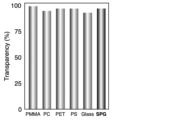
- FIG. 1 Schematic diagram showing the polymer network of supramolecular polymer glass (SPG). Photograph showing liquid-liquid phase separation during the production of supramolecular polymer glass (SPG). Micrograph of supramolecular polymer micelles. A graph showing the optical transparency of various plastics and first generation supramolecular polymer glass.
- PMMA polymethylmethacrylate
- PC polycarbonate
- PET polyethylene terephthalate
- PS polystyrene
- Glass inorganic glass
- SPG supramolecular polymer glass.
- First-generation monomer Gu M Gen.I -(9-2) is used.
- Rightmost: First-generation monomer Gu M Gen.I -(9-4) is used.
- Second from the right: First-generation monomer Gu M Gen.I -(9-2) is used.
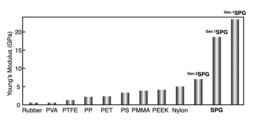
- Rubber rubber
- PVA polyvinyl acetate
- PTFE polytetrafluoroethylene
- PP polypropylene
- PET polyethylene terephthalate
- PS polystyrene
- PMMA polymethyl methacrylate
- PEEK aromatic polyether ketone
- Nylon nylon
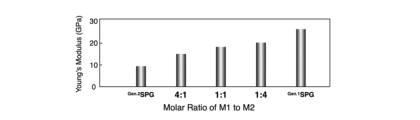
- SPG supramolecular polymer glass Young's modulus of the first generation supramolecular polymer glass ( Gen.1 SPG, far right), the second generation supramolecular polymer glass ( Gen.2 SPG, far left), and three third generation supramolecular polymer glasses ( Gen.2 SPG and Gen.1 SPG, three bars in the middle).
- the mixed molar ratio of the guanidine compounds (referred to as M1 and M2, respectively) used in the production of each of the third generation supramolecular polymer glasses was changed. From left to right, the molar ratios of M1:M2 are 4:1, 1:1, and 1:4.
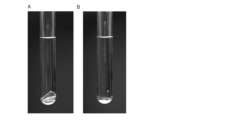
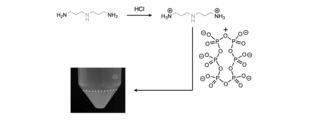
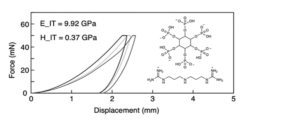
- A (B) Photographs showing the underwater processability of the first generation supramolecular polymer glass (A) 10 s after immersion in water (B) 2 h after immersion in water. Synthesis of supramolecular polymer glasses using diamines and sodium hexametaphosphate. Measurement results of an indentation experiment on an SPG consisting of Gu M Gen.II -1 and phytic acid. Force: Force, Displacement: Displacement.
- the upper or lower limit of a certain numerical range can be arbitrarily combined with the upper or lower limit of a numerical range of another stage.
- the upper or lower limit of the numerical range may be replaced with a value shown in an example or a value that can be unambiguously derived from an example.
- a numerical value connected with " ⁇ " means a numerical range that includes the numerical values before and after " ⁇ " as the upper and lower limits.
- complex refers to a material formed by the bonding of two or more types of substances. Each substance that constitutes a complex may be referred to as a "monomer.” A complex formed by the bonding of two or more types of molecules may be referred to as a "molecular assembly.”
- silica refers to a polymer in which two or more types of monomers are bonded together through reversible interactions.
- Reversible interactions include non-covalent bonds such as hydrogen bonds, ionic bonds, hydrophobic interactions, electrostatic interactions, and/or van der Waals forces.
- supramolecular plastic refers to a polymer formed by bonding two or more types of monomers through reversible interactions, or a composition containing the same.
- a “supramolecular plastic” may be the same as a “supramolecular polymer", or may contain substances other than a “supramolecular polymer”.
- a “supramolecular plastic” may be a synthetic resin.
- glass refers to an amorphous solid material.
- Amorphous is also called amorphous, and refers to a disordered atomic arrangement in which no clear diffraction phenomenon is observed in X-ray diffraction.
- organic cation refers to a cation whose structure contains at least one carbon atom.
- oxyanion refers to an anion having oxygen bound to a nonmetal.
- a complex that contains an organic cation formed by ionizing a compound having at least two amino groups or guanidino groups, and an oxyanion, and the organic cation and the oxyanion are bonded together by ionic bonds and hydrogen bonds.
- the supramolecular polymer (1) is a polymer in which an organic cation (2) formed by ionizing a compound having at least two amino groups or a compound having at least two guanidino groups is bonded to an oxyanion (3) by a non-covalent bond, so that the bond between these monomers is strong and the mechanical strength of the supramolecular polymer is higher than that of conventional supramolecular polymers.
- the organic cation and the oxyanion are easier to separate than when the monomers are covalently bonded to each other, so that the polymer has excellent recyclability.
- the organic cation and the oxyanion can be separated, for example, by immersing the polymer in water or an aqueous solution, which is a polar medium, for a certain period of time or more.
- the compound having at least two amino groups excludes compounds having at least two guanidino groups.
- the organic cation and the oxyanion are bonded to each other by an ionic bond and a hydrogen bond represented by one or more of the following formulas (1) to (4):
- R is any monovalent organic group.
- an organic group refers to a group having one or more carbon atoms.
- the R may be the same or different.
- hydrogen bonds are formed between the hydrogen atoms derived from the two amino groups of the amine compound and the oxygen atoms of the oxyanion, and an ionic bond is formed between the ammonium cation and the oxyanion.
- the compound having at least two amino groups is an amine compound represented by the following formula (5):
- R is a substituted or unsubstituted hydrocarbon chain.
- the hydrocarbon chain is substituted, some of the methylene groups of the hydrocarbon chain are replaced with a group selected from the group consisting of -NH-, -N(alkyl group)-, -O-, -COO-, -O-COO-, -NHCO-, -S-, cycloalkane, cycloalkanone, benzene, a group represented by formula (7), and a substituted or unsubstituted -N(guanidyl alkylene group)-.
- the -N(guanidyl alkylene group) is substituted, some of the methylene groups of the guanidyl alkylene group are replaced with the same group as the group replacing some of the methylene groups of the hydrocarbon chain.
- R 1 and R 2 are each independently an alkyl group or a phenyl group having 1 to 6 carbon atoms
- R 3 and R 4 are each independently an alkyl group or a phenyl group having 1 to 6 carbon atoms
- m is 1 to 6
- n is 1 to 6
- p is an integer in the range of 0 to 20
- q is an integer in the range of 0 to 20, with the proviso that p+q is an integer of 1 or greater.
- the hydrocarbon chain of R may be an aliphatic hydrocarbon chain, an alicyclic hydrocarbon chain, an aromatic hydrocarbon chain, or a combination thereof.
- the aliphatic hydrocarbon chain may be a saturated linear aliphatic hydrocarbon chain or an unsaturated aliphatic hydrocarbon chain, and may be linear or branched.
- the hydrocarbon chain is a linear or branched saturated hydrocarbon chain.
- the number of substituted methylene groups is not limited, but is preferably 1 to 20, more preferably 1 to 10, and even more preferably 1 to 5.
- the alkyl group of -N(alkyl group), which is a substituent of the methylene group of the hydrocarbon chain is preferably a linear or branched alkyl group having 1 to 6 carbon atoms.
- the alkylene group of -N(guanidyl alkylene group), which is a substituent of the methylene group of the hydrocarbon chain is preferably a linear or branched alkylene group having 1 to 6 carbon atoms.
- the alkyl groups having 1 to 6 carbon atoms for R 1 and R 2 may be linear, branched, or cyclic.
- the alkyl groups having 1 to 6 carbon atoms for R 3 and R 4 may be linear, branched, or cyclic.
- the alkyl groups having 1 to 6 carbon atoms for R 1 , R 2 , R 3 , and R 4 are each independently linear alkyl groups having 1 to 6 carbon atoms.
- p and q are both integers in the range of 1 to 20.
- one of p and q is an integer in the range of 1 to 20, and one of p and q is 0.
- a compound having at least two amino groups may have two, three, or four or more amino groups in one molecule.
- an amine compound When an amine compound has three amino groups in one molecule, it usually has greater mechanical strength than when it has two amino groups in one molecule. Also, when a guanidine compound has a nitrogen atom in the hydrocarbon chain with a -NH- substituent, it has improved solubility in water and is more likely to become amorphous.
- the compound having at least two guanidino groups is a guanidine compound represented by the following formula (6):
- R is a substituted or unsubstituted hydrocarbon chain.
- the hydrocarbon chain is substituted, some of the methylene groups of the hydrocarbon chain are replaced with a group selected from the group consisting of -NH-, -N(alkyl group)-, -O-, -COO-, -O-COO-, -NHCO-, -S-, cycloalkane, cycloalkanone, benzene, a group represented by formula (7), and a substituted or unsubstituted -N(guanidyl alkylene group)-.
- the -N(guanidyl alkylene group) is substituted, some of the methylene groups of the guanidyl alkylene group are replaced with the same group as the group replacing some of the methylene groups of the hydrocarbon chain.
- R 1 and R 2 are each independently an alkyl group or a phenyl group having 1 to 6 carbon atoms
- R 3 and R 4 are each independently an alkyl group or a phenyl group having 1 to 6 carbon atoms
- m is 1 to 6
- n is 1 to 6
- p is an integer in the range of 0 to 20
- q is an integer in the range of 0 to 20, with the proviso that p+q is an integer of 1 or greater.
- the hydrocarbon chain of R may be an aliphatic hydrocarbon chain, an alicyclic hydrocarbon chain, an aromatic hydrocarbon chain, or a combination thereof.
- the aliphatic hydrocarbon chain may be a saturated linear aliphatic hydrocarbon chain or an unsaturated aliphatic hydrocarbon chain, and may be linear or branched.
- the hydrocarbon chain is a linear or branched saturated hydrocarbon chain.
- the number of substituted methylene groups is not limited, but is preferably 1 to 20, more preferably 1 to 10, and even more preferably 1 to 5.
- the alkyl group of -N(alkyl group), which is a substituent of the methylene group of the hydrocarbon chain is preferably a linear or branched alkyl group having 1 to 6 carbon atoms.
- the alkylene group of -N(guanidyl alkylene group), which is a substituent of the methylene group of the hydrocarbon chain is preferably a linear or branched alkylene group having 1 to 6 carbon atoms.
- the alkyl groups having 1 to 6 carbon atoms for R 1 and R 2 may be linear, branched, or cyclic.
- the alkyl groups having 1 to 6 carbon atoms for R 3 and R 4 may be linear, branched, or cyclic.
- the alkyl groups having 1 to 6 carbon atoms for R 1 , R 2 , R 3 , and R 4 are each independently linear alkyl groups having 1 to 6 carbon atoms.
- p and q are both integers in the range of 1 to 20.
- one of p and q is an integer in the range of 1 to 20, and one of p and q is 0.
- a guanidine compound having at least two guanidino groups may have two, three, or four or more guanidino groups in one molecule.
- guanidine compound When a guanidine compound has three guanidino groups in one molecule, it usually has greater mechanical strength than when it has two guanidino groups in one molecule. In addition, when a guanidine compound has a nitrogen atom in the hydrocarbon chain with a -NH- substituent, it is more soluble in water and more likely to become amorphous.
- the guanidine compound is the guanidine compound (I) below, the guanidine compound (II) below, or includes both the guanidine compound (I) and the guanidine compound (II).
- Guanidine compounds of formula (I) A compound represented by formula (6), in which A is a substituted or unsubstituted hydrocarbon chain, and when the hydrocarbon chain is substituted, part of the methylene groups of the hydrocarbon chain is substituted with a group selected from the group consisting of -NH-, -N(alkyl)-, -O-, -COO-, -O-COO-, -NHCO-, -S-, cycloalkane, cycloalkanone, benzene, and substituted or unsubstituted -N(guanidyl alkylene group)-, and when the -N(guanidyl alkylene group) is substituted, part of the methylene groups of the guanidyl alkylene group is substituted with the same group as the group substituting part of the methylene groups of the hydrocarbon chain, except for a compound in which part of the methylene groups of the hydrocarbon chain is substituted with a group represented
- Guanidine compound (II) A compound represented by formula (6), wherein A is a substituted hydrocarbon chain, and some of the methylene groups of the hydrocarbon chain are substituted with a group represented by formula (7).
- the supramolecular polymer produced using the guanidine compound (I) has high mechanical strength, but is also easily soluble in water and has high underwater processability.
- organic cations formed by protonating the guanidine compound (I) include the following organic cations:
- the supramolecular polymer produced using the guanidine compound (II) has lower solubility in water but tends to have lower mechanical strength than the supramolecular polymer produced using the guanidine compound (I).
- the supramolecular polymer produced using both the guanidine compound (I) and the guanidine compound (II) can improve the mechanical strength of the supramolecular polymer produced using the guanidine compound (II) while suppressing the solubility in water of the supramolecular polymer produced using the guanidine compound (I).
- each of the guanidine compound (I) and the guanidine compound (II) may be any combination of the guanidine compound (I) and the guanidine compound (II) disclosed herein.
- Each of the guanidine compound (I) and the guanidine compound (II) may be one type or two or more types.
- the molar ratio of the guanidine compound (I) to the guanidine compound (II) for producing the supramolecular polymer is not particularly limited, but is preferably 90:10 to 10:90, and more preferably 20:80 to 80:20.
- organic cations formed by protonating the guanidine compound (II) include the organic cations represented by the following formulas (9-1) to (9-10).
- n is an integer from 1 to 100.
- n is an integer between 1 and 100.
- Guanidine is a highly safe substance that is also present in the body. Guanidine compounds may be synthesized by known methods or commercially available products may be used.
- Oxyanion refers to an anion having a structure consisting of a central element and oxygen bonded to the central element.
- the central element may be either a metal element or a nonmetal, but sulfur, phosphorus, silicon, or carbon are more preferred in terms of safety and low environmental impact.
- the oxyanion is a sulfur, phosphorus, silicon, or carbon oxyanion.
- the oxyanion is generated by ionization of a sulfur, phosphorus, silicon, or carbon oxyanion-containing compound.
- the sulfur, phosphorus, silicon, or carbon oxyanion-containing compound includes, but is not limited to, a salt selected from the group consisting of sulfate, sulfite, sulfonate, protonated phosphate, phosphate, polyphosphate, metaphosphate, phosphonite, oxyphosphate, silicate, carboxylate, carbonate, and combinations thereof.
- the salt is preferably a metal salt, and preferred metals constituting the metal salt include, but are not limited to, sodium, potassium, lithium, calcium, strontium, barium, magnesium, and the like.
- the supramolecular polymer may include one type of oxyanion, or may include two or more types of oxyanions.
- the sulfur, phosphorus, silicon, or carbon oxyanion-containing compound includes, but is not limited to, a salt selected from the group consisting of sulfate esters, phosphodiesters, silicates, and carboxylate esters, and combinations thereof.
- the oxyanion is a polyoxyanion having two or more central elements in one molecule. Since the oxyanion is a divalent or higher anion, it can bond to the organic cation, which is the partner molecule, at two or more points, and a network structure can be formed by bonding the organic cation and the oxyanion.
- the oxyanion is a cyclic phosphate anion represented by the following formula (10), a linear phosphate anion represented by the following formula (11), an anion of phytic acid, or an anion of a carboxylate.
- n is an integer from 1 to 4.
- n is an integer from 1 to 1000
- n is preferably 1 or 4, and more preferably n is 4.
- Sodium hexametaphosphate which is used as a raw material for the hexaphosphate ion when n is 4, is a compound approved by the U.S. Food and Drug Administration (FDA) and is highly safe.
- FDA U.S. Food and Drug Administration
- an oxyanion in which n is 4 is more preferable.
- the upper limit of n is preferably 100.
- the linear phosphate anion represented by formula (11) preferably has a value of n between 1 and 1000.
- the sulfur, phosphorus, silicon, or carbon oxyanion-containing compound may be synthesized by a known method, or a commercially available product may be used.
- the anion of phytic acid is the anion produced by deprotonating phytic acid represented by formula (12).
- Carboxylic acid anions are also called carbanions, and include, but are not limited to, anions generated by deprotonating carboxylic acids represented by formulas (13-1) and (13-2) and an anion of alginic acid represented by formula (14).
- the oxyanion-containing compound is a polysaccharide, and the oxyanion is an oxyanion generated by ionization of the polysaccharide.
- the polysaccharide is a polysaccharide having an anionic functional group, more preferably an acidic polysaccharide having an anionic functional group.
- an anionic functional group may be an acid group, a salt, an acid ester, or a combination thereof.
- the salt may be selected from the group consisting of sulfate, sulfite, sulfonate, protonated phosphate, phosphate, polyphosphate, metaphosphate, phosphonite, oxyphosphate, silicate, carboxylate, carbonate, and combinations thereof, but is not limited thereto.
- the salt is preferably a metal salt, and preferred metals constituting the metal salt include, but are not limited to, sodium, potassium, lithium, calcium, strontium, barium, magnesium, and the like.
- Preferred anionic functional groups include, for example, sulfate groups, sulfate salts, sulfate esters, carboxy groups, carboxylates, carboxylate esters, sulfo groups, sulfonates, sulfonic acid esters, phosphoric acid groups, phosphoric acid salts, phosphoric acid esters, phosphonic acid groups, phosphonate salts, phosphonic acid esters, or combinations thereof.
- the polysaccharide has at least two anionic functional groups selected from the group consisting of sulfate groups, sulfate salts, sulfate esters, carboxy groups, carboxylates, carboxylate esters, sulfo groups, sulfonates, sulfonic acid esters, phosphoric acid groups, phosphoric acid salts, phosphoric acid esters, phosphonic acid groups, phosphonate salts, phosphonic acid esters, and phosphodiesters.
- the at least two anionic functional groups may be of the same type or different types.
- the polysaccharide having an anionic functional group preferably contains one anionic functional group per monomer unit, which is a constituent unit of the polysaccharide.
- All of the monomer units may have an anionic functional group, or a part of the monomer units may have an anionic functional group.
- At least two anionic functional groups may be directly bonded to a five-membered or six-membered ring containing carbon of the monomer unit, which is a constituent unit of the polysaccharide, or may be bonded to the five-membered or six-membered ring via a substituted or unsubstituted hydrocarbon chain.
- the hydrocarbon chain include, but are not limited to, an alkylene group (e.g., a methylene group).
- Examples of groups obtained when the at least two functional groups are ionized include a sulfate ester group (-O - SO3- ), a sulfonic acid group ( -SO3- ), a carboxylate group ( -COO- ), a phosphate group ( -O-PO32- ) , and a phosphoryl group (-PO32- ) .
- the polysaccharide having an anionic functional group may be a natural polysaccharide or a synthetic polysaccharide.
- the polysaccharide having an anionic functional group may be linear, branched, or cyclic.
- polysaccharides include, but are not limited to, carboxymethylcellulose, gellan gum, alginic acid, sulfated alginic acid, carrageenan, xanthan gum, chondroitin sulfate, heparin, hyaluronic acid, pectinic acid, gum arabic, agar, tragacanth gum, sodium dextran sulfate, and sodium sulfated cyclodextrin.
- the number of monomer units in polysaccharides that ionize to generate oxyanions, particularly polysaccharides having anionic functional groups is not particularly limited, but is preferably 2 to 100,000.
- the molecular weight of polysaccharides that ionize to generate oxyanions, particularly polysaccharides having an anionic functional group is not particularly limited, but is preferably 1,000 to 10,000,000, more preferably 5,000 to 1,000,000 in terms of weight average molecular weight.
- the weight average molecular weight of polysaccharides can be calculated by gel permeation chromatography (GPC) measurement.
- the oxyanions generated from the above-mentioned polysaccharides that ionize to generate oxyanions, particularly polysaccharides having anionic functional groups can form complexes by bonding through ionic bonds and hydrogen bonds with organic cations formed by ionization of any compound having at least two amino groups or guanidino groups described herein.
- the Young's modulus of the supramolecular polymer measured under the following measurement conditions for the indentation experiment is 5 GPa or more, preferably 10 GPa or more, more preferably 15 GPa or more, and more preferably 20 GPa or more.
- Measurement conditions The supramolecular polymer is cut into a length and width of 1 cm x 1 cm and a thickness of 0.5 mm to produce a sample.
- the Young's modulus of this sample was determined using an indentation hardness tester ENT-NEXUS (ELIONIX Inc.) at a measurement temperature of 20°C. A diamond indenter tip was used for indentation.
- the test load was 50 mN, the loading time was 20,000 msec, the holding time was 5,000 msec, and the unloading time was 20,000 msec.
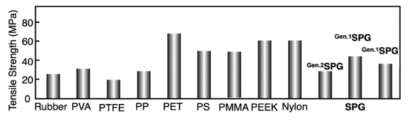
- the tensile strength of the supramolecular polymers measured under the following measurement conditions is preferably 5 MPa or more and 50 MPa or less. These values are comparable to the tensile strength of some known covalently polymerized synthetic resins, and the tensile strength of the supramolecular polymer glass (SPG) may be the same as or greater than the tensile strength of such synthetic resins.
- Measurement conditions The supramolecular polymer is cut into a length and width of 2 mm x 35 mm and a thickness of 0.5 mm to prepare a sample. The test speed is 10 mm/s. The sensor of the tensile machine indicates 500 N. The measurement temperature is 20°C.
- the supramolecular polymer glass can be processed in water at 20°C.
- the organic cations and the oxyanions are bonded by ionic and hydrogen bonds, so that when placed in water for a certain period of time, the supramolecular polymer binds with water, swells, becomes soft, and can be processed by hand or machine.
- an electrolyte such as sodium chloride
- the supramolecular polymer can be moistened with water and molded into any shape, such as a flat plate or a sphere.
- the molded supramolecular polymer can also be dried to maintain the shape of the molded supramolecular polymer.
- the supramolecular polymer of this embodiment may be 100% decomposable in water, which is advantageous in that such a supramolecular polymer has a low environmental impact.
- supramolecular polymer glasses can be formed into a variety of shapes at temperatures above their glass transition temperature.
- supramolecular polymer glass has self-healing properties. For example, if a supramolecular polymer is broken into two pieces, the two pieces will bond together if the broken surfaces are moistened with water and placed in contact for a period of time.
- the Young's modulus of the supramolecular polymer at 20°C is 5 GPa or more, preferably 10 GPa or more, more preferably 15 GPa or more, more preferably 20 GPa or more, and the tensile strength of the supramolecular polymer at 20°C is 5 MPa or more and 50 GPa or less.
- a supramolecular polymer of this configuration has high rigidity and high mechanical strength against tension.
- the supramolecular polymer glass is insoluble in organic solvents, such as dichloromethane, chloroform, methanol, ethanol, acetone, hexane, dimethylformamide, dimethylsulfoxide, ethyl acetate, diethyl ether, and tetrahydrofuran.
- organic solvents such as dichloromethane, chloroform, methanol, ethanol, acetone, hexane, dimethylformamide, dimethylsulfoxide, ethyl acetate, diethyl ether, and tetrahydrofuran.
- the optical transmittance of a 0.5 mm thick supramolecular polymer glass at 400 to 800 nm is 95% or more.
- Such supramolecular polymers have excellent transparency.
- the supramolecular polymer which is a complex according to the first aspect of the present invention, has one or more of the following advantages [1] to [8]. In a particularly preferred embodiment, it has all advantages except [5] or all advantages [1] to [8].
- [1] Quantitative Green Synthesis An organic cation formed by ionizing a compound having at least two amino or guanidino groups is non-covalently bonded to an oxyanion in a molar ratio of 1:1 to produce a supramolecular polymer.
- the supramolecular polymer can be synthesized without the need for heating or pressure. In addition, the supramolecular polymer can be synthesized in water or an aqueous solvent, and no organic solvent is required.
- Green processing Supramolecular polymers can be processed in water. No heating is required for processing.
- Ultra-toughness The supramolecular polymer has a Young's modulus at 20° C.
- organic solvents include dichloromethane, chloroform, methanol, ethanol, acetone, hexane, dimethylformamide, dimethyl sulfoxide, ethyl acetate, diethyl ether, and tetrahydrofuran.
- Organic solvents include dichloromethane, chloroform, methanol, ethanol, acetone, hexane, dimethylformamide, dimethyl sulfoxide, ethyl acetate, diethyl ether, and tetrahydrofuran.
- the organic cation and the oxyanion in the complex of the first aspect may be bonded by additional covalent or non-covalent bonds other than ionic bonds and hydrogen bonds.
- additional covalent or non-covalent bonds can be formed by introducing functional groups to the organic cation and/or the oxyanion by known methods.
- the composite of the first aspect is a supramolecular polymer. In some embodiments, the composite of the first aspect is a supramolecular plastic. In some embodiments, the composite of the first aspect is a supramolecular polymer glass. A supramolecular polymer composite is preferred in that it has a lower or no environmental impact in its manufacture and processing.
- a composition containing the composite of the first aspect may further contain a polymer such as a synthetic resin, an elastomer, or a rubber.
- the composition may further contain an additive other than the polymer.
- additives include, but are not limited to, synthetic resins, elastomers, rubbers, surfactants, lubricants, dispersants, antioxidants, light stabilizers, UV absorbers, colorants, preservatives, and fragrances.
- an article that includes the composite of the first aspect.
- the article may include a member other than the composite of the first aspect.
- articles include, but are not limited to, containers, packaging, metal machinery industrial products (industrial machinery, electrical machinery, precision machinery, electrical machinery), home appliances, personal computers and mobile phones, kitchen utensils, cleaning supplies, stationery, toys, sporting goods, furniture, clothing, detergents, pharmaceuticals, cosmetics, coatings, building materials, vehicles (light vehicles, vehicles) and parts thereof, etc.
- a method for producing a complex comprising mixing a compound having at least two amino groups or guanidino groups with an oxyanion-containing compound in water or an aqueous solution, and generating a complex in which an organic cation formed by ionization of the compound having at least two amino groups or guanidino groups and an oxyanion formed by ionization of the oxyanion-containing compound are bonded by ionic bonds and hydrogen bonds.
- the complex may be the complex of the first aspect above.
- the complex is a supramolecular polymer.
- the complex is a supramolecular polymer glass.
- the compound having at least two amino groups or guanidino groups, the oxyanion-containing compound, and the complex are as described for the complex of the first embodiment.
- the supramolecular polymer, which is the complex of the first embodiment can be produced in one step.
- the organic cation formed by ionization of the compound having at least two amino groups or guanidino groups and the oxyanion formed by ionization of the oxyanion-containing compound form ionic bonds and hydrogen bonds to form a supramolecular polymer
- the anion generated by ionization of the compound having at least two amino groups or guanidino groups and the organic cation generated by ionization of the oxyanion-containing compound are neutralized and dissolved in water.
- the supramolecular polymer undergoes liquid-liquid phase separation from the solvent, the supramolecular polymer can be easily separated or recovered from the water or aqueous solution by known methods such as centrifugation and recovery.
- a supramolecular polymer having high mechanical strength while the monomer molecules are non-covalently bonded is obtained.
- the supramolecular polymer After the supramolecular polymer is separated or recovered from the water or aqueous solution, it can also be molded into any shape such as a flat plate or a sphere. Any molding method such as press molding, injection molding, and extrusion molding can be used as a molding method.
- the method for producing the composite of this embodiment is environmentally friendly in that it can be carried out in an aqueous system and the use of organic solvents can be avoided. In addition, no heating or pressure is required, and the composite can be produced at temperatures of 5 to 40°C under ambient or atmospheric pressure. In addition, it is low cost in that it does not require the use of expensive rare earth metal catalysts.
- a use of a compound having at least two amino or guanidino groups and a sulfur, phosphorus, silicon or carbon oxyanion-containing compound for producing a supramolecular polymer composite is provided.
- the compound having at least two amino or guanidino groups and the sulfur, phosphorus, silicon or carbon oxyanion-containing compound are as described for the composite of the first aspect.
- Step I In an oven-dried 200 mL three-neck round-bottom flask, S - methylisothiourea.0.5H2SO4 (13.9 g, 0.1 mol) was dissolved in 50 mL of water and ethanol (v/v 1:3). To this solution was added 10 mL of 1,3-diaminopropane. After stirring for a few minutes, water and ethanol (v/v 1:3) was poured in and stirring was continued for another 30 minutes. The crude residue was filtered, washed with water, and recrystallized to give the desired product in crystalline form (yield: 72% based on 1,3-diaminopropane). The product was identified by 1H NMR.
- Step II The product obtained in step I (7.4 g) and S-methylisothiourea 0.5 H 2 SO 4 (4.81 g, 34.5 mmol) were dissolved in 50 mL of water. 1.5 mL of aqueous sodium hydroxide (5 M) was added dropwise to the mixture and refluxed for 8 hours. The reaction mixture was cooled to room temperature. The flask was placed in a freezer at 4° C.
- Example 2 Synthesis of supramolecular polymer glass (SPG) 1.
- Synthesis of first generation supramolecular polymer glass Gen.I SPG
- the first generation supramolecular polymer glass is synthesized using the first generation monomer prepared in Example 1.
- the synthesis of this first generation supramolecular polymer glass can be carried out in an aqueous system, and does not involve any organic solvent or expensive rare earth metal catalyst.
- the supramolecular polymer glass was synthesized in a flask similar to Example 1, unless otherwise specified.
- each guanidinium-based first generation monomer ( Gu M Gen.I ) prepared in Example 1 was added to an aqueous solution of sodium hexametaphosphate (or sodium trimetaphosphate) so that the theoretical molar ratio of the guanidinium monomer to the phosphoric acid diester was 1:1.
- the mixed aqueous solution immediately underwent liquid-liquid phase separation to produce a cloudy supramolecular polymer emulsion ( Figures 2A and 2B, in Figure 2A, phase separation occurs at the interface 12 between the water layer 10 and the layer of viscous liquid 11 consisting of the supramolecular polymer glass).
- the supramolecular polymer emulsion was concentrated by centrifugation to a viscous liquid, which was rinsed with pure water and dried in vacuum to obtain the first generation supramolecular polymer glass ( Gen.I SPG) with a yield of 98%.
- Second generation supramolecular polymer glass is synthesized using second generation monomers.
- each guanidinium-based second generation monomer ( Gu M Gen.II ) prepared in Example 1 was added to an aqueous solution of sodium hexametaphosphate (or sodium trimetaphosphate) so that the theoretical molar ratio of the guanidinium monomer to the phosphoric acid diester was 1:1. Regardless of which second generation monomer was used, the mixed aqueous solution immediately underwent liquid-liquid phase separation, resulting in a cloudy supramolecular polymer emulsion.
- the supramolecular polymer emulsion was concentrated by centrifugation to a viscous liquid, which was rinsed with pure water and dried in vacuum to obtain a second generation supramolecular polymer glass ( Gen.II SPG) with a yield of 72%.
- Gen.II SPG second generation supramolecular polymer glass
- aqueous solution of sodium hexametaphosphate (or sodium trimetaphosphate) was added with a combination of the guanidinium-based first generation monomer ( GuM Gen.I ) and each second generation monomer ( GuM Gen.II ) prepared in Example 1, so that the theoretical molar ratio of the guanidinium monomer to the phosphoric acid diester was 1:1.
- the mixed aqueous solution immediately underwent liquid-liquid phase separation, resulting in a cloudy supramolecular polymer emulsion.
- the supramolecular polymer emulsion was concentrated by centrifugation to a viscous liquid, which was rinsed with pure water and dried in vacuum to obtain a third generation supramolecular polymer glass ( Gen.III SPG) with a yield of 90%.
- Gen.III SPG third generation supramolecular polymer glass
- Example 3 Evaluation of physical properties of supramolecular polymer glass (SPG) 1.
- SPG supramolecular polymer glass
- the optical transmittance of the SPG films ranged from 90% to 97%, depending on the molecular structure of the monomer, and was comparable to that of commercially available transparent resin films (polymethylmethacrylate (PMMA)), polycarbonate (PC), polyethylene terephthalate (PET), polystyrene (PS), and inorganic glass (Glass) (Figure 3).
- PMMA polymethylmethacrylate
- PC polycarbonate
- PET polyethylene terephthalate
- PS polystyrene
- Glass inorganic glass
- SPG supramolecular polymer glass
- the tensile strength of commercially available materials was the value listed on Wikipedia and in the public literature.
- the tensile strength was measured by preparing samples with a length of 35 mm, a width of 2 mm, and a thickness of 0.5 mm using a tensile machine at a test speed of 10 mm/s. (result)
- the first generation supramolecular polymer glass can maintain its shape and withstand a load even when a weight is placed on it.
- the Young's modulus of the SPG films exceeded 5 Gpa for the second-generation supramolecular polymer glass and exceeded 15 Gpa for the first-generation supramolecular polymer glass, both of which were higher than those of commercially available resin films.
- the tensile strength of the first and second generation supramolecular polymer glasses was in the range of 20 to 50 GPa, which was comparable to that of commercially available resin films.
- Tg glass transition temperatures of the first to third generation SPGs produced in Example 2 ranged from 35° C. to 125° C.
- Each SPG could be processed into various shapes or patterns by hot pressing at temperatures around Tg , similar to conventional synthetic resins such as PET.
- SPG supramolecular polymer glass
- the SPG based on Gu M Gen.I -2 prepared in Example 2 was able to completely self-heal after being broken into two pieces by applying pressure under ambient conditions (20°C, humidity 60%). After self-healing, the mechanical properties of the SPG were not impaired.
- all of the SPGs prepared in Example 2 can self-heal with the assistance of water or moisture.
- the first generation supramolecular polymer glass Gen.I SPG could self-heal by pressing for 30 minutes under high humidity (RH 80%) conditions
- the second generation supramolecular polymer glass Gen.II SPG could self-heal by pressing for 20 minutes under water spray.
- Gen.I SPG Underwater processability of first-generation supramolecular polymer glass ( Gen.I SPG) When each of the first-generation supramolecular polymer glasses, Gen.I SPG, produced in Example 2, was immersed in water, it gradually softened (FIG. 8(A)), and after several hours, it became a viscous supramolecular polymer liquid (FIG. 8(B)). When this viscous liquid was dried in a Teflon (registered trademark) container at 80°C for 6 hours in a vacuum, Gen.I SPG with mechanical strength was obtained without any loss of monomer or mechanical properties. Gen.I SPG can also be softened adhesively by spraying water, and can be molded into various structures.
- Example 4 Synthesis of Supramolecular Polymer Glasses Using Ammonium-Based Monomers
- the ammonium groups of ammonium-based molecules interact with oxyanions such as carboxylate and phosphodiester groups to form cross-linked supramolecular networks, giving rise to SPGs.
- diamine monomer was dissolved in ethanol at 0.06 M, and 0.2 M sodium hexametaphosphate solution was added to the prepared diamine monomer solution.
- the solution immediately became cloudy, and liquid-liquid phase separation was observed instantly.
- clear liquid-liquid phase separation was observed as shown by the dotted line in the lower left photograph of Figure 9.
- the lower viscous liquid was washed three times with 50 mL of deionized water. After vacuum drying at 80°C for 3 hours, a transparent glass was obtained with a yield of approximately 98%.
- SPGs Synthesis of SPGs using renewable feedstock monomers Water-soluble small biomolecules or biopolymers are abundantly stored on Earth, and they may also be capable of forming SPGs using our strategy.
- SPGs were prepared using two renewable feedstock monomers for oxoanions, phytic acid and alginic acid.
- Phytic acid is a 6-fold dihydrogen phosphate ester of inositol and is the main storage form of phosphorus in cereals, legumes, oilseeds, and nuts.
- Alginic acid is a naturally occurring edible polysaccharide purified from brown algae and certain bacterial genera that occur in nature. It is rich in carboxyl groups and can form salt bridges with ammonium and guanidinium groups. Alginic acid can also be incorporated into Gen.1 and Gen.2 SPG as an additive to reinforce the mechanical properties of SPG.
- Phytic acid-based SPG An aqueous solution of guanidinium monomers was added to an aqueous solution of phytic acid so that the stoichiometric molar ratio of guanidino groups to phosphate groups (guanidinium ions to phosphate ions) was 1:1.
- This mixed aqueous solution instantly underwent liquid-liquid phase separation, resulting in a cloudy supramolecular polymer emulsion.
- This supramolecular polymer emulsion was concentrated into a viscous liquid by centrifugation, and the viscous liquid was washed with Milli-Q water and then vacuum dried to obtain supramolecular polymer glass (SPG).
- SPG supramolecular polymer glass
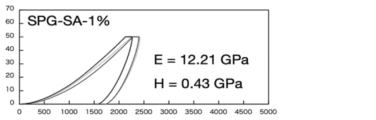
- the Young's modulus of SPG was high, exceeding 10 GPa in all samples (12.21 Gpa, 17.51 Gpa, and 16.16 GPa in Figures 11A, B, and C, respectively).
- Example 6 Synthesis of SPG using natural polysaccharides
- An aqueous solution of chondroitin sulfate and an aqueous solution of each guanidinium-based first generation monomer ( Gu M Gen.I ) prepared in Example 1 were mixed so that the theoretical molar ratio of the guanidinium monomer to the anionic functional group in chondroitin sulfate was 1:1.
- the mixed aqueous solution underwent liquid-liquid phase separation, resulting in a turbid supramolecular polymer emulsion ( Figure 12).
- the supramolecular polymer emulsion was concentrated by centrifugation to a viscous liquid, which was rinsed with pure water and dried in vacuum to obtain a supramolecular polymer glass with a yield of 95% ( Figure 13).
- Example 7 Synthesis of SPG using natural polysaccharides
- An aqueous solution of sodium heparin sulfate and an aqueous solution of each guanidinium-based first generation monomer ( Gu M Gen.I ) prepared in Example 1 were mixed so that the theoretical molar ratio of the guanidinium monomer to the anionic functional group in sodium heparin sulfate was 1:1.
- the mixed aqueous solution underwent liquid-liquid phase separation to produce a turbid supramolecular polymer emulsion ( Figure 14).
- the supramolecular polymer emulsion was concentrated by centrifugation to a viscous liquid, which was rinsed with pure water and dried in vacuum to obtain a supramolecular polymer glass with a yield of 98% ( Figure 15).
- Example 8 Synthesis of SPG using synthetic polysaccharides
- An aqueous solution of sodium dextran sulfate and an aqueous solution of each guanidinium-based first generation monomer ( Gu M Gen.I ) prepared in Example 1 were mixed so that the theoretical molar ratio of the guanidinium monomer to the anionic functional group in sodium dextran sulfate was 1:1.
- the mixed aqueous solution underwent liquid-liquid phase separation to produce a turbid supramolecular polymer emulsion ( Figure 16).
- the supramolecular polymer emulsion was concentrated by centrifugation to a viscous liquid, which was rinsed with pure water and dried in vacuum to obtain a supramolecular polymer glass with a yield of 100% ( Figure 17).
- Example 9 Synthesis of SPG using synthetic polysaccharides
- An aqueous solution of ⁇ -cyclodextrin (product number CAS7585-39-9) in which some of the hydrogen atoms of the hydroxyl groups were replaced with -SO 3 Na was mixed with an aqueous solution of each guanidinium-based first generation monomer ( Gu M Gen.I ) prepared in Example 1 so that the theoretical molar ratio of the guanidinium monomer to the anionic functional group in ⁇ -cyclodextrin was 1:1.
- the mixed aqueous solution underwent liquid-liquid phase separation, resulting in a turbid supramolecular polymer emulsion ( Figure 18).
- the supramolecular polymer emulsion was concentrated by centrifugation to a viscous liquid, which was rinsed with pure water and dried in vacuum to obtain a supramolecular polymer glass with a yield of 98% ( Figure 19).
Landscapes
- Chemical & Material Sciences (AREA)
- Organic Chemistry (AREA)
- Health & Medical Sciences (AREA)
- Chemical Kinetics & Catalysis (AREA)
- Polymers & Plastics (AREA)
- Medicinal Chemistry (AREA)
- Life Sciences & Earth Sciences (AREA)
- Molecular Biology (AREA)
- General Health & Medical Sciences (AREA)
- Biochemistry (AREA)
- Engineering & Computer Science (AREA)
- Materials Engineering (AREA)
- Dermatology (AREA)
- Inorganic Chemistry (AREA)
- Compositions Of Macromolecular Compounds (AREA)
Priority Applications (4)
| Application Number | Priority Date | Filing Date | Title |
|---|---|---|---|
| JP2024566144A JPWO2024135791A1 (https=) | 2022-12-21 | 2023-12-21 | |
| CN202380088252.1A CN120344501A (zh) | 2022-12-21 | 2023-12-21 | 机械硬质可持续塑料及其绿色非共价的生产方法 |
| EP23907151.7A EP4640670A1 (en) | 2022-12-21 | 2023-12-21 | Mechanically-sturdy sustainable plastic, and green and noncovalent production method of same |
| KR1020257023781A KR20250127108A (ko) | 2022-12-21 | 2023-12-21 | 기계적으로 견고한 서스테이너블 플라스틱 및 그의 그린이며 비공유 결합적인 제조 방법 |
Applications Claiming Priority (2)
| Application Number | Priority Date | Filing Date | Title |
|---|---|---|---|
| JP2022-204315 | 2022-12-21 | ||
| JP2022204315 | 2022-12-21 |
Publications (1)
| Publication Number | Publication Date |
|---|---|
| WO2024135791A1 true WO2024135791A1 (ja) | 2024-06-27 |
Family
ID=91588808
Family Applications (1)
| Application Number | Title | Priority Date | Filing Date |
|---|---|---|---|
| PCT/JP2023/046016 Ceased WO2024135791A1 (ja) | 2022-12-21 | 2023-12-21 | 機械的に堅牢なサステイナブルプラスチック及びそのグリーンで非共有結合的な製造方法 |
Country Status (5)
| Country | Link |
|---|---|
| EP (1) | EP4640670A1 (https=) |
| JP (1) | JPWO2024135791A1 (https=) |
| KR (1) | KR20250127108A (https=) |
| CN (1) | CN120344501A (https=) |
| WO (1) | WO2024135791A1 (https=) |
Citations (8)
| Publication number | Priority date | Publication date | Assignee | Title |
|---|---|---|---|---|
| JP2005514498A (ja) * | 2002-01-17 | 2005-05-19 | アルケマ | 超分子ポリマー |
| JP2009051772A (ja) * | 2007-08-27 | 2009-03-12 | Toyota Motor Corp | 非共有結合高分子 |
| WO2011001657A1 (ja) * | 2009-07-01 | 2011-01-06 | 独立行政法人科学技術振興機構 | ポリイオンデンドリマー、及びそれよりなるハイドロゲル |
| JP2014224194A (ja) * | 2013-05-16 | 2014-12-04 | 日産化学工業株式会社 | カチオン型水溶性高分子およびそれよりなるハイドロゲル |
| JP2016501303A (ja) * | 2012-12-05 | 2016-01-18 | ダンマルクス テクニスケ ウニベルシテット | イオン性超分子構造を含む誘電性電場応答性高分子 |
| CN106519239A (zh) * | 2016-10-11 | 2017-03-22 | 西南科技大学 | 一种含磷‑氮‑碳聚合型膨胀型阻燃剂的制备方法及其用途 |
| WO2020069999A1 (en) * | 2018-10-01 | 2020-04-09 | Solvay Specialty Polymers Italy S.P.A. | Compositions comprising a supramolecular polymer and a resin |
| CN116731344A (zh) * | 2022-11-24 | 2023-09-12 | 北京工业大学 | 基于多级能量耗散耦合结构的超强韧物理凝胶 |
-
2023
- 2023-12-21 JP JP2024566144A patent/JPWO2024135791A1/ja active Pending
- 2023-12-21 WO PCT/JP2023/046016 patent/WO2024135791A1/ja not_active Ceased
- 2023-12-21 KR KR1020257023781A patent/KR20250127108A/ko active Pending
- 2023-12-21 EP EP23907151.7A patent/EP4640670A1/en active Pending
- 2023-12-21 CN CN202380088252.1A patent/CN120344501A/zh active Pending
Patent Citations (8)
| Publication number | Priority date | Publication date | Assignee | Title |
|---|---|---|---|---|
| JP2005514498A (ja) * | 2002-01-17 | 2005-05-19 | アルケマ | 超分子ポリマー |
| JP2009051772A (ja) * | 2007-08-27 | 2009-03-12 | Toyota Motor Corp | 非共有結合高分子 |
| WO2011001657A1 (ja) * | 2009-07-01 | 2011-01-06 | 独立行政法人科学技術振興機構 | ポリイオンデンドリマー、及びそれよりなるハイドロゲル |
| JP2016501303A (ja) * | 2012-12-05 | 2016-01-18 | ダンマルクス テクニスケ ウニベルシテット | イオン性超分子構造を含む誘電性電場応答性高分子 |
| JP2014224194A (ja) * | 2013-05-16 | 2014-12-04 | 日産化学工業株式会社 | カチオン型水溶性高分子およびそれよりなるハイドロゲル |
| CN106519239A (zh) * | 2016-10-11 | 2017-03-22 | 西南科技大学 | 一种含磷‑氮‑碳聚合型膨胀型阻燃剂的制备方法及其用途 |
| WO2020069999A1 (en) * | 2018-10-01 | 2020-04-09 | Solvay Specialty Polymers Italy S.P.A. | Compositions comprising a supramolecular polymer and a resin |
| CN116731344A (zh) * | 2022-11-24 | 2023-09-12 | 北京工业大学 | 基于多级能量耗散耦合结构的超强韧物理凝胶 |
Non-Patent Citations (8)
| Title |
|---|
| FENG LUO; TAO LIN SUN; TASUKU NAKAJIMA; TAKAYUKI KUROKAWA; YU ZHAO; KOSHIRO SATO; ABU BIN IHSAN; XUFENG LI; HONGLEI GUO; JIAN PING: "Oppositely Charged Polyelectrolytes Form Tough, Self‐Healing, and Rebuildable Hydrogels", ADVANCED MATERIALS, VCH PUBLISHERS, DE, vol. 27, no. 17, 23 March 2015 (2015-03-23), DE , pages 2722 - 2727, XP071814977, ISSN: 0935-9648, DOI: 10.1002/adma.201500140 * |
| JOSEPH ARUL PRAGASAM, A. ; MADHAVAN, J. ; GULAM MOHAMED, M. ; SELVAKUMAR, S. ; AMBUJAM, K. ; SAGAYARAJ, P.: "Growth and characterization of amino acid (glycine and valine) substituted l-arginine diphosphate single crystals", OPTICAL MATERIALS, ELSEVIER SCIENCE PUBLISHERS B.V. AMSTERDAM., NL, vol. 29, no. 2-3, 1 November 2006 (2006-11-01), NL , pages 173 - 179, XP027970840, ISSN: 0925-3467 * |
| NATURE COMMUN., vol. 13, 2022, pages 356 |
| NATURE COMMUN., vol. 7, 2016, pages 10995 |
| NATURE, vol. 590, 2020, pages 423 - 427 |
| no. 7585-39-9 |
| NOTTI ANNA, PISAGATTI ILENIA, NASTASI FRANCESCO, PATANÈ SALVATORE, PARISI MELCHIORRE F., GATTUSO GIUSEPPE: "Stimuli-Responsive Internally Ion-Paired Supramolecular Polymer Based on a Bis-pillar[5]arene Dicarboxylic Acid Monomer", THE JOURNAL OF ORGANIC CHEMISTRY, AMERICAN CHEMICAL SOCIETY, UNITED STATES, vol. 86, no. 2, 15 January 2021 (2021-01-15), United States, pages 1676 - 1684, XP093183569, ISSN: 0022-3263, DOI: 10.1021/acs.joc.0c02501 * |
| SCIENCE, vol. 360, 2018, pages 398 - 403 |
Also Published As
| Publication number | Publication date |
|---|---|
| CN120344501A (zh) | 2025-07-18 |
| JPWO2024135791A1 (https=) | 2024-06-27 |
| KR20250127108A (ko) | 2025-08-26 |
| EP4640670A1 (en) | 2025-10-29 |
Similar Documents
| Publication | Publication Date | Title |
|---|---|---|
| Zhou et al. | Synthesis of vanillin-based polyimine vitrimers with excellent reprocessability, fast chemical degradability, and adhesion | |
| Kai et al. | Development of lignin supramolecular hydrogels with mechanically responsive and self-healing properties | |
| Chen et al. | Topological cyclodextrin nanoparticles as crosslinkers for self-healing tough hydrogels as strain sensors | |
| Gürses et al. | Introduction to polymer-clay nanocomposites | |
| CN109206570B (zh) | 一种柔性物理分相超分子动态聚合物及其应用 | |
| WO2015011214A1 (en) | Self-healing polymers | |
| Xuan et al. | Novel highly-flexible, acid-resistant and self-healing host-guest transparent multilayer films | |
| JP4145336B2 (ja) | 温度感応性ポリホスファゼン系高分子、その製造方法、及びそれを用いた注入型温度感応性ポリホスファゼンヒドロゲル | |
| Sabaa et al. | Crosslinked poly (vinyl alcohol)/carboxymethyl chitosan hydrogels for removal of metal ions and dyestuff from aqueous solutions | |
| BRPI0707549A2 (pt) | poliuretano celular, rolo, filme, cobertura de piso, componente para interior de automàvel, sola de sapato antiestÁtica, sapato de seguranÇa, processo para a produÇço de um produto de poliadiÇço de poliisocianato celular antiestÁtico, e, uso de lÍquidos iânicos | |
| Cao et al. | Fabrication of self-healing nanocomposite hydrogels with the cellulose nanocrystals-based Janus hybrid nanomaterials | |
| Nowacka et al. | Self-healing silsesquioxane-based materials | |
| US10472500B2 (en) | Chitosan biopolymer and chitosan biopolymer based triboelectric nanogenerators | |
| Yang et al. | Healable, recyclable, and scratch-resistant polyurethane elastomers cross-linked with multiple hydrogen bonds | |
| JP2017071710A (ja) | 自己修復材料及びその製造方法 | |
| JP2009001630A5 (https=) | ||
| Wu et al. | Extremely tough and stretchable hydrophobic deep eutectic solvent-based gels with strong adhesion and moisture resistance for wearable strain sensors | |
| KR102085442B1 (ko) | 접착성, 자가치유 및 스트레처블 특성을 갖는 물질 및 조성물 | |
| CN105348454A (zh) | 一种环境友好型导电凝胶及其制备方法 | |
| WO2024135791A1 (ja) | 機械的に堅牢なサステイナブルプラスチック及びそのグリーンで非共有結合的な製造方法 | |
| CN103282419A (zh) | 含有机改性的层状硅酸盐的聚合物材料 | |
| CN119325488A (zh) | 含硫高分子化合物及其制备方法、聚合物组合物以及含硫化合物 | |
| JP7126553B2 (ja) | ポリマー及び添加物を含む組成物 | |
| Guven et al. | Bisphosphonate-functionalized poly (amido amine) crosslinked 2-hydroxyethyl methacrylate hydrogel as tissue engineering scaffold | |
| Veetil et al. | End-terminated poly (urethane–urea) hybrid approach toward nanoporous/microfilament morphology |
Legal Events
| Date | Code | Title | Description |
|---|---|---|---|
| 121 | Ep: the epo has been informed by wipo that ep was designated in this application |
Ref document number: 23907151 Country of ref document: EP Kind code of ref document: A1 |
|
| WWE | Wipo information: entry into national phase |
Ref document number: 2024566144 Country of ref document: JP |
|
| WWE | Wipo information: entry into national phase |
Ref document number: CN2023800882521 Country of ref document: CN Ref document number: 202380088252.1 Country of ref document: CN |
|
| WWE | Wipo information: entry into national phase |
Ref document number: 202517065514 Country of ref document: IN |
|
| ENP | Entry into the national phase |
Ref document number: 1020257023781 Country of ref document: KR Free format text: ST27 STATUS EVENT CODE: A-0-1-A10-A15-NAP-PA0105 (AS PROVIDED BY THE NATIONAL OFFICE) |
|
| WWE | Wipo information: entry into national phase |
Ref document number: 1020257023781 Country of ref document: KR |
|
| WWP | Wipo information: published in national office |
Ref document number: 202380088252.1 Country of ref document: CN |
|
| WWE | Wipo information: entry into national phase |
Ref document number: 2023907151 Country of ref document: EP |
|
| NENP | Non-entry into the national phase |
Ref country code: DE |
|
| WWP | Wipo information: published in national office |
Ref document number: 202517065514 Country of ref document: IN |
|
| ENP | Entry into the national phase |
Ref document number: 2023907151 Country of ref document: EP Effective date: 20250721 |
|
| ENP | Entry into the national phase |
Ref document number: 2023907151 Country of ref document: EP Effective date: 20250721 |
|
| ENP | Entry into the national phase |
Ref document number: 2023907151 Country of ref document: EP Effective date: 20250721 |
|
| WWP | Wipo information: published in national office |
Ref document number: 1020257023781 Country of ref document: KR |
|
| WWP | Wipo information: published in national office |
Ref document number: 2023907151 Country of ref document: EP |