WO2024135497A1 - 触媒及びそれを用いた化合物の製造方法 - Google Patents
触媒及びそれを用いた化合物の製造方法 Download PDFInfo
- Publication number
- WO2024135497A1 WO2024135497A1 PCT/JP2023/044647 JP2023044647W WO2024135497A1 WO 2024135497 A1 WO2024135497 A1 WO 2024135497A1 JP 2023044647 W JP2023044647 W JP 2023044647W WO 2024135497 A1 WO2024135497 A1 WO 2024135497A1
- Authority
- WO
- WIPO (PCT)
- Prior art keywords
- catalyst
- mass
- spht3
- catalyst according
- formula
- Prior art date
- Legal status (The legal status is an assumption and is not a legal conclusion. Google has not performed a legal analysis and makes no representation as to the accuracy of the status listed.)
- Ceased
Links
Images


Classifications
-
- B—PERFORMING OPERATIONS; TRANSPORTING
- B01—PHYSICAL OR CHEMICAL PROCESSES OR APPARATUS IN GENERAL
- B01J—CHEMICAL OR PHYSICAL PROCESSES, e.g. CATALYSIS OR COLLOID CHEMISTRY; THEIR RELEVANT APPARATUS
- B01J23/00—Catalysts comprising metals or metal oxides or hydroxides, not provided for in group B01J21/00
- B01J23/70—Catalysts comprising metals or metal oxides or hydroxides, not provided for in group B01J21/00 of the iron group metals or copper
- B01J23/76—Catalysts comprising metals or metal oxides or hydroxides, not provided for in group B01J21/00 of the iron group metals or copper combined with metals, oxides or hydroxides provided for in groups B01J23/02 - B01J23/36
- B01J23/84—Catalysts comprising metals or metal oxides or hydroxides, not provided for in group B01J21/00 of the iron group metals or copper combined with metals, oxides or hydroxides provided for in groups B01J23/02 - B01J23/36 with arsenic, antimony, bismuth, vanadium, niobium, tantalum, polonium, chromium, molybdenum, tungsten, manganese, technetium or rhenium
- B01J23/85—Chromium, molybdenum or tungsten
- B01J23/88—Molybdenum
- B01J23/887—Molybdenum containing in addition other metals, oxides or hydroxides provided for in groups B01J23/02 - B01J23/36
-
- B—PERFORMING OPERATIONS; TRANSPORTING
- B01—PHYSICAL OR CHEMICAL PROCESSES OR APPARATUS IN GENERAL
- B01J—CHEMICAL OR PHYSICAL PROCESSES, e.g. CATALYSIS OR COLLOID CHEMISTRY; THEIR RELEVANT APPARATUS
- B01J23/00—Catalysts comprising metals or metal oxides or hydroxides, not provided for in group B01J21/00
- B01J23/70—Catalysts comprising metals or metal oxides or hydroxides, not provided for in group B01J21/00 of the iron group metals or copper
- B01J23/76—Catalysts comprising metals or metal oxides or hydroxides, not provided for in group B01J21/00 of the iron group metals or copper combined with metals, oxides or hydroxides provided for in groups B01J23/02 - B01J23/36
- B01J23/84—Catalysts comprising metals or metal oxides or hydroxides, not provided for in group B01J21/00 of the iron group metals or copper combined with metals, oxides or hydroxides provided for in groups B01J23/02 - B01J23/36 with arsenic, antimony, bismuth, vanadium, niobium, tantalum, polonium, chromium, molybdenum, tungsten, manganese, technetium or rhenium
- B01J23/85—Chromium, molybdenum or tungsten
- B01J23/888—Tungsten
-
- B—PERFORMING OPERATIONS; TRANSPORTING
- B01—PHYSICAL OR CHEMICAL PROCESSES OR APPARATUS IN GENERAL
- B01J—CHEMICAL OR PHYSICAL PROCESSES, e.g. CATALYSIS OR COLLOID CHEMISTRY; THEIR RELEVANT APPARATUS
- B01J35/00—Catalysts, in general, characterised by their form or physical properties
- B01J35/50—Catalysts, in general, characterised by their form or physical properties characterised by their shape or configuration
- B01J35/51—Spheres
-
- C—CHEMISTRY; METALLURGY
- C07—ORGANIC CHEMISTRY
- C07B—GENERAL METHODS OF ORGANIC CHEMISTRY; APPARATUS THEREFOR
- C07B61/00—Other general methods
-
- C—CHEMISTRY; METALLURGY
- C07—ORGANIC CHEMISTRY
- C07C—ACYCLIC OR CARBOCYCLIC COMPOUNDS
- C07C45/00—Preparation of compounds having >C = O groups bound only to carbon or hydrogen atoms; Preparation of chelates of such compounds
- C07C45/27—Preparation of compounds having >C = O groups bound only to carbon or hydrogen atoms; Preparation of chelates of such compounds by oxidation
- C07C45/32—Preparation of compounds having >C = O groups bound only to carbon or hydrogen atoms; Preparation of chelates of such compounds by oxidation with molecular oxygen
- C07C45/33—Preparation of compounds having >C = O groups bound only to carbon or hydrogen atoms; Preparation of chelates of such compounds by oxidation with molecular oxygen of CHx-moieties
- C07C45/34—Preparation of compounds having >C = O groups bound only to carbon or hydrogen atoms; Preparation of chelates of such compounds by oxidation with molecular oxygen of CHx-moieties in unsaturated compounds
- C07C45/35—Preparation of compounds having >C = O groups bound only to carbon or hydrogen atoms; Preparation of chelates of such compounds by oxidation with molecular oxygen of CHx-moieties in unsaturated compounds in propene or isobutene
-
- C—CHEMISTRY; METALLURGY
- C07—ORGANIC CHEMISTRY
- C07C—ACYCLIC OR CARBOCYCLIC COMPOUNDS
- C07C47/00—Compounds having —CHO groups
- C07C47/20—Unsaturated compounds having —CHO groups bound to acyclic carbon atoms
- C07C47/21—Unsaturated compounds having —CHO groups bound to acyclic carbon atoms with only carbon-to-carbon double bonds as unsaturation
- C07C47/22—Acryaldehyde; Methacryaldehyde
-
- C—CHEMISTRY; METALLURGY
- C07—ORGANIC CHEMISTRY
- C07C—ACYCLIC OR CARBOCYCLIC COMPOUNDS
- C07C51/00—Preparation of carboxylic acids or their salts, halides or anhydrides
- C07C51/16—Preparation of carboxylic acids or their salts, halides or anhydrides by oxidation
- C07C51/21—Preparation of carboxylic acids or their salts, halides or anhydrides by oxidation with molecular oxygen
- C07C51/25—Preparation of carboxylic acids or their salts, halides or anhydrides by oxidation with molecular oxygen of unsaturated compounds containing no six-membered aromatic ring
-
- C—CHEMISTRY; METALLURGY
- C07—ORGANIC CHEMISTRY
- C07C—ACYCLIC OR CARBOCYCLIC COMPOUNDS
- C07C57/00—Unsaturated compounds having carboxyl groups bound to acyclic carbon atoms
- C07C57/02—Unsaturated compounds having carboxyl groups bound to acyclic carbon atoms with only carbon-to-carbon double bonds as unsaturation
- C07C57/03—Monocarboxylic acids
- C07C57/04—Acrylic acid; Methacrylic acid
Definitions
- the present invention relates to a new catalyst that can produce the target product with high selectivity, and in particular to a catalyst that enables stable, high-yield production when oxidatively producing unsaturated aldehydes, unsaturated carboxylic acids, or conjugated dienes.
- acrylic acid is becoming increasingly important as a raw material for absorbent resins, adhesives, and the like.
- catalyst performance for producing acrylic acid through a gas-phase catalytic oxidation reaction using acrolein as a raw material.
- companies have made various improvements to catalysts that can produce acrylic acid in high yields and stably over the long term, and the following proposals have been made, for example:
- Patent documents 1 to 3 disclose improvements to catalyst composition, etc., focusing on the X-ray diffraction peaks of catalytically active components. These catalysts are proposed as catalysts that achieve high activity and high yields. Patent documents 4 and 5 also provide improvement guidelines aimed at improving mechanical strength, and attempt to improve catalyst performance by preventing powdering during filling. Patent document 6 aims to improve the long-term stability of catalytic reactions by setting the standard deviation of catalyst particle size within a specific range. Patent document 7 proposes producing a catalyst that combines high catalytic performance and mechanical strength by controlling the relative centrifugal acceleration when molding using a tumbling granulator.
- Japanese Patent Application Publication No. 8-299797 Japanese Patent Application Publication No. 2003-251184 Japanese Patent Application Publication No. 2015-120133 Japanese Patent Application Publication No. 2001-79408 International Publication No. 2012/073584 Japanese Patent Application Publication No. 2009-214105 Japanese Patent Application Publication No. 2015-96497
- the objective of the present invention is to improve the selectivity in a method for producing the corresponding unsaturated aldehydes and unsaturated carboxylic acids using propylene, isobutylene, t-butyl alcohol, etc. as raw materials, and in a gas-phase catalytic oxidation method for producing 1,3-butadiene from butenes.
- the present invention relates to the following 1) to 9).
- A is the area of the particle photographed by dynamic image analysis
- P is the perimeter of said particle.
- Each of the molybdenum atoms represents at least one element selected from the group consisting of molybdenum, titanium, and arsenic.
- a, b, c, d, e, f, g, and h represent the atomic ratio of each element, and with respect to 12 molybdenum atoms, a represents 0 ⁇ a ⁇ 10.0, b represents 0 ⁇ b ⁇ 10.0, c represents 0 ⁇ c ⁇ 6.0, d represents 0 ⁇ d ⁇ 10.0, e represents 0 ⁇ e ⁇ 0.50, f represents 0 ⁇ f ⁇ 1.0, and g represents 0 ⁇ g ⁇ 6.0.
- h represents the number of oxygen atoms required to satisfy the valence of each of the components.
- the catalyst according to any one of 1) to 5) above which is a catalyst in which a catalytically active component is supported on an inert carrier.
- the catalyst according to any one of 1) to 7) above which is used for producing an unsaturated aldehyde, an unsaturated carboxylic acid, or a conjugated diene compound.
- the present invention makes it possible to maintain high selectivity in a method for producing the corresponding unsaturated aldehydes and unsaturated carboxylic acids using propylene, isobutylene, t-butyl alcohol, etc. as raw materials, and in a gas-phase catalytic oxidation method for producing 1,3-butadiene from butenes.
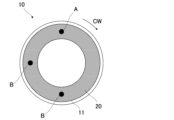
- FIG. 1 is a schematic diagram showing a method of adding a binder in Example 1.
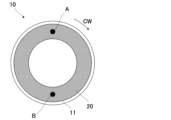
- FIG. 2 is a schematic diagram showing a method of adding a binder in Example 2.
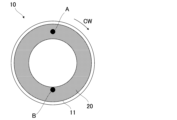
- FIG. 3 is a schematic diagram showing a method of adding a binder in Example 3.
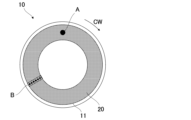
- FIG. 4 is a schematic diagram showing a method of adding a binder in Comparative Example 1.
- FIG. 5 is a schematic diagram showing a method of adding a binder in Comparative Example 2.
- FIG. 6 is a schematic diagram showing a method of adding a binder in Example 4.
- the catalyst of the present invention has an SPHT3 (sphericity) value of 0.9822 or more, which is obtained by particle shape measurement using dynamic image analysis.
- Dynamic image analysis is a method of obtaining particle size distribution and shape distribution (aspect ratio, sphericity, etc.) by continuously photographing particles dispersed in a fluid (solvent, etc.) and measuring, binarizing, and analyzing the images.
- An example of a practical device for carrying out dynamic image analysis is the CAMSIZER X2 (manufactured by Microtrac Bell).
- sphericity and sphericity parameter (SPHT3) are synonymous.
- the sphericity SPHT3 is calculated by analyzing continuously captured particle images, and applying the perimeter P of the captured image of each particle and the area A of each particle to the following formula (I).
- the SPHT3 value of a catalyst when the SPHT3 value of a catalyst is within a certain range, it means that the average SPHT3 value measured for about 100 to 200 particles of the catalyst is within the range.
- the lower limit of the SPHT3 is more preferably 0.9830, 0.9835, 0.9840, 0.9845, 0.9850, 0.9855, 0.9860, 0.9865, and particularly preferably 0.9870.
- the upper limit may be 1.0000, but is more preferably 0.9950, 0.9900, 0.9890, and particularly preferably 0.9880. Therefore, the range of SPHT3 is preferably 0.9830 or more and 1.0000 or less, more preferably 0.9835 or more and 1.0000 or less, more preferably 0.9840 or more and 1.0000 or less, more preferably 0.9845 or more and 1.0000 or less, more preferably 0.9850 or more and 1.0000 or less, more preferably 0.9855 or more and 0.9950 or less, more preferably 0.9860 or more and 0.9900 or less, more preferably 0.0.9865 or more and 0.9890 or less, and most preferably 0.9870 or more and 0.9880 or less.
- the inventors of the present invention have found that the closer the shape of the catalyst is to a perfect sphere (i.e., the larger the SPHT3 value), the higher the selectivity is. This is thought to be because, when gas is passed through a reaction tube filled with catalyst to carry out a catalytic reaction, the closer the shape of the catalyst is to a perfect sphere, the more orderly the gas flow is and the less stagnant it is in the catalyst layer, reducing the contact time with the catalyst, resulting in improved selectivity. Another factor is that the closer the shape of the catalyst is to a perfect sphere, the more uniform the pore distribution and/or the thickness of the active component in the spherical catalyst are, and the reaction proceeds without localized accumulation of reaction heat.
- Symm3 is a parameter indicating geometric symmetry that is analyzed from images captured continuously by dynamic image analysis, and is calculated as follows. First, a straight line is drawn in any direction through the center of gravity of the image taken of each particle and intersecting with the outer periphery of the particle. The distances from the center of gravity to the outer periphery of the particle are defined as r1 and r2. When the direction of the straight line is changed, the smallest r1/r2 is defined as min(r1/r2), and the value calculated by applying it to the following formula (II) is defined as Symm3 (symmetry).
- the catalyst of the present invention is more preferably when Symm3 (symmetry) is 0.9750 or more and 0.9865 or less.
- Symm3 symmetry
- the lower limit of Symm3 is more preferably 0.9760, 0.9770, 0.9780, 0.9790, 0.9800, 0.9810, 0.9820, and particularly preferably 0.9825.
- the upper limit is more preferably 0.9861, 0.9855, 0.9845, and particularly preferably 0.9835.
- the range of Symm3 is preferably 0.9760 or more and 0.9865 or less, more preferably 0.9770 or more and 0.9865 or less, more preferably 0.9780 or more and 0.9865 or less, more preferably 0.9790 or more and 0.9865 or less, more preferably 0.9800 or more and 0.9861 or less, more preferably 0.9810 or more and 0.9855 or less, more preferably 0.9820 or more and 0.9845 or less, and most preferably 0.9825 or more and 0.9835 or less.
- Symm3 ⁇ 1+min(r1/r2) ⁇ /2...(II)
- the aspect ratio b/I3 in the present invention is a parameter indicating the shape of each particle continuously photographed by dynamic image analysis, and its calculation method is as follows.
- P an arbitrary point on the outer periphery of the photographed particle
- a straight line is drawn from point P through the inside of the particle so as to intersect with a point Q on the outer periphery different from point P
- the maximum value of the length when point Q is moved along the outer periphery is designated as the cord diameter Xc .
- the minimum value of the cord diameter Xc measured when point P is moved along the outer periphery is designated as the minimum cord diameter Xcmin .
- the aspect ratio b/I3 is calculated by the following formula (III). In terms of selectivity, it is more preferable that the catalyst of the present invention has an aspect ratio b/I3 of 0.9275 or more and 0.9580 or less. The lower limit of the aspect ratio is more preferably 0.9280, 0.9300, 0.9350, 0.9400, 0.9410, 0.9420, 0.9430, and particularly preferably 0.9440.
- the upper limit is more preferably 0.9542, 0.9540, 0.9530, 0.9525, 0.9520, 0.9500, 0.9475, and particularly preferably 0.9450. Therefore, the range of the aspect ratio is more preferably 0.9280 or more and 0.9542 or less, more preferably 0.9300 or more and 0.9540 or less, more preferably 0.9350 or more and 0.9530 or less, more preferably 0.9400 or more and 0.9525 or less, more preferably 0.9410 or more and 0.9520 or less, more preferably 0.9420 or more and 0.9500 or less, more preferably 0.9430 or more and 0.9475 or less, and most preferably 0.9440 or more and 0.9450 or less.
- b/I3 X cmin /X FeMAX ...(III)
- the catalytic active component has a composition represented by the following formula (1).
- Mo Mo 12 (V) a (W) b (Cu) c (Sb) d (X) e (Y) f (Z) g (O) h
- Mo, V, W, Cu, Sb, and O represent molybdenum, vanadium, tungsten, copper, antimony, and oxygen, respectively;
- X represents at least one element selected from the group consisting of alkali metals and thallium;
- Y represents at least one element selected from the group consisting of magnesium, calcium, strontium, barium, and zinc;
- Z represents bismuth, tellurium, silver, selenium, silicon, aluminum, boron, niobium, cerium, tin, chromium, manganese, iron, co
- a, b, c, d, e, f, g, and h represent the atomic ratio of each element, and a represents 0 ⁇ a ⁇ 10.0, b represents 0 ⁇ b ⁇ 10.0, c represents 0 ⁇ c ⁇ 6.0, d represents 0 ⁇ d ⁇ 10.0, e represents 0 ⁇ e ⁇ 0.50, f represents 0 ⁇ f ⁇ 1.0, and g represents 0 ⁇ g ⁇ 6.0, relative to 12 molybdenum atoms. Also, h represents the number of oxygen atoms required to satisfy the valence of each of the components.
- the preferred ranges of a to g are as follows:
- the lower limit of a is, in order of desirability, 0.20, 0.50, 0.80, 1.0, 1.5, 2.0, 2.2, 2.5, and most desirably 2.8
- the upper limit of a is, in order of desirability, 9.0, 8.0, 7.0, 6.0, 5.0, 4.5, 4.0, 3.5, and most desirably 3.2.
- the range of a is preferably 0.20 ⁇ a ⁇ 9.0, more preferably 0.50 ⁇ a ⁇ 8.0, more preferably 0.80 ⁇ a ⁇ 7.0, more preferably 1.0 ⁇ a ⁇ 6.0, more preferably 1.5 ⁇ a ⁇ 5.0, more preferably 2.0 ⁇ a ⁇ 4.5, more preferably 2.2 ⁇ a ⁇ 4.0, more preferably 2.5 ⁇ a ⁇ 3.5, and most preferably 2.8 ⁇ a ⁇ 3.2.
- the lower limit of b is, in order of desirability, 0.10, 0.20, 0.30, 0.40, 0.50, 0.60, 0.70, 0.80, and 0.90, and is most desirably 1.0
- the upper limit of b is, in order of desirability, 9.0, 8.0, 7.0, 6.0, 5.0, 4.0, 3.0, 2.5, 2.0, and 1.5, and is most desirably 1.4.
- the range of b is preferably 0.10 ⁇ b ⁇ 9.0, more preferably 0.10 ⁇ b ⁇ 8.0, more preferably 0.20 ⁇ b ⁇ 7.0, more preferably 0.30 ⁇ b ⁇ 6.0, more preferably 0.40 ⁇ b ⁇ 5.0, more preferably 0.50 ⁇ b ⁇ 4.0, more preferably 0.60 ⁇ b ⁇ 3.0, more preferably 0.70 ⁇ b ⁇ 2.5, more preferably 0.80 ⁇ b ⁇ 2.0, more preferably 0.90 ⁇ b ⁇ 1.5, and most preferably 1.0 ⁇ b ⁇ 1.4.
- the lower limit of c is, in order of desirability, 0.10, 0.20, 0.30, 0.40, 0.50, 0.60, 0.70, 0.80, 0.90, and most desirably 1.0
- the upper limit of c is, in order of desirability, 5.0, 4.0, 3.0, 2.5, 2.0, 1.5, and most desirably 1.4.
- the range of c is preferably 0.10 ⁇ c ⁇ 5.0, more preferably 0.20 ⁇ c ⁇ 5.0, more preferably 0.30 ⁇ c ⁇ 5.0, more preferably 0.40 ⁇ c ⁇ 5.0, more preferably 0.50 ⁇ c ⁇ 4.0, more preferably 0.60 ⁇ c ⁇ 3.0, more preferably 0.70 ⁇ c ⁇ 2.5, more preferably 0.80 ⁇ c ⁇ 2.0, more preferably 0.90 ⁇ c ⁇ 1.5, and most preferably 1.0 ⁇ c ⁇ 1.4.
- the lower limit of d is, in order of desirability, 0.11, 0.15, 0.18, 0.20, 0.25, 0.30, and 0.35, and is most desirably 0.40
- the upper limit of d is, in order of desirability, 9.0, 8.0, 7.0, 6.0, 5.0, 4.0, 3.0, 2.5, 2.0, 1.5, and 1.0, and is most desirably 0.70.
- the range of d is preferably 0.11 ⁇ d ⁇ 9.0, more preferably 0.11 ⁇ d ⁇ 8.0, more preferably 0.11 ⁇ d ⁇ 7.0, more preferably 0.11 ⁇ d ⁇ 6.0, more preferably 0.11 ⁇ d ⁇ 5.0, more preferably 0.15 ⁇ d ⁇ 4.0, more preferably 0.18 ⁇ d ⁇ 3.0, more preferably 0.20 ⁇ d ⁇ 2.5, more preferably 0.25 ⁇ d ⁇ 2.0, more preferably 0.30 ⁇ d ⁇ 1.5, more preferably 0.35 ⁇ d ⁇ 1.0, and most preferably 0.40 ⁇ d ⁇ 0.70.
- the upper limit of e is, in order of desirability, 0.40, 0.30, 0.20, and 0.10. That is, the most preferable range of e is 0 ⁇ e ⁇ 0.10.
- the upper limit of f is, in order of desirability, 0.80, 0.50, 0.20, 0.15, and most desirably 0.10. That is, the most preferable range of f is 0 ⁇ g1 ⁇ 0.10.
- the upper limit of g is, in order of desirability, 5.0, 4.0, 3.0, 2.0, 1.0, 0.050, 0.025, and 0.015. That is, the most preferable range of g is 0 ⁇ g ⁇ 0.015.
- a catalyst in which the catalytically active component is preliminarily calcined after preparation and the preliminarily calcined powder is supported on an inert carrier is particularly effective.
- the inert carrier may be made of known materials such as alumina, silica, titania, zirconia, niobia, silica alumina, silicon carbide, carbides, and mixtures thereof. There are no particular limitations on the particle size, water absorption rate, mechanical strength, crystallinity of each crystal phase, or mixing ratio of the inert carrier, and appropriate ranges should be selected in consideration of the final catalyst performance, moldability, production efficiency, etc.
- the mixing ratio of the carrier and the pre-calcined powder is generally calculated as the loading rate using the following formula based on the charged mass of each raw material.
- additives such as molding aids and strength improvers remain in the catalyst after the main calcination, they are included in the total amount (denominator).
- Support rate (mass%) (mass of pre-calcined powder used in molding)/ ⁇ (mass of pre-calcined powder used in molding)+(mass of support used in molding) ⁇ 100
- the upper limit of the above-mentioned supporting rate is preferably 80% by mass, and more preferably 60% by mass.
- the lower limit is preferably 20% by mass, more preferably 30% by mass.
- the support rate is preferably 20% by mass or more and 80% by mass or less, and most preferably 30% by mass or more and 60% by mass or less.
- the inert carrier silica and/or alumina are preferred, and a mixture of silica and alumina is particularly preferred.
- a binder when supporting. Specific examples of binders that can be used include water, ethanol, methanol, propanol, polyhydric alcohols, polyvinyl alcohol as a polymer binder, and silica sol aqueous solution as an inorganic binder.
- Ethanol, methanol, propanol, and polyhydric alcohols are preferred, diols such as ethylene glycol and triols such as glycerin are preferred, and an aqueous solution of glycerin with a concentration of 5% by mass or more is preferred.
- an aqueous glycerin solution By using an appropriate amount of an aqueous glycerin solution, moldability is improved, and a high-performance catalyst with high mechanical strength can be obtained.
- the amount of these binders used is usually 2 to 60 parts by mass relative to 100 parts by mass of the pre-calcined powder, but in the case of an aqueous glycerin solution, 10 to 30 parts by mass is preferred.
- the binder and the pre-calcined powder may be supplied alternately or simultaneously to the molding machine.
- the supported catalyst obtained as described above can be used as it is in a gas-phase catalytic oxidation reaction, but calcination is preferable because it may improve the catalytic activity.
- calcination method or conditions There are no particular limitations on the calcination method or conditions, and known processing methods and conditions can be applied.
- the optimal calcination conditions vary depending on the catalyst raw material, catalyst composition, preparation method, etc. used, but the calcination temperature is usually 100 to 450°C, preferably 270 to 420°C, and particularly preferably 350 to 390°C, and the calcination time is 1 to 20 hours.
- Calcination is usually performed in an air atmosphere, but it may be performed in an inert gas atmosphere such as nitrogen, carbon dioxide, helium, or argon, or, after calcination in an inert gas atmosphere, calcination may be further performed in an air atmosphere as necessary.
- inert gas atmosphere such as nitrogen, carbon dioxide, helium, or argon
- the catalyst of the present invention is used in a reaction for producing a corresponding unsaturated carboxylic acid from an unsaturated aldehyde such as acrolein or methacrolein as a raw material, particularly in a reaction for producing acrylic acid by gas-phase catalytic oxidation of acrolein with molecular oxygen or a molecular oxygen-containing gas, it is possible to improve catalytic activity and reduce the differential pressure, which is very effective compared to known methods. In addition, in a process of partial oxidation reaction accompanied by heat generation, it is expected to improve stability by reducing hot spot temperature, etc.
- the catalyst of the present invention is also effective in reducing by-products that adversely affect the environment and the quality of the final product, such as carbon monoxide (CO), carbon dioxide (CO 2 ), acetaldehyde, acetic acid, and formaldehyde.
- CO carbon monoxide
- CO 2 carbon dioxide
- acetaldehyde acetaldehyde
- acetic acid formaldehyde
- the method for flowing the raw material gas may be a normal single flow method or a recycle method, and may be carried out under generally used conditions and is not particularly limited.
- a mixed gas consisting of 1 to 10% by volume, preferably 4 to 9% by volume of unsaturated aldehyde as a starting raw material at room temperature, 3 to 20% by volume, preferably 4 to 18% by volume of molecular oxygen, 0 to 60% by volume, preferably 4 to 50% by volume of steam, and 20 to 80% by volume, preferably 30 to 60% by volume of inert gas such as carbon dioxide or nitrogen is introduced onto the catalyst of the present invention filled in a reaction tube at 240 to 450° C., under a pressure of normal pressure to 10 atm, and at a space velocity of 300 to 5000 h ⁇ 1 to carry out the reaction.
- the catalyst of the present invention preferably contains inorganic fibers for the purpose of improving mechanical strength, etc.
- the material of the inorganic fibers is not particularly limited, and for example, glass fibers (glass fibers), ceramic fibers, metal fibers, mineral fibers, carbon fibers, various whiskers, etc. can be used. Among these, glass fibers treated with silane-based chemicals are particularly preferred.
- the fiber length is not particularly limited as long as it does not impair the effects of the present invention, but the average fiber length is preferably about 1 to 1000 ⁇ m, more preferably about 10 to 500 ⁇ m.
- two or more kinds of inorganic fibers can be used in combination. Two or more kinds of fibers made of different materials may be used, or two kinds of fibers made of the same material but having different average fiber lengths may be used.
- vanadium component raw material, molybdenum component raw material, and antimony component raw material are mixed in a desired ratio with a separately prepared aqueous solution or slurry of tungsten component raw material and Z component raw material under conditions of 20 to 95 ° C., and heated and stirred for about 1 hour under conditions of 20 to 90 ° C., and then an aqueous solution in which a copper component raw material is dissolved and, if necessary, an X component raw material and a Y component raw material are added to obtain an aqueous solution or slurry containing a catalyst component.
- the aqueous solution or slurry obtained in this way is collectively referred to as the prepared liquid (A).
- the prepared liquid (A) does not necessarily need to contain all the catalyst constituent elements, and some elements or a part of the amount of the elements may be added in a subsequent step. Furthermore, when preparing the preparation liquid (A), if the amount of water in which each component raw material is dissolved, or if an acid such as sulfuric acid, nitric acid, hydrochloric acid, tartaric acid, or acetic acid is added for dissolution, is not appropriate within the range of, for example, 5% by mass to 99% by mass, the aqueous solution must have an acid concentration sufficient to dissolve the raw materials; otherwise, the preparation liquid (A) may take the form of a clay-like mass, which will not serve as an excellent catalyst. Therefore, the preparation liquid (A) obtained is preferably in the form of an aqueous solution or a slurry, in order to obtain an excellent catalyst.
- the drying method is not particularly limited as long as it can completely dry the preparation (A), and examples thereof include drum drying, freeze drying, spray drying, and evaporation to dryness.
- spray drying is particularly preferred, which can dry the slurry into powder or granules in a short time.
- the drying temperature of the spray drying varies depending on the concentration of the slurry, the liquid delivery speed, etc., but the temperature at the outlet of the dryer is generally 70 to 150°C.
- Step c) Pre-calcination The obtained dry powder (B) is calcined under air flow at 200°C to 500°C, preferably 300°C to 400°C, which tends to improve the moldability, mechanical strength, and catalytic performance of the catalyst.
- the calcination time is preferably 1 hour to 12 hours. In this way, a pre-calcined body (C) is obtained.
- Step d) Crushing The obtained pre-calcined body (C) is obtained as a solid (D) in which the dry powder (B) is aggregated by pre-calcination.
- the solid (D) is pulverized.
- the pulverization method is not particularly limited, and examples thereof include a roller mill, a jet mill, a hammer mill, a rotary mill, and a vibration mill.
- the average particle size (pre-calcined median size) of the pre-calcined powder (E) obtained at this time is preferably 10 ⁇ m or more and 100 ⁇ m or less, more preferably 20 ⁇ m or more and 80 ⁇ m or less, even more preferably 30 ⁇ m or more and 50 ⁇ m or less, and particularly preferably 35 ⁇ m or more and 45 ⁇ m or less.
- the pre-calcined powder (E) after pulverization is described as a catalyst precursor. However, in cases where there is no aggregation at the stage of the pre-calcined body (C) and it can be used without going through a pulverization step, the pre-calcined body (C) may be used as a catalyst precursor.
- Step e) Molding The molding method is not particularly limited, but it is preferable to mold the pre-sintered powder (E) into a spherical shape.
- the pre-sintered powder (E) may be molded into a spherical shape using a molding machine, but a method in which the pre-sintered powder (E) (containing a molding aid and a strength improver, if necessary) is supported on a carrier such as an inactive ceramic is preferable.
- the supporting method is widely known to be a rolling granulation method, a method using a centrifugal fluidized coating device, a wash coat method, etc., and is not particularly limited as long as it can uniformly support the pre-calcined powder (E) on the carrier, but when considering the production efficiency of the catalyst and the performance of the prepared catalyst, it is more preferable to use a device having a flat or uneven disk at the bottom of a fixed cylindrical container, rotate the disk at high speed, and vigorously stir the carrier charged in the container by the rotation and revolution of the carrier itself, and add the pre-calcined powder (E) and, if necessary, a molding aid and/or a strength improver and a pore former to support the powder component on the carrier.
- binders that can be used include water, ethanol, methanol, propanol, polyhydric alcohols, polyvinyl alcohol as a polymer binder, and silica sol aqueous solution as an inorganic binder.
- Ethanol, methanol, propanol, and polyhydric alcohols are preferred, and diols such as ethylene glycol and triols such as glycerin are more preferred.
- a particularly high-performance catalyst can be obtained when an aqueous solution of glycerin with a concentration of 5% by mass or more is used.
- the amount of these binders used is usually 2 to 80 parts by mass per 100 parts by mass of the pre-calcined powder (E).
- An inert carrier of about 2 to 8 mm is usually used, and the pre-calcined powder (E) is supported on it.
- the support rate is determined in consideration of the catalyst use conditions, such as the space velocity of the reaction raw materials and the raw material concentration, and is usually 20% to 80% by mass.
- the support rate is expressed as the following formula (4) when a molding aid or strength improver is used in molding. In this way, a molded body (F) is obtained.
- the present inventors have found that it is difficult to maintain mechanical strength in the present invention. Therefore, it is preferable to add inactive inorganic fibers as a strength improver during support molding, and glass fibers are particularly preferable.
- the amount of these fibers used is usually 1 to 30 parts by mass, preferably 2 to 10 parts by mass, and more preferably 3 to 5 parts by mass, per 100 parts by mass of the catalytically active component solids.
- the inert carrier may be made of known materials such as alumina, silica, titania, zirconia, niobia, silica alumina, silicon carbide, carbides, and mixtures thereof. There are no particular limitations on the particle size, water absorption rate, mechanical strength, crystallinity of each crystal phase, or mixture ratio of the inert carrier, and appropriate ranges should be selected in consideration of the final catalyst performance, moldability, production efficiency, etc.
- Step f) Calcination The molded body (F) is calcined at a temperature of 100 to 450°C for about 1 to 12 hours, which tends to improve the catalytic activity and effective yield.
- the calcination temperature is preferably 270°C to 420°C, more preferably 350°C to 400°C.
- Air is the preferred gas to be circulated because it is simple, but other inert gases such as nitrogen, carbon dioxide, nitrogen oxide-containing gas for creating a reducing atmosphere, ammonia-containing gas, hydrogen gas, and mixtures thereof can also be used. In this way, the catalyst (G) is obtained.
- the above SPHT3 value can be adjusted by changing the raw material used in the above a) step, the spray drying conditions in the step b), the calcination temperature and time in the step c), the pulverization method and the median diameter after pulverization in the step d), and the relative centrifugal acceleration, the loading rate, the type of binder, the position where the binder is added, etc. in the step e), but it is difficult to change it significantly by changing a single condition, and it can be achieved by optimizing two or more conditions.
- the firing temperature is preferably 200° C. to 500° C., but if the temperature is increased, SPHT3 tends to increase. Therefore, in terms of adjusting SPHT3, the firing temperature is preferably 380° C. or higher. In addition, since SPHT3 can increase if the firing time is extended, it is preferable to set the firing time to 3 hours or more.
- ⁇ d) Grinding method and median diameter in the process> The SPHT3 can also be controlled by the method of step d). When a ball mill is used, the SPHT3 can be easily adjusted, and the SPHT3 can also be adjusted by setting the median diameter of the pre-fired body (c) within a certain range.
- the value of SPHT3 can also be adjusted by changing the relative centrifugal acceleration in step e).
- the relative centrifugal acceleration may be about 2.0 G or more and 30 G or less, but if it is made higher, SPHT3 tends to become high, so that about 8.0 G or more and 12.0 G or less is optimal. However, this also depends on the relationship between the amount of the carrier and the pre-calcined powder supported thereon (support rate).
- SPHT3 can be controlled by keeping the median diameter of the pre-calcined powder within a certain range using the method of step d)
- SPHT3 can also be adjusted by changing the position at which the binder is added in step e). It is preferable to add the binder at a position away from the position at which the granules are added. Multiple addition ports may be provided, but the more addition ports there are, the lower the SPHT3 tends to be, so it is preferable to have two or less addition ports.
- the above-mentioned method of adjusting SPHT3 can also be applied to adjusting Sym3 and the aspect ratio.
- Sym3 and the aspect ratio can be adjusted by changing two or more of the conditions a) to f).
- Catalyst composition of catalyst for producing unsaturated aldehyde or conjugated diene compound When the catalyst of the present invention is used as a catalyst for producing an unsaturated aldehyde or a conjugated diene compound, it is preferable that the catalytically active component has a composition represented by the following formula (2).
- Mo, Bi, Ni, Co and Fe represent molybdenum, bismuth, nickel, cobalt and iron, respectively;
- X represents at least one element selected from tungsten, antimony, tin, zinc, chromium, manganese, magnesium, calcium, silicon, aluminum, cerium and titanium;
- Y represents at least one element selected from sodium, potassium, cesium, rubidium and thallium;
- Z represents an element belonging to Groups 1 to 16 of the periodic table; and the above Mo, Bi, means at least one element selected from elements other than Ni, Co, Fe, X, and Y, and b1, c1, d1, e1, f1, g1, h1, and i1 respectively represent the number of atoms of molybdenum, bismuth, nickel, cobalt, iron, X, Y, Z, and oxygen, and satisfy
- the preferred ranges of b1 to h1 are as follows.
- the lower limit of b1 is preferably 0.1, 0.2, 0.3, 0.4, 0.5, 0.6, and 0.7
- the upper limit is preferably 6.0, 5.0, 4.0, 3.0, 2.0, 1.8, 1.5, 1.2, and 1.0. That is, the range of b1 is preferably 0.1 to 6.0, more preferably 0.1 to 5.0, more preferably 0.1 to 4.0, more preferably 0.2 to 3.0, more preferably 0.3 to 2.0, more preferably 0.4 to 1.8, more preferably 0.5 to 1.5, more preferably 0.6 to 1.2, and most preferably 0.7 to 1.0.
- the lower limit of c1 is preferably 0.2, 0.5, 0.8, 1.0, 1.5, and 1.7
- the upper limit is preferably 8.0, 7.0, 6.0, 5.0, 4.0, 3.5, 3.3, and 3.0. That is, the range of c1 is preferably 0.2 to 8.0, more preferably 0.2 to 7.0, more preferably 0.2 to 6.0, more preferably 0.2 to 5.0, more preferably 0.2 to 4.0, more preferably 0.5 to 3.5, more preferably 0.8 to 3.3, more preferably 1.0 to 3.0, more preferably 1.5 to 2.7, and most preferably 1.7 to 3.0.
- the lower limit of d1 is preferably 1.0, 2.0, 3.0, 4.0, 5.0, 5.5, and 5.8, and the upper limit is preferably 9.5, 9.0, 8.5, 8.0, 7.5, 7.0, 6.8, and 6.6. That is, the range of d1 is preferably 1.0 to 9.5, more preferably 1.0 to 9.0, more preferably 2.0 to 8.5, more preferably 4.0 to 8.0, more preferably 5.0 to 7.0, more preferably 5.5 to 6.8, and most preferably 5.8 to 6.6.
- the lower limit of c1+d1 is preferably 1.2, 2.0, 4.0, 6.0, 8.0, and 8.3, and the upper limit is preferably 20.0, 15.0, 12.5, 11.0, 10.0, and 9.0.
- the range of c1+d1 is preferably 1.2 or more and 20.0 or less, more preferably 2.0 or more and 15.0 or less, more preferably 4.0 or more and 12.5 or less, more preferably 6.0 or more and 11.0 or less, more preferably 8.0 or more and 10.0 or less, and most preferably 8.3 or more and 9.0 or less.
- the lower limit of e1 is preferably 0.1, 0.2, 0.5, 0.8, 1.0, 1.5, and 1.6, and the upper limit is preferably 4.5, 4.0, 3.5, 3.0, 2.5, and 2.3.
- the range of e1 is preferably 0.1 to 4.5, more preferably 0.2 to 4.5, more preferably 0.5 to 3.5, more preferably 0.8 to 3.0, more preferably 1.0 to 2.5, more preferably 1.5 to 2.5, and most preferably 1.6 to 2.3.
- the upper limit of f1 is preferably 1.8, 1.5, 1.0, 0.8, and 0.5, and the lower limit is preferably 0. That is, the range of f1 is preferably 0 to 1.8, 0 to 1.5, 0 to 1.0, 0 to 0.8, and 0 to 0.5, and most preferably f1 is 0.
- the lower limit of g1 is preferably 0.010, 0.020, and 0.030, and the upper limit is preferably 2, 1, 0.5, 0.4, 0.3, 0.2, 0.15, and 0.10. That is, the range of g1 is preferably 0.010 or more and 2 or less, more preferably 0.010 or more and 1 or less, more preferably 0.010 or more and 0.5 or less, more preferably 0.010 or more and 0.4 or less, more preferably 0.010 or more and 0.3 or less, more preferably 0.010 or more and 0.2 or less, more preferably 0.020 or more and 0.15 or less, and the most preferable range is 0.030 or more and 0.10 or less.
- the upper limit of h1 is preferably 4.0, 3.0, 2.0, 1.8, 1.5, 1.0, 0.8, and 0.5, and the lower limit is preferably 0. That is, the range of h1 is preferably 0 to 4.0, 0 to 3.0, 0 to 2.0, 0 to 1.8, 0 to 1.5, 0 to 1.0, 0 to 0.8, and 0 to 0.5, and most preferably h1 is 0.
- X is preferably tungsten, antimony, zinc, magnesium, calcium or cerium.
- Y is preferably sodium, potassium or cesium, more preferably potassium or cesium.
- Z is preferably vanadium, copper, niobium, zirconium, calcium, beryllium, strontium, barium, lead or phosphorus.
- the starting materials for the elements constituting the catalyst represented by the above formula (2) are not particularly limited.
- the starting material for the molybdenum component there can be used molybdenum oxides such as molybdenum trioxide, molybdic acid, ammonium paramolybdate, ammonium metamolybdate, or a salt thereof, a molybdenum-containing heteropolyacid such as phosphomolybdic acid, silicomolybdic acid, or a salt thereof, and the like.
- the raw materials for the bismuth component can include bismuth salts such as bismuth nitrate, bismuth carbonate, bismuth sulfate, and bismuth acetate, bismuth trioxide, and metallic bismuth. These raw materials can be used as solids, or as an aqueous solution, a nitric acid solution, or a slurry of the bismuth compound produced from these aqueous solutions, but it is preferable to use the nitrate salt, or a solution thereof, or a slurry produced from the solution.
- bismuth salts such as bismuth nitrate, bismuth carbonate, bismuth sulfate, and bismuth acetate, bismuth trioxide, and metallic bismuth.
- the starting materials for the other component elements may be ammonium salts, nitrates, nitrites, carbonates, subcarbonates, acetates, chlorides, inorganic acids, salts of inorganic acids, heteropolyacids, salts of heteropolyacids, sulfates, hydroxides, organic acid salts, oxides, or mixtures thereof of the metal elements generally used in this type of catalyst, with ammonium salts and nitrates being preferred.
- the slurry liquid can be obtained by uniformly mixing each active ingredient-containing compound with water.
- the amount of water used in the slurry liquid can be determined appropriately taking into account the drying method and drying conditions.
- the amount of water used is 100 parts by mass or more and 2000 parts by mass or less per 100 parts by mass of the total mass of the compounds used to prepare the slurry. The more water there is, the better, but if there is too much water, the energy cost of the drying process will be high and there is a risk that complete drying will not be possible.
- the slurry liquid of the source compounds of each of the above-mentioned component elements is preferably prepared by (i) mixing the above-mentioned source compounds all at once, (ii) mixing them all at once and then aging them, (iii) mixing them in stages, (iv) repeating mixing and aging in stages, or a combination of (i) to (iv).
- the aging refers to "processing industrial raw materials or semi-finished products under specific conditions such as a certain time and a certain temperature to obtain or increase the required physical or chemical properties or to promote a certain reaction.”
- the certain time refers to a range of 5 minutes to 24 hours
- the certain temperature refers to a range above room temperature and below the boiling point of the aqueous solution or aqueous dispersion.
- the method (iii) of mixing in stages is preferred in terms of the activity and yield of the final catalyst, and the more preferred method is a method in which each raw material to be mixed in stages into the mother liquor is a solution in which it is completely dissolved, and the most preferred method is a method in which an alkali metal solution and various mixed solutions of nitrates are mixed into a mother liquor in which the molybdenum raw material is prepared as a liquid or slurry.
- any stirring blade such as a propeller blade, turbine blade, paddle blade, inclined paddle blade, screw blade, anchor blade, ribbon blade, large lattice blade, etc. can be used in one stage or in two or more stages of the same or different blades in the vertical direction.
- baffles baffle plates may be installed in the reaction tank as necessary.
- the slurry liquid thus obtained is dried.
- the drying method there are no particular restrictions on the drying method as long as it can completely dry the slurry liquid, but examples include drum drying, freeze drying, spray drying, and evaporation to dryness.
- spray drying is particularly preferred, as it can dry the slurry liquid into powder or granules in a short period of time.
- the drying temperature for spray drying varies depending on the concentration of the slurry liquid, the liquid delivery speed, etc., but generally the temperature at the outlet of the dryer is 70°C or higher and 150°C or lower.
- the catalyst precursor obtained as described above can be pre-calcined, molded, and then finally calcined, making it possible to control and maintain the molded shape, resulting in a catalyst with excellent mechanical strength, particularly for industrial applications, and capable of exhibiting stable catalytic performance.
- the molding can be performed by either supported molding, in which the catalyst is supported on an inert carrier such as silica, or non-supported molding, in which no carrier is used.
- Specific molding methods include, for example, granulation molding.
- the shape of the molded product can be selected appropriately from, for example, spherical carriers, ellipsoidal carriers, etc., but it is preferable to use a supported catalyst in which the catalyst precursor is supported on a spherical carrier, especially an inert carrier such as silica or alumina, and the average particle size is 3.0 mm to 10.0 mm, preferably 3.0 mm to 8.0 mm.
- Widely known methods of support include the rolling granulation method, a method using a centrifugal fluid coating device, and a wash coat method, and are not particularly limited as long as the method can uniformly support the pre-calcined powder on the carrier, but when considering the production efficiency of the catalyst, the rolling granulation method is preferred.
- the method is a method in which a carrier charged in a fixed cylindrical container is vigorously stirred by repeated rotation and revolution of the carrier itself by using an apparatus having a flat or uneven disk at the bottom of the container, and the carrier is supported on the carrier by adding the pre-calcined powder to the container. It is preferable to use a binder for supporting the carrier.
- binders that can be used include water, ethanol, methanol, propanol, polyhydric alcohols, polyvinyl alcohol as a polymer binder, and silica sol aqueous solutions as inorganic binders.
- Ethanol, methanol, propanol, and polyhydric alcohols are preferred, diols such as ethylene glycol and triols such as glycerin are more preferred, and an aqueous solution of glycerin with a concentration of 5% by mass or more is even more preferred.
- the amount of these binders used is usually 2 to 60 parts by weight per 100 parts by weight of the pre-calcined powder, but in the case of a glycerin aqueous solution, 15 to 50 parts by weight is preferred.
- the binder and the pre-calcined powder may be fed alternately or simultaneously to the molding machine.
- small amounts of known additives such as graphite, talc, etc. may be added. Note that molding aids, pore-forming agents, and carriers added during molding are not considered as constituent elements of the active component in the present invention, regardless of whether they have activity in the sense of converting the raw materials into some other product.
- the pre-firing method and pre-firing conditions, or the main firing method and main firing conditions are not particularly limited, and known processing methods and conditions can be applied.
- Pre-firing and main firing are usually performed under an oxygen-containing gas such as air or an inert gas flow at 200°C to 600°C, preferably 300°C to 550°C, for 0.5 hours or more, preferably 1 hour to 40 hours.
- the inert gas refers to a gas that does not reduce the reaction activity of the catalyst, and specific examples include nitrogen, carbon dioxide, helium, and argon.
- the optimal conditions, particularly in the main firing differ depending on the reaction conditions when producing unsaturated aldehydes and/or unsaturated carboxylic acids using a catalyst, and changing the process parameters of the main firing process, i.e., the oxygen content in the atmosphere, the maximum temperature reached, and the firing time, is known to those skilled in the art, and is therefore considered to be within the scope of the present invention.
- the main calcination process is carried out after the above-mentioned pre-calcination process, and the maximum temperature reached in the main calcination process (main calcination temperature) is higher than the maximum temperature reached in the above-mentioned pre-calcination process (pre-calcination temperature).
- calcination method such as a fluidized bed, rotary kiln, muffle furnace, or tunnel calcination furnace, and the method should be appropriately selected taking into consideration the final catalyst performance, mechanical strength, moldability, production efficiency, etc.
- the method of adjusting the SPHT3, Symm3, and aspect ratio of the catalyst for producing unsaturated aldehydes or conjugated diene compounds can be achieved by appropriately adjusting two or more of the conditions for preparation, drying, pre-calcination, grinding, molding, and main calcination, in the same manner as the catalyst for producing unsaturated carboxylic acids.
- the catalyst of the present invention is preferably used as a catalyst for producing unsaturated aldehyde compounds, unsaturated carboxylic acid compounds, or conjugated diene compounds, and is preferably used according to its composition as described above.
- the catalyst having the composition of the above formula (1) is particularly useful as a catalyst for producing unsaturated carboxylic acids using unsaturated aldehydes as starting materials.
- the catalyst having the composition of the above formula (2) is particularly useful as a catalyst for producing unsaturated aldehydes using propylene, isobutylene, t-butyl alcohol, etc. as starting materials, or conjugated diolefins using monoolefin starting materials as starting materials.
- the method of flowing the raw material gas may be a normal single flow method or a recycle method, and may be carried out under generally used conditions and is not particularly limited.
- a mixed gas consisting of 1 to 10% by volume, preferably 4 to 9% by volume of starting raw materials at room temperature, 3 to 20% by volume, preferably 4 to 18% by volume of molecular oxygen, 0 to 60% by volume, preferably 4 to 50% by volume of steam, and 20 to 80% by volume, preferably 30 to 60% by volume of inert gas such as carbon dioxide or nitrogen is introduced onto the catalyst of the present invention filled in a reaction tube at 240 to 450° C., under a pressure of normal pressure to 10 atm, and at a space velocity of 300 to 5000 h ⁇ 1 to carry out the reaction.
- inert gas such as carbon dioxide or nitrogen
- the catalysts of the above-mentioned types are arranged so that the activity becomes higher from the raw material inlet to the outlet in the raw material gas flow direction.
- the number of divisions n is not particularly limited, but is usually 2 to 5, preferably 2 to 3.
- the above-mentioned different types of catalysts do not only mean the case where the catalyst composition is different, but also include the case where the support rate on the inert carrier is different or the case where the dilution rate is different.
- raw material conversion rate (%) (number of moles of reacted acrolein)/(number of moles of supplied acrolein) ⁇ 100
- Yield (%) (moles of acrylic acid produced)/(moles of acrolein fed) ⁇ 100
- Selectivity (%) (moles of acrylic acid produced)/(moles of acrolein reacted) ⁇ 100
- the median diameter of the pre-calcined powder shown in this example is the volume-based median value when the equivalent circle diameter Xarea of the powder dispersed in air is measured using a CAMSIZER X2 manufactured by Microtrac-Bell Co., Ltd.
- the equivalent circle diameter Xarea can be calculated from the following formula (IV) when the measured particle area is A.
- X area (4A/ ⁇ ) (1/2) ...(IV)
- Example 1 ⁇ Production of Catalyst 1> 148 parts by mass of ammonium paratungstate was completely dissolved in 5241 parts by mass of pure water heated to 95 ° C. While stirring this solution, 166 parts by mass of ammonium metavanadate and 1000 parts by mass of ammonium molybdate were added, and after confirming dissolution, 70.5 parts by mass of antimony acetate was gradually added and thoroughly stirred. Next, 143 parts by mass of copper sulfate was added to 427 parts by mass of pure water heated to 80 ° C., and the solution was completely dissolved and added to the above solution, and mixed by stirring.
- This preparation liquid (A) was dried by a spray drying method, and the obtained dried powder (B) was pre-fired at 350 ° C. for 4 hours to obtain a pre-fired body (C).
- the obtained pre-fired body (C) was pulverized with a ball mill to obtain a pre-fired powder (E).
- the median diameter of the obtained pre-fired powder (E) was 37.5 ⁇ m. 5% by mass of crystalline cellulose and 5% by mass of milled fiber EFH150-31 manufactured by Central Glass Co., Ltd.
- FIG. 1 is a schematic diagram showing the binder addition method in Example 1, showing a top view of a rolling granulator 10.
- the rolling granulator 10 is charged with spherical carriers, and the carriers are agitated by rotating the bottom plate 11 clockwise as indicated by the arrow CW in FIG. 1. As shown in FIG.
- This preparation liquid (A) was dried by a spray drying method, and the obtained dried powder (B) was pre-fired at 350 ° C. for 4 hours to obtain a pre-fired body (C).
- the obtained pre-fired body (C) was pulverized with a ball mill to obtain a pre-fired powder (E).
- the median diameter of the obtained pre-fired powder (E) was 28.6 ⁇ m.
- FIG. 2 is a schematic diagram showing the method of adding the binder in Example 2, and is the same as FIG. 1 except that the binder addition position B is different.
- main calcination was carried out under conditions of 390° C. for 4 hours to obtain a spherical catalyst 2 of the present invention.
- the composition of catalyst 2 is Mo12V3.0W1.3Cu1.2Sb0.50Si0.010 .
- pre-fired body (C) was pulverized with a ball mill to obtain a pre-fired powder (E).
- the median diameter of the obtained pre-fired powder (E) was 28.2 ⁇ m.
- 5% by mass of crystalline cellulose and 5% by mass of Central Glass Milled Fiber EFH150-31 were added to the pre-calcined powder (E), and after thorough mixing, a 20% by mass glycerin solution was used as a binder by the rolling granulation method, and the mixture was molded into an inactive spherical carrier consisting of a mixture of silica and alumina so that the loading rate was 25% by mass.
- FIG. 3 is a schematic diagram showing a method of adding a binder in Example 3, and is similar to FIG. 1 except that the position B where the binder is added is different.
- main calcination was carried out under conditions of 390° C. for 4 hours to obtain a spherical catalyst 3 of the present invention.
- the composition of catalyst 3 is Mo 12 V 3.0 W 1.2 Cu 1.2 Sb 0.50 .
- This preparation liquid (A) was dried by a spray drying method, and the obtained dried powder (B) was pre-fired at 350 ° C. for 4 hours to obtain a pre-fired body (C).
- the obtained pre-fired body (C) was pulverized with a ball mill to obtain a pre-fired powder (E).
- the median diameter of the obtained pre-fired powder (E) was 29.8 ⁇ m.
- FIG. 4 is a schematic diagram showing the method of adding the binder in Comparative Example 1, and is the same as FIG. 1 except that the binder addition position B is different.
- main calcination was carried out under conditions of 390° C. for 4 hours, and a spherical catalyst 4 was obtained.
- the composition of the catalyst 4 is Mo 12 V 3.0 W 1.2 Cu 1.2 Sb 0.50 .
- pre-fired body (C) was pulverized with a vibration mill to obtain a pre-fired powder (E).
- the median diameter of the obtained pre-fired powder (E) was 22.7 ⁇ m.
- 5% by mass of crystalline cellulose and 5% by mass of Central Glass Milled Fiber EFH150-31 were added to the pre-calcined powder (E), and after thorough mixing, a 20% by mass glycerin solution was used as a binder by the rolling granulation method, and the mixture of silica and alumina was molded into an inactive spherical carrier so that the loading rate was 33% by mass.
- FIG. 5 is a schematic diagram showing the binder addition method in Comparative Example 2, and is the same as FIG. 1 except that the binder addition position B is different.
- the final calcination was carried out at 375° C. for 4 hours to obtain a spherical catalyst 5.
- the composition of catalyst 5 is Mo 12 V 3.0 W 1.2 Cu 1.2 Sb 0.50 .
- Example 4 (Preparation of Catalyst 6) 100 parts by mass of ammonium heptamolybdate was completely dissolved in 380 parts by mass of pure water heated to 60 ° C. (mother liquor 1). Next, 0.37 parts by mass of potassium nitrate was dissolved in 3.2 parts by mass of pure water and added to mother liquor 1. Next, nitric acid (60% by mass) was added to mother liquor 1 so that the pH was 4. Next, 36 parts by mass of ferric nitrate, 81 parts by mass of cobalt nitrate and 41 parts by mass of nickel nitrate were dissolved in 84 parts by mass of pure water heated to 60 ° C. and added to mother liquor 1.
- crystalline cellulose 5% by mass was added to the pre-calcined powder, and after thorough mixing, the mixture was spherically supported on an inactive carrier consisting of a mixture of silica and alumina using a 33% by mass glycerin solution as a binder by rolling granulation so that the support rate was 50% by mass.
- FIG. 6 is a schematic diagram showing the binder addition method in Example 4, and is the same as FIG. 1 except that the binder addition position B is different.
- main calcination was carried out under conditions of 520° C. for 4 hours to obtain catalyst 6.
- the selectivity can be maintained high. Therefore, the plant for producing acrylic acid can be operated stably for a long period of time, which is very useful.
Landscapes
- Chemical & Material Sciences (AREA)
- Organic Chemistry (AREA)
- Engineering & Computer Science (AREA)
- Materials Engineering (AREA)
- Chemical Kinetics & Catalysis (AREA)
- Oil, Petroleum & Natural Gas (AREA)
- Organic Low-Molecular-Weight Compounds And Preparation Thereof (AREA)
- Catalysts (AREA)
Priority Applications (1)
| Application Number | Priority Date | Filing Date | Title |
|---|---|---|---|
| JP2024521355A JP7649427B2 (ja) | 2022-12-20 | 2023-12-13 | 触媒及びそれを用いた化合物の製造方法 |
Applications Claiming Priority (2)
| Application Number | Priority Date | Filing Date | Title |
|---|---|---|---|
| JP2022-202843 | 2022-12-20 | ||
| JP2022202843 | 2022-12-20 |
Publications (1)
| Publication Number | Publication Date |
|---|---|
| WO2024135497A1 true WO2024135497A1 (ja) | 2024-06-27 |
Family
ID=91588774
Family Applications (1)
| Application Number | Title | Priority Date | Filing Date |
|---|---|---|---|
| PCT/JP2023/044647 Ceased WO2024135497A1 (ja) | 2022-12-20 | 2023-12-13 | 触媒及びそれを用いた化合物の製造方法 |
Country Status (2)
| Country | Link |
|---|---|
| JP (1) | JP7649427B2 (https=) |
| WO (1) | WO2024135497A1 (https=) |
Citations (5)
| Publication number | Priority date | Publication date | Assignee | Title |
|---|---|---|---|---|
| JP2009131776A (ja) * | 2007-11-30 | 2009-06-18 | Nippon Shokubai Co Ltd | アクリル酸製造用触媒および該触媒を用いたアクリル酸の製造方法 |
| JP2009285581A (ja) * | 2008-05-29 | 2009-12-10 | Asahi Kasei Chemicals Corp | 流動床用アンモ酸化触媒及びそれを用いたアクリロニトリル又はメタクリロニトリルの製造方法 |
| WO2018051933A1 (ja) * | 2016-09-14 | 2018-03-22 | 日本化薬株式会社 | アクリル酸製造用触媒ならびにアクリル酸の製造方法 |
| JP2018111720A (ja) * | 2013-10-10 | 2018-07-19 | 日本化薬株式会社 | 不飽和カルボン酸の製造方法、及び担持触媒 |
| EP4052788A1 (en) * | 2019-10-31 | 2022-09-07 | China Petroleum & Chemical Corporation | Support and ft synthetic catalyst, and preparation methods therefor and applications thereof |
Family Cites Families (3)
| Publication number | Priority date | Publication date | Assignee | Title |
|---|---|---|---|---|
| JP7170375B2 (ja) * | 2019-03-18 | 2022-11-14 | 日本化薬株式会社 | 触媒及びそれを用いた不飽和アルデヒド、不飽和カルボン酸の製造方法 |
| KR20230073177A (ko) * | 2020-09-24 | 2023-05-25 | 닛뽄 가야쿠 가부시키가이샤 | 촉매 전구체, 그것을 이용한 촉매, 화합물의 제조 방법 및 촉매의 제조 방법 |
| JP2022082836A (ja) * | 2020-11-24 | 2022-06-03 | 日本化薬株式会社 | 触媒の製造方法 |
-
2023
- 2023-12-13 WO PCT/JP2023/044647 patent/WO2024135497A1/ja not_active Ceased
- 2023-12-13 JP JP2024521355A patent/JP7649427B2/ja active Active
Patent Citations (5)
| Publication number | Priority date | Publication date | Assignee | Title |
|---|---|---|---|---|
| JP2009131776A (ja) * | 2007-11-30 | 2009-06-18 | Nippon Shokubai Co Ltd | アクリル酸製造用触媒および該触媒を用いたアクリル酸の製造方法 |
| JP2009285581A (ja) * | 2008-05-29 | 2009-12-10 | Asahi Kasei Chemicals Corp | 流動床用アンモ酸化触媒及びそれを用いたアクリロニトリル又はメタクリロニトリルの製造方法 |
| JP2018111720A (ja) * | 2013-10-10 | 2018-07-19 | 日本化薬株式会社 | 不飽和カルボン酸の製造方法、及び担持触媒 |
| WO2018051933A1 (ja) * | 2016-09-14 | 2018-03-22 | 日本化薬株式会社 | アクリル酸製造用触媒ならびにアクリル酸の製造方法 |
| EP4052788A1 (en) * | 2019-10-31 | 2022-09-07 | China Petroleum & Chemical Corporation | Support and ft synthetic catalyst, and preparation methods therefor and applications thereof |
Also Published As
| Publication number | Publication date |
|---|---|
| JPWO2024135497A1 (https=) | 2024-06-27 |
| JP7649427B2 (ja) | 2025-03-19 |
Similar Documents
| Publication | Publication Date | Title |
|---|---|---|
| JP6363464B2 (ja) | 不飽和カルボン酸の製造方法、及び担持触媒 | |
| JP7105395B1 (ja) | 触媒前駆体、それを用いた触媒、化合物の製造方法及び触媒の製造方法 | |
| CN113905818B (zh) | 催化剂、催化剂填充方法和使用催化剂的化合物制造方法 | |
| CN113939364B (zh) | 催化剂、使用该催化剂的化合物的制造方法和化合物 | |
| WO2014181839A1 (ja) | 不飽和アルデヒドおよび/または不飽和カルボン酸製造用触媒、その製造方法及び不飽和アルデヒドおよび/または不飽和カルボン酸の製造方法 | |
| CN113613782A (zh) | 催化剂制造用干燥颗粒、催化剂以及化合物的制造方法 | |
| JP7170375B2 (ja) | 触媒及びそれを用いた不飽和アルデヒド、不飽和カルボン酸の製造方法 | |
| JP5680373B2 (ja) | 触媒及びアクリル酸の製造方法 | |
| JP7209901B1 (ja) | 触媒、およびそれを用いた気相酸化反応による化合物の製造方法 | |
| JP2018043196A (ja) | アクリル酸製造用触媒ならびにアクリル酸の製造方法 | |
| JP7649427B2 (ja) | 触媒及びそれを用いた化合物の製造方法 | |
| JP7649426B2 (ja) | 触媒及びそれを用いた化合物の製造方法 | |
| JP7816954B2 (ja) | 触媒前駆体、それを用いた触媒、化合物の製造方法及び触媒の製造方法 | |
| JP7667381B1 (ja) | 不飽和カルボン酸製造用触媒および不飽和カルボン酸の製造方法 | |
| JP7383202B2 (ja) | 触媒、及びそれを用いた化合物の製造方法 | |
| JP7325688B1 (ja) | 触媒、及びそれを用いた化合物の製造方法 | |
| CN120857978A (zh) | 不饱和羧酸制造用催化剂 | |
| JP2023112677A (ja) | 触媒、およびそれを用いた気相酸化反応による化合物の製造方法 |
Legal Events
| Date | Code | Title | Description |
|---|---|---|---|
| WWE | Wipo information: entry into national phase |
Ref document number: 2024521355 Country of ref document: JP |
|
| 121 | Ep: the epo has been informed by wipo that ep was designated in this application |
Ref document number: 23906862 Country of ref document: EP Kind code of ref document: A1 |
|
| NENP | Non-entry into the national phase |
Ref country code: DE |
|
| 122 | Ep: pct application non-entry in european phase |
Ref document number: 23906862 Country of ref document: EP Kind code of ref document: A1 |