WO2024128317A1 - 球状アルミナ粉末 - Google Patents
球状アルミナ粉末 Download PDFInfo
- Publication number
- WO2024128317A1 WO2024128317A1 PCT/JP2023/045120 JP2023045120W WO2024128317A1 WO 2024128317 A1 WO2024128317 A1 WO 2024128317A1 JP 2023045120 W JP2023045120 W JP 2023045120W WO 2024128317 A1 WO2024128317 A1 WO 2024128317A1
- Authority
- WO
- WIPO (PCT)
- Prior art keywords
- alumina powder
- spherical alumina
- cup
- less
- measured
- Prior art date
- Legal status (The legal status is an assumption and is not a legal conclusion. Google has not performed a legal analysis and makes no representation as to the accuracy of the status listed.)
- Ceased
Links
Images
Classifications
-
- C—CHEMISTRY; METALLURGY
- C01—INORGANIC CHEMISTRY
- C01F—COMPOUNDS OF THE METALS BERYLLIUM, MAGNESIUM, ALUMINIUM, CALCIUM, STRONTIUM, BARIUM, RADIUM, THORIUM, OR OF THE RARE-EARTH METALS
- C01F7/00—Compounds of aluminium
- C01F7/02—Aluminium oxide; Aluminium hydroxide; Aluminates
-
- C—CHEMISTRY; METALLURGY
- C01—INORGANIC CHEMISTRY
- C01F—COMPOUNDS OF THE METALS BERYLLIUM, MAGNESIUM, ALUMINIUM, CALCIUM, STRONTIUM, BARIUM, RADIUM, THORIUM, OR OF THE RARE-EARTH METALS
- C01F7/00—Compounds of aluminium
- C01F7/02—Aluminium oxide; Aluminium hydroxide; Aluminates
- C01F7/021—After-treatment of oxides or hydroxides
- C01F7/022—Classification
-
- C—CHEMISTRY; METALLURGY
- C01—INORGANIC CHEMISTRY
- C01F—COMPOUNDS OF THE METALS BERYLLIUM, MAGNESIUM, ALUMINIUM, CALCIUM, STRONTIUM, BARIUM, RADIUM, THORIUM, OR OF THE RARE-EARTH METALS
- C01F7/00—Compounds of aluminium
- C01F7/02—Aluminium oxide; Aluminium hydroxide; Aluminates
- C01F7/021—After-treatment of oxides or hydroxides
- C01F7/027—Treatment involving fusion or vaporisation
-
- C—CHEMISTRY; METALLURGY
- C08—ORGANIC MACROMOLECULAR COMPOUNDS; THEIR PREPARATION OR CHEMICAL WORKING-UP; COMPOSITIONS BASED THEREON
- C08K—Use of inorganic or non-macromolecular organic substances as compounding ingredients
- C08K3/00—Use of inorganic substances as compounding ingredients
- C08K3/18—Oxygen-containing compounds, e.g. metal carbonyls
- C08K3/20—Oxides; Hydroxides
- C08K3/22—Oxides; Hydroxides of metals
-
- C—CHEMISTRY; METALLURGY
- C09—DYES; PAINTS; POLISHES; NATURAL RESINS; ADHESIVES; COMPOSITIONS NOT OTHERWISE PROVIDED FOR; APPLICATIONS OF MATERIALS NOT OTHERWISE PROVIDED FOR
- C09D—COATING COMPOSITIONS, e.g. PAINTS, VARNISHES OR LACQUERS; FILLING PASTES; CHEMICAL PAINT OR INK REMOVERS; INKS; CORRECTING FLUIDS; WOODSTAINS; PASTES OR SOLIDS FOR COLOURING OR PRINTING; USE OF MATERIALS THEREFOR
- C09D7/00—Features of coating compositions, not provided for in group C09D5/00; Processes for incorporating ingredients in coating compositions
- C09D7/40—Additives
- C09D7/60—Additives non-macromolecular
- C09D7/61—Additives non-macromolecular inorganic
-
- C—CHEMISTRY; METALLURGY
- C01—INORGANIC CHEMISTRY
- C01P—INDEXING SCHEME RELATING TO STRUCTURAL AND PHYSICAL ASPECTS OF SOLID INORGANIC COMPOUNDS
- C01P2004/00—Particle morphology
- C01P2004/30—Particle morphology extending in three dimensions
- C01P2004/32—Spheres
-
- C—CHEMISTRY; METALLURGY
- C01—INORGANIC CHEMISTRY
- C01P—INDEXING SCHEME RELATING TO STRUCTURAL AND PHYSICAL ASPECTS OF SOLID INORGANIC COMPOUNDS
- C01P2004/00—Particle morphology
- C01P2004/51—Particles with a specific particle size distribution
-
- C—CHEMISTRY; METALLURGY
- C01—INORGANIC CHEMISTRY
- C01P—INDEXING SCHEME RELATING TO STRUCTURAL AND PHYSICAL ASPECTS OF SOLID INORGANIC COMPOUNDS
- C01P2006/00—Physical properties of inorganic compounds
- C01P2006/10—Solid density
Definitions
- the present invention relates to spherical alumina powder.
- Patent Document 1 describes spherical alumina powder with an average particle size (D50) of 50 ⁇ m or less and a sphericity of 0.9 or more (e.g., claim 1 of Patent Document 1).
- the present inventors found that by appropriately controlling one of the particle size distributions of the spherical alumina powder, namely (D 97 -D 10 )/D 50 , it is possible to suppress the generation of burrs during molding using a resin molding material containing the same, and thus completed the present invention.
- a spherical alumina powder as follows: 1. In a volume frequency particle size distribution measured by a wet laser diffraction scattering method, when the particle size at which the cumulative value is 10% is D10 , the particle size at which the cumulative value is 50% is D50 , and the particle size at which the cumulative value is 97% is D97 , A spherical alumina powder having a (D 97 -D 10 )/D 50 of 4.2 or more and 20.0 or less. 2. The spherical alumina powder according to 1., A spherical alumina powder having a D 97 /D 50 of 5.0 or more and 20.0 or less. 3.
- the spherical alumina powder according to 1. or 2. A spherical alumina powder, the thixotropy index of a resin varnish for evaluation containing the spherical alumina powder being 0.10 or more and 0.80 or less, as measured according to the following procedure. (procedure)
- the spherical alumina powder is mixed with bisphenol F type epoxy that is liquid at 25° C. so that the content is 83 mass %, to obtain the above-mentioned resin varnish for evaluation.
- the viscosity ( ⁇ 1 ) of the obtained resin varnish for evaluation is measured using a rheometer at a shear rate of 2 [1/s] and a shear rate of 20 [1/s] at 25 ° C.
- the thixotropic index is calculated based on ⁇ 20 / ⁇ 1 . 4.
- the spherical alumina powder according to any one of 1 to 3 A test sample of the resin composition has a viscosity ⁇ 20 of 10 Pa ⁇ s or more and 200 Pa ⁇ s or less at a shear rate of 20 [1/s]. 5.
- the spherical alumina powder according to any one of 1. to 4. A spherical alumina powder having a loose bulk density of 1.10 g/ cm3 or more and 1.50 g/ cm3 or less, as measured by the following procedure.
- the spherical alumina powder is allowed to fall from a height of 25 cm at a rate of 5 to 10 g per minute into a 100 cm3 measuring cup, and the fall is continued until the powder overflows from the cup, to prepare a heaping cup.
- the overflowing amount is leveled off without tapping, and then the mass (g) of the spherical alumina powder filled in the cup is measured to calculate the loose bulk density (g/cm 3 ).
- the present invention provides spherical alumina powder that is excellent at suppressing burrs when used in resin molding materials.
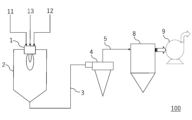
- FIG. 2 is a schematic cross-sectional view showing the configuration of a thermal spraying device.
- the spherical alumina powder of this embodiment will be described.
- the volume frequency particle size distribution of the spherical alumina powder is measured by a wet laser diffraction scattering method, and in the obtained volume frequency particle size distribution, the particle size at which the cumulative value is 10% is defined as D10 , the particle size at which the cumulative value is 50% is defined as D50 , and the particle size at which the cumulative value is 97% is defined as D97 .
- the spherical alumina powder of this embodiment is configured so that (D 97 -D 10 )/D 50 , which is one of the particle size distributions, is 4.2 or more and 20.0 or less.
- the lower limit of (D 97 -D 10 )/D 50 is at least 4.2, preferably at least 4.5, and more preferably at least 5.0, which can suppress the generation of burrs during molding of a resin molding material containing spherical alumina powder.
- the upper limit of ( D97 - D10 )/ D50 is 20.0 or less, preferably 15.0 or less, and more preferably 10.0 or less, so that the particle size distribution is not too broad and D50 is not too small, and the flowability and filling property of the powder itself can be improved by keeping the range appropriate.
- the lower limit of D 97 /D 50 is, for example, 5.0 or more, preferably 5.5 or more, and more preferably 6.0 or more, whereby the particle size distribution has a certain width, and the flowability and moldability can be improved.
- the upper limit of D 97 /D 50 is, for example, 20.0 or less, preferably 10.0 or less, and more preferably 8.0 or less, whereby the particle size of the coarse particles becomes sharp, and molding defects in the molded product due to the coarse particles can be suppressed.
- the lower limit of D50 is, for example, 2.0 ⁇ m or more, preferably 3.0 ⁇ m or more, and more preferably 4.0 ⁇ m or more.
- the upper limit of D50 is, for example, 15.0 ⁇ m or less, preferably 9.0 ⁇ m or less, and more preferably 8.5 ⁇ m or less.
- the lower limit of D90 is, for example, 20.0 ⁇ m or more, preferably 25.0 ⁇ m or more, and more preferably 30.0 ⁇ m or more.
- the upper limit of D90 is, for example, 80.0 ⁇ m or less, preferably 70.0 ⁇ m or less, and more preferably 60.0 ⁇ m or less.
- the particle size distribution of the spherical alumina powder is a value based on particle size measurement by the laser diffraction light scattering method, and can be measured using a particle size distribution measuring device such as the "Model LS-13230" (manufactured by Beckman Coulter).
- a particle size distribution measuring device such as the "Model LS-13230" (manufactured by Beckman Coulter).
- water was used as the solvent, and as a pretreatment, the powder was dispersed for 1 minute using a homogenizer at 200 W output.
- the PIDS (Polarization Intensity Differential Scattering) concentration was adjusted to 45-55%.
- the refractive index of water was 1.33, and the refractive index of the powder was determined taking into account the refractive index of the powder material.
- the refractive index of amorphous silica was 1.50
- the refractive index of alumina was 1.68.
- the above (D 97 -D 10 )/D 50 and D 97 /D 50 by appropriately selecting, for example, the raw material components of the spherical alumina powder, the manufacturing method of the spherical alumina powder, etc.
- factors for setting the above (D 97 -D 10 )/D 50 and D 97 /D 50 within the desired numerical range include, for example, appropriately controlling the melting flame conditions such as the raw material supply amount, raw material particle size, flame temperature, combustible gas, combustion supporting gas, and dispersion gas , heating the raw material carrier gas , using alumina raw material powders of different particle sizes in combination, and appropriately adjusting the aperture during classification treatment.
- the thixotropy index of the evaluation resin varnish containing spherical alumina powder is configured to be, for example, 0.10 or more and 0.80 or less.
- the thixotropy index of the resin varnish to be evaluated can be measured according to the following procedure.
- the spherical alumina powder is mixed with bisphenol F type epoxy (Epicoat 807) that is liquid at 25° C. so that the content is 83 mass % to obtain the above-mentioned resin varnish for evaluation.
- the viscosity ( ⁇ 1 ) of the obtained resin varnish for evaluation is measured using a rheometer at a shear rate of 2 [1/s] and a shear rate of 20 [1/s] at 25 ° C.
- the thixotropic index is calculated based on ⁇ 20 / ⁇ 1 .
- the lower limit of the thixotropy index is, for example, 0.10 or more, preferably 0.12 or more, and more preferably 0.15 or more, which can improve the wire sweepability of the resin molding material.
- the upper limit of the thixotropy index is, for example, 0.80 or less, preferably 0.70 or less, and more preferably 0.60 or less, thereby improving the moldability of the resin molding material.
- the lower limit of the viscosity ( ⁇ 1 ) of the resin varnish for evaluation at a shear rate of 1 [1/s] is, for example, 100 Pa ⁇ s or more, preferably 120 Pa ⁇ s or more, and more preferably 150 Pa ⁇ s or more. This can improve the handleability of the resin molding material.
- the upper limit of the viscosity ( ⁇ 1 ) is, for example, 1000 Pa ⁇ s or less, preferably 800 Pa ⁇ s or less, and more preferably 600 Pa ⁇ s or less, which can improve the handleability of the resin molding material and suppress deformation of the wire due to flow pressure during molding.
- the spherical alumina powder may be configured so that the degree of compression calculated based on ((P-A)/P) x 100, where A is the loose bulk density and P is the compacted bulk density measured according to the following procedure, is, for example, 35% or more and 55% or less.
- the loose bulk density, the hardened bulk density and the compressibility can be measured according to the following procedure under conditions of a room temperature of 25° C. and a humidity of 55%.
- the spherical alumina powder is allowed to fall from a height of 25 cm at a rate of 5 to 10 g per minute into a 100 cm3 measuring cup, and the fall is continued until the powder overflows from the cup, to prepare a heaping cup.
- the overflowing amount is leveled off without tapping, and then the mass (g) of the spherical alumina powder filled in the cup is measured to calculate the loose bulk density (g/cm 3 ).
- the lower limit of the compression degree is, for example, 35% or more, preferably 38% or more, and more preferably 40% or more, which can improve the handleability of the spherical alumina powder.
- the upper limit of the compression degree is, for example, 55% or less, preferably 53% or less, and more preferably 50% or less, which can improve the mixability of the resin and the spherical alumina powder.
- the spherical alumina powder may be configured so as to have a loose bulk density (A) of 1.10 g/cm 3 or more and 1.50 g/cm 3 or less.
- the lower limit of the loose bulk density (A) is, for example, 1.10 cm 3 /g or more, preferably 1.15 cm 3 /g or more, and more preferably 1.20 cm 3 /g or more. This improves the denseness and may improve the strength of the molded article of the resin molding material.
- the upper limit of the loose bulk density (A) is, for example, 1.50 cm 3 /g or less, preferably 1.45 cm 3 /g or less, and more preferably 1.40 cm 3 /g or less, which can improve the mixability of the resin and the spherical alumina powder.
- Spherical alumina powder is produced, for example, by supplying alumina raw material powder into a high-temperature flame formed by the combustion reaction of a combustible gas and a combustion supporting gas, and melting and spheroidizing the powder at a temperature above its melting point.
- the particles obtained by this type of molten flame method are called molten spherical particles.
- the obtained molten spherical particles may be further subjected to classification and sieving processing as necessary.
- For the alumina raw material powder multiple raw material powders with different particle sizes are used.
- FIG. 1 shows a schematic diagram of an example of a thermal spraying apparatus used for producing molten spherical particles.
- the thermal spraying device 100 in FIG. 1 is composed of a melting furnace 2 in which a burner 1 is installed, a cyclone 4 for classifying molten spherical particles generated by high-temperature exhaust gas from a flame by suction with a blower 9, and a bag filter 8 for collecting fine powder that cannot be captured by the cyclone 4.
- the melting furnace 2 is configured as a vertical furnace body, but is not limited to this, and may be a so-called horizontal furnace or inclined furnace that is horizontal and blows out flames horizontally.
- the hot exhaust gas is cooled by pipes 3 and 5 which are equipped with water-cooled jackets.
- the blower 9 may be connected to a suction gas amount control valve and a gas exhaust port (not shown).
- a collected powder removal device (not shown) may be connected to the lower portion of the melting furnace 2, the cyclone 4, and the bag filter 8.
- the classification can be carried out using known equipment such as a settling chamber, a cyclone, a classifier having a rotor, etc. This classification operation may be incorporated into the transportation process of the molten spheroidized product, or may be carried out in a separate line after collecting the molten spheroidized product all at once.
- the combustible gas for example, one or more of acetylene, propane, butane, etc. may be used, but propane, butane, or a mixture thereof, which have a relatively small calorific value, is preferred.
- the combustion supporting gas for example, a gas containing oxygen is used. In general, it is most preferable to use pure oxygen of 99 mass% or more, as it is inexpensive.
- an inert gas such as air or argon can be mixed with the combustion supporting gas.
- Alumina powder having an average particle size of, for example, 3 to 70 ⁇ m may be used as the raw material powder, which is the alumina raw material powder.
- the aluminum hydroxide powder may be supplied to the high-temperature flame in a dry manner or in a wet manner in which it is slurried with water or the like.
- the spherical alumina powder of the present invention can be blended with a resin composition and used suitably as a resin molding material.
- the resin composition contains, in addition to the spherical alumina powder of the present invention, a resin and known resin additives.
- the spherical alumina powder may be used alone or may be mixed with other fillers.
- the resin composition may contain 10 to 99% by mass of the spherical alumina powder, or 10 to 99% by mass of a mixed inorganic powder containing the spherical alumina powder and other fillers.
- the content of the other fillers in the mixed inorganic powder may be, for example, 1 to 20% by mass or 3 to 15% by mass relative to 100% by mass of the spherical alumina powder.
- the range "to" indicates that both the upper and lower limits are included, unless otherwise specified.
- Examples of the other fillers include crystalline silica, fused silica, titania, silicon nitride, aluminum nitride, silicon carbide, talc, and calcium carbonate.
- the average particle size of the other fillers is, for example, about 5 to 100 ⁇ m, and there are no particular restrictions on the particle size composition and shape.
- Examples of the above resins include epoxy resins, silicone resins, phenolic resins, melamine resins, urea resins, unsaturated polyesters, fluororesins, polyamides such as polyimide, polyamideimide, and polyetherimide, polyesters such as polybutylene terephthalate and polyethylene terephthalate, polyphenylene sulfide, wholly aromatic polyesters, polysulfones, liquid crystal polymers, polyethersulfones, polycarbonates, maleimide-modified resins, ABS resins, AAS (acrylonitrile-acrylic rubber-styrene) resins, and AES (acrylonitrile-ethylene-propylene-diene rubber-styrene) resins. These may be used alone or in combination of two or more.
- the resin composition can be produced, for example, by blending the raw material components in a prescribed ratio using a blender or Henschel mixer, kneading the mixture using a heated roll, kneader, single-screw or twin-screw extruder, etc., cooling the mixture, and then pulverizing it.
- the thermal spraying device 100 shown in FIG. 1 includes a melting furnace 2, a burner 1 installed in the upper part of the melting furnace 2, and a collection system line installed directly connected to the lower part of the melting furnace 2 and consisting of a cyclone 4 and a bag filter 8.
- Burner 1 has a double-tube structure capable of forming an inner flame and an outer flame, and is installed at the top of melting furnace 2, to which a combustible gas supply pipe 11, a combustion supporting gas supply pipe 12, and a raw material supply pipe 13 are each connected.
- raw material powder is fed into the high-temperature flame through a raw material supply pipe 13 and melted to form molten spherical particles.
- the molten spherical particles that have passed through the melting furnace 2 are sucked in by a blower 9 together with the combustion exhaust gas, moved by the air through pipes 3 and 5, and classified and collected by a cyclone 4 or a bag filter 8.
- Example 1 Using the above-mentioned thermal spraying device 100, LPG was supplied as a combustible gas from the combustible gas supply pipe 11, and oxygen was supplied as a combustion supporting gas from the combustion supporting gas supply pipe 12. A high-temperature flame was formed in the burner 1 by combustion of the LPG and oxygen. Secondary air is supplied to the cyclone 4 by a rotary valve (not shown) installed in the pipe 3. Air in the atmosphere is used as the secondary air. The degree of opening and closing of the lower valve in the cyclone 4 (lower opening degree) is set to 100%. As the raw material powder, alumina powders having a maximum average particle size (D 50 ) in the range of 2 to 45 ⁇ m were used.
- D 50 maximum average particle size
- the supply rates were 15 Nm 3 /hr for the raw material carrier gas heated to 500° C., 5 Nm 3 /hr for the burner combustible gas, and 10 Nm 3 /hr for the combustion supporting gas.
- the molten spherical particles captured by the bag filter 8 were recovered as spherical alumina powder.
- Examples 2 to 5 The spherical alumina powder was collected in the same manner as in Example 1 above, except that the lower opening degree during the classification process in the production of the spherical alumina powder was changed to 20%, 25%, 35%, and 45%, respectively.
- Comparative Example 1 To the spherical alumina powder recovered in the same manner as in Example 1, spherical alumina fine powder (DAW-01, manufactured by Denka Company, Ltd., average particle diameter D 50 : 2 ⁇ m) was added to adjust the particle size distribution in Table 1, thereby obtaining the spherical alumina powder of Comparative Example 1.
- DWA-01 spherical alumina fine powder
- Comparative Example 2 To the spherical alumina powder recovered in the same manner as in Example 1, spherical alumina coarse powder (DAW-70, manufactured by Denka Company, average particle diameter D 50 : 45 ⁇ m) was added to adjust the particle size distribution in Table 1, thereby obtaining the spherical alumina powder of Comparative Example 2.
- DWA-70 spherical alumina coarse powder
- ⁇ Loose bulk density, hard bulk density> The loose bulk density and the packed bulk density of the obtained spherical alumina powder were measured at room temperature of 25° C. and humidity of 55% using a powder tester (PT-E type, manufactured by Hosokawa Micron Corporation). The specific steps are as follows: The spherical alumina powder sample was allowed to fall from a height of 25 cm at a rate of 5 to 10 g per minute into a 100 cm3 measuring cup. The drop was continued until the powder overflowed from the cup, and a heaping cup was prepared.
- the overflowing powder was leveled off without tapping, and then the mass (g) of the spherical alumina powder filled in the cup was measured to calculate the loose bulk density (g/cm 3 ).
- the heaped cup was tapped up and down 180 times (stroke length 2 cm, 1 second/time), and the overflowed powder was leveled off.
- the mass (g) of the spherical alumina powder filled in the cup was then measured, and the compacted bulk density (g/ cm3 ) was calculated.
- the loose bulk density obtained by the above procedure is A and the hardened bulk density is P
- the degree of compression (%) was calculated based on the formula: ((P-A)/P) x 100.
- the volume frequency particle size distribution of the obtained spherical alumina powder was determined by a wet laser diffraction scattering method using a particle size distribution measuring device (LS-13230, manufactured by Beckman Coulter, Inc.). Water was used as the solvent, and as a pretreatment, the powder was dispersed for 1 minute using a homogenizer at an output of 200 W. The PIDS (Polarization Intensity Differential Scattering) concentration was adjusted to 45 to 55%, and the measurement was performed. Based on the obtained volume frequency particle size distribution, the particle diameter D X at which the cumulative value becomes X% was calculated.
- ⁇ Viscosity> The obtained spherical alumina powder was mixed with bisphenol F type epoxy (Epicoat 807) in a liquid state at 25° C. so that the content was 83 mass %, to obtain the above-mentioned resin varnish for evaluation.
- the obtained resin varnish for evaluation was measured for viscosity ( ⁇ 1 ) at a shear rate of 1 [1/s] at 25° C. and viscosity ( ⁇ 20 ) at a shear rate of 20 [1/s] using a rheometer (manufactured by Anton Paar).
- the obtained ⁇ 1 and ⁇ 20 were used to calculate the "thixotropy index" represented by the formula ⁇ 20 / ⁇ 1 .
- ⁇ Burring prevention> A mixture of 90.1 parts by mass of the obtained spherical alumina powder, 4.8 parts by mass of biphenylene aralkyl phenol type epoxy resin (manufactured by Nippon Kayaku Co., Ltd., product name: NC-3000, epoxy equivalent 275, softening point 56° C.), 3.7 parts by mass of phenol resin (phenol aralkyl resin, manufactured by Meiwa Kasei Co., Ltd. MEHC-7800S), 0.19 parts by mass of triphenylphosphine (manufactured by Hokko Chemical Industry Co., Ltd.: TPP), and N-phenyl-3-aminopropyltrimethylamine was used.
- biphenylene aralkyl phenol type epoxy resin manufactured by Nippon Kayaku Co., Ltd., product name: NC-3000, epoxy equivalent 275, softening point 56° C.
- phenol resin phenol aralkyl resin, manufactured by Meiwa Kasei Co.
- toxosilane manufactured by Shin-Etsu Chemical Co., Ltd.: KBM-573
- a Henschel mixer manufactured by Nippon Coke and Engineering Co., Ltd., "FM-20C/I”
- screw diameter D 25 mm
- the obtained resin composition was molded using a burr measurement mold having slits of 2 ⁇ m, 5 ⁇ m, 10 ⁇ m, and 30 ⁇ m at a molding temperature of 175° C. and a molding pressure of 7.4 MPa.
- the amount of resin that flowed into the slits was measured with a vernier caliper, and the values measured for each slit were averaged to determine the burr length ( ⁇ m).
- the burr length was 2 mm or less, it was evaluated as being able to suppress the generation of burrs during molding (good), and when it exceeded 2 mm, it was evaluated as being likely to generate burrs during molding (bad).
- the resin composition obtained above was used in a spiral flow mold in accordance with EMMI-1-66 (Epoxy Molding Material Institute; Society of Plastics Industry).
- the mold temperature was 175° C.
- the molding pressure was 7.4 MPa
- the pressure retention time was 90 seconds.
- a spiral flow of 150 cm or more was evaluated as good, and a spiral flow of less than 150 cm was evaluated as poor.
- the resin composition obtained above was poured into a mold having a disk-shaped hole with a diameter of 28 mm and a thickness of 3 mm, and molded at 150°C for 20 minutes after degassing.
- the thermal conductivity (W/m ⁇ K) of the obtained molded body was measured by a steady method in accordance with ASTM D5470 using a thermal conductivity measuring device (a resin material thermal resistance measuring device "TRM-046RHHT" (product name) manufactured by Hitachi Technology and Services Co., Ltd.).
- the resin composition was processed to a width of 10 mm x 10 mm, and measurements were performed while applying a load of 2 N.
- Thermal conductivity (W/m ⁇ K) thickness of molded body (m)/ ⁇ thermal resistance (° C./W) ⁇ heat transfer area (m 2 ) ⁇
- the spherical alumina powders of Examples 1 to 4 were able to suppress the generation of burrs during molding of the resin composition, and also showed results that could improve the thermal conductivity of the resin molding material.
- the spherical alumina powders of Examples 1 to 4 showed results that showed excellent flowability when used in the resin molding material.
Landscapes
- Chemical & Material Sciences (AREA)
- Organic Chemistry (AREA)
- Inorganic Chemistry (AREA)
- Life Sciences & Earth Sciences (AREA)
- Geology (AREA)
- Engineering & Computer Science (AREA)
- Plasma & Fusion (AREA)
- Physics & Mathematics (AREA)
- Polymers & Plastics (AREA)
- Medicinal Chemistry (AREA)
- Materials Engineering (AREA)
- Wood Science & Technology (AREA)
- Health & Medical Sciences (AREA)
- Chemical Kinetics & Catalysis (AREA)
- Compounds Of Alkaline-Earth Elements, Aluminum Or Rare-Earth Metals (AREA)
- Compositions Of Macromolecular Compounds (AREA)
Abstract
Description
1. 湿式によるレーザー回折散乱法で測定される体積頻度粒度分布において、累積値が10%となる粒子径をD10、累積値が50%となる粒子径をD50、累積値が97%となる粒子径をD97としたとき、
(D97-D10)/D50が、4.2以上20.0以下である、球状アルミナ粉末。
2. 1.に記載の球状アルミナ粉末であって、
D97/D50が、5.0以上20.0以下である、球状アルミナ粉末。
3. 1.又は2.に記載の球状アルミナ粉末であって、
下記の手順に従って測定される、当該球状アルミナ粉末を含む評価用樹脂ワニスのチキソ指数が、0.10以上0.80以下である、球状アルミナ粉末。
(手順)
当該球状アルミナ粉末を、含有量が83質量%となるように、25℃で液状のビスフェノールF型エポキシと混合して、上記の評価用樹脂ワニスを得る。
続いて、得られた評価用樹脂ワニスにおいて、レオメータを用いて、25℃下、せん断速度2[1/s]で測定したときの粘度(η1)、およびせん断速度20[1/s]で測定したときの粘度(η20)を測定する。上記のチキソ指数を、η20/η1に基づいて求める。
4. 1.~3.に記載の球状アルミナ粉末であって、
前記樹脂組成物の試験サンプルにおけるせん断速度:20[1/s]時における粘度η20が、10Pa・s以上200Pa・s以下である、球状アルミナ粉末。
5. 1.~4.のいずれか一つに記載の球状アルミナ粉末であって、
下記の手順で測定される、ゆるめ嵩密度が、1.10g/cm3以上1.50g/cm3以下である、球状アルミナ粉末。
(手順)
当該球状アルミナ粉末を、1分間に5~10gの投入量で、高さ25cmから自然落下させ、100cm3の測定用カップの内部に投入し、カップから溢れ出るまで続けて、山盛りカップを準備する。
続いて、山盛りカップについて、タッピングせずに、カップの上面に溢れた分をすり切った後、カップに充填された球状アルミナ粉末の質量(g)を測定し、ゆるめ嵩密度(g/cm3)を算出する。
一方、山盛りカップについて、上下方向に180回の条件(ストローク長2cm、1秒/回)でタッピングした後で、カップの上面に溢れた分をすり切った後、カップに充填された球状アルミナ粉末の質量(g)を測定し、かため嵩密度(g/cm3)を算出する。
6. 1.~5.に記載の球状アルミナ粉末であって、
前記手順で測定される、ゆるめ嵩密度をA、かため嵩密度をPとしたとき、
((P-A)/P)×100に基づいて求められる圧縮度が、35%以上55%以下である、球状アルミナ粉末。
(D97-D10)/D50の下限は、4.2以上、好ましくは4.5以上、より好ましくは5.0以上である。これにより、球状アルミナ粉末を含む樹脂成形材料の成形時におけるバリ発生を抑制できる。
また、(D97-D10)/D50の上限は、20.0以下、好ましくは15.0以下、より好ましくは10.0以下である。これにより、粒度分布が広くなりすぎたり、D50が小さくなりすぎたりすることなく、適切な範囲にあることで、粉体自身の流動性、充填性が向上できる。
また、D97/D50の上限は、例えば、20.0以下、好ましくは10.0以下、より好ましくは8.0以下である。これにより、粗大な粒子の粒度がシャープになり、粗大な粒子による成形体の成形不良を抑制できる。
また、D50の上限は、例えば、15.0μm以下、好ましくは9.0μm以下、より好ましくは8.5μm以下である。
また、D90の上限は、例えば、80.0μm以下、好ましくは70.0μm以下、より好ましくは60.0μm以下である。
当該球状アルミナ粉末を、含有量が83質量%となるように、25℃で液状のビスフェノールF型エポキシ(エピコート807)と混合して、上記の評価用樹脂ワニスを得る。
続いて、得られた評価用樹脂ワニスにおいて、レオメータを用いて、25℃下、せん断速度2[1/s]で測定したときの粘度(η1)、およびせん断速度20[1/s]で測定したときの粘度(η20)を測定する。上記のチキソ指数を、η20/η1に基づいて求める。
また、上記チキソ指数の上限は、例えば、0.80以下、好ましくは0.70以下、より好ましくは0.60以下である。これにより、樹脂成形材料の成形性を向上できる。
また、上記の粘度(η1)の上限は、例えば、1000Pa・s以下、好ましくは800Pa・s以下、より好ましくは600Pa・s以下である。これにより、樹脂成形材料のハンドリング性を向上や成型時の流動圧によるワイヤーが変形を抑制することができる。
当該球状アルミナ粉末を、1分間に5~10gの投入量で、高さ25cmから自然落下させ、100cm3の測定用カップの内部に投入し、カップから溢れ出るまで続けて、山盛りカップを準備する。
続いて、山盛りカップについて、タッピングせずに、カップの上面に溢れた分をすり切った後、カップに充填された球状アルミナ粉末の質量(g)を測定し、ゆるめ嵩密度(g/cm3)を算出する。
一方、山盛りカップについて、上下方向に180回の条件(ストローク長2cm、1秒/回)でタッピングした後で、カップの上面に溢れた分をすり切った後、カップに充填された球状アルミナ粉末の質量(g)を測定し、かため嵩密度(g/cm3)を算出する。
上記手順により求めた、ゆるめ嵩密度(A)およびかため嵩密度(P)を用いて、((P-A)/P)×100に基づいて、圧縮度(%)を算出する。
また、圧縮度の上限は、例えば、55%以下、好ましくは53%以下、より好ましくは50%以下である。これにより、樹脂と球状アルミナ粉末との混合性を向上できる。
ゆるめ嵩密度(A)の下限は、例えば、1.10cm3/g以上、好ましくは1.15cm3/g以上、より好ましくは1.20cm3/g以上である。これにより、緻密性が向上し、樹脂成形材料の成形体における強度向上の可能性がある。
また、ゆるめ嵩密度(A)の上限は、例えば、1.50cm3/g以下、好ましくは1.45cm3/g以下、より好ましくは1.40cm3/g以下である。これにより、樹脂と球状アルミナ粉末との混合性を向上できる。
図1の溶射装置100は、バーナー1が設置された溶融炉2と、火炎の高温排ガスで生成した溶融球状粒子を、ブロワー9の吸引にて分級するためのサイクロン4と、サイクロン4で捕集できなかった微粉を回収するバグフィルター8と、により構成されている。
溶融炉2は、縦型炉体で構成されるが、これに限定されず、横型にして火炎を水平方向に吹き出す、いわゆる横型炉又は傾斜炉であってもよい。
高温排ガスは、水冷ジャケットを備える配管3,5によって冷却される。
ブロワー9には、不図示の吸引ガス量制御バルブ、およびガス排気口が接続されていてもよい。
溶融炉2、サイクロン4、およびバグフィルター8の下部には、不図示の捕集粉抜き出し装置が接続されていてもよい。
分級は、重沈室、サイクロン、回転翼を有する分級機等公知の機器を用いて行うことができる。この分級操作は、溶融球状化品の輸送工程に織り込んで行ってもよく、また一括捕集してから別ラインで行ってもよい。
助燃ガスとしては、例えば、酸素を含むガスが使用される。一般的には、99質量%以上の純酸素を用いるのが安価で最も好ましい。ガスの発熱量低減を目的とし、空気やアルゴン等の不活性ガスを助燃ガスに混合することもできる。
樹脂組成物中に、球状アルミナ粉末は、単独で使用してもよいが、その他のフィラーと混合して使用してもよい。樹脂組成物中には、球状アルミナ粉末が10~99質量%含まれていてもよく、または球状アルミナ粉末およびその他のフィラーを含む混合無機粉末が10~99質量%含まれていてもよい。また、混合無機粉末中、その他のフィラーの含有量は、球状アルミナ粉末100質量%に対して、例えば、1~20質量%、3~15質量%であってもよい。
なお、本明細書中、「~」は、特に明示しない限り、上限値と下限値を含むことを表す。
その他のフィラーの平均粒子径は、例えば、5~100μm程度のものが使用され、その粒度構成及び形状については特に制約はない。
図1に示す溶射装置100を用いて、球状アルミナ粉末を製造した。
図1に示す溶射装置100は、溶融炉2と、溶融炉2の上部に設置されたバーナー1と、溶融炉2の下部に直結して設置された、サイクロン4およびバグフィルター8からなる捕集系ラインと、を備える。
バーナー1は、内炎と外炎とを形成できる二重管構造を有していて、溶融炉2の頂上部に設置されており、可燃ガス供給管11、助燃ガス供給管12、原料供給管13の各々が接続されている。
溶融炉2内では、原料供給管13より原料粉末を高温火炎中に供給し、溶融させて、球状化した溶融球状粒子を形成できる。溶融炉2を通過した溶融球状粒子は、燃焼排ガスとともにブロワー9により吸引され、配管3,5内を空気により移動し、サイクロン4またはバグフィルター8にて分級・捕集される。
上記の溶射装置100を用いて、可燃性ガスとしてLPGを可燃ガス供給管11から供給し、助燃ガスとして酸素を助燃ガス供給管12から供給し、バーナー1において、LPGと酸素との燃焼により高温火炎を形成した。
サイクロン4に対して、配管3に設置された不図示のロータリーバルブにより二次エアーを供給する。二次エアーには、大気中の空気を使用した。また、サイクロン4における下部の弁の開閉度合(下部開度)を100%とした。
なお、原料粉末として、平均粒径(D50)が2~45μmの範囲に極大値を有するアルミナ粉末を複数使用した。供給量は、500℃に加熱された原料のキャリアガスが15Nm3/hr、バーナーの可燃性ガスが5Nm3/hr、助燃ガスが10Nm3/hrとした。バグフィルター8にて捕集された溶融球状粒子を、球状アルミナ粉末として回収した。
球状アルミナ粉末の製造において分級処理の際、下部開度を、それぞれ20%、25%、35%、45%に変更した以外は、上記の実施例1と同様にして、球状アルミナ粉末を回収した。
実施例1と同様にして回収した球状アルミナ粉末に対して、球状アルミナ微粉(デンカ社製、DAW-01、平均粒子径D50:2μm)を添加して、表1の粒度分布を調整し、比較例1の球状アルミナ粉末を得た。
実施例1と同様にして回収した球状アルミナ粉末に対して、球状アルミナ粗粉(デンカ社製、DAW-70、平均粒子径D50:45μm)を添加して、表1の粒度分布を調整し、比較例2の球状アルミナ粉末を得た。
得られた球状アルミナ粉末において、室温25℃、湿度55%の条件下、パウダーテスター(ホソカワミクロン社製、PT-E型)を用いて、ゆるめ嵩密度及びかため嵩密度を測定した。
具体的な手順は以下の通り。
測定サンプルである球状アルミナ粉末を、1分間に5~10gの投入量で、高さ25cmから自然落下させ、100cm3の測定用カップの内部に投入し、カップから溢れ出るまで続けて、山盛りカップを準備した。
続いて、山盛りカップについて、タッピングせずに、カップの上面に溢れた分をすり切った後、カップに充填された球状アルミナ粉末の質量(g)を測定し、ゆるめ嵩密度(g/cm3)を算出した。
一方、山盛りカップについて、上下方向に180回の条件(ストローク長2cm、1秒/回)でタッピングした後で、カップの上面に溢れた分をすり切った後、カップに充填された球状アルミナ粉末の質量(g)を測定し、かため嵩密度(g/cm3)を算出した。
上記の手順で求められた、ゆるめ嵩密度をA、かため嵩密度をPとしたとき、圧縮度(%)を、式:((P-A)/P)×100に基づいて求めた。
得られた球状アルミナ粉末について、粒度分布測定装置(ベックマンコールター社製、LS-13230)を用いて、湿式によるレーザー回折散乱法により体積頻度粒度分布を求めた。溶媒には水を用い、前処理として、1分間、ホモジナイザーを用いて200Wの出力をかけて分散処理させた。また、PIDS(Polarization Intensity Differential Scattering)濃度を45~55%になるように調製して測定した。
得られた体積頻度粒度分布に基づいて、累積値がX%となる粒子径DXを算出した。
得られた球状アルミナ粉末を、含有量が83質量%となるように、25℃で液状のビスフェノールF型エポキシ(エピコート807)と混合して、上記の評価用樹脂ワニスを得た。
得られた評価用樹脂ワニスについて、レオメータ(AntonPaar社製)を用いて、25℃せん断速度1[1/s]で測定した粘度(η1)、およびせん断速度20[1/s]で測定した時の粘度(η20)を測定した。得られたη1、η20を用いて、式η20/η1で表される「チキソ指数」を求めた。

結果を表1に示す。表1中、「-」は未測定を意味する。
得られた球状アルミナ粉末90.1質量部と、ビフェニレンアラルキルフェノール型エポキシ樹脂(日本化薬株式会社製、商品名;NC-3000、エポキシ当量275、軟化点56℃)4.8質量部と、フェノール樹脂(フェノールアラルキル樹脂、明和化成株式会社製MEHC-7800S)3.7質量部と、トリフェニルホスフィン(北興化学工業株式会社製:TPP)0.19質量部と、N-フェニル-3-アミノプロピルトリメトキシシラン信越化学工業株式会社製:KBM-573)0.35質量部とを、ヘンシェルミキサー(日本コークス工業社製「FM-20C/I」)を用いて、常温、回転数2000rpmの条件下で混合し、得られた混合物を、同方向噛み合い二軸押出混練機(スクリュー径D=25mm、L/D=10.2、パドル回転数50~120rpm、吐出量3.0kg/Hr、混練物温度98~100℃)で加熱混練して、樹脂組成物を得た。
バリ長さが2mm以下の場合、成形時のバリ発生を抑制できる(良)と評価し、2mmを超える場合、成形時にバリが発生する恐れがある(不良)と評価した。
上記で得られた樹脂組成物を使用し、スパイラルフロー金型を用い、EMMI-1-66(Epoxy Molding Material Institute;Society of Plastic Industry)に準拠して行った。金型温度は175℃、成形圧力7.4MPa、保圧時間90秒とした。
スパイラルフローが150cm以上であるものを良好とし、150cm未満であるものと不良として評価した。
上記で得られた樹脂組成物を使用し、直径28mm、厚さ3mmの円盤状サイズ穴を設けた金型に樹脂組成物を流し込み、脱気後150℃×20分で成形した。得られた成形体について、得られた樹脂組成物について、熱伝導率測定装置(日立テクノロジーアンドサービス社製樹脂材料熱抵抗測定装置「TRM-046RHHT」(商品名)を用い、ASTM D5470に準拠した定常法で熱伝導率(W/m・K)を測定した。樹脂組成物は幅10mm×10mmに加工し、2Nの荷重をかけながら測定を実施した。
熱伝導率(W/m・K)=成形体の厚さ(m)/{熱抵抗(℃/W)×伝熱面積(m2)}
2 溶融炉
3 配管
4 サイクロン
5 配管
8 バグフィルター
9 ブロワー
11 可燃ガス供給管
12 助燃ガス供給管
13 原料供給管
100 溶射装置
Claims (6)
- 湿式によるレーザー回折散乱法で測定される体積頻度粒度分布において、累積値が10%となる粒子径をD10、累積値が50%となる粒子径をD50、累積値が97%となる粒子径をD97としたとき、
(D97-D10)/D50が、4.2以上20.0以下である、球状アルミナ粉末。 - 請求項1に記載の球状アルミナ粉末であって、
D97/D50が、5.0以上20.0以下である、球状アルミナ粉末。 - 請求項1又は2に記載の球状アルミナ粉末であって、
下記の手順に従って測定される、当該球状アルミナ粉末を含む評価用樹脂ワニスのチキソ指数が、0.10以上0.80以下である、球状アルミナ粉末。
(手順)
当該球状アルミナ粉末を、含有量が83質量%となるように、25℃で液状のビスフェノールF型エポキシと混合して、上記の評価用樹脂ワニスを得る。
続いて、得られた評価用樹脂ワニスにおいて、レオメータを用いて、25℃下、せん断速度2[1/s]で測定したときの粘度(η1)、およびせん断速度20[1/s]で測定したときの粘度(η20)を測定する。上記のチキソ指数を、η20/η1に基づいて求める。 - 請求項3に記載の球状アルミナ粉末であって、
前記樹脂組成物の試験サンプルにおけるせん断速度:20[1/s]時における粘度η20が、10Pa・s以上200Pa・s以下である、球状アルミナ粉末。 - 請求項1または2に記載の球状アルミナ粉末であって、
下記の手順で測定される、ゆるめ嵩密度が、1.10g/cm3以上1.50g/cm3以下である、球状アルミナ粉末。
(手順)
当該球状アルミナ粉末を、1分間に5~10gの投入量で、高さ25cmから自然落下させ、100cm3の測定用カップの内部に投入し、カップから溢れ出るまで続けて、山盛りカップを準備する。
続いて、山盛りカップについて、タッピングせずに、カップの上面に溢れた分をすり切った後、カップに充填された球状アルミナ粉末の質量(g)を測定し、ゆるめ嵩密度(g/cm3)を算出する。
一方、山盛りカップについて、上下方向に180回の条件(ストローク長2cm、1秒/回)でタッピングした後で、カップの上面に溢れた分をすり切った後、カップに充填された球状アルミナ粉末の質量(g)を測定し、かため嵩密度(g/cm3)を算出する。 - 請求項5に記載の球状アルミナ粉末であって、
前記手順で測定される、ゆるめ嵩密度をA、かため嵩密度をPとしたとき、
((P-A)/P)×100に基づいて求められる圧縮度が、35%以上55%以下である、球状アルミナ粉末。
Priority Applications (3)
| Application Number | Priority Date | Filing Date | Title |
|---|---|---|---|
| CN202380086021.7A CN120359188A (zh) | 2022-12-16 | 2023-12-15 | 球状氧化铝粉末 |
| JP2024564449A JPWO2024128317A1 (ja) | 2022-12-16 | 2023-12-15 | |
| KR1020257020201A KR20250109765A (ko) | 2022-12-16 | 2023-12-15 | 구상 알루미나 분말 |
Applications Claiming Priority (2)
| Application Number | Priority Date | Filing Date | Title |
|---|---|---|---|
| JP2022-201021 | 2022-12-16 | ||
| JP2022201021 | 2022-12-16 |
Publications (1)
| Publication Number | Publication Date |
|---|---|
| WO2024128317A1 true WO2024128317A1 (ja) | 2024-06-20 |
Family
ID=91485880
Family Applications (1)
| Application Number | Title | Priority Date | Filing Date |
|---|---|---|---|
| PCT/JP2023/045120 Ceased WO2024128317A1 (ja) | 2022-12-16 | 2023-12-15 | 球状アルミナ粉末 |
Country Status (5)
| Country | Link |
|---|---|
| JP (1) | JPWO2024128317A1 (ja) |
| KR (1) | KR20250109765A (ja) |
| CN (1) | CN120359188A (ja) |
| TW (1) | TW202436231A (ja) |
| WO (1) | WO2024128317A1 (ja) |
Citations (4)
| Publication number | Priority date | Publication date | Assignee | Title |
|---|---|---|---|---|
| WO2018047871A1 (ja) * | 2016-09-09 | 2018-03-15 | 住友化学株式会社 | アルミナ粉末、アルミナスラリー、アルミナ含有コート層、積層分離膜及び二次電池 |
| CN111302368A (zh) * | 2020-04-10 | 2020-06-19 | 洛阳中超新材料股份有限公司 | α-氧化铝微粉及其制备方法和应用 |
| WO2023013441A1 (ja) * | 2021-08-05 | 2023-02-09 | 株式会社トクヤマ | 組成物およびフィラー混合物 |
| JP2024021860A (ja) * | 2022-08-04 | 2024-02-16 | 住友化学株式会社 | アルミナ粉末、樹脂組成物、およびアルミナ粉末の製造方法 |
Family Cites Families (1)
| Publication number | Priority date | Publication date | Assignee | Title |
|---|---|---|---|---|
| JP2015193493A (ja) | 2014-03-31 | 2015-11-05 | 新日鉄住金化学株式会社 | 高比重アルミナおよびその製造方法 |
-
2023
- 2023-12-15 CN CN202380086021.7A patent/CN120359188A/zh active Pending
- 2023-12-15 KR KR1020257020201A patent/KR20250109765A/ko active Pending
- 2023-12-15 JP JP2024564449A patent/JPWO2024128317A1/ja active Pending
- 2023-12-15 WO PCT/JP2023/045120 patent/WO2024128317A1/ja not_active Ceased
- 2023-12-18 TW TW112149232A patent/TW202436231A/zh unknown
Patent Citations (4)
| Publication number | Priority date | Publication date | Assignee | Title |
|---|---|---|---|---|
| WO2018047871A1 (ja) * | 2016-09-09 | 2018-03-15 | 住友化学株式会社 | アルミナ粉末、アルミナスラリー、アルミナ含有コート層、積層分離膜及び二次電池 |
| CN111302368A (zh) * | 2020-04-10 | 2020-06-19 | 洛阳中超新材料股份有限公司 | α-氧化铝微粉及其制备方法和应用 |
| WO2023013441A1 (ja) * | 2021-08-05 | 2023-02-09 | 株式会社トクヤマ | 組成物およびフィラー混合物 |
| JP2024021860A (ja) * | 2022-08-04 | 2024-02-16 | 住友化学株式会社 | アルミナ粉末、樹脂組成物、およびアルミナ粉末の製造方法 |
Also Published As
| Publication number | Publication date |
|---|---|
| KR20250109765A (ko) | 2025-07-17 |
| JPWO2024128317A1 (ja) | 2024-06-20 |
| TW202436231A (zh) | 2024-09-16 |
| CN120359188A (zh) | 2025-07-22 |
Similar Documents
| Publication | Publication Date | Title |
|---|---|---|
| TW202344477A (zh) | 無機質粉末 | |
| WO2024128321A1 (ja) | 球状アルミナ粉末 | |
| WO2024128320A1 (ja) | 球状アルミナ粉末 | |
| WO2024128318A1 (ja) | 球状アルミナ粉末 | |
| WO2024128316A1 (ja) | 球状アルミナ粉末 | |
| JP7804705B2 (ja) | 球状シリカ粉末 | |
| WO2023153352A1 (ja) | 無機質粉末 | |
| JP7787917B2 (ja) | 球状シリカ粉末 | |
| KR20250109765A (ko) | 구상 알루미나 분말 | |
| JP7787916B2 (ja) | 球状シリカ粉末 | |
| KR20240144980A (ko) | 무기질 분말 | |
| JP2025168739A (ja) | アルミナ粉末、無機粉末および樹脂組成物 | |
| JP2025168735A (ja) | アルミナ粉末、無機粉末および樹脂組成物 | |
| TW202525718A (zh) | 無機質粉末 | |
| JP2025168731A (ja) | アルミナ粉末、無機粉末および樹脂組成物 | |
| CN119604471A (zh) | 氧化铝粉末、树脂组合物及氧化铝粉末的制造方法 |
Legal Events
| Date | Code | Title | Description |
|---|---|---|---|
| 121 | Ep: the epo has been informed by wipo that ep was designated in this application |
Ref document number: 23903596 Country of ref document: EP Kind code of ref document: A1 |
|
| WWE | Wipo information: entry into national phase |
Ref document number: 2024564449 Country of ref document: JP |
|
| WWE | Wipo information: entry into national phase |
Ref document number: 202380086021.7 Country of ref document: CN |
|
| WWE | Wipo information: entry into national phase |
Ref document number: 1020257020201 Country of ref document: KR |
|
| NENP | Non-entry into the national phase |
Ref country code: DE |
|
| WWP | Wipo information: published in national office |
Ref document number: 1020257020201 Country of ref document: KR |
|
| WWP | Wipo information: published in national office |
Ref document number: 202380086021.7 Country of ref document: CN |
|
| 122 | Ep: pct application non-entry in european phase |
Ref document number: 23903596 Country of ref document: EP Kind code of ref document: A1 |