WO2024128275A1 - 粒子含有繊維束の製造方法および粒子含有繊維束 - Google Patents
粒子含有繊維束の製造方法および粒子含有繊維束 Download PDFInfo
- Publication number
- WO2024128275A1 WO2024128275A1 PCT/JP2023/044781 JP2023044781W WO2024128275A1 WO 2024128275 A1 WO2024128275 A1 WO 2024128275A1 JP 2023044781 W JP2023044781 W JP 2023044781W WO 2024128275 A1 WO2024128275 A1 WO 2024128275A1
- Authority
- WO
- WIPO (PCT)
- Prior art keywords
- particle
- fiber bundle
- containing fiber
- particles
- fibers
- Prior art date
- Legal status (The legal status is an assumption and is not a legal conclusion. Google has not performed a legal analysis and makes no representation as to the accuracy of the status listed.)
- Ceased
Links
Images


Classifications
-
- C—CHEMISTRY; METALLURGY
- C08—ORGANIC MACROMOLECULAR COMPOUNDS; THEIR PREPARATION OR CHEMICAL WORKING-UP; COMPOSITIONS BASED THEREON
- C08J—WORKING-UP; GENERAL PROCESSES OF COMPOUNDING; AFTER-TREATMENT NOT COVERED BY SUBCLASSES C08B, C08C, C08F, C08G or C08H
- C08J5/00—Manufacture of articles or shaped materials containing macromolecular substances
- C08J5/04—Reinforcing macromolecular compounds with loose or coherent fibrous material
- C08J5/0405—Reinforcing macromolecular compounds with loose or coherent fibrous material with inorganic fibres
- C08J5/042—Reinforcing macromolecular compounds with loose or coherent fibrous material with inorganic fibres with carbon fibres
-
- C—CHEMISTRY; METALLURGY
- C08—ORGANIC MACROMOLECULAR COMPOUNDS; THEIR PREPARATION OR CHEMICAL WORKING-UP; COMPOSITIONS BASED THEREON
- C08K—Use of inorganic or non-macromolecular organic substances as compounding ingredients
- C08K3/00—Use of inorganic substances as compounding ingredients
- C08K3/02—Elements
- C08K3/04—Carbon
- C08K3/046—Carbon nanorods, nanowires, nanoplatelets or nanofibres
-
- B—PERFORMING OPERATIONS; TRANSPORTING
- B01—PHYSICAL OR CHEMICAL PROCESSES OR APPARATUS IN GENERAL
- B01J—CHEMICAL OR PHYSICAL PROCESSES, e.g. CATALYSIS OR COLLOID CHEMISTRY; THEIR RELEVANT APPARATUS
- B01J2/00—Processes or devices for granulating materials, e.g. fertilisers in general; Rendering particulate materials free flowing in general, e.g. making them hydrophobic
- B01J2/10—Processes or devices for granulating materials, e.g. fertilisers in general; Rendering particulate materials free flowing in general, e.g. making them hydrophobic in stationary drums or troughs, provided with kneading or mixing appliances
-
- B—PERFORMING OPERATIONS; TRANSPORTING
- B29—WORKING OF PLASTICS; WORKING OF SUBSTANCES IN A PLASTIC STATE IN GENERAL
- B29B—PREPARATION OR PRETREATMENT OF THE MATERIAL TO BE SHAPED; MAKING GRANULES OR PREFORMS; RECOVERY OF PLASTICS OR OTHER CONSTITUENTS OF WASTE MATERIAL CONTAINING PLASTICS
- B29B7/00—Mixing; Kneading
- B29B7/80—Component parts, details or accessories; Auxiliary operations
- B29B7/88—Adding charges, i.e. additives
- B29B7/90—Fillers or reinforcements, e.g. fibres
-
- B—PERFORMING OPERATIONS; TRANSPORTING
- B29—WORKING OF PLASTICS; WORKING OF SUBSTANCES IN A PLASTIC STATE IN GENERAL
- B29B—PREPARATION OR PRETREATMENT OF THE MATERIAL TO BE SHAPED; MAKING GRANULES OR PREFORMS; RECOVERY OF PLASTICS OR OTHER CONSTITUENTS OF WASTE MATERIAL CONTAINING PLASTICS
- B29B9/00—Making granules
- B29B9/08—Making granules by agglomerating smaller particles
-
- B—PERFORMING OPERATIONS; TRANSPORTING
- B29—WORKING OF PLASTICS; WORKING OF SUBSTANCES IN A PLASTIC STATE IN GENERAL
- B29B—PREPARATION OR PRETREATMENT OF THE MATERIAL TO BE SHAPED; MAKING GRANULES OR PREFORMS; RECOVERY OF PLASTICS OR OTHER CONSTITUENTS OF WASTE MATERIAL CONTAINING PLASTICS
- B29B9/00—Making granules
- B29B9/12—Making granules characterised by structure or composition
- B29B9/14—Making granules characterised by structure or composition fibre-reinforced
-
- C—CHEMISTRY; METALLURGY
- C08—ORGANIC MACROMOLECULAR COMPOUNDS; THEIR PREPARATION OR CHEMICAL WORKING-UP; COMPOSITIONS BASED THEREON
- C08J—WORKING-UP; GENERAL PROCESSES OF COMPOUNDING; AFTER-TREATMENT NOT COVERED BY SUBCLASSES C08B, C08C, C08F, C08G or C08H
- C08J3/00—Processes of treating or compounding macromolecular substances
- C08J3/20—Compounding polymers with additives, e.g. colouring
- C08J3/205—Compounding polymers with additives, e.g. colouring in the presence of a continuous liquid phase
-
- C—CHEMISTRY; METALLURGY
- C08—ORGANIC MACROMOLECULAR COMPOUNDS; THEIR PREPARATION OR CHEMICAL WORKING-UP; COMPOSITIONS BASED THEREON
- C08K—Use of inorganic or non-macromolecular organic substances as compounding ingredients
- C08K7/00—Use of ingredients characterised by shape
- C08K7/02—Fibres or whiskers
- C08K7/04—Fibres or whiskers inorganic
- C08K7/06—Elements
-
- D—TEXTILES; PAPER
- D01—NATURAL OR MAN-MADE THREADS OR FIBRES; SPINNING
- D01G—PRELIMINARY TREATMENT OF FIBRES, e.g. FOR SPINNING
- D01G9/00—Opening or cleaning fibres, e.g. scutching cotton
- D01G9/02—Opening or cleaning fibres, e.g. scutching cotton by agitation within a moving receptacle
-
- C—CHEMISTRY; METALLURGY
- C08—ORGANIC MACROMOLECULAR COMPOUNDS; THEIR PREPARATION OR CHEMICAL WORKING-UP; COMPOSITIONS BASED THEREON
- C08J—WORKING-UP; GENERAL PROCESSES OF COMPOUNDING; AFTER-TREATMENT NOT COVERED BY SUBCLASSES C08B, C08C, C08F, C08G or C08H
- C08J2363/00—Characterised by the use of epoxy resins; Derivatives of epoxy resins
-
- C—CHEMISTRY; METALLURGY
- C08—ORGANIC MACROMOLECULAR COMPOUNDS; THEIR PREPARATION OR CHEMICAL WORKING-UP; COMPOSITIONS BASED THEREON
- C08J—WORKING-UP; GENERAL PROCESSES OF COMPOUNDING; AFTER-TREATMENT NOT COVERED BY SUBCLASSES C08B, C08C, C08F, C08G or C08H
- C08J2367/00—Characterised by the use of polyesters obtained by reactions forming a carboxylic ester link in the main chain; Derivatives of such polymers
-
- C—CHEMISTRY; METALLURGY
- C08—ORGANIC MACROMOLECULAR COMPOUNDS; THEIR PREPARATION OR CHEMICAL WORKING-UP; COMPOSITIONS BASED THEREON
- C08J—WORKING-UP; GENERAL PROCESSES OF COMPOUNDING; AFTER-TREATMENT NOT COVERED BY SUBCLASSES C08B, C08C, C08F, C08G or C08H
- C08J2375/00—Characterised by the use of polyureas or polyurethanes; Derivatives of such polymers
- C08J2375/04—Polyurethanes
-
- C—CHEMISTRY; METALLURGY
- C08—ORGANIC MACROMOLECULAR COMPOUNDS; THEIR PREPARATION OR CHEMICAL WORKING-UP; COMPOSITIONS BASED THEREON
- C08J—WORKING-UP; GENERAL PROCESSES OF COMPOUNDING; AFTER-TREATMENT NOT COVERED BY SUBCLASSES C08B, C08C, C08F, C08G or C08H
- C08J2377/00—Characterised by the use of polyamides obtained by reactions forming a carboxylic amide link in the main chain; Derivatives of such polymers
-
- D—TEXTILES; PAPER
- D06—TREATMENT OF TEXTILES OR THE LIKE; LAUNDERING; FLEXIBLE MATERIALS NOT OTHERWISE PROVIDED FOR
- D06M—TREATMENT, NOT PROVIDED FOR ELSEWHERE IN CLASS D06, OF FIBRES, THREADS, YARNS, FABRICS, FEATHERS OR FIBROUS GOODS MADE FROM SUCH MATERIALS
- D06M2101/00—Chemical constitution of the fibres, threads, yarns, fabrics or fibrous goods made from such materials, to be treated
- D06M2101/40—Fibres of carbon
Definitions
- the present invention relates to a method for producing a particle-containing fiber bundle and a particle-containing fiber bundle.
- Carbon fibers are mixed and dispersed in matrices such as resins and are used in a variety of applications as an important industrial material to improve mechanical and electrical properties such as high strength, high rigidity, low specific gravity, high electrical conductivity, and high abrasion resistance.
- a carbon fiber form that makes the carbon fibers easy to handle and makes the mixing and dispersion processes efficient is used.
- the carbon fibers be fed stably and smoothly into kneaders, molding dies, etc.
- Methods used for this include cutting continuous carbon fiber bundles obtained by treating with a sizing agent, etc., to produce so-called chopped carbon fiber, and granulating the chopped carbon fibers to produce carbon fiber bundles.
- Carbon fiber reinforced thermoplastics can be manufactured by adding carbon fiber pellets to a thermoplastic resin.
- One method for manufacturing carbon fiber pellets has been disclosed in which short carbon fibers are mixed with a solution or suspension of a sizing agent to form carbon fiber aggregates, which are then pelletized using a disc pelletizer and then dried (Patent Document 1). This results in carbon fiber pellets with high density and a streamlined shape, and makes it possible to feed the carbon fibers stably and smoothly.
- a method for obtaining carbon fiber pellets using recycled fibers includes cutting and/or crushing the carbon fibers to a predetermined average length, mixing the carbon fibers with a solution or suspension in a mixer to form agglomerates, concentrating the agglomerates by contacting the agglomerates with an inclined rotating surface, and drying the agglomerates to form carbon fiber pellets, and includes pyrolysis of the carbon fibers prior to cutting or crushing (Patent Document 2).
- Patent Document 3 a method for producing carbon fiber pellets by rolling a mixture composed of carbon fibers and a binder-containing liquid in a container, in which the mixture further contains thermoplastic resin fibers, has been disclosed.
- An object of the present invention is to provide a particle-containing fiber bundle having high uniformity and further improved feed efficiency, and a method for producing the same.
- An object of the present invention is to provide a particle-containing fiber bundle having high uniformity and further improved feed efficiency, and a method for producing the same, particularly when recycled fibers are used as the raw carbon fiber.
- a method for producing a fiber bundle containing spheroidal or strand-shaped particles comprising: The method includes mixing a plurality of shortened fibers, particles having a median diameter of 100 ⁇ m or less, an organic binder, and a liquid; The fibers include carbon fibers, The method for producing a particle-containing fiber bundle, wherein the particles are used in an amount of 10 parts by mass or more per 100 parts by mass of the fibers.
- [3] The method for producing a particle-containing fiber bundle described in [1] or [2], wherein the solubility of the particles in the liquid is 0.01 g/100 g or less.
- [4] The method for producing a particle-containing fiber bundle according to any one of [1] to [3], wherein the solubility of the particles in water is 0.0001 g/100 g or less.
- [5] The method for producing a particle-containing fiber bundle according to [4], wherein the solubility of the organic binder in water exceeds 0.0001 g/100 g.
- [6] The method for producing a particle-containing fiber bundle according to any one of [1] to [5], wherein the particles include organic particles.
- [7] The method for producing a particle-containing fiber bundle according to any one of [1] to [6], wherein the particles are used in an amount of 20 parts by mass or more and 80 parts by mass or less per 100 parts by mass of the fibers.
- [8] The method for producing a particle-containing fiber bundle according to any one of [1] to [7], wherein the particles are used in an amount of 55 parts by mass or more and 75 parts by mass or less per 100 parts by mass of the fibers.
- [9] The method for producing a particle-containing fiber bundle according to any one of [1] to [8], wherein the organic binder contains at least one resin selected from the group consisting of polyamide resins, epoxy resins, unsaturated polyester resins, vinyl ester resins, and polyurethane resins.
- the organic particles include thermoplastic resin particles.
- thermoplastic resin particles include at least one selected from the group consisting of polyamide resin, polyolefin resin, polyester resin, polycarbonate resin, polyethersulfone resin, polyetheretherketone resin, polyetherimide resin, and polyphenylene sulfide resin.
- the organic particles include thermosetting resin particles.
- thermosetting resin particles include at least one selected from the group consisting of epoxy resin, vinyl ester resin, unsaturated polyester resin, cyanate ester resin, polyimide resin, maleimide resin, silicone resin, melamine resin, urea resin, alkyd resin, urethane resin, and phenol resin.
- the organic particles include curing agent particles.
- [15] The method for producing a particle-containing fiber bundle according to [14], wherein the curing agent particles include at least one selected from the group consisting of dicyandiamides, phenols, amines, carboxylic acid anhydrides, thiols, imidazoles, phosphines, peroxides, and organic metal salts.
- the particles include inorganic particles.
- [17] The method for producing a particle-containing fiber bundle according to [16], wherein the inorganic particles include at least one selected from the group consisting of metal particles, metal oxide particles, silica particles, silicate particles, carbonate particles, sulfate particles, hydroxide particles, glass particles, ceramic particles, graphite, and carbon black.
- [19] The method for producing a particle-containing fiber bundle according to any one of [1] to [18], wherein the particle diameter D10 at which the integrated value in a volume-based particle size distribution of the particles is 10% is 50 ⁇ m or less.
- [20] The method for producing a particle-containing fiber bundle according to any one of [1] to [19], wherein the particle diameter D90, at which the integrated value in a volume-based particle size distribution of the particles is 90%, is 0.5 ⁇ m or more.
- [21] The method for producing a particle-containing fiber bundle according to any one of [1] to [20], wherein the particle diameter D10 at which the integrated value in the volume-based particle size distribution of the particles is 10% is 0.05 ⁇ m or more.
- [22] The method for producing a particle-containing fiber bundle according to any one of [1] to [21], wherein the ratio (D75/D25) of the particle diameter D75 at which the integrated value in the volume-based particle size distribution of the particles is 75% and the particle diameter D25 at which the integrated value is 25% is 1 to 15.
- [23] A method for producing a particle-containing fiber bundle described in any one of [1] to [22], using fiber cotton containing the fiber.
- [24] A method for producing a particle-containing fiber bundle according to any one of [1] to [23], using an agitation granulator.
- [25] The method for producing a particle-containing fiber bundle described in [24], wherein the agitation granulator is equipped with an agitation tank.
- [26] The method for producing a particle-containing fiber bundle described in [25], in which an agitator blade is provided inside the agitation tank.
- [27] The method for producing a particle-containing fiber bundle described in [25] or [26], wherein the stirring tank is equipped with a scraper.
- [28] The method for producing a particle-containing fiber bundle described in [26] or [27], wherein the distance between the stirring blade and the wall surface of the stirring tank is 1 mm or less.
- [29] The method for producing a particle-containing fiber bundle described in any one of [26] to [28], wherein the distance between the stirring blade and the wall surface of the stirring tank is 10 mm or more.
- [30] The method for producing a particle-containing fiber bundle according to any one of [25] to [29], wherein the stirring tank is rotated.
- [31] The method for producing a particle-containing fiber bundle according to any one of [1] to [30], wherein the average fiber length of the fibers is 12 to 50 mm.
- [32] The method for producing a particle-containing fiber bundle according to any one of [1] to [30], wherein the average fiber length of the fibers is 2 to 12 mm.
- [33] The method for producing a particle-containing fiber bundle described in any one of [1] to [32], wherein the bulk density of the fiber is 0.01 to 0.1 g/ cm3 .
- [34] The method for producing a particle-containing fiber bundle described in any one of [1] to [33], wherein the positions of the tips of the fibers constituting the particle-containing fiber bundle are not uniform.
- [35] The method for producing a particle-containing fiber bundle according to any one of [1] to [34], wherein the length of the particle-containing fiber bundle is longer than the average fiber length of the fibers contained in the particle-containing fiber bundle.
- [36] A method for producing a particle-containing fiber bundle according to any one of [1] to [35], comprising mixing the particles, the organic binder, and the liquid to obtain mixture 1, and mixing the mixture 1 with the fibers to obtain mixture 2.
- [37] A method for producing a particle-containing fiber bundle described in any one of [1] to [36], comprising removing the liquid.
- [38] The method for producing a particle-containing fiber bundle described in any one of [1] to [37], wherein the liquid is used in an amount of 60 to 200 parts by mass per 100 parts by mass of the fibers.
- [39] The method for producing a particle-containing fiber bundle according to any one of [1] to [38], in which the organic binder is used in an amount of 1 to 40 parts by mass per 100 parts by mass of the fibers.
- [40] The method for producing a particle-containing fiber bundle according to any one of [1] to [39], wherein the particles and the organic binder are used so that the mass ratio of the particles to the organic binder (mass of particles/mass of organic binder) is 2.5 to 100.
- [41] A method for producing a particle-containing fiber bundle comprising a plurality of shortened fibers, particles having a median diameter of 100 ⁇ m or less, and an organic binder, the fibers being aligned and having an oval or strand shape.
- [42] The method for producing a particle-containing fiber bundle described in [41], wherein the fiber contains carbon fiber.
- [43] The method for producing a particle-containing fiber bundle according to [41] or [42], wherein the median diameter of the particles is 3 ⁇ m or more.
- [44] The method for producing a particle-containing fiber bundle according to any one of [41] to [43], wherein the solubility of the particles in water is 0.0001 g/100 g or less.
- [45] The method for producing a particle-containing fiber bundle according to [44], wherein the solubility of the organic binder in water exceeds 0.0001 g/100 g.
- [46] The method for producing a particle-containing fiber bundle according to any one of [41] to [45], wherein the average fiber length of the fibers is 12 to 50 mm.
- [47] The method for producing a particle-containing fiber bundle according to any one of [41] to [45], wherein the average fiber length of the fibers is 2 to 12 mm.
- [48] The method for producing a particle-containing fiber bundle described in any one of [41] to [47], wherein the positions of the tips of the fibers constituting the particle-containing fiber bundle are not uniform.
- [49] The method for producing a particle-containing fiber bundle according to any one of [41] to [48], wherein the length of the particle-containing fiber bundle is longer than the average fiber length of the fibers contained in the particle-containing fiber bundle.
- [50] The method for producing a particle-containing fiber bundle according to any one of [41] to [49], wherein the ratio of the length of the particle-containing fiber bundle to the average fiber length of the fibers contained in the particle-containing fiber bundle (length of the particle-containing fiber bundle/average fiber length of the fibers contained in the particle-containing fiber bundle) is 1.1 to 2.5.
- [51] The method for producing a particle-containing fiber bundle according to any one of [41] to [50], wherein the mass content of the particles in the particle-containing fiber bundle is 20 to 80 mass%.
- [52] The method for producing a particle-containing fiber bundle according to any one of [41] to [51], wherein the mass content of the organic binder in the particle-containing fiber bundle is 0.5 to 20 mass%.
- [53] The method for producing a particle-containing fiber bundle according to any one of [41] to [52], wherein the mass ratio of the particles to the organic binder in the particle-containing fiber bundle (mass of particles/mass of organic binder) is 2.5 to 100.
- [54] A method for producing a particle-containing fiber bundle, comprising mixing a mixture containing carbon fiber cotton containing a plurality of shortened fibers, particles having a median diameter of 100 ⁇ m or less, at least one resin selected from the group consisting of polyamide resin, epoxy resin, unsaturated polyester resin, vinyl ester resin, and polyurethane resin, and water.
- [55] The method for producing a particle-containing fiber bundle according to [54], wherein the solubility of the particles in water is 0.0001 g/100 g or less.
- [56] The method for producing a particle-containing fiber bundle according to [54] or [55], wherein the particles include at least one type of resin particles selected from the group consisting of polyamide resin, polyether ether ketone resin, polyetherimide resin, polyphenylene sulfide resin, epoxy resin, and vinyl ester resin.
- the particles include at least one type of resin particles selected from the group consisting of polyamide resin, polyether ether ketone resin, polyetherimide resin, polyphenylene sulfide resin, epoxy resin, and vinyl ester resin.
- the fibers include carbon fibers, A particle-containing fiber bundle comprising the particles in an amount of 10 parts by mass or more per 100 parts by mass of the fibers.
- the organic particles include thermoplastic resin particles.
- thermoplastic resin particles include at least one selected from the group consisting of polyamide resin, polyolefin resin, polyester resin, polycarbonate resin, polyethersulfone resin, polyetheretherketone resin, polyetherimide resin, and polyphenylene sulfide resin.
- the organic particles include thermosetting resin particles.
- thermosetting resin particles include at least one selected from the group consisting of epoxy resin, vinyl ester resin, unsaturated polyester resin, cyanate ester resin, polyimide resin, maleimide resin, silicone resin, melamine resin, urea resin, alkyd resin, urethane resin, and phenol resin.
- the organic particles include curing agent particles.
- [65] The particle-containing fiber bundle according to [64], wherein the curing agent particles include at least one selected from the group consisting of dicyandiamides, phenols, amines, carboxylic acid anhydrides, thiols, imidazoles, phosphines, peroxides, and organic metal salts.
- [66] The particle-containing fiber bundle according to any one of [57] to [65], wherein the median diameter of the particles is 3 ⁇ m or more.
- [67] The particle-containing fiber bundle according to any one of [57] to [66], wherein the average fiber length of the fibers is 12 to 50 mm.
- [68] The particle-containing fiber bundle according to any one of [57] to [66], wherein the average fiber length of the fibers is 2 to 12 mm.
- [69] The particle-containing fiber bundle according to any one of [57] to [68], wherein the tips of the fibers constituting the particle-containing fiber bundle are not aligned.
- [70] The particle-containing fiber bundle according to any one of [57] to [69], wherein the length of the particle-containing fiber bundle is longer than the average fiber length of the fibers contained in the particle-containing fiber bundle.
- [71] The particle-containing fiber bundle according to any one of [57] to [70], wherein the ratio of the length of the particle-containing fiber bundle to the average fiber length of the fibers contained in the particle-containing fiber bundle (length of the particle-containing fiber bundle/average fiber length of the fibers contained in the particle-containing fiber bundle) is 1.1 to 2.5.
- [72] The particle-containing fiber bundle according to any one of [57] to [71], wherein the mass content of the particles in the particle-containing fiber bundle is 20 to 80 mass%.
- [73] The particle-containing fiber bundle according to any one of [57] to [72], wherein the mass content of the organic binder in the particle-containing fiber bundle is 0.5 to 20 mass%.
- [77] A particle-containing fiber bundle according to any one of [57] to [76], which uses fiber cotton containing the above-mentioned fiber.
- [78] The particle-containing fiber bundle according to any one of [57] to [77], wherein the particle diameter D10 at which the integrated value in the volume-based particle size distribution of the particles is 10% is 50 ⁇ m or less.
- [79] The particle-containing fiber bundle according to any one of [57] to [78], wherein the particle diameter D90, at which the integrated value in the volume-based particle size distribution of the particles is 90%, is 0.5 ⁇ m or more.
- [82] The particle-containing fiber bundle according to any one of [57] to [81], wherein the ratio of the average fiber diameter of the fibers to the median diameter of the particles (average fiber diameter ( ⁇ m) of the fibers/median diameter ( ⁇ m) of the particles) is 0.01 to 0.4.
- a particle-containing fiber bundle comprising a plurality of shortened fibers, polyether ether ketone resin particles, and an organic binder, the fiber bundle having an oval or strand shape.
- [86] The particle-containing fiber bundle according to any one of [83] to [85], wherein the ratio of the length of the particle-containing fiber bundle to the average fiber length of the fibers contained in the particle-containing fiber bundle (length of the particle-containing fiber bundle/average fiber length of the fibers contained in the particle-containing fiber bundle) is 1.1 to 2.5.
- [87] The particle-containing fiber bundle according to any one of [83] to [86], wherein the average fiber length of the fibers is 1 to 100 mm.
- [88] The particle-containing fiber bundle according to any one of [83] to [87], wherein the average fiber length of the fibers is 12 to 50 mm.
- [89] The particle-containing fiber bundle according to any one of [83] to [87], wherein the average fiber length of the fibers is 2 to 12 mm.
- a particle-containing fiber bundle having high uniformity and further improved feed efficiency and a method for producing the same can be provided.
- a particle-containing fiber bundle having high uniformity and further improved feed efficiency and a method for producing the same can be provided, particularly when recycled raw materials are used as the raw carbon fiber.
- a particle-containing fiber bundle with improved feed efficiency can be obtained.
- the size of the particle-containing fiber bundle can be easily adjusted. Even when using a fiber cotton raw material, a particle-containing fiber bundle with improved feed efficiency and resin impregnation can be easily obtained.
- FIG. 1A is a diagram showing an embodiment of an agitation granulator, showing a horizontal cross-sectional view of an agitation tank.
- FIG. 1B is a cross-sectional view taken along line bb in FIG. 1A.
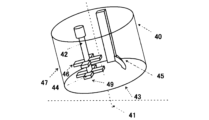
- FIG. 2 is a perspective view showing the inside of the tumbling and stirring granulator according to the embodiment.
- FIG. 3 is a photograph showing an example of the form of recycled fibers.
- FIG. 4 is a photograph showing an example of the morphology of virgin fibers.
- FIG. 5 is an image of the particle-containing fiber bundle obtained in Example 1.
- FIG. 6 is an image showing the appearance of the particle-containing fiber bundle obtained in Example 1.
- FIG. 7 is an image showing a cross section of the particle-containing fiber bundle obtained in Example 1.
- One embodiment of the present invention relates to a method for producing a particle-containing fiber bundle.
- the method for producing a particle-containing fiber bundle includes mixing a plurality of shortened fibers, particles having a median diameter of 100 ⁇ m or less, an organic binder, and a liquid, and produces a particle-containing fiber bundle having a spheroid shape or a strand shape.
- the fiber includes carbon fiber, and 10 parts by mass or more of the particles are used per 100 parts by mass of the fiber.
- the median diameter is the particle size (D50) at which the cumulative value in the volume-based particle size distribution is 50%.
- a method using a plurality of shortened fibers as a starting material typically includes the following steps (i) to (iii).
- the timing of mixing the fibers, particles, organic binder, and liquid is not limited, but from the viewpoint of manufacturing efficiency, it is preferable to include mixing the particles, the organic binder, and the liquid to obtain mixture 1, and mixing the mixture 1 and the fibers to obtain mixture 2.
- the mixture 1 can be prepared in the (i) mixing step, but may be prepared separately.
- the mixture 2 can be prepared in the (i) mixing step, but bundling may be carried out simultaneously with the production of the mixture 2 in the (ii) bundling step.
- the amount of the raw materials used can be, for example, 10 to 200 parts by mass of the particles, 1 to 200 parts by mass of the liquid, and 1 to 40 parts by mass of the organic binder, relative to 100 parts by mass of the fibers until the particle-containing fiber bundle is produced.
- the amount of organic binder used is preferably 1 part by mass or more, more preferably 3 parts by mass or more, and even more preferably 6 parts by mass or more, per 100 parts by mass of fiber.
- the amount of organic binder used is preferably 40 parts by mass or less, more preferably 20 parts by mass or less, and even more preferably 10 parts by mass or less, per 100 parts by mass of fiber.
- the above upper and lower limits can be combined in any manner. For example, it may be 1 to 40 parts by mass, 3 to 20 parts by mass, or 6 to 10 parts by mass.
- the amount of particles used is 10 parts by mass or more, preferably 20 parts by mass or more, more preferably 30 parts by mass or more, even more preferably 40 parts by mass or more, particularly preferably 50 parts by mass or more, and most preferably 55 parts by mass or more, per 100 parts by mass of fiber.
- the amount of particles used is preferably 150 parts by mass or less, more preferably 100 parts by mass or less, even more preferably 90 parts by mass or less, particularly preferably 80 parts by mass or less, and most preferably 75 parts by mass or less, per 100 parts by mass of fiber.
- the above upper and lower limits can be combined arbitrarily. For example, it may be 10 to 150 parts by mass, 20 to 150 parts by mass, 30 to 100 parts by mass, 40 to 90 parts by mass, 50 to 80 parts by mass, or 55 to 75 parts by mass.
- the mass ratio of particles to organic binder is 2.5 to 100, and 5.0 to 50 is more preferable.
- the amount of liquid used is preferably 5 parts by mass or more, more preferably 10 parts by mass or more, even more preferably 30 parts by mass or more, particularly preferably 60 parts by mass or more, and most preferably 80 parts by mass or more, per 100 parts by mass of fiber.
- the amount of liquid used is preferably 200 parts by mass or less, more preferably 180 parts by mass or less, and even more preferably 160 parts by mass or less, per 100 parts by mass of fiber.
- the above upper and lower limits can be combined arbitrarily. For example, it may be 5 to 200 parts by mass, 10 to 200 parts by mass, 30 to 180 parts by mass, 60 to 180, or 80 to 160 parts by mass.
- (i) Mixing step In the mixing step, fibers, particles, an organic binder, and a liquid are mixed to obtain a mixture.
- a general fiberizer can be used in the mixing step, but is not limited to this.
- fibers and particles can be put into an agitation granulator such as a Henschel mixer and mixed by agitation in a dry state. This method has the advantage that the resulting mixture can be advanced to the next bundling step without being taken out of the agitation granulator.
- the bundling step may be advanced by omitting the mixing step.
- the mixture obtained in the mixing step is mixed with a liquid to form a fiber bundle.
- the particles, organic binder, and liquid can be mixed in this step to form a mixture.
- the fibers and particles constituting the mixture are aggregated by capillary forces based on the surface tension of the liquid to form fiber bundles containing the liquid.
- a mixture of the liquid and the organic binder may be used for bundling.
- the bundling liquid is not particularly limited, but for example, a solvent such as an organic solvent can be used, and may contain an organic binder and other components.
- the organic binder and other components may be dissolved in a solvent, may be dispersed mechanically, or may be dispersed by a surfactant.
- a bundling liquid that has been heated to reduce its viscosity can be used.
- the amount of the bundling liquid is, for example, 70 to 210 parts by mass per 100 parts by mass of the total amount of the raw material fibers (hereinafter, sometimes referred to as "raw material fibers") used in the production of the particle-containing fiber bundle, but is not limited thereto.
- the amount of the bundling liquid can be appropriately adjusted while observing the state of the mixture.
- the shape of the particle-containing fiber bundle can be made uniform.
- the viscosity can be 8 Pa ⁇ s or less, 5 Pa ⁇ s or less, 2 Pa ⁇ s or less, or 0.5 Pa ⁇ s or less.
- the viscosity can be 0.0001 Pa ⁇ s or more.
- the above upper and lower limits can be combined arbitrarily.
- the viscosity may be 0.0001 to 10 Pa ⁇ s, 0.0001 to 8 Pa ⁇ s, 0.0001 to 5 Pa ⁇ s, 0.0001 to 2 Pa ⁇ s, or 0.0001 to 0.5 Pa ⁇ s.
- a bundling liquid having the above-mentioned viscosity range at the temperature at which it is used can be used.
- the viscosity is a value measured using a Brookfield type rotational viscometer (e.g., LVDV-1 Pri manufactured by Brookfield) at a rotation speed of 50 rpm.
- the surface tension of the bundling liquid is 120 mN/m or less, a liquid bridge can be formed between the fibers, and the fibers can be oriented by facilitating the movement of the fibers.
- the surface tension at 23° C. can be 110 mN/m or less, 100 mN/m or less, 90 mN/m or less, 72 mN/m or less, 60 mN/m or less, 50 mN/m or less, or 40 mN/m or less.
- the surface tension can be 10 mN/m or more, 15 mN/m or more, 20 mN/m or more, or 30 mN/m or more. The above upper and lower limits can be combined arbitrarily.
- the surface tension is a value measured by the plate method (vertical plate method).
- a bundling liquid having the above tension range at the temperature at that time can be used.
- the ratio (Y/X) of the average fiber length Y of the fibers of the particle-containing fiber bundle to the average fiber length X of the raw fiber is preferably 0.55 or more, more preferably 0.70 or more, even more preferably 0.80 or more, and particularly preferably 0.90 or more.
- This ratio (Y/X) can be 1 or less.
- the above upper and lower limits can be combined arbitrarily. For example, it may be 0.55 to 1, 0.70 to 1, 0.80 to 1, or 0.90 to 1.
- the agitation granulator preferably has a rotating shaft 2 on the central axis inside a cylindrical agitation tank 1 with a bottom, and a plurality of propeller-shaped agitation blades (three in Fig. 1A) extend radially at equal intervals from the rotating shaft 2.
- the agitation blades may be disk-shaped and perpendicular to the rotating shaft. They may also be disks with undulations and protrusions.
- the agitator blade 3 is inclined in the direction of rotation with respect to the bottom surface 1A of the agitator tank 1.
- the included angle ⁇ between the surface 3A, which is the rear surface with respect to the direction of rotation R, and the bottom surface 1A of the agitator tank 1 (hereinafter sometimes simply referred to as the "inclination angle") is preferably in the range of 1 to 60°. If the inclination angle ⁇ of the agitator blade 3 is 1° or more, it is possible to agitate the mixture while circulating it within the agitator tank.
- the inclination angle ⁇ of the agitator blade 3 is 60° or less, it is possible to adjust the rotation speed within a range where resistance to the agitator blade is suppressed and no load is placed on the device.
- the inclination angle ⁇ is more preferably 10 to 50°, and even more preferably 20 to 40°.
- the impeller 3 is bent at an angle ⁇ in the middle of its longitudinal direction.
- the distance between the bottom surface of the impeller 3 and the bottom surface 1A of the mixing tank 1 may be set to 1 mm or less so as to scrape up the raw material remaining at the bottom.
- the distance between the tip of the impeller 3 and the side (wall) of the mixing tank 1 may be set to 10 mm or more to prevent damage to the raw material due to shear.
- the impeller is not limited to be bent as described above, and may be a straight plate-like impeller.
- the impeller may be bent in an arc shape.
- the stirring granulator may be provided with a propeller auxiliary stirring blade (chopper) on the wall of the stirring tank for auxiliary stirring.
- the stirring tank of the stirring granulator may be provided with a scraper on the bottom or side.
- the stirring tank has a stirring blade (agitator) that rotates horizontally and a propeller auxiliary stirring blade (chopper) that rotates vertically as a stirring blade, and efficient stirring granulation can be performed by stirring with the stirring blade that rotates horizontally and the propeller auxiliary stirring blade that rotates vertically.
- the auxiliary stirring blade that rotates vertically has the role of crushing the granulated material that has become too large and making the size of the particle-containing fiber bundle uniform.
- the rotation conditions of the impeller in the stirring granulator are preferably such that the peripheral speed (hereinafter simply referred to as "peripheral speed") of the impeller tip (part 3a in Fig. 1a) is in the range of 1 to 20 m/sec. If the peripheral speed is 1 m/sec or more, the mixture can be stirred while circulating in the stirring tank. If the peripheral speed is 20 m/sec or less, the particle shape of the particle-containing fiber bundle can be made uniform.
- the peripheral speed of the impeller is more preferably 4 to 12 m/sec, and even more preferably 4 to 8 m/sec.
- the peripheral speed of the chopper is preferably in the range of 5 to 30 m/sec.
- one embodiment of the rolling agitation granulator includes a rotatable container 40 that contains raw fiber, particles, an organic binder, and a liquid, and a rotating shaft 42 that is parallel to the central axis 41 and is disposed inside the container 40 and at a position eccentric to the central axis 41 of the container 40.
- the rotating shaft 42 is preferably rotatable in the direction opposite to the direction of rotation of the container 40. By rotating in the opposite direction, the impact force between the agitating blades and the raw fiber increases, and the fibers can be aligned in a short time by strong shear.
- the rotating direction of the rotating shaft 42 may be the same as that of the container 40.
- the rotation direction of the impeller is opposite to that of the container, the number of filaments contained in the fiber bundle tends to be small, and the distribution of the number and shape of the filaments contained in the fiber bundle tends to be uniform.
- the rotation direction of the impeller is the same as that of the container, the number of filaments contained in each fiber bundle tends to be large, and the fibers tend to be easily bundled. It is believed that when the impeller is rotated in the opposite direction to the container and then rotated in the same direction as the container, liquid bridging between the fiber bundles with a small number of filaments and uniform distribution is promoted, resulting in a fiber bundle that is uniform and has a high bulk density.
- the rotating shaft 42 extends close to the bottom plate 43 of the container 40 and has an agitator blade 44 that moves within the area where the mixture can exist.
- the mixture is circulated by the rotation of the container 40, and the rotation of the agitator blade 44 can shear the mixture to align the fibers.
- the blades of the agitator blade 44 can be of the same configuration as described for the agitator granulator.
- the distance between the bottom surface 49 of the agitator blade 44 and the bottom plate 43 of the agitator tank may be 10 mm or more, so that the agitator blade can efficiently come into contact with the raw materials scraped up by the scraper.
- the distance between the tip 46 of the agitator blade 44 and the side surface 47 of the agitator tank may be 10 mm or more, so that damage to the raw materials due to shearing is suppressed.
- the container 40 is equipped with a scraper 45 on its side.
- a scraper may also be provided on the inside side 47 of the container 40, on the bottom plate 43, or on both.
- the scraper 45 can be used to scrape off any adhering raw materials.
- the peripheral speed of the container 40 can be in the range of 0.4 to 1.2 m/sec. If the peripheral speed is 0.4 m/sec or more, the mixture can be stirred while circulating in the stirring tank. On the other hand, if the peripheral speed is 1.2 m/sec or less, the mixture can be efficiently brought into contact with the stirring blades or scraper, and the processing time can be shortened.
- the peripheral speed can be 0.5 to 1.0 m/sec or 0.7 to 0.9 m/sec.
- the peripheral speed of the agitating blade tip (tip peripheral speed) of the agitating blade 44 can be in the range of 1 to 30 m/sec.
- the tip peripheral speed is 1 m/sec or more, it is possible to align the fibers in a short time and increase the density of the fiber bundle. On the other hand, if the tip peripheral speed is 30 m/sec or less, it is possible to make the shape of the fiber bundle uniform.
- the peripheral speed of the agitating blade 44 can be 10 to 20 m/sec or 1 to 8 m/sec.
- stirring time in the stirring granulator there is no particular limit to the stirring time in the stirring granulator, and stirring may be performed for a period of time sufficient to obtain the desired fiber bundle. By passing through the fiber cotton, the time required for the bundling process can be shortened.
- the temperature during stirring is not particularly limited, and stirring can be performed at room temperature (for example, 5 to 40°C). A rise in temperature of the container or mixture due to stirring is permitted.
- stirring can be performed at a temperature equal to or higher than the melting point or softening point of the organic binder so that the organic binder becomes solid when the granulated state is maintained as a product, and cooling can be performed when the particle-containing fiber bundle is generated.
- the stirring conditions are preferably adjusted so as to obtain aligned fiber bundles, rather than spherical carbon fiber balls in which the fibers are crimped.
- aligned fiber bundles for example, there are a method of increasing the amount of liquid, a method of increasing the peripheral speed of the stirring blade tip, and a method of using raw material fibers with an average fiber length of more than 1 mm.
- time when granulation is completed is no particular restriction on the time when granulation is completed, but it is preferably completed when it is possible to confirm that fiber bundles have been formed to an extent that allows the particle size distribution to be specified.
- the particle-containing fiber bundle formed in the bundling step is dried to remove the liquid contained in the bundling liquid contained in the particle-containing fiber bundle. Even if the liquid evaporates due to drying, the shape of the particle-containing fiber bundle can be maintained due to the adhesion of the organic binder.
- the drying may be forced drying or natural drying.
- the particle-containing fiber bundle formed in the stirring tank of the stirring granulator can be dried while being stirred in the stirring tank without being removed from the stirring tank.
- the particle-containing fiber bundle formed in the stirring tank of the stirring granulator may be removed from the stirring tank and dried in another location, for example, in a hot air dryer, or in a transport pipe or on a conveyor belt.
- drying can be performed at 50 to 150° C. for about 1 to 5 hours.
- drying equipment include box dryers, belt conveyor dryers, tunnel dryers, fixed tank agitator dryers, drum rotary dryers, rotary kilns, fluidized bed dryers, agitator hot air dryers, airflow dryers, infrared dryers, microwave dryers, and vacuum dryers.
- a classification process and a chopping process may be performed.
- the classification step can be introduced in any of the steps (i) to (iii), but by introducing it after step (iii), the uniformity of the plurality of particle-containing fiber bundles can be improved.
- the sieve used for classification may be, for example, configured to include a vibration mechanism, a container connected to the vibration mechanism, and a sieve mesh that divides the internal space of the container. The mesh shape and opening of the sieve mesh are adjusted so that the particle-containing fiber bundle can be sieved into a desired size.
- the mesh shape is preferably rectangular or rhombic, but may also be square or circular.
- the chopping step is preferably introduced before (i).
- a continuous fiber bundle made of virgin fibers is cut at predetermined intervals in the fiber direction using a rotary cutter to form chopped fiber bundles.
- the bundle size of the continuous fiber bundle (the number of fiber filaments constituting the bundle) can be, for example, 10K or more and 100K or less.
- K is a symbol representing 1000, for example, 1K means 1000, and 10K means 10000.
- the bundle size of the continuous fiber bundle is preferably 24K or more, more preferably 36K or more, and even more preferably 48K or more. For example, it may be 24K or more and 100K or less, 36K or more and 100K or less, or 48K or more and 100K or less.
- the fiber length of the chopped fiber bundle is not limited, but may be, for example, 3 mm or more, 5 mm or more, or 10 mm or more, and may be, for example, 60 mm or less, 50 mm or less, 40 mm or less, 30 mm or less, or 20 mm or less.
- the above upper and lower limits can be combined arbitrarily. For example, it may be 3 to 60 mm, 3 to 50 mm, 5 to 40 mm, 5 to 30 mm, or 10 to 20 mm or less.
- the chopped fiber bundle contains water, a sizing agent, etc., it is preferable to remove the water, the sizing agent, etc. by a solvent or by thermal decomposition to obtain dried fiber cotton.
- the fibers include carbon fibers. Carbon fibers are useful for the production of fiber-reinforced resin compositions, and can provide fiber-reinforced resin compositions with high specific strength and specific modulus. Carbon fibers include PAN-based and pitch-based fibers, and PAN-based fibers are easily available. From the viewpoint of specific strength and specific modulus, the proportion of carbon fibers in the raw fiber is preferably 70% by mass or more, and more preferably 90 to 100% by mass.
- the raw fiber is not limited to virgin fiber, but may be recycled fiber.
- Fig. 3 shows an example of the form of recycled fiber.
- Recycled fiber is a fiber cotton in which monofilaments are randomly overlapped.
- Fig. 4 shows an example of the form of virgin fiber.
- Virgin fiber is a mass of fiber bundles in which fibers are aligned.
- the raw fiber may have a sizing agent or a matrix resin of FRP attached thereto.
- the amount of resin residue in the raw fiber such as carbon fiber is, for example, in the range of 0.01 to 10%.
- recycled fibers include fibers obtained by decomposing the matrix using heat, subcritical fluids, or supercritical fluids, and fibers obtained by cutting scraps of fiber substrates.
- the matrix can be completely removed from recycled fibers until they become cotton-like. If there is any resin residue that cannot be completely removed, it may be removed by heat treatment in an oxidizing atmosphere.
- the fibers contained in the particle-containing fiber bundle may be partially or entirely thermally deteriorated fibers.
- thermally deteriorated carbon fibers are recycled carbon fibers recovered from CFRP waste materials, and are thermally deteriorated in the process of pyrolyzing and removing the matrix resin.
- the raw fiber is an aggregate of a plurality of shortened fibers (discontinuous fibers), and is preferably cotton-like. Since the raw fiber is cotton-like and separated into monofilaments in a dry state, energy is not required to loosen the orientation when the fibers are wet and have a certain orientation, and size control of the particle-containing fiber bundle can be efficiently performed.
- the raw fiber may include a group of aligned fibers, but it is preferable that, for example, 50 mass % or more of the raw fiber material is fiber cotton.
- the shortened fibers may be obtained by cutting a continuous bundle of fibers, or fibers in a discontinuous form may be used.
- the continuous fibers may be tows or fibers taken out from prepregs or molded bodies.
- recycled fibers obtained by decomposing the matrix with heat are in a dry, cotton-like fiber state immediately after heating.
- an agitation granulator it is possible to obtain particle-containing fiber bundles in which the fibers are aligned without changing the form of the fibers from the fiber recycling process.
- the raw fibers may be defibrated before being stirred with an agitator granulator or the like.
- the raw fibers are defibrated by stirring the fibers without liquid in the stirring tank with an agitator blade.
- the rotation of the agitator blade loosens the fibers bonded together with adhesions such as resin carbonized material into smaller units of fiber, which makes it easier to align the fibers by stirring with the agitator blade after the fiber treatment agent is added.
- the uniformity of the fiber bundles can be improved.
- the fiber diameter of the raw fiber is in the range of, for example, 3 ⁇ m to 100 ⁇ m, and fibers with a diameter of 5 ⁇ m to 15 ⁇ m are readily available.
- the bulk density of the raw fiber is, for example, in the range of 0.01 to 0.90 g/ cm3 . If the raw fiber has a bulk density of 0.01 to 0.10 g/ cm3 , it is easy to convert it into a fiber bundle having a bulk density greater than that of the raw fiber. For example, a fiber cotton having a bulk density in the range of 0.01 to 0.10 g/cm3 can be mentioned.
- the fiber length of the raw fiber is preferably 100 mm or less, more preferably 60 mm or less, and further preferably 50 mm or less, and may be 20 mm or less or 12 mm or less.
- the length of the fibers contained in the particle-containing fiber bundle is preferably 1 mm or more, and more preferably 2 mm or more, from the viewpoint of strength when used in a molded article.
- the fibers may not contain fibers having a fiber length of less than 1 mm, or may contain fibers at a content of less than 5 wt %.
- the average fiber length of the raw material fibers is preferably 2 to 12 mm.
- the average fiber length of the raw material fibers is preferably 12 to 50 mm, and more preferably 12 to 30 mm from the viewpoint of facilitating uniform deposition by scattering the particle-containing fiber bundles during prepreg production. If the fiber length of the raw fiber is equal to or greater than the lower limit, the strength of the fiber-reinforced resin composition can be sufficiently increased, and the fiber orientation can be highly controlled.
- the fiber bundle can be prevented from being entangled in the device during production of the particle-containing fiber bundle, thereby improving production efficiency, and the shape of the particle-containing fiber bundle can be uniformly controlled.
- the average fiber length is a weighted average fiber length.
- the average fiber length can be measured by the method described in the Examples section below.
- the average fiber length can also be calculated by binarizing an image taken by microscopic observation using image processing software such as ImageJ.
- image processing software such as ImageJ.
- the particle-containing fiber bundle can be adjusted to have a short overall length while making the shape of the particle-containing fiber bundle uniform.
- the shorter the overall length of the particle-containing fiber bundle the less fiber interference at the tips of the particle-containing fiber bundles, making it easier to improve the feed efficiency from the hopper to the feeder.
- the presence of particles in the particle-containing fiber bundle can form spaces between the fibers, making it easier to impregnate them with resin.
- the particles have a solubility in water at 23° C. of 0.0001 g/mL or less, and are a material that is used separately from the organic binder described later in ⁇ Organic Binder>. Furthermore, the particles are preferably capable of maintaining their particle shape in the presence or absence of a liquid component, which will be described later in the section ⁇ Liquid>. From the viewpoint of adjusting the overall length of the particle-containing fiber bundle to be short, it is preferable that the particles are difficult to dissolve in the liquid described below. For example, by making the solubility in the liquid at 23°C 0.01 g/100 g or less, the particles are incorporated into the fiber bundle while maintaining their shape during mixing.
- the median diameter of the particles is the particle diameter (D50) at which the cumulative value in the volume-based particle size distribution is 50%, and is preferably 0.1 ⁇ m or more, more preferably 3 ⁇ m or more, and even more preferably 10 ⁇ m or more. This allows the total length of the particle-containing fiber bundle to be adjusted to be short. Furthermore, during injection molding or press molding of the obtained particle-containing fiber bundle, the fibers are easily loosened and uniformly dispersed, resulting in a good appearance of the molded product.
- the median diameter of the particles is preferably 90 ⁇ m or less, more preferably 80 ⁇ m or less, and even more preferably 60 ⁇ m or less. This allows the shape of the particle-containing fiber bundle to be uniform.
- the interfaces between the fiber bundles become uniform, improving the strength of the molded product.
- the upper and lower limits can be combined in any manner, for example, 0.1 to 90 ⁇ m, 3 to 80 ⁇ m, or 10 to 60 ⁇ m.
- the particle diameter D90 at which the cumulative value in the particle size distribution based on volume of the particles is 90% is preferably 350 ⁇ m or less, more preferably 250 ⁇ m or less, and even more preferably 100 ⁇ m or less. This results in a uniform distribution of particles and fibers inside the particle-containing fiber bundle. Furthermore, during injection molding or press molding of the obtained particle-containing fiber bundle, the fibers are easily loosened and uniformly dispersed, resulting in a good appearance of the molded product.
- the particle diameter D90 is preferably 0.5 ⁇ m or more, more preferably 30 ⁇ m or more. The total length of the particle-containing fiber bundle can be adjusted to be short.
- the fibers are easily loosened and uniformly dispersed, resulting in a good appearance of the molded product.
- the upper and lower limits can be combined in any manner, for example, 0.5 to 350 ⁇ m, 0.5 to 250 ⁇ m, or 30 to 100 ⁇ m.
- the particle diameter D10 at which the cumulative value in the particle size distribution based on the volume of the particles is 10% is preferably 70 ⁇ m or less, more preferably 50 ⁇ m or less, and even more preferably 30 ⁇ m or less. This allows the distribution of particles and fibers inside the particle-containing fiber bundle to be uniform. Furthermore, during injection molding or press molding of the obtained particle-containing fiber bundle, the interface between the fiber bundles becomes uniform, improving the strength of the molded product.
- the particle diameter D10 is preferably 0.05 ⁇ m or more, more preferably 1 ⁇ m or more. This allows the total length of the particle-containing fiber bundle to be adjusted to be short.
- the fibers are easily loosened and uniformly dispersed, resulting in a good appearance of the molded product.
- the upper and lower limits can be combined in any manner, for example, 0.05 to 70 ⁇ m, 0.05 to 50 ⁇ m, or 1 to 30 ⁇ m.
- the ratio (D75/D25) of the particle diameter D75 at which the cumulative value in the particle size distribution based on volume of the particles is 75% and the particle diameter D25 at which the cumulative value is 25% is preferably 1 to 15, and more preferably 1 to 10. This allows the distribution of particles and fibers inside the particle-containing fiber bundle to be uniform. In addition, when the obtained particle-containing fiber bundle is injection molded or press molded, the interfaces between the fiber bundles become uniform, improving the strength of the molded product.
- the relational equation (D84-D16)/2 which is the particle size D84 at which the cumulative value in the particle size distribution based on volume of the particles is 84% and the particle size D16 at which the cumulative value is 16%, can be set to 1 to 150 or 5 to 100.
- the particle size distribution based on the volume of the particles can be obtained by a laser diffraction/scattering method or image analysis.
- the particle size distribution measurement by the laser diffraction/scattering method can be performed, for example, by the method described in the Examples.
- the particle size distribution measurement by image analysis can be performed, for example, by determining the particle diameters of 50 or more particles from an image obtained using an optical microscope.
- the median diameters D90, D10, D75, D25, D84, and D16 listed in the catalog may be used.
- the median diameter, D90, D10, D75, D25, D84, and D16 are determined from the particle size distribution obtained by separating the peaks having particle sizes of 1000 ⁇ m or more by peak separation.
- the ratio of the average fiber length of the raw fibers to the median diameter of the particles is preferably 10 to 150, more preferably 30 to 130. This allows the overall length of the particle-containing fiber bundle to be adjusted to be short. Furthermore, during injection molding or press molding of the resulting particle-containing fiber bundle, the fibers are easily loosened and uniformly dispersed, resulting in a molded product with a good appearance.
- the ratio of the average fiber diameter of the raw fibers to the median diameter of the particles (average fiber diameter of the raw fibers ( ⁇ m)/median diameter of the particles ( ⁇ m)) is preferably 0.01 to 0.4, more preferably 0.07 to 0.3. This allows the distribution of particles and fibers inside the particle-containing fiber bundle to be uniform. Furthermore, during injection molding or press molding of the resulting particle-containing fiber bundle, the interfaces between the fiber bundles become uniform, improving the strength of the molded product.
- the particle shape may be spherical, flat, needle-like, amorphous, etc., but a spherical shape is preferred because a shape different from that of fibers makes it easier to shorten the overall length of the particle-containing fiber bundle.
- the aspect ratio of the particles can be 1 to 1.5.
- the maximum Feret diameter of the particles can be 0.1 ⁇ m to 100 ⁇ m, and may be 3 to 80 ⁇ m. The maximum Feret diameter can be determined by analyzing 50 or more particles from an image obtained using a transmission electron microscope (TEM) and measuring the median of the maximum distance between parallel tangents to opposing contour lines.
- TEM transmission electron microscope
- Types of particles include organic particles and inorganic particles.
- Organic particles include thermoplastic resin particles, thermosetting resin particles, and hardener particles.
- Hardener particles are capable of hardening thermosetting resins.
- Thermoplastic resin particles and thermosetting resin particles can be components that make up the matrix resin of a fiber-reinforced resin composition or a molded product thereof.
- Organic particles and inorganic particles may be used in combination.
- thermoplastic resin particles examples include polyamide resins, polyolefin resins, polyester resins, polycarbonate resins, polyethersulfone resins, polyetheretherketone resins, polyetherimide resins, and polyphenylene sulfide resins.
- polyamide resin, polyether ether ketone resin, polyether imide resin, or polyphenylene sulfide resin is preferred from the viewpoint of impact resistance of the molded article.
- thermoplastic resin particles are used in an amount of, for example, 1 to 200 parts by mass per 100 parts by mass of the total amount of the raw fiber material.
- the obtained particle-containing fiber bundle is used as a molding material as it is, 30 to 300 parts by mass is preferred, and when the particle-containing fiber bundle is converted into another molding material, 1 to 100 parts by mass is preferred.
- thermosetting resin particles examples include epoxy resins, vinyl ester resins, unsaturated polyester resins, cyanate ester resins, polyimide resins, maleimide resins, silicone resins, melamine resins, urea resins, alkyd resins, urethane resins, and phenol resins.
- an epoxy resin, a vinyl ester resin, a cyanate ester resin, or a phenol resin is preferred.
- the thermosetting resin particles are used in an amount of, for example, 1 to 200 parts by mass per 100 parts by mass of the total amount of raw fiber.
- the obtained particle-containing fiber bundle is used as a molding material as it is, 30 to 300 parts by mass is preferred, and when the particle-containing fiber bundle is converted into another molding material, 1 to 100 parts by mass is preferred.
- the hardener particles include dicyandiamides, phenols, amines, carboxylic acid anhydrides, thiols, imidazoles, phosphines, peroxides, and organic metal salts.
- the curing agent particles are used in an amount of, for example, 1 to 100 parts by mass per 100 parts by mass of the total amount of raw fiber, but from the viewpoint of reducing the amount remaining so as not to become the starting point of fracture of the molded article, 2 to 10 parts by mass is preferred.
- the organic binder is not particularly limited as long as it is an organic material capable of binding fibers together.
- a suitable example of the organic binder material is a resin used for sizing a general fiber bundle that is commercially available. In other words, it may be called a component resin of a sizing agent.
- resins include, but are not limited to, polyamide resin, epoxy resin, unsaturated polyester resin, vinyl ester resin, and polyurethane resin. These resins may be used alone or in combination of two or more.
- the organic binder may contain the same resin as that constituting the particles, but is used separately from the particles in order to bind the fibers together.
- the solubility of an organic binder in water at 23° C. is greater than 0.0001 g/mL.
- the solubility of an organic binder in liquid at 23° C. is greater than 0.01 g/mL.
- a liquid allows liquid bridges to be formed between the fibers to form a bundle.
- the liquid is preferably a liquid at room temperature (25° C.).
- the liquid include organic solvents such as alcohols, such as methanol, ethanol, and propanol, ketones, such as acetone and methyl ethyl ketone, and hydrocarbons, such as hexane, cyclohexane, benzene, toluene, and styrene, and water. Water is preferred from the viewpoint of eliminating the need for explosion-proof equipment in the production process.
- the particle-containing fiber bundle includes a plurality of shortened fibers, particles having a median diameter of 100 ⁇ m or less, and an organic binder, and has an elongated spheroid or strand shape.
- the fibers include carbon fibers, and the particles are contained in an amount of 10 parts by mass or more per 100 parts by mass of the fibers.
- a particle-containing fiber bundle according to another embodiment of the present invention includes a plurality of shortened fibers, polyether ether ketone resin particles, and an organic binder, and has an oval or strand shape.
- the fibers in the particle-containing fiber bundle are preferably aligned to form the fiber bundle, and the fibers present on the surface of the fiber bundle are preferably curved and oriented along the contour of the spheroid shape.
- the particle-containing fiber bundle can be manufactured, for example, by the above-mentioned method for manufacturing a particle-containing fiber bundle.
- a fiber bundle is formed by agglomerating a plurality of fibers, so that the tips of the fibers that make up the particle-containing fiber bundle are not aligned.
- the shape of the fiber bundle is an oblong spheroid from the viewpoint of feeding efficiency into a kneader.
- the fiber bundle is preferably in the form of a strand from the viewpoint of strength when formed into a molded article. The longer the fiber length of the fibers contained in the particle-containing fiber bundle, the more likely it is to form a strand shape.
- Figures 5 to 7 show the appearance and cross-section of the particle-containing fiber bundle obtained in the examples described in detail below.
- the particle-containing fiber bundle has an elongated spheroid shape with aligned fibers as shown in Figure 5, and as shown in Figures 6 and 7, particles and fibers are uniformly present on the surface (appearance) and inside (cross-section) of the particle-containing fiber bundle.
- the length of the particle-containing fiber bundle may be 3 mm or more, 6 mm or more, 12 mm or more, 20 mm or more, 50 mm or more, or 70 mm or more.
- the length of the particle-containing fiber bundle may be 100 mm or less, 70 mm or less, 50 mm or less, 40 mm or less, 25 mm or less, 12 mm or less, or 6 mm or less.
- the above upper and lower limits can be combined arbitrarily. For example, it may be 3 to 100 mm, 6 to 70 mm, 12 to 50 mm, 20 to 40 mm, 50 to 100 mm, 70 to 100 mm, 3 to 25 mm, 3 to 12 mm, or 3 to 6 mm.
- the length of the particle-containing fiber bundle can be determined by the method described in the Examples.
- the length of the particle-containing fiber bundle is preferably 3 mm to 12 mm.
- the length of the particle-containing fiber bundle is preferably 12 mm or more and 50 mm or less.
- the diameter of the thickest part of the particle-containing fiber bundle may be 0.1 mm to 10 mm, and the cross-sectional shape may be, for example, circular or elliptical.
- the length of the particle-containing fiber bundle is preferably longer than the average fiber length of the fibers in the particle-containing fiber bundle.
- the ratio of the length of the particle-containing fiber bundle to the average fiber length of the fibers contained in the particle-containing fiber bundle is preferably 1.1 to 5.0 from the viewpoint of feed efficiency, and more preferably 1.1 to 2.5, particularly when the feeder is a screw feeder equipped with a hopper, since it is easy to stably feed a constant amount without clogging the feed port.
- the diameter of the thickest part is preferably 2 mm to 7 mm.
- the length of the major axis of the particle-containing fiber bundle is longer than the average fiber length of the fibers contained in the fiber bundle, and is preferably 3 mm to 18 mm, and the ratio (length of the major axis of the particle-containing fiber bundle/average fiber length of the fibers contained in the fiber bundle) is preferably 1.1 to 5.0.
- the diameter of the thickest part is preferably 2 mm to 10 mm.
- the length of the major axis of the particle-containing fiber bundle is longer than the average fiber length of the fibers contained in the particle-containing fiber bundle, and is preferably 12 mm to 150 mm, and the ratio (length of the major axis of the particle-containing fiber bundle/average fiber length of the fibers contained in the particle-containing fiber bundle) is preferably 1.1 to 3.0.
- the fibers contained in the particle-containing fiber bundle function as a reinforcing material for the molded article.
- the number of filaments contained in the particle-containing fiber bundle can be, for example, 8,000 or more and 800,000 or less.
- the particle-containing fiber bundle can have a spheroidal shape by having a greater number of filaments at the center of the long axis than at the ends of the long axis.
- the fiber length is preferably 60 mm or less, more preferably 40 mm or less, even more preferably 30 mm or less, and may be 20 mm or less or 12 mm or less.
- the fiber length contained in the particle-containing fiber bundle is preferably 1 mm or more, more preferably 2 mm or more.
- the fibers may not contain fibers with a fiber length of less than 1 mm, or may contain fibers with a content of less than 5 wt%.
- the upper and lower limits can be combined in any manner, for example, 1 to 60 mm, 1 to 40 mm, 1 to 30 mm, 2 to 20 mm, or 2 to 12 mm.
- the bulk density of the particle-containing fiber bundle can be, for example, 0.03 to 0.7 g/cm 3. Although it varies depending on the raw fiber used, from the viewpoint of the transport efficiency of the particle-containing fiber bundle, the bulk density is preferably 0.1 g/cm 3 or more, and particularly preferably 0.2 g/cm 3 or more. If the application is for a molded body with a low fiber content, the bulk density may be 0.1 g/cm 3 or more and less than 0.3 g/cm 3. If the application is for a molded body requiring strength, the bulk density may be 0.3 g/cm 3 to 0.6 g/cm 3.
- the bulk density is preferably 0.15 g/cm 3 or more, and particularly preferably 0.2 g/cm 3 or more.
- the bulk density of the particle-containing fiber bundle is measured in accordance with JIS Z2512 and JIS R1628.
- the repose angle of the particle-containing fiber bundle is preferably 60° or less, more preferably 50° or less.
- the repose angle of the particle-containing fiber bundle can be 10° or more. For example, it may be 10 to 60°, or 10 to 50°.
- the fibers described above in ⁇ Fibers> can be used.
- the mass content of carbon fiber in the total fibers in the particle-containing fiber bundle is preferably 70 mass% or more, more preferably 70 to 100 mass%, and even more preferably 90 to 100 mass%.
- the organic binder can be the same as that described above in ⁇ Organic Binder>. By including an organic binder, the fibers are bound together and the shape of the particle-containing fiber bundle can be maintained.
- the particle-containing fiber bundle may also contain fillers such as silica, calcium silicate, alumina, calcium carbonate, talc, barium sulfate, etc.; flame retardants such as metal phosphinate, aluminum hydroxide, magnesium hydroxide, etc.; and release agents such as silicone oil, wetting and dispersing agents, antifoaming agents, defoaming agents, natural waxes, synthetic waxes, metal salts of straight-chain fatty acids, acid amides, esters, paraffins, etc.
- fillers such as silica, calcium silicate, alumina, calcium carbonate, talc, barium sulfate, etc.
- flame retardants such as metal phosphinate, aluminum hydroxide, magnesium hydroxide, etc.
- release agents such as silicone oil, wetting and dispersing agents, antifoaming agents, defoaming agents, natural waxes, synthetic waxes, metal salts of straight-chain fatty acids, acid amides, est
- the mass content of the whole particles in the particle-containing fiber bundle can be, for example, 20 to 80 mass %, and from the viewpoint of moldability and functionality, 30 to 70 mass % is preferable.
- the content can be 20 to 80% by weight.
- the content can be 1 to 70% by weight.
- the mass content of the liquid in the particle-containing fiber bundle can be, for example, 5 mass % or less, or 1 mass % or less, and the particle-containing fiber bundle may be dried so as to contain no liquid.
- the moisture content (mass) of the particle-containing fiber bundle is preferably 5% by mass or less, or 1% by mass or less, from the viewpoint of use as a molding material.
- the particle-containing fiber bundle produced by the above-described method for producing a particle-containing fiber bundle can be used as a reinforcing fiber in fiber-reinforced resin compositions and molding materials such as various prepregs (random, unidirectional), pellets, and stampable sheets.
- a molded article can be formed by fusing a plurality of particle-containing fiber bundles together.
- adjacent particle-containing fiber bundles can be fused together by melting the organic particles.
- the organic binder can be melted or reacted to fuse adjacent particle-containing fiber bundles.
- a thermoplastic resin or a thermosetting resin can be added to supplement the amount of fiber when fusing.
- a molded body can be obtained by dispersing a plurality of particle-containing fiber bundles in a mold and compressing the molded body.
- the particle-containing fiber bundles can also be heated and fused without applying pressure in an oven or the like.
- ⁇ Particle size distribution The particle size distribution of the particles was measured by suspending 0.1 g of particles in 10 mL of an aqueous solution containing 0.1% by mass of a surfactant, dropping the suspension into a laser diffraction/scattering type particle size distribution measuring device (HORIBA, Ltd.: LA-960V2, wet measurement, water solvent) so that the transmittance was in the range of 65% to 95%, and irradiating the suspension with ultrasound for 1 minute.
- ⁇ Surface tension The surface tension of the bundling liquid at 23° C. was measured using an automatic surface tensiometer (Kyowa Interface Science: CBVP-A3, plate method).
- Example 5 A particle-containing fiber bundle P7 having an elongated spheroid shape and a fiber bundle length of 12.2 mm was obtained in the same manner as in Example 4, except that the glass beads were replaced with glass beads (product name: J-800, manufactured by Potters-Barotini, powder, median diameter 24.6 ⁇ m).
- the standard deviation and coefficient of variation CV of the fiber bundle length when 112 particle-containing fiber bundles P7 were measured are shown in Table 1B.
Landscapes
- Chemical & Material Sciences (AREA)
- Engineering & Computer Science (AREA)
- Chemical Kinetics & Catalysis (AREA)
- Organic Chemistry (AREA)
- Medicinal Chemistry (AREA)
- Health & Medical Sciences (AREA)
- Polymers & Plastics (AREA)
- Mechanical Engineering (AREA)
- Materials Engineering (AREA)
- Nanotechnology (AREA)
- Textile Engineering (AREA)
- Inorganic Chemistry (AREA)
- Manufacturing & Machinery (AREA)
- Reinforced Plastic Materials (AREA)
Priority Applications (4)
| Application Number | Priority Date | Filing Date | Title |
|---|---|---|---|
| JP2024564424A JPWO2024128275A1 (https=) | 2022-12-16 | 2023-12-14 | |
| EP23903559.5A EP4635700A4 (en) | 2022-12-16 | 2023-12-14 | METHOD FOR PRODUCING FIBER BUNDLES CONTAINING PARTICLES AND FIBER BUNDLES CONTAINING PARTICLES |
| CN202380080577.5A CN120344367A (zh) | 2022-12-16 | 2023-12-14 | 含粒子纤维束的制造方法及含粒子纤维束 |
| US19/233,141 US20250353993A1 (en) | 2022-12-16 | 2025-06-10 | Particle-containing fiber bundle production method and particle-containing fiber bundle |
Applications Claiming Priority (4)
| Application Number | Priority Date | Filing Date | Title |
|---|---|---|---|
| JP2022-201050 | 2022-12-16 | ||
| JP2022200735 | 2022-12-16 | ||
| JP2022-200735 | 2022-12-16 | ||
| JP2022201050 | 2022-12-16 |
Related Child Applications (1)
| Application Number | Title | Priority Date | Filing Date |
|---|---|---|---|
| US19/233,141 Continuation US20250353993A1 (en) | 2022-12-16 | 2025-06-10 | Particle-containing fiber bundle production method and particle-containing fiber bundle |
Publications (1)
| Publication Number | Publication Date |
|---|---|
| WO2024128275A1 true WO2024128275A1 (ja) | 2024-06-20 |
Family
ID=91485861
Family Applications (1)
| Application Number | Title | Priority Date | Filing Date |
|---|---|---|---|
| PCT/JP2023/044781 Ceased WO2024128275A1 (ja) | 2022-12-16 | 2023-12-14 | 粒子含有繊維束の製造方法および粒子含有繊維束 |
Country Status (5)
| Country | Link |
|---|---|
| US (1) | US20250353993A1 (https=) |
| EP (1) | EP4635700A4 (https=) |
| JP (1) | JPWO2024128275A1 (https=) |
| CN (1) | CN120344367A (https=) |
| WO (1) | WO2024128275A1 (https=) |
Citations (9)
| Publication number | Priority date | Publication date | Assignee | Title |
|---|---|---|---|---|
| JPH01282364A (ja) * | 1988-05-10 | 1989-11-14 | Asahi Chem Ind Co Ltd | 集束された補強用繊維及び短繊維チップの製造法 |
| JPH02105860A (ja) * | 1988-10-14 | 1990-04-18 | Osaka Gas Co Ltd | 繊維含有塊状樹脂組成物およびその製造方法 |
| JPH02125706A (ja) * | 1988-11-04 | 1990-05-14 | Toho Rayon Co Ltd | 炭素繊維束の製造方法 |
| JPH07332414A (ja) * | 1994-04-07 | 1995-12-22 | Toyota Motor Corp | ブレーキ用摩擦材およびその製造方法 |
| JPH10503812A (ja) | 1994-08-05 | 1998-04-07 | アクゾ ノーベル ナムローゼ フェンノートシャップ | カーボンファイバーペレットの製造法、それから得られた高密度流線形ペレット、及び該ペレットを使用する強化熱可塑性樹脂の製造法 |
| WO2013172318A1 (ja) * | 2012-05-15 | 2013-11-21 | 帝人株式会社 | 補強用炭素繊維束、その製造方法及びそれを用いた複合体の製造方法 |
| EP2902433A1 (de) | 2014-02-03 | 2015-08-05 | Karl Meyer AG | Kohlenstofffaserpellet-Herstellungsverfahren |
| WO2022210591A1 (ja) | 2021-03-31 | 2022-10-06 | 帝人株式会社 | 紡錘形の炭素繊維含有集合体及びその製造方法、並びに、再生炭素繊維を含有する炭素繊維強化熱可塑性樹脂ペレット及びその製造方法 |
| JP2025503812A (ja) | 2022-01-05 | 2025-02-05 | 北京石頭世紀科技股▲ふん▼有限公司 | 自動清掃装置およびシステム |
Family Cites Families (6)
| Publication number | Priority date | Publication date | Assignee | Title |
|---|---|---|---|---|
| US4783506A (en) * | 1986-07-09 | 1988-11-08 | Hercules Incorporated | Damage tolerant composites containing infusible particles |
| JPH03275139A (ja) * | 1989-05-29 | 1991-12-05 | Kawasaki Steel Corp | 球状繊維塊活性炭およびその製造方法 |
| DE102010008349A1 (de) * | 2010-02-17 | 2011-08-18 | Thüringisches Institut für Textil- und Kunststoff-Forschung e.V., 07407 | Verfahren zur Herstellung von Pellets aus Faserverbundwerkstoffen |
| US9677635B2 (en) * | 2013-07-29 | 2017-06-13 | Borgwarner Inc. | Friction material |
| EP2924068A1 (de) * | 2014-03-26 | 2015-09-30 | LANXESS Deutschland GmbH | Polyamidzusammensetzungen |
| JP2020055256A (ja) * | 2018-10-04 | 2020-04-09 | Aca株式会社 | 複数の微粒子群の製造方法 |
-
2023
- 2023-12-14 JP JP2024564424A patent/JPWO2024128275A1/ja active Pending
- 2023-12-14 CN CN202380080577.5A patent/CN120344367A/zh active Pending
- 2023-12-14 WO PCT/JP2023/044781 patent/WO2024128275A1/ja not_active Ceased
- 2023-12-14 EP EP23903559.5A patent/EP4635700A4/en active Pending
-
2025
- 2025-06-10 US US19/233,141 patent/US20250353993A1/en active Pending
Patent Citations (9)
| Publication number | Priority date | Publication date | Assignee | Title |
|---|---|---|---|---|
| JPH01282364A (ja) * | 1988-05-10 | 1989-11-14 | Asahi Chem Ind Co Ltd | 集束された補強用繊維及び短繊維チップの製造法 |
| JPH02105860A (ja) * | 1988-10-14 | 1990-04-18 | Osaka Gas Co Ltd | 繊維含有塊状樹脂組成物およびその製造方法 |
| JPH02125706A (ja) * | 1988-11-04 | 1990-05-14 | Toho Rayon Co Ltd | 炭素繊維束の製造方法 |
| JPH07332414A (ja) * | 1994-04-07 | 1995-12-22 | Toyota Motor Corp | ブレーキ用摩擦材およびその製造方法 |
| JPH10503812A (ja) | 1994-08-05 | 1998-04-07 | アクゾ ノーベル ナムローゼ フェンノートシャップ | カーボンファイバーペレットの製造法、それから得られた高密度流線形ペレット、及び該ペレットを使用する強化熱可塑性樹脂の製造法 |
| WO2013172318A1 (ja) * | 2012-05-15 | 2013-11-21 | 帝人株式会社 | 補強用炭素繊維束、その製造方法及びそれを用いた複合体の製造方法 |
| EP2902433A1 (de) | 2014-02-03 | 2015-08-05 | Karl Meyer AG | Kohlenstofffaserpellet-Herstellungsverfahren |
| WO2022210591A1 (ja) | 2021-03-31 | 2022-10-06 | 帝人株式会社 | 紡錘形の炭素繊維含有集合体及びその製造方法、並びに、再生炭素繊維を含有する炭素繊維強化熱可塑性樹脂ペレット及びその製造方法 |
| JP2025503812A (ja) | 2022-01-05 | 2025-02-05 | 北京石頭世紀科技股▲ふん▼有限公司 | 自動清掃装置およびシステム |
Non-Patent Citations (1)
| Title |
|---|
| See also references of EP4635700A1 |
Also Published As
| Publication number | Publication date |
|---|---|
| EP4635700A1 (en) | 2025-10-22 |
| EP4635700A4 (en) | 2026-04-22 |
| JPWO2024128275A1 (https=) | 2024-06-20 |
| CN120344367A (zh) | 2025-07-18 |
| US20250353993A1 (en) | 2025-11-20 |
Similar Documents
| Publication | Publication Date | Title |
|---|---|---|
| KR102733961B1 (ko) | 카본나노튜브 배합 응집물의 제조 방법 | |
| EP2902433B1 (de) | Kohlenstofffaserpellet-herstellungsverfahren | |
| JP2025126925A (ja) | 繊維集合体の製造方法及びプリプレグシートの製造方法 | |
| CN108430721B (zh) | 用于制造前体材料的方法 | |
| JP7724635B2 (ja) | 熱可塑性樹脂繊維及び炭素繊維の紡錘形の集合体並びにその製造方法 | |
| WO2024128275A1 (ja) | 粒子含有繊維束の製造方法および粒子含有繊維束 | |
| JP2009256866A (ja) | ガラス繊維マットの製造方法及び製造装置、並びにバインダの再生方法 | |
| JP5464591B2 (ja) | 無機微粒子凝集体の製造方法および無機微粒子を含有する樹脂組成物の製造方法 | |
| JP2024086632A (ja) | 繊維束の製造方法 | |
| JP7724629B2 (ja) | 紡錘形の炭素繊維集合体及びその製造方法 | |
| US11951656B2 (en) | Fiber-containing particles with dual-tapered shape | |
| JP7824160B2 (ja) | 炭素繊維含有樹脂成形品の製造方法 | |
| KR20260012725A (ko) | 재순환 보강 섬유를 사용하여 섬유-함유 입자를 제조하는 방법 | |
| CN117480288A (zh) | 纤维集合体的制造方法和预浸料片的制造方法 | |
| PT2995640T (pt) | Granulado plástico endurecível reforçado com fibra |
Legal Events
| Date | Code | Title | Description |
|---|---|---|---|
| 121 | Ep: the epo has been informed by wipo that ep was designated in this application |
Ref document number: 23903559 Country of ref document: EP Kind code of ref document: A1 |
|
| WWE | Wipo information: entry into national phase |
Ref document number: 2024564424 Country of ref document: JP |
|
| WWE | Wipo information: entry into national phase |
Ref document number: 202380080577.5 Country of ref document: CN |
|
| WWE | Wipo information: entry into national phase |
Ref document number: 2023903559 Country of ref document: EP |
|
| NENP | Non-entry into the national phase |
Ref country code: DE |
|
| WWP | Wipo information: published in national office |
Ref document number: 202380080577.5 Country of ref document: CN |
|
| ENP | Entry into the national phase |
Ref document number: 2023903559 Country of ref document: EP Effective date: 20250716 |
|
| WWP | Wipo information: published in national office |
Ref document number: 2023903559 Country of ref document: EP |