WO2024127656A1 - エアロゾル生成装置の電源ユニット、及びエアロゾル生成装置 - Google Patents
エアロゾル生成装置の電源ユニット、及びエアロゾル生成装置 Download PDFInfo
- Publication number
- WO2024127656A1 WO2024127656A1 PCT/JP2022/046480 JP2022046480W WO2024127656A1 WO 2024127656 A1 WO2024127656 A1 WO 2024127656A1 JP 2022046480 W JP2022046480 W JP 2022046480W WO 2024127656 A1 WO2024127656 A1 WO 2024127656A1
- Authority
- WO
- WIPO (PCT)
- Prior art keywords
- power supply
- power
- heating
- unit
- charging
- Prior art date
- Legal status (The legal status is an assumption and is not a legal conclusion. Google has not performed a legal analysis and makes no representation as to the accuracy of the status listed.)
- Ceased
Links
Images





Classifications
-
- H—ELECTRICITY
- H02—GENERATION; CONVERSION OR DISTRIBUTION OF ELECTRIC POWER
- H02J—ELECTRIC POWER NETWORKS; CIRCUIT ARRANGEMENTS OR SYSTEMS FOR SUPPLYING OR DISTRIBUTING ELECTRIC POWER; SYSTEMS FOR STORING ELECTRIC ENERGY
- H02J7/00—Circuit arrangements for charging or discharging batteries or for supplying loads from batteries
- H02J7/60—Circuit arrangements for charging or discharging batteries or for supplying loads from batteries including safety or protection arrangements
-
- A—HUMAN NECESSITIES
- A24—TOBACCO; CIGARS; CIGARETTES; SIMULATED SMOKING DEVICES; SMOKERS' REQUISITES
- A24F—SMOKERS' REQUISITES; MATCH BOXES; SIMULATED SMOKING DEVICES
- A24F40/00—Electrically operated smoking devices; Component parts thereof; Manufacture thereof; Maintenance or testing thereof; Charging means specially adapted therefor
- A24F40/10—Devices using liquid inhalable precursors
-
- A—HUMAN NECESSITIES
- A24—TOBACCO; CIGARS; CIGARETTES; SIMULATED SMOKING DEVICES; SMOKERS' REQUISITES
- A24F—SMOKERS' REQUISITES; MATCH BOXES; SIMULATED SMOKING DEVICES
- A24F40/00—Electrically operated smoking devices; Component parts thereof; Manufacture thereof; Maintenance or testing thereof; Charging means specially adapted therefor
- A24F40/40—Constructional details, e.g. connection of cartridges and battery parts
-
- A—HUMAN NECESSITIES
- A24—TOBACCO; CIGARS; CIGARETTES; SIMULATED SMOKING DEVICES; SMOKERS' REQUISITES
- A24F—SMOKERS' REQUISITES; MATCH BOXES; SIMULATED SMOKING DEVICES
- A24F40/00—Electrically operated smoking devices; Component parts thereof; Manufacture thereof; Maintenance or testing thereof; Charging means specially adapted therefor
- A24F40/50—Control or monitoring
-
- A—HUMAN NECESSITIES
- A24—TOBACCO; CIGARS; CIGARETTES; SIMULATED SMOKING DEVICES; SMOKERS' REQUISITES
- A24F—SMOKERS' REQUISITES; MATCH BOXES; SIMULATED SMOKING DEVICES
- A24F40/00—Electrically operated smoking devices; Component parts thereof; Manufacture thereof; Maintenance or testing thereof; Charging means specially adapted therefor
- A24F40/50—Control or monitoring
- A24F40/51—Arrangement of sensors
-
- A—HUMAN NECESSITIES
- A24—TOBACCO; CIGARS; CIGARETTES; SIMULATED SMOKING DEVICES; SMOKERS' REQUISITES
- A24F—SMOKERS' REQUISITES; MATCH BOXES; SIMULATED SMOKING DEVICES
- A24F40/00—Electrically operated smoking devices; Component parts thereof; Manufacture thereof; Maintenance or testing thereof; Charging means specially adapted therefor
- A24F40/50—Control or monitoring
- A24F40/53—Monitoring, e.g. fault detection
-
- A—HUMAN NECESSITIES
- A24—TOBACCO; CIGARS; CIGARETTES; SIMULATED SMOKING DEVICES; SMOKERS' REQUISITES
- A24F—SMOKERS' REQUISITES; MATCH BOXES; SIMULATED SMOKING DEVICES
- A24F40/00—Electrically operated smoking devices; Component parts thereof; Manufacture thereof; Maintenance or testing thereof; Charging means specially adapted therefor
- A24F40/90—Arrangements or methods specially adapted for charging batteries thereof
-
- A—HUMAN NECESSITIES
- A24—TOBACCO; CIGARS; CIGARETTES; SIMULATED SMOKING DEVICES; SMOKERS' REQUISITES
- A24F—SMOKERS' REQUISITES; MATCH BOXES; SIMULATED SMOKING DEVICES
- A24F40/00—Electrically operated smoking devices; Component parts thereof; Manufacture thereof; Maintenance or testing thereof; Charging means specially adapted therefor
- A24F40/90—Arrangements or methods specially adapted for charging batteries thereof
- A24F40/95—Arrangements or methods specially adapted for charging batteries thereof structurally associated with cases
Definitions
- the present disclosure relates to a power supply unit for an aerosol generating device, and to an aerosol generating device.
- Aerosol generating devices generally heat the aerosol source by adjusting the power supplied from a power source to a specified heating power using a power conversion device and supplying it to a heater. In addition, they are configured to be repeatedly rechargeable when the SOC of the power source decreases.
- the aerosol generating device described in Patent Document 1 describes how the power from a power source is boosted by a DC/DC converter and supplied to a heater to heat an aerosol-forming article, and how the DC/DC converter is provided with a feedback pin for adjusting the output voltage.
- the heating element used to heat the aerosol source and the charging IC that controls charging close to the power source.
- the power conversion device and heating switch in particular carry a large current for heating, so it is preferable to eliminate power loss.
- the charging IC close to the power source. In other words, the further the measurement point is from the power source, the greater the wiring resistance becomes, and the lower the accuracy of charging control becomes.
- the present disclosure provides a power supply unit for an aerosol generating device that can maintain the control accuracy of charging while improving heating efficiency, and an aerosol generating device.
- the present disclosure relates to A power source for supplying power to a heating section for heating the aerosol source; a power converter that converts power from the power source and supplies heating power to the heating unit and/or a heating switch that controls the supply of power to the heating unit; A charging IC that receives power from an external power source and controls the supply of charging power to the power source; A power supply unit for an aerosol generating device, comprising: a board on which the charging IC, a power supply connection part to which power from the power supply is supplied, the power conversion device and/or the heating switch are mounted;
- the charging IC includes: a power supply voltage measurement pin for measuring the voltage of the power supply; a power supply connection pin to which the voltage of the power supply is input; At least one of the power conversion device and/or the heating switch is disposed closer to the power supply connection part than the charging IC;
- the power supply voltage measurement pin of the charging IC is connected to a position closer to the power supply connection part than the power supply connection pin in a power supply wiring that connects
- the present disclosure also provides A power source for supplying power to a heating section for heating the aerosol source; a power converter that converts power from the power source and supplies heating power to the heating unit and/or a heating switch that controls the supply of power to the heating unit; A charging IC that receives power from an external power source and controls the supply of charging power to the power source; A power supply unit for an aerosol generating device, comprising: a board on which the charging IC, a power supply connection part to which power from the power supply is supplied, the power conversion device and/or the heating switch are mounted;
- the charging IC includes: a power supply voltage measurement pin for measuring the voltage of the power supply; a power supply connection pin to which the voltage of the power supply is input; a wiring distance between at least one of the power conversion device and the heating switch and the power supply connection part is shorter than a wiring distance between the charging IC and the power supply connection part;
- the power supply voltage measurement pin of the charging IC is connected to a position closer to the power supply connection part than the power supply
- the present disclosure also provides A heating unit that heats the aerosol source; A power source for supplying power to the heating unit; a power converter that converts power from the power source and supplies heating power to the heating unit and/or a heating switch that controls the supply of power to the heating unit; A charging IC that receives power from an external power source and controls the supply of charging power to the power source; A substrate carrying the charging IC, a power supply connection portion to which power from the power supply is supplied, the power conversion device and/or the heating switch,
- the charging IC includes: a power supply voltage measurement pin for measuring the voltage of the power supply; a power supply connection pin to which the voltage of the power supply is input; At least one of the power conversion device and the heating switch is disposed closer to the power supply connection part than the charging IC, The power supply voltage measurement pin of the charging IC is connected to a position closer to the power supply connection part than the power supply connection pin in a power supply wiring that connects the power supply connection part and the power supply connection pin via a voltage measurement wiring.
- FIG. 1 is a schematic diagram showing a first configuration example of a suction device (suction device 100A).
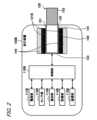
- FIG. 2 is a schematic diagram showing a second configuration example (suction device 100B) of the suction device.
- FIG. 3 is an overall perspective view of a suction device 100 which is one embodiment of the suction device of the present disclosure.
- FIG. 4 is a perspective view of the internal unit 10 as viewed from the front right side.
- FIG. 5 is a perspective view of the internal unit 10 as viewed from the front left side.
- FIG. 6 is an exploded perspective view of the internal unit 10.
- FIG. 7 is a cross-sectional perspective view of heater assembly 30. As shown in FIG. FIG. FIG.
- FIG. 8 is a block diagram showing the electrical connections of the main elements of the internal unit 10 in a simplified manner.
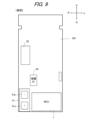
- FIG. 9 is a diagram showing elements mounted on the front surface 501 of the main substrate 50.
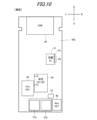
- FIG. 10 is a diagram showing elements mounted on the back surface 502 of the main substrate 50.
- FIG. 11 is a diagram showing the flow of power during heating in FIG.
- FIG. 12 is a diagram showing the flow of power during charging in FIG.
- FIG. 13 is a diagram showing the main conductive tracks of the first conductive layer L1 to the tenth conductive layer L10 provided on the main substrate 50. As shown in FIG.
- the inhalation device is a device that generates a substance to be inhaled by a user.
- the substance generated by the inhalation device is described as an aerosol.
- the substance generated by the inhalation device may be a gas.
- FIG. 1 is a schematic diagram showing a first configuration example of an inhalation device.
- an inhalation device 100A includes a power supply unit 110, a cartridge 120, and a flavor imparting cartridge 130.
- the power supply unit 110 includes a power supply section 111A, a sensor section 112A, a notification section 113A, a memory section 114A, a communication section 115A, and a control section 116A.
- the cartridge 120 includes a heating section 121A, a liquid guiding section 122, and a liquid storage section 123.
- the flavor imparting cartridge 130 includes a flavor source 131 and a mouthpiece 124.
- An air flow path 180 is formed in the cartridge 120 and the flavor imparting cartridge 130.
- the power supply unit 111A stores power.
- the power supply unit 111A supplies power to each component of the suction device 100A under the control of the control unit 116A.
- the power supply unit 111A may be configured, for example, by a rechargeable battery such as a lithium ion secondary battery.
- the sensor unit 112A acquires various information related to the suction device 100A.
- the sensor unit 112A is configured with a pressure sensor such as a condenser microphone, a flow rate sensor, or a temperature sensor, and acquires values associated with suction by the user.
- the sensor unit 112A is configured with an input device such as a button or switch that accepts information input from the user.
- the notification unit 113A notifies the user of information.
- the information that the notification unit 113A notifies the user includes various information such as the SOC (State Of Charge) indicating the charging state of the power supply unit 111A, the pre-heating time for inhalation, and the period during which inhalation is possible.
- the notification unit 113A is composed of, for example, a light-emitting device that emits light, a display device that displays images, a sound output device that outputs sound, or a vibration device that vibrates.
- the storage unit 114A stores various information for the operation of the suction device 100A.
- the storage unit 114A is configured, for example, with a non-volatile storage medium such as a flash memory.
- the communication unit 115A is a communication interface capable of performing communication conforming to any wired or wireless communication standard.
- Such communication standards may include, for example, standards using Wi-Fi (registered trademark), Bluetooth (registered trademark), BLE (Bluetooth Low Energy (registered trademark)), NFC (Near Field Communication), or LPWA (Low Power Wide Area).
- the control unit 116A functions as an arithmetic processing unit and a control unit, and controls the overall operation of the suction device 100A in accordance with various programs.
- the control unit 116A is realized by an electronic circuit such as a CPU (Central Processing Unit) or a microprocessor.
- the liquid storage unit 123 stores the aerosol source.
- the aerosol source is atomized to generate an aerosol.
- the aerosol source is, for example, a liquid such as a polyhydric alcohol such as glycerin and propylene glycol, or water.
- the aerosol source may contain a tobacco-derived or non-tobacco-derived flavor component. If the inhalation device 100A is a medical inhaler such as a nebulizer, the aerosol source may contain a medicine.
- the liquid guide section 122 guides and holds the aerosol source, which is a liquid stored in the liquid storage section 123, from the liquid storage section 123.
- the liquid guide section 122 is, for example, a wick formed by twisting a fiber material such as glass fiber or a porous material such as porous ceramic. In this case, the aerosol source stored in the liquid storage section 123 is guided by the capillary effect of the wick.
- the heating unit 121A generates aerosol by heating the aerosol source and atomizing the aerosol source.
- the heating unit 121A is configured as a coil and is wound around the liquid guide unit 122.
- the heating unit 121A generates heat, the aerosol source held in the liquid guide unit 122 is heated and atomized, and an aerosol is generated.
- the heating unit 121A generates heat when power is supplied from the power supply unit 111A.
- the sensor unit 112A detects that the user has started inhaling and/or that predetermined information has been input, power may be supplied to the heating unit 121A.
- the sensor unit 112A detects that the user has stopped inhaling and/or that predetermined information has been input, power supply to the heating unit 121A may be stopped.
- the user's inhalation action on the suction device 100A can be detected, for example, based on the pressure (internal pressure) inside the suction device 100A detected by a suction sensor exceeding a predetermined threshold.
- the flavor source 131 is a component for imparting flavor components to the aerosol.
- the flavor source 131 may contain tobacco-derived or non-tobacco-derived flavor components.
- the air flow path 180 is a flow path for air inhaled by the user.
- the air flow path 180 has a tubular structure with an air inlet hole 181, which is an entrance of air into the air flow path 180, and an air outlet hole 182, which is an exit of air from the air flow path 180, at both ends.
- the liquid guide section 122 is arranged on the upstream side (the side closer to the air inlet hole 181), and the flavor source 131 is arranged on the downstream side (the side closer to the air outlet hole 182).
- the air flowing in from the air inlet hole 181 as the user inhales is mixed with the aerosol generated by the heating section 121A, and as shown by the arrow 190, is transported through the flavor source 131 to the air outlet hole 182.
- the flavor components contained in the flavor source 131 are imparted to the aerosol.
- the mouthpiece 124 is a member that is held by the user when inhaling.
- An air outlet hole 182 is arranged in the mouthpiece 124.
- the configuration of the suction device 100A is not limited to the above, and various configurations such as those shown below are possible.
- the inhalation device 100A may not include a flavoring cartridge 130.
- the cartridge 120 is provided with a mouthpiece 124.
- the suction device 100A may include multiple types of aerosol sources. Multiple types of aerosols generated from the multiple types of aerosol sources may be mixed in the air flow path 180 and undergo a chemical reaction to generate further types of aerosols.
- the means for atomizing the aerosol source is not limited to heating by the heating unit 121A.
- the means for atomizing the aerosol source may be vibration atomization or induction heating.
- FIG. 2 is a schematic diagram showing a second configuration example of the suction device.
- the suction device 100B according to this configuration example includes a power supply unit 111B, a sensor unit 112B, a notification unit 113B, a memory unit 114B, a communication unit 115B, a control unit 116B, a heating unit 121B, a storage unit 140, and a heat insulating unit 144.
- the power supply unit 110 that stores the power supply unit 111A and the heating unit 121A are separate, but in the suction device 100B according to the second configuration example, the power supply unit 111B and the heating unit 121B are integrated. That is, the suction device 100B according to the second configuration example can also be said to be a power supply unit with a built-in heating unit.
- Each of the power supply unit 111B, the sensor unit 112B, the notification unit 113B, the memory unit 114B, the communication unit 115B, and the control unit 116B is substantially the same as the corresponding components included in the suction device 100A according to the first configuration example.
- the storage section 140 has an internal space 141 and holds the stick-shaped substrate 150 while storing a part of the stick-shaped substrate 150 in the internal space 141.
- the storage section 140 has an opening 142 that connects the internal space 141 to the outside and stores the stick-shaped substrate 150 inserted into the internal space 141 through the opening 142.
- the storage section 140 is a cylindrical body with the opening 142 and the bottom 143 as the bottom surface, and defines a columnar internal space 141.
- An air flow path that supplies air to the internal space 141 is connected to the storage section 140.
- An air inlet hole which is an air inlet to the air flow path, is arranged, for example, on the side of the suction device 100.
- An air outlet hole which is an air outlet from the air flow path to the internal space 141, is arranged, for example, on the bottom 143.
- the stick-type substrate 150 includes a substrate portion 151 and a mouthpiece portion 152.
- the substrate portion 151 includes an aerosol source.
- the aerosol source includes a flavor component derived from tobacco or non-tobacco.
- the aerosol source may include a medicine.
- the aerosol source may be, for example, a liquid such as polyhydric alcohol such as glycerin and propylene glycol, and water, which includes a flavor component derived from tobacco or non-tobacco, or may be a solid containing a flavor component derived from tobacco or non-tobacco.
- the stick-type substrate 150 When the stick-type substrate 150 is held in the storage portion 140, at least a part of the substrate portion 151 is stored in the internal space 141, and at least a part of the mouthpiece portion 152 protrudes from the opening 142.
- the heating section 121B is configured in a film shape and is arranged to cover the outer periphery of the storage section 140.
- the heating section 121B generates heat, the substrate section 151 of the stick-shaped substrate 150 is heated from the outer periphery, and an aerosol is generated.
- the insulating section 144 prevents heat transfer from the heating section 121B to other components.
- the insulating section 144 is made of a vacuum insulating material or an aerogel insulating material.
- the configuration of the suction device 100B is not limited to the above, and various configurations such as those shown below are possible.
- the heating section 121B may be configured in a blade shape and disposed so as to protrude from the bottom 143 of the storage section 140 into the internal space 141. In that case, the blade-shaped heating section 121B is inserted into the substrate section 151 of the stick-shaped substrate 150 and heats the substrate section 151 of the stick-shaped substrate 150 from the inside. As another example, the heating section 121B may be disposed so as to cover the bottom 143 of the storage section 140. Furthermore, the heating section 121B may be configured as a combination of two or more of a first heating section that covers the outer periphery of the storage section 140, a blade-shaped second heating section, and a third heating section that covers the bottom 143 of the storage section 140.
- the storage unit 140 may include an opening/closing mechanism, such as a hinge, that opens and closes a portion of the outer shell that forms the internal space 141. The storage unit 140 may then open and close the outer shell to accommodate the stick-shaped substrate 150 inserted into the internal space 141 while clamping it.
- the heating unit 121B may be provided at the clamping location in the storage unit 140, and may heat the stick-shaped substrate 150 while pressing it.
- the means for atomizing the aerosol source is not limited to heating by the heating unit 121B.
- the means for atomizing the aerosol source may be induction heating.
- the suction device 100B has at least an electromagnetic induction source such as a coil that generates a magnetic field, instead of the heating unit 121B.
- a susceptor that generates heat by induction heating may be provided in the suction device 100B, or may be included in the stick-shaped substrate 150.
- the suction device 100B may further include the heating unit 121A, the liquid guide unit 122, the liquid storage unit 123, and the air flow path 180 according to the first configuration example, and the air flow path 180 may supply air to the internal space 141.
- the mixed fluid of the aerosol and air generated by the heating unit 121A flows into the internal space 141 and is further mixed with the aerosol generated by the heating unit 121B, and reaches the user's oral cavity.
- suction device 100 an embodiment of a suction device (hereinafter, referred to as suction device 100) in which the configuration of the suction device disclosed herein is applied to the suction device 100B of the second configuration example described above will be described. Note that, although a specific description will be omitted, a part of the configuration of the suction device 100 described in detail below can also be applied to the suction device 100A of the first configuration example.
- Figure 3 is an overall perspective view of the suction device 100.
- the direction in which the stick-shaped substrate 150 is inserted into and removed from the suction device 100 is defined as the up-down direction
- the direction in which the shutter 23, which will be described later, slides is defined as the front-rear direction
- the direction perpendicular to the up-down direction and the front-rear direction is defined as the left-right direction.
- the front is defined as Fr, the rear as Rr, the left side as L, the right side as R, the top as U, and the bottom as D.
- the suction device 100 is preferably sized to fit in the hand, and has, for example, a rod shape.
- a user holds the suction device 100 in one hand with the fingertips in contact with the surface of the suction device 100.
- the shape of the suction device 100 is not limited to a rod shape, and can be any shape (for example, a rounded, approximately rectangular parallelepiped shape or an egg shape).
- the suction device 100 comprises an internal unit 10 (see Figures 4 to 6) and a case 20 that constitutes the exterior of the suction device 100.
- the case 20 has a lower case 21 and an upper case 22. A portion of the internal unit 10 is housed in the lower case 21, and the entire internal unit 10 is housed in the case 20 by placing the upper case 22 over the lower case 21 from above.
- the top surface of the suction device 100 is provided with an opening 27 (see Figures 4 to 6) through which the stick-shaped substrate 150 is inserted and removed, and a shutter 23 that can slide back and forth.
- the opening 27 is located at the rear side of the top surface of the suction device 100.
- the shutter 23 selectively takes an open state (front position) that opens the opening 27 to allow the stick-shaped substrate 150 to be inserted and removed, and a closed state (rear position) that positions the shutter 23 above the opening 27 to close the opening 27.
- the user opens the shutter 23.
- a shutter detection sensor 11 (see FIG. 4) is provided near the shutter 23.
- the shutter detection sensor 11 detects whether the shutter 23 is open or not.
- the shutter detection sensor 11 is an example of the sensor unit 112B of the suction device 100B in FIG. 2.
- a USB (Universal Serial Bus) port 26 (see FIG. 4) is provided on the top surface of the suction device 100, adjacent to the opening 27.
- the shutter 23 blocks the USB port 26.
- the USB port 26 is open.
- the USB port 26 is configured to be electrically connectable to an external power source (not shown) capable of supplying power for charging the power supply unit 111C (see FIG. 4).
- the USB port 26 is, for example, a receptacle into which a mating plug can be inserted.
- the USB port 26 is a USB Type-C shaped receptacle.
- the suction device 100 has an operation unit 24 and a light-emitting unit 25 on the front side.
- the operation unit 24 is disposed below the light-emitting unit 25. More specifically, the operation unit 24 and the light-emitting unit 25 are components of the internal unit 10 housed in the case 20, and are configured such that a portion of the operation unit 24 and the light-emitting unit 25 are exposed from an opening formed on the front side of the case 20.
- the light-emitting unit 25 is an example of the notification unit 113B of the suction device 100B in FIG. 2.
- the operation unit 24 is a button-type switch that can be operated by the user, and is an input device that accepts information input from the user.
- the operation unit 24 is connected to the main board 50 (see Figures 4 to 6) described below.
- the MCU (Micro Controller Unit) 1 (see Figures 4 to 6) or the heating unit 121C (see Figure 7) is started.
- the MCU 1 functions as the control unit 116B in the suction device 100B.
- the MCU 1 may also have an integrated function as the communication unit 115B in addition to the function as the control unit 116B in the suction device 100B.
- the MCU 1 may be composed of one IC or two or more ICs.
- the discharge control to the heating unit 121C and the charge control to the power supply unit 111C may be performed by one IC or by separate ICs.
- the light-emitting unit 25 is composed of light-emitting elements such as LEDs (Light Emitting Diodes).
- the light-emitting unit 25 has a plurality of LEDs 251 (see FIG. 6) provided on the main board 50, and a transparent cover 250 that covers the plurality of LEDs 251 and transmits light from the LEDs 251. A portion of the transparent cover 250 is exposed from an opening formed on the front surface of the case 20.
- the plurality of LEDs 251 are configured to be capable of emitting light in a plurality of colors including blue, yellow, and red.
- the number of light-emitting elements can be set arbitrarily, and for example, the light-emitting unit 25 may have only one light-emitting element.
- the light emitting unit 25 emits light in a predetermined light emission manner in response to a command from the MCU 1, and notifies the user of predetermined information.
- the light emission manner can be, for example, the light emission color, but is not limited to this, and can be, for example, the strength of the lighting intensity (in other words, brightness), or the lighting pattern (for example, blinking at a predetermined time interval), etc.
- the predetermined information is, for example, operational information indicating whether the power of the suction device 100 is on or not.
- Figure 4 is a perspective view of the internal unit 10 seen from the front right side
- Figure 5 is a perspective view of the internal unit 10 seen from the front left side
- Figure 6 is an exploded perspective view of the internal unit 10
- Figure 7 is a cross-sectional perspective view of the heater assembly 30
- Figure 8 is a block diagram simply showing the electrical connections of the main elements of the internal unit 10.
- the internal unit 10 is the suction device 100 with the case 20 and shutter 23 removed.
- the internal unit 10 includes a chassis 40, a main board 50, a vibration device 60, a heater assembly 30, a power supply unit 111C, a power supply board 71, a peripheral FPC (Flexible Printed Circuits) 72, a sensor FPC 73, and various sensors.
- the power supply board 71, the peripheral FPC 72, and the sensor FPC 73 are flexible circuit boards. Flexible circuit boards are flexible, contain conductive wiring and/or signal wiring, and can mount electronic components (elements) such as resistors and chips. Flexible circuit boards generally have a thickness of 100 ⁇ m to 600 ⁇ m.
- the power supply board 71 may be a flexible circuit board, a rigid board (described later), or a combination of a flexible board and a rigid board, but a flexible circuit board will be described here as an example.
- the chassis 40 has a power supply holding portion 41 that holds the power supply unit 111C, a board holding portion 42 that holds the main board 50, and a heater holding portion 43 that holds the heater assembly 30.
- the power supply holding portion 41 is located in the lower part of the chassis 40, and the board holding portion 42 and the heater holding portion 43 are located in the upper part of the chassis 40.
- the power supply holding section 41 has a cylindrical shape with a portion of the side cut out, in other words, a roughly semi-cylindrical shape.
- the power supply holding section 41 has a bottom wall section 401, a side wall section 402 having an arc shape and standing upward from the bottom wall section 401, and an upper wall section 403 provided at the upper end section of the side wall section 402.
- the power supply section 111C is disposed in a space surrounded by the bottom wall section 401, the side wall section 402, and the upper wall section 403.
- the board holding portion 42 is provided on a vertical wall portion 404 that stands upward from the upper wall portion 403 of the power supply holding portion 41.
- the board holding portion 42 is provided on one side (here, the front side) of the vertical wall portion 404 in the front-to-rear direction, and holds the main board 50.
- the heater holding portion 43 is provided on the opposite side (here, the rear side) of the vertical wall portion 404 from the substrate holding portion 42 in the front-rear direction.
- the heater holding portion 43 has a space surrounded by the vertical wall portion 404, a pair of left and right wall portions 405 extending in the front-rear direction from the vertical wall portion 404, and the upper surface of the upper wall portion 403 of the power supply holding portion 41, and the heater assembly 30 is disposed in this space.
- the main board 50 is a rigid board on which a plurality of electronic components (elements) are mounted on both sides. Rigid boards are not flexible and generally have a thickness of 300 ⁇ m to 1,600 ⁇ m.
- the main board 50 is equipped with an MCU 1, an LED 251, a charging IC (Integrated Circuit) 81, a boost DC/DC converter 82, a protection IC 83, heating switches 85 and 86, an operational amplifier 87, and the like.
- the main board 50 is held by the board holder 42 of the chassis 40 so that the element mounting surface faces the front-rear direction.
- FIG. 9 is a diagram showing elements mounted on the front surface 501 of the main substrate 50.
- a power supply connection part 51 is provided at the right end of the lower region of the front surface 501 of the main board 50, which is electrically connected to the power supply part 111C.
- the positive electrode side connection part 51a is provided below the negative electrode side connection part 51b.
- the power supply connection part 51 is electrically connected to the power supply part 111C via the power supply board 71.
- the power supply part 111C is a cylindrical lithium ion secondary battery, and is an example of the power supply part 111B of the suction device 100B in Fig. 2.
- the power supply unit 111C is provided with a positive electrode tab 111a and a negative electrode tab 111b.
- the power supply unit 111C is arranged in the power supply holding portion 41 of the chassis 40 with the positive electrode tab 111a and the negative electrode tab 111b arranged in front.
- the power supply board 71 is arranged in front of the power supply unit 111C and the main board 50 and extends in the vertical direction.
- the power supply board 71 is connected to the positive electrode tab 111a and the negative electrode tab 111b of the power supply unit 111C, and is also connected to the power supply connection portion 51 of the main board 50.
- the power of the power supply unit 111C is transmitted to the main board 50 through the conductive track formed on the power supply board 71 and is supplied to each electronic component, for example, the step-up DC/DC converter 82, the protection IC 83, etc.
- the power supply board 71 is provided with a power supply temperature sensor 16.
- the power supply temperature sensor 16 is a sensor that detects the temperature of the power supply unit 111C.
- the power supply temperature sensor 16 is, for example, a thermistor.
- the power supply temperature sensor 16 is an example of the sensor unit 112B of the suction device 100B in FIG. 2.
- the MCU1 is mounted to the left of the power connection unit 51, and the protection IC 83 is mounted above the MCU1 near the power connection unit 51.
- the protection IC 83 protects the power supply unit 111C by stopping the charging or discharging of the power supply unit 111C in the event of overcharging, over-discharging, or overcurrent during charging or discharging of the power supply unit 111C.
- FIG. 10 is a diagram showing elements mounted on the back surface 502 of the main substrate 50.
- a USB port 26 is provided in an upper region of the rear surface 502 of the main substrate 50.
- the USB port 26 is electrically connected to the charging IC 81 by wiring formed on the main substrate 50.
- the charging IC 81 is mounted on the right side, and in the lower area, the heater connectors 57a and 57b are provided in the center, and a low-potential side heating switch 86 (in the figure, an Nch FET) is mounted to the right of the heater connectors 57a and 57b.
- a high-potential side heating switch 85 in the figure, a Pch FET
- a step-up DC/DC converter 82 in this order from the left between the charging IC 81 and the heater connectors 57a and 57b.
- the charging IC 81 performs charging control to supply (charge) the power input from the USB port 26 to the power supply unit 111C.
- the step-up DC/DC converter 82 boosts the power supplied from the power supply unit 111C to generate power to be supplied to the heating unit 121C (see FIG. 7) via the heating switches 85 and 86.
- the heating switches 85, 86 are, for example, FETs (Field Effect Transistors). In this way, while the power supply connection part 51 is provided on the front surface 501, by mounting the heating elements such as the step-up DC/DC converter 82 and the heating switches 85, 86 on the back surface 502, it is possible to arrange the heating elements and the power supply connection part 51 closer to each other. Since the aforementioned protection IC 83 is prone to errors at high temperatures, deterioration of control accuracy can be suppressed by mounting it on the side opposite the heating element, which is a heat generating element.
- the heater connectors 57a and 57b are connected to the board connector 121a extending from below the heater assembly 30, and supply power to the heating section 121C of the heater assembly 30. This allows power to be supplied from the power supply section 111C to the heating section 121C of the heater assembly 30 via the main board 50.
- the operational amplifier 87 is connected to the heater connection parts 57a and 57b. Although detailed explanation is omitted, the operational amplifier 87 amplifies and outputs the difference between the voltage input to the inverting input terminal and the voltage input to the non-inverting input terminal in order to measure the resistance value of the heating part 121C.
- the MCU1 obtains the temperature of the heating part 121C based on the voltage input from the operational amplifier 87. In this way, by arranging the operational amplifier 87 on the same surface as the heating element, the signal-to-noise ratio, i.e., SNR (Signal-to-Noise Ratio), for measuring the heater resistance value can be improved.
- the operational amplifier 87 may be, for example, a zero-drift amplifier.
- the vibration device 60 is composed of a vibration element such as a vibration motor. As shown in FIG. 6, the vibration device 60 is disposed between the upper surface of the power supply unit 111C and the upper wall unit 403 in the power supply holding unit 41 of the chassis 40. The lead wire 61 of the vibration device 60 is connected to the peripheral FPC 72.
- the vibration device 60 vibrates in a predetermined vibration mode in response to a command from the MCU 1 to notify the user of predetermined information. For example, when the heating of the stick-type substrate 150 starts or ends, the vibration device 60 vibrates in a predetermined vibration mode to notify the user of the start or end of heating.
- the vibration device 60 is an example of the notification unit 113B of the suction device 100B in FIG. 2.
- the heater assembly 30 includes a heating section 121C, a housing section 140C, and a heat insulating section 144C.
- the heating section 121C is, for example, a film heater, and is wound around the outer periphery of the housing section 140C.
- the heating section 121C and the board connection section 121a may be formed of a single heater FPC.
- the heater assembly 30 is also provided with a stick guide 31.
- the stick guide 31 is provided on the upper part of the heater assembly 30 and guides the insertion and removal of the stick-shaped substrate 150 into the storage section 140C.
- the stick guide 31 is a cylindrical member that has an opening 27 and constitutes part of the storage section 140C.
- the heater assembly 30 is also provided with a heater temperature sensor 15 capable of detecting the temperature of the heating section 121C. More specifically, the heater temperature sensor 15 is provided between the heating section 121C and the insulating section 144C, in contact with or in close proximity to the heating section 121C.
- the heater temperature sensor 15 is, for example, a thermistor.
- the sensor FPC 73 is disposed between the standing wall portion 404 of the heater holding portion 43 and the heater assembly 30.
- the sensor FPC 73 is equipped with a stick detection sensor 12, a suction sensor 13, and a case temperature sensor 14.
- the stick detection sensor 12, the suction sensor 13, and the case temperature sensor 14 are an example of the sensor unit 112B of the suction device 100B in FIG.
- the stick detection sensor 12 is a sensor capable of detecting the stick-shaped substrate 150 housed in the housing section 140C.
- the stick detection sensor 12 is an optical sensor capable of detecting the stick-shaped substrate 150 based on the amount of reflected light of light irradiated onto the housing section 140C.
- the amount of light is a concept that includes luminous flux, illuminance, luminous flux emittance, luminous intensity, brightness, etc.
- the optical sensor is, for example, an IR (Infrared Rays) sensor.
- the suction sensor 13 is a sensor that detects the user's puffing action (inhalation action).
- the suction sensor 13 is composed of, for example, a condenser microphone, a pressure sensor, a thermistor, etc.
- the suction sensor 13 is provided near the stick guide 31 on the sensor FPC 73.
- the case temperature sensor 14 is a sensor that detects the temperature of the case 20.
- the case temperature sensor 14 is, for example, a thermistor.
- the case temperature sensor 14 is arranged adjacent to the inner surface of the case 20 on the sensor FPC 73.
- the sensor FPC 73 is also provided with a heater temperature sensor connection 731 that connects to the heater temperature sensor 15 of the heater assembly 30.
- the heater temperature sensor connection 731 is provided on the lower part of the sensor FPC 73. More specifically, a lead wire 15a is connected to the heater temperature sensor 15, and the heater temperature sensor connection 731 connects to the lead wire 15a extending from below the heater assembly 30.
- the stick detection sensor 12, suction sensor 13, case temperature sensor 14, and heater temperature sensor connection part 731 are connected to the board connection part 730 via conductive tracks formed on the sensor FPC 73.
- the board connection part 730 is connected to the sensor FPC connection part 55 provided in the central region of the surface 501 of the main board 50. This allows the detection results of each sensor to be output to the MCU 1 mounted on the main board 50, etc.
- the MCU1 starts heating the heating unit 121C.
- aerosol is supplied into the user's mouth from the aerosol source of the stick-shaped substrate 150 heated by the heating unit 121C.
- the suction sensor 13 detects the number of suctions, and the MCU1 stops heating after a predetermined number of suctions or after a predetermined time has elapsed.
- the suction device 100 While the suction device 100 is heating, the case temperature sensor 14, heater temperature sensor 15, and power supply temperature sensor 16 detect the respective temperatures, and if abnormal heating is determined, the MCU1 stops or suppresses heating of the heating unit 121C.
- the user can operate the operation unit 24 to, for example, check the SOC of the power supply unit 111C.
- the light-emitting unit 25 (LED 251) and the vibration device 60 notify the user of various information such as the SOC of the power supply unit 111C, error indications, etc. If the SOC of the power supply unit 111C decreases, the user can connect an external power source to the USB port 26 to charge the power supply unit 111C.
- Fig. 11 is a diagram showing the flow of power during heating in Fig. 10
- Fig. 12 is a diagram showing the flow of power during charging in Fig. 10.
- Figs. 11 and 12 show the main board 50 viewed from the rear surface 502 side, and the power supply connection part 51 (positive electrode side connection part 51a) provided on the front surface 501 is shown by a dashed line.
- Fig. 9 shows the power supply connection part 51 viewed with the front surface 501 facing forward, and therefore the position of the power supply connection part 51 is reversed in appearance from Figs. 11 and 12, in which the power supply connection part 51 is viewed with the rear surface 502 facing forward.
- the heating switch 86 is omitted because it overlaps with the power supply connection part 51.
- the step-up DC/DC converter 82 and heating elements such as heating switches 85, 86 are arranged closer to the power connection part 51 than the charging IC 81, which is a charging element.
- these elements are arranged so that the wiring distance connecting the power connection part 51 and heating elements such as the step-up DC/DC converter 82 and heating switches 85, 86 is shorter than the wiring distance connecting the power connection part 51 and the charging IC 81, which is a charging element.
- the white arrow 58 in FIG. 11 indicates the flow of power during discharge.
- the power of the power supply unit 111C input from the positive electrode side connection unit 51a of the power supply connection unit 51 to the power supply connection pin Pb flows counterclockwise through the heating unit connection pin Po of the step-up DC/DC converter 82 and the high potential side heating switch 85, and is supplied to the heater connection unit 57a.
- the white arrow 59 in FIG. 12 indicates the flow of power during charging.
- the power supplied from the USB port 26 to the charging IC 81 flows downward from the power connection pin Pb of the charging IC 81 and through the positive connection part 51a of the power connection part 51.
- FIG. 13 is a diagram showing the main conductive tracks of the first conductive layer L1 to the tenth conductive layer L10 provided on the main board 50.
- the first conductive layer L1 is a conductive track exposed on the back surface 502
- the tenth conductive layer L10 is a conductive track exposed on the front surface 501.
- the charging IC 81, step-up DC/DC converter 82, heating switch 85, etc. mounted on the back surface 502 are connected to the first conductive layer L1.
- Part of the tenth conductive layer L10 (the lower ends of the conductive tracks 810 and 820 described below) is the positive electrode side connection part 51a and the negative electrode side connection part 51b.
- the conductive track 810 of the tenth conductive layer L10 which becomes the positive electrode side connection portion 51a, is connected to the conductive tracks 809-805 of the ninth conductive layer L9 to the fifth conductive layer L5, which are formed in the same position.
- the conductive track 805 of the fifth conductive layer L5 extends upward on the substrate and is connected to the conductive track 804 of the fourth conductive layer L4.
- the conductive track 804 of the fourth conductive layer L4 has a length that is approximately half the length of the conductive track 805 in the vertical direction, and is connected at the bottom to the conductive track 803a of the third conductive layer L3 and at the top to the conductive track 803b of the third conductive layer L3.
- the conductive tracks of different conductive layers are connected to each other via vias (not shown).
- the conductive track 803a of the third conductive layer L3 is connected to the power connection pin Pb (see FIG. 11) of the step-up DC/DC converter 82 via the conductive rack 802a of the second conductive layer L2 and the conductive track 801a of the first conductive layer L1, which are formed in the same position.
- the conductive tracks 801a-803a and 804-810 form the power supply wiring 510 during discharge, which is part of the open arrow 58 in FIG. 11.
- the conductive track 803b of the third conductive layer L3 is connected to the power connection pin Pb (see FIG. 11) of the charging IC 81 via the conductive rack 802b of the second conductive layer L2 and the conductive track 801b of the first conductive layer L1, which are formed in the same position.
- the conductive tracks 801b-803b and 804-810 form the power supply wiring 520 during charging, which is the open arrow 59 in FIG. 12.
- the power supply wiring 520 connecting the positive electrode side connection part 51a and the power supply connection pin Pb of the charging IC 81, and the power supply wiring 510 connecting the positive electrode side connection part 51a and the power supply connection pin Pb of the step-up DC/DC converter 82 share conductive tracks (804-810) in multiple conductive layers (L4-L10).
- conductive tracks 804-810) in multiple conductive layers (L4-L10).
- the conductive track 820 of the tenth conductive layer L10 which becomes the negative electrode side connection portion 51b, extends upward and is connected to a ground wiring formed over a wide area from the tenth conductive layer L10 to the first conductive layer L1.
- the description of the ground wiring is omitted.
- the heating elements such as the step-up DC/DC converter 82 and the heating switches 85, 86, as well as the charging IC 81, which is the charging element, near the power supply connection part 51, but in order to make the main board 50 smaller, it is necessary to place one of them away from the power supply connection part 51.
- the heating element When heating, it is necessary to eliminate power loss, so it is preferable to place the heating element close to the power connection part 51 as a priority.
- the charging IC 81 when measuring the power supply voltage for controlling charging, it is also preferable for the charging IC 81 to measure close to the power supply connection part 51. In other words, the further the measurement point is from the power supply, the greater the wiring resistance becomes, and the accuracy of charging control decreases.
- the heating elements such as the step-up DC/DC converter 82 and the heating switches 85, 86 are arranged closer to the power connection part 51 than the charging IC 81, which is the charging element, and the power supply voltage is measured not using the power supply voltage obtained from the power connection pin Pb of the charging IC 81, but by providing a power supply voltage measurement pin Ps on the charging IC 81 and obtaining the power supply voltage from near the power supply connection part 51 via the voltage measurement wiring 521, thereby improving the measurement accuracy of the power supply voltage.
- the charging IC 81 is provided with a power supply voltage measurement pin Ps.
- the power supply voltage measurement pin Ps is connected to the signal track 521b of the seventh conductive layer L7 through a via 521a that penetrates from the first conductive layer L1 to the sixth conductive layer L6.
- the signal track 521b extends downward from the via 521a, is connected to the conductive track 807, and is connected to the positive electrode side connection part 51a (conductive track 810) through the conductive track 808 of the eighth conductive layer L8 and the conductive track 809 of the ninth conductive layer L9 that are formed at the same position. That is, the power supply voltage measurement pin Ps of the charging IC 81 is connected to the conductive tracks 807 to 810 through the via 521a and signal track 521b that constitute the voltage measurement wiring 521.
- the power supply voltage measurement pin Ps of the charging IC 81 is connected to a position closer to the power supply connection part 51 than the power supply connection pin Pb in the power supply wiring 520 that connects the positive electrode side connection part 51a and the power supply connection pin Pb via the voltage measurement wiring 521. Therefore, the charging IC 81 can use the power supply voltage at a position closer to the positive electrode side connection part 51a in the power supply wiring 520 than using the power supply voltage input to the power supply connection pin Pb of the charging IC 81.
- the heating efficiency is improved by arranging the step-up DC/DC converter 82 and/or heating switches 85, 86, etc., closer to the power supply connection part 51 than the charging IC 81, and even with such an arrangement, the control accuracy of charging can be maintained.
- the voltage measurement wiring 521 is a wiring for measurement, so there is no need to pass a large current like the power supply wiring 510, so a thin wiring can be used and it can be arranged without being made large.
- the signal track 521b is formed on the seventh conductive layer L7, which is a layer between the front surface 501 and the back surface 502, but this is not limited thereto, and the signal track 521b may be provided on a layer closer to the positive electrode side connection part 51a, for example, the ninth conductive layer L9.
- the via 521a penetrates from the first conductive layer L1 to the eighth conductive layer L8.
- the signal track 521b is also formed on the ninth conductive layer L9 and connected to the conductive track 809 of the ninth conductive layer L9.
- the power supply voltage measurement pin Ps is connected to the signal track 521b of the ninth conductive layer L9 through the via 521a that penetrates from the first conductive layer L1 to the eighth conductive layer L8.
- the signal track 521b extends downward from the via 521a, is connected to the conductive track 809, and is connected to the positive electrode side connection part 51a (conductive track 810) of the tenth conductive layer L10 formed at the same position. That is, the power supply voltage measurement pin Ps of the charging IC 81 is connected to the conductive tracks 809 and 810 via the via 521a and the signal track 521b that constitute the voltage measurement wiring 521.
- the signal track 521b may also be provided on the tenth conductive layer L10.
- the voltage measurement wiring 521 can be formed by utilizing the interface of the multilayer structure even when there is not enough space on the element mounting surface of the main board 50.
- the power supply voltage can be obtained at a position closer to the positive electrode side connection part 51a.
- the signal track 521b may also be provided on both the layer between the front surface 501 and the back surface 502 and the layer (tenth conductive layer L10) on which the positive electrode side connection part 51a is provided, and the signal tracks 521b provided on these layers may be connected to each other by vias, and the signal track 521b may be connected to the positive electrode side connection part 51a on the front surface 501 (tenth conductive layer L10) on which the positive electrode side connection part 51a is provided.
- the step-up DC/DC converter 82 is provided with a feedback pin Pf for measuring the output voltage from the heating unit connection pin Po to the heating switch 85. More specifically, as shown in FIG. 13, the feedback pin Pf of the step-up DC/DC converter 82 is connected to the signal track 515b of the second conductive layer L2 through a via 515a that penetrates the first conductive layer L1.
- the signal track 515b extends obliquely downward from the via 515a toward the heating switch 85 and is connected to the heating switch 85 through a via 515c that penetrates the first conductive layer L1.
- the via 515c is a via that is closer to the heating switch 85 than the other elements among the multiple vias in the wiring between the heating unit connection pin Po and the heating switch 85.
- the other elements are, for example, the capacitors C1 to C3 shown in FIG. 8.
- the capacitors C1 to C3 are each connected in parallel to the heating unit connection pin Po and the ground terminal of the step-up DC/DC converter 82.
- Capacitors C1 to C3 are each electrically connected to the heating unit connection pin Po on the first conductive layer L1, and are also connected to vias 515d, 515e, and 515f that penetrate the first conductive layer L1. Vias 515d, 515e, and 515f are connected to ground.
- the step-up DC/DC converter 82 wants to detect the power supply voltage as close as possible to the heater connection part 57a for feedback control, and measures the output voltage through one of the multiple vias in the wiring between the heating part connection pin Po and the heating switch 85 that is closer to the heating switch 85 than the other elements, improving the control accuracy of the heating voltage. From this perspective, it is preferable for the feedback pin Pf to obtain the output voltage through one of the multiple vias that is closest to the heating switch 85. This makes it possible to further improve the control accuracy of the heating voltage.
- a power source (power source unit 111A to 111C) that supplies power to a heating unit (heating unit 121A to 121C) that heats an aerosol source (stick-shaped substrate 150); a power conversion device (a step-up DC/DC converter 82) that converts power from the power source and supplies heating power to the heating unit and/or a heating switch (a heating switch 85) that controls the supply of power to the heating unit;
- a charging IC charging IC 81) that receives power from an external power source and controls the supply of charging power to the power source;
- a power supply unit (power supply unit 110, suction device 100B, 100) for an aerosol generating device, comprising: a board (main board 50) on which the charging IC, a power supply connection part (power supply connection part 51) to which power from the power supply is supplied, and the power conversion device and/or the heating switch are mounted;
- the charging IC includes: A power supply voltage measurement pin (power supply voltage measurement pin Ps) for measuring the voltage of the power supply
- the power wiring through which a large current flows can be shortened, reducing power loss and improving heating efficiency.
- the charging IC is arranged farther than the heating element due to space constraints, the power supply voltage measurement pin of the charging IC is connected to a position closer to the power supply connection part than the power supply connection pin in the power supply wiring that connects the power supply connection part and the power supply connection pin via the voltage measurement wiring. Therefore, rather than using the power supply voltage input to the power supply connection pin, the charging IC can use the power supply voltage at a position closer to the power supply connection part in the power supply wiring through which a large current flows. This improves heating efficiency and maintains the control accuracy of charging.
- the voltage measurement wiring is a measurement wiring and does not need to pass a large current like the power supply wiring, so a thin wiring is sufficient and it can be arranged without being made large.
- a power source power source unit 111A to 111C
- a heating unit heating unit 121A to 121C
- a power conversion device a step-up DC/DC converter 82
- a heating switch a heating switch 85
- a charging IC charging IC 81
- a power supply unit power supply unit 110, suction device 100B, 100
- a power supply unit for an aerosol generating device, comprising: a board (main board 50) on which the charging IC, a power supply connection part (power supply connection part 51) to which power from the power supply is supplied, and the power conversion device and/or the heating switch are mounted
- the charging IC includes: A power supply voltage measurement pin (power supply voltage measurement pin Ps) for measuring the voltage of the power supply; a power supply voltage measurement pin Ps) for measuring the voltage of the power supply; a power supply voltage measurement pin Ps
- the wiring distance between the power conversion device, heating element such as the heating switch, and the power supply connection part is shorter than the wiring distance between the charging IC and the power supply connection part, so the power supply wiring through which a large current flows can be shortened. This makes it possible to reduce power loss and improve heating efficiency.
- the wiring distance between the charging IC and the power supply connection part is long due to space constraints, but the power supply voltage measurement pin of the charging IC is connected to a position closer to the power supply connection part than the power supply connection pin in the power supply wiring that connects the power supply connection part and the power supply connection pin via the voltage measurement wiring.
- the charging IC can use the power supply voltage at a position closer to the power supply connection part in the power supply wiring through which a large current flows, rather than using the power supply voltage input to the power supply connection pin. This makes it possible to improve heating efficiency and maintain the control accuracy of charging.
- the voltage measurement wiring is a wiring for measurement, so it does not need to pass a large current like the power supply wiring, so a thin wiring is sufficient and it can be arranged without being made large.
- a power supply unit for the aerosol generating device is A first surface (back surface 502) on which the power conversion device and/or the heating switch are mounted;
- a power supply unit of an aerosol generating device having a second surface (surface 501) opposite the first surface and on which the power supply connection portion is mounted.
- the heating elements such as the power conversion device and the heating switch, and the power connection part on different sides of the substrate, it is possible to arrange the heating elements and the power connection part closer to each other.
- the voltage measurement wiring of the power supply unit of the aerosol generating device includes a via (via 521a) connecting the first surface and the second surface, and wiring (signal track 521b) formed on at least one of the first surface and the second surface.
- a power supply unit for the aerosol generating device according to (3) The substrate has a multi-layer structure, A power supply unit of an aerosol generating device, wherein the voltage measurement wiring includes wiring formed in a layer between the first surface and the second surface.
- a power supply unit for the aerosol generating device is A heating unit connection pin (heating unit connection pin Po) for supplying power to the heating unit via the heating switch; A feedback pin (feedback pin Pf) that measures an output voltage from the heating unit connection pin to the heating switch, A plurality of vias are provided in the wiring between the heating unit connection pin and the heating switch, An element is electrically connected to any one of the plurality of vias; A power supply unit for an aerosol generating device, wherein the feedback pin obtains the output voltage through one of the plurality of vias that is closer to the heating switch than the via to which the element is electrically connected.
- the output voltage is measured through a via that is closer to the heating switch than other elements among multiple vias in the wiring between the heating unit connection pin and the heating switch, so that the accuracy of heating control can be improved.
- a power supply unit for the aerosol generating device according to (7), The power supply unit of the aerosol generating device, wherein the elements are capacitors (capacitors C1 to C3).
- a power supply unit for the aerosol generating device according to (8) A power supply unit for an aerosol generating device, wherein the capacitor is connected to the heating portion connection pin and ground.
- a power supply unit for the aerosol generating device is A heating unit connection pin (heating unit connection pin Po) for supplying power to the heating unit via the heating switch; A feedback pin (feedback pin Pf) that measures an output voltage from the heating unit connection pin to the heating switch, A plurality of vias are provided in the wiring between the heating unit connection pin and the heating switch, A power supply unit of an aerosol generating device, wherein the feedback pin obtains the output voltage through one of the plurality of vias that is closest to the heating switch.
- the output voltage is measured through the via that is closest to the heating switch among multiple vias in the wiring between the heating unit connection pin and the heating switch, so that the accuracy of heating control can be improved.
- a power supply unit for the aerosol generating device is A power supply connection pin (power supply connection pin Pb) to which the voltage of the power supply is input,
- the substrate has a multi-layer structure,
- the board when heating and charging are not performed simultaneously, the board can be made smaller by sharing part of the wiring between the power supply wiring and the charging wiring.
- a power supply unit for the aerosol generating device according to any one of (3) to (6),
- An operational amplifier (operational amplifier 87) is provided for measuring the resistance of the heating unit,
- the operational amplifier is a power supply unit of the aerosol generating device mounted on the first surface.
- the signal-to-noise ratio (SNR) for measuring the heater resistance value is more important than drift error due to heat generation, so placing the amplifier on the same surface as the heating element improves the SNR.
- a power supply unit for the aerosol generating device according to any one of (3) to (6) and (12), A protection IC (protection IC 83) is provided to protect the power supply, A power supply unit of an aerosol generating device, wherein the protection IC is arranged on the second surface.
- a protection IC protection IC 83
- the protection IC since the protection IC is prone to errors at high temperatures, by mounting it on the side opposite the heating element, which is a heat generating element, it is possible to prevent deterioration in control accuracy.
- a heating unit for heating the aerosol source (the stick-shaped substrate 150);
- a power source power source unit 111A to 111C) for supplying power to the heating unit;
- a power conversion device (a step-up DC/DC converter 82) that converts power from the power source and supplies heating power to the heating unit and/or a heating switch (a heating switch 85) that controls the supply of power to the heating unit;
- a charging IC charging IC 81
- An aerosol generating device comprising: a board (main board 50) on which the charging IC, a power supply connection part (power supply connection part 51) to which power from the power supply is supplied, and the power conversion device and/or the heating switch are mounted;
- the charging IC includes: A power supply voltage measurement pin (power supply voltage measurement pin Ps) for measuring the voltage of the power supply; a power supply connection
- the power wiring through which a large current flows can be shortened, thereby reducing power loss and improving heating efficiency.
- the charging IC is arranged farther than the heating element due to space constraints, the power supply voltage measurement pin of the charging IC is connected to a position closer to the power supply connection part than the power supply connection pin in the power supply wiring that connects the power supply connection part and the power supply connection pin via the voltage measurement wiring. Therefore, the charging IC can use the power supply voltage at a position closer to the power supply connection part in the power supply wiring through which a large current flows, rather than using the power supply voltage input to the power supply connection pin.
- the voltage measurement wiring is a wiring for measurement, and therefore does not need to pass a large current like the power supply wiring, so a thin wiring is sufficient and it can be arranged without being made large.
Landscapes
- Engineering & Computer Science (AREA)
- Power Engineering (AREA)
- Charge And Discharge Circuits For Batteries Or The Like (AREA)
Priority Applications (5)
| Application Number | Priority Date | Filing Date | Title |
|---|---|---|---|
| KR1020257021509A KR20250115429A (ko) | 2022-12-16 | 2022-12-16 | 에어로졸 생성 디바이스용 전력 공급부, 및 에어로졸 생성 디바이스 |
| PCT/JP2022/046480 WO2024127656A1 (ja) | 2022-12-16 | 2022-12-16 | エアロゾル生成装置の電源ユニット、及びエアロゾル生成装置 |
| CN202280102633.6A CN120302903A (zh) | 2022-12-16 | 2022-12-16 | 用于气溶胶产生装置的供电单元和气溶胶产生装置 |
| JP2024564131A JP7813386B2 (ja) | 2022-12-16 | 2022-12-16 | エアロゾル生成装置の電源ユニット、及びエアロゾル生成装置 |
| EP22968564.9A EP4635332A1 (en) | 2022-12-16 | 2022-12-16 | Power supply unit for aerosol generation device, and aerosol generation device |
Applications Claiming Priority (1)
| Application Number | Priority Date | Filing Date | Title |
|---|---|---|---|
| PCT/JP2022/046480 WO2024127656A1 (ja) | 2022-12-16 | 2022-12-16 | エアロゾル生成装置の電源ユニット、及びエアロゾル生成装置 |
Publications (1)
| Publication Number | Publication Date |
|---|---|
| WO2024127656A1 true WO2024127656A1 (ja) | 2024-06-20 |
Family
ID=91484695
Family Applications (1)
| Application Number | Title | Priority Date | Filing Date |
|---|---|---|---|
| PCT/JP2022/046480 Ceased WO2024127656A1 (ja) | 2022-12-16 | 2022-12-16 | エアロゾル生成装置の電源ユニット、及びエアロゾル生成装置 |
Country Status (5)
| Country | Link |
|---|---|
| EP (1) | EP4635332A1 (https=) |
| JP (1) | JP7813386B2 (https=) |
| KR (1) | KR20250115429A (https=) |
| CN (1) | CN120302903A (https=) |
| WO (1) | WO2024127656A1 (https=) |
Citations (3)
| Publication number | Priority date | Publication date | Assignee | Title |
|---|---|---|---|---|
| EP2959786A1 (en) * | 2014-06-23 | 2015-12-30 | Shenzhen Smoore Technology Limited | Electronic cigarette controller and electronic cigarette |
| WO2022038153A1 (en) * | 2020-08-17 | 2022-02-24 | Nicoventures Trading Limited | Non-combustible aerosol provision system |
| WO2022239386A1 (ja) * | 2021-05-10 | 2022-11-17 | 日本たばこ産業株式会社 | エアロゾル生成装置の電源ユニット |
Family Cites Families (1)
| Publication number | Priority date | Publication date | Assignee | Title |
|---|---|---|---|---|
| JP7203040B2 (ja) | 2017-05-03 | 2023-01-12 | フィリップ・モーリス・プロダクツ・ソシエテ・アノニム | 電気加熱式エアロゾル発生装置における温度制御のためのシステムおよび方法 |
-
2022
- 2022-12-16 CN CN202280102633.6A patent/CN120302903A/zh active Pending
- 2022-12-16 EP EP22968564.9A patent/EP4635332A1/en active Pending
- 2022-12-16 JP JP2024564131A patent/JP7813386B2/ja active Active
- 2022-12-16 KR KR1020257021509A patent/KR20250115429A/ko active Pending
- 2022-12-16 WO PCT/JP2022/046480 patent/WO2024127656A1/ja not_active Ceased
Patent Citations (3)
| Publication number | Priority date | Publication date | Assignee | Title |
|---|---|---|---|---|
| EP2959786A1 (en) * | 2014-06-23 | 2015-12-30 | Shenzhen Smoore Technology Limited | Electronic cigarette controller and electronic cigarette |
| WO2022038153A1 (en) * | 2020-08-17 | 2022-02-24 | Nicoventures Trading Limited | Non-combustible aerosol provision system |
| WO2022239386A1 (ja) * | 2021-05-10 | 2022-11-17 | 日本たばこ産業株式会社 | エアロゾル生成装置の電源ユニット |
Non-Patent Citations (1)
| Title |
|---|
| See also references of EP4635332A1 * |
Also Published As
| Publication number | Publication date |
|---|---|
| JPWO2024127656A1 (https=) | 2024-06-20 |
| EP4635332A1 (en) | 2025-10-22 |
| KR20250115429A (ko) | 2025-07-30 |
| JP7813386B2 (ja) | 2026-02-12 |
| CN120302903A (zh) | 2025-07-11 |
Similar Documents
| Publication | Publication Date | Title |
|---|---|---|
| US12349736B2 (en) | Electronic smoking device | |
| JP2011087569A (ja) | 電子タバコ、および充電ユニット | |
| EP4635328A1 (en) | Power source unit for aerosol generation device, and aerosol generation device | |
| CN115151149A (zh) | 气溶胶产生装置 | |
| EP4635329A1 (en) | Power supply unit for aerosol-generating device, and aerosol-generating device | |
| JP7813386B2 (ja) | エアロゾル生成装置の電源ユニット、及びエアロゾル生成装置 | |
| EP4635330A1 (en) | Power supply unit for aerosol generation device, and aerosol generation device | |
| EP4635331A1 (en) | Power supply unit for aerosol-generating device, and aerosol-generating device | |
| WO2025126402A1 (ja) | エアロゾル生成装置の電源ユニット | |
| JP7839900B2 (ja) | 吸引装置、制御方法、及びプログラム | |
| WO2025126401A1 (ja) | エアロゾル生成装置の電源ユニット | |
| EP4635340A1 (en) | Inhalation device, control method, and program | |
| CN116322391A (zh) | 具有自支撑部件的气溶胶生成装置 | |
| RU2808400C1 (ru) | Устройство, генерирующее аэрозоль, с самонесущим компонентом | |
| EP4635341A1 (en) | Inhalation device, control method, and program | |
| WO2024201943A1 (ja) | エアロゾル生成装置の電源ユニット、及びエアロゾル生成装置 | |
| WO2023105781A1 (ja) | エアロゾル生成装置の電源ユニット、及びエアロゾル生成装置 |
Legal Events
| Date | Code | Title | Description |
|---|---|---|---|
| 121 | Ep: the epo has been informed by wipo that ep was designated in this application |
Ref document number: 22968564 Country of ref document: EP Kind code of ref document: A1 |
|
| WWE | Wipo information: entry into national phase |
Ref document number: 2024564131 Country of ref document: JP |
|
| WWE | Wipo information: entry into national phase |
Ref document number: CN2022801026336 Country of ref document: CN Ref document number: 202280102633.6 Country of ref document: CN |
|
| WWP | Wipo information: published in national office |
Ref document number: 202280102633.6 Country of ref document: CN |
|
| WWE | Wipo information: entry into national phase |
Ref document number: 2022968564 Country of ref document: EP |
|
| NENP | Non-entry into the national phase |
Ref country code: DE |
|
| ENP | Entry into the national phase |
Ref document number: 2022968564 Country of ref document: EP Effective date: 20250716 |
|
| WWP | Wipo information: published in national office |
Ref document number: 1020257021509 Country of ref document: KR |
|
| WWP | Wipo information: published in national office |
Ref document number: 2022968564 Country of ref document: EP |