WO2024116937A1 - 冷却器 - Google Patents
冷却器 Download PDFInfo
- Publication number
- WO2024116937A1 WO2024116937A1 PCT/JP2023/041644 JP2023041644W WO2024116937A1 WO 2024116937 A1 WO2024116937 A1 WO 2024116937A1 JP 2023041644 W JP2023041644 W JP 2023041644W WO 2024116937 A1 WO2024116937 A1 WO 2024116937A1
- Authority
- WO
- WIPO (PCT)
- Prior art keywords
- flow path
- refrigerant
- cooler
- refrigerant flow
- longitudinal direction
- Prior art date
- Legal status (The legal status is an assumption and is not a legal conclusion. Google has not performed a legal analysis and makes no representation as to the accuracy of the status listed.)
- Ceased
Links
Images


























Classifications
-
- F—MECHANICAL ENGINEERING; LIGHTING; HEATING; WEAPONS; BLASTING
- F28—HEAT EXCHANGE IN GENERAL
- F28D—HEAT-EXCHANGE APPARATUS, NOT PROVIDED FOR IN ANOTHER SUBCLASS, IN WHICH THE HEAT-EXCHANGE MEDIA DO NOT COME INTO DIRECT CONTACT
- F28D7/00—Heat-exchange apparatus having stationary tubular conduit assemblies for both heat-exchange media, the media being in contact with different sides of a conduit wall
- F28D7/08—Heat-exchange apparatus having stationary tubular conduit assemblies for both heat-exchange media, the media being in contact with different sides of a conduit wall the conduits being otherwise bent, e.g. in a serpentine or zig-zag
-
- F—MECHANICAL ENGINEERING; LIGHTING; HEATING; WEAPONS; BLASTING
- F28—HEAT EXCHANGE IN GENERAL
- F28F—DETAILS OF HEAT-EXCHANGE AND HEAT-TRANSFER APPARATUS, OF GENERAL APPLICATION
- F28F13/00—Arrangements for modifying heat-transfer, e.g. increasing, decreasing
- F28F13/06—Arrangements for modifying heat-transfer, e.g. increasing, decreasing by affecting the pattern of flow of the heat-exchange media
- F28F13/12—Arrangements for modifying heat-transfer, e.g. increasing, decreasing by affecting the pattern of flow of the heat-exchange media by creating turbulence, e.g. by stirring, by increasing the force of circulation
-
- H—ELECTRICITY
- H05—ELECTRIC TECHNIQUES NOT OTHERWISE PROVIDED FOR
- H05K—PRINTED CIRCUITS; CASINGS OR CONSTRUCTIONAL DETAILS OF ELECTRIC APPARATUS; MANUFACTURE OF ASSEMBLAGES OF ELECTRICAL COMPONENTS
- H05K7/00—Constructional details common to different types of electric apparatus
- H05K7/20—Modifications to facilitate cooling, ventilating, or heating
Definitions
- the cooler disclosed herein is a cooler in which a first flow path member and a second flow path member come into contact with each other to form a cooling flow path, the cooler is provided with a refrigerant inlet and a refrigerant outlet, the first flow path member extends in a longitudinal direction, and when a direction perpendicular to the longitudinal direction toward the second flow path member is defined as a stacking direction and a direction perpendicular to the longitudinal direction and the stacking direction is defined as a lateral direction, at least one first refrigerant flow path having a first bottom that is inclined with respect to the longitudinal direction and the lateral direction is provided in the first flow path member, the second flow path member has a heat receiving surface, and at least one second refrigerant flow path having a second bottom that is inclined with respect to the longitudinal direction and the lateral direction is provided on the opposite side to the heat receiving surface, the second refrigerant flow path is inclined in the opposite direction to the first refrigerant flow path, and the first refrigerant flow path and the second
- FIG. 1 is a perspective view including a partial cross section of a cooler 1 according to a first embodiment.
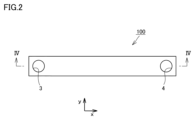
- FIG. 2 is a rear view of the first flow path member 100 according to the first embodiment.
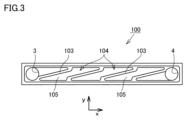
- FIG. 3 is a plan view of the first flow path member 100 according to the first embodiment.
- FIG. 4 is a cross-sectional view taken along line IV-IV in FIG.
- FIG. 5 is a perspective view of the first flow path member 100 according to the first embodiment.
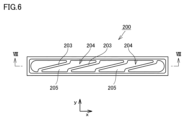
- FIG. 6 is a plan view of the second flow path member 200 according to the first embodiment.
- FIG. 7 is a rear view of the second flow path member 200 according to the first embodiment.
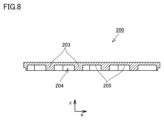
- FIG. 8 is a cross-sectional view taken along line VIII-VIII in FIG.
- FIG. 9 is an exploded perspective view of the cooler 1 according to the first embodiment.
- FIG. 10 is a perspective view including a partial cross section of a cooler 1 according to the second embodiment.
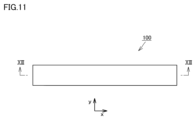
- FIG. 11 is a rear view of the first flow path member 100 according to the second embodiment.
- FIG. 12 is a plan view of the first flow path member 100 according to the second embodiment.
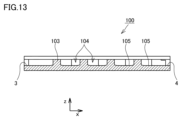
- FIG. 13 is a cross-sectional view taken along line XIII-XIII in FIG.
- FIG. 14 is a perspective view of a first flow path member 100 according to the second embodiment.
- FIG. 15 is a plan view of a second flow path member 200 according to the second embodiment.
- FIG. 16 is a rear view of the second flow path member 200 according to the second embodiment.
- FIG. 17 is a cross-sectional view taken along line XVII-XVII in FIG.
- FIG. 17 is a cross-sectional view taken along line XVII-XVII in FIG.
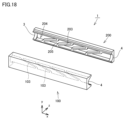
- FIG. 18 is an exploded perspective view of the cooler 1 according to the second embodiment.
- FIG. 19 is a perspective view including a partial cross section of a cooler 1 according to the third embodiment.
- FIG. 20 is a rear view of the first flow path member 100 according to the third embodiment.
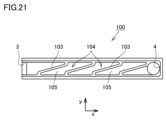
- FIG. 21 is a plan view of the first flow path member 100 according to the third embodiment.
- FIG. 22 is a cross-sectional view taken along line XXII-XXII in FIG.
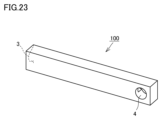
- FIG. 23 is a perspective view of a first flow path member 100 according to the third embodiment.
- FIG. 24 is a plan view of the second flow path member 200 according to the third embodiment.
- FIG. 25 is a rear view of the second flow path member 200 according to the third embodiment.
- FIG. 26 is a cross-sectional view taken along line XXVI-XXVI in FIG.
- FIG. 27 is an exploded perspective view of the cooler 1 according to the third embodiment.
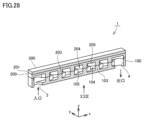
- FIG. 28 is a perspective view including a partial cross section of a cooler 1 according to the fourth embodiment.
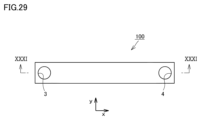
- FIG. 29 is a rear view of the first flow path member 100 according to the fourth embodiment.
- FIG. 30 is a plan view of the first flow path member 100 according to the fourth embodiment.
- FIG. 31 is a cross-sectional view taken along line XXXI-XXXI in FIG.
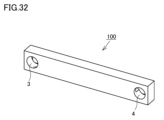
- FIG. 32 is a perspective view of the first flow path member 100 according to the fourth embodiment.
- FIG. 33 is a plan view of the second flow path member 200 according to the fourth embodiment.
- FIG. 34 is a rear view of the second flow path member 200 according to the fourth embodiment.
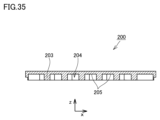
- FIG. 35 is a cross-sectional view taken along line XXXV-XXXV in FIG.
- FIG. 36 is an exploded perspective view of the cooler 1 according to the fourth embodiment.
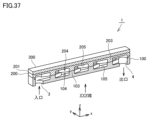
- FIG. 37 is a perspective view including a partial cross section of a cooler 1 according to the fifth embodiment.
- FIG. 38 is a rear view of the first flow path member 100 according to the fifth embodiment.
- FIG. 39 is a plan view of the first flow path member 100 according to the fifth embodiment.
- FIG. 40 is a cross-sectional view taken along the line XL-XL in FIG.
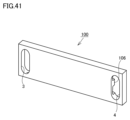
- FIG. 41 is a perspective view of the first flow path member 100 according to the fifth embodiment.
- FIG. 42 is a plan view of the second flow path member 200 according to the fifth embodiment.
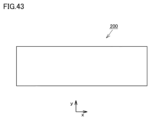
- FIG. 43 is a rear view of the second flow path member 200 according to the fifth embodiment.
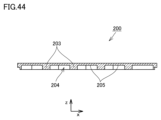
- FIG. 44 is a cross-sectional view taken along the line XLIV-XLIV in FIG.
- FIG. 45 is an exploded perspective view of the cooler 1 according to the fifth embodiment.
- FIG. 46 is a perspective view including a partial cross section of a cooler 1 according to the sixth embodiment.
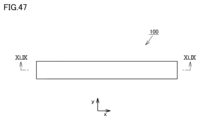
- FIG. 47 is a rear view of the first flow path member 100 according to the sixth embodiment.
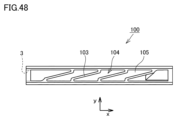
- FIG. 48 is a plan view of the first flow path member 100 according to the sixth embodiment.
- FIG. 49 is a cross-sectional view taken along the line XLIX-XLIX in FIG.
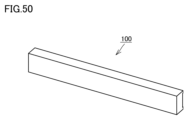
- FIG. 50 is a perspective view of the first flow path member 100 according to the sixth embodiment.
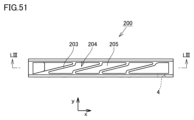
- FIG. 51 is a plan view of the second flow path member 200 according to the sixth embodiment.
- FIG. 52 is a rear view of the second flow path member 200 according to the sixth embodiment.
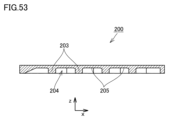
- 53 is a cross-sectional view taken along line LIII-LIII in FIG. 51.
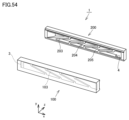
- FIG. FIG. 54 is an exploded perspective view of the cooler 1 according to the sixth embodiment.
- FIG. 55 is a perspective view including a partial cross section of the cooler 1 according to the seventh embodiment.
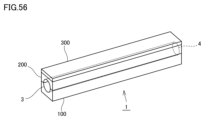
- FIG. 56 is a perspective view of a cooler 1 according to a comparative example.
- FIGS 1 to 9 show a cooler 1 according to a first embodiment of the present disclosure.
- the cooler 1 of the present disclosure has a cooling structure consisting of a cooling member having a first flow path member 100 and a second flow path member 200, each having a cooling flow path through which the cooling water flows, and a heat receiving surface 201.
- a first partition wall 103 and a second partition wall 203 are provided within the cooling flow path as partition plates. When the cooling water collides with the first partition wall 103 and the second partition wall 203, the thermal boundary layer is destroyed, and the heat transfer performance can be improved.
- the first partition wall 103 and the second partition wall 203 are inclined with respect to the flow path. If they are installed parallel to the flow path, it becomes difficult to destroy the temperature boundary layer due to collision. Furthermore, if they are installed as perpendicular partition plates, the water flow is suddenly bent, generating large vortexes in the flow path and causing pressure loss. Normally, an angle of 10 to 60 degrees makes it possible to achieve both pressure loss and heat removal performance.
- the first partition 103 and the second partition 203 are inclined in opposite directions across the center plane of the flow path.
- the flow in the flow path rotates around the center line of the flow path as the central axis, effectively stirring the cooling water and improving heat removal performance.
- the intersection of the mutually inclined partitions be on the center line of the flow path, the symmetry of the flow is further increased and pressure loss can be reduced.
- the height of the first partition wall 103 and the second partition wall 203, which are inclined toward each other, is equal to the height of the center plane of the flow path, and further that they have a common starting point on the side wall of the flow path.
- the starting points of the first partition wall 103 and the second partition wall 203 are not in contact with the side wall of the flow path, the flow along the side wall of the flow path and the flow along the first partition wall 103 and the second partition wall 203 may interfere with each other, causing pressure loss. Also, if the starting points of the first partition wall 103 and the second partition wall 203 are misaligned, flow interference may occur in this area, causing pressure loss.
- the cooling water entering from the inlet 3 collides with the first and second partition walls 103 and 203, which are arranged at an angle, and changes direction within the first and second refrigerant flow paths 104 and 204, respectively, before colliding with the side walls of the first and second bottoms 105 and 205, changing direction, and then collides with the first and second partition walls 103 and 203, where it is guided, again colliding with the side walls and changing direction, before being discharged from the outlet 4.
- the flow in the secondary flow path spontaneously swirls, inducing a secondary swirling flow, which can more efficiently destroy the temperature boundary layer and promote flow agitation.
- first partitions 103 and second partitions 203 can be set appropriately depending on the application. The more the number, the higher the heat removal performance, but the greater the pressure loss, so the number should be determined appropriately taking into account the cooling water supply capacity and the required heat removal performance. Normally, between 2 and 12 partitions are used. If more than 12 partitions are installed, the secondary flow paths separated by the first partitions 103 and second partitions 203 will become narrower, generating more frictional resistance and potentially increasing pressure loss.
- the cooler 1 is preferably of a two-piece structure. Dividing the cooling member into two parts makes it easier to install the partition plate, for example by cutting. If the cooler 1 has a two-piece structure, it can be assembled by methods such as brazing, diffusion bonding, and welding. If it is a one-piece structure, it can be easily manufactured using lost wax casting or additive manufacturing techniques.
- first partition 103 and the second partition 203 provided in the cooling flow path are integral with the first flow path member 100 and the second flow path member 200.
- first partition 103 and the second partition 203 are integral with the first flow path member 100 and the second flow path member 200.
- it is possible to later attach the fins by a method such as brazing by integrating the first partition 103 and the second partition 203 with the first flow path member 100 and the second flow path member 200, the risk of the first partition 103 and the second partition 203 falling off is reduced, and the thermal resistance between the second flow path member 200 in contact with the heat receiving surface 201 and the second partition 203 in contact with the cooling water is reduced, thereby further improving heat removal and increasing mechanical reliability.
- the first flow path member 100 and the second flow path member 200 are made of metal materials such as copper or its alloys, which have excellent thermal conductivity, or stainless steel, which has excellent corrosion resistance. If the first flow path member 100 and the second flow path member 200 have a two-part structure, the heat-receiving surface 201 side may be made of copper or its alloys, which have excellent thermal conductivity, and the opposite side may be made of stainless steel, which has excellent specific strength.
- a heat receiving plate 300 may be bonded as a protective plate made of, for example, a heat-resistant metal with a melting point of 1200°C or higher, or a ceramic material, graphite-based material, etc.
- the increased heat resistance of the heat receiving surface 201 allows it to withstand higher temperatures.
- the range of industrial applications can be expanded, such as the furnace walls of a vacuum high-temperature furnace and the walls of a plasma generating device where a high heat load is concentrated.
- the material of the heat receiving plate 300 is preferably tungsten or its alloy, molybdenum or its alloy, Ni-based superalloy, Co-based superalloy, heat-resistant steel, heat-resistant stainless steel, or graphite-based material.
- the temperature of the heat receiving surface 201 when the temperature of the heat receiving surface 201 is about 1000°C or lower, it can be made of a metal material with good thermal conductivity such as copper or its alloy, aluminum or its alloy, etc., to further promote heat transfer, and can be used, for example, for cooling semiconductor elements.
- the cooler 1 In the cooler 1, the first flow path member 100 and the second flow path member 200 come into contact with each other to form a cooling flow path.
- the cooler 1 is provided with a refrigerant inlet 3 and a refrigerant outlet 4.
- the first flow path member 100 extends in the longitudinal direction (x), with the direction (z) perpendicular to the longitudinal direction toward the second flow path member 200 being the stacking direction, and the direction perpendicular to the longitudinal direction and the stacking direction being the transverse direction (y).
- At least one first refrigerant flow path 104 having a first bottom 105 inclined with respect to the longitudinal direction and the transverse direction is provided in the first flow path member 100.
- the second flow path member 200 has a heat receiving surface 201, and at least one second refrigerant flow path 204 having a second bottom 205 that is inclined with respect to the longitudinal and lateral directions is provided on the opposite side to the heat receiving surface, the second refrigerant flow path 204 is inclined in the opposite direction to the first refrigerant flow path 104, and the first refrigerant flow path 104 and the second refrigerant flow path 204 form a cooling flow path.
- the first flow path member 100 has a first partition wall (103) that is inclined in the longitudinal and lateral directions along the first refrigerant flow path 104
- the second flow path member 200 has a second partition wall 203 that is inclined in the longitudinal and lateral directions along the second refrigerant flow path 204.
- the first partition 103 and the second partition 203 are in contact with each other.
- the first partition 103 is integrally formed with the first bottom 105 so as to protrude from the first bottom 105.
- the thermal resistance between the first bottom 105 and the first partition 103 is reduced. This can improve the heat dissipation capacity.
- the second partition 203 is integrally formed with the second bottom 205 so as to protrude from the second bottom 205.
- the thermal resistance between the second bottom 205 and the second partition 203 is reduced. This can improve the heat dissipation capacity.
- the space surrounded by the first partition wall 103 and the first bottom 105 is the first refrigerant flow path 104.
- the first refrigerant flow path 104 extends within the first flow path member 100 so as to be inclined with respect to the x and y directions.
- the space surrounded by the second partition wall 203 and the second bottom 205 is the second refrigerant flow path 204.
- the second refrigerant flow path 204 extends within the second flow path member 200 so as to be inclined with respect to the x direction and the y direction.
- the first partition 103 and the second partition 203 are inclined in opposite directions.
- the refrigerant that enters the cooler 1 from the inlet 3 flows in the x direction in the first flow path member 100 or the second flow path member 200.
- the refrigerant flowing in the first refrigerant flow path 104 of the first flow path member 100 flows in the x direction and also flows in the direction indicated by the arrow y2. Then, since the first refrigerant flow path 104 narrows, the refrigerant moves in the z1 direction and transfers to the second refrigerant flow path 204 of the second flow path member 200.
- the refrigerant flowing in the second refrigerant flow path 204 of the second flow path member 200 flows in the x direction and also flows in the direction indicated by the arrow y1. Then, since the second refrigerant flow path 204 narrows, the refrigerant moves in the z2 direction and transfers to the first refrigerant flow path 104 of the first flow path member 100.
- the refrigerant that enters the second flow path member 200 from the inlet 3 flows within the second refrigerant flow path 204 of the second flow path member 200, and the refrigerant flows in the x direction as well as in the direction indicated by the arrow y1. Then, as the second refrigerant flow path 204 narrows, the refrigerant moves in the z2 direction and transfers to the first refrigerant flow path 104 of the first flow path member 100.
- the refrigerant flowing within the first refrigerant flow path 104 of the first flow path member 100 flows in the x direction as well as in the direction indicated by the arrow y2. Then, as the first refrigerant flow path 104 narrows, the refrigerant moves in the z1 direction and transfers to the second refrigerant flow path 204 of the second flow path member 200.
- the refrigerant flows in the x direction, as well as in the y1 direction and the y2 direction opposite the y1 direction, and in the z1 direction and the z2 direction opposite the z1 direction, so that the refrigerant flows back and forth in the y and z directions.
- This brings the refrigerant into contact with the first partition wall 103 and the second partition wall 203, as well as the first bottom 105 and the second bottom 205. Therefore, the refrigerant comes into contact with a large area of the first flow path member 100 and the second flow path member 200. As a result, a thermal boundary layer is less likely to form between the refrigerant and the first flow path member 100 and the second flow path member 200.
- Second embodiment 10 to 18 show a cooler 1 according to a second embodiment of the present disclosure.
- the second embodiment differs from the cooler 1 according to the first embodiment in that the inlet 3 and the outlet 4 are open in the longitudinal direction (x).
- Third embodiment 19 to 27 show a cooler 1 according to a third embodiment of the present disclosure.
- the third embodiment differs from the cooler 1 according to the second embodiment in that the inlet 3 opens in the longitudinal direction (x) and the outlet 4 opens in the longitudinal direction (x).
- outlet 4 By orienting the opening of outlet 4 so that it faces vertically downward, for example, the refrigerant can be allowed to fall freely from outlet 4.
- Fourth embodiment 28 to 36 show a cooler 1 according to a fourth embodiment of the present disclosure.
- six first partition walls 103 and six second partition walls 203 are provided, which differs from the cooler 1 according to the first embodiment in which four first partition walls 103 and four second partition walls 203 are provided.
- a plurality of first refrigerant channels 104 and a plurality of second refrigerant channels 204 are provided side by side in the short side direction.
- the amount of heat dissipated into the refrigerant can be increased.
- Fifth embodiment 37 to 45 show a cooler 1 according to a fifth embodiment of the present disclosure.
- the first refrigerant flow path 104 and the second refrigerant flow path 204 are different from the cooler 1 according to the first embodiment in that they are arranged in two rows in the short direction (y) and extend in the longitudinal direction (x).
- a large amount of refrigerant can be made to flow, and heat dissipation capacity can be improved.
- Sixth embodiment 46 to 54 show a cooler 1 according to a sixth embodiment of the present disclosure.
- the sixth embodiment differs from the cooler 1 according to the first embodiment in that the inlet 3 and the outlet 4 have a flat shape. This allows piping to be connected to the inlet 3 and the outlet 4 even in a narrow space.
- the first flow path portion 1100 and the second flow path portion 1200 form a cooling flow path.
- the cooler 1 is provided with a refrigerant inlet 3 and a refrigerant outlet 4.
- the first flow path portion 1100 and the second flow path portion 1200 are integrally configured.
- the first flow path portion 1100 extends in a longitudinal direction (x), and when a direction (z) perpendicular to the longitudinal direction toward the second flow path portion 1200 is defined as a stacking direction, and a direction perpendicular to the longitudinal direction and the stacking direction is defined as a lateral direction (y), at least one first refrigerant flow path 104 having a first bottom 105 that is inclined with respect to the longitudinal direction and the lateral direction is provided in the first flow path portion 1100.
- the second flow path portion 1200 has a heat receiving surface 1201, and at least one second refrigerant flow path 204 having a second bottom 205 that is inclined with respect to the longitudinal direction and the lateral direction is provided on the opposite side to the heat receiving surface 1201.
- the second refrigerant flow path 204 is inclined in the opposite direction to the first refrigerant flow path 104, and the first refrigerant flow path 104 and the second refrigerant flow path 204 form a cooling flow path.
- the first flow path section 1100 and the second flow path section 1200 are integrally formed in the cooler 1, which improves the heat transfer performance.
- This type of shape can be manufactured, for example, by a three-dimensional printer.
- Example 1 for the purpose of high-temperature furnace wall tiles, the second flow path member 200 on the heat receiving surface 201 side was made of a pure copper block with a thickness of 13.5 mm.
- the other side first flow path member 100 not having a heat receiving surface was made of a SUS316 member with a thickness of 16.5 mm, and these were used in combination.
- Each member was machined to have a groove with a width of 18 mm and a height of 9 mm, and by combining these, a rectangular cooler 1 of FIG. 10 with a width of 18 mm and a height of 18 mm was formed.
- a semicircular groove with a diameter of 18 mm was provided on the surface perpendicular to the longitudinal direction of each of the pure copper member and the SUS316L member, so as to be connected to the rectangular groove.
- a circular inlet 3 and outlet 4 of the cooling water with a diameter of 18 mm were provided and connected to the cooling water piping.
- four partition plates each having a height of 9 mm as the first partition wall 103 and the second partition wall 203 were installed on the top and bottom of the flow path, inclined at 15 degrees to the flow path, so that the inclination direction is reversed at the central cross section of the flow path parallel to the heat receiving surface 201.
- the cooler 1 was assembled by brazing with nickel brazing material BNi-6. After that, a 5 mm thick tile made of pure tungsten was brazed to a pure copper member as the heat receiving plate 300 using nickel brazing material BNi-6.
- a cooler 1 with a width of 30 mm and a length of 200 mm was fabricated by joining a 13.5 mm thick pure copper block on the heat receiving surface side and a 16.5 mm thick pure copper block on the other side not having a heat receiving surface with nickel brazing material BNi-6.
- a cylindrical flow path with a diameter of 18 mm was created by drilling a hole at a position 13.5 mm from the heat receiving surface side and 15 mm in the width direction.
- a 5 mm thick pure tungsten tile was bonded with BNi-6 to form the heat receiving plate 300, as shown in Figure 56.
- a cooler 1 was produced that had a cooling structure in which a helical copper twisted tape with a pitch of 8 turns per 200 mm was inserted into the cylindrical flow path of a pure copper cooling member with the same structure as Comparative Example 1.
- a heating experiment was conducted to confirm the cooling effect. While flowing 25°C cooling water at a flow rate of 15 dm 3 L/min, the temperature rise of the tungsten tile was measured when a heat flux of 60 kW was uniformly applied to the heat receiving surface by external heating with a heater. The temperature rise of the tungsten tile was measured by installing an R thermocouple on the surface of the tungsten tile. In addition, the water pressure at the inlet and outlet sides of the cooling water was measured using a Bourdon tube pressure gauge conforming to JIS B 7505-1, and the pressure loss was calculated as the difference between the measured values.
- the tungsten tile in Example 1 had a surface temperature of 640 degrees, and the pressure loss at this time was 0.008 MPa.
- the pressure loss was 0.001 MPa, but the surface temperature of the tungsten tile rose to 800 degrees, resulting in poor heat removal.
- the pressure loss was 0.005 MPa, but the surface temperature of the tungsten tile was 700 degrees, resulting in insufficient heat removal. From these results, it was confirmed that the cooler 1 disclosed herein is an excellent cooling structure that has high heat removal properties and can keep pressure loss sufficiently low compared to conventional simple cylindrical flow paths and swirl tubes.
- Example 2 shown in Figure 1 is another example, and has the same structure as Example 1, with the cooling water inlet and outlet being a hole with a diameter of 18 mm provided on the bottom surface of the SUS316L member.
- the surface temperature of the tungsten tile was 643°C, and the pressure loss was 0.01 MPa, showing almost the same effect as Example 1.
- Example 3 is shown in Figure 19 and has the same structure as Examples 1 and 2, except that the heat-receiving side is made of chromium copper and the other side not having a heat-receiving side is made of SUS304, with cooling water inlets provided on the surfaces perpendicular to the longitudinal direction of the chromium copper member and the SUS304 member, and an outlet provided on the bottom surface of the SUS304 member.
- the surface temperature of the tungsten tile was 658°C and the pressure loss was 0.009 MPa. Compared to Example 1, the tungsten surface temperature was slightly higher due to the difference in thermal conductivity of the copper member, but almost the same effect was shown.
- Example 4 is shown in Figure 28 and has the same structure as Example 2, with six internal fins on each side, tilted at 23 degrees with respect to the flow path.
- the surface temperature was 615 degrees, significantly lower than that of Example 1, Comparative Example 1, and Comparative Example 2. Meanwhile, the pressure loss was 0.015 MPa. If cooling performance is a priority, the number of fins can be increased to improve heat removal. In this way, the balance between cooling performance and pressure loss can be appropriately determined depending on the application.
- Example 5 is shown in Fig. 37, and is a member having a width of 60 mm and a length of 200 mm, in which a pure molybdenum tile having a thickness of 5 mm on the heat receiving surface 201, a pure copper member having a thickness of 11 mm on the heat receiving surface 201 side as the second flow passage member 200, and a member made of alumina-dispersed copper having a thickness of 14 mm as the first flow passage member 100 on the other side are joined.
- the member has two flow passages having a width of 20 mm and a height of 15 mm inside, and has four fins as the first partition wall 103 and the second partition wall 203 on the top and bottom of each flow passage.
- the first flow path member 100 extends in a longitudinal direction (x), a direction (z) perpendicular to the longitudinal direction toward the second flow path member 200 is defined as a stacking direction, and a direction perpendicular to the longitudinal direction and the stacking direction is defined as a lateral direction (y).
- at least one first refrigerant flow path 104 having a first bottom 105 is provided in the first flow path member (100).
- the first refrigerant flow path 104 is inclined with respect to the longitudinal direction and the lateral direction.
- the second flow path member 200 has a heat receiving surface 201, and at least one second refrigerant flow path 204 having a second bottom 205 inclined with respect to the longitudinal direction and the lateral direction is provided on the opposite side to the heat receiving surface 201, the second refrigerant flow path 204 is inclined in the opposite direction to the first refrigerant flow path 104, and the first refrigerant flow path 104 and the second refrigerant flow path 204 form the cooling flow path.
- the first flow path portion 1100 extends in a longitudinal direction (x), a direction (z) perpendicular to the longitudinal direction toward the second flow path portion 1200 is defined as a stacking direction, and a direction perpendicular to the longitudinal direction and the stacking direction is defined as a lateral direction (y).
- at least one first refrigerant flow path 104 having a first bottom 105 is provided in the first flow path portion 1100.
- the first refrigerant flow path 104 is inclined with respect to the longitudinal direction and the lateral direction.
- the second flow path portion 1200 has a heat receiving surface 201, and at least one second refrigerant flow path 204 having a second bottom 205 inclined with respect to the longitudinal direction and the lateral direction is provided on the opposite side to the heat receiving surface 201, the second refrigerant flow path 204 is inclined in the opposite direction to the first refrigerant flow path 104, and the first refrigerant flow path 104 and the second refrigerant flow path 204 form the cooling flow path.
- Cooler 3 Inlet, 4 Outlet, 100 First flow path member, 103 First partition, 104 First refrigerant flow path, 105 First bottom, 200 Second flow path member, 201, 1201 Heat receiving surface, 203 Second partition, 204 Second refrigerant flow path, 205 Second bottom, 300 Heat receiving plate, 1100 First flow path portion, 1200 Second flow path portion.
Landscapes
- Engineering & Computer Science (AREA)
- Physics & Mathematics (AREA)
- Thermal Sciences (AREA)
- Mechanical Engineering (AREA)
- General Engineering & Computer Science (AREA)
- Microelectronics & Electronic Packaging (AREA)
- Cooling Or The Like Of Semiconductors Or Solid State Devices (AREA)
Priority Applications (1)
| Application Number | Priority Date | Filing Date | Title |
|---|---|---|---|
| JP2024527592A JPWO2024116937A1 (https=) | 2022-11-30 | 2023-11-20 |
Applications Claiming Priority (2)
| Application Number | Priority Date | Filing Date | Title |
|---|---|---|---|
| JP2022191783 | 2022-11-30 | ||
| JP2022-191783 | 2022-11-30 |
Publications (1)
| Publication Number | Publication Date |
|---|---|
| WO2024116937A1 true WO2024116937A1 (ja) | 2024-06-06 |
Family
ID=91323726
Family Applications (1)
| Application Number | Title | Priority Date | Filing Date |
|---|---|---|---|
| PCT/JP2023/041644 Ceased WO2024116937A1 (ja) | 2022-11-30 | 2023-11-20 | 冷却器 |
Country Status (2)
| Country | Link |
|---|---|
| JP (1) | JPWO2024116937A1 (https=) |
| WO (1) | WO2024116937A1 (https=) |
Citations (5)
| Publication number | Priority date | Publication date | Assignee | Title |
|---|---|---|---|---|
| JP2007212120A (ja) * | 2006-01-13 | 2007-08-23 | T Rad Co Ltd | インナーフィン及びこのインナーフィンを備えたヒートシンク |
| JP2008039337A (ja) * | 2006-08-09 | 2008-02-21 | T Rad Co Ltd | 熱交換器 |
| JP2008159746A (ja) * | 2006-12-22 | 2008-07-10 | T Rad Co Ltd | ヘリボーン型液冷ヒートシンクおよびその製造方法 |
| US20200340766A1 (en) * | 2017-12-29 | 2020-10-29 | Ehrfeld Mikrotechnik Gmbh | Turbulator and Channel and Process Apparatus With a Turbulator |
| CN112038311A (zh) * | 2020-10-15 | 2020-12-04 | 哈尔滨理工大学 | 一种双层复杂交错结构微通道热沉 |
-
2023
- 2023-11-20 JP JP2024527592A patent/JPWO2024116937A1/ja active Pending
- 2023-11-20 WO PCT/JP2023/041644 patent/WO2024116937A1/ja not_active Ceased
Patent Citations (5)
| Publication number | Priority date | Publication date | Assignee | Title |
|---|---|---|---|---|
| JP2007212120A (ja) * | 2006-01-13 | 2007-08-23 | T Rad Co Ltd | インナーフィン及びこのインナーフィンを備えたヒートシンク |
| JP2008039337A (ja) * | 2006-08-09 | 2008-02-21 | T Rad Co Ltd | 熱交換器 |
| JP2008159746A (ja) * | 2006-12-22 | 2008-07-10 | T Rad Co Ltd | ヘリボーン型液冷ヒートシンクおよびその製造方法 |
| US20200340766A1 (en) * | 2017-12-29 | 2020-10-29 | Ehrfeld Mikrotechnik Gmbh | Turbulator and Channel and Process Apparatus With a Turbulator |
| CN112038311A (zh) * | 2020-10-15 | 2020-12-04 | 哈尔滨理工大学 | 一种双层复杂交错结构微通道热沉 |
Also Published As
| Publication number | Publication date |
|---|---|
| JPWO2024116937A1 (https=) | 2024-06-06 |
Similar Documents
| Publication | Publication Date | Title |
|---|---|---|
| EP1714100B1 (en) | Method of forming a brazed plate fin heat exchanger | |
| EP0338704A1 (en) | Heat exchanger core | |
| US20090188655A1 (en) | Heat exchanger flat tube with oblique elongate dimples | |
| WO2018138936A1 (ja) | ヒートシンク | |
| CN101297172B (zh) | 板片式热交换器,特别是增压空气冷却器 | |
| US20240255234A1 (en) | Heat exchanger with heat transfer augmentation features | |
| CN110431663B (zh) | 热交换器 | |
| WO2024116937A1 (ja) | 冷却器 | |
| JP3852047B2 (ja) | アルミニューム製積層型オイルクーラ | |
| EP3734213B1 (en) | Offset/slanted cross counter flow heat exchanger | |
| US10473411B2 (en) | Aluminum alloy finned heat exchanger | |
| JP2014045134A (ja) | 流路部材およびこれを用いた熱交換器ならびに半導体装置 | |
| JP6743846B2 (ja) | 積層型熱交換器、および、その積層型熱交換器の製造方法 | |
| JP7739249B2 (ja) | 熱交換器及びその製造方法 | |
| EP4365535B1 (en) | Heat exchanger | |
| JP2001248980A (ja) | 多管式熱交換器 | |
| JP2009228970A (ja) | 熱交換器 | |
| CN113574332B (zh) | 热交换器 | |
| CN106705715B (zh) | 换热器 | |
| JP7210646B2 (ja) | ヒートシンク及び熱交換器 | |
| US20250058392A1 (en) | Brazed hybrid aluminum/copper heat exchangers | |
| JP7370883B2 (ja) | 伝熱部材および伝熱部材を有する冷却装置 | |
| JP4341490B2 (ja) | 熱交換器 | |
| CN115989100B (zh) | 热交换器及其制造方法 | |
| JP2020200963A (ja) | プレートフィン熱交換器の熱交換部及び熱交換システムの製造方法 |
Legal Events
| Date | Code | Title | Description |
|---|---|---|---|
| WWE | Wipo information: entry into national phase |
Ref document number: 2024527592 Country of ref document: JP |
|
| 121 | Ep: the epo has been informed by wipo that ep was designated in this application |
Ref document number: 23897585 Country of ref document: EP Kind code of ref document: A1 |
|
| NENP | Non-entry into the national phase |
Ref country code: DE |
|
| 122 | Ep: pct application non-entry in european phase |
Ref document number: 23897585 Country of ref document: EP Kind code of ref document: A1 |