WO2024101407A1 - 粘着剤、粘着シートおよび粘着剤の製造方法 - Google Patents
粘着剤、粘着シートおよび粘着剤の製造方法 Download PDFInfo
- Publication number
- WO2024101407A1 WO2024101407A1 PCT/JP2023/040316 JP2023040316W WO2024101407A1 WO 2024101407 A1 WO2024101407 A1 WO 2024101407A1 JP 2023040316 W JP2023040316 W JP 2023040316W WO 2024101407 A1 WO2024101407 A1 WO 2024101407A1
- Authority
- WO
- WIPO (PCT)
- Prior art keywords
- adhesive
- cyclodextrin compound
- cyclodextrin
- pressure
- sensitive adhesive
- Prior art date
- Legal status (The legal status is an assumption and is not a legal conclusion. Google has not performed a legal analysis and makes no representation as to the accuracy of the status listed.)
- Ceased
Links
Images

Classifications
-
- C—CHEMISTRY; METALLURGY
- C09—DYES; PAINTS; POLISHES; NATURAL RESINS; ADHESIVES; COMPOSITIONS NOT OTHERWISE PROVIDED FOR; APPLICATIONS OF MATERIALS NOT OTHERWISE PROVIDED FOR
- C09J—ADHESIVES; NON-MECHANICAL ASPECTS OF ADHESIVE PROCESSES IN GENERAL; ADHESIVE PROCESSES NOT PROVIDED FOR ELSEWHERE; USE OF MATERIALS AS ADHESIVES
- C09J4/00—Adhesives based on organic non-macromolecular compounds having at least one polymerisable carbon-to-carbon unsaturated bond ; adhesives, based on monomers of macromolecular compounds of groups C09J183/00 - C09J183/16
-
- C—CHEMISTRY; METALLURGY
- C08—ORGANIC MACROMOLECULAR COMPOUNDS; THEIR PREPARATION OR CHEMICAL WORKING-UP; COMPOSITIONS BASED THEREON
- C08F—MACROMOLECULAR COMPOUNDS OBTAINED BY REACTIONS ONLY INVOLVING CARBON-TO-CARBON UNSATURATED BONDS
- C08F290/00—Macromolecular compounds obtained by polymerising monomers on to polymers modified by introduction of aliphatic unsaturated end or side groups
- C08F290/08—Macromolecular compounds obtained by polymerising monomers on to polymers modified by introduction of aliphatic unsaturated end or side groups on to polymers modified by introduction of unsaturated side groups
- C08F290/10—Polymers provided for in subclass C08B
-
- C—CHEMISTRY; METALLURGY
- C08—ORGANIC MACROMOLECULAR COMPOUNDS; THEIR PREPARATION OR CHEMICAL WORKING-UP; COMPOSITIONS BASED THEREON
- C08L—COMPOSITIONS OF MACROMOLECULAR COMPOUNDS
- C08L5/00—Compositions of polysaccharides or of their derivatives not provided for in groups C08L1/00 or C08L3/00
- C08L5/16—Cyclodextrin; Derivatives thereof
-
- C—CHEMISTRY; METALLURGY
- C09—DYES; PAINTS; POLISHES; NATURAL RESINS; ADHESIVES; COMPOSITIONS NOT OTHERWISE PROVIDED FOR; APPLICATIONS OF MATERIALS NOT OTHERWISE PROVIDED FOR
- C09J—ADHESIVES; NON-MECHANICAL ASPECTS OF ADHESIVE PROCESSES IN GENERAL; ADHESIVE PROCESSES NOT PROVIDED FOR ELSEWHERE; USE OF MATERIALS AS ADHESIVES
- C09J105/00—Adhesives based on polysaccharides or on their derivatives, not provided for in groups C09J101/00 or C09J103/00
- C09J105/16—Cyclodextrin; Derivatives thereof
-
- C—CHEMISTRY; METALLURGY
- C09—DYES; PAINTS; POLISHES; NATURAL RESINS; ADHESIVES; COMPOSITIONS NOT OTHERWISE PROVIDED FOR; APPLICATIONS OF MATERIALS NOT OTHERWISE PROVIDED FOR
- C09J—ADHESIVES; NON-MECHANICAL ASPECTS OF ADHESIVE PROCESSES IN GENERAL; ADHESIVE PROCESSES NOT PROVIDED FOR ELSEWHERE; USE OF MATERIALS AS ADHESIVES
- C09J11/00—Features of adhesives not provided for in group C09J9/00, e.g. additives
- C09J11/08—Macromolecular additives
-
- C—CHEMISTRY; METALLURGY
- C09—DYES; PAINTS; POLISHES; NATURAL RESINS; ADHESIVES; COMPOSITIONS NOT OTHERWISE PROVIDED FOR; APPLICATIONS OF MATERIALS NOT OTHERWISE PROVIDED FOR
- C09J—ADHESIVES; NON-MECHANICAL ASPECTS OF ADHESIVE PROCESSES IN GENERAL; ADHESIVE PROCESSES NOT PROVIDED FOR ELSEWHERE; USE OF MATERIALS AS ADHESIVES
- C09J133/00—Adhesives based on homopolymers or copolymers of compounds having one or more unsaturated aliphatic radicals, each having only one carbon-to-carbon double bond, and at least one being terminated by only one carboxyl radical, or of salts, anhydrides, esters, amides, imides, or nitriles thereof; Adhesives based on derivatives of such polymers
- C09J133/04—Homopolymers or copolymers of esters
-
- C—CHEMISTRY; METALLURGY
- C09—DYES; PAINTS; POLISHES; NATURAL RESINS; ADHESIVES; COMPOSITIONS NOT OTHERWISE PROVIDED FOR; APPLICATIONS OF MATERIALS NOT OTHERWISE PROVIDED FOR
- C09J—ADHESIVES; NON-MECHANICAL ASPECTS OF ADHESIVE PROCESSES IN GENERAL; ADHESIVE PROCESSES NOT PROVIDED FOR ELSEWHERE; USE OF MATERIALS AS ADHESIVES
- C09J4/00—Adhesives based on organic non-macromolecular compounds having at least one polymerisable carbon-to-carbon unsaturated bond ; adhesives, based on monomers of macromolecular compounds of groups C09J183/00 - C09J183/16
- C09J4/06—Organic non-macromolecular compounds having at least one polymerisable carbon-to-carbon unsaturated bond in combination with a macromolecular compound other than an unsaturated polymer of groups C09J159/00 - C09J187/00
-
- C—CHEMISTRY; METALLURGY
- C09—DYES; PAINTS; POLISHES; NATURAL RESINS; ADHESIVES; COMPOSITIONS NOT OTHERWISE PROVIDED FOR; APPLICATIONS OF MATERIALS NOT OTHERWISE PROVIDED FOR
- C09J—ADHESIVES; NON-MECHANICAL ASPECTS OF ADHESIVE PROCESSES IN GENERAL; ADHESIVE PROCESSES NOT PROVIDED FOR ELSEWHERE; USE OF MATERIALS AS ADHESIVES
- C09J7/00—Adhesives in the form of films or foils
- C09J7/30—Adhesives in the form of films or foils characterised by the adhesive composition
- C09J7/38—Pressure-sensitive adhesives [PSA]
-
- C—CHEMISTRY; METALLURGY
- C09—DYES; PAINTS; POLISHES; NATURAL RESINS; ADHESIVES; COMPOSITIONS NOT OTHERWISE PROVIDED FOR; APPLICATIONS OF MATERIALS NOT OTHERWISE PROVIDED FOR
- C09J—ADHESIVES; NON-MECHANICAL ASPECTS OF ADHESIVE PROCESSES IN GENERAL; ADHESIVE PROCESSES NOT PROVIDED FOR ELSEWHERE; USE OF MATERIALS AS ADHESIVES
- C09J7/00—Adhesives in the form of films or foils
- C09J7/30—Adhesives in the form of films or foils characterised by the adhesive composition
- C09J7/38—Pressure-sensitive adhesives [PSA]
- C09J7/381—Pressure-sensitive adhesives [PSA] based on macromolecular compounds obtained by reactions involving only carbon-to-carbon unsaturated bonds
- C09J7/385—Acrylic polymers
Definitions
- the present invention relates to an adhesive, an adhesive sheet, and a method for producing an adhesive.
- Patent Document 1 proposes a polymer material that includes a crosslinked polymer crosslinked by the interaction between a host group and a guest group, in which the host group is a monovalent group obtained by removing one hydrogen atom or one hydroxyl group from cyclodextrin, and the crosslinked polymer includes a predetermined repeating structural unit.
- Patent Document 2 also proposes an inclusion complex formed from a host group of a host group-containing monomer and a guest group of a guest group-containing monomer, in which the host group-containing monomer is a cyclodextrin monomer derivative having a (meth)acryloyl group, and the guest group-containing monomer is a specified monomer having a vinyl group.
- Patent Documents 1 and 2 make no mention of the adhesive in the adhesive sheet, nor do they mention recyclability.
- Adhesive sheets are used to secure various adherends, but depending on the application, there is a demand for minimal change in the attachment position even when exposed to high temperatures for long periods of time.
- the present invention was made in consideration of the above-mentioned circumstances, and aims to provide an adhesive and adhesive sheet that have excellent high-temperature adhesion and are recyclable, as well as a method for producing such an adhesive.
- the present invention provides an adhesive that contains a cyclodextrin compound, has a gel fraction of 30% or less, and has a loss tangent tan ⁇ of 0.48 or more and 3.00 or less at 25°C (Invention 1).
- the present invention provides a pressure-sensitive adhesive which contains a cyclodextrin compound, has a gel fraction of 30% or less, and exhibits a maximum stress of 0.08 N/mm2 or more when molded to a thickness of 500 ⁇ m and a width of 10 mm and stretched to the breaking elongation at a measuring length of 20 mm and a tensile speed of 200 mm/min under an environment of 23 ° C. and 50% RH (Invention 2).
- the adhesive according to the above inventions contains a cyclodextrin compound and has a gel fraction of 30% or less, which makes it excellent in solvent solubility and enables the adhesive to be recycled.
- the adhesive according to the above inventions contains a cyclodextrin compound and the loss tangent tan ⁇ or the maximum stress at 25°C satisfies the above values, which makes it excellent in high-temperature lamination with little change in lamination position even when exposed to high temperatures for a long period of time.
- the loss tangent tan ⁇ at 80°C is 0.01 or more and 2.00 or less (Invention 3).
- the breaking energy is preferably 0.80 MJ/ m3 or more (Invention 4).
- the adhesive is an acrylic adhesive (Invention 5).
- the present invention provides an adhesive sheet having at least an adhesive layer, characterized in that the adhesive constituting the adhesive layer is the adhesive described above (Inventions 1 to 7) (Invention 8).
- the present invention provides a method for producing the adhesive (Inventions 1 to 7), characterized in that the acrylic monomer and the cyclodextrin compound are cured all at once (Invention 9).
- the present invention provides a method for producing the adhesive (Inventions 1 to 7), which comprises at least a step of curing a cyclodextrin compound having a polymerizable group to obtain a primary cured product, a step of mixing an acrylic monomer, a cyclodextrin compound having a polymerizable group, and the primary cured product to obtain a secondary mixture, and a step of curing the secondary mixture to obtain a secondary cured product (Invention 10).
- the present invention provides a method for producing the adhesive (Inventions 1 to 7), comprising the steps of mixing an acrylic monomer and a cyclodextrin compound to obtain a primary mixture, curing the primary mixture to obtain a primary cured product, mixing the acrylic monomer, the cyclodextrin compound, and the primary cured product to obtain a secondary mixture, and curing the secondary mixture to obtain a secondary cured product (Invention 11).
- the present invention provides a method for producing the adhesive (Inventions 1 to 7), which comprises at least a step of curing one or more acrylic monomers to obtain a primary cured product, a step of mixing a cyclodextrin compound and the primary cured product to obtain a secondary mixture, and a step of curing the secondary mixture to obtain a secondary cured product (Invention 12).
- the adhesive and adhesive sheet of the present invention have excellent high-temperature adhesion properties, and the adhesive can be recycled. Furthermore, the method for producing the adhesive of the present invention makes it possible to produce an adhesive that has excellent high-temperature adhesion properties and is recyclable.
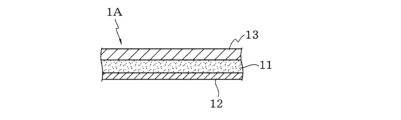
- FIG. 1 is a cross-sectional view of a pressure-sensitive adhesive sheet according to one embodiment of the present invention.
- FIG. 4 is a cross-sectional view of a pressure-sensitive adhesive sheet according to another embodiment of the present invention.
- the pressure-sensitive adhesive according to one embodiment of the present invention preferably contains a cyclodextrin compound and has a gel fraction of 30% or less. It is also preferable that the loss tangent tan ⁇ at 25°C is 0.48 or more and 3.00 or less, that the maximum stress when the pressure-sensitive adhesive is molded to a thickness of 500 ⁇ m and a width of 10 mm and stretched to the breaking elongation at a measuring length of 20 mm and a tensile speed of 200 mm/min under an environment of 23°C and 50 % RH is 0.08 N/mm2 or more, or that both the range of the loss tangent tan ⁇ and the range of the maximum stress are satisfied.
- the method for measuring the gel fraction in this specification is as shown in the test examples described later.
- the method for measuring the loss tangent tan ⁇ and the storage modulus G' in this specification is as shown in the test examples described later.
- the details of the tensile tests for measuring the maximum stress, the breaking energy, and the tensile modulus in this specification are as shown in the test examples described later.
- the adhesive according to this embodiment contains a cyclodextrin compound and has a gel fraction of 30% or less, which gives the adhesive excellent solvent solubility and makes it possible to recycle the adhesive. That is, by immersing the adhesive according to this embodiment in a specific solvent, the adhesive dissolves in the solvent and falls off from the substrate. The adhesive dissolved in the solvent can be reused by volatilizing the solvent, etc.
- Solvents that dissolve the adhesive (layer) during recycling are not particularly limited, but examples include aliphatic hydrocarbons such as hexane, heptane, cyclohexane, etc.; aromatic hydrocarbons such as toluene and xylene; halogenated hydrocarbons such as methylene chloride and ethylene chloride; alcohols such as methanol, ethanol, propanol, butanol, 1-methoxy-2-propanol, etc.; ketones such as acetone, methyl ethyl ketone, 2-pentanone, isophorone, cyclohexanone, etc.; esters such as ethyl acetate and butyl acetate; and cellosolve-based solvents such as ethyl cellosolve.
- aliphatic hydrocarbons such as hexane, heptane, cyclohexane, etc.
- aromatic hydrocarbons such as toluene and
- the adhesive according to this embodiment contains a cyclodextrin compound, and the loss tangent tan ⁇ or the maximum stress at 25°C satisfies the above values, so that the adhesive exhibits little change in the lamination position even when exposed to high temperatures for a long period of time, and has excellent high-temperature lamination properties. It is more preferable that both the loss tangent tan ⁇ and the maximum stress at 25°C satisfy the above values.
- the gel fraction of the adhesive according to this embodiment is preferably 30% or less, more preferably 15% or less, particularly preferably 10% or less, even more preferably 6% or less, more preferably 4% or less, and of these, more preferably 2% or less.
- the gel fraction of the adhesive according to this embodiment is preferably 0% or more, more preferably 0.1% or more.
- the loss tangent tan ⁇ of the adhesive according to this embodiment at 25°C is preferably 0.48 or more and 3.00 or less. This results in excellent high-temperature adhesion. From this perspective, the loss tangent tan ⁇ at 25°C is more preferably 0.51 to 2.60, particularly preferably 0.55 to 2.20, and even more preferably 0.70 to 2.00, with 0.80 to 1.80 being particularly preferred.
- the maximum stress of the pressure-sensitive adhesive according to the present embodiment is preferably 0.08 N/ mm2 or more. This results in excellent high-temperature lamination. From this viewpoint, the maximum stress is more preferably 0.1 to 30.0 N/ mm2 , particularly preferably 0.5 to 10.0 N/ mm2 , more preferably 0.8 to 8.0 N/ mm2 , and even more preferably 1.1 to 6.0 N/ mm2 or more, and of these, preferably 1.0 to 4.5 N/ mm2 or more.
- the loss tangent tan ⁇ at 80°C of the adhesive according to this embodiment is preferably 0.01 or more, more preferably 0.05 or more, and particularly preferably 0.10 or more.
- the loss tangent tan ⁇ at 80°C is preferably 2.00 or less, more preferably 1.50 or less, and particularly preferably 1.20 or less.
- the loss tangent tan ⁇ at 80°C is preferably 0.20 to 0.90, more preferably 0.30 to 0.60, and particularly preferably 0.38 to 0.52.
- the adhesive according to the present embodiment is molded to a thickness of 500 ⁇ m and a width of 10 mm, and the breaking energy when stretched to the breaking elongation at a measurement length of 20 mm and a tensile speed of 200 mm/min under an environment of 23° C. and 50% RH is preferably 0.80 MJ/m 3 or more, more preferably 1.2 MJ/m 3 or more, particularly preferably 2.0 MJ/m 3 or more, and even more preferably 3.0 MJ/m 3 or more. This makes the high-temperature lamination property more excellent.
- the breaking energy is preferably 100 MJ/m 3 or less, more preferably 50 MJ/m 3 or less, particularly preferably 30 MJ/m 3 or less, and even more preferably 15 MJ/m 3 or less.
- the tensile modulus is preferably 0.01 MPa or more, more preferably 0.10 MPa or more, particularly preferably 0.20 MPa or more, even more preferably 0.40 MPa or more, and of these, preferably 0.50 MPa or more. This provides better high-temperature adhesion.
- the tensile modulus is preferably 40 MPa or less, more preferably 20 MPa or less, particularly preferably 10 MPa or less, and even more preferably 6 MPa or less.
- the storage modulus G' at 25°C of the pressure-sensitive adhesive according to this embodiment is preferably 1.0x10⁴ to 1.0x10⁸ Pa, more preferably 1.0x10⁵ to 1.0x10⁷ Pa, particularly preferably 2.0x10⁵ to 8.0x10⁶ Pa, and further preferably 3.0x10⁵ to 5.0x10⁶ Pa. This makes it easier to satisfy the above-mentioned physical properties, resulting in more excellent high-temperature lamination properties and easily achieving good solvent solubility.
- the storage modulus G' at 80°C of the pressure-sensitive adhesive according to this embodiment is preferably 1.0x10 4 to 1.0x10 6 Pa, more preferably 1.5x10 4 to 5.0x10 5 Pa, particularly preferably 3.0x10 4 to 1.0x10 5 Pa, and further preferably 5.0x10 4 to 9.0x10 4 Pa. This makes it easier to satisfy the above-mentioned physical properties, resulting in better high-temperature lamination properties and easy compatibility with solvent solubility.
- the adhesive according to this embodiment contains a cyclodextrin compound.
- the cyclodextrin compound in this specification may be cyclodextrin itself, a cyclodextrin having a substituent (cyclodextrin derivative), or a cyclodextrin or cyclodextrin derivative incorporated into a polymer (a polymer having cyclodextrin or a cyclodextrin derivative as a constituent monomer).
- the adhesive according to this embodiment is preferably a solventless adhesive.
- the adhesive according to this embodiment is preferably an acrylic adhesive, and more preferably a solventless acrylic adhesive.
- the adhesive according to this embodiment preferably contains a polymer having a main chain formed by copolymerizing an acrylic monomer with a cyclodextrin compound having a polymerizable group, or contains an acrylic polymer and cyclodextrin or a cyclodextrin derivative.
- a cyclodextrin derivative is more preferable than cyclodextrin.
- the cyclodextrin derivative is preferably one in which all hydroxyl groups of cyclodextrin are substituted with acyl groups, particularly acetyl groups.
- the adhesive according to this embodiment preferably does not contain a guest molecule that can be included in the cyclodextrin compound.
- inclusion refers to the phenomenon in which a guest molecule is taken into the cavity of a host molecule (cyclodextrin compound).
- guest molecule refers to a molecule that can be included in a cyclodextrin compound, including those that have not yet been included.
- guest molecules examples include n-butyl acrylate, styrene, octyl acrylate, and dodecyl acrylate for ⁇ -cyclodextrin compounds, n-butyl acrylate, t-butyl acrylate, styrene, adamantyl acrylate, and isobornyl acrylate for ⁇ -cyclodextrin compounds, and octyl acrylate and dodecyl acrylate for ⁇ -cyclodextrin compounds.
- the adhesive "does not contain guest molecules that can be included in a cyclodextrin compound” means that it does not substantially contain any. Specifically, the adhesive is permitted to contain guest molecules in an amount of 1 mol or less, preferably 0.1 mol or less, particularly preferably 0.01 mol or less, and even more preferably 0.001 mol or less, per 100 mol of the total amount of acrylic monomers.
- the monomers listed above may be used as acrylic monomers, but these monomers basically become polymers by polymerization and do not become guest molecules that can be included, but may remain in small amounts even after polymerization, and are therefore specified as above.
- the polymer having a main chain obtained by copolymerizing the above-mentioned acrylic monomer with a cyclodextrin compound having a polymerizable group preferably does not have a branched structure. This prevents the resulting adhesive from becoming too dense, making it easier to achieve the aforementioned gel fraction.
- the adhesive according to this embodiment is preferably produced by copolymerizing the acrylic monomer (A) and the polymerizable cyclodextrin compound (Bp) using an acrylic monomer (A), a cyclodextrin compound having a polymerizable group (hereinafter sometimes referred to as a "polymerizable group cyclodextrin compound") (Bp), and preferably further a photopolymerization initiator (C).
- the adhesive according to this embodiment is preferably produced by polymerizing the acrylic monomer (A) using an acrylic monomer (A), a cyclodextrin compound not having a polymerizable group (hereinafter sometimes referred to as a "non-polymerizable group cyclodextrin compound") (Bn), and preferably further a photopolymerization initiator (C).
- the acrylic monomer (A) in the present embodiment is preferably a monofunctional acrylic monomer, which allows the resulting polymer to have no branched structure and makes it easier to satisfy the above-mentioned gel fraction.
- the acrylic monomer (A) may be used alone or in combination of two or more kinds. It is preferable that the acrylic monomer (A) first contains a (meth)acrylic acid ester.
- the (meth)acrylic acid ester may be used alone or in combination of two or more kinds.
- (meth)acrylic acid means both acrylic acid and methacrylic acid. The same applies to other similar terms.
- Examples of (meth)acrylic acid esters include (meth)acrylic acid alkyl esters in which the alkyl group is linear or branched, (meth)acrylic acid esters having a cyclic structure such as an alicyclic structure, and (meth)acrylic acid esters having a functional group such as a hydroxyl group. Among these, (meth)acrylic acid alkyl esters in which the alkyl group is linear or branched are preferred.
- the above-mentioned (meth)acrylic acid alkyl ester is preferably a (meth)acrylic acid alkyl ester having an alkyl group with 1 to 20 carbon atoms.
- (meth)acrylic acid alkyl esters having an alkyl group with 1 to 20 carbon atoms include methyl (meth)acrylate, ethyl (meth)acrylate, propyl (meth)acrylate, n-butyl (meth)acrylate, n-pentyl (meth)acrylate, n-hexyl (meth)acrylate, 2-ethylhexyl (meth)acrylate, isooctyl (meth)acrylate, n-decyl (meth)acrylate, n-dodecyl (meth)acrylate, myristyl (meth)acrylate, palmityl (meth)acrylate, and stearyl (meth)acrylate.
- a (meth)acrylic acid ester having an alkyl group with 1 to 8 carbon atoms is preferred, and methyl (meth)acrylate, ethyl (meth)acrylate, n-butyl (meth)acrylate, and 2-ethylhexyl (meth)acrylate are more preferred.
- ethyl (meth)acrylate, n-butyl (meth)acrylate, etc. are preferred, and ethyl acrylate, n-butyl acrylate, etc. are even more preferred.
- the content of the (meth)acrylic acid alkyl ester in the acrylic monomer (A) is preferably 70 to 100% by mass, and when the nitrogen atom-containing monomer described below is included, it is more preferably 75 to 99% by mass, particularly preferably 80 to 98% by mass, and even more preferably 84 to 97% by mass. This brings the above-mentioned physical properties into a more preferable range.
- the acrylic monomer (A) contains a monomer containing a nitrogen atom in the molecule (nitrogen atom-containing monomer).
- nitrogen atom-containing monomer is preferably used in combination with the above-mentioned (meth)acrylic acid alkyl ester.
- the nitrogen atom-containing monomer examples include monomers having an amino group, monomers having an amide group, and monomers having a nitrogen-containing heterocycle. Among them, monomers having an amide group are preferred from the viewpoint of easily satisfying the above-mentioned physical properties. Furthermore, from the viewpoint of increasing the degree of freedom of the portion derived from the nitrogen atom-containing monomer in the higher-order structure of the pressure-sensitive adhesive that is constituted, it is preferred that the nitrogen atom-containing monomer does not contain a reactive unsaturated double bond group other than one polymerizable group used in the polymerization to form the (meth)acrylic acid ester polymer (A).
- the nitrogen atom-containing monomer may be used alone or in combination of two or more kinds.
- Examples of monomers having an amide group include (meth)acrylamide, N-methyl(meth)acrylamide, N,N-dimethyl(meth)acrylamide, N-ethyl(meth)acrylamide, N,N-diethyl(meth)acrylamide, N-methylol(meth)acrylamide, N-tert-butyl(meth)acrylamide, N,N-dimethylaminopropyl(meth)acrylamide, N-isopropyl(meth)acrylamide, N-phenyl(meth)acrylamide, N-(n-butoxymethyl)(meth)acrylamide, dimethylaminopropyl(meth)acrylamide, and N-vinylcaprolactam.
- N,N-diethyl(meth)acrylamide or N-isopropyl(meth)acrylamide is preferred from the viewpoint of superior high-temperature lamination properties, and N,N-diethylacrylamide or N-isopropylacrylamide is particularly preferred.
- the content of the nitrogen atom-containing monomer (particularly the monomer having an amide group) in the acrylic monomer (A) is preferably 1 to 30 mass%, more preferably 2 to 25 mass%, particularly preferably 3 to 20 mass%, and even more preferably 4 to 16 mass%. This brings the above-mentioned physical properties into a more preferable range, and in particular improves the high-temperature lamination property.
- the acrylic monomer (A) may contain acrylic monomers other than the above monomers, for example, carboxyl group-containing monomers such as (meth)acrylic acid, and hydroxyl group-containing monomers such as 2-hydroxyethyl (meth)acrylate.
- the content of the component derived from the acrylic monomer (A) in the adhesive according to this embodiment is preferably 70 to 99.99% by mass, more preferably 75 to 99.9% by mass, particularly preferably 80 to 99.6% by mass, and even more preferably 90 to 99.2% by mass. This brings the above-mentioned physical properties into a more preferable range.
- the cyclodextrin portion of the polymerizable cyclodextrin compound (Bp) in this embodiment is preferably ⁇ -cyclodextrin, ⁇ -cyclodextrin, or ⁇ -cyclodextrin, which may have a substituent.
- ⁇ -cyclodextrin is preferable, and ⁇ -cyclodextrin having a substituent is particularly preferable.
- the above-mentioned substituents are those in which the hydroxyl groups of cyclodextrin have been substituted.
- substituents include acyl groups, alkyl groups, trityl groups, tosyl groups, trimethylsilane groups, phenyl groups, polyester chains, oxyethylene chains, alkyl chains, ether chains, ester chains, acrylic ester chains, etc.
- acyl groups are preferred, and acetyl groups are particularly preferred.
- the polymerizable cyclodextrin compound (Bp) it is preferable that no hydroxyl groups remain in the cyclodextrin, and it is preferable that all hydroxyl groups in the cyclodextrin other than those in the portion having the polymerizable group are substituted with acyl groups, particularly acetyl groups.
- the polymerizable group of the polymerizable cyclodextrin compound (Bp) is not particularly limited as long as it can polymerize with the acryloyl group of the acrylic monomer (A), but is preferably a group containing a polymerizable unsaturated double bond, more preferably an ethylenically unsaturated group, and more preferably a (meth)acryloyl group, a vinyl group, an allyl group, or the like, and particularly preferably a (meth)acryloyl group.
- the polymerizable cyclodextrin compound (Bp) has one polymerizable group per cyclodextrin molecule. This allows the copolymer of the acrylic monomer (A) and the polymerizable cyclodextrin compound (Bp) to have no branched structure, making it easier to achieve the gel fraction described above.
- the content of the cyclodextrin compound having two or more polymerizable groups per molecule in the adhesive is small. Specifically, it is preferable that the content is 0.1% by mass or less, more preferably 0.01% by mass or less, and even more preferably 0.001% by mass or less.
- the polymerizable cyclodextrin compound (Bp) in this embodiment is preferably a compound represented by the following formula (1).
- R 1 represents a hydrogen atom or a methyl group.
- R 2 represents O, NH, a hydrocarbon containing O, a hydrocarbon containing NH, or a hydrocarbon containing O and NH.
- CD represents ⁇ -cyclodextrin, ⁇ -cyclodextrin, ⁇ -cyclodextrin, or a derivative thereof.
- Examples of the "NH-containing hydrocarbon" with the right side bonded to CD include, -CH 2 -NH-CH 2 -, -NH-CH 2 -O-CH 2 -, -O-CH 2 -NH-CH 2 -, -CH 2 -NH-CH 2 -O-, -O-CH 2 -NH-CH 2 -O-, -CH 2 -O-CO-NH-CH 2 -O-, -CH 2 -O-CO-NH-C 2 H 4 -O-, etc.
- -NH-CH 2 -O-CH 2 - is particularly preferred from the viewpoint of easily satisfying the above-mentioned physical properties.
- CD in the above formula (1) is preferably a ⁇ -cyclodextrin derivative, and more preferably a ⁇ -cyclodextrin derivative in which all of the hydroxyl groups of the cyclodextrin, except for the portion bonded to R2 , are substituted with acyl groups, particularly acetyl groups.
- the content of the polymerizable cyclodextrin compound (Bp)-derived component in the adhesive according to this embodiment is preferably 0.01 to 10, more preferably 0.05 to 6, particularly preferably 0.1 to 3, even more preferably 0.3 to 2, and of these, preferably 0.4 to 1.2, in terms of molar ratio when the content of the acrylic monomer (A)-derived component (the total amount of acrylic monomer (A) used during the manufacture of the adhesive) is taken as 100 mol. This makes it easier to satisfy the above-mentioned physical properties, and the resulting adhesive has better solvent solubility (recyclability) and high-temperature lamination properties.
- Non-polymerizable cyclodextrin compounds (Bn) The cyclodextrin portion of the non-polymerizable cyclodextrin compound (Bn) in this embodiment is preferably ⁇ -cyclodextrin, ⁇ -cyclodextrin, or ⁇ -cyclodextrin, which may have a substituent (excluding a polymerizable group).
- ⁇ -cyclodextrin is preferred, and ⁇ -cyclodextrin having a substituent (excluding a polymerizable group) is particularly preferred.
- non-polymerizable cyclodextrin compound (Bn) it is preferable that no hydroxyl groups of the cyclodextrin remain, and in particular, it is preferable that all of the hydroxyl groups of the cyclodextrin are substituted with acyl groups, particularly acetyl groups.
- the content of the non-polymerizable cyclodextrin compound (Bn)-derived component in the adhesive according to this embodiment is preferably 0.01 to 10, more preferably 0.05 to 6, particularly preferably 0.1 to 3, even more preferably 0.3 to 2, and of these, preferably 0.4 to 1.2, in terms of molar ratio when the content of the acrylic monomer (A)-derived component (total amount of acrylic monomer (A) used during adhesive production) is taken as 100 mol. This makes it easier to satisfy the above-mentioned physical properties, and the resulting adhesive has better solvent solubility (recyclability) and high-temperature lamination properties.
- Photopolymerization initiator (C) When ultraviolet light is used as the active energy ray for irradiating the acrylic monomer (A) and the polymerizable cyclodextrin compound (Bp) or for polymerizing the acrylic monomer (A), it is preferable to further use a photopolymerization initiator (C) when producing the adhesive.By using the photopolymerization initiator (C) in this way, the acrylic monomer (A) can be efficiently copolymerized without remaining in the adhesive, and the polymerization curing time and the irradiation amount of the active energy ray can be reduced.
- Such photopolymerization initiators (C) include, for example, benzoin, benzoin methyl ether, benzoin ethyl ether, benzoin isopropyl ether, benzoin-n-butyl ether, benzoin isobutyl ether, acetophenone, dimethylaminoacetophenone, 2,2-dimethoxy-2-phenylacetophenone, 2,2-diethoxy-2-phenylacetophenone, 2-hydroxy-2-methyl-1-phenylpropan-1-one, 1-hydroxycyclohexyl phenyl ketone, 2-methyl-1-[4-(methylthio)phenyl]-2-morpholino-propan-1-one, 4-(2-hydroxyethoxy)phenyl-2-(hydroxy-2-propyl)ketone, benzophenone, and p-phenylbenzophenone.
- benzoin benzoin methyl ether
- benzoin ethyl ether benzoin isopropyl ether
- the amount of photopolymerization initiator (C) used is preferably 0.001 to 10, more preferably 0.01 to 1, and even more preferably 0.02 to 0.5, particularly preferably 0.05 to 0.3, and even more preferably 0.1 to 0.2, in terms of the molar ratio when the total amount of the acrylic monomer (A) and the polymerizable cyclodextrin compound (Bp) is taken as 100 mol. This makes it easier for the resulting adhesive to satisfy the physical properties described above.
- the adhesive according to the present embodiment may contain, if desired, various additives that are commonly used in acrylic adhesives, such as a silane coupling agent, an anti-rust agent, an ultraviolet absorber, an infrared absorber, an antistatic agent, a tackifier, an antioxidant, a light stabilizer, a softener, a refractive index adjuster, a colorant, and a filler.
- various additives that are commonly used in acrylic adhesives, such as a silane coupling agent, an anti-rust agent, an ultraviolet absorber, an infrared absorber, an antistatic agent, a tackifier, an antioxidant, a light stabilizer, a softener, a refractive index adjuster, a colorant, and a filler.
- the pressure-sensitive adhesive according to the present embodiment is preferably produced by copolymerizing an acrylic monomer (A) and a polymerizable cyclodextrin compound (Bp), and more preferably produced by copolymerizing the acrylic monomer (A) and the polymerizable cyclodextrin compound (Bp) without a solvent. Specifically, it is preferably produced by the following method.
- the first manufacturing method is a method in which the entire amount of the acrylic monomer (A) and the polymerizable cyclodextrin compound (Bp) are cured at once.
- a mixed liquid containing the entire amount of the acrylic monomer (A), the entire amount of the polymerizable cyclodextrin compound (Bp), and optionally a photopolymerization initiator (C), etc. is applied to a desired object and cured to form an adhesive layer.
- the mixed liquid can be cured by irradiation with active energy rays or by heat treatment, preferably by irradiation with active energy rays.
- Active energy rays are electromagnetic waves or charged particle beams that have an energy quantum, and specific examples include ultraviolet rays and electron beams. Among active energy rays, ultraviolet rays are particularly preferred because they are easy to handle.
- Irradiation with ultraviolet rays can be carried out by a high pressure mercury lamp, a Heraeus H lamp, a xenon lamp, or the like, and the irradiation amount of ultraviolet rays is preferably an illuminance of 50 to 1000 mW/cm 2 , and a light amount of 50 to 10000 mJ/cm 2 , more preferably 100 to 7000 mJ/cm 2 , and particularly preferably 200 to 4000 mJ/cm 2.
- irradiation with electron beams can be carried out by an electron beam accelerator, or the like, and the irradiation amount of electron beams is preferably 10 to 1000 krad.
- the heating temperature for the heat treatment is preferably 60 to 150°C, and more preferably 80 to 120°C.
- the heating time for the heat treatment is preferably 10 seconds to 10 minutes, and more preferably 30 seconds to 5 minutes. This heat treatment can also serve as a drying process after application of the mixed liquid.
- the heat treatment may be followed by irradiation with active energy rays, or both treatments may be performed simultaneously.
- the second manufacturing method includes at least a step of hardening the polymerizable cyclodextrin compound (Bp) to obtain a primary hardened product (syrup), a step of mixing the acrylic monomer (A), the polymerizable cyclodextrin compound (Bp), and the primary hardened product to obtain a secondary mixture, and a step of hardening the secondary mixture to obtain a secondary hardened product.
- a primary mixture containing the acrylic monomer (A) together with the polymerizable cyclodextrin compound (Bp) is hardened.
- a primary mixture containing a predetermined amount of polymerizable cyclodextrin compound (Bp) and, if desired, a predetermined amount of acrylic monomer (A), photopolymerization initiator (C), etc., and harden the primary mixture to form a primary cured product (syrup).
- a secondary mixture secondary mixed liquid
- This secondary mixture is applied to the desired object and hardened to form an adhesive layer.
- the amount of the polymerizable cyclodextrin compound (Bp) to be blended when the primary mixture is prepared is preferably 1 mol% or more, more preferably 5 mol% or more, particularly preferably 15 mol% or more, and even more preferably 30 mol% or more, with the upper limit being preferably 100 mol% or less, relative to the total amount (100 mol%) of the polymerizable cyclodextrin compound (Bp).
- the amount of the acrylic monomer (A) to be blended when the primary mixture is prepared is preferably 0 to 80 mol%, particularly preferably 10 to 60 mol%, and even more preferably 20 to 50 mol%, relative to the total amount (100 mol%) of the acrylic monomer (A).
- the irradiation amount of the ultraviolet light is preferably 50 to 1000 mW/cm 2 in illuminance, preferably 200 to 10000 mJ/cm 2 in light quantity, and particularly preferably 500 to 8000 mJ/cm 2.
- the irradiation amount of the ultraviolet light is preferably 50 to 1000 mW/cm 2 in illuminance, preferably 200 to 20000 mJ/cm 2 in light quantity, and particularly preferably 500 to 10000 mJ/cm 2 .
- the third manufacturing method includes a step of curing one or more acrylic monomers (A) to obtain a primary cured product, a step of mixing at least a polymerizable cyclodextrin compound (Bp) and the primary cured product to obtain a secondary mixture, and a step of curing the secondary mixture to obtain a secondary cured product.
- the acrylic monomer (A) is mixed with the polymerizable cyclodextrin compound (Bp) and the primary cured product to obtain a secondary mixture.
- an adhesive layer When forming an adhesive layer, first prepare a primary mixture containing a predetermined amount of acrylic monomer (A) and, if desired, a photopolymerization initiator (C) and the like. In the third manufacturing method, the polymerizable cyclodextrin compound (Bp) is not added at this time. The primary mixture is then cured to form a primary cured product (syrup). Next, the remaining amount of acrylic monomer (A), the polymerizable cyclodextrin compound (Bp), the primary cured product, and, if desired, a photopolymerization initiator (C) and the like are mixed to obtain a secondary mixture (secondary mixed liquid). This secondary mixture (secondary mixed liquid) is applied to the desired object and cured to form an adhesive layer.
- the amount of acrylic monomer (A) used when preparing the primary mixture is preferably 5 to 80 mol%, more preferably 10 to 60 mol%, and even more preferably 20 to 50 mol%, based on the total amount of acrylic monomer (A) (100 mol%).
- the method for hardening the primary and secondary mixtures is the same as the second manufacturing method described above.
- the pressure-sensitive adhesive according to the present embodiment is preferably produced by adding the non-polymerizable cyclodextrin compound (Bn) when polymerizing the acrylic monomer (A), and is particularly preferably produced without a solvent. Specifically, it is preferably produced by the following method.
- the first manufacturing method is a method in which the entire amount of acrylic monomer (A) is cured at once.
- a mixed liquid containing the entire amount of acrylic monomer (A), the entire amount of non-polymerizable cyclodextrin compound (Bn), and optionally a photopolymerization initiator (C), etc. is applied to a desired object and cured to form an adhesive layer.
- the curing method is the same as when using a polymerizable cyclodextrin compound (Bp).
- the second manufacturing method includes a step of hardening a mixture of an acrylic monomer (A) and a non-polymerizable cyclodextrin compound (Bn) to obtain a primary hardened product (syrup), a step of mixing the acrylic monomer (A), the non-polymerizable cyclodextrin compound (Bn), and the primary hardened product to obtain a secondary mixture, and a step of hardening the secondary mixture to obtain a secondary hardened product.
- an adhesive layer When forming an adhesive layer, first prepare a primary mixture containing a predetermined amount of acrylic monomer (A), a predetermined amount of non-polymerizable cyclodextrin compound (Bn), and optionally a photopolymerization initiator (C), and then harden the primary mixture to obtain a primary cured product (syrup). Next, mix the remaining amount of acrylic monomer (A), the remaining amount of polymerizable cyclodextrin compound (Bp), the primary cured product, and optionally a photopolymerization initiator (C), to obtain a secondary mixture (secondary mixed liquid). This secondary mixture (secondary mixed liquid) is applied to the desired object and hardened to form an adhesive layer.
- This secondary mixture (secondary mixed liquid) is applied to the desired object and hardened to form an adhesive layer.
- the amount of the acrylic monomer (A) to be blended when the primary mixture is prepared is preferably 1 to 80 mol%, more preferably 10 to 60 mol%, and even more preferably 20 to 50 mol%, based on the total amount (100 mol%) of the acrylic monomer (A).
- the amount of the non-polymerizable cyclodextrin compound (Bn) to be blended when the primary mixture is prepared is preferably 1 mol% or more, more preferably 5 mol% or more, more preferably 15 mol% or more, and even more preferably 30 mol% or more, with the upper limit being preferably 100 mol% or less, based on the total amount (100 mol%) of the non-polymerizable cyclodextrin compound (Bn).
- the method for hardening the above primary and secondary mixtures is the same as when a polymerizable cyclodextrin compound (Bp) is used.
- the third manufacturing method includes a step of curing one or more acrylic monomers (A) to obtain a primary cured product, a step of mixing at least a non-polymerizable cyclodextrin compound (Bn) and the primary cured product to obtain a secondary mixture, and a step of curing the secondary mixture to obtain a secondary cured product.
- the acrylic monomer (A) is mixed with the non-polymerizable cyclodextrin compound (Bn) and the primary cured product to obtain a secondary mixture.
- a primary mixture containing a predetermined amount of acrylic monomer (A) and, if desired, a photopolymerization initiator (C) and the like.
- the non-polymerizable cyclodextrin compound (Bn) is not mixed at this time.
- the primary mixture is then cured to form a primary cured product (syrup).
- the remaining amount of acrylic monomer (A), the non-polymerizable cyclodextrin compound (Bn), the primary cured product, and, if desired, a photopolymerization initiator (C) and the like are mixed to obtain a secondary mixture (secondary mixed liquid).
- This secondary mixture (secondary mixed liquid) is applied to a desired object and cured to form an adhesive layer.
- the amount of acrylic monomer (A) used when preparing the primary mixture is preferably 5 to 80 mol%, more preferably 10 to 60 mol%, and even more preferably 20 to 50 mol%, based on the total amount of acrylic monomer (A) (100 mol%).
- the method for hardening the above primary and secondary mixtures is the same as when a polymerizable cyclodextrin compound (Bp) is used.
- the ratio of the measurement gap at 80°C to the measurement gap at 25°C is preferably 0.40 to 1.20, more preferably 0.50 to 1.15, particularly preferably 0.70 to 1.10, and even more preferably 0.90 to 1.05. This allows the pressure sensitive adhesive to have little shape change even at high temperatures and excellent high-temperature adhesion.
- the measurement gap here means the distance between the measurement jig and the Peltier module. A specific method for measuring the measurement gap is as shown in the test example described below.
- a pressure-sensitive adhesive layer molded to a thickness of 50 ⁇ m and a size of 7 cm ⁇ 7 cm is attached to a soda-lime glass plate having a thickness of 1.1 mm and a size of 7 cm ⁇ 7 cm, and this is used as a sample.
- the maximum displacement of the left and right ends of the sample is preferably 7.0 mm or less, more preferably 4.5 mm or less, particularly preferably 4.0 mm or less, and even more preferably 3.0 mm or less, and among these, preferably 1 mm or less.
- the lower limit of the displacement is 0 mm.
- the specific method for measuring the displacement is as shown in the test example described below.
- the pressure-sensitive adhesive sheet according to one embodiment of the present invention includes at least a pressure-sensitive adhesive layer, and preferably includes a release sheet laminated on one or both sides of the pressure-sensitive adhesive layer.
- a specific configuration of one example of the pressure-sensitive adhesive sheet according to this embodiment is shown in Figures 1 and 2.
- the adhesive sheet 1A is composed of, from the bottom up, a release sheet 12, an adhesive layer 11 laminated on the release surface of the release sheet 12, and a substrate 13 laminated on the adhesive layer 11.
- the adhesive sheet 1B according to the second embodiment is composed of two release sheets 12a, 12b and an adhesive layer 11 sandwiched between the two release sheets 12a, 12b so as to be in contact with the release surfaces of the two release sheets 12a, 12b.
- the release surface of the release sheet in this specification refers to the surface of the release sheet that has releasability, and includes both a surface that has been subjected to a release treatment and a surface that exhibits releasability even without being subjected to a release treatment.
- the adhesive layer 11 is made of the adhesive described above.
- the thickness of the adhesive layer 11 (measured according to JIS K7130) is appropriately determined depending on the purpose of use of the adhesive sheets 1A and 1B, but is preferably 1 ⁇ m or more, more preferably 3 ⁇ m or more, particularly preferably 5 ⁇ m or more, even more preferably 10 ⁇ m or more, and most preferably 15 ⁇ m or more. This allows for good high-temperature adhesion.
- the thickness of the adhesive layer 12 is preferably 3000 ⁇ m or less, more preferably 1000 ⁇ m or less, particularly preferably 600 ⁇ m or less, even more preferably 100 ⁇ m or less, and most preferably 50 ⁇ m or less. This allows the adhesive layer 12 to have better solvent solubility and better recyclability of the adhesive.
- the adhesive layer 12 may be formed as a single layer, or may be formed by laminating multiple layers.
- any substrate that is used as a substrate sheet for ordinary adhesive sheets can be used.
- polyester films such as polyethylene terephthalate, polybutylene terephthalate, and polyethylene naphthalate
- polyolefin films such as polyethylene and polypropylene films
- cellophane diacetyl cellulose films, triacetyl cellulose films, acetyl cellulose butyrate films
- polyvinyl chloride films polyvinylidene chloride films
- polyvinyl alcohol films ethylene-vinyl acetate copolymer films
- polystyrene films polycarbonate films, polymethylpentene films, polysulfone films, polyether ether ketone films, polyether sulfone films, polyether imide films, fluororesin films, polyamide films, acrylic resin films, polyurethane resin films, norbornene polymer films, cyclic olefin polymer films, cyclic conjugated diene poly
- the substrate 13 may be a desired optical member.
- optical members include a polarizing plate (polarizing film), a polarizer, a retardation plate (retardation film), a viewing angle compensation film, a brightness enhancement film, a contrast enhancement film, a liquid crystal polymer film, a diffusion film, and a semi-transmissive reflective film.
- the thickness of the substrate 13 varies depending on its type and application, but is usually preferably 10 to 300 ⁇ m, more preferably 20 to 200 ⁇ m, and even more preferably 30 to 100 ⁇ m.
- the release sheets 12, 12a, and 12b protect the adhesive layer 13 until the adhesive sheet 1 is used, and are peeled off when the adhesive sheet 1 (adhesive layer 11) is used.
- the release sheets 12, 12a, 12b may be, for example, polyethylene films, polypropylene films, polybutene films, polybutadiene films, polymethylpentene films, polyvinyl chloride films, vinyl chloride copolymer films, polyethylene terephthalate films, polyethylene naphthalate films, polybutylene terephthalate films, polyurethane films, ethylene vinyl acetate films, ionomer resin films, ethylene-(meth)acrylic acid copolymer films, ethylene-(meth)acrylic acid ester copolymer films, polystyrene films, polycarbonate films, polyimide films, fluororesin films, etc. Crosslinked films of these may also be used. Furthermore, laminated films of these may also be used.
- the release surfaces of the release sheets 12, 12a, and 12b are preferably subjected to a release treatment.
- release agents used in the release treatment include alkyd-based, silicone-based, fluorine-based, unsaturated polyester-based, polyolefin-based, and wax-based release agents. It is preferable that one of the release sheets 12a and 12b is a heavy release type release sheet with a high release strength, and the other is a light release type release sheet with a low release strength.
- the thickness of the release sheets 12, 12a, and 12b there are no particular limitations on the thickness of the release sheets 12, 12a, and 12b, but it is usually preferable for it to be 20 to 200 ⁇ m, and more preferably 30 to 120 ⁇ m.
- the above-mentioned mixed liquid or secondary mixed liquid is applied to the release surface of the release sheet 12 to form a coating layer, the substrate 13 is laminated on the coating layer, and the coating layer is then cured to form the adhesive layer 11.
- the above-mentioned mixed liquid or secondary mixed liquid is applied to one side of the substrate 13 to form a coating layer, the release surface of the release sheet 12 is laminated on the coating layer, and the coating layer is then cured to form the adhesive layer 11.
- the curing conditions are as described above.
- the above-mentioned mixed liquid or secondary mixed liquid is applied to the release surface of one release sheet 12a (or 12b) to form a coating layer, and then the release surface of the other release sheet 12b (or 12a) is superimposed on the coating layer, and the coating layer is then cured to form the adhesive layer 11.
- Methods that can be used to apply the above-mentioned mixed liquid or secondary mixed liquid include, for example, bar coating, knife coating, roll coating, blade coating, die coating, and gravure coating.
- the release sheet 12 in the adhesive layer 1A may be omitted, and either one of the release sheets 12a, 12b in the adhesive sheet 1B may be omitted.
- Example 1 Preparation of a coating solution of a pressure-sensitive adhesive composition Ethyl acrylate and N-isopropylacrylamide as acrylic monomers (A), the polymerizable ⁇ -cyclodextrin compound (Bp1) produced in Production Example 1, and 1-hydroxycyclohexyl phenyl ketone as a photopolymerization initiator (C) were mixed in the molar ratios shown in Table 1 and thoroughly stirred to obtain a mixed solution.
- step 2 Production of Pressure-Sensitive Adhesive Sheet
- a heavy release type release sheet R1 which was a polyethylene terephthalate film having one side treated with a silicone-based release agent.
- the coating layer on the release sheet R1 obtained above was attached to a light release type release sheet R2, which was a polyethylene terephthalate film with one side treated with a silicone-based release agent, so that the release-treated surface of the release sheet R2 was in contact with the coating layer.
- active energy rays (ultraviolet rays; UV) were irradiated through the release sheet R2 under the following conditions to harden the coating layer into an adhesive layer 50 ⁇ m thick.
- active energy rays ultraviolet rays; UV
- an adhesive sheet consisting of release sheet R2/adhesive layer (thickness: 50 ⁇ m)/release sheet R1 was produced.
- the thickness of the adhesive layer was measured in accordance with JIS K7130 using a constant pressure thickness gauge (manufactured by Techclock, product name "PG-02") (hereinafter the same).
- PG-02 constant pressure thickness gauge
- Examples 2, 4 to 6, Comparative Examples 2, 3, 5, and 6 Pressure-sensitive adhesive sheets were produced in the same manner as in Example 1, except that the type and amount of the acrylic monomer (A) and the type and amount of the cyclodextrin compound (B) were changed as shown in Table 1.
- the polymerizable ⁇ -cyclodextrin compound (Bp2) produced in Production Example 2 was used as the cyclodextrin compound (B).
- Example 3 Ethyl acrylate and N-isopropylacrylamide as the acrylic monomers (A) and 1-hydroxycyclohexyl phenyl ketone as the photopolymerization initiator (C) were mixed in the molar ratio shown in Table 1 and thoroughly stirred to obtain a primary mixed solution.
- the primary mixture was irradiated with active energy rays (ultraviolet rays; UV) under the following conditions to obtain a primary cured product (syrup).
- active energy rays ultraviolet rays; UV
- the secondary mixture obtained above was applied with a knife coater to the release-treated surface of the same release sheet R1 used in Example 1.
- the coating layer on the release sheet R1 obtained above was attached to the same release sheet R2 used in Example 1 so that the release-treated surface of the release sheet R2 was in contact with the coating layer.
- active energy rays (ultraviolet rays; UV) were irradiated through the release sheet R2 under the following conditions to harden the coating layer into an adhesive layer 50 ⁇ m thick.
- active energy rays ultraviolet rays; UV
- an adhesive sheet consisting of release sheet R2/adhesive layer (thickness: 50 ⁇ m)/release sheet R1 was produced.
- Example 7 An adhesive sheet was produced in the same manner as in Example 3, except that in preparing the secondary mixed solution, the polymerizable ⁇ -cyclodextrin compound (Bp1) produced in Production Example 1 was used instead of the non-polymerizable ⁇ -cyclodextrin compound (Bn3).
- Example 8 Ethyl acrylate as the acrylic monomer (A), the polymerizable ⁇ -cyclodextrin compound (Bp1) produced in Production Example 1, and 1-hydroxycyclohexyl phenyl ketone as the photopolymerization initiator (C) were mixed in the molar ratios shown in Table 1 and thoroughly stirred to obtain a primary mixed solution.
- the primary mixture was irradiated with active energy rays (ultraviolet rays; UV) under the following conditions to obtain a primary cured product (syrup).
- active energy rays ultraviolet rays; UV
- the primary cured product obtained above was mixed with ethyl acrylate as the acrylic monomer (A) and 1-hydroxycyclohexyl phenyl ketone as the photopolymerization initiator (C) in the molar ratio shown in Table 1 and thoroughly stirred to obtain a secondary mixed liquid.
- the secondary mixture obtained above was applied with a knife coater to the release-treated surface of the same release sheet R1 used in Example 1.
- the coating layer on the release sheet R1 obtained above was attached to the same release sheet R2 used in Example 1 so that the release-treated surface of the release sheet R2 was in contact with the coating layer.
- active energy rays (ultraviolet rays; UV) were irradiated through the release sheet R2 under the following conditions to harden the coating layer into an adhesive layer 50 ⁇ m thick.
- active energy rays ultraviolet rays; UV
- an adhesive sheet consisting of release sheet R2/adhesive layer (thickness: 50 ⁇ m)/release sheet R1 was produced.
- the adhesive wrapped in the polyester mesh was immersed in ethyl acetate at room temperature (23°C) for 24 hours.
- the adhesive was then removed and air-dried for 24 hours in an environment with a temperature of 23°C and a relative humidity of 50%, and then dried in an oven at 80°C for 12 hours.
- the mass was weighed using a precision balance, and the mass of the adhesive alone was calculated by subtracting the mass of the mesh alone. This mass was designated M2.
- the gel fraction (%) was expressed as (M2/M1) x 100.
- the gel fraction of the adhesive was calculated in this way. The results are shown in Table 2.
- the storage modulus G' and loss tangent tan ⁇ of the above sample were measured under the following conditions by a torsional shear method using a viscoelasticity measuring device (manufactured by Anton Paar, product name "MCR302") in accordance with JIS K7244-6, and the storage modulus G' (MPa) and loss tangent tan ⁇ at 25°C, and the storage modulus G' (MPa) and loss tangent tan ⁇ at 80°C were obtained.
- the results are shown in Table 2. Measurement frequency: 1Hz Heating rate: 5° C./min Distortion: 1% Normal force: 1.0N Measurement temperature: -30°C to 140°C
- the sample was elongated until it broke, and the maximum stress (N/mm 2 ) and breaking energy (MJ/m 3 ) at that time were measured.
- the tensile modulus (MPa) was measured by the tensile test. The results are shown in Table 2.
- the above sample was set in a viscoelasticity measuring instrument (product name "MCR302" manufactured by Anton Paar) and heated from -20°C to 100°C at a heating rate of 4°C/min while applying a force of 1N.
- the measurement gap at 25°C and the measurement gap at 80°C were measured.
- the measurement gap here refers to the distance between the measurement jig (PP08, an accessory of MCR301 manufactured by Anton Paar) and the Peltier module (P-PTD200, an accessory of MCR301 manufactured by Anton Paar).
- the ratio of the measurement gap at 80°C to the measurement gap at 25°C was then calculated. The respective results are shown in Table 2.
- the above sample was attached to a soda lime glass plate that was vertically erected, and left to stand at 80°C for 240 hours. After that, the deviation (mm) from the initial position at the left and right ends of the sample was measured, and the maximum deviation (mm) at the left and right ends was obtained. Then, based on the maximum deviation, the high-temperature lamination property was evaluated according to the following criteria. The results are shown in Table 2. . . The maximum amount of deviation was less than 1 mm. ⁇ : The maximum amount of deviation was 1 mm or more and less than 4.5 mm. ⁇ : The maximum amount of deviation was 4.5 mm or more and less than 7 mm. ⁇ : The maximum amount of deviation was 7 mm or more.
- Test Example 6 Evaluation of Solvent Solubility
- the release sheet R2 was peeled off from the adhesive sheet produced in the examples and comparative examples, and the exposed adhesive layer was attached to a soda-lime glass plate (thickness: 1.1 mm), and then the release sheet R1 was peeled off from the adhesive layer, which was used as a sample.
- the obtained sample was immersed in ethyl acetate for 72 hours, and then removed, and the presence or absence of adhesive was confirmed visually and with a finger on the surface of the adhesive layer side of the soda-lime glass plate of the sample.
- the solvent solubility of the adhesive layer was evaluated based on the following criteria. The results are shown in Table 2. ⁇ : No adhesive residue was found by visual inspection, and there was no stickiness. ⁇ : No adhesive residue was found by visual inspection, but stickiness was observed. ⁇ : Remaining adhesive was visually observed.
- the adhesives and adhesive sheets of the examples had excellent high-temperature adhesion properties as well as excellent solvent solubility.
- the adhesive and adhesive sheet of the present invention are suitable for applications that require high-temperature adhesion and recyclability.
- Adhesive sheet 11 Adhesive layer 12, 12a, 12b... Release sheet 13... Substrate
Landscapes
- Chemical & Material Sciences (AREA)
- Organic Chemistry (AREA)
- Chemical Kinetics & Catalysis (AREA)
- Health & Medical Sciences (AREA)
- Medicinal Chemistry (AREA)
- Polymers & Plastics (AREA)
- Adhesives Or Adhesive Processes (AREA)
- Adhesive Tapes (AREA)
Priority Applications (3)
| Application Number | Priority Date | Filing Date | Title |
|---|---|---|---|
| JP2024557836A JPWO2024101407A1 (https=) | 2022-11-10 | 2023-11-09 | |
| CN202380078056.6A CN120202273A (zh) | 2022-11-10 | 2023-11-09 | 粘着剂、粘着片及粘着剂的制造方法 |
| KR1020257012238A KR20250107810A (ko) | 2022-11-10 | 2023-11-09 | 점착제, 점착 시트 및 점착제의 제조 방법 |
Applications Claiming Priority (2)
| Application Number | Priority Date | Filing Date | Title |
|---|---|---|---|
| JP2022180363 | 2022-11-10 | ||
| JP2022-180363 | 2022-11-10 |
Publications (1)
| Publication Number | Publication Date |
|---|---|
| WO2024101407A1 true WO2024101407A1 (ja) | 2024-05-16 |
Family
ID=91032463
Family Applications (1)
| Application Number | Title | Priority Date | Filing Date |
|---|---|---|---|
| PCT/JP2023/040316 Ceased WO2024101407A1 (ja) | 2022-11-10 | 2023-11-09 | 粘着剤、粘着シートおよび粘着剤の製造方法 |
Country Status (5)
| Country | Link |
|---|---|
| JP (1) | JPWO2024101407A1 (https=) |
| KR (1) | KR20250107810A (https=) |
| CN (1) | CN120202273A (https=) |
| TW (1) | TW202428823A (https=) |
| WO (1) | WO2024101407A1 (https=) |
Citations (4)
| Publication number | Priority date | Publication date | Assignee | Title |
|---|---|---|---|---|
| JP2013056962A (ja) * | 2011-09-07 | 2013-03-28 | Lintec Corp | 粘着性組成物、粘着剤および粘着シート |
| JP2018127561A (ja) * | 2017-02-09 | 2018-08-16 | リンテック株式会社 | 粘着シート |
| CN111234733A (zh) * | 2020-02-24 | 2020-06-05 | 中国农业科学院麻类研究所 | 一种低共熔溶剂、环保型胶黏剂及其制备方法 |
| WO2022168714A1 (ja) * | 2021-02-08 | 2022-08-11 | リンテック株式会社 | 粘着剤、粘着シート、粘着剤層付き光学フィルム、および光学積層体 |
Family Cites Families (2)
| Publication number | Priority date | Publication date | Assignee | Title |
|---|---|---|---|---|
| EP2842976B1 (en) | 2012-04-27 | 2021-08-25 | Osaka University | Gel with self-restorability and shape-memory property and process for producing same |
| US11535691B2 (en) | 2016-03-18 | 2022-12-27 | Osaka University | Macromolecular material, method for producing same, and polymerizable monomer composition |
-
2023
- 2023-11-09 JP JP2024557836A patent/JPWO2024101407A1/ja active Pending
- 2023-11-09 WO PCT/JP2023/040316 patent/WO2024101407A1/ja not_active Ceased
- 2023-11-09 TW TW112143194A patent/TW202428823A/zh unknown
- 2023-11-09 KR KR1020257012238A patent/KR20250107810A/ko active Pending
- 2023-11-09 CN CN202380078056.6A patent/CN120202273A/zh active Pending
Patent Citations (4)
| Publication number | Priority date | Publication date | Assignee | Title |
|---|---|---|---|---|
| JP2013056962A (ja) * | 2011-09-07 | 2013-03-28 | Lintec Corp | 粘着性組成物、粘着剤および粘着シート |
| JP2018127561A (ja) * | 2017-02-09 | 2018-08-16 | リンテック株式会社 | 粘着シート |
| CN111234733A (zh) * | 2020-02-24 | 2020-06-05 | 中国农业科学院麻类研究所 | 一种低共熔溶剂、环保型胶黏剂及其制备方法 |
| WO2022168714A1 (ja) * | 2021-02-08 | 2022-08-11 | リンテック株式会社 | 粘着剤、粘着シート、粘着剤層付き光学フィルム、および光学積層体 |
Also Published As
| Publication number | Publication date |
|---|---|
| TW202428823A (zh) | 2024-07-16 |
| KR20250107810A (ko) | 2025-07-14 |
| JPWO2024101407A1 (https=) | 2024-05-16 |
| CN120202273A (zh) | 2025-06-24 |
Similar Documents
| Publication | Publication Date | Title |
|---|---|---|
| JP6075538B2 (ja) | 偏光板 | |
| KR20200036015A (ko) | 광경화성 점착 시트, 광경화성 점착 시트 적층체, 광경화성 점착 시트 적층체의 제조 방법 및 화상 표시 패널 적층체의 제조 방법 | |
| WO2011043269A1 (ja) | 粘着剤組成物の製造方法、粘着フィルムの製造方法、粘着剤用原料組成物及び粘着フィルム | |
| JP2019210445A (ja) | 光硬化性粘着シート | |
| JP2011038021A (ja) | 粘着剤組成物の製造方法、粘着フィルムの製造方法、粘着剤用原料組成物及び粘着フィルム | |
| WO2024190724A1 (ja) | 両面粘着シート、活性エネルギー線硬化性両面粘着シート、離型フィルム付き両面粘着シート、及びこれを用いた画像表示装置用積層体、画像表示装置、画像表示装置構成部材用両面粘着シート | |
| WO2024101407A1 (ja) | 粘着剤、粘着シートおよび粘着剤の製造方法 | |
| JP2016056347A (ja) | プラスチックシート、プラスチックシートロール、成形物の製造方法及び成形物、並びにプラスチックシートの製造方法 | |
| JP7728267B2 (ja) | 粘着シートおよび粘着シートの製造方法 | |
| JP2024139738A (ja) | 粘着シート、離型フィルム付き粘着シート、画像表示装置用積層体、画像表示装置及び、画像表示装置構成部材用粘着シート | |
| JP2025154771A (ja) | 粘着剤および粘着シート | |
| JP2017179230A (ja) | 光学用透明粘着シート | |
| JP2024139739A (ja) | 粘着シート、離型フィルム付き粘着シート、画像表示装置用積層体、画像表示装置、画像表示装置構成部材用粘着シート | |
| JP2015143347A (ja) | ラジカル硬化性組成物、プラスチックシート、プラスチックシートロール及び成形物 | |
| JP2020128488A (ja) | 粘着シート及び積層体 | |
| JP2025150742A (ja) | 粘着剤および粘着シート | |
| JP2017024227A (ja) | 成形物の製造方法、並びにそれに用いるプラスチックシート及びプラスチックシートロールの製造方法 | |
| WO2026004133A1 (ja) | 粘着剤および粘着シート | |
| JP5886905B2 (ja) | 粘着剤組成物の製造方法、粘着フィルムの製造方法、粘着剤用原料組成物及び粘着フィルム | |
| TWI920353B (zh) | 黏著片及黏著片的製造方法 | |
| JP7496432B2 (ja) | 硬化性組成物、物品、確認方法および接着剤組成物 | |
| WO2023176023A1 (ja) | 粘着シートおよび粘着シートの製造方法 | |
| WO2024203789A1 (ja) | 粘着シート、離型フィルム付き粘着シート、画像表示装置用積層体、画像表示装置及び、画像表示装置構成部材用粘着シート | |
| JP2019059837A (ja) | 両面粘着シート、積層体の製造方法及び両面粘着シートの使用方法 | |
| WO2024203790A1 (ja) | 粘着シート、離型フィルム付き粘着シート、画像表示装置用積層体、画像表示装置及び、画像表示装置構成部材用粘着シート |
Legal Events
| Date | Code | Title | Description |
|---|---|---|---|
| 121 | Ep: the epo has been informed by wipo that ep was designated in this application |
Ref document number: 23888752 Country of ref document: EP Kind code of ref document: A1 |
|
| WWE | Wipo information: entry into national phase |
Ref document number: 2024557836 Country of ref document: JP |
|
| WWE | Wipo information: entry into national phase |
Ref document number: 202380078056.6 Country of ref document: CN |
|
| NENP | Non-entry into the national phase |
Ref country code: DE |
|
| WWP | Wipo information: published in national office |
Ref document number: 202380078056.6 Country of ref document: CN |
|
| WWP | Wipo information: published in national office |
Ref document number: 1020257012238 Country of ref document: KR |
|
| 122 | Ep: pct application non-entry in european phase |
Ref document number: 23888752 Country of ref document: EP Kind code of ref document: A1 |