WO2024085149A1 - テイラー反応装置及びカプセル粒子の製造方法 - Google Patents
テイラー反応装置及びカプセル粒子の製造方法 Download PDFInfo
- Publication number
- WO2024085149A1 WO2024085149A1 PCT/JP2023/037566 JP2023037566W WO2024085149A1 WO 2024085149 A1 WO2024085149 A1 WO 2024085149A1 JP 2023037566 W JP2023037566 W JP 2023037566W WO 2024085149 A1 WO2024085149 A1 WO 2024085149A1
- Authority
- WO
- WIPO (PCT)
- Prior art keywords
- inlet
- particle
- component
- reaction chamber
- lipid
- Prior art date
- Legal status (The legal status is an assumption and is not a legal conclusion. Google has not performed a legal analysis and makes no representation as to the accuracy of the status listed.)
- Ceased
Links
Images



Classifications
-
- B—PERFORMING OPERATIONS; TRANSPORTING
- B01—PHYSICAL OR CHEMICAL PROCESSES OR APPARATUS IN GENERAL
- B01J—CHEMICAL OR PHYSICAL PROCESSES, e.g. CATALYSIS OR COLLOID CHEMISTRY; THEIR RELEVANT APPARATUS
- B01J19/00—Chemical, physical or physico-chemical processes in general; Their relevant apparatus
- B01J19/18—Stationary reactors having moving elements inside
- B01J19/1806—Stationary reactors having moving elements inside resulting in a turbulent flow of the reactants, such as in centrifugal-type reactors, or having a high Reynolds-number
-
- A—HUMAN NECESSITIES
- A61—MEDICAL OR VETERINARY SCIENCE; HYGIENE
- A61K—PREPARATIONS FOR MEDICAL, DENTAL OR TOILETRY PURPOSES
- A61K31/00—Medicinal preparations containing organic active ingredients
- A61K31/70—Carbohydrates; Sugars; Derivatives thereof
- A61K31/7088—Compounds having three or more nucleosides or nucleotides
- A61K31/713—Double-stranded nucleic acids or oligonucleotides
-
- A—HUMAN NECESSITIES
- A61—MEDICAL OR VETERINARY SCIENCE; HYGIENE
- A61K—PREPARATIONS FOR MEDICAL, DENTAL OR TOILETRY PURPOSES
- A61K38/00—Medicinal preparations containing peptides
- A61K38/02—Peptides of undefined number of amino acids; Derivatives thereof
-
- A—HUMAN NECESSITIES
- A61—MEDICAL OR VETERINARY SCIENCE; HYGIENE
- A61K—PREPARATIONS FOR MEDICAL, DENTAL OR TOILETRY PURPOSES
- A61K47/00—Medicinal preparations characterised by the non-active ingredients used, e.g. carriers or inert additives; Targeting or modifying agents chemically bound to the active ingredient
- A61K47/06—Organic compounds, e.g. natural or synthetic hydrocarbons, polyolefins, mineral oil, petrolatum or ozokerite
- A61K47/08—Organic compounds, e.g. natural or synthetic hydrocarbons, polyolefins, mineral oil, petrolatum or ozokerite containing oxygen, e.g. ethers, acetals, ketones, quinones, aldehydes, peroxides
- A61K47/10—Alcohols; Phenols; Salts thereof, e.g. glycerol; Polyethylene glycols [PEG]; Poloxamers; PEG/POE alkyl ethers
-
- A—HUMAN NECESSITIES
- A61—MEDICAL OR VETERINARY SCIENCE; HYGIENE
- A61K—PREPARATIONS FOR MEDICAL, DENTAL OR TOILETRY PURPOSES
- A61K47/00—Medicinal preparations characterised by the non-active ingredients used, e.g. carriers or inert additives; Targeting or modifying agents chemically bound to the active ingredient
- A61K47/06—Organic compounds, e.g. natural or synthetic hydrocarbons, polyolefins, mineral oil, petrolatum or ozokerite
- A61K47/16—Organic compounds, e.g. natural or synthetic hydrocarbons, polyolefins, mineral oil, petrolatum or ozokerite containing nitrogen, e.g. nitro-, nitroso-, azo-compounds, nitriles, cyanates
- A61K47/18—Amines; Amides; Ureas; Quaternary ammonium compounds; Amino acids; Oligopeptides having up to five amino acids
-
- A—HUMAN NECESSITIES
- A61—MEDICAL OR VETERINARY SCIENCE; HYGIENE
- A61K—PREPARATIONS FOR MEDICAL, DENTAL OR TOILETRY PURPOSES
- A61K47/00—Medicinal preparations characterised by the non-active ingredients used, e.g. carriers or inert additives; Targeting or modifying agents chemically bound to the active ingredient
- A61K47/06—Organic compounds, e.g. natural or synthetic hydrocarbons, polyolefins, mineral oil, petrolatum or ozokerite
- A61K47/24—Organic compounds, e.g. natural or synthetic hydrocarbons, polyolefins, mineral oil, petrolatum or ozokerite containing atoms other than carbon, hydrogen, oxygen, halogen, nitrogen or sulfur, e.g. cyclomethicone or phospholipids
-
- A—HUMAN NECESSITIES
- A61—MEDICAL OR VETERINARY SCIENCE; HYGIENE
- A61K—PREPARATIONS FOR MEDICAL, DENTAL OR TOILETRY PURPOSES
- A61K48/00—Medicinal preparations containing genetic material which is inserted into cells of the living body to treat genetic diseases; Gene therapy
-
- A—HUMAN NECESSITIES
- A61—MEDICAL OR VETERINARY SCIENCE; HYGIENE
- A61K—PREPARATIONS FOR MEDICAL, DENTAL OR TOILETRY PURPOSES
- A61K48/00—Medicinal preparations containing genetic material which is inserted into cells of the living body to treat genetic diseases; Gene therapy
- A61K48/0008—Medicinal preparations containing genetic material which is inserted into cells of the living body to treat genetic diseases; Gene therapy characterised by an aspect of the 'non-active' part of the composition delivered, e.g. wherein such 'non-active' part is not delivered simultaneously with the 'active' part of the composition
- A61K48/0025—Medicinal preparations containing genetic material which is inserted into cells of the living body to treat genetic diseases; Gene therapy characterised by an aspect of the 'non-active' part of the composition delivered, e.g. wherein such 'non-active' part is not delivered simultaneously with the 'active' part of the composition wherein the non-active part clearly interacts with the delivered nucleic acid
- A61K48/0041—Medicinal preparations containing genetic material which is inserted into cells of the living body to treat genetic diseases; Gene therapy characterised by an aspect of the 'non-active' part of the composition delivered, e.g. wherein such 'non-active' part is not delivered simultaneously with the 'active' part of the composition wherein the non-active part clearly interacts with the delivered nucleic acid the non-active part being polymeric
-
- A—HUMAN NECESSITIES
- A61—MEDICAL OR VETERINARY SCIENCE; HYGIENE
- A61K—PREPARATIONS FOR MEDICAL, DENTAL OR TOILETRY PURPOSES
- A61K48/00—Medicinal preparations containing genetic material which is inserted into cells of the living body to treat genetic diseases; Gene therapy
- A61K48/0091—Purification or manufacturing processes for gene therapy compositions
-
- A—HUMAN NECESSITIES
- A61—MEDICAL OR VETERINARY SCIENCE; HYGIENE
- A61K—PREPARATIONS FOR MEDICAL, DENTAL OR TOILETRY PURPOSES
- A61K9/00—Medicinal preparations characterised by special physical form
- A61K9/10—Dispersions; Emulsions
- A61K9/127—Synthetic bilayered vehicles, e.g. liposomes or liposomes with cholesterol as the only non-phosphatidyl surfactant
- A61K9/1271—Non-conventional liposomes, e.g. PEGylated liposomes or liposomes coated or grafted with polymers
-
- A—HUMAN NECESSITIES
- A61—MEDICAL OR VETERINARY SCIENCE; HYGIENE
- A61K—PREPARATIONS FOR MEDICAL, DENTAL OR TOILETRY PURPOSES
- A61K9/00—Medicinal preparations characterised by special physical form
- A61K9/10—Dispersions; Emulsions
- A61K9/127—Synthetic bilayered vehicles, e.g. liposomes or liposomes with cholesterol as the only non-phosphatidyl surfactant
- A61K9/1271—Non-conventional liposomes, e.g. PEGylated liposomes or liposomes coated or grafted with polymers
- A61K9/1272—Non-conventional liposomes, e.g. PEGylated liposomes or liposomes coated or grafted with polymers comprising non-phosphatidyl surfactants as bilayer-forming substances, e.g. cationic lipids or non-phosphatidyl liposomes coated or grafted with polymers
-
- A—HUMAN NECESSITIES
- A61—MEDICAL OR VETERINARY SCIENCE; HYGIENE
- A61K—PREPARATIONS FOR MEDICAL, DENTAL OR TOILETRY PURPOSES
- A61K9/00—Medicinal preparations characterised by special physical form
- A61K9/10—Dispersions; Emulsions
- A61K9/127—Synthetic bilayered vehicles, e.g. liposomes or liposomes with cholesterol as the only non-phosphatidyl surfactant
- A61K9/1277—Preparation processes; Proliposomes
-
- A—HUMAN NECESSITIES
- A61—MEDICAL OR VETERINARY SCIENCE; HYGIENE
- A61K—PREPARATIONS FOR MEDICAL, DENTAL OR TOILETRY PURPOSES
- A61K9/00—Medicinal preparations characterised by special physical form
- A61K9/48—Preparations in capsules, e.g. of gelatin, of chocolate
-
- A—HUMAN NECESSITIES
- A61—MEDICAL OR VETERINARY SCIENCE; HYGIENE
- A61K—PREPARATIONS FOR MEDICAL, DENTAL OR TOILETRY PURPOSES
- A61K9/00—Medicinal preparations characterised by special physical form
- A61K9/48—Preparations in capsules, e.g. of gelatin, of chocolate
- A61K9/4841—Filling excipients; Inactive ingredients
- A61K9/4858—Organic compounds
-
- A—HUMAN NECESSITIES
- A61—MEDICAL OR VETERINARY SCIENCE; HYGIENE
- A61K—PREPARATIONS FOR MEDICAL, DENTAL OR TOILETRY PURPOSES
- A61K9/00—Medicinal preparations characterised by special physical form
- A61K9/48—Preparations in capsules, e.g. of gelatin, of chocolate
- A61K9/4841—Filling excipients; Inactive ingredients
- A61K9/4866—Organic macromolecular compounds
-
- A—HUMAN NECESSITIES
- A61—MEDICAL OR VETERINARY SCIENCE; HYGIENE
- A61K—PREPARATIONS FOR MEDICAL, DENTAL OR TOILETRY PURPOSES
- A61K9/00—Medicinal preparations characterised by special physical form
- A61K9/48—Preparations in capsules, e.g. of gelatin, of chocolate
- A61K9/50—Microcapsules having a gas, liquid or semi-solid filling; Solid microparticles or pellets surrounded by a distinct coating layer, e.g. coated microspheres, coated drug crystals
- A61K9/51—Nanocapsules; Nanoparticles
- A61K9/5107—Excipients; Inactive ingredients
- A61K9/5123—Organic compounds, e.g. fats, sugars
-
- A—HUMAN NECESSITIES
- A61—MEDICAL OR VETERINARY SCIENCE; HYGIENE
- A61K—PREPARATIONS FOR MEDICAL, DENTAL OR TOILETRY PURPOSES
- A61K9/00—Medicinal preparations characterised by special physical form
- A61K9/48—Preparations in capsules, e.g. of gelatin, of chocolate
- A61K9/50—Microcapsules having a gas, liquid or semi-solid filling; Solid microparticles or pellets surrounded by a distinct coating layer, e.g. coated microspheres, coated drug crystals
- A61K9/51—Nanocapsules; Nanoparticles
- A61K9/5192—Processes
-
- A—HUMAN NECESSITIES
- A61—MEDICAL OR VETERINARY SCIENCE; HYGIENE
- A61P—SPECIFIC THERAPEUTIC ACTIVITY OF CHEMICAL COMPOUNDS OR MEDICINAL PREPARATIONS
- A61P37/00—Drugs for immunological or allergic disorders
- A61P37/02—Immunomodulators
- A61P37/04—Immunostimulants
-
- A—HUMAN NECESSITIES
- A61—MEDICAL OR VETERINARY SCIENCE; HYGIENE
- A61P—SPECIFIC THERAPEUTIC ACTIVITY OF CHEMICAL COMPOUNDS OR MEDICINAL PREPARATIONS
- A61P7/00—Drugs for disorders of the blood or the extracellular fluid
-
- B—PERFORMING OPERATIONS; TRANSPORTING
- B01—PHYSICAL OR CHEMICAL PROCESSES OR APPARATUS IN GENERAL
- B01J—CHEMICAL OR PHYSICAL PROCESSES, e.g. CATALYSIS OR COLLOID CHEMISTRY; THEIR RELEVANT APPARATUS
- B01J13/00—Colloid chemistry, e.g. the production of colloidal materials or their solutions, not otherwise provided for; Making microcapsules or microballoons
- B01J13/02—Making microcapsules or microballoons
-
- B—PERFORMING OPERATIONS; TRANSPORTING
- B01—PHYSICAL OR CHEMICAL PROCESSES OR APPARATUS IN GENERAL
- B01J—CHEMICAL OR PHYSICAL PROCESSES, e.g. CATALYSIS OR COLLOID CHEMISTRY; THEIR RELEVANT APPARATUS
- B01J13/00—Colloid chemistry, e.g. the production of colloidal materials or their solutions, not otherwise provided for; Making microcapsules or microballoons
- B01J13/02—Making microcapsules or microballoons
- B01J13/04—Making microcapsules or microballoons by physical processes, e.g. drying, spraying
-
- B—PERFORMING OPERATIONS; TRANSPORTING
- B01—PHYSICAL OR CHEMICAL PROCESSES OR APPARATUS IN GENERAL
- B01J—CHEMICAL OR PHYSICAL PROCESSES, e.g. CATALYSIS OR COLLOID CHEMISTRY; THEIR RELEVANT APPARATUS
- B01J19/00—Chemical, physical or physico-chemical processes in general; Their relevant apparatus
- B01J19/18—Stationary reactors having moving elements inside
- B01J19/22—Stationary reactors having moving elements inside in the form of endless belts
-
- C—CHEMISTRY; METALLURGY
- C12—BIOCHEMISTRY; BEER; SPIRITS; WINE; VINEGAR; MICROBIOLOGY; ENZYMOLOGY; MUTATION OR GENETIC ENGINEERING
- C12N—MICROORGANISMS OR ENZYMES; COMPOSITIONS THEREOF; PROPAGATING, PRESERVING, OR MAINTAINING MICROORGANISMS; MUTATION OR GENETIC ENGINEERING; CULTURE MEDIA
- C12N15/00—Mutation or genetic engineering; DNA or RNA concerning genetic engineering, vectors, e.g. plasmids, or their isolation, preparation or purification; Use of hosts therefor
- C12N15/09—Recombinant DNA-technology
- C12N15/87—Introduction of foreign genetic material using processes not otherwise provided for, e.g. co-transformation
- C12N15/88—Introduction of foreign genetic material using processes not otherwise provided for, e.g. co-transformation using microencapsulation, e.g. using amphiphile liposome vesicle
-
- C—CHEMISTRY; METALLURGY
- C12—BIOCHEMISTRY; BEER; SPIRITS; WINE; VINEGAR; MICROBIOLOGY; ENZYMOLOGY; MUTATION OR GENETIC ENGINEERING
- C12N—MICROORGANISMS OR ENZYMES; COMPOSITIONS THEREOF; PROPAGATING, PRESERVING, OR MAINTAINING MICROORGANISMS; MUTATION OR GENETIC ENGINEERING; CULTURE MEDIA
- C12N2760/00—MICROORGANISMS OR ENZYMES; COMPOSITIONS THEREOF; PROPAGATING, PRESERVING, OR MAINTAINING MICROORGANISMS; MUTATION OR GENETIC ENGINEERING; CULTURE MEDIA ssRNA viruses negative-sense
- C12N2760/00011—Details
- C12N2760/16011—Orthomyxoviridae
- C12N2760/16111—Influenzavirus A, i.e. influenza A virus
- C12N2760/16134—Use of virus or viral component as vaccine, e.g. live-attenuated or inactivated virus, VLP, viral protein
Definitions
- the present disclosure relates to a Taylor reactor and a method for producing capsule particles.
- Capsule particles are one example of a means for delivering an encapsulated object to a target.
- Capsule particles usually have an outer capsule portion that encapsulates the contents inside. This improves stability and allows the contents to be delivered to a target.
- applications of capsule particles include cosmetics, pharmaceuticals, functional foods, printing technology, and industrial chemicals.
- mRNA vaccines are a type of vaccine that induces an immune response by administering mRNA into the body to express a target protein in the body.
- antigen proteins in mRNA vaccines include viral antigens and cancer antigens, and a recent example is the spike protein of SARS-CoV-2.
- SARS-CoV-2 spike protein of SARS-CoV-2.
- nucleic acids are negatively charged polymers, they cannot penetrate cell membranes even when administered as is.
- issues with mRNA include the fact that it is quickly degraded in the blood and that it induces an inflammatory response in the body. For this reason, various drug delivery systems are used to deliver nucleic acids.
- Drug delivery systems for delivering nucleic acids include, for example, lipid nanoparticles.
- Lipid nanoparticles are mainly spherical or sphere-like in shape.
- lipids fatty acids, acylglycerols, waxes, and mixtures of these with surfactants may be used.
- Stabilizers may be used, such as phospholipids, biomembrane lipids such as sphingomyelin, bile salts, sterols (e.g. cholesterol), etc.
- lipid nanoparticles see, for example, Shah et al., Lipid Nanoparticles: Production, Characterization and Stability, Springer, 2015.
- lipid components of lipid nanoparticles include, for example, phospholipids, cholesterol, pH-responsive cationic lipids, and PEGylated lipids, in which the nucleic acid is encapsulated.
- the manufacturing flow for lipid nanoparticles (LNPs) with embedded nucleic acid is generally as follows: First, a lipid ethanol solution is brought into contact with an aqueous solution of nucleic acid (acidic) and the lipid solution and nucleic acid solution are mixed (mixing process). Next, dilution is performed as necessary (dilution process). Next, ultrafiltration or diafiltration is performed and the solution is concentrated (purification process). At this stage, free nucleic acid is removed, the solvent (ethanol) is removed and replaced with the final medium, and the lipid nanoparticles are concentrated to the desired concentration. Next, filter filtration is performed.
- Conventional methods for mixing lipid components and nucleic acid components include the drop mixing method, in-line mixing method, and microchannel mixing method.
- the drop mixing method is a batch method, so it is not suitable for continuous production, and the quality of the resulting particles is not uniform, which is an issue.
- In-line mixing allows for continuous production, but because the flow path is on the order of millimeters, the resulting particles are large in size, of non-uniform quality, and have poor reproducibility.
- the microchannel mixing method can control the particle size to be small and has high reproducibility, but on the other hand, because the flow path is small at around 0.1 mm, production volume is low.
- the inventors' objective is to provide a method for producing capsule particles that at least partially solves the problems associated with conventional particle production.
- capsule particles could be produced by using a Taylor reactor, for example, and completed the present invention, which includes this as one embodiment.
- a method for producing capsule particles using a Taylor reactor comprising an outer cylinder, an inner cylinder, and one or more inlets;
- the inner cylinder is rotatably disposed within the outer cylinder, and forms an annular reaction chamber between the inner cylinder and the outer cylinder; At least one of the inlets is positioned to allow fluid to enter the reaction chamber;
- the one or more inlets include a first inlet and a second inlet, the first inlet and the second inlet are independent of each other and each are connected to a reaction chamber; Injecting particle-forming components into the reaction chamber through a first inlet; injecting an encapsulation component into the reaction chamber through a second inlet; The inner cylinder is rotated to mix the particle-forming components and the encapsulation components within the reaction chamber.
- the one or more inlets include a first line and a second line, the first line and the second line are arranged to merge, and the merged line is connected to the reaction chamber via a common inlet; a particle-forming component is injected from a first line, an encapsulation component is injected from a second line, and the particle-forming component and the encapsulation component are mixed before entering a reaction chamber to generate a particle-forming component-encapsulation component mixture, the particle-forming component-encapsulation component mixture is then injected into the reaction chamber through a common inlet, the inner cylinder is rotated, and the particle-forming component-encapsulation component mixture is further mixed in the reaction chamber;
- the particle-forming component includes a polymer component or a lipid component,
- the encapsulated component comprises a nucleic acid, a protein, a polypeptide, a peptide, or a small molecule compound;
- the particle-forming component includes a lipid component;
- the encapsulated components include nucleic acids;
- the method of claim 3 wherein the particle-forming components are injected first, followed by the encapsulation components.
- the encapsulation component is injected first, followed by the particle-forming component.
- the particle-forming components and the encapsulation components are injected simultaneously.
- a Taylor reactor for use in a method for producing capsule particles comprising an outer cylinder, an inner cylinder, and one or more inlets; The inner cylinder is rotatably disposed within the outer cylinder, and forms an annular reaction chamber between the inner cylinder and the outer cylinder; At least one of the inlets is positioned to allow fluid to enter the reaction chamber.
- the one or more inlets include a first inlet and a second inlet, the first inlet and the second inlet being independent of each other and each being connected to a reaction chamber; a first inlet for injecting particle-forming components; a second inlet for injecting an encapsulating component; 17.
- the one or more inlets have a first line and a second line; the first line is for injecting particle-forming components; A second line is for injecting the encapsulating ingredient; The first and second lines join just before the reaction chamber.
- a particle-forming component-encapsulation component mixed liquid line is formed downstream of the joint portion, and is then connected to a reaction chamber via a common inlet; The inner cylinder is for rotating to further mix the particle-forming component-encapsulation component mixture in the reaction chamber.
- the device of embodiment 16. [19] The particle-forming component includes a polymer component or a lipid component, The encapsulated component comprises a nucleic acid, a protein, a polypeptide, a peptide, or a small molecule compound; 19. The apparatus of embodiment 17 or 18. [20] The particle-forming component comprises a lipid component, The encapsulated components include nucleic acids; 20. The apparatus described in 19.
- capsule particles can be produced.
- FIG. 1 is a schematic diagram of a Taylor reactor.
- 1 shows an inlet arrangement with a first line and a second line. The arrangement of the first and second inlets is shown.
- 1 shows an inlet arrangement with a first line, a second line, and a third line.
- 5 shows the arrangement of the first line, the first inlet with the second line, and the second inlet.
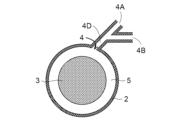
- Fig. 5 corresponds to the A-A' cross section in Fig. 1.
- 1 shows the arrangement of the first inlet, the second inlet, and the third inlet.
- This figure shows plasma iron concentrations in mice before administration of TfR2 siRNA-encapsulated nucleic acid lipid particles.
- This figure shows plasma iron concentrations in mice one day after administration of TfR2 siRNA-encapsulated nucleic acid lipid particles.
- A_Sin_GP1908_2015_H1 This figure shows serum HA-specific IgG concentrations in mice after administration of mRNA-encapsulated nucleic acid lipid particles (Reference Example 2, Sample 9, Sample 10, and Sample 11).
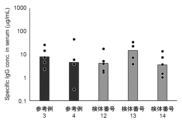
- A_Sin_GP1908_2015_H1 This figure shows serum HA-specific IgG concentrations in mice after administration of mRNA-encapsulated nucleic acid lipid particles (Reference Example 3, Reference Example 4, Sample 12, Sample 13, and Sample 14).
- the present disclosure provides a method for producing capsule particles using a Taylor reactor.
- Capsule particles refer to particles in which the contents are encapsulated.
- the contents encapsulated in the capsule particles are sometimes referred to as the encapsulated components (encapsulated components).
- the components surrounding the encapsulated contents are sometimes referred to as the components that form the particles (particle-forming components) or capsule-forming components.
- the encapsulated components and the particle-forming components may form a complex.
- Capsule particles include, but are not limited to, lipid particles and polymer particles.
- the capsule particles may be particles having an average particle size of 10 nm or more, 20 nm or more, 30 nm or more, 40 nm or more, 50 nm or more, 60 nm or more, 70 nm or more, 80 nm or more, 90 nm or more, 100 nm or more, 1 ⁇ m or more, 10 ⁇ m or more, 100 ⁇ m or more, for example, 1 mm or more, 2 mm or less, 1 mm or less, 100 ⁇ m or less, 10 ⁇ m or less, 1 ⁇ m or less, for example, 100 nm or less, 90 nm or less, 80 nm or less, 70 nm or less, 60 nm or less, 50 nm or less, 40 nm or less, 30 nm or less, 20 nm or less, for example, 10 nm or less, but are not limited thereto.
- the capsule particles may contain any contents (encapsulated components).
- the size and average particle size of the capsule particles may be adjusted appropriately depending on the particle-forming components and encapsulated components.
- the particle size may vary depending on the particle-forming components and encapsulated components, and combinations thereof.
- the particle-forming component may include a polymer component, a lipid component, and an auxiliary component.
- the polymer component include a biodegradable polymer.
- biodegradable polymers include, but are not limited to, polylactic acid, polyglycolic acid, polylactic acid-glycolic acid copolymer (PLGA), and polydepsipeptide-lactic acid copolymer.
- the lipid component include, but are not limited to, zwitterionic lipids, neutral lipids, and cationic lipids. Specific examples include, but are not limited to, phospholipids, sphingolipids, glycolipids, glycerolipids, sterol lipids, and polymer complex lipids.
- the particle-forming component can be dissolved or otherwise used.
- the encapsulated component include, but are not limited to, nucleic acids, proteins, polypeptides, peptides, low molecular weight compounds such as pharmaceutical compounds, cosmetics or cosmetic ingredients, pigments, skin care ingredients, and supplement ingredients.
- the encapsulated component can be dissolved or otherwise used.
- the average particle diameter refers to the volume average particle diameter measured and calculated based on the principle of dynamic light scattering.
- n1, n2, ... ni, ... nk particles having particle diameters of d1, d2, ... di, ... dk, respectively, in order of smallest particle diameter.
- the volume per particle is vi.
- Polymer particles refer to particles that contain a polymer material.
- the polymer particles may be particles having an average particle size of 10 nm or more, 20 nm or more, 30 nm or more, 40 nm or more, 50 nm or more, 60 nm or more, 70 nm or more, 80 nm or more, 90 nm or more, 100 nm or more, 1 ⁇ m or more, 10 ⁇ m or more, 100 ⁇ m or more, for example, 1 mm or more, 2 mm or less, 1 mm or less, 500 ⁇ m or less, 400 ⁇ m or less, 300 ⁇ m or less, 200 ⁇ m or less, for example, 100 ⁇ m or less, 10 ⁇ m or less, 1 ⁇ m or less, for example, 100 nm or less, 90 nm or less, 80 nm or less, 70 nm or less, 60 nm or less, 50 nm or less, 40 nm or less, 30 nm or less,
- the polymer particles may be particles having an average particle size of 10 nm to 500 ⁇ m, for example, 20 nm to 400 ⁇ m, 30 nm to 300 ⁇ m, 20 nm to 200 ⁇ m, for example, 10 nm to 100 ⁇ m, but are not limited thereto.
- the polymer particles include particles containing a biodegradable polymer as a particle forming component.
- the biodegradable polymer include polymers containing polylactic acid.
- the polymers containing polylactic acid include, but are not limited to, polylactic acid-glycolic acid copolymer (PLGA) and polydepsipeptide-lactic acid copolymer.
- the polymer particles may contain any contents (encapsulated components).
- Lipid particles refer to particles containing lipid components.
- the structure of lipid particles is not particularly limited, and may be a lipid multilayer, lipid bilayer, or lipid monolayer, or may partially have a lipid multilayer, lipid bilayer, or lipid monolayer.
- lipid particles include, but are not limited to, particles having a lipid bilayer, such as liposomes or niosomes having a lipid bilayer, particles having a lipid monolayer, such as lipid monolayer particles containing tetraether type lipids, particles having a partial lipid monolayer and/or lipid bilayer, particles having a lipid multilayer, lipid nanoparticles (LNP), and the like.
- Lipid particles may contain any contents (encapsulated components), and examples of the encapsulated components include nucleic acids, proteins, peptides, low molecular weight compounds, and pharmaceutical compounds, and preferably nucleic acids, more preferably messenger RNA (mRNA), double-stranded RNA (siRNA), double-stranded RNA (dsRNA), double-stranded DNA (dsDNA), single-stranded DNA (ssDNA), and even more preferably mRNA (lipid particles containing nucleic acids as encapsulated components are sometimes referred to as nucleic acid-lipid particles).
- Liposomes refer to lipid particles having at least one lipid bilayer.
- liposomes examples include small unilamellar vesicles (SUVs), large unilamellar vesicles (LUVs), multilamellar vesicles (MLVs), oligolamellar vesicles (OLVs), medium unilamellar vesicles (MUVs), giant unilamellar vesicles (GUVs), and giant multilamellar vesicles (GMVs).
- LUVs generally have a particle size of 100 nm or more, but are also classified as 50 nm or more.
- SUVs generally have a particle size of 20 to 100 nm, but are also classified as less than 50 nm.
- each vesicle has two or more bilayers. Separate aqueous compartments may be formed within the MLVs.
- Liposomes may have a bilayer composed of phospholipids.
- Niosomes may have a bilayer composed of nonionic surfactants. For example, see JP2013-536803. The disclosure of which regarding liposomes is incorporated herein by reference.
- Lipid components are broadly classified into amphoteric lipids, neutral lipids, anionic lipids, and cationic lipids. Lipid components are not particularly limited, and include, but are not limited to, phospholipids, sphingolipids, glycolipids, glycerolipids, sterol lipids, and polymer complex lipids.
- Cationic lipids include lipids whose lipid molecules have a net positive charge regardless of pH, and lipids whose lipid molecules have a net positive charge at a selected pH such as physiological pH, depending on the pKa of the lipid (sometimes called pH-responsive cationic lipids).
- DODAC N,N-dioleyl-N,N-dimethylammonium chloride
- DDAB N,N-distearyl-N,N-dimethylammonium bromide
- DOTAP N,N-dioctadecylamidoglycylspermine
- DOGS N-[1-(2,3-diole ...
- DOTMA methylammonium chloride
- DOSPA 2,3-dioleyloxy-N-[2(sperminecarboxamido)ethyl]-N,N-dimethyl-1-propanaminum trifluoroacetate
- DOSPA 2,3-dioleyloxy-N-[2(sperminecarboxamido)ethyl]-N,N-dimethyl-1-propanaminum trifluoroacetate
- DOSPA 2,3-dioleyloxy-N-[2(sperminecarboxamido)ethyl]-N,N-dimethyl-1-propanaminum trifluoroacetate
- DMRIE N-[1-(2,3-dimyristyloxy)propyl]-N,N-dimethyl-N-(2-hydroxyethyl)ammonium bromide
- DC-Chol 3 ⁇ -N-(N',N',-dimethylaminoethane)-carbamoyl
- pH-responsive cationic lipids include, but are not limited to, 1,2-dioleoyloxy-3-dimethylaminopropane (DODAP), N,N-dimethyl-(2,3-dioleyloxy)propylamine (DODMA), 1,2-dilinoleyloxy-3-dimethylaminopropane (DLinDMA), 2,2-dilinoleyl-4-(2-dimethylaminoethyl)-[1,3]-dioxolane (DLin-KC2-DMA), heptatriaconta-6,9,28,31-tetraen-19-yl-4-(dimethylamino)butanoate (DLin-MC3-DMA). See, for example, WO 2015/005253 and WO 2021/060440. The descriptions of cationic lipids therein are incorporated by reference.
- Amphipathic lipids are lipids that have both hydrophilic and hydrophobic groups.
- amphipathic lipids include, but are not limited to, ionic lipids, phospholipids, sphingolipids, glycolipids, and glycerolipids.
- phospholipids include glycerophospholipids and sphingophospholipids.
- glycerophospholipids include phosphatidylcholine, phosphatidylethanolamine, phosphatidylserine, phosphatidylinositol, and phosphatidylcholine.
- sphingophospholipids include sphingomyelin and sphingoethanolamine.
- glycolipids examples include glyceroglycolipids and sphingoglycolipids.
- glyceroglycolipids examples include monogalactosyldiacylglycerol, digalactosyldiacylglycerol, and sulfoquinovosyldiacylglycerol.
- sphingoglycolipids include ceramide and ganglioside.
- phospholipids include 1,2-dioleoyl-sn-glycero-3-phosphocholine (DOPC), 1,2-dimyristoyl-sn-glycero-3-phosphocholine (DMPC), 1,2-distearoyl-sn-glycero-3-phosphocholine (DSPC), 1,2-dioleoyl-sn-glycero-3-phosphoethanolamine (DOPE), 1,2-diacyl-sn-glycero-3-phosphocholine (PC), 1,2-diacyl-sn-glycero-3-phosphatidylethanolamine (PE), 1,2-diacyl-sn-glycero-3-phosphatidylserine (PS), 1,2-diacyl-sn-glycero-3-phosphatidylglycerol (PG), 1,2-diacyl-sn-glycero-3-phosphatidic acid (PA), 1,2-didecanoyl-sn-glycero-3-phosphocholine
- Sterol lipids include, for example, sterols derived from animals, sterols derived from plants, and sterols derived from microorganisms.
- sterols derived from animals include cholesterol, cholesterol succinate, dihydrocholesterol, 7-dehydrocholesterol, lanosterol, dihydrolanosterol, and desmosterol.
- sterols derived from plants include brassicasterol, campesterol, stigmasterol, and sitosterol.
- Examples of sterols derived from microorganisms include zymosterol and ergosterol.
- the polymer complex lipid refers to a lipid to which a nonionic polyether, a nonionic polyester, a nonionic polyamino acid, or a nonionic polypeptide, or a polymer having an alkoxylated end, is added.
- the polymer to be added to the polymer complex lipid is not particularly limited, but is preferably a nonionic polyether or a nonionic polyester, or a polymer having an alkoxylated end, more preferably a nonionic polyether or a nonionic monoalkoxy polyether, even more preferably a polyalkylene glycol or a monomethoxy polyalkylene glycol, and even more preferably a polyethylene glycol or a monomethoxy polyethylene glycol.
- the polyoxyalkylenated lipid is a lipid modified with polyalkylene glycol or a derivative thereof, and examples thereof include, but are not limited to, polymethylene glycolated lipid, polyethylene glycolated lipid (PEG lipid), polypropylene glycolated lipid, polytetramethylene glycolated lipid, polyhexamethylene glycolated lipid, and the like.
- the weight average molecular weight of the polyalkylene glycol may be, for example, 200 to 10,000 Da.
- PEG lipids include, but are not limited to, PEG-cholesterol, PEG-phospholipid, PEG-ceramide, and PEG-diacylglycerol.
- the PEG portion of the PEG lipid can have a molecular weight of, for example, 200-10,000 Da.
- the PEG portion can be linear or branched.
- PEG modifications include stearylated polyethylene glycol, N-[carbonyl-methoxypolyethylene glycol-1000]-1,2-dipalmitoyl-sn-glycero-3-phosphoethanolamine, N-[carbonyl-methoxypolyethylene glycol-2000]-1,2-dipalmitoyl-sn-glycero-3-phosphoethanolamine, n-[carbonyl-methoxypolyethylene glycol-5000]-1,2-dipalmitoyl-sn-glycero-3-phosphoethanolamine, N-[carbonyl-methoxypolyethylene glycol-750]-1,2-distearoyl-sn-glycero-3-phosphoethanolamine, and N-[carbonyl-methoxypolyethylene glycol-800]-1,2-distearoyl-sn
- Amines N-[carbonyl-methoxypolyethylene glycol-1000]-1,2-distearoyl-sn-glycero-3-phosphoethanolamine, N-[carbonyl-methoxypolyethylene glycol-2000]-1,2-distearoyl-sn-glycero-3-phosphoethanolamine, N-[carbonyl-methoxypolyethylene glycol-5000]-1,2-distearoyl-sn-glycero-3-phosphoethanolamine, polyethylene glycol derivatives such as 1,2-dimyristoyl-rac-glycero-3-methoxypolyethylene glycol-2000 (PEG-DMG), etc. may be used, but are not limited to these. See, for example, WO 2020/262150. The description thereof regarding polyoxyalkylenated lipids is incorporated herein by reference.
- the lipid component may be a single component or a plurality of components.
- the lipid component may be a lipid including a cationic lipid.
- the lipid component may be an amphipathic lipid, a cationic lipid, a sterol lipid, and a polymer complex lipid.
- each lipid in the total lipid component used may be a lipid including 5 to 30 mol %, for example 12.5 mol %, for example 17.5 mol %, as an amphipathic lipid, 10 to 75 mol %, for example 30 to 70 mol %, for example 40 to 65 mol %, for example 45 mol %, for example 60 mol %, as a cationic lipid, 15 to 50 mol %, for example 21 mol %, for example 41 mol %, as a cholesterol, and 1 to 10 mol %, for example 1 to 5 mol %, for example 1.5 mol % as a polyoxyalkylenated lipid. See, for example, WO 2009/127060 and WO 2015/005253. The descriptions therein regarding the composition ratio of the lipid components are incorporated herein.
- Encapsulated components (contents) contained in capsule particles include, but are not limited to, nucleic acids, proteins, polypeptides, peptides, small molecular weight compounds, and pharmaceutical compounds.
- Nucleic acids include DNA and RNA.
- RNA includes, but is not limited to, messenger RNA (mRNA), double-stranded RNA (siRNA), single-stranded RNA (antisense oligo), small nuclear RNA (snRNA), non-coding RNA (ncRNA), long non-coding RNA (lncRNA), microRNA (miRNA), double-stranded RNA (dsRNA), and circular RNA.
- DNA includes, but is not limited to, plasmids, single-stranded DNA, and double-stranded DNA.
- Small molecular weight compounds include, but are not limited to, pharmaceutical compounds, anticancer drugs, compounds that act on the living body, biologically active substances, metabolic substances, etc.
- Proteins, polypeptides, or peptides include, but are not limited to, antigenic proteins, therapeutic proteins, biologically active proteins, antibodies, etc.
- the combination of the particle-forming component and the encapsulating component is not particularly limited. In certain embodiments, the combination of the particle-forming component and the encapsulating component may be selected taking into consideration the charge, polarity, and the like. In some embodiments, when the encapsulating component is negatively charged, the particle-forming component (e.g., lipid component) may be selected to be positively charged. In some embodiments, when the encapsulating component is positively charged, the particle-forming component (e.g., lipid component) may be selected to be negatively charged. In some embodiments, when the encapsulating component is uncharged or barely charged, the particle-forming component (e.g., lipid component) may be selected to be uncharged or barely charged.
- the particle-forming component e.g., lipid component
- the medium for dissolving the encapsulating component and the medium for dissolving the particle-forming component may be the same medium. In another embodiment, when the encapsulating component is highly hydrophobic, the medium for dissolving the encapsulating component and the medium for dissolving the particle-forming component may be different media.
- the capsule particles are lipid particles that use nucleic acid as an encapsulated component (sometimes referred to as nucleic acid lipid particles).
- nucleic acid lipid particles include lipid nanoparticles (LNPs) that encapsulate nucleic acid, and liposomes that encapsulate nucleic acid.
- LNPs lipid nanoparticles
- lipid components used in the particle-forming components include zwitterionic lipids, neutral lipids, cationic lipids, anionic lipids, amphipathic lipids, sterol lipids, and polymer complex lipids, and these can be used alone or in combination of two or more.
- lipids When multiple lipids are used as lipid components in the nucleic acid lipid particles, from the viewpoint of drug delivery in the body, it is preferable to use cationic lipids, amphipathic lipids, sterol lipids, and polymer complex lipids, and it is more preferable to use pH-responsive cationic lipids, phospholipids, cholesterol, and PEG lipids.
- each lipid in the entire lipid component used can be appropriately adjusted depending on the type of lipid used and the nucleic acid to be encapsulated, and can be, for example, 5 to 30 mol% phospholipid, for example 12.5 mol%, for example 17.5 mol%, 10 to 75 mol% cationic lipid, for example 30 to 70 mol%, for example 40 to 65 mol%, for example 45 mol%, for example 60 mol%, cholesterol 15 to 50 mol%, for example 21 mol%, for example 41 mol%, and 1 to 10 mol% PEGylated lipid, for example 1 to 5 mol%, for example 1.5 mol%.
- the nucleic acid used as the encapsulation component is not particularly limited, but preferably includes messenger RNA (mRNA), double-stranded RNA (siRNA), double-stranded RNA (dsRNA), double-stranded DNA (dsDNA), single-stranded DNA (ssDNA), and more preferably mRNA.
- mRNA messenger RNA
- siRNA double-stranded RNA
- dsRNA double-stranded RNA
- dsDNA double-stranded DNA
- ssDNA single-stranded DNA
- the ratio of the number of cationic lipid molecules (N) in the nucleic acid-lipid particle to the number of phosphorus atoms (P) derived from the nucleic acid can be, for example, about 2.0 to 15.0, preferably about 2.0 to 12.0, more preferably about 2.0 to 9.0, and even more preferably about 3.0 to 9.0.
- the lower limit of the N/P ratio can be, for example, 2.0, preferably 2.5, and more preferably 3.0
- the upper limit can be, for example, 15.0, preferably 12.0, and more preferably 9.0.
- the average particle size of the nucleic acid-lipid particle is not particularly limited, but can be, for example, 1 nm to 1 ⁇ m, preferably 10 nm to 500 nm, more preferably 30 nm to 300 nm, even more preferably 50 nm to 200 nm, and most preferably 75 nm to 150 nm.
- the Taylor reactor 1 is a device that performs a Taylor reaction (also called a Taylor vortex reaction).
- the Taylor reactor 1 has an inner cylinder 3 and an outer cylinder 2.
- the Taylor reactor 1 includes an outer cylinder 2 and an inner cylinder 3, and the inner cylinder 3 is rotatably arranged in the outer cylinder 2, forming an annular reaction chamber 5 between the inner cylinder 3 and the outer cylinder 2.
- the Taylor reactor 1 may have one or more inlets 4 (including a first inlet 41 and a second inlet 42) for liquid to flow into the reaction chamber 5.
- the inlets 4, the first inlet 41, and the second inlet 42 may be referred to as injection ports in this specification.
- the Taylor reactor 1 may also have at least one outlet 6 for liquid in the reaction chamber 5 to flow out to the outside. In this specification, the outlet 6 may be referred to as an exhaust port or an outflow port.
- Reference numeral 7 denotes a control device, which controls the rotation speed of the motor 8 that rotates the inner cylinder 3 and the supply amount of the first pump 12, the second pump 14, and the third pump 16.
- Reference numeral 20 denotes a jacket that cools the reaction chamber 5
- reference numeral 21 denotes a jacket temperature control chiller that circulates the cooling medium in the jacket 20 to adjust the temperature.
- the encapsulation components and particle-forming components can be reacted in solution to form particles. Therefore, appropriate solvents can be selected depending on the properties of the encapsulation components and particle-forming components.
- the nucleic acid can be dissolved in a citrate buffer, and the lipid can be dissolved in ethanol, and then supplied to the device. Therefore, the encapsulation components and particle-forming components can be prepared in solution in a solvent, and then each can be supplied to the device.
- the method for producing particles disclosed herein may include a step of mixing the particle-forming components and the encapsulated components.
- a set of vortex rows 5V is formed along the axial direction in a cross-sectional view perpendicular to the rotation axis of the inner cylinder 3 in a number of opposite directions, and various solutions are mixed (Taylor vortex reaction) in the process of the number of vortex rows 5V moving in the axial direction.
- the solution of the particle-forming components is supplied from the first tank 11 containing the solution through the first pump 12 via the first line 4A
- the solution of the encapsulated components is supplied from the second tank 13 containing the solution through the second pump 14 via the second line 4B, and mixed in the mixed liquid line 4D, which is then supplied to the reaction chamber 5 of the Taylor reaction apparatus 1 through the inlet 4 (which is also the common inlet described in the claims) (see Figures 1 and 2). Since the mixing of the two liquids is performed before injection into the reaction chamber 5, for convenience, this is sometimes referred to as mixing "before the reaction chamber (before the reaction tank)" in this specification.
- the particle-forming component and the encapsulation component are supplied to the reaction chamber 5 of the Taylor reactor 1 through independent injection ports (first inlet 41, second inlet 42) without contacting each other, and then the two liquids are mixed for the first time in the reaction chamber 5 (see FIG. 3). Since the mixing of the two liquids is performed in the reaction chamber 5, for convenience, this is sometimes referred to as "mixing within the reaction chamber (reaction tank)" in this specification.
- the order in which the solutions are injected is not particularly limited, and the particle-forming component and the encapsulation component may be injected simultaneously, the particle-forming component may be injected first, or the encapsulation component may be injected first.
- the method for producing particles of the present disclosure may supply a mixing liquid containing premixed particle-forming components and encapsulation components to the reaction chamber 5 from the first inlet 41.
- the mixing of the particle-forming components and encapsulation components may be performed outside the Taylor reaction apparatus 1.
- a dilute solution may be injected from a second inlet 42 that is separate from the first inlet 41 that injects the mixing liquid (see FIG. 3).
- the particle-forming components and the encapsulation components may be dissolved in the same or different solvents and mixed.
- Such a premixed solution may then be used in the method for producing particles of the present disclosure.
- the method for producing particles of the present disclosure may further include a step of injecting a dilute solution.
- the dilute solution may be injected at any stage.
- the particle-forming component is first supplied from the first line 4A, then the dilute solution is supplied from the third line 4C and mixed to produce a particle-forming component-dilute solution mixture, and then the encapsulated component is supplied from the second line 4B to the particle-forming component-dilute solution mixture to produce a particle-forming component-encapsulated component-dilute solution mixture in the mixed solution line 4D, which may be supplied to the reaction chamber 5 via the inlet 4 (which is also the common inlet described in the claims) (see FIG. 4).
- the encapsulated component and the dilute solution are first mixed to produce an encapsulated component-dilute solution mixture, and then the encapsulated component-dilute solution mixture is mixed with the particle-forming component to produce a particle-forming component-encapsulated component-dilute solution mixture, which may be supplied to the reaction chamber.
- the particle-forming component and the encapsulation component are first mixed to generate a particle-forming component-encapsulation component mixture, and then the particle-forming component-encapsulation component mixture is mixed with the dilution solution to generate a 1-2-3 mixture, which is then supplied to the reaction chamber.
- the particle-forming component solution is first supplied from the first tank 11 containing the particle-forming component solution via the first pump 12 through the first line 41A, and the encapsulation component solution is supplied from the second tank 13 containing the encapsulation component solution via the second pump 14 through the second line 41B, and mixed to generate a particle-forming component-encapsulation component mixture in the mixture line 41D, which is then supplied to the reaction chamber 5 via the first inlet 41, and then the dilution solution is supplied from the third tank 15 containing the dilution solution via the third pump 16 through the second inlet 42 to the reaction chamber 5, generating a particle-forming component-encapsulation component-dilution solution mixture (see FIGS. 1 and 5).
- the order in which the solutions are injected into the reaction chamber is not particularly limited.
- the diluted solution may be supplied to the reaction chamber first, and then the particle-forming component-encapsulated component mixture may be supplied to the reaction chamber.
- the diluted solution and the particle-forming component-encapsulated component mixture may be supplied to the reaction chamber simultaneously.
- the dilution solution may stabilize the encapsulated components. In another embodiment, the dilution solution may reduce the association of the particles by diluting the formed capsule particles.
- the type of dilution solution may be any of neutral buffer, acidic buffer, and basic buffer, and may be appropriately selected depending on the particle-forming components and the encapsulated components. Examples of the dilution solution include, but are not limited to, buffers including citrate buffer, acetate buffer, phosphate buffer, and Good's buffer.
- the dilution solution may preferably be a neutral or weakly acidic buffer, for example, a phosphate buffer as a neutral buffer, or a citrate buffer as a weakly acidic buffer.
- the dilution solution may include a near-neutral buffer, for example, a phosphate buffer.
- the dilution solution may include, for example, an alkaline or weakly alkaline buffer.
- the same solvent as the solvent for the encapsulated component e.g., if a citrate buffer is used as the solvent for the encapsulated component, a citrate buffer
- a citrate buffer may be used as the diluent.
- the particle-forming component and the dilute solution may be mixed first to generate a particle-forming component-dilute solution mixture, then the particle-forming component-dilute solution mixture may be supplied to the reaction chamber, and then the encapsulated component may be supplied to the reaction chamber to generate a particle-forming component-encapsulated component-dilute solution mixture.
- the order in which the solutions are injected into the reaction chamber is not particularly limited.
- the encapsulated component may be supplied to the reaction chamber, and simultaneously or subsequently the particle-forming component-dilute solution mixture may be supplied to the reaction chamber.
- the encapsulated component and the dilute solution may be mixed first to generate an encapsulated component-dilute solution mixture, then the encapsulated component-dilute solution mixture may be supplied to the reaction chamber, and then the particle-forming component may be supplied to the reaction chamber to generate a particle-forming component-encapsulated component-dilute solution mixture.
- the order in which the solutions are injected into the reaction chamber is not particularly limited.
- the particle-forming component may be supplied to the reaction chamber, and simultaneously or subsequently the encapsulated component-dilute solution mixture may be supplied to the reaction chamber.
- the particle-forming component is supplied to the reaction chamber 5 through the first inlet 41, the encapsulated component is supplied to the reaction chamber 5 through the second inlet 42, and the dilute solution is supplied to the reaction chamber 5 through the third inlet 43, so that a particle-forming component-encapsulated component-dilute solution mixture is generated in the reaction chamber 5 (see FIG. 6).
- the order in which the solutions are injected into the reaction chamber is not particularly limited.
- the particle-forming component may be supplied to the reaction chamber, simultaneously or subsequently, the dilute solution may be supplied to the reaction chamber, and simultaneously or subsequently, the encapsulated component may be supplied to the reaction chamber.
- the encapsulated component may be supplied to the reaction chamber, simultaneously or subsequently, the particle-forming component may be supplied to the reaction chamber, and simultaneously or subsequently, the dilute solution may be supplied to the reaction chamber.
- the encapsulated component may be supplied to the reaction chamber, simultaneously or subsequently, the dilute solution may be supplied to the reaction chamber, and simultaneously or subsequently, the particle-forming component may be supplied to the reaction chamber.
- the dilute solution may be supplied to the reaction chamber, simultaneously or subsequently, the particle-forming component may be supplied to the reaction chamber, and simultaneously or subsequently, the encapsulated component may be supplied to the reaction chamber.
- the dilution solution may be supplied to the reaction chamber, simultaneously or subsequently, the encapsulation component may be supplied to the reaction chamber, and simultaneously or subsequently, the particle-forming component may be supplied to the reaction chamber.
- the three liquids of the particle-forming component, the encapsulation component, and the dilution solution may be supplied to the reaction chamber simultaneously.
- the method for producing particles of the present disclosure may further include a step of injecting one or more additional solutions in addition to the particle-forming components, encapsulated components, and/or dilution solution.
- the additional solutions may each independently be a solution in which the particle-forming components are dissolved, a solution in which the encapsulated components are dissolved, or a dilution solution, or a mixture of these.
- the particles do not necessarily have to be manufactured only in the reaction chamber 5.
- the target particles may be formed in part from the stage in which the particle-forming components and the encapsulated components are mixed.
- the target particles formed by such a process also fall under the category of target particles manufactured by the manufacturing method of the present disclosure, or the target particles manufactured by the apparatus of the present disclosure.
- a mixing step before the reaction tank not only can the target particles be formed in the reaction chamber 5, but the particles can also be homogenized.
- the Taylor reactor 1 has an inlet 4 (which is also a common inlet as claimed) for injecting a particle-forming component-encapsulated component mixture, which is a mixture of the particle-forming component and the encapsulated component, into the reaction chamber 5 (see FIG. 2).
- the particle production method includes a step of injecting the particle-forming component-encapsulated component mixture from the inlet 4, rotating the inner cylinder 3, and further mixing the particle-forming component-encapsulated component mixture.
- the particle-forming component-encapsulated component mixture is subjected to a Taylor vortex reaction and can be further mixed.
- the Taylor reactor 1 has a first inlet 41 for injecting the particle-forming components into the reaction chamber 5 and a second inlet 42 for injecting the encapsulated components into the reaction chamber 5 (see FIG. 3).
- the particle production method includes the steps of injecting the particle-forming components from the first inlet 41, injecting the encapsulated components from the second inlet 42, rotating the inner cylinder 3, and mixing the particle-forming components and the encapsulated components.
- the particle-forming components and the encapsulated components can be subjected to a Taylor vortex reaction.
- the Taylor reactor 1 may further have a third inlet 43 for injecting the diluted solution into the reaction chamber 5 (see FIG. 6).
- the particle production method includes a step of injecting the diluted solution from the third inlet 43 and rotating the inner cylinder 3.
- the diluted solution and the solution in the reaction chamber 5 may be subjected to a Taylor vortex reaction.
- a fourth inlet for injecting the fourth solution a fifth inlet for injecting the fifth solution
- the particles produced may be lipid particles.
- the lipid particles may include a lipid component and an encapsulated component such as a nucleic acid.
- the particle-forming component may include a lipid component and the encapsulating component may include an encapsulated component such as a nucleic acid.
- the particle-forming component may include an encapsulated component such as a nucleic acid and the encapsulating component may include a lipid component.
- the diluted solution may reduce the content of the organic solvent (such as ethanol) in which the lipids are dissolved, stabilizing the particles.
- the diluted solution may be contacted with a solution containing lipid components at any time.
- the present disclosure provides a Taylor reactor 1 for producing particles.
- the particles produced include, but are not limited to, capsule particles.
- the Taylor reactor 1 has an inner cylinder 3 and an outer cylinder 2. A gap is formed between the outer diameter of the inner cylinder 3 and the inner diameter of the outer cylinder 2, and this is used as a reaction chamber 5.
- the Taylor reactor 1 includes an outer cylinder 2 and an inner cylinder 3, and the inner cylinder 3 is rotatably disposed within the outer cylinder 2, forming an annular reaction chamber 5 between the outer cylinder 2 and the inner cylinder 3.
- the Taylor reactor 1 may have one or more inlets 4 through which liquid flows into the reaction chamber 5.
- the Taylor reactor 1 may have at least one outlet 6 through which liquid in the reaction chamber 5 flows out to the outside.
- the Taylor reactor 1 may be configured to mix the particle-forming component and the encapsulated component "before the reaction chamber."
- a first line 4A for injecting the particle-forming component and a second line 4B for injecting the encapsulated component join together (FIG. 2).
- the part after the joining part i.e., downstream side
- the particle-forming component and the encapsulated component are mixed in the particle-forming component-encapsulated component mixed liquid line 4D.
- the particle-forming component-encapsulated component mixed liquid line 4D then supplies the particle-forming component-encapsulated component mixed liquid into the reaction chamber 5 via the inlet 4 (which is also the common inlet described in the claims).
- the Taylor reactor 1 may be configured to mix the particle-forming component and the encapsulated component "inside the reaction chamber.”
- the reaction chamber 5 is provided with a first inlet 41 (also called a first injection port) for injecting the particle-forming component, and a second inlet 42 (also called a second injection port) for injecting the encapsulated component (FIG. 3).
- the order in which the solutions are injected is not particularly limited, and the particle-forming component and the encapsulated component may be injected simultaneously, the particle-forming component may be injected first, or the encapsulated component may be injected first.
- the first inlet 41 and the second inlet 42 may be arranged in any relative position.
- the first inlet 41 and the second inlet 42 may be arranged to form an angle of about 15 degrees, about 30 degrees, about 45 degrees, about 60 degrees, about 75 degrees, about 90 degrees, about 105 degrees, about 120 degrees, about 135 degrees, about 150 degrees, about 165 degrees, about 180 degrees, about 195 degrees, about 210 degrees, about 225 degrees, about 240 degrees, about 255 degrees, about 270 degrees, about 285 degrees, about 300 degrees, about 315 degrees, about 330 degrees, about 345 degrees, or about 360 degrees when viewed from the direction of the rotation axis for rotating the inner cylinder 3 (viewed from a direction perpendicular to the circular cross section of the inner cylinder 3), but are not limited thereto.
- first inlet 41 and the second inlet 42 may be adjacent to each other or may be spaced apart at a fixed interval when viewed perpendicularly to the rotation axis for rotating the inner cylinder 3 (viewed perpendicularly to the rectangular cross section of the inner cylinder).
- the first inlet 41 may be arranged on the upstream side and the second inlet 42 may be arranged on the downstream side.
- the second inlet 42 may be arranged on the upstream side and the first inlet 41 may be arranged on the downstream side.
- the first inlet 41 and the second inlet 42 may be arranged on the same cross section perpendicular to the axial direction of the inner cylinder 3 ( Figure 3). In this case, the first inlet 41 and the second inlet 42 are not both upstream and downstream, but are both on the same rotational cross section.
- the third inlet 43 may also be arranged arbitrarily.
- the third inlet 43 may be arranged upstream of the first inlet 41, on the same rotational cross section as the first inlet 41, downstream of the first inlet 41 and upstream of the second inlet 42, on the same rotational cross section as the second inlet 42, or downstream of the second inlet 42.
- the peripheral speed of the inner cylinder 3 is, for example, 0.5 to 47 m/s, for example, 0.4 m/s or more, 0.41 m/s or more, 0.42 m/s or more, 0.43 m/s or more, 0.44 m/s or more, 0.45 m/s or more, 0.46 m/s or more, 0.47 m/s or more, 0.48 m/s or more, 0.49 m/s or more, m/s or more, 0.5m/s or more, 0.51m/s or more, 0.52m/s or more, 0.53m/s or more, 0.54m/s or more, 0.55m/s or more, 0.6m/s or more, 0.65m/s or more, 0.7m/s or more, 0.75m/s or more, 0.8m/s or more, 0.85m/s or more, 0.9m/s or more, 0.95m/s
- the rotation speed of the inner cylinder 3 can be, for example, 500 to 30,000 rpm, 550 to 25,000 rpm, 600 to 20,000 rpm, 650 to 15,000 rpm, 700 to 10,000 rpm, 750 to 9,000 rpm, 800 to 8,000 rpm, 850 to 7,000 rpm, 900 to 6,000 rpm, for example, 1,000 to 6,000 rpm, but is not limited to this.
- the outer diameter of the inner cylinder can be, but is not limited to, ⁇ 20 mm or more, ⁇ 21 mm or more, ⁇ 22 mm or more, ⁇ 23 mm or more, ⁇ 24 mm or more, ⁇ 25 mm or more, ⁇ 26 mm or more, ⁇ 27 mm or more, ⁇ 28 mm or more, ⁇ 29 mm or more, ⁇ 29.1 mm or more, ⁇ 29.2 mm or more, ⁇ 29.3 mm or more, ⁇ 29.4 mm or more, ⁇ 29.5 mm or more, ⁇ 29.6 mm or more, ⁇ 29.7 mm or more, ⁇ 29.8 mm or more, ⁇ 29.9 mm or more, ⁇ 29.91 mm or more, ⁇ 29.92 mm or more, ⁇ 29.93 mm or more, ⁇ 29.94 mm or more, ⁇ 29.95 mm or
- the gap width d between the inner cylinder 3 and the outer cylinder 2 is set to 0.01 mm or more, 0.02 mm or more, 0.03 mm or more, 0.04 mm or more, 0.05 mm or more, 0.06 mm or more, 0.07 mm or more, 0.08 mm or more, 0.09 mm or more, 0.1 mm or more, 0.11 mm or more, 0.12 mm or more, 0.13 mm or more, 0.14 mm or more, 0.15 mm or more, for example 0.21 mm or more, 0.75 mm or more, 1.5 mm or more, for example 5 mm or less, 4.9 mm or less, 4.8 mm or less, 4.7 mm or less, 4.6 mm or less, 4.5 mm or less, 4.4 mm or less, 4.
- the peripheral speed and the gap width d can be set so that the shear force is a simplified formula for the stirring force R.
- the stirring force R is calculated by the following formula: [Number 3]
- Mixing force R peripheral speed ⁇ gap width d
- the stirring force R is 0.5/5 ⁇ R ⁇ 47/0.01, 100 to 5,000,000 s -1 , 104 to 4,900,000 s -1 , 105 to 4,900,000 s -1 , 110 to 4,800,000 s -1 , 120 to 4,710,000 s -1 , 130 to 4,700,900 s -1 , 140 to 4,700,000 s -1 , 150 to 4,600,000 s -1 , 160 to 4,500,000 s -1 , 170 to 4,400,000 s -1 , 180 to 4,300,000 s -1 , 190 to 4,200,000 s -1 , 200 to 4,100,000s -1 , 250 to 4,000,000s -1 , 300 to 3,900
- the solutions can be mixed with each other and injected into the reaction chamber 5 at an appropriate injection rate.
- a person skilled in the art can set the injection rates of the solutions as appropriate.
- a person skilled in the art can also set the ratio of the injection rates of the solutions as appropriate.
- the ratio of the injection rate of the particle-forming component to the injection rate of the encapsulated component can be a ratio selected from the range of 1:1 to 1:9, for example, 1:2 to 1:9, 1:3 to 1:9, for example, 1:1, 1:2, 1:3, 1:4, 1:5, 1:6, 1:7, 1:8, for example, 1:9, but is not limited thereto.
- the injection rate can be determined according to the combination of the particle-forming component and the encapsulated component.
- the injection rate of the particle-forming component or encapsulated component may be, for example, 1 mL/min or more, 1.1 mL/min or more, 1.2 mL/min or more, 1.3 mL/min or more, 1.4 mL/min or more, 1.5 mL/min or more, 1.6 mL/min or more, 1.7 mL/min or more, 1.8 mL/min or more, 1.9 mL/min or more, 2 mL/min or more, 2.1 mL/min or more, 2.2 mL/min or more, 2.3 mL/min or more, 2.4 mL/min or more, 2.5 mL/min or more, 2.6 mL/min or more, 2.7 mL/min or more, 2.8 mL/min or more, 2.9 mL/min or more, 3 mL/min or more, 3.5mL/min or more, 4mL/min or more, 4.5mL/min or more, 5m
- the stirring time for the Taylor reaction may be, but is not limited to, 5 minutes or less, 4 minutes or less, 3 minutes or less, 2 minutes or less, 90 seconds or less, 60 seconds or less, 50 seconds or less, 40 seconds or less, 30 seconds or less, 20 seconds or less, 15 seconds or less, for example, 10 seconds or less.
- the stirring time for the Taylor reaction may be, but is not limited to, 1 second or more, 2 seconds or more, 3 seconds or more, 4 seconds or more, for example, 5 seconds or more.
- “stirring time” refers to the time from when the injected liquid flows into the reaction vessel to when it passes through the outlet port.
- the time from when the injected liquid flows into the reaction vessel to when it passes through the outlet port is sometimes referred to as the time for one pass.
- the stirring time refers to the time from when the latest injected liquid flows into the reaction vessel to when it passes through the outlet port.
- the inner diameters of the first inlet 41 and the second inlet 42 may be the same or approximately the same. Approximately the same includes ⁇ 5%. In another embodiment, the inner diameters of the first inlet 41 and the second inlet 42 may be different.
- AD-47882 is an siRNA against mouse TfR2 described in WO2012/177921.
- the lipid solution and siRNA solution were mixed by injecting them into a Taylor reactor with the inner cylinder rotating at the "circumferential speed” shown in Table 1 and the "gap width" between the inner and outer cylinders shown in Table 1 from each "injection port” shown in Table 1 using a pump at the "injection speed (sum of the injection speeds of the lipid solution and the siRNA solution)" shown in Table 1, and a dispersion of nucleic acid lipid particles was obtained from the outlet port.
- the injection speed ratio of the lipid solution to the siRNA solution was 1:3.
- the first inlet is located upstream and the second inlet is located downstream, and the siRNA solution, which is the encapsulation component, was injected from the first inlet, and the lipid solution, which is the particle-forming component, was injected from the second inlet.
- the siRNA solution which is the encapsulation component
- the lipid solution which is the particle-forming component
- the two liquids can be mixed before the reaction vessel, and then the mixture can be injected into the reaction section of the Taylor reactor, i.e., the gap between the inner and outer cylinders.
- Tables 2 to 5 Regarding "with or without dilution” shown in Table 1, when diluting the nucleic acid-lipid particles, a citrate buffer solution (20 mM citrate buffer, pH 4.0) was injected as a dilution solution from the injection port before the outlet port using a pump at a rate equal to the "injection rate" listed in Table 1.
- the resulting nucleic acid-lipid particle dispersion was dialyzed (Float-A-Lyzer G2, MWCO: 1,000 kD, Spectra/Por) against approximately 25 to 50 times the amount of PBS (pH 7.4) for 12 to 18 hours to remove ethanol, and a purified dispersion of siRNA-encapsulating nucleic acid-lipid particles was obtained.
- LP1 was synthesized according to the method described in WO2015/005253. The description of WO2015/005253 regarding the synthesis of LP1 is incorporated herein by reference.
- DSPC Distearoylphosphatidylcholine
- Chol cholesterol
- LP1 1,2-dimyristoyl-sn-glycerol methoxypolyethyleneglycol
- ⁇ -catenin dsDNA was diluted with citrate buffer (20 mM citrate buffer, pH 4.0) to a concentration of 52.7 ⁇ g/mL.
- the lipid solution and dsDNA solution were mixed by injecting them into a Taylor reactor, in which the inner cylinder rotates at the "circumferential speed” shown in Table 2 and the "gap width" between the inner and outer cylinders is shown in Table 2, using a pump at the "injection rate (sum of the injection rates of the lipid solution and dsDNA solution)" shown in Table 2, from the "injection port” shown in Table 2, and a dispersion of nucleic acid-lipid particles was obtained from the outlet port.
- the injection rate ratio of the lipid solution to the dsDNA solution was 1:3.
- a citrate buffer solution (20 mM citrate buffer, pH 4.0) was injected as a dilution solution from the injection port just before the outlet port at a rate equal to the "injection rate” shown in Table 2, using a pump.
- the nucleic acid-lipid particle dispersion was dialyzed (Float-A-Lyzer G2, MWCO: 1,000 kD, Spectra/Por) against approximately 25-50 times the volume of PBS (pH 7.4) for 12-18 hours to remove the ethanol, yielding a dispersion of purified nucleic acid-lipid particles encapsulating dsDNA.
- LP1 was synthesized according to the method described in WO2015/005253.
- DSPC Distearoylphosphatidylcholine
- Chol cholesterol
- LP1 1,2-dimyristoyl-sn-glycerol methoxypolyethyleneglycol
- A_Sin_GP1908_2015_H1 mRNA was diluted with citrate buffer (20 mM citrate buffer, pH 4.0) to a concentration of 52.7 ⁇ g/mL.
- the lipid solution and mRNA solution were mixed by injecting them into a Taylor reactor, in which the inner cylinder rotates at the "circumferential speed” shown in Table 3 and the "gap width" between the inner and outer cylinders is shown in Table 3, using a pump at the "injection rate (sum of the injection rates of the lipid solution and the mRNA solution)" shown in Table 3, from the "injection port” shown in Table 3, and a dispersion of nucleic acid-lipid particles was obtained from the outlet port.
- the injection rate ratio of the lipid solution to the mRNA solution was 1:3.
- a citrate buffer solution (20 mM citrate buffer, pH 4.0) was injected as a dilution solution from the injection port just before the outlet port at a rate equal to the "injection rate” shown in Table 3, using a pump.
- the nucleic acid-lipid particle dispersion was dialyzed (Float-A-Lyzer G2, MWCO: 1,000 kD, Spectra/Por) against approximately 25-50 times the volume of PBS (pH 7.4) for 12-18 hours to remove the ethanol, yielding a dispersion of purified mRNA-encapsulating nucleic acid-lipid particles.
- LP1 was synthesized according to the method described in WO2015/005253.
- DSPC Distearoylphosphatidylcholine
- Chol cholesterol
- LP1 1,2-dimyristoyl-sn-glycerol methoxypolyethyleneglycol
- A_Sin_GP1908_2015_H1 mRNA was diluted with citrate buffer (20 mM citrate buffer, pH 4.0) to a concentration of 52.7 ⁇ g/mL.
- the above lipid solution and mRNA solution were mixed by injecting them using a pump at the "injection rate (sum of the injection rates of the lipid solution and the mRNA solution)" shown in Table 4 into a Taylor reactor, in which the inner cylinder rotates at the “circumferential speed” shown in Table 4 and the “gap width" between the inner and outer cylinders is shown in Table 4, from the "injection port” shown in Table 4, and a dispersion of nucleic acid lipid particles was obtained from the outlet port.
- the injection rate ratio of the lipid solution to the mRNA solution was 1:3.
- citrate buffer (20 mM Citrate Buffer, pH 4.0) was injected as a diluent solution from the injection port just before the outlet port using a pump at a rate equal to the "injection rate" shown in Table 4.
- the nucleic acid-lipid particle dispersion was dialyzed (Float-A-Lyzer G2, MWCO: 1,000 kD, Spectra/Por) against approximately 25-50 times the volume of 10 mM histidine, 300 mM sucrose (pH 7.0) for 12-18 hours to remove the ethanol, yielding a dispersion of purified mRNA-encapsulating nucleic acid-lipid particles.
- LP1 was synthesized according to the method described in WO2015/005253.
- A_Sin_GP1908_2015_H1 mRNA was diluted with citrate buffer (20 mM citrate buffer, pH 4.0) to a concentration of 51.3 ⁇ g/mL.
- the above lipid solution and mRNA solution were mixed by injecting them using a pump at the "injection rate (sum of the injection rates of the lipid solution and the mRNA solution)" shown in Table 5 into a Taylor reactor, in which the inner cylinder rotates at the “circumferential speed” shown in Table 5 and the “gap width" between the inner and outer cylinders is shown in Table 5, from the "injection port” shown in Table 5, and a dispersion of nucleic acid lipid particles was obtained from the outlet port.
- the injection rate ratio of the lipid solution to the mRNA solution was 1:3.
- citrate buffer (20 mM Citrate Buffer, pH 4.0) was injected as a diluent solution from the injection port just before the outlet port using a pump at a rate equal to the "injection rate" shown in Table 5.
- the nucleic acid-lipid particle dispersion was dialyzed (Float-A-Lyzer G2, MWCO: 1,000 kD, Spectra/Por) against approximately 25-50 times the volume of 10 mM histidine, 300 mM sucrose (pH 7.0) for 12-18 hours to remove the ethanol, yielding a dispersion of purified mRNA-encapsulating nucleic acid-lipid particles.
- LP2 was synthesized according to the method described in WO2015/005253. The description of WO2015/005253 regarding the synthesis of LP2 is incorporated herein by reference.
- Encapsulation rate of nucleic acid was measured using the Quant-iT RiboGreen RNA Assay Kit (Invitrogen) in accordance with the attached instructions.
- the amount of nucleic acid in the dispersion of the nucleic acid-lipid particles was quantified in the presence and absence of 0.015% Triton X-100 surfactant, and the encapsulation rate was calculated by the following formula. [Number 4] ⁇ ([amount of nucleic acid in the presence of surfactant] - [amount of nucleic acid in the absence of surfactant]) / [amount of nucleic acid in the presence of surfactant] ⁇ x 100 (%)
- PDI Average particle size/polydispersity index
- the average particle size and polydispersity index of the nucleic acid lipid particles were measured using Zeta Potential/Particle Sizer NICOMP (trademark) 380ZLS (PARTICLE SIZING SYSTEMS).
- the average particle size in the table represents the volume average particle size.
- PDI is the polydispersity index calculated by the square of (standard deviation/average particle size), and is sometimes simply called the degree of dispersion.
- nucleic acid lipid particles with an average particle size of 80 to 200 nm and a nucleic acid encapsulation rate of 85% or more were obtained. This demonstrates that lipid particles encapsulating nucleic acid can be produced using the Taylor reactor. It was also demonstrated that particles that can be produced using microchannels can also be produced using the Taylor reactor.
- the above lipid solution and mRNA solution were mixed in a microchannel using NanoAssemblr BenchTop (Precision Nanosystems Inc.) to a volume ratio of 1:3 to obtain a crude dispersion of nucleic acid-lipid particles.
- the nucleic acid-lipid particle dispersion was dialyzed (Float-A-Lyzer G2, MWCO: 1,000 kD, Spectra/Por) against approximately 25 to 50 times the volume of the buffer solution for 12 to 18 hours to remove ethanol, thereby obtaining a dispersion of purified siRNA-encapsulated nucleic acid-lipid particles.
- the above lipid solution and mRNA solution were mixed in a microchannel using NanoAssemblr BenchTop (Precision Nanosystems Inc.) so that the volume ratio was 1:3, and a crude dispersion of nucleic acid-lipid particles was obtained.
- the nucleic acid-lipid particle dispersion was dialyzed (Float-A-Lyzer G2, MWCO: 1,000 kD, Spectra/Por) against approximately 25 to 50 times the volume of the buffer solution for 12 to 18 hours to remove ethanol, thereby obtaining a dispersion of purified mRNA-encapsulating nucleic acid-lipid particles.
- the above lipid solution and mRNA solution were mixed in a microchannel using NanoAssemblr BenchTop (Precision Nanosystems Inc.) so that the volume ratio was 1:3, and a crude dispersion of nucleic acid-lipid particles was obtained.
- the nucleic acid-lipid particle dispersion was dialyzed (Float-A-Lyzer G2, MWCO: 1,000 kD, Spectra/Por) against approximately 25 to 50 times the volume of the buffer solution for 12 to 18 hours to remove ethanol, thereby obtaining a dispersion of purified mRNA-encapsulating nucleic acid-lipid particles.
- nucleic acid lipid particles with an average particle size of 90 to 140 nm and a nucleic acid encapsulation rate of 95% or more were obtained for Reference Examples 1 to 4.
- TfR2 siRNA-encapsulated nucleic acid lipid particles Efficacy evaluation test of TfR2 siRNA-encapsulated nucleic acid lipid particles in normal mice It has been reported that the TfR2 siRNA encapsulated in lipid particles in the above-mentioned Example 1 and Reference Example 1 increases the plasma iron concentration in normal mice (WO2012/177921). Therefore, the following test was carried out using TfR2 siRNA encapsulated nucleic acid lipid particles (samples 1 to 3) produced using a Taylor reactor and TfR2 siRNA encapsulated nucleic acid lipid particles (Reference Example 1) produced by microchannel mixing.
- Blood was collected from the tail vein before siRNA or PBS treatment (Pre), one day after treatment (Day 1), and seven days after treatment (Day 7), and plasma iron concentration (plasma Fe (ug/mL)) was measured using a Metalloassay iron measurement kit (Metalogenix). The results of plasma iron concentration are shown in Figures 7 to 9 (mean ⁇ standard error).
- Reference Example 2 Sample 9, Sample 10, or Sample 11 was administered twice at two-week intervals into the gastrocnemius muscle of 7-week-old BALB/c mice. Blood was collected two weeks after the final administration, and serum was prepared. Similarly, Reference Example 3, Reference Example 4, Sample 12, Sample 13, or Sample 14 was administered to 6-week-old BALB/c mice, and serum was prepared. Specific IgG against HA in the serum was detected by enzyme-linked immunosorbent assay (ELISA).
- ELISA enzyme-linked immunosorbent assay
- ELISA was performed by adding 0.5 ⁇ g/mL recombinant A/Michigan/45/2015 HA at 25 ⁇ L/well to a 96-well plate and incubating overnight at 4°C.
- mouse IgG of known concentrations was serially diluted and similarly immobilized to prepare a standard curve.
- the plate was washed three times with DPBS containing 0.05% Tween 20 (DPBST) and blocked with Dulbecco's phosphate-buffered saline (DPBS) containing 1% bovine serum albumin (BSA) and 0.05% Tween 20 (DPBST/BSA). Serum was serially diluted in DPBST/BSA.
- the plate was washed three times with DPBST and diluted serum was added at 25 ⁇ L/well.
- DPBST/BSA was added instead of diluted serum to the wells for the standard curve.
- HRP horseradish peroxidase
- the plate was washed three times with DPBST and 3,3',5,5'-tetramethylbenzidine (TMB) peroxidase substrate was added at 30 ⁇ L/well.
- the plate was left to stand at room temperature for approximately 10 minutes to allow color development, after which 30 ⁇ L/well of a color-development stop solution containing hydrochloric acid was added and the absorbance at 450 nm was measured.
- the specific IgG concentration in the serum was calculated from the standard curve.
- Reference Example 3 shows the results of administration of Reference Example 3, Reference Example 4, Sample 12, Sample 13, and Sample 14 in Figure 11.
- Reference Example 3 and Reference Example 4 showed similar levels of specific IgG induction.
- Samples 12, 13, and 14 showed similar levels of specific IgG induction as both Reference Examples.
- the present disclosure makes it possible to produce capsule particles, which can be used, for example, to produce RNA vaccines and siRNA medicines. Furthermore, the capsule particles can be produced continuously. Furthermore, the capsule particles can be produced on a large scale, although the present invention is not limited thereto.
Landscapes
- Health & Medical Sciences (AREA)
- Chemical & Material Sciences (AREA)
- Life Sciences & Earth Sciences (AREA)
- General Health & Medical Sciences (AREA)
- Medicinal Chemistry (AREA)
- Pharmacology & Pharmacy (AREA)
- Animal Behavior & Ethology (AREA)
- Public Health (AREA)
- Veterinary Medicine (AREA)
- Engineering & Computer Science (AREA)
- Epidemiology (AREA)
- Organic Chemistry (AREA)
- Chemical Kinetics & Catalysis (AREA)
- Bioinformatics & Cheminformatics (AREA)
- Molecular Biology (AREA)
- Genetics & Genomics (AREA)
- General Chemical & Material Sciences (AREA)
- Immunology (AREA)
- Dispersion Chemistry (AREA)
- Biotechnology (AREA)
- Biochemistry (AREA)
- Biomedical Technology (AREA)
- Nuclear Medicine, Radiotherapy & Molecular Imaging (AREA)
- Oil, Petroleum & Natural Gas (AREA)
- Biophysics (AREA)
- Physics & Mathematics (AREA)
- Proteomics, Peptides & Aminoacids (AREA)
- Hematology (AREA)
- Zoology (AREA)
- Nanotechnology (AREA)
- Wood Science & Technology (AREA)
- General Engineering & Computer Science (AREA)
- Optics & Photonics (AREA)
- Diabetes (AREA)
- Plant Pathology (AREA)
- Manufacturing & Machinery (AREA)
- Microbiology (AREA)
- Medicinal Preparation (AREA)
- Manufacturing Of Micro-Capsules (AREA)
- Medical Preparation Storing Or Oral Administration Devices (AREA)
Priority Applications (4)
| Application Number | Priority Date | Filing Date | Title |
|---|---|---|---|
| KR1020257009363A KR20250057825A (ko) | 2022-10-18 | 2023-10-17 | 테일러 반응 장치 및 캡슐 입자의 제조 방법 |
| CN202380071512.4A CN120051273A (zh) | 2022-10-18 | 2023-10-17 | 泰勒反应装置及胶囊粒子的制造方法 |
| EP23879792.2A EP4606372A1 (en) | 2022-10-18 | 2023-10-17 | Taylor reactor and capsule particle manufacturing method |
| JP2024501529A JP7557915B2 (ja) | 2022-10-18 | 2023-10-17 | テイラー反応装置及びカプセル粒子の製造方法 |
Applications Claiming Priority (2)
| Application Number | Priority Date | Filing Date | Title |
|---|---|---|---|
| JP2022-167048 | 2022-10-18 | ||
| JP2022167048 | 2022-10-18 |
Publications (1)
| Publication Number | Publication Date |
|---|---|
| WO2024085149A1 true WO2024085149A1 (ja) | 2024-04-25 |
Family
ID=90737820
Family Applications (1)
| Application Number | Title | Priority Date | Filing Date |
|---|---|---|---|
| PCT/JP2023/037566 Ceased WO2024085149A1 (ja) | 2022-10-18 | 2023-10-17 | テイラー反応装置及びカプセル粒子の製造方法 |
Country Status (5)
| Country | Link |
|---|---|
| EP (1) | EP4606372A1 (https=) |
| JP (1) | JP7557915B2 (https=) |
| KR (1) | KR20250057825A (https=) |
| CN (1) | CN120051273A (https=) |
| WO (1) | WO2024085149A1 (https=) |
Citations (12)
| Publication number | Priority date | Publication date | Assignee | Title |
|---|---|---|---|---|
| JP2005513145A (ja) * | 2001-12-21 | 2005-05-12 | セラター テクノロジーズ インコーポレイテッド | 改変されたポリマー脂質送達ビヒクル |
| WO2009127060A1 (en) | 2008-04-15 | 2009-10-22 | Protiva Biotherapeutics, Inc. | Novel lipid formulations for nucleic acid delivery |
| JP2011529912A (ja) * | 2008-07-31 | 2011-12-15 | エンゾン ファーマシューティカルズ,インコーポレーテッド | 核酸送達システム用のナノ粒子組成物 |
| WO2012177921A2 (en) | 2011-06-21 | 2012-12-27 | Alnylam Pharmaceuticals, Inc | Compositions and methods for inhibiting hepcidin antimicrobial peptide (hamp) or hamp-related gene expression |
| KR20130080539A (ko) * | 2012-01-05 | 2013-07-15 | 서울대학교산학협력단 | 전기영동성 마이크로 캡슐의 제조방법 |
| JP2013536803A (ja) | 2010-08-31 | 2013-09-26 | ノバルティス アーゲー | 免疫原をコードするrnaの送達のためのpeg化リポソーム |
| US20140120169A1 (en) * | 2012-10-26 | 2014-05-01 | Board Of Trustees Of Michigan State University | Device and method for encapsulation of hydrophilic materials |
| WO2015005253A1 (ja) | 2013-07-08 | 2015-01-15 | 第一三共株式会社 | 新規脂質 |
| JP2020532528A (ja) * | 2017-08-31 | 2020-11-12 | モデルナティエックス インコーポレイテッドModernaTX,Inc. | 脂質ナノ粒子の生成方法 |
| WO2020262150A1 (ja) | 2019-06-24 | 2020-12-30 | 国立大学法人北海道大学 | 脂質ナノ粒子 |
| WO2021060440A1 (ja) | 2019-09-26 | 2021-04-01 | 日油株式会社 | 脂質ナノ粒子の凍結乾燥組成物 |
| JP2022167048A (ja) | 2021-04-22 | 2022-11-04 | マツダ株式会社 | 車両の荷室構造 |
-
2023
- 2023-10-17 EP EP23879792.2A patent/EP4606372A1/en active Pending
- 2023-10-17 CN CN202380071512.4A patent/CN120051273A/zh active Pending
- 2023-10-17 KR KR1020257009363A patent/KR20250057825A/ko active Pending
- 2023-10-17 JP JP2024501529A patent/JP7557915B2/ja active Active
- 2023-10-17 WO PCT/JP2023/037566 patent/WO2024085149A1/ja not_active Ceased
Patent Citations (12)
| Publication number | Priority date | Publication date | Assignee | Title |
|---|---|---|---|---|
| JP2005513145A (ja) * | 2001-12-21 | 2005-05-12 | セラター テクノロジーズ インコーポレイテッド | 改変されたポリマー脂質送達ビヒクル |
| WO2009127060A1 (en) | 2008-04-15 | 2009-10-22 | Protiva Biotherapeutics, Inc. | Novel lipid formulations for nucleic acid delivery |
| JP2011529912A (ja) * | 2008-07-31 | 2011-12-15 | エンゾン ファーマシューティカルズ,インコーポレーテッド | 核酸送達システム用のナノ粒子組成物 |
| JP2013536803A (ja) | 2010-08-31 | 2013-09-26 | ノバルティス アーゲー | 免疫原をコードするrnaの送達のためのpeg化リポソーム |
| WO2012177921A2 (en) | 2011-06-21 | 2012-12-27 | Alnylam Pharmaceuticals, Inc | Compositions and methods for inhibiting hepcidin antimicrobial peptide (hamp) or hamp-related gene expression |
| KR20130080539A (ko) * | 2012-01-05 | 2013-07-15 | 서울대학교산학협력단 | 전기영동성 마이크로 캡슐의 제조방법 |
| US20140120169A1 (en) * | 2012-10-26 | 2014-05-01 | Board Of Trustees Of Michigan State University | Device and method for encapsulation of hydrophilic materials |
| WO2015005253A1 (ja) | 2013-07-08 | 2015-01-15 | 第一三共株式会社 | 新規脂質 |
| JP2020532528A (ja) * | 2017-08-31 | 2020-11-12 | モデルナティエックス インコーポレイテッドModernaTX,Inc. | 脂質ナノ粒子の生成方法 |
| WO2020262150A1 (ja) | 2019-06-24 | 2020-12-30 | 国立大学法人北海道大学 | 脂質ナノ粒子 |
| WO2021060440A1 (ja) | 2019-09-26 | 2021-04-01 | 日油株式会社 | 脂質ナノ粒子の凍結乾燥組成物 |
| JP2022167048A (ja) | 2021-04-22 | 2022-11-04 | マツダ株式会社 | 車両の荷室構造 |
Non-Patent Citations (1)
| Title |
|---|
| SHAH ET AL.: "Lipid Nanoparticles: Production, Characterization and Stability", 2015, SPRINGER |
Also Published As
| Publication number | Publication date |
|---|---|
| KR20250057825A (ko) | 2025-04-29 |
| EP4606372A1 (en) | 2025-08-27 |
| CN120051273A (zh) | 2025-05-27 |
| JPWO2024085149A1 (https=) | 2024-04-25 |
| JP7557915B2 (ja) | 2024-09-30 |
Similar Documents
| Publication | Publication Date | Title |
|---|---|---|
| US20210267891A1 (en) | Liposomal apparatus and manufacturing methods | |
| EP2558074B1 (en) | Preparation of lipid nanoparticles | |
| TWI618548B (zh) | 用於藥物傳遞之脂質奈米粒子的製造方法 | |
| JP5831588B2 (ja) | リポソームの製造方法 | |
| CN103989633A (zh) | 制造脂质体的系统和方法 | |
| US20230255894A1 (en) | Method of preparing lipid vesicles | |
| JP7557915B2 (ja) | テイラー反応装置及びカプセル粒子の製造方法 | |
| Chella et al. | Lipid carriers: role and applications in nano drug delivery | |
| JP6968452B2 (ja) | 所望の粒径を有する脂質粒子を製造するための方法および装置の開発 | |
| Patel et al. | Production of Lipid Nanoparticles for mRNA and Vaccines: An Industry Perspective | |
| Ξενάκης et al. | Nanoprecipitation-and nanoemulsification-based systems for efficient nucleic acid delivery | |
| Bhavsar et al. | Current Improvements in Liposome Technology | |
| 澤田由佳 | Development of Microfluidic Devices to Accelerate Clinical Application of Lipid-Based Nanomedicines | |
| WO2025083397A1 (en) | A ring membrane | |
| AU2023338088A1 (en) | Kit for manufacture of drug-containing nanoparticles and nanoparticle composition for drug delivery | |
| HK1255382A1 (en) | Preparation of lipid nanoparticles |
Legal Events
| Date | Code | Title | Description |
|---|---|---|---|
| ENP | Entry into the national phase |
Ref document number: 2024501529 Country of ref document: JP Kind code of ref document: A |
|
| 121 | Ep: the epo has been informed by wipo that ep was designated in this application |
Ref document number: 23879792 Country of ref document: EP Kind code of ref document: A1 |
|
| ENP | Entry into the national phase |
Ref document number: 20257009363 Country of ref document: KR Kind code of ref document: A |
|
| WWE | Wipo information: entry into national phase |
Ref document number: 1020257009363 Country of ref document: KR |
|
| WWE | Wipo information: entry into national phase |
Ref document number: 202380071512.4 Country of ref document: CN |
|
| WWP | Wipo information: published in national office |
Ref document number: 1020257009363 Country of ref document: KR |
|
| WWE | Wipo information: entry into national phase |
Ref document number: 2023879792 Country of ref document: EP |
|
| NENP | Non-entry into the national phase |
Ref country code: DE |
|
| ENP | Entry into the national phase |
Ref document number: 2023879792 Country of ref document: EP Effective date: 20250519 |
|
| WWP | Wipo information: published in national office |
Ref document number: 202380071512.4 Country of ref document: CN |
|
| WWP | Wipo information: published in national office |
Ref document number: 2023879792 Country of ref document: EP |