WO2024085121A1 - 電池 - Google Patents
電池 Download PDFInfo
- Publication number
- WO2024085121A1 WO2024085121A1 PCT/JP2023/037445 JP2023037445W WO2024085121A1 WO 2024085121 A1 WO2024085121 A1 WO 2024085121A1 JP 2023037445 W JP2023037445 W JP 2023037445W WO 2024085121 A1 WO2024085121 A1 WO 2024085121A1
- Authority
- WO
- WIPO (PCT)
- Prior art keywords
- separator
- electrode
- battery
- electrode assembly
- tensile strength
- Prior art date
- Legal status (The legal status is an assumption and is not a legal conclusion. Google has not performed a legal analysis and makes no representation as to the accuracy of the status listed.)
- Ceased
Links
Images










Classifications
-
- H—ELECTRICITY
- H01—ELECTRIC ELEMENTS
- H01M—PROCESSES OR MEANS, e.g. BATTERIES, FOR THE DIRECT CONVERSION OF CHEMICAL ENERGY INTO ELECTRICAL ENERGY
- H01M50/00—Constructional details or processes of manufacture of the non-active parts of electrochemical cells other than fuel cells, e.g. hybrid cells
- H01M50/40—Separators; Membranes; Diaphragms; Spacing elements inside cells
- H01M50/489—Separators, membranes, diaphragms or spacing elements inside the cells, characterised by their physical properties, e.g. swelling degree, hydrophilicity or shut down properties
- H01M50/494—Tensile strength
-
- H—ELECTRICITY
- H01—ELECTRIC ELEMENTS
- H01M—PROCESSES OR MEANS, e.g. BATTERIES, FOR THE DIRECT CONVERSION OF CHEMICAL ENERGY INTO ELECTRICAL ENERGY
- H01M10/00—Secondary cells; Manufacture thereof
- H01M10/04—Construction or manufacture in general
-
- H—ELECTRICITY
- H01—ELECTRIC ELEMENTS
- H01M—PROCESSES OR MEANS, e.g. BATTERIES, FOR THE DIRECT CONVERSION OF CHEMICAL ENERGY INTO ELECTRICAL ENERGY
- H01M10/00—Secondary cells; Manufacture thereof
- H01M10/05—Accumulators with non-aqueous electrolyte
- H01M10/052—Li-accumulators
-
- H—ELECTRICITY
- H01—ELECTRIC ELEMENTS
- H01M—PROCESSES OR MEANS, e.g. BATTERIES, FOR THE DIRECT CONVERSION OF CHEMICAL ENERGY INTO ELECTRICAL ENERGY
- H01M10/00—Secondary cells; Manufacture thereof
- H01M10/05—Accumulators with non-aqueous electrolyte
- H01M10/052—Li-accumulators
- H01M10/0525—Rocking-chair batteries, i.e. batteries with lithium insertion or intercalation in both electrodes; Lithium-ion batteries
-
- H—ELECTRICITY
- H01—ELECTRIC ELEMENTS
- H01M—PROCESSES OR MEANS, e.g. BATTERIES, FOR THE DIRECT CONVERSION OF CHEMICAL ENERGY INTO ELECTRICAL ENERGY
- H01M10/00—Secondary cells; Manufacture thereof
- H01M10/05—Accumulators with non-aqueous electrolyte
- H01M10/058—Construction or manufacture
- H01M10/0585—Construction or manufacture of accumulators having only flat construction elements, i.e. flat positive electrodes, flat negative electrodes and flat separators
-
- H—ELECTRICITY
- H01—ELECTRIC ELEMENTS
- H01M—PROCESSES OR MEANS, e.g. BATTERIES, FOR THE DIRECT CONVERSION OF CHEMICAL ENERGY INTO ELECTRICAL ENERGY
- H01M10/00—Secondary cells; Manufacture thereof
- H01M10/05—Accumulators with non-aqueous electrolyte
- H01M10/058—Construction or manufacture
- H01M10/0587—Construction or manufacture of accumulators having only wound construction elements, i.e. wound positive electrodes, wound negative electrodes and wound separators
-
- H—ELECTRICITY
- H01—ELECTRIC ELEMENTS
- H01M—PROCESSES OR MEANS, e.g. BATTERIES, FOR THE DIRECT CONVERSION OF CHEMICAL ENERGY INTO ELECTRICAL ENERGY
- H01M50/00—Constructional details or processes of manufacture of the non-active parts of electrochemical cells other than fuel cells, e.g. hybrid cells
- H01M50/40—Separators; Membranes; Diaphragms; Spacing elements inside cells
- H01M50/409—Separators, membranes or diaphragms characterised by the material
-
- H—ELECTRICITY
- H01—ELECTRIC ELEMENTS
- H01M—PROCESSES OR MEANS, e.g. BATTERIES, FOR THE DIRECT CONVERSION OF CHEMICAL ENERGY INTO ELECTRICAL ENERGY
- H01M50/00—Constructional details or processes of manufacture of the non-active parts of electrochemical cells other than fuel cells, e.g. hybrid cells
- H01M50/40—Separators; Membranes; Diaphragms; Spacing elements inside cells
- H01M50/46—Separators, membranes or diaphragms characterised by their combination with electrodes
-
- H—ELECTRICITY
- H01—ELECTRIC ELEMENTS
- H01M—PROCESSES OR MEANS, e.g. BATTERIES, FOR THE DIRECT CONVERSION OF CHEMICAL ENERGY INTO ELECTRICAL ENERGY
- H01M50/00—Constructional details or processes of manufacture of the non-active parts of electrochemical cells other than fuel cells, e.g. hybrid cells
- H01M50/40—Separators; Membranes; Diaphragms; Spacing elements inside cells
- H01M50/463—Separators, membranes or diaphragms characterised by their shape
-
- H—ELECTRICITY
- H01—ELECTRIC ELEMENTS
- H01M—PROCESSES OR MEANS, e.g. BATTERIES, FOR THE DIRECT CONVERSION OF CHEMICAL ENERGY INTO ELECTRICAL ENERGY
- H01M50/00—Constructional details or processes of manufacture of the non-active parts of electrochemical cells other than fuel cells, e.g. hybrid cells
- H01M50/40—Separators; Membranes; Diaphragms; Spacing elements inside cells
- H01M50/489—Separators, membranes, diaphragms or spacing elements inside the cells, characterised by their physical properties, e.g. swelling degree, hydrophilicity or shut down properties
-
- Y—GENERAL TAGGING OF NEW TECHNOLOGICAL DEVELOPMENTS; GENERAL TAGGING OF CROSS-SECTIONAL TECHNOLOGIES SPANNING OVER SEVERAL SECTIONS OF THE IPC; TECHNICAL SUBJECTS COVERED BY FORMER USPC CROSS-REFERENCE ART COLLECTIONS [XRACs] AND DIGESTS
- Y02—TECHNOLOGIES OR APPLICATIONS FOR MITIGATION OR ADAPTATION AGAINST CLIMATE CHANGE
- Y02E—REDUCTION OF GREENHOUSE GAS [GHG] EMISSIONS, RELATED TO ENERGY GENERATION, TRANSMISSION OR DISTRIBUTION
- Y02E60/00—Enabling technologies; Technologies with a potential or indirect contribution to GHG emissions mitigation
- Y02E60/10—Energy storage using batteries
-
- Y—GENERAL TAGGING OF NEW TECHNOLOGICAL DEVELOPMENTS; GENERAL TAGGING OF CROSS-SECTIONAL TECHNOLOGIES SPANNING OVER SEVERAL SECTIONS OF THE IPC; TECHNICAL SUBJECTS COVERED BY FORMER USPC CROSS-REFERENCE ART COLLECTIONS [XRACs] AND DIGESTS
- Y02—TECHNOLOGIES OR APPLICATIONS FOR MITIGATION OR ADAPTATION AGAINST CLIMATE CHANGE
- Y02P—CLIMATE CHANGE MITIGATION TECHNOLOGIES IN THE PRODUCTION OR PROCESSING OF GOODS
- Y02P70/00—Climate change mitigation technologies in the production process for final industrial or consumer products
- Y02P70/50—Manufacturing or production processes characterised by the final manufactured product
Definitions
- the present invention relates to a battery.
- a film-like separator formed by stretching in one direction may be provided between the positive and negative electrodes.
- the film-like separator has a machine direction (MD) that is the stretching direction, and a transverse direction (TD) that is perpendicular to the stretching direction.
- MD machine direction
- TD transverse direction
- Patent document 1 illustrates a secondary battery in which the short side direction of the battery is the same as the TD of the separator.
- Patent Document 2 discloses a secondary battery in which the separator's TD is aligned with the short side of the battery container when viewed in a plan view in the stacking direction of the separator, in order to prevent the separator from coming into contact with the negative electrode and causing a short circuit due to thermal shrinkage of the separator.
- the short side direction of the battery is the same as the TD of the separator. Therefore, when the separator is damaged by an external force, it may not be possible to sufficiently prevent a short circuit between the positive and negative electrodes.
- the battery according to one aspect of the present invention is a battery comprising an electrode assembly having a positive electrode, a negative electrode, and a film-like separator, the electrode assembly being flat in shape, and when the shortest direction of the electrode assembly is defined as a first direction, the separator has a thickness at least in the first direction and is provided at least between the positive electrode and the negative electrode in the first direction, and when the direction in which the distance between the opposing sides of the separator is smallest in a planar view in the first direction is defined as a second direction, and a direction perpendicular to the first direction and the second direction is defined as a third direction, the angle between the direction in which the tensile strength of the separator is smallest in a planar view in the first direction and the second direction is larger than the angle between the direction in which the tensile strength of the separator is smallest in a planar view in the first direction and the third direction, and the ratio of the length of the separator in the third direction to the length of the separator in the second
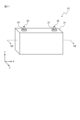
- FIG. 1 is a cutaway perspective view showing an example of a battery according to a first embodiment.
- FIG. 2 is an exploded plan view showing components of the electrode assembly according to the first embodiment.
- FIG. 3 is a schematic diagram illustrating a method for measuring the tensile strength of a separator.
- FIG. 4 is a schematic plan view showing the electrode assembly according to the first embodiment when the separator breaks.
- FIG. 5 is a schematic plan view showing a comparative example of the electrode assembly shown in FIG.
- FIG. 6 is a schematic plan view showing an electrode assembly according to a modified example of the battery according to the first embodiment.
- FIG. 7 is a schematic plan view showing a comparative example of the electrode assembly shown in FIG. FIG.
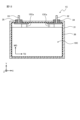
- FIG. 8 is a partial cutaway view showing an example of a battery according to the second embodiment.
- FIG. 9 is a schematic cross-sectional view taken along line IX-IX in FIG.
- FIG. 10 is a schematic plan view showing an electrode assembly according to the second embodiment.
- FIG. 11 is a perspective view showing an example of a battery according to the third embodiment.
- FIG. 12 is a cross-sectional view taken along line XII-XII in FIG.
- FIG. 13 is a cross-sectional view showing a modified example of the battery according to the third embodiment.
- FIG. 14 is a schematic plan view showing batteries according to the examples and the comparative example.
- FIG. 15 is a schematic cross-sectional view illustrating the piercing test.
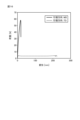
- FIG. 16 is a diagram showing the results of the tensile test of the separators according to Example 1 and Comparative Example 1.
- FIG. 17 is a diagram showing the change over time in the potential difference of the battery during the piercing test in Example 1.
- FIG. 18 is an X-ray CT image of the battery after the piercing test according to Example 1.
- FIG. 19 is a diagram showing the change over time in the potential difference of the battery during the piercing test according to Comparative Example 1.
- FIG. 20 is an X-ray CT image of the battery according to Comparative Example 1 after the puncture test.
- First Embodiment Fig. 1 is a cutaway perspective view showing an example of a battery according to the first embodiment.
- the battery according to the first embodiment includes a positive electrode lead 11A, a negative electrode lead 12A, an electrode assembly 10A, an exterior member 21, and an adhesive 22.
- the battery 1A according to the first embodiment is a so-called laminated lithium ion secondary battery in which the electrode assembly 10A is housed in the exterior member 21.
- the positive electrode lead 11A is a terminal that is pulled out from the electrode assembly 10A to the outside of the exterior member 21.
- the positive electrode lead 11A is the terminal that serves as the positive electrode of the battery 1A.
- the positive electrode lead 11A is arranged to extend in a direction perpendicular to the Z direction described below.
- the positive electrode lead 11A is made of a conductor.
- the negative electrode lead 12A is a terminal drawn from the electrode assembly 10A to the outside of the exterior member 21.
- the negative electrode lead 12A is the terminal that serves as the negative electrode of the battery 1A.
- the negative electrode lead 12A is arranged to extend in a direction perpendicular to the Z direction described below.
- the negative electrode lead 12A is made of a conductor.
- the exterior member 21 is a case in which the electrode assembly 10A is housed.
- the exterior member 21 includes an insulating layer, a metal layer, and an outermost layer.
- the exterior member 21 has a structure in which the insulating layer, the metal layer, and the outermost layer are laminated in this order from the inside, i.e., from the side where the electrode assembly 10A is provided, and then pasted together by lamination.
- the insulating layer of the exterior member 21 is made of a resin such as polyethylene, polypropylene, modified polyethylene, modified polypropylene, or a polyolefin resin containing ethylene or propylene as a monomer. This allows the exterior member 21 to reduce the moisture permeability of the battery 1A and improve its airtightness.
- the metal layer of the exterior member 21 is a metal plate or foil such as aluminum, stainless steel, nickel, or iron.
- the outermost layer may be made of any material, but is preferably made of a high-strength material such as the same resin as the insulating layer or nylon. This allows the exterior member 21 to improve its strength against tearing and punctures.
- the adhesive 22 is a member that makes the inside of the exterior member 21 airtight.
- the adhesive 22 is provided so as to surround the positive electrode lead 11A and the negative electrode lead 12A, and seals between the positive electrode lead 11A and the negative electrode lead 12A and the exterior member 21.
- the material of the adhesive 22 is preferably one that has adhesion to the positive electrode lead 11A and the negative electrode lead 12A.
- the adhesive 22 is made of a polyolefin resin such as polyethylene, polypropylene, modified polyethylene, or modified polypropylene. This makes it possible to seal the gap between the exterior member 21 and the positive electrode lead 11A and the negative electrode lead 12A, and therefore makes the inside of the exterior member 21 airtight.
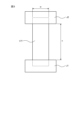
- FIG. 2 is an exploded plan view showing the components of the electrode assembly according to the first embodiment.
- the electrode assembly 10A includes a positive electrode, a negative electrode, and a separator 17A.
- the electrode assembly 10A according to the first embodiment is an electrode laminate in which positive electrodes and negative electrodes are alternately stacked with the separator 17A interposed therebetween.
- the electrode assembly 10A has a flat shape, and is generally plate-like.
- the electrode assembly 10A has a generally rectangular parallelepiped shape. In other words, the length of the electrode assembly 10A in one direction is shorter than the length in other directions.
- the shortest direction of the electrode assembly 10A is described as the Z direction.
- the direction in which the distance between opposing sides of a separator 17A (described later) is smallest is described as the Y direction, and the direction perpendicular to the Y and Z directions is described as the X direction. That is, the electrode assembly 10A has a flat shape that spreads in the YZ directions.
- the positive electrode and the negative electrode are stacked in the Z direction
- the separator 17A is stacked in the Z direction.
- the separator 17A has a thickness in the Z direction, and when viewed in a plane in the Z direction, the length in the X direction is greater than the length in the Y direction. The shape of the separator 17A will be described in detail later.
- the positive electrode includes a positive electrode current collector layer 13 A and a positive electrode active material layer 14 A. As shown in Fig. 2, the positive electrode is a laminate in which positive electrode active material layers 14A are laminated on both sides in the Z direction of the positive electrode current collector layer 13A.
- the positive electrode collector layer 13A is a sheet-like conductive foil, for example, an aluminum foil.
- the positive electrode collector layer 13A is rectangular in plan view in the Z direction, with a rectangular protrusion 13Aa.
- the protrusion 13Aa of the positive electrode collector layer 13A is connected to the positive electrode lead 11A.
- the positive electrode active material layer 14A is a layer containing a positive electrode active material.
- the positive electrode active material layer 14A is laminated with the positive electrode current collector layer 13A sandwiched therebetween.
- the positive electrode active material layer 14A contains a positive electrode active material, a conductive agent, and a binder.
- the shape of the positive electrode active material layer 14A is rectangular when viewed in a plane in the Z direction.
- the contents of the positive electrode active material layer 14A are not limited to those listed above, and may contain, for example, a dispersant.
- the positive electrode active material is preferably a lithium-containing compound such as a lithium-containing complex oxide or a lithium-containing phosphate compound.
- the lithium-containing complex oxide is an oxide containing lithium and one or more elements other than lithium as constituent elements.
- the lithium-containing complex oxide has, for example, a layered rock salt type or spinel type crystal structure.
- the lithium-containing phosphate compound is a phosphate compound containing lithium and one or more elements other than lithium as constituent elements.
- the lithium-containing phosphate compound has, for example, an olivine type crystal structure.
- the binder contained in the positive electrode active material layer 14A may be any material, and may include, for example, one or more of synthetic rubber and polymeric compounds.
- synthetic rubber include styrene butadiene rubber, fluorine-based rubber, and ethylene propylene diene.
- polymeric compounds include polyvinylidene fluoride and polyimide.
- the conductive agent contained in the positive electrode active material layer 14A may be any material, and may include, for example, carbon. Examples of carbon include graphite, carbon black, acetylene black, and ketjen black. However, the positive electrode conductive agent is not limited to these materials, and may be a metal material, a conductive polymer, or the like, as long as it is a material that is conductive.
- the negative electrode includes a negative electrode current collector layer 15 A and a negative electrode active material layer 16 A. As shown in Fig. 2, the negative electrode is a laminate in which two negative electrode active material layers 16A are laminated on both sides in the Z direction of the negative electrode current collector layer 15A.
- the negative electrode collector layer 15A is a sheet-like conductive foil, for example, a copper foil.
- the negative electrode collector layer 15A is rectangular in plan view in the Z direction, with a rectangular protrusion 15Aa.
- the protrusion 15Aa of the negative electrode collector layer 15A is connected to the negative electrode lead 12A.
- the negative electrode active material layer 16A is a layer containing a negative electrode active material.
- the negative electrode active material layer 16A may further contain a conductive agent and a binder, similar to the positive electrode active material layer 14A.
- the negative electrode active material includes materials capable of absorbing and releasing lithium (Li), such as carbon materials, metals, semimetals, silicon (Si) alloys or compounds, and tin (Sn) alloys or compounds.
- Carbon materials that can be used as the negative electrode active material include, for example, graphite, non-graphitizable carbon, and easily graphitizable carbon. More specifically, carbon materials include, for example, pyrolytic carbons, cokes, glassy carbon fiber, organic polymer compound sintered bodies, activated carbon, and carbon blacks. Cokes include pitch coke, needle coke, and petroleum coke.
- organic polymer compound sintered bodies are made by sintering polymer compounds such as phenol resin and furan resin at an appropriate temperature and carbonizing them.
- Metals and semimetals that can be used as negative electrode active materials include, for example, tin, lead (Pb), aluminum, indium (In), silicon, zinc (Zn), antimony (Sb), bismuth (Bi), cadmium (Cd), magnesium (Mg), boron (B), gallium (Ga), germanium (Ge), arsenic (As), silver (Ag), zirconium (Zr), yttrium (Y), and hafnium (Hf).
- silicon, germanium, tin, and lead are preferred. Silicon and tin are more preferred because they have a high ability to absorb and release lithium and can provide a high energy density.
- Silicon alloys that can be used as the negative electrode active material include, for example, those that contain at least one of the group consisting of tin, nickel, copper (Cu), iron (Fe), cobalt (Co), manganese (Mn), zinc, indium, silver, titanium (Ti), germanium, bismuth, antimony, and chromium (Cr) as a second constituent element other than silicon.
- Silicon compounds that can be used as the negative electrode active material include, for example, those that contain oxygen (O) or carbon (C), and may contain the above-mentioned second constituent element in addition to silicon.
- Tin alloys that can be used as the negative electrode active material include, for example, those that contain at least one of the group consisting of silicon, nickel, copper, iron, cobalt, manganese, zinc, indium, silver, titanium, germanium, bismuth, antimony, and chromium as a second constituent element other than tin.
- Tin compounds that can be used as the negative electrode active material include, for example, those that contain oxygen or carbon, and may contain the above-mentioned second constituent element in addition to tin.
- the electrolyte is filled in the exterior member 21.
- the electrolyte includes an electrolyte salt and a solvent that dissolves the electrolyte salt.
- the electrolyte salt includes lithium salts such as lithium perchlorate (LiClO 4 ), lithium hexafluorophosphate (LiPF 6 ), lithium tetrafluoroborate (LiBF 4 ), lithium bis(trifluoromethanesulfonyl)imide (LiN(SO 2 CF 3 ) 2 ), lithium bis(pentafluoroethanesulfonyl)imide (LiN(SO 2 C 2 F 5 ) 2 ), and lithium hexafluoroarsenate (LiAsF 6 ).
- the solvent examples include lactone-based solvents such as ⁇ -butyrolactone, ⁇ -valerolactone, ⁇ -valerolactone, and ⁇ -caprolactone; carbonate-based solvents such as ethylene carbonate, propylene carbonate, butylene carbonate, vinylene carbonate, dimethyl carbonate, ethyl methyl carbonate, and diethyl carbonate; ether-based solvents such as 1,2-dimethoxyethane, 1-ethoxy-2-methoxyethane, 1,2-diethoxyethane, tetrahydrofuran, and 2-methyltetrahydrofuran; nitrile-based solvents such as acetonitrile; sulfolane-based solvents; phosphoric acids; phosphate ester solvents; and pyrrolidones.
- lactone-based solvents such as ⁇ -butyrolactone, ⁇ -valerolactone, ⁇ -valerolactone, and ⁇ -cap
- the separator 17A insulates the positive electrode from the negative electrode.
- the separator 17A is provided so that the positive electrode and the negative electrode do not come into direct contact with each other, and is stacked between the positive electrode and the negative electrode in the Z direction in the electrode assembly 10A.
- a plurality of separators 17A are provided and each separator 17A has a thickness in the Z direction.
- separator 17A is rectangular when viewed in a plan view in the Z direction. That is, separator 17A has short sides parallel to the Y direction and long sides parallel to the X direction that are longer than the short sides when viewed in a plan view in the Z direction.
- separator 17A may be described with the length in the X direction as a and the length in the Y direction as b.
- separator 17A shown in FIG. 2 has right-angled vertices when viewed in a plan view in the Z direction, but this is merely an example and the vertices may be rounded.
- the length a of the separator 17A in the X direction is 2.0 times or more the length b in the Y direction.
- Separator 17A is made of a material that is electrically stable, chemically stable to the positive electrode active material, the negative electrode active material, and the electrolyte, and has insulating properties.
- Separator 17A can be, for example, a polymer nonwoven fabric, a porous film, or a layer made of glass or ceramic fibers.
- Separator 17A may also be a laminate of multiple layers, or a composite of a porous polyolefin film and a heat-resistant film containing polyimide, glass, or ceramic fibers.
- Separator 17A may also be a film surface coated with particles such as ceramic particles, but is not limited to this.
- separator 17A a film synthesized by uniaxial stretching or biaxial stretching is used. Separator 17A is preferably made of a film synthesized by uniaxial stretching. This allows costs to be reduced. When a film synthesized by uniaxial stretching is used as separator 17A, separator 17A is more preferably synthesized by dry stretching. This allows costs to be reduced.
- Separator 17A has MD (Machine Direction) and TD (Transverse Direction).
- MD refers to the flow direction of the film, i.e., the direction in which the film runs during production.
- TD refers to the lateral direction of the film of separator 17A, i.e., the direction perpendicular to the MD when viewed in a planar view in the thickness direction.
- the film is stretched only in the MD.
- the biaxial stretching method the film is stretched not only in the MD but also in the TD.
- the MD and TD of separator 17A can be examined using a scanning electron microscope (SEM) or the like. Specifically, in an SEM image of separator 17A, the direction in which the fibrous structures are oriented can be regarded as the MD, and the direction perpendicular to the orientation direction and thickness direction can be regarded as the TD.
- SEM scanning electron microscope
- Separator 17A has different tensile strengths in MD and TD, and has anisotropy in tensile strength. This is because when separator 17A is manufactured, it is stretched in MD, and the orientation of the molecules that make up separator 17A is tilted toward MD.
- the tensile strength of separator 17A refers to the maximum tensile stress that separator 17A can withstand.
- separator 17A has the maximum tensile strength in MD and the minimum tensile strength in TD. That is, in the first embodiment, the direction in which separator 17A has the minimum tensile strength is TD.
- the anisotropy of the tensile strength of separator 17A is more pronounced in films manufactured by uniaxial stretching than in films manufactured by biaxial stretching.
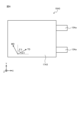
- FIG. 3 is a schematic diagram for explaining a method for measuring the tensile strength of a separator.
- the tensile strength of the separator 17A can be measured by an Instron-type universal material testing machine. Specifically, the tensile strength can be measured by fixing both ends of a test piece 17T of the separator 17A with tensile jigs J1 and J2 and performing a tensile test under the following conditions.
- the test piece 17T of the separator 17A is a test piece cut out from the film used for the separator 17A or the separator 17A.
- the width w of the test piece 17T refers to the maximum length of the test piece 17T in a direction perpendicular to the tensile direction at the start of the test.
- ⁇ Width w of test piece 17T 12.5 mm
- Distance c between the tensile jigs J1 and J2 of the test piece 17T 30 mm
- Pulling speed 50 mm per minute
- the direction in which the tensile strength of the separator 17A is smallest refers to the direction in which the tensile strength of the separator 17A is smallest among the directions perpendicular to the thickness direction of the separator 17A.
- the direction in which the tensile strength of the separator 17A is smallest can be measured by performing the tensile test described above with the direction perpendicular to the thickness direction of the separator 17A as the tensile direction.
- the direction in which the tensile strength of the separator 17A is smallest as a result of performing a tensile test with multiple directions perpendicular to the thickness direction of the separator 17A as the tensile direction can be the direction in which the tensile strength of the separator 17A is smallest.
- the multiple directions perpendicular to the thickness direction of the separator 17A that are used as the tensile direction in the tensile test include one direction selected from the directions perpendicular to the thickness direction of the separator 17A, a direction perpendicular to the first direction, and multiple directions rotated 5° from the one direction to the perpendicular direction.
- by performing a tensile test in which the direction of tension on separator 17A is changed in 5° increments it is possible to determine the direction in which separator 17A has the smallest tensile strength.
- the tensile strength of the separator 17A in the MD is 1.05 times or more the tensile strength in the TD.
- the direction in which the tensile strength of separator 17A is the smallest, i.e., the TD of separator 17A, is along the X direction.
- the direction along the X direction includes a direction that is completely parallel to the X direction as well as a direction that is substantially parallel to the X direction.
- Two directions that are substantially parallel means, for example, that the angle between the two directions is between 0° and 10°. This makes it possible to prevent a short circuit between the positive and negative electrodes when separator 17A is damaged by an external force. This will be described in detail below with reference to Figures 4 and 5.
- FIG. 4 is a schematic plan view showing the electrode assembly according to the first embodiment when the separator breaks.
- the TD is the same as the X direction.
- a crack T1 occurs in the separator 17A1.
- the crack T1 spreads depending on the anisotropy of the tensile strength of the separator 17A1, so that the crack T1 spreads in the MD so as to tear the separator 17A1 in the TD, which has a weak tensile strength.
- the crack T1 spreads in the short direction, i.e., in the Y direction, so that the end E1 of the crack T1 reaches the long side of the separator 17A1.
- the positive electrode and the negative electrode break together with the separator 17A1 before they come into contact in the Z direction, so that when the separator 17A1 is damaged by an external force, it is possible to suppress a short circuit between the positive electrode and the negative electrode.
- FIG. 5 is a schematic plan view showing a comparative example of the electrode assembly shown in FIG. 4.
- the TD is the same as the Y direction.
- a crack T2 occurs in the separator 17A2.
- the crack T2 spreads in the MD so as to tear the separator 17A2 in the TD, which has a weak tensile strength.
- the crack T2 spreads in the longitudinal direction, i.e., in the X direction, so that the end E2 of the crack T2 does not reach the short side of the separator 17A2.
- the electrode assembly 10A2 is compressed as if it is being crushed, and the positive and negative electrodes come into contact in the Z direction, causing a short circuit.
- the TD of the separator 17A i.e., the direction in which the tensile strength is at a minimum, is the same for multiple separators 17A.
- the crack tends to spread in the Y direction, making it possible to prevent a short circuit between the positive and negative electrodes.
- the separators 17A are not welded to each other. As a result, when the separator 17A is damaged by an external force, the crack tends to spread in the Y direction, which makes it possible to prevent a short circuit between the positive and negative electrodes.
- the battery according to the first embodiment is not limited to the battery 1A shown in FIG. 1.
- FIG. 6 is a schematic plan view showing an electrode assembly according to a modified example of the battery according to the first embodiment.
- the TD of the separator 17A3 when viewed in a plan view in the Z direction, the TD of the separator 17A3 does not have to be oriented along the X direction, and it is sufficient that the angle ⁇ 3 between the TD of the separator 17A3 and the Y direction is larger than the angle ⁇ 3 between the TD of the separator 17A3 and the X direction.
- FIG. 7 is a schematic plan view showing a comparative example of the electrode assembly shown in FIG. 6.
- the electrode assembly 10A4 when viewed in a plan view in the Z direction, if the angle ⁇ 4 between the TD of the separator 17A4 and the Y direction is equal to or smaller than the angle ⁇ 4 between the TD of the separator 17A4 and the X direction, cracks are less likely to reach the long side of the separator 17A4.
- the electrode assembly 10A4 is compressed in a crushed manner, and the positive and negative electrodes may come into contact in the Z direction, causing a short circuit.
- a gel electrolyte layer made of a polymer compound that holds the electrolyte solution may be provided instead of the electrolyte solution.
- the electrolyte layer is provided between the separator 17A and the positive electrode or the negative electrode.
- the polymer compound that constitutes the gel of the electrolyte layer is not particularly limited as long as it absorbs a solvent and gels.
- polymer compound that constitutes the gel of the electrolyte layer examples include fluorine-based polymer compounds such as copolymers of polyvinylidene fluoride or vinylidene fluoride and hexafluoropropylene, ether-based polymer compounds such as polyethylene oxide or crosslinked bodies containing polyethylene oxide, and polymer compounds containing polyacrylonitrile, polypropylene oxide, or polymethyl methacrylate as monomers.
- the polymer compound that constitutes the gel of the electrolyte layer is preferably a fluorine-based polymer compound, and more preferably a copolymer containing vinylidene fluoride and hexafluoropropylene as components.
- the copolymer may further contain components such as monoesters of unsaturated dibasic acids, such as monomethyl maleate esters, halogenated ethylenes, such as trifluorochloroethylene, cyclic carbonates of unsaturated compounds, such as vinylene carbonate, and epoxy group-containing acrylic vinyl monomers. This allows for high cycle characteristics to be obtained.
- the battery 1A is a battery including an electrode assembly 10A having a positive electrode, a negative electrode, and a film-like separator 17A.
- the shape of the electrode assembly 10A is flat.
- the separator 17A has a thickness at least in the first direction and is provided between the positive electrode and the negative electrode at least in the first direction.
- the angle between the direction (TD) in which the tensile strength of the separator 17A is smallest and the second direction is larger than the angle between the direction in which the tensile strength of the separator 17A is smallest and the third direction.
- the ratio of the length of the separator 17A in the third direction to the length of the separator 17A in the second direction is 2.0 or more.
- the crack T1 spreads in the direction (MD) perpendicular to the direction in which the tensile strength is at its minimum, so as to tear the separator 17A in the direction in which the tensile strength is at its minimum. Since the angle between the direction in which the tensile strength of the separator 17A is at its minimum (TD) and the second direction is greater than the angle between the direction in which the tensile strength of the separator 17A is at its minimum and the third direction, the end E1 of the crack T1 is more likely to reach the long side of the separator 17A than the short side of the separator 17A. As a result, the positive and negative electrodes break together with the separator 17A before they come into contact in the Z direction, so that a short circuit between the positive and negative electrodes can be suppressed.
- the direction in which the tensile strength of separator 17A is at its smallest is along the third direction.
- separator 17A when viewed in a plan view in the first direction, separator 17A has a short side parallel to the second direction and a long side parallel to the third direction that is longer than the short side. Even in this case, the positive and negative electrodes break together with separator 17A before coming into contact in the Z direction, so that it is possible to prevent a short circuit between the positive and negative electrodes when separator 17A is damaged by an external force.
- the electrode assembly 10A is an electrode laminate in which a positive electrode and a negative electrode are laminated in the first direction with a separator 17A interposed therebetween. Even in this case, the positive electrode and the negative electrode break together with the separator 17A before they come into contact in the Z direction, so that it is possible to prevent a short circuit between the positive electrode and the negative electrode when the separator 17A is damaged by an external force.
- the electrode stack has multiple separators 17A, and the multiple separators 17A all have the same direction in which their tensile strength is at its minimum. This makes it easier for cracks to spread in a direction perpendicular to the direction in which the tensile strength is at its minimum when a separator 17A is damaged by an external force, which further prevents a short circuit between the positive and negative electrodes.
- the ratio of the tensile strength of separator 17A in the direction in which the tensile strength of separator 17A is minimum to the tensile strength of separator 17A in the direction perpendicular to the direction in which the tensile strength of separator 17A is minimum is 1.05 or more. This allows for better prevention of short circuits between the positive and negative electrodes when separator 17A is damaged by an external force, as cracks will occur in separator 17A in a fixed direction.
- Second Embodiment Fig. 8 is a partial cutaway view showing an example of a battery according to the second embodiment.
- the battery 1B according to the second embodiment differs from the first embodiment in that the electrode assembly 10B is a wound electrode body.
- the battery 1B according to the second embodiment will be described with reference to the drawings. Note that a description of the same configuration as the first embodiment will be omitted.
- the electrode assembly 10B has a positive electrode including a positive electrode collector layer 13B and a positive electrode active material layer 14B, a negative electrode including a negative electrode collector layer 15B and a negative electrode active material layer 16B, a separator 17B, and a protective material 18.
- the electrode assembly 10B is an electrode winding body in which a laminate in which a positive electrode and a negative electrode are stacked with a separator 17B interposed therebetween is wound around a positive electrode lead 11B and a negative electrode lead 12B extending in a direction perpendicular to the Z direction.
- FIG. 10 the example shown in FIG.
- the laminate including a positive electrode, a negative electrode, and a separator 17B in the electrode assembly 10B is wound in a direction perpendicular to the X direction. That is, in the electrode assembly 10B, the positive electrode, the negative electrode, and the separator 17B are stacked in a direction parallel to at least the Z direction, and the separator 17B has a thickness in a direction parallel to at least the Z direction. Note that the winding direction of the electrode assembly 10B shown in FIG. 9 is merely an example, and the electrode assembly 10B may be wound in a direction perpendicular to the Y direction.
- the electrode assembly 10B has a flat shape, similar to the electrode assembly 10A according to the first embodiment. That is, the electrode assembly 10B has a plate-like shape with a length in the Z direction that is shorter than the lengths in the X and Y directions. In other words, the length of the electrode assembly 10B in the direction perpendicular to the winding axis is not constant, so the battery 1B is not a so-called cylindrical battery. In a cylindrical battery, the surface perpendicular to the Z direction is curved, so even if an external force is applied that pierces the Z direction, cracks in the separator do not spread in the MD direction, and there is a possibility of a short circuit between the positive and negative electrodes.
- the electrode assembly 10B has a structure in which, from the outside, i.e., the protective material 18 side, the negative electrode collector layer 15B, the negative electrode active material layer 16B, the separator 17B, the positive electrode active material layer 14B, the positive electrode collector layer 13B, the positive electrode active material layer 14B, the separator 17B, and the negative electrode active material layer 16B are stacked in this order.
- the electrode assembly 10B no layers other than the negative electrode collector layer 15B, the separator 17B, and the positive electrode collector layer 13B are provided near the positive electrode lead 11B and the negative electrode lead 12B.
- the positive electrode collector layer 13B is connected to the positive electrode lead 11B
- the negative electrode collector layer 15B is connected to the negative electrode lead 12B.
- the protective material 18 is a member that protects the inside of the electrode assembly 10B.
- the protective material 18 is provided so as to be wrapped around the electrode assembly 10B.
- the protective material 18 is, for example, an insulating tape.
- FIG. 10 is a schematic plan view showing an electrode assembly according to the second embodiment.
- the direction in which the tensile strength of the separator 17B is at its minimum i.e., TD
- TD the direction in which the tensile strength of the separator 17B is at its minimum
- TD the direction in which the tensile strength of the separator 17B is at its minimum
- TD the direction in which the tensile strength of the separator 17B is at its minimum
- TD the direction in which the tensile strength of the separator 17B is at its minimum
- the battery according to the second embodiment is not limited to the battery 1B shown in FIG. 8.
- the electrolyte is filled in the exterior member 21 as in the first embodiment, but this is not limited to this, and instead, a gel electrolyte layer made of a polymer compound that holds the electrolyte may be provided.
- a gel electrolyte layer made of a polymer compound that holds the electrolyte may be provided.
- an electrolyte layer may be provided between the separator 17B and the positive electrode or the negative electrode.
- the electrode assembly 10B is an electrode winding body in which the positive electrode and the negative electrode are stacked and wound with the separator 17B interposed therebetween. Even in this case, the positive electrode and the negative electrode break together with the separator 17B before they come into contact in the Z direction, so that it is possible to prevent a short circuit between the positive electrode and the negative electrode when the separator 17B is broken by an external force.
- Fig. 11 is a perspective view showing an example of a battery according to the third embodiment.
- Fig. 12 is a cross-sectional view taken along line XII-XII in Fig. 11.
- the battery 1C according to the third embodiment differs from the first embodiment in that the electrode assembly 10C is housed in a battery case can 31. That is, the battery 1C according to the third embodiment is a so-called prismatic lithium ion secondary battery.
- the battery 1C according to the third embodiment will be described below with reference to the drawings. Note that descriptions of configurations similar to those of the first and second embodiments will be omitted.
- Battery 1C comprises electrode assembly 10C, battery case 31, electrodes 32, 33, and sealing materials 34, 35, and 36.
- the battery case can 31 is a can that houses the electrode assembly 10C.
- the battery case can 31 is a flat rectangular can made of a conductor.
- the electrode 32 is a terminal that is pulled out from inside the battery container 31 to the outside.
- the electrode 32 is the positive terminal of the battery 1C.
- the electrode 32 is made of a conductor.
- the electrode 32 is connected to the protruding portion 13Ca of the positive electrode collector of the electrode assembly 10C.
- the electrode 33 is a terminal that is pulled out from inside the battery container 31 to the outside.
- the electrode 33 is the negative terminal of the battery 1C.
- the electrode 33 is made of a conductor.
- the electrode 33 is connected to the protruding portion 15Ca of the negative electrode collector of the electrode assembly 10C.
- the sealing material 34 is provided to surround the electrode 32 and seal the inside of the battery case 31.
- the sealing material 34 is made of an insulator. This makes it possible to prevent electrical conduction between the battery case 31 and the electrode 32.
- the sealing material 35 is provided to surround the electrode 33 and seal the inside of the battery case 31.
- the sealing material 35 is made of an insulator. This makes it possible to prevent electrical conduction between the battery case 31 and the electrode 33.
- the sealing material 36 is provided to cover the inside of the battery case can 31.
- the sealing material 35 is made of an insulator. This makes it possible to prevent electrical conduction between the electrode assembly 10C and the battery case can 31.
- the electrode assembly 10C is an electrode laminate in which positive electrodes and negative electrodes are alternately stacked with separators between them.
- the electrode assembly 10C is an electrode laminate similar to the electrode assembly 10A according to the first embodiment.
- the separator 17C according to the third embodiment has a direction in which the tensile strength is at a minimum, i.e., TD, which is aligned with the X direction when viewed in a plan view in the Z direction. This makes it possible to prevent a short circuit between the positive and negative electrodes when the separator is damaged by an external force.
- the battery 1C according to the third embodiment has been described above, but the battery according to the third embodiment is not limited to the battery 1C shown in FIG. 12.
- the electrode assembly may be a wound electrode body.
- FIG. 13 is a cross-sectional view showing a modified example of the battery according to the third embodiment.
- the electrode assembly 10D is an electrode winding body wound around the positive electrode lead 11D and the negative electrode lead 12D extending in a direction perpendicular to the Z direction.
- the positive electrode lead 11D and the negative electrode lead 12D are connected to the electrodes 32 and 33, respectively.
- the electrode assembly 10D is an electrode winding body having a configuration similar to that of the electrode assembly 10B according to the second embodiment.
- the laminate including the positive electrode, the negative electrode, and the separator of the electrode assembly 10D is wound in a direction perpendicular to the X direction.
- the positive electrode, the negative electrode, and the separator are stacked at least in a direction parallel to the Z direction, and the separator 17B has a thickness at least in a direction parallel to the Z direction.
- the separator has a direction in which the tensile strength is minimum, i.e., TD, along the X direction when viewed in a plan view in the Z direction. Therefore, even in this case, when the separator is damaged by an external force, it is possible to prevent the positive electrode and the negative electrode from shorting out.
- the winding direction of the electrode assembly 10B shown in FIG. 13 is merely an example, and the electrode assembly may be wound in a direction perpendicular to the Y direction.
- FIG. 14 is a schematic plan view showing the batteries according to the examples and the comparative examples.
- FIG. 15 is a schematic cross-sectional view illustrating the piercing test.
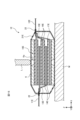
- the battery 1E according to FIG. 14 is shown in FIG. 15 as a cross section taken along line XV-XV in FIG. 14. In the test, the battery 1E shown in FIG. 14 and FIG. 15 was produced.
- the battery 1E is a laminated stacked battery. That is, as shown in FIG. 14 and FIG. 15, the battery 1E includes a positive electrode lead 11E, a negative electrode lead 12E, an electrode assembly 10E, an exterior member 21E, and an adhesive 22, and the electrode assembly 10E is housed in the exterior member 21E.
- the electrode assembly 10E has a structure in which a positive electrode having a positive electrode collector layer 13E and a positive electrode active material layer 14E, and a negative electrode having a negative electrode collector layer 15E and a negative electrode active material layer 16E are stacked with a separator 17E interposed therebetween.
- the separator 17E in Example 1 and Comparative Example 1 is a porous polyolefin film manufactured by a uniaxial stretching method.
- the separator 17E is rectangular when viewed in a plane in the Z direction, with a length a in the X direction of 25 mm and a length b in the Y direction of the separator 17E of 7 mm. That is, in Example 1 and Comparative Example 1, the length a in the X direction of the separator 17E is 3.5 times the length b in the Y direction of the separator 17E.
- a tensile test was carried out under the following conditions for the films used in the separator 17E according to Example 1 and Comparative Example 1.
- the tensile test was carried out in the air.
- ⁇ Measuring device Instron type universal material testing machine 5564 (Instron) ⁇ Test piece width w: 12.5 mm Distance c between tensile jigs of test piece: 30 mm Pulling speed: 50 mm per minute Pull direction: MD or TD
- Figure 16 shows the results of the tensile test of the separators of Example 1 and Comparative Example 1. As a result of the tensile test, the load-displacement curve shown in Figure 16 was obtained. In the load-displacement curve of Figure 16, the maximum value of the load is the tensile strength, so it can be seen that the tensile strength of separator 17E in the MD is 14 times the tensile strength in the TD.
- Battery 1E is further provided with pressure plates K on both sides of electrode assembly 10E in the Z direction.
- Pressure plates K are provided inside exterior member 21E.
- Pressure plate K has a circular recess Ka with a diameter of 6 mm in plan view in the Z direction at the center in the X direction.
- Recess Ka is a recess that guides pin L used in a puncture test into electrode assembly 10E during a puncture test.
- a piercing test was conducted on the battery 1E according to the embodiment and comparative example described above.
- a pin L was pierced in the Z direction toward the recess Ka in the pressing plate K of the battery 1E on the stand M at a speed of 200 mm per second.
- the tip of the pin L is a ball with a diameter of 3 mm.
- the time change in the potential difference between the positive electrode lead 11E and the negative electrode lead 12E was measured before and after the piercing to check whether or not there was a short circuit between the positive and negative electrodes in the battery 1E.
- X-ray CT Computed Tomography
- the TDs of the separators are all in the same direction as the X direction. That is, the TDs of all the separators in the battery of Example 1 are parallel to the long sides of the separators.
- Figure 17 shows the change in potential difference over time in the battery during the piercing test of Example 1.
- pin L came into contact with the electrode assembly at 3110 ms, and pin L penetrated the electrode assembly at 3132 ms.
- the potential difference hardly changed before and after piercing. Therefore, it can be seen that in the battery of Example 1, even when an external force is applied in the Z direction, the positive electrode and negative electrode are not short-circuited.
- Figure 18 is an X-ray CT image of the battery after the puncture test of Example 1.
- the X-ray CT image of Figure 18 is a planar image in the Z direction of the electrode assembly after the puncture test of Example 1.
- the cracks that occurred in the electrode assembly due to the puncture test reached both ends of the electrode assembly in the Y direction. From this, it is believed that when punctured, the positive and negative electrodes of the electrode assembly broke together with the separator before coming into contact in the Z direction, and therefore the positive and negative electrodes did not short-circuit.
- the TDs of the separators are all in the same direction as the Y direction.
- the TDs of all separators in battery 1E according to the embodiment are parallel to the short sides of the separators.
- Figure 19 shows the change in potential difference over time in the battery during the piercing test of Comparative Example 1.
- pin L came into contact with the electrode assembly at 2332 ms, and pin L penetrated the electrode assembly at 2350 ms.
- the potential difference decreased after the electrode assembly was penetrated. Therefore, it can be seen that in the battery of Comparative Example 1, when an external force is applied in the Z direction, the positive electrode and negative electrode are short-circuited.
- Figure 20 is an X-ray CT image of a battery after the puncture test of Comparative Example 1.
- the X-ray CT image of Figure 20 is a planar image in the Z direction of the electrode assembly after the puncture test of Comparative Example 1.
- the cracks that occurred in the electrode assembly due to the puncture test do not reach both ends of the electrode assembly in the X direction. From this, it is believed that when punctured, the electrode assembly is compressed in a crushed manner, causing the positive and negative electrodes to come into contact in the Z direction and causing a short circuit between the positive and negative electrodes.
- Example 2 battery 1E was produced in the same manner as in Example 1, except that the length b of separator 17E in the Y direction was set to 12 mm, and a piercing test was performed. That is, in battery 1E according to Example 2, the TD of the separator is all in the same direction as the X direction and parallel to the long side of the separator. Also, in Example 2, the length a of separator 17E in the X direction is 2.1 times the length b of separator 17E in the Y direction. In the battery according to Example 2, the potential difference hardly changed before and after piercing. Therefore, it can be seen that in the battery according to Example 2, even if an external force is applied in the Z direction, the positive electrode and the negative electrode are not short-circuited.
- battery 1E was prepared in the same manner as in Comparative Example 1, except that the length b of separator 17E in the Y direction was 12 mm, and a puncture test was performed. That is, in battery 1E according to Comparative Example 2, the TD of the separator is all in the same direction as the Y direction and parallel to the short side of the separator. Also, in Comparative Example 2, the length a of separator 17E in the X direction is 2.1 times the length b of separator 17E in the Y direction. In the battery according to Comparative Example 2, the potential difference decreased after the puncture test. Therefore, it can be seen that in the battery according to Comparative Example 2, when an external force is applied in the Z direction, the positive electrode and negative electrode are short-circuited.
- battery 1E was prepared in the same manner as in Example 1, except that the length b of separator 17E in the Y direction was 17 mm, and a puncture test was performed. That is, in battery 1E according to Example 3, the TDs of the separators are all in the same direction as the X direction and parallel to the long sides of the separator. Also, in Comparative Example 3, the length a of separator 17E in the X direction is 1.5 times the length b of separator 17E in the Y direction. In the battery according to Comparative Example 3, the potential difference decreased after the puncture test. Therefore, it can be seen that in the battery according to Comparative Example 3, when an external force is applied in the Z direction, the positive electrode and negative electrode are short-circuited.
- a battery comprising an electrode assembly having a positive electrode, a negative electrode, and a film-like separator,
- the electrode assembly has a flat shape
- the separator has a thickness at least in the first direction and is provided between the positive electrode and the negative electrode at least in the first direction, when viewed in a plane in the first direction, a direction in which a distance between opposing sides of the separator is smallest is defined as a second direction, and a direction perpendicular to the first direction and the second direction is defined as a third direction, an angle between the direction in which the tensile strength of the separator is smallest and the second direction is larger than an angle between the direction in which the tensile strength of the separator is smallest and the third direction,
- a battery wherein, when viewed in a plan view in the first direction, a ratio of a length of the separator in the third direction to a length of the separator
- the electrode assembly is an electrode winding body in which the positive electrode and the negative electrode are stacked and wound with the separator interposed therebetween.
- the ratio of the tensile strength of the separator in a direction perpendicular to the direction in which the tensile strength of the separator is minimum to the tensile strength of the separator in a direction in which the tensile strength of the separator is minimum is 1.05 or more.
Landscapes
- Chemical & Material Sciences (AREA)
- Chemical Kinetics & Catalysis (AREA)
- Electrochemistry (AREA)
- General Chemical & Material Sciences (AREA)
- Engineering & Computer Science (AREA)
- Manufacturing & Machinery (AREA)
- Materials Engineering (AREA)
- Secondary Cells (AREA)
- Cell Separators (AREA)
Priority Applications (3)
| Application Number | Priority Date | Filing Date | Title |
|---|---|---|---|
| CN202380054741.5A CN119585938A (zh) | 2022-10-21 | 2023-10-16 | 电池 |
| JP2024551800A JP7806924B2 (ja) | 2022-10-21 | 2023-10-16 | 電池 |
| US19/055,982 US20250192373A1 (en) | 2022-10-21 | 2025-02-18 | Battery |
Applications Claiming Priority (2)
| Application Number | Priority Date | Filing Date | Title |
|---|---|---|---|
| JP2022-169415 | 2022-10-21 | ||
| JP2022169415 | 2022-10-21 |
Related Child Applications (1)
| Application Number | Title | Priority Date | Filing Date |
|---|---|---|---|
| US19/055,982 Continuation US20250192373A1 (en) | 2022-10-21 | 2025-02-18 | Battery |
Publications (1)
| Publication Number | Publication Date |
|---|---|
| WO2024085121A1 true WO2024085121A1 (ja) | 2024-04-25 |
Family
ID=90737850
Family Applications (1)
| Application Number | Title | Priority Date | Filing Date |
|---|---|---|---|
| PCT/JP2023/037445 Ceased WO2024085121A1 (ja) | 2022-10-21 | 2023-10-16 | 電池 |
Country Status (4)
| Country | Link |
|---|---|
| US (1) | US20250192373A1 (https=) |
| JP (1) | JP7806924B2 (https=) |
| CN (1) | CN119585938A (https=) |
| WO (1) | WO2024085121A1 (https=) |
Citations (3)
| Publication number | Priority date | Publication date | Assignee | Title |
|---|---|---|---|---|
| JP2016062876A (ja) * | 2014-09-22 | 2016-04-25 | 株式会社豊田自動織機 | 蓄電装置 |
| JP2016072233A (ja) * | 2014-09-29 | 2016-05-09 | 株式会社Gsユアサ | 蓄電素子、及び蓄電素子の製造方法 |
| CN113078415A (zh) * | 2020-01-06 | 2021-07-06 | 天能帅福得能源股份有限公司 | 一种改善重物冲击性能的软包锂离子电池及其制备方法 |
-
2023
- 2023-10-16 JP JP2024551800A patent/JP7806924B2/ja active Active
- 2023-10-16 CN CN202380054741.5A patent/CN119585938A/zh active Pending
- 2023-10-16 WO PCT/JP2023/037445 patent/WO2024085121A1/ja not_active Ceased
-
2025
- 2025-02-18 US US19/055,982 patent/US20250192373A1/en active Pending
Patent Citations (3)
| Publication number | Priority date | Publication date | Assignee | Title |
|---|---|---|---|---|
| JP2016062876A (ja) * | 2014-09-22 | 2016-04-25 | 株式会社豊田自動織機 | 蓄電装置 |
| JP2016072233A (ja) * | 2014-09-29 | 2016-05-09 | 株式会社Gsユアサ | 蓄電素子、及び蓄電素子の製造方法 |
| CN113078415A (zh) * | 2020-01-06 | 2021-07-06 | 天能帅福得能源股份有限公司 | 一种改善重物冲击性能的软包锂离子电池及其制备方法 |
Also Published As
| Publication number | Publication date |
|---|---|
| US20250192373A1 (en) | 2025-06-12 |
| JP7806924B2 (ja) | 2026-01-27 |
| JPWO2024085121A1 (https=) | 2024-04-25 |
| CN119585938A (zh) | 2025-03-07 |
Similar Documents
| Publication | Publication Date | Title |
|---|---|---|
| US20240297336A1 (en) | Electrochemical device comprising separator with laminated porous layers | |
| CN102569698B (zh) | 层压微孔膜、电池隔膜和非水电解质电池 | |
| KR101843577B1 (ko) | 비수 전해질 2차 전지 및 그 제조 방법 | |
| KR100687159B1 (ko) | 고체 전해질 전지 | |
| US8247100B2 (en) | Electrochemical device | |
| US9287544B2 (en) | Heat-resistant porous film, separator for nonaqueous battery, and nonaqueous battery | |
| JP5621248B2 (ja) | セパレータおよび電池 | |
| US9831480B2 (en) | Fiber-containing polymer film and method of manufacturing same, and electrochemical device and method of manufacturing same | |
| JP4927064B2 (ja) | 二次電池 | |
| US20190013553A1 (en) | Rechargeable battery with resistive layer for enhanced safety | |
| KR20170141141A (ko) | 이차전지용 전극 및 이를 포함하는 리튬 이차 전지 | |
| JP2012109123A (ja) | 耐熱性微多孔膜および電池用セパレータ | |
| JP2004363048A (ja) | セパレータ及び非水電解質電池 | |
| JP7020167B2 (ja) | 非水電解液二次電池 | |
| WO2020059806A1 (ja) | 二次電池 | |
| CN112640183A (zh) | 二次电池 | |
| JP7806924B2 (ja) | 電池 | |
| KR101744382B1 (ko) | 이차전지용 전극 리드 및 이를 포함하는 이차전지 | |
| JP2014222669A (ja) | セパレータおよび電池 | |
| JP2002216740A (ja) | 非水二次電池 | |
| JP2010021043A (ja) | セパレータ、セパレータの製造方法および電池 | |
| JP2008234868A (ja) | 非水電解液二次電池及びその製造方法 | |
| US20250087677A1 (en) | Negative electrode active material layer, negative electrode, and lithium-ion rechargeable battery | |
| US20230290938A1 (en) | Negative electrode active material, negative electrode and lithium-ion secondary battery | |
| US20250105295A1 (en) | Negative electrode active material layer, negative electrode, and lithium-ion rechargeable battery |
Legal Events
| Date | Code | Title | Description |
|---|---|---|---|
| 121 | Ep: the epo has been informed by wipo that ep was designated in this application |
Ref document number: 23879764 Country of ref document: EP Kind code of ref document: A1 |
|
| WWE | Wipo information: entry into national phase |
Ref document number: 2024551800 Country of ref document: JP |
|
| WWE | Wipo information: entry into national phase |
Ref document number: 202380054741.5 Country of ref document: CN |
|
| WWP | Wipo information: published in national office |
Ref document number: 202380054741.5 Country of ref document: CN |
|
| NENP | Non-entry into the national phase |
Ref country code: DE |
|
| 122 | Ep: pct application non-entry in european phase |
Ref document number: 23879764 Country of ref document: EP Kind code of ref document: A1 |