WO2024075643A1 - 熱可塑性樹脂組成物及びそれを含む光学部材 - Google Patents
熱可塑性樹脂組成物及びそれを含む光学部材 Download PDFInfo
- Publication number
- WO2024075643A1 WO2024075643A1 PCT/JP2023/035579 JP2023035579W WO2024075643A1 WO 2024075643 A1 WO2024075643 A1 WO 2024075643A1 JP 2023035579 W JP2023035579 W JP 2023035579W WO 2024075643 A1 WO2024075643 A1 WO 2024075643A1
- Authority
- WO
- WIPO (PCT)
- Prior art keywords
- thermoplastic resin
- resin composition
- formula
- bis
- pellets
- Prior art date
- Legal status (The legal status is an assumption and is not a legal conclusion. Google has not performed a legal analysis and makes no representation as to the accuracy of the status listed.)
- Ceased
Links
Classifications
-
- C—CHEMISTRY; METALLURGY
- C08—ORGANIC MACROMOLECULAR COMPOUNDS; THEIR PREPARATION OR CHEMICAL WORKING-UP; COMPOSITIONS BASED THEREON
- C08K—Use of inorganic or non-macromolecular organic substances as compounding ingredients
- C08K5/00—Use of organic ingredients
- C08K5/04—Oxygen-containing compounds
- C08K5/10—Esters; Ether-esters
- C08K5/101—Esters; Ether-esters of monocarboxylic acids
- C08K5/103—Esters; Ether-esters of monocarboxylic acids with polyalcohols
-
- C—CHEMISTRY; METALLURGY
- C08—ORGANIC MACROMOLECULAR COMPOUNDS; THEIR PREPARATION OR CHEMICAL WORKING-UP; COMPOSITIONS BASED THEREON
- C08G—MACROMOLECULAR COMPOUNDS OBTAINED OTHERWISE THAN BY REACTIONS ONLY INVOLVING UNSATURATED CARBON-TO-CARBON BONDS
- C08G63/00—Macromolecular compounds obtained by reactions forming a carboxylic ester link in the main chain of the macromolecule
- C08G63/64—Polyesters containing both carboxylic ester groups and carbonate groups
-
- C—CHEMISTRY; METALLURGY
- C08—ORGANIC MACROMOLECULAR COMPOUNDS; THEIR PREPARATION OR CHEMICAL WORKING-UP; COMPOSITIONS BASED THEREON
- C08G—MACROMOLECULAR COMPOUNDS OBTAINED OTHERWISE THAN BY REACTIONS ONLY INVOLVING UNSATURATED CARBON-TO-CARBON BONDS
- C08G64/00—Macromolecular compounds obtained by reactions forming a carbonic ester link in the main chain of the macromolecule
- C08G64/04—Aromatic polycarbonates
-
- C—CHEMISTRY; METALLURGY
- C08—ORGANIC MACROMOLECULAR COMPOUNDS; THEIR PREPARATION OR CHEMICAL WORKING-UP; COMPOSITIONS BASED THEREON
- C08K—Use of inorganic or non-macromolecular organic substances as compounding ingredients
- C08K5/00—Use of organic ingredients
- C08K5/0008—Organic ingredients according to more than one of the "one dot" groups of C08K5/01 - C08K5/59
- C08K5/005—Stabilisers against oxidation, heat, light, ozone
-
- C—CHEMISTRY; METALLURGY
- C08—ORGANIC MACROMOLECULAR COMPOUNDS; THEIR PREPARATION OR CHEMICAL WORKING-UP; COMPOSITIONS BASED THEREON
- C08K—Use of inorganic or non-macromolecular organic substances as compounding ingredients
- C08K5/00—Use of organic ingredients
- C08K5/04—Oxygen-containing compounds
- C08K5/10—Esters; Ether-esters
- C08K5/109—Esters; Ether-esters of carbonic acid, e.g. R-O-C(=O)-O-R
-
- C—CHEMISTRY; METALLURGY
- C08—ORGANIC MACROMOLECULAR COMPOUNDS; THEIR PREPARATION OR CHEMICAL WORKING-UP; COMPOSITIONS BASED THEREON
- C08L—COMPOSITIONS OF MACROMOLECULAR COMPOUNDS
- C08L67/00—Compositions of polyesters obtained by reactions forming a carboxylic ester link in the main chain; Compositions of derivatives of such polymers
-
- C—CHEMISTRY; METALLURGY
- C08—ORGANIC MACROMOLECULAR COMPOUNDS; THEIR PREPARATION OR CHEMICAL WORKING-UP; COMPOSITIONS BASED THEREON
- C08L—COMPOSITIONS OF MACROMOLECULAR COMPOUNDS
- C08L67/00—Compositions of polyesters obtained by reactions forming a carboxylic ester link in the main chain; Compositions of derivatives of such polymers
- C08L67/02—Polyesters derived from dicarboxylic acids and dihydroxy compounds
-
- C—CHEMISTRY; METALLURGY
- C08—ORGANIC MACROMOLECULAR COMPOUNDS; THEIR PREPARATION OR CHEMICAL WORKING-UP; COMPOSITIONS BASED THEREON
- C08L—COMPOSITIONS OF MACROMOLECULAR COMPOUNDS
- C08L69/00—Compositions of polycarbonates; Compositions of derivatives of polycarbonates
-
- C—CHEMISTRY; METALLURGY
- C08—ORGANIC MACROMOLECULAR COMPOUNDS; THEIR PREPARATION OR CHEMICAL WORKING-UP; COMPOSITIONS BASED THEREON
- C08L—COMPOSITIONS OF MACROMOLECULAR COMPOUNDS
- C08L69/00—Compositions of polycarbonates; Compositions of derivatives of polycarbonates
- C08L69/005—Polyester-carbonates
-
- G—PHYSICS
- G02—OPTICS
- G02B—OPTICAL ELEMENTS, SYSTEMS OR APPARATUS
- G02B1/00—Optical elements characterised by the material of which they are made; Optical coatings for optical elements
- G02B1/04—Optical elements characterised by the material of which they are made; Optical coatings for optical elements made of organic materials, e.g. plastics
-
- G—PHYSICS
- G02—OPTICS
- G02B—OPTICAL ELEMENTS, SYSTEMS OR APPARATUS
- G02B1/00—Optical elements characterised by the material of which they are made; Optical coatings for optical elements
- G02B1/04—Optical elements characterised by the material of which they are made; Optical coatings for optical elements made of organic materials, e.g. plastics
- G02B1/041—Lenses
Definitions
- the present invention relates to a thermoplastic resin composition and an optical member containing the same.
- Glass which has traditionally been used as an optical material, has excellent optical properties, environmental resistance, and color, but has the problem of poor processability.
- optical resins especially thermoplastic resin compositions, are cheaper than glass materials, and have the advantages of being able to mass-produce molded products by injection molding and easily manufacturing aspherical lenses. For these reasons, they have been used primarily in the optical lenses that make up smartphone cameras, and have become widespread. In recent years, new applications for these materials are expected, including optical lenses for so-called in-vehicle cameras, such as in-vehicle sensing cameras and in-vehicle viewing cameras, and optical lenses for AR/VR devices.
- optical resins are required to have a higher refractive index in order to make optical systems smaller and thinner, and they are also required to have extremely low distortion, in other words, low birefringence, because images formed through optical lenses are recognized by sensors and people. Furthermore, for in-vehicle camera applications, long-term heat resistance is important so that they do not discolor for long periods of time even at high temperatures due to the operating environment.
- the light from the display must be transmitted accurately so that humans can recognize the image formed on the screen, and light in the visible light range must be transmitted in a balanced manner. Furthermore, since people can directly view the optical lens, an excellent appearance like luxurious glass is required.
- Patent Document 1 describes that a polyester carbonate resin having structural units represented by formula (M) and formula (N) can be obtained, which has a high refractive index of 1.635 to 1.650 and an excellent low orientation birefringence of 0 to 6 ⁇ 10-3 .
- Patent Document 2 describes that a polyester carbonate resin produced using a catalyst made of an aluminum compound and a phosphorus compound has a better hue than a polyester carbonate resin produced using a general titanium-based catalyst.
- Patent Document 3 describes the production of a polycarbonate resin having a structure represented by formula (O) that is excellent in terms of high transparency, high Tg, high refractive index, and low birefringence.
- T1 and T2 each independently represent a hydrogen atom or a methyl group.
- polycarbonate resin compositions and polyester carbonate resin compositions and optical lenses that have a high refractive index, low birefringence, and long-term heat resistance have not yet been provided.
- high refractive index optical resin materials generally undergo thermal degradation and begin to absorb light in the short wavelength region of visible light, disrupting the balance of visible light transmission and reducing transmittance, while causing the molded product to yellow after extrusion and molding, resulting in a poor appearance.
- the above-mentioned documents describe the production of polycarbonate resins or polyester carbonate resins with high refractive index, low birefringence, high transparency, and good hue, but do not describe the visible light transmission characteristics or appearance characteristics, particularly the transmission balance and hue, of the thermoplastic resin composition after extrusion and molding, leaving room for improvement.
- polycarbonate resin compositions and polyester carbonate resin compositions and optical lenses that have a high refractive index, low birefringence, as well as excellent transmittance and hue, have not yet been provided.
- thermoplastic resin composition comprising a thermoplastic resin having a structural unit represented by the following formula (1) and a mold release agent, wherein the content of an antioxidant in the thermoplastic resin composition is 0 to 300 ppm:
- ring Z represents an aromatic hydrocarbon ring
- L1 and L2 each independently represent a divalent linking group
- o and p each independently represent an integer of 0 or more
- R1 , R2 , R3 , and R4 each independently represent a hydrogen atom or a hydrocarbon group having 1 to 20 carbon atoms
- X is at least one selected from the group represented by the following formula (2) or (3):
- Y represents a divalent linking group.
- Aspect 2 2. The thermoplastic resin composition according to claim 1, wherein the release agent is contained in the thermoplastic resin composition in an amount of 1 to 4000 ppm.
- Aspect 3 The thermoplastic resin composition according to claim 1 or 2, wherein the content of the antioxidant in the thermoplastic resin composition is 0 to 50 ppm.
- Aspect 4 The thermoplastic resin composition according to claim 1 or 2, wherein the dry heat yellowing ⁇ YI is 0.00 to 0.47.
- thermoplastic resin composition comprising a thermoplastic resin having a structural unit represented by the following formula (4), a coloring agent, and an antioxidant, wherein the content of the coloring agent in the thermoplastic resin composition is 0.01 to 4.00 ppm, and the content of the antioxidant in the thermoplastic resin composition is 50 to 3000 ppm.
- ring Z represents an aromatic hydrocarbon ring
- L1 and L2 each independently represent a divalent linking group
- o and p each independently represent an integer of 0 or more
- R1 , R2 , R3 , and R4 each independently represent a hydrogen atom or a hydrocarbon group having 1 to 20 carbon atoms
- X is at least one selected from the group represented by formula (5) or (6) below.
- Y represents a divalent linking group.
- Aspect 6 The thermoplastic resin composition according to embodiment 5, wherein the hue a * of a 2 mm thick molded plate of the thermoplastic resin composition is ⁇ 0.40 to 0.00 and the hue b * is ⁇ 0.50 to 1.25.
- Aspect 7 The thermoplastic resin composition according to aspect 5 or 6, wherein a total light transmittance of a 2 mm thick molded plate of the thermoplastic resin composition is 86.5% or more.
- Aspect 8 The thermoplastic resin composition according to aspect 5 or 6, wherein the thermoplastic resin composition has a 400 nm light transmittance of 81.0% or more in a 2 mm thick molded plate.
- Aspect 10 The thermoplastic resin composition according to claim 1 or 5, wherein ring Z in formula (1) or formula (4) is a benzene ring.
- Aspect 11 The thermoplastic resin composition according to any one of claims 1 to 5, wherein the thermoplastic resin having a structural unit represented by formula (1) or formula (4) is a polycarbonate resin or a polyester carbonate resin.
- Aspect 12 The thermoplastic resin composition according to embodiment 11, wherein the thermoplastic resin having a structural unit represented by formula (1) or formula (4) is a polyester carbonate resin.
- Aspect 13 An optical member comprising the thermoplastic resin composition according to any one of claims 1 to 5.
- Aspect 14 14. The optical member according to claim 13, which is an optical lens.
- thermoplastic resin composition of the present invention has a high refractive index, low birefringence, and excellent long-term heat resistance. Furthermore, by using the thermoplastic resin composition of the present invention, it is possible to obtain an excellent optical lens that can be adapted to a wide range of environments.
- thermoplastic resin composition of the present invention is a thermoplastic resin composition that contains a thermoplastic resin having a predetermined structure and a mold release agent, and further contains an antioxidant in an amount of 0 to 300 ppm. Due to this constitution, the thermoplastic resin composition of the present invention has a high refractive index, low birefringence, and excellent long-term heat resistance.
- Thermoplastic resin The thermoplastic resin used in the present invention has a structure represented by the above formula (1).
- Z may be the same or different and represents an aromatic hydrocarbon ring, such as a naphthalene ring or a benzene ring, with a benzene ring being preferred.
- R 1 , R 2 , R 3 and R 4 each independently represent a hydrogen atom or a hydrocarbon group having 1 to 20 carbon atoms, and examples of the hydrocarbon group include an alkyl group, a cycloalkyl group, and an aryl group.
- alkyl group examples include methyl, ethyl, propyl, isopropyl, butyl, and t-butyl groups, with methyl being preferred.
- Cycloalkyl groups include cyclopropyl, cyclobutyl, cyclopentyl, cyclohexyl, and bicyclo[1.1.1]pentanyl groups.
- Aryl groups include phenyl, tolyl, naphthyl, and xylyl groups, with phenyl being preferred.
- R 1 , R 2 , R 3 and R 4 each independently preferably represent any one of a hydrogen atom, a methyl group, or a phenyl group, and more preferably a hydrogen atom.
- L 1 and L 2 each independently represent a divalent linking group, such as an alkylene group having 1 to 4 carbon atoms, preferably an ethylene group or a propylene group, and more preferably an ethylene group.
- o and p each independently represent an integer of 0 or more, preferably 0 to 2, and more preferably 1.
- X is at least one selected from the group represented by the above formula (2) or (3).
- Y represents a divalent linking group
- examples of the hydrocarbon group include an alkene group, a cycloalkene group, and an arylene group.
- arylene group examples include a phenylene group and a naphthylene group, with a phenylene group being particularly preferred.
- thermoplastic resin in the present invention examples include polycarbonate, polyester carbonate, and polyester, with polycarbonate and polyester carbonate being preferred, and polyester carbonate being more preferred.
- thermoplastic resin having the structure represented by formula (1)>> The diol component used in the structural unit represented by the above formula (1) of the thermoplastic resin of the present invention is mainly a compound represented by formula (a).
- 9,9-bis(6-(2-hydroxyethoxy)-2-naphthyl)fluorene, 9,9-bis(4-(2-hydroxyethoxy)-3-phenylphenyl)fluorene and 9,9-bis(4-(2-hydroxyethoxy)phenyl)fluorene are preferred, with 9,9-bis(4-(2-hydroxyethoxy)phenyl)fluorene being more preferred.
- 9,9-bis(4-(2-hydroxyethoxy)phenyl)fluorene has a structure that contributes to a high refractive index and low birefringence, and also has a stable structure that is resistant to oxidation, and is advantageous in terms of long-term heat resistance.
- the thermoplastic resin in the present invention has the structure of the above formula (1) derived from the diol component represented by the above formula (a), but may contain structures derived from other diol components within a range that does not impair the effects of the present invention.
- the diol component represented by the above formula (a) preferably accounts for 70 mol % or more, more preferably 80 mol % or more, of the total diol components.
- diol components include ethylene glycol, propanediol, butanediol, pentanediol, hexanediol, heptanediol, octanediol, nonanediol, tricyclo[5.2.1.0 2,6 ] decanedimethanol, cyclohexane-1,4-dimethanol, decalin-2,6-dimethanol, norbornane dimethanol, pentacyclopentadecanedimethanol, cyclopentane-1,3-dimethanol, spiroglycol, isosorbide, isomannide, isoidide, hydroquinone, resorcinol, dihydroxynaphthalene, 2,2-bis(4-hydroxyphenyl)propane, 2,2-bis(3-methyl-4-hydroxyphenyl)propane, 1,1-bis(4-hydroxyphenyl)-1-phenylethane, 1,3-bis(2-(4
- thermoplastic resin of the present invention is a polyester carbonate, polyester or the like
- dicarboxylic acid component used is mainly a compound represented by formula (b) or an ester-forming derivative thereof.
- dicarboxylic acid component examples include aliphatic dicarboxylic acid components such as malonic acid, succinic acid, glutaric acid, adipic acid, pimelic acid, suberic acid, azelaic acid, methylmalonic acid, and ethylmalonic acid; monocyclic aromatic dicarboxylic acid components such as phthalic acid, isophthalic acid, and terephthalic acid; 2,6-naphthalenedicarboxylic acid, 2,7-naphthalenedicarboxylic acid, 2,3-naphthalenedicarboxylic acid, 1,4-naphthalenedicarboxylic acid, 1,8-naphthalenedicarboxylic acid, anthracene dicarboxylic acid, phenanthrene dicarboxylic acid, 9,9-bis(carboxymethyl)fluorene, 9,9-bis(2-carboxyethyl)fluorene, 9,9-bis(1-carboxyethyl)fluoren
- dicarboxylic acid component examples include polycyclic aromatic dicarboxylic acid components such as 9,9-bis(2-carboxypropyl)fluorene, 9,9-bis(2-carboxy-1-methylethyl)fluorene, 9,9-bis(2-carboxy-1-methylpropyl)fluorene, 9,9-bis(2-carboxybutyl)fluorene, 9,9-bis(2-carboxy-1-methylbutyl)fluorene, 9,9-bis(5-carboxypentyl)fluorene, and 9,9-bis(carboxycyclohexyl)fluorene; and alicyclic dicarboxylic acid components such as 1,4-cyclohexanedicarboxylic acid and 2,6-decalindicarboxylic acid.
- polycyclic aromatic dicarboxylic acid components such as 9,9-bis(2-carboxypropyl)fluorene, 9,9-bis(2-carboxy-1-methylethyl
- 2,6-naphthalenedicarboxylic acid and terephthalic acid are preferred, and terephthalic acid is more preferred.
- ester-forming derivative include acid chlorides, and esters such as methyl esters, ethyl esters, and phenyl esters.
- dimethyl 2,6-naphthalenedicarboxylate and dimethyl terephthalate are preferred, and dimethyl terephthalate is more preferred.
- Dimethyl terephthalate has a stable structure that is resistant to oxidation, and is advantageous in terms of long-term heat resistance. These may be used alone or in combination of two or more.
- the polycarbonate resin is obtained by reacting a dihydroxy compound component with a carbonate precursor by a known reaction means, for example, an interfacial polymerization method or a melt polymerization method.
- a catalyst, a terminal terminator, an antioxidant, etc. may be used as necessary. It can be produced by referring to the description in International Publication No. 2017/078070.
- a polymerization catalyst can be used to increase the polymerization rate.
- polymerization catalysts include alkali metal compounds, alkaline earth metal compounds, and nitrogen-containing compounds.
- Preferred compounds include organic acid salts, inorganic salts, oxides, hydroxides, hydrides, alkoxides, and quaternary ammonium hydroxides of alkali metals and alkaline earth metals, and these compounds can be used alone or in combination.
- alkali metal compound examples include sodium hydroxide, potassium hydroxide, cesium hydroxide, lithium hydroxide, sodium hydrogen carbonate, sodium carbonate, potassium carbonate, cesium carbonate, lithium carbonate, sodium acetate, potassium acetate, cesium acetate, lithium acetate, sodium stearate, potassium stearate, cesium stearate, lithium stearate, sodium borohydride, sodium benzoate, potassium benzoate, cesium benzoate, lithium benzoate, disodium hydrogen phosphate, dipotassium hydrogen phosphate, dilithium hydrogen phosphate, disodium phenylphosphate, disodium salt, dipotassium salt, dicesium salt, dilithium salt of bisphenol A, sodium salt, potassium salt, cesium salt, lithium salt of phenol, and the like.
- polyester carbonate resin can be produced by a reaction means known per se, for example, by reacting a dihydroxy compound component and a dicarboxylic acid or an ester-forming derivative thereof with a carbonate precursor such as phosgene or a carbonate ester. The production can be carried out by referring to the descriptions in Patent Documents 1 and 2.
- a polymerization catalyst can be used to increase the polymerization rate, and a catalyst consisting of aluminum or a compound thereof and a phosphorus compound can be used as the polymerization catalyst.
- the amount of the catalyst can be 80 ⁇ mol or more, 90 ⁇ mol or more, or 100 ⁇ mol or more, or 1000 ⁇ mol or less, 800 ⁇ mol or less, or 600 ⁇ mol or less, per 1 mol of the total of all monomer units used.
- Aluminum salts include organic and inorganic salts of aluminum.
- organic salts of aluminum include aluminum carboxylates, specifically aluminum formate, aluminum acetate, aluminum propionate, aluminum oxalate, aluminum acrylate, aluminum laurate, aluminum stearate, aluminum benzoate, aluminum trichloroacetate, aluminum lactate, aluminum citrate, and aluminum salicylate.
- inorganic salts of aluminum include aluminum chloride, aluminum hydroxide, aluminum hydroxide chloride, aluminum carbonate, aluminum phosphate, and aluminum phosphonate.
- aluminum chelate compounds include aluminum acetylacetonate, aluminum acetylacetate, aluminum ethylacetoacetate, and aluminum ethylacetoacetate disiso-propoxide, with aluminum acetylacetonate being more preferred.
- Examples of the phosphorus compound include phosphonic acid compounds, phosphinic acid compounds, phosphine oxide compounds, phosphonous acid compounds, phosphineous acid compounds, and phosphine compounds.
- phosphonic acid compounds, phosphinic acid compounds, and phosphine oxide compounds are particularly preferred, and phosphonic acid compounds are particularly preferred.
- a known reaction method may be used, for example, an esterification reaction or an ester exchange reaction between a dihydroxy compound component and a dicarboxylic acid or its ester-forming derivative, and the resulting reaction product may be subjected to a polycondensation reaction to obtain a polymer having a desired molecular weight.
- the polyester resin may be produced by referring to the description in JP-A-2016-69643.
- thermoplastic resin composition of the present invention contains a release agent, and the content of the release agent in the thermoplastic resin composition is preferably 1 to 4000 ppm, more preferably 10 to 3500 ppm, even more preferably 50 to 3000 ppm, even more preferably 80 to 2500 ppm, particularly preferably 300 to 2000 ppm, and most preferably 700 ppm to 2000 ppm.
- the inventors have found that by adding the release agent within the above range, it is possible to improve the releasability and also to exhibit high long-term heat resistance. It is believed that the long-term heat resistance is improved by suppressing oxidative deterioration.
- the presence of the release agent in the resin has the effect of protecting the polymer chain from friction and the like during resin kneading and molding processing, reducing the load, and suppressing the generation of unstable structures such as radicals and peroxides that promote oxidative deterioration, so that it is presumed that the long-term heat resistance is improved.
- the effect of improving the initial color is achieved by suppressing oxidative deterioration during resin kneading and molding processing.
- ppm means "ppm by mass.”
- release agent one type of release agent may be used, or multiple types of release agents may be combined. When multiple types of release agents are used, the total amount of the release agents should be adjusted so that it falls within the above numerical range.
- the release agent used in the present invention is preferably one described in International Publication No. 2011/010741.
- Particularly preferred release agents include stearic acid monoglyceride, stearic acid triglyceride, pentaerythritol tetrastearate, and a mixture of stearic acid triglyceride and stearyl stearate.
- the amount of the ester in the release agent is preferably 90% by mass or more, more preferably 95% by mass or more, when the release agent is taken as 100% by mass.
- the amount of the antioxidant contained in the thermoplastic resin composition is preferably 0 to 200 ppm, more preferably 0 to 100 ppm, even more preferably 0 to 50 ppm, even more preferably 0 to 10 ppm, particularly preferably 0 to 1 ppm, and most preferably 0 ppm.
- the long-term heat resistance is excellent. Since the long-term heat resistance is improved by suppressing oxidative deterioration, the long-term heat resistance can be improved by reducing the structure that can be easily changed such as the antioxidant and constructing the thermoplastic resin composition with a stable chemical structure that is resistant to oxidation.
- antioxidants include those described in WO 2011/010741, such as phosphorus-based antioxidants, sulfur-based antioxidants, and hindered phenol-based antioxidants.
- examples of phosphorus-based antioxidants include tris(2,4-di-tert-butylphenyl)phosphite, bis(2,6-di-tert-butyl-4-methylphenyl)pentaerythritol diphosphite, tetrakis(2,4-di-tert-butylphenyl)-4,4'-biphenylene diphosphonite, distearyl pentaerythritol diphosphite, bis(2,4-dicumylphenyl)pentaerythritol diphosphite, cyclic neopentanetetraylbis(2,6-di-tert-butyl-4-methylphenyl phosphite), and bis(2,4-di-tert-butylphenyl)pentaerythritol diphosphite.
- Another sulfur-based antioxidant is pentaerythritol-tetrakis(3-laurylthiopropionate).
- hindered phenol antioxidant examples include octadecyl-3-(3,5-di-tert-butyl-4-hydroxyphenyl)propionate, pentaerythritol-tetrakis[3-(3,5-di-tert-butyl-4-hydroxyphenyl)propionate], triethylene glycol-bis[3-(3-tert-butyl-5-methyl-4-hydroxyphenyl)propionate], 1,6-hexanediol-bis[3-(3,5-di-tert-butyl-4-hydroxyphenyl)propionate], 1,3,5-trimethyl-2,4,6-tris(3,5 -di-tert-butyl-4-hydroxybenzyl)benzene, N,N-hexamethylenebis(3,5-di-tert-butyl-4-hydroxy-hydrocinnamide), 3,5-di-tert-butyl-4-hydroxy-benzylphosphonate-diethyl
- thermoplastic resin composition of the present invention can be used as a resin composition by appropriately adding additives such as ultraviolet absorbers, antistatic agents, flame retardants, plasticizers, fillers, lubricants, surfactants, antibacterial agents, polymerized metal deactivators, compatibilizers, and colorants, as necessary.
- additives such as ultraviolet absorbers, antistatic agents, flame retardants, plasticizers, fillers, lubricants, surfactants, antibacterial agents, polymerized metal deactivators, compatibilizers, and colorants, as necessary.
- At least one ultraviolet absorbing agent selected from the group consisting of benzotriazole-based ultraviolet absorbing agents, benzophenone-based ultraviolet absorbing agents, triazine-based ultraviolet absorbing agents, cyclic iminoester-based ultraviolet absorbing agents, and cyanoacrylate-based ultraviolet absorbing agents is preferred.
- benzotriazole-based UV absorbers 2-(2-hydroxy-5-tert-octylphenyl)benzotriazole and 2,2'-methylenebis[4-(1,1,3,3-tetramethylbutyl)-6-(2H-benzotriazol-2-yl)phenol] are more preferred.
- benzophenone-based UV absorbers examples include 2-hydroxy-4-n-dodecyloxybenzophenone and 2-hydroxy-4-methoxy-2'-carboxybenzophenone.
- Triazine-based UV absorbers include 2-(4,6-diphenyl-1,3,5-triazin-2-yl)-5-[(hexyl)oxy]-phenol, 2-(4,6-bis(2.4-dimethylphenyl)-1,3,5-triazin-2-yl)-5-[(octyl)oxy]-phenol, etc.
- a particularly suitable cyclic iminoester UV absorber is 2,2'-p-phenylenebis(3,1-benzoxazin-4-one).
- Cyanoacrylate-based UV absorbers include 1,3-bis-[(2'-cyano-3',3'-diphenylacryloyl)oxy]-2,2-bis[(2-cyano-3,3-diphenylacryloyl)oxy]methyl)propane and 1,3-bis-[(2-cyano-3,3-diphenylacryloyl)oxy]benzene.
- the amount of the ultraviolet absorber to be blended is preferably 1,000 to 30,000 ppm relative to the thermoplastic resin composition. Within this range of blending amount, it is possible to impart sufficient weather resistance to a molded article of the thermoplastic resin composition depending on the application.
- the thermoplastic resin composition of the present invention is produced by adding a release agent and other additives to a thermoplastic resin having a structure represented by formula (1), and melt-kneading the mixture.
- the method of adding various additives is not particularly limited, and may be carried out by any method. For example, they may be added at the polymerization stage of the thermoplastic resin, or may be added after the thermoplastic resin is polymerized.
- the additives may be added later to a container containing the thermoplastic resin, the thermoplastic resin may be added later to a container containing the additives in advance, or the thermoplastic resin and the additives may be placed in one container at the same time.
- the additives may be attached to the pellet-shaped thermoplastic resin using a turnbull mixer, a Henschel mixer, a ribbon blender, a super mixer, a roll mixer, or a tumbler mixer.
- the additives can be uniformly dispersed in the thermoplastic resin, which is preferable.
- pellet-shaped thermoplastic resin and pellets in which the additives are melt-kneaded at a high concentration in a part of the thermoplastic resin may be mixed together.
- the method of melt-kneading them is not particularly limited, and may be carried out by any method.
- the melt-kneading may be carried out by a known kneading method such as a single-screw or twin-screw extruder, a Banbury mixer, or a static mixer.
- the method of pelletization is not particularly limited, and any method can be used.
- thermoplastic resin composition of the present invention has excellent long-term heat resistance.
- excellent long-term heat resistance means that the injection molded product has little yellowing before and after long-term exposure to high temperatures.
- the long-term heat resistance can be evaluated by injection molding the thermoplastic resin composition, exposing the obtained molded product to 120°C in a dry atmosphere for 500 hours in a dry heat test, and measuring the dry heat yellowing ⁇ YI, which is the change in color before and after the test.
- the dry heat yellowing ⁇ YI of a 2 mm thick molded product of the thermoplastic resin composition of the present invention is preferably 0.00 to 0.47, more preferably 0.00 to 0.40, even more preferably 0.00 to 0.35, even more preferably 0.00 to 0.30, even more preferably 0.00 to 0.21, and most preferably 0.00 to 0.15. If the dry heat yellowing ⁇ YI is within the above range, the range of use as various transparent members is not limited and is preferable.
- the thermoplastic resin composition of the present invention has a high refractive index nd and a low Abbe number ⁇ d.
- the refractive index nd of the thermoplastic resin composition of the present invention is 1.600 or more, and may be 1.610 or more, 1.620 or more, or 1.630 or more, or may be 1.680 or less, 1.670 or less, 1.660 or less, or 1.650 or less, when measured at a temperature of 20°C and a wavelength of 589 nm.
- the refractive index nd of the thermoplastic resin of the present invention is 1.635 to 1.650, preferably 1.635 to 1.648, more preferably 1.635 to 1.646, even more preferably 1.636 to 1.644, particularly preferably 1.636 to 1.642, and most preferably 1.636 to 1.641.
- the refractive index is within the above range, the spherical aberration of the optical lens can be reduced, and the focal length of the optical lens can be shortened.
- the Abbe number ⁇ d of the thermoplastic resin composition of the present invention may be 17.0 or more, 18.0 or more, 19.0 or more, 20.0 or more, or 21.0 or more, and may be 30.0 or less, 29.0 or less, 28.0 or less, 27.0 or less, 26.0 or less, or 25.0 or less.
- the Abbe number ⁇ d of the thermoplastic resin composition of the present invention may be 21.0 to 26.0, 21.5 to 25.5, or 22.0 to 25.0.
- the thermoplastic resin composition of the present invention has a low orientation birefringence
- of the thermoplastic resin composition of the present invention is preferably 6.0 ⁇ 10 ⁇ 3 or less, more preferably 5.0 ⁇ 10 ⁇ 3 or less, even more preferably 4.0 ⁇ 10 ⁇ 3 or less, and most preferably 3.0 ⁇ 10 ⁇ 3 or less. If the orientation birefringence
- is obtained from the retardation value measured at a wavelength of 589 nm and the film thickness after stretching a cast film having a thickness of 100 ⁇ m obtained from the thermoplastic resin twice at Tg+10 ° C.
- the viscosity average molecular weight Mv of the thermoplastic resin composition of the present invention when measured by the method described in the Examples, may be 5,000 or more, 6,000 or more, or 7,000 or more, and may be 25,000 or less, 20,000 or less, or 15,000 or less.
- the viscosity average molecular weight Mv of the thermoplastic resin composition of the present invention may be 6,000 to 20,000, or 7,000 to 15,000.
- the initial hue YI can be evaluated by injection molding the thermoplastic resin composition and measuring the YI of the obtained molded product.
- the initial hue YI of the 2 mm thick molded product of the thermoplastic resin composition of the present invention is preferably 7.0 or less, more preferably 6.0 or less, even more preferably 5.5 or less, particularly preferably 5.0 or less, and most preferably 4.5 or less. If the initial hue YI is within the above range, the range of use as various transparent members is not limited, which is preferable. Aspect II of the present invention Hereinafter, when the present invention is mentioned, it refers to embodiment II of the present invention.
- thermoplastic resin composition of the present invention is a thermoplastic resin composition comprising a thermoplastic resin having a predetermined structure, a coloring agent, and an antioxidant, and further comprising a coloring agent content of 0.01 to 4.00 ppm and an antioxidant content of 50 to 3000 ppm in the thermoplastic resin composition. Due to such a constitution, the thermoplastic resin composition of the present invention has a high refractive index, low birefringence, and excellent transmittance and appearance. "Thermoplastic resin”
- the thermoplastic resin used in the present invention has a structure represented by the above formula (4).
- Z may be the same or different and represents an aromatic hydrocarbon ring, such as a naphthalene ring or a benzene ring, with a benzene ring being preferred.
- R 1 , R 2 , R 3 and R 4 each independently represent a hydrogen atom or a hydrocarbon group having 1 to 20 carbon atoms, and examples of the hydrocarbon group include an alkyl group, a cycloalkyl group, and an aryl group.
- alkyl group examples include methyl, ethyl, propyl, isopropyl, butyl, and t-butyl groups, with methyl being preferred.
- Cycloalkyl groups include cyclopropyl, cyclobutyl, cyclopentyl, cyclohexyl, and bicyclo[1.1.1]pentanyl groups.
- Aryl groups include phenyl, tolyl, naphthyl, and xylyl groups, with phenyl being preferred.
- R 1 , R 2 , R 3 and R 4 each independently preferably represent any one of a hydrogen atom, a methyl group, or a phenyl group, and more preferably a hydrogen atom.
- L 1 and L 2 each independently represent a divalent linking group, such as an alkylene group having 1 to 4 carbon atoms, preferably an ethylene group or a propylene group, and more preferably an ethylene group.
- o and p each independently represent an integer of 0 or more, preferably 0 to 2, and more preferably 1.
- X is at least one selected from the group represented by the above formula (5) or (6).
- Y represents a divalent linking group
- examples of the hydrocarbon group include an alkene group, a cycloalkene group, and an arylene group.
- arylene group examples include a phenylene group and a naphthylene group, with a phenylene group being particularly preferred.
- Thermoplastic resins of the present invention include polycarbonate resins, polyester carbonate resins, and polyester resins, with polycarbonate resins and polyester carbonate resins being preferred, and polyester carbonate resins being more preferred.
- thermoplastic resin which is a component of the thermoplastic resin composition of the present invention, preferably contains 50 mol % or more of the following formula (7) relative to the repeating unit represented by formula (4), more preferably 60 mol % or more, even more preferably 70 mol % or more, and particularly preferably 80 mol % or more of the following formula (7) relative to the repeating unit represented by formula (3).
- the diol component used for the structural unit represented by the above formula (4) in the thermoplastic resin of the present invention is mainly a compound represented by the formula (a).
- 9,9-bis(6-(2-hydroxyethoxy)-2-naphthyl)fluorene, 9,9-bis(4-(2-hydroxyethoxy)-3-phenylphenyl)fluorene and 9,9-bis(4-(2-hydroxyethoxy)phenyl)fluorene are preferred, with 9,9-bis(4-(2-hydroxyethoxy)phenyl)fluorene being more preferred.
- thermoplastic resin in the present invention has the structure of the above formula (4) derived from the diol component represented by the above formula (a), but may contain structures derived from other diol components as long as the effects of the present invention are not impaired.
- the diol component represented by the above formula (a) preferably accounts for 70 mol % or more, more preferably 80 mol % or more, of the total diol components.
- diol components include ethylene glycol, propanediol, butanediol, pentanediol, hexanediol, heptanediol, octanediol, nonanediol, tricyclo[5.2.1.0 2,6 ] decanedimethanol, cyclohexane-1,4-dimethanol, decalin-2,6-dimethanol, norbornane dimethanol, pentacyclopentadecanedimethanol, cyclopentane-1,3-dimethanol, spiroglycol, isosorbide, isomannide, isoidide, hydroquinone, resorcinol, dihydroxynaphthalene, 2,2-bis(4-hydroxyphenyl)propane, 2,2-bis(3-methyl-4-hydroxyphenyl)propane, 1,1-bis(4-hydroxyphenyl)-1-phenylethane, 1,3-bis(2-(4
- the thermoplastic resin of the present invention is a polyester carbonate resin, a polyester resin or the like
- the dicarboxylic acid component used is mainly a compound represented by formula (b) or an ester-forming derivative thereof.
- dicarboxylic acid component examples include aliphatic dicarboxylic acid components such as malonic acid, succinic acid, glutaric acid, adipic acid, pimelic acid, suberic acid, azelaic acid, methylmalonic acid, and ethylmalonic acid; monocyclic aromatic dicarboxylic acid components such as phthalic acid, isophthalic acid, and terephthalic acid; 2,6-naphthalenedicarboxylic acid, 2,7-naphthalenedicarboxylic acid, 2,3-naphthalenedicarboxylic acid, 1,4-naphthalenedicarboxylic acid, 1,8-naphthalenedicarboxylic acid, anthracene dicarboxylic acid, phenanthrene dicarboxylic acid, 9,9-bis(carboxymethyl)fluorene, 9,9-bis(2-carboxyethyl)fluorene, 9,9-bis(1-carboxyethyl)fluoren
- dicarboxylic acid component examples include polycyclic aromatic dicarboxylic acid components such as 9,9-bis(2-carboxypropyl)fluorene, 9,9-bis(2-carboxy-1-methylethyl)fluorene, 9,9-bis(2-carboxy-1-methylpropyl)fluorene, 9,9-bis(2-carboxybutyl)fluorene, 9,9-bis(2-carboxy-1-methylbutyl)fluorene, 9,9-bis(5-carboxypentyl)fluorene, and 9,9-bis(carboxycyclohexyl)fluorene; and alicyclic dicarboxylic acid components such as 1,4-cyclohexanedicarboxylic acid and 2,6-decalindicarboxylic acid.
- polycyclic aromatic dicarboxylic acid components such as 9,9-bis(2-carboxypropyl)fluorene, 9,9-bis(2-carboxy-1-methylethyl
- 2,6-naphthalenedicarboxylic acid and terephthalic acid are preferred, and terephthalic acid is more preferred.
- ester-forming derivative include acid chlorides, and esters such as methyl esters, ethyl esters, and phenyl esters.
- dimethyl 2,6-naphthalenedicarboxylate and dimethyl terephthalate are preferred, and dimethyl terephthalate is more preferred.
- Dimethyl terephthalate has a stable structure that is resistant to heat, and is advantageous in suppressing absorption of visible light in the short wavelength region around 400 nm due to thermal deterioration. These may be used alone or in combination of two or more.
- the polycarbonate resin is obtained by reacting a dihydroxy compound component with a carbonate precursor by a known reaction means, for example, an interfacial polymerization method or a melt polymerization method.
- a catalyst, a terminal terminator, an antioxidant, etc. may be used as necessary. It can be produced by referring to the description in International Publication No. 2017/078070.
- a polymerization catalyst can be used to increase the polymerization rate.
- polymerization catalysts include alkali metal compounds, alkaline earth metal compounds, and nitrogen-containing compounds.
- Preferred compounds include organic acid salts, inorganic salts, oxides, hydroxides, hydrides, alkoxides, and quaternary ammonium hydroxides of alkali metals and alkaline earth metals, and these compounds can be used alone or in combination.
- alkali metal compound examples include sodium hydroxide, potassium hydroxide, cesium hydroxide, lithium hydroxide, sodium hydrogen carbonate, sodium carbonate, potassium carbonate, cesium carbonate, lithium carbonate, sodium acetate, potassium acetate, cesium acetate, lithium acetate, sodium stearate, potassium stearate, cesium stearate, lithium stearate, sodium borohydride, sodium benzoate, potassium benzoate, cesium benzoate, lithium benzoate, disodium hydrogen phosphate, dipotassium hydrogen phosphate, dilithium hydrogen phosphate, disodium phenylphosphate, disodium salt, dipotassium salt, dicesium salt, dilithium salt of bisphenol A, sodium salt, potassium salt, cesium salt, lithium salt of phenol, and the like.
- polyester carbonate resin can be produced by a reaction means known per se, for example, by reacting a dihydroxy compound component and a dicarboxylic acid or an ester-forming derivative thereof with a carbonate precursor such as phosgene or a carbonate ester. The production can be carried out by referring to the descriptions in Patent Documents 1 and 2.
- a polymerization catalyst can be used to increase the polymerization rate, and a catalyst consisting of aluminum or a compound thereof and a phosphorus compound can be used as the polymerization catalyst.
- the amount of the catalyst can be 80 ⁇ mol or more, 90 ⁇ mol or more, or 100 ⁇ mol or more, or 1000 ⁇ mol or less, 800 ⁇ mol or less, or 600 ⁇ mol or less, per 1 mol of the total of all monomer units used.
- Aluminum salts include organic and inorganic salts of aluminum.
- organic salts of aluminum include aluminum carboxylates, specifically aluminum formate, aluminum acetate, aluminum propionate, aluminum oxalate, aluminum acrylate, aluminum laurate, aluminum stearate, aluminum benzoate, aluminum trichloroacetate, aluminum lactate, aluminum citrate, and aluminum salicylate.
- inorganic salts of aluminum include aluminum chloride, aluminum hydroxide, aluminum hydroxide chloride, aluminum carbonate, aluminum phosphate, and aluminum phosphonate.
- aluminum chelate compounds include aluminum acetylacetonate, aluminum acetylacetate, aluminum ethylacetoacetate, and aluminum ethylacetoacetate disiso-propoxide, with aluminum acetylacetonate being more preferred.
- Examples of the phosphorus compound include phosphonic acid compounds, phosphinic acid compounds, phosphine oxide compounds, phosphonous acid compounds, phosphineous acid compounds, and phosphine compounds.
- phosphonic acid compounds, phosphinic acid compounds, and phosphine oxide compounds are particularly preferred, and phosphonic acid compounds are particularly preferred.
- a known reaction method may be used, for example, an esterification reaction or an ester exchange reaction between a dihydroxy compound component and a dicarboxylic acid or its ester-forming derivative, and the resulting reaction product may be subjected to a polycondensation reaction to obtain a polymer having a desired molecular weight.
- the polyester resin may be produced by referring to the description in JP-A-2016-69643.
- Coloring agent The thermoplastic resin composition of the present invention contains a coloring agent.
- the content of the coloring agent in the thermoplastic resin composition is preferably 0.01 to 4.00 ppm, more preferably 0.50 to 3.50 ppm, even more preferably 0.80 to 3.00 ppm, even more preferably 1.00 to 2.75 ppm, particularly preferably 1.20 to 2.50 ppm, and most preferably 1.40 ppm to 2.25 ppm.
- the inventors have found that by adding the coloring agent within the above range, it is possible to achieve a well-balanced high transmittance of visible light (high 400 nm light transmittance, high 580 nm light transmittance, and high total light transmittance), while eliminating the yellowish tinge peculiar to high refractive index optical resins, and to develop an excellent appearance of a blue-green color like glass.
- ppm means "ppm by mass.”
- coloring agent one type of coloring agent may be used, or multiple types of coloring agents may be combined. When multiple types of coloring agents are used, the total amount of the coloring agents should be adjusted so that it falls within the above numerical range.
- any colorant that is used for polycarbonate, polyester carbonate, or polyester can be used without any problems.
- anthraquinone dyes are preferred, and specific examples thereof include the general name Solvent Violet 13 [CA. No. (Color Index No.) 60725; trademark name "Macrolex Violet B” manufactured by Lanxess AG], the general name Solvent Violet 36 [trade name "Macrolex Violet 3R” manufactured by Lanxess AG], and the general name Solvent Blue 97 [CA. No.
- Solvent Blue 45 (trade name: Polysynthren Blue RLS manufactured by Clariant) has a high thermal decomposition temperature, does not fade during extrusion or molding, and does not affect the reaction even when added at the resin polymerization stage, allowing the thermoplastic resin composition to be colored evenly.
- the coloring suppresses the yellowish color of the thermoplastic resin composition and gives it a glass-like blue-green color, resulting in excellent appearance.
- adding a large amount of it causes a decrease in the 580 nm light transmittance and a decrease in the total light transmittance.
- the content of the antioxidant contained in the thermoplastic resin composition is 50 to 3000 ppm.
- the amount of the antioxidant contained in the thermoplastic resin composition is preferably 50 to 3000 ppm, more preferably 100 to 2500 ppm, even more preferably 200 to 2000 ppm, even more preferably 300 to 1500 ppm, particularly preferably 400 to 1200 ppm, and most preferably 500 to 1000 ppm.
- antioxidants include those described in WO 2011/010741, such as phosphorus-based antioxidants, sulfur-based antioxidants, and hindered phenol-based antioxidants.
- Phosphorus-based antioxidants include tris(2,4-di-tert-butylphenyl)phosphite, bis(2,6-di-tert-butyl-4-methylphenyl)pentaerythritol diphosphite, tetrakis(2,4-di-tert-butylphenyl)-4,4'-biphenylene diphosphonite, distearyl pentaerythritol diphosphite, bis(2,4-dicumylphenyl)pentaerythritol diphosphite, cyclic neopentanetetraylbis(2,6-di-tert-butyl-4-methylphenyl phosphite), and bis(2,4-di-tert-butylphenyl)pentaerythritol diphosphite.
- Another sulfur-based antioxidant is pentaerythritol-tetrakis(3-laurylthiopropionate).
- Hindered phenol antioxidants include octadecyl-3-(3,5-di-tert-butyl-4-hydroxyphenyl)propionate, pentaerythritol-tetrakis[3-(3,5-di-tert-butyl-4-hydroxyphenyl)propionate], triethylene glycol-bis[3-(3-tert-butyl-5-methyl-4-hydroxyphenyl)propionate], 1,6-hexanediol-bis[3-(3,5-di-tert-butyl-4-hydroxyphenyl)propionate], 1,3,5-trimethyl-2,4,6-tris(3, 5-di-tert-butyl-4-hydroxybenzyl)benzene, N,N-hexamethylenebis(3,5-di-tert-butyl-4-hydroxy-hydrocinnamide), 3,5-di-tert-butyl-4-hydroxy-benzylphosphonate-diethyl ester
- antioxidants may be included.
- Cyclic neopentanetetraylbis(2,6-di-tert-butyl-4-methylphenylphosphite) has an excellent ability to scavenge oxygen from peroxides, and even a small amount can suppress a decrease in the transmittance of the thermoplastic resin composition in the short wavelength region of visible light around 400 nm due to thermal deterioration.
- thermoplastic resin composition of the present invention can be used as a resin composition by appropriately adding additives such as a release agent, an ultraviolet absorber, an antistatic agent, a flame retardant, a plasticizer, a filler, a lubricant, a surfactant, an antibacterial agent, a polymerized metal deactivator, a compatibilizer, and a colorant, as necessary.
- additives such as a release agent, an ultraviolet absorber, an antistatic agent, a flame retardant, a plasticizer, a filler, a lubricant, a surfactant, an antibacterial agent, a polymerized metal deactivator, a compatibilizer, and a colorant, as necessary.
- Preferred examples of the release agent used in the present invention include those described in International Publication No. 2011/010741.
- Particularly preferred release agents include stearic acid monoglyceride, stearic acid triglyceride, pentaerythritol tetrastearate, and a mixture of stearic acid triglyceride and stearyl stearate.
- the amount of the ester in the release agent is preferably 90% by mass or more, and more preferably 95% by mass or more, when the release agent is taken as 100% by mass.
- At least one ultraviolet absorbing agent selected from the group consisting of benzotriazole-based ultraviolet absorbing agents, benzophenone-based ultraviolet absorbing agents, triazine-based ultraviolet absorbing agents, cyclic iminoester-based ultraviolet absorbing agents, and cyanoacrylate-based ultraviolet absorbing agents is preferred.
- benzotriazole-based UV absorbers 2-(2-hydroxy-5-tert-octylphenyl)benzotriazole and 2,2'-methylenebis[4-(1,1,3,3-tetramethylbutyl)-6-(2H-benzotriazol-2-yl)phenol] are more preferred.
- benzophenone-based UV absorbers examples include 2-hydroxy-4-n-dodecyloxybenzophenone and 2-hydroxy-4-methoxy-2'-carboxybenzophenone.
- Triazine-based UV absorbers include 2-(4,6-diphenyl-1,3,5-triazin-2-yl)-5-[(hexyl)oxy]-phenol, 2-(4,6-bis(2.4-dimethylphenyl)-1,3,5-triazin-2-yl)-5-[(octyl)oxy]-phenol, etc.
- a particularly suitable cyclic iminoester UV absorber is 2,2'-p-phenylenebis(3,1-benzoxazin-4-one).
- Cyanoacrylate-based UV absorbers include 1,3-bis-[(2'-cyano-3',3'-diphenylacryloyl)oxy]-2,2-bis[(2-cyano-3,3-diphenylacryloyl)oxy]methyl)propane and 1,3-bis-[(2-cyano-3,3-diphenylacryloyl)oxy]benzene.
- the amount of the ultraviolet absorber to be blended is preferably 1,000 to 30,000 ppm relative to the thermoplastic resin composition. Within this range of blending amount, it is possible to impart sufficient weather resistance to a molded article of the thermoplastic resin composition depending on the application.
- the thermoplastic resin composition of the present invention is produced by adding a coloring agent, an antioxidant and other additives to a thermoplastic resin having a structure represented by formula (4), and melt-kneading the mixture.
- the method of adding various additives is not particularly limited, and may be any method. For example, they may be added at the polymerization stage of the thermoplastic resin, or may be added after the thermoplastic resin is polymerized.
- the additives may be added to a container containing the thermoplastic resin later, the thermoplastic resin may be added to a container containing the additives in advance, or the thermoplastic resin and the additives may be placed in one container at the same time.
- the additives may be attached to the pellet-shaped thermoplastic resin using a Turnbull mixer, Henschel mixer, ribbon blender, super mixer, roll mixer, or tumbler mixer. This method of addition is preferable because it allows the additives to be uniformly dispersed in the thermoplastic resin.
- pellet-shaped thermoplastic resin and pellets in which additives are melt-kneaded at a high concentration into a part of the thermoplastic resin may be mixed together.
- the method of melt-kneading them is not particularly limited, and may be any method.
- melt-kneading may be performed by a known kneading method such as a single-screw or twin-screw extruder, a Banbury mixer, or a static mixer.
- the method of pelletization is not particularly limited, and any method may be used.
- the coloring agent is preferably added at the polymerization stage, since this makes it possible to obtain a uniform thermoplastic resin composition free from color unevenness.
- the thermoplastic resin composition of the present invention has a high refractive index and low birefringence, and also has excellent transmittance and excellent appearance.
- excellent transmittance means that the visible light transmittance is high and the transmission balance is well balanced
- excellent appearance means that the visible light transmittance is not yellowish and that the appearance is a glass-like blue-green color.
- the level of visible light transmittance can be evaluated by injection molding the thermoplastic resin composition and measuring the total light transmittance of the resulting molded article.
- the total light transmittance of a 2 mm thick molded article of the thermoplastic resin composition of the present invention is preferably 86.5% or more, more preferably 87.0% or more, even more preferably 87.2% or more, particularly preferably 87.4% or more, even more preferably 87.6% or more, and most preferably 87.8% or more. If the total light transmittance is within the above range, the range of use as various transparent members is not limited, which is preferable, and in the case of optical members such as optical lenses, for example, this is preferable because the brightness of the formed image becomes brighter.
- the transmission balance can be evaluated by measuring the 400 nm light transmittance in the short wavelength region of visible light, which changes due to thermal degradation, and the 580 nm light transmittance in the medium wavelength region of visible light, which changes due to colorant absorption, for a molded body obtained by injection molding of a thermoplastic resin composition.
- the 400 nm light transmittance of a 2 mm thick molded plate of the thermoplastic resin composition of the present invention is preferably 81.0% or more, more preferably 81.2% or more, even more preferably 81.4% or more, even more preferably 81.6% or more, even more preferably 81.8% or more, and most preferably 82.0% or more.
- the 580 nm light transmittance of a 2 mm thick molded plate of the thermoplastic resin composition of the present invention is preferably 85.0% or more, more preferably 85.4% or more, even more preferably 85.8% or more, even more preferably 86.0% or more, even more preferably 86.2% or more, and most preferably 86.4% or more.
- the transmittance is high in both the short wavelength region of visible light and the medium to long wavelength region of visible light, resulting in an excellent transmission balance, and is preferable because it does not limit the range of use as various transparent components.
- it is an optical component such as an optical lens it is preferable because it can accurately deliver light without loss of specific wavelengths.
- the hue can be evaluated by measuring the color of the molded product obtained by injection molding the thermoplastic resin composition and using a* and b* in the CIE (1976) L*a*b* color space.
- the a* of a 2 mm thick molded plate of the thermoplastic resin composition of the present invention is preferably -0.40 to 0.00, more preferably -0.35 to -0.05, even more preferably -0.30 to -0.10, even more preferably -0.25 to -0.15, even more preferably -0.24 to -0.16, and most preferably -0.23 to -0.17.
- the b* of a 2 mm thick molded plate of the thermoplastic resin composition of the present invention is preferably -0.50 to 1.25, more preferably -0.30 to 1.10, even more preferably -0.10 to 1.00, even more preferably 0.20 to 0.90, even more preferably 0.30 to 0.85, and most preferably 0.40 to 0.80.
- the thermoplastic resin composition of the present invention has a high refractive index nd and a low Abbe number ⁇ d.
- the refractive index nd of the thermoplastic resin composition of the present invention is 1.600 or more, and may be 1.610 or more, 1.620 or more, or 1.630 or more, or may be 1.680 or less, 1.670 or less, 1.660 or less, or 1.650 or less, when measured at a temperature of 20°C and a wavelength of 589 nm.
- the refractive index nd of the thermoplastic resin of the present invention is 1.635 to 1.650, preferably 1.635 to 1.648, more preferably 1.635 to 1.646, even more preferably 1.636 to 1.644, particularly preferably 1.636 to 1.642, and most preferably 1.636 to 1.641.
- the refractive index is within the above range, the spherical aberration of the optical lens can be reduced, and the focal length of the optical lens can be shortened.
- the Abbe number ⁇ d of the thermoplastic resin composition of the present invention may be 17.0 or more, 18.0 or more, 19.0 or more, 20.0 or more, or 21.0 or more, and may be 30.0 or less, 29.0 or less, 28.0 or less, 27.0 or less, 26.0 or less, or 25.0 or less.
- the Abbe number ⁇ d of the thermoplastic resin composition of the present invention may be 21.0 to 26.0, 21.5 to 25.5, or 22.0 to 25.0.
- the thermoplastic resin composition of the present invention has a low orientation birefringence
- of the thermoplastic resin composition of the present invention is preferably 6.0 ⁇ 10 ⁇ 3 or less, more preferably 5.0 ⁇ 10 ⁇ 3 or less, even more preferably 4.0 ⁇ 10 ⁇ 3 or less, and most preferably 3.0 ⁇ 10 ⁇ 3 or less. If the orientation birefringence
- is obtained from the retardation value measured at a wavelength of 589 nm and the film thickness after stretching a cast film having a thickness of 100 ⁇ m obtained from the thermoplastic resin twice at Tg+10 ° C.
- the viscosity average molecular weight Mv of the thermoplastic resin composition of the present invention when measured by the method described in the Examples, may be 5,000 or more, 6,000 or more, or 7,000 or more, and may be 25,000 or less, 20,000 or less, or 15,000 or less.
- the viscosity average molecular weight Mv of the thermoplastic resin composition of the present invention may be 6,000 to 20,000, or 7,000 to 15,000.
- the hue L* of a 2 mm thick molded plate of the thermoplastic resin composition of the present invention is preferably 90.0 or more, more preferably 91.0 or more, even more preferably 92.0 or more, even more preferably 94.0 or more, even more preferably 94.5 or more, and most preferably 95.0% or more.
- L* is within the above range, it has a bright color and good appearance, and is preferable because it can be used in a wide range of transparent components without being limited.
- the yellowness index YI of a 2 mm thick molded plate of the thermoplastic resin composition of the present invention is preferably 3.0 or less, more preferably 2.8 or less, even more preferably 2.6 or less, even more preferably 2.4 or less, even more preferably 2.2 or less, and most preferably 2.0 or less.
- the yellowness is small and the appearance is good, and the use applications as various transparent members are not limited, which is preferable.
- Optical Members and Optical Lenses in Aspects I and II of the Present Invention> (2) Optical Member
- the optical member in the aspect I or aspect II of the present invention contains the above-mentioned thermoplastic resin composition.
- Such optical members are not particularly limited as long as they are used for optical applications in which the above-mentioned thermoplastic resin composition is useful, and examples thereof include optical lenses, light guide plates, optical disks, transparent conductive substrates, optical cards, sheets, films, optical fibers, lenses, prisms, optical films, substrates, optical filters, hard coat films, etc.
- the optical member in embodiment I or embodiment II of the present invention may be composed of a resin composition containing the above-mentioned thermoplastic resin composition, and the resin composition may contain additives such as a heat stabilizer, an antioxidant, a plasticizer, a light stabilizer, a polymerized metal deactivator, a flame retardant, a lubricant, an antistatic agent, a surfactant, an antibacterial agent, an ultraviolet absorber, and a release agent, as necessary.
- additives such as a heat stabilizer, an antioxidant, a plasticizer, a light stabilizer, a polymerized metal deactivator, a flame retardant, a lubricant, an antistatic agent, a surfactant, an antibacterial agent, an ultraviolet absorber, and a release agent, as necessary.
- additives such as a heat stabilizer, an antioxidant, a plasticizer, a light stabilizer, a polymerized metal deactivator, a flame retardant, a lubricant, an antistatic agent, a sur
- optical lens examples include imaging lenses for mobile phones, smartphones, tablet terminals, personal computers, digital cameras, video cameras, vehicle-mounted cameras, surveillance cameras, etc., sensing cameras such as TOF cameras, and lenses for AR/VR devices such as smart glasses and head-mounted displays.
- the optical lens in aspect I or aspect II of the present invention is manufactured by injection molding, it is preferable to mold the lens under the conditions of a cylinder temperature of 230 to 350°C and a mold temperature of 70 to 180°C. More preferably, it is preferable to mold the lens under the conditions of a cylinder temperature of 250 to 300°C and a mold temperature of 80 to 170°C. If the cylinder temperature is higher than 350°C, the thermoplastic resin composition decomposes and discolors, and if it is lower than 230°C, the melt viscosity is high and molding is likely to be difficult. Also, if the mold temperature is higher than 180°C, it is likely to be difficult to remove the molded piece made of the thermoplastic resin composition from the mold. On the other hand, if the mold temperature is lower than 70°C, the resin hardens too quickly in the mold during molding, making it difficult to control the shape of the molded piece, and it is likely to be difficult to fully transfer the shape applied to the mold.
- the optical lens in aspect I or aspect II of the present invention is preferably implemented as an aspherical lens as necessary. Since an aspherical lens can reduce spherical aberration to essentially zero with a single lens, it is not necessary to remove spherical aberration by combining multiple spherical lenses, which allows for weight reduction and reduced molding costs.
- thermoplastic resin composition according to aspect I or II of the present invention has high molding fluidity and is therefore particularly useful as a material for optical lenses having complex shapes.
- Specific lens sizes include a central thickness of 0.05 to 10.0 mm, more preferably 0.05 to 8.0 mm, and even more preferably 0.1 to 6.0 mm.
- the diameter is 1.0 mm to 100.0 mm, more preferably 1.0 to 80.0 mm, and even more preferably 1.0 to 60.0 mm.
- the shape is preferably a meniscus lens with one convex side and the other concave side.
- the lens made of thermoplastic resin in embodiment I or II of the present invention is molded by any method such as mold molding, cutting, polishing, laser processing, electric discharge processing, etching, etc. Among these, mold molding is more preferable in terms of manufacturing costs.
- ⁇ d (nd ⁇ 1)/(nF ⁇ nC) nd: refractive index at a wavelength of 587.56 nm, nF: refractive index at a wavelength of 486.13 nm, nC: refers to the refractive index at a wavelength of 656.27 nm.
- ⁇ Initial hue YI> A 2 mm thick plate was prepared from each thermoplastic resin composition, and the YI was measured using a color/turbidity simultaneous measuring instrument COH 400 (D65 light source, 10° field of view) manufactured by Nippon Denshoku Industries Co., Ltd.
- ⁇ Dry heat yellowing ⁇ YI> A 2 mm thick plate of each thermoplastic resin composition was prepared and subjected to a dry heat test in which it was exposed to 120°C in a dry atmosphere for 500 hours. The YI before and after the test was measured using a color/turbidity simultaneous measuring device COH 400 (D65 light source, 10° field of view) manufactured by Nippon Denshoku Industries Co., Ltd., and then the dry heat yellowing ⁇ YI was calculated using the following formula.
- COH 400 D65 light source, 10° field of view
- Dry heat yellowing ⁇ YI YI after dry heat test - YI before dry heat test ⁇ Hue L*, a*, b*> A 2 mm thick plate of the thermoplastic resin composition was prepared, and L*, a*, and b* were measured using a color/turbidity simultaneous measuring device COH 400 (D65 light source, 10° field of view) manufactured by Nippon Denshoku Industries Co., Ltd. Yellowness index YI A 2 mm thick plate of the thermoplastic resin composition was prepared, and the YI was measured using a color/turbidity simultaneous measuring instrument COH 400 (D65 light source, 10° field of view) manufactured by Nippon Denshoku Industries Co., Ltd.
- thermoplastic resin composition A 2 mm thick plate of the thermoplastic resin composition was prepared, and Tt (%) was measured using a color/turbidity simultaneous measuring device COH 400 (D65 light source, 10° field of view) manufactured by Nippon Denshoku Industries Co., Ltd. ⁇ 400 nm light transmittance and 580 nm light transmittance> A 2 mm thick plate of the thermoplastic resin composition was prepared, and the 400 nm light transmittance (%) and 580 nm light transmittance (%) were measured using a UV-Visible-Near-Infrared Spectrophotometer V-770EX manufactured by JASCO Corporation.
- Viscosity average molecular weight Mv The viscosity average molecular weight of the thermoplastic resin composition was measured by the following method. 0.7 g of the thermoplastic resin composition was dissolved in 100 ml of methylene chloride to measure the specific viscosity ( ⁇ sp) of the solution at 20° C. Then, Mv calculated by the following formula was taken as the viscosity average molecular weight.
- thermoplastic resin composition was dissolved in methylene chloride, cast on a glass petri dish, and thoroughly dried to prepare a cast film having a thickness of 100 ⁇ m. The film was stretched twice at Tg+10° C., and the retardation (Re) at 589 nm was measured using an Ellipsometer M-220 manufactured by JASCO Corporation. The absolute value of the orientation birefringence (
- the pressure was reduced to 40 kPa over 20 minutes.
- the temperature was then raised to 260° C., the pressure was reduced to 0.13 kPa or less, and the polymerization reaction was carried out until a predetermined stirring torque was reached.
- the produced resin was pelletized and extracted to obtain pellets of polyester carbonate resin (PEC1).
- the Mv of the obtained polyester carbonate resin (PEC1) was 10,100.
- Synthesis Example 2 (Production of polyester carbonate resin (PEC2)) Referring to Example 4 of Patent Document 1, 90.0 mol of BPEF, 10.0 mol of DMT, 84.0 mol of DPC, and 1.0 ⁇ 10 -2 mol of titanium tetrabutoxide (hereinafter, sometimes abbreviated as Cat.Ti) were placed in a reaction kettle equipped with a stirrer and a distillation device, and after nitrogen replacement was performed three times, the jacket was heated to 180°C to melt the raw materials.
- Cat.Ti titanium tetrabutoxide
- the pressure was reduced to 30 kPa over 20 minutes.
- the temperature was then raised to 250° C., the pressure was reduced to 0.13 kPa or less, and the polymerization reaction was carried out until a predetermined stirring torque was reached.
- the produced resin was pelletized and extracted to obtain pellets of polyester carbonate resin (PEC2).
- the Mv of the obtained polyester carbonate resin (PEC2) was 10,800.
- Synthesis Example 3 (Production of Polycarbonate Resin (PC1)) 100.0 mol of BPEF, 104.0 mol of DPC, and 6.0 ⁇ 10 -4 mol of sodium hydrogen carbonate (hereinafter sometimes abbreviated as Cat.Na) (sodium hydrogen carbonate was added in the form of a 0.1 wt % aqueous solution) were placed in a reaction kettle equipped with a stirrer and a distillation device, and after nitrogen replacement was performed three times, the jacket was heated to 200°C to melt the raw materials.
- PC1 Polycarbonate Resin
- PC1 polycarbonate resin
- Example 1 The polyester carbonate resin (PEC1) obtained in Synthesis Example 1 and stearic acid monoglyceride as a mold release agent [product name: Rikemal S-100A manufactured by Riken Vitamin Co., Ltd.] were blended in the mass ratio shown in Table 1, mixed well, and then melt-kneaded at 270 ° C. and vent pressure of 30 mmHg using an extruder (TEX30 ⁇ 30 mm ⁇ twin-screw extruder manufactured by Japan Steel Works, Ltd.). The thermoplastic resin composition obtained by melt-kneading was extruded into a strand shape and then pelletized using a pelletizer to obtain pellets of the thermoplastic resin composition. The Mv of the pellets was 9,800.
- Example 2 The polyester carbonate resin (PEC1) obtained in Synthesis Example 1 and the release agent Rikemal S-100A were blended in the mass ratio shown in Table 1, mixed thoroughly, and then melt-kneaded at 270°C and a vent pressure of 30 mmHg using an extruder (TEX30 ⁇ 30 mm ⁇ twin-screw extruder manufactured by Japan Steel Works, Ltd.). The thermoplastic resin composition obtained by melt-kneading was extruded into a strand shape and then pelletized using a pelletizer to obtain pellets of the thermoplastic resin composition.
- the Mv of the pellets was 9,800.
- the pellets were injection molded at 280°C to obtain plate-shaped molded pieces having a thickness of 2 mm and 3 mm.
- the molded bodies were transparent.
- the evaluation results are shown in Table 1.
- Example 3 The polyester carbonate resin (PEC1) obtained in Synthesis Example 1 and the release agent Rikemal S-100A were blended in the mass ratio shown in Table 1, mixed thoroughly, and then melt-kneaded at 270°C and a vent pressure of 30 mmHg using an extruder (TEX30 ⁇ 30 mm ⁇ twin-screw extruder manufactured by Japan Steel Works, Ltd.).
- thermoplastic resin composition obtained by melt-kneading was extruded into a strand shape and then pelletized using a pelletizer to obtain pellets of the thermoplastic resin composition.
- the Mv of the pellets was 9,900.
- the pellets were injection molded at 280°C to obtain plate-shaped molded pieces having a thickness of 2 mm and 3 mm.
- the molded bodies were transparent. The evaluation results are shown in Table 1.
- Example 4 The polyester carbonate resin (PEC1) obtained in Synthesis Example 1 and the release agent Rikemal S-100A were blended in the mass ratio shown in Table 1, mixed thoroughly, and then melt-kneaded at 270°C and a vent pressure of 30 mmHg using an extruder (TEX30 ⁇ 30 mm ⁇ twin-screw extruder manufactured by Japan Steel Works, Ltd.).
- the thermoplastic resin composition obtained by melt-kneading was extruded into a strand shape and then pelletized using a pelletizer to obtain pellets of the thermoplastic resin composition.
- the Mv of the pellets was 9,800.
- the pellets were injection molded at 280°C to obtain plate-shaped molded pieces having a thickness of 2 mm and 3 mm.
- Example 5 The polycarbonate resin (PC1) obtained in Synthesis Example 3 and the release agent Rikemal S-100A were blended in the mass ratio shown in Table 1, mixed thoroughly, and then melt-kneaded at 270°C and a vent pressure of 30 mmHg using an extruder (TEX30 ⁇ 30 mm ⁇ twin-screw extruder manufactured by Japan Steel Works, Ltd.).
- the thermoplastic resin composition obtained by melt-kneading was extruded into a strand shape and then pelletized using a pelletizer to obtain pellets of the thermoplastic resin composition.
- the Mv of the pellets was 9,600.
- Example 6 The polyester carbonate resin (PEC1) obtained in Synthesis Example 1 was blended with the release agent Rikemal S-100A and cyclic neopentanetetraylbis(2,6-di-tert-butyl-4-methylphenylphosphite) [product name: Adeka STAB PEP-36 manufactured by ADEKA CORPORATION] as an antioxidant in the mass ratios shown in Table 1, mixed well, and then melt-kneaded at 270 ° C.
- PEC1 polyester carbonate resin obtained in Synthesis Example 1 was blended with the release agent Rikemal S-100A and cyclic neopentanetetraylbis(2,6-di-tert-butyl-4-methylphenylphosphite) [product name: Adeka STAB PEP-36 manufactured by ADEKA CORPORATION] as an antioxidant in the mass ratios shown in Table 1, mixed well, and then melt-kneaded at 270 ° C.
- thermoplastic resin composition obtained by melt-kneading was extruded into a strand shape and then pelletized using a pelletizer to obtain pellets of the thermoplastic resin composition.
- the Mv of the pellets was 9,900.
- the pellets were injection molded at 280 ° C. to obtain plate-shaped molded pieces having a thickness of 2 mm and 3 mm.
- the molded bodies were transparent. The evaluation results are shown in Table 1.
- the polyester carbonate resin (PEC1) obtained in Synthesis Example 1 was blended with the release agent Rikemal S-100A and the antioxidant PEP-36 in the mass ratio shown in Table 1, mixed thoroughly, and then melt-kneaded at 270 ° C. and vent pressure of 30 mmHg using an extruder (TEX30 ⁇ 30 mm ⁇ twin-screw extruder manufactured by Japan Steel Works, Ltd.).
- the thermoplastic resin composition obtained by melt-kneading was extruded into a strand shape and then pelletized using a pelletizer to obtain pellets of the thermoplastic resin composition.
- the Mv of the pellets was 9,900.
- the pellets were injection molded at 280 ° C.
- the Mv of the pellets was 9,700.
- the pellets were injection molded at 280 ° C. to obtain plate-shaped molded pieces having a thickness of 2 mm and 3 mm.
- the molded bodies were transparent.
- the evaluation results are shown in Table 1.
- Comparative Example 3 Referring to Example 4 of Patent Document 1, the polyester carbonate resin (PEC2) obtained in Synthesis Example 2 was blended with pentaerythritol tetrastearate as a release agent and bis(2,4-dicumylphenyl)pentaerythritol diphosphite as an antioxidant in the mass ratio shown in Table 1, mixed thoroughly, and then melt-kneaded at 270°C and vent pressure of 30 mmHg using an extruder (TEX30 ⁇ 30 mm ⁇ twin-screw extruder manufactured by Japan Steel Works, Ltd.).
- thermoplastic resin composition obtained by melt-kneading was extruded into a strand shape and pelletized using a pelletizer to obtain pellets of the thermoplastic resin composition.
- the Mv of the pellets was 10,600.
- the pellets were injection molded at 280°C to obtain plate-shaped molded pieces with a thickness of 2 mm and 3 mm.
- the molded bodies were transparent. The evaluation results are shown in Table 1.
- thermoplastic resin compositions of Examples 1 to 6 have excellent optical properties with a high refractive index and low birefringence, and in addition, are superior in long-term heat resistance compared to the thermoplastic resin compositions of Comparative Examples 1 to 3.
- the thermoplastic resin composition of aspect I of the present invention has excellent optical properties and is therefore extremely useful as an optical material, particularly for optical lenses, and further has excellent long-term heat resistance and can be applied in a wide range of environments.
- the Mv of the obtained polyester carbonate resin (PEC4) was 10,300.
- Synthesis Example 6 (Production of polyester carbonate resin (PEC5)) Pellets of polyester carbonate resin (PEC5) were obtained in the same manner as in Synthesis Example 4, except that the amount of PB used in Synthesis Example 4 was 6.65 ⁇ 10 ⁇ 5 parts by mass.
- the Mv of the obtained polyester carbonate resin (PEC5) was 10,400.
- Synthesis Example 7 (Production of polyester carbonate resin (PEC6)) Pellets of polyester carbonate resin (PEC6) were obtained in the same manner as in Synthesis Example 4, except that the amount of PB used in Synthesis Example 4 was 4.99 ⁇ 10 ⁇ 5 parts by mass.
- the Mv of the obtained polyester carbonate resin (PEC6) was 10,400.
- Synthesis Example 8 (Production of polyester carbonate resin (PEC7)) Pellets of polyester carbonate resin (PEC7) were obtained in the same manner as in Synthesis Example 4, except that the amount of PB used in Synthesis Example 4 was 3.32 ⁇ 10 ⁇ 5 parts by mass. The Mv of the obtained polyester carbonate resin (PEC7) was 10,400.
- Synthesis Example 9 (Production of polyester carbonate resin (PEC8)) Pellets of polyester carbonate resin (PEC8) were obtained in the same manner as in Synthesis Example 4, except that the amount of PB used in Synthesis Example 4 was 1.66 ⁇ 10 ⁇ 5 parts by mass. The Mv of the obtained polyester carbonate resin (PEC8) was 10,400.
- Synthesis Example 10 (Production of polyester carbonate resin (PEC9)) Pellets of a polyester carbonate resin (PEC9) were obtained in the same manner as in Synthesis Example 4, except that the PB of Synthesis Example 4 was not contained. The Mv of the obtained polyester carbonate resin (PEC9) was 10,400.
- Synthesis Example 11 (Production of polyester carbonate resin (PEC10)) Pellets of polyester carbonate resin (PEC10) were obtained in the same manner as in Synthesis Example 4, except that the amount of PB used in Synthesis Example 4 was 1.66 ⁇ 10 ⁇ 4 parts by mass. The Mv of the obtained polyester carbonate resin (PEC10) was 10,200.
- Synthesis Example 12 (Production of polyester carbonate resin (PEC11)) Referring to Example 4 of Patent Document 1, 30.00 parts by mass of BPEF, 1.48 parts by mass of DMT, 13.68 parts by mass of DPC, and 2.59 ⁇ 10-3 parts by mass of titanium tetrabutoxide (hereinafter, sometimes abbreviated as Cat.Ti) were placed in a reaction kettle equipped with a stirrer and a distillation device, and nitrogen replacement was performed three times. After that, the jacket was heated to 180°C to melt the raw materials.
- Cat.Ti titanium tetrabutoxide
- the pressure was reduced to 30 kPa over 20 minutes.
- the temperature was then raised to 250° C., the pressure was reduced to 0.13 kPa or less, and the polymerization reaction was carried out until a predetermined stirring torque was reached.
- the produced resin was pelletized and extracted to obtain pellets of polyester carbonate resin (PEC11).
- the Mv of the obtained polyester carbonate resin (PEC11) was 10,800.
- Synthesis Example 13 (Production of Polycarbonate Resin (PC2)) 30.00 parts by mass of BPEF, 15.24 parts by mass of DPC, 3.45 ⁇ 10-5 parts by mass of sodium hydrogen carbonate (hereinafter sometimes abbreviated as Cat.Na) (sodium hydrogen carbonate was added in the state of a 0.1 wt % aqueous solution), and 4.80 ⁇ 10-5 parts by mass of PB were placed in a reaction kettle equipped with a stirrer and a distillation device, and after nitrogen replacement was performed three times, the jacket was heated to 200° C. to melt the raw materials.
- PC2 Polycarbonate Resin
- Example 7 The polyester carbonate resin (PEC3) obtained in Synthesis Example 4, glycerin monostearate [product name: Rikemal S-100A manufactured by Riken Vitamin Co., Ltd.] as a mold release agent, and cyclic neopentanetetraylbis(2,6-di-tert-butyl-4-methylphenylphosphite) [product name: Adeka STAB PEP-36 manufactured by ADEKA Corporation] as an antioxidant were blended in the mass ratios shown in Table 1, mixed well, and then melt-kneaded at 270 ° C. and vent pressure of 4.0 kPa using an extruder (TEX30 ⁇ 30 mm ⁇ twin-screw extruder manufactured by Japan Steel Works, Ltd.).
- glycerin monostearate product name: Rikemal S-100A manufactured by Riken Vitamin Co., Ltd.
- thermoplastic resin composition obtained by melt kneading was extruded into a strand shape, and then pelletized using a pelletizer to obtain pellets of the thermoplastic resin composition.
- the Mv of the pellets was 10,000.
- the pellets were injection molded at 280 ° C. to obtain plate-shaped molded pieces having a thickness of 2 mm and 3 mm.
- the molded bodies were transparent. The evaluation results are shown in Table 2.
- Example 8 The polyester carbonate resin (PEC4) obtained in Synthesis Example 5 was melt-kneaded and pelletized in the same manner as in Example 7, except that glycerin monostearate (product name: Rikemal S-100A manufactured by Riken Vitamin Co., Ltd.) as a release agent and cyclic neopentanetetraylbis(2,6-di-tert-butyl-4-methylphenylphosphite) (product name: Adeka STAB PEP-36 manufactured by ADEKA Corporation) as an antioxidant were blended in the mass ratios shown in Table 2 to obtain pellets of a thermoplastic resin composition. The Mv of the pellets was 10,000.
- glycerin monostearate product name: Rikemal S-100A manufactured by Riken Vitamin Co., Ltd.
- cyclic neopentanetetraylbis(2,6-di-tert-butyl-4-methylphenylphosphite) product name: Adeka STAB PEP-
- Example 9 The polyester carbonate resin (PEC5) obtained in Synthesis Example 6 was melt-kneaded and pelletized in the same manner as in Example 7, except that glycerin monostearate (product name: Rikemal S-100A manufactured by Riken Vitamin Co., Ltd.) as a release agent and cyclic neopentanetetraylbis(2,6-di-tert-butyl-4-methylphenylphosphite) (product name: Adeka STAB PEP-36 manufactured by ADEKA Corporation) as an antioxidant were blended in the mass ratios shown in Table 2 to obtain pellets of a thermoplastic resin composition.
- glycerin monostearate product name: Rikemal S-100A manufactured by Riken Vitamin Co., Ltd.
- cyclic neopentanetetraylbis(2,6-di-tert-butyl-4-methylphenylphosphite) product name: Adeka STAB PEP-36 manufactured by ADEKA Corporation
- the Mv of the pellets was 10,100.
- the pellets were injection molded at 280°C to obtain plate-shaped molded pieces having a thickness of 2 mm and 3 mm.
- the molded bodies were transparent.
- the evaluation results are shown in Table 2.
- Example 10 The polyester carbonate resin (PEC6) obtained in Synthesis Example 7 was melt-kneaded and pelletized in the same manner as in Example 7, except that glycerin monostearate (product name: Rikemal S-100A manufactured by Riken Vitamin Co., Ltd.) as a release agent and cyclic neopentanetetraylbis(2,6-di-tert-butyl-4-methylphenylphosphite) (product name: Adeka STAB PEP-36 manufactured by ADEKA Corporation) as an antioxidant were blended in the mass ratios shown in Table 2, to obtain pellets of a thermoplastic resin composition.
- glycerin monostearate product name: Rikemal S-100A manufactured by Riken Vitamin Co
- the Mv of the pellets was 10,100.
- the pellets were injection molded at 280°C to obtain plate-shaped molded pieces having a thickness of 2 mm and 3 mm.
- the molded bodies were transparent.
- the evaluation results are shown in Table 2.
- Example 11 The polyester carbonate resin (PEC7) obtained in Synthesis Example 8 was melt-mixed and pelletized in the same manner as in Example 7, except that glycerin monostearate (product name: Rikemal S-100A manufactured by Riken Vitamin Co., Ltd.) as a release agent and cyclic neopentanetetraylbis(2,6-di-tert-butyl-4-methylphenylphosphite) (product name: Adeka STAB PEP-36 manufactured by ADEKA Corporation) as an antioxidant were blended in the mass ratios shown in Table 2 to obtain pellets of a thermoplastic resin composition.
- glycerin monostearate product name: Rikemal S-100A manufactured by Riken Vitamin Co.
- Example 12 The polyester carbonate resin (PEC8) obtained in Synthesis Example 9 was melt-kneaded and pelletized in the same manner as in Example 7, except that glycerin monostearate (product name: Rikemal S-100A manufactured by Riken Vitamin Co., Ltd.) as a release agent and cyclic neopentanetetraylbis(2,6-di-tert-butyl-4-methylphenylphosphite) (product name: Adeka STAB PEP-36 manufactured by ADEKA Corporation) as an antioxidant were blended in the mass ratios shown in Table 2, to obtain pellets of a thermoplastic resin composition.
- glycerin monostearate product name: Rikemal S-100A manufactured by Riken Vitamin Co., Ltd.
- cyclic neopentanetetraylbis(2,6-di-tert-butyl-4-methylphenylphosphite) product name: Adeka STAB PEP-36 manufactured by ADEKA Corporation
- the Mv of the pellets was 10,100.
- the pellets were injection molded at 280°C to obtain plate-shaped molded pieces having a thickness of 2 mm and 3 mm.
- the molded bodies were transparent.
- the evaluation results are shown in Table 2.
- Example 13 The polyester carbonate resin (PEC6) obtained in Synthesis Example 7 was melt-kneaded and pelletized in the same manner as in Example 7, except that glycerin monostearate (product name: Rikemal S-100A manufactured by Riken Vitamin Co., Ltd.) as a release agent and cyclic neopentanetetraylbis(2,6-di-tert-butyl-4-methylphenylphosphite) (product name: Adeka STAB PEP-36 manufactured by ADEKA Corporation) as an antioxidant were blended in the mass ratios shown in Table 2, to obtain pellets of a thermoplastic resin composition.
- glycerin monostearate product name: Rikemal S-100A manufactured by Riken Vitamin Co
- the Mv of the pellets was 10,100.
- the pellets were injection molded at 280°C to obtain plate-shaped molded pieces having a thickness of 2 mm and 3 mm.
- the molded bodies were transparent.
- the evaluation results are shown in Table 2.
- Example 14 The polyester carbonate resin (PEC6) obtained in Synthesis Example 7 was melt-kneaded and pelletized in the same manner as in Example 7, except that glycerin monostearate (product name: Rikemal S-100A manufactured by Riken Vitamin Co., Ltd.) as a release agent and cyclic neopentanetetraylbis(2,6-di-tert-butyl-4-methylphenylphosphite) (product name: Adeka STAB PEP-36 manufactured by ADEKA Corporation) as an antioxidant were blended in the mass ratios shown in Table 2, to obtain pellets of a thermoplastic resin composition.
- glycerin monostearate product name: Rikemal S-100A manufactured by Riken Vitamin Co
- Example 15 The polycarbonate resin (PC2) obtained in Synthesis Example 13 was melt-mixed and pelletized in the same manner as in Example 7, except that glycerin monostearate (product name: Rikemal S-100A manufactured by Riken Vitamin Co., Ltd.) as a release agent and cyclic neopentanetetraylbis(2,6-di-tert-butyl-4-methylphenylphosphite) (product name: Adeka STAB PEP-36 manufactured by ADEKA Corporation) as an antioxidant were blended in the mass ratios shown in Table 2 to obtain pellets of a thermoplastic resin composition.
- glycerin monostearate product name: Rikemal S-100A manufactured by Riken Vitamin Co., Ltd.
- cyclic neopentanetetraylbis(2,6-di-tert-butyl-4-methylphenylphosphite) product name: Adeka STAB PEP-36 manufactured by ADEKA Corporation
- the Mv of the pellets was 9,500.
- the pellets were injection molded at 280°C to obtain plate-shaped molded pieces having a thickness of 2 mm and 3 mm.
- the molded bodies were transparent.
- the evaluation results are shown in Table 2.
- Comparative Example 4 The polyester carbonate resin (PEC9) obtained in Synthesis Example 10 and glycerin monostearate as a release agent [product name: Rikemal S-100A manufactured by Riken Vitamin Co., Ltd.] were blended in the mass ratio shown in Table 2, mixed well, and then melt-kneaded at 270 ° C. and vent pressure of 4.0 kPa using an extruder (TEX30 ⁇ 30 mm ⁇ twin-screw extruder manufactured by Japan Steel Works, Ltd.).
- thermoplastic resin composition obtained by melt-kneading was extruded into a strand shape and then pelletized using a pelletizer to obtain pellets of the thermoplastic resin composition.
- the Mv of the pellets was 9,900.
- the pellets were injection molded at 280 ° C. to obtain plate-shaped molded pieces having a thickness of 2 mm and 3 mm.
- the molded bodies were transparent. The evaluation results are shown in Table 2.
- Comparative Example 5 Pellets of a thermoplastic resin composition were obtained by melt kneading and pelletizing in the same manner as in Comparative Example 4, except that the polyester carbonate resin (PEC5) obtained in Synthesis Example 6 and glycerin monostearate (product name: Rikemal S-100A manufactured by Riken Vitamin Co., Ltd.) as a mold release agent were blended in the mass ratio shown in Table 1.
- the Mv of the pellets was 10,100.
- the pellets were injection molded at 280°C to obtain plate-shaped molded pieces having a thickness of 2 mm and 3 mm.
- the molded bodies were transparent. The evaluation results are shown in Table 2.
- Comparative Example 6 The polyester carbonate resin (PEC9) obtained in Synthesis Example 10 was melt-kneaded and pelletized in the same manner as in Comparative Example 4, except that glycerin monostearate (product name: Rikemal S-100A manufactured by Riken Vitamin Co., Ltd.) as a release agent and cyclic neopentanetetraylbis(2,6-di-tert-butyl-4-methylphenylphosphite) (product name: Adeka STAB PEP-36 manufactured by ADEKA Corporation) as an antioxidant were blended in the mass ratios shown in Table 2 to obtain pellets of a thermoplastic resin composition. The Mv of the pellets was 10,000.
- Comparative Example 7 The polyester carbonate resin (PEC10) obtained in Synthesis Example 11 was melt-kneaded and pelletized in the same manner as in Comparative Example 4, except that glycerin monostearate (product name: Rikemal S-100A manufactured by Riken Vitamin Co., Ltd.) as a release agent and cyclic neopentanetetraylbis(2,6-di-tert-butyl-4-methylphenylphosphite) (product name: Adeka STAB PEP-36 manufactured by ADEKA Corporation) as an antioxidant were blended in the mass ratios shown in Table 2 to obtain pellets of a thermoplastic resin composition.
- glycerin monostearate product name: Rikemal S-100A manufactured by Riken Vitamin Co., Ltd.
- cyclic neopentanetetraylbis(2,6-di-tert-butyl-4-methylphenylphosphite) product name: Adeka STAB PEP-36 manufactured by ADEKA
- the Mv of the pellets was 9,700.
- the pellets were injection molded at 280°C to obtain plate-shaped molded pieces having a thickness of 2 mm and 3 mm.
- the molded bodies were transparent.
- the evaluation results are shown in Table 2.
- Comparative Example 8 The polyester carbonate resin (PEC9) obtained in Synthesis Example 10 was melt-kneaded and pelletized in the same manner as in Comparative Example 4, except that glycerin monostearate (product name: Rikemal S-100A manufactured by Riken Vitamin Co., Ltd.) as a release agent and cyclic neopentanetetraylbis(2,6-di-tert-butyl-4-methylphenylphosphite) (product name: Adeka STAB PEP-36 manufactured by ADEKA Corporation) as an antioxidant were blended in the mass ratios shown in Table 2 to obtain pellets of a thermoplastic resin composition.
- glycerin monostearate product name: Rikemal S-100A manufactured by
- the Mv of the pellets was 10,300.
- the pellets were injection molded at 280°C to obtain plate-shaped molded pieces having a thickness of 2 mm and 3 mm.
- the molded bodies were transparent.
- the evaluation results are shown in Table 2.
- Comparative Example 9 The polyester carbonate resin (PEC9) obtained in Synthesis Example 10 was melt-kneaded and pelletized in the same manner as in Comparative Example 4, except that glycerin monostearate (product name: Rikemal S-100A manufactured by Riken Vitamin Co., Ltd.) as a release agent and cyclic neopentanetetraylbis(2,6-di-tert-butyl-4-methylphenylphosphite) (product name: Adeka STAB PEP-36 manufactured by ADEKA Corporation) as an antioxidant were blended in the mass ratios shown in Table 2 to obtain pellets of a thermoplastic resin composition.
- glycerin monostearate product name: Rikemal S-100A manufactured by
- the Mv of the pellets was 10,300.
- the pellets were injection molded at 280°C to obtain plate-shaped molded pieces having a thickness of 2 mm and 3 mm.
- the molded bodies were transparent.
- the evaluation results are shown in Table 2.
- Comparative Example 10 With reference to Example 4 of Patent Document 1, the polyester carbonate resin (PEC11) obtained in Synthesis Example 12 was melt-kneaded and pelletized in the same manner as in Comparative Example 4, except that pentaerythritol tetrastearate as a mold release agent and bis(2,4-dicumylphenyl)pentaerythritol diphosphite as an antioxidant were blended in the mass ratios shown in Table 2, to obtain pellets of a thermoplastic resin composition.
- the Mv of the pellets was 10,600.
- the pellets were injection molded at 280° C. to obtain plate-shaped molded pieces having a thickness of 2 mm and 3 mm.
- the molded bodies were transparent.
- the evaluation results are shown in Table 2.
- Comparative Example 11 The polycarbonate resin (PC3) obtained in Synthesis Example 14 was melt-kneaded and pelletized in the same manner as in Comparative Example 4, except that glycerin monostearate (product name: Rikemal S-100A manufactured by Riken Vitamin Co., Ltd.) as a release agent and cyclic neopentanetetraylbis(2,6-di-tert-butyl-4-methylphenylphosphite) (product name: Adeka STAB PEP-36 manufactured by ADEKA Corporation) as an antioxidant were blended in the mass ratios shown in Table 2 to obtain pellets of a thermoplastic resin composition.
- the Mv of the pellets was 9,700.
- the pellets were injection molded at
- thermoplastic resin compositions of Examples 7 to 15 have excellent optical properties with a high refractive index and low birefringence, and in addition, compared to the thermoplastic resin compositions of Comparative Examples 4 to 11, they have high visible light transmittance, good transmission balance, and excellent hue.
- the thermoplastic resin composition of aspect II of the present invention has excellent optical properties and is therefore extremely useful as an optical material, particularly for optical lenses, and furthermore, because of its excellent appearance, it can be applied to a wide range of fields.
- thermoplastic resin composition of the present invention has a high refractive index, low birefringence, and long-term heat resistance, and is therefore suitable for use in optical materials such as lenses and films.
- the thermoplastic resin composition of the present invention has a high refractive index, low birefringence, and excellent transmittance and appearance, and is therefore suitable for use in optical materials such as lenses and films.
Landscapes
- Chemical & Material Sciences (AREA)
- Health & Medical Sciences (AREA)
- Chemical Kinetics & Catalysis (AREA)
- Medicinal Chemistry (AREA)
- Polymers & Plastics (AREA)
- Organic Chemistry (AREA)
- Physics & Mathematics (AREA)
- General Physics & Mathematics (AREA)
- Optics & Photonics (AREA)
- Compositions Of Macromolecular Compounds (AREA)
- Addition Polymer Or Copolymer, Post-Treatments, Or Chemical Modifications (AREA)
Abstract
Description
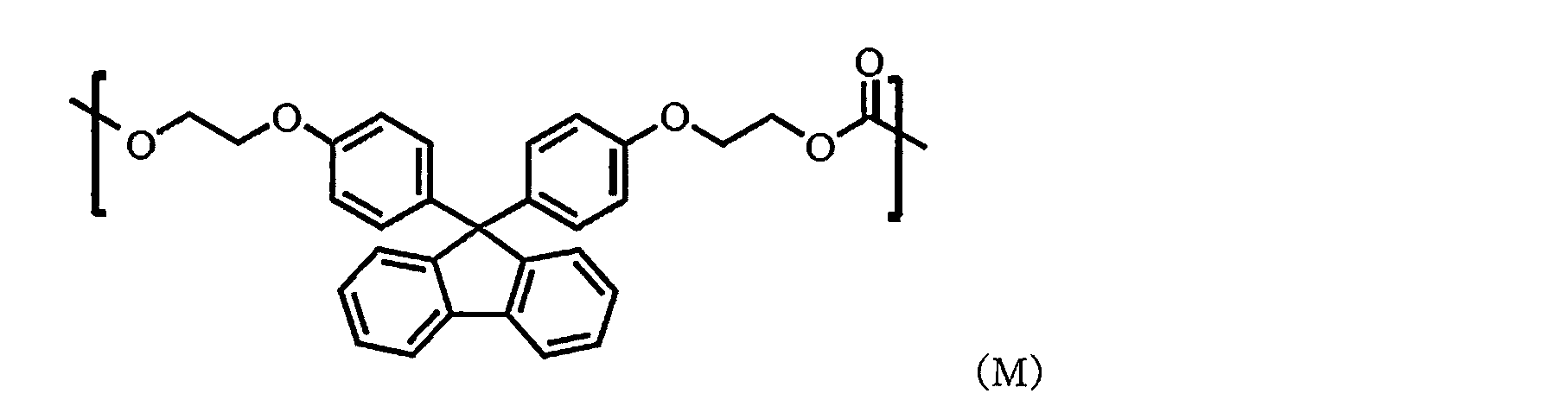
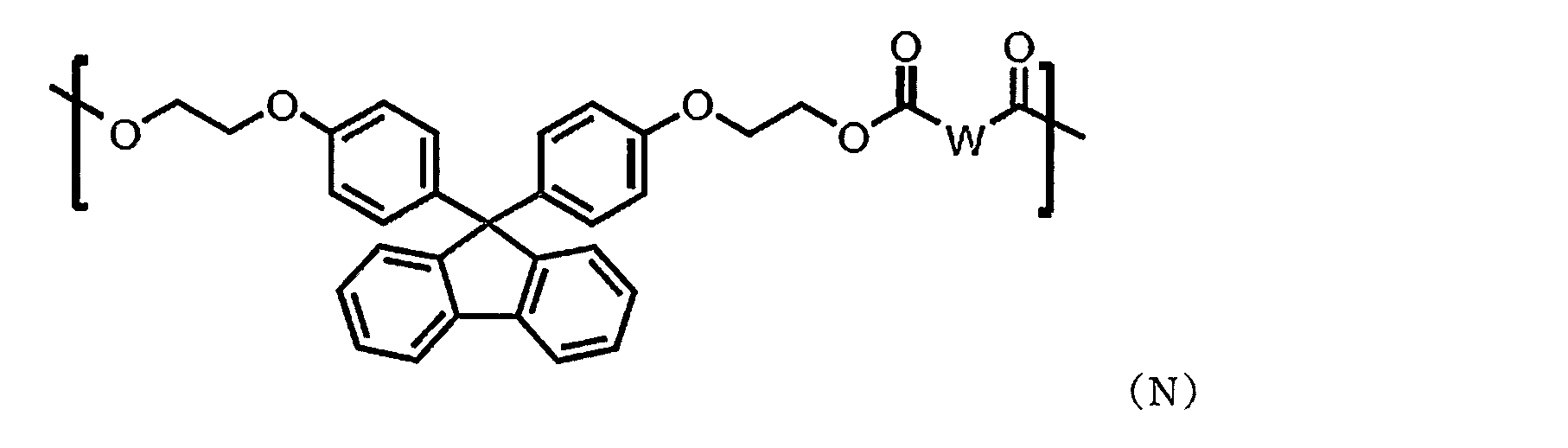
特許文献2には、アルミニウム化合物とリン化合物からなる触媒を用いたポリエステルカーボネート樹脂が一般的なチタン系触媒を用いた場合よりも色相が良好と記載されている。
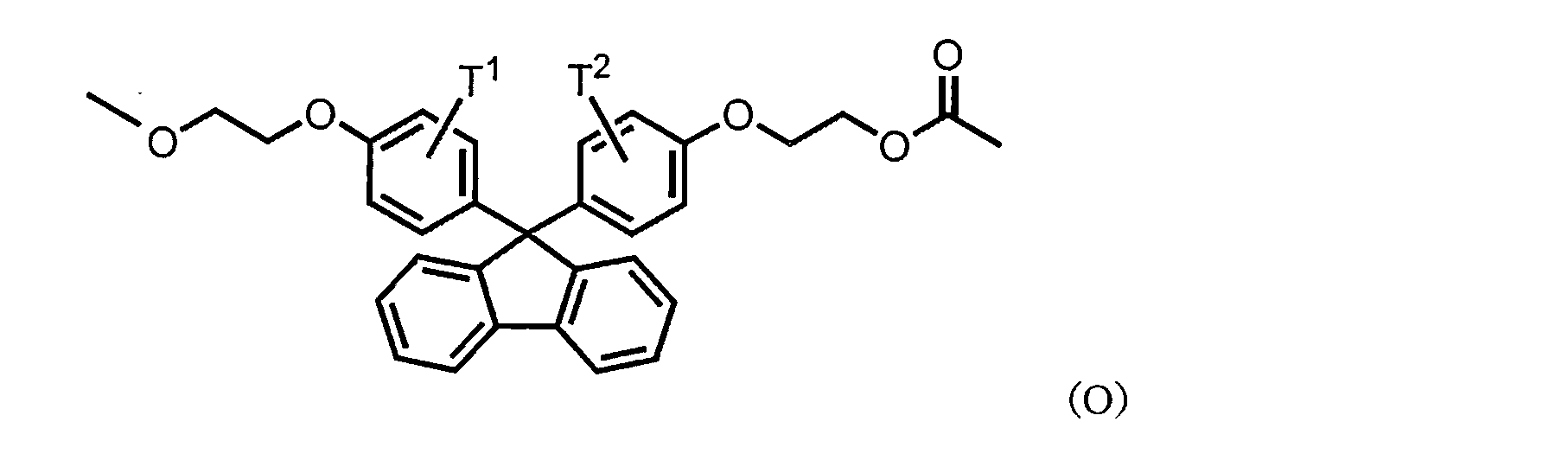
《態様1》
下記式(1)で表される構成単位を有する熱可塑性樹脂および離型剤を含む熱可塑性樹脂組成物であって、さらに熱可塑性樹脂組成物中の酸化防止剤の含有量が0~300ppmである熱可塑性樹脂組成物。
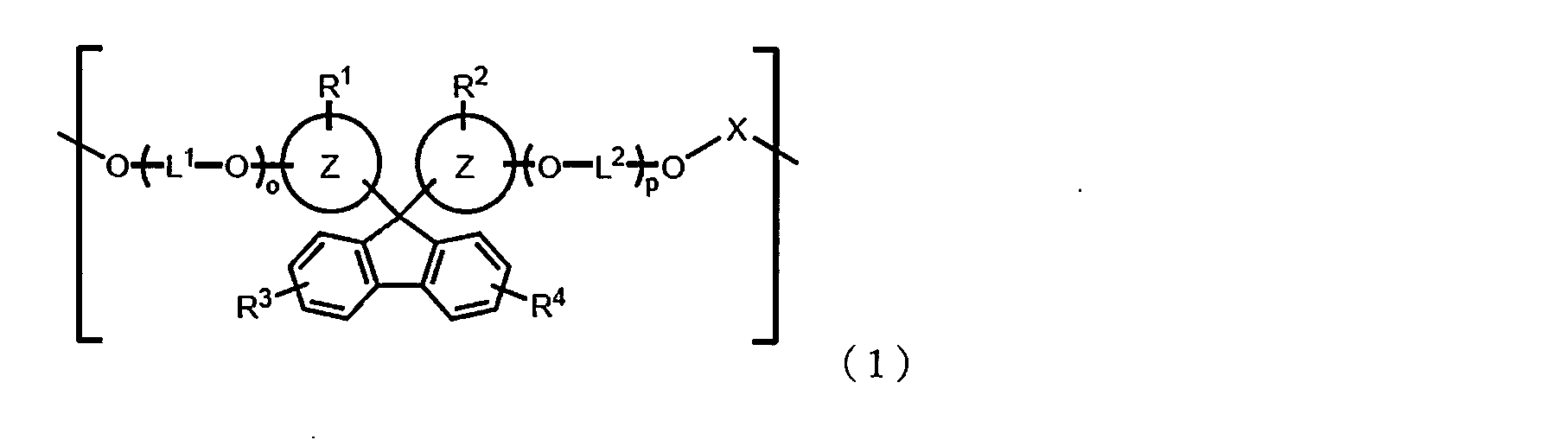


《態様2》
前記離型剤が熱可塑性樹脂組成物中に1~4000ppmの量で含まれる、態様1に記載の熱可塑性樹脂組成物。
《態様3》
前記熱可塑性樹脂組成物中の酸化防止剤の含有量が0~50ppmである、態様1又は2に記載の熱可塑性樹脂組成物。
《態様4》
乾熱黄変ΔYIが0.00~0.47である、態様1又は2に記載の熱可塑性樹脂組成物。
《態様5》
下記式(4)で表される構成単位を有する熱可塑性樹脂、色剤および酸化防止剤を含む熱可塑性樹脂組成物であって、前記熱可塑性樹脂組成物中における前記色剤の含有量が0.01~4.00ppm、前記酸化防止剤の含有量が50~3000ppmである熱可塑性樹脂組成物。
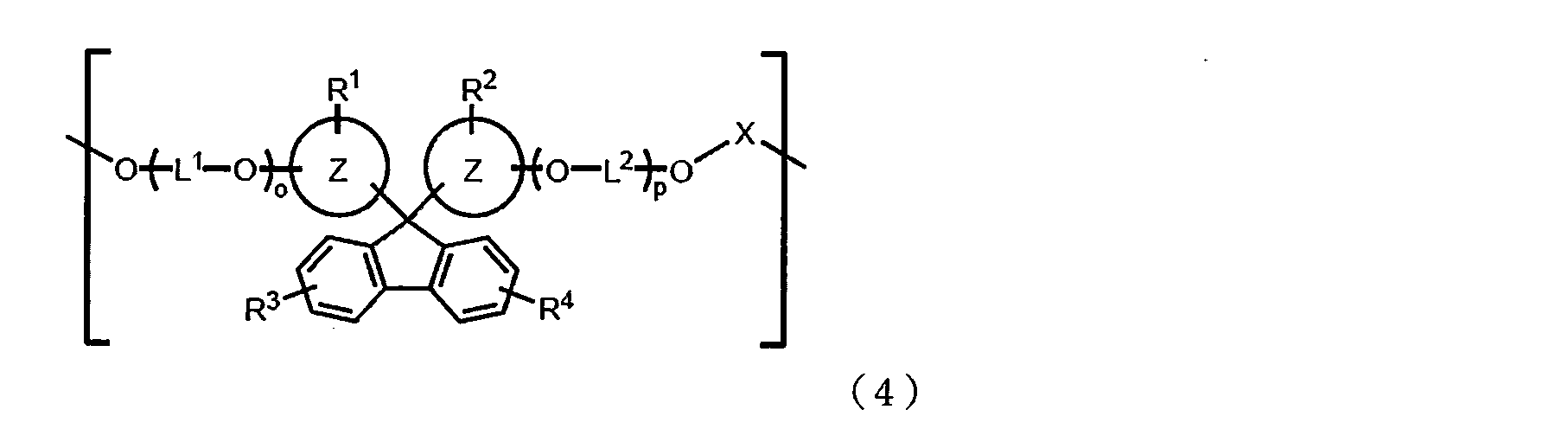


《態様6》
前記熱可塑性樹脂組成物の2mm厚成形板の色相a*が-0.40~0.00且つ、色相b*が-0.50~1.25である、態様5に記載の熱可塑性樹脂組成物。
《態様7》
前記熱可塑性樹脂組成物の2mm厚成形板の全光線透過率が86.5%以上である、態様5又は6に記載の熱可塑性樹脂組成物。
《態様8》
前記熱可塑性樹脂組成物の2mm厚成形板の400nm光線透過率が81.0%以上である、態様5又は6に記載の熱可塑性樹脂組成物。
《態様9》
前記熱可塑性樹脂組成物の2mm厚成形板の580nm光線透過率が85.0%以上である、態様5又は6に記載の熱可塑性樹脂組成物。
《態様10》
前記式(1)または式(4)中の環Zがベンゼン環である、態様1又は5に記載の熱可塑性樹脂組成物。
《態様11》
式(1)または式(4)で表される構成単位を有する熱可塑性樹脂が、ポリカーボネート樹脂またはポリエステルカーボネート樹脂である態様1又は5に記載の熱可塑性樹脂組成物。
《態様12》
式(1)または式(4)で表される構成単位を有する熱可塑性樹脂が、ポリエステルカーボネート樹脂である態様11に記載の熱可塑性樹脂組成物。
《態様13》
態様1又は5に記載の熱可塑性樹脂組成物を含む、光学部材。
《態様14》
光学レンズである、態様13に記載の光学部材。
〈本発明の態様I〉
本発明の態様IIの説明までは、以下、本発明と記載されている場合は、本発明の態様Iのことを表す。
(1)熱可塑性樹脂組成物
本発明の熱可塑性樹脂組成物は、所定の構造を有する熱可塑性樹脂と離型剤を含み、さらに熱可塑性樹脂組成物中の酸化防止剤の含有量が0~300ppmの熱可塑性樹脂組成物である。本発明の熱可塑性樹脂組成物は、このような構成により、高屈折率、低複屈折を有し、かつ、優れた長期耐熱性を有する。
《熱可塑性樹脂》
本発明に用いる熱可塑性樹脂は上記式(1)で表される構造を有する。
《上記式(1)で表される構造を有する熱可塑性樹脂に使用するジオール成分》
本発明の熱可塑性樹脂の上記式(1)で表される構造単位に使用するジオール成分は、主に式(a)で表される化合物である。

9,9-ビス(6-(3-ヒドロキシプロポキシ)-2-ナフチル)フルオレン、9,9-ビス(6-(3-ヒドロキシプロポキシ)-2-ナフチル)-2,7-ジメチルフルオレン、9,9-ビス(6-(3-ヒドロキシプロポキシ)-2-ナフチル)-2,7-ジフェニルフルオレンが挙げられる。
《上記式(a)以外のジオール成分》
本発明における熱可塑性樹脂は、上記式(a)で表されるジオール成分由来の上記式(1)の構造を有するが、本発明による効果を損なわない範囲で他のジオール成分由来の構造を含んでも良い。本発明における熱可塑性樹脂では、上記式(a)で表されるジオール成分を全ジオール成分中70mol%以上占めることが好ましく、80mol%以上であることがより好ましい。
《上記式(1)で表される構造を有する熱可塑性樹脂に使用するジカルボン酸成分》
本発明の熱可塑性樹脂がポリエステルカーボネート、ポリエステルなどの場合に使用するジカルボン酸成分は、主に式(b)で表される化合物、またはそのエステル形成誘導体である。
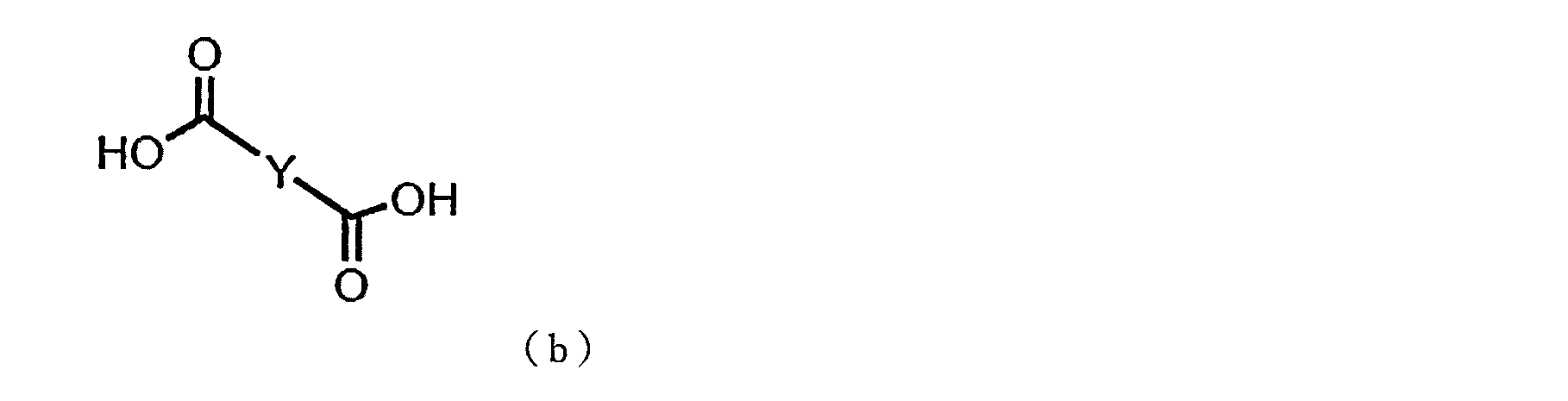
《ポリカーボネート樹脂の製造方法》
ポリカーボネート樹脂は、それ自体公知の反応手段、例えばジヒドロキシ化合物成分とカーボネート前駆物質を界面重合法または溶融重合法によって反応させて得られる。ポリカーボネート樹脂を製造するに当たっては、必要に応じて触媒、末端停止剤、酸化防止剤等を使用してもよい。国際公開第2017/078070号の記載を参考に製造することができる。
《ポリエステルカーボネート樹脂の製造方法》
ポリエステルカーボネート樹脂は、それ自体公知の反応手段、例えばジヒドロキシ化合物成分およびジカルボン酸またはそのエステル形成性誘導体と、ホスゲンやカーボネートエステルなどのカーボネート前駆物質とを反応させることにより製造することができる。特許文献1や2の記載を参考に製造することができる。
《ポリエステル樹脂の製造方法》
ポリエステル樹脂である場合はそれ自体公知の反応手段、例えばジヒドロキシ化合物成分とジカルボン酸またはそのエステル形成性誘導体とをエステル化反応もしくはエステル交換反応させ、得られた反応生成物を重縮合反応させ、所望の分子量の高分子量体とすればよい。特開2016―69643号公報の記載を参考に製造することができる。
《離型剤》
本発明の熱可塑性樹脂組成物は、離型剤を含み、離型剤の含有量として、熱可塑性樹脂組成物中に1~4000ppm含むことが好ましく、10~3500ppm含むことがより好ましく、50~3000ppm含むことがさらに好ましく、80~2500ppm含むことがよりさらに好ましく、300~2000ppm含むことが特に好ましく、700ppm~2000ppm含むことが最も好ましい。発明者は離型剤を上記範囲内で添加することで、離型性を向上させることに加え、高い長期耐熱性を発揮させることができることを見出した。長期耐熱性は、酸化劣化を抑制することで向上すると考えられる。よって、離型剤が樹脂中に存在することで、樹脂混錬時及び成形加工時の摩擦等からポリマー鎖を保護し負荷を低減する効果が奏され、酸化劣化を進行させるラジカル・過酸化物等の不安定構造生成が抑えられる為、長期耐熱性が向上すると推測される。併せて、樹脂混錬時及び成形加工時の酸化劣化が抑制されることで初期色相も良化する効果が奏される。
さらに、上記範囲内であれば離型剤の量が多すぎることによる屈折率の低下、全光線透過率の低下、金型付着汚れを抑制することができる。なお本書において「ppm」は「質量ppm」を意味する。
《酸化防止剤》
本発明の熱可塑性樹脂組成物において、熱可塑性樹脂組成物中に含まれる酸化防止剤の含有量は0~300ppmである。熱可塑性樹脂組成物中に含まれる酸化防止剤の量は0~200ppmであることが好ましく、0~100ppmであることがより好ましく、0~50ppmであることがさらに好ましく、0~10ppmであることがよりさらに好ましく、0~1ppmであることが特に好ましく、0ppmであることが最も好ましい。酸化防止剤が上記範囲内であることで、長期耐熱性に優れる。長期耐熱性は、酸化劣化を抑制することで向上するため、酸化防止剤のように容易に変化可能な構造を少なくし、酸化に強い安定な化学構造で熱可塑性樹脂組成物を構築することで長期耐熱性を向上させることができる。
、N,N-ヘキサメチレンビス(3,5-ジ-tert-ブチル-4-ヒドロキシ-ヒドロシンナマイド)、3,5-ジ-tert-ブチル-4-ヒドロキシ-ベンジルホスホネート-ジエチルエステル、トリス(3,5-ジ-tert-ブチル-4-ヒドロキシベンジル)イソシアヌレート、3,9-ビス{1,1-ジメチル-2-[β-(3-tert-ブチル-4-ヒドロキシ-5-メチルフェニル)プロピオニルオキシ]エチル}-2,4,8,10-テトラオキサスピロ(5,5)ウンデカンが挙げられる。
《任意の添加剤》
本発明の熱可塑性樹脂組成物には、必要に応じて、紫外線吸収剤、帯電防止剤、難燃剤、可塑剤、充填剤、滑剤、界面活性剤、抗菌剤、重合金属不活性化剤、相溶化剤、着色剤などの添加剤を適宜添加して樹脂組成物として用いることができる。
《熱可塑性樹脂組成物の製造方法》
本発明の熱可塑性樹脂組成物は、式(1)で表される構造を有する熱可塑性樹脂に離型剤及びその他添加剤を添加し、溶融混錬することで製造される。
《熱可塑性樹脂組成物の特性》
本発明の熱可塑性樹脂組成物は、優れた長期耐熱性を有する。本明細書において、「優れた長期耐熱性」とは射出成形物が長期にわたる高温暴露の前後で黄変が小さいことを示す。長期耐熱性は、熱可塑性樹脂組成物を射出成形し、得られた成形物に乾燥雰囲気下120℃で500時間暴露する乾熱試験を行い、試験前後での色の変化である乾熱黄変ΔYIを測定することで評価することができる。本発明の熱可塑性樹脂組成物の2mm厚成形物の乾熱黄変ΔYIは、0.00~0.47であることが好ましく、0.00~0.40であることがより好ましく、0.00~0.35であることがさらに好ましく、0.00~0.30であることがよりさらに好ましく、0.00~0.21であることがさらに好ましく、0.00~0.15であることが最も好ましい。乾熱黄変ΔYIが上記範囲内であると各種透明部材としての使用範囲が限定されず好ましい。
νd=(nd-1)/(nF-nC)
nd:波長587.56nmでの屈折率、
nF:波長486.13nmでの屈折率、
nC:波長656.27nmでの屈折率を意味する。
〈本発明の態様II〉
以下、本発明と記載されている場合は、本発明の態様IIのことを表す。
(1)熱可塑性樹脂組成物
本発明の熱可塑性樹脂組成物は、所定の構造を有する熱可塑性樹脂、色剤および酸化防止剤を含み、さらに熱可塑性樹脂組成物中の色剤の含有量が0.01~4.00ppm、酸化防止剤の含有量が50~3000ppmの熱可塑性樹脂組成物である。本発明の熱可塑性樹脂組成物は、このような構成により、高屈折率、低複屈折を有し、且つ、優れた透過率及び外観を有する。
《熱可塑性樹脂》
本発明に用いる熱可塑性樹脂は上記式(4)で表される構造を有する。
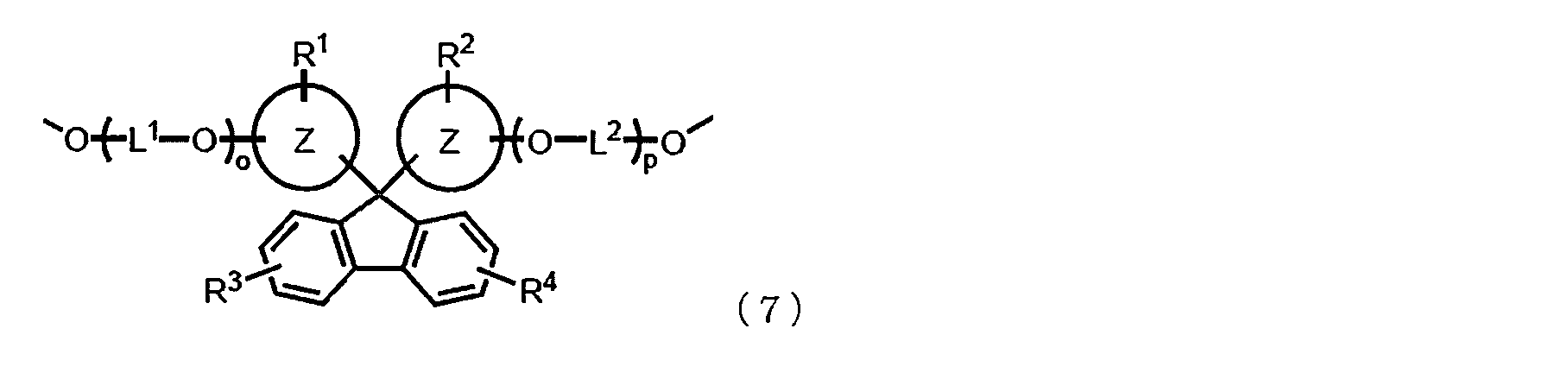
《上記式(4)で表される構造を有する熱可塑性樹脂に使用するジオール成分》
本発明の熱可塑性樹脂の上記式(4)で表される構造単位に使用するジオール成分は、主に式(a)で表される化合物である。

9,9-ビス(6-(3-ヒドロキシプロポキシ)-2-ナフチル)フルオレン、9,9-ビス(6-(3-ヒドロキシプロポキシ)-2-ナフチル)-2,7-ジメチルフルオレン、9,9-ビス(6-(3-ヒドロキシプロポキシ)-2-ナフチル)-2,7-ジフェニルフルオレンが挙げられる。
《上記式(a)以外のジオール成分》
本発明における熱可塑性樹脂は、上記式(a)で表されるジオール成分由来の上記式(4)の構造を有するが、本発明による効果を損なわない範囲で他のジオール成分由来の構造を含んでも良い。本発明における熱可塑性樹脂では、上記式(a)で表されるジオール成分を全ジオール成分中70mol%以上占めることが好ましく、80mol%以上であることがより好ましい。
《上記式(4)で表される構造を有する熱可塑性樹脂に使用するジカルボン酸成分》
本発明の熱可塑性樹脂がポリエステルカーボネート樹脂、ポリエステル樹脂などの場合に使用するジカルボン酸成分は、主に式(b)で表される化合物、またはそのエステル形成誘導体である。

《ポリカーボネート樹脂の製造方法》
ポリカーボネート樹脂は、それ自体公知の反応手段、例えばジヒドロキシ化合物成分とカーボネート前駆物質を界面重合法または溶融重合法によって反応させて得られる。ポリカーボネート樹脂を製造するに当たっては、必要に応じて触媒、末端停止剤、酸化防止剤等を使用してもよい。国際公開第2017/078070号の記載を参考に製造することができる。
《ポリエステルカーボネート樹脂の製造方法》
ポリエステルカーボネート樹脂は、それ自体公知の反応手段、例えばジヒドロキシ化合物成分およびジカルボン酸またはそのエステル形成性誘導体と、ホスゲンやカーボネートエステルなどのカーボネート前駆物質とを反応させることにより製造することができる。特許文献1や2の記載を参考に製造することができる。
《ポリエステル樹脂の製造方法》
ポリエステル樹脂である場合はそれ自体公知の反応手段、例えばジヒドロキシ化合物成分とジカルボン酸またはそのエステル形成性誘導体とをエステル化反応もしくはエステル交換反応させ、得られた反応生成物を重縮合反応させ、所望の分子量の高分子量体とすればよい。特開2016―69643号公報の記載を参考に製造することができる。
《色剤》
本発明の熱可塑性樹脂組成物は、色剤を含む。色剤の含有量として、熱可塑性樹脂組成物中に0.01~4.00ppm含むことが好ましく、0.50~3.50ppm含むことがより好ましく、0.80~3.00ppm含むことがさらに好ましく、1.00~2.75ppm含むことがよりさらに好ましく、1.20~2.50ppm含むことが特に好ましく、1.40ppm~2.25ppm含むことが最も好ましい。発明者は色剤を上記範囲内で添加することで、可視光をバランスよく高透過させつつ(400nm光線透過率、580nm光線透過率、そして全光線透過率が高い)、高屈折率光学用樹脂特有の黄色味を解消し、ガラスのような青緑系統色の優れた外観を発現させることができることを見出した。
《酸化防止剤》
本発明の熱可塑性樹脂組成物において、熱可塑性樹脂組成物中に含まれる酸化防止剤の含有量は50~3000ppmである。熱可塑性樹脂組成物中に含まれる酸化防止剤の量は50~3000ppmであることが好ましく、100~2500ppmであることがより好ましく、200~2000ppmであることがさらに好ましく、300~1500ppmであることがよりさらに好ましく、400~1200ppmであることが特に好ましく、500~1000ppmであることが最も好ましい。酸化防止剤が上記範囲内であることで、熱劣化を効果的に防止し、400nm付近の可視光短波長域の透過率低下を抑制して高透過率を維持できるとともに、色相の黄変を防ぐことができる。さらに、上記範囲内であれば酸化防止剤の量が多すぎることによる屈折率の低下、透過率の低下、金型付着汚れを抑制することができる。
なかでもトリス(2,4-ジ-tert-ブチルフェニル)ホスファイト、ビス(2,6-ジ-tert-ブチル-4-メチルフェニル)ペンタエリスリトールジホスファイト、テトラキス(2,4-ジ-tert-ブチルフェニル)-4,4’-ビフェニレンジホスホナイト、ジスステアリルペンタエリスリトールジホスファイト、ビス(2,4-ジクミルフェニル)ペンタエリスリトールジホスファイト、環状ネオペンタンテトライルビス(2,6-ジ-tert-ブチル-4-メチルフェニルホスファイト)、ビス(2,4-ジ-tert-ブチルフェニル)ペンタエリスリトールジホスファイトが好ましく、環状ネオペンタンテトライルビス(2,6-ジ-tert-ブチル-4-メチルフェニルホスファイト)がより好ましい。環状ネオペンタンテトライルビス(2,6-ジ-tert-ブチル-4-メチルフェニルホスファイト)は、過酸化物からの酸素捕集能力に優れ、少量でも熱可塑性樹脂組成物の熱劣化による400nm付近の可視光短波長域の透過率低下を抑制することができる。
《任意の添加剤》
本発明の熱可塑性樹脂組成物には、必要に応じて、離型剤、紫外線吸収剤、帯電防止剤、難燃剤、可塑剤、充填剤、滑剤、界面活性剤、抗菌剤、重合金属不活性化剤、相溶化剤、着色剤などの添加剤を適宜添加して樹脂組成物として用いることができる。
《熱可塑性樹脂組成物の製造方法》
本発明の熱可塑性樹脂組成物は、式(4)で表される構造を有する熱可塑性樹脂に色剤、酸化防止剤及びその他添加剤を添加し、溶融混錬することで製造される。
《熱可塑性樹脂組成物の特性》
本発明の熱可塑性樹脂組成物は、高屈折率及び低複屈折を有し、且つ、優れた透過性および優れた外観を有する。本明細書において、「優れた透過性」とは、可視光の透過率が高く且つ透過バランスが整っていること、「優れた外観」とは、黄色味が無くガラスのような青緑系統色であることを示す。
νd=(nd-1)/(nF-nC)
nd:波長587.56nmでの屈折率、
nF:波長486.13nmでの屈折率、
nC:波長656.27nmでの屈折率を意味する。
〈本発明の態様I、態様IIにおける光学部材、光学レンズ〉
(2)光学部材
本発明の態様Iまたは態様IIにおける光学部材は、上記の熱可塑性樹脂組成物をそれぞれ含む。そのような光学部材としては、上記の熱可塑性樹脂組成物が有用となる光学用途であれば、特に限定されないが、光学レンズ、導光板、光ディスク、透明導電性基板、光カード、シート、フィルム、光ファイバー、レンズ、プリズム、光学膜、基盤、光学フィルター、ハードコート膜等を挙げることができる。
(3)光学レンズ
本発明の態様Iまたは態様IIにおける光学部材として、特に光学レンズを挙げることができる。このような光学レンズとしては、携帯電話、スマートフォン、タブレット端末、パソコン、デジタルカメラ、ビデオカメラ、車載カメラ、監視カメラ等のための撮像レンズや、TOFカメラ等のセンシングカメラ、さらにスマートグラス、ヘッドマウントディスプレイを代表するAR/VR機器のためのレンズを挙げることができる。
《評価方法》
〈屈折率nd〉
各熱可塑性樹脂組成物の3mm厚板を作製し、切削、研磨した後、(株)島津製作所製のカルニュー精密屈折計KPR-2000を使用して、屈折率nd(587.56nm)を測定した。
〈アッベ数νd〉
アッベ数の測定波長は、486.13nm、587.56nm、656.27nmの屈折率から下記の式を用いて算出した。
nd:波長587.56nmでの屈折率、
nF:波長486.13nmでの屈折率、
nC:波長656.27nmでの屈折率を意味する。
〈初期色相YI〉
各熱可塑性樹脂組成物の2mm厚板を作製し、日本電色工業(株)製 色彩・濁度同時測定器COH 400(D65光源、10°視野)により、YIを測定した。
〈乾熱黄変ΔYI〉
各熱可塑性樹脂組成物の2mm厚板を作製し、乾燥雰囲気下120℃に500時間暴露する乾熱試験を行い、試験前後でのYIを日本電色工業(株)製 色彩・濁度同時測定器COH 400(D65光源、10°視野)で測定した後、以下の式を用いて乾熱黄変ΔYIを算出した。
〈色相L*、a*、b*〉
熱可塑性樹脂組成物の2mm厚板を作製し、日本電色工業(株)製 色彩・濁度同時測定器COH 400(D65光源、10°視野)により、L*、a*、b*を測定した。
〈黄色度YI〉
熱可塑性樹脂組成物の2mm厚板を作製し、日本電色工業(株)製 色彩・濁度同時測定器COH 400(D65光源、10°視野)により、YIを測定した。
〈全光線透過率Tt〉
熱可塑性樹脂組成物の2mm厚板を作製し、日本電色工業(株)製 色彩・濁度同時測定器COH 400(D65光源、10°視野)により、Tt(%)を測定した。
〈400nm光線透過率及び580nm光線透過率〉
熱可塑性樹脂組成物の2mm厚板を作製し、日本分光(株)製 紫外可視近赤外分光光度計V-770EXにより、400nm光線透過率(%)及び580nm光線透過率(%)を測定した。
〈粘度平均分子量Mv〉
熱可塑性樹脂組成物の粘度平均分子量を、以下の方法で測定した。熱可塑性樹脂組成物0.7gを塩化メチレン100mlに溶解した溶液から、その溶液の20℃における比粘度(ηsp)を測定した。そして、下記式により算出されるMvを粘度平均分子量とした。
ηsp/c=[η]+0.45×[η]2c
[η]=1.23×10⁻⁴Mv0.83
ηsp:比粘度
η:極限粘度
c:定数(=0.7)
Mv:粘度平均分子量
〈配向複屈折の絶対値|Δn|〉
熱可塑性樹脂組成物を塩化メチレンに溶解した後、ガラスシャーレ上にキャストし、十分乾燥することで厚さ100μmのキャストフィルムを作製した。該フィルムをTg+10℃で2倍延伸し、日本分光(株)製エリプソメーターM-220を用いて589nmにおける位相差(Re)を測定し、下記式より配向複屈折の絶対値(|Δn|)を求めた。
Δn:配向複屈折
Re:位相差(nm)
d:厚さ(nm)
<本発明の態様I>
〈合成例1〉(ポリエステルカーボネート樹脂(PEC1)の製造)
9,9-ビス(4-(2-ヒドロキシエトキシ)フェニル)フルオレン(以下、BPEFと省略することがある)82.0mol、テレフタル酸ジメチル(以下、DMTと省略することがある)18.0mol、ジフェニルカーボネート(以下、DPCと省略することがある)71.0mol、アルミニウムアセチルアセトネート(以下、Cat.Alと省略することがある)1.5×10⁻²mol及び3,5-ジ-tert-ブチル-4-ヒドロキシベンジルホスホン酸ジエチル(以下、Cat.Pと省略することがある)3.0×10⁻²molを攪拌機および留出装置付きの反応釜に入れ、窒素置換を3度行った後、ジャケットを200℃に加熱し、原料を溶融させた。
〈合成例2〉(ポリエステルカーボネート樹脂(PEC2)の製造)
特許文献1の実施例4を参考に、BPEF90.0mol、DMT10.0mol、DPC84.0mol及びチタンテトラブトキシド(以下、Cat.Tiと省略することがある)1.0×10⁻²molを攪拌機および留出装置付きの反応釜に入れ、窒素置換を3度行った後、ジャケットを180℃に加熱し、原料を溶融させた。
〈合成例3〉(ポリカーボネート樹脂(PC1)の製造)
BPEF100.0mol、DPC104.0mol及び炭酸水素ナトリウム(以下、Cat.Naと省略することがある)6.0×10⁻⁴mol(炭酸水素ナトリウムは0.1wt%水溶液の状態で添加した)を攪拌機および留出装置付きの反応釜に入れ、窒素置換を3度行った後、ジャケットを200℃に加熱し、原料を溶融させた。
〈実施例1〉
合成例1で得られたポリエステルカーボネート樹脂(PEC1)と離型剤としてステアリン酸モノグリセリド[製品名:理研ビタミン株式会社製のリケマールS-100A]を表1に示す質量比で配合し、よく混合した後、押出機(日本製鋼所製 TEX30α 30mmφ二軸押出機)により270℃、ベント圧力30mmHgで溶融混練した。溶融混錬によって得られた熱可塑性樹脂組成物をストランド状に押出した後、ペレタイザーを用いてペレット化して、熱可塑性樹脂組成物のペレットを得た。該ペレットのMvは9,800であった。該ペレットを280℃で射出成型して2mm厚及び3mm厚の板状成型片を得た。成型体は透明であった。評価結果を表1に示す。
〈実施例2〉
合成例1で得られたポリエステルカーボネート樹脂(PEC1)と離型剤リケマールS-100Aを表1に示す質量比で配合し、よく混合した後、押出機(日本製鋼所製 TEX30α 30mmφ二軸押出機)により270℃、ベント圧力30mmHgで溶融混練した。溶融混錬によって得られた熱可塑性樹脂組成物をストランド状に押出した後、ペレタイザーを用いてペレット化して、熱可塑性樹脂組成物のペレットを得た。該ペレットのMvは9,800であった。該ペレットを280℃で射出成型して2mm厚及び3mm厚の板状成型片を得た。成型体は透明であった。評価結果を表1に示す。
〈実施例3〉
合成例1で得られたポリエステルカーボネート樹脂(PEC1)と離型剤リケマールS-100Aを表1に示す質量比で配合し、よく混合した後、押出機(日本製鋼所製 TEX30α 30mmφ二軸押出機)により270℃、ベント圧力30mmHgで溶融混練した。溶融混錬によって得られた熱可塑性樹脂組成物をストランド状に押出した後、ペレタイザーを用いてペレット化して、熱可塑性樹脂組成物のペレットを得た。該ペレットのMvは9,900であった。該ペレットを280℃で射出成型して2mm厚及び3mm厚の板状成型片を得た。成型体は透明であった。評価結果を表1に示す。
〈実施例4〉
合成例1で得られたポリエステルカーボネート樹脂(PEC1)と離型剤リケマールS-100Aを表1に示す質量比で配合し、よく混合した後、押出機(日本製鋼所製 TEX30α 30mmφ二軸押出機)により270℃、ベント圧力30mmHgで溶融混練した。溶融混錬によって得られた熱可塑性樹脂組成物をストランド状に押出した後、ペレタイザーを用いてペレット化して、熱可塑性樹脂組成物のペレットを得た。該ペレットのMvは9,800であった。該ペレットを280℃で射出成型して2mm厚及び3mm厚の板状成型片を得た。成型体は透明であった。評価結果を表1に示す。
〈実施例5〉
合成例3で得られたポリカーボネート樹脂(PC1)と離型剤リケマールS-100Aを表1に示す質量比で配合し、よく混合した後、押出機(日本製鋼所製 TEX30α 30mmφ二軸押出機)により270℃、ベント圧力30mmHgで溶融混練した。溶融混錬によって得られた熱可塑性樹脂組成物をストランド状に押出した後、ペレタイザーを用いてペレット化して、熱可塑性樹脂組成物のペレットを得た。該ペレットのMvは9,600であった。該ペレットを280℃で射出成型して2mm厚及び3mm厚の板状成型片を得た。成型体は透明であった。評価結果を表1に示す。
〈実施例6〉
合成例1で得られたポリエステルカーボネート樹脂(PEC1)と離型剤リケマールS-100A及び酸化防止剤として環状ネオペンタンテトライルビス(2,6-ジ-tert-ブチル-4-メチルフェニルホスファイト)[製品名:株式会社ADEKA製のアデカスタブPEP-36]を表1に示す質量比で配合し、よく混合した後、押出機(日本製鋼所製 TEX30α 30mmφ二軸押出機)により270℃、ベント圧力30mmHgで溶融混練した。溶融混錬によって得られた熱可塑性樹脂組成物をストランド状に押出した後、ペレタイザーを用いてペレット化して、熱可塑性樹脂組成物のペレットを得た。該ペレットのMvは9,900であった。該ペレットを280℃で射出成型して2mm厚及び3mm厚の板状成型片を得た。成型体は透明であった。評価結果を表1に示す。
〈比較例1〉
合成例1で得られたポリエステルカーボネート樹脂(PEC1)と離型剤リケマールS-100A及び酸化防止剤PEP-36を表1に示す質量比で配合し、よく混合した後、押出機(日本製鋼所製 TEX30α 30mmφ二軸押出機)により270℃、ベント圧力30mmHgで溶融混練した。溶融混錬によって得られた熱可塑性樹脂組成物をストランド状に押出した後、ペレタイザーを用いてペレット化して、熱可塑性樹脂組成物のペレットを得た。該ペレットのMvは9,900であった。該ペレットを280℃で射出成型して2mm厚及び3mm厚の板状成型片を得た。成型体は透明であった。評価結果を表1に示す。
〈比較例2〉
合成例3で得られたポリカーボネート樹脂(PC1)と離型剤リケマールS-100A及び酸化防止剤PEP-36を表1に示す質量比で配合し、よく混合した後、押出機(日本製鋼所製 TEX30α 30mmφ二軸押出機)により270℃、ベント圧力30mmHgで溶融混練した。溶融混錬によって得られた熱可塑性樹脂組成物をストランド状に押出した後、ペレタイザーを用いてペレット化して、熱可塑性樹脂組成物のペレットを得た。該ペレットのMvは9,700であった。該ペレットを280℃で射出成型して2mm厚及び3mm厚の板状成型片を得た。成型体は透明であった。評価結果を表1に示す。
〈比較例3〉
特許文献1の実施例4を参考に、合成例2で得られたポリエステルカーボネート樹脂(PEC2)と離型剤としてペンタエリスリトールテトラステアレート及び酸化防止剤としてビス(2,4-ジクミルフェニル)ペンタエリスリトールジホスファイトを表1に示す質量比で配合し、よく混合した後、押出機(日本製鋼所製 TEX30α 30mmφ二軸押出機)により270℃、ベント圧力30mmHgで溶融混練した。溶融混錬によって得られた熱可塑性樹脂組成物をストランド状に押出した後、ペレタイザーを用いてペレット化して、熱可塑性樹脂組成物のペレットを得た。該ペレットのMvは10,600であった。該ペレットを280℃で射出成型して2mm厚及び3mm厚の板状成型片を得た。成型体は透明であった。評価結果を表1に示す。
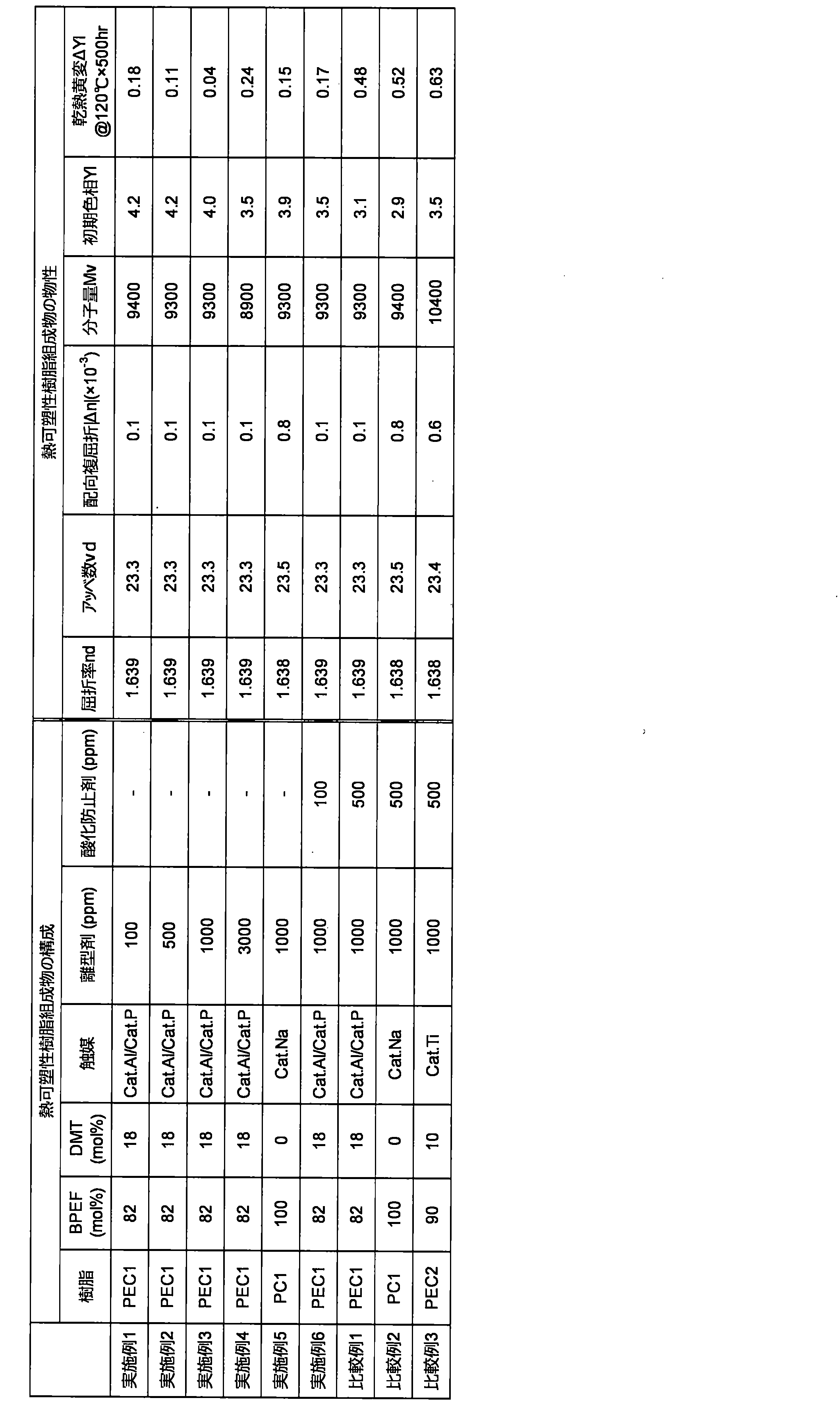
<本発明の態様II>
[合成例]
〈合成例4〉(ポリエステルカーボネート樹脂(PEC3)の製造)
9,9-ビス(4-(2-ヒドロキシエトキシ)フェニル)フルオレン(以下、BPEFと省略することがある)30.00質量部、テレフタル酸ジメチル(以下、DMTと省略することがある)2.92質量部、ジフェニルカーボネート(以下、DPCと省略することがある)12.69質量部、アルミニウムアセチルアセトネート(以下、Cat.Alと省略することがある)4.05×10⁻³質量部、3,5-ジ-tert-ブチル-4-ヒドロキシベンジルホスホン酸ジエチル(以下、Cat.Pと省略することがある)8.91×10⁻³質量部及び色剤としてSolvent Blue 45[製品名:クラリアント社製のポリシンスレンブルーRLS(Polysynthren Blue RLS)」](以下、PBと省略することがある)9.97×10⁻⁵質量部を攪拌機および留出装置付きの反応釜に入れ、窒素置換を3度行った後、ジャケットを200℃に加熱し、原料を溶融させた。
〈合成例5〉(ポリエステルカーボネート樹脂(PEC4)の製造)
合成例4のPBの使用量を8.31×10⁻⁵質量部とする以外は合成例4と同様に合成して、ポリエステルカーボネート樹脂(PEC4)のペレットを得た。得られたポリエステルカーボネート樹脂(PEC4)のMvは10,300であった。
〈合成例6〉(ポリエステルカーボネート樹脂(PEC5)の製造)
合成例4のPBの使用量を6.65×10⁻⁵質量部とする以外は合成例4と同様に合成して、ポリエステルカーボネート樹脂(PEC5)のペレットを得た。得られたポリエステルカーボネート樹脂(PEC5)のMvは10,400であった。
〈合成例7〉(ポリエステルカーボネート樹脂(PEC6)の製造)
合成例4のPBの使用量を4.99×10⁻⁵質量部とする以外は合成例4と同様に合成して、ポリエステルカーボネート樹脂(PEC6)のペレットを得た。得られたポリエステルカーボネート樹脂(PEC6)のMvは10,400であった。
〈合成例8〉(ポリエステルカーボネート樹脂(PEC7)の製造)
合成例4のPBの使用量を3.32×10⁻⁵質量部とする以外は合成例4と同様に合成して、ポリエステルカーボネート樹脂(PEC7)のペレットを得た。得られたポリエステルカーボネート樹脂(PEC7)のMvは10,400であった。
〈合成例9〉(ポリエステルカーボネート樹脂(PEC8)の製造)
合成例4のPBの使用量を1.66×10⁻⁵質量部とする以外は合成例4と同様に合成して、ポリエステルカーボネート樹脂(PEC8)のペレットを得た。得られたポリエステルカーボネート樹脂(PEC8)のMvは10,400であった。
〈合成例10〉(ポリエステルカーボネート樹脂(PEC9)の製造)
合成例4のPBを含まない以外は合成例4と同様に合成して、ポリエステルカーボネート樹脂(PEC9)のペレットを得た。得られたポリエステルカーボネート樹脂(PEC9)のMvは10,400であった。
〈合成例11〉(ポリエステルカーボネート樹脂(PEC10)の製造)
合成例4のPBの使用量を1.66×10⁻⁴質量部とする以外は合成例4と同様に合成して、ポリエステルカーボネート樹脂(PEC10)のペレットを得た。得られたポリエステルカーボネート樹脂(PEC10)のMvは10,200であった。
〈合成例12〉(ポリエステルカーボネート樹脂(PEC11)の製造)
特許文献1の実施例4を参考に、BPEF30.00質量部、DMT1.48質量部、DPC13.68質量部及びチタンテトラブトキシド(以下、Cat.Tiと省略することがある)2.59×10⁻³質量部を攪拌機および留出装置付きの反応釜に入れ、窒素置換を3度行った後、ジャケットを180℃に加熱し、原料を溶融させた。
〈合成例13〉(ポリカーボネート樹脂(PC2)の製造)
BPEF30.00質量部、DPC15.24質量部、炭酸水素ナトリウム(以下、Cat.Naと省略することがある)3.45×10⁻⁵質量部(炭酸水素ナトリウムは0.1wt%水溶液の状態で添加した)及びPB4.80×10-5質量部を攪拌機および留出装置付きの反応釜に入れ、窒素置換を3度行った後、ジャケットを200℃に加熱し、原料を溶融させた。
〈合成例14〉(ポリカーボネート樹脂(PC3)の製造)
合成例13のPBを含まない以外は合成例13と同様に合成して、ポリカーボネート樹脂(PC3)のペレットを得た。得られたポリカーボネート樹脂(PC3)のMvは9,800であった。
〈実施例7〉
合成例4で得られたポリエステルカーボネート樹脂(PEC3)と離型剤としてグリセリンモノステアレート[製品名:理研ビタミン株式会社製のリケマールS-100A]及び酸化防止剤として環状ネオペンタンテトライルビス(2,6-ジ-tert-ブチル-4-メチルフェニルホスファイト)[製品名:株式会社ADEKA製のアデカスタブPEP-36]を表1に示す質量比で配合し、よく混合した後、押出機(日本製鋼所製 TEX30α 30mmφ二軸押出機)により270℃、ベント圧力4.0kPaで溶融混練した。溶融混錬によって得られた熱可塑性樹脂組成物をストランド状に押出した後、ペレタイザーを用いてペレット化して、熱可塑性樹脂組成物のペレットを得た。該ペレットのMvは10,000であった。該ペレットを280℃で射出成型して2mm厚及び3mm厚の板状成型片を得た。成型体は透明であった。評価結果を表2に示す。
〈実施例8〉
合成例5で得られたポリエステルカーボネート樹脂(PEC4)と離型剤としてグリセリンモノステアレート[製品名:理研ビタミン株式会社製のリケマールS-100A]及び酸化防止剤として環状ネオペンタンテトライルビス(2,6-ジ-tert-ブチル-4-メチルフェニルホスファイト)[製品名:株式会社ADEKA製のアデカスタブPEP-36]を表2に示す質量比で配合する以外は実施例7と同様に溶融混錬及びペレット化して、熱可塑性樹脂組成物のペレットを得た。該ペレットのMvは10,000であった。該ペレットを280℃で射出成型して2mm厚及び3mm厚の板状成型片を得た。成型体は透明であった。評価結果を表2に示す。
〈実施例9〉
合成例6で得られたポリエステルカーボネート樹脂(PEC5)と離型剤としてグリセリンモノステアレート[製品名:理研ビタミン株式会社製のリケマールS-100A]及び酸化防止剤として環状ネオペンタンテトライルビス(2,6-ジ-tert-ブチル-4-メチルフェニルホスファイト)[製品名:株式会社ADEKA製のアデカスタブPEP-36]を表2に示す質量比で配合する以外は実施例7と同様に溶融混錬及びペレット化して、熱可塑性樹脂組成物のペレットを得た。該ペレットのMvは10,100であった。該ペレットを280℃で射出成型して2mm厚及び3mm厚の板状成型片を得た。成型体は透明であった。評価結果を表2に示す。
〈実施例10〉
合成例7で得られたポリエステルカーボネート樹脂(PEC6)と離型剤としてグリセリンモノステアレート[製品名:理研ビタミン株式会社製のリケマールS-100A]及び酸化防止剤として環状ネオペンタンテトライルビス(2,6-ジ-tert-ブチル-4-メチルフェニルホスファイト)[製品名:株式会社ADEKA製のアデカスタブPEP-36]を表2に示す質量比で配合する以外は実施例7と同様に溶融混錬及びペレット化して、熱可塑性樹脂組成物のペレットを得た。該ペレットのMvは10,100であった。該ペレットを280℃で射出成型して2mm厚及び3mm厚の板状成型片を得た。成型体は透明であった。評価結果を表2に示す。
〈実施例11〉
合成例8で得られたポリエステルカーボネート樹脂(PEC7)と離型剤としてグリセリンモノステアレート[製品名:理研ビタミン株式会社製のリケマールS-100A]及び酸化防止剤として環状ネオペンタンテトライルビス(2,6-ジ-tert-ブチル-4-メチルフェニルホスファイト)[製品名:株式会社ADEKA製のアデカスタブPEP-36]を表2に示す質量比で配合する以外は実施例7と同様に溶融混錬及びペレット化して、熱可塑性樹脂組成物のペレットを得た。該ペレットのMvは10,200であった。該ペレットを280℃で射出成型して2mm厚及び3mm厚の板状成型片を得た。成型体は透明であった。評価結果を表2に示す。
〈実施例12〉
合成例9で得られたポリエステルカーボネート樹脂(PEC8)と離型剤としてグリセリンモノステアレート[製品名:理研ビタミン株式会社製のリケマールS-100A]及び酸化防止剤として環状ネオペンタンテトライルビス(2,6-ジ-tert-ブチル-4-メチルフェニルホスファイト)[製品名:株式会社ADEKA製のアデカスタブPEP-36]を表2に示す質量比で配合する以外は実施例7と同様に溶融混錬及びペレット化して、熱可塑性樹脂組成物のペレットを得た。該ペレットのMvは10,100であった。該ペレットを280℃で射出成型して2mm厚及び3mm厚の板状成型片を得た。成型体は透明であった。評価結果を表2に示す。
〈実施例13〉
合成例7で得られたポリエステルカーボネート樹脂(PEC6)と離型剤としてグリセリンモノステアレート[製品名:理研ビタミン株式会社製のリケマールS-100A]及び酸化防止剤として環状ネオペンタンテトライルビス(2,6-ジ-tert-ブチル-4-メチルフェニルホスファイト)[製品名:株式会社ADEKA製のアデカスタブPEP-36]を表2に示す質量比で配合する以外は実施例7と同様に溶融混錬及びペレット化して、熱可塑性樹脂組成物のペレットを得た。該ペレットのMvは10,100であった。該ペレットを280℃で射出成型して2mm厚及び3mm厚の板状成型片を得た。成型体は透明であった。評価結果を表2に示す。
〈実施例14〉
合成例7で得られたポリエステルカーボネート樹脂(PEC6)と離型剤としてグリセリンモノステアレート[製品名:理研ビタミン株式会社製のリケマールS-100A]及び酸化防止剤として環状ネオペンタンテトライルビス(2,6-ジ-tert-ブチル-4-メチルフェニルホスファイト)[製品名:株式会社ADEKA製のアデカスタブPEP-36]を表2に示す質量比で配合する以外は実施例7と同様に溶融混錬及びペレット化して、熱可塑性樹脂組成物のペレットを得た。該ペレットのMvは10,100であった。該ペレットを280℃で射出成型して2mm厚及び3mm厚の板状成型片を得た。成型体は透明であった。評価結果を表2に示す。
〈実施例15〉
合成例13で得られたポリカーボネート樹脂(PC2)と離型剤としてグリセリンモノステアレート[製品名:理研ビタミン株式会社製のリケマールS-100A]及び酸化防止剤として環状ネオペンタンテトライルビス(2,6-ジ-tert-ブチル-4-メチルフェニルホスファイト)[製品名:株式会社ADEKA製のアデカスタブPEP-36]を表2に示す質量比で配合する以外は実施例7と同様に溶融混錬及びペレット化して、熱可塑性樹脂組成物のペレットを得た。該ペレットのMvは9,500であった。該ペレットを280℃で射出成型して2mm厚及び3mm厚の板状成型片を得た。成型体は透明であった。評価結果を表2に示す。
〈比較例4〉
合成例10で得られたポリエステルカーボネート樹脂(PEC9)と離型剤としてグリセリンモノステアレート[製品名:理研ビタミン株式会社製のリケマールS-100A]を表2に示す質量比で配合し、よく混合した後、押出機(日本製鋼所製 TEX30α 30mmφ二軸押出機)により270℃、ベント圧力4.0kPaで溶融混練した。溶融混錬によって得られた熱可塑性樹脂組成物をストランド状に押出した後、ペレタイザーを用いてペレット化して、熱可塑性樹脂組成物のペレットを得た。該ペレットのMvは9,900であった。該ペレットを280℃で射出成型して2mm厚及び3mm厚の板状成型片を得た。成型体は透明であった。評価結果を表2に示す。
〈比較例5〉
合成例6で得られたポリエステルカーボネート樹脂(PEC5)と離型剤としてグリセリンモノステアレート[製品名:理研ビタミン株式会社製のリケマールS-100A]を表1に示す質量比で配合する以外は比較例4と同様に溶融混錬及びペレット化して、熱可塑性樹脂組成物のペレットを得た。該ペレットのMvは10,100であった。該ペレットを280℃で射出成型して2mm厚及び3mm厚の板状成型片を得た。成型体は透明であった。評価結果を表2に示す。
〈比較例6〉
合成例10で得られたポリエステルカーボネート樹脂(PEC9)と離型剤としてグリセリンモノステアレート[製品名:理研ビタミン株式会社製のリケマールS-100A]及び酸化防止剤として環状ネオペンタンテトライルビス(2,6-ジ-tert-ブチル-4-メチルフェニルホスファイト)[製品名:株式会社ADEKA製のアデカスタブPEP-36]を表2に示す質量比で配合する以外は比較例4と同様に溶融混錬及びペレット化して、熱可塑性樹脂組成物のペレットを得た。該ペレットのMvは10,000であった。該ペレットを280℃で射出成型して2mm厚及び3mm厚の板状成型片を得た。成型体は透明であった。評価結果を表2に示す。
〈比較例7〉
合成例11で得られたポリエステルカーボネート樹脂(PEC10)と離型剤としてグリセリンモノステアレート[製品名:理研ビタミン株式会社製のリケマールS-100A]及び酸化防止剤として環状ネオペンタンテトライルビス(2,6-ジ-tert-ブチル-4-メチルフェニルホスファイト)[製品名:株式会社ADEKA製のアデカスタブPEP-36]を表2に示す質量比で配合する以外は比較例4と同様に溶融混錬及びペレット化して、熱可塑性樹脂組成物のペレットを得た。該ペレットのMvは9,700であった。該ペレットを280℃で射出成型して2mm厚及び3mm厚の板状成型片を得た。成型体は透明であった。評価結果を表2に示す。
〈比較例8〉
合成例10で得られたポリエステルカーボネート樹脂(PEC9)と離型剤としてグリセリンモノステアレート[製品名:理研ビタミン株式会社製のリケマールS-100A]及び酸化防止剤として環状ネオペンタンテトライルビス(2,6-ジ-tert-ブチル-4-メチルフェニルホスファイト)[製品名:株式会社ADEKA製のアデカスタブPEP-36]を表2に示す質量比で配合する以外は比較例4と同様に溶融混錬及びペレット化して、熱可塑性樹脂組成物のペレットを得た。該ペレットのMvは10,300であった。該ペレットを280℃で射出成型して2mm厚及び3mm厚の板状成型片を得た。成型体は透明であった。評価結果を表2に示す。
〈比較例9〉
合成例10で得られたポリエステルカーボネート樹脂(PEC9)と離型剤としてグリセリンモノステアレート[製品名:理研ビタミン株式会社製のリケマールS-100A]及び酸化防止剤として環状ネオペンタンテトライルビス(2,6-ジ-tert-ブチル-4-メチルフェニルホスファイト)[製品名:株式会社ADEKA製のアデカスタブPEP-36]を表2に示す質量比で配合する以外は比較例4と同様に溶融混錬及びペレット化して、熱可塑性樹脂組成物のペレットを得た。該ペレットのMvは10,300であった。該ペレットを280℃で射出成型して2mm厚及び3mm厚の板状成型片を得た。成型体は透明であった。評価結果を表2に示す。
〈比較例10〉
特許文献1の実施例4を参考に、合成例12で得られたポリエステルカーボネート樹脂(PEC11)と離型剤としてペンタエリスリトールテトラステアレート及び酸化防止剤としてビス(2,4-ジクミルフェニル)ペンタエリスリトールジホスファイトを表2に示す質量比で配合する以外は比較例4と同様に溶融混錬及びペレット化して、熱可塑性樹脂組成物のペレットを得た。該ペレットのMvは10,600であった。該ペレットを280℃で射出成型して2mm厚及び3mm厚の板状成型片を得た。成型体は透明であった。評価結果を表2に示す。
〈比較例11〉
合成例14で得られたポリカーボネート樹脂(PC3)と離型剤としてグリセリンモノステアレート[製品名:理研ビタミン株式会社製のリケマールS-100A]及び酸化防止剤として環状ネオペンタンテトライルビス(2,6-ジ-tert-ブチル-4-メチルフェニルホスファイト)[製品名:株式会社ADEKA製のアデカスタブPEP-36]を表2に示す質量比で配合する以外は比較例4と同様に溶融混錬及びペレット化して、熱可塑性樹脂組成物のペレットを得た。該ペレットのMvは9,700であった。該ペレットを280℃で射出成型して2mm厚及び3mm厚の板状成型片を得た。成型体は透明であった。評価結果を表2に示す。
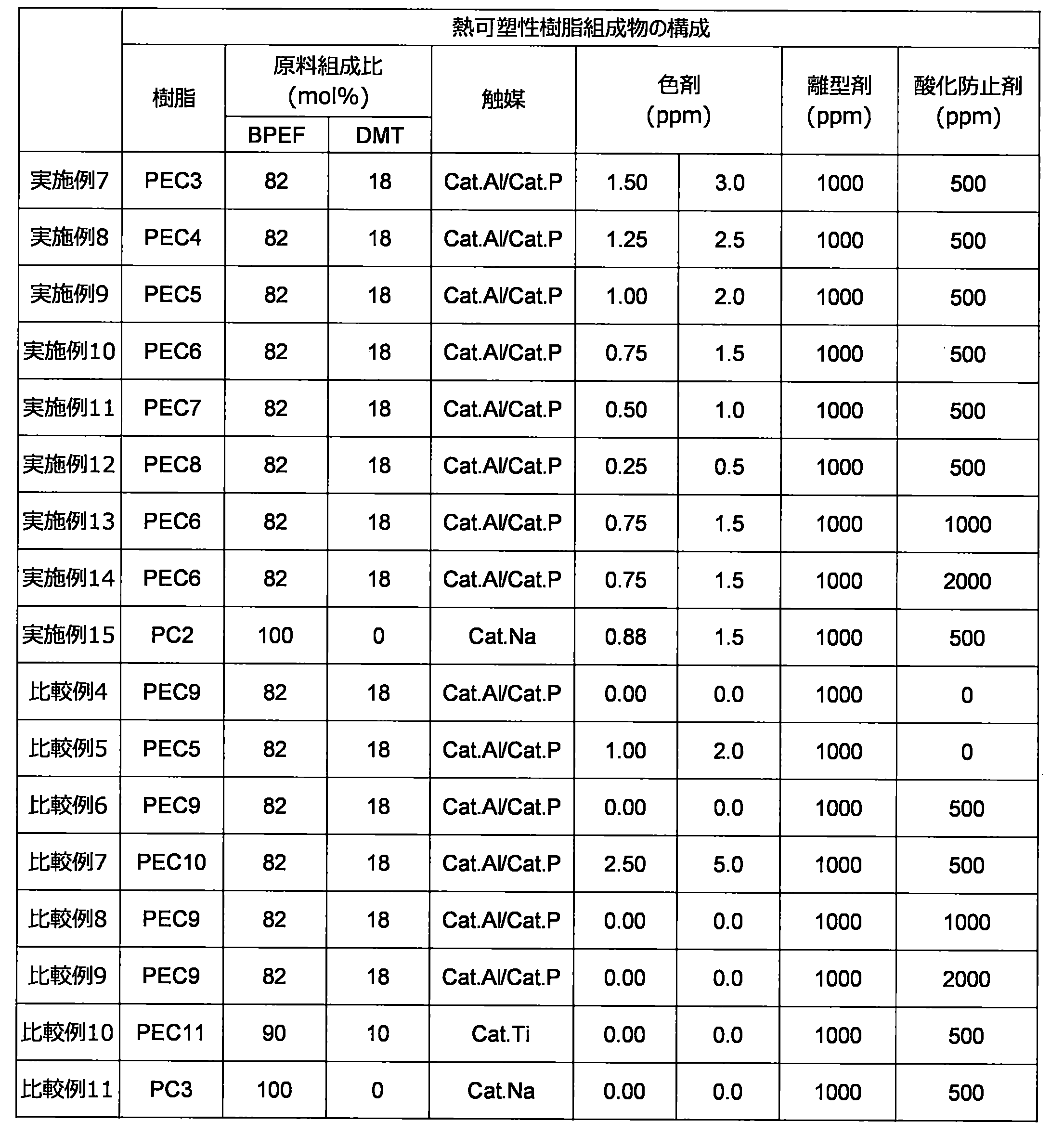
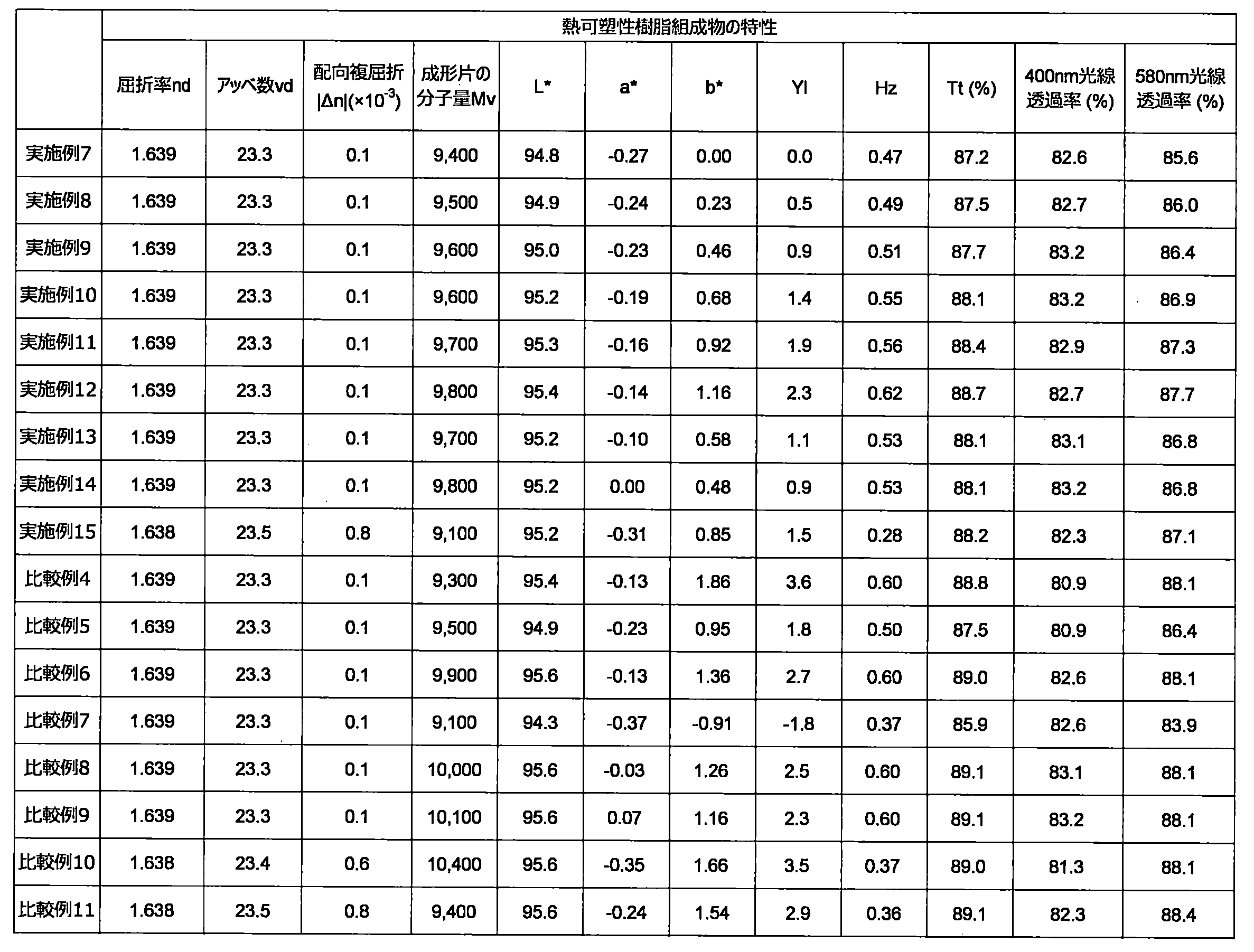
Claims (14)
- 下記式(1)で表される構成単位を有する熱可塑性樹脂および離型剤を含む熱可塑性樹脂組成物であって、さらに熱可塑性樹脂組成物中の酸化防止剤の含有量が0~300ppmである熱可塑性樹脂組成物。



- 前記離型剤が熱可塑性樹脂組成物中に1~4000ppmの量で含まれる、請求項1に記載の熱可塑性樹脂組成物。
- 前記熱可塑性樹脂組成物中の酸化防止剤の含有量が0~50ppmである、請求項1又は2に記載の熱可塑性樹脂組成物。
- 乾熱黄変ΔYIが0.00~0.47である、請求項1又は2に記載の熱可塑性樹脂組成物。
- 下記式(4)で表される構成単位を有する熱可塑性樹脂、色剤および酸化防止剤を含む熱可塑性樹脂組成物であって、前記熱可塑性樹脂組成物中における前記色剤の含有量が0.01~4.00ppm、前記酸化防止剤の含有量が50~3000ppmである熱可塑性樹脂組成物。


- 前記熱可塑性樹脂組成物の2mm厚成形板の色相a*が-0.40~0.00且つ、色相b*が-0.50~1.25である、請求項5に記載の熱可塑性樹脂組成物。
- 前記熱可塑性樹脂組成物の2mm厚成形板の全光線透過率が86.5%以上である、請求項5又は6に記載の熱可塑性樹脂組成物。
- 前記熱可塑性樹脂組成物の2mm厚成形板の400nm光線透過率が81.0%以上である、請求項5又は6に記載の熱可塑性樹脂組成物。
- 前記熱可塑性樹脂組成物の2mm厚成形板の580nm光線透過率が85.0%以上である、請求項5又は6に記載の熱可塑性樹脂組成物。
- 前記式(1)または式(4)中の環Zがベンゼン環である、請求項1又は5に記載の熱可塑性樹脂組成物。
- 式(1)または式(4)で表される構成単位を有する熱可塑性樹脂が、ポリカーボネート樹脂またはポリエステルカーボネート樹脂である請求項1又は5に記載の熱可塑性樹脂組成物。
- 式(1)または式(4)で表される構成単位を有する熱可塑性樹脂が、ポリエステルカーボネート樹脂である請求項11に記載の熱可塑性樹脂組成物。
- 請求項1又は5に記載の熱可塑性樹脂組成物を含む、光学部材。
- 光学レンズである、請求項13に記載の光学部材。
Priority Applications (2)
| Application Number | Priority Date | Filing Date | Title |
|---|---|---|---|
| CN202380070790.8A CN119998399A (zh) | 2022-10-07 | 2023-09-29 | 热塑性树脂组合物及包含其的光学部件 |
| KR1020257014137A KR20250078522A (ko) | 2022-10-07 | 2023-09-29 | 열가소성 수지 조성물 및 그것을 함유하는 광학 부재 |
Applications Claiming Priority (4)
| Application Number | Priority Date | Filing Date | Title |
|---|---|---|---|
| JP2022162131A JP2024055310A (ja) | 2022-10-07 | 2022-10-07 | 熱可塑性樹脂組成物及びそれを含む光学部材 |
| JP2022-162131 | 2022-10-07 | ||
| JP2023-024948 | 2023-02-21 | ||
| JP2023024948A JP2024118588A (ja) | 2023-02-21 | 2023-02-21 | 熱可塑性樹脂組成物及びそれを含む光学部材 |
Publications (1)
| Publication Number | Publication Date |
|---|---|
| WO2024075643A1 true WO2024075643A1 (ja) | 2024-04-11 |
Family
ID=90608363
Family Applications (1)
| Application Number | Title | Priority Date | Filing Date |
|---|---|---|---|
| PCT/JP2023/035579 Ceased WO2024075643A1 (ja) | 2022-10-07 | 2023-09-29 | 熱可塑性樹脂組成物及びそれを含む光学部材 |
Country Status (4)
| Country | Link |
|---|---|
| KR (1) | KR20250078522A (ja) |
| CN (1) | CN119998399A (ja) |
| TW (1) | TW202428697A (ja) |
| WO (1) | WO2024075643A1 (ja) |
Citations (6)
| Publication number | Priority date | Publication date | Assignee | Title |
|---|---|---|---|---|
| JP2004330541A (ja) * | 2003-05-06 | 2004-11-25 | Teijin Chem Ltd | 耐熱性、耐光性構成体 |
| JP2005015545A (ja) * | 2003-06-24 | 2005-01-20 | Teijin Chem Ltd | 添加剤マスターおよびそれを使用した耐熱性ポリカーボネート樹脂組成物 |
| JP2005029744A (ja) * | 2003-07-11 | 2005-02-03 | Teijin Chem Ltd | ポリカーボネート樹脂ペレット |
| JP2006273931A (ja) * | 2005-03-28 | 2006-10-12 | Teijin Chem Ltd | 難燃性樹脂組成物 |
| JP2008292992A (ja) * | 2007-04-27 | 2008-12-04 | Teijin Chem Ltd | ホログラム記録媒体用基板およびホログラム記録媒体 |
| WO2017146023A1 (ja) * | 2016-02-24 | 2017-08-31 | 富士フイルム株式会社 | ポリカーボネート樹脂、成形体、光学部材及びレンズ |
Family Cites Families (3)
| Publication number | Priority date | Publication date | Assignee | Title |
|---|---|---|---|---|
| JP5332696B2 (ja) | 2009-02-17 | 2013-11-06 | 三菱瓦斯化学株式会社 | ポリカーボネート樹脂組成物及びその製造方法 |
| JP5011450B2 (ja) | 2009-07-24 | 2012-08-29 | 帝人化成株式会社 | 光学レンズ用ポリエステルカーボネート共重合体および光学レンズ |
| KR102386166B1 (ko) | 2017-12-28 | 2022-04-12 | 데이진 가부시키가이샤 | 폴리(에스테르)카보네이트, 및 폴리(에스테르)카보네이트의 제조 방법 |
-
2023
- 2023-09-29 KR KR1020257014137A patent/KR20250078522A/ko active Pending
- 2023-09-29 CN CN202380070790.8A patent/CN119998399A/zh active Pending
- 2023-09-29 WO PCT/JP2023/035579 patent/WO2024075643A1/ja not_active Ceased
- 2023-10-06 TW TW112138453A patent/TW202428697A/zh unknown
Patent Citations (6)
| Publication number | Priority date | Publication date | Assignee | Title |
|---|---|---|---|---|
| JP2004330541A (ja) * | 2003-05-06 | 2004-11-25 | Teijin Chem Ltd | 耐熱性、耐光性構成体 |
| JP2005015545A (ja) * | 2003-06-24 | 2005-01-20 | Teijin Chem Ltd | 添加剤マスターおよびそれを使用した耐熱性ポリカーボネート樹脂組成物 |
| JP2005029744A (ja) * | 2003-07-11 | 2005-02-03 | Teijin Chem Ltd | ポリカーボネート樹脂ペレット |
| JP2006273931A (ja) * | 2005-03-28 | 2006-10-12 | Teijin Chem Ltd | 難燃性樹脂組成物 |
| JP2008292992A (ja) * | 2007-04-27 | 2008-12-04 | Teijin Chem Ltd | ホログラム記録媒体用基板およびホログラム記録媒体 |
| WO2017146023A1 (ja) * | 2016-02-24 | 2017-08-31 | 富士フイルム株式会社 | ポリカーボネート樹脂、成形体、光学部材及びレンズ |
Also Published As
| Publication number | Publication date |
|---|---|
| KR20250078522A (ko) | 2025-06-02 |
| CN119998399A (zh) | 2025-05-13 |
| TW202428697A (zh) | 2024-07-16 |
Similar Documents
| Publication | Publication Date | Title |
|---|---|---|
| US11370882B2 (en) | Resin produced by polycondensation, and resin composition | |
| JP5808959B2 (ja) | 高屈折率ポリカーボネート共重合体及び光学レンズ | |
| TWI860987B (zh) | 聚碳酸酯樹脂組成物、其製造方法及光學透鏡 | |
| KR20250025031A (ko) | 열가소성 수지 조성물 및 그 성형체 | |
| WO2018008483A1 (ja) | 熱可塑性樹脂 | |
| JP5808960B2 (ja) | 高屈折率かつ耐熱性に優れたポリカーボネート共重合体及び光学レンズ | |
| JPWO2020166408A1 (ja) | ポリカーボネート系樹脂組成物または共重合体、および光学フィルム | |
| JP7790873B2 (ja) | ポリエステル樹脂またはポリエステルカーボネート樹脂、および該樹脂を用いた光学部材 | |
| JP7646071B2 (ja) | 熱可塑性樹脂及びそれを含む光学部材 | |
| JP2024026220A (ja) | 熱可塑性樹脂及びそれを含む光学部材 | |
| TWI896796B (zh) | 熱可塑性樹脂及包含其之光學構件 | |
| WO2021182217A1 (ja) | 樹脂組成物および未延伸光学フィルム | |
| KR20250172669A (ko) | 폴리카보네이트 수지 및 그 수지를 사용한 광학 부재 | |
| WO2024075643A1 (ja) | 熱可塑性樹脂組成物及びそれを含む光学部材 | |
| JP2024118588A (ja) | 熱可塑性樹脂組成物及びそれを含む光学部材 | |
| JP2024055310A (ja) | 熱可塑性樹脂組成物及びそれを含む光学部材 | |
| JP2025119165A (ja) | ポリカーボネート樹脂および該樹脂を用いた光学部材 | |
| WO2025164207A1 (ja) | ポリカーボネート樹脂および該樹脂を用いた光学部材 | |
| JP2025119167A (ja) | ポリカーボネート樹脂および該樹脂を用いた光学部材 | |
| KR20220161254A (ko) | 수지 조성물 그리고 그것을 포함하는 광학 렌즈 및 광학 필름 | |
| HK1234427B (en) | Resin produced by polycondensation, and resin composition | |
| HK1234427A1 (en) | Resin produced by polycondensation, and resin composition |
Legal Events
| Date | Code | Title | Description |
|---|---|---|---|
| 121 | Ep: the epo has been informed by wipo that ep was designated in this application |
Ref document number: 23874770 Country of ref document: EP Kind code of ref document: A1 |
|
| WWE | Wipo information: entry into national phase |
Ref document number: 202380070790.8 Country of ref document: CN |
|
| ENP | Entry into the national phase |
Ref document number: 20257014137 Country of ref document: KR Kind code of ref document: A |
|
| NENP | Non-entry into the national phase |
Ref country code: DE |
|
| WWP | Wipo information: published in national office |
Ref document number: 202380070790.8 Country of ref document: CN |
|
| WWP | Wipo information: published in national office |
Ref document number: 1020257014137 Country of ref document: KR |
|
| 122 | Ep: pct application non-entry in european phase |
Ref document number: 23874770 Country of ref document: EP Kind code of ref document: A1 |