WO2024075352A1 - 多層フィルム及び包装材 - Google Patents
多層フィルム及び包装材 Download PDFInfo
- Publication number
- WO2024075352A1 WO2024075352A1 PCT/JP2023/025059 JP2023025059W WO2024075352A1 WO 2024075352 A1 WO2024075352 A1 WO 2024075352A1 JP 2023025059 W JP2023025059 W JP 2023025059W WO 2024075352 A1 WO2024075352 A1 WO 2024075352A1
- Authority
- WO
- WIPO (PCT)
- Prior art keywords
- multilayer film
- layer
- polyethylene
- resin
- mass
- Prior art date
- Legal status (The legal status is an assumption and is not a legal conclusion. Google has not performed a legal analysis and makes no representation as to the accuracy of the status listed.)
- Ceased
Links
Classifications
-
- B—PERFORMING OPERATIONS; TRANSPORTING
- B32—LAYERED PRODUCTS
- B32B—LAYERED PRODUCTS, i.e. PRODUCTS BUILT-UP OF STRATA OF FLAT OR NON-FLAT, e.g. CELLULAR OR HONEYCOMB, FORM
- B32B27/00—Layered products comprising a layer of synthetic resin
- B32B27/32—Layered products comprising a layer of synthetic resin comprising polyolefins
-
- B—PERFORMING OPERATIONS; TRANSPORTING
- B32—LAYERED PRODUCTS
- B32B—LAYERED PRODUCTS, i.e. PRODUCTS BUILT-UP OF STRATA OF FLAT OR NON-FLAT, e.g. CELLULAR OR HONEYCOMB, FORM
- B32B7/00—Layered products characterised by the relation between layers; Layered products characterised by the relative orientation of features between layers, or by the relative values of a measurable parameter between layers, i.e. products comprising layers having different physical, chemical or physicochemical properties; Layered products characterised by the interconnection of layers
- B32B7/02—Physical, chemical or physicochemical properties
- B32B7/027—Thermal properties
-
- B—PERFORMING OPERATIONS; TRANSPORTING
- B65—CONVEYING; PACKING; STORING; HANDLING THIN OR FILAMENTARY MATERIAL
- B65D—CONTAINERS FOR STORAGE OR TRANSPORT OF ARTICLES OR MATERIALS, e.g. BAGS, BARRELS, BOTTLES, BOXES, CANS, CARTONS, CRATES, DRUMS, JARS, TANKS, HOPPERS, FORWARDING CONTAINERS; ACCESSORIES, CLOSURES, OR FITTINGS THEREFOR; PACKAGING ELEMENTS; PACKAGES
- B65D65/00—Wrappers or flexible covers; Packaging materials of special type or form
- B65D65/38—Packaging materials of special type or form
- B65D65/40—Applications of laminates for particular packaging purposes
Definitions
- the present invention relates to a multilayer film used for packaging food, medical products, etc.
- the reasons for the deterioration of the quality of recycled plastics include the fact that many of the plastic products currently in circulation are made using polymeric compounds (sometimes called resins or polymers) with multiple different structures, and that impurities are mixed into the plastic, causing it to become discolored.
- many packaging materials used for food and beverages are multifunctional, such as durable weather resistance during distribution and refrigeration, functions to protect the contents from processes such as heat sterilization, and long-term storage (gas barrier properties). These are given many functions by combining various raw materials with their own functions.
- the quality of recycled plastics deteriorates in order to provide these multifunctional functions.
- recycled materials are sometimes mixed with virgin materials (newly synthesized polymeric compounds that are not recycled).
- polypropylene film which is often used as packaging material along with polyethylene, has a specific gravity close to that of polyethylene, so it cannot be easily separated by specific gravity, and as a result, polyethylene and polypropylene end up mixed together in recycled materials.
- Mono-material films laminated with polyethylene have been disclosed (see, for example, Patent Documents 1 and 2).
- Patent Documents 1 and 2 Mono-material films laminated with polyethylene have been disclosed (see, for example, Patent Documents 1 and 2).
- ratio of polyethylene to polypropylene when collected after use and mixed with polypropylene to become recycled materials, have an unknown composition (ratio of polyethylene to polypropylene). This makes it difficult to produce the films stably or to obtain the desired physical properties when they are re-filmed, raising concerns about a decline in quality.
- composition analysis by simple quantitative methods such as infrared spectroscopy (IR) and differential scanning calorimetry (DSC) has been proposed (see Non-Patent Documents 1 and 2).
- IR infrared spectroscopy
- DSC differential scanning calorimetry
- Non-Patent Documents 1 and 2 had a large measurement error for recycled materials with a high polyethylene ratio.
- Polyethylene with few short-chain branches is thought to be less likely to affect the polypropylene peak when a mixture with polypropylene resin is measured by infrared spectroscopy (IR). Therefore, from the viewpoint of the accuracy of IR measurement of the polyethylene ratio of recycled materials in which polypropylene resin and polyethylene resin are mixed, it is preferable to use polyethylene with few short-chain branches, especially high-density polyethylene.
- high-density polyethylene film is difficult to use for packaging applications where the contents must be visible due to its poor transparency, and also has poor impact resistance at low temperatures, so it may not be suitable for packaging frozen foods or chilled foods that are stored in low-temperature environments.
- the inventors conducted extensive research into the development of a multilayer film that is an easily recyclable mono-material film, has good accuracy in measuring the polyethylene ratio by IR in recycled materials that are a mixture of polypropylene-based resin and polyethylene-based resin, can be used in low-temperature environments such as for frozen foods, and has excellent packaging suitability, and as a result, they arrived at the multilayer film of the present invention. In other words, they discovered that these problems could be solved by setting the high-density polyethylene content and medium-density polyethylene content in the entire multilayer film to specific ranges.
- the objective of the present invention is to provide a multilayer film that has excellent performance as a packaging material, is a monomaterial, and has excellent composition analysis accuracy using IR.
- the present invention solves the above problems by providing a multilayer film in which at least a surface layer (A), an intermediate layer (B) and a sealing layer (C) are laminated in this order, and in which 90% by mass or more of the components contained in the multilayer film are polyethylene resins, the content of high density polyethylene in the entire multilayer film is 5 to 40% by mass, and the content of medium density polyethylene in the entire multilayer film is 28 to 72% by mass.
- the multilayer film of the present invention is a polyethylene mono-material film, so it is easy to recycle and contributes to reducing the environmental impact. Furthermore, when recycled, the accuracy of the compositional analysis of the recycled material is not reduced, making it easier to clarify the composition of the recycled material and to obtain the targeted physical properties, which allows the amount of virgin material mixed into the recycled material to be reduced, thereby contributing to the realization of a recycling-oriented society.
- the multilayer film of the present invention also has excellent suitability for packaging machines and is suitable as a packaging material.
- the multilayer film of the present invention has excellent impact resistance at extremely low temperatures of -20°C, and is therefore suitable for use in packaging frozen foods, chilled foods, and other items that are transported or stored at low temperatures, as well as in packaging medical products.
- the packaging material can be made lighter, reducing the environmental impact and costs.
- the multilayer film of the present invention is a multilayer film in which at least a surface layer (A), an intermediate layer (B) and a sealing layer (C) are laminated in this order, and is characterized in that 90% by mass or more of the components contained in the multilayer film are polyethylene resins, the content of high density polyethylene in the entire multilayer film is 5 to 40% by mass, and the content of medium density polyethylene in the entire multilayer film is 28 to 72% by mass.
- the surface layer (A) of the multilayer film of the present invention is preferably a layer containing a polyethylene resin as a main resin component, although other resins that can be co-extruded may be used in combination therewith within the range that does not impair the effects of the present invention.
- "Main resin component” specifically means that 70 mass % or more of the resin components used in the surface layer (A) is a polyethylene-based resin, preferably 80 mass % or more is a polyethylene-based resin, and more preferably 90 mass % or more is a polyethylene-based resin.
- polyethylene resins such as low-density polyethylene (LDPE), linear low-density polyethylene (LLDPE), medium-density polyethylene (MDPE), and high-density polyethylene (HDPE) can be used.
- LDPE low-density polyethylene
- LLDPE linear low-density polyethylene
- MDPE medium-density polyethylene
- HDPE high-density polyethylene
- low density polyethylene is meant a homopolymer of ethylene having a density less than 0.935 g/cm 3 .
- the linear low density polyethylene (LLDPE) is a copolymer of ethylene and an ⁇ -olefin polymerized using a multi-site catalyst such as a Ziegler-Natta catalyst or a single-site catalyst such as a metallocene catalyst, and has a density of less than 0.925 g/cm 3. It is therefore distinguished from low density polyethylene (LDPE), which is a homopolymer of ethylene.
- the ⁇ -olefins that serve as comonomers for linear low density polyethylene are those having 3 or more carbon atoms, such as propylene, 1-butene, 1-pentene, 1-hexene, 1-octene, 1-nonene, 4-methylpentene, 3,3-dimethylbutene, and mixtures thereof.
- the medium density polyethylene (MDPE) means a copolymer of ethylene and an ⁇ -olefin having a density of 0.925 g/ cm3 or more and less than 0.942 g/ cm3 .
- the high density polyethylene means a polyethylene having a density of 0.942 g/cm 3 or more.
- the comonomer ratio is preferably 0.5% or less.
- the comonomer ratio may not be disclosed, so linear low-density polyethylene, medium-density polyethylene, and high-density polyethylene are distinguished by density, and low-density polyethylene and medium-density polyethylene are distinguished by whether they are homopolymers of ethylene or not.
- biomass-derived polyethylene may be used, such as, for example, biomass-derived low-density polyethylene manufactured by Braskem (product name: SBC818, density: 0.918 g/cm 3 , MFR: 8.1 g/10 min), biomass-derived low-density polyethylene manufactured by Braskem (product name: SPB681, density: 0.922 g/cm 3 , MFR: 3.8 g/10 min), and biomass-derived linear low-density polyethylene manufactured by Braskem (product name: SLL118, density: 0.916 g/cm 3 , MFR: 1.0 g/10 min).
- the surface layer (A) of the multilayer film of the present invention needs to have a higher melting point than the seal layer (C) of the multilayer film. Therefore, the surface layer (A) of the multilayer film of the present invention is preferably a layer in which a medium density polyethylene (a1) and a high density polyethylene (a2) are used in combination, and the ratio of the medium density polyethylene (a1) to the high density polyethylene (a2) is more preferably 30:70 to 85:15, and even more preferably 40:60 to 70:30.
- the surface layer (A) is such a layer, it can exhibit impact resistance in a very low temperature (e.g., ⁇ 20° C.) environment while maintaining suitable packaging suitability, and also has good resistance to puncture by frozen foods.
- a plurality of types of the medium-density polyethylene (a1) and the high-density polyethylene (a2) may be used in combination.
- the ratio of (a1-1)+(a1-2):(a2) falls within the above range.
- the surface layer (A) of the multilayer film of the present invention may further contain a polyethylene resin other than the medium density polyethylene (a1) and the high density polyethylene (a2).
- LDPE low density polyethylene
- LDPE low density polyethylene
- the surface layer (A) of the multilayer film of the present invention preferably has a melting point of 110 to 150°C, more preferably 115 to 145°C.
- a melting point of the surface layer (A) refers to the melting peak measured by a differential scanning calorimeter.
- the surface layer (A) is a resin layer made by mixing a plurality of resins, it is preferable to determine the blending ratio so that the melting point of the mixed resin composition is within the range.
- the melting point of the mixed resin composition is a melting point calculated from the content of each resin component and the melting point of each resin, and when the resins used in each layer are resin a, resin b, resin c, etc., the melting points of these resins are Ta, Tb, Tc, etc., and the masses of the resins used in the layers are Wa, Wb, Wc, etc., the melting point is calculated as (TaWa+TbWb+TcWc%)/(Wa+Wb+Wc).
- the surface layer (A) of the multilayer film of the present invention preferably has a density of 0.925 to 0.955 g/cm 3 , and more preferably 0.930 to 0.950 g/cm 3 .
- the density is a value measured in accordance with JIS K7112.
- the MFR (190°C, 21.18N) of the polyethylene resin used in the surface layer (A) is 0.5 to 50 g/10 min (190°C, 21.18N), preferably 1 to 30 g/10 min (190°C, 21.18N), more preferably 2 to 20 g/10 min (190°C, 21.18N). When the MFR is within this range, good film-forming properties can be obtained, which is preferable.
- various resins used in packaging films can be used as resins other than the above-mentioned polyethylene-based resins, and among them, olefin-based resins such as polypropylene-based resins can be preferably used.
- olefin-based resins such as polypropylene-based resins
- polypropylene-based resin propylene homopolymers, propylene- ⁇ -olefin random copolymers, propylene- ⁇ -olefin block copolymers, etc. can be used. These may be used alone or in combination.
- an olefin-based resin other than the above-mentioned polyethylene-based resin is used as the resin component used in the surface layer (A)
- its content is preferably 30 mass % or less of the resin components contained in the surface layer (A), more preferably 10 mass % or less, and even more preferably 5 mass % or less.
- a cyclic polyolefin-based resin may be used, but the content of the cyclic polyolefin-based resin in the resin component contained in the surface layer (A) is preferably 10 mass% or less, more preferably 5 mass% or less, and it is also preferable that no cyclic polyolefin-based resin is used substantially.
- the cyclic olefin resin include norbornene polymers, vinyl alicyclic hydrocarbon polymers, and cyclic conjugated diene polymers. Of these, norbornene-based polymers are preferred.
- norbornene polymers examples include ring-opening polymers (COP) of norbornene monomers, and norbornene copolymers (COC) obtained by copolymerizing norbornene monomers with olefins such as ethylene. Hydrogenated products of COP and COC are also particularly preferred.
- the weight average molecular weight of the cyclic olefin resin is preferably from 5,000 to 500,000, and more preferably from 7,000 to 300,000.
- the norbornene monomer used as the raw material for the norbornene polymer is an alicyclic monomer having a norbornene ring.
- Examples of such norbornene-based monomers include norbornene, tetracyclododecene, ethylidenenorbornene, vinylnorbornene, ethylidetetracyclododecene, dicyclopentadiene, dimethanotetrahydrofluorene, phenylnorbornene, methoxycarbonylnorbornene, and methoxycarbonyltetracyclododecene.
- These norbornene monomers may be used alone or in combination of two or more kinds.
- the norbornene copolymer is a copolymer of the norbornene monomer and a copolymerizable olefin.
- olefins include olefins having 2 to 20 carbon atoms, such as ethylene, propylene, and 1-butene; cycloolefins, such as cyclobutene, cyclopentene, and cyclohexene; and non-conjugated dienes, such as 1,4-hexadiene.
- thermoplastic elastomers such as polyethylene-based elastomers, such as ethylene-vinyl acetate copolymer (EVA) and ethylene- ⁇ -olefin copolymers, polypropylene-based elastomers, and butene-based elastomers; ethylene-based copolymers such as ethylene-methyl methacrylate copolymer (EMMA), ethylene-ethyl acrylate copolymer (EEA), ethylene-methyl acrylate (EMA) copolymer, ethylene-ethyl acrylate-maleic anhydride copolymer (E-EA-MAH), ethylene-acrylic acid copolymer (EAA), and ethylene-methacrylic acid copolymer (EMAA); and further ionomers of ethylene-acrylic acid copolymers and ionomers of
- their content is preferably 30% by mass or less of the resin components contained in the surface layer (A), more preferably 20% by mass or less, even more preferably 10% by mass or less, and even more preferably 5% by mass or less.
- additives may be appropriately used in addition to the above-mentioned resin components.
- the additives include antioxidants, weather stabilizers, antistatic agents, antifogging agents, antiblocking agents, lubricants, nucleating agents, pigments, and biodegradability-promoting additives.
- these additives are used in an amount of preferably 5 parts by mass or less, more preferably about 0.01 to 3 parts by mass, per 100 parts by mass of the resin component used in the surface layer (A).
- the thickness ratio of the surface layer (A) of the multilayer film of the present invention to the total thickness of the multilayer film is preferably in the range of 10 to 45%, and more preferably in the range of 15 to 30%, since this makes it easier to obtain suitable heat resistance and excellent impact resistance at low temperatures.
- the intermediate layer (B) of the multilayer film of the present invention is preferably a layer containing a polyethylene resin as a main resin component, similar to the surface layer (A) of the multilayer film of the present invention, although other co-extrudable resins may be used in combination therewith within the scope not impairing the effects of the present invention.
- the intermediate layer (B) of the multilayer film of the present invention is preferably a layer using a medium density polyethylene (b1) and a high density polyethylene (b2) in combination, and the ratio of the medium density polyethylene (b1) to the high density polyethylene (b2) is more preferably 50:50 to 90:10, and further preferably 70:30 to 80:20.
- the intermediate layer (B) is such a layer, it is likely to exhibit impact resistance in a very low temperature (e.g., ⁇ 20° C.) environment.
- a plurality of types of medium-density polyethylene (b1) and high-density polyethylene (b2) may be used in combination. In that case, for example, when two types of medium-density polyethylene (b1) (b1-1 and b1-2) are used, it is preferable that the ratio of (b1-1)+(b1-2):(b2) is within the above range.
- the intermediate layer (B) of the multilayer film of the present invention may further contain a polyethylene resin other than the medium density polyethylene (b1) and the high density polyethylene (b2).
- LDPE low density polyethylene
- LDPE low density polyethylene
- the melting point of the intermediate layer (B) of the multi-layer film of the present invention is preferably from 110 to 150°C, and more preferably from 115 to 140°C. By setting the melting point of the intermediate layer (B) within the above range, it becomes easier to realize suitable impact resistance and packaging machine suitability. In addition, suitable heat resistance can be realized.
- the melting point of the resin refers to the melting peak measured by a differential scanning calorimeter.
- the intermediate layer (B) is composed of one type of resin
- the melting point of the intermediate layer (B) is the melting point of the resin.
- the intermediate layer (B) is a resin layer in which a plurality of types of resins are mixed, it is preferable to determine the blending ratio so that the melting point of the mixed resin composition is within the range.
- the melting point of the mixed resin composition is a melting point calculated from the content of each resin component and the melting point of each resin.
- the resins used in each layer are resin a, resin b, resin c, etc.
- the melting points of these resins are Ta, Tb, Tc, etc.
- the masses of the resins used in the layers are Wa, Wb, Wc, etc.
- the melting point is calculated as (TaWa+TbWb+TcWc%)/(Wa+Wb+Wc).
- the intermediate layer (B) of the multilayer film of the present invention preferably has a density of 0.925 to 0.955 g/cm 3 , and more preferably 0.930 to 0.950 g/cm 3 .
- the density is a value measured in accordance with JIS K7112.
- the MFR (190°C, 21.18N) of the polyethylene resin used in the intermediate layer (B) is 0.5 to 50 g/10 min (190°C, 21.18 N), preferably 1 to 30 g/10 min (190°C, 21.18 N), and more preferably 2 to 20 g/10 min (190°C, 21.18 N).
- MFR 0.5 to 50 g/10 min (190°C, 21.18 N), preferably 1 to 30 g/10 min (190°C, 21.18 N), and more preferably 2 to 20 g/10 min (190°C, 21.18 N).
- resins other than those mentioned above may be used in combination.
- the other resins include polypropylene-based resins such as propylene homopolymers, propylene- ⁇ -olefin random copolymers, and propylene- ⁇ -olefin block copolymers, cyclic olefin-based resins, thermoplastic elastomers such as ethylene-vinyl acetate copolymers (EVA), polyethylene-based elastomers, polypropylene-based elastomers, and butene-based elastomers; ethylene-based copolymers such as ethylene-methyl methacrylate copolymers (EMMA), ethylene-ethyl acrylate copolymers (EEA), ethylene-methyl acrylate (EMA) copolymers, ethylene-ethyl acrylate-maleic anhydride copolymers (E-EA-MAH), ethylene-acrylic acid copolymers
- EMMA ethylene-methyl methacrylate
- the content of the resin is 20% or less by mass of the resin components contained in the intermediate layer (B), more preferably 10% or less by mass, and even more preferably 5% or less by mass. If the content is within this range, it is easier to achieve a mono-material structure for the entire multilayer film, and recyclability is improved.
- additives may be appropriately used in addition to the above-mentioned resin components.
- the additives include antioxidants, weather stabilizers, antistatic agents, antifogging agents, antiblocking agents, lubricants, nucleating agents, pigments, and biodegradation-promoting additives.
- these additives are used in an amount of preferably 5 parts by mass or less, and more preferably about 0.01 to 3 parts by mass, per 100 parts by mass of the resin component used in the intermediate layer (B).
- the thickness ratio of the intermediate layer (B) to the total thickness of the multilayer film is preferably 30 to 70%, and more preferably 35 to 55%, from the viewpoints of good packaging machine suitability and low-temperature impact resistance.
- the sealing layer (C) of the multi-layer film of the present invention is preferably a layer containing linear low density polyethylene as a main resin component. By providing the sealing layer (C), good impact resistance and heat sealability can be achieved.
- the melting point of the sealing layer (C) of the multi-layer film of the present invention is preferably 75 to 125°C, more preferably 80 to 120°C, further preferably 80 to 100°C, and particularly preferably 83 to 97°C. By setting the melting point of the sealing layer (C) within this range, good sealing strength can be obtained.
- the melting point of a resin refers to the melting peak measured by a differential scanning calorimeter. When there are two peaks, the peak with the largest amount of heat absorption is taken as the melting point. When the seal layer (C) is made of one type of resin, the melting point of the seal layer (C) is the melting point of the resin.
- the melting point of the mixed resin composition is a melting point calculated from the content of each resin component and the melting point of each resin, and when the resins used in each layer are resin a, resin b, resin c, etc., the melting points of these resins are Ta, Tb, Tc, etc., and the masses of the resins used in the layers are Wa, Wb, Wc, etc., the melting point is calculated as (TaWa+TbWb+TcWc%)/(Wa+Wb+Wc).
- the density of the linear low-density polyethylene is preferably 0.880 to 0.924 g/ cm3 , and more preferably 0.890 to 0.920 g/ cm3 , because good sealability and impact resistance can be easily obtained.
- the density is within this range, it can be assumed that the number of short chain branches in the polyethylene is relatively small, and even when the polyethylene is mixed with polypropylene as a recycled material, the blend ratio can be easily identified by infrared spectroscopy (IR).
- the linear low density polyethylene has an MFR of 0.5 to 50 g/10 min (190° C., 21.18 N), preferably 1 to 30 g/10 min (190° C., 21.18 N), and more preferably 2 to 20 g/10 min (190° C., 21.18 N).
- MFR 0.5 to 50 g/10 min (190° C., 21.18 N), preferably 1 to 30 g/10 min (190° C., 21.18 N), and more preferably 2 to 20 g/10 min (190° C., 21.18 N).
- the content of linear low-density polyethylene in the sealing layer (C) of the multilayer film of the present invention 70 mass% or more of the resin components contained in the sealing layer (C), it becomes easier to obtain suitable sealing properties and excellent impact resistance at low temperatures.
- the content is preferably 75% by mass or more, more preferably 80% by mass or more, and even more preferably 90% by mass or more, of the resin component contained in the sealing layer (C).
- 100% by mass of the resin component contained in the seal layer (C) may be linear low-density polyethylene.
- two or more kinds of linear low density polyethylenes having different densities, MFRs, etc. may be used in combination, so long as the total content is within the above range.
- resins other than the linear low density polyethylene may be used in combination within the range not impairing the effects of the present invention.
- examples of other resins that can be used in combination include polyethylene resins other than the linear low-density polyethylene resins exemplified for the surface layer (A) above, olefin resins such as polypropylene resins, and other resins.
- the olefin resin is used as the resin other than the linear low-density polyethylene, its content is preferably 30 mass% or less of the resin components contained in the sealing layer (C), more preferably 10 mass% or less, and even more preferably 5 mass% or less.
- a cyclic polyolefin resin may be used as the olefin resin, but the content of the cyclic polyolefin resin in the resin components contained in the sealing layer (C) of the multilayer film of the present invention is preferably 10% by mass or less, more preferably 5% by mass or less, and it is also preferable that substantially no cyclic polyolefin resin is used.
- the sealing layer (C) of the multilayer film of the present invention may contain resins other than those mentioned above.
- resins include the thermoplastic elastomers, ethylene-based copolymers, ionomers, etc. exemplified for the surface layer (A).
- their content is preferably 30 mass% or less of the resin components contained in the sealing layer (C), more preferably 10 mass% or less, and even more preferably 5 mass% or less.
- additives may be appropriately used in addition to the above resin components.
- the additives include antioxidants, weather stabilizers, antistatic agents, antifogging agents, antiblocking agents, lubricants, nucleating agents, pigments, and biodegradability-promoting additives.
- these additives are preferably used in an amount of 15 parts by mass or less, more preferably about 0.01 to 10 parts by mass, per 100 parts by mass of the resin component used in the sealing layer (C).
- the thickness ratio of the sealing layer (C) of the multilayer film of the present invention to the total thickness of the multilayer film is preferably 10 to 45%, and more preferably 20 to 40%, from the viewpoint of low-temperature impact resistance and in order to exhibit sufficient sealing strength when a heavy object is enclosed. If the thickness ratio of the sealing layer (C) to the total thickness of the multilayer film is 10% or more, sufficient sealing strength can be obtained, and if the thickness ratio is 20% or more, it is more preferable because it is easy to obtain sealing strength that can withstand the encapsulation of a heavy object.
- the thickness ratio is 45% or less, it is preferable because when mixed with a polypropylene film as a recycled material, the polyethylene/polypropylene ratio can be specified with a practical accuracy by simple measurement using IR, and if the thickness ratio is 40% or less, it is more preferable because the accuracy is improved.
- the sealing layer (C) of the multi-layer film of the present invention may be composed of multiple layers.
- the linear low-density polyethylene contained in each of the multiple sealing layers (C) is preferably 70% by mass or more, more preferably 75% by mass or more, even more preferably 80% by mass or more, and even more preferably 90% by mass or more.
- each layer may have the same composition or different compositions, or may have different compositions only in terms of additives, as long as the composition is within the range of the composition.
- the total thickness of the sealing layer (C) is preferably 10 to 45%, more preferably 20 to 40%, of the total thickness of the multilayer film.
- the multilayer film of the present invention is a multilayer film in which the surface layer (A), intermediate layer (B) and seal layer (C) are laminated in the order of (A)/(B)/(C).
- another layer e.g., including a plurality of seal layers (C), other intermediate layers, adhesive layers, adhesive layers, etc.
- seal layer (C) may be included between the surface layer (A), intermediate layer (B) and seal layer (C).
- the layers are laminated in the order of (A)/(B)/(C), such as (A)/(B)/(C), (A)/(B)/(other layers)/(C), (A)/(other layers)/(B)/(C), etc.
- the multilayer film of the present invention can achieve suitable impact resistance even at low temperatures, particularly at temperatures as low as -20°C, which is significantly below 0°C.
- it has good film-forming properties, and can achieve favorable sealing properties and suitability for packaging machines.
- the multilayer film of the present invention is a multilayer film in which 90% by mass or more of the components contained therein are polyethylene-based resins. By making 90% by mass or more of the components contained in the multilayer film a polyethylene-based resin, the multilayer film becomes a mono-material film, and recyclability is improved.
- the components contained in the multilayer film include not only resins but also additives, adhesives, etc. From the viewpoint of recyclability, it is more preferable that 95% by mass or more of the components contained in the multilayer film is a polyethylene resin.
- the multi-layer film of the present invention preferably has a total thickness of 15 to 100 ⁇ m, more preferably 20 to 90 ⁇ m. If the total thickness of the film is within this range, it becomes easier to obtain excellent impact resistance, rigidity, sealability, suitability for packaging heavy items, suitability for use with packaging machines, and the like at low temperatures.
- each layer is not particularly limited, but for example, the thickness of the surface layer (A) is preferably from 2 to 25 ⁇ m, and more preferably from 4 to 20 ⁇ m.
- the thickness of the intermediate layer (B) is preferably from 10 to 40 ⁇ m, and more preferably from 12 to 38 ⁇ m.
- the thickness of the sealing layer (C) is preferably from 5 to 35 ⁇ m, and more preferably from 7 to 30 ⁇ m.
- the sealing layer (C) is made up of multiple layers, preferably in the configuration of surface layer (A)/intermediate layer (B)/sealing layer (C1)/sealing layer (C2), etc., it is preferable that the total thickness of the sealing layers (C1 and C2) is within the thickness range of the sealing layer (C).
- the multilayer film of the present invention preferably has a seal strength of 5 N/15 mm or more, and more preferably 10 N/15 mm or more, when the sealing layers (C) of the multilayer film are combined and heat sealed at 100°C, 0.2 MPa, for 1 second with a seal width of 10 mm.
- the multilayer film of the present invention preferably has an impact resistance strength of 0.5 J or more, more preferably 0.7 J or more, as measured by a film impact method.
- the impact strength was measured after conditioning a 40 ⁇ m multilayer film at ⁇ 20° C.
- the multilayer film of the present invention has a stiffness of preferably 200 to 400 MPa, and more preferably 220 to 380 MPa or more, because it is easy to obtain a suitable flexibility.
- the difference between the melting point of the surface layer (A) and the melting point of the seal layer (C) is preferably 10° C. or more, more preferably 20° C. or more. By ensuring the melting point difference, it becomes easier to obtain suitable packaging suitability.
- the melting points of the surface layer (A), intermediate layer (B) and seal layer (C) are melting points calculated from the content and melting point of each resin component used in each layer.
- the melting points of these resins are Ta, Tb, Tc, ...
- the masses of the resins used in the layers are Wa, Wb, Wc, ...
- the melting points are calculated as (TaWa+TbWb+TcWc%)/(Wa+Wb+Wc).
- the multilayer film of the present invention satisfies the following calculation formula.
- a ⁇ B > C By adjusting the melting points of each layer as described above, it is possible to obtain a difference in melting points between the surface layer (A) and the sealing layer (C), improving the suitability for packaging machines.
- the interlayer adhesion between the surface layer (A), the intermediate layer (B), and the sealing layer (C) is improved, improving low-temperature resistance and sealing strength.
- the multilayer film of the present invention has a high-density polyethylene content of 5 to 40% by mass relative to the entire multilayer film. This range of high-density polyethylene content is preferable because it provides suitable sealing strength and packaging suitability.
- the high-density polyethylene content of the entire multilayer film is preferably 7 to 35% by mass, more preferably 8 to 31% by mass, and even more preferably 10 to 26% by mass.
- the multilayer film of the present invention has a medium-density polyethylene content of 28 to 72% by mass relative to the entire multilayer film. This range of medium-density polyethylene content is preferable because it provides suitable sealing strength, packaging suitability, and impact resistance.
- the medium-density polyethylene content of the entire multilayer film is preferably 31 to 64% by mass, more preferably 34 to 56% by mass, and even more preferably 34 to 52% by mass.
- the multilayer film of the present invention has a specific range of high-density polyethylene and medium-density polyethylene content in the entire multilayer film, which allows the melting point and rigidity to be controlled while keeping the short-chain branching of polyethylene low. This improves the performance of the packaging material, such as seal strength, packaging suitability, and impact resistance, as well as the accuracy of measuring the polyethylene ratio by IR for recycled materials in which polypropylene resin and the multilayer film are mixed.
- the method for producing the multilayer film of the present invention is not particularly limited, but examples thereof include a coextrusion method in which each resin or resin mixture used for the surface layer (A), intermediate layer (B), and seal layer (C) is heated and melted in a separate extruder, and laminated in the molten state in the order of, for example, (A)/(B)/(C) by a method such as a coextrusion multilayer die method or a feed block method, and then molded into a film by an inflation method, a T-die chill roll method, or the like.
- This co-extrusion method is preferable because it allows relatively free adjustment of the thickness ratio of each layer, and it can provide a multi-layer film that is excellent in hygiene and cost performance.
- the multilayer film of the present invention may be a matte multilayer film in which an uneven structure is formed on the film surface by pressure molding using a chill roll having an uneven structure in the above-mentioned coextrusion method.
- the resins or resin mixtures used for the surface layer (A), intermediate layer (B), and seal layer (C) are heated and melted in separate extruders, and the thermoplastic resins extruded in a molten state from a T-die in the order of (A)/(B)/(C) by a method such as a coextrusion multilayer die method or a feed block method are pressure-molded by a chill roll having an uneven structure to form an uneven structure on the film surface, thereby making it possible to obtain a multilayer film having an uneven structure.
- This method imparts a matte design to the multilayer film while simplifying the manufacturing process and reducing costs by performing shaping simultaneously with film molding, with less environmental impact.
- the specific surface area of the surface of the seal layer (C) side of the multilayer film is preferably 1.02 or more.
- the specific surface area refers to the average value of the S/A specific surface area measured three times under the following measurement conditions using a non-contact surface/layer cross-sectional shape measurement system VertScan (registered trademark) 2.0 (model number: R3300G Lite, manufactured by Ryoka Systems Co., Ltd.).
- the specific surface area of the sealing layer (C) side surface of the multilayer film is preferably 1.02 or more, and more preferably 1.03 or more. There is no particular upper limit, but from the viewpoint of ease of manufacture, it is preferably 1.30 or less, and more preferably 1.10 or less. If the specific surface area is within the above range, pressure molding using a chill roll having an uneven structure may be performed on the sealing layer (C) side surface of the multilayer film, or on the surface layer (A) side surface of the multilayer film.
- the multilayer film of the present invention is obtained as a substantially unstretched multilayer film by the above manufacturing method, so secondary forming such as deep drawing by vacuum forming is also possible.
- the resin layer (A) in order to improve adhesion to printing ink and lamination suitability when used as a sealant film for lamination, it is preferable to subject the resin layer (A) to a surface treatment.
- surface treatments include surface oxidation treatments such as corona treatment, plasma treatment, chromic acid treatment, flame treatment, hot air treatment, and ozone/ultraviolet treatment, and surface roughening treatments such as sandblasting, with corona treatment being preferred.
- packaging materials made of the multilayer film of the present invention include packaging bags and packaging containers used for food, medicines, industrial parts, miscellaneous goods, magazines, etc.
- the film since the film has excellent impact resistance at very low temperatures, it can be suitably used for packaging materials for frozen foods, frozen lunches, refrigerated foods, and medical products that are distributed at low temperatures.
- the packaging bag is preferably a packaging bag formed by overlapping and sealing the seal layers (C) of the multilayer film of the present invention. It is also preferable that the packaging bag is a packaging bag formed by overlapping and sealing the seal layer (C) and the surface layer (A) of the multilayer film of the present invention.
- the packaging bag is a packaging bag formed by overlapping and sealing the seal layer (C) and the surface layer (A) of the multilayer film of the present invention.
- two sheets of the multilayer film can be cut to the desired size of a packaging bag, stacked on top of each other and sealed at three sides to form a bag, after which the contents can be filled in through the one unsealed side and the unsealed side can be sealed to form a hermetic bag, and the bag can be used as a packaging bag.
- the sealing method is not particularly limited, and may be heat sealing or ultrasonic sealing.
- the method of ultrasonic sealing is not particularly limited, and may be appropriately selected from known ultrasonic sealing methods and methods using known ultrasonic sealing devices according to the purpose.
- the other film to be used may be a film of LDPE, EVA or the like, which has a relatively weak mechanical strength.
- the multilayer film of the present invention can also be used by laminating it to another substrate.
- the other substrate that can be used in this case is not particularly limited, but from the viewpoint of easily realizing the effects of the present invention, it is preferable to use a plastic substrate having high rigidity and high gloss, in particular a stretched resin film.
- aluminum foil can be used alone or in combination.
- stretched resin film examples include biaxially oriented polyester (PET), easily tearable biaxially oriented polyester (PET), biaxially oriented polypropylene (OPP), biaxially oriented polyamide (PA), coextruded biaxially oriented polypropylene having an ethylene-vinyl alcohol copolymer (EVOH) as a central layer, biaxially oriented ethylene-vinyl alcohol copolymer (EVOH), and coextruded biaxially oriented polypropylene coated with polyvinylidene chloride (PVDC). These may be used alone or in combination.
- PET biaxially oriented polyester
- PET easily tearable biaxially oriented polyester
- OPP biaxially oriented polypropylene
- PA biaxially oriented polyamide
- EVOH coextruded biaxially oriented polypropylene having an ethylene-vinyl alcohol copolymer (EVOH) as a central layer
- EVOH biaxially oriented ethylene-vinyl alcohol copolymer
- Examples of lamination methods for laminating the above-mentioned substrate onto the multilayer film of the present invention obtained by the above-mentioned manufacturing method to form a laminate film include dry lamination, wet lamination, non-solvent lamination, extrusion lamination, etc.
- the layer of adhesive located between the multilayer film and the substrate is called the adhesive layer.
- Adhesives used in the dry lamination include, for example, solvent-based two-component curing adhesives.
- a "solvent-based” adhesive refers to a form used in the so-called dry lamination method, in which the adhesive is applied to a substrate, heated in an oven or the like to volatilize the organic solvent in the coating, and then bonded to another substrate, and includes a polyisocyanate composition, a polyol composition, and an organic solvent capable of dissolving (diluting) them.
- biomass raw materials plant-derived raw materials
- the biomass degree can be increased by appropriately using a biomass raw material.
- biomass raw material examples include castor oil-based polyols such as castor oil, dehydrated castor oil, hydrogenated castor oil, and 5 to 50 mole alkylene oxide adducts of castor oil, as well as aliphatic polybasic acids such as succinic acid, succinic anhydride, glutaric acid, adipic acid, azelaic acid, sebacic acid, and itaconic acid, and alkyl esters of the acids, and dimer acids.
- castor oil-based polyols such as castor oil, dehydrated castor oil, hydrogenated castor oil, and 5 to 50 mole alkylene oxide adducts of castor oil
- aliphatic polybasic acids such as succinic acid, succinic anhydride, glutaric acid, adipic acid, azelaic acid, sebacic acid, and itaconic acid, and alkyl esters of the acids, and dimer acids.
- the weight of the adhesive layer after drying is preferably 0.1 to 10 g/m 2 , more preferably 1 to 6 g/m 2 , and even more preferably 2 to 5 g/m 2.
- the thickness of the adhesive layer is preferably 0.1 to 10 ⁇ m, more preferably 1 to 7 ⁇ m, and even more preferably 2 to 5 ⁇ m.
- various adhesives can be used for the adhesive layer, but it is preferable to use a pressure-sensitive adhesive.
- pressure-sensitive adhesives include rubber-based adhesives obtained by dissolving polyisobutylene rubber, butyl rubber, or mixtures thereof in an organic solvent such as benzene, toluene, xylene, or hexane; or these rubber-based adhesives blended with tackifiers such as abiethylene acid rosin ester, terpene-phenol copolymer, or terpene-indene copolymer; and acrylic-based adhesives obtained by dissolving an acrylic copolymer having a glass transition point of ⁇ 20° C.
- any tear initiation portion such as a V notch, I notch, perforation, or microhole in the sealed portion in order to weaken the initial tear strength and improve the ease of opening.
- the multilayer film of the present invention may further have a printing layer on the surface layer (A).
- the printing layer is a layer in which a desired pattern is formed by liquid printing ink in order to impart aesthetics, various information about the contents, and functionality to the printed material.
- the printing layer is formed by printing a gravure printing ink or a flexographic printing ink (hereinafter referred to as liquid printing ink) containing a binder resin and a colorant, or an inkjet ink.
- the printing layer may be a single layer, or there may be multiple printing layers.
- the liquid printing ink used for each printing layer may be the same, or may be the same composition with only the colorant being different, or may be of different compositions.
- printing may be performed using a combination of liquid printing ink and inkjet ink.
- the above liquid printing inks are used as gravure printing inks and flexographic printing inks, and are broadly divided into organic solvent-based liquid printing inks that use organic solvents as the main solvent, and water-based liquid printing inks that use water as the main solvent. It is preferable that the printing layer formed on the multilayer film of the present invention be a general-purpose organic solvent-based liquid printing ink.
- the above organic solvent-based liquid printing ink is produced by dispersing a mixture of pigment, binder resin, organic solvent medium, dispersant, defoamer, etc., in a disperser to obtain a pigment dispersion.
- the resulting pigment dispersion is then mixed with resin, aqueous medium, and, if necessary, additives such as a leveling agent, and then stirred.
- Dispersers used in the production of gravure and flexographic printing inks include bead mills, Eiger mills, sand mills, gamma mills, and attritors.
- binder resins include cellulose-based resins such as cellulose acetate propionate (CAP) and cellulose acetate butyronate (CAB), polyamide-based resins, urethane-based resins, acrylic-based resins, vinyl chloride-vinyl acetate copolymer resins, chlorinated polypropylene resins, ethylene-vinyl acetate copolymer resins, vinyl acetate resins, polyvinyl chloride resins, and other vinyl chloride resins, polyester resins, alkyd resins, rosin-based resins, rosin-modified maleic acid resins, ketone resins, cyclized rubber, chlorinated rubber, butyral, and petroleum resins.
- cellulose-based resins such as cellulose acetate propionate (CAP) and cellulose acetate butyronate (CAB)
- polyamide-based resins such as cellulose acetate propionate (CAP) and cellulose acetate butyronate (CAB
- Pigments include inorganic and organic pigments that are commonly used in inks, paints, and recording agents.
- Organic pigments include soluble azo pigments, insoluble azo pigments, azo pigments, phthalocyanine pigments, halogenated phthalocyanine pigments, anthraquinone pigments, anthanthrone pigments, dianthraquinonyl pigments, anthrapyrimidine pigments, perylene pigments, perinone pigments, quinacridone pigments, thioindigo pigments, dioxazine pigments, isoindolinone pigments, quinophthalone pigments, azomethine azo pigments, flavanthrone pigments, diketopyrrolopyrrole pigments, isoindoline pigments, indanthrone pigments, and carbon black pigments.
- carmine 6B lake red C, permanent red 2B, disazo yellow, pyrazolone orange, carmine FB, chromophthalic yellow, chromophthalic red, phthalocyanine blue, phthalocyanine green, dioxazine violet, quinacridone magenta, quinacridone red, indanthrone blue, pyrimidine yellow, thioindigo bordeaux, thioindigo magenta, perylene red, perinone orange, isoindolinone yellow, aniline black, diketopyrrolopyrrole red, daylight fluorescent pigments, etc.
- both non-acid-treated pigments and acid-treated pigments can be used.
- inorganic pigments examples include white inorganic pigments such as titanium oxide, zinc oxide, zinc sulfide, barium sulfate, calcium carbonate, chromium oxide, silica, litbon, antimony white, and gypsum.
- white inorganic pigments such as titanium oxide, zinc oxide, zinc sulfide, barium sulfate, calcium carbonate, chromium oxide, silica, litbon, antimony white, and gypsum.
- titanium oxide is particularly preferred. Titanium oxide is white in color and is preferred in terms of coloring power, hiding power, chemical resistance, and weather resistance, and from the standpoint of printing performance, it is preferable that the titanium oxide has been treated with silica and/or alumina.
- inorganic pigments other than white examples include aluminum particles, mica, bronze powder, chrome vermilion, yellow lead, cadmium yellow, cadmium red, ultramarine, Prussian blue, red iron oxide, yellow iron oxide, iron oxide black, and zircon.
- Aluminum is in powder or paste form, but it is preferable to use it in paste form from the standpoint of ease of handling and safety, and whether leafing or non-leafing is used is selected appropriately from the standpoint of brightness and concentration.
- the organic solvent-based liquid printing ink has excellent adhesion to various substrates and can be used for printing on paper, synthetic paper, thermoplastic resin films, plastic products, steel plates, etc., and is useful as an ink for gravure printing using a gravure printing plate made by electronic engraving or the like, or for flexographic printing using a flexographic printing plate made by a resin plate or the like.
- the thickness of the liquid printing ink formed by the gravure printing method or the flexographic printing method using the organic solvent-based liquid printing ink is preferably 0.1 to 10 ⁇ m, more preferably 1 to 5 ⁇ m, and even more preferably 1 to 3 ⁇ m.
- the weight of the printed layer after drying is preferably 0.1 to 10 g/ m2 , more preferably 1 to 5 g/ m2 , and even more preferably 1 to 3 g/ m2 .
- liquid printing ink in consideration of the establishment of a recycling-based society that should develop in a sustainable manner (sustainability), it is preferable to use a liquid printing ink that uses raw materials derived from plants (biomass raw materials).
- plant-derived raw materials include cellulose resins such as cellulose acetate propionate resin and nitrocellulose; polyamide resins using dimer acids or polymerized fatty acids derived from natural oils such as soybean oil, palm oil, and rice bran oil; polycarboxylic acids such as succinic acid, succinic anhydride, adipic acid, azelaic acid, sebacic acid, dimer acid, glutaric acid, and malic acid; polyols such as ethylene glycol, 1,2-propanediol, 1,3-propanediol, 1,4-butanediol, neopentyl glycol, pentylene glycol, 1,10-dodecanediol, dimer diol, and
- Liquid printing inks using the above-mentioned plant-derived raw materials can also be commercially available products.
- Examples of commercially available products that can be used include inks listed in the Japan Organic Resources Association, such as Glossa BM, Raizin, Ultima, and Finart BM (all manufactured by DIC Corporation), Rotobio (manufactured by Sakata Inx Corporation), PANNECO, Real NEX BO, and FB King X (all manufactured by Toyo Ink Co., Ltd.), NT-VESTA, and PULPTECC (both manufactured by Tokyo Ink Co., Ltd.), etc.
- the above-mentioned printed layer may be printed directly onto the surface layer (A) of the multilayer film of the present invention by so-called surface printing, or may be printed onto another substrate by so-called reverse printing, and then the substrate and the multilayer film of the present invention may be laminated by dry lamination.
- the mixed ratio of recycled materials containing the multilayer film of the present invention and polypropylene-based resin can be determined by measuring with infrared spectroscopy (IR). Specifically, the polyethylene (multilayer film of the present invention) ratio in the recycled material can be calculated according to the following procedure, which is based on the method described in Gifu Prefectural Industrial Technology Center Research Report No. 13 pp10-13 (2019).
- the linear approximation formula described in Gifu Prefectural Industrial Technology Center Research Report No. 13 pp10-13 (2019) has been verified when the polyethylene ratio in a mixture of polyethylene and polypropylene is 5 to 50% by mass, but has not been verified when the polyethylene ratio exceeds 50% by mass.
- the inventors have found through their studies that the accuracy drops significantly when the polyethylene ratio is 70% by mass or more.
- the exponential approximation formula discovered by the inventors can specify the polyethylene ratio with good accuracy even when the polyethylene ratio is low, and can specify the polyethylene ratio with good accuracy even when the polyethylene ratio is 70 mass% or more.
- the multilayer film of the present invention uses a small amount of low-density polyethylene, which reduces the accuracy of measuring the polyethylene ratio of recycled materials mixed with polypropylene resins, and therefore the accuracy of measuring the polyethylene ratio of the recycled materials is relatively good.
- the multilayer film can achieve both packaging suitability and interlayer adhesive strength as well as excellent accuracy of measuring the polyethylene ratio by adjusting physical properties such as melting point and rigidity by using a combination of high-density polyethylene and medium-density polyethylene.
- Example 1 The following resins were used as the resin components forming each of the surface layer (A), intermediate layer (B) and seal layer (C) to prepare resins and resin mixtures forming each layer. These resins and resin mixtures were fed to three extruders and melted at 250°C. The molten resin was supplied to a T-die chill roll method coextrusion multilayer film manufacturing apparatus having a feed block (feed block and T-die temperature: 250°C) and co-melt extrusion was performed to obtain a multilayer film having a three-layer structure of surface layer (A)/middle layer (B)/seal layer (C), with each layer having a thickness of 10 ⁇ m/23 ⁇ m/17 ⁇ m (total 50 ⁇ m).
- Surface layer (A) 60 parts by mass of medium density polyethylene (density: 0.933 g/cm 3 , MFR (190° C., 21.18 N): 4 g/10 min, melting point: 122° C.) (hereinafter referred to as "MDPE (1)"), 40 parts by mass of high density polyethylene (density: 0.960 g/cm 3 , MFR (190° C., 21.18 N): 8 g/10 min, melting point: 134° C.) (hereinafter referred to as "HDPE").
- Sealing layer (C) 100 parts by mass of linear low density polyethylene (density: 0.905 g/cm 3 , MFR (190° C., 21.18 N): 4 g/10 min, melting point (peak with largest heat absorption): 89° C.) (hereinafter referred to as "LLDPE").
- Example 2 Multilayer films of Examples 2 to 6 were obtained in the same manner as in Example 1, except that the compounding ratio and layer thickness of each layer were changed as shown in Table 1.
- Example 7 After co-melt extrusion was carried out in the same manner as in Example 1, the film was pressurized and cooled by a chill roll having an uneven structure at 40° C. to obtain a matte multilayer film having a three-layer structure of a surface layer (A)/an intermediate layer (B)/a seal layer (C), with the average thicknesses of the layers being 10 ⁇ m/23 ⁇ m/17 ⁇ m (total 50 ⁇ m).
- Comparative Examples 1 to 2 A multilayer film of Comparative Example 1 was obtained in the same manner as in Example 1, except that the compounding ratio and layer thickness of each layer were changed as shown in Table 2.
- the surface roughness (RzJIS) of the surface of the seal layer (A) was measured (unit: ⁇ m) using a non-contact surface/layer cross-sectional shape measuring system VertScan (registered trademark) 2.0 (model number: R3300G Lite, manufactured by Ryoka Systems Co., Ltd.).
- the specific surface area (S/A) of the surface of the seal layer (A) was measured using a non-contact surface/layer cross-sectional shape measuring system VertScan (registered trademark) 2.0 (model number: R3300G Lite, manufactured by Ryoka Systems Co., Ltd.).
- the films obtained in the examples and comparative examples were cut into a size of 300 mm length x 25.4 mm width (200 mm interval between marks) with the longitudinal direction being the flow direction of the film (machine direction) to obtain test pieces with a thickness of 30 ⁇ m.
- the 1% tangent modulus (unit: MPa) at 23° C. was measured at a tensile speed of 500 mm/min in accordance with ASTM D-882 using a Tensilon tensile tester (manufactured by A&D Co., Ltd.).
- Heat seal strength Using the films obtained in the Examples and Comparative Examples, test pieces were prepared by heat sealing at 100°C, 0.2 MPa, and 1 second to a seal width of 10 mm. These were then cut to a width of 15 mm, and the heat seal strength (unit: N/15 mm) was measured using a tensile tester. The same evaluation was carried out three times, and the average value was used as the evaluation result.
- ⁇ Heat seal strength is 5N/15mm or more
- Heat seal strength is less than 5N/15mm
- ⁇ No shrinkage of the sealed part, no adhesion to the seal bar, no wrinkles, etc.
- ⁇ Some shrinkage of the sealed part, some adhesion to the seal bar, some wrinkles, etc.
- ⁇ Some shrinkage of the sealed part, some adhesion to the seal bar, some wrinkles, etc.
- ⁇ The measurement result of the polyethylene ratio of the recycled material is within ⁇ 10% by mass of the actual mixing ratio, exceeding ⁇ 5% by mass.
- ⁇ The measurement result of the polyethylene ratio of the recycled material is more than ⁇ 10% by mass of the actual mixing ratio. For example, when the actual mixing ratio of multilayer film:polypropylene is 50:50, if the measurement result of the polyethylene ratio of the recycled material is 65% by mass, it was evaluated as ⁇ .
- MDPE Medium density polyethylene (density: 0.933 g/cm 3 , MFR (190° C., 21.18 N): 4 g/10 min, melting point: 122° C.)
- MDPE (2) Medium density polyethylene (density: 0.931 g/cm 3 , MFR (190° C., 21.18 N): 4 g/10 min, melting point: 123° C.)
- HDPE High density polyethylene (density: 0.960 g/cm 3 , MFR (190° C., 21.18 N): 8 g/10 min, melting point: 134° C.)
- LLDPE Linear low density polyethylene (density: 0.905 g/cm 3 , MFR (190° C., 21.18 N): 4 g/10 min, melting point (peak with largest endothermic heat): 89° C.)
- LDPE low density polyethylene (density: 0.922 g/cm 3 , M
- the multilayer films of the present invention in Examples 1 to 10 had suitable rigidity and excellent impact resistance at a very low temperature of -20°C, and also had excellent suitability for packaging machines.
- they are monomaterials of polyethylene resins, they are easy to recycle.
- the polyethylene ratios measured by IR for the recycled materials consisting of mixtures of the multilayer films and polypropylene in Examples 1 and 5 to 7 were close to the actual mixture ratios, and even when mixed with polypropylene, the polyethylene ratio was easily identified by infrared spectroscopy, which was advantageous for the advanced utilization of the recycled materials.
- the multilayer film of Comparative Example 1 was a low-density polyethylene film, and therefore had poor suitability for packaging machines. Also, the polyethylene ratio measured by IR was far from the actual mixing ratio, and even when mixed with polypropylene, the polyethylene ratio could not be accurately determined by infrared spectroscopy. Also, the multilayer film of Comparative Example 2 had a low content of high-density polyethylene, and therefore the polyethylene ratio measured by IR was somewhat far from the actual mixing ratio, and even when mixed with polypropylene, the polyethylene ratio could not be accurately determined by infrared spectroscopy.
Landscapes
- Physics & Mathematics (AREA)
- Thermal Sciences (AREA)
- Engineering & Computer Science (AREA)
- Mechanical Engineering (AREA)
- Laminated Bodies (AREA)
Abstract
本発明は、少なくとも表面層(A)、中間層(B)及びシール層(C)がこの順に積層された多層フィルムであって、前記多層フィルムに含まれる成分のうち、90質量%以上がポリエチレン系樹脂であり、前記多層フィルム全体に対する高密度ポリエチレンの含有量が5~40質量%であり、前記多層フィルム全体に対する中密度ポリエチレンの含有量が28~72質量%であることを特徴とする、モノマテリアルである多層フィルムを提供するものである。
Description
本発明は、食品や医療品等の包装材に使用する多層フィルムに関する。
製造されたプラスチックのうち、分別回収しリサイクルされるのは、世界全体でみるとごくわずかである。ゴミとなった大多数のプラスチックは、焼却処分されたり、埋め立て処分されたり、若しくは環境中に漏れ出ていると言われている。リサイクルされたプラスチック製品は、コストの観点から同じ製品に戻ることは難しく、基本的にはリサイクルするたびに劣化するため、品質が低下した製品に生まれ変わらざるを得ない。
リサイクルプラスチックの品質が低下する理由としては、現在流通するプラスチック製品の多くが、複数の異なる構造の高分子化合物(樹脂、ポリマーと称されることもある)を使用して構成されていることや、プラスチックに不純物が混在し着色してしまうことがあげられる。特に食品や飲料等に使用される包装材料は、流通、冷蔵等の耐久耐候性、加熱殺菌等の処理等から内容物を保護するための機能、長期保存性(ガスバリア性)を備える等多機能な材料が多くあるが、これは、各々の機能を有する様々な原材料を組み合わせてこれらの多くの機能性を付与している。逆にいえば、これらの多機能性を備えるために、リサイクルプラスチックの品質は低下してしまう。リサイクルプラスチックの品質低下を抑えるため、リサイクル材とバージン材(リサイクルされていない、新しく合成された高分子化合物)とを混合することも行われている。
包装材料の機能性をできる限り落とさずに、リサイクルプラスチックの品質を高める方法として、「包装材料をできるだけ単一種の原材料で構成する」という動き(モノマテリアル化と称されることがある)があり、主原料であるプラスチックの材料として、例えばポリエチレンフィルムのみで構成しこれらを複数層積層した多層フィルム(モノマテリアルフィルムと称されることがある)を包装材料として使用する提案が始まっている。
一方、ポリエチレンとともに包装材によく使われるポリプロピレンフィルムは、その比重がポリエチレンと近いため、比重により簡便に分別することができない。そのため、リサイクル材にはポリエチレンとポリプロピレンが混ざった状態となってしまう。
ポリエチレンを積層したモノマテリアルフィルム(例えば特許文献1及び2参照)が開示されているが、このようなモノマテリアルフィルムであっても、使用後に回収されてポリプロピレンと混ざりリサイクル材になった場合は、その組成(ポリエチレンとポリプロピレンの比率)が不明となるため、再フィルム化する際に安定生産や狙った物性を得ることが難しく、品質が低下する懸念がある。
ポリエチレンを積層したモノマテリアルフィルム(例えば特許文献1及び2参照)が開示されているが、このようなモノマテリアルフィルムであっても、使用後に回収されてポリプロピレンと混ざりリサイクル材になった場合は、その組成(ポリエチレンとポリプロピレンの比率)が不明となるため、再フィルム化する際に安定生産や狙った物性を得ることが難しく、品質が低下する懸念がある。
リサイクル材となったポリエチレンとポリプロピレンの組成比率を知るためには、核磁気共鳴分光法(NMR)での測定が必要である。しかし、NMRは高価で煩雑な測定となり、リサイクル材の高コスト化につながってしまう。そこで、赤外分光法(IR)や示差走査熱量測定(DSC)のような簡便な定量方法による組成解析が提案されている(非特許文献1及び2参照)。
しかしながら、IRによるポリエチレンとポリプロピレンの混合率特定においては、低密度ポリエチレンといった分岐の多いポリエチレンが多量に含まれた場合、組成解析精度が落ちるという問題が指摘されている。
しかしながら、IRによるポリエチレンとポリプロピレンの混合率特定においては、低密度ポリエチレンといった分岐の多いポリエチレンが多量に含まれた場合、組成解析精度が落ちるという問題が指摘されている。
また、発明者らがポリエチレンとポリプロピレンの混合物からなるリサイクル材中のポリエチレン比率の特定に関し鋭意検討したところ、非特許文献1及び2に記載の計算式では、当該ポリエチレン比率が高い当該リサイクル材の測定誤差が大きくなることがわかった。
足立,栗田,浅倉,岐阜県産業技術センター研究報告 No.13,pp10-13,2019
足立, 栗田, 浅倉, 岐阜県産業技術総合センター研究報告 No.1,pp37-40,2020
短鎖分岐が少ないポリエチレンは、ポリプロピレン系樹脂との混合物を赤外分光(IR)法測定した際に、ポリプロピレンのピークに影響を及ぼしにくいと考えられる。そのため、ポリプロピレン系樹脂とポリエチレン系樹脂が混合されたリサイクル材のIRによるポリエチレン比率測定精度の観点からは、短鎖分岐の少ないポリエチレン、特に高密度ポリエチレンを用いることが好ましい。一方、高密度ポリエチレンフィルムは、透明性に劣ることから中身を視認したい包装用途には使いづらく、また低温下での耐衝撃性に劣るため、低温環境下に置かれる冷凍食品やチルド食品等の包装には適さない場合がある。
発明者らは、リサイクルしやすいモノマテリアルフィルムであり、かつポリプロピレン系樹脂とポリエチレン系樹脂が混合されたリサイクル材のIRによるポリエチレン比率測定精度が良好で、さらに冷凍食品等の低温環境下でも使用でき、包装適性にも優れた多層フィルムの開発に際し鋭意検討した結果、本発明の多層フィルムに至った。すなわち、多層フィルム全体に対する高密度ポリエチレンの含有量と中密度ポリエチレンの含有量を特定範囲とすることで、これらの課題を解決できることを見出した。
すなわち、本発明の課題は、包装材としての性能に優れ、モノマテリアルであり、かつIRによる組成解析精度に優れた多層フィルムを提供することにある。
本発明は、少なくとも表面層(A)、中間層(B)及びシール層(C)がこの順に積層された多層フィルムであって、前記多層フィルムに含まれる成分のうち、90質量%以上がポリエチレン系樹脂であり、前記多層フィルム全体に対する高密度ポリエチレンの含有量が5~40質量%であり、前記多層フィルム全体に対する中密度ポリエチレンの含有量が28~72質量%であることを特徴とする、多層フィルムにより、上記課題を解決するものである。
本発明の多層フィルムは、ポリエチレンのモノマテリアルフィルムであるため、リサイクルしやすく、環境負荷の低減に貢献する。さらに、リサイクルされた場合に、リサイクル材の組成解析精度を落とさないことから、リサイクル材の組成を明確にしやすく、狙った物性を得やすくなるため、リサイクル材に混合するバージン材の量を減らすことができ、循環型社会の達成に貢献する。
また、本発明の多層フィルムは、包装機械適性に優れ、包装材として好適である。特に、本発明の多層フィルムは、-20℃のごく低温における耐衝撃性に優れることから、低温下で輸送や管理を行う冷凍食品やチルド食品等の包装や、医療品の包装に好適に使用できる。さらに、延伸基材と貼り合わせることなく好適な耐衝撃性を実現できることから、包装材の軽量化により環境負荷低減及び低コスト化が可能となる。
本発明の多層フィルムは、少なくとも表面層(A)、中間層(B)及びシール層(C)がこの順に積層された多層フィルムであって、前記多層フィルムに含まれる成分のうち、90質量%以上がポリエチレン系樹脂であり、前記多層フィルム全体に対する高密度ポリエチレンの含有量が5~40質量%であり、前記多層フィルム全体に対する中密度ポリエチレンの含有量が28~72質量%であることを特徴とする、多層フィルムである。
[表面層(A)]
本発明の多層フィルムの表面層(A)は、ポリエチレン系樹脂を主たる樹脂成分とする層であることが好ましい。ただし、本発明の効果を損なわない範囲で共押出可能なその他の樹脂を併用しても良い。
「主たる樹脂成分とする」とは具体的には表面層(A)に用いる樹脂成分のうちの70質量%以上がポリエチレン系樹脂であることを指し、80質量%以上がポリエチレン系樹脂であることが好ましく、90質量%以上がポリエチレン系樹脂であることがより好ましい。
本発明の多層フィルムの表面層(A)は、ポリエチレン系樹脂を主たる樹脂成分とする層であることが好ましい。ただし、本発明の効果を損なわない範囲で共押出可能なその他の樹脂を併用しても良い。
「主たる樹脂成分とする」とは具体的には表面層(A)に用いる樹脂成分のうちの70質量%以上がポリエチレン系樹脂であることを指し、80質量%以上がポリエチレン系樹脂であることが好ましく、90質量%以上がポリエチレン系樹脂であることがより好ましい。
上記ポリエチレン系樹脂としては、例えば、低密度ポリエチレン(LDPE)、直鎖状低密度ポリエチレン(LLDPE)、中密度ポリエチレン(MDPE)、高密度ポリエチレン(HDPE)等のポリエチレン樹脂等を使用できる。
上記低密度ポリエチレン(LDPE)とは、0.935g/cm3未満の密度を有する、エチレンの単独重合体を意味する。
上記直鎖状低密度ポリエチレン(LLDPE)とは、チーグラー・ナッタ触媒に代表されるマルチサイト触媒又はメタロセン触媒に代表されるシングルサイト触媒を使用して重合した、エチレンと、αオレフィンとの共重合体であり、密度が0.925g/cm3未満のものを指す。したがって、エチレンの単独重合体である低密度ポリエチレン(LDPE)とは区別される。直鎖状低密度ポリエチレンのコモノマーとなるαオレフィンは、炭素原子数3以上のものであり、例えばプロピレン、1-ブテン、1-ペンテン、1-へキセン、1-オクテン、1-ノネン、4-メチルペンテン、3,3-ジメチルブテン等、及びこれらの混合物が挙げられる。
上記中密度ポリエチレン(MDPE)とは、0.925g/cm3以上0.942g/cm3未満の密度を有するエチレンとαオレフィンの共重合体を意味する。コモノマーとなるαオレフィンが増えると密度が低下するため、コモノマーは少ない方が好ましく、具体的にはコモノマー比率が0.5~1%であることが好ましいが、この範囲に限定されるものではない。
上記高密度ポリエチレン(HDPE)とは、0.942g/cm3以上の密度を有するポリエチレンを意味する。エチレンの単独重合体であってもよいし、エチレンとαオレフィンの共重合体であっても構わないが、コモノマーとなるαオレフィンが増えると密度が低下するため、コモノマーは少ない方が好ましく、具体的にはコモノマー比率が0.5%以下であることが好ましい。
市販品では、コモノマー比率が開示されていない場合もあるため、直鎖状低密度ポリエチレンと中密度ポリエチレンと高密度ポリエチレンとは、密度で区別し、低密度ポリエチレンと中密度ポリエチレンでは、エチレンの単独重合体であるか否かで区別すればよい。本発明においては、直鎖状低密度ポリエチレンとして市販されているものであっても、密度が0.925g/cm3以上のものは、中密度ポリエチレンとして扱う。また、例えば密度0.926g/cm3のポリエチレンがあった場合、エチレンの単独重合体であれば低密度ポリエチレン、エチレンとαオレフィン共重合体であれば中密度ポリエチレンとして扱う。
上記直鎖状低密度ポリエチレン(LLDPE)とは、チーグラー・ナッタ触媒に代表されるマルチサイト触媒又はメタロセン触媒に代表されるシングルサイト触媒を使用して重合した、エチレンと、αオレフィンとの共重合体であり、密度が0.925g/cm3未満のものを指す。したがって、エチレンの単独重合体である低密度ポリエチレン(LDPE)とは区別される。直鎖状低密度ポリエチレンのコモノマーとなるαオレフィンは、炭素原子数3以上のものであり、例えばプロピレン、1-ブテン、1-ペンテン、1-へキセン、1-オクテン、1-ノネン、4-メチルペンテン、3,3-ジメチルブテン等、及びこれらの混合物が挙げられる。
上記中密度ポリエチレン(MDPE)とは、0.925g/cm3以上0.942g/cm3未満の密度を有するエチレンとαオレフィンの共重合体を意味する。コモノマーとなるαオレフィンが増えると密度が低下するため、コモノマーは少ない方が好ましく、具体的にはコモノマー比率が0.5~1%であることが好ましいが、この範囲に限定されるものではない。
上記高密度ポリエチレン(HDPE)とは、0.942g/cm3以上の密度を有するポリエチレンを意味する。エチレンの単独重合体であってもよいし、エチレンとαオレフィンの共重合体であっても構わないが、コモノマーとなるαオレフィンが増えると密度が低下するため、コモノマーは少ない方が好ましく、具体的にはコモノマー比率が0.5%以下であることが好ましい。
市販品では、コモノマー比率が開示されていない場合もあるため、直鎖状低密度ポリエチレンと中密度ポリエチレンと高密度ポリエチレンとは、密度で区別し、低密度ポリエチレンと中密度ポリエチレンでは、エチレンの単独重合体であるか否かで区別すればよい。本発明においては、直鎖状低密度ポリエチレンとして市販されているものであっても、密度が0.925g/cm3以上のものは、中密度ポリエチレンとして扱う。また、例えば密度0.926g/cm3のポリエチレンがあった場合、エチレンの単独重合体であれば低密度ポリエチレン、エチレンとαオレフィン共重合体であれば中密度ポリエチレンとして扱う。
また、当該ポリエチレン系樹脂として、バイオマス由来のポリエチレンを使用してもよく、例えばBraskem社製のバイオマス由来の低密度ポリエチレン(商品名:SBC818、密度:0.918g/cm3、MFR:8.1g/10分)、Braskem社製のバイオマス由来の低密度ポリエチレン(商品名:SPB681、密度:0.922g/cm3、MFR:3.8g/10分)、Braskem社製のバイオマス由来の直鎖状低密度ポリエチレン(商品名:SLL118、密度:0.916g/cm3、MFR:1.0g/10分)等が挙げられる。
後述する通り、本発明の多層フィルムの表面層(A)は、当該多層フィルムのシール層(C)と比較して融点を高くする必要がある。そのため、当該本発明の多層フィルムの表面層(A)は、中密度ポリエチレン(a1)と高密度ポリエチレン(a2)を併用した層であることが好ましく、中密度ポリエチレン(a1)と高密度ポリエチレン(a2)の比率が30:70~85:15であることがより好ましく、40:60~70:30であることがさらに好ましい。当該表面層(A)がこのような層であると、包装適性を好適に保ちつつも、ごく低温(例えば、-20℃)環境下での耐衝撃性を発揮でき、また冷凍物による突き刺しへの耐性も良好となる。
当該中密度ポリエチレン(a1)及び高密度ポリエチレン(a2)は、複数種を併用してもよい。その場合は、例えば中密度ポリエチレン(a1)を2種類(a1-1とa1-2)使用したときには、(a1-1)+(a1-2):(a2)の比率が当該範囲となることが好ましい。
当該中密度ポリエチレン(a1)及び高密度ポリエチレン(a2)は、複数種を併用してもよい。その場合は、例えば中密度ポリエチレン(a1)を2種類(a1-1とa1-2)使用したときには、(a1-1)+(a1-2):(a2)の比率が当該範囲となることが好ましい。
また、本発明の多層フィルムの表面層(A)には、中密度ポリエチレン(a1)及び高密度ポリエチレン(a2)以外のポリエチレン系樹脂をさらに併用してもよい。特に、透明性を要求される用途の場合は、低密度ポリエチレン(LDPE)をさらに併用することが好ましい。当該低密度ポリエチレン(LDPE)をさらに併用することにより、表面層(A)の結晶化を遅延させ、透明性を向上することができる。
本発明の多層フィルムの表面層(A)は、その融点が110~150℃であることが好ましく、115~145℃であることがより好ましい。
当該表面層(A)の融点を当該範囲とすることで、包装時のシールバーへの付着を抑えることができ、好適な包装機械適性を実現しやすくなる。また、好適な耐衝撃性と耐熱性を実現出来る。
なお、樹脂の融点は、示差走査熱量計による融解ピークをいう。また、表面層(A)を複数種の樹脂を混合した樹脂層とする場合は、その混合樹脂組成物の融点が当該範囲となるように配合比率を決定することが好ましい。当該混合樹脂組成物の融点は、各樹脂成分の含有量と各樹脂の融点とから計算される融点であり、各層に使用する樹脂が、樹脂a、樹脂b、樹脂c・・・である場合に、これら樹脂の融点をTa、Tb、Tc・・・、層中に使用する樹脂の質量をWa、Wb、Wc・・・とした際に、(TaWa+TbWb+TcWc・・・)/(Wa+Wb+Wc・・・)で算出される。
当該表面層(A)の融点を当該範囲とすることで、包装時のシールバーへの付着を抑えることができ、好適な包装機械適性を実現しやすくなる。また、好適な耐衝撃性と耐熱性を実現出来る。
なお、樹脂の融点は、示差走査熱量計による融解ピークをいう。また、表面層(A)を複数種の樹脂を混合した樹脂層とする場合は、その混合樹脂組成物の融点が当該範囲となるように配合比率を決定することが好ましい。当該混合樹脂組成物の融点は、各樹脂成分の含有量と各樹脂の融点とから計算される融点であり、各層に使用する樹脂が、樹脂a、樹脂b、樹脂c・・・である場合に、これら樹脂の融点をTa、Tb、Tc・・・、層中に使用する樹脂の質量をWa、Wb、Wc・・・とした際に、(TaWa+TbWb+TcWc・・・)/(Wa+Wb+Wc・・・)で算出される。
本発明の多層フィルムの表面層(A)は、その密度が0.925~0.955g/cm3であることが好ましく、0.930~0.950g/cm3であることがより好ましい。
当該表面層(A)の密度を当該範囲とすることで、好適な耐衝撃性や包装機械適性を実現しやすくなる。また、好適な耐熱性を実現できる。
当該密度は、JIS K7112にしたがって測定される値である。
当該表面層(A)の密度を当該範囲とすることで、好適な耐衝撃性や包装機械適性を実現しやすくなる。また、好適な耐熱性を実現できる。
当該密度は、JIS K7112にしたがって測定される値である。
表面層(A)に使用するポリエチレン系樹脂のMFR(190℃、21.18N)は、0.5~50g/10分(190℃、21.18N)、好ましくは1~30g/10分(190℃、21.18N)、より好ましくは2~20g/10分(190℃、21.18N)である。
MFRがこの範囲であると、良好な成膜性が得られる点で好ましい。
MFRがこの範囲であると、良好な成膜性が得られる点で好ましい。
本発明の多層フィルムの表面層(A)は、上記ポリエチレン系樹脂以外の樹脂として、包装用フィルムに使用される各種樹脂を使用でき、なかでも、ポリプロピレン系樹脂等のオレフィン系樹脂を好ましく使用できる。当該ポリプロピレン系樹脂としては、プロピレンの単独重合体、プロピレン-α-オレフィンランダム共重合体、プロピレン-α-オレフィンブロック共重合体等を使用できる。これらはそれぞれ単独で使用してもよいし、併用してもよい。
表面層(A)に使用する樹脂成分として、上記ポリエチレン系樹脂以外のオレフィン系樹脂を使用する場合には、その含有量が表面層(A)に含まれる樹脂成分中の30質量%以下であることが好ましく、10質量%以下であることがより好ましく、5質量%以下であることがさらに好ましい。
また、上記ポリエチレン系樹脂以外のオレフィン系樹脂として、環状ポリオレフィン系樹脂を使用してもよいが、表面層(A)に含まれる樹脂成分中の環状ポリオレフィン系樹脂の含有量は10質量%以下とすることが好ましく、5質量%以下とすることがより好ましく、実質的に使用しないことも好ましい。
当該環状オレフィン系樹脂としては、例えば、ノルボルネン系重合体、ビニル脂環式炭化水素重合体、環状共役ジエン重合体等が挙げられる。
これらの中でも、ノルボルネン系重合体が好ましい。
また、ノルボルネン系重合体としては、ノルボルネン系単量体の開環重合体(COP)、ノルボルネン系単量体とエチレン等のオレフィンを共重合したノルボルネン系共重合体(COC)等が挙げられる。
また、COP及びCOCの水素添加物も、特に好ましい。
また、環状オレフィン系樹脂の重量平均分子量は、5,000~500,000が好ましく、より好ましくは7,000~300,000である。
当該環状オレフィン系樹脂としては、例えば、ノルボルネン系重合体、ビニル脂環式炭化水素重合体、環状共役ジエン重合体等が挙げられる。
これらの中でも、ノルボルネン系重合体が好ましい。
また、ノルボルネン系重合体としては、ノルボルネン系単量体の開環重合体(COP)、ノルボルネン系単量体とエチレン等のオレフィンを共重合したノルボルネン系共重合体(COC)等が挙げられる。
また、COP及びCOCの水素添加物も、特に好ましい。
また、環状オレフィン系樹脂の重量平均分子量は、5,000~500,000が好ましく、より好ましくは7,000~300,000である。
上記ノルボルネン系重合体と原料となるノルボルネン系単量体は、ノルボルネン環を有する脂環族系単量体である。
このようなノルボルネン系単量体としては、例えば、ノルボルネン、テトラシクロドデセン、エチリデンノルボルネン、ビニルノルボルネン、エチリデテトラシクロドデセン、ジシクロペンタジエン、ジメタノテトラヒドロフルオレン、フェニルノルボルネン、メトキシカルボニルノルボルネン、メトキシカルボニルテトラシクロドデセン等が挙げられる。
これらのノルボルネン系単量体は、単独で用いても、2種以上を併用しても良い。
このようなノルボルネン系単量体としては、例えば、ノルボルネン、テトラシクロドデセン、エチリデンノルボルネン、ビニルノルボルネン、エチリデテトラシクロドデセン、ジシクロペンタジエン、ジメタノテトラヒドロフルオレン、フェニルノルボルネン、メトキシカルボニルノルボルネン、メトキシカルボニルテトラシクロドデセン等が挙げられる。
これらのノルボルネン系単量体は、単独で用いても、2種以上を併用しても良い。
前記ノルボルネン系共重合体は、前記ノルボルネン系単量体と共重合可能なオレフィンとを共重合したものであり、このようなオレフィンとしては、例えば、エチレン、プロピレン、1-ブテン等の炭素原子数2~20個を有するオレフィン;シクロブテン、シクロペンテン、シクロヘキセン等のシクロオレフィン;1,4-ヘキサジエン等の非共役ジエン等が挙げられる。
本発明で使用する表面層(A)中には、上記以外のその他の樹脂を併用してもよい。
当該他の樹脂としては、例えば、エチレン-酢酸ビニル共重合体(EVA)、エチレン-αオレフィン共重合体等のポリエチレン系エラストマー、ポリプロピレン系エラストマー、ブテン系エラストマー等の熱可塑性エラストマー;エチレン-メチルメタアクリレート共重合体(EMMA)、エチレン-エチルアクリレート共重合体(EEA)、エチレン-メチルアクリレート(EMA)共重合体、エチレン-エチルアクリレート-無水マレイン酸共重合体(E-EA-MAH)、エチレン-アクリル酸共重合体(EAA)、エチレン-メタクリル酸共重合体(EMAA)等のエチレン系共重合体;更にはエチレン-アクリル酸共重合体のアイオノマー、エチレン-メタクリル酸共重合体のアイオノマー等を例示できる。
当該他の樹脂としては、例えば、エチレン-酢酸ビニル共重合体(EVA)、エチレン-αオレフィン共重合体等のポリエチレン系エラストマー、ポリプロピレン系エラストマー、ブテン系エラストマー等の熱可塑性エラストマー;エチレン-メチルメタアクリレート共重合体(EMMA)、エチレン-エチルアクリレート共重合体(EEA)、エチレン-メチルアクリレート(EMA)共重合体、エチレン-エチルアクリレート-無水マレイン酸共重合体(E-EA-MAH)、エチレン-アクリル酸共重合体(EAA)、エチレン-メタクリル酸共重合体(EMAA)等のエチレン系共重合体;更にはエチレン-アクリル酸共重合体のアイオノマー、エチレン-メタクリル酸共重合体のアイオノマー等を例示できる。
上記他の樹脂を使用する場合には、その含有量が表面層(A)に含まれる樹脂成分中の30質量%以下で使用することが好ましく、20質量%以下で使用することがより好ましく、10質量%以下であることがより好ましく、5質量%以下であることがさらに好ましい。
本発明の多層フィルムの表面層(A)中には、上記樹脂成分以外に各種添加剤等を適宜併用してもよい。
添加剤としては、例えば、酸化防止剤、耐候安定剤、帯電防止剤、防曇剤、アンチブロッキング剤、滑剤、核剤、顔料、生分解性促進添加剤等を例示できる。
これら添加剤を使用する場合には、表面層(A)に使用する樹脂成分100質量部に対して、好ましくは5質量部以下、より好ましくは0.01~3質量部程度で使用する。
添加剤としては、例えば、酸化防止剤、耐候安定剤、帯電防止剤、防曇剤、アンチブロッキング剤、滑剤、核剤、顔料、生分解性促進添加剤等を例示できる。
これら添加剤を使用する場合には、表面層(A)に使用する樹脂成分100質量部に対して、好ましくは5質量部以下、より好ましくは0.01~3質量部程度で使用する。
本発明の多層フィルムの表面層(A)の多層フィルムの総厚に対する厚み比率は、好適な耐熱性や低温下での優れた耐衝撃性を得やすいことから、多層フィルムの総厚みに対する表面層(A)の厚み比率として、10~45%の範囲であることが好ましく、特に15~30%の範囲であることが好ましい。
[中間層(B)]
本発明の多層フィルムの中間層(B)は、本発明の多層フィルムの表面層(A)と同様に、ポリエチレン系樹脂を主たる樹脂成分とする層であることが好ましい。ただし、本発明の効果を損なわない範囲で、共押出可能なその他の樹脂を併用しても良い。
本発明の多層フィルムの中間層(B)は、本発明の多層フィルムの表面層(A)と同様に、ポリエチレン系樹脂を主たる樹脂成分とする層であることが好ましい。ただし、本発明の効果を損なわない範囲で、共押出可能なその他の樹脂を併用しても良い。
本発明の多層フィルムの中間層(B)は、中密度ポリエチレン(b1)と高密度ポリエチレン(b2)を併用した層であることが好ましく、中密度ポリエチレン(b1)と高密度ポリエチレン(b2)の比率が50:50~90:10であることがより好ましく、70:30~80:20であることがさらに好ましい。当該中間層(B)がこのような層であると、ごく低温(例えば、-20℃)環境下での耐衝撃性を発揮しやすくなる。
なお、中密度ポリエチレン(b1)及び高密度ポリエチレン(b2)は、複数種を併用してもよい。その場合は、例えば中密度ポリエチレン(b1)を2種類(b1-1とb1-2)使用したときには、(b1-1)+(b1-2):(b2)の比率が当該範囲となることが好ましい。
なお、中密度ポリエチレン(b1)及び高密度ポリエチレン(b2)は、複数種を併用してもよい。その場合は、例えば中密度ポリエチレン(b1)を2種類(b1-1とb1-2)使用したときには、(b1-1)+(b1-2):(b2)の比率が当該範囲となることが好ましい。
また、本発明の多層フィルムの中間層(B)には、中密度ポリエチレン(b1)及び高密度ポリエチレン(b2)以外のポリエチレン系樹脂をさらに併用してもよい。特に、透明性を要求される用途の場合は、低密度ポリエチレン(LDPE)をさらに併用することが好ましい。当該低密度ポリエチレン(LDPE)をさらに併用することにより、中間層(B)の結晶化を遅延させ、透明性を向上することができる。
本発明の多層フィルムの中間層(B)は、その融点が110~150℃であることが好ましく、115~140℃であることがより好ましい。
当該中間層(B)の融点を当該範囲とすることで、好適な耐衝撃性や包装機械適性を実現しやすくなる。また、好適な耐熱性を実現できる。
樹脂の融点は、示差走査熱量計による融解ピークをいう。当該中間層(B)が1種の樹脂で構成されている場合は、当該中間層(B)の融点は樹脂の融点となる。また、中間層(B)が複数種の樹脂を混合した樹脂層とする場合は、その混合樹脂組成物の融点が当該範囲となるように配合比率を決定することが好ましい。当該混合樹脂組成物の融点は、各樹脂成分の含有量と各樹脂の融点とから計算される融点であり、各層に使用する樹脂が、樹脂a、樹脂b、樹脂c・・・である場合に、これら樹脂の融点をTa、Tb、Tc・・・、層中に使用する樹脂の質量をWa、Wb、Wc・・・とした際に、(TaWa+TbWb+TcWc・・・)/(Wa+Wb+Wc・・・)で算出される。
当該中間層(B)の融点を当該範囲とすることで、好適な耐衝撃性や包装機械適性を実現しやすくなる。また、好適な耐熱性を実現できる。
樹脂の融点は、示差走査熱量計による融解ピークをいう。当該中間層(B)が1種の樹脂で構成されている場合は、当該中間層(B)の融点は樹脂の融点となる。また、中間層(B)が複数種の樹脂を混合した樹脂層とする場合は、その混合樹脂組成物の融点が当該範囲となるように配合比率を決定することが好ましい。当該混合樹脂組成物の融点は、各樹脂成分の含有量と各樹脂の融点とから計算される融点であり、各層に使用する樹脂が、樹脂a、樹脂b、樹脂c・・・である場合に、これら樹脂の融点をTa、Tb、Tc・・・、層中に使用する樹脂の質量をWa、Wb、Wc・・・とした際に、(TaWa+TbWb+TcWc・・・)/(Wa+Wb+Wc・・・)で算出される。
本発明の多層フィルムの中間層(B)は、その密度が0.925~0.955g/cm3であることが好ましく、0.930~0.950g/cm3であることがより好ましい。
当該中間層(B)密度を当該範囲とすることで、好適な耐衝撃性を持つフィルムとなり、かつ、層間密着性が向上する。
当該密度は、JIS K7112にしたがって測定される値である。
当該中間層(B)密度を当該範囲とすることで、好適な耐衝撃性を持つフィルムとなり、かつ、層間密着性が向上する。
当該密度は、JIS K7112にしたがって測定される値である。
中間層(B)に使用するポリエチレン系樹脂のMFR(190℃、21.18N)は、0.5~50g/10分(190℃、21.18N)、好ましくは1~30g/10分(190℃、21.18N)、より好ましくは2~20g/10分(190℃、21.18N)である。
MFRがこの範囲であると、良好な成膜性が得られる点で好ましい。
MFRがこの範囲であると、良好な成膜性が得られる点で好ましい。
本発明で使用する中間層(B)中には、上記以外のその他の樹脂を併用してもよい。
当該他の樹脂としては、例えば、プロピレンの単独重合体、プロピレン-α-オレフィンランダム共重合体、プロピレン-α-オレフィンブロック共重合体等のポリプロピレン系樹脂、環状オレフィン系樹脂、エチレン-酢酸ビニル共重合体(EVA)、ポリエチレン系エラストマー、ポリプロピレン系エラストマー、ブテン系エラストマー等の熱可塑性エラストマー;エチレン-メチルメタアクリレート共重合体(EMMA)、エチレン-エチルアクリレート共重合体(EEA)、エチレン-メチルアクリレート(EMA)共重合体、エチレン-エチルアクリレート-無水マレイン酸共重合体(E-EA-MAH)、エチレン-アクリル酸共重合体(EAA)、エチレン-メタクリル酸共重合体(EMAA)等のエチレン系共重合体;更にはエチレン-アクリル酸共重合体のアイオノマー、エチレン-メタクリル酸共重合体のアイオノマー等を例示できる。
当該他の樹脂としては、例えば、プロピレンの単独重合体、プロピレン-α-オレフィンランダム共重合体、プロピレン-α-オレフィンブロック共重合体等のポリプロピレン系樹脂、環状オレフィン系樹脂、エチレン-酢酸ビニル共重合体(EVA)、ポリエチレン系エラストマー、ポリプロピレン系エラストマー、ブテン系エラストマー等の熱可塑性エラストマー;エチレン-メチルメタアクリレート共重合体(EMMA)、エチレン-エチルアクリレート共重合体(EEA)、エチレン-メチルアクリレート(EMA)共重合体、エチレン-エチルアクリレート-無水マレイン酸共重合体(E-EA-MAH)、エチレン-アクリル酸共重合体(EAA)、エチレン-メタクリル酸共重合体(EMAA)等のエチレン系共重合体;更にはエチレン-アクリル酸共重合体のアイオノマー、エチレン-メタクリル酸共重合体のアイオノマー等を例示できる。
上記他の樹脂を使用する場合には、その含有量が中間層(B)に含まれる樹脂成分中の20質量%以下で使用することが好ましく、10質量%以下で使用することがより好ましく、5質量%以下であることがさらに好ましい。当該範囲であれば、多層フィルム全体としてモノマテリアルを達成しやすく、リサイクル性が良好となる。
本発明の多層フィルムの中間層(B)中には、上記樹脂成分以外に各種添加剤等を適宜併用してもよい。
添加剤としては、例えば、酸化防止剤、耐候安定剤、帯電防止剤、防曇剤、アンチブロッキング剤、滑剤、核剤、顔料、生分解性促進添加剤等を例示できる。
これら添加剤を使用する場合には、中間層(B)に使用する樹脂成分100質量部に対して、好ましくは5質量部以下、より好ましくは0.01~3質量部程度で使用する。
添加剤としては、例えば、酸化防止剤、耐候安定剤、帯電防止剤、防曇剤、アンチブロッキング剤、滑剤、核剤、顔料、生分解性促進添加剤等を例示できる。
これら添加剤を使用する場合には、中間層(B)に使用する樹脂成分100質量部に対して、好ましくは5質量部以下、より好ましくは0.01~3質量部程度で使用する。
中間層(B)の多層フィルムの総厚に対する厚み比率としては、良好な包装機械適性や耐低温衝撃性の観点より、30~70%であることが好ましく、35~55%であることがより好ましい。
[シール層(C)]
本発明の多層フィルムのシール層(C)は、直鎖状低密度ポリエチレンを主たる樹脂成分とする層であることが好ましい。
当該シール層(C)とすることで、良好な耐衝撃性とヒートシール性とを実現できる。
本発明の多層フィルムのシール層(C)は、直鎖状低密度ポリエチレンを主たる樹脂成分とする層であることが好ましい。
当該シール層(C)とすることで、良好な耐衝撃性とヒートシール性とを実現できる。
本発明の多層フィルムのシール層(C)は、その融点が75~125℃であることが好ましく、80~120℃であることがより好ましく、80~100℃であることがさらに好ましく、83~97℃が特に好ましい。
当該シール層(C)の融点を当該範囲とすることで、良好なシール強度を得ることができる。
樹脂の融点は、示差走査熱量計による融解ピークをいう。ピークが二つ存在する場合は、吸熱量が最も大きいピークを融点とする。
当該シール層(C)が1種の樹脂で構成されている場合は、当該シール層(C)の融点は樹脂の融点となる。また、シール層(C)を複数種の樹脂を混合した樹脂層とする場合は、その混合樹脂組成物の融点が当該範囲となるように配合比率を決定することが好ましい。当該混合樹脂組成物の融点は、各樹脂成分の含有量と各樹脂の融点とから計算される融点であり、各層に使用する樹脂が、樹脂a、樹脂b、樹脂c・・・である場合に、これら樹脂の融点をTa、Tb、Tc・・・、層中に使用する樹脂の質量をWa、Wb、Wc・・・とした際に、(TaWa+TbWb+TcWc・・・)/(Wa+Wb+Wc・・・)で算出される。
当該シール層(C)の融点を当該範囲とすることで、良好なシール強度を得ることができる。
樹脂の融点は、示差走査熱量計による融解ピークをいう。ピークが二つ存在する場合は、吸熱量が最も大きいピークを融点とする。
当該シール層(C)が1種の樹脂で構成されている場合は、当該シール層(C)の融点は樹脂の融点となる。また、シール層(C)を複数種の樹脂を混合した樹脂層とする場合は、その混合樹脂組成物の融点が当該範囲となるように配合比率を決定することが好ましい。当該混合樹脂組成物の融点は、各樹脂成分の含有量と各樹脂の融点とから計算される融点であり、各層に使用する樹脂が、樹脂a、樹脂b、樹脂c・・・である場合に、これら樹脂の融点をTa、Tb、Tc・・・、層中に使用する樹脂の質量をWa、Wb、Wc・・・とした際に、(TaWa+TbWb+TcWc・・・)/(Wa+Wb+Wc・・・)で算出される。
上記直鎖状低密度ポリエチレンの密度は、良好なシール性と耐衝撃性とを得やすいことから、0.880~0.924g/cm3であることが好ましく、0.890~0.920g/cm3であることがより好ましい。密度がこの範囲であると、ポリエチレンの短鎖分岐数が比較的少ないことが推測でき、リサイクル材としてポリプロピレンと混合された場合も、容易に赤外分光法(IR)により、混合比を特定しやすくなる。
また、上記直鎖状低密度ポリエチレンのMFRは、0.5~50g/10分(190℃、21.18N)、好ましくは1~30g/10分(190℃、21.18N)、より好ましくは2~20g/10分(190℃、21.18N)である。
MFRがこの範囲であると、良好な成膜性が得られる点で好ましい。
MFRがこの範囲であると、良好な成膜性が得られる点で好ましい。
本発明の多層フィルムのシール層(C)中の直鎖状低密度ポリエチレンの含有量をシール層(C)に含まれる樹脂成分中の70質量%以上とすることで、好適なシール性や低温下での優れた耐衝撃性を得やすくなる。
当該含有量は、好ましくはシール層(C)に含まれる樹脂成分中の75質量%以上であることが好ましく、80質量%以上であることがより好ましく、90質量%以上であることがさらに好ましい。
また、当該シール層(C)に含まれる樹脂成分中の100質量%が、直鎖状低密度ポリエチレンであってもよい。
また、その総含有量が上記範囲であれば、密度やMFR等の異なる直鎖状低密度ポリエチレンを2種以上併用してもよい。
当該含有量は、好ましくはシール層(C)に含まれる樹脂成分中の75質量%以上であることが好ましく、80質量%以上であることがより好ましく、90質量%以上であることがさらに好ましい。
また、当該シール層(C)に含まれる樹脂成分中の100質量%が、直鎖状低密度ポリエチレンであってもよい。
また、その総含有量が上記範囲であれば、密度やMFR等の異なる直鎖状低密度ポリエチレンを2種以上併用してもよい。
本発明の多層フィルムのシール層(C)中には、本発明の効果を損なわない範囲で、上記直鎖状低密度ポリエチレン以外の他の樹脂を併用してもよい。
その他の併用できる樹脂種としては、例えば、上記表面層(A)にて例示した直鎖状低密度ポリエチレン系樹脂以外のポリエチレン系樹脂や、ポリプロピレン系樹脂等のオレフィン系樹脂や、その他の樹脂を例示できる。
上記直鎖状低密度ポリエチレン以外の樹脂として当該オレフィン系樹脂を使用する場合には、その含有量が当該シール層(C)に含まれる樹脂成分中の30質量%以下であることが好ましく、10質量%以下であることがより好ましく、5質量%以下であることがさらに好ましい。
その他の併用できる樹脂種としては、例えば、上記表面層(A)にて例示した直鎖状低密度ポリエチレン系樹脂以外のポリエチレン系樹脂や、ポリプロピレン系樹脂等のオレフィン系樹脂や、その他の樹脂を例示できる。
上記直鎖状低密度ポリエチレン以外の樹脂として当該オレフィン系樹脂を使用する場合には、その含有量が当該シール層(C)に含まれる樹脂成分中の30質量%以下であることが好ましく、10質量%以下であることがより好ましく、5質量%以下であることがさらに好ましい。
また、オレフィン系樹脂として環状ポリオレフィン系樹脂を使用してもよいが、本発明の多層フィルムのシール層(C)に含まれる樹脂成分中の環状ポリオレフィン系樹脂の含有量は10質量%以下とすることが好ましく、5質量%以下とすることがより好ましく、実質的に使用しないことも好ましい。
また、本発明の多層フィルムのシール層(C)中には、上記以外の他の樹脂を併用してもよく、当該他の樹脂としては、表面層(A)にて例示した熱可塑性エラストマーやエチレン系共重合体、アイオノマー等を例示できる。
当該その他の樹脂を使用する場合には、その含有量が当該シール層(C)に含まれる樹脂成分中の30質量%以下で使用することが好ましく、10質量%以下であることがより好ましく、5質量%以下であることがさらに好ましい。
当該その他の樹脂を使用する場合には、その含有量が当該シール層(C)に含まれる樹脂成分中の30質量%以下で使用することが好ましく、10質量%以下であることがより好ましく、5質量%以下であることがさらに好ましい。
本発明の多層フィルムのシール層(C)中には、上記樹脂成分以外に各種添加剤等を適宜併用してもよい。
添加剤としては、例えば、酸化防止剤、耐候安定剤、帯電防止剤、防曇剤、アンチブロッキング剤、滑剤、核剤、顔料、生分解性促進添加剤等を例示できる。
これら添加剤を使用する場合には、当該シール層(C)に使用する樹脂成分100質量部に対して、好ましくは15質量部以下、より好ましくは0.01~10質量部程度で使用する。
添加剤としては、例えば、酸化防止剤、耐候安定剤、帯電防止剤、防曇剤、アンチブロッキング剤、滑剤、核剤、顔料、生分解性促進添加剤等を例示できる。
これら添加剤を使用する場合には、当該シール層(C)に使用する樹脂成分100質量部に対して、好ましくは15質量部以下、より好ましくは0.01~10質量部程度で使用する。
本発明の多層フィルムのシール層(C)の多層フィルムの総厚に対する厚み比率としては、耐低温衝撃性の観点や、重量物を封入した時に十分なシール強度を発揮するために、10~45%であることが好ましく、20~40%であることがより好ましい。当該シール層(C)の多層フィルムの総厚に対する厚み比率が10%以上であれば、十分なシール強度を得ることができるため好ましく、当該厚み比率が20%以上であれば、重量物の封入にも耐えるシール強度を得やすいためより好ましい。また、当該厚み比率が45%以下であれば、リサイクル材としてポリプロピレンフィルムと混合されたときに、IRによる簡易な測定により、実用に耐えうる精度でポリエチレン/ポリプロピレン比率を特定できるようになるため好ましく、当該厚み比率が40%以下であれば、当該精度が向上するためより好ましい。
本発明の多層フィルムのシール層(C)は複数層で構成されていてもよい。当該シール層(C)が複数層で構成されている場合は、それら複数のシール層(C)に含まれる直鎖状低密度ポリエチレンがそれぞれ70質量%以上とすることが好ましく、75質量%以上であることがより好ましく、80質量%以上であることがさらに好ましく、90質量%以上であることがさらに好ましい。
また、当該シール層(C)を複数層とする場合には、当該配合範囲であれば、各層が同一の配合であっても、異なる配合であっても好ましく、添加剤のみが異なる配合であっても好ましい。また、当該シール層(C)を複数層とする場合には、当該シール層(C)の総厚が多層フィルムの総厚に対する厚み比率として10~45%であることが好ましく、20~40%であることがより好ましい。
また、当該シール層(C)を複数層とする場合には、当該配合範囲であれば、各層が同一の配合であっても、異なる配合であっても好ましく、添加剤のみが異なる配合であっても好ましい。また、当該シール層(C)を複数層とする場合には、当該シール層(C)の総厚が多層フィルムの総厚に対する厚み比率として10~45%であることが好ましく、20~40%であることがより好ましい。
[多層フィルム]
本発明の多層フィルムは、上記表面層(A)、中間層(B)及びシール層(C)が、(A)/(B)/(C)の順に積層された多層フィルムである。また、本発明の効果が発揮される範囲で、当該表面層(A)、中間層(B)及びシール層(C)の間に、別の層(例えば、複数のシール層(C)や、その他の中間層や、接着剤層や、粘着層等を含む)を含んでいてもよい。その場合は、(A)/(B)/(C)/(C)、(A)/(B)/(その他の層)/(C)、(A)/(その他の層)/(B)/(C)等のように、(A)/(B)/(C)の順に積層されていればよい。モノマテリアルフィルムとするために、その他の層を追加する場合は、その層を含めたすべての層がポリエチレン系樹脂を主たる樹脂成分とするものであることが好ましい。
本発明の多層フィルムは当該構成により、低温下、特に0℃を大きく下回る-20℃の低温下でも好適な耐衝撃性を実現できる。
また良好な成膜性を有し、好適なシール性、包装機械適性を実現できる。
本発明の多層フィルムは、上記表面層(A)、中間層(B)及びシール層(C)が、(A)/(B)/(C)の順に積層された多層フィルムである。また、本発明の効果が発揮される範囲で、当該表面層(A)、中間層(B)及びシール層(C)の間に、別の層(例えば、複数のシール層(C)や、その他の中間層や、接着剤層や、粘着層等を含む)を含んでいてもよい。その場合は、(A)/(B)/(C)/(C)、(A)/(B)/(その他の層)/(C)、(A)/(その他の層)/(B)/(C)等のように、(A)/(B)/(C)の順に積層されていればよい。モノマテリアルフィルムとするために、その他の層を追加する場合は、その層を含めたすべての層がポリエチレン系樹脂を主たる樹脂成分とするものであることが好ましい。
本発明の多層フィルムは当該構成により、低温下、特に0℃を大きく下回る-20℃の低温下でも好適な耐衝撃性を実現できる。
また良好な成膜性を有し、好適なシール性、包装機械適性を実現できる。
本発明の多層フィルムは、前記多層フィルムに含まれる成分のうち、90質量%以上がポリエチレン系樹脂である。当該多層フィルムに含まれる成分のうち、90質量%以上をポリエチレン系樹脂とすることにより、モノマテリアルフィルムとなるため、リサイクル性が向上する。なお、当該多層フィルムに含まれる成分とは、樹脂だけではなく、添加剤や接着剤等も含む。
当該多層フィルムに含まれる成分のうち、95質量%以上がポリエチレン系樹脂であることが、リサイクル性の観点からより好ましい。
当該多層フィルムに含まれる成分のうち、95質量%以上がポリエチレン系樹脂であることが、リサイクル性の観点からより好ましい。
本発明の多層フィルムは、フィルムの総厚みが15~100μmのものが好ましく、より好ましくは20~90μmである。
フィルムの総厚みがこの範囲であれば、低温下での優れた耐衝撃性、剛性、シール性、重量物包装適性、包装機械適性等を得やすくなる。
フィルムの総厚みがこの範囲であれば、低温下での優れた耐衝撃性、剛性、シール性、重量物包装適性、包装機械適性等を得やすくなる。
また、各層の厚みは、特に制限されるものではないが、例えば、表面層(A)の厚みとしては、2~25μmであることが好ましく、4~20μmであることがより好ましい。
中間層(B)の厚みは10~40μmであることが好ましく、12~38μmであることがより好ましい。
シール層(C)の厚みは5~35μmであることが好ましく、7~30μmであることがより好ましい。
中間層(B)の厚みは10~40μmであることが好ましく、12~38μmであることがより好ましい。
シール層(C)の厚みは5~35μmであることが好ましく、7~30μmであることがより好ましい。
なお、シール層(C)を複数層とする場合、好ましくは、表面層(A)/中間層(B)/シール層(C1)/シール層(C2)等の構成とする場合には、シール層(C1及びC2)の総厚みが上記シール層(C)の厚み範囲であることが好ましい。
本発明の多層フィルムは、内容物保護の観点から、当該多層フィルムのシール層(C)同士を合わせて100℃、0.2MPa、1秒の条件にて、シール幅10mmでヒートシールしたときのシール強度が5N/15mm以上であることが好ましく、10N/15mm以上であることが好ましい。
本発明の多層フィルムは、フィルムインパクト法によって測定される耐衝撃強度が0.5J以上であることが好ましく、0.7J以上であることがより好ましい。
当該衝撃強度は、40μmの多層フィルムを-20℃下に状態調整した後に測定した衝撃強度である。
当該衝撃強度は、40μmの多層フィルムを-20℃下に状態調整した後に測定した衝撃強度である。
本発明の多層フィルムは、好適な柔軟性を得やすいことから、剛性が200~400MPaであることが好ましく、220~380MPa以上であることがより好ましい。また、
本発明の多層フィルムは、表面層(A)の融点と、シール層(C)の融点の差が10℃以上であることが好ましく、20℃以上であることがより好ましい。
当該融点差を確保することで、好適な包装適性を得やすくなる。
表面層(A)、中間層(B)及びシール層(C)の融点は、各層に使用する各樹脂成分の含有量と融点とから計算される融点であり、各層に使用する樹脂が、樹脂a、樹脂b、樹脂c・・・である場合に、これら樹脂の融点をTa、Tb、Tc・・・、層中に使用する樹脂の質量をWa、Wb、Wc・・・とした際に、(TaWa+TbWb+TcWc・・・)/(Wa+Wb+Wc・・・)で算出される。
当該融点差を確保することで、好適な包装適性を得やすくなる。
表面層(A)、中間層(B)及びシール層(C)の融点は、各層に使用する各樹脂成分の含有量と融点とから計算される融点であり、各層に使用する樹脂が、樹脂a、樹脂b、樹脂c・・・である場合に、これら樹脂の融点をTa、Tb、Tc・・・、層中に使用する樹脂の質量をWa、Wb、Wc・・・とした際に、(TaWa+TbWb+TcWc・・・)/(Wa+Wb+Wc・・・)で算出される。
本発明の多層フィルムの表面層(A)の融点をA℃、中間層(B)の融点をB℃、シール層(C)の融点をC℃としたとき、本発明の多層フィルムは、下記計算式を満たす。
A≧B>C
各層の融点を上記のように調整することで、表面層(A)とシール層(C)の融点差を出すことができ、包装機械適性が向上する。また、表面層(A)と中間層(B)とシール層(C)の層間密着性が向上するため、耐低温特性、シール強度が向上する。
A≧B>C
各層の融点を上記のように調整することで、表面層(A)とシール層(C)の融点差を出すことができ、包装機械適性が向上する。また、表面層(A)と中間層(B)とシール層(C)の層間密着性が向上するため、耐低温特性、シール強度が向上する。
本発明の多層フィルムは、多層フィルム全体に対する高密度ポリエチレンの含有量が5~40質量%である。当該高密度ポリエチレンの含有量がこの範囲であると、好適なシール強度や包装適性を得られるため好ましい。また、当該多層フィルム全体に対する高密度ポリエチレンの含有量としては、7~35質量%であることが好ましく、8~31質量%であることがより好ましく、10~26質量%であることがさらに好ましい。
また、本発明の多層フィルムは、多層フィルム全体に対する中密度ポリエチレンの含有量が28~72質量%である。当該中密度ポリエチレンの含有量がこの範囲であると、好適なシール強度や包装適性、耐衝撃性を得られるため好ましい。また、当該多層フィルム全体に対する中密度ポリエチレンの含有量としては、31~64質量%であることが好ましく、34~56質量%であることがより好ましく、34~52質量%であることがさらに好ましい。
本発明の多層フィルムは、当該多層フィルム全体に対する高密度ポリエチレンと中密度ポリエチレンの含有量を特定範囲とすることで、融点や剛性を制御しつつもポリエチレンの短鎖分岐を少なく保つことができる。そのため、シール強度や包装適性、耐衝撃性といった包装材の性能とともに、ポリプロピレン系樹脂と当該多層フィルムが混合されたリサイクル材のIRによるポリエチレン比率測定精度が良好となる。
本発明の多層フィルムの製造方法としては、特に限定されないが、例えば、表面層(A)、中間層(B)、シール層(C)に用いる各樹脂又は樹脂混合物を、それぞれ別々の押出機で加熱溶融させ、共押出多層ダイス法やフィードブロック法等の方法により溶融状態で例えば(A)/(B)/(C)の順で積層した後、インフレーションやTダイ・チルロール法等によりフィルム状に成形する共押出法が挙げられる。
この共押出法は、各層の厚さの比率を比較的自由に調整することが可能で、衛生性に優れ、コストパフォーマンスにも優れた多層フィルムが得られるので好ましい。
この共押出法は、各層の厚さの比率を比較的自由に調整することが可能で、衛生性に優れ、コストパフォーマンスにも優れた多層フィルムが得られるので好ましい。
また、透明性が必要でない用途や、高級感のある意匠性が求められる用途の場合は、本発明の多層フィルムは、上記の共押出法において、凹凸構造を有するチルロールにより加圧成形して、フィルム表面に凹凸構造を形成したマット調の多層フィルムであってもよい。
例えば、表面層(A)、中間層(B)、シール層(C)に用いる各樹脂又は樹脂混合物を、それぞれ別々の押出機で加熱溶融させ、共押出多層ダイス法やフィードブロック法等の方法により、溶融状態で例えば(A)/(B)/(C)の順でTダイから押し出された熱可塑性樹脂を、凹凸構造を有するチルロールにより加圧成形して、フィルム表面に凹凸構造を形成する方法により、凹凸構造を形成した多層フィルムとすることができる。当該方法は、フィルムの成形と同時に賦型を行うことで、環境負荷が少なく、製造工程の簡略化やコストダウンを図りながら、マット調の意匠を多層フィルムに付与することができる。
例えば、表面層(A)、中間層(B)、シール層(C)に用いる各樹脂又は樹脂混合物を、それぞれ別々の押出機で加熱溶融させ、共押出多層ダイス法やフィードブロック法等の方法により、溶融状態で例えば(A)/(B)/(C)の順でTダイから押し出された熱可塑性樹脂を、凹凸構造を有するチルロールにより加圧成形して、フィルム表面に凹凸構造を形成する方法により、凹凸構造を形成した多層フィルムとすることができる。当該方法は、フィルムの成形と同時に賦型を行うことで、環境負荷が少なく、製造工程の簡略化やコストダウンを図りながら、マット調の意匠を多層フィルムに付与することができる。
本発明の多層フィルムを凹凸構造を形成した多層フィルムとする場合、当該多層フィルムのシール層(C)側表面の比表面積が、1.02以上となることが好ましい。このような多層フィルムとすることで、モノマテリアルフィルムでありながらマット調の高級感のある意匠性を得ることができる。
ここで、比表面積とは、非接触表面・層断面形状計測システム VertScan(登録商標)2.0(型番:R3300G Lite、株式会社菱化システム製)にて、下記測定条件にて3回測定したS/A比表面積の値の平均値を指す。
-測定条件-
・ カメラ:XC-HR50、1/3型IT方式プログレッシブスキャンCCD搭載
(ソニー株式会社製)
・ 対物レンズ:5倍
・ 鏡筒:単眼鏡筒
・ 波長フィルター:520nm
・ 表面測定モード:Phase
・ 視野サイズ:640×480pixels
ここで、比表面積とは、非接触表面・層断面形状計測システム VertScan(登録商標)2.0(型番:R3300G Lite、株式会社菱化システム製)にて、下記測定条件にて3回測定したS/A比表面積の値の平均値を指す。
-測定条件-
・ カメラ:XC-HR50、1/3型IT方式プログレッシブスキャンCCD搭載
(ソニー株式会社製)
・ 対物レンズ:5倍
・ 鏡筒:単眼鏡筒
・ 波長フィルター:520nm
・ 表面測定モード:Phase
・ 視野サイズ:640×480pixels
上記多層フィルムのシール層(C)側表面の比表面積は、1.02以上であることが好ましく、1.03以上であることがより好ましい。また、上限は特に限定されないが、製造しやすさの点で、1.30以下であることが好ましく、1.10以下であることがより好ましい。なお、当該比表面積が上記範囲になるのであれば、凹凸構造を有するチルロールによる加圧成形を、当該多層フィルムのシール層(C)側表面に施してもよいし、当該多層フィルムの表面層(A)側表面に施してもよい。
本発明の多層フィルムは、上記の製造方法によって、実質的に無延伸の多層フィルムとして得られるため、真空成形による深絞り成形等の二次成形も可能となる。
さらに、印刷インキとの接着性や、ラミネート用シーラントフィルムとして使用する場合のラミネート適性を向上させるため、前記樹脂層(A)に表面処理を施すことが好ましい。
このような表面処理としては、例えば、コロナ処理、プラズマ処理、クロム酸処理、火炎処理、熱風処理、オゾン・紫外線処理等の表面酸化処理、あるいはサンドブラスト等の表面凹凸処理を挙げることができるが、好ましくはコロナ処理である。
このような表面処理としては、例えば、コロナ処理、プラズマ処理、クロム酸処理、火炎処理、熱風処理、オゾン・紫外線処理等の表面酸化処理、あるいはサンドブラスト等の表面凹凸処理を挙げることができるが、好ましくはコロナ処理である。
[包装材]
本発明の多層フィルムからなる包装材としては、食品、薬品、工業部品、雑貨、雑誌等の用途に用いる包装袋、包装容器等が挙げられる。特に、ごく低温下での耐衝撃性に優れていることから、低温で流通される冷凍食品や冷凍弁当、チルド食品、あるいは医療用の包材等に好適に用いることができる。
本発明の多層フィルムからなる包装材としては、食品、薬品、工業部品、雑貨、雑誌等の用途に用いる包装袋、包装容器等が挙げられる。特に、ごく低温下での耐衝撃性に優れていることから、低温で流通される冷凍食品や冷凍弁当、チルド食品、あるいは医療用の包材等に好適に用いることができる。
前記包装袋は、本発明の多層フィルムのシール層(C)同士を重ねてシールすることにより形成した包装袋であることが好ましい。また、前記包装袋は、本発明の多層フィルムのシール層(C)と表層(A)を重ねてシールすることにより形成した包装袋であることも好ましい。
例えば当該多層フィルム2枚を所望とする包装袋の大きさに切り出して、それらを重ねて3辺をシールして袋状にした後、シールをしていない1辺から内容物を充填し、その1辺をシールして密封することで、包装袋として用いることができる。
さらには自動包装機によりロール状のフィルムを円筒形に端部をシールした後、上下をシールすることにより包装袋を形成することも可能である。
なお、シール方法は特に限定されず、ヒートシールでもよいし、超音波によるシールも適用可能である。超音波によりシールする方法としては、特に制限はなく目的に応じて、公知の超音波シール方法や、公知の超音波シール装置を用いた方法等を適宜選択することができる。
例えば当該多層フィルム2枚を所望とする包装袋の大きさに切り出して、それらを重ねて3辺をシールして袋状にした後、シールをしていない1辺から内容物を充填し、その1辺をシールして密封することで、包装袋として用いることができる。
さらには自動包装機によりロール状のフィルムを円筒形に端部をシールした後、上下をシールすることにより包装袋を形成することも可能である。
なお、シール方法は特に限定されず、ヒートシールでもよいし、超音波によるシールも適用可能である。超音波によりシールする方法としては、特に制限はなく目的に応じて、公知の超音波シール方法や、公知の超音波シール装置を用いた方法等を適宜選択することができる。
また、シール層(C)とシール可能な別のフィルムを重ねてシールすることにより包装袋・容器を形成することも可能である。
その際、使用する別のフィルムとしては、比較的機械強度の弱いLDPE、EVA等のフィルムを用いることができる。
その際、使用する別のフィルムとしては、比較的機械強度の弱いLDPE、EVA等のフィルムを用いることができる。
本発明の多層フィルムは、他の基材と貼りあわせても使用できる。
この時使用することができる当該他の基材としては、特に限定されるものではないが、本発明の効果を容易に発現させる観点から、高剛性、高光沢を有するプラスチック基材、特には延伸された樹脂フィルムを用いることが好ましい。
また透明性を必要としない用途の場合はアルミ箔を単独あるいは組み合わせて使用することもできる。
この時使用することができる当該他の基材としては、特に限定されるものではないが、本発明の効果を容易に発現させる観点から、高剛性、高光沢を有するプラスチック基材、特には延伸された樹脂フィルムを用いることが好ましい。
また透明性を必要としない用途の場合はアルミ箔を単独あるいは組み合わせて使用することもできる。
上記延伸された樹脂フィルムとしては、例えば、二軸延伸ポリエステル(PET)、易裂け性二軸延伸ポリエステル(PET)、二軸延伸ポリプロピレン(OPP)、二軸延伸ポリアミド(PA)、エチレンビニルアルコール共重合体(EVOH)を中心層とした共押出二軸延伸ポリプロピレン、二軸延伸エチレンビニルアルコール共重合体(EVOH)、ポリ塩化ビニリデン(PVDC)をコートした共押出二軸延伸ポリプロピレン等が挙げられる。
これらは、単独あるいは複合化して使用しても良い。
これらは、単独あるいは複合化して使用しても良い。
上記の製造方法によって得られた本発明の多層フィルムに上記基材を積層し、ラミネートフィルムとする場合の積層方法としては、例えば、ドライラミネーション、ウェットラミネーション、ノンソルベントラミネーション、押出ラミネーション等の方法が挙げられる。この時、多層フィルムと基材の間に位置する接着剤による層は、接着層と呼称する。
前記ドライラミネーションで用いる接着剤としては、例えば、溶剤型の2液硬化型接着剤等が挙げられる。「溶剤型」の接着剤とは、接着剤を基材に塗工した後に、オーブン等で加熱して塗膜中の有機溶剤を揮発させた後に他の基材と貼り合せる方法、いわゆるドライラミネート法に用いられる形態をいい、ポリイソシアネート組成物、ポリオール組成物と、それらを溶解(希釈)することが可能な有機溶剤を含む。
上記2液硬化型接着剤において、持続的に発展すべき循環型社会の構築(サステナビリティ)を考慮し、上記ポリイソシアネート組成物あるいはポリオール組成物の原料として、植物由来原料(バイオマス原料)を使用することが好ましい。
バイオマス原料を適宜使用することで、バイオマス度を高めることができる。バイオマス原料としては、ひまし油、脱水ひまし油、ひまし油の水素添加物であるヒマシ硬化油、ひまし油のアルキレンオキサイド5~50モル付加体等のひまし油系ポリオールや、コハク酸、無水コハク酸、グルタル酸、アジピン酸、アゼライン酸、セバシン酸、イタコン酸等の脂肪族多塩基酸や当該酸のアルキルエステル化物、ダイマー酸等が挙げられる。
バイオマス原料を適宜使用することで、バイオマス度を高めることができる。バイオマス原料としては、ひまし油、脱水ひまし油、ひまし油の水素添加物であるヒマシ硬化油、ひまし油のアルキレンオキサイド5~50モル付加体等のひまし油系ポリオールや、コハク酸、無水コハク酸、グルタル酸、アジピン酸、アゼライン酸、セバシン酸、イタコン酸等の脂肪族多塩基酸や当該酸のアルキルエステル化物、ダイマー酸等が挙げられる。
バイオマス接着剤としては市販品を利用することもできる。市販品としては、一般社団法人日本有機資源協会に記載の接着剤等が使用でき、例えば、ディックドライBM(DIC株式会社製)、タケネートBM(三井化学株式会社)等が挙げられる。
上記接着層の乾燥後の重量は、0.1~10g/m2であることが好ましく、1~6g/m2であることがより好ましく、2~5g/m2であることがさらに好ましい。また、当該接着層の厚みは、0.1~10μmが好ましく、1~7μmがより好ましく、2~5μmであることがより好ましい。
また、接着層として各種の粘着剤を使用することもできるが、感圧性粘着剤を用いることが好ましい。
感圧性粘着剤としては、例えば、ポリイソブチレンゴム、ブチルゴム、これらの混合物をベンゼン、トルエン、キシレン、ヘキサンのような有機溶剤に溶解したゴム系粘着剤、或いは、これらゴム系粘着剤にアビエチレン酸ロジンエステル、テルペン・フェノール共重合体、テルペン・インデン共重合体等の粘着付与剤を配合したもの、或いは、2-エチルヘキシルアクリレート・アクリル酸n-ブチル共重合体、2-エチルヘキシルアクリレート・アクリル酸エチル・メタクリル酸メチル共重合体等のガラス転移点が-20℃以下のアクリル系共重合体を有機溶剤で溶解したアクリル系粘着剤等を挙げることができる。
感圧性粘着剤としては、例えば、ポリイソブチレンゴム、ブチルゴム、これらの混合物をベンゼン、トルエン、キシレン、ヘキサンのような有機溶剤に溶解したゴム系粘着剤、或いは、これらゴム系粘着剤にアビエチレン酸ロジンエステル、テルペン・フェノール共重合体、テルペン・インデン共重合体等の粘着付与剤を配合したもの、或いは、2-エチルヘキシルアクリレート・アクリル酸n-ブチル共重合体、2-エチルヘキシルアクリレート・アクリル酸エチル・メタクリル酸メチル共重合体等のガラス転移点が-20℃以下のアクリル系共重合体を有機溶剤で溶解したアクリル系粘着剤等を挙げることができる。
本発明の多層フィルムを用いた包装材には、初期の引き裂き強度を弱め、開封性を向上するため、シール部にVノッチ、Iノッチ、ミシン目、微多孔等の任意の引き裂き開始部を形成することが好ましい。
本発明の多層フィルムは、表面層(A)の上にさらに印刷層を設けてもよい。当該印刷層とは、被印刷体に美粧性、内容物に関する様々な情報、及び機能性を付与するために、リキッド印刷インキにより所望の図柄を形成する層である。当該印刷層は、バインダー樹脂と着色剤とを含有グラビア印刷インキやフレキソ印刷インキ(以後リキッド印刷インキと称する)や、インクジェットインキを印刷してなる。当該印刷層は、単層であってもよいし、複数の印刷層があってもよい。印刷層が複数ある場合は、各印刷層に使用するリキッド印刷インキは同一のものであっても良いし、同一の組成で着色剤のみが違うものであっても良いし、異なる組成であっても良い。また、リキッド印刷インキとインクジェットインキを併用した印刷であってもよい。
上記リキッド印刷インキは、グラビア印刷インキやフレキソ印刷インキとして使用され、有機溶剤を主溶媒とする有機溶剤型リキッド印刷インキと、水を主溶媒とする水性リキッド印刷インキとに大別される。本発明の多層フィルム上に形成する印刷層としては、汎用の有機溶剤型リキッド印刷インキであることが好ましい。
上記有機溶剤型リキッド印刷インキは、顔料、バインダー樹脂、有機溶剤媒体、分散剤、消泡剤等を添加した混合物を分散機で分散し、顔料分散体を得る。得られた顔料分散体に樹脂、水性媒体、必要に応じてレベリング剤等の添加剤を加え、撹拌混合することで得られる。分散機としてはグラビア、フレキソ印刷インキの製造に一般的に使用されているビーズミル、アイガーミル、サンドミル、ガンマミル、アトライター等を用いて製造される。
上記バインダー樹脂としては、硝化綿、セルロースアセテートプロピオネート(CAP)やセルロースアセテートブチロネート(CAB)等セルロース系樹脂等の繊維素系樹脂、ポリアミド系樹脂、ウレタン系樹脂、アクリル系樹脂、塩化ビニル-酢酸ビニル共重合樹脂、塩素化ポリプロピレン樹脂、エチレン-酢酸ビニル共重合体樹脂、酢酸ビニル樹脂、ポリ塩化ビニル樹脂等の塩化ビニル系樹脂、ポリエステル樹脂、アルキッド樹脂、ロジン系樹脂、ロジン変性マレイン酸樹脂、ケトン樹脂、環化ゴム、塩化ゴム、ブチラール、石油樹脂等を挙げることができる。
顔料としては、一般のインキ、塗料、及び記録剤等に使用されている無機顔料、有機顔料を挙げることができる。有機顔料としては、溶性アゾ系、不溶性アゾ系、アゾ系、フタロシアニン系、ハロゲン化フタロシアニン系、アントラキノン系、アンサンスロン系、ジアンスラキノニル系、アンスラピリミジン系、ペリレン系、ペリノン系、キナクリドン系、チオインジゴ系、ジオキサジン系、イソインドリノン系、キノフタロン系、アゾメチンアゾ系、フラバンスロン系、ジケトピロロピロール系、イソインドリン系、インダンスロン系、カーボンブラック系等の顔料が挙げられる。また、例えば、カーミン6B、レーキレッドC、パーマネントレッド2B、ジスアゾイエロー、ピラゾロンオレンジ、カーミンFB、クロモフタルイエロー、クロモフタルレッド、フタロシアニンブルー、フタロシアニングリーン、ジオキサジンバイオレット、キナクリドンマゼンタ、キナクリドンレッド、インダンスロンブルー、ピリミジンイエロー、チオインジゴボルドー、チオインジゴマゼンタ、ペリレンレッド、ペリノンオレンジ、イソインドリノンイエロー、アニリンブラック、ジケトピロロピロールレッド、昼光蛍光顔料等が挙げられる。また未酸性処理顔料、酸性処理顔料のいずれも使用することができる。無機顔料としては、酸化チタン、酸化亜鉛、硫化亜鉛、硫酸バリウム、炭酸カルシウム、酸化クロム、シリカ、リトボン、アンチモンホワイト、石膏等の白色無機顔料が挙げられる。無機顔料の中では酸化チタンの使用が特に好ましい。酸化チタンは白色を呈し、着色力、隠ぺい力、耐薬品性、耐候性の点から好ましく、印刷性能の観点から該酸化チタンはシリカ及び/又はアルミナ処理を施されているものが好ましい。
白色以外の無機顔料としては、例えば、アルミニウム粒子、マイカ(雲母)、ブロンズ粉、クロムバーミリオン、黄鉛、カドミウムイエロー、カドミウムレッド、群青、紺青、ベンガラ、黄色酸化鉄、鉄黒、ジルコンが挙げられ、アルミニウムは粉末又はペースト状であるが、取扱い性及び安全性の面からペースト状で使用するのが好ましく、リーフィング又はノンリーフィングを使用するかは輝度感及び濃度の点から適宜選択される。
上記有機溶剤型リキッド印刷インキは、各種の基材と密着性に優れ、紙、合成紙、熱可塑性樹脂フィルム、プラスチック製品、鋼板等への印刷に使用することができるものであり、電子彫刻凹版等によるグラビア印刷版を用いたグラビア印刷用、又は樹脂版等によるフレキソ印刷版を用いたフレキソ印刷用のインキとして有用である。
上記有機溶剤型リキッド印刷インキを用いてグラビア印刷方式やフレキソ印刷方式から形成されるリキッド印刷インキの膜厚は、0.1~10μmであることが好ましく、1~5μmであることがより好ましく、1~3μmであることがさらに好ましい。また、印刷層の乾燥後の重量は、0.1~10g/m2であることが好ましく、1~5g/m2であることがより好ましく、1~3g/m2であることがさらに好ましい。
上記有機溶剤型リキッド印刷インキを用いてグラビア印刷方式やフレキソ印刷方式から形成されるリキッド印刷インキの膜厚は、0.1~10μmであることが好ましく、1~5μmであることがより好ましく、1~3μmであることがさらに好ましい。また、印刷層の乾燥後の重量は、0.1~10g/m2であることが好ましく、1~5g/m2であることがより好ましく、1~3g/m2であることがさらに好ましい。
上記リキッド印刷インキにおいて、持続的に発展すべき循環型社会の構築(サステナビリティ)を考慮し、植物由来原料(バイオマス原料)を使用したリキッド印刷インキを使用することが好ましい。
植物由来原料としては例えば、セルロースアセテートプロピオネート樹脂や硝化綿等の繊維素系樹脂や、大豆油由来、パーム油由来、米糠油由来等天然油に由来するダイマー酸あるいは重合脂肪酸を使用したポリアミド樹脂や、ポリカルボン酸として、コハク酸、無水コハク酸、アジピン酸、アゼライン酸、セバシン酸、ダイマー酸、グルタル酸、リンゴ酸等、ポリオールとして、エチレングリコール、1,2-プロパンジオール、1,3-プロパンジオール、1,4-ブタンジオール、ネオペンチルグリコール、ペンチレングリコール、1,10-ドデカンジオール、ダイマージオール、イソソルビド等、ポリイソシアネートとして、1,5-ペンタメチレンジイソシアネート、ダイマージイソシアネート等の植物由来原料から合成したバイオマスポリウレタンや、ロジン樹脂、ダンマル樹脂、ポリ乳酸等が挙げられる。
植物由来原料としては例えば、セルロースアセテートプロピオネート樹脂や硝化綿等の繊維素系樹脂や、大豆油由来、パーム油由来、米糠油由来等天然油に由来するダイマー酸あるいは重合脂肪酸を使用したポリアミド樹脂や、ポリカルボン酸として、コハク酸、無水コハク酸、アジピン酸、アゼライン酸、セバシン酸、ダイマー酸、グルタル酸、リンゴ酸等、ポリオールとして、エチレングリコール、1,2-プロパンジオール、1,3-プロパンジオール、1,4-ブタンジオール、ネオペンチルグリコール、ペンチレングリコール、1,10-ドデカンジオール、ダイマージオール、イソソルビド等、ポリイソシアネートとして、1,5-ペンタメチレンジイソシアネート、ダイマージイソシアネート等の植物由来原料から合成したバイオマスポリウレタンや、ロジン樹脂、ダンマル樹脂、ポリ乳酸等が挙げられる。
上記植物由来原料を使用したリキッド印刷インキは、市販品を使用することもできる。市販品としては、一般社団法人日本有機資源協会に記載のインキ等が使用でき、例えば、グロッサBM、ライジン、アルティマ、フィナートBM(すべてDIC株式会社製)、ロトビオ(サカタインクス株式会社製)、PANNECO、レアルNEX BO、FBキングX(すべて東洋インキ株式会社製)、NT-VESTA、PULPTECC(どちらも東京インキ株式会社製)等が挙げられる。
上記印刷層は、所謂表刷りにて、本発明の多層フィルムの表面層(A)に直接印刷されていてもよいし、所謂裏刷りにて、別の基材に印刷したうえで基材と本発明の多層フィルムをドライラミネートで積層してもよい。
[リサイクル材]
本発明の多層フィルムは、リサイクル材として回収され、ポリプロピレン系樹脂フィルムと混合された場合であっても、赤外分光法(IR)や示差走査熱量測定(DSC)のような簡便な定量方法による組成解析により、簡便にかつ精度よくポリプロピレン系樹脂との混合比率を特定することができる。そのため、リサイクル材の高度利用を促進することができ、循環型社会の達成に貢献することができる。
本発明の多層フィルムは、リサイクル材として回収され、ポリプロピレン系樹脂フィルムと混合された場合であっても、赤外分光法(IR)や示差走査熱量測定(DSC)のような簡便な定量方法による組成解析により、簡便にかつ精度よくポリプロピレン系樹脂との混合比率を特定することができる。そのため、リサイクル材の高度利用を促進することができ、循環型社会の達成に貢献することができる。
本発明の多層フィルムとポリプロピレン系樹脂が混合されたリサイクル材は、赤外分光法(IR)で測定することで混合率を特定できる。具体的には、岐阜県産業技術センター研究報告 No.13 pp10-13 (2019)に記載の方法に準じた、下記の手順にてリサイクル材のポリエチレン(本発明の多層フィルム)比率を算出することができる。
赤外分光測定:日本分光株式会社製FT/IR-4100を用いて測定する。得られた吸光度スペクトルのうち、719cm-1のピーク高さをポリエチレン由来のピークとして、841cm-1のピーク高さをポリプロピレン由来のピークとして取得する。
ここで、当該文献においては「719cm-1のピーク高さ/841cm-1のピーク高さ」を強度比とし、「(強度比)=0.0444×(ポリエチレン混合率)」の検量線に基づき、ポリエチレン混合率を算出しているが、発明者らの検討により、当該検量線ではポリエチレン比率が比較的高い場合の誤差が大きいことがわかった。
そこで、本発明者らは精度のよい検量線を検討した結果、「719cm-1のピーク高さ/(841cm-1のピーク高さ+719cm-1のピーク高さ)」をポリエチレンのピーク強度とし、「(ポリエチレン混合率)=4.2868×exp(3.5635×(ポリエチレンのピーク強度))」の式を得た。当該式から計算したポリエチレン混合率を、リサイクル材のポリエチレン比率とする。
ここで、当該文献においては「719cm-1のピーク高さ/841cm-1のピーク高さ」を強度比とし、「(強度比)=0.0444×(ポリエチレン混合率)」の検量線に基づき、ポリエチレン混合率を算出しているが、発明者らの検討により、当該検量線ではポリエチレン比率が比較的高い場合の誤差が大きいことがわかった。
そこで、本発明者らは精度のよい検量線を検討した結果、「719cm-1のピーク高さ/(841cm-1のピーク高さ+719cm-1のピーク高さ)」をポリエチレンのピーク強度とし、「(ポリエチレン混合率)=4.2868×exp(3.5635×(ポリエチレンのピーク強度))」の式を得た。当該式から計算したポリエチレン混合率を、リサイクル材のポリエチレン比率とする。
岐阜県産業技術センター研究報告 No.13 pp10-13 (2019)に記載の線形近似式は、ポリエチレンとポリプロピレンの混合物におけるポリエチレン比率が5~50質量%である場合での検証がなされているが、当該ポリエチレン比率が50質量%を超える場合の検証がなされていない。また、当該ポリエチレン比率が70質量%以上の場合は精度が著しく落ちることが、発明者らの検討で分かった。
一方、発明者らの見出した指数近似式は、当該ポリエチレン比率が低い場合においても良好な精度でポリエチレン比率を特定でき、また、当該ポリエチレン比率が70質量%以上の場合も、良好な精度でポリエチレン比率を特定できる。
一方、発明者らの見出した指数近似式は、当該ポリエチレン比率が低い場合においても良好な精度でポリエチレン比率を特定でき、また、当該ポリエチレン比率が70質量%以上の場合も、良好な精度でポリエチレン比率を特定できる。
本発明の多層フィルムは、ポリプロピレン系樹脂と混合されたリサイクル材のポリエチレン比率測定精度を低下させる低密度ポリエチレンの使用量が少ないため、当該リサイクル材の当該ポリエチレン比率測定精度が比較的良好となる。また、当該多層フィルムは、高密度ポリエチレンと中密度ポリエチレンを併用して融点や剛性等の物性を調整することで、包装適性や層間接着強度と優れた当該ポリエチレン比率測定精度とを両立することができる。
次に、実施例及び比較例を挙げて本発明をより詳しく説明するが、本発明は実施例の内容に限定されるものではない。
以下、特に断りのない限り、「部」及び「%」は質量基準である。
以下、特に断りのない限り、「部」及び「%」は質量基準である。
(実施例1)
表面層(A)、中間層(B)及びシール層(C)の各層を形成する樹脂成分として、各々下記の樹脂を使用して、各層を形成する樹脂、樹脂混合物を調製した。
これら樹脂、樹脂混合物を3台の押出機に各々供給して250℃で溶融した。
溶融した樹脂を、フィードブロックを有するTダイ・チルロール法の共押出多層フィルム製造装置(フィードブロック及びTダイ温度:250℃)にそれぞれ供給して共溶融押出を行って、フィルムの層構成が表面層(A)/中間層(B)/シール層(C)の3層構成で、各層の厚みが10μm/23μm/17μm(合計50μm)の多層フィルムを得た。
表面層(A)、中間層(B)及びシール層(C)の各層を形成する樹脂成分として、各々下記の樹脂を使用して、各層を形成する樹脂、樹脂混合物を調製した。
これら樹脂、樹脂混合物を3台の押出機に各々供給して250℃で溶融した。
溶融した樹脂を、フィードブロックを有するTダイ・チルロール法の共押出多層フィルム製造装置(フィードブロック及びTダイ温度:250℃)にそれぞれ供給して共溶融押出を行って、フィルムの層構成が表面層(A)/中間層(B)/シール層(C)の3層構成で、各層の厚みが10μm/23μm/17μm(合計50μm)の多層フィルムを得た。
表面層(A):中密度ポリエチレン(密度:0.933g/cm3、MFR(190℃、21.18N):4g/10分、融点:122℃)(以下、「MDPE(1)」と称する。)60質量部、高密度ポリエチレン(密度:0.960g/cm3、MFR(190℃、21.18N):8g/10分、融点:134℃)(以下、「HDPE」と称する。)40質量部
中間層(B):MDPE70質量部、HDPE30質量部
シール層(C):直鎖状低密度ポリエチレン(密度:0.905g/cm3、MFR(190℃、21.18N):4g/10分、融点(吸熱量が最も大きいピーク):89℃)(以下、「LLDPE」と称する。)100質量部
中間層(B):MDPE70質量部、HDPE30質量部
シール層(C):直鎖状低密度ポリエチレン(密度:0.905g/cm3、MFR(190℃、21.18N):4g/10分、融点(吸熱量が最も大きいピーク):89℃)(以下、「LLDPE」と称する。)100質量部
(実施例2~6)
各層の配合比率や層厚みを表1の通り変更した以外は実施例1と同様にして、実施例2~6の多層フィルムを得た。
各層の配合比率や層厚みを表1の通り変更した以外は実施例1と同様にして、実施例2~6の多層フィルムを得た。
(実施例7)
実施例1と同様に共溶融押出を行った後、凹凸構造を有する40℃のチルロールにより加圧冷却し、フィルムの層構成が表面層(A)/中間層(B)/シール層(C)の3層構成で、各層の平均厚みが10μm/23μm/17μm(合計50μm)のマット調の多層フィルムを得た。
実施例1と同様に共溶融押出を行った後、凹凸構造を有する40℃のチルロールにより加圧冷却し、フィルムの層構成が表面層(A)/中間層(B)/シール層(C)の3層構成で、各層の平均厚みが10μm/23μm/17μm(合計50μm)のマット調の多層フィルムを得た。
(実施例8~10)
各層の配合比率や層厚みを表2の通り変更した以外は実施例7と同様にして、実施例8~10のマット調の多層フィルムを得た。
各層の配合比率や層厚みを表2の通り変更した以外は実施例7と同様にして、実施例8~10のマット調の多層フィルムを得た。
(比較例1~2)
各層の配合比率や層厚みを表2の通り変更した以外は実施例1と同様にして、比較例1の多層フィルムを得た。
各層の配合比率や層厚みを表2の通り変更した以外は実施例1と同様にして、比較例1の多層フィルムを得た。
[表面粗さの測定]
得られた共押出フィルムについて、非接触表面・層断面形状計測システム VertScan(登録商標)2.0(型番:R3300G Lite、株式会社菱化システム製)を用いてシール層(A)表面の表面粗さ(RzJIS)を測定した(単位:μm)。
得られた共押出フィルムについて、非接触表面・層断面形状計測システム VertScan(登録商標)2.0(型番:R3300G Lite、株式会社菱化システム製)を用いてシール層(A)表面の表面粗さ(RzJIS)を測定した(単位:μm)。
[比表面積の測定]
得られた共押出フィルムについて、非接触表面・層断面形状計測システム VertScan(登録商標)2.0(型番:R3300G Lite、株式会社菱化システム製)を用いてシール層(A)表面の比表面積(S/A)を測定した。
得られた共押出フィルムについて、非接触表面・層断面形状計測システム VertScan(登録商標)2.0(型番:R3300G Lite、株式会社菱化システム製)を用いてシール層(A)表面の比表面積(S/A)を測定した。
[ヘイズの測定]
JIS K7105に準拠し、日本電色工業株式会社製のヘイズメータ(NDH5000)で上記の実施例及び比較例で得られたフィルムのヘイズを測定した。
JIS K7105に準拠し、日本電色工業株式会社製のヘイズメータ(NDH5000)で上記の実施例及び比較例で得られたフィルムのヘイズを測定した。
[光沢度の測定]
JIS Z8741に準拠し、日本電色工業株式会社製の光沢計(VG-2000)で上記の実施例及び比較例で得られたフィルムの光沢度を測定した。
JIS Z8741に準拠し、日本電色工業株式会社製の光沢計(VG-2000)で上記の実施例及び比較例で得られたフィルムの光沢度を測定した。
[剛性の測定]
実施例及び比較例にて得られたフィルムを、長手方向がフィルムの流れ方向(縦方向)となるように、縦300mm×横25.4mm(標線間隔200mm)で切り出した厚さ30μmのフィルムを試験片として用い、ASTMD-882に準拠して引張速度500mm/分の条件で23℃における1%接線モジュラス(単位:MPa)を、テンシロン引張試験機〔株式会社エー・アンド・デー製〕を用いて測定した。
実施例及び比較例にて得られたフィルムを、長手方向がフィルムの流れ方向(縦方向)となるように、縦300mm×横25.4mm(標線間隔200mm)で切り出した厚さ30μmのフィルムを試験片として用い、ASTMD-882に準拠して引張速度500mm/分の条件で23℃における1%接線モジュラス(単位:MPa)を、テンシロン引張試験機〔株式会社エー・アンド・デー製〕を用いて測定した。
[ヒートシール強度]
実施例及び比較例にて得られたフィルムを用いて100℃、0.2MPa、1秒の条件にて、シール幅10mmでヒートシールした試験片を作成し、15mm幅に裁断し、引張試験機にて、ヒートシール強度(単位:N/15mm)を測定した。
同様の評価を3回実施し、これらの平均値を評価結果とした。
○:ヒートシール強度が5N/15mm以上
×:ヒートシール強度が5N/15mm未満
実施例及び比較例にて得られたフィルムを用いて100℃、0.2MPa、1秒の条件にて、シール幅10mmでヒートシールした試験片を作成し、15mm幅に裁断し、引張試験機にて、ヒートシール強度(単位:N/15mm)を測定した。
同様の評価を3回実施し、これらの平均値を評価結果とした。
○:ヒートシール強度が5N/15mm以上
×:ヒートシール強度が5N/15mm未満
[耐衝撃性]
実施例及び比較例にて得られたフィルムを-20℃下に調整した恒温室内で4時間静置した試験片を準備した。
各試験片にて、テスター産業製BU-302型フィルムインパクトテスターを用いて、振り子の先端に1.0インチのヘッドを取り付け、フィルムインパクト法による衝撃強度を測定した。
○:衝撃強度が0.70(J)以上
×:衝撃強度が0.70(J)未満
実施例及び比較例にて得られたフィルムを-20℃下に調整した恒温室内で4時間静置した試験片を準備した。
各試験片にて、テスター産業製BU-302型フィルムインパクトテスターを用いて、振り子の先端に1.0インチのヘッドを取り付け、フィルムインパクト法による衝撃強度を測定した。
○:衝撃強度が0.70(J)以上
×:衝撃強度が0.70(J)未満
[包装機械適性]
実施例、比較例で作成した多層フィルムを自動包装機にて、下記縦ピロー包装を行い、製袋し、以下の評価を行った。
包装機:株式会社ダイケン DAIKEN DK2400
横シール:速度32袋/分、縦ヒートシール温度140℃、横ヒートシール温度100℃から140℃まで10℃刻みで変更しながらシール層(C)同士をシールした。
各横ヒートシール温度における横(合掌貼り)シール、縦シールを行なった平袋のシール部の外観観察により、収縮及びヒートシールバーへのフィルム融着状況及びシワ等の入り具合により評価した。
○:シール部の収縮、シールバーへの融着及びシワ等なし
△:シール部の収縮、シールバーへの融着及びシワ等若干あり
×:シール部の収縮、シールバーへの融着及びシワ等あり
実施例、比較例で作成した多層フィルムを自動包装機にて、下記縦ピロー包装を行い、製袋し、以下の評価を行った。
包装機:株式会社ダイケン DAIKEN DK2400
横シール:速度32袋/分、縦ヒートシール温度140℃、横ヒートシール温度100℃から140℃まで10℃刻みで変更しながらシール層(C)同士をシールした。
各横ヒートシール温度における横(合掌貼り)シール、縦シールを行なった平袋のシール部の外観観察により、収縮及びヒートシールバーへのフィルム融着状況及びシワ等の入り具合により評価した。
○:シール部の収縮、シールバーへの融着及びシワ等なし
△:シール部の収縮、シールバーへの融着及びシワ等若干あり
×:シール部の収縮、シールバーへの融着及びシワ等あり
[多層フィルムとポリプロピレン混合リサイクル材のIRポリエチレン比率測定結果]
実施例、比較例にて得られた多層フィルムを粉砕し溶融押出したペレットとポリプロピレン単独重合体ペレットを混合して、単層フィルム(ポリプロピレンの重量比=50:50及び70:30)を作成した。得られたリサイクル材を模した単層フィルムサンプルについて、赤外分光測定を行った。赤外分光測定は日本分光株式会社製FT/IR-4100を用い、フィルムサンプルの場所を変え、5回測定した。得られた吸光度スペクトルのうち、「719cm-1のピーク高さ/(841cm-1のピーク高さ+719cm-1のピーク高さ)」をポリエチレンのピーク強度とし、「(ポリエチレン混合率)=4.2866×exp(3.5636×(ポリエチレンのピーク強度))」に基づき、ポリエチレン混合率を算出して、5回測定の平均値をリサイクル材のポリエチレン比率とした。以下の基準により評価を行った。各ピーク高さは、ベースラインを設けて算出を行った。
◎:リサイクル材のポリエチレン比率測定結果が、実際の混合比率±3質量%以内
〇:リサイクル材のポリエチレン比率測定結果が、実際の混合比率±3質量%を超えて±5質量%以内
△:リサイクル材のポリエチレン比率測定結果が、実際の混合比率±5質量%を超えて±10質量%以内
×:リサイクル材のポリエチレン比率測定結果が、実際の混合比率±10質量%超
例えば、実際の多層フィルム:ポリプロピレンの混合比率が50:50である場合に、リサイクル材のポリエチレン比率測定結果が65質量%であった場合は、△と評価した。
実施例、比較例にて得られた多層フィルムを粉砕し溶融押出したペレットとポリプロピレン単独重合体ペレットを混合して、単層フィルム(ポリプロピレンの重量比=50:50及び70:30)を作成した。得られたリサイクル材を模した単層フィルムサンプルについて、赤外分光測定を行った。赤外分光測定は日本分光株式会社製FT/IR-4100を用い、フィルムサンプルの場所を変え、5回測定した。得られた吸光度スペクトルのうち、「719cm-1のピーク高さ/(841cm-1のピーク高さ+719cm-1のピーク高さ)」をポリエチレンのピーク強度とし、「(ポリエチレン混合率)=4.2866×exp(3.5636×(ポリエチレンのピーク強度))」に基づき、ポリエチレン混合率を算出して、5回測定の平均値をリサイクル材のポリエチレン比率とした。以下の基準により評価を行った。各ピーク高さは、ベースラインを設けて算出を行った。
◎:リサイクル材のポリエチレン比率測定結果が、実際の混合比率±3質量%以内
〇:リサイクル材のポリエチレン比率測定結果が、実際の混合比率±3質量%を超えて±5質量%以内
△:リサイクル材のポリエチレン比率測定結果が、実際の混合比率±5質量%を超えて±10質量%以内
×:リサイクル材のポリエチレン比率測定結果が、実際の混合比率±10質量%超
例えば、実際の多層フィルム:ポリプロピレンの混合比率が50:50である場合に、リサイクル材のポリエチレン比率測定結果が65質量%であった場合は、△と評価した。
上記で得られた結果を表1及び表2に示す。

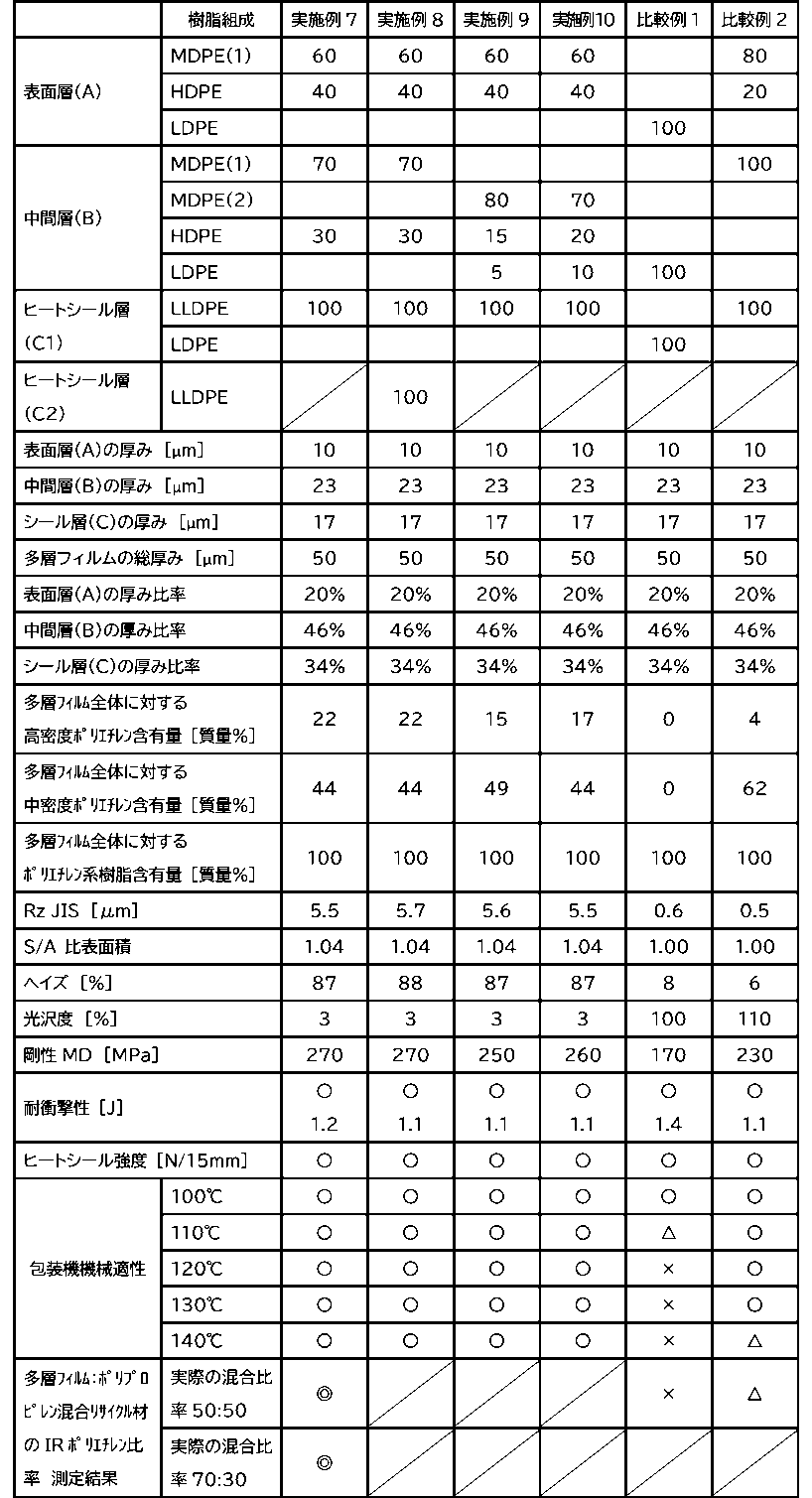
表中で使用した樹脂を以下に示す。
MDPE(1)中密度ポリエチレン(密度:0.933g/cm3、MFR(190℃、21.18N):4g/10分、融点:122℃)
MDPE(2)中密度ポリエチレン(密度:0.931g/cm3、MFR(190℃、21.18N):4g/10分、融点:123℃)
HDPE:高密度ポリエチレン(密度:0.960g/cm3、MFR(190℃、21.18N):8g/10分、融点:134℃)
LLDPE:直鎖状低密度ポリエチレン(密度:0.905g/cm3、MFR(190℃、21.18N):4g/10分、融点(吸熱量が最も大きいピーク):89℃)
LDPE:低密度ポリエチレン(密度:0.922g/cm3、MFR(190℃、21.18N):5g/10分、融点:108℃)
MDPE(1)中密度ポリエチレン(密度:0.933g/cm3、MFR(190℃、21.18N):4g/10分、融点:122℃)
MDPE(2)中密度ポリエチレン(密度:0.931g/cm3、MFR(190℃、21.18N):4g/10分、融点:123℃)
HDPE:高密度ポリエチレン(密度:0.960g/cm3、MFR(190℃、21.18N):8g/10分、融点:134℃)
LLDPE:直鎖状低密度ポリエチレン(密度:0.905g/cm3、MFR(190℃、21.18N):4g/10分、融点(吸熱量が最も大きいピーク):89℃)
LDPE:低密度ポリエチレン(密度:0.922g/cm3、MFR(190℃、21.18N):5g/10分、融点:108℃)
上記表から明らかなとおり、実施例1~10の本発明の多層フィルムは、好適な剛性や、-20℃のごく低温下での優れた耐衝撃性を有すると共に、包装機械適性に優れたものであった。また、ポリエチレン系樹脂のモノマテリアルであるため、リサイクルしやすい。
さらに、実施例1及び実施例5~7の多層フィルムとポリプロピレンとの混合物からなるリサイクル材の、IRにより測定したポリエチレン比率が実際の混合比率に近く、ポリプロピレンと混合されても赤外分光法にて容易にポリエチレン比率を特定しやすく、リサイクル材の高次利用に有利であった。
一方、比較例1の多層フィルムは、低密度ポリエチレンのフィルムであるため、包装機械適性が劣っていた。また、IRにより測定したポリエチレン比率が実際の混合比率から離れており、ポリプロピレンと混合されても赤外分光法にて精度よくポリエチレン比率を把握することができないものであった。また、比較例2の多層フィルムは、高密度ポリエチレンの含有量が少ないため、IRにより測定したポリエチレン比率が実際の混合比率からやや離れており、ポリプロピレンと混合されても赤外分光法にて精度よくポリエチレン比率を把握することができないものであった。
さらに、実施例1及び実施例5~7の多層フィルムとポリプロピレンとの混合物からなるリサイクル材の、IRにより測定したポリエチレン比率が実際の混合比率に近く、ポリプロピレンと混合されても赤外分光法にて容易にポリエチレン比率を特定しやすく、リサイクル材の高次利用に有利であった。
一方、比較例1の多層フィルムは、低密度ポリエチレンのフィルムであるため、包装機械適性が劣っていた。また、IRにより測定したポリエチレン比率が実際の混合比率から離れており、ポリプロピレンと混合されても赤外分光法にて精度よくポリエチレン比率を把握することができないものであった。また、比較例2の多層フィルムは、高密度ポリエチレンの含有量が少ないため、IRにより測定したポリエチレン比率が実際の混合比率からやや離れており、ポリプロピレンと混合されても赤外分光法にて精度よくポリエチレン比率を把握することができないものであった。
Claims (6)
- 少なくとも表面層(A)、中間層(B)及びシール層(C)がこの順に積層された多層フィルムであって、
前記多層フィルムに含まれる成分のうち、90質量%以上がポリエチレン系樹脂であり、
前記多層フィルム全体に対する高密度ポリエチレンの含有量が5~40質量%であり、
前記多層フィルム全体に対する中密度ポリエチレンの含有量が28~72質量%である、多層フィルム。 - 前記表面層(A)の融点をA℃、前記中間層(B)の融点をB℃、前記シール層(C)の融点をC℃としたとき、下記計算式を満たす、請求項1に記載の多層フィルム。
A≧B>C - 前記多層フィルムの総厚みが20~90μmの範囲である、請求項1に記載の多層フィルム。
- 前記多層フィルムの-20℃における衝撃強度が0.7J以上である請求項1に記載の多層フィルム。
- 前記多層フィルムの前記シール層(C)側表面の比表面積が、1.02以上である、請求項1に記載の多層フィルム。
- 請求項1~5のいずれか1項に記載の多層フィルムを用いた包装材。
Priority Applications (1)
| Application Number | Priority Date | Filing Date | Title |
|---|---|---|---|
| JP2023572172A JP7453633B1 (ja) | 2022-10-06 | 2023-07-06 | 多層フィルム及び包装材 |
Applications Claiming Priority (2)
| Application Number | Priority Date | Filing Date | Title |
|---|---|---|---|
| JP2022-161523 | 2022-10-06 | ||
| JP2022161523 | 2022-10-06 |
Publications (1)
| Publication Number | Publication Date |
|---|---|
| WO2024075352A1 true WO2024075352A1 (ja) | 2024-04-11 |
Family
ID=90608067
Family Applications (1)
| Application Number | Title | Priority Date | Filing Date |
|---|---|---|---|
| PCT/JP2023/025059 Ceased WO2024075352A1 (ja) | 2022-10-06 | 2023-07-06 | 多層フィルム及び包装材 |
Country Status (1)
| Country | Link |
|---|---|
| WO (1) | WO2024075352A1 (ja) |
Cited By (1)
| Publication number | Priority date | Publication date | Assignee | Title |
|---|---|---|---|---|
| JP7727080B1 (ja) | 2024-09-13 | 2025-08-20 | グンゼ株式会社 | リサイクルフィルム |
Citations (3)
| Publication number | Priority date | Publication date | Assignee | Title |
|---|---|---|---|---|
| JP2011025637A (ja) * | 2009-07-29 | 2011-02-10 | Dic Corp | 共押出多層フィルム及び該フィルムからなる包装材 |
| WO2019189092A1 (ja) * | 2018-03-26 | 2019-10-03 | 大日本印刷株式会社 | 積層体、該積層体からなる包装材料、包装袋およびスタンドパウチ、並びに多層基材 |
| JP2020055176A (ja) * | 2018-09-28 | 2020-04-09 | 大日本印刷株式会社 | ポリエチレン積層体およびこれを用いた包装材料 |
-
2023
- 2023-07-06 WO PCT/JP2023/025059 patent/WO2024075352A1/ja not_active Ceased
Patent Citations (3)
| Publication number | Priority date | Publication date | Assignee | Title |
|---|---|---|---|---|
| JP2011025637A (ja) * | 2009-07-29 | 2011-02-10 | Dic Corp | 共押出多層フィルム及び該フィルムからなる包装材 |
| WO2019189092A1 (ja) * | 2018-03-26 | 2019-10-03 | 大日本印刷株式会社 | 積層体、該積層体からなる包装材料、包装袋およびスタンドパウチ、並びに多層基材 |
| JP2020055176A (ja) * | 2018-09-28 | 2020-04-09 | 大日本印刷株式会社 | ポリエチレン積層体およびこれを用いた包装材料 |
Cited By (2)
| Publication number | Priority date | Publication date | Assignee | Title |
|---|---|---|---|---|
| JP7727080B1 (ja) | 2024-09-13 | 2025-08-20 | グンゼ株式会社 | リサイクルフィルム |
| JP2026054406A (ja) * | 2024-09-13 | 2026-03-26 | グンゼ株式会社 | リサイクルフィルム |
Similar Documents
| Publication | Publication Date | Title |
|---|---|---|
| ES2902847T3 (es) | Películas revestidas y artículos formados a partir de las mismas | |
| JP7545648B2 (ja) | 樹脂フィルム、積層体および袋 | |
| JP2011194588A (ja) | マット調積層フィルム及び該フィルムからなる包装材 | |
| CA3190393A1 (en) | Recyclable packaging material and process of preparation thereof | |
| WO2024075352A1 (ja) | 多層フィルム及び包装材 | |
| JP7453633B1 (ja) | 多層フィルム及び包装材 | |
| US20160368251A1 (en) | Shrink label | |
| JP7643647B1 (ja) | 防曇性多層フィルム、これを用いる積層体、及び包装材 | |
| US20160279908A1 (en) | Stretch label and manufacturing method therefor | |
| US20240351316A1 (en) | Thermoformable sheet and thermoformed package | |
| JP2013075438A (ja) | 共押出多層フィルム、ラミネートフィルム、及びこれらを用いる包装材 | |
| JP7033266B2 (ja) | 積層体及び該積層体で構成される袋並びに積層体の製造方法 | |
| JP6467828B2 (ja) | 蓋材 | |
| JP7849668B1 (ja) | 防曇性多層フィルム、これを用いる積層体、及び包装材 | |
| JP2021528272A (ja) | コーティングされたフィルムおよびそれから形成される物品 | |
| US12472727B2 (en) | Thermoformable sheet and thermoformed package | |
| JP2024088105A (ja) | インキ、多層フィルムを含む積層体及び包装材 | |
| WO2025164778A1 (ja) | フィルム、積層体および包装容器 | |
| JP2024073024A (ja) | 超音波シール用シーラントフィルム、ラミネートフィルム及び包装材 | |
| JP2026008639A (ja) | フィルム、積層体および包装容器 | |
| JP2026008637A (ja) | フィルム、積層体および包装容器 | |
| JP2026008640A (ja) | フィルム、積層体および包装容器 | |
| JP2026008638A (ja) | フィルム、積層体および包装容器 | |
| JP2026008641A (ja) | フィルム、積層体および包装容器 | |
| JP2026008644A (ja) | フィルム、積層体および包装容器 |
Legal Events
| Date | Code | Title | Description |
|---|---|---|---|
| ENP | Entry into the national phase |
Ref document number: 2023572172 Country of ref document: JP Kind code of ref document: A |
|
| 121 | Ep: the epo has been informed by wipo that ep was designated in this application |
Ref document number: 23874486 Country of ref document: EP Kind code of ref document: A1 |
|
| NENP | Non-entry into the national phase |
Ref country code: DE |
|
| 122 | Ep: pct application non-entry in european phase |
Ref document number: 23874486 Country of ref document: EP Kind code of ref document: A1 |