WO2024070455A1 - 反射パネル、これを用いた電磁波反射装置、電磁波反射フェンス、及び反射パネルの作製方法 - Google Patents
反射パネル、これを用いた電磁波反射装置、電磁波反射フェンス、及び反射パネルの作製方法 Download PDFInfo
- Publication number
- WO2024070455A1 WO2024070455A1 PCT/JP2023/031572 JP2023031572W WO2024070455A1 WO 2024070455 A1 WO2024070455 A1 WO 2024070455A1 JP 2023031572 W JP2023031572 W JP 2023031572W WO 2024070455 A1 WO2024070455 A1 WO 2024070455A1
- Authority
- WO
- WIPO (PCT)
- Prior art keywords
- substrate
- reflective
- reflective panel
- metal
- resin
- Prior art date
- Legal status (The legal status is an assumption and is not a legal conclusion. Google has not performed a legal analysis and makes no representation as to the accuracy of the status listed.)
- Ceased
Links
Images




Classifications
-
- H—ELECTRICITY
- H01—ELECTRIC ELEMENTS
- H01Q—ANTENNAS, i.e. RADIO AERIALS
- H01Q15/00—Devices for reflection, refraction, diffraction or polarisation of waves radiated from an antenna, e.g. quasi-optical devices
- H01Q15/14—Reflecting surfaces; Equivalent structures
Definitions
- the present invention relates to a reflective panel, an electromagnetic wave reflective device using the same, an electromagnetic wave reflective fence, and a method for manufacturing the reflective panel.
- 5G fifth generation mobile communication system
- IoT Internet of Things
- 5G radio waves have a high degree of directivity, it is necessary to install reflectors and other devices to ensure a propagation path that delivers radio waves to the required area.
- 6G sixth generation mobile communication system
- reflectors used to improve the propagation environment are required to have high reflection efficiency as well as accurate reflection direction.
- reflectors will also be used as soundproofing walls and safety fences, and in order to ensure visibility, a transparency of 50% or more for visible light may be required.
- the reflective film of a reflector is generally made of a metal mesh that is transparent to visible light, or a metal mesh printed on transparent resin.
- metal mesh that is highly transparent to visible light is easily deformed, and deformation of the metal mesh can easily cause streaky defects when manufacturing the reflective panel. These streaky defects are visually recognized as cloudiness or scratches on the reflective panel. If the deformation of the metal mesh is significant, the reflection direction and reflection efficiency may deviate from the design, posing a more serious problem in that the desired wireless communication area cannot be obtained.
- Metal mesh printed on transparent resin is prone to the moiré phenomenon, and in this case too, the moiré reduces visibility.
- One objective of the present invention is to provide a reflective panel that maintains transparency while improving at least one of the reflective efficiency and accuracy of the reflective direction.
- a reflective panel includes a first substrate, a second substrate, and a reflective layer disposed between the first substrate and the second substrate; the first substrate and the second substrate are insulating substrates that are transparent to visible light and electromagnetic waves in the range of 1 GHz to 300 GHz, an interface between the first substrate and the reflective layer, or an interface between the second substrate and the reflective layer, is a reflective surface that reflects electromagnetic waves in a predetermined frequency band included in the range,
- the reflective layer is a resin layer containing a predetermined content of metal nanostructures.
- a reflective panel is realized that maintains transparency while improving at least one of the reflective efficiency and accuracy of the reflective direction.
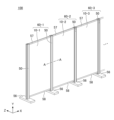
- FIG. 1 is a schematic diagram of an electromagnetic wave reflecting fence in which electromagnetic wave reflecting devices having reflecting panels according to an embodiment are connected together.
- 2 is a horizontal cross-sectional view taken along line AA in FIG. 1.
- FIG. 2 is a schematic diagram of a layer structure of a reflective panel.
- FIG. 2 is a schematic diagram illustrating an example of a reflective layer.
- FIG. 4 is a schematic diagram showing another example of a reflective layer.
- FIG. 13 is a schematic diagram showing yet another example of a reflective layer.
- FIG. 13 is a schematic diagram of a modified example of the reflective panel.
- FIG. 2 is a schematic diagram of a sample used for evaluation.
- FIG. 1 is a schematic diagram of an electromagnetic wave reflecting fence 100 in which electromagnetic wave reflecting devices having reflecting panels according to an embodiment are connected together.
- the electromagnetic wave reflecting fence 100 is formed by connecting electromagnetic wave reflecting devices 60-1, 60-2, and 60-3, each having a reflecting panel 10-1, 10-2, and 10-3 (hereinafter, may be collectively referred to as "reflecting panel 10" as appropriate), in the horizontal direction.
- the width or horizontal direction of the reflecting panel 10 is the X direction
- the height or vertical direction is the Y direction
- the thickness direction is the Z direction.
- the electromagnetic wave reflecting fence 100 is formed by connecting three electromagnetic wave reflecting devices 60-1, 60-2, and 60-3 (hereinafter, may be collectively referred to as "electromagnetic wave reflecting device 60" as appropriate), but there is no particular limit to the number of electromagnetic wave reflecting devices 60 that are connected.
- the reflective panels 10-1, 10-2, and 10-3 used in the electromagnetic wave reflecting devices 60-1, 60-2, and 60-3 reflect electromagnetic waves in a predetermined frequency band of 1 GHz to 300 GHz, for example, 1 GHz to 170 GHz, or 1 GHz to 100 GHz, or 1 GHz to 80 GHz.
- each reflective panel 10 has a reflective layer sandwiched between two insulating substrates.
- Each electromagnetic wave reflecting device 60 has a frame 50 that holds the reflecting panel 10.
- the electromagnetic wave reflecting device 60 may have legs 56 that support the frame 50.
- the legs 56 are not essential, but are useful when the electromagnetic wave reflecting device 60 or the electromagnetic wave reflecting fence 100 is to be made to stand independently on the installation surface (XZ plane) as shown in FIG. 1.
- the reflective panel 10 may have a specular reflective surface that reflects electromagnetic waves in the same direction as the angle of incidence, or may have an artificial metasurface in which the reflection angle is controlled in a direction different from the angle of incidence.
- a single reflective panel 10 may have a mixture of specular reflective surfaces and metasurfaces.
- the reflective panel 10 has a specular reflective surface, it is desirable for adjacent reflective panels 10 to be electrically connected to each other via a frame 50 in order to maintain continuity of the reflected potential between the panels.
- the reflective panel 10 has a metasurface, there may be no electrical connection between adjacent reflective panels 10.
- the electromagnetic wave reflection device 60 may have a top frame 57 that holds the upper end of the reflective panel 10, and a bottom frame 58 that holds the lower end.
- the frame 50, top frame 57, and bottom frame 58 form a frame that holds the entire periphery of the reflective panel 10.
- the frame 50 may be called a "side frame" because of its positional relationship to the top frame 57 and bottom frame 58. Providing the top frame 57 and bottom frame 58 ensures mechanical strength and safety when transporting and assembling the reflective panel 10.
- FIG. 2 is a horizontal cross-sectional view taken along line A-A in FIG. 1.
- This horizontal cross-sectional view shows the reflective panels 10-1 and 10-2 held by the frame 50 in a cross section parallel to the XZ plane.
- the frame 50 has a conductive main body 500 and slits 51-1 and 51-2 formed on both sides of the width of the main body 500.
- the edges of the reflective panels 10-1 and 10-2 are inserted into the slits 51-1 and 51-2, respectively, and are held within a space 52.
- the space 52 is not essential, providing the space 52 allows the weight of the main body 500 of the frame 50 to be reduced and allows for a more flexible holding angle for the reflective panel 10.
- a part of the main body 500 may be formed from a non-conductive material.
- a non-conductive cover 501 such as a resin may be provided on the outer surface of the main body 500, but the cover 501 is not essential. If the cover 501 is provided, the cover 501 functions as a protective member that protects the frame 50.
- ⁇ Layer structure of reflective panel> 3 is a schematic diagram of the layer structure of the reflective panel 10.
- This layer structure is the structure in the thickness (Z) direction of the reflective panel 10.
- the reflective panel 10A has a first substrate 11, a second substrate 12, and a reflective layer 15 provided between the first substrate 11 and the second substrate 12.
- the first substrate 11 and the second substrate 12 are insulating substrates that are transparent to electromagnetic waves of 1 GHz to 300 GHz and visible light.
- the interface between the first substrate 11 and the reflective layer 15, or the interface between the second substrate 12 and the reflective layer 15 becomes a reflective surface that selectively reflects electromagnetic waves of a predetermined frequency band included in the above range.
- the reflective layer 15 is a resin layer containing a predetermined proportion of metal nanostructures.
- the first substrate 11 and the second substrate 12 are insulating polymer sheets or films such as polycarbonate, cycloolefin polymer (COP), polyethylene terephthalate (PET), and fluororesin. These materials have high transparency to visible light and high transmittance to electromagnetic waves between 1 GHz and 170 GHz.
- polycarbonate which has excellent impact resistance, durability, and transparency.
- the thicknesses of the first substrate 11 and the second substrate 12 are appropriately selected within the range of 1.0 mm to 10.0 mm depending on the application location and manner of the reflective panel 10.
- the reflective layer 15 has metal nanostructures contained in a resin layer at a predetermined ratio.
- resin ethylene vinyl acetate, COP, UV-curable resin, thermosetting resin, thermoplastic resin, etc.
- UV-curable resin urethane-based resin, acrylic-based resin, silicone-based resin, epoxy resin, urethane acrylate, etc.
- thermoplastic resin polycarbonate can be used.
- the relative dielectric constant and dielectric dissipation factor of the resin material are set within an appropriate range that suppresses a decrease in the reflection efficiency of the entire reflective layer 15.
- the relative dielectric constant of the resin material is 2.0 or more and less than 3.0, and the dielectric dissipation factor is 0.0001 or more and less than 0.1000. If the relative dielectric constant of the resin material is 3.0 or more, there is a risk of increased loss at high frequencies. If the dielectric dissipation factor of the resin material is 0.1000 or more, there is a risk of increased loss of electrical energy in the resin.
- cellulose resin, aniline resin, ethylene resin, and other resin materials may be used as the resin.
- the metal nanostructure may be a metal particle or metal wire with a diameter or width of 1 nm to several hundreds of nm, or may be a metal pattern with a diameter or width of several nm to several hundreds of nm embedded in a resin layer.
- the shape of the metal pattern may be a cylinder, a polygonal prism, an ellipse, a line and space pattern, etc.
- the wire length may be 1 ⁇ m or more and 500 ⁇ m or less.
- a transparent ink in which fine metal is dispersed may be applied as the reflective layer 15.
- the solid concentration of the fine metal is 0.5 wt% or more and 30.0 wt% or less, more preferably 1.5 wt% or more and 30.0 wt% or less.
- the reflective layer 15 itself is a flexible conductive layer, and has good conformability and adhesion to the surface of the first substrate 11 or the second substrate 12. Also, compared to metal mesh, there is almost no distortion or deformation during the manufacture of the reflective panel 10. The occurrence of streak-like defects and moire is suppressed, and the transparency of the reflective panel 10 can be maintained at a high level. Furthermore, deviation from the designed reflection efficiency and reflection direction can be suppressed.
- the thickness of the reflective layer 15 is, for example, 10 ⁇ m or more and 1000 ⁇ m or less.
- the surface resistance value of the reflective layer 15 is 0.1 ⁇ / ⁇ or more and 50.0 ⁇ / ⁇ or less, preferably 0.1 ⁇ / ⁇ or more and 10.0 ⁇ / ⁇ or less.
- FIG. 4A is a schematic diagram of the reflective layer 15A.
- the reflective layer 15A includes a resin layer 151 and metal nanoparticles 153A dispersed in the resin layer 151.
- the resin layer 151 is vinyl acetate, COP, urethane resin, acrylic resin, silicone resin, epoxy resin, urethane acrylate, cellulose resin, aniline resin, ethylene resin, other ultraviolet hardening resin, thermosetting resin, thermoplastic resin, or the like.
- the relative dielectric constant of the resin layer 151 is preferably 2.0 or more and less than 3.0. If the relative dielectric constant of the resin layer 151 is 3.0 or more, the loss at high frequencies may increase.
- the dielectric tangent of the resin layer 151 is 0.0001 or more and less than 0.1000. If the dielectric tangent of the resin layer 151 is 0.1000 or more, the loss of electrical energy in the resin layer 151 may increase. As long as the relative dielectric constant and the dielectric tangent are within the above-mentioned ranges, an appropriate resin material can be selected.
- the metal nanoparticles 153A contained in the resin layer 151 are metal particles with a diameter or width on the order of nanometers, and may be of any shape, such as spherical particles, elliptical particles, cylindrical particles, columnar particles, or polygonal pyramidal particles. Particles with a diameter smaller than 1 micron are called "nanoparticles," and in order to efficiently reflect and scatter electromagnetic waves, which are wireless communication wavelengths, the average diameter of the metal nanoparticles 153A is 1 nm or more and 500 nm or less, and preferably 1 nm or more and 100 nm or less.
- Materials that can be used for the metal nanoparticles 153A include silver, copper, gold, platinum, palladium, rhodium, iridium, ruthenium, osmium, iron, cobalt, and tin.
- the reflection panel 10 or the electromagnetic wave reflection device 60 is used indoors or outdoors, such as on roads, in parks, in factories, in commercial facilities, in offices, etc., it is desirable to have high transparency or visibility in terms of taking in natural light or illumination light.
- the solid content of metal nanoparticles 153A may be set to 1.5 wt% or more and 30.0 wt% or more.
- the upper limit of the content of metal nanoparticles may be appropriately adjusted according to the metal material used, within a range in which the surface resistance is 50.0 ⁇ / ⁇ or less and transparency is guaranteed.
- FIG. 4B is a schematic diagram of the reflective layer 15B.
- the reflective layer 15B includes a resin layer 151 and metal nanowires 153B dispersed in the resin layer 151.
- the resin layer 151 can be made of the same resin as described with reference to FIG. 4A, and the preferred ranges of the relative dielectric constant and dielectric tangent are also as described with reference to FIG. 4A.
- the metal nanowires 153B contained in the resin layer 151 are metal wires with a diameter or width of submicron size.
- the average diameter of the metal nanowires 153B is 10 nm or more and 500 nm or less, preferably 10 nm or more and 100 nm or less.
- the average length of the metal nanowires 153B is, for example, 1 ⁇ m or more and 500 ⁇ m or less.
- Materials for the metal nanowires 153B include silver, copper, gold, platinum, palladium, rhodium, iridium, ruthenium, osmium, iron, cobalt, tin, etc. Whiskers of tin, silver sulfide, copper oxide, etc. may also be used as the metal nanowires 153B.
- the reflection panel 10 or the electromagnetic wave reflection device 60 is used indoors or outdoors, such as on roads, in parks, in factories, in commercial facilities, in offices, etc., high transparency or visibility is desirable from the viewpoint of taking in natural light or illumination light.
- the solid content of the metal nanowires 153B may be set to 1.5 wt% or more and 30.0 wt% or more.
- the upper limit of the content of the metal nanowires 153B may be appropriately adjusted according to the nanowire material used, within a range in which the surface resistance is 50.0 ⁇ / ⁇ or less and transparency is guaranteed.
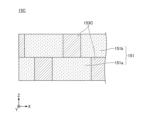
- FIG. 4C is a schematic diagram of the reflective layer 15C.
- the reflective layer 15C includes a resin layer 151 and a metal nanopattern 153C in the resin layer 151.
- the resin layer 151 can be made of the same resin material as described with reference to FIG. 4A, and the preferred ranges of the relative dielectric constant and dielectric tangent are also as described with reference to FIG. 4A.
- the metal nanopattern 153C contained in the resin layer 151 is a metal pattern with a diameter or width of submicron size.
- the average diameter or width of the metal nanopattern 153C is 10 nm or more and 500 nm or less, preferably 10 nm or more and 100 nm or less.
- the reflective layer 15C may be a resin sheet of a predetermined size with the metal nanopattern 153C embedded therein, tiled tightly on the first substrate 11 or the second substrate 12.
- resin layer 151 is formed by laminating resin sheets 151a and 151b having metal nanopattern 153C, but reflective layer 15C may be formed of a single resin sheet having metal nanopattern 153C, or three or more layers of resin sheets may be laminated together.
- the shape of metal nanopattern 153C in the XY plane may be a circle, an ellipse, a polygon, a stripe extending in the Y direction, or the like.
- Metal nanopattern 153C may be formed of silver, copper, gold, platinum, palladium, rhodium, iridium, ruthenium, osmium, iron, cobalt, tin, or the like.
- the reflective panel 10 or the electromagnetic wave reflection device 60 is used indoors or outdoors, such as on a road, in a park, in a factory, in a commercial facility, or in an office, it is desirable to have high transparency or visibility in order to take in natural light or illumination light.
- the solid content concentration of the metal nanopattern 153C in the reflective layer 15C may be set to 1.5 wt% or more and 30.0 wt% or more.
- the upper limit of the content of the metal nanopattern 153C may be appropriately adjusted according to the metal material used, within a range in which the surface resistance is 50.0 ⁇ / ⁇ or less and transparency is guaranteed.
- ⁇ Modifications of the Reflective Panel> 5 shows a reflective panel 10A as a modified example of the reflective panel 10.
- This layer structure is the structure in the thickness (Z) direction of the reflective panel 10.
- the reflective panel 10A has a first substrate 11, a second substrate 12A, and a reflective layer 15 provided between the first substrate 11 and the second substrate 12. At least one of the first substrate 11 and the second substrate 12A has irregularities 121 at the interface with the reflective layer 15. In this example, the second substrate 12A has the irregularities 121.
- the unevenness 121 may be the unevenness present on the surface of a typical plastic substrate, or may be a groove structure formed on the surface of the second substrate 12A to obtain the desired reflection characteristics. Since the reflective layer 15 itself is a flexible resin film containing metal nanostructures, the reflective layer 15 conforms to the shape of the unevenness 121 on the surface of the second substrate 12A, and is obtained in close contact between the first substrate 11 and the second substrate 12.
- the unevenness 121 may be a periodic pattern that has selectivity for a predetermined frequency, or may be a pattern designed to reflect incident electromagnetic waves in a predetermined direction.
- the configuration of FIG. 5 also improves at least one of the reflection efficiency and the accuracy of the reflection direction while maintaining the transparency of the reflective panel 10A.
- samples are prepared under different conditions and the return loss at a specified frequency is measured to verify the preferred range of the content ratio of metal nanostructures contained in the reflective layer 15 and the preferred range of the surface resistance of the reflective layer 15.
- the return loss is measured using a vector network analyzer and a high-frequency oblique incidence free-space type S-parameter measurement jig.
- the return loss is measured using a smooth aluminum plate that is 3 mm thick and 300 mm x 300 mm, and this measured value is set to a return loss of 0.00 dB.
- FIG. 6 is a schematic diagram of a sample 20 used for evaluation.
- an adhesive layer 21 is inserted between the first substrate 11 and the reflective layer 15, and an adhesive layer 22 is inserted between the second substrate 12 and the reflective layer 15.
- Example 1 is Example 1.
- a polycarbonate sheet having a thickness of 2 mm is used as the first substrate 11 and the second substrate.
- An ethylene vinyl acetate film having a thickness of 400 ⁇ m is used as the adhesive layers 21 and 22.
- a polycarbonate film having a thickness of 100 ⁇ m obtained by coating a polycarbonate solution containing silver nanowires having a wire length of 1 ⁇ m and a wire diameter of 10 nm at a solid content concentration of 1.5 wt% is used as the reflective layer 15.
- This laminate is sandwiched between two pieces of glass having a thickness of 3 mm and heated at 130° C. under vacuum to obtain a sample of Example 1.
- the heat treatment at 130°C causes shrinkage of the reflective layer 15 and adhesive layers 21 and 22 of the polycarbonate film, but the silver nanowires are evenly dispersed in the polycarbonate film and there is almost no deformation of the silver nanowires themselves.
- the return loss measured for the sample of Example 1 is -0.03 dB, and the surface resistance of the reflective layer 15 is 10.0 ⁇ / ⁇ . Visual observation shows that the sample is not cloudy and maintains its transparency. The transmittance of this sample to visible light is 70.2%.
- the reflective panel of Example 1 maintains transparency, has low surface resistance, and has low return loss.
- Example 2 is Example 2.
- a polycarbonate sheet having a thickness of 2 mm is used as the first substrate 11 and the second substrate, and an ethylene vinyl acetate film having a thickness of 400 ⁇ m is used as the adhesive layers 21 and 22.
- a polycarbonate film having a thickness of 100 ⁇ m obtained by coating a polycarbonate solution containing silver nanowires having a wire length of 10 ⁇ m and a wire diameter of 50 nm at a solid content concentration of 10.0 wt% is used as the reflective layer 15. This laminate is sandwiched between two pieces of glass having a thickness of 3 mm and heated at 130° C. under vacuum to obtain a sample of Example 2.
- the above heat treatment causes shrinkage of the reflective layer 15 and adhesive layers 21 and 22 of the polycarbonate film.
- the silver nanowires are evenly dispersed in the polycarbonate film, but the silver nanowire mesh is slightly deformed locally due to the increased solids concentration.
- the return loss measured at the deformed part of the silver nanowire mesh of the sample of Example 2 is -0.05 dB, and the surface resistance of the reflective layer 15 is 1.0 ⁇ / ⁇ . According to external observation, no clouding is observed on the sample, and transparency is maintained.
- the transmittance of this sample to visible light is 65.6%.
- the reflective panel of Example 2 maintains transparency, has low surface resistance, and has low return loss.
- Example 3 is Example 3.
- a polycarbonate sheet having a thickness of 2 mm is used as the first substrate 11 and the second substrate, and an ethylene vinyl acetate film having a thickness of 400 ⁇ m is used as the adhesive layers 21 and 22.
- a polycarbonate film having a thickness of 100 ⁇ m obtained by coating a polycarbonate solution containing silver nanowires having a wire length of 100 ⁇ m and a wire diameter of 100 nm at a solid content concentration of 25.0 wt% is used as the reflective layer 15. This laminate is sandwiched between two pieces of glass having a thickness of 3 mm and heated at 130° C. under vacuum to obtain a sample of Example 3.
- the above heat treatment causes shrinkage of the reflective layer 15 and adhesive layers 21 and 22 of the polycarbonate film.
- the silver nanowires are evenly dispersed in the polycarbonate film, but as the solids concentration increases, the mesh of the silver nanowires is locally deformed due to shrinkage of the resin components.
- the return loss measured at the deformed part of the silver nanowire mesh of the sample of Example 3 is -0.07 dB, and the surface resistance of the reflective layer 15 is 0.1 ⁇ / ⁇ . According to external observation, no cloudiness is observed on the sample, and transparency is maintained.
- the transmittance of this sample to visible light is 60.2%.
- the reflective panel of Example 3 maintains transparency, has low surface resistance, and has low return loss.
- Example 4 is Comparative Example 1.
- a polycarbonate sheet having a thickness of 2 mm is used as the first substrate 11 and the second substrate, and an ethylene vinyl acetate film having a thickness of 400 ⁇ m is used as the adhesive layers 21 and 22.
- a stainless steel mesh having a thickness of 100 ⁇ m is used as the reflective layer 15. This laminate is sandwiched between two pieces of glass having a thickness of 3 mm and heated at 130° C. under vacuum to obtain a sample of Example 4.
- the above heat treatment causes shrinkage of the reflective layer 15 and adhesive layers 21 and 22 of the polycarbonate film, and the stainless steel mesh is deformed as the resin material deforms.
- the return loss measured in the deformed portion of the stainless steel mesh of the sample of Example 4 is -1.75 dB.
- the surface resistance of the reflective layer 15 in the portion where no local deformation has occurred is low at 0.01 ⁇ / ⁇ , but it can be seen that the deformation of the stainless steel mesh creates portions where the reflection efficiency is reduced.
- Visual observation revealed moire patterns caused by the regular mesh of the stainless steel mesh.
- the visible light transmittance of the portion of this sample where no local deformation has occurred is 60.0%.
- Example 5 is Comparative Example 2. The same layer structure as Example 4 is used, but the heating temperature is lowered to reduce the resin material shrinkage.
- a polycarbonate sheet having a thickness of 2 mm is used as the first substrate 11 and the second substrate, and an ethylene vinyl acetate film having a thickness of 400 ⁇ m is used as the adhesive layers 21 and 22.
- a stainless steel mesh having a thickness of 100 ⁇ m is used as the reflective layer 15. This laminate is sandwiched between two pieces of glass having a thickness of 3 mm and heated at 100° C. under vacuum to obtain a sample of Example 5.
- Heat treatment at the above temperatures causes shrinkage of the reflective layer 15 and adhesive layers 21 and 22 of the polycarbonate film, and the stainless steel mesh deforms as the resin material deforms.
- the return loss measured in the deformed portion of the stainless steel mesh of the sample of Example 4 was -1.02 dB, which is an improvement over Example 4.
- the surface resistance of the reflective layer 15 in the portion where no local deformation has occurred is low at 0.01 ⁇ / ⁇ , but it can be seen that the deformation of the stainless steel mesh creates portions where the reflection efficiency is reduced.
- Visual observation revealed moire patterns caused by the regular mesh of the stainless steel mesh.
- the visible light transmittance of the portion of this sample where no local deformation has occurred is 60.3%.
- a first substrate 11 and a second substrate 12 are prepared, which are insulating and transparent to visible light and electromagnetic waves having a frequency of 1 GHz or more and 300 GHz or less;
- a resin film containing a predetermined amount of metal nanostructures is provided on one of the first substrate 11 and the second substrate 12;
- the other of the first substrate 11 and the second substrate 12 is disposed on the resin film; It can be produced by
- a coating agent is prepared in which metal nanostructures are dispersed in a resin solution at a solids concentration of 1.5 wt% or more and 30.0 wt% or less, and this coating agent is applied to one of the first substrate 11 and the second substrate 12.
- An ink containing nanometal powder with a solids concentration of 1.5 wt% or more and 30 wt% or less may also be used as the coating agent. In either case, the surface resistance is suppressed while maintaining the transparency of the reflective panel, and at least one of the reflection efficiency and the accuracy of the reflection direction is improved.
- the electromagnetic wave reflecting device 60 and the electromagnetic wave reflecting fence 100 using the reflective panel 10 are effectively used in environments where many blind zones occur within a limited space.
- the reflective panel 10 is highly transparent, the electromagnetic wave reflecting device 60 and the electromagnetic wave reflecting fence 100 can also be used as a safety fence or a soundproof fence.
- the in-plane size of the reflective panel 10 can be appropriately selected within a range from 30 cm x 30 cm to 3 m x 3 m.
- a protective layer such as an ultraviolet protection film may be provided on the surfaces of the first substrate 11 and the second substrate 12 of the reflective panel 10. This allows the reflective panel 10 to be used for a long period of time in outdoor environments.
- the present disclosure may include the following configurations.
- the reflective layer is a resin layer containing a predetermined content of metal nanostructures. Reflective panel.
- Item 2 Item 2.
- the reflective panel according to item 1 wherein the reflective layer contains the metal nanostructure at a solid content concentration of 1.5 wt % or more and 30.0 wt % or less.
- (Item 3) 3.
- (Item 4) Item 4.
- Item 5 Item 4.
- Item 6 Item 4.
- Item 7 Item 7.
- Item 8 A reflective panel according to any one of items 1 to 7; A frame for holding the reflective panel; An electromagnetic wave reflecting device having the same.
- Item 9 Item 9. An electromagnetic wave reflective fence comprising two or more electromagnetic wave reflective devices according to item 8, the two or more reflective panels being connected by the frame.
- Item 11 Item 11.
- a method for producing a reflective panel as described in item 10 comprising preparing a coating agent in which the metal nanostructure is dispersed in a resin solution at a solids concentration of 1.5 wt % or more and 30.0 wt % or less, and applying the coating agent to one of the first substrate and the second substrate.
- Item 12 Item 12. The method for producing a reflective panel according to item 11, further comprising applying a resin ink having metal nanopowder dispersed therein at the solid content concentration to one of the first substrate and the second substrate.
- Electromagnetic wave reflection device 100 Electromagnetic wave reflection fence
Landscapes
- Physics & Mathematics (AREA)
- Electromagnetism (AREA)
- Laminated Bodies (AREA)
- Aerials With Secondary Devices (AREA)
Priority Applications (1)
| Application Number | Priority Date | Filing Date | Title |
|---|---|---|---|
| JP2024549918A JPWO2024070455A1 (https=) | 2022-09-26 | 2023-08-30 |
Applications Claiming Priority (2)
| Application Number | Priority Date | Filing Date | Title |
|---|---|---|---|
| JP2022-152155 | 2022-09-26 | ||
| JP2022152155 | 2022-09-26 |
Publications (1)
| Publication Number | Publication Date |
|---|---|
| WO2024070455A1 true WO2024070455A1 (ja) | 2024-04-04 |
Family
ID=90477337
Family Applications (1)
| Application Number | Title | Priority Date | Filing Date |
|---|---|---|---|
| PCT/JP2023/031572 Ceased WO2024070455A1 (ja) | 2022-09-26 | 2023-08-30 | 反射パネル、これを用いた電磁波反射装置、電磁波反射フェンス、及び反射パネルの作製方法 |
Country Status (3)
| Country | Link |
|---|---|
| JP (1) | JPWO2024070455A1 (https=) |
| TW (1) | TW202431713A (https=) |
| WO (1) | WO2024070455A1 (https=) |
Citations (3)
| Publication number | Priority date | Publication date | Assignee | Title |
|---|---|---|---|---|
| JP2020141338A (ja) * | 2019-02-28 | 2020-09-03 | 日本ゼオン株式会社 | 標示用シート、並びに、標示構造およびその施工方法 |
| WO2022163813A1 (ja) * | 2021-01-29 | 2022-08-04 | 積水化学工業株式会社 | 構造体、及び建築材料 |
| JP7206571B1 (ja) * | 2022-02-01 | 2023-01-18 | 積水化学工業株式会社 | 電波反射体、および建築材料 |
-
2023
- 2023-08-30 JP JP2024549918A patent/JPWO2024070455A1/ja active Pending
- 2023-08-30 WO PCT/JP2023/031572 patent/WO2024070455A1/ja not_active Ceased
- 2023-09-04 TW TW112133437A patent/TW202431713A/zh unknown
Patent Citations (3)
| Publication number | Priority date | Publication date | Assignee | Title |
|---|---|---|---|---|
| JP2020141338A (ja) * | 2019-02-28 | 2020-09-03 | 日本ゼオン株式会社 | 標示用シート、並びに、標示構造およびその施工方法 |
| WO2022163813A1 (ja) * | 2021-01-29 | 2022-08-04 | 積水化学工業株式会社 | 構造体、及び建築材料 |
| JP7206571B1 (ja) * | 2022-02-01 | 2023-01-18 | 積水化学工業株式会社 | 電波反射体、および建築材料 |
Also Published As
| Publication number | Publication date |
|---|---|
| TW202431713A (zh) | 2024-08-01 |
| JPWO2024070455A1 (https=) | 2024-04-04 |
Similar Documents
| Publication | Publication Date | Title |
|---|---|---|
| CN112622391B (zh) | 一种光学透明超宽带雷达与红外双隐身结构 | |
| JP7271802B2 (ja) | 構造体、及び建築材料 | |
| US20250055201A1 (en) | Electromagnetic wave reflecting device, electromagnetic wave reflecting fence, and reflection panel | |
| US20220272798A1 (en) | Transparent heating film | |
| EP4475340A1 (en) | Radio wave reflector and construction material | |
| WO2024070455A1 (ja) | 反射パネル、これを用いた電磁波反射装置、電磁波反射フェンス、及び反射パネルの作製方法 | |
| WO2024106405A1 (ja) | 電波反射体、電波反射体の作製方法、電波反射構造体、電波反射システムおよび電波反射装置 | |
| EP4459796A1 (en) | Radio wave reflector | |
| JP2024021078A (ja) | 電波反射体、電波反射体の製造方法および電波反射体の施工方法 | |
| JP7206571B1 (ja) | 電波反射体、および建築材料 | |
| EP4129648A1 (en) | Multilayer structure | |
| WO2024029559A1 (ja) | 電波反射体 | |
| JP2024021077A (ja) | 電波反射体 | |
| US20250210877A1 (en) | Reflective panel, electromagnetic wave reflecting apparatus using reflective panel, electromagnetic wave reflecting fence, and method of making reflective panel | |
| JP2016223161A (ja) | 透明発熱板及び透明発熱板を備えた窓 | |
| CN121713334A (zh) | 电磁波反射面板、使用该电磁波反射面板的电磁波反射装置、电磁波反射围栏、电磁波反射面板的制造方法以及电磁波反射面板的评价方法 | |
| WO2024029575A1 (ja) | 電波反射体、電波反射体の製造方法および電波反射体の施工方法 | |
| WO2024214372A1 (ja) | 電磁波反射パネルの製造方法、電磁波反射パネル、電磁波反射装置、及び電磁波反射フェンス | |
| CN118648191A (zh) | 电波反射体 | |
| WO2024241666A1 (ja) | 電磁波反射パネル、電磁波反射装置、及び電磁波反射フェンス | |
| JP2026054790A (ja) | 電波反射体および反射鏡アンテナ | |
| WO2024214369A1 (ja) | 電磁波反射パネル、電磁波反射装置、及び電磁波反射フェンス | |
| JP2024141594A (ja) | 電磁波吸収部材 | |
| JP2026054789A (ja) | ブラインドおよび電波反射方法 | |
| CN119156746A (zh) | 电磁波反射装置、电磁波反射围栏以及反射面板 |
Legal Events
| Date | Code | Title | Description |
|---|---|---|---|
| 121 | Ep: the epo has been informed by wipo that ep was designated in this application |
Ref document number: 23871695 Country of ref document: EP Kind code of ref document: A1 |
|
| WWE | Wipo information: entry into national phase |
Ref document number: 2024549918 Country of ref document: JP |
|
| NENP | Non-entry into the national phase |
Ref country code: DE |
|
| 122 | Ep: pct application non-entry in european phase |
Ref document number: 23871695 Country of ref document: EP Kind code of ref document: A1 |