WO2024048425A1 - 仮想空間制御方法、仮想空間制御装置及び仮想空間制御システム - Google Patents
仮想空間制御方法、仮想空間制御装置及び仮想空間制御システム Download PDFInfo
- Publication number
- WO2024048425A1 WO2024048425A1 PCT/JP2023/030608 JP2023030608W WO2024048425A1 WO 2024048425 A1 WO2024048425 A1 WO 2024048425A1 JP 2023030608 W JP2023030608 W JP 2023030608W WO 2024048425 A1 WO2024048425 A1 WO 2024048425A1
- Authority
- WO
- WIPO (PCT)
- Prior art keywords
- virtual space
- item
- information
- server
- user
- Prior art date
- Legal status (The legal status is an assumption and is not a legal conclusion. Google has not performed a legal analysis and makes no representation as to the accuracy of the status listed.)
- Ceased
Links
Images







Classifications
-
- G—PHYSICS
- G06—COMPUTING OR CALCULATING; COUNTING
- G06T—IMAGE DATA PROCESSING OR GENERATION, IN GENERAL
- G06T17/00—Three-dimensional [3D] modelling for computer graphics
-
- G—PHYSICS
- G06—COMPUTING OR CALCULATING; COUNTING
- G06T—IMAGE DATA PROCESSING OR GENERATION, IN GENERAL
- G06T19/00—Manipulating three-dimensional [3D] models or images for computer graphics
-
- A—HUMAN NECESSITIES
- A63—SPORTS; GAMES; AMUSEMENTS
- A63F—CARD, BOARD, OR ROULETTE GAMES; INDOOR GAMES USING SMALL MOVING PLAYING BODIES; VIDEO GAMES; GAMES NOT OTHERWISE PROVIDED FOR
- A63F13/00—Video games, i.e. games using an electronically generated display having two or more dimensions
- A63F13/60—Generating or modifying game content before or while executing the game program, e.g. authoring tools specially adapted for game development or game-integrated level editor
- A63F13/69—Generating or modifying game content before or while executing the game program, e.g. authoring tools specially adapted for game development or game-integrated level editor by enabling or updating specific game elements, e.g. unlocking hidden features, items, levels or versions
-
- G—PHYSICS
- G06—COMPUTING OR CALCULATING; COUNTING
- G06F—ELECTRIC DIGITAL DATA PROCESSING
- G06F9/00—Arrangements for program control, e.g. control units
- G06F9/06—Arrangements for program control, e.g. control units using stored programs, i.e. using an internal store of processing equipment to receive or retain programs
- G06F9/44—Arrangements for executing specific programs
- G06F9/451—Execution arrangements for user interfaces
-
- G—PHYSICS
- G06—COMPUTING OR CALCULATING; COUNTING
- G06T—IMAGE DATA PROCESSING OR GENERATION, IN GENERAL
- G06T19/00—Manipulating three-dimensional [3D] models or images for computer graphics
- G06T19/20—Editing of three-dimensional [3D] images, e.g. changing shapes or colours, aligning objects or positioning parts
-
- A—HUMAN NECESSITIES
- A63—SPORTS; GAMES; AMUSEMENTS
- A63F—CARD, BOARD, OR ROULETTE GAMES; INDOOR GAMES USING SMALL MOVING PLAYING BODIES; VIDEO GAMES; GAMES NOT OTHERWISE PROVIDED FOR
- A63F2300/00—Features of games using an electronically generated display having two or more dimensions, e.g. on a television screen, showing representations related to the game
- A63F2300/50—Features of games using an electronically generated display having two or more dimensions, e.g. on a television screen, showing representations related to the game characterized by details of game servers
- A63F2300/55—Details of game data or player data management
- A63F2300/5546—Details of game data or player data management using player registration data, e.g. identification, account, preferences, game history
- A63F2300/5553—Details of game data or player data management using player registration data, e.g. identification, account, preferences, game history user representation in the game field, e.g. avatar
-
- A—HUMAN NECESSITIES
- A63—SPORTS; GAMES; AMUSEMENTS
- A63F—CARD, BOARD, OR ROULETTE GAMES; INDOOR GAMES USING SMALL MOVING PLAYING BODIES; VIDEO GAMES; GAMES NOT OTHERWISE PROVIDED FOR
- A63F2300/00—Features of games using an electronically generated display having two or more dimensions, e.g. on a television screen, showing representations related to the game
- A63F2300/50—Features of games using an electronically generated display having two or more dimensions, e.g. on a television screen, showing representations related to the game characterized by details of game servers
- A63F2300/57—Features of games using an electronically generated display having two or more dimensions, e.g. on a television screen, showing representations related to the game characterized by details of game servers details of game services offered to the player
- A63F2300/575—Features of games using an electronically generated display having two or more dimensions, e.g. on a television screen, showing representations related to the game characterized by details of game servers details of game services offered to the player for trading virtual items
Definitions
- the present disclosure relates to a virtual space control method and the like.
- Patent Document 1 discloses a method for displaying a single character in multiple virtual spaces.
- the data format of the first virtual space and the data format of the second virtual space are different, and the data that can be used in the first virtual space is may not be available in the second virtual space. Therefore, it may be difficult to move a character object in multiple virtual spaces.
- the present disclosure provides a virtual space control method that can accurately control the movement of items between a plurality of virtual spaces.
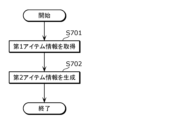
- a virtual space control method acquires first item information regarding a first item displayed in a first virtual space, and based on the first item information, Second item information regarding a second item displayed in a second virtual space different from the first virtual space is generated.
- Each of the multiple aspects explicitly or implicitly shown in this disclosure includes, for example, improved security in services provided via virtual space, improved ease of system construction, improved flexibility in system changes, This can contribute to any one or more of the following: improving the ease of starting service provision, reducing the processing amount of the server or terminal, and reducing the cost of the server or terminal.
- the embodiments exemplified in the means for solving the above problems can contribute to accurately controlling the movement of items between a plurality of virtual spaces.
- FIG. 1 is a block diagram showing a configuration example of a virtual space system in an embodiment.
- FIG. 2 is a block diagram showing a first configuration example of a server in an embodiment. It is a block diagram showing the 2nd example of composition of the server in an embodiment. It is a block diagram which shows the 3rd structural example of the server in embodiment.
- FIG. 2 is a block diagram showing a first configuration example of a terminal in an embodiment.
- FIG. 2 is a block diagram showing a second configuration example of a terminal in an embodiment.
- FIG. 1 is a block diagram illustrating a configuration example of a virtual space collaboration system in an embodiment. It is a block diagram showing an example of composition of a 1st server in an embodiment.
- a virtual space is expressed, for example, by three-dimensional shape data indicating the three-dimensional shape of an object such as a topography in the space or a building placed in the space.
- a user can operate an avatar that is a representation of the user in the virtual space to explore the space, participate in any activity, or communicate with other users.
- the virtual space can be used to simulate physical phenomena that occur virtually within the virtual space, or to control home appliances or electronic devices placed in the real space based on the simulation results.
- Patent Document 1 discloses a method of displaying a single character in multiple virtual spaces.
- Patent Document 1 assumes that data of the same character can be handled in each virtual space, that is, that the data format of characters handled in a plurality of virtual spaces is standardized.
- the data format of the first virtual space and the data format of the second virtual space are different, and the data that can be used in the first virtual space is may not be available in the second virtual space. Therefore, it may be difficult to move a character object in multiple virtual spaces.
- first item information regarding a first item displayed in a first virtual space is acquired, and based on the first item information, a second virtual space that is different from the first virtual space is Second item information regarding a second item displayed in the virtual space is generated.
- the virtual space control method of Example 2 is the virtual space control method of Example 1, wherein the first item information includes first model information indicating a first model used for displaying the first item, and and first attribute information indicating an attribute of the first item, and the second item information includes second model information indicating a second model used for displaying the second item and an attribute of the second item. and second attribute information, and the attribute of the second item may be the same as the attribute of the first item.
- the virtual space control method of Example 3 is the virtual space control method of Example 2, wherein the second model is selected from one or more model candidates available in the second virtual space. It may also be a virtual space control method.
- the virtual space control method of Example 4 is the virtual space control method of any one of Examples 1 to 3, in which the second item information is transmitted to the user who holds the first item in the first virtual space.
- the second item information may be stored in association with the user information shown, and when the user participates in the second virtual space while holding the first item, the second item information is read.
- the virtual space control method of Example 5 is the virtual space control method of any one of Examples 1 to 4, wherein the first virtual space is provided by a first virtual space system, and the second virtual space is provided by a first virtual space system.
- the virtual space control method may be provided by a second virtual space system different from the first virtual space system.
- the second item information used in the second virtual space provided by the second virtual space system different from the first virtual space system providing the first virtual space is It becomes possible to generate item information. Therefore, it becomes possible to accurately control the movement of items between a plurality of virtual spaces provided by a plurality of mutually different virtual space systems.
- the virtual space control method of Example 6 is the virtual space control method of any one of Examples 1 to 5, wherein the second virtual space has at least one of a display format, an encoding method, and a data format. A virtual space control method different from that for the first virtual space may be used.
- the second item displayed in the second virtual space whose display format, encoding method, or data format is different from the first virtual space. It becomes possible to generate second item information regarding the item. Therefore, it becomes possible to accurately control the movement of items between a plurality of virtual spaces having mutually different display formats, encoding methods, or data formats.
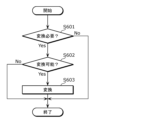
- the virtual space control method of Example 7 is the virtual space control method of any of Examples 1 to 6, in which moving an item from the first virtual space to the second virtual space is allowed. If it is determined that moving the item from the first virtual space to the second virtual space is permitted, the first item displayed in the first virtual space may be moved from the first item to the second virtual space. converting the item into the second item displayed in a second virtual space; moving the item from the first virtual space to the second virtual space; and moving the item from the first virtual space to the second virtual space. If it is determined that moving an item is not allowed, the virtual space control method may not convert the item and do not move the item.
- the virtual space control method of Example 8 is the virtual space control method of any of Examples 1 to 6, in which moving an item from the first virtual space to the second virtual space is permitted. If it is determined that moving the item from the first virtual space to the second virtual space is permitted, moving the item from the first virtual space to the second virtual space. determining whether the moving requires converting the item from the first item displayed in the first virtual space to the second item displayed in the second virtual space; If it is determined that it is necessary to convert the item from the first item to the second item, convert the item from the first item to the second item, and convert the item from the first virtual space to the second item.
- a virtual space control method may also be used.
- the conversion and movement of items between multiple virtual spaces can be accurately controlled according to whether the movement of items between multiple virtual spaces is permitted and whether or not it is necessary to convert items between multiple virtual spaces. becomes possible.
- the virtual space control method of Example 9 is the virtual space control method of any of Examples 1 to 6, in which moving an item from the first virtual space to the second virtual space is permitted. If it is determined that moving the item from the first virtual space to the second virtual space is permitted, moving the item from the first virtual space to the second virtual space. determining whether the moving requires converting the item from the first item displayed in the first virtual space to the second item displayed in the second virtual space; If it is determined that it is necessary to convert the item from the first item to the second item, determine whether it is possible to convert the item from the first item to the second item.
- the item from the first item to the second item converts the item from the first item to the second item, and convert the item from the first item to the second item, and convert the item from the first item to the second item. If it is determined that it is not possible to move the item from the first item to the second virtual space and convert the item from the first item to the second item, do not convert the item and move the item. If it is determined that it is not necessary to convert the item from the first item to the second item, the item is not converted and the item is moved from the first virtual space to the second virtual space. and, if it is determined that moving the item from the first virtual space to the second virtual space is not allowed, the virtual space control method does not convert the item and does not move the item. It's okay.
- the virtual space control method of Example 10 is the virtual space control method of Example 7, in which information about the first item and information about the second item are acquired and the item is allowed to move.
- the virtual space control method may include comparing information regarding the first item and information regarding the second item in determining whether or not the item exists.
- the item is transferred from the first virtual space to the second virtual space based on the comparison between the information regarding the first item displayed in the first virtual space and the information regarding the second item displayed in the second virtual space. It becomes possible to determine whether movement is permitted.
- the virtual space control method of Example 11 is the virtual space control method of Example 8, and requires acquiring information regarding the first item and information regarding the second item, and converting the item.
- the virtual space control method may include comparing information regarding the first item and information regarding the second item in determining whether the item is the first item or not.
- the virtual space control method of Example 12 is the virtual space control method of Example 9, and is capable of acquiring information regarding the first item and information regarding the second item, and converting the item.
- the virtual space control method may include comparing information regarding the first item and information regarding the second item in determining whether the item is the first item or not.
- the item is converted from the first item to the second item based on the comparison between the information regarding the first item displayed in the first virtual space and the information regarding the second item displayed in the second virtual space. It becomes possible to determine whether or not it is possible.
- the virtual space control method of Example 13 is the virtual space control method of any of Examples 1 to 12, wherein the virtual space control method is used to display the first virtual space or the second virtual space.
- the virtual space control method may be performed by at least one of a server that transmits virtual space information to a terminal, and the terminal that receives the virtual space information from the server.
- Example 14 determines whether moving an item from a first virtual space to a second virtual space different from the first virtual space is permitted.
- the virtual space control method of Example 15 is the virtual space control method of Example 14, in which the virtual space control method is performed on a terminal that displays virtual space information for displaying the first virtual space or the second virtual space.
- the virtual space control method may be performed by at least one of a server that transmits the virtual space information to the server and the terminal that receives the virtual space information from the server.
- Example 16 requires converting an item from a first item displayed in a first virtual space to a second item displayed in a second virtual space different from the first virtual space. Determine whether or not.
- the virtual space control method of Example 17 is the virtual space control method of Example 16, in which the virtual space control method is performed on a terminal that displays virtual space information for displaying the first virtual space or the second virtual space.
- the virtual space control method may be performed by at least one of a server that transmits the virtual space information to the server and the terminal that receives the virtual space information from the server.
- the virtual space control method of Example 18 is capable of converting an item from a first item displayed in a first virtual space to a second item displayed in a second virtual space different from the first virtual space. Determine whether or not.
- the virtual space control method of Example 19 is the virtual space control method of Example 18, in which the virtual space control method is performed on a terminal that displays virtual space information for displaying the first virtual space or the second virtual space.
- the virtual space control method may be performed by at least one of a server that transmits the virtual space information to the server and the terminal that receives the virtual space information from the server.
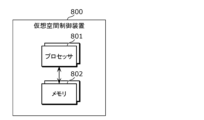
- the virtual space control device of Example 20 includes one or more processors and one or more memories accessible from the one or more processors, and in operation, the one or more processors Obtain first item information regarding a first item displayed in a virtual space, and based on the first item information, obtain a second item regarding a second item displayed in a second virtual space different from the first virtual space. Generate information.
- the virtual space control system of Example 21 includes one or more processors and one or more memories accessible from the one or more processors, and in operation, the one or more processors Obtain first item information regarding a first item displayed in a virtual space, and based on the first item information, obtain a second item regarding a second item displayed in a second virtual space different from the first virtual space. Generate information.
- FIG. 1 is a block diagram showing a configuration example of a virtual space system in this embodiment.
- the virtual space system in FIG. 1 includes a server 100 and a terminal 101, and provides a virtual space.
- the virtual space system may be expressed as a virtual space providing system.
- the display format, encoding method, data format, etc. are specified.
- Server 100 and terminal 101 communicate with each other. Although only one terminal 101 is illustrated in FIG. 1, a plurality of terminals 101 may be communicating with the server 100. That is, multiple users may participate in the virtual space simultaneously via multiple terminals 101, respectively.
- the server 100 is a server device that holds virtual space data (virtual space information) and transmits virtual space data to the terminal 101 in response to a request from the terminal 101. Further, the server 100 holds user data (user information) of the user who uses the terminal 101 and other users, and transmits the user data of other users to the terminal 101. The server 100 may transmit user data of a user using the terminal 101 in addition to user data of other users to the terminal 101.
- the user data is data associated with a user, and includes, for example, image data or three-dimensional model data of an avatar representing the user in virtual space. Further, the user data may include data on items held by the user in the virtual space, attribute data indicating attributes of the user, and data regarding the user's action history. Further, the user data may include data indicating parameters such as the in-game level, strength, or skill of a character object operated by the user in the virtual space.
- the avatar representing the user in the virtual space and the character object operated by the user in the virtual space can be considered as examples of items held by the user in the virtual space.
- an avatar representing a user in the virtual space and a character object operated by the user in the virtual space may be expressed as a user in the virtual space.
- the data associated with the user may be data associated with the user ID.
- the user data may include not only information used in the virtual space but also personal information that can identify the user. However, if user data includes personal information in addition to the data used in the virtual space, the information shared with other users will not be shared with other users to prevent personal information from being seen by other users. It may be managed separately from information. Furthermore, the information shared with other users may be configurable by each user.
- the user data may directly include data such as values or text regarding the user. Further, the user data may include parameters, indexes, etc. for specifying data related to the user. Data regarding the user may be acquired by referring to a predefined table or a table acquired from an external source such as another server based on parameters, indexes, or the like.
- the user data may include a data storage location such as an address on another server, or the data may be indirectly indicated by the storage location.
- the server 100 or the terminal 101 acquires data such as values or text regarding the user from the storage location specified by the address.
- the address is written as a URI (Uniform Resource Identifier) such as a URL (Uniform Resource Locator) or a URN (Uniform Resource Name).
- URI Uniform Resource Identifier
- URL Uniform Resource Locator
- URN Uniform Resource Name
- the user data may include information indicating the type and format of data obtained from the address. Note that the user data will be explained in detail in FIG. 8.
- the terminal 101 is a terminal device that receives virtual space data (virtual space information) from the server 100. Based on the virtual space data received from the server 100, the terminal 101 displays an image of the virtual space on a display device included in the terminal 101 or connected to the terminal 101. Further, the terminal 101 acquires input data corresponding to a user's input operation, and transmits the input data to the server 100.
- virtual space data virtual space information
- the input data corresponds to movement information of an avatar in the virtual space.
- the server 100 notifies each user's terminal 101 of input data.
- Each user's terminal 101 moves the avatar in the virtual space based on the 3D model downloaded in advance and the input data notified from the server 100.
- the server 100 determines whether the avatar placed in the virtual space has performed an action such as movement or gesture based on the input data, and determines whether the avatar placed in the virtual space has performed an action such as movement or gesture. The determination result may be notified to each user's terminal 101. Thereby, the server 100 may move the avatar in the virtual space displayed on each user's terminal 101.
- the input data may include text data, audio data, video data, etc. used for communication with other users.
- FIG. 2 is a block diagram showing a first configuration example of the server 100.
- the server 100 includes an information processing section 200, a content management section 201, and a user management section 202.
- the information processing unit 200 communicates with the terminal 101. For example, the information processing unit 200 acquires data requested by the terminal 101 from the content management unit 201 or the user management unit 202 and transmits it to the terminal 101. The information processing unit 200 also performs processing requested by the terminal 101 on data received from the terminal 101 and transmits the processing results to the terminal 101 or to the content management unit 201 or user management unit 202. It may also be stored.
- the information processing unit 200 may perform processing requested by the terminal 101 on data acquired from the content management unit 201 and the user management unit 202. Then, the information processing section 200 may transmit the processing result to the terminal 101 or may store it in the content management section 201 or the user management section 202.
- the content management unit 201 manages content data that is data related to content that constitutes a virtual space.
- the user management unit 202 manages user data that is data related to users. Details of the content data and user data will be described later.
- FIG. 3 is a block diagram showing a second configuration example of the server 100.
- the components of server 100 shown in FIG. 2 may be implemented by the components of server 100 shown in FIG. 3.
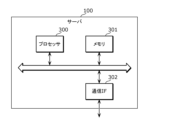
- the server 100 includes a processor 300, a memory 301, and a communication IF (InterFace) 302.
- IF InterFace
- the processor 300 is composed of, for example, a CPU (Central Processing Unit).
- the processor 300 may be configured with a plurality of CPUs, or may include a circuit specialized for specific processing such as image processing or AI processing, such as a GPU (Graphics Processing Unit).
- the memory 301 is composed of, for example, RAM (Random Access Memory) and ROM (Read Only Memory).
- the memory 301 may include a magnetic storage medium such as a hard disk, a semiconductor memory such as a solid state drive (SSD), or the like.
- the memory 301 may be an internal memory built into the CPU or GPU.
- the communication IF 302 is configured with a circuit that provides communication compatible with, for example, cellular communication, wireless LAN, wired LAN, or short-range wireless communication.
- the cellular communication corresponds to LTE (registered trademark) (Long Term Evolution) and the like.
- the wireless LAN corresponds to WiFi (registered trademark) (IEEE 802.11 and its revised standard), etc.
- the wired LAN corresponds to Ethernet (registered trademark) or the like.
- Near field wireless communication corresponds to Bluetooth (registered trademark) or the like.
- the communication IF 302 may include a terminal for connecting an antenna for wireless communication or a cable for wired communication.
- the processor 300 of the server 100 uses the memory 301 to execute a program stored in the memory 301 to perform processing related to provision of a virtual space.
- the communication IF 302 performs wireless communication or wired communication. Specifically, the communication IF 302 communicates with the terminal 101 via an arbitrary network such as the Internet or a CDN (Content Distribution Network). Although the Internet or CDN is described here as an example of a network, other networks may be used.
- an arbitrary network such as the Internet or a CDN (Content Distribution Network).
- CDN Content Distribution Network
- the network that connects the server 100 and the terminal 101 is connected to the AP or base station. It may be only direct wireless communication.
- the server 100 may be included in the AP or base station, or may be placed together with the AP or base station and connected to the AP or base station through wired or wireless communication.
- the communication IF 302 may transmit and receive data between the server 100 (content providing device) and the terminal 101 (content reproducing device) corresponding to the client using HTTP (HyperText Transfer Protocol).
- HTTP HyperText Transfer Protocol
- HTTP is exemplified here as a protocol used for communication, other communication protocols may be used.
- data may be sent and received using FTP (File Transfer Protocol) or RTP (Real-time Transport Protocol).
- FTP File Transfer Protocol
- RTP Real-time Transport Protocol
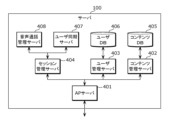
- FIG. 4 is a block diagram showing a third configuration example of the server 100.
- the server 100 shown in FIG. 2 is the plurality of servers shown in FIG. 4, and may be configured by a plurality of servers that operate in cooperation.
- the server 100 includes an application server (AP server) 401, a content management server 402, a user management server 403, a session management server 404, a content database (content DB) 405, and a user database (user DB). 406, a user synchronization server 407, and a voice call management server 408.
- AP server application server
- content management server a content management server 402
- content database (content DB) 405 a content database
- user DB user database
- user DB user database
- voice call management server 408 a voice call management server
- server group shown in FIG. 4 is just an example, and the roles or names of each server may be different.
- one server in FIG. 4 may be composed of a plurality of servers, or a plurality of servers in FIG. 4 may constitute one server.
- processing performed by any server may be performed by another server instead of that server.
- the AP server 401 transmits the data requested by the terminal 101 to the terminal 101. Additionally, the AP server 401 may perform processing requested by the terminal 101 and transmit the result to the terminal 101.
- the content management server 402 is a server that manages content data related to content that constitutes a virtual space.
- Content DB 405 is a database in which content data is stored.
- the content management server 402 acquires content data from the content DB 405 and transmits it to the terminal 101 via the AP server 401. Further, the content management server 402 updates content data stored in the content DB 405 in response to a request notified from the terminal 101 via the AP server 401.
- the content management server 402 accepts requests notified from the terminal 101 via the AP server 401.
- content management server 402 may accept requests made by AP server 401. More specifically, the content management server 402 may accept a request made by the AP server 401 that processes a request notified from the terminal 101.
- the content management server 402 may store address information indicating the storage location of the data itself in the content DB 405.
- the user management server 403 is a server that manages user data regarding users participating in the virtual space.
- User DB 406 is a database in which user data is stored.
- the user management server 403 acquires user data from the user DB 406 and transmits it to the terminal 101 via the AP server 401. Further, the user management server 403 updates user data stored in the user DB 406 in response to a request notified from the terminal 101 via the AP server 401.
- the user management server 403 accepts requests notified from the terminal 101 via the AP server 401.
- user management server 403 may accept requests made by AP server 401. More specifically, the user management server 403 may accept a request made by the AP server 401 that processes a request notified from the terminal 101.
- the user management server 403 may store address information indicating the storage location of the data itself in the user DB 406.
- the session management server 404 manages sessions between the terminal 101 corresponding to the client and the server 100.
- the session management server 404 identifies the request sent from the client, that is, the terminal 101, and manages the state of the client. This allows the AP server 401 to respond to requests sent from the client, that is, the terminal 101, in accordance with the state of the client.
- the user synchronization server 407 maintains synchronization among the users by managing information regarding each user's actions that affect the position and movement direction of the user's avatar.
- the user synchronization server 407 may perform synchronization in units of frames, or may perform synchronization in units of multiple frames.
- the user synchronization server 407 transmits and shares information regarding the behavior of the display target user, specifically, information regarding the behavior of the user whose corresponding avatar exists within the display area, to the terminal 101, so that the users can interact with each other. prevent discrepancies in their actions.
- the voice call management server 408 manages the transmission and reception of voice data between the plurality of terminals 101 when a voice call is made between users.
- communication between users is not limited to voice calls, and video calls may be used for communication between users.
- video data is transmitted and received simultaneously with audio data.
- a video call management server for managing video calls may be provided.
- one call management server may be provided for managing both voice calls and video calls.
- communication between users may be performed using not only real-time phone calls but also pre-generated audio and video files.
- each of the multiple servers that operate in cooperation may have the configuration shown in FIG. 3.
- the communication IF 302 of the AP server 401 communicates directly with the terminal 101, and also communicates with the communication IF 302 of each of the other servers such as the content management server 402, user management server 403, and session management server 404. communicate.
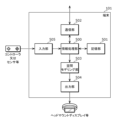
- FIG. 5 is a block diagram showing a first configuration example of the terminal 101.
- the terminal 101 includes an information processing section 500, a storage section 501, a communication section 502, a spatial modeling section 503, an output section 504, and an input section 505.
- the information processing unit 500 executes application software corresponding to the virtual space provided by the server 100 and controls the storage unit 501, the communication unit 502, the space modeling unit 503, the output unit 504, and the input unit 505.
- the storage unit 501 stores software programs executed by the information processing unit 500, data received from the server 100, data resulting from calculations in the information processing unit 500, input data acquired via the input unit 505, etc. do.
- the communication unit 502 communicates with the server 100.
- the space modeling unit 503 generates images to be displayed as a two-dimensional or three-dimensional virtual space and sounds to be heard in the virtual space, based on content data that is data related to the virtual space.
- the output unit 504 outputs the images and sounds generated by the spatial modeling unit 503 to the display and the sound output device, thereby presenting the images and sounds via the display and the sound output device.
- the display device and the sound output device may be included in the terminal 101, or may be connected to the terminal 101 through wired or wireless communication.
- the display device may be a stationary or portable display, a head-mounted display, or AR glasses.
- the sound output device may be a speaker, headphones, or earphones.
- the information processing unit 500 requests content data, which is data related to the virtual space, from the server 100 via the communication unit 502, and acquires the content data from the server 100. Further, the information processing unit 500 transmits input data obtained from the input unit 505 to the server 100 via the communication unit 502. At this time, the input data obtained from the input unit 505 may be sent to the server 100 as is, or the input data obtained from the input unit 505 may be subjected to signal processing and the result may be sent to the server 100. .
- the process performed on the input data obtained from the input unit 505 may be, for example, a process of converting input data that is operation information input by a user via a controller etc. into a command that can be implemented in a virtual space. good.
- the processing performed on the input data may be performing image processing such as recognition processing on the input data that is image data obtained from a camera.
- the processing performed on the input data involves performing image processing to generate information indicating the posture or movement of the photographed person, or information indicating that the photographed person has made a predetermined gesture. It may be a process.
- FIG. 6 is a block diagram showing a second configuration example of the terminal 101.
- the components shown in FIG. 5 may be implemented by the components shown in FIG.
- the terminal 101 includes a processor 600, a memory 601, a communication IF 602, an input IF 603, a video signal processing section 604, an audio signal processing section 605, and a sensor 606.
- the processor 600 is composed of, for example, a CPU (Central Processing Unit).
- the processor 600 may be configured with a plurality of CPUs, or may include a circuit specialized for specific processing such as image processing or AI processing, such as a GPU (Graphics Processing Unit).
- the memory 601 is composed of, for example, RAM (Random Access Memory) and ROM (Read Only Memory).
- the memory 601 may include a magnetic storage medium such as a hard disk, a semiconductor memory such as a solid state drive (SSD), or the like.
- the memory 601 may be an internal memory built into the CPU or GPU.
- the communication IF 602 is configured with a circuit that provides communication such as, for example, cellular communication, wireless LAN, wired LAN, or short-range wireless communication.
- the cellular communication corresponds to LTE (registered trademark) (Long Term Evolution) and the like.
- the wireless LAN corresponds to WiFi (registered trademark) (IEEE 802.11 and its revised standard), etc.
- the wired LAN corresponds to Ethernet (registered trademark) or the like.
- Near field wireless communication corresponds to Bluetooth (registered trademark) or the like.
- the communication IF 602 may include a terminal for connecting an antenna for wireless communication or a cable for wired communication.
- the input IF 603 may include, for example, a touch panel and buttons provided on the terminal 101, or may include a communication IF with a peripheral device connected to the terminal 101 via wireless or wired communication.
- a USB Universal Serial Bus
- a USB Universal Serial Bus
- WiFi or Bluetooth may be used as the communication interface with the peripheral device
- the communication IF 602 described above may also be used as a communication IF with peripheral devices.
- the processor 600 of the terminal 101 uses the memory 601 to execute a program stored in the memory 601 to perform processing related to provision of a virtual space.
- the memory 601 stores programs, data, etc.
- the memory 601 may store a program executed by the processor 600, data processed by the processor 600, or data processed by the processor 600.
- the memory 601 may store data transmitted from the communication IF 602, data received at the communication IF 602, or data input from the input IF 603. .
- the memory 601 may store data processed by the video signal processing unit 604, or may store data processed by the video signal processing unit 604. Further, the memory 601 may store data processed by the audio signal processing unit 605, data processed by the audio signal processing unit 605, or data acquired by the sensor 606. may be stored.
- Writing and reading of data in the memory 601 is performed based on, for example, instructions from the processor 600, but is not limited thereto.
- data received by the communication IF 602 may be written directly to the memory 601.
- data transmitted from the communication IF 602 may be read from the memory 601 and input directly to the communication IF 602.
- the communication IF 602 performs wireless communication or wired communication. Specifically, the communication IF 602 communicates with the server 100 via any network such as the Internet or CDN.
- the communication method that the communication IF 602 performs with the server 100 is the same as the communication method that the communication IF 302 of the server 100 performs with the terminal 101. Note that the communication IF 602 may communicate not only with the server 100 but also with a device used together with the terminal 101.
- the input IF 603 detects an operation performed by the user via a touch panel included in the terminal 101, and acquires the detected operation as input data. Further, the operation input that the input IF 603 accepts is not limited to the user's operation input via a device built into the terminal 101. For example, user operation input may be received via an external controller connected via wired or wireless communication.
- the video signal processing unit 604 performs signal processing on the video signal displayed by the terminal 101 and the video signal captured by the camera.
- the signal processing performed by the video signal processing unit 604 includes, for example, encoding processing for compressing the video signal and decoding processing for expanding the compressed video signal.
- the video signal processing unit 604 may output the processing result as an image from a display included in the terminal 101 or a display connected to the terminal 101 through wired or wireless communication.
- the image may be a video.
- the audio signal processing unit 605 performs signal processing on the audio signal presented by the terminal 101 and the audio signal collected by the microphone.
- the signal processing performed by the audio signal processing unit 605 may include, for example, encoding processing for compressing the audio signal and decoding processing for expanding the compressed audio signal.
- the audio signal processing unit 605 may output the processing result as audio from a sound output device included in the terminal 101 or a sound output device connected to the terminal 101 through wired communication or wireless communication.
- the sensor 606 is a sensor included in the terminal 101.
- the sensor 606 may include, for example, one or more of a camera, LiDAR (Light Detection and Ranging), a microphone, a touch panel, a GPS (Global Positioning System), an acceleration sensor, a gyro sensor, and a temperature sensor.
- the sensing data acquired by the sensor 606 may be detected by the input IF 603 as an operation by the user, or may be transmitted to the server 100 as a detection result of the surrounding environment of the terminal 101.
- the virtual space in the present disclosure is expressed, for example, by spatial data including three-dimensional shape data indicating the three-dimensional shape of an object such as a topography in the space or a building placed in the space.
- the virtual space does not have to be a three-dimensional space.
- the virtual space may be a two-dimensional plane.
- the spatial data includes, for example, two-dimensional shape data indicating an area in which the user can move.
- the spatial data may include image data.
- data representing the virtual space is expressed as spatial data, but other expressions may be used.
- data representing a virtual space may be represented as map data, terrain data, or content data.
- the spatial data may include data on buildings arranged within the space.
- data on buildings placed in a space may be managed as object data separately from spatial data.
- the object data of an object placed in the virtual space may include metadata associated with the object in addition to three-dimensional shape data.
- Metadata indicates attributes of an object or information specific to the object.
- the metadata may include information indicating whether an object placed in the space is a building. Note that although data such as attributes associated with objects is expressed as metadata here, other expressions may be used.
- the virtual space may include not only visible objects, that is, objects that are displayed on the screen, but also invisible objects, that is, objects that are not displayed on the screen.
- the invisible object may be an object related to any event, such as a flow of air or water in a space, and may be an object expressed by a vector indicating the direction and magnitude of movement or acceleration. .
- an invisible object may be an object that indicates the characteristics of a space, such as the temperature, humidity, odor, contained particulates, or the type or concentration of chemical substances in a region within the space.
- the invisible object data may include three-dimensional shape data, or may include position data or area data indicating the position or area in the virtual space where the invisible object exists.
- the position data indicates, for example, coordinate values in the coordinate system of the virtual space. Furthermore, when the virtual space is associated with the real space, the position data may indicate coordinate values in a coordinate system that can express the position in the real space.
- the position data may indicate relative position information or rotation information indicating the correspondence between a coordinate system in virtual space and a coordinate system in real space.
- the position data may indicate the index value of the corresponding unit space. Furthermore, if a position that can be used as a reference position is determined in the virtual space, the position data may indicate the position by a difference from the reference position.
- the coordinate system expressing the position in the virtual space is not limited to the orthogonal coordinate system. The coordinate system expressing the position in the virtual space may be, for example, a polar coordinate system.
- the area data includes, for example, information indicating a representative position within the area and information indicating the size of the area.
- the representative position of the area may be, for example, the position of the center of the area, or if the area is a rectangular parallelepiped, the position of the vertex having the smallest coordinate value with respect to each of the three axes.
- the representative position of the area is not limited to these positions. Depending on the predetermined description specifications of the area, any position within or outside the area may be used as the representative position.
- the size of the area for example, the size of the area in the three axial directions in the coordinate system representing the virtual space is used.
- the three axial dimensions are, for example, the height, width, and depth of the region.
- the size of the area is not limited to the three axial sizes.
- the region is represented as a sphere, the value of the region's diameter or radius may be used.
- the region has the shape of an elliptical sphere, the diameter or radius in the major axis direction, the diameter or radius in the minor axis direction, and the diameter or radius in the direction perpendicular to both the major axis direction and the minor axis direction. may be used.
- the minimum and maximum values of the area for each of the three axes are , the location and size of the region are determined.
- the position and size of the region can be determined by the coordinate value of the vertex closest to the origin and the coordinate value of the vertex furthest from the origin.
- the coordinate values of one vertex may be used as the representative position, and the coordinate values of the other vertex may be used as information indicating the size of the area.
- a virtual space may be composed only of virtual objects created by an administrator or user of the virtual space.
- the virtual space may include virtual objects generated based on data obtained by sensing the real world with a sensor such as a camera or LiDAR (Light Detection and Ranging). That is, the virtual space may include virtual objects that are copies of objects in the real space. Further, all objects in the virtual space may be composed only of virtual objects corresponding to objects in the real space.
- a sensor such as a camera or LiDAR (Light Detection and Ranging). That is, the virtual space may include virtual objects that are copies of objects in the real space. Further, all objects in the virtual space may be composed only of virtual objects corresponding to objects in the real space.
- a virtual object that corresponds to an object in real space is not limited to being generated based on data obtained by sensing the real world.
- a virtual object is generated based on drawing data or CAD (Computer-Aided Design) data for a building built in real space, or an arbitrary object such as a statue, device, or equipment placed in real space. It's okay.
- the virtual object may be generated based on data obtained by performing signal processing on sensing data obtained by sensing the real world.
- the signal processing performed on sensing data may be an extraction process that selects only a portion of the sensing data for generating a virtual object, or an interpolation process on discretely obtained sensing data. It may be.
- the signal processing may be other processing.
- the signal processing may include object estimation processing. Specifically, in the estimation process, the degree of matching between object candidate data such as a three-dimensional model or image registered in a database and sensing data may be evaluated. Then, the object candidate corresponding to the object candidate data with a high evaluated degree of matching may be estimated to be the object corresponding to the sensing data.
- processing such as data simplification, meshing, voxelization, or deformation may be performed on the sensing data or the three-dimensional shape model generated from the sensing data.
- the data of the virtual object may also include attribute information such as color or reflectance obtained by photographing the object in real space with a camera or LiDAR. good. Further, the attribute information of the virtual object may be generated from the shape and attribute information of the object in real space.
- the device used for sensing may be a camera, LiDAR, wireless transceiver, or ultrasonic sonar.
- the virtual object may be generated by combining a plurality of sensing data obtained from each of a plurality of sensing devices.
- the object data of the object corresponding to the real space may include information indicating the size of the object in the real space.
- the information indicating the size of the object in real space may include a value of the size of the object in real space, or may include a value of a scale ratio between the size of the object in virtual space and the size of the object in real space. Good too.
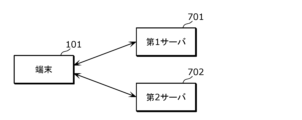
- FIG. 7 is a diagram showing a configuration example of a virtual space collaboration system.
- the virtual space collaboration system includes a terminal 101, a first server 701, and a second server 702.
- the first server 701 is a server device that provides a first virtual space.
- the second server 702 is a server device that provides a second virtual space. That is, the virtual space cooperation system includes a plurality of virtual space systems and provides a plurality of virtual spaces. Each virtual space system corresponds to the virtual space system shown in FIG.
- the virtual space cooperation system includes a first virtual space system that provides a first virtual space and a second virtual space system that provides a second virtual space.
- the first server 701 is a server device of a first virtual space system that provides a first virtual space.
- the second server 702 is a server device of a second virtual space system that provides a second virtual space.
- the terminal 101 is included in both the first virtual space system and the second virtual space system.
- the first virtual space system and the second virtual space system can operate independently from each other, have different specifications, and are managed by different administrators.
- the terminal 101 in FIG. 7 corresponds to the terminal 101 in FIG. 1, and includes, for example, the plurality of components shown in FIG. 5 or FIG. 6.
- each of the first server 701 and the second server 702 in FIG. 7 corresponds to the server 100 in FIG. 1, and includes, for example, a plurality of components shown in any of FIGS. 2 to 4.
- Each of the terminal 101, first server 701, and second server 702 in FIG. 7 may further include additional components or may perform additional processing.
- the terminal 101 communicates with a first server 701 that provides a first virtual space and a second server 702 that provides a second virtual space at the communication IF 602. Specifically, when the terminal 101 receives a request from the user to operate in the first virtual space, the terminal 101 communicates with the first server 701. Further, when the terminal 101 receives a request from the user to move from the first virtual space to the second virtual space, the terminal 101 communicates with the second server 702.
- the terminal 101 communicates with the first server 701 or the second server 702 in response to a user's communication request.
- the terminal 101 may communicate with the first server 701 or the second server 702 at any timing, regardless of a user's communication request.
- the virtual space collaboration system may include more servers that provide more virtual spaces.
- the terminal 101 may further communicate with another server. Further, the first server 701, the second server 702, and other servers may communicate with each other.
- the movement of the user between the plurality of virtual spaces is performed, for example, by the user changing the participating virtual space from the first virtual space to the second virtual space.
- the movement of the user between the plurality of virtual spaces corresponds to, for example, the movement of the user in the first virtual space to the second virtual space.
- movement of the user between multiple virtual spaces corresponds to, for example, moving an avatar representing the user in the first virtual space or a character object operated by the user in the first virtual space to the second virtual space. do. That is, movement of a user between a plurality of virtual spaces corresponds to movement of an item between a plurality of virtual spaces.
- movement of a user between multiple virtual spaces corresponds to movement of a user between multiple virtual space systems, and corresponds to movement of an item between multiple virtual space systems.
- FIG. 8 is a block diagram showing a configuration example of the first server 701.
- the second server 702 may have the same components as the first server 701.
- the first server 701 includes an information processing section 200, a content management section 201, a user management section 202, and a cooperation management section 203.
- the information processing section 200 connects to the content management section 201, the user management section 202, and the cooperation management section 203, and acquires necessary data as appropriate. Note that how to use data when a user moves between virtual spaces will be described later.
- the multiple components shown in FIG. 8 may be implemented by the multiple components shown in FIG. 3, or may be implemented by the multiple components shown in FIG. 4.
- the first server 701 may further include a cooperation management server and a cooperation DB corresponding to the cooperation management section 203.
- Content data is data related to content included in a virtual space.
- the content data includes one or more of three-dimensional model information, two-dimensional model information, invisible information, and the like. Further, the content data corresponds to virtual space information for displaying a virtual space.
- the three-dimensional model information is data related to a three-dimensional model among the contents included in the virtual space.
- the three-dimensional model information includes one or more of spatial information, object information, avatar information, and the like.
- the spatial information is three-dimensional shape data of the background virtual space of the virtual space.
- the spatial information may be shape data from the user's first-person viewpoint or shape data from the third-person viewpoint.
- the spatial information may include not only three-dimensional shape data but also metadata indicating attributes of objects arranged in the space.
- the object information indicates the topography of the space or the shape of an object such as a building placed in the space, and is expressed as three-dimensional shape data.
- the object is not limited to a visible object such as a building, a person different from the user, an animal, or a character, but may also be an invisible object.
- the three-dimensional shape data may be a point group or may be polygon data such as a mesh.
- Avatar information is three-dimensional shape data of an avatar that acts in place of the operating user.
- the avatar may correspond to, for example, a person, an animal, a character, or the like.
- content data may be static data that does not change over time, or may be dynamic data that changes over time.
- the two-dimensional model information is data related to a two-dimensional model among the contents included in the virtual space.
- Two-dimensional model information differs from three-dimensional model information in that it does not have depth information.
- the two-dimensional model information may be, for example, a still image, a moving image, a 360-degree image, or the like. Note that in this embodiment, spatial information, object information, and avatar information are included in the three-dimensional model information, but they may also be included in the two-dimensional model information.
- the invisible information includes content information included in the virtual space that relates to a sense different from vision, and additional information that is not included in either the two-dimensional model or the three-dimensional model.
- the invisible information includes, for example, text information, audio information, and attribute information.
- the attribute information is, for example, information regarding the abilities or characteristics of the avatar.
- the ability is obtained depending on, for example, the user's operation in the first virtual space or the login time.
- Ability may be expressed as a skill or as a level value.
- the characteristics may be, for example, the avatar's gender and age, or may be character-specific attributes.
- User data is data related to users who use the virtual space.
- One set of user data is set for one user.
- the user data includes, for example, one or more of a user identifier, personal information, virtual space item information, spatial movement information, and the like.
- a user identifier is an identifier of a user registered for each virtual space. In other words, this is information linking users and indexes. Alternatively, it may be a user identifier that can be used in common in a plurality of virtual spaces in which collaboration is performed.
- Personal information is the user's personal information, and includes personal information such as name, age, and date of birth.
- Virtual space item information is set for each virtual space used by the user.
- Virtual space item information is information regarding items used within the virtual space.
- An item is a general term for tools used by a user (or avatar, etc.) in a virtual space.
- An avatar may be an example of an item.
- Items include objects that can be obtained by the user in the virtual space in some way, such as avatars, avatar animations, clothes that the avatar can wear, equipment, possessions, currency in the virtual space, and other objects. Items may include invisible objects.
- the spatial movement information is information regarding the movement of the user (or avatar, etc.).
- the movement information includes, for example, position information, animation, movement, movement direction, and speed of the user (or avatar, etc.) obtained in real time.
- Cooperation data is content data or metadata used for user movement between multiple virtual spaces.
- Collaboration data is predetermined between a plurality of virtual spaces in which collaboration is performed, and is defined in a syntax, description method, and format that can be analyzed in each of the plurality of virtual spaces.
- the cooperation data includes one or more of a virtual space identifier, a group identifier, a movement permission level, currency information, and predetermined rules in the virtual space.
- the virtual space identifier is an identifier assigned in advance to uniquely identify the virtual space in which collaboration is performed.
- the group identifier is an identifier assigned in advance to uniquely identify a group of multiple virtual spaces.
- the group identifier may be used, for example, to assign the same identifier to a plurality of virtual spaces having common rules, currency information, and the like.
- the movement permission level is, for example, a level assigned to each virtual space regarding compatibility in movement between multiple virtual spaces. It may be determined that movement from a high-level virtual space to a low-level virtual space is allowed, and movement from a low-level virtual space to a high-level virtual space is not possible. For example, level 1 is assigned to virtual space A, and level 2 is assigned to virtual space B. In this case, a user of virtual space A can move to virtual space B, but a user of virtual space B cannot move to virtual space A.
- Currency information is information regarding parameters used as currency in virtual space.
- the currency information may include an exchange rate with respect to a common reference value in a plurality of virtual spaces.
- the predetermined rules are, for example, rules for movement between multiple virtual spaces.
- object information or coordinate information for presenting entrances and exits for movement between a plurality of virtual spaces in a virtual space may be defined as a predetermined rule.
- the item is an avatar held by the user in the virtual space or an accessory thereof.
- the item may be, for example, an avatar, an avatar animation, clothes that the avatar can wear, equipment, possessions, or currency in the virtual space.
- the item may be an item prepared in advance by the virtual space operator. Further, the item may be generated by a combination of a plurality of parts selected by the user from a plurality of choices of a plurality of parts of an item prepared in advance by a virtual space operator. Additionally, the item may be an item generated by a user.
- moving the item that the user owns in the first virtual space to the second virtual space means, for example, moving the data of the item that the user owns in the first virtual space to the second virtual space. It's about sharing.
- the item data is 3D data having base information and extended information.
- the base information may be, for example, a point group with a sparse density.
- the extended information may be information for increasing the density of the point cloud of the base information.
- item data is shared between the first virtual space system and the second virtual space system.
- whether both the base information and extended information of the item data are shared or only the base information is shared is switched based on information such as the processing performance of the second virtual space system. good.
- the density of the point cloud that the second virtual space system can handle in terms of performance is equivalent to the density of the point cloud of the base information, only the base information may be shared.
- the second virtual space system is capable of processing a point cloud having a density greater than or equal to the density of the point cloud of the base information, both the base information and the extended information may be shared. This makes it possible to share appropriate item data according to the processing performance of the second virtual space system while reducing network bandwidth and the like for sharing.
- the data to be shared may be switched based on the standard information, etc. For example, if the second virtual space system holds information indicating whether it can handle extended information, even if it is switched whether or not both base information and extended information are shared by referring to that information. good. This makes it possible to switch the data to be shared by referring to the standard information held by the second virtual space system, and it becomes possible to share appropriate data while suppressing the amount of processing.
- moving the user's item from the first virtual space to the second virtual space means that the user's item is presented on the user's terminal 101 and the terminal 101 of another user using the second virtual space. As such, it may be possible to share the item's data with other users.
- the information on the presentation target item may be switched depending on the processing performance of the user's terminal 101.
- the item data may be 3D data having base information and extended information. If the user's terminal 101 is capable of displaying extended information, the base information and extended information are shared with the user's terminal 101; otherwise, only the base information is shared with the user's terminal 101. It's okay. Thereby, regardless of the performance of the user's terminal 101, it is possible to provide the user with at least the ability to view the item data.
- processing performance information of the user's terminal 101 may be transmitted to the first server 701 or the second server 702 in advance. Further, base information and extended information may be shared with the user's terminal 101. Then, whether or not the extended information is applied may be switched on the user's terminal 101 according to the processing performance of the terminal 101. Thereby, the first server 701 or the second server 702 does not need to switch the contents of the shared item data depending on the performance of the user's terminal 101, and can reduce the amount of processing.
- the user's terminal 101 switches from an application that presents a first virtual space to an application that presents a second virtual space, and displays items held by the user in the first virtual space in the second virtual space. good.
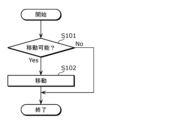
- FIG. 9 is a flowchart showing the first movement control example. Specifically, FIG. 9 shows control of the operation of moving items between a plurality of virtual spaces.
- the virtual space collaboration system determines whether it is possible to move an item from the first virtual space to the second virtual space (S101). If it is determined that movement is possible (Yes in S101), the item is moved from the first virtual space to the second virtual space (S102). If movement is not possible (No in S101), the virtual space collaboration system does not move the item from the first virtual space to the second virtual space.
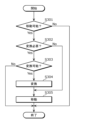
- FIG. 10 is a flowchart showing a second movement control example. Specifically, FIG. 10 shows control of operations for converting and moving items between a plurality of virtual spaces.
- the virtual space cooperation system determines whether it is possible to move an item from the first virtual space to the second virtual space (S201). If it is determined that movement is not possible (No in S201), the virtual space collaboration system does not move the item and ends the process. If it is determined that movement is possible (Yes in S201), the virtual space collaboration system determines whether conversion of the item is necessary in order to move the item from the first virtual space to the second virtual space ( S202).
- the virtual space collaboration system converts the item (S203). Then, the virtual space collaboration system moves the item from the first virtual space to the second virtual space (S204). Note that if the user has ownership of the item through NFT (Non-Fungible Token), ownership of the converted item may also be given to the same user through NFT.
- NFT Non-Fungible Token
- the virtual space cooperation system moves the item from the first virtual space to the second virtual space without converting the item (S204).
- the virtual space collaboration system performs the above processing (S202 to S204) in a loop for each item.
- FIG. 11 is a flowchart showing the third movement control example. Specifically, FIG. 11 shows another control for converting and moving items between a plurality of virtual spaces.
- the virtual space collaboration system determines whether it is possible to move an item from the first virtual space to the second virtual space (S301). If it is determined that movement is not possible (No in S301), the virtual space collaboration system does not move the item and ends the process. If it is determined that movement is possible (Yes in S301), the virtual space collaboration system determines whether conversion of the item is necessary in order to move the item from the first virtual space to the second virtual space ( S302).
- the virtual space collaboration system moves the item from the first virtual space to the second virtual space (S305). If it is determined that conversion is necessary (S302: Yes), the virtual space collaboration system determines whether or not the item can be converted (S303).
- the virtual space collaboration system converts the item (S304). Then, the virtual space collaboration system moves the item from the first virtual space to the second virtual space (S305). If it is determined that conversion is not possible (No in S303), the virtual space collaboration system does not convert or move the item.
- the virtual space cooperation system performs the above processing (S302 to S305) in a loop for each item.
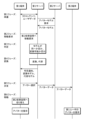
- FIG. 12 is a sequence diagram illustrating an example of processing when moving items between multiple virtual spaces.
- FIG. 12 shows processing performed at the first terminal 101, the first server 701, the second server 702, and the second terminal 101 when the first user moves from the first virtual space to the second virtual space. It is shown.
- the first terminal 101 is the first user's terminal 101
- the second terminal 101 is the second user's terminal 101.
- the first phase preparations for collaboration will be made.
- downloading of 3D content and items, user authentication of the first user, synchronization of user data, etc. are performed between the first terminal 101 and the first server 701. It will be done.
- the first server 701 requests the second server 702 for information and cooperation data of the second virtual space, and The server 702 sends information on the second virtual space and cooperation data to the first server 701.
- the information on the second virtual space is, for example, the above-mentioned content data, and includes, for example, avatar information indicating an avatar model in the second virtual space.
- the first user requests movement to the second virtual space.
- the movement request is made when the first user performs a predetermined operation on the interface of the first terminal 101, for example, when the avatar arrives at a predetermined position in the first virtual space. It will be done.
- determination processing related to the movement of the first user from the first virtual space to the second virtual space is performed.
- the determination process may be a combination of multiple determinations.
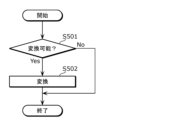
- the determination process may include determining whether or not movement is possible based on the cooperation data (S101, S201, and S301 described above). Further, the determination process may include determining whether or not it is possible to convert the item (S303 described above, S501 and S602 described later, etc.).
- the determination process may include determining whether or not it is necessary to convert the item (S202 and S302 described above, S401 and S601 described later, etc.). For example, if the model of the item in the first virtual space and the model of the item in the second virtual space are the same, it may be determined that conversion is not necessary. Further, the determination process may further include other determinations.
- the processing from the first phase to the third phase does not need to be in this order as long as it is performed before the conversion processing of the fourth phase.
- the first server 701 may acquire content data necessary for the third phase determination process from the second server 702 based on the second phase movement request.
- the first server 701 converts the item as necessary, and replaces the item with another item as necessary, based on the determination result in the third phase. Further, the first server 701 sends a notification indicating whether or not the item conversion process could be performed to the first terminal 101. Further, if a conversion process is performed, a conversion model obtained by the conversion process is transmitted, and if a substitute process is performed, a substitute model obtained by the substitute process is transmitted.
- the item is an avatar, and both avatar conversion processing and substitution processing are performed.
- the conversion model and alternative model are then transmitted.
- the first terminal 101 receives the approval notification. Furthermore, when the conversion model is transmitted, the first terminal 101 receives the conversion model and displays the conversion model as a candidate for an avatar to be used in the second virtual space. Furthermore, when the alternative model is transmitted, the first terminal 101 receives the alternative model and displays the alternative model as a candidate for an avatar to be used in the second virtual space.
- the first terminal 101 receives a selection of an avatar to be used in the second virtual space from the first user.
- the first terminal 101 then notifies the first server 701 of the avatar selection.
- the first server 701 transmits avatar data indicating the selected conversion model or alternative model to the second server 702.
- the second server 702 displays the conversion model or alternative model on the second terminal 101 when the second user participates in the second virtual space so that the conversion model or the alternative model is also displayed on the second terminal 101 different from the first terminal 101.
- Avatar data indicating the conversion model or alternative model is downloaded.
- the first user moves from the first virtual space to the second virtual space.
- the first terminal 101 switches the UI to the second virtual space and presents the selected avatar.
- the second terminal 101 presents the avatar selected by the first user as the first user's avatar.
- the second terminal 101 may display the initial avatar as the first user's avatar.
- the second terminal 101 may notify the second user that the first user's avatar cannot be displayed.
- FIG. 13 is a conceptual diagram showing avatar selection. Specifically, in the fourth and fifth phases of FIG. 12, the first terminal 101 displays a display for selecting an avatar as shown in FIG. 13. The first terminal 101 then receives the selection of an avatar from the first user. Note that although conversion and substitution are shown separately in FIGS. 12 and 13, substitution may be considered as an example of conversion.
- the transmission, reception, and sharing of data between the first server 701, the second server 702, the user's terminal 101, and other user's terminals 101 is performed using commands, APIs, and functions for executing data requests and responses. It may be realized by being defined and executed.
- the first server 701 executes the determination of whether or not movement is possible, the determination of whether conversion is possible, and the conversion process.
- other devices such as the second server 702 or a cooperation server (not shown) may perform the determination and the like.
- each process associated with movement may be performed by the first server 701, the second server 702, or another device such as a third server or a common server. good.
- the determination as to whether or not the user can move from the first virtual space to the second virtual space is performed at the timing when the user indicates the intention to move from the first virtual space to the second virtual space. It's okay.
- the first server 701 determines whether movement is possible at the timing when the user indicates an intention to move to the second virtual space by operating an avatar or an object in the first virtual space.
- the determination may be made at a timing determined by the virtual space cooperation system regardless of the user's intention.
- the collaboration data may be shared in advance between the first server 701 and the second server 702, or may be used to determine whether the user can move from the first virtual space to the second virtual space. It may be shared at any time. When multiple virtual spaces exist, cooperative data is shared among multiple servers that respectively provide multiple virtual spaces.
- Whether or not it is possible to move from the first virtual space to the second virtual space may be determined regardless of who the user is.
- the first server 701 refers to the group identifier of the first virtual space and the group identifier of the second virtual space from the cooperation data, and determines whether the group identifier of the second virtual space is the same as the group identifier of the first virtual space. Based on this, it is determined whether or not it is possible to move. In other words, the first server 701 determines that movement is possible when the group identifier of the second virtual space is the same as the group identifier of the first virtual space, and the first server 701 determines that the group identifier of the second virtual space is the same as the group identifier of the first virtual space. If it is not the same as the identifier, it is determined that it cannot be moved.
- the first server 701 refers to the movement permission level of the first virtual space and the movement permission level of the second virtual space from the cooperation data, and determines that the movement permission level of the second virtual space is the movement permission level of the first virtual space. It may be determined whether or not it is movable based on whether or not it is less than or equal to the following. Specifically, the first server 701 determines that movement is possible when the movement permission level of the second virtual space is lower than or equal to the movement permission level of the first virtual space, and the first server 701 determines that movement is possible when the movement permission level of the second virtual space is lower than or equal to the movement permission level of the first virtual space. If the level is not lower than the virtual space movement permission level, it is determined that movement is not possible.
- the user can move from the first virtual space to the second virtual space based on whether the user identifier registered as the user identifier in the first server 701 is linked to the user identifier registered in the second server 702. It may be determined whether it is possible to move. Specifically, if the user identifier of the first server 701 is linked to the user identifier of the second server 702, it is determined that movement is possible, and the user identifier of the first server 701 is linked to the user identifier of the second server 702. If there is no link, it is determined that movement is not possible.
- the user can move from the first virtual space to the second virtual space based on whether a common user identifier is registered as the user's user identifier in the first server 701 and the second server 702. It may be determined whether or not there is. Specifically, if a common user identifier is registered, it is determined that movement is possible, and if a common user identifier is not registered, it is determined that movement is not possible.
- the user may be prompted to register the user identifier in the second server 702.
- whether the user can move or not may be determined based on whether preparations for the user to use the second virtual space have been completed.
- the determination condition may be that preparations for the application, content, and avatar for presenting the second virtual space have been completed. Specifically, if preparations have been completed, it may be determined that movement is possible, and if preparations have not been completed, it may be determined that movement is not possible. Furthermore, it may be added to the determination condition that the first terminal 101 has specifications for presenting the second virtual space.
- the first server 701 makes a determination based on cooperation data.
- the first server 701 may notify the second server 702 of the cooperation data, and the second server 702 may determine whether the user can move.
- the second server 702 may then feed back the determination result to the first server 701.
- the user may be notified of the result of the determination as to whether or not it is possible to move the item from the first virtual space to the second virtual space.
- ⁇ Common ID> For example, if an item is previously recognized as a common item that can be used in multiple virtual spaces, it may be determined that conversion is not necessary. For example, a common ID predetermined by a plurality of servers may be assigned to a common item that can be used in a plurality of virtual spaces. Then, it may be determined whether or not the items need to be converted based on whether or not a common ID is assigned to the items in the user data.
- ⁇ 3D shape> it is determined whether the 3D shape of an item in the first virtual space is allowed to be presented in the second virtual space based on the world view or object rules of the second virtual space. For example, the types or presentation levels of items that can be presented in the virtual space may be defined for each virtual space. Then, an identifier indicating the type of the item, a presentation level of the item, and the like may be assigned to the item.
- Whether or not the item can be presented is determined by comparing the type or presentation level of the item to be moved from the first virtual space to the second virtual space with the type or presentation level of the item that can be presented in the second virtual space. For example, if presenting the shape of a gun is permitted in the first virtual space but not in the second virtual space, it is determined that the item having the shape of a gun cannot be presented in the second virtual space. Ru. If it is determined that the item cannot be presented in the second virtual space, it is determined that conversion is required to move the item.
- ⁇ Resolution, frame rate or size (display format)> For example, display formats such as resolution, frame rate, size, etc. of items that can be presented or used in the virtual space are defined for each virtual space, and based on these display formats, it is determined whether conversion is necessary. Ru.
- the display format is not limited to resolution, frame rate, and size, but if the item is a point cloud, the number or density of points, the number of points per unit area, the upper or lower limit of the number of attribute types, or the bits of attribute data.
- a width may be defined. If the item is a mesh, the upper or lower limit of the number of vertices or faces, or the bit width of attribute data may be defined.
- a level corresponding to these may be defined in advance for each virtual space, and the resolution, frame rate, size, etc. may be defined for each level.
- an identifier indicating resolution, frame rate, or size may be defined for each virtual space.
- the first server 701 assigns an identifier or level indicating the resolution, frame rate, size, etc. of the item to the item to be processed. Then, the first server 701 determines the resolution, frame rate, size level, etc. of the item to be moved from the first virtual space to the second virtual space, and the resolution, frame rate, etc. of the item that can be presented in the second virtual space. Alternatively, it compares the size level, etc., and determines whether or not it can be presented.
- ⁇ Format (data format)> For example, whether it is necessary to convert the item, that is, convert the format or parameters, based on whether the format of the data of the item or the parameters in the format are the same in the first virtual space and the second virtual space. is determined. The necessity of converting an item may be determined based on the format type or level.
- the level allowed in the second virtual space is higher than the level allowed in the first virtual space, it may be determined that conversion of the item is unnecessary. Further, whether or not an item needs to be converted may be determined based on whether or not the second server 702 has the ability to present the item according to the format of data in the first virtual space.
- any one determination example among the plurality of determination examples described above may be executed, or a combination of the plurality of determination examples may be executed.
- the second server 702 has a conversion list of items that can be presented in the second virtual space, and shares the conversion list as cooperation data with other servers.
- the conversion list may be a table showing the correspondence between item types before and after conversion.
- the table indicates that an item whose item type is a gun can be converted to an item whose item type is a water gun.
- the item type is included in the above table. If the item type is included in the table, it is determined that the item can be converted. Alternatively, the table may indicate that the item to be converted can be replaced with a predetermined item by indicating the ID of the item that can be presented in the second virtual space.
- ⁇ Resolution, frame rate or size> For example, if it is necessary to convert the display format of the item, such as resolution, frame rate, or size, it is determined whether the display format of the item can be converted. Specifically, when the first server 701 converts the display format of an item, whether conversion is possible or not may be determined based on whether the first server 701 has the ability to convert the display format of the item. .
- ⁇ Codec> For example, if the type of codec system of an item is different between the first virtual space and the second virtual space and it is necessary to convert the codec system of the item, it is determined whether or not the codec system of the item can be converted. Ru. Specifically, when the first server 701 converts the codec system of an item, whether or not the conversion is possible is determined based on whether the first server 701 has the ability to perform encoding and decoding using the codec system of the second virtual space. may be determined.
- ⁇ Format> For example, if it is necessary to convert the data format of an item or the parameters in the format, it is determined whether the format or parameters of the item can be converted. Specifically, by comparing an identifier indicating the format type or level of the first virtual space with an identifier indicating the format type or level of the second virtual space, it is determined whether or not they are compatible with respect to format conversion. It may be determined whether If there is compatibility, it may be determined that conversion is possible because format conversion rules have been defined.
- the first server 701 may execute the above-described process for determining whether conversion is necessary and/or the process for determining whether conversion is possible, and may perform the conversion process described below based on the result of the determination process. Alternatively, the first server 701 may transmit the determination result to the terminal 101 or the second server 702, etc., without performing the conversion process.
- the item conversion process includes acquiring first item information regarding a first item displayed in a first virtual space, and converting a second item regarding a second item displayed in a second virtual space based on the first item information. This is the process of generating information. Details of the item conversion process will be described below.
- the second item information is generated by converting the first item information. Transformations may include substitutions.
- the first server 701 may automatically convert the original shape according to the shape of the type specified in the conversion table, or the first server 701 may convert the original shape with a shape selected from a plurality of item candidates that the first server 701 has in advance.
- the shape may be substituted.
- items with shapes that are difficult to display in the second virtual space can be converted or replaced and displayed.
- other information for example, attribute information
- the item resolution conversion process includes up-conversion to increase the number of points, or down-conversion to decrease the number of points, using interpolation or extrapolation of pixels or 3D points, subsampling, point removal, and filtering. Implemented. Processing may be performed to increase the frame rate by temporally interpolating the content. Further, processing may be performed to lower the frame rate by thinning out frames.
- the converted item generated in the item conversion process may be presented to the user, and the user may select whether or not to move the converted item to the second virtual space.
- the avatar generated by the conversion process and the avatar that can originally be used in the second virtual space may be displayed to the user so that the user can select one.
- the converted item is shared by the first server 701 that provides the first virtual space and the second server 702 that provides the second virtual space.
- the converted item is then downloaded from the second server 702 to the terminal 101 of another user who uses the second virtual space, so that it is also displayed on the terminal 101 of the other user.
- a destination item may be selected from a plurality of item candidates obtained by a plurality of conversions.
- the above conversion process may be used in combination with the corresponding conversion necessity determination process and/or conversion propriety determination process, or only the conversion process may be performed.
- FIG. 14 is a flowchart showing the first conversion control example. Specifically, FIG. 14 shows a first control example of the operation of converting items between a plurality of virtual spaces.
- the virtual space collaboration system determines whether conversion of an item is necessary in moving the item between a plurality of virtual spaces (S401). If it is determined that conversion is necessary (Yes in S401), the virtual space collaboration system converts the item (S402). If it is determined that conversion is not necessary (No in S401), the virtual space cooperation system does not convert the item.
- the virtual space collaboration system converts items that are determined to require conversion and moves them from the first virtual space to the second virtual space, and moves items that are determined to not require conversion from the first virtual space to the first virtual space without converting them. Move from the space to the second virtual space.
- FIG. 15 is a flowchart showing a second conversion control example. Specifically, FIG. 15 shows a second control example of the operation of converting items between a plurality of virtual spaces.
- the virtual space cooperation system determines whether or not it is possible to convert an item in moving the item between a plurality of virtual spaces (S501). If it is determined that conversion is possible (Yes in S501), the virtual space collaboration system converts the item (S502). If it is determined that conversion is not possible (No in S501), the virtual space collaboration system does not convert the item.
- the virtual space collaboration system converts items that are determined to be convertible and moves them from the first virtual space to the second virtual space, and does not convert or move items that are determined to be not convertible. .
- FIG. 16 is a flowchart showing a third conversion control example. Specifically, FIG. 16 shows a third control example of the operation of converting items between a plurality of virtual spaces.
- the virtual space cooperation system determines whether conversion of an item is necessary in moving the item between a plurality of virtual spaces (S601). If it is determined that conversion is not necessary (No in S601), the virtual space collaboration system ends the process without converting the item. If it is determined that conversion is necessary (S601: Yes), the virtual space collaboration system determines whether or not the item can be converted (S602).
- the virtual space collaboration system converts the item (S603). If it is determined that conversion is not possible (No in S602), the virtual space collaboration system ends the process without converting the item.
- the virtual space cooperation system moves an item determined not to require conversion from the first virtual space to the second virtual space without converting the item. Further, the virtual space cooperation system converts an item that is determined to require conversion and can be converted, and moves the item from the first virtual space to the second virtual space. Furthermore, the virtual space collaboration system does not convert or move items that require conversion but are determined to be impossible.
- FIG. 17 is a block diagram showing a configuration example of a virtual space control device in this embodiment.
- the virtual space control device 800 shown in FIG. 17 includes one or more processors 801 and one or more memories 802.
- the virtual space control device 800 may be one device or may be composed of a plurality of devices.
- Virtual space control device 800 may be expressed as a virtual space control system.
- the virtual space control device 800 may be included in the above-described virtual space cooperation system or virtual space system, or may correspond to the virtual space cooperation system or virtual space system.
- the virtual space control device 800 may be included in the terminal 101, the first server 701, or the second server 702 shown in FIG.
- the virtual space control device 800 may include the terminal 101, the first server 701, or the second server 702.
- the virtual space control device 800 may correspond to a combination of the first server 701 and the second server 702.
- the virtual space control device 800 may operate as a virtual space collaboration system or a virtual space system, or may operate as any one of a plurality of components included in the virtual space collaboration system or the virtual space system. good.
- Each of the one or more processors 801 is a circuit that processes information.
- the processor 801 may correspond to a processor included in any one of the terminal 101, the first server 701, and the second server 702.
- an operation performed by one or more processors 801 is performed by at least one of the one or more processors 801.
- an operation performed by one or more processors 801 may be performed by one processor 801, by multiple processors 801 in cooperation, or by each of the multiple processors 801. It's okay to be hurt.
- Each of the one or more memories 802 is a volatile or non-volatile memory that stores information.
- the processor 801 may correspond to a memory included in either the terminal 101, the first server 701, or the second server 702.
- information stored by one or more memories 802 is stored by at least one of the one or more memories 802. That is, information stored by one or more memories 802 may be stored by one memory 802, by multiple memories 802 cooperatively, or by each of multiple memories 802. May be stored.
- One or more processors 801 can access one or more memories 802. That is, at least one processor 801 can access at least one memory 802. One or more processors 801 utilize one or more memories 802 to perform operations. One or more memories 802 store information for one or more processors 801 to perform operations on.
- one or more memories 802 may store programs for one or more processors 801 to operate. Further, the one or more memories 802 may store information to which information processing is applied by one or more processors 801, or may store information to which information processing is applied by one or more processors 801. may have been done.
- FIG. 18 is a flowchart showing an example of the operation of the virtual space control device 800. Specifically, one or more processors 801 of the virtual space control device 800 perform the operations shown in FIG. 18.
- one or more processors 801 first obtain first item information regarding a first item displayed in the first virtual space (S701). One or more processors 801 then generates second item information regarding a second item displayed in a second virtual space different from the first virtual space based on the first item information (S702).
- second item information regarding the second item displayed in a second virtual space different from the first virtual space is generated. becomes possible. Therefore, for example, when an item moves from a first virtual space to a second virtual space, it becomes possible to convert the item from the first item to the second item. Therefore, it becomes possible to accurately control the movement of items between a plurality of virtual spaces.
- the first item information may include first model information indicating a first model used to display the first item and first attribute information indicating an attribute of the first item.
- the second item information may include second model information indicating a second model used for displaying the second item, and second attribute information indicating an attribute of the second item.
- the attributes of the second item may be the same as the attributes of the first item.
- the second model may be selected from one or more model candidates available in the second virtual space. This makes it possible to display the second item in the second virtual space using a second model selected from one or more model candidates available in the second virtual space. That is, it becomes possible to select the second model used for displaying the second item in the second virtual space from among one or more model candidates available in the second virtual space.
- the second item information may be stored in association with user information indicating the user who holds the first item in the first virtual space. Then, when the user participates in the second virtual space while holding the first item, the second item information may be read. Thereby, when a user who holds the first item in the first virtual space participates in the second virtual space, it becomes possible to read out the second item information. Therefore, when the user holds the first item in the first virtual space, it becomes possible to display the second item in the second virtual space.
- the first virtual space may be provided by a first virtual space system.
- the second virtual space may be provided by a second virtual space system different from the first virtual space system.
- the second item information used in the second virtual space provided by the second virtual space system different from the first virtual space system providing the first virtual space is It becomes possible to generate item information. Therefore, it becomes possible to accurately control the movement of items between a plurality of virtual spaces provided by a plurality of mutually different virtual space systems.
- the second virtual space may be different from the first virtual space in at least one of the display format, encoding method, and data format.
- the second item displayed in the second virtual space whose display format, encoding method, or data format is different from the first virtual space. It becomes possible to generate second item information regarding the item. Therefore, it becomes possible to accurately control the movement of items between a plurality of virtual spaces having mutually different display formats, encoding methods, or data formats.
- one or more processors 801 may determine whether moving an item from the first virtual space to the second virtual space is permitted. When it is determined that moving the item from the first virtual space to the second virtual space is permitted, the one or more processors 801 move the item from the first item displayed in the first virtual space to the second virtual space. The item may be converted into a second item displayed in virtual space. Also, in this case, one or more processors 801 may move items from the first virtual space to the second virtual space.
- the one or more processors 801 may not convert the item if it is determined that moving the item from the first virtual space to the second virtual space is not allowed. Also, one or more processors 801 may not move the item in this case.
- one or more processors 801 may determine whether moving an item from the first virtual space to the second virtual space is permitted.
- the one or more processors 801 may then determine whether a conversion is necessary if it is determined that moving the item from the first virtual space to the second virtual space is permitted. . That is, the one or more processors 801 may, in this case, move the item from the first virtual space to the second virtual space, from the first item displayed in the first virtual space to the second item displayed in the second virtual space. It may be determined whether it is necessary to convert the item to a second item.
- one or more processors 801 may convert the item from the first item to the second item if it is determined that converting the item from the first item to the second item is necessary.
- the one or more processors 801 may also move items from the first virtual space to the second virtual space in this case.
- one or more processors 801 may not convert the item if it is determined that it is not necessary to convert the item from the first item to the second item.
- the one or more processors 801 may also move items from the first virtual space to the second virtual space in this case.
- the one or more processors 801 may not convert the item if it is determined that moving the item from the first virtual space to the second virtual space is not allowed. Also, one or more processors 801 may not move the item in this case.
- the conversion and movement of items between multiple virtual spaces can be accurately controlled according to whether the movement of items between multiple virtual spaces is permitted and whether or not it is necessary to convert items between multiple virtual spaces. becomes possible.
- one or more processors 801 may determine whether moving an item from the first virtual space to the second virtual space is permitted.
- the one or more processors 801 may then determine whether a conversion is necessary if it is determined that moving the item from the first virtual space to the second virtual space is permitted. . That is, the one or more processors 801 may, in this case, move the item from the first virtual space to the second virtual space, from the first item displayed in the first virtual space to the second item displayed in the second virtual space. It may be determined whether it is necessary to convert the item to a second item.
- the one or more processors 801 may convert the item from the first item to the second item if it is determined that converting the item from the first item to the second item is necessary. It may be determined whether or not.
- the one or more processors 801 may then convert the item from the first item to the second item if it is determined that it is possible to convert the item from the first item to the second item.
- the one or more processors 801 may also move items from the first virtual space to the second virtual space in this case.
- one or more processors 801 may not convert the item if it is determined that it is not possible to convert the item from the first item to the second item. Also, one or more processors 801 may not move the item in this case.
- the one or more processors 801 may also not convert the item if it is determined that converting the item from the first item to the second item is not necessary.
- the one or more processors 801 may also move items from the first virtual space to the second virtual space in this case.
- the one or more processors 801 may not convert the item if it is determined that moving the item from the first virtual space to the second virtual space is not allowed. Also, one or more processors 801 may not move items.
- one or more processors 801 may obtain information regarding the first item and information regarding the second item. One or more processors 801 may then compare information regarding the first item and information regarding the second item in any of the above determinations. One or more processors 801 may then make any of the above determinations according to the results of the comparison.
- the information regarding the first item and the information regarding the second item may be the same as or different from the first item information and the second item information described above.
- the information regarding the first item may be information regarding the first virtual space in which the first item is displayed.
- the information regarding the second item may be information regarding the second virtual space in which the second item is displayed.
- the one or more processors 801 may A positive determination result may also be obtained. Further, one or more processors 801 may obtain a positive determination result when the information regarding the first item and the information regarding the second item have a predetermined correspondence relationship.
- one or more processors 801 may obtain information regarding the first item and information regarding the second item. One or more processors 801 may then compare information regarding the first item and information regarding the second item in determining whether moving the item is permitted.
- the item is transferred from the first virtual space to the second virtual space based on the comparison between the information regarding the first item displayed in the first virtual space and the information regarding the second item displayed in the second virtual space. It becomes possible to determine whether movement is permitted.
- one or more processors 801 may obtain information regarding the first item and information regarding the second item. The one or more processors 801 may then compare information regarding the first item and information regarding the second item in determining whether it is necessary to convert the item.
- one or more processors 801 may obtain information regarding the first item and information regarding the second item. Then, in determining whether it is possible to convert the item, information regarding the first item and information regarding the second item may be compared.
- the item is converted from the first item to the second item based on the comparison between the information regarding the first item displayed in the first virtual space and the information regarding the second item displayed in the second virtual space. It becomes possible to determine whether or not it is possible.
- one or more processors 801 may determine whether moving an item from the first virtual space to a second virtual space different from the first virtual space is permitted. This makes it possible to accurately control the movement of items between multiple virtual spaces based on the determination result of whether or not movement of items from the first virtual space to the second virtual space is permitted. .
- the one or more processors 801 may be required to convert an item from a first item displayed in a first virtual space to a second item displayed in a second virtual space different from the first virtual space. It may be determined whether or not. Thereby, according to the determination result of whether or not it is necessary to convert the item from the first item displayed in the first virtual space to the second item displayed in the second virtual space, between the plurality of virtual spaces. It becomes possible to accurately control the movement of items.
- the one or more processors 801 may convert an item from a first item displayed in a first virtual space to a second item displayed in a second virtual space different from the first virtual space. It may be determined whether or not. Thereby, according to the determination result of whether or not it is possible to convert the item from the first item displayed in the first virtual space to the second item displayed in the second virtual space, between the plurality of virtual spaces. It becomes possible to accurately control the movement of items.
- another device different from the virtual space control device 800 may move the item or convert the item according to the results of the determination made by one or more processors 801.
- one or more processors 801 may perform the above-described operations as the operations of the terminal 101, the first server 701, or the second server 702.
- Application software for executing processing related to the terminal and server of the present disclosure may be provided by a software distribution server. This application software may then be installed on the terminal and server. The terminal and server may then fulfill the roles described in this disclosure by performing processing related to the terminal and server of this disclosure according to the application software.
- the application software may be provided to the terminal and server via another device by connecting the other device to the software distribution server via a network.
- aspects of the system, device, and method are not limited to the above description, and the aspects of the system, device, and method in the above description may be implemented by being modified from the above description.
- at least a portion of each aspect may be implemented by software, dedicated hardware, or a combination of hardware and software.
- programs for executing the various processes described in the present disclosure may be stored in advance in a ROM (Read Only Memory). Then, the process may be executed by executing the program by the CPU.
- ROM Read Only Memory
- programs for executing the various processes described in this disclosure may be stored in a computer-readable storage medium. Furthermore, the program stored in the storage medium may be read into RAM (Random Access Memory) of the computer. The computer may then operate according to the program.
- RAM Random Access Memory
- each of the above configurations may be realized as an LSI (Large Scale Integration), which is typically an integrated circuit. These may be individually integrated into one chip, or may be integrated into one chip so as to include all or part of the configurations of each aspect. Although it is referred to as an LSI here, it may also be called an IC (Integrated Circuit), system LSI, super LSI, or ultra LSI depending on the degree of integration.
- LSI Large Scale Integration
- the method of circuit integration is not limited to LSI, and may be realized using a dedicated circuit or a general-purpose processor.
- a PLD Programmable Logic Device
- FPGA Field-Programmable Gate Array
- a reconfigurable processor that can reconfigure the connections and settings of circuit cells inside the LSI may be used.
- At least one of the FPGA and the CPU may acquire and execute all or part of the software for executing the method described in the present disclosure through wireless communication or wired communication.
- the terminal or server described in the present disclosure includes at least one of an FPGA and a CPU, and includes a communication interface for externally obtaining software for operating at least one of the FPGA and the CPU. It's okay.
- the method described in the present disclosure is realized by the terminal or server having a storage unit for storing software obtained from an external source, and at least one of the FPGA and the CPU operating based on the stored software. may be done.
- the process executed by a specific component may be executed by another component instead of the specific component.
- the order of the plurality of processes may be changed, or the plurality of processes may be executed in parallel.
- the ordinal numbers such as first and second used in the explanation may be replaced, removed, or newly added as appropriate. These ordinal numbers do not necessarily correspond to any meaningful order and may be used to identify elements.
- the expression "at least one (or one or more) of the first element, second element, and third element” corresponds to the first element, the second element, the third element, or any combination thereof. do.
- each component may be configured with dedicated hardware, or may be realized by executing a software program suitable for each component.
- Each component may be realized by a program execution unit such as a CPU or a processor reading and executing a software program recorded on a recording medium such as a hard disk or a semiconductor memory.
- the above program may cause a computer to obtain first item information regarding a first item displayed in a first virtual space, and based on the first item information, display a second virtual space different from the first virtual space.
- a virtual space control method is executed that generates second item information regarding a second item displayed in the space.
- the above program executes a virtual space control method that causes a computer to determine whether moving an item from a first virtual space to a second virtual space different from the first virtual space is permitted. You may let them.
- the above program may require a computer to convert an item from a first item displayed in a first virtual space to a second item displayed in a second virtual space different from the first virtual space.
- a virtual space control method may be executed to determine whether or not there is a virtual space.
- the program described above may cause a computer to convert an item from a first item displayed in a first virtual space to a second item displayed in a second virtual space different from the first virtual space.
- a virtual space control method may be executed to determine whether or not there is a virtual space.
- the present disclosure can be applied, for example, to any one or more of servers, terminals, communication devices, sensor devices, home appliances, and electronic devices involved in providing a virtual space.
Landscapes
- Engineering & Computer Science (AREA)
- Software Systems (AREA)
- Physics & Mathematics (AREA)
- Theoretical Computer Science (AREA)
- General Physics & Mathematics (AREA)
- Computer Graphics (AREA)
- General Engineering & Computer Science (AREA)
- Multimedia (AREA)
- Computer Hardware Design (AREA)
- Geometry (AREA)
- Human Computer Interaction (AREA)
- Architecture (AREA)
- Information Transfer Between Computers (AREA)
- User Interface Of Digital Computer (AREA)
Priority Applications (4)
| Application Number | Priority Date | Filing Date | Title |
|---|---|---|---|
| EP23860188.4A EP4583062A4 (en) | 2022-08-31 | 2023-08-24 | VIRTUAL SPACE CONTROL METHOD, VIRTUAL SPACE CONTROL DEVICE AND VIRTUAL SPACE CONTROL SYSTEM |
| CN202380061352.5A CN119768842A (zh) | 2022-08-31 | 2023-08-24 | 虚拟空间控制方法、虚拟空间控制装置及虚拟空间控制系统 |
| JP2024544189A JPWO2024048425A1 (https=) | 2022-08-31 | 2023-08-24 | |
| US19/050,512 US20250182395A1 (en) | 2022-08-31 | 2025-02-11 | Virtual space control method, virtual space control device, and virtual space control system |
Applications Claiming Priority (2)
| Application Number | Priority Date | Filing Date | Title |
|---|---|---|---|
| US202263402695P | 2022-08-31 | 2022-08-31 | |
| US63/402,695 | 2022-08-31 |
Related Child Applications (1)
| Application Number | Title | Priority Date | Filing Date |
|---|---|---|---|
| US19/050,512 Continuation US20250182395A1 (en) | 2022-08-31 | 2025-02-11 | Virtual space control method, virtual space control device, and virtual space control system |
Publications (1)
| Publication Number | Publication Date |
|---|---|
| WO2024048425A1 true WO2024048425A1 (ja) | 2024-03-07 |
Family
ID=90099754
Family Applications (1)
| Application Number | Title | Priority Date | Filing Date |
|---|---|---|---|
| PCT/JP2023/030608 Ceased WO2024048425A1 (ja) | 2022-08-31 | 2023-08-24 | 仮想空間制御方法、仮想空間制御装置及び仮想空間制御システム |
Country Status (5)
| Country | Link |
|---|---|
| US (1) | US20250182395A1 (https=) |
| EP (1) | EP4583062A4 (https=) |
| JP (1) | JPWO2024048425A1 (https=) |
| CN (1) | CN119768842A (https=) |
| WO (1) | WO2024048425A1 (https=) |
Citations (4)
| Publication number | Priority date | Publication date | Assignee | Title |
|---|---|---|---|---|
| JP2002360936A (ja) * | 2001-06-07 | 2002-12-17 | Sony Corp | キャラクタデータ管理システム、キャラクタサーバー、およびキャラクタデータ管理方法、並びにプログラム |
| JP2011528834A (ja) * | 2008-07-21 | 2011-11-24 | サムスン エレクトロニクス カンパニー リミテッド | 仮想現実サービス間の相互連動のための装置及び方法 |
| US20150309696A1 (en) * | 1995-11-13 | 2015-10-29 | Worlds Inc. | System and method for enabling users to interact in a virtual space |
| JP2021006894A (ja) * | 2019-06-27 | 2021-01-21 | 株式会社ドワンゴ | コンテンツ配信サーバ、コンテンツ作成装置、教育端末、コンテンツ配信プログラム、および教育プログラム |
Family Cites Families (2)
| Publication number | Priority date | Publication date | Assignee | Title |
|---|---|---|---|---|
| EP2745462B1 (en) * | 2011-08-18 | 2021-10-20 | Pfaqutruma Research LLC | Systems and methods of virtual world interaction |
| US9658737B2 (en) * | 2013-08-16 | 2017-05-23 | Disney Enterprises, Inc. | Cross platform sharing of user-generated content |
-
2023
- 2023-08-24 CN CN202380061352.5A patent/CN119768842A/zh active Pending
- 2023-08-24 WO PCT/JP2023/030608 patent/WO2024048425A1/ja not_active Ceased
- 2023-08-24 JP JP2024544189A patent/JPWO2024048425A1/ja active Pending
- 2023-08-24 EP EP23860188.4A patent/EP4583062A4/en active Pending
-
2025
- 2025-02-11 US US19/050,512 patent/US20250182395A1/en active Pending
Patent Citations (4)
| Publication number | Priority date | Publication date | Assignee | Title |
|---|---|---|---|---|
| US20150309696A1 (en) * | 1995-11-13 | 2015-10-29 | Worlds Inc. | System and method for enabling users to interact in a virtual space |
| JP2002360936A (ja) * | 2001-06-07 | 2002-12-17 | Sony Corp | キャラクタデータ管理システム、キャラクタサーバー、およびキャラクタデータ管理方法、並びにプログラム |
| JP2011528834A (ja) * | 2008-07-21 | 2011-11-24 | サムスン エレクトロニクス カンパニー リミテッド | 仮想現実サービス間の相互連動のための装置及び方法 |
| JP2021006894A (ja) * | 2019-06-27 | 2021-01-21 | 株式会社ドワンゴ | コンテンツ配信サーバ、コンテンツ作成装置、教育端末、コンテンツ配信プログラム、および教育プログラム |
Non-Patent Citations (1)
| Title |
|---|
| See also references of EP4583062A4 |
Also Published As
| Publication number | Publication date |
|---|---|
| JPWO2024048425A1 (https=) | 2024-03-07 |
| US20250182395A1 (en) | 2025-06-05 |
| EP4583062A4 (en) | 2025-11-26 |
| CN119768842A (zh) | 2025-04-04 |
| EP4583062A1 (en) | 2025-07-09 |
Similar Documents
| Publication | Publication Date | Title |
|---|---|---|
| KR20210151114A (ko) | 하이브리드 렌더링 | |
| US8823708B2 (en) | Teleport preview provisioning in virtual environments | |
| CN111770325A (zh) | 一种三维gis实时云渲染展示方法、终端、云服务器及存储介质 | |
| CN105493501A (zh) | 虚拟视觉相机 | |
| US12001750B2 (en) | Location-based shared augmented reality experience system | |
| WO2018014766A1 (zh) | 增强现实模块的生成方法及装置、生成系统和存储介质 | |
| JP2023057017A (ja) | 3次元仮想モデルを提供するためのホールフィリング方法及びそのためのコンピューティング装置 | |
| WO2022224964A1 (ja) | 情報処理装置及び情報処理方法 | |
| US20250232548A1 (en) | Generate a simplified version of a user-generated digital object | |
| WO2024048425A1 (ja) | 仮想空間制御方法、仮想空間制御装置及び仮想空間制御システム | |
| JP2023134920A (ja) | システム、方法、端末、方法及びプログラム | |
| KR20200019395A (ko) | 가상 현실 컨텐츠를 제공하는 서버, 방법 및 사용자 단말 | |
| CN120726219A (zh) | 使用多模态生成式ai的改进的3d模型生成 | |
| US20240203055A1 (en) | Representing flat surfaces in point-based representations of physical environments | |
| CN112381929A (zh) | 一种三维电力设备模型建模方法 | |
| WO2024157810A1 (ja) | 情報処理方法及び情報処理装置 | |
| CN116563449A (zh) | 3d模型生成方法及相关装置 | |
| JP7632488B2 (ja) | サーバ装置、および、ネットワーク制御方法 | |
| US20240161328A1 (en) | Electronic device for obtaining location of virtual object and method thereof | |
| US20250191319A1 (en) | Method and system for enabling users to experience an extended reality-based social multiverse | |
| RU2810701C2 (ru) | Гибридный рендеринг | |
| CN121814959A (zh) | 用于分辨率受限系统的自适应图像编码和解码 | |
| JP2024155705A (ja) | ブロックオブジェクトの設計図を出力する方法 | |
| CN121527147A (zh) | 纹理采样方法、装置、电子设备、介质及产品 | |
| JP2026036107A (ja) | システム |
Legal Events
| Date | Code | Title | Description |
|---|---|---|---|
| 121 | Ep: the epo has been informed by wipo that ep was designated in this application |
Ref document number: 23860188 Country of ref document: EP Kind code of ref document: A1 |
|
| WWE | Wipo information: entry into national phase |
Ref document number: 2024544189 Country of ref document: JP |
|
| WWE | Wipo information: entry into national phase |
Ref document number: 202380061352.5 Country of ref document: CN |
|
| WWE | Wipo information: entry into national phase |
Ref document number: 2023860188 Country of ref document: EP |
|
| NENP | Non-entry into the national phase |
Ref country code: DE |
|
| WWP | Wipo information: published in national office |
Ref document number: 202380061352.5 Country of ref document: CN |
|
| ENP | Entry into the national phase |
Ref document number: 2023860188 Country of ref document: EP Effective date: 20250331 |
|
| WWP | Wipo information: published in national office |
Ref document number: 2023860188 Country of ref document: EP |