WO2024033982A1 - 電力変換システムおよび制御装置 - Google Patents
電力変換システムおよび制御装置 Download PDFInfo
- Publication number
- WO2024033982A1 WO2024033982A1 PCT/JP2022/030306 JP2022030306W WO2024033982A1 WO 2024033982 A1 WO2024033982 A1 WO 2024033982A1 JP 2022030306 W JP2022030306 W JP 2022030306W WO 2024033982 A1 WO2024033982 A1 WO 2024033982A1
- Authority
- WO
- WIPO (PCT)
- Prior art keywords
- power
- command value
- voltage
- current
- controller
- Prior art date
- Legal status (The legal status is an assumption and is not a legal conclusion. Google has not performed a legal analysis and makes no representation as to the accuracy of the status listed.)
- Ceased
Links
Images








Classifications
-
- H—ELECTRICITY
- H02—GENERATION; CONVERSION OR DISTRIBUTION OF ELECTRIC POWER
- H02M—APPARATUS FOR CONVERSION BETWEEN AC AND AC, BETWEEN AC AND DC, OR BETWEEN DC AND DC, AND FOR USE WITH MAINS OR SIMILAR POWER SUPPLY SYSTEMS; CONVERSION OF DC OR AC INPUT POWER INTO SURGE OUTPUT POWER; CONTROL OR REGULATION THEREOF
- H02M1/00—Details of apparatus for conversion
- H02M1/10—Arrangements incorporating converting means for enabling loads to be operated at will from different kinds of power supplies, e.g. from AC or DC
-
- H—ELECTRICITY
- H02—GENERATION; CONVERSION OR DISTRIBUTION OF ELECTRIC POWER
- H02M—APPARATUS FOR CONVERSION BETWEEN AC AND AC, BETWEEN AC AND DC, OR BETWEEN DC AND DC, AND FOR USE WITH MAINS OR SIMILAR POWER SUPPLY SYSTEMS; CONVERSION OF DC OR AC INPUT POWER INTO SURGE OUTPUT POWER; CONTROL OR REGULATION THEREOF
- H02M7/00—Conversion of AC power input into DC power output; Conversion of DC power input into AC power output
- H02M7/42—Conversion of DC power input into AC power output without possibility of reversal
- H02M7/44—Conversion of DC power input into AC power output without possibility of reversal by static converters
- H02M7/48—Conversion of DC power input into AC power output without possibility of reversal by static converters using discharge tubes with control electrode or semiconductor devices with control electrode
- H02M7/483—Converters with outputs that each can have more than two voltages levels
- H02M7/4833—Capacitor voltage balancing
-
- H—ELECTRICITY
- H02—GENERATION; CONVERSION OR DISTRIBUTION OF ELECTRIC POWER
- H02J—ELECTRIC POWER NETWORKS; CIRCUIT ARRANGEMENTS OR SYSTEMS FOR SUPPLYING OR DISTRIBUTING ELECTRIC POWER; SYSTEMS FOR STORING ELECTRIC ENERGY
- H02J3/00—Circuit arrangements for AC mains or AC distribution networks
- H02J3/02—Circuit arrangements for AC mains or AC distribution networks using a single network for simultaneous distribution of AC power at different frequencies
-
- H—ELECTRICITY
- H02—GENERATION; CONVERSION OR DISTRIBUTION OF ELECTRIC POWER
- H02J—ELECTRIC POWER NETWORKS; CIRCUIT ARRANGEMENTS OR SYSTEMS FOR SUPPLYING OR DISTRIBUTING ELECTRIC POWER; SYSTEMS FOR STORING ELECTRIC ENERGY
- H02J3/00—Circuit arrangements for AC mains or AC distribution networks
- H02J3/36—Arrangements for transfer of electric power between AC networks via high-voltage DC [HVDC] links; Arrangements for transfer of electric power between generators and networks via HVDC links
-
- H—ELECTRICITY
- H02—GENERATION; CONVERSION OR DISTRIBUTION OF ELECTRIC POWER
- H02J—ELECTRIC POWER NETWORKS; CIRCUIT ARRANGEMENTS OR SYSTEMS FOR SUPPLYING OR DISTRIBUTING ELECTRIC POWER; SYSTEMS FOR STORING ELECTRIC ENERGY
- H02J4/00—Circuit arrangements for mains or distribution networks not specified as AC or DC; Circuit arrangements for mains or distribution networks combining AC and DC sections or sub-networks
- H02J4/20—Networks integrating separated AC and DC power sections
- H02J4/25—Networks integrating separated AC and DC power sections for transfer of electric power between AC and DC networks, e.g. for supplying the DC section within a load from an AC mains system
-
- H—ELECTRICITY
- H02—GENERATION; CONVERSION OR DISTRIBUTION OF ELECTRIC POWER
- H02M—APPARATUS FOR CONVERSION BETWEEN AC AND AC, BETWEEN AC AND DC, OR BETWEEN DC AND DC, AND FOR USE WITH MAINS OR SIMILAR POWER SUPPLY SYSTEMS; CONVERSION OF DC OR AC INPUT POWER INTO SURGE OUTPUT POWER; CONTROL OR REGULATION THEREOF
- H02M1/00—Details of apparatus for conversion
- H02M1/0003—Details of control, feedback or regulation circuits
-
- H—ELECTRICITY
- H02—GENERATION; CONVERSION OR DISTRIBUTION OF ELECTRIC POWER
- H02M—APPARATUS FOR CONVERSION BETWEEN AC AND AC, BETWEEN AC AND DC, OR BETWEEN DC AND DC, AND FOR USE WITH MAINS OR SIMILAR POWER SUPPLY SYSTEMS; CONVERSION OF DC OR AC INPUT POWER INTO SURGE OUTPUT POWER; CONTROL OR REGULATION THEREOF
- H02M7/00—Conversion of AC power input into DC power output; Conversion of DC power input into AC power output
- H02M7/42—Conversion of DC power input into AC power output without possibility of reversal
- H02M7/44—Conversion of DC power input into AC power output without possibility of reversal by static converters
- H02M7/48—Conversion of DC power input into AC power output without possibility of reversal by static converters using discharge tubes with control electrode or semiconductor devices with control electrode
- H02M7/483—Converters with outputs that each can have more than two voltages levels
- H02M7/4835—Converters with outputs that each can have more than two voltages levels comprising two or more cells, each including a switchable capacitor, the capacitors having a nominal charge voltage which corresponds to a given fraction of the input voltage, and the capacitors being selectively connected in series to determine the instantaneous output voltage
-
- H—ELECTRICITY
- H02—GENERATION; CONVERSION OR DISTRIBUTION OF ELECTRIC POWER
- H02M—APPARATUS FOR CONVERSION BETWEEN AC AND AC, BETWEEN AC AND DC, OR BETWEEN DC AND DC, AND FOR USE WITH MAINS OR SIMILAR POWER SUPPLY SYSTEMS; CONVERSION OF DC OR AC INPUT POWER INTO SURGE OUTPUT POWER; CONTROL OR REGULATION THEREOF
- H02M1/00—Details of apparatus for conversion
- H02M1/0003—Details of control, feedback or regulation circuits
- H02M1/0016—Control circuits providing compensation of output voltage deviations using feedforward of disturbance parameters
-
- H—ELECTRICITY
- H02—GENERATION; CONVERSION OR DISTRIBUTION OF ELECTRIC POWER
- H02M—APPARATUS FOR CONVERSION BETWEEN AC AND AC, BETWEEN AC AND DC, OR BETWEEN DC AND DC, AND FOR USE WITH MAINS OR SIMILAR POWER SUPPLY SYSTEMS; CONVERSION OF DC OR AC INPUT POWER INTO SURGE OUTPUT POWER; CONTROL OR REGULATION THEREOF
- H02M1/00—Details of apparatus for conversion
- H02M1/0003—Details of control, feedback or regulation circuits
- H02M1/0025—Arrangements for modifying reference values, feedback values or error values in the control loop of a converter
-
- H—ELECTRICITY
- H02—GENERATION; CONVERSION OR DISTRIBUTION OF ELECTRIC POWER
- H02M—APPARATUS FOR CONVERSION BETWEEN AC AND AC, BETWEEN AC AND DC, OR BETWEEN DC AND DC, AND FOR USE WITH MAINS OR SIMILAR POWER SUPPLY SYSTEMS; CONVERSION OF DC OR AC INPUT POWER INTO SURGE OUTPUT POWER; CONTROL OR REGULATION THEREOF
- H02M5/00—Conversion of AC power input into AC power output, e.g. for change of voltage, for change of frequency, for change of number of phases
- H02M5/40—Conversion of AC power input into AC power output, e.g. for change of voltage, for change of frequency, for change of number of phases with intermediate conversion into DC
- H02M5/42—Conversion of AC power input into AC power output, e.g. for change of voltage, for change of frequency, for change of number of phases with intermediate conversion into DC by static converters
- H02M5/44—Conversion of AC power input into AC power output, e.g. for change of voltage, for change of frequency, for change of number of phases with intermediate conversion into DC by static converters using discharge tubes or semiconductor devices to convert the intermediate DC into AC
- H02M5/453—Conversion of AC power input into AC power output, e.g. for change of voltage, for change of frequency, for change of number of phases with intermediate conversion into DC by static converters using discharge tubes or semiconductor devices to convert the intermediate DC into AC using devices of a triode or transistor type requiring continuous application of a control signal
- H02M5/458—Conversion of AC power input into AC power output, e.g. for change of voltage, for change of frequency, for change of number of phases with intermediate conversion into DC by static converters using discharge tubes or semiconductor devices to convert the intermediate DC into AC using devices of a triode or transistor type requiring continuous application of a control signal using semiconductor devices only
- H02M5/4585—Conversion of AC power input into AC power output, e.g. for change of voltage, for change of frequency, for change of number of phases with intermediate conversion into DC by static converters using discharge tubes or semiconductor devices to convert the intermediate DC into AC using devices of a triode or transistor type requiring continuous application of a control signal using semiconductor devices only having a rectifier with controlled elements
-
- Y—GENERAL TAGGING OF NEW TECHNOLOGICAL DEVELOPMENTS; GENERAL TAGGING OF CROSS-SECTIONAL TECHNOLOGIES SPANNING OVER SEVERAL SECTIONS OF THE IPC; TECHNICAL SUBJECTS COVERED BY FORMER USPC CROSS-REFERENCE ART COLLECTIONS [XRACs] AND DIGESTS
- Y02—TECHNOLOGIES OR APPLICATIONS FOR MITIGATION OR ADAPTATION AGAINST CLIMATE CHANGE
- Y02E—REDUCTION OF GREENHOUSE GAS [GHG] EMISSIONS, RELATED TO ENERGY GENERATION, TRANSMISSION OR DISTRIBUTION
- Y02E60/00—Enabling technologies; Technologies with a potential or indirect contribution to GHG emissions mitigation
- Y02E60/60—Arrangements for transfer of electric power between AC networks or generators via a high voltage DC link [HVCD]
Definitions
- the present disclosure relates to a power conversion system and a control device for the power conversion system.
- High Voltage Direct Current (HVDC) systems include a first power converter for converting AC power into DC power, and a second power converter for converting DC power into AC power.
- a converter is used.
- a plurality of unit converters hereinafter referred to as “converter cells”
- MMC modular multilevel converter
- the converter cell includes a plurality of switching elements and a storage element (typically a capacitor).
- the first power converter converts AC power supplied from the first AC system into DC power, and transmits the power to the second power converter via the DC power transmission line.
- the second power converter converts the received DC power into AC power and supplies the AC power to the second AC system.
- the present disclosure has been made in consideration of the above-mentioned problems, and its purpose is to provide a power conversion system that can continue operating even when a disturbance occurs in the power system.
- a power conversion system is connected to first and second AC systems and a DC system.
- the power conversion system includes a first power converter connected between a first AC system and a DC system, and a second power converter connected between a second AC system and a DC system. , and a control device.
- the control device outputs first AC power output from the first power converter to the first AC system, second AC power output from the second power converter to the second AC system, and
- the first and second power converters are integrally controlled so that the sum of DC power output from the power conversion system to the DC system becomes zero.
- the control of the first and second power converters can respond quickly.
- the power conversion system can continue to operate even when a disturbance occurs.
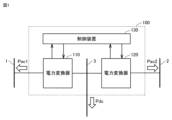
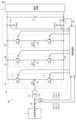
- FIG. 1 is a block diagram showing the configuration of a power conversion system according to Embodiment 1.
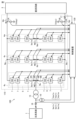
- FIG. 2 is a schematic configuration diagram of the power converter shown in FIG. 1.
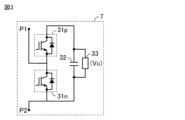
- FIG. 3 is a circuit diagram showing a first configuration example of the converter cell shown in FIG. 2.
- FIG. 3 is a circuit diagram showing a second configuration example of the converter cell shown in FIG. 2.
- FIG. 2 is a block diagram showing an example of a hardware configuration of a control device 130.
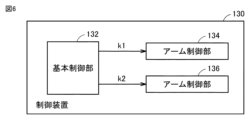
- FIG. 2 is a functional block diagram illustrating the internal configuration of a control device 130.
- FIG. 7 is a block diagram illustrating a configuration example of a basic control unit 132 shown in FIG. 6.
- FIG. 8 is a block diagram illustrating a specific configuration example of an AC power controller 40 and an AC current controller 50 shown in FIG. 7.
- FIG. 7 is a block diagram showing a specific configuration example of an AC power controller 40 and an AC current controller 50 shown in FIG. 7.
- FIG. 8 is a block diagram illustrating a first configuration example of a capacitor voltage controller 44 shown in FIG. 7.
- FIG. 8 is a block diagram illustrating a second configuration example of the capacitor voltage controller 44 shown in FIG. 7.
- FIG. 8 is a block diagram illustrating a specific configuration example of an AC power controller 42 and an AC current controller 52 shown in FIG. 7.
- FIG. 8 is a block diagram illustrating a specific configuration example of a capacitor voltage balance controller 56 and a loop current controller 58 shown in FIG. 7.
- FIG. 7 is a block diagram illustrating a configuration example of a basic control unit 132 according to a first modification of the first embodiment.
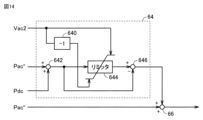
- FIG. 14 is a block diagram illustrating a specific configuration example of the output fluctuation compensator 64 shown in FIG. 13.
- FIG. 14 is a block diagram illustrating a specific configuration example of the output fluctuation compensator 64 shown in FIG. 13.
- FIG. 3 is a block diagram illustrating a configuration example of a basic control unit 132 according to a second modification of the first embodiment.
- FIG. 13 is a block diagram illustrating a configuration example of an AC power controller 42 included in a basic control unit 132 according to a third modification of the first embodiment.
- FIG. 13 is a block diagram illustrating a specific configuration example of a capacitor voltage balance controller 56 and a loop current controller 58 included in a basic control unit 132 according to a fourth modification of the first embodiment.
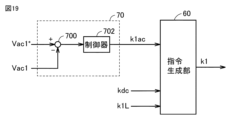
- FIG. 3 is a block diagram illustrating a configuration example of a basic control unit 132 in a power conversion system according to a second embodiment.
- FIG. 19 is a block diagram illustrating a specific configuration example of the AC voltage controller 70 shown in FIG. 18.
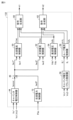
- FIG. 21 is a block diagram illustrating a first configuration example of a basic control unit 132 in the control device 130 shown in FIG. 20.
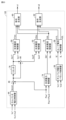
- FIG. 21 is a block diagram illustrating a second configuration example of the basic control unit 132 in the control device 130 shown in FIG. 20.
- FIG. 23 is a block diagram illustrating a modification of the second configuration example of the basic control unit 132 shown in FIG. 22.
- FIG. FIG. 3 is a schematic configuration diagram of a power conversion system according to a fourth embodiment.
- 13 is a block diagram illustrating a configuration example of a basic control unit 132 in a control device 130 according to Embodiment 4.
- FIG. 21 is a block diagram illustrating a first configuration example of a basic control unit 132 in the control device 130 shown in FIG. 20.
- FIG. 21 is a block diagram illustrating a second configuration example of the basic control unit 132 in the control device 130 shown in FIG. 20.
- FIG. 23 is a block diagram illustrating a modification of the second configuration example
- FIG. 1 is a block diagram showing the configuration of a power conversion system according to Embodiment 1.
- Power conversion system 100 according to Embodiment 1 is a system for controlling power of a DC power transmission system having a unipolar configuration. Power is transmitted and received between the two AC systems 1 and 2 via the DC system 3.
- AC systems 1 and 2 are three-phase AC systems, they are shown as one electric wire in FIG. 1 for ease of illustration.
- the AC systems 1 and 2 are sometimes referred to as “AC circuits”, and the DC system 3 is sometimes referred to as "DC circuit”.
- the DC system 3 is a DC transmission line with capacitance.
- the length of the DC power transmission line is, for example, several tens of kilometers to several hundred kilometers.
- the length of the DC power transmission line is, for example, several meters to several tens of meters.
- a power conversion system 100 includes a power converter 110, a power converter 120, and a control device 130.
- Power converter 110 is connected between AC system 1 and DC system 3.
- Power converter 120 is connected between AC system 2 and DC system 3.
- AC system 1 corresponds to an example of a "first AC system”
- AC system 2 corresponds to an example of a "second AC system”.
- Power converter 120 corresponds to an example of a "first power converter”
- power converter 120 corresponds to an example of a "second power converter”.
- the power converters 110 and 120 are self-excited power converters, and function as a forward converter that converts AC power to DC power and an inverse converter that converts DC power to AC power.
- power converters 110 and 120 are configured by MMC. The details of the configuration of the MMC type power converters 110 and 120 will be explained with reference to FIGS. 2 to 4.
- the power converter 110 When power is transmitted from the AC system 1 to the AC system 2, the power converter 110 operates as a forward converter (REC), and the power converter 120 operates as an inverter (INV). Specifically, AC power is converted into DC power by the power converter 110, and the converted DC power is transmitted as DC power via the DC system 3. At the power receiving end, DC power is converted to AC power by a power converter 120, and this converted AC power is supplied to the AC system 2.
- power converter 110 operates as an inverse converter and power converter 120 operates as a forward converter, a conversion operation opposite to that described above is performed.
- Control device 130 controls the operation of power converters 110 and 120. Specifically, the control device 130 determines that the sum of the AC power Pac1 output from the power converter 110, the DC power Pdc output to the DC system 3, and the AC power Pac2 output from the power converter 120 is zero.
- the operation of power converters 110 and 120 is integrally controlled so as to achieve the following.
- AC power Pac1 is defined as positive in the direction from the power conversion system 100 toward the AC system 1.
- AC power Pac2 is defined as positive in the direction from power conversion system 100 to AC system 2.
- the DC power Pdc is defined as positive in the direction from the power conversion system 100 toward the DC system 3. Note that the DC power Pdc has a positive or negative value when another power conversion system or a DC load is connected to the DC system 3 outside the power conversion system 100.
- the control device 130 is configured to integrally control the operations of the power converters 110 and 120.
- "to control in an integrated manner” means that the control device 130 controls information regarding the output power of one of the power converters 110 and 120 and the DC power output from the power conversion system 100. This means controlling the operation of the other power converter based on the
- FIG. 2 is a schematic configuration diagram of the power converter 110 shown in FIG. 1.
- power converter 110 is configured by a modular multilevel converter including a plurality of converter cells connected in series. Note that the "converter cell” is also called a “submodule,” SM, or "unit converter.”
- the power converter 110 performs power conversion between the AC system 1 and the DC system 3.
- Power converter 110 includes a plurality of leg circuits 4u, 4v, and 4w.
- the plurality of leg circuits 4u, 4v, and 4w are connected in parallel to each other between a positive DC terminal (ie, a high-potential DC terminal) Np and a negative DC terminal (ie, a low-potential DC terminal) Nn.
- a positive DC terminal ie, a high-potential DC terminal
- Nn negative DC terminal
- the leg circuit 4 is provided for each of the multiple phases that make up the alternating current.
- the leg circuit 4 is connected between the AC system 1 and the DC system 3, and performs power conversion between the two systems.
- FIG. 2 shows a case where the AC system 1 is a three-phase AC system, and three leg circuits 4u, 4v, and 4w are provided corresponding to the U phase, V phase, and W phase, respectively.
- AC input terminals Nu, Nv, and Nw provided in the leg circuits 4u, 4v, and 4w, respectively, are connected to the AC system 1 via a transformer 13.
- the connection between the AC input terminals Nv, Nw and the transformer 13 is not shown for ease of illustration.
- a high potential side DC terminal Np and a low potential side DC terminal Nn commonly connected to each leg circuit 4 are connected to the DC system 3.
- the transformer 13 in FIG. 2 may be configured to connect to the AC system 1 via a interconnection reactor. Furthermore, primary windings are provided in the leg circuits 4u, 4v, 4w in place of the AC input terminals Nu, Nv, Nw, and the leg circuits 4u, 4v, 4w are connected via secondary windings magnetically coupled to the primary windings.
- the transformer 13 or the interconnection reactor may be connected in an alternating current manner. In this case, the primary windings may be the following reactors 8A and 8B. That is, the leg circuit 4 is electrically connected (i.e., DC or AC ) Connected to AC system 1.
- the leg circuit 4u includes an upper arm 5 from a high potential side DC terminal Np to an AC input terminal Nu, and a lower arm 6 from a low potential side DC terminal Nn to an AC input terminal Nu.
- An AC input terminal Nu which is a connection point between the upper arm 5 and the lower arm 6, is connected to a transformer 13.
- the high potential side DC terminal Np and the low potential side DC terminal Nn are connected to the DC system 3. Since the leg circuits 4v and 4w have similar configurations, the configuration of the leg circuit 4u will be described below as a representative example.
- the upper arm 5 includes a plurality of cascade-connected converter cells 7 and a reactor 8A.
- the plurality of converter cells 7 and reactor 8A are connected in series.
- the lower arm 6 includes a plurality of cascade-connected converter cells 7 and a reactor 8B.
- the plurality of converter cells 7 and reactor 8B are connected in series.
- the number of converter cells 7 included in each of the upper arm 5 and the lower arm 6 is assumed to be Ncell. However, Ncell ⁇ 2.
- the position where the reactor 8A is inserted may be any position on the upper arm 5 of the leg circuit 4u, and the position where the reactor 8B is inserted may be any position on the lower arm 6 of the leg circuit 4u. good.
- a plurality of reactors 8A and 8B may be provided. The inductance values of each reactor may be different from each other. Furthermore, only the reactor 8A of the upper arm 5 or only the reactor 8B of the lower arm 6 may be provided.
- the transformer connection may be devised to cancel the magnetic flux of the DC component current, and the leakage inductance of the transformer acts on the AC component current, thereby making it possible to replace the reactor.
- the power conversion system 100 further includes an AC voltage detector 10, an AC current detector 16, and DC voltage detectors 11A and 11B as detectors for detecting quantities of electricity (current, voltage, etc.) used for control. , arm current detectors 9A and 9B provided in each leg circuit 4, and a DC current detector 17. Signals detected by these detectors are input to control device 130.
- signal lines for signals input from each detector to the control device 130 and signal lines for signals input/output between the control device 130 and each converter cell 7 are shown. Although some of them are described collectively, they are actually provided for each detector and for each converter cell 7. Separate signal lines may be provided between each converter cell 7 and the control device 130 for transmission and reception.
- the signal line is composed of, for example, an optical fiber.
- the AC voltage detector 10 detects the U-phase AC voltage Vac1u, the V-phase AC voltage Vac1v, and the W-phase AC voltage Vac1w of the AC system 1.
- Vac1u, Vac1v, and Vac1w are also collectively referred to as "Vac1.”
- the alternating current detector 16 detects the U-phase alternating current Iac1u, the V-phase alternating current Iac1v, and the W-phase alternating current Iac1w of the alternating current system 1.
- Iac1u, Iac1v, and Iac1w will also be collectively referred to as "Iac1.”
- the DC voltage detector 11A detects the DC voltage Vdcp of the high potential side DC terminal Np connected to the DC system 3.
- the DC voltage detector 11B detects the DC voltage Vdcn of the low potential side DC terminal Nn connected to the DC system 3.
- the difference between DC voltage Vdcp and DC voltage Vdcn (Vdcp-Vdcn) is defined as "DC voltage Vdc.”
- the DC current detector 17 detects the DC current Idc flowing through the high potential side DC terminal Np or the low potential side DC terminal Nn.
- Arm current detectors 9A and 9B provided in the U-phase leg circuit 4u detect an upper arm current Ipu flowing in the upper arm 5 and a lower arm current Inu flowing in the lower arm 6, respectively.
- Arm current detectors 9A and 9B provided in the V-phase leg circuit 4v detect an upper arm current Ipv and a lower arm current Inv, respectively.
- Arm current detectors 9A and 9B provided in the W-phase leg circuit 4w detect an upper arm current Ipw and a lower arm current Inw flowing in the upper arm 5, respectively.
- upper arm currents Ipu, Ipv, and Ipw are also collectively referred to as “upper arm currentThatmp,” and the lower arm currents Inu, Inv, and Inw are also collectively referred to as “lower arm current Iarmn.”
- FIG. 3 is a circuit diagram showing a first configuration example of the converter cell 7 shown in FIG. 2.
- the converter cell 7 according to the first configuration example has a circuit configuration called a half-bridge configuration.
- the converter cell 7 includes a series body formed by connecting two switching elements 31p and 31n in series, a power storage element 32, a voltage detector 33, and input/output terminals P1 and P2.
- the series body of switching elements 31p and 31n and power storage element 32 are connected in parallel.
- Voltage detector 33 detects voltage Vc between both ends of power storage element 32 .
- Converter cell 7 outputs voltage Vc or zero voltage of power storage element 32 between input/output terminals P1 and P2 by switching operations of switching elements 31p and 31n.
- switching element 31p When switching element 31p is turned on and switching element 31n is turned off, converter cell 7 outputs voltage Vc of power storage element 32.
- the switching element 31p When the switching element 31p is turned off and the switching element 31n is turned on, the converter cell 7 outputs zero voltage.
- FIG. 4 is a circuit diagram showing a second configuration example of the converter cell 7 shown in FIG. 2. As shown in FIG. 4, the converter cell 7 according to the second configuration example has a circuit configuration called a full bridge configuration.
- the converter cell 7 includes a first series body formed by connecting two switching elements 31p1 and 31n1 in series, and a second series body formed by connecting two switching elements 31p2 and 31n2 in series. It includes a power storage element 32, a voltage detector 33, and input/output terminals P1 and P2.
- the first series body, the second series body, and the power storage element 32 are connected in parallel.
- Voltage detector 33 detects voltage Vc between both ends of power storage element 32 .
- a midpoint between the switching element 31p1 and the switching element 31n1 is connected to the input/output terminal P1. Similarly, the midpoint of the switching element 31p2 and the switching element 31n2 is connected to the input/output terminal P2.
- Converter cell 7 outputs voltages Vc, -Vc, or zero voltage of power storage element 32 between input/output terminals P1 and P2 by switching operations of switching elements 31p1, 31n1, 31p2, and 31n2.
- the switching elements 31p, 31n, 31p1, 31n1, 31p2, 31n2 are self-extinguishing semiconductor switching devices such as IGBTs (Insulated Gate Bipolar Transistors) and GCTs (Gate Commutated Turn-off) thyristors.
- IGBTs Insulated Gate Bipolar Transistors
- GCTs Gate Commutated Turn-off thyristors.
- FWD Freewheeling Diode
- a capacitor such as a film capacitor is mainly used as the power storage element 32.
- the power storage element 32 may be referred to as a “capacitor” in the following description.
- the voltage Vc of the power storage element 32 is also referred to as “capacitor voltage Vc.”
- the converter cells 7 are connected in cascade.
- the input/output terminal P1 is connected to the input/output terminal P2 of the adjacent converter cell 7 or the high potential side DC terminal Np
- the input/output terminal P2 is connected to the input/output terminal P1 of the adjacent converter cell 7 or the AC input terminal Nu.
- the input/output terminal P1 is connected to the input/output terminal P2 of the adjacent converter cell 7 or the AC input terminal Nu
- the input/output terminal P2 is connected to the input/output terminal P2 of the adjacent converter cell 7. It is connected to the input/output terminal P1 of the converter cell 7 or the low potential side DC terminal Nn.
- the converter cell 7 has a half-bridge cell configuration shown in FIG. 3, and a semiconductor switching element is used as the switching element and a capacitor is used as the storage element.
- the converter cells 7 constituting the power converters 110 and 120 it is also possible to configure the converter cells 7 constituting the power converters 110 and 120 as a full bridge cell shown in FIG. 4.
- a converter cell having a configuration other than the one exemplified above for example, a converter cell having a circuit configuration called a clamped double cell, etc. may be used, and the switching element and the storage element are also limited to the above example. isn't it.
- FIG. 5 is a block diagram showing an example of the hardware configuration of the control device 130.
- FIG. 5 shows an example in which the control device 130 is configured by a computer.
- the control device 130 includes one or more input converters 20, one or more sample and hold (S/H) circuits 21, a multiplexer (MUX) 22, and an A/D (Analog to Digital) converter 23. Furthermore, the control device 130 includes one or more CPUs (Central Processing Units) 24 , RAMs (Random Access Memory) 25 , and ROMs (Read Only Memory) 26 . Furthermore, control device 130 includes one or more input/output interfaces 27, auxiliary storage 28, and a bus 29 interconnecting the above-mentioned components.
- S/H sample and hold
- MUX multiplexer
- A/D Analog to Digital
- CPUs Central Processing Units
- RAMs Random Access Memory
- ROMs Read Only Memory
- the input converter 20 has an auxiliary transformer (not shown) for each input channel.
- Each auxiliary transformer converts the detection signal from each electrical quantity detector of FIG. 2 into a signal at a voltage level suitable for subsequent signal processing.
- a sample and hold circuit 21 is provided for each input converter 20.
- the sample and hold circuit 21 samples and holds a signal representing the amount of electricity received from the corresponding input converter 20 at a prescribed sampling frequency.
- the multiplexer 22 sequentially selects the signals held in the plurality of sample and hold circuits 21.
- A/D converter 23 converts the signal selected by multiplexer 22 into a digital value. Note that by providing a plurality of A/D converters 23, A/D conversion may be performed in parallel on detection signals of a plurality of input channels.
- the CPU 24 controls the entire control device 130 and executes arithmetic processing according to a program.
- RAM 25 as a volatile memory
- ROM 26 as a non-volatile memory are used as main memory of the CPU 24.
- the ROM 26 stores programs, signal processing settings, and the like.
- the auxiliary storage device 28 is a non-volatile memory with a larger capacity than the ROM 26, and stores programs, data of the detected amount of electricity, and the like.
- the input/output interface 27 is an interface circuit for communicating between the CPU 24 and external devices.
- control device 130 may be configured using circuits such as FPGA (Field Programmable Gate Array) and ASIC (Application Specific Integrated Circuit). That is, the mechanism of each functional block described in FIG. 6, which will be described later, can be configured based on the computer illustrated in FIG. 5, or at least a part thereof can be configured using circuits such as FPGA and ASIC. be able to. Further, at least a part of the functions of each functional block can be configured by analog circuits.
- FPGA Field Programmable Gate Array
- ASIC Application Specific Integrated Circuit
- FIG. 6 is a functional block diagram illustrating the internal configuration of the control device 130.
- the control device 130 includes a basic control section 132, an arm control section 134, and an arm control section 136.
- the configurations of the basic control section 132 and the arm control sections 134 and 136 are realized by, for example, a processing circuit.
- the processing circuit may be dedicated hardware or may be the CPU 24 that executes a program stored in the internal memory of the control device 130. If the processing circuit is dedicated hardware, the processing circuit may be comprised of, for example, an FPGA, an ASIC, or a combination thereof.
- the basic control unit 132 generates an arm voltage command value k1 for the power converter 110 and an arm voltage command value k2 for the power converter 120 using the electrical quantity measured by each of the above-mentioned detectors.
- Arm voltage command value k1 includes six arm voltage command values for upper arm 5 and lower arm 6 of U phase, V phase, and W phase that constitute power converter 110.
- Arm voltage command value k2 includes six arm voltage command values for upper arm 5 and lower arm 6 of U phase, V phase, and W phase that constitute power converter 120.
- the arm control unit 134 generates a gate control signal for controlling on and off of the switching elements constituting each arm of the power converter 110 based on the arm voltage command value k1, and transmits the gate control signal to the corresponding one. Output to switching element.
- the arm control unit 134 compares the arm voltage command value k1 with a carrier signal, and generates a gate control signal as a pulse width modulation (PWM) signal based on the comparison result. .
- PWM pulse width modulation
- a triangular wave is used as the carrier signal.
- the arm control unit 136 generates a gate control signal for controlling on and off of the switching elements constituting each arm of the power converter 120 based on the arm voltage command value k2, and converts the gate control signal into a corresponding one. Output to switching element.
- arm control unit 136 compares arm voltage command value k2 and a carrier signal, and generates a gate control signal as a PWM signal based on the comparison result. In the following description, it is assumed that each signal is converted into a PU (Per Unit) inside the control device 130.
- PU Per Unit
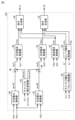
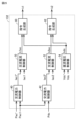
- FIG. 7 is a block diagram illustrating a configuration example of the basic control section 132 shown in FIG. 6.
- the basic control unit 132 includes AC power controllers 40 and 42, a capacitor voltage controller 44, adders 46 and 48, AC current controllers 50 and 52, and a DC voltage controller 54. , a capacitor voltage balance controller 56 , a loop current controller 58 , and command generators 60 and 62 .
- the configuration example in FIG. 7 is directed to control for making AC power Pac1 output from the power converter 110 to the AC system 1 match the AC power command value Pac*.
- the operation of the power converter 110 is controlled so that the AC power Pac1 matches the AC power command value Pac*, and the sum of the AC power Pac1, the DC power Pdc, and the AC power Pac2 becomes zero.
- the operation of power converter 120 is controlled.
- the configuration example of FIG. 7 further includes control for eliminating excess or deficiency of stored energy in the capacitors 32 in all converter cells 7 of power converters 110 and 120, and converter cells 7 of power converters 110 and 120. Control is performed to equalize the level of capacitor voltage Vc in power converters 110 and 120 to eliminate imbalance in stored energy of converter cells 7.
- the AC power controller 40 controls the output from the power converter 110 by feedback control to reduce the deviation between the AC power Pac1 output from the power converter 110 and the AC power command value Pac* to 0.
- An alternating current command value Iac10* which is a command value of the alternating current, is generated.
- AC power Pac1 is calculated based on AC voltage Vac1 and AC current Iac1 shown in FIG. 2.
- the AC power command value Pac* is, for example, a value preset by a system operator or the like.
- Capacitor voltage controller 44 receives capacitor voltage Vc detected by voltage detector 33 in each converter cell 7 of power converter 110 and also receives capacitor voltage Vc detected by voltage detector 33 in each converter cell 7 of power converter 120. receives the capacitor voltage Vc.
- the capacitor voltage Vc of each converter cell 7 included in the power converter 110 is also referred to as “capacitor voltage Vc1”
- the capacitor voltage Vc of each converter cell 7 included in the power converter 120 is also referred to as “capacitor voltage Vc1”. Also referred to as "Vc2”.
- Capacitor voltage controller 44 controls all conversions of power converters 110 and 120 from capacitor voltages Vc1 of all converter cells 7 of power converter 110 and capacitor voltages Vc2 of all converter cells 7 of power converter 120.
- a voltage evaluation value Vcg for evaluating the total sum of stored energy in the device cell 7 is generated.
- Capacitor voltage controller 44 controls alternating current to correct alternating current command value Iac10* of power converter 110 through feedback control to zero the deviation between voltage evaluation value Vcg and total voltage command value Vc*.
- a command correction value Iaccor1 and an AC current command correction value Iaccor2 for correcting the AC current command value Iac20* of the power converter 120 are generated.
- Total voltage command value Vc* is a reference value of capacitor voltage Vc corresponding to a reference value of stored energy of capacitor 32 in each converter cell 7 of power converters 110, 120.
- the total voltage command value Vc* may be a fixed value or may be a variable value obtained by some calculation.
- the AC current command correction values Iaccor1 and Iaccor2 control the overall level of the capacitor voltage Vc of each converter cell 7 of the power converters 110 and 120 to the total voltage command value Vc*. This corresponds to an alternating current value for eliminating excess or deficiency of stored energy in all converter cells 7.
- Adder 46 generates AC current command value Iac1* by adding AC current command correction value Iaccor1 to AC current command value Iac10*.
- the alternating current controller 50 controls the alternating current voltage output from the power converter 110 by feedback control to zero the deviation between the alternating current command value Iac1* and the alternating current Iac1 detected by the alternating current detector 16.
- An AC voltage command value k1ac which is a command value of , is generated.
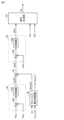
- FIG. 8 is a block diagram illustrating a specific configuration example of the AC power controller 40 and the AC current controller 50 shown in FIG. 7.
- AC power controller 40 includes a subtracter 400 and a controller 402.
- Subtractor 400 subtracts AC power Pac1 from AC power command value Pac*.
- the controller 402 executes a control calculation so that the deviation ⁇ Pac1 between the AC power command value Pac* and the AC power Pac1 calculated by the subtractor 400 becomes 0, and sets the AC current command value Iac10* as the control calculation result.
- the controller 402 may be configured as a PI controller that performs proportional calculation and integral calculation on the deviation ⁇ Pac1, or may be configured as a PID controller that performs differential calculation. Alternatively, other controller configurations used for feedback control may be used. Further, the controller 402 may be configured by combining a feedback controller and a feedforward controller.
- Adder 46 generates alternating current command value Iac1* by adding alternating current command value Iac10* and alternating current command correction value Iaccor1 generated by capacitor voltage controller 44.
- the alternating current controller 50 includes a subtracter 500 and a controller 502.
- Subtractor 500 subtracts alternating current Iac1 from alternating current command value Iac1*.
- the controller 502 executes a control calculation so that the deviation ⁇ Iac1 between the AC current command value Iac1* and the AC current Iac1 calculated by the subtractor 500 becomes 0, and calculates the AC voltage command value k1ac as the control calculation result.
- the controller 502 may be configured as a PI controller that performs proportional calculation and integral calculation on the deviation ⁇ Iac1, or may be configured as a PID controller that performs differential calculation. Alternatively, other controller configurations used for feedback control may be used. Further, the controller 502 may be configured by combining a feedback controller and a feedforward controller.
- FIG. 9 is a block diagram illustrating a first configuration example of the capacitor voltage controller 44 shown in FIG. 7. As shown in FIG. 9, capacitor voltage controller 44 includes a voltage calculator 440, a subtracter 442, a proportional device 444, an integrator 446, and an adder 448.
- the voltage calculator 440 calculates the capacitor voltage Vc1 detected by the voltage detector 33 of each converter cell 7 of the power converter 110 and the capacitor voltage Vc1 detected by the voltage detector 33 of each converter cell 7 of the power converter 120. It receives voltage Vc2.
- Voltage calculator 440 calculates all converter cells of power converters 110 and 120 from capacitor voltages Vc1 of all converter cells 7 of power converter 110 and capacitor voltages Vc2 of all converter cells 7 of power converter 120. A voltage evaluation value Vcgall for evaluating the total sum of stored energy of the cell 7 is generated.
- voltage calculator 440 calculates voltage evaluation value Vcg1 indicating the sum of accumulated energy of all converter cells 7 of power converter 110 from capacitor voltage Vc1 of each converter cell 7 of power converter 110. generate.
- the voltage evaluation value Vcg1 is the average value of the capacitor voltages Vc1 of all converter cells 7 of the power converter 110, or the average value of the capacitor voltages Vc1 of a plurality of converter cells 7 belonging to each phase leg circuit or each arm. Desired.
- the voltage evaluation value Vcg1 may be obtained as a total value or a representative value of the capacitor voltages Vc1 of all converter cells 7 of the power converter 110.
- the representative value the median value, maximum value, minimum value, etc. of the capacitor voltage Vc1 of all the converter cells 7 can be appropriately applied.
- the voltage calculator 440 further generates a voltage evaluation value Vcg2 indicating the sum of the accumulated energy of all converter cells 7 of the power converter 120 from the capacitor voltage Vc2 of each converter cell 7 of the power converter 120.
- the voltage evaluation value Vcg2 is the average value of the capacitor voltages Vc2 of all converter cells 7 of the power converter 120, or the average value of the capacitor voltages Vc2 of a plurality of converter cells 7 belonging to each phase leg circuit or each arm. Desired.
- the voltage evaluation value Vcg2 may be obtained as a total value or a representative value of the capacitor voltages Vc2 of all converter cells 7 of the power converter 120.
- the representative value the median value, maximum value, minimum value, etc. of the capacitor voltage Vc2 of all the converter cells 7 can be appropriately applied.
- voltage calculator 440 uses voltage evaluation value Vcg1 and voltage evaluation value Vcg2 to calculate voltage evaluation value Vcgall for evaluating the sum of stored energy of all converter cells 7 of power converters 110 and 120. generate.
- the voltage evaluation value Vcgall is determined as the average value of the voltage evaluation value Vcg1 and the voltage evaluation value Vcg2.
- the subtracter 442 subtracts the voltage evaluation value Vcgall from the total voltage command value Vc*.
- the proportional device 444 performs a proportional calculation on the deviation ⁇ Vc between the total voltage command value Vc* and the voltage evaluation value Vcgall calculated by the subtractor 442.
- the integrator 446 performs an integral operation on the deviation ⁇ Vc.
- the adder 448 generates alternating current command correction values Iaccor1 and Iaccor2 by adding the computed value by the proportional device 444 and the computed value by the integrator 446.
- the alternating current command correction value Iaccor1 is used in the power converter 110 in order to control the overall level of the capacitor voltage Vc of each converter cell 7 of the power converters 110, 120 to the total voltage command value Vc*. This corresponds to the current value for correcting the AC current command value Iac10*.
- the AC current command correction value Iaccor2 is the AC current command value of the power converter 120 in order to control the overall level of the capacitor voltage Vc of each converter cell 7 of the power converters 110, 120 to the total voltage command value Vc*. This corresponds to the current value for correcting Iac20*.
- FIG. 10 is a block diagram illustrating a second configuration example of the capacitor voltage controller 44 shown in FIG. 7.
- the second configuration example differs from the first configuration example shown in FIG. 9 in the method of generating the AC current command correction value Iaccor1.
- the proportional device 444 performs a proportional calculation on the deviation ⁇ Vc between the total voltage command value Vc* and the voltage evaluation value Vcgall, which is calculated by the subtracter 442, thereby increasing the AC voltage.
- a current command correction value Iaccor1 is generated.
- adder 448 generates alternating current command correction value Iaccor2 by adding the calculated value by proportional device 444 and the calculated value by integrator 446.
- the AC current command correction value Iaccor1 when the total voltage command value Vc* and the voltage evaluation value Vcgall match and the deviation ⁇ Vc becomes 0, the AC current command correction value Iaccor1 also becomes 0, so the AC current command value Iac1 * will match the AC current command value Iac0*. According to this, it is possible to suppress the control of the capacitor voltage Vc1 of each converter cell 7 of the power converter 110 from interfering with the control of the AC power Pac1 by the AC power controller 40.
- the AC power controller 42 feedforwards the AC power Pac1 output from the power converter 110 and the DC power Pdc output to the DC system 3, thereby outputting the AC power Pac1 from the power converter 120.
- An alternating current command value Iac20* which is an alternating current command value, is generated.
- Feedforward of AC power Pac1 and DC power Pdc is the response of AC power Pac2 to fluctuations in AC power Pac1 output from power converter 110 to AC system 1 and fluctuations in DC power Pdc output to DC system 3. It is done to improve sexuality.
- Adder 48 generates AC current command value Iac2* by adding AC current command correction value Iaccor2 to AC current command value Iac20*.
- the alternating current controller 52 controls the alternating current voltage output from the power converter 120 by feedback control to zero the deviation between the alternating current command value Iac2* and the alternating current Iac2 detected by the alternating current detector 16.
- An AC voltage command value k2ac which is a command value of k2ac, is generated.
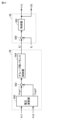
- FIG. 11 is a block diagram illustrating a specific configuration example of the AC power controller 42 and the AC current controller 52 shown in FIG. 7.
- the AC power controller 42 includes an adder 420 and a controller 422.
- Adder 420 adds AC power Pac1 output from power converter 110 to AC system 1 and DC power Pdc output to DC system 3.
- AC power Pac1 is calculated based on AC voltage Vac1 and AC current Iac1 shown in FIG. 2.
- DC power Pdc is calculated based on DC voltage Vdc and DC current Idc shown in FIG. 2.
- DC voltage Vdc is calculated as the difference between DC voltage Vdcp and DC voltage Vdcn. Note that the voltage between the DC terminals Np and Nn may be directly detected, and the detected value may be used as the DC voltage Vdc.
- the controller 422 generates the AC current command value Iac20* by multiplying the added value (Pac1+Pdc) obtained by the calculation by a predetermined feedforward gain.
- the AC power controller 42 can change the AC current command value Iac20* in response to changes in the AC power Pac1 and the DC power Pdc by feedforward control of the AC power Pac2.
- Adder 48 generates AC current command value Iac2* by adding AC current command value Iac20* and AC current command correction value Iaccor2 generated by capacitor voltage controller 44.
- the alternating current controller 52 includes a subtracter 520 and a controller 522.
- Subtractor 520 subtracts alternating current Iac2 from alternating current command value Iac2*.
- the controller 522 executes a control calculation so that the deviation ⁇ Iac2 between the AC current command value Iac2* and the AC current Iac2 calculated by the subtractor 520 becomes 0, and calculates the AC voltage command value k2ac as the control calculation result.
- the controller 522 may be configured as a PI controller that performs proportional calculation and integral calculation on the deviation ⁇ Iac2, or may be configured as a PID controller that performs differential calculation. Alternatively, other controller configurations used for feedback control may be used. Further, the controller 522 may be configured by combining a feedback controller and a feedforward controller.
- the AC power Pac1 used by the AC power controller 42 is calculated from the AC voltage Vac1 and AC current Iac1 shown in FIG. 2, but a value obtained by filtering the calculated value is used. It may also be a configuration.
- the AC power controller 42 may be configured to use AC power command value Pac* instead of AC power Pac1.
- the AC power command value Pac* may be used, and if the deviation ⁇ Pac1 exceeds the threshold.
- the AC power command value Pac* may be switched to the AC power Pac1.
- the DC voltage controller 54 adjusts the DC voltage output from the power converters 110, 120 by feedback control to zero the deviation between the DC voltage Vdc and the DC voltage command value Vdc*.
- a DC voltage command value kdc which is a command value, is generated.
- the DC voltage command value Vdc* is a value set in advance by a system operator or the like.
- the capacitor voltage balance controller 56 controls the capacitor voltage Vc1 detected by the voltage detector 33 of each converter cell 7 of the power converter 110 and the voltage detected by the voltage detector 33 of each converter cell 7 of the power converter 120. It receives the capacitor voltage Vc2. Capacitor voltage balance controller 56 generates loop current command value IL* so as to eliminate imbalance in the stored energy of each arm of power converter 110 and power converter 120.
- loop current controller 58 generates loop control command values k1L and k2L for controlling the loop current IL to follow the loop current command value IL*.
- Loop current is a current that circulates inside power conversion system 100 and includes a current that circulates within each power converter and a current that flows between power converter 110 and power converter 120.
- FIG. 12 is a block diagram illustrating a specific configuration example of the capacitor voltage balance controller 56 and loop current controller 58 shown in FIG. 7. As shown in FIG. 12, capacitor voltage balance controller 56 includes a voltage calculator 560, a subtracter 562, and an inter-group balance controller 564.
- the voltage calculator 560 calculates the capacitor voltage Vc1 detected by the voltage detector 33 in each converter cell 7 of the power converter 110 and the capacitor voltage Vc1 detected by the voltage detector 33 in each converter cell 7 of the power converter 120. Receives capacitor voltage Vc2.
- the voltage calculator 560 In the power converter 110, the voltage calculator 560 generates a group-by-group voltage evaluation value Vcgr1 that indicates the sum of the accumulated energy of the capacitors 32 of the converter cells 7 for each predetermined group. In addition, the voltage calculator 560 generates a group-by-group voltage evaluation value Vcgr2 that indicates the sum of the accumulated energy of the capacitors 32 of the converter cells 7 for each predetermined group in the power converter 120.
- each of the group-by-group voltage evaluation values Vcgr1 and Vcgr2 is calculated for each of the upper arm 5 and lower arm 6 of each leg circuit 4 of the corresponding power converter for a plurality of converters (Ncells) included in each arm.
- each of the voltage evaluation values Vcgr1 and Vcgr2 for each group can be used instead of or in addition to the voltage evaluation value for each arm for the leg circuits 4u (U phase), 4v (V phase) and U-phase voltage evaluation value Vcgu, V-phase voltage evaluation value Vcgv, and W
- the phase voltage evaluation value Vcgw may also be included.
- the voltage evaluation value Vcgr1 is obtained as the average value of the capacitor voltages Vc1 of all the converter cells 7 of the plurality of converter cells 7 belonging to each group (each arm) of the power converter 110.
- Voltage evaluation value Vcgr2 is obtained as an average value of capacitor voltages Vc1 of all converter cells 7 of a plurality of converter cells 7 belonging to each group (each arm) of power converter 120.
- the voltage evaluation values Vcgr1 and Vcgr2 may be obtained as a total value or a representative value of the capacitor voltages Vc of the plurality of converter cells 7 belonging to each group. As the representative value, the median value, maximum value, minimum value, etc. of the capacitor voltage Vc of the plurality of converter cells 7 can be appropriately applied.
- the subtracter 562 subtracts the group voltage evaluation value Vcgr2 from the group voltage evaluation value Vcgr1.
- the inter-group balance controller 564 executes a control calculation so that the deviation of the group voltage evaluation value Vcgr2 from the group voltage evaluation value Vcgr1 becomes 0, and generates a loop current command value IL* as a result of the control calculation.
- the loop current command value IL* equalizes the level of the capacitor voltage Vc of the converter cell 7 between the groups of power converters 110 and 120, and makes the difference in the stored energy of the converter cells 7 between the groups. This corresponds to the value of the loop current flowing inside each power converter and between power converter 110 and power converter 120 to eliminate the balance.
- Loop current controller 58 includes a subtracter 580 and a controller 582.
- Subtractor 580 subtracts loop current IL from loop current command value IL*.
- the controller 582 executes control calculations so that the deviation of the loop current IL from the loop current command value IL* becomes 0, and generates loop control command values k1L and k2L as control calculation results.
- the controller 582 may be configured as a PI controller that performs proportional calculation and integral calculation on the deviation, or may be configured as a PID controller that performs differential calculation. Alternatively, other controller configurations used for feedback control may be used. Further, the controller 582 may be configured by combining a feedback controller and a feedforward controller.
- the capacitor voltage balance controller 56 suppresses the imbalance in the stored energy of each group included in the power converters 110 and 120 by controlling the loop current IL using the voltage evaluation values Vcgr1 and Vcgr2.
- the command generation unit 60 generates an AC voltage command value k1ac generated by the AC current controller 50, a DC voltage command value kdc generated by the DC voltage controller 54, and a DC voltage command value kdc generated by the loop current controller 58.
- an arm voltage command value k1 for the power converter 110 is generated.
- Arm voltage command value k1 includes six arm voltage command values for upper arm 5 and lower arm 6 of U phase, V phase, and W phase that constitute power converter 110.
- the command generation unit 62 generates an AC voltage command value k2ac generated by the AC current controller 52, a DC voltage command value kdc generated by the DC voltage controller 54, and a loop control command value generated by the loop current controller 58.
- arm voltage command value k2 for power converter 120 is generated.
- Arm voltage command value k2 includes six arm voltage command values for upper arm 5 and lower arm 6 of U phase, V phase, and W phase that constitute power converter 120.
- the control device 130 controls the operation of the power converter 110 so that the AC power Pac1 output from the power converter 110 to the AC system 1 follows the AC power command value Pac*.
- an AC current command value Iac10* for controlling the AC power Pac1 to follow the AC power command value Pac* is generated.
- the control device 130 further executes control to eliminate excess or deficiency of stored energy in all converter cells 7 of the power converters 110 and 120.
- an alternating current command correction value is used to control the voltage evaluation value Vcgall for evaluating the total sum of stored energy of all converter cells 7 of the power converters 110 and 120 to follow the total voltage command value Vc*.
- Iaccor1 and Iaccor2 are generated.
- the alternating current command value Iac1* is generated by adding the alternating current command correction value Iaccor1 to the alternating current command value Iac10*.
- An AC voltage command value k1ac for controlling the AC current Iac1 to follow the AC current command value Iac1* is generated.
- the control device 130 also executes control to eliminate the imbalance of stored energy in the converter cells 7 of each group (arm) included in the power converters 110 and 120.
- a group voltage evaluation value Vcgr1 indicating the sum of the accumulated energy of the converter cells 7 for each group in the power converter 110
- a group voltage evaluation value Vcgr1 indicating the sum of the accumulated energy of the converter cells 7 for each group in the power converter 120
- a group-by-group voltage evaluation value Vcgr2 indicating the sum is generated.
- the level of the capacitor voltage Vc of the converter cell 7 is equalized between each group of power converters, and the level of the capacitor voltage Vc of the converter cell 7 is equalized between the power converters 110 and 120.
- a loop current command value IL* is generated.
- Loop control command values k1L and k2L are generated for controlling the loop current IL to follow the loop current command value IL*.
- the control device 130 synthesizes the AC voltage command value k1ac, the DC voltage command value kdc which is the command value of the DC voltage output from the power converter 110, and the loop control command value k1L.
- the arm voltage command value k1 is generated.
- the control device 130 controls the AC power Pac2 outputted from the power converter 120 to the AC system 2 and the AC power Pac1 outputted from the power converter 110 to the AC system 1.
- the operation of the power converter 120 is controlled so that the sum of the DC power Pdc and the DC power Pdc output to the DC system 3 becomes zero.
- AC current command value Iac20* is generated by feeding forward the sum of AC power Pac1 and DC power Pdc.
- the control device 130 controls the power converter by combining the AC voltage command value k2ac, the DC voltage command value kdc which is the command value of the DC voltage output from the power converter 120, and the loop control command value k2L described above. An arm voltage command value k2 for 120 is generated.
- power converter 110 outputs AC power Pac1 that follows AC power command value Pac*, while each power converter 110 outputs AC power Pac1 that follows AC power command value Pac*.
- Excess/deficiency of stored energy in converter cell 7 and imbalance in stored energy with power converter 120 can be suppressed.
- the power converter 120 changes the AC power Pac2 to follow the changes in the AC power Pac1 and the DC power Pdc so that the sum of the AC power Pac1, the AC power Pac2, and the DC power Pdc becomes zero. Excess/deficiency of stored energy in each converter cell 7 of converter 120 and imbalance in stored energy with power converter 110 can be suppressed.
- the control device 130 controls the AC power Pac1 output from the power converter 110 according to the AC power command value Pac*, and also controls the AC power It is configured to feed forward the DC power Pdc output from Pac1 and the power conversion system 100.
- the AC power Pac2 can quickly respond to sudden changes in the AC power Pac1 due to disturbances such as grid failures. As a result, the energy stored in the entire power conversion system 100 can be maintained even when a disturbance occurs.
- control device 130 controls the power converters 110 and 120 so as to suppress excess or deficiency of stored energy in all converter cells 7 of the power converters 110 and 120. According to this, the influence of disturbances on the capacitor voltage Vc of each converter cell 7 can be reduced, so that the energy stored in the capacitors 32 of all converter cells 7 of power converters 110 and 120 can be maintained. .
- control device 130 is further configured to perform control to equalize the level of capacitor voltage Vc of all converter cells 7 between power converters 110 and 120. According to this, fluctuations in stored energy due to disturbances can be shared by the entire power conversion system 100, so variations in capacitor voltage Vc throughout the power conversion system 100 can be suppressed.
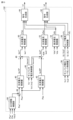
- FIG. 13 is a block diagram illustrating a configuration example of the basic control unit 132 according to the first modification of the first embodiment.
- the basic control unit 132 according to this modification differs from the basic control unit 132 shown in FIG. 7 in that it includes an output fluctuation compensator 64 and an adder 66.
- the output fluctuation compensator 64 subtracts the excess amount ((Pac*+Pdc)-Pac2) of the total value of the AC power command value Pac* and the DC power Pdc with respect to the outputtable AC power Pac2 from the AC power command value Pac*.
- the AC power command value Pac* is corrected as follows.
- the outputtable AC power Pac2 is calculated based on the AC voltage Vac2. Note that the method for calculating the outputtable AC power Pac2 is not limited to the above example. It is possible to calculate the amount of variation in AC power Pac2 using any method.
- FIG. 14 is a block diagram illustrating a specific configuration example of the output fluctuation compensator 64 shown in FIG. 13. As shown in FIG. 14, the output fluctuation compensator 64 includes a multiplier 640, an adder 642, a limiter 644, and a subtracter 646.
- the multiplier 640 multiplies the AC voltage Vac2 by a gain of "-1".
- Multiplier 640 and limiter 644 calculate outputtable AC power Pac2 based on AC voltage Vac2.
- the subtracter 646 subtracts the total value of the AC power command value Pac* and the DC power Pdc from the outputtable AC power Pac2 calculated by the limiter 644, and outputs the subtraction result to the adder 66.
- FIG. 15 is a block diagram illustrating a configuration example of the basic control unit 132 according to the second modification of the first embodiment.
- the basic control unit 132 according to this modification differs from the basic control unit 132 shown in FIG. 7 in that it includes a DC current controller 68 instead of the DC voltage controller 54.
- the DC current controller 68 controls the DC voltage output from the power converters 110, 120 by feedback control to zero the deviation between the DC current Idc and the DC current command value Idc*.
- a DC voltage command value kdc which is a command value of , is generated.
- the DC current Idc is detected by the DC current detector 17.
- the direct current command value Idc* is a value set in advance by a system operator or the like.
- the AC power controller 42 generates the AC current command value Iac20* by multiplying the added value (Pac1+Pdc) of the AC power Pac1 and the DC power Pdc by the feedforward gain.
- the AC power Pac1 input to the AC power controller 42 may be a value obtained by filtering the AC power Pac1 calculated based on the AC voltage Vac1 and the AC current Iac1 shown in FIG. 2.
- the AC power controller 42 selectively uses AC power command value Pac* and AC power Pac1 depending on the magnitude of the deviation of AC power Pac1 from AC power command value Pac*. It is also possible to have a configuration in which FIG. 16 is a block diagram illustrating a configuration example of the AC power controller 42 included in the basic control unit 132 according to the third modification of the first embodiment. As shown in FIG. 16, AC power controller 42 includes a subtracter 426, a comparator 428, a switching circuit 424, an adder 420, and a controller 422.
- a subtracter 426 subtracts AC power Pac1 from AC power command value Pac*.
- the comparator 428 compares the deviation ⁇ Pac1 between the AC power command value Pac* and the AC power Pac1 with a predetermined threshold value ⁇ Pth, and outputs a signal indicating the comparison result.
- the comparator 428 outputs an L (logic low) level signal when the deviation ⁇ Pac1 is less than or equal to the deviation ⁇ Pac1, and outputs an H (logic high) level signal when the deviation ⁇ Pac1 is greater than the deviation ⁇ Pac1.
- the switching circuit 424 inputs the AC power command value Pac* to the adder 420 in response to the L level output signal from the comparator 428.
- the switching circuit 424 inputs the AC power Pac1 to the adder 420 in response to the H level output signal from the comparator 428.
- the AC power controller 42 controls the AC power command value Iac20* according to the AC power command value Pac* and the DC power Pdc. generate.
- the AC power controller 42 generates the AC current command value Iac20* according to the AC power Pac1 and the DC power Pdc.
- the AC power command value Pac* is used to generate the AC current command value Iac20*, so that the AC power Quick control of Pac2 can be realized.
- a disturbance occurs in the AC power controller 40, by generating the AC current command value Iac20* using the AC power Pac, it becomes possible to quickly respond to changes in the AC power Pac1.
- the impedance of the DC transmission line connecting the power converters 110 and 120 increases as the distance between the power converters 110 and 120 increases. The impact of this cannot be ignored. In such a case, an impedance difference occurs between the current path inside each power converter and the current path between power converters 110 and 120, so the loop current circulating within each power converter and the power It is desirable to control the loop current flowing through the current path between converters 110 and 120 separately.
- FIG. 17 is a block diagram illustrating a specific configuration example of the capacitor voltage balance controller 56 and circulating current controller 58 included in the basic control unit 132 according to the fourth modification of the first embodiment.
- the capacitor voltage balance controller 56 includes a voltage calculator 560, subtracters 562A to 562C, inter-group balance controllers 564A and 564C, an inter-power converter balance controller 564B, and an adder. 566,568.
- the voltage calculator 560 calculates the capacitor voltage Vc1 detected by the voltage detector 33 in each converter cell 7 of the power converter 110 and the capacitor voltage Vc1 detected by the voltage detector 33 in each converter cell 7 of the power converter 120. Receives capacitor voltage Vc2.
- the voltage calculator 560 In the power converter 110, the voltage calculator 560 generates a group-by-group voltage evaluation value Vcgr1 that indicates the sum of the accumulated energy of the capacitors 32 of the converter cells 7 for each group (arm). Further, the voltage calculator 560 generates a group-by-group voltage evaluation value Vcgr2 that indicates the sum of the accumulated energy of the capacitors 32 of the converter cells 7 for each group (arm) in the power converter 120.
- Voltage calculator 560 calculates all converter cells of power converters 110 and 120 from capacitor voltages Vc1 of all converter cells 7 of power converter 110 and capacitor voltages Vc2 of all converter cells 7 of power converter 120.
- a total voltage evaluation value Vcgall for evaluating the total sum of stored energy of the cell 7 is generated.
- the total voltage evaluation value Vcgall is determined as the average value of the capacitor voltages Vc of all converter cells 7 of power converters 110 and 120.
- the voltage calculator 440 generates a voltage evaluation value Vcg1 indicating the sum of the accumulated energy of all converter cells 7 of the power converter 110 from the capacitor voltage Vc1 of each converter cell 7 of the power converter 110.
- Voltage evaluation value Vcg1 is obtained as an average value, total value, or representative value of capacitor voltages Vc1 of all converter cells 7 of power converter 110.
- the representative value the median value, maximum value, minimum value, etc. of the capacitor voltage Vc1 of all the converter cells 7 can be appropriately applied.
- the voltage calculator 440 further generates a voltage evaluation value Vcg2 indicating the sum of the accumulated energy of all converter cells 7 of the power converter 120 from the capacitor voltage Vc2 of each converter cell 7 of the power converter 120.
- Voltage evaluation value Vcg2 may be obtained as an average value, total value, or representative value of capacitor voltages Vc2 of all converter cells 7 of power converter 120. As the representative value, the median value, maximum value, minimum value, etc. of the capacitor voltage Vc2 of all the converter cells 7 can be appropriately applied.
- the subtracter 562A subtracts the group-by-group voltage evaluation value Vcgr1 from the total voltage evaluation value Vcgall.
- the inter-group balance controller 564A executes a control calculation so that the deviation of the group voltage evaluation value Vcgr1 from the total voltage evaluation value Vcgall becomes 0, and generates a first current command value as a result of the control calculation.
- the first current command value equalizes the level of the capacitor voltage Vc1 of the converter cells 7 between the groups of power converters 110, and eliminates the imbalance of stored energy in the converter cells 7 between the groups. corresponds to the loop current value for
- the inter-group balance controller 564A corresponds to an example of a "first balance controller".
- the subtracter 562C subtracts the group-by-group voltage evaluation value Vcgr2 from the total voltage evaluation value Vcgall.
- the inter-group balance controller 564C executes a control calculation so that the deviation of the group-by-group voltage evaluation value Vcgr2 from the total voltage evaluation value Vcgall becomes 0, and generates a second current command value as a result of the control calculation.
- the second current command value equalizes the level of the capacitor voltage Vc2 of the converter cells 7 between the groups of power converters 120, and eliminates the imbalance of stored energy in the converter cells 7 between the groups. corresponds to the loop current value for
- the inter-group balance controller 564C corresponds to an example of a "second balance controller".
- the subtracter 562B subtracts the voltage evaluation value Vcg2 from the voltage evaluation value Vcg1.
- the inter-power converter balance controller 564B executes a control calculation so that the deviation between the voltage evaluation value Vcg1 and the voltage evaluation value Vcg2 becomes 0, and generates a third current command value as a result of the control calculation.
- the third current command value equalizes the level of the capacitor voltage Vc in the converter cell 7 between the power converters 110 and 120, and the accumulation in the converter cell 7 between the power converters 110 and 120. Corresponds to the loop current value to eliminate energy imbalance.
- the inter-power converter balance controller 564B corresponds to an example of a "third balance controller".
- Adder 566 adds the first current command value from inter-group balance controller 564A and the third current command value from inter-power converter balance controller 565B to obtain loop current command value IL1*. generate.
- Adder 568 adds the second current command value from inter-group balance controller 564C and the third current command value from inter-power converter balance controller 564B to obtain loop current command value IL*. generate.
- the loop current controller 58 includes subtracters 580 and 584 and controllers 582 and 586.
- Subtractor 580 subtracts loop current IL1 circulating within power converter 110 from loop current command value IL1*.
- the controller 582 executes a control calculation so that the deviation of the loop current IL1 from the loop current command value IL1* becomes 0, and generates a loop control command value k1L as a result of the control calculation.
- Subtractor 584 subtracts loop current IL2 circulating within power converter 120 from loop current command value IL2*.
- the controller 586 executes a control calculation so that the deviation of the loop current IL2 from the loop current command value IL2* becomes 0, and generates a loop control command value k2L as a result of the control calculation.
- the controllers 582 and 586 may be configured as PI controllers that perform proportional calculations and integral calculations on deviations, or may be configured as PID controllers that perform differential calculations. Alternatively, other controller configurations used for feedback control may be used. Further, the controllers 582 and 586 may be configured by combining a feedback controller and a feedforward controller.
- the capacitor voltage balance controller 56 controls the loop current using the voltage evaluation values Vcgall, Vcgr1, and Vcgr2, thereby controlling the difference in stored energy in the plurality of converter cells 7 of each group in each power converter. Balancing is suppressed and the imbalance of stored energy between power converters 110 and 120 is suppressed.
- Embodiment 2 In the power conversion system 100 shown in FIG. 1, when a synchronous generator is connected to the AC system 1, the AC voltage Vac1 of the AC system 1 is maintained within an appropriate range by the synchronous generator. Therefore, the control device 130 can control the AC powers Pac1 and Pac2 by controlling the AC currents Iac1 and Iac2 output from the power converters 110 and 120, respectively.
- control device 130 performs power conversion to maintain the AC voltage Vac1 of the AC system 1 within an appropriate range, as shown below.
- 110 is configured to control the operation of the device 110.
- FIG. 18 is a block diagram illustrating a configuration example of the basic control unit 132 in the power conversion system 100 according to the second embodiment.
- the basic control unit 132 shown in FIG. 18 differs from the basic control unit 132 shown in FIG. 7 in that it includes an AC voltage controller 70 instead of the AC power controller 40, the adder 46, and the AC current controller 50. different.
- the AC voltage controller 70 controls the power converter by feedback control to make the deviation ⁇ Vac1 between the AC voltage command value Vac1*, which is the AC voltage command value of the AC system 1, and the AC voltage Vac1 of the AC system 1 to 0.
- An AC voltage command value k1ac which is a command value of the AC voltage output from 110, is generated.
- the AC voltage command value Vac1* is a value set in advance by a system operator or the like.
- FIG. 19 is a block diagram illustrating a specific configuration example of the AC voltage controller 70 shown in FIG. 18. As shown in FIG. 19, AC voltage controller 70 includes a subtracter 700 and a controller 702.
- the subtracter 700 subtracts the AC voltage Vac from the AC voltage command value Vac1*.
- the controller 702 executes a control calculation so that the deviation ⁇ Vac1 between the AC voltage command value Vac1* and the AC voltage Vac1 calculated by the subtractor 700 becomes 0, and calculates the AC voltage command value k1ac as the control calculation result. Output.
- the controller 402 may be configured as a PI controller that performs proportional calculation and integral calculation on the deviation ⁇ Vac1, or may be configured as a PID controller that performs differential calculation. Alternatively, other controller configurations used for feedback control may be used. Further, the controller 702 may be configured by combining a feedback controller and a feedforward controller.
- the AC voltage Vac1 of the AC system 1 can be maintained within an appropriate range by voltage control in the power converter 110.
- the alternating current Iac1 output from the power converter 110 varies depending on the load or power source connected to the alternating current system 1, it becomes difficult for the control device 130 to control the alternating current Iac1.
- the capacitor voltage balance controller 56 equalizes the level of the capacitor voltage Vc of the converter cell 7 between the power converters 110 and 120, the level of the capacitor voltage Vc between the power converters 110 and 120 is The imbalance of stored energy in the converter cell 7 can be reduced.
- Embodiment 3 In the first and second embodiments described above, the configuration of the control device 130 in the case where the power conversion system 100 corresponds to the HVDC system or the BTB system has been described.
- Embodiment 3 a configuration of a control device 130 will be described when the power conversion system 100 corresponds to an AC/DC conversion system that performs bidirectional power conversion between an AC system and a DC system.
- FIG. 20 is a block diagram showing the configuration of a power conversion system according to Embodiment 3.
- the power conversion system 100 shown in FIG. 20 differs from the power conversion system 100 shown in FIG. 1 in that a power converter 120 is connected between the AC system 1 and the DC system 3.
- the power converter 110 and the power converter 120 are connected in parallel between the AC system 1 and the DC system 3.
- the power conversion system 100 can be regarded as an AC/DC conversion system with increased DC current capacity.
- the control device 130 controls the AC power Pac1 output from the power converter 110, the DC power Pdc output to the DC system 3, and the output from the power converter 120.
- the operations of power converters 110 and 120 are integrally controlled so that the sum of AC power Pac2 becomes zero. Thereby, power converters 110 and 120 can operate stably without interfering with each other. Further, since the energy stored in the power conversion system 100 as a whole can be maintained, the operation of the power conversion system 100 can be continued.
- the power conversion system 100 converts DC power provided from the DC system 3 into AC power and supplies the AC power to the AC system 1. Assuming that the power loss occurring within the power conversion system 100 is zero, in order to maintain the energy stored in the capacitors 32 included in the power converters 110 and 120, it is necessary to output the energy from the power converter 110 to the AC system 1.
- the control device 130 according to the third embodiment differs from the control device 130 shown in FIG. 6 in the internal configuration of a basic control section 132.
- the internal configuration of the basic control unit 132 can be designed according to the functions that the power conversion system 100 is responsible for. Below, an example of the configuration of the basic control unit 132 when the power conversion system 100 takes on the function of stabilizing the DC voltage Vdc of the DC system 3 (see FIG. 21), and a configuration example of the basic control unit 132 when the power conversion system 100 takes on the function of stabilizing the DC voltage Vdc of the DC system 3, and An example of the configuration of the basic control unit 132 (see FIG. 22) will be described when the basic control unit 132 has a function of outputting desired AC power.
- FIG. 21 is a block diagram illustrating a first configuration example of the basic control section 132 in the control device 130 shown in FIG. 20.
- the basic control section 132 shown in FIG. 21 differs from the basic control section 132 shown in FIG. 7 in that it includes an AC power controller 72 instead of the AC power controllers 40 and 42.
- the AC power controller 72 feed-forwards the DC power Pdc output from the power converters 110, 120 to generate an AC current command value Iac0*, which is a command value of the AC current output from the power converters 110, 120. generate. Feedforward of the DC power Pdc is performed in order to improve the responsiveness of the AC powers Pac1 and Pac2 to fluctuations in the DC power Pdc output from the power conversion system 100 to the DC system 3.
- Capacitor voltage controller 44 generates a voltage evaluation value Vcgall for evaluating the sum of stored energy of all converter cells 7 of power converters 110 and 120.
- the capacitor voltage controller 44 corrects the alternating current command value Iac0* of the power converters 110, 120 by feedback control to make the deviation between the voltage evaluation value Vcgall and the total voltage command value Vc* zero.
- An alternating current command correction value Iaccor is generated.
- Adder 46 generates AC current command values Iac1*, Iac2* by adding AC current command correction value Iaccor to AC current command value Iac0*. That is, the AC current command value Iac1* and the AC current command value Iac2* match.
- the alternating current controller 50 controls the alternating current voltage output from the power converter 110 by feedback control to zero the deviation between the alternating current command value Iac1* and the alternating current Iac1 detected by the alternating current detector 16.
- An AC voltage command value k1ac which is a command value of , is generated.
- the alternating current controller 52 controls the alternating current voltage output from the power converter 120 by feedback control to zero the deviation between the alternating current command value Iac2* and the alternating current Iac2 detected by the alternating current detector 16.
- An AC voltage command value k2ac which is a command value of k2ac, is generated.
- the DC voltage controller 54 controls the DC voltage, which is the command value of the DC voltage output from the power converters 110 and 120, by feedback control to make the deviation between the DC voltage Vdc and the DC voltage command value Vdc* zero. Generate command value kdc.
- the DC voltage command value Vdc* is a value set in advance by a system operator or the like.
- the capacitor voltage balance controller 56 controls the capacitor voltage Vc1 detected by the voltage detector 33 of each converter cell 7 of the power converter 110 and the voltage detected by the voltage detector 33 of each converter cell 7 of the power converter 120. It receives the capacitor voltage Vc2.
- the capacitor voltage balance controller 56 controls the energy stored in the converter cells 7 of each group (each arm) of the power converter 110 and the stored energy in the converter cell 7 of each group (each arm) of the power converter 120.
- a loop current command value IL* is generated so as to eliminate the imbalance between the two.
- the loop current controller 58 generates loop control command values k1L and k2L for controlling the loop current IL to follow the loop current command value IL*.
- the command generation unit 60 generates an AC voltage command value k1ac generated by the AC current controller 50, a DC voltage command value kdc generated by the DC voltage controller 54, and a loop control command value generated by the loop current controller 58. By combining k1L, arm voltage command value k1 for power converter 110 is generated.
- the command generation unit 62 generates an AC voltage command value k2ac generated by the AC current controller 52, a DC voltage command value kdc generated by the DC voltage controller 54, and a loop control command value generated by the loop current controller 58. By combining k2L, arm voltage command value k2 for power converter 120 is generated.
- control device 130 is configured to control the DC voltage Vdc of the DC system 3 according to the DC voltage command value Vdc*, and to feed forward the DC power Pdc. This allows the AC power Pac1 and Pac2 to quickly respond to sudden changes in the DC power Pdc due to disturbances in the DC system 3, making it possible to maintain the stored energy in the entire power conversion system 100. .
- control device 130 since the control device 130 is configured to perform control to equalize the level of the capacitor voltage Vc of all the converter cells 7 between the power converters 110 and 120, the power conversion Variations in capacitor voltage Vc throughout the system 100 can be suppressed.
- FIG. 22 is a block diagram illustrating a second configuration example of the basic control section 132 in the control device 130 shown in FIG. 20.
- the basic control unit 132 shown in FIG. 22 is different from the basic control unit 132 shown in FIG. 7 in that the basic control unit 132 shown in FIG. The difference is that a current controller 76 is included.
- the AC power controller 74 sets the deviation between the sum (Pac1+Pac2) of the AC power Pac1 output from the power converter 110 and the AC power Pac2 output from the power converter 120 and the AC power command value Pac* to 0.
- a DC current command value Idc* which is a command value of the DC current output from the power converters 110 and 120 to the DC system 3 is generated.
- AC power Pac1 is calculated based on AC voltage Vac1 and AC current Iac1 shown in FIG. 2.
- AC power Pac2 is calculated based on AC voltage Vac2 and AC current Iac2.
- Capacitor voltage controller 44 generates a voltage evaluation value Vcgall for evaluating the sum of stored energy of all converter cells 7 of power converters 110 and 120.
- the capacitor voltage controller 44 corrects the alternating current command value Iac0* of the power converters 110, 120 by feedback control to make the deviation between the voltage evaluation value Vcgall and the total voltage command value Vc* zero.
- An AC current command correction value Iaccor and a DC current command correction value Idccor for correcting the DC current command value Idc* are generated.
- Adder 75 corrects DC current command value Idc* by adding DC current command value correction value Idccor to DC current command value Idc* from AC power controller 74 .
- the DC current controller 76 controls the DC voltage command value output from the power converters 110 and 120 by feedback control to zero the deviation between the DC current Idc and the corrected DC current command value Idc*. A certain DC voltage command value kdc is generated. The DC current Idc is detected by the DC current detector 17.
- Adder 46 generates AC current command values Iac1*, Iac2* by adding AC current command correction value Iaccor to AC power command value Pac*. That is, the AC current command value Iac1* and the AC current command value Iac2* match.
- the alternating current controller 50 controls the alternating current voltage output from the power converter 110 by feedback control to zero the deviation between the alternating current command value Iac1* and the alternating current Iac1 detected by the alternating current detector 16.
- An AC voltage command value k1ac which is a command value of , is generated.
- the alternating current controller 52 controls the alternating current voltage output from the power converter 120 by feedback control to zero the deviation between the alternating current command value Iac2* and the alternating current Iac2 detected by the alternating current detector 16.
- An AC voltage command value k2ac which is a command value of k2ac, is generated.
- the DC voltage controller 54 controls the DC voltage, which is the command value of the DC voltage output from the power converters 110 and 120, by feedback control to make the deviation between the DC voltage Vdc and the DC voltage command value Vdc* zero. Generate command value kdc.
- the capacitor voltage balance controller 56 controls the capacitor voltage Vc1 detected by the voltage detector 33 of each converter cell 7 of the power converter 110 and the voltage detected by the voltage detector 33 of each converter cell 7 of the power converter 120. It receives the capacitor voltage Vc2.
- the capacitor voltage balance controller 56 controls the energy stored in the converter cells 7 of each group (each arm) of the power converters 110 and the energy stored in the converter cells 7 of each group (each arm) of the power converters 120.
- a loop current command value IL* is generated so as to eliminate the imbalance with energy.
- the loop current controller 58 generates loop control command values k1L and k2L for controlling the loop current IL to follow the loop current command value IL*.
- the command generation unit 60 generates an AC voltage command value k1ac generated by the AC current controller 50, a DC voltage command value kdc generated by the DC voltage controller 54, and a loop control command value generated by the loop current controller 58. By combining k1L, arm voltage command value k1 for power converter 110 is generated.
- the command generation unit 62 generates an AC voltage command value k2ac generated by the AC current controller 52, a DC voltage command value kdc generated by the DC voltage controller 54, and a loop control command value generated by the loop current controller 58. By combining k2L, arm voltage command value k2 for power converter 120 is generated.
- FIG. 23 is a block diagram illustrating a modification of the second configuration example of the basic control unit 132 shown in FIG. 22.
- the basic control section 132 shown in FIG. 23 differs from the basic control section 132 shown in FIG. 22 in that it includes a limiter 78 and a subtracter 80.
- the limiter 78 is provided between the adder 46 and the AC current controller 50.
- Subtractor 80 is provided between limiter 78 and alternating current controller 52.
- Adder 46 generates AC current command value Iac0* by adding AC current command correction value Iaccor to AC power command value Pac*.
- the limiter 78 limits the alternating current command value Iac0* to a range that follows a preset alternating current limit value Imax.
- AC current limit value Imax is set to the allowable current value of power converter 110. Specifically, if the alternating current command value Iac0* deviates from the range based on the alternating current limit value Imax (that is, lower limit value: -Imax, upper limit value: +Imax), the limiter 78 sets the alternating current command value Iac0* to The value Iac0* is limited to a lower limit value (-Imax) or an upper limit value (+Imax).
- the AC current command value Iac0* limited by the limiter 78 is given to the AC current controller 50 as the AC current command value Iac1*.
- the alternating current controller 50 controls the alternating current voltage output from the power converter 110 by feedback control to zero the deviation between the alternating current command value Iac1* and the alternating current Iac1 detected by the alternating current detector 16.
- An AC voltage command value k1ac which is a command value of , is generated.
- the subtracter 80 generates the AC current command value Iac2* by subtracting the AC current command value Iac1* from the AC current command value Iac0*.
- the alternating current controller 52 controls the alternating current voltage output from the power converter 120 by feedback control to zero the deviation between the alternating current command value Iac2* and the alternating current Iac2 detected by the alternating current detector 16.
- An AC voltage command value k2ac which is a command value of k2ac, is generated.
- the AC current command value Iac0* deviates from the range based on the AC current limit value Imax
- the AC current command value Iac1* is limited to the lower limit value (-Imax) or upper limit value (+Imax). be done. In this case, the deviation (Iac0*-Iac1*) becomes the AC current command value Iac2*.
- the AC current command value Iac0* when the AC current command value Iac0* has a positive value, that is, when AC power is output from the power converters 110 and 120 to the AC system 1, the AC current command value Iac0* is less than or equal to the allowable current value of power converter 110, AC current Iac1 that matches AC current command value Iac0* is output from power converter 110, and AC current Iac2 output from power converter 120 becomes 0.
- AC current command value Iac0* exceeds the allowable current value of power converter 110
- AC current Iac1 equal to the allowable current value
- AC current command value Iac0* is AC current Iac2 corresponding to the excess over the current value is output from power converter 120.
- FIG. 23 can also be applied to the first configuration example shown in FIG. 21.
- Embodiment 4 In the first to third embodiments described above, a configuration in which power converters 110 and 120 are MMC converters has been described, but power converters 110 and 120 are not limited to this configuration. In the fourth embodiment, a configuration example in which power converters 110 and 120 are two-level converters will be described.
- FIG. 24 is a schematic configuration diagram of power conversion system 100 according to Embodiment 4. As shown in FIG. 24, power converters 110 and 120 are AC/DC converters also called two-level converters.
- each of three leg circuits 4u, 4v, 4w includes an upper arm 5 and a lower arm 6.
- the upper arm 5 and the lower arm 6 are configured by a freewheeling diode (FWD) connected in antiparallel to a self-extinguishing switching element that can control both on and off operations.
- FWD freewheeling diode
- a semiconductor switching element such as an IGBT, a GCT, or a MOSFET is used as the switching element.
- Power storage element 12 is connected between high potential DC terminal Np and low potential DC terminal Nn.
- a capacitor is used as the power storage element 12.
- the power storage element 12 may be referred to as a "capacitor" in the following description.
- control device 130 ⁇ Example of functional configuration of control device> Next, the configuration of control device 130 according to Embodiment 4 will be described.
- the hardware configuration of the control device 130 according to the fourth embodiment is the same as the hardware configuration shown in FIG. 5.
- the control device 130 according to the fourth embodiment differs from the control device 130 shown in FIG. 6 in the configuration of a basic control section 132.
- FIG. 25 is a block diagram illustrating a configuration example of basic control section 132 in control device 130 according to the fourth embodiment. In the following description, it is assumed that each signal is converted into a PU within the control device 130.
- the basic control section 132 shown in FIG. 25 is the basic control section 132 shown in FIG. 7 except that the capacitor voltage controller 44, adders 46, 48, capacitor voltage balance controller 56, and loop current controller 58 are removed It is.
- control device 130 controls the output power Pac1 of the power converter 110 according to the AC power command value Pac*, and also controls the output power Pac1 so that the sum of the output power Pac1, the output power Pac2, and the DC power Pdc becomes zero. It is configured to feed forward the output power Pac1 and the DC power Pdc. With such a configuration, when the output power Pac1 suddenly changes due to an accident in the AC system 1, the output power Pac2 can be quickly adjusted.
- each voltage command during AC voltage control or DC voltage control is predetermined by the system operator. It is also possible to have a configuration in which it is provided. Alternatively, in AC voltage control, a configuration may be adopted in which voltage and frequency are controlled so as to provide inertia to AC systems 1 and 2.
Landscapes
- Engineering & Computer Science (AREA)
- Power Engineering (AREA)
- Inverter Devices (AREA)
- Supply And Distribution Of Alternating Current (AREA)
Priority Applications (4)
| Application Number | Priority Date | Filing Date | Title |
|---|---|---|---|
| PCT/JP2022/030306 WO2024033982A1 (ja) | 2022-08-08 | 2022-08-08 | 電力変換システムおよび制御装置 |
| US18/880,901 US20250385617A1 (en) | 2022-08-08 | 2022-08-08 | Power conversion system and control system |
| JP2023503442A JP7367261B1 (ja) | 2022-08-08 | 2022-08-08 | 電力変換システムおよび制御装置 |
| EP22954904.3A EP4572067A4 (en) | 2022-08-08 | 2022-08-08 | POWER CONVERSION SYSTEM AND CONTROL DEVICE |
Applications Claiming Priority (1)
| Application Number | Priority Date | Filing Date | Title |
|---|---|---|---|
| PCT/JP2022/030306 WO2024033982A1 (ja) | 2022-08-08 | 2022-08-08 | 電力変換システムおよび制御装置 |
Publications (1)
| Publication Number | Publication Date |
|---|---|
| WO2024033982A1 true WO2024033982A1 (ja) | 2024-02-15 |
Family
ID=88418506
Family Applications (1)
| Application Number | Title | Priority Date | Filing Date |
|---|---|---|---|
| PCT/JP2022/030306 Ceased WO2024033982A1 (ja) | 2022-08-08 | 2022-08-08 | 電力変換システムおよび制御装置 |
Country Status (4)
| Country | Link |
|---|---|
| US (1) | US20250385617A1 (https=) |
| EP (1) | EP4572067A4 (https=) |
| JP (1) | JP7367261B1 (https=) |
| WO (1) | WO2024033982A1 (https=) |
Citations (3)
| Publication number | Priority date | Publication date | Assignee | Title |
|---|---|---|---|---|
| JP2014079089A (ja) * | 2012-10-10 | 2014-05-01 | Rikiya Abe | デジタルグリッドルータの制御方法 |
| JP2017143626A (ja) | 2016-02-09 | 2017-08-17 | 株式会社東芝 | 電力変換装置 |
| JP2019165531A (ja) * | 2018-03-19 | 2019-09-26 | 株式会社日立製作所 | 多端子直流送電システムおよび多端子直流送電システムの制御方法 |
Family Cites Families (2)
| Publication number | Priority date | Publication date | Assignee | Title |
|---|---|---|---|---|
| US10840813B2 (en) * | 2016-06-02 | 2020-11-17 | Mitsubishi Electric Corporation | Power conversion system |
| CN113067357B (zh) * | 2021-03-18 | 2022-03-29 | 华中科技大学 | 交直流混合配电网直流电压自适应下垂控制方法和系统 |
-
2022
- 2022-08-08 EP EP22954904.3A patent/EP4572067A4/en active Pending
- 2022-08-08 WO PCT/JP2022/030306 patent/WO2024033982A1/ja not_active Ceased
- 2022-08-08 US US18/880,901 patent/US20250385617A1/en active Pending
- 2022-08-08 JP JP2023503442A patent/JP7367261B1/ja active Active
Patent Citations (3)
| Publication number | Priority date | Publication date | Assignee | Title |
|---|---|---|---|---|
| JP2014079089A (ja) * | 2012-10-10 | 2014-05-01 | Rikiya Abe | デジタルグリッドルータの制御方法 |
| JP2017143626A (ja) | 2016-02-09 | 2017-08-17 | 株式会社東芝 | 電力変換装置 |
| JP2019165531A (ja) * | 2018-03-19 | 2019-09-26 | 株式会社日立製作所 | 多端子直流送電システムおよび多端子直流送電システムの制御方法 |
Non-Patent Citations (2)
| Title |
|---|
| ANONYMOUS: "Multi-Terminal HVDC System Control and Protection Standard Specifications.", NEW ENERGY AND INDUSTRIAL TECHNOLOGY DEVELOPMENT ORGANIZATION, 1 March 2020 (2020-03-01), pages 1 - 61, XP093138154, Retrieved from the Internet <URL: https://www.nedo.go.jp/content/100905898.pdf> [retrieved on 20240306] * |
| See also references of EP4572067A4 |
Also Published As
| Publication number | Publication date |
|---|---|
| US20250385617A1 (en) | 2025-12-18 |
| JP7367261B1 (ja) | 2023-10-23 |
| EP4572067A4 (en) | 2025-12-31 |
| EP4572067A1 (en) | 2025-06-18 |
| JPWO2024033982A1 (https=) | 2024-02-15 |
Similar Documents
| Publication | Publication Date | Title |
|---|---|---|
| JP6509352B2 (ja) | 電力変換装置 | |
| US11936306B2 (en) | Power conversion device | |
| EP3148067B1 (en) | Direct-current power transmission power conversion device and direct-current power transmission power conversion method | |
| US9564827B2 (en) | Power conversion device | |
| JP6227192B2 (ja) | 電力変換装置 | |
| US10560036B2 (en) | Power conversion device for reliable control of circulating current while maintaining voltage of a cell | |
| US12273045B2 (en) | Power conversion device with individual cell and arm balancing | |
| US12413156B2 (en) | Capacitor balancing control in an HVDC MMC | |
| JP6768993B1 (ja) | 電力変換装置 | |
| JP6771707B1 (ja) | 電力変換装置 | |
| JP7367261B1 (ja) | 電力変換システムおよび制御装置 | |
| JP7481576B2 (ja) | 電力変換装置 | |
| JP7843947B1 (ja) | 電力変換装置 |
Legal Events
| Date | Code | Title | Description |
|---|---|---|---|
| ENP | Entry into the national phase |
Ref document number: 2023503442 Country of ref document: JP Kind code of ref document: A |
|
| 121 | Ep: the epo has been informed by wipo that ep was designated in this application |
Ref document number: 22954904 Country of ref document: EP Kind code of ref document: A1 |
|
| WWE | Wipo information: entry into national phase |
Ref document number: 18880901 Country of ref document: US |
|
| WWE | Wipo information: entry into national phase |
Ref document number: 2022954904 Country of ref document: EP |
|
| NENP | Non-entry into the national phase |
Ref country code: DE |
|
| ENP | Entry into the national phase |
Ref document number: 2022954904 Country of ref document: EP Effective date: 20250310 |
|
| WWP | Wipo information: published in national office |
Ref document number: 2022954904 Country of ref document: EP |
|
| WWP | Wipo information: published in national office |
Ref document number: 18880901 Country of ref document: US |