WO2024029367A1 - 物性を制御した複合積層軟磁性薄帯 - Google Patents
物性を制御した複合積層軟磁性薄帯 Download PDFInfo
- Publication number
- WO2024029367A1 WO2024029367A1 PCT/JP2023/026712 JP2023026712W WO2024029367A1 WO 2024029367 A1 WO2024029367 A1 WO 2024029367A1 JP 2023026712 W JP2023026712 W JP 2023026712W WO 2024029367 A1 WO2024029367 A1 WO 2024029367A1
- Authority
- WO
- WIPO (PCT)
- Prior art keywords
- ribbon
- soft magnetic
- ribbons
- amorphous alloy
- laminated soft
- Prior art date
- Legal status (The legal status is an assumption and is not a legal conclusion. Google has not performed a legal analysis and makes no representation as to the accuracy of the status listed.)
- Ceased
Links
Images




Classifications
-
- H—ELECTRICITY
- H01—ELECTRIC ELEMENTS
- H01F—MAGNETS; INDUCTANCES; TRANSFORMERS; SELECTION OF MATERIALS FOR THEIR MAGNETIC PROPERTIES
- H01F27/00—Details of transformers or inductances, in general
- H01F27/24—Magnetic cores
- H01F27/25—Magnetic cores made from strips or ribbons
-
- H—ELECTRICITY
- H01—ELECTRIC ELEMENTS
- H01F—MAGNETS; INDUCTANCES; TRANSFORMERS; SELECTION OF MATERIALS FOR THEIR MAGNETIC PROPERTIES
- H01F1/00—Magnets or magnetic bodies characterised by the magnetic materials therefor; Selection of materials for their magnetic properties
- H01F1/01—Magnets or magnetic bodies characterised by the magnetic materials therefor; Selection of materials for their magnetic properties of inorganic materials
- H01F1/03—Magnets or magnetic bodies characterised by the magnetic materials therefor; Selection of materials for their magnetic properties of inorganic materials characterised by their coercivity
- H01F1/12—Magnets or magnetic bodies characterised by the magnetic materials therefor; Selection of materials for their magnetic properties of inorganic materials characterised by their coercivity of soft-magnetic materials
- H01F1/14—Magnets or magnetic bodies characterised by the magnetic materials therefor; Selection of materials for their magnetic properties of inorganic materials characterised by their coercivity of soft-magnetic materials metals or alloys
- H01F1/147—Alloys characterised by their composition
- H01F1/14766—Fe-Si based alloys
-
- H—ELECTRICITY
- H01—ELECTRIC ELEMENTS
- H01F—MAGNETS; INDUCTANCES; TRANSFORMERS; SELECTION OF MATERIALS FOR THEIR MAGNETIC PROPERTIES
- H01F1/00—Magnets or magnetic bodies characterised by the magnetic materials therefor; Selection of materials for their magnetic properties
- H01F1/01—Magnets or magnetic bodies characterised by the magnetic materials therefor; Selection of materials for their magnetic properties of inorganic materials
- H01F1/03—Magnets or magnetic bodies characterised by the magnetic materials therefor; Selection of materials for their magnetic properties of inorganic materials characterised by their coercivity
- H01F1/12—Magnets or magnetic bodies characterised by the magnetic materials therefor; Selection of materials for their magnetic properties of inorganic materials characterised by their coercivity of soft-magnetic materials
- H01F1/14—Magnets or magnetic bodies characterised by the magnetic materials therefor; Selection of materials for their magnetic properties of inorganic materials characterised by their coercivity of soft-magnetic materials metals or alloys
- H01F1/147—Alloys characterised by their composition
- H01F1/153—Amorphous metallic alloys, e.g. glassy metals
- H01F1/15333—Amorphous metallic alloys, e.g. glassy metals containing nanocrystallites, e.g. obtained by annealing
-
- H—ELECTRICITY
- H01—ELECTRIC ELEMENTS
- H01F—MAGNETS; INDUCTANCES; TRANSFORMERS; SELECTION OF MATERIALS FOR THEIR MAGNETIC PROPERTIES
- H01F27/00—Details of transformers or inductances, in general
- H01F27/24—Magnetic cores
-
- H—ELECTRICITY
- H01—ELECTRIC ELEMENTS
- H01F—MAGNETS; INDUCTANCES; TRANSFORMERS; SELECTION OF MATERIALS FOR THEIR MAGNETIC PROPERTIES
- H01F27/00—Details of transformers or inductances, in general
- H01F27/24—Magnetic cores
- H01F27/245—Magnetic cores made from sheets, e.g. grain-oriented
-
- H—ELECTRICITY
- H01—ELECTRIC ELEMENTS
- H01F—MAGNETS; INDUCTANCES; TRANSFORMERS; SELECTION OF MATERIALS FOR THEIR MAGNETIC PROPERTIES
- H01F3/00—Cores, Yokes, or armatures
- H01F3/02—Cores, Yokes, or armatures made from sheets
-
- H—ELECTRICITY
- H01—ELECTRIC ELEMENTS
- H01F—MAGNETS; INDUCTANCES; TRANSFORMERS; SELECTION OF MATERIALS FOR THEIR MAGNETIC PROPERTIES
- H01F3/00—Cores, Yokes, or armatures
- H01F3/04—Cores, Yokes, or armatures made from strips or ribbons
-
- H—ELECTRICITY
- H02—GENERATION; CONVERSION OR DISTRIBUTION OF ELECTRIC POWER
- H02K—DYNAMO-ELECTRIC MACHINES
- H02K1/00—Details of the magnetic circuit
- H02K1/02—Details of the magnetic circuit characterised by the magnetic material
Definitions
- the present invention relates to a composite laminated soft magnetic ribbon in which soft magnetic ribbons such as a silicon steel sheet ribbon, an amorphous alloy ribbon, and a nanocrystalline alloy ribbon are laminated.
- soft magnetic ribbons such as a silicon steel sheet ribbon, an amorphous alloy ribbon, and a nanocrystalline alloy ribbon are laminated.
- This field relates to the manufacture of cores for transformers, reactors, toroidal cores, bulk laminates, stator cores, rotor cores, magnetic circuits, etc. for motors and generators, using composite laminated soft magnetic ribbons.
- Amorphous alloy ribbons are produced by rapidly cooling from a molten state, and are in a state in which they do not retain a crystal structure at the atomic level, and do not retain a specific periodic structure when observed with an electron microscope or X-ray diffraction. For this reason, normally, an amorphous alloy ribbon produced in a rapidly cooled state is subjected to strain relief annealing at a temperature lower than the crystallization temperature to further make it soft magnetic before use. Since the amorphous alloy ribbon is produced by rapid cooling from a molten state, the width of the ribbon is approximately 20 cm. At present, the manufacture and use of wide ribbons is limited. Although soft magnetic ribbons with various characteristics can be manufactured from amorphous alloy ribbons, the types that are generally sold are limited.
- Silicon steel sheet ribbon which is one type of soft magnetic ribbon, has a high saturation magnetic flux density, so the volume and weight of magnetic parts can be reduced.
- Amorphous alloy ribbons and nanocrystalline alloy ribbons have magnetic properties such as magnetic permeability and iron loss that surpass those of silicon steel sheet ribbons, and their magnetic parts are excellent in energy conservation.
- Nanocrystalline alloy ribbons have good magnetic properties, including magnetostriction, so they are increasingly being applied to magnetic parts, but their only drawback is that they have low rigidity. If magnetic parts are optimally made from amorphous alloy ribbons, the energy efficiency of transformers and motors can be over 97%, making them suitable for energy conservation. Furthermore, since nanocrystalline alloy ribbons have low magnetostriction, there is a high possibility that restrictions on manufacturing such as processing and molding will be relaxed.
- Amorphous alloy ribbons and nanocrystalline alloy ribbons generally have a thickness of about 0.03 mm, which is much thinner than silicon steel sheets, so eddy current loss is small, and they are often used by winding and stacking them.
- each soft magnetic ribbon has advantages and disadvantages in its characteristics, and sufficient performance cannot be obtained even if a magnetic component is constructed by using only one soft magnetic ribbon.
- Patent Document 1 in order to ensure mechanical strength and rigidity, which are the only drawbacks of the nanocrystalline alloy laminated core, a support member that sandwiches a nonmagnetic material in the lamination direction of the laminated blocks is used.
- Patent Document 2 as a manufacturing method for a wound core, a part of an amorphous alloy ribbon that can be nanocrystallized is crystallized, and amorphous alloy ribbons with similar shrinkage rates are selected to produce a nanocrystalline alloy thin film with stable characteristics. Stable properties are obtained by selectively nanocrystallizing and heat-treating the bands.
- an amorphous iron core transformer is manufactured by abutting amorphous alloy ribbons and stacking large, wide amorphous alloy ribbons in such a manner that the abutting surfaces are offset.
- Patent Document 4 discloses a method in which three rolls of soft magnetic alloy ribbons are pasted together with epoxy resin coating and laminated into one roll, and two types of thermosetting resins with different glass transition temperatures are used to form a laminate of soft magnetic alloy ribbons. It's glued.
- stator and rotor of a motor are manufactured by punching silicon steel plates and laminating them.
- Amorphous alloy ribbons and nanocrystalline alloy ribbons are thin and hard, and the life of the punching die is short, and the process of collecting, handling, and stacking the punched ribbons is time-consuming. Not suitable for making.
- Patent Document 5 an amorphous alloy ribbon is wound into a fan shape and applied to a stator core of a motor to produce an axial gap motor, which is applied to a fan device.
- Patent Document 6 a laminate is manufactured by laminating soft magnetic alloy ribbons by adhesion while applying a resin, and bonding them under heat.
- Non-Patent Document 1 examines the characteristics of a nanocrystalline alloy ribbon applied to the core of a transformer.
- Non-Patent Document 2 describes a low-loss amorphous core structure configured to maintain the shape of the core by cutting and laminating amorphous metal foil strips and inserting them into a core holding member made of resin.
- Small nanocrystalline alloy laminated ribbons can be made more rigid by molding, etc., but in order to ensure mechanical strength and rigidity, which is the only drawback of large nanocrystalline alloy laminated ribbons, they must be supported by a transformer core. There is a problem that parts are required. Furthermore, when the nanocrystalline alloy laminated ribbon is used in the core of a motor or generator, noise, vibration, etc. may occur due to deformation due to tensile force or repulsive force caused by external force. Transformers that use amorphous alloy ribbons with high magnetostriction produce a lot of noise. Currently, the maximum width of a ribbon that can be manufactured for both amorphous alloy ribbon and nanocrystalline alloy ribbon is about 20 cm. In order to manufacture large-sized magnetic products, it is necessary to develop a wide composite laminated soft magnetic ribbon. Because nanocrystalline alloy ribbons are heat treated before being laminated, they may become more brittle than before the heat treatment.
- amorphous alloy ribbons and nanocrystalline alloy ribbons which have higher magnetic permeability and lower iron loss than silicon steel sheets, are used to create stators and rotors with high efficiency and productivity. That is what is required.
- ideal magnetic products using soft magnetic ribbons are manufactured from amorphous alloy ribbons and nanocrystalline alloy ribbons that are free from processing strain and compressive stress due to molding.
- the magnetic parts that are excited and used vary depending on the purpose of use, ranging from low power to high power.
- silicon steel sheets with high magnetic flux density are used as the main material, but their properties such as magnetic permeability and iron loss are lower than those of amorphous alloy ribbons and nanocrystalline ribbons. Inferior. For this reason, although the volume and weight of magnetic parts increase, from the viewpoint of energy saving, the development of transformers, motors, etc. mainly made of amorphous alloy ribbons and nanocrystalline alloy ribbons is progressing. In order to fabricate a large transformer using a nanocrystalline alloy ribbon, it is necessary to reinforce it with a non-magnetic support material to compensate for its low rigidity. It is necessary to develop a composite laminated soft magnetic ribbon in which the nanocrystalline alloy ribbon is supported and laminated with a silicon steel plate and an amorphous alloy ribbon so that it can stand on its own without using a support material.
- the present invention was made in view of these problems, and takes into consideration the advantages and disadvantages of individual soft magnetic ribbons such as silicon steel sheet ribbons, amorphous alloy ribbons, and nanocrystalline alloy ribbons.
- the purpose of this invention is to combine the advantages of materials for magnetic components such as transformers and motor cores, and to provide composite laminated soft magnetic ribbons that are laminated to obtain maximum efficiency.
- the composite laminated soft magnetic ribbon according to the present invention is a composite laminated soft magnetic ribbon that is fixed after stacking multiple layers of laminated soft magnetic ribbons made by laminating multiple types of soft magnetic metal ribbons with different characteristics with the same width.
- the magnetic ribbon is characterized in that the plurality of types of soft magnetic ribbons always include an amorphous alloy ribbon and a nanocrystalline alloy ribbon.
- the composite laminated soft magnetic ribbon according to the present invention is a composite laminated soft magnetic ribbon in which a laminated soft magnetic ribbon is wound and fixed a plurality of times, and the laminated soft magnetic ribbon is made of an amorphous alloy ribbon and a nano It is characterized by being made by laminating crystalline alloy ribbons with the same width.
- the composite laminated soft magnetic ribbon according to the present invention is a composite laminated soft magnetic ribbon that is fixed after stacking multiple layers of laminated soft magnetic ribbons, and the laminated soft magnetic ribbon is made of a wide silicon steel sheet.
- One or more layers are laminated on the ribbon, in which narrow amorphous alloy ribbons and nanocrystalline alloy ribbons are arranged so that the width is approximately equal to the width of the wide silicon steel sheet ribbon. It is characterized by becoming.
- a narrow amorphous alloy ribbon and a nanocrystalline alloy ribbon are placed on a wide silicon steel sheet ribbon, and the width of the wide silicon steel sheet ribbon is Laminated soft magnetic ribbons arranged so as to be approximately equal in width are wound a plurality of times, and then the narrow amorphous alloy is arranged in a manner that the width is approximately equal to that of the wide silicon steel sheet ribbon. It is characterized in that only the ribbon and the nanocrystalline alloy ribbon are wound a plurality of times and fixed.
- an amorphous alloy ribbon and a nanocrystalline alloy ribbon makes it possible to create a magnetic component that maintains soft magnetic properties with low iron loss while reinforcing the weak point of nanocrystalline alloy ribbon with the amorphous alloy ribbon.
- a small, independent, low-noise transformer can be created. Winding it into a magnetic component will help reduce the number of work steps, and when used in the stator of an axial gap motor, it can be processed directly into a core.
- laminated soft magnetic ribbons in which narrow amorphous alloy ribbons and nanocrystalline alloy ribbons are arranged on wide silicon steel sheet ribbons, the amorphous alloy ribbon and nanocrystalline alloy ribbon parts are small.
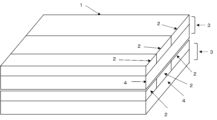
- FIG. 1 is a diagram showing a composite laminated soft magnetic ribbon according to Example 1.
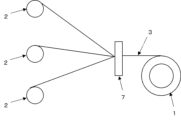
- FIG. 2 is a diagram showing a method for manufacturing a composite laminated soft magnetic ribbon according to Example 2.
- FIG. 3 is a diagram showing a composite laminated soft magnetic ribbon produced according to Example 2.
- FIG. 4 is a diagram showing a composite laminated soft magnetic ribbon according to Example 3.
- FIG. 5a is a diagram showing a method for manufacturing a composite laminated soft magnetic ribbon according to Example 4.
- FIG. 5b is a diagram showing a method for manufacturing a composite laminated soft magnetic ribbon according to Example 4.
- FIG. 6 is a diagram showing a composite laminated soft magnetic ribbon produced according to Example 4.
- Silicon steel sheets, amorphous alloy ribbons, nanocrystalline alloy ribbons, and the like are known as soft magnetic ribbons, but they have superiority and inferiority in magnetic properties, mechanical properties, and the like.
- magnetic components are manufactured by laminating layers of the same material.
- the good properties of each ribbon are synthesized macroscopically and used as a composite laminated soft magnetic ribbon.
- the composite laminated soft magnetic ribbon according to the present invention can be produced by holding a nanocrystalline alloy ribbon with a silicon steel sheet ribbon, an amorphous alloy ribbon, etc., without reinforcing it with a non-magnetic support material, and without using an adhesive. Since it is composed of 100% soft magnetic ribbon, it is possible to reduce the volume and weight of the magnetic component.
- Laminated soft magnetic ribbons using amorphous alloy ribbons and nanocrystalline alloy ribbons have higher magnetic permeability than silicon steel sheets, making it possible to create magnetic parts that save energy by reducing iron loss.
- the nanocrystalline alloy ribbon as the main component of the laminated soft magnetic ribbon, it becomes possible to reduce magnetostriction and reduce the beat of the transformer.
- the core of the motor may be deformed by external force from the magnet, but amorphous alloy ribbons are expected to increase rigidity and reduce core deformation. can.
- a laminated soft magnetic ribbon that combines the advantages of various materials rather than using a single type of material, the possibility of manufacturing higher-performance products increases.
- silicon steel sheet ribbon has a wide width and the thickness can be adjusted arbitrarily, but by using it for composite laminated soft magnetic ribbon, it is possible to manufacture widths of 25 cm or more, and it is suitable for large transformers and motors. , leading to the development of magnetic components such as generators.
- a magnetic material with a small coercive force and a material with a large saturation magnetic flux density when the excitation energy is small, the material with a small coercive force works up to the saturation magnetic flux density, and then when further excitation energy is added, the saturation magnetic flux decreases.
- a material with a high density it is possible to create a composite material that takes advantage of each other's strengths.
- FIG. 1 is a diagram showing a composite laminated soft magnetic ribbon 1 according to Example 1.
- a plurality of types of soft magnetic ribbons 2 having the same ribbon width and different characteristics are stacked and fixed to form a laminated soft magnetic ribbon 3.
- the plurality of types of soft magnetic ribbons 2 always include amorphous alloy ribbons and nanocrystalline alloy ribbons.
- a silicon steel sheet ribbon or the like may be added as the third soft magnetic ribbon.
- the number of laminated layers can be appropriately selected from about 2 to 5.
- the laminated soft magnetic ribbon 3 is further laminated in multiple stages and fixed to form a composite laminated soft magnetic ribbon 1.
- FIG. 1 shows two layers stacked, in reality, for example, about 100 layers are stacked to ensure the thickness.
- a method of adhesion can be used.
- Nanocrystalline alloy ribbons contribute to improving the magnetic properties of magnetic parts, but when used alone they have low rigidity and are difficult to stand on their own, and may deform when made into magnetic parts.
- the composite laminated soft magnetic ribbon can be used independently while maintaining good magnetic properties.
- a composite laminated soft magnetic ribbon 1 which is a combination of a nanocrystalline alloy ribbon and an amorphous alloy ribbon is used. The low rigidity of the nanocrystalline alloy ribbon is compensated for by the amorphous alloy ribbon, and the composite laminated soft magnetic ribbon 1 can be used as a bulk laminate. If you combine four rectangular parallelepipeds, you will get a transformer.
- Amorphous alloy ribbons have a large magnetostriction constant, so when used in a transformer, they vibrate with alternating current and cause noise. However, if the amount of amorphous alloy ribbons used is controlled to be smaller than that of nanocrystalline alloy ribbons, , vibrations caused by alternating current are also reduced.
- an amorphous alloy ribbon and a nanocrystalline alloy ribbon are essential, but a soft magnetic ribbon such as a silicon steel sheet ribbon may be used as occasion demands.
- FIG. 2 is a diagram showing a method for manufacturing a composite laminated soft magnetic ribbon 1 according to Example 2.
- multiple amorphous alloy ribbons and nanocrystalline alloy ribbons with the same width but different characteristics are stacked to form a laminated soft magnetic ribbon 3, and after the laminated soft magnetic ribbon 3 is wound, it is fixed. Then, a composite laminated soft magnetic ribbon 1 is produced.
- the number of layers to be stacked can be appropriately selected from about 2 to 5 layers.
- the combination of soft magnetic ribbons 2 is selected by adjusting the thickness, such as alternating amorphous alloy ribbons and nanocrystalline alloy ribbons, or one layer of amorphous alloy ribbons and two layers of nanocrystalline alloy ribbons. If adhesive is used as the fixing method, mechanical strength and rigidity can be reinforced.
- the composite laminated soft magnetic ribbon 1 produced in this manner is cut as necessary to produce magnetic components such as transformers, toroidal cores, and reactors.
- An amorphous alloy ribbon with a width of 2 cm wound on one reel and a nanocrystalline alloy ribbon with a width of 2 cm wound on two reels are prepared.
- Two layers of nanocrystalline alloy ribbon are placed on top of the amorphous alloy ribbon, and then the nanocrystalline alloy ribbon is wound.
- a composite laminated soft magnetic ribbon 1 having a thickness of 1 cm as shown in FIG. 3 was produced by repeatedly winding the composite layer into a rectangular shape of 6 cm in width and 2 cm in length 100 times.
- This material has good properties because it uses nanocrystalline alloy ribbons, and was used as a transformer core that can stand on its own without the use of nonmagnetic reinforcing materials.
- a reactor, a motor core, and a bulk laminate can also be produced in a similar manner. Similar to Example 1, the combination of soft magnetic ribbons in Example 2 has low hysteresis loss and eddy current loss, can reduce iron loss, has excellent soft magnetic properties, and is optimal for energy-saving magnetic parts.
- the stator of an axial gap motor is made by cutting and laminating amorphous alloy thin ribbons and placing them in a case (Non-patent Document 2). By processing the core and winding it into a coil, it becomes possible to use it in the stator of an axial gap motor.
- FIG. 4 is a diagram showing a composite laminated soft magnetic ribbon 1 according to Example 3.
- a narrow amorphous alloy ribbon and a nanocrystalline alloy ribbon are placed on a wide silicon steel sheet ribbon 4 as a soft magnetic ribbon 2 so that the width thereof is approximately equal to the width of the wide silicon steel sheet ribbon 4.
- the arranged layers are laminated one or more to form a laminated soft magnetic ribbon 3.
- the laminated soft magnetic ribbon 3 is further laminated in multiple stages and fixed to form a composite laminated soft magnetic ribbon 1.
- the laminated soft magnetic ribbon 3 shown in FIG. 4 is composed of one layer each of silicon steel sheet ribbon 4 and soft magnetic ribbon 2, but the silicon steel sheet ribbon is laminated in one layer and the soft magnetic ribbon 2 is laminated in multiple layers. It may also be a laminated soft magnetic ribbon 3.
- FIG. 4 is composed of one layer each of silicon steel sheet ribbon 4 and soft magnetic ribbon 2, but the silicon steel sheet ribbon is laminated in one layer and the soft magnetic ribbon 2 is laminated in multiple layers. It may also be a laminated soft magnetic ribbon 3.
- the composite laminated soft magnetic ribbon 1 can be processed as required to make magnetic components such as motor cores, bulk laminates, and generator core materials. According to this example, conventionally, to fabricate a large motor core using amorphous alloy ribbon, a plurality of teeth, which are part of the stator, were connected in a ring shape to fabricate one core. A wider motor core can be easily produced by one press punching.
- the amorphous alloy ribbon and nanocrystalline alloy ribbon parts of the composite laminated soft magnetic ribbon 1 operate with a small excitation current, making full use of the large saturation magnetization of the silicon steel plate, making the most of miniaturization. Ideal for magnetic parts used as stators in small motors. In addition, it is suitable for magnetic parts that operate with nanocrystalline alloy ribbons and amorphous alloy ribbons at low output power, and with silicon steel ribbons with high saturation magnetization, although energy efficiency decreases when operating at maximum power. When applied to transformers, standby power consumption can be reduced by using nanocrystalline alloy ribbons or amorphous alloy ribbons, resulting in energy savings.
- the nanocrystalline alloy ribbon and amorphous alloy ribbon operate at low output, and the silicon steel sheet ribbon also operates at maximum output.
- Silicon steel sheet ribbon has inferior soft magnetic properties compared to nanocrystalline alloy ribbon and amorphous alloy ribbon, and its drawback is increased energy consumption, but silicon steel sheet ribbon has lower magnetostriction than amorphous alloy ribbon, so it is suitable for transformers. The vibration when doing so is not large.
- FIG. 5a and FIG. 5b are diagrams showing a method for manufacturing a composite laminated soft magnetic ribbon 1 according to Example 4.
- silicon steel sheet ribbon 4 is wound on one reel with a thickness of 0.1 mm, width of 50 cm, and length of 6 m, and wound on two reels with a thickness of 0.03 mm, a width of 20 cm, and a length of 6 m.
- An amorphous alloy ribbon 5 with a length of about 1000 m and a nanocrystalline alloy ribbon 6 wound onto one reel with a thickness of 0.02 mm, a width of 10 cm, and a length of about 1000 m are prepared.
- the ribbons are pulled out from each reel, and the amorphous alloy ribbon with a width of 20cm, the nanocrystalline ribbon with a width of 10cm, and the amorphous alloy ribbon with a width of 20cm are placed on the silicon steel sheet ribbon 4 with a width of 50cm as shown in Fig. 5b.
- Laminated soft magnetic ribbons 3 are formed by stacking them side by side so that the overall width is 50 cm, which is the same as the silicon steel sheet, and winding them through a guide frame 7. Wrap it around three times, bending it 90 degrees in four places, so that it forms a square with each side 50 cm.
- the amorphous alloy ribbon with a width of 20 cm, the nanocrystalline alloy ribbon with a width of 10 cm, and the amorphous alloy ribbon with a width of 20 cm were continued to be wound 30 times while maintaining a total width of 50 cm, until the thickness was 1. Cut the amorphous alloy ribbon when it reaches 29 mm. If the thickness of the amorphous alloy ribbon and the nanocrystalline alloy ribbon are the same, the nanocrystalline alloy ribbon is also cut and the process is completed. However, in the above example, since the thickness of the nanocrystalline alloy ribbon is thin, Continue wrapping the obi another 15 times.
- the nanocrystalline alloy ribbon is also cut.
- a composite laminated magnetic ribbon 1 shown in FIG. 1 is produced. After fixing the cubic composite laminated magnetic ribbon 1 produced in this way, it was cut at four corners to cut out four plates measuring 50 cm x 50 cm x 1.29 mm. Press punching was performed from the plate as a motor core material.
- the composite magnetic ribbon 1 according to this embodiment can also be used as a generator core.
- the magnetic components such as motor cores and generator cores manufactured according to this example have the advantage that there is no restriction on the ribbon width and that a wide composite soft magnetic ribbon can be used.
- the method according to this embodiment is suitable for manufacturing large transformers and motor cores because they require a wide width, a large thickness, and a large number of turns.
- the magnetic parts manufactured in Examples 1 and 2 operate with low energy consumption due to the nanocrystalline alloy ribbons and amorphous alloy ribbons having low saturation magnetic flux density but excellent soft magnetic properties when used at low outputs. Therefore, the methods of Examples 1 and 2 are suitable for magnetic parts that require low output and energy saving.
- the magnetic parts manufactured in Examples 3 and 4 always use silicon steel sheet ribbons with large iron loss, and therefore generate a large amount of heat, which is somewhat disadvantageous from the viewpoint of energy saving.
- Examples 3 and 4 are suitable for magnetic components used in a wide range from small output to large output.
- transformers, motor cores, etc. can be manufactured by winding and laminating the same magnetic parts, compared to Examples 1 and 3, which do not involve winding and require the labor of punching and laminating. This has the advantage of reducing the number of man-hours required to manufacture magnetic components.
- composite laminated soft magnetic ribbons that combine the advantages of various types of soft magnetic ribbons can be used for bulk laminates with excellent properties, magnetic components such as transformers, reactors, motor cores, and generator core materials. can be manufactured while reducing manufacturing man-hours, so it has great industrial applicability.
Landscapes
- Engineering & Computer Science (AREA)
- Power Engineering (AREA)
- Chemical & Material Sciences (AREA)
- Physics & Mathematics (AREA)
- Electromagnetism (AREA)
- Dispersion Chemistry (AREA)
- Crystallography & Structural Chemistry (AREA)
- Inorganic Chemistry (AREA)
- Materials Engineering (AREA)
- Iron Core Of Rotating Electric Machines (AREA)
- Manufacturing Cores, Coils, And Magnets (AREA)
- Soft Magnetic Materials (AREA)
Priority Applications (3)
| Application Number | Priority Date | Filing Date | Title |
|---|---|---|---|
| CN202380033034.8A CN119054033A (zh) | 2022-08-02 | 2023-07-21 | 性质可控的复合层叠软磁性带 |
| JP2024538933A JP7669087B2 (ja) | 2022-08-02 | 2023-07-21 | 物性を制御した複合積層軟磁性薄帯 |
| US18/855,642 US20250232907A1 (en) | 2022-08-02 | 2023-07-21 | Composite laminated soft magnetic ribbon with controlled property |
Applications Claiming Priority (2)
| Application Number | Priority Date | Filing Date | Title |
|---|---|---|---|
| JP2022-123636 | 2022-08-02 | ||
| JP2022123636 | 2022-08-02 |
Publications (1)
| Publication Number | Publication Date |
|---|---|
| WO2024029367A1 true WO2024029367A1 (ja) | 2024-02-08 |
Family
ID=89848914
Family Applications (1)
| Application Number | Title | Priority Date | Filing Date |
|---|---|---|---|
| PCT/JP2023/026712 Ceased WO2024029367A1 (ja) | 2022-08-02 | 2023-07-21 | 物性を制御した複合積層軟磁性薄帯 |
Country Status (4)
| Country | Link |
|---|---|
| US (1) | US20250232907A1 (https=) |
| JP (1) | JP7669087B2 (https=) |
| CN (1) | CN119054033A (https=) |
| WO (1) | WO2024029367A1 (https=) |
Citations (5)
| Publication number | Priority date | Publication date | Assignee | Title |
|---|---|---|---|---|
| JPS57126113A (en) * | 1981-01-27 | 1982-08-05 | Matsushita Electric Ind Co Ltd | Magnetic core |
| WO2013069270A1 (ja) * | 2011-11-08 | 2013-05-16 | 株式会社 東芝 | 非接触受電装置用磁性シートとそれを用いた非接触受電装置、電子機器、並びに非接触充電装置 |
| JP2014155347A (ja) * | 2013-02-08 | 2014-08-25 | Mitsubishi Electric Corp | 分割鉄心、及びこの分割鉄心を用いた固定子、並びにこの固定子を備えた回転電機 |
| JP2017099157A (ja) * | 2015-11-25 | 2017-06-01 | パナソニックIpマネジメント株式会社 | 磁性板の積層体及びモータ |
| WO2021166314A1 (ja) * | 2020-02-19 | 2021-08-26 | 株式会社日立産機システム | 静止誘導機器および変圧器 |
-
2023
- 2023-07-21 CN CN202380033034.8A patent/CN119054033A/zh active Pending
- 2023-07-21 WO PCT/JP2023/026712 patent/WO2024029367A1/ja not_active Ceased
- 2023-07-21 JP JP2024538933A patent/JP7669087B2/ja active Active
- 2023-07-21 US US18/855,642 patent/US20250232907A1/en active Pending
Patent Citations (5)
| Publication number | Priority date | Publication date | Assignee | Title |
|---|---|---|---|---|
| JPS57126113A (en) * | 1981-01-27 | 1982-08-05 | Matsushita Electric Ind Co Ltd | Magnetic core |
| WO2013069270A1 (ja) * | 2011-11-08 | 2013-05-16 | 株式会社 東芝 | 非接触受電装置用磁性シートとそれを用いた非接触受電装置、電子機器、並びに非接触充電装置 |
| JP2014155347A (ja) * | 2013-02-08 | 2014-08-25 | Mitsubishi Electric Corp | 分割鉄心、及びこの分割鉄心を用いた固定子、並びにこの固定子を備えた回転電機 |
| JP2017099157A (ja) * | 2015-11-25 | 2017-06-01 | パナソニックIpマネジメント株式会社 | 磁性板の積層体及びモータ |
| WO2021166314A1 (ja) * | 2020-02-19 | 2021-08-26 | 株式会社日立産機システム | 静止誘導機器および変圧器 |
Also Published As
| Publication number | Publication date |
|---|---|
| JP7669087B2 (ja) | 2025-04-28 |
| US20250232907A1 (en) | 2025-07-17 |
| CN119054033A (zh) | 2024-11-29 |
| JPWO2024029367A1 (https=) | 2024-02-08 |
Similar Documents
| Publication | Publication Date | Title |
|---|---|---|
| JP5911930B2 (ja) | 軟磁性の金属電磁構成要素を製造する方法 | |
| CN101286676B (zh) | 一种用于高速电机的非晶合金定子铁芯的制备方法 | |
| EP1127359B1 (en) | Bulk amorphous metal magnetic components | |
| JP2002530042A (ja) | 電動モータ用のバルクアモルファス金属磁気構成要素 | |
| JP2011139075A (ja) | 高性能バルク金属磁気構成部品 | |
| BR112017010829B1 (pt) | Módulo básico de núcleo magnético de transformador elétrico do tipo enrolado, núcleo magnético de transformador elétrico monofásico, transformador elétrico monofásico, núcleo magnético de transformador elétrico trifásico, transformador elétrico trifásico, método de fabricação de um núcleo de transformador elétrico monofásico e método de fabricação de um núcleo de transformador elétrico trifásico | |
| US20180233267A1 (en) | Core for Stationary Induction Apparatus | |
| JP5843124B2 (ja) | コアの製造方法 | |
| JP2004511898A5 (https=) | ||
| CN107046335A (zh) | 磁性板的层叠体以及马达 | |
| JP2012134448A (ja) | アモルファス材を使用したリアクトル装置及びその製造方法 | |
| WO2024029367A1 (ja) | 物性を制御した複合積層軟磁性薄帯 | |
| JP2018056336A (ja) | 積層体及び複合積磁心 | |
| JP2020126963A (ja) | 合金薄帯の製造方法 | |
| WO2024106262A1 (ja) | 複合積層軟磁性薄帯 | |
| Ning et al. | Review on applications of low loss amorphous metals in motors | |
| WO2023127328A1 (ja) | 積層鉄心およびそれを用いた回転電機 | |
| JP2006013294A (ja) | リアクトル | |
| JPWO2024029367A5 (https=) | ||
| KR20240159098A (ko) | 전동기용 회전자 및 그 제조방법 | |
| JP2026067280A (ja) | アモルファス積層コアを有するステータのリサイクル方法 | |
| CN121356183A (zh) | 利用层叠软磁性薄带的径向间隙马达用定子或转子 | |
| CN113541413A (zh) | 铁心的制造方法、铁心以及定子 | |
| JPS6174314A (ja) | 変圧器鉄心の製造方法 | |
| JPS6053006A (ja) | 巻鉄心 |
Legal Events
| Date | Code | Title | Description |
|---|---|---|---|
| 121 | Ep: the epo has been informed by wipo that ep was designated in this application |
Ref document number: 23849922 Country of ref document: EP Kind code of ref document: A1 |
|
| DPE1 | Request for preliminary examination filed after expiration of 19th month from priority date (pct application filed from 20040101) | ||
| ENP | Entry into the national phase |
Ref document number: 2024538933 Country of ref document: JP Kind code of ref document: A |
|
| WWE | Wipo information: entry into national phase |
Ref document number: 202380033034.8 Country of ref document: CN |
|
| WWE | Wipo information: entry into national phase |
Ref document number: 18855642 Country of ref document: US |
|
| WWE | Wipo information: entry into national phase |
Ref document number: 202447080043 Country of ref document: IN |
|
| NENP | Non-entry into the national phase |
Ref country code: DE |
|
| WWP | Wipo information: published in national office |
Ref document number: 18855642 Country of ref document: US |
|
| 122 | Ep: pct application non-entry in european phase |
Ref document number: 23849922 Country of ref document: EP Kind code of ref document: A1 |