WO2024024890A1 - 光学積層体 - Google Patents
光学積層体 Download PDFInfo
- Publication number
- WO2024024890A1 WO2024024890A1 PCT/JP2023/027575 JP2023027575W WO2024024890A1 WO 2024024890 A1 WO2024024890 A1 WO 2024024890A1 JP 2023027575 W JP2023027575 W JP 2023027575W WO 2024024890 A1 WO2024024890 A1 WO 2024024890A1
- Authority
- WO
- WIPO (PCT)
- Prior art keywords
- film
- group
- meth
- liquid crystal
- compound
- Prior art date
- Legal status (The legal status is an assumption and is not a legal conclusion. Google has not performed a legal analysis and makes no representation as to the accuracy of the status listed.)
- Ceased
Links
Images


Classifications
-
- G—PHYSICS
- G02—OPTICS
- G02B—OPTICAL ELEMENTS, SYSTEMS OR APPARATUS
- G02B5/00—Optical elements other than lenses
- G02B5/30—Polarising elements
- G02B5/3016—Polarising elements involving passive liquid crystal elements
-
- B—PERFORMING OPERATIONS; TRANSPORTING
- B32—LAYERED PRODUCTS
- B32B—LAYERED PRODUCTS, i.e. PRODUCTS BUILT-UP OF STRATA OF FLAT OR NON-FLAT, e.g. CELLULAR OR HONEYCOMB, FORM
- B32B7/00—Layered products characterised by the relation between layers; Layered products characterised by the relative orientation of features between layers, or by the relative values of a measurable parameter between layers, i.e. products comprising layers having different physical, chemical or physicochemical properties; Layered products characterised by the interconnection of layers
- B32B7/02—Physical, chemical or physicochemical properties
- B32B7/023—Optical properties
-
- B—PERFORMING OPERATIONS; TRANSPORTING
- B32—LAYERED PRODUCTS
- B32B—LAYERED PRODUCTS, i.e. PRODUCTS BUILT-UP OF STRATA OF FLAT OR NON-FLAT, e.g. CELLULAR OR HONEYCOMB, FORM
- B32B7/00—Layered products characterised by the relation between layers; Layered products characterised by the relative orientation of features between layers, or by the relative values of a measurable parameter between layers, i.e. products comprising layers having different physical, chemical or physicochemical properties; Layered products characterised by the interconnection of layers
- B32B7/04—Interconnection of layers
- B32B7/12—Interconnection of layers using interposed adhesives or interposed materials with bonding properties
-
- G—PHYSICS
- G02—OPTICS
- G02B—OPTICAL ELEMENTS, SYSTEMS OR APPARATUS
- G02B1/00—Optical elements characterised by the material of which they are made; Optical coatings for optical elements
- G02B1/10—Optical coatings produced by application to, or surface treatment of, optical elements
- G02B1/14—Protective coatings, e.g. hard coatings
-
- G—PHYSICS
- G02—OPTICS
- G02B—OPTICAL ELEMENTS, SYSTEMS OR APPARATUS
- G02B5/00—Optical elements other than lenses
- G02B5/003—Light absorbing elements
-
- G—PHYSICS
- G02—OPTICS
- G02B—OPTICAL ELEMENTS, SYSTEMS OR APPARATUS
- G02B5/00—Optical elements other than lenses
- G02B5/30—Polarising elements
-
- G—PHYSICS
- G02—OPTICS
- G02B—OPTICAL ELEMENTS, SYSTEMS OR APPARATUS
- G02B5/00—Optical elements other than lenses
- G02B5/30—Polarising elements
- G02B5/3025—Polarisers, i.e. arrangements capable of producing a definite output polarisation state from an unpolarised input state
- G02B5/3033—Polarisers, i.e. arrangements capable of producing a definite output polarisation state from an unpolarised input state in the form of a thin sheet or foil, e.g. Polaroid
- G02B5/3041—Polarisers, i.e. arrangements capable of producing a definite output polarisation state from an unpolarised input state in the form of a thin sheet or foil, e.g. Polaroid comprising multiple thin layers, e.g. multilayer stacks
- G02B5/305—Polarisers, i.e. arrangements capable of producing a definite output polarisation state from an unpolarised input state in the form of a thin sheet or foil, e.g. Polaroid comprising multiple thin layers, e.g. multilayer stacks including organic materials, e.g. polymeric layers
-
- G—PHYSICS
- G02—OPTICS
- G02F—OPTICAL DEVICES OR ARRANGEMENTS FOR THE CONTROL OF LIGHT BY MODIFICATION OF THE OPTICAL PROPERTIES OF THE MEDIA OF THE ELEMENTS INVOLVED THEREIN; NON-LINEAR OPTICS; FREQUENCY-CHANGING OF LIGHT; OPTICAL LOGIC ELEMENTS; OPTICAL ANALOGUE/DIGITAL CONVERTERS
- G02F1/00—Devices or arrangements for the control of the intensity, colour, phase, polarisation or direction of light arriving from an independent light source, e.g. switching, gating or modulating; Non-linear optics
- G02F1/01—Devices or arrangements for the control of the intensity, colour, phase, polarisation or direction of light arriving from an independent light source, e.g. switching, gating or modulating; Non-linear optics for the control of the intensity, phase, polarisation or colour
- G02F1/13—Devices or arrangements for the control of the intensity, colour, phase, polarisation or direction of light arriving from an independent light source, e.g. switching, gating or modulating; Non-linear optics for the control of the intensity, phase, polarisation or colour based on liquid crystals, e.g. single liquid crystal display cells
- G02F1/133—Constructional arrangements; Operation of liquid crystal cells; Circuit arrangements
- G02F1/1333—Constructional arrangements; Manufacturing methods
- G02F1/1335—Structural association of cells with optical devices, e.g. polarisers or reflectors
- G02F1/13363—Birefringent elements, e.g. for optical compensation
-
- G—PHYSICS
- G02—OPTICS
- G02F—OPTICAL DEVICES OR ARRANGEMENTS FOR THE CONTROL OF LIGHT BY MODIFICATION OF THE OPTICAL PROPERTIES OF THE MEDIA OF THE ELEMENTS INVOLVED THEREIN; NON-LINEAR OPTICS; FREQUENCY-CHANGING OF LIGHT; OPTICAL LOGIC ELEMENTS; OPTICAL ANALOGUE/DIGITAL CONVERTERS
- G02F1/00—Devices or arrangements for the control of the intensity, colour, phase, polarisation or direction of light arriving from an independent light source, e.g. switching, gating or modulating; Non-linear optics
- G02F1/01—Devices or arrangements for the control of the intensity, colour, phase, polarisation or direction of light arriving from an independent light source, e.g. switching, gating or modulating; Non-linear optics for the control of the intensity, phase, polarisation or colour
- G02F1/13—Devices or arrangements for the control of the intensity, colour, phase, polarisation or direction of light arriving from an independent light source, e.g. switching, gating or modulating; Non-linear optics for the control of the intensity, phase, polarisation or colour based on liquid crystals, e.g. single liquid crystal display cells
- G02F1/133—Constructional arrangements; Operation of liquid crystal cells; Circuit arrangements
- G02F1/1333—Constructional arrangements; Manufacturing methods
- G02F1/1337—Surface-induced orientation of the liquid crystal molecules, e.g. by alignment layers
-
- H—ELECTRICITY
- H10—SEMICONDUCTOR DEVICES; ELECTRIC SOLID-STATE DEVICES NOT OTHERWISE PROVIDED FOR
- H10K—ORGANIC ELECTRIC SOLID-STATE DEVICES
- H10K50/00—Organic light-emitting devices
- H10K50/80—Constructional details
- H10K50/86—Arrangements for improving contrast, e.g. preventing reflection of ambient light
-
- H—ELECTRICITY
- H10—SEMICONDUCTOR DEVICES; ELECTRIC SOLID-STATE DEVICES NOT OTHERWISE PROVIDED FOR
- H10K—ORGANIC ELECTRIC SOLID-STATE DEVICES
- H10K59/00—Integrated devices, or assemblies of multiple devices, comprising at least one organic light-emitting element covered by group H10K50/00
- H10K59/10—OLED displays
-
- H—ELECTRICITY
- H10—SEMICONDUCTOR DEVICES; ELECTRIC SOLID-STATE DEVICES NOT OTHERWISE PROVIDED FOR
- H10K—ORGANIC ELECTRIC SOLID-STATE DEVICES
- H10K59/00—Integrated devices, or assemblies of multiple devices, comprising at least one organic light-emitting element covered by group H10K50/00
- H10K59/80—Constructional details
- H10K59/8793—Arrangements for polarized light emission
Definitions
- the present invention relates to an optical laminate.
- organic electroluminescent (hereinafter also referred to as organic EL) display device it has been proposed to arrange a vertically aligned liquid crystal cured film for the purpose of improving the oblique reflection hue during black display (Patent Document 1).
- a vertically aligned liquid crystal cured film is often a cured film obtained by curing a composition containing a dichroic dye and a polymerizable liquid crystal compound on a base film with the polymerizable liquid crystal compound oriented in the vertical direction.
- a polarizing plate in which such a vertically aligned liquid crystal cured film is incorporated together with an optical film may have a reduced front transmittance in a heat-and-moisture durability test.
- An object of the present invention is to provide an optical laminate including an optical film, an adhesive layer, a light-absorbing anisotropic film, and a polarizer in this order, which suppresses a decrease in front transmittance in a heat-and-moisture durability test.
- An object of the present invention is to provide an optical laminate.
- the present invention provides the following optical laminate.
- An optical laminate comprising an optical film, an adhesive layer, a light absorption anisotropic film, and a polarizer in this order, The optical laminate, wherein the light absorption anisotropic film is a cured layer in which a dichroic dye and a polymerizable liquid crystal compound are oriented in the lamination direction of the optical laminate.
- the light-absorbing anisotropic film includes a cured product of a polymerizable liquid crystal composition containing the dichroic dye, the polymerizable liquid crystal compound, and an isocyanate crosslinking agent.
- Optical laminate [3] Further including a hard coat layer between the light absorption anisotropic film and the polarizer, The optical laminate according to [1] or [2], wherein the light-absorbing anisotropic film and the hard coat layer are in direct contact with each other.
- an optical laminate including an optical film, an adhesive layer, a light-absorbing anisotropic film, and a polarizer in this order, which suppresses a decrease in front transmittance in a heat-and-moisture durability test. It is possible to provide an optical laminate.
- FIG. 3 is a diagram showing the X-axis, Y-axis, and Z-axis in the light-absorbing anisotropic film included in the optical laminate. It is a schematic sectional view showing an example of the layer composition of an optical layered product. It is a schematic sectional view showing an example of the layer composition of an optical layered product.
- An optical laminate according to an embodiment of the present invention includes an optical film, an adhesive layer, a light-absorbing anisotropic film, and a polarizer in this order, and the light-absorbing anisotropic film includes a dichroic dye.
- FIG. 1 is a cross-sectional view schematically showing an optical laminate.
- the optical laminate 1 shown in FIG. 1 includes an optical film 11, an adhesive layer 12, a light absorption anisotropic film 13, and a polarizer 14 in this order.
- the optical laminate 1 may further include one or more hard coat layers (hereinafter also referred to as HC layers) on one or both sides of the light-absorbing anisotropic film 13.
- the optical laminate 1 may further include an optical film or an optical film with a hard coat layer between the light absorption anisotropic film 13 and the polarizer 14.
- the optical laminate 1 can further include, for example, a retardation layer, a protection film, a bonding layer, and the like.
- the present inventor has developed an optical laminate comprising an optical film and a light-absorbing anisotropic film, in which the optical film and the light-absorbing anisotropic film are laminated via an adhesive layer. It has been found that the decrease in transmittance is suppressed.
- the optical film 11 is placed on the light-absorbing anisotropic film 13 via the adhesive layer 12.
- the optical film is preferably placed in direct contact with the light-absorbing anisotropic film via an adhesive layer.
- the optical film may be further disposed between the light absorption anisotropic film and the polarizer.
- the optical film can prevent dimensional changes, cracks, etc. due to heat and/or humidity in the light-absorbing anisotropic film or other layers. Furthermore, it is possible to prevent deterioration when exposed to ultraviolet rays and the like, and it is possible to prevent scratches and deterioration of the surface of the light-absorbing anisotropic film during storage and transportation.
- the optical film 11 is preferably a transparent film that is transparent enough to transmit light, particularly visible light, and preferably has a transmittance of 80% or more for light rays having a wavelength of 380 to 780 nm.
- the optical film 11 may be provided with a hard coat layer, which will be described later, on one or both sides.
- the hard coat layer is preferably arranged on the opposite side of the optical film 11 from the adhesive layer.
- the surface opposite to the adhesive layer 12 side may be subjected to hard coat treatment, antireflection treatment, antisticking treatment, antiglare treatment, or the like.
- the thickness of the optical film 11 is preferably 3 to 40 ⁇ m, more preferably 5 to 30 ⁇ m.
- the thickness of the transparent optical film is within the above range, the surface of the light absorption anisotropic film can be sufficiently protected. Further, it may be possible to reduce the thickness of the optical laminate.
- the thickness of the optical film includes the hard coat layer when the optical film has the hard coat layer described below.
- Examples of the optical film 11 include glass films and resin films. Among these, a resin film is preferred.
- the resin constituting the resin film the resins exemplified for the base material of the light absorption anisotropic film 13 described later can be used.
- the resin film is preferably a cyclic polyolefin resin (COP) film.
- the adhesive layer 12 is interposed between the optical film 11 and the light-absorbing anisotropic film 13, and can have the function of bonding them together. Any suitable adhesive can be used as the adhesive constituting the adhesive layer 12.
- a water-based adhesive, an active energy ray-curable adhesive, or the like can be used as the adhesive.
- the thickness of the adhesive when applied can be set to any appropriate value.
- the adhesive layer 12 is set to have a desired thickness after curing or heating (drying).
- the thickness of the adhesive layer 12 may be, for example, 10 ⁇ m or less, preferably 5 ⁇ m or less, more preferably 3 ⁇ m or less, still more preferably 2 ⁇ m or less. Further, the adhesive layer 12 may have a thickness of 0.05 ⁇ m or more, and preferably 0.1 ⁇ m or more.
- the adhesive layer 12 has a temperature [°C] at which the loss modulus (hereinafter also referred to as loss modulus) [MPa] obtained by dynamic viscoelasticity measurement in a tensile mode with a frequency of 10 Hz is the maximum value, as determined by the moist heat resistance durability test.
- the temperature may preferably be 60°C or higher, more preferably 80°C or higher, and even more preferably 100°C or higher.
- the temperature at which the loss modulus reaches its maximum value can be measured according to the viscoelasticity evaluation method described in the Examples section below.
- the temperature at which the loss modulus reaches its maximum value is usually 150°C or lower, and preferably 120°C or lower from the viewpoint of adhesion.
- the adhesive layer 12 is an adhesive layer formed from a radical curing adhesive described below
- the loss modulus (hereinafter also referred to as loss modulus) obtained by dynamic viscoelasticity measurement in a tensile mode at a frequency of 10 Hz.
- the temperature [°C] at which [MPa] reaches the maximum value may be 60°C or higher, 70°C or higher, or 120°C or lower, from the viewpoint of suppressing a decrease in front transmittance in the heat-and-moisture durability test. There may be.
- the adhesive layer 12 has a storage modulus [MPa] at 30°C of preferably 1000 [MPa] or more, more preferably 2000 [MPa] or more, and even more preferably It is 2500 [MPa] or more. From the viewpoint of adhesion, it is preferably 3500 [MPa] or less, more preferably 3000 [MPa] or less.
- the storage modulus [MPa] at 30° C. can be determined according to the viscoelasticity evaluation method described in the Examples section below.
- the adhesive layer 12 has a storage modulus [MPa] at 80° C. from the viewpoint of suppressing a decrease in front transmittance in a heat-and-moisture durability test, preferably 500 [MPa] or more, more preferably 1000 [MPa] or more, and even more preferably It is 1500 [MPa] or more. From the viewpoint of adhesion, it is preferably 2500 [MPa] or less.
- the storage modulus [MPa] at 80° C. can be determined according to the viscoelasticity evaluation method described in the Examples section below.
- the adhesive layer 12 is an adhesive layer formed from a radical curing adhesive described below, the storage elastic modulus [MPa] at 80° C.
- MPa 300 [MPa] from the viewpoint of suppressing a decrease in front transmittance in a heat-and-moisture durability test. MPa] or more, 500 [MPa] or more, 2500 [MPa] or less, or 2300 [MPa] or less.
- the temperature at which tan ⁇ is maximum may be, for example, higher than 30° C., preferably higher than 50° C., more preferably higher than 95° C., from the viewpoint of suppressing a decrease in front transmittance in a heat-and-moisture durability test. More preferably, the temperature is 100°C or higher, more preferably 120°C or higher, and from the viewpoint of adhesion, the temperature is preferably 200°C or lower, and more preferably 150°C or lower.
- the temperature at which tan ⁇ becomes maximum can be determined according to the viscoelasticity evaluation method described in the Examples section below.
- water-based adhesives examples include adhesives made of polyvinyl alcohol resin aqueous solutions, water-based two-component urethane emulsion adhesives, and the like. Among them, a water-based adhesive made of an aqueous solution of a polyvinyl alcohol resin is preferably used.
- Polyvinyl alcohol-based resins include vinyl alcohol homopolymers obtained by saponifying polyvinyl acetate, which is a homopolymer of vinyl acetate, as well as vinyl alcohol homopolymers obtained by saponifying vinyl acetate and other monomers that can be copolymerized with vinyl acetate.
- a polyvinyl alcohol copolymer obtained by saponifying a polymer, a modified polyvinyl alcohol copolymer obtained by partially modifying the hydroxyl groups thereof, or the like can be used.
- the water-based adhesive can contain a crosslinking agent such as an aldehyde compound (such as glyoxal), an epoxy compound, a melamine compound, a methylol compound, an isocyanate compound, an amine compound, or a polyvalent metal salt.
- An active energy ray-curable adhesive is an adhesive containing a curable compound that is cured by irradiation with active energy rays such as ultraviolet rays, visible light, electron beams, and X-rays, and is preferably an ultraviolet curable adhesive. be. Among these, at least one selected from radical curable adhesives and cationic curable adhesives is preferred, and radical curable adhesives are more preferred.
- the active energy ray-curable adhesive usually further contains at least one of a radical polymerization initiator and a cationic polymerization initiator for initiating the curing reaction of the curable compound.
- the cationic curable adhesive can further include at least one of a photosensitizer and a photosensitizer. The radical polymerization initiator, cationic polymerization initiator, photosensitizer, and photosensitization aid will be described later.
- the above-mentioned curable compound can be a radically polymerizable compound or a cationic polymerizable compound.
- a radically polymerizable compound and a cationically polymerizable compound may be used together.
- a radically polymerizable compound used in a radically curable adhesive is a compound or oligomer that undergoes a radical polymerization reaction and is cured by irradiation or heating with active energy rays such as ultraviolet rays, visible light, electron beams, or X-rays.
- active energy rays such as ultraviolet rays, visible light, electron beams, or X-rays.
- Examples include compounds having an ethylenically unsaturated bond.
- Compounds with ethylenically unsaturated bonds include (meth)acrylic compounds having one or more (meth)acryloyl groups in the molecule, as well as styrene, styrene sulfonic acid, vinyl acetate, vinyl propionate, and N-vinyl.
- Examples include vinyl compounds such as -2-pyrrolidone.
- preferred radically polymerizable compounds are (meth)acrylic compounds.
- (meth)acryloyloxy means at least one selected from acryloyloxy and methacryloyloxy.
- (meth)acrylic means at least one selected from acrylic and methacrylic.
- (Meth)acrylic compounds are obtained by reacting two or more types of (meth)acrylate monomers having at least one (meth)acryloyloxy group in the molecule, (meth)acrylamide monomers, and functional group-containing compounds.
- Examples include (meth)acryloyl group-containing compounds such as (meth)acrylic oligomers having at least two (meth)acryloyl groups in the molecule.
- the (meth)acrylic oligomer is preferably a (meth)acrylate oligomer having at least two (meth)acryloyloxy groups in the molecule.
- the (meth)acrylic compounds may be used alone or in combination of two or more.
- (Meth)acrylate monomers include monofunctional (meth)acrylate monomers having one (meth)acryloyloxy group in the molecule, and difunctional (meth)acrylate monomers having two (meth)acryloyloxy groups in the molecule. Monomers include polyfunctional (meth)acrylate monomers having three or more (meth)acryloyloxy groups in the molecule. (Meth)acrylate means at least one selected from acrylate and methacrylate.
- Examples of monofunctional (meth)acrylate monomers include alkyl (meth)acrylates.
- the alkyl group may be linear or branched as long as it has 3 or more carbon atoms.
- Specific examples of alkyl (meth)acrylates include methyl (meth)acrylate, ethyl (meth)acrylate, isopropyl (meth)acrylate, butyl (meth)acrylate, isobutyl (meth)acrylate, t-butyl (meth)acrylate, Examples include 2-ethylhexyl (meth)acrylate.
- aralkyl (meth)acrylates such as benzyl (meth)acrylate; (meth)acrylates of terpene alcohols such as isobornyl (meth)acrylate; (meth)acrylates having a tetrahydrofurfuryl structure such as tetrahydrofurfuryl (meth)acrylate ) Acrylate; cycloalkyl group having a cycloalkyl group in the alkyl group site such as cyclohexyl (meth)acrylate, cyclohexylmethyl methacrylate, dicyclopentanyl acrylate, dicyclopentenyl (meth)acrylate, 1,4-cyclohexanedimethanol monoacrylate (meth)acrylate; ) acrylates; aminoalkyl (meth)acrylates such as N,N-dimethylaminoethyl (meth)acrylate; 2-phenoxyethyl (meth)acrylate, dicyclopentenyloxy
- monofunctional (meth)acrylates having a hydroxyl group at the alkyl site and monofunctional (meth)acrylates having a carboxyl group at the alkyl site can also be used.
- monofunctional (meth)acrylates having a hydroxyl group at the alkyl site include 2-hydroxyethyl (meth)acrylate, 2- or 3-hydroxypropyl (meth)acrylate, 4-hydroxybutyl (meth)acrylate, and 2-hydroxybutyl (meth)acrylate.
- monofunctional (meth)acrylates having a carboxyl group in the alkyl moiety include 2-carboxyethyl (meth)acrylate, ⁇ -carboxy-polycaprolactone (n ⁇ 2) mono(meth)acrylate, 1-[2-( meth)acryloyloxyethyl]phthalic acid, 1-[2-(meth)acryloyloxyethyl]hexahydrophthalic acid, 1-[2-(meth)acryloyloxyethyl]succinic acid, 4-[2-(meth)acryloyl [oxyethyl]trimellitic acid, N-(meth)acryloyloxy-N',N'-dicarboxymethyl-p-phenylenediamine.
- N-substituted (meth)acrylamide examples include N-methyl (meth)acrylamide, N-ethyl (meth)acrylamide, N-isopropyl (meth)acrylamide, Nn-butyl (meth)acrylamide, Nt- N-alkyl (meth)acrylamide such as butyl (meth)acrylamide, N-hexyl (meth)acrylamide; N,N- such as N,N-dimethyl (meth)acrylamide, N,N-diethyl (meth)acrylamide Contains dialkyl (meth)acrylamide.
- the N-substituent may be an alkyl group having a hydroxyl group, and examples thereof include N-hydroxymethyl (meth)acrylamide, N-(2-hydroxyethyl)(meth)acrylamide, N-(2-hydroxy (propyl)(meth)acrylamide, etc.
- specific examples of the N-substituted (meth)acrylamide forming the above-mentioned 5-membered ring or 6-membered ring include N-acryloylpyrrolidine, 3-acryloyl-2-oxazolidinone, 4-acryloylmorpholine, N-acryloyl Examples include piperidine and N-methacryloylpiperidine.
- the N-substituted (meth)acrylamide is preferably an N-substituted (meth)acrylamide forming a 5- or 6-membered ring, and more preferably 4-acryloylmorpholine.
- bifunctional (meth)acrylate monomers include alkylene glycol di(meth)acrylate, polyoxyalkylene glycol di(meth)acrylate, halogen-substituted alkylene glycol di(meth)acrylate, di(meth)acrylate of aliphatic polyol, and hydrogenated Di(meth)acrylate of dicyclopentadiene or tricyclodecane dialkanol, di(meth)acrylate of dioxane glycol or dioxane dialkanol, di(meth)acrylate of alkylene oxide adduct of bisphenol A or bisphenol F, bisphenol A or bisphenol Examples include epoxy di(meth)acrylate of F and the like.
- difunctional (meth)acrylate monomers include ethylene glycol di(meth)acrylate, 1,3-butanediol di(meth)acrylate, 1,4-butanediol di(meth)acrylate, 1 , 6-hexanediol di(meth)acrylate, 1,9-nonanediol di(meth)acrylate, neopentyl glycol di(meth)acrylate, trimethylolpropane di(meth)acrylate, pentaerythritol di(meth)acrylate, ditri Methylolpropane di(meth)acrylate, diethylene glycol di(meth)acrylate, triethylene glycol di(meth)acrylate, dipropylene glycol di(meth)acrylate, tripropylene glycol di(meth)acrylate, polyethylene glycol di(meth)acrylate, Polypropylene glycol di(meth)acrylate, polytetramethylene glycol di(
- bifunctional (meth)acrylate monomer examples include bifunctional (meth)acrylate monomers containing a hydroxyl group in the molecule.
- a specific example is 2-hydroxy-3-methacrylpropyl acrylate.
- commercially available products may be used, such as "Epoxy Ester 70PA (Kyoeisha Chemical Co., Ltd.)".
- trifunctional or higher polyfunctional (meth)acrylate monomers examples include glycerin tri(meth)acrylate, alkoxylated glycerin tri(meth)acrylate, trimethylolpropane tri(meth)acrylate, ditrimethylolpropane tri(meth)acrylate, ditrimethylol Propane tetra(meth)acrylate, pentaerythritol tri(meth)acrylate, pentaerythritol tetra(meth)acrylate, dipentaerythritol tetra(meth)acrylate, dipentaerythritol penta(meth)acrylate, dipentaerythritol hexa(meth)acrylate, etc.
- Typical examples include poly(meth)acrylates of trifunctional or higher functional aliphatic polyols; other examples include poly(meth)acrylates of trifunctional or higher functional halogen-substituted polyols, and tri(meth)acrylates of alkylene oxide adducts of glycerin. Acrylate, tri(meth)acrylate of alkylene oxide adduct of trimethylolpropane, 1,1,1-tris[(meth)acryloyloxyethoxyethoxy]propane, tris(hydroxyethyl)isocyanurate tri(meth)acrylate, etc. It will be done.
- (meth)acrylic oligomers include urethane (meth)acrylic oligomers, polyester (meth)acrylic oligomers, and epoxy (meth)acrylic oligomers.
- a urethane (meth)acrylic oligomer is a compound having a urethane bond (-NHCOO-) and at least two (meth)acryloyl groups in the molecule.
- urethanization reaction products of polyisocyanates and hydroxyl group-containing (meth)acrylic monomers each having at least one (meth)acryloyl group and at least one hydroxyl group in the molecule and polyols and polyisocyanates.
- It may be a urethane reaction product between a urethane compound containing a terminal isocyanato group obtained by the reaction and a (meth)acrylic monomer each having at least one (meth)acryloyl group and at least one hydroxyl group in the molecule. .
- the hydroxyl group-containing (meth)acrylic monomer used in the urethanization reaction can be, for example, a hydroxyl group-containing (meth)acrylate monomer, and specific examples thereof include 2-hydroxyethyl (meth)acrylate, 2-hydroxypropyl (meth)acrylate, and 2-hydroxypropyl (meth)acrylate.
- Specific examples other than hydroxyl group-containing (meth)acrylate monomers include N-hydroxyalkyl (meth)acrylamide monomers such as N-hydroxyethyl (meth)acrylamide and N-methylol (meth)acrylamide.
- Examples of the polyisocyanate to be subjected to the urethanization reaction with the hydroxyl group-containing (meth)acrylic monomer include hexamethylene diisocyanate, lysine diisocyanate, isophorone diisocyanate, dicyclohexylmethane diisocyanate, tolylene diisocyanate, xylylene diisocyanate, and aromatic diisocyanates among these diisocyanates.
- Diisocyanates obtained by hydrogenating isocyanates for example, hydrogenated tolylene diisocyanate, hydrogenated xylylene diisocyanate, etc.
- di- or tri-isocyanates such as triphenylmethane triisocyanate, dibenzylbenzene triisocyanate, and the above.
- examples include polyisocyanates obtained by increasing the amount of diisocyanates.
- polystyrene resin used to form a urethane compound containing a terminal isocyanate group by reaction with a polyisocyanate
- polyisocyanate in addition to aromatic, aliphatic or alicyclic polyols, polyester polyols, polyether polyols, etc. can be used. can.
- Aliphatic and cycloaliphatic polyols include 1,4-butanediol, 1,6-hexanediol, ethylene glycol, diethylene glycol, triethylene glycol, propylene glycol, neopentyl glycol, trimethylolethane, trimethylolpropane, ditriethylene glycol, Examples include methylolpropane, pentaerythritol, dipentaerythritol, dimethylolheptane, dimethylolpropionic acid, dimethylolbutanoic acid, glycerin, hydrogenated bisphenol A, and the like.
- the polyester polyol is obtained by a dehydration condensation reaction between the above-mentioned polyol and a polybasic carboxylic acid or its anhydride.
- polybasic carboxylic acids or their anhydrides are succinic acid (anhydride), adipic acid (anhydride), maleic acid (anhydride), and (anhydride).
- examples include itaconic acid, (anhydrous) trimellitic acid, (anhydrous) pyromellitic acid, (anhydrous) phthalic acid, isophthalic acid, terephthalic acid, hexahydrophthalic acid (anhydrous).
- the polyether polyol may be a polyoxyalkylene-modified polyol obtained by reacting the above-described polyol or dihydroxybenzenes with an alkylene oxide.
- a polyester (meth)acrylic oligomer is a compound that has an ester bond and at least two (meth)acryloyl groups (typically (meth)acryloyloxy groups) in the molecule. Specifically, it can be obtained by a dehydration condensation reaction using (meth)acrylic acid, a polybasic carboxylic acid or its anhydride, and a polyol. Examples of polybasic carboxylic acids or their anhydrides used in dehydration condensation reactions are succinic acid (anhydride), adipic acid (anhydride), and (anhydride).
- Examples include maleic acid, itaconic acid (anhydride), trimellitic acid (anhydride), pyromellitic acid (anhydride), hexahydrophthalic acid (anhydride), phthalic acid (anhydride), isophthalic acid, and terephthalic acid.
- the polyols used in the dehydration condensation reaction include 1,4-butanediol, 1,6-hexanediol, ethylene glycol, diethylene glycol, triethylene glycol, propylene glycol, neopentyl glycol, trimethylolethane, trimethylolpropane, Examples include ditrimethylolpropane, pentaerythritol, dipentaerythritol, dimethylolheptane, dimethylolpropionic acid, dimethylolbutanoic acid, glycerin, hydrogenated bisphenol A, and the like.
- Epoxy (meth)acrylic oligomers can be obtained, for example, by an addition reaction between polyglycidyl ether and (meth)acrylic acid, and have at least two (meth)acryloyloxy groups in the molecule.
- the polyglycidyl ether used in the addition reaction include ethylene glycol diglycidyl ether, propylene glycol diglycidyl ether, tripropylene glycol diglycidyl ether, 1,6-hexanediol diglycidyl ether, and bisphenol A diglycidyl ether.
- a photo-radical polymerization initiator is one that initiates a polymerization reaction of a radical-curable compound by irradiation with active energy rays such as visible light, ultraviolet rays, X-rays, or electron beams.
- the photoradical polymerization initiators may be used alone or in combination of two or more.
- photoradical polymerization initiators include acetophenone, 3-methylacetophenone, benzyl dimethyl ketal, 1-(4-isopropylphenyl)-2-hydroxy-2-methylpropan-1-one, 2-methyl-1-[ Acetophenone initiators such as 4-(methylthio)phenyl-2-morpholinopropan-1-one, 2-hydroxy-2-methyl-1-phenylpropan-1-one; benzophenone, 4-chlorobenzophenone, 4,4' - Benzophenone initiators such as diaminobenzophenone; benzoin ether initiators such as benzoin propyl ether and benzoin ethyl ether; others include xanthone, fluorenone, camphorquinone, benzaldehyde, and anthraquinone.
- the amount of the radical photopolymerization initiator is usually 100 parts by mass of the radically polymerizable compound.
- the amount is 0.5 to 20 parts by weight, preferably 1 to 6 parts by weight.
- the radical curable adhesive may further contain a (meth)acrylic polymer.
- (meth)acrylic polymers include epoxy group-containing (meth)acrylic polymers, hydroxyl group-containing (meth)acrylic polymers, and the like.
- a commercially available epoxy group-containing (meth)acrylic polymer may be used.
- Commercially available epoxy group-containing (meth)acrylic polymers include, for example, "ARUFON UG-4000,”"ARUFONUG-4010,””ARUFONUG-4035,””ARUFONUG-4040,” and “ARUFON UG-40070” (Toagosei Co., Ltd.). Co., Ltd.), etc.
- a commercially available product may be used as the hydroxyl group-containing (meth)acrylic polymer.
- hydroxyl group-containing (meth)acrylic polymers include, for example, “ARUFON UH-2000,””ARUFONUH-2032,””ARUFONUH-2041,””ARUFONUH-210,” and “ARUFON UH-2012” (Toagosei Co., Ltd.). ), etc.
- the radical curable adhesive preferably contains at least one selected from a (meth)acrylamide monomer, a hydroxyl group-containing (meth)acrylate monomer, and a hydroxyl group-containing (meth)acrylic polymer. It is more preferable to contain at least one selected from a monofunctional (meth)acrylate monomer containing a hydroxyl group, a bifunctional (meth)acrylate monomer containing a hydroxyl group in the molecule, and a (meth)acrylic polymer containing a hydroxyl group.
- the content of the (meth)acrylamide monomer is preferably 1 to 60 parts by mass, and preferably 5 to 55 parts by mass, based on 100 parts by mass of the radical adhesive. It is more preferable that the amount is 10 to 50 parts by mass.
- the radical adhesive contains a hydroxyl group-containing (meth)acrylate monomer
- the content of the hydroxyl group-containing (meth)acrylate monomer is preferably 1 to 60 parts by mass, and 5 to 60 parts by mass, based on 100 parts by mass of the radical adhesive. It is more preferably 50 parts by mass, and even more preferably 10 to 50 parts by mass.
- the content of the hydroxyl group-containing (meth)acrylic polymer is preferably 0.5 to 25 parts by mass based on 100 parts by mass of the radical adhesive. , more preferably 1 to 20 parts by weight, and even more preferably 3 to 20 parts by weight.
- cationically polymerizable compounds used in cationically polymerizable adhesives include oxetane compounds (monofunctional oxetane having one oxetane ring in the molecule or polyfunctional oxetane having two or more oxetane rings), epoxy compounds (molecular Monofunctional alicyclic epoxy, monofunctional aromatic epoxy or monofunctional aliphatic epoxy having one epoxy group within it, or polyfunctional alicyclic epoxy having two or more epoxy groups, polyfunctional (aromatic epoxy or polyfunctional aliphatic epoxy), etc.
- oxetane compounds monofunctional oxetane having one oxetane ring in the molecule or polyfunctional oxetane having two or more oxetane rings
- epoxy compounds molecular Monofunctional alicyclic epoxy, monofunctional aromatic epoxy or monofunctional aliphatic epoxy having one epoxy group within it, or polyfunctional alicyclic epoxy having two or more epoxy groups, polyfunctional (ar
- the cationic curable adhesive preferably contains at least one selected from the group consisting of polyfunctional alicyclic epoxy, polyfunctional aromatic epoxy, aliphatic epoxy, and polyfunctional oxetane.
- the cationically curable adhesive is preferably made of polyfunctional alicyclic epoxy, polyfunctional aromatic epoxy, and polyfunctional oxetane based on 100 parts by mass of all cationic polymerizable compounds.
- the oxetane compound is a compound having an oxetanyl group, and may be an aliphatic compound, an alicyclic compound, or an aromatic compound.
- the oxetane compound referred to herein is a compound that does not have an epoxy group.
- the oxetane compound may be a monofunctional oxetane having only one oxetanyl group, or a polyfunctional oxetane having two or more oxetanyl groups.
- the oxetane compound is preferably a polyfunctional oxetane compound, and preferably a bifunctional oxetane having two oxetanyl groups.
- the cationic polymerizable compound one or more monofunctional oxetanes or one or more polyfunctional oxetanes can be used alone, or one or more monofunctional oxetanes and one or more polyfunctional oxetanes can be used in combination.
- oxetane compounds include 3,7-bis(3-oxetanyl)-5-oxanonane, 1,4-bis[(3-ethyl-3-oxetanylmethoxy)methyl]benzene, 1,2-bis [(3-ethyl-3-oxetanylmethoxy)methyl]ethane, 1,3-bis[(3-ethyl-3-oxetanylmethoxy)methyl]propane, ethylene glycol bis(3-ethyl-3-oxetanylmethyl)ether, Triethylene glycol bis(3-ethyl-3-oxetanylmethyl) ether, tetraethylene glycol bis(3-ethyl-3-oxetanylmethyl) ether, 1,4-bis(3-ethyl-3-oxetanylmethoxy)butane, 1 , 6-bis(3-ethyl-3-oxetanylmethoxy)hexan
- oxetane compound (A1) one type of oxetane compound may be used alone, or a plurality of different types may be used in combination. Among them, 3-ethyl-3-hydroxymethyloxetane, xylylenebisoxetane, 3-ethyl-3-(phenoxymethyl)oxetane, 3-ethyl-3 ⁇ [(3-ethyloxetan-3-yl)methoxy] methyl ⁇ oxetane, 3-ethyl-3-(2-ethylhexyloxymethyl)oxetane, and 3-ethyl-3-(cyclohexyloxymethyl)oxetane.
- oxetane compound commercially available products can be used, such as the "Aron Oxetane (registered trademark)” series sold by Toagosei Co., Ltd. and the “Aron Oxetane (registered trademark)” series sold by Ube Industries, Ltd. under the respective trade names. Examples include the “ETERNACOLL (registered trademark)” series.
- the content of the oxetane compound in the cationically polymerizable compound may be, for example, 5 parts by mass or more and 70 parts by mass or less based on 100 parts by mass of all the cationically polymerizable compounds. , preferably 20 parts by mass or more and 60 parts by mass or less.
- the cationic polymerizable compound contains an oxetane compound, if the content of the oxetane compound is too high, the adhesion tends to decrease, and if the content is too low, the frontal transmittance in the heat and humidity durability test tends to decrease.
- a cycloaliphatic epoxy compound is a compound having one or more cycloaliphatic epoxy groups.
- the alicyclic epoxy compound may further have an epoxy group other than the alicyclic epoxy group, as long as it has one or more alicyclic epoxy groups.
- the alicyclic epoxy compound may be a monofunctional alicyclic epoxy having only one alicyclic epoxy group, or a polyfunctional alicyclic epoxy having two or more alicyclic epoxy groups. good.
- the alicyclic epoxy compound is preferably a polyfunctional alicyclic epoxy, and preferably a bifunctional alicyclic epoxy having two alicyclic epoxy groups.
- the cationic polymerizable compound may include one or more monofunctional alicyclic epoxy or one or more polyfunctional alicyclic epoxy alone, or one or more monofunctional alicyclic epoxy and one or more polyfunctional alicyclic epoxy. Combinations of cyclic epoxies can be used.
- the alicyclic epoxy group refers to an epoxy group bonded to an alicyclic ring, and refers to a bridging oxygen atom -O- in the structure represented by the following formula (a).
- m is an integer from 2 to 5.
- a compound in which a group in which one or more hydrogen atoms in (CH 2 ) m in formula (a) are removed is bonded to another chemical structure can be an alicyclic epoxy compound.
- One or more hydrogen atoms in (CH 2 ) m may be appropriately substituted with a linear alkyl group such as a methyl group or an ethyl group.
- the curing speed of the cationically curable adhesive can be adjusted by using the alicyclic epoxy compound.
- a specific example of the alicyclic epoxy compound is 3,4-epoxycyclohexylmethyl 3,4- Epoxycyclohexane carboxylate, 1,2-epoxy-4-vinylcyclohexane, 1,2-epoxy-1-methyl-4-(1-methylepoxyethyl)cyclohexane, 3,4-epoxycyclohexylmethyl methacrylate, 2,2 4-(1,2-epoxyethyl)-1,2-epoxycyclohexane adduct of -bis(hydroxymethyl)-1-butanol, ethylene bis(3,4-epoxycyclohexane carboxylate), oxydiethylene bis(3, 4-epoxycyclohexane carboxylate), 1 , 4-cyclohexanedimethyl bis(3,4-epoxycyclohexanecarboxylate), and 3-(3,4-epoxycyclohexylmethoxycarbonyl)propyl 3 , 4-ep
- alicyclic epoxy compounds 3,4-epoxycyclohexylmethyl and 3,4-epoxycyclohexanecarboxylate are preferably used because they have appropriate curability and are available at relatively low prices.
- the alicyclic epoxy compound one type of alicyclic epoxy compound may be used alone, or a plurality of different types may be used in combination.
- alicyclic epoxy compound commercially available products can be used.
- the "Celoxide (registered trademark)” series, “EHPE3150”, and “Cyclomer (registered trademark)” are sold by Daicel Corporation under the respective trade names. )” and the “Cyracure UVR” series sold by Dow Chemical Company.
- the content of the alicyclic epoxy compound may be, for example, 10 parts by mass or more and 90 parts by mass or less based on 100 parts by mass of the total amount of all cationically polymerizable compounds. , preferably 20 parts by mass or more and 80 parts by mass or less, more preferably 35 parts by mass or more and 80 parts by mass or less.
- the cationic polymerizable compound contains an alicyclic epoxy compound, if the content of the alicyclic epoxy compound is too high, the adhesion tends to decrease, and if it is too low, the decrease in frontal transmittance in the heat and humidity durability test is suppressed. It tends to be less likely to occur.
- the aromatic epoxy compound can be an aromatic compound that is a compound having one or more epoxy groups. However, the aromatic epoxy compound as used herein excludes a compound having an alicyclic epoxy group in the molecule, which is included in the alicyclic epoxy compound.
- the aromatic epoxy compound may be a monofunctional aromatic epoxy having one epoxy group, or a polyfunctional aromatic epoxy having two or more epoxy groups.
- the aromatic epoxy compound is preferably a polyfunctional aromatic epoxy, and preferably a difunctional aromatic epoxy having two epoxy groups.
- the cationic polymerizable compound may be one or more monofunctional aromatic epoxy or one or more polyfunctional aromatic epoxy alone, or one or more monofunctional aromatic epoxy and one or more polyfunctional aromatic epoxy. Can be used in combination.
- monofunctional aromatic epoxies include monohydric phenols such as phenol, cresol, and butylphenol, bisphenol derivatives such as bisphenol A and bisphenol F, or monoglycidyl etherified products of alkylene oxide adducts thereof; epoxy novolac resins; resorcinol and hydroquinone; A monoglycidyl etherified product of an aromatic compound having two or more phenolic hydroxyl groups such as catechol; a monoglycidyl etherified product of an aromatic compound having two or more alcoholic hydroxyl groups such as benzenedimethanol, benzenediethanol, and benzenedibutanol; Monoglycidyl esters of polybasic acid aromatic compounds having two or more carboxyl groups such as phthalic acid, terephthalic acid, and trimellitic acid; monoglycidyl esters of benzoic acid, toluic acid, and naphthoic acid.
- monohydric phenols such as phenol, cresol, and
- polyfunctional aromatic epoxy examples include polyglycidyl etherified products of naphthalene or naphthalene derivatives (also referred to as “naphthalene type epoxy compounds”); polyglycidyl etherified products of bisphenol derivatives such as bisphenol A and bisphenol F ("bisphenol A”); epoxy novolac resins; polyglycidyl etherified aromatic compounds having two or more phenolic hydroxyl groups such as resorcinol, hydroquinone, and catechol; benzenedimethanol and Polyglycidyl etherified aromatic compounds having two or more alcoholic hydroxyl groups such as benzenediethanol and benzenedibutanol; polybasic acid aromatic compounds having two or more carboxyl groups such as phthalic acid, terephthalic acid, trimellitic acid, etc.
- polyglycidyl esters of benzoic acid, toluic acid, naphthoic acids, etc. examples include styrene oxides, alkylated styrene oxides, styrene oxides such as vinylnaphthalene epoxides, divinylbenzene diepoxides, etc. .
- polyfunctional aromatic epoxy one type of compound may be used alone, or a plurality of different types may be used in combination.
- polyfunctional aromatic epoxies can be used, such as “Denacol EX-201,” “Denacol EX-711,” and “Denacol EX-721” (all manufactured by Nagase ChemteX Co., Ltd.).
- the content of the aromatic epoxy compound may be, for example, 10 parts by mass or more and 60 parts by mass or less, based on 100 parts by mass of the total amount of all cationic polymerizable compounds, and is preferably is 15 parts by mass or more and 50 parts by mass or less, more preferably 15 parts by mass or more and 45 parts by mass or less.
- the cationic polymerizable compound contains an aromatic epoxy compound, if the content of the aromatic epoxy compound is too high, the viscosity tends to increase and it becomes difficult to form a thin film. The decline becomes difficult to suppress.
- examples of the aliphatic epoxy compound include monofunctional aliphatic epoxy, which is a compound having one epoxy group, and polyfunctional aliphatic epoxy, which is a compound having two or more epoxy groups.
- Polyfunctional aliphatic epoxy is preferred from the viewpoint of maintaining the cohesive force of the cured product and improving adhesion.
- the cationic polymerizable compound may include one or more monofunctional aliphatic epoxy or one or more polyfunctional aliphatic epoxy alone, or one or more monofunctional aliphatic epoxy and one or more polyfunctional aliphatic epoxy. Can be used in combination.
- a monofunctional aliphatic epoxy can adjust the viscosity of a cationically curable adhesive.
- the monofunctional aliphatic epoxy include glycidyl ethers of aliphatic alcohols and glycidyl esters of alkyl carboxylic acids. Specific examples include allyl glycidyl ether, butyl glycidyl ether, sec-butylphenyl glycidyl ether, and 2-ethylhexyl.
- glycidyl ethers include mixed alkyl glycidyl ethers having 12 and 13 carbon atoms, glycidyl ethers of alcohols, monoglycidyl ethers of aliphatic higher alcohols, glycidyl esters of higher fatty acids, and the like.
- monofunctional aliphatic epoxy one type of monofunctional epoxy compound may be used alone, or a plurality of different types may be used in combination.
- a polyfunctional aliphatic epoxy is a compound that has two or more epoxy groups and no aromatic ring.
- the polyfunctional aliphatic epoxy as used herein excludes compounds having an alicyclic epoxy group, which are included in the alicyclic epoxy compound.
- the adhesion of the cationically curable adhesive can be adjusted by using the polyfunctional aliphatic epoxy.
- an aliphatic diepoxy compound represented by the following formula (b) is more preferable.
- the aliphatic diepoxy compound represented by the following formula (b) as a polyfunctional aliphatic epoxy compound, it is possible to obtain an active energy ray-curable adhesive that has a low viscosity and is easy to apply.
- Z is an alkylene group having 1 to 9 carbon atoms, an alkylidene group having 3 or 4 carbon atoms, a divalent alicyclic hydrocarbon group, or a formula -C m H 2m -Z 1 -C n H It is a divalent group represented by 2n -. Furthermore, in the above formula -C m H 2m -Z 1 -C n H 2n -, -Z 1 - is -O-, -CO-O-, -O-CO-, -SO 2 -, -SO- or CO-, m and n each independently represent an integer of 1 or more, and the sum of m and n is 9 or less.
- the divalent alicyclic hydrocarbon group may be, for example, a divalent alicyclic hydrocarbon group having 4 to 8 carbon atoms, such as a divalent group represented by the following formula (b-1). Can be mentioned.
- Specific examples of the compound represented by formula (b) include diglycidyl ethers of alkanediols, diglycidyl ethers of oligoalkylene glycols having a repeating number of up to about 4, diglycidyl ethers of alicyclic diols, and the like.
- diols examples include ethylene glycol, propylene glycol, 1,3-propanediol, 2-methyl-1,3-propanediol, 2-butyl- 2-ethyl-1,3-propanediol, 1,4-butanediol, neopentyl glycol, 3-methyl-2,4-pentanediol, 2,4-pentanediol, 1,5-pentanediol, 3-methyl -1,5-pentanediol, 2-methyl-2,4-pentanediol, 2,4-diethyl-1,5-pentanediol, 1,6-hexanediol, 1,7-heptanediol, 3,5- Alkanediols such as heptanediol, 1,8-octanediol, 2-methyl
- 1,4-butanediol diglycidyl ether, 1,6-hexanediol diglycidyl ether, and neopentyl glycol diglycidyl ether are preferred from the viewpoint of obtaining a cationically curable adhesive that has a low viscosity and is easy to apply.
- the aliphatic epoxy compound one type of aliphatic epoxy compound may be used alone, or a plurality of different types may be used in combination.
- aliphatic epoxy compounds can be used, such as "EP-4088S”, “ED-523T” (manufactured by ADEKA Corporation), “EX-211L”, “EX-212L” (manufactured by ADEKA Corporation), Both are manufactured by Nagase ChemteX Co., Ltd.) and the like.
- the content of the aliphatic epoxy compound may be, for example, 1 part by mass or more and 90 parts by mass or less, based on 100 parts by mass of the total amount of all cationic polymerizable compounds. is 2.5 parts by mass or more and 80 parts by mass or less, more preferably 5 parts by mass or more and 40 parts by mass or less.
- the cationic polymerizable compound contains an aliphatic epoxy compound, if the content of the aliphatic epoxy compound is too high, the frontal transmittance in the heat and humidity resistance test tends to decrease, and if it is too low, the adhesion will decrease. There is a tendency.
- the cationic curable adhesive preferably contains at least one member selected from the group consisting of polyfunctional alicyclic epoxy, polyfunctional aromatic epoxy, and polyfunctional oxetane from the viewpoint of suppressing a decrease in frontal transmittance in the heat-and-moisture durability test. More preferably at least one selected from polyfunctional alicyclic epoxy and polyfunctional oxetane, still more preferably polyfunctional alicyclic epoxy and polyfunctional oxetane.
- the cationically curable adhesive preferably contains a polyfunctional alicyclic epoxy compound, a polyfunctional aromatic
- the total content of at least one selected from the group consisting of epoxy compounds and polyfunctional oxetane compounds is 60 parts by mass or more, more preferably 70 parts by mass or more, and even more preferably 80 parts by mass or more.
- the cationic curable adhesive does not contain a solvent.
- the above-mentioned curable components oxetane compounds, alicyclic epoxy compounds, aromatic epoxy compounds, aliphatic epoxy compounds] should not be diluted with organic solvents etc. in order to make the cationic curable adhesive solvent-free. It is preferable to use
- the above-mentioned curable components are usually liquid at room temperature, have appropriate fluidity even in the absence of a solvent, and are selected to provide appropriate adhesive strength, and are combined with an appropriate photocationic polymerization initiator.
- the cationically curable adhesive can omit drying equipment for evaporating the solvent in the process of bonding the linearly polarizing plate and the retardation layer laminate in the optical laminate manufacturing equipment. Moreover, by irradiating with an appropriate dose of active energy, the curing speed can be accelerated and the production speed can be improved.
- the cationically polymerizable compounds contained in the cationically curable adhesive are not limited to the above-mentioned curable components, and include cationically polymerizable curable components other than the cationically polymerizable curable components described above, and radically polymerizable components. may contain a curable component.
- An example of the radically polymerizable curable component is an acrylic compound.
- the cationically curable adhesive contains only a cationically polymerizable curable component as the cationically polymerizable compound.
- the cationic polymerization initiator can be, for example, a photocationic polymerization initiator.
- the cationically curable adhesive can form an adhesive layer by curing the cationically polymerizable compound through cationic polymerization by irradiation with active energy rays.
- the curable component can be sufficiently cured, and the adhesive has sufficient adhesive strength and hardness. A hardened layer can be obtained.
- the amount is 10 parts by mass or less based on 100 parts by mass of the total amount of cationically polymerizable compounds.
- the content of the photocationic polymerization initiator in the cationically curable adhesive is preferably 1.5 parts by mass or more and 8 parts by mass or less, more preferably 2 parts by mass or more, based on 100 parts by mass of the total amount of cationically polymerizable compounds. It is 6 parts by mass or less.
- a photocationic polymerization initiator generates cationic species or Lewis acids upon irradiation with active energy rays such as visible light, ultraviolet rays, X-rays, and electron beams, and initiates the polymerization reaction of cationically polymerizable compounds. Since a photocationic polymerization initiator acts catalytically with light, it has excellent storage stability and workability even when mixed with a cationically polymerizable compound.
- Photocationic polymerization initiators include, for example, aromatic diazonium salts; onium salts such as aromatic iodonium salts and aromatic sulfonium salts; Examples include arene complexes.
- the photocationic polymerization initiator is preferably at least one ionic compound selected from the group consisting of aromatic sulfonium salts and aromatic iodonium salts.
- aromatic diazonium salts examples include benzenediazonium hexafluoroantimonate, benzenediazonium hexafluorophosphate, and benzenediazonium hexafluoroborate.
- aromatic iodonium salts include diphenyliodonium tetrakis(pentafluorophenyl)borate, diphenyliodonium hexafluorophosphate, diphenyliodonium hexafluoroantimonate, and di(4-nonylphenyl)iodonium hexafluorophosphate.
- aromatic sulfonium salts include triphenylsulfonium hexafluorophosphate, triphenylsulfonium hexafluoroantimonate, triphenylsulfonium tetrakis(pentafluorophenyl)borate, and 4,4'-bis[diphenylsulfonio]diphenylsulfide bishexa.
- Fluorophosphate 4,4'-bis[di( ⁇ -hydroxyethoxy)phenylsulfonio]diphenylsulfide Bishexafluoroantimonate, 4,4'-bis[di( ⁇ -hydroxyethoxy)phenylsulfonio]diphenylsulfide bis Hexafluorophosphate, 7-[di(p-tolyl)sulfonio]-2-isopropylthioxanthone Hexafluoroantimonate, 7-[di(p-tolyl)sulfonio]-2-isopropylthioxanthone Tetrakis(pentafluorophenyl)borate, 4 -Phenylcarbonyl-4'-diphenylsulfonio-diphenylsulfide Hexafluorophosphate, 4-(p-tert-butylphenylcarbonyl)-4'-diphenylsulf
- iron-arene complexes examples include xylene-cyclopentadienyl iron (II) hexafluoroantimonate, cumene-cyclopentadienyl iron (II) hexafluorophosphate, xylene-cyclopentadienyl iron (II), tris( (trifluoromethylsulfonyl) methanide.
- the photocationic polymerization initiators may be used alone or in combination of two or more.
- aromatic sulfonium salts are particularly preferred because they have ultraviolet absorbing properties even in the wavelength region of around 300 nm, have excellent curability, and can provide a cured adhesive layer with good mechanical strength and adhesive strength. used.
- Photosensitizer By including a photosensitizer (hereinafter also referred to as photosensitizer) that exhibits maximum absorption in light with a wavelength longer than 400 nm in a cationic curing adhesive, the adhesive's Curability can be improved.
- photosensitizer a photosensitizer that exhibits maximum absorption in light with a wavelength longer than 400 nm in a cationic curing adhesive
- the photosensitizer has the following general formula (H):
- R 1 and R 2 independently represent an alkyl group having 1 to 6 carbon atoms or an alkoxyalkyl group having 2 to 12 carbon atoms
- R 3 represents a hydrogen atom or an alkyl group having 1 to 6 carbon atoms.
- anthracene compounds include, for example, 9,10-dimethoxyanthracene, 9,10-diethoxyanthracene, 9,10-dipropoxyanthracene, 9,10-diisopropoxyanthracene, 9,10-dibutoxyanthracene, 9,10-dipentyloxyanthracene, 9,10-dihexyloxyanthracene, 9,10-bis(2-methoxyethoxy)anthracene, 9,10-bis(2-ethoxyethoxy)anthracene, 9,10-bis(2-butoxyethoxy)anthracene, 9,10-bis(3-butoxypropoxy)anthracene, 2-methyl or 2-ethyl-9,10-dimethoxyanthracene, 2-methyl or 2-ethyl-9,10-diethoxyanthracene, 2-methyl or 2-ethyl-9,10-dipropoxyanthracene, 2-methyl or 2-eth
- the content of the photosensitizer in the cationically curable adhesive is preferably 0.1 parts by mass or more and 5.0 parts by mass or less, more preferably 0.5 parts by mass, based on 100 parts by mass of the total amount of cationically polymerizable compounds. It is not less than 3.0 parts by mass and not more than 3.0 parts by mass.
- the cationically curable adhesive may contain a photosensitizer.
- the photosensitizer is preferably a naphthalene photosensitizer.
- naphthalene photosensitizers include, for example: 4-methoxy-1-naphthol, 4-ethoxy-1-naphthol, 4-propoxy-1-naphthol, 4-butoxy-1-naphthol, 4-hexyloxy-1-naphthol, 1,4-dimethoxynaphthalene, 1-ethoxy-4-methoxynaphthalene, 1,4-diethoxynaphthalene, 1,4-dipropoxynaphthalene, 1,4-dibutoxynaphthalene is mentioned.
- the curing speed of the adhesive can be improved compared to a case where it is not included.
- Such an effect can be achieved by setting the content of the naphthalene photosensitizer to 0.1 part by mass or more based on 100 parts by mass of the total amount of cationic polymerizable compounds.
- the content of the naphthalene-based photosensitizer increases, problems such as precipitation may occur during low-temperature storage. It is preferable that The content of the naphthalene photosensitizer is preferably 3 parts by mass or less based on 100 parts by mass of the total amount of cationic polymerizable compounds.
- the active energy ray-curable adhesive does not contain a solvent, it is possible to omit drying equipment for evaporating the solvent in the manufacturing process of the optical laminate 1, and the curing speed can be increased by irradiating an appropriate active energy dose. This makes it possible to accelerate production and improve production speed.
- the active energy ray-curable adhesive may contain additive components as other optional components, as long as the effects of the present invention are not impaired.
- Additive components include ion trapping agents, antioxidants, light stabilizers, chain transfer agents, tackifiers, thermoplastic resins, fillers, fluidity regulators, plasticizers, antifoaming agents, leveling agents, pigments, and organic Examples include solvents.
- the content thereof is preferably 10 parts by mass or less based on 100 parts by mass of the total amount of the active energy ray-curable adhesive.
- the radical polymerization initiator, cationic polymerization initiator, photosensitizer, photosensitization aid, and additive components may be added in a solvent-free state during the preparation of the active energy ray-curable adhesive; It may be diluted in a solvent and then added directly. All of the numerical ranges for the content described above are based on solid content.
- the active energy ray curable adhesive can be used in an electron beam curable or ultraviolet ray curable form.
- an active energy ray is defined as an energy ray that can generate active species by decomposing a compound that generates active species. Examples of such active energy rays include visible light, ultraviolet rays, infrared rays, X-rays, ⁇ -rays, ⁇ -rays, ⁇ -rays, and electron beams.
- the acceleration voltage is preferably 5 kV or more and 300 kV or less, more preferably 10 kV or more and 250 kV or less. If the accelerating voltage is less than 5 kV, the electron beam may not reach the adhesive, resulting in insufficient curing. If the accelerating voltage exceeds 300 kV, the penetrating force through the sample is too strong and the electron beam bounces off, causing damage to the transparent protective film and the like. There is a risk of damaging the polarizer.
- the irradiation dose is 5 kGy or more and 100 kGy or less, more preferably 10 kGy or more and 75 kGy or less. If the irradiation dose is less than 5 kGy, the adhesive will be insufficiently cured, and if it exceeds 100 kGy, the optical layer will be damaged, resulting in a decrease in mechanical strength and yellowing, making it impossible to obtain desired optical properties.
- Electron beam irradiation is usually performed in an inert gas, but if necessary, it may be performed in the atmosphere or with a small amount of oxygen introduced. By appropriately introducing oxygen, it is possible to intentionally cause oxygen inhibition in the optical layer that is first hit by the electron beam, thereby preventing damage to other optical layers and allowing the electron beam to be efficiently irradiated only to the adhesive. Can be done.
- the light irradiation intensity of the active energy ray curable adhesive is determined depending on the composition of the adhesive and is not particularly limited, but is 10 mW/cm 2 or more and 1,000 mW/cm 2 or less. It is preferable. If the light irradiation intensity to the resin composition is less than 10 mW/cm 2 , the reaction time will be too long, and if it exceeds 1,000 mW/cm 2 , the reaction time will be too long due to the heat radiated from the light source and the heat generated during polymerization of the composition. , yellowing of the constituent materials of the adhesive may occur.
- the irradiation intensity is preferably an intensity in a wavelength range effective for activating a polymerization initiator, a photosensitizer, and a photosensitizer, more preferably an intensity in a wavelength range of 400 nm or less, More preferably, the intensity is in a wavelength range of 280 nm or more and 320 nm or less. Irradiation is performed once or multiple times at such a light irradiation intensity, and the cumulative amount of light is preferably 10 mJ/cm 2 or more, more preferably 100 mJ/cm 2 or more and 1,000 mJ. / cm2 or less.
- the cumulative amount of light to the adhesive is less than 10 mJ/cm 2 , the generation of active species derived from the polymerization initiator will not be sufficient, resulting in insufficient curing of the adhesive.
- the cumulative amount of light exceeds 1,000 mJ/cm 2 , the irradiation time becomes long, which is disadvantageous for improving productivity.
- the integrated light amount in which wavelength range UVA (320 nm to 390 nm), UVB (280 nm to 320 nm), etc.
- UVA 320 nm to 390 nm
- UVB 280 nm to 320 nm
- the light source used to polymerize and cure the active energy ray-curable adhesive by irradiation with active energy rays is not particularly limited, but includes, for example, a low-pressure mercury lamp, a medium-pressure mercury lamp, a high-pressure mercury lamp, an ultra-high-pressure mercury lamp, a xenon lamp, and a halogen lamp. , a carbon arc lamp, a tungsten lamp, a gallium lamp, an excimer laser, an LED light source that emits light in a wavelength range of 380 nm or more and 440 nm or less, a chemical lamp, a black light lamp, a microwave-excited mercury lamp, and a metal halide lamp. From the viewpoint of energy stability and device simplicity, it is preferable that the ultraviolet light source has an emission distribution at a wavelength of 400 nm or less.
- surface activation treatment may be performed on the bonding surface of at least one of the adhesive layer 12 and the layer to be bonded.
- surface activation treatments include dry treatments such as corona treatment, plasma treatment, discharge treatment (glow discharge treatment, etc.), ozone treatment, UV ozone treatment, and ionizing active ray treatment (ultraviolet treatment, electron beam treatment, etc.). be able to.
- These surface activation treatments may be performed alone or in combination of two or more.
- corona treatment is preferred.
- Corona treatment can be performed, for example, at an output of 1 kJ/m 2 or more and 50 kJ/m 2 or less.
- the time for performing the corona treatment may be, for example, 1 second or more and 1 minute or less.
- the light absorption anisotropic film 13 is a cured layer in which a dichroic dye and a polymerizable liquid crystal compound are oriented in the lamination direction of the optical laminate.
- the light absorption anisotropic film 13 is preferably a cured product of a polymerizable liquid crystal composition containing a dichroic dye and at least one polymerizable liquid crystal compound.
- the optical laminate 1 may have an alignment film for controlling the alignment of the polymerizable liquid crystal compound so as to be in direct contact with the cured product layer, and a base material for forming the cured product layer or the alignment film. It may have.
- the cured material layer or the alignment film and the base material can be provided so as to be in direct contact with each other.
- the stacking direction of the optical laminate is also referred to as a vertical direction
- the orientation in the vertical direction is also referred to as vertical alignment.
- the light-absorbing anisotropic film 13 is a cured layer in which a dichroic dye and a polymerizable liquid crystal compound are oriented in the lamination direction of the optical laminate 1.
- the light absorption anisotropic film 13 has an x-axis in an arbitrary direction within the film plane, a y-axis in a direction perpendicular to the x-axis within the film plane, and a film thickness direction (of the optical laminate) perpendicular to the x-axis and the y-axis.
- Ax represents the absorbance of linearly polarized light vibrating in the x-axis direction.
- Ax can be measured by inputting linearly polarized light that vibrates in the x-axis direction from the z-axis direction toward the film surface.
- Ay represents the absorbance of linearly polarized light vibrating in the y-axis direction.
- Ay can be measured by inputting linearly polarized light that vibrates in the y-axis direction from the z-axis direction toward the film surface.
- Az represents the absorbance of linearly polarized light vibrating in the z-axis direction.
- Az is, for example, incident linearly polarized light that vibrates in the z-axis direction from the xy plane direction toward the side surface of the film, that is, when the film is taken as an xy plane, it is perpendicular to the side surface (thickness direction). can be measured.
- the rotation of the film is performed by rotating the film in which Ax has been measured by 60° in the direction of incidence of linearly polarized light with the y-axis as the rotation axis.
- the rotation of the film is performed by rotating the film in which Ay was measured by 60° in the direction of incidence of linearly polarized light with the x-axis as the rotation axis.
- the absorbance in the z direction in equation (i) is difficult to measure because light is incident from the side surface of the film. Therefore, when the angle between the vibration plane of the linearly polarized light that is the measurement light and the xy plane of the membrane is 90°, the xy plane of the membrane is 30° in the direction of incidence of the linearly polarized light with respect to this vibration plane.
- the absorbance in the Az direction can be estimated by measuring at angles of 60° and 60°. Specifically, it can be estimated by the following method.
- the light absorption anisotropic film 13 satisfies the above formulas (ii) and (iii).
- the dichroic dye tends to have excellent absorption anisotropy, that is, excellent polarization performance. This excellent property makes it easy to effectively transmit light from the front direction and effectively absorb light from an oblique direction.
- the thickness of the light-absorbing anisotropic film 13 is preferably 0.1 to 5 ⁇ m, more preferably 0.2 to 3 ⁇ m, and even more preferably 0.4 to 2 ⁇ m.
- the thickness of the light-absorbing anisotropic film 13 can be measured using, for example, a laser microscope, a stylus-type film thickness meter, or the like.
- a dichroic dye refers to a dye that has a property that the absorbance in the long axis direction of the molecule is different from the absorbance in the short axis direction.
- the dichroic dye preferably has a maximum absorption wavelength ( ⁇ MAX) in the wavelength range of 300 to 700 nm in the light absorption anisotropic film, and more preferably has a maximum absorption wavelength in the wavelength range of 500 to 600 nm. preferable.
- dichroic dyes examples include acridine dyes, oxazine dyes, cyanine dyes, naphthalene dyes, azo dyes, and anthraquinone dyes, among which azo dyes are preferred.
- azo dyes include monoazo dyes, bisazo dyes, trisazo dyes, tetrakisazo dyes, and stilbene azo dyes, with bisazo dyes and trisazo dyes being preferred.
- Dichroic dyes may be used alone or in combination, but if polarization properties are required over the entire visible light range, it is preferable to combine three or more types of dichroic dyes, and it is preferable to combine three or more types of azo dyes. More preferred.
- the light absorption anisotropic film contains at least one dye having a maximum absorption wavelength in the wavelength range of 500 to 600 nm.
- the light absorption anisotropic film contains at least one dye having a maximum absorption wavelength in the wavelength range of 500 to 600 nm.
- a 1 and A 3 are each independently a phenyl group that may have a substituent, a naphthyl group that may have a substituent, or a monovalent heterocyclic group that may have a substituent. represents.
- a 2 is a p-phenylene group which may have a substituent, a naphthalene-1,4-diyl group which may have a substituent, or a divalent heterocycle which may have a substituent. represents a group.
- p represents an integer from 1 to 4.
- a plurality of A 2 's may be the same or different from each other.
- Examples of the monovalent heterocyclic group include groups obtained by removing one hydrogen atom from a heterocyclic compound such as quinoline, thiazole, benzothiazole, thienothiazole, imidazole, benzimidazole, oxazole, and benzoxazole.
- Examples of the divalent heterocyclic group include a group obtained by removing two hydrogen atoms from the above-mentioned heterocyclic compound.
- substituent optionally possessed by the phenyl group, naphthyl group, and monovalent heterocyclic group in A 1 and A 3 , and the p-phenylene group, naphthalene-1,4-diyl group, and divalent heterocyclic group in A 2 is an alkyl group having 1 to 20 carbon atoms, an alkyl group having 1 to 20 carbon atoms having a polymerizable group, an alkenyl group having 1 to 4 carbon atoms; a methoxy group, an ethoxy group, a butoxy group, etc.
- Substituted or unsubstituted amino groups such as groups (substituted amino groups refer to amino groups having one or two alkyl groups having 1 to 6 carbon atoms, and one alkyl group having 1 to 6 carbon atoms having a polymerizable group) or an amino group having two amino groups, or an amino group in which two substituted alkyl groups bond to each other to form an alkanediyl group having 2 to 8 carbon atoms.
- An unsubstituted amino group is -NH 2.
- examples of the polymerizable group include an acryloyl group, a methacryloyl group, an acryloyloxy group, a methacryloyloxy group, and the like.
- B 1 to B 30 are each independently a hydrogen atom, an alkyl group having 1 to 6 carbon atoms, an alkenyl group having 1 to 6 carbon atoms, an alkoxy group having 1 to 4 carbon atoms, a cyano group, a nitro group, a substituted or It represents an unsubstituted amino group (the definitions of a substituted amino group and an unsubstituted amino group are as above), a chlorine atom, or a trifluoromethyl group.
- n1 to n4 each independently represent an integer of 0 to 3.
- the plurality of B2s may be the same or different from each other
- the plurality of B6s may be the same or different from each other
- n3 is 2 or more
- multiple B9s may be the same or different from each other
- n4 is 2 or more
- the plurality of B14s may be the same or different from each other.
- anthraquinone dye a compound represented by formula (I-9) is preferred.
- R 1 to R 8 each independently represent a hydrogen atom, -R x , -NH 2 , -NHR x , -NR x 2 , -SR x or a halogen atom.
- R x represents an alkyl group having 1 to 4 carbon atoms or an aryl group having 6 to 12 carbon atoms.
- oxazone dye a compound represented by formula (I-10) is preferred.
- R 9 to R 15 each independently represent a hydrogen atom, -R x , -NH 2 , -NHR x , -NR x 2 , -SR x or a halogen atom.
- R x represents an alkyl group having 1 to 4 carbon atoms or an aryl group having 6 to 12 carbon atoms.
- acridine dye a compound represented by formula (I-11) is preferred.
- R 16 to R 23 each independently represent a hydrogen atom, -R x , -NH 2 , -NHR x , -NR x 2 , -SR x or a halogen atom.
- R x represents an alkyl group having 1 to 4 carbon atoms or an aryl group having 6 to 12 carbon atoms.
- the alkyl group having 1 to 6 carbon atoms represented by R x includes methyl group, ethyl group, propyl group and butyl group.
- Examples of the aryl group having 6 to 12 carbon atoms include phenyl group, tolyl group, xylyl group, and naphthyl group.
- cyanine dye a compound represented by formula (I-12) and a compound represented by formula (I-13) are preferred.
- D 1 and D 2 each independently represent a group represented by any one of formulas (I-12a) to (I-12d).
- n5 represents an integer from 1 to 3.
- D 3 and D 4 each independently represent a group represented by any one of formulas (I-13a) to (I-13h).
- n6 represents an integer from 1 to 3.
- the content of the dichroic dye in the polymerizable liquid crystal composition for forming the light-absorbing anisotropic film 13 depends on the orientation of the dichroic dye. From the viewpoint of improving the quality, the amount is preferably 0.1 parts by mass or more and 30 parts by mass or less, more preferably 0.1 parts by mass or more and 20 parts by mass or less, and 0.1 parts by mass based on 100 parts by mass of solid content of the liquid crystal composition. Parts by weight or more and 10 parts by weight or less are more preferable, and 0.1 parts by weight or more and 5 parts by weight or less are particularly preferable. It is preferable that the content of the dichroic dye is within this range because it is difficult to disturb the liquid crystal alignment of the liquid crystal compound.
- the light-absorbing anisotropic layer is a cured layer in which the dichroic dye and the polymerizable liquid crystal compound are oriented in the lamination direction of the optical laminate, and therefore also contains a polymer of the polymerizable liquid crystal compound.
- the term "polymerizable liquid crystal compound” refers to a liquid crystal compound having at least one polymerizable group in its molecule.
- the polymerizable liquid crystal compound may be a monomer having a polymerizable group (hereinafter also referred to as “polymerizable liquid crystal monomer”), or may be a polymer of monomers having a polymerizable group or It may be an oligomer (hereinafter also simply referred to as “polymerizable liquid crystal polymer").
- a polymer of a polymerizable liquid crystal compound refers to a compound having a repeating unit derived from a polymerizable liquid crystal compound, which is formed by polymerization of a polymerizable group possessed by the polymerizable liquid crystal compound, and Also included are polymers obtained by performing a reaction such as a reaction in which a specific functional group (for example, a polymerizable group) is introduced into a polymer obtained by polymerizing a polymerizable group.
- the polymer of the polymerizable liquid crystal compound may or may not have a polymerizable group.
- a polymer of a polymerizable liquid crystal compound that has a polymerizable group is considered to correspond to the above-mentioned "polymerizable liquid crystal polymer" when the compound is polymerized in the formation of a light-absorbing anisotropic layer.
- the polymer of the compound (polymerizable liquid crystal polymer) corresponds to the "polymer of the polymerizable liquid crystal compound" in this specification.
- the polymer of the polymerizable liquid crystal compound may or may not have liquid crystallinity.
- the polymer may have two or more types of repeating units derived from a polymerizable liquid crystal compound. Moreover, the polymer may have repeating units other than repeating units derived from the polymerizable liquid crystal compound.
- the light absorption anisotropic layer can contain one or more polymers of polymerizable liquid crystal compounds.
- the above-mentioned polymerizable group refers to a group that can participate in a polymerization reaction by active radicals, acids, etc. generated from a polymerization initiator.
- Examples of the polymerizable group include vinyl group, vinyloxy group, 1-chlorovinyl group, isopropenyl group, 4-vinylphenyl group, (meth)acryloyl group, (meth)acryloyloxy group, oxiranyl group, oxetanyl group, etc. Can be mentioned.
- (meth)acryloyl group, (meth)acryloyloxy group, vinyloxy group, oxiranyl group and oxetanyl group are preferable, and (meth)acryloyloxy group and (meth)acryloyl group are more preferable.
- the liquid crystallinity of the polymerizable liquid crystal compound may be thermotropic liquid crystal or lyotropic liquid crystal, but thermotropic liquid crystal is preferable.
- the polymerizable liquid crystal compound forming the light-absorbing anisotropic layer may contain the same functional group (polymerizable group) as the functional group possessed by the compound forming the alignment film for forming the light-absorbing anisotropic layer, for example ( When the meth)acryloyl group is present, the compatibility between the alignment film and the light-absorbing anisotropic layer is high, and excellent adhesion between the layers can be exhibited.
- the liquid crystal state exhibited by the polymerizable liquid crystal compound is preferably a smectic liquid crystal phase, and more preferably a higher-order smectic phase from the viewpoint of improving performance.
- the polymerizable liquid crystal compound forms a smectic B phase, a smectic D phase, a smectic E phase, a smectic F phase, a smectic G phase, a smectic H phase, a smectic I phase, a smectic J phase, a smectic K phase, or a smectic L phase.
- liquid crystal phase formed by the polymerizable liquid crystal compound is one of these higher-order smectic phases, higher light absorption anisotropy characteristics can be easily obtained.
- the polymerizable liquid crystal compound is not particularly limited as long as it has at least one polymerizable group in its molecule, and any known polymerizable liquid crystal compound can be used.
- examples of polymerizable liquid crystal compounds that can exhibit (higher order) smectic liquid crystallinity include compounds represented by the following formula (L-1).
- X 1 and X 2 each independently represent a divalent aromatic group or a divalent alicyclic hydrocarbon group which may have a substituent;
- the carbon atoms constituting the alicyclic hydrocarbon group may be substituted with oxygen atoms, sulfur atoms, or nitrogen atoms.
- at least one of X 1 and X 2 is a 1,4-phenylene group which may have a substituent or a cyclohexane-1,4-diyl group which may have a substituent.
- Y 1 represents a single bond or a divalent linking group.
- n 1 to 4, and when n is 2 or more, a plurality of X 1 's may be the same or different from each other.
- X 2 may be the same as or different from any or all of the plurality of X 1s .
- the plurality of Y 1 's may be the same or different from each other.
- U 1 represents a polymerizable group.
- W 1 represents a single bond or a divalent linking group.
- V 1 represents an alkanediyl group having 1 to 20 carbon atoms which may have a substituent, and -CH 2 - constituting the alkanediyl group is -O-, -CO-, -S-, Alternatively, it may be replaced with -NH-.
- T 3 represents a hydrogen atom or a monovalent group.
- examples of substituents that the divalent aromatic group or divalent alicyclic hydrocarbon group may have include halogen atoms, methyl groups, ethyl groups, and butyl groups Examples include an alkyl group having 1 to 4 carbon atoms, a fluorinated alkyl group having 1 to 4 carbon atoms, an alkoxy group having 1 to 4 carbon atoms, a cyano group, a nitro group, and a monovalent aromatic group.
- substituents that the 1,4-phenylene group or the cyclohexane-1,4-diyl group may have.
- X 1 and X 2 are each independently preferably a 1,4-phenylene group which may have a substituent or a cyclohexane-1,4-diyl group which may have a substituent. It is.
- the cyclohexane-1,4-diyl group is preferably a trans-cyclohexane-1,4-diyl group.
- the 1,4-phenylene group and the cyclohexane-1,4-diyl group are unsubstituted.
- R a and R b each independently represent a hydrogen atom or an alkyl group having 1 to 4 carbon atoms.
- X 1 and X 2 all have the same structure, it is preferable that two or more Y 1 exist with mutually different bonding methods.
- a plurality of Y 1 's with mutually different bonding methods are present, an asymmetric structure is formed and smectic liquid crystallinity tends to occur easily.
- U 1 is a polymerizable group, preferably a radically polymerizable group.
- Examples of the polymerizable group include the same groups as those exemplified above as the polymerizable group possessed by the polymerizable liquid crystal compound.
- the polymerizable group represented by U 1 is preferably a (meth)acryloyl group or a (meth)acryloyloxy group.
- alkanediyl group represented by V 1 examples include methylene group, ethylene group, propane-1,3-diyl group, butane-1,3-diyl group, butane-1,4-diyl group, pentane-1,5 -diyl group, hexane-1,6-diyl group, heptane-1,7-diyl group, octane-1,8-diyl group, decane-1,10-diyl group, tetradecane-1,14-diyl group, icosane -1,20-diyl group and the like.
- V 1 is preferably an alkanediyl group having 2 to 12 carbon atoms, more preferably an alkanediyl group having 4 to 12 carbon atoms, and even more preferably an alkanediyl group having 6 to 12 carbon atoms.
- -CH 2 - constituting the alkanediyl group may be replaced with -O-, -CO-, -S-, or -NH-.
- alkanediyl group may have include a cyano group and a halogen atom, but the alkanediyl group is preferably unsubstituted, and an unsubstituted linear alkanediyl group Or, it is more preferable that at least one -CH 2 - constituting the alkanediyl group is replaced with -O-, -CO-, -S-, or -NH-.
- W 1 is preferably a single bond, -O-, -S-, -COO-, or -OCOO-, more preferably a single bond or -O-.
- T 3 is preferably a monovalent group.
- the polymerizable liquid crystal compound in which T 3 is a monovalent group is preferably a compound represented by the following formula (L-2).
- U 1 -V 1 -W 1 -(X 1 -Y 1 ) n -X 2 -W 2 -V 2 -U 2 (L-2) [In formula (L-2), X 1 , X 2 , Y 1 , n, U 1 , W 1 and V 1 each have the same meaning as above.
- U 2 represents a hydrogen atom or a polymerizable group.
- W 2 represents a single bond or a divalent linking group.
- V 2 represents an alkanediyl group having 1 to 20 carbon atoms which may have a substituent, and -CH 2 - constituting the alkanediyl group is -O-, -CO-, -S-, Alternatively, it may be replaced with -NH-.
- Examples of the polymerizable group represented by U 2 include the same groups as those exemplified above as polymerizable groups possessed by the polymerizable liquid crystal compound.
- both U 1 and U 2 are polymerizable groups, more preferably both are radically polymerizable groups.
- the polymerizable group represented by U 1 and the polymerizable group represented by U 2 may be different from each other, but U 1 and U 2 It is preferable that at least one of them is a (meth)acryloyl group or a (meth)acryloyloxy group, and it is more preferable that both of them are a (meth)acryloyl group or a (meth)acryloyloxy group.
- U 1 and U 2 are the same type of group.
- V 2 For details of V 2 , the above explanation for V 1 is cited.
- W2 the above explanation of W1 is cited.
- X 1 , Y 1 , X 2 and n each have the same meaning as above.
- a partial structure represented by [hereinafter also referred to as partial structure (L-1A)]. ] is preferably an asymmetric structure because it facilitates the development of smectic liquid crystallinity.
- Examples of the polymerizable liquid crystal compound in which the partial structure (L-1A) is an asymmetric structure include a polymerizable liquid crystal compound in which n is 1 and one X 1 and one X 2 have a mutually different structure. Also, a compound in which n is 2, two Y 1s have the same structure, two X 1s have the same structure, and one X 2 has a different structure from these two X 1s . Polymerizable liquid crystal compound, in which X 1 bonded to W 1 of two X 1 has a different structure from the other X 1 and X 2 , and the other X 1 and X 2 have the same structure. Also included are liquid crystal compounds. Furthermore, a compound in which n is 3, three Y 1s have the same structure, and any one of the three X 1s and one X 2 has a structure different from all of the other three. Examples include liquid crystal compounds.
- the polymerizable liquid crystal compound is more preferably a polymerizable liquid crystal compound that has a partial structure represented by the following formula (L-1B) and exhibits smectic liquid crystallinity.
- the polymerizable liquid crystal compound may have two or more partial structures represented by formula (L-1B).
- -X 3 -Y 2 -X 4 -Y 3 -X 5 - (L-1B) [In formula (L-1B), X 3 , X 4 and X 5 are each independently a 1,4-phenylene group which may have a substituent or a cyclohexane-1,4-diyl group which may have a substituent. .
- the partial structure represented by formula (L-1B) has an asymmetric structure as a whole. ]
- Examples of the polymerizable liquid crystal compound include the following compounds.
- polymerizable liquid crystal compounds are shown below, but the invention is not limited thereto.
- the polymerizable liquid crystal compound has a cyclohexane-1,4-diyl group
- the cyclohexane-1,4-diyl group is preferably in the trans form.
- the polymer of the polymerizable liquid crystal compound is a compound having a repeating unit derived from the polymerizable liquid crystal compound, which is formed by polymerization of the polymerizable group possessed by the polymerizable liquid crystal compound. Also included are polymers obtained by performing a reaction such as a reaction to introduce a specific functional group (for example, a polymerizable group) to a polymer obtained by polymerization.
- a reaction such as a reaction to introduce a specific functional group (for example, a polymerizable group) to a polymer obtained by polymerization.
- An example of such a polymer is a polymer having a repeating unit having a polymerizable group at the end, which is represented by the following formula.
- the above-mentioned repeating unit is obtained by polymerizing a polymerizable liquid crystal compound having a group at its end that can be converted into a polymerizable group, and then converting the group that can be converted into a polymerizable group into a polymerizable group. be able to.
- the polymer having the above repeating unit corresponds to a polymer of a polymerizable liquid crystal monomer represented by the following formula, and can also be said to correspond to a polymerizable liquid crystal polymer when it is polymerized in forming a polarizing film.
- the content of the polymer of the polymerizable liquid crystal compound in the light-absorbing anisotropic layer is preferably set to 100 parts by mass of the light-absorbing anisotropic layer.
- the amount is 50 to 99.9 parts by weight, more preferably 60 to 99.5 parts by weight, and even more preferably 80 to 99 parts by weight.
- the light-absorbing anisotropic layer is formed from a composition for forming a light-absorbing anisotropic layer containing a dichroic dye and a polymerizable liquid crystal compound or a polymer thereof
- the polymerizable liquid crystal compound in the light-absorbing anisotropic layer The content of the polymer may be calculated as the ratio of the polymerizable liquid crystal compound to the solid content of the composition.
- the dichroic dye is included in the polymerizable liquid crystal compound, and the dichroic dye and the polymerizable liquid crystal compound exhibit light absorption anisotropy. It is preferable that the film 13 be oriented in the vertical direction with a high degree of order. Since the polymerizable liquid crystal compound and the dichroic dye are oriented with a high degree of order, when the optical laminate 1 including the light-absorbing anisotropic film 13 is incorporated into an organic EL display device, transmission in the front direction is reduced. It has excellent properties and tends to easily reduce directional anisotropy of light absorption characteristics in oblique directions.
- the polymerizable liquid crystal composition used to form the light-absorbing anisotropic film 13 may contain components other than the dichroic dye and the polymerizable liquid crystal compound.
- examples of such components include polymerization initiators, leveling agents, solvents, antioxidants, photosensitizers, crosslinking agents, and the like. These components may be used alone or in combination of two or more.
- the polymerization initiator is a compound that can initiate a polymerization reaction of a polymerizable liquid crystal compound or the like.
- a photopolymerization initiator that generates active radicals by the action of light is preferred.
- polymerization initiator examples include benzoin compounds, benzophenone compounds, alkylphenone compounds, acylphosphine oxide compounds, triazine compounds, iodonium salts, and sulfonium salts.
- benzophenone compounds include benzophenone, methyl o-benzoylbenzoate, 4-phenylbenzophenone, 4-benzoyl-4'-methyldiphenyl sulfide, and 3,3',4,4'-tetra(tert-butylperoxycarbonyl).
- benzophenone and 2,4,6-trimethylbenzophenone examples include benzophenone and 2,4,6-trimethylbenzophenone.
- alkylphenone compounds include diethoxyacetophenone, 2-methyl-2-morpholino-1-(4-methylthiophenyl)propan-1-one, 2-benzyl-2-dimethylamino-1-(4-morpholinophenyl) Butan-1-one, 2-hydroxy-2-methyl-1-phenylpropan-1-one, 1,2-diphenyl-2,2-dimethoxyethane-1-one, 2-hydroxy-2-methyl-1-one [4-(2-hydroxyethoxy)phenyl]propan-1-one, 1-hydroxycyclohexylphenylketone and 2-hydroxy-2-methyl-1-[4-(1-methylvinyl)phenyl]propan-1-one
- Examples include oligomers such as
- acylphosphine oxide compound examples include 2,4,6-trimethylbenzoyldiphenylphosphine oxide and bis(2,4,6-trimethylbenzoyl)phenylphosphine oxide.
- triazine compounds examples include 2,4-bis(trichloromethyl)-6-(4-methoxyphenyl)-1,3,5-triazine, 2,4-bis(trichloromethyl)-6-(4-methoxynaphthyl) )-1,3,5-triazine, 2,4-bis(trichloromethyl)-6-(4-methoxystyryl)-1,3,5-triazine, 2,4-bis(trichloromethyl)-6-[ 2-(5-methylfuran-2-yl)ethenyl]-1,3,5-triazine, 2,4-bis(trichloromethyl)-6-[2-(furan-2-yl)ethenyl]-1, 3,5-triazine, 2,4-bis(trichloromethyl)-6-[2-(4-diethylamino-2-methylphenyl)ethenyl]-1,3,5-triazine and 2,4-bis(trichloromethyl) )-6
- polymerization initiators can be used.
- Commercially available polymerization initiators include Irgacure (registered trademark) 907, 184, 651, 819, 250, and 369 (BASF); Sequal (registered trademark) BZ, Z, and BEE (Seiko Kagaku Co., Ltd.); Kayacure (registered trademark) BP100 and UVI-6992 (Nippon Kayaku Co., Ltd.); ADEKA Optomer SP-152 and SP-170 (ADEKA Co., Ltd.); TAZ-A and TAZ-PP (DKSH Japan Co., Ltd.); ); and TAZ-104 (Sanwa Chemical Co., Ltd.).
- the content of the polymerization initiator is preferably 0.1 parts by mass or more, more preferably 0.5 parts by mass, based on 100 parts by mass of the polymerizable liquid crystal compound, from the viewpoint of not easily disturbing the orientation of the polymerizable liquid crystal compound.
- the content is preferably 30 parts by mass or less, more preferably 10 parts by mass or less, and still more preferably 8 parts by mass or less.
- the crosslinking agent preferably has a carbon-carbon unsaturated bond and an active hydrogen-reactive group in its molecule.
- active hydrogen-reactive group refers to a group that is reactive with groups having active hydrogen, such as carboxyl group (-COOH), hydroxyl group (-OH), and amino group (-NH 2 ). Representative examples thereof include a glycidyl group, an oxazoline group, a carbodiimide group, an aziridine group, an imide group, an isocyanato group, a thioisocyanato group, and a maleic anhydride group.
- the crosslinking agent is preferably a compound having two or more active hydrogen-reactive groups in its molecule, and in this case, the plurality of active hydrogen-reactive groups may be the same or different.
- the carbon-carbon unsaturated bond possessed by the crosslinking agent may be a carbon-carbon double bond, a carbon-carbon triple bond, or a combination thereof, but is preferably a carbon-carbon double bond.
- the crosslinking agent preferably contains a carbon-carbon unsaturated bond as a vinyl group and/or (meth)acrylic group.
- the active hydrogen-reactive group is at least one selected from the group consisting of an epoxy group, a glycidyl group, and an isocyanato group, and a crosslinking agent (isocyanate-based crosslinking agent) having an acrylic group and an isocyanato group is preferable. Particularly preferred.
- reactive additives include compounds having a (meth)acrylic group and an epoxy group, such as methacryloxyglycidyl ether and acryloxyglycidyl ether; Compounds having a (meth)acrylic group and a lactone group, such as lactone acrylate and lactone methacrylate; Compounds having a vinyl group and an oxazoline group, such as vinyloxazoline and isopropenyloxazoline; Isocyanatomethyl acrylate Examples include oligomers of compounds having a (meth)acrylic group and an isocyanato group, such as isocyanatomethyl methacrylate, 2-isocyanatoethyl acrylate, and 2-isocyanatoethyl methacrylate.
- Other examples include compounds having a vinyl group or vinylene group and an acid anhydride, such as methacrylic anhydride, acrylic anhydride, maleic anhydride, and vinyl maleic anhydride.
- methacryloxyglycidyl ether, acryloxyglycidyl ether, isocyanatomethyl acrylate, isocyanatomethyl methacrylate, vinyloxazoline, 2-isocyanatoethyl acrylate, 2-isocyanatoethyl methacrylate and the aforementioned oligomers are preferred, and isocyanatomethyl acrylate, Particular preference is given to 2-isocyanatoethyl acrylate and the oligomers mentioned above.
- the crosslinking agent having an isocyanato group as an active hydrogen-reactive group is preferably a compound represented by the following formula (Y).
- n represents an integer from 1 to 10
- R 1' is a divalent aliphatic or alicyclic hydrocarbon group having 2 to 20 carbon atoms, or a divalent aromatic hydrocarbon group having 5 to 20 carbon atoms. represents.
- R 3' represents a hydroxyl group or a group having a carbon-carbon unsaturated bond.
- At least one R 3 ' in the formula (Y) is a group having a carbon-carbon unsaturated bond.
- the compound represented by the formula (Y) is more preferably a compound represented by the following formula (YY) (hereinafter referred to as "compound (YY)” in some cases) (n is the formula (YY)). ).
- the compound (YY) a commercially available product can be used as it is or after being purified if necessary.
- Examples of commercially available products include Laromer (registered trademark) LR-9000 (manufactured by BASF).
- the content of the crosslinking agent is preferably 0.01 parts by mass or more, more preferably 0.1 parts by mass or more, and preferably 5 parts by mass or less, based on 100 parts by mass of the polymerizable liquid crystal compound.
- the leveling agent has the function of adjusting the fluidity of the polymerizable liquid crystal composition and making the light absorption anisotropic film 13 more flat, and includes, for example, a surfactant.
- Preferred leveling agents include leveling agents containing a polyacrylate compound as a main component and leveling agents containing a fluorine atom-containing compound as a main component.
- Leveling agents containing polyacrylate compounds as main ingredients include BYK-350, BYK-352, BYK-353, BYK-354, BYK-355, BYK-358N, BYK-361N, BYK-380, BYK-381 and BYK -392 (BYK Chemie), etc.
- Leveling agents containing fluorine atom-containing compounds as main ingredients include Megafac (registered trademark) R-08, R-30, R-90, F-410, F-411, F-443, F-445, F- 470, F-471, F-477, F-479, F-482, F-483 (DIC Corporation); Surflon (registered trademark) S-381, S-382, S-383, S-393, SC -101, SC-105, KH-40 and SA-100 (AGC Seimi Chemical Co., Ltd.); E1830 and E5844 (Daikin Industries, Ltd.); )) etc.
- the content of the leveling agent is preferably 0.01 parts by mass or more, more preferably 0.1 parts by mass or more, and preferably 5 parts by mass or less, more preferably 3 parts by mass, based on 100 parts by mass of the polymerizable liquid crystal compound. Parts by mass or less. It is preferable that the content of the leveling agent is within the above range because the resulting light absorption anisotropic film 13 tends to be smoother. If the content of the leveling agent in the polymerizable liquid crystal compound exceeds the above range, it is not preferable because the resulting light absorption anisotropic film 13 tends to be uneven or tends to be oriented in the horizontal direction.
- the light absorption anisotropic film 13 may contain two or more types of leveling agents.
- the solvent is preferably one that can completely dissolve the polymerizable liquid crystal compound, and more preferably a solvent that is inert to the polymerization reaction.
- solvents examples include alcoholic solvents such as methanol, ethanol, ethylene glycol, isopropyl alcohol, propylene glycol, ethylene glycol methyl ether, ethylene glycol butyl ether, and propylene glycol monomethyl ether; ethyl acetate, butyl acetate, ethylene glycol methyl ether acetate, and ⁇ -butyrolactone.
- ester solvents such as propylene glycol methyl ether acetate and ethyl lactate; ketone solvents such as acetone, methyl ethyl ketone, cyclopentanone, cyclohexanone, 2-heptanone and methyl isobutyl ketone; aliphatic hydrocarbon solvents such as pentane, hexane and heptane; toluene and aromatic hydrocarbon solvents such as xylene; nitrile solvents such as acetonitrile; ether solvents such as tetrahydrofuran and dimethoxyethane; chlorine-containing solvents such as chloroform and chlorobenzene; and the like. These solvents may be used alone or in combination of two or more.
- the content of the solvent is preferably 50 to 98% by mass based on the total amount of the polymerizable liquid crystal composition.
- the proportion of the components in the light-absorbing anisotropic film 13 is preferably 2 to 50% by mass based on the total amount of the polymerizable liquid crystal composition.
- the antioxidant may be a primary antioxidant selected from phenolic antioxidants, amine antioxidants, quinone antioxidants, nitroso antioxidants, or phosphorus antioxidants and sulfur antioxidants. It may also be a secondary antioxidant selected from type antioxidants.
- the content of the antioxidant is usually 0.01 to 10 parts by mass based on 100 parts by mass of the polymerizable liquid crystal compound. The amount is preferably 0.1 to 5 parts by weight, more preferably 0.1 to 3 parts by weight.
- Antioxidants can be used alone or in combination of two or more.
- Photosensitizer By using a photosensitizer, the sensitivity of the photopolymerization initiator can be increased.
- the photosensitizer include xanthone such as xanthone and thioxanthone; anthracenes having substituents such as anthracene and alkyl ether; phenothiazine; and rubrene.
- the photosensitizers can be used alone or in combination of two or more.
- the content of the photosensitizer is usually 0.01 to 10 parts by weight, preferably 0.05 to 5 parts by weight, and more preferably 0.1 to 5 parts by weight, based on 100 parts by weight of the polymerizable liquid crystal compound. 3 parts by mass.
- the light absorption anisotropic film 13 is, for example, obtaining a composition for forming a light-absorbing anisotropic film by stirring a polymerizable liquid crystal compound, a dichroic dye, and optionally an additive such as a solvent at a predetermined temperature; forming a coating film of a composition for forming a light-absorbing anisotropic film; It can be produced by a method including a step of drying the above coating film to form a dry coating film, and a step of irradiating the dried coating film with active energy rays to form a cured liquid crystal film.
- the temperature at which the polymerizable liquid crystal compound, the dichroic dye, and optionally additives such as a solvent are stirred is usually 0 to 50°C, preferably 10 to 40°C.
- the stirring method is not particularly limited, and any conventionally known method can be used.
- a coating film of the composition for forming a light-absorbing anisotropic film can be formed, for example, by applying the composition for forming a light-absorbing anisotropic film onto a substrate or an alignment film.
- Examples of the base material include glass base materials, film base materials, etc., but resin film base materials are preferred from the viewpoint of processability.
- resins constituting the film base material include polyolefins such as polyethylene, polypropylene, and norbornene polymers; cyclic olefin resins; polyvinyl alcohol; polyethylene terephthalate; polymethacrylic esters; polyacrylic esters; triacetyl cellulose, diacetyl cellulose and cellulose esters such as cellulose acetate propionate; polyethylene naphthalate; polycarbonate; polysulfone; polyether sulfone; polyether ketone; and plastics such as polyphenylene sulfide and polyphenylene oxide.
- Such a resin can be formed into a film by known means such as a solvent casting method and a melt extrusion method to form a base material.
- the surface of the base material may have a protective layer formed from acrylic resin, methacrylic resin, epoxy resin, oxetane resin, urethane resin, melamine resin, etc., and may be subjected to mold release treatment such as silicone treatment, corona treatment, Surface treatment such as plasma treatment may be performed.
- the base material may have a hard coat layer described below.
- a light absorption anisotropic film can also be formed on the hard coat layer.
- the base material may be peeled off from the optical laminate leaving the hard coat layer, or may be incorporated into the optical laminate.
- cellulose ester base materials include, for example, cellulose ester base materials manufactured by Fuji Photo Film Co., Ltd. such as Fuji Tac Film; cellulose manufactured by Konica Minolta Opto Co., Ltd. such as "KC8UX2M”, “KC8UY”, and “KC4UY”; Examples include ester base materials.
- cyclic olefin resins include, for example, cyclic olefin resins manufactured by Ticona (Germany) such as “Topas (registered trademark)”; cyclic olefin resins manufactured by JSR Corporation such as “Arton (registered trademark)”; Cyclic olefin resins manufactured by Zeon Co., Ltd. such as “ZEONOR (registered trademark)” and “ZEONEX (registered trademark)”; Examples include cyclic olefin resins.
- a commercially available cyclic olefin resin base material can also be used.
- cyclic olefin resin base materials include cyclic olefin resin base materials manufactured by Sekisui Chemical Co., Ltd. such as “Escina (registered trademark)” and “SCA40 (registered trademark)”; “Zeonor Film (registered trademark)” Cyclic olefin resin base materials manufactured by Optes Co., Ltd.; and cyclic olefin resin base materials manufactured by JSR Corporation such as "Arton Film (registered trademark)”.
- a commercially available polyethylene terephthalate film includes "SP-PLR382050" manufactured by Lintec.
- the thickness of the base material is usually 5 to 300 ⁇ m, preferably 10 to 150 ⁇ m.
- Methods for applying the composition for forming a light-absorbing anisotropic film to a substrate include coating methods such as spin coating, extrusion, gravure coating, die coating, bar coating, and applicator methods, and flexography. Examples include known methods such as printing methods such as methods.
- a dry coating film is formed by removing the solvent by drying or the like.
- the drying method include natural drying, ventilation drying, heating drying, and reduced pressure drying.
- the heating temperature of the coating film can be determined as appropriate, taking into consideration the polymerizable liquid crystal compound used and the material of the base material forming the coating film. It is necessary that the temperature is higher than the phase transition temperature.
- the polymerizable liquid crystal compound In order to vertically align the polymerizable liquid crystal compound while removing the solvent contained in the polymerizable liquid crystal composition for forming the light absorption anisotropic film, for example, to form the light absorption anisotropic film 13. It can be heated to a temperature approximately equal to or higher than the liquid crystal phase transition temperature (smectic phase transition temperature or nematic phase transition temperature) of the polymerizable liquid crystal compound contained in the polymerizable liquid crystal composition.
- the liquid crystal phase transition temperature can be measured using, for example, a polarizing microscope equipped with a temperature control stage, a differential scanning calorimeter (DSC), a thermogravimetric differential thermal analyzer (TG-DTA), or the like.
- the above phase transition temperature is such that the total polymerizable liquid crystal compound constituting the polymerizable liquid crystal composition for forming the light-absorbing anisotropic film is It means the temperature measured using a mixture of polymerizable liquid crystal compounds mixed in the same ratio as the composition in a liquid crystal composition in the same manner as when one type of polymerizable liquid crystal compound is used. It is generally known that the liquid crystal phase transition temperature of the polymerizable liquid crystal compound in the polymerizable liquid crystal composition may be lower than the liquid crystal phase transition temperature of the polymerizable liquid crystal compound alone.
- the heating time can be appropriately determined depending on the heating temperature, the type of polymerizable liquid crystal compound used, the type of solvent, its boiling point, its amount, etc., but is usually 15 seconds to 10 minutes, preferably 0.5 to 10 minutes. It's 5 minutes.
- the light-absorbing anisotropic film 13 is formed by polymerizing the polymerizable liquid crystal compound while maintaining the vertical alignment state of the polymerizable liquid crystal compound.
- the polymerization method include a thermal polymerization method and a photopolymerization method, and the photopolymerization method is preferable from the viewpoint of easy control of the polymerization reaction.
- the light irradiated to the dry coating film depends on the type of photopolymerization initiator contained in the dry coating film, the type of polymerizable liquid crystal compound (especially the type of polymerizable group possessed by the polymerizable liquid crystal compound) and the amount thereof is selected as appropriate.
- Specific examples include one or more types of light selected from the group consisting of visible light, ultraviolet light, infrared light, X-rays, ⁇ -rays, ⁇ -rays, and ⁇ -rays, and active electron beams.
- ultraviolet light is preferable because it is easy to control the progress of the polymerization reaction and it is possible to use photopolymerization equipment that is widely used in the field.
- the polymerization temperature can also be controlled by irradiating the dry coating film with light while cooling it with an appropriate cooling means.
- the light-absorbing anisotropic film 13 can be appropriately formed even if a base material with relatively low heat resistance is used. can. It is also possible to promote the polymerization reaction by increasing the polymerization temperature within a range that does not cause problems due to heat during light irradiation (such as deformation of the base material due to heat).
- a patterned light-absorbing anisotropic film 13 can also be obtained by performing masking, development, etc. during photopolymerization.
- Examples of the light source of the active energy rays include a low-pressure mercury lamp, a medium-pressure mercury lamp, a high-pressure mercury lamp, an ultra-high-pressure mercury lamp, a xenon lamp, a halogen lamp, a carbon arc lamp, a tungsten lamp, a gallium lamp, an excimer laser, and a wavelength range of 380.
- Examples include an LED light source that emits light at ⁇ 440 nm, a chemical lamp, a black light lamp, a microwave-excited mercury lamp, and a metal halide lamp.
- the ultraviolet irradiation intensity is usually 10 to 3,000 mW/cm 2 .
- the ultraviolet irradiation intensity is preferably an intensity in a wavelength range effective for activating the photopolymerization initiator.
- the time for irradiating the light is usually 0.1 seconds to 10 minutes, preferably 0.1 seconds to 5 minutes, more preferably 0.1 seconds to 3 minutes, and even more preferably 0.1 seconds to 1 minute. be.
- the cumulative amount of light is 10 to 3,000 mJ/cm 2 , preferably 50 to 2,000 mJ/cm 2 , more preferably 100 to 1,000 mJ/cm It is 2 .
- a coating film of the polymerizable liquid crystal composition for forming the light-absorbing anisotropic film 13 can be formed on the alignment film.
- the alignment film has an alignment regulating force that causes the polymerizable liquid crystal compound to align the liquid crystal in a desired direction.
- an alignment film having an alignment regulating force for aligning the polymerizable liquid crystal compound in the vertical direction is sometimes called a vertical alignment film
- an alignment film having an alignment regulating force for aligning the polymerizable liquid crystal compound in the horizontal direction is sometimes called a horizontal alignment film.
- the alignment regulating force can be arbitrarily adjusted by the type of alignment film, surface condition, rubbing conditions, etc., and if the alignment film is made of a photo-alignable polymer, it can be arbitrarily adjusted by changing the polarized light irradiation conditions, etc. It is possible to do so.
- the alignment film is preferably one that has a solvent resistance that does not dissolve when the liquid crystal composition is applied, etc., and also has heat resistance in heat treatment for removing the solvent and for aligning the polymerizable liquid crystal compound described below.
- the alignment film include an alignment film containing an alignment polymer, a photo-alignment film, a groove alignment film having a concavo-convex pattern or a plurality of grooves on the surface, and a stretched film stretched in the alignment direction.
- a photo-alignment film is preferred from the viewpoint of quality.
- oriented polymers include polyamides and gelatins having an amide bond in the molecule, polyimide having an imide bond in the molecule, and polyamic acid, which is a hydrolyzate thereof, polyvinyl alcohol, alkyl-modified polyvinyl alcohol, polyacrylamide, and polyamide. Mention may be made of oxazole, polyethyleneimine, polystyrene, polyvinylpyrrolidone, polyacrylic acid and polyacrylic esters. Among them, polyvinyl alcohol is preferred.
- the oriented polymers can be used alone or in combination of two or more.
- An oriented film containing an oriented polymer is usually prepared by applying a composition in which an oriented polymer is dissolved in a solvent (hereinafter sometimes referred to as an "oriented polymer composition") to a base material, and then removing the solvent, or It is obtained by applying an oriented polymer composition to a base material, removing the solvent, and rubbing it (rubbing method).
- a solvent hereinafter sometimes referred to as an "oriented polymer composition”
- the solvent include the same solvents as those exemplified above as solvents that can be used in the liquid crystal composition.
- the concentration of the oriented polymer in the oriented polymer composition may be within a range that allows the oriented polymer material to be completely dissolved in the solvent, but it is preferably 0.1 to 20% in terms of solid content with respect to the solution. It is more preferably about .1 to 10%.
- alignment film materials may be used as they are as the alignment polymer composition.
- Commercially available alignment film materials include Sunever (registered trademark, manufactured by Nissan Chemical Industries, Ltd.), Optomer (registered trademark, manufactured by JSR Corporation), and the like.
- Examples of the method for applying the oriented polymer composition to the substrate include the same methods as those exemplified as the method for applying the liquid crystal composition to the substrate.
- Examples of methods for removing the solvent contained in the oriented polymer composition include natural drying, ventilation drying, heat drying, and reduced pressure drying.
- rubbing treatment can be performed as necessary (rubbing method).
- a method of imparting an orientation regulating force by a rubbing method a rubbing cloth is wrapped around a rotating rubbing roll, and an oriented polymer composition is applied to a substrate and annealed to form an oriented polymer composition on the surface of the substrate. Examples include a method of bringing oriented polymer films into contact with each other. If masking is performed when performing the rubbing process, a plurality of regions (patterns) with different orientation directions can be formed on the alignment film.
- a photo-alignment film is usually produced by coating a base material with a composition containing a polymer or monomer having a photo-reactive group and a solvent (hereinafter also referred to as "composition for forming a photo-alignment film"), and after removing the solvent, polarized light is produced. (preferably polarized UV).
- composition for forming a photo-alignment film a composition containing a polymer or monomer having a photo-reactive group and a solvent
- polarized light preferably polarized UV.
- the photo-alignment film is also advantageous in that the direction of the alignment regulating force can be arbitrarily controlled by selecting the polarization direction of the polarized light to be irradiated.
- a photoreactive group refers to a group that produces liquid crystal alignment ability when irradiated with light. Specifically, groups that are involved in molecular alignment induction caused by light irradiation or photoreactions that are the origin of liquid crystal alignment ability, such as isomerization reactions, dimerization reactions, photocrosslinking reactions, or photodecomposition reactions, can be mentioned. Among these, groups that participate in a dimerization reaction or a photocrosslinking reaction are preferable because they have excellent orientation.
- Examples of the photoreactive group having a C ⁇ C bond include a vinyl group, a polyene group, a stilbene group, a stilbazole group, a stilbazolium group, a chalcone group, and a cinnamoyl group.
- Examples of the photoreactive group having a C ⁇ O bond include a benzophenone group, a coumarin group, an anthraquinone group, and a maleimide group. These groups may have a substituent such as an alkyl group, an alkoxy group, an aryl group, an allyloxy group, a cyano group, an alkoxycarbonyl group, a hydroxyl group, a sulfonic acid group, or a halogenated alkyl group.
- photoreactive groups that participate in photodimerization reactions are preferred, in that the amount of polarized light irradiation required for photoalignment is relatively small, and it is easy to obtain a photoalignment film with excellent thermal stability and stability over time. Cinnamoyl and chalcone groups are preferred.
- the polymer having a photoreactive group one having a cinnamoyl group such that the end of the polymer side chain has a cinnamic acid structure is particularly preferred.
- a photo-alignment inducing layer By applying the composition for forming a photo-alignment film onto the base material, a photo-alignment inducing layer can be formed on the base material.
- the solvent contained in the composition may be the same as the solvents listed above as solvents that can be used in the liquid crystal composition, and should be appropriately selected depending on the solubility of the polymer or monomer having a photoreactive group. Can be done.
- the content of the polymer or monomer having a photoreactive group in the composition for forming a photo-alignment film can be adjusted as appropriate depending on the type of polymer or monomer and the desired thickness of the photo-alignment film.
- the amount is preferably at least 0.2% by weight, more preferably from 0.3 to 10% by weight.
- the composition for forming a photo-alignment film may contain a polymeric material such as polyvinyl alcohol or polyimide, and a photosensitizer as long as the properties of the photo-alignment film are not significantly impaired.
- Examples of the method for applying the photoalignment film-forming composition to the substrate include the same method as the method for applying the alignment polymer composition to the substrate.
- Examples of methods for removing the solvent from the applied composition for forming a photoalignment film include natural drying, ventilation drying, heat drying, and reduced pressure drying.
- polarized UV can be irradiated directly onto the composition for forming a photo-alignment film coated on the substrate, from which the solvent has been removed, or the polarized light can be irradiated from the substrate side and the polarized light can be transmitted. It may also be a form of irradiation. Moreover, it is particularly preferable that the polarized light is substantially parallel light.
- the wavelength of the polarized light to be irradiated is preferably in a wavelength range in which a polymer having a photoreactive group or a photoreactive group of a monomer can absorb light energy.
- UV ultraviolet light
- Light sources used for polarized light irradiation include xenon lamps, high-pressure mercury lamps, ultra-high-pressure mercury lamps, metal halide lamps, and ultraviolet lasers such as KrF and ArF. Lamps are more preferred.
- high-pressure mercury lamps, ultra-high-pressure mercury lamps, and metal halide lamps are preferable because they emit a high intensity of ultraviolet light with a wavelength of 313 nm.
- Polarized UV can be irradiated by passing the light from the light source through a suitable polarizer.
- a polarizing filter, a polarizing prism such as Glan-Thompson or Glan-Taylor, or a wire grid type polarizer can be used.
- a groove alignment film is a film that has an uneven pattern or a plurality of grooves on its surface.
- a liquid crystal compound is applied to a film having a plurality of linear grooves arranged at equal intervals, liquid crystal molecules are aligned in the direction along the grooves.
- the groove alignment film can be obtained by exposing the surface of a photosensitive polyimide film to light through an exposure mask having pattern-shaped slits, followed by development and rinsing to form a concavo-convex pattern, and by using a plate with grooves on the surface.
- fluorine-based polymers such as perfluoroalkyl, silane compounds, and condensation reactions thereof are used as materials exhibiting an alignment regulating force that aligns a polymerizable liquid crystal compound in a direction perpendicular to the plane of the coating film.
- a polysiloxane compound obtained by the above method may also be used.
- the constituent elements include Si element and C element from the viewpoint of easily reducing surface tension and increasing adhesion with layers adjacent to the alignment film.
- Compounds are preferred, and silane compounds can be suitably used.
- silane compounds By using a silane compound, the ability to regulate orientation can be increased.
- These silane compounds may be used alone, in combination of two or more, or in combination with other materials.
- the thickness of the alignment film is usually in the range of 10 to 10,000 nm, preferably in the range of 10 to 1,000 nm, more preferably in the range of 10 to 500 nm, and even more preferably is in the range of 10 to 300 nm, particularly preferably 50 to 250 nm.
- the coating film of the liquid crystal composition does not require an alignment film and can be formed directly on the substrate.
- the polymerizable liquid crystal composition for forming the light-absorbing anisotropic film 13 may contain an alignment promoter.
- the alignment promoter refers to a material that promotes liquid crystal alignment of a liquid crystal compound in a desired direction. Examples of the alignment promoter that promotes alignment of the liquid crystal compound include ionic compounds made of nonmetallic atoms, nonionic silane compounds, and the like.
- the polymerizable liquid crystal composition for forming the light-absorbing anisotropic film 13 contains at least one of an ionic compound made of non-metal atoms and a non-ionic silane compound; It is more preferable to include both an ionic compound and a nonionic silane compound.
- Examples of ionic compounds consisting of nonmetallic atoms include onium salts (more specifically, quaternary ammonium salts and tertiary sulfonium salts in which the nitrogen atom has a positive charge, and phosphorus atoms in which the phosphorus atom has a positive charge).
- onium salts more specifically, quaternary ammonium salts and tertiary sulfonium salts in which the nitrogen atom has a positive charge, and phosphorus atoms in which the phosphorus atom has a positive charge.
- quaternary phosphonium salts, etc. are preferred from the viewpoint of further improving the vertical alignment of the polymerizable liquid crystal compound, and quaternary phosphonium salts or quaternary onium salts are preferred from the viewpoint of improving availability and mass production.
- Ammonium salts are more preferred.
- the onium salt may have two or more quaternary onium salt sites in the molecule, and may be an oli
- Nonionic silane compounds include, for example, silicon polymers such as polysilanes, silicone resins such as silicone oils and silicone resins, as well as organic and inorganic silane compounds (more specifically (silane coupling agents, etc.), silicone leveling agents, etc.
- the polarizer 14 is a linearly polarizing layer that has a property of transmitting linearly polarized light having a vibration plane perpendicular to the absorption axis when unpolarized light is incident thereon.
- Examples of the polarizer 14 include a stretched film on which a dye having absorption anisotropy is adsorbed, a film containing a polarizer formed by applying a composition containing a dye having absorption anisotropy to a base film, and the like.
- the polarizer 14 may be a stretched film on which a dye having absorption anisotropy is adsorbed.
- Polarizers made of such stretched films are usually manufactured by uniaxially stretching a polyvinyl alcohol resin film or by dyeing the polyvinyl alcohol resin film with a dye having absorption anisotropy. It can be produced through the steps of adsorbing a dye having absorption anisotropy, treating a polyvinyl alcohol resin film on which a dye having absorption anisotropy has been adsorbed with an aqueous boric acid solution, and washing with water after treatment with an aqueous boric acid solution. .
- the polarizer 14 may be incorporated into the optical laminate as a polarizing plate in which a transparent protective film is laminated on one or both sides via an adhesive.
- Polyvinyl alcohol-based resin is obtained by saponifying polyvinyl acetate-based resin.
- polyvinyl acetate resin in addition to polyvinyl acetate, which is a homopolymer of vinyl acetate, a copolymer of vinyl acetate and another monomer copolymerizable therewith can be used.
- Other monomers copolymerizable with vinyl acetate include, for example, unsaturated carboxylic acids, olefins, vinyl ethers, unsaturated sulfonic acids, acrylamides having an ammonium group, and the like.
- the degree of saponification of the polyvinyl alcohol resin is usually about 85 to 100 mol%, preferably 98 mol% or more.
- the polyvinyl alcohol resin may be modified, and for example, polyvinyl formal or polyvinyl acetal modified with aldehydes can also be used.
- the degree of polymerization of the polyvinyl alcohol resin is usually about 1,000 to 10,000, preferably in the range of 1,500 to 5,000.
- a film made of such a polyvinyl alcohol resin is used as the original film of a polarizer.
- the method of forming a polyvinyl alcohol resin into a film is not particularly limited, and any known method can be used to form the film.
- the thickness of the polyvinyl alcohol base film can be, for example, about 10 to 150 ⁇ m.
- Uniaxial stretching of the polyvinyl alcohol resin film can be performed before, simultaneously with, or after dyeing with a dye having absorption anisotropy.
- this uniaxial stretching may be performed before or during the boric acid treatment.
- the uniaxial stretching it may be uniaxially stretched between rolls having different circumferential speeds, or it may be uniaxially stretched using hot rolls.
- the uniaxial stretching may be dry stretching in which the film is stretched in the atmosphere, or wet stretching in which the polyvinyl alcohol resin film is stretched in a swollen state using a solvent.
- the stretching ratio is usually about 3 to 8 times.
- Staining of a polyvinyl alcohol resin film with a dye having absorption anisotropy is carried out, for example, by immersing the polyvinyl alcohol resin film in an aqueous solution containing a dye having absorption anisotropy.
- iodine and dichroic organic dyes are used as the dye having absorption anisotropy.
- a dichroic organic dye C.I. I. Examples include dichroic direct dyes made of disazo compounds such as DIRECT RED 39, and dichroic direct dyes made of compounds such as trisazo and tetrakisazo. It is preferable that the polyvinyl alcohol resin film is immersed in water before being dyed.
- iodine When using iodine as a dye having absorption anisotropy, a method of dyeing by immersing a polyvinyl alcohol resin film in an aqueous solution containing iodine and potassium iodide is usually adopted.
- the content of iodine in this aqueous solution is usually about 0.01 to 1 part by mass per 100 parts by mass of water.
- the content of potassium iodide is usually about 0.5 to 20 parts by mass per 100 parts by mass of water.
- the temperature of the aqueous solution used for dyeing is usually about 20 to 40°C.
- the immersion time (staining time) in this aqueous solution is usually about 20 to 1,800 seconds.
- a method of dyeing the polyvinyl alcohol resin film by immersing it in an aqueous solution containing a water-soluble dichroic dye is usually employed.
- the content of the dichroic organic dye in this aqueous solution is usually about 1 ⁇ 10 ⁇ 4 to 10 parts by mass, preferably 1 ⁇ 10 ⁇ 3 to 1 part by mass, per 100 parts by mass of water, and Preferably it is 1 ⁇ 10 ⁇ 3 to 1 ⁇ 10 ⁇ 2 parts by mass.
- This aqueous solution may contain an inorganic salt such as sodium sulfate as a dyeing aid.
- the temperature of the aqueous solution containing the dichroic dye used for dyeing is usually about 20 to 80°C.
- the immersion time (staining time) in this aqueous solution is usually about 10 to 1,800 seconds.
- the boric acid treatment after dyeing with a dye having absorption anisotropy can usually be carried out by immersing the dyed polyvinyl alcohol-based resin film in an aqueous boric acid solution.
- the content of boric acid in this boric acid aqueous solution is usually about 2 to 15 parts by weight, preferably 5 to 12 parts by weight, per 100 parts by weight of water.
- the boric acid aqueous solution contains potassium iodide, and the content of potassium iodide in this case is usually 0% per 100 parts by mass of water.
- the amount is about .1 to 15 parts by weight, preferably 5 to 12 parts by weight.
- the immersion time in the boric acid aqueous solution is usually about 60 to 1,200 seconds, preferably 150 to 600 seconds, and more preferably 200 to 400 seconds.
- the temperature of the boric acid treatment is usually 50°C or higher, preferably 50 to 85°C, more preferably 60 to 80°C.
- the polyvinyl alcohol resin film is usually washed with water.
- the water washing treatment can be performed, for example, by immersing a boric acid-treated polyvinyl alcohol resin film in water.
- the temperature of water in the washing process is usually about 5 to 40°C.
- the immersion time is usually about 1 to 120 seconds.
- a drying process is performed to obtain a polarizer.
- the drying process can be performed using, for example, a hot air dryer or a far-infrared heater.
- the temperature of the drying treatment is usually about 30 to 100°C, preferably 50 to 80°C.
- the drying time is usually about 60 to 600 seconds, preferably 120 to 600 seconds.
- the drying process reduces the moisture content of the polarizer to a practical level. Its moisture content is usually about 5 to 20% by weight, preferably 8 to 15% by weight. If the moisture content is less than 5% by weight, the flexibility of the polarizer is lost and the polarizer may be damaged or broken after drying. Furthermore, if the moisture content exceeds 20% by mass, the thermal stability of the polarizer may deteriorate.
- the thickness of the polarizer obtained by uniaxially stretching the polyvinyl alcohol resin film, dyeing with a dye having absorption anisotropy, boric acid treatment, washing with water, and drying is preferably 5 to 40 ⁇ m.
- a polarizer formed by applying a dye having absorption anisotropy to a base film may be a composition containing a dye having liquid crystallinity and absorption anisotropy, or a composition containing a dye having absorption anisotropy and a polymerizable liquid crystal. Examples include polarizers obtained by applying a composition containing the following to a base film. Examples of the base film include those exemplified above as base materials that can be used for manufacturing the light-absorbing anisotropic film 13.
- the thickness of the polarizer formed by coating a base film with a dye having absorption anisotropy is preferably small, but if it is too small, the strength tends to decrease and processability tends to be poor, so the thickness is usually 20 ⁇ m or less. , preferably 5 ⁇ m or less, more preferably 0.5 to 3 ⁇ m.
- polarizers described in JP-A-2013-33249 and the like include polarizers described in JP-A-2013-33249 and the like.
- the polarizer 14 (stretched film, polarizer formed by coating a base film with a dye having absorption anisotropy) obtained as described above is coated with a protective film on one or both sides via an adhesive. It may be incorporated into the optical laminate 1 in the form of a laminated polarizing plate.
- the protective film those exemplified above as base materials that can be used for manufacturing the light-absorbing anisotropic film 13 can be used.
- the base film described above may be used as a protective film.
- the protective film may have a hard coat layer on one or both sides.
- the hard coat layer can have a function of protecting the surfaces of the optical film 11, the light absorption anisotropic film 13, and the polarizer 14.
- the hard coat layer can be arranged on one side or both sides of the light absorption anisotropic film 13.
- the hard coat layer may be arranged on the side of the light-absorbing anisotropic film 13 opposite to the adhesive layer 12 side, or on the side of the optical film 11 opposite to the adhesive layer 12 side.
- the hard coat layer When the hard coat layer is placed on the opposite side of the light absorption anisotropic film 13 from the adhesive layer 12 side, the hard coat layer may be placed in direct contact with the light absorption anisotropic film 13. , it may be arranged as an optical film with a hard coat layer.
- the hard coat layer When the hard coat layer is placed on the opposite side of the optical film 11 from the adhesive layer 12 side, it may be placed in direct contact with the optical film 11 .
- the hard coat layer is preferably a cured layer of any suitable ultraviolet curable resin.
- the ultraviolet curable resin include acrylic resin, silicone resin, polyester resin, urethane resin, amide resin, and epoxy resin. These resins may be used alone or in combination.
- the hard coat layer can be a cured product layer of a curable composition for forming a hard coat layer containing the above-mentioned ultraviolet curable resin.
- the curable composition for forming a hard coat layer may contain a polymerization initiator, a solvent, and the like, if necessary. Examples of the polymerization initiator include radical polymerization initiators.
- the thickness of the hard coat layer can be set to any appropriate value. It is preferably 30 ⁇ m or less, more preferably 1 to 20 ⁇ m, even more preferably 1 to 15 ⁇ m, and particularly preferably 1 to 10 ⁇ m.
- the hard coat layer is a laminate in which a curable composition for forming a hard coat layer is applied onto a base material such as a release film or the above-mentioned optical film, and then cured to form a cured product layer. It can be laminated into the optical laminate 1 in the following manner.
- the release film may be peeled off and removed when the optical laminate 1 is bonded to an optical member.
- the base material the base material used in the method for manufacturing the light-absorbing anisotropic film 13 described above may be employed.
- the retardation layer has an in-plane retardation.
- the value of the in-plane retardation that the retardation layer has is not particularly limited, but preferably satisfies the optical properties shown in the following formula (1), and the following formula (1), the following formula (2), and the following formula (3) It is preferable that the optical properties shown in the following are satisfied. 100nm ⁇ Re(550) ⁇ 160nm...(1) [In the formula, Re (550) represents an in-plane retardation value (in-plane retardation) for light with a wavelength of 550 nm.
- Re (450) is the in-plane retardation value for light with a wavelength of 450 nm
- Re (550) is the in-plane retardation value for light with a wavelength of 550 nm
- Re (650) is the in-plane retardation value for light with a wavelength of 650 nm. Represents the phase difference value.
- Re(450)/Re(550) is preferably 0.7 or more and 1.0 or less, more preferably 0.80 or more and 0.95 or less, and even more preferably 0.80 or more and 0.92 or less. , particularly preferably 0.82 or more and 0.88 or less.
- the in-plane retardation value ReA( ⁇ ) of the retardation layer at the wavelength ⁇ can be derived from the equation expressed by the following equation (4). Therefore, in order to obtain the desired in-plane retardation value (Re( ⁇ )), it is sufficient to adjust (nxA( ⁇ ) ⁇ nyA( ⁇ )) and the film thickness d.
- nxA( ⁇ ) represents the principal refractive index at wavelength ⁇ nm in the plane of the retardation layer
- nyA( ⁇ ) represents the refractive index at wavelength ⁇ nm in a direction perpendicular to the direction of nxA( ⁇ ) in the same plane as nxA( ⁇ )
- dA indicates the thickness of the retardation layer.
- the retardation layer may be, for example, a stretched film having an in-plane retardation, in which a polymerizable liquid crystal compound is formed in a direction perpendicular to the lamination direction of the optical laminate 1 (hereinafter sometimes referred to as "horizontal direction”). It may be a cured product layer (hereinafter sometimes referred to as "horizontally aligned liquid crystal layer”) that is cured in a state where the liquid crystals are oriented.
- the retardation layer is preferably a horizontally aligned liquid crystal layer because the retardation layer can be easily controlled to a desired in-plane retardation value and can be made thin.
- the horizontal alignment alignment liquid crystal layer is described, for example, in JP-A No.
- Examples include cured layers in which polymerizable liquid crystal compounds described in Japanese Patent Publication No. 2016-81035, International Publication No. 2017/043438, and Japanese Patent Publication No. 2011-207765 are cured in an oriented state.
- the thickness of the retardation layer is usually 5 ⁇ m or more and 200 ⁇ m or less, preferably 10 ⁇ m or more and 80 ⁇ m or less, and more preferably 40 ⁇ m or less.
- the thickness of the retardation layer is preferably 0.1 ⁇ m or more, more preferably 0.2 ⁇ m or more, and preferably 5 ⁇ m or less, more preferably It is 3 ⁇ m or less.
- the retardation layer is composed of a plurality of layers, such as a combination of a layer having a retardation characteristic of ⁇ /4 and a layer having a retardation characteristic of ⁇ /2, so that the angle between the slow axes of each layer is an arbitrary angle.
- the relationships of the above formulas (1) to (3) may be satisfied as a whole. If the retardation layer having an in-plane retardation is a laminate including a layer having a retardation characteristic of ⁇ /4 and a layer having a retardation characteristic of ⁇ /2, for example, the slow axes of each layer may It is preferable to use a layered structure in which the angle formed by the two layers is 50° or more and 70° or less.
- the optical laminate 3 shown in FIG. 4, which will be described later, includes a circularly polarizing plate, it may further include a layer having anisotropy in the thickness direction (positive C plate).
- the positive C layer has a retardation value Rth (550) in the thickness direction at a wavelength of 550 nm, which is usually in the range of -170 nm or more and -10 nm or less, preferably -150 nm or more and -20 nm or less, and more preferably -100 nm or more and -40 nm. range.
- Rth 550
- the bonding layer can be interposed between the layers to be bonded and have the function of bonding the layers together.
- a known pressure-sensitive adhesive layer or adhesive layer can be used as the bonding layer.
- the adhesive layer is a layer formed using an adhesive.
- the adhesive is an adhesive that exhibits adhesive properties by pasting itself onto an adherend, and is referred to as a so-called pressure-sensitive adhesive.
- any conventionally known adhesive with excellent optical transparency can be used without any particular restriction.
- an adhesive having a base polymer such as acrylic, urethane, silicone, or polyvinyl ether can be used. be able to.
- the thickness of the adhesive layer may be 3 ⁇ m or more, 5 ⁇ m or more, 35 ⁇ m or less, or 30 ⁇ m or less.
- the adhesive layer contains additives such as ultraviolet absorbers, antistatic agents using ionic compounds, solvents, crosslinking catalysts, tackifying resins (tackifiers), plasticizers, softeners, dyes, pigments, and inorganic fillers. May contain.
- additives such as ultraviolet absorbers, antistatic agents using ionic compounds, solvents, crosslinking catalysts, tackifying resins (tackifiers), plasticizers, softeners, dyes, pigments, and inorganic fillers. May contain.
- the adhesive layer used as the bonding layer can be formed by curing the curable component in the adhesive.
- the adhesive for forming the adhesive layer used as the bonding layer may be an adhesive other than a pressure-sensitive adhesive (adhesive), such as an active energy adhesive such as a water-based adhesive or an ultraviolet curable adhesive. Examples include line-curing adhesives.
- the adhesive used in the bonding layer the adhesives exemplified in the above adhesive layer 12 can also be used.
- the optical laminate can include a protect film for protecting its surface (typically, the surface of the optical laminate 1 on the optical film 11 side). After the optical laminate 1 is bonded to, for example, an image display element or an optical member, the protect film is peeled off together with the adhesive layer it has.
- the protect film is, for example, composed of a base film and an adhesive layer laminated thereon.
- the adhesive layer the above description is cited.
- the resin constituting the base film may be, for example, a polyethylene resin such as polyethylene, a polypropylene resin such as polypropylene, a polyester resin such as polyethylene terephthalate or polyethylene naphthalate, or a thermoplastic resin such as polycarbonate resin. can.
- it is a polyester resin such as polyethylene terephthalate.
- the thickness of the protect film is not particularly limited, but is preferably in the range of 20 ⁇ m or more and 200 ⁇ m or less. When the thickness of the base film is 20 ⁇ m or more, strength tends to be easily imparted to the optical laminate.
- the optical laminate can have a layer structure other than the layer structure shown in FIG.
- the optical laminate 2 shown in FIG. 3 includes a protect film 21, an optical film with a first hard coat layer 22, an adhesive layer 23, a light absorption anisotropic film 24, a second hard coat layer 25, a bonding layer 26, and a polarizing layer. Layers (linear polarizing plates) 27 are provided in this order.
- the first hard coat layer-attached optical film 22 includes a first hard coat layer 28 and a resin film 29.
- the optical laminate has a structure in which a hard coat layer is disposed between the light absorption anisotropic film and the polarizer, the decrease in front transmittance tends to be more suppressed in the heat and humidity durability test.
- the light-absorbing anisotropic film is located on the viewing side (opposite to the panel side) of the polarizer, there is a tendency for the front transmittance to decrease in the heat-and-moisture durability test, but the structure of the present invention If so, it is possible to suppress a decrease in front transmittance in a heat-and-moisture durability test.
- the optical layered body 3 shown in FIG. Optical film with three hard coat layers 47, bonding layer 48, polarizer 49, bonding layer 50, resin film 59, bonding layer 60, first retardation film 51, bonding layer 52, second retardation film 53 , and a bonding layer 54 are provided in this order.
- the first hard coat layer-attached optical film 42 includes a first hard coat layer 55 and a resin film 56.
- the third hard coat layer-attached optical film 47 includes a third hard coat layer 57 and a resin film 58.
- the optical laminate can be manufactured by laminating the above-mentioned layers via a bonding layer, if necessary.
- the optical laminate can be manufactured, for example, by a so-called roll-to-roll method in which long films are laminated while being conveyed continuously.
- the light-absorbing anisotropic film and the optical film can be laminated together via an adhesive layer while being conveyed continuously, and then the polarizer can be laminated through the lamination layer.
- the optical laminate can be used for a display device, and particularly suitable for an organic EL display device.
- the optical laminate can be arranged such that the optical film is closer to the viewing side than the polarizer.
- the adhesive composition was applied to one side of a COP film (ZB manufactured by Nippon Zeon Co., Ltd.) using a bar coater (manufactured by Daiichi Rika Co., Ltd.) to a film thickness of approximately 25 ⁇ m.
- the work surface was further covered with COP film.
- the H bulb of the ultraviolet irradiation device [manufactured by Fusion UV Systems Co., Ltd.] was used to irradiate ultraviolet light with a cumulative light intensity of 600 mJ/cm 2 (UV-B), and when the adhesive layer became solid, one COP
- UV-B cumulative light intensity of 600 mJ/cm 2
- the protective film of the obtained evaluation sample was peeled off, autoclaved at a temperature of 50° C. and a pressure of 5 kg/cm 2 (490.3 kPa) for 20 minutes, and left for 24 hours in an environment of a temperature of 23° C. and a relative humidity of 55%. . Thereafter, a heat and humidity resistance durability test was conducted under the conditions of 65°C, 90% RH x 500 hr, and changes in frontal transmittance before and after the autoclave treatment were measured using an ultraviolet-visible spectrophotometer [UV-2450 manufactured by Shimadzu Corporation. ”] and evaluated based on the following criteria. The results are shown in Table 3.
- ⁇ The absolute value of the front transmittance change at a wavelength of 620 nm is less than 3%.
- ⁇ The absolute value of the front transmittance change at a wavelength of 620 nm is 3% or more and less than 5%.
- ⁇ The absolute value of the front transmittance change at a wavelength of 620 nm is 5% or more.
- composition for forming a light-absorbing anisotropic film was obtained by mixing the following components and stirring at 80° C. for 1 hour.
- dichroic dye an azo dye described in Examples of JP-A No. 2013-101328 was used.
- ⁇ Polymerization initiator 6 parts of 2-dimethylamino-2-benzyl-1-(4-morpholinophenyl)butan-1-one (Irgacure 369; manufactured by Ciba Specialty Chemicals) ⁇ Isocyanate crosslinking agent (“LR9000” manufactured by BASF) ) 2 parts Leveling agent: F-556 (Megafac F-556, manufactured by DIC Corporation) 1 part Solvent: o-xylene 650 parts
- a curable composition for forming a hard coat layer (X) was prepared by mixing the following components and stirring at 80° C. for 1 hour.
- ⁇ Acrylate compound 50 parts of dipentaerythritol hexaacrylate
- ⁇ Urethane acrylate compound 50 parts of urethane acrylate (“Ebecryl 4858” manufactured by Daicel Allnex Corporation)
- ⁇ Preparation of light-absorbing anisotropic film> After performing corona treatment on the release-treated surface of a polyethylene terephthalate film (SP-PLR382050 manufactured by Lintec Corporation) that has been subjected to mold release treatment, the above-mentioned curable composition for forming a hard coat layer (X) is bar coated. method (#2, 30 mm/s), and using an ultraviolet irradiation device [SPOT CURE SP-7 manufactured by Ushio Inc.], ultraviolet rays with a cumulative light intensity of 500 mJ/cm 2 (wavelength 365 nm, nitrogen atmosphere) were applied. By irradiating the coating film, a release film with a hard coat layer was obtained, in which a hard coat layer was formed on the surface of the release film. The thickness of the hard coat layer measured with a contact thickness meter was 2 ⁇ m.
- the light-absorbing anisotropic film-forming composition obtained above was applied to the surface of the hard coat layer using a bar coater, and dried at 100° C. for 1 minute.
- Adhesive compositions 1 to 6 were prepared by blending the following components in the proportions shown in Table 2.
- A-3 Bisphenol A type epoxy resin (product name: EP-4100E, manufactured by ADEKA Co., Ltd.)
- A-5 Compound represented by the following formula
- ⁇ Preparation of water-based adhesive Dissolve 3 parts of carboxyl group-modified polyvinyl alcohol [trade name "KL-318” obtained from Kuraray Co., Ltd.] in 100 parts of water, and add a polyamide epoxy additive [Taoka Chemical Industry Co., Ltd.], which is a water-soluble epoxy resin, to the aqueous solution.
- a water-based adhesive was prepared by adding 1.5 parts of an aqueous solution with a solid content concentration of 30% under the trade name "SUMIREZ RESIN (registered trademark) 650 (30)" obtained from Co., Ltd.
- polarizing plate A 20 ⁇ m thick polyvinyl alcohol resin film was stretched and dyed with iodine to obtain a polarizing film (8 ⁇ m thick) in which iodine was adsorbed and oriented on the polyvinyl alcohol resin film.
- the total stretching ratio in this stretching was 5.2 times.
- a hard coat cyclic olefin resin film (HC-COP film 2) was prepared in which a hard coat layer (HC layer) (thickness 3 ⁇ m) was formed on one side of a cyclic polyolefin resin film (COP film) (thickness 13 ⁇ m).
- This HC-COP film 2 had a pencil hardness of 5B on the HC layer side surface.
- the COP film side (the side opposite to the HC layer side) of this HC-COP film 2 was laminated to one side of the polarizing film obtained above via the water-based adhesive prepared above, and the HC-COP A linear polarizing plate having a laminated structure of film 2/aqueous adhesive layer/polarizing film was obtained.
- the in-plane retardation value Re (550) of this HC-COP film 2 at a wavelength of 550 nm is 0 (zero) nm.
- the total light transmittance Ht (%) was measured in accordance with JIS K7105 and was 0.1%.
- the luminous sensitivity correction single transmittance was 42.1%
- the luminous sensitivity correction polarization degree was 99. 996%
- the single hue a was -1.1
- the single hue b was 3.7.
- polymerizable liquid crystal compounds A polymerizable liquid crystal compound (X1) and a polymerizable liquid crystal compound (X2) having the following molecular structures were respectively prepared.
- Polymerizable liquid crystal compound (X1) was produced according to the method described in JP-A-2010-31223. Further, the polymerizable liquid crystal compound (X2) was produced according to the method described in JP-A-2009-173893.
- a solution was obtained by dissolving 1 mg of polymerizable liquid crystal compound (X1) in 50 mL of tetrahydrofuran.
- the obtained solution was placed in a measurement cell with an optical path length of 1 cm to serve as a measurement sample.
- the measurement sample was set in a UV-visible spectrophotometer ("UV-2450" manufactured by Shimadzu Corporation) and the absorption spectrum was measured, and the wavelength at which the maximum absorption occurred was read from the obtained absorption spectrum.
- the maximum absorption wavelength ⁇ max in the 400 nm range was 350 nm.
- NMP N-methyl-2-pyrrolidone
- the polymerizable liquid crystal composition (AA1) obtained above was coated on the horizontal alignment film using a bar coater, heated at 120°C for 60 seconds, and then heated using a high-pressure mercury lamp (Unicure VB-15201BY-A, Ushio
- a high-pressure mercury lamp Unicure VB-15201BY-A, Ushio
- the horizontally aligned liquid crystal layer was A laminated structure (A1) having a layered structure of COP film/horizontal alignment film/horizontal alignment liquid crystal layer was obtained.
- ⁇ Cationic curable component a1 70 parts: 3',4'-epoxycyclohexylmethyl 3',4'-epoxycyclohexane carboxylate (product name: CEL2021P, manufactured by Daicel Corporation)
- ⁇ Cationic curable component a2 (20 parts): Neopentyl glycol diglycidyl ether (product name: EX-211, manufactured by Nagase ChemteX Corporation)
- ⁇ Cationic curable component a3 (10 parts): 2-Ethylhexyl glycidyl ether (product name: EX-121, manufactured by Nagase ChemteX Corporation)
- ⁇ Cationic polymerization initiator (2.25 parts (solid content)):
- Product name: CPI-100 manufactured by San-Apro Co., Ltd.
- 50% propylene carbonate solution/sensitizer 2 parts): 1,4-diethoxynaphthalene
- composition for forming vertical alignment film 0.5 parts by mass of polyimide ("Sunever SE-610" manufactured by Nissan Chemical Industries, Ltd.), 72.3 parts by mass of N-methyl-2-pyrrolidone, 18.
- a composition for forming a vertical alignment film was prepared by mixing 1 part by mass of 2-butoxyethanol, 9.1 parts by mass of ethylcyclohexane, and 0.01 part by mass of DPHA (manufactured by Shin Nakamura Chemical).
- a polymerizable liquid crystal composition for forming a vertically aligned liquid crystal cured film was applied onto the produced vertically aligned film to form a coating film.
- a high-pressure mercury lamp (Unicure VB-15201BY-A, manufactured by Ushio Inc.)
- the dried paint film was irradiated with ultraviolet rays in a nitrogen atmosphere and under the conditions of a cumulative light intensity of 500 mJ/cm2 at a wavelength of 365 nm.
- An oriented retardation film vertical alignment liquid crystal cured film
- the optical film is a hard coat cyclic olefin resin film (thickness 16 ⁇ m) in which a hard coat layer (HC layer, thickness 3 ⁇ m) is formed on one side of a cyclic polyolefin resin film (COP film, thickness 13 ⁇ m) that has been given an ultraviolet absorption function. , hereinafter referred to as "16HC-COP film”) was prepared. A protect film was attached to the hard coat layer side of this 16HC-COP film.
- Corona treatment was applied to the COP film side of the 16HC-COP film (the side opposite to the hard coat layer side) and the light-absorbing anisotropic film surface of the laminate (1) consisting of the light-absorbing anisotropic film obtained above.
- the corona-treated surfaces were bonded together using a laminator using Adhesive Composition 1 so that the adhesive thickness was 1.5 ⁇ m.
- UV-A ultraviolet rays with a cumulative light intensity of 500 mJ/cm 2
- H bulb of an ultraviolet irradiation device manufactured by Fusion UV Systems Co., Ltd.
- a first laminate having a laminate structure of protect film/16HC-COP film/adhesive layer/light absorption anisotropic film/hard coat layer/release film was obtained.
- a heat and humidity resistance durability test was conducted on this first laminate. The results are shown in Table 3.
- the release film of the first laminate was peeled off, and the exposed hard coat layer and the hard coat layer of the polarizing plate prepared above were each subjected to corona treatment.
- the corona-treated surfaces are laminated together using a laminator through a film (thickness 5 ⁇ m), and then the protective film/16HC-COP film/adhesive layer/light-absorbing anisotropic film/hard coat layer/adhesive/HC-COP film 2/
- a second laminate having a laminate structure of water-based adhesive layer/polarizing film (polarizer) was obtained.
- the polarizing film (polarizer) side of the obtained second laminate and the liquid crystal layer of the horizontally oriented retardation film prepared above were each subjected to corona treatment, and then applied through the prepared acrylic adhesive (film thickness 5 ⁇ m). , the corona-treated surfaces were bonded together using a laminator. At this time, they were laminated so that the angle between the absorption axis of the polarizing film (polarizer) and the slow axis of the liquid crystal layer of the horizontally oriented retardation film was 45°.
- the COP film (ZF-14-50) on the horizontally aligned retardation film side was peeled off, and corona treatment was applied to the exposed horizontal alignment film and the liquid crystal layer of the vertically aligned retardation film prepared above, respectively.
- the corona-treated surfaces were bonded together using a laminator using the ultraviolet curable adhesive A prepared above so that the adhesive thickness was 1.5 ⁇ m.
- the adhesive was cured by irradiating ultraviolet rays from the vertically aligned retardation film side with an H bulb of an ultraviolet irradiation device (manufactured by Fusion UV Systems Co., Ltd.) at a cumulative light intensity of 500 mJ/cm 2 (UV-A).
- the COP film (ZF-14-50) on the vertically aligned retardation film side was peeled off, the exposed vertically aligned film was subjected to corona treatment, and the prepared acrylic adhesive (manufactured by Lintec, film thickness 25 ⁇ m) was applied.
- Example 2 to 6 An optical laminate was produced in the same manner as in Example 1 except that the adhesive composition shown in Table 3 was used in place of Adhesive Composition 1 in Example 1. The results are shown in Table 3.
- Example 1 In Example 1, using the adhesive shown in Table 3 instead of Adhesive Composition 1, the light absorption difference between the COP film side of the 16HC-COP film (the side opposite to the hard coat layer side) and the laminate (1) was measured. An optical laminate was produced in the same manner as in Example 1 except that the oriented film surface was laminated. The results are shown in Table 3.
- Adhesive compositions 7 to 10 were prepared by blending the following components in the proportions shown in Table 4.
- (acrylic compound) C-2: 4-acryloylmorpholine (product name: ACMO, manufactured by KJ Chemicals Co., Ltd.)
- C-3 2-hydroxy-3-methacrylpropyl acrylate (product name: 701A, manufactured by Shin Nakamura Chemical Co., Ltd.)
- C-4 Monomer shown by the following structure (product name: Epoxy Ester 70PA, manufactured by Kyoeisha Chemical Co., Ltd.)
- C-5 1,9-nonanediol diacrylate (product name: Light acrylate 1,9ND-A, manufactured by Kyoeisha Chemical Co., Ltd.)
- C-6 Epoxy group-containing acrylic oligomer (product name: ARUFON UG-4010, manufactured by Toagosei Co., Ltd.)
- C-7 Hydroxyl group-containing acrylic oligomer (product name: ARUFON UH-2041, manufactured by Toagosei Co., Ltd.)
- C-8 1,4-cyclohexanedimethanol monoacrylate (product name: CHDMMA, manufactured by Nippon Kasei Co., Ltd.) (initiator)
- D-2 Radical polymerization initiator (trade name: Omnirad 907, manufactured by IGM RESINS) (Photosensitizer)
- E-2 2,4-diethylthioxanthone
- Examples 7 to 10> A first laminate, a second laminate, and an optical laminate were prepared in the same manner as in Example 1, except that adhesive composition 1 in Example 1 was replaced with adhesive compositions 7 to 10 as shown in Table 5. Obtained.
- ⁇ Moisture heat resistance durability test> The release film of the first laminate produced in Examples 7 to 10 was subjected to corona treatment, and the prepared acrylic adhesive (manufactured by Lintec Corporation, film thickness 5 ⁇ m) was laminated using a laminator. Next, it was cut into 40 mm x 40 mm, and the adhesive side was pasted on non-alkali glass to form a protective film/16HC-COP film/adhesive layer (Examples 7 to 10)/light absorption anisotropic film/ A durability evaluation sample having a laminated structure of hard coat layer/release film/alkali-free glass was obtained.
- the protective film was peeled off from the obtained durability evaluation sample, autoclaved at a temperature of 50°C and a pressure of 5 kg/cm 2 (490.3 kPa) for 20 minutes, and then left in an environment of a temperature of 23°C and a relative humidity of 55% for 24 hours. I left it still. Thereafter, it was allowed to stand for 500 hours under conditions of a temperature of 65° C. and a relative humidity of 90% (90% RH) to perform a heat and humidity resistance durability test.
- the change in front transmittance before autoclave treatment and after the durability test was measured using an ultraviolet-visible spectrophotometer ("UV-2450" manufactured by Shimadzu Corporation), and evaluated based on the following criteria. The results are shown in Table 5.
- ⁇ The absolute value of the front transmittance change at a wavelength of 620 nm is less than 3%.
- ⁇ The absolute value of the front transmittance change at a wavelength of 620 nm is 3% or more and less than 5%.
- ⁇ The absolute value of the front transmittance change at a wavelength of 620 nm is 5% or more.
- Example 11 The optical laminate obtained in Example 3 was cut into 40 mm x 40 mm and the adhesive side was laminated to alkali-free glass to form a protective film/16HC-COP film/adhesive layer (adhesive composition 3)/ Light-absorbing anisotropic film / Hard coat layer / Adhesive layer / HC-COP film 2 / Water-based adhesive layer / Polarizing film (polarizer) / Adhesive / Horizontal alignment film Liquid crystal layer / Horizontal alignment film / UV-curable adhesive A durability evaluation sample having a laminated structure of agent A layer/vertical alignment liquid crystal layer/vertical alignment film/adhesive layer/alkali-free glass was obtained.
- the protective film was peeled off from the obtained durability evaluation sample, autoclaved at a temperature of 50°C and a pressure of 5 kg/cm 2 (490.3 kPa) for 20 minutes, and then left in an environment of a temperature of 23°C and a relative humidity of 55% for 24 hours. I left it still. Thereafter, it was allowed to stand for 500 hours under conditions of a temperature of 65° C. and a relative humidity of 90% (90% RH) to perform a heat and humidity resistance durability test.
- 1,2,3 Optical laminate 11 Optical film, 12,23,43 Adhesive layer, 13,24,44 Light absorption anisotropic film, 14,27,49 Polarizer, 21,41 Protective film, 22, 42 Optical film with first hard coat layer, 25, 45 Second hard coat layer, 26, 46, 48, 50, 52, 54, 60 Lamination layer, 28, 55 First hard coat layer, 29, 56, 58 , 59 resin film, 47 optical film with third hard coat layer, 51 first retardation film, 53 second retardation film, 57 third hard coat layer.
Landscapes
- Physics & Mathematics (AREA)
- Optics & Photonics (AREA)
- General Physics & Mathematics (AREA)
- Nonlinear Science (AREA)
- Chemical & Material Sciences (AREA)
- Crystallography & Structural Chemistry (AREA)
- Mathematical Physics (AREA)
- Spectroscopy & Molecular Physics (AREA)
- Adhesives Or Adhesive Processes (AREA)
- Laminated Bodies (AREA)
- Polarising Elements (AREA)
Abstract
Description
[1] 光学フィルムと、接着剤層と、光吸収異方性膜と、偏光子とをこの順に含む光学積層体であって、
前記光吸収異方性膜は、二色性色素と重合性液晶化合物とが前記光学積層体の積層方向に配向した状態で硬化した硬化物層である、光学積層体。
[2] 前記光吸収異方性膜が、前記二色性色素と、前記重合性液晶化合物と、イソシアネート系架橋剤とを含む重合性液晶組成物の硬化物を含む、[1]に記載の光学積層体。[3] 前記光吸収異方性膜と前記偏光子との間に、ハードコート層をさらに含み、
前記光吸収異方性膜とハードコート層とが直接接している、[1]または[2]に記載の光学積層体。
本発明の一実施形態に係る光学積層体は、光学フィルムと、接着剤層と、光吸収異方性膜と、偏光子とをこの順に含み、光吸収異方性膜は、二色性色素と重合性液晶化合物とが光学積層体の積層方向に配向した状態で硬化した硬化物層である光学積層体である。光学積層体について図面を参照しながら説明する。
光学フィルム11は、接着剤層12を介して光吸収異方性膜13上に配置される。光学フィルムは、好ましくは接着剤層を介して光吸収異方性膜上に直接的に接して配置される。また、光学フィルムは、光吸収異方性膜と偏光子との間にさらに配置されてもよい。光学フィルムは、光吸収異方性膜あるいはその他の層の熱および/または湿度による寸法変化、割れおよびクラック等を防止することができる。また、紫外線等に曝露した際の劣化を防止することができ、保管時および輸送時の光吸収異方性膜の表面の傷や劣化を防ぐことができる。
接着剤層12は、光学フィルム11と光吸収異方性膜13との間に介在し、両者を接合する機能を有することができる。接着剤層12を構成する接着剤は、任意の適切な接着剤を用いることができる。接着剤は、水系接着剤、活性エネルギー線硬化型接着剤などを用いることができる。
接着剤層12が後述するラジカル硬化型接着剤から形成された接着剤層である場合は、周波数10Hzの引張モードで動的粘弾性測定により得られる損失弾性率(以下、損失弾性率ともいう)[MPa]が最大値となる温度[℃]が、耐湿熱耐久試験における正面透過率の低下抑制の観点から60℃以上であってもよく、70℃以上であってもよく、120℃以下であってもよい。
接着剤層12が後述するラジカル硬化型接着剤から形成された接着剤層である場合は、80℃における貯蔵弾性率[MPa]が耐湿熱耐久試験における正面透過率の低下抑制の観点から300[MPa]以上であってもよいし、500[MPa]以上であってもよいし、2500[MPa]以下であってもよいし、2300[MPa]以下であってもよい。
ラジカル硬化型接着剤に用いるラジカル重合性化合物は、紫外線、可視光、電子線、X線等の活性エネルギー線の照射や加熱によりラジカル重合反応が進行し、硬化する化合物またはオリゴマーをいい、具体的にはエチレン性不飽和結合を有する化合物を挙げることができる。エチレン性不飽和結合を有する化合物としては、分子内に1個以上の(メタ)アクリロイル基を有する(メタ)アクリル系化合物の他、スチレン、スチレンスルホン酸、酢酸ビニル、プロピオン酸ビニル、N-ビニル-2-ピロリドンのようなビニル化合物等が挙げられる。中でも、好ましいラジカル重合性化合物は(メタ)アクリル系化合物である。本明細書において(メタ)アクリロイルオキシとはアクリロイルオキシおよびメタアクリロイルオキシから選択される少なくとも一方を意味する。また、(メタ)アクリルとはアクリルおよびメタアクリルから選択される少なくとも一方を意味する。
N-置換(メタ)アクリルアミドは、5員環または6員環を形成するN-置換(メタ)アクリルアミドであることが好ましく、4-アクリロイルモルホリンであることがより好ましい。
ラジカル重合開始剤として光ラジカル重合開始剤を配合することが好ましい。光ラジカル重合開始剤は、可視光線、紫外線、X線、または電子線のような活性エネルギー線の照射によって、ラジカル硬化性化合物の重合反応を開始させるものである。光ラジカル重合開始剤は、1種のみを単独で使用してもよいし2種以上を併用してもよい。
0.5~20質量部であり、好ましくは1~6質量部である。光ラジカル重合開始剤を0.5質量部以上配合することにより、ラジカル重合性化合物を十分に硬化させることができる。
エポキシ基含有(メタ)アクリル系ポリマーは、市販品用いてもよい。エポキシ基含有(メタ)アクリル系ポリマーの市販品としては、例えば、「ARUFON UG-4000」「ARUFON UG-4010」「ARUFON UG-4035」「ARUFON UG-4040」「ARUFON UG-40070」(東亞合成株式会社製)等が挙げられる。
水酸基含有(メタ)アクリル系ポリマーは、市販品を用いてもよい。水酸基含有(メタ)アクリルポリマーの市販品としては、例えば、「ARUFON UH-2000」「ARUFON UH-2032」「ARUFON UH-2041」「ARUFON UH-210」「ARUFON UH-2012」(東亞合成株式会社製)等が挙げられる。
ラジカル接着剤が水酸基含有(メタ)アクリレートモノマーを含む場合、水酸基含有(メタ)アクリレートモノマーの含有量は、ラジカル接着剤100質量部に対して、1~60質量部であることが好ましく、5~50質量部であることがより好ましく、10~50質量部であることがさらに好ましい。
ラジカル接着剤が水酸基含有(メタ)アクリル系ポリマーを含む場合、水酸基含有(メタ)アクリル系ポリマーの含有量はラジカル接着剤100質量部に対して、0.5~25質量部であることが好ましく、1~20質量部であることがより好ましく、3~20質量部であることがさらに好ましい。
カチオン重合型接着剤に用いるカチオン重合性化合物としては、例えば、オキセタン化合物(分子内に1個のオキセタン環を有する単官能オキセタンまたは2個以上のオキセタン環を有する多官能オキセタン)、エポキシ化合物(分子内に1個のエポキシ基を有する単官能の脂環式エポキシ、単官能の芳香族エポキシもしくは単官能の脂肪族エポキシまたは2個以上のエポキシ基を有する多官能の脂環式エポキシ、多官能の芳香族エポキシもしくは多官能の脂肪族エポキシ)等が挙げられる。カチオン硬化型接着剤は、好ましくは多官能脂環式エポキシ、多官能芳香族エポキシ、脂肪族エポキシおよび多官能オキセタンからなる群から選択される少なくとも1種を含む。カチオン硬化型接着剤は、正面透過率の低下抑制の観点から好ましくは、全カチオン重合性化合物の総量100質量部に対して、多官能脂環式エポキシ、多官能芳香族エポキシおよび多官能オキセタンからなる群から選択される少なくとも一種の合計含有量が、60質量部以上、より好ましくは70質量部以上、さらに好ましくは80質量部以上である。
本明細書において、オキセタン化合物は、オキセタニル基を有する化合物であり、脂肪族化合物、脂環式化合物または芳香族化合物であってもよい。本明細書でいうオキセタン化合物は、エポキシ基を有さない化合物とする。
オキセタン化合物は、オキセタニル基を1つのみ有する単官能オキセタンであってもよいし、オキセタニル基を2つ以上有する多官能オキセタンであってもよい。オキセタン化合物は多官能オキセタン化合物であることが好ましく、オキセタニル基を2つ有する2官能オキセタンであることが好ましい。カチオン重合性化合物は、1種以上の単官能オキセタンまたは1種以上の多官能オキセタンを単独で、または1種以上の単官能オキセタンおよび1種以上の多官能オキセタンを組み合わせて用いることができる。
脂環式エポキシ化合物は、脂環式エポキシ基を1つ以上有する化合物である。脂環式エポキシ化合物は、脂環式エポキシ基を1つ以上有する化合物であれば、脂環式エポキシ基以外のエポキシ基をさらに有していてもよい。脂環式エポキシ化合物は、脂環式エポキシ基を1つのみ有する単官能脂環式エポキシであってもよいし、脂環式エポキシ基を2つ以上有する多官能脂環式エポキシであってもよい。脂環式エポキシ化合物は多官能脂環式エポキシであることが好ましく、脂環式エポキシ基を2つ有する2官能脂環式エポキシであることが好ましい。カチオン重合性化合物は、1種以上の単官能脂環式エポキシまたは1種以上の多官能脂環式エポキシを単独で、または1種以上の単官能脂環式エポキシおよび1種以上の多官能脂環式エポキシを組み合わせて用いることができる。

エポキシシクロヘキサンカルボキシレート、1,2-エポキシ-4-ビニルシクロヘキサン、1,2-エポキシ-1-メチル-4-(1-メチルエポキシエチル)シクロヘキサン、3,4-エポキシシクロヘキシルメチル メタアクリレート、2,2-ビス(ヒドロキ
シメチル)-1-ブタノールの4-(1,2-エポキシエチル)-1,2-エポキシシクロヘキサン付加物、エチレン ビス(3,4-エポキシシクロヘキサンカルボキシレート
)、オキシジエチレン ビス(3,4-エポキシシクロヘキサンカルボキシレート)、1
,4-シクロヘキサンジメチル ビス(3,4-エポキシシクロヘキサンカルボキシレー
ト)、および3-(3,4-エポキシシクロヘキシルメトキシカルボニル)プロピル 3
,4-エポキシシクロヘキサンカルボキシレート等が挙げられる。
芳香族エポキシ化合物は、エポキシ基を1つ以上有する化合物である芳香族化合物であることができる。ただし、本明細書でいう芳香族エポキシ化合物は、脂環式エポキシ化合物に含まれる、分子内に脂環式エポキシ基を有する化合物を除く。芳香族エポキシ化合物は、エポキシ基を1つ有する単官能芳香族エポキシであってよく、エポキシ基を2以上有する多官能芳香族エポキシであってよい。芳香族エポキシ化合物は多官能芳香族エポキシであることが好ましく、エポキシ基を2つ有する2官能芳香族エポキシであることが好ましい。カチオン重合性化合物は、1種以上の単官能芳香族エポキシまたは1種以上の多官能芳香族エポキシを単独で、または1種以上の単官能芳香族エポキシおよび1種以上の多官能芳香族エポキシを組み合わせて用いることができる。
本発明において、脂肪族エポキシ化合物としては、例えばエポキシ基を1つ有する化合物である単官能脂肪族エポキシ、2つ以上のエポキシ基を有する多官能脂肪族エポキシ等が挙げられる。硬化物の凝集力を維持し、密着性を向上させる観点から、多官能脂肪族エポキシが好ましい。カチオン重合性化合物は、1種以上の単官能脂肪族エポキシまたは1種以上の多官能脂肪族エポキシを単独で、または1種以上の単官能脂肪族エポキシおよび1種以上の多官能脂肪族エポキシを組み合わせて用いることができる。


カチオン重合開始剤は、例えば光カチオン重合開始剤であることができる。カチオン硬化型接着剤は、光カチオン重合開始剤を含有することにより、カチオン重合性化合物を活性エネルギー線の照射によるカチオン重合で硬化させて接着剤層を形成することができる。光カチオン重合開始剤をカチオン重合性化合物の合計量100質量部に対し1質量部以上含有させることにより、硬化性成分を十分に硬化させることができ、十分な接着強度と硬度とを有する接着剤硬化層を得ることができる。一方、その量が多くなると、硬化物中のイオン性物質が増加することで硬化物の吸湿性が高くなり、光学積層体の耐久性能を低下させる可能性があるため、光カチオン重合開始剤の量は、カチオン重合性化合物の合計量100質量部に対して10質量部以下とする。カチオン硬化型接着剤中の光カチオン重合開始剤の含有量は、カチオン重合性化合物の合計量100質量部に対し、好ましくは1.5質量部以上8質量部以下、より好ましくは2質量部以上6質量部以下である。
ム ヘキサフルオロボレート、が挙げられる。
(p-トルイル)スルホニオ〕-2-イソプロピルチオキサントン ヘキサフルオロアン
チモネート、7-〔ジ(p-トルイル)スルホニオ〕-2-イソプロピルチオキサントン
テトラキス(ペンタフルオロフェニル)ボレート、4-フェニルカルボニル-4’-ジフェニルスルホニオ-ジフェニルスルフィド ヘキサフルオロホスフェート、4-(p-tert-ブチルフェニルカルボニル)-4’-ジフェニルスルホニオ-ジフェニルスルフィド ヘキサフルオロアンチモネート、4-(p-tert-ブチルフェニルカルボニル)-4’-ジ(p-トルイル)スルホニオ-ジフェニルスルフィド テトラキス(ペン
タフルオロフェニル)ボレート、が挙げられる。
キサフルオロアンチモネート、クメン-シクロペンタジエニル鉄(II) ヘキサフルオ
ロホスフェート、キシレン-シクロペンタジエニル鉄(II) トリス(トリフルオロメ
チルスルホニル)メタナイド、が挙げられる。
カチオン硬化型接着剤に400nmより長い波長の光に極大吸収を示す光増感剤(以下、略して光増感剤ともいう)を含有させることにより、それを含有しない場合に比べ、接着剤の硬化性を向上させることができる。
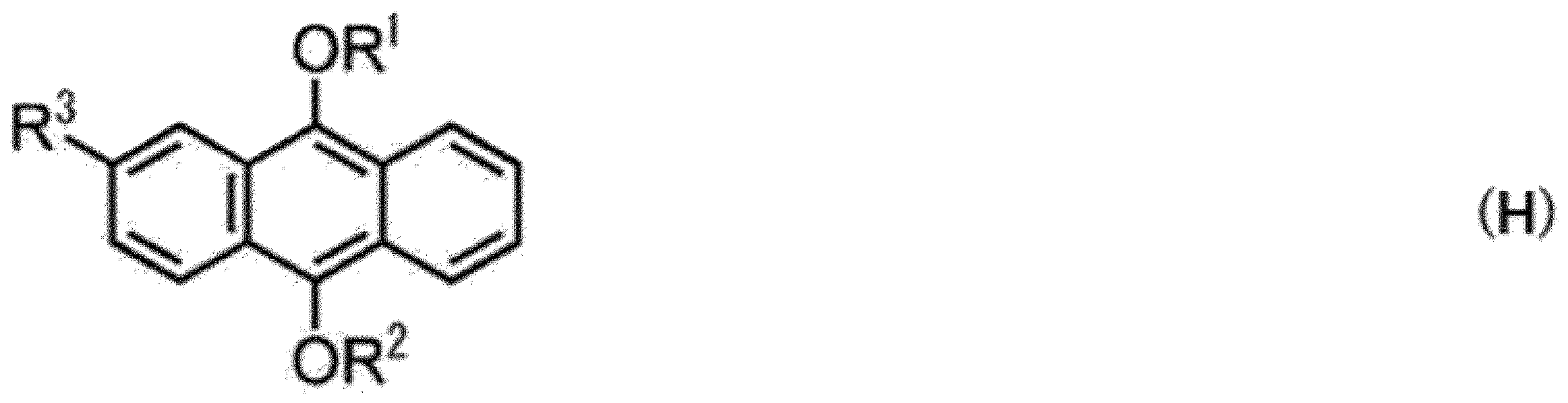
(式中、R1およびR2は互いに独立に炭素数1~6のアルキル基または炭素数2~12のアルコキシアルキル基を表し、R3は水素原子または炭素数1~6のアルキル基を表す
)
で示されるアントラセン系化合物を含む。上記の光カチオン重合開始剤は、300nm付近またはそれより短い波長域に極大吸収を示し、その付近の波長の光に感応してカチオン種またはルイス酸を発生し、カチオン重合性の硬化性成分のカチオン重合を開始させるが、一般式(H)で示されるアントラセン系化合物は、400nmより長い波長域に極大吸収を示すものであるため、それよりも長い波長の光にも感応することができるようになる。
9,10-ジメトキシアントラセン、
9,10-ジエトキシアントラセン、
9,10-ジプロポキシアントラセン、
9,10-ジイソプロポキシアントラセン、
9,10-ジブトキシアントラセン、
9,10-ジペンチルオキシアントラセン、
9,10-ジヘキシルオキシアントラセン、
9,10-ビス(2-メトキシエトキシ)アントラセン、
9,10-ビス(2-エトキシエトキシ)アントラセン、
9,10-ビス(2-ブトキシエトキシ)アントラセン、
9,10-ビス(3-ブトキシプロポキシ)アントラセン、
2-メチルまたは2-エチル-9,10-ジメトキシアントラセン、
2-メチルまたは2-エチル-9,10-ジエトキシアントラセン、
2-メチルまたは2-エチル-9,10-ジプロポキシアントラセン、
2-メチルまたは2-エチル-9,10-ジイソプロポキシアントラセン、
2-メチルまたは2-エチル-9,10-ジブトキシアントラセン、
2-メチルまたは2-エチル-9,10-ジペンチルオキシアントラセン、
2-メチルまたは2-エチル-9,10-ジヘキシルオキシアントラセン
が挙げられる。
カチオン硬化型接着剤は、光増感助剤を含有してもよい。光増感助剤は、好ましくはナフタレン系光増感助剤である。
4-メトキシ-1-ナフトール、
4-エトキシ-1-ナフトール、
4-プロポキシ-1-ナフトール、
4-ブトキシ-1-ナフトール、 4-ヘキシルオキシ-1-ナフトール、
1,4-ジメトキシナフタレン、
1-エトキシ-4-メトキシナフタレン、
1,4-ジエトキシナフタレン、
1,4-ジプロポキシナフタレン、
1,4-ジブトキシナフタレン
が挙げられる。
/cm2以下となるように設定する。上記接着剤への積算光量が10mJ/cm2未満であると、重合開始剤由来の活性種の発生が十分でなく、接着剤の硬化が不十分となる。一方でその積算光量が1,000mJ/cm2を超えると、照射時間が長くなり、生産性向上には不利なものとなる。この際、光吸収異方性膜や光学フィルムの種類、接着剤種の組み合わせなどによって、どの波長領域(UVA(320nm以上390nm以下)やUVB(280nm以上320nm以下)など)での積算光量が必要かは異なる。
光吸収異方性膜13は、二色性色素と重合性液晶化合物とが光学積層体の積層方向に配向した状態で硬化した硬化物層である。光吸収異方性膜13は、二色性色素と少なくとも1種の重合性液晶化合物とを含む重合性液晶組成物の硬化物であることが好ましい。光学積層体1は、上記硬化物層に直接接するように重合性液晶化合物の配向を規制するための配向膜を有していてもよく、上記硬化物層または配向膜を形成するための基材を有していてもよい。上記硬化物層または配向膜と基材とは、直接接するように設けることができる。本明細書において、光学積層体の積層方向を垂直方向、垂直方向への配向を垂直配向ともいう。
Az>(Ax+Ay)/2 (i)
Ax(z=60°)/Ax>5 (ii)
Ay(z=60°)/Ay>5 (iii)
満たすことが好ましい。
ここで、式(i)~(iii)中、Ax、Ay、Az、Ax(z=60°)およびAy(z=60°)は、いずれも光吸収異方性膜13中の二色性色素の光吸収異方性膜13中での吸収極大波長における吸光度である。
Axは、x軸方向に振動する直線偏光の吸光度を表す。Axは、z軸方向から膜面に向かって、x軸方向に振動する直線偏光を入射して測定することができる。
Ayは、y軸方向に振動する直線偏光の吸光度を表す。Ayは、z軸方向から膜面に向かって、y軸方向に振動する直線偏光を入射して測定することができる。
Azは、z軸方向に振動する直線偏光の吸光度を表す。Azは、例えばx-y平面方向から膜側面に向かって、すなわち膜をx-y平面としたとき、その側面(厚み方向)に向かって垂直に、z軸方向に振動する直線偏光を入射して測定することができる。
Ax(z=60°)は、y軸を回転軸として光吸収異方性膜13を60°回転させたときのx軸方向に振動する直線偏光の吸光度を表す。Ax(z=60°)は、y軸を回転軸として光吸収異方性膜13を60°回転させた状態で、Axを測定した直線偏光と同一の直線偏光を入射して測定することができる。ここで、膜の回転は、Axを測定した状態の膜を、y軸を回転軸として直線偏光の入射方向に60°回転させて行う。
Ay(z=60°)は、x軸を回転軸として光吸収異方性膜13を60°回転させたときのy軸方向に振動する直線偏光の吸光度を表す。Ay(z=60°)は、x軸を回転軸として光吸収異方性膜13を60°回転させた状態で、Ayを測定した直線偏光と同一の直線偏光を入射して測定することができる。ここで、膜の回転は、Ayを測定した状態の膜を、x軸を回転軸として直線偏光の入射方向に60°回転させて行う。
具体的には、以下の方法等で見積もることができる。
y軸を回転軸として光吸収異方性膜13を30°および60°回転させた状態で、Axを測定した直線偏光と同一の直線偏光を入射することによりAx(z=30°)およびAx(z=60°)を測定し、同様に、x軸を回転軸として光吸収異方性膜13を30°および60°回転させた状態で、Ayを測定した直線偏光と同一の直線偏光を入射することによりAy(z=30)およびAy(z=60)を測定する。
このとき、Ax(z=30°)<Ax(z=60°)かつAy(z=30°)=Ay(z=60°)であれば、Ax(z=30°)<Ax(z=60°)<Ax(z=90°)=Azであり、かつAy(z=30°)<Ay(z=60°)かつAx(z=30°)=Ax(z=60°)であれば、Ay(z=30°)<Ay(z=60°)<Ay(z=90°)=Azであるから、必然的に式(i)を満たす。
Ax(z=60°)/AxおよびAy(z=60°)/Ayは、その数値が大きいほど優れた光吸収異方性を示すことを意味する。これらの数値は、例えば50以下であってもよく、また30以下であってもよい。
また、光吸収異方性膜13は、好ましくは、式(ii’)および(iii’):
Ax(z=60°)/Ax>10 (ii’)
Ay(z=60°)/Ay>10 (iii’)
を満たすことが好ましい。
二色性色素とは、分子の長軸方向における吸光度と、短軸方向における吸光度とが異なる性質を有する色素をいう。二色性色素としては、光吸収異方性膜中にて波長300~700nmの範囲に吸収極大波長(λMAX)を有するものが好ましく、波長500~600nmの範囲に極大吸収波長を有するものがより好ましい。人の視感度が高い波長500~600nmの範囲に極大吸収波長を有することによって、二色性色素の使用量を低減し易くなり、および光吸収異方性膜13を薄膜化し易い傾向となる。
A1(-N=N-A2)p-N=N-A3 (I)
[式(I)中、
A1およびA3は、互いに独立に、置換基を有していてもよいフェニル基、置換基を有していてもよいナフチル基または置換基を有していてもよい1価の複素環基を表す。A2は、置換基を有していてもよいp-フェニレン基、置換基を有していてもよいナフタレン-1,4-ジイル基または置換基を有していてもよい2価の複素環基を表す。pは1~4の整数を表す。pが2以上の整数である場合、複数のA2は互いに同一でも異なっていてもよい。可視域に吸収を示す範囲で-N=N-結合が-C=C-、-COO-、-NHCO-、-N=CH-結合に置き換わっていてもよい]
で表される化合物(以下、「化合物(I)」ということがある)が挙げられる。
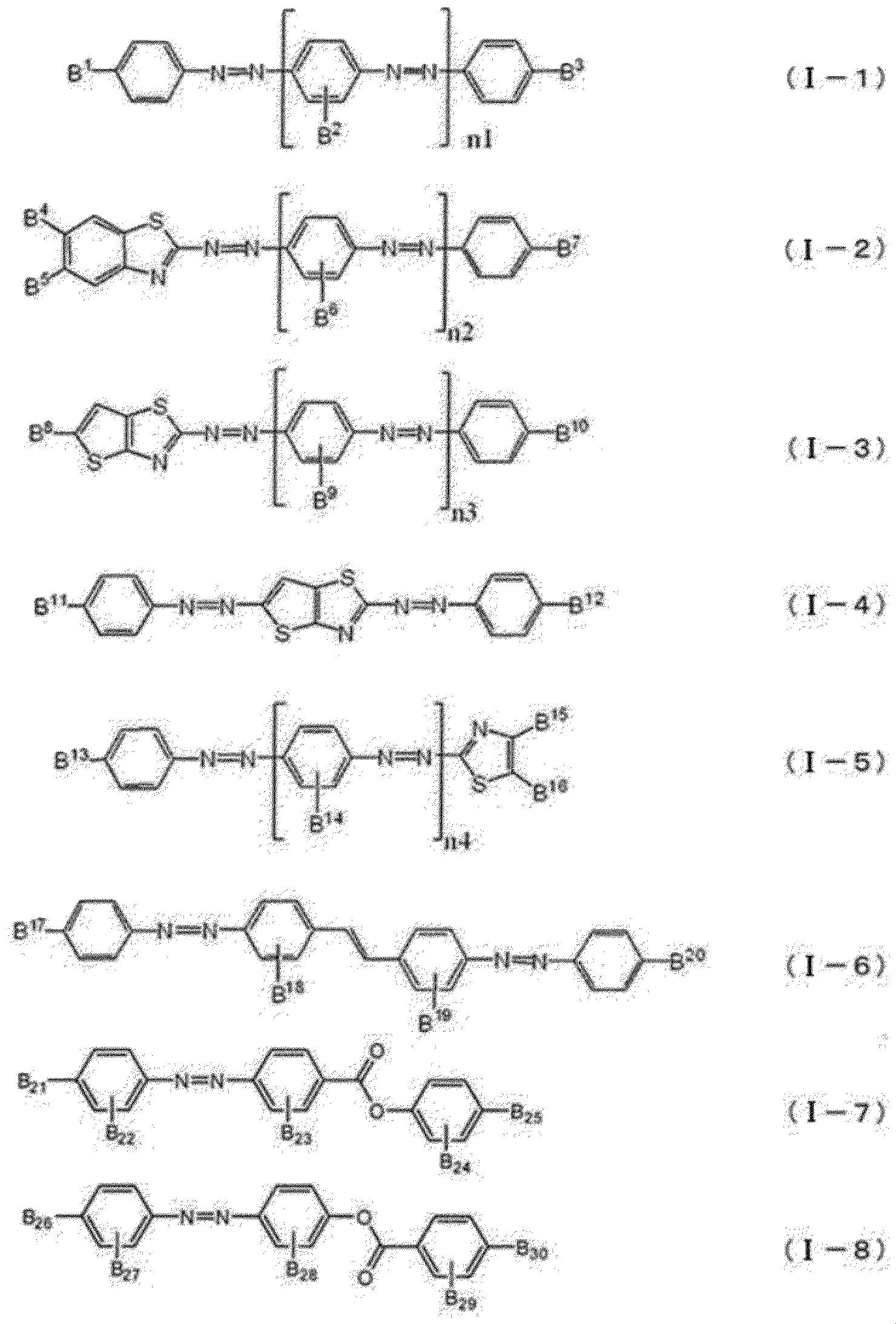
[式(I-1)~(I-8)中、
B1~B30は、互いに独立して、水素原子、炭素数1~6のアルキル基、炭素数1~6のアルケニル基、炭素数1~4のアルコキシ基、シアノ基、ニトロ基、置換または無置換のアミノ基(置換アミノ基および無置換アミノ基の定義は上記のとおり)、塩素原子またはトリフルオロメチル基を表わす。
n1~n4は、互いに独立に0~3の整数を表わす。
n1が2以上である場合、複数のB2は互いに同一でも異なっていてもよく、
n2が2以上である場合、複数のB6は互いに同一でも異なっていてもよく、
n3が2以上である場合、複数のB9は互いに同一でも異なっていてもよく、
n4が2以上である場合、複数のB14は互いに同一でも異なっていてもよい。]
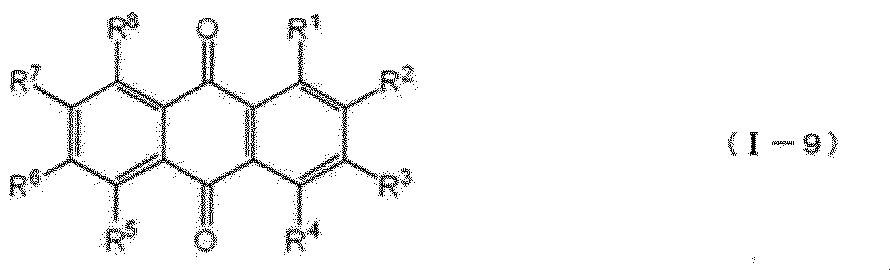
[式(I-9)中、
R1~R8は、互いに独立して、水素原子、-Rx、-NH2、-NHRx、-NRx 2、-SRxまたはハロゲン原子を表す。
Rxは、炭素数1~4のアルキル基または炭素数6~12のアリール基を表す。]
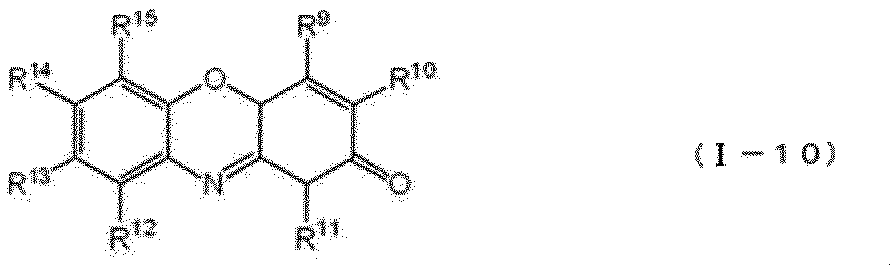
[式(I-10)中、
R9~R15は、互いに独立して、水素原子、-Rx、-NH2、-NHRx、-NRx 2、-SRxまたはハロゲン原子を表す。
Rxは、炭素数1~4のアルキル基または炭素数6~12のアリール基を表す。]

[式(I-11)中、
R16~R23は、互いに独立して、水素原子、-Rx、-NH2、-NHRx、-NRx 2、-SRxまたはハロゲン原子を表す。
Rxは、炭素数1~4のアルキル基または炭素数6~12のアリール基を表す。]

[式(I-12)中、
D1およびD2は、互いに独立に、式(I-12a)~式(I-12d)のいずれかで表される基を表す。
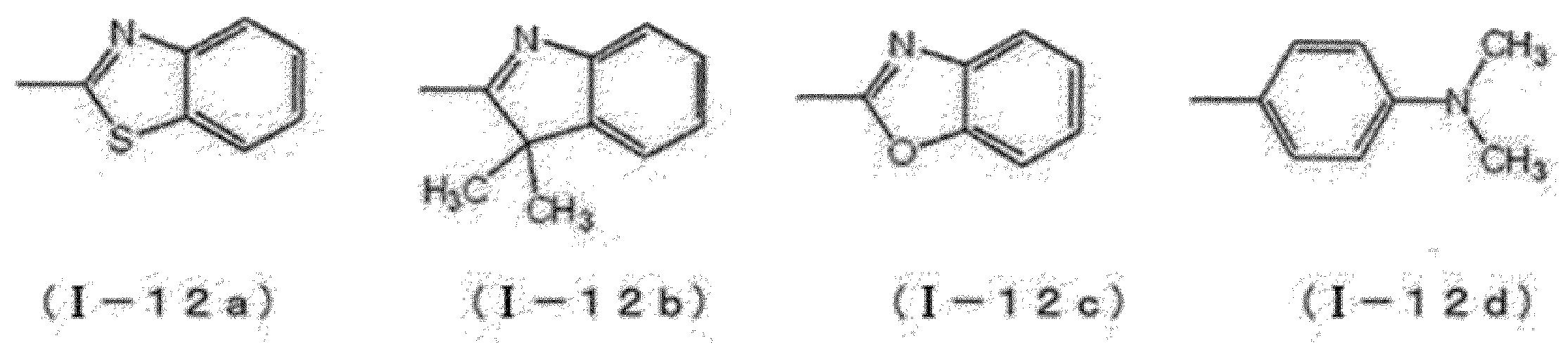
n5は、1~3の整数を表す。]

[式(I-13)中、
D3およびD4は、互いに独立に、式(I-13a)~式(I-13h)のいずれかで表される基を表す。
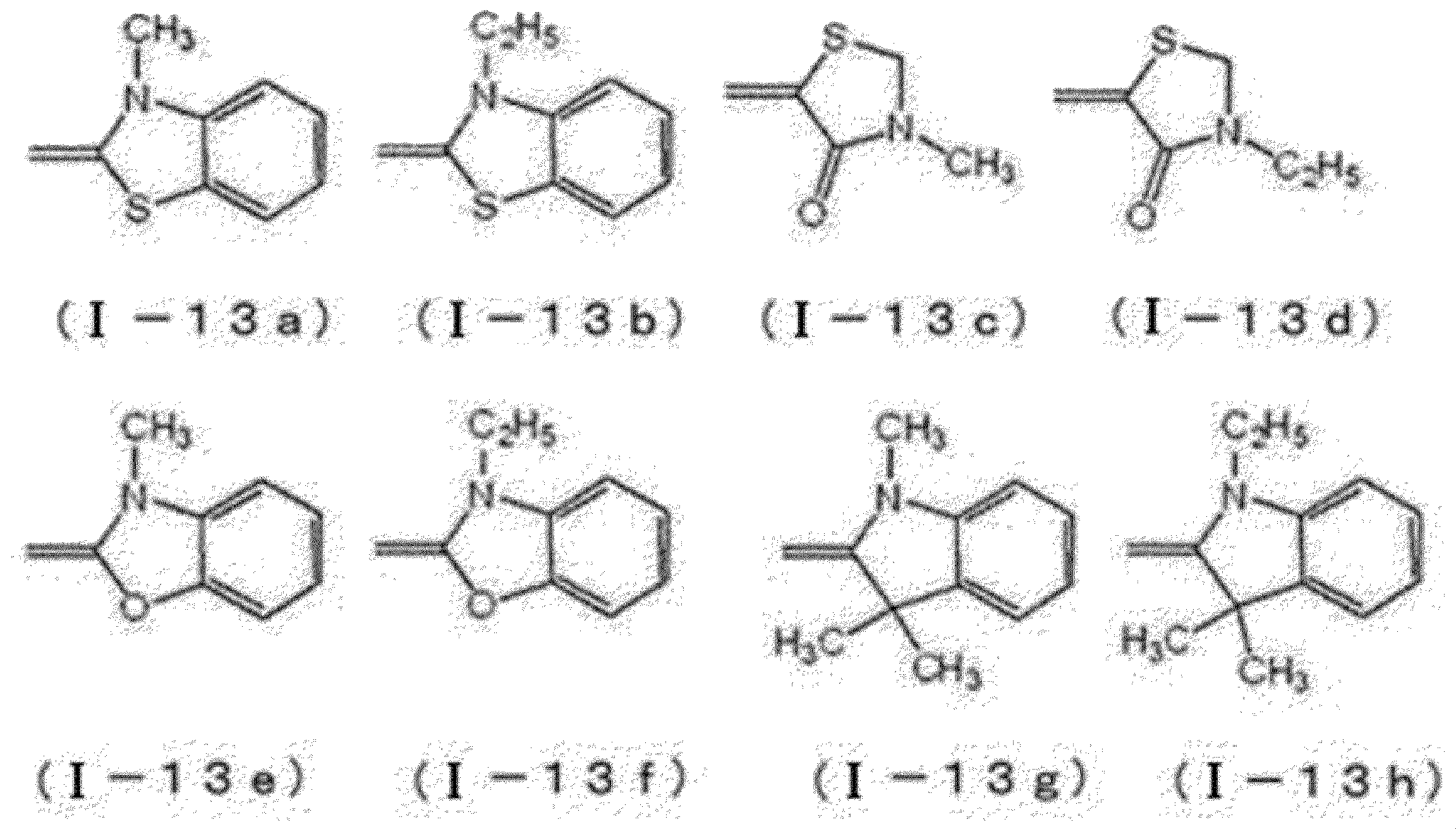
n6は、1~3の整数を表す。]
光吸収異方性層は、二色性色素と重合性液晶化合物とが光学積層体の積層方向に配向した状態で硬化した硬化物層であることから、重合性液晶化合物の重合体も含む。
本明細書において「重合性液晶化合物」とは、分子内に少なくとも1つの重合性基を有する液晶化合物をいう。重合性液晶化合物は、重合性基を有する単量体(以下、「重合性液晶モノマー」ともいう。)であってもよいし、単量体の重合物であって重合性基を有するポリマー又はオリゴマー(以下、単に「重合性液晶ポリマー」ともいう。)であってもよい。
U1-V1-W1-(X1-Y1)n-X2-T3 (L-1)
[式(L-1)中、
X1及びX2は、互いに独立して、置換基を有していてもよい2価の芳香族基又は2価の脂環式炭化水素基を表し、該2価の芳香族基又は2価の脂環式炭化水素基を構成する炭素原子は、酸素原子、硫黄原子又は窒素原子に置換されていてもよい。ただし、X1及びX2のうち少なくとも1つは、置換基を有していてもよい1,4-フェニレン基又は置換基を有していてもよいシクロヘキサン-1,4-ジイル基である。
Y1は、単結合又は2価の連結基を表す。
nは1~4を表し、nが2以上の場合、複数のX1は互いに同一でも異なっていてもよい。X2は、複数のX1のうちのいずれか又は全てと同一でも異なっていてもよい。また、nが2以上の場合、複数のY1は互いに同一でも異なっていてもよい。
U1は、重合性基を表す。
W1は、単結合又は2価の連結基を表す。
V1は、置換基を有していてもよい炭素数1~20のアルカンジイル基を表し、該アルカンジイル基を構成する-CH2-は、-O-、-CO-、-S-、又は-NH-に置き換わっていてもよい。
T3は、水素原子又は1価の基を表す。]
U1-V1-W1-(X1-Y1)n-X2-W2-V2-U2 (L-2)
[式(L-2)中、
X1、X2、Y1、n、U1、W1及びV1は、それぞれ、前記と同じ意味を表す。
U2は、水素原子又は重合性基を表す。
W2は、単結合又は2価の連結基を表す。
V2は、置換基を有していてもよい炭素数1~20のアルカンジイル基を表し、該アルカンジイル基を構成する-CH2-は、-O-、-CO-、-S-、又は-NH-に置き換わっていてもよい。]
-(X1-Y1)n-X2- (L-1A)
[式(L-1A)中、X1、Y1、X2及びnは、それぞれ、前記と同じ意味を表す。]
で示される部分構造〔以下、部分構造(L-1A)ともいう。〕は、非対称構造であることが、スメクチック液晶性を発現し易い点で好ましい。
また、nが2であり、2つのY1が互いに同じ構造である化合物であって、2つのX1が互いに同じ構造であり、1つのX2はこれら2つのX1とは異なる構造である重合性液晶化合物、2つのX1のうちのW1に結合するX1が、他方のX1及びX2とは異なる構造であり、他方のX1とX2とは互いに同じ構造である重合性液晶化合物も挙げられる。さらに、nが3であり、3つのY1が互いに同じ構造である化合物であって、3つのX1及び1つのX2のうちのいずれか1つが他の3つの全てと異なる構造である重合性液晶化合物が挙げられる。
-X3-Y2-X4-Y3-X5- (L-1B)
[式(L-1B)中、
X3、X4及びX5は、互いに独立して、置換基を有していてもよい1,4-フェニレン基又は置換基を有していてもよいシクロヘキサン-1,4-ジイル基である。
Y2及びY3は、互いに独立して、-CH2CH2-、-CH2O-、-OCH2-、-COO-、-OCO-、-OCOO-、単結合、-N=N-、-CRa=CRb-、-C≡C-、-CRa=N-、又は-CO-NRa-を表す。
ただし、式(L-1B)で表される部分構造は、全体として非対称構造である。]
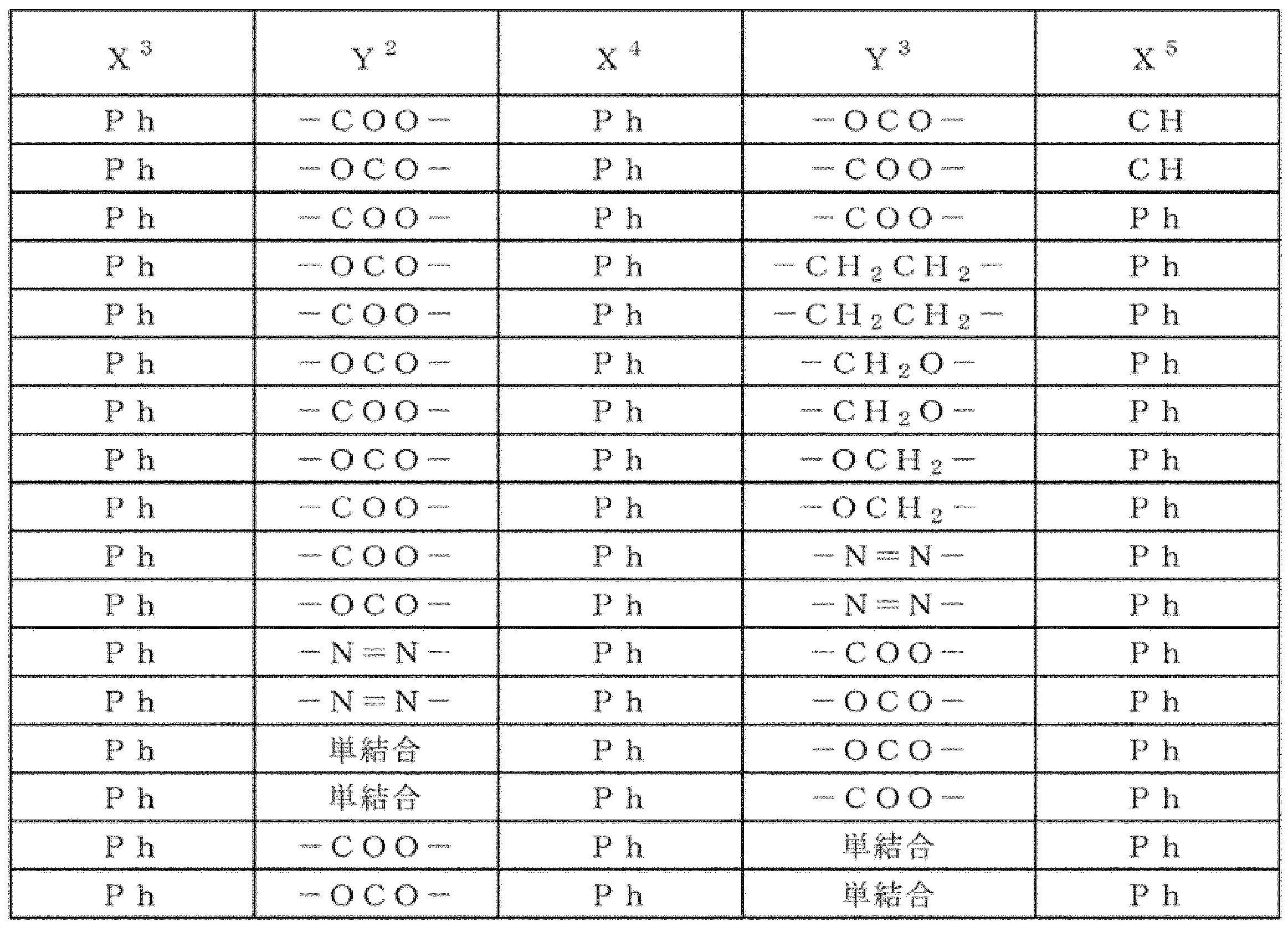
式(L-1)で表される化合物、
式(L-2)で表される化合物、
非対称構造である部分構造(L-1A)を有する式(L-1)で表される化合物、
非対称構造である部分構造(L-1A)を有する式(L-2)で表される化合物、
非対称構造である部分構造(L-1A)を有し、部分構造(L-1A)が式(L-1B)で表される部分構造である式(L-1)で表される化合物、
非対称構造である部分構造(L-1A)を有し、部分構造(L-1A)が式(L-1B)で表される部分構造である式(L-2)で表される化合物。


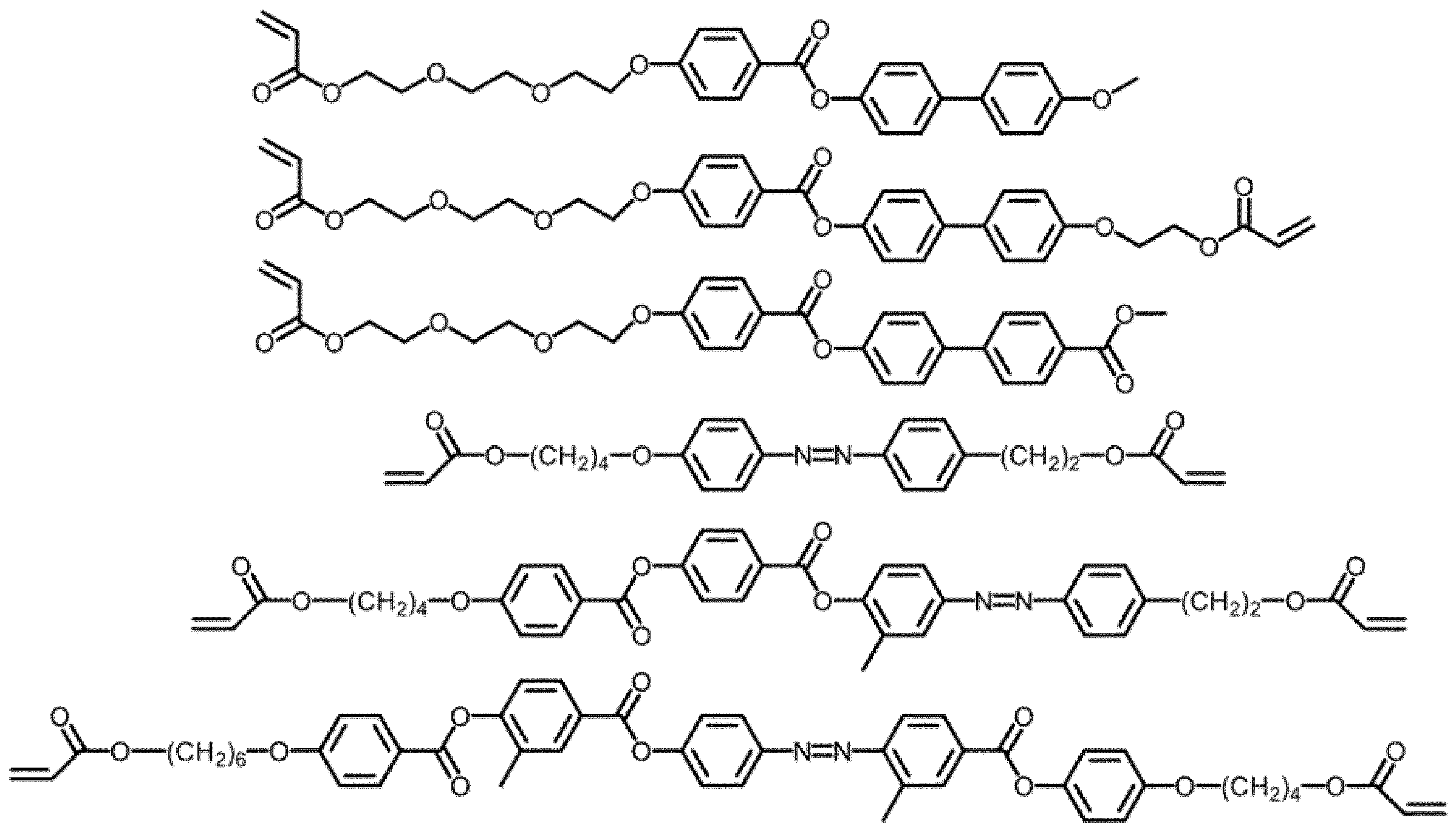


重合開始剤は、重合性液晶化合物等の重合反応を開始し得る化合物である。重合開始剤としては、光の作用により活性ラジカルを発生する光重合開始剤が好ましい。
架橋剤としては、その分子内に炭素-炭素不飽和結合と活性水素反応性基とを有するものが好ましい。なお、ここでいう「活性水素反応性基」とは、カルボキシル基(-COOH)、水酸基(-OH)、アミノ基(-NH2)等の活性水素を有する基に対して反応性を有する基を意味し、グリシジル基、オキサゾリン基、カルボジイミド基、アジリジン基、イミド基、イソシアナト基、チオイソシアナト基、無水マレイン酸基等がその代表例である。

[式(Y)中、
nは1~10までの整数を表わし、R1’は、炭素数2~20の2価の脂肪族又は脂環式炭化水素基、或いは炭素数5~20の2価の芳香族炭化水素基を表わす。各繰り返し単位にある2つのR2’は、一方が-NH-であり、他方が>N-C(=O)-R3’で示される基である。R3’は、水酸基又は炭素-炭素不飽和結合を有する基を表す。
式(Y)中のR3’のうち、少なくとも1つのR3’は炭素-炭素不飽和結合を有する基である。]

化合物(YY)には、市販品をそのまま又は必要に応じて精製して用いることができる。市販品としては、例えば、Laromer(登録商標)LR-9000(BASF社製)等が挙げられる。
架橋剤の含有量は、重合性液晶化合物100質量部に対して、好ましくは0.01質量部以上、より好ましくは0.1質量部以上であり、好ましくは5質量部以下である。
レベリング剤とは、重合性液晶組成物の流動性を調整し、光吸収異方性膜13をより平坦にする機能を有するものであり、例えば界面活性剤を挙げることができる。好ましいレベリング剤としては、ポリアクリレート化合物を主成分とするレベリング剤およびフッ素原子含有化合物を主成分とするレベリング剤が挙げられる。
溶剤としては、重合性液晶化合物を完全に溶解し得るものが好ましく、さらに重合反応に不活性な溶剤であることが好ましい。
重合性液晶組成物の総量に対して、該固形分が50質量%以下であると、重合性液晶組成物の粘度が低くなることから、光吸収異方性膜13の厚みが略均一になることで、光吸収異方性膜13にムラが生じにくくなる傾向がある。また、かかる固形分は、製造しようとする光吸収異方性膜13の厚みを考慮して定めることができる。
酸化防止剤を配合することにより、重合性液晶化合物の重合反応をコントロールすることができる。酸化防止剤としては、フェノール系酸化防止剤、アミン系酸化防止剤、キノン系酸化防止剤、ニトロソ系酸化防止剤から選ばれる一次酸化防止剤であってもよいし、リン系酸化防止剤および硫黄系酸化防止剤から選ばれる二次酸化防止剤であってもよい。重合性液晶化合物の配向を乱すことなく、重合性液晶化合物を重合するためには、酸化防止剤の含有量は、重合性液晶化合物100質量部に対して、通常0.01~10質量部であり、好ましくは0.1~5質量部であり、さらに好ましくは0.1~3質量部である。酸化防止剤は単独または2種以上を組み合わせて使用できる。
光増感剤を用いることにより、光重合開始剤を高感度化することができる。光増感剤としては、例えば、キサントン、チオキサントン等のキサントン類;アントラセンおよびアルキルエーテル等の置換基を有するアントラセン類;フェノチアジン;ルブレンが挙げられる。光増感剤は単独または2種以上を組み合わせて使用できる。光増感剤の含有量は、重合性液晶化合物100質量部に対して、通常0.01~10質量部であり、好ましくは0.05~5質量部であり、さらに好ましくは0.1~3質量部である。
重合性液晶化合物および二色性色素と、場合により溶剤等の添加剤とを所定温度で撹拌等することによって光吸収異方性膜形成用組成物を得る工程、
光吸収異方性膜形成用組成物の塗膜を形成する工程、
上記塗膜を乾燥させて乾燥塗膜を形成する工程、および
乾燥塗膜に活性エネルギー線を照射し、液晶硬化膜を形成する工程
を含む方法により製造することができる。
なお、液晶相転移温度は、例えば、温度調節ステージを備えた偏光顕微鏡や、示差走査熱量計(DSC)、熱重量示差熱分析装置(TG-DTA)等を用いて測定することができる。また、重合性液晶化合物として2種以上を組み合わせて用いる場合、上記相転移温度は、光吸収異方性膜を形成するための重合性液晶組成物を構成する全重合性液晶化合物を上記重合性液晶組成物における組成と同じ比率で混合した重合性液晶化合物の混合物を用いて、1種の重合性液晶化合物を用いる場合と同様にして測定される温度を意味する。なお、一般に上記重合性液晶組成物中における重合性液晶化合物の液晶相転移温度は、重合性液晶化合物単体としての液晶相転移温度よりも下がる場合もあることが知られている。
偏光子14は、無偏光の光を入射させたとき、吸収軸に直交する振動面をもつ直線偏光を透過させる性質を有する直線偏光層である。偏光子14は、吸収異方性を有する色素を吸着させた延伸フィルム、吸収異方性を有する色素を含む組成物を基材フィルムに塗布して形成した偏光子を含むフィルム等が挙げられる。
偏光子14は、吸収異方性を有する色素を吸着させた延伸フィルムであってもよい。このような延伸フィルムで構成された偏光子は、通常、ポリビニルアルコール系樹脂フィルムを一軸延伸する工程、ポリビニルアルコール系樹脂フィルムを吸収異方性を有する色素で染色することにより、その吸収異方性を有する色素を吸着させる工程、吸収異方性を有する色素が吸着されたポリビニルアルコール系樹脂フィルムをホウ酸水溶液で処理する工程、およびホウ酸水溶液による処理後に水洗する工程を経て製造することができる。偏光子14は、片面または両面に接着剤を介して透明保護フィルムを積層した偏光板として、光学積層体に組み込まれてもよい。
吸収異方性を有する色素を基材フィルムに塗布して形成した偏光子としては、液晶性および吸収異方性を有する色素を含む組成物、または吸収異方性を有する色素と重合性液晶とを含む組成物を基材フィルムに塗布して得られる偏光子が挙げられる。基材フィルムとしては、光吸収異方性膜13の製造に用い得る基材として先に例示したものが挙げられる。
吸収異方性を有する色素を基材フィルムに塗布して形成した偏光子の厚みは小さい方が好ましいが、小さすぎると強度が低下し、加工性に劣る傾向があるため、通常20μm以下であり、好ましくは5μm以下であり、より好ましくは0.5~3μmである。
ハードコート層は、光学フィルム11、光吸収異方性膜13および偏光子14の表面を保護する機能を有することができる。ハードコート層は、光吸収異方性膜13の片側または両側に配置されることができる。ハードコート層は、光吸収異方性膜13の接着剤層12側とは反対側に配置されてもよいし、光学フィルム11の接着剤層12側とは反対側に配置されてもよい。ハードコート層が、光吸収異方性膜13の接着剤層12側とは反対側に配置される場合、ハードコート層は光吸収異方性膜13に直接的に接して配置されてよいし、ハードコート層付光学フィルムとして配置されてもよい。ハードコート層が、光学フィルム11の接着剤層12側とは反対側に配置される場合、光学フィルム11に直接的に接して配置されてよい。
位相差層は、面内位相差を有する。位相差層が有する面内位相差の値は特に限定されないが、下記式(1)に示される光学特性を満たすことが好ましく、下記式(1)、下記式(2)及び下記式(3)で示される光学特性を満たすことが好ましい。
100nm<Re(550)<160nm ・・・(1)
[式中、Re(550)は波長550nmの光に対する面内位相差値(面内リタデーション)を表す。]
Re(450)/Re(550)≦1.0 ・・・(2)
1.00≦Re(650)/Re(550) ・・・(3)
[式中、Re(450)は波長450nmの光に対する面内位相差値を、Re(550)は波長550nmの光に対する面内位相差値を、Re(650)は波長650nmの光に対する面内位相差値を表す。]
ReA(λ)=(nxA(λ)-nyA(λ))×dA (4)
[式(6)中、
nxA(λ)は、位相差層の面内における波長λnmでの主屈折率を表し、
nyA(λ)は、nxA(λ)と同一面内で、nxA(λ)の方向に対して直交する方向の波長λnmでの屈折率を表し、
dAは、位相差層の厚みを示す。]
水平配向配向液晶層は、例えば、特開2010-31223号公報、特開2010-270108号公報、特開2011-6360号公報、特開2011-207765号公報、特開2011-162678号公報、特開2016-81035号公報、国際公開第2017/043438号及び特表2011-207765号公報に記載の重合性液晶化合物が配向した状態で硬化した硬化物層等が挙げられる。
ポジティブC層を含む場合は、貼合層を介して位相差層とポジティブC層とを積層させることが好ましい。
貼合層は貼り合わせる層同士の間に介在させて層同士を接合する機能を有することができる。貼合層は、公知の粘着剤層または接着剤層を用いることができる。粘着剤層は、粘着剤を用いて形成された層である。本明細書において粘着剤とは、それ自体を被着体に張り付けることで接着性を発現するものであり、いわゆる感圧型接着剤と称されるものである。粘着剤としては、従来公知の光学的な透明性に優れる粘着剤を特に制限なく用いることができ、例えば、アクリル系、ウレタン系、シリコーン系、ポリビニルエーテル系等のベースポリマーを有する粘着剤を用いることができる。粘着剤層の厚みは3μm以上であってもよく、5μm以上であってもよく、また、35μm以下であってもよく、30μm以下であってもよい。
光学積層体は、その表面(典型的には、光学積層体1の光学フィルム11側の表面)を保護するためのプロテクトフィルムを含むことができる。プロテクトフィルムは、例えば画像表示素子や光学部材に光学積層体1が貼合された後、それが有する粘着剤層ごと剥離除去される。
光学積層体は、図1に示す層構成以外の層構成を有することができる。図3に示す光学積層体2は、プロテクトフィルム21、第一ハードコート層付光学フィルム22、接着剤層23、光吸収異方性膜24、第二ハードコート層25、貼合層26、偏光層(直線偏光板)27をこの順に備える。第一ハードコート層付光学フィルム22は、第一ハードコート層28および樹脂フィルム29を備える。
光学積層体は、上記した各層を、必要に応じて貼合層を介して積層することによって製造することができる。光学積層体は、例えば長尺のフィルムを連続的に搬送しながら積層する、いわゆるロールトゥロールによって光学積層体を製造することができる。例えば、光吸収異方性膜と、光学フィルムとを連続的に搬送しながら接着剤層を介して貼合し、次いで貼合層を介して偏光子を貼合することができる。
光学積層体は表示装置に用いることができ、特に有機EL表示装置に好適に用いることができる。表示装置において光学積層体は、光学フィルムが偏光子よりも視認側になるように配置されることができる。
接着剤組成物を、COPフィルム〔日本ゼオン(株)製「ZB」〕の片面に、バーコーター〔第一理化(株)製〕を用いて膜厚およそ25μmとなるよう塗工し、その塗工面に更にCOPフィルムを被せた。次に、紫外線照射装置〔フュージョンUVシステムズ(株)製〕のHバルブで積算光量600mJ/cm2(UV-B)の紫外線を照射し、接着剤層が固体となった段階で、片方のCOPフィルムを剥がし、温度23℃相対湿度55%の雰囲気中で3日以上養生させ、接着剤を硬化させた。これを30mm×5mmの大きさに裁断し、もう片方のCOPフィルムを剥がし、接着剤硬化物層を得た。得られた硬化物層を動的粘弾性測定装置〔アイティー計測制御(株)製「DVA―220」〕に、つかみ具間20mmでセットし、周波数10Hz、引張モードで粘弾性測定を行い、損失弾性率[MPa]の最大値の温度[℃]、温度30℃および80℃における貯蔵弾性率[MPa]
、tanδが最大となる温度[℃]を求めた。tanδは、貯蔵弾性率をG’および損失弾性率をG’’としたとき以下の関係を有する。

実施例および比較例で作製した第1積層体の離型フィルムを剥離し、剥き出しとなったハードコート層にコロナ処理を施し、準備したアクリル系粘着剤(リンテック社製、膜厚5μm)をラミネーターで貼合した。次に、それを40mm×40mmに裁断し、粘着剤面を無アルカリガラスに貼合し、プロテクトフィルム/16HC-COPフィルム/接着剤層(実施例1~6)もしくは粘着剤(比較例1)/光吸収異方性膜/ハードコート層/アクリル系粘着剤/無アルカリガラスの積層構造を有する耐久性評価サンプルを得た。得られた評価サンプルのプロテクトフィルムを剥離し、温度50℃、圧力5kg/cm2(490.3kPa)で20分間オートクレーブ処理を施し、温度23℃、相対湿度55%の環境下で24時間放置した。その後、65℃90%RH×500hrの条件で耐湿熱耐久試験を行い、オートクレーブ処理前と耐久試験後での正面透過率変化を、紫外可視分光光度計〔(株)島津製作所製“UV―2450”〕を用いて測定し、以下の基準に基づいて評価した。結果を表3に示す。
◎:波長620nmでの正面透過率変化の絶対値が3%未満。
○:波長620nmでの正面透過率変化の絶対値が3%以上5%未満。
×:波長620nmでの正面透過率変化の絶対値が5%以上。
下記成分を混合し、80℃で1時間攪拌することにより、光吸収異方性膜形成用組成物を得た。二色性色素には、特開2013-101328号公報の実施例に記載のアゾ系色素を用いた。

・式(A-7)で表される重合性液晶化合物 25部

・下記に示す二色性色素(1)(極大吸収波長:602nm) 1部

・重合開始剤:2-ジメチルアミノ-2-ベンジル-1-(4-モルホリノフェニル)ブタン-1-オン(イルガキュア369;チバスペシャルティケミカルズ社製) 6部
・イソシアネート系架橋剤(BASF社製「LR9000」) 2部
・レベリング剤:F-556(メガファックF-556、DIC(株)製) 1部
・溶剤:o-キシレン 650部
下記成分を混合し、80℃で1時間攪拌することにより、ハードコート層形成用硬化性組成物(X)を調製した。
・アクリレート化合物:ジペンタエリスリトールヘキサアクリレート 50部
・ウレタンアクリレート化合物:ウレタンアクリレート(ダイセル・オルネクス(株)製「エベクリル4858」) 50部
・ラジカル重合開始剤:2-[4-(メチルチオ)ベンゾイル]-2-(4-モルホリニル)プロパン(BASF社製「イルガキュア907」) 3部
・溶剤:メチルエチルケトン 10部
離型処理が施されたポリエチレンテレフタレートフィルム(リンテック社製「SP-PLR382050」)の離型処理面に、コロナ処理を実施した後、上記ハードコート層形成用硬化性組成物(X)をバーコート法(#2、30mm/s)により塗布し、紫外線照射装置〔ウシオ電機(株)製SPOT CURE SP-7〕を用いて、積算光量500mJ/cm2(波長365nm、窒素雰囲気下)の紫外線を塗膜に照射することにより、離型フィルム表面にハードコート層が形成されたハードコート層付き離型フィルムを得た。接触式膜厚計で測定したハードコート層の厚みは2μmであった。
以下に示す各成分を表2に示す割合で配合し、接着剤組成物1~6を作製した。
(エポキシ化合物)
A-1:3’,4’-エポキシシクロヘキシルメチル 3,4-エポキシシクロヘキサンカルボキシレート(商品名:CEL2021P、株式会社ダイセル製)
A-2:2,2-ビス(ヒドロキシメチル)-1-ブタノールの1,2-エポキシ-4-(2-オキシラニル)シクロヘキサン付加物(商品名:EHPE3150、株式会社ダイセル製)
A-3:ビスフェノールA型エポキシ樹脂(商品名:EP-4100E、株式会社ADEKA製)
A-4:ネオペンチルグリコールジグリシジルエーテル(商品名:EX-211L、ナガセケムテックス株式会社製)
A-5:下記式で表される化合物
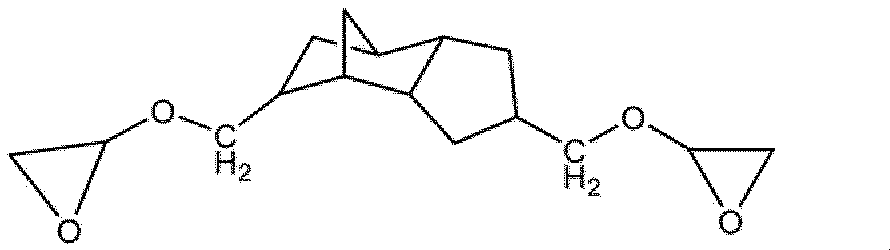
(オキセタン化合物)
B-1:3-エチル-3{[(3-エチルオキセタン-3-イル)メトキシ]メチル}オキセタン(商品名:OXT-221、東亜合成株式会社製)
(アクリル化合物)
C-1:トリシクロデカンジメタノールジアクリレート(商品名:A-DCP、新中村化学株式会社製)
(開始剤)
D-1:カチオン重合開始剤(商品名:CPI-100P、50質量%溶液、サンアプロ株式会社製)
D-2:ラジカル重合開始剤(商品名:Omnirad 907、IGM RESINS製)
(光増感助剤)
E-1:1,4-ジエトキシナフタレン
(レベリング剤)
F-1:シリコーン系レベリング剤(商品名:SH710、東レ・ダウコーニング株式会社製)
F-2:シリコーン系レベリング剤(商品名:BYK-307、ビッグケミー・ジャパン株式会社製)
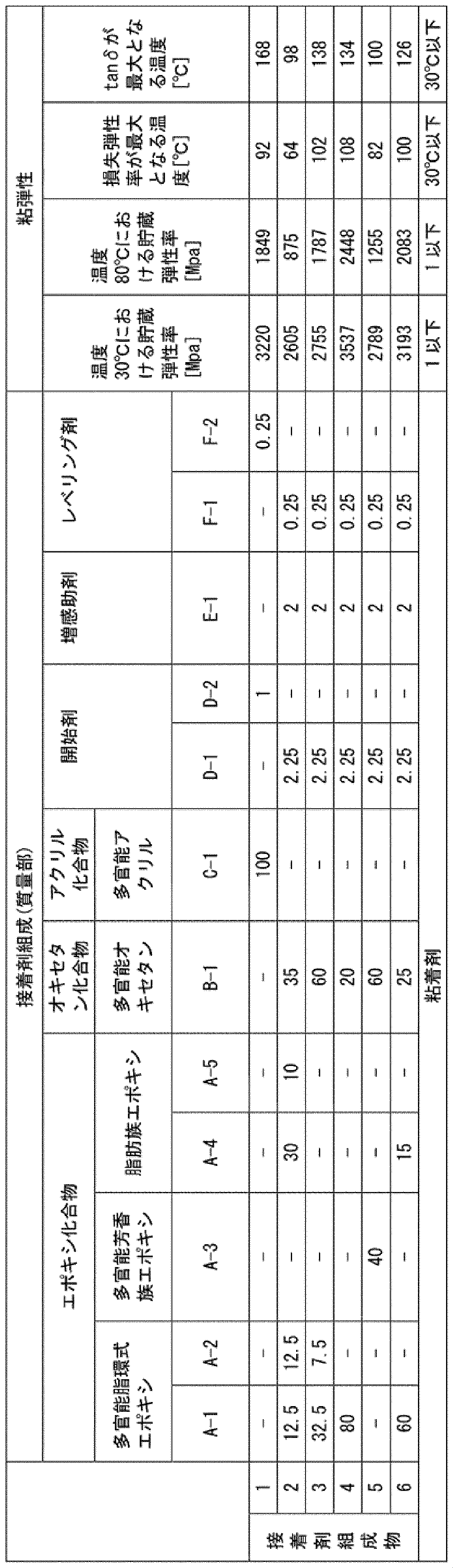
水100部に対し、カルボキシル基変性ポリビニルアルコール〔株式会社クラレから入手した商品名「KL-318」〕を3部溶解し、その水溶液に水溶性エポキシ樹脂であるポリアミドエポキシ系添加剤〔田岡化学工業株式会社から入手した商品名「スミレーズレジン(登録商標)650(30)」、固形分濃度30%の水溶液〕を1.5部添加して、水系接着剤を調製した。
厚み20μmのポリビニルアルコール系樹脂フィルムを延伸し、ヨウ素で染色することにより、ポリビニルアルコール系樹脂フィルムにヨウ素が吸着配向した偏光フィルム(厚み8μm)を得た。かかる延伸におけるトータル延伸倍率は5.2倍であった。
Meter Hz-V3」)を用いて、JIS K7105に準拠して、全光線透過率Ht(%)を測定すると、0.1%であった。
(1)水平配向膜形成用組成物の調製
下記構造の光配向性材料5部(重量平均分子量:30000)とシクロペンタノン(溶媒)95部とを成分として混合し、得られた混合物を80℃で1時間撹拌することにより、水平配向膜形成用組成物を得た。

下記分子構造を有する重合性液晶化合物(X1)および重合性液晶化合物(X2)を、それぞれ調製した。重合性液晶化合物(X1)は、特開2010-31223号公報に記載の方法に準じて製造した。また、重合性液晶化合物(X2)は、特開2009-173893号公報に記載の方法に準じて製造した。
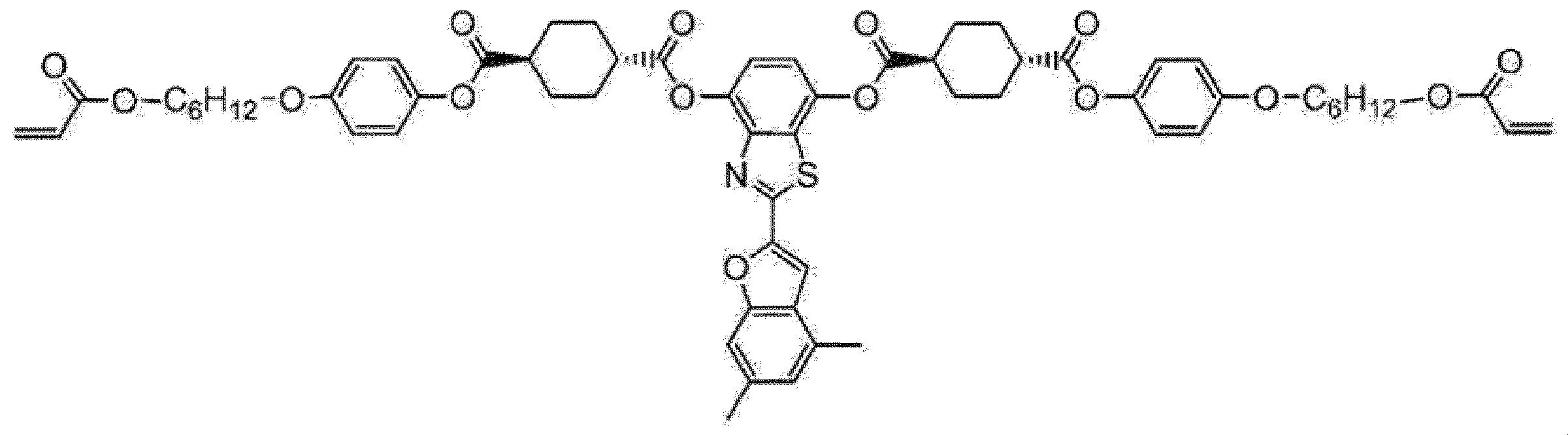
重合性液晶化合物(X2):

重合性液晶化合物(X1)および重合性液晶化合物(X2)を質量比90:10で混合し、混合物を得た。得られた混合物100部に対して、レベリング剤「BYK-361N」(BM Chemie社製)0.1部と、光重合開始剤として2-ジメチルアミノ-2-ベンジル-1-(4-モルホリノフェニル)ブタン-1-オン(BASFジャパン株式会社製「イルガキュア(登録商標)369(Irg369)」)6部を添加した。さらに、固形分濃度が13%となるようにN-メチル-2-ピロリドン(NMP)を添加した。この混合物を80℃で1時間撹拌することにより、水平配向液晶層の形成用の重合性液晶組成物(AA1)を得た。
日本ゼオン株式会社製のCOPフィルム(ZF-14-50)上に、コロナ処理を実施した後、上記で得た水平配向膜形成用組成物をバーコーター塗布し、80℃で1分間乾燥し、偏光UV照射装置(SPOT CURE SP-9;ウシオ電機株式会社製)を用いて、波長313nmにおける積算光量:100mJ/cm2で偏光UV露光を実施し、水平配向膜を得た。得られた水平配向膜の膜厚をエリプソメータで測定したところ、200nmであった。
下記に示すカチオン硬化性成分a1~a3およびカチオン重合開始剤を混合した後、下記に示すカチオン重合開始剤および増感剤をさらに混合し、得られた混合物を脱泡して、紫外線硬化型接着剤組成物を調製した。なお、下記の配合量は固形分量に基づく。
・カチオン硬化性成分a1(70部):
3’,4’-エポキシシクロヘキシルメチル 3’,4’-エポキシシクロヘキサンカルボキシレート(商品名:CEL2021P、株式会社ダイセル製)
・カチオン硬化性成分a2(20部):
ネオペンチルグリコールジグリシジルエーテル(商品名:EX-211、ナガセケムテックス株式会社製)
・カチオン硬化性成分a3(10部):
2-エチルヘキシルグリシジルエーテル(商品名:EX-121、ナガセケムテックス株式会社製)
・カチオン重合開始剤(2.25部(固形分量)):
商品名:CPI-100(サンアプロ株式会社製)の50%プロピレンカーボネート溶液
・増感剤(2部):
1,4-ジエトキシナフタレン
(1)垂直配向膜形成用組成物の調製
0.5質量部のポリイミド(日産化学工業株式会社製「サンエバーSE-610」)、72.3質量部のN-メチル-2-ピロリドン、18.1質量部の2-ブトキシエタノール、9.1質量部のエチルシクロヘキサン、および0.01質量部のDPHA(新中村化学製)を混合して、垂直配向膜形成用組成物を調製した。
下記式(LC242)に示す液晶化合物LC242:PaliocolorLC242(BASF社 登録商標)100質量部に対して、レベリング剤(DIC社製「F-556」)0.1質量部と、重合開始剤Irg369 3質量部とを添加し、固形分濃度が13質量部となるようにシクロペンタノンを添加した。これらを混合し、垂直配向液晶硬化膜形成用重合性液晶組成物を得た。
なお、液晶化合物LC242:PaliocolorLC242(BASF社登録商標)は下記式で表される。

基材としてCOPフィルム(日本ゼオン株式会社「ZF-14-23」)を用い、該COPフィルムに対してコロナ処理を実施した。コロナ処理を実施したCOPフィルムにバーコーターを用いて、垂直配向膜形成用組成物を塗布し、塗膜を形成した。塗膜を80℃で1分間乾燥させ、垂直配向膜を得た。得られた垂直配向膜の膜厚をエリプソメータで測定したところ0.2μmであった。続いて、作製した垂直配向膜上に垂直配向液晶硬化膜形成用重合性液晶組成物を塗布し、塗膜を形成した。塗膜を80℃で1分乾燥させた後、
高圧水銀ランプ(ウシオ電機株式会社製「ユニキュアVB-15201BY-A」)を用いて、窒素雰囲気下、および波長365nmにおける積算光量500mJ/cm2の条件で乾燥塗膜に紫外線を照射して、垂直配向位相差フィルム(垂直配向液晶硬化膜)を形成した。
<実施例1>
光学フィルムとして、紫外線吸収機能が付与された環状ポリオレフィン系樹脂フィルム(COPフィルム、厚み13μm)の片面にハードコート層(HC層、厚み3μm)が形成されたハードコート環状オレフィン系樹脂フィルム(厚み16μm、以下、「16HC-COPフィルム」という)を用意した。この16HC-COPフィルムのハードコート層側にはプロテクトフィルムを貼合した。
この第1積層体について耐湿熱耐久試験を行った。結果を表3に示す。
実施例1において接着剤組成物1に代えて表3に示す接着剤組成物を用いたこと以外は実施例1と同様にして光学積層体を作製した。結果を表3に示す。
実施例1において接着剤組成物1に代えて表3に示す粘着剤を用いて16HC-COPフィルムのCOPフィルム側(ハードコート層側とは反対側)と、積層体(1)の光吸収異方性膜面とを貼合したこと以外は実施例1と同様にして光学積層体を作製した。結果を表3に示す。

以下に示す各成分を表4に示す割合で配合し、接着剤組成物7~10を作製した。
(アクリル化合物)
C-2:4-アクリロイルモルホリン(商品名:ACMO、KJケミカルズ株式会社製)C-3:2-ヒドロキシ-3-メタクリルプロピルアクリレート(商品名:701A、新中村化学株式会社製)
C-4:下記構造で示されるモノマー(商品名:エポキシエステル70PA、共栄社化学株式会社製)

C-5:1,9-ノナンジオールジアクリレート(商品名:ライトアクリレート1,9ND-A、共栄社化学株式会社製)
C-6:エポキシ基含有アクリル系オリゴマー(商品名:ARUFON UG-4010、東亞合成株式会社製)
C-7:水酸基含有アクリル系オリゴマー(商品名:ARUFON UH-2041、東亞合成株式会社製)
C-8:1,4-シクロヘキサンジメタノールモノアクリレート(商品名:CHDMMA,日本化成株式会社製)
(開始剤)
D-2:ラジカル重合開始剤(商品名:Omnirad 907、IGM RESINS製)
(光増感助剤)
E-2:2,4-ジエチルチオキサントン

<実施例7~10>
実施例1における接着剤組成物1を、表5に示すとおり接着剤組成物7~10に代えたこと以外は実施例1と同様にして第1積層体、第2積層体及び光学積層体を得た。
実施例7~10で作製した第1積層体の離型フィルムにコロナ処理を施し、準備したアクリル系粘着剤(リンテック株式会社製、膜厚5μm)をラミネーターで貼合した。次に、それを40mm×40mmに裁断し、粘着剤面を無アルカリガラスに貼合し、プロテクトフィルム/16HC-COPフィルム/接着剤層(実施例7~10)/光吸収異方性膜/ハードコート層/離型フィルム/無アルカリガラスの積層構造を有する耐久性評価サンプルを得た。
得られた耐久性評価サンプルからプロテクトフィルムを剥離し、温度50℃、圧力5kg/cm2(490.3kPa)で20分間オートクレーブ処理を施し、温度23℃、相対湿度55%の環境下で24時間静置した。その後、温度65℃、相対湿度90%(90%RH)の条件下で500時間静置して耐湿熱耐久試験を行った。オートクレーブ処理前と耐久試験後での正面透過率変化を、紫外可視分光光度計〔(株)島津製作所製“UV―2450”〕を用いて測定し、以下の基準に基づいて評価した。結果を表5に示す。
◎:波長620nmでの正面透過率変化の絶対値が3%未満。
○:波長620nmでの正面透過率変化の絶対値が3%以上5%未満。
×:波長620nmでの正面透過率変化の絶対値が5%以上。

実施例3で得られた光学積層体を、40mm×40mmに裁断して粘着剤面を無アルカリガラスに貼合し、プロテクトフィルム/16HC-COPフィルム/接着剤層(接着剤組成物3)/光吸収異方性膜/ハードコート層/粘着剤層/HC-COPフィルム2/水系接着剤層/偏光フィルム(偏光子)/粘着剤/水平配向膜液晶層/水平配向膜/紫外線硬化型接着剤A層/垂直配向液晶層/垂直配向膜/粘着剤層/無アルカリガラスの積層構造を有する耐久性評価サンプルを得た。
得られた耐久性評価サンプルからプロテクトフィルムを剥離し、温度50℃、圧力5kg/cm2(490.3kPa)で20分間オートクレーブ処理を施し、温度23℃、相対湿度55%の環境下で24時間静置した。その後、温度65℃、相対湿度90%(90%RH)の条件下で500時間静置して耐湿熱耐久試験を行った。オートクレーブ処理前と耐久試験後での正面MD透過率(プリズムから出る偏光の向きと偏光フィルム試料の透過軸とを平行にしたときの透過率)変化を、積分球付き分光光度計〔日本分光(株)製の製品名「V7100」〕を用いて測定し、以下の基準に基づいて評価した。結果を表6に示す。
○:波長620nmでの正面透過率変化の絶対値が2%未満。
×:波長620nmでの正面透過率変化の絶対値が2%以上。
接着剤組成物3の代わりに、表6に示す粘着剤(アクリル系、膜厚5μm)を用いて、プロテクトフィルム/16HC-COPフィルム/粘着剤/光吸収異方性膜/ハードコート層/粘着剤層/HC-COPフィルム2/水系接着剤層/偏光フィルム(偏光子)/粘着剤/水平配向膜液晶層/水平配向膜/紫外線硬化型接着剤A層/垂直配向液晶層/垂直配向膜/粘着剤層の積層構造を有する光学積層体を得た。
得られた光学積層体を用いて、上記と同様にして、耐湿熱耐久試験を行った。結果を表6に示す。
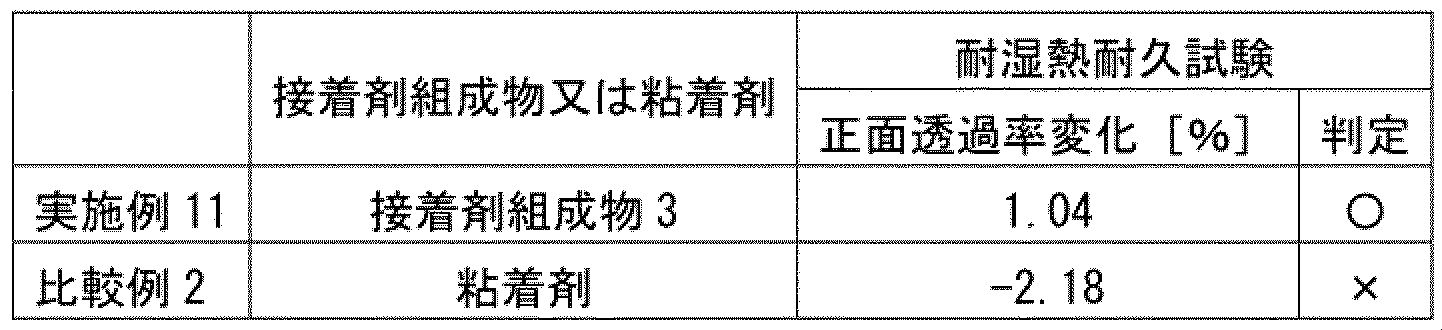
Claims (3)
- 光学フィルムと、接着剤層と、光吸収異方性膜と、偏光子とをこの順に含む光学積層体であって、
前記光吸収異方性膜は、二色性色素と重合性液晶化合物とが前記光学積層体の積層方向に配向した状態で硬化した硬化物層である、光学積層体。 - 前記光吸収異方性膜が、前記二色性色素と、前記重合性液晶化合物と、イソシアネート系架橋剤とを含む重合性液晶組成物の硬化物を含む、請求項1に記載の光学積層体。
- 前記光吸収異方性膜と前記偏光子との間に、ハードコート層をさらに含み、
前記光吸収異方性膜とハードコート層とが直接接している、請求項1または2に記載の光学積層体。
Priority Applications (2)
| Application Number | Priority Date | Filing Date | Title |
|---|---|---|---|
| CN202380030000.3A CN118922752A (zh) | 2022-07-29 | 2023-07-27 | 光学层叠体 |
| KR1020247026264A KR20250043322A (ko) | 2022-07-29 | 2023-07-27 | 광학 적층체 |
Applications Claiming Priority (4)
| Application Number | Priority Date | Filing Date | Title |
|---|---|---|---|
| JP2022-121877 | 2022-07-29 | ||
| JP2022121877 | 2022-07-29 | ||
| JP2023-118297 | 2023-07-20 | ||
| JP2023118297A JP2024019046A (ja) | 2022-07-29 | 2023-07-20 | 光学積層体 |
Publications (1)
| Publication Number | Publication Date |
|---|---|
| WO2024024890A1 true WO2024024890A1 (ja) | 2024-02-01 |
Family
ID=89706609
Family Applications (1)
| Application Number | Title | Priority Date | Filing Date |
|---|---|---|---|
| PCT/JP2023/027575 Ceased WO2024024890A1 (ja) | 2022-07-29 | 2023-07-27 | 光学積層体 |
Country Status (3)
| Country | Link |
|---|---|
| KR (1) | KR20250043322A (ja) |
| TW (1) | TW202421420A (ja) |
| WO (1) | WO2024024890A1 (ja) |
Cited By (1)
| Publication number | Priority date | Publication date | Assignee | Title |
|---|---|---|---|---|
| WO2024195693A1 (ja) * | 2023-03-23 | 2024-09-26 | 株式会社Adeka | 組成物、接着剤、硬化物の製造方法及び硬化物 |
Citations (5)
| Publication number | Priority date | Publication date | Assignee | Title |
|---|---|---|---|---|
| JP2009145776A (ja) * | 2007-12-17 | 2009-07-02 | Nitto Denko Corp | 視角制御システムならびに画像表示装置 |
| JP2021047245A (ja) * | 2019-09-17 | 2021-03-25 | 住友化学株式会社 | 積層体およびこれを含む楕円偏光板 |
| JP2021157170A (ja) * | 2020-03-25 | 2021-10-07 | 住友化学株式会社 | 偏光膜形成用組成物および偏光膜 |
| JP2022044293A (ja) * | 2020-09-07 | 2022-03-17 | 住友化学株式会社 | 光学積層体およびこれを含む楕円偏光板 |
| JP2022109653A (ja) * | 2021-01-15 | 2022-07-28 | 住友化学株式会社 | 光吸収異方性板 |
Family Cites Families (1)
| Publication number | Priority date | Publication date | Assignee | Title |
|---|---|---|---|---|
| JP7311958B2 (ja) | 2018-11-09 | 2023-07-20 | 住友化学株式会社 | 垂直配向液晶硬化膜およびそれを含む積層体 |
-
2023
- 2023-07-27 WO PCT/JP2023/027575 patent/WO2024024890A1/ja not_active Ceased
- 2023-07-27 KR KR1020247026264A patent/KR20250043322A/ko active Pending
- 2023-07-27 TW TW112128182A patent/TW202421420A/zh unknown
Patent Citations (5)
| Publication number | Priority date | Publication date | Assignee | Title |
|---|---|---|---|---|
| JP2009145776A (ja) * | 2007-12-17 | 2009-07-02 | Nitto Denko Corp | 視角制御システムならびに画像表示装置 |
| JP2021047245A (ja) * | 2019-09-17 | 2021-03-25 | 住友化学株式会社 | 積層体およびこれを含む楕円偏光板 |
| JP2021157170A (ja) * | 2020-03-25 | 2021-10-07 | 住友化学株式会社 | 偏光膜形成用組成物および偏光膜 |
| JP2022044293A (ja) * | 2020-09-07 | 2022-03-17 | 住友化学株式会社 | 光学積層体およびこれを含む楕円偏光板 |
| JP2022109653A (ja) * | 2021-01-15 | 2022-07-28 | 住友化学株式会社 | 光吸収異方性板 |
Cited By (1)
| Publication number | Priority date | Publication date | Assignee | Title |
|---|---|---|---|---|
| WO2024195693A1 (ja) * | 2023-03-23 | 2024-09-26 | 株式会社Adeka | 組成物、接着剤、硬化物の製造方法及び硬化物 |
Also Published As
| Publication number | Publication date |
|---|---|
| KR20250043322A (ko) | 2025-03-28 |
| TW202421420A (zh) | 2024-06-01 |
Similar Documents
| Publication | Publication Date | Title |
|---|---|---|
| KR102860164B1 (ko) | 타원 편광판 | |
| JP5267919B2 (ja) | 偏光板、光学部材および液晶表示装置 | |
| TWI732772B (zh) | 積層體、含有該積層體之圓偏光板,及具備該積層體之顯示裝置 | |
| JP2018159911A (ja) | 偏光板及び画像表示装置 | |
| JP2013160775A (ja) | 偏光板及び光学部材 | |
| JP2024019045A (ja) | 光学積層体 | |
| KR20160063258A (ko) | 광학 필름 | |
| JP2022109928A (ja) | 光吸収異方性板 | |
| JP5985145B2 (ja) | 光学積層体とその製造方法 | |
| KR20260070387A (ko) | 광학 적층체, 접합층 부착 광학 적층체, 및 그의 제조 방법 | |
| JP2022120975A (ja) | 偏光板 | |
| JP2024019046A (ja) | 光学積層体 | |
| WO2020039799A1 (ja) | 水平配向液晶硬化膜を含む積層体 | |
| WO2024024889A1 (ja) | 光学積層体 | |
| KR20250043322A (ko) | 광학 적층체 | |
| KR20190035847A (ko) | 적층 필름 | |
| JP2016206684A (ja) | 偏光板及び光学部材 | |
| JP2023152763A (ja) | 光学積層体 | |
| KR102603487B1 (ko) | 광학 필름 | |
| CN118922752A (zh) | 光学层叠体 | |
| JP7610988B2 (ja) | 光学積層体 | |
| JP7833895B2 (ja) | 偏光板及び画像表示装置 | |
| JP5971039B2 (ja) | 基材および光学フィルム | |
| JP2026005756A (ja) | 光学異方性積層体およびこれを含む円偏光板 | |
| JP2026008788A (ja) | 光学異方性積層体およびこれを含む円偏光板 |
Legal Events
| Date | Code | Title | Description |
|---|---|---|---|
| 121 | Ep: the epo has been informed by wipo that ep was designated in this application |
Ref document number: 23846620 Country of ref document: EP Kind code of ref document: A1 |
|
| WWE | Wipo information: entry into national phase |
Ref document number: 202380030000.3 Country of ref document: CN |
|
| NENP | Non-entry into the national phase |
Ref country code: DE |
|
| WWP | Wipo information: published in national office |
Ref document number: 1020247026264 Country of ref document: KR |
|
| 122 | Ep: pct application non-entry in european phase |
Ref document number: 23846620 Country of ref document: EP Kind code of ref document: A1 |