WO2024024489A1 - 望ましくない植物を防除し、かつ有用植物の成長を促進する方法 - Google Patents
望ましくない植物を防除し、かつ有用植物の成長を促進する方法 Download PDFInfo
- Publication number
- WO2024024489A1 WO2024024489A1 PCT/JP2023/025527 JP2023025527W WO2024024489A1 WO 2024024489 A1 WO2024024489 A1 WO 2024024489A1 JP 2023025527 W JP2023025527 W JP 2023025527W WO 2024024489 A1 WO2024024489 A1 WO 2024024489A1
- Authority
- WO
- WIPO (PCT)
- Prior art keywords
- plants
- thiafenacil
- manufactured
- metolachlor
- active ingredient
- Prior art date
- Legal status (The legal status is an assumption and is not a legal conclusion. Google has not performed a legal analysis and makes no representation as to the accuracy of the status listed.)
- Ceased
Links
Classifications
-
- A—HUMAN NECESSITIES
- A01—AGRICULTURE; FORESTRY; ANIMAL HUSBANDRY; HUNTING; TRAPPING; FISHING
- A01G—HORTICULTURE; CULTIVATION OF VEGETABLES, FLOWERS, RICE, FRUIT, VINES, HOPS OR SEAWEED; FORESTRY; WATERING
- A01G7/00—Botany in general
- A01G7/06—Treatment of growing trees or plants, e.g. for preventing decay of wood, for tingeing flowers or wood, for prolonging the life of plants
-
- A—HUMAN NECESSITIES
- A01—AGRICULTURE; FORESTRY; ANIMAL HUSBANDRY; HUNTING; TRAPPING; FISHING
- A01P—BIOCIDAL, PEST REPELLANT, PEST ATTRACTANT OR PLANT GROWTH REGULATORY ACTIVITY OF CHEMICAL COMPOUNDS OR PREPARATIONS
- A01P21/00—Plant growth regulators
-
- A—HUMAN NECESSITIES
- A01—AGRICULTURE; FORESTRY; ANIMAL HUSBANDRY; HUNTING; TRAPPING; FISHING
- A01N—PRESERVATION OF BODIES OF HUMANS OR ANIMALS OR PLANTS OR PARTS THEREOF; BIOCIDES, e.g. AS DISINFECTANTS, AS PESTICIDES OR AS HERBICIDES; PEST REPELLANTS OR ATTRACTANTS; PLANT GROWTH REGULATORS
- A01N37/00—Biocides, pest repellants or attractants, or plant growth regulators containing organic compounds containing a carbon atom having three bonds to hetero atoms with at the most two bonds to halogen, e.g. carboxylic acids
- A01N37/18—Biocides, pest repellants or attractants, or plant growth regulators containing organic compounds containing a carbon atom having three bonds to hetero atoms with at the most two bonds to halogen, e.g. carboxylic acids containing the group —CO—N<, e.g. carboxylic acid amides or imides; Thio analogues thereof
- A01N37/20—Biocides, pest repellants or attractants, or plant growth regulators containing organic compounds containing a carbon atom having three bonds to hetero atoms with at the most two bonds to halogen, e.g. carboxylic acids containing the group —CO—N<, e.g. carboxylic acid amides or imides; Thio analogues thereof containing the group, wherein Cn means a carbon skeleton not containing a ring; Thio analogues thereof
-
- A—HUMAN NECESSITIES
- A01—AGRICULTURE; FORESTRY; ANIMAL HUSBANDRY; HUNTING; TRAPPING; FISHING
- A01N—PRESERVATION OF BODIES OF HUMANS OR ANIMALS OR PLANTS OR PARTS THEREOF; BIOCIDES, e.g. AS DISINFECTANTS, AS PESTICIDES OR AS HERBICIDES; PEST REPELLANTS OR ATTRACTANTS; PLANT GROWTH REGULATORS
- A01N37/00—Biocides, pest repellants or attractants, or plant growth regulators containing organic compounds containing a carbon atom having three bonds to hetero atoms with at the most two bonds to halogen, e.g. carboxylic acids
- A01N37/18—Biocides, pest repellants or attractants, or plant growth regulators containing organic compounds containing a carbon atom having three bonds to hetero atoms with at the most two bonds to halogen, e.g. carboxylic acids containing the group —CO—N<, e.g. carboxylic acid amides or imides; Thio analogues thereof
- A01N37/22—Biocides, pest repellants or attractants, or plant growth regulators containing organic compounds containing a carbon atom having three bonds to hetero atoms with at the most two bonds to halogen, e.g. carboxylic acids containing the group —CO—N<, e.g. carboxylic acid amides or imides; Thio analogues thereof the nitrogen atom being directly attached to an aromatic ring system, e.g. anilides
-
- A—HUMAN NECESSITIES
- A01—AGRICULTURE; FORESTRY; ANIMAL HUSBANDRY; HUNTING; TRAPPING; FISHING
- A01N—PRESERVATION OF BODIES OF HUMANS OR ANIMALS OR PLANTS OR PARTS THEREOF; BIOCIDES, e.g. AS DISINFECTANTS, AS PESTICIDES OR AS HERBICIDES; PEST REPELLANTS OR ATTRACTANTS; PLANT GROWTH REGULATORS
- A01N43/00—Biocides, pest repellants or attractants, or plant growth regulators containing heterocyclic compounds
- A01N43/02—Biocides, pest repellants or attractants, or plant growth regulators containing heterocyclic compounds having rings with one or more oxygen or sulfur atoms as the only ring hetero atoms
- A01N43/04—Biocides, pest repellants or attractants, or plant growth regulators containing heterocyclic compounds having rings with one or more oxygen or sulfur atoms as the only ring hetero atoms with one hetero atom
- A01N43/06—Biocides, pest repellants or attractants, or plant growth regulators containing heterocyclic compounds having rings with one or more oxygen or sulfur atoms as the only ring hetero atoms with one hetero atom five-membered rings
- A01N43/10—Biocides, pest repellants or attractants, or plant growth regulators containing heterocyclic compounds having rings with one or more oxygen or sulfur atoms as the only ring hetero atoms with one hetero atom five-membered rings with sulfur as the ring hetero atom
-
- A—HUMAN NECESSITIES
- A01—AGRICULTURE; FORESTRY; ANIMAL HUSBANDRY; HUNTING; TRAPPING; FISHING
- A01N—PRESERVATION OF BODIES OF HUMANS OR ANIMALS OR PLANTS OR PARTS THEREOF; BIOCIDES, e.g. AS DISINFECTANTS, AS PESTICIDES OR AS HERBICIDES; PEST REPELLANTS OR ATTRACTANTS; PLANT GROWTH REGULATORS
- A01N43/00—Biocides, pest repellants or attractants, or plant growth regulators containing heterocyclic compounds
- A01N43/64—Biocides, pest repellants or attractants, or plant growth regulators containing heterocyclic compounds having rings with three nitrogen atoms as the only ring hetero atoms
- A01N43/707—1,2,3- or 1,2,4-triazines; Hydrogenated 1,2,3- or 1,2,4-triazines
-
- A—HUMAN NECESSITIES
- A01—AGRICULTURE; FORESTRY; ANIMAL HUSBANDRY; HUNTING; TRAPPING; FISHING
- A01N—PRESERVATION OF BODIES OF HUMANS OR ANIMALS OR PLANTS OR PARTS THEREOF; BIOCIDES, e.g. AS DISINFECTANTS, AS PESTICIDES OR AS HERBICIDES; PEST REPELLANTS OR ATTRACTANTS; PLANT GROWTH REGULATORS
- A01N43/00—Biocides, pest repellants or attractants, or plant growth regulators containing heterocyclic compounds
- A01N43/72—Biocides, pest repellants or attractants, or plant growth regulators containing heterocyclic compounds having rings with nitrogen atoms and oxygen or sulfur atoms as ring hetero atoms
- A01N43/80—Biocides, pest repellants or attractants, or plant growth regulators containing heterocyclic compounds having rings with nitrogen atoms and oxygen or sulfur atoms as ring hetero atoms five-membered rings with one nitrogen atom and either one oxygen atom or one sulfur atom in positions 1,2
-
- A—HUMAN NECESSITIES
- A01—AGRICULTURE; FORESTRY; ANIMAL HUSBANDRY; HUNTING; TRAPPING; FISHING
- A01N—PRESERVATION OF BODIES OF HUMANS OR ANIMALS OR PLANTS OR PARTS THEREOF; BIOCIDES, e.g. AS DISINFECTANTS, AS PESTICIDES OR AS HERBICIDES; PEST REPELLANTS OR ATTRACTANTS; PLANT GROWTH REGULATORS
- A01N47/00—Biocides, pest repellants or attractants, or plant growth regulators containing organic compounds containing a carbon atom not being member of a ring and having no bond to a carbon or hydrogen atom, e.g. derivatives of carbonic acid
- A01N47/08—Biocides, pest repellants or attractants, or plant growth regulators containing organic compounds containing a carbon atom not being member of a ring and having no bond to a carbon or hydrogen atom, e.g. derivatives of carbonic acid the carbon atom having one or more single bonds to nitrogen atoms
- A01N47/10—Carbamic acid derivatives, i.e. containing the group —O—CO—N<; Thio analogues thereof
- A01N47/12—Carbamic acid derivatives, i.e. containing the group —O—CO—N<; Thio analogues thereof containing a —O—CO—N< group, or a thio analogue thereof, neither directly attached to a ring nor the nitrogen atom being a member of a heterocyclic ring
-
- A—HUMAN NECESSITIES
- A01—AGRICULTURE; FORESTRY; ANIMAL HUSBANDRY; HUNTING; TRAPPING; FISHING
- A01P—BIOCIDAL, PEST REPELLANT, PEST ATTRACTANT OR PLANT GROWTH REGULATORY ACTIVITY OF CHEMICAL COMPOUNDS OR PREPARATIONS
- A01P13/00—Herbicides; Algicides
-
- A—HUMAN NECESSITIES
- A01—AGRICULTURE; FORESTRY; ANIMAL HUSBANDRY; HUNTING; TRAPPING; FISHING
- A01N—PRESERVATION OF BODIES OF HUMANS OR ANIMALS OR PLANTS OR PARTS THEREOF; BIOCIDES, e.g. AS DISINFECTANTS, AS PESTICIDES OR AS HERBICIDES; PEST REPELLANTS OR ATTRACTANTS; PLANT GROWTH REGULATORS
- A01N43/00—Biocides, pest repellants or attractants, or plant growth regulators containing heterocyclic compounds
- A01N43/48—Biocides, pest repellants or attractants, or plant growth regulators containing heterocyclic compounds having rings with two nitrogen atoms as the only ring hetero atoms
- A01N43/54—1,3-Diazines; Hydrogenated 1,3-diazines
-
- A—HUMAN NECESSITIES
- A01—AGRICULTURE; FORESTRY; ANIMAL HUSBANDRY; HUNTING; TRAPPING; FISHING
- A01P—BIOCIDAL, PEST REPELLANT, PEST ATTRACTANT OR PLANT GROWTH REGULATORY ACTIVITY OF CHEMICAL COMPOUNDS OR PREPARATIONS
- A01P13/00—Herbicides; Algicides
- A01P13/02—Herbicides; Algicides selective
Definitions
- the present invention provides an effective amount of tiafenacil (a1) and an effective amount of at least one herbicide compound (a2) selected from the following compound group A, so that undesirable plants and undesirable plants grow.
- the present invention relates to a method for controlling undesirable plants and promoting the growth of useful plants by applying the present invention to a place or a place where useful plants are cultivated.
- Patent Document 1 discloses a herbicidal composition containing a uracil compound represented by a specific chemical formula and other herbicidally active compounds as active ingredients.
- Non-Patent Document 1 discloses the herbicidal effect of a mixture of thiafenacil and metribuzin on glyphosate-resistant Horseweed.
- Patent Document 2 discloses an agrochemical composition in Table 1-17 that contains flumioxazin and thiafenacil and has a weight ratio of flumioxazin to thiafenacil of thiafenacil/flumioxazin of 1/1,000 or less. has been done.
- Patent Document 3 describes a turf growth promoter containing a PPO-inhibiting compound, a VLCFA synthesis-inhibiting compound, or a combination thereof, and a method for promoting turf growth.
- Patent Document 3 does not describe thiafenacil.
- Non-Patent Document 2 and Non-Patent Document 3 confirm that thiafenacil is used alone and that thiafenacil inhibits the growth of useful plants such as legumes or peppermint or affects plant height, but in both documents, thiafenacil and other There is no description of the effect of promoting the growth of useful plants when mixed with herbicide compounds.
- the present invention provides an effective amount of thiafenacil (a1) and an effective amount of at least one herbicide compound (a2) selected from the following compound group A to undesirable plants, places where undesirable plants grow, or Provided is a method (hereinafter also referred to as the method of the present invention) that is applied to a place where useful plants are cultivated to control undesirable plants and promote the growth of useful plants.
- Compound group A is a herbicide compound, S-metolachlor, metribuzin, pyroxasulfone, pethoxamide, tri-allate, and dimethenamid-P] Further, the present invention contains thiafenacil (a1) and at least one herbicide compound (a2) selected from the compound group A as active ingredients, and the mixing ratio of (a1) and (a2) is a weight ratio.
- Agrochemical compositions (hereinafter also referred to as compositions of the present invention) having a ratio of 1:0.8 to 1:1000 are provided.
- the present invention contains thiafenacil (a1) and at least one herbicide compound (a2) selected from the compound group A as active ingredients, and the mixing ratio of (a1) and (a2) is a weight ratio.
- the mixing ratio of (a1) and (a2) is a weight ratio.
- composition of the present invention exhibits excellent herbicidal effects against undesirable plants that cannot be predicted from the use of (a1) and (a2) alone, and also promotes the growth of useful plants. have an effect.
- application amount of thiafenacil (a1) and/or at least one herbicide compound (a2) selected from compound group A below can be reduced, which is useful in practical situations.
- an effective amount of thiafenacil (a1) and an effective amount of at least one herbicide compound (a2) selected from compound group A below are administered to undesirable plants, places where undesirable plants grow, or By applying it to areas where useful plants are grown, undesirable plants can be controlled. Moreover, undesirable plants can be controlled by applying an effective amount of the composition of the present invention to undesirable plants, locations where undesirable plants grow, or locations where useful plants are cultivated.
- an effective amount of thiafenacil (a1) and an effective amount of at least one herbicide compound (a2) selected from compound group A below are administered to undesirable plants, places where undesirable plants grow, or By applying it to a place where useful plants are grown, the growth of useful plants can be promoted. Furthermore, the growth of useful plants can be promoted by applying an effective amount of the composition of the present invention to undesirable plants, locations where undesirable plants grow, or locations where useful plants are cultivated.
- thiafenacil (a1), the herbicide compound (a2), or the composition of the present invention may be used before cultivating the useful plants, for example, before sowing seeds of the useful plants or when growing the useful plants.
- An effective amount of each can be applied to undesirable plants, to areas where undesirable plants grow, or to areas where useful plants are to be grown, prior to planting of seedlings. After the application, the growth of useful plants that have started cultivation is promoted by sowing seeds or planting seedlings.
- composition of the present invention contains thiafenacil (a1) and at least one herbicide compound (a2) selected from compound group A below as active ingredients.
- Compound group A is a herbicide compound (a2), S-metolachlor, metribuzin, pyroxasulfone, pethoxamide, tri-allate, and dimethenamide.
- This is a group consisting of P (dimethenamid-P).
- S-metolachlor, metribuzin, pyroxasulfone, or trialate is preferred, S-metolachlor or metribuzin is more preferred, or S-metolachlor, pyroxasulfone, or trialate is more preferred. Even more preferred are S-metolachlor or pyroxasulfone, or even more preferred are S-metolachlor or trialate, and particularly preferred is S-metolachlor.
- Thiafenacil (a1) and the herbicide compound (a2) may exist in the form of salts, alkyl esters, hydrates, different crystal forms, various structural isomers, etc. In such cases, the scope of the present invention naturally covers these as well. include.
- the mixing ratio of thiafenacil (a1) and herbicide compound (a2) in the present invention may vary depending on various conditions such as the formulation form of the active ingredient to be mixed, weather conditions, and the type and growth condition of undesirable plants to be controlled.
- the weight ratio of (a1):(a2) is usually 1:0.8 to 1:1000, preferably 1:1.2 to 1:200.
- the weight ratio of (a1):(a2) is more preferably 1:1.2 to 1:180, still more preferably 1:1.2 to 1. :150, particularly preferably 1:1.2 to 1:120.
- the weight ratio of (a1):(a2) is more preferably 1:1.2 to 1:190, still more preferably 1:1.2 to 1:180, Even more preferably 1:1.2 to 1:160, particularly preferably 1:1.5 to 1:176, even more particularly preferably 1:1.5 to 1:130, even more particularly preferably 1:1.5 ⁇ 1:88.
- the weight ratio of (a1):(a2) is more preferably 1:1.2 to 1:160, still more preferably 1:1.2 to 1: 120, even more preferably 1:1.2 to 1:80, particularly preferably 1:1.2 to 1:70, even more particularly preferably 1:1.2 to 1:60, even more particularly preferably 1: 1.2 to 1:40.
- the weight ratio of (a1):(a2) is more preferably 1:7 to 1:200, still more preferably 1:8 to 1:200, particularly preferably The time is from 1:12 to 1:200.
- the weight ratio of (a1):(a2) is more preferably 1:8 to 1:200, still more preferably 1:12 to 1:160, particularly preferably 1 :15 to 1:120.
- the weight ratio of (a1):(a2) is more preferably 1:6 to 1:200, still more preferably 1:8 to 1:160, particularly preferably The ratio is 1:9.6 to 1:120.
- the appropriate application amounts of thiafenacil (a1) and herbicide compound (a2) in the present invention may vary depending on various conditions such as the formulation form of the active ingredient to be mixed, weather conditions, and the type and growth status of undesirable plants to be controlled.
- the appropriate amount of (a1) to be applied per hectare is usually 0.01 to 400 g, preferably 0.05 to 300 g, more preferably 0.1 to 200 g, even more preferably 0.5 to 400 g. 100 g, particularly preferably 1 to 100 g, and the appropriate amount of (a2) to be applied is usually 0.1 to 5000 g, preferably 1 to 4000 g.
- the appropriate amount to be applied is more preferably 10 to 3000 g, even more preferably 25 to 2000 g, particularly preferably 250 to 1500 g per hectare.
- the appropriate amount to be applied is more preferably 10 to 3000 g, even more preferably 25 to 2000 g, particularly preferably 50 to 1500 g per hectare.
- the herbicide compound (a2) is pyroxasulfone, the appropriate amount to be applied is more preferably 10 to 1000 g, even more preferably 25 to 500 g, particularly preferably 50 to 300 g per hectare.
- the appropriate amount to be applied is more preferably 10 to 3700 g, even more preferably 25 to 3300 g, particularly preferably 500 to 3000 g per hectare.
- the appropriate amount to be applied is more preferably 10 to 3000 g, even more preferably 25 to 3000 g, particularly preferably 500 to 2000 g per hectare.
- the herbicide compound (a2) is dimethenamide P, the appropriate amount to be applied is more preferably 10 to 3000 g, even more preferably 25 to 3000 g, particularly preferably 300 to 2000 g per hectare.
- the composition of the present invention is applied to undesirable plants, places where undesirable plants grow, or places where useful plants are grown, and exhibits an excellent control effect on undesirable plants and promotes the growth of useful plants.
- the locations include, for example, non-agricultural land such as parking lots, cemeteries, residential lots, embankments, gardens, parks, forests, roads, farm roads, grounds, and factory sites, and agricultural land such as fields, orchards, mulberry gardens, and lawns. and a wide variety of things. Among these, it is desirable to apply it to agricultural land or places where useful plants will be cultivated in the future.
- the cultivation means a series of actions starting from sowing seeds of useful plants, planting seeds, or planting vegetative propagation organs of useful plants.
- the said seed means a seed, a seedling, etc.
- the method of applying the composition of the present invention can be appropriately selected from soil treatment, foliage treatment, flooding treatment, etc.
- the timing of application of the composition of the present invention can be appropriately selected from the range from after harvesting of useful plants to before next sowing, from after sowing of useful plants to before emergence.
- the appropriate application amount of (a1) is preferably 0.01 to 400 g, more preferably 0.05 to 300 g per hectare, and the appropriate application amount of (a2) is: The amount is preferably 0.1 to 5000 g per hectare, more preferably 1 to 4000 g.
- the appropriate amount of (a1) to be applied is preferably 0.01 to 400 g, more preferably 0.05 to 300 g per hectare, and the appropriate amount of (a2) to be applied is: The amount is preferably 0.1 to 5000 g per hectare, more preferably 1 to 4000 g.
- the appropriate amount of (a1) to be applied is preferably 0.01 to 400 g, more preferably 0.05 to 300 g per hectare, and the appropriate amount of (a2) to be applied is , preferably 0.1 to 5000 g, more preferably 1 to 4000 g per hectare.
- the above-mentioned soil treatment refers to a method of applying the composition of the present invention to soil before useful or undesirable plants emerge. By treating soil with the composition of the present invention, a treated layer is formed on the soil surface, and the effects of the composition of the present invention are exerted on each plant.
- the above-mentioned foliage treatment refers to a method in which the composition of the present invention is applied to the foliage of various plants after useful or undesirable plants have sprouted. By treating the composition of the present invention with foliage, the drug is absorbed or brought into contact with the foliage, and the effect of the composition of the present invention is exerted on each plant.
- the term "flooding treatment” refers to a method in which the composition of the present invention is applied to paddy fields in which useful plants are cultivated or undesirable plants are flooded. By submerging the composition of the present invention in water, the effects of the composition of the present invention can be exerted on each plant.
- the composition of the present invention is generally diluted with water or the like to a predetermined concentration, and sprayed using a sprayer onto undesirable plants, locations where undesirable plants grow, or locations where useful plants are cultivated. It is also possible to use flying devices such as unmanned helicopters and drones, power spreaders, or boom sprayers.
- the amount of the composition of the present invention to be used in each of the above treatments can be determined by the mixing ratio or each application amount of the above-mentioned thiafenacil (a1) and herbicide compound (a2).
- the above-mentioned “promoting the growth of useful plants (hereinafter also referred to as “growth promotion”)” of the present invention refers to an increase in plant weight, an increase in leaf area, an increase in the number of healthy leaves, and plant height. , an increase in root growth or root density, an increase in the number or weight of seeds or fruits, an increase in the number of flowers or fruits set.
- growth promotion refers to an increase in plant weight, an increase in leaf area, an increase in the number of healthy leaves, and plant height.
- an increase in root growth or root density an increase in the number or weight of seeds or fruits, an increase in the number of flowers or fruits set.
- the compositions of the invention are particularly suitable for increasing plant weight and/or seed weight.
- Plant weight Plant weight refers to the above-ground parts of each useful plant that are cut off and weighed to determine the fresh weight, or the cut samples are dried and then weighed to determine the dry weight. demand.
- Leaf area Leaf area is determined by collecting the leaves of each useful plant and using a leaf area meter to determine the total area of the leaves.
- Number of healthy leaves The number of healthy leaves is determined by measuring the number of healthy leaves of each useful plant.
- Plant height Plant height is determined by standing the above-ground part of each useful plant upright and measuring the height from the highest point to the ground surface.
- Root growth or root density is determined by digging up the roots of each useful plant and measuring their weight to determine the fresh weight, or by drying the dug sample and then measuring its weight. to find the dry weight.
- Number or weight of seeds or fruits The number or weight of seeds or fruits is determined by collecting seeds or fruits of each useful plant and measuring their number, or by measuring their weight, and determining the total weight or average value. seek.
- Number of flowers or fruits The number of flowers or fruits is determined by measuring the number of flowers or fruits of each useful plant.
- the composition of the present invention includes, for example, Barnyardgrass (Echinochloa crus-galli, Echinochloa oryzicola), southern crabgrass (Digitaria ciliaris, Digitaria adscendens), large carbgrass (Digitaria sanguinalis), smooth crabgrass (Digitaria ischaemum), (East Indian crabgrass (Digitaria microbachne)), Jamaican crabgrass (Digitaria horizontalis), green foxtail (Setaria viridis), giant foxtail (Setaria faberi), yellow foxtail (Setaria lutescens), goosegrass (Eleusine indica), wild oat (Avena fatua), johnsongrass (Sorghum halepense), quackgrass (Agropyron repens), hairy signalgrass (Urochloa villosa), (alexandergrass) (Brachiaria plantaginea)), guineagrass(Panicum maximum), paragrass (Panicum purpurascens),
- rice flatsedge (Cyperus iria), purple nutsedge (Cyperus rotundus), yellow nutsedge (Cyperus esculentus), tidal-marsh flatsedge (Cyperus serotinus), smallflower umbrella sedge ( Cyperus difformis), needle spikerush (Eleocharis acicularis), water chestnut (Eleocharis kuroguwai), green kyllinga (Kyllinga brevifolia var.
- Alismataceae such as Japanese ribbon waparo (Sagittaria pygmaea), arrow-head (Sagittaria trifolia), and channelled waterplantain (Alisma canaliculatum); Pontederiaceae such as heartshape false pickerelweed (Monochoria vaginalis) and korsakow monochoria (Monochoria korsakowii); Lythraceae such as Indian toothcup (Rotala indica) and jerry-jerry (Ammannia multiflora); Elatinaceae, such as long stem water-wort (Elatine triandra); velvetleaf (Abutilon theophrasti), prickly sida (Sida spinosa), volunteer cotton (Gossypium hirsutum), common mallow (Malva neglecta), little mallow (Malva parviflora) )), Malvaceae such as venice mallow (Hibiscus trionum);
- centrorubrum narrow- Amaranthaceae such as leaf goosefoot (Chenopodium pratericola), procumbent pigweed (Amaranthus blitoides), Russian thistle (Salsola sp.), waterhemp (Amaranthus tuberculatus);
- pyrenaicus thunberg knotweed (Persicaria thunbergii), nepalese smartweed ( Polygonaceae such as Persicaria nepalensis), Japanese dock (Rumex japonicus), and Pennsylvania smartweed (Persicaria pensylvanica); Flexible bittercress (Cardamine flexuosa), shepherd's-purse (Capsella bursa-pastoris), Indian mustard (Brassica juncea), variableleaf yellowcress (Rorippa indica), marsh yellowcress (Rorippa palustris), volunteer canola (Brassica spp.), smallseed falseflax (Camelina microcarpa), flixweed (Descurainia sophia), black mustard (Brassica nigra), tumble mustard (Sisymbrium Cruciferous weeds such as field pennycress (Thlaspi arvense), London rocket (Sisymbrium irio),
- tall morningglory Ipomoea purpurea
- field bindweed Calystegia arvensis
- ivyleaf morningglory Ipomoea hederacea
- entireleaf morningglory Ipomoea hederacea var.
- Convolvulaceae such as palmleaf morningglory (Ipomoea wrightii) and pitted morningglory (Ipomoea lacunosa); Portulacaceae, such as common purslane (Portulaca oleracea); sicklepod (Cassia obtusifolia), red clover (Trifolium pratense), narrowleaf vetch (Vicia sativa subsp. nigra var.
- Lamiaceae such as henbit (Lamium amplexicaule) and purple deadnettle (Lamium purpureum); Rubiaceae (Rubiaceae) such as catchweed (Galium spurium), catchweed bedstraw (Galium aparine), and Florida pusley (Richardia scabra); Euphorbiaceae such as threeseeded copperleaf (Acalypha australis), spotted spurge (Euphorbia maculata), Texas weed (Caperonia palustris), and Virginia copperleaf (Acalypha virginica) ; Commelinaceae, such as Asiatic dayflower (Commelina communis);
- Linderniaceae such as common false pimpernel (Lindernia procumbens), false pimpernel (Lindernia dubia subsp. major), false pimpernel (Lindernia dubia subsp. dubia), and Lindernia micrantha.
- Plantago family members such as dopatrium (Dopatrium junceum), Asian plantain (Plantago asiatica), persian speedwell (Veronica persica), corn speedwell (Veronica arvensis) Weeds (Plantaginaceae); Molluginaceae, such as Carpetweed (Mollugo verticillata); Onagraceae such as cutleaf eveningprimrose (Oenothera laciniata) and American willowherb (Epilobium ciliatum); Geraniaceae such as redstem filaree (Erodium cicutarium); Umbelliferous weeds (Apiaceae) such as poison-hemlock (Conium maculatum); Urticaceae such as burning nettle (Urtica urens); Control or inhibit the growth of various undesirable plants such as puncturevine (Tribulus terrestris); Can be used to suppress.
- Dopatrium junceum Asian plantain (Plantago asiatica), persian speedwell (Veronica per
- the composition of the present invention comprises: Barnyardgrass (Echinochloa crus-galli, Echinochloa oryzicola), southern crabgrass (Digitaria ciliaris, Digitaria adscendens), large carbgrass (Digitaria sanguinalis), smooth crabgrass (Digitaria ischaemum), (East Indian crabgrass (Digitaria microbachne)), Jamaican crabgrass (Digitaria horizontalis), giant foxtail (Setaria faberi), goosegrass (Eleusine indica), wild oat (Avena fatua), Azegaya (Chinese sprangletop (Leptochloa chinensis)), annual bluegrass (Poa annua), shortawn foxtail (Alopecurus aequalis), blackgrass (Alopecurus myosuroides), bathroom ryegrass (Lolium multiflorum), Poaceae such as (violet crabgrass (Digitaria violascens)
- Cyperaceae weeds such as purple nutsedge (Cyperus rotundus), yellow nutsedge (Cyperus esculentus), and green kyllinga (Kyllinga brevifolia var. leiolepis); Malvaceae such as velvetleaf (Abutilon theophrasti); Common ragweed (Ambrosia artemisiifolia), hairy galinsoga (Galinsoga ciliata), tall fleabane (Conyza sumatrensis), philadelphia fleabane (Erigeron philadelphicus), dandelion (Taraxacum officinale) Asteraceae weeds (Asteraceae); Solanaceae weeds (Solanaceae) such as black nightshade (Solanum nigrum); redroot pigweed (Amaranthus retroflexus), powell's amaranth (Amaranthus powellii), livid amaranth (Amarant
- Polygonum weeds such as pale smartweed (Polygonum lapathifolium), pale smartweed (Persicaria lapathifolia var. lapathifolia), Oriental lady's thumb (Persicaria longiseta), and nepalese smartweed (Persicaria nepalensis) Polygonaceae); Brassicaceae such as flexuous bittercress (Cardamine flexuosa), shepherd's-purse (Capsella bursa-pastoris), and marsh yellowcress (Rorippa palustris); Weeds of the Convolvulaceae family, such as tall morningglory (Ipomoea purpurea), ivyleaf morningglory (Ipomoea hederacea), field bindweed (Convolvulus arvensis), and pitted morningglory (Ipomoea lacunosa) Convolvulaceae); Portulacaceae such as common purslane (Portulaca
- Caryophyllaceae such as common chickweed (Stellaria media) and sticky chickweed (Cerastium glomeratum); Lamiaceae, such as henbit (Lamium amplexicaule); Rubiaceae (Rubiaceae) such as catchweed (Galium spurium); Control or growth of undesirable plants such as Asiatic dayflower (Commelina communis); and Plantaginaceae such as persian speedwell (Veronica persica). It can be suitably used to suppress.
- Lamiaceae such as henbit (Lamium amplexicaule); Rubiaceae (Rubiaceae) such as catchweed (Galium spurium); Control or growth of undesirable plants such as Asiatic dayflower (Commelina communis); and Plantaginaceae such as persian speedwell (Veronica persica). It can be suitably used to suppress.
- composition of the present invention can be applied to Poaceae, Cyperaceae, Malvaceae, Asteraceae, Solanaceae, Amaranthaceae, Polygonum. Polygonaceae, Brassicaceae, Convolvulaceae, Fabaceae, Caryophyllaceae, Lamiaceae, Rubiaceae, Rubiaceae It is useful for controlling or suppressing the growth of undesirable plants such as weeds (Commelinaceae) and Plantaginaceae (Plantaginaceae).
- composition of the present invention is further useful for controlling or suppressing the growth of undesirable plants such as Poaceae, Asteraceae, and Amaranthaceae.
- the compositions of the present invention are useful for controlling undesirable plants such as Italian ryegrass (Lolium multiflorum), goosegrass (Eleusine indica), waterhemp (Amaranthus tuberculatus), and horseweed (Conyza canadensis). It is particularly useful for controlling pests or suppressing their growth.
- composition of the present invention can be applied to, for example, lawn, soybean (Glycine max), alfalfa (Medicago sativa), chickpea (Cicer arietinum), pea (Pisum sativum). , lentil (Lens culinaris), cotton (Gossypium spp.), wheat (Triticum aestivum), rice (Oryza sativa), barley (Hordeum vulgare), rye (rye) (Secale cereale)), oat (Avena sativa), corn (Zea mays), sorghum (Sorghum spp.), oilseed rape (Chinese colza (Brassica rapa var.
- the above-mentioned undesirable plants can be controlled. It is used to increase or suppress the growth of Therefore, the composition of the present invention is preferably used in a place where the above-mentioned useful plants grow or a place where the above-mentioned useful plants are cultivated.
- composition of the present invention is particularly useful in places where useful plants such as grass, soybean, cotton, wheat, rice, corn, rapeseed, rapeseed, sunflower, sugar beet, sugar cane, peanut, flax, tobacco, or coffee grow or where said useful plants grow. Used where plants are grown.
- the composition of the present invention is preferably used in places where useful plants such as grass, soybean, wheat, rice, or corn grow or where the useful plants are cultivated.
- the composition of the present invention is more preferably used in a place where useful plants such as soybean, wheat, rice, or corn grow or a place where the useful crops are cultivated.
- Useful plants include HPPD inhibitors such as isoxaflutole, ALS inhibitors such as imazethapyr and thifensulfuron-methyl, EPSP synthase inhibitors such as glyphosate, glutamine synthetase inhibitors such as glufosinate, and acetyl CoA such as settoxydim. Included are plants that have been conferred resistance to herbicides such as carboxylase inhibitors, bromoxynil, dicamba, 2,4-D, etc. by classical breeding methods. Specific examples include corn and canola varieties (trade name: Clearfield) that are resistant to imidazolinone herbicides; STS soybean that is tolerant to sulfonylurea ALS-inhibiting herbicides; and the like.
- HPPD inhibitors such as isoxaflutole
- ALS inhibitors such as imazethapyr and thifensulfuron-methyl
- EPSP synthase inhibitors such as glyphos
- Useful plants also include transformed plants produced by genetic recombination technology. Examples of transformed plants include herbicide-tolerant transformed plants, pest-resistant transformed plants, transformed plants related to plant components, and phytopathogen-resistant transformed plants. Furthermore, useful plants also include stack varieties that combine a plurality of these useful traits.
- composition of the present invention can be effectively used to selectively control or suppress the growth of undesirable plants in the cultivation of various transformed plants of the above-mentioned useful plants (e.g., soybean, cotton, rapeseed, corn, etc.). can.
- useful plants e.g., soybean, cotton, rapeseed, corn, etc.
- herbicide-resistant transformed plants include glyphosate-resistant corn, soybean, cotton, rapeseed, and sugar beet, glufosinate-resistant corn, soybean, cotton, rapeseed, and bromoxynil-resistant cotton.
- insect-resistant transformed plants include plants that are capable of synthesizing toxins and the like that are known to be synthesized by Bacillus.
- the toxins synthesized by these transformed plants confer resistance to Coleoptera, Hemiptera, Diptera, Lepidoptera, and Nematodes, among others.
- Such toxins include insecticidal proteins derived from Bacillus cereus and Bacillus popilliae; ⁇ -endotoxin such as Cry1Ab, Cry1Ac, Cry1F, Cry1Fa2, Cry2Ab, Cry3A, Cry3Bb1 or Cry9C derived from Bacillus thuringiensis; VIP1, VIP2, Insecticidal proteins such as VIP3 or VIP3A; insecticidal proteins derived from nematodes; toxins produced by animals such as scorpion toxins, spider toxins, bee toxins or insect-specific neurotoxins; filamentous fungal toxins; plant lectins; agglutinins; trypsin inhibitors , serine protease inhibitors, patatin, cystatin, papain inhibitors; ribosome-inactivating proteins (RIPs) such as ricin, maize-RIP, abrin, rufin, saporin, bryodin; 3-hydroxysteroid oxidase
- toxins include ⁇ -endotoxin proteins such as Cry1Ab, Cry1Ac, Cry1F, Cry1Fa2, Cry2Ab, Cry3A, Cry3Bb1, Cry9C, Cry34Ab or Cry35Ab, hybrid toxins of insecticidal proteins such as VIP1, VIP2, VIP3 or VIP3A, etc. It also includes toxins with missing parts and modified toxins.
- transformed plants related to plant components include plants that have been endowed with traits such as improved oil component and amino acid content enhancement.
- transformed plants resistant to phytopathogens include plants that have been endowed with the ability to produce antipathogenic substances with selective action.
- Specific transformed plants include, but are not limited to, glyphosate-resistant corn, soybean, cotton, rapeseed, and sugar beet varieties (trade names: Roundup Ready, Agrisure, Gly-Tol); Corn, soybean, cotton and rapeseed varieties resistant to glufosinate (trade name: LibertyLink); cotton varieties resistant to bromoxynil (trade name: BXN); corn, soybean varieties resistant to both glyphosate and ALS inhibitors (trade name: Product name: Optimum, GAT); Imidazolinone compound resistant variety (product name: IMI); Corn variety expressing Cry1Ab toxin (product name: YieldGard); Corn variety expressing Cry3Bb1 toxin (product name: YieldGard Rootworm) ); Corn variety expressing Cry1Ab and Cry3Bb1 toxin (product name: YieldGard Plus); Corn variety expressing Cry1Fa2 toxin and phosphinothricin N-acetyltransferase (
- the composition of the present invention has a higher effect by combining thiafenacil (a1) and herbicide compound (a2) than when they are used alone. Since this higher effect is exhibited over a long period of time, it is very useful in practical situations, for example, in situations where there is a concern that the effectiveness of the agrochemical composition may decrease due to rainfall or temperature after application.
- other herbicidal compounds may be further mixed with the composition of the present invention as required.
- the other herbicidal compound can be appropriately selected from various known herbicidal compounds, taking into consideration the situation in which the composition of the present invention is applied, the type of undesirable plant to be controlled, the growth condition, etc.
- the composition of the present invention can be mixed or used in combination with bactericides, antibiotics, plant hormones, insecticides, fertilizers, phytotoxicity reducers, etc., and in this case, it can exhibit even better effects and action.
- Examples of other herbicidal compounds include the following (common names), and one or more of these can be selected as appropriate.
- a herbicidal compound different from the herbicide compound (a2) is selected. That is, for example, when the herbicide compound (a2) is metribuzin, the other herbicidal compound to be mixed is selected to be a compound other than metribuzin.
- Hydroxybenzonitrile compounds such as pyridate, bentazone, bentazone-sodium, amicarbazone, methazole, chloridazon, etc.
- a compound that is said to exhibit herbicidal efficacy by inhibiting herbicidal activity is said to exhibit herbicidal efficacy by inhibiting herbicidal activity.
- Quaternary ammonium salt compounds such as paraquat and diquat, which themselves become free radicals in the plant body and generate active oxygen, thereby exhibiting rapid herbicidal efficacy.
- Pyridazinone compounds such as norflurazon, metflurazon; pyrazolynate, pyrazoxyfen, benzofenap, topramezone, cypyrafluone, bipyrazone , tolpyralate, and pyraquinate; others include amitrole, fluridone, flurtamone, diflufenican, methoxyphenone, and clomazone.
- MSMA, DSMA, CMA endothal, endothal-dipotassium, endothal-sodium, endothal-mono(N,N-dimethylalkylammonium) N,N-dimethylalkylammonium), etofumesate, sodium chlorate, pelargonic acid, nonanoic acid, fosamine, fosamine-ammonium, ipfen ipfencarbazone, acrolein, ammonium sulfamate, borax, chloroacetic acid, sodium chloroacetate, cyanamide, methylarsonic acid ), dimethylarsinic acid, sodium dimethylarsinate, dinoterb, dinoterb-ammonium, dinoterb-diolamine, dinoterb-acetate ), DNOC, ferrous sulfate, flupropanate, flupropanate-sodium, mefluidide, mefluidide-diolamine, metam , metam-methas
- Microorganisms that are said to exhibit herbicidal efficacy by parasitizing plants, such as Xanthomonas campestris, Exserohilum monoceras, and Drechslera monoceras.
- herbicidal compounds are not limited to the compounds exemplified above.
- composition of the present invention When applying the composition of the present invention, it is possible to arbitrarily choose between applying it to undesirable plants, and applying it to a place where these plants grow (which may be before or after the emergence of the plants) or a place where useful plants are cultivated. can. Further, thiafenacil (a1) and herbicide compound (a2) may be formulated separately and mixed and applied at the time of spraying, or both may be formulated and applied together. Examples of specific application methods include the following.
- Thiafenacil (a1) and herbicide compound (a2) are formulated together and applied as is.
- Thiafenacil (a1) and herbicide compound (a2) are prepared together into a formulation, diluted with water etc. to a predetermined concentration, and various spreading agents (surfactant, vegetable oil, mineral oil, etc.) are added as necessary. Apply.
- Thiafenacil (a1) and herbicide compound (a2) are prepared separately and each is applied as is.
- Thiafenacil (a1) and herbicide compound (a2) are prepared separately, each is diluted with water etc. to a predetermined concentration, and various spreading agents (surfactant, vegetable oil, mineral oil, etc.) are added as necessary. Add and apply. 5.
- Thiafenacil (a1) and herbicide compound (a2) are prepared separately and mixed together when diluted with water etc. to a predetermined concentration, and if necessary various spreading agents (surfactants, vegetable oil, mineral oil, etc.) ) is added and applied.
- various spreading agents surfactants, vegetable oil, mineral oil, etc.
- composition of the present invention is prepared by blending active ingredients thiafenacil (a1) and herbicide compound (a2) with various adjuvants according to the usual formulation method of agricultural chemicals, and preparing powders, granules, wettable powders, etc. Wettable powders, tablets, pills, capsules (including those packaged in water-soluble film), aqueous suspensions, oil-based suspensions, microemulsion preparations, suspoemulsion preparations, aqueous solutions, emulsions, solutions, pastes
- the preparation can be prepared and applied in various forms such as a drug, and as long as it is compatible with the purpose of the present invention, it can be made into any form commonly used in the field.
- thiafenacil (a1) and herbicide compound (a2) may be prepared together or separately.
- Auxiliary agents used in the formulation include solid carriers such as diatomaceous earth, slaked lime, calcium carbonate, talc, white carbon, kaolin, bentonite, kaolinite, sericite, clay, sodium carbonate, baking soda, Glauber's salt, zeolite, starch, and sugars; Water, toluene, xylene, solvent naphtha, dioxane, acetone, isophorone, methyl isobutyl ketone, chlorobenzene, cyclohexane, dimethyl sulfoxide, dimethyl formamide, dimethyl acetamide, N-methyl-2-pyrrolidone, alcohols (e.g. propylene glycol), etc.
- solid carriers such as diatomaceous earth, slaked lime, calcium carbonate, talc, white carbon, kaolin, bentonite, kaolinite, sericite, clay, sodium carbonate, baking soda, Glauber's salt, zeolite,
- Solvent fatty acid salt, benzoate, alkyl sulfosuccinate, dialkyl sulfosuccinate, polycarboxylate, alkyl sulfate ester salt, alkyl sulfate, alkylaryl sulfate, alkyl diglycol ether sulfate, alcohol sulfate ester salt, Alkyl sulfonate, alkylaryl sulfonate, aryl sulfonate, lignin sulfonate, alkyldiphenyl ether disulfonate, polystyrene sulfonate, alkyl phosphate ester salt, alkylaryl phosphate, styryl aryl phosphate, Polyoxyethylene alkyl ether sulfate, polyoxyethylene alkyl aryl ether sulfate, polyoxyethylene alkyl aryl ether sulfate, polyoxyethylene alkyl ether phosphat
- auxiliary agents may be used alone or in combination of two or more, as long as they do not depart from the purpose of the present invention.
- auxiliary agents such as stabilizers, safeners, antifungal agents, foaming agents, disintegrants, and binders can also be used.
- the mixing ratio of various adjuvants to each of thiafenacil (a1) and herbicide compound (a2) or a mixture thereof is about 0.1:99.9 to 99.9:0.1, preferably 0.1:99.9 to 99.9:0.1 by weight. The ratio is about 2:99.8 to 85:15.
- tiafenacil (a1) and an effective amount of at least one herbicide compound (a2) selected from compound group A below are applied to undesirable plants and locations where undesirable plants grow. , or a method for controlling undesirable plants and promoting the growth of useful plants by applying it to a place where useful plants are cultivated.
- Compound group A is a herbicide compound, S-metolachlor, metribuzin, pyroxasulfone, pethoxamide, tri-allate, and dimethenamid-P]
- the herbicide compound (a2) is S-metolachlor, pyroxasulfone, pethoxamide, tri-allate, and dimethenamide-P.
- the herbicide compound (a2) is at least one selected from S-metolachlor, metribuzin, pyroxasulfone, and tri-allate.
- the herbicide compound (a2) is at least one selected from S-metolachlor, pyroxasulfone, and tri-allate, [1] The method described in.
- [16] Contains tiafenacil (a1) and at least one herbicide compound (a2) selected from the compound group A as active ingredients, and the mixing ratio of (a1) and (a2) is in weight ratio.
- a pesticide composition having a ratio of 1:0.8 to 1:1000.
- [18] Contains tiafenacil (a1) and at least one herbicide compound (a2) selected from the compound group A as active ingredients, and the mixing ratio of (a1) and (a2) is a weight ratio.
- the herbicide compound (a2) is S-metolachlor, pyroxasulfone, pethoxamide, tri-allate, and dimethenamide-P.
- the herbicide compound (a2) is at least one selected from S-metolachlor, metribuzin, pyroxasulfone, and tri-allate.
- the herbicide compound (a2) is at least one selected from S-metolachlor, pyroxasulfone, and tri-allate, [16] Or the agricultural chemical composition according to [17].
- [29] Before starting cultivation of useful plants, preferably administer an effective amount of tiafenacil (a1) and an effective amount of at least one herbicide compound (a2) selected from the following compound group A.
- Compound group A is a herbicide compound, S-metolachlor, metribuzin, pyroxasulfone, pethoxamide, tri-allate, and dimethenamid-P]
- tiafenacil (a1) and an effective amount of at least one herbicide compound (a2) selected from compound group A below are applied to undesirable plants and locations where undesirable plants grow. , or a method of increasing the yield of useful plants by applying it to the place where useful plants are cultivated.
- Compound group A is a herbicide compound, S-metolachlor, metribuzin, pyroxasulfone, pethoxamide, tri-allate, and dimethenamid-P]
- Herbicidal effect test (Lolium multiflorum) Soil was filled in a 1/1,000,000 ha pot and seeds of Italian ryegrass (Lolium multiflorum) were sown.
- an aqueous suspension containing thiafenacil as an active ingredient and an emulsion containing S-metolachlor as an active ingredient prepared by a conventional method for preparing an aqueous suspension ( Product name: Duar Gold, manufactured by Syngenta) was diluted with water (equivalent to 200 L/ha) containing 0.5% by volume of a spreading agent (product name: Destiny HC, manufactured by Winfield Solutions, LLC.), and a small Spraying was performed using a spray gun (model: W-101-132G, manufactured by Anest Iwata).
- Spraying was performed using a small spray gun (model: W-101-132G, manufactured by Anest Iwata). On the 16th day after spraying, the growth condition of the rat wheat was visually inspected, and the growth inhibition rate (%) was evaluated according to the evaluation criteria described in (1) Herbicidal effect test above, and the results are shown in Table 2. Ta. In addition, the growth inhibition rate (%) [expected value] was calculated according to Colby's formula described in (1) Herbicidal effect test above, and the results are also shown in Table 2.
- Spraying was performed using a small spray gun (model: W-101-132G, manufactured by Anest Iwata). On the 7th day after spraying, the growth condition of the rat wheat was visually inspected, and the growth inhibition rate (%) was evaluated according to the evaluation criteria described in (1) Herbicidal effect test above, and the results are shown in Table 3. Ta. In addition, the growth inhibition rate (%) [expected value] was calculated according to Colby's formula described in (1) Herbicidal effect test above, and the results are also shown in Table 3.
- Herbicidal effect test (Lolium multiflorum) A 1/1,000,000 ha pot was filled with field soil and seeds of Italian ryegrass (Lolium multiflorum) were sown. When the wheat reaches the 2.5-3.0 leaf stage, an aqueous suspension containing thiafenacil as an active ingredient and a wettable powder containing metribuzin as an active ingredient (product diluted with water (equivalent to 200 L/ha) containing 0.5% by volume of a spreading agent (product name: Destiny HC, manufactured by Winfield Solutions, LLC.). Then, it was sprayed using a small spray gun (model: W-101-132G, manufactured by Anest Iwata).
- the growth condition of the rat wheat was visually inspected, and the growth inhibition rate (%) was evaluated according to the evaluation criteria described in (1) Herbicidal effect test above, and the results are shown in Table 4. Ta.
- the growth inhibition rate (%) [expected value] was calculated according to Colby's formula described in (1) Herbicidal effect test above, and the results are also shown in Table 4.
- Herbicidal effect test (Lolium multiflorum) A 1/1,000,000 ha pot was filled with field soil and seeds of Italian ryegrass (Lolium multiflorum) were sown.
- an aqueous suspension containing thiafenacil as an active ingredient and a wettable powder containing metribuzin as an active ingredient (commercial product) are prepared using conventional methods for preparing aqueous suspensions. Name: Senkoru hydrating powder, manufactured by Bayer Crop Science), granular hydrating powder containing pyroxasulfone as an active ingredient (trade name: Sakura, manufactured by Bayer Crop Science), or prepared using conventional methods for preparing hydrating powders.
- a hydrating powder containing trialate as an active ingredient was diluted in water (equivalent to 200 L/ha) containing 0.5% by volume of a spreading agent (product name: Destiny HC, manufactured by Winfield Solutions, LLC), and Spraying was performed using a spray gun (model: W-101-132G, manufactured by Anest Iwata).
- a spray gun model: W-101-132G, manufactured by Anest Iwata
- the growth inhibition rate (%) was evaluated according to the evaluation criteria described in (1) Herbicidal effect test above, and the results are shown in Table 5.
- Ta the growth inhibition rate (%) [expected value] was calculated according to Colby's formula described in (1) Herbicidal effect test above, and the results are also shown in Table 5.
- Table 5 shows that the mixed use of thiafenacil (a1) and metribuzin, pyroxasulfone, or trialate (a2) improved the control effect against mouse wheat compared to using each agent alone. .
- Herbicidal effect test (Lolium multiflorum) A 1/1,000,000 ha pot was filled with field soil and seeds of Italian ryegrass (Lolium multiflorum) were sown. When the murine wheat reached the 2.5-3.0 leaf stage, an aqueous suspension containing thiafenacil as an active ingredient and a hydrated granule containing pyroxasulfone as an active ingredient were prepared by a conventional method for preparing an aqueous suspension.
- Herbicidal effect test (Lolium multiflorum) A 1/1,000,000 ha pot was filled with field soil and seeds of Italian ryegrass (Lolium multiflorum) were sown. When the wheat reaches the 2.8-3.0 leaf stage, an aqueous suspension containing thiafenacil as an active ingredient and an emulsion containing petoxamide as an active ingredient (trade name: Successor 600, manufactured by Stahler Canal SA) or an emulsion containing dimethenamide P as an active ingredient (trade name: Field Star P emulsion, manufactured by BASF) with 0.5% by volume of a spreading agent (trade name: Destiny HC, Winfield Solutions, LLC.) was diluted with water (equivalent to 200 L/ha) and sprayed using a small spray gun (model: W-101-132G, manufactured by Anest Iwata).
- the growth condition of the rat wheat was observed and investigated, and the growth inhibition rate (%) was evaluated according to the evaluation criteria described in (1) Herbicidal effect test above, and the results are shown in Table 7.
- the growth inhibition rate (%) [expected value] was calculated according to Colby's formula described in (1) Herbicidal effect test above, and the results are also shown in Table 7.
- Herbicidal effect test (Lolium multiflorum) A 1/1,000,000 ha pot was filled with field soil and seeds of Italian ryegrass (Lolium multiflorum) were sown.
- an aqueous suspension containing thiafenacil as an active ingredient and an emulsion containing S-metolachlor as an active ingredient prepared by a conventional method for preparing an aqueous suspension ( (Product name: Duar Gold, manufactured by Syngenta), a hydrating powder containing metribuzin as an active ingredient (Product name: Cencor hydrating agent, manufactured by Bayer Crop Science), or a granular hydrating powder containing Pyroxasulfone as an active ingredient (Product name: Sakura, manufactured by Bayer Crop Science) was diluted in water (equivalent to 200 L/ha) containing 0.5% by volume of a spreading agent (Product name: Destiny HC, manufactured by Winfield Solutions, LLC.).
- Spraying was performed using a small spray gun (model: W-101-132G, manufactured by Anest Iwata). On the 4th day after spraying, the growth condition of the rat wheat was visually inspected, and the growth inhibition rate (%) was evaluated according to the evaluation criteria described in (1) Herbicidal effect test above, and the results are shown in Table 8. Ta. In addition, the growth inhibition rate (%) [expected value] was calculated according to Colby's formula described in (1) Herbicidal effect test above, and the results are also shown in Table 8.
- Table 8 shows that the mixed use of thiafenacil (a1) and S-metolachlor, metribuzin, or pyroxasulfone (a2) improved the control effect against rat wheat compared to using each agent alone. I understand. The growth inhibition rate when thiafenacil (a1) was combined with S-metolachlor, metribuzin, or pyroxasulfone (a2) exceeded the expected value in any combination, indicating that they had a synergistic effect.
- Herbicidal effect test (Lolium multiflorum) A 1/1,000,000 ha pot was filled with field soil and seeds of Italian ryegrass (Lolium multiflorum) were sown.
- an aqueous suspension containing thiafenacil as an active ingredient was prepared by a conventional method for preparing an aqueous suspension, and an aqueous suspension was prepared by a conventional method for preparing a wettable powder.
- Wettable powders containing trialate as an active ingredient, emulsions containing petoxamide as an active ingredient (product name: Successor 600, manufactured by Stahler Canal SA), or emulsions containing dimethenamide P as an active ingredient (product names: Fieldstar P emulsion, BASF) was diluted with water (equivalent to 200 L/ha) containing 0.5% by volume of a spreading agent (product name: Destiny HC, manufactured by Winfield Solutions, LLC.), and a small spray gun (model: W- 101-132G, manufactured by Anest Iwata).
- the growth condition of the rat wheat was visually inspected, and the growth inhibition rate (%) was evaluated according to the evaluation criteria described in (1) Herbicidal effect test above, and the results are shown in Table 9. Ta.
- the growth inhibition rate (%) [expected value] was calculated according to Colby's formula described in (1) Herbicidal effect test above, and the results are also shown in Table 9.
- Herbicidal effect test (Eleusine indica) A 1/1,000,000 ha pot was filled with field soil and seeds of goosegrass (Eleusine indica) were sown.
- An aqueous suspension containing thiafenacil as an active ingredient and an emulsion containing S-metolachlor as an active ingredient prepared by conventional methods for preparing aqueous suspensions ( (Product name: Duar Gold, manufactured by Syngenta), a hydrating powder containing metribuzin as an active ingredient (Product name: Cencor hydrating agent, manufactured by Bayer Crop Science), or a granular hydrating powder containing Pyroxasulfone as an active ingredient (Product name: Sakura, manufactured by Bayer Crop Science) was diluted in water (equivalent to 200 L/ha) containing 0.5% by volume of a spreading agent (Product name: Destiny HC, manufactured by Winfield Solutions, LLC.).
- Spraying was performed using a small spray gun (model: W-101-132G, manufactured by Anest Iwata). On the 13th day after the spray application, the growth condition of Ohishiba was visually inspected, and the growth inhibition rate (%) was evaluated according to the evaluation criteria described in (1) Herbicidal effect test above, and the results are shown in Table 10. Ta. In addition, the growth inhibition rate (%) [expected value] was calculated according to Colby's formula described in (1) Herbicidal effect test above, and the results are also shown in Table 10.
- Table 10 shows that the mixed use of thiafenacil (a1) and S-metolachlor, metribuzin, or pyroxasulfone (a2) improved the control effect on thornweed as compared to using each agent alone. I understand. The growth inhibition rate when thiafenacil (a1) was combined with S-metolachlor, metribuzin, or pyroxasulfone (a2) exceeded the expected value in any combination, indicating that they had a synergistic effect.
- Herbicidal effect test (Eleusine indica) A 1/1,000,000 ha pot was filled with field soil and seeds of goosegrass (Eleusine indica) were sown. When Ohishiba reached the 7.0-8.3 leaf stage, an aqueous suspension containing thiafenacil as an active ingredient prepared by a conventional method for preparing an aqueous suspension and a conventional method for preparing a wettable powder was prepared.
- Wettable powders containing trialate as an active ingredient, emulsions containing petoxamide as an active ingredient (product name: Successor 600, manufactured by Stahler Canal SA), or emulsions containing dimethenamide P as an active ingredient (product names: Fieldstar P emulsion, BASF) was diluted with water (equivalent to 200 L/ha) containing 0.5% by volume of a spreading agent (product name: Destiny HC, manufactured by Winfield Solutions, LLC.), and a small spray gun (model: W- 101-132G, manufactured by Anest Iwata).
- the growth condition of Ohishiba was visually inspected, and the growth inhibition rate (%) was evaluated according to the evaluation criteria described in (1) Herbicidal effect test above, and the results are shown in Table 11. Ta.
- the growth inhibition rate (%) [expected value] was calculated according to Colby's formula described in (1) Herbicidal effect test above, and the results are also shown in Table 11.
- Herbicidal effect test (Amaranthus tuberculatus) A 1/1,000,000 ha pot was filled with field soil and seeds of waterhemp (Amaranthus tuberculatus) were sown.
- An aqueous suspension containing thiafenacil as an active ingredient and an emulsion containing S-metolachlor as an active ingredient prepared by conventional methods for preparing aqueous suspensions ( (Product name: Duar Gold, manufactured by Syngenta), a hydrating powder containing metribuzin as an active ingredient (Product name: Cencor hydrating agent, manufactured by Bayer Crop Science), or a granular hydrating powder containing Pyroxasulfone as an active ingredient (Product name: Sakura, manufactured by Bayer Crop Science) was diluted in water (equivalent to 200 L/ha) containing 0.5% by volume of a spreading agent (Product name: Destiny HC, manufactured by Winfield Solutions, LLC.).
- Spraying was performed using a small spray gun (model: W-101-132G, manufactured by Anest Iwata). On the 13th day after spraying, the growth condition of the cypress was visually inspected, and the growth inhibition rate (%) was evaluated according to the evaluation criteria described in (1) Herbicidal effect test above, and the results are shown in Table 12. Ta. In addition, the growth inhibition rate (%) [expected value] was calculated according to Colby's formula described in (1) Herbicidal effect test above, and the results are also shown in Table 12.
- Table 12 shows that the mixed use of thiafenacil (a1) and S-metolachlor, metribuzin, or pyroxasulfone (a2) improved the control effect against cypress chinensis compared to using each agent alone. I understand. The growth inhibition rate when thiafenacil (a1) was combined with S-metolachlor, metribuzin, or pyroxasulfone (a2) exceeded the expected value in any combination, indicating that they had a synergistic effect.
- Herbicidal effect test (Amaranthus tuberculatus) A 1/1,000,000 ha pot was filled with field soil and seeds of waterhemp (Amaranthus tuberculatus) were sown. An aqueous suspension containing thiafenacil as an active ingredient prepared by a conventional method for preparing an aqueous suspension and a conventional method for preparing a wettable powder were prepared when the cypress reached the 5.0-8.0 leaf stage.
- Wettable powders containing trialate as an active ingredient, emulsions containing petoxamide as an active ingredient (product name: Successor 600, manufactured by Stahler Canal SA), or emulsions containing dimethenamide P as an active ingredient (product names: Fieldstar P emulsion, BASF) was diluted with water (equivalent to 200 L/ha) containing 0.5% by volume of a spreading agent (product name: Destiny HC, manufactured by Winfield Solutions, LLC.), and a small spray gun (model: W- 101-132G, manufactured by Anest Iwata).
- the growth condition of the cypress was visually inspected, and the growth inhibition rate (%) was evaluated according to the evaluation criteria described in (1) Herbicidal effect test above, and the results are shown in Table 13. Ta.
- the growth inhibition rate (%) [expected value] was calculated according to Colby's formula described in (1) Herbicidal effect test above, and the results are also shown in Table 13.
- Herbicidal effect test (Conyza canadensis) A 1/1,000,000 ha pot was filled with field soil and seeds of horseweed (Conyza canadensis) were sown. When the mugwort reaches a diameter of 12-17 cm, an aqueous suspension containing thiafenacil as an active ingredient and an emulsion containing S-metolachlor as an active ingredient (trade name: Dual) were prepared using a conventional method for preparing an aqueous suspension.
- Table 14 shows that the mixed use of thiafenacil (a1) and S-metolachlor, metribuzin, or pyroxasulfone (a2) improved the control effect against Artemisia annua compared to using each agent alone. I understand. The growth inhibition rate when thiafenacil (a1) was combined with S-metolachlor, metribuzin, or pyroxasulfone (a2) exceeded the expected value in any combination, indicating that they had a synergistic effect.
- Herbicidal effect test (Conyza canadensis) A 1/1,000,000 ha pot was filled with field soil and seeds of horseweed (Conyza canadensis) were sown. When the mugwort reaches a diameter of 13-19 cm, an aqueous suspension containing thiafenacil as an active ingredient prepared by a conventional method for preparing an aqueous suspension and a trialate prepared by a conventional method for preparing a wettable powder as an active ingredient are added.
- Wettable powders containing petoxamide as an active ingredient emulsions containing petoxamide as an active ingredient
- emulsions containing petoxamide as an active ingredient product name: Successor 600, manufactured by Stahler Canal SA
- emulsions containing dimethenamid P as an active ingredient product name: Field Star P emulsion, manufactured by BASF
- water equivalent to 200 L/ha
- a spreading agent product name: Destiny HC, manufactured by Winfield Solutions, LLC.
- a small spray gun model: W-101-132G, ANEST
- Herbicidal effect test (comparative test) A 1/1,000,000 ha pot was filled with field soil and seeds of Italian ryegrass (Lolium multiflorum) were sown.
- an aqueous suspension containing thiafenacil as an active ingredient prepared by a conventional method for preparing an aqueous suspension ( (Product name: Sharpen, manufactured by BASF), Wettable powders containing fomesafen as an active ingredient prepared using conventional hydrating powder preparation methods, Emulsions containing fluthiacetmethyl as an active ingredient (Product names: Attack Shot Emulsion, Maruwa Bio) (manufactured by Chemical Co., Ltd.), a dry flowable agent containing carfentrazone ethyl as an active ingredient (product name: Task DF, manufactured by Ishihara Sangyo Co., Ltd.), or an aqueous suspension containing
- the growth condition of the rat wheat was visually inspected, and the growth inhibition rate (%) was evaluated according to the evaluation criteria described in (1) Herbicidal effect test above, and the results are shown in Table 16. Ta. In addition, the growth inhibition rate (%) [expected value] was calculated according to Colby's formula described in (1) Herbicidal effect test above, and the results are also shown in Table 16.
- Table 16 shows that by using a mixture of thiafenacil (a1) and S-metolachlor or metribuzin (a2), the control effect against murine wheat was improved compared to using each agent alone.
- the composition of the present invention which is a combination of thiafenacil (a1) and S-metolachlor or metribuzin (a2), is a combination of a test compound other than thiafenacil and S-metolachlor or metribuzin. It exceeded the growth inhibition rate.
- a test of the growth promoting effect of the composition of the present invention on useful plants (hereinafter referred to as a plant growth promoting effect test) will be described.
- a plant growth promoting effect test will be described under conditions where undesirable plants grow.
- Plant growth promotion effect test corn
- Soil was filled in a 1/1,000,000 ha pot, and seeds of Italian ryegrass (Lolium multiflorum) were sown.
- an aqueous suspension containing thiafenacil as an active ingredient and an emulsion containing S-metolachlor as an active ingredient prepared by a conventional method for preparing an aqueous suspension ( (Product name: Duar Gold, manufactured by Syngenta) or a hydrating agent containing metribuzin as an active ingredient (Product name: Cencor Hydrating Agent, manufactured by Bayer CropScience) with 0.5% by volume of a spreading agent (Product) Destiny HC, manufactured by Winfield Solutions, LLC.) was diluted with water (equivalent to 200 L/ha) and sprayed using a small spray gun (model: W-101-132G, manufactured by Anest Iwata).
- Spraying was performed using a small spray gun (model: W-101-132G, manufactured by Anest Iwata). Seeds of fodder corn (variety: Snowdent Otoha, manufactured by Snow Brand Seed Co., Ltd.) were sown in the pots after spraying. On the 21st day after sowing, the above-ground part of the feed corn was harvested and weighed to determine the fresh weight, and the results are shown in Table 18. Table 18 shows that the combined use of thiafenacil (a1) and S-metolachlor, metribuzin, or pyroxasulfone (a2) improves feed corn production compared to the untreated area and when each agent is used alone. Weight has increased.
- Plant growth promotion effect test corn
- Soil was filled in a 1/1,000,000 ha pot and seeds of Italian ryegrass (Lolium multiflorum) were sown.
- an aqueous suspension containing thiafenacil as an active ingredient was prepared by a conventional method for preparing an aqueous suspension, and an aqueous suspension was prepared by a conventional method for preparing a wettable powder.
- a hydrating agent containing trialate as an active ingredient or an emulsion containing petoxamide as an active ingredient (trade name: Successor 600, manufactured by Stahler Canal SA) was mixed with 0.5% by volume of a spreading agent (trade name: Destiny HC, Winfield Solutions, LLC.) was diluted with water (equivalent to 200 L/ha) and sprayed using a small spray gun (model: W-101-132G, manufactured by Anest Iwata). Seeds of fodder corn (variety: Snowdent Otoha, manufactured by Snow Brand Seed Co., Ltd.) were sown in the pots after spraying.
- a hydrating powder containing pyroxasulfone (trade name: Sakura, manufactured by Bayer Crop Science) as a spreading agent (Product name: Destiny HC, manufactured by Winfield Solutions, LLC) was diluted with water (equivalent to 200 L/ha) and sprayed using a small spray gun (model: W-101-132G, manufactured by Anest Iwata). Seeds of wheat (variety: Norin No. 61, manufactured by Asahi Farm) were sown in the sprayed pots. On the 22nd day after sowing, the above-ground part of the wheat was harvested and weighed to determine the fresh weight, and the results are shown in Table 21. From Table 21, the combined use of thiafenacil (a1) and metribuzin or pyroxasulfone (a2) increased the fresh weight of wheat compared to the untreated area and when each agent was used alone.
- the solution was diluted with water (equivalent to 200 L/ha) containing (manufactured by) and sprayed using a small spray gun (model: W-101-132G, manufactured by Anest Iwata). Soybean seeds (variety: Enrei, manufactured by Asahi Farm) were sown in the sprayed pots and cultivated. On the 97th day after sowing, seeds were collected from the grown soybeans and weighed to determine the total weight, and the results are shown in Table 23.
- Plant growth promotion effect test (soybeans) Fill a 1/500,000 ha pot with soil and prepare an aqueous suspension containing thiafenacil as an active ingredient and an emulsion containing S-metolachlor as an active ingredient (trade name: Dual Gold, manufactured by Syngenta), a hydrating powder containing metribuzin as an active ingredient (product name: Cencor hydrating agent, manufactured by Bayer CropScience), a hydrating powder containing pyroxasulfone as an active ingredient (product name: Sakura, Bayer Crop Science), a hydrating powder containing trialate as an active ingredient prepared by a conventional hydrating powder preparation method, an emulsion containing petoxamide as an active ingredient (trade name: Successor 600, manufactured by Stahler conspiracy SA), Or, an emulsion containing dimethenamide P as an active ingredient (trade name: Field Star P emulsion, manufactured by BASF) in water containing 0.5% by volume of a spreading agent (trade name:
- Soybean (variety: Enrei, manufactured by Asahi Farm) seeds were sown in the pots after spraying. On the 48th day after sowing, the above-ground parts of the soybeans were cut and weighed to determine the fresh weight, and the results are shown in Table 24. From Table 24, by mixing thiafenacil (a1) with S-metolachlor, metribuzin, pyroxasulfone, trialate, petoxamide, or dimethenamid P (a2), it is possible to use both untreated and each single agent. In comparison, the fresh weight of soybeans increased. This revealed that the composition of the present invention has a growth-promoting effect on soybean under conditions that do not sow undesirable plants.
- composition of the present invention has the effect of controlling undesirable plants and the effect of promoting the growth of useful plants.
Landscapes
- Life Sciences & Earth Sciences (AREA)
- Environmental Sciences (AREA)
- Engineering & Computer Science (AREA)
- Wood Science & Technology (AREA)
- Plant Pathology (AREA)
- Zoology (AREA)
- Pest Control & Pesticides (AREA)
- Health & Medical Sciences (AREA)
- Agronomy & Crop Science (AREA)
- Dentistry (AREA)
- General Health & Medical Sciences (AREA)
- General Chemical & Material Sciences (AREA)
- Chemical Kinetics & Catalysis (AREA)
- Chemical & Material Sciences (AREA)
- Botany (AREA)
- Biodiversity & Conservation Biology (AREA)
- Ecology (AREA)
- Forests & Forestry (AREA)
- Agricultural Chemicals And Associated Chemicals (AREA)
Abstract
Description
非特許文献1には、チアフェナシルとメトリブジンの混合物によるグリホサート耐性Horseweedに対する除草効果が開示されている。
特許文献2には、表1-17で、フルミオキサジンとチアフェナシルとを含み、フルミオキサジンとチアフェナシルとの重量比が、チアフェナシル/フルミオキサジンで1/1,000またはそれ以下である農薬組成物が開示されている。
しかしながら、これらの文献には、後記する本発明の望ましくない植物を防除し、かつ有用植物の成長を促進する方法について具体的に記載されていない。
特許文献3には、PPO阻害活性化合物、VLCFA合成阻害活性化合物又はそれらの組み合わせを含む芝の成長促進剤並びに芝の成長を促進方法が記載されている。しかしながら、特許文献3にはチアフェナシルは記載されていない。
非特許文献2及び非特許文献3には、チアフェナシルを単用で処理し、チアフェナシルによる豆類又はペパーミントの有用植物の生育抑制又は草丈への影響を確認しているが、いずれの文献でもチアフェナシルと他の除草剤化合物との混用による有用植物の生育を促進する効果について記述はみられない。
本発明の目的は、望ましくない植物を防除し、かつ有用植物の成長を促進する方法を提供することである。
[化合物群A:除草剤化合物である、
S-メトラクロール(S-metolachlor)、メトリブジン(metribuzin)、ピロキサスルホン(pyroxasulfone)、ペトキサミド(pethoxamid)、トリアレート(tri-allate)、及びジメテナミドP(dimethenamid-P)]
また、本発明は、チアフェナシル(a1)と前記化合物群Aから選択される少なくとも1種の除草剤化合物(a2)を有効成分として含有し、(a1)と(a2)の混用比率が重量比で1:0.8~1:1000である、農薬組成物(以下、本発明の組成物ともいう)を提供する。
さらに、本発明は、チアフェナシル(a1)と前記化合物群Aから選択される少なくとも1種の除草剤化合物(a2)を有効成分として含有し、(a1)と(a2)の混用比率が重量比で1:0.8~1:1000である、組み合わせを提供する。本願明細書において、単に本発明の組成物と記載した場合であっても、前記組み合わせを含むものとする。
有用植物の成長を促進させるにあたり、チアフェナシル(a1)、前記除草剤化合物(a2)又は本発明の組成物は、有用植物の栽培を開始する前、例えば有用植物の種子を播種する前や有用植物の苗を植え付ける前に、望ましくない植物、望ましくない植物が生育する場所、又は有用植物を栽培する場所に、各有効量を施用することができる。当該施用後、種子を播種又は苗を植え付けることにより、栽培を開始した有用植物は、その成長が促進される。
前記茎葉処理とは有用植物又は望ましくない植物が出芽した後に、各種の植物の茎葉部に本発明の組成物を施用する方法を意味する。本発明の組成物を茎葉処理することで、茎葉部から薬剤を吸収又は接触させ、各植物に対し本発明の組成物の効果が発揮される。
前記湛水処理とは、有用植物を栽培する又は望ましくない植物が湛水状態の水田に本発明の組成物を施用する方法を意味する。本発明の組成物を湛水処理することで、各植物に対し本発明の組成物の効果が発揮される。
上記の各処理では、本発明の組成物を一般に水等で所定濃度に希釈し、噴霧器を用いて、望ましくない植物、望ましくない植物が生育する場所、又は有用植物を栽培する場所に散布する。また、無人ヘリコプターやドローン等の飛行装置、動力散布機、又はブームスプレーヤーを使用することもできる。
上記の各処理における本発明の組成物の使用量は、上記のチアフェナシル(a1)と除草剤化合物(a2)の混用比率又は各施用量を適用できる。
(1)植物体重量
植物体重量とは、各有用植物の地上部を切り取り、重量を測定して、生重量を求める、或いは切り取ったサンプルを乾燥させた後に重量を測定して、乾燥重量を求める。
(2)葉の面積
葉の面積とは、各有用植物の葉を採取し、葉面積計を用いて、葉の総面積を求める。
(3)健全な葉数
健全な葉数とは、各有用植物の健全な葉数を測定して求める。
(4)草丈
草丈とは、各有用植物の地上部を直立させ、最も高い位置から地表までの高さを測定して求める。
(5)根部生長又は根密度
根部生長又は根密度とは、各有用植物の根部を掘り取り、重量を測定して、生重量を求める、或いは掘り取ったサンプルを乾燥させた後に重量を測定して、乾燥重量を求める。
(6)種子又は果実の数若しくは重量
種子又は果実の数若しくは重量とは、各有用植物の種子又は果実を採取し、その数を測定し求める、若しくはその重量を測定し、総重量又は平均値を求める。
(7)着花数又は着果数
着花数又は着果数とは、各有用植物の着花又は着果した数を測定し求める。
イヌビエ又はタイヌビエ(barnyardgrass (Echinochloa crus-galli、Echinochloa oryzicola))、メヒシバ(southern crabgrass (Digitaria ciliaris、Digitaria adscendens))、オニメヒシバ(large carbgrass (Digitaria sanguinalis))、キタメヒシバ(smooth crabgrass (Digitaria ischaemum))、イヌメヒシバ(East Indian crabgrass (Digitaria microbachne))、ムレメヒシバ(Jamaican crabgrass (Digitaria horizontalis))、エノコログサ(green foxtail (Setaria viridis))、アキノエノコログサ(giant foxtail (Setaria faberi))、キンエノコロ (yellow foxtail (Setaria lutescens))、オヒシバ(goosegrass (Eleusine indica))、カラスムギ(wild oat (Avena fatua))、セイバンモロコシ(johnsongrass (Sorghum halepense))、シバムギ(quackgrass (Agropyron repens))、ビロードキビ(hairy signalgrass (Urochloa villosa))、(alexandergrass (Brachiaria plantaginea))、ギネアキビ(guineagrass(Panicum maximum))、パラグラス(paragrass (Panicum purpurascens))、アゼガヤ(Chinese sprangletop (Leptochloa chinensis))、イトアゼガヤ(red sprangletop (Leptochloa panicea))、スズメノカタビラ(annual bluegrass (Poa annua))、スズメノテッポウ(shortawn foxtail (Alopecurus aequalis))、ノスズメノテッポウ(blackgrass (Alopecurus myosuroides))、カモジグサ(cholorado bluestem (Agropyron tsukushiense))、メリケンニクキビ(broadleaf signalgrass (Brachiaria platyphylla))、シンクリノイガ(southern sandbur (Cenchrus echinatus))、ネズミムギ(Italian ryegrass (Lolium multiflorum))、ギョウギシバ(bermudagrass (Cynodon dactylon))、アキメヒシバ(violet crabgrass (Digitaria violascens))、キシュウスズメノヒエ(knotgrass (Paspalum distichum))、ヒメコバンソウ(little quakinggrass (Briza minor))、ハルガヤ(sweet vernalgrass (Anthoxanthum odoratum))、オオクサキビ(fall panicum (Panicum dichotomiflorum))、シャッターケーン(shattercane (Sorghum bicolor))、カズノコグサ(American sloughgrass (Beckmannia syzigachne))のようなイネ科雑草(Poaceae);
コナギ(heartshape false pickerelweed (Monochoria vaginalis))、ミズアオイ(korsakow monochoria (Monochoria korsakowii))のようなミズアオイ科雑草(Pontederiaceae);
キカシグサ(Indian toothcup (Rotala indica))、ヒメミソハギ(jerry-jerry (Ammannia multiflora))のようなミソハギ科雑草(Lythraceae);
ミゾハコベ(long stem water-wort(Elatine triandra))のようなミゾハコベ科雑草(Elatinaceae);
イチビ(velvetleaf (Abutilon theophrasti))、アメリカキンゴジカ(prickly sida (Sida spinosa))、雑草ワタ (volunteer cotton (Gossypium hirsutum))、ゼニバアオイ(common mallow (Malva neglecta))、ウサギアオイ(little mallow (Malva parviflora))、ギンセンカ (venice mallow (Hibiscus trionum))のようなアオイ科雑草(Malvaceae);
アオビユ(slender amaranth (Amaranthus viridis))、アオゲイトウ(redroot pigweed (Amaranthus retroflexus))、イヌビユ(livid amaranth (Amaranthus blitum))、イノコヅチ(Japanese chaff-flower (Achyranthes bidentata var. japonica))、オオホナガアオゲイトウ(palmer amaranth (Amaranthus palmeri))、ホウキギ(kochia (Bassia scoparia))、ホソアオゲイトウ(smooth pigweed (Amaranthus hybridus))、ホナガイヌビユ(slender amaranth (Amaranthus viridis))、イガホビユ(powell's amaranth (Amaranthus powellii))、ハリビユ(spiny amaranth (Amaranthus spinosus))、ゴウシュウアリタソウ(clammy goosefoot (Dysphania pumilio)、シロザ(common lambsquarters (Chenopodium album))、アカザ(fat hen (Chenopodium album var. centrorubrum))、ヒロハヒメハマアカザ(narrow-leaf goosefoot (Chenopodium pratericola))、アメリカビユ (procumbent pigweed (Amaranthus blitoides))、ロシアアザミ (Russian thistle (Salsola sp.))、ヒユモドキ (waterhemp (Amaranthus tuberculatus))のようなヒユ科雑草(Amaranthaceae);
タネツケバナ(flexuous bittercress (Cardamine flexuosa))、ナズナ(shepherd's-purse (Capsella bursa-pastoris))、セイヨウカラシナ(Indian mustard(Brassica juncea))、イヌガラシ(variableleaf yellowcress (Rorippa indica))、スカシタゴボウ(marsh yellowcress (Rorippa palustris))、雑草ナタネ (volunteer canola (Brassica spp.))、ヒメアマナズナ (smallseed falseflax (Camelina microcarpa)、クジラグサ(flixweed (Descurainia sophia))、クロガラシ (black mustard (Brassica nigra))、ハタザオガラシ (tumble mustard (Sisymbrium altissimum))、ノハラガラシ (wild mustard (Sinapis arvensis))、グンバイナズナ (field pennycress (Thlaspi arvense))、ホソエガラシ (London rocket (Sisymbrium irio))、ヒメクジラグサ (pinnate tansymustard (Descurainia pinnata))のようなアブラナ科雑草(Brassicaceae);
スベリヒユ(common purslane (Portulaca oleracea))のようなスベリヒユ科雑草(Portulacaceae);
エビスグサ(sicklepod (Cassia obtusifolia))、アカツメクサ(red clover (Trifolium pratense))、カラスノエンドウ(narrowleaf vetch (Vicia sativa subsp. nigra var. segetalis))、シロツメクサ(white clover (Trifolium repens))、スズメノエンドウ(tiny vetch (Vicia hirsuta))、雑草アルファルファ(volunteer alfalfa (Medicago sativa))、コメツブウマゴヤシ(black medic (Medicago lupulina))、ヤハズソウ(common lespedeza (Kummerowia striata))、コメツブツメグサ(suckling clover (Trifolium dubium))、ミヤコグサ(bird's foot trefoil (Lotus corniculatus var. japonicus))、ムラサキヌスビトハギ(Florida beggarweed (Desmodium tortuosum))、アメリカツノクサネム (hemp sesbania (Sesbania herbacea))のようなマメ科雑草(Fabaceae);
ホトケノザ(henbit (Lamium amplexicaule))、ヒメオドリコソウ(purple deadnettle(Lamium purpureum))のようなシソ科雑草(Lamiaceae);
ヤエムグラ(catchweed (Galium spurium))、シラホシムグラ(catchweed bedstraw (Galium aparine))、ハシカグサモドキ (Florida pusley (Richardia scabra))のようなアカネ科雑草(Rubiaceae);
エノキグサ(threeseeded copperleaf (Acalypha australis))、コニシキソウ(spotted spurge (Euphorbia maculata))、テキサスウィード (texasweed (Caperonia palustris))、バージニアカッパーリーフ(Virginia copperleaf (Acalypha virginica))のようなトウダイグサ科雑草(Euphorbiaceae);
ツユクサ(Asiatic dayflower (Commelina communis))のようなツユクサ科雑草(Commelinaceae);
アブノメ(dopatrium(Dopatrium junceum))、オオアブノメ(Gratiola japonica))、オオバコ(Asiatic plantain (Plantago asiatica))、オオイヌノフグリ(persian speedwell(Veronica persica))、タチイヌノフグリ(corn speedwell(Veronica arvensis))のようなオオバコ科雑草(Plantaginaceae);
クルマバザクロソウ (Carpetweed (Mollugo verticillata))のようなザクロソウ科雑草(Molluginaceae);
コマツヨイグサ(cutleaf eveningprimrose (Oenothera laciniata))、カラフトアカバナ (American willowherb (Epilobium ciliatum))のようなアカバナ科雑草 (Onagraceae);
オランダフウロ (redstem filaree (Erodium cicutarium))のようなフウロソウ科雑草(Geraniaceae);
ドクニンジン(poison-hemlock (Conium maculatum))のようなセリ科雑草(Apiaceae);
ヒメイラクサ (burning nettle (Urtica urens))のようなイラクサ科雑草(Urticaceae);
ハマビシ (puncturevine (Tribulus terrestris))のようなハマビシ科雑草(Zygophyllaceae);及び
アレチウリ (burcucumber (Sicyos angulatus))のようなウリ科雑草(Cucurbitaceae)などの各種の望ましくない植物を、防除又はその生育を抑制するために使用することができる。
イヌビエ又はタイヌビエ(barnyardgrass (Echinochloa crus-galli、Echinochloa oryzicola))、メヒシバ(southern crabgrass (Digitaria ciliaris、Digitaria adscendens))、オニメヒシバ(large carbgrass (Digitaria sanguinalis))、キタメヒシバ(smooth crabgrass (Digitaria ischaemum))、イヌメヒシバ(East Indian crabgrass (Digitaria microbachne))、ムレメヒシバ(Jamaican crabgrass (Digitaria horizontalis))、アキノエノコログサ(giant foxtail (Setaria faberi))、オヒシバ(goosegrass (Eleusine indica))、カラスムギ(wild oat (Avena fatua))、アゼガヤ(Chinese sprangletop (Leptochloa chinensis))、スズメノカタビラ(annual bluegrass (Poa annua))、スズメノテッポウ(shortawn foxtail (Alopecurus aequalis))、ノスズメノテッポウ(blackgrass (Alopecurus myosuroides))、ネズミムギ(italian ryegrass (Lolium multiflorum))、アキメヒシバ(violet crabgrass (Digitaria violascens))、オオクサキビ(fall panicum (Panicum dichotomiflorum))、カズノコグサ(American sloughgrass (Beckmannia syzigachne))のようなイネ科雑草(Poaceae);
イチビ(velvetleaf (Abutilon theophrasti))のようなアオイ科雑草(Malvaceae);
ブタクサ(common ragweed (Ambrosia artemisiifolia))、ハキダメギク(hairy galinsoga (Galinsoga ciliata)) 、オオアレチノギク(tall fleabane(Conyza sumatrensis))、ハルジオン(philadelphia fleabane (Erigeron philadelphicus))、セイヨウタンポポ(dandelion (Taraxacum officinale))のようなキク科雑草(Asteraceae);
イヌホオズキ(black nightshade (Solanum nigrum))のようなナス科雑草(Solanaceae);
アオゲイトウ(redroot pigweed (Amaranthus retroflexus))、イガホビユ(powell’s amaranth(Amaranthus powellii))、イヌビユ(livid amaranth (Amaranthus blitum))、オオホナガアオゲイトウ(palmer amaranth (Amaranthus palmeri))、ホソアオゲイトウ(smooth pigweed(Amaranthus hybridus))、ホナガイヌビユ(slender amaranth(Amaranthus viridis))、ハリビユ(spiny amaranth (Amaranthus spinosus))、ホウキギ(kochia (Bassia scoparia))、シロザ(common lambsquarters (Chenopodium album))、アカザ(fat hen (Chenopodium album var. centrorubrum))、ヒユモドキ (waterhemp (Amaranthus tuberculatus))のようなヒユ科雑草(Amaranthaceae);
タネツケバナ(flexuous bittercress (Cardamine flexuosa))、ナズナ(shepherd's-purse(Capsella bursa-pastoris))、スカシタゴボウ(marsh yellowcress(Rorippa palustris))のようなアブラナ科雑草(Brassicaceae);
マルバアサガオ(tall morningglory (Ipomoea purpurea))、アメリカアサガオ(ivyleaf morningglory (Ipomoea hederacea))、セイヨウヒルガオ(field bindweed (Convolvulus arvensis))、マメアサガオ (pitted morningglory (Ipomoea lacunosa))のようなヒルガオ科雑草(Convolvulaceae);
スベリヒユ(common purslane (Portulaca oleracea))のようなスベリヒユ科雑草(Portulacaceae);
カラスノエンドウ(narrowleaf vetch (Vicia sativa subsp. nigra var. segetalis))、ヤハズソウ(common lespedeza (Kummerowia striata))のようなマメ科雑草(Fabaceae);
ホトケノザ(henbit (Lamium amplexicaule))のようなシソ科雑草(Lamiaceae);
ヤエムグラ(catchweed (Galium spurium))のようなアカネ科雑草(Rubiaceae);
ツユクサ(Asiatic dayflower (Commelina communis))のようなツユクサ科雑草(Commelinaceae);及び
オオイヌノフグリ(persian speedwell (Veronica persica))のようなオオバコ科雑草(Plantaginaceae);などの望ましくない植物を、防除又はその生育を抑制するために好適に使用することができる。
本発明の組成物は、ネズミムギ (Italian ryegrass (Lolium multiflorum))、オヒシバ(goosegrass (Eleusine indica))、ヒユモドキ(waterhemp (Amaranthus tuberculatus))、及びヒメムカシヨモギ(horseweed (Conyza canadensis))などの望ましくない植物の防除又はその生育の抑制に特に有用である。
グルホシネートに耐性であるトウモロコシ、ダイズ、ワタ及びナタネ品種(商品名:LibertyLink);ブロモキシニルに耐性のワタ品種(商品名:BXN);グリホサート及びALS阻害剤の両方に耐性であるトウモロコシ、ダイズの品種(商品名:Optimum、GAT);イミダゾリノン系化合物に耐性の品種(商品名:IMI);Cry1Ab毒素を発現するトウモロコシ品種(商品名:YieldGard);Cry3Bb1毒素を発現するトウモロコシ品種(商品名:YieldGard Rootworm);Cry1AbとCry3Bb1毒素を発現するトウモロコシ品種(商品名:YieldGard Plus);Cry1Fa2毒素とグルホシネートへの耐性を付与する為のホスフィノトリシン N-アセチルトランスフェラーゼ(PAT)を発現するトウモロコシ品種(商品名:Herculex I);Cry1Ac毒素を発現するワタ品種(商品名:NuCOTN33B、Bollgard I);Cry1AcとCry2Ab毒素を発現するワタ品種(商品名:Bollgard II);VIP毒素を発現するワタ品種(商品名:VIPCOT);Cry1Fa2毒素と、グルホシネートへの耐性を付与する為にホスフィノトリシン N-アセチルトランスフェラーゼ(PAT)とを発現するトウモロコシ品種(Herculex I);GA21グリホサート耐性形質の品種(商品名:NatureGard Agrisure GT Advantage);Bt11コーンボーラー(CB)形質の品種(商品名:Agrisure CB Advantage);リノレン含量を低減させた低リノレンダイズ(商品名:VISTIVE);リジンあるいはオイル含有量を増量したコーン品種;などが挙げられる。
2.チアフェナシル(a1)と除草剤化合物(a2)とを一緒に製剤調製し、水等で所定濃度に希釈し、必要に応じて各種展着剤(界面活性剤、植物油、鉱物油など)を添加して施用する。
3.チアフェナシル(a1)と除草剤化合物(a2)とを別々に製剤調製し、各々をそのまま施用する。
4.チアフェナシル(a1)と除草剤化合物(a2)とを別々に製剤調製し、各々を水等で所定濃度に希釈し、必要に応じて各種展着剤(界面活性剤、植物油、鉱物油など)を添加して施用する。
5.チアフェナシル(a1)と除草剤化合物(a2)とを別々に製剤調製したものを水等で所定濃度に希釈する時に混合し、必要に応じて各種展着剤(界面活性剤、植物油、鉱物油など)を添加して施用する。
[1]チアフェナシル(tiafenacil)(a1)の有効量と、下記の化合物群Aから選択される少なくとも1種の除草剤化合物(a2)の有効量を、望ましくない植物、望ましくない植物が生育する場所、又は有用植物を栽培する場所に施用し、望ましくない植物を防除し、かつ有用植物の成長を促進する方法。
[化合物群A:除草剤化合物である、
S-メトラクロール(S-metolachlor)、メトリブジン(metribuzin)、ピロキサスルホン(pyroxasulfone)、ペトキサミド(pethoxamid)、トリアレート(tri-allate)、及びジメテナミドP(dimethenamid-P)]
[3]前記除草剤化合物(a2)が、S-メトラクロール(S-metolachlor)、メトリブジン(metribuzin)、ピロキサスルホン(pyroxasulfone)、及びトリアレート(tri-allate)から選択される少なくとも1種である、[1]に記載の方法。
[4]前記除草剤化合物(a2)が、S-メトラクロール(S-metolachlor)、ピロキサスルホン(pyroxasulfone)、及びトリアレート(tri-allate)から選択される少なくとも1種である、[1]に記載の方法。
[5]前記除草剤化合物(a2)が、S-メトラクロール(S-metolachlor)及びメトリブジン(metribuzin)から選択される少なくとも1種である、[1]に記載の方法。
[6]前記除草剤化合物(a2)が、S-メトラクロール(S-metolachlor)又はメトリブジン(metribuzin)である、[1]に記載の方法。
[8]前記除草剤化合物(a2)が、S-メトラクロール(S-metolachlor)又はピロキサスルホン(pyroxasulfone)である、[1]に記載の方法。
[9]前記除草剤化合物(a2)が、S-メトラクロール(S-metolachlor)及びトリアレート(tri-allate)から選択される少なくとも1種である、[1]に記載の方法。
[10]前記除草剤化合物(a2)が、S-メトラクロール(S-metolachlor)又はトリアレート(tri-allate)である、[1]に記載の方法。
[11]前記除草剤化合物(a2)が、S-メトラクロール(S-metolachlor)である、[1]に記載の方法。
[12](a1)と(a2)の混用比率が重量比で1:0.8~1:1000で施用する、[1]~[11]のいずれかに記載の方法。
[13](a1)と(a2)の混用比率が重量比で1:1.2~1:200で施用する、[1]~[11]のいずれかに記載の方法。
[14](a1)を0.01~400g/ha、(a2)を0.1~5000g/haで施用する、[1]~[11]のいずれかに記載の方法。
[15](a1)を0.05~300g/ha、(a2)を1~4000g/haで施用する、[1]~[11]のいずれかに記載の方法。
[17](a1)と(a2)の混用比率が重量比で1:1.2~1:200である、[16]に記載の農薬組成物。
[18]チアフェナシル(tiafenacil)(a1)と、前記化合物群Aから選択される少なくとも1種の除草剤化合物(a2)を有効成分として含有し、(a1)と(a2)の混用比率が重量比で1:0.8~1:1000である、組み合わせ。
[19]前記除草剤化合物(a2)が、S-メトラクロール(S-metolachlor)、ピロキサスルホン(pyroxasulfone)、ペトキサミド(pethoxamid)、トリアレート(tri-allate)、及びジメテナミドP(dimethenamid-P)から選択される少なくとも1種である、[16]又は[17]に記載の農薬組成物。
[20]前記除草剤化合物(a2)が、S-メトラクロール(S-metolachlor)、メトリブジン(metribuzin)、ピロキサスルホン(pyroxasulfone)、及びトリアレート(tri-allate)から選択される少なくとも1種である、[16]又は[17]に記載の農薬組成物。
[22]前記除草剤化合物(a2)が、S-メトラクロール(S-metolachlor)、及びメトリブジン(metribuzin)から選択される少なくとも1種である、[16]又は[17]に記載の農薬組成物。
[23]前記除草剤化合物(a2)が、S-メトラクロール(S-metolachlor)又はメトリブジン(metribuzin)である、[16]又は[17]に記載の農薬組成物。
[24]前記除草剤化合物(a2)が、S-メトラクロール(S-metolachlor)及びピロキサスルホン(pyroxasulfone)から選択される少なくとも1種である、[16]又は[17]に記載の農薬組成物。
[25]前記除草剤化合物(a2)が、S-メトラクロール(S-metolachlor)又はピロキサスルホン(pyroxasulfone)である、[16]又は[17]に記載の農薬組成物。
[26]前記除草剤化合物(a2)が、S-メトラクロール(S-metolachlor)及びトリアレート(tri-allate)から選択される少なくとも1種である、[16]又は[17]に記載の農薬組成物。
[27]前記除草剤化合物(a2)が、S-メトラクロール(S-metolachlor)又はトリアレート(tri-allate)である、[16]又は[17]に記載の農薬組成物。
[28]前記除草剤化合物(a2)が、S-メトラクロール(S-metolachlor)である、[16]又は[17]に記載の農薬組成物。
[化合物群A:除草剤化合物である、
S-メトラクロール(S-metolachlor)、メトリブジン(metribuzin)、ピロキサスルホン(pyroxasulfone)、ペトキサミド(pethoxamid)、トリアレート(tri-allate)、及びジメテナミドP(dimethenamid-P)]
[30]前記除草剤化合物(a2)が、S-メトラクロール(S-metolachlor)である、[29]に記載の有用植物の成長を促進する方法。
[31]チアフェナシル(tiafenacil)(a1)の有効量と、下記の化合物群Aから選択される少なくとも1種の除草剤化合物(a2)の有効量を、望ましくない植物、望ましくない植物が生育する場所、又は有用植物を栽培する場所に施用し、有用植物の収穫量を向上する方法。
[化合物群A:除草剤化合物である、
S-メトラクロール(S-metolachlor)、メトリブジン(metribuzin)、ピロキサスルホン(pyroxasulfone)、ペトキサミド(pethoxamid)、トリアレート(tri-allate)、及びジメテナミドP(dimethenamid-P)]
[33]チアフェナシル(tiafenacil)(a1)の有効量と、下記の化合物群Aから選択される少なくとも1種の除草剤化合物(a2)の有効量を、望ましくない植物、望ましくない植物が生育する場所、又は有用植物を栽培する場所に施用し、有用植物の生育を促進する方法。
[化合物群A:除草剤化合物である、
S-メトラクロール(S-metolachlor)、メトリブジン(metribuzin)、ピロキサスルホン(pyroxasulfone)、ペトキサミド(pethoxamid)、トリアレート(tri-allate)、及びジメテナミドP(dimethenamid-P)]
[34]前記除草剤化合物(a2)が、S-メトラクロール(S-metolachlor)である、[33]に記載の方法。
まず、本発明の組成物による望ましくない植物に対する除草効果試験について記載する。
1/1,000,000haポットに土壌をつめ、ネズミムギ(Italian ryegrass (Lolium multiflorum))の種子を播種した。ネズミムギが2.3-3.0葉期に達した時に、従来の水性懸濁剤の調製方法により調製したチアフェナシルを有効成分とする水性懸濁剤とS-メトラクロールを有効成分とする乳剤(商品名:デュアールゴールド、シンジェンタ社製)を、0.5容量%の展着剤(商品名:Destiny HC、Winfield Solutions、LLC.製)を含む水(200L/ha相当)で希釈し、小型スプレーガン(型式:W-101-132G、アネスト岩田社製)で噴霧散布した。噴霧散布後6日目にネズミムギの生育状態を目視にて調査し、下記評価基準に従って生育抑制率(%)を評価し、その結果を第1表に示した。
評価基準;
生育抑制率(%)=0(無処理区同等)~100(完全枯殺)
E=X+Y-(X・Y/100)
X:化合物Aをαg/haの量で処理した時の生育抑制率
Y:化合物Bをβg/haの量で処理した時の生育抑制率
E:化合物Aをαg/haの量及び化合物Bをβg/haの量で処理した時に期待される生育抑制率〔期待値〕
すなわち、本発明の組成物の生育抑制率が上記計算によって算出されるE(生育抑制率〔期待値〕)を上回れば、その組み合わせは相乗効果を有する。
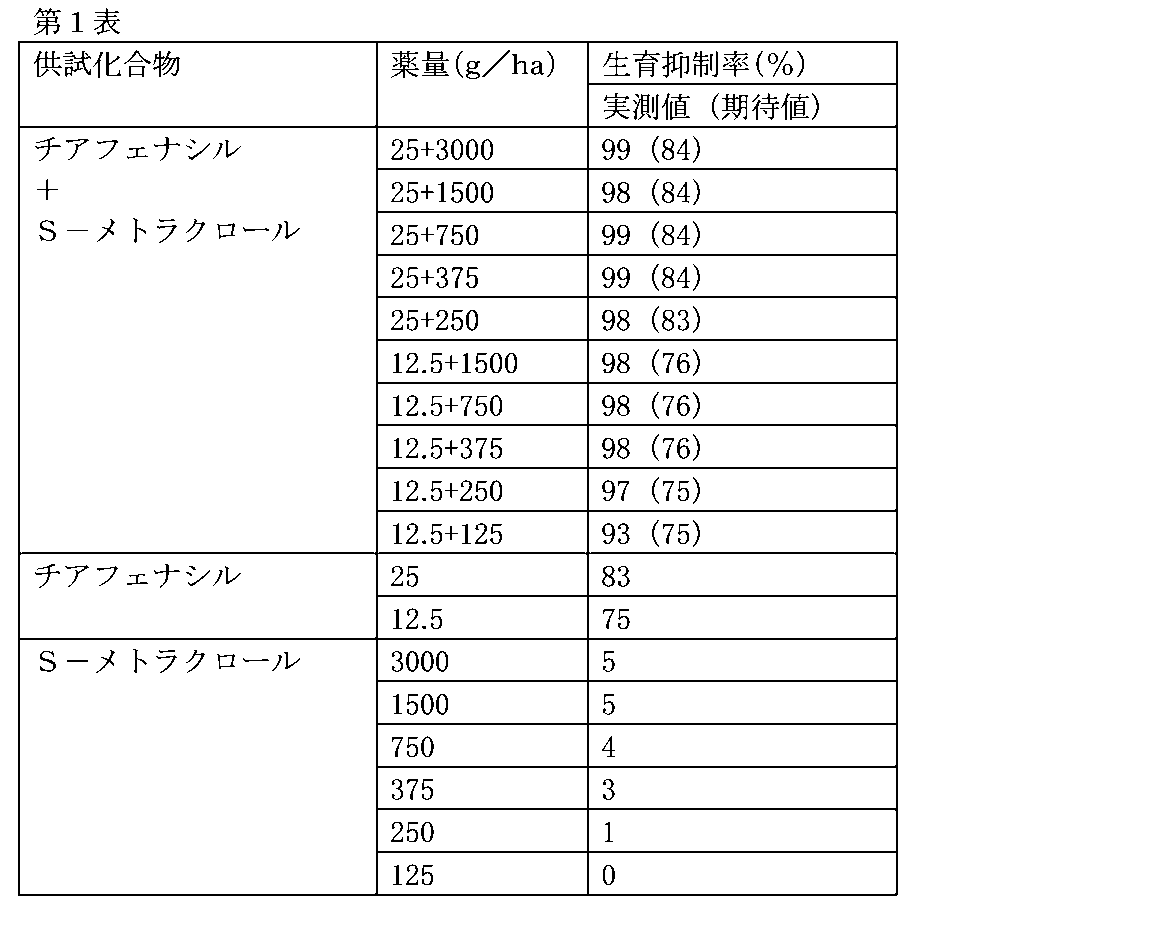
1/1,000,000haポットに畑作土壌をつめ、ネズミムギ(Italian ryegrass (Lolium multiflorum))の種子を播種した。ネズミムギが2.5-3.0葉期に達した時に、従来の水性懸濁剤の調製方法により調製したチアフェナシルを有効成分とする水性懸濁剤とS-メトラクロールを有効成分とする乳剤(商品名:デュアールゴールド、シンジェンタ社製)とを、0.5容量%の展着剤(商品名:Destiny HC、Winfield Solutions、LLC.製)を含む水(200L/ha相当)に希釈し、小型スプレーガン(型式:W-101-132G、アネスト岩田社製)で噴霧散布した。噴霧散布後16日目にネズミムギの生育状態を目視にて調査し、上記の(1)除草効果試験に記載の評価基準に従って生育抑制率(%)を評価し、その結果を第2表に示した。また、上記の(1)除草効果試験に記載のコルビーの式に従って生育抑制率(%)〔期待値〕を算出し、その結果も第2表に示した。
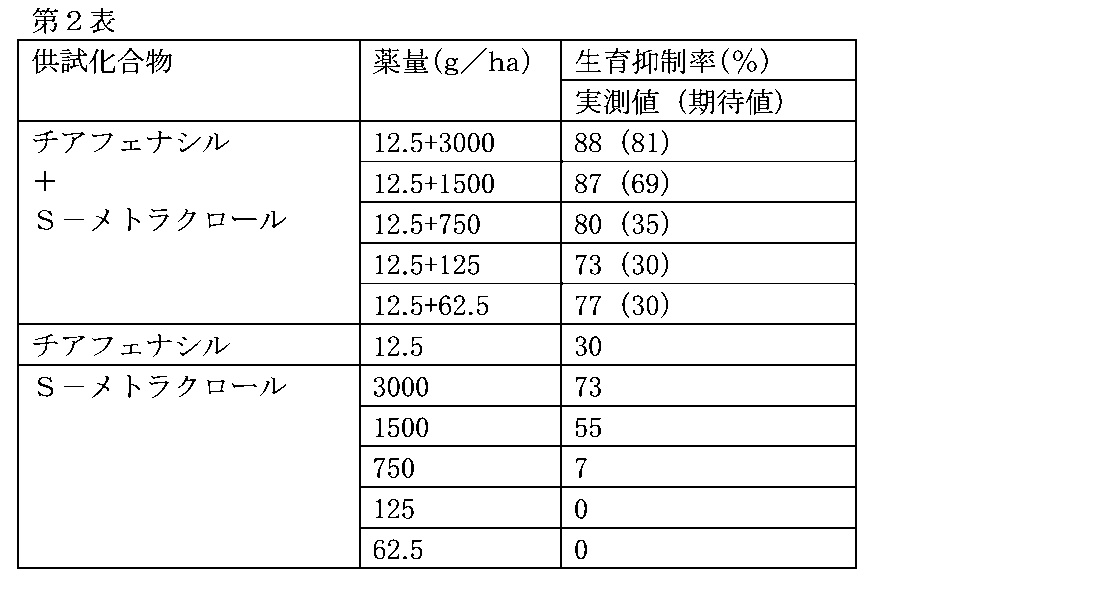
1/1,000,000haポットに畑作土壌をつめ、ネズミムギ(Italian ryegrass (Lolium multiflorum))の種子を播種した。ネズミムギが2.8-3.2葉期に達した時に、従来の水性懸濁剤の調製方法により調製したチアフェナシルを有効成分とする水性懸濁剤とS-メトラクロールを有効成分とする乳剤(商品名:デュアールゴールド、シンジェンタ社製)とを、0.5容量%の展着剤(商品名:Destiny HC、Winfield Solutions、LLC.製)を含む水(200L/ha相当)に希釈し、小型スプレーガン(型式:W-101-132G、アネスト岩田社製)で噴霧散布した。噴霧散布後7日目にネズミムギの生育状態を目視にて調査し、上記の(1)除草効果試験に記載の評価基準に従って生育抑制率(%)を評価し、その結果を第3表に示した。また、上記の(1)除草効果試験に記載のコルビーの式に従って生育抑制率(%)〔期待値〕を算出し、その結果も第3表に示した。
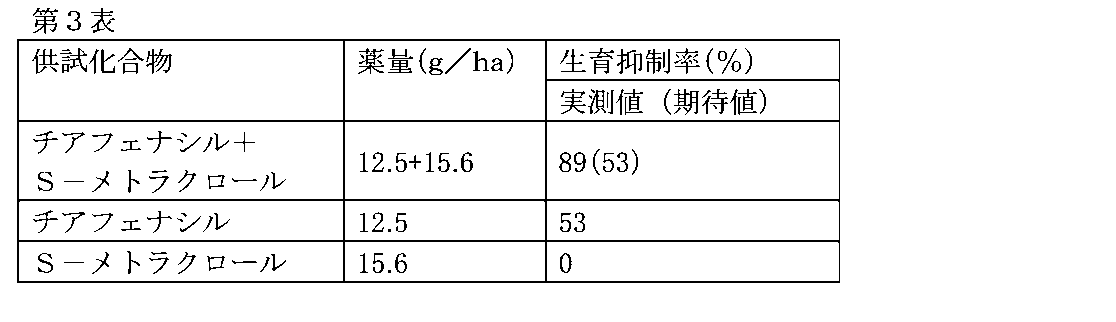
1/1,000,000haポットに畑作土壌をつめ、ネズミムギ(Italian ryegrass (Lolium multiflorum))の種子を播種した。ネズミムギが2.5-3.0葉期に達した時に、従来の水性懸濁剤の調製方法により調製したチアフェナシルを有効成分とする水性懸濁剤とメトリブジンを有効成分とする水和剤(商品名:センコル水和剤、バイエルクロップサイエンス社製)とを、0.5容量%の展着剤(商品名:Destiny HC、Winfield Solutions, LLC.製)を含む水(200L/ha相当)に希釈し、小型スプレーガン(型式:W-101-132G、アネスト岩田社製)で噴霧散布した。噴霧散布後7日目にネズミムギの生育状態を目視にて調査し、上記の(1)除草効果試験に記載の評価基準に従って生育抑制率(%)を評価し、その結果を第4表に示した。また、上記の(1)除草効果試験に記載のコルビーの式に従って生育抑制率(%)〔期待値〕を算出し、その結果も第4表に示した。
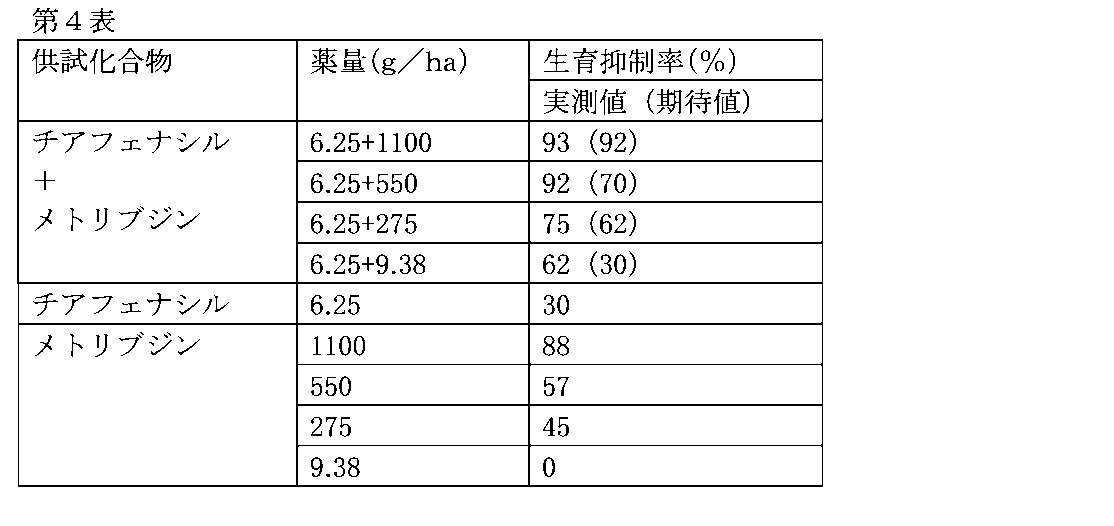
1/1,000,000haポットに畑作土壌をつめ、ネズミムギ(Italian ryegrass (Lolium multiflorum))の種子を播種した。ネズミムギが3.0-3.3葉期に達した時に、従来の水性懸濁剤の調製方法により調製したチアフェナシルを有効成分とする水性懸濁剤及びメトリブジンを有効成分とする水和剤(商品名:センコル水和剤、バイエルクロップサイエンス社製)、ピロキサスルホンを有効成分とする顆粒水和剤(商品名:Sakura、Bayer Crop Science社製)、又は従来の水和剤の調製方法により調製したトリアレートを有効成分とする水和剤を、0.5容量%の展着剤(商品名:Destiny HC、Winfield Solutions, LLC.製)を含む水(200L/ha相当)に希釈し、小型スプレーガン(型式:W-101-132G、アネスト岩田社製)で噴霧散布した。噴霧散布後6日目にネズミムギの生育状態を目視にて調査し、上記の(1)除草効果試験に記載の評価基準に従って生育抑制率(%)を評価し、その結果を第5表に示した。また、上記の(1)除草効果試験に記載のコルビーの式に従って生育抑制率(%)〔期待値〕を算出し、その結果も第5表に示した。

1/1,000,000haポットに畑作土壌をつめ、ネズミムギ(Italian ryegrass (Lolium multiflorum))の種子を播種した。ネズミムギが2.5-3.0葉期に達した時に、従来の水性懸濁剤の調製方法により調製したチアフェナシルを有効成分とする水性懸濁剤とピロキサスルホンを有効成分とする顆粒水和剤(商品名:Sakura、Bayer Crop Science社製)とを、0.5容量%の展着剤(商品名:Destiny HC、Winfield Solutions、LLC.製)を含む水(200L/ha相当)に希釈し、小型スプレーガン(型式:W-101-132G、アネスト岩田社製)で噴霧散布した。噴霧散布後14日目にネズミムギの生育状態を目視にて調査し、上記の(1)除草効果試験に記載の評価基準に従って生育抑制率(%)を評価し、その結果を第6表に示した。また、上記の(1)除草効果試験に記載のコルビーの式に従って生育抑制率(%)〔期待値〕を算出し、その結果も第6表に示した。

1/1,000,000haポットに畑作土壌をつめ、ネズミムギ(Italian ryegrass (Lolium multiflorum))の種子を播種した。ネズミムギが2.8-3.0葉期に達した時に、従来の水性懸濁剤の調製方法により調製したチアフェナシルを有効成分とする水性懸濁剤及びペトキサミドを有効成分とする乳剤(商品名:Successor 600、Stahler Suisse SA社製)、又はジメテナミドPを有効成分とする乳剤(商品名:フィールドスターP乳剤、BASF社製)を、0.5容量%の展着剤(商品名:Destiny HC、Winfield Solutions、LLC.製)を含む水(200L/ha相当)に希釈し、小型スプレーガン(型式:W-101-132G、アネスト岩田社製)で噴霧散布した。噴霧散布後7日目にネズミムギの生育状態を観察調査し、上記の(1)除草効果試験に記載の評価基準に従って生育抑制率(%)を評価し、その結果を第7表に示した。また、上記の(1)除草効果試験に記載のコルビーの式に従って生育抑制率(%)〔期待値〕を算出し、その結果も第7表に示した。
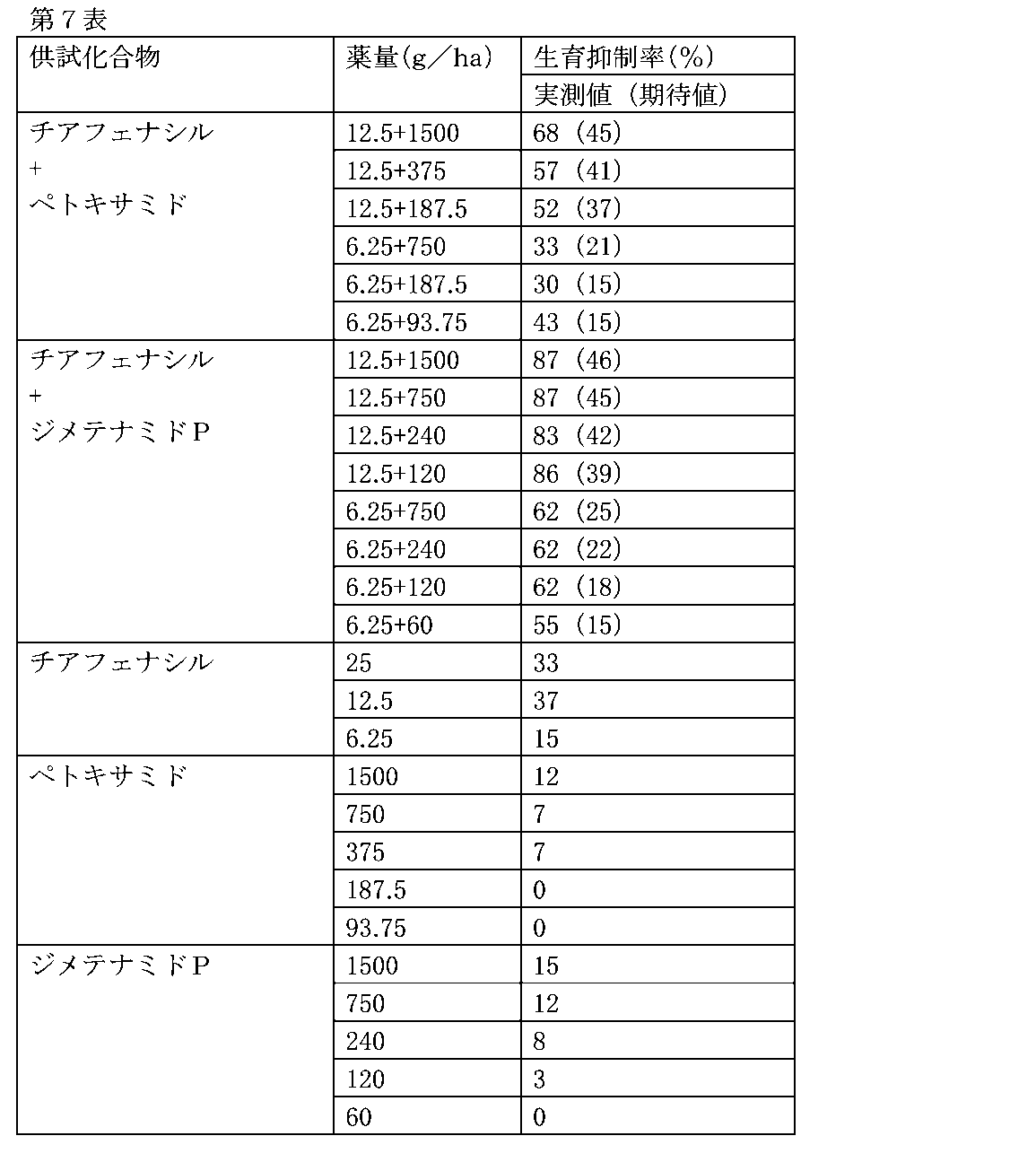
1/1,000,000haポットに畑作土壌をつめ、ネズミムギ(Italian ryegrass (Lolium multiflorum))の種子を播種した。ネズミムギが3.0-3.1葉期に達した時に、従来の水性懸濁剤の調製方法により調製したチアフェナシルを有効成分とする水性懸濁剤及びS-メトラクロールを有効成分とする乳剤(商品名:デュアールゴールド、シンジェンタ社製)、メトリブジンを有効成分とする水和剤(商品名:センコル水和剤、バイエルクロップサイエンス社製)、又はピロキサスルホンを有効成分とする顆粒水和剤(商品名:Sakura、Bayer Crop Science社製)を、0.5容量%の展着剤(商品名:Destiny HC、Winfield Solutions、LLC.製)を含む水(200L/ha相当)に希釈し、小型スプレーガン(型式:W-101-132G、アネスト岩田社製)で噴霧散布した。噴霧散布後4日目にネズミムギの生育状態を目視にて調査し、上記の(1)除草効果試験に記載の評価基準に従って生育抑制率(%)を評価し、その結果を第8表に示した。また、上記の(1)除草効果試験に記載のコルビーの式に従って生育抑制率(%)〔期待値〕を算出し、その結果も第8表に示した。
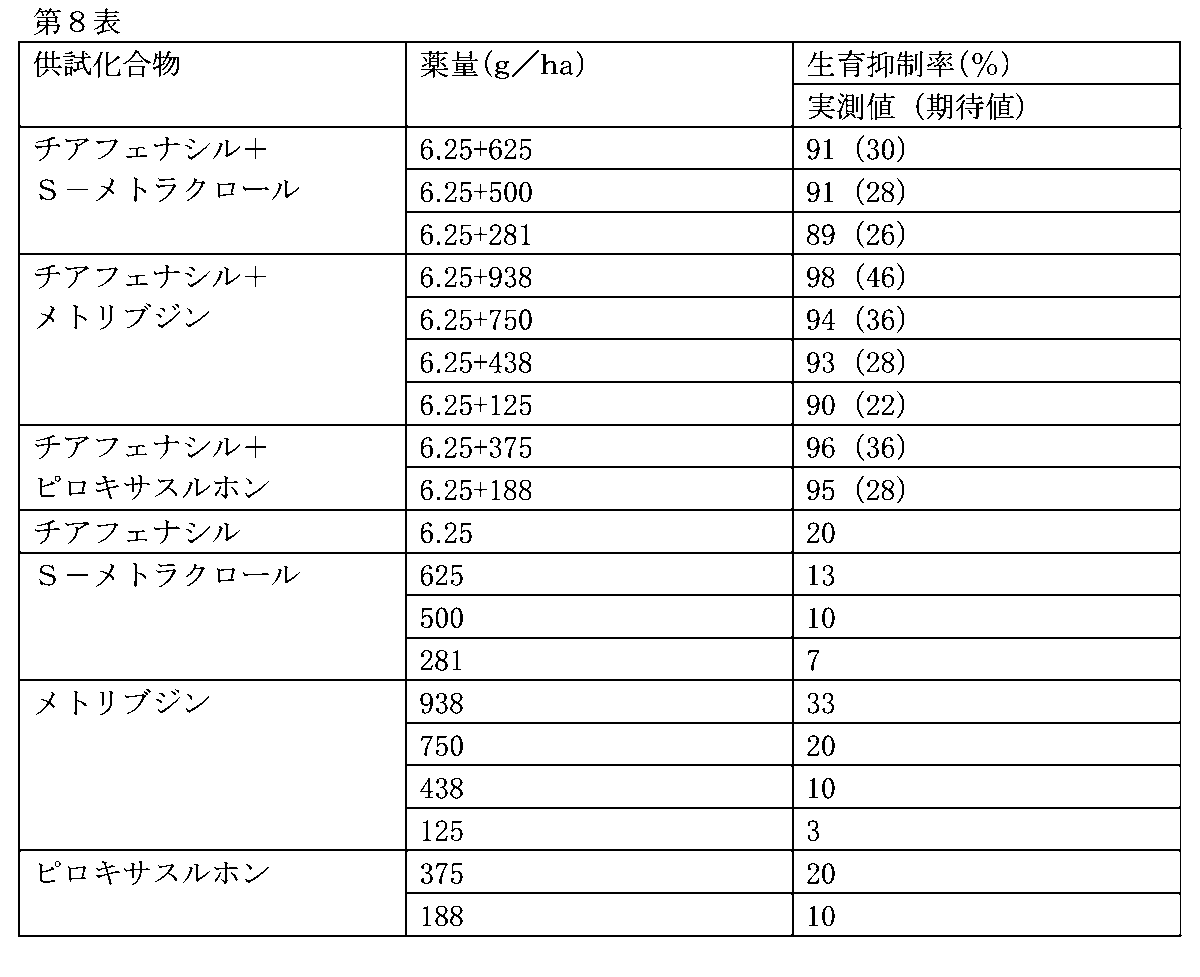
1/1,000,000haポットに畑作土壌をつめ、ネズミムギ(Italian ryegrass (Lolium multiflorum))の種子を播種した。ネズミムギが3.2-4.0葉期に達した時に、従来の水性懸濁剤の調製方法により調製したチアフェナシルを有効成分とする水性懸濁剤及び従来の水和剤の調製方法により調製したトリアレートを有効成分とする水和剤、ペトキサミドを有効成分とする乳剤(商品名:Successor 600、Stahler Suisse SA社製)、又はジメテナミドPを有効成分とする乳剤(商品名:フィールドスターP乳剤、BASF社製)を、0.5容量%の展着剤(商品名:Destiny HC、Winfield Solutions、LLC.製)を含む水(200L/ha相当)に希釈し、小型スプレーガン(型式:W-101-132G、アネスト岩田社製)で噴霧散布した。噴霧散布後6日目にネズミムギの生育状態を目視にて調査し、上記の(1)除草効果試験に記載の評価基準に従って生育抑制率(%)を評価し、その結果を第9表に示した。また、上記の(1)除草効果試験に記載のコルビーの式に従って生育抑制率(%)〔期待値〕を算出し、その結果も第9表に示した。
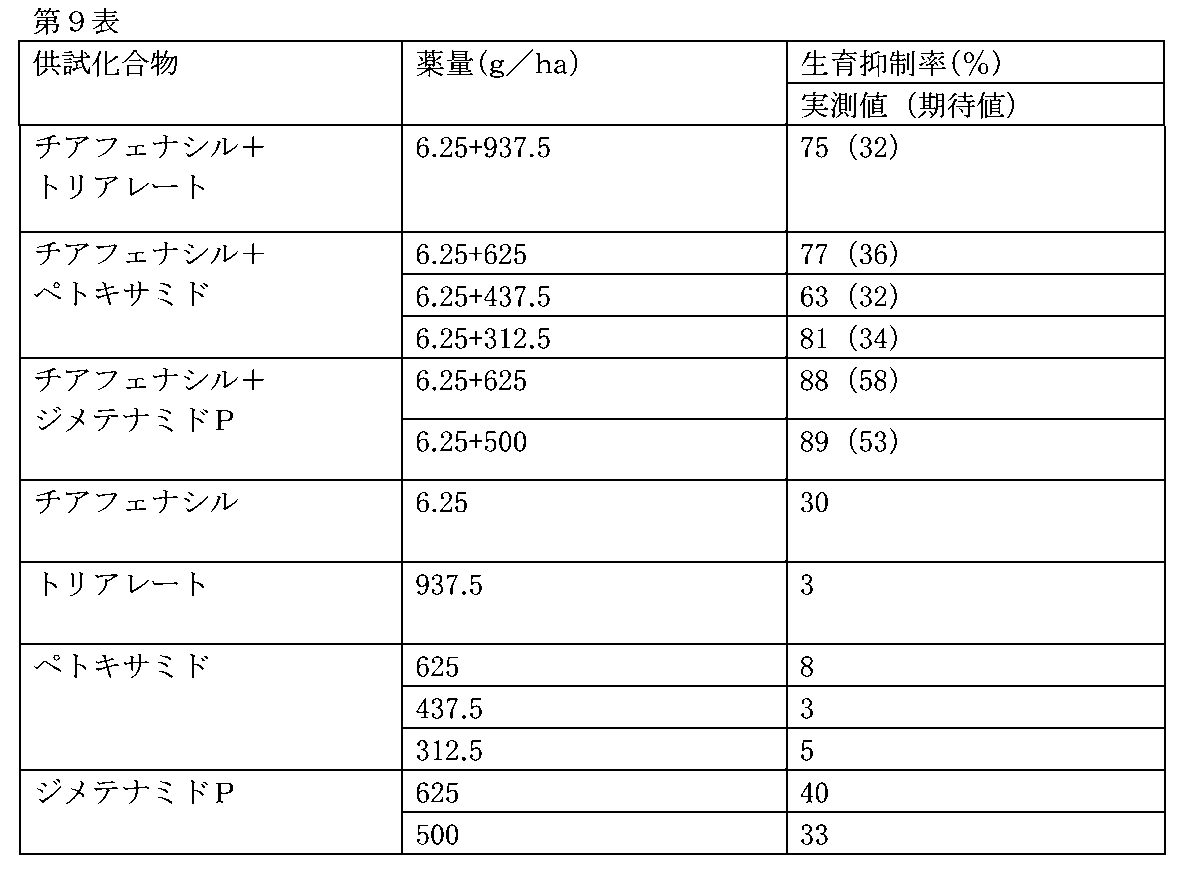
1/1,000,000haポットに畑作土壌をつめ、オヒシバ(goosegrass (Eleusine indica))の種子を播種した。オヒシバが6.5-7.8葉期に達した時に、従来の水性懸濁剤の調製方法により調製したチアフェナシルを有効成分とする水性懸濁剤及びS-メトラクロールを有効成分とする乳剤(商品名:デュアールゴールド、シンジェンタ社製)、メトリブジンを有効成分とする水和剤(商品名:センコル水和剤、バイエルクロップサイエンス社製)、又はピロキサスルホンを有効成分とする顆粒水和剤(商品名:Sakura、Bayer Crop Science社製)を、0.5容量%の展着剤(商品名:Destiny HC、Winfield Solutions、LLC.製)を含む水(200L/ha相当)に希釈し、小型スプレーガン(型式:W-101-132G、アネスト岩田社製)で噴霧散布した。噴霧散布後13日目にオヒシバの生育状態を目視にて調査し、上記の(1)除草効果試験に記載の評価基準に従って生育抑制率(%)を評価し、その結果を第10表に示した。また、上記の(1)除草効果試験に記載のコルビーの式に従って生育抑制率(%)〔期待値〕を算出し、その結果も第10表に示した。
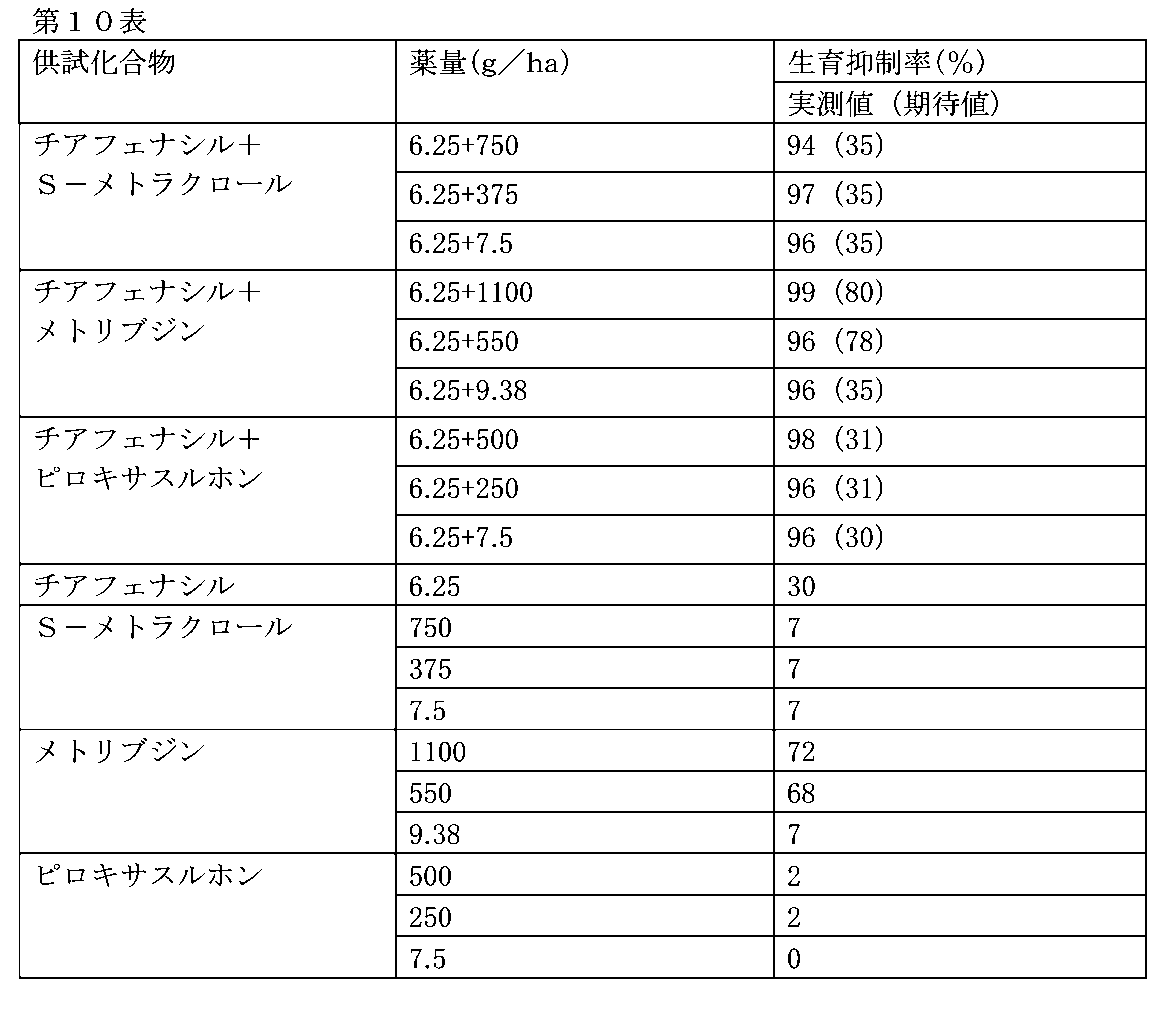
1/1,000,000haポットに畑作土壌をつめ、オヒシバ(goosegrass (Eleusine indica))の種子を播種した。オヒシバが7.0-8.3葉期に達した時に、従来の水性懸濁剤の調製方法により調製したチアフェナシルを有効成分とする水性懸濁剤及び従来の水和剤の調製方法により調製したトリアレートを有効成分とする水和剤、ペトキサミドを有効成分とする乳剤(商品名:Successor 600、Stahler Suisse SA社製)、又はジメテナミドPを有効成分とする乳剤(商品名:フィールドスターP乳剤、BASF社製)を、0.5容量%の展着剤(商品名:Destiny HC、Winfield Solutions、LLC.製)を含む水(200L/ha相当)に希釈し、小型スプレーガン(型式:W-101-132G、アネスト岩田社製)で噴霧散布した。噴霧散布後3日目にオヒシバの生育状態を目視にて調査し、上記の(1)除草効果試験に記載の評価基準に従って生育抑制率(%)を評価し、その結果を第11表に示した。また、上記の(1)除草効果試験に記載のコルビーの式に従って生育抑制率(%)〔期待値〕を算出し、その結果も第11表に示した。

1/1,000,000haポットに畑作土壌をつめ、ヒユモドキ(waterhemp (Amaranthus tuberculatus))の種子を播種した。ヒユモドキが6.0-8.5葉期に達した時に、従来の水性懸濁剤の調製方法により調製したチアフェナシルを有効成分とする水性懸濁剤及びS-メトラクロールを有効成分とする乳剤(商品名:デュアールゴールド、シンジェンタ社製)、メトリブジンを有効成分とする水和剤(商品名:センコル水和剤、バイエルクロップサイエンス社製)、又はピロキサスルホンを有効成分とする顆粒水和剤(商品名:Sakura、Bayer Crop Science社製)を、0.5容量%の展着剤(商品名:Destiny HC、Winfield Solutions、LLC.製)を含む水(200L/ha相当)に希釈し、小型スプレーガン(型式:W-101-132G、アネスト岩田社製)で噴霧散布した。噴霧散布後13日目にヒユモドキの生育状態を目視にて調査し、上記の(1)除草効果試験に記載の評価基準に従って生育抑制率(%)を評価し、その結果を第12表に示した。また、上記の(1)除草効果試験に記載のコルビーの式に従って生育抑制率(%)〔期待値〕を算出し、その結果も第12表に示した。
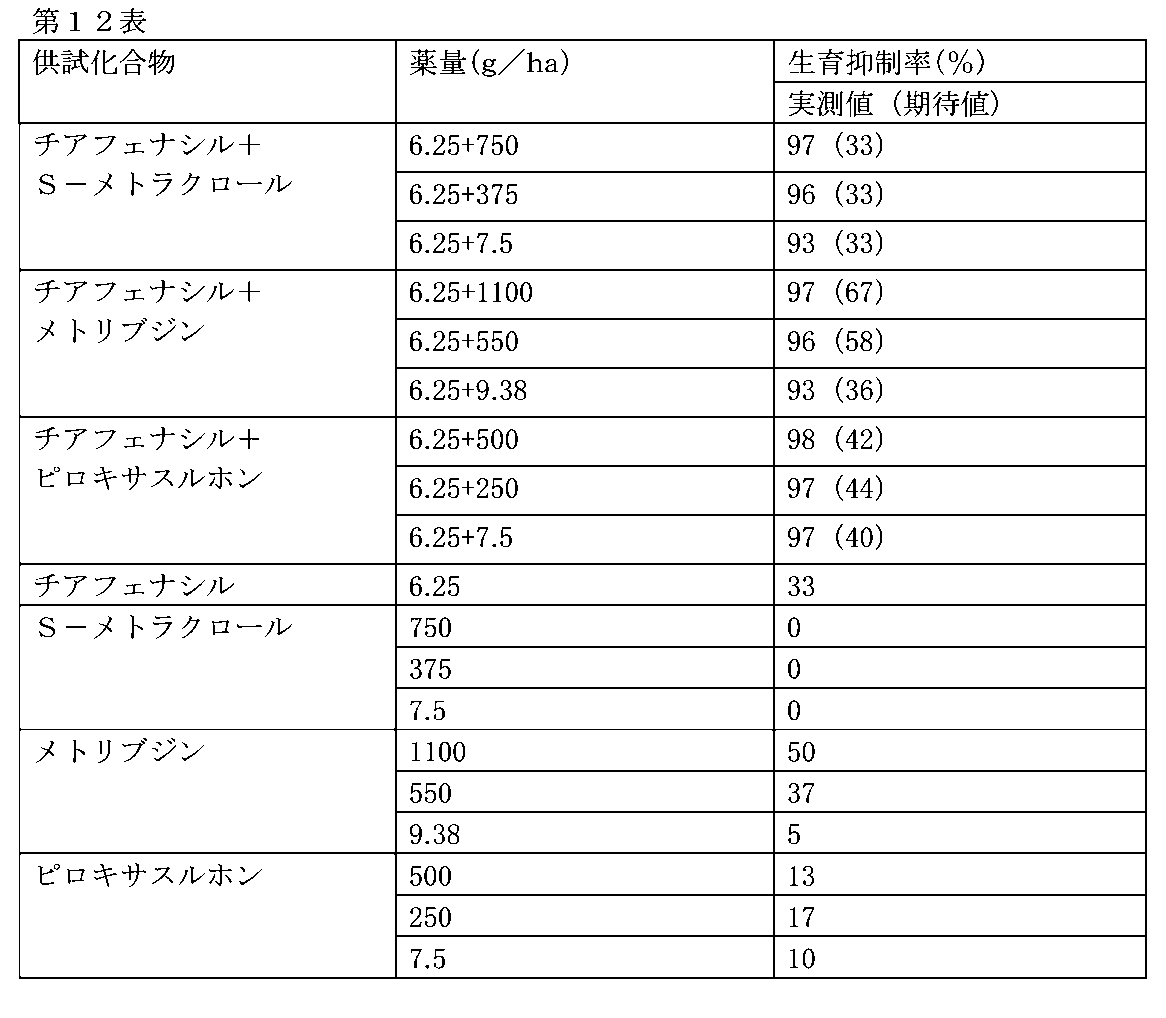
1/1,000,000haポットに畑作土壌をつめ、ヒユモドキ(waterhemp (Amaranthus tuberculatus))の種子を播種した。ヒユモドキが5.0-8.0葉期に達した時に、従来の水性懸濁剤の調製方法により調製したチアフェナシルを有効成分とする水性懸濁剤及び従来の水和剤の調製方法により調製したトリアレートを有効成分とする水和剤、ペトキサミドを有効成分とする乳剤(商品名:Successor 600、Stahler Suisse SA社製)、又はジメテナミドPを有効成分とする乳剤(商品名:フィールドスターP乳剤、BASF社製)を、0.5容量%の展着剤(商品名:Destiny HC、Winfield Solutions、LLC.製)を含む水(200L/ha相当)に希釈し、小型スプレーガン(型式:W-101-132G、アネスト岩田社製)で噴霧散布した。噴霧散布後4日目にヒユモドキの生育状態を目視にて調査し、上記の(1)除草効果試験に記載の評価基準に従って生育抑制率(%)を評価し、その結果を第13表に示した。また、上記の(1)除草効果試験に記載のコルビーの式に従って生育抑制率(%)〔期待値〕を算出し、その結果も第13表に示した。
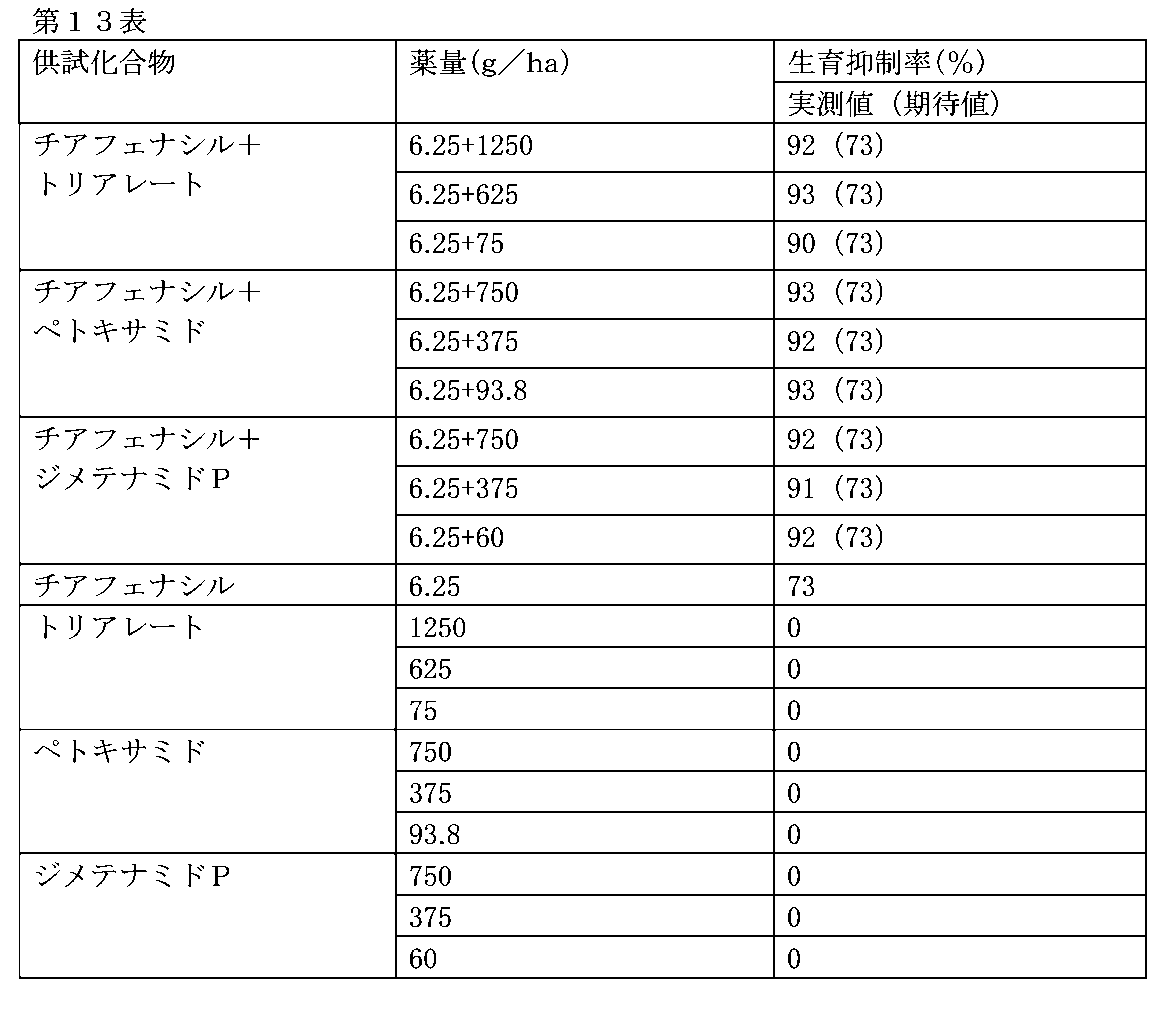
1/1,000,000haポットに畑作土壌をつめ、ヒメムカシヨモギ(horseweed (Conyza canadensis))の種子を播種した。ヒメムカシヨモギが直径12-17cmに達した時に、従来の水性懸濁剤の調製方法により調製したチアフェナシルを有効成分とする水性懸濁剤及びS-メトラクロールを有効成分とする乳剤(商品名:デュアールゴールド、シンジェンタ社製)、メトリブジンを有効成分とする水和剤(商品名:センコル水和剤、バイエルクロップサイエンス社製)、又はピロキサスルホンを有効成分とする顆粒水和剤(商品名:Sakura、Bayer Crop Science社製)を、0.5容量%の展着剤(商品名:Destiny HC、Winfield Solutions、LLC.製)を含む水(200L/ha相当)に希釈し、小型スプレーガン(型式:W-101-132G、アネスト岩田社製)で噴霧散布した。噴霧散布後6日目にヒメムカシヨモギの生育状態を目視にて調査し、上記の(1)除草効果試験に記載の評価基準に従って生育抑制率(%)を評価し、その結果を第14表に示した。また、上記の(1)除草効果試験に記載のコルビーの式に従って生育抑制率(%)〔期待値〕を算出し、その結果も第14表に示した。

1/1,000,000haポットに畑作土壌をつめ、ヒメムカシヨモギ(horseweed (Conyza canadensis))の種子を播種した。ヒメムカシヨモギが直径13-19cmに達した時に、従来の水性懸濁剤の調製方法により調製したチアフェナシルを有効成分とする水性懸濁剤及び従来の水和剤の調製方法により調製したトリアレートを有効成分とする水和剤、ペトキサミドを有効成分とする乳剤(商品名:Successor 600、Stahler Suisse SA社製)、又はジメテナミドPを有効成分とする乳剤(商品名:フィールドスターP乳剤、BASF社製)を、0.5容量%の展着剤(商品名:Destiny HC、Winfield Solutions、LLC.製)を含む水(200L/ha相当)に希釈し、小型スプレーガン(型式:W-101-132G、アネスト岩田社製)で噴霧散布した。噴霧散布後3日目にヒメムカシヨモギの生育状態を目視にて調査し、上記の(1)除草効果試験に記載の評価基準に従って生育抑制率(%)を評価し、その結果を第15表に示した。また、上記の(1)除草効果試験に記載のコルビーの式に従って生育抑制率(%)〔期待値〕を算出し、その結果も第15表に示した。

1/1,000,000haポットに畑作土壌をつめ、ネズミムギ(Italian ryegrass (Lolium multiflorum))の種子を播種した。ネズミムギが2.5-3.0葉期に達した時に、従来の水性懸濁剤の調製方法により調製したチアフェナシルを有効成分とする水性懸濁剤、サフルフェナシルを有効成分とする水性懸濁剤(商品名:Sharpen、BASF社製)、従来の水和剤の調製方法により調製したフォメサフェンを有効成分とする水和剤、フルチアセットメチルを有効成分とする乳剤(商品名:アタックショット乳剤、丸和バイオケミカル社製)、カルフェントラゾンエチルを有効成分とするドライフロアブル剤(商品名:タスクDF、石原産業社製)、又はピラフルフェンエチルを有効成分とする水性懸濁剤(商品名:エコパートフロアブル、日本農薬社製)及びS-メトラクロールを有効成分とする乳剤(商品名:デュアールゴールド、シンジェンタ社製)、又はメトリブジンを有効成分とする水和剤(商品名:センコル水和剤、バイエルクロップサイエンス社製)を、0.5容量%の展着剤(商品名:Destiny HC、Winfield Solutions、LLC.製)を含む水(200L/ha相当)に希釈し、小型スプレーガン(型式:W-101-132G、アネスト岩田社製)で噴霧散布した。噴霧散布後4日目にネズミムギの生育状態を目視にて調査し、上記の(1)除草効果試験に記載の評価基準に従って生育抑制率(%)を評価し、その結果を第16表に示した。また、上記の(1)除草効果試験に記載のコルビーの式に従って生育抑制率(%)〔期待値〕を算出し、その結果も第16表に示した。
そして、本発明の組成物である、チアフェナシル(a1)とS-メトラクロール、又はメトリブジン(a2)とを組み合わせは、チアフェナシル以外の供試化合物とS-メトラクロール、又はメトリブジンとを組み合わせた場合の生育抑制率よりも上回った。
一方で、チアフェナシル以外の供試化合物とS-メトラクロール、又はメトリブジンとを混用することにより、各単剤で使用するのに比べて、ネズミムギに対する防除効果の向上は確認できなかった。さらに、これらを組み合わせた場合の生育抑制率は、期待値より上回らず、相乗効果を有しないことが分かった。

はじめに、望ましくない植物が生育する条件下で、植物成長促進効果試験について記載する。
1/1,000,000haポットに土壌をつめ、ネズミムギ(Italian ryegrass (Lolium multiflorum))の種子を播種した。ネズミムギが2.5-3.0葉期に達した時に、従来の水性懸濁剤の調製方法により調製したチアフェナシルを有効成分とする水性懸濁剤及びS-メトラクロールを有効成分とする乳剤(商品名:デュアールゴールド、シンジェンタ社製)、又はメトリブジンを有効成分とする水和剤(商品名:センコル水和剤、バイエルクロップサイエンス社製)を、0.5容量%の展着剤(商品名:Destiny HC、Winfield Solutions, LLC.製)を含む水(200L/ha相当)に希釈し、小型スプレーガン(型式:W-101-132G、アネスト岩田社製)で噴霧散布した。噴霧散布後のポットに飼料用トウモロコシ(品種:スノーデントおとは、雪印種苗社製)の種子を播種した。播種後20日目に飼料用トウモロコシの地上部を刈り取り、重量を測定し生重量を求め、その結果を第17表に示した。
第17表より、チアフェナシル(a1)とS-メトラクロール又はメトリブジン(a2)を混用することで、無処理区及び各単剤で使用するのに比べて、飼料用のトウモロコシの生重量が増加した。
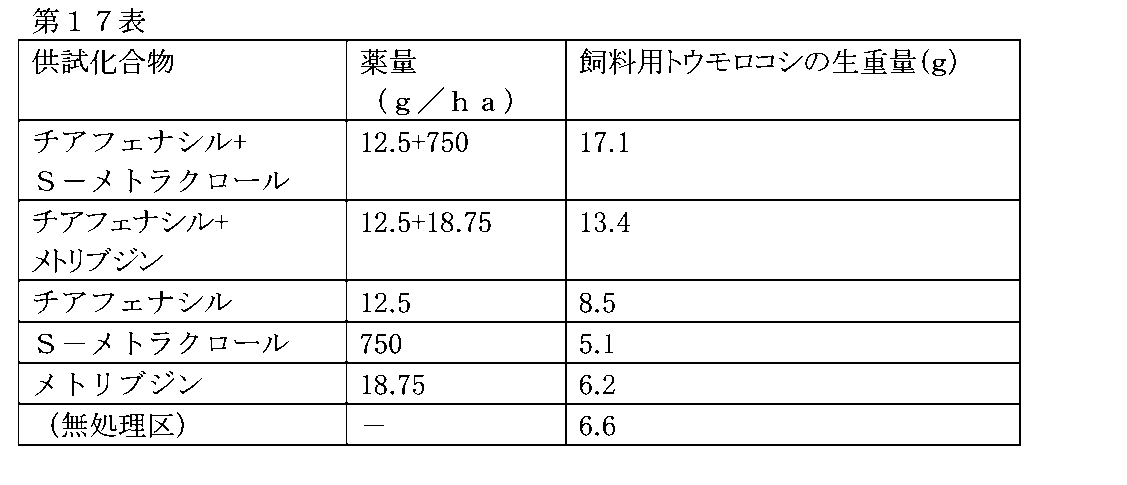
1/1,000,000haポットに土壌をつめ、ネズミムギ(Italian ryegrass (Lolium multiflorum))の種子を播種した。ネズミムギが2.7-3.1葉期に達した時に、従来の水性懸濁剤の調製方法により調製したチアフェナシルを有効成分とする水性懸濁剤及びS-メトラクロールを有効成分とする乳剤(商品名:デュアールゴールド、シンジェンタ社製)、メトリブジンを有効成分とする水和剤(商品名:センコル水和剤、バイエルクロップサイエンス社製)、又はピロキサスルホンを有効成分とする顆粒水和剤(商品名:Sakura、Bayer Crop Science社製)を、0.5容量%の展着剤(商品名:Destiny HC、Winfield Solutions, LLC.製)を含む水(200L/ha相当)に希釈し、小型スプレーガン(型式:W-101-132G、アネスト岩田社製)で噴霧散布した。噴霧散布後のポットに飼料用トウモロコシ(品種:スノーデントおとは、雪印種苗社製)の種子を播種した。播種後21日目に飼料用トウモロコシの地上部を刈り取り、重量を測定し生重量を求め、その結果を第18表に示した。
第18表より、チアフェナシル(a1)とS-メトラクロール、メトリブジン、又はピロキサスルホン(a2)を混用することで、無処理区及び各単剤で使用するのに比べて、飼料用トウモロコシの生重量が増加した。
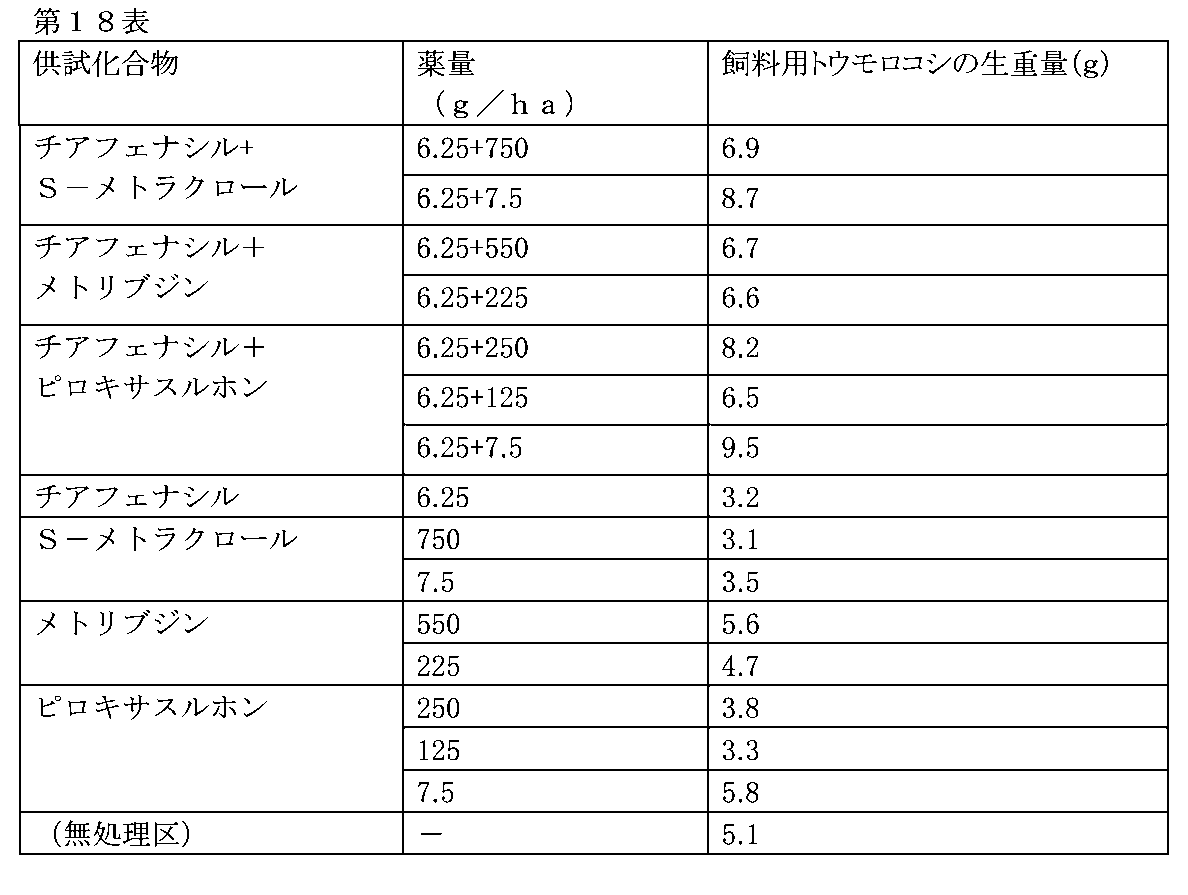
1/1,000,000haポットに土壌をつめ、ネズミムギ(Italian ryegrass (Lolium multiflorum))の種子を播種した。ネズミムギが3.2-3.7葉期に達した時に、従来の水性懸濁剤の調製方法により調製したチアフェナシルを有効成分とする水性懸濁剤及び従来の水和剤の調製方法により調製したトリアレートを有効成分とする水和剤、又はペトキサミドを有効成分とする乳剤(商品名:Successor 600、Stahler Suisse SA社製)を、0.5容量%の展着剤(商品名:Destiny HC、Winfield Solutions, LLC.製)を含む水(200L/ha相当)に希釈し、小型スプレーガン(型式:W-101-132G、アネスト岩田社製)で噴霧散布した。噴霧散布後のポットに飼料用トウモロコシ(品種:スノーデントおとは、雪印種苗社製)の種子を播種した。播種後21日目に飼料用トウモロコシの地上部を刈り取り、重量を測定し生重量を求め、その結果を第19表に示した。
第19表より、チアフェナシル(a1)とトリアレート、又はペトキサミド(a2)を混用することで、無処理区及び各単剤で使用するのに比べて、飼料用トウモロコシの生重量が増加した。

1/1,000,000haポットに土壌をつめ、ネズミムギ(Italian ryegrass (Lolium multiflorum))の種子を播種した。ネズミムギが2.7-3.0葉期に達した時に、従来の水性懸濁剤の調製方法により調製したチアフェナシルを有効成分とする水性懸濁剤及びジメテナミドPを有効成分とする乳剤(商品名:フィールドスターP乳剤、BASF社製)を、0.5容量%の展着剤(商品名:Destiny HC、Winfield Solutions, LLC.製)を含む水(200L/ha相当)に希釈し、小型スプレーガン(型式:W-101-132G、アネスト岩田社製)で噴霧散布した。噴霧散布後のポットに飼料用トウモロコシ(品種:スノーデントおとは、雪印種苗社製)の種子を播種した。播種後33日目に飼料用トウモロコシの地上部を刈り取り、重量を測定し生重量を求め、その結果を第20表に示した。
第20表より、チアフェナシル(a1)とジメテナミドP(a2)を混用することで、無処理区及び各単剤で使用するのに比べて、飼料用トウモロコシの生重量が増加した。

1/1,000,000haポットに土壌をつめ、ネズミムギ(Italian ryegrass (Lolium multiflorum))の種子を播種した。ネズミムギが3.3-3.8葉期に達した時に、従来の水性懸濁剤の調製方法により調製したチアフェナシルを有効成分とする水性懸濁剤及びメトリブジンを有効成分とする水和剤(商品名:センコル水和剤、バイエルクロップサイエンス社製)、又はピロキサスルホンを有効成分とする顆粒水和剤(商品名:Sakura、Bayer Crop Science社製)を、0.5容量%の展着剤(商品名:Destiny HC、Winfield Solutions, LLC.製)を含む水(200L/ha相当)に希釈し、小型スプレーガン(型式:W-101-132G、アネスト岩田社製)で噴霧散布した。噴霧散布後のポットにコムギ(品種:農林61号、アサヒ農園製)の種子を播種した。播種後22日目に小麦の地上部を刈り取り、重量を測定し生重量を求め、その結果を第21表に示した。
第21表より、チアフェナシル(a1)とメトリブジン、又はピロキサスルホン(a2)を混用することで、無処理区及び各単剤で使用するのに比べて、コムギの生重量が増加した。
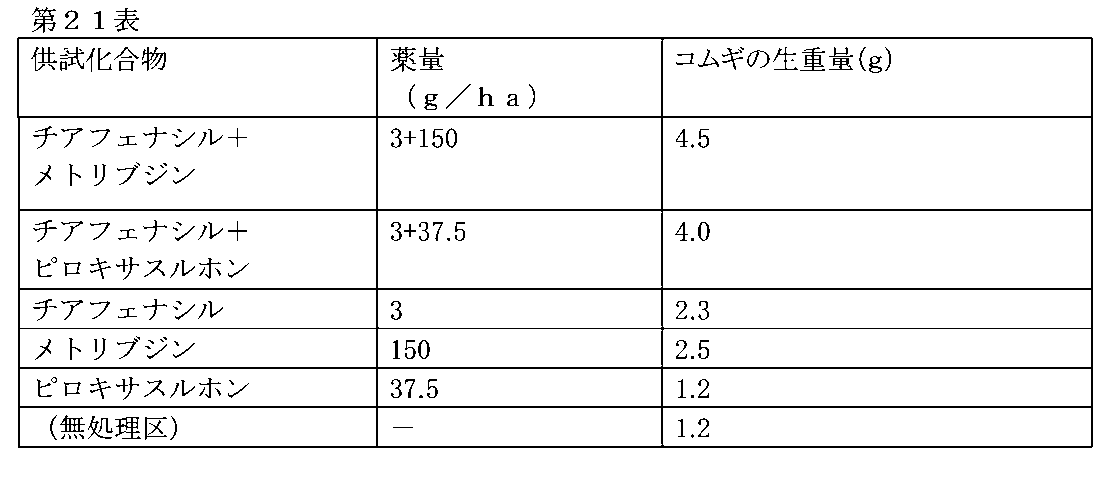
1/1,000,000haポットに土壌をつめ、ネズミムギ(Italian ryegrass (Lolium multiflorum))の種子を播種した。ネズミムギが2.5-2.8葉期に達した時に、従来の水性懸濁剤の調製方法により調製したチアフェナシルを有効成分とする水性懸濁剤及び従来の水和剤の調製方法により調製したトリアレートを有効成分とする水和剤を、0.5容量%の展着剤(商品名:Destiny HC、Winfield Solutions, LLC.製)を含む水(200L/ha相当)に希釈し、小型スプレーガン(型式:W-101-132G、アネスト岩田社製)で噴霧散布した。噴霧散布後のポットに小麦(品種:農林61号、アサヒ農園製)の種子を播種した。播種後21日目にコムギの地上部を刈り取り、重量を測定し生重量を求め、その結果を第22表に示した。
第22表より、チアフェナシル(a1)とトリアレート(a2)を混用することで、無処理区及び各単剤で使用するのに比べて、コムギの生重量が増加した。
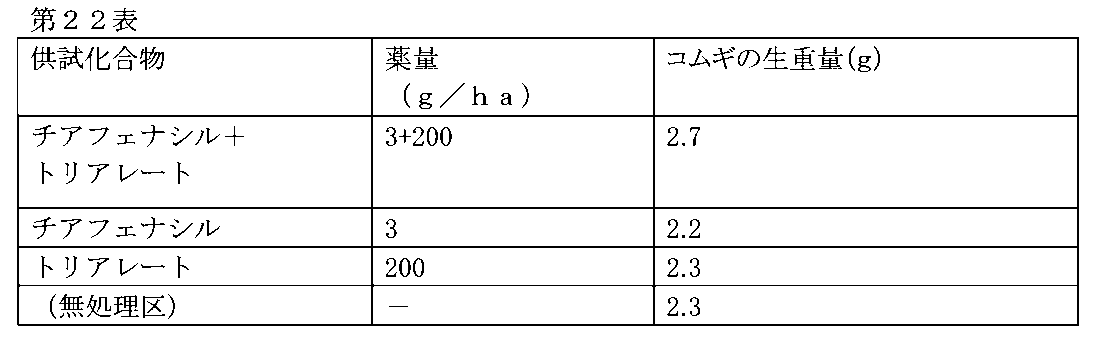
1/200,000haポットに土壌をつめ、ネズミムギ(Italian ryegrass (Lolium multiflorum))の種子を播種した。ネズミムギが2.5-3.0葉期に達した時に、従来の水性懸濁剤の調製方法により調製したチアフェナシルを有効成分とする水性懸濁剤及びS-メトラクロールを有効成分とする乳剤(商品名:デュアールゴールド、シンジェンタ社製)、メトリブジンを有効成分とする水和剤(商品名:センコル水和剤、バイエルクロップサイエンス社製)、ピロキサスルホンを有効成分とする顆粒水和剤(商品名:Sakura、Bayer Crop Science社製)、従来の水和剤の調製方法により調製したトリアレートを有効成分とする水和剤、ペトキサミドを有効成分とする乳剤(商品名:Successor 600、Stahler Suisse SA社製)、又はジメテナミドPを有効成分とする乳剤(商品名:フィールドスターP乳剤、BASF社製)を、0.5容量%の展着剤(商品名:Destiny HC、Winfield Solutions, LLC.製)を含む水(200L/ha相当)に希釈し、小型スプレーガン(型式:W-101-132G、アネスト岩田社製)で噴霧散布した。噴霧散布後のポットに大豆(品種:エンレイ、アサヒ農園製)の種子を播種し、栽培した。播種後97日目に、成長したダイズから種子を採取して、重量を測定し総重量を求め、その結果を第23表に示した。
第23表より、チアフェナシル(a1)とS-メトラクロール、メトリブジン、ピロキサスルホン、トリアレート、ペトキサミド、又はジメテナミドP(a2)を混用することで、無処理区及び各単剤で使用するのに比べて、ダイズの種子の総重量が増加した。

1/500,000haポットに土壌をつめ、従来の水性懸濁剤の調製方法により調製したチアフェナシルを有効成分とする水性懸濁剤及びS-メトラクロールを有効成分とする乳剤(商品名:デュアールゴールド、シンジェンタ社製)、メトリブジンを有効成分とする水和剤(商品名:センコル水和剤、バイエルクロップサイエンス社製)、ピロキサスルホンを有効成分とする顆粒水和剤(商品名:Sakura、Bayer Crop Science社製)、従来の水和剤の調製方法により調製したトリアレートを有効成分とする水和剤、ペトキサミドを有効成分とする乳剤(商品名:Successor 600、Stahler Suisse SA社製)、又はジメテナミドPを有効成分とする乳剤(商品名:フィールドスターP乳剤、BASF社製)を、0.5容量%の展着剤(商品名:Destiny HC、Winfield Solutions, LLC.製)を含む水(200L/ha相当)に希釈し、小型スプレーガン(型式:W-101-132G、アネスト岩田社製)で噴霧散布した。噴霧散布後のポットにダイズ(品種:エンレイ、アサヒ農園製)の種子を播種した。播種後48日目にダイズの地上部を刈り取り、重量を測定し生重量を求め、その結果を第24表に示した。
第24表より、チアフェナシル(a1)とS-メトラクロール、メトリブジン、ピロキサスルホン、トリアレート、ペトキサミド、又はジメテナミドP(a2)を混用することで、無処理区及び各単剤で使用するのに比べて、ダイズの生重量が増加した。これにより、望ましくない植物を播種しない条件下で、本発明の組成物がダイズに対する成長促進効果を有することが分かった。

Claims (10)
- チアフェナシル(tiafenacil)(a1)の有効量と、下記の化合物群Aから選択される少なくとも1種の除草剤化合物(a2)の有効量を、望ましくない植物、望ましくない植物が生育する場所、又は有用植物を栽培する場所に施用し、望ましくない植物を防除し、かつ有用植物の成長を促進する方法。
[化合物群A:除草剤化合物である、
S-メトラクロール(S-metolachlor)、メトリブジン(metribuzin)、ピロキサスルホン(pyroxasulfone)、ペトキサミド(pethoxamid)、トリアレート(tri-allate)、及びジメテナミドP(dimethenamid-P)] - 前記除草剤化合物(a2)が、S-メトラクロール(S-metolachlor)、及びメトリブジン(metribuzin)から選択される少なくとも1種である、請求項1に記載の方法。
- 前記除草剤化合物(a2)が、S-メトラクロール(S-metolachlor)である、請求項1に記載の方法。
- (a1)と(a2)の混用比率が、(a1):(a2)の重量比で1:0.8~1:1000で施用する、請求項1から請求項3のいずれか一項に記載の方法。
- (a1)と(a2)の混用比率が重量比で1:1.2~1:200で施用する、請求項1から請求項3のいずれか一項に記載の方法。
- (a1)を0.01~400g/ha、(a2)を0.1~5000g/haで施用する、請求項1から請求項3のいずれか一項に記載の方法。
- (a1)を0.05~300g/ha、(a2)を1~4000g/haで施用する、請求項1から請求項3のいずれか一項に記載の方法。
- チアフェナシル(tiafenacil)(a1)と下記の化合物群Aから選択される少なくとも1種の除草剤化合物(a2)を有効成分として含有し、(a1)と(a2)の混用比率が重量比で1:0.8~1:1000である、農薬組成物。
[化合物群A:除草剤化合物である、
S-メトラクロール(S-metolachlor)、メトリブジン(metribuzin)、ピロキサスルホン(pyroxasulfone)、ペトキサミド(pethoxamid)、トリアレート(tri-allate)、及びジメテナミドP(dimethenamid-P)] - (a1)と(a2)の混用比率が、(a1):(a2)の重量比で1:1.2~1:200である、請求項8に記載の農薬組成物。
- チアフェナシル(tiafenacil)(a1)と、下記の化合物群Aから選択される少なくとも1種の除草剤化合物(a2)を有効成分として含有し、(a1)と(a2)の混用比率が重量比で1:0.8~1:1000である、組み合わせ。
[化合物群A:除草剤化合物である、
S-メトラクロール(S-metolachlor)、メトリブジン(metribuzin)、ピロキサスルホン(pyroxasulfone)、ペトキサミド(pethoxamid)、トリアレート(tri-allate)、及びジメテナミドP(dimethenamid-P)]
Priority Applications (13)
| Application Number | Priority Date | Filing Date | Title |
|---|---|---|---|
| CN202380053651.4A CN119546187A (zh) | 2022-07-29 | 2023-07-11 | 防除不期望的植物、且促进有用植物的成长的方法 |
| KR1020257004901A KR20250040672A (ko) | 2022-07-29 | 2023-07-11 | 바람직하지 않은 식물을 방제하며, 또한 유용 식물의 성장을 촉진시키는 방법 |
| AU2023313222A AU2023313222A1 (en) | 2022-07-29 | 2023-07-11 | Method for controlling undesirable plants and promoting growth of beneficial plants |
| PE2025000247A PE20251230A1 (es) | 2022-07-29 | 2023-07-11 | Metodo para controlar plantas indeseables y promover el crecimiento de plantas utiles |
| IL318452A IL318452A (en) | 2022-07-29 | 2023-07-11 | A method for controlling unwanted plants and promoting the growth of beneficial plants |
| JP2024536938A JPWO2024024489A1 (ja) | 2022-07-29 | 2023-07-11 | |
| CA3259770A CA3259770A1 (en) | 2022-07-29 | 2023-07-11 | METHOD FOR CONTROLLING UNDESIRABLE PLANTS AND ACCELERATING THE GROWTH OF USEFUL PLANTS |
| MA69731A MA69731A1 (fr) | 2022-07-29 | 2023-07-11 | Procédé de lutte contre les plantes indésirables et d'accélération de la croissance des plantes utiles |
| CR20250027A CR20250027A (es) | 2022-07-29 | 2023-07-11 | Método para controlar plantas indeseables y promover el crecimiento de plantas útiles |
| US18/881,915 US20250380696A1 (en) | 2022-07-29 | 2023-07-11 | Method for controlling undesired plants and promoting growth of useful plants |
| DO2024000257A DOP2024000257A (es) | 2022-07-29 | 2024-12-02 | Método para controlar plantas indeseables y promover el crecimiento de plantas útiles |
| CONC2025/0000774A CO2025000774A2 (es) | 2022-07-29 | 2025-01-24 | Método para controlar plantas indeseables y promover el crecimiento de plantas útiles |
| MX2025001004A MX2025001004A (es) | 2022-07-29 | 2025-01-24 | Metodo para controlar plantas indeseables y promover el crecimiento de plantas utiles |
Applications Claiming Priority (2)
| Application Number | Priority Date | Filing Date | Title |
|---|---|---|---|
| JP2022121363 | 2022-07-29 | ||
| JP2022-121363 | 2022-07-29 |
Publications (1)
| Publication Number | Publication Date |
|---|---|
| WO2024024489A1 true WO2024024489A1 (ja) | 2024-02-01 |
Family
ID=89706237
Family Applications (1)
| Application Number | Title | Priority Date | Filing Date |
|---|---|---|---|
| PCT/JP2023/025527 Ceased WO2024024489A1 (ja) | 2022-07-29 | 2023-07-11 | 望ましくない植物を防除し、かつ有用植物の成長を促進する方法 |
Country Status (17)
| Country | Link |
|---|---|
| US (1) | US20250380696A1 (ja) |
| JP (1) | JPWO2024024489A1 (ja) |
| KR (1) | KR20250040672A (ja) |
| CN (1) | CN119546187A (ja) |
| AR (1) | AR129914A1 (ja) |
| AU (1) | AU2023313222A1 (ja) |
| CA (1) | CA3259770A1 (ja) |
| CL (1) | CL2025000201A1 (ja) |
| CO (1) | CO2025000774A2 (ja) |
| CR (1) | CR20250027A (ja) |
| DO (1) | DOP2024000257A (ja) |
| IL (1) | IL318452A (ja) |
| MA (1) | MA69731A1 (ja) |
| MX (1) | MX2025001004A (ja) |
| PE (1) | PE20251230A1 (ja) |
| TW (1) | TW202408364A (ja) |
| WO (1) | WO2024024489A1 (ja) |
Citations (7)
| Publication number | Priority date | Publication date | Assignee | Title |
|---|---|---|---|---|
| JP2011515360A (ja) * | 2008-03-17 | 2011-05-19 | ビーエーエスエフ ソシエタス・ヨーロピア | ピロキサスルホンを含む除草性組成物v |
| WO2015060221A1 (ja) * | 2013-10-23 | 2015-04-30 | 石原産業株式会社 | 除草組成物 |
| JP2015514723A (ja) * | 2012-04-12 | 2015-05-21 | ドンブ ファーム ハンノン カンパニー リミテッド | 活性成分としてウラシル化合物を含む除草剤組成物 |
| JP2018030797A (ja) * | 2016-08-23 | 2018-03-01 | 日本農薬株式会社 | 除草剤組成物及び使用方法 |
| JP2018030799A (ja) * | 2016-08-23 | 2018-03-01 | 日本農薬株式会社 | 除草剤組成物及び使用方法 |
| WO2020241360A1 (ja) * | 2019-05-30 | 2020-12-03 | 石原産業株式会社 | 除草組成物 |
| WO2021085278A1 (ja) * | 2019-10-31 | 2021-05-06 | クミアイ化学工業株式会社 | 雑草の防除方法および土壌処理用混合農薬組成物 |
Family Cites Families (2)
| Publication number | Priority date | Publication date | Assignee | Title |
|---|---|---|---|---|
| JP6452388B2 (ja) | 2014-11-10 | 2019-01-16 | バイエルクロップサイエンス株式会社 | 芝の成長促進剤とその使用方法。 |
| JP2020015768A (ja) | 2019-11-01 | 2020-01-30 | 住友化学株式会社 | 農薬組成物および有害生物防除方法 |
-
2023
- 2023-07-11 JP JP2024536938A patent/JPWO2024024489A1/ja active Pending
- 2023-07-11 KR KR1020257004901A patent/KR20250040672A/ko active Pending
- 2023-07-11 US US18/881,915 patent/US20250380696A1/en active Pending
- 2023-07-11 PE PE2025000247A patent/PE20251230A1/es unknown
- 2023-07-11 WO PCT/JP2023/025527 patent/WO2024024489A1/ja not_active Ceased
- 2023-07-11 CN CN202380053651.4A patent/CN119546187A/zh active Pending
- 2023-07-11 CA CA3259770A patent/CA3259770A1/en active Pending
- 2023-07-11 IL IL318452A patent/IL318452A/en unknown
- 2023-07-11 CR CR20250027A patent/CR20250027A/es unknown
- 2023-07-11 AU AU2023313222A patent/AU2023313222A1/en active Pending
- 2023-07-11 MA MA69731A patent/MA69731A1/fr unknown
- 2023-07-13 AR ARP230101836A patent/AR129914A1/es unknown
- 2023-07-19 TW TW112126936A patent/TW202408364A/zh unknown
-
2024
- 2024-12-02 DO DO2024000257A patent/DOP2024000257A/es unknown
-
2025
- 2025-01-23 CL CL2025000201A patent/CL2025000201A1/es unknown
- 2025-01-24 MX MX2025001004A patent/MX2025001004A/es unknown
- 2025-01-24 CO CONC2025/0000774A patent/CO2025000774A2/es unknown
Patent Citations (7)
| Publication number | Priority date | Publication date | Assignee | Title |
|---|---|---|---|---|
| JP2011515360A (ja) * | 2008-03-17 | 2011-05-19 | ビーエーエスエフ ソシエタス・ヨーロピア | ピロキサスルホンを含む除草性組成物v |
| JP2015514723A (ja) * | 2012-04-12 | 2015-05-21 | ドンブ ファーム ハンノン カンパニー リミテッド | 活性成分としてウラシル化合物を含む除草剤組成物 |
| WO2015060221A1 (ja) * | 2013-10-23 | 2015-04-30 | 石原産業株式会社 | 除草組成物 |
| JP2018030797A (ja) * | 2016-08-23 | 2018-03-01 | 日本農薬株式会社 | 除草剤組成物及び使用方法 |
| JP2018030799A (ja) * | 2016-08-23 | 2018-03-01 | 日本農薬株式会社 | 除草剤組成物及び使用方法 |
| WO2020241360A1 (ja) * | 2019-05-30 | 2020-12-03 | 石原産業株式会社 | 除草組成物 |
| WO2021085278A1 (ja) * | 2019-10-31 | 2021-05-06 | クミアイ化学工業株式会社 | 雑草の防除方法および土壌処理用混合農薬組成物 |
Non-Patent Citations (1)
| Title |
|---|
| WESTERVELD DAVID B., SOLTANI NADER, HOOKER DAVID C., ROBINSON DARREN E., SIKKEMA PETER H.: "Efficacy of tiafenacil applied preplant alone or mixed with metribuzin for glyphosate-resistant horseweed control in soybean", WEED TECHNOLOGY, ALLEN PRESS, INC., US, vol. 35, no. 5, 1 October 2021 (2021-10-01), US , pages 817 - 823, XP093134343, ISSN: 0890-037X, DOI: 10.1017/wet.2021.39 * |
Also Published As
| Publication number | Publication date |
|---|---|
| MX2025001004A (es) | 2025-03-07 |
| AU2023313222A1 (en) | 2024-12-19 |
| IL318452A (en) | 2025-03-01 |
| US20250380696A1 (en) | 2025-12-18 |
| CO2025000774A2 (es) | 2025-02-04 |
| CR20250027A (es) | 2025-03-10 |
| CA3259770A1 (en) | 2025-03-28 |
| DOP2024000257A (es) | 2024-12-30 |
| PE20251230A1 (es) | 2025-04-29 |
| JPWO2024024489A1 (ja) | 2024-02-01 |
| CN119546187A (zh) | 2025-02-28 |
| AR129914A1 (es) | 2024-10-09 |
| TW202408364A (zh) | 2024-03-01 |
| KR20250040672A (ko) | 2025-03-24 |
| MA69731A1 (fr) | 2025-05-30 |
| CL2025000201A1 (es) | 2025-04-04 |
Similar Documents
| Publication | Publication Date | Title |
|---|---|---|
| AU2012243714B2 (en) | Herbicidal composition comprising flazasulfuron and an inhibitor of protoporphyrinogen oxidase | |
| EP2797418B1 (en) | Herbicidal composition comprising nicosulfuron or its salt and s-metolachlor or its salt | |
| US12239133B2 (en) | Herbicidal composition | |
| KR102874660B1 (ko) | 제초 조성물 | |
| CN105658060B (zh) | 除草组合物 | |
| JP2020122026A (ja) | 除草組成物 | |
| WO2024024489A1 (ja) | 望ましくない植物を防除し、かつ有用植物の成長を促進する方法 | |
| RU2812493C2 (ru) | Гербицидная композиция | |
| TR2024019598T2 (tr) | I?stenmeyen bi?tki?leri?n kontrol altina alinmasi ve faydali bi?tki?leri?n büyümesi?ni?n desteklenmesi? i?çi?n yöntem | |
| RU2812490C2 (ru) | Гербицидная композиция | |
| WO2019171918A1 (ja) | 除草組成物 | |
| BR112021021038B1 (pt) | Composição herbicida, método para controlar plantas indesejáveis, mistura e combinação | |
| OA19776A (en) | Herbicidal Composition Comprising Flazasulfuron and an Inhibitor of Protoporphyrinogen Oxidase. | |
| NZ617467B2 (en) | Herbicidal composition comprising flazasulfuron and an inhibitor of protoporphyrinogen oxidase |
Legal Events
| Date | Code | Title | Description |
|---|---|---|---|
| 121 | Ep: the epo has been informed by wipo that ep was designated in this application |
Ref document number: 23846220 Country of ref document: EP Kind code of ref document: A1 |
|
| WWE | Wipo information: entry into national phase |
Ref document number: 2024536938 Country of ref document: JP |
|
| WWE | Wipo information: entry into national phase |
Ref document number: 12024552856 Country of ref document: PH |
|
| WWE | Wipo information: entry into national phase |
Ref document number: 816798 Country of ref document: NZ Ref document number: AU2023313222 Country of ref document: AU |
|
| WWE | Wipo information: entry into national phase |
Ref document number: 2024/019598 Country of ref document: TR |
|
| ENP | Entry into the national phase |
Ref document number: 2023313222 Country of ref document: AU Date of ref document: 20230711 Kind code of ref document: A |
|
| WWE | Wipo information: entry into national phase |
Ref document number: 2401008537 Country of ref document: TH |
|
| WWE | Wipo information: entry into national phase |
Ref document number: 18881915 Country of ref document: US |
|
| WWE | Wipo information: entry into national phase |
Ref document number: 202380053651.4 Country of ref document: CN |
|
| WWE | Wipo information: entry into national phase |
Ref document number: 318452 Country of ref document: IL |
|
| WWE | Wipo information: entry into national phase |
Ref document number: MX/A/2025/001004 Country of ref document: MX |
|
| WWE | Wipo information: entry into national phase |
Ref document number: 202517007219 Country of ref document: IN |
|
| WWE | Wipo information: entry into national phase |
Ref document number: 202590272 Country of ref document: EA |
|
| REG | Reference to national code |
Ref country code: BR Ref legal event code: B01A Ref document number: 112025001282 Country of ref document: BR |
|
| ENP | Entry into the national phase |
Ref document number: 20257004901 Country of ref document: KR Kind code of ref document: A |
|
| WWP | Wipo information: published in national office |
Ref document number: 202517007219 Country of ref document: IN |
|
| WWP | Wipo information: published in national office |
Ref document number: 202380053651.4 Country of ref document: CN |
|
| NENP | Non-entry into the national phase |
Ref country code: DE |
|
| WWP | Wipo information: published in national office |
Ref document number: MX/A/2025/001004 Country of ref document: MX |
|
| WWP | Wipo information: published in national office |
Ref document number: 2024/019598 Country of ref document: TR |
|
| WWP | Wipo information: published in national office |
Ref document number: 1020257004901 Country of ref document: KR |
|
| WWP | Wipo information: published in national office |
Ref document number: 202590272 Country of ref document: EA |
|
| ENP | Entry into the national phase |
Ref document number: 112025001282 Country of ref document: BR Kind code of ref document: A2 Effective date: 20250123 |
|
| 122 | Ep: pct application non-entry in european phase |
Ref document number: 23846220 Country of ref document: EP Kind code of ref document: A1 |
|
| WWP | Wipo information: published in national office |
Ref document number: 18881915 Country of ref document: US |