WO2024009754A1 - 界面活性剤組成物及び洗浄剤 - Google Patents
界面活性剤組成物及び洗浄剤 Download PDFInfo
- Publication number
- WO2024009754A1 WO2024009754A1 PCT/JP2023/022763 JP2023022763W WO2024009754A1 WO 2024009754 A1 WO2024009754 A1 WO 2024009754A1 JP 2023022763 W JP2023022763 W JP 2023022763W WO 2024009754 A1 WO2024009754 A1 WO 2024009754A1
- Authority
- WO
- WIPO (PCT)
- Prior art keywords
- oxy
- acetic acid
- acetate
- sodium
- surfactant
- Prior art date
- Legal status (The legal status is an assumption and is not a legal conclusion. Google has not performed a legal analysis and makes no representation as to the accuracy of the status listed.)
- Ceased
Links
Classifications
-
- A—HUMAN NECESSITIES
- A61—MEDICAL OR VETERINARY SCIENCE; HYGIENE
- A61K—PREPARATIONS FOR MEDICAL, DENTAL OR TOILETRY PURPOSES
- A61K8/00—Cosmetics or similar toiletry preparations
- A61K8/18—Cosmetics or similar toiletry preparations characterised by the composition
- A61K8/30—Cosmetics or similar toiletry preparations characterised by the composition containing organic compounds
- A61K8/33—Cosmetics or similar toiletry preparations characterised by the composition containing organic compounds containing oxygen
- A61K8/36—Carboxylic acids; Salts or anhydrides thereof
-
- A—HUMAN NECESSITIES
- A61—MEDICAL OR VETERINARY SCIENCE; HYGIENE
- A61Q—SPECIFIC USE OF COSMETICS OR SIMILAR TOILETRY PREPARATIONS
- A61Q1/00—Make-up preparations; Body powders; Preparations for removing make-up
- A61Q1/14—Preparations for removing make-up
-
- A—HUMAN NECESSITIES
- A61—MEDICAL OR VETERINARY SCIENCE; HYGIENE
- A61Q—SPECIFIC USE OF COSMETICS OR SIMILAR TOILETRY PREPARATIONS
- A61Q19/00—Preparations for care of the skin
- A61Q19/10—Washing or bathing preparations
-
- A—HUMAN NECESSITIES
- A61—MEDICAL OR VETERINARY SCIENCE; HYGIENE
- A61Q—SPECIFIC USE OF COSMETICS OR SIMILAR TOILETRY PREPARATIONS
- A61Q5/00—Preparations for care of the hair
- A61Q5/02—Preparations for cleaning the hair
-
- C—CHEMISTRY; METALLURGY
- C09—DYES; PAINTS; POLISHES; NATURAL RESINS; ADHESIVES; COMPOSITIONS NOT OTHERWISE PROVIDED FOR; APPLICATIONS OF MATERIALS NOT OTHERWISE PROVIDED FOR
- C09K—MATERIALS FOR MISCELLANEOUS APPLICATIONS, NOT PROVIDED FOR ELSEWHERE
- C09K23/00—Use of substances as emulsifying, wetting, dispersing, or foam-producing agents
- C09K23/42—Ethers, e.g. polyglycol ethers of alcohols or phenols
- C09K23/44—Ether carboxylic acids
-
- C—CHEMISTRY; METALLURGY
- C11—ANIMAL OR VEGETABLE OILS, FATS, FATTY SUBSTANCES OR WAXES; FATTY ACIDS THEREFROM; DETERGENTS; CANDLES
- C11D—DETERGENT COMPOSITIONS; USE OF SINGLE SUBSTANCES AS DETERGENTS; SOAP OR SOAP-MAKING; RESIN SOAPS; RECOVERY OF GLYCEROL
- C11D9/00—Compositions of detergents based essentially on soap
Definitions
- the present invention relates to surfactant compositions and cleaning agents.
- Surfactants such as anionic surfactants are used in detergents for human skin and hair, and they exhibit moderate viscosity and produce foam with excellent foaming power, foam stability, and moisturizing power.
- a cleaning agent a cleaning agent containing sodium dodecanediol acetate is known (Patent Document 1).
- An object of the present invention is to provide a surfactant composition that can provide a detergent with excellent detergency against sebum and excellent moisturizing properties after washing.
- the present invention contains an alkyl hydroxy ether acetic acid (salt) (A) represented by the following general formula (1) and an alkyl hydroxy ether acetic acid (salt) (B) represented by the following general formula (2).
- a surfactant composition in which the total weight proportion of alkyl hydroxy ether acetic acid and its salt (B) is 0.05 to 1% by weight based on the total weight of alkyl hydroxy ether acetic acid and its salt (A), and the above surfactant
- This is a cleaning agent containing a cleaning agent composition.
- R 1 -CH(OH)-CH 2 -OCH 2 COOM 1 (1)
- R 1 represents an alkyl group having 8 to 12 carbon atoms
- M 1 represents a hydrogen atom, a sodium atom, a potassium atom, or triethanolammonium.
- R 2 -O-CH(X 1 )CH(X 2 )-OCH 2 COOM 2 (2) [In the formula, one of X 1 and X 2 is a hydrogen atom, the other is an alkyl group having 8 to 12 carbon atoms, R 2 is a hydroxyalkyl group in which any one hydrogen atom bonded to the carbon atom bonded to the carbon atom with position number 1 in an alkyl group having 10 to 14 carbon atoms is replaced with a hydroxyl group, When the number of carbon atoms in the alkyl group having 8 to 12 carbon atoms represented by X 1 or X 2 is n, the number of carbon atoms in R 2 is n+2, M 2 represents a hydrogen atom, a sodium atom, a potassium atom or triethanolammonium. ]
- the detergent containing the surfactant composition of the present invention has excellent detergency against sebum, it is less sticky after washing. In addition, since the natural moisturizing factors present in the skin are not washed away, the skin remains highly moisturized after washing.
- the surfactant composition which is the first invention of the present application contains an alkyl hydroxy ether acetic acid (salt) (A) represented by the general formula (1) as the alkyl hydroxy ether acetic acid (salt) (A).
- R 1 -CH(OH)-CH 2 -OCH 2 COOM 1 (1) [In the formula, R 1 represents an alkyl group having 8 to 12 carbon atoms, and M 1 represents a hydrogen atom, a sodium atom, a potassium atom, or triethanolammonium. ]
- alkyl hydroxy ether acetic acid means alkyl hydroxy ether acetic acid and/or alkyl hydroxy ether acetate.
- R 1 represents an alkyl group having 8 to 12 carbon atoms.
- alkyl groups having 8 to 12 carbon atoms include n-octyl group, isooctyl group, 2-ethylhexyl group, n-nonyl group, isononyl group, n-decyl group, isodecyl group, undecyl group, n-dodecyl group and isododecyl group. etc.
- R 1 from the viewpoint of detergency against sebum, an alkyl group having 8 to 10 carbon atoms is preferred, an alkyl group having 10 carbon atoms is more preferred, and an n-decyl group is particularly preferred. Further, preferably a straight-chain alkyl group.
- M 1 is a hydrogen atom, a sodium atom, a potassium atom, or triethanolammonium.
- M1 from the viewpoint of detergency against sebum, sodium atom or triethanolammonium is preferable, and sodium atom is more preferable.
- alkyl hydroxy ether acetic acid (A) represented by general formula (1) include decyl hydroxy ether acetic acid (2-hydroxydecyl acetate), isodecyl hydroxy ether acetic acid (2-hydroxyisodecyl acetate), ethyl octyl hydroxy Etheracetic acid (2-hydroxyethyloctyl acetate), undecylhydroxyetheracetic acid (2-hydroxyundecyl acetate), isoundecylhydroxyetheracetic acid (2-hydroxyisoundecyl acetate), dodecylhydroxyetheracetic acid (2-hydroxyacetic acid) dodecyl), isododecyl hydroxyether acetate (2-hydroxyisododecyl acetate), tridecyl hydroxyether acetate (2-hydroxytridecyl acetate), tetradecyl hydroxyether acetate (2-hydroxytetradecyl acetate) and iso
- alkyl hydroxy ether acetate (A) represented by general formula (1) include sodium decyl hydroxy ether acetate, sodium isodecyl hydroxy ether acetate, sodium ethyl octyl hydroxy ether acetate, sodium undecyl hydroxy ether acetate, Sodium undecyl hydroxy ether acetate, sodium dodecyl hydroxy ether acetate, sodium isododecyl hydroxy ether acetate, sodium tridecyl hydroxy ether acetate, sodium tetradecyl hydroxy ether acetate, sodium isotetradecyl hydroxy ether acetate, potassium decyl hydroxy ether acetate, isodecyl Potassium hydroxy ether acetate, potassium ethyl octyl hydroxy ether acetate, potassium undecyl hydroxy ether acetate, potassium isoundecyl hydroxy ether acetate,
- alkyl hydroxy ether acetic acid represented by the general formula (1) and its salt (A) from the viewpoint of detergency against sebum, an alkyl hydroxy ether acetate represented by the general formula (1) is preferable, and a decyl hydroxy ether acetate represented by the general formula (1) is more preferable.
- the alkyl hydroxy ether acetic acid represented by the general formula (1) and its salt (A) can be obtained by a known method described in JP 2017-197732 A and the like. Specifically, 1.04 mol of sodium monochloroacetate is added to 1 mol of 1,2-diol having 10 to 14 carbon atoms, preferably at 30 to 80°C, more preferably at 50 to 70°C. After obtaining an aqueous solution containing crude sodium alkyl hydroxy ether acetate through the reaction, by adding hydrochloric acid, an aqueous surfactant solution containing alkyl hydroxy ether acetic acid (A) can be obtained.
- the alkyl hydroxy ether acetate (A) is obtained by neutralizing the obtained surfactant aqueous solution containing the alkyl hydroxy ether acetic acid (A) with an alkaline compound such as sodium hydroxide, potassium hydroxide, and triethanolamine.
- an alkaline compound such as sodium hydroxide, potassium hydroxide, and triethanolamine.
- the aqueous surfactant solution containing alkyl hydroxy ether acetic acid or its salt (A) may be used as it is in producing the surfactant composition of the present invention, or the aqueous surfactant solution may be desorbed by a known method such as an evaporator.
- a powder containing the alkyl hydroxy ether acetic acid or its salt (A) obtained by solvent may be used for producing a surfactant composition, or a surfactant aqueous solution containing the alkyl hydroxy ether acetic acid or its salt (A) may be used. and a powder containing alkyl hydroxy ether acetic acid or its salt (A) may be mixed and used for producing a surfactant composition.
- the molecular structure of alkyl hydroxy ether acetic acid can be determined by nuclear magnetic resonance (NMR) spectroscopy, and the types of cations that make up alkyl hydroxy ether acetate can be determined by radio frequency inductively coupled plasma emission (ICP) analysis and nuclear magnetic resonance. It can be identified by resonance (NMR) spectroscopy.
- NMR nuclear magnetic resonance
- a sodium standard solution [1,000 ppm ⁇ Fujifilm Wako Pure Chemical Industries, Ltd. ⁇ ] is diluted with ultrapure water to 50, 100, 200, 500, and 1,000 ppm to prepare a calibration curve solution. Furthermore, the surfactant aqueous solution or the powder containing the surfactant is diluted 200,000 times with ultrapure water. From the ICP-OES [product name: ICP-OES5900 ⁇ manufactured by Agilent Technologies, Inc. ⁇ ] measurement results, the sodium concentration contained in the surfactant aqueous solution or the surfactant-containing powder is calculated.
- the molar ratio of the sodium concentration contained in the obtained surfactant aqueous solution or surfactant-containing powder to the content of alkyl hydroxy ether acetate contained in the surfactant aqueous solution or surfactant-containing powder is If it is 0.8 to 1.2, it can be said that the alkyl hydroxy ether acetate contained in the obtained surfactant aqueous solution or surfactant-containing powder is a sodium salt.
- the molar ratio of the potassium concentration contained in the obtained surfactant aqueous solution or surfactant-containing powder to the content of alkyl hydroxy ether acetate contained in the surfactant aqueous solution or surfactant-containing powder is If it is 0.8 to 1.2, it can be said that the alkyl hydroxy ether acetate contained in the obtained surfactant aqueous solution or surfactant-containing powder is a potassium salt.
- the peak of the methylene group at the ⁇ -position in the carboxylic acid group of the alkyl hydroxy ether acetate appears at 3.0 to 3.2 ppm in the obtained H-NMR spectrum, and the peak of the alkyl hydroxy ether acetate appears at 3.6 to 3.7 ppm. If the peak area ratio to the peak of triethanolammonium is 1:2.4 to 1:3.6, the alkyl hydroxy ether acetate contained in the surfactant aqueous solution or the surfactant-containing powder is triethanolic. It can be said that it is an ethanol ammonium salt.
- alkyl hydroxy ether acetic acid and its salt (A) contained in the surfactant aqueous solution or surfactant was determined using high performance liquid chromatography (hereinafter sometimes abbreviated as HPLC), respectively, as described below. It can be measured by the method described in ⁇ Method for quantitative analysis of alkyl hydroxy ether acetic acid (salt) (A) by HPLC>.
- the concentration of undecanoic acid is 0.0006 g/L
- the concentration of undecanoic acid is 1.2 g/L
- the concentration of the surfactant aqueous solution or the powder containing the surfactant is 9.0 g/L.
- a sample solution having an undecanoic acid concentration of 1.2 g/L is prepared.
- sample solution and calibration curve solutions 1 to 3 were analyzed under the HPLC measurement conditions described below, and the peak of 1,2-dodecanediol that appeared at retention time 11.7 to 12.2 minutes in the obtained HPLC spectrum and retention time 13 Based on the peak area ratio of the alkyl hydroxy ether acetic acid (salt) (A) peak that appears at a retention time of 4 to 14.7 minutes and the undecanoic acid peak that appears at a retention time of 12.1 to 19.6 minutes, the sampled surfactant was determined.
- alkyl hydroxy ether acetic acid (salt) (A) contained in the aqueous surfactant solution or powder containing a surfactant. calculate.
- R 1 of the alkyl hydroxy ether acetic acid (salt) (A) is an alkyl group having a carbon number other than 10
- the corresponding 1,2-diol can be used instead of 1,2-dodecanediol. , can be quantified.
- the surfactant composition which is the first invention of the present application, contains an alkyl hydroxy ether acetic acid (salt) (B) represented by the general formula (2).
- R 2 -O-CH(X 1 )CH(X 2 )-OCH 2 COOM 2 (2)
- one of X 1 and X 2 is a hydrogen atom, the other is an alkyl group having 8 to 12 carbon atoms, R 2 is a hydroxyalkyl group in which any one hydrogen atom bonded to the carbon atom bonded to the carbon atom with position number 1 in an alkyl group having 10 to 14 carbon atoms is replaced with a hydroxyl group
- M 2 represents a hydrogen atom, a sodium atom, a potassium atom or triethanolammonium.
- one of X 1 and X 2 is a hydrogen atom, and the other is an alkyl group having 8 to 12 carbon atoms.
- alkyl groups having 8 to 12 carbon atoms include n-octyl group, isooctyl group, 2-ethylhexyl group, n-nonyl group, isononyl group, n-decyl group, isodecyl group, undecyl group, n-dodecyl group and isododecyl group. etc.
- the alkyl group having 8 to 12 carbon atoms is preferably an alkyl group having 8 to 10 carbon atoms, more preferably an alkyl group having 10 carbon atoms, particularly preferably an alkyl group having 10 carbon atoms, from the viewpoint of moisturizing the skin after washing. It is an n-decyl group. Further, preferably a straight-chain alkyl group.
- R 2 is a hydroxyalkyl group in which the hydrogen atom bonded to the carbon atom bonded to the carbon atom at position number 1 in an alkyl group having 10 to 14 carbon atoms is replaced with a hydroxyl group.
- a hydroxyalkyl group means an alkyl group substituted with one or more hydroxyl groups.
- the carbon atom at position number 1 in the alkyl group having 10 to 14 carbon atoms represented by R 2 means the carbon atom bonded to the oxygen atom of the ether bond to which R 2 is bonded.
- Examples of the hydroxyalkyl group having 10 to 14 carbon atoms include hydroxydecyl group, hydroxyundecyl group, hydroxydodecyl group, hydroxytridecyl group, and hydroxytetradecyl group.
- R2 from the viewpoint of moisturizing the skin after washing, a hydroxyalkyl group having 10 to 12 carbon atoms is preferred, a hydroxyalkyl group having 10 carbon atoms is more preferred, and a hydroxydecyl group is particularly preferred. be.
- M 2 is a hydrogen atom, a sodium atom, a potassium atom, or triethanolammonium.
- M2 from the viewpoint of moisturizing the skin after washing, sodium atom or triethanolammonium is preferable, and sodium atom is more preferable.
- alkyl hydroxy ether acetic acid (B) represented by the general formula (2) include 2-((1-((2-hydroxydecyl)oxy)decyl-2-yl)oxy)acetic acid, 2-(( 1-((2-hydroxyisodecyl)oxy)isodecyl-2-yl)oxy)acetic acid, 2-((1-((2-hydroxyundecyl)oxy)undecyl-2-yl)oxy)acetic acid, 2- ((1-((2-hydroxydodecyl)oxy)dodecyl-2-yl)oxy)acetic acid, 2-((1-((2-hydroxyisododecyl)oxy)isododecyl-2-yl)oxy)acetic acid, 2 -((1-((2-hydroxytridecyl)oxy)tridecyl-2-yl)oxy)acetic acid, 2-((1-((2-hydroxyisotridecyl)oxy)isotride
- alkyl hydroxy ether acetate (B) represented by the general formula (2) which is a sodium salt is 2-((1-((2-hydroxydecyl)oxy)decyl-2-yl)oxy)acetic acid.
- Sodium 2-((1-((2-hydroxyisodecyl)oxy)isodecyl-2-yl)oxy)sodium acetate, 2-((1-((2-hydroxyundecyl)oxy)undecyl-2-yl )oxy) Sodium acetate, 2-((1-((2-hydroxydodecyl)oxy)dodecyl-2-yl)oxy)sodium acetate, 2-((1-((2-hydroxyisododecyl)oxy)isododecyl- 2-yl)oxy)sodium acetate, 2-((1-((2-hydroxytridecyl)oxy)tridecyl-2-yl)oxy)sodium acetate,
- alkyl hydroxy ether acetate (B) represented by the general formula (2) which is a potassium salt is 2-((1-((2-hydroxydecyl)oxy)decyl-2-yl)oxy)acetic acid. Potassium, 2-((1-((2-hydroxyisodecyl)oxy)isodecyl-2-yl)oxy)potassium acetate, 2-((1-((2-hydroxyundecyl)oxy)undecyl-2-yl )oxy) potassium acetate, 2-((1-((2-hydroxydodecyl)oxy)dodecyl-2-yl)oxy)potassium acetate, 2-((1-((2-hydroxyisododecyl)oxy)isododecyl- 2-yl)oxy)potassium acetate, 2-((1-((2-hydroxytridecyl)oxy)tridecyl-2-yl)oxy)potassium acetate,
- alkyl hydroxy ether acetate (B) represented by the general formula (2), which is a triethanol ammonium salt, is 2-((1-((2-hydroxydecyl)oxy)decyl-2-yl)oxy.
- Triethanolammonium acetate 2-((1-((2-hydroxyisodecyl)oxy)isodecyl-2-yl)oxy)triethanolammonium acetate, 2-((1-((2-hydroxyundecyl)oxy) )undecyl-2-yl)oxy)triethanolammonium acetate, 2-((1-((2-hydroxydodecyl)oxy)dodecyl-2-yl)oxy)triethanolammonium acetate, 2-((1-(( 2-hydroxyisododecyl)oxy)isododecyl-2-yl)oxy)triethanolammonium acetate, 2-((1-((2-hydroxytridecyl)oxy)tridecyl-2-yl)oxy)triethanolammonium acetate, 2-((1-((2-hydroxytridecyl)oxy)tridecyl-2-yl)oxy)triethanolammonium acetate, 2-((1-(
- an alkyl hydroxy ether acetate represented by the general formula (2) is preferable, and more preferably is 2-((1-((2-hydroxydodecyl)oxy)dodecyl-2-yl)oxy)sodium acetate, 2-((2-((2-hydroxydodecyl)oxy)dodecyl)oxy)sodium acetate, 2 -((1-((1-hydroxydodecyl-2-yl)oxy)dodecyl-2-yl)oxy)sodium acetate, 2-((2-((1-hydroxydodecyl-2-yl)oxy)dodecyl) oxy) sodium acetate, 2-((1-((2-hydroxydodecyl)oxy)dodecyl-2-yl)oxy)potassium acetate
- Sodium 2-((1-((2-hydroxydodecyl)oxy)dodecyl-2-yl)oxy)acetate has the general formula (2) in which R 2 is a 2-hydroxydodecyl group, X 1 is a hydrogen atom, and X 2 is a decyl group, and M2 is a sodium atom.
- R 2 has a structure in which the hydrogen atom bonded to the 1st-position carbon atom of 2-dodecanol is replaced so as to bond to the oxygen atom of the ether bond.
- 2-((2-((2-hydroxydodecyl)oxy)dodecyl)oxy)sodium acetate has the general formula (2) in which R 2 is a 2-hydroxydodecyl group, X 1 is a decyl group, and X 2 is a hydrogen atom. , M2 is a sodium atom. R 2 has a structure in which the hydrogen atom bonded to the 1st-position carbon atom of 2-dodecanol is replaced so as to bond to the oxygen atom of the ether bond.
- 2-((1-((1-hydroxydodecyl-2-yl)oxy)dodecyl-2-yl)oxy)sodium acetate has the general formula (2), where R 2 is a hydroxydodecyl group and X 1 is a hydrogen atom. , X 2 is a decyl group, and M 2 is a sodium atom. R 2 has a structure in which the hydrogen atom bonded to the 2-position carbon atom of 1-dodecanol is replaced so as to bond to the oxygen atom of the ether bond.
- R 2 is described as "1-hydroxydodecyl-2-yl" in the above compound name, but the carbon atom at position number 1 in R 2 in the present invention refers to 1 in the above compound name.
- This refers to the carbon atom that is bonded to the oxygen atom of the ether bond to which R 2 is bonded, rather than the carbon atom that is assumed to be the carbon atom in the ether bond. That is, the carbon atom corresponding to the carbon atom at the 2-position of 1-dodecanol is the carbon atom whose position number is 1 for R 2 in the present invention.
- 2-((2-((1-hydroxydodecyl-2-yl)oxy)dodecyl)oxy)sodium acetate has the general formula (2) in which R 2 is a hydroxydodecyl group, X 1 is a decyl group, and X 2 is a decyl group.
- the hydrogen atom, M2 is a sodium atom.
- R 2 has a structure in which the hydrogen atom bonded to the 2-position carbon atom of 1-dodecanol is replaced so as to bond to the oxygen atom of the ether bond.
- R 2 is described as "1-hydroxydodecyl-2-yl" in the above compound name, but the carbon atom at position number 1 in R 2 in the present invention refers to 1 in the above compound name.
- This refers to the carbon atom that is bonded to the oxygen atom of the ether bond to which R 2 is bonded, rather than the carbon atom that is assumed to be the carbon atom in the ether bond. That is, the carbon atom corresponding to the carbon atom at the 2-position of 1-dodecanol is the carbon atom whose position number is 1 for R 2 in the present invention.
- the method for producing the alkyl hydroxy ether acetic acid and its salt (B) represented by the general formula (2) is as follows. First, 1,2-diol having 10 to 14 carbon atoms is subjected to dehydration condensation between two molecules to obtain a dimer of 1,2-diol. 1.04 mol of sodium monochloroacetate is added to 1 mol of the obtained 1,2-diol dimer, and the mixture is purified by SN2 reaction at preferably 30 to 80°C, more preferably 50 to 80°C. After obtaining an aqueous solution containing sodium alkyl hydroxy ether acetate, by adding hydrochloric acid, an aqueous surfactant solution containing alkyl hydroxy ether acetic acid (B) can be obtained.
- the alkyl hydroxy ether acetate (B) is obtained by neutralizing the resulting aqueous surfactant solution containing the alkyl ether hydroxy acetic acid (B) with an alkali compound such as sodium hydroxide, potassium hydroxide, and triethanolamine.
- an alkali compound such as sodium hydroxide, potassium hydroxide, and triethanolamine.
- the aqueous surfactant solution containing alkyl hydroxy ether acetic acid or its salt (B) may be used as it is in producing the surfactant composition of the present invention, or the aqueous surfactant solution may be desorbed by a known method such as an evaporator.
- a powder containing the alkyl hydroxy ether acetic acid or its salt (B) obtained by solvent may be used for producing a surfactant composition, or a surfactant aqueous solution containing the alkyl hydroxy ether acetic acid or its salt (B) and a powder containing alkyl hydroxyether acetic acid or its salt (B) may be mixed and used for producing a surfactant composition.
- the molecular structure of alkyl hydroxy ether acetate (B) can be determined by NMR spectroscopy, and the type of cations constituting alkyl hydroxy ether acetate (B) can be determined by ICP analysis and NMR spectroscopy. can.
- the ICP analysis method and NMR spectroscopy are based on the above-mentioned ⁇ Method for identifying the type of cations constituting the alkyl hydroxy ether acetate by ICP analysis method> and ⁇ Method for identifying the types of cations constituting the alkyl hydroxy ether acetate by NMR spectroscopy. Identification method>.
- alkyl hydroxy ether acetic acid and its salt (B) is measured using HPLC according to the method described in ⁇ Quantitative analysis method by HPLC of alkyl hydroxy ether acetic acid (salt) (B)> described below. be able to.
- the concentration of undecanoic acid is 1.2 g/L
- the concentration of the dimer of 5,1,2-dodecanediol is 0.0006 g/L
- the concentration of undecanoic acid is 1.2 g. /L
- a sample solution in which the concentration of the surfactant aqueous solution or the powder containing the surfactant is 9.0 g/L
- the concentration of undecanoic acid is 1.2 g/L.
- the sample solution and calibration curve solutions 4 to 6 were analyzed under the HPLC measurement conditions described below, and a mixture of 1,2-dodecanediol dimers appeared at a retention time of 9.0 to 9.5 minutes in the obtained HPLC spectrum.
- R 2 of the alkyl hydroxy ether acetic acid (salt) (B) is an alkyl group having a carbon number other than 12, and either X 1 or X 2 is an alkyl group having a carbon number other than 10, 1, Quantification can be achieved by using the corresponding 1,2-diol instead of 2-dodecanediol.
- the surfactant composition which is the first invention of the present application contains an alkyl hydroxy ether acetic acid (salt) (A) and an alkyl hydroxy ether acetic acid (salt) (B).
- the total weight proportion is 0.05 to 1% by weight based on the total weight of alkyl hydroxyether acetic acid and its salt (A).
- the surfactant composition if the total weight proportion of the alkyl hydroxy ether acetic acid and its salt (B) is less than 0.05% by weight based on the total weight of the alkyl hydroxy ether acetic acid and its salt (A), after washing.
- the moisture retention of the skin becomes insufficient and the total weight proportion of alkyl hydroxy ether acetic acid and its salt (B) exceeds 1% by weight with respect to the total weight of alkyl hydroxy ether acetic acid and its salt (A), Foam quality during cleaning becomes insufficient.
- the surfactant composition which is the first invention of the present application, has a moisture retention property in which the total weight ratio of the alkyl hydroxy ether acetic acid and its salt (B) is greater than the total weight of the alkyl hydroxy ether acetic acid and its salt (A). From this point of view, the amount is preferably 0.1 to 0.8% by weight, more preferably 0.2 to 0.6% by weight.
- the total weight ratio of alkyl hydroxy ether acetic acid and its salt (A) is preferably preferably based on the total weight of the surfactant composition from the viewpoint of storage stability.
- the amount is 10 to 20% by weight, more preferably 15 to 18% by weight.
- the total weight ratio of the alkyl hydroxy ether acetic acid and its salt (B) is preferably set to the total weight of the surfactant composition from the viewpoint of storage stability.
- the amount is 0.01 to 0.9% by weight, more preferably 0.01 to 0.2% by weight, particularly preferably 0.01 to 0.05% by weight.
- the surfactant composition which is the first invention of the present application, contains alkyl hydroxy ether acetic acid and its salt (A) and alkyl hydroxy ether acetic acid and its salt (B) so that the content thereof becomes a predetermined ratio.
- the surfactant composition of the present invention may further contain any other components, and preferably contains water.
- the surfactant composition of the first invention of the present application contains water
- the water content is preferably 60 to 90% by weight based on the total weight of the surfactant composition. Preferably, it is more preferably 65 to 85% by weight.
- the water contained in the surfactant composition includes the water used as a reaction solvent when producing the alkyl hydroxy ether acetic acid or its salt (A) and the alkyl hydroxy ether acetic acid or its salt (B).
- alkaline ionized water In addition to regular water, purified water, hard water, soft water, natural water, deep ocean water, hot spring water, electrolyzed alkaline ionized water, electrolyzed acidic ionized water, ion-exchanged water, cluster water, etc., so as to maintain the specified weight ratio.
- purified water hard water, soft water, natural water, deep ocean water, hot spring water, electrolyzed alkaline ionized water, electrolyzed acidic ionized water, ion-exchanged water, cluster water, etc.
- B alkyl hydroxy ether acetic acid and its salt
- the surfactant composition which is the first invention of the present application is an amphoteric surfactant, alkyl hydroxy ether acetic acid and its salt (A), and alkyl hydroxy ether acetic acid and its salt (B), which are contained in the cleaning agent described below.
- amphoteric surfactant alkyl hydroxy ether acetic acid and its salt (A)
- alkyl hydroxy ether acetic acid and its salt (B) alkyl hydroxy ether acetic acid and its salt
- other anionic surfactants cationic surfactants
- nonionic surfactants water, oily components, solvents, humectants, chelating agents, conditioning agents, thickeners
- the surfactant composition may contain unreacted substances and residues of reaction catalysts during the synthesis of alkyl hydroxy ether acetic acid or its salt (A) and alkyl hydroxy ether acetic acid or its salt (B). good.
- the surfactant composition which is the first invention of the present application, comprises a paddle containing alkyl hydroxy ether acetic acid and its (A), alkyl hydroxy ether acetic acid and its salt (B), and water used as necessary in a predetermined ratio. It can be obtained by mixing in a known mixing device equipped with a stirring device such as a type stirring blade or a spiral type stirring blade.
- the content of alkyl hydroxy ether acetic acid and its salt (A) contained in the surfactant composition can be measured by HPLC.
- the HPLC measurement method and conditions are the same as the HPLC quantitative analysis method of alkyl hydroxy ether acetic acid (salt) (A) described above.
- the content of alkyl hydroxy ether acetic acid and its salt (B) contained in the surfactant composition can be measured by HPLC.
- the HPLC measurement method and conditions are the same as the HPLC quantitative analysis method of alkyl hydroxy ether acetic acid (salt) (B) described above.
- the surfactant composition which is the first invention of the present application, has excellent foaming properties and storage stability, so it can be preferably used as a raw material for cleaning agents.
- the second invention of the present application is a cleaning agent containing the surfactant composition of the first invention of the present application, and the alkyl hydroxy ether acetic acid ( (A) and alkyl hydroxyether acetic acid (salt) (B).
- cleaning agent in the present application refers to cleaning agents for hair or skin (shampoo, face wash, body soap, bar soap, cleansing, liquid soap, etc.), and the like.
- the detergent composition contains the surfactant composition of the first invention of the present application in an amount of 0.0% based on the total weight of the detergent.
- the content is preferably 1 to 10.0% by weight, and more preferably 1.0 to 3.0% by weight.
- the cleaning agent which is the second invention of the present application has a total weight ratio of the alkyl hydroxy ether acetic acid and its salt (B) to the total weight of the alkyl hydroxy ether acetic acid and its salt (A) from the viewpoint of moisture retention. It is preferably 0.05 to 1% by weight, more preferably 0.1 to 0.8% by weight, particularly preferably 0.2 to 0.6% by weight.
- the total weight ratio of alkyl hydroxy ether acetic acid and its salt (A) and alkyl hydroxy ether acetic acid and its salt (B) contained in the cleaning agent which is the second invention of the present application is 0.00175 to 1. .75% by weight is preferred, and 0.175-1.05% by weight is more preferred.
- the content of alkyl hydroxy ether acetic acid and its salt (A) contained in the cleaning agent can be measured by HPLC.
- the HPLC measurement method and conditions are the same as the HPLC quantitative analysis method of alkyl hydroxy ether acetic acid (salt) (A) described above.
- the total weight ratio of alkyl hydroxy ether acetic acid and its salt (A) is preferably 0.01 to 1.75 with respect to the total weight of the cleaning agent from the viewpoint of cleaning power. % by weight, more preferably 0.10 to 1.25% by weight.
- the content of alkyl hydroxy ether acetic acid and its salt (B) contained in the cleaning agent can be measured by HPLC.
- the HPLC measurement method and conditions are the same as the HPLC quantitative analysis method of alkyl hydroxy ether acetic acid (salt) (B) described above.
- the total weight ratio of alkyl hydroxy ether acetic acid and its salt (B) is preferably 0.000006 to 0.003 with respect to the total weight of the cleaning agent from the viewpoint of cleaning power. % by weight, more preferably 0.001 to 0.002% by weight.
- the cleaning agent according to the second invention of the present application may contain any other components.
- Optional other ingredients include amphoteric surfactants, other anionic surfactants, cationic surfactants, nonionic surfactants, water, oily ingredients, solvents, humectants, chelating agents, conditioning agents, thickeners.
- Known cosmetic ingredients such as whitening agents, pH adjusters, refreshing agents, coloring agents, ultraviolet scattering agents, ultraviolet absorbers, preservatives, and antioxidants may be mentioned.
- amphoteric surfactants include alkyl dimethyl acetate betaines, fatty acid amidopropyl betaines, alkylimidazolinium betaines, sulfobetaine-type amphoteric surfactants, and amphoteric amino acid-based surfactants.
- alkyldimethylaminoacetic acid betaine examples include lauryldimethylaminoacetic acid betaine [also known as laurylbetaine], myristyldimethylaminoacetic acid betaine [also known as myristylbetaine], and stearyldimethylaminoacetic acid betaine [also known as stearylbetaine].
- fatty acid amidopropyl betaine examples include amidopropyl betaine laurate [also known as lauramidopropyl betaine], amidopropyl betaine myristate [also known as myristamidopropyl betaine], amidopropyl betaine isostearate, and amidopropyl betaine coconut oil fatty acid [also known as: cocamidopropyl betaine] and the like.
- alkylimidazolinium betaines examples include 2-coconut oil fatty acid-N-hydroxyethyl-N-hydroxyethylimidazolinium betaine, N-lauroyl-N'-carboxymethyl-N'-hydroxyethylethylenediamine sodium [also known as lauroamphoacetic acid] Na] and N-coconut oil fatty acid acyl-N'-carboxymethyl-N'-hydroxyethylethylenediamine sodium [also known as sodium cocoamphoacetate].
- sulfobetaine type amphoteric surfactants examples include lauramidopropylhydroxysultaine and cocamidopropylhydroxysultaine.
- amphoteric amino acid surfactants include sodium lauryl aspartate, sodium myristyl aspartate, sodium lauryl- ⁇ -aminopropionate, and sodium lauroylmethyl- ⁇ -alanine [also known as lauroylmethylalanine Na].
- anionic surfactants include ether carboxylic acids or salts thereof (hereinafter referred to as ether carboxylates or salts thereof) other than alkyl hydroxy ether acetic acids and their salts (A) and alkyl hydroxy ether acetic acids and their salts (B). ), sulfuric acid ester salts, sulfonic acid salts, phosphoric acid ester salts, fatty acid salts, and acylated amino acid salts.
- ether carboxylates or salts thereof include polyoxyethylene (average degree of polymerization 4) sodium lauryl ether carboxylate [also known as polyoxyethylene (average degree of polymerization 4) sodium lauryl ether acetate, sodium laureth-4 carboxylate], Oxyethylene (average degree of polymerization 6) sodium lauryl ether carboxylate [also known as: Na laureth-6 carboxylate], polyoxyethylene (average degree of polymerization 4) sodium tridecyl ether carboxylate [also known as Na trideceth-4 carboxylate], and Examples include polyoxyethylene (average degree of polymerization 7) sodium tridecyl ether carboxylate [also known as sodium trideceth-7 carboxylate].
- Sulfate ester salts include sodium lauryl sulfate [also known as Na lauryl sulfate], polyoxyethylene (average degree of polymerization 2) sodium lauryl ether sulfate [also known as Na laureth-2 sulfate], polyoxyethylene (average degree of polymerization 3) lauryl Sodium ether sulfate [also known as: Na laureth-3 sulfate], polyoxyethylene (average degree of polymerization 3) lauryl ether sulfate triethanolamine [also known as laureth-3 sulfate TEA], polyoxyethylene (average degree of polymerization 3) coconut oil fatty acid Sodium monoethanolamide sulfate [also known as PEG-3 coconut fatty acid amide MEA sodium sulfate] and polyoxyethylene (average degree of polymerization 3) alkyl (carbon number 12-13) ether sodium sulfate [also known as (C12, C13) Pareth-3] Na sulfate] and
- sulfonate salts include sodium olefin (C14-16) sulfonate [also known as Na olefin (C14-16) sulfonate], sodium dodecylbenzenesulfonate [also known as Na dodecylbenzenesulfonate], polyoxyethylene (average polymerized Degree 2) Disodium lauryl sulfosuccinate [also known as 2Na laureth sulfosuccinate], disodium lauryl sulfosuccinate [also known as 2Na lauryl sulfosuccinate], polyoxyethylene (average degree of polymerization 5) disodium lauroyl ethanolamide sulfosuccinate, etc. Can be mentioned.
- phosphate ester salts include sodium lauryl phosphate [also known as Na lauryl phosphate] and sodium polyoxyethylene lauryl ether phosphate [also known as trilaureth-4 phosphate].
- fatty acid salts include salts of myristic acid (sodium myristate [also known as Na myristate], potassium myristate [also known as K myristate], triethanolamine myristate [also known as TEA myristate], etc.), lauric acid salts, etc.
- Salts sodium laurate [also known as: Na laurate], potassium laurate [also known as: K laurate], triethanolamine laurate [also known as: TEA laurate], etc.
- salts of stearic acid sodium stearate [also known as: salts of palmitic acid (sodium palmitate [also known as Na palmitate] and triethanolamine palmitate [also known as TEA palmitate]), etc.
- acylated amino acid salts include N-coconut oil fatty acid acylglycine potassium [also known as cocoylglycine K], N-coconut oil fatty acid methyltaurine sodium [also known as cocoyl methyltaurine Na], and N-coconut oil fatty acid sarcosine sodium [also known as: cocoylsarcosine Na], N-lauroylsarcosine sodium [also known as lauroylsarcosine Na], N-coconut oil fatty acid sarcosine triethanolamine [also known as acylglutamate TEA], N-coconut oil fatty acid acyl-L-glutamate triethanolamine [also known as : cocoyl glutamate TEA], sodium N-coconut oil fatty acyl-L-glutamate [also known as: Na cocoyl glutamate], and lauroyl-L-glutamate triethanolamine [also known as: lauroyl glutamate TE
- cationic surfactants include quaternary ammonium salts and amine salts.
- Quaternary ammonium salts include stearyltrimethylammonium chloride [alias: steartrimonium chloride], behenyltrimethylammonium chloride [alias: behentrimonium chloride], distearyldimethylammonium chloride [alias: distearyldimonium chloride], and ethyl Examples include lanolin sulfate fatty acid aminopropylethyldimethylammonium [also known as quaternium-33].
- amine salts include stearic acid diethylaminoethylamide lactate [also known as stearamide ethyl diethylamine lactate] and behenic acid dimethylaminoethylamide lactate [also known as behenamide propyl dimethylamine lactate].
- nonionic surfactants include alkylene oxide (carbon numbers 2 to 8) adducts of alcohols having carbon numbers of 4 to 24, and polymers of fatty acids having carbon numbers of 8 to 24 and alcohols or alkylene oxides (carbon numbers 2 to 8).
- examples include esters or ethers of, alkylene oxide adducts of higher fatty acid esters of polyhydric (divalent to decavalent) alcohols, glycerin fatty acid esters, polyglycerin fatty acid esters, and fatty acid alkanolamides.
- alkylene oxide (carbon number 2 to 8) adducts of alcohols having 4 to 24 carbon atoms examples include polyoxyethylene (average degree of polymerization 10) polyoxypropylene (average degree of polymerization 7) butyl ether [also known as PPG-7 buteth-10 ], polyoxyethylene (average degree of polymerization 20) lauryl ether [also known as Laureth-20], polyoxyethylene (average degree of polymerization 20) oleyl ether [also known as Oles-20], polyoxyethylene (average degree of polymerization 12) poly Examples include oxypropylene (average degree of polymerization 2) cetyl ether [also known as: PPG-2 Ceteth-12] and a mixture of polyoxyethylene cetearyl ether and polyoxyethylene oleyl ether [also known as Ceretos-5].
- esters or ethers of fatty acids having 8 to 24 carbon atoms and polymers of alcohols or alkylene oxides (having 2 to 8 carbon atoms) include glyceryl monostearate [also known as glyceryl stearate], glyceryl monocaprylate [also known as caprylic acid] Glyceryl monomyristate [also known as glyceryl myristate], glyceryl monooleate [also known as glyceryl oleate], ethylene glycol monostearate [also known as glycol stearate], sorbitan monolaurate [also known as sorbitan laurate] , sorbitan monopalmitate [also known as sorbitan palmitate], sorbitan monostearate [also known as sorbitan stearate], sorbitan monooleate [also known as sorbitan oleate], sorbitan coconut oil fatty acid, polyoxyethylene monooleate (average Polymerization
- Alkylene oxide adducts of higher fatty acid esters of polyhydric (divalent to decavalent) alcohols include addition polymerization of polyethylene oxide (average degree of polymerization 6) to glycerin esters of caprylic acid and capric acid [also known as (caprylic acid) / capric acid) PEG-6 glycerides], polyoxyethylene monolaurate (average degree of polymerization 10) sorbitan [also known as PEG-10 sorbitan laurate], polyoxyethylene monolaurate (average degree of polymerization 80) sorbitan [also known as lauric acid PEG-80 sorbitan], polyoxyethylene monooleate (average degree of polymerization 6) sorbitan [also known as PEG-6 sorbitan oleate], polyoxyethylene monooleate (average degree of polymerization 3) sorbitan [also known as PEG- oleate] 3 sorbitan], polyoxyethylene monooleate (average degree of polymerization 40)
- polyglycerin fatty acid esters examples include decaglyceryl monooleate [also known as polyglyceryl oleate-10], decaglyceryl monolaurate [also known as polyglyceryl laurate], decaglyceryl isostearate [also known as polyglyceryl isostearate-10], Polyglyceryl distearate [also known as polyglyceryl distearate-10], polyglyceryl stearate [also known as polyglyceryl stearate-10], hexaglyceryl polyricinoleate [also known as polyglyceryl-6 polyricinoleate], and diglyceryl monoisostearate [also known as: Polyglyceryl-2 isostearate] and the like.
- decaglyceryl monooleate also known as polyglyceryl oleate-10
- decaglyceryl monolaurate also known as polyglyceryl laurate
- decaglyceryl isostearate
- fatty acid alkanolamides examples include coconut oil fatty acid monoethanolamide [also known as cocamide MEA], coconut oil fatty acid N-methylethanolamide [also known as cocamide methyl MEA], and coconut oil fatty acid diethanolamide [also known as cocamide DEA].
- Examples of water include ordinary water, purified water, hard water, soft water, natural water, deep ocean water, hot spring water, electrolyzed alkaline ionized water, electrolyzed acidic ionized water, ion-exchanged water, cluster water, and the like.
- oily components include liquid oils, solid oils, hydrocarbon oils, synthetic ester oils, silicone oils, and essential oils.
- Liquid oils include avocado oil, camellia oil, turtle oil, macadamia seed oil, corn oil, mink oil, olive oil, rapeseed oil, egg yolk oil, sesame oil, persic oil, wheat germ oil, sasanqua oil, castor oil, linseed oil, Safflower oil, cottonseed seed oil, soybean oil, peanut oil, tea seed oil, rice bran oil, jojoba oil, rice germ oil, glyceryl tri-2-ethylhexanoate [also known as triethylhexanoin], and triisopalmitic acid Examples include glyceryl [also known as triisopalmitine].
- Solid fats and oils include cacao butter, coconut oil, candelilla wax, beeswax, shea butter, horse oil, hydrogenated coconut oil, palm oil, beef tallow, lanolin, hydrogenated beef tallow, palm kernel oil, hydrogenated palm oil, pork fat. , Japanese owl oil, hydrogenated castor oil, and the like.
- Hydrocarbon oils include 2,2,4,6,6-pentamethylheptane [also known as isododecane], 2,2,4,4,6,8,8-heptamethylnonane [also known as isohexadecane], and hexadecane.
- Methyltetracosane also known as squalane
- 2,6,10,15,19,23-hexamethyltetracosa-2,6,10,14,18,22-hexaene also known as squalene
- petrolatum, paraffin, water examples include added polyisobutene, ozokerite, 2,6,10,14-tetramethylpentadecane, ceresin, and microcrystalline wax.
- Synthetic ester oils include isopropyl myristate, cetyl ethylhexanoate, octyldodecyl myristate, cetyl palmitate, isopropyl palmitate, butyl stearate, hexyl laurate, myristyl myristate, decyl oleate, hexyldecyl ethylhexanoate, Cetyl lactate, myristyl lactate, lanolin acetate, isocetyl stearate, isocetyl isostearate, cholesteryl hydroxystearate, glycol diethylhexanoate, neopentyl glycol dicaprate, triester of caprylic acid, capric acid, and glycerin [also known as tri(capryl)] Glyceryl acid/capric acid], hydroxystearic acid, hydroxystearic acid, hexaester of
- silicone oil examples include chain polysiloxanes, cyclic polysiloxanes, and modified polysiloxanes (amino-modified polysiloxanes, polyether-modified siloxanes, alkyl-modified polysiloxanes, fluorine-modified polysiloxanes, etc.).
- linear polysiloxanes examples include methylphenylpolysiloxane [also known as diphenyl dimethicone], caprylylmethicone, dimethicone, dimethylpolysiloxane crosslinked with divinyldimethylpolysiloxane [also known as (dimethicone/vinyl dimethicone) crosspolymer], and phenylvinyl dimethyl.
- examples include dimethylpolysiloxane copolymer crosslinked with polysiloxane [also known as (dimethicone/phenylvinyl dimethicone) crosspolymer], etc.
- cyclic polysiloxane examples include decamethylcyclopentasiloxane [also known as cyclopentasiloxane] and dodecamethylcyclohexasiloxane [also known as cyclohexasiloxane].
- Modified polysiloxanes include aminopropyl dimethicone, alkyl (C26-28) dimethicone, alkyl (C30-45) dimethicone, polyoxyethylene (average degree of polymerization 10)/methylpolysiloxane copolymer [also known as PEG-10 dimethicone] , polyoxyethylene (average degree of polymerization 12)/methylpolysiloxane copolymer [also known as PEG-12 dimethicone] and polyoxyethylene (average degree of polymerization 9) dimethylsiloxyethyl dimethicone [also known as PEG-9 polydimethylsiloxyethyl dimethicone] ] etc.
- Solvents include ethanol, isoprene diol [also known as isopentyldiol], denatured alcohol, dipropylene glycol [also known as DPG], 1,2-hexanediol [also known as 1,2-hexanediol], isododecane, isopropanol, acetic acid.
- examples include butyl, diethylene glycol monoethyl ether [also known as ethoxydiglycol], and propylene glycol [also known as PG].
- Moisturizers include glycerin, 1,3-butylene glycol [also known as BG], hydrogenated rapeseed oil alcohol [also known as hydrogenated rapeseed oil alcohol], sorbitol, sodium acetate [also known as sodium lactate], sodium pyrrolidone carboxylate [also known as :PCN-Na], sodium hyaluronate [also known as hyaluronate Na], and sodium chondroitin sulfate [also known as chondroitin sulfate Na].
- BG 1,3-butylene glycol
- hydrogenated rapeseed oil alcohol also known as hydrogenated rapeseed oil alcohol
- sorbitol sodium acetate [also known as sodium lactate]
- sodium pyrrolidone carboxylate also known as :PCN-Na
- sodium hyaluronate also known as hyaluronate Na
- sodium chondroitin sulfate Na also known as chondroitin
- Chelating agents include ethylenediaminetetraacetic acid [also known as EDTA], disodium salt of ethylenediaminetetraacetic acid [also known as EDTA-2Na], sodium polyphosphate [also known as Na polyphosphate], disodium pyrophosphate [also known as pyrophosphoric acid] 2Na], gluconic acid, sodium gluconate [also known as Na gluconate], and ascorbic acid.
- Conditioning agents include polymers of quaternary ammonium salts obtained by adding glycidyltrimethylammonium chloride to hydroxyethylcellulose [also known as polyquaternium-10], polymers of quaternary ammonium salts obtained from acrylic acid amide and dimethyldiallylammonium chloride, and Copolymer [also known as: polyquaternium-7], copolymer of dimethyldiallylammonium chloride and acrylic acid [also known as polyquaternium-22], copolymer of vinyl acetate and vinyl pyrrolidone [also known as (VP/VA) copolymer], guar gum Quaternary ammonium salt added with glycidyltrimethylammonium chloride [also known as guar hydroxypropyltrimonium chloride], polyethylene glycol 20000 [also known as PEG-400], sodium polyacrylate [also known as Na polyacrylate], hydroxyethyl cellulose, and Examples include D-pantothenyl alcohol [also known as panth
- Thickeners include guar gum, xanthan gum, starch, behenyl alcohol, stearyl alcohol, cetearyl alcohol, cetanol, myristyl alcohol, carboxyvinyl polymer [also known as carbomer], hydroxypropyl methylcellulose, polyvinyl alcohol, sodium polyacrylate [also known as poly Sodium acrylate], sodium salt of starch grafted with acrylic acid [also known as Na acrylate grafted starch], dimethyl distearylammonium hectorite [also known as disteardimonium hectorite], talc, coconut oil fatty acid N- Methylethanolamide [also known as cocamide methyl MEA], glycol distearate and acrylic acid/alkyl methacrylate (C10-30) copolymer [also known as (acrylates/alkyl acrylate (C10-30)) crosspolymer], etc. Can be mentioned.
- whitening agents examples include tranexamic acid, arbutin, and hydroquinone.
- pH adjuster examples include lactic acid, citric acid, phosphoric acid, malic acid, tartaric acid, hydrochloric acid, acetic acid, sodium hydroxide, potassium hydroxide, and triethanolamine.
- refreshing agents include menthol, peppermint oil, thymol, methyl salicylate, and camphor.
- colorants examples include Blue No. 1, Blue No. 2, Green No. 3, and Red No. 1.
- Examples of the ultraviolet scattering agent include titanium oxide and zinc oxide.
- ultraviolet absorber examples include ethylhexyl methoxycinnamate, ester of dimethyl para-aminobenzoic acid and 2-ethylhexyl alcohol [also known as dimethyl PABA ethylhexyl], and t-butylmethoxydibenzoylmethane.
- preservatives examples include phenoxyethanol, o-cymen-5-ol, methylparaben, ethylparaben, propylparaben, isopropylparaben, butylparaben, and isobutylparaben.
- Antioxidants include vitamin E [also known as tocopherol], dibutylated hydroxytoluene [also known as BHT], butylated hydroxyanisole [also known as BHA], dipotassium glycyrrhizinate [also known as 2K glycyrrhizinate], ascorbyl palmitate, and rosemary. Examples include leaf extract.
- the types and contents of known cosmetic ingredients that can be used as needed in the cleaning agent, which is the second invention of the present application, are as follows.
- the amphoteric surfactant, other anionic surfactant, cationic surfactant, nonionic surfactant, water, oily component, solvent, and humectant are each preferably 50% by weight based on the total weight of the cleaning agent. % or less, more preferably 10% by weight or less.
- the content of the chelating agent, conditioning agent, thickener, and whitening agent is preferably 30% by weight or less, and more preferably 10% by weight or less, based on the total weight of the detergent.
- the pH adjuster, cooling agent, coloring agent, ultraviolet scattering agent, ultraviolet absorber, preservative, and antioxidant are each preferably 10% by weight or less, and more preferably 5% by weight, based on the total weight of the cleaning agent. It is as follows.
- the cleaning agent which is the second invention of the present application, can be manufactured by mixing the surfactant composition and any other components using a known stirrer.
- agitators used in manufacturing the cleaning agent, which is the second invention of the present application include Henschel mixers, ball mills, jet mills, kneaders, planetary mixers, sand mills, attritors, ribbon blenders, disper mixers, and homomixers.
- a disper mixer can be preferably used.
- the cleaning agent which is the second invention of the present application, is preferably solid, liquid or paste at 25°C, and liquid is more preferable from the viewpoint of ease of handling.
- the cleaning agent of the present invention is a shampoo
- the shampoo preferably contains, for example, the following components.
- an active ingredient means a component obtained by removing water from the raw material of each component.
- anionic surfactants include polyoxyethylene (average degree of polymerization 2) sodium lauryl ether sulfate, polyoxyethylene (average degree of polymerization 4) sodium lauryl ether acetate, sodium N-coco fatty acid acyl-L-glutamate, At least one selected from the group consisting of sodium N-lauroylsarcosinate and sodium olefin (C14-16) sulfonate is preferred.
- the shampoo may contain 3.0 to 10.0% by weight of polyoxyethylene (average degree of polymerization 2) sodium lauryl ether sulfate as an active ingredient, based on the weight of the entire shampoo.
- the shampoo may contain 1.0 to 5.0% by weight of polyoxyethylene (average degree of polymerization 4) sodium lauryl ether acetate as an active ingredient, based on the total weight of the shampoo.
- the shampoo may contain 3.0 to 10.0% by weight of N-coconut fatty acyl-L-sodium glutamate as an active ingredient, based on the total weight of the shampoo.
- the shampoo may contain 1.0 to 5.0% by weight of N-lauroylsarcosinate sodium, calculated as an active ingredient, based on the total weight of the shampoo.
- the shampoo may contain 1.0 to 10.0% by weight of sodium olefin (C14-16) sulfonate, calculated as an active ingredient, based on the total weight of the shampoo.
- the amphoteric surfactant is preferably at least one selected from the group consisting of cocamidopropyl betaine and 2-coconut oil fatty acid-N-hydroxyethyl-N-hydroxyethylimidazolinium betaine.
- the shampoo may contain 1.0 to 5.0% by weight of cocamidopropyl betaine as an active ingredient, based on the total weight of the shampoo.
- the shampoo contains 1.0 to 5.0% by weight of 2-coconut oil fatty acid-N-hydroxyethyl-N-hydroxyethylimidazolinium betaine as an active ingredient, based on the weight of the entire shampoo. Good too.
- the shampoo may contain 1.0 to 5.0% by weight of 1,3-butylene glycol as an active ingredient, based on the total weight of the shampoo.
- the shampoo may contain 1.0 to 5.0% by weight of glycerin as an active ingredient, based on the total weight of the shampoo.
- the conditioning agent is preferably at least one selected from the group consisting of polyquaternium-22, polyquaternium-7, and polyquaternium-10.
- the shampoo may contain 0.1 to 1.0% by weight of polyquaternium-22 as an active ingredient, based on the total weight of the shampoo.
- the shampoo may contain 0.05 to 0.5% by weight of polyquaternium-7 as an active ingredient, based on the total weight of the shampoo.
- the shampoo may contain 0.1 to 1.0% by weight of polyquaternium-10 as an active ingredient, based on the total weight of the shampoo.
- Dimethicone is preferred as the oily component.
- the shampoo may contain 0.1 to 1.0% by weight of dimethicone as an active ingredient, based on the total weight of the shampoo.
- the shampoo may contain 0.05 to 0.5% by weight of EDTA-2Na as an active ingredient, based on the total weight of the shampoo.
- coconut oil fatty acid N-methylethanolamide is preferred.
- the shampoo may contain 1.0 to 5.0% by weight of coconut oil fatty acid N-methylethanolamide as an active ingredient, based on the total weight of the shampoo.
- PEG-160 sorbitan triisostearate is preferred.
- the shampoo may contain 1.0 to 5.0% by weight of PEG-160 sorbitan triisostearate as an active ingredient, based on the total weight of the shampoo.
- Menthol is preferred as a refreshing agent.
- the shampoo may contain 0.5 to 3.0% by weight of menthol as an active ingredient, based on the total weight of the shampoo.
- Citric acid is preferred as the pH adjuster.
- the shampoo may contain 0.05 to 0.5% by weight of citric acid as an active ingredient, based on the total weight of the shampoo.
- compositions of each component in terms of active ingredients include the following compositions.
- Alkyl hydroxy ether acetic acid (salt) (A): 0.15-1.30% by weight Alkyl hydroxy ether acetic acid (salt) (B): 0.00010 to 0.0040% by weight
- Other anionic surfactants 3.0 to 20.0% by weight
- Amphoteric surfactant 1.0 to 5.0% by weight
- Moisturizer 1.0-5.0% by weight
- Conditioning agent 0.1-1.0% by weight
- Oily component 0.1-1.0% by weight
- Chelating agent 0.05-0.5% by weight
- Thickener 1.0-5.0% by weight
- Nonionic surfactant 1.0 to 5.0% by weight
- Coolant 0.5-3.0% by weight pH adjuster: 0.05-0.5% by weight
- the cleansing agent of the present invention is a facial cleanser for pump formers
- the facial cleanser for pump formers contains, for example, the following components.
- the other anionic surfactant at least one selected from the group consisting of lauroyl-L-glutamate triethanolamine and sodium olefin (C14-16) sulfonate is preferred.
- the face wash for pump formers may contain 1.0 to 10.0% by weight of lauroyl-L-glutamate triethanolamine as an active ingredient, based on the entire weight of the face wash for pump formers. good.
- the face wash for pump formers contains 0.5 to 3.0% by weight of sodium olefin (C14-16) sulfonate as an active ingredient, based on the entire weight of the face wash for pump formers. Good too.
- cocamidopropyl betaine is preferred.
- the pump former facial cleanser may contain 0.5 to 3.0% by weight of cocamidopropyl betaine as an active ingredient, based on the entire weight of the pump former facial cleanser.
- polyquaternium-7 is preferred.
- the pump former facial cleanser may contain 0.05 to 0.5% by weight of polyquaternium-7 as an active ingredient, based on the entire weight of the pump former facial cleanser.
- compositions of each component calculated as active ingredients include the following compositions.
- Alkyl hydroxy ether acetic acid (salt) (A): 0.20 to 1.00% by weight
- Other anionic surfactants 1.0 to 10.0% by weight
- Amphoteric surfactant 0.5-3.0% by weight
- Conditioning agent 0.05-0.5% by weight
- the cleansing agent of the present invention is a cream facial cleanser
- the cream facial cleanser preferably contains, for example, the following components.
- the cream facial cleanser may contain 1.0 to 3.0% by weight of sodium N-coconut oil fatty acyl-L-glutamate as an active ingredient, based on the weight of the entire cream facial cleanser.
- the cream facial cleanser may contain 5.0 to 20.0% by weight of N-coconut oil fatty acid acylglycine potassium as an active ingredient, based on the total weight of the cream facial cleanser.
- the cream facial cleanser may contain 0.5 to 5.0% by weight of lauric acid salt as an active ingredient, based on the total weight of the cream facial cleanser.
- the cream facial cleanser may contain 0.5 to 20.0% by weight of stearic acid salt as an active ingredient, based on the total weight of the cream facial cleanser.
- the cream facial cleanser may contain 5.0 to 20.0% by weight of palmitic acid salt as an active ingredient, based on the total weight of the cream facial cleanser.
- the other anionic surfactant contains a fatty acid salt, it is assumed that all the fatty acids are potassium salts, and the weight of the potassium salt of the fatty acid is regarded as the weight of the fatty acid salt.
- cocamidopropyl betaine is preferred.
- the cream facial cleanser may contain 0.5 to 3.0% by weight of cocamidopropyl betaine as an active ingredient, based on the weight of the entire cream facial cleanser.
- Glycerin is preferred as a humectant.
- the cream facial cleanser may contain 5.0 to 20.0% by weight of glycerin as an active ingredient, based on the total weight of the cream facial cleanser.
- polyquaternium-7 is preferred.
- the cream facial cleanser may contain 0.01 to 0.10% by weight of polyquaternium-7 as an active ingredient, based on the weight of the entire cream facial cleanser.
- the cream facial cleanser may contain 0.05 to 0.30% by weight of vitamin E as an active ingredient, based on the total weight of the cream facial cleanser.
- the thickener is preferably at least one selected from the group consisting of coconut oil fatty acid N-methylethanolamide and glycol distearate.
- the cream facial cleanser may contain 1.0 to 3.0% by weight of coconut oil fatty acid N-methylethanolamide as an active ingredient, based on the total weight of the cream facial cleanser.
- the cream facial cleanser may contain 1.0 to 3.0% by weight of glycol distearate as an active ingredient, based on the total weight of the cream facial cleanser.
- the cream facial cleanser may contain 3.0 to 10.0% by weight of PEG-190 distearate as an active ingredient, based on the total weight of the cream facial cleanser.
- the cream facial cleanser may contain 3.0 to 10.0% by weight of potassium hydroxide as an active ingredient, based on the total weight of the cream facial cleanser.
- compositions of each component calculated as active ingredients include the following compositions.
- Alkyl hydroxy ether acetic acid (salt) (A): 0.015-1.5% by weight Alkyl hydroxy ether acetic acid (salt) (B): 0.000005 to 0.003% by weight
- Other anionic surfactants 10.0 to 40.0% by weight
- Amphoteric surfactant 0.5-3.0% by weight
- Moisturizer 5.0-20.0% by weight
- Conditioning agent 0.01-0.10% by weight
- Thickener 1.0-10.0% by weight
- Nonionic surfactant 3.0 to 10.0% by weight pH adjuster: 3.0 to 10.0% by weight
- the present disclosure (1) comprises an alkyl hydroxy ether acetic acid (salt) (A) represented by the following general formula (1) and an alkyl hydroxy ether acetic acid (salt) (B) represented by the following general formula (2).
- R 1 -CH(OH)-CH 2 -OCH 2 COOM 1 (1)
- R 1 represents an alkyl group having 8 to 12 carbon atoms
- M 1 represents a hydrogen atom, a sodium atom, a potassium atom, or triethanolammonium.
- R 2 -O-CH(X 1 )CH(X 2 )-OCH 2 COOM 2 (2) [In the formula, one of X 1 and X 2 is a hydrogen atom, the other is an alkyl group having 8 to 12 carbon atoms, R 2 is a hydroxyalkyl group in which any one hydrogen atom bonded to the carbon atom bonded to the carbon atom with position number 1 in an alkyl group having 10 to 14 carbon atoms is replaced with a hydroxyl group, When the number of carbon atoms in the alkyl group having 8 to 12 carbon atoms represented by X 1 or X 2 is n, the number of carbon atoms in R 2 is n+2, M 2 represents a hydrogen atom, a sodium atom, a potassium atom or triethanolammonium. ]
- the present disclosure (2) is a cleaning agent containing the surfactant composition according to the present disclosure (1).
- ⁇ Manufacture example 1> In a 1 L four-necked flask equipped with a stirrer, reflux condenser, dropping funnel, and thermometer, 50 g of 1,2-dodecanediol [manufactured by Fujifilm Wako Pure Chemical Industries, Ltd.] and toluene [manufactured by Fuji Film Wako Pure Chemical Industries, Ltd.] were added.
- Powder 1 containing a surfactant was a powder containing 40% by weight of sodium decylhydroxyether acetate as alkylhydroxyether acetic acid (salt) (A).
- a sample solution was prepared in which the concentration of the calibration curve solution 3 and the powder 1 containing a surfactant was 9.0 g/L, and the concentration of undecanoic acid was 1.2 g/L.
- the sample solution and calibration curve solutions 1 to 3 were analyzed by HPLC under the conditions described below, and the peak of 1,2-dodecanediol that appeared at retention time 11.7 to 12.2 minutes in the obtained HPLC spectrum and retention time 13 Based on the peak area ratio of the alkyl hydroxy ether acetic acid (salt) (A) peak that appears at a retention time of 4 to 14.7 minutes and the undecanoic acid peak that appears at a retention time of 12.1 to 19.6 minutes, the sampled surfactant was determined. Based on the content of undecanoic acid contained in Powder 1 containing surfactant, the content of alkyl hydroxy ether acetic acid (salt) (A) contained in Powder 1 containing surfactant was calculated.
- ⁇ Manufacture example 2> In a 300 mL beaker, add 100 g of the surfactant-containing powder 1 produced in Production Example 1, 2 g of ion-exchanged water, and 21.8 g of a 35% hydrochloric acid aqueous solution [manufactured by Kishida Chemical Co., Ltd.], and heat to 70°C. The mixture was stirred for 60 minutes to obtain 124 g of surfactant aqueous solution 1.
- ⁇ Manufacture example 3> In a 50 mL beaker, add 33.3 g of the surfactant aqueous solution 1 produced in Production Example 2, 16.5 g of ion exchange water, and 6 g of triethanolamine [manufactured by Tokyo Kasei Kogyo Co., Ltd.], and heat it to 70°C. After stirring for several minutes, 55.8 g of surfactant aqueous solution 2 was obtained.
- ⁇ Manufacture example 4> In a 50 mL beaker, add 33.3 g of the surfactant aqueous solution 1 produced in Production Example 2, 17.5 g of ion-exchanged water, and potassium hydroxide [manufactured by Fujifilm Wako Pure Chemical Industries, Ltd.], and heat to 70°C. The mixture was stirred for 60 minutes to obtain 52.8 g of surfactant aqueous solution 3.
- ⁇ Manufacture example 5> In a 1 L four-necked flask equipped with a stirrer, reflux condenser, and thermometer, 200 g of 1,2-dodecanediol [manufactured by Tokyo Chemical Industry Co., Ltd.] and toluene [manufactured by Fuji Film Wako Pure Chemical Industries, Ltd.] were added. ], and 4 g of 97% sulfuric acid [special grade, manufactured by Kishida Chemical Co., Ltd.] were charged, and after purging with nitrogen, the temperature was raised to 90°C, and at the same temperature, the pressure was reduced until the gauge pressure became 2.7 kPa, and dehydration condensation was carried out. The reaction was carried out for 7 hours.
- Intermediate 1 containing a dehydrated condensate of 1,2-dodecanediol.
- Intermediate 1 was sampled, and the structure and content of the dehydrated condensate of 1,2-dodecanediol contained in the sampled Intermediate 1 were measured by NMR and gas chromatography (GC) described below.
- GC gas chromatography
- ⁇ GC measurement conditions Equipment: GC-2014 (manufactured by Shimadzu Corporation) Detector: FID GC capillary column: Ultra2 (inner diameter 0.2 mm, length 25 m, film thickness 0.11 ⁇ m, manufactured by Agilent J&W) Column temperature: 100°C ⁇ 300°C (heating rate: 10°C/min) Sample injection volume: 2 ⁇ L
- ⁇ Manufacture example 6> In a 1 L four-necked flask equipped with a stirrer, reflux condenser, dropping funnel, and thermometer, 386 g of Intermediate 1, 77 g of toluene [manufactured by Fujifilm Wako Pure Chemical Industries, Ltd.], and sodium monochloroacetate [Denac] were added. After adding 121.2 g of sodium hydroxide (manufactured by Tosoh Corporation) and purging with nitrogen, the temperature was raised to 50°C, and while stirring, 40.4 g of granular sodium hydroxide (manufactured by Tosoh Corporation) was gradually added over 5 hours. and then aged for 3 hours.
- sodium hydroxide manufactured by Tosoh Corporation
- Powder 2 containing a surfactant is alkyl hydroxy ether acetic acid (salt) (B) containing 2-((1-((2-hydroxydodecyl)oxy)dodecyl-2-yl)oxy)sodium acetate, 2-(( 2-((2-hydroxydodecyl)oxy)dodecyl)oxy)sodium acetate, 2-((1-((1-hydroxydodecyl-2-yl)oxy)dodecyl-2-yl)oxy)sodium acetate and 2- It was a powder containing a total of 40% by weight of sodium ((2-((1-hydroxydodecyl-2-yl)oxy)dodecyl)oxy)acetate.
- Calibration curve solution 5 1,2-dodecanediol dimer is 0.0004 g/L and the concentration of undecanoic acid is 1.2 g/L and the concentration of undecanoic acid is 0.0006 g/L
- a sample solution was prepared in which the concentration of the calibration curve solution 6 was 1.2 g/L, the concentration of the powder 2 containing a surfactant was 9.0 g/L, and the concentration of undecanoic acid was 1.2 g/L. .
- the sample solution and calibration curve solutions 4 to 6 were analyzed by HPLC, and the peak of the dimer of 1,2-dodecanediol that appeared at the retention time of 9.0 to 9.52 minutes in the obtained HPLC spectrum and the retention time of 12 Based on the peak area ratio of the alkyl hydroxy ether acetic acid (salt) (B) that appears between .5 and 13.0 minutes and the peak of undecanoic acid that appears between 12.1 and 19.6 minutes, it is determined that the sampled surfactant is included. Based on the content of undecanoic acid contained in Powder 2, the content of alkyl hydroxy ether acetic acid (salt) (B) contained in Powder 2 containing a surfactant was calculated.
- ⁇ Manufacture example 7> In a 300 mL beaker, add 100 g of the surfactant-containing powder 2 produced in Production Example 6, 4.3 g of ion exchange water, and 21.8 g of a 35% hydrochloric acid aqueous solution [manufactured by Kishida Chemical Co., Ltd.], and heat to 70°C. The mixture was heated and stirred for 60 minutes to obtain 126 g of surfactant aqueous solution 4.
- Surfactant aqueous solution 4 contains 2-((1-((2-hydroxydodecyl)oxy)dodecyl-2-yl)oxy)acetic acid, 2-((2-(( 2-hydroxydodecyl)oxy)dodecyl)oxy)acetic acid, 2-((1-((1-hydroxydodecyl-2-yl)oxy)dodecyl-2-yl)oxy)acetic acid and 2-((2-(( It was an aqueous solution containing a total of 30% by weight of 1-hydroxydodecyl-2-yl)oxy)dodecyl)oxy)acetic acid.
- Aqueous surfactant solution 5 contains triethanolammonium 2-((1-((2-hydroxydodecyl)oxy)dodecyl-2-yl)oxy)acetate, 2-((2 -((2-hydroxydodecyl)oxy)dodecyl)oxy)triethanolammonium acetate, 2-((1-((1-hydroxydodecyl-2-yl)oxy)dodecyl-2-yl)oxy)triethanolammonium acetate and 2-((2-((1-hydroxydodecyl-2-yl)oxy)dodecyl)oxy)triethanolammonium acetate at a total of 27.3% by weight.
- ⁇ Manufacture example 9> Add 33.3 g of surfactant aqueous solution 4 produced in Production Example 7 and 1.3 g of potassium hydroxide [manufactured by Fuji Film Wako Pure Chemical Industries, Ltd.] to a 50 mL beaker, heat to 70° C., and stir for 60 minutes. 24.6g of surfactant aqueous solution 6 was obtained.
- Surfactant aqueous solution 6 is 2-((1-((2-hydroxydodecyl)oxy)dodecyl-2-yl)oxy)potassium acetate, 2-((2-((2-hydroxydodecyl)oxy)dodecyl)oxy ) Potassium acetate, 2-((1-((1-hydroxydodecyl-2-yl)oxy)dodecyl-2-yl)oxy)potassium acetate and 2-((2-((1-hydroxydodecyl-2-yl) It was an aqueous solution containing a total of 28.9% by weight of potassium )oxy)dodecyl)oxy)acetate.
- Examples 1 to 5 and Comparative Examples 1 to 3 Powders 1 and 2 containing surfactants obtained in Production Examples 1 and 6 and surfactant aqueous solutions 1 to 6 obtained in Production Examples 2 to 4 and 7 to 9 were mixed in the proportions shown in Table 1. , surfactant compositions 1 to 5 of the present invention and comparative surfactant compositions 1' to 3' were prepared.
- Examples 6 to 14 and Comparative Examples 4 to 5 Surfactant compositions 1 to 5 and comparative surfactant compositions 1' to 3' and any other components described below were mixed in the proportions shown in Tables 2 to 5, and Examples 6 to 14 were prepared.
- a cleaning agent of the present invention shampoo, pump former facial cleanser, and cream facial cleanser
- a comparative cleaning agent shampoo according to Comparative Examples 4 and 5 were prepared.
- the numbers in parentheses in Tables 2 to 5 are values converted to the proportion of the components (sometimes referred to as active ingredients) remaining after water is removed from each raw material.
- ⁇ GC measurement conditions Equipment: GC-1700 (manufactured by Shimadzu Corporation) Column: Zebron ZB-5 (length: 15 m, inner diameter: 0.25 mm, film thickness: 0.25 ⁇ m, manufactured by Shimadzu GLC Co., Ltd.) Vaporization chamber: 310°C Detector: FID (temperature: 320°C) Column temperature: 80°C ⁇ 300°C (heating rate 10°C/min) 300°C (hold for 10 minutes) Total flow rate: 115ml/min Column flow rate: 2.2ml/min Split ratio: 50 Pressure: 100kPa Sample injection volume: 1 ⁇ L
- ⁇ Amount of residual sebum after using pump former facial cleanser and cream facial cleanser> A total of 10 male and female panelists thoroughly wet their faces with 40°C hot water, then washed their faces with 5 g of the cleansing agent of Example 12 (facial cleanser for pump formers), and rinsed with 40°C hot water. After 1 hour, the forehead was wiped at five random locations with a kitchen towel (1 cm x 1 cm) soaked in ethanol. The wiped kitchen towel was immersed in a screw tube containing 1 mL of methanol (screw tube No. 6, manufactured by Maruem Co., Ltd.), shaken by hand for 5 minutes, and the components wiped off with the kitchen towel were extracted into methanol. A sample solution was prepared.
- the cleaning agents of Examples 6 to 14 have less residual sebum and less shine on the skin than the cleaning agents of Comparative Examples 4 and 5, and have a softer feel to the hair and moisturizing properties to the skin. Excellent.
- a cleansing agent using the surfactant composition of the present application is suitable for shampoos, facial cleansers, etc. because it has low residual sebum and shine on the skin, and has excellent softness of the hair and moisturizing properties of the skin. Furthermore, it may be used as a household cleaning agent (clothing detergent, dishwashing detergent, etc.) and an industrial cleaning agent (cleaning agent for metals, precision parts, etc.).
Landscapes
- Health & Medical Sciences (AREA)
- Life Sciences & Earth Sciences (AREA)
- Public Health (AREA)
- Animal Behavior & Ethology (AREA)
- Veterinary Medicine (AREA)
- Chemical & Material Sciences (AREA)
- General Health & Medical Sciences (AREA)
- Organic Chemistry (AREA)
- Engineering & Computer Science (AREA)
- Dermatology (AREA)
- Materials Engineering (AREA)
- Chemical Kinetics & Catalysis (AREA)
- Wood Science & Technology (AREA)
- Oil, Petroleum & Natural Gas (AREA)
- Emergency Medicine (AREA)
- Birds (AREA)
- Epidemiology (AREA)
- Detergent Compositions (AREA)
Abstract
Description
すなわち本発明は、下記一般式(1)で表されるアルキルヒドロキシエーテル酢酸(塩)(A)と下記一般式(2)で表されるアルキルヒドロキシエーテル酢酸(塩)(B)とを含有し、アルキルヒドロキシエーテル酢酸及びその塩(B)の合計重量割合がアルキルヒドロキシエーテル酢酸及びその塩(A)の合計重量に対して0.05~1重量%である界面活性剤組成物及び上記界面活性剤組成物を含有する洗浄剤である。
R1-CH(OH)-CH2-OCH2COOM1 (1)
[式中、R1は炭素数8~12のアルキル基を表し、M1は水素原子、ナトリウム原子、カリウム原子又はトリエタノールアンモニウムを表す。]
R2-O-CH(X1)CH(X2)-OCH2COOM2 (2)
[式中、X1とX2のいずれか一方は水素原子であり、他方が炭素数8~12のアルキル基であり、
R2は、炭素数10~14のアルキル基における位置番号が1の炭素原子に結合した炭素原子に結合するいずれか1つの水素原子を水酸基で置換したヒドロキシアルキル基であり、
X1又はX2で表される炭素数8~12のアルキル基の炭素数がnである場合のR2の炭素数はn+2であり、
M2は水素原子、ナトリウム原子、カリウム原子又はトリエタノールアンモニウムを表す。]
本願第一の発明である界面活性剤組成物はアルキルヒドロキシエーテル酢酸(塩)(A)として、一般式(1)で表されるアルキルヒドロキシエーテル酢酸(塩)(A)を含有する。
R1-CH(OH)-CH2-OCH2COOM1 (1)
[式中、R1は炭素数8~12のアルキル基を表し、M1は水素原子、ナトリウム原子、カリウム原子又はトリエタノールアンモニウムを表す。]
炭素数8~12のアルキル基としては、n-オクチル基、イソオクチル基、2-エチルヘキシル基、n-ノニル基、イソノニル基、n-デシル基、イソデシル基、ウンデシル基、n-ドデシル基及びイソドデシル基等が挙げられる。
R1のうち、皮脂に対する洗浄力の観点から、好ましくは炭素数8~10のアルキル基であり、さらに好ましくは炭素数10のアルキル基であり、特に好ましくはn-デシル基である。また、好ましくは直鎖のアルキル基である。
M1のうち、皮脂に対する洗浄力の観点から、好ましくはナトリウム原子又はトリエタノールアンモニウムであり、さらに好ましくはナトリウム原子である。
これらのうち1種を単独で用いても2種以上を併用してもよい。
具体的には、炭素数10~14の1,2-ジオール1モルに対し、モノクロル酢酸ナトリウム1.04モルを添加して、好ましくは30~80℃、さらに好ましくは50~70℃で、SN2反応によって粗アルキルヒドロキシエーテル酢酸ナトリウムを含む水溶液を得た後、塩酸を添加することで、アルキルヒドロキシエーテル酢酸(A)を含む界面活性剤水溶液を得ることができる。
ナトリウム標準液[1,000ppm{富士フイルム和光純薬(株)}]を超純水で50、100、200、500及び1,000ppmに希釈し、検量線溶液を作製する。さらに、界面活性剤水溶液又は界面活性剤を含む粉体を超純水で200,000倍希釈する。
ICP-OES[製品名:ICP-OES5900{アジレント・テクノロジー(株)製}]測定結果から、界面活性剤水溶液又は界面活性剤を含む粉体に含まれるナトリウム濃度を算出する。
得られた界面活性剤水溶液又は界面活性剤を含む粉体に含まれるナトリウム濃度が、界面活性剤水溶液又は界面活性剤を含む粉体に含まれるアルキルヒドロキシエーテル酢酸塩の含有量に対し、モル比で0.8~1.2であれば、得られた界面活性剤水溶液又は界面活性剤を含む粉体に含まれるアルキルヒドロキシエーテル酢酸塩がナトリウム塩であるということが言える。
界面活性剤水溶液又は界面活性剤を含む粉体10mgを、重アセトンで均一化したサンプルを核磁気共鳴分光計[製品名:AVANCE III 400HD{BRUKER製}]でH-NMR測定する。
得られたH-NMRスペクトルの3.0~3.2ppmに現れるアルキルヒドロキシエーテル酢酸塩のカルボン酸基におけるα位のメチレン基のピークと、3.6~3.7ppmに現れるアルキルヒドロキシエーテル酢酸塩のトリエタノールアンモニウムのピークとのピーク面積比が、1:2.4~1:3.6であれば、界面活性剤水溶液又は界面活性剤を含む粉体に含まれるアルキルヒドロキシエーテル酢酸塩がトリエタノールアンモニウム塩であるということが言える。
アルキルヒドロキシエーテル酢酸(塩)(A)のR1が炭素数10のアルキル基である場合、1,2-ドデカンジオールの濃度が0.0002g/Lであって、ウンデカン酸の濃度が1.2g/Lである検量線溶液1、1,2-ドデカンジオールの濃度が0.0004g/Lであって、ウンデカン酸の濃度が1.2g/Lである検量線溶液2、1,2-ドデカンジオールの濃度が0.0006g/Lであって、ウンデカン酸の濃度が1.2g/Lである検量線溶液3及び界面活性剤水溶液又は界面活性剤を含む粉体の濃度が9.0g/Lであって、ウンデカン酸の濃度が1.2g/Lである試料溶液を作製する。
試料溶液及び検量線溶液1~3を後述するHPLC測定条件で分析を行い、得られたHPLCスペクトルの保持時間11.7~12.2分に現れる1,2-ドデカンジオールのピーク及び保持時間13.4~14.7分に現れるアルキルヒドロキシエーテル酢酸(塩)(A)のピークと保持時間12.1~19.6分に現れるウンデカン酸のピークとのピーク面積比から、サンプリングした界面活性剤水溶液又は界面活性剤を含む粉体に含まれるウンデカン酸の含有量を元に、界面活性剤水溶液又は界面活性剤を含む粉体に含まれるアルキルヒドロキシエーテル酢酸(塩)(A)の含有量を計算する。
なお、アルキルヒドロキシエーテル酢酸(塩)(A)のR1が炭素数10以外のアルキル基である場合には、1,2-ドデカンジオールの代わりに対応する1,2-ジオールを使用することで、定量することができる。
装置:液体クロマトグラフィー((株)島津製作所製)
検出器:示差屈折率計
カラム:カプセルパックC18 SG 120A(内径4.6nm、長さ25cm、(株)大阪ソーダ製)
カラム温度:40℃
溶離液:0.02mol/Lリン酸、0.01mol/Lリン酸2水素ナトリウム溶液及びアセトニトリルの混合液[47:53(体積比)]
サンプル注入量:40μL
本願第一の発明である界面活性剤組成物は、一般式(2)で表されるアルキルヒドロキシエーテル酢酸(塩)(B)を含有する。
R2-O-CH(X1)CH(X2)-OCH2COOM2 (2)
[式中、X1とX2のいずれか一方は水素原子であり、他方が炭素数8~12のアルキル基であり、
R2は、炭素数10~14のアルキル基における位置番号が1の炭素原子に結合した炭素原子に結合するいずれか1つの水素原子を水酸基で置換したヒドロキシアルキル基であり、
X1又はX2で表される炭素数8~12のアルキル基の炭素数がnである場合のR2の炭素数はn+2であり、
M2は水素原子、ナトリウム原子、カリウム原子又はトリエタノールアンモニウムを表す。]
炭素数8~12のアルキル基としては、n-オクチル基、イソオクチル基、2-エチルヘキシル基、n-ノニル基、イソノニル基、n-デシル基、イソデシル基、ウンデシル基、n-ドデシル基及びイソドデシル基等が挙げられる。
炭素数8~12のアルキル基としては、洗浄後の皮膚の保湿性の観点から、好ましくは炭素数8~10のアルキル基であり、さらに好ましくは炭素数10のアルキル基であり、特に好ましくはn-デシル基である。また、好ましくは直鎖のアルキル基である。
R2のうち、洗浄後の皮膚の保湿性の観点から、好ましくは炭素数10~12のヒドロキシアルキル基であり、さらに好ましくは炭素数10のヒドロキシアルキル基であり、特に好ましくはヒドロキシデシル基である。
M2のうち、洗浄後の皮膚の保湿性の観点から、好ましくはナトリウム原子又はトリエタノールアンモニウムであり、さらに好ましくはナトリウム原子である。
これらのうち1種を単独で用いても2種以上を併用してもよい。
2-((1-((2-ヒドロキシドデシル)オキシ)ドデシル-2-イル)オキシ)酢酸ナトリウムは、一般式(2)において、R2が2-ヒドロキシドデシル基、X1が水素原子、X2がデシル基、M2がナトリウム原子である。R2は、2-ドデカノールの1位の炭素原子に結合する水素原子がエーテル結合の酸素原子に結合するように置き換わった構造である。
2-((2-((2-ヒドロキシドデシル)オキシ)ドデシル)オキシ)酢酸ナトリウムは、一般式(2)において、R2が2-ヒドロキシドデシル基、X1がデシル基、X2が水素原子、M2がナトリウム原子である。R2は、2-ドデカノールの1位の炭素原子に結合する水素原子がエーテル結合の酸素原子に結合するように置き換わった構造である。
2-((1-((1-ヒドロキシドデシル-2-イル)オキシ)ドデシル-2-イル)オキシ)酢酸ナトリウムは、一般式(2)において、R2がヒドロキシドデシル基、X1が水素原子、X2がデシル基、M2がナトリウム原子である。R2は、1-ドデカノールの2位の炭素原子に結合する水素原子がエーテル結合の酸素原子に結合するように置き換わった構造である。なお、R2は、上記の化合物名においては「1-ヒドロキシドデシル-2-イル」と記載されるが、本発明におけるR2の位置番号が1の炭素原子とは、上記の化合物名において1位とされる炭素原子ではなく、R2が結合するエーテル結合の酸素原子と結合している炭素原子のことを意味する。つまり、1-ドデカノールの2位の炭素原子に相当する炭素原子が、本発明におけるR2の位置番号が1の炭素原子となる。
2-((2-((1-ヒドロキシドデシル-2-イル)オキシ)ドデシル)オキシ)酢酸ナトリウムは、一般式(2)において、R2がヒドロキシドデシル基、X1がデシル基、X2が水素原子、M2がナトリウム原子である。R2は、1-ドデカノールの2位の炭素原子に結合する水素原子がエーテル結合の酸素原子に結合するように置き換わった構造である。なお、R2は、上記の化合物名においては「1-ヒドロキシドデシル-2-イル」と記載されるが、本発明におけるR2の位置番号が1の炭素原子とは、上記の化合物名において1位とされる炭素原子ではなく、R2が結合するエーテル結合の酸素原子と結合している炭素原子のことを意味する。つまり、1-ドデカノールの2位の炭素原子に相当する炭素原子が、本発明におけるR2の位置番号が1の炭素原子となる。
まず、炭素数10~14の1,2-ジオールを2分子間で脱水縮合し、1,2-ジオールの二量体を得る。得られた1,2-ジオールの二量体1モルに対し、モノクロル酢酸ナトリウム1.04モルを添加して、好ましくは30~80℃、さらに好ましくは50~80℃で、SN2反応によって、粗アルキルヒドロキシエーテル酢酸ナトリウムを含む水溶液を得た後、塩酸を添加することで、アルキルヒドロキシエーテル酢酸(B)を含む界面活性剤水溶液を得ることができる。
アルキルヒドロキシエーテル酢酸(塩)(B)のR2が炭素数12のアルキル基であり、X1又はX2のいずれかが炭素数10のアルキル基である場合、1,2-ドデカンジオールの二量体の濃度が0.0002g/Lであって、ウンデカン酸の濃度が1.2g/Lである検量線溶液4、1,2-ドデカンジオールの二量体の濃度が0.0004g/Lであって、ウンデカン酸の濃度が1.2g/Lである検量線溶液5、1,2-ドデカンジオールの二量体の濃度が0.0006g/Lであって、ウンデカン酸の濃度が1.2g/Lである検量線溶液6及び界面活性剤水溶液又は界面活性剤を含む粉体の濃度が9.0g/Lであって、ウンデカン酸の濃度が1.2g/Lである試料溶液を作製する。
試料溶液及び検量線溶液4~6を後述するHPLC測定条件で分析を行い、得られたHPLCスペクトルの保持時間9.0~9.5分に現れる1,2-ドデカンジオールの二量体の混合物のピーク及び保持時間12.5~13.0に現れるアルキルヒドロキシエーテル酢酸(塩)(B)のピークと保持時間12.1~19.6分に現れるウンデカン酸のピークとのピーク面積比から、サンプリングした界面活性剤水溶液又は界面活性剤を含む粉体に含まれるウンデカン酸の含有量を元に、界面活性剤水溶液又は界面活性剤を含む粉体に含まれるアルキルヒドロキシエーテル酢酸(塩)(B)の含有量を計算する。
なお、アルキルヒドロキシエーテル酢酸(塩)(B)のR2が炭素数12以外のアルキル基であり、X1又はX2のいずれかが炭素数10以外のアルキル基である場合には、1,2-ドデカンジオールの代わりに対応する1,2-ジオールを使用することで、定量することができる。
装置:液体クロマトグラフィー((株)島津製作所製)
検出器:示差屈折率計
カラム:カプセルパックC18 SG 120A(内径4.6nm、長さ25cm、(株)大阪ソーダ製)
カラム温度:40℃
溶離液:0.02Mリン酸、0.01Mリン酸2水素ナトリウム溶液及びアセトニトリルの混合液[47:53(体積比)]
サンプル注入量:40μL
本願第一の発明である界面活性剤組成物は、アルキルヒドロキシエーテル酢酸(塩)(A)及びアルキルヒドロキシエーテル酢酸(塩)(B)を含有し、アルキルヒドロキシエーテル酢酸及びその塩(B)の合計重量割合が、アルキルヒドロキシエーテル酢酸及びその塩(A)の合計重量に対して0.05~1重量%である。
界面活性剤組成物に含まれる水としては、アルキルヒドロキシエーテル酢酸又はその塩(A)及びアルキルヒドロキシエーテル酢酸又はその塩(B)の製造を行う際の反応溶媒として用いた水をそのまま含んでいてもよく、所定の重量割合となるように常水、精製水の他、硬水、軟水、天然水、海洋深層水、温泉水、電解アルカリイオン水、電解酸性イオン水、イオン交換水及びクラスター水等を用いてもアルキルヒドロキシエーテル酢酸及びその塩(A)及びアルキルヒドロキシエーテル酢酸及びその塩(B)と混合しても良い。
また、界面活性剤組成物はアルキルヒドロキシエーテル酢酸又はその塩(A)及びアルキルヒドロキシエーテル酢酸又はその塩(B)の合成を行った際の未反応物及び反応触媒の残渣等を含んでいても良い。
本願第二の発明である洗浄剤は、前記の本願第一の発明である界面活性剤組成物を含有する洗浄剤であり、前記の界面活性剤組成物の必須成分であるアルキルヒドロキシエーテル酢酸(塩)(A)及びアルキルヒドロキシエーテル酢酸(塩)(B)を含む洗浄剤である。
なお、本願における洗浄剤とは、頭髪用又は皮膚洗浄用の洗浄剤(シャンプー、洗顔料、ボディソープ、固形石鹸、クレンジング及び液体石けん等)等を示す。
両性界面活性剤、その他のアニオン性界面活性剤、カチオン性界面活性剤、ノニオン性界面活性剤、水、油性成分、溶剤及び保湿剤は、洗浄剤の全重量に基づき、好ましいのはそれぞれ50重量%以下、さらに好ましいのは10重量%以下である。
キレート剤、コンディショニング剤、増粘剤及び美白剤は、洗浄剤の全重量に基づき、好ましいのはそれぞれ30重量%以下、さらに好ましいのは10重量%以下である。
pH調整剤、清涼剤、着色料、紫外線散乱剤、紫外線吸収剤、防腐剤及び酸化防止剤は、洗浄剤の全重量に基づき、好ましいのはそれぞれ10重量%以下、さらに好ましいのは5重量%以下である。
本願第二の発明である洗浄剤を製造する際の撹拌機としては、ヘンシェルミキサー、ボールミル、ジェットミル、ニーダー、プラネタリーミキサー、サンドミル、アトライター、リボンブレンダー、ディスパーミキサー及びホモミキサー等が挙げられ、ディスパーミキサーを好ましく用いることができる。
なお、以下の記載において有効成分とは、各成分の原料から水を除いた成分を意味する。
シャンプーはシャンプー全体の重量に基づいて、ポリオキシエチレン(平均重合度2)ラウリルエーテル硫酸ナトリウムを、有効成分として換算して、3.0~10.0重量%含んでいてもよい。シャンプーはシャンプー全体の重量に基づいて、ポリオキシエチレン(平均重合度4)ラウリルエーテル酢酸ナトリウムを、有効成分として換算して、1.0~5.0重量%含んでいてもよい。シャンプーはシャンプー全体の重量に基づいて、N-ヤシ油脂肪酸アシル-L-グルタミン酸ナトリウムを、有効成分として換算して、3.0~10.0重量%含んでいてもよい。シャンプーはシャンプー全体の重量に基づいてN-ラウロイルサルコシンナトリウムを、有効成分として換算して、1.0~5.0重量%含んでいてもよい。シャンプーはシャンプー全体の重量に基づいてオレフィン(C14-16)スルホン酸ナトリウムを、有効成分として換算して、1.0~10.0重量%含んでいてもよい。
シャンプーはシャンプー全体の重量に基づいて、コカミドプロピルベタインを、有効成分として換算して、1.0~5.0重量%含んでいてもよい。シャンプーはシャンプー全体の重量に基づいて、2-ヤシ油脂肪酸-N-ヒドロキシエチル-N-ヒドロキシエチルイミダゾリニウムベタインを、有効成分として換算して、1.0~5.0重量%含んでいてもよい。
シャンプーはシャンプー全体の重量に基づいて、1,3-ブチレングリコールを、有効成分として換算して、1.0~5.0重量%含んでいてもよい。シャンプーはシャンプー全体の重量に基づいて、グリセリンを、有効成分として換算して、1.0~5.0重量%含んでいてもよい。
シャンプーはシャンプー全体の重量に基づいて、ポリクオタニウム-22を、有効成分として換算して、0.1~1.0重量%含んでいてもよい。シャンプーはシャンプー全体の重量に基づいて、ポリクオタニウム-7を、有効成分として換算して、0.05~0.5重量%含んでいてもよい。シャンプーはシャンプー全体の重量に基づいて、ポリクオタニウム-10を、有効成分として換算して、0.1~1.0重量%含んでいてもよい。
シャンプーはシャンプー全体の重量に基づいて、ジメチコンを、有効成分として換算して、0.1~1.0重量%含んでいてもよい。
シャンプーはシャンプー全体の重量に基づいて、EDTA-2Naを、有効成分として換算して、0.05~0.5重量%含んでいてもよい。
シャンプーはシャンプー全体の重量に基づいて、ヤシ油脂肪酸N-メチルエタノールアミドを、有効成分として換算して、1.0~5.0重量%含んでいてもよい。
シャンプーはシャンプー全体の重量に基づいて、トリイソステアリン酸PEG-160ソルビタンを、有効成分として換算して、1.0~5.0重量%含んでいてもよい。
シャンプーはシャンプー全体の重量に基づいて、メントールを、有効成分として換算して、0.5~3.0重量%含んでいてもよい。
シャンプーはシャンプー全体の重量に基づいて、クエン酸を、有効成分として換算して、0.05~0.5重量%含んでいてもよい。
アルキルヒドロキシエーテル酢酸(塩)(A):0.15~1.30重量%
アルキルヒドロキシエーテル酢酸(塩)(B):0.00010~0.0040重量%
その他のアニオン性界面活性剤:3.0~20.0重量%
両性界面活性剤:1.0~5.0重量%
保湿剤:1.0~5.0重量%
コンディショニング剤:0.1~1.0重量%
油性成分:0.1~1.0重量%
キレート剤:0.05~0.5重量%
増粘剤:1.0~5.0重量%
ノニオン性界面活性剤:1.0~5.0重量%
清涼剤:0.5~3.0重量%
pH調整剤:0.05~0.5重量%
ポンプフォーマー用洗顔料はポンプフォーマー用洗顔料全体の重量に基づいて、ラウロイル-L-グルタミン酸トリエタノールアミンを、有効成分として換算して、1.0~10.0重量%含んでいてもよい。ポンプフォーマー用洗顔料はポンプフォーマー用洗顔料全体の重量に基づいて、オレフィン(C14-16)スルホン酸ナトリウムを、有効成分として換算して、0.5~3.0重量%含んでいてもよい。
ポンプフォーマー用洗顔料はポンプフォーマー用洗顔料全体の重量に基づいて、コカミドプロピルベタインを、有効成分として換算して、0.5~3.0重量%含んでいてもよい。
ポンプフォーマー用洗顔料はポンプフォーマー用洗顔料全体の重量に基づいて、ポリクオタニウム-7を、有効成分として換算して、0.05~0.5重量%含んでいてもよい。
アルキルヒドロキシエーテル酢酸(塩)(A):0.20~1.00重量%
アルキルヒドロキシエーテル酢酸(塩)(B):0.00020~0.00100重量%
その他のアニオン性界面活性剤:1.0~10.0重量%
両性界面活性剤:0.5~3.0重量%
コンディショニング剤:0.05~0.5重量%
クリーム洗顔料はクリーム洗顔料全体の重量に基づいて、N-ヤシ油脂肪酸アシル-L-グルタミン酸ナトリウムを、有効成分として換算して、1.0~3.0重量%含んでいてもよい。クリーム洗顔料はクリーム洗顔料全体の重量に基づいて、N-ヤシ油脂肪酸アシルグリシンカリウムを、有効成分として換算して、5.0~20.0重量%含んでいてもよい。クリーム洗顔料はクリーム洗顔料全体の重量に基づいてラウリン酸の塩を、有効成分として換算して、0.5~5.0重量%含んでいてもよい。クリーム洗顔料はクリーム洗顔料全体の重量に基づいてステアリン酸の塩を、有効成分として換算して、0.5~20.0重量%含んでいてもよい。クリーム洗顔料はクリーム洗顔料全体の重量に基づいてパルミチン酸の塩を、有効成分として換算して、5.0~20.0重量%含んでいてもよい。
なお、本明細書中において、その他のアニオン性界面活性剤が脂肪酸塩を含む場合、脂肪酸が全てカリウム塩となっていると仮定し、脂肪酸のカリウム塩の重量を脂肪酸塩の重量とみなす。
クリーム洗顔料はクリーム洗顔料全体の重量に基づいて、コカミドプロピルベタインを、有効成分として換算して、0.5~3.0重量%含んでいてもよい。
クリーム洗顔料はクリーム洗顔料全体の重量に基づいて、グリセリンを、有効成分として換算して、5.0~20.0重量%含んでいてもよい。
クリーム洗顔料はクリーム洗顔料全体の重量に基づいて、ポリクオタニウム-7を、有効成分として換算して、0.01~0.10重量%含んでいてもよい。
クリーム洗顔料はクリーム洗顔料全体の重量に基づいて、ビタミンEを、有効成分として換算して、0.05~0.30重量%含んでいてもよい。
クリーム洗顔料はクリーム洗顔料全体の重量に基づいて、ヤシ油脂肪酸N-メチルエタノールアミドを、有効成分として換算して、1.0~3.0重量%含んでいてもよい。クリーム洗顔料はクリーム洗顔料全体の重量に基づいて、ジステアリン酸グリコールを、有効成分として換算して、1.0~3.0重量%含んでいてもよい。
クリーム洗顔料はクリーム洗顔料全体の重量に基づいて、ジステアリン酸PEG-190を、有効成分として換算して、3.0~10.0重量%含んでいてもよい。
クリーム洗顔料はクリーム洗顔料全体の重量に基づいて、水酸化カリウムを、有効成分として換算して、3.0~10.0重量%含んでいてもよい。
アルキルヒドロキシエーテル酢酸(塩)(A):0.015~1.5重量%
アルキルヒドロキシエーテル酢酸(塩)(B):0.000005~0.003重量%
その他のアニオン性界面活性剤:10.0~40.0重量%
両性界面活性剤:0.5~3.0重量%
保湿剤:5.0~20.0重量%
コンディショニング剤:0.01~0.10重量%
酸化防止剤:0.05~0.30重量%
増粘剤:1.0~10.0重量%
ノニオン性界面活性剤:3.0~10.0重量%
pH調整剤:3.0~10.0重量%
アルキルヒドロキシエーテル酢酸及びその塩(B)の合計重量割合がアルキルヒドロキシエーテル酢酸及びその塩(A)の合計重量に対して0.05~1重量%である界面活性剤組成物である。
R1-CH(OH)-CH2-OCH2COOM1 (1)
[式中、R1は炭素数8~12のアルキル基を表し、M1は水素原子、ナトリウム原子、カリウム原子又はトリエタノールアンモニウムを表す。]
R2-O-CH(X1)CH(X2)-OCH2COOM2 (2)
[式中、X1とX2のいずれか一方は水素原子であり、他方が炭素数8~12のアルキル基であり、
R2は、炭素数10~14のアルキル基における位置番号が1の炭素原子に結合した炭素原子に結合するいずれか1つの水素原子を水酸基で置換したヒドロキシアルキル基であり、
X1又はX2で表される炭素数8~12のアルキル基の炭素数がnである場合のR2の炭素数はn+2であり、
M2は水素原子、ナトリウム原子、カリウム原子又はトリエタノールアンモニウムを表す。]
攪拌装置、還流冷却機、滴下漏斗、及び温度計を装備した1Lの4つ口フラスコに1,2-ドデカンジオール[富士フイルム和光純薬(株)製]50g、トルエン[富士フイルム和光純薬(株)製]10g及びモノクロル酢酸ナトリウム[デナック(株)製]30gを添加し、窒素置換した後に、50℃に昇温し、攪拌下、粒状の水酸化ナトリウム[東ソー(株)製]10gを5時間かけて徐々に添加し、その後3時間熟成した。
反応後の溶液に、50℃でイオン交換水25gを添加し、70℃に昇温し、38%塩酸水溶液[東亜合成(株)製]32gを添加した後、30分攪拌後、溶液を分液漏斗に移し、30分静置後に分液して、下層の溶液を除去した。残った上澄みの溶液に水酸化ナトリウム10gを添加し、ロータリーエバポレーターを用いて75℃でゲージ圧が2.7kPaになるまで減圧した。その温度と圧力を7時間保持することで揮発分を除去し、界面活性剤を含む粉体1を得た。
界面活性剤を含む粉体1から1gサンプリングを行い、ICP及びNMRによって、界面活性剤を含む粉体1に含まれる界面活性剤の分子構造と界面活性剤を構成する陽イオンの種類とを特定し、さらに、界面活性剤を含む粉体1の界面活性剤の含量を後述するHPLCによる定量分析方法によって測定した。
界面活性剤を含む粉体1はアルキルヒドロキシエーテル酢酸(塩)(A)としてデシルヒドロキシエーテル酢酸ナトリウムを40重量%含む粉体であった。
1,2-ドデカンジオールの濃度が0.0002g/Lであって、ウンデカン酸の濃度が1.2g/Lである検量線溶液1、1,2-ドデカンジオールの濃度が0.0004g/Lであって、ウンデカン酸の濃度が1.2g/Lである検量線溶液2、1,2-ドデカンジオールの濃度が0.0006g/Lであって、ウンデカン酸の濃度が1.2g/Lである検量線溶液3及び界面活性剤を含む粉体1の濃度が9.0g/Lであって、ウンデカン酸の濃度が1.2g/Lである試料溶液を作製した。
試料溶液及び検量線溶液1~3を後述する条件のHPLCで分析を行い、得られたHPLCスペクトルの保持時間11.7~12.2分に現れる1,2-ドデカンジオールのピーク及び保持時間13.4~14.7分に現れるアルキルヒドロキシエーテル酢酸(塩)(A)のピークと保持時間12.1~19.6分に現れるウンデカン酸のピークとのピーク面積比から、サンプリングした界面活性剤を含む粉体1に含まれるウンデカン酸の含有量を元に、界面活性剤を含む粉体1に含まれるアルキルヒドロキシエーテル酢酸(塩)(A)の含有量を計算した。
装置:液体クロマトグラフィー((株)島津製作所製)
検出器:示差屈折率計
カラム:カプセルパックC18 SG 120A(内径4.6nm、長さ25cm、(株)大阪ソーダ製)
カラム温度:40℃
溶離液:0.02Mリン酸、0.01Mリン酸2水素ナトリウム溶液及びアセトニトリルの混合液[47:53(体積比)]
サンプル注入量:40μL
300mLビーカーに、製造例1で製造した界面活性剤を含む粉体1を100g、イオン交換水2g、及び塩酸35%水溶液[キシダ化学(株)製]21.8gを加え、70℃に加熱して60分攪拌し、界面活性剤水溶液1を124g得た。
界面活性剤水溶液1からサンプリングを行い、界面活性剤水溶液1に含まれる界面活性剤の分子構造と界面活性剤を構成する陽イオンの種類とを製造例1と同様の方法で特定し、さらに、界面活性剤水溶液1に含まれる界面活性剤の含量を製造例1と同様の方法で測定した。
界面活性剤水溶液1はアルキルヒドロキシエーテル酢酸(塩)(A)としてデシルヒドロキシエーテル酢酸を30重量%含む水溶液であった。
50mLビーカーに、製造例2で製造した界面活性剤水溶液1を33.3g、イオン交換水16.5g及びトリエタノールアミン[東京化成工業(株)製]6gを加え、70℃に加熱して60分攪拌し、界面活性剤水溶液2を55.8g得た。
界面活性剤水溶液2からサンプリングを行い、界面活性剤水溶液2に含まれる界面活性剤の分子構造と界面活性剤を構成する陽イオンの種類とを製造例1と同様の方法で特定し、さらに、界面活性剤水溶液2に含まれる界面活性剤の含量を製造例1と同様の方法で測定した。
界面活性剤水溶液2はアルキルヒドロキシエーテル酢酸(塩)(A)としてデシルヒドロキシエーテル酢酸トリエタノールアンモニウムを27.3重量%含む水溶液であった。
50mLビーカーに、製造例2で製造した界面活性剤水溶液1を33.3g、イオン交換水17.5g、及び水酸化カリウム[富士フイルム和光純薬(株)製]を加え、70℃に加熱して60分攪拌し、界面活性剤水溶液3を52.8g得た。
界面活性剤水溶液3からサンプリングを行い、界面活性剤水溶液3に含まれる界面活性剤の分子構造と界面活性剤を構成する陽イオンの種類とを製造例1と同様の方法で特定し、さらに、界面活性剤水溶液3に含まれる界面活性剤の含量を製造例1と同様の方法で測定した。
界面活性剤水溶液3はアルキルヒドロキシエーテル酢酸(塩)(A)としてデシルヒドロキシエーテル酢酸カリウムを28.9重量%含む水溶液であった。
攪拌装置、還流冷却機、及び温度計を装備した1Lの4つ口フラスコに、1,2-ドデカンジオール[東京化成工業(株)製]を200gとトルエン[富士フイルム和光純薬(株)製]300g、及び97%硫酸[特級、キシダ化学(株)製]4gを仕込み、窒素置換したのちに90℃に昇温し、同温度でゲージ圧が2.7kPaになるまで減圧し、脱水縮合反応を7時間行った。
その後、120℃まで昇温し、トルエンの脱溶剤を行うことで、1,2-ドデカンジオールの脱水縮合物を含む中間体1を380g得た。
中間体1からサンプリングを行い、サンプリングした中間体1に含まれる1,2-ドデカンジオールの脱水縮合物の構造と含量とをNMRと後述するガスクロマトグラフィー(GC)によって測定した。
中間体1は、全量が1,2-ドデカンジオールの二量体であった。
中間体1の濃度が50g/Lである試料溶液を作製し、後述する条件でGCによる分析を行った。
得られたGCチャートから、保持時間18~20分に現れる1,2-ドデカンジオールの二量体のピークを確認し、中間体1に1,2-ドデカンジオールの二量体が含まれることを確認した。
さらに、得られたGCチャートから、下記計算式に基づき、中間体1に含まれる1,2-ドデカンジオールの二量体の含有量を算出した。
中間体1に含まれる1,2-ドデカンジオールの二量体の含有量(重量%)=(保持時間18~20分に現れる1,2-ドデカンジオールの二量体のピークの面積値合計)/(保持時間2~20分に現れるピークの面積値合計)
装置:GC-2014((株)島津製作所製)
検出器:FID
GCキャピラリーカラム:Ultra2(内径0.2mm、長さ25m、膜厚0.11μm、Agilent J&W製)
カラム温度:100℃→300℃(昇温速度:10℃/min)
サンプル注入量:2μL
攪拌装置、還流冷却機、滴下漏斗、及び温度計を装備した1Lの4つ口フラスコに、中間体1を386g、トルエン[富士フイルム和光純薬(株)製]77g、及びモノクロル酢酸ナトリウム[デナック(株)製]121.2gを添加し、窒素置換した後に、50℃に昇温し、攪拌下、粒状の水酸化ナトリウム[東ソー(株)製]を、40.4gを5時間かけて徐々に添加し、その後3時間熟成した。
反応後の溶液に、50℃でイオン交換水を211g添加し、75℃まで昇温し、38%塩酸水溶液[東亜合成(株)製]を110g添加した後、30分攪拌後、溶液を分液漏斗に移し、30分静置後に分液して、下層の溶液を除去した。残った上澄みの溶液を攪拌装置、還流冷却機、及び温度計を装備した1Lの4つ口フラスコに移し、イオン交換水を86g添加し、30分混合した。混合後、分液漏斗に移し、30分静置後に下層の溶液を除去した。残った上澄みの溶液に水酸化ナトリウム10gを添加し、ロータリーエバポレーターを用いて75℃でゲージ圧が2.7kPaになるまで減圧した。その温度と圧力を7時間保持することで、揮発分を除去し、界面活性剤を含む粉体2を400g得た。
界面活性剤を含む粉体2から1gサンプリングを行い、ICP及びNMRによって、界面活性剤を含む粉体2に含まれる界面活性剤の分子構造と界面活性剤を構成する陽イオンの種類とを特定し、さらに、界面活性剤を含む粉体2に含まれる界面活性剤の含量を後述するHPLCによる定量分析方法によって測定した。
界面活性剤を含む粉体2はアルキルヒドロキシエーテル酢酸(塩)(B)として2-((1-((2-ヒドロキシドデシル)オキシ)ドデシル-2-イル)オキシ)酢酸ナトリウム、2-((2-((2-ヒドロキシドデシル)オキシ)ドデシル)オキシ)酢酸ナトリウム、2-((1-((1-ヒドロキシドデシル-2-イル)オキシ)ドデシル-2-イル)オキシ)酢酸ナトリウム及び2-((2-((1-ヒドロキシドデシル-2-イル)オキシ)ドデシル)オキシ)酢酸ナトリウムを合計40重量%含む粉体であった。
1,2-ドデカンジオールの二量体が0.0002g/Lであって、ウンデカン酸の濃度が1.2g/Lである検量線溶液4、1,2-ドデカンジオールの二量体の濃度が0.0004g/Lであって、ウンデカン酸の濃度が1.2g/Lである検量線溶液5、1,2-ドデカンジオールの二量体が0.0006g/Lであって、ウンデカン酸の濃度が1.2g/Lである検量線溶液6及び界面活性剤を含む粉体2の濃度が9.0g/Lであって、ウンデカン酸の濃度が1.2g/Lである試料溶液を作製した。
試料溶液及び検量線溶液4~6をHPLCで分析を行い、得られたHPLCスペクトルの保持時間9.0~9.52分に現れる1,2-ドデカンジオールの二量体のピーク及び保持時間12.5~13.0分に現れるアルキルヒドロキシエーテル酢酸(塩)(B)と保持時間12.1~19.6分に現れるウンデカン酸のピークとのピーク面積比から、サンプリングした界面活性剤を含む粉体2に含まれるウンデカン酸の含有量を元に、界面活性剤を含む粉体2に含まれるアルキルヒドロキシエーテル酢酸(塩)(B)の含有量を計算した。
装置:液体クロマトグラフィー((株)島津製作所製)
検出器:示差屈折率計
カラム:カプセルパックC18 SG 120A(内径4.6nm、長さ25cm、(株)大阪ソーダ製)
カラム温度:40℃
溶離液:0.02Mリン酸、0.01Mリン酸2水素ナトリウム溶液及びアセトニトリルの混合液[47:53(体積比)]
サンプル注入量:40μL
300mLビーカーに、製造例6で製造した界面活性剤を含む粉体2を100g、イオン交換水4.3g、及び塩酸35%水溶液[キシダ化学(株)製]21.8gを加え、70℃に加熱して60分攪拌し、界面活性剤水溶液4を126g得た。
界面活性剤水溶液4からサンプリングを行い、界面活性剤水溶液4に含まれる界面活性剤の分子構造と界面活性剤を構成する陽イオンの種類とを製造例6と同様の方法で特定し、さらに、界面活性剤水溶液4に含まれる界面活性剤の含量を製造例6と同様の方法で測定した。
界面活性剤水溶液4はアルキルヒドロキシエーテル酢酸(塩)(B)として2-((1-((2-ヒドロキシドデシル)オキシ)ドデシル-2-イル)オキシ)酢酸、2-((2-((2-ヒドロキシドデシル)オキシ)ドデシル)オキシ)酢酸、2-((1-((1-ヒドロキシドデシル-2-イル)オキシ)ドデシル-2-イル)オキシ)酢酸及び2-((2-((1-ヒドロキシドデシル-2-イル)オキシ)ドデシル)オキシ)酢酸を合計30重量%含む水溶液であった。
50mLビーカーに、製造例7で製造した界面活性剤水溶液4を33.3g、イオン交換水13.5g、トリエタノールアミン[東京化成工業(株)製]3.9gを加え、70℃に加熱して60分攪拌し、界面活性剤水溶液5を50.7g得た。
界面活性剤水溶液5からサンプリングを行い、界面活性剤水溶液5に含まれる界面活性剤の分子構造と界面活性剤を構成する陽イオンの種類とを製造例6と同様の方法で特定し、さらに、界面活性剤水溶液5に含まれる界面活性剤の含量を製造例6と同様の方法で測定した。
界面活性剤水溶液5はアルキルヒドロキシエーテル酢酸(塩)(B)として2-((1-((2-ヒドロキシドデシル)オキシ)ドデシル-2-イル)オキシ)酢酸トリエタノールアンモニウム、2-((2-((2-ヒドロキシドデシル)オキシ)ドデシル)オキシ)酢酸トリエタノールアンモニウム、2-((1-((1-ヒドロキシドデシル-2-イル)オキシ)ドデシル-2-イル)オキシ)酢酸トリエタノールアンモニウム及び2-((2-((1-ヒドロキシドデシル-2-イル)オキシ)ドデシル)オキシ)酢酸トリエタノールアンモニウムを合計27.3重量%含む水溶液であった。
50mLビーカーに、製造例7で製造した界面活性剤水溶液4を33.3gと水酸化カリウム[富士フイルム和光純薬(株)製]1.3gとを加え、70℃に加熱して60分攪拌し、界面活性剤水溶液6を24.6g得た。
界面活性剤水溶液6からサンプリングを行い、界面活性剤水溶液6に含まれる界面活性剤の分子構造と界面活性剤を構成する陽イオンの種類とを製造例6と同様の方法で特定し、さらに、界面活性剤水溶液6に含まれる界面活性剤の含量を製造例6と同様の方法で測定した。
界面活性剤水溶液6は2-((1-((2-ヒドロキシドデシル)オキシ)ドデシル-2-イル)オキシ)酢酸カリウム、2-((2-((2-ヒドロキシドデシル)オキシ)ドデシル)オキシ)酢酸カリウム、2-((1-((1-ヒドロキシドデシル-2-イル)オキシ)ドデシル-2-イル)オキシ)酢酸カリウム及び2-((2-((1-ヒドロキシドデシル-2-イル)オキシ)ドデシル)オキシ)酢酸カリウムを合計28.9重量%含む水溶液であった。
製造例1及び6で得られた界面活性剤を含む粉体1及び2並びに製造例2~4及び7~9で得られた界面活性剤水溶液1~6を表1に記載の割合で混合し、本発明の界面活性剤組成物1~5及び比較用の界面活性剤組成物1’~3’を作製した。
本発明の界面活性剤組成物1~5及び比較用の界面活性剤組成物1’~3’を酸化カルシウム換算15ppmの軟水で希釈して界面活性剤組成物の1重量%(有効成分濃度)水溶液200mLを調製し、25℃にてファイバーミキサー(National MX-V200)で30秒間攪拌し、その時の泡の高さ(mm)で、起泡性を評価し、結果を表1に示した。
本発明の界面活性剤組成物1~5及び比較用の界面活性剤組成物1’~3’を、遮光された25℃のスクリュー管No.7(マルエム(株)製)内に各界面活性剤組成物を30g作製した直後から保存し、保存開始から90日目の外観を目視で確認し、下記の基準で保存安定性を評価し、結果を表1に示した。
(保存安定性の評価基準)
〇:90日目の外観が透明であり、白濁や分離はみられない
×:90日目の外観において、白濁又は分離がみられる

界面活性剤組成物1~5及び比較用の界面活性剤組成物1’~3’と、後述する任意の他の成分とを表2~5に記載した割合で混合し、実施例6~14にかかる本発明の洗浄剤(シャンプー、ポンプフォーマー用洗顔料及びクリーム洗顔料)、及び比較例4~5にかかる比較用の洗浄剤(シャンプー)を作製した。
なお、表2~5において括弧内に記載した数字は、各原料から水を除いて残留する成分(有効成分と呼ばれることもある)の割合に換算した値である。
男女計10人のパネラーが、充分に40℃のお湯で頭髪を濡らした後、実施例6の洗浄剤(シャンプー)5gを用いて頭髪を洗浄し、40℃のお湯ですすいだ後、1時間後にエタノールに浸漬したキッチンタオル(1cm×1cm)で頭皮をランダムで5か所拭き取った。
拭き取ったキッチンタオルをメタノール1mLの入ったスクリュー管(スクリュー管No.6、(株)マルエム製)に浸漬し、手振りで5分間振とうして、キッチンタオルで拭き取った成分をメタノールに抽出し、試料溶液を作製した。
5、15、30及び50ppmの各濃度でトリオレインを溶解したメタノール溶液を作成し、検量線溶液とした。
試料溶液及び検量線溶液を後述する条件のGCで分析した。
検量線サンプル中のトリオレインの濃度とトリオレインに基づくGCスペクトルとのピーク面積の関係から、最小二乗法によって検量線を作成し、検量線及びメタノールに抽出された成分のGCスペクトルのピーク面積からメタノール中のトリオレインの量を定量した。
トリオレインは、皮脂の主要な成分の一つであり、メタノールに抽出されたトリオレインの濃度が低いほどシャンプー後の皮脂残留量が低いことを意味することから、定量したメタノール中のトリオレインの濃度を皮脂残留量(ppm)とした。
実施例7~11及び比較例4~5の洗浄剤(シャンプー)についても同様の方法で評価を行い、結果を表2~4に示した。
装置:GC-1700((株)島津製作所製)
カラム:Zebron ZB-5(長さ:15m、内径:0.25mm、膜厚:0.25μm、(株)島津ジーエルシー製)
気化室:310℃
検出器:FID(温度:320℃)
カラム温度:80℃→300℃(昇温速度10℃/min)
300℃(10分ホールド)
全流量:115ml/min
カラム流量:2.2ml/min
スプリット比:50
圧力:100kPa
サンプル注入量:1μL
男女計10人のパネラーが、充分に40℃のお湯で顔を濡らした後、実施例12の洗浄剤(ポンプフォーマー用洗顔料)5gを用いて顔を洗浄し、40℃のお湯ですすいだ後、1時間後にエタノールに浸漬したキッチンタオル(1cm×1cm)で額をランダムで5か所拭き取った。
拭き取ったキッチンタオルをメタノール1mLの入ったスクリュー管(スクリュー管No.6、(株)マルエム製)に浸漬し、手振りで5分間振とうして、キッチンタオルで拭き取った成分をメタノールに抽出し、試料溶液を作製した。
5、15、30及び50ppmの各濃度でトリオレインを溶解したメタノール溶液を作成し、検量線溶液とした。
試料溶液及び検量線溶液をGCで分析した。分析の条件は皮脂残留量(シャンプー)と同様に行った。
実施例13~14の洗浄剤(クリーム洗顔料)についても同様の方法で評価を行い、結果を表5に示した。
男女計10人のパネラーが、充分に40℃のお湯で頭髪を濡らした後、実施例6の洗浄剤(シャンプー)5gを用いて頭髪を洗浄し、40℃のお湯ですすいだ後、ドライヤーで乾燥し、温度25℃、相対湿度40%の条件下で安静に2時間過ごした。その後、頭髪の生え際の光沢をランダムで5か所光沢計グロスメーター[商品名:MJ-GM26グロスチェッカーサトテック{(株)佐藤商事製}]で測定した。光沢の測定値が低いほど、肌のテカリを抑制できていることを意味する。
実施例7~11及び比較例4~5の洗浄剤(シャンプー)についても同様の方法で評価を行い、結果を表2~4に示した。
男女計10人のパネラーが、充分に40℃のお湯で顔を濡らした後、実施例12の洗浄剤(ポンプフォーマー用洗顔料)1gを用いて顔を洗浄し、40℃のお湯ですすいだ後、タオルで10秒間水滴をぬぐい、温度25℃、相対湿度40%の条件下で安静に2時間過ごした。その後、額の光沢をランダムで5か所光沢計グロスメーター[商品名:MJ-GM26グロスチェッカーサトテック{(株)佐藤商事製}]で測定した。光沢の測定値が低いほど、肌のテカリを抑制できていることを意味する。
実施例13~14及びの洗浄剤(クリーム洗顔料)についても同様の方法で評価を行い、結果を表5に示した。
髪の長さが30cm以上の女性20人のパネラーが、充分に40℃のお湯で頭髪を濡らした後、実施例6の洗浄剤(シャンプー)5gを用いて頭髪を洗浄し、40℃のお湯ですすいだ後、ドライヤーで乾燥した。ドライヤーで乾燥直後、温度25℃、相対湿度40%の条件の部屋で過ごした。ドライヤーで乾燥後10分後及び2時間後における頭頂部の髪の根本から最も毛髪の高い部分の垂直方向の高さを測定し、10分後と2時間後との差を髪のふんわり感保持とした。10分後と2時間後との差が小さいほど髪のふんわり感を保持できていることを意味する。
実施例7~11及び比較例4~5の洗浄剤(シャンプー)についても同様の方法で評価を行い、結果を表2~4に示した。
20歳から50歳の日本人男女合計20名が、40℃のお湯で充分に髪を濡らした後、実施例6の洗浄剤(シャンプー)1gで頭皮を洗浄し、40℃のお湯で充分にすすいだ後、ヘアドライヤーで髪を5分間乾燥することを一日一回、毎日繰り返した。
使用開始14日目の頭皮洗浄後の2時間後にコルネオメーター[製品名:Corneometor CM825{Courage+Khazaka製}]で頭皮の角質水分量をランダムに3か所測定し、その平均値を算出した。
実施例7~11及び比較例4~5の洗浄剤(シャンプー)についても、同様の方法で評価を行い、結果を表2~4に示した。
20歳から50歳の日本人男女合計20名が、40℃のお湯で充分に顔を濡らした後、実施例12の洗浄剤(ポンプフォーマー用洗顔料)1gで洗顔し、40℃のお湯で充分にすすいだ後、タオルで10秒間水滴をぬぐうことを一日一回、毎日繰り返した。
使用開始14日目の洗顔後の2時間後にコルネオメーター[製品名:Corneometor CM825{Courage+Khazaka製}]で額の角質水分量をランダムに3か所測定し、その平均値を算出した。
実施例13~14の洗浄剤(クリーム洗顔料)についても、同様の方法で評価を行い、結果を表5に示した。
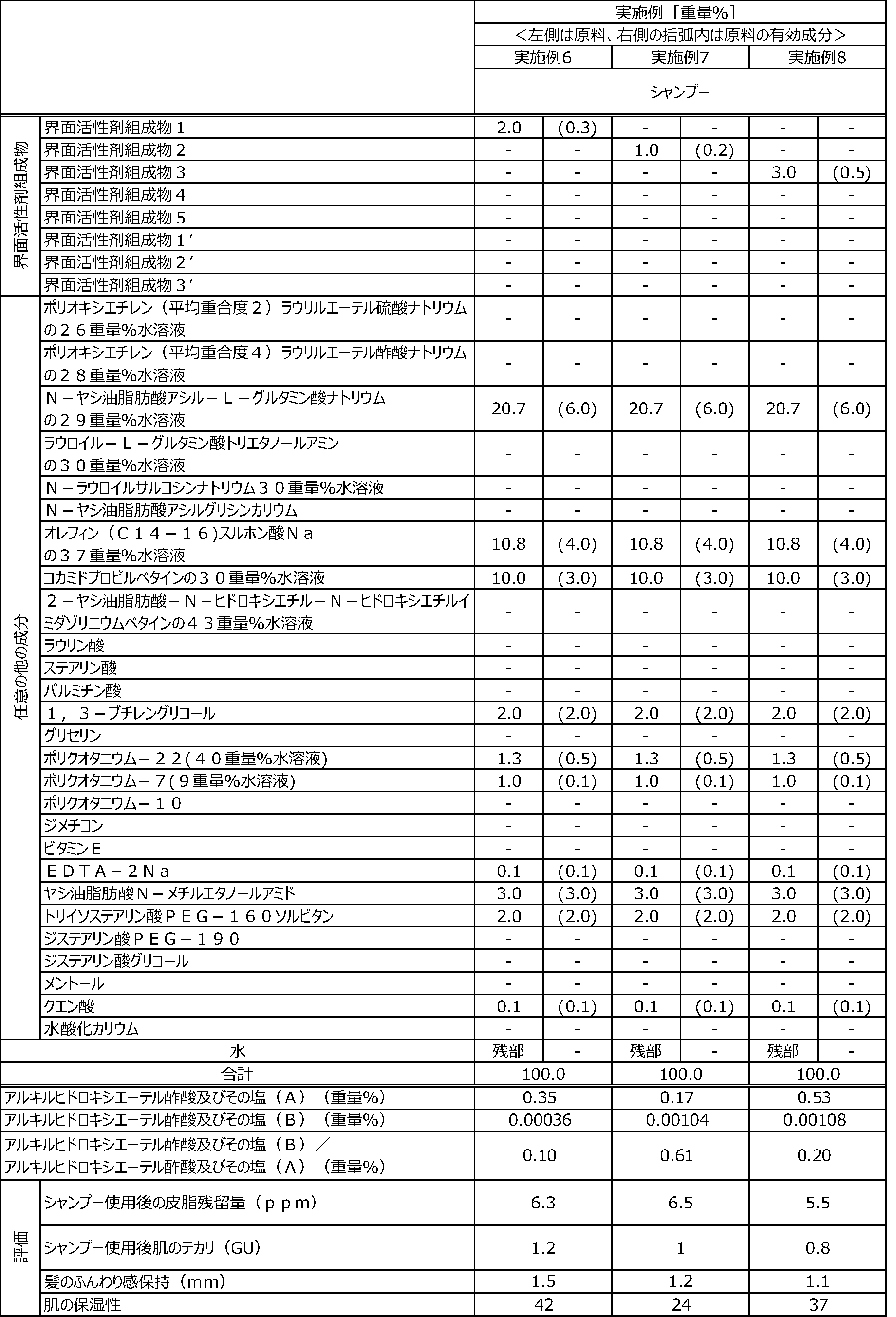

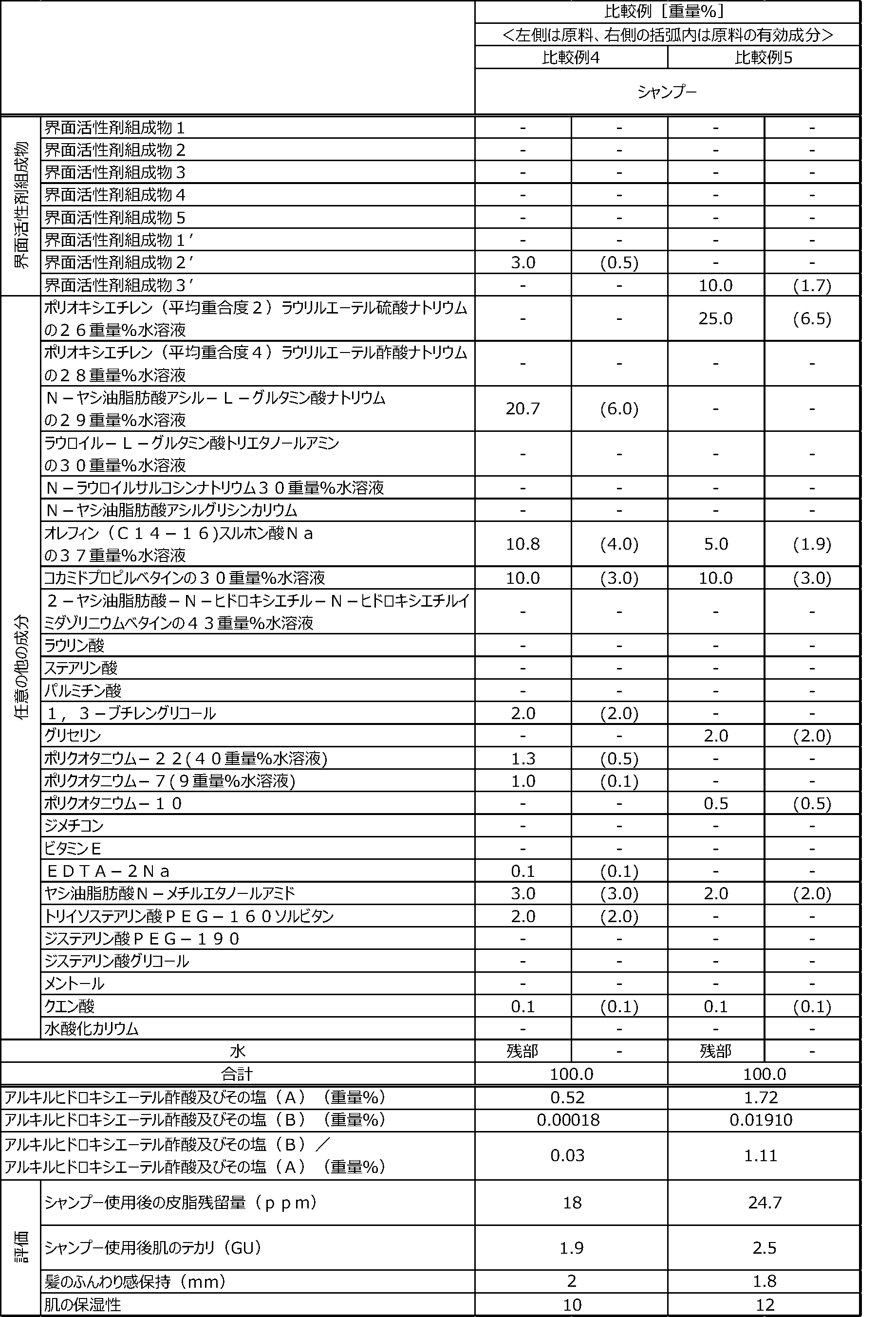
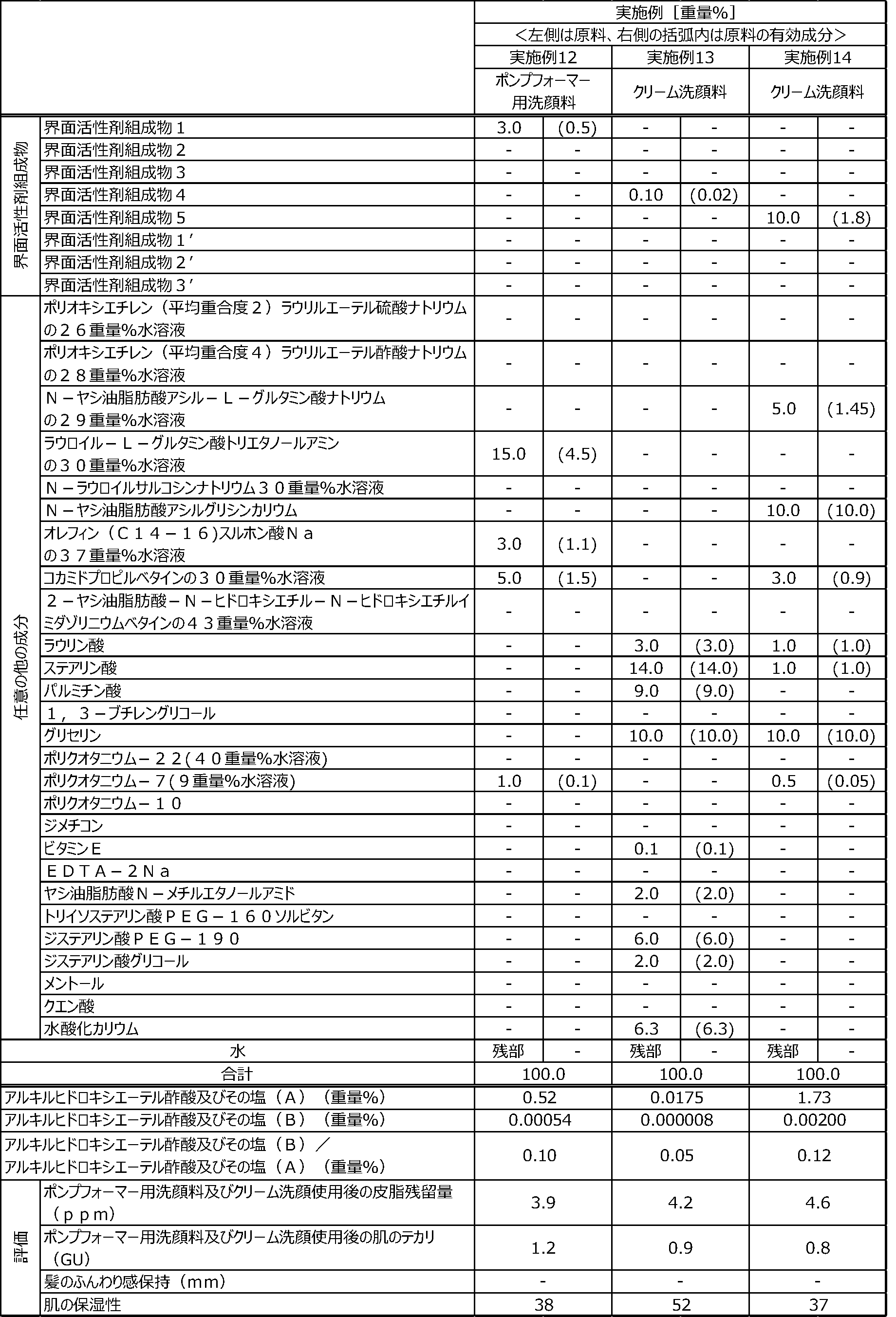
・ポリオキシエチレン(平均重合度2)ラウリルエーテル硫酸ナトリウムの26重量%水溶液[商品名:ビューライトNA-25S{三洋化成工業(株)製(ビューライトは三洋化成工業(株)の登録商標である)}]
・ポリオキシエチレン(平均重合度4)ラウリルエーテル酢酸ナトリウムの28重量%水溶液[商品名:ビューライトLCA-25N{三洋化成工業(株)製}]
・N-ヤシ油脂肪酸アシル-L-グルタミン酸ナトリウムの29重量%水溶液[商品名:Plantapon Amino SCG-L{BASF社製(Plantaponはコグニス・アイピー・マネージメント・ゲゼルシャフト・ミット・ベシュレンクテル・ハフツングの登録商標である)}]
・ラウロイル-L-グルタミン酸トリエタノールアミンの30重量%水溶液[商品名:アミソフト LT-12{味の素ヘルシーサプライ(株)製(アミソフトは味の素(株)の登録商標である)}]
・N-ラウロイルサルコシンナトリウム30重量%水溶液[商品名:ソイポン SLE{川研ファインケミカル(株)製(ソイポンは川研ファインケミカル(株)の登録商標である)}]
・N-ヤシ油脂肪酸アシルグリシンカリウム[商品名:アミライト GCK-11{味の素ヘルシーサプライ(株)製(アミライトは味の素(株)の登録商標である)}]
・オレフィン(C14-16)スルホン酸Naの37重量%水溶液[商品名:リポランLJ-441{ライオン(株)製(リポランはライオン・スペシャリティケミカルズ(株)の登録商標である)}]
・コカミドプロピルベタインの30重量%水溶液[商品名:レボンHC-30W{三洋化成工業(株)製}]
・2-ヤシ油脂肪酸-N-ヒドロキシエチル-N-ヒドロキシエチルイミダゾリニウムベタインの43重量%水溶液[商品名:レボンCIB{三洋化成工業(株)製}]
・ラウリン酸[商品名:NAA-122{日油(株)製(NAAは日油(株)の登録商標である)}]
・ステアリン酸[商品名:NAA―172{日油(株)製}]
・パルミチン酸[商品名:NAA-160{日油(株)製}]
・1,3-ブチレングリコール[ナカライテスク(株)製]
・グリセリン[商品名:化粧品用濃グリセリン{花王(株)製}]
・ポリクオタニウム-22(40重量%水溶液)[商品名:MERQUAT280{ルブリゾール社製(MERQUATはルブリゾル アドバンスド マテリアルズ,インコーポレイテッドの登録商標である)}]
・ポリクオタニウム-7(9重量%水溶液)[商品名:MERQUAT550(ルブリゾール社製)]
・ポリクオタニウム-10[商品名:Sensomer 10M Polymer(ルブリゾール社製)]
・ジメチコン[商品名:KF-96A-2CS{信越化学工業(株)製}]
・ビタミンE[商品名:D-α-トコフェロール{東京化成工業(株)製}]
・EDTA-2Na[商品名:2NA(EDTA・2Na){(株)同仁化学研究所製}]
・ヤシ油脂肪酸N-メチルエタノールアミド[商品名:アミノーンC-11S{花王(株)製(アミノーンは花王(株)の登録商標である)}]
・トリイソステアリン酸PEG-160ソルビタン[商品名:レオドールTW-IS399C{花王(株)製(レオドールは花王(株)の登録商標である)}]
・ジステアリン酸PEG-190[商品名:エマルミン862{三洋化成工業(株)製(エマルミンは三洋化成工業(株)の登録商標である)}]
・ジステアリン酸グリコール[商品名:EMALEX EG-di-S{日本エマルジョン(株)製(EMALEXは日本エマルジョン(株)の登録商標である)}]
・メントール[商品名:l-メントール{富士フイルム和光純薬(株)製}]
・クエン酸[富士フイルム和光純薬(株)製]
・水酸化カリウム[ナカライテスク(株)製]
Claims (2)
- 下記一般式(1)で表されるアルキルヒドロキシエーテル酢酸(塩)(A)と
下記一般式(2)で表されるアルキルヒドロキシエーテル酢酸(塩)(B)とを
含有し、
アルキルヒドロキシエーテル酢酸及びその塩(B)の合計重量割合がアルキルヒドロキシエーテル酢酸及びその塩(A)の合計重量に対して0.05~1重量%である界面活性剤組成物。
R1-CH(OH)-CH2-OCH2COOM1 (1)
[式中、R1は炭素数8~12のアルキル基を表し、M1は水素原子、ナトリウム原子、カリウム原子又はトリエタノールアンモニウムを表す。]
R2-O-CH(X1)CH(X2)-OCH2COOM2 (2)
[式中、X1とX2のいずれか一方は水素原子であり、他方が炭素数8~12のアルキル基であり、
R2は、炭素数10~14のアルキル基における位置番号が1の炭素原子に結合した炭素原子に結合するいずれか1つの水素原子を水酸基で置換したヒドロキシアルキル基であり、
X1又はX2で表される炭素数8~12のアルキル基の炭素数がnである場合のR2の炭素数はn+2であり、
M2は水素原子、ナトリウム原子、カリウム原子又はトリエタノールアンモニウムを表す。] - 請求項1に記載の界面活性剤組成物を含有する洗浄剤。
Priority Applications (2)
| Application Number | Priority Date | Filing Date | Title |
|---|---|---|---|
| CN202380052144.9A CN119497606B (zh) | 2022-07-08 | 2023-06-20 | 表面活性剂组合物和清洗剂 |
| JP2024532010A JPWO2024009754A1 (ja) | 2022-07-08 | 2023-06-20 |
Applications Claiming Priority (2)
| Application Number | Priority Date | Filing Date | Title |
|---|---|---|---|
| JP2022-110133 | 2022-07-08 | ||
| JP2022110133 | 2022-07-08 |
Publications (1)
| Publication Number | Publication Date |
|---|---|
| WO2024009754A1 true WO2024009754A1 (ja) | 2024-01-11 |
Family
ID=89453248
Family Applications (1)
| Application Number | Title | Priority Date | Filing Date |
|---|---|---|---|
| PCT/JP2023/022763 Ceased WO2024009754A1 (ja) | 2022-07-08 | 2023-06-20 | 界面活性剤組成物及び洗浄剤 |
Country Status (4)
| Country | Link |
|---|---|
| JP (1) | JPWO2024009754A1 (ja) |
| CN (1) | CN119497606B (ja) |
| TW (1) | TWI883470B (ja) |
| WO (1) | WO2024009754A1 (ja) |
Cited By (2)
| Publication number | Priority date | Publication date | Assignee | Title |
|---|---|---|---|---|
| JP7835339B1 (ja) * | 2025-10-30 | 2026-03-25 | 三洋化成工業株式会社 | 界面活性剤組成物及び洗浄剤 |
| JP7841647B1 (ja) * | 2025-10-30 | 2026-04-07 | 三洋化成工業株式会社 | 界面活性剤組成物及び洗浄剤 |
Citations (5)
| Publication number | Priority date | Publication date | Assignee | Title |
|---|---|---|---|---|
| JP2003082385A (ja) * | 2001-09-17 | 2003-03-19 | Shiseido Co Ltd | 洗浄剤組成物 |
| JP2015093835A (ja) * | 2013-11-08 | 2015-05-18 | クラシエホームプロダクツ株式会社 | 洗浄剤組成物 |
| JP2017197732A (ja) * | 2016-04-25 | 2017-11-02 | 三洋化成工業株式会社 | 洗浄剤組成物 |
| JP2018203700A (ja) * | 2017-06-09 | 2018-12-27 | ライオン株式会社 | 液体皮膚洗浄剤組成物 |
| JP2021107347A (ja) * | 2019-12-27 | 2021-07-29 | 株式会社 資生堂 | 洗浄料 |
Family Cites Families (3)
| Publication number | Priority date | Publication date | Assignee | Title |
|---|---|---|---|---|
| DE3861820D1 (de) * | 1987-05-13 | 1991-04-04 | Sanyo Chemical Ind Ltd | Carbonsaeuren und verfahren zur herstellung derselben. |
| JP5577058B2 (ja) * | 2009-07-06 | 2014-08-20 | 花王株式会社 | 洗浄剤 |
| CN104159563B (zh) * | 2012-03-02 | 2016-08-24 | 花王株式会社 | 皮肤清洁剂组合物 |
-
2023
- 2023-06-20 JP JP2024532010A patent/JPWO2024009754A1/ja active Pending
- 2023-06-20 CN CN202380052144.9A patent/CN119497606B/zh active Active
- 2023-06-20 WO PCT/JP2023/022763 patent/WO2024009754A1/ja not_active Ceased
- 2023-06-21 TW TW112123421A patent/TWI883470B/zh active
Patent Citations (5)
| Publication number | Priority date | Publication date | Assignee | Title |
|---|---|---|---|---|
| JP2003082385A (ja) * | 2001-09-17 | 2003-03-19 | Shiseido Co Ltd | 洗浄剤組成物 |
| JP2015093835A (ja) * | 2013-11-08 | 2015-05-18 | クラシエホームプロダクツ株式会社 | 洗浄剤組成物 |
| JP2017197732A (ja) * | 2016-04-25 | 2017-11-02 | 三洋化成工業株式会社 | 洗浄剤組成物 |
| JP2018203700A (ja) * | 2017-06-09 | 2018-12-27 | ライオン株式会社 | 液体皮膚洗浄剤組成物 |
| JP2021107347A (ja) * | 2019-12-27 | 2021-07-29 | 株式会社 資生堂 | 洗浄料 |
Cited By (2)
| Publication number | Priority date | Publication date | Assignee | Title |
|---|---|---|---|---|
| JP7835339B1 (ja) * | 2025-10-30 | 2026-03-25 | 三洋化成工業株式会社 | 界面活性剤組成物及び洗浄剤 |
| JP7841647B1 (ja) * | 2025-10-30 | 2026-04-07 | 三洋化成工業株式会社 | 界面活性剤組成物及び洗浄剤 |
Also Published As
| Publication number | Publication date |
|---|---|
| TW202408454A (zh) | 2024-03-01 |
| TWI883470B (zh) | 2025-05-11 |
| CN119497606A (zh) | 2025-02-21 |
| CN119497606B (zh) | 2025-11-14 |
| JPWO2024009754A1 (ja) | 2024-01-11 |
Similar Documents
| Publication | Publication Date | Title |
|---|---|---|
| US9890107B2 (en) | Cross-linked polyglycerol esters | |
| US9409853B2 (en) | Polyglycerol partial esters, preparation and use thereof | |
| AU2016323835B2 (en) | Compositions comprising zwitterionic alkyl-alkanoylamides and/or alkyl alkanoates | |
| AU2012261565B2 (en) | Cationic polyglyceryl compositions and compounds | |
| EP2897573B1 (en) | Cleansing composition for skin or hair | |
| CN116615172A (zh) | 包含天然聚合物和一种或多种(生物)烷二醇的组合物 | |
| CN116634990A (zh) | 包含一种或多种(生物)-链烷二醇与活性组分的组合物 | |
| WO2014046300A2 (en) | Cleansing composition for skin or hair | |
| WO2013041388A1 (en) | Use of isosorbide derivatives for producing cosmetic preparations | |
| US20140080746A1 (en) | Cleansing composition for skin or hair | |
| TWI883470B (zh) | 界面活性劑組成物及洗淨劑 | |
| JP6847839B2 (ja) | すすぎ速度が速いクレンジング組成物 | |
| JP7841647B1 (ja) | 界面活性剤組成物及び洗浄剤 | |
| JP7835339B1 (ja) | 界面活性剤組成物及び洗浄剤 | |
| JP7671030B2 (ja) | クレンジング化粧料 | |
| JP7750391B2 (ja) | 化粧料用組成物、皮膚化粧料及び洗浄料 | |
| JP7790446B2 (ja) | 化粧料用界面活性剤組成物及び化粧料 | |
| JP2024005458A (ja) | 皮膚製剤用の組成物及び皮膚用製剤 | |
| JP4824517B2 (ja) | 外用組成物 | |
| JP2023169101A (ja) | 毛髪用化粧料 | |
| WO2025182885A1 (ja) | 化粧料用油剤組成物及び前記化粧料用油剤組成物を含有する化粧料 | |
| CN118338888A (zh) | 化妆料用表面活性剂组合物和化妆料 | |
| JP2024171364A (ja) | クレンジング料 | |
| JP5562599B2 (ja) | 外用組成物 | |
| JP2023022566A (ja) | 透明皮膚洗浄剤組成物 |
Legal Events
| Date | Code | Title | Description |
|---|---|---|---|
| 121 | Ep: the epo has been informed by wipo that ep was designated in this application |
Ref document number: 23835288 Country of ref document: EP Kind code of ref document: A1 |
|
| WWE | Wipo information: entry into national phase |
Ref document number: 2024532010 Country of ref document: JP |
|
| WWE | Wipo information: entry into national phase |
Ref document number: 202380052144.9 Country of ref document: CN |
|
| WWE | Wipo information: entry into national phase |
Ref document number: 202547009172 Country of ref document: IN |
|
| NENP | Non-entry into the national phase |
Ref country code: DE |
|
| WWP | Wipo information: published in national office |
Ref document number: 202547009172 Country of ref document: IN |
|
| WWP | Wipo information: published in national office |
Ref document number: 202380052144.9 Country of ref document: CN |
|
| 122 | Ep: pct application non-entry in european phase |
Ref document number: 23835288 Country of ref document: EP Kind code of ref document: A1 |