WO2024009458A1 - 半導体装置および電力変換装置 - Google Patents
半導体装置および電力変換装置 Download PDFInfo
- Publication number
- WO2024009458A1 WO2024009458A1 PCT/JP2022/026975 JP2022026975W WO2024009458A1 WO 2024009458 A1 WO2024009458 A1 WO 2024009458A1 JP 2022026975 W JP2022026975 W JP 2022026975W WO 2024009458 A1 WO2024009458 A1 WO 2024009458A1
- Authority
- WO
- WIPO (PCT)
- Prior art keywords
- semiconductor device
- connection terminal
- external connection
- sealing resin
- lead frame
- Prior art date
- Legal status (The legal status is an assumption and is not a legal conclusion. Google has not performed a legal analysis and makes no representation as to the accuracy of the status listed.)
- Ceased
Links
Images





Classifications
-
- H—ELECTRICITY
- H10—SEMICONDUCTOR DEVICES; ELECTRIC SOLID-STATE DEVICES NOT OTHERWISE PROVIDED FOR
- H10W—GENERIC PACKAGES, INTERCONNECTIONS, CONNECTORS OR OTHER CONSTRUCTIONAL DETAILS OF DEVICES COVERED BY CLASS H10
- H10W70/00—Package substrates; Interposers; Redistribution layers [RDL]
- H10W70/40—Leadframes
- H10W70/421—Shapes or dispositions
- H10W70/433—Shapes or dispositions of deformation-absorbing parts, e.g. leads having meandering shapes
-
- H—ELECTRICITY
- H10—SEMICONDUCTOR DEVICES; ELECTRIC SOLID-STATE DEVICES NOT OTHERWISE PROVIDED FOR
- H10W—GENERIC PACKAGES, INTERCONNECTIONS, CONNECTORS OR OTHER CONSTRUCTIONAL DETAILS OF DEVICES COVERED BY CLASS H10
- H10W40/00—Arrangements for thermal protection or thermal control
- H10W40/20—Arrangements for cooling
- H10W40/22—Arrangements for cooling characterised by their shape, e.g. having conical or cylindrical projections
- H10W40/226—Arrangements for cooling characterised by their shape, e.g. having conical or cylindrical projections characterised by projecting parts, e.g. fins to increase surface area
- H10W40/228—Arrangements for cooling characterised by their shape, e.g. having conical or cylindrical projections characterised by projecting parts, e.g. fins to increase surface area the projecting parts being wire-shaped or pin-shaped
-
- H—ELECTRICITY
- H10—SEMICONDUCTOR DEVICES; ELECTRIC SOLID-STATE DEVICES NOT OTHERWISE PROVIDED FOR
- H10W—GENERIC PACKAGES, INTERCONNECTIONS, CONNECTORS OR OTHER CONSTRUCTIONAL DETAILS OF DEVICES COVERED BY CLASS H10
- H10W40/00—Arrangements for thermal protection or thermal control
- H10W40/60—Securing means for detachable heating or cooling arrangements, e.g. clamps
- H10W40/611—Bolts or screws
-
- H—ELECTRICITY
- H10—SEMICONDUCTOR DEVICES; ELECTRIC SOLID-STATE DEVICES NOT OTHERWISE PROVIDED FOR
- H10W—GENERIC PACKAGES, INTERCONNECTIONS, CONNECTORS OR OTHER CONSTRUCTIONAL DETAILS OF DEVICES COVERED BY CLASS H10
- H10W70/00—Package substrates; Interposers; Redistribution layers [RDL]
- H10W70/40—Leadframes
- H10W70/421—Shapes or dispositions
- H10W70/424—Cross-sectional shapes
-
- H—ELECTRICITY
- H10—SEMICONDUCTOR DEVICES; ELECTRIC SOLID-STATE DEVICES NOT OTHERWISE PROVIDED FOR
- H10W—GENERIC PACKAGES, INTERCONNECTIONS, CONNECTORS OR OTHER CONSTRUCTIONAL DETAILS OF DEVICES COVERED BY CLASS H10
- H10W70/00—Package substrates; Interposers; Redistribution layers [RDL]
- H10W70/40—Leadframes
- H10W70/481—Leadframes for devices being provided for in groups H10D8/00 - H10D48/00
-
- H—ELECTRICITY
- H10—SEMICONDUCTOR DEVICES; ELECTRIC SOLID-STATE DEVICES NOT OTHERWISE PROVIDED FOR
- H10W—GENERIC PACKAGES, INTERCONNECTIONS, CONNECTORS OR OTHER CONSTRUCTIONAL DETAILS OF DEVICES COVERED BY CLASS H10
- H10W72/00—Interconnections or connectors in packages
- H10W72/50—Bond wires
- H10W72/531—Shapes of wire connectors
- H10W72/5363—Shapes of wire connectors the connected ends being wedge-shaped
-
- H—ELECTRICITY
- H10—SEMICONDUCTOR DEVICES; ELECTRIC SOLID-STATE DEVICES NOT OTHERWISE PROVIDED FOR
- H10W—GENERIC PACKAGES, INTERCONNECTIONS, CONNECTORS OR OTHER CONSTRUCTIONAL DETAILS OF DEVICES COVERED BY CLASS H10
- H10W72/00—Interconnections or connectors in packages
- H10W72/851—Dispositions of multiple connectors or interconnections
- H10W72/874—On different surfaces
- H10W72/884—Die-attach connectors and bond wires
-
- H—ELECTRICITY
- H10—SEMICONDUCTOR DEVICES; ELECTRIC SOLID-STATE DEVICES NOT OTHERWISE PROVIDED FOR
- H10W—GENERIC PACKAGES, INTERCONNECTIONS, CONNECTORS OR OTHER CONSTRUCTIONAL DETAILS OF DEVICES COVERED BY CLASS H10
- H10W74/00—Encapsulations, e.g. protective coatings
- H10W74/10—Encapsulations, e.g. protective coatings characterised by their shape or disposition
- H10W74/111—Encapsulations, e.g. protective coatings characterised by their shape or disposition the semiconductor body being completely enclosed
- H10W74/114—Encapsulations, e.g. protective coatings characterised by their shape or disposition the semiconductor body being completely enclosed by a substrate and the encapsulations
-
- H—ELECTRICITY
- H10—SEMICONDUCTOR DEVICES; ELECTRIC SOLID-STATE DEVICES NOT OTHERWISE PROVIDED FOR
- H10W—GENERIC PACKAGES, INTERCONNECTIONS, CONNECTORS OR OTHER CONSTRUCTIONAL DETAILS OF DEVICES COVERED BY CLASS H10
- H10W90/00—Package configurations
- H10W90/701—Package configurations characterised by the relative positions of pads or connectors relative to package parts
- H10W90/731—Package configurations characterised by the relative positions of pads or connectors relative to package parts of die-attach connectors
- H10W90/736—Package configurations characterised by the relative positions of pads or connectors relative to package parts of die-attach connectors between a chip and a stacked lead frame, conducting package substrate or heat sink
-
- H—ELECTRICITY
- H10—SEMICONDUCTOR DEVICES; ELECTRIC SOLID-STATE DEVICES NOT OTHERWISE PROVIDED FOR
- H10W—GENERIC PACKAGES, INTERCONNECTIONS, CONNECTORS OR OTHER CONSTRUCTIONAL DETAILS OF DEVICES COVERED BY CLASS H10
- H10W90/00—Package configurations
- H10W90/701—Package configurations characterised by the relative positions of pads or connectors relative to package parts
- H10W90/751—Package configurations characterised by the relative positions of pads or connectors relative to package parts of bond wires
- H10W90/756—Package configurations characterised by the relative positions of pads or connectors relative to package parts of bond wires between a chip and a stacked lead frame, conducting package substrate or heat sink
Definitions
- the present disclosure relates to a semiconductor device and a power conversion device.
- Japanese Unexamined Patent Publication No. 2003-31765 discloses a semiconductor device in which a fixing hole is formed in an external connection terminal portion that is a part of a lead frame extending outside of a sealing resin.
- the external connection terminal section and an external terminal block and a conductor such as a bus bar are fixed by screws inserted into holes in the external connection terminal section.
- Such a semiconductor device is applied to, for example, a power conversion device.
- the present disclosure has been made to solve the above-mentioned problems, and is to provide a highly reliable semiconductor device and power conversion device.
- a semiconductor device includes a semiconductor element, a lead frame, and a sealing resin.
- the semiconductor element is mounted on a lead frame.
- the sealing resin seals the semiconductor element and a portion of the lead frame.
- the lead frame includes an inner portion and an external connection terminal portion.
- the inner part contacts the sealing resin.
- the external connection terminal portion protrudes outward from the surface of the sealing resin.
- the lead frame includes a deformed portion.
- the deformed part is located at the boundary between the inner part and the external connection terminal part.
- the deformation portion is configured to concentrate stress in order to bend the lead frame.
- the deformed portion and the surface of the sealing resin intersect.
- a power conversion device includes a main conversion circuit and a control circuit.
- the main conversion circuit includes the semiconductor device described above, converts input power, and outputs the converted power.
- the control circuit outputs a control signal for controlling the main conversion circuit to the main conversion circuit.
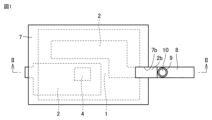
- FIG. 1 is a schematic plan view for explaining the configuration of a semiconductor device according to Embodiment 1.
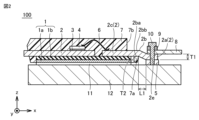
- FIG. 2 is a schematic cross-sectional view taken along line II-II in FIG. 1.
- FIG. 2 is a schematic cross-sectional view for explaining the configuration of the semiconductor device shown in FIG. 1.
- FIG. 2 is a schematic cross-sectional view for explaining the configuration of a modification of the semiconductor device shown in FIG. 1;
- FIG. 3 is a schematic cross-sectional view for explaining the configuration of a semiconductor device according to a second embodiment.
- 6 is a schematic partial cross-sectional view of region VI in FIG. 5.
- FIG. 6 is a schematic partial cross-sectional view for explaining the configuration of the semiconductor device shown in FIG. 5.
- FIG. 6 is a schematic partial cross-sectional view for explaining the configuration of Modification Example 1 of the semiconductor device shown in FIG. 5;
- FIG. 6 is a schematic partial cross-sectional view for explaining the configuration of Modification Example 2 of the semiconductor device shown in FIG. 5;
- FIG. 6 is a partial schematic plan view for explaining the configuration of modification 3 of the semiconductor device shown in FIG. 5;
- FIG. 6 is a partial schematic plan view for explaining the configuration of modification example 4 of the semiconductor device shown in FIG. 5;
- FIG. 12 is a schematic partial cross-sectional view for explaining the configuration of Modification Example 1 of the semiconductor device shown in FIG. 5;
- FIG. 6 is a schematic partial cross-sectional view for explaining the configuration of Modification Example 2 of the semiconductor device shown in FIG. 5;
- FIG. 6 is
- FIG. 13 is a schematic cross-sectional view for explaining the configuration of a modification of the semiconductor device shown in FIG. 12.
- FIG. 15 is a schematic partial cross-sectional view for explaining the configuration of the semiconductor device shown in FIG. 14.
- FIG. 7 is a schematic cross-sectional view for explaining the configuration of a semiconductor device according to a fourth embodiment.
- FIG. 7 is a block diagram showing the configuration of a power conversion system to which a power conversion device according to a fifth embodiment is applied.
- the semiconductor device 100 includes a semiconductor element 4, a lead frame 2, a thermally conductive member 1, a wire 6, a cooler 12, and a fixing part 5. and a sealing resin 7.
- the semiconductor element 4 is mounted on the lead frame 2.
- the semiconductor element 4 is mounted on the upper surface (upper surface) of the lead frame 2 in the z direction.
- a conductive wire 6, which is a connecting member, is arranged to connect an electrode (not shown) of the semiconductor element 4 and the lead frame 2.
- the wire 6 is arranged so as to extend in the x direction in FIG.
- a heat conductive member 1 is connected to the back surface of the lead frame 2, which is opposite to the top surface on which the semiconductor element 4 is mounted.
- the heat conductive member 1 , a portion of the lead frame 2 , the semiconductor element 4 and the wire 6 are sealed with a sealing resin 7 .
- the surface of the heat conductive member 1 is exposed from the sealing resin 7.
- a cooler 12 is connected to the surface of the thermally conductive member 1 via grease 11 .
- the size of the cooler 12 is larger than the size of the sealing resin 7 in a plan view seen from a direction perpendicular to the surface of the lead frame 2 on which the semiconductor element 4 is mounted.
- a fixing portion 5 is formed at a position that does not overlap with the sealing resin 7.
- the fixing portion 5 is a portion for fixing the external connection terminal portion 2a of the lead frame 2, as described later.
- the lead frame 2 includes an inner part 2c and an external connection terminal part 2a.
- the inner part 2c is a part that is buried inside the sealing resin 7 and comes into contact with the sealing resin 7.
- the external connection terminal portion 2a is a portion that is continuous with the inner portion 2c and protrudes outward from the surface of the sealing resin 7.
- a through hole 2e is formed at the tip side of the external connection terminal portion 2a.
- the through hole 2e is a hole for inserting a screw 10 as a fixing member.
- the external connection terminal portion 2a is arranged so that the through hole 2e overlaps with the fixed portion 5.
- a screw hole for inserting a screw 10 is formed in the fixing part 5.
- Bus bar 8 and washer 9 are arranged so as to overlap with through hole 2e of external connection terminal portion 2a.
- a through hole is formed in the bus bar 8 for inserting a screw 10 therethrough.
- the bus bar 8 is positioned such that the through hole of the bus bar 8 overlaps the through hole 2e of the external connection terminal portion 2a.
- the washer 9 is also arranged so as to overlap the through hole 2e.
- the screw 10 is inserted into the hole of the washer 9, the through hole of the bus bar 8, and the through hole 2e of the external connection terminal portion 2a, and is fixed to the screw hole of the fixing portion 5. In this way, the external connection terminal section 2a is fixed to the fixing section 5 and connected to the bus bar 8.
- the lead frame 2 includes a deformed portion 2b.
- the deformed portion 2b is located at the boundary between the inner portion 2c and the external connection terminal portion 2a.
- the deformable portion 2b is configured to concentrate stress in order to bend the lead frame 2. Therefore, as shown in FIG. 2, the lead frame 2 is bent at the deformed portion 2b due to stress when fixing the external connection terminal portion 2a to the fixed portion 5.
- the surface of the support portion 7a of the sealing resin 7 is in contact with the deformed portion 2b so as to intersect therewith.
- the deformable portion 2b includes a first surface 2ba and a second surface 2bb.
- the second surface 2bb is located on the opposite side to the first surface 2ba.
- the first surface 2ba is a part of the back surface of the lead frame 2 connected to the heat conductive member 1 at the deformed portion 2b.
- the second surface 2bb is a part of the upper surface of the lead frame 2 to which the semiconductor element 4 is connected.
- the sealing resin 7 is in contact with the first surface 2ba, but not with the second surface 2bb.
- the notch 7b is formed in the portion of the deformed portion 2b of the sealing resin 7 facing the second surface 2bb, the second surface 2bb of the deformed portion 2b is exposed from the sealing resin 7. ing.
- the supporting portion 7a of the sealing resin 7 is in contact with the first surface 2ba of the deformable portion 2b.
- the surface of the support portion 7a is in contact with the bending point or in a nearby region within 1 mm from the bending point on the first surface 2ba of the deformable portion 2b.
- Thermal conductive member 1 includes metal foil 1a and insulating sheet 1b.
- the insulating sheet 1b is formed on the upper surface of the metal foil 1a. That is, the heat conductive member 1 is a laminate including a metal foil 1a and an insulating sheet 1b.
- the thermally conductive member 1 functions as an insulating layer with high heat dissipation.
- the insulating sheet 1b insulates the metal foil 1a and the lead frame 2. Further, heat generated in the semiconductor element 4 is radiated to the metal foil 1a via the insulating sheet 1b. That is, the insulating sheet 1b has a function as a heat transfer member.
- a high heat conductive member such as a copper plate, an aluminum plate, a copper foil, or an aluminum foil is used.
- the material constituting the insulating sheet 1b is not particularly limited, but may be an inorganic ceramic material alone, or a resin material in which at least one of fine particles and filler is dispersed.
- Materials constituting the fine particles and filler include, for example, alumina (Al 2 O 3 ), aluminum nitride (AlN), silicon nitride (Si 3 N 4 ), silicon dioxide (SiO 2 ), boron nitride (BN), and diamond (C ), silicon carbide (SiC) or boron oxide (B 2 O 3 ).
- the material constituting the fine particles and filler may be a resin material such as silicone resin or acrylic resin.
- the resin in which at least one of the fine particles and the filler is dispersed has electrical insulation properties.
- the resin in which at least one of the fine particles and the filler is dispersed is not particularly limited, but may have an epoxy resin, a polyimide resin, a silicone resin, or an acrylic resin as a main component.
- a lead frame 2 on which an arbitrary wiring structure (wiring circuit) is formed is provided on the thermally conductive member 1.
- Lead frame 2 includes a front surface and a back surface.
- the back surface of the lead frame 2 including the first surface 2ba of the deformed portion 2b is connected to the insulating sheet 1b of the heat conductive member 1.
- a back electrode (not shown) of the semiconductor element 4 is bonded to a wiring circuit via a solder 3 which is a bonding material.
- the portion of the lead frame 2 that protrudes from the sealing resin 7 is screwed to the bus bar 8 and the fixed portion 5, which is a terminal block, as the external connection terminal portion 2a.
- the external connection terminal portion 2a is formed to extend linearly from the surface of the sealing resin 7.
- FIG. 2 when the fixing part 5 is integrated with the cooler 12, there is a difference in the height between the lower surface of the external connection terminal part 2a and the upper surface of the fixing part 5 due to the dimensional tolerance of the members. It can occur. For example, a case may be considered in which the lower surface of the external connection terminal portion 2a is located above the upper surface of the fixing portion 5 at a distance.
- the semiconductor element 4 various types of semiconductor elements can be applied.
- a diode used in a converter section that converts input AC power to DC power a bipolar transistor used in an inverter section that converts DC power to AC power, an IGBT (Insulated Gate Bipolar Transistor), a MOSFET (Metal Oxide Semi-Conduit), etc.
- ctor Field Effect Transistor), GTO (Gate Turn-Off Thyristor), etc. can be used.
- the sealing resin 7 ensures insulation between members such as the sealed semiconductor element 4 and the lead frame 2, and functions as a case for the semiconductor device 100.
- the sealing resin 7 integrally seals the lead frame 2 and the semiconductor element 4.
- transfer molding, injection molding, compression molding, etc. can be used.
- material of the sealing resin 7, for example, epoxy resin containing a filler, phenol resin, etc. can be used.
- a process of preparing members constituting the semiconductor device 100, such as the lead frame 2 and the semiconductor element 4, is carried out.
- the prepared lead frame 2 has a plurality of parts connected to each other by a mold part located on the outer periphery.
- a step of connecting each member is performed.
- the semiconductor element 4 is bonded to the surface of the lead frame 2 via the solder 3.
- wires 6 connecting the wiring circuit formed on the lead frame 2 and the semiconductor element 4 are formed by wire bonding.
- a step (resin sealing step) of sealing the lead frame 2 that has undergone the above-described steps with a sealing resin 7 is performed.
- the resin sealing step the thermally conductive member 1 and the lead frame 2, which has been subjected to wire bonding through the above-described steps, are placed in a mold. Thereafter, a resin that will become the sealing resin 7 is injected into the mold.
- molding methods such as transfer molding, compression molding, and injection molding can be applied.
- a part of the lead frame 2 is cut. Specifically, for example, the mold part is cut and removed from the outer peripheral part of the lead frame 2. In this way, the semiconductor device 100 shown in FIG. 3 is obtained.
- the molded semiconductor device 100 is assembled into the cooler 12 via the grease 11. After that, the semiconductor device 100 is mounted inside a power conversion device, for example.
- the external connection terminal portion 2a is electrically connected (fastened) to a bus bar 8 in the power conversion device, as shown in FIG.
- the connection structure between the external connection terminal section 2a and the bus bar 8 is a screw fastening structure using a washer 9 and a screw 10, but is not limited to this, and other structure may be adopted.
- the external connection terminal portion 2a and the bus bar 8 may be connected by ultrasonic bonding or the like.
- the thickness T1 of the external connection terminal portion 2a is 0.5 mm and the distance between the sealing resin 7 and the bus bar 8 is 3.5 mm or less.
- the distance L1 between the sealing resin 7 and the fixed part 5 is also substantially 3.5 mm or less.
- the distance L1 between the fixed part 5 and the surface of the sealing resin 7 is 7 times or less the thickness T1 of the external connection terminal part 2a.
- the portion of the upper surface of the external connection terminal portion 2a that is not in contact with the sealing resin 7 is, for example, 3.5 mm from the surface (edge portion) of the support portion 7a of the sealing resin 7 that is in contact with the lower surface of the external connection terminal portion 2a. It may extend to a position on the inner side.
- the notch portion 7b which is the portion where the sealing resin 7 is not present, is preferably formed only in the area located on the external connection terminal portion 2a; It may also extend in a direction that intersects the current direction (for example, a direction perpendicular to the paper plane of FIG. 2). In this case, the bottom surface of the notch portion 7b may be on the same plane as the top surface of the external connection terminal portion 2a.
- the side wall of the notch 7b shown in FIG. 2 may be formed over the entire width of the sealing resin 7 in the direction perpendicular to the paper surface of FIG.
- the thickness T2 of the support portion 7a of the sealing resin 7 located in contact with the lower surface of the external connection terminal portion 2a is preferably 1.25 mm or more. be. That is, in the thickness direction that is the direction from the first surface 2ba to the second surface 2bb, the thickness T2 of the support portion 7a, which is the portion of the sealing resin 7 that is in contact with the first surface 2ba, is The thickness T1 is 2.5 times or more. Note that the thickness T1 of the external connection terminal portion 2a may be 0.5 mm or more.
- the external connection terminal portion 2a When the external connection terminal portion 2a is connected (fastened) to the fixed portion 5 and the bus bar 8, the external connection terminal portion is connected (fastened) to the fixed portion 5 and the bus bar 8 in the fastening direction (direction toward the fixed portion 5: ⁇ z direction) in the deformed portion 2b.
- 2a has a bent structure.
- the end portion of the support portion 7a (the corner where the surface of the sealing resin 7 and the upper surface of the support portion 7a intersect) contacts the deformation portion 2b from the lower surface side, so that stress is concentrated on the deformation portion 2b. In other words, the deformation portion 2b becomes the deformation starting point.
- the deformed portion 2b is preferentially deformed (bent)
- excessive stress can be suppressed from being applied to the interface between the lead frame 2 and the sealing resin 7 in areas other than the deformed portion 2b. Therefore, cracks in the sealing resin 7 and occurrence of peeling at the connection interface between the sealing resin 7 and the external connection terminal portion 2a can be suppressed.
- the external connection terminal portion 2a has a support portion 7a made of the sealing resin 7 on one side, and the end portion of the support portion 7a of the sealing resin 7 and the external connection terminal portion
- the contact point with 2a becomes the deformation starting point (deformation portion 2b). Therefore, by concentrating stress on the deformed portion 2b, the deformed portion 2b is preferentially deformed, leading to cracking of the sealing resin 7 in other parts and the interface between the sealing resin 7 and the external connection terminal portion 2a. Peeling can be suppressed. Therefore, without increasing the length of the external connection terminal portion 2a, it is possible to suppress moisture from entering the inside of the semiconductor device 100 from the resin cracked or interface peeled portion. Furthermore, it is also possible to suppress insulation defects caused by the progression of resin cracking and interfacial peeling. As a result, it is possible to improve the reliability of the semiconductor device 100 while suppressing the increase in size.
- the semiconductor device 100 shown in FIG. 4 basically has the same configuration as the semiconductor device 100 shown in FIGS. 1 and 2, but the upper surface of the fixed part 5 and the lower surface of the external connection terminal part 2a are
- the semiconductor device 100 shown in FIGS. 1 and 2 is different from the semiconductor device 100 shown in FIGS. 1 and 2 in terms of the positional relationship and the shape of the sealing resin 7. That is, in the semiconductor device 100 shown in FIG. 4, the height of the upper surface of the fixing portion 5 from the surface of the cooler 12 is higher than the height of the lower surface of the external connection terminal portion 2a from the surface of the cooler 12. There is. Therefore, in FIG. 4, by fixing the external connection terminal part 2a to the fixing part 5, the external connection terminal part 2a is placed on the side away from the cooler 12 (the upper surface side of the lead frame 2 on which the semiconductor element 4 is mounted). It is bent to.
- the first surface 2ba of the deformed portion 2b is included in the upper surface of the lead frame 2, and the second surface 2bb is included in the lower surface of the lead frame 2. Furthermore, a notch 7b in the sealing resin 7 is formed on the lower surface side of the lead frame 2. The support portion 7a of the sealing resin 7 is in contact with the upper surface of the lead frame 2 (the surface on which the semiconductor element 4 is mounted). In this manner, in the semiconductor device 100 shown in FIG. 4, the structure near the deformed portion 2b is vertically reversed from that of the semiconductor device 100 shown in FIG.
- the cutout portion 7b of the sealing resin 7 is formed on the opposite side to the direction in which the deformation portion 2b is bent, the region located on the opposite side to the deformation direction of the deformation portion 2b (the lower surface of the lead frame 2 In the area where the lead frame 2 is exposed from the notch 7b), it is possible to suppress the occurrence of problems such as damage to the sealing resin 7.
- a semiconductor device 100 includes a semiconductor element 4, a lead frame 2, and a sealing resin 7.
- the semiconductor element 4 is mounted on the lead frame 2.
- the sealing resin 7 seals the semiconductor element 4 and a portion of the lead frame 2 .
- Lead frame 2 includes an inner portion 2c and an external connection terminal portion 2a.
- the inner portion 2c contacts the sealing resin 7.
- the external connection terminal portion 2a protrudes outward from the surface of the sealing resin 7.
- Lead frame 2 includes a deformed portion 2b.
- the deformed portion 2b is located at the boundary between the inner portion 2c and the external connection terminal portion 2a.
- the deformable portion 2b is configured to concentrate stress in order to bend the lead frame 2.
- the deformed portion 2b and the surface of the sealing resin 7 intersect.
- the deformable portion 2b is preferentially deformed by the external force. Therefore, it is possible to suppress the occurrence of a problem in which the external force acts on the contact portion between the inner side portion 2c of the lead frame 2 and the sealing resin 7, and the sealing resin 7 is peeled off or damaged at the contact portion. Therefore, the reliability of the semiconductor device 100 can be improved. Furthermore, since the deformed portion 2b and the surface of the sealing resin 7 intersect, that is, the deformed portion 2b is arranged so as to partially overlap the surface of the sealing resin 7, the external connection terminal portion 2a is sealed. The dimensions of the external connection terminal portion 2a can be made smaller than when the deformed portion 2b is formed at a position away from the stopper resin 7. Therefore, it can also be applied to small-sized semiconductor devices.
- the deformable portion 2b includes a first surface 2ba and a second surface 2bb.
- the second surface 2bb is located on the opposite side to the first surface 2ba.
- the sealing resin 7 contacts the first surface 2ba and does not contact the second surface 2bb.
- the supporting portion 7a made of the sealing resin 7 is disposed only on one side (the first surface 2ba) of the deformable portion 2b. becomes. Therefore, when an external force is applied to the first surface 2ba side to bend the external connection terminal portion 2a, the support portion 7a of the sealing resin 7 supports (presses) the deformable portion 2b from the first surface 2ba side. It turns out. As a result, the lead frame 2 can be easily bent at the deformable portion 2b.
- the sealing resin 7 is not in contact with the second surface 2bb of the deformable portion 2b, the second surface 2bb of the deformable portion 2b applies stress to the sealing resin 7 when the deformable portion 2b is bent. In addition, the problem of damage to the sealing resin 7 does not occur.
- the thickness T2 of the support portion 7a which is the portion of the sealing resin 7 that is in contact with the first surface 2ba, is It is 2.5 times or more the thickness T1 of the connection terminal portion 2a.
- the support portion 7a of the sealing resin 7 has a sufficient thickness T2
- the support portion 7a can press the deformation portion 2b of the lead frame 2, promoting stress concentration and deformation on the deformation portion 2b. .
- the distance L1 between the fixing portion 5 and the surface of the sealing resin 7 is as follows. It is seven times or less the thickness T1 of the external connection terminal portion 2a.
- the above configuration according to the present disclosure is applied to the semiconductor device 100 in which the distance L1 between the fixing part 5 and the surface of the sealing resin 7 is relatively small, so that the external connection terminal part 2a and the fixing part Even if there is a misalignment with respect to the lead frame 2 and the sealing resin 7, peeling between the lead frame 2 and the sealing resin 7 and damage to the sealing resin 7 can be effectively suppressed.
- the thickness T1 of the external connection terminal portion 2a is 0.5 mm or more.
- the external connection terminal portion 2a has some degree of rigidity, when stress is applied to the external connection terminal portion 2a, the stress is not transmitted to the sealing resin 7 that contacts the lead frame 2. Cheap.
- damage to the sealing resin 7 caused by the stress can be effectively suppressed.
- Embodiment 2 ⁇ Configuration of semiconductor device>
- the semiconductor device 200 shown in FIGS. 5 to 7 basically has the same configuration as the semiconductor device 100 shown in FIGS. 1 and 2, but the shapes of the deformed portion 2b and the sealing resin 7 are 1 and the semiconductor device 100 shown in FIG. That is, in the semiconductor device 200 shown in FIGS. 5 to 7, the lead frame 2 is shaped so that in the deformed portion 2b, the cross-sectional area in the cross section perpendicular to the extending direction of the external connection terminal portion 2a is locally reduced.
- a recess 21 is formed on the upper surface (the surface on which the semiconductor element 4 is mounted).
- the recess 21, which is the deformed portion 2b, is formed at a position overlapping the surface of the sealing resin 7 so that the recess 21 and the surface of the sealing resin 7 intersect. That is, in the semiconductor device 200 shown in FIGS. 5 to 7, the cutout portion 7b of the sealing resin 7 as shown in FIGS. 1 and 2 is not formed.
- the recess 21 is formed on the surface (upper surface) of the lead frame 2 located on the opposite side to the direction in which the lead frame 2 is bent (the lower side where the heat conductive member 1 is located in FIG. 5).
- the recess 21 is, for example, a cutout in which the lead frame 2 is partially removed.
- the recess 21 may be formed by knurling, for example.
- Such a recess 21 is formed in the semiconductor device 200 before the lead frame 2 is bent, as shown in FIG. Then, when the external connection terminal portion 2a of the semiconductor device 200 is connected (fastened) to the fixing portion 5 and the bus bar 8 as shown in FIG. 5, the connection direction ( The external connection terminal portion 2a is bent in the direction (direction toward the fixed portion 5). At this time, since the recess 21 is formed, the lead frame 2 is easily bent at a portion where the cross-sectional area of the lead frame 2 is locally reduced (a portion where the recess 21 is formed).
- the cross-sectional shape of the recess 21 may be any shape, and may be a V-shape as shown in FIG. 6 or a U-shape.
- the inner circumferential surface of the recess 21 may be a curved surface.
- the recess 21 may be formed in the entire width direction perpendicular to the extending direction of the lead frame 2, or may be formed in a part of the width direction.
- the thickness T1 of the external connection terminal portion 2a is, for example, 1 mm.
- the distance L1 between the sealing resin 7 and the fixed part 5 or the distance between the sealing resin 7 and the bus bar 8 is, for example, 7 mm or less.
- the semiconductor device 200 described above can be manufactured basically by the same manufacturing method as the manufacturing method of the semiconductor device 100 according to the first embodiment. Specifically, a step of preparing members constituting the semiconductor device 200, a step of connecting each member, and a step of sealing with the sealing resin 7 are performed to obtain the semiconductor device 200 having the structure shown in FIG. . The semiconductor device 200 is assembled into the cooler 12. Thereafter, the semiconductor device 200 is mounted inside an electrical device such as a power conversion device.
- connection structure between the external connection terminal section 2a and the bus bar 8 is a screw fastening structure using a washer 9 and a screw 10.
- the deformed portion 2b when the upper surface of the fixed part 5 is located below the lower surface of the external connection terminal part 2a, when the external connection terminal part 2a is connected (fastened) to the fixed part 5 and the bus bar 8, as shown in FIG.
- the deformed portion 2b the external connection terminal portion 2a is bent in the fastening direction (direction toward the fixed portion 5).
- the cross-sectional area of the deformed portion 2b is locally reduced due to the formation of the recess 21, and the strength of the deformed portion 2b is locally reduced.
- the recessed portion 21 of the deformed portion 2b is partially in contact with the sealing resin 7. In other words, the recess 21 is partially (for example, half) enclosed in the sealing resin 7. Therefore, the deformable portion 2b can be easily deformed. Therefore, it is possible to fasten the external connection terminal portion 2a to the bus bar 8 without applying stress to the sealing resin 7 that could cause resin cracking or interfacial peeling between the sealing resin 7 and the lead frame 2. .
- the recess 21 formed as the deformed portion 2b in the lead frame 2 may be formed on a surface other than the top surface of the lead frame 2.
- 8 and 9 are partial cross-sectional schematic diagrams showing Modification 1 and Modification 2 of the semiconductor device 200 shown in FIGS. 5 to 7.
- FIG. 8 to 11 correspond to FIG. 7.
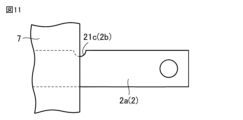
- 10 and 11 are partial plan schematic diagrams showing a third modification and a fourth modification of the semiconductor device 200 shown in FIGS. 5 to 7.
- FIGS. 10 and 11 show the configuration of the deformed portion 2b in plan view when viewed from a direction perpendicular to the top surface of the lead frame 2.
- Modification 1 of the semiconductor device 200 shown in FIG. 8 basically has the same configuration as the semiconductor device 200 shown in FIGS. This is different from the semiconductor device 200 shown in FIG.
- a recess 21 serving as the deformed portion 2b is formed on the lower surface of the lead frame 2.
- no recess is formed on the upper surface of the lead frame 2.
- the recess 21 is arranged at a position partially overlapping the surface of the sealing resin 7.
- Modification 2 of the semiconductor device 200 shown in FIG. 9 basically has the same configuration as the semiconductor device 200 shown in FIGS. 5 to 7, but the configuration of the recess 21 in the lead frame 2 is different from that shown in FIG. This is different from the semiconductor device 200 shown in FIG.
- a recess 21a and a recess 21b are formed in the lead frame 2 as the deformed portion 2b.
- a recess 21 a is formed on the upper surface of the lead frame 2 .
- a recess 21b is formed on the lower surface of the lead frame 2.
- the recess 21a and the recess 21b are respectively arranged at positions that partially overlap the surface of the sealing resin 7.
- FIG. 9 the recess 21a and the recess 21b are respectively arranged at positions that partially overlap the surface of the sealing resin 7.
- the recess 21a and the recess 21b are formed at positions facing each other in the thickness direction of the lead frame 2. However, when viewed from above in a direction perpendicular to the top surface of the lead frame 2, the recesses 21a and 21b are arranged offset so that only a portion thereof overlaps.
- Modification 3 of the semiconductor device 200 shown in FIG. 10 basically has the same configuration as the semiconductor device 200 shown in FIGS. 5 to 7, but the arrangement of the deformed portion 2b in the lead frame 2 is This is different from the semiconductor device 200 shown in FIGS. 5 to 7.
- a recess 21c and a recess 21d are formed in the lead frame 2 as the deformed portion 2b.
- a recess 21c is formed on one of the two side surfaces connecting the top and bottom surfaces of the lead frame 2.
- a recess 21d is formed on the other of the two side surfaces of the lead frame 2.
- the recess 21c and the recess 21d are respectively arranged at positions that partially overlap the surface of the sealing resin 7.
- FIG. 10 the recess 21c and the recess 21d are respectively arranged at positions that partially overlap the surface of the sealing resin 7.
- the recess 21c and the recess 21d are formed at positions facing each other in the width direction, which is a direction perpendicular to the thickness direction of the lead frame 2 and perpendicular to the direction in which the external connection terminal portion 2a extends. has been done.
- Modification 4 of the semiconductor device 200 shown in FIG. 11 basically has the same configuration as the semiconductor device 200 shown in FIG. This is different from the semiconductor device 200 shown in FIG.
- one recess 21c is formed in the lead frame 2 as the deformed portion 2b.
- the recess 21c is formed on one of the two side surfaces connecting the top and bottom surfaces of the lead frame 2. No recess is formed on the other of the two side surfaces of the lead frame 2.
- the recess 21c is arranged at a position that partially overlaps the surface of the sealing resin 7.
- one or two recesses as the deformed portion 2b may be formed in the lead frame 2, but the number of recesses may be three or more.
- recesses may be formed in three or four of the top surface, bottom surface, one side surface, and the other side surface of the lead frame 2.
- the recesses 21a to 21d are preferably formed on a pair of opposing surfaces of the lead frame 2.
- the recess 21 is formed in the deformed portion 2b so that the cross-sectional area in a cross section perpendicular to the extending direction of the external connection terminal portion 2a is locally reduced.
- the recess 21 and the surface of the sealing resin 7 intersect.
- the lead frame 2 when an external force is applied to the external connection terminal portion 2a, the lead frame 2 can be easily deformed in the recess 21 serving as the deformation portion 2b. Further, since the recess 21 and the surface of the sealing resin 7 intersect, the recess 21 is partially fixed by the sealing resin 7. Therefore, a region in which stress is concentrated can be easily formed inside the recess 21, so that the lead frame 2 can be reliably bent in the recess 21.
- the distance L1 between the fixing portion 5 and the surface of the sealing resin 7 is as follows: It is seven times or less the thickness T1 of the external connection terminal portion 2a.
- the external connection terminal portion 2a Even if there is a misalignment between the position of the lead frame 2 and the fixed part 5, damage to the sealing resin 7 can be effectively suppressed by easily bending the lead frame 2 in the recess 21.
- the thickness T1 of the external connection terminal portion 2a is 0.5 mm or more.
- the external connection terminal portion 2a has some degree of rigidity, when stress is applied to the external connection terminal portion 2a, the stress is not transmitted to the sealing resin 7 that contacts the lead frame 2.
- the lead frame 2 is easily bent in the recess 21, so damage to the sealing resin 7 caused by the stress can be effectively suppressed.
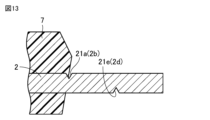
- the semiconductor device 300 shown in FIGS. 12 and 13 basically has the same configuration as the semiconductor device 200 shown in FIGS.
- the semiconductor device 200 differs from the semiconductor device 200 shown in FIGS. 5 to 7 in that a portion 2d is formed.
- the additional deformation portion 2d is formed in the external connection terminal portion 2a at a position farther away from the deformation portion 2b when viewed from the sealing resin 7.
- the additional deformation portion 2d is a recess 21e formed on the lower surface of the external connection terminal portion 2a.
- the additional deformation portion 2d is configured such that stress is concentrated in order to bend the external connection terminal portion 2a by locally reducing the cross-sectional area of the external connection terminal portion 2a.
- a through hole 2e for inserting a screw 10 as a fixing member is formed in the external connection terminal portion 2a.
- the through hole 2e is formed at a position farther away from the additional deformation portion 2d when viewed from the sealing resin 7. Similar to the semiconductor device 200 shown in FIG. fixed in the hole.
- the recess 21e which is the additional deformation portion 2d, is arranged at a position overlapping the outer periphery of the washer 9.
- the external connection terminal portion 2a is bent downward (in the direction toward the fixed portion 5) at the deformed portion 2b.
- the external connection terminal portion 2a is bent in the direction opposite to the deformation direction of the deformation portion 2b (in the direction away from the fixed portion 5) at the additional deformation portion 2d.
- a portion of the external connection terminal portion 2a located on the distal side of the additional deformation portion 2d (a portion in which the through hole 2e is formed) is arranged so as to extend in a direction along the upper surface of the fixing portion 5.
- the semiconductor device 300 described above can be manufactured basically by the same manufacturing method as the manufacturing method of the semiconductor device 200 according to the second embodiment. Specifically, a step of preparing members constituting the semiconductor device 300, a step of connecting each member, and a step of sealing with the sealing resin 7 are performed to obtain the semiconductor device 300 having the structure shown in FIG. . The semiconductor device 300 is assembled into the cooler 12. Thereafter, the semiconductor device 300 is mounted inside an electrical device such as a power conversion device.
- connection structure between the external connection terminal section 2a and the bus bar 8 is a screw fastening structure using a washer 9 and a screw 10.
- the external connection terminal part 2a when the upper surface of the fixed part 5 is located below the lower surface of the external connection terminal part 2a, when the external connection terminal part 2a is connected (fastened) to the fixed part 5 and the bus bar 8, as shown in FIG.
- the external connection terminal portion 2a is bent in the fastening direction (direction toward the fixed portion 5) at the deformed portion 2b.
- the external connection terminal portion 2a is bent in the additional deformation portion 2d in a direction opposite to the bending direction in the deformation portion 2b.
- the additional deformation part 2d the cross-sectional area becomes locally small due to the formation of the recess 21e, and the strength of the additional deformation part 2d becomes locally small. Therefore, the additional deformation portion 2d can be easily deformed. For this reason, it is possible to fasten the external connection terminal part 2a to the bus bar 8 without excessive stress being applied to the sealing resin 7 when connecting the external connection terminal part 2a and the bus bar 8 with the screw 10. It is.
- the cross-sectional shape of the recess 21e constituting the additional deformation portion 2d may be any shape, and may be a V-shape as shown in FIG. 12 or a U-shape.
- the inner circumferential surface of the recess 21e may be a curved surface.
- the recessed portion 21e may be formed in the entire width direction perpendicular to the extending direction of the external connection terminal portion 2a, or may be formed in a part of the width direction.
- a plurality of recesses 21e may be formed on the lower surface of the external connection terminal portion 2a.
- One or two recesses as the additional deformation portion 2d may be formed in the external connection terminal portion 2a, but the number of recesses may be three or more.
- the recesses 21e may be formed in three or four of the top surface, bottom surface, one side surface, and the other side surface of the external connection terminal portion 2a.
- the recesses 21e are preferably formed on a set of surfaces facing each other in the external connection terminal portion 2a.
- the recessed portion 21e is, for example, a cutout portion in which the external connection terminal portion 2a is partially removed.
- the recess 21e may be formed by knurling, for example.
- the recess 21b and the recess 21e are formed on different surfaces of the upper and lower surfaces of the lead frame 2, the recess 21b and the recess 21e may be formed on the same surface.
- the semiconductor device 300 shown in FIGS. 14 and 15 basically has the same configuration as the semiconductor device 300 shown in FIGS. 12 and 13, but the upper surface of the fixing part 5 and the lower surface of the external connection terminal part 2a The relative positional relationship between the deformed portion 2b and the additional deformed portion 2d is different from the semiconductor device 300 shown in FIGS. 12 and 13. Note that FIG. 14 corresponds to FIG. 12, and FIG. 15 corresponds to FIG. 13.
- a recess 21b is formed on the lower surface of the lead frame 2 (the surface facing the thermally conductive member 1) as the deformed portion 2b. Further, as the additional deformation portion 2d, a recessed portion 21f is formed on the upper surface of the external connection terminal portion 2a (the surface on the side where the semiconductor element 4 is located). That is, in the semiconductor device 300 shown in FIGS. 14 and 15, the arrangement of the deformed portion 2b and the additional deformed portion 2d is reversed from that of the semiconductor device 300 shown in FIGS. 12 and 13.
- the height of the upper surface of the fixing portion 5 from the surface of the cooler 12 is higher than the height of the lower surface of the external connection terminal portion 2a from the surface of the cooler 12. ing. Therefore, in FIG. 14, by fixing the external connection terminal part 2a to the fixed part 5, the external connection terminal part 2a is fixed to the deformed part 2b on the side away from the cooler 12 (the side of the lead frame 2 on which the semiconductor element 4 is mounted). upper surface side: +z direction). Further, the external connection terminal portion 2a is bent in the direction toward the cooler 12 ( ⁇ z direction) at the additional deformation portion 2d.
- the structures of the deformed portion 2b and the additional deformed portion 2d are vertically reversed from those of the semiconductor device 300 shown in FIGS. 12 and 13. .
- effects similar to those of the semiconductor device 300 shown in FIGS. 12 and 13 can be obtained.
- the external connection terminal portion 2a includes an additional deformation portion 2d.
- the additional deformation portion 2d is formed at a position farther away from the deformation portion 2b when viewed from the sealing resin 7 in the external connection terminal portion 2a.
- the additional deformation portion 2d is configured to concentrate stress in order to bend the external connection terminal portion 2a.
- bendable portions (deformable portion 2b and additional deformable portion 2d) are formed in at least two locations in the external connection terminal portion 2a so as to absorb stress applied to the external connection terminal portion 2a. Therefore, since the stress is easily absorbed by the bending of the portion, damage to the sealing resin 7 caused by the stress can be suppressed.
- a through hole 2e is formed in the external connection terminal portion 2a.
- the through hole 2e is formed at a position farther away from the additional deformation portion 2d when viewed from the sealing resin 7.
- the through hole 2e is a hole through which a fixing member is inserted.
- the fixing member includes a screw 10 and a washer 9.
- the screw 10 is inserted into the through hole 2e.
- the washer 9 is arranged so as to overlap the through hole 2e.
- a screw 10 is inserted through the washer 9.
- the additional deformation portion 2d is arranged at a position overlapping the outer periphery of the washer 9 with the screw 10 inserted into the through hole 2e.
- the additional deformable portion 2d is arranged near the portion of the fixing member that is pressed by the washer 9. Therefore, the external connection terminal portion 2a can be easily bent in the additional deformation portion 2d due to the stress caused by the fixing member. Therefore, damage to the sealing resin 7 caused by the stress can be suppressed.
- the distance L1 between the fixing portion 5 and the surface of the sealing resin 7 is as follows: It is seven times or less the thickness T1 of the external connection terminal portion 2a.
- the external connection terminal portion 2a Even if there is a misalignment between the position of the fixed portion 5 and the fixed portion 5, the external connection terminal portion 2a can be easily bent at the additional deformation portion 2d and the deformation portion 2b. Therefore, damage to the sealing resin 7 can be effectively suppressed.
- the thickness T1 of the external connection terminal portion 2a is 0.5 mm or more.
- the external connection terminal portion 2a has some degree of rigidity, when stress is applied to the external connection terminal portion 2a, the stress is not transmitted to the sealing resin 7 that contacts the lead frame 2.
- Cheap the external connection terminal portion 2a is easily bent at the additional deformation portion 2d and the deformation portion 2b, so that damage to the sealing resin 7 caused by the stress can be effectively prevented. can be suppressed to
- a semiconductor device 400 shown in FIG. 16 basically has the same configuration as the semiconductor device 100 shown in FIGS. 1 and 2, but the structure of the heat conductive member 1, cooler 12, and sealing resin 7 This is different from the semiconductor device 100 shown in FIGS. 1 and 2. That is, in the semiconductor device 400 shown in FIG. 16, the heat conductive member 1 is constituted by the insulating sheet 1b. Further, the heat conductive member 1 and a part of the cooler 12 are sealed with a sealing resin 7.
- the insulating sheet 1b constituting the heat conductive member 1 is an insulating layer with high heat dissipation.
- the insulating sheet 1b electrically insulates between the cooler 12 and the lead frame 2. Further, the insulating sheet 1b as the heat conductive member 1 has a role of dissipating the heat generated in the semiconductor element 4 to the cooler 12 via the insulating sheet 1b.
- the same material as the material forming the insulating sheet 1b in the semiconductor device 100 shown in FIGS. 1 and 2 can be used as the material forming the insulating sheet 1b.
- the sealing resin 7 covers the connection portion between the lead frame 2 and the heat conduction member 1, and extends over the connection portion between the heat conduction member 1 and the cooler 12 to the side surface of the cooler 12. That is, the heat conductive member 1 and a part of the cooler 12 are sealed with the sealing resin 7. Therefore, unlike the semiconductor device 100 shown in FIG. has been done.
- the semiconductor device 400 includes a heat conductive member 1 and a cooler 12.
- the heat conductive member 1 is connected to a lead frame 2.
- the cooler 12 is connected to the heat conductive member 1 .
- the heat conductive member 1 and a portion of the cooler 12 are sealed with a sealing resin 7.
- the sealing process using the sealing resin 7 also connects the heat conductive member 1 and the cooler 12, so the sealing process using the sealing resin 7 and the process of connecting the cooler 12 to the heat conductive member 1 are performed.
- the manufacturing process of the semiconductor device can be simplified compared to the case where the process is performed as a separate process.
- the distance L1 between the fixing portion 5 and the surface of the sealing resin 7 is as follows: It is seven times or less the thickness T1 of the external connection terminal portion 2a.
- the external connection terminal portion 2a Even if there is a misalignment between the position of the fixed part 5 and the fixed part 5, the lead frame 2 can be easily bent at the deformable part 2b. Therefore, damage to the sealing resin 7 can be effectively suppressed.
- the thickness T1 of the external connection terminal portion 2a is 0.5 mm or more.
- the external connection terminal portion 2a has some degree of rigidity, when stress is applied to the external connection terminal portion 2a, the stress is not transmitted to the sealing resin 7 that contacts the lead frame 2.
- the lead frame 2 is easily bent at the deformed portion 2b, so damage to the sealing resin 7 caused by the stress can be effectively suppressed.
- Embodiment 5 the semiconductor device according to any one of Embodiments 1 to 4 described above is applied to a power conversion device.
- the present disclosure is not limited to a specific power conversion device, a case will be described below as a fifth embodiment in which the present disclosure is applied to a three-phase inverter.
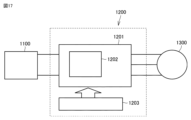
- FIG. 17 is a block diagram showing the configuration of a power conversion system to which the power conversion device according to the present embodiment is applied.
- the power conversion system shown in FIG. 17 includes a power source 1100, a power conversion device 1200, and a load 1300.
- Power supply 1100 is a DC power supply and supplies DC power to power conversion device 1200.
- the power source 1100 can be composed of various things, for example, it can be composed of a DC system, a solar battery, a storage battery, or it can be composed of a rectifier circuit or an AC/DC converter connected to an AC system. Good too. Further, the power supply 1100 may be configured with a DC/DC converter that converts DC power output from a DC system into predetermined power.
- the power conversion device 1200 is a three-phase inverter connected between the power source 1100 and the load 1300, converts the DC power supplied from the power source 1100 into AC power, and supplies the AC power to the load 1300. As shown in FIG. 17, the power conversion device 1200 includes a main conversion circuit 1201 that converts DC power into AC power and outputs it, and a control circuit 1203 that outputs a control signal for controlling the main conversion circuit 1201 to the main conversion circuit 1201. It is equipped with
- the load 1300 is a three-phase electric motor driven by AC power supplied from the power converter 1200.
- the load 1300 is not limited to a specific application, but is a motor installed in various electrical devices, and is used, for example, as a motor for a hybrid vehicle, an electric vehicle, a railway vehicle, an elevator, or an air conditioner.
- the main conversion circuit 1201 includes a switching element and a freewheeling diode (not shown), and when the switching element switches, it converts the DC power supplied from the power supply 1100 into AC power, and supplies the alternating current power to the load 1300.
- the main conversion circuit 1201 is a two-level three-phase full bridge circuit, and has six switching elements and each switching element. It can be constructed from six freewheeling diodes arranged in antiparallel.
- each switching element and each freewheeling diode of main conversion circuit 1201 is a switching element or a freewheeling diode included in semiconductor device 1202 corresponding to the semiconductor device of any one of Embodiments 1 to 4 described above.
- the six switching elements are connected in series every two switching elements to form upper and lower arms, and each upper and lower arm forms each phase (U phase, V phase, W phase) of the full bridge circuit.
- the output terminals of the upper and lower arms, that is, the three output terminals of the main conversion circuit 1201 are connected to the load 1300.
- the main conversion circuit 1201 includes a drive circuit (not shown) that drives each switching element, but the drive circuit may be built in the semiconductor device 1202 or may be provided separately from the semiconductor device 1202. It may be a configuration in which it is provided.
- the drive circuit generates a drive signal for driving the switching element of the main conversion circuit 1201 and supplies it to the control electrode of the switching element of the main conversion circuit 1201. Specifically, according to a control signal from a control circuit 1203, which will be described later, a drive signal that turns the switching element on and a drive signal that turns the switching element off are output to the control electrode of each switching element.
- the drive signal When keeping the switching element in the on state, the drive signal is a voltage signal (on signal) that is greater than or equal to the threshold voltage of the switching element, and when the switching element is kept in the off state, the drive signal is a voltage signal that is less than or equal to the threshold voltage of the switching element. signal (off signal).
- the control circuit 1203 controls the switching elements of the main conversion circuit 1201 so that the desired power is supplied to the load 1300. Specifically, the time (on time) during which each switching element of the main conversion circuit 1201 should be in the on state is calculated based on the power to be supplied to the load 1300.
- the main conversion circuit 1201 can be controlled by PWM control that modulates the on-time of the switching element according to the voltage to be output. Then, a control command (control signal) is sent to the drive circuit included in the main conversion circuit 1201 so that an on signal is output to the switching element that should be in the on state at each time, and an off signal is output to the switching element that should be in the off state. Output.
- the drive circuit outputs an on signal or an off signal as a drive signal to the control electrode of each switching element according to this control signal.
- the semiconductor device according to any one of Embodiments 1 to 4 is applied as the semiconductor device 1202 configuring the main conversion circuit 1201, so that high reliability can be obtained. can.
- the present disclosure is not limited to this and can be applied to various power conversion devices.
- a two-level power converter is used, but a three-level or multi-level power converter may be used, and when supplying power to a single-phase load, the present disclosure may be applied to a single-phase inverter. May be applied.
- the present disclosure can also be applied to a DC/DC converter or an AC/DC converter.
- the power conversion device to which the present disclosure is applied is not limited to cases where the above-mentioned load is an electric motor. It can also be used as a power conditioner for solar power generation systems, power storage systems, etc.
- 1 heat conductive member 1a metal foil, 1b insulating sheet, 2 lead frame, 2a external connection terminal part, 2b deformed part, 2ba first surface, 2bb second surface, 2c inner part, 2d additional deformed part, 2e through hole, 3 Solder, 4 Semiconductor element, 5 Fixing part, 6 Wire, 7 Sealing resin, 7a Support part, 7b Notch part, 8 Bus bar, 9 Washer, 10 Screw, 11 Grease, 12 Cooler, 21, 21a, 21b, 21c, 21d, 21e, 21f recess, 100, 200, 300, 400, 1202 semiconductor device, 1100 power supply, 1200 power conversion device, 1201 main conversion circuit, 1203 control circuit, 1300 load.
Landscapes
- Structures Or Materials For Encapsulating Or Coating Semiconductor Devices Or Solid State Devices (AREA)
- Lead Frames For Integrated Circuits (AREA)
Priority Applications (5)
| Application Number | Priority Date | Filing Date | Title |
|---|---|---|---|
| PCT/JP2022/026975 WO2024009458A1 (ja) | 2022-07-07 | 2022-07-07 | 半導体装置および電力変換装置 |
| DE112022007496.5T DE112022007496T5 (de) | 2022-07-07 | 2022-07-07 | Halbleitervorrichtung und leistungsumwandlungsvorrichtung |
| JP2022576823A JP7237258B1 (ja) | 2022-07-07 | 2022-07-07 | 半導体装置および電力変換装置 |
| US18/878,094 US20250385163A1 (en) | 2022-07-07 | 2022-07-07 | Semiconductor device and power conversion device |
| CN202280097525.4A CN119452474A (zh) | 2022-07-07 | 2022-07-07 | 半导体装置以及电力变换装置 |
Applications Claiming Priority (1)
| Application Number | Priority Date | Filing Date | Title |
|---|---|---|---|
| PCT/JP2022/026975 WO2024009458A1 (ja) | 2022-07-07 | 2022-07-07 | 半導体装置および電力変換装置 |
Publications (1)
| Publication Number | Publication Date |
|---|---|
| WO2024009458A1 true WO2024009458A1 (ja) | 2024-01-11 |
Family
ID=85503239
Family Applications (1)
| Application Number | Title | Priority Date | Filing Date |
|---|---|---|---|
| PCT/JP2022/026975 Ceased WO2024009458A1 (ja) | 2022-07-07 | 2022-07-07 | 半導体装置および電力変換装置 |
Country Status (5)
| Country | Link |
|---|---|
| US (1) | US20250385163A1 (https=) |
| JP (1) | JP7237258B1 (https=) |
| CN (1) | CN119452474A (https=) |
| DE (1) | DE112022007496T5 (https=) |
| WO (1) | WO2024009458A1 (https=) |
Citations (4)
| Publication number | Priority date | Publication date | Assignee | Title |
|---|---|---|---|---|
| JP2003234442A (ja) * | 2002-02-06 | 2003-08-22 | Hitachi Ltd | 半導体装置及びその製造方法 |
| JP2007165426A (ja) * | 2005-12-12 | 2007-06-28 | Mitsubishi Electric Corp | 半導体装置 |
| WO2015012180A1 (ja) * | 2013-07-22 | 2015-01-29 | ローム株式会社 | パワーモジュールおよびその製造方法 |
| JP7026861B1 (ja) * | 2021-05-11 | 2022-02-28 | 三菱電機株式会社 | 半導体装置及び電力変換装置 |
-
2022
- 2022-07-07 DE DE112022007496.5T patent/DE112022007496T5/de active Pending
- 2022-07-07 JP JP2022576823A patent/JP7237258B1/ja active Active
- 2022-07-07 WO PCT/JP2022/026975 patent/WO2024009458A1/ja not_active Ceased
- 2022-07-07 CN CN202280097525.4A patent/CN119452474A/zh active Pending
- 2022-07-07 US US18/878,094 patent/US20250385163A1/en active Pending
Patent Citations (4)
| Publication number | Priority date | Publication date | Assignee | Title |
|---|---|---|---|---|
| JP2003234442A (ja) * | 2002-02-06 | 2003-08-22 | Hitachi Ltd | 半導体装置及びその製造方法 |
| JP2007165426A (ja) * | 2005-12-12 | 2007-06-28 | Mitsubishi Electric Corp | 半導体装置 |
| WO2015012180A1 (ja) * | 2013-07-22 | 2015-01-29 | ローム株式会社 | パワーモジュールおよびその製造方法 |
| JP7026861B1 (ja) * | 2021-05-11 | 2022-02-28 | 三菱電機株式会社 | 半導体装置及び電力変換装置 |
Also Published As
| Publication number | Publication date |
|---|---|
| US20250385163A1 (en) | 2025-12-18 |
| CN119452474A (zh) | 2025-02-14 |
| JP7237258B1 (ja) | 2023-03-10 |
| DE112022007496T5 (de) | 2025-04-17 |
| JPWO2024009458A1 (https=) | 2024-01-11 |
Similar Documents
| Publication | Publication Date | Title |
|---|---|---|
| JP7561677B2 (ja) | 電力半導体装置、電力半導体装置の製造方法及び電力変換装置 | |
| CN113454773B (zh) | 半导体装置、半导体装置的制造方法及电力变换装置 | |
| CN113316844A (zh) | 半导体装置、半导体装置的制造方法以及电力变换装置 | |
| CN113261095B (zh) | 半导体装置、半导体装置的制造方法及电力转换装置 | |
| US12469802B2 (en) | Semiconductor device and power converter | |
| US20220199476A1 (en) | Semiconductor device, method for manufacturing semiconductor device, and power conversion device | |
| CN114530435B (zh) | 功率半导体模块及电力转换装置 | |
| US20240222233A1 (en) | Semiconductor device and power converter | |
| JP6279186B1 (ja) | 半導体装置および電力変換装置 | |
| JP7237258B1 (ja) | 半導体装置および電力変換装置 | |
| JP7535909B2 (ja) | 電力用半導体装置およびその製造方法ならびに電力変換装置 | |
| CN115280496B (zh) | 半导体装置以及电力变换装置 | |
| JP7479771B2 (ja) | 半導体装置、半導体装置の製造方法及び電力変換装置 | |
| JP2024077117A (ja) | 半導体装置、半導体装置の製造方法および電力変換装置 | |
| JP2024138858A (ja) | 電力用半導体装置、電力変換装置、及び、電力用半導体装置の製造方法 | |
| JP7851687B2 (ja) | 半導体装置、電力変換装置および半導体装置の製造方法 | |
| JP7851410B2 (ja) | 半導体装置、電力変換装置および半導体装置の製造方法 | |
| US20240404939A1 (en) | Semiconductor device and vehicle | |
| US20250246522A1 (en) | Semiconductor module | |
| JP2024139935A (ja) | 半導体装置および電力変換装置 | |
| JP2026058632A (ja) | 電力用半導体装置および電力変換装置 | |
| WO2025182086A1 (ja) | 電力用半導体装置および電力変換装置 | |
| CN116613112A (zh) | 半导体装置 |
Legal Events
| Date | Code | Title | Description |
|---|---|---|---|
| WWE | Wipo information: entry into national phase |
Ref document number: 2022576823 Country of ref document: JP |
|
| 121 | Ep: the epo has been informed by wipo that ep was designated in this application |
Ref document number: 22950252 Country of ref document: EP Kind code of ref document: A1 |
|
| WWE | Wipo information: entry into national phase |
Ref document number: 18878094 Country of ref document: US |
|
| WWE | Wipo information: entry into national phase |
Ref document number: 202280097525.4 Country of ref document: CN |
|
| WWE | Wipo information: entry into national phase |
Ref document number: 112022007496 Country of ref document: DE |
|
| WWP | Wipo information: published in national office |
Ref document number: 202280097525.4 Country of ref document: CN |
|
| WWP | Wipo information: published in national office |
Ref document number: 112022007496 Country of ref document: DE |
|
| 122 | Ep: pct application non-entry in european phase |
Ref document number: 22950252 Country of ref document: EP Kind code of ref document: A1 |
|
| WWP | Wipo information: published in national office |
Ref document number: 18878094 Country of ref document: US |