WO2024004618A1 - 多官能ビニル樹脂及びその製造方法 - Google Patents
多官能ビニル樹脂及びその製造方法 Download PDFInfo
- Publication number
- WO2024004618A1 WO2024004618A1 PCT/JP2023/021783 JP2023021783W WO2024004618A1 WO 2024004618 A1 WO2024004618 A1 WO 2024004618A1 JP 2023021783 W JP2023021783 W JP 2023021783W WO 2024004618 A1 WO2024004618 A1 WO 2024004618A1
- Authority
- WO
- WIPO (PCT)
- Prior art keywords
- formula
- group
- polyfunctional vinyl
- vinyl resin
- resin
- Prior art date
- Legal status (The legal status is an assumption and is not a legal conclusion. Google has not performed a legal analysis and makes no representation as to the accuracy of the status listed.)
- Ceased
Links
Images



Classifications
-
- C—CHEMISTRY; METALLURGY
- C08—ORGANIC MACROMOLECULAR COMPOUNDS; THEIR PREPARATION OR CHEMICAL WORKING-UP; COMPOSITIONS BASED THEREON
- C08G—MACROMOLECULAR COMPOUNDS OBTAINED OTHERWISE THAN BY REACTIONS ONLY INVOLVING UNSATURATED CARBON-TO-CARBON BONDS
- C08G61/00—Macromolecular compounds obtained by reactions forming a carbon-to-carbon link in the main chain of the macromolecule
- C08G61/02—Macromolecular compounds containing only carbon atoms in the main chain of the macromolecule, e.g. polyxylylenes
-
- B—PERFORMING OPERATIONS; TRANSPORTING
- B32—LAYERED PRODUCTS
- B32B—LAYERED PRODUCTS, i.e. PRODUCTS BUILT-UP OF STRATA OF FLAT OR NON-FLAT, e.g. CELLULAR OR HONEYCOMB, FORM
- B32B27/00—Layered products comprising a layer of synthetic resin
- B32B27/28—Layered products comprising a layer of synthetic resin comprising synthetic resins not wholly covered by any one of the sub-groups B32B27/30 - B32B27/42
-
- C—CHEMISTRY; METALLURGY
- C08—ORGANIC MACROMOLECULAR COMPOUNDS; THEIR PREPARATION OR CHEMICAL WORKING-UP; COMPOSITIONS BASED THEREON
- C08F—MACROMOLECULAR COMPOUNDS OBTAINED BY REACTIONS ONLY INVOLVING CARBON-TO-CARBON UNSATURATED BONDS
- C08F299/00—Macromolecular compounds obtained by interreacting polymers involving only carbon-to-carbon unsaturated bond reactions, in the absence of non-macromolecular monomers
-
- C—CHEMISTRY; METALLURGY
- C08—ORGANIC MACROMOLECULAR COMPOUNDS; THEIR PREPARATION OR CHEMICAL WORKING-UP; COMPOSITIONS BASED THEREON
- C08J—WORKING-UP; GENERAL PROCESSES OF COMPOUNDING; AFTER-TREATMENT NOT COVERED BY SUBCLASSES C08B, C08C, C08F, C08G or C08H
- C08J5/00—Manufacture of articles or shaped materials containing macromolecular substances
- C08J5/24—Impregnating materials with prepolymers which can be polymerised in situ, e.g. manufacture of prepregs
-
- C—CHEMISTRY; METALLURGY
- C08—ORGANIC MACROMOLECULAR COMPOUNDS; THEIR PREPARATION OR CHEMICAL WORKING-UP; COMPOSITIONS BASED THEREON
- C08G—MACROMOLECULAR COMPOUNDS OBTAINED OTHERWISE THAN BY REACTIONS ONLY INVOLVING UNSATURATED CARBON-TO-CARBON BONDS
- C08G2261/00—Macromolecular compounds obtained by reactions forming a carbon-to-carbon link in the main chain of the macromolecule
- C08G2261/10—Definition of the polymer structure
- C08G2261/14—Side-groups
- C08G2261/142—Side-chains containing oxygen
- C08G2261/1422—Side-chains containing oxygen containing OH groups
-
- C—CHEMISTRY; METALLURGY
- C08—ORGANIC MACROMOLECULAR COMPOUNDS; THEIR PREPARATION OR CHEMICAL WORKING-UP; COMPOSITIONS BASED THEREON
- C08G—MACROMOLECULAR COMPOUNDS OBTAINED OTHERWISE THAN BY REACTIONS ONLY INVOLVING UNSATURATED CARBON-TO-CARBON BONDS
- C08G2261/00—Macromolecular compounds obtained by reactions forming a carbon-to-carbon link in the main chain of the macromolecule
- C08G2261/30—Monomer units or repeat units incorporating structural elements in the main chain
- C08G2261/34—Monomer units or repeat units incorporating structural elements in the main chain incorporating partially-aromatic structural elements in the main chain
- C08G2261/342—Monomer units or repeat units incorporating structural elements in the main chain incorporating partially-aromatic structural elements in the main chain containing only carbon atoms
-
- C—CHEMISTRY; METALLURGY
- C08—ORGANIC MACROMOLECULAR COMPOUNDS; THEIR PREPARATION OR CHEMICAL WORKING-UP; COMPOSITIONS BASED THEREON
- C08G—MACROMOLECULAR COMPOUNDS OBTAINED OTHERWISE THAN BY REACTIONS ONLY INVOLVING UNSATURATED CARBON-TO-CARBON BONDS
- C08G2261/00—Macromolecular compounds obtained by reactions forming a carbon-to-carbon link in the main chain of the macromolecule
- C08G2261/70—Post-treatment
- C08G2261/72—Derivatisation
Definitions
- the present invention relates to a polyfunctional vinyl resin, a polyfunctional vinyl resin composition, and a cured product thereof, which have a low dielectric loss tangent, high heat resistance, and adhesive properties that are useful for printed circuit boards of electronic devices, sealing materials, casting materials, etc.
- cured resins such as bisphenol divinylbenzyl ether resin or phenol novolak type polyvinylbenzyl ether resin have been proposed (Patent Document 1, Patent Document 2).
- Patent Document 1 cured resins such as bisphenol divinylbenzyl ether resin or phenol novolak type polyvinylbenzyl ether resin
- Patent Document 2 cured resins such as bisphenol divinylbenzyl ether resin or phenol novolak type polyvinylbenzyl ether resin
- these vinyl benzyl ether resins not only did not have sufficient initial dielectric properties, but also did not have sufficiently high heat resistance.
- Patent Document 3 Patent Document 4
- Patent Document 5 Patent Document 5
- the improvement in properties has not yet been sufficient, and further improvements in properties have been desired. For this reason, it has not been sufficient as a mounting material in terms of reliability and workability.
- a polyfunctional vinyl resin in which at least one hydroxyl group selected from the group consisting of phenol aralkyl resin, naphthol aralkyl resin, biphenyl type phenol novolak resin, and biphenyl type naphthol novolak resin is converted into vinylbenzyl ether.
- a polyfunctional vinyl resin composition is disclosed (Patent Document 6).
- the vinylbenzyl etherified polyfunctional vinyl resin synthesized according to the method disclosed in this publication has a high total halogen content and a large amount of residual vinyl aromatic halomethyl compounds, so it cannot be used after undergoing severe thermal history.
- the dielectric loss tangent and heat resistance were not satisfactory as an insulating material compatible with high frequencies, and the moldability was also undesirable because molding defects were likely to occur.
- polyhydric phenols and monohydric phenols have at least 3 but less than 9 phenolic hydroxyl groups in the molecule, and at least one of the phenolic hydroxyl groups has an alkyl group or an alkylene group at the 2 or 6 position.
- vinylbenzylate the phenolic hydroxyl group of a polyfunctional phenylene ether oligomer obtained by reacting a compound Patent Document 7
- the vinyl benzyl ether resin obtained by this technology has the disadvantage that the molding temperature is high due to its high viscosity, and the dielectric loss tangent deteriorates significantly when exposed to high temperatures in an air atmosphere. Ta.
- the adhesive strength with the conductor layer was not satisfactory, and there was a need for improvement.
- Japanese Unexamined Patent Publication No. 63-68537 Japanese Unexamined Patent Publication No. 64-65110 Special Publication No. 1-503238 Japanese Patent Application Publication No. 9-31006 Japanese Patent Application Publication No. 2004-323730 Japanese Patent Application Publication No. 2003-306591 JP2007-308685A
- An object of the present invention is to provide a vinyl resin and a resin composition that provide a cured product that has a high glass transition temperature while having a low dielectric constant and a low dielectric loss tangent, and also has excellent adhesion to a conductor layer.
- the present invention aims to provide a resin composition, a cured product, or a material containing the same, which can be used as a dielectric material, an insulating material, or a heat-resistant material in fields such as the electrical/electronic industry, the space/aircraft industry, etc.
- the present invention is a polyfunctional vinyl resin characterized by being represented by the following general formula (1).
- R 1 independently represents a hydrocarbon group having 1 to 8 carbon atoms
- R 2 independently represents a hydrogen atom, a group represented by formula (2), or a group represented by formula (3), and at least one is represented by formula (2) or formula (3).
- R 3 independently represents a hydrogen atom or a hydrocarbon group having 1 to 8 carbon atoms
- R 4 independently represents a hydrogen atom or a group represented by formula (2).
- A is a residue obtained by removing two R 2 from formula (1), and R 2 in the residue is independently a hydrogen atom or a group represented by formula (2).
- Me represents a methyl group.
- X independently represents a hydrogen atom or a vinyl group-containing aromatic group represented by the above formula (1a), and at least one is a vinyl group-containing aromatic group, Ar represents an aromatic ring.
- i is an integer from 0 to 2.
- n and p1 each indicate the number of repetitions, and their average value is a number from 0 to 5.
- Ar in the above formula (1a) is preferably an aromatic ring selected from the group of benzene ring, naphthalene ring, and biphenyl ring, and this aromatic ring Ar is unsubstituted or has one or more substituents.
- R 1 is preferably a methyl group or a phenyl group, and i is preferably 1 or 2.
- the present invention is a polyfunctional vinyl resin obtained by vinylizing a polyhydric hydroxy resin represented by the following general formula (4).
- R 1 independently represents a hydrocarbon group having 1 to 8 carbon atoms
- R 21 independently represents a hydrogen atom, a group represented by formula (5), or a group represented by formula (6), and at least one is represented by formula (5) or formula (6).
- R 3 independently represents a hydrogen atom or a hydrocarbon group having 1 to 8 carbon atoms
- R 4 independently represents a hydrogen atom or a group represented by formula (5).
- a 1 is a residue obtained by removing two R 21 from formula (4), and R 21 in the residue is independently a hydrogen atom or a group represented by formula (5).
- Me represents a methyl group.
- i is an integer from 0 to 2.
- m and p2 each indicate the number of repetitions, and their average value is a number from 0 to 5.
- the present invention is a polyfunctional vinyl resin composition containing the above polyfunctional vinyl resin and a radical polymerization initiator as essential components.
- the present invention also relates to a cured product obtained by curing the above-mentioned resin composition, and a circuit board material, a sealing material, a prepreg, a resin sheet, or a laminate using the above-mentioned resin composition. be.
- the present invention also provides a method for producing the polyfunctional vinyl resin, which comprises reacting the polyhydric hydroxy resin with a halogenated methyl group-containing aromatic vinyl compound represented by the following general formula (10).
- Ar represents an aromatic ring
- R 5 represents a halogen.
- the polyfunctional vinyl resin and composition of the present invention as well as the cured product obtained by curing the composition, have low dielectric constant and dielectric loss tangent, yet have high adhesive strength with conductor layers, and can be used as electronic materials for high-speed communication equipment. Useful.
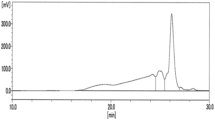
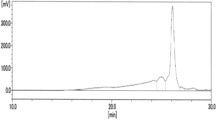
- a GPC chart of the polyfunctional vinyl resin obtained in Example 1 is shown.
- An IR chart of the polyfunctional vinyl resin obtained in Example 1 is shown.
- a GPC chart of the polyfunctional vinyl resin obtained in Example 2 is shown.
- a GPC chart of the polyfunctional vinyl resin obtained in Example 3 is shown.
- a GPC chart of the polyfunctional vinyl resin obtained in Comparative Example 1 is shown.
- the polyfunctional vinyl resin of the present invention is represented by the following general formula (1).
- R 1 independently represents a hydrocarbon group having 1 to 8 carbon atoms, an alkyl group having 1 to 8 carbon atoms, an aryl group having 6 to 8 carbon atoms, an aralkyl group having 7 to 8 carbon atoms. , or allyl group is preferred.
- the alkyl group may be linear, branched, or cyclic, and includes, for example, methyl group, ethyl group, propyl group, isopropyl group, n-butyl group, t-butyl group, hexyl group, cyclohexyl group, and methyl group. Examples include cyclohexyl group.
- Examples of the aryl group include phenyl group, tolyl group, xylyl group, and ethylphenyl group.
- Examples of the aralkyl group include benzyl group and ⁇ -methylbenzyl group. Among these substituents, a phenyl group and an alkyl group having 1 to 3 carbon atoms are preferred, and a methyl group is particularly preferred, from the viewpoint of ease of availability and reactivity when used as a cured product.
- the substitution position of R 1 may be any of the ortho, meta, and para positions with respect to the aryl ether group (-OX), but the ortho position is preferable.
- R 2 represents a hydrogen atom or a group represented by formula (2) or formula (3), and at least one is represented by formula (2) or formula (3). Unlike R 1 , which is a substituent, R 2 does not necessarily represent only a substituent, but also represents a hydrogen atom.
- the group represented by the formula (2) is the group represented by the general formula (8a) below among the aromatic vinyl compounds used as raw materials when producing the polyhydric hydroxy resin (4) represented by the general formula (4).
- the group represented by formula (3) is a group derived from an aromatic divinyl compound represented by general formula (8b) below, among aromatic vinyl compounds. It is.
- X independently represents a hydrogen atom or a vinyl group-containing aromatic group represented by the following formula (1a), at least one of which is a vinyl group-containing aromatic group, and It is a group derived from
- the aromatic ring Ar in formula (1a) is preferably an aromatic ring selected from the group consisting of a benzene ring, a naphthalene ring, and a biphenyl ring, and may be unsubstituted or have one or more substituents. If it has a substituent, it is preferably 1 to 4, and the substituent is preferably an alkyl group or aryl group having 1 to 10 carbon atoms, more preferably an alkyl group having 1 to 3 carbon atoms or a phenyl group. .
- i is the number of substitutions for R 1 and is 0 to 2, preferably 1 or 2, more preferably 2.
- n is the number of repetitions, and represents a number of 0 or more, and its average value (number average) is 0 to 5, preferably 1.0 to 4.0, more preferably 1.1 to 3.0, More preferably 1.2 to 2.5.
- R 3 represents a hydrogen atom or a hydrocarbon group having 1 to 8 carbon atoms. Examples of the hydrocarbon group having 1 to 8 carbon atoms include those similar to R 1 . Similar to R 2 , R 3 does not necessarily represent only a substituent, but also represents a hydrogen atom, unlike R 1 which is a substituent.
- R 3 is determined by the ease of availability and the cured product. From the viewpoint of heat resistance, a hydrogen atom, a methyl group, and an ethyl group are preferable, and a hydrogen atom and an ethyl group are particularly preferable.
- a vinyl group may be included as R 3 .
- the substitution position of R 3 may be any of the ortho position, meta position, and para position, but the meta position and para position are preferable.
- one of R 3 is an ethyl group and the remaining are hydrogen atoms.
- A is a residue obtained by removing two R 2 from formula (1), and R 2 in the residue is a hydrogen atom or a group represented by formula (2).
- A is a divalent group having the same structure as general formula (1), but does not become a group represented by formula (3).
- R 3 has the same meaning as R 3 in formula (2).
- R 4 represents a hydrogen atom or a group represented by formula (2). Similar to R 2 and R 3 , R 4 does not necessarily represent only a substituent, but also represents a hydrogen atom, unlike R 1 which is a substituent.
- p1 is the number of repetitions, and represents a number of 0 or more, and its average value (number average) is 0 to 5, preferably 0.01 to 3, more preferably 0.1 to 2.0, 0. 2 to 1.0 is more preferable, and 0.3 to 0.8 is particularly preferable.
- the weight average molecular weight (Mw) of the polyfunctional vinyl resin (1) of the present invention is preferably 400 to 5,000, more preferably 600 to 4,500, even more preferably 800 to 4,000.
- the number average molecular weight (Mn) is preferably 350 to 2,000, more preferably 500 to 1,500, even more preferably 700 to 1,200.
- the phenolic hydroxyl equivalent (g/eq.) is preferably 5,000 or more, more preferably 10,000 or more, even more preferably 16,000 or more. When it exceeds 10,000, the amount of hydroxyl groups substantially exceeds the measurable amount, indicating that the phenolic hydroxyl groups of the raw polyhydric hydroxy resin have been almost completely vinylized.
- the vinyl equivalent (g/eq.) is preferably 300 or more, more preferably 350 or more, still more preferably 400 or more.
- the upper limit of the vinyl equivalent is preferably 1,000 or less, more preferably 700 or less, and still more preferably 500 or less.
- the polyhydric hydroxy resin that is the raw material for the polyfunctional vinyl resin (1) of the present invention is represented by the following general formula (4).
- R 1 and i have the same definitions as in general formula (1). Although m is the same as the definition of n in general formula (1), it is almost the same even in the case of the relationship between raw materials and products.
- R 21 independently represents a hydrogen atom or a group represented by the following formula (5) or the following formula (6), and at least one is represented by the formula (5) or the formula (6). Like R 2 in general formula (1), R 21 does not necessarily represent only a substituent, but also represents a hydrogen atom.
- R 3 has the same meaning as defined in formula (2).
- R 3 , R 4 , and Me have the same definitions as in formula (3).
- p2 has the same meaning as p1 in formula (3), and is almost the same even in the case of the relationship between raw materials and products.
- a 1 is a residue obtained by removing two R 21 from formula (4), and R 21 in the residue is a hydrogen atom or a group represented by formula (5).
- a 1 is a divalent group having the same structure as general formula (4), but does not become a group represented by formula (6).
- the weight average molecular weight (Mw) of the polyhydric hydroxy resin represented by general formula (4) is preferably 400 to 5,000, more preferably 500 to 3,000, and even more preferably 600 to 2,500.
- the number average molecular weight (Mn) is preferably 350 to 2,000, more preferably 400 to 1,500, even more preferably 450 to 1,000.
- the phenolic hydroxyl equivalent (g/eq.) is preferably 190 to 500, more preferably 220 to 400, even more preferably 250 to 350.
- the softening point is preferably 50 to 180°C, more preferably 50 to 120°C.
- the polyhydric hydroxy resin (4) represented by the general formula (4) is a dicyclopentadiene type polyhydric resin (a) represented by the following general formula (7) in the presence of an acid catalyst. It is obtained by subjecting an aromatic monovinyl compound represented by (8a) and/or an aromatic divinyl compound represented by general formula (8b) to an aromatic electrophilic substitution reaction. Aromatic monovinyl compounds and aromatic divinyl compounds are also collectively referred to as aromatic vinyl compounds. These aromatic vinyl compounds (8a) and (8b) do not have a halogenated methyl group, unlike the halogenated methyl group-containing aromatic vinyl compound (10).
- the polyhydric hydroxy resin (a) represented by general formula (7) has a structure in which phenols are linked through dicyclopentadiene.
- R 1 and i have the same definitions as in general formula (1), and s has the same definition as n in general formula (1), but in the case of the relationship between raw materials and products. However, it is almost the same.
- R 3 has the same meaning as defined in formula (2).
- the substituent position may be any of the ortho, meta, and para positions with respect to the vinyl group, but the meta and para positions are preferable.
- the substitution position of the other vinyl group with respect to the vinyl group may be any of the ortho position, meta position, and para position, but the substitution position is the meta position. and para positions are preferred, and a mixture thereof may be used.
- the aromatic vinyl compound used as a raw material essentially includes an aromatic monovinyl compound (8a) and an aromatic divinyl compound (8b).
- an aromatic monovinyl compound (8a) As the amount of the aromatic divinyl compound compounded increases, the molecular weight of the polyhydric hydroxy resin (4) increases. Therefore, the blending amount may be adjusted while considering the molecular weight of the polyhydric hydroxy resin (4) so as to obtain the desired molecular weight.
- the aromatic monovinyl compound becomes a substituent represented by formula (2) through an addition reaction, and exhibits a further effect of reducing dielectric properties.
- aromatic monovinyl compound (8a) examples include vinyl aromatic compounds such as styrene, vinylnaphthalene, vinylbiphenyl, ⁇ -methylstyrene, o-methylstyrene, m-methylstyrene, p-methylstyrene, o,p - Nuclear alkyl-substituted vinyl aromatic compounds such as dimethylstyrene, o-ethylvinylbenzene, m-ethylvinylbenzene, p-ethylvinylbenzene, ethylvinylbiphenyl, ethylvinylnaphthalene, and indene, acenaphthylene, benzothiophene, coumaron, etc.
- aromatic divinyl compound (8b) examples include divinyl aromatic compounds such as divinylbenzene, divinylnaphthalene, and divinylbiphenyl. Preferred is divinylbenzene. These can be used alone or in combination of two or more.
- the blending amounts of the aromatic monovinyl compound (8a) and the aromatic divinyl compound (8b) are 15 to 50% by mass of the aromatic monovinyl compound (8a) and 15 to 50% by mass of the aromatic divinyl compound, based on the total amount of the aromatic vinyl compound.
- (8b) is preferably 50 to 85% by mass.
- the aromatic monovinyl compound (8a) is preferably 15 to 50% by weight, more preferably 17 to 45% by weight.
- the aromatic divinyl compound (8b) is preferably 50 to 85% by mass, more preferably 55 to 83% by mass.
- the phenolic hydroxyl equivalent (g/eq.) of the polyhydric hydroxy resin (a) represented by the above general formula (7) is preferably from 160 to 220, more preferably from 165 to 210, even more preferably from 170 to 200.
- the polyhydric hydroxy resin (a) represented by the general formula (7) can be obtained by reacting a phenol represented by the following general formula (9) with dicyclopentadiene in the presence of a Lewis acid. In this reaction, not only isomers with different substitution positions but also a structure in which a dicyclopentadiene structure and a phenol hydroxyl group are bonded may be included.
- R 1 and i have the same definitions as in general formula (1).
- the substitution position of R 1 may be any of the ortho, meta, and para positions, but the ortho position is preferred.
- the structure of dicyclopentadiene is as follows.
- the phenols represented by the general formula (9) include phenol, cresol, ethylphenol, propylphenol, isopropylphenol, n-butylphenol, t-butylphenol, hexylphenol, cyclohexylphenol, phenylphenol, tolylphenol, benzylphenol, ⁇ -Methylbenzylphenol, allylphenol, dimethylphenol, diethylphenol, dipropylphenol, diisopropylphenol, di(n-butyl)phenol, di(t-butyl)phenol, dihexylphenol, dicyclohexylphenol, diphenylphenol, ditolylphenol , dibenzylphenol, bis( ⁇ -methylbenzyl)phenol, methylethylphenol, methylpropylphenol, methylisopropylphenol, methylbutylphenol, methyl-t-butylphenol, methylallylphenol, tolylphenylphenol, and the like. From the
- the catalyst used in the above reaction is a Lewis acid, specifically boron trifluoride, boron trifluoride/phenol complex, boron trifluoride/ether complex, aluminum chloride, tin chloride, zinc chloride, iron chloride, etc.
- boron trifluoride/ether complex is preferred.
- the amount of the catalyst used is 0.001 to 20 parts by weight, preferably 0.5 to 15 parts by weight, based on 100 parts by weight of dicyclopentadiene.
- the amount of dicyclopentadiene used is 0.08 to 0.80 mol, preferably 0.09 to 0.60 mol, more preferably 0.10 to 0.50 mol, even more preferably The amount is 0.10 to 0.40 mol, particularly preferably 0.10 to 0.20 mol.
- This reaction is preferably carried out by charging the phenols and the catalyst into a reactor, and adding dicyclopentadiene dropwise over a period of 0.1 to 10 hours, preferably 0.5 to 8 hours, more preferably 1 to 6 hours. .
- the reaction temperature is preferably 50 to 200°C, more preferably 100 to 180°C, even more preferably 120 to 160°C.
- the reaction time is preferably 1 to 10 hours, more preferably 3 to 10 hours, and even more preferably 4 to 8 hours.
- an alkali such as sodium hydroxide, potassium hydroxide, calcium hydroxide, etc.
- solvents such as aromatic hydrocarbons such as toluene and xylene and ketones such as methyl ethyl ketone and methyl isobutyl ketone are added and dissolved, and after washing with water, the solvent is recovered under reduced pressure to obtain the desired general purpose.
- a polyhydric hydroxy resin represented by formula (7) can be obtained. Note that it is preferable to react the entire amount of dicyclopentadiene as much as possible and recover unreacted raw material phenols under reduced pressure.
- aromatic hydrocarbons such as benzene, toluene, and xylene
- ketones such as methyl ethyl ketone and methyl isobutyl ketone
- halogenated hydrocarbons such as chlorobenzene and dichlorobenzene
- ethylene glycol dimethyl ether In the reaction, aromatic hydrocarbons such as benzene, toluene, and xylene, ketones such as methyl ethyl ketone and methyl isobutyl ketone, halogenated hydrocarbons such as chlorobenzene and dichlorobenzene, ethylene glycol dimethyl ether, Solvents such as ethers such as diethylene glycol dimethyl ether may also be used.
- the polyvalent hydroxy resin (in this method is reacted with aromatic vinyl compounds (8a) and (8b) at a predetermined ratio.
- the reaction ratio is 0.05 to 2.0 mol, more preferably 0.1 to 1.0 mol, and 0.05 to 2.0 mol, more preferably 0.1 to 1.0 mol, of the aromatic vinyl compound to 1 mol of the phenolic hydroxyl group of the polyhydric hydroxy resin (a). Particularly preferred is 15 to 0.95 mol.
- this reaction is an aromatic electrophilic substitution reaction, and the reaction target is strictly a benzene ring.
- one OH group corresponds to one benzene ring, and in general, electrophilic aromatic substitution reactions (Friedel Crafts-type reactions) proceed quickly when they have a phenol skeleton. Therefore, the phenolic hydroxyl group was used as the standard.
- the catalyst used in the reaction is an acid catalyst, specifically mineral acids such as hydrochloric acid, sulfuric acid, phosphoric acid, organic acids such as formic acid, oxalic acid, trifluoroacetic acid, p-toluenesulfonic acid, zinc chloride, chloride, etc.
- mineral acids such as hydrochloric acid, sulfuric acid, phosphoric acid
- organic acids such as formic acid, oxalic acid, trifluoroacetic acid
- p-toluenesulfonic acid zinc chloride, chloride, etc.
- Lewis acids such as aluminum, iron chloride, and boron trifluoride
- solid acids such as activated clay, silica-alumina, and zeolite.
- p-toluenesulfonic acid is preferred because of its ease of handling.
- the amount of the catalyst used is 0.001 to 20 parts by weight, preferably 0.5 to 10 parts by weight, based on 100 parts by weight of the polyhydric hydroxy
- the polyvalent hydroxy resin (a), catalyst, and solvent are charged into a reactor and dissolved, and then the aromatic vinyl compound is heated for 0.1 to 10 hours, preferably 0.5 to 8 hours, more preferably 0. It is best to drip the solution over 5 to 5 hours.
- the reaction temperature is preferably 50 to 200°C, more preferably 100 to 180°C, even more preferably 120 to 160°C.
- the reaction time is preferably 1 to 10 hours, more preferably 3 to 10 hours, and even more preferably 4 to 8 hours.
- an alkali such as sodium hydroxide, potassium hydroxide, calcium hydroxide, etc.
- solvents such as aromatic hydrocarbons such as toluene and xylene, and ketones such as methyl ethyl ketone and methyl isobutyl ketone are added and dissolved, washed with water, and the solvent is recovered under reduced pressure to obtain the desired polycarbonate. hydroxyl resins can be obtained.
- the solvents used in the reaction include aromatic hydrocarbons such as benzene, toluene, and xylene, ketones such as methyl ethyl ketone and methyl isobutyl ketone, halogenated hydrocarbons such as chlorobenzene and dichlorobenzene, ethylene glycol dimethyl ether, and diethylene.
- aromatic hydrocarbons such as benzene, toluene, and xylene
- ketones such as methyl ethyl ketone and methyl isobutyl ketone
- halogenated hydrocarbons such as chlorobenzene and dichlorobenzene
- ethylene glycol dimethyl ether and diethylene
- solvents such as ethers such as glycol dimethyl ether. These solvents may be used alone or in combination of two or more.
- polyvalent hydroxy compound (resin) represented by the above general formula (4) it is preferable to use a polyvalent hydroxy resin obtained by the above reaction, but it is not limited thereto.
- Etherification is an excellent method for obtaining the polyfunctional vinyl resin of general formula (1).
- a method of reacting a polyhydric hydroxy resin (4) represented by general formula (4) with a halogenated methyl group-containing aromatic vinyl compound represented by general formula (10) in a solvent in the presence of an alkali compound can be mentioned.
- the etherification reaction referred to herein refers to a bimolecular nucleophilic substitution reaction between the phenolic hydroxyl group of the polyhydric hydroxy resin and the halogenated methyl group of the halogenated methyl group-containing aromatic vinyl compound.
- Ar has the same meaning as defined in the formula (1a), and R 5 represents a halogen, preferably a chlorine atom or a bromine atom.
- the ratio of the polyvalent hydroxy resin and the aromatic vinyl compound containing a halogenated methyl group is preferably such that the halogenated methyl group of the aromatic vinyl compound containing a halogenated methyl group is used per equivalent of the phenolic hydroxyl group of the polyvalent hydroxy resin.
- the reaction may be carried out in an amount of 0.5 to 1.5 equivalents, more preferably 0.8 to 1.2 equivalents.
- halomethylstyrene is preferred.
- halomethylstyrene include chloromethylstyrene, bromomethylstyrene, isomers thereof, and those having substituents.
- substitution position of the halomethyl compound for example, in the case of halomethylstyrene, the 3rd or 4th position is preferable, and the content of each is preferably in the range of 1/99 to 99/1.
- the alkali compound used in the production of the polyfunctional vinyl resin of the present invention is preferably an alkali metal hydroxide or carbonate, and specific examples include sodium hydroxide, potassium hydroxide, potassium carbonate, and sodium carbonate. and sodium hydroxide and potassium hydroxide are preferred.
- Such an alkali metal hydroxide may be used in the form of a solid substance or in the form of a solution thereof.
- the amount of the alkali compound used is usually 1.0 to 2.0 mol, preferably 1.0 to 1.8 mol, more preferably 1.0 to 1.8 mol, per 1 mol of the phenolic hydroxyl group of the polyhydric hydroxy resin.
- the amount is 1.5 mol, more preferably 1.0 to 1.3 mol, particularly preferably 1.0 to 1.1 mol.
- Solvents used in the production of the polyfunctional vinyl resin of the present invention are not particularly limited, but include alcohols such as methanol, ethanol, n-propanol, isopropanol, and n-butanol, acetone, methyl ethyl ketone, and methyl isobutyl ketone.
- ethers such as tetrahydrofuran, dioxane, and diglyme
- aprotic polar solvents such as dimethylacetamide, dimethylformamide, and dimethyl sulfoxide.
- solvents can be used from among these.
- water can also be used in combination with the above solvent.
- water and solvent may also contain a solvent (other organic solvent) such as toluene, and the amount of the other organic solvent used is 0.5 to 400% by mass based on the amount of the above-mentioned solvent used.
- the range is preferably from 100 to 300% by weight, and more preferably from 150 to 250% by weight.
- the amount of the solvent used is preferably 20 to 500% by weight, more preferably 25 to 400% by weight, particularly preferably 25 to 350% by weight, based on the total weight of the polyhydric hydroxy resin.
- aprotic polar solvents are not useful for purification such as washing with water, and have a high boiling point and are difficult to remove. Undesirable.
- the reaction temperature for producing the polyfunctional vinyl resin of the present invention is usually 30 to 90°C, preferably 35 to 80°C.
- the first stage is 15 to 50°C
- the second stage is 45 to 70°C.
- the reaction time for producing the polyfunctional vinyl resin of the present invention is usually 0.5 to 10 hours, preferably 1 to 8 hours, particularly preferably 1 to 5 hours. When the reaction time is 0.5 hours or more, the reaction proceeds sufficiently, and when the reaction time is 10 hours or less, it is possible to suppress the amount of by-products produced.
- a ketone solvent having 4 to 7 carbon atoms for example, methyl isobutyl ketone, methyl ethyl ketone, cyclopentanone, cyclohexanone, etc.
- a solvent such as toluene, heated to 40 to 90°C, more preferably 50 to 80°C, and washed with water until the pH of the aqueous layer reaches 5 to 8 to remove by-product salts.
- Alcohols such as methanol, ethanol, and propanol may be added during washing with water.
- the polyfunctional vinyl resin of the present invention is usually produced while blowing an inert gas such as nitrogen into the system (in air or liquid).
- an inert gas such as nitrogen
- the amount of inert gas blown per unit time varies depending on the volume of the pot used for the reaction. For example, the amount of inert gas blown per unit time is set so that the volume of the pot can be replaced in 0.5 to 20 hours. It is preferable to adjust.
- polymerization inhibitors such as quinones, nitro compounds, nitrophenols, nitroso compounds, nitrone compounds, phenols, and oxygen may be used. .
- the end point of the reaction can be determined by tracking the remaining amount of the halogenated methyl group-containing aromatic vinyl compound using various chromatograms, and the reaction rate can be adjusted by adjusting the type and amount of metal hydroxide and adjusting the addition rate. can be adjusted by using an appropriate catalyst.
- polyfunctional vinyl resin of the present invention can be cured alone, it is also suitable to use it as a polyfunctional resin composition blended with various additives.
- a radical polymerization initiator can be added to promote curing.
- radical polymerization initiator also referred to as a radical polymerization catalyst
- the resin composition of the present invention is cured by causing a crosslinking reaction by means such as heating, as described later, but the reaction temperature at that time is low.
- a radical polymerization initiator may be included for the purpose of promoting the crosslinking reaction of unsaturated groups.
- the amount of the radical polymerization initiator used for this purpose is preferably 0.01 to 12 parts by weight, more preferably 0.1 to 8 parts by weight, based on 100 parts by weight of the polyfunctional vinyl resin.
- radical polymerization initiators include benzoyl peroxide, cumene hydroperoxide, 2,5-dimethylhexane-2,5-dihydroperoxide, 2,5-dimethyl-2,5-di( t-butylperoxy)hexyne-3, di-t-butylperoxide, t-butylcumyl peroxide, ⁇ , ⁇ '-bis(t-butylperoxy-m-isopropyl)benzene, 2,5-dimethyl- 2,5-di(t-butylperoxy)hexane, dicumyl peroxide, di-t-butylperoxyisophthalate, t-butylperoxybenzoate, 2,2-bis(t-butylperoxy)butane, Peroxides such as 2,2-bis(t-butylperoxy)octane, 2,5-dimethyl-2,5-di(benzoylperoxy)hexane, di
- the polyfunctional vinyl resin composition of the present invention may contain other resin components as long as they do not inhibit the effect of the polyfunctional vinyl resin represented by formula (1) as an essential component. It is preferably blended in an amount of 50% by mass or less based on the total amount of resin components.
- vinyl resins and other thermal polyfunctional vinyl resins can be blended. Examples include vinyl ester resin, polyvinylbenzyl resin, epoxy resin, oxetane resin, maleimide resin, acrylate resin, polyester resin, polyurethane resin, polycyanate resin, phenol resin, benzoxazine resin, and the like.
- thermoplastic resins such as polystyrene resin, polyphenylene ether resin, polyetherimide resin, polyether sulfone resin, PPS resin, polycyclopentadiene resin, polycycloolefin resin, styrene-ethylene-propylene copolymer, styrene- Thermoplastic elastomers such as ethylene-butylene copolymer, styrene-butadiene copolymer, styrene-isoprene copolymer, hydrogenated styrene-butadiene copolymer, hydrogenated styrene-isoprene copolymer, polybutadiene, polyisoprene, etc. It is also possible to blend rubbers and the like.
- Various known flame retardants can be used in the polyfunctional vinyl resin composition of the present invention, in order to improve the flame retardancy of the resulting cured product, within a range that does not reduce reliability.
- flame retardants that can be used include halogen flame retardants, phosphorus flame retardants, nitrogen flame retardants, silicone flame retardants, inorganic flame retardants, and organic metal salt flame retardants. From the environmental point of view, halogen-free flame retardants are preferred, and phosphorus-based flame retardants are particularly preferred. These flame retardants may be used alone, two or more of the same type of flame retardants may be used in combination, or flame retardants of different types may be used in combination.
- the polyfunctional vinyl resin composition of the present invention may contain components other than those listed above (sometimes referred to as "other components” in the present invention) for the purpose of further improving its functionality. You can stay there. These other ingredients include fillers, UV inhibitors, antioxidants, coupling agents, plasticizers, fluxes, thixotropic agents, smoothing agents, colorants, pigments, dispersants, emulsifiers, and modifiers. agent, mold release agent, antifoaming agent, ion trapping agent, etc.
- fillers include fused silica, crystalline silica, alumina, silicon nitride, boron nitride, aluminum nitride, aluminum hydroxide, calcium hydroxide, magnesium hydroxide, boehmite, talc, mica, clay, calcium carbonate, magnesium carbonate, Inorganic fillers such as barium carbonate, zinc oxide, titanium oxide, magnesium oxide, magnesium silicate, calcium silicate, zirconium silicate, barium sulfate, carbon, carbon fiber, glass fiber, alumina fiber, silica alumina fiber, silicon carbide
- fibrous fillers such as fibers, polyester fibers, polyamide fibers, cellulose fibers, aramid fibers, and ceramic fibers, and fine particle rubber.
- ingredients include organic pigments such as quinacridone, azo, and phthalocyanine, inorganic pigments such as titanium oxide, metal foil pigments, and antirust pigments, and ultraviolet absorbing pigments such as hindered amine, benzotriazole, and benzophenone.
- antioxidants such as hindered phenol-based, phosphorus-based, sulfur-based, and hydrazide-based, mold release agents such as stearic acid, palmitic acid, zinc stearate, and calcium stearate, leveling agents, rheology control agents, and pigment dispersions.
- additives such as anti-cissing agents, antifoaming agents, and antifoaming agents.
- the blending amount of these other components is preferably in the range of 0.01 to 20% by mass based on the total solid content in the resin composition.
- the polyfunctional vinyl resin composition of the present invention can be made into a resin varnish by dissolving it in a solvent.
- the solvent include methyl ethyl ketone, acetone, toluene, xylene, tetrahydrofuran, dioxolane, dimethylformamide, methyl isobutyl ketone, methoxypropanol, cyclohexanone, methyl cellosolve, ethyl diglycol acetate, propylene glycol monomethyl ether acetate, ⁇ -butyrolactone, etc.
- the selection and appropriate usage amount can be appropriately selected depending on the application.
- a solvent with a boiling point of 160°C or lower such as methyl ethyl ketone, acetone, toluene, xylene, 1-methoxy-2-propanol, etc., and a proportion of non-volatile content of 20 to 80% by mass.
- examples include ketones such as acetone, methyl ethyl ketone, and cyclohexanone; ester compounds such as ethyl acetate, butyl acetate, cellosolve acetate, propylene glycol monomethyl ether acetate, carbitol acetate, and ⁇ -butyrolactone; It is preferable to use carbitols such as cellosolve and butyl carbitol, aromatic hydrocarbons such as toluene and xylene, dimethylformamide, dimethylacetamide, N-methylpyrrolidone, etc., and the nonvolatile content is 20 to 80% by mass. Preferably, they are used in proportions.
- the laminate of the present invention is obtained by curing a resin varnish. Specifically, printed wiring boards, printed circuit boards, flexible printed wiring boards, build-up wiring boards, etc. may be mentioned.
- the cured product obtained by curing the polyfunctional vinyl resin composition of the present invention can be used as a molded product, laminate, cast product, adhesive, coating film, or film.
- a cured product of a semiconductor encapsulating material is a cast product or a molded product, and the method of obtaining a cured product for this purpose is to mold the compound using a cast molding machine, a transfer molding machine, an injection molding machine, etc. Then, a cured product can be obtained by further heating at 80 to 230°C for 0.5 to 10 hours.
- the cured product of resin varnish is a laminate, and the method for obtaining this cured product is to impregnate the resin varnish into the above-mentioned fibrous filler or a base material such as paper, heat dry it, and obtain a prepreg. They can be obtained either singly or by laminating with metal foil such as copper foil and hot press molding.
- the uncured sheet or partially cured sheet of the polyfunctional vinyl resin composition of the present invention can be used, for example, as a build-up film, a bonding sheet, a coverlay sheet, a bump sheet for a flip chip bonder, an insulating layer for a substrate, or an adhesive. It can be suitably used as a layer.
- inorganic high dielectric powder such as barium titanate or inorganic magnetic material such as ferrite
- it is useful as a material for electronic components, especially as a material for high-frequency electronic components.
- a substrate is added to the prepreg of the present invention to increase mechanical strength and increase dimensional stability.
- Such base materials include various glass cloths such as roving cloth, cloth, chopped mats, surfacing mats, asbestos cloth, metal fiber cloth, other synthetic or natural inorganic fiber cloths, fully aromatic polyamide fibers, fully aromatic Woven fabrics or non-woven fabrics obtained from liquid crystal fibers such as group polyester fibers and polybenzoal fibers; woven fabrics or non-woven fabrics obtained from synthetic fibers such as polyvinyl alcohol fibers, polyester fibers, and acrylic fibers; natural fibers such as cotton fabrics, linen fabrics, and felt. Cloths such as cloth, carbon fiber cloth, kraft paper, cotton paper, natural cellulose cloth such as paper-glass mixed fiber paper, etc., and papers can be used alone or in combination of two or more.
- the proportion of the base material in the prepreg is preferably 5 to 90% by mass, preferably 10 to 80% by mass, and more preferably 20 to 70% by mass.
- a coupling agent can be used in the prepreg of the present invention, if necessary, for the purpose of improving the adhesiveness at the interface between the resin and the base material.
- the coupling agent common ones such as a silane coupling agent, a titanate coupling agent, an aluminum coupling agent, a zircoaluminate coupling agent, etc. can be used.
- the polyfunctional vinyl resin composition of the present invention and other components as required are uniformly mixed in the above-mentioned aromatic, ketone, etc. solvent, or a mixed solvent thereof.
- examples include a method of dissolving or dispersing it in a substrate, impregnating it into a base material, and then drying it. Impregnation is performed by dipping, coating, etc. Impregnation can be repeated multiple times as necessary, and at this time, impregnation can be repeated using multiple solutions with different compositions and concentrations to finally adjust the desired resin composition and resin amount. It is possible.
- a cured product can be obtained by curing the prepreg of the present invention by a method such as heating.
- the manufacturing method is not particularly limited, and for example, a plurality of prepregs may be stacked, each layer may be bonded together under heat and pressure, and at the same time, heat curing may be performed to obtain a cured product (laminate) with a desired thickness. Can be done. It is also possible to obtain a multilayer laminate with a new layer configuration by combining a cured product that has been adhesively cured and a prepreg. Laminate molding and curing are usually performed simultaneously using a hot press or the like, but both may be performed independently. That is, uncured or semi-cured prepreg obtained by lamination molding in advance can be cured by heat treatment or another method.
- the molding and curing may be performed, for example, at a temperature of 80 to 300°C, a pressure of 0.1 to 1000 kgf/cm 2 , and a time of 1 minute to 10 hours, more preferably a temperature of 150 to 250°C and a pressure of 1 to 10 hours. It can be carried out at 500 kgf/cm 2 and for a period of time ranging from 1 minute to 5 hours.
- the laminate of the present invention is composed of a layer of the prepreg of the present invention and a layer of metal foil.
- the metal foil used here include copper foil, aluminum foil, and the like.
- the thickness is not particularly limited, but is in the range of 3 to 200 ⁇ m, more preferably 3 to 105 ⁇ m.
- a prepreg obtained from the polyfunctional vinyl resin composition of the present invention and the base material described above and metal foil are laminated in a layer configuration depending on the purpose, and then heated.
- a method of adhering each layer under pressure and simultaneously curing with heat can be mentioned.
- the laminate of the polyfunctional vinyl resin composition of the present invention the cured product and the metal foil are laminated in an arbitrary layer configuration.
- Metal foil can be used both as a surface layer and as an intermediate layer. In addition to the above, it is also possible to repeat lamination and curing multiple times to form a multilayer structure.
- An adhesive can also be used for adhesion to the metal foil.
- adhesives include epoxy, acrylic, phenol, and cyanoacrylate adhesives, but are not particularly limited thereto.
- the above lamination molding and curing can be performed under the same conditions as for producing the cured prepreg of the present invention.
- the polyfunctional vinyl resin composition of the present invention can also be formed into a film.
- the thickness is not particularly limited, but is in the range of 3 to 200 ⁇ m, more preferably 5 to 105 ⁇ m.
- the method for producing the film of the present invention is not particularly limited, and for example, the polyfunctional vinyl resin composition and other components as necessary are mixed in an aromatic solvent, a ketone solvent, or a mixed solvent thereof. Examples include a method of uniformly dissolving or dispersing the mixture, applying it to a resin film such as a PET film, and then drying it. Coating can be repeated multiple times if necessary, and it is also possible to repeat coating using multiple solutions with different compositions and concentrations to finally adjust to the desired resin composition and resin amount. It is.
- a resin sheet is produced by forming a polyfunctional vinyl resin composition onto a support film into a sheet shape by a coating method or the like, and then drying or semi-curing it by heating.
- This resin sheet is stacked on a base material (first base material), the support film is peeled off from the resin sheet, and another base material (second base material) is stacked. That is, the first base material, the resin sheet (polyfunctional vinyl resin composition), and the second base material are laminated in this order. Subsequently, the first base material and the second base material are bonded together via the cured product of the polyfunctional vinyl resin composition by heating and curing.
- a resin-coated metal foil can be obtained from the polyfunctional vinyl resin composition of the present invention and metal foil.
- the metal foil used here include copper foil, aluminum foil, and the like.
- the thickness is not particularly limited, but is in the range of 3 to 200 ⁇ m, more preferably 5 to 105 ⁇ m.
- the method for producing resin-coated metal foil is not particularly limited, and for example, a polyfunctional vinyl resin composition and other components as necessary are mixed in an aromatic or ketone solvent, or a mixed solvent thereof. Examples include a method of uniformly dissolving or dispersing the material, applying it to a metal foil, and then drying it. Application can be repeated multiple times if necessary, and in this case, application can be repeated using multiple solutions with different compositions and concentrations to finally adjust to the desired resin composition and resin amount. It is possible.
- the electronic material substrate is made using the laminate of the present invention.
- the above substrates for electronic materials are used in mobile phones, PHSs, notebook computers, PDAs (personal digital assistants), and mobile TVs that require reliability in environments that require heat resistance and water resistance, as well as transmission reliability of high-frequency signals.
- the cured product of the present invention can be suitably used as a circuit board for the electrical/electronic equipment described above because of its excellent dielectric properties, heat resistance stability, and dimensional stability and moldability compatible with the formation of fine pattern circuits.
- Specific examples include single-sided, double-sided, multilayer printed circuit boards, flexible circuit boards, and build-up circuit boards.
- a multilayer circuit board using metal plating as the conductor layer is also included as a preferable example.
- Hydroxyl group equivalent Measurement was performed in accordance with the JIS K0070 standard, and the unit was expressed in "g/eq.”.
- the hydroxyl group equivalent of the polyhydric hydroxy resin means the phenolic hydroxyl group equivalent.
- Softening point It was measured in accordance with the JIS K7234 standard and the ring and ball method. Specifically, an automatic softening point device (ASP-MG4, manufactured by Meitec Co., Ltd.) was used.
- Total chlorine Measured in accordance with JIS K7243-3 standard. Specifically, after dissolving 1.0 g of the sample in 25 mL of butyl carbitol, 25 mL of 1N-KOH propylene glycol solution was added, heated under reflux for 10 minutes, cooled to room temperature, and further 100 mL of 80% acetone water was added. It was measured by potentiometric titration with 002N-AgNO 3 aqueous solution.
- Relative permittivity and dielectric loss tangent Measured in accordance with IPC-TM-650 2.5.5.9. Specifically, the evaluation was performed by determining the relative dielectric constant and dielectric loss tangent at a frequency of 1 GHz using a material analyzer (manufactured by AGILENT Technologies) using the capacitance method.
- Glass transition temperature (Tg) It was measured in accordance with the JIS C6481 standard. Specifically, it was expressed as the tan ⁇ peak top when the measurement was performed using a dynamic viscoelasticity measurement device (EXSTAR DMS6100, manufactured by Hitachi High-Tech Science Co., Ltd.) under a temperature increasing condition of 5° C./min.
- GPC gel permeation chromatography measurement: A body (manufactured by Tosoh Corporation, HLC-8220GPC) equipped with a column (manufactured by Tosoh Corporation, TSKgelG4000HXL, TSKgelG3000HXL, TSKgelG2000HXL) in series was used, and the column temperature was set at 40°C. Moreover, tetrahydrofuran (THF) was used as an eluent at a flow rate of 1 mL/min, and a differential refractive index detector was used as a detector.
- THF tetrahydrofuran
- 0.1 g of the sample was dissolved in 10 mL of THF, and 50 ⁇ L of the solution was filtered with a microfilter.
- Mw and Mn were calculated using a calibration curve obtained from standard polystyrene (PStQuick Kit-H, manufactured by Tosoh Corporation). Note that GPC-8020 Model II version 6.00 manufactured by Tosoh Corporation was used for data processing.
- PH1 Polyhydric hydroxy resin obtained in Synthesis Example 1
- P1 Polyhydric hydroxy resin obtained in Synthesis Example 2
- P2 Polyhydric hydroxy resin obtained in Synthesis Example 3
- P3 Biphenylaralkyl type polyhydric hydroxy resin (Meiwa Kasei Co., Ltd. manufactured by MEH-7851, phenol hydroxyl group equivalent 223)
- P4 Phenol novolac resin (manufactured by Aica Kogyo Co., Ltd., BRG-555, phenol hydroxyl group equivalent 105)
- V1 Polyfunctional vinyl resin obtained in Example 1
- V2 Polyfunctional vinyl resin obtained in Example 2
- V3 Polyfunctional vinyl resin obtained in Example 3
- VH1 Polyfunctional vinyl resin obtained in Comparative Example 1
- VH2 Polyfunctional vinyl resin
- VH3 obtained in Comparative Example 2 Polyfunctional vinyl resin
- VH4 obtained in Comparative Example 3 Polyfunctional vinyl resin (manufactured by Mitsubishi Gas Chemical Co., Ltd., OPE-2ST, Mn 1187, vinyl group equivalent weight 590)
- Synthesis example 1 2,6-xylenol (the structural formula below) was added to a reaction apparatus consisting of a separable glass flask equipped with a stirrer, a thermometer, a nitrogen blowing tube, a dropping funnel, and a cooling tube. 500 parts and 7.3 parts of 47% BF 3 ether complex were charged, and the mixture was heated to 100° C. with stirring. While maintaining the same temperature, dicyclopentadiene (structural formula below) 67.6 parts (0.12 times the mole of 2,6-xylenol) was added dropwise over 1 hour. The mixture was further reacted at a temperature of 115 to 125° C. for 4 hours, and 11 parts of calcium hydroxide was added.
- the obtained polyhydric hydroxy resin (PH1) had a hydroxyl equivalent of 195 and a softening point of 73°C.
- Synthesis example 2 400 parts of the polyhydric hydroxy resin (PH1) obtained in Synthesis Example 1, 4.0 parts of paratoluenesulfonic acid monohydrate, and 100 parts of MIBK were charged into the same reaction apparatus as in Synthesis Example 1, and the mixture was heated to 120 parts with stirring. Warmed to °C. Divinylbenzene (manufactured by Aldrich, 80% divinylbenzene, 20% ethylvinylbenzene) (structural formula below) while maintaining the same temperature. 240 parts (0.90 times the mole relative to PH1) was added dropwise over 1 hour. The reaction was further carried out at a temperature of 120 to 130°C for 4 hours.
- the product was dissolved by adding 1400 parts of MIBK, neutralized with 5.3 parts of sodium bicarbonate, washed with 450 parts of 80°C warm water, and the lower layer water tank was separated and removed. Thereafter, the mixture was heated to 180° C. under a reduced pressure of 5 mmHg to evaporate and remove MIBK, yielding 608 parts of a reddish-brown polyvalent hydroxy resin (P1).
- the obtained polyhydric hydroxy resin (P1) had a hydroxyl equivalent of 302 and a softening point of 82°C.
- a polyhydric hydroxy resin represented by formula (4), in which R 1 is a methyl group, i is 2, Mw by GPC is 2,000, Mn is 670, and m 0 body content is 3.
- R 21 is a group represented by formula (5) derived from ethylvinylbenzene (one of R 3 is an ethyl group) and a group represented by formula (6) derived from divinylbenzene (R 3 are all hydrogen atoms) are mixed at almost the same mixing ratio as the raw material divinylbenzene (20/80).
- Synthesis example 3 100 parts of the polyhydric hydroxy resin (PH1) obtained in Synthesis Example 1, 1.0 part of paratoluenesulfonic acid monohydrate, and 25 parts of MIBK were charged into the same reaction apparatus as in Synthesis Example 1, and the mixture was heated to 120 parts with stirring. Warmed to °C. While maintaining the same temperature, 45 parts of divinylbenzene (manufactured by Aldrich, divinylbenzene 55%, ethylvinylbenzene 45%) (0.67 times the mole relative to PH1) was added dropwise over 1 hour. The reaction was further carried out at a temperature of 120 to 130°C for 4 hours.
- the product was dissolved by adding 310 parts of MIBK, neutralized with 1.3 parts of sodium bicarbonate, washed with 100 parts of 80°C warm water, and the lower layer water tank was separated and removed. Thereafter, the mixture was heated to 180° C. under a reduced pressure of 5 mmHg to evaporate and remove MIBK, yielding 139 parts of a reddish-brown polyvalent hydroxy resin (P2).
- the obtained polyhydric hydroxy resin (P2) had a hydroxyl equivalent of 276 and a softening point of 71°C.
- R 21 is a group represented by formula (5) derived from ethylvinylbenzene (one of R 3 is an ethyl group) and a group represented by formula (6) derived from divinylbenzene (R 3 are all hydrogen atoms) are mixed at almost the same mixing ratio as the raw material divinylbenzene (45/55).
- Example 1 Into a device similar to Synthesis Example 1, 100 parts of the polyhydric hydroxy resin (P1) obtained in Synthesis Example 2, 200 parts of toluene, 100 parts of dimethyl sulfoxide, and 25 parts of methanol were charged, and the temperature was raised to 60°C to dissolve. did. 23.7 parts of 86% potassium hydroxide was added, and the mixture was further reacted at 60°C for 1 hour.
- 57 parts (1.13 equivalents based on the hydroxyl equivalent of P1 was added dropwise over 1 hour, and the reaction was further carried out at 60°C for 3 hours.
- the absence of chloromethylstyrene was confirmed by gas chromatography, and the solvent was recovered under reduced pressure.
- the obtained resin was dissolved in 320 parts of toluene and washed with 240 parts of water until the pH of the aqueous layer became 7.
- a polyfunctional vinyl resin (V1) as a toluene solution containing 60% nonvolatile content.
- the obtained polyfunctional vinyl resin (V1) had a hydroxyl equivalent of 17,200, a vinyl equivalent of 430, and a total chlorine content of 420 ppm.
- R 2 is a group represented by formula (2) derived from ethylvinylbenzene (one of R 3 is an ethyl group) and a group represented by formula (3) derived from divinylbenzene (R 3 are all hydrogen atoms) are mixed at almost the same mixing ratio as the raw material divinylbenzene (20/80).
- formula (1a) representing Mixed in similar proportions. GPC and IR of the polyfunctional vinyl resin (V1) are shown in FIG. 1 and 2, respectively.
- P2 polyhydric hydroxy resin obtained in Synthesis Example 3
- R 2 is a group represented by formula (2) derived from ethylvinylbenzene (one of R 3 is an ethyl group) and a group represented by formula (3) derived from divinylbenzene (R 3 are all hydrogen atoms) are mixed at almost the same mixing ratio as the raw material divinylbenzene (45/55).
- formula (1a) representing Mixed in similar proportions.
- FIG. 2 shows GPC of the polyfunctional vinyl resin (V2).
- Example 3 Into a device similar to Synthesis Example 1, 100 parts of the polyhydric hydroxy resin (P1) obtained in Synthesis Example 2, 200 parts of toluene, 100 parts of dimethyl sulfoxide, and 25 parts of methanol were charged, and the temperature was raised to 60°C to dissolve. did. 23.7 parts of 86% potassium hydroxide was added, and the mixture was further reacted at 60°C for 1 hour.
- 57 parts (1.13 equivalents relative to the hydroxyl equivalent of P1
- the absence of chloromethylstyrene was confirmed by gas chromatography, and the solvent was recovered under reduced pressure.
- the obtained resin was dissolved in 320 parts of toluene and washed with 240 parts of water until the pH of the aqueous layer became 7.
- R 2 is a group represented by formula (2) derived from ethylvinylbenzene (one of R 3 is an ethyl group) and a group represented by formula (3) derived from divinylbenzene (R 3 are all hydrogen atoms) are mixed at almost the same mixing ratio as the raw material divinylbenzene (20/80).
- formula (1a) representing Mixed in similar proportions.
- FIG. 4 shows GPC of the polyfunctional vinyl resin (V3).
- Comparative example 1 In a device similar to Synthesis Example 1, 100 parts of the polyhydric hydroxy resin (PH1) obtained in Synthesis Example 1, 200 parts of toluene, 100 parts of dimethyl sulfoxide, and 25 parts of methanol were charged, and the temperature was raised to 60°C to dissolve. did. 36.8 parts of 86% potassium hydroxide was added, and the mixture was further reacted at 60°C for 1 hour. After cooling to 20°C, 88 parts of chloromethylstyrene (1.13 equivalents relative to the hydroxyl equivalent of PH1) was added dropwise over 1 hour, and the mixture was further reacted at 60°C for 3 hours.
- the absence of chloromethylstyrene was confirmed by gas chromatography, and the solvent was recovered under reduced pressure.
- the obtained resin was dissolved in 370 parts of toluene and washed with 270 parts of water until the pH of the aqueous layer became 7. Thereafter, the solvent was distilled off under reduced pressure to obtain 213 parts of a polyfunctional vinyl resin (VH1) as a toluene solution with a nonvolatile content of 60%.
- the obtained polyfunctional vinyl resin (VH1) had a hydroxyl equivalent of 15,500, a vinyl equivalent of 315, and a total chlorine content of 1,580 ppm.
- FIG. 5 shows GPC of the polyfunctional vinyl resin (VH1).
- Comparative example 2 100 parts of polyhydric hydroxy resin (P3), 200 parts of toluene, 100 parts of dimethyl sulfoxide, and 25 parts of methanol were charged into the same apparatus as in Synthesis Example 1, and the mixture was heated to 60° C. and dissolved. 32.2 parts of 86% potassium hydroxide was added, and the mixture was further reacted at 60°C for 1 hour. After cooling to 20°C, 77 parts of chloromethylstyrene (1.13 equivalents relative to the hydroxyl equivalent of P3) was added dropwise over 1 hour, and the mixture was further reacted at 60°C for 3 hours. The absence of chloromethylstyrene was confirmed by gas chromatography, and the solvent was recovered under reduced pressure.
- the obtained resin was dissolved in 320 parts of toluene and washed with 250 parts of water until the pH of the aqueous layer became 7. Thereafter, the solvent was distilled off under reduced pressure to obtain 203 parts of a polyfunctional vinyl resin (VH2) as a toluene solution containing 60% nonvolatile content.
- the obtained polyfunctional vinyl resin (VH2) had a hydroxyl equivalent of 15,200, a vinyl equivalent of 331, and a total chlorine content of 1,680 ppm.
- Comparative example 3 100 parts of polyhydric hydroxy resin (P4), 200 parts of toluene, 100 parts of dimethyl sulfoxide, and 25 parts of methanol were charged into the same apparatus as in Synthesis Example 1, and the mixture was heated to 60° C. and dissolved. 68.4 parts of 86% potassium hydroxide was added, and the mixture was further reacted at 60°C for 1 hour. After cooling to 20°C, 164 parts of chloromethylstyrene (1.13 equivalents relative to the hydroxyl equivalent of P4) was added dropwise over 1 hour, and the mixture was further reacted at 60°C for 3 hours. The absence of chloromethylstyrene was confirmed by gas chromatography, and the solvent was recovered under reduced pressure.
- the obtained resin was dissolved in 490 parts of toluene and washed with 330 parts of water until the pH of the aqueous layer became 7. Thereafter, the solvent was distilled off under reduced pressure to obtain 280 parts of a polyfunctional vinyl resin (VH3) as a toluene solution containing 60% nonvolatile content.
- the obtained polyfunctional vinyl resin (VH3) had a hydroxyl equivalent of 12,200, a vinyl equivalent of 235, and a total chlorine content of 2,700 ppm.
- Example 4 They were mixed in the proportions (parts) shown in Table 1 and dissolved in a solvent to obtain a uniform vinyl resin composition varnish.
- a glass cloth manufactured by Nittobo Co., Ltd., WEA 7628 XS13, 0.18 mm thick
- the impregnated glass cloth was dried for 5 minutes in a hot air circulating oven at 130°C to obtain a prepreg.
- Eight sheets of the obtained prepreg were stacked with copper foil (3EC-III, thickness 35 ⁇ m, manufactured by Mitsui Kinzoku Mining Co., Ltd.) on top and bottom, and vacuum pressed at 2 MPa at a temperature of 130°C x 30 minutes + 220°C x 100 minutes. , a laminate with a thickness of 1.6 mm was obtained.
- Table 1 shows the results of the copper foil peel strength and Tg of the laminate.
- the above vinyl resin composition varnish was applied to a PET film, dried at 130°C for 5 minutes, and peeled off from the PET film to obtain a resin composition.
- the obtained resin composition was placed in a fluororesin mold and vacuum pressed at 2 MPa under the temperature conditions of 130°C x 30 minutes + 220°C x 100 minutes to obtain a 50 mm square x 2 mm thick test piece.
- Table 1 shows the results of the dielectric constant and dielectric loss tangent of the test pieces.
- Examples 5 to 7, Comparative Examples 4 to 7 They were blended in the amounts (parts) shown in Table 1, and the same operations as in Example 4 were performed to obtain a vinyl resin composition varnish, a prepreg, a laminate, a vinyl resin composition, and a test piece. The same test as in Example 4 was conducted, and the results are shown in Table 1.
- the polyfunctional vinyl resin of the example exhibited excellent physical properties such as high adhesive strength, low dielectric constant, and low dielectric loss tangent compared to the comparative example. Furthermore, since a Tg of 250° C. or higher was obtained, it was also shown that the material had sufficient heat resistance.
- the polyfunctional vinyl resin and composition of the present invention can be used as dielectric materials, insulating materials, and heat-resistant materials in the fields of electrical and electronic industries, space and aircraft industries, etc., and in particular, printed circuit boards for electronic devices, sealing materials, and casting materials. It is particularly useful as an electronic material for high-speed communication equipment.
Landscapes
- Chemical & Material Sciences (AREA)
- Health & Medical Sciences (AREA)
- Chemical Kinetics & Catalysis (AREA)
- Medicinal Chemistry (AREA)
- Polymers & Plastics (AREA)
- Organic Chemistry (AREA)
- Engineering & Computer Science (AREA)
- Materials Engineering (AREA)
- Manufacturing & Machinery (AREA)
- Addition Polymer Or Copolymer, Post-Treatments, Or Chemical Modifications (AREA)
- Macromolecular Compounds Obtained By Forming Nitrogen-Containing Linkages In General (AREA)
Priority Applications (3)
| Application Number | Priority Date | Filing Date | Title |
|---|---|---|---|
| JP2024530654A JPWO2024004618A1 (https=) | 2022-06-30 | 2023-06-12 | |
| KR1020247037306A KR20250025600A (ko) | 2022-06-30 | 2023-06-12 | 다관능 비닐 수지 및 그 제조 방법 |
| CN202380048620.XA CN119403857A (zh) | 2022-06-30 | 2023-06-12 | 多官能乙烯基树脂及其制造方法 |
Applications Claiming Priority (2)
| Application Number | Priority Date | Filing Date | Title |
|---|---|---|---|
| JP2022106378 | 2022-06-30 | ||
| JP2022-106378 | 2022-06-30 |
Publications (1)
| Publication Number | Publication Date |
|---|---|
| WO2024004618A1 true WO2024004618A1 (ja) | 2024-01-04 |
Family
ID=89382079
Family Applications (1)
| Application Number | Title | Priority Date | Filing Date |
|---|---|---|---|
| PCT/JP2023/021783 Ceased WO2024004618A1 (ja) | 2022-06-30 | 2023-06-12 | 多官能ビニル樹脂及びその製造方法 |
Country Status (5)
| Country | Link |
|---|---|
| JP (1) | JPWO2024004618A1 (https=) |
| KR (1) | KR20250025600A (https=) |
| CN (1) | CN119403857A (https=) |
| TW (1) | TW202417542A (https=) |
| WO (1) | WO2024004618A1 (https=) |
Citations (5)
| Publication number | Priority date | Publication date | Assignee | Title |
|---|---|---|---|---|
| JP2016069524A (ja) * | 2014-09-30 | 2016-05-09 | 新日鉄住金化学株式会社 | 変性多価ヒドロキシ樹脂、エポキシ樹脂、エポキシ樹脂組成物及びその硬化物 |
| CN109305896A (zh) * | 2017-07-26 | 2019-02-05 | 郑州大学 | 一种低极性树脂及其制备方法和应用 |
| WO2021241255A1 (ja) * | 2020-05-28 | 2021-12-02 | 日鉄ケミカル&マテリアル株式会社 | 多官能ビニル樹脂及びその製造方法 |
| WO2022124252A1 (ja) * | 2020-12-07 | 2022-06-16 | 日鉄ケミカル&マテリアル株式会社 | 多価ヒドロキシ樹脂、エポキシ樹脂、それらの製造方法、エポキシ樹脂組成物及びその硬化物 |
| WO2023100572A1 (ja) * | 2021-12-02 | 2023-06-08 | 日鉄ケミカル&マテリアル株式会社 | 多価ヒドロキシ樹脂、エポキシ樹脂、それらの製造方法、エポキシ樹脂組成物及びその硬化物 |
Family Cites Families (5)
| Publication number | Priority date | Publication date | Assignee | Title |
|---|---|---|---|---|
| DE3773398D1 (de) | 1986-12-29 | 1991-10-31 | Allied Signal Inc | Thermohaertbare polymere von mit styrol endenden tetrakis-phenolen. |
| JP3414556B2 (ja) | 1995-07-24 | 2003-06-09 | 昭和高分子株式会社 | ポリビニルベンジルエーテル化合物およびその製造方法 |
| JP2003306591A (ja) | 2002-02-13 | 2003-10-31 | Showa Highpolymer Co Ltd | 硬化性樹脂組成物およびそれを用いた層間絶縁材料 |
| JP4465979B2 (ja) | 2003-04-25 | 2010-05-26 | Dic株式会社 | ジビニルベンジルエーテル化合物、該化合物を含有する硬化性組成物 |
| JP5176336B2 (ja) | 2006-03-15 | 2013-04-03 | 三菱瓦斯化学株式会社 | ポリビニルベンジルエーテル化合物およびそれを含む硬化性樹脂組成物および硬化性フィルム |
-
2023
- 2023-06-12 JP JP2024530654A patent/JPWO2024004618A1/ja active Pending
- 2023-06-12 WO PCT/JP2023/021783 patent/WO2024004618A1/ja not_active Ceased
- 2023-06-12 CN CN202380048620.XA patent/CN119403857A/zh active Pending
- 2023-06-12 KR KR1020247037306A patent/KR20250025600A/ko active Pending
- 2023-06-19 TW TW112122976A patent/TW202417542A/zh unknown
Patent Citations (5)
| Publication number | Priority date | Publication date | Assignee | Title |
|---|---|---|---|---|
| JP2016069524A (ja) * | 2014-09-30 | 2016-05-09 | 新日鉄住金化学株式会社 | 変性多価ヒドロキシ樹脂、エポキシ樹脂、エポキシ樹脂組成物及びその硬化物 |
| CN109305896A (zh) * | 2017-07-26 | 2019-02-05 | 郑州大学 | 一种低极性树脂及其制备方法和应用 |
| WO2021241255A1 (ja) * | 2020-05-28 | 2021-12-02 | 日鉄ケミカル&マテリアル株式会社 | 多官能ビニル樹脂及びその製造方法 |
| WO2022124252A1 (ja) * | 2020-12-07 | 2022-06-16 | 日鉄ケミカル&マテリアル株式会社 | 多価ヒドロキシ樹脂、エポキシ樹脂、それらの製造方法、エポキシ樹脂組成物及びその硬化物 |
| WO2023100572A1 (ja) * | 2021-12-02 | 2023-06-08 | 日鉄ケミカル&マテリアル株式会社 | 多価ヒドロキシ樹脂、エポキシ樹脂、それらの製造方法、エポキシ樹脂組成物及びその硬化物 |
Also Published As
| Publication number | Publication date |
|---|---|
| JPWO2024004618A1 (https=) | 2024-01-04 |
| KR20250025600A (ko) | 2025-02-24 |
| TW202417542A (zh) | 2024-05-01 |
| CN119403857A (zh) | 2025-02-07 |
Similar Documents
| Publication | Publication Date | Title |
|---|---|---|
| CN112313265B (zh) | 树脂组合物和其应用 | |
| JP7051333B2 (ja) | 硬化性樹脂組成物、その硬化物、硬化性複合材料、樹脂付き金属箔、及び回路基板材料用ワニス | |
| TWI847970B (zh) | 樹脂組成物、預浸體、附樹脂之膜、附樹脂之金屬箔、覆金屬積層板及配線板 | |
| JP6457187B2 (ja) | ビニルベンジルエーテル樹脂、その製造方法、これを含有する硬化性樹脂組成物、硬化物 | |
| KR102803525B1 (ko) | 다관능 비닐 수지 및 그 제조 방법 | |
| JPWO2018181842A1 (ja) | 可溶性多官能ビニル芳香族共重合体、その製造方法並びに硬化性樹脂組成物及びその硬化物 | |
| TW202313772A (zh) | 烯丙基醚化合物、樹脂組成物及其硬化物 | |
| CN115362194A (zh) | 多官能乙烯基树脂及其制造方法 | |
| WO2023171553A1 (ja) | 樹脂組成物、硬化物、プリプレグ、金属箔張積層板、樹脂複合シート、プリント配線板、および、半導体装置 | |
| JP5797147B2 (ja) | 芳香族ジヒドロキシ化合物、ビニルベンジルエーテル系化合物、及びこれを含有する硬化性組成物 | |
| JP7770402B2 (ja) | アリルエーテル化合物、その樹脂組成物、及びその硬化物、並びにアリルエーテル化合物の製造方法 | |
| WO2024004618A1 (ja) | 多官能ビニル樹脂及びその製造方法 | |
| TWI920090B (zh) | 多官能乙烯基樹脂及其製造方法、多官能乙烯基樹脂組成物、硬化物、預浸體、樹脂片以及積層板 | |
| JP2024085115A (ja) | 多官能ビニル樹脂、その製造方法、多官能ビニル樹脂組成物及びその硬化物 | |
| WO2024018918A1 (ja) | 多官能ビニル樹脂、その製造方法、多官能ビニル樹脂組成物及びその硬化物 | |
| TW202440718A (zh) | 多官能乙烯系樹脂、其製造方法、多官能乙烯系樹脂組成物及其硬化物 | |
| WO2026034288A1 (ja) | ビニル樹脂、ビニル樹脂の製造方法、ビニル樹脂組成物、硬化物、プリプレグ、樹脂シート及び積層板 | |
| TW202446823A (zh) | 乙烯基樹脂的製造方法、乙烯基樹脂及其組合物、硬化物、預浸料、樹脂片及積層板 | |
| JP7853987B2 (ja) | アリルエーテル化合物、樹脂組成物及びその硬化物 | |
| CN114133748B (zh) | 一种低介电树脂组合物及其应用 | |
| JP2025009898A (ja) | 硬化性樹脂組成物、硬化物、プリプレグ、回路基板、ビルドアップフィルム、半導体封止材、及び、半導体装置 |
Legal Events
| Date | Code | Title | Description |
|---|---|---|---|
| 121 | Ep: the epo has been informed by wipo that ep was designated in this application |
Ref document number: 23831066 Country of ref document: EP Kind code of ref document: A1 |
|
| DPE1 | Request for preliminary examination filed after expiration of 19th month from priority date (pct application filed from 20040101) | ||
| WWE | Wipo information: entry into national phase |
Ref document number: 2024530654 Country of ref document: JP |
|
| WWE | Wipo information: entry into national phase |
Ref document number: 202380048620.X Country of ref document: CN |
|
| NENP | Non-entry into the national phase |
Ref country code: DE |
|
| WWP | Wipo information: published in national office |
Ref document number: 202380048620.X Country of ref document: CN |
|
| WWP | Wipo information: published in national office |
Ref document number: 1020247037306 Country of ref document: KR |
|
| 122 | Ep: pct application non-entry in european phase |
Ref document number: 23831066 Country of ref document: EP Kind code of ref document: A1 |