WO2023286309A1 - 建設機械 - Google Patents
建設機械 Download PDFInfo
- Publication number
- WO2023286309A1 WO2023286309A1 PCT/JP2022/006087 JP2022006087W WO2023286309A1 WO 2023286309 A1 WO2023286309 A1 WO 2023286309A1 JP 2022006087 W JP2022006087 W JP 2022006087W WO 2023286309 A1 WO2023286309 A1 WO 2023286309A1
- Authority
- WO
- WIPO (PCT)
- Prior art keywords
- excavated
- construction machine
- machine according
- excavated material
- drone
- Prior art date
- Legal status (The legal status is an assumption and is not a legal conclusion. Google has not performed a legal analysis and makes no representation as to the accuracy of the status listed.)
- Ceased
Links
Images




Classifications
-
- B—PERFORMING OPERATIONS; TRANSPORTING
- B64—AIRCRAFT; AVIATION; COSMONAUTICS
- B64U—UNMANNED AERIAL VEHICLES [UAV]; EQUIPMENT THEREFOR
- B64U70/00—Launching, take-off or landing arrangements
- B64U70/90—Launching from or landing on platforms
- B64U70/92—Portable platforms
- B64U70/93—Portable platforms for use on a land or nautical vehicle
-
- B—PERFORMING OPERATIONS; TRANSPORTING
- B02—CRUSHING, PULVERISING, OR DISINTEGRATING; PREPARATORY TREATMENT OF GRAIN FOR MILLING
- B02C—CRUSHING, PULVERISING, OR DISINTEGRATING IN GENERAL; MILLING GRAIN
- B02C21/00—Disintegrating plant with or without drying of the material
- B02C21/02—Transportable disintegrating plant
- B02C21/026—Transportable disintegrating plant self-propelled
-
- B—PERFORMING OPERATIONS; TRANSPORTING
- B02—CRUSHING, PULVERISING, OR DISINTEGRATING; PREPARATORY TREATMENT OF GRAIN FOR MILLING
- B02C—CRUSHING, PULVERISING, OR DISINTEGRATING IN GENERAL; MILLING GRAIN
- B02C23/00—Auxiliary methods or auxiliary devices or accessories specially adapted for crushing or disintegrating not provided for in preceding groups or not specially adapted to apparatus covered by a single preceding group
- B02C23/02—Feeding devices
-
- E—FIXED CONSTRUCTIONS
- E02—HYDRAULIC ENGINEERING; FOUNDATIONS; SOIL SHIFTING
- E02F—DREDGING; SOIL-SHIFTING
- E02F3/00—Dredgers; Soil-shifting machines
- E02F3/04—Dredgers; Soil-shifting machines mechanically-driven
- E02F3/96—Dredgers; Soil-shifting machines mechanically-driven with arrangements for alternate or simultaneous use of different digging elements
- E02F3/963—Arrangements on backhoes for alternate use of different tools
- E02F3/964—Arrangements on backhoes for alternate use of different tools of several tools mounted on one machine
-
- E—FIXED CONSTRUCTIONS
- E02—HYDRAULIC ENGINEERING; FOUNDATIONS; SOIL SHIFTING
- E02F—DREDGING; SOIL-SHIFTING
- E02F7/00—Equipment for conveying or separating excavated material
-
- E—FIXED CONSTRUCTIONS
- E02—HYDRAULIC ENGINEERING; FOUNDATIONS; SOIL SHIFTING
- E02F—DREDGING; SOIL-SHIFTING
- E02F9/00—Component parts of dredgers or soil-shifting machines, not restricted to one of the kinds covered by groups E02F3/00 - E02F7/00
-
- E—FIXED CONSTRUCTIONS
- E02—HYDRAULIC ENGINEERING; FOUNDATIONS; SOIL SHIFTING
- E02F—DREDGING; SOIL-SHIFTING
- E02F9/00—Component parts of dredgers or soil-shifting machines, not restricted to one of the kinds covered by groups E02F3/00 - E02F7/00
- E02F9/08—Superstructures; Supports for superstructures
- E02F9/0858—Arrangement of component parts installed on superstructures not otherwise provided for, e.g. electric components, fenders, air-conditioning units
- E02F9/0883—Tanks, e.g. oil tank, urea tank, fuel tank
-
- E—FIXED CONSTRUCTIONS
- E02—HYDRAULIC ENGINEERING; FOUNDATIONS; SOIL SHIFTING
- E02F—DREDGING; SOIL-SHIFTING
- E02F9/00—Component parts of dredgers or soil-shifting machines, not restricted to one of the kinds covered by groups E02F3/00 - E02F7/00
- E02F9/18—Counterweights
-
- B—PERFORMING OPERATIONS; TRANSPORTING
- B64—AIRCRAFT; AVIATION; COSMONAUTICS
- B64U—UNMANNED AERIAL VEHICLES [UAV]; EQUIPMENT THEREFOR
- B64U2101/00—UAVs specially adapted for particular uses or applications
- B64U2101/30—UAVs specially adapted for particular uses or applications for imaging, photography or videography
Definitions
- the present invention relates to construction machines such as hydraulic excavators that perform excavation and loading work, and more particularly to construction machines with a high degree of freedom in layout.
- Patent Document 1 is a construction machine with a driver's seat, there are restrictions on the layout of the construction machine.
- an object of the present invention is to provide a construction machine with a high degree of layout freedom. Another object of the present invention is to provide a multifunctional construction machine.
- a construction machine comprises a main unit movable by a moving device, a conveying device for conveying an excavated object excavated by a working device to the outside of the main unit via the main unit, and the conveying unit. and a processing device for processing the excavated material when the excavated material is transported by the excavated material.
- the processing device is provided for processing the excavated object when it is transported to the excavated object by the conveying device, it is possible to realize a construction machine with a high degree of freedom in layout.
- FIG. 1 (a) is a top view
- FIG.1(b) is a front view
- FIG. 1B is a cross-sectional view of the construction machine in FIG. 1B taken along the line AA.
- FIG. 4 is a flowchart executed by the heavy equipment control device of the first embodiment
- Fig. 5(a) is a schematic diagram of the construction machine representing the second embodiment
- Fig. 5(a) is a diagram showing a state in which the work device is retracted
- FIG. 5(b) is a diagram showing the middle of folding of the sand feeder and the discharge belt conveyor.
- FIG. 5(c) is a diagram showing a state in which folding of the earth and sand feeder and the discharge belt conveyor is completed, and
- FIG. 5(d) is a state in which the work device is turned toward the discharge belt conveyor. It is a figure which shows. It is a flowchart performed by the heavy equipment control apparatus of the 2nd Embodiment.
- FIG. 11 is a schematic diagram of a hydraulic excavator 1 representing an example of a construction machine representing the third embodiment;
- FIG. 11 is a schematic diagram of a hydraulic excavator 1 representing an example of a construction machine representing the fourth embodiment;
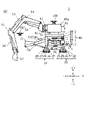
- FIG. 1 and 2 are schematic diagrams showing a hydraulic excavator 1 representing the first embodiment, FIG. 1(a) being a top view, FIG. 1(b) being a front view, and FIG. It is an AA cross-sectional view of the construction machine of (b).
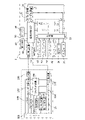
- FIG. 3 is a block diagram of the main part of the first embodiment.
- the vertical direction is defined as the Z direction
- the biaxial directions orthogonal to each other in the horizontal plane are defined as the X direction and the Y direction.
- illustration of the working device 60 is omitted in order to avoid complicating the drawing.
- the hydraulic excavator 1 of the first embodiment is an automatic operation type or remote operation type construction machine without a driver's seat, and is an Unmanned Aerial Vehicle (UAV). 100).
- UAV Unmanned Aerial Vehicle
- the hydraulic excavator 1 may be automatically operated at a construction site and placed on a trailer for transportation on a public road. Further, the operation of the hydraulic excavator 1 may be automatic operation or remote operation at a remote location away from the excavation site.
- the hydraulic excavator 1 of the first embodiment has a drive system 10 (see FIG. 3), a first processing device 15, a travel device 20, a swing device 30, an upper body device 40a and a lower body device 40b. main unit 40 , working device 60 , and second processing device 70 .
- the hydraulic excavator 1 also has a drone 100 that can take off and land on a takeoff/landing section provided on the upper surface of the upper body device 40a. Although one drone 100 is shown in FIG. 1, a plurality of drones 100 may be used. Further, the drone 100 may be of a type that flies by electric power, or may be of a type that flies by a fuel cell using hydrogen. Note that by setting the number of drones 100 to be greater than the number of working devices 60 (one in the first embodiment), monitoring of other devices in addition to monitoring of the working devices 60, charging of the drones 100, etc. It can be performed.
- the drive system 10 has an engine 11, a fuel tank 12, and a generator 13 housed in an upper body device 40a, which will be described later.
- the engine 11 is an internal combustion engine, and employs a diesel engine in the first embodiment.
- the engine 11 burns fuel supplied from the fuel tank 12 to drive the generator 13 .
- the fuel tank 12 stores ammonia (NH3) in a liquid state in the first embodiment, and is provided with a remaining amount gauge (not shown) inside. Liquid ammonia is vaporized by a vaporizer (not shown), and the vaporized ammonia is combusted by the engine 11 together with air.
- a plurality of fuel tanks 12 may be provided as storage tanks for ammonia and storage tanks for light oil.
- the engine 11 may be a co-combustion type engine that co-combusts ammonia and light oil.
- the generator 13 is connected to the output shaft of the engine 11 and generates power by the rotational driving force of the output shaft of the engine 11. Electric power generated by the generator 13 is supplied to various cylinders and various motors as shown in the block diagram of FIG.
- the power transmitting device 14 supplies power to a power receiving device 103 (described later) of the drone 100, and wireless power feeding is adopted in the first embodiment.
- Wireless power supply supplies electric power to the power receiving apparatus 103 in a non-contact manner, and known methods include a magnetic resonance method and an electromagnetic induction method.
- the power transmission device 14 of the first embodiment includes a power supply, a control circuit, and power transmission coils. Also, the power transmission device 14 may be of a spatial transmission type instead of the proximity junction type described above. Spatial transmission type power supply uses electromagnetic waves such as microwaves to supply power to an object (the power receiving device 103 of the drone 100 in the first embodiment) at a distance of several meters to several tens of meters.
- a contact-type power supply method may be used instead of wireless power supply.
- the power transmitting device 14 and the power receiving device 103 may each be provided with a metal contact, and power may be supplied by mechanically connecting the contacts.
- the take-off/landing section may be provided with a concave contact point, and the drone 100 side may be provided with a convex contact point.
- One concave contact and one convex contact may be provided, or a plurality of contacts may be provided.
- the first processing device 15 processes excavated material excavated by the work device 60 .
- the first processing device 15 has a first detection device 16 that detects the properties of the excavated material excavated by the work device 60, and a first change device 17 that changes the properties of the excavated material. ing.
- the first detection device 16 detects moisture contained in the excavated material as a property of the excavated material. It is A near-infrared moisture meter using near-infrared rays can be adopted as the first detection device 16 .
- a near-infrared moisture meter detects moisture contained in an excavated object by measuring the intensity of near-infrared rays reflected by an object to be measured (an excavated object in the first embodiment) with a light receiving element.
- the near-infrared moisture meter When the near-infrared moisture meter is used to detect the moisture contained in the excavated material, the near-infrared moisture meter must be brought close to the excavated material by about 10 cm to 50 cm. Although the moisture meter is provided in the lower main unit 40b, it is not limited to this.
- the first changing device 17 changes the water content ratio (water content) of the excavated object, and uses a liquid supply device that supplies liquid such as water to the excavated object.
- the liquid supply device has a liquid tank 18 for storing water, and a pump, nozzle, piping, etc. for supplying the water stored in the liquid tank 18 to the excavated object.
- the first changing device 17 is provided in the lower main unit 40b so as to face the discharge belt conveyor 74, which will be described later, and the liquid tank 18 is provided in the upper main unit 40a. not to be
- first detection device 16 and one first change device 17 are provided in the first embodiment, a plurality of first detection devices 16 and first change devices 17 may be provided.
- the first detection device 16 and the first change device 17 may be provided so as to face the earth and sand feeder (to be described later) and the sieve 73 (to be described later).
- the traveling device 20 has a pair of crawler belts 23 wound around an idler wheel 21 and a driving wheel 22, and a traveling motor (not shown) that drives the driving wheels 22.
- the driving wheels 22 drive the pair of crawler belts 23.
- the traveling motor 24 is driven by electric power supplied from the generator 13, and in the first embodiment, an in-wheel motor provided so as to be coaxially connected to the driving wheel 22 or the hub of the driving wheel 22 is adopted. ing.
- a hydraulic motor may be used as the travel motor 24 .
- the turning device 30 is arranged between the upper body device 40a and the lower body device 40b.
- the turning device 30 includes a bearing (not shown) and a turning motor 31 to which power is supplied from the generator 13, and turns the upper body device 40a and the work device 60.
- the turning of the main unit 40 and the working device 60 by the turning device 30 may be performed by a hydraulic motor using hydraulic pressure instead of the turning motor 31 .
- the main unit 40 of the first embodiment has an upper main unit 40a and a lower main unit 40b.
- the upper body device 40a has a cylindrical shape with a flat upper surface, and has a power transmission device 14 for supplying electric power to the drone 100 on its upper surface. Also, the power transmission device 14 on the upper surface of the main device 40 serves as the takeoff and landing part of the drone 100 .
- the body device 40 has a columnar shape in the first embodiment, it is not limited to this and can have any shape.
- the upper body device 40a houses an engine 11, a fuel tank 12, a generator 13, and a liquid tank 18 inside.
- the upper body device 40a has one side connected to the working device 60 via the swing portion 41 and the swing cylinder 42, and the countermass 43 connected to the other side.
- the upper body device 40a includes a first GNSS 47 (Global Navigation Satellite System) which is a global positioning system, a first communication device 48, a first memory 49, a hydraulic excavator 1 is provided with a heavy machinery control device 50 for controlling the entirety.
- GNSS 47 Global Navigation Satellite System
- the lower main body device 40b is a frame member having a shelf structure, holds the turning device 30 and the second processing device 70, and is connected to the traveling device 20 via a pair of side frames 25. ing.
- the lower main body device 40b holds the turning device 30 in the first stage, which is the upper stage, the sand feeder 72 in the second stage, the sieve 73 in the third stage, and the fourth stage, which is the lower stage.
- the discharge belt conveyor 74 is held.
- the swing portion 41 is pivotally supported such that a portion connected to one end side of the upper main body device 40a and a portion connected to the boom 53 are rotatable around the Z-axis indicating the vertical direction.
- the swing cylinder 42 is a cylinder whose one end is connected to the upper main unit 40a and whose other end is connected to the swing portion 41. Electric power supplied from the generator 13 causes the cylinder to expand and contract. The expansion and contraction of the swing cylinder 42 rotates the working device 60 around the Z axis in FIG.
- the countermass 43 is a mass body provided on the other end side of the upper main unit 40a, and corrects the unbalanced load acting on the main unit 40 due to the excavation operation of the work device 60. As shown in FIG.
- the first GNSS 47 (see FIG. 3) measures the position of the hydraulic excavator 1 using artificial satellites.
- the first GNSS 47 may be provided in the take-off/landing section of the upper main unit 40a.
- the first communication device 48 is a wireless communication unit that has a transmitter, a receiver, various circuits, an antenna (not shown), and the like, and accesses the second communication device 106 described later and a wide area network such as the Internet.
- the first communication device 48 communicates the flight path of the drone 100 to the second communication device 106 based on the position of the excavator 1 detected by the first GNSS 47 .
- the first memory 49 is a non-volatile memory (for example, flash memory), and stores various data and programs for driving the hydraulic excavator 1 and various data and programs for automatically operating the hydraulic excavator 1.
- the first memory 49 also stores the water content ratio (water content rate) calculated based on the data on the flight path of the drone 100 and the detection result of the first detection device 16 .
- the first memory 49 may store the amount of liquid supplied by the first changing device 17 .
- the heavy equipment control device 50 includes a CPU and is a control device that controls the entire hydraulic excavator 1. For example, the excavation operation of the work device 60, the detection operation of the first detection device 16, the water content ratio (water content rate ), driving the first change device 17, and controlling the flight operation of the drone 100.
- the working device 60 has a boom 53 , a boom cylinder 54 , an arm 55 , an arm cylinder 56 , a bucket 57 and a bucket cylinder 58 .
- the boom 53 is a rotatable L-shaped component connected to the upper main unit 40a via the swing portion 41, and is rotated by the boom cylinder 54.
- the arm 55 is connected to the tip of the boom 53 and rotated by an arm cylinder 56 .
- a bucket 57 is connected to the tip of the arm 55 and rotated by a bucket cylinder 58 .
- a breaker or the like can be attached to the tip of the arm 55 instead of the bucket 57 .
- the boom cylinder 54 is a cylinder that is telescopically operated by electric power supplied from the generator 13 to drive the boom 53 .
- the arm cylinder 56 is a cylinder that is expanded and contracted by electric power supplied from the generator 13 to drive the arm 55 .
- the bucket cylinder 58 is a cylinder that is expanded and contracted by electric power supplied from the generator 13 to drive the bucket 57 .
- the swing cylinder 42, the boom cylinder 54, the arm cylinder 56, and the bucket cylinder 58 are driven by electric power from the generator 13, but hydraulic pressure is used to drive these cylinders. You may
- the second processing device 70 processes the excavated material excavated by the work device 60, and screens the excavated material in the first embodiment.
- the second treatment device 70 has a hopper 71, a sand feeder 72, a sieve 73 and a discharge belt conveyor 74 for screening excavated material.
- the hopper 71 has an inlet and a discharge port, receives the excavated material discharged from the bucket 57 through the inlet, and discharges the excavated material to the sand feeder 72 through the discharge port.
- the hopper 71 can temporarily store excavated material because the cross-sectional area of the inlet is larger than the cross-sectional area of the outlet.
- the hopper 71 is supported by a pair of frames 72b of the sand feeder 72. As shown in FIG.
- the earth and sand feeder 72 conveys the excavated material from the hopper 71 to the sieve 73.
- the earth and sand feeder 72 has a belt 72a, a pair of frames 72b, and a support portion 72c.
- the belt 72 a is rotationally driven by a motor (not shown) to convey the excavated material to the sieve 73 .
- a pair of frames 72b are fixed to the second stage of the lower main unit 40b and rotatably support the belt 72a.
- the support portion 72c supports the pair of frames 72b.
- the sieve 73 has a mesh 73a for sieving, and allows excavated objects of a predetermined size or smaller to pass through the openings of the mesh 73a.
- the sieve 73 has a discharge member 73b inclined in the Y direction as shown in FIG. 2, and discharges excavated materials such as rocks that have not passed through the openings of the mesh 73a in the -Y direction.
- the mesh 73a is preferably modularized so that the size of the opening can be changed according to the properties of the excavated material (for example, particle diameter). In this case, the mesh 73a may have the same outer dimensions and a plurality of sizes of openings.
- a vibration imparting member that imparts vibration to the mesh 73a.
- an ultrasonic transducer can be used as the vibration imparting member.
- the discharge belt conveyor 74 conveys the excavated material that has passed through the mesh 73a to a dump truck (not shown).
- the discharge belt conveyor 74 has a belt 74a, a pair of frames 74b, and a support portion 74c.
- the belt 74a is rotationally driven by a motor (not shown) to convey the excavated material to a dump truck (not shown).
- a pair of frames 74b are fixed to the fourth stage of the lower main unit 40b and rotatably support the belt 74a.
- the support portion 74c supports the pair of frames 74b.
- the distance over which the discharge belt conveyor 74 conveys the excavated material is longer than the distance over which the sand feeder 72 conveys the excavated material.
- the weight of the discharge belt conveyor 74 is greater than the sum of the weight of the hopper 71 and the weight of the dirt feeder 72 . Therefore, the discharge belt conveyor 74 can correct the unbalanced load acting on the main unit 40 due to the excavation operation of the work device 60 . Thereby, the weight of the counter mass 43 can be reduced.
- the drone 100 of the first embodiment includes a flight device 101, an imaging device 102, a power receiving device 103, a sensor group 104, a battery 105, a second communication device 106, a second memory 107, and a UAV control device. 108 and . These components are provided in the body of the drone 100 . Note that, as shown in FIG. 3, the drone 100 may be configured to include at least one of the first detection device 16 and the first change device 17 .
- the flight device 101 has a motor (not shown) and a plurality of propellers, and generates thrust to float the drone 100 in the air and move it in the air.
- the number of drones 100 that land on the take-off/landing section can be arbitrarily set.
- the configuration of each drone 100 may be the same, or a part thereof may be changed.
- the size of each drone 100 may be the same or may be different.
- the imaging device 102 is a digital camera that has a lens, an imaging device, an image processing engine, and the like, and captures moving images and still images. In the first embodiment, the imaging device 102 performs surveying and imaging of an excavation site.
- the lens of the imaging device 102 is attached to the side surface (front) of the drone 100, but the lens of the imaging device 102 may be attached to the bottom surface of the drone 100, and a plurality of lenses may be attached. may be provided in the drone 100. Also, a moving mechanism may be provided to move the lens attached to the side face downward. Alternatively, a mechanism for rotating the imaging device 102 around the Z-axis may be provided to position the lens of the imaging device 102 at an arbitrary position around the Z-axis. Note that an omnidirectional camera (360-degree camera) may be used as the imaging device 102, and a three-dimensional scanner may be used instead of the imaging device 102.
- the power receiving device 103 has a power receiving coil and a charging circuit provided on the leg 109 of the drone 100 and charges the battery 105 with power from the power transmitting device 14 .
- the battery 105 is a secondary battery connected to the power receiving device 103, and can be a lithium ion secondary battery, a lithium polymer secondary battery, or the like, but is not limited thereto. Battery 105 is capable of supplying power to flight device 101 , imaging device 102 , second communication device 106 , second memory 107 and UAV controller 108 .
- the sensor group 104 includes GNSS, an infrared sensor for avoiding collision between the drone 100 and other devices (for example, the work device 60), an air pressure sensor for measuring altitude, a magnetic sensor for detecting orientation, and sensors for detecting the direction of the drone 100.
- a gyro sensor that detects an attitude an acceleration sensor that detects acceleration acting on the drone 100, and the like.
- the second communication device 106 has a wireless communication unit, accesses a wide area network such as the Internet, and communicates with the first communication device 48 .
- the second communication device 106 transmits image data captured by the imaging device 102 and detection results detected by the sensor group 104 to the first communication device 48, It is for sending commands to the UAV controller 108 .
- the second memory 107 is a non-volatile memory (for example, flash memory), stores various data and programs for flying the drone 100, and stores image data captured by the imaging device 102 and detections detected by the sensor group 104. It stores results and the like.
- non-volatile memory for example, flash memory
- the UAV control device 108 includes a CPU, an attitude control circuit, a flight control circuit, etc., and controls the drone 100 as a whole. Also, the UAV control device 108 determines the charging timing at the takeoff/landing part from the remaining amount of the battery 105, and controls the imaging position, angle of view, frame rate, and the like of the imaging device 102. FIG.
- the drone 100 surveys the excavation area prior to excavation by the work device 60, and during the excavation by the work device 60, images are captured from above and Since the bucket can be imaged near the bucket 57, excavation can be performed even if the operator is not in the excavation area.
- the drone 100 captures images at the take-off and landing section, it is possible to capture images from substantially the same position as from the driver's seat of a conventional hydraulic excavator. Since the takeoff/landing section is provided at the top of the upper main body device 40a, the drone 100 can perform imaging with the imaging device 102 in the takeoff/landing section without being blocked by the upper main body device 40a.
- the drone 100 of the first embodiment includes the first detection device 16 and the first change device 17. At least one of the first detection device 16 and the first change device 17 Alternatively, the first detection device 16 and the first change device 17 may be omitted.
- the liquid tank 18 in the upper main body device 40a may be used as a tank for replenishing a tank (not shown) in the drone 100 with liquid.
- the liquid tank 18 may be provided on the upper surface of the upper body device 40a, and one of the drone 100 and the liquid tank 18 may be provided with a male joint, and the other of the drone 100 and the liquid tank 18 may be provided with a female joint. good. It is preferable to connect the male joint and the female joint to supply the liquid in the liquid tank 18 to a tank (not shown) in the drone 100 when the drone 100 lands on the takeoff/landing section.
- FIG. 4 is a flowchart executed by the heavy equipment control device 50 of the first embodiment.
- the heavy machinery control device 50 performs excavation by the work device 60 and performs screening by the second processing device 70 (step S1).
- the heavy machine control device 50 causes the excavated material accommodated in the bucket 57 to be thrown into the inlet of the hopper 71 .
- the excavated material discharged from the discharge port of the hopper 71 is discharged to the earth and sand feeder 72 and conveyed to the sieve 73 .
- the sieve 73 the excavated material that has passed through the mesh 73 a is conveyed in the +X direction by the discharge belt conveyor 74 .
- the excavated material that has not passed through the mesh 73a is carried out to the outside of the hydraulic excavator 1 by the discharge member 73b.
- the heavy machinery control device 50 determines whether it is necessary to detect the properties of the excavated material that has passed through the mesh 73a (step S2). Here, it is assumed that detection of the nature of the excavated material by the first detection device 16 is necessary, and the process proceeds to step S3. If the first detector 16 does not need to detect the properties of the excavated material, the heavy equipment control device 50 proceeds to step S4.
- the heavy equipment control device 50 detects the properties of the excavated material being conveyed by the discharge belt conveyor 74 using the first detection device 16 (step S3). The reason why the heavy equipment control device 50 detects the properties of the sifted excavated material is to avoid detecting the properties of the excavated material that did not pass through the mesh 73a.
- the heavy equipment control device 50 detects the moisture contained in the excavated material using a near-infrared moisture meter.
- the heavy equipment control device 50 calculates the water content ratio (water content) of the excavated material based on the water contained in the excavated material detected by the near-infrared moisture meter, and stores this calculation result in the first memory 49 .
- the heavy machinery control device 50 determines whether it is necessary to change the properties of the excavated material being conveyed by the discharge belt conveyor 74 (step S4). Here, it is assumed that the property of the excavated material needs to be changed by the first changing device 17, and the process proceeds to step S5. It should be noted that the heavy equipment control device 50 proceeds to step S6 when the first change device 17 does not need to change the properties of the excavated material.
- the heavy equipment control device 50 may determine Yes in step S4 and change the property of the excavated material. This assumes that the properties of the excavated material (for example, water content) are known in advance from preliminary excavation or past experience. In this way, when the hydraulic excavator 1 does not need to detect the properties of the excavated material, the first detection device 16 may be omitted.
- the properties of the excavated material for example, water content
- the heavy equipment control device 50 supplies the liquid to the excavated object by the first changing device 17 so that the excavated object has a predetermined water content (moisture content) based on the detection result of the first detection device 16 or preliminary excavation.
- the water content ratio (water content) of the excavated material can be adjusted, for example, before the embankment using this excavated material is completed. It should be adjusted as follows.
- a flow meter may be provided in the first changing device 17 , and the heavy machinery control device 50 may store the amount of liquid supplied to the excavated object by the first changing device 17 in the first memory 49 .
- the heavy equipment control device 50 detects the operating state of the hydraulic excavator 1 (step S6).
- the heavy equipment control device 50 detects the operating state of the hydraulic excavator 1 based on the imaging result of the imaging device 102 of the drone 100 .
- UAV control device 108 uses infrared sensors of sensor group 104 to fly drone 100 so as to avoid collision with work device 60, second processing device 70, and the like, while controlling work device 60, second processing device 70, and the like.
- the imaging device 102 is caused to take an image of the surroundings.
- the heavy equipment control device 50 may detect the operating states of the various motors by comparing the rated current of the various motors and the load current.
- the heavy equipment control device 50 determines whether or not the hydraulic excavator 1 has an abnormality based on the detection of the operating state of the hydraulic excavator 1 performed in step S6 (step S7).
- the heavy equipment control device 50 detects an abnormality when an image captured by the imaging device 102 includes an image of an excavated object falling from the belt 72a or the belt 74a or an image of damage or slackness of the belt 72a or the belt 74a. judge as a thing. If the excavated material discharged by the discharge member 73b contains an image of soil that would normally pass through the opening of the mesh 73a, the heavy equipment control device 50 determines that the mesh 73a is clogged and that there is an abnormality. do.
- the heavy machinery control device 50 acquires teacher data regarding past abnormalities of the hydraulic excavator 1 collected by the drone 100, generates an evaluation model using machine learning, and reproduces the image captured by the imaging device 102 in step S6.
- the presence or absence of anomalies is determined by analysis.
- the determination in step S7 may be made by a host computer (not shown) provided with artificial intelligence through a network instead of the heavy machinery control device 50, or may be made by an operator in a remote location such as a temporary office. good.
- the heavy equipment control device 50 determines that an abnormality has occurred due to clogging of the mesh 73a, and proceeds to step S8. If the heavy equipment control device 50 determines that no abnormality has occurred, the process proceeds to step S10.
- the heavy machinery control device 50 performs maintenance on the location where the abnormality occurred (step S8).
- the heavy machinery control device 50 drives a vibration imparting member that imparts vibration to the mesh 73a in order to maintain clogging of the mesh 73a.
- the mesh 73a may be cleaned by supplying liquid to the mesh 73a by the first changing device 17.
- the first changing device 17 is preferably provided on the lower main body device 40b so as to face the mesh 73a.
- the heavy machinery control device 50 may supply the liquid to the mesh 73 a by the first changing device 17 provided in the drone 100 .
- the clogging of the mesh 73a may be eliminated using compressed gas (for example, air) instead of liquid.
- the heavy equipment control device 50 determines whether the maintenance has been completed (step S9).
- the heavy equipment control device 50 determines whether or not the clogging of the mesh 73a has been eliminated by generating an evaluation model based on the training data of the clogged state of the mesh 73a.
- the judgment in step S9 may be made by a host computer (not shown) through a network instead of by the heavy equipment control device 50, or may be made by an operator in a remote location such as a temporary office.
- the heavy equipment control device 50 repeats step S8 until the maintenance is completed, and when the maintenance is completed, the determination in step S9 is Yes, and the process proceeds to step S10.
- the maintenance in step S8 may be performed by an operator. Maintenance performed by the operator includes replacement of the belts 72a and 74a and adjustment of tension.
- the heavy machinery control device 50 determines whether excavation using the work device 60 has ended (step S10). If the excavation has not ended, the process returns to step S1, and if the excavation has ended, the flow chart of FIG. 4 ends.
- the heavy equipment control device 50 is provided with water content ratio (water content) data calculated from water contained in the excavated object detected by the first detection device 16 and data supplied by the first change device 17. Data on the amount of liquid supplied is sent by the first communication device 48 to, for example, the drone 100, the host computer of the temporary office, and construction heavy equipment (such as a bulldozer and a motor grader) that uses the excavated material to fill and level the soil. etc.
- water content ratio water content
- the imaging device 102 of the drone 100 images the mesh 73a, but an imaging device may be provided in the lower main unit 40b so as to face the mesh 73a.
- At least part of the second processing device 70 is provided using the space of a conventional operator's cab, so the hydraulic excavator 1 with a high degree of layout freedom can be provided.
- the work device 60 conveys the excavated material to the hopper 71 connected to the lower main body device 70b, the bucket 57 is not driven above the lower main body device 70b, and the stroke of the work device 60 in the Z direction is increased. can be shortened, and the size of the boom cylinder 54, arm cylinder 56, and bucket cylinder 58 can be reduced, so that the energy-saving hydraulic excavator 1 can be realized.
- the excavation work, the processing by the first processing device 15, and the processing by the second processing device 70 were performed without driving the turning device 30 and the turning motor 31. Therefore, in the first embodiment, it is possible to omit the turning device 30 and the turning motor 31 .
- the hydraulic excavator 1 of the first embodiment is also suitable for work in narrow sites such as tunnels where turning is difficult. It should be noted that it is also possible to adopt a device configuration in which one of the first processing device 15 and the second processing device 70 is omitted.
- the hydraulic excavator 1 and the drone 100 are provided with the first detection device 16 and the first change device 17, but one of the excavator 1 and the drone 100 is provided with the first detection device 16 and the first change One of the devices 17 may be provided, and the other of the first detection device 16 and the first change device 17 may be provided to the other of the excavator 1 and the drone 100 . If the drone 100 is provided with the first modification device 17, the second memory 107 may store the amount of liquid supplied by the first modification device 17 to the excavated object.
- a near-infrared moisture meter is used as the first detection device 16, but instead of this, the imaging result of the imaging device 102 is used, and various water content ratios (water content ) may be stored.
- the heavy equipment control device 50 may analogize the water content and water content (moisture content) contained in the excavated object based on the image captured by the imaging device 102 and the teacher data. Further, the analogy of the water content and the water content ratio (moisture content) may be performed using a host computer provided with artificial intelligence instead of the heavy equipment control device 50 .
- the imaging device 102 may be provided in the hydraulic excavator 1 .
- the particle size of the excavated material may be detected by the imaging device 102 .
- the first detection device 16 may be an oil content detection device that detects the oil content of the excavated matter, or an odor detector that detects the smell of the excavated matter.
- the first detection device 16 may be a detection device that detects the concentration of oxygen and harmful gases in the tunnel.
- a photovoltaic power generation device may be provided on the top or side of the upper body device 40a, and the power generated by the photovoltaic power generation device may be used to drive the hydraulic excavator 1.
- the photovoltaic device may use, for example, perovskite solar cells.
- a perovskite solar cell is a solar cell using perovskite crystals, and because it is flexible, it can be attached to a structure having a curved surface. Moreover, since the perovskite solar cell is lightweight, it is possible to suppress an increase in the weight of the excavator 1 .
- FIG. 5 is a schematic diagram of a hydraulic excavator 1 representing an example of a construction machine representing the second embodiment
- FIG. 5(b) is a diagram showing a state in the middle of folding the sand feeder 72 and the discharge belt conveyor 74
- FIG. 5(d) is a diagram showing a state in which the working device 60 is turned toward the discharge belt conveyor 74.
- the hydraulic excavator 1 of the second embodiment is provided with a mechanism that folds the earth and sand feeder 72 and the discharge belt conveyor 74 so that they can be placed on the bed of a truck or a trailer. Also, in the hydraulic excavator 1 of the second embodiment, the height of the working device 60 is adjusted so that it can be placed on the bed of a truck or a trailer.
- the soil feeder 72 has a hinge portion 72d so that it can be folded toward the lower main unit 40b, and a motor (not shown) for driving the hinge portion 72d toward the lower main unit 40b.
- the discharge belt conveyor 74 also has a hinge portion 74d so that it can be folded toward the lower main unit 40b, and a motor (not shown) that drives the hinge portion 74d toward the lower main unit 40b. .
- the hinge part 72d rotatably supports a pair of frames 72b divided along the transport direction.
- the hinge portion 74d rotatably supports a pair of frames 74b divided along the transport direction.
- FIG. 6 is a flowchart executed by the heavy equipment control device 50 of the second embodiment.
- the heavy machine control device 50 retracts the work device 60 before the earth and sand feeder 72 and the discharge belt conveyor 74 are folded (step S11).
- the heavy machine control device 50 causes the turning device 30 to turn the working device 60 by about 90 degrees so that the working device 60 does not interfere with the sand feeder 72 and the discharge belt conveyor 74 .
- FIG. 5(a) shows the state of the hydraulic excavator 1 after step S11 is performed.
- the heavy equipment control device 50 folds the sand feeder 72 and the discharge belt conveyor 74 (step S12).
- FIG. 5(b) shows how the soil feeder 72 and the discharge belt conveyor 74 are being folded.
- the heavy machinery control device 50 determines whether or not the sand feeder 72 and the discharge belt conveyor 74 have finished folding (step S13).
- the hopper 71 may be provided with a contact sensor to detect the end of folding of the sand feeder 72 based on the output of this contact sensor.
- the end of folding of the discharge belt conveyor 74 may be detected by providing a contact sensor for detecting contact between the frames 74b, for example.
- the heavy machinery control device 50 repeats steps S12 and S13 until the sand feeder 72 and the discharge belt conveyor 74 are completely folded.
- the heavy machine control device 50 controls the posture of the work device 60 (step S14).
- the heavy machine control device 50 controls the posture of the working device 60 so as to surround the folded discharge belt conveyor 74, as shown in FIG. 5(d). Note that the heavy machine control device 50 may control the attitude of the working device 60 so as to surround the folded dirt feeder 72 .
- part of the second processing device 70 can be folded, so that the hydraulic excavator 1 can be easily transported by a truck bed or a trailer.
- FIG. 7 is a schematic diagram of a hydraulic excavator 1 representing an example of a construction machine representing the third embodiment.
- two working devices 60 are provided in the hydraulic excavator 1 of the third embodiment.
- the number of work devices 60 may be three or more.
- one is a working device 60a and the other is a working device 60b. are also attached with a or b after the reference numerals.
- the second processing device 70 of the third embodiment has a mesh 73a, a discharge member 75, and a support portion 76.
- the discharge member 75 is connected to one end of the mesh 73a and discharges excavated material that has not passed through the opening of the mesh 73a.
- the discharge member 75 is inclined to discharge the excavated material that has not passed through the opening of the mesh 73a. It is good also as a structure which carries out. Note that the discharge member 75 may have a structure that can be divided along the longitudinal direction.
- the support portion 76 is a member that supports the mesh 73a and the discharge member 75, and one end thereof is connected to the lower main body device 40b. Note that the support portion 76 may support the ejection member 75 at a plurality of locations. In the third embodiment, a damming member 77 is provided to prevent the discharged excavated material from returning to the excavation site.
- one working device 60 (for example, the working device 60b) is turned by the turning device 30 following excavation, and the bucket 57b is positioned above the loading platform of the dump truck 79.
- the excavated material contained in the bucket 57b passes through the opening of the mesh 73a of the second processing device 70, and excavated material of a predetermined size or smaller is discharged onto the bed of the dump truck 79.
- the work device 60a is excavating while the work device 60b is discharging the excavated material onto the bed of the dump truck 79.
- the hydraulic excavator 1 of the third embodiment can perform excavation and discharge in parallel, so that the hydraulic excavator 1 can be realized with good usability.
- the working device 60a is provided on one side of the upper main body device 40a and the working device 60b is provided on the other side of the upper main body device 40a, for example, the working device 60a that is performing excavation can operate the upper main body device 40a. is corrected by the operation of the working device 60b that is discharging. Therefore, the counter mass 43 can be omitted in the third embodiment.
- the properties can be changed by the first changing device 17 of the drone 100 flying near the mesh 73a. Further, in the third embodiment, it is possible to omit the first processing device 15 provided in the lower main unit 40b in the first and second embodiments.
- the third embodiment by increasing the number of working devices 60 (two in the third embodiment), in addition to monitoring the working devices 60a and 60b, other devices can be monitored, and drones can be monitored. 100 charging and the like can be performed.
- the image captured by the imaging device 102 of the drone 100 positioned at the take-off/landing portion of the upper main unit 40a can be used as an image visually recognized by the operator from the conventional driver's seat.
- FIG. 8 is a schematic diagram of a hydraulic excavator 1 representing an example of a construction machine representing the fourth embodiment.
- a rotary crushing device 80 is provided in the lower main body device 40b.
- the rotary crusher 80 is a device that uses construction-generated soil (surplus soil) or the like as a raw material and crushes construction-generated soil to produce improved soil. If necessary, the rotary crushing device 80 may add lime-based solidifying materials such as quicklime and slaked lime, cement-based solidifying materials such as ordinary cement and blast-furnace cement, or soil improvement materials made of polymeric materials as additives. It can be mixed with construction-generated soil to adjust the properties and strength of improved soil.
- the excavated material excavated by the working device 60 is used as a raw material to manufacture improved soil. Further, in the fourth embodiment, four triangular crawler belt-type traveling bodies are used as the traveling device 20 .
- the rotary crushing device 80 has a motor 81 , a driving pulley 82 , a belt 83 , a driven pulley 84 , a rotating shaft 85 and a crushing section 86 .
- the control of the rotary crushing device 80 is performed by the heavy equipment control device 50 .
- the motor 81 is provided in the lower main body device 40b, and is decelerated by a driving pulley 82, a belt 83, and a driven pulley 84, and imparts rotational driving force to the rotating shaft 85.
- a driving pulley 82 is connected to a motor 81 and to a driven pulley 84 via a belt 83 .
- the belt 83 is stretched over the drive pulley 82 and the driven pulley 84 and rotates around the Z axis.
- the driven pulley 84 is connected to the rotating shaft 85 and transmits the driving torque of the motor 81 to the rotating shaft 85 .
- the crushing section 86 is connected to the rotating shaft 85, and in the fourth embodiment, it has a two-stage configuration spaced apart in the Z direction, but it may have a one-stage configuration or three or more stages.
- the crushing unit 86 hangs down when the motor 81 is stopped, and when the motor 81 is driven, the rotating shaft 85 rotates through the drive pulley 82, the belt 83, and the driven pulley 84. , rotates around the Z-axis due to the accompanying centrifugal rotation, and crushes the excavated material fed from the sand feeder 72 .
- Part of the rotating shaft 85 and the crushing section 86 are housed in a container. Therefore, in FIG. 8, a portion of the rotating shaft 85 and the crushing section 86 are illustrated by dotted lines.
- the excavated material crushed by the crushing section 86 is conveyed to the outside of the hydraulic excavator 1 (for example, a dump truck (not shown)) by a discharge belt conveyor 74 provided below the crushing section 86 .
- a more detailed configuration of the rotary crusher 80 is disclosed in Japanese Patent No. 6466043 filed by the applicant of the present application.
- the travel device 20 is connected to the lower main body device 40 b and has drive wheels 26 , driven wheels 27 , crawler belts 28 , and supports 29 .
- the travel device 20 also has an in-wheel motor as the travel motor 24 that transmits a driving force to the drive wheels 26 on the rear side of the drive wheels 26 .
- the rotating shaft of the in-wheel motor is connected to the rotating shaft of the driving wheel 26 , and the rotating driving force of the in-wheel motor rotates the driving wheel 26 , thereby transmitting the driving force to the crawler belt 28 .
- one driving wheel 26 and two driven wheels 27 form a triangular shape.
- the crawler belt 28 is wound around one drive wheel 26 and two driven wheels 27 .
- the support 29 is connected to the lower main unit 40b and rotatably supports the drive wheel 26 and the driven wheel 27. As shown in FIG.
- the hydraulic excavator 1 can travel stably even on rough terrain. Also, when the hydraulic excavator 1 is put on or off the trailer, it can travel stably by means of the four triangular crawler belt-type traveling bodies.
- the triangular crawler belt type traveling body of the fourth embodiment may be used as the traveling device 20 of the first to third embodiments. Conversely, the triangular crawler belt type traveling body of the fourth embodiment may be employed as the traveling device 20 of the first to third embodiments.
- a mass body may also be provided on the +X direction side of the lower body device 40b in order to correct the unbalanced load acting on the body device 40 due to the excavation operation of the work device 60. good.
- the hydraulic excavator 1 can crush construction-generated soil (surplus soil) in addition to excavation. It can be carried out.
- hydrogen and a fuel cell may be used to drive the hydraulic excavator 1 instead of the internal combustion engine.
- high-pressure hydrogen gas may be stored in the fuel tank 12 and supplied to the fuel cell. If a drive system 10 that emits less greenhouse gas is used, the environmentally friendly hydraulic excavator 1 can be realized.
- the embodiments described above are merely examples for explaining the present invention, and various modifications can be made without departing from the gist of the present invention.
- the UAV control device 108 recognizes the bucket 57 with the infrared sensor of the sensor group 104, thereby avoiding collision between the bucket 57 and the drone 100.
- the configurations of the hydraulic excavator 1 according to the first to fourth embodiments can be combined as appropriate.
Landscapes
- Engineering & Computer Science (AREA)
- Mining & Mineral Resources (AREA)
- Civil Engineering (AREA)
- General Engineering & Computer Science (AREA)
- Structural Engineering (AREA)
- Food Science & Technology (AREA)
- Aviation & Aerospace Engineering (AREA)
- Mechanical Engineering (AREA)
- Operation Control Of Excavators (AREA)
- Excavating Of Shafts Or Tunnels (AREA)
Priority Applications (2)
| Application Number | Priority Date | Filing Date | Title |
|---|---|---|---|
| US18/574,971 US20240309605A1 (en) | 2021-07-16 | 2022-02-16 | Construction Machine |
| JP2023535089A JP7754929B2 (ja) | 2021-07-16 | 2022-02-16 | 建設機械 |
Applications Claiming Priority (2)
| Application Number | Priority Date | Filing Date | Title |
|---|---|---|---|
| US202163222484P | 2021-07-16 | 2021-07-16 | |
| US63/222,484 | 2021-07-16 |
Publications (1)
| Publication Number | Publication Date |
|---|---|
| WO2023286309A1 true WO2023286309A1 (ja) | 2023-01-19 |
Family
ID=84919167
Family Applications (1)
| Application Number | Title | Priority Date | Filing Date |
|---|---|---|---|
| PCT/JP2022/006087 Ceased WO2023286309A1 (ja) | 2021-07-16 | 2022-02-16 | 建設機械 |
Country Status (3)
| Country | Link |
|---|---|
| US (1) | US20240309605A1 (https=) |
| JP (1) | JP7754929B2 (https=) |
| WO (1) | WO2023286309A1 (https=) |
Families Citing this family (2)
| Publication number | Priority date | Publication date | Assignee | Title |
|---|---|---|---|---|
| WO2023162405A1 (ja) * | 2022-02-22 | 2023-08-31 | 日本国土開発株式会社 | 移動装置および無人飛行装置 |
| MX2024010921A (es) * | 2023-09-11 | 2025-04-02 | Polaris Inc | Integracion de dron con el vehiculo |
Citations (11)
| Publication number | Priority date | Publication date | Assignee | Title |
|---|---|---|---|---|
| JPH0711667A (ja) * | 1993-06-28 | 1995-01-13 | Shimizu Corp | 発生土処理方法及び該方法に使用される発生土処理装置 |
| JPH07288753A (ja) * | 1994-04-14 | 1995-10-31 | Ohbayashi Corp | 遠隔操縦システムにおける映像伝達装置の姿勢保持装置 |
| JPH09165797A (ja) * | 1995-10-12 | 1997-06-24 | Komatsu Est Corp | 作業機械の操作装置 |
| JP2000042443A (ja) * | 1998-07-24 | 2000-02-15 | Yutani Heavy Ind Ltd | 破砕機械 |
| JP2004132030A (ja) * | 2002-10-10 | 2004-04-30 | Hitachi Constr Mach Co Ltd | 土質改良方法 |
| JP2009209549A (ja) * | 2008-03-03 | 2009-09-17 | Kobelco Contstruction Machinery Ltd | 作業機械 |
| JP2010131573A (ja) * | 2008-12-08 | 2010-06-17 | Hitachi Constr Mach Co Ltd | 自走式処理機 |
| JP2016130409A (ja) * | 2015-01-13 | 2016-07-21 | 株式会社小松製作所 | 掘削機械、掘削機械の制御方法及び掘削システム |
| JP2017137136A (ja) * | 2016-02-01 | 2017-08-10 | 誠一 柴山 | 搬送装置およびホッパ装置 |
| JP2018164413A (ja) * | 2017-03-28 | 2018-10-25 | 日本電気株式会社 | 農作物管理システム、遠隔操作装置及び農作物管理方法 |
| JP2019065518A (ja) * | 2017-09-29 | 2019-04-25 | 日立建機株式会社 | 建設機械 |
-
2022
- 2022-02-16 US US18/574,971 patent/US20240309605A1/en active Pending
- 2022-02-16 WO PCT/JP2022/006087 patent/WO2023286309A1/ja not_active Ceased
- 2022-02-16 JP JP2023535089A patent/JP7754929B2/ja active Active
Patent Citations (11)
| Publication number | Priority date | Publication date | Assignee | Title |
|---|---|---|---|---|
| JPH0711667A (ja) * | 1993-06-28 | 1995-01-13 | Shimizu Corp | 発生土処理方法及び該方法に使用される発生土処理装置 |
| JPH07288753A (ja) * | 1994-04-14 | 1995-10-31 | Ohbayashi Corp | 遠隔操縦システムにおける映像伝達装置の姿勢保持装置 |
| JPH09165797A (ja) * | 1995-10-12 | 1997-06-24 | Komatsu Est Corp | 作業機械の操作装置 |
| JP2000042443A (ja) * | 1998-07-24 | 2000-02-15 | Yutani Heavy Ind Ltd | 破砕機械 |
| JP2004132030A (ja) * | 2002-10-10 | 2004-04-30 | Hitachi Constr Mach Co Ltd | 土質改良方法 |
| JP2009209549A (ja) * | 2008-03-03 | 2009-09-17 | Kobelco Contstruction Machinery Ltd | 作業機械 |
| JP2010131573A (ja) * | 2008-12-08 | 2010-06-17 | Hitachi Constr Mach Co Ltd | 自走式処理機 |
| JP2016130409A (ja) * | 2015-01-13 | 2016-07-21 | 株式会社小松製作所 | 掘削機械、掘削機械の制御方法及び掘削システム |
| JP2017137136A (ja) * | 2016-02-01 | 2017-08-10 | 誠一 柴山 | 搬送装置およびホッパ装置 |
| JP2018164413A (ja) * | 2017-03-28 | 2018-10-25 | 日本電気株式会社 | 農作物管理システム、遠隔操作装置及び農作物管理方法 |
| JP2019065518A (ja) * | 2017-09-29 | 2019-04-25 | 日立建機株式会社 | 建設機械 |
Also Published As
| Publication number | Publication date |
|---|---|
| JPWO2023286309A1 (https=) | 2023-01-19 |
| JP7754929B2 (ja) | 2025-10-15 |
| US20240309605A1 (en) | 2024-09-19 |
Similar Documents
| Publication | Publication Date | Title |
|---|---|---|
| JP7159491B2 (ja) | 建設機械 | |
| JP7436593B2 (ja) | 建設機械 | |
| JP7754929B2 (ja) | 建設機械 | |
| CN111771031B (zh) | 用于控制作业机械的系统及方法 | |
| US20250108943A1 (en) | Moving Device And Unmanned Aerial Device | |
| JP2022079773A (ja) | 作業システムおよび制御方法 | |
| US20160051999A1 (en) | Industrial misting fan with mobility control and method for controlling an industrial misting fan | |
| JP7228732B2 (ja) | 杭打ち方法 | |
| JP7762233B2 (ja) | 搬送装置および建設機械 | |
| US20160035149A1 (en) | Truck spotting system using position detection and perception | |
| JP7549164B2 (ja) | 建設機械システム | |
| JP2016216218A (ja) | 自走式搬送装置 | |
| WO2022239303A1 (ja) | 建設機械、掘削物測定方法ならびに無人飛行体 | |
| AU2022364581A1 (en) | Method and apparatus for remotely or autonomously depositing explosives into a blast hole | |
| JP7806309B2 (ja) | 建設装置 | |
| WO2022185666A1 (ja) | 建設機械 | |
| WO2023067837A1 (ja) | 搬送装置 | |
| JP2024143469A (ja) | ずり搬出装置 | |
| CN209080992U (zh) | 煤炭工程车煤料卸料装置 | |
| WO2023119737A1 (ja) | トレイン式スクレーパ車両 | |
| CN109230642A (zh) | 煤炭工程车煤料卸料装置 |
Legal Events
| Date | Code | Title | Description |
|---|---|---|---|
| 121 | Ep: the epo has been informed by wipo that ep was designated in this application |
Ref document number: 22841659 Country of ref document: EP Kind code of ref document: A1 |
|
| WWE | Wipo information: entry into national phase |
Ref document number: 2023535089 Country of ref document: JP |
|
| NENP | Non-entry into the national phase |
Ref country code: DE |
|
| 122 | Ep: pct application non-entry in european phase |
Ref document number: 22841659 Country of ref document: EP Kind code of ref document: A1 |