WO2023282205A1 - 露光装置及びデバイス製造方法 - Google Patents
露光装置及びデバイス製造方法 Download PDFInfo
- Publication number
- WO2023282205A1 WO2023282205A1 PCT/JP2022/026485 JP2022026485W WO2023282205A1 WO 2023282205 A1 WO2023282205 A1 WO 2023282205A1 JP 2022026485 W JP2022026485 W JP 2022026485W WO 2023282205 A1 WO2023282205 A1 WO 2023282205A1
- Authority
- WO
- WIPO (PCT)
- Prior art keywords
- exposure
- optical system
- pattern
- moving body
- exposure apparatus
- Prior art date
- Legal status (The legal status is an assumption and is not a legal conclusion. Google has not performed a legal analysis and makes no representation as to the accuracy of the status listed.)
- Ceased
Links
Images






Classifications
-
- G—PHYSICS
- G03—PHOTOGRAPHY; CINEMATOGRAPHY; ANALOGOUS TECHNIQUES USING WAVES OTHER THAN OPTICAL WAVES; ELECTROGRAPHY; HOLOGRAPHY
- G03F—PHOTOMECHANICAL PRODUCTION OF TEXTURED OR PATTERNED SURFACES, e.g. FOR PRINTING, FOR PROCESSING OF SEMICONDUCTOR DEVICES; MATERIALS THEREFOR; ORIGINALS THEREFOR; APPARATUS SPECIALLY ADAPTED THEREFOR
- G03F7/00—Photomechanical, e.g. photolithographic, production of textured or patterned surfaces, e.g. printing surfaces; Materials therefor, e.g. comprising photoresists; Apparatus specially adapted therefor
- G03F7/70—Microphotolithographic exposure; Apparatus therefor
- G03F7/70216—Mask projection systems
- G03F7/70283—Mask effects on the imaging process
- G03F7/70291—Addressable masks, e.g. spatial light modulators [SLMs], digital micro-mirror devices [DMDs] or liquid crystal display [LCD] patterning devices
-
- G—PHYSICS
- G02—OPTICS
- G02B—OPTICAL ELEMENTS, SYSTEMS OR APPARATUS
- G02B26/00—Optical devices or arrangements for the control of light using movable or deformable optical elements
- G02B26/08—Optical devices or arrangements for the control of light using movable or deformable optical elements for controlling the direction of light
- G02B26/0816—Optical devices or arrangements for the control of light using movable or deformable optical elements for controlling the direction of light by means of one or more reflecting elements
- G02B26/0833—Optical devices or arrangements for the control of light using movable or deformable optical elements for controlling the direction of light by means of one or more reflecting elements the reflecting element being a micromechanical device, e.g. a MEMS mirror, DMD
-
- G—PHYSICS
- G02—OPTICS
- G02B—OPTICAL ELEMENTS, SYSTEMS OR APPARATUS
- G02B5/00—Optical elements other than lenses
- G02B5/04—Prisms
-
- G—PHYSICS
- G03—PHOTOGRAPHY; CINEMATOGRAPHY; ANALOGOUS TECHNIQUES USING WAVES OTHER THAN OPTICAL WAVES; ELECTROGRAPHY; HOLOGRAPHY
- G03F—PHOTOMECHANICAL PRODUCTION OF TEXTURED OR PATTERNED SURFACES, e.g. FOR PRINTING, FOR PROCESSING OF SEMICONDUCTOR DEVICES; MATERIALS THEREFOR; ORIGINALS THEREFOR; APPARATUS SPECIALLY ADAPTED THEREFOR
- G03F7/00—Photomechanical, e.g. photolithographic, production of textured or patterned surfaces, e.g. printing surfaces; Materials therefor, e.g. comprising photoresists; Apparatus specially adapted therefor
- G03F7/20—Exposure; Apparatus therefor
-
- G—PHYSICS
- G03—PHOTOGRAPHY; CINEMATOGRAPHY; ANALOGOUS TECHNIQUES USING WAVES OTHER THAN OPTICAL WAVES; ELECTROGRAPHY; HOLOGRAPHY
- G03F—PHOTOMECHANICAL PRODUCTION OF TEXTURED OR PATTERNED SURFACES, e.g. FOR PRINTING, FOR PROCESSING OF SEMICONDUCTOR DEVICES; MATERIALS THEREFOR; ORIGINALS THEREFOR; APPARATUS SPECIALLY ADAPTED THEREFOR
- G03F7/00—Photomechanical, e.g. photolithographic, production of textured or patterned surfaces, e.g. printing surfaces; Materials therefor, e.g. comprising photoresists; Apparatus specially adapted therefor
- G03F7/70—Microphotolithographic exposure; Apparatus therefor
- G03F7/70216—Mask projection systems
- G03F7/70258—Projection system adjustments, e.g. adjustments during exposure or alignment during assembly of projection system
-
- G—PHYSICS
- G03—PHOTOGRAPHY; CINEMATOGRAPHY; ANALOGOUS TECHNIQUES USING WAVES OTHER THAN OPTICAL WAVES; ELECTROGRAPHY; HOLOGRAPHY
- G03F—PHOTOMECHANICAL PRODUCTION OF TEXTURED OR PATTERNED SURFACES, e.g. FOR PRINTING, FOR PROCESSING OF SEMICONDUCTOR DEVICES; MATERIALS THEREFOR; ORIGINALS THEREFOR; APPARATUS SPECIALLY ADAPTED THEREFOR
- G03F7/00—Photomechanical, e.g. photolithographic, production of textured or patterned surfaces, e.g. printing surfaces; Materials therefor, e.g. comprising photoresists; Apparatus specially adapted therefor
- G03F7/70—Microphotolithographic exposure; Apparatus therefor
- G03F7/70216—Mask projection systems
- G03F7/70316—Details of optical elements, e.g. of Bragg reflectors, extreme ultraviolet [EUV] multilayer or bilayer mirrors or diffractive optical elements
-
- G—PHYSICS
- G03—PHOTOGRAPHY; CINEMATOGRAPHY; ANALOGOUS TECHNIQUES USING WAVES OTHER THAN OPTICAL WAVES; ELECTROGRAPHY; HOLOGRAPHY
- G03F—PHOTOMECHANICAL PRODUCTION OF TEXTURED OR PATTERNED SURFACES, e.g. FOR PRINTING, FOR PROCESSING OF SEMICONDUCTOR DEVICES; MATERIALS THEREFOR; ORIGINALS THEREFOR; APPARATUS SPECIALLY ADAPTED THEREFOR
- G03F7/00—Photomechanical, e.g. photolithographic, production of textured or patterned surfaces, e.g. printing surfaces; Materials therefor, e.g. comprising photoresists; Apparatus specially adapted therefor
- G03F7/70—Microphotolithographic exposure; Apparatus therefor
- G03F7/70216—Mask projection systems
- G03F7/70358—Scanning exposure, i.e. relative movement of patterned beam and workpiece during imaging
-
- G—PHYSICS
- G03—PHOTOGRAPHY; CINEMATOGRAPHY; ANALOGOUS TECHNIQUES USING WAVES OTHER THAN OPTICAL WAVES; ELECTROGRAPHY; HOLOGRAPHY
- G03F—PHOTOMECHANICAL PRODUCTION OF TEXTURED OR PATTERNED SURFACES, e.g. FOR PRINTING, FOR PROCESSING OF SEMICONDUCTOR DEVICES; MATERIALS THEREFOR; ORIGINALS THEREFOR; APPARATUS SPECIALLY ADAPTED THEREFOR
- G03F7/00—Photomechanical, e.g. photolithographic, production of textured or patterned surfaces, e.g. printing surfaces; Materials therefor, e.g. comprising photoresists; Apparatus specially adapted therefor
- G03F7/70—Microphotolithographic exposure; Apparatus therefor
- G03F7/708—Construction of apparatus, e.g. environment aspects, hygiene aspects or materials
- G03F7/7085—Detection arrangement, e.g. detectors of apparatus alignment possibly mounted on wafers, exposure dose, photo-cleaning flux, stray light, thermal load
Definitions
- a step-and-repeat projection exposure apparatus such as liquid crystal and organic EL display panels and semiconductor elements (integrated circuits, etc.
- And-scan projection exposure apparatuses so-called scanning steppers (also called scanners)
- This type of exposure apparatus projects and exposes a mask pattern for an electronic device onto a photosensitive layer coated on the surface of a substrate to be exposed (hereinafter simply referred to as a substrate) such as a glass substrate, semiconductor wafer, printed wiring board, or resin film. are doing.
- a digital mirror device or the like in which a large number of micromirrors that are slightly displaced are regularly arranged can be used instead of the mask substrate.
- a digital mirror device or the like in which a large number of micromirrors that are slightly displaced are regularly arranged.
- illumination light obtained by mixing light from a laser diode (LD) with a wavelength of 375 nm and light from an LD with a wavelength of 405 nm in a multimode fiber bundle is sent to a digital mirror.
- a device (DMD) is irradiated with light, and reflected light from each of a large number of tilt-controlled micromirrors is projected and exposed onto a substrate via an imaging optical system and a microlens array.
- an exposure apparatus is an exposure apparatus that exposes an object to pattern light generated by a spatial light modulator according to drawing data, and irradiates the spatial light modulator with illumination light.
- an illumination optical system a projection optical system that projects the pattern light onto the object; a first moving body that is disposed below the projection optical system and holds the object; a first driving unit that moves the first moving body in a first direction and a second direction that are orthogonal to each other within a predetermined plane; a second moving body that holds the spatial light modulator; a second drive unit for moving; a measurement unit for measuring measurement results including at least one of position information of the object and position information of the first moving body; and based on the measurement results obtained by the measurement unit.
- a control unit that controls at least one of driving the second moving body and adjusting the projection optical system, and controls the exposure position of the pattern light.
- FIG. 1 is a perspective view showing an overview of the external configuration of an exposure apparatus according to one embodiment.
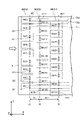
- FIG. 2 is a diagram showing an arrangement example of a DMD projection area projected onto a substrate by each projection unit of a plurality of exposure modules.
- FIG. 3 is a diagram for explaining the state of stitch exposure by each of the four specific projection areas in FIG.
- FIG. 4 is an optical layout diagram of a specific configuration of two exposure modules arranged in the X direction (scanning exposure direction) viewed in the XZ plane.
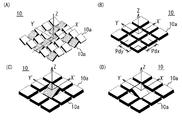
- FIG. 5A is a diagram schematically showing the DMD
- FIG. 5B is a diagram showing the DMD when the power is OFF
- FIG. FIG. 5D is a diagram for explaining the mirror in the OFF state.
- FIGS. 6A and 6B are diagrams illustrating optical elements provided between the DMD and the first lens group of the projection unit.
- FIG. 7 is a diagram showing a schematic configuration of an alignment device provided on a calibration reference portion attached to the edge of the substrate holder of the exposure apparatus.
- FIG. 8 is a functional block diagram showing the functional configuration of the exposure control device.
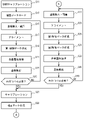
- FIG. 9 is a flow chart showing an outline of a procedure for exposing a substrate.
- FIG. 10 is a diagram showing a case where patterns of four display panels are exposed on one substrate.
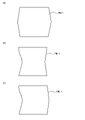
- FIGS. 11A to 11C are diagrams showing examples of exposure results of the first exposure processing of the display panel.
- a pattern exposure apparatus (hereinafter simply referred to as an exposure apparatus) according to one embodiment will be described with reference to the drawings.
- FIG. 1 is a perspective view showing an overview of the external configuration of an exposure apparatus EX according to one embodiment.
- the exposure apparatus EX is an apparatus that forms and projects, onto a substrate to be exposed, exposure light whose intensity distribution in space is dynamically modulated by a spatial light modulator (SLM).
- SLM spatial light modulator
- Examples of spatial light modulators include liquid crystal devices, digital micromirror devices (DMDs), magneto-optical spatial light modulators (MOSLMs), and the like.
- the exposure apparatus EX according to this embodiment includes the DMD 10 as a spatial light modulator, but may include other spatial light modulators.
- the exposure apparatus EX is a step-and-scan projection exposure apparatus (scanner) that exposes a rectangular glass substrate used in a display device (flat panel display) or the like. be.
- the glass substrate is a flat panel display substrate P having at least one side length or diagonal length of 500 mm or more and a thickness of 1 mm or less.
- the exposure device EX exposes a photosensitive layer (photoresist) formed on the surface of the substrate P with a constant thickness to a projected image of a pattern created by the DMD.
- the substrate P unloaded from the exposure apparatus EX after exposure is sent to predetermined process steps (film formation step, etching step, plating step, etc.) after the development step.
- the exposure apparatus EX includes a pedestal 2 placed on active vibration isolation units 1a, 1b, 1c, and 1d (1d is not shown), a platen 3 placed on the pedestal 2, and An XY stage 4A that can move two-dimensionally, a first driving section that moves the XY stage 4A, a substrate holder 4B (first moving body) that sucks and holds the substrate P on a plane on the XY stage 4A, and a substrate holder.
- a stage device including laser length measurement interferometers (hereinafter simply referred to as interferometers) IFX and IFY1 to IFY4 for measuring the two-dimensional movement position of 4B (substrate P) is provided.
- Such a stage apparatus is disclosed, for example, in US Patent Publication No. 2010/0018950 and US Patent Publication No. 2012/0057140.
- the XY plane of the orthogonal coordinate system XYZ is set parallel to the flat surface of the surface plate 3 of the stage device, and the XY stage 4A is set to be translatable within the XY plane.
- the direction parallel to the X-axis of the coordinate system XYZ is set as the scanning movement direction of the substrate P (XY stage 4A) during scanning exposure.
- the movement position of the substrate P in the X-axis direction is sequentially measured by the interferometer IFX, and the movement position in the Y-axis direction is sequentially measured by at least one (preferably two) of the four interferometers IFY1 to IFY4. be.
- the substrate holder 4B is configured to be slightly movable in the direction of the Z-axis perpendicular to the XY plane with respect to the XY stage 4A and to be slightly inclined in any direction with respect to the XY plane, and projected onto the surface of the substrate P. Focus adjustment and leveling (parallelism) adjustment with respect to the imaging plane of the pattern are actively performed. Further, the substrate holder 4B is configured to be slightly rotatable ( ⁇ z rotation) about an axis parallel to the Z axis in order to actively adjust the tilt of the substrate P within the XY plane.
- the exposure apparatus EX further includes an optical surface plate 5 that holds a plurality of exposure (drawing) module groups MU(A), MU(B), and MU(C), and a main column that supports the optical surface plate 5 from the pedestal 2. 6a, 6b, 6c, 6d (6d is not shown).
- Each of the plurality of exposure module groups MU(A), MU(B), and MU(C) is attached to the +Z direction side of the optical platen 5 .
- Each of the plurality of exposure module groups MU(A), MU(B), and MU(C) is attached to the +Z direction side of the optical surface plate 5, and an illumination unit ILU that receives illumination light from the optical fiber unit FBU.
- each of the exposure module groups MU(A), MU(B), and MU(C) serves as a light modulating section that reflects the illumination light from the illumination unit ILU in the -Z direction and makes it enter the projection unit PLU. of DMD 10.
- MU(A), MU(B), and MU(C) serves as a light modulating section that reflects the illumination light from the illumination unit ILU in the -Z direction and makes it enter the projection unit PLU. of DMD 10.
- a plurality of alignment systems (microscopes) ALG for detecting alignment marks formed at a plurality of predetermined positions on the substrate P are attached to the -Z direction side of the optical platen 5 of the exposure apparatus EX.
- a calibration reference unit CU for calibration is provided at the -X direction end on the substrate holder 4B. Calibration is performed by confirming (calibrating) the relative positional relationship within the XY plane of each detection field of alignment system ALG, and by projecting each of exposure module groups MU(A), MU(B), and MU(C).
- Confirmation of the baseline error between each projection position of the pattern image projected from the unit PLU and the position of each detection field of the alignment system ALG, and adjustment of the position and image quality of the pattern image projected from the projection unit PLU. Include at least one of the confirmations.
- part of the exposure module groups MU(A), MU(B), and MU(C) are not shown in FIG. 1, in this embodiment, nine modules are arranged in the Y direction as an example. Although they are arranged at regular intervals, the number of modules may be less or more than nine. In FIG. 1, three rows of exposure modules are arranged in the X-axis direction, but the number of rows of exposure modules arranged in the X-axis direction may be two or less, or four or more. .
- FIG. 2 is a diagram showing an arrangement example of the projection areas IAn of the DMD 10 projected onto the substrate P by the projection units PLU of the exposure module groups MU(A), MU(B), and MU(C).
- the coordinate system XYZ is set the same as in FIG.
- the exposure module group MU (A) in the first row, the exposure module group MU (B) in the second row, and the exposure module in the third row are spaced apart in the X direction (first direction).
- Each group MU(C) is composed of nine modules arranged in the Y direction (second direction).
- the exposure module group MU(A) consists of nine modules MU1 to MU9 arranged in the +Y direction
- the exposure module group MU(B) consists of nine modules MU10 to MU18 arranged in the -Y direction
- the exposure module group MU(C) is composed of nine modules MU19 to MU27 arranged in the +Y direction.
- the modules MU1 to MU27 all have the same configuration, and when the exposure module group MU(A) and the exposure module group MU(B) face each other in the X direction, the exposure module group MU(B) and the exposure module group It has a back-to-back relationship with MU(C) in the X direction.
- the center point of each of the projection areas IA1 to IA9 in the first row is located on a line k1 parallel to the Y axis
- the center point of each of the projection areas IA10 to IA18 in the second row is on a line k2 parallel to the Y axis
- the center point of each of the projection areas IA19 to IA27 in the third row is located on a line k3 parallel to the Y-axis.
- the distance in the X direction between the lines k1 and k2 is set to the distance XL1
- the distance in the X direction between the lines k2 and k3 is set to the distance XL2.
- the connecting portion between the -Y direction end of the projection area IA9 and the +Y direction end of the projection area IA10 is OLa
- the -Y direction end of the projection area IA10 and the +Y direction end of the projection area IA27 and OLb, and the joint portion between the +Y-direction end of the projection area IA8 and the -Y-direction end of the projection area IA27 is OLc.
- the orthogonal coordinate system XYZ is set the same as in FIGS.
- the coordinate system X'Y' in the projection areas IA8, IA9, IA10, IA27 (and all other projection areas IAn) is It is set to be inclined by an angle ⁇ k with respect to the X-axis and Y-axis (lines k1 to k3) of the orthogonal coordinate system XYZ. That is, the entire DMD 10 is tilted by an angle ⁇ k in the XY plane so that the two-dimensional array of many micromirrors of the DMD 10 is in the X'Y' coordinate system.
- a circular area encompassing each of the projection areas IA8, IA9, IA10, IA27 (and all other projection areas IAn as well) in FIG. 3 represents the circular image field PLf' of the projection unit PLU.
- the projection image of the micromirrors arranged obliquely (angle ⁇ k) at the end of the projection area IA10 in the ⁇ Y′ direction and the projection image of the micromirrors arranged obliquely (angle ⁇ k) at the end of the projection area IA27 in the +Y′ direction It is set so that the projected images of the aligned micromirrors overlap.
- the projection image of the micromirrors arranged obliquely (angle ⁇ k) at the end of the projection area IA8 in the +Y′ direction and the oblique (angle ⁇ k) end of the projection area IA27 in the ⁇ Y′ direction ) are set so as to overlap the projection images of the micromirrors arranged in the plane.
- FIG. 4 is an optical view of the specific configuration of the module MU18 in the exposure module group MU(B) and the module MU19 in the exposure module group MU(C) shown in FIGS. 1 and 2 in the XZ plane. It is a layout diagram.
- the orthogonal coordinate system XYZ in FIG. 4 is set the same as the orthogonal coordinate system XYZ in FIGS.
- the module MU18 is shifted in the +Y direction with respect to the module MU19 by a constant interval and is installed in a back-to-back relationship.
- the optical fiber unit FBU shown in FIG. 1 is composed of 27 optical fiber bundles FB1 to FB27 corresponding to the 27 modules MU1 to MU27 shown in FIG.
- the illumination unit ILU of the module MU18 functions as a mirror 100 that reflects the illumination light ILm traveling in the -Z direction from the output end of the optical fiber bundle FB18, a mirror 102 that reflects the illumination light ILm from the mirror 100 in the -Z direction, and a collimator lens.
- Mirror 102, input lens system 104, optical integrator 108, condenser lens system 110, and tilt mirror 112 are arranged along optical axis AXc parallel to the Z axis.
- the optical fiber bundle FB18 is configured by bundling one optical fiber line or a plurality of optical fiber lines.
- the illumination light ILm emitted from the output end of the optical fiber bundle FB18 (each of the optical fiber lines) is set to a numerical aperture (NA, also called divergence angle) so as to enter the input lens system 104 at the subsequent stage without being vignetted.
- NA numerical aperture
- the position of the front focal point of the input lens system 104 is designed to be the same as the position of the output end of the optical fiber bundle FB18.
- the position of the rear focal point of the input lens system 104 is such that the illumination light ILm from a single or a plurality of point light sources formed at the output end of the optical fiber bundle FB18 is superimposed on the incident surface side of the MFE lens 108A of the optical integrator 108. is set to let Therefore, the incident surface of the MFE lens 108A is Koehler-illuminated by the illumination light ILm from the exit end of the optical fiber bundle FB18.
- the geometric center point in the XY plane of the output end of the optical fiber bundle FB18 is positioned on the optical axis AXc, and the principal ray ( center line) is parallel (or coaxial) with the optical axis AXc.
- Illumination light ILm from input lens system 104 is attenuated by an arbitrary value in the range of 0% to 90% by illumination adjustment filter 106, and then passes through optical integrator 108 (MFE lens 108A, field lens, etc.). , enter the condenser lens system 110 .
- the MFE lens 108A is a two-dimensional arrangement of a large number of rectangular microlenses of several tens of ⁇ m square. ) is set to be almost similar to Also, the position of the front focal point of the condenser lens system 110 is set to be substantially the same as the position of the exit surface of the MFE lens 108A.
- each illumination light from a point light source formed on each exit side of a large number of microlenses of the MFE lens 108A is converted into a substantially parallel light beam by the condenser lens system 110, and after being reflected by the tilt mirror 112, , are superimposed on the DMD 10 to form a uniform illuminance distribution. Since a surface light source in which a large number of point light sources (condensing points) are two-dimensionally densely arranged is generated on the exit surface of the MFE lens 108A, the MFE lens 108A functions as a surface light source forming member.
- the optical axis AXc passing through the condenser lens system 110 and parallel to the Z-axis is bent by the tilt mirror 112 and reaches the DMD 10.
- AXb the neutral plane including the center point of each of the numerous micromirrors of DMD 10 is set parallel to the XY plane. Therefore, the angle formed by the normal to the neutral plane (parallel to the Z-axis) and the optical axis AXb is the incident angle ⁇ of the illumination light ILm with respect to the DMD 10 .
- the DMD 10 is attached to the underside of a mount portion 10M fixed to the support column of the illumination unit ILU.
- a fine movement stage (No. 2 moving body) 10S is provided in the mount section 10M.
- the fine movement stage 10S can be moved in the X direction and the Y direction by a fine movement stage driving section 10D (second driving section), and can rotate ⁇ z (Z axis). Therefore, by moving the fine movement stage 10S in the XY directions or rotating ⁇ z, the DMD 10 can be moved in the XY directions or rotated ⁇ z. Also, by using a displacement sensor (not shown), it is possible to perform feedback control on the amount of movement or the amount of rotation of the fine movement stage 10S.
- FIG. 5A is a diagram schematically showing the DMD 10
- FIG. 5B is a diagram showing the DMD 10 when the power is off
- FIG. 5C is an explanation of mirrors in the ON state
- FIG. 5D is a diagram for explaining the mirror in the OFF state.
- mirrors in the ON state are indicated by hatching.
- the DMD 10 has a plurality of micromirrors 10a whose reflection angle can be changed and controlled.
- the DMD 10 is of a roll-and-pitch drive type in which the ON state and the OFF state are switched by tilting in the roll direction and tilting in the pitch direction of the micromirror 10a.
- each micromirror 10a when the power is off, the reflecting surface of each micromirror 10a is set parallel to the X'Y' plane.
- the arrangement pitch of the micromirrors 10a in the X' direction is Pdx ([mu]m), and the arrangement pitch in the Y' direction is Pdy ([mu]m).
- Each micromirror 10a is turned on by tilting around the Y'-axis.
- FIG. 5C shows a case where only the central micromirror 10a is in the ON state and the other micromirrors 10a are in the neutral state (neither ON nor OFF state).
- Each micromirror 10a is turned off by tilting around the X' axis.
- FIG. 5(D) shows a case where only the central micromirror 10a is in the OFF state and the other micromirrors 10a are in the neutral state.
- the ON-state micromirror 10a is arranged from the X'Y' plane so that the illumination light applied to the ON-state micromirror 10a is reflected in the X direction of the XZ plane. It is driven to tilt at a predetermined angle. Further, the micromirror 10a in the OFF state is driven to be inclined at a predetermined angle from the X'Y' plane so that the illumination light irradiated to the micromirror 10a in the ON state is reflected in the Y direction in the YZ plane. .
- the DMD 10 generates an exposure pattern by switching the ON state and OFF state of each micromirror 10a.
- Illumination light reflected by the mirror in the OFF state is absorbed by a light absorber (not shown).
- the DMD 10 has been described as an example of a spatial light modulator, the DMD 10 has been described as a reflective type that reflects laser light. A diffractive type may also be used.
- a spatial light modulator can spatially and temporally modulate laser light.
- the illumination light ILm irradiated to the ON-state micromirror 10a of the micromirrors 10a of the DMD 10 is reflected in the X direction in the XZ plane toward the projection unit PLU.
- the illumination light ILm irradiated to the OFF-state micromirror 10a among the micromirrors 10a of the DMD 10 is reflected in the Y direction in the YZ plane so as not to face the projection unit PLU.
- a movable shutter 114 for shielding reflected light from the DMD 10 during a non-exposure period is detachably provided in the optical path between the DMD 10 and the projection unit PLU.
- the movable shutter 114 is rotated to an angular position retracted from the optical path during the exposure period, as illustrated on the module MU19 side, and inserted obliquely into the optical path during the non-exposure period, as illustrated on the module MU18 side. is rotated to the desired angular position.
- a reflecting surface is formed on the DMD 10 side of the movable shutter 114 , and the light from the DMD 10 reflected there is applied to the light absorber 117 .
- the light absorber 117 absorbs light energy in the ultraviolet wavelength range (wavelength of 400 nm or less) without re-reflection and converts it into heat energy. Therefore, the light absorber 117 is also provided with a heat dissipation mechanism (radiating fins or a cooling mechanism). Although not shown in FIG. 4, the reflected light from the micromirror 10a of the DMD 10, which is in the OFF state during the exposure period, is reflected in the Y direction ( 4) is absorbed by a similar light absorber (not shown in FIG. 4).
- the projection unit PLU attached to the lower side of the optical surface plate 5 is a double-telecentric combination composed of a first lens group 116 and a second lens group 118 arranged along an optical axis AXa parallel to the Z axis. It is configured as an image projection lens system.
- the first lens group 116 and the second lens group 118 are translated in the direction along the Z-axis (optical axis AXa) by a fine actuator with respect to a support column fixed to the lower side of the optical surface plate 5.
- the projection magnification Mp is set to about 1/6, taking into account the tilt angle ⁇ k in the XY plane.
- An imaging projection lens system consisting of lens groups 116 and 118 inverts/inverts the reduced image of the entire mirror surface of the DMD 10 and forms an image on a projection area IA18 (IAn) on the substrate P.
- the first lens group 116 of the projection unit PLU can be finely moved in the direction of the optical axis AXa by an actuator in order to finely adjust the projection magnification Mp (about ⁇ several tens of ppm), and the second lens group 118 is for high-speed focus adjustment. Therefore, the actuator can be finely moved in the direction of the optical axis AXa. Further, a plurality of oblique incident light type focus sensors 120 are provided below the optical surface plate 5 in order to measure the positional change of the surface of the substrate P in the Z-axis direction with submicron accuracy.
- the DMD 10 and the first lens group 116 are two deflection prisms 600a and 600b as shown in FIG. 6A or two prisms as shown in FIG. 6B.
- Parallel plates 601a and 601b are provided.
- the two deflection prisms 600a and 600b and the two parallel plates 601a and 601b will be referred to as optical elements OPE unless otherwise specified. Further, in the present embodiment, correcting the positional deviation is also referred to as image shifting.
- the optical element OPE is provided between the DMD 10 and the first lens group 116 in this embodiment, it is not limited to this.
- the optical element OPE may be provided between the first lens group 116 and the second lens group or between the projection unit PLU and the substrate P.
- a projection optical system is configured by the projection unit PLU and the optical element OPE.
- the projection area IAn must be tilted by the angle ⁇ k in the XY plane as described above with reference to FIG. (at least the optical path portion of the mirrors 102 to 112 along the optical axis AXc) are arranged so as to be inclined by an angle ⁇ k in the XY plane as a whole.
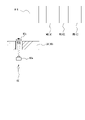
- FIG. 7 is a diagram showing a schematic configuration of the alignment device 60 provided in the calibration reference unit CU attached to the end of the substrate holder 4B of the exposure apparatus EX.
- the alignment device 60 includes a reference mark 60a, a two-dimensional imaging element 60e, and the like. Alignment device 60 is used to measure and calibrate the positions of various modules, and is also used to calibrate alignment system ALG.
- the positions of the modules MU1 to MU27 are measured by projecting the DMD pattern for calibration onto the reference mark 60a of the alignment device 60 with the projection unit PLU, and measuring the relative position between the reference mark 60a and the DMD pattern.
- alignment system ALG can be calibrated by measuring reference mark 60a of alignment device 60 with alignment system ALG. That is, the position of alignment system ALG can be determined by measuring reference mark 60a of alignment device 60 with alignment system ALG. Furthermore, using reference mark 60a, it is possible to determine the relative positions of alignment system ALG and modules MU1 to MU27.
- Alignment system ALG can also measure the position of the alignment mark on substrate P placed on substrate holder 4B with reference to reference mark 60a of alignment device 60 .
- FIG. 8 is a functional block diagram showing the functional configuration of the exposure control device 300 included in the exposure apparatus EX according to this embodiment.
- the exposure control device 300 includes a drawing data storage unit 310 , a control data creation unit 301 , a correction data creation unit 302 , a drive control unit 304 and an exposure control unit 306 .
- the drawing data storage unit 310 sends drawing data MD1 to MD27 for pattern exposure to the DMDs 10 of the 27 modules MU1 to MU27 shown in FIG.
- the control data creation unit 301 creates first control data based on the alignment measurement result of the substrate P by the alignment system ALG, and outputs the first control data to the drive control unit 304 .
- the driving amount of the fine movement stage 10S of each module MU1 to MU27 is defined based on the first control data.
- the fine movement stage 10S driven by the fine movement stage driving section 10D is moved in the X and Y directions, or rotated in the ⁇ z direction. As a result, the projection image projected onto the substrate P can be image-shifted.
- the driving amount of the projection unit PLU of each module MU1 to MU27 or the adjustment amount of the lens in the projection unit PLU is defined based on the first control data.
- the projection unit PLU moves at least one lens group of the first lens group 116 or the second lens group 118 within the XY plane by an actuator or the like provided in the projection unit PLU.
- the projection image projected onto the substrate P can be image-shifted. From the viewpoint of aberration, it is more preferable that the projection unit PLU moves the first lens group 116 and the second lens group 118 with the same amount of movement of the first lens group 116 and the second lens group 118 .
- At least one lens provided in the first lens group 116 or the second lens group 118 is adjusted by an actuator or the like provided in the first lens group 116 or the second lens group 118. Move within the XY plane. As a result, the projection image projected onto the substrate P can be image-shifted.
- the two deflection prisms 600a and 600b are driven based on the first control data.
- the drive amount of 600b By controlling the distance between the two deflection prisms, the projection image projected onto the substrate P can be image-shifted.
- the two deflection prisms 600a and 600b are arranged not only between the DMD 10 and the first lens group 116, but also between the first lens group 116 and the second lens group 118, between the second lens group 118 and the substrate P. can also be provided between
- the two parallel plates 601a and 601b are driven based on the first control data.
- the drive amount of 601b can be image-shifted by controlling the rotation amount for rotating the two parallel plates 601a and 601b by ⁇ z.
- the two parallel plates 601a and 601b are placed not only between the DMD 10 and the first lens group 116, but also between the first lens group 116 and the second lens group 118, and between the second lens group 118 and the substrate P. can also be provided.
- the reason for creating the first control data will be explained.
- the substrate P is placed on the substrate holder 4B at a position deviated from the designed position.
- the pattern generated based on the drawing data MDn will be exposed on the substrate P at a deviation from the designed position.
- the positional displacement is determined. Rewriting the drawing data MDn according to the substrate P can be considered.
- the drawing data MDn for the display panel has a large amount of data, it takes a long time (for example, 40 minutes) to rewrite, which may reduce the throughput. Further, if the amount of misalignment is smaller than the minimum line width (minimum pixel size) of the pattern projected onto the substrate P, the misalignment cannot be corrected even if the drawing data is changed. That is, it may be difficult to accurately correct by changing the drawing data.
- the pattern projection position is shifted to correct the positional deviation of the substrate P from the design value.
- the projection position of the pattern is shifted by controlling the driving of at least one of the fine movement stage 10S of the DMD 10, the optical system of the projection unit PLU, and the optical element OPE.
- the fine movement stage 10S of the DMD 10 is rotated by ⁇ degrees and ⁇ z from the initial position, and the X position of the DMD 10 is changed.
- the pattern can be projected to the design position.
- the control data generating unit 301 considers the relationship between the modules MUn, Create data. It should be noted that the creation time of the first control data is, for example, about several seconds.
- the correction data creation unit 302 creates correction data based on the calibration result and outputs it to the drive control unit 304 .
- the correction data is the driving amount of the fine movement stage 10S of the DMD 10 and the projection unit PLU so as to correct the positional deviation of each component of the exposure apparatus EX (for example, the module MUn, the alignment system ALG, etc.). and data for correcting the drive amount of the optical system and the drive amount of the optical element OPE.
- the correction data includes, for each of the modules MU1 to MU27, the offset value of the driving amount of the fine movement stage 10S of the DMD 10, the offset value of the driving amount of the optical system of the projection unit PLU, and the offset value of the driving amount of the optical element OPE. is defined.
- the reason for creating the correction data will be explained.
- the positions of the components of the exposure apparatus EX may shift, and calibration may be required between exposure processes.
- calibration it is conceivable to redo configuration settings and rewrite drawing data so as to correct misalignment of each configuration.
- the drive amount of the fine movement stage 10S of the DMD 10 is corrected so as to correct the positional deviation of each component of the exposure apparatus EX.
- the correction data creation unit 302 thus creates correction data for correcting the drive amount of the fine movement stage 10S of the DMD 10, the drive amount of the optical system of the projection unit PLU, and the drive amount of the optical element OPE.
- the drive control unit 304 generates second control data by correcting the first control data input from the control data creation unit 301 using the correction data input from the correction data creation unit 302 .
- the drive control unit 304 generates the second control data by combining the first control data input from the control data generation unit 301 and the calibration result without generating the correction data in the correction data generation unit 302. Also good.
- the drive control unit 304 controls the drive amount of the fine movement stage 10S of the DMD 10, the drive amount of the optical system of the projection unit PLU, and the optical elements included in the second control data.
- Drive amount control data CD1 to CD27 are generated by correcting the drive amount of the OPE in real time, and sent to the modules MU1 to MU27.
- the exposure control device 300 (driving control section 304) may control the first driving section that moves the XY stage 4A. Further, the exposure control device 300 (driving control section 304) may control the fine movement stage driving section 10D.
- the exposure control device 300 (driving control unit 304) may also control a driving unit that drives the first lens group 116, the second lens group 118, and the optical element OPE provided in the projection optical system.
- the substrate holder 4B may not move as designed (for example, it should move straight in the X direction, but it moves in a meandering manner).
- the substrate holder 4B does not move as designed in this way (for example, when the position in the Y direction of the substrate holder 4B at a predetermined position in the X direction differs from the design value)
- drawing data MDn The pattern based on is exposed on the substrate P with deviation from the designed position. At this time, it is difficult in terms of time to rewrite the drawing data so as to follow the positional deviation of the substrate holder 4B.
- the misalignment cannot be corrected even if the drawing data is changed. That is, it may be difficult to accurately correct by changing the drawing data.
- the drive control unit 304 controls the drive amount of the fine movement stage 10S of the DMD 10 and the drive of the optical system of the projection unit PLU, which are included in the second control data, based on the measurement results of the interferometers IFY1 to IFY4.
- the modules MU1 to MU2 are controlled by drive amount control data (third control data) CD1 to CD27 obtained by correcting the amount and the drive amount of the optical element OPE in real time. This makes it possible to correct the positional deviation of the substrate P, the positional deviation of each component of the exposure apparatus EX, and the positional deviation of the substrate holder 4B during scanning exposure, and project and expose the pattern onto the substrate P as designed.
- modules MU1-MU27 drive fine movement stage 10S of DMD 10, drive the optical system of projection unit PLU, and optical element It controls the driving of the OPE.
- the exposure control unit (sequencer) 306 transmits the drawing data MD1 to MD27 from the drawing data storage unit 310 to the modules MU1 to MU27 in synchronization with the scanning exposure (moving position) of the substrate P, drive amount control data CD1 to CD27.
- FIG. 9 shows an overview of the procedure when exposing the substrate P using the exposure apparatus EX for the first time, or when exposing the substrate P using the exposure apparatus EX that has not been used for a long time. It is a flow chart. In the following example, a case of scanning and exposing a pattern such as a display panel on the substrate P will be described.
- step S11 initial calibration of the exposure apparatus EX is performed (step S11).
- the settings of each component of the exposure apparatus EX are calibrated based on the measurement results obtained by the alignment system ALG and the like. For example, the positions of the modules MU1 to MU27, the initial positions and attitudes of the illumination units ILU, DMD10, and the projection unit PLU of the modules MU1 to MU27, and the inclination of the substrate holder 4B are corrected.
- the substrate P is loaded into the main body of the exposure apparatus EX and placed on the substrate holder 4B (step S15).
- step S17 alignment marks formed at a plurality of predetermined positions on the substrate P are measured by a plurality of alignment systems ALG (step S17).
- control data generation unit 301 calculates the driving amount of the fine movement stage 10S of the DMD 10 and the driving amount of the optical system of the projection unit PLU so as to correct the positional deviation of the substrate P. , and the drive amount of the optical element OPE are created (step S19).
- the driving amount control data CDn at this time is data (fourth control data) obtained by correcting the first control data in real time based on the measurement results of the interferometers IFY1 to IFY4 (that is, the position of the substrate holder 4B). be.
- the substrate P is unloaded (step S23).
- step S25 it is determined whether or not calibration is necessary (step S25). For example, when the number of substrates P subjected to scanning exposure processing reaches a predetermined number (for example, 10) after the previous calibration, it is determined that calibration is necessary. Alternatively, it is determined that calibration is necessary when a predetermined time has passed every day.
- a predetermined number for example, 10
- step S25/NO If calibration is unnecessary (step S25/NO), return to step S15. On the other hand, if calibration is required (step S25/YES), calibration is performed (step S27).
- the correction data generation unit 302 determines the driving amount of the fine movement stage 10S of the DMD 10 and the driving of the optical system of the projection unit PLU so as to correct the positional deviation of each device of the exposure device EX. Correction data for correcting the amount and the driving amount of the optical element OPE are created (step S29).
- a new substrate P is loaded into the main body of the exposure apparatus EX and placed on the substrate holder 4B (step S31).
- step S33 alignment marks formed at a plurality of predetermined positions on the newly loaded substrate P are measured by a plurality of alignment systems ALG (step S33).
- control data generation unit 301 calculates the driving amount of the fine movement stage 10S of the DMD 10 and the driving amount of the optical system of the projection unit PLU so as to correct the positional deviation of the substrate P. , and the driving amount of the optical element OPE are created (step S35).
- the drive control unit 304 generates second control data by correcting the first control data created in step S35 with the correction data created in step S29 (step S37).
- step S29 may be omitted, and the drive control unit 304 may create the second control data based on the first control data and the calibration result.
- the driving amount control data CDn at this time is data (third control data) obtained by correcting the second control data in real time based on the measurement results of the interferometers IFY1 to IFY4 (that is, the position of the substrate holder 4B). be.
- the substrate P is unloaded (step S41).
- step S43 it is determined whether or not calibration is necessary. For example, when the number of substrates P subjected to scanning exposure processing reaches a predetermined number (for example, 10) after the previous calibration, it is determined that calibration is necessary.
- a predetermined number for example, 10
- step S43/NO If calibration is unnecessary (step S43/NO), return to step S31. On the other hand, if calibration is required (step S43/YES), calibration is performed (step S27).
- step S21 the drive control unit 304 corrects the first control data in real time based on the measurement results of the interferometers IFY1 to IFY4 (that is, the position of the substrate holder 4B) to generate the drive amount control data CDn for each module. It can be sent to MUn.
- a plurality of modules MU1 to MU1 each including a plurality of illumination units ILU for irradiating light and a plurality of projection units PLU for projecting patterns formed by the respective DMDs 10 onto the substrate P placed on the substrate holder 4B. and MU27.
- the exposure apparatus EX further drives the DMD 10 of each of the modules MU1 to MU27 according to at least one of the state of the substrate P, the state of the substrate holder 4B, and the state of the exposure apparatus EX without changing the drawing data MDn.
- the drive control unit 304 drives the DMD 10 and the projection unit PLU according to at least one of the state of the substrate P, the state of the substrate holder 4B, and the state of the exposure apparatus EX without changing the drawing data MDn.
- the driving of the optical element OPE it is possible to expose a predetermined pattern on a predetermined position of the substrate P while suppressing a decrease in the throughput of the exposure apparatus EX. Further, when the amount of positional deviation is smaller than the minimum line width (minimum pixel dimension) of the pattern projected onto the substrate P, it is difficult to correct the positional deviation by rewriting the drawing data. In this embodiment, since the positional deviation is corrected by driving the DMD 10, driving the projection unit PLU, and driving the optical element OPE, the amount of positional deviation is smaller than the minimum line width of the pattern projected onto the substrate P. Even in this case, the positional deviation can be corrected. This improves exposure accuracy.
- the exposure apparatus EX includes an alignment system ALG that measures the state of the substrate P with respect to the substrate holder 4B, and a pattern projected onto a predetermined position on the substrate P based on the measurement result of the alignment system ALG.
- a control data creation unit that creates first control data for controlling the driving of at least one of the fine movement stage 10S of the DMD 10, the optical system of the projection unit PLU, and the optical element OPE.
- the drive control unit 304 controls driving of the fine movement stage 10S of the DMD 10, driving of the optical system of the projection unit PLU, and driving of the optical element OPE.
- the pattern can be exposed onto the substrate P by correcting the positional deviation from the design position of the substrate P without lowering the throughput. Further, even if the amount of positional deviation is smaller than the minimum line width of the pattern projected onto the substrate P, the positional deviation can be corrected.
- the exposure apparatus EX includes a correction data creation unit 302 that creates correction data for correcting the first control data based on the calibration result, and the drive control unit 304 creates the first control data.
- the driving of the fine movement stage 10S of the DMD 10, the driving of the optical system of the projection unit PLU, and the driving of the optical element OPE are controlled. Accordingly, the pattern can be exposed onto the substrate P by correcting the positional deviation of each component of the exposure apparatus EX without lowering the throughput. Further, even when the positional deviation amount of each component of the exposure apparatus EX is smaller than the minimum line width of the pattern projected onto the substrate P, the positional deviation can be corrected.
- the exposure apparatus EX includes interferometers IFY1 to IFY4 for measuring position information of the substrate holder 4B with respect to the surface plate 3 or the optical surface plate 5.
- the predetermined pattern can be exposed on the designed position of the substrate P without lowering the throughput. Further, even if the positional deviation amount of the substrate holder 4B is smaller than the minimum line width of the pattern projected onto the substrate P, the positional deviation can be corrected.
- the exposure apparatus EX according to the above embodiment can also be used when exposing another pattern to the substrate P already exposed with a predetermined pattern.
- a second pattern different from the first pattern may be exposed.
- the substrate P is exposed with a first pattern using an exposure apparatus that uses a mask substrate
- the substrate P is exposed with a second pattern using the exposure apparatus EX according to the present embodiment.
- FIG. 10 is a diagram showing a case where patterns for four display panels are exposed on one substrate P.
- FIG. 10 it is assumed that patterns of four display panels PNL1 to PNL4 are exposed on one substrate P by the first exposure process.
- hatched portions indicate regions exposed in the first exposure process, and black circles in each region indicate alignment marks AM.
- the dotted line indicates the cutting line for separating each panel, and the dashed-dotted line indicates the position where the display panel PNL2 and its alignment mark AM should have been exposed in the first exposure process.
- the pattern of the display panel PNL2 is exposed with a large deviation from the design position compared to the other display panels PNL1, PNL3, and PNL4.
- the drawing data in the second exposure process is rewritten so as to match the exposed area of the display panel PNL2 in the first exposure process, it takes a long time to rewrite the drawing data, resulting in a decrease in throughput. Resulting in.
- the second pattern can be exposed so as to match the exposed area of the first pattern of the display panel PNL2 as follows.
- control data creation unit 301 creates first control data so that the deviation from the design position of the exposed region of the first pattern on display panel PNL2 is corrected.
- the drive control unit 304 controls the driving of the fine movement stage 10S of the DMD 10 of the modules MU1 to MU27 and the optical system of the projection unit PLU based on the first control data, so that the first pattern is exposed deviated from the designed position.
- the second pattern can be exposed in the exposed areas of the first pattern.
- the first control data corresponding to the positional deviation of the exposed area from the designed position is created for each area of the display panels PNL1 to PNL4.
- the exposure apparatus EX can expose the second pattern so as to match the exposed area of the first pattern without lowering the throughput. can do.
- the distance D1 between the exposure area of the display panel PNL1 and the exposure area of the display panel PNL2 is the distance of the fine movement stage 10S of the DMD 10 when the pattern exposure of the display panel PNL1 is completed.
- the substrate holder 4B moves the distance D1 longer than the time required to change from the state, the state of the optical system of the projection unit PLU, and the state of the optical element OPE to the state for exposing the display panel PNL2. It is preferable that the time is set to be longer.
- the state of the fine movement stage 10S refers to relative positional information of the DMD 10 with respect to the substrate holder 4B, the XY stage 4A, the optical platen 5, and the platen 3, the inclination angle in the ⁇ z-axis direction, and the like.
- the state of the optical system of the projection unit PLU means the first lens group 116, the second lens group 118, the first lens group 116 and the second lens group 116 with respect to the substrate holder 4B, the XY stage 4A, the optical surface plate 5, and the surface plate 3. It refers to relative position information of each lens included in the lens group 118 and the like.
- the state of the optical element OPE refers to relative positional information of the optical element OPE with respect to the substrate holder 4B, the XY stage 4A, the optical platen 5, and the platen 3, and the like. If the optical element OPE is a pair of deflection prisms, the state of the optical element OPE includes the distance between the pair of deflection prisms and the rotation angle of each deflection prism. If the optical element OPE is a pair of parallel plates, the state of the optical element OPE includes the interval between the pair of parallel plates and the rotation angle of each parallel plate. Therefore, the exposure apparatus EX according to the above embodiment can expose the display panel PNL1 and the display panel PNL2 in one scanning exposure.
- the DMD 10 moves slightly when the pattern exposure of the display panel PNL1 is completed while the exposure apparatus EX moves the distance D1 after exposing the exposure area of the display panel PNL1. At least one of the state of the stage 10S, the state of the optical system of the projection unit PLU, and the state of the optical element OPE is changed to a state for exposing the display panel PNL2, and the exposure area of the display panel PNL2 is exposed.
- the exposure control device 300 (drive control unit 304) provided in the exposure apparatus EX moves the XY stage 4A in the scanning direction (X-axis direction) to expose the exposure area of the display panel PNL1 of the substrate P, and then the display panel.
- the exposure area of PNL2 is exposed, and the setting of the exposure apparatus EX is changed while the projection optical system advances the distance D1 between the exposure areas of the display panels PNL1 and PNL2.
- the exposure control device 300 (drive control unit 304) provided in the exposure apparatus EX changes the settings of the exposure apparatus EX by controlling the driving of the fine movement stage 10S of the DMD 10 or the projection optical system.
- the control unit provided in the exposure apparatus EX includes an XY stage 4A, a fine movement stage driving unit 10D that changes at least one of the position and orientation of the spatial light modulator 10, and a first lens group 116 provided in the projection optical system. , the second lens group 118, and a driving unit that drives the optical element OPE, the exposure area of the display panel PNL1 and the exposure area of the display panel PNL2 aligned in the scanning direction (X-axis direction) on the substrate P are projected optically.
- the XY stage 4A is driven so as to move to the same side in the scanning direction (X-axis direction) with respect to the optical axis of the system, and the exposure area of the display panel PNL1 on the substrate P moving in the scanning direction (X-axis direction). and the exposure area of the display panel PNL2 (distance D) intersects the optical axis. drive at least one of
- the state of the fine movement stage 10S of the DMD 10 the state of the optical system of the projection unit PLU, and the state of the optical element OPE are the states for exposing the display panel PNL2. Since exposure processing can be continued without waiting for , the throughput can be improved.
- the positional deviation from the design value of the exposed area in the first exposure process of the display panel PNL2 drives the fine movement stage 10S of the DMD 10, the optical system of the projection unit PLU, and the optical element OPE. If the amount is such that it cannot be corrected even if the projection position of the pattern is shifted, the exposure process is not started, and the relevant information is displayed on the display device provided in the exposure apparatus EX to determine whether or not to continue the exposure process.
- the operator of the device EX may be allowed to make the selection. Alternatively, the exposure apparatus EX may output a warning. Alternatively, the operator may be allowed to select whether to continue the exposure process, stop the exposure process, or expose the substrate P to a pattern that is known to be defective.
- the exposure result (exposure shape) of the first exposure process of the display panel PNL1 is not a square like PNL1 in FIG. 10, but a barrel shape like FIG. It may have a pincushion shape.
- fine movement stage 10S of DMD 10, the optical system of projection unit PLU, and optical element OPE are driven in real time during exposure of display panel PNL1 based on the measurement result of alignment mark AM of display panel PNL1 by alignment system ALG.
- the projection position of the pattern can be corrected at each position on the display panel PNL1.
- the shape of the display panel PNL1 is not limited to this. As shown in FIG. include.
- such an exposure result is not limited to PNL1, and PLN2 to PLN4 may also have similar exposure results.
- the exposure apparatus EX can expose the display panel PNL1 and the display panel PNL3 in one scanning exposure.
- the alignment system ALG measures the alignment mark AM of the display panel PNL1 (first measurement) and the alignment mark AM of the display panel PNL3 (second measurement). and alignment measurement of the two display panels PNL1 and PLN3.
- the exposure apparatus EX according to the above-described embodiment can expose the display panel PNL1 and the display panel PNL2 in one scanning exposure.
- the distance D1 between the exposure area of the display panel PNL1 and the exposure area of the display panel PNL2 can be set larger than the exposure field of the exposure module. Also, if there is no problem with accuracy, the distance D1 may be set smaller than the exposure field of view of the exposure module.
- the modules MU1 to MU4 are used to expose the PNL3, and the modules MU5 to MU9 are used to expose the PNL1.
- the modules MU1 to MU4 drive the fine movement stage 10S of the DMD 10, the optical system of the projection unit PLU, and the optical element OPE in real time based on the measurement result of the second measurement while the display panel PNL3 is being exposed. Exposure is performed while correcting the projection position of the pattern.
- the modules MU5 to MU9 drive the fine movement stage 10S of the DMD 10, the optical system of the projection unit PLU, and the optical element OPE in real time based on the measurement result of the first measurement while the display panel PNL1 is being exposed, thereby driving the pattern projection position. Exposure is performed while correcting the As a result, exposure can be performed while correcting a plurality of panels PNL1 and PLN3 in one scanning exposure.
- the modules MU1 to MU4 expose the display panel PNL3 and the modules MU5 to MU9 expose the display panel PNL1.
- the exposure module group MU(B) and the exposure module group MU(C) are the same as the exposure module group MU(A).
- the distance D1 between the exposure area of the display panel PNL1 and the exposure area of the display panel PNL2 is short, and while the substrate holder 4B moves the distance D1, the fine movement stage 10S of the DMD 10 is driven and the projection unit PLU is moved.
- the information is displayed on the display device of the exposure apparatus EX so that the operator of the exposure apparatus EX can decide whether to continue the exposure process.
- the operator may be allowed to select whether to continue the exposure process, stop the exposure process, or expose the substrate P to a pattern that is known to be defective.
- the drive control unit 304 controls the driving of the fine movement stage 10S of the DMD 10, the driving of the optical system of the projection unit PLU, and the driving of the optical element OPE. It is not limited.
- the drive control unit 304 may control the drive of any one of the fine movement stage 10S of the DMD 10, the optical system of the projection unit PLU, and the optical element OPE.
- the amount of misalignment measured by alignment system ALG, calibration, and interferometers IFY1 to IFY4 exceeds a prescribed amount predetermined by the operator, exposure, continuation of exposure, or realignment is performed. It is also possible to predetermine, for example, redo as recipe information (exposure conditions).
- the drive control unit 304 corrects the first control data or the second control data based on the measurement results of the interferometers IFY1 to IFY4. No correction is required.
- the drive control unit 304 controls the driving of the fine movement stage 10S of the DMD 10, the driving of the optical system of the projection unit PLU, and the driving of the optical element OPE based on the first control data or the second control data. do it.
Landscapes
- Physics & Mathematics (AREA)
- General Physics & Mathematics (AREA)
- Optics & Photonics (AREA)
- Health & Medical Sciences (AREA)
- Engineering & Computer Science (AREA)
- Environmental & Geological Engineering (AREA)
- Epidemiology (AREA)
- Public Health (AREA)
- Exposure And Positioning Against Photoresist Photosensitive Materials (AREA)
- Exposure Of Semiconductors, Excluding Electron Or Ion Beam Exposure (AREA)
Priority Applications (4)
| Application Number | Priority Date | Filing Date | Title |
|---|---|---|---|
| JP2023533103A JPWO2023282205A1 (https=) | 2021-07-05 | 2022-07-01 | |
| KR1020237045137A KR20240014514A (ko) | 2021-07-05 | 2022-07-01 | 노광 장치 및 디바이스 제조 방법 |
| CN202280047477.8A CN117651911A (zh) | 2021-07-05 | 2022-07-01 | 曝光装置以及器件制造方法 |
| JP2025102283A JP2025120502A (ja) | 2021-07-05 | 2025-06-18 | 露光装置 |
Applications Claiming Priority (2)
| Application Number | Priority Date | Filing Date | Title |
|---|---|---|---|
| JP2021111676 | 2021-07-05 | ||
| JP2021-111676 | 2021-07-05 |
Publications (1)
| Publication Number | Publication Date |
|---|---|
| WO2023282205A1 true WO2023282205A1 (ja) | 2023-01-12 |
Family
ID=84800630
Family Applications (1)
| Application Number | Title | Priority Date | Filing Date |
|---|---|---|---|
| PCT/JP2022/026485 Ceased WO2023282205A1 (ja) | 2021-07-05 | 2022-07-01 | 露光装置及びデバイス製造方法 |
Country Status (5)
| Country | Link |
|---|---|
| JP (2) | JPWO2023282205A1 (https=) |
| KR (1) | KR20240014514A (https=) |
| CN (1) | CN117651911A (https=) |
| TW (1) | TW202318108A (https=) |
| WO (1) | WO2023282205A1 (https=) |
Citations (5)
| Publication number | Priority date | Publication date | Assignee | Title |
|---|---|---|---|---|
| JP2002050558A (ja) * | 2000-07-31 | 2002-02-15 | Canon Inc | 投影露光装置及びデバイス製造方法 |
| JP2004056080A (ja) * | 2002-05-30 | 2004-02-19 | Dainippon Screen Mfg Co Ltd | 画像記録装置 |
| JP2008182115A (ja) * | 2007-01-25 | 2008-08-07 | Nikon Corp | 露光方法及び露光装置並びにマイクロデバイスの製造方法 |
| JP2010533310A (ja) * | 2007-07-10 | 2010-10-21 | エルジー エレクトロニクス インコーポレイティド | マスクレス露光方法 |
| JP2013012639A (ja) * | 2011-06-30 | 2013-01-17 | Dainippon Screen Mfg Co Ltd | パターン描画装置およびパターン描画方法 |
Family Cites Families (2)
| Publication number | Priority date | Publication date | Assignee | Title |
|---|---|---|---|---|
| JP6250415B2 (ja) * | 2014-01-31 | 2017-12-20 | 株式会社Screenホールディングス | パターン描画装置およびパターン描画方法 |
| JP6652618B2 (ja) | 2018-10-11 | 2020-02-26 | 株式会社アドテックエンジニアリング | 照度割合変更方法及び露光方法 |
-
2022
- 2022-07-01 WO PCT/JP2022/026485 patent/WO2023282205A1/ja not_active Ceased
- 2022-07-01 CN CN202280047477.8A patent/CN117651911A/zh active Pending
- 2022-07-01 JP JP2023533103A patent/JPWO2023282205A1/ja active Pending
- 2022-07-01 KR KR1020237045137A patent/KR20240014514A/ko active Pending
- 2022-07-04 TW TW111124920A patent/TW202318108A/zh unknown
-
2025
- 2025-06-18 JP JP2025102283A patent/JP2025120502A/ja active Pending
Patent Citations (5)
| Publication number | Priority date | Publication date | Assignee | Title |
|---|---|---|---|---|
| JP2002050558A (ja) * | 2000-07-31 | 2002-02-15 | Canon Inc | 投影露光装置及びデバイス製造方法 |
| JP2004056080A (ja) * | 2002-05-30 | 2004-02-19 | Dainippon Screen Mfg Co Ltd | 画像記録装置 |
| JP2008182115A (ja) * | 2007-01-25 | 2008-08-07 | Nikon Corp | 露光方法及び露光装置並びにマイクロデバイスの製造方法 |
| JP2010533310A (ja) * | 2007-07-10 | 2010-10-21 | エルジー エレクトロニクス インコーポレイティド | マスクレス露光方法 |
| JP2013012639A (ja) * | 2011-06-30 | 2013-01-17 | Dainippon Screen Mfg Co Ltd | パターン描画装置およびパターン描画方法 |
Also Published As
| Publication number | Publication date |
|---|---|
| TW202318108A (zh) | 2023-05-01 |
| JPWO2023282205A1 (https=) | 2023-01-12 |
| KR20240014514A (ko) | 2024-02-01 |
| CN117651911A (zh) | 2024-03-05 |
| JP2025120502A (ja) | 2025-08-15 |
Similar Documents
| Publication | Publication Date | Title |
|---|---|---|
| JP4486323B2 (ja) | 画素位置特定方法、画像ずれ補正方法、および画像形成装置 | |
| JP7743866B2 (ja) | パターン露光装置、露光方法、及びデバイス製造方法 | |
| JP7835222B2 (ja) | 露光装置、露光方法およびフラットパネルディスプレイの製造方法 | |
| JP2025038155A (ja) | 露光装置、露光方法およびフラットパネルディスプレイの製造方法、ならびに露光データ作成方法 | |
| JP7700860B2 (ja) | 露光装置、露光方法、デバイス製造方法およびフラットパネルディスプレイの製造方法 | |
| WO2023282205A1 (ja) | 露光装置及びデバイス製造方法 | |
| JP7548441B2 (ja) | 露光装置、制御方法、及びデバイス製造方法 | |
| US20240345486A1 (en) | Exposure device | |
| US20240110844A1 (en) | Exposure apparatus and inspection method | |
| WO2026088689A1 (ja) | マスク、計測方法、及び露光方法 | |
| KR102953844B1 (ko) | 노광 장치, 노광 방법 및 플랫 패널 디스플레이의 제조 방법, 그리고 노광 데이터 작성 방법 | |
| WO2026014337A1 (ja) | 方法、調整方法、及び露光装置 | |
| TW202505314A (zh) | 空間光調變單元及曝光裝置 | |
| KR20250112838A (ko) | 노광 장치, 디바이스 제조 방법 및 제어 방법 | |
| CN117083572A (zh) | 曝光装置、器件制造方法及平板显示器的制造方法 |
Legal Events
| Date | Code | Title | Description |
|---|---|---|---|
| 121 | Ep: the epo has been informed by wipo that ep was designated in this application |
Ref document number: 22837621 Country of ref document: EP Kind code of ref document: A1 |
|
| WWE | Wipo information: entry into national phase |
Ref document number: 2023533103 Country of ref document: JP |
|
| ENP | Entry into the national phase |
Ref document number: 20237045137 Country of ref document: KR Kind code of ref document: A |
|
| WWE | Wipo information: entry into national phase |
Ref document number: 1020237045137 Country of ref document: KR |
|
| WWE | Wipo information: entry into national phase |
Ref document number: 202280047477.8 Country of ref document: CN |
|
| NENP | Non-entry into the national phase |
Ref country code: DE |
|
| 122 | Ep: pct application non-entry in european phase |
Ref document number: 22837621 Country of ref document: EP Kind code of ref document: A1 |