WO2023281851A1 - 紙を含むたばこセグメント - Google Patents
紙を含むたばこセグメント Download PDFInfo
- Publication number
- WO2023281851A1 WO2023281851A1 PCT/JP2022/013937 JP2022013937W WO2023281851A1 WO 2023281851 A1 WO2023281851 A1 WO 2023281851A1 JP 2022013937 W JP2022013937 W JP 2022013937W WO 2023281851 A1 WO2023281851 A1 WO 2023281851A1
- Authority
- WO
- WIPO (PCT)
- Prior art keywords
- tobacco
- paper
- flavor
- segment
- weight
- Prior art date
- Legal status (The legal status is an assumption and is not a legal conclusion. Google has not performed a legal analysis and makes no representation as to the accuracy of the status listed.)
- Ceased
Links
Images



Classifications
-
- D—TEXTILES; PAPER
- D21—PAPER-MAKING; PRODUCTION OF CELLULOSE
- D21H—PULP COMPOSITIONS; PREPARATION THEREOF NOT COVERED BY SUBCLASSES D21C OR D21D; IMPREGNATING OR COATING OF PAPER; TREATMENT OF FINISHED PAPER NOT COVERED BY CLASS B31 OR SUBCLASS D21G; PAPER NOT OTHERWISE PROVIDED FOR
- D21H17/00—Non-fibrous material added to the pulp, characterised by its constitution; Paper-impregnating material characterised by its constitution
- D21H17/20—Macromolecular organic compounds
- D21H17/21—Macromolecular organic compounds of natural origin; Derivatives thereof
- D21H17/23—Lignins
-
- A—HUMAN NECESSITIES
- A24—TOBACCO; CIGARS; CIGARETTES; SIMULATED SMOKING DEVICES; SMOKERS' REQUISITES
- A24B—MANUFACTURE OR PREPARATION OF TOBACCO FOR SMOKING OR CHEWING; TOBACCO; SNUFF
- A24B13/00—Tobacco for pipes, for cigars, e.g. cigar inserts, or for cigarettes; Chewing tobacco; Snuff
-
- A—HUMAN NECESSITIES
- A24—TOBACCO; CIGARS; CIGARETTES; SIMULATED SMOKING DEVICES; SMOKERS' REQUISITES
- A24B—MANUFACTURE OR PREPARATION OF TOBACCO FOR SMOKING OR CHEWING; TOBACCO; SNUFF
- A24B15/00—Chemical features or treatment of tobacco; Tobacco substitutes, e.g. in liquid form
- A24B15/10—Chemical features of tobacco products or tobacco substitutes
- A24B15/12—Chemical features of tobacco products or tobacco substitutes of reconstituted tobacco
-
- A—HUMAN NECESSITIES
- A24—TOBACCO; CIGARS; CIGARETTES; SIMULATED SMOKING DEVICES; SMOKERS' REQUISITES
- A24B—MANUFACTURE OR PREPARATION OF TOBACCO FOR SMOKING OR CHEWING; TOBACCO; SNUFF
- A24B15/00—Chemical features or treatment of tobacco; Tobacco substitutes, e.g. in liquid form
- A24B15/10—Chemical features of tobacco products or tobacco substitutes
- A24B15/12—Chemical features of tobacco products or tobacco substitutes of reconstituted tobacco
- A24B15/14—Chemical features of tobacco products or tobacco substitutes of reconstituted tobacco made of tobacco and a binding agent not derived from tobacco
-
- A—HUMAN NECESSITIES
- A24—TOBACCO; CIGARS; CIGARETTES; SIMULATED SMOKING DEVICES; SMOKERS' REQUISITES
- A24B—MANUFACTURE OR PREPARATION OF TOBACCO FOR SMOKING OR CHEWING; TOBACCO; SNUFF
- A24B15/00—Chemical features or treatment of tobacco; Tobacco substitutes, e.g. in liquid form
- A24B15/10—Chemical features of tobacco products or tobacco substitutes
- A24B15/16—Chemical features of tobacco products or tobacco substitutes of tobacco substitutes
-
- A—HUMAN NECESSITIES
- A24—TOBACCO; CIGARS; CIGARETTES; SIMULATED SMOKING DEVICES; SMOKERS' REQUISITES
- A24B—MANUFACTURE OR PREPARATION OF TOBACCO FOR SMOKING OR CHEWING; TOBACCO; SNUFF
- A24B15/00—Chemical features or treatment of tobacco; Tobacco substitutes, e.g. in liquid form
- A24B15/10—Chemical features of tobacco products or tobacco substitutes
- A24B15/16—Chemical features of tobacco products or tobacco substitutes of tobacco substitutes
- A24B15/165—Chemical features of tobacco products or tobacco substitutes of tobacco substitutes comprising as heat source a carbon fuel or an oxidized or thermally degraded carbonaceous fuel, e.g. carbohydrates, cellulosic material
-
- A—HUMAN NECESSITIES
- A24—TOBACCO; CIGARS; CIGARETTES; SIMULATED SMOKING DEVICES; SMOKERS' REQUISITES
- A24B—MANUFACTURE OR PREPARATION OF TOBACCO FOR SMOKING OR CHEWING; TOBACCO; SNUFF
- A24B3/00—Preparing tobacco in the factory
- A24B3/14—Forming reconstituted tobacco products, e.g. wrapper materials, sheets, imitation leaves, rods, cakes; Forms of such products
-
- A—HUMAN NECESSITIES
- A24—TOBACCO; CIGARS; CIGARETTES; SIMULATED SMOKING DEVICES; SMOKERS' REQUISITES
- A24D—CIGARS; CIGARETTES; TOBACCO SMOKE FILTERS; MOUTHPIECES OF CIGARS OR CIGARETTES; MANUFACTURE OF TOBACCO SMOKE FILTERS OR MOUTHPIECES
- A24D1/00—Cigars; Cigarettes
- A24D1/02—Cigars; Cigarettes with special covers
-
- A—HUMAN NECESSITIES
- A24—TOBACCO; CIGARS; CIGARETTES; SIMULATED SMOKING DEVICES; SMOKERS' REQUISITES
- A24D—CIGARS; CIGARETTES; TOBACCO SMOKE FILTERS; MOUTHPIECES OF CIGARS OR CIGARETTES; MANUFACTURE OF TOBACCO SMOKE FILTERS OR MOUTHPIECES
- A24D1/00—Cigars; Cigarettes
- A24D1/20—Cigarettes specially adapted for simulated smoking devices
-
- D—TEXTILES; PAPER
- D21—PAPER-MAKING; PRODUCTION OF CELLULOSE
- D21H—PULP COMPOSITIONS; PREPARATION THEREOF NOT COVERED BY SUBCLASSES D21C OR D21D; IMPREGNATING OR COATING OF PAPER; TREATMENT OF FINISHED PAPER NOT COVERED BY CLASS B31 OR SUBCLASS D21G; PAPER NOT OTHERWISE PROVIDED FOR
- D21H17/00—Non-fibrous material added to the pulp, characterised by its constitution; Paper-impregnating material characterised by its constitution
- D21H17/20—Macromolecular organic compounds
- D21H17/21—Macromolecular organic compounds of natural origin; Derivatives thereof
- D21H17/24—Polysaccharides
-
- D—TEXTILES; PAPER
- D21—PAPER-MAKING; PRODUCTION OF CELLULOSE
- D21H—PULP COMPOSITIONS; PREPARATION THEREOF NOT COVERED BY SUBCLASSES D21C OR D21D; IMPREGNATING OR COATING OF PAPER; TREATMENT OF FINISHED PAPER NOT COVERED BY CLASS B31 OR SUBCLASS D21G; PAPER NOT OTHERWISE PROVIDED FOR
- D21H17/00—Non-fibrous material added to the pulp, characterised by its constitution; Paper-impregnating material characterised by its constitution
- D21H17/20—Macromolecular organic compounds
- D21H17/21—Macromolecular organic compounds of natural origin; Derivatives thereof
- D21H17/24—Polysaccharides
- D21H17/25—Cellulose
-
- D—TEXTILES; PAPER
- D21—PAPER-MAKING; PRODUCTION OF CELLULOSE
- D21H—PULP COMPOSITIONS; PREPARATION THEREOF NOT COVERED BY SUBCLASSES D21C OR D21D; IMPREGNATING OR COATING OF PAPER; TREATMENT OF FINISHED PAPER NOT COVERED BY CLASS B31 OR SUBCLASS D21G; PAPER NOT OTHERWISE PROVIDED FOR
- D21H27/00—Special paper not otherwise provided for, e.g. made by multi-step processes
-
- D—TEXTILES; PAPER
- D21—PAPER-MAKING; PRODUCTION OF CELLULOSE
- D21H—PULP COMPOSITIONS; PREPARATION THEREOF NOT COVERED BY SUBCLASSES D21C OR D21D; IMPREGNATING OR COATING OF PAPER; TREATMENT OF FINISHED PAPER NOT COVERED BY CLASS B31 OR SUBCLASS D21G; PAPER NOT OTHERWISE PROVIDED FOR
- D21H5/00—Special paper or cardboard not otherwise provided for
- D21H5/12—Special paper or cardboard not otherwise provided for characterised by the use of special fibrous materials
- D21H5/14—Special paper or cardboard not otherwise provided for characterised by the use of special fibrous materials of cellulose fibres only
- D21H5/16—Tobacco or cigarette paper
Definitions
- the present invention relates to tobacco segments containing paper as filler.
- a non-combustion heating type flavor inhalation article comprises a tobacco segment filled with tobacco material, which is heated to generate a flavor.
- a tobacco material-filled non-combustion heated flavor inhalation article comprising a first sheet containing a tobacco material and a second sheet containing a non-tobacco flavoring material (Patent Document 1), crimped paper (Patent Document 2), a smoking article containing a cellulose filler (Patent Document 3), and the like have been proposed.
- an object of the present invention is to provide a non-combustion heating type flavor inhaling article exhibiting a diluted flavor.
- a non-combustion heating type flavor inhaling article exhibiting a diluted flavor and taste can be provided.
- a diagram showing one aspect of a tobacco segment A diagram showing one aspect of a tobacco segment A diagram showing one aspect of a tobacco segment A diagram showing one aspect of a tobacco segment A diagram showing one aspect of a tobacco segment A diagram showing one aspect of a tobacco segment A diagram showing one aspect of a tobacco segment A diagram showing one aspect of a non-combustion heating type flavor inhalation article A diagram showing another embodiment of the non-combustion heating type flavor inhalation article
- X to Y includes X and Y which are the end values.
- the tobacco segment is a substantially columnar member for generating the flavor and taste components contained in the tobacco material.
- a heating tobacco segment is a tobacco segment that is heated to generate flavor and taste components.
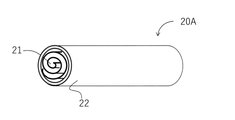
- An overview of the tobacco segment is shown in Figure 1A.
- the tobacco segment 20A comprises a tobacco filler 21 and a wrapper 22 surrounding it.
- Tobacco filler 21 includes tobacco material T and paper P.
- the tobacco material T and the paper P are in strand form. The strand may be obtained by cutting a sheet in which the sheet-like tobacco material T and the paper P are laminated.
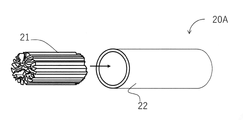
- FIG. 1B shows a mode in which the sheet-like tobacco filler 21 is spirally filled into the wrapper 22 .
- the sheet-shaped tobacco filler 21 may be a sheet in which the sheet-shaped tobacco material T and the paper P are laminated, or may be obtained by joining the side surfaces of the sheet-shaped tobacco material T and the paper P together or in the vicinity of the side surfaces. It may be a sheet.
- FIG. 1C shows a mode in which the sheet-like tobacco filler 21 is folded and filled into the wrapper 22.
- the sheet-shaped tobacco filler 21 may be a sheet in which the sheet-shaped tobacco material T and the paper P are laminated, or may be obtained by joining the side surfaces of the sheet-shaped tobacco material T and the paper P together or in the vicinity of the side surfaces. It may be a sheet.
- FIG. 1D shows a mode of filling the shredded tobacco filler 21 into the wrapper 22 .
- the figure shows a manner in which cut tobacco material T and cut paper P are prepared and filled.
- the shredded sheet may be a shredded sheet obtained by laminating the sheet-like tobacco material T and the paper P.
- FIG. 1E shows a mode in which the sheet-like tobacco filler 21 is rolled up by being compressed in the vertical and horizontal directions and filled into the wrapper 22 .
- the sheet-shaped tobacco filler 21 may be a sheet in which the sheet-shaped tobacco material T and the paper P are laminated, or may be obtained by joining the side surfaces of the sheet-shaped tobacco material T and the paper P together or in the vicinity of the side surfaces. It may be a sheet.
- the heating tobacco segment is paper having a total content of tobacco material, lignin and hemicellulose of 0.1 to 10% by weight as filler. including.
- the filling is a filling for tobacco segments.
- Lignin is a high-molecular phenolic compound contained in trees and the like.
- Hemicellulose is an insoluble polysaccharide contained in cell walls. When the total amount is within this range, offensive odors (such as fiber odors) during smoking can be reduced. That is, in this aspect, the effect of diluting the flavor and taste without greatly impairing the original flavor and taste is exhibited.
- the upper limit of the total content of lignin and hemicellulose is preferably 9.0% by weight or less.
- Lignin and hemicellulose are measured by known methods, but in the present invention, they are preferably measured by the following methods.
- Step 1) can use, for example, a Thermo Scientific TM Dionex TM ASE TM Accelerated Solvent Extraction System (model number: ASE-350).
- ASE-350 Thermo Scientific TM Dionex TM ASE TM Accelerated Solvent Extraction System
- Step 2) can be specifically implemented as follows. Put 50 mg of sample A in a screw bottle, add 8.5 ml of ultrapure water (ML-Q water) and 0.5 ml of pancreatin solution, and shake at 40° C. and 125 rpm for 16 hours.
- the pancreatin solution is the supernatant obtained by adding 8 g of pancreatin to 100 ml of 0.1 M phosphate buffer of pH 6.4, stirring for 1 hour, and centrifuging at 8000 rpm for 30 minutes.
- the sample liquid is then transferred to a 15 ml centrifuge tube using ML-Q water and centrifuged at 8000 rpm for 15 minutes to remove the supernatant. This wash is repeated three times.
- Steps ii) and iii) can be specifically performed as follows. 100 mg of sample A is placed in a screw bottle, 4 ml of 72% sulfuric acid is added, the sample is completely immersed in sulfuric acid, and shaken at 30° C. and 200 rpm for 4 hours. Next, 157.2 ml of ultrapure water (ML-Q water) is added so that the concentration of sulfuric acid after dilution becomes 4%, transferred to an eggplant flask, and heated under reflux in an oil bath at 110° C. for 2 hours. After allowing to cool to room temperature, filter, dry with a rotary dryer, and weigh.
- ML-Q water ultrapure water
- the content of the paper used in this embodiment is preferably 5-70% by weight, more preferably 10-50% by weight, still more preferably 15-40% by weight, based on the dry matter weight of the tobacco material.
- the flavor and taste can be diluted to an appropriate level without impairing the original flavor and taste.
- Dry matter weight is, in one aspect, the weight of the residue after drying the tobacco material at 100° C. for 5 hours.
- the paper used in this embodiment is not limited as long as the total content of lignin and hemicellulose is within the above range. . However, from the viewpoint of suppressing the generation of offensive odors, non-coated paper or lightly coated paper is preferred. Also, the paper used in this embodiment may or may not contain an aerosol-generating substrate as described below. The amount may be within the range described in the second aspect, or may be within a range other than this.
- the heating tobacco segment includes, as fillers, tobacco material and paper containing an aerosol-generating substrate.
- Aerosol-forming substrates are materials that form an aerosol by being vaporized by heating and being cooled to form an aerosol, or by atomization.
- paper containing an aerosol-generating base material is used, so that the effect of diluting the flavor and taste without reducing the amount of smoke is exhibited.
- Known aerosol-generating base materials can be used, and examples thereof include glycerin, vegetable glycerin, polyhydric alcohols such as propylene glycol (PG), triethyl citrate (TEC), and triacetin.
- the amount of aerosol-forming substrate is preferably 3-20% by weight, more preferably 5-15% by weight, based on the dry matter weight of said paper. If the amount of the aerosol-generating base material exceeds the upper limit, stains or the like may occur on the tobacco segment, and if it is less than the lower limit, the amount of smoke perceptible may decrease. Aerosol-generating substrates can be added to the paper, such as by impregnation or spraying.
- the content of the paper to which the aerosol-generating substrate is added is preferably 5 to 75% by weight, more preferably 10 to 50% by weight, still more preferably 15 to 40% by weight, based on the dry weight of the tobacco material. be.
- the paper used in this aspect is not limited, and may be the paper described in the first aspect.
- the density of the paper prior to the addition of the aerosol-generating substrate used in this aspect may be within the range described in the first aspect, or may be in a range other than this.
- the amount of lignin and hemicellulose contained in the paper used in this embodiment is not limited, and may be within the range described in the first embodiment or within a range other than this.
- the shape of the paper is not limited as long as it is easily mixed with the tobacco material.
- the paper is a sheet, cut, or strand.
- the shapes of the paper and tobacco material are similar, and in the most preferred embodiment, both the paper and tobacco material are shredded.
- the paper may be added with menthol and other fragrances that are commonly used in the relevant field.
- Tobacco materials are materials derived from Nicotiana plants. Specific examples of tobacco materials include tobacco shreds, tobacco dust, tobacco cores, tobacco stems, tobacco sheets, strands, and the like, which are commonly used in the relevant field. These are used alone or in combination. Among these, shredded tobacco and cut tobacco sheets are preferable from the viewpoints of being excellent in mixability with paper, not improving ventilation resistance, easily contributing to flavor and taste, and having high uniformity in shape.
- leaf tobacco those belonging to the genus Nicotiana, such as tabacum and rustica, can be suitably used. Although the varieties are not limited, one or more of these leaf tobaccos can be mixed and used. As the mixture, an appropriate blend of the above varieties can be used so as to obtain the desired taste.
- Tobacco segments can be manufactured by any method, for example, by mixing the tobacco material and the paper and wrapping the mixture with a wrapper.
- a wrapper one commonly used in the relevant field can be used.
- flavor inhalation article refers to an article for the user to inhale a flavor.
- tobacco flavor inhaling articles those containing tobacco or tobacco-derived components are referred to as “tobacco flavor inhaling articles.”
- Tobacco flavor inhaling articles are divided into “combustion type tobacco flavor inhaling articles” (simply referred to as “smoking articles") that generate flavor and taste by combustion, and “non-combustion type tobacco flavor inhaling articles” that generate flavor and taste without burning. broadly classified.
- non-combustion type tobacco flavor inhalation article is classified into a "non-combustion heating type tobacco flavor inhalation article” that generates a flavor and taste by heating, and a “non-combustion and non-heating type tobacco flavor inhalation article” that generates a flavor and taste without heating. It is divided into Tobacco segments containing the paper of the present invention are suitable for non-combustion heated tobacco flavor inhalation articles.
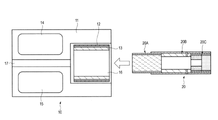
- Fig. 2 shows one embodiment of the non-combustion heating tobacco flavor suction article.
- the non-combustion-heating tobacco flavor inhalation article 20 includes a tobacco segment 20A, a cylindrical cooling portion 20B having perforations on its circumference, and a filter portion 20C.
- the non-combustion heating tobacco flavor inhalation article 20 may have other members.
- the axial length of the non-combustion heating tobacco flavor inhalation article 20 is not limited, but is preferably 40 to 90 mm, more preferably 50 to 75 mm, and even more preferably 50 to 60 mm or less.
- the circumference of the non-combustion heating tobacco flavor inhalation article 20 is preferably 16 to 25 mm, more preferably 20 to 24 mm, even more preferably 21 to 23 mm.
- the length of the tobacco segment 20A is 20 mm
- the length of the cooling section 20B is 20 mm
- the length of the filter section 20C is 7 mm.
- the length of each of these members can be changed as appropriate according to manufacturability, required quality, and the like.
- FIG. 2 shows a mode in which the first segment 25 is arranged, only the second segment 26 may be arranged on the downstream side of the cooling section 20B without arranging this.
- Tobacco filler 21 in tobacco segment 20A includes the tobacco material and paper.
- the method of filling the tobacco filling 21 in the wrapper 22 is not particularly limited, but for example, the tobacco filling 21 may be wrapped in the wrapper 22 or the tobacco filling 21 may be filled in the cylindrical wrapper 22 . If the tobacco and paper have a longitudinal direction, such as a rectangular shape, they may be packed in unspecified directions within the wrapper 22, aligned or aligned with the axial direction of the tobacco segment 20A. The filling may be aligned in a direction orthogonal to this. As the wrapper 22, the paper can also be used.
- the tobacco components, aerosol-generating base material and water contained in the tobacco filling 21 are vaporized and provided for inhalation.
- Cooling section 20B It is preferable that the cooling part 20B is configured by a cylindrical member.
- the tubular member may be, for example, a paper tube 23 formed by processing cardboard into a cylindrical shape.
- Cooling section 20B may also be formed by a thin sheet of material that is crumpled and then pleated, gathered, or folded to form channels.
- a sheet material selected from the group consisting of polyethylene, polypropylene, polyvinyl chloride, polyethylene terephthalate, polylactic acid, cellulose acetate, and aluminum foil can be used.
- the total surface area of the cooling part 20B is appropriately prepared in consideration of the cooling efficiency, and can be, for example, 300 to 1000 mm 2 /mm.
- Cooling section 20B is preferably provided with perforations 24 . Due to the presence of the perforations 24, outside air is introduced into the cooling section 20B during suction. As a result, the vaporized aerosol component generated by the heating of the tobacco segment 21A comes into contact with the outside air, and its temperature is lowered, so that it is liquefied and an aerosol is formed.
- the diameter (spanning length) of the perforations 24 is not particularly limited, but may be, for example, 0.5 to 1.5 mm.
- the number of perforations 24 is not particularly limited, and may be one or two or more. For example, a plurality of perforations 24 may be provided on the circumference of the cooling section 20B.
- the cooling part 20B can be rod-shaped with an axial length of, for example, 7 to 28 mm.
- the axial length of the cooling part 20B can be 18 mm.
- the cooling portion 20B has a substantially circular axial cross-sectional shape, and can have a diameter of 5 to 10 mm.
- the diameter of the cooling section can be approximately 7 mm.
- Filter section 20C Although the configuration of the filter part 20C is not particularly limited, it may be composed of a single or a plurality of filling layers. The outer side of the packing layer may be wrapped with one or more wrapping papers.
- the ventilation resistance of the filter portion 20C can be appropriately changed depending on the amount, material, etc. of the filter filler filled in the filter portion 20C. For example, when the filter filling material is cellulose acetate fiber, the ventilation resistance can be increased by increasing the amount of cellulose acetate fiber with which the filter portion 20C is filled. When the filter packing is cellulose acetate fibers, the packing density of the cellulose acetate fibers can be from 0.13 to 0.18 g/cm 3 .
- the airflow resistance is a value measured by an airflow resistance measuring instrument (trade name: SODIMAX, manufactured by SODIM).
- the length of the circumference of the filter portion 20C is not particularly limited, it is preferably 16 to 25 mm, more preferably 20 to 24 mm, even more preferably 21 to 23 mm.
- the length in the axial direction (horizontal direction in FIG. 2) of the filter portion 20C can be selected from 4 to 10 mm, and is selected so that the ventilation resistance is 15 to 60 mmH 2 O/seg.
- the axial length of the filter portion 20C is preferably 5 to 9 mm, more preferably 6 to 8 mm.
- the shape of the cross section of the filter portion 20C is not particularly limited, and may be, for example, circular, elliptical, polygonal, or the like.
- destructible capsules containing perfume, perfume beads, and perfume may be directly added to the filter portion 20C.
- the filter part 20C may have a center hole part as the first segment 25.
- the center hole portion is composed of a first filling layer 25a having one or more hollow portions and an inner plug wrapper (inner wrapping paper) 25b covering the filling layer.
- the center hole portion has a function of increasing the strength of the mouthpiece portion.
- the center hole portion does not have the inner plug wrapper 25b, and the shape may be maintained by thermoforming.
- the filter portion 20C may have a second segment 26 .
- the second segment 26 is composed of a second filling layer 26a and an inner plug wrapper (inner wrapping paper) 26b covering the filling layer.
- the second filling layer 26a has an inner diameter of ⁇ 5.0 to ⁇ 1.0 mm, for example, filled with cellulose acetate fibers at a high density and hardened by adding 6 to 20% by weight of a plasticizer containing triacetin to the weight of the cellulose acetate. It can be a rod. Since the second packed layer has a high packing density of fibers, air and aerosol flow only in the hollow portion during suction, and hardly flow in the second packed layer. Since the second filling layer inside the center hole portion is a fiber filling layer, the feeling of touch from the outside during use does not make the user feel uncomfortable.
- the first filling layer 25a and the second filling layer 26a are connected by an outer plug wrapper (outer wrapping paper) 27.
- the outer plug wrapper 27 can be, for example, a cylinder of paper.
- the tobacco segment 20A, the cooling section 20B, and the connected first and second filling layers 25a and 26a are connected by a mouthpiece lining paper 28. As shown in FIG. These connections can be made, for example, by applying paste such as vinyl acetate paste to the inner surface of the mouthpiece lining paper 28 and winding the three members. These members may be connected in a plurality of times with a plurality of lining papers.
- a combination of a non-combustion heating tobacco flavor inhalation article and a heating device for generating an aerosol is also called a non-combustion heating tobacco flavor inhalation system.
- a non-combustion heating tobacco flavor inhalation system comprises a non-combustion heating tobacco flavor inhalation article 20 and a heating device 10 for externally heating tobacco segments 20A.
- the heating device 10 includes a body 11, a heater 12, a metal tube 13, a battery unit 14, and a control unit 15.
- the body 11 has a cylindrical recess 16, and the heater 12 and the metal tube 13 are arranged at positions corresponding to the tobacco segments 20A inserted therein.
- the heater 13 can be a heater based on electric resistance, and electric power is supplied from the battery unit 14 according to an instruction from the control unit 15 for temperature control, and the heater 12 is heated. Heat emitted from the heater 12 is transmitted to the tobacco segment 20A through the metal pipe 13 having high thermal conductivity.
- the heating device 10 may heat the tobacco segment 20A from the inside.
- the heating temperature of the heating device 10 is not particularly limited, but is preferably 400°C or less, more preferably 150 to 400°C, and even more preferably 200 to 350°C. A heating temperature indicates the temperature of the heater of the heating device 10 .
- Comparative Example 1 A tobacco sheet manufactured by a known papermaking method was prepared. The tobacco sheet was packed into a wrapper to form a tobacco segment, and a non-combustion heating type flavor inhalation article shown in FIG. 2 was prepared. The article was subjected to a smoking test by 10 well-trained panelists (average age 40 years).
- Example 1 Papers with a total lignin and hemicellulose content of 0.1-10% by weight (Materials 1-7) and papers with a total lignin and hemicellulose content of more than 10% by weight (Materials 8-10) were prepared.
- the same tobacco sheet and each paper prepared in Comparative Example 1 were cut into pieces having a width of 0.3 to 2.0 mm and a length of 3 to 50 mm.
- the cut pieces of paper and cut pieces of tobacco sheet were mixed at a weight ratio of 80:20, and a non-combustion heating type flavor inhalation article was prepared in the same manner as in Comparative Example 1, and subjected to a smoking test. .
- the smoking flavor and amount of smoke were evaluated according to the following criteria. 1: Decrease significantly 2: Decrease 3: No change (standard) 4: increase 5: greatly increase
- the fiber odor was evaluated according to the following criteria. 1: None (standard) 2: very low 3: low 4: moderate 5: strong
- Example 2 Comparative Example 3
- a non-combustion heated flavor inhalation article was prepared in the same manner as in Example 1, except that the tobacco sheet and Material 5 were blended in the amounts shown in Table 2, and a smoking test was conducted.
- Example 3 Tobacco sheets and Material 5 were blended in the amounts shown in Table 3. However, in Material 5, 10% by weight of glycerin was added as an aerosol-generating base material, based on the dry weight. A non-combustion heated flavor inhalation article was prepared and smoke tested in the same manner as in Example 1, except that the blend was used.
- the sample liquid was then transferred to a 15 ml centrifuge tube using ML-Q water and centrifuged at 8000 rpm for 15 minutes to remove the supernatant. This washing was repeated three times. After washing, 10 ml of a 5% sulfuric acid aqueous solution was added and hydrolysis was carried out at 100° C. for 2.5 hours. After the hydrolysis reaction was completed, the sample was allowed to cool to room temperature. The precipitate was then filtered off and the filtrate was collected in a 250 ml volumetric flask. After thoroughly washing the residue on the filter paper with ML-Q water, the volume was adjusted to 250 ml. This solution was used as a sample for hemicellulose measurement.
- the tobacco segment of the present invention can moderately dilute the flavor and taste.
Landscapes
- Chemical & Material Sciences (AREA)
- Chemical Kinetics & Catalysis (AREA)
- General Chemical & Material Sciences (AREA)
- Health & Medical Sciences (AREA)
- Life Sciences & Earth Sciences (AREA)
- General Health & Medical Sciences (AREA)
- Molecular Biology (AREA)
- Manufacture Of Tobacco Products (AREA)
Priority Applications (5)
| Application Number | Priority Date | Filing Date | Title |
|---|---|---|---|
| EP22837273.6A EP4368774A4 (en) | 2021-07-08 | 2022-03-24 | TOBACCO SEGMENT CONTAINING PAPER |
| JP2023533415A JP7678878B2 (ja) | 2021-07-08 | 2022-03-24 | 紙を含むたばこセグメント |
| CN202280047496.0A CN117794401A (zh) | 2021-07-08 | 2022-03-24 | 含纸的烟草段 |
| KR1020247003810A KR20240025692A (ko) | 2021-07-08 | 2022-03-24 | 종이를 포함하는 담배 세그먼트 |
| US18/396,355 US20240122236A1 (en) | 2021-07-08 | 2023-12-26 | Paper-containing tobacco segment |
Applications Claiming Priority (2)
| Application Number | Priority Date | Filing Date | Title |
|---|---|---|---|
| JP2021-113314 | 2021-07-08 | ||
| JP2021113314 | 2021-07-08 |
Related Child Applications (1)
| Application Number | Title | Priority Date | Filing Date |
|---|---|---|---|
| US18/396,355 Continuation US20240122236A1 (en) | 2021-07-08 | 2023-12-26 | Paper-containing tobacco segment |
Publications (1)
| Publication Number | Publication Date |
|---|---|
| WO2023281851A1 true WO2023281851A1 (ja) | 2023-01-12 |
Family
ID=84801677
Family Applications (1)
| Application Number | Title | Priority Date | Filing Date |
|---|---|---|---|
| PCT/JP2022/013937 Ceased WO2023281851A1 (ja) | 2021-07-08 | 2022-03-24 | 紙を含むたばこセグメント |
Country Status (6)
| Country | Link |
|---|---|
| US (1) | US20240122236A1 (https=) |
| EP (1) | EP4368774A4 (https=) |
| JP (1) | JP7678878B2 (https=) |
| KR (1) | KR20240025692A (https=) |
| CN (1) | CN117794401A (https=) |
| WO (1) | WO2023281851A1 (https=) |
Citations (6)
| Publication number | Priority date | Publication date | Assignee | Title |
|---|---|---|---|---|
| JP2015514882A (ja) * | 2012-04-19 | 2015-05-21 | アール・ジエイ・レイノルズ・タバコ・カンパニー | タバコから微結晶セルロースを製造する方法および関連するタバコ製品 |
| JP3201449U (ja) * | 2011-02-17 | 2015-12-10 | ブリティッシュ アメリカン タバコ (インヴェストメンツ) リミテッドBritish Americantobacco (Investments) Limited | 喫煙品 |
| JP6683698B2 (ja) | 2014-11-03 | 2020-04-22 | フィリップ・モーリス・プロダクツ・ソシエテ・アノニム | 捲縮したウェブを製造するための方法および装置 |
| US20200359674A1 (en) | 2017-09-14 | 2020-11-19 | Altria Client Services Llc | Smoking Article With Reduced Tobacco |
| JP2020535837A (ja) * | 2017-10-06 | 2020-12-10 | エスダブリュエム・ルクセンブルク・エスアーアールエル | タバコを燃焼させることなく加熱する装置のための再構成植物シート |
| JP2021507684A (ja) * | 2017-12-20 | 2021-02-25 | フィリップ・モーリス・プロダクツ・ソシエテ・アノニム | 油添加剤を含むエアロゾル発生基体 |
Family Cites Families (8)
| Publication number | Priority date | Publication date | Assignee | Title |
|---|---|---|---|---|
| US5092353A (en) * | 1989-01-18 | 1992-03-03 | R. J. Reynolds Tobacco Company | Cigarette |
| US20040094170A1 (en) * | 2002-11-19 | 2004-05-20 | Zho Zeong Ghee | Nicotine free cigarette substitute |
| CN101912152B (zh) * | 2010-08-13 | 2012-06-27 | 川渝中烟工业有限责任公司 | 应用复合酶处理蒸汽爆破烟梗改善吸食品质的方法 |
| CN103462213B (zh) * | 2013-09-29 | 2015-07-29 | 中国烟草总公司郑州烟草研究院 | 一种适用于加热非燃烧型烟草制品的烟草材料制备方法 |
| US9950858B2 (en) * | 2015-01-16 | 2018-04-24 | R.J. Reynolds Tobacco Company | Tobacco-derived cellulose material and products formed thereof |
| EP4620320A3 (en) * | 2018-08-09 | 2025-11-12 | KT&G Corporation | Method and apparatus for manufacturing aerosol-forming rod |
| US12478112B2 (en) * | 2018-10-30 | 2025-11-25 | R.J. Reynolds Tobacco Company | Smoking article cartridge |
| US11957160B2 (en) * | 2019-02-11 | 2024-04-16 | Mativ Holdings, Inc. | Filler containing blends of aerosol generating materials |
-
2022
- 2022-03-24 WO PCT/JP2022/013937 patent/WO2023281851A1/ja not_active Ceased
- 2022-03-24 KR KR1020247003810A patent/KR20240025692A/ko active Pending
- 2022-03-24 JP JP2023533415A patent/JP7678878B2/ja active Active
- 2022-03-24 EP EP22837273.6A patent/EP4368774A4/en active Pending
- 2022-03-24 CN CN202280047496.0A patent/CN117794401A/zh active Pending
-
2023
- 2023-12-26 US US18/396,355 patent/US20240122236A1/en active Pending
Patent Citations (6)
| Publication number | Priority date | Publication date | Assignee | Title |
|---|---|---|---|---|
| JP3201449U (ja) * | 2011-02-17 | 2015-12-10 | ブリティッシュ アメリカン タバコ (インヴェストメンツ) リミテッドBritish Americantobacco (Investments) Limited | 喫煙品 |
| JP2015514882A (ja) * | 2012-04-19 | 2015-05-21 | アール・ジエイ・レイノルズ・タバコ・カンパニー | タバコから微結晶セルロースを製造する方法および関連するタバコ製品 |
| JP6683698B2 (ja) | 2014-11-03 | 2020-04-22 | フィリップ・モーリス・プロダクツ・ソシエテ・アノニム | 捲縮したウェブを製造するための方法および装置 |
| US20200359674A1 (en) | 2017-09-14 | 2020-11-19 | Altria Client Services Llc | Smoking Article With Reduced Tobacco |
| JP2020535837A (ja) * | 2017-10-06 | 2020-12-10 | エスダブリュエム・ルクセンブルク・エスアーアールエル | タバコを燃焼させることなく加熱する装置のための再構成植物シート |
| JP2021507684A (ja) * | 2017-12-20 | 2021-02-25 | フィリップ・モーリス・プロダクツ・ソシエテ・アノニム | 油添加剤を含むエアロゾル発生基体 |
Non-Patent Citations (1)
| Title |
|---|
| See also references of EP4368774A4 |
Also Published As
| Publication number | Publication date |
|---|---|
| KR20240025692A (ko) | 2024-02-27 |
| EP4368774A4 (en) | 2025-10-08 |
| JP7678878B2 (ja) | 2025-05-16 |
| CN117794401A (zh) | 2024-03-29 |
| JPWO2023281851A1 (https=) | 2023-01-12 |
| EP4368774A1 (en) | 2024-05-15 |
| US20240122236A1 (en) | 2024-04-18 |
Similar Documents
| Publication | Publication Date | Title |
|---|---|---|
| RU2766820C1 (ru) | Курительное изделие с нагреванием без горения и курительная система с электрическим нагреванием | |
| JP7139451B2 (ja) | 非燃焼加熱型喫煙物品、電気加熱型喫煙システム及び非燃焼加熱型喫煙物品の製造方法 | |
| US20260083162A1 (en) | Hot Pressed Tobacco Substrate | |
| US20250351865A1 (en) | Stable wrapper for aerosol generating article | |
| US20240074489A1 (en) | Aerosol-generating rod with multiple aerosol-generating segments | |
| JP7738059B2 (ja) | 非燃焼加熱香味吸引物品及び非燃焼加熱香味吸引システム | |
| JPWO1995020329A1 (ja) | 香喫味物品 | |
| US6378528B1 (en) | Cigarette with improved tobacco substrate | |
| CN114727649A (zh) | 用于非燃烧型卷烟的包装纸及其制备方法 | |
| US20260076404A1 (en) | Stable wrapper for aerosol generating article | |
| UA130724C2 (uk) | Виріб, що генерує аерозоль, із заданим напрямком уведення | |
| JP2023546653A (ja) | 非燃焼型エアロゾル供給システムにおける使用のための物品 | |
| JP7648351B2 (ja) | たばこ充填材およびたばこ製品 | |
| JP7678878B2 (ja) | 紙を含むたばこセグメント | |
| JP7762806B2 (ja) | 非燃焼加熱型香味吸引物品 | |
| JP7337284B2 (ja) | 香味吸引器 | |
| WO2023112870A1 (ja) | たばこ材料 | |
| WO2024142149A1 (ja) | 風味原料付香構成部材及び喫煙物品 | |
| RU2813007C1 (ru) | Обертка для сигареты негорючего типа и способ ее производства | |
| RU2842912C1 (ru) | Изделие, генерирующее аэрозоль, с негомогенизированным табачным субстратом | |
| RU2859054C2 (ru) | Изделие и система для генерирования аэрозоля с несколькими элементами для генерирования аэрозоля | |
| KR20250172971A (ko) | 향미 흡입기용 필터, 이의 제조 방법, 및 향미 흡입기 | |
| RU2777962C1 (ru) | Курительное изделие с нагреванием без горения, курительная система с электрическим нагреванием и способ изготовления курительного изделия с нагреванием без горения | |
| WO2023248604A1 (ja) | 低香味原料を含むたばこセグメント | |
| WO2024024083A1 (ja) | 非燃焼加熱型香味吸引器用再生たばこ及びその製造方法、非燃焼加熱型香味吸引器、並びに非燃焼加熱型香味吸引システム |
Legal Events
| Date | Code | Title | Description |
|---|---|---|---|
| 121 | Ep: the epo has been informed by wipo that ep was designated in this application |
Ref document number: 22837273 Country of ref document: EP Kind code of ref document: A1 |
|
| WWE | Wipo information: entry into national phase |
Ref document number: 202280047496.0 Country of ref document: CN |
|
| WWE | Wipo information: entry into national phase |
Ref document number: 2023533415 Country of ref document: JP |
|
| ENP | Entry into the national phase |
Ref document number: 20247003810 Country of ref document: KR Kind code of ref document: A |
|
| WWE | Wipo information: entry into national phase |
Ref document number: 1020247003810 Country of ref document: KR |
|
| WWE | Wipo information: entry into national phase |
Ref document number: 2022837273 Country of ref document: EP |
|
| NENP | Non-entry into the national phase |
Ref country code: DE |