WO2023281671A1 - 通信品質予測装置および通信品質予測方法ならびに通信品質予測プログラム - Google Patents
通信品質予測装置および通信品質予測方法ならびに通信品質予測プログラム Download PDFInfo
- Publication number
- WO2023281671A1 WO2023281671A1 PCT/JP2021/025674 JP2021025674W WO2023281671A1 WO 2023281671 A1 WO2023281671 A1 WO 2023281671A1 JP 2021025674 W JP2021025674 W JP 2021025674W WO 2023281671 A1 WO2023281671 A1 WO 2023281671A1
- Authority
- WO
- WIPO (PCT)
- Prior art keywords
- communication quality
- prediction
- base station
- csi
- unit
- Prior art date
- Legal status (The legal status is an assumption and is not a legal conclusion. Google has not performed a legal analysis and makes no representation as to the accuracy of the status listed.)
- Ceased
Links
Images




Classifications
-
- H—ELECTRICITY
- H04—ELECTRIC COMMUNICATION TECHNIQUE
- H04W—WIRELESS COMMUNICATION NETWORKS
- H04W24/00—Supervisory, monitoring or testing arrangements
- H04W24/08—Testing, supervising or monitoring using real traffic
Definitions
- the present invention relates to a communication quality prediction device, a communication quality prediction method, and a communication quality prediction program.
- CSI Channel State Information
- Non-Patent Document 1 discloses a channel estimation method for obtaining CSI of a wireless channel using time division duplex (TDD).
- Non-Patent Document 2 discloses a channel estimation method for obtaining CSI of a wireless channel using frequency division duplexing (FDD).
- TDD time division duplex
- FDD frequency division duplexing
- Non-Patent Document 3 discloses a method of predicting CSI using a CSI time-series prediction algorithm based on long-short-term memory (LSTM) and gated recurrence unit (GRU).
- Non-Patent Document 4 discloses a method of predicting CSI using temporal correlation between channels by LSTM and convolutional neural network (CNN).
- Non-Patent Document 5 discloses predicting CSI at unobserved locations with a Gaussian process (GP) by selecting a squared exponential (SE) kernel function as the kernel function.
- Non-Patent Document 6 discloses employing a Cous process, which is a squared exponential kernel function, to predict channel strength for unmanned aerial vehicles (UAVs) in urban environments.
- Non-Patent Documents 3 and 4 in order to keep up with dynamically changing non-stationary CSI and maintain high prediction performance, it is necessary to frequently change the learning parameters or Learning using training data is required.
- the accuracy of CSI can be accurately predicted based on the regularity of movement of terminals.
- Non-Patent Documents 5 and 6 it is not easy to appropriately model the spatial correlation that changes according to changes in the propagation environment.
- the present invention has been made in view of the above circumstances, and its object is to provide a communication quality prediction apparatus and a communication quality prediction method capable of predicting the communication quality of future wireless channels with high accuracy, and To provide a communication quality prediction program.
- a communication quality prediction apparatus includes an accumulation unit that accumulates communication qualities of wireless channels in a plurality of base stations; a prediction unit that predicts a trajectory of a user device that communicates with the base station; Estimation for predicting the future communication quality of radio channels at each base station based on the communication quality of the radio channels at each base station stored in the storage unit and the trajectory of the user equipment predicted by the prediction unit.
- a communication quality prediction method includes the steps of: storing communication qualities of radio channels in a plurality of base stations in a storage unit; and predicting a trajectory of a user equipment that communicates with the base stations. and predicting the future communication quality of the radio channel at each base station based on the communication quality of the radio channel at each base station stored in the storage unit and the predicted trajectory of the user equipment; Prepare.
- One aspect of the present invention is a radio channel prediction program for causing a computer to function as the communication quality prediction device.
- FIG. 1 is a block diagram showing the configuration of a communication system including a communication quality prediction device and its peripherals according to an embodiment.
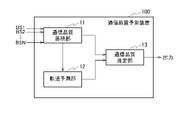
- FIG. 2 is a block diagram showing the detailed configuration of the communication quality prediction device according to the embodiment.
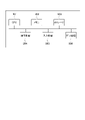
- FIG. 3 is a transition diagram of the prediction framework of CSI based on Gaussian process.
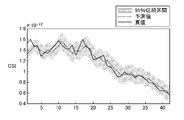
- FIG. 4 is a graph showing a comparison between the true value of CSI and the CSI predicted using the prediction method according to the embodiment.
- FIG. 5 is a graph showing a comparison between the true value of CSI and the CSI predicted using the prediction method according to the embodiment.
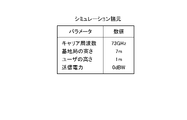
- FIG. 6 is a diagram showing specifications of the simulation.
- FIG. 7 is a graph showing prediction errors when CSI is predicted by the conventional method and the method of the embodiment.
- FIG. 8 is a block diagram showing the hardware configuration of this embodiment.
- FIG. 1 is a block diagram showing the configuration of a communication system comprising a communication quality prediction device 100 and its peripheral devices according to an embodiment of the present invention.
- the communication quality prediction device 100 is connected to a plurality of base stations BS-1, BS-2, . . . BS-N via a network.
- N indicates the number of base stations.
- base station BS-1 when individual base stations are specified, they are indicated with a suffix such as "base station BS-1", and when individual base stations are not specified, base stations are collectively referred to. , it is indicated without a suffix, such as "base station BS”.
- Each of the base stations BS-1 to BS-N performs radio communication with a user equipment UE1 mounted on a vehicle traveling within the area set for each, and provides various services to the user equipment UE1. offer.
- FIG. 2 is a block diagram showing the detailed configuration of the communication quality prediction device 100.
- the communication quality prediction device 100 includes a communication quality accumulation unit 11 (accumulation unit), a trajectory prediction unit 12 (prediction unit), and a communication quality estimation unit 13 (estimation unit). , is equipped with
- the communication quality accumulation unit 11 acquires and stores the communication quality (hereafter referred to as "CSI") of the wireless channels in each of the base stations BS-1 to BS-N. Therefore, the communication quality accumulation unit 11 stores the past CSI of the radio channel in each base station BS.
- CSI communication quality
- the trajectory prediction unit 12 predicts the movement trajectory of the vehicle on which the user device UE1 is mounted.
- the trajectory prediction unit 12 calculates the distance between the user equipment UE1 and each base station BS based on the path loss.
- Path loss refers to the degradation of CSI due to the increasing distance between the base station BS and the user equipment UE1.
- the trajectory prediction unit 12 predicts the movement trajectory of the user device UE1 based on the distance between the user device UE1 and each base station BS.
- the trajectory prediction unit 12 outputs prediction information of the movement trajectory of the vehicle to the communication quality estimation unit 13 .
- the communication quality estimation unit 13 estimates each base station BS based on the prediction information of the movement trajectory of the vehicle predicted by the trajectory prediction unit 12 and the past CSI of each base station BS stored in the communication quality storage unit 11. Predict future CSI in Specifically, the communication quality estimation unit 13 predicts CSI using a CSI prediction framework of a learning model based on a Gaussian Process (GP).
- GP Gaussian Process
- the distance between the user equipment UE1 and the first base station BS-1 is "d1".
- Equation (1) "hi” denotes the complex channel fading coefficients of the user equipment UE1 and the i-th base station BS-i. "Pi” indicates transmission power. “ni” represents white Gaussian noise of power N0.
- each CSI element "Si” can be expressed by the following equation (2).
- the future N CSI is predicted based on the past finite "M*N" CSI, ie, the past M CSI at each of the N base stations BS.
- the communication quality estimation unit 13 predicts CSI using a learning model based on a Gaussian process.
- a Gaussian process is a statistical model based on probability theory. , a regression model of the system output "Y" consisting of elements "y1 to yM" is used.
- the communication quality estimation unit 13 calculates "y*" by a Gaussian process. Predict. That is, a new input “x*” is given to the communication quality estimation unit 13 by the movement of the user equipment UE1. The communication quality estimation unit 13 predicts future CSI using the new input "x*".
- the conditional probability distribution of the mapping function f(x*) is the predicted average “f( ⁇ )(x *)” and the variance ⁇ 2 (x*).
- K(x*,x*) shown in the first term on the right side of equation (7) is a kernel function.
- the communication quality estimator 13 of the present embodiment adopts a learning model based on a Gaussian mixture distribution, and learns a kernel function of the Gaussian mixture distribution so as to follow changes in communication quality of radio channels in each base station BS.
- the CSI of past radio channels in each base station BS are arranged as a CSI sequence using the distance between the user equipment UE1 and each base station BS as an index.
- the system input "X" and system output "Y" of the radio channel in the i-th base station BS-i are expressed by the following equations (8) and (9).
- X shown in formula (8) is a formula obtained by rewriting the components of formula (3) described above to "d1, d2, ..., dM". Note that the above “d1 to dM” are vectors.
- Yi shown in equation (9) is an equation obtained by rewriting the components of equation (4) described above to "S1,i, S1,i, . . . , SM,i”. Also, in the equation (8), "dj" can be represented by the following equation (10).
- M shown in the formulas (8) to (10) above is the number of CSIs in each base station BS stored in the communication quality storage unit 11, and M CSIs in the past are stored.
- N indicates the number of base stations BS.
- d(j,i) denotes the distance between the user equipment UE1 and the i-th base station BS-i.
- S(j,i) indicates the CSI of the radio channel at the i-th base station BS-i.
- “j” indicates the past j-th CSI stored in the communication quality accumulation unit 11 .
- the distance between the base station BS and the user equipment UE1 has a great impact on the path loss. Therefore, based on the path loss between the user equipment UE1 and each base station BS, the distance between the user equipment UE1 and each base station BS can be calculated. Furthermore, based on the calculated distance, the trajectory traveled by the user equipment UE1 can be predicted.
- the kernel function "Kn(di, dj)" of the radio channel in the "n"th base station BS can be formulated as in the following equation (11).
- the first term on the right side shown in equation (11) can be calculated by learning the effect of path loss on CSI.
- the second term on the right side can be calculated by learning the influence of the position change of the user equipment UE1 on the CSI.
- " ⁇ " shown in the second term on the right side of equation (11) is a symbol indicating multiplication of each component.
- FIG. 3 is a transition diagram of a prediction framework of CSI based on a Gaussian process learning model.
- the prediction framework comprises an input layer 21, an LMC layer 22, and an output layer 23.
- the input layer 21 inputs the past CSI of the radio channel in each base station BS-1 to BS-N as "D1, D2, ..., DN".
- the LMC layer 22 adopts a linear model of coregionalization (LMC) and expresses it as a linear combination of N latent functions "gN(X)". That is, the communication quality estimator 13 predicts the communication quality of the wireless channel in each base station BS by adopting a collisionalization linear model that expresses the output of the learning model as a linear combination of a plurality of latent functions.
- the latent function "gN(X)" has an average of zero and is a Gaussian process of the kernel function "Kn(di, dj)" shown on the left side of the above equation (11).
- l (n; 1 to N, l; 1 to N) denotes the weight coefficient of the l-th latent function and the n-th output.
- the output layer 23 predicts CSI connections. "x*" shown in the output layer 23 is the newly input CSI.
- the output "y( ⁇ )N(x*)” represents the output as a linear combination of L latent functions.
- the prediction and the variance are calculated by the formulas (6) and (7) described above, and then the output "y( ⁇ )i” is calculated by the formula (12) below.
- the output "y( ⁇ )i" shown in equation (12) is CSI prediction data.
- FIGS. 4 and 5 are graphs showing a comparison between the true value of CSI and the CSI predicted using the prediction method according to the present embodiment. As shown in FIGS. 4 and 5, the CSI predicted by the prediction method of the present embodiment can accurately predict the trend and characteristics of true value variation. Furthermore, it is understood that the CSI predicted by the prediction method of this embodiment falls within the 95% confidence interval.
- the inventors assume that the size of the grid is "150m x 150m" and that two base stations BS exist at coordinates (0,75) and (75,150), respectively. Furthermore, the simulation was performed assuming that the user equipment UE1 moves from coordinates (0,0) to (150,150) with random speeds and paths. As shown in FIG. 6, the parameters of the simulation are assuming that the carrier frequency is 73 [GHz], the height of the base station BS is 7 m, the height of the user equipment UE1 is 1 m, and the transmission power is 0 [dBW]. bottom.
- ARIMA the order of the autoregressive coefficients, the order of the moving average coefficients, and the order of the integration process are empirically determined.
- GP GP (SM) introduces a standalone GP (Gaussian distribution) for each channel.
- FIG. 7 is a graph showing the above results, showing the prediction errors of channels CH1 and CH2 in terms of RMSE (root mean square error).
- ARIMA based on stochastic process theory has large prediction errors.
- LSTM based on deep learning cannot reduce the prediction error in a dynamic environment where the user equipment UE1 moves.
- GP GP (SM) does not use the correlation between channels, so the prediction error is large. Furthermore, in GP (Time slot), the prediction error is large because the CSI variation is weakly related to the length of the time slot in the mobile scenario.
- the method according to the present embodiment has a small numerical value for the prediction error.
- an accumulation unit (communication quality accumulation unit 11) for accumulating communication quality of radio channels in a plurality of base stations and a trajectory of a user device communicating with the base station are predicted.
- the prediction unit trajectory prediction unit 12
- the communication quality of the radio channel at each base station stored in the storage unit, and the trajectory of the user equipment predicted by the prediction unit the radio communication at each base station and an estimator (communication quality estimator 13) for predicting the future communication quality of the channel.
- a learning model based on a Gaussian mixture distribution is adopted in the frequency domain, and an arbitrary stationary kernel function is approximated with arbitrary precision so as to follow the CSI. Therefore, the characteristics of the current CSI can be learned by appropriately adjusting the number of mixture components and the associated hyperparameters. Therefore, future CSI can be predicted with high accuracy.
- LMC linear model of collisionalization
- the communication quality prediction device 100 of the present embodiment described above includes, for example, a CPU (Central Processing Unit, processor) 901, a memory 902, a storage 903 (HDD: HardDisk Drive, SSD: Solid State Drive ), a communication device 904, an input device 905, and an output device 906, a general-purpose computer system can be used.
- Memory 902 and storage 903 are storage devices.
- CPU 901 executes a predetermined program loaded on memory 902 to implement each function of communication quality prediction apparatus 100 .
- communication quality prediction device 100 may be implemented by one computer, or may be implemented by a plurality of computers. Further, communication quality prediction apparatus 100 may be a virtual machine implemented on a computer.
- the program for the communication quality prediction device 100 can be stored in computer-readable recording media such as HDD, SSD, USB (Universal Serial Bus) memory, CD (Compact Disc), DVD (Digital Versatile Disc), It can also be distributed over a network.
- computer-readable recording media such as HDD, SSD, USB (Universal Serial Bus) memory, CD (Compact Disc), DVD (Digital Versatile Disc), It can also be distributed over a network.
Landscapes
- Engineering & Computer Science (AREA)
- Computer Networks & Wireless Communication (AREA)
- Signal Processing (AREA)
- Mobile Radio Communication Systems (AREA)
Priority Applications (2)
| Application Number | Priority Date | Filing Date | Title |
|---|---|---|---|
| PCT/JP2021/025674 WO2023281671A1 (ja) | 2021-07-07 | 2021-07-07 | 通信品質予測装置および通信品質予測方法ならびに通信品質予測プログラム |
| JP2023532959A JPWO2023281671A1 (cg-RX-API-DMAC7.html) | 2021-07-07 | 2021-07-07 |
Applications Claiming Priority (1)
| Application Number | Priority Date | Filing Date | Title |
|---|---|---|---|
| PCT/JP2021/025674 WO2023281671A1 (ja) | 2021-07-07 | 2021-07-07 | 通信品質予測装置および通信品質予測方法ならびに通信品質予測プログラム |
Publications (1)
| Publication Number | Publication Date |
|---|---|
| WO2023281671A1 true WO2023281671A1 (ja) | 2023-01-12 |
Family
ID=84801480
Family Applications (1)
| Application Number | Title | Priority Date | Filing Date |
|---|---|---|---|
| PCT/JP2021/025674 Ceased WO2023281671A1 (ja) | 2021-07-07 | 2021-07-07 | 通信品質予測装置および通信品質予測方法ならびに通信品質予測プログラム |
Country Status (2)
| Country | Link |
|---|---|
| JP (1) | JPWO2023281671A1 (cg-RX-API-DMAC7.html) |
| WO (1) | WO2023281671A1 (cg-RX-API-DMAC7.html) |
Cited By (1)
| Publication number | Priority date | Publication date | Assignee | Title |
|---|---|---|---|---|
| JP2024132589A (ja) * | 2023-03-17 | 2024-10-01 | Kddi株式会社 | 基地局機能配置決定装置、方法及びプログラム |
Citations (2)
| Publication number | Priority date | Publication date | Assignee | Title |
|---|---|---|---|---|
| JP2017033198A (ja) * | 2015-07-30 | 2017-02-09 | 日本電信電話株式会社 | 時空間変数予測装置及びプログラム |
| JP2020507233A (ja) * | 2016-12-30 | 2020-03-05 | インテル コーポレイション | 無線通信のための方法およびデバイス |
Family Cites Families (6)
| Publication number | Priority date | Publication date | Assignee | Title |
|---|---|---|---|---|
| US7123924B2 (en) * | 2002-06-28 | 2006-10-17 | Interdigital Technology Corporation | Method and system for determining the speed and position of a mobile unit |
| JP3997120B2 (ja) * | 2002-07-19 | 2007-10-24 | 株式会社エヌ・ティ・ティ・ドコモ | 移動局、移動通信システム、及びハンドオーバ制御方法 |
| JP5515558B2 (ja) * | 2009-09-25 | 2014-06-11 | ソニー株式会社 | 通信システム、中継装置および通信装置 |
| JP6569659B2 (ja) * | 2016-12-22 | 2019-09-04 | トヨタ自動車株式会社 | 衝突回避支援装置 |
| JP6547735B2 (ja) * | 2016-12-22 | 2019-07-24 | トヨタ自動車株式会社 | 衝突回避支援装置 |
| JP6551382B2 (ja) * | 2016-12-22 | 2019-07-31 | トヨタ自動車株式会社 | 衝突回避支援装置 |
-
2021
- 2021-07-07 JP JP2023532959A patent/JPWO2023281671A1/ja active Pending
- 2021-07-07 WO PCT/JP2021/025674 patent/WO2023281671A1/ja not_active Ceased
Patent Citations (2)
| Publication number | Priority date | Publication date | Assignee | Title |
|---|---|---|---|---|
| JP2017033198A (ja) * | 2015-07-30 | 2017-02-09 | 日本電信電話株式会社 | 時空間変数予測装置及びプログラム |
| JP2020507233A (ja) * | 2016-12-30 | 2020-03-05 | インテル コーポレイション | 無線通信のための方法およびデバイス |
Non-Patent Citations (1)
| Title |
|---|
| MATEO-SANCHIS ANNA; MUNOZ-MARI JORDI; CAMPOS-TABERNER MANUEL; GARCIA-HARO JAVIER; CAMPS-VALLS GUSTAU: "Gap Filling of Biophysical Parameter Time Series with Multi-Output Gaussian Processes", IGARSS 2018 - 2018 IEEE INTERNATIONAL GEOSCIENCE AND REMOTE SENSING SYMPOSIUM, IEEE, 22 July 2018 (2018-07-22), pages 4039 - 4042, XP033438443, DOI: 10.1109/IGARSS.2018.8519254 * |
Cited By (2)
| Publication number | Priority date | Publication date | Assignee | Title |
|---|---|---|---|---|
| JP2024132589A (ja) * | 2023-03-17 | 2024-10-01 | Kddi株式会社 | 基地局機能配置決定装置、方法及びプログラム |
| JP7791128B2 (ja) | 2023-03-17 | 2025-12-23 | Kddi株式会社 | 基地局機能配置決定装置、方法及びプログラム |
Also Published As
| Publication number | Publication date |
|---|---|
| JPWO2023281671A1 (cg-RX-API-DMAC7.html) | 2023-01-12 |
Similar Documents
| Publication | Publication Date | Title |
|---|---|---|
| US12501286B2 (en) | Devices, methods and apparatuses for channel prediction | |
| CN116137553B (zh) | 一种信道预测方法、装置、ue及系统 | |
| Chiumento et al. | Adaptive CSI and feedback estimation in LTE and beyond: a Gaussian process regression approach | |
| CN115037608B (zh) | 量化的方法、装置、设备及可读存储介质 | |
| CN114422380A (zh) | 神经网络信息传输方法、装置、通信设备和存储介质 | |
| JP2023553498A (ja) | 強化されたフィンガープリント測位 | |
| WO2017152876A1 (zh) | 用于无线通信的装置和方法、参数优化装置和方法 | |
| WO2019080771A1 (zh) | 用于无线通信的电子设备和方法 | |
| Wang et al. | Adaptive task offloading for mobile edge computing with forecast information | |
| US20240406773A1 (en) | Method, apparatus and computer program | |
| Yin et al. | Channel prediction with liquid time-constant networks: An online and adaptive approach | |
| WO2023040888A1 (zh) | 数据传输方法及装置 | |
| CN116418432A (zh) | 模型更新方法及通信设备 | |
| CN113273106B (zh) | 上行链路数据流的处理 | |
| CN117915411A (zh) | 信道状态信息报告频率优化 | |
| Li et al. | From rigid isolation to elastic integration: Progressively unified resource allocation in isac for value of service maximization | |
| Ezea et al. | Improved channel quality indicator estimation using extended Kalman filter in LTE networks under diverse mobility models | |
| Wang et al. | Correlation discovery and channel prediction in mobile networks: A revisiting to Gaussian process | |
| CN119474894A (zh) | Ai/ml的数据评价 | |
| WO2024011565A1 (en) | On-demand labelling for channel classification training | |
| WO2025104508A1 (en) | Hybrid ai-tuned implementations for modeling serdes rx and ber prediction | |
| Earle et al. | Denoising 5G limited channel state information | |
| Almosa et al. | Performance Analysis of DoA Estimation for FDD Cell Free Systems Based on Compressive Sensing Technique | |
| CN117614569A (zh) | 用于基于学习的信道矩阵预测的方法和装置 | |
| CN119366236A (zh) | 信息安全保护方法和装置 |
Legal Events
| Date | Code | Title | Description |
|---|---|---|---|
| 121 | Ep: the epo has been informed by wipo that ep was designated in this application |
Ref document number: 21949304 Country of ref document: EP Kind code of ref document: A1 |
|
| WWE | Wipo information: entry into national phase |
Ref document number: 2023532959 Country of ref document: JP |
|
| NENP | Non-entry into the national phase |
Ref country code: DE |
|
| 122 | Ep: pct application non-entry in european phase |
Ref document number: 21949304 Country of ref document: EP Kind code of ref document: A1 |