WO2023276378A1 - 焙煎コーヒー豆を含む香味発生セグメント - Google Patents
焙煎コーヒー豆を含む香味発生セグメント Download PDFInfo
- Publication number
- WO2023276378A1 WO2023276378A1 PCT/JP2022/015267 JP2022015267W WO2023276378A1 WO 2023276378 A1 WO2023276378 A1 WO 2023276378A1 JP 2022015267 W JP2022015267 W JP 2022015267W WO 2023276378 A1 WO2023276378 A1 WO 2023276378A1
- Authority
- WO
- WIPO (PCT)
- Prior art keywords
- flavor
- coffee beans
- generating segment
- roasted coffee
- aerosol
- Prior art date
- Legal status (The legal status is an assumption and is not a legal conclusion. Google has not performed a legal analysis and makes no representation as to the accuracy of the status listed.)
- Ceased
Links
Images


Classifications
-
- A—HUMAN NECESSITIES
- A24—TOBACCO; CIGARS; CIGARETTES; SIMULATED SMOKING DEVICES; SMOKERS' REQUISITES
- A24D—CIGARS; CIGARETTES; TOBACCO SMOKE FILTERS; MOUTHPIECES OF CIGARS OR CIGARETTES; MANUFACTURE OF TOBACCO SMOKE FILTERS OR MOUTHPIECES
- A24D1/00—Cigars; Cigarettes
- A24D1/20—Cigarettes specially adapted for simulated smoking devices
-
- A—HUMAN NECESSITIES
- A24—TOBACCO; CIGARS; CIGARETTES; SIMULATED SMOKING DEVICES; SMOKERS' REQUISITES
- A24F—SMOKERS' REQUISITES; MATCH BOXES; SIMULATED SMOKING DEVICES
- A24F40/00—Electrically operated smoking devices; Component parts thereof; Manufacture thereof; Maintenance or testing thereof; Charging means specially adapted therefor
- A24F40/30—Devices using two or more structurally separated inhalable precursors, e.g. using two liquid precursors in two cartridges
-
- A—HUMAN NECESSITIES
- A24—TOBACCO; CIGARS; CIGARETTES; SIMULATED SMOKING DEVICES; SMOKERS' REQUISITES
- A24F—SMOKERS' REQUISITES; MATCH BOXES; SIMULATED SMOKING DEVICES
- A24F40/00—Electrically operated smoking devices; Component parts thereof; Manufacture thereof; Maintenance or testing thereof; Charging means specially adapted therefor
- A24F40/40—Constructional details, e.g. connection of cartridges and battery parts
- A24F40/42—Cartridges or containers for inhalable precursors
Definitions
- the present invention relates to flavor generating segments containing roasted coffee beans.
- Patent Literature 1 discloses a non-burning flavor inhaling article of the type in which a generated aerosol is brought into contact with a tobacco material and the aerosol carrying flavor components is inhaled.
- an object of the present invention is to provide a flavor-generating segment that allows the user to enjoy the aroma or flavor of coffee.
- Aspect 2 Aspect 1. The flavor generating segment of aspect 1, wherein the roasted coffee beans comprise ground roasted coffee beans.
- Aspect 3 The flavor generating segment according to aspect 1 or 2, wherein the roasted coffee bean pulverized product has a particle size measured using a sieve of 200 to 1000 ⁇ m.
- Aspect 4 The flavor generating segment according to any one of aspects 1 to 3, wherein the roasted coffee beans have an L value of 16.0 or more as measured according to JIS Z 8729.
- Aspect 5 The flavor generating segment according to any one of aspects 1 to 4, wherein the roasted coffee beans comprise lightly roasted coffee beans.
- Aspect 6 The flavor generating segment of any of aspects 1-5, further comprising tobacco material.
- a non-burning flavor inhalation article comprising a flavor generating segment according to any of aspects 1-6.
- Aspect 8 A non-combustion flavor inhalation article according to aspect 7, further comprising an aerosol-generating segment, comprising said flavor-generating segment downstream of said aerosol-generating segment.
- Aspect 9 The flavor generating segment according to any one of aspects 1 to 8, which is enclosed in a packaging material comprising a substrate layer and a metal layer.
- X to Y includes X and Y which are the end values.
- the flavor-generating segment includes an exterior material such as a wrapper or a capsule, and a flavor-generating base material as a filler filled therein.
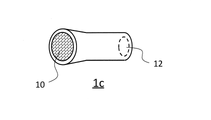
- FIG. 1 shows a capsule 1c, one embodiment of a flavor generating segment.
- the top surface 10 and the bottom surface 12 have a structure that allows gas to pass therethrough, and a filler is present inside.
- roasted coffee beans The flavor generating segment contains roasted coffee beans as a filler.
- Roasted coffee beans in the present invention preferably refer to coffee beans that have been roasted so as to be suitable for drinking.
- the roasted coffee beans preferably contain pulverized roasted coffee beans, and in one aspect consist of pulverized roasted coffee beans.
- Ground roasted coffee beans are granules obtained by grinding roasted coffee beans with a mill or the like. Roasting refers to heating and drying ingredients without using oil or water as a heat medium.
- the roasted coffee beans are also simply referred to as "coffee beans” unless otherwise specified. Roasting is classified into light roasting, medium roasting, and deep roasting depending on the degree of roasting, and any of them can be used in the present invention.
- the degree of roasting can be represented by the L value measured according to JIS Z 8729, and the L value of roasted coffee beans that can be used in the present invention is preferably 16.0 or more. Among them, it is preferable to use lightly roasted coffee beans. This is because off-note (stuffy smell) after storage can be suppressed.
- the L value of lightly roasted coffee beans measured according to JIS Z 8729 is preferably 24.0 or more, more preferably 25.0 or more.
- the particle size of the ground coffee beans is preferably 200-1000 ⁇ m, more preferably 600-850 ⁇ m.
- the particle size can be measured by a known method, but in the present invention, it is preferably measured using a sieve or by a laser diffraction method.
- a laser diffraction method is particularly preferred, and specifically, a laser diffraction particle size distribution analyzer can be used.
- coffee character refers to the aroma or flavor of coffee.
- the amount of coffee beans is preferably 50% by weight or more, 75% by weight or more, 90% by weight or more, 95% by weight or more, or 100% by weight of the dry matter weight of the filling.
- the upper limit is preferably 98% by weight or less, 95% by weight or less, or 90% by weight or less relative to the dry matter weight of the filling.
- the dry matter weight of the filling is preferably the weight of the residue when the filling is dried at 100° C. for 5 hours.
- coffee beans those normally used in the coffee industry can be used.
- the characteristics of each coffee bean that can be perceived when drunk can be enjoyed as a flavor.
- An example of coffee beans is shown in the table below.
- the flavor generating segment may contain tobacco material in addition to the coffee beans.
- Tobacco material is material derived from Nicotiana plants. Specific tobacco materials include chopped dried tobacco leaves, pulverized leaf tobacco, tobacco extracts (extracts with water, organic solvents, or mixed solutions thereof), and the like.
- Leaf tobacco pulverized material is particles obtained by pulverizing leaf tobacco.
- the pulverized leaf tobacco can have, for example, an average particle diameter D50 of preferably 30 to 120 ⁇ m, more preferably 50 to 100 ⁇ m. Pulverization can be performed using a known pulverizer, and may be dry pulverization or wet pulverization. Leaf tobacco pulverized products are therefore also referred to as leaf tobacco particles.
- the average particle diameter is determined by a laser diffraction/scattering method, and specifically measured using a laser diffraction particle size distribution analyzer (eg, Horiba LA-950).
- leaf tobacco belonging to the genus Nicotiana such as tabacum and rustica
- leaf tobaccos can be mixed and used.
- an appropriate blend of the above varieties can be used so as to obtain the desired taste.
- the tobacco material may be contained in the filler or may be contained in the wrapping material.
- the outer covering can include tobacco material by using a wrapper that includes tobacco material.
- the amount of tobacco material is preferably 2% by weight or more, 5% by weight or more, or 10% by weight or more relative to the dry matter weight of the filling.
- the upper limit is preferably 10% by weight or less, 5% by weight or less, or 2% by weight or less in the dry matter weight of the filling.
- the flavor generating segment may contain additives known as fillers.
- additives include perfumes, aerosol-forming bases, and the like.
- medium-chain fatty acids which generally enhance the storage stability of products, can be used as other ingredients, but they may generate aromas other than coffee and may inhibit the aroma of coffee, so medium-chain fatty acids should not be used.
- the flavor generating segment is provided with an exterior material.
- a capsule is mentioned as an exterior material.
- the capsule preferably has a columnar shape having a side surface, a bottom surface and a top surface, and the bottom surface and the top surface preferably have a structure through which gas can pass. In one aspect, the bottom and top surfaces of the capsule are perforated.
- the material of the capsule is not limited, it is preferably made of resin, for example. Capsules are suitable for non-combustible flavor inhalation articles with an aerosol-generating source upstream of the capsule.
- the exterior material may be a wrapper used in the relevant field.
- the wrapper includes paper, plastic film, and the like. Flavor generating segments whose exterior material is a wrapper are suitable for non-combustion flavor inhaling articles of the type in which the flavor generating segment is heated.
- the filling preferably comprises an aerosol-generating substrate.
- the type of aerosol-generating base material is not particularly limited, and substances extracted from various natural products or their constituent components can be selected according to the application.
- Specific examples of aerosol-forming substrates include, but are not limited to, polyhydric alcohols such as glycerin, propylene glycol, sorbitol, xylitol, erythritol, triacetin, 1,3-butanediol, and mixtures thereof. .
- the flavor-generating segment is preferably stored enclosed in a packaging material in order to prevent the flavor component from decreasing during storage.
- the packaging material is not limited as long as it is made of a material with low air permeability, but it is preferable to use a packaging material comprising a base material layer and a metal layer.
- the substrate layer is preferably a plastic film such as polypropylene or polyester.
- the metal layer is preferably metal foil such as aluminum foil. Both are laminates, and the metal layer is preferably present on the side where the flavor generating segment is encapsulated.
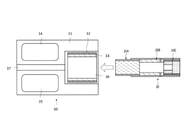
- FIG. 2(1) shows a preferred embodiment of a non-combustion flavor inhalation article.
- 10 is a non-burning flavor inhaling article
- 1c is a capsule that is a flavor generating segment
- 2 is an atomizing part
- 4 is an aerosol source
- 40 is an aerosol generating segment
- 5 is a mouthpiece
- 6 is a housing
- 8 is a power supply.
- the article is an article in which an aerosol is generated from an aerosol generation source arranged upstream of the flavor generating segment, and the aerosol carries the flavor component from the flavor generating segment to generate flavor.
- Capsule The capsule 1c is sealed so that gas can communicate between the outside and the inside.
- the aerosol generated from the aerosol source 4 is introduced into the container and is sealed so that it can pass from the container towards the mouthpiece end. For this reason, openings are preferably provided at both longitudinal ends of the container.
- the shape of the tobacco material is not limited, but it is preferably in the form of granules.
- Aerosol Source 4 can be configured by supporting the aforementioned aerosol-generating substrate on a porous body such as a fiber filler. Although the length of the aerosol source 4 is not limited, it is preferably 10-25 mm.
- the atomization section 2 can electrically heat the aerosol source 4 to about 200 to 300°C.
- An aerosol is generated by the heating, and the aerosol is introduced into the capsule 1c, passes through the filling while maintaining an atmosphere of 30 to 80° C., carries the flavor component, and is inhaled by the user.
- Combinations of non-combustion flavor inhalation articles and power sources are also referred to as non-combustion flavor inhalation systems.
- the atomizing part 4 may be, for example, a coil, and can generate an aerosol by electricity supplied from a power supply 8 as shown in FIG. 2(2). Such a system is disclosed, for example, in WO2016/075749.
- Mouthpiece The mouthpiece 5 may be equipped with a filter.
- Housing The housing 6 may be made of a known material, but is preferably made of polymer, for example.
- Fig. 3 (1) shows another preferred embodiment of the non-burning flavor inhaling article.
- the non-burning flavor inhalation article 20 includes a flavor generating segment 20A, a cylindrical cooling portion 20B having perforations on its circumference, and a filter portion 20C. Because the non-combustion flavor inhalation article 20 directly heats the flavor generating segment 20A, it is also referred to as a "non-combustion direct heating flavor inhalation article.”
- the non-burning flavor inhaling article 20 may have other members.
- the axial length of the non-burning flavor inhalation article 20 is not limited, it is preferably 40 to 90 mm, more preferably 50 to 75 mm, and even more preferably 50 to 60 mm or less.
- the circumference of the non-burning flavor inhalation article 20 is preferably 16 to 25 mm, more preferably 20 to 24 mm, even more preferably 21 to 23 mm.
- the length of the flavor generation segment 20A is 20 mm
- the length of the cooling section 20B is 20 mm
- the length of the filter section 20C is 7 mm.
- the length of each of these members can be changed as appropriate according to manufacturability, required quality, and the like.
- FIG. 3 shows a mode in which the first segment 25 is arranged, only the second segment 26 may be arranged on the downstream side of the cooling section 20B without arranging this.
- Flavor generation segment 20A Coffee beans can be used as the filling material 21 for the flavor generating segment 20A.
- the method of filling the filler 21 into the wrapping paper 22 is not particularly limited, but for example, coffee beans, preferably ground coffee beans, may be wrapped in the wrapping paper 22, and the coffee beans, preferably ground coffee beans, may be wrapped in the tubular wrapping paper 22. May be filled.
- the coffee-derived component and moisture contained in the filling 21 and, if the filling 21 contains an aerosol-generating base material are vaporized and provided for suction.
- Cooling section 20B It is preferable that the cooling part 20B is configured by a cylindrical member.
- the tubular member may be, for example, a paper tube 23 formed by processing cardboard into a cylindrical shape.
- Cooling section 20B may also be formed by a thin sheet of material that is crumpled and then pleated, gathered, or folded to form channels.
- a sheet material selected from the group consisting of polyethylene, polypropylene, polyvinyl chloride, polyethylene terephthalate, polylactic acid, cellulose acetate, and aluminum foil can be used.
- the total surface area of the cooling part 20B is appropriately prepared in consideration of the cooling efficiency, and can be, for example, 300 to 1000 mm 2 /mm.
- Cooling section 20B is preferably provided with perforations 24 . Due to the presence of the perforations 24, outside air is introduced into the cooling section 20B during suction. As a result, the vaporized aerosol component generated by the heating of the flavor generating segment 20A comes into contact with the outside air, and its temperature decreases, liquefying to form an aerosol.
- the diameter (spanning length) of the perforations 24 is not particularly limited, but may be, for example, 0.5 to 1.5 mm.
- the number of perforations 24 is not particularly limited, and may be one or two or more. For example, a plurality of perforations 24 may be provided on the circumference of the cooling section 20B.
- the cooling part 20B can be rod-shaped with an axial length of, for example, 7 to 28 mm.
- the axial length of the cooling part 20B can be 18 mm.
- the cooling portion 20B has a substantially circular axial cross-sectional shape, and can have a diameter of 5 to 10 mm.
- the diameter of the cooling section can be approximately 7 mm.
- Filter section 20C Although the configuration of the filter part 20C is not particularly limited, it may be composed of a single or a plurality of filling layers. The outer side of the packing layer may be wrapped with one or more wrapping papers.
- the ventilation resistance of the filter portion 20C can be appropriately changed depending on the amount, material, etc. of the filter filler filled in the filter portion 20C. For example, when the filter filling material is cellulose acetate fiber, the ventilation resistance can be increased by increasing the amount of cellulose acetate fiber with which the filter portion 20C is filled. When the filter packing is cellulose acetate fibers, the packing density of the cellulose acetate fibers can be from 0.13 to 0.18 g/cm 3 .
- the airflow resistance is a value measured by an airflow resistance measuring instrument (trade name: SODIMAX, manufactured by SODIM).
- the length of the circumference of the filter portion 20C is not particularly limited, it is preferably 16 to 25 mm, more preferably 20 to 24 mm, even more preferably 21 to 23 mm.
- the length of the filter part 20C in the axial direction can be selected from 4 to 10 mm, and is selected so that the ventilation resistance is 15 to 60 mmH 2 O/seg.
- the axial length of the filter portion 20C is preferably 5 to 9 mm, more preferably 6 to 8 mm.
- the shape of the cross section of the filter portion 20C is not particularly limited, and may be, for example, circular, elliptical, polygonal, or the like.
- destructible capsules containing perfume, perfume beads, and perfume may be directly added to the filter portion 20C.
- the filter part 20C may have a center hole part as the first segment 25.
- the center hole portion is composed of a first filling layer 25a having one or more hollow portions and an inner plug wrapper (inner wrapping paper) 25b covering the filling layer.
- the center hole portion has a function of increasing the strength of the mouthpiece portion.
- the center hole portion does not have the inner plug wrapper 25b, and the shape may be maintained by thermoforming.
- the filter portion 20C may have a second segment 26 .
- the second segment 26 is composed of a second filling layer 26a and an inner plug wrapper (inner wrapping paper) 26b covering the filling layer.
- the second filling layer 26a has an inner diameter of ⁇ 5.0 to ⁇ 1.0 mm, for example, filled with cellulose acetate fibers at a high density and hardened by adding 6 to 20% by weight of a plasticizer containing triacetin to the weight of the cellulose acetate. It can be a rod. Since the second packed layer has a high packing density of fibers, air and aerosol flow only in the hollow portion during suction, and hardly flow in the second packed layer. Since the second filling layer inside the center hole portion is a fiber filling layer, the feeling of touch from the outside during use does not make the user feel uncomfortable.
- the first filling layer 25a and the second filling layer 26a are connected by an outer plug wrapper (outer wrapping paper) 27.
- the outer plug wrapper 27 can be, for example, a cylinder of paper.
- the flavor generation segment 20A, the cooling section 20B, and the already connected first and second filling layers 25a and 26a are connected by a mouthpiece lining paper 28. As shown in FIG. These connections can be made, for example, by applying paste such as vinyl acetate paste to the inner surface of the mouthpiece lining paper 28 and winding the three members. These members may be connected in a plurality of times with a plurality of lining papers.
- the filter section 20C may not be provided in the present invention.
- a combination of a non-combustion flavor inhalation article and a heating device for generating an aerosol is also called a non-combustion heating flavor inhalation system.
- a non-combustion heating flavor inhalation system comprises a non-combustion flavor inhalation article 20 and a heating device 30 for externally heating the flavor generating segment 20A.
- the heating device 30 includes a body 31, a heater 32, a metal tube 33, a battery unit 34, and a control unit 35.
- the body 31 has a cylindrical recess 36, and a heater 32 and a metal tube 33 are arranged at positions corresponding to the flavor generating segments 20A inserted therein.
- the heater 33 can be a heater using electric resistance, and electric power is supplied from the battery unit 34 according to an instruction from the control unit 35 for temperature control, and the heater 32 is heated.
- the heat emitted from the heater 32 is transmitted to the flavor generating segment 20A through the metal pipe 33 with high thermal conductivity.
- the heating device 30 may heat the flavor generating segment 20A from the inside.
- the heating temperature of the heating device 30 is not particularly limited, but is preferably 400°C or less, more preferably 150 to 400°C, and even more preferably 200 to 350°C.
- the heating temperature indicates the temperature of the heater of the heating device 30 .
- the flavor generating segment 20A is heated to about 200-350.degree.
- the flavor generating segment 20A may be heated from the inside.
- a needle-type or blade-type heater may be inserted inside the flavor generating segment 20A to heat the segment.
- Example 1 Commercially available roasted coffee beans shown in Table 2 were prepared and ground using a mill. Next, a non-combustion heating type flavor inhalation article (Ploom Tech (registered trademark), manufactured by Japan Tobacco Inc.) as shown in FIG. 2 was prepared. A tobacco capsule was taken out from the product, and the tobacco granules filled in the capsule were replaced with the ground coffee beans. The capsules filled with the ground coffee beans were placed in the non-combustion heated flavor inhalation articles and subjected to a smoking test by well-trained panelists. Table 2 shows the results. It was confirmed that the characteristics of coffee beans when drunk as a beverage can also be reproduced by smoking a non-combustion heating type flavor inhalation article.
- Ploom Tech registered trademark
- FIG. 2 shows the results. It was confirmed that the characteristics of coffee beans when drunk as a beverage can also be reproduced by smoking a non-combustion heating type flavor inhalation article.
- Example 2 The ground coffee beans of Colombian Arabica were prepared with different degrees of roasting (light roasting L value 24, deep roasting L value 16, medium roasting L value 20). Three capsules were prepared, and each capsule was filled with ground coffee beans. Each capsule was stored under the following conditions. A smoking test was conducted in the same manner as in Example 1 using the stored capsules. Storage conditions: A constant temperature and humidity chamber (manufactured by Espec Co., Ltd., product name “Platinous”, model/Model “PR-3J”) is used. 20 days at 40°C/60% humidity (assuming 8 months of storage under normal conditions).
- Capsules filled with the following fillings were prepared.
- Capsule 3X 200 mg ground roasted Colombian Arabica coffee beans
- Capsule 3Y 200 mg ground roasted Vietnamese canephora coffee beans
- Each of these capsules was placed in a commercially available polypropylene bag, and the bag was sealed.
- Each bag was stored under the following conditions. Storage conditions: Use the aforementioned constant temperature and humidity chamber. 16 days at 40°C/60% humidity (assuming 6.5 months of storage under normal conditions). After storage, each capsule was removed from the bag and subjected to smoking test in the same manner as in Example 1. As a result, for all capsules, the top note (coffee aroma) was slightly weak, but no off note (stuffy smell) was felt.
- Capsules filled with the following fillings were prepared.
- Capsules 4X-7X 250 mg ground roasted Colombian Arabica coffee beans of particle size shown in Table 4
- Capsules 4Y-7Y 250 mg of ground roasted Vietnamese canephora coffee beans of particle size shown in Table 4
- the 8 capsules thus obtained were placed in a blister pack (packaging material comprising a PET layer and an aluminum layer) and the bag was sealed.
- Each bag was stored under the following conditions. Storage conditions: Use the aforementioned constant temperature and humidity chamber. 15 days and 30 days at 40°C/60% humidity (assuming 6 months storage under normal conditions and 12 months storage under normal conditions). After storage, each capsule was removed from the bag and subjected to smoking test in the same manner as in Example 1.
- Table 4 shows the results. When the ground coffee beans had a particle size of 600 ⁇ m or more, excellent coffee characters were exhibited. In addition, when the particle size was less than 600 ⁇ m, it was felt that it was a little difficult to suck, and the impression was that the coffee character was weakened.
- Coffee beans other than the above were also evaluated in the same manner as in Example 4, and it was confirmed that the same results as in Example 4 were obtained.
- the particle size of the ground coffee beans was measured using a laser diffraction particle size distribution analyzer (MASTERSIZER 3000 manufactured by Malvern).
Landscapes
- Cigarettes, Filters, And Manufacturing Of Filters (AREA)
Priority Applications (2)
| Application Number | Priority Date | Filing Date | Title |
|---|---|---|---|
| CN202280038887.6A CN117396086A (zh) | 2021-06-29 | 2022-03-29 | 包括烘焙咖啡豆的香味产生节段 |
| JP2023531447A JP7642816B2 (ja) | 2021-06-29 | 2022-03-29 | 焙煎コーヒー豆を含む香味発生セグメント |
Applications Claiming Priority (2)
| Application Number | Priority Date | Filing Date | Title |
|---|---|---|---|
| JP2021107775 | 2021-06-29 | ||
| JP2021-107775 | 2021-06-29 |
Publications (1)
| Publication Number | Publication Date |
|---|---|
| WO2023276378A1 true WO2023276378A1 (ja) | 2023-01-05 |
Family
ID=84692646
Family Applications (1)
| Application Number | Title | Priority Date | Filing Date |
|---|---|---|---|
| PCT/JP2022/015267 Ceased WO2023276378A1 (ja) | 2021-06-29 | 2022-03-29 | 焙煎コーヒー豆を含む香味発生セグメント |
Country Status (3)
| Country | Link |
|---|---|
| JP (1) | JP7642816B2 (https=) |
| CN (1) | CN117396086A (https=) |
| WO (1) | WO2023276378A1 (https=) |
Citations (3)
| Publication number | Priority date | Publication date | Assignee | Title |
|---|---|---|---|---|
| WO2010147222A1 (ja) * | 2009-06-19 | 2010-12-23 | キリンビバレッジ株式会社 | 呈味増強組成物とその製造方法 |
| WO2016075749A1 (ja) * | 2014-11-10 | 2016-05-19 | 日本たばこ産業株式会社 | カートリッジ及び非燃焼型香味吸引器 |
| WO2020204038A1 (ja) * | 2019-04-01 | 2020-10-08 | 株式会社 東亜産業 | スティック型被加熱芳香発生基材組成物、その組成物を用いたスティック型被加熱芳香発生基材、及び、そのスティック型被加熱芳香発生基材を用いた芳香カートリッジ |
Family Cites Families (2)
| Publication number | Priority date | Publication date | Assignee | Title |
|---|---|---|---|---|
| CN105146750A (zh) * | 2015-07-09 | 2015-12-16 | 保山云潞咖啡产业开发有限责任公司 | 一种咖啡香烟过虑嘴及其制备方法 |
| CN210869845U (zh) * | 2019-10-04 | 2020-06-30 | 深圳市乐云天科技有限公司 | 一种加热不燃烧新型咖啡烟支 |
-
2022
- 2022-03-29 CN CN202280038887.6A patent/CN117396086A/zh active Pending
- 2022-03-29 JP JP2023531447A patent/JP7642816B2/ja active Active
- 2022-03-29 WO PCT/JP2022/015267 patent/WO2023276378A1/ja not_active Ceased
Patent Citations (3)
| Publication number | Priority date | Publication date | Assignee | Title |
|---|---|---|---|---|
| WO2010147222A1 (ja) * | 2009-06-19 | 2010-12-23 | キリンビバレッジ株式会社 | 呈味増強組成物とその製造方法 |
| WO2016075749A1 (ja) * | 2014-11-10 | 2016-05-19 | 日本たばこ産業株式会社 | カートリッジ及び非燃焼型香味吸引器 |
| WO2020204038A1 (ja) * | 2019-04-01 | 2020-10-08 | 株式会社 東亜産業 | スティック型被加熱芳香発生基材組成物、その組成物を用いたスティック型被加熱芳香発生基材、及び、そのスティック型被加熱芳香発生基材を用いた芳香カートリッジ |
Also Published As
| Publication number | Publication date |
|---|---|
| JP7642816B2 (ja) | 2025-03-10 |
| CN117396086A (zh) | 2024-01-12 |
| JPWO2023276378A1 (https=) | 2023-01-05 |
Similar Documents
| Publication | Publication Date | Title |
|---|---|---|
| KR102592684B1 (ko) | 담배 무스 | |
| US20260083162A1 (en) | Hot Pressed Tobacco Substrate | |
| JP7493600B2 (ja) | 非燃焼系エアロゾル供給システムに使用するための物品 | |
| CN115397267B (zh) | 用于不可燃气溶胶供应设备的包含两种不同的气溶胶产生材料的消耗品 | |
| JP7771262B2 (ja) | エアロゾル供給システムで使用するための物品 | |
| KR20210135299A (ko) | 담배 성분 및 에어로졸 생성 재료를 포함하는 담배 조성물 | |
| JP2023535333A (ja) | エアロゾル供給システム用の消耗品 | |
| KR20220006618A (ko) | 비-가연성 에어로졸 제공 시스템에서 사용하기 위한 물품 | |
| JP7747818B2 (ja) | エアロゾル供給システムで使用するための物品 | |
| JP2024105528A (ja) | エアロゾル送達システムで使用するための物品向けの構成要素 | |
| JP2023525800A (ja) | 難燃剤を備えたエアロゾル発生物品 | |
| JP2023525802A (ja) | 燃焼防止ラッパーを有するエアロゾル発生物品 | |
| JP2023526256A (ja) | 難燃性ラッパーを備える改良型エアロゾル発生物品 | |
| JP7481451B2 (ja) | 非燃焼系エアロゾル供給システム | |
| JP2023538239A (ja) | 物品 | |
| JP2025143416A (ja) | エアロゾル供給システムで使用するための物品 | |
| KR20240021966A (ko) | 물품을 위한 구성요소 및 비가연성 에어로졸 제공 시스템에서 사용하기 위한 물품 | |
| JP2025157584A (ja) | 飽和脂肪酸系添加剤を含むたばこ組成物 | |
| JP7642816B2 (ja) | 焙煎コーヒー豆を含む香味発生セグメント | |
| JP7755665B2 (ja) | 不燃式エアロゾル供給デバイスと共に用いるための構成要素 | |
| JP2025534015A (ja) | 消耗品 | |
| KR20240053036A (ko) | 키토산 및 부가적인 결합제를 포함하는 에어로졸 생성 재료 | |
| CN115023152A (zh) | 气溶胶生成 | |
| JP7809810B2 (ja) | 物品 | |
| JP2025038251A (ja) | たばこ幹原料を含有するたばこ材料 |
Legal Events
| Date | Code | Title | Description |
|---|---|---|---|
| 121 | Ep: the epo has been informed by wipo that ep was designated in this application |
Ref document number: 22832539 Country of ref document: EP Kind code of ref document: A1 |
|
| WWE | Wipo information: entry into national phase |
Ref document number: 202280038887.6 Country of ref document: CN |
|
| WWE | Wipo information: entry into national phase |
Ref document number: 2023531447 Country of ref document: JP |
|
| NENP | Non-entry into the national phase |
Ref country code: DE |
|
| 122 | Ep: pct application non-entry in european phase |
Ref document number: 22832539 Country of ref document: EP Kind code of ref document: A1 |