WO2023276049A1 - 店舗データ処理装置、店舗データ処理方法、及びプログラム - Google Patents
店舗データ処理装置、店舗データ処理方法、及びプログラム Download PDFInfo
- Publication number
- WO2023276049A1 WO2023276049A1 PCT/JP2021/024774 JP2021024774W WO2023276049A1 WO 2023276049 A1 WO2023276049 A1 WO 2023276049A1 JP 2021024774 W JP2021024774 W JP 2021024774W WO 2023276049 A1 WO2023276049 A1 WO 2023276049A1
- Authority
- WO
- WIPO (PCT)
- Prior art keywords
- data
- store
- relevance
- period
- sales
- Prior art date
- Legal status (The legal status is an assumption and is not a legal conclusion. Google has not performed a legal analysis and makes no representation as to the accuracy of the status listed.)
- Ceased
Links
Images





Classifications
-
- G—PHYSICS
- G06—COMPUTING OR CALCULATING; COUNTING
- G06Q—INFORMATION AND COMMUNICATION TECHNOLOGY [ICT] SPECIALLY ADAPTED FOR ADMINISTRATIVE, COMMERCIAL, FINANCIAL, MANAGERIAL OR SUPERVISORY PURPOSES; SYSTEMS OR METHODS SPECIALLY ADAPTED FOR ADMINISTRATIVE, COMMERCIAL, FINANCIAL, MANAGERIAL OR SUPERVISORY PURPOSES, NOT OTHERWISE PROVIDED FOR
- G06Q30/00—Commerce
- G06Q30/06—Buying, selling or leasing transactions
- G06Q30/0601—Electronic shopping [e-shopping]
- G06Q30/0641—Electronic shopping [e-shopping] utilising user interfaces specially adapted for shopping
-
- G—PHYSICS
- G06—COMPUTING OR CALCULATING; COUNTING
- G06Q—INFORMATION AND COMMUNICATION TECHNOLOGY [ICT] SPECIALLY ADAPTED FOR ADMINISTRATIVE, COMMERCIAL, FINANCIAL, MANAGERIAL OR SUPERVISORY PURPOSES; SYSTEMS OR METHODS SPECIALLY ADAPTED FOR ADMINISTRATIVE, COMMERCIAL, FINANCIAL, MANAGERIAL OR SUPERVISORY PURPOSES, NOT OTHERWISE PROVIDED FOR
- G06Q30/00—Commerce
- G06Q30/02—Marketing; Price estimation or determination; Fundraising
-
- G—PHYSICS
- G06—COMPUTING OR CALCULATING; COUNTING
- G06Q—INFORMATION AND COMMUNICATION TECHNOLOGY [ICT] SPECIALLY ADAPTED FOR ADMINISTRATIVE, COMMERCIAL, FINANCIAL, MANAGERIAL OR SUPERVISORY PURPOSES; SYSTEMS OR METHODS SPECIALLY ADAPTED FOR ADMINISTRATIVE, COMMERCIAL, FINANCIAL, MANAGERIAL OR SUPERVISORY PURPOSES, NOT OTHERWISE PROVIDED FOR
- G06Q30/00—Commerce
- G06Q30/06—Buying, selling or leasing transactions
Definitions
- the present invention relates to a store data processing device, a store data processing method, and a program.
- Patent Document 1 discloses a prediction model that reduces opportunity loss.
- This prediction model calculates a predicted value of product demand using demand information indicating past sales of products in a store and external information regarding the sales.
- the external information includes, for example, time or time period, day of the week or holiday, temperature, weather, and number of visitors.
- Patent Document 2 calculates the expected profit for each product up to a specific number of products based on the sales performance data in the most recent past period, and the calculation results for all products are targeted. are sorted in descending order of expected profit, and the optimum order pattern is calculated based on the result of this sorting.
- the store clerk decides the number of products to purchase and the number of meals to be cooked in the store. For this reason, it is important to let the store clerk recognize the appropriateness of the number of products purchased and the number of meals prepared in the store.
- One example of the object of the present invention is to make it easier for store employees to recognize the validity of the number of products purchased and the number of meals cooked in the store.
- sales data for acquiring sales data indicating at least one of the number of sales and the number of preparations of products in a first store for each unit period, and disposal data indicating the number of discarded products for each unit period.
- acquisition means Customer data acquisition means for acquiring customer data indicating at least one of the number of customers at the first store and traffic volume in a first area including the first store for each unit period;
- relevance data generation means for generating relevance data indicating the relevance of the sales data, the disposal data, and the customer data, and displaying the relevance data on a display;
- a store data processing device is provided.
- assumed data acquisition for acquiring assumed data including at least one of an assumed number of customers at a first store and an assumed traffic volume in a first area including the first store in a first period in the future means and At least one of the actual number of customers of the second store and the actual traffic volume of the second area including the second store in the past and having the same attributes as the first period, and cooking at the second store performance data acquisition means for acquiring performance data including at least one of the number of products sold and the number of products prepared; recommended number specifying means for specifying a recommended number indicating the number of products to be prepared at the first store in the first period using the assumed data and the actual data;
- a store data processing device is provided.
- a computer is configured to: a sales data acquisition process for acquiring sales data indicating at least one of the number of products sold and the number of preparations in the first store for each unit period, and disposal data indicating the number of discarded products for each unit period; Customer data acquisition processing for acquiring customer data indicating at least one of the number of customers at the first store and traffic volume in a first area including the first store for each unit period; relevance data generation processing for generating relevance data indicating the relevance of the sales data, the disposal data, and the customer data, and displaying the relevance data on a display; There is provided a store data processing method for performing
- a computer is configured to: Estimated data acquisition processing for acquiring estimated data including at least one of the estimated number of customers of the first store and the estimated traffic volume of the first area including the first store in a first period that is the future; At least one of the actual number of customers of the second store and the actual traffic volume of the second area including the second store in the past and having the same attributes as the first period, and cooking at the second store performance data acquisition processing for acquiring performance data including at least one of the number of products sold and the number of products prepared; a recommended number specifying process for specifying a recommended number indicating the number of products to be prepared at the first store in the first period using the assumed data and the actual data; There is provided a store data processing method for performing
- the computer is configured to: a sales data acquisition function for acquiring sales data indicating at least one of the number of products sold and the number of preparations in the first store for each unit period, and disposal data indicating the number of discarded products for each unit period; a customer data acquisition function for acquiring customer data indicating at least one of the number of customers at the first store and traffic volume in a first area including the first store for each unit period; a relationship data generation function for generating relationship data indicating relationships among the sales data, the disposal data, and the customer data, and displaying the relationship data on a display;
- a program is provided to have a sales data acquisition function for acquiring sales data indicating at least one of the number of products sold and the number of preparations in the first store for each unit period, and disposal data indicating the number of discarded products for each unit period;
- the computer is configured to: An assumed data acquisition function for acquiring assumed data including at least one of an assumed number of customers at a first store and an assumed traffic volume in a first area including the first store in a first period in the future; At least one of the actual number of customers of the second store and the actual traffic volume of the second area including the second store in the past and having the same attributes as the first period, and cooking at the second store a performance data acquisition function for acquiring performance data including at least one of the number of products sold and the number of products prepared; A recommended number specifying function for specifying a recommended number indicating the number of products to be prepared at the first store in the first period using the assumed data and the actual data; A program is provided to have a
- the store clerk can easily recognize the validity of the number of items purchased and the number of items cooked in the store.
- FIG. 5 is a diagram showing an example of a screen displayed on a display by a relevance data generation unit; It is a figure for demonstrating the selection method of several similar shops. It is a figure for demonstrating an example of location conditions.
- 3 is a diagram showing a modified example of the data display column shown in FIG. 2; FIG. It is a figure which shows an example of the selection method of a 2nd shop. It is a figure which shows an example of the selection method of a 2nd shop. It is a figure which shows the hardware structural example of a store data processing apparatus. It is a flowchart which shows an example of the process which a store data processing apparatus performs. It is a figure showing an example of functional composition of a shop data processor concerning a 2nd embodiment.
- FIG. 1 is a diagram showing an example of the functional configuration of a store data processing device 10 according to this embodiment.
- the store data processing device 10 displays on the display 140 at least one of the number of sales and the number of preparations of products, such as food, and the number of discards of the products at the target store (hereinafter referred to as the first store). Let At this time, the store data processing device 10 also displays the number of visitors to the first store or the traffic volume around the first store.
- the number of sales should be any information that can identify the number of products sold.
- the number of sales may be the number of commodities sold, or the amount of the commodities sold (that is, the amount of sales).
- An example of the number of preparations is the number of purchases.
- the target product is food that is cooked in the store
- the number of preparations is the number of times the product is cooked.
- the number of preparations may be any information that can specify the number of prepared products.
- the number of preparations may be the number of commodities prepared or the price of the commodities prepared.
- the number of disposals may be any information that can identify the number of discarded products.
- the number of disposals may be the number of discarded commodities itself, or the disposal amount of the discarded commodities.
- the store data processing device 10 includes a sales data acquisition unit 110, a customer data acquisition unit 120, and a relationship data generation unit 130. In addition, the store data processing device 10 can use information stored in the storage unit 150 .
- the storage unit 150 may be part of the store data processing device 10 or may be located outside the store data processing device 10 .
- the sales data acquisition unit 110 acquires sales data and disposal data.
- the sales data indicates at least one of the number of products sold and the number of products prepared at the first store for each unit period.
- the discard data indicates the number of discarded products for each unit period.
- the unit period may be, for example, quarterly, monthly, weekly, or daily. If the unit period is in days, the sales data and disposal data may further indicate the respective numbers for each time period.
- the sales data and disposal data include each number of a predetermined period (hereinafter referred to as a target period) that is longer than the unit period described above. This target period includes a plurality of unit periods described above. When the unit period is quarterly or monthly, an example of the target period is one year.
- the unit period is weekly, an example of the target period is a month or a quarter. Also, when the unit period is a day unit, an example of the target period is a week or a month. Sales data and disposal data are stored in the storage unit 150 .
- the sales data acquisition unit 110 acquires from the salesclerk information designating the product for which sales data and disposal data are to be obtained (hereinafter referred to as product designation information). That is, the sales data acquisition unit 110 also serves as a product specification acquisition unit that acquires product specification information. The sales data acquisition unit 110 further acquires information designating the above-described predetermined period (hereinafter referred to as period designation information) from the store clerk.
- the customer data acquisition unit 120 acquires customer data.
- the customer data indicates at least one of the number of customers at the first store and the traffic volume in the first area for each unit period.
- the first area is an area including the first store, and is an area within a predetermined time (for example, within 10 minutes) from the store on foot.
- Customer data is stored in the storage unit 150 .
- the unit period used here is the same as the unit period used for the sales data and disposal data.
- the customer data includes each number of the target period described above.
- the relevance data generation unit 130 generates relevance data.
- the relevance data is data for making the store clerk recognize the relevance of the sales data, the disposal data, and the customer data in the target period, and indicates, for example, these relevance.
- the relevance data generation unit 130 then causes the display 140 to display this relevance data.
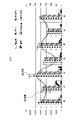
- FIG. 2 is a diagram showing an example of a screen displayed on the display 140 by the relevance data generation unit 130. As shown in FIG. This screen has a period selection field 202 , a product selection field 204 and a data display field 210 .
- the period selection field 202 is a field for the store clerk to enter period designation information.
- the period selection column 202 allows selection of the month and day that are the starting point and the ending point of the target period.
- the product selection column 204 is a column for the clerk to select the product for which the sales data and disposal data are to be confirmed. A plurality of products can be selected in the product selection column 204 .
- the sales data acquisition unit 110 then acquires information indicating the product selected in the product selection field 204 as product designation information.
- the data display column 210 is a column in which relevance data is displayed.
- the relevance data indicates changes in at least one of the number of customers and traffic volume, at least one of the number of sales and the number of preparations, and the number of disposals.
- the relevance data includes a graph that simultaneously shows the number of sales (the amount of sales in the example of this figure), the number of disposals (the amount of disposal in the example of this figure), and the number of customers.
- the horizontal axis is the unit period. That is, this graph shows each number for each unit period.
- the number of sales and the number of disposals are indicated by bar graphs, and the number of customers is indicated by line graphs.
- the graph format is not limited to this example.
- the unit period is in units of days.
- the horizontal axis of the graph is the day of the week. That is, from this graph, it is possible to recognize the relationship between at least one of the number of customers and traffic volume, at least one of the number of sales and the number of preparations, and the number of disposals for each day of the week.
- the store clerk can recognize the attribute (for example, the day of the week or the time period) of the unit period in which the number of customers is large but the sales are small. In such a unit period, if the number of prepared products is increased, there is a possibility that the sales amount of the product will also increase. Therefore, the store clerk considers increasing the number of preparations for the unit period having the same attribute as the unit period.
- the store clerk can recognize the attributes (for example, the day of the week or time period) of the unit period in which the number of customers is small and the number of discards is large. In such a unit period, even if the number of products prepared is reduced, there is a possibility that the sales amount of the product will not decrease. Therefore, the store clerk considers reducing the number of preparations for the unit period that has the same attributes as the unit period.
- the attributes for example, the day of the week or time period
- the relevance data generation unit 130 preferably displays a unit period satisfying a predetermined condition (hereinafter referred to as a specific period) in a manner different from the other unit periods.
- the specific period may be indicated by a pattern or color different from other periods, or may be given a specific mark, frame, or characters. This makes it easier for the store clerk to recognize the specific period.
- An example of a predetermined condition is "necessary to change the number of preparations". Changes here may be an increase or a decrease.
- the predetermined condition is at least one of the following. 1) The ratio of at least one of the number of customers and traffic volume to at least one of the number of sales and the number of preparations must meet the standards 2) The discarded data must meet the standards
- This ratio is, for example, that this ratio deviates from the standard range.
- This reference range is determined, for example, using the actual values of a plurality of stores (hereinafter referred to as similar stores) whose conditions are similar to the first store. A specific example of "similar conditions" will be described later.
- the above 2) is, for example, that the discarded data is equal to or greater than the standard value.
- This reference value is also determined using, for example, actual values of a plurality of similar stores.
- the store data processing device 10 may be installed in the first store, or may be installed in a management center that manages multiple stores. In the latter case, display 140 is connected to a terminal installed at the first store. The relevance data generator 130 then transmits the relevance data to the store terminal.
- FIG. 3 is a diagram for explaining a method of selecting similar stores from multiple stores.
- a plurality of stores are pre-clustered using a plurality of conditions.
- the clustering population is, for example, stores with similar location conditions within the local government (prefecture or municipality) to which the first store belongs. Then, each of the plurality of shops belonging to the same cluster as the first shop is selected as a similar shop. Information specifying this population is stored in the storage unit 150 .
- the conditions used for clustering relate to sales trends.
- An example of conditions related to sales trends are the number of customers and the amount of sales.
- the sales amount may be the sales amount for each store, or may be the sales amount for the product indicated by the product designation information.
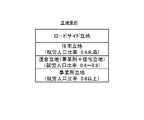
- FIG. 4 is a diagram for explaining an example of location conditions. Location conditions are first classified according to whether or not the facility is located on the roadside, for example, whether or not it faces a main road. In addition, stores not located on the roadside are further classified using the working population ratio.
- An example of the working population ratio is "working population around the store"/"(number of households around the store) + (working population around the store)". Note that "around the store” means being within a certain range from the store, for example, being within a predetermined time on foot from the store.
- stores that are not located on the roadside are classified into one of three groups: residential location, mixed location, and business location.
- FIG. 5 is a diagram showing a modification of the data display field 210 shown in FIG.
- the relevance data generation unit 130 causes the data display field 210 to further display information that can specify the recommended number of preparations in the specific period.
- the relevance data generator 130 calculates the number of recommendations for each of a plurality of unit periods included in the graph. A method for calculating this recommended number will be described later.
- the relevance data generation unit 130 also displays this number of recommendations on the graph.
- the recommended number is shown in the same manner as the sold number and discarded number, for example, in a bar graph.
- the relevance data generation unit 130 displays information indicating the difference (hereinafter referred to as difference information) in the graph for the unit period in which the difference between the recommended number and the prepared number is equal to or greater than the reference value.
- difference information is displayed as a bar that fills in the difference above the bar graph of the number of preparations and the number of recommendations, whichever is smaller.
- the relevance data generating unit 130 displays the difference in different modes depending on whether the number of preparations is less than the recommended number or when the number of preparations is greater than the recommended number. Aspects herein include at least one of color, pattern, and outline.
- the relevance data generation unit 130 calculates the number of recommendations from a plurality of shops (hereinafter referred to as the second store). Specifically, the relevance data generation unit 130 calculates the number of recommendations by multiple regression analysis using the actual values of the second store.
- the objective variable is the number of sales (for example, the number of sales by time period).
- An example of an explanatory variable is the attribute of the unit period (for example, day of the week), the number of customers, and the traffic volume of the area to which the store belongs. Data used for this multiple regression analysis is stored in the storage unit 150 .
- assumed data including at least one of the number of customers in the unit period of the first store and the traffic volume in the first area is required.
- the relevance data generator 130 calculates this assumed data using the past number of customers and the actual traffic volume in the first area.
- the record used here is the record of a period (for example, the same day of the week) having the same attributes as the unit period.
- the number of the second stores may be one or plural.
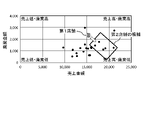
- FIG. 6 shows the result of plotting a plurality of stores belonging to the same cluster as the first store (that is, a plurality of similar stores) on a graph having two axes of sales amount and disposal amount.
- the sales amount and disposal amount relate to the product indicated by the product designation information.
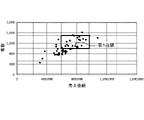
- the relevance data generation unit 130 selects a plurality of similar stores having a sales amount higher than that of the first store and a disposal amount lower than that of the first store as candidates for the second store.
- the relevance data generation unit 130 selects, as the second store, a store whose sales trend by time period is similar to that of the first store among the selected candidates, as shown in FIG.
- the relevance data generation unit 130 determines that the degree of similarity is high when the time slots with the highest number of sales are the same in both daytime and nighttime.
- the relevance data generation unit 130 selects the store with the highest similarity as the second store.
- the number of shops selected here may be one or plural.
- the relevance data generation unit 130 generates the relevance data (for example, graph) similar to that of the first store for the above-described second store as well. It may be displayed in the data display field 210 at the same time. In this case, the sales data acquisition unit 110 and the customer data acquisition unit 120 perform the same processing for the second store as for the first store.
- the graph related to the second store may not include information that can specify the number of recommendations.
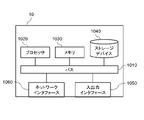
- FIG. 8 is a diagram showing a hardware configuration example of the shop data processing device 10. As shown in FIG. Store data processing device 10 has bus 1010 , processor 1020 , memory 1030 , storage device 1040 , input/output interface 1050 and network interface 1060 .
- the bus 1010 is a data transmission path for the processor 1020, the memory 1030, the storage device 1040, the input/output interface 1050, and the network interface 1060 to exchange data with each other.
- the method of connecting processors 1020 and the like to each other is not limited to bus connection.
- the processor 1020 is a processor realized by a CPU (Central Processing Unit), a GPU (Graphics Processing Unit), or the like.
- the memory 1030 is a main memory implemented by RAM (Random Access Memory) or the like.
- the storage device 1040 is an auxiliary storage device realized by a HDD (Hard Disk Drive), SSD (Solid State Drive), memory card, ROM (Read Only Memory), or the like.
- the storage device 1040 stores program modules that implement each function of the store data processing apparatus 10 (for example, the sales data acquisition unit 110, the customer data acquisition unit 120, and the relationship data generation unit 130). Each function corresponding to the program module is realized by the processor 1020 reading each program module into the memory 1030 and executing it.
- the storage device 1040 also functions as the storage unit 150 .
- the input/output interface 1050 is an interface for connecting the store data processing device 10 and various input/output devices.
- the store data processing device 10 communicates with the display 140 via the input/output interface 1050 .
- the network interface 1060 is an interface for connecting the shop data processing device 10 to the network.
- This network is, for example, a LAN (Local Area Network) or a WAN (Wide Area Network).
- a method for connecting the network interface 1060 to the network may be a wireless connection or a wired connection.
- FIG. 9 is a flowchart showing an example of processing performed by the store data processing device 10.
- the store data processing device 10 displays an initial screen. This screen includes, for example, the period selection field 202 and the product selection field 204 shown in FIG.
- the store clerk of the first store inputs product designation information and period designation information to the store data processing device 10 via the period selection field 202 and the product selection field 204 (step S10).
- the sales data acquisition unit 110 acquires the sales data and disposal data of the product corresponding to the product designation information from the storage unit 150.
- the sales data and disposal data acquired here are data for the period indicated by the period designation information.
- the customer data acquisition unit 120 also acquires customer data for the period indicated by the period designation information from the storage unit 150 (step S20).
- the relevance data generation unit 130 generates relevance data using the sales data, disposal data, and customer data acquired in step S20 (step S30), and causes the display 140 to display this relevance data (step S40).
- a store clerk at the first store recognizes the relevance data by looking at the display 140 .
- the store data processing device 10 generates relationship data indicating the relationship between the sales data, disposal data, and customer data of the first store, and displays the relationship data on the display 140. Let Therefore, the salesclerk of the first store can easily recognize the validity of the number of products prepared, for example, the number of purchases and the number of preparations.
- the relevance data generation unit 130 also causes the display 140 to display the recommended number of products to be prepared. Therefore, the store clerk at the first store can more easily recognize the validity of the number of products prepared. Also, by looking at the display 140, the store clerk can easily recognize whether or not it is necessary to change the number of products to be prepared.
- FIG. 10 is a diagram showing an example of the functional configuration of the store data processing device 30 according to this embodiment.
- the store data processing device 30 shown in this figure calculates the number of recommendations described using FIG. 5 of the first embodiment, but does not generate relevance data.
- the store data processing device 30 has an assumed data acquisition unit 310 , a performance data acquisition unit 320 , and a recommended number identification unit 330 .
- the estimated data acquisition unit 310 acquires data including at least one of the estimated number of customers of the first store and the estimated traffic volume of the first area in the unit period for which the recommended number is calculated (hereinafter referred to as the first period). .
- This data is the same as the assumed data described using FIG. 5 in the first embodiment. Since the first period is in the future, there are no actual values for the number of customers and traffic volume. Therefore, the assumed data acquisition unit 310 calculates assumed data using at least one of the past number of customers and the traffic volume in the first area, similarly to the relationship data generation unit 130 of the first embodiment.
- the track record used here is the track record of a period having the same attribute as the first period.
- the performance data acquisition unit 320 acquires the performance data of the second store in the past and in the second period having the same attributes (for example, at least one of the day of the week and the time period) as the first period.
- the second store is as described using FIG. 5 in the first embodiment. That is, the performance data acquisition unit 320 can use the result of clustering a plurality of shops. An example of this clustering is as described with reference to FIG. Then, the performance data acquisition unit 320 selects at least some of the stores belonging to the same cluster as the first store as the second stores.
- the actual data includes at least one of the actual number of customers and the actual traffic volume of the second area including the second store, and at least one of the number of products sold and the number of items prepared at the second store.
- a specific example of the performance data acquired by the performance data acquisition unit 320 is the same as the data used for the multiple regression analysis shown in FIG. 5 and stored in the storage unit 350 .
- the storage unit 350 also stores the same data as the storage unit 150 shown in the first embodiment.
- the recommended number identifying unit 330 uses the assumed data and the actual data to identify the recommended number indicating the number of products to be prepared at the first store in the first period.
- the processing performed by the recommended number identification unit 330 is the same as the processing performed by the relevance data generation unit 130 described using FIG. Then, the recommended number identification unit 330 causes the display 340 to display the identified recommended number.
- the display performed here is, for example, the data display column 210 shown in FIG. 5 excluding at least one of the number of customers and traffic volume, at least one of the number of sales and the number of preparations, and the number of disposals.
- the store data processing device 30 further includes a product designation acquisition unit 360 that acquires product designation information.
- the product designation acquisition unit 360 acquires product designation information via the product selection field 204 shown in FIG. 2, for example. Then, the assumed data acquisition unit 310 , the actual data acquisition unit 320 , and the recommended number identification unit 330 perform the above-described processing on the product indicated by the product designation information acquired by the product designation acquisition unit 360 .
- the recommended number specifying unit 330 also causes the display 140 to display the recommended number of items to be prepared. Therefore, the store clerk of the first store can easily recognize the validity of the actual value of the number of products prepared.
- sales data acquisition means for acquiring sales data indicating at least one of the number of products sold and the number of preparations in the first store for each unit period, and disposal data indicating the number of discarded products for each unit period;
- Customer data acquisition means for acquiring customer data indicating at least one of the number of customers at the first store and traffic volume in a first area including the first store for each unit period;
- relevance data generation means for generating relevance data indicating the relevance of the sales data, the disposal data, and the customer data, and displaying the relevance data on a display;
- a store data processing device for acquiring sales data indicating at least one of the number of products sold and the number of preparations in the first store for each unit period, and disposal data indicating the number of discarded products for each unit period.
- the store data processing device wherein the relationship data indicates changes in at least one of the number of customers and the traffic volume, at least one of the number of sales and the number of preparations, and the number of disposals.
- the unit period is in units of days;
- the relevance data includes data indicating at least one of the number of customers and the traffic volume, at least one of the number of sales and the number of preparations, and the number of discards for each unit period
- the relevance data generation means is a store data processing device that displays a specific period, which is the unit period that satisfies a predetermined condition, in a manner different from other unit periods. 5.
- the predetermined conditions include at least one of the following. 1) The ratio of at least one of the number of customers and the traffic volume to at least one of the number of sales and the number of preparations satisfies the criteria. 2) The discarded data satisfies the criteria.
- the relevance data generation means includes, in the relevance data, information capable of specifying the recommended number of preparations in the specific period. 7.
- the sales data acquisition means acquires the sales data and the disposal data of a second store different from the first store,
- the customer data acquisition means acquires the customer data of the second store,
- the relevance data generation means generates the relevance data of the second store, and displays the relevance data on the display simultaneously with the relevance data of the first store. 8.
- Estimated data acquisition means for acquiring estimated data including at least one of an estimated number of customers at a first store and an estimated traffic volume in a first area including the first store in a first period in the future; At least one of the actual number of customers of the second store and the actual traffic volume of the second area including the second store in the past and having the same attributes as the first period, and cooking at the second store performance data acquisition means for acquiring performance data including at least one of the number of products sold and the number of products prepared; recommended number specifying means for specifying a recommended number indicating the number of products to be prepared at the first store in the first period using the assumed data and the actual data; A store data processing device. 9.
- the store data processing device wherein the attribute includes at least one of a day of the week and a time zone. 10.
- the store data processing device, wherein the assumed data acquisition means generates the assumed data using at least one of the number of customers of the first store and the actual value of the traffic volume of the first area.
- the performance data acquisition means is It is possible to use the results of clustering multiple stores, a second store selection means for selecting at least part of the stores belonging to the same cluster as the first store as the second store; A store data processing device. 12.
- a store data processing apparatus further comprising product designation obtaining means for obtaining product designation information designating the product.
- the computer a sales data acquisition process for acquiring sales data indicating at least one of the number of products sold and the number of preparations in the first store for each unit period, and disposal data indicating the number of discarded products for each unit period;
- Customer data acquisition processing for acquiring customer data indicating at least one of the number of customers at the first store and traffic volume in a first area including the first store for each unit period;
- relevance data generation processing for generating relevance data indicating the relevance of the sales data, the disposal data, and the customer data, and displaying the relevance data on a display; store data processing method.
- the store data processing method wherein the relationship data indicates changes in at least one of the number of customers and the traffic volume, at least one of the number of sales and the number of preparations, and the number of discards.
- the unit period is in units of days;
- the relevance data includes data indicating at least one of the number of customers and the traffic volume, at least one of the number of sales and the number of preparations, and the number of discards for each unit period
- the store data processing method wherein in the relevance data generation process, the computer displays a specific period, which is the unit period satisfying a predetermined condition, in a manner different from other unit periods. 17.
- the predetermined conditions include at least one of the following. 1) The ratio of at least one of the number of customers and the traffic volume to at least one of the number of sales and the number of preparations satisfies the criteria. 2) The discarded data satisfies the criteria.
- the store data processing method wherein in the relevance data generation process, the computer includes, in the relevance data, information capable of specifying the recommended number of preparations in the specific period. 19.
- the computer is in the sales data acquisition process, acquiring the sales data and the disposal data of a second store different from the first store; in the customer data acquisition process, acquiring the customer data of the second store; A store data processing method, wherein, in the relevance data generation process, the relevance data of the second store is generated, and the relevance data is displayed on the display simultaneously with the relevance data of the first store. 20.
- the computer Estimated data acquisition processing for acquiring estimated data including at least one of the estimated number of customers of the first store and the estimated traffic volume of the first area including the first store in a first period that is the future; At least one of the actual number of customers of the second store and the actual traffic volume of the second area including the second store in the past and having the same attributes as the first period, and cooking at the second store performance data acquisition processing for acquiring performance data including at least one of the number of products sold and the number of products prepared; a recommended number specifying process for specifying a recommended number indicating the number of products to be prepared at the first store in the first period using the assumed data and the actual data; store data processing method. 21.
- the store data processing method wherein the attribute includes at least one of a day of the week and a time period. 22.
- the store data processing method wherein in the assumed data acquisition process, the computer generates the assumed data using at least one of the actual value of the number of customers of the first store and the traffic volume of the first area. 23.
- the computer in the performance data acquisition process, It is possible to use the results of clustering multiple stores, a second store selection means for selecting at least part of the stores belonging to the same cluster as the first store as the second store;
- a store data processing method comprising: 24.
- the store data processing method wherein the computer further performs product designation acquisition processing for acquiring product designation information designating the product.
- a sales data acquisition function for acquiring sales data indicating at least one of the number of products sold and the number of preparations in the first store for each unit period, and disposal data indicating the number of discarded products for each unit period;
- a customer data acquisition function for acquiring customer data indicating at least one of the number of customers at the first store and traffic volume in a first area including the first store for each unit period;
- a relationship data generation function for generating relationship data indicating relationships among the sales data, the disposal data, and the customer data, and displaying the relationship data on a display;
- the program wherein the relevance data indicates changes in at least one of the number of customers and the traffic volume, at least one of the number of sales and the number of preparations, and the number of discards.
- the unit period is in units of days;
- the program, wherein the relevance data indicates at least one of the number of customers and the traffic volume, at least one of the number of sales and the number of preparations, and the number of discards for each day of the week. 28.
- the relevance data includes data indicating at least one of the number of customers and the traffic volume, at least one of the number of sales and the number of preparations, and the number of discards for each unit period
- the program, wherein the predetermined condition includes at least one of the following. 1) The ratio of at least one of the number of customers and the traffic volume to at least one of the number of sales and the number of preparations satisfies the criteria. 2) The discarded data satisfies the criteria. 3) It is better to change the number of preparations. 30.
- the relevance data generation function is a program that includes, in the relevance data, information capable of specifying the recommended number of preparations in the specific period.
- the sales data acquisition function acquires the sales data and the disposal data of a second store different from the first store
- the customer data acquisition function acquires the customer data of the second store
- a program, wherein the relevance data generation function generates the relevance data of the second store and displays the relevance data on the display simultaneously with the relevance data of the first store.
- An assumed data acquisition function for acquiring assumed data including at least one of an assumed number of customers at a first store and an assumed traffic volume in a first area including the first store in a first period in the future; At least one of the actual number of customers of the second store and the actual traffic volume of the second area including the second store in the past and having the same attribute as the first period, and cooking at the second store a performance data acquisition function for acquiring performance data including at least one of the number of products sold and the number of products prepared; A recommended number specifying function for specifying a recommended number indicating the number of products to be prepared at the first store in the first period using the assumed data and the actual data; A program that has 33.
- the program wherein the attribute includes at least one of a day of the week and a time period. 34.
- the performance data acquisition function is It is possible to use the results of clustering multiple stores, a second store selection means for selecting at least part of the stores belonging to the same cluster as the first store as the second store; A program with 36.
Landscapes
- Business, Economics & Management (AREA)
- Accounting & Taxation (AREA)
- Finance (AREA)
- Strategic Management (AREA)
- Engineering & Computer Science (AREA)
- Development Economics (AREA)
- Marketing (AREA)
- Economics (AREA)
- Physics & Mathematics (AREA)
- General Business, Economics & Management (AREA)
- General Physics & Mathematics (AREA)
- Theoretical Computer Science (AREA)
- Game Theory and Decision Science (AREA)
- Entrepreneurship & Innovation (AREA)
- Management, Administration, Business Operations System, And Electronic Commerce (AREA)
Priority Applications (3)
| Application Number | Priority Date | Filing Date | Title |
|---|---|---|---|
| JP2023531245A JP7635841B2 (ja) | 2021-06-30 | 2021-06-30 | 店舗データ処理装置、店舗データ処理方法、及びプログラム |
| US18/273,214 US20240054553A1 (en) | 2021-06-30 | 2021-06-30 | Shop data processing apparatus, shop data processing method, and non-transitory storage medium |
| PCT/JP2021/024774 WO2023276049A1 (ja) | 2021-06-30 | 2021-06-30 | 店舗データ処理装置、店舗データ処理方法、及びプログラム |
Applications Claiming Priority (1)
| Application Number | Priority Date | Filing Date | Title |
|---|---|---|---|
| PCT/JP2021/024774 WO2023276049A1 (ja) | 2021-06-30 | 2021-06-30 | 店舗データ処理装置、店舗データ処理方法、及びプログラム |
Publications (1)
| Publication Number | Publication Date |
|---|---|
| WO2023276049A1 true WO2023276049A1 (ja) | 2023-01-05 |
Family
ID=84691650
Family Applications (1)
| Application Number | Title | Priority Date | Filing Date |
|---|---|---|---|
| PCT/JP2021/024774 Ceased WO2023276049A1 (ja) | 2021-06-30 | 2021-06-30 | 店舗データ処理装置、店舗データ処理方法、及びプログラム |
Country Status (3)
| Country | Link |
|---|---|
| US (1) | US20240054553A1 (https=) |
| JP (1) | JP7635841B2 (https=) |
| WO (1) | WO2023276049A1 (https=) |
Citations (4)
| Publication number | Priority date | Publication date | Assignee | Title |
|---|---|---|---|---|
| JPH11296750A (ja) * | 1998-04-13 | 1999-10-29 | Toshiba Tec Corp | 在庫管理装置システム |
| JP2006236273A (ja) * | 2005-02-28 | 2006-09-07 | Toyo Eng Corp | 管理システムおよび店舗管理端末 |
| JP2011053861A (ja) * | 2009-09-01 | 2011-03-17 | Qualitech Inc | 多次元データ表示装置、多次元データ表示プログラム、多次元データ表示方法 |
| WO2021033338A1 (ja) * | 2019-08-22 | 2021-02-25 | 日本電気株式会社 | 分析システム、装置、制御方法、及びプログラム |
Family Cites Families (1)
| Publication number | Priority date | Publication date | Assignee | Title |
|---|---|---|---|---|
| JP6260959B2 (ja) | 2016-07-11 | 2018-01-17 | パナソニックIpマネジメント株式会社 | 施設運営支援装置、および施設運営支援方法 |
-
2021
- 2021-06-30 WO PCT/JP2021/024774 patent/WO2023276049A1/ja not_active Ceased
- 2021-06-30 JP JP2023531245A patent/JP7635841B2/ja active Active
- 2021-06-30 US US18/273,214 patent/US20240054553A1/en active Pending
Patent Citations (4)
| Publication number | Priority date | Publication date | Assignee | Title |
|---|---|---|---|---|
| JPH11296750A (ja) * | 1998-04-13 | 1999-10-29 | Toshiba Tec Corp | 在庫管理装置システム |
| JP2006236273A (ja) * | 2005-02-28 | 2006-09-07 | Toyo Eng Corp | 管理システムおよび店舗管理端末 |
| JP2011053861A (ja) * | 2009-09-01 | 2011-03-17 | Qualitech Inc | 多次元データ表示装置、多次元データ表示プログラム、多次元データ表示方法 |
| WO2021033338A1 (ja) * | 2019-08-22 | 2021-02-25 | 日本電気株式会社 | 分析システム、装置、制御方法、及びプログラム |
Non-Patent Citations (2)
| Title |
|---|
| ANONYMOUS: "Commencement of demonstration experiment of "Machizukuri DTC™" at WITH HARAJUKU", CITY PLANNING DTC, 30 March 2021 (2021-03-30), XP093021424, Retrieved from the Internet <URL:https://www.nttdata.com/jp/ja/news/release/2021/033001> [retrieved on 20230207] * |
| DATAFLUCT CO., LTD.: "Industry's first store support AI (artificial intelligence) service specializing in food loss for food supermarkets / Looking for partners for FDATAFLUCT foodloss. J!", DATAFLUCT FOODLOSS, pages 1 - 4, XP009542375, Retrieved from the Internet <URL:https://japan.cnet.com/release/30379311> [retrieved on 20210909] * |
Also Published As
| Publication number | Publication date |
|---|---|
| JP7635841B2 (ja) | 2025-02-26 |
| JPWO2023276049A1 (https=) | 2023-01-05 |
| US20240054553A1 (en) | 2024-02-15 |
Similar Documents
| Publication | Publication Date | Title |
|---|---|---|
| JP6604431B2 (ja) | 情報処理システム、情報処理方法および情報処理プログラム | |
| US20220277331A1 (en) | Systems and methods for procurement cost forecasting | |
| US10706434B1 (en) | Methods and systems for determining location information | |
| JPH0668065A (ja) | 商品の需要予測装置 | |
| US20220351051A1 (en) | Analysis system, apparatus, control method, and program | |
| JP2018005563A (ja) | 処理装置、処理方法及びプログラム | |
| KR20160010756A (ko) | 쇼핑 분석기능을 갖는 온라인 쇼핑 시스템 및 쇼핑 분석 방법 | |
| WO2019065610A1 (ja) | 情報処理装置、制御方法、及びプログラム | |
| KR20230057679A (ko) | 빅데이터에 기반한 온-오프라인 재고관리 시스템 및 방법 | |
| JP2020149468A (ja) | 商品管理システムおよび商品管理方法 | |
| CN114862508B (zh) | 目标产品的展示方法、系统、电子设备和存储介质 | |
| US11568177B2 (en) | Sequential data analysis apparatus and program | |
| CN111242698A (zh) | 一种商品需求预测的神经网络模的方法和系统 | |
| CN115187330A (zh) | 基于用户标签的产品推荐方法、装置、设备和介质 | |
| JP6676993B2 (ja) | 情報提供装置、情報提供方法、及び、プログラム | |
| WO2023276049A1 (ja) | 店舗データ処理装置、店舗データ処理方法、及びプログラム | |
| JP6274471B1 (ja) | 情報処理システム、情報処理装置、情報処理方法および情報処理プログラム | |
| JP6449578B2 (ja) | 購買予測分析システム及びそのプログラム | |
| CN116308112A (zh) | 一种综合智能化农村电商惠民服务系统 | |
| US20250238826A1 (en) | Purchase action analysis apparatus, purchase action analysis method, and computer readable medium | |
| Singh et al. | Digitizing the street vending market | |
| US20240078592A1 (en) | Sales information processing apparatus, sales information processing method, and non-transitory storage medium | |
| JP7838798B2 (ja) | 集配エリア設定装置、集配エリアマッチング装置、集配エリア設定方法、集配エリアマッチング方法、及びプログラム | |
| JP7585075B2 (ja) | 情報処理装置、情報処理システム及びプログラム | |
| US20240281830A1 (en) | Image display apparatus, image display method, and non-transitory computer-readable medium |
Legal Events
| Date | Code | Title | Description |
|---|---|---|---|
| 121 | Ep: the epo has been informed by wipo that ep was designated in this application |
Ref document number: 21948356 Country of ref document: EP Kind code of ref document: A1 |
|
| WWE | Wipo information: entry into national phase |
Ref document number: 18273214 Country of ref document: US |
|
| ENP | Entry into the national phase |
Ref document number: 2023531245 Country of ref document: JP Kind code of ref document: A |
|
| NENP | Non-entry into the national phase |
Ref country code: DE |
|
| 122 | Ep: pct application non-entry in european phase |
Ref document number: 21948356 Country of ref document: EP Kind code of ref document: A1 |