WO2023248770A1 - 発光装置 - Google Patents
発光装置 Download PDFInfo
- Publication number
- WO2023248770A1 WO2023248770A1 PCT/JP2023/020776 JP2023020776W WO2023248770A1 WO 2023248770 A1 WO2023248770 A1 WO 2023248770A1 JP 2023020776 W JP2023020776 W JP 2023020776W WO 2023248770 A1 WO2023248770 A1 WO 2023248770A1
- Authority
- WO
- WIPO (PCT)
- Prior art keywords
- light emitting
- emitting device
- lead
- semiconductor light
- recess
- Prior art date
- Legal status (The legal status is an assumption and is not a legal conclusion. Google has not performed a legal analysis and makes no representation as to the accuracy of the status listed.)
- Ceased
Links
Images










Classifications
-
- H—ELECTRICITY
- H10—SEMICONDUCTOR DEVICES; ELECTRIC SOLID-STATE DEVICES NOT OTHERWISE PROVIDED FOR
- H10H—INORGANIC LIGHT-EMITTING SEMICONDUCTOR DEVICES HAVING POTENTIAL BARRIERS
- H10H20/00—Individual inorganic light-emitting semiconductor devices having potential barriers, e.g. light-emitting diodes [LED]
- H10H20/80—Constructional details
- H10H20/85—Packages
- H10H20/857—Interconnections, e.g. lead-frames, bond wires or solder balls
-
- H—ELECTRICITY
- H10—SEMICONDUCTOR DEVICES; ELECTRIC SOLID-STATE DEVICES NOT OTHERWISE PROVIDED FOR
- H10H—INORGANIC LIGHT-EMITTING SEMICONDUCTOR DEVICES HAVING POTENTIAL BARRIERS
- H10H20/00—Individual inorganic light-emitting semiconductor devices having potential barriers, e.g. light-emitting diodes [LED]
- H10H20/01—Manufacture or treatment
- H10H20/036—Manufacture or treatment of packages
- H10H20/0364—Manufacture or treatment of packages of interconnections
-
- H—ELECTRICITY
- H10—SEMICONDUCTOR DEVICES; ELECTRIC SOLID-STATE DEVICES NOT OTHERWISE PROVIDED FOR
- H10H—INORGANIC LIGHT-EMITTING SEMICONDUCTOR DEVICES HAVING POTENTIAL BARRIERS
- H10H20/00—Individual inorganic light-emitting semiconductor devices having potential barriers, e.g. light-emitting diodes [LED]
- H10H20/80—Constructional details
- H10H20/85—Packages
- H10H20/8506—Containers
-
- H—ELECTRICITY
- H10—SEMICONDUCTOR DEVICES; ELECTRIC SOLID-STATE DEVICES NOT OTHERWISE PROVIDED FOR
- H10H—INORGANIC LIGHT-EMITTING SEMICONDUCTOR DEVICES HAVING POTENTIAL BARRIERS
- H10H20/00—Individual inorganic light-emitting semiconductor devices having potential barriers, e.g. light-emitting diodes [LED]
- H10H20/80—Constructional details
- H10H20/85—Packages
- H10H20/852—Encapsulations
- H10H20/853—Encapsulations characterised by their shape
Definitions
- the present invention relates to a light emitting device, and particularly to a light emitting device in which a semiconductor light emitting element such as a light emitting diode (LED) is mounted on a lead frame.
- a semiconductor light emitting element such as a light emitting diode (LED) is mounted on a lead frame.
- a light emitting device in which a resin body is provided on a lead frame by insert molding and then cut with a dicer.
- Patent Document 1 discloses a method of forming a resin molded body on a lead frame provided with a notch portion, and cutting the resin molded body and the lead frame along the notch portion to form a light emitting device. ing.
- Patent Document 2 describes a first resin molded body formed by integrally molding a light emitting element and first and second leads, and a second resin molded body containing a phosphor that covers the light emitting element. A surface-mounted light emitting device is disclosed.
- the present invention has been made in view of the above-mentioned points, and aims to provide a light emitting device that prevents peeling between the resin and the lead frame, has high die shear strength, and is less likely to cause disconnection defects.
- a light emitting device includes: A plurality of plate-shaped lead electrodes, a resin frame that is provided so as to surround the entire outer periphery of the plurality of lead electrodes while filling gaps between the plurality of lead electrodes, and has an opening that exposes the plurality of lead electrodes; a semiconductor light emitting element mounted on the plurality of lead electrodes exposed from the opening; A semiconductor light emitting device, wherein a corner portion and/or an outer surface of the frame body has a recessed portion in which an end portion of the lead electrode is exposed at a position retracted from the outer surface of the frame body.
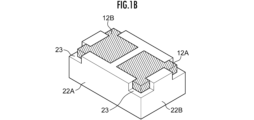
- FIG. 1 is a conceptual diagram showing the main parts of a light emitting device 10 according to a first embodiment of the present invention, and is a perspective view when viewed from the top side.
- 1 is a conceptual diagram showing the main parts of a light emitting device 10 according to a first embodiment of the present invention, and is a perspective view when viewed from the bottom side.
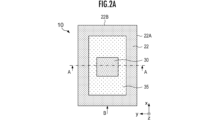
- 1 is a diagram showing a top surface of a light emitting device 10.
- FIG. 2A is a cross-sectional view taken along line AA shown in FIG. 2A.
- FIG. FIG. 2B is a side view when viewed from direction B shown in FIG. 2A.
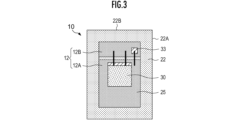
- 3 is a diagram showing the top surface of the light emitting device 10 before being filled with a covering member 35.
- FIG. 2 is a diagram showing the back surface (mounting surface on a circuit board) of the light emitting device 10.
- FIG. FIG. 3 is a partially enlarged perspective view showing a recess 23 in an enlarged manner.
- FIG. 4 is a partially enlarged perspective view showing a solder joint portion when the light emitting device 10 is mounted on wiring 41 of a circuit board 40 using solder 45;
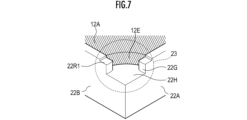
- FIG. 7 is a partially enlarged perspective view showing an enlarged arc-shaped (fan-shaped) recess 23 that is a modified example of the present embodiment.
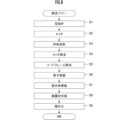
- 3 is a flowchart showing a method for manufacturing the light emitting device 10.
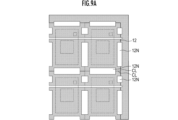
- FIG. FIG. 3 is a top view showing manufacturing steps S1 and S2 of the light emitting device 10.
- FIG. 3 is a top view showing a manufacturing process S3 of the light emitting device 10.
- FIG. 6 is a top view showing a manufacturing process S4 of the light emitting device 10.
- FIG. 6 is a top view showing a manufacturing process S5 of the light emitting device 10.
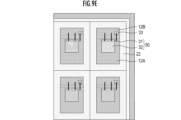
- FIG. It is a top view showing manufacturing steps S6 and S7 of the light emitting device 10.
- 6 is a top view showing a manufacturing process S8 of the light emitting device 10.
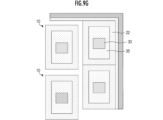
- FIG. It is a top view showing manufacturing process S9 of light emitting device 10.
- FIG. 3 is a schematic top view showing an enlarged intersection point X of the lead frame 12.
- FIG. FIG. 3 is a cross-sectional view showing a cross section of an intersection point X in a step S4 and a step S5.
- FIG. 3 is a diagram showing a removed region RC of the lead frame 12 when an arc-shaped recess 23 is formed.
- FIGS. 1A and 1B are conceptual diagrams showing main parts of a light emitting device 10 according to a first embodiment of the present invention, and are perspective views when viewed from the top side and the bottom side, respectively.
- the light emitting device 10 includes a plurality of lead electrodes (hereinafter also simply referred to as leads) and a resin frame 22. Although a case will be described below in which the light emitting device 10 has two leads 12A and 12B, the light emitting device 10 may have three or more leads.
- the resin frame 22 is provided with an opening 25 in which a light emitting element is mounted, and the opening 25 is filled with a covering member 35.
- recesses 23 are provided at the four corners of the back side of the light emitting device 10, in which the corners of the leads 12A and 12B are exposed inside.
- FIG. 2A is a diagram showing the top surface of the light emitting device 10, and FIG. 2B is a cross-sectional view taken along the line AA shown in FIG. 2A. Further, FIG. 2C is a side view when viewed from direction B shown in FIG. 2A. Further, FIG. 3 is a diagram showing the top surface of the light emitting device 10 before being filled with the covering member 35, and FIG. 4 is a diagram showing the back surface (mounting surface on the circuit board) of the light emitting device 10.
- the light emitting device 10 has a plate-shaped lead 12A (first electrode) and a lead 12B (second electrode).
- the core material of the leads 12A and 12B is made of copper (Cu), which is a metal with good etching properties (corrosivity), and the surface is plated with nickel/gold (Ni/Au), which is a corrosion-resistant metal. has been done.
- corrosive metals such as aluminum (Al) and iron alloys such as iron-nickel-cobalt (Fe-Ni-Co) can be used.
- a corrosion-resistant metal such as platinum (Pt), palladium (Pd), rhodium (Rh), etc. can be used for the surfaces of the leads 12A and 12B.
- a lead pair 12 (hereinafter also referred to as the lead frame 12 of the light emitting device 10) consisting of leads 12A and 12B are arranged on substantially the same plane and separated from each other by a gap (slit) 12G between the leads 12A and 12B. It is formed by Note that in the following, unless the leads 12A and 12B are particularly distinguished, they will simply be referred to as leads.
- a resin frame 22 is insert-molded into the leads 12A and 12B, and the resin frame 22 is provided so as to fill in the gaps between the leads and surround the entire outer periphery of the leads, thereby forming a resin package. That is, the leads are not exposed on the outer surface of the resin frame 22 and on the same surface as the outer surface.
- the resin frame 22 is formed, for example, by adding titanium oxide particles to silicone resin, epoxy resin, or acrylic resin (white resin). Alternatively, it may be formed by adding carbon black to silicone resin, epoxy resin, or acrylic resin (black resin).
- the resin frame 22 has a rectangular shape (rectangular column shape), and has two outer surfaces 22A that are parallel to each other and two outer surfaces 22B that are perpendicular to the outer surfaces 22A. Furthermore, recesses 23 are provided at the four corners of the back side of the resin frame 22, in which the corners of the leads 12A and 12B are exposed inside.
- a thin portion 12T is provided at the outer edge WS of the leads 12A and 12B excluding the corner portions. Further, as shown in FIG. 4, a thin portion 12T is provided at the edge WO where the leads 12A and 12B face each other. Since the edges of the leads 12A and 12B are covered with the resin of the resin frame 22 by the thin portion 12T, the leads are prevented from peeling off from the resin frame 22 during dicing or the like.
- the thin portion 12T is formed by being etched to a depth of, for example, about 50% of the thickness of the leads 12A and 12B by so-called half etching.
- the light emitting device 10 is mounted with the back surface of the light emitting device 10 (that is, the back surface of the resin frame 22) placed on a circuit board or the like using solder or the like. As shown in FIGS. 1B and 4, recesses 23 are provided at the four corners of the back surface side (mounting surface side) of the resin frame 22.
- the resin frame 22 is provided so as to fill the gaps between the leads and surround the entire outer periphery of the leads, but the ends of the leads are exposed inside the recesses 23.
- FIG. 5 is a partially enlarged perspective view showing the recess 23 in an enlarged manner.
- the resin frame 22 is depressed from the outer surfaces 22A and 22B, and the rectangular corner of the lead 12A is exposed within the recess 23.
- the recess 23 in which the corner of the lead 12A is exposed will be described, the same applies to the recess 23 in which the corner of the lead 12B is exposed.
- the end face 12E of the corner of the lead 12A is located at a position recessed inward from the outer surfaces 22A and 22B of the resin frame 22. That is, the resin frame 22 has a rectangular (L-shaped) bottom surface 22H in the recess 23, and the end surface 12E of the lead 12A is located at a position retreated inward from the outer surfaces 22A and 22B by the distance LS (see FIG. 4).
- fillet guards 22G which are partition walls of the resin frame 22, are formed on both sides of the corner of the lead 12A.
- a rectangular space for accommodating a solder fillet is defined within the recess 23 by the fillet guard 22G and bottom surface 22H of the resin frame 22. That is, the recess 23 functions as a rectangular accommodating part that accommodates the solder fillet.
- the depth (height) of the bottom surface 22H and the fillet guard 22G is approximately the same as the thickness of the leads 12A.
- the recess 23 is formed by etching the core material 12C of the lead frame 12 and milling of the lead frame surface layer (plating layer) is also used for the etching, as shown in FIGS. 4 and 5.
- the outer peripheral portion 22R1 of the back surface 22R of the resin frame 22 is formed by the processing so as to be slightly lower than the back surface 22R and have a step 22S with respect to the back surface 22R.
- the light emitting device 10 can be mounted so as not to float off the circuit board. Therefore, it is possible to implement mounting that has high die shear strength and does not impair heat dissipation performance or reliability.
- the light emitting device 10 when mounted on a wiring pattern of the same size as the light emitting device 10, even if there are burrs around the wiring pattern, the light emitting device 10 is prevented from tilting, and optical axis misalignment can be prevented. can.
- the back surface 22R of the resin frame 22 may be a flat surface without the step 22S.
- the recess 23 may be formed by removing only the surface layer (plated layer) of the lead frame 12 using a micro-mill or the like so that the step 22S does not occur.
- FIG. 6 is a partially enlarged perspective view showing a solder joint when the light emitting device 10 is mounted on the wiring (land) 41 of the circuit board 40 using solder 45.
- the die shear strength can be maintained high even when mounted on wiring of approximately the same size as the light emitting device 10.
- FIG. 7 is a partially enlarged perspective view showing an enlarged recess 23 which is a modified example of this embodiment.
- an arc-shaped (fan-shaped) recess 23 is formed.
- the bottom surface 22H of the resin frame 22 has an arc shape (or a quadrant shape), and the end surface (side surface) 12E of the end of the lead 12A has a cylindrical side surface shape. ing.
- fillet guards 22G which are partition walls extending and protruding from the resin frame 22, are formed on both sides of the end portion of the lead 12A.
- a fillet guard 22G and bottom surface 22H of the resin frame 22 define a quarter-cylindrical space within the recess 23 to accommodate the solder fillet. That is, the arc-shaped recess 23 functions as an accommodating portion for accommodating the solder fillet. Since such a protruding fillet guard 22G pinches a part of the solder fillet so as to neck it, the die shear strength can be increased.
- the fillet of the solder 45 is formed within the recess 23, so that the die shear strength can be maintained high even when mounted on wiring of the same size as the light emitting device 10. Can be done.
- the recess 23 of the resin frame 22 is a rectangular or arc-shaped recess is described, but the recess 23 has the end face of the lead exposed inside and the solder connected to the end face of the lead. It is sufficient if it is formed to have a space for accommodating the fillet.
- the recessed portion 23 is provided at a corner of the light emitting device 10 (that is, the resin frame 22), the present invention is not limited to this.
- it may be provided on the side of the light emitting device 10. More specifically, referring to FIG. 4, even if the connecting portion 12AJ or 12BJ of the lead 12A or 12B with the adjacent lead is formed as a rectangular (for example, I-shaped) recess 23, good. Therefore, the recesses 23 may be provided at the corners and/or sides of the light emitting device 10.
- the resin frame 22 has an opening 25 (first opening) which is an inner area of the frame, and has a lead 12A and a lead 12B. A part of the surface is exposed through the opening 25.
- a semiconductor light emitting device (hereinafter simply referred to as a light emitting device) 30 is mounted within the opening 25 .
- the light emitting element 30 in this embodiment includes an LED (Light Emitting Diode) 31 that is a light source element, and a phosphor 32 that is an optical member provided on the light source element.
- the light source element may also be a laser diode (LD) or the like.
- the optical member is not limited to fluorescent material. Further, the optical member may not be provided.
- the lead 12A is an anode electrode
- the lead 12B is a cathode electrode
- the p-electrode of the LED 31 is connected and mounted on the lead 12A
- the n-electrode of the LED 31 is connected to the lead 12B with a bonding wire. ing.
- a plate-shaped phosphor 32 is provided on the LED 31.
- the light emitting element 30 may include an optical member such as a transparent body provided on the LED 31.
- the phosphor is not particularly limited, but various phosphors such as YAG (yttrium aluminum garnet), LuAG (lutetium aluminum garnet), GYAG (gadolinium aluminum garnet), ⁇ , ⁇ sialon, SCASN, CASN, KFS, etc. may be used as appropriate. Can be used.
- nanoparticles such as cadmium selenium (CdSn), indium phosphide (InP), or indium nitride (InN) are placed on the top surface (light-emitting surface) of the LED 31.
- a light conversion member can also be arranged.
- a protection element 33 which is a Zener diode, is bonded and mounted on the lead 12B exposed from the opening 25.
- the other electrode of the protection element 33 is connected to the lead 12A by a bonding wire.
- a varistor or the like can be used as the protection element 33.
- Passive elements such as capacitors, resistors, and light receiving elements may also be provided.
- the space around the light emitting element 30 is filled with a covering member 35 that is a sealing resin or a covering resin.
- a covering member 35 that is a sealing resin or a covering resin.
- the covering member 35 is not illustrated for explanation of the internal structure.
- the surface of the light emitting element 30 (that is, the surface of the phosphor 32) is exposed from the covering member 35.
- the resin frame 22 has a rectangular shape when viewed from above, and has a rectangular column-shaped opening 25 that is an inner region of the frame.
- the opening 25 is not limited to a rectangular columnar shape, but may have a cylindrical shape, a truncated cone shape, or the like.
- FIG. 8 is a flowchart showing a method for manufacturing the light emitting device 10. Further, FIGS. 9A to 9G are top views showing each process. Note that FIGS. 9A, 9B, and 9E to 9G are top views, and FIGS. 9C and 9B are back views. Furthermore, in each figure, for clarity of illustration, the cutting line CL for dividing each device is shown as a solid line, and the element mounting portion is shown as a dotted line.
- Nickel (Ni) and gold (Au) are plated in this order on the upper surface of the lead frame 12 by electrolytic plating (Ni/Au plating) (FIG. 9A).
- the resin frame 22 made of thermosetting resin is formed on the lead frame 12 by insert molding (FIG. 9B).
- the resin frame 22 has an opening 25 that is an inner region of the resin frame 22, and a portion of the surfaces of the leads 12A and 12B are exposed from the opening 25.
- FIG. 10A is a schematic top view showing an enlarged intersection X of the cutting line CL of the lead frame 12 (see FIGS. 9C and 9D), and FIG. 10B is a schematic top view showing step S4 and the step FIG. 3 is a sectional view showing a cross section of the intersection point X at S5.
- the plating layer 12P on the surface of the lead frame 12 is removed by dicing (rectangular teeth) along the cutting line CL with a constant width (plating removed portion RB) (FIG. 10B, upper stage).
- the core material 12C (Cu) is exposed in the plating removed portion RB (FIG. 9C).
- the outer circumferential portion 22R1 of the back surface 22R of the resin frame 22 is also shaved off, forming a step 22S that is slightly lower than the back surface 22R (see FIG. 5).
- plating layer 12P may be removed not only by dicing but also by milling or the like.
- the plating layer 12P on the resin frame 22 side is removed by air blasting (FIG. 10B, bottom).
- a removal means there are also methods such as water jet blasting. Note that the plating layer 12P on the resin frame 22 side can also be left. In that case, this step may be skipped.
- the remaining plating layer 12P functions as a solder attraction wall when the light emitting device 10 is soldered to the circuit board.
- a rectangular recess 23 (FIG. 5) is formed at the corner of the resin frame 22 (FIG. 9D).
- FIG. 10C shows the removed region RC of the lead frame 12 when forming the arc-shaped recess 23.
- Reflow (heating at 300°C) is performed to melt and solidify the gold-tin solder, and the element is mounted.
- Wire bonding of the light emitting element 31 and the protection element 33 is performed using gold wire to perform element mounting (FIG. 9E).
- Silicone resin which is a translucent adhesive, is applied to the light emitting surface of the light emitting element 31.
- the phosphor 32 is mounted on the light emitting element 31. Then, it is temporarily cured at 180° C. to adhere the phosphor 32 (FIG. 9E).
- the lead frame 12 is cut by etching in the lead frame removal step (S5), and the lead frame 12 is not cut in the singulation step (S9).
- the resin frame may peel off due to the cutting stress applied to the lead frame.
- the cut portions of the lead frame 12 are removed in advance. Therefore, the lead frame 12 and the resin frame 22 will not separate from each other. Therefore, it is possible to provide a light emitting device that has high die shear strength and is less prone to disconnection defects.
- the present invention it is possible to provide a light emitting device in which peeling between the frame and the lead frame is prevented, the die shear strength of the solder joint is high, and disconnection defects are less likely to occur. .
- Light emitting device 12 Lead frame 12A, 12B: Lead 12E: End surface of lead 22: Resin frame 22A, 22B: Outer surface 22G: Fillet guard 22H: Bottom surface of recess 22R: Back surface of resin frame 22 22R1: Back surface 22R Outer periphery 23: Recess 30: Light emitting element 31: LED 32: Phosphor 35: Covering member 40: Circuit board 45: Solder CL: Cutting line RB: Plating removal part
Landscapes
- Led Device Packages (AREA)
Priority Applications (4)
| Application Number | Priority Date | Filing Date | Title |
|---|---|---|---|
| CN202380047842.XA CN119404618A (zh) | 2022-06-22 | 2023-06-05 | 发光装置 |
| KR1020247041195A KR20250026176A (ko) | 2022-06-22 | 2023-06-05 | 발광장치 |
| EP23826957.5A EP4517848A4 (en) | 2022-06-22 | 2023-06-05 | Light-emitting device |
| US18/869,060 US20250324830A1 (en) | 2022-06-22 | 2023-06-05 | Light-emitting device |
Applications Claiming Priority (2)
| Application Number | Priority Date | Filing Date | Title |
|---|---|---|---|
| JP2022-100686 | 2022-06-22 | ||
| JP2022100686A JP2024001800A (ja) | 2022-06-22 | 2022-06-22 | 発光装置 |
Publications (1)
| Publication Number | Publication Date |
|---|---|
| WO2023248770A1 true WO2023248770A1 (ja) | 2023-12-28 |
Family
ID=89379631
Family Applications (1)
| Application Number | Title | Priority Date | Filing Date |
|---|---|---|---|
| PCT/JP2023/020776 Ceased WO2023248770A1 (ja) | 2022-06-22 | 2023-06-05 | 発光装置 |
Country Status (7)
| Country | Link |
|---|---|
| US (1) | US20250324830A1 (https=) |
| EP (1) | EP4517848A4 (https=) |
| JP (1) | JP2024001800A (https=) |
| KR (1) | KR20250026176A (https=) |
| CN (1) | CN119404618A (https=) |
| TW (1) | TW202404919A (https=) |
| WO (1) | WO2023248770A1 (https=) |
Cited By (1)
| Publication number | Priority date | Publication date | Assignee | Title |
|---|---|---|---|---|
| US20240379926A1 (en) * | 2021-09-24 | 2024-11-14 | Stanley Electric Co., Ltd. | Light-emitting device, and method for producing light-emitting device |
Citations (5)
| Publication number | Priority date | Publication date | Assignee | Title |
|---|---|---|---|---|
| JP2006156704A (ja) | 2004-11-30 | 2006-06-15 | Nichia Chem Ind Ltd | 樹脂成形体及び表面実装型発光装置並びにそれらの製造方法 |
| JP2010062272A (ja) | 2008-09-03 | 2010-03-18 | Nichia Corp | 発光装置、樹脂パッケージ、樹脂成形体並びにこれらの製造方法 |
| JP2013051296A (ja) * | 2011-08-31 | 2013-03-14 | Panasonic Corp | 半導体装置用パッケージとその製造方法、および半導体装置 |
| KR20150116127A (ko) * | 2014-04-04 | 2015-10-15 | 엘지디스플레이 주식회사 | 발광다이오드 장치와 이를 이용한 액정표시장치 |
| JP3219881U (ja) * | 2017-12-11 | 2019-01-31 | 長華科技股▲ふん▼有限公司 | 発光素子パッケージ |
Family Cites Families (2)
| Publication number | Priority date | Publication date | Assignee | Title |
|---|---|---|---|---|
| JP6260593B2 (ja) * | 2015-08-07 | 2018-01-17 | 日亜化学工業株式会社 | リードフレーム、パッケージ及び発光装置、並びにこれらの製造方法 |
| JP6888709B2 (ja) * | 2020-04-09 | 2021-06-16 | 日亜化学工業株式会社 | 発光装置の製造方法及び発光装置 |
-
2022
- 2022-06-22 JP JP2022100686A patent/JP2024001800A/ja active Pending
-
2023
- 2023-06-05 WO PCT/JP2023/020776 patent/WO2023248770A1/ja not_active Ceased
- 2023-06-05 CN CN202380047842.XA patent/CN119404618A/zh active Pending
- 2023-06-05 US US18/869,060 patent/US20250324830A1/en active Pending
- 2023-06-05 KR KR1020247041195A patent/KR20250026176A/ko active Pending
- 2023-06-05 EP EP23826957.5A patent/EP4517848A4/en active Pending
- 2023-06-14 TW TW112122142A patent/TW202404919A/zh unknown
Patent Citations (5)
| Publication number | Priority date | Publication date | Assignee | Title |
|---|---|---|---|---|
| JP2006156704A (ja) | 2004-11-30 | 2006-06-15 | Nichia Chem Ind Ltd | 樹脂成形体及び表面実装型発光装置並びにそれらの製造方法 |
| JP2010062272A (ja) | 2008-09-03 | 2010-03-18 | Nichia Corp | 発光装置、樹脂パッケージ、樹脂成形体並びにこれらの製造方法 |
| JP2013051296A (ja) * | 2011-08-31 | 2013-03-14 | Panasonic Corp | 半導体装置用パッケージとその製造方法、および半導体装置 |
| KR20150116127A (ko) * | 2014-04-04 | 2015-10-15 | 엘지디스플레이 주식회사 | 발광다이오드 장치와 이를 이용한 액정표시장치 |
| JP3219881U (ja) * | 2017-12-11 | 2019-01-31 | 長華科技股▲ふん▼有限公司 | 発光素子パッケージ |
Non-Patent Citations (1)
| Title |
|---|
| See also references of EP4517848A4 |
Cited By (1)
| Publication number | Priority date | Publication date | Assignee | Title |
|---|---|---|---|---|
| US20240379926A1 (en) * | 2021-09-24 | 2024-11-14 | Stanley Electric Co., Ltd. | Light-emitting device, and method for producing light-emitting device |
Also Published As
| Publication number | Publication date |
|---|---|
| CN119404618A (zh) | 2025-02-07 |
| JP2024001800A (ja) | 2024-01-10 |
| TW202404919A (zh) | 2024-02-01 |
| US20250324830A1 (en) | 2025-10-16 |
| EP4517848A1 (en) | 2025-03-05 |
| EP4517848A4 (en) | 2025-10-01 |
| KR20250026176A (ko) | 2025-02-25 |
Similar Documents
| Publication | Publication Date | Title |
|---|---|---|
| CN102142513B (zh) | Led封装及制作led封装的方法 | |
| US10096758B2 (en) | Lead frame including a plurality of units connected together and semiconductor device including the lead frame | |
| US9548261B2 (en) | Lead frame and semiconductor device | |
| JP6260593B2 (ja) | リードフレーム、パッケージ及び発光装置、並びにこれらの製造方法 | |
| US9368704B2 (en) | Lead frame and light emitting device | |
| US10629790B2 (en) | Light-emitting device | |
| JP6337873B2 (ja) | パッケージ、パッケージ中間体、発光装置及びそれらの製造方法 | |
| WO2003044872A1 (fr) | Dispositif electroluminescent semi-conducteur compose et son procede de fabrication | |
| WO2023248770A1 (ja) | 発光装置 | |
| US11223000B2 (en) | Method of manufacturing light emitting element mounting base member, method of manufacturing light emitting device using the light emitting element mounting base member, light emitting element mounting base member, and light emitting device using the light emitting element mounting base member | |
| JP6551210B2 (ja) | 発光装置 | |
| US12261252B2 (en) | Light-emitting device and manufacturing method of the same | |
| US20240379926A1 (en) | Light-emitting device, and method for producing light-emitting device | |
| EP4583173A1 (en) | Semiconductor light emitting device | |
| JP6728998B2 (ja) | 発光装置の製造方法及び発光装置 | |
| CN107425104B (zh) | 发光元件载置用基体的制造方法及发光元件载置用基体 | |
| JP2016119464A (ja) | 発光装置 | |
| EP4191689B1 (en) | Semiconductor light emitting device | |
| JP7140956B2 (ja) | 発光装置、パッケージ及びそれらの製造方法 | |
| JP2018160673A (ja) | パッケージの製造方法、パッケージ中間体の製造方法及び発光装置の製造方法 |
Legal Events
| Date | Code | Title | Description |
|---|---|---|---|
| 121 | Ep: the epo has been informed by wipo that ep was designated in this application |
Ref document number: 23826957 Country of ref document: EP Kind code of ref document: A1 |
|
| WWE | Wipo information: entry into national phase |
Ref document number: 18869060 Country of ref document: US |
|
| WWE | Wipo information: entry into national phase |
Ref document number: 2023826957 Country of ref document: EP |
|
| ENP | Entry into the national phase |
Ref document number: 2023826957 Country of ref document: EP Effective date: 20241127 |
|
| WWE | Wipo information: entry into national phase |
Ref document number: 202380047842.X Country of ref document: CN |
|
| NENP | Non-entry into the national phase |
Ref country code: DE |
|
| WWP | Wipo information: published in national office |
Ref document number: 202380047842.X Country of ref document: CN |
|
| WWP | Wipo information: published in national office |
Ref document number: 1020247041195 Country of ref document: KR |
|
| WWP | Wipo information: published in national office |
Ref document number: 18869060 Country of ref document: US |