WO2023238713A1 - 直流短絡保護装置 - Google Patents
直流短絡保護装置 Download PDFInfo
- Publication number
- WO2023238713A1 WO2023238713A1 PCT/JP2023/019837 JP2023019837W WO2023238713A1 WO 2023238713 A1 WO2023238713 A1 WO 2023238713A1 JP 2023019837 W JP2023019837 W JP 2023019837W WO 2023238713 A1 WO2023238713 A1 WO 2023238713A1
- Authority
- WO
- WIPO (PCT)
- Prior art keywords
- current
- section
- bus bar
- current detection
- resistance
- Prior art date
- Legal status (The legal status is an assumption and is not a legal conclusion. Google has not performed a legal analysis and makes no representation as to the accuracy of the status listed.)
- Ceased
Links
Images




Classifications
-
- H—ELECTRICITY
- H01—ELECTRIC ELEMENTS
- H01H—ELECTRIC SWITCHES; RELAYS; SELECTORS; EMERGENCY PROTECTIVE DEVICES
- H01H39/00—Switching devices actuated by an explosion produced within the device and initiated by an electric current
- H01H39/006—Opening by severing a conductor
-
- H—ELECTRICITY
- H02—GENERATION; CONVERSION OR DISTRIBUTION OF ELECTRIC POWER
- H02H—EMERGENCY PROTECTIVE CIRCUIT ARRANGEMENTS
- H02H1/00—Details of emergency protective circuit arrangements
- H02H1/0007—Details of emergency protective circuit arrangements concerning the detecting means
-
- H—ELECTRICITY
- H01—ELECTRIC ELEMENTS
- H01H—ELECTRIC SWITCHES; RELAYS; SELECTORS; EMERGENCY PROTECTIVE DEVICES
- H01H85/00—Protective devices in which the current flows through a part of fusible material and this current is interrupted by displacement of the fusible material when this current becomes excessive
- H01H85/02—Details
- H01H85/0241—Structural association of a fuse and another component or apparatus
- H01H2085/0266—Structural association with a measurement device, e.g. a shunt
-
- H—ELECTRICITY
- H01—ELECTRIC ELEMENTS
- H01H—ELECTRIC SWITCHES; RELAYS; SELECTORS; EMERGENCY PROTECTIVE DEVICES
- H01H71/00—Details of the protective switches or relays covered by groups H01H73/00 - H01H83/00
- H01H71/10—Operating or release mechanisms
- H01H71/12—Automatic release mechanisms with or without manual release
- H01H71/123—Automatic release mechanisms with or without manual release using a solid-state trip unit
- H01H71/125—Automatic release mechanisms with or without manual release using a solid-state trip unit characterised by sensing elements, e.g. current transformers
-
- H—ELECTRICITY
- H02—GENERATION; CONVERSION OR DISTRIBUTION OF ELECTRIC POWER
- H02H—EMERGENCY PROTECTIVE CIRCUIT ARRANGEMENTS
- H02H3/00—Emergency protective circuit arrangements for automatic disconnection directly responsive to an undesired change from normal electric working condition with or without subsequent reconnection ; integrated protection
- H02H3/08—Emergency protective circuit arrangements for automatic disconnection directly responsive to an undesired change from normal electric working condition with or without subsequent reconnection ; integrated protection responsive to excess current
- H02H3/087—Emergency protective circuit arrangements for automatic disconnection directly responsive to an undesired change from normal electric working condition with or without subsequent reconnection ; integrated protection responsive to excess current for DC applications
Definitions
- the present disclosure relates to a DC short circuit protection device.
- Patent Document 1 describes a technique for downsizing an electric circuit breaker by integrating a sensor for current detection with the electric circuit breaker.
- the present disclosure provides a DC short circuit protection device that can easily dissipate heat.
- a DC short circuit protection device includes a bus bar, a fuse that disconnects the bus bar in response to an ignition signal, and a first resistor that detects a current flowing through the bus bar. a detection section; and a second current detection section that has a second resistance section and detects a current flowing through the bus bar, the first resistance section and the second resistance section being equal to the current flowing through the bus bar.
- the bus bar is integrated with the bus bar so that a current of a certain magnitude flows therethrough, and the bus bar is disconnected between the first current detection section and the second current detection section in response to the ignition signal, or The first resistance section of the first current detection section is disconnected.
- FIG. 1 is a configuration diagram showing an example of a DC short circuit protection device according to an embodiment. It is a perspective view of an active type fuse in a first example.
- FIG. 3 is a partial cross-sectional view of an active type fuse in a first example. It is a perspective view of the active type fuse in a second example.
- FIG. 7 is a partial cross-sectional view of an active type fuse in a third example. It is a partial sectional view of the active type fuse in a fourth example. It is a bottom view of the bus bar in a fourth example. It is a figure for explaining the cross-sectional structure of the bus bar in a fourth example. It is a top view of the bus bar in a fifth example.
- FIG. 1 is a configuration diagram showing an example of a DC short circuit protection device 1 according to an embodiment.
- the DC short circuit protection device 1 is mounted, for example, on a vehicle such as an electric vehicle that uses electric power for propulsion.
- a vehicle such as an electric vehicle is equipped with a high-voltage battery, and power is supplied from the battery to a load such as a motor to propel the vehicle such as an electric vehicle.
- a load such as a motor to propel the vehicle such as an electric vehicle.
- the DC short circuit protection device 1 is provided to cut off the path. It will be done.
- the DC short circuit protection device 1 includes an active type fuse 10 and a cutoff control circuit 20.
- the active type fuse 10 is a device for cutting off a path connecting a battery and a load when a large current flows through the path due to a short circuit abnormality, and is, for example, a pyrofuse.
- a pyrofuse contains gunpowder inside, and by igniting the gunpowder based on a control signal from the outside, the explosive force generated by the ignition of the gunpowder irreversibly cuts the bus bar and interrupts the current.
- the active type fuse 10 includes a cutter 11, a bus bar 12, and a plurality of current detection sections.
- two current sensing sections 13a and 13b are shown as the plurality of current sensing sections, but the number of the plurality of current sensing sections may be three or more.
- the bus bar 12 is a long conductive rod that is connected (for example, fastened) to a path connecting the battery and the load and becomes a part of the path.
- the cutting machine 11 cuts the busbar 12 in response to an ignition signal from the cutoff control circuit 20 . Since the bus bar 12 is a part of the route, the route can be cut off by cutting the bus bar 12.
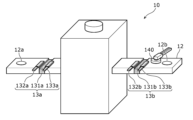
- FIG. 2 is a perspective view of an example of the active type fuse 10.
- the current detection section 13a has a resistance section 131a
- the current detection section 13b has a resistance section 131b.
- Each of the current detection section 13a and the current detection section 13b is a current sensor that detects the current flowing through the bus bar 12.
- Resistance sections 131a and 131b are integrated with bus bar 12 so that a current of the same magnitude as the current flowing through bus bar 12 flows therein. An example of integration will be described later.
- the current detection sections 13a and 13b detect the current flowing through the bus bar 12 by converting the current flowing through the resistance sections 131a and 131b, respectively, into voltage.
- the plurality of current detection sections are distributed and arranged on one end side and the other end side in the longitudinal direction of the bus bar 12. An example of distributed arrangement will be described later.
- the cutoff control circuit 20 is connected to the active type fuse 10 and cuts the bus bar 12 by controlling the active type fuse 10. Specifically, the cutoff control circuit 20 outputs the ignition signal S3 to the active type fuse 10 based on the detection signal S1 output from the current detection section 13a and the detection signal S2 output from the current detection section 13b. do. The cutting machine 11 cuts the busbar 12 when the ignition signal S3 is input.
- the cutoff control circuit 20 is realized by, for example, a microcontroller unit (MCU).
- the cutoff control circuit 20 includes a detection signal acquisition section 21 , a cutoff determination section 22 , a comparison section 23 , and an ignition control circuit 24 .
- the detection signal acquisition unit 21 acquires the detection signal S1 output from the current detection unit 13a and the detection signal S2 output from the current detection unit 13b.
- the detection signal S1 is a signal indicating a voltage generated when a current flows through the resistance section 131a included in the current detection section 13a
- the detection signal S2 is a signal indicating a voltage generated when a current flows through the resistance section 131b included in the current detection section 13b. This signal indicates the voltage generated at
- the cutoff determination unit 22 determines whether or not to cut off the path connecting the battery and the load based on the detection signals S1 and S2 output from the current detection units 13a and 13b. For example, the cutoff determination unit 22 first calculates the sum of the voltage indicated by the detection signal S1 outputted from the current detection unit 13a and the voltage indicated by the detection signal S2 outputted from the current detection unit 13b, and calculates the resistance of the resistance unit 131a. By dividing the current value by the sum of the resistance value and the resistance value of the resistance section 131b, the value of the current flowing through the bus bar 12 is calculated. Next, when the calculated value of the current flowing through the bus bar 12 is greater than or equal to a predetermined value, that is, when a large current is flowing through the bus bar 12, it is determined that the path is to be cut off.
- the comparison unit 23 compares the current value calculated based on the detection signal S1 and the current value calculated based on the detection signal S2. Specifically, the comparison unit 23 divides the voltage indicated by the detection signal S1 by the resistance value of the resistance unit 131a, and further divides the voltage indicated by the detection signal S2 by the resistance value of the resistance unit 131b. Calculate the current value. The comparison unit 23 performs failure detection of the current detection units 13a and 13b based on the comparison results of a plurality of current values. If the plurality of current values are different, it is determined that either the current detection section 13a or the current detection section 13b is malfunctioning. For example, when one of the plurality of current detection units is out of order, the cutoff control circuit 20 may notify an external device to that effect.
- the ignition control circuit 24 outputs the ignition signal S3 to the active type fuse 10 when it is determined that the path connecting the battery and the load is to be cut off. Thereby, when a large current flows through the path due to a short circuit abnormality, the bus bar 12 is cut by the active type fuse 10 and the path can be cut off.
- FIG. 2 is a perspective view of the active type fuse 10 in the first example.
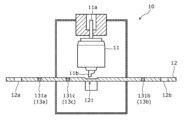
- FIG. 3 is a partial cross-sectional view of the active type fuse 10 in the first example.
- illustration of a cross section of the cutting machine 11 is omitted.
- the cutting machine 11 has, for example, an ignition terminal 11a and a cutting blade 11b.
- the ignition terminal 11a is connected to the ignition control circuit 24 of the cutoff control circuit 20.
- the ignition signal S3 (see FIG. 1) is output from the ignition control circuit 24 to the ignition terminal 11a, the cutting machine 11 instantly pushes the cutting blade 11b downward to cut the bus bar 12.
- the bus bar 12 is provided with a fastening portion 12a at one end in the longitudinal direction of the bus bar 12, and a fastening portion 12b is provided at the other end in the longitudinal direction of the bus bar 12.
- the bus bar 12 is inserted in the middle of a path connecting the battery and the load, and the fastening portions 12a and 12b are fastened to the path with screws or the like. Thereby, the bus bar 12 becomes part of the above route.
- the cut portion 121 of the bus bar 12 is a portion that is cut by the cutting blade 11b of the cutting machine 11 when the ignition signal S3 is output from the cutoff control circuit 20.
- the plurality of current detection sections are arranged at one end (for example, the fastening section 12a side) and the other end (for example, the fastening section 12a side) in the longitudinal direction of the bus bar 12 with respect to the cut portion 121 of the bus bar 12 cut by the active type fuse 10.
- the fastening portion 12b side there are two current detection units, and one current detection unit 13a of the two current detection units is located at one end side in the longitudinal direction of the bus bar 12 with respect to the cut portion 121.
- the other current sensing portion 13 b is placed on the other end side of the bus bar 12 in the longitudinal direction with respect to the cut portion 121 .
- the current detection section 13a has a resistance section 131a
- the current detection section 13b has a resistance section 131b.
- the resistance value of the resistance section 131a and the resistance value of the resistance section 131b are the same value.
- Each of the resistance parts 131a and 131b is a resistance element (shunt resistance) of about several tens of microohms.
- the resistance parts 131a and 131b are integrated with the bus bar 12 by being inserted into the bus bar 12.
- the resistance parts 131a and 131b are not resistive elements but are part of the bus bar 12, and are integrated with the bus bar 12 as part of the bus bar 12.
- the current flowing through the bus bar 12 is converted into voltage, so that the current flowing through the bus bar 12 can be detected.
- each of the plurality of current detection sections has two current monitoring terminals for monitoring the current flowing through the resistance section.
- the current detection section 13a has current monitoring terminals 132a and 133a for monitoring the current flowing through the resistance section 131a, and the resistance section 131a is positioned between the current monitoring terminals 132a and 133a.
- Current monitor terminals 132a and 133a are provided on bus bar 12.
- the current detection section 13b has current monitoring terminals 132b and 133b for monitoring the current flowing through the resistance section 131b, and the current monitoring terminals 132b and 133b are arranged such that the resistance section 131b is located between the current monitoring terminals 132b and 133b.
- Terminals 132b and 133b are provided on bus bar 12.
- the distance between current monitor terminals 132a and 133a is approximately the same as the distance between current monitor terminals 132b and 133b.
- the current monitor terminals 132a, 133a, 132b, and 133b are connected to the detection signal acquisition section 21 of the cutoff control circuit 20.
- the detection signal acquisition section 21 detects the voltage between the current monitoring terminals 132a and 133a, that is, the voltage generated in the resistance section 131a when a current flows through the resistance section 131a, and the voltage between the current monitoring terminals 132b and 133b, that is, The voltage generated in the resistance part 131b when a current flows through the resistance part 131b is acquired as a detection signal.
- the first example shows an example in which the plurality of current detection sections are provided outside the casing of the active type fuse 10, at least one of the plurality of current detection sections is provided inside the casing of the active type fuse 10. It's okay.
- the cutting machine 11 may have a plurality of cutting blades, and the bus bar 12 may be cut at a plurality of locations when the ignition signal S3 is output from the cutoff control circuit 20.
- the DC short circuit protection device 1 includes the bus bar 12, the active type fuse 10 that disconnects the bus bar 12 in response to the ignition signal S3 (see FIG. 1), and the resistor section 131a.
- a current detection section 13a that detects the current flowing through the bus bar 12, and a current detection section 13b that has a resistance section 131b and detects the current flowing through the bus bar 12. It is integrated with the bus bar 12 so that the current flows therethrough, and is cut between the current detection section 13a and the current detection section 13b. That is, the current detection section 13a and the current detection section 13b are provided in a distributed manner on the bus bar.
- a resistor section with a certain resistance value is required to detect the current, and one current Heat is concentrated in the resistance section of the detection section, making it difficult to dissipate heat.
- the resistance value per resistance part can be reduced, so the heat generation of each resistance part can be reduced, and the concentration of heat generation can be reduced. can be alleviated. Therefore, in the DC short circuit protection device 1 in which a plurality of current detection sections are arranged in a distributed manner, heat can be easily dissipated.
- the plurality of current detection units be distributed and arranged at one end and the other end of the bus bar 12 in the longitudinal direction with respect to the cut portion 121 of the bus bar 12 that is cut by the active type fuse 10.
- the plurality of current detection sections are two, and one current detection section 13a of the two current detection sections is arranged at one end side in the longitudinal direction of the bus bar 12 with respect to the cutting section 121, and the The current detection unit 13b may be arranged at the other end of the bus bar 12 in the longitudinal direction with respect to the cut portion 121.
- the DC short circuit protection device 1 may further include a cutoff control circuit 20 that outputs the ignition signal S3 to the active type fuse 10 based on detection signals output from the plurality of current detection units.
- the cutoff control circuit 20 may be included in the DC short circuit protection device 1.
- each of the plurality of current detection sections may have a current monitoring terminal for monitoring the current flowing through the resistance section.
- the current monitoring terminal may be provided in the current detection section.
- the DC short circuit protection device 1 further includes a comparison unit 23 that compares a plurality of current values based on detection signals output from a plurality of current detection units, and the comparison unit 23 compares the comparison results of the plurality of current values. Based on this, failure detection of a plurality of current detection units may be performed.
- the plurality of current values based on the detection signals output from the plurality of current detection sections should be the same.
- the current value may be different. For example, if there are two current detection units and the two current values are different, it is difficult to identify which of the two current detection units is malfunctioning, but if one of the two current detection units is malfunctioning, It is possible to detect that
- FIG. 4 is a perspective view of the active type fuse 10 in the second example.
- the bus bar 12 is provided with a temperature monitoring terminal 140 for monitoring the temperature of the bus bar 12.
- the other points are the same as the first example, so the explanation will be omitted.
- a thermistor, thermocouple, or the like is connected to the temperature monitoring terminal 140 to monitor the temperature of the bus bar 12.
- the temperature of the bus bar 12 is acquired by the cut-off control circuit 20 and used by the cut-off determination section 22 to calculate the current value of the current flowing through the bus bar 12 .
- the resistance values of the resistance sections included in the plurality of current detection sections change depending on the temperature, and the voltage generated in the resistance sections changes accordingly. Therefore, the calculation result of the current flowing through the bus bar 12 changes depending on the temperature. Therefore, the temperature of the bus bar 12 in which the resistance section is integrated is monitored, and the detection signals of the plurality of current detection sections or the calculated current value are corrected according to the temperature of the bus bar 12. Flowing current can be detected accurately.
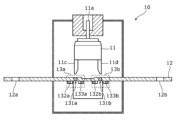
- FIG. 5 is a partial cross-sectional view of the active type fuse 10 in a third example.
- illustration of a cross section of the cutting machine 11 is omitted.
- illustration of the current monitor terminal is omitted.
- the third example there are three current detection sections, and two current detection sections 13a and 13c (resistance sections 131a and 131c) among the three current detection sections 13a to 13c are connected to the cutting section 121.
- the remaining one current detection section 13b (resistance section 131b) among the three current detection sections 13a to 13c is arranged at one end side in the longitudinal direction of the bus bar 12 with respect to the cut portion 121. It is arranged at the other end side of.
- the other points are the same as the first example, so the explanation will be omitted.
- the current value based on the detection signal output from one of the three current detection units 13a to 13c is different from the current value based on the detection signal output from the other two current detection units. If the value is different from the current value, it can be detected that the one current detection section is out of order.
- FIG. 5 an example is shown in which the current detection section 13c is provided inside the casing of the active type fuse 10, but two or more of the three current detection sections 13a to 13c are connected to the active type fuse 10. Alternatively, all three current detection sections 13a to 13c may be provided outside the casing of the active type fuse 10.
- the bus bar 12 may be provided with a temperature monitoring terminal 140.
- FIG. 6 is a partial cross-sectional view of the active type fuse 10 in the fourth example. In FIG. 6, illustration of a cross section of the cutting machine 11 is omitted.
- FIG. 7 is a bottom view of the bus bar 12 in the fourth example.
- FIG. 8 is a diagram for explaining the cross-sectional structure of the bus bar 12 in the fourth example. Note that in FIG. 8, illustration of the current monitor terminal is omitted.
- each resistance section of the plurality of current detection sections is a part of the bus bar 12, and a part of the bus bar 12 is thinned.
- the part that has a higher resistance value by making it thinner is used as a resistor part.
- the area of the cross section perpendicular to the direction in which the current flows in the resistance portion of the bus bar 12 is smaller than the area of the cross section perpendicular to the direction in which the current flows in the portion of the bus bar 12 other than the resistance portion.
- the area of the cross section of the resistance part 131a (the area of the cross section BB' in FIG.
- the active type fuse 10 cuts the bus bar 12 at two locations, one end side and the other end side in the longitudinal direction of the bus bar 12.
- the cutting machine 11 of the active type fuse 10 has two cutting blades 11c and 11d.
- the ignition signal S3 is output from the ignition control circuit 24 to the ignition terminal 11a, the cutting machine 11 instantly pushes down the cutting blades 11c and 11d downward in FIG. 6 to cut the bus bar 12.
- the resistance section 131a included in one of the current detection sections 13a among the plurality of current detection sections is a cut portion on one end side in the longitudinal direction of the bus bar 12 that is cut by the active type fuse 10, and the resistance section 131a of one of the plurality of current detection sections
- the resistance section 131b of the other one of the current detection sections 13b is a cut portion on the other end side in the longitudinal direction of the bus bar 12 that is cut by the active type fuse 10.
- the resistance portion 131a is a cut portion on one end side in the longitudinal direction of the bus bar 12 that is cut by the cutting blade 11c of the cutting machine 11 when the ignition signal S3 is output from the cutoff control circuit 20
- the resistance portion 131b is a cut portion on the other end side in the longitudinal direction of the bus bar 12 that is cut by the cutting blade 11d of the cutting machine 11 when the ignition signal S3 is output from the cutoff control circuit 20.
- the cut portion of the bus bar 12 that is cut by the active type fuse 10 has a smaller cross-sectional area (for example, is constricted) than other portions of the bus bar 12 so that it can be easily cut. Therefore, the cut portion of the bus bar 12 has a higher resistance value than other portions of the bus bar 12. Therefore, the cut portion can be used as a resistance section for detecting the current flowing through the bus bar 12, and compared to the case where a resistance section for detecting the current flowing through the bus bar 12 is separately prepared, the DC short circuit protection device 1
- the structure can be simplified and costs can be reduced.
- the resistance value varies due to dimensional tolerances due to processing accuracy of the cut portion. For this reason, a calibration value for each individual may be stored in a flash memory or the like of the cutoff control circuit 20, and the current value may be corrected for each individual using the calibration value.
- the number of the plurality of current detection sections may be three or more. Further, among the plurality of current detection sections, there may be a mixture of those whose resistance sections are part of the bus bar 12 and those whose resistance sections are resistance elements.
- the cut portion of the bus bar 12 is utilized as a resistance section of the current detection section, but the portion that is not the cut portion and has a smaller cross-sectional area is It may also be used as a resistance section of a current detection section.
- the bus bar 12 may be provided with a temperature monitoring terminal 140.
- FIG. 9 is a top view of the bus bar 12 in the fifth example. Note that in FIG. 9, illustration of the current monitor terminal is omitted.
- the shape of the resistance portion (cut portion) in the bus bar is different from the fourth example.
- the other points are the same as the fourth example, so the explanation will be omitted.
- the resistance value of the resistance portion varies depending on the dimensional tolerance of the cut portion, etc., but as shown in FIG. 9, the resistance portion (cut portion) is By forming the cross-sectional shape to be constant for several millimeters along the cross-section, it is possible to stably detect the current even if there are variations in resistance value due to processing accuracy.
- the DC short circuit protection device 1 (specifically, the cutoff control circuit 20) includes the comparison section 23, but the DC short circuit protection device 1 does not include the comparison section 23. Good too.
- the DC short circuit protection device 1 includes the cutoff control circuit 20, but the DC short circuit protection device 1 may not be provided with the cutoff control circuit 20. That is, the cutoff control circuit 20 may be provided separately from the DC short circuit protection device 1.
- each of the plurality of current detection units has a current monitoring terminal, but the current monitoring terminal does not need to be a component of the current detection unit.
- the DC short circuit protection device 1 includes a bus bar 12, an active type fuse 10 that disconnects the bus bar 12 in response to an ignition signal S3, and a resistor 131a, in which a current flows to the bus bar 12.
- the current detection unit 13a includes a current detection unit 13a that detects a current, and a current detection unit 13b that has a resistance unit 131b and detects the current flowing through the bus bar 12.
- the bus bar 12 is integrated with the bus bar 12 so that a current of the same magnitude flows, and the bus bar 12 is disconnected between the current detecting section 13a and the current detecting section 13b or the current detecting section 13a is disconnected in response to the ignition signal S3. Resistance portion 131a is cut.
- the bus bar 12 is provided with a plurality of current detection sections, the resistance value per resistance section can be reduced, and heat radiation can be easily performed.
- the resistance section 131a and the resistance section 131b are part of the bus bar 12, and the direction of the current flowing through the resistance section 131a and the bus bar 12 is the first direction (
- the area of the cross section of the resistance part 131a perpendicular to the first direction for example, the area of the cross section BB' shown in FIG. 8
- the cross section of the resistance part 131b perpendicular to the first direction for example, the area of the cross section DD′ shown in FIG.
- the current monitoring terminals are connected to both ends of the portion where the cross-sectional area is small, and the voltage generated when a current flows through the portion can be obtained via the current monitoring terminals. Therefore, this portion can be utilized as a current detection section.
- the bus bar 12 has a cut portion 121 that is cut by the active type fuse 10, and the current detection unit 13a is connected to one end of the bus bar 12 and the cut portion 121.
- the current detection unit 13b is located between the other end of the bus bar 12 and the cut portion 121.
- the DC short circuit protection device 1 further includes a current detection section 13c, and the current detection section 13c is located between one end of the bus bar 12 and the cut portion 121.
- the current value based on the detection signal output from one of the three current detection units 13a to 13c is equal to the current value based on the detection signal output from the other two current detection units. If the current value is different from the two current values, it can be detected that the one current detection section is malfunctioning.
- the active type fuse 10 disconnects the resistance section 131a of the current detection section 13a (or the resistance section 131b of the current detection section 13b) in response to the ignition signal S3. do.
- the resistance portion 131a (or the resistance portion 131b) can be utilized as the cutting portion 121.
- the DC short circuit protection device 1 provides an ignition signal to the active type fuse 10 in response to a detection signal S1 output from the current detection section 13a and a detection signal S2 output from the current detection section 13b. It further includes a cutoff control circuit 20 that outputs S3.
- the bus bar 12 can be shut off according to the detection signals S1 and S2 output from the current detection sections 13a and 13b.
- the current detection section 13a has current monitoring terminals 132a and 133a for monitoring the current flowing through the resistance section 131a
- the current detection section 13b has: It has second current monitor terminals 132b and 133b for monitoring the current flowing through the resistance section 131b.
- the voltages generated in the resistance section 131a and the resistance section 131b can be outputted from the current detection sections 13a and 13b as the detection signals S1 and S2.
- the DC short circuit protection device 1 further includes a temperature monitoring terminal 140 that is provided on the bus bar 12 and monitors the temperature of the bus bar 12.
- the temperature of the bus bar 12 can be monitored, and the temperature of the bus bar 12 can be used to calculate the current value.
- the DC short circuit protection device 1 includes a first current value calculated based on the detection signal S1 output from the current detection section 13a and a detection signal output from the current detection section 13b. It further includes a comparison unit 23 that compares the current value with the second current value calculated based on S2.
- the present disclosure can be applied to a device that interrupts current flowing in a current path.
Landscapes
- Fuses (AREA)
- Emergency Protection Circuit Devices (AREA)
Priority Applications (4)
| Application Number | Priority Date | Filing Date | Title |
|---|---|---|---|
| CN202380044358.1A CN119343734A (zh) | 2022-06-07 | 2023-05-29 | 直流短路保护装置 |
| US18/868,212 US20260024984A1 (en) | 2022-06-07 | 2023-05-29 | Dc short-circuit protection device |
| EP23819695.0A EP4539282A4 (en) | 2022-06-07 | 2023-05-29 | DC SHORT CIRCUIT PROTECTION DEVICE |
| JP2024526376A JPWO2023238713A1 (https=) | 2022-06-07 | 2023-05-29 |
Applications Claiming Priority (2)
| Application Number | Priority Date | Filing Date | Title |
|---|---|---|---|
| JP2022-092473 | 2022-06-07 | ||
| JP2022092473 | 2022-06-07 |
Publications (1)
| Publication Number | Publication Date |
|---|---|
| WO2023238713A1 true WO2023238713A1 (ja) | 2023-12-14 |
Family
ID=89118229
Family Applications (1)
| Application Number | Title | Priority Date | Filing Date |
|---|---|---|---|
| PCT/JP2023/019837 Ceased WO2023238713A1 (ja) | 2022-06-07 | 2023-05-29 | 直流短絡保護装置 |
Country Status (5)
| Country | Link |
|---|---|
| US (1) | US20260024984A1 (https=) |
| EP (1) | EP4539282A4 (https=) |
| JP (1) | JPWO2023238713A1 (https=) |
| CN (1) | CN119343734A (https=) |
| WO (1) | WO2023238713A1 (https=) |
Cited By (1)
| Publication number | Priority date | Publication date | Assignee | Title |
|---|---|---|---|---|
| CN120089566A (zh) * | 2025-05-07 | 2025-06-03 | 比亚迪股份有限公司 | 断路器、驱动系统及其控制方法 |
Citations (6)
| Publication number | Priority date | Publication date | Assignee | Title |
|---|---|---|---|---|
| JPH05223849A (ja) * | 1992-02-18 | 1993-09-03 | Toshiba Corp | 電流検出器 |
| JPH11329190A (ja) * | 1998-05-13 | 1999-11-30 | Harness Syst Tech Res Ltd | 車両の異常報知装置 |
| JP2001035345A (ja) * | 1999-07-15 | 2001-02-09 | Yazaki Corp | 回路遮断装置 |
| US20040041682A1 (en) * | 2002-08-29 | 2004-03-04 | Pasha Brian D. | Battery circuit disconnect device |
| WO2020137452A1 (ja) * | 2018-12-25 | 2020-07-02 | サンコール株式会社 | 保護システム |
| JP2020136055A (ja) | 2019-02-19 | 2020-08-31 | 株式会社ダイセル | 電気回路遮断装置 |
Family Cites Families (3)
| Publication number | Priority date | Publication date | Assignee | Title |
|---|---|---|---|---|
| JP2001052584A (ja) * | 1999-08-03 | 2001-02-23 | Yazaki Corp | 回路遮断装置 |
| DE10049071B4 (de) * | 2000-10-02 | 2004-12-16 | Micronas Gmbh | Sicherungsvorrichtung für einen Stromkreis insbesondere in Kraftfahrzeugen |
| KR102264409B1 (ko) * | 2018-03-16 | 2021-06-21 | 주식회사 엘지에너지솔루션 | 통합형 스위칭 장치 |
-
2023
- 2023-05-29 JP JP2024526376A patent/JPWO2023238713A1/ja active Pending
- 2023-05-29 EP EP23819695.0A patent/EP4539282A4/en active Pending
- 2023-05-29 CN CN202380044358.1A patent/CN119343734A/zh active Pending
- 2023-05-29 US US18/868,212 patent/US20260024984A1/en active Pending
- 2023-05-29 WO PCT/JP2023/019837 patent/WO2023238713A1/ja not_active Ceased
Patent Citations (6)
| Publication number | Priority date | Publication date | Assignee | Title |
|---|---|---|---|---|
| JPH05223849A (ja) * | 1992-02-18 | 1993-09-03 | Toshiba Corp | 電流検出器 |
| JPH11329190A (ja) * | 1998-05-13 | 1999-11-30 | Harness Syst Tech Res Ltd | 車両の異常報知装置 |
| JP2001035345A (ja) * | 1999-07-15 | 2001-02-09 | Yazaki Corp | 回路遮断装置 |
| US20040041682A1 (en) * | 2002-08-29 | 2004-03-04 | Pasha Brian D. | Battery circuit disconnect device |
| WO2020137452A1 (ja) * | 2018-12-25 | 2020-07-02 | サンコール株式会社 | 保護システム |
| JP2020136055A (ja) | 2019-02-19 | 2020-08-31 | 株式会社ダイセル | 電気回路遮断装置 |
Non-Patent Citations (1)
| Title |
|---|
| See also references of EP4539282A4 |
Cited By (1)
| Publication number | Priority date | Publication date | Assignee | Title |
|---|---|---|---|---|
| CN120089566A (zh) * | 2025-05-07 | 2025-06-03 | 比亚迪股份有限公司 | 断路器、驱动系统及其控制方法 |
Also Published As
| Publication number | Publication date |
|---|---|
| JPWO2023238713A1 (https=) | 2023-12-14 |
| EP4539282A4 (en) | 2025-10-08 |
| US20260024984A1 (en) | 2026-01-22 |
| CN119343734A (zh) | 2025-01-21 |
| EP4539282A1 (en) | 2025-04-16 |
Similar Documents
| Publication | Publication Date | Title |
|---|---|---|
| CN109314024B (zh) | 用于车辆的配电器和保险系统 | |
| US20140294045A1 (en) | Capacitor module and detection apparatus | |
| JP6426956B2 (ja) | 車両用電力供給システム | |
| JP2014007883A (ja) | 回路保護装置 | |
| CN107466424B (zh) | 功率模块 | |
| JP6642384B2 (ja) | 車載電池用の電池監視装置 | |
| WO2023238713A1 (ja) | 直流短絡保護装置 | |
| CN111572477A (zh) | 车辆电源系统 | |
| JP6426955B2 (ja) | 車両用電力供給システム | |
| US5703746A (en) | Electric junction box and electric current distribution system | |
| US9698592B2 (en) | Device for connecting to a power network and method for protecting such a device | |
| JP5823144B2 (ja) | 過電流保護装置 | |
| WO2023238714A1 (ja) | 直流短絡保護装置 | |
| JP2002369372A (ja) | 組電池 | |
| US20060149427A1 (en) | Apparatus for monitoring a supply system, in particular a motor-vehicle electrical system, and method for monitoring a supply system for this type | |
| JPWO2023238713A5 (https=) | ||
| JP2012217271A (ja) | 電源供給装置および電源供給方法 | |
| US20260005507A1 (en) | Shutoff system | |
| US20220094157A1 (en) | Load control device | |
| JP2025094807A (ja) | 電圧変換装置 | |
| JP7619309B2 (ja) | 回路保護装置 | |
| JPWO2023238714A5 (https=) | ||
| WO2024162041A1 (ja) | バッテリ遮断ユニット | |
| JP7530556B2 (ja) | 地絡検出装置 | |
| JP7609822B2 (ja) | バスバー |
Legal Events
| Date | Code | Title | Description |
|---|---|---|---|
| 121 | Ep: the epo has been informed by wipo that ep was designated in this application |
Ref document number: 23819695 Country of ref document: EP Kind code of ref document: A1 |
|
| ENP | Entry into the national phase |
Ref document number: 2024526376 Country of ref document: JP Kind code of ref document: A |
|
| WWE | Wipo information: entry into national phase |
Ref document number: 202380044358.1 Country of ref document: CN |
|
| WWE | Wipo information: entry into national phase |
Ref document number: 2023819695 Country of ref document: EP |
|
| NENP | Non-entry into the national phase |
Ref country code: DE |
|
| ENP | Entry into the national phase |
Ref document number: 2023819695 Country of ref document: EP Effective date: 20250107 |
|
| WWP | Wipo information: published in national office |
Ref document number: 202380044358.1 Country of ref document: CN |
|
| WWP | Wipo information: published in national office |
Ref document number: 2023819695 Country of ref document: EP |