WO2023238328A1 - 生体信号計測システム - Google Patents
生体信号計測システム Download PDFInfo
- Publication number
- WO2023238328A1 WO2023238328A1 PCT/JP2022/023296 JP2022023296W WO2023238328A1 WO 2023238328 A1 WO2023238328 A1 WO 2023238328A1 JP 2022023296 W JP2022023296 W JP 2022023296W WO 2023238328 A1 WO2023238328 A1 WO 2023238328A1
- Authority
- WO
- WIPO (PCT)
- Prior art keywords
- reference potential
- biopotential
- information
- biosignal
- electrode
- Prior art date
- Legal status (The legal status is an assumption and is not a legal conclusion. Google has not performed a legal analysis and makes no representation as to the accuracy of the status listed.)
- Ceased
Links
Images



Classifications
-
- A—HUMAN NECESSITIES
- A61—MEDICAL OR VETERINARY SCIENCE; HYGIENE
- A61B—DIAGNOSIS; SURGERY; IDENTIFICATION
- A61B5/00—Measuring for diagnostic purposes; Identification of persons
- A61B5/24—Detecting, measuring or recording bioelectric or biomagnetic signals of the body or parts thereof
- A61B5/30—Input circuits therefor
- A61B5/305—Common mode rejection
-
- A—HUMAN NECESSITIES
- A61—MEDICAL OR VETERINARY SCIENCE; HYGIENE
- A61B—DIAGNOSIS; SURGERY; IDENTIFICATION
- A61B5/00—Measuring for diagnostic purposes; Identification of persons
- A61B5/24—Detecting, measuring or recording bioelectric or biomagnetic signals of the body or parts thereof
- A61B5/30—Input circuits therefor
- A61B5/307—Input circuits therefor specially adapted for particular uses
- A61B5/308—Input circuits therefor specially adapted for particular uses for electrocardiography [ECG]
Definitions
- the present invention relates to a biosignal measurement system for measuring biosignals such as electrocardiographic waveforms.
- Non-Patent Document 1 For electrocardiographic waveforms, which are one of the biological signals, it is necessary to measure the potential difference between electrodes placed on both sides of the body's heart.
- a device 400 for measuring bioelectric potential is attached to the center of the torso, and electrodes (200, 200, 300).
- the effort involved in attaching the electrode may cause the wearer to feel repellent, and the pressure exerted by the clothing may cause discomfort to the wearer.
- the wiring connecting the left and right electrodes forms a handcuff-like loop, which restricts the wearer's body movements and makes it difficult to There is a problem that there is a constraint.
- the purpose of the present invention is to solve the above-mentioned problems, and the purpose of the present invention is to eliminate the discomfort of the wearer and the restraint on the body when wearing an electrode device, and to perform biosignal measurement that allows natural measurement of biosignals.
- the purpose is to provide a system.
- the biosignal measurement system of the present invention includes an electrode that measures biopotential, an amplification circuit that amplifies the measured biopotential, and converts the amplified biopotential into digital data.
- a quantization circuit that generates biopotential information using a quantization circuit, a wireless transmitter that transmits the biopotential information, a wireless receiver that receives reference potential information of the amplification circuit, the amplification circuit, the quantization circuit, and the wireless a plurality of electrode devices having a transmitter and a power source that supplies power to the wireless receiver; a wireless receiver that receives the biopotential information transmitted from the wireless transmitter of the electrode device;
- An arithmetic circuit that generates a biosignal waveform and the reference potential information using the biopotential information in at least two of the electrode devices, and a wireless transmitter that transmits the generated reference potential information to the electrode device.
- the amplifying circuit of the electrode device amplifies the biological potential using the reference potential information received from the biological signal generating device.
- biosignal measurement system that can perform natural measurement of biosignals by eliminating the wearer's discomfort and physical restraint when wearing an electrode device.
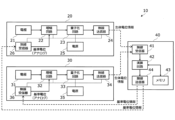
- FIG. 1 is a diagram showing a configuration example of a biological signal measurement system according to a first embodiment of the present invention.
- FIG. 2 is a diagram showing a conceptual diagram of a biological signal measurement system according to an embodiment of the present invention.
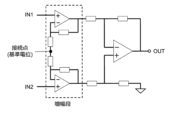
- FIG. 3 is an example of a measurement circuit used in a conventional biological signal measurement system.
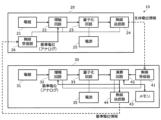
- FIG. 4 is a diagram showing a configuration example of a biological signal measurement system according to a second embodiment of the present invention.
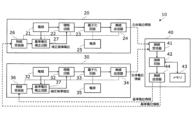
- FIG. 5 is a diagram showing a configuration example of a biological signal measurement system according to the third embodiment of the present invention.
- FIG. 6 is a diagram showing an example of the operation flow in the reference potential correction circuit according to the third embodiment of the present invention.
- FIG. 7 is a diagram showing a configuration example of a reference potential correction circuit according to a fourth embodiment of the present invention.
- FIG. 8 shows a configuration example of a conventional biological signal measurement system.
- FIG. 1 is a diagram showing a configuration example of a biological signal measurement system according to a first embodiment of the present invention.
- the biosignal measurement system 10 of the present embodiment generates a biosignal waveform using a plurality of electrode devices (20, 30) that measure biopotential and biopotential information in the plurality of electrode devices (20, 30).
- a biological signal generation device 40 is provided.
- the electrode device (20, 30) includes an electrode (21, 31) that measures biopotential, an amplification circuit (22, 32) that amplifies the measured biopotential, and converts the amplified biopotential into digital data.
- a quantization circuit (23, 33) that generates biopotential information
- a wireless transmitter (24, 34) that transmits the biopotential information
- a wireless receiver (26) that receives reference potential information from the biosignal generating device 40. , 36
- a power source (25, 35) that supplies power to the amplifier circuit (22, 32), the quantization circuit (23, 33), the wireless transmitter (24, 34), and the wireless receiver (26, 36).
- the amplification circuit (22, 32) amplifies the biopotential using the reference potential information received from the biosignal generating device 40.
- the biosignal generation device 40 includes a wireless receiver 41 that receives biopotential information transmitted from a wireless transmitter (24, 34) of an electrode device (20, 30), and at least one of the plurality of electrode devices (20, 30).
- An arithmetic circuit 42 that uses biopotential information in the two electrode devices to generate biosignal waveforms and reference potential information in the amplification circuit (22, 32), and transmits the generated reference potential information to the electrode devices (20, 30). It has a wireless transmitter 44.
- FIG. 2 shows a conceptual diagram of the biological signal measurement system 10 according to the present embodiment.
- a plurality of electrode devices (20, 30) are arranged at positions sandwiching the heart.
- As a way of wearing the electrode device (20, 30) that is comfortable for the wearer 1 to use for example, it is possible to wear the electrode device (20, 30) on the limbs such as hands and feet.
- Each electrode device (20, 30) measures an in-phase component that appears as a noise component and an out-of-phase component that appears as a biopotential. There is a problem in that the biopotential signals that can be measured by the electrodes (21, 31) of each electrode device (20, 30) are weak and have an extremely poor signal-to-noise ratio.
- a plurality of measured biopotential signals are transmitted to the biopotential signal generating device 40 using wireless communication, and the biopotential signal generating device 40 calculates a difference between the biopotential signals. conduct. By performing the difference calculation, it is possible to remove the in-phase component that appears as a noise component, generate a biological signal, and improve the S/N ratio.
- the biosignal measurement system of this embodiment is configured to use wireless communication to transmit biopotential information from a plurality of electrode devices that measure biopotential to a biosignal generation device that generates a biosignal waveform. Therefore, it is possible to provide a biological signal measurement system that can perform natural measurement of biological signals by eliminating the wearer's discomfort and physical restraint due to physical wiring when wearing an electrode device. .
- FIG. 2 a case has been described in which an electrocardiogram, which is one of the biological signals, is measured. It is also applicable to signal measurement.
- the biological signal measurement system of this embodiment it is expected that it will be possible to eliminate the discomfort of the wearer due to the physical wiring of the electrode device, increase the degree of freedom in electrode placement, and expand the range of gadgets that can be implemented. can.
- electrodes (21, 31) of the electrode devices (20, 30) electrodes made of various materials and configurations can be used. Any electrode can be used, including Ag/AgCl electrodes used in medical applications, conductive cloth electrodes, and metal electrodes.
- usability can be further improved by using cloth or metal electrodes that do not need to be directly attached to the wearer's body, and by creating a non-contact electrode configuration in which the electrodes are worn over clothing. .
- biopotential information is a very weak signal, it is necessary to amplify the signal using an amplification circuit (22, 32) using a filter circuit or an operational amplifier.
- the amplifier circuits (22, 32) of the electrode devices (20, 30) require high input impedance to reduce biopotential losses.
- the resistance that determines the input impedance also affects the gain setting and directly contributes as thermal noise, resulting in a decrease in the S/N ratio of the biopotential.
- a non-inverting amplifier circuit has a characteristic that noise does not easily increase even if it has a high input impedance configuration. It is effective to use a non-inverting amplifier circuit as the amplifier circuit (22, 32). By employing a non-inverting amplifier circuit, it is possible to realize a system configuration equivalent to that of an instrumentation amplifier that has a high ability to suppress common-mode components that appear as noise components.
- any wireless standard such as carrier communication, Wi-Fi (registered trademark), Bluetooth (registered trademark), etc. can be used.
- the biosignal generation device 40 that receives the biopotential information transmitted by the electrode devices (20, 30) may be selected according to the communication standard to be used.
- a short-range communication standard such as Bluetooth
- a device carried by the wearer such as a smartphone can be used;
- a short-range communication standard such as Wi-Fi
- a device such as a server can also be used. It is possible.
- the reference potential of two separated non-inverting amplifier circuits is shared.
- the reference potential generated by the biological signal generation device 40 is used as the reference potential of the amplifier circuit (22, 32) in each electrode device (20, 30), thereby making the reference potential common. This enables signal amplification in which the reference potential of the amplifier circuit (22, 32) is shared between multiple electrode devices (20, 30), improving the measurement accuracy of biological signals, and obtaining good biological signals. You can finally get it.
- the electrode device (20, 30) of this embodiment includes a wireless receiver (26, 36) for receiving reference potential information from the biological signal generation device 40.
- the amplifier circuit (22, 32) of each electrode device (20, 30) amplifies the biopotential by using the potential obtained by converting the reference potential information received as a digital value into an analog value as a reference potential.
- a digital-to-analog converter may be used to convert digital values to analog values.
- Some electronic devices such as audio devices have a configuration in which a low-pass filter is provided at the output of the DAC, and by adopting a similar configuration, it is possible to suppress unstable oscillations of the amplifier circuit.
- the arithmetic circuit 42 of the biosignal generation device 40 uses information on the biopotential measured by the plurality of electrode devices (20, 30) to generate a reference potential for amplifying the biopotential in the electrode device (20, 30). do.
- the arithmetic circuit 42 of the biosignal generating device 40 may generate the reference potential by using an average of biopotential information measured by a plurality of electrode devices (20, 30).
- a communication module has both transmitting and receiving functions, so the wireless transmitter (24, 34) and wireless receiver (26, 36) in FIG. 1 may be implemented in one communication module.
- the digitized biopotential information output from the quantization circuit (23, 33) is sent to the biosignal generation device 40, and the reference potential information obtained by calculating the biopotential information is received from the biosignal generation device 40. If this can be realized, other configurations may be used instead of the configuration shown in FIG.
- an electrocardiogram that is one of the biological signals
- a 12-lead electrocardiogram that is used for medical purposes.
- 10 electrodes are pasted around the limbs and ribs to measure potential differences between multiple pairs of electrodes.
- a large number of cables become entangled with the wearer's body, causing great discomfort to the wearer, so measurements are not often performed in positions other than the lying position.
- the biological signal measurement system of this embodiment as a system for generating a 12-lead electrocardiogram, all of the numerous cables described above can be removed. This eliminates the discomfort caused by a large number of cables for the wearer, and makes it possible to perform 12-lead electrocardiogram measurements at all times in daily life, and is expected to contribute to the advancement of medical care.
- FIG. 4 is a diagram showing a configuration example of a biological signal measurement system according to a second embodiment of the present invention.
- a function required of a biosignal generation device is to receive biopotential information transmitted from a plurality of electrode devices, and to generate biosignals and reference potential information using the received biopotential information.
- the functions of the biological signal generation device 40 may be implemented in any of the electrode devices 30.
- the electrode device 30 in which the functions of the biological signal generation device 40 are implemented will be referred to as a master device, and the electrode device 20 that transmits a measured potential signal to the master device will be referred to as a slave device.
- a master device the electrode device 30 in which the functions of the biological signal generation device 40 are implemented
- a slave device the electrode device 20 that transmits a measured potential signal to the master device.
- the wireless receiver 41 of the parent device receives information on the biopotential measured by the child device
- the arithmetic circuit 42 of the parent device receives information on the biopotential measured by the parent device and the biopotential measured by the child device. Generate biological signals and reference potential information using this information.
- the generated biosignal is stored in the memory 43 of the base device and can be used when analyzing the biosignal, and the same functions as the biosignal generation device 40 of the first embodiment can be realized. .
- the reference potential information generated in the base unit is used as a reference potential in the amplifier circuit 32 of the base unit, and is also transmitted to the slave unit via the wireless transmitter 44.
- the amplification circuit 22 of the child device amplifies the biopotential using the reference potential converted into reference potential information analog data received from the parent device.
- the biosignal generation device 40 is not required as a separate device from the electrode device, so it is not necessary to carry a device such as a smartphone, and it is possible to measure biosignals without any restrictions on the user. .
- ⁇ Third embodiment> it is possible to measure biological signals with the same accuracy as conventional biological signal measurement systems using a plurality of electrode devices without physical wiring. Become. On the other hand, there is a problem in that a delay occurs when biopotential information and reference potential information are transmitted between the biosignal generation device 40 and the electrode devices (20, 30) by wireless communication including digital logic. Although the amount of delay varies depending on the communication protocol, for example, in Bluetooth, it is about 10 msec.
- the delay can be considered to be almost 0.
- the influence thereof may not be negligible. Since the reference potential is generated by adding two pieces of biopotential information, the differential mode component, which is a signal component, is suppressed, and only the common mode (in-phase) component, which is a noise component, is generated.
- the output voltage Vo when the amplifier circuit of the electrode device is a non-inverting amplifier circuit is expressed by the following equation (1).
- S(t) and C(t) are a signal component and a common mode component, respectively, and have periodicity.
- FIG. 5 is a diagram showing a configuration example of a biological signal measurement system according to the third embodiment of the present invention.
- a reference potential correction circuit (27, 37) is provided in each electrode device (20, 30), and a certain amount of time-series data of the received reference potential information is stored.
- the lag in the time series data of the reference potential information is estimated by calculating the correlation value of the time series data of the potential information, and the phase fluctuation of the reference potential information is corrected based on the estimated lag.
- FIG. 6 is a diagram showing an example of the operation flow in the reference potential correction circuit according to the third embodiment of the present invention.
- a predetermined amount of time series data of reference potential information is saved (S1-1 to S1-3), and a correlation value of the data of the saved reference potential information is calculated (S1-4).
- the lag which is the amount of delay in the time series data of the reference potential information, is estimated using the correlation value (S1-5), and the phase fluctuation of the reference potential information is corrected according to the estimated lag value (S1-6). .
- a ring buffer may be used to store the time-series data of the reference potential information. Using a ring buffer enables efficient memory allocation.
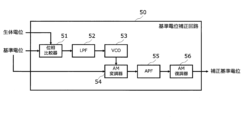
- FIG. 7 is a diagram showing a configuration example of a reference potential correction circuit according to a fourth embodiment of the present invention.
- the reference potential correction circuit 50 of the present embodiment converts the reference potential information received from the biological signal generation device into an analog signal, and then compares the phase with the biological potential signal input from the electrode section. Correct the phase of the reference potential according to the phase difference. By correcting the phase in the analog domain, there is no need to perform digital calculations as in the third embodiment, so power consumption can be significantly reduced.
- the reference potential correction circuit 50 of this embodiment includes, for example, a phase comparator 51, an LPF (Low-Pass-Filter) 52, a VCO (Voltage-controlled oscillator) 53, an AM modulator 54, as shown in FIG. This can be realized by an APF (All-Pass Filter) 55 and an AM demodulator 56.
- LPF Low-Pass-Filter
- VCO Voltage-controlled oscillator
- AM modulator 54 as shown in FIG. This can be realized by an APF (All-Pass Filter) 55 and an AM demodulator 56.
- a phase comparator 51 that compares the phases of a biopotential signal and a reference potential signal
- an LPF 52 that outputs a DC component from the output of the phase comparator 51
- an oscillator that outputs a signal with a frequency corresponding to the output of the LPF 52
- the VCO 53 outputs a signal with a frequency corresponding to the phase difference between the biopotential signal and the reference potential signal.
- the reference potential signal is amplitude-modulated by the output signal of the VCO 53, and the amplitude-modulated reference potential signal is passed through the APF 55.
- the APF 55 changes only the phase without changing the amplitude of the reference potential signal
- the frequency that is, the phase of the output signal of the VCO 53 is changed.
- the phase of the reference potential signal can be shifted according to the phase difference detected by the comparator 51.
- the AM demodulator 56 demodulates the output signal of the all-pass filter, thereby obtaining a phase-shifted reference potential signal.
- ⁇ Fifth embodiment> it is possible to measure biological signals with the same accuracy as conventional biological signal measurement systems using a plurality of electrode devices without physical wiring. Become. On the other hand, the reference potential output changes stepwise depending on the sampling rate of the device, so the reference potential remains constant until the next sampling value is transmitted, and the reference potential signal changes stepwise. do. However, since the true reference potential is constantly changing, this difference is output as an error, and there is a problem in that the suppression performance of common mode (in-phase) components deteriorates.
- a reference potential correction circuit provided in each electrode device (20, 30) interpolates a reference potential signal that changes stepwise. Since the reference potential signal in the amplifier circuit (22, 32) includes a periodic noise component called hum of 50 or 60 Hz, by estimating this periodic signal, the signal of the reference potential is adjusted stepwise according to the sampling rate of the electrode device. It is possible to interpolate a reference potential signal that changes in a similar manner. Interpolation of the reference potential signal can be performed in either the electrode device (20, 30) or the biological signal generation device 40.
- the electrode device (20, 30) When implemented using the electrode device (20, 30), this is achieved by receiving a reference potential signal and then interpolating the reference potential up to the next reception.
- the biosignal generation device 40 performs the interpolation, the results of interpolation in the biosignal generation device 40 may be transmitted to the electrode devices (20, 30). This interpolation may be performed by specifying frequency information using Fourier transform or wavelet transform.
- interpolation can be performed with a small amount of calculation, and there is an advantage that it can be easily implemented in electrode devices (20, 30).
- the AR model approximates a signal using a plurality of coefficients called AR coefficients.
- the number of AR coefficients is a parameter that can be arbitrarily determined by the designer, but the amount of data is generally smaller than the data used for estimation. Therefore, by configuring the biological signal generation device 40 to calculate the AR coefficient and send this value to the electrode devices (20, 30), the amount of communication can be reduced, and the amount of calculation in the electrode devices (20, 30) can be reduced. This makes it possible to expect a reduction in the power consumption of the electrode devices (20, 30).
- the present invention can be used for a bioelectrode that is used on a daily basis to acquire biosignals such as electrocardiographic signals and a biosignal measurement system using the bioelectrode.
Landscapes
- Health & Medical Sciences (AREA)
- Life Sciences & Earth Sciences (AREA)
- Heart & Thoracic Surgery (AREA)
- Medical Informatics (AREA)
- Biophysics (AREA)
- Pathology (AREA)
- Engineering & Computer Science (AREA)
- Biomedical Technology (AREA)
- Veterinary Medicine (AREA)
- Physics & Mathematics (AREA)
- Molecular Biology (AREA)
- Surgery (AREA)
- Animal Behavior & Ethology (AREA)
- General Health & Medical Sciences (AREA)
- Public Health (AREA)
- Cardiology (AREA)
- Measurement And Recording Of Electrical Phenomena And Electrical Characteristics Of The Living Body (AREA)
Priority Applications (2)
| Application Number | Priority Date | Filing Date | Title |
|---|---|---|---|
| JP2024526157A JP7768369B2 (ja) | 2022-06-09 | 2022-06-09 | 生体信号計測システム |
| PCT/JP2022/023296 WO2023238328A1 (ja) | 2022-06-09 | 2022-06-09 | 生体信号計測システム |
Applications Claiming Priority (1)
| Application Number | Priority Date | Filing Date | Title |
|---|---|---|---|
| PCT/JP2022/023296 WO2023238328A1 (ja) | 2022-06-09 | 2022-06-09 | 生体信号計測システム |
Publications (1)
| Publication Number | Publication Date |
|---|---|
| WO2023238328A1 true WO2023238328A1 (ja) | 2023-12-14 |
Family
ID=89117753
Family Applications (1)
| Application Number | Title | Priority Date | Filing Date |
|---|---|---|---|
| PCT/JP2022/023296 Ceased WO2023238328A1 (ja) | 2022-06-09 | 2022-06-09 | 生体信号計測システム |
Country Status (2)
| Country | Link |
|---|---|
| JP (1) | JP7768369B2 (https=) |
| WO (1) | WO2023238328A1 (https=) |
Cited By (1)
| Publication number | Priority date | Publication date | Assignee | Title |
|---|---|---|---|---|
| WO2026004033A1 (ja) * | 2024-06-27 | 2026-01-02 | Ntt株式会社 | 計測システムおよび信号読み出し装置 |
Citations (3)
| Publication number | Priority date | Publication date | Assignee | Title |
|---|---|---|---|---|
| WO2012085996A1 (ja) * | 2010-12-20 | 2012-06-28 | 富士通株式会社 | 電位計測装置 |
| US20170055862A1 (en) * | 2015-08-24 | 2017-03-02 | Korea Institute Of Science And Technology | Apparatus and method for measuring electrocardiogram using wireless communication |
| US20210244337A1 (en) * | 2019-05-08 | 2021-08-12 | Boe Technology Group Co., Ltd. | Electrocardiograph acquisition circuit, device, method and system |
Family Cites Families (1)
| Publication number | Priority date | Publication date | Assignee | Title |
|---|---|---|---|---|
| JPWO2019225244A1 (ja) | 2018-05-24 | 2021-06-10 | パナソニックIpマネジメント株式会社 | 生体信号取得用電極、生体信号取得用電極対及び生体信号測定システム |
-
2022
- 2022-06-09 JP JP2024526157A patent/JP7768369B2/ja active Active
- 2022-06-09 WO PCT/JP2022/023296 patent/WO2023238328A1/ja not_active Ceased
Patent Citations (3)
| Publication number | Priority date | Publication date | Assignee | Title |
|---|---|---|---|---|
| WO2012085996A1 (ja) * | 2010-12-20 | 2012-06-28 | 富士通株式会社 | 電位計測装置 |
| US20170055862A1 (en) * | 2015-08-24 | 2017-03-02 | Korea Institute Of Science And Technology | Apparatus and method for measuring electrocardiogram using wireless communication |
| US20210244337A1 (en) * | 2019-05-08 | 2021-08-12 | Boe Technology Group Co., Ltd. | Electrocardiograph acquisition circuit, device, method and system |
Cited By (1)
| Publication number | Priority date | Publication date | Assignee | Title |
|---|---|---|---|---|
| WO2026004033A1 (ja) * | 2024-06-27 | 2026-01-02 | Ntt株式会社 | 計測システムおよび信号読み出し装置 |
Also Published As
| Publication number | Publication date |
|---|---|
| JP7768369B2 (ja) | 2025-11-12 |
| JPWO2023238328A1 (https=) | 2023-12-14 |
Similar Documents
| Publication | Publication Date | Title |
|---|---|---|
| US8301232B2 (en) | Wireless, ultrasonic personal health monitoring system | |
| Yazicioglu et al. | A 30$\mu $ w analog signal processor ASIC for portable biopotential signal monitoring | |
| JP6651488B2 (ja) | 容量性差動回路およびデジタルシグマデルタ帰還回路を備えるadc | |
| CN110327038B (zh) | 心电采集电路、设备、方法和系统 | |
| US20110301439A1 (en) | Wireless, ultrasonic personal health monitoring system | |
| US8753285B2 (en) | ECG sensing apparatus and method for removal of baseline drift | |
| JP2012187404A (ja) | 生体信号測定装置と方法、そのための単位測定器、及びその方法に係る記録媒体 | |
| US12507933B2 (en) | Mobile ECG sensor apparatus | |
| Wang et al. | Design and evaluation of a novel wireless reconstructed 3-lead ECG monitoring system | |
| JP7768369B2 (ja) | 生体信号計測システム | |
| Tang et al. | Group-Chopping: An 8-Channel, 0.04% Gain Mismatch, 2.1 µW 0.017 mm 2 Instrumentation Amplifier for Bio-Potential Recording | |
| Hong et al. | A wireless ECG acquisition and classification system for body sensor networks | |
| WO2015115114A1 (ja) | 血圧測定システムおよび脈波センサ | |
| KR101571543B1 (ko) | 인체 통신을 이용한 맥파 속도 측정 장치 및 방법 | |
| JP7800681B2 (ja) | 生体信号計測システム | |
| JP2016174642A (ja) | ウェアラブル型心電信号生成装置、心電信号生成方法、およびプログラム | |
| US10888233B2 (en) | Monopolar physiological signal detection device and its operating method | |
| JP7852735B2 (ja) | 生体信号計測システム | |
| Vergara et al. | DC information preservation for cardiopulmonary monitor utilizing CW Doppler radar | |
| Gawali et al. | Mixed signal SoC based Bio-Sensor Node for long term health monitoring | |
| JP7841599B2 (ja) | 生体信号計測システム | |
| Feng et al. | A design and implementation of an ambulatory electrocardiogram (ECG) acquisition circuit for emergency application | |
| US20260026730A1 (en) | Biosignal measurement system | |
| US11406310B2 (en) | Circuits for mobile ECG system | |
| EP4620394A2 (en) | Apparatus for biopotential measurement |
Legal Events
| Date | Code | Title | Description |
|---|---|---|---|
| 121 | Ep: the epo has been informed by wipo that ep was designated in this application |
Ref document number: 22945830 Country of ref document: EP Kind code of ref document: A1 |
|
| WWE | Wipo information: entry into national phase |
Ref document number: 2024526157 Country of ref document: JP |
|
| NENP | Non-entry into the national phase |
Ref country code: DE |
|
| 122 | Ep: pct application non-entry in european phase |
Ref document number: 22945830 Country of ref document: EP Kind code of ref document: A1 |