WO2023219053A1 - 音響レンズ、及びスピーカシステム - Google Patents
音響レンズ、及びスピーカシステム Download PDFInfo
- Publication number
- WO2023219053A1 WO2023219053A1 PCT/JP2023/017253 JP2023017253W WO2023219053A1 WO 2023219053 A1 WO2023219053 A1 WO 2023219053A1 JP 2023017253 W JP2023017253 W JP 2023017253W WO 2023219053 A1 WO2023219053 A1 WO 2023219053A1
- Authority
- WO
- WIPO (PCT)
- Prior art keywords
- sound wave
- acoustic lens
- partition plates
- sound
- directivity
- Prior art date
- Legal status (The legal status is an assumption and is not a legal conclusion. Google has not performed a legal analysis and makes no representation as to the accuracy of the status listed.)
- Ceased
Links
Images




Classifications
-
- G—PHYSICS
- G10—MUSICAL INSTRUMENTS; ACOUSTICS
- G10K—SOUND-PRODUCING DEVICES; METHODS OR DEVICES FOR PROTECTING AGAINST, OR FOR DAMPING, NOISE OR OTHER ACOUSTIC WAVES IN GENERAL; ACOUSTICS NOT OTHERWISE PROVIDED FOR
- G10K11/00—Methods or devices for transmitting, conducting or directing sound in general; Methods or devices for protecting against, or for damping, noise or other acoustic waves in general
- G10K11/18—Methods or devices for transmitting, conducting or directing sound
- G10K11/26—Sound-focusing or directing, e.g. scanning
- G10K11/30—Sound-focusing or directing, e.g. scanning using refraction, e.g. acoustic lenses
-
- H—ELECTRICITY
- H04—ELECTRIC COMMUNICATION TECHNIQUE
- H04R—LOUDSPEAKERS, MICROPHONES, GRAMOPHONE PICK-UPS OR LIKE ACOUSTIC ELECTROMECHANICAL TRANSDUCERS; ELECTRIC HEARING AIDS; PUBLIC ADDRESS SYSTEMS
- H04R1/00—Details of transducers, loudspeakers or microphones
- H04R1/20—Arrangements for obtaining desired frequency or directional characteristics
- H04R1/32—Arrangements for obtaining desired frequency or directional characteristics for obtaining desired directional characteristic only
- H04R1/34—Arrangements for obtaining desired frequency or directional characteristics for obtaining desired directional characteristic only by using a single transducer with sound reflecting, diffracting, directing or guiding means
- H04R1/345—Arrangements for obtaining desired frequency or directional characteristics for obtaining desired directional characteristic only by using a single transducer with sound reflecting, diffracting, directing or guiding means for loudspeakers
-
- H—ELECTRICITY
- H04—ELECTRIC COMMUNICATION TECHNIQUE
- H04R—LOUDSPEAKERS, MICROPHONES, GRAMOPHONE PICK-UPS OR LIKE ACOUSTIC ELECTROMECHANICAL TRANSDUCERS; ELECTRIC HEARING AIDS; PUBLIC ADDRESS SYSTEMS
- H04R2499/00—Aspects covered by H04R or H04S not otherwise provided for in their subgroups
- H04R2499/10—General applications
- H04R2499/13—Acoustic transducers and sound field adaptation in vehicles
-
- H—ELECTRICITY
- H04—ELECTRIC COMMUNICATION TECHNIQUE
- H04R—LOUDSPEAKERS, MICROPHONES, GRAMOPHONE PICK-UPS OR LIKE ACOUSTIC ELECTROMECHANICAL TRANSDUCERS; ELECTRIC HEARING AIDS; PUBLIC ADDRESS SYSTEMS
- H04R5/00—Stereophonic arrangements
- H04R5/02—Spatial or constructional arrangements of loudspeakers
- H04R5/023—Spatial or constructional arrangements of loudspeakers in a chair, pillow
Definitions
- the present disclosure relates to an acoustic lens that controls the directivity of sound, and a speaker system.
- Patent Document 1 discloses an acoustic lens that improves the direction of sound waves in only one predetermined direction.
- An object of the present disclosure is to provide an acoustic lens and the like that can easily control the directivity of sound waves in each of two directions that intersect with each other.
- An acoustic lens includes an opening and a plurality of partition plates. Sound waves emitted from a speaker are input into the opening.
- the plurality of partition plates constitute a plurality of sound paths through which the sound waves input into the opening pass.
- the plurality of partition plates have a first control mechanism and a second control mechanism.
- the first control mechanism controls the directivity in a first direction of the sound waves that pass through the plurality of sound paths and are output to the outside.
- the second control mechanism controls the directivity of the sound waves that pass through the plurality of sound paths and are output to the outside in a second direction intersecting the first direction.
- a speaker system includes the acoustic lens and the speaker that emits the sound waves to the opening of the acoustic lens.
- FIG. 1 is a schematic diagram showing a speaker system of a comparative example.
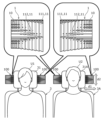
- FIG. 2 is a schematic diagram showing an example of use of the speaker system including the acoustic lens according to the first embodiment.
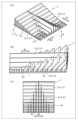
- FIG. 3 is a schematic diagram showing the configuration of the acoustic lens according to the first embodiment.
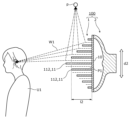
- FIG. 4 is an explanatory diagram of the first control mechanism of the acoustic lens according to the first embodiment.
- FIG. 5 is an explanatory diagram of the second control mechanism of the acoustic lens according to the first embodiment.
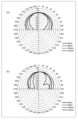
- FIG. 6 is an explanatory diagram of the directivity in the first direction of the acoustic lens according to the first embodiment.
- FIG. 7 is an explanatory diagram of the directivity in the second direction of the acoustic lens according to the first embodiment.
- FIG. 8 is a schematic diagram showing the configuration of a speaker system including an acoustic lens according to the second embodiment.
- FIG. 9 is a partially cutaway perspective view of the speaker system according to the second embodiment.
- FIG. 10 is a top view of the speaker system according to the second embodiment.
- FIG. 11 is a schematic diagram showing the configuration of an acoustic lens according to a modification of the first embodiment.
- FIG. 1 is a schematic diagram showing a speaker system 200 of a comparative example.
- the speaker system 200 of the comparative example is installed on the headrest 31 of the seat 3.
- the speaker system 200 of the comparative example is installed near the left ear and near the right ear of the user U1 seated on the seat 3, respectively.
- the directivity of the sound waves emitted from the speaker is uniform in the front direction of the speaker. Therefore, in the speaker system 200 of the comparative example, the sound or music played by the speaker is likely to leak to the person sitting in the seat next to seat 3 and the person sitting in the seat located behind seat 3. . In other words, the speaker system 200 of the comparative example has a problem in that sound tends to leak to users other than the target user U1.
- the structure of the acoustic lens by devising the structure of the acoustic lens, it is possible to easily control the directivity of sound waves in each of two mutually intersecting directions, thereby suppressing sound leaking to users other than the target user U1.
- the purpose is to provide an acoustic lens etc. that is easy to use.
- the acoustic lens according to the first aspect of the present disclosure includes an opening and a plurality of partition plates. Sound waves emitted from the speaker are input into the opening.
- the plurality of partition plates constitute a plurality of sound paths through which sound waves input into the openings pass.
- the plurality of partition plates have a first control mechanism and a second control mechanism.
- the first control mechanism controls the directivity in the first direction of the sound waves that pass through the plurality of sound paths and are output to the outside.
- the second control mechanism controls the directivity of the sound waves that pass through the plurality of sound paths and are output to the outside in a second direction intersecting the first direction.
- the first control mechanism controls the directivity of the sound wave in the first direction
- the second control mechanism controls the directivity of the sound wave in the second direction
- the first control mechanism is arranged in the first direction of the plurality of partition plates and in the traveling direction of the sound wave. It is constituted by a plurality of first partition plates having mutually different lengths.
- the second control mechanism includes a plurality of second partition plates, among the plurality of partition plates, that are arranged in the second direction and have different lengths in the direction of propagation of the sound waves.
- the plurality of first partition plates have a length in the direction of propagation of the sound waves that is directed from one side to the other side in the first direction. It gets shorter as time goes by.
- the plurality of second partition plates have a length in the direction of propagation of the sound waves from the center in the second direction. It gets shorter as you get further away.
- At least one of the plurality of first partition plates and the plurality of second partition plates is It is inclined at a predetermined angle with respect to the direction in which the sound waves travel.
- the predetermined angles are different for each of the partition plates.
- the first direction and the second direction are orthogonal to each other.
- the directivity of the sound waves can be easily controlled in each of the horizontal direction and the vertical direction.
- the plurality of partition plates are a plurality of third partition plates arranged in the first direction.
- the first control mechanism is configured such that the plurality of third partition plates have different lengths in the direction of propagation of the sound waves and are inclined at a first angle with respect to the direction of propagation of the sound waves.
- the second control mechanism is configured such that the plurality of third partition plates are each inclined at a second angle different from the second direction with respect to the second direction, and a line is formed across the center in the second direction when viewed from the propagation direction of the sound wave. It is constructed by being arranged symmetrically.
- the first control mechanism controls the directivity of the sound wave in the first direction
- the second control mechanism controls the directivity of the sound wave in the second direction
- a speaker system includes the acoustic lens according to any one of the first to eighth aspects, and a speaker that emits sound waves to the opening of the acoustic lens.
- constituent elements that are not described in the independent claims will be described as arbitrary constituent elements. Note that each figure is a schematic diagram and is not necessarily strictly illustrated. Further, in each figure, substantially the same configurations are denoted by the same reference numerals, and overlapping explanations may be omitted or simplified.
- FIG. 2 is a schematic diagram showing an example of use of the speaker system 100 including the acoustic lens 1 according to the first embodiment. In FIG. 2, illustration of the speaker 2 is omitted.
- FIG. 3 is a schematic diagram showing the configuration of the acoustic lens 1 according to the first embodiment. 3(a), 3(b), and 3(c) each represent a perspective view of the acoustic lens 1 viewed from different angles.
- FIG. 4 is an explanatory diagram of a first control mechanism (described later) of the acoustic lens 1 according to the first embodiment.
- FIG. 5 is an explanatory diagram of a second control mechanism (described later) of the acoustic lens 1 according to the first embodiment.
- the speaker system 100 includes an acoustic lens 1 and a speaker 2 (see FIGS. 4 and 5).
- the speaker system 100 is a system for allowing a target user U1 to hear sound waves W1 (see FIGS. 4 and 5) emitted from the speaker 2 and radiated through the acoustic lens 1.
- the speaker system 100 is installed in the seats 3 and 3A of a moving body such as a car.
- the seat 3 is the driver's seat of the automobile
- the seat 3A is the passenger seat of the automobile.
- the seats 3 and 3A are lined up in the left-right direction (horizontal direction) of the vehicle on the front side of the vehicle.
- the left-right direction (horizontal direction) of the automobile will be referred to as a "first direction d1.”
- the height direction (vertical direction) of the automobile will be referred to as a "second direction d2.”
- the speaker system 100 is installed at both ends of the headrest 31 of the seat 3 in the first direction d1. That is, the speaker system 100 is installed near the left ear and near the right ear of the user U1 seated on the seat 3, respectively. Further, the speaker system 100 is installed at both ends of the headrest 31A of the seat 3A in the first direction d1. That is, the speaker system 100 is installed near the left ear and near the right ear of the user U2 seated on the seat 3A.
- the speaker 2 is a device that outputs a sound wave W1 by converting an electrical signal such as an audio signal into vibration of a diaphragm.
- the size, shape, or structure of the diaphragm, magnetic circuit, frame, etc. that constitute the speaker 2 is not particularly limited.
- the speaker 2 is an electrodynamic speaker equipped with a cone-shaped diaphragm.
- the speaker 2 emits a sound wave W1 to an opening 10 (described later) of the acoustic lens 1. Thereby, the sound wave W1 emitted from the speaker 2 passes through the acoustic lens 1 and is radiated to the outside (atmosphere).
- the acoustic lens 1 includes an opening 10 and a plurality of partition plates 11.
- the opening 10 is a part into which the sound wave W1 emitted from the speaker 2 is input.
- the opening 10 is a bottom portion of the acoustic lens 1 facing the speaker 2, and is configured in a lattice shape by combining a plurality of partition plates 11. Sound waves W1 emitted from the speaker 2 pass through a plurality of gaps provided between the partition plates 11 in the opening 10.
- Each partition plate 11 has a flat plate shape, and is a member that itself is difficult to vibrate.
- the material constituting each partition plate 11 is, for example, wood, resin, metal, ceramics, etc., and is not particularly limited.
- the plurality of partition plates 11 constitute a plurality of sound paths P1 through which the sound waves W1 input into the opening 10 pass.
- the space between adjacent partition plates 11 serves as a sound path P1 through which the sound wave W1 input into the opening 10 passes.
- the sound wave W1 input into the opening 10 passes through the sound path P1 and is output to the outside.
- the plurality of partition plates 11 have a first control mechanism and a second control mechanism.
- the first control mechanism is a mechanism that controls the directivity in the first direction d1 of the sound wave W1 that passes through the plurality of sound paths P1 and is output to the outside.
- the first control mechanism controls the sound pressure level of the sound wave W1 that passes through the acoustic lens 1 and is outputted to the outside to the other side in the first direction d1 (in FIG.
- the directivity of the sound wave W1 is controlled so that it is relatively higher on one side (the user U1 side in FIG. 4) than on the user U2 side, that is, the directivity is deflected to one side in the first direction d1.
- the second control mechanism is a mechanism that controls the directivity of the sound wave W1 that passes through the plurality of sound paths P1 and is output to the outside in a second direction d2 that intersects the first direction d1.
- the directivity of the sound wave W1 is controlled so that it is relatively higher on the center side than on the upper and lower sides in the second direction d2, that is, the directivity of the sound wave W1 is deflected toward the center in the second direction d2.
- the first direction d1 is the horizontal direction
- the second direction d2 is the vertical direction. Therefore, in the first embodiment, the first direction d1 and the second direction d2 are orthogonal to each other. Note that the first direction d1 and the second direction d2 only need to intersect with each other, and do not need to be orthogonal to each other.
- the first control mechanism is configured by a plurality of first partition plates 111 among the plurality of partition plates 11.
- the plurality of first partition plates 111 are arranged in the first direction d1, and have different lengths l1 in the traveling direction of the sound wave W1.
- the plurality of first partition plates 111 have a condition that the length l1 in the traveling direction of the sound wave W1 becomes shorter as it goes from one side (the right side in FIG. 4) to the other side (the left side in FIG. 4) in the first direction d1. are arranged according to.
- the plurality of first partition plates 111 are arranged such that the longer the first partition plate 111 is located on the side where the sound wave W1 is desired to have directivity in the first direction d1, the longer the length l1 of the first partition plate 111 in the traveling direction of the sound wave W1. is located.
- the traveling direction of the sound wave W1 is the traveling direction of the sound wave W1 emitted from the speaker 2, and is not the traveling direction of the sound wave W1 passing through the acoustic lens 1.
- the traveling direction of the sound wave W1 corresponds to a direction perpendicular to both the first direction d1 and the second direction d2.
- the two first partition plates 111 located on the farthest side in the first direction d1 (on the right side in FIG. 4) do not meet the above conditions.
- these first partition plates 111 may also be arranged according to the above conditions.
- the plurality of first partition plates 111 are each inclined at a predetermined angle ⁇ with respect to the traveling direction of the sound wave W1, as shown in FIGS. 3 and 4.
- the predetermined angle ⁇ is an acute angle, for example, 45 ⁇ 1 to 5 degrees.
- the predetermined angle ⁇ may be any acute angle, and may be, for example, 30 ⁇ 1 to 5 degrees or 60 ⁇ 1 to 5 degrees.
- the second control mechanism is configured by a plurality of second partition plates 112 among the plurality of partition plates 11.
- the plurality of second partition plates 112 are arranged in the second direction d2, and have different lengths l2 in the traveling direction of the sound wave W1.
- the plurality of second partition plates 112 are arranged according to the condition that the length l2 in the traveling direction of the sound wave W1 becomes shorter as the distance from the center in the second direction d2 increases.
- the plurality of second partition plates 112 are arranged such that the length l2 of the second partition plate 112 in the traveling direction of the sound wave W1 becomes longer as the second partition plate 112 is located on the side where the sound wave W1 is desired to have directivity in the second direction d2. is located.
- a plurality of sound paths P1 constituted by a plurality of first partition plates 111 have a length (hereinafter referred to as "distance") in the traveling direction of the sound wave W1. , becomes shorter from one side (right side in FIG. 4) to the other side (left side in FIG. 4) in the first direction d1. Then, the sound waves W1 pass through each sound path P1 and are radiated to the outside (atmosphere).
- each of the first partition plates 111 The directivity in the first direction d1 is controlled by changing the passage distance of the sound wave W1 depending on the length of and shifting the arrival time of the sound wave W1.
- the sound wave W1 that reaches the ear of the user U1 located on one side (on the right side in FIG. 4) in the first direction d1 is caused by each of the first partition plates 111 to be deflected in the first direction d1, as shown by the broken line.
- the passage of the sound wave W1 to one side is hardly obstructed.
- there is no significant difference in the travel distance of the sound waves W1 emitted from each sound path P1 partitioned by each first partition plate 111 of the acoustic lens 1 there is no significant difference in the travel distance of the sound waves W1 emitted from each sound path P1 partitioned by each first partition plate 111 of the acoustic lens 1, and the difference in the arrival time of the sound waves W1 from each sound path P1 is small. Since it is small, there is little cancellation of the sound wave W1 due to the difference in arrival time.
- the sound wave W1 that reaches the ear of the user U2 located on the other side (the left side in FIG. 4) in the first direction d1 is transmitted in the first direction d1 by each first partition plate 111, as shown by the dashed line.
- the passage of the sound wave W1 to the other side in the first direction d1 is obstructed, and in particular, the passage of the sound wave W1 to the other side in the first direction d1 is more markedly obstructed.
- the sound wave W1 heading toward the ear of the user U2 located on the other side in the first direction d1 is smaller than the distance traveled by the sound wave W1 emitted from each sound path P1 partitioned by each first partition plate 111 of the acoustic lens 1. Since the distance difference is large, the difference in arrival time becomes large, and the influence of cancellation of the sound wave W1 due to the difference in arrival time is large.
- the sound pressure level of the sound wave W1 reaching the ear of the user U1 is relatively higher than the sound pressure level of the sound wave W1 reaching the ear of the user U2, so that the directivity is deflected to one side in the first direction d1. becomes.
- the plurality of first partition plates 111 are each inclined at a predetermined angle ⁇ with respect to the traveling direction of the sound wave W1. Therefore, in the first embodiment, the sound wave W1 has a directivity that is further deflected to one side (to the right in FIG. 4) in the first direction d1 compared to the case where the plurality of first partition plates 111 are not inclined. controlled so that Note that the directivity of the sound wave W1 in the first direction d1 can be adjusted by changing a predetermined angle ⁇ . For example, the larger the predetermined angle ⁇ is, the more the sound wave W1 is controlled to have a directivity deflected to one side in the first direction d1.
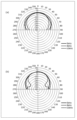
- FIG. 6 is an explanatory diagram of the directivity in the first direction d1 of the acoustic lens 1 according to the first embodiment.
- FIG. 6 is a directional characteristic diagram (polar pattern).
- FIG. 6A shows the directivity of the sound wave W1 in the first direction d1 when the sound wave W1 is emitted from the speaker 2 without using the acoustic lens 1.
- FIG. 6B shows the directivity of the sound wave W1 in the first direction d1 when the sound wave W1 is emitted from the speaker 2 using the acoustic lens 1.
- FIG. 6A shows the directivity of the sound wave W1 in the first direction d1 when the sound wave W1 is emitted from the speaker 2 without using the acoustic lens 1.
- FIG. 6B shows the directivity of the sound wave W1 in the first direction d1 when the sound wave W1 is emitted from the speaker 2 using the acoustic lens 1.
- FIG. 6A shows the directivity of the sound wave W1 in
- the solid line shows the directivity of the sound wave W1 with a frequency of 5 kHz
- the dotted line shows the directivity of the sound wave W1 with a frequency of 8 kHz
- the broken line shows the directivity of the sound wave W1 with a frequency of 10 kHz
- the dashed line shows the directivity of the sound wave W1 with a frequency of 12 kHz. It represents the directivity of W1.
- the right side in FIG. 6 corresponds to one side in the first direction d1
- the left side in FIG. 6 corresponds to the other side in the first direction d1.
- the position of the ear of the user U1 seated on the seat 3 and the virtual point p located on one side (upper side in FIG. 5) in the second direction d2 are controlled.
- the directivity in the second direction d2 is controlled by changing the passage distance of the sound wave W1 depending on the length of each second partition plate 112 and shifting the arrival time of the sound wave W1.
- the sound wave W1 that reaches the ear of the user U1 located at the center in the second direction d2 is transmitted by each second partition plate 112 to the center side in the second direction d2, as shown by the broken line.
- the sound wave W1 that reaches the virtual point p located on one side in the second direction d2 is directed to one side in the second direction d2 by each second partition plate 112, as shown by the dashed line. Passage of W1 is obstructed, and particularly toward the center in the second direction, it is more conspicuously obstructed.
- the sound wave W1 heading toward the virtual point p located on one side in the second direction d2 is smaller than the distance traveled by the sound wave W1 emitted from each sound path P1 partitioned by each second partition plate 112 of the acoustic lens 1. Since the distance difference is large, the difference in arrival time from when the sound wave W1 is emitted until it reaches the virtual point p becomes large, and the effect of cancellation of the sound wave W1 due to the difference in arrival time is large.
- the sound wave W1 directed toward the ear of the user U1 located at the center in the second direction d2 passes through the sound wave W1 radiated from each sound path P1 partitioned by each second partition plate 112 of the acoustic lens 1. Since the distance difference is small, there is little cancellation of the sound wave W1 due to the difference in arrival time from when the sound wave W1 is emitted until it reaches the ear of the user U1.
- the sound pressure level of the sound wave W1 reaching the ear of the user U1 is relatively higher than the sound pressure level of the sound wave W1 reaching the virtual point p, so that the directivity is deflected toward the center in the second direction d2.
- FIG. 7 is an explanatory diagram of the directivity in the second direction d2 of the acoustic lens 1 according to the first embodiment.
- FIG. 7 is a directional characteristic diagram (polar pattern).
- FIG. 7A shows the directivity of the sound wave W1 in the second direction d2 when the sound wave W1 is emitted from the speaker 2 without using the acoustic lens 1.
- FIG. 7B shows the directivity of the sound wave W1 in the second direction d2 when the sound wave W1 is emitted from the speaker 2 using the acoustic lens 1. Further, in FIG.
- the solid line represents the directivity of the sound wave W1 with a frequency of 5 kHz
- the dotted line represents the directivity of the sound wave W1 with a frequency of 8 kHz
- the broken line represents the directivity of the sound wave W1 with a frequency of 10 kHz.
- the right side in FIG. 7 corresponds to one side in the second direction d2
- the left side in FIG. 7 corresponds to the other side in the second direction d2.
- the directivity of the sound wave W1 in the first direction d1 is controlled by the first control mechanism (the plurality of first partition plates 111), and the second control mechanism
- the directivity of the sound wave W1 in the second direction d2 can be controlled by (the plurality of second partition plates 112). Therefore, the acoustic lens 1 according to the first embodiment has the advantage that the directivity of the sound wave W1 can be easily controlled in each of the two mutually intersecting directions (the first direction d1 and the second direction d2).
- the acoustic lens 1 can control the directivity of the sound wave W1 in the horizontal direction and the vertical direction, with the first direction d1 being the horizontal direction and the second direction d2 being the vertical direction. . Therefore, the acoustic lens 1 according to the first embodiment and the speaker system 100 using the acoustic lens 1 can solve the problems that the speaker system 200 of the comparative example had.
- the speaker system 100 is arranged near the left ear and the right ear of the user U1 seated on the seat 3, and the sound wave W1 is arranged in the horizontal direction (first direction d1).
- the acoustic lens 1 is arranged so that the directivity is biased toward the user U1.
- the sound wave W1 emitted by the speaker 2 is radiated through the acoustic lens 1 so as to have a directionality deflected toward the user U1 in the horizontal direction, so that the sound wave W1 is directed toward the user U2 who is seated on the seat 3A next to the seat 3. Sound doesn't easily leak out.
- the sound waves W1 emitted by the speaker 2 are radiated through the acoustic lens 1 so as to have a directivity that is deflected toward the front of the user U1 without being diffused in the vertical direction.
- the sound waves W1 are less likely to go around, and the sound is less likely to leak to the user seated on the seat located behind the seat 3.
- the speaker system 100 is placed near the left ear and near the right ear of the user U2 who is seated on the seat 3A next to the seat 3, and the sound wave W1 is directed toward the user U2 in the horizontal direction (first direction d1).
- the acoustic lens 1 is arranged so that the directivity is deflected toward U2.
- the sound wave W1 emitted by the speaker 2 is radiated through the acoustic lens 1 so as to have a directionality deflected toward the user U2 in the horizontal direction, so that the sound is less likely to leak to the user U1 seated on the seat 3.
- the sound waves W1 emitted by the speaker 2 are not diffused in the vertical direction through the acoustic lens 1, but are radiated with directivity deflected toward the front of the user U2, so that the sound waves W1 are emitted toward the rear of the seat 3A.
- the sound wave W1 is less likely to go around, and the sound is less likely to leak to the user seated at the seat located behind the seat 3A.
- the acoustic lens 1 according to the first embodiment and the speaker system 100 using the acoustic lens 1 have the advantage that it is easy to suppress sound leaking to users other than the target user U1 (or user U2). .
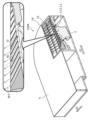
- FIG. 8 is a schematic diagram showing the configuration of a speaker system 100A including an acoustic lens 1A according to the second embodiment.
- (a) of FIG. 8 represents a perspective view of the acoustic lens 1A
- (b) of FIG. 8 represents a perspective view of the speaker system 100A.
- FIG. 9 is a partially cutaway perspective view of a speaker system 100A according to the second embodiment.
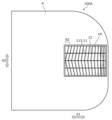
- FIG. 10 is a top view of a speaker system 100A according to the second embodiment. Note that in the following description, descriptions of configurations common to Embodiment 1 will be omitted as appropriate. Further, in both FIGS. 8 and 10, illustration of the sound wave W1 is omitted.
- the speaker system 100A includes an acoustic lens 1A, a speaker 2 (see FIG. 9), and a housing 4, as shown in FIG. 8(b). Similar to the speaker system 100 according to the first embodiment, the speaker system 100A is a system for making the target user U1 listen to the sound wave W1 emitted from the speaker 2 and radiated through the acoustic lens 1A. .
- the configuration of the speaker 2, the arrangement of the speaker system 100A, etc. are the same as those in Embodiment 1, so the description thereof will be omitted here.
- the housing 4 is formed into a flat rectangular parallelepiped shape and holds the acoustic lens 1A and the speaker 2. Specifically, the speaker 2 is housed inside the housing 4 . Further, the housing 4 is provided with an opening, and the acoustic lens 1A is held in the housing 4 so that the acoustic lens 1A is exposed to the outside through the opening.
- the acoustic lens 1A includes an opening 10, a plurality of partition plates 11, and a plurality of partition plates 12.
- the plurality of partition plates 11 are a plurality of third partition plates 113 arranged in the first direction d1.
- the plurality of partition plates 12 are made of the same material as each partition plate 11, and are arranged in the second direction d2. Note that each division plate 12 hardly contributes to controlling the directivity of the sound wave W1, so a description thereof will be omitted here.
- the first control mechanism is such that the plurality of third partition plates 113 have different lengths l3 in the direction of travel of the sound wave W1, and and is tilted at a first angle ⁇ 1.
- the first angle ⁇ 1 is an acute angle, for example, 45 ⁇ 1 to 5 degrees.
- the first angle ⁇ 1 may be any acute angle, and may be, for example, 30 ⁇ 1 to 5 degrees or 60 ⁇ 1 to 5 degrees.
- the length l3 of the plurality of third partition plates 113 in the traveling direction of the sound wave W1 becomes shorter as it goes from one side (the left side in FIG. 9) to the other side (the right side in FIG. 9) in the first direction d1.
- the plurality of third partition plates 113 are arranged such that the length l3 of the third partition plate 113 in the traveling direction of the sound wave W1 becomes longer as the third partition plate 113 is located on the side where the sound wave W1 is desired to have directivity in the first direction d1. is located.
- the plurality of third partition plates 113 are inclined at mutually different second angles ⁇ 2 with respect to the second direction d2, and When viewed from the traveling direction of the sound wave W1 (direction perpendicular to the plane of the paper in FIG. 10), they are arranged so as to be symmetrical with respect to the center of the second direction d2.
- the plurality of third partition plates 113 are arranged according to the condition that the second angle ⁇ 2 becomes smaller from one side (left side in FIG. 10) to the other (right side in FIG. 10) in the first direction d1. There is.
- the second angle ⁇ 2 is, for example, in the range of 0 ⁇ 1 to 5 degrees or more and 20 ⁇ 1 to 5 degrees or less. Note that the second angle ⁇ 2 may be any acute angle (including 0 degrees), and may be, for example, in the range of 30 ⁇ 1 to 5 degrees or less, or in the range of 60 ⁇ 1 to 5 degrees or less.
- the directivity of the sound wave W1 in the first direction d1 is controlled by the first control mechanism (the plurality of third partition plates 113), and the second control mechanism
- the directivity of the sound wave W1 in the second direction d2 can be controlled by (the plurality of third partition plates 113). Therefore, the acoustic lens 1A according to the second embodiment, like the acoustic lens 1 according to the first embodiment, directs the sound wave W1 in each of the two directions (first direction d1 and second direction d2) that intersect with each other. It has the advantage of being easy to control.
- the first direction d1 is the horizontal direction
- the second direction d2 is the vertical direction
- the acoustic lens 1A adjusts the directivity of the sound wave W1 in the horizontal direction and the vertical direction. It is possible to control the Therefore, like the first embodiment, the acoustic lens 1A according to the second embodiment and the speaker system 100A using the acoustic lens 1A can solve the problem that the speaker system 200 of the comparative example had.
- the plurality of first partition plates 111 are all inclined with respect to the traveling direction of the sound wave W1, but the present invention is not limited to this.
- only some of the first partition plates 111 among the plurality of first partition plates 111 may be inclined.
- FIG. 11 is a schematic diagram showing the configuration of an acoustic lens 1 according to a modification of the first embodiment.
- the plurality of first partition plates 111 and the plurality of second partition plates 112 may be configured without being inclined with respect to the traveling direction of the sound wave W1.
- the plurality of first partition plates 111 all have the same length l1 along the traveling direction of the sound wave W1, and have a predetermined angle ⁇ . They may be arranged according to the condition that they become smaller as they go from one direction d1 (back side in FIG. 11(b)) to the other direction (front side in FIG. 11(b)).
- the plurality of second partition plates 112 have a length l2 in the traveling direction of the sound wave W1 in one of the second directions d2 (in FIG. 11(c)). They may be arranged according to the condition that they become longer as they go from the left side to the other side (the right side in FIG. 11(c)). Further, each of the plurality of second partition plates 112 may be inclined at a predetermined angle ⁇ ' with respect to the traveling direction of the sound wave W1.
- the predetermined angle ⁇ ' is an acute angle, for example, 45 ⁇ 1 to 5 degrees. Note that the predetermined angle ⁇ ' may be any acute angle, and may be, for example, 30 ⁇ 1 to 5 degrees or 60 ⁇ 1 to 5 degrees.
- the present disclosure is useful as a member that controls the directivity of sound waves emitted from a speaker.
Landscapes
- Physics & Mathematics (AREA)
- Engineering & Computer Science (AREA)
- Acoustics & Sound (AREA)
- Health & Medical Sciences (AREA)
- Otolaryngology (AREA)
- Multimedia (AREA)
- Signal Processing (AREA)
- Obtaining Desirable Characteristics In Audible-Bandwidth Transducers (AREA)
- Circuit For Audible Band Transducer (AREA)
Priority Applications (4)
| Application Number | Priority Date | Filing Date | Title |
|---|---|---|---|
| CN202380038245.0A CN119213788A (zh) | 2022-05-11 | 2023-05-08 | 声学透镜和扬声器系统 |
| EP23803530.7A EP4525479A4 (en) | 2022-05-11 | 2023-05-08 | ACOUSTIC LENS AND SPEAKER SYSTEM |
| JP2024520439A JPWO2023219053A1 (https=) | 2022-05-11 | 2023-05-08 | |
| US18/934,815 US20250063297A1 (en) | 2022-05-11 | 2024-11-01 | Acoustic lens and loudspeaker system |
Applications Claiming Priority (4)
| Application Number | Priority Date | Filing Date | Title |
|---|---|---|---|
| US202263340697P | 2022-05-11 | 2022-05-11 | |
| US63/340,697 | 2022-05-11 | ||
| JP2023073204 | 2023-04-27 | ||
| JP2023-073204 | 2023-04-27 |
Related Child Applications (1)
| Application Number | Title | Priority Date | Filing Date |
|---|---|---|---|
| US18/934,815 Continuation US20250063297A1 (en) | 2022-05-11 | 2024-11-01 | Acoustic lens and loudspeaker system |
Publications (1)
| Publication Number | Publication Date |
|---|---|
| WO2023219053A1 true WO2023219053A1 (ja) | 2023-11-16 |
Family
ID=88730472
Family Applications (1)
| Application Number | Title | Priority Date | Filing Date |
|---|---|---|---|
| PCT/JP2023/017253 Ceased WO2023219053A1 (ja) | 2022-05-11 | 2023-05-08 | 音響レンズ、及びスピーカシステム |
Country Status (5)
| Country | Link |
|---|---|
| US (1) | US20250063297A1 (https=) |
| EP (1) | EP4525479A4 (https=) |
| JP (1) | JPWO2023219053A1 (https=) |
| CN (1) | CN119213788A (https=) |
| WO (1) | WO2023219053A1 (https=) |
Citations (3)
| Publication number | Priority date | Publication date | Assignee | Title |
|---|---|---|---|---|
| JPS6373297A (ja) | 1986-09-17 | 1988-04-02 | 三菱電機株式会社 | 音響レンズ |
| WO2020213561A1 (ja) * | 2019-04-19 | 2020-10-22 | パナソニックIpマネジメント株式会社 | スピーカユニット、電子機器および移動体装置 |
| WO2021049136A1 (ja) * | 2019-09-13 | 2021-03-18 | パナソニックIpマネジメント株式会社 | 音響レンズ及びスピーカシステム |
Family Cites Families (2)
| Publication number | Priority date | Publication date | Assignee | Title |
|---|---|---|---|---|
| US2848058A (en) * | 1954-10-29 | 1958-08-19 | William L Hartsfield | Compressional-wave lens |
| GB2004170B (en) * | 1977-08-30 | 1982-01-27 | Secr Defence | Acoustic lenses |
-
2023
- 2023-05-08 JP JP2024520439A patent/JPWO2023219053A1/ja active Pending
- 2023-05-08 WO PCT/JP2023/017253 patent/WO2023219053A1/ja not_active Ceased
- 2023-05-08 CN CN202380038245.0A patent/CN119213788A/zh active Pending
- 2023-05-08 EP EP23803530.7A patent/EP4525479A4/en active Pending
-
2024
- 2024-11-01 US US18/934,815 patent/US20250063297A1/en active Pending
Patent Citations (3)
| Publication number | Priority date | Publication date | Assignee | Title |
|---|---|---|---|---|
| JPS6373297A (ja) | 1986-09-17 | 1988-04-02 | 三菱電機株式会社 | 音響レンズ |
| WO2020213561A1 (ja) * | 2019-04-19 | 2020-10-22 | パナソニックIpマネジメント株式会社 | スピーカユニット、電子機器および移動体装置 |
| WO2021049136A1 (ja) * | 2019-09-13 | 2021-03-18 | パナソニックIpマネジメント株式会社 | 音響レンズ及びスピーカシステム |
Non-Patent Citations (1)
| Title |
|---|
| See also references of EP4525479A4 |
Also Published As
| Publication number | Publication date |
|---|---|
| CN119213788A (zh) | 2024-12-27 |
| US20250063297A1 (en) | 2025-02-20 |
| EP4525479A1 (en) | 2025-03-19 |
| JPWO2023219053A1 (https=) | 2023-11-16 |
| EP4525479A4 (en) | 2025-07-30 |
Similar Documents
| Publication | Publication Date | Title |
|---|---|---|
| JP6286583B2 (ja) | ラウドスピーカシステム | |
| KR100840081B1 (ko) | 차량용 스피커 어레이 | |
| JP7547029B2 (ja) | 音声指向型拡声器グリル | |
| JP4989934B2 (ja) | スピーカシステム | |
| US20040109575A1 (en) | Vehicle audio system with directional sound and reflected audio imaging for creating a personal sound stage | |
| US20190069079A1 (en) | Speaker apparatus | |
| JPH074038B2 (ja) | スピ−カ装置 | |
| EP0457487B1 (en) | Horn speaker | |
| WO2023219053A1 (ja) | 音響レンズ、及びスピーカシステム | |
| JPH10224877A (ja) | 車載用スピーカシステム | |
| WO2007139066A1 (ja) | スピーカシステム | |
| JP7066931B2 (ja) | 車両用スピーカシステム | |
| WO2017104118A1 (ja) | スピーカ装置 | |
| JP2606441B2 (ja) | 車載用スピーカ装置 | |
| EP1445979A2 (en) | Speaker system with a main and a subordinate speaker | |
| JPH03192900A (ja) | 車載用スピーカ装置 | |
| US20250056155A1 (en) | Acoustic lens and loudspeaker system | |
| JPH05199595A (ja) | 車載用音場再生装置 | |
| US20260067613A1 (en) | Sound reproducing device, acoustic system, and mobile device | |
| US20260006374A1 (en) | Acoustic apparatus | |
| US12598408B2 (en) | Acoustic apparatus | |
| JP2021019265A (ja) | 音響装置 | |
| US20240073606A1 (en) | Loudspeaker transducer arrangement | |
| JPH06181596A (ja) | 車載用スピーカシステム | |
| JPH04172795A (ja) | 車載用スピーカシステム |
Legal Events
| Date | Code | Title | Description |
|---|---|---|---|
| 121 | Ep: the epo has been informed by wipo that ep was designated in this application |
Ref document number: 23803530 Country of ref document: EP Kind code of ref document: A1 |
|
| WWE | Wipo information: entry into national phase |
Ref document number: 2024520439 Country of ref document: JP |
|
| WWE | Wipo information: entry into national phase |
Ref document number: 202380038245.0 Country of ref document: CN |
|
| WWE | Wipo information: entry into national phase |
Ref document number: 2023803530 Country of ref document: EP |
|
| NENP | Non-entry into the national phase |
Ref country code: DE |
|
| ENP | Entry into the national phase |
Ref document number: 2023803530 Country of ref document: EP Effective date: 20241211 |
|
| WWP | Wipo information: published in national office |
Ref document number: 202380038245.0 Country of ref document: CN |