WO2023210960A1 - 지르코니아 표면 처리방법 - Google Patents
지르코니아 표면 처리방법 Download PDFInfo
- Publication number
- WO2023210960A1 WO2023210960A1 PCT/KR2023/003321 KR2023003321W WO2023210960A1 WO 2023210960 A1 WO2023210960 A1 WO 2023210960A1 KR 2023003321 W KR2023003321 W KR 2023003321W WO 2023210960 A1 WO2023210960 A1 WO 2023210960A1
- Authority
- WO
- WIPO (PCT)
- Prior art keywords
- plasma
- zirconia
- nitrogen
- treated
- mixed gas
- Prior art date
- Legal status (The legal status is an assumption and is not a legal conclusion. Google has not performed a legal analysis and makes no representation as to the accuracy of the status listed.)
- Ceased
Links
Images

Classifications
-
- A—HUMAN NECESSITIES
- A61—MEDICAL OR VETERINARY SCIENCE; HYGIENE
- A61C—DENTISTRY; APPARATUS OR METHODS FOR ORAL OR DENTAL HYGIENE
- A61C13/00—Dental prostheses; Making same
- A61C13/01—Palates or other bases or supports for the artificial teeth; Making same
- A61C13/02—Palates or other bases or supports for the artificial teeth; Making same made by galvanoplastic methods or by plating; Surface treatment; Enamelling; Perfuming; Making antiseptic
-
- A—HUMAN NECESSITIES
- A61—MEDICAL OR VETERINARY SCIENCE; HYGIENE
- A61C—DENTISTRY; APPARATUS OR METHODS FOR ORAL OR DENTAL HYGIENE
- A61C13/00—Dental prostheses; Making same
- A61C13/0003—Making bridge-work, inlays, implants or the like
- A61C13/0006—Production methods
-
- A—HUMAN NECESSITIES
- A61—MEDICAL OR VETERINARY SCIENCE; HYGIENE
- A61C—DENTISTRY; APPARATUS OR METHODS FOR ORAL OR DENTAL HYGIENE
- A61C13/00—Dental prostheses; Making same
- A61C13/08—Artificial teeth; Making same
- A61C13/083—Porcelain or ceramic teeth
-
- A—HUMAN NECESSITIES
- A61—MEDICAL OR VETERINARY SCIENCE; HYGIENE
- A61C—DENTISTRY; APPARATUS OR METHODS FOR ORAL OR DENTAL HYGIENE
- A61C5/00—Filling or capping teeth
- A61C5/70—Tooth crowns; Making thereof
-
- A—HUMAN NECESSITIES
- A61—MEDICAL OR VETERINARY SCIENCE; HYGIENE
- A61C—DENTISTRY; APPARATUS OR METHODS FOR ORAL OR DENTAL HYGIENE
- A61C7/00—Orthodontics, i.e. obtaining or maintaining the desired position of teeth, e.g. by straightening, evening, regulating, separating, or by correcting malocclusions
- A61C7/12—Brackets; Arch wires; Combinations thereof; Accessories therefor
- A61C7/14—Brackets; Fixing brackets to teeth
-
- A—HUMAN NECESSITIES
- A61—MEDICAL OR VETERINARY SCIENCE; HYGIENE
- A61C—DENTISTRY; APPARATUS OR METHODS FOR ORAL OR DENTAL HYGIENE
- A61C8/00—Means to be fixed to the jaw-bone for consolidating natural teeth or for fixing dental prostheses thereon; Dental implants; Implanting tools
-
- A—HUMAN NECESSITIES
- A61—MEDICAL OR VETERINARY SCIENCE; HYGIENE
- A61C—DENTISTRY; APPARATUS OR METHODS FOR ORAL OR DENTAL HYGIENE
- A61C8/00—Means to be fixed to the jaw-bone for consolidating natural teeth or for fixing dental prostheses thereon; Dental implants; Implanting tools
- A61C8/0012—Means to be fixed to the jaw-bone for consolidating natural teeth or for fixing dental prostheses thereon; Dental implants; Implanting tools characterised by the material or composition, e.g. ceramics, surface layer, metal alloy
-
- A—HUMAN NECESSITIES
- A61—MEDICAL OR VETERINARY SCIENCE; HYGIENE
- A61K—PREPARATIONS FOR MEDICAL, DENTAL OR TOILETRY PURPOSES
- A61K6/00—Preparations for dentistry
- A61K6/80—Preparations for artificial teeth, for filling teeth or for capping teeth
- A61K6/802—Preparations for artificial teeth, for filling teeth or for capping teeth comprising ceramics
- A61K6/818—Preparations for artificial teeth, for filling teeth or for capping teeth comprising ceramics comprising zirconium oxide
-
- H—ELECTRICITY
- H05—ELECTRIC TECHNIQUES NOT OTHERWISE PROVIDED FOR
- H05H—PLASMA TECHNIQUE; PRODUCTION OF ACCELERATED ELECTRICALLY-CHARGED PARTICLES OR OF NEUTRONS; PRODUCTION OR ACCELERATION OF NEUTRAL MOLECULAR OR ATOMIC BEAMS
- H05H1/00—Generating plasma; Handling plasma
- H05H1/24—Generating plasma
- H05H1/46—Generating plasma using applied electromagnetic fields, e.g. high frequency or microwave energy
Definitions
- the present invention relates to a method for treating zirconia surfaces, and more specifically, to zirconia stabilized with 1 to 5 mol% (preferably, 3 mol%) yttria (1 to 5 mol% (3 mol%) yttria stabilized tetragonal
- Biomaterials can modulate biological interactions by controlling the surface energy, biocompatibility, and adhesive strength of the substrate through surface modification strategies.
- Plasma modification is a method of modifying the surface properties of biological materials through physical collision of excited gas molecules or high-energy ion bombardment by chemical reaction.
- Atmospheric-pressure glow discharge (APGD) plasmas, especially cold atmospheric plasma (CAP) have recently been used in surface treatment, film deposition, ozone production for water purification, biomedical decontamination, wound healing, muscle regeneration, etc. It is attracting a lot of attention in various industrial and medical applications such as anti-cancer treatment.
- CAP also called non-thermal plasma (NTP)
- NTP non-thermal plasma
- CAP reactive oxygen and nitrogen species
- DBD dielectric-barrier discharge
- CAP generates large amounts of reactive oxygen and nitrogen species (RONS) through chemical reactions in biological systems.
- One common source of CAP is dielectric-barrier discharge (DBD), which is responsible for self-pulsing plasma operation with an insulating (dielectric) material in the discharge gap.
- DBD systems require a high voltage AC source in the kHz range (1 to 100 kVrms).
- Zirconia (3Y-TZP) ceramic stabilized with 1 to 5 mol% (approximately 3 mol%) yttria is suitable for fabricating crowns and bridge restorations due to its excellent biocompatibility, sufficient mechanical strength and high esthetics. , is widely used in dental applications for manufacturing dental implants, orthodontic brackets, and root canal posts.
- zirconia has a low reactivity and a chemically inert surface, which limits stable bonding, cell adhesion, or osseointegration with resin cement.
- Mechanical surface treatment tends to increase the bond strength of resin cement and zirconia through micromechanical retention, but may worsen the fracture resistance of zirconia by inducing cracks and surface damage.
- Plasma surface treatment is performed to increase the surface energy of the material by creating polar groups on the zirconia surface.
- plasma surface treatment has been found to increase the surface hydrophilicity of 3Y-TZP without changing the surface morphology, several studies have shown that plasma treatment increases the associated shear bond strength (SBS) between zirconia and composite resin. ) did not significantly improve.
- SBS shear bond strength
- oxygen radicals generated in plasma can primarily remove surface organic contaminants and exhibit potential antibacterial efficacy around zirconia.
- Gas type is one of the important plasma characteristics in plasma performance.
- Noble gases such as helium (He) or argon (Ar) are generally used to induce CAP discharge due to their low breakdown voltage.
- some reactive gases such as oxygen , nitrogen or air are noble gases and small amounts for the generation of chemically active species such as O3, OH, H2O2 , NO and OH radicals at breakdown voltage and low temperature.
- reactive gases such as oxygen , nitrogen or air are noble gases and small amounts for the generation of chemically active species such as O3, OH, H2O2 , NO and OH radicals at breakdown voltage and low temperature. can be mixed.
- Rare gases in an excited state in plasma generated from a mixed gas can change discharge characteristics by ionizing the active gas through energy transfer (Penning ionization) through collision.
- the present inventors made diligent efforts to confirm the effect of plasma composition on the physicochemical surface modification of 3Y-TZP, and as a result, plasma consisting of He/O 2 mixed gas, N 2 /Ar mixed gas, N 2 gas, or Ar gas Contact angle of treated zirconia samples, surface energy, surface area through methods such as X-ray photoelectron spectroscopy (XPS), By confirming changes in 3Y-TZP surface properties such as chemistry, phase composition and morphology, and confirming that the biological activity of zirconia samples treated with plasma consisting of nitrogen and argon mixed gas (N 2 /Ar) is significantly improved, this study The invention was completed.
- XPS X-ray photoelectron spectroscopy
- the purpose of the present invention is to provide a zirconia surface treatment method.
- the present invention provides a dental zirconia surface treatment method comprising the following steps.
- the plasma in step (b), may include nitrogen and argon gases in a composition ratio of 0.3:9.7 to 1.5:8.5.
- the present invention also provides dental zirconia surface-treated by the above method.
- the present invention also provides a dental material containing the zirconia as an active ingredient.
- the dental material may be used to manufacture one or more dental articles selected from the group consisting of implants, crowns, inlays, posts, and orthodontic brackets.
- Zirconia (3Y-TZP) treated with plasma consisting of nitrogen and argon mixed gas (N 2 /Ar) of the present invention significantly decreased the contact angle, increased surface energy, and increased surface energy without changing the surface topography.
- the polar component value appears the highest.
- the surface oxygen (O) content increases and the surface carbon (C) content decreases, effectively increasing the hydrophilicity of the zirconia surface.
- the antibacterial properties, osseointegration ability, and adhesive performance of 3Y-TZP can be improved by controlling the nitrogen functional groups.
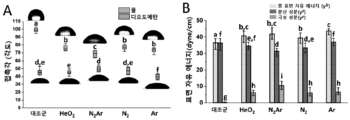
- Figure 1A relates to the contact angle of water and diiodomethane.
- the box plot represents the mean (solid black horizontal line), median (dashed horizontal line), interquartile range (box), and total range (whiskers) of the data set.
- Figure 1B shows the values of total surface free energy ( ⁇ total ), dispersion component ( ⁇ d ), and polar component ( ⁇ p ) of each plasma-treated zirconia sample ( ⁇ p). Identical letters indicate that there is no significant difference in the corresponding values between plasma types (p >0.05). Error bars represent standard deviation.
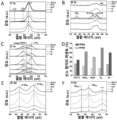
- Figure 2A relates to carbon (C 1s) XPS spectrum (X-ray diffraction). Compared to zirconia treated with plasma made of other types of gas, the carbon content in zirconia treated with N 2 /Ar was significantly reduced.
- Figure 2B relates to nitrogen (N 1s) XPS spectrum. It was confirmed that a new component related to the presence of nitrate (NO 3 - ) species in zirconia treated with N 2 /Ar exhibits a binding energy of 406.5 eV.
- Figure 2C relates to the oxygen (O 1s) XPS spectrum.
- Figure 2D relates the percent area of acidic hydroxyl groups OH (a) and basic hydroxyl groups OH (b) in the O1s XPS spectrum.
- Figure 2E relates to zirconia (Zr 3d) XPS spectrum.
- Figure 2F relates to Y 3d XPS spectra of the outermost surface of zirconia treated with plasma containing different types of
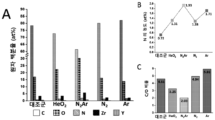
- Figure 3A relates to the atomic percentage (at%) for each element detected in zirconia treated with plasma made of different types of gases.
- Figure 3B relates to the nitrogen (N) concentration of zirconia treated with plasma made of different types of gases
- Figure 3C relates to the carbon/oxygen ratio of zirconia treated with plasma made of different types of gases.
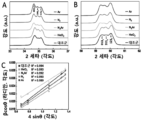
- W-H Williamson-Hall
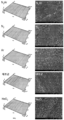
- Figure 5 is a representative three-dimensional image obtained by a confocal laser scanning microscope (left) and a scanning electron microscope image (right) at 30,000X magnification of zirconia samples treated with plasma of different types of gas.
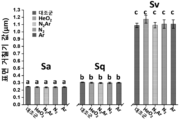
- Figure 6 relates to surface texture parameters (Sa, Sq, and Sv) of zirconia samples treated with plasma of different types of gas. Identical letters indicate that Sa, Sq and Sv values are not significantly different (p >0.05).
- Figure 7 is a schematic diagram of the experimental setup for treating the surface of a zirconia sample with plasma.
- Plasma surface treatment can improve clinical performance by altering the chemically inert properties of zirconia.
- the present invention confirmed the effect of plasma composition on the physicochemical surface modification of 3 mol% yttria stabilized tetragonal zirconia polycrystal (3Y-TZP).
- Low-temperature atmospheric plasma discharge was performed for 60 seconds at an application distance of 10 mm using plasma consisting of four different types of gases: He/O 2 , N 2 /Ar, N 2 and Ar.
- the static contact angle was measured to define the surface free energy.
- N 2 Ar plasma containing 10% nitrogen was used, and while the N 2 Ar plasma mixed gas was irradiated on the zirconia surface, nitrogen atoms were replaced with oxygen atoms, so the zirconia surface tended to have more negative charges.
- Helium plasma can easily generate a stable glow discharge with the addition of active gases such as O 2 , N 2 or CF 4 , but since helium is much lighter than air, reactive oxygen species cannot easily reach the target material, and unlike helium, argon cannot easily reach the target material. Because it is denser than air, excited atomic oxygen can be easily transferred to the substrate.
- the present invention relates to a method for treating a dental zirconia surface, consistently comprising the following steps.
- argon is an inert gas, can be used at atmospheric pressure, and has the advantage of low operating costs.
- nitrogen gas is mixed with nitrogen gas, nitrogen molecules become nitrogen ions through the Penning ionization process. Ionization is possible only by mixing a small amount of nitrogen gas, and the maximum ionization effect can be obtained by mixing 10% nitrogen, but is not limited to this. Ionized nitrogen ions attack the oxygen vacancies on the zirconia surface, accelerating the surface anionization of the zirconia surface, and increasing surface reactivity by creating zirconium oxynitride.
- Zirconia has the disadvantage of being surface inert, but through the plasma treatment method of the present invention using a nitrogen and argon mixed gas (N 2 /Ar), zirconia-nitride induces surface formation and increases the ionic conductivity of zirconia. Accordingly, zirconia treated with plasma consisting of nitrogen and argon mixed gas (N 2 /Ar) using the above method may be characterized as being particularly optimal for dental materials.
- the nitrogen and argon gases may be included in a component ratio of 0.3:9.7 to 1.5:8.5, preferably 0.7:9.3 to 1.2:8.8, and more preferably 1:9. Not limited.
- the present invention relates to dental zirconia surface-treated by the above method.
- the present invention relates to a dental material containing the zirconia as an active ingredient.
- Zirconia has surface inertness and low adhesion, but by activating the zirconia surface by treating it with plasma consisting of nitrogen and argon mixed gas (N 2 /Ar) using the method of the present invention, it can be used in dental implants, crowns, inlays, posts, and orthodontic brackets.
- plasma consisting of nitrogen and argon mixed gas (N 2 /Ar) using the method of the present invention.
- the utilization of zirconia as a material can be improved.
- the dental material may be used to manufacture one or more dental articles selected from the group consisting of implants, crowns, inlays, posts, and orthodontic brackets, but is not limited thereto.
- the present invention used 3Y-TZP (KATANA ML, Kuraray Noritake Dental, Osaka, Japan) sintered at 1500°C for 2 hours.
- a total of 140 plate-shaped samples (10.0 mm ⁇ 10.0 mm ⁇ 1.0 mm) were prepared and ground to a uniform finish with 800 grit SiC paper.
- plasma irradiation was performed at room temperature using a low-temperature atmospheric pressure DBD plasma generator (PR-ATO-001, ICD Co., Anseong, Gyeonggi-do, Korea). Plasma was applied perpendicular to the sample surface at a distance of 10 mm for 60 seconds.
- a schematic diagram of the device used in the experiment is shown in Figure 7.
- the input voltage was fixed to 5kV using a high-voltage transformer, and the operating frequency was set to 25kHz using a digital oscilloscope (MSO4032, Tektronix, Beaverton, OR, USA).
- the mass flow controller maintained a constant gas flow rate of 10 standard liters per minute (slm).
- the surface wettability of the samples was measured using a contact angle meter (Phoenix 300 Touch, S.E.O., Suwon, Gyeonggi-do, Korea).
- the surface free energy was calculated by measuring the contact angle of two liquids (distilled water and nonpolar diodomethane) according to the Owens-Wendt equation.
- the total surface free energy ( ⁇ total ) including the dispersive component ( ⁇ d ) and polar component ( ⁇ p ) was calculated.
- Figure 1 shows the contact angle along with the sessile drop image (A) and ⁇ total , ⁇ d , and ⁇ p values (B) of zirconia samples treated with plasma of different types of gas, and the measured contact angles are shown in Table 1. . After exposure to plasma, the water contact angle of all samples significantly decreased, and the lowest value of 69° was measured in the sample treated with plasma consisting of nitrogen and argon mixed gas (N 2 /Ar). The diodomethane contact angle remained almost constant for all plasma treated samples except argon (Ar) (1A and Table 1).
- Plasma group Contact Angle(°) Water Diiodomethane Control 98.75 ⁇ 2.70 a 45.66 ⁇ 4.30 d,e HeO 2 75.59 ⁇ 3.38 b 44.72 ⁇ 3.16 e N 2 Ar 69.00 ⁇ 3.98 c 49.39 ⁇ 3.33 d N 2 76.86 ⁇ 3.30 b 47.21 ⁇ 4.14 d,e Ar 73.22 ⁇ 3.00 b 39.60 ⁇ 3.19 f
- XPS X-ray photoelectron spectroscopy
- Figure 2 shows the XPS C 1s, O 1s, N 1s, Y 3d and Zr 3d core level spectra
- Figure 3 shows the atomic percentages (at%) of these elements determined by XPS and the carbon/oxygen ratio for all samples. indicates.
- the nitrogen content of the zirconia surface increased after plasma treatment, but only in the 1-2% range ( Figures 3A and 3B).
- nitrate (NO 3 -) species were formed on the zirconia surface in samples treated with a plasma consisting of a nitrogen and argon mixed gas (N 2 /Ar).
- Nitrate anions can generate highly reactive nitrate radicals ( ⁇ NO 3 ), and nitrate radicals can react with organic compounds due to their high diffusivity into non-polar solvents, thus improving the bioactivity or binding efficiency of 3Y-TZP. You can. Therefore, this may improve the bioactivity or binding efficiency of 3Y-TZP.
- the N 1s photoelectronic region (Figure 2B) shows a new component that is associated with the presence of nitrate (NO 3 -) species at a binding energy of 406.5 eV.
- Nitrogen atoms (N) can be adsorbed on the zirconia surface to form nitrogen-containing functional groups.
- the second component which appears at a binding energy of about 399.1 eV, is associated with the typical binding state of nitrogen in ZrOxNy, or zirconium oxynitride, where nitrogen can be identified in the zirconia lattice.
- N-doped zirconium oxynitride was confirmed in all samples without direct N 2 supply, with the highest intensity in samples treated with plasma consisting of nitrogen and argon mixed gas (N 2 /Ar). shown ( Figures 2C and 3B). It is believed that interaction between the surrounding air and the zirconia surface was involved during plasma treatment.
- Plasma nitriding of zirconia can produce ZrN structures characterized by high hardness, even harder than 3Y-TZP, high resistance to wear or corrosion, and high thermal stability.
- Nitriding of zirconia involves replacing oxide with nitride, and the lattice structure of zirconium oxynitride is slightly modified from the ideal cubic structure, which was also confirmed in the present invention.
- the carbon content of the zirconia surface exposed to plasma consisting of different types of gas is shown in Figure 2A. Carbon content was significantly reduced in samples treated with plasma consisting of nitrogen and argon mixed gas (N 2 /Ar) compared to samples treated with other plasma gases. This indicates that the zirconia surface treated with plasma consisting of a nitrogen and argon mixed gas (N 2 /Ar) is less vulnerable to carbon contamination when subsequently treated in air.
- the dominant carbon species detected in XPS were generally associated with airborne carbon contaminants that render surfaces hydrophobic. Organic compounds remaining on the surface were removed as C-C bonds were broken during plasma treatment.
- samples treated with plasma consisting of nitrogen and argon mixed gas (N 2 /Ar)
- the CC bonds of hydrocarbons are broken by the collision cross section between N and Ar or excited to a metastable state, creating a new method that can improve the hydrophilicity of the surface.
- samples treated with a plasma consisting of nitrogen and argon mixed gas contained a greater amount of CO species, which was related to a higher ⁇ p value. There is.
- the ⁇ p component of surface energy has a more significant impact on cellular interactions compared to ⁇ d .
- Partially stabilized zirconia suitable for dental use can be obtained by adding 1 to 5 mol% (preferably 3 mol%) (5.2 wt%) of a low valence oxide such as Yttria. Oxygen vacancies compensate for the charge imbalance and increase the ionic conductivity of the zirconia material.
- the O 1s spectrum can be resolved into three components: the oxygen of ZrO 2 (OL) at about 530.0 eV, the oxygen of acidic hydroxyl OH(a) at about 531.5 eV, and the oxygen of basic hydroxyl OH(b) at about 532.5 eV. It consists of a wide range of features (Figure 2B). Surface hydroxyl groups may be formed when moisture in the air dissociates from the sample surface.
- the content of surface hydroxyl groups may increase when the surface is oxygen-deficient and provides adsorption sites for H 2 O.
- the relatively high OL-to-OH intensity ratio confirmed in samples treated with plasma composed of nitrogen and argon mixed gas (N 2 /Ar) is higher in samples treated with plasma composed of nitrogen and argon mixed gas (N 2 /Ar) than in samples treated with plasma composed of other types of gases.
- the XPS spectrum of the Zr 3d spectrum clearly showed two characteristic components, Zr 3d 3/2 at 181.3 eV and Zr 3d 5/2 at 183.6 eV, which indicate zirconium in the Zr 4+ state (ZrO 2 ). It may apply to In the Y 3d spectrum ( Figure 2F), two components (Y3d 3/2 and Y3d 5/2 ) of Y3d were identified for oxidized yttrium in the Y 3+ state. The distinct Y 3d that appears in samples treated with plasma composed of nitrogen and argon mixed gas (N 2 /Ar) can be seen as a result of grain refinement of the fine structure.
- N 2 /Ar nitrogen and argon mixed gas
- phase composition ratio and lattice parameters of samples treated with plasma made of different types of gas were calculated, and the results are shown in Table 2.
- the zirconia phase was observed as the major phase, the tetragonal phase (t-ZrO 2 ) and the cubic phase (c-ZrO 2 ).
- the cubic phase content decreased and the metastable tetragonal (t') phase content decreased in samples treated with plasma consisting of nitrogen and argon mixed gas (N 2 /Ar) and samples treated with nitrogen (N 2 ).
- Plasma Group Phase Amount (wt%) Lattice Parameters a b ( ⁇ ) c ( ⁇ ) c/a Ratio Control t 62(2) 3.6069(2) 5.1777(4) 1.0151 c 38(2) 5.1382(3) 5.1382(3) HeO 2 t 59(2) 3.6070(2) 5.1788(4) 1.0152 t' 2(1) 3.625(2) 5.173(5) 1.0091 c 39(1) 5.1383(3) 5.1383(3) N 2 Ar t 67(2) 3.6098(2) 5.1808(4) 1.0148 t' 3(1) 3.626(2) 5.175(5) 1.0092 c 30(1) 5.1423(3) 5.1423(3) N 2 t 66(2) 3.6087(2) 5.1804(4) 1.0151 t' 3(1) 3.626(1) 5.172(3) 1.0086 c 31(1) 5.1407(3) 5.1407(3) Ar t 60(2) 3.6075(2) 5.1779(4) 1.0149 t'
- t tetragonal zirconia (space group P4 2 /nmcS)
- t' metastable tetragonal zirconia
- c cubic zirconia (space group Fm3m).
- the values in parentheses correspond to the estimated standard deviation of the least significant digit on the left.
- c/a ratio c( ⁇ )/ ⁇ v2 a( ⁇ ).
- Surface texture parameters especially the arithmetic mean height Sa; root mean square height, Sq; The maximum pit height Sv was calculated according to ISO 25,178.
- Surface analysis was conducted independently at two central locations, and measurements were made a total of 10 times for each sample treated with plasma consisting of different types of gases.
- FIG. 5 Enlarged confocal images and SEM images of samples treated with plasma made of different types of gas are shown in FIG. 5.
- the surface texture parameters (Sa, Sq, Sv) measured in CLSM are shown in Figure 6. Morphological differences were not significant, and all samples displayed relatively similar microstructures characterized by large cubic crystals and integrated tetragonal symmetry without relevant surface damage.
Landscapes
- Health & Medical Sciences (AREA)
- Oral & Maxillofacial Surgery (AREA)
- Veterinary Medicine (AREA)
- Epidemiology (AREA)
- Life Sciences & Earth Sciences (AREA)
- Animal Behavior & Ethology (AREA)
- General Health & Medical Sciences (AREA)
- Public Health (AREA)
- Engineering & Computer Science (AREA)
- Dentistry (AREA)
- Ceramic Engineering (AREA)
- Chemical & Material Sciences (AREA)
- Physics & Mathematics (AREA)
- Plasma & Fusion (AREA)
- Orthopedic Medicine & Surgery (AREA)
- Plastic & Reconstructive Surgery (AREA)
- Electromagnetism (AREA)
- Spectroscopy & Molecular Physics (AREA)
- Manufacturing & Machinery (AREA)
- Materials For Medical Uses (AREA)
Abstract
Description
| Plasma group | Contact Angle(°) | |
| Water | Diiodomethane | |
| Control | 98.75 ± 2.70a | 45.66 ± 4.30d,e |
| HeO2 | 75.59 ± 3.38b | 44.72 ± 3.16e |
| N2Ar | 69.00 ± 3.98c | 49.39 ± 3.33d |
| N2 | 76.86 ± 3.30b | 47.21 ± 4.14d,e |
| Ar | 73.22 ± 3.00b | 39.60 ± 3.19f |
| Plasma Group | Phase | Amount (wt%) | Lattice Parameters | ||
| a = b (Å) | c (Å) | c/a Ratio | |||
| Control | t | 62(2) | 3.6069(2) | 5.1777(4) | 1.0151 |
| c | 38(2) | 5.1382(3) | 5.1382(3) | ||
| HeO2 | t | 59(2) | 3.6070(2) | 5.1788(4) | 1.0152 |
| t' | 2(1) | 3.625(2) | 5.173(5) | 1.0091 | |
| c | 39(1) | 5.1383(3) | 5.1383(3) | ||
| N2Ar |
t | 67(2) | 3.6098(2) | 5.1808(4) | 1.0148 |
| t' | 3(1) | 3.626(2) | 5.175(5) | 1.0092 | |
| c | 30(1) | 5.1423(3) | 5.1423(3) | ||
| N2
|
t | 66(2) | 3.6087(2) | 5.1804(4) | 1.0151 |
| t' | 3(1) | 3.626(1) | 5.172(3) | 1.0086 | |
| c | 31(1) | 5.1407(3) | 5.1407(3) | ||
| Ar | t | 60(2) | 3.6075(2) | 5.1779(4) | 1.0149 |
| t' | 2(1) | 3.625(2) | 5.173(6) | 1.0091 | |
| c | 38(1) | 5.1390(3) | 5.1390(3) | ||
Claims (5)
- 다음 단계를 포함하는 치과용 지르코니아 표면 처리방법:(a) 1 내지 5 mol%의 이트리아(yttria)로 안정화된 지르코니아(zirconia)를 준비하는 단계; 및(b) 질소와 아르곤 혼합가스(N2/Ar)로 이루어진 플라즈마를 발생시켜 상기 지르코니아에 조사하는 단계.
- 제1 항에 있어서,상기 (b) 단계에서 플라즈마는 질소 및 아르곤 가스를 0.3:9.7 ~ 1.5:8.5의 성분비로 포함하는 것을 특징으로 하는, 방법.
- 제1 항 또는 제2 항의 방법으로 표면 처리된 치과용 지르코니아.
- 제3 항의 지르코니아를 유효성분으로 포함하는 치과용 재료.
- 제4 항에 있어서,상기 치과용 재료는 임플란트, 크라운, 인레이, 포스트 및 교정용 브라켓으로 구성된 군에서 선택되는 하나 이상의 치과용 물품을 제조하는 데 사용되는 것을 특징으로 하는, 치과용 재료.
Priority Applications (1)
| Application Number | Priority Date | Filing Date | Title |
|---|---|---|---|
| US18/861,098 US20250352312A1 (en) | 2022-04-28 | 2023-03-10 | Zirconia surface treatment method |
Applications Claiming Priority (2)
| Application Number | Priority Date | Filing Date | Title |
|---|---|---|---|
| KR10-2022-0052963 | 2022-04-28 | ||
| KR1020220052963A KR102816359B1 (ko) | 2022-04-28 | 2022-04-28 | 지르코니아 표면 처리방법 |
Publications (1)
| Publication Number | Publication Date |
|---|---|
| WO2023210960A1 true WO2023210960A1 (ko) | 2023-11-02 |
Family
ID=88519213
Family Applications (1)
| Application Number | Title | Priority Date | Filing Date |
|---|---|---|---|
| PCT/KR2023/003321 Ceased WO2023210960A1 (ko) | 2022-04-28 | 2023-03-10 | 지르코니아 표면 처리방법 |
Country Status (3)
| Country | Link |
|---|---|
| US (1) | US20250352312A1 (ko) |
| KR (1) | KR102816359B1 (ko) |
| WO (1) | WO2023210960A1 (ko) |
Cited By (1)
| Publication number | Priority date | Publication date | Assignee | Title |
|---|---|---|---|---|
| US20250352312A1 (en) * | 2022-04-28 | 2025-11-20 | Ajou University Industry-Academic Cooperation Foundation | Zirconia surface treatment method |
Citations (5)
| Publication number | Priority date | Publication date | Assignee | Title |
|---|---|---|---|---|
| KR20160139984A (ko) * | 2015-05-29 | 2016-12-07 | 삼성전자주식회사 | 코팅층 형성 방법, 플라즈마 처리 장치 및 패턴 형성 방법 |
| KR20170070814A (ko) * | 2015-12-07 | 2017-06-22 | 램 리써치 코포레이션 | 표면 코팅 처리 |
| KR101853646B1 (ko) * | 2016-11-18 | 2018-05-02 | 전남대학교 산학협력단 | 대기압 플라즈마를 이용한 지르코니아 임플란트의 표면처리 방법 |
| KR20190113259A (ko) * | 2018-03-28 | 2019-10-08 | (주)세원하드페이싱 | 유동성 향상을 위한 마이크로파 플라즈마를 이용한 세라믹 분말의 표면 처리 방법 |
| KR20200021265A (ko) * | 2018-08-20 | 2020-02-28 | 한국생산기술연구원 | 인체 삽입용 금속 부품의 표면개질 방법 |
Family Cites Families (29)
| Publication number | Priority date | Publication date | Assignee | Title |
|---|---|---|---|---|
| US5783641A (en) * | 1995-04-19 | 1998-07-21 | Korea Institute Of Science And Technology | Process for modifying surfaces of polymers, and polymers having surfaces modified by such process |
| US6863531B2 (en) * | 2001-06-28 | 2005-03-08 | Itac Ltd. | Surface modification process on metal dentures, products produced thereby, and the incorporated system thereof |
| US20060105297A1 (en) * | 2002-12-23 | 2006-05-18 | Nano-Write Corporation | Vapor deposited multilayer dental devices |
| KR100714244B1 (ko) * | 2004-04-26 | 2007-05-02 | 한국기계연구원 | 생체용 골유도성 금속 임플란트 및 그 제조방법 |
| EP1777302B1 (en) | 2005-10-21 | 2009-07-15 | Sulzer Metco (US) Inc. | Plasma remelting method for making high purity and free flowing metal oxides powder |
| US8298329B2 (en) * | 2010-04-29 | 2012-10-30 | James R. Glidewell Dental Ceramics, Inc. | Nano-crystalline dental ceramics |
| PL2439183T3 (pl) * | 2010-10-06 | 2014-07-31 | Ceram Gmbh | Monolityczny korpus ceramiczny z obszarem brzegowym wykonanym z mieszanki tlenków i z powierzchnią metaliczną, sposób jego wytwarzania i jego zastosowanie |
| TWM409821U (en) * | 2011-04-21 | 2011-08-21 | Smilden Biotecnnology Co Ltd | Oral cavity denture material with high bounding force |
| DE102012018816A1 (de) * | 2012-09-25 | 2014-03-27 | Mdi Dental- Und Implantattechnik Gmbh | Pharmazeutische Beschichtung für Aufbauten von Zahnimplantaten |
| KR101435158B1 (ko) * | 2013-03-04 | 2014-08-29 | (주)오티앤티 | 항균활성을 갖는 합금소재를 이용한 치과용 보철의 코팅막 형성방법과 치과용 보철 |
| WO2017151548A1 (en) * | 2016-03-04 | 2017-09-08 | Mirus Llc | Stent device for spinal fusion |
| KR20180034098A (ko) * | 2016-09-27 | 2018-04-04 | 한국과학기술연구원 | 할로겐화 탄소 재료를 포함하는 에너지 소자 및 그 제조 방법 |
| EP3318218B1 (en) * | 2016-11-07 | 2019-09-11 | Shofu Inc. | Dental zirconia blank having high relative density |
| KR101993391B1 (ko) * | 2018-01-10 | 2019-06-26 | 단국대학교 천안캠퍼스 산학협력단 | 표면이 개질된 치과용 임플란트 재료의 제조방법 |
| WO2019210285A2 (en) * | 2018-04-26 | 2019-10-31 | San Diego State University | Selective sintering-based fabrication of fully dense complex shaped parts |
| AU2020367832A1 (en) * | 2019-10-16 | 2022-05-12 | Lifehouse Australia | Plasma ion processing of substrates |
| WO2021154457A1 (en) * | 2020-01-31 | 2021-08-05 | University Of Florida Research Foundation | Methods and compositions for medical implants having anti-bacterial coatings |
| KR20210148911A (ko) * | 2020-06-01 | 2021-12-08 | 주식회사 플라즈맵 | 임플란트 표면처리 보조 장치 및 이를 이용한 임플란트 표면처리 방법 |
| US11521834B2 (en) * | 2020-08-26 | 2022-12-06 | Tokyo Electron Limited | Plasma processing systems and methods for chemical processing a substrate |
| KR102390123B1 (ko) * | 2020-12-22 | 2022-04-25 | 한국세라믹기술원 | 내플라즈마 세라믹 기판 및 그 제조방법 |
| CN113430481B (zh) * | 2021-06-25 | 2022-10-11 | 西安热工研究院有限公司 | 一种碳化钨-氧化钇稳定氧化锆复合热障涂层及制备方法 |
| WO2023059171A1 (ko) * | 2021-10-08 | 2023-04-13 | 아주대학교산학협력단 | 표면이 개질된 치과용 지르코니아 소재 및 이의 제조방법 |
| WO2023059170A1 (ko) * | 2021-10-08 | 2023-04-13 | 아주대학교산학협력단 | 표면이 개질된 치과용 티타늄 소재 및 이의 제조방법 |
| KR20230098085A (ko) * | 2021-12-24 | 2023-07-03 | 주식회사 플라즈맵 | 포장용기, 플라즈마 처리장치 및 처리방법 |
| KR102816359B1 (ko) * | 2022-04-28 | 2025-06-02 | 아주대학교산학협력단 | 지르코니아 표면 처리방법 |
| KR102853482B1 (ko) * | 2023-03-28 | 2025-09-01 | 경북대학교 산학협력단 | 전자빔을 이용하여 표면 처리된 임플란트 구조물 생성방법 및 그 방법을 이용하여 제조된 임플란트 구조물 |
| KR20240148136A (ko) * | 2023-04-03 | 2024-10-11 | 주식회사 큐브인스트루먼트 | 임플란트 플라즈마 처리 장치 |
| KR20250047006A (ko) * | 2023-09-27 | 2025-04-03 | 아주대학교산학협력단 | 진공 플라즈마를 이용한 지르코니아 소재의 표면개질 방법 |
| KR20250047005A (ko) * | 2023-09-27 | 2025-04-03 | 아주대학교산학협력단 | 대기압 플라즈마를 이용한 지르코니아 소재의 표면개질 방법 |
-
2022
- 2022-04-28 KR KR1020220052963A patent/KR102816359B1/ko active Active
-
2023
- 2023-03-10 WO PCT/KR2023/003321 patent/WO2023210960A1/ko not_active Ceased
- 2023-03-10 US US18/861,098 patent/US20250352312A1/en active Pending
Patent Citations (5)
| Publication number | Priority date | Publication date | Assignee | Title |
|---|---|---|---|---|
| KR20160139984A (ko) * | 2015-05-29 | 2016-12-07 | 삼성전자주식회사 | 코팅층 형성 방법, 플라즈마 처리 장치 및 패턴 형성 방법 |
| KR20170070814A (ko) * | 2015-12-07 | 2017-06-22 | 램 리써치 코포레이션 | 표면 코팅 처리 |
| KR101853646B1 (ko) * | 2016-11-18 | 2018-05-02 | 전남대학교 산학협력단 | 대기압 플라즈마를 이용한 지르코니아 임플란트의 표면처리 방법 |
| KR20190113259A (ko) * | 2018-03-28 | 2019-10-08 | (주)세원하드페이싱 | 유동성 향상을 위한 마이크로파 플라즈마를 이용한 세라믹 분말의 표면 처리 방법 |
| KR20200021265A (ko) * | 2018-08-20 | 2020-02-28 | 한국생산기술연구원 | 인체 삽입용 금속 부품의 표면개질 방법 |
Non-Patent Citations (1)
| Title |
|---|
| KANG SUNG-UN, KIM CHUL-HO, KIM HEE-KYUNG, YOON YE-WON, KIM YU-KWON, KIM SEUNG-JOO: "Effect of the Plasma Gas Type on the Surface Characteristics of 3Y-TZP Ceramic", INTERNATIONAL JOURNAL OF MOLECULAR SCIENCES, vol. 23, no. 6, 10 March 2022 (2022-03-10), pages 3007, XP093103190, DOI: 10.3390/ijms23063007 * |
Cited By (1)
| Publication number | Priority date | Publication date | Assignee | Title |
|---|---|---|---|---|
| US20250352312A1 (en) * | 2022-04-28 | 2025-11-20 | Ajou University Industry-Academic Cooperation Foundation | Zirconia surface treatment method |
Also Published As
| Publication number | Publication date |
|---|---|
| KR20230153130A (ko) | 2023-11-06 |
| KR102816359B1 (ko) | 2025-06-02 |
| US20250352312A1 (en) | 2025-11-20 |
Similar Documents
| Publication | Publication Date | Title |
|---|---|---|
| Bommel et al. | Poly (l‐lysine) Aggregates as Templates for the Formation of Hollow Silica Spheres | |
| EP3636621B1 (en) | Zirconia mill blank for dental cutting and machining and preparing method thereof | |
| WO2023210960A1 (ko) | 지르코니아 표면 처리방법 | |
| WO2005000741A1 (ja) | 電気伝導性12CaO・7Al 2O3 及び同型化合物とその製造方法 | |
| EP2834390A1 (en) | Atomic layer deposition | |
| Simka et al. | Anodic oxidation of Ti–13Nb–13Zr alloy in silicate solutions | |
| TWI375734B (en) | Ceramic coating material for thermal spray on the parts of semiconductor processing devices and fabrication method and coating method thereof | |
| Wang et al. | Tooth enamel evaluation after tooth bleaching with hydrogen peroxide assisted by a DC nonthermal atmospheric-pressure plasma jet | |
| Šantak et al. | Surface treatment of human hard dental tissues with atmospheric pressure plasma jet | |
| WO2019083967A1 (en) | CERAMIC BODY WITH ANTIMICROBIAL PROPERTIES AND METHODS OF MAKING SAME | |
| Kaminski et al. | Structure and corrosion resistance of titanium oxide layers produced on NiTi alloy in low-temperature plasma | |
| WO2019200453A1 (en) | An amorphous titanium dioxide precursor material. method of producing thereof and method of controlling crystalline phases thereof | |
| Hashimoto et al. | Control of surface potential and hydroxyapatite formation on TiO2 scales containing nitrogen-related defects | |
| Zhu et al. | Electrodeposition of fluorohydroxyapatite gradient coating on titanium alloy | |
| KR101081687B1 (ko) | 바이오재료 제조방법 | |
| Liu et al. | An effective and convenient way to improve the adhesion property of the dental zirconia prosthesis by ar plasma jet with the control of environmental humidity | |
| KR102908939B1 (ko) | 표면이 개질된 치과용 지르코니아 소재 및 이의 제조방법 | |
| TW201030845A (en) | Method of processing substrate | |
| TW202504873A (zh) | 透過表面包覆粉末之陶瓷合成 | |
| KR20250047005A (ko) | 대기압 플라즈마를 이용한 지르코니아 소재의 표면개질 방법 | |
| WO2023059170A1 (ko) | 표면이 개질된 치과용 티타늄 소재 및 이의 제조방법 | |
| KR20250047006A (ko) | 진공 플라즈마를 이용한 지르코니아 소재의 표면개질 방법 | |
| WO2026043020A1 (ko) | 지르코니아의 표면 활성 유지 방법 | |
| JP4568866B2 (ja) | 可視光応答型二酸化チタン光触媒薄膜とその作製法 | |
| JPWO2007058224A1 (ja) | 炭素フォイルの作製方法、炭素フォイル、この炭素フォイルを利用した荷電変換用ストリッパーフォイル、及び炭素フォイルの作製装置 |
Legal Events
| Date | Code | Title | Description |
|---|---|---|---|
| 121 | Ep: the epo has been informed by wipo that ep was designated in this application |
Ref document number: 23796610 Country of ref document: EP Kind code of ref document: A1 |
|
| WWE | Wipo information: entry into national phase |
Ref document number: 18861098 Country of ref document: US |
|
| NENP | Non-entry into the national phase |
Ref country code: DE |
|
| 122 | Ep: pct application non-entry in european phase |
Ref document number: 23796610 Country of ref document: EP Kind code of ref document: A1 |
|
| WWP | Wipo information: published in national office |
Ref document number: 18861098 Country of ref document: US |