WO2023210831A1 - 複合体及びその製造方法 - Google Patents
複合体及びその製造方法 Download PDFInfo
- Publication number
- WO2023210831A1 WO2023210831A1 PCT/JP2023/016989 JP2023016989W WO2023210831A1 WO 2023210831 A1 WO2023210831 A1 WO 2023210831A1 JP 2023016989 W JP2023016989 W JP 2023016989W WO 2023210831 A1 WO2023210831 A1 WO 2023210831A1
- Authority
- WO
- WIPO (PCT)
- Prior art keywords
- iron
- arsenic
- microfibrous cellulose
- composite
- compound
- Prior art date
- Legal status (The legal status is an assumption and is not a legal conclusion. Google has not performed a legal analysis and makes no representation as to the accuracy of the status listed.)
- Ceased
Links
Images


Classifications
-
- B—PERFORMING OPERATIONS; TRANSPORTING
- B01—PHYSICAL OR CHEMICAL PROCESSES OR APPARATUS IN GENERAL
- B01J—CHEMICAL OR PHYSICAL PROCESSES, e.g. CATALYSIS OR COLLOID CHEMISTRY; THEIR RELEVANT APPARATUS
- B01J20/00—Solid sorbent compositions or filter aid compositions; Sorbents for chromatography; Processes for preparing, regenerating or reactivating thereof
- B01J20/02—Solid sorbent compositions or filter aid compositions; Sorbents for chromatography; Processes for preparing, regenerating or reactivating thereof comprising inorganic material
-
- B—PERFORMING OPERATIONS; TRANSPORTING
- B01—PHYSICAL OR CHEMICAL PROCESSES OR APPARATUS IN GENERAL
- B01J—CHEMICAL OR PHYSICAL PROCESSES, e.g. CATALYSIS OR COLLOID CHEMISTRY; THEIR RELEVANT APPARATUS
- B01J20/00—Solid sorbent compositions or filter aid compositions; Sorbents for chromatography; Processes for preparing, regenerating or reactivating thereof
- B01J20/30—Processes for preparing, regenerating, or reactivating
-
- C—CHEMISTRY; METALLURGY
- C02—TREATMENT OF WATER, WASTE WATER, SEWAGE, OR SLUDGE
- C02F—TREATMENT OF WATER, WASTE WATER, SEWAGE, OR SLUDGE
- C02F1/00—Treatment of water, waste water, or sewage
- C02F1/28—Treatment of water, waste water, or sewage by sorption
Definitions
- the present disclosure relates to a novel composite, a method for producing the composite, an arsenic adsorbent containing the composite, a method for producing water using the arsenic adsorbent, and a water purification device equipped with the arsenic adsorbent.
- arsenic Although arsenic is widely distributed in the environment, it is highly toxic and is known to cause various diseases and harm health when ingested even in minute amounts over a long period of time.
- Patent Document 1 describes that an adsorbent obtained by mixing ferric hydroxide with a styrene-acrylic copolymer binder and pelletizing the mixture is capable of adsorbing and removing arsenic (III) from strongly acidic water. It is stated that it is useful.
- Arsenic (V) is adsorbed on the surface of iron, but because the ferric hydroxide supported on the binder dissolves in water, it is difficult to secure a wide adsorption surface for arsenic (V). there were.
- ferric hydroxide is supported by bonding to the carboxyl group of the styrene-acrylic acid copolymer binder, it is difficult to increase the amount of iron supported per unit weight. It was not possible to adsorb it well.
- an object of the present disclosure is to provide a novel composite that has the effect of efficiently adsorbing and recovering arsenic (V) dissolved in water. Another object of the present disclosure is to provide a method for producing the composite. Another object of the present disclosure is to provide a novel arsenic adsorbent that can efficiently adsorb and recover arsenic (V) dissolved in water. Another object of the present disclosure is to provide a method for producing purified water using the arsenic adsorbent. Another object of the present disclosure is to provide a water purification device equipped with the arsenic adsorbent.
- Microfibrous cellulose has an extremely large surface area and also has three hydroxyl groups per constituent unit to which iron can be bonded, so it is possible to increase the amount of iron supported per unit weight. 3. When metal particles are supported on the surface of microfibrous cellulose, agglomeration of metal particles can be suppressed, and a wide surface area of metal particles, which is effective in adsorbing arsenic, can be secured.3. Microfibrous cellulose has excellent hydrophilicity, and when immersed in water, water easily penetrates into the microfibrous cellulose. Therefore, arsenic dissolved in water is efficiently transferred to the metal particles supported on the microfibrous cellulose. Being Adsorbed The present disclosure has been completed based on these findings.
- the present disclosure provides a composite having a structure in which metal particles containing zero-valent and/or trivalent iron are supported on the surface of microfibrous cellulose.
- the present disclosure also provides the composite, in which the total supported amount of zero-valent and trivalent iron (in terms of iron element) per gram of microfibrous cellulose is 1 to 100 mmol.
- the present disclosure also provides the composite, wherein the microfibrous cellulose is microfibrillated cellulose.
- the metal particles contain an oxide, hydroxide, or oxyhydroxide of at least one metal selected from zirconium and titanium, as well as zero-valent and/or trivalent iron.
- the molar ratio of the iron (in terms of iron element) and the oxide, hydroxide, or oxyhydroxide of the metal (in terms of metal element; if it contains two or more, the total amount thereof) [iron/(zirconium and/or or titanium)] is 1 to 100.
- the present disclosure also provides the composite, wherein the trivalent iron is at least one iron compound selected from iron oxide, iron hydroxide, and iron oxyhydroxide.
- the present disclosure also provides the composite, wherein the metal particles have a volume-equivalent spherical particle diameter of 1 ⁇ m or more.
- the present disclosure also provides a method for producing a composite, which comprises producing the composite through Reaction 1 or Reaction 2 below.
- Reaction 1 Mixing microfibrous cellulose and an iron compound in water, allowing the iron compound to be adsorbed onto the microfibrous cellulose, and reducing the adsorbed iron compound
- Reaction 2 Mixing microfibrous cellulose and an iron compound in water and a basic compound to adsorb trivalent iron colloid to microfibrous cellulose and grow it into particles.
- the present disclosure also provides an arsenic adsorbent comprising the composite.
- the present disclosure also provides a method for producing purified water, in which purified water is obtained by treating arsenic-contaminated water with the arsenic adsorbent.
- the present disclosure also provides a water purification device including the arsenic adsorbent.
- the composite of the present disclosure has a structure in which metal particles having an arsenic-adsorbing surface are dispersed and supported on microfibrous cellulose having excellent hydrophilicity and an extremely large surface area. Therefore, when the composite is immersed in water, arsenic dissolved in water can be efficiently adsorbed and recovered. Furthermore, the complex can selectively adsorb and recover arsenic even if phosphorus (P), which has chemical properties similar to arsenic, coexists. Furthermore, the above-mentioned composite does not cause any emission problems even when burned, and by burning it to reduce its volume after adsorbing arsenic, it is possible to significantly reduce the cost of disposal such as landfilling. . Therefore, the composite is extremely useful as an arsenic adsorbent.
- FIG. 3 is a diagram showing the relationship between the As(V) adsorption rate and pH of the composite (1) obtained in the example.
- FIG. 2 is a diagram showing the As(V) adsorption rate of the complex (1) obtained in Examples in the presence of anions.
- FIG. 3 is a diagram showing a SEM image of the composite (2) obtained in Example 2 (magnification: 5000 times).
- FIG. 2 is a diagram showing that iron oxide particles are bonded to the surface of microfibrous cellulose (1) in a composite in an embodiment of the present disclosure.
- FIG. 2 is a diagram showing the dispersibility of composite (1) of Example 1 or zero-valent iron powder of Comparative Example 1.
- FIG. 3 is a diagram showing a SEM image of a different field of view from FIG.
- Example 3 of the composite (2) obtained in Example 2 (magnification: 5000 times). It is a figure showing a SEM image of composite (3) obtained in Example 4 (magnification: 5000 times). It is a figure showing a SEM image of composite (4) obtained in Example 5 (magnification: 5000 times).
- the lower limit and/or upper limit of the numerical range described in the present disclosure are numerical values within the numerical range, and may be replaced with the numerical values shown in the examples.
- the expression "X to Y” regarding a numerical range means “more than or equal to X and less than or equal to Y.”
- the expression “S and/or T” regarding components, substances, etc. means “at least one selected from the group consisting of S and T.”
- the composite of the present disclosure has a structure in which metal particles containing zero-valent iron or trivalent iron are supported on the surface of microfibrous cellulose.
- the composite includes at least one metal particle selected from metal particles containing zero-valent iron, metal particles containing trivalent iron, and metal particles containing zero-valent iron and trivalent iron. .
- the trivalent iron compounds include, for example, water-insoluble compounds such as iron oxide (Fe 2 O 3 ), iron hydroxide (Fe(OH) 3 ), and iron oxyhydroxide (FeOOH).
- the trivalent iron compound is more preferably at least one selected from the group consisting of iron oxide (Fe 2 O 3 ) and iron oxyhydroxide (FeOOH).
- the metal particles contain at least zero-valent iron (i.e., metallic iron) or trivalent iron as an iron component, and may contain other iron components, but the iron component contained in the metal particles (In other words, the total amount of iron-containing compounds), the total content of zero-valent iron and trivalent iron is, for example, 50% by weight or more, preferably 60% by weight or more, and more preferably 70% by weight or more. , particularly preferably 80% by weight or more, most preferably 90% by weight or more, especially preferably 95% by weight or more. Note that the upper limit is 100% by weight.
- the metal particles may contain other metal components in addition to the iron component, such as zirconium oxide, zirconium hydroxide, zirconium oxyhydroxide, titanium oxide, titanium hydroxide, titanium oxyhydroxide, etc. It may contain an oxide, hydroxide, or oxyhydroxide of at least one metal selected from zirconium and titanium. Further, it may contain a combination of two or more selected from oxides, hydroxides, and oxyhydroxides of the metals. The metal particles may contain an iron component as a mixed oxide with the other metal.
- the metal oxide, hydroxide, or oxyhydroxide has excellent affinity for arsenic (eg, pentavalent arsenic).
- the arsenic Adsorption power can be further improved.
- the iron (III)-containing particles contain other components in addition to the water-insoluble trivalent iron compound, they consist of an oxide and oxyhydroxide of at least one metal selected from zirconium and titanium. It is more preferable to contain at least one selected from the group.
- the metal particles contain a mixed oxide of an iron component and at least one of the other metals, a mixed oxide of zirconium and/or titanium (Fe x Zr y O z , Fe x Ti y O z etc. ) is preferred.
- the metal particles include an iron component (zerovalent iron and/or trivalent iron), at least one of the zirconium and/or titanium oxide, hydroxide, or oxyhydroxide, and the iron component and the metal. It may contain any combination of at least two or more selected from mixed oxides with at least one of: iron components (zerovalent iron and/or trivalent iron), zirconium and/or titanium compounds; , and a mixed oxide of an iron component and zirconium and/or titanium.
- the metal particles When the metal particles contain zero-valent and/or trivalent iron and an oxide, hydroxide, or oxyhydroxide of the metal, the iron (iron element equivalent value), the oxide of the metal, and water
- the molar ratio [iron/(zirconium+titanium)] of the oxide or oxyhydroxide (value in terms of metal element; if two or more types are contained, the total amount thereof) is, for example, 1 to 100.
- the molar ratio [iron/(zirconium+titanium)] of the total amount is, for example, 1 to 100.
- the upper limit of the molar ratio is preferably 50, more preferably 30, even more preferably 20, particularly preferably 15.
- the lower limit of the molar ratio is preferably 2, particularly preferably 3, and most preferably 5. That is, the molar ratio [iron/(zirconium + titanium)] may be any combination of these upper and lower limits, but is preferably 2 or more and 50 or less, more preferably 2 or more and 30 or less, and even more preferably It is 3 or more and 20 or less, more preferably 5 or more and 15 or less.
- zirconium + titanium means "zirconium and/or titanium". That is, [iron/(zirconium+titanium)] means "iron/(zirconium and/or titanium)".
- the molar ratio [iron/(zirconium+titanium)] is preferably a molar ratio of "iron/zirconium” or "iron/titanium”.
- the shape of the metal particles is not particularly limited, and examples thereof include spherical shapes (true spheres, substantially true spheres, elliptical spheres, etc.), polyhedral shapes, needle shapes, plate shapes, scale shapes, irregular shapes, and the like.
- the particle diameter of the volume equivalent sphere of the metal particles (hereinafter sometimes referred to as "volume equivalent diameter") is, for example, 100 ⁇ m or less, preferably 50 ⁇ m or less, particularly preferably 20 ⁇ m or less, and most preferably 10 ⁇ m or less. .
- the lower limit of the particle diameter is, for example, 0.1 ⁇ m, preferably 1 ⁇ m. That is, the particle diameter of the particle volume-equivalent sphere may be any combination of these upper and lower limits, for example, 0.1 ⁇ m or more and 100 ⁇ m or less, preferably 0.1 ⁇ m or more and 50 ⁇ m or less, and more preferably 0.
- 0.1 ⁇ m or more and 20 ⁇ m or less more preferably 0.1 ⁇ m or more and 10 ⁇ m or less.
- 0.1 ⁇ m or more and 10 ⁇ m or less it may be 1 ⁇ m or more and 10 ⁇ m or less.
- the particle diameter of the volume-equivalent sphere can be determined by approximating the particle to a cube from SEM observation or image analysis.
- the particle diameter of a volume-equivalent sphere is determined by calculating the volume (V) of an arbitrarily selected particle in at least one SEM two-dimensional particle image by multiplying its three sides by assuming that the particle is a cube, and calculating the volume-equivalent particle diameter by the following formula. This is the calculated value of the spherical particle diameter (D).
- the volume equivalent diameter of the metal particles is such that in at least one SEM two-dimensional particle image, at least one particle out of ten arbitrarily selected particles is within the above numerical range, but at least one particle is within the above numerical range. It is preferable that at least one particle is 1 ⁇ m or more, and it is preferable that 15% or more of the analyzed particles are 1 ⁇ m or more. In one embodiment, when the metal particles contain zero-valent iron (i.e., metallic iron) or trivalent iron as a metal component, it is preferable that the volume equivalent diameter of 15% or more of the analyzed particles is 1 ⁇ m or more. .
- the metal particles when the metal particles contain trivalent iron and the other metal compound as a metal component (or contain the iron component as a mixed oxide with the metal of the metal compound), 15% or more of the analyzed particles It is preferable that the volume equivalent diameter is 1 ⁇ m or more.
- the other metal compound when the other metal compound is a zirconium compound, it is preferable that the volume equivalent diameter of 40% or more of the analyzed particles is 1 ⁇ m or more.
- the other metal compound is a titanium compound, it is preferable that the volume equivalent diameter of 15% or more of the analyzed particles is 1 ⁇ m or more.
- the volume-equivalent diameter of the metal particles is 1 ⁇ m or more, which means that in at least one two-dimensional SEM image, 15% or more of the surface area of the microfibrous cellulose in an arbitrary range has a volume-equivalent diameter of 1 ⁇ m or more. It may also mean that it is covered with particles having a diameter of 1 ⁇ m or more.
- the other metal compound is a zirconium compound
- the metal compound is a titanium compound
- the particle diameter of the metal particles tends to be 1 ⁇ m or more and 100 ⁇ m or less.
- the total amount of zero-valent and trivalent iron supported in 1 g of the composite (or the total of the microfibrous cellulose and the metal particles contained in the composite) (in terms of iron element) is, for example, 1 to 100 mmol. It is.
- the upper limit of the supported amount is preferably 80 mmol, more preferably 70 mmol, still more preferably 60 mmol, even more preferably 40 mmol, particularly preferably 30 mmol, most preferably 10 mmol, particularly preferably 5 mmol.
- the lower limit of the supported amount is preferably 1.0 mmol, and may be 2 mmol or 3 mmol.
- the total supported amount of zero- and trivalent iron may be any combination of the upper and lower limits, but is preferably 1.0 mmol or more and 80 mmol or less, more preferably 1.0 mmol or more and 80 mmol or less. is from 1.0 mmol to 70 mmol, more preferably from 1.0 mmol to 60 mmol, even more preferably from 1.0 mmol to 40 mmol, even more preferably from 1.0 mmol to 30 mmol, even more preferably from 1.0 mmol to 10 mmol, even more preferably from 1.0 mmol to 10 mmol. is 1.0 mmol or more and 5 mmol or less.
- the total amount of zero-valent and trivalent iron supported in the complex can be determined by adding 6 mol/L hydrochloric acid to the complex to elute zero-valent and trivalent iron as iron(III) ions. ) It can be evaluated by the method described in Examples by measuring the concentration of ions with a device such as an ICP emission spectrometer.
- the total amount of zero- and trivalent iron supported per gram of microfibrous cellulose is, for example, 0.1 to 20 mmol, preferably 1 to 10 mmol, particularly preferably 1 to 8 mmol. For example, it may be 1 to 5 mmol or 1.5 to 4 mmol.
- the weight of the microfibrous cellulose contained in the composite is determined by calculating the weight of zero-valent iron and trivalent iron particles calculated from the total supported amount of zero-valent and trivalent iron (iron element equivalent value) in the composite. It can be evaluated by subtracting it from the weight of the composite.
- the amount of zero-valent iron and trivalent iron supported on 1 g of microfibrous cellulose is calculated from the total amount of zero-valent and trivalent iron supported in the composite and the weight of the microfibrous cellulose contained in the composite. can do.
- Microfibrous cellulose is, for example, cellulose fibers torn longitudinally and made into fine particles, and is preferably microfibrillated cellulose.
- a cellulose fiber is torn longitudinally, it is meant that the cellulose fiber is torn along its fiber direction.
- the average fiber length of the microfibrous cellulose is, for example, 0.5 to 1.5 mm, preferably 0.5 to 1.2 mm, particularly preferably 0.6 to 0.8 mm.
- the average fiber diameter of the microfibrous cellulose is, for example, 0.5 to 50 ⁇ m.
- the aspect ratio (average fiber length/average fiber diameter) of the microfibrous cellulose is preferably 5 to 10,000, more preferably 7 to 5,000, and even more preferably 10 to 3,000.
- the fiber length and fiber diameter are the long axis length and short axis diameter of the fibers in a two-dimensional particle image observed by SEM.
- the aspect ratio of the microfibrous cellulose is determined by measuring the length of ten or more cellulose long axes and the short axis diameter of the same cellulose in a SEM two-dimensional cellulose image, and This is a value calculated from the average value and the average value of the minor axis diameter using the formula: average fiber length/average fiber diameter.
- the aspect ratio of microfibrous cellulose is a value calculated from the average fiber length/average fiber diameter from the average fiber length and average fiber diameter (or reference fiber diameter) stated in the product information published by the manufacturer. Good too.
- the composite may further contain other components, but the proportion of the microfibrous cellulose and metal particles is, for example, 50% by weight or more, preferably 60% by weight or more, particularly preferably 60% by weight or more of the total amount of the composite. is 70% by weight or more, most preferably 80% by weight or more, particularly preferably 90% by weight or more. If the proportion of microfibrous cellulose and metal particles is below the above range, it tends to be difficult to efficiently and selectively adsorb arsenic.
- FIG. 4 shows a state in which metal particles (iron (III)-containing particles (2)) have grown on microfibrous cellulose (1). By bonding multiple particles smaller than the fiber diameter to the fiber surface of microfibrous cellulose, more iron can be supported than when adsorbed only to the fiber surface.
- Arsenic (V) exists as arsenate ions in an aqueous solution.
- the above-mentioned complex is produced by complexing the zero-valent and/or trivalent iron contained in the metal particles through the hydroxyl group of arsenic (especially arsenate ion) in water. is adsorbed and fixed (chemical formula 2) (see below).
- Fe connected to Cellulose by a dotted line means iron of the iron compound contained in the iron (III)-containing particles adsorbed to Cellulose, and as mentioned above, iron adsorbs and fixes arsenic. Show the situation.
- [Chemical formula 2] shows how the metals (Fe, Zr, Ti) contained in the iron (III)-containing particles (2) adsorb and fix arsenic.
- the arsenic adsorption capacity of the complex is, for example, 300 ⁇ mol/g or more, preferably 350 ⁇ mol/g or more, more preferably 400 ⁇ mol/g or more, still more preferably 450 ⁇ mol/g or more, particularly preferably 500 ⁇ mol/g or more, and most preferably It is 520 ⁇ mol/g or more.
- the upper limit of the arsenic adsorption capacity is, for example, 5000 ⁇ mol/g, particularly 1000 ⁇ mol/g.
- the arsenic adsorption capacity of the composite may be any combination of these upper and lower limits, but for example, 300 ⁇ mol/g or more and 5000 ⁇ mol/g or less, preferably 350 ⁇ mol/g or more and 1000 ⁇ mol/g or less, and Preferably 400 ⁇ mol/g or more and 1000 ⁇ mol/g or less, more preferably 450 ⁇ mol/g or more and 1000 ⁇ mol/g or less, still more preferably 500 ⁇ mol/g or more and 1000 ⁇ mol/g or less, and even more preferably 520 ⁇ mol/g or more and 1000 ⁇ mol/g or less.
- the adsorption capacity of arsenic per 1 mol of the total amount of zero-valent and trivalent iron (converted value as iron element) contained in the composite is, for example, 0.05 mol or more, preferably 0.08 mol or more, particularly preferably 0.1 mol.
- the above amount is particularly preferably 0.15 mol or more.
- the upper limit of the arsenic adsorption capacity is, for example, 10 mol, further 5 mol, particularly 3 mol.
- the adsorption capacity of arsenic per 1 mol of the total amount of zero- and trivalent iron contained in the composite may be any combination of these upper and lower limits, but for example,
- the amount is 0.05 mol or more and 10 mol or less, preferably 0.08 mol or more and 5 mol or less, more preferably 0.1 mol or more and 5 mol or less, and still more preferably 0.12 mol or more and 3 mol or less. In the case of 0.12 mol or more and 3 mol or less, it may be 0.15 mol or more and 3 mol or less.
- Zero-valent and/or trivalent iron has a high affinity for arsenic ions, but other ions such as dihydrogen phosphate ions containing phosphorus, which have chemical properties similar to arsenic, halide ions, and sulfate ions, have a high affinity for arsenic ions. It has low affinity with anions. Since the above-mentioned complex contains zero- and/or trivalent iron having the above-mentioned characteristics, it can adsorb arsenic even in the coexistence of other anions (e.g., halide ions, sulfate ions, dihydrogen phosphate ions, etc.). Power is maintained without decreasing.
- other anions e.g., halide ions, sulfate ions, dihydrogen phosphate ions, etc.
- the adsorption capacity of arsenic by the above composite is determined by immersing 0.01 g of the above complex in 10 mL of a 1000 mg/L arsenic (V) aqueous solution at 25°C and shaking it for 30 minutes with a shaker. It is the capacity and is calculated from the formula described in the examples.
- the above-mentioned composite has the above characteristics, it is suitable as an arsenic adsorbent (especially an arsenic (V) adsorbent) for efficiently adsorbing and recovering arsenic (in particular, arsenic (V)) dissolved in water. can be used.
- an arsenic adsorbent especially an arsenic (V) adsorbent
- arsenic (in particular, arsenic (V)) dissolved in water can be used.
- the complex can be produced, for example, through the following reaction [1] or [2].
- [Reaction 1] Mixing microfibrous cellulose and an iron compound in water, allowing the iron compound to be adsorbed onto the microfibrous cellulose, and reducing the adsorbed iron compound
- [Reaction 2] Mixing microfibrous cellulose and an iron compound in water and a basic compound to adsorb trivalent iron colloid to microfibrous cellulose and grow it into particles.
- Reaction 1 includes an adsorption step in which microfibrous cellulose and an iron compound are mixed in water and the iron compound is adsorbed onto the microfibrous cellulose, and a reduction step in which the adsorbed iron compound is reduced.
- Reaction 1 may include a drying step after the reduction step.
- the adsorption step is a step in which microfibrous cellulose and an iron compound are mixed in water and the iron compound is adsorbed onto the microfibrous cellulose.
- Microfibrous cellulose is, for example, cellulose fibers that are longitudinally torn and made into fine particles, that is, microfibrillated cellulose.
- Microfibrous cellulose is produced by, for example, subjecting cellulose fibers having a specific fiber length to beating treatment and/or mechanical shearing treatment (e.g., homogenization treatment) so that the cellulose fibers are torn along the fiber direction. can be manufactured.
- cellulose fibers for example, cellulose fibers derived from wood pulp (softwood pulp, hardwood pulp) or cotton linter pulp can be suitably used. These can be used alone or in combination of two or more. Note that the pulp may contain different components such as hemicellulose.
- the cellulose fiber may have a hydrophilic group added to its surface.
- the average fiber length of the microfibrous cellulose is, for example, 0.5 to 1.5 mm, preferably 0.5 to 1.2 mm, particularly preferably 0.6 to 0.8 mm.
- the average fiber diameter of the microfibrous cellulose is, for example, 0.5 to 50 ⁇ m. Examples and preferred aspect ratios of the microfibrous cellulose are as described in the "Composite" section.
- microfibrous cellulose for example, commercially available products such as the product names "Selish”, “Filtration Meijin”, “PC110S”, and “PC110T” (manufactured by Daicel Millize Co., Ltd.) can be used.
- the iron compound it is preferable to use, for example, a trivalent iron compound such as FeCl 3 .
- a trivalent iron compound such as FeCl 3
- the iron compound adsorbed on the microfibrous cellulose is, for example, a trivalent iron ion.
- the amount of iron compound used is, for example, 1 to 100 mmol, preferably 1 to 50 mmol, per 1 g of microfibrous cellulose.
- At least one metal compound selected from zirconium compounds, titanium compounds, etc. may be added to the adsorption reaction system (or in water) together with the iron compound. By adding the metal compound together with the iron compound, the iron compound and the metal compound can be adsorbed onto the microfibrous cellulose.
- the molar ratio of the iron compound (in terms of iron element) and the metal compound (in terms of metal element; if two or more are contained, the total amount) [iron/(zirconium + titanium)] )] is, for example, 1 to 100 (preferably 1 to 50, particularly preferably 1 to 10, most preferably 2 to 10, particularly preferably 3 to 10) to improve the arsenic adsorption power. It is preferable because it has a particularly excellent effect.
- zirconium + titanium means “zirconium (zirconium compound) and/or titanium (titanium compound)".
- [iron/(zirconium+titanium)] means "iron/(zirconium compound and/or titanium compound)".
- the molar ratio [iron/(zirconium+titanium)] is preferably a molar ratio of "iron/zirconium compound” or "iron/titanium compound”.
- zirconium compound examples include zirconium oxide (ZrO 2 ), zirconium hydroxide, zirconium oxyhydroxide, zirconium chloride oxide (ZrCl 2 O), and zirconium chloride (ZrCl 4 ). These can be used alone or in combination of two or more.
- titanium compound examples include titanium chloride, titanium oxide, titanium hydroxide, titanium oxyhydroxide, and the like. These can be used alone or in combination of two or more.
- the metal compound is at least one selected from oxides, hydroxides, and oxyhydroxides of the metals, which have excellent affinity with arsenic and are particularly effective in improving the amount of adsorption of arsenic. is preferable, at least one selected from the group consisting of oxides and oxyhydroxides of the metals mentioned above is more preferable, and zirconium compounds such as zirconium chloride oxide (ZrCl 2 O) are even more preferable.
- the adsorption step it is preferable to mix the microfibrous cellulose and the iron compound in water and stir them.
- the stirring conditions are not particularly limited, but are, for example, 100 rpm for about 30 to 120 minutes. Further, the temperature of the mixed liquid during the stirring is, for example, 25 to 60°C.
- the reaction atmosphere during the stirring is not particularly limited as long as it does not inhibit the reaction, and may be, for example, any of air atmosphere, nitrogen atmosphere, argon atmosphere, etc.
- the reduction step is a step in which microfibrous cellulose adsorbed with iron compounds is subjected to a reduction reaction to obtain microfibrous cellulose supporting metal particles containing zero-valent iron.
- the reduction reaction can be performed using a reducing agent.
- the reducing agent include lithium borohydride, sodium borohydride, sodium cyanoborohydride, lithium triethylborohydride, sodium triethylborohydride, lithium tri(sec-butyl)borohydride, and triethylborohydride.
- borohydride salts such as potassium (sec-butyl)boroboro; aluminum hydride compounds such as lithium aluminum hydride and sodium bis(2-methoxyethoxy)aluminum hydride; These can be used alone or in combination of two or more.
- the amount of the reducing agent used is, for example, 0.1 to 10 mol, preferably 0.1 to 5 mol, particularly preferably 0.3 to 2 mol, per 1 mol of the iron compound.
- the reduction reaction can be carried out, for example, by adding a reducing agent to a mixture of microfibrous cellulose and an iron compound, and stirring the mixture.
- stirring conditions There are no particular restrictions on stirring conditions, but for example, stirring is performed using a stirrer for about 1 hour.
- the temperature of the mixed liquid during stirring is, for example, 25 to 60°C.
- the atmosphere for the reaction is not particularly limited as long as it does not inhibit the reaction, and may be, for example, an air atmosphere, a nitrogen atmosphere, an argon atmosphere, or the like.
- the iron compound adsorbed on the microfibrous cellulose is reduced, and zero-valent iron can be precipitated on the surface of the microfibrous cellulose.
- reaction product After the reduction reaction is completed, the obtained reaction product can be separated and purified by conventional precipitation, washing, and filtration.
- Drying process This is a process of drying the microfibrous cellulose supporting metal particles containing zero-valent iron obtained through the reduction process.
- a drying method a well-known and commonly used method can be adopted.
- the drying temperature is, for example, room temperature to about 50°C.
- a powdered composite is obtained, which has metal particles containing zero-valent iron supported on the surface of microfibrous cellulose.
- Reaction 2 includes at least an adsorption step in which microfibrous cellulose, an iron compound, and a basic compound are mixed in water, and a trivalent iron colloid is adsorbed onto the microfibrous cellulose, and a growth step in which the trivalent iron colloid is grown into particles.
- Reaction 2 may include a drying step after the adsorption/growth step.
- the same ones as the iron compound and the microfibrous cellulose in Reaction 1 can be used.
- the amount of microfibrous cellulose used is, for example, 10 to 1000 mg per 1 mmol of the iron compound.
- the amount of iron compound used is, for example, 1 to 100 mmol, preferably 1 to 50 mmol, per 1 g of microfibrous cellulose.
- microfibrous cellulose an iron compound, and a basic compound are mixed in water and stirred to adsorb the trivalent iron colloid onto the microfibrous cellulose.
- Trivalent iron colloid can be grown to precipitate metal particles containing trivalent iron (iron hydroxide and/or iron oxyhydroxide).
- the stirring conditions are not particularly limited, but are, for example, 100 rpm for about 30 to 120 minutes. Further, the temperature of the mixed liquid during the stirring is, for example, 25 to 60°C.
- the concentration of iron compounds (in terms of iron element) in the adsorption/growth reaction system (or in water) is, for example, 0.1 to 10% by weight.
- Examples of the basic compound include organic bases such as ammonia and inorganic bases such as hydroxides of alkali metals (eg, sodium, potassium, etc.). These can be used alone or in combination of two or more.
- organic bases such as ammonia
- inorganic bases such as hydroxides of alkali metals (eg, sodium, potassium, etc.). These can be used alone or in combination of two or more.
- the adsorption/growth reaction is performed at a pH of, for example, 2 to 14 (the lower limit of pH is preferably 3, particularly preferably 6; the upper limit of pH is preferably 12, particularly preferably 10, and most preferably 9).
- the pH is preferably adjusted to 4 to 13 (the lower limit of pH is preferably 5, particularly preferably 6), and the upper limit of pH is preferably 12, particularly preferably 10, most preferably Preferably, it is adjusted to 9) in that it is possible to obtain the effect of promoting the precipitation of metal particles containing trivalent iron.
- the pH in the adsorption/growth reaction may be any combination of these upper and lower limits.
- a well-known and commonly used pH adjuster or a buffer solution can be used.
- the adsorption/growth reaction temperature is, for example, room temperature (25°C) to 100°C.
- the adsorption/growth reaction time is, for example, 0.5 to 10 hours.
- the adsorption/growth reaction produces metal particles containing trivalent iron (for example, iron hydroxide and/or iron oxyhydroxide).
- metal particles containing trivalent iron and the metal compound, and/or metal particles containing a mixed oxide of iron and at least one of the metals mentioned above are obtained.
- the molar ratio of the iron compound (in terms of iron element) and the metal compound (in terms of metal element; if two or more are contained, the total amount) [iron/(zirconium + titanium)] )] is, for example, 1 to 100 (preferably 1 to 50, particularly preferably 1 to 10, most preferably 2 to 10, particularly preferably 3 to 10) to improve the arsenic adsorption power. It is preferable because it has a particularly excellent effect.
- zirconium compound examples include zirconium chloride, zirconium chloride oxide, zirconium oxide, and zirconium chloride. These can be used alone or in combination of two or more.
- titanium compound examples include titanium chloride, titanium oxide, and the like. These can be used alone or in combination of two or more.
- zirconium compounds are preferred because they have excellent affinity with arsenic and are particularly effective in improving the amount of arsenic adsorbed.
- Metal particles containing trivalent iron for example, metal particles containing iron hydroxide and/or iron oxyhydroxide obtained through the adsorption/growth process and, if necessary, the metal compound (or iron and This is a step of drying microfibrous cellulose supporting a mixed oxide with at least one of the metals.
- the drying temperature is, for example, from room temperature to about 50°C.
- metal particles containing trivalent iron for example, metal particles containing at least one selected from iron hydroxide, iron oxyhydroxide, and iron oxide
- a powdered composite having a structure in which the metal compound (or a mixed oxide of iron and at least one of the metals) is supported is obtained.
- the arsenic adsorbent of the present disclosure includes the composite.
- the arsenic adsorbent may contain other components in addition to the complex, but the proportion of the complex in the total amount of the arsenic adsorbent (or the total amount of nonvolatile content contained in the arsenic adsorbent) is For example, it is 50% by weight or more, preferably 60% by weight or more, more preferably 70% by weight or more, particularly preferably 80% by weight or more, most preferably 90% by weight or more, particularly preferably 95% by weight or more.
- the arsenic adsorbent may be composed only of the composite.
- nonvolatile content refers to the total weight of components other than the solvent (including water and organic solvents), and for example, the amount remaining after heating 1 g of arsenic adsorbent at 100 ° C. for 1 hour under normal pressure. It is an ingredient.
- the shape of the arsenic adsorbent is not particularly limited as long as it does not impair the effects of the present disclosure, but it may be gel-like or powdery in that it can be easily recovered from the aqueous solution after adsorbing arsenic therein. or pellet form is preferable.
- the arsenic adsorbent of the present disclosure contains the above-mentioned complex, it can be suitably used for adsorbing and removing arsenic (V) dissolved in water.
- the arsenic adsorbent can be prepared by manufacturing a composite by the method for manufacturing the composite, adding other components as necessary, and molding as necessary.
- the method for producing purified water of the present disclosure provides arsenic-contaminated water (water contaminated with arsenic, where the arsenic concentration is, for example, 5 ⁇ mol/L or more, and may be 5 mmol/L or more), by the arsenic adsorption method.
- a method of obtaining purified water for example, purified water in which 99% by weight or more (more preferably 99.9% by weight or more) of arsenic contained in the contaminated water has been removed) by treating the contaminated water with an agent (or the above-mentioned complex). It is.
- Arsenic (V) exists as arsenate ions in an aqueous solution.
- the arsenic adsorbent (or the composite) adsorbs arsenic ions by complexing the zero-valent and/or trivalent iron contained in the metal particles with the hydroxyl groups of arsenate ions. ,to recover.
- the method of treating contaminated water with the arsenic adsorbent is a method in which arsenic contained in contaminated water is adsorbed onto the arsenic adsorbent.
- the method is not particularly limited, and examples include a method in which the arsenic adsorbent is packed in a column or the like and contaminated water is poured therein, a method in which the arsenic adsorbent is added to contaminated water, and the mixture is stirred. Can be mentioned.
- the pH of contaminated water When treating with the arsenic adsorbent, adjusting the pH of contaminated water to, for example, 10 or less (for example, 1 to 10, preferably 2 to 10), preferably 8 or less, recovers arsenic more efficiently. This is preferable because it can be done.
- the said pH adjustment can be performed using a well-known and commonly used pH adjuster.
- the volume can be significantly reduced and the cost of disposal can be reduced.
- arsenic can be efficiently removed from water contaminated with arsenic, and purified water without arsenic contamination can be efficiently produced.
- the water purification device of the present disclosure includes the arsenic adsorbent (or the composite).
- the water purification device may include a column filled with the arsenic adsorbent.
- the water purification device may include necessary configurations such as a device for supplying unpurified water to the arsenic adsorbent and a device for discharging water after being purified by the arsenic adsorbent. I can do it.
- the water purification device includes the arsenic adsorbent, it can efficiently remove arsenic from arsenic-contaminated water, and can efficiently produce purified water free from arsenic contamination.
- Example 1 In a 100 mL flask, microfibrillated cellulose (hereinafter sometimes referred to as "CMF") (average fiber length: 0.6 to 0.8 mm, reference fiber diameter: 0.5 to 50 ⁇ m, product name "Filtration Meijin", 0.10 g (manufactured by Daicel Millirise Co., Ltd.) and 10 mL of a 10% by weight FeCl 3 .6H 2 0 aqueous solution were added thereto, and the mixture was stirred with a stirrer at room temperature for 1 hour.
- CMF microfibrillated cellulose
- the weight of the composite is m (g), the amount of hydrochloric acid used is V (mL), and from the following formula, the total amount of zero-valent and trivalent iron supported per 1 g of microfibrous cellulose (iron element equivalent value) was evaluated.
- Total supported amount Ce x V/m
- the weight of the microfibrous cellulose was evaluated by subtracting the amount of iron supported as determined above from the weight of the composite. The estimated amount (Table 1) was calculated.
- the complex (1) 0.02 g was added to 10 mL of the arsenic aqueous solution, and the mixture was stirred for 20 minutes at 25° C. using a shaker. It was filtered using a membrane filter (nitrocellulose, pore size: 0.45 ⁇ m), and the arsenic ion concentration (C e : ⁇ mol/L) in the filtrate was determined using an ICP emission spectrometer (iCAP6300 manufactured by Thermo Fischer Scientific). The initial concentration of arsenic ions in the solution was set as C 0 ( ⁇ mol/L), and the removal rate (%) was calculated from the following formula.
- the composite (1) exhibits an arsenic adsorption rate of over 90% at pH 10 or lower. It can be seen that at pH 8 or lower, the arsenic adsorption rate is close to 100%.
- Example 2 NaOH was added to a mixture of 10% by weight FeCl 3.6H 2 O and a buffer solution (2-(N-morpholino)-ethanesulfonic acid) to adjust the pH to 6 to obtain an iron compound solution (1).
- Ta Pour 10 mL of the above iron compound solution (1) into a 100 mL flask, and add microfibrillated cellulose (average fiber length: 0.6 to 0.8 mm, reference fiber diameter: 0.5 to 50 ⁇ m, product name "Filtration Meijin", 0.10 g of Daicel Millize Co., Ltd. was added thereto, and the mixture was stirred for 1.0 hour using a stirrer at room temperature.
- a solid content was obtained by suction filtration, and the obtained solid content was dried.
- a composite (2) Fe III -CMF (pH 6) in which iron oxide (Fe 2 O 3 ) (or iron oxide and iron oxyhydroxide) particles are supported on microfibrillated cellulose (volume equivalent diameter : 1 ⁇ m or more (actual value: 1.2 ⁇ m)).
- a SEM image of the obtained composite (2) is shown in FIG.
- FIG. 3 when the composite is observed using SEM, particles are observed on the surface of the microfibrous cellulose. At least 30 particles were observed in this field.
- Example 3 NaOH was added to a solution containing 10% by weight FeCl 3 .6H 2 O and NH 4 buffer (ammonium chloride) to adjust the pH to 9 to obtain an iron compound solution (2).
- Iron oxide (Fe 2 O 3 ) (or iron oxide and iron oxyhydroxide) particles were formed into microfibrils in the same manner as in Example 2 except that iron compound solution (2) was used instead of iron compound solution (1).
- a composite (3) (Fe III -CMF (pH 9)) supported on cellulose was obtained. The total amount of trivalent iron supported per gram of microfibrous cellulose (in terms of iron element) of this composite was 3.6 mmol.
- Example 4 NaOH was added to a solution containing 10% by weight FeCl 3 .6H 2 O and a buffer solution (acetic acid) to adjust the pH to 3 to obtain an iron compound solution (3).
- Iron oxide (Fe 2 O 3 ) (or iron oxide and iron oxyhydroxide) particles were formed into microfibrils in the same manner as in Example 2 except that iron compound solution (3) was used instead of iron compound solution (1).
- a composite (3) (Fe III -CMF (pH 3)) supported on cellulose was obtained. The total amount of trivalent iron supported per gram of microfibrous cellulose (in terms of iron element) of this composite was 0.3 mmol.
- Example 5 NaOH was added to a solution containing 10% by weight FeCl 3 .6H 2 O and a buffer solution (3-cyclohexylaminopropanesulfonic acid) to adjust the pH to 12 to obtain an iron compound solution (4).
- Iron oxide (Fe 2 O 3 ) (or iron oxide and iron oxyhydroxide) particles were formed into microfibrils in the same manner as in Example 2 except that iron compound solution (4) was used instead of iron compound solution (1).
- a composite (3) Fe III -CMF (pH 12) supported on cellulose was obtained. The total amount of trivalent iron supported per gram of microfibrous cellulose (in terms of iron element) of this composite was 2.0 mmol.
- microfibrillated cellulose In a 100 mL flask, 0.10 g of microfibrillated cellulose (average fiber length: 0.6 to 0.8 mm, reference fiber diameter: 0.5 to 50 ⁇ m, trade name "Filtration Meijin", manufactured by Daicel Millize Co., Ltd.), and 10 mL of the dispersion of the iron oxide/zirconium oxide-containing particles was added and stirred for 1 hour using a stirrer to support the particles on the microfibrillated cellulose. Thereafter, a solid content was obtained by suction filtration, and the obtained solid content was dried.
- Example 7 Iron oxide / titanium oxide containing particles and/or mixture of iron and titanium were prepared in the same manner as in Example 4 except that 0.10 mL of 10 wt % TiCl 4 was used instead of 10 mL of 1.0 wt % ZrCl 2 O.
- the total amount of trivalent iron supported per gram of microfibrous cellulose (in terms of iron element) of this composite was 7.0 mmol.
- Comparative example 2 10 mL of 10 wt% FeCl 3 , 10 mL of 1 wt % ZrCl 2 O, and 2-(N-morpholino)-ethanesulfonic acid were added to a 100 mL flask, and the mixture was stirred at room temperature using a stirrer for 0.5 hour. NaOH was added thereto to adjust the pH to 6.0, and the mixture was stirred at 60° C. for 0.5 hour using a stirrer.
- the total supported amount of zero-valent and trivalent iron (in terms of iron element) per 1 g of the metal particles containing microfibrous cellulose and zero-valent and/or trivalent iron is 1 to 100 mmol, The complex according to [1].
- the metal particles contain zero-valent and/or trivalent iron as well as an oxide, hydroxide, or oxyhydroxide of at least one metal selected from zirconium and titanium,
- the molar ratio of the iron (in terms of iron element) and the oxide, hydroxide, or oxyhydroxide of the metal (in terms of metal element; if it contains two or more, the total amount thereof) [iron/(zirconium and/or or titanium)] is 1 to 100, the composite according to any one of [1] to [4].
- the trivalent iron according to any one of [1] to [5], wherein the trivalent iron is at least one iron compound selected from iron oxide, iron hydroxide, and iron oxyhydroxide. complex.
- a method for producing a composite which comprises producing the composite according to any one of [1] to [6] through Reaction 1 or Reaction 2 below.
- reaction 1 Mixing microfibrous cellulose and an iron compound in water, allowing the iron compound to be adsorbed onto the microfibrous cellulose, and reducing the adsorbed iron compound
- reaction 2 Mixing microfibrous cellulose and an iron compound in water and a basic compound to adsorb trivalent iron colloid to microfibrous cellulose and grow it into particles
- a method for producing purified water comprising treating arsenic-contaminated water with the arsenic adsorbent according to [8] to obtain purified water.
- a method for producing purified water comprising treating arsenic-contaminated water with the complex according to any one of [1] to [6] to obtain purified water.
- a water purification device comprising the arsenic adsorbent according to [8].
- a water purification device comprising the composite according to any one of [1] to [6].
- the composite and arsenic adsorbent of the present disclosure can efficiently adsorb and recover arsenic dissolved in water. After arsenic has been adsorbed, it is burned to reduce its volume, thereby significantly reducing the cost of disposal such as landfilling. Therefore, it can be suitably used for purifying water contaminated with arsenic.
Landscapes
- Chemical & Material Sciences (AREA)
- Organic Chemistry (AREA)
- Analytical Chemistry (AREA)
- Chemical Kinetics & Catalysis (AREA)
- Life Sciences & Earth Sciences (AREA)
- Hydrology & Water Resources (AREA)
- Engineering & Computer Science (AREA)
- Environmental & Geological Engineering (AREA)
- Water Supply & Treatment (AREA)
- Inorganic Chemistry (AREA)
- Water Treatment By Sorption (AREA)
- Solid-Sorbent Or Filter-Aiding Compositions (AREA)
Abstract
水中に溶解するヒ素(V)を効率よく吸着・回収する効果を有する新規の複合体、及び新規のヒ素吸着剤を提供する。 本開示の複合体は、微小繊維状セルロース表面に、0価及び/又は3価の鉄を含む金属粒子を担持した構成を有する。 前記複合体は、前記金属粒子が、0価及び/又は3価の鉄と共に、ジルコニウム及びチタンから選択される少なくとも1種の金属の酸化物、水酸化物、又はオキシ水酸化物を含有し、前記鉄(鉄元素換算値)と前記金属の酸化物、水酸化物、又はオキシ水酸化物(金属元素換算値;2種以上含有する場合はその総量)のモル比[鉄/(ジルコニウム+チタン)]が1~100であることが好ましい。 また、本開示のヒ素吸着剤は前記複合体を含む。
Description
本開示は、新規の複合体、前記複合体の製造方法、前記複合体を含むヒ素吸着剤、前記ヒ素吸着剤を用いた浄水の製造方法、並びに前記ヒ素吸着剤を備えた浄水装置に関する。
ヒ素は、環境中に広く分布しているが、有害性が高く、微量であっても長期間摂取することで、種々の疾患を引き起こし、健康被害をもたらすことが知られている。
そして、東南アジアをはじめ世界各地で発生している井戸水の無機ヒ素汚染が、大きな環境問題となっている。そのため、水中に含まれるヒ素を除去する方法が求められている。
例えば、特許文献1には、水酸化第2鉄を、スチレン-アクリル共重合体バインダーと混合し、ペレット化して得られる吸着剤は、強酸性水中からヒ素(III)を吸着して除去するのに有用であることが記載されている。
ヒ素(V)は鉄の表面に吸着するが、前記吸着剤は、バインダーに担持された水酸化第2鉄が水に溶解するため、ヒ素(V)の吸着面を広く確保することが困難であった。また、水酸化第2鉄は、スチレン-アクリル酸共重合体バインダーのカルボキシル基に結合して担持されるため、単位重量当たりの鉄担持量を増やすことが困難であり、ヒ素(V)を効率よく吸着することができなかった。
従って、本開示の目的は、水中に溶解するヒ素(V)を効率よく吸着・回収する効果を有する新規の複合体を提供することにある。
本開示の他の目的は、前記複合体の製造方法を提供することにある。
本開示の他の目的は、水中に溶解するヒ素(V)を効率よく吸着・回収することができる新規のヒ素吸着剤を提供することにある。
本開示の他の目的は、前記ヒ素吸着剤を用いた浄水の製造方法を提供することにある。
本開示の他の目的は、前記ヒ素吸着剤を備えた浄水装置を提供することにある。
本開示の他の目的は、前記複合体の製造方法を提供することにある。
本開示の他の目的は、水中に溶解するヒ素(V)を効率よく吸着・回収することができる新規のヒ素吸着剤を提供することにある。
本開示の他の目的は、前記ヒ素吸着剤を用いた浄水の製造方法を提供することにある。
本開示の他の目的は、前記ヒ素吸着剤を備えた浄水装置を提供することにある。
本発明者らは前記課題を解決するため鋭意検討した結果、以下の事項を見出した。
1.微小繊維状セルロースは表面積が極めて大きく、その上、鉄が結合する水酸基を構成単位当たり3個も有するため、単位重量当たりの鉄担持量を増やすことができること
2.微小繊維状セルロースの表面に金属粒子を担持すると、金属粒子の凝集を抑制することができ、ヒ素の吸着に有効な金属粒子の表面積が広く確保できること
3.微小繊維状セルロースは親水性に優れ、水に浸漬すると、微小繊維状セルロース中に水が容易に浸透するため、水中に溶解するヒ素が、微小繊維状セルロースに担持された金属粒子に効率的に吸着されること
本開示はこれらの知見に基づいて完成させたものである。
1.微小繊維状セルロースは表面積が極めて大きく、その上、鉄が結合する水酸基を構成単位当たり3個も有するため、単位重量当たりの鉄担持量を増やすことができること
2.微小繊維状セルロースの表面に金属粒子を担持すると、金属粒子の凝集を抑制することができ、ヒ素の吸着に有効な金属粒子の表面積が広く確保できること
3.微小繊維状セルロースは親水性に優れ、水に浸漬すると、微小繊維状セルロース中に水が容易に浸透するため、水中に溶解するヒ素が、微小繊維状セルロースに担持された金属粒子に効率的に吸着されること
本開示はこれらの知見に基づいて完成させたものである。
すなわち、本開示は、微小繊維状セルロース表面に、0価及び/又は3価の鉄を含む金属粒子を担持した構成を有する複合体を提供する。
本開示は、また、微小繊維状セルロース1g当たりの0価及び3価の鉄の合計担持量(鉄元素換算値)が1~100mmolである前記複合体を提供する。
本開示は、また、微小繊維状セルロースがミクロフィブリル化セルロースである前記複合体を提供する。
本開示は、また、前記金属粒子が、0価及び/又は3価の鉄と共に、ジルコニウム及びチタンから選択される少なくとも1種の金属の酸化物、水酸化物、又はオキシ水酸化物を含有し、
前記鉄(鉄元素換算値)と前記金属の酸化物、水酸化物、又はオキシ水酸化物(金属元素換算値;2種以上含有する場合はその総量)のモル比[鉄/(ジルコニウム及び/又はチタン)]が1~100である前記複合体を提供する。
前記鉄(鉄元素換算値)と前記金属の酸化物、水酸化物、又はオキシ水酸化物(金属元素換算値;2種以上含有する場合はその総量)のモル比[鉄/(ジルコニウム及び/又はチタン)]が1~100である前記複合体を提供する。
本開示は、また、前記3価の鉄が、酸化鉄、水酸化鉄、及びオキシ水酸化鉄から選択される少なくとも1種の鉄化合物である前記複合体を提供する。
本開示は、また、前記金属粒子の体積相当球の粒子直径が1μm以上である前記複合体を提供する。
本開示は、また、下記反応1又は反応2を経て前記複合体を製造する、複合体の製造方法を提供する。
[反応1]水中で微小繊維状セルロースと鉄化合物とを混合して、微小繊維状セルロースに鉄化合物を吸着させ、吸着した鉄化合物を還元する
[反応2]水中で微小繊維状セルロースと鉄化合物と塩基性化合物とを混合して、微小繊維状セルロースに3価の鉄コロイドを吸着させ、粒子に成長させる
[反応1]水中で微小繊維状セルロースと鉄化合物とを混合して、微小繊維状セルロースに鉄化合物を吸着させ、吸着した鉄化合物を還元する
[反応2]水中で微小繊維状セルロースと鉄化合物と塩基性化合物とを混合して、微小繊維状セルロースに3価の鉄コロイドを吸着させ、粒子に成長させる
本開示は、また、前記複合体を含むヒ素吸着剤を提供する。
本開示は、また、ヒ素汚染水を、前記ヒ素吸着剤で処理して浄水を得る、浄水の製造方法を提供する。
本開示は、また、前記ヒ素吸着剤を備えた浄水装置を提供する。
本開示の複合体は、親水性に優れ、表面積が極めて大きい微小繊維状セルロースに、ヒ素吸着表面を有する金属粒子が分散して担持された構成を有する。そのため、前記複合体を水中に浸漬すると、水中に溶解したヒ素を効率よく吸着して回収することができる。
また、前記複合体は、ヒ素と類似の化学的性質を有するリン(P)が共存しても、ヒ素を選択的に吸着・回収することができる。
さらに、前記複合体は、燃焼させても排気問題を生じることがなく、ヒ素を吸着させたあとは燃焼させて減容することにより、埋め立て等の処分に係る費用を大幅に削減することができる。
従って、前記複合体はヒ素吸着剤として極めて有用である。
また、前記複合体は、ヒ素と類似の化学的性質を有するリン(P)が共存しても、ヒ素を選択的に吸着・回収することができる。
さらに、前記複合体は、燃焼させても排気問題を生じることがなく、ヒ素を吸着させたあとは燃焼させて減容することにより、埋め立て等の処分に係る費用を大幅に削減することができる。
従って、前記複合体はヒ素吸着剤として極めて有用である。
以下、本開示の一実施形態について詳細に説明する。本開示は、以下の実施形態に限定されるものではなく、本開示の効果を阻害しない範囲で適宜変更を加えて実施することができる。
各実施形態における各構成及びそれらの組み合わせ等は、一例であって、本開示の主旨から逸脱しない範囲内で、適宜、構成の付加、省略、置換、及びその他の変更が可能である。本開示は、実施形態によって限定されることはなく、特許請求の範囲によってのみ限定される。
本明細書に開示された各々の態様は、本明細書に開示された他の如何なる特徴とも組み合わせることができる。
一実施形態について記載した特定の説明が他の実施形態についても当てはまる場合には、他の実施形態においてはその説明を省略している場合がある。また、本開示に記載されている数値範囲の下限値及び/又は上限値は、その数値範囲内の数値であって、実施例で示されている数値に置き換えてもよい。
本開示において数値範囲についての「X~Y」との表現は、「X以上Y以下」であることを意味している。
本開示において、成分や物質などについての「S及び/又はT」との表現は、「S及びTからなる群から選ばれた少なくとも一種」であることを意味している。
各実施形態における各構成及びそれらの組み合わせ等は、一例であって、本開示の主旨から逸脱しない範囲内で、適宜、構成の付加、省略、置換、及びその他の変更が可能である。本開示は、実施形態によって限定されることはなく、特許請求の範囲によってのみ限定される。
本明細書に開示された各々の態様は、本明細書に開示された他の如何なる特徴とも組み合わせることができる。
一実施形態について記載した特定の説明が他の実施形態についても当てはまる場合には、他の実施形態においてはその説明を省略している場合がある。また、本開示に記載されている数値範囲の下限値及び/又は上限値は、その数値範囲内の数値であって、実施例で示されている数値に置き換えてもよい。
本開示において数値範囲についての「X~Y」との表現は、「X以上Y以下」であることを意味している。
本開示において、成分や物質などについての「S及び/又はT」との表現は、「S及びTからなる群から選ばれた少なくとも一種」であることを意味している。
[複合体]
本開示の複合体は、微小繊維状セルロース表面に、0価の鉄又は3価の鉄を含む金属粒子を担持した構成を有する。尚、前記複合体は、金属粒子として、0価の鉄を含む金属粒子、3価の鉄を含む金属粒子、及び0価と3価の鉄を含む金属粒子から選択される少なくとも1種を含む。
本開示の複合体は、微小繊維状セルロース表面に、0価の鉄又は3価の鉄を含む金属粒子を担持した構成を有する。尚、前記複合体は、金属粒子として、0価の鉄を含む金属粒子、3価の鉄を含む金属粒子、及び0価と3価の鉄を含む金属粒子から選択される少なくとも1種を含む。
前記3価の鉄化合物には、例えば、酸化鉄(Fe2O3)、水酸化鉄(Fe(OH)3)、オキシ水酸化鉄(FeOOH)等の水に不溶の化合物が含まれる。前記3価の鉄化合物としては、酸化鉄(Fe2O3)、及びオキシ水酸化鉄(FeOOH)からなる群から選択される少なくとも1種がより好ましい。
さらに、前記金属粒子は、鉄成分として少なくとも0価の鉄(すなわち、金属鉄)又は3価の鉄を含有し、その他の鉄成分を含有していても良いが、金属粒子に含まれる鉄成分(すなわち、鉄を含有する化合物)全量において、0価の鉄と3価の鉄の合計含有量の占める割合は、例えば50重量%以上、好ましくは60重量%以上、さらに好ましくは70重量%以上、特に好ましくは80重量%以上、最も好ましくは90重量%以上、とりわけ好ましくは95重量%以上である。尚、上限は100重量%である。
前記金属粒子は、鉄成分以外にも他の金属成分を含有していても良く、例えば、酸化ジルコニウム、水酸化ジルコニウム、オキシ水酸化ジルコニウム、酸化チタン、水酸化チタン、オキシ水酸化チタン等の、ジルコニウム及びチタンから選択される少なくとも1種の金属の酸化物、水酸化物、又はオキシ水酸化物を含有していても良い。
また、前記金属の酸化物、水酸化物、及びオキシ水酸化物から選択される2種以上を組み合わせて含有しても良い。金属粒子は、鉄成分を前記他の金属との混合酸化物として含有していてもよい。
前記金属の酸化物、水酸化物、又はオキシ水酸化物はヒ素(例えば、5価のヒ素)に対する親和性に優れる。そのため、微小繊維状セルロース表面に、鉄成分と共に前記金属の酸化物、水酸化物、又はオキシ水酸化物を担持すれば、又は鉄成分と前記金属成分との混合酸化物を担持すれば、ヒ素吸着力をより一層向上することができる。鉄(III)含有粒子が、水に不溶の3価の鉄化合物以外にも他の成分を含有する場合、ジルコニウム及びチタンから選択される少なくとも1種の金属の酸化物及びオキシ水酸化物からなる群から選択される少なくとも1種を含有することがより好ましい。金属粒子が、鉄成分と前記他の金属の少なくとも1種との混合酸化物を含有する場合、ジルコニウム及び/又はチタンとの混合酸化物(FexZryOz、FexTiyOz等)の少なくとも1種を含有することが好ましい。
金属粒子は、鉄成分(0価の鉄及び/又は3価の鉄)、前記ジルコニウム及び/若しくはチタンの酸化物、水酸化物、又はオキシ水酸化物の少なくとも1種、並びに鉄成分と前記金属の少なくとも1種との混合酸化物から選択される少なくとも2種以上を如何なる組み合わせで含有してもよく、鉄成分(0価の鉄及び/又は3価の鉄)、ジルコニウム及び/又はチタンの化合物、並びに鉄成分とジルコニウム及び/又はチタンとの混合酸化物の全てを含有していてもよい。
また、前記金属の酸化物、水酸化物、及びオキシ水酸化物から選択される2種以上を組み合わせて含有しても良い。金属粒子は、鉄成分を前記他の金属との混合酸化物として含有していてもよい。
前記金属の酸化物、水酸化物、又はオキシ水酸化物はヒ素(例えば、5価のヒ素)に対する親和性に優れる。そのため、微小繊維状セルロース表面に、鉄成分と共に前記金属の酸化物、水酸化物、又はオキシ水酸化物を担持すれば、又は鉄成分と前記金属成分との混合酸化物を担持すれば、ヒ素吸着力をより一層向上することができる。鉄(III)含有粒子が、水に不溶の3価の鉄化合物以外にも他の成分を含有する場合、ジルコニウム及びチタンから選択される少なくとも1種の金属の酸化物及びオキシ水酸化物からなる群から選択される少なくとも1種を含有することがより好ましい。金属粒子が、鉄成分と前記他の金属の少なくとも1種との混合酸化物を含有する場合、ジルコニウム及び/又はチタンとの混合酸化物(FexZryOz、FexTiyOz等)の少なくとも1種を含有することが好ましい。
金属粒子は、鉄成分(0価の鉄及び/又は3価の鉄)、前記ジルコニウム及び/若しくはチタンの酸化物、水酸化物、又はオキシ水酸化物の少なくとも1種、並びに鉄成分と前記金属の少なくとも1種との混合酸化物から選択される少なくとも2種以上を如何なる組み合わせで含有してもよく、鉄成分(0価の鉄及び/又は3価の鉄)、ジルコニウム及び/又はチタンの化合物、並びに鉄成分とジルコニウム及び/又はチタンとの混合酸化物の全てを含有していてもよい。
前記金属粒子が0価及び/又は3価の鉄と前記金属の酸化物、水酸化物、又はオキシ水酸化物を含有する場合、前記鉄(鉄元素換算値)と前記金属の酸化物、水酸化物、又はオキシ水酸化物(金属元素換算値;2種以上含有する場合はその総量)のモル比[鉄/(ジルコニウム+チタン)]は、例えば1~100である。前記金属粒子が、3価の鉄と前記他の金属との混合酸化物を含有する場合、前記鉄(鉄元素換算値)と他の金属(金属元素換算値;2種以上含有する場合はその総量)のモル比[鉄/(ジルコニウム+チタン)]は、例えば1~100である。前記モル比の上限値は、好ましくは50、より好ましくは30、更に好ましくは20、特に好ましくは15である。前記モル比の下限値は、好ましくは2、特に好ましくは3、最も好ましくは5である。すなわち、モル比[鉄/(ジルコニウム+チタン)]は、これらの上限値及び下限値の如何なる組み合わせであってもよいが、好ましくは2以上50以下、より好ましくは2以上30以下、更に好ましくは3以上20以下、更に好ましくは5以上15以下である。
ここで、「ジルコニウム+チタン」とは、「ジルコニウム及び/又はチタン」を意味する。すなわち、[鉄/(ジルコニウム+チタン)]は、「鉄/(ジルコニウム及び/又はチタン)」を意味する。
一実施形態において、モル比[鉄/(ジルコニウム+チタン)]は、「鉄/ジルコニウム」又は「鉄/チタン」のモル比であることが好ましい。
ここで、「ジルコニウム+チタン」とは、「ジルコニウム及び/又はチタン」を意味する。すなわち、[鉄/(ジルコニウム+チタン)]は、「鉄/(ジルコニウム及び/又はチタン)」を意味する。
一実施形態において、モル比[鉄/(ジルコニウム+チタン)]は、「鉄/ジルコニウム」又は「鉄/チタン」のモル比であることが好ましい。
前記金属粒子の形状は特に制限がなく、例えば、球状(真球状、略真球状、楕円球状など)、多面体状、針状、平板状、りん片状、不定形状等を挙げることができる。
前記金属粒子の体積相当球の粒子直径(以後、「体積相当径」と称する場合がある)は、例えば100μm以下であり、好ましくは50μm以下、特に好ましくは20μm以下、最も好ましくは10μm以下である。前記粒子直径の下限値は、例えば0.1μmであり、好ましくは1μmである。すなわち、粒子の体積相当球の粒子直径は、これらの上限値及び下限値の如何なる組み合わせであってもよいが、例えば0.1μm以上100μm以下、好ましくは0.1μm以上50μm以下、より好ましくは0.1μm以上20μm以下、更に好ましくは0.1μm以上10μm以下である。0.1μm以上10μm以下の場合、1μm以上10μm以下であってもよい。
前記体積相当球の粒子直径は、SEM観察や画像解析から粒子を立方体と近似して求めることができる。体積相当球の粒子直径は、少なくとも1つのSEMの二次元粒子画像において、任意に選択した粒子について当該粒子を立方体とみなして3辺の乗算から体積(V)を算出し、下式により体積相当球粒子直径(D)を算出した値である。
D=(6/πV)(1/3)
一実施形態において、金属粒子の体積相当径は、少なくとも1つのSEMの二次元粒子画像において、任意に選択した10個の粒子あたり少なくとも1個以上の粒子が上記数値範囲内であるが、少なくとも1個以上の粒子が1μm以上であることが好ましく、解析した粒子の15%以上が1μmであることが好ましい。
一実施形態において、金属粒子が金属成分として0価の鉄(すなわち、金属鉄)又は3価の鉄を含有する場合、解析した粒子の15%以上の体積相当径が1μm以上であることが好ましい。
一実施形態において、金属粒子が金属成分として3価の鉄と前記他の金属化合物を含む(又は鉄成分を該金属化合物の金属との混合酸化物として含む)場合、解析した粒子の15%以上の体積相当径が1μm以上であることが好ましい。ここで、他の金属化合物がジルコニウム化合物である場合、解析した粒子の40%以上の体積相当径が1μm以上であることが好ましい。他の金属化合物がチタン化合物である場合、解析した粒子の15%以上の体積相当径が1μm以上であることが好ましい。
一実施形態において、金属粒子の体積相当径が1μm以上である、とは、少なくとも1つのSEMの二次元画像において、任意の範囲の微小繊維状セルロース表面に対し、15%以上の面積が体積相当径が1μm以上の粒子により覆われていることを意味してもよい。このとき、他の金属化合物がジルコニウム化合物である場合、任意の範囲の微小繊維状セルロース表面に対し、40%以上の面積が体積相当径が1μm以上の粒子により覆われていることが好ましく、他の金属化合物がチタン化合物である場合、任意の範囲の微小繊維状セルロース表面に対し、15%以上の面積が体積相当径が1μm以上の粒子により覆われていることが好ましい。
D=(6/πV)(1/3)
一実施形態において、金属粒子の体積相当径は、少なくとも1つのSEMの二次元粒子画像において、任意に選択した10個の粒子あたり少なくとも1個以上の粒子が上記数値範囲内であるが、少なくとも1個以上の粒子が1μm以上であることが好ましく、解析した粒子の15%以上が1μmであることが好ましい。
一実施形態において、金属粒子が金属成分として0価の鉄(すなわち、金属鉄)又は3価の鉄を含有する場合、解析した粒子の15%以上の体積相当径が1μm以上であることが好ましい。
一実施形態において、金属粒子が金属成分として3価の鉄と前記他の金属化合物を含む(又は鉄成分を該金属化合物の金属との混合酸化物として含む)場合、解析した粒子の15%以上の体積相当径が1μm以上であることが好ましい。ここで、他の金属化合物がジルコニウム化合物である場合、解析した粒子の40%以上の体積相当径が1μm以上であることが好ましい。他の金属化合物がチタン化合物である場合、解析した粒子の15%以上の体積相当径が1μm以上であることが好ましい。
一実施形態において、金属粒子の体積相当径が1μm以上である、とは、少なくとも1つのSEMの二次元画像において、任意の範囲の微小繊維状セルロース表面に対し、15%以上の面積が体積相当径が1μm以上の粒子により覆われていることを意味してもよい。このとき、他の金属化合物がジルコニウム化合物である場合、任意の範囲の微小繊維状セルロース表面に対し、40%以上の面積が体積相当径が1μm以上の粒子により覆われていることが好ましく、他の金属化合物がチタン化合物である場合、任意の範囲の微小繊維状セルロース表面に対し、15%以上の面積が体積相当径が1μm以上の粒子により覆われていることが好ましい。
製造時に中性条件に近いpHの緩衝液中で粒子を成長させることにより、金属粒子の粒子直径が1μm以上100μm以下になり易い。
前記複合体(若しくは、複合体に含まれる、微小繊維状セルロースと前記金属粒子の合計)1gにおける、前記0価と3価の鉄の合計担持量(鉄元素換算値)は、例えば1~100mmolである。前記担持量の上限値は、好ましくは80mmol、より好ましくは70mmol、更に好ましくは60mmol、更に好ましくは40mmol、特に好ましくは30mmol、最も好ましくは10mmol、とりわけ好ましくは5mmolである。前記担持量の下限値は、好ましくは1.0mmolであり、2mmolであっても、3mmolであってもよい。すなわち、前記0価と3価の鉄の合計担持量(鉄元素換算値)は、これらの上限値及び下限値の如何なる組み合わせであってもよいが、好ましくは1.0mmol以上80mmol以下、より好ましくは1.0mmol以上70mmol以下、更に好ましくは1.0mmol以上60mmol以下、更に好ましくは1.0mmol以上40mmol以下、更に好ましくは1.0mmol以上30mmol以下、更に好ましくは1.0mmol以上10mmol以下、更に好ましくは1.0mmol以上5mmol以下である。
複合体における0価と3価の鉄の合計担持量は、複合体に6mol/L塩酸を加えて0価と3価の鉄を鉄(III)イオンとして溶出させ、溶離液中の鉄(III)イオンの濃度をICP発光分光分析機等の機器で測定することにより、実施例に記載の方法で評価することができる。
複合体における0価と3価の鉄の合計担持量は、複合体に6mol/L塩酸を加えて0価と3価の鉄を鉄(III)イオンとして溶出させ、溶離液中の鉄(III)イオンの濃度をICP発光分光分析機等の機器で測定することにより、実施例に記載の方法で評価することができる。
微小繊維状セルロース1g当たりの0価と3価の鉄の合計担持量(鉄元素換算値)は、例えば0.1~20mmol、好ましくは1~10mmol、特に好ましくは1~8mmolである。例えば、1~5mmolであっても、1.5~4mmolであってもよい。
複合体に含まれる微小繊維状セルロースの重量は、前記複合体中の0価と3価の鉄の合計担持量(鉄元素換算値)から算出した0価の鉄と3価の粒子重量を、複合体の重量から減ずることで評価することができる。微小繊維状セルロース1gに対する0価の鉄と3価の鉄の担持量は、前記複合体中の0価と3価の鉄の合計担持量と複合体に含まれる微小繊維状セルロースの重量から算出することができる。
複合体に含まれる微小繊維状セルロースの重量は、前記複合体中の0価と3価の鉄の合計担持量(鉄元素換算値)から算出した0価の鉄と3価の粒子重量を、複合体の重量から減ずることで評価することができる。微小繊維状セルロース1gに対する0価の鉄と3価の鉄の担持量は、前記複合体中の0価と3価の鉄の合計担持量と複合体に含まれる微小繊維状セルロースの重量から算出することができる。
微小繊維状セルロースは、例えばセルロース繊維が縦に引き裂かれ、微細化されたものであり、好ましくはミクロフィブリル化セルロースである。セルロース繊維が縦に引き裂かれるとは、セルロース繊維がその繊維方向に沿って引き裂かれることを意味する。
微小繊維状セルロースの平均繊維長は、例えば0.5~1.5mm、好ましくは0.5~1.2mm、特に好ましくは0.6~0.8mmである。微小繊維状セルロースの平均繊維径は、例えば0.5~50μmである。
微小繊維状セルロースのアスペクト比(平均繊維長/平均繊維径)は、5~10000が好ましく、7~5000がより好ましく、10~3000が更に好ましい。
微小繊維状セルロースにおいて、繊維長及び繊維径は、SEMによって観察される二次元の粒子画像における、繊維の長軸の長さと短軸径である。
一実施形態において、微小繊維状セルロースのアスペクト比は、SEM二次元セルロース画像において、10本以上のセルロースの長軸の長さ、及び同一セルロースの短軸径を測定し、長軸の長さの平均値と短軸径の平均値から、平均繊維長/平均繊維径により算出される値である。或いは、微小繊維状セルロースのアスペクト比は、メーカーの公開する製品情報に記載の平均繊維長と平均繊維径(又は参考繊維径)から、平均繊維長/平均繊維径により算出される値であってもよい。
一実施形態において、微小繊維状セルロースのアスペクト比は、SEM二次元セルロース画像において、10本以上のセルロースの長軸の長さ、及び同一セルロースの短軸径を測定し、長軸の長さの平均値と短軸径の平均値から、平均繊維長/平均繊維径により算出される値である。或いは、微小繊維状セルロースのアスペクト比は、メーカーの公開する製品情報に記載の平均繊維長と平均繊維径(又は参考繊維径)から、平均繊維長/平均繊維径により算出される値であってもよい。
前記複合体は、さらに他の成分を含有していても良いが、微小繊維状セルロースと金属粒子の占める割合は、前記複合体全量の例えば50重量%以上、好ましくは60重量%以上、特に好ましくは70重量%以上、最も好ましくは80重量%以上、とりわけ好ましくは90重量%以上である。微小繊維状セルロースと金属粒子の占める割合が前記範囲を下回ると、ヒ素を効率よく且つ選択的に吸着することが困難となる傾向がある。
微小繊維状セルロース(1)上に金属粒子(鉄(III)含有粒子(2))が成長した状態を図4に示す。微小繊維状セルロースの繊維表面に繊維径よりも小さな粒子が複数結合することで、繊維の表面のみに吸着する場合よりも多くの鉄を担持することができる。
ヒ素(V)は水溶液中においてはヒ酸イオンとして存在する。前記複合体は、水中において、金属粒子に含まれる0価及び/又は3価の鉄がヒ素(特に、ヒ酸イオン)の水酸基を介して錯形成することによって、ヒ素(特に、ヒ酸イオン)を吸着し固定する(化2)(下記参照)。
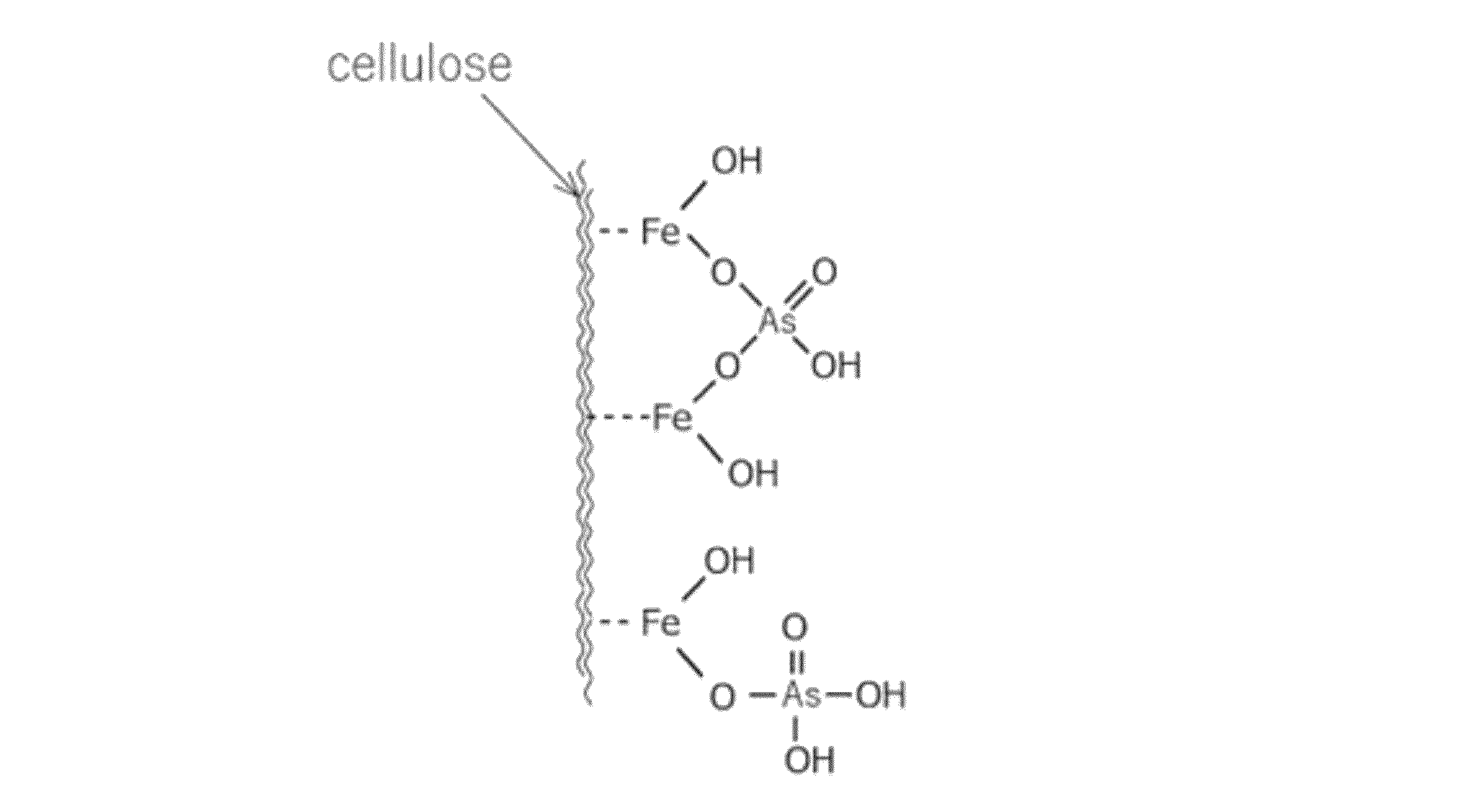

ヒ素(V)は水溶液中においてはヒ酸イオンとして存在する。前記複合体は、水中において、金属粒子に含まれる0価及び/又は3価の鉄がヒ素(特に、ヒ酸イオン)の水酸基を介して錯形成することによって、ヒ素(特に、ヒ酸イオン)を吸着し固定する(化2)(下記参照)。
[化1]は、Celluloseに点線で接続した「Fe」は、Celluloseに吸着した鉄(III)含有粒子に含まれる鉄化合物の鉄を意味し、上記のように鉄がヒ素を吸着し固定する様子を示す。
[化2]は、鉄(III)含有粒子(2)に含まれる金属(Fe、Zr、Ti)がヒ素を吸着し固定する様子を示す。
[化2]は、鉄(III)含有粒子(2)に含まれる金属(Fe、Zr、Ti)がヒ素を吸着し固定する様子を示す。
前記複合体のヒ素の吸着容量は、例えば300μmol/g以上、好ましくは350μmol/g以上、より好ましくは400μmol/g以上、更に好ましくは450μmol/g以上、特に好ましくは500μmol/g以上、最も好ましくは520μmol/g以上である。ヒ素の吸着容量の上限値は、例えば5000μmol/g、特に1000μmol/gである。すなわち、複合体のヒ素の吸着容量は、これらの上限値及び下限値の如何なる組み合わせであってもよいが、例えば300μmol/g以上5000μmol/g以下、好ましくは350μmol/g以上1000μmol/g以下、更に好ましくは400μmol/g以上1000μmol/g以下、更に好ましくは450μmol/g以上1000μmol/g以下、更に好ましくは500μmol/g以上1000μmol/g以下、更に好ましくは520μmol/g以上1000μmol/g以下である。
前記複合体が含有する0価と3価の鉄の合計量(鉄元素換算値)1mol当たりのヒ素の吸着容量は、例えば0.05mol以上、好ましくは0.08mol以上、特に好ましくは0.1mol以上、とりわけ好ましくは0.15mol以上である。ヒ素の吸着容量の上限値は、例えば10mol、更に5mol、特に3molである。すなわち、複合体が含有する0価と3価の鉄の合計量(鉄元素換算値)1mol当たりのヒ素の吸着容量は、これらの上限値及び下限値の如何なる組み合わせであってもよいが、例えば0.05mol以上10mol以下、好ましくは0.08mol以上5mol以下、より好ましくは0.1mol以上5mol以下、更に好ましくは0.12mol以上3mol以下である。0.12mol以上3mol以下の場合、0.15mol以上3mol以下であってもよい。
0価及び/又は3価の鉄は、ヒ素イオンとは高い親和性を有するが、ヒ素と化学的性質が近似するリンを含むリン酸二水素イオンや、ハロゲン化物イオン、硫酸イオン等の他の陰イオンとは親和性が低い。前記複合体は前記特性を有する0価及び/又は3価の鉄を含有するため、他の陰イオン(例えば、ハロゲン化物イオン、硫酸イオン、リン酸二水素イオン等)の共存下でも、ヒ素吸着力は低下することなく保持される。
尚、前記複合体によるヒ素の吸着容量は、25℃において、1000mg/Lのヒ素(V)水溶液10mLに、前記複合体0.01gを浸漬し、振とう器で30分振とうした場合の吸着容量であり、実施例に記載の式から算出される。
前記複合体は以上の特性を有するため、水中に溶解したヒ素(特に、ヒ素(V))を効率よく吸着して回収するためのヒ素吸着剤(特に、ヒ素(V)吸着剤)として好適に使用することができる。
[複合体の製造方法]
前記複合体は、例えば、下記反応[1]又は[2]を経て製造することができる。
[反応1]水中で微小繊維状セルロースと鉄化合物とを混合して、微小繊維状セルロースに鉄化合物を吸着させ、吸着した鉄化合物を還元する
[反応2]水中で微小繊維状セルロースと鉄化合物と塩基性化合物とを混合して、微小繊維状セルロースに3価の鉄コロイドを吸着させ、粒子に成長させる
前記複合体は、例えば、下記反応[1]又は[2]を経て製造することができる。
[反応1]水中で微小繊維状セルロースと鉄化合物とを混合して、微小繊維状セルロースに鉄化合物を吸着させ、吸着した鉄化合物を還元する
[反応2]水中で微小繊維状セルロースと鉄化合物と塩基性化合物とを混合して、微小繊維状セルロースに3価の鉄コロイドを吸着させ、粒子に成長させる
(反応1)
反応1は、水中で微小繊維状セルロースと鉄化合物とを混合して、微小繊維状セルロースに鉄化合物を吸着させる吸着工程と、吸着した鉄化合物を還元する還元工程を含む。
反応1は、水中で微小繊維状セルロースと鉄化合物とを混合して、微小繊維状セルロースに鉄化合物を吸着させる吸着工程と、吸着した鉄化合物を還元する還元工程を含む。
反応1は、還元工程の後に乾燥工程を含んでいても良い。
吸着工程は、水中で微小繊維状セルロースと鉄化合物とを混合して、微小繊維状セルロースに鉄化合物を吸着させる工程である。
微小繊維状セルロースは、例えばセルロース繊維が縦に引き裂かれ、微細化されたもの、すなわちミクロフィブリル化セルロースである。微小繊維状セルロースは、例えば、特定の繊維長を有するセルロース繊維を、例えば、叩解処理及び/又は機械的剪断処理(例えば、ホモジナイズ処理)等に付すことによりセルロース繊維がその繊維方向に沿って引き裂かれ、製造することができる。
前記セルロース繊維としては、例えば、木材パルプ(針葉樹パルプ、広葉樹パルプ)やコットンリンターパルプ由来のセルロース繊維を好適に用いることができる。これらは1種を単独で、又は2種以上を組み合わせて使用することができる。尚、前記パルプには、ヘミセルロースなどの異成分が含まれていてもよい。
また、前記セルロース繊維は、その表面に親水性基が付与されたものであっても良い。
微小繊維状セルロースの平均繊維長は、例えば0.5~1.5mm、好ましくは0.5~1.2mm、特に好ましくは0.6~0.8mmである。微小繊維状セルロースの平均繊維径は、例えば0.5~50μmである。
微小繊維状セルロースのアスペクト比の例、好適例は、「複合体」の項に記載のとおりである。
微小繊維状セルロースのアスペクト比の例、好適例は、「複合体」の項に記載のとおりである。
前記微小繊維状セルロースとしては、例えば、商品名「セリッシュ」「ろ過名人」「PC110S」「PC110T」(以上、ダイセルミライズ(株)製)等の市販品を使用することができる。
鉄化合物としては、例えば、FeCl3等の3価の鉄化合物を使用することが好ましい。3価の鉄化合物を使用した場合、微小繊維状セルロースに吸着する鉄化合物は、例えば、3価の鉄イオンである。
鉄化合物の使用量は、微小繊維状セルロース1gに対して、例えば1~100mmol、好ましくは1~50mmolである。
また、吸着反応系内(若しくは、水中)には、鉄化合物と共に、ジルコニウム化合物、チタン化合物等から選択される少なくとも1種の金属化合物を添加してもよい。鉄化合物と共に、前記金属化合物を添加することで、鉄化合物と前記金属化合物を微小繊維状セルロースに吸着させることができる。
鉄化合物と前記金属化合物を使用する場合、前記鉄化合物(鉄元素換算値)と前記金属化合物(金属元素換算値;2種以上含有する場合はその総量)のモル比[鉄/(ジルコニウム+チタン)]が、例えば1~100(好ましくは1~50、特に好ましくは1~10、最も好ましくは2~10、とりわけ好ましくは3~10)となる範囲で使用することが、ヒ素吸着力を向上させる効果に特に優れる点で好ましい。
ここで、「ジルコニウム+チタン」とは、「ジルコニウム(ジルコニウム化合物)及び/又はチタン(チタン化合物)」を意味する。すなわち、[鉄/(ジルコニウム+チタン)]は、「鉄/(ジルコニウム化合物及び/又はチタン化合物)」を意味する。
一実施形態において、モル比[鉄/(ジルコニウム+チタン)]は、「鉄/ジルコニウム化合物」又は「鉄/チタン化合物」のモル比であることが好ましい。
ここで、「ジルコニウム+チタン」とは、「ジルコニウム(ジルコニウム化合物)及び/又はチタン(チタン化合物)」を意味する。すなわち、[鉄/(ジルコニウム+チタン)]は、「鉄/(ジルコニウム化合物及び/又はチタン化合物)」を意味する。
一実施形態において、モル比[鉄/(ジルコニウム+チタン)]は、「鉄/ジルコニウム化合物」又は「鉄/チタン化合物」のモル比であることが好ましい。
前記ジルコニウム化合物としては、例えば、酸化ジルコニウム(ZrO2)、水酸化ジルコニウム、オキシ水酸化ジルコニウム、塩化酸化ジルコニウム(ZrCl2O)、塩化ジルコニウム(ZrCl4)等が挙げられる。これらは1種を単独で、又は2種以上を組み合わせて使用することができる。
前記チタン化合物としては、例えば、塩化チタン、酸化チタン、水酸化チタン、オキシ水酸化チタン等が挙げられる。これらは1種を単独で、又は2種以上を組み合わせて使用することができる。
前記金属化合物としては、ヒ素との親和性に優れ、ヒ素の吸着量を向上する効果に特に優れる点で、前記金属の酸化物、水酸化物、及びオキシ水酸化物から選択される少なくとも1種であることが好ましく、前記金属の酸化物及びオキシ水酸化物からなる群から選択される少なくとも1種であることがより好ましく、塩化酸化ジルコニウム(ZrCl2O)等のジルコニウム化合物が更に好ましい。
吸着工程では、水中で微小繊維状セルロースと鉄化合物とを混合し、これらを撹拌することが好ましい。撹拌条件は、特に制限がないが、例えば100rpmで30~120分程度である。また、前記撹拌時の混合液の温度は、例えば25~60℃である。
前記撹拌時の反応雰囲気としては反応を阻害しない限り特に限定されず、例えば、空気雰囲気、窒素雰囲気、アルゴン雰囲気等の何れであってもよい。
還元工程は、鉄化合物を吸着した微小繊維状セルロースを還元反応に付して、0価の鉄を含む金属粒子を担持した微小繊維状セルロースを得る工程である。
前記還元反応は、還元剤を使用して行うことができる。前記還元剤としては、例えば、水素化ホウ素リチウム、水素化ホウ素ナトリウム、シアノ水素化ホウ素ナトリウム、水素化トリエチルホウ素リチウム、水素化トリエチルホウ素ナトリウム、水素化トリ(sec-ブチル)ホウ素リチウム、水素化トリ(sec-ブチル)ホウ素カリウム等の水素化ホウ素酸塩;水素化アルミニウムリチウム、水素化ビス(2-メトキシエトキシ)アルミニウムナトリウム等のアルミニウムのヒドリド化合物等が挙げられる。これらは1種を単独で、又は2種以上を組み合わせて使用することができる。
前記還元剤の使用量は、鉄化合物1モルに対して、例えば0.1~10モル、好ましくは0.1~5モル、特に好ましくは0.3~2モルである。
前記還元反応は、例えば、微小繊維状セルロースと鉄化合物との混合物中に、還元剤を添加し、撹拌することにより行うことができる。撹拌条件としては、特に制限がないが、例えば、スターラーを用いて1時間程度である。撹拌時の混合液の温度は、例えば25~60℃である。
前記反応の雰囲気としては反応を阻害しない限り特に限定されず、例えば、空気雰囲気、窒素雰囲気、アルゴン雰囲気等の何れであってもよい。
前記還元反応を経て、微小繊維状セルロースに吸着した鉄化合物を還元して、微小繊維状セルロース表面に0価の鉄を析出させることができる。
前記還元反応終了後、得られた反応生成物は、一般的な、沈殿・洗浄・濾過により分離精製できる。
乾燥工程
還元工程を経て得られた0価の鉄を含む金属粒子を担持した微小繊維状セルロースを、乾燥する工程である。乾燥方法としては、周知慣用の方法を採用することができる。乾燥温度は、例えば室温~50℃程度である。乾燥工程を経て、微小繊維状セルロース表面に0価の鉄を含む金属粒子を担持した構成の、粉末状の複合体が得られる。
還元工程を経て得られた0価の鉄を含む金属粒子を担持した微小繊維状セルロースを、乾燥する工程である。乾燥方法としては、周知慣用の方法を採用することができる。乾燥温度は、例えば室温~50℃程度である。乾燥工程を経て、微小繊維状セルロース表面に0価の鉄を含む金属粒子を担持した構成の、粉末状の複合体が得られる。
(反応2)
反応2は、水中で微小繊維状セルロースと鉄化合物と塩基性化合物とを混合して、微小繊維状セルロースに3価の鉄コロイドを吸着させる吸着工程、粒子に成長させる成長工程を少なくとも含む。
反応2は、水中で微小繊維状セルロースと鉄化合物と塩基性化合物とを混合して、微小繊維状セルロースに3価の鉄コロイドを吸着させる吸着工程、粒子に成長させる成長工程を少なくとも含む。
反応2は、前記吸着・成長工程の後に乾燥工程を有していても良い。
前記鉄化合物、及び前記微小繊維状セルロースとしては、反応1における鉄化合物、及び前記微小繊維状セルロースと同様のものを使用することができる。
微小繊維状セルロースの使用量は、鉄化合物1mmolに対して、例えば10~1000mgである。
鉄化合物の使用量は、微小繊維状セルロース1gに対して、例えば1~100mmol、好ましくは1~50mmolである。
鉄化合物の使用量は、微小繊維状セルロース1gに対して、例えば1~100mmol、好ましくは1~50mmolである。
吸着・成長工程は、例えば、水中で、微小繊維状セルロースと鉄化合物と塩基性化合物を混合し、撹拌することで、3価の鉄コロイドを微小繊維状セルロースに鉄化合物を吸着させ、吸着した3価の鉄コロイドを成長させ、3価の鉄(水酸化鉄及び/又はオキシ水酸化鉄)を含む金属粒子を析出させることができる。
撹拌条件は、特に制限がないが、例えば100rpmで30~120分程度である。また、前記撹拌時の混合液の温度は、例えば25~60℃である。
吸着・成長反応系内(若しくは、水中)における鉄化合物の濃度(鉄元素換算値)は、例えば0.1~10重量%である。
塩基性化合物としては、例えば、アンモニア等の有機塩基や、アルカリ金属(例えば、ナトリウム、カリウムなど)の水酸化物等の無機塩基が挙げられる。これらは1種を単独で、又は2種以上を組み合わせて使用することができる。
吸着・成長反応は、pHを例えば2~14(pHの下限値は好ましくは3、特に好ましくは6である。pHの上限値は好ましくは12、特に好ましくは10、最も好ましくは9である)に調整すること、また、別の一実施形態において、例えば4~13(pHの下限値は好ましくは5、特に好ましくは6である。pHの上限値は好ましくは12、特に好ましくは10、最も好ましくは9である)に調整することが、3価の鉄を含む金属粒子の析出を促進する効果が得られる点で好ましい。吸着・成長反応におけるpHは、これらの上限値及び下限値の如何なる組み合わせであってもよい。pHの調整は、周知慣用のpH調整剤や、緩衝液を使用することができる。
吸着・成長反応温度は、例えば室温(25℃)~100℃である。吸着・成長反応時間は、例えば、0.5~10時間である。
前記吸着・成長反応により、3価の鉄(例えば、水酸化鉄及び/又はオキシ水酸化鉄)を含む金属粒子が生成する。
また、吸着・成長反応系内に、鉄化合物と共に、ジルコニウム化合物、チタン化合物等から選択される少なくとも1種の金属化合物を添加することで、3価の鉄と前記金属化合物を含有する金属粒子、及び/又は鉄と前記金属の少なくとも1種との混合酸化物を含有する金属粒子が得られる。
鉄化合物と前記金属化合物を使用する場合、前記鉄化合物(鉄元素換算値)と前記金属化合物(金属元素換算値;2種以上含有する場合はその総量)のモル比[鉄/(ジルコニウム+チタン)]が、例えば1~100(好ましくは1~50、特に好ましくは1~10、最も好ましくは2~10、とりわけ好ましくは3~10)となる範囲で使用することが、ヒ素吸着力を向上させる効果に特に優れる点で好ましい。
前記ジルコニウム化合物としては、例えば、塩化ジルコニウム、塩化酸化ジルコニウム、酸化ジルコニウム、塩化ジルコニウム等が挙げられる。これらは1種を単独で、又は2種以上を組み合わせて使用することができる。
前記チタン化合物としては、例えば、塩化チタン、酸化チタン等が挙げられる。これらは1種を単独で、又は2種以上を組み合わせて使用することができる。
前記ジルコニウム化合物とチタン化合物のなかでも、ジルコニウム化合物が、ヒ素との親和性に優れ、ヒ素の吸着量を向上する効果に特に優れる点で好ましい。
乾燥工程
吸着・成長工程を経て得られた3価の鉄を含む金属粒子(例えば、水酸化鉄及び/又はオキシ水酸化鉄を含む金属粒子)と、必要に応じて前記金属化合物(又は鉄と前記金属の少なくとも1種との混合酸化物)を担持した微小繊維状セルロースを、乾燥する工程である。乾燥温度は、例えば室温から50℃程度である。乾燥工程を経て、微小繊維状セルロース表面に3価の鉄を含む金属粒子(例えば、水酸化鉄、オキシ水酸化鉄、及び酸化鉄から選択される少なくとも1種を含む金属粒子)と、必要に応じて前記金属化合物(又は鉄と前記金属の少なくとも1種との混合酸化物)を担持した構成の、粉末状の複合体が得られる。
吸着・成長工程を経て得られた3価の鉄を含む金属粒子(例えば、水酸化鉄及び/又はオキシ水酸化鉄を含む金属粒子)と、必要に応じて前記金属化合物(又は鉄と前記金属の少なくとも1種との混合酸化物)を担持した微小繊維状セルロースを、乾燥する工程である。乾燥温度は、例えば室温から50℃程度である。乾燥工程を経て、微小繊維状セルロース表面に3価の鉄を含む金属粒子(例えば、水酸化鉄、オキシ水酸化鉄、及び酸化鉄から選択される少なくとも1種を含む金属粒子)と、必要に応じて前記金属化合物(又は鉄と前記金属の少なくとも1種との混合酸化物)を担持した構成の、粉末状の複合体が得られる。
[ヒ素吸着剤]
本開示のヒ素吸着剤は、前記複合体を含む。前記ヒ素吸着剤は、前記複合体以外にも他の成分を含有していても良いが、ヒ素吸着剤全量(若しくは、ヒ素吸着剤に含まれる不揮発分全量)における前記複合体の占める割合は、例えば50重量%以上、好ましくは60重量%以上、より好ましくは70重量%以上、特に好ましくは80重量%以上、最も好ましくは90重量%以上、とりわけ好ましくは95重量%以上である。尚、前記ヒ素吸着剤は前記複合体のみからなるものであってもよい。
本開示のヒ素吸着剤は、前記複合体を含む。前記ヒ素吸着剤は、前記複合体以外にも他の成分を含有していても良いが、ヒ素吸着剤全量(若しくは、ヒ素吸着剤に含まれる不揮発分全量)における前記複合体の占める割合は、例えば50重量%以上、好ましくは60重量%以上、より好ましくは70重量%以上、特に好ましくは80重量%以上、最も好ましくは90重量%以上、とりわけ好ましくは95重量%以上である。尚、前記ヒ素吸着剤は前記複合体のみからなるものであってもよい。
尚、本開示において「不揮発分」とは、溶剤(水や有機溶媒を含む)以外の成分の合計重量であり、例えば、1gのヒ素吸着剤を常圧下において100℃で1時間加熱した後に残る成分である。
前記ヒ素吸着剤の形状としては、本開示の効果を損なわない限り特に制限されるものではないが、水溶液中のヒ素を吸着させた後に、水溶液からの回収が容易な点において、ゲル状、粉末状、又はペレット状が好ましい。
本開示のヒ素吸着剤は前記複合体を含むため、水中に溶解したヒ素(V)を吸着して除去する用途に好適に使用することができる。
前記ヒ素吸着剤は、前記複合体の製造方法により複合体を製造し、必要に応じて他の成分を添加し、また必要に応じて成形することで調製することができる。
[浄水の製造方法]
本開示の浄水の製造方法は、ヒ素汚染水(ヒ素で汚染された水であり、ヒ素濃度は、例えば5μmol/L以上である。5mmol/L以上であってもよい。)を、前記ヒ素吸着剤(或いは、前記複合体)で処理して、浄水(例えば、前記汚染水に含まれるヒ素の99重量%以上(更に好ましくは99.9重量%以上)が除去されてなる浄水)を得る方法である。
本開示の浄水の製造方法は、ヒ素汚染水(ヒ素で汚染された水であり、ヒ素濃度は、例えば5μmol/L以上である。5mmol/L以上であってもよい。)を、前記ヒ素吸着剤(或いは、前記複合体)で処理して、浄水(例えば、前記汚染水に含まれるヒ素の99重量%以上(更に好ましくは99.9重量%以上)が除去されてなる浄水)を得る方法である。
ヒ素(V)は水溶液中においてはヒ酸イオンとして存在する。そして、前記ヒ素吸着剤(或いは、前記複合体)は、金属粒子に含まれる0価及び/又は3価の鉄が、ヒ酸イオンの水酸基を介して錯形成することによって、ヒ素イオンを吸着し、回収する。
汚染水を前記ヒ素吸着剤で処理する方法とは、すなわち汚染水に含まれるヒ素を前記ヒ素吸着剤に吸着させる方法である。前記方法としては、特に制限されることがなく、例えば、前記ヒ素吸着剤をカラム等に充填し、そこに汚染水を流す方法や、汚染水中に前記ヒ素吸着剤を加え、撹拌する方法等が挙げられる。
前記ヒ素吸着剤で処理する際には、汚染水のpHを例えば10以下(例えば1~10、好ましくは2~10)、好ましくは8以下に調整することが、ヒ素をより一層効率よく回収することができる点で好ましい。尚、前記pH調整は、周知慣用のpH調整剤を用いて行うことができる。
また、ヒ素吸着剤にヒ素を吸着させた後は、ヒ素を吸着したヒ素吸着剤を燃焼させることによって、顕著に減容することができ、処分にかかる費用を軽減することができる。
本開示の浄水の製造方法によれば、ヒ素で汚染された水から効率よくヒ素を除去することができ、ヒ素汚染のない浄水を効率よく製造することができる。
[浄水装置]
本開示の浄水装置は、前記ヒ素吸着剤(或いは、前記複合体)を備える。
本開示の浄水装置は、前記ヒ素吸着剤(或いは、前記複合体)を備える。
ヒ素吸着剤の装備方法としては、特に制限がない。例えば、ヒ素吸着剤をカラム等に充填した状態で装備する方法が挙げられる。
従って、前記浄水装置は、上記ヒ素吸着剤を充填したカラムを備えるものであってよい。
前記浄水装置は、上記ヒ素吸着剤の他、ヒ素吸着剤に浄化前の水を供給するための装置や、ヒ素吸着剤により浄化された後の水を排出する装置等、必要な構成を備えることができる。
前記浄水装置は、上記ヒ素吸着剤を備えるため、ヒ素で汚染された水から効率よくヒ素を除去することができ、ヒ素汚染のない浄水を効率よく製造することができる。
以上、本開示の各構成及びそれらの組み合わせ等は一例であって、本開示の主旨から逸脱しない範囲において、適宜、構成の付加、省略、置換、及び変更が可能である。また、本開示は、実施形態によって限定されることはなく、請求の範囲の記載によってのみ限定される。
以下、実施例により本開示をより具体的に説明するが、本開示はこれらの実施例により限定されるものではない。
実施例1
100mLフラスコに、ミクロフィブリル化セルロース(以後、「CMF」と称する場合がある)(平均繊維長:0.6~0.8mm、参考繊維径:0.5~50μm、商品名「ろ過名人」、ダイセルミライズ(株)製)0.10g、10重量%FeCl3・6H20水溶液10mLを加え、室温下において、スターラーで1時間撹拌した。
その後、溶液を撹拌しながら、フラスコ内に、1mmol/LのNaBH4水溶液を7.0mL加え、室温下において、スターラーで1時間撹拌した。
メンブランフィルター(ニトロセルロース、孔径:0.45μm)を用いて吸引ろ過により固形分を回収し、40℃で乾燥させることで0価の鉄粒子がセルロースナノファイバーに担持されてなる複合体(1)(Fe0-CMF)(体積相当径:1μm以上)を得た。
この複合体の、微小繊維状セルロース1g当たりの0価の鉄の合計担持量(鉄元素換算値)は3.3mmolであった。
100mLフラスコに、ミクロフィブリル化セルロース(以後、「CMF」と称する場合がある)(平均繊維長:0.6~0.8mm、参考繊維径:0.5~50μm、商品名「ろ過名人」、ダイセルミライズ(株)製)0.10g、10重量%FeCl3・6H20水溶液10mLを加え、室温下において、スターラーで1時間撹拌した。
その後、溶液を撹拌しながら、フラスコ内に、1mmol/LのNaBH4水溶液を7.0mL加え、室温下において、スターラーで1時間撹拌した。
メンブランフィルター(ニトロセルロース、孔径:0.45μm)を用いて吸引ろ過により固形分を回収し、40℃で乾燥させることで0価の鉄粒子がセルロースナノファイバーに担持されてなる複合体(1)(Fe0-CMF)(体積相当径:1μm以上)を得た。
この複合体の、微小繊維状セルロース1g当たりの0価の鉄の合計担持量(鉄元素換算値)は3.3mmolであった。
(評価1)
複合体(1)、又は比較例1としての0価の鉄粉(富士フイルム和光純薬(株)製、以後「Fe0」と称する場合がある)0.010gを水10mLに分散させ、スターラーで10分撹拌して分散性を目視で確認した。
結果を図5に示す。その結果、複合体(1)は凝集が抑制され、分散状体が維持された。このことから、複合体(1)は、水中において、ヒ素吸着に寄与する0価の鉄粒子の表面積を広く保持できることが分かる。
一方、0価の鉄粉は、水中において凝集して、沈殿した。
複合体(1)、又は比較例1としての0価の鉄粉(富士フイルム和光純薬(株)製、以後「Fe0」と称する場合がある)0.010gを水10mLに分散させ、スターラーで10分撹拌して分散性を目視で確認した。
結果を図5に示す。その結果、複合体(1)は凝集が抑制され、分散状体が維持された。このことから、複合体(1)は、水中において、ヒ素吸着に寄与する0価の鉄粒子の表面積を広く保持できることが分かる。
一方、0価の鉄粉は、水中において凝集して、沈殿した。
(評価2)
複合体(1)について、塩酸を加えて0価と3価の鉄を鉄(III)イオンとして溶出させ、溶離液中の鉄(III)イオンの濃度を測定することにより、微小繊維状セルロース1g当たりの0価及び3価の鉄の合計担持量(鉄元素換算値)を評価した。
50mL遠沈管に複合体(1)0.01g、6mol/L塩酸5mLを加え、振盪機を用いて室温で20分撹拌した。メンブランフィルター(ニトロセルロース、孔径:0.45μm)を用いてろ過し、濾液中の鉄イオン濃度(Ce:mol/L)をICP発光分光分析機(Thermo Fischer Scientific社製 iCAP6300)で定量した。複合体の重量をm(g)、使用した塩酸の量をV(mL)とし、下式から、微小繊維状セルロース1g当たりの0価及び3価の鉄の合計担持量(鉄元素換算値)を評価した。
合計担持量=Ce×V/m
上記複合体の重量から、上記のように求めた鉄の担持量を減ずることによって微小繊維状セルロースの重量を評価し、該微小繊維状セルロース1gに対する鉄の担持量(CMF 1g当たりの鉄粒子担持量推算値、表1)を算出した。
複合体(1)について、塩酸を加えて0価と3価の鉄を鉄(III)イオンとして溶出させ、溶離液中の鉄(III)イオンの濃度を測定することにより、微小繊維状セルロース1g当たりの0価及び3価の鉄の合計担持量(鉄元素換算値)を評価した。
50mL遠沈管に複合体(1)0.01g、6mol/L塩酸5mLを加え、振盪機を用いて室温で20分撹拌した。メンブランフィルター(ニトロセルロース、孔径:0.45μm)を用いてろ過し、濾液中の鉄イオン濃度(Ce:mol/L)をICP発光分光分析機(Thermo Fischer Scientific社製 iCAP6300)で定量した。複合体の重量をm(g)、使用した塩酸の量をV(mL)とし、下式から、微小繊維状セルロース1g当たりの0価及び3価の鉄の合計担持量(鉄元素換算値)を評価した。
合計担持量=Ce×V/m
上記複合体の重量から、上記のように求めた鉄の担持量を減ずることによって微小繊維状セルロースの重量を評価し、該微小繊維状セルロース1gに対する鉄の担持量(CMF 1g当たりの鉄粒子担持量推算値、表1)を算出した。
なお、実施例2~7で得られた複合体においても、同様の方法により、微小繊維状セルロース1g当たりの0価及び3価の鉄の合計担持量(鉄元素換算値)及び微小繊維状セルロース1gに対する鉄の担持量を評価した(表1)。
(評価3)
複合体(1)について、0.01mol硝酸、又は緩衝液を用いてpHを2~12に調整したヒ素水溶液(初期ヒ素濃度10μmol/L)を調整し、ヒ素除去率のpH依存性を評価した。
複合体(1)について、0.01mol硝酸、又は緩衝液を用いてpHを2~12に調整したヒ素水溶液(初期ヒ素濃度10μmol/L)を調整し、ヒ素除去率のpH依存性を評価した。
前記ヒ素水溶液10mLに複合体(1)0.02gを加え、25℃において、振盪機で20分撹拌した。メンブランフィルター(ニトロセルロース、孔径:0.45μm)を用いてろ過し、濾液中のヒ素イオン濃度(Ce:μmol/L)をICP発光分光分析機(Thermo Fischer Scientific社製 iCAP6300)で定量した。溶液中のヒ素イオンの初期濃度をC0(μmol/L)とし、下記式から除去率(%)を算出した。
除去率=(C0-Ce)/C0×100
緩衝液は、酢酸(pH3-5)、2-(N-モルホリノ)-エタンスルホン酸(pH6)、4-(2-ヒドロキシエチル)-1-ピペラジンエタンスルホン酸(pH7-8)、塩化アンモニウム(pH9)、3-[N-トリス (ヒドロキシメチル)メチル-3-アミノ]-1-プロパンスルホン酸(pH9)、3-シクロヘキシルアミノプロパンスルホン酸(pH10-12)、および水酸化ナトリウムを用いて調整した。結果を図1に示す。
除去率=(C0-Ce)/C0×100
緩衝液は、酢酸(pH3-5)、2-(N-モルホリノ)-エタンスルホン酸(pH6)、4-(2-ヒドロキシエチル)-1-ピペラジンエタンスルホン酸(pH7-8)、塩化アンモニウム(pH9)、3-[N-トリス (ヒドロキシメチル)メチル-3-アミノ]-1-プロパンスルホン酸(pH9)、3-シクロヘキシルアミノプロパンスルホン酸(pH10-12)、および水酸化ナトリウムを用いて調整した。結果を図1に示す。
図1から、複合体(1)は、pH10以下において90%を超えるヒ素吸着率を示すことが分かる。そして、pH8以下においては、100%に近いヒ素吸着率を示すことが分かる。
(評価4)
複合体(1)について、塩化ナトリウム、硫酸ナトリウム、リン酸ナトリウム、前記の緩衝液(評価3を参照)を用いて、塩化物イオン、硫酸イオン、リン酸イオンの濃度を0.1mmol/L、1mmol/L、又は100mmol/Lとしたヒ素水溶液(ヒ素初期濃度:10μmol/L、pH3)を調整し、陰イオン共存下におけるヒ素除去率の変化を評価した。
複合体(1)について、塩化ナトリウム、硫酸ナトリウム、リン酸ナトリウム、前記の緩衝液(評価3を参照)を用いて、塩化物イオン、硫酸イオン、リン酸イオンの濃度を0.1mmol/L、1mmol/L、又は100mmol/Lとしたヒ素水溶液(ヒ素初期濃度:10μmol/L、pH3)を調整し、陰イオン共存下におけるヒ素除去率の変化を評価した。
前記ヒ素水溶液10mLに、複合体(1)0.02gを加えて、25℃において、振盪機で20分撹拌した。メンブランフィルター(ニトロセルロース、孔径:0.45μm)を用いてろ過し、濾液中のヒ素イオン濃度(Ce:μmol/L)をICP発光分光分析機(Thermo Fischer Scientific社製 iCAP6300)で定量した。溶液中のヒ素イオンの初期濃度をC0(μmol/L)とし、下記式から除去率(%)を算出した。結果を図2に示す。
除去率=(C0-Ce)/C0×100
除去率=(C0-Ce)/C0×100
図2から、複合体(1)は、陰イオンが共存しても(特に、ヒ素と化学的性質が近似するリンが存在しても)、陰イオンが共存しない時と変わらず、ヒ素(V)を効率よく吸着することが分かる。
実施例2
10重量%FeCl3・6H2Oと緩衝液(2-(N-モルホリノ)-エタンスルホン酸)との混合液に、NaOHを添加してpH6に調整して、鉄化合物溶液(1)を得た。
100mLフラスコに、前記鉄化合物溶液(1)10mLを仕込み、更にミクロフィブリル化セルロース(平均繊維長:0.6~0.8mm、参考繊維径:0.5~50μm、商品名「ろ過名人」、ダイセルミライズ(株)製)0.10gを加え、室温下、スターラーを用いて1.0時間撹拌した。その後、吸引ろ過により固形分を得、得られた固形分を乾燥させた。
これにより、酸化鉄(Fe2O3)(又は酸化鉄及びオキシ水酸化鉄)粒子がミクロフィブリル化セルロースに担持されてなる複合体(2)(FeIII-CMF(pH6))(体積相当径:1μm以上(実測値:1.2μm))を得た。得られた複合体(2)のSEM画像を図3に示す。
図3に示すように、複合体をSEMで観察すると、微小繊維状セルロースの表面に粒子が観察される。この視野においては少なくとも30個の粒子が観察された。この複合体の、微小繊維状セルロース1g当たりの0価及び3価の鉄の合計担持量(鉄元素換算値)は1.3mmolであった。
10重量%FeCl3・6H2Oと緩衝液(2-(N-モルホリノ)-エタンスルホン酸)との混合液に、NaOHを添加してpH6に調整して、鉄化合物溶液(1)を得た。
100mLフラスコに、前記鉄化合物溶液(1)10mLを仕込み、更にミクロフィブリル化セルロース(平均繊維長:0.6~0.8mm、参考繊維径:0.5~50μm、商品名「ろ過名人」、ダイセルミライズ(株)製)0.10gを加え、室温下、スターラーを用いて1.0時間撹拌した。その後、吸引ろ過により固形分を得、得られた固形分を乾燥させた。
これにより、酸化鉄(Fe2O3)(又は酸化鉄及びオキシ水酸化鉄)粒子がミクロフィブリル化セルロースに担持されてなる複合体(2)(FeIII-CMF(pH6))(体積相当径:1μm以上(実測値:1.2μm))を得た。得られた複合体(2)のSEM画像を図3に示す。
図3に示すように、複合体をSEMで観察すると、微小繊維状セルロースの表面に粒子が観察される。この視野においては少なくとも30個の粒子が観察された。この複合体の、微小繊維状セルロース1g当たりの0価及び3価の鉄の合計担持量(鉄元素換算値)は1.3mmolであった。
体積相当球の粒子直径は、SEMの二次元粒子画像において、上記30個の粒子を立方体とみなして3辺の乗算から体積(V)を算出し、各粒子について下式により体積相当球粒子直径(D)を算出した。図3においては9割以上の粒子が1μm以上であった。
D=(6/πV)(1/3)
D=(6/πV)(1/3)
実施例3
10重量%FeCl3・6H2OとNH4緩衝液(塩化アンモニウム)を加えた溶液に、NaOHを添加してpH9に調整して、鉄化合物溶液(2)を得た。
鉄化合物溶液(1)に代えて鉄化合物溶液(2)を使用した以外は実施例2と同様にして、酸化鉄(Fe2O3)(又は酸化鉄及びオキシ水酸化鉄)粒子がミクロフィブリル化セルロースに担持されてなる複合体(3)(FeIII-CMF(pH9))を得た。
この複合体の、微小繊維状セルロース1g当たりの3価の鉄の合計担持量(鉄元素換算値)は3.6mmolであった。
10重量%FeCl3・6H2OとNH4緩衝液(塩化アンモニウム)を加えた溶液に、NaOHを添加してpH9に調整して、鉄化合物溶液(2)を得た。
鉄化合物溶液(1)に代えて鉄化合物溶液(2)を使用した以外は実施例2と同様にして、酸化鉄(Fe2O3)(又は酸化鉄及びオキシ水酸化鉄)粒子がミクロフィブリル化セルロースに担持されてなる複合体(3)(FeIII-CMF(pH9))を得た。
この複合体の、微小繊維状セルロース1g当たりの3価の鉄の合計担持量(鉄元素換算値)は3.6mmolであった。
実施例4
10重量%FeCl3・6H2Oと緩衝液(酢酸)を加えた溶液に、NaOHを添加してpH3に調整して、鉄化合物溶液(3)を得た。
鉄化合物溶液(1)に代えて鉄化合物溶液(3)を使用した以外は実施例2と同様にして、酸化鉄(Fe2O3)(又は酸化鉄及びオキシ水酸化鉄)粒子がミクロフィブリル化セルロースに担持されてなる複合体(3)(FeIII-CMF(pH3))を得た。
この複合体の、微小繊維状セルロース1g当たりの3価の鉄の合計担持量(鉄元素換算値)は0.3mmolであった。
10重量%FeCl3・6H2Oと緩衝液(酢酸)を加えた溶液に、NaOHを添加してpH3に調整して、鉄化合物溶液(3)を得た。
鉄化合物溶液(1)に代えて鉄化合物溶液(3)を使用した以外は実施例2と同様にして、酸化鉄(Fe2O3)(又は酸化鉄及びオキシ水酸化鉄)粒子がミクロフィブリル化セルロースに担持されてなる複合体(3)(FeIII-CMF(pH3))を得た。
この複合体の、微小繊維状セルロース1g当たりの3価の鉄の合計担持量(鉄元素換算値)は0.3mmolであった。
実施例5
10重量%FeCl3・6H2Oと緩衝液(3-シクロヘキシルアミノプロパンスルホン酸)を加えた溶液に、NaOHを添加してpH12に調整して、鉄化合物溶液(4)を得た。
鉄化合物溶液(1)に代えて鉄化合物溶液(4)を使用した以外は実施例2と同様にして、酸化鉄(Fe2O3)(又は酸化鉄及びオキシ水酸化鉄)粒子がミクロフィブリル化セルロースに担持されてなる複合体(3)(FeIII-CMF(pH12))を得た。
この複合体の、微小繊維状セルロース1g当たりの3価の鉄の合計担持量(鉄元素換算値)は2.0mmolであった。
10重量%FeCl3・6H2Oと緩衝液(3-シクロヘキシルアミノプロパンスルホン酸)を加えた溶液に、NaOHを添加してpH12に調整して、鉄化合物溶液(4)を得た。
鉄化合物溶液(1)に代えて鉄化合物溶液(4)を使用した以外は実施例2と同様にして、酸化鉄(Fe2O3)(又は酸化鉄及びオキシ水酸化鉄)粒子がミクロフィブリル化セルロースに担持されてなる複合体(3)(FeIII-CMF(pH12))を得た。
この複合体の、微小繊維状セルロース1g当たりの3価の鉄の合計担持量(鉄元素換算値)は2.0mmolであった。
実施例6
100mLフラスコに、10重量%FeCl3・6H2O 10mL、1.0重量%ZrCl2O 10mL、及び2-(N-モルホリノ)-エタンスルホン酸を加え、スターラーを用いて30分撹拌した。次に、溶液を60℃に加熱しながらNaOHを滴下し、pHを6.0に調整した。その後さらに30分撹拌し、酸化鉄/酸化ジルコニウム含有粒子(Fe/Zr(モル比)=7/1)の分散液を得た。
100mLフラスコに、ミクロフィブリル化セルロース(平均繊維長:0.6~0.8mm、参考繊維径:0.5~50μm、商品名「ろ過名人」、ダイセルミライズ(株)製)0.10g、及び前記酸化鉄/酸化ジルコニウム含有粒子の分散液10mLを加え、スターラーで1時間撹拌して、前記粒子をミクロフィブリル化セルロースに担持させた。その後、吸引ろ過により固形分を得、得られた固形分を乾燥させた。これにより、酸化鉄と酸化ジルコニウムを含有する粒子、及び/又は鉄及びジルコニウムの混合酸化物を含有する粒子がミクロフィブリル化セルロースに担持されてなる複合体(4)(FeIII/Zr-CMF;Fe/Zr(モル比)=7/1)(体積相当径:1μm以上(実測値:1.8μm))を得た。
この複合体の、微小繊維状セルロース1g当たりの3価の鉄の合計担持量(鉄元素換算値)は4.7mmolであった。
100mLフラスコに、10重量%FeCl3・6H2O 10mL、1.0重量%ZrCl2O 10mL、及び2-(N-モルホリノ)-エタンスルホン酸を加え、スターラーを用いて30分撹拌した。次に、溶液を60℃に加熱しながらNaOHを滴下し、pHを6.0に調整した。その後さらに30分撹拌し、酸化鉄/酸化ジルコニウム含有粒子(Fe/Zr(モル比)=7/1)の分散液を得た。
100mLフラスコに、ミクロフィブリル化セルロース(平均繊維長:0.6~0.8mm、参考繊維径:0.5~50μm、商品名「ろ過名人」、ダイセルミライズ(株)製)0.10g、及び前記酸化鉄/酸化ジルコニウム含有粒子の分散液10mLを加え、スターラーで1時間撹拌して、前記粒子をミクロフィブリル化セルロースに担持させた。その後、吸引ろ過により固形分を得、得られた固形分を乾燥させた。これにより、酸化鉄と酸化ジルコニウムを含有する粒子、及び/又は鉄及びジルコニウムの混合酸化物を含有する粒子がミクロフィブリル化セルロースに担持されてなる複合体(4)(FeIII/Zr-CMF;Fe/Zr(モル比)=7/1)(体積相当径:1μm以上(実測値:1.8μm))を得た。
この複合体の、微小繊維状セルロース1g当たりの3価の鉄の合計担持量(鉄元素換算値)は4.7mmolであった。
実施例7
1.0重量%ZrCl2O 10mLに代えて、10重量%TiCl4 0.10mLを使用した以外は実施例4と同様にして、酸化鉄/酸化チタン含有粒子、及び/又は鉄及びチタンの混合酸化物を含有する粒子がセルロースナノファイバーに担持されてなる複合体(5)(FeIII/Ti-CNF;(Fe/Ti(モル比)=7/1)(体積相当径:1μm以上(実測値:1.0μm))を得た。
この複合体の、微小繊維状セルロース1g当たりの3価の鉄の合計担持量(鉄元素換算値)は7.0mmolであった。
1.0重量%ZrCl2O 10mLに代えて、10重量%TiCl4 0.10mLを使用した以外は実施例4と同様にして、酸化鉄/酸化チタン含有粒子、及び/又は鉄及びチタンの混合酸化物を含有する粒子がセルロースナノファイバーに担持されてなる複合体(5)(FeIII/Ti-CNF;(Fe/Ti(モル比)=7/1)(体積相当径:1μm以上(実測値:1.0μm))を得た。
この複合体の、微小繊維状セルロース1g当たりの3価の鉄の合計担持量(鉄元素換算値)は7.0mmolであった。
比較例2
100mLフラスコに、10重量%FeCl3を10mL、1重量%ZrCl2O 10mL、及び2-(N-モルホリノ)-エタンスルホン酸を加え、室温下、スターラーを使用して0.5時間撹拌した。そこへ、NaOHを加えてpHを6.0に調整し、スターラーを使用して、60℃で0.5時間撹拌した。これにより、酸化鉄と酸化ジルコニウムを含有する粒子(FeIII/Zr粒子;Fe/Zr(モル比)=7/1)及び/又は鉄及びジルコニウムの混合酸化物を含有する粒子(FeIII/Zr粒子;Fe/Zr(モル比)=7/1)を得た。
100mLフラスコに、10重量%FeCl3を10mL、1重量%ZrCl2O 10mL、及び2-(N-モルホリノ)-エタンスルホン酸を加え、室温下、スターラーを使用して0.5時間撹拌した。そこへ、NaOHを加えてpHを6.0に調整し、スターラーを使用して、60℃で0.5時間撹拌した。これにより、酸化鉄と酸化ジルコニウムを含有する粒子(FeIII/Zr粒子;Fe/Zr(モル比)=7/1)及び/又は鉄及びジルコニウムの混合酸化物を含有する粒子(FeIII/Zr粒子;Fe/Zr(モル比)=7/1)を得た。
(評価5)
実施例で得られた複合体について、下記方法で減容率を測定した。
複合体0.1g(w1)を800℃で1時間燃焼させ、燃焼後に残存した灰分の重量(w2)を測定し、下記式から減容率を算出した。
減容率(%)=(w1-w2)/w1×100
実施例で得られた複合体について、下記方法で減容率を測定した。
複合体0.1g(w1)を800℃で1時間燃焼させ、燃焼後に残存した灰分の重量(w2)を測定し、下記式から減容率を算出した。
減容率(%)=(w1-w2)/w1×100
(評価6-1)
実施例1~7で得られた複合体、又は比較例1、2の粒子を使用して、下記方法でヒ素(V)の吸着容量を求めた。
100mLの遠沈管に、1000mg/LのAs(V)水溶液10mLと、ヒ素吸着剤0.010gを加え、25℃において、振盪機で20分撹拌した。
メンブランフィルター(ニトロセルロース、孔径:0.45μm)を用いてろ過し、濾液中のヒ素イオン濃度(Ce:μmol/L)をICP発光分光分析機(Thermo Fischer Scientific社製 iCAP6300)で定量した。溶液中のヒ素イオンの初期濃度をC0(μmol/L)、加えた液量をV0(L)、使用した複合体又は粒子の重量をm(g)とし、下記式から吸着容量(μmol/g)を算出した。
吸着容量=(C0-Ce)×V0/m
実施例1~7で得られた複合体、又は比較例1、2の粒子を使用して、下記方法でヒ素(V)の吸着容量を求めた。
100mLの遠沈管に、1000mg/LのAs(V)水溶液10mLと、ヒ素吸着剤0.010gを加え、25℃において、振盪機で20分撹拌した。
メンブランフィルター(ニトロセルロース、孔径:0.45μm)を用いてろ過し、濾液中のヒ素イオン濃度(Ce:μmol/L)をICP発光分光分析機(Thermo Fischer Scientific社製 iCAP6300)で定量した。溶液中のヒ素イオンの初期濃度をC0(μmol/L)、加えた液量をV0(L)、使用した複合体又は粒子の重量をm(g)とし、下記式から吸着容量(μmol/g)を算出した。
吸着容量=(C0-Ce)×V0/m
(評価6-2)
実施例で得られた複合体を内径2mm、長さ5cmのテフロンチューブに充填し、両端にテフロンウールを詰め、固相カラムを作製し、カラムによるヒ素の除去試験を実施した。
前記固相カラムに0.1mol/L緩衝液20mLを通液しカラム 内のpHを調整した。続いて、ヒ素を含む緩衝液(初期ヒ素濃度C0=5μmol/L)5mLを約1mL/minの流速で通液し、留出液および、前記のヒ素を含む緩衝液中のヒ素イオン濃度(Ce:μmol/L)をICP発光分光分析機(Thermo Fischer Scientific社製 iCAP6300)で定量した。留出液中のヒ素イオンの初期濃度をC0(μmol/L)とし、下記式から除去率(%)を算出した。その結果、複合体(2)~(5)において水溶液中の99.9重量%のヒ素が除去できた。
除去率(%)=(C0-Ce)/C0×100
実施例で得られた複合体を内径2mm、長さ5cmのテフロンチューブに充填し、両端にテフロンウールを詰め、固相カラムを作製し、カラムによるヒ素の除去試験を実施した。
前記固相カラムに0.1mol/L緩衝液20mLを通液しカラム 内のpHを調整した。続いて、ヒ素を含む緩衝液(初期ヒ素濃度C0=5μmol/L)5mLを約1mL/minの流速で通液し、留出液および、前記のヒ素を含む緩衝液中のヒ素イオン濃度(Ce:μmol/L)をICP発光分光分析機(Thermo Fischer Scientific社製 iCAP6300)で定量した。留出液中のヒ素イオンの初期濃度をC0(μmol/L)とし、下記式から除去率(%)を算出した。その結果、複合体(2)~(5)において水溶液中の99.9重量%のヒ素が除去できた。
除去率(%)=(C0-Ce)/C0×100
結果を下記表1にまとめて示す。
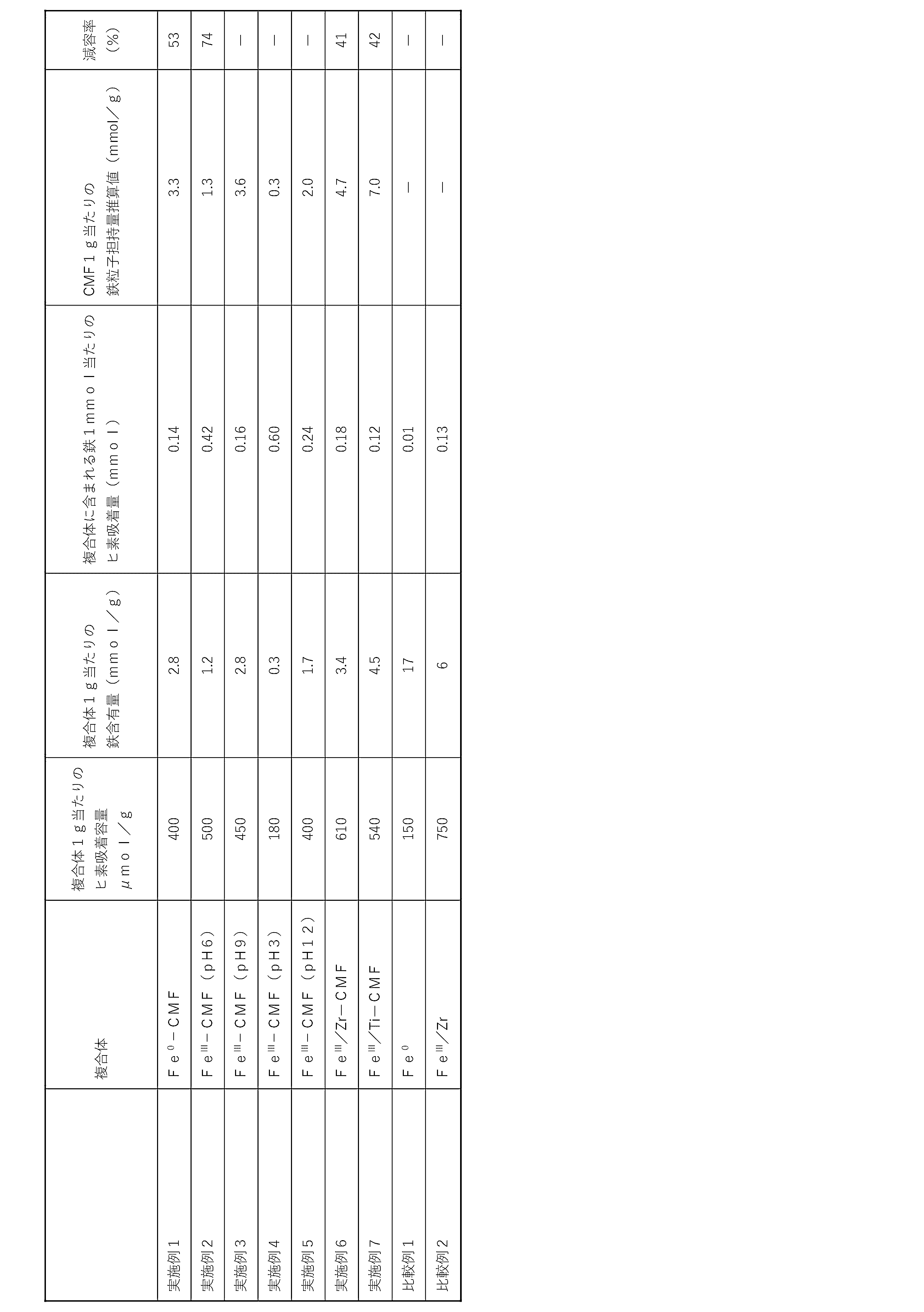
上記表1より、微小繊維状セルロースの表面に、鉄を含む金属粒子を担持すると、ヒ素吸着量が有意に向上することが分かる。また、微小繊維状セルロースの表面に、鉄と共にジルコニウムやチタンを含む金属粒子、及び/又は鉄とジルコニウム若しくはチタンとの混合酸化物を含む金属粒子を担持すると、ヒ素吸着力がより一層向上することが分かる。
そして、本開示の複合体は、溶液中のヒ素を効率よく吸着して回収することができ、溶液中のヒ素濃度を大幅に低減させることができ、前記複合体にヒ素を吸着させた後は、焼成することで大幅に減容することができ、埋め立て等の処分にかかる費用を大幅に削減できることが分かる。
そして、本開示の複合体は、溶液中のヒ素を効率よく吸着して回収することができ、溶液中のヒ素濃度を大幅に低減させることができ、前記複合体にヒ素を吸着させた後は、焼成することで大幅に減容することができ、埋め立て等の処分にかかる費用を大幅に削減できることが分かる。
以上のまとめとして、本開示の構成及びそのバリエーションを以下に付記する。
[1] 微小繊維状セルロース表面に、0価及び/又は3価の鉄を含む金属粒子を担持した構成を有する複合体。
[2] 微小繊維状セルロースと0価及び/又は3価の鉄を含む金属粒子の合計1g当たりの0価及び3価の鉄の合計担持量(鉄元素換算値)が1~100mmolである、[1]に記載の複合体。
[3] 微小繊維状セルロースがミクロフィブリル化セルロースである、[1]又は[2]に記載の複合体。
[4] 前記金属粒子の体積相当球の粒子直径が1μm以上である、[1]~[3]の何れか1つに記載の複合体。
[5] 前記金属粒子が、0価及び/又は3価の鉄と共に、ジルコニウム及びチタンから選択される少なくとも1種の金属の酸化物、水酸化物、又はオキシ水酸化物を含有し、
前記鉄(鉄元素換算値)と前記金属の酸化物、水酸化物、又はオキシ水酸化物(金属元素換算値;2種以上含有する場合はその総量)のモル比[鉄/(ジルコニウム及び/又はチタン)]が1~100である、[1]~[4]の何れか1つに記載の複合体。
[6] 前記3価の鉄が、酸化鉄、水酸化鉄、及びオキシ水酸化鉄から選択される少なくとも1種の鉄化合物である、[1]~[5]の何れか1つに記載の複合体。
[7] 下記反応1又は反応2を経て、[1]~[6]の何れか1つに記載の複合体を製造する、複合体の製造方法。
[反応1]水中で微小繊維状セルロースと鉄化合物とを混合して、微小繊維状セルロースに鉄化合物を吸着させ、吸着した鉄化合物を還元する
[反応2]水中で微小繊維状セルロースと鉄化合物と塩基性化合物とを混合して、微小繊維状セルロースに3価の鉄コロイドを吸着させ、粒子に成長させる
[8] [1]~[6]の何れか1つに記載の複合体を含むヒ素吸着剤。
[9] [1]~[6]の何れか1つに記載の複合体のヒ素吸着剤としての使用。
[10] ヒ素汚染水を、[8]に記載のヒ素吸着剤で処理して浄水を得る、浄水の製造方法。
[11] ヒ素汚染水を、[1]~[6]の何れか1つに記載の複合体で処理して浄水を得る、浄水の製造方法。
[12] [8]に記載のヒ素吸着剤を備えた浄水装置。
[13] [1]~[6]の何れか1つに記載の複合体を備えた浄水装置。
[14] [1]~[6]の何れか1つに記載の複合体をヒ素吸着剤として使用する、使用方法。
[1] 微小繊維状セルロース表面に、0価及び/又は3価の鉄を含む金属粒子を担持した構成を有する複合体。
[2] 微小繊維状セルロースと0価及び/又は3価の鉄を含む金属粒子の合計1g当たりの0価及び3価の鉄の合計担持量(鉄元素換算値)が1~100mmolである、[1]に記載の複合体。
[3] 微小繊維状セルロースがミクロフィブリル化セルロースである、[1]又は[2]に記載の複合体。
[4] 前記金属粒子の体積相当球の粒子直径が1μm以上である、[1]~[3]の何れか1つに記載の複合体。
[5] 前記金属粒子が、0価及び/又は3価の鉄と共に、ジルコニウム及びチタンから選択される少なくとも1種の金属の酸化物、水酸化物、又はオキシ水酸化物を含有し、
前記鉄(鉄元素換算値)と前記金属の酸化物、水酸化物、又はオキシ水酸化物(金属元素換算値;2種以上含有する場合はその総量)のモル比[鉄/(ジルコニウム及び/又はチタン)]が1~100である、[1]~[4]の何れか1つに記載の複合体。
[6] 前記3価の鉄が、酸化鉄、水酸化鉄、及びオキシ水酸化鉄から選択される少なくとも1種の鉄化合物である、[1]~[5]の何れか1つに記載の複合体。
[7] 下記反応1又は反応2を経て、[1]~[6]の何れか1つに記載の複合体を製造する、複合体の製造方法。
[反応1]水中で微小繊維状セルロースと鉄化合物とを混合して、微小繊維状セルロースに鉄化合物を吸着させ、吸着した鉄化合物を還元する
[反応2]水中で微小繊維状セルロースと鉄化合物と塩基性化合物とを混合して、微小繊維状セルロースに3価の鉄コロイドを吸着させ、粒子に成長させる
[8] [1]~[6]の何れか1つに記載の複合体を含むヒ素吸着剤。
[9] [1]~[6]の何れか1つに記載の複合体のヒ素吸着剤としての使用。
[10] ヒ素汚染水を、[8]に記載のヒ素吸着剤で処理して浄水を得る、浄水の製造方法。
[11] ヒ素汚染水を、[1]~[6]の何れか1つに記載の複合体で処理して浄水を得る、浄水の製造方法。
[12] [8]に記載のヒ素吸着剤を備えた浄水装置。
[13] [1]~[6]の何れか1つに記載の複合体を備えた浄水装置。
[14] [1]~[6]の何れか1つに記載の複合体をヒ素吸着剤として使用する、使用方法。
本開示の複合体やヒ素吸着剤は、水中に溶解したヒ素を効率よく吸着して回収することができる。そして、ヒ素を吸着させたあとは燃焼させて減容することにより、埋め立て等の処分に係る費用を大幅に削減することができる。そのため、ヒ素で汚染された水の浄化処理用途に好適に使用することができる。
1 微小繊維状セルロース
2 鉄(III)含有粒子
2 鉄(III)含有粒子
Claims (10)
- 微小繊維状セルロース表面に、0価及び/又は3価の鉄を含む金属粒子を担持した構成を有する複合体。
- 微小繊維状セルロース1g当たりの0価及び3価の鉄の合計担持量(鉄元素換算値)が1~100mmolである、請求項1に記載の複合体。
- 微小繊維状セルロースがミクロフィブリル化セルロースである、請求項1又は2に記載の複合体。
- 前記金属粒子が、0価及び/又は3価の鉄と共に、ジルコニウム及びチタンから選択される少なくとも1種の金属の酸化物、水酸化物、又はオキシ水酸化物を含有し、
前記鉄(鉄元素換算値)と前記金属の酸化物、水酸化物、又はオキシ水酸化物(金属元素換算値;2種以上含有する場合はその総量)のモル比[鉄/(ジルコニウム及び/又はチタン)]が1~100である、請求項1又は2に記載の複合体。 - 前記3価の鉄が、酸化鉄、水酸化鉄、及びオキシ水酸化鉄から選択される少なくとも1種の鉄化合物である、請求項1又は2に記載の複合体。
- 前記金属粒子の体積相当球の粒子直径が1μm以上である、請求項1又は2に記載の複合体。
- 下記反応1又は反応2を経て、請求項1又は2に記載の複合体を製造する、複合体の製造方法。
[反応1]水中で微小繊維状セルロースと鉄化合物とを混合して、微小繊維状セルロースに鉄化合物を吸着させ、吸着した鉄化合物を還元する
[反応2]水中で微小繊維状セルロースと鉄化合物と塩基性化合物とを混合して、微小繊維状セルロースに3価の鉄コロイドを吸着させ、粒子に成長させる - 請求項1又は2に記載の複合体を含むヒ素吸着剤。
- ヒ素汚染水を、請求項8に記載のヒ素吸着剤で処理して浄水を得る、浄水の製造方法。
- 請求項8に記載のヒ素吸着剤を備えた浄水装置。
Priority Applications (1)
| Application Number | Priority Date | Filing Date | Title |
|---|---|---|---|
| JP2024518087A JPWO2023210831A1 (ja) | 2022-04-28 | 2023-04-28 |
Applications Claiming Priority (2)
| Application Number | Priority Date | Filing Date | Title |
|---|---|---|---|
| PCT/JP2022/019877 WO2023210025A1 (ja) | 2022-04-28 | 2022-04-28 | 複合体及びその製造方法 |
| JPPCT/JP2022/019877 | 2022-04-28 |
Publications (1)
| Publication Number | Publication Date |
|---|---|
| WO2023210831A1 true WO2023210831A1 (ja) | 2023-11-02 |
Family
ID=88518267
Family Applications (2)
| Application Number | Title | Priority Date | Filing Date |
|---|---|---|---|
| PCT/JP2022/019877 Ceased WO2023210025A1 (ja) | 2022-04-28 | 2022-04-28 | 複合体及びその製造方法 |
| PCT/JP2023/016989 Ceased WO2023210831A1 (ja) | 2022-04-28 | 2023-04-28 | 複合体及びその製造方法 |
Family Applications Before (1)
| Application Number | Title | Priority Date | Filing Date |
|---|---|---|---|
| PCT/JP2022/019877 Ceased WO2023210025A1 (ja) | 2022-04-28 | 2022-04-28 | 複合体及びその製造方法 |
Country Status (2)
| Country | Link |
|---|---|
| JP (1) | JPWO2023210831A1 (ja) |
| WO (2) | WO2023210025A1 (ja) |
Citations (7)
| Publication number | Priority date | Publication date | Assignee | Title |
|---|---|---|---|---|
| JP2007229551A (ja) * | 2006-02-27 | 2007-09-13 | Toda Kogyo Corp | 吸着剤 |
| JP2014171996A (ja) * | 2013-03-11 | 2014-09-22 | Daiwabo Holdings Co Ltd | 砒素吸着性再生セルロース成形体、その製造方法、砒素吸着材及び水処理材 |
| JP2016097351A (ja) * | 2014-11-20 | 2016-05-30 | 大成建設株式会社 | ヒ素を含む泥水の浄化方法及び浄化装置 |
| JP2016185499A (ja) * | 2015-03-27 | 2016-10-27 | 株式会社ネオス | 重金属回収材料 |
| WO2019172164A1 (ja) * | 2018-03-07 | 2019-09-12 | 島根県 | ヒ素吸着性セルロース材料 |
| JP2020011211A (ja) * | 2018-07-20 | 2020-01-23 | 株式会社フジタ | 吸着材の製造方法 |
| JP2021171729A (ja) * | 2020-04-28 | 2021-11-01 | 東レ株式会社 | 中空糸状吸着材、浄水器、浄水の製造方法 |
-
2022
- 2022-04-28 WO PCT/JP2022/019877 patent/WO2023210025A1/ja not_active Ceased
-
2023
- 2023-04-28 WO PCT/JP2023/016989 patent/WO2023210831A1/ja not_active Ceased
- 2023-04-28 JP JP2024518087A patent/JPWO2023210831A1/ja active Pending
Patent Citations (7)
| Publication number | Priority date | Publication date | Assignee | Title |
|---|---|---|---|---|
| JP2007229551A (ja) * | 2006-02-27 | 2007-09-13 | Toda Kogyo Corp | 吸着剤 |
| JP2014171996A (ja) * | 2013-03-11 | 2014-09-22 | Daiwabo Holdings Co Ltd | 砒素吸着性再生セルロース成形体、その製造方法、砒素吸着材及び水処理材 |
| JP2016097351A (ja) * | 2014-11-20 | 2016-05-30 | 大成建設株式会社 | ヒ素を含む泥水の浄化方法及び浄化装置 |
| JP2016185499A (ja) * | 2015-03-27 | 2016-10-27 | 株式会社ネオス | 重金属回収材料 |
| WO2019172164A1 (ja) * | 2018-03-07 | 2019-09-12 | 島根県 | ヒ素吸着性セルロース材料 |
| JP2020011211A (ja) * | 2018-07-20 | 2020-01-23 | 株式会社フジタ | 吸着材の製造方法 |
| JP2021171729A (ja) * | 2020-04-28 | 2021-11-01 | 東レ株式会社 | 中空糸状吸着材、浄水器、浄水の製造方法 |
Also Published As
| Publication number | Publication date |
|---|---|
| WO2023210025A1 (ja) | 2023-11-02 |
| JPWO2023210831A1 (ja) | 2023-11-02 |
Similar Documents
| Publication | Publication Date | Title |
|---|---|---|
| Liu et al. | Magnetic zirconium-based metal–organic frameworks for selective phosphate adsorption from water | |
| Biswas et al. | Highly selective and straightforward recovery of gold and platinum from acidic waste effluents using cellulose-based bio-adsorbent | |
| Zhou et al. | Adsorption of platinum (IV) and palladium (II) from aqueous solution by magnetic cross-linking chitosan nanoparticles modified with ethylenediamine | |
| Pandey et al. | Facile approach to synthesize chitosan based composite—characterization and cadmium (II) ion adsorption studies | |
| Sun et al. | Adsorption of hexavalent chromium on Arundo donax Linn activated carbon amine-crosslinked copolymer | |
| Medina et al. | Incorporation of graphene oxide into a chitosan–poly (acrylic acid) porous polymer nanocomposite for enhanced lead adsorption | |
| US20170036993A1 (en) | Metal-organic framework for fluid stream filtration applications | |
| JP2012014167A5 (ja) | ||
| CN111318261B (zh) | 改性活性炭及其制备方法以及去除水中溴酸盐的方法 | |
| JP5628225B2 (ja) | 金属含有コロイド粒子担持担体およびその製造方法 | |
| JP5794294B2 (ja) | 金属粒子及びそれを含む排ガス浄化用触媒並びにそれらの製造方法 | |
| Ahmad et al. | Synthesis of zeolitic imidazolate framework-8 (ZIF-8) using different solvents for lead and cadmium adsorption | |
| Borgo et al. | Zirconium phosphate dispersed on a cellulose fiber surface: preparation, characterization, and selective adsorption of Li+, Na+, and K+ from aqueous solution | |
| JP2012509169A (ja) | 多孔ブロックナノファイバー複合フィルタ | |
| JP5612050B2 (ja) | 金属粒子担持触媒の製造方法 | |
| WO2023210831A1 (ja) | 複合体及びその製造方法 | |
| Huang et al. | Bimetallic metal-organic framework-modified resin for enhanced removal of organophosphorus: Inherent defects and high selectivity | |
| Jiao et al. | Competitive adsorption of heavy metals from aqueous solution onto sodium alginate gel beads | |
| JPWO2016136956A1 (ja) | 貴金属固溶体担持微粒子の製造方法 | |
| JP2017127805A (ja) | ヨウ素イオン吸着材、及びその製造方法 | |
| WO2017081857A1 (ja) | 吸着材担持体 | |
| WO2023210830A1 (ja) | 複合体及びその製造方法 | |
| CN114797787A (zh) | 载铁椰壳活性炭壳聚糖复合微球的制备及其应用 | |
| JP4452682B2 (ja) | 自動車内部に流入する有害ガスの吸着剤組成物 | |
| KR102126227B1 (ko) | 알칼리로 표면 개질된 석탄 연소 부산물을 지지체로 이용한 영가철 촉매 및 이의 제조방법 |
Legal Events
| Date | Code | Title | Description |
|---|---|---|---|
| 121 | Ep: the epo has been informed by wipo that ep was designated in this application |
Ref document number: 23796563 Country of ref document: EP Kind code of ref document: A1 |
|
| ENP | Entry into the national phase |
Ref document number: 2024518087 Country of ref document: JP Kind code of ref document: A |
|
| NENP | Non-entry into the national phase |
Ref country code: DE |
|
| 122 | Ep: pct application non-entry in european phase |
Ref document number: 23796563 Country of ref document: EP Kind code of ref document: A1 |