WO2023203641A1 - 分散電源統合管理装置及び電力システム - Google Patents
分散電源統合管理装置及び電力システム Download PDFInfo
- Publication number
- WO2023203641A1 WO2023203641A1 PCT/JP2022/018187 JP2022018187W WO2023203641A1 WO 2023203641 A1 WO2023203641 A1 WO 2023203641A1 JP 2022018187 W JP2022018187 W JP 2022018187W WO 2023203641 A1 WO2023203641 A1 WO 2023203641A1
- Authority
- WO
- WIPO (PCT)
- Prior art keywords
- distributed power
- power source
- power sources
- management device
- integrated management
- Prior art date
- Legal status (The legal status is an assumption and is not a legal conclusion. Google has not performed a legal analysis and makes no representation as to the accuracy of the status listed.)
- Ceased
Links
Images




Classifications
-
- H—ELECTRICITY
- H02—GENERATION; CONVERSION OR DISTRIBUTION OF ELECTRIC POWER
- H02J—ELECTRIC POWER NETWORKS; CIRCUIT ARRANGEMENTS OR SYSTEMS FOR SUPPLYING OR DISTRIBUTING ELECTRIC POWER; SYSTEMS FOR STORING ELECTRIC ENERGY
- H02J13/00—Circuit arrangements for providing remote monitoring or remote control of equipment in a power distribution network
-
- H—ELECTRICITY
- H02—GENERATION; CONVERSION OR DISTRIBUTION OF ELECTRIC POWER
- H02J—ELECTRIC POWER NETWORKS; CIRCUIT ARRANGEMENTS OR SYSTEMS FOR SUPPLYING OR DISTRIBUTING ELECTRIC POWER; SYSTEMS FOR STORING ELECTRIC ENERGY
- H02J13/00—Circuit arrangements for providing remote monitoring or remote control of equipment in a power distribution network
- H02J13/12—Monitoring network conditions, e.g. electrical magnitudes or operational status
-
- H—ELECTRICITY
- H02—GENERATION; CONVERSION OR DISTRIBUTION OF ELECTRIC POWER
- H02J—ELECTRIC POWER NETWORKS; CIRCUIT ARRANGEMENTS OR SYSTEMS FOR SUPPLYING OR DISTRIBUTING ELECTRIC POWER; SYSTEMS FOR STORING ELECTRIC ENERGY
- H02J3/00—Circuit arrangements for AC mains or AC distribution networks
-
- H—ELECTRICITY
- H02—GENERATION; CONVERSION OR DISTRIBUTION OF ELECTRIC POWER
- H02J—ELECTRIC POWER NETWORKS; CIRCUIT ARRANGEMENTS OR SYSTEMS FOR SUPPLYING OR DISTRIBUTING ELECTRIC POWER; SYSTEMS FOR STORING ELECTRIC ENERGY
- H02J3/00—Circuit arrangements for AC mains or AC distribution networks
- H02J3/38—Arrangements for feeding a single network from two or more generators or sources in parallel; Arrangements for feeding already energised networks from additional generators or sources in parallel
-
- H—ELECTRICITY
- H02—GENERATION; CONVERSION OR DISTRIBUTION OF ELECTRIC POWER
- H02J—ELECTRIC POWER NETWORKS; CIRCUIT ARRANGEMENTS OR SYSTEMS FOR SUPPLYING OR DISTRIBUTING ELECTRIC POWER; SYSTEMS FOR STORING ELECTRIC ENERGY
- H02J3/00—Circuit arrangements for AC mains or AC distribution networks
- H02J3/38—Arrangements for feeding a single network from two or more generators or sources in parallel; Arrangements for feeding already energised networks from additional generators or sources in parallel
- H02J3/381—Dispersed generators
-
- H—ELECTRICITY
- H02—GENERATION; CONVERSION OR DISTRIBUTION OF ELECTRIC POWER
- H02J—ELECTRIC POWER NETWORKS; CIRCUIT ARRANGEMENTS OR SYSTEMS FOR SUPPLYING OR DISTRIBUTING ELECTRIC POWER; SYSTEMS FOR STORING ELECTRIC ENERGY
- H02J3/00—Circuit arrangements for AC mains or AC distribution networks
- H02J3/38—Arrangements for feeding a single network from two or more generators or sources in parallel; Arrangements for feeding already energised networks from additional generators or sources in parallel
- H02J3/46—Controlling the sharing of generated power between the generators, sources or networks
-
- H—ELECTRICITY
- H02—GENERATION; CONVERSION OR DISTRIBUTION OF ELECTRIC POWER
- H02J—ELECTRIC POWER NETWORKS; CIRCUIT ARRANGEMENTS OR SYSTEMS FOR SUPPLYING OR DISTRIBUTING ELECTRIC POWER; SYSTEMS FOR STORING ELECTRIC ENERGY
- H02J2101/00—Supply or distribution of decentralised, dispersed or local electric power generation
- H02J2101/20—Dispersed power generation using renewable energy sources
- H02J2101/22—Solar energy
- H02J2101/24—Photovoltaics
Definitions
- the present disclosure relates to a distributed power source integrated management device and a power system.
- Patent Document 1 describes a specific control method for virtual synchronous generator control.
- Patent Document 1 describes a power conversion device that can continue operating despite fluctuations in grid voltage or grid frequency without using a PLL (Phase Locked Loop) circuit for detecting grid frequency.
- PLL Phase Locked Loop
- the dispersion may vary depending on the values of the control parameters.
- divergent operations may be induced due to mutual interference between power supply control systems.
- instability may occur in the above-mentioned power system or microgrid.
- An object of the present invention is to provide a distributed power supply integrated management device for executing stable power supply while avoiding the occurrence of.
- a distributed power source integrated management device manages the operational status of a power system in which multiple distributed power sources are connected, the output voltage of which is controlled by virtual synchronous generator control that simulates the operating characteristics of a synchronous generator in a static power source. do.
- the distributed power supply integrated management device includes a receiving section, an operation determining section, a control parameter determining section, and a transmitting section.
- the receiving unit receives information regarding the operating states of the plurality of distributed power sources.
- the operation determining section determines an operation pattern of the plurality of distributed power sources based on the information acquired by the receiving section.
- the control parameter determination unit determines the distribution of multiple power sources in the operation pattern determined by the operation determination unit so that the electric power system can operate stably by avoiding mutual interference of virtual synchronous generator control by multiple distributed power sources. Determine control parameter values for virtual synchronous generator control in each of the power sources.
- the transmitter transmits an operation command according to the operation pattern determined by the operation determiner and a control parameter value determined by the control parameter value determiner to each of the plurality of distributed power sources.
- a power system in another aspect of the present disclosure, includes a power system, the above-mentioned distributed power source integrated management device, and a communication path formed between the distributed power source integrated control device and the plurality of distributed power sources.
- a power system is connected to a plurality of distributed power sources whose output voltages are controlled by virtual synchronous generator control, which simulates the operating characteristics of a synchronous generator in a static power source.
- FIG. 1 is a block diagram illustrating a schematic configuration of a power system managed by a distributed power source integrated management device according to Embodiment 1.
- FIG. FIG. 2 is a block diagram illustrating a configuration example of a distributed power source.
- FIG. 2 is a block diagram illustrating a control configuration example of virtual synchronous generator control applied to each distributed power source.
- 1 is a block diagram illustrating an internal configuration of a distributed power source integrated management device according to Embodiment 1.
- FIG. FIG. 2 is a block diagram illustrating an example of a power system in which distributed power sources according to a comparative example including virtual synchronous generator control are connected to a plurality of power systems.
- 6 is a first simulation waveform diagram of the output of each distributed power source in the power supply system shown in FIG. 5.
- FIG. 5 is a first simulation waveform diagram of the output of each distributed power source in the power supply system shown in FIG. 5.
- FIG. 6 is a second simulation waveform diagram of the output of each distributed power source in the power supply system shown in FIG. 5.
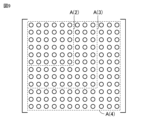
- FIG. FIG. 2 is a conceptual diagram illustrating linear approximation of the output power characteristics of a distributed power source for introducing a state equation. It is a conceptual diagram explaining the size of the coefficient matrix A of a state equation.
- 3 is a flowchart illustrating an example of a control parameter value determination processing procedure by the distributed power source integrated management device according to the first embodiment.
- 7 is an example of a block diagram showing control transfer characteristics of a power system including transfer functions used in the distributed power source integrated management device according to Embodiment 2.
- FIG. FIG. 2 is a conceptual diagram illustrating a gain margin and a phase margin of a loop transfer function.
- FIG. 3 is a block diagram illustrating the internal configuration of a distributed power source integrated management device according to Embodiment 3.
- FIG. FIG. 3 is a block diagram illustrating the internal configuration of a distributed power source integrated management device according to a fourth
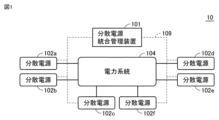
- FIG. 1 is a block diagram illustrating a schematic configuration of a power system 10 that includes a plurality of distributed power sources and is managed by a distributed power source integrated management apparatus 101 according to the first embodiment.
- the power system 10 is formed between a distributed power source integrated management device 101, a plurality of distributed power sources 102a to 102f, and the distributed power source integrated management device 101 and each distributed power source 102a to 102f. It includes a communication path 109 and a power system 104 to which a plurality of distributed power sources 102a to 102f are connected.
- the power system 104 is a network that includes a power source and a customer (not shown), and wiring (not shown) that electrically connects the power source and the customer.
- the scale of the network may be the entire jurisdictional area managed by a general power transmission and distribution company, a self-sustaining microgrid operated independently at a specific municipal scale, or a power distribution network inside a specific building.
- the power system 104 may be a system using either three-phase alternating current or single-phase alternating current.
- Distributed power sources 102a to 102f indicate distributed power sources, among the distributed power sources connected to the power system 104, whose output voltages are controlled by virtual synchronous generator control to be described later, and which are managed by the distributed power source integrated management device 101.
- the distributed power sources 102a to 102f are also simply referred to as the distributed power sources 102.
- the distributed power source 102 can be configured by a solar power generation system, a wind power generation system, a storage battery system, or the like.
- FIG. 2 shows a block diagram illustrating a configuration example of the distributed power source 102.
- distributed power source 102 includes a control device 103, a power source 105, and a power conversion device 106.
- the power source 105 can be configured by a power generation element such as a solar cell or a wind power generator, or a power storage element such as a battery or a capacitor.
- the power conversion device 106 is a "static power source” that converts the power from the power source 105 into AC power for linking with the power system 104. That is, the power conversion device 106 includes a main circuit 107 that performs power conversion by on/off control of a semiconductor switching element (not shown), and a switching control circuit 108 that generates an on/off control signal for the semiconductor switching element in the main circuit 107. has.
- the control device 103 generates an operation command for the power conversion device 106 according to information from the distributed power source integrated management device 101 shown in FIG. As described later, in this embodiment, the control device 103 controls the output voltage of the distributed power source 102 by virtual synchronous generator control using control parameter values from the distributed power source integrated management device 101. That is, in the control device 103, an operation command for controlling power conversion in the main circuit 107 is generated according to the virtual synchronous generator control.
- the control device 103 can be configured by, for example, a microcomputer including a processor such as a CPU (Central Processing Unit), a memory, etc. (not shown).
- the switching control circuit 108 controls the on/off of semiconductor switching elements in the main circuit 107 so that power conversion in the main circuit 107 is performed according to operation commands from the control device 103.
- the distributed power source 102 is not limited to a configuration that includes a power generation device or a power storage device, but can convert power from other power sources such as DC power into AC power, as illustrated by the dotted line in FIG. It may be configured to do so.
- a communication path 109 is formed between the distributed power source integrated management device 101 and each distributed power source 102.
- the communication path 109 can be formed by either a wired connection or a wireless connection.
- the distributed power source integrated management device 101 sends and receives information to and from each of the distributed power sources 102a to 102f via the communication path 109, and manages the operating status of each of the distributed power sources 102a to 102f.
- FIG. 3 is a block diagram illustrating a control configuration example of virtual synchronous generator control applied to each distributed power source 102.
- the virtual synchronous generator control is a control for giving the stationary power supply (main circuit 107) simulated operating characteristics equivalent to the rotating machine power supply.
- the functions of the distributed power supply control unit 200 shown in FIG. 3 can be realized by software processing in which a microcomputer forming the control device 103 executes a pre-stored program.
- a microcomputer forming the control device 103 executes a pre-stored program.
- at least some of the functions of each block in FIG. 3 can be realized by a hardware circuit.
- distributed power supply control section 200 includes a virtual synchronous generator control section 201 and an operation command value generation section 202.
- the operation command value generation unit 202 calculates the frequency f and phase ⁇ of the AC voltage output from the distributed power source 102 in accordance with the calculation result of the virtual synchronous generator control unit 201.
- the switching control circuit 108 shown in FIG. 2 controls on/off of the semiconductor switching elements forming the main circuit 107 so that the main circuit 107 outputs an AC voltage according to the calculated frequency f and phase ⁇ .
- ⁇ is the rotational speed of the rotor
- ⁇ 0 is the rated rotational speed of the rotor
- M is the inertia constant of the rotor
- D is the damping coefficient of the rotor.
- the rotating machine power supply has due to this characteristic. If we use the phase difference ⁇ between the output voltage of a power source connected to the power system, not only the rotating machine power source, and the voltage phase on the power system side, the electrical output energy Pe can be expressed as shown in equation (2). I can do it.
- P 0 is a positive constant determined depending on the internal impedance and voltage amplitude of the generator.
- the phase difference ⁇ is operated in a range of 0 ⁇ 90[deg], and within this range, there is a positive correlation between Pe and the phase difference ⁇ .
- the rotating machine power supply has the advantage of being able to self-return to a stable operating state because it has the characteristics shown in equation (1). Further, based on the same principle, even when a plurality of different rotating machine power supplies are operated in parallel, there is an advantage that the cross current that occurs between the rotating machine power supplies can be eliminated and the rotational speed and voltage phase can be synchronized.
- the virtual synchronous generator control section 201 includes subtracters 211 to 213, an integrator 203, a feedback path 204, and a governor control section 205.
- the subtracter 211 subtracts the output active power measurement value P out from the active power command value (hereinafter referred to as output active power command value P ref ) output from the distributed power source 102 (power conversion device 106) to obtain the active power deviation.
- P ref active power command value
- the active power deviation ⁇ P out passes through an integrator 203 whose integral constant is the reciprocal of the inertia constant M (1/M) in equation (1), and the output value of the integrator 203 is applied to the braking in equation (1). It passes through a feedback path 204 where it is multiplied by a coefficient D, and is negatively fed back to a subtracter 213.
- the output value of the integrator 203b is negatively fed back to the subtracter 212 by the governor control unit 205 having a gain K and a first-order lag element (K/(1+T ⁇ s)) with a time constant T.
- the arithmetic processing by the integrator 203 and the feedback path 204 corresponds to the calculation of the oscillation equation of the rotating machine shown in equation (1).
- the governor control unit 205 is a feedback path for adding characteristics equivalent to a speed governor provided in the rotating machine power source.
- the virtual synchronous generator control unit 201 calculates the frequency change amount ⁇ f of the output voltage from the distributed power source 102 (power conversion device 106) by executing these control calculations on the active power deviation ⁇ P out .
- the operation command value generation unit 202 includes an adder 214, a multiplier 206, and an integrator 208.
- the adder 214 adds the reference frequency fn of the output voltage and the frequency change amount ⁇ f calculated by the virtual synchronous generator control unit 201 to calculate the frequency command value f of the output voltage.
- Multiplier 206 multiplies the frequency command value f output from adder 214 by 2 ⁇ to calculate an angular frequency ⁇ corresponding to the rotational speed.
- the integrator 208 integrates the angular frequency ⁇ output from the multiplier 206 to calculate the phase command value ⁇ of the output voltage.
- the distributed power source 102 is controlled so that the frequency and phase of the output voltage (AC voltage) of the power conversion device 106 are equal to the frequency command value f and the phase command value ⁇ described above.
- the distributed power source 102 to which virtual synchronous generator control is applied has the same operating characteristics as a rotating machine power source, the ability to self-return to a stable operating state, and the ability to eliminate cross current between different power sources. This provides the ability to achieve frequency and phase synchronization.
- the inertia constant M included in the integrator 203, the damping coefficient D included in the feedback path 204, and the gain K and time constant T included in the first-order lag element of the governor control section 205 are a control parameter that can be changed by a designer or administrator. By changing these control parameter values, the operating characteristics of virtual synchronous generator control can be changed.
- FIG. 4 is a block diagram illustrating an example of the internal configuration of the distributed power source integrated management device 101.
- distributed power supply integrated management device 101 includes a receiving section 301, a calculating section 302, a storage section 305, and a transmitting section 306.
- the distributed power source integrated management device 101 uses the receiving section 301 and the transmitting section 306 to form a communication path 109 (FIG. 1) with each distributed power source 102 connected to the power system 104.
- the receiving unit 301 receives distributed power source information 311 transmitted from each distributed power source 102.
- the distributed power source information 311 includes information regarding the past and current operating states of the distributed power source 102 and information about the configuration of control provided in the distributed power source 102 or constants related to control.
- the receiving unit 301 passes the received distributed power source information to the calculation unit 302 as distributed power source information 312. Note that the receiving unit 301 can generate distributed power source information 312 by adding preprocessing to the received distributed power source information 311 to process it into a form that can be used for calculations in the calculation unit 302.
- the preprocessing by the receiving unit 301 includes a process of converting a signal transmitted according to a communication protocol into a signal format that can be processed by the arithmetic unit 302, and a filtering process of removing or extracting a specific frequency band from a received time-series signal. , and processing for calculating active power based on information on the output voltage and output current of the distributed power source.
- the distributed power source information 311 received by the receiving unit 301 includes at least information on the amplitude and phase of the current output voltage of each distributed power source 102, and output active power. .
- the storage unit 305 stores in advance information regarding the configuration and connection state of the distributed power sources 102 and the power system 104 that are managed by the distributed power source integrated management device 101. Furthermore, the storage unit 305 passes information 319 necessary for processing in the calculation unit 302 to the calculation unit 302 as appropriate. Furthermore, the storage unit 305 may update, add, or delete stored information based on the information 318 from the calculation unit 302.
- the information stored in the storage unit 305 includes at least information regarding the connection position of each distributed power source 102 and the impedance of the electrical path connecting the distributed power sources 102.
- the information related to impedance includes the reluctance of the path.
- the storage unit 305 is not limited to a configuration in which it is a component of the distributed power source integrated management device 101, and may be configured to be connected to the distributed power source integrated management device 101 via wireless communication or wired communication. For example, it is also possible to configure the storage unit 305 using a cloud on the Internet.
- the calculation unit 302 can be configured by, for example, a microcomputer including a CPU and memory (not shown), similar to the control device 103 in FIG. 2. Based on the distributed power source information 311 from the receiving section 301 and the information 319 received from the storage section 305, the calculation section 302 performs various functions for managing each distributed power source 102, which will be described later, by executing a program stored in advance. can be realized.
- the calculation unit 302 controls the virtual synchronous generators provided in each of the plurality of distributed power sources 102 by considering the mutual interference via the power system 104 and controlling the power system 102 to be managed.
- the control details of each distributed power source 102 for example, the configuration of the control system and control parameter values, are determined so as to ensure operational stability.
- the configuration of the control system is fixed to the example shown in FIG. 3. That is, the calculation unit 302 calculates the control parameters ( (braking coefficient D, inertia constant M, first-order delay system time constant T, gain K, etc.) are set appropriately.
- FIG. 5 illustrates a configuration example of a power system in which three distributed power sources 102(1) to 102(3) according to a comparative example coexist in a power system to be managed and are equipped with virtual synchronous generator control.
- FIG. 5 illustrates a configuration example of a power system in which three distributed power sources 102(1) to 102(3) according to a comparative example coexist in a power system to be managed and are equipped with virtual synchronous generator control.
- Three distributed power sources 102(1) to 102(3) according to the comparative example are connected to each other via a common bus 407. It is assumed that each of the distributed power sources 102(1) to 102(3) is equipped with the virtual synchronous generator control shown in FIG. Reactances 404 to 406 exist between the distributed power sources 102(1) to 102(3) and the common bus bar 407, respectively, depending on the wiring distance. In the following, the reactance values of reactances 404 to 406 are expressed as X 1 to X 3 . Further, power sources and consumers 408 other than those to be managed are also connected to the common bus 407.
- FIG. 6 is a first simulation waveform diagram of the output of each distributed power source 102(1) to 102(3) in the power system shown in FIG. FIG. 6 shows simulation waveforms when the output of each distributed power source stably converges.
- FIG. 6 shows simulation results of the output active powers P out1 to P out3 of the distributed power sources 102(1) to 102(3) and the frequencies f1 to f3 of the output voltages.
- FIG. 7 shows simulation waveforms in the case of divergent operation in which the output of each distributed power source becomes unstable because the control parameter value is inappropriate.
- the setting of control parameter values can only be achieved by carrying out a complete design for each individual distributed power source. It is not a good thing, but it is necessary to consider mutual interference. Further, the setting range of values required for control parameters in order to stabilize the operation may change depending on the status of the distributed power source, other power sources connected to the power system, and the consumer 408.
- calculation unit 302 includes an operation determining unit 303 for each distributed power source 102 and a control parameter determining unit 304.
- the operation determining unit 303 determines the number of operating distributed power sources necessary and sufficient to supply power to consumers based on information such as the current output active power (P out in FIG. 3) of each distributed power source 102. . Furthermore, the operation determining unit 303 generates a run/stop command for each distributed power source 102 based on the determination, and also sets a command value of output active power (P in FIG. ref ). Note that in the distributed power source 102 charged from the power system 104, the output active power command value P ref is set to a negative value (P ref ⁇ 0). Furthermore, in the distributed power source 102 where the operation command is generated, there is a case where the output active power command value P ref is set to 0.
- each combination of operation/stop states (operation pattern) of the plurality of distributed power sources 102 connected to the power system 104 is subdivided into combinations of output active power command values P ref of the distributed power sources 102 in the operating state.
- Each pattern is also referred to as an operation pattern. That is, the operation determination unit 303 determines the operation when the operation pattern (operation/stop state) of a plurality of distributed power sources is changed, or when the operation pattern is the same but the output active power command value P ref is changed. The pattern will change.
- the number of operating distributed power sources 102 When determining the number of operating distributed power sources 102, an outline of the current demand amount is grasped from the total value of the current output active power (P out ) of each distributed power source 102 . Then, the number of operating distributed power sources 102 can be determined so that at least the sum of the rated capacities of the operating distributed power sources 102 exceeds the demand so as to be able to sufficiently supply the grasped demand.
- the operation determining unit 303 operates each distributed power source 102 after considering the operational priority among the distributed power sources 102 based on the economic cost and environmental cost of operating each distributed power source 102 and the operational efficiency. A distributed power source 102 may also be determined. Further, when the distributed power source 102 from which the operation command is generated includes a storage battery, the operation determining unit 303 determines the output active power command value (P ref ) in consideration of the SOC (State of Charge) of the storage battery. It's okay.
- the operation determining unit 303 generates the operation command information 313 including the operation/stop command for each distributed power source 102 and the output active power command value P ref .
- the operation determining unit 303 generates the latest operation command information 313 using the passage of a certain period of time as a trigger or in response to establishment of a predetermined trigger condition of the distributed power source information 312.
- the operation command information 313 is sequentially updated based on the latest distributed power source information 312. For example, the above trigger condition is satisfied when any one of the plurality of items making up the distributed power source information 312 changes.
- control configuration for controlling the virtual synchronous generator in each distributed power source 102 is determined as shown in FIG.
- control parameter determining unit 304 determines the value based on the distributed power source information 312 received from the receiving unit and the information 319 received from the storage unit under the operation pattern determined by the operation determining unit 303. Then, the control parameter values are determined along with the stability evaluation of the entire power system.
- the operational characteristics of the power system to be managed are expressed by a state equation, and the stability is evaluated from the eigenvalues of the coefficient matrix of the state equation.
- a specific stability evaluation method will be described with reference to a power system including three distributed power sources equipped with virtual synchronous generator control, as illustrated in FIG. 5 .
- Equation (3) V L and ⁇ L are the amplitude and phase of the voltage of the common bus 407 at the connection point of the distributed power source 102 (1), and V 1 and ⁇ 1 are the amplitude and phase of the voltage of the common bus 407 at the connection point of the distributed power source 102 (1). These are the amplitude and phase of the output voltage. Further, ⁇ indicates the amount of minute fluctuation of each variable from the standard value in a state where the power system is operating steadily and stably.
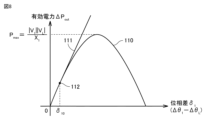
- the phase difference at an operating point 112 on the characteristic line 111 in a stable operating state of the power system is ⁇ 10
- the slope of the tangent to the characteristic line 110 at the operating point 112 is given by cos ⁇ 10 .
- the characteristic line 111 is expressed by the following equation (4).
- the output active powers P out2 and P out3 of the second distributed power source 102 (2) and the third distributed power source 102 (3) also follow the same linear pattern with respect to the amount of fluctuation from the operating point in the stable operating state.
- phase difference ⁇ 20 in equation (5) is the voltage of the common bus 407 at the connection point of the distributed power source 102 (2) and the common bus 407 in a stable operating state, and the output voltage of the distributed power source 102 (2). shows the phase difference of
- phase difference ⁇ 30 in equation (6) is the voltage of the common bus 407 at the connection point of the distributed power source 102 (3) and the common bus 407 in a stable operating state and the output voltage of the distributed power source 102 (3). shows the phase difference between
- P 1m (
- P 2m (
- P 3m (
- P 1m to P 3m are coefficients that are inversely proportional to the reactance values X 1 to X 3 , respectively.
- Equation (8) can be obtained by eliminating ⁇ L from Equations (4) to (7) and rearranging them in matrix form.
- Equations (10) and (11) correspond to state equation representations of virtual synchronous generator control for one distributed power source 102.
- equations (12) and (13) are obtained. Note that in equations (12) and (13), the state variable x ij indicates the j-th state variable of the i-th distributed power source.
- equation (14) can be obtained.
- equation (14) the coefficient matrix A (9 rows x 9 columns) in equation (14) is expressed by equation (15) below.
- equation (16) Equation (16) below.
- Equation (14) is a state equation expression that includes all the operating characteristics of the power system to be managed. Then, by determining the eigenvalues of the coefficient matrix A (formula (15)) of formula (14), it is possible to understand the vibration mode of the system.
- the real part of the eigenvalue of the coefficient matrix A when the real part of the eigenvalue of the coefficient matrix A is negative, it indicates the damping rate of the vibration of the system, while when it is positive, it indicates the divergence rate of the vibration.
- the imaginary part of the eigenvalue represents the frequency of vibration.
- the absolute value of the real part of the eigenvalue which is a negative value, can be used as a stability index for evaluating the stability of the power system.
- the main eigenvalues are "-6.1625308 ⁇ 3.2739828i", “-6.2123889 ⁇ 3.2929444i”, and It becomes "-6.25 ⁇ 3.3071891i”.
- the real parts of the main eigenvalues are all negative values in both cases of Figures 6 and 7, but the absolute value of the real part (negative value) is larger in the case of Figure 6. can be confirmed.
- the control parameter values are set so that the absolute value of the real part (negative value) of the eigenvalue is 11 or more. It is possible to ensure stable operation of the grid. Note that since the appropriate value of the threshold may change depending on the system configuration, it is desirable to define it in advance based on instantaneous value simulation or the like.
- the coefficient matrix A shown in equation (15) is an example when three distributed power sources 102(1) to 102(3) operate according to virtual synchronous generator control, and is (3 ⁇ 3) Although the size of the coefficient matrix A is rows ⁇ (3 ⁇ 3) columns, the size of the coefficient matrix A changes depending on the number of distributed power sources (N: natural number) connected to the power system and operating. Specifically, the size of the coefficient matrix A is (N ⁇ 3) rows ⁇ (N ⁇ 3) columns for the number N of distributed power sources for which operation commands have been generated.
- the coefficient matrix A also changes.
- the operating point 112 (stable operating state) in FIG. 8 changes, and the coefficient matrix A may also change.
- the coefficient matrix A used for stability evaluation is determined by the operation determining unit 303 in FIG. may change each time a change occurs. Accordingly, it is preferable to re-perform the stability evaluation.
- FIG. 10 shows a flowchart illustrating an example of a procedure for determining control parameter values by the distributed power source integrated management device according to the first embodiment.
- the process shown in FIG. 10 is performed when the operation determining unit 303 changes the operation pattern (combination of operation/stopping) of at least a plurality of distributed power sources. It is executed by executing a stored program. Thereby, the function of the control parameter determining section 304 in FIG. 4 is realized.
- the process shown in FIG. 10 may be executed even if the operation pattern of the plurality of distributed power sources is fixed or when the output active power command value P ref of the plurality of distributed power sources is changed. good. That is, the process shown in FIG. 10 can be executed using a change in the operation pattern of the plurality of distributed power sources 102 by the operation determining unit 303 as a trigger.
- the calculation unit 302 (control parameter determination unit 304) tentatively determines the control parameter value of each distributed power source in step (hereinafter simply referred to as "S") 110.
- S control parameter value of each distributed power source in step (hereinafter simply referred to as "S") 110.
- the inertia constant M, the braking coefficient D, and the gain K of the first-order lag element constituting the governor control unit 205 in the virtual synchronous generator control unit 201 illustrated in FIG. and the value of time constant T is tentatively determined.
- the initial value of the temporarily determined control parameter value may be a predetermined standard value or may be a randomly set value.
- the coefficient matrix of equation (15) is also tentatively determined using the tentatively determined control parameter values.
- the calculation unit 302 calculates the stability index of the system using the coefficient matrix A tentatively determined in S110. For example, as described above, the eigenvalues of the coefficient matrix A are calculated. Then, in S130, it is determined whether the stability index (eigenvalue of coefficient matrix A) calculated in S120 is included within a predetermined stability range. For example, as described above, when the real parts of all the eigenvalues are negative values and the absolute values of the real parts are larger than a predetermined threshold, a YES determination is made in S130. On the other hand, if this is not the case, a NO determination is made in S130.
- the calculation unit 302 changes at least part of the control parameter value in S140.
- S140 in order to increase the stability of the system, for example, the damping coefficient D and/or the inertia constant M are increased by a certain amount (a certain amount or a certain ratio) in at least some of the distributed power sources. Furthermore, if the stability index does not improve sufficiently even after increasing the damping coefficient D and the inertia constant M, the gain K can be further increased.
- the calculation unit 302 returns the process to S110 and tentatively determines the modified coefficient matrix A using the control parameter values changed in S140. Then, in S120, the stability index of the system is calculated using the modified coefficient matrix A, and in S130, the stability index (eigenvalue of the modified coefficient matrix A) calculated in S120 is calculated based on the stability index. It is determined whether or not it is within the guaranteed range.
- the calculation unit 302 uses the values provisionally determined in S110 to finalize the control parameter values of the virtual synchronous generator control unit 201 of the distributed power source for which the operation command has been generated, in S150.
- the operation command information 313 by the operation determination unit 303 specifically, the control parameter values that enable stable operation of the system are determined in correspondence with the operation/stop command and output active power command value P ref for each distributed power source 102. can be determined.
- the calculation unit 302 uses the operation command information 313 (run/stop command for each distributed power source 102 and output active power command value P ref ) determined by the operation determination unit 303 and the operation Information 314 (control parameter values for stable operation of the system) determined by the control parameter determining unit 304 in response to the command information 313 is output to the transmitting unit 306 as setting information 315.
- the information 318 may be passed to the storage unit 305 and stored.
- This information 317 may include at least part of the information output to the transmitter 306.
- the transmitting unit 306 Upon receiving the setting information 315 from the calculation unit 302, the transmitting unit 306 transmits the operation command value and control parameter value of the distributed power source 102 to each distributed power source 102.
- the setting information 315 includes at least the operation/stop command and output active power command value (operation command information 313) of the distributed power source 102, and each distributed power source for which the operation command has been generated.
- 102 includes control parameter values for virtual synchronous generator control.
- the distributed power source integrated management device As explained above, according to the distributed power source integrated management device according to the first embodiment, even in a power system in which a plurality of distributed power sources whose output voltages are controlled by virtual synchronous generator control are connected, the operation of the distributed power sources can be controlled.
- control parameter values for virtual synchronous generator control in each distributed power source are appropriately set to prevent instability due to mutual interference between distributed power sources.
- stable operation can be realized, and stable power supply can be realized while avoiding unstable phenomena caused by mutual interference in the control of a plurality of distributed power sources.
- Embodiment 2 In the first embodiment, the stability index was calculated by finding the eigenvalues of the coefficient matrix A of the state equation, but in the second embodiment, a different method of calculating the stability index will be explained. That is, the distributed power source integrated management device according to the second embodiment differs from the distributed power source integrated management device 101 according to the first embodiment only in the function of the control parameter determination unit 304. The configuration and operation of other parts of the distributed power source integrated management device according to the second embodiment are the same as those of the distributed power source integrated management device 101 according to the first embodiment, so detailed explanations will not be repeated.
- control parameter determining unit 304 derives a open-loop transfer function representing the frequency response of the system when evaluating the stability of the power system. Then, the stability of the system can be evaluated in S130 (FIG. 9) using the phase margin and gain margin of the open-loop transfer function as a stability index (S120 in FIG. 9).
- a stability evaluation method using a open-loop transfer function is applied to a power system in which three distributed power sources whose output voltages are controlled by virtual synchronous generator control are connected, as illustrated in FIG. explain.
- FIG. 11 is an example of a block diagram showing control transfer characteristics of a power system including transfer functions used in the distributed power source integrated management device according to the second embodiment.
- FIG. 11 shows a control transmission block diagram that takes into account interference of virtual synchronous generator control provided by three distributed power sources 102(1) to 102(3) in the power system illustrated in FIG. 5.
- equation (8) is established by the linear approximation described in the first embodiment. Further, the output voltages of the distributed power sources 102(1) to 102(3) are controlled by virtual synchronous generator control having the configuration shown in FIG. Therefore, if the transfer functions G VSG1 (s) to G VSG3 (s) of the virtual synchronous generator control of the distributed power sources 102(1) to 430 are used, the transfer functions of the distributed power sources 102(1) to 102(3) The transfer characteristics of the power system to which the distributed power sources 102(1) to 102(3) are connected are shown in the block diagram of FIG. 11, reflecting cross currents (mutual interference) occurring between the power sources. The transfer functions G VSG1 (s) to G VSG3 (s) of the distributed power sources 102(1) to 102(3) can be obtained by substituting the control parameter values D, M, T, and K into equation (9). You can ask for it.
- Adders 834 to 836 add ⁇ P L1 to ⁇ P L3 from multipliers 811 to 813 and ⁇ P crs1 to ⁇ P crs3 from arithmetic units 841 to 843, respectively, to obtain distributed power sources 102(1) to 102(3). ), the output active power fluctuation amounts ⁇ P out1 to ⁇ P out3 are calculated, respectively.
- the subtracters 831 to 833 subtract ⁇ P out1 to ⁇ P out3 from the adders 834 to 836 from the fluctuation amounts ⁇ P ref1 to ⁇ P ref3 of the output active power command value, thereby obtaining the distributed power sources 102(1) to 102(3). ), the variation amount ⁇ dP 1 to dP 3 of the power deviation ⁇ Pout (FIG. 3) is calculated.
- the virtual synchronous generator control by the distributed power source 102(1) can be performed using other distributed power sources 102(2). , 102(3), it is possible to understand the frequency response characteristics taking into account the interference with the virtual synchronous generator control.
- virtual synchronization in distributed power sources 102(2) and 102(3) can be achieved by determining the one-round transfer function G(2) starting from ⁇ dP2 and the one-round transfer function G(3) starting from ⁇ dP3.
- generator control it is also possible to understand the frequency response characteristics that take into account interference with virtual synchronous generator control in other distributed power sources.
- the gain margin GM and phase margin PM shown in FIG. 12 can be further determined from the Bode diagram of the determined open-loop transfer function.
- a Bode diagram showing the frequency characteristics of the open loop transfer function is obtained for gain [dB] and phase [deg].
- the gain margin GM is defined as the phase [deg] at the frequency ⁇ c where the gain is 0 [dB]
- the phase margin PM is (-1) times the gain at the frequency ⁇ p where the phase is -180 [deg].
- the distributed power supply integrated management device when the operation pattern of the plurality of distributed power supplies 102 is changed and the calculation unit 302 (control parameter determination unit 304) executes the process of FIG. In S110, the above-mentioned open-circuit transfer functions G(1) to G(3) are obtained using the transfer functions G VSG1 (s) to G VSG3 (s) to which the tentatively determined control parameter values are substituted.
- the gain margin GM and phase margin PM based on the open-loop transfer functions G(1) to G(3) determined in S110 are calculated as stability indices. Furthermore, in S130 of FIG. 10, the stability index is included within the stable range when the gain margin GM and phase margin PM calculated in S120 are respectively larger than predetermined determination thresholds TH GM and TH PM . (YES determination).
- the control parameter values of the virtual synchronous generator control are changed in S140 to obtain the transfer functions G VSG1 (s) to G VSG3 (s) and the open-loop transfer functions G(1) to G(3). , and S120 and S130 are executed.
- the operation pattern of the plurality of distributed power sources 102 determined by the operation determination unit 303 is Control parameter values that allow stable operation of the system can be determined.
- determination thresholds TH GM and TH PM for the gain margin GM and phase margin PM described above should also be set in advance by comparing the results of the circuit simulation with the stability determination results based on the Bode diagram. is possible.
- the distributed power supply integrated management device by using the frequency response characteristic of the transfer function obtained from the control parameter value (virtual synchronous generator control) as a stability index, It is possible to enjoy the same effects as in the first embodiment. In other words, even in a power system where multiple distributed power sources whose output voltages are controlled by virtual synchronous generator control are connected, instability occurs due to mutual interference between the distributed power sources when the operating pattern of the distributed power sources changes. It is possible to appropriately set control parameter values for virtual synchronous generator control to avoid this. This makes it possible to realize stable power supply that avoids unstable phenomena caused by mutual interference in the control of a plurality of distributed power sources.
- Embodiment 3 In Embodiments 3 and 4, further modifications of the distributed power source integrated management device will be described.
- FIG. 13 is a block diagram illustrating the internal configuration of the distributed power supply integrated management device according to the third embodiment.
- FIG. 13 compared to the distributed power source integrated management device 101 shown in FIG. They differ in some respects.
- the rest of the configuration of the distributed power source integrated management device 101X is the same as that of the distributed power source integrated management device 101, so detailed description will not be repeated.
- the calculation unit 302X further includes an operation determining unit 303, a control parameter determining unit 304X, and a lookup table 307.
- the operation determining unit 303 generates operation command information 313 based on distributed power source information 312 such as the current output active power (P out in FIG. 3 ) of each distributed power source 102, as described in FIG. 4. .
- the operation command information 313 includes the operation/stop command for each distributed power source 102 and the output active power command value P ref .
- control parameter determining unit 304 Control parameter values (braking coefficient D, inertia constant M, first-order lag system time constant T, gain K, etc.) used for virtual synchronous generator control of the distributed power source 102 for which the command has been generated are determined.
- the lookup table 307 includes control parameter values (D, A combination of values of M, T, and K) is stored in advance.
- the lookup table 307 stores control parameter values that have been analyzed in advance to determine that the stability index is within the stable range according to the first or second embodiment for each operation pattern of the plurality of distributed power sources 102. has been done.
- the control parameter determination unit 304X selects one of the plurality of predefined operation patterns based on the operation command information 313 from the operation determination unit 303, and refers to the lookup table 307. Thereby, in accordance with the operation pattern determined by the operation command information 313, control parameter values stored in advance for stably operating the system can be read from the lookup table 307.
- the control parameter value is added and output to the transmitter 306 together with the operation command information 313 as part of the information 314 from the control parameter determiner 304X, and is transmitted to each distributed power source 102.
- the distributed power source integrated management device also performs virtual synchronous generator control to prevent unstable phenomena due to mutual interference between distributed power sources when the operation pattern of the distributed power sources changes.
- control parameter values can be set appropriately. This makes it possible to realize stable power supply that avoids unstable phenomena caused by mutual interference in the control of a plurality of distributed power sources.
- the calculation and evaluation of the stability index using the tentatively determined control value parameter values are performed online, so the calculation load is relatively high, while in the third embodiment, Such an increase in online calculation load can be avoided.
- the third embodiment it is necessary to determine in advance appropriate control parameter values for each operation pattern of the plurality of distributed power sources 102, which increases the storage capacity of the lookup table 307 and the workload for preparation. There are concerns that this will happen.
- FIG. 14 is a block diagram illustrating the internal configuration of the distributed power source integrated management device according to the fourth embodiment.
- FIG. 14 compared to the distributed power source integrated management device 101 shown in FIG. They differ in some respects.
- the rest of the configuration of the distributed power source integrated management device 101Y is the same as that of the distributed power source integrated management device 101, so detailed description will not be repeated.
- the calculation unit 302Y is different in that it includes an operation determining unit 303, a control parameter determining unit 304Y, and a learning unit 308.
- the operation determining unit 303 generates operation command information 313 based on distributed power source information 312 such as the current output active power (P out in FIG. 3 ) of each distributed power source 102, as described in FIG. 4. .
- the operation command information 313 includes the operation/stop command for each distributed power source 102 and the output active power command value P ref .
- control parameter determination unit 304Y generates a driving command by reflecting the learning results in the learning unit 308.
- Control parameter values (braking coefficient D, inertia constant M, first-order lag system time constant T, gain K, etc.) used for virtual synchronous generator control of the distributed power source 102 are determined.
- the learning unit 308 inputs a combination of control parameter values for each operation pattern, and evaluates the stability under the combination of control parameter values (either stable/unstable information or the first embodiment). It includes a learning model whose output is the stability index (stability index in 2).
- the learning model can be configured by an AI (Artificial Intelligence) learning model.
- the learning model is created by machine learning in which the correspondence between the combination of control parameter values and the stability evaluation result when using the combination of control parameter values is input as learning data for each movement pattern. be able to.
- stability evaluation results can include both results obtained when the power system is actually operated and simulation results.
- the learning model is configured to input the motion pattern and output an appropriate combination of control parameter values (D, M, T, K).
- control parameter values D, M, T, K
- an appropriate combination of control parameter values one in which the stability evaluation is positive or the stability index is larger than a predetermined threshold value in the operation pattern can be used.
- the control parameter determining unit 304Y inputs the motion pattern indicated by the motion command information 313 from the motion determining unit 303 into the learning model that constitutes the learning unit 308. As a result, an appropriate combination of control parameter values for the motion determination pattern is obtained as the output of the learning model.
- the control parameter value is added and output to the transmitter 306 along with the operation command information 313 as part of the information 314 from the control parameter determiner 304Y, and transmitted to each distributed power source 102.
- control parameter determining unit 304Y updates the learning model in the learning unit 308 by additionally inputting new results obtained when the power system is actually operated as learning data to the learning unit 308. It is also possible to update sequentially.
- the distributed power source integrated management device also performs virtual synchronous generator control to prevent unstable phenomena due to mutual interference between distributed power sources when the operation pattern of the distributed power sources changes.
- control parameter values can be set appropriately. This makes it possible to realize stable power supply that avoids unstable phenomena caused by mutual interference in the control of a plurality of distributed power sources.
- the configuration of the control system for virtual synchronous generator control in each distributed power source 102 is fixed to the content shown in FIG. , 304Y) determines the control parameter values in FIG. 3, but the configuration of the control system for virtual synchronous generator control may be switched depending on the operation setting pattern.
- a configuration (modified example) in which the feedback loop of the governor control unit 205 (first-order lag system) is omitted may be applied to some operation patterns.
- the above configuration (modified example) is realized by setting the gain K of the first-order lag system to 0. That is, the functions of the control parameter determination unit 304 (304X, 304Y) substantially include determining the configuration of the control system for virtual synchronous generator control.
Landscapes
- Engineering & Computer Science (AREA)
- Power Engineering (AREA)
- Supply And Distribution Of Alternating Current (AREA)
Priority Applications (5)
| Application Number | Priority Date | Filing Date | Title |
|---|---|---|---|
| PCT/JP2022/018187 WO2023203641A1 (ja) | 2022-04-19 | 2022-04-19 | 分散電源統合管理装置及び電力システム |
| US18/854,564 US20250337248A1 (en) | 2022-04-19 | 2022-04-19 | Distributed power supply integration management device and power system |
| CN202280094838.4A CN119032483A (zh) | 2022-04-19 | 2022-04-19 | 分布式电源集成管理装置以及电力系统 |
| JP2024515779A JP7738746B2 (ja) | 2022-04-19 | 2022-04-19 | 分散電源統合管理装置及び電力システム |
| TW112113821A TWI848660B (zh) | 2022-04-19 | 2023-04-13 | 分散電源統合管理裝置以及電力系統 |
Applications Claiming Priority (1)
| Application Number | Priority Date | Filing Date | Title |
|---|---|---|---|
| PCT/JP2022/018187 WO2023203641A1 (ja) | 2022-04-19 | 2022-04-19 | 分散電源統合管理装置及び電力システム |
Publications (1)
| Publication Number | Publication Date |
|---|---|
| WO2023203641A1 true WO2023203641A1 (ja) | 2023-10-26 |
Family
ID=88419452
Family Applications (1)
| Application Number | Title | Priority Date | Filing Date |
|---|---|---|---|
| PCT/JP2022/018187 Ceased WO2023203641A1 (ja) | 2022-04-19 | 2022-04-19 | 分散電源統合管理装置及び電力システム |
Country Status (5)
| Country | Link |
|---|---|
| US (1) | US20250337248A1 (https=) |
| JP (1) | JP7738746B2 (https=) |
| CN (1) | CN119032483A (https=) |
| TW (1) | TWI848660B (https=) |
| WO (1) | WO2023203641A1 (https=) |
Cited By (1)
| Publication number | Priority date | Publication date | Assignee | Title |
|---|---|---|---|---|
| CN119200800A (zh) * | 2024-11-28 | 2024-12-27 | 苏州元脑智能科技有限公司 | 服务器电源信息的查询方法及装置、存储介质及电子设备 |
Citations (2)
| Publication number | Priority date | Publication date | Assignee | Title |
|---|---|---|---|---|
| JP2016220352A (ja) * | 2015-05-18 | 2016-12-22 | パナソニックIpマネジメント株式会社 | 分散電源システム、および、分散電源システムの制御方法 |
| WO2022029924A1 (ja) * | 2020-08-05 | 2022-02-10 | 三菱電機株式会社 | 分散電源管理装置 |
Family Cites Families (9)
| Publication number | Priority date | Publication date | Assignee | Title |
|---|---|---|---|---|
| JP7025973B2 (ja) | 2018-03-28 | 2022-02-25 | 株式会社日立製作所 | 分散電源の制御装置 |
| US11303130B2 (en) * | 2018-06-14 | 2022-04-12 | Mitsubishi Electric Corporation | Power management system |
| CN108964067B (zh) * | 2018-07-03 | 2021-08-03 | 国家能源投资集团有限责任公司 | 稳定电网的方法及系统 |
| CN109245115B (zh) * | 2018-08-17 | 2024-04-05 | 国网江苏省电力有限公司盐城供电分公司 | 一种分布式电源供电系统 |
| CN109217368B (zh) * | 2018-10-08 | 2019-06-14 | 上海电力学院 | 一种可监控的分布式光伏发电系统 |
| CA3082177A1 (en) * | 2019-06-05 | 2020-12-05 | Battelle Memorial Institute | Control of energy storage to reduce electric power system off-nominal frequency deviations |
| CN110445130B (zh) * | 2019-07-24 | 2020-12-29 | 山东劳动职业技术学院(山东劳动技师学院) | 考虑最优无功支撑的静态电压稳定裕度计算装置 |
| WO2022097269A1 (ja) | 2020-11-06 | 2022-05-12 | 三菱電機株式会社 | 電力変換装置 |
| CN113328427B (zh) * | 2021-05-07 | 2022-12-06 | 华能青岛热电有限公司 | 基于深度学习的直流供电系统及供电方法 |
-
2022
- 2022-04-19 WO PCT/JP2022/018187 patent/WO2023203641A1/ja not_active Ceased
- 2022-04-19 CN CN202280094838.4A patent/CN119032483A/zh active Pending
- 2022-04-19 US US18/854,564 patent/US20250337248A1/en active Pending
- 2022-04-19 JP JP2024515779A patent/JP7738746B2/ja active Active
-
2023
- 2023-04-13 TW TW112113821A patent/TWI848660B/zh active
Patent Citations (2)
| Publication number | Priority date | Publication date | Assignee | Title |
|---|---|---|---|---|
| JP2016220352A (ja) * | 2015-05-18 | 2016-12-22 | パナソニックIpマネジメント株式会社 | 分散電源システム、および、分散電源システムの制御方法 |
| WO2022029924A1 (ja) * | 2020-08-05 | 2022-02-10 | 三菱電機株式会社 | 分散電源管理装置 |
Cited By (1)
| Publication number | Priority date | Publication date | Assignee | Title |
|---|---|---|---|---|
| CN119200800A (zh) * | 2024-11-28 | 2024-12-27 | 苏州元脑智能科技有限公司 | 服务器电源信息的查询方法及装置、存储介质及电子设备 |
Also Published As
| Publication number | Publication date |
|---|---|
| JP7738746B2 (ja) | 2025-09-12 |
| CN119032483A (zh) | 2024-11-26 |
| US20250337248A1 (en) | 2025-10-30 |
| TW202343930A (zh) | 2023-11-01 |
| JPWO2023203641A1 (https=) | 2023-10-26 |
| TWI848660B (zh) | 2024-07-11 |
Similar Documents
| Publication | Publication Date | Title |
|---|---|---|
| Cheema et al. | Improved virtual synchronous generator control to analyse and enhance the transient stability of microgrid | |
| CN109256801B (zh) | 虚拟同步发电机虚拟惯量和虚拟阻尼系数自适应控制方法 | |
| CN109980686B (zh) | 基于储能型虚拟同步发电技术的系统振荡抑制方法及装置 | |
| Hadidi et al. | Reinforcement learning based real-time wide-area stabilizing control agents to enhance power system stability | |
| Yang et al. | Inertia‐adaptive model predictive control‐based load frequency control for interconnected power systems with wind power | |
| Moafi et al. | Energy management system based on fuzzy fractional order PID controller for transient stability improvement in microgrids with energy storage | |
| CN110476315A (zh) | 用于将电功率馈入供电网中的方法 | |
| Li et al. | Agent‐based distributed and economic automatic generation control for droop‐controlled AC microgrids | |
| Kumar et al. | Fuzzy based virtual inertia emulation in a multi-area wind penetrated power system using adaptive predictive control based flywheel storage | |
| Radhakrishnan et al. | Improving primary frequency response in networked microgrid operations using multilayer perceptron‐driven reinforcement learning | |
| Ge et al. | Frequency coordinated control strategy based on sliding mode method for a microgrid with hybrid energy storage system | |
| Behara et al. | Deep Q-network reinforcement learning-based rotor side control system of a grid integrated DFIG wind energy system under variable wind speed conditions | |
| Ryan et al. | Frequency response of motor drive loads in microgrids | |
| WO2023203641A1 (ja) | 分散電源統合管理装置及び電力システム | |
| EP3968484A1 (en) | Control for electrical converters | |
| Shah et al. | Analysis, reduction and robust stabiliser design of sub‐synchronous resonance in an IEEE FBM augmented by DFIG‐based wind farm | |
| Bhowmik et al. | Experimental prototyping of synthetic inertial system for the improvement in frequency deflection | |
| Dou et al. | Prescribed Performance‐Based Adaptive Terminal Sliding Mode Control for Virtual Synchronous Generators | |
| CN110034562A (zh) | 一种静止同步补偿器与发电机励磁鲁棒协调的控制方法 | |
| Huang et al. | Distributed hybrid secondary control of virtual synchronous generators for isolated AC microgrids with low bandwidth communication | |
| Rehimi et al. | Grid forming converter control system synthesis: A static output feedback approach | |
| CN115622088A (zh) | 基于积分电量的一次调频闭环处理方法及装置 | |
| JPWO2023203641A5 (https=) | ||
| CN109713664B (zh) | 直流孤岛频率稳定的网源协调控制策略计算方法及系统 | |
| CN113890055A (zh) | 一种基于模型预测虚拟同步机控制的储能调频方法和系统 |
Legal Events
| Date | Code | Title | Description |
|---|---|---|---|
| 121 | Ep: the epo has been informed by wipo that ep was designated in this application |
Ref document number: 22938444 Country of ref document: EP Kind code of ref document: A1 |
|
| WWE | Wipo information: entry into national phase |
Ref document number: 18854564 Country of ref document: US |
|
| WWE | Wipo information: entry into national phase |
Ref document number: 12024552435 Country of ref document: PH |
|
| WWE | Wipo information: entry into national phase |
Ref document number: 202280094838.4 Country of ref document: CN |
|
| WWE | Wipo information: entry into national phase |
Ref document number: 2024515779 Country of ref document: JP |
|
| NENP | Non-entry into the national phase |
Ref country code: DE |
|
| WWE | Wipo information: entry into national phase |
Ref document number: 11202407208T Country of ref document: SG |
|
| 122 | Ep: pct application non-entry in european phase |
Ref document number: 22938444 Country of ref document: EP Kind code of ref document: A1 |
|
| WWP | Wipo information: published in national office |
Ref document number: 18854564 Country of ref document: US |