WO2023199775A1 - 複合吸収体及びそれを用いた衛生用品 - Google Patents
複合吸収体及びそれを用いた衛生用品 Download PDFInfo
- Publication number
- WO2023199775A1 WO2023199775A1 PCT/JP2023/013799 JP2023013799W WO2023199775A1 WO 2023199775 A1 WO2023199775 A1 WO 2023199775A1 JP 2023013799 W JP2023013799 W JP 2023013799W WO 2023199775 A1 WO2023199775 A1 WO 2023199775A1
- Authority
- WO
- WIPO (PCT)
- Prior art keywords
- absorbent
- polymer
- composite
- water
- absorbed
- Prior art date
- Legal status (The legal status is an assumption and is not a legal conclusion. Google has not performed a legal analysis and makes no representation as to the accuracy of the status listed.)
- Ceased
Links
Images


Classifications
-
- A—HUMAN NECESSITIES
- A61—MEDICAL OR VETERINARY SCIENCE; HYGIENE
- A61F—FILTERS IMPLANTABLE INTO BLOOD VESSELS; PROSTHESES; DEVICES PROVIDING PATENCY TO, OR PREVENTING COLLAPSING OF, TUBULAR STRUCTURES OF THE BODY, e.g. STENTS; ORTHOPAEDIC, NURSING OR CONTRACEPTIVE DEVICES; FOMENTATION; TREATMENT OR PROTECTION OF EYES OR EARS; BANDAGES, DRESSINGS OR ABSORBENT PADS; FIRST-AID KITS
- A61F13/00—Bandages or dressings; Absorbent pads
- A61F13/15—Absorbent pads, e.g. sanitary towels, swabs or tampons for external or internal application to the body; Supporting or fastening means therefor; Tampon applicators
- A61F13/53—Absorbent pads, e.g. sanitary towels, swabs or tampons for external or internal application to the body; Supporting or fastening means therefor; Tampon applicators characterised by the absorbing medium
- A61F13/534—Absorbent pads, e.g. sanitary towels, swabs or tampons for external or internal application to the body; Supporting or fastening means therefor; Tampon applicators characterised by the absorbing medium having an inhomogeneous composition through the thickness of the pad
- A61F13/537—Absorbent pads, e.g. sanitary towels, swabs or tampons for external or internal application to the body; Supporting or fastening means therefor; Tampon applicators characterised by the absorbing medium having an inhomogeneous composition through the thickness of the pad characterised by a layer facilitating or inhibiting flow in one direction or plane, e.g. a wicking layer
Definitions
- the present invention relates to a composite absorbent material and sanitary products using the same.
- Absorbent materials containing pulp fibers and superabsorbent polymers are known as absorbent materials used in sanitary products such as disposable diapers and sanitary napkins.
- sanitary products such as disposable diapers and sanitary napkins.
- the amount of pulp fibers is reduced while maintaining absorbent performance, making the absorbent body and, by extension, the sanitary product thinner, making the sanitary product more comfortable to wear.
- the water-absorbing resin particles include a crosslinked polymer containing at least one of acrylic acid and its salt as a monomer unit, and absorb physiological saline at a rate of 1 to 15 seconds.
- the median particle diameter is 100 to 600 ⁇ m
- the amount of residual volatile components is 0.44% by mass or more and 1.5% by mass or less
- the residual volatile components are chain aliphatic hydrocarbons, alicyclic carbonized It is at least one selected from the group consisting of hydrogen and aromatic hydrocarbons.
- the water-absorbing resin particles are designed to have an improved absorption rate compared to general super-absorbent polymers.
- the absorption rate cannot be said to be sufficiently fast, and therefore the rate of transfer from pulp fibers to the water-absorbing resin particles cannot be said to be sufficient. Therefore, if a large amount of body fluid is excreted, leakage of body fluid from the absorbent body cannot be ruled out, and there is a risk that the water retention capacity of the superabsorbent polymer and, by extension, the absorption performance of the absorbent body cannot be fully demonstrated.
- An object of the present invention is to provide a composite absorbent body that can suppress the leakage of body fluids and exhibit high absorption performance while suppressing the thickness, and sanitary products using the same.
- One aspect of the present invention is a composite absorbent body for sanitary products for absorbing body fluids, which comprises pulp fibers, a polymeric absorbent having a hydrophilic continuous skeleton and continuous pores, and a superabsorbent polymer. It is a composite absorbent body comprising the following, and the initial absorption rate is such that the pulp fiber>the polymer absorbent>the super absorbent polymer.
- Another aspect of the present invention is a sanitary product that includes a topsheet, a backsheet, and the above composite absorbent body located between the topsheet and the backsheet.
- the present invention it is possible to provide a composite absorbent body that can suppress the leakage of body fluids and exhibit high absorption performance while suppressing the thickness, and sanitary products using the same.
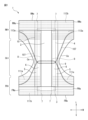
- FIG. 1 is a schematic plan view of the disposable diaper 1 in the unfolded state according to the embodiment, viewed from the skin-facing surface side in the thickness direction. It is a figure explaining the manufacturing process of absorbent A which is an example of the polymer absorbent concerning an embodiment.
- This is a SEM photograph of absorbent A at a magnification of 50 times.
- This is a SEM photograph of absorbent A at a magnification of 100 times.
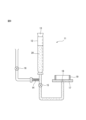
- FIG. 2 is a schematic diagram showing a measuring device used in the non-pressure DW method.
- a composite absorbent material for sanitary products for absorbing body fluids comprising pulp fibers, a polymeric absorbent material with a hydrophilic continuous skeleton and continuous pores, and a superabsorbent polymer.
- the absorption rate of the composite absorbent material is as follows: the pulp fiber>the polymer absorbent>the super absorbent polymer.
- the initial absorption rate is in the order of pulp fiber>polymer absorbent>super absorbent polymer. Therefore, the polymer absorbent once receives (absorbs) the body fluid absorbed by the pulp fibers, and then the superabsorbent polymer can receive (absorb) the body fluid absorbed by the polymer absorbent. In this way, body fluids absorbed by the pulp fibers, which have a fast absorption rate, are sequentially transferred (absorbed) to the polymeric water-absorbing agent, which has a relatively fast absorption rate, so the pulp fibers are unable to absorb the body fluids. We can control the situation.
- body fluids absorbed by the polymeric water-absorbing agent are sequentially transferred (absorbed) to the superabsorbent polymer, which has a slow absorption rate but high absorption performance, so the transfer of body fluids to the superabsorbent polymer cannot keep up.
- the situation can also be contained. Thereby, it is possible to suppress the leakage of body fluids from the composite absorbent body while suppressing the thickness, and it is possible to fully exhibit the water retention ability of the super absorbent polymer and, by extension, the absorption performance of the absorbent body.
- the body fluid absorbed by the pulp fibers can be rapidly transferred to the polymer absorbent, and the body fluid transferred to the polymer absorbent can be further transferred to the superabsorbent polymer. Therefore, leakage of body fluids from the composite absorbent body can be suppressed, and the absorbent performance of the composite absorbent body can be fully exhibited.
- the polymer absorbent When the basis weight of the superabsorbent polymer is greater than the basis weight of the polymer absorbent, the polymer absorbent can easily come into contact with the superabsorbent polymer, and the body fluids absorbed by the polymer absorbent can be transferred to the superabsorbent material. It can be easily delivered to the polymer. Thereby, the pulp fibers can absorb body fluids quickly, the body fluids can be quickly transferred from the pulp fibers to the polymer absorbent, and the body fluids can be quickly transferred from the polymer absorbent to the superabsorbent polymer. Therefore, leakage of body fluids from the composite absorbent body can be suppressed, and the absorbent performance of the composite absorbent body can be fully exhibited.
- Aspect 7 Aspect 1, wherein the liquid discharge amount of the absorbed liquid is the polymer absorbent>the super absorbent polymer, and the liquid discharge rate of the absorbed liquid is the polymer absorbent>the super absorbent polymer. 7.
- the composite absorbent body according to any one of items 6 to 6.
- body fluids once absorbed by the polymeric absorbent are easily transferred to the superabsorbent polymer, so body fluids transferred from the pulp fibers can be quickly transferred from the polymeric absorbent to the superabsorbent polymer. can.
- the body fluid absorbed by the pulp fibers can be rapidly transferred to the polymer absorbent, and the body fluid transferred to the polymer absorbent can be further transferred to the superabsorbent polymer. Therefore, leakage of body fluids from the composite absorbent body can be suppressed, and the absorbent performance of the composite absorbent body can be fully exhibited.
- the composite absorbent body can be Leakage of body fluids can be suppressed, and the absorption performance of the composite absorbent body can be fully demonstrated.
- the composite absorbent body according to any one of aspects 1 to 9, wherein the thickness of the composite absorbent body is 3 mm or less, and the repeated absorption rate of the composite absorbent body is 20 seconds or less.
- This composite absorbent material has a thickness of 3 mm or less and a repeated absorption speed of 20 seconds or less, so it can quickly absorb multiple or large amounts of body fluids and fully demonstrate the absorption performance of the composite absorbent material. At the same time, when the composite absorbent body is applied to sanitary products, the feeling of wearing it can be improved.
- the polymer absorbent is a hydrolyzate of a crosslinked polymer of a (meth)acrylic acid ester and a compound containing two or more vinyl groups in one molecule, and at least one -COONa group.
- the composite absorbent body according to any one of aspects 1 to 10, comprising: In this composite absorbent, since the polymer absorbent has the above structure, the polymer absorbent can quickly receive (absorb) the body fluid absorbed by the pulp fibers, and then absorb the body fluid absorbed by the polymer absorbent. Super absorbent polymers can quickly receive (absorb) water. Thereby, the composite absorbent material can suppress leakage of body fluids and exhibit high absorption performance.
- a sanitary product comprising a topsheet, a backsheet, and the composite absorbent body according to any one of aspects 1 to 11 located between the topsheet and the backsheet. Since this sanitary product is equipped with the above-mentioned composite absorbent body, it is possible to maintain or improve the absorbent performance of the sanitary product and to reduce the thickness of the sanitary product to improve the feeling of wearing it. I can do it.
- a preferred embodiment of the composite absorbent body of the present invention will be described using a disposable diaper 1 (pants-type diaper), which is an example of a sanitary product to which the composite absorbent body is applied.
- an object placed on a horizontal surface in an unfolded state is ⁇ Viewing in the thickness direction of the object from the surface sheet side'' is simply referred to as ⁇ planar viewing.
- the "longitudinal direction” refers to the "longer direction of the length of a vertically elongated object (for example, an unfolded disposable diaper, a composite absorbent body, etc.) in plan view.”
- the "width direction” refers to the "shorter length direction of a vertically elongated object in plan view.”
- Thiickness direction refers to "a direction perpendicular to an object placed on a horizontal surface in an expanded state.”
- the longitudinal direction, width direction, and thickness direction are perpendicular to each other.
- the “skin facing side” the side that is relatively proximal to the wearer's skin when wearing the disposable diaper 1
- the “relatively distal side to the wearer's skin surface” is referred to as the “non-skin facing surface side”.
- FIG. 1 is a schematic plan view of a disposable diaper 1 in an expanded state, to which a composite absorbent body 4 according to an embodiment is applied.
- the disposable diaper 1 of this embodiment has a longitudinal direction L, a width direction W, and a thickness direction T that are perpendicular to each other in plan view.
- the disposable diaper 1 includes a cover sheet 9 that constitutes a ventral region FW, a dorsal region RW, and a crotch region CA, and an absorbent main body 10.
- One end of the absorbent body 10 in the longitudinal direction L is laminated on the skin-side surface of the ventral region FW, and the other end is laminated on the skin-side surface of the back region RW.
- the crotch region CA supports the absorbent main body 10 from the non-skin side. Both ends FWa, FWa in the width direction W of the ventral region FW and both ends RWa, RWa in the width direction W of the dorsal region RW overlap in the thickness direction T, and are joined along the longitudinal direction L. In this way, the disposable diaper 1 is formed.
- the outer end FWe in the longitudinal direction L of the ventral region FW and the outer end RWe in the longitudinal direction L of the dorsal region RW define a waist opening through which the waist of the wearer passes. be done.
- a pair of leg openings through which the wearer's legs pass are defined by side portions Ce, Ce on both sides in the width direction W in the crotch region CA.
- the cover sheet 9 has a substantially hourglass shape in a plan view
- the absorbent main body 10 has a substantially rectangular shape extending in the longitudinal direction L in a plan view.
- the external shape of the disposable diaper 1 is not particularly limited, and any known shape can be adopted depending on various uses and usage modes.
- the cover sheet 9 is composed of, for example, a two-layer sheet, and a plurality of elastic members 111a, 111b; 113a, 113b; 107 are arranged between the two layers of sheets.
- the plurality of elastic members 111a and 111b are located in the ventral region FW.
- the plurality of elastic members 111a are arranged inside the ventral region FW in the longitudinal direction L and on both sides of the absorbent body 10 in the width direction W.
- the plurality of elastic members 111b are arranged outside in the longitudinal direction L in the ventral region FW.
- the plurality of elastic members 113a and 113b are located in the dorsal region RW.
- the plurality of elastic members 113a are arranged inside the back region RW in the longitudinal direction L and on both sides of the absorbent body 10 in the width direction W.
- the plurality of elastic members 113b are arranged outside in the longitudinal direction L in the dorsal region RW.
- the plurality of elastic members 107 are arranged on both sides in the width direction W in the region from the ventral region FW to the dorsal region RW.
- the plurality of elastic members 111a, 111b; 113a, 113b; 107 are exemplified by rubber thread.
- the cover sheet 95 is made of, for example, a nonwoven fabric or a resin film.
- the absorbent body 10 includes, in the thickness direction, a liquid-permeable top sheet 2 that forms the surface of the absorbent body 10 on the skin-facing side, and a back sheet that forms the surface of the absorbent body 10 on the non-skin-facing side. 3 and a composite absorbent body 4 located between these sheets as a basic structure.
- the absorbent main body 10 of the present embodiment further includes a pair of side sheets 5 located on both end sides in the width direction W and extending in the longitudinal direction L at a position closer to the skin-facing surface than the top sheet 2.
- Each side sheet 5 has a leakage prevention wall 6 and a fixing area 7.
- the fixing region 7 is located at the front and rear ends of the side sheet 5 in the longitudinal direction L, and fixes the leak-proof wall 6 to the skin-facing surface of (the top sheet 2 of) the absorbent body 10.
- the leakage prevention wall 6 is located between the front and rear fixed regions 7 in the longitudinal direction L of the side sheet 5, and is located on the skin-facing surface of the absorbent main body 10 (top sheet 2) in the width direction W.
- the outer edge is fixed, and the inner edge in the width direction W is unfixed.
- each leakage prevention wall 6 and the fixed area 7 are formed, for example, at the inner part of the side sheet 5 in the width direction W, and the outer part of the side sheet 5 in the width direction W is formed by the top sheet 2 of the absorbent body 10 ( ) is fixed.
- Each leakage prevention wall 6 includes one or more elastic members 8 extending along the longitudinal direction L at the inner end in the width direction W.
- the elastic member 8 is exemplified by a rubber thread.
- the absorbent main body 10 further includes a pair of linear high-density portions (not shown) that extend along the longitudinal direction L or the width direction W and are spaced apart from each other in the width direction W or the longitudinal direction L. You can leave it there.
- "along a predetermined direction” includes not only a case parallel to the predetermined direction but also a case offset by ⁇ 30 degrees with respect to the predetermined direction.
- the high-density portion is formed, for example, by embossing the topsheet 2 and the composite absorbent core 4 in the thickness direction.
- the disposable diaper 1 (and the absorbent main body 10) is not limited to such a configuration, and may have other configurations as long as it includes the configuration of the composite absorbent body 4 described below.
- the composite absorbent body 4 is located between the top sheet 2 and the back sheet 3, and absorbs body fluids such as urine and menstrual blood that have been discharged from the wearer and have passed through the top sheet 2. It is made of a water-absorbent material that can absorb water.
- the composite absorbent body 4 includes, as a water-absorbing member, a polymer absorbent having a hydrophilic continuous skeleton and continuous pores.
- polymer absorbents When absorbing water, polymer absorbents exhibit a unique water absorption behavior in which the water is taken into the continuous skeleton and then into the continuous pores. Therefore, when the polymer absorbent absorbs body fluids such as urine and menstrual blood, the hydrophilic continuous skeleton instantly takes in the body fluid due to osmotic pressure and expands, expanding the volume of the continuous pores and further Body fluids can be taken into the enlarged continuous pores. Therefore, polymer absorbents can instantly absorb large amounts of body fluids. In this embodiment, the absorbed body fluid is further transferred to the super absorbent polymer with high water retention capacity, and can be steadily retained within the super absorbent polymer.
- the composite absorbent body 4 includes, as an absorbent member, a polymer absorbent having a hydrophilic continuous skeleton and continuous pores, as well as pulp fibers and a superabsorbent polymer.
- the initial absorption speed of these absorbent members is as follows: pulp fiber>polymer absorbent>super absorbent polymer. That is, the initial absorption rate of the pulp fiber is the fastest, the initial absorption rate of the polymer absorbent is the second fastest, and the initial absorption rate of the superabsorbent polymer is the slowest.
- the initial absorption speed is in the order of pulp fiber>polymer absorbent>superabsorbent polymer. Therefore, the polymer absorbent once receives (absorbs) the body fluid absorbed by the pulp fibers, and then the superabsorbent polymer can receive (absorb) the body fluid absorbed by the polymer absorbent. In this way, body fluids absorbed by the pulp fibers, which have a fast absorption rate, are sequentially transferred (absorbed) to the polymeric water-absorbing agent, which has a relatively fast absorption rate, so that the pulp fibers cannot absorb all the body fluids. We can control the situation.
- body fluids absorbed by the polymeric water-absorbing agent are sequentially transferred (absorbed) to the superabsorbent polymer, which has a slow absorption rate but high absorption performance, so the transfer of body fluids to the superabsorbent polymer cannot keep up.
- the situation can also be contained.
- it is possible to suppress the leakage of body fluids from the composite absorbent body while using the superabsorbent polymer to suppress the thickness, and the water retention capacity of the superabsorbent polymer and, by extension, the absorption performance of the absorbent body can be fully demonstrated.
- most of the excreted body fluid is first absorbed by the pulp fibers, but a portion is absorbed by the polymer absorbent and then transferred to the superabsorbent polymer.
- the disposable diaper 1 (absorbent main body 10) equipped with such a composite absorbent body 4 can also suppress the leakage of body fluids while suppressing the thickness by using a super absorbent polymer, and the disposable diaper (absorbent main body) It can exhibit excellent absorption performance.
- the topsheet 2 extends from one side edge of the absorbent body 10 in the longitudinal direction L to the other side edge in a plan view, and extends from one side edge of the absorbent body 10 in the width direction W. It has a vertically elongated external shape extending from near the side edge to near the other side edge.
- the top sheet 2 is disposed at a position on the skin-facing surface side of the absorbent body 10 in the thickness direction, and constitutes a contact surface that can come into contact with the wearer's skin, that is, the surface of the absorbent body 10 on the skin-facing surface side.
- the top sheet 2 is formed of a liquid-permeable sheet-like member.
- the topsheet 2 has a slightly larger size in the longitudinal direction L and width direction W than the composite absorbent body 4 disposed on the non-skin facing surface side of the topsheet 2. There is.
- the top sheet 2 is joined to the back sheet 3 located on the non-skin facing side at the peripheral edge.
- the outer shape, various dimensions, basis weight, etc. of the top sheet are not particularly limited as long as they can be used as a top sheet for sanitary products, and are determined according to desired liquid permeability, texture, flexibility, strength, etc. Any external shape, various dimensions, basis weight, etc. can be adopted.
- the back sheet 3 extends from one side edge of the absorbent body 10 in the longitudinal direction L to the other side edge, and extends from one side edge of the absorbent body 10 in the width direction W to the other side edge. It has a vertically elongated external shape that extends over the edges.
- the back sheet 3 is arranged at a position on the non-skin facing surface side in the thickness direction of the absorbent main body 10, and constitutes the non-skin facing surface of the absorbent main body 10.
- the back sheet 3 is formed of a liquid-impermeable sheet-like member, and prevents body fluids such as urine and menstrual blood that have passed through the composite absorbent core 4 from leaking to the outside of the absorbent body 10.
- the outer shape, various dimensions, basis weight, etc. of the back sheet are not particularly limited as long as they can be used as the back sheet of sanitary products, and are arbitrary depending on the desired leak-proof performance, breathability, strength, etc.
- the external shape, various dimensions, basis weight, etc. can be adopted.
- the composite absorbent body 4 has one side end in each of the longitudinal direction L and the width direction W centered on the central part of the absorbent main body 10 in the longitudinal direction L and the width direction W in plan view. It has a vertically elongated, generally rectangular external shape extending over a wide area from near the edge to near the other edge.
- the composite absorbent core 4 has a substantially rectangular shape extending in the longitudinal direction L, which is substantially the same as the absorbent main body 10 in plan view.
- the external shape of the composite absorbent body 4 is not particularly limited, and any known shape can be adopted depending on various uses and usage modes.
- the composite absorbent body 4 is disposed between the top sheet 2 and the back sheet 3 in the thickness direction of the disposable diaper 1, and can absorb and retain body fluids such as urine and menstrual blood that have passed through the top sheet 2. It is formed of a predetermined water-absorbing member.
- the water-absorbing member includes a water-absorbing material such as a polymer absorbent, a pulp fiber, and a superabsorbent polymer, which will be described later, and a tissue-like sheet holding the water-absorbing material. That is, the composite absorbent body 4 refers to a water-absorbing member composed of a water-absorbing material capable of absorbing and retaining body fluids and a sheet that retains the same.
- the composite absorbent core 4 is bonded to each of the top sheet 2 and the back sheet 3 using an arbitrary adhesive such as a hot melt adhesive.
- the composite absorbent body 4 contains a polymer absorbent having a hydrophilic continuous skeleton and continuous pores and exhibiting a unique water absorption behavior, and further contains pulp fibers and a super absorbent polymer.
- the polymer absorbent is in the form of particles, the average particle size (when dry) is, for example, several hundred ⁇ m (200 to 500 ⁇ m).
- the polymer absorbent may be in the form of a sheet. The polymer absorbent will be described later.
- the super absorbent polymer is called SAP (Super Absorbent Polymer), and its type is not particularly limited, and materials known in the art can be used.
- examples of superabsorbent polymers include polyacrylate-based, polysulfonate-based, and maleic anhydride-based water-absorbing polymers.
- the average particle size (when dry) is, for example, several hundred ⁇ m (200 to 500 ⁇ m).
- the superabsorbent polymer may be in the form of a sheet.
- the type of pulp fiber is not particularly limited, and materials known in the art can be used.
- pulp fibers include cellulose fibers.
- Examples of cellulosic fibers include wood pulp, crosslinked pulp, non-wood pulp, regenerated cellulose, and semi-synthetic cellulose.
- the average length of the fibers is, for example, several tens of ⁇ m (20 to 40 ⁇ m), and the average length of the fibers is, for example, several mm (2 to 5 mm).
- the composite absorbent body may be enclosed in a core wrap made of a liquid-permeable sheet.
- the absorbent materials which are polymer absorbent, pulp fiber, and superabsorbent polymer, are generally uniformly arranged throughout the composite absorbent body 4 in plan view, excluding manufacturing errors.
- the invention is not limited to that example and may have other arrangements in which at least one of the absorbent materials is not generally uniform but has a deliberately predetermined distribution.
- the polymer absorbent may be disposed between one and the other of a pair of high-density regions in the width direction W, with a higher basis weight than other regions, and the polymer absorbent may be disposed between one and the other of a pair of high-density regions in the width direction W, and the It may be arranged between one and the other of the high-density regions with a higher basis weight than other regions.
- the polymer absorbent may be disposed on the outside of each of the pair of high-density parts in the width direction W, with a higher basis weight than other areas, and It may be arranged on the outside of each of the sections with a higher basis weight compared to other regions.
- the polymer absorbent material is preferably in contact with the superabsorbent polymer in order to ensure that body fluids absorbed by the pulp fibers are transferred to the superabsorbent polymer.
- the external shape, various dimensions, basis weight, etc. of the composite absorbent body are not particularly limited as long as they do not impede the effects of the present invention, and may be any external shape or shape depending on the desired water absorbency, flexibility, strength, etc. Various dimensions, basis weights, etc. can be adopted.
- Polymer absorbents have a hydrophilic continuous skeleton and continuous pores, and when absorbing water, they exhibit a water absorption behavior in which water is taken into the continuous skeleton and then into the continuous pores, and the initial absorption rate is high. It is not particularly limited as long as pulp fiber>polymer absorbent>super absorbent polymer.
- a polymer absorbent is, for example, a hydrolyzate of a crosslinked polymer of two or more monomers containing at least (meth)acrylic acid ester, and a polymer having at least one hydrophilic group in its functional group. Examples include molecular compounds.
- a hydrolyzate of a crosslinked polymer of a (meth)acrylic acid ester and a compound containing two or more vinyl groups in one molecule and includes a polymer compound having at least a -COONa group. It will be done.
- a polymer absorbent is an organic porous material having at least one -COONa group in one molecule, and may further have a -COOH group. -COONa groups are distributed approximately uniformly in the skeleton of the porous body.
- the hydrophilic continuous skeleton tends to elongate (in other words, expand easily) when absorbing body fluids such as urine and menstrual blood, as will be described later.
- the continuous pores also become easier to expand. Therefore, more body fluids can be taken into the continuous pores more quickly, and the material can exhibit excellent absorption performance as an absorbent material.
- the polymer absorbent can quickly receive (absorb) the body fluids absorbed by the pulp fibers, and then the superabsorbent polymer can receive (absorb) the body fluids absorbed by the polymer absorbent. .
- (meth)acrylic ester refers to acrylic ester or methacrylic ester.
- the polymer absorbent is formed by, for example, a hydrolyzate of a crosslinked polymer of (meth)acrylic acid ester and divinylbenzene.
- a hydrophilic continuous skeleton is formed by an organic polymer having at least a -COONa group, and communication between the skeletons serves as an absorption field for the liquid to be absorbed (e.g., body fluid such as urine or menstrual blood). Pores (continuous pores) are formed.
- the hydrolysis treatment converts the -COOR group (i.e., carboxylic acid ester group) of the crosslinked polymer into a -COONa group or -COOH group (see Figure 2), so the polymer absorbent is -COOR. It may have a group.
- FIG. 2 is a diagram explaining the manufacturing process of absorbent A, which is an example of a polymer absorbent.
- the upper diagram shows the constituent raw materials for polymerization
- the middle diagram shows monolith A, which is a crosslinked polymer of (meth)acrylic acid ester and divinylbenzene
- the lower diagram shows monolith A in the middle diagram after hydrolysis and Absorbent A obtained by drying treatment is shown.
- absorbent A which is an example of the polymer absorbent, and is formed from a hydrolyzate of a crosslinked polymer of (meth)acrylic acid ester and divinylbenzene.
- the polymer absorbent is not limited to such absorbent A.
- the polymer absorbent may be, for example, a hydrolyzate of a crosslinked polymer of a (meth)acrylic ester and a compound having two or more vinyl groups in one molecule.
- the polymer absorbent may be, for example, a hydrolyzate of a crosslinked polymer of two or more types of monomers containing at least a (meth)acrylic acid ester.
- the polymeric absorbent is a monolithic absorbent, body fluids can be absorbed quickly, and the body fluids temporarily held in the polymeric absorbent can be more steadily transferred to the superabsorbent polymer. It has the advantage of being able to
- “monolith A” is an organic porous body made of a crosslinked polymer of (meth)acrylic acid ester and divinylbenzene before being subjected to hydrolysis treatment
- “monolith-like organic porous body” It is sometimes referred to as "substance”.
- “absorbent A” is a hydrolyzate of a crosslinked polymer (monolith A) of (meth)acrylic acid ester and divinylbenzene that has been subjected to hydrolysis treatment and drying treatment.
- the absorbent A refers to one in a dry state.
- Absorbent A has a hydrophilic continuous skeleton and continuous pores as described above.
- Absorbent A which is an organic polymer having a hydrophilic continuous skeleton, is obtained by crosslinking polymerization of (meth)acrylic acid ester, which is a polymerization monomer, and divinylbenzene, which is a crosslinking monomer, as shown in Figure 2. It is obtained by further hydrolyzing the crosslinked polymer (monolith A).
- the organic polymer forming a hydrophilic continuous skeleton has a polymerized residue of ethylene group (hereinafter referred to as "constituent unit X”) and a cross-linked polymerized residue of divinylbenzene (hereinafter referred to as "constituent unit ). Furthermore, the polymerized residue of the ethylene group (constituent unit It has both groups. Note that when the polymerization monomer is a (meth)acrylic acid ester, the polymerization residue of the ethylene group (constituent unit X) has a -COONa group, a -COOH group, and an ester group.
- the proportion of divinylbenzene crosslinked polymer residues (constituent unit Y) in the organic polymer forming the hydrophilic continuous skeleton is, for example, 0.1 to 30 mol% with respect to the total constituent units. , preferably 0.1 to 20 mol%.
- the proportion of divinylbenzene crosslinking polymer residues (constituent unit Y) in the organic polymer forming a hydrophilic continuous skeleton is, for example, about 3%, preferably 0.1 to 10 mol%, more preferably 0.3 to 8 mol%, based on the total structural units.
- the organic polymer forming the hydrophilic continuous skeleton may consist of only the structural unit X and the structural unit Y, or in addition to the structural unit X and the structural unit Y, It may have structural units other than structural unit X and structural unit Y, that is, polymerized residues of monomers other than (meth)acrylic acid ester and divinylbenzene.
- Examples of structural units other than structural unit X and structural unit Y include styrene, ⁇ -methylstyrene, vinyltoluene, vinylbenzyl chloride, glycidyl (meth)acrylate, isobutene, butadiene, isoprene, chloroprene, vinyl chloride, vinyl bromide, Examples include polymerized residues of monomers such as vinylidene chloride, tetrafluoroethylene, (meth)acrylonitrile, vinyl acetate, ethylene glycol di(meth)acrylate, tripropylene glycol di(meth)acrylate, and trimethylolpropane tri(meth)acrylate. .
- the proportion of structural units other than the structural unit X and the structural unit Y in the organic polymer forming the hydrophilic continuous skeleton is, for example, 0 to 50 mol%, preferably 0 to 30 It is mole%.
- the thickness of the hydrophilic continuous skeleton of the absorbent A is 0.1 to 100 ⁇ m.
- the thickness of the hydrophilic continuous skeleton of absorbent A is 0.1 ⁇ m or more, the spaces (pores) for taking in the liquid to be absorbed (body fluid) in the porous body become difficult to collapse during absorption, and the amount of absorption decreases. It becomes difficult to do.
- the thickness of the hydrophilic continuous skeleton is 100 ⁇ m or less, an excellent absorption rate can be easily obtained.
- the thickness of the continuous skeleton is measured by using the cross section of the skeleton appearing on the specimen for electron microscopy measurement as the thickness evaluation point.
- the continuous skeleton is often polygonal in shape because it is formed at intervals between water (water droplets) that are removed during dehydration and drying treatment after hydrolysis. Therefore, the thickness of the continuous skeleton is the average value of the diameters ( ⁇ m) of circles circumscribing the polygonal cross section. Additionally, in rare cases where a polygon has a small hole, in that case, measure the circumscribed circle of the cross section of the polygon that surrounds the small hole.
- the average diameter of continuous pores in the absorbent A is 1 to 1000 ⁇ m.
- the average diameter of the continuous pores of absorbent A is 1 ⁇ m or more, the spaces (pores) for taking in the liquid to be absorbed (body fluid) in the porous body are difficult to collapse during absorption, and the absorption rate is difficult to decrease.
- the average diameter of the continuous pores is 1000 ⁇ m or less, it becomes easier to obtain an excellent absorption rate.
- the average diameter ( ⁇ m) of continuous pores in absorbent A can be measured by mercury intrusion method, and the maximum value of the pore distribution curve obtained by such mercury intrusion method is adopted.
- the sample for measuring the average diameter of continuous pores regardless of the ionic form of the absorbent A, use a sample that has been dried for 18 hours or more in a vacuum dryer set at a temperature of 50°C. Note that the final ultimate pressure is 0 Torr.
- FIG. 3 is an SEM photograph of absorbent A at a magnification of 50 times
- FIG. 4 is an SEM photograph of absorbent A at a magnification of 100 times
- FIG. 5 is an SEM photograph of absorbent A at a magnification of 500 times
- FIG. 6 is a SEM photograph of absorbent A at a magnification of 1500 times.
- the absorbent A shown in FIGS. 3 to 6 is an example of an absorbent using butyl methacrylate as a polymerization monomer and divinylbenzene as a crosslinking monomer, and each has a cubic structure of 2 mm square.
- the absorbent A shown in FIGS. 3 to 6 has a large number of bubble-like macropores, and further has a portion where these bubble-like macropores overlap.
- Absorbent A has an open cell structure in which the overlapping portions of the macropores form a common opening (mesopore), that is, an open cell structure (continuous macropore structure).
- the area where these macropores overlap is a common opening (mesopore) with an average diameter in a dry state of 1 to 1000 ⁇ m, preferably 10 to 200 ⁇ m, particularly preferably 20 to 100 ⁇ m, and most of the macropores have an open pore structure. It becomes.
- the average diameter of the mesopores in a dry state is 1 ⁇ m or more, the absorption rate of the liquid to be absorbed becomes better.
- the average diameter of the mesopores in a dry state is 1000 ⁇ m or less, the absorbent A becomes less likely to become brittle. Note that the number of overlaps between such macropores is about 1 to 12 per macropore, and about 3 to 10 in most cases.
- the absorbent A has such an open cell structure, macropore groups and mesopore groups can be formed uniformly, and particle agglomeration type as described in JP-A No. 8-252579 etc. It has the advantage that the pore volume and specific surface area can be significantly increased compared to porous materials.
- the total pore volume of the pores (holes) of absorbent A is preferably 0.5 to 50 mL/g, more preferably 2 to 30 mL/g.
- the total pore volume of the absorbent A is preferably 0.5 to 50 mL/g, more preferably 2 to 30 mL/g.
- a sufficient pore volume can be ensured in the absorbent A, and therefore, a sufficient amount of water absorption can be ensured.
- the spaces (holes) for taking in the liquid to be absorbed (body fluid) in the porous body can be made difficult to collapse during absorption, and the water absorption amount and water absorption rate can be made difficult to decrease.
- the total pore volume of the absorbent A is 50 mL/g or less, the strength of the absorbent A can be made difficult to decrease.
- the total pore volume can be measured by mercury intrusion method.
- the sample for measuring the total pore volume is one that has been dried for 18 hours or more in a vacuum dryer set at a temperature of 50°C, regardless of the ionic form of the absorbent A.
- the final ultimate pressure is 0 Torr.
- body fluid a liquid such as a body fluid
- body fluid a liquid such as a body fluid
- the mass of the body fluid is approximately proportional to the amount of body fluid, in the following description, the mass of the body fluid may be simply referred to as "the amount of body fluid.”
- the continuous pores provided in the absorbent A shown in FIGS. 3 to 6 are pores in which a plurality of pores (holes) are in communication with each other, and it can be seen from the appearance that a large number of pores are provided. can be seen with the naked eye.
- the hydrophilic continuous skeleton first takes in some of the body fluids by osmotic pressure and expands (i.e., expands). do). This continuous skeletal elongation occurs in almost all directions.
- the absorbent A which has become larger by absorbing a certain amount of body fluid in this way, can further absorb a predetermined amount of body fluid into the enlarged continuous pores due to capillary action.
- absorbent A when absorbing water (body fluid), absorbent A exhibits a unique water absorption behavior in which the water is taken into the hydrophilic continuous skeleton and then taken into the continuous pores for absorption.
- the body fluid absorbed into the hydrophilic continuous skeleton of absorbent A is difficult to be released from the continuous skeleton (that is, it is difficult to undergo water separation).
- body fluids absorbed into the continuous pores are easily separated. Therefore, within the composite absorbent body, body fluids absorbed into these continuous pores are separated, transferred to the super absorbent polymer with high water retention ability, and are steadily retained within the super absorbent polymer. .
- the amount of body fluid absorbed into the continuous skeleton of absorbent A and the amount of body fluid absorbed into the continuous pores are the total amount of body fluid absorbed by absorbent A during centrifugation (150G/90 seconds).
- the amount of body fluid separated from absorbent A becomes the amount of body fluid absorbed into the continuous pores, and the amount of other body fluids (the amount of body fluid that was not separated from absorbent A during centrifugation) is absorbed into the continuous skeleton. This is the amount of body fluid absorbed.
- the body fluid absorbed into the absorbent A remains within the pores than the body fluid absorbed into the hydrophilic continuous skeleton.
- Most of the absorption of body fluids by absorbent A is carried out by retaining body fluids within the pores by capillarity, so the porosity (absorbent A The larger the volume of the pores (to the volume of the pores), the more body fluids can be absorbed. Note that this porosity is preferably 85% or more.
- the specific surface area of absorbent A obtained by mercury porosimetry is 400 m 2 /g, and the pore volume is 15.5 mL/g.
- This pore volume of 15.5 mL/g means that the volume of pores in 1 g of absorbent A is 15.5 mL.
- the specific gravity of absorbent A is 1 g/mL
- the volume occupied by pores in 1 g of absorbent A is 15.5 mL
- the volume of 1 g of absorbent A is 1 mL.
- the total volume (volume) of 1 g of absorbent A is 15.5+1 (mL)
- the porosity is the ratio of the pore volume, so the porosity of absorbent A is 15.5/( 15.5+1) ⁇ 100 ⁇ 94%.
- the absorbent A having such a hydrophilic continuous skeleton and continuous pores is in the form of particles or sheets, for example, and is used to absorb the composite absorbent material of the absorbent body 10 of the disposable diaper 1 described above. It is applied to a composite absorbent material such as body 4 for absorbing body fluids such as urine and menstrual blood.
- this polymer absorbent when absorbing water (directly or via pulp fibers), this polymer absorbent has a unique water absorption property in which water is taken into the hydrophilic continuous skeleton and then into the continuous pores. Show behavior.
- this polymer absorbent can instantly absorb a large amount of surrounding body fluid (in the pulp fibers), and has the ability to retain the absorbed body fluid (mainly body fluid absorbed into continuous pores). It can be delivered to a highly water-absorbent polymer and steadily retained within the super-absorbent polymer. Therefore, a composite absorbent to which such a polymer absorbent is applied can exhibit high absorption performance as an absorbent.
- the absorption rate of the polymer absorbent containing absorbent A by the Vortex method is preferably 5 seconds or less.
- the body fluid once absorbed by the pulp fibers can be quickly transferred to the polymer absorbent in a short time (5 seconds or less). Therefore, it is possible to prevent the pulp fibers from accumulating body fluids too much, slowing down the absorption rate of the pulp fibers, or preventing the pulp fibers from absorbing body fluids completely.
- the body fluids absorbed by the pulp fibers which have a high absorption rate, can be quickly transferred to the polymer absorbent, and the polymer absorbent then transfers the body fluids to the superabsorbent polymer, which has high absorption performance. You can also pass it on. Therefore, leakage of body fluids from the composite absorbent body can be suppressed, and the absorbent performance of the composite absorbent body can be fully exhibited.
- the absorption rate of the polymer absorbent containing absorbent A by the Vortex method is more preferably 3 seconds or less, and even more preferably 2 seconds or less. Further, the absorption rate is preferably at least the absorption rate of the pulp fiber in seconds, and preferably at least 1 second. Body fluids absorbed by the pulp fibers can be transferred more quickly to the polymer absorbent in a shorter time.
- the absorption rate by the Vortex method is measured as the absorption time for the target object to absorb a predetermined solution, the shorter the absorption time, the faster the absorption rate.
- the absorption rate (absorption time) by the Vortex method is measured by the following method (see JIS-K7224).
- absorption time absorption rate
- the liquid transfer rate from the pulp fibers is such that the polymer absorbent>super absorbent polymer.
- the composite absorbent body 4 body fluids once absorbed by the pulp fibers can be transferred quickly to the polymeric absorbent, which has a fast absorption rate, faster than to the superabsorbent polymer, which has a slow absorption rate. can. Therefore, it is possible to prevent the pulp fibers from accumulating body fluids too much, slowing down the absorption rate of the pulp fibers, or preventing the pulp fibers from absorbing body fluids completely.
- the body fluid absorbed by the pulp fibers can be rapidly transferred to the polymer absorbent, and the body fluid transferred to the polymer absorbent can be further transferred to the superabsorbent polymer. Therefore, leakage of body fluids from the composite absorbent body can be suppressed, and the absorbent performance of the composite absorbent body can be fully exhibited.
- the liquid transfer rate (30 seconds) of the polymer absorbent from the pulp fibers is preferably 60% or more.
- the relationship ⁇ polymer absorbent > super absorbent polymer'' is further satisfied, and in the composite absorbent body 4, body fluids once absorbed by the pulp fibers are transferred to the super absorbent polymer, which has a slow absorption rate, and the absorption rate is It can be quickly transferred to a fast polymer absorbent.
- the liquid transfer amount and liquid transfer rate from material A to material B are measured by the following method.
- material A is pulp fiber and material B is a polymer absorbent or super absorbent polymer
- the liquid transfer rate of the polymer absorbent or super absorbent polymer from the pulp fiber can be measured.
- Material A is a polymeric absorbent or pulp fiber
- Material B is a superabsorbent polymer
- the liquid transfer rate of the superabsorbent polymer from the polymeric absorbent or pulp fiber can be measured.
- Nylon mesh material manufactured by NBC Meshtech Co., Ltd., N-NO255HD 115 (standard width: 115 cm, 255 mesh/2.54 cm, opening: 57 ⁇ m, wire diameter: 43 ⁇ m, thickness: 75 ⁇ m)
- Nylon mesh material manufactured by NBC Meshtech Co., Ltd., N-NO255HD 115 (standard width: 115 cm, 255 mesh/2.54 cm, opening: 57 ⁇ m, wire diameter: 43 ⁇ m, thickness: 75 ⁇ m)
- put 0.3 g of the sample for measurement (material A) into the pasted plastic cylinder inner diameter: 60 mm, outer diameter: 70 mm, height: 52 mm, mass: 64 g
- the liquid transfer rate per unit mass after a predetermined time is the rate of liquid transfer of material B after the predetermined time (examples: 30 seconds, 10 seconds) determined in (9) above. It is obtained by dividing the amount of water absorption per unit mass (g/g) by the amount of water absorption per unit mass (g/g) of the sample (material A) determined in (6) above and multiplying by 100.
- the amount of liquid transferred to the superabsorbent polymer satisfies the following relationship: polymer absorbent>pulp fiber.
- polymer absorbent >pulp fiber.
- the composite absorbent body 4 more body fluids than the pulp fibers are transferred to and absorbed by the polymer absorbent, and more body fluids transferred to the polymer absorbent are transferred to the superabsorbent polymer than the pulp fibers. It can be migrated. Therefore, the water absorption performance of the polymer absorbent can be restored after body fluid transfer. Thereby, the body fluid absorbed by the pulp fibers can be rapidly transferred to the polymer absorbent, and the body fluid transferred to the polymer absorbent can be further transferred to the superabsorbent polymer. Therefore, leakage of body fluids from the composite absorbent body can be suppressed, and the absorbent performance of the composite absorbent body can be fully exhibited.
- the amount of liquid transfer (30 seconds) from the polymer absorbent to the superabsorbent polymer is preferably 6.0 g/g or more, more preferably 8.0 g/g or more.
- the relationship of polymer absorbent>pulp fiber is more satisfied, and more body fluids transferred to the polymer absorbent can be transferred to the superabsorbent polymer than to the pulp fibers.
- the amount of liquid transferred from the polymer absorbent to the superabsorbent polymer is 6.0 g/g or more, body fluids temporarily held by the polymer absorbent are more reliably transferred to the superabsorbent polymer. Therefore, the absorption performance of the composite absorbent body can be fully and reliably exhibited.
- the relationship regarding the basis weight between the pulp fibers, the polymer absorbent, and the superabsorbent polymer in the composite absorbent body 4 is such that (basis weight of pulp fibers)/(basis weight of polymer absorbent) is 1. Larger is preferable. Since the basis weight of the pulp fibers is higher than the basis weight of the polymer absorbent, the pulp fibers, which have a fast absorption rate, can easily absorb body fluids in the initial stage, and then the body fluids absorbed by the pulp fibers can be transferred to the polymer absorbent. Delivery can be made easier.
- the relationship regarding the basis weight between the pulp fibers, the polymer absorbent, and the superabsorbent polymer in the composite absorbent body 4 is as follows: (Basic weight of the super absorbent polymer)/(Basic weight of the polymer absorbent) is 1. Larger is preferable. Since the basis weight of the superabsorbent polymer is greater than the basis weight of the polymer absorbent, the polymer absorbent can easily come into contact with the superabsorbent polymer, and the body fluids absorbed by the polymer absorbent can be transferred to the superabsorbent polymer. It can be easily delivered to
- the pulp fibers can quickly absorb body fluids, and the body fluids can be quickly transferred from the pulp fibers to the polymer absorbent.
- Body fluids can be rapidly transferred from the polymer absorbent to the superabsorbent polymer. Therefore, leakage of body fluids from the composite absorbent body can be suppressed, and the absorbent performance of the composite absorbent body can be fully exhibited.
- (Basic weight of pulp fiber)/(Basic weight of polymer absorbent) is more preferably larger than 1 and smaller than 10 from the above viewpoint, and more preferably larger than 1 and smaller than 5. Further, (basis weight of super absorbent polymer)/(basis weight of polymer absorbent) is more preferably greater than 1 and less than 10 from the above viewpoint, and more preferably greater than 1 and less than 5.
- the basis weight of the pulp fiber, the basis weight of the polymer absorbent, and the basis weight of the superabsorbent polymer can be appropriately selected depending on the absorption performance required of the composite absorbent body 4.
- the basis weight of pulp fibers is 50 to 500 g/m 3
- the basis weight of polymer absorbent is 1 to 100 g/m 3
- the basis weight of superabsorbent polymers is: Examples include 50 to 500 g/m 3 .
- the amount of water absorbed by the non-pressure Demand Wettability (DW) method of the composite absorbent body 4 satisfies the following relationship: polymer absorbent>super absorbent polymer.
- the polymer absorbent absorbs free water more easily than the superabsorbent polymer
- the polymer absorbent absorbs free water more easily than the nonwoven fabric and the polymer, which may occur when absorbed body fluids diffuse. Free water in the gaps between the absorbent and the polymer absorbent can be drawn in. That is, the polymer absorbent can absorb free water without leaking it. Thereby, leakage of body fluids from the composite absorbent body can be suppressed, and the absorption performance of the composite absorbent body can be fully exhibited.
- the water absorption amount (30 seconds) of the polymer absorbent by the non-pressure DW method is preferably 8.0 g/g or more, more preferably 12 g/g or more.
- the polymer absorbent can absorb free water more easily than the superabsorbent polymer.
- the amount of water absorbed by the non-pressure DW method is measured by the following method.
- FIG. 9 is a schematic diagram showing a measuring device used in the pressureless DW method.
- a DW device (Demand Wettability device, manufactured by Taiyo Create Co., Ltd.) 11 is used.
- the DW device 11 includes a burette 12 (scale capacity 50 ml, length 86 cm, inner diameter 1.05 cm), a rubber stopper 13, an air inflow capillary (tip inner diameter 3 mm) 14, a cock 15, and a cock. 16, a measuring table 17, a liquid outlet (inner diameter 3 mm) 18, a cylinder 19, and a test liquid 20.
- a conduit (inner diameter 7 mm) is attached from the buret 12 to the measuring table 17.
- a 0.9% aqueous sodium chloride solution is used as the test liquid.
- the measurement is performed under conditions of a temperature of 25° C. and a humidity of 60%.
- the measurement procedure is as follows. (1) With both cocks 15 and 16 of the DW device 11 closed, put the test liquid 20 above the 0 point (the top of the buret 12 scale (0 ml line)) and put the rubber stopper 13 on the top of the burette 12. , sealed. (2) After placing a filter paper at the liquid outlet 18 of the measuring table 17, open both cocks 15 and 16, and adjust the liquid level to the zero point while sucking up the liquid coming out of the liquid outlet 18 with the filter paper. After adjustment, close cocks 15 and 16.
- the specific gravity of the test liquid is 1, the value of the determined absorption amount can also be expressed in units of (g/g).
- the liquid discharge amount of the absorbed liquid is polymer absorbent > super absorbent polymer, and the liquid discharge rate of the absorbed liquid is polymer absorbent > super absorbent polymer. It is preferable.
- the body fluids once absorbed by the polymeric absorbent are easily transferred to the superabsorbent polymer, so the body fluids transferred from the pulp fibers are quickly transferred from the polymeric absorbent to the superabsorbent polymer. can be done.
- the body fluid absorbed by the pulp fibers can be rapidly transferred to the polymer absorbent, and the body fluid transferred to the polymer absorbent can be further transferred to the superabsorbent polymer. Therefore, leakage of body fluids from the composite absorbent body can be suppressed, and the absorbent performance of the composite absorbent body can be fully exhibited.
- the polymer absorbent has a liquid discharge amount of absorbed moisture of 25 g/g or more and a liquid discharge rate of 65% or more. It is more preferable that the liquid discharge amount of the polymer absorbent is 35 g/g or more, and the liquid discharge rate is more preferably 70% or more.
- the polymer absorbent in addition to being able to retain a large amount of body fluid at once, the polymer absorbent has excellent water release properties (hydrolysing properties). can be released to Therefore, since a large amount of body fluid can be transferred from the polymer absorbent to the superabsorbent polymer, the water retention ability of the superabsorbent polymer can be fully utilized.
- the liquid discharge amount and liquid discharge rate of the polymer absorbent are measured by the following method.
- the repeated liquid discharge amount (g/g) and liquid discharge rate after repeating water absorption and water separation two or three times are determined by repeating the steps (2) to (6) above two or three times. means the amount of liquid discharged (g/g) and liquid discharge rate (%) after
- the water absorption amount per unit mass of the polymer absorbent is preferably 30 g/g or more, more preferably 40 g/g or more, and even more preferably 50 g/g or more.
- the amount of water absorbed per unit mass of the polymer absorbent is sufficiently large compared to, for example, the amount of water absorbed per unit mass of pulp fiber alone (approximately 20 g/g). 30 g/g or more), the polymer absorbent can quickly and with sufficient margin absorb the body fluids absorbed by the pulp fibers. Thereby, leakage of body fluids from the composite absorbent body can be suppressed, and the absorption performance of the composite absorbent body can be fully exhibited.
- the amount of water absorbed per unit mass is measured by the following method.
- ⁇ Method for measuring water absorption per unit mass> (1) Mesh bag (manufactured by NBC Meshtech Co., Ltd., N-NO255HD 115 (standard width: 115 cm, 255 mesh/2.54 cm, opening: 57 ⁇ m, wire diameter: 43 ⁇ m) in which 1 g of sample for measurement was cut into 10 cm squares , thickness: 75 ⁇ m)). Note that the mass (g) of the mesh bag is measured in advance. Further, when a sample for measurement (polymer absorbent) is collected from a sanitary product and used, it can be obtained according to the above-mentioned ⁇ Method for collecting sample for measurement (polymer absorbent)>.
- the water absorption viscosity satisfies the following relationship: polymer absorbent>super absorbent polymer.
- the water absorption viscosity of the polymer absorbent when absorbing body fluids is higher than that of the superabsorbent polymer. Therefore, when the composite absorbent absorbs body fluids, the viscosity of the polymer absorbent increases, causing the absorbency of the polymer absorbent in the composite absorbent and the superabsorbent polymers and pulp fibers existing around it to increase. Material movement, ie fluidization, is suppressed.
- the composite absorbent body can be Leakage of body fluids can be suppressed, and the absorption performance of the composite absorbent body can be fully demonstrated.
- the water absorption viscosity of the polymer absorbent is more preferably 80 Pa ⁇ s, more preferably 90 Pa ⁇ s. Since the water absorption viscosity when absorbing body fluids has a high value, when the composite absorbent body absorbs body fluids, the viscosity of the polymer absorbent increases, which causes the movement of the absorbent material including the polymer absorbent within the composite absorbent body. In other words, fluidization can be further suppressed.
- water absorption viscosity is measured by the following method.
- ⁇ Method for measuring water absorption viscosity (1) Put 100 ml of physiological saline and a rotor (30 mm x 10 mm) into a 100 ml beaker (inner diameter 50 mm) manufactured by HARIO, and rotate it at 600 rpm. (2) Weigh 1.5 g of the sample, place it in the beaker from (1) above, and wait until the liquid level solidifies and stops (if it does not solidify, stop the rotor after 1 minute has passed). (3) Leave it for 5 minutes. (4) Measure the viscosity with a viscometer (TVB-10 type viscometer manufactured by Toki Sangyo Co., Ltd., rotor used: M4, rotation speed: 3 rpm). Note that the above measurement method is performed under conditions of a temperature of 25° C. and a humidity of 60%.
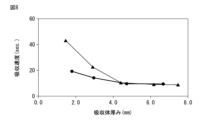
- the thickness of the composite absorbent body is preferably 3 mm or less, and the repeated absorption rate of the composite absorbent body is preferably 20 seconds or less.
- the composite absorbent body 4 has a thickness of 3 mm or less and a repeated absorption speed of 20 seconds or less, so it can quickly absorb body fluids multiple times or in large amounts, improving the absorption performance of the composite absorbent body. While the composite absorbent body is fully exerted, it is possible to improve the feeling of wearing when the composite absorbent body is applied to sanitary products.
- the thickness and repeated absorption rate of the composite absorbent body are each measured by the following methods.
- ⁇ Method for measuring the thickness of composite absorber> (1) Using a thickness meter (Model FS-60DS, manufactured by Daiei Kagaku Seiki Seisakusho Co., Ltd.) equipped with a 15 cm 2 measuring head, the thickness of the composite absorbent body is measured under the condition of a measurement load of 3 g/cm 2 . The thickness of one sample is measured at three locations, and the average value of the three locations is defined as the thickness of the composite absorbent body.
- a thickness meter Model FS-60DS, manufactured by Daiei Kagaku Seiki Seisakusho Co., Ltd.
- ⁇ Method for measuring repeated absorption rate of composite absorbent material (1) Prepare the sample. Pulp fibers, polymeric absorbents, and superabsorbent polymers are each weighed to a desired mass (mass that yields a desired basis weight) using an electronic balance, and uniformly mixed to form a mixture. Then, the top and bottom of the mixture were sandwiched and fixed between tissues (14 g/m 3 ) coated with hot melt adhesive, and a circular piece with a radius of 45 mm was cut out to serve as a sample. (2) Place the sample in a glass Petri dish with a radius of 46 mm and a height of 20 mm.
- the absorbent body 10 of) the disposable diaper 1 that is, the sanitary product is located between the top sheet 2, the back sheet 3, and between the top sheet 2 and the back sheet 3.
- the composite absorbent body 4 described above is provided. That is, since the disposable diaper 1 (hygienic product) is equipped with the composite absorbent body 4 described above, it is possible to maintain or improve the absorption performance of the disposable diaper 1 (hygienic product), and to improve the absorption performance of the disposable diaper 1 (hygienic product). It is possible to reduce the thickness and improve the wearing feeling.
- the above-mentioned absorbent A can be obtained through a crosslinking polymerization process and a hydrolysis process, as shown in FIG. Each of these steps will be explained below.
- Monolith A is obtained by crosslinking polymerization using sorbitan monooleate as an activator and isobutyronitrile as a polymerization initiator.
- absorbent A as shown in the upper diagram of FIG. 2, first, 9.2 g of t-butyl methacrylate as an oil-soluble monomer, 0.28 g of divinylbenzene as a crosslinking monomer, 1.0 g of sorbitan monooleate (hereinafter abbreviated as "SMO") as a surfactant and 0.4 g of 2,2'-azobis(isobutyronitrile) as a polymerization initiator were mixed and uniformly mixed. Dissolve in.
- SMO sorbitan monooleate
- this emulsion is quickly transferred to a reaction container, sealed, and allowed to polymerize at 60° C. for 24 hours while standing still. After the polymerization is completed, the contents are taken out, extracted with methanol, and then dried under reduced pressure to obtain monolith A having a continuous macropore structure.
- monolith A had an open cell structure, and the thickness of the continuous skeleton was 5.4 ⁇ m. Further, the average diameter of continuous pores measured by mercury porosimetry was 36.2 ⁇ m, and the total pore volume was 15.5 mL/g.
- the content of divinylbenzene based on all monomers is preferably 0.3 to 10 mol%, more preferably 0.3 to 5 mol%.
- the ratio of divinylbenzene to the total of butyl methacrylate and divinylbenzene is preferably 0.1 to 10 mol%, more preferably 0.3 to 8 mol%.
- the ratio of butyl methacrylate to the total of butyl methacrylate and divinylbenzene is 97.0 mol%, and the ratio of divinylbenzene is 3.0 mol%.
- the amount of surfactant added can be set depending on the type of oil-soluble monomer and the desired size of emulsion particles (macropores), and is approximately 2 to 70% based on the total amount of oil-soluble monomer and surfactant. It is preferable to set it as the range of %.
- alcohols such as methanol and stearyl alcohol
- carboxylic acids such as stearic acid
- hydrocarbons such as octane, dodecane, and toluene
- cyclic ethers such as tetrahydrofuran and dioxane. It may be allowed to coexist within the polymerization system.
- the mixing method for forming a water-in-oil emulsion is not particularly limited. Any mixing method can be employed, such as a method in which the components and a water-soluble component such as water or a water-soluble polymerization initiator are separately and uniformly dissolved, and then the respective components are mixed.
- the mixing device for forming the emulsion is not particularly limited, and any device such as a normal mixer, homogenizer, high-pressure homogenizer, etc. can be adopted depending on the desired emulsion particle size. It is also possible to use a so-called planetary stirring device, which stirs and mixes the objects to be processed by placing the objects in a mixing container and rotating the mixing container while rotating around the revolution axis while tilting the mixing container.
- the mixing conditions are not particularly limited, and the stirring rotation speed, stirring time, etc. can be arbitrarily set according to the desired emulsion particle size.
- water droplets in the W/O emulsion can be uniformly generated, and the average diameter thereof can be arbitrarily set within a wide range.
- polymerization conditions for the water-in-oil emulsion can be adopted depending on the type of monomer and initiator.
- azobisisobutyronitrile, benzoyl peroxide, potassium persulfate, etc. as a polymerization initiator, heat polymerization at a temperature of 30 to 100°C for 1 to 48 hours in a sealed container under an inert atmosphere.
- hydrogen peroxide-ferrous chloride, sodium persulfate-acidic sodium sulfite, etc. are used as a polymerization initiator, in a sealed container under an inert atmosphere at a temperature of 0 to 30°C for 1 to 48 hours. All it has to do is polymerize.
- monolith A was immersed in dichloroethane containing zinc bromide, stirred at 40°C for 24 hours, and then brought into contact with methanol, 4% hydrochloric acid, 4% aqueous sodium hydroxide solution, and water in this order to perform hydrolysis. , to obtain block-shaped absorbent A. Further, this block-shaped absorbent A is pulverized to a predetermined size to obtain particulate absorbent A. Note that the form of this absorbent A is not limited to particulate, and for example, it may be formed into a sheet during or after drying.
- the method for hydrolyzing monolith A is not particularly limited, and various methods can be employed.
- aromatic solvents such as toluene and xylene
- halogen solvents such as chloroform and dichloroethane
- ether solvents such as tetrahydrofuran and isopropyl ether
- amide solvents such as dimethylformamide and dimethylacetamide
- alcohol solvents such as methanol and ethanol.
- a method in which a carboxylic acid solvent such as acetic acid or propionic acid or water is used as a solvent and is brought into contact with a strong base such as sodium hydroxide or a method in which a hydrohalic acid such as hydrochloric acid, sulfuric acid, nitric acid, trifluoroacetic acid, methanesulfonic acid , a method of contacting with a Br ⁇ nsted acid such as p-toluenesulfonic acid or a Lewis acid such as zinc bromide, aluminum chloride, aluminum bromide, titanium (IV) chloride, cerium chloride/sodium iodide, magnesium iodide, etc. It will be done.
- a carboxylic acid solvent such as acetic acid or propionic acid or water is used as a solvent and is brought into contact with a strong base such as sodium hydroxide
- a hydrohalic acid such as hydrochloric acid, sulfuric acid, nitric acid, trifluoro
- (meth)acrylic acid ester is not particularly limited, but C1 to C10 of (meth)acrylic acid (i.e., carbon number (1 to 10) alkyl esters are preferred, and C4 (ie, 4 carbon atoms) alkyl esters of (meth)acrylic acid are particularly preferred.
- C4 alkyl ester of (meth)acrylic acid include t-butyl (meth)acrylate, n-butyl (meth)acrylate, and iso-butyl (meth)acrylate.
- the monomers used for crosslinking polymerization may be only (meth)acrylic ester and divinylbenzene, or in addition to (meth)acrylic ester and divinylbenzene, other monomers other than (meth)acrylic ester and divinylbenzene may be used. may contain. In the latter case, other monomers include, but are not particularly limited to, styrene, ⁇ -methylstyrene, vinyltoluene, vinylbenzyl chloride, glycidyl (meth)acrylate, 2-ethylhexyl (meth)acrylate, isobutene, butadiene, isobrene.
- the proportion of monomers other than (meth)acrylic acid ester and divinylbenzene in all monomers used for crosslinking polymerization is preferably 0 to 80 mol%, more preferably 0 to 50 mol%.
- the surfactant is not limited to the above-mentioned sorbitan monooleate, and any surfactant may be used as long as it can form a water-in-oil (W/O) emulsion when the monomer for crosslinking polymerization and water are mixed.
- W/O water-in-oil
- examples of such surfactants include sorbitan monolaurate, sorbitan monopalmitate, sorbitan monostearate, sorbitan trioleate, polyoxyethylene nonylphenyl ether, polyoxyethylene stearyl ether, and polyoxyethylene sorbitan.
- Nonionic surfactants such as monooleate, anionic surfactants such as potassium oleate, sodium dodecylbenzenesulfonate, dioctyl sodium sulfosuccinate, cationic surfactants such as distearyldimethylammonium chloride, lauryl dimethyl betaine, etc. Examples include amphoteric surfactants. These surfactants may be used alone or in combination of two or more.
- the polymerization initiator a compound that generates radicals when exposed to heat and light is preferably used.
- the polymerization initiator may be water-soluble or oil-soluble, and includes, for example, azobis(4-methoxy-2,4-dimethylvaleronitrile), azobisisobutyronitrile, azobisdimethylvaleronitrile, azobiscyclohexanenitrile, Azobiscyclohexanecarbonitrile, azobis(2-methylpropionamidine) dihydrochloride, benzoyl peroxide, potassium persulfate, ammonium persulfate, hydrogen peroxide-ferrous chloride, sodium persulfate-acidic sodium sulfite, tetramethylthiuram disulfide, etc. can be mentioned.
- azobis(4-methoxy-2,4-dimethylvaleronitrile) azobisisobutyronitrile
- azobisdimethylvaleronitrile azo
- the main focus is on the amount of surfactant added in the crosslinking polymerization process (example: surfactant/monomer ratio). It is possible to adjust the pore diameter, pore distribution, and absorption performance by changing the mixing conditions (eg, stirring rotation speed, stirring time).
- the composite absorbent body is not particularly limited and may be manufactured using a known method, for example, using a fiber stacking device equipped with a material feeder and a rotating drum.
- the rotating drum has suction means on its inner surface, and includes a fiber stacking support that is arranged on the outer peripheral surface of the rotating drum and is rotatably arranged together with the rotating drum.
- the fiber stacking support has a depositing recessed portion in which pulp fibers, a polymer absorbent material, and a superabsorbent polymer are deposited.
- the material supply device supplies pulp fibers whose basis weight (mixing ratio) has been adjusted, a polymer absorbent, and a superabsorbent polymer in a mixed state to the fiber stacking support.
- pulp fibers, a polymer absorbent material, and a superabsorbent polymer supplied in a mixed state by a material feeder are deposited in a stacking recessed portion of a fiber stacking support by a suction means to form a fiber stack.
- the fiber stack is transferred from the fiber stack support to a sheet member whose surface is coated with an adhesive, and the composite absorbent body is manufactured by wrapping the fiber stack with the sheet member.
- a fiber stack of pulp fibers and a superabsorbent polymer may be created by the above method, and a polymer absorbent may be separately sprinkled onto the fiber stack before wrapping it in a sheet member, and then the fiber stack may be wrapped.
- FIG. 7 is a graph showing the relationship between liquid transfer rate and transfer time. The vertical axis shows the liquid transfer rate (%), and the horizontal axis shows the transfer time (seconds). Thick solid lines and circles indicate polymeric absorbents, thin solid lines and triangles indicate fast SAPs, and dashed lines and diamonds indicate normal SAPs.
- the liquid transfer rate (%) is 61% for the polymer absorbent, 40% for the high speed SAP, and 7% for the normal SAP at a transfer time of 10 seconds, and 63% for the polymer absorbent at a transfer time of 30 seconds.
- Fast SAP accounted for 57%
- regular SAP accounted for 18%. Therefore, when the transition time was within 30 seconds, the polymer absorbent was greater than the superabsorbent polymer (high-speed SAP, normal SAP).
- the relationship was that polymer absorbent > super absorbent polymer (usually SAP).
- the liquid transfer rate (30 seconds) of the polymer absorbent was 60% or more.
- the liquid transfer amount (g/g) was 9.9 g/g for the polymer absorbent, 5.6 g/g for the high-speed SAP, and 3.8 g for the pulp fiber at a transfer time of 30 seconds. Therefore, the amount of liquid transferred to the superabsorbent polymer was as follows: polymer absorbent > high-speed SAP > pulp fiber. Moreover, the liquid transfer amount (30 seconds) of the polymer absorbent was 6 g/g or more.
- Water absorption amount (non-pressure DW method) The amount of water absorption (non-pressure DW method) was measured by the method for measuring water absorption using the above-mentioned non-pressure DW method. As a result, the water absorption amount was 14.5 g/g for the polymer absorbent, 8.9 g/g for the pulp fiber, 7.9 g/g for the high-speed SAP, and 6.7 g/g for the normal SAP at a measurement time of 30 seconds. Met. Therefore, the water absorption amount (non-pressure DW method) was as follows: polymer absorbent > super absorbent polymer (high speed SAP, normal SAP). In addition, the water absorption amount (non-pressure DW method) of the polymer absorbent was 8.0 seconds or more.
- Water absorption viscosity was measured by the method for measuring water absorption viscosity described above. As a result, the water absorption viscosity was 96 Pa ⁇ s for the polymer absorbent, 23 Pa ⁇ s for the high-speed SAP, and 72 Pa ⁇ s for the normal SAP. Therefore, the water absorption viscosity was polymer absorbent > super absorbent polymer. Further, the water absorption viscosity of the polymer absorbent was 80 Pa ⁇ s.
- Liquid discharge amount/liquid discharge rate The liquid discharge amount/liquid discharge rate of the absorbed liquid was measured by the method for measuring the liquid discharge amount and liquid discharge rate described above. As a result, the liquid discharge amount was 39 to 42 g/g for the polymer absorbent, 24 g/g for the high speed SAP, and 20 to 22 g/g for the normal SAP. Furthermore, the liquid ejection rate was 75-76% for the polymer absorbent, 44-46% for the high-speed SAP, and 34-36% for the regular SAP. Therefore, the liquid discharge amount was polymer absorbent > super absorbent polymer, and the liquid discharge rate was polymer absorbent > super absorbent polymer.
- the liquid discharge amount of the polymer absorbent was 25 g/g or more, and the liquid discharge rate was 65% or more.
- the liquid discharge rate was 44 to 46% in each measurement, but the final liquid discharge rate was 45% in each case, so the table shows It was set at 45%.
- Thickness and repeated absorption rate of the composite absorbent body were measured by the above-described method for measuring the thickness of the composite absorbent body and the method for measuring the repeated absorption rate of the composite absorbent body, respectively.
- the structure of the absorbent body to be evaluated is shown in Table 3 below.
- pulp fiber/normal SAP/polymer absorbent as an example (composite absorbent body)
- pulp fiber/normal SAP as a comparative example (normal absorbent body) were adopted.
- the basis weight of the SAP was usually the same, and in the case of the composite absorbent, the basis weight of the polymer absorbent was also the same, and the thickness was varied depending on the basis weight of the pulp fiber.
- FIG. 8 is a graph showing the relationship between thickness and repeated absorption rate.
- the vertical axis shows the absorption rate (seconds) of each absorbent body
- the horizontal axis shows the thickness (mm) of each absorbent body.
- Thick solid lines and circles indicate composite absorbent bodies made of pulp fibers/normal SAP/polymer absorbent
- thin solid lines and triangles indicate normal absorbent bodies formed of pulp fibers/normal SAP. It has been found that by including a polymer absorbent in the composite absorbent body, even if the thickness is reduced to 3 mm or less, the repeated absorption rate can be kept at 20 seconds or less. On the other hand, it has been found that with a normal absorbent material, if the thickness is reduced to 3 mm or less, the repeated absorption rate cannot be reduced to 20 seconds or less.
- the composite absorbent body of the present invention can be used, for example, in tape-type disposable diapers, sanitary napkins, absorbent liners, absorbent pads (e.g., incontinence pads, bedsore pads, etc.). Postpartum pads, etc.), absorbent sheets, breast milk pads, disposable diapers for pets, absorbent pads for pets, excrement disposal sheets for pets, wet sheets, wet tissues, cosmetic wipes, masks, and various other sanitary products. Can be applied.
- the body fluids to be absorbed by the composite absorbent material are fluids discharged from the wearer of the sanitary product, such as urine, sweat, feces, menstrual blood, vaginal discharge, breast milk, blood, and exudate. It will be done.
- the present invention is not limited to the above-described embodiments, etc., and can be appropriately combined, substituted, and changed within the scope of the purpose and gist of the present invention.
Landscapes
- Health & Medical Sciences (AREA)
- Epidemiology (AREA)
- Engineering & Computer Science (AREA)
- Biomedical Technology (AREA)
- Heart & Thoracic Surgery (AREA)
- Vascular Medicine (AREA)
- Life Sciences & Earth Sciences (AREA)
- Animal Behavior & Ethology (AREA)
- General Health & Medical Sciences (AREA)
- Public Health (AREA)
- Veterinary Medicine (AREA)
- Absorbent Articles And Supports Therefor (AREA)
Abstract
Description
[態様1]
体液を吸収するための衛生用品用の複合吸収体であって、パルプ繊維と、親水性の連続骨格及び連続空孔を備えた高分子吸収剤と、高吸水性ポリマーと、を含み、初期の吸収速度の速さは、前記パルプ繊維>前記高分子吸収剤>前記高吸水性ポリマー、である、複合吸収体。
前記高分子吸収剤のVoltex法による吸収速度が5秒以下である、態様1に記載の複合吸収体。
本複合吸収体では、一旦パルプ繊維が吸収した体液を、高分子吸収剤へ短時間(5秒以内)で速やかに移行させることができる。したがって、パルプ繊維が体液を蓄積し過ぎて、パルプ繊維の吸収速度が遅くなったり、パルプ繊維が体液を吸収しきれなくなったりする事態を抑制できる。それにより、吸収速度が速いパルプ繊維が吸収した体液を高分子吸収剤へ速やかに受け渡すことができ、続けて、高分子吸収剤が受け渡された体液を吸収性能が高い高吸水性ポリマーに更に受け渡すことができる。よって、複合吸収体から体液の漏れを抑制でき、複合吸収体の吸収性能を十分に発揮させることができる。
前記パルプ繊維からの液移行率は、前記高分子吸収剤>前記高吸水性ポリマー、である、態様1又は2に記載の複合吸収体。
本複合吸収体では、一旦パルプ繊維が吸収した体液を、吸収速度の遅い高吸水性ポリマーへの移行よりも速く、まず吸収速度の速い高分子吸収剤へ速やかに移行させることができる。したがって、パルプ繊維が体液を蓄積し過ぎて、パルプ繊維の吸収速度が遅くなったり、パルプ繊維が体液を吸収しきれなくなったりする事態を抑制できる。それにより、連続的に、パルプ繊維が吸収した体液を高分子吸収剤へ速やかに受け渡し、高分子吸収剤が受け渡された体液を高吸水性ポリマーに更に受け渡すことができる。よって、複合吸収体から体液の漏れを抑制でき、複合吸収体の吸収性能を十分に発揮させることができる。
前記高吸水性ポリマーへの液移行量は、前記高分子吸収剤>前記パルプ繊維、である、態様1乃至3のいずれか一項に記載の複合吸収体。
本複合吸収体では、パルプ繊維よりも多くの体液を高分子吸収剤に移行させ吸収させて、高分子吸収剤に移行された体液を、パルプ繊維よりも多く高吸水性ポリマーへ移行させることができる。したがって、体液の移行後に高分子吸収剤の吸水性能を回復することができる。それにより、連続的に、パルプ繊維が吸収した体液を高分子吸収剤へ速やかに受け渡し、高分子吸収剤が受け渡された体液を高吸水性ポリマーに更に受け渡すことができる。よって、複合吸収体から体液の漏れを抑制でき、複合吸収体の吸収性能を十分に発揮させることができる。
(前記パルプ繊維の坪量)/(前記高分子吸収剤の坪量)が1より大きく、及び/又は、(前記高吸水性ポリマーの坪量)/(前記高分子吸収剤の坪量)が1より大きい、態様1乃至4のいずれか一項に記載の複合吸収体。
本複合吸収体では、パルプ繊維の坪量が高分子吸収剤の坪量より多いため、初期段階で、吸収速度が速いパルプ繊維で体液を吸水し易くでき、その後にパルプ繊維が吸収した体液を高分子吸収剤に受け渡し易くすることができる。そして、高吸水性ポリマーの坪量が高分子吸収剤の坪量より多いときには、高分子吸収剤が高吸水性ポリマーに接し易くすることができ、高分子吸収剤が吸収した体液を高吸水性ポリマーに受け渡し易くすることができる。それにより、パルプ繊維に速やかに体液を吸収させ、パルプ繊維から高分子吸収剤へ体液を速やかに受け渡し、高分子吸収剤から高吸水性ポリマーへ体液を速やかに受け渡すことができる。よって、複合吸収体から体液の漏れを抑制でき、複合吸収体の吸収性能を十分に発揮させることができる。
無加圧DemandWettability法による吸水量が、前記高分子吸収剤>前記高吸水性ポリマーである、態様1乃至5のいずれか一項に記載の複合吸収体。
本複合吸収体では、高分子吸収剤が、吸収した体液が拡散するときに生じ得る、不織布と高分子吸収剤との間の隙間や、高分子吸収剤間の隙間の自由水を、引き込むことができる。すなわち、高分子吸収剤が、自由水を漏らさずに吸収することができる。それにより、複合吸収体から体液の漏れを抑制でき、複合吸収体の吸収性能を十分に発揮させることができる。
吸収した液の液吐出し量は、前記高分子吸収剤>前記高吸水性ポリマーであり、吸収した液の液吐出し率は、前記高分子吸収剤>前記高吸水性ポリマーである、態様1乃至6のいずれか一項に記載の複合吸収体。
本複合吸収体では、高分子吸収剤が一旦吸水した体液を高吸水性ポリマーに受け渡し易いので、パルプ繊維から移行された体液を、高分子吸収剤から高吸水性ポリマーに速やかに移行させることができる。それにより、連続的に、パルプ繊維が吸収した体液を高分子吸収剤へ速やかに受け渡し、高分子吸収剤が受け渡された体液を高吸水性ポリマーに更に受け渡すことができる。よって、複合吸収体から体液の漏れを抑制でき、複合吸収体の吸収性能を十分に発揮させることができる。
前記高分子吸収剤の単位質量当たりの吸水量は、30g/g以上である、態様1乃至7のいずれか一項に記載の複合吸収体。
本複合吸収体では、高分子吸収剤の単位質量当たりの吸水量が、例えばパルプ繊維のみの単位質量当たりの吸水量(約20g/g)と比較して、十分に多いので(30g/g以上)、パルプ繊維が吸収した体液を、高分子吸収剤が速やかに、且つ余裕をもって吸収することができる。それにより、複合吸収体から体液の漏れを抑制でき、複合吸収体の吸収性能を十分に発揮させることができる。
吸水粘度の大きさは、前記高分子吸収剤>前記高吸水性ポリマー、である、態様1乃至8のいずれか一項に記載の複合吸収体
本複合吸収体が含む高分子吸収剤は、体液吸収時の吸水粘度が、高吸水性ポリマーよりも高い。そのため、複合吸収体が体液を吸収したとき、高分子吸収剤の粘度が高まることで、複合吸収体内での高分子吸収剤並びにその周囲に存在する高吸水性ポリマー及びパルプ繊維のような吸収性材料の移動、すなわち流動化が抑制される。それにより、装着者の体の動きに追従して、複合吸収体内で吸収性材料が偏在して隙間が生じる事態を生じさせずに複合吸収体を変形することができ、したがって、複合吸収体から体液の漏れを抑制でき、複合吸収体の吸収性能を十分に発揮させることができる。
前記複合吸収体の厚みは、3mm以下であり、前記複合吸収体の繰り返し吸収速度は、20秒以下である、態様1乃至9のいずれか一項に記載の複合吸収体。
本複合吸収体は、厚みを3mm以下に抑えつつ、繰り返し吸収速度を20秒以下に速めているので、複数回又は多量の体液も速やかに吸収でき、複合吸収体の吸収性能を十分に発揮させつつ、その複合吸収体を衛生用品に適用した場合での装着感を良好にすることができる。
前記高分子吸収剤は、(メタ)アクリル酸エステルと、一分子中に2個以上のビニル基を含有する化合物の架橋重合体の加水分解物であり、且つ、少なくとも1個以上の-COONa基を含有する、態様1乃至10のいずれか一項に記載の複合吸収体。
本複合吸収体は、高分子吸収剤が上記構成を有するので、パルプ繊維が吸収した体液を高分子吸収剤が素早く受け取る(吸収する)ことができ、その後、高分子吸収剤が吸収した体液を高吸水性ポリマーが素早く受け取る(吸収する)ことができる。それにより、複合吸収体は、体液の漏れを抑制でき、高い吸収性能を発揮できる。
表面シートと、裏面シートと、前記表面シートと前記裏面シートとの間に位置する態様項1乃至11のいずれか一項に記載の複合吸収体と、を備える衛生用品。
本衛生用品は、上記された複合吸収体を備えているので、衛生用品の吸収性能を維持又は向上させることと、衛生用品の厚みを薄くして装着感を良好にすることとを両立させることができる。
図1は、実施形態に係る複合吸収体4が適用された、展開状態の使い捨ておむつ1の概略平面図である。本実施形態の使い捨ておむつ1は、平面視にて、互いに直交する長手方向L、幅方向W及び厚み方向Tを有する。使い捨ておむつ1は、腹側領域FW、背側領域RW及び股部領域CAを構成するカバーシート9と、吸収性本体10と、を備える。吸収性本体10の長手方向Lの一端部は腹側領域FWの肌側の面に、他端部は背側領域RWの肌側の面にそれぞれ積層される。股部領域CAは、吸収性本体10を非肌側から支持する。腹側領域FWの幅方向Wの両端部FWa、FWaと、背側領域RWの幅方向Wの両端部RWa、RWaとが、それぞれ厚さ方向Tに重なり、長手方向Lに沿って接合されることで、使い捨ておむつ1が形成される。この場合、使い捨ておむつ1では、腹側領域FWにおける長手方向Lの外側の端部FWeと背側領域RWにおける長手方向Lの外側の端部RWeとにより装着者の腰が通るウエスト開口部が画定される。また、使い捨ておむつ1では、股部領域CAにおける幅方向Wの両側の側部Ce、Ceにより装着者の脚が通る一対のレッグ開口部が画定される。カバーシート9は平面視で略砂時計の形状を有し、吸収性本体10は平面視で長手方向Lに延びる略矩形の形状を有する。なお、使い捨ておむつ1の外形形状は特に限定されず、各種用途や使用態様等に応じた公知の任意の形状を採用することができる。
表面シート2は、図1に示すように、平面視にて、吸収性本体10の長手方向Lの一方側端縁から他方側端縁にわたって延在し、吸収性本体10の幅方向Wの一方側端縁近傍から他方側端縁近傍にわたって延在する、縦長の外形形状を有している。表面シート2は、吸収性本体10の厚み方向において肌対向面側の位置に配置され、着用者の肌に当接し得る接触面、すなわち吸収性本体10の肌対向面側の表面を構成する。表面シート2は、液透過性のシート状部材によって形成されている。
裏面シート3は、平面視にて、吸収性本体10の長手方向Lの一方側端縁から他方側端縁にわたって延在し、吸収性本体10の幅方向Wの一方側端縁から他方側端縁にわたって延在する、縦長の外形形状を有している。裏面シート3は、吸収性本体10の厚み方向において非肌対向面側の位置に配置されて、吸収性本体10の非肌対向面を構成する。裏面シート3は、液不透過性のシート状部材によって形成されており、複合吸収体4を透過してきた尿や経血等の体液が吸収性本体10の外部へ漏出するのを防ぐ。
複合吸収体4は、図1に示すように、平面視にて、吸収性本体10の長手方向L及び幅方向Wの中央部を中心に、長手方向L及び幅方向Wの各々における一方側端縁近傍から他方側端縁近傍にわたる広範囲の領域に延在する、縦長の略矩形の外形形状を有している。
高分子吸収剤は、親水性の連続骨格及び連続空孔を備え、水分を吸収する際、水分連続骨格に取り込んだ後に連続空孔に取り込むという吸水挙動を示し、初期の吸収速度の速さが、パルプ繊維>高分子吸収剤>高吸水性ポリマーとなるものであれば特に限定されない。そのような高分子吸収剤としては、例えば、少なくとも(メタ)アクリル酸エステルを含む2個以上のモノマーの架橋重合体の加水分解物であり、官能基に少なくとも1個以上の親水基を有する高分子化合物が挙げられる。より具体的には、(メタ)アクリル酸エステルと、一分子中に2個以上のビニル基を含有する化合物の架橋重合体の加水分解物であり、少なくとも-COONa基を有する高分子化合物が挙げられる。このような高分子吸収剤は、一分子中に少なくとも1個以上の-COONa基を有する有機多孔質体であり、さらに、-COOH基を有していてもよい。多孔質体の骨格中には、-COONa基が略均一に分布している。
吸収剤Aは、上述のとおり親水性の連続骨格と連続空孔を有している。親水性の連続骨格を有する有機ポリマーである吸収剤Aは、図2に示すように、重合モノマーである(メタ)アクリル酸エステルと、架橋モノマーであるジビニルベンゼンとを架橋重合し、得られた架橋重合体(モノリスA)を更に加水分解することにより得られる。
なお、このようなマクロポア同士の重なりは、1個のマクロポアで1~12個程度、多くのものは3~10個程度である。
(1)100mlビーカーに30×8mmの大きさの回転子を入れ、液温25度±1度に調整した50gの濃度0.9wt%のNaCl水溶液を入れる。
(2)マグネッックスターラー(MITAMURA RIKEN KOGYO INC.MAGMIX STIRRER(AC100W))で回転子を600±30rpmの回転数に調整してNaCl水溶液を攪拌する。
(3)攪拌中の容器に2.00gの吸収剤Aを投入し、投入と同時に時間の計測を開始する。
(4)そして、溶液内の溶液表面がフラットになったときの時間を吸収時間(吸収速度)として測定する。溶液表面がフラットになったときとは、激しく回転している液体の渦の傾斜が平面に近づく点とし、渦の液表面に反射する明かりの消失を観察することで判断する。なお、本測定方法は、温度25℃、湿度60%の条件下で行う。
(1)底面にナイロン製メッシュ材((株)NBCメッシュテック製、N-NO255HD 115(規格巾:115cm、255メッシュ/2.54cm、オープニング:57μm、線径:43μm、厚み:75μm))を貼り付けたプラスチック製の円筒(内径:60mm、外径:70mm、高さ:52mm、質量:64g)の中に、測定用の試料(材料A)を0.3g入れて、均一にならし、円筒の質量(g)を測定する。なお、本測定方法は、温度25℃、湿度60%の条件下で行う。
(2)シャーレ(内径:85mm、深さ:20mm)の中にプラスチック製の円筒(内径:60mm、外径:70mm、高さ:52mm、質量:64g)を置き、材料B0.3gを円筒内に均等に振り入れた後、円筒を外し、シャーレの質量(g)を測定する。
(3)台座付きのシャーレ(内径:85mm、深さ:20mm、台座配置:底面(内面側)中央部に2個の台座を24mm間隔で平行に配置、台座幅:2mm、台座高さ:2mm、台座長さ:25mm)に生理食塩水(0.9%塩化ナトリウム水溶液)を60mL入れる。
(4)測定用の試料(材料A)の入った円筒を台座付きのシャーレの中央部の台座の上に置いて、円筒の底面を生理食塩水に浸し、生理食塩水を円筒の中の試料に3分間吸水させる。
(5)3分間の吸水後に円筒を引き上げ、円筒を45°傾けて1分間水切りした後、円筒の質量(g)を測定する。
(6)上記(5)で測定した吸水後の円筒の質量(g)を上記(1)で測定した吸水前の円筒の質量(g)から差し引くことにより試料(材料A)の吸水量(g)を算出し、さらにこの吸水量を試料の質量(=0.3g)で除することにより試料(材料A)の単位質量当たりの吸水量(g/g)を得る。
(7)そして、上記(5)で水切りした後の円筒を、材料Bを入れたシャーレの上に置き、円筒の中の試料(材料A)とシャーレ内の材料Bとを、円筒の底面(メッシュ材)を介して接触させる。
(8)試料(材料A)と材料Bとを接触させてから所定時間(例示:30秒、10秒)経過後に、円筒を取り外し、シャーレの質量(g)を測定する。
(9)上記(8)で測定したシャーレの質量(g)を上記(2)で測定したシャーレの質量(g)で差し引くことにより材料Bの吸水量(g)を算出し、さらにこの吸水量を試料の質量(=0.3g)で除する。それにより、所定時間(例示:30秒、10秒)経過後の試料の単位質量当たりの材料Bの吸水量(g/g)、すなわち、所定時間経過後の試料(材料A)の単位質量当たりの材料Bへの液移行量(g/g)を得る。
(10)所定時間(例示:30秒、10秒)経過後の単位質量当たりの液移行率は、上記(9)で求めた所定時間(例示:30秒、10秒)経過後の材料Bの単位質量当たりの吸水量(g/g)を、上記(6)で求めた試料(材料A)の単位質量当たりの吸水量(g/g)で除して、100を乗ずることで得られる。
図9は、無加圧DW法で用いられる測定装置を示した模式図である。このような測定装置としてDW装置(DemandWettability装置、大洋クリエイト株式会社製)11を使用する。図示されるように、DW装置11は、ビュレット12(目盛容量50ml、長さ86cm、内径1.05cm)と、ゴム栓13と、空気流入細管(先端内径3mm)14と、コック15と、コック16と、測定台17と、液出口(内径3mm)18と、円筒19と、試験液20と、を備える。ビュレット12から測定台17までには、導管(内径7mm)が取り付けられている。試験液として、0.9%塩化ナトリウム水溶液を使用する。測定は、温度25℃、湿度60%の条件下で行う。
(1)DW装置11の両方のコック15、16を閉じた状態で、試験液20を0点(ビュレット12目盛の一番上(0mlライン))以上に入れビュレット12上部にゴム栓13をし、密閉する。
(2)測定台17の液出口18に濾紙を置いた後、両方のコック15、16を開け、濾紙で液出口18から出る液を吸い取りながら、液面を0点に合わせる。調整後、コック15、16を閉じる。
(3)測定台17上に、液出口18が中心になるように10cm四方に切断したナイロンメッシュ((株)NBCメッシュテック製、N-NO255HD 115(規格巾:115cm、255メッシュ/2.54cm、オープニング:57μm、線径:43μm、厚み:75μm))を載せる。
(4)メッシュの中心部に直径30mmの円筒19を載せ、その中に、液出口18を中心に試料を均一に置く。円筒19を取り外す。
(5)コック15、16を開き、試料が試験液20を吸収し始め、空気流入細管14から導入された一つ目の泡がビュレット12内の試験液20の水面に到達した時点(ビュレット12内の試験液20の水面が下がった時点)を測定開始時間とする。
(6)継続的に、ビュレット12内の試験液20の減少量(試験対象物が吸収した試験液20の量)M(ml)を読み取る。
(7)吸液開始から所定の測定時間経過後(例示:30秒)における試料の吸収量を、DW法による吸収量(ml/g)=M(ml)/(試料の重量(g))により求める。
なお、試験液の比重は1であるので、求められた吸収量の数値を(g/g)単位で示すこともできる。
(1)測定用の試料1gを10cm四方に切断したメッシュ袋((株)NBCメッシュテック製、N-NO255HD 115(規格巾:115cm、255メッシュ/2.54cm、オープニング:57μm、線径:43μm、厚み:75μm))に封入する。なお、メッシュ袋は、予め質量(g)を測定しておく。また、本測定方法は、温度25℃、湿度60%の条件下で行う。
(2)試料を封入したメッシュ袋を生理食塩水(0.9%塩化ナトリウム水溶液)に1時間浸漬する。
(3)メッシュ袋を5分間吊るして水切りした後の質量(g)を測定する。
(4)上記(3)で測定した水切り後のメッシュ袋の質量から試料の質量(=1g)及びメッシュ袋の合計質量を差し引くことにより試料の吸水量(g)を算出し、さらにこの吸水量を試料の質量(=1g)で除することにより試料の単位質量当たりの吸水量(g/g)を得る。
(5)さらに、上記(3)で水切りした後のメッシュ袋に、150Gで90秒間の遠心処理を施し、その遠心処理後のメッシュ袋の質量(g)を測定する。
(6)上記(5)で測定した遠心処理後のメッシュ袋の質量から試料の質量(=1g)及びメッシュ袋の合計質量を差し引くことにより試料の液吐出し量(g)を算出し、さらにこの液吐出し量を試料の質量(=1g)で除することにより試料の単位質量当たりの液吐出し量(g/g)を得る。
(7)上記(6)で得た単位質量当たりの液吐出し量を上記(4)で得た単位質量当たりの吸水量で除して100を乗ずることにより、試料(高分子吸収剤)の吸水量に対する液吐出し量、すなわち液吐出し率(%)を得る。
なお、吸水及び離水を2回、3回繰り返した後の繰返し液吐出し量(g/g)・液吐出し率は、上記の(2)~(6)の工程を2回、3回繰り返した後の液吐出し量(g/g)・液吐出し率(%)を意味する。
(1)測定用の試料1gを10cm四方に切断したメッシュ袋((株)NBCメッシュテック製、N-NO255HD 115(規格巾:115cm、255メッシュ/2.54cm、オープニング:57μm、線径:43μm、厚み:75μm))に封入する。なお、メッシュ袋は、予め質量(g)を測定しておく。また、測定用の試料(高分子吸収剤)を衛生用品の製品から回収して用いる場合は、前述の<測定用の試料(高分子吸収剤)の回収方法>に従って得ることができる。
(2)試料を封入したメッシュ袋を生理食塩水(0.9%塩化ナトリウム水溶液)に1時間浸漬する。
(3)メッシュ袋を5分間吊るして水切りした後の質量(g)を測定する。
(4)上記(3)で測定した水切り後のメッシュ袋の質量から試料の質量(=1g)及びメッシュ袋の合計質量を差し引くことにより試料の吸水量(g)を算出し、さらにこの吸水量を試料の質量(=1g)で除することにより試料の単位質量当たりの吸水量(g/g)を得る。
なお、以上の測定方法は、温度25℃、湿度60%の条件下で行う。
(1)HARIO社製100mlビーカー(内径50mm)に生理食塩水100mlと回転子(30mm×10mm)を入れ、600rpmで回転させる。
(2)試料1.5gを測り、上記(1)のビーカーに入れ、液面が固まって止まるまで待つ(固まらない場合は1分経過時点で回転子を止める)。
(3)5分静置する、
(4)粘度計(東機産業株式会社製TVB-10形粘度計、使用ロータ:M4、回転速度:3rpm)で粘度を測定する。
なお、以上の測定方法は、温度25℃、湿度60%の条件下で行う。
(1)15cm2の測定子を備えた厚み計((株)大栄化学精器製作所製 型式FS-60DS)を用い、3g/cm2の測定荷重の条件で複合吸収体の厚みを測定する。1つの試料で3か所の厚みを測定し、3か所の厚みの平均値を複合吸収体の厚みとする。
(1)試料を準備する。パルプ繊維、高分子吸収剤及び高吸水性ポリマーをそれぞれ所望の質量(所望の坪量になる質量)ずつ電子天秤で秤量し、均一に混合して混合物とする。そして、ホットメルト接着剤が塗布されたティッシュ(14g/m3)で混合物の上下を挟んで、固定し、半径45mmの円形に切り出して試料とする。
(2)半径46mm、高さ20mmのガラスシャーレ内に試料を入れる。
(3)人工尿30mlを8ml/sガラスビュレットで試料に滴下し、試料の表面から液体が消えるまでの速度(秒)を測定する。ただし、人工尿は、イオン交換水10Lに、尿素200g、塩化ナトリウム80g、硫酸マグネシウム8g、塩化カルシウム3g及び色素:青色1号約1gを溶解させることによりを調製する。
(4)5分後、試料の滴下部分の上にろ紙(ADVANTEC社製、半径45cm、No.2、質量30g)を載せ、その上に更に荷重2kgを載せる。
(5)3分後に荷重及びろ紙を取り除き、ろ紙の質量を測定する。
(6)上記(3)~(5)をもう一回実施する。
(7)一回目及び二回目の上記(3)の速度(秒)を合わせて、繰り返し吸収速度(秒)とする。
なお、以上の測定方法は、温度25℃、湿度60%の条件下で行う。
上述の吸収剤Aは、図2に示すように、架橋重合工程と加水分解工程を経ることにより得ることができる。以下、これらの各工程について説明する。
まず、架橋重合用の油溶性モノマーと、架橋性モノマーと、界面活性剤と、水と、必要に応じて重合開始剤とを混合し、油中水滴型エマルションを得る。この油中水滴型エマルションは、油相が連続相となって、その中に水滴が分散したエマルションである。
続いて、モノリスA(架橋重合体)を加水分解して、吸収剤Aを得る工程(加水分解工程)について説明する。
なお、(メタ)アクリル酸のC4のアルキルエステルとしては、(メタ)アクリル酸t-ブチルエステル、(メタ)アクリル酸n-ブチルエステル、(メタ)アクリル酸iso-ブチルエステルが挙げられる。
後者の場合、他のモノマーとしては、特に限定されないが、例えばスチレン、α―メチルスチレン、ビニルトルエン、ビニルベンジルクロライド、(メタ)アクリル酸グリシジル、(メタ)アクリル酸2エチルヘキシル、イソブテン、ブタジエン、イソブレン、クロロプレン、塩化ビニル、臭化ビニル、塩化ビニリデン、テトラフルオロエチレン、(メタ)アクリロニトリル、酢酸ビニル、エチレングリコールジ(メタ)アクリレート、トリメチロールプロパントリ(メタ)アクリレートなどが挙げられる。
なお、架橋重合に用いる全モノマー中の、(メタ)アクリル酸エステル及びジビニルベンゼン以外の他のモノマーの割合は、0~80モル%が好ましく、0~50モル%がより好ましい。
複合吸収体は、特に制限されるものではなく、公知の方法を用いて製造され得るが、例えば、材料供給器と回転ドラムとを備える積繊装置を用いて製造される。回転ドラムは、吸引手段を内側面に有し、回転ドラムの外周表面に配置され、回転ドラムとともに回転可能に配設された積繊支持体を含んでいる。積繊支持体は、パルプ繊維と高分子吸収体と高吸収性ポリマーとを堆積させる堆積用凹み部を有している。材料供給器は、坪量(配合比)を調整されたパルプ繊維と高分子吸収剤と高吸水性ポリマーとを混合状態で積繊支持体に供給する。製造方法では、材料供給器により混合状態で供給されたパルプ繊維、高分子吸収体及び高吸収性ポリマーを吸引手段により積繊支持体の堆積用凹み部に堆積させて積繊体を成形する。そして、その積繊体を、積繊支持体から、表面に接着剤を塗布されたシート部材に受け渡し、そのシート部材で積繊体を包み込むことにより複合吸収体を製造する。または、上記方法でパルプ繊維と高吸収性ポリマーの積繊体を作成し、シート部材に包み込む前の段階で積繊体上に別途高分子吸収剤を散布してから包み込んでもよい。
上記の製造方法で製造された実施例としての高分子吸収剤、比較例としての特許文献1の高吸水性ポリマー(住友精化株式会社製、以下、「高速SAP」と称する。)、及び、他の比較例としての通常な高吸収性ポリマー(住友精化株式会社製、アクアキープSA60S、以下、「通常SAP」と称する。)のそれぞれの特性を比較した。また、必要に応じて、更に他の比較例としての通常なパルプ繊維(木材パルプ粉砕品)の特性との比較も行った。
上記の試料の全部又は一部について、以下の項目について評価を行った。項目は、吸収速度(Voltex法)、パルプ繊維からの液移行率、高吸水性ポリマーへの液移行量、吸水量(無加圧DW法)、液吐出し量・液吐出し率、吸水粘度、複合吸収体の厚み及び繰り返し吸収速度、である。
(1)吸収速度
初期の吸収速度は、上記のVoltex法による(初期の)吸収速度の測定方法で測定された。その結果、高分子吸収剤は1.7秒、パルプ繊維は1.0秒、高速SAPは5.4秒、通常SAPは46.8秒であった。すなわち、初期の吸収速度は、パルプ繊維>高分子吸収剤>高吸水性ポリマー(高速SAP、通常SAP)であった。また、高分子吸収剤のVoltex法による吸収速度は5秒以下であった。
パルプ繊維からの単位質量当たりの液移行率は、上記の材料Aから材料Bへの液移行量及び液移行率の測定方法で測定された。ただし、材料Aはパルプ繊維であり、材料Bは高分子吸収剤、高速SAP及び通常SAPである。その結果を図7に示す。図7は液移行率と移行時間との関係を示すグラフである。縦軸は液移行率(%)を示し、横軸は移行時間(秒)を示す。太い実線及び丸が高分子吸収剤を示し、細い実線及び三角が高速SAPを示し、破線及び菱形が通常SAPを示す。液移行率(%)は、移行時間10秒において、高分子吸収剤が61%、高速SAPが40%、通常SAPが7%であり、移行時間30秒において、高分子吸収剤が63%、高速SAPが57%、通常SAPが18%であった。よって、移行時間が30秒以内のとき、高分子吸収剤>高吸水性ポリマー(高速SAP、通常SAP)であった。また、グラフから把握できるように、移行時間に拘わらず、高分子吸収剤>高吸水性ポリマー(通常SAP)であった。また、高分子吸収剤の液移行率(30秒)は60%以上であった。
高吸水性ポリマーへの単位質量当たりの液移行量は、上記の材料Aから材料Bへの液移行量及び液移行率の測定方法で測定された((9)の値)。ただし、材料Aは高分子吸収剤、高速SAP及びパルプ繊維であり、材料Bは通常SAPである。この場合、同一条件で生理食塩水を吸水させた材料Aから材料Bへの液移行量を示している。その結果、単位質量当たりの吸水量(g/g)は、高分子吸収剤は82.3g/g、高速SAPは60.3g/g、パルプ繊維は23.3g/gであった。そして、液移行量(g/g)は、移行時間30秒において、高分子吸収剤は9.9g/g、高速SAPは5.6g/g、パルプ繊維は3.8gであった。よって、高吸水性ポリマーへの液移行量は、高分子吸収剤>高速SAP>パルプ繊維であった。また、高分子吸収剤の液移行量(30秒)は、6g/g以上であった。
吸水量(無加圧DW法)は、上記の無加圧DW法による吸水量の測定方法で測定された。その結果、吸水量は、測定時間30秒において、高分子吸収剤が14.5g/g、パルプ繊維が8.9g/g、高速SAPでは7.9g/g、通常SAPでは6.7g/gであった。よって、吸水量(無加圧DW法)は、高分子吸収剤>高吸水性ポリマー(高速SAP、通常SAP)、であった。また、高分子吸収剤の吸水量(無加圧DW法)は、8.0秒以上であった。
吸水粘度は、上記の吸水粘度の測定方法で測定された。その結果、吸水粘度は、高分子吸収剤が96Pa・s、高速SAPが23Pa・s、通常SAPが72Pa・sであった。よって、吸水粘度は、高分子吸収剤>高吸水性ポリマーであった。また、高分子吸収剤の吸水粘度は、80Pa・sであった。

吸収した液の液吐出し量・液吐出し率は、上記の液吐出し量及び液吐出し率の測定方法で測定された。その結果、液吐出し量は、高分子吸収剤が39~42g/g、高速SAPが24g/g、通常SAPが20~22g/gであった。また、液吐出し率は、高分子吸収剤が75~76%、高速SAPが44~46%、通常SAPが34~36%であった。よって、液吐出し量は高分子吸収剤>高吸水性ポリマーであり、液吐出し率は高分子吸収剤>高吸水性ポリマーであった。また、高分子吸収剤の液吐出し量は25g/g以上であり、液吐出し率は65%以上であった。なお、吸水/離水回数を2,3回とした場合、各回の測定では液吐出し率が44~46%であったが、最終的な液吐出し率はいずれも45%であったため表では45%とした。
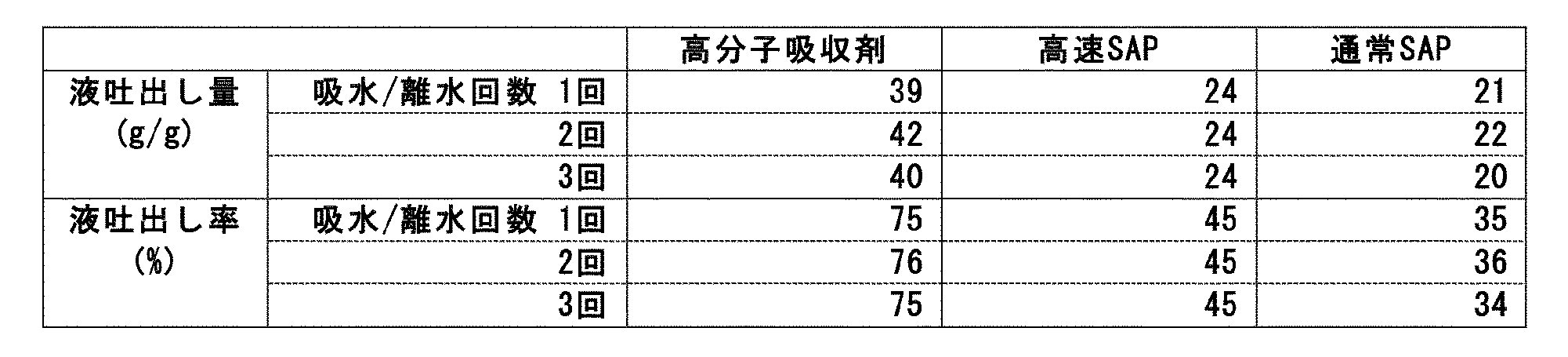
複合吸収体の厚み及び繰り返し吸収速度は、それぞれ上記の複合吸収体の厚みの測定方法及び複合吸収体の繰り返し吸収速度の測定方法により測定された。評価対象の吸収体の構成を、下記の表3に示す。吸収体の構成として、実施例(複合吸収体)としてのパルプ繊維/通常SAP/高分子吸収剤、及び、比較例(通常の吸収体)としてのパルプ繊維/通常SAP、を採用した。両者の各材料については、通常SAPの坪量を同一とし、複合吸収体では更に高分子吸収剤の坪量を同一とし、パルプ繊維の坪量で厚みを変化させた。その結果を表3,図8に示す。
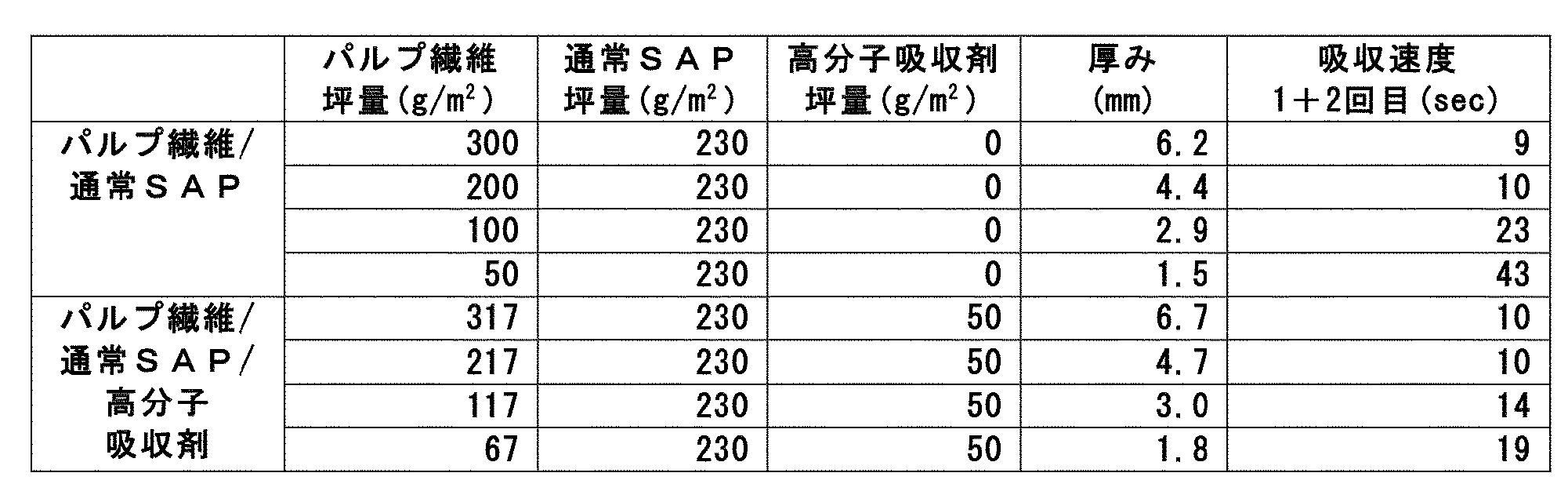
2 表面シート
3 裏面シート
4 複合吸収体
Claims (12)
- 体液を吸収するための衛生用品用の複合吸収体であって、
パルプ繊維と、親水性の連続骨格及び連続空孔を備えた高分子吸収剤と、高吸水性ポリマーと、を含み、
初期の吸収速度の速さは、前記パルプ繊維>前記高分子吸収剤>前記高吸水性ポリマー、である、
複合吸収体。 - 前記高分子吸収剤のVoltex法による吸収速度が5秒以下である、
請求項1に記載の複合吸収体。 - 前記パルプ繊維からの液移行率は、前記高分子吸収剤>前記高吸水性ポリマー、である、
請求項1又は2に記載の複合吸収体。 - 前記高吸水性ポリマーへの液移行量は、前記高分子吸収剤>前記パルプ繊維、である、
請求項1乃至3のいずれか一項に記載の複合吸収体。 - (前記パルプ繊維の坪量)/(前記高分子吸収剤の坪量)が1より大きく、及び/又は
(前記高吸水性ポリマーの坪量)/(前記高分子吸収剤の坪量)が1より大きい、
請求項1乃至4のいずれか一項に記載の複合吸収体。 - 無加圧DemandWettability法による吸水量が、前記高分子吸収剤>前記高吸水性ポリマーである、
請求項1乃至5のいずれか一項に記載の複合吸収体。 - 吸収した液の液吐出し量は、前記高分子吸収剤>前記高吸水性ポリマーであり、
吸収した液の液吐出し率は、前記高分子吸収剤>前記高吸水性ポリマーである、
請求項1乃至6のいずれか一項に記載の複合吸収体。 - 前記高分子吸収剤の単位質量当たりの吸水量は、30g/g以上である、
請求項1乃至7のいずれか一項に記載の複合吸収体。 - 吸水粘度の大きさは、前記高分子吸収剤>前記高吸水性ポリマー、である、
請求項1乃至8のいずれか一項に記載の複合吸収体。 - 前記複合吸収体の厚さは、3mm以下であり、
前記複合吸収体の繰り返し吸収速度は、20秒以下である、
請求項1乃至9のいずれか一項に記載の複合吸収体。 - 前記高分子吸収剤は、(メタ)アクリル酸エステルと、一分子中に2個以上のビニル基を含有する化合物の架橋重合体の加水分解物であり、且つ、少なくとも1個以上の-COONa基を含有する、
請求項1乃至10のいずれか一項に記載の複合吸収体。 - 表面シートと、裏面シートと、前記表面シートと前記裏面シートとの間に位置する請求項1乃至11のいずれか一項に記載の複合吸収体と、を備える衛生用品。
Priority Applications (1)
| Application Number | Priority Date | Filing Date | Title |
|---|---|---|---|
| CN202380033005.1A CN118984692A (zh) | 2022-04-15 | 2023-04-03 | 复合吸收体及使用其的卫生用品 |
Applications Claiming Priority (2)
| Application Number | Priority Date | Filing Date | Title |
|---|---|---|---|
| JP2022067735A JP7682125B2 (ja) | 2022-04-15 | 2022-04-15 | 複合吸収体及びそれを用いた衛生用品 |
| JP2022-067735 | 2022-04-15 |
Publications (1)
| Publication Number | Publication Date |
|---|---|
| WO2023199775A1 true WO2023199775A1 (ja) | 2023-10-19 |
Family
ID=88329563
Family Applications (1)
| Application Number | Title | Priority Date | Filing Date |
|---|---|---|---|
| PCT/JP2023/013799 Ceased WO2023199775A1 (ja) | 2022-04-15 | 2023-04-03 | 複合吸収体及びそれを用いた衛生用品 |
Country Status (4)
| Country | Link |
|---|---|
| JP (1) | JP7682125B2 (ja) |
| CN (1) | CN118984692A (ja) |
| TW (1) | TW202406518A (ja) |
| WO (1) | WO2023199775A1 (ja) |
Citations (3)
| Publication number | Priority date | Publication date | Assignee | Title |
|---|---|---|---|---|
| JP2003144489A (ja) * | 2001-11-09 | 2003-05-20 | Uni Charm Corp | 使い捨ておむつ |
| WO2020262343A1 (ja) * | 2019-06-28 | 2020-12-30 | ユニ・チャーム株式会社 | 吸収体及び吸収性物品 |
| JP2021106648A (ja) * | 2019-12-27 | 2021-07-29 | ユニ・チャーム株式会社 | 吸収性物品 |
-
2022
- 2022-04-15 JP JP2022067735A patent/JP7682125B2/ja active Active
-
2023
- 2023-04-03 WO PCT/JP2023/013799 patent/WO2023199775A1/ja not_active Ceased
- 2023-04-03 CN CN202380033005.1A patent/CN118984692A/zh active Pending
- 2023-04-13 TW TW112113888A patent/TW202406518A/zh unknown
Patent Citations (3)
| Publication number | Priority date | Publication date | Assignee | Title |
|---|---|---|---|---|
| JP2003144489A (ja) * | 2001-11-09 | 2003-05-20 | Uni Charm Corp | 使い捨ておむつ |
| WO2020262343A1 (ja) * | 2019-06-28 | 2020-12-30 | ユニ・チャーム株式会社 | 吸収体及び吸収性物品 |
| JP2021106648A (ja) * | 2019-12-27 | 2021-07-29 | ユニ・チャーム株式会社 | 吸収性物品 |
Also Published As
| Publication number | Publication date |
|---|---|
| TW202406518A (zh) | 2024-02-16 |
| CN118984692A (zh) | 2024-11-19 |
| JP2023157674A (ja) | 2023-10-26 |
| JP7682125B2 (ja) | 2025-05-23 |
Similar Documents
| Publication | Publication Date | Title |
|---|---|---|
| JP7630276B2 (ja) | 複合吸収体及び衛生用品 | |
| AU2001247489B2 (en) | Permanently wettable superabsorbents fibers | |
| JPH10502954A (ja) | 少なくとも二種類のヒドロゲル形成粒子の乾燥混合物からなる吸収性ゲル化剤及びその製造方法 | |
| KR20220027061A (ko) | 흡수체 및 흡수성 물품 | |
| JP2024014926A (ja) | 吸収性物品 | |
| WO2014034134A1 (en) | Absorbent body and absorbent article using the same | |
| WO2014034132A2 (en) | Absorbent body and absorbent article using the same | |
| JP2000501979A (ja) | 改善された吸収透過性を有する吸収性材料およびそれを作るための方法 | |
| WO2024057952A1 (ja) | 複合吸収体及びそれを用いた衛生用品 | |
| TWI905341B (zh) | 複合吸收體及衛生用品 | |
| JP2023157674A (ja) | 複合吸収体及びそれを用いた衛生用品 | |
| TWI899396B (zh) | 複合吸收體及衛生用品 | |
| JPH0728891B2 (ja) | 吸収性物品 | |
| JP7692697B2 (ja) | 複合吸収体及び衛生用品 | |
| WO2022145240A1 (ja) | 複合吸収体及び衛生用品 | |
| JP2023157677A (ja) | 複合吸収体及び高分子吸収剤 | |
| WO2022145226A1 (ja) | 複合吸収体及び衛生用品 | |
| WO2023100479A1 (ja) | 吸水性樹脂粒子及び吸収体 | |
| WO2022145239A1 (ja) | 複合吸収体及び衛生用品 | |
| JP2024041649A (ja) | 複合吸収体及び高分子吸収剤 |
Legal Events
| Date | Code | Title | Description |
|---|---|---|---|
| 121 | Ep: the epo has been informed by wipo that ep was designated in this application |
Ref document number: 23788195 Country of ref document: EP Kind code of ref document: A1 |
|
| WWE | Wipo information: entry into national phase |
Ref document number: 202417074831 Country of ref document: IN |
|
| WWE | Wipo information: entry into national phase |
Ref document number: 2401006680 Country of ref document: TH |
|
| WWE | Wipo information: entry into national phase |
Ref document number: 202380033005.1 Country of ref document: CN |
|
| NENP | Non-entry into the national phase |
Ref country code: DE |
|
| 122 | Ep: pct application non-entry in european phase |
Ref document number: 23788195 Country of ref document: EP Kind code of ref document: A1 |