WO2023195528A1 - ガラス振動板及び振動子付きガラス振動板 - Google Patents
ガラス振動板及び振動子付きガラス振動板 Download PDFInfo
- Publication number
- WO2023195528A1 WO2023195528A1 PCT/JP2023/014299 JP2023014299W WO2023195528A1 WO 2023195528 A1 WO2023195528 A1 WO 2023195528A1 JP 2023014299 W JP2023014299 W JP 2023014299W WO 2023195528 A1 WO2023195528 A1 WO 2023195528A1
- Authority
- WO
- WIPO (PCT)
- Prior art keywords
- mount
- glass
- vibrator
- mount part
- plate structure
- Prior art date
- Legal status (The legal status is an assumption and is not a legal conclusion. Google has not performed a legal analysis and makes no representation as to the accuracy of the status listed.)
- Ceased
Links
Images








Classifications
-
- H—ELECTRICITY
- H04—ELECTRIC COMMUNICATION TECHNIQUE
- H04R—LOUDSPEAKERS, MICROPHONES, GRAMOPHONE PICK-UPS OR LIKE ACOUSTIC ELECTROMECHANICAL TRANSDUCERS; ELECTRIC HEARING AIDS; PUBLIC ADDRESS SYSTEMS
- H04R1/00—Details of transducers, loudspeakers or microphones
-
- H—ELECTRICITY
- H04—ELECTRIC COMMUNICATION TECHNIQUE
- H04R—LOUDSPEAKERS, MICROPHONES, GRAMOPHONE PICK-UPS OR LIKE ACOUSTIC ELECTROMECHANICAL TRANSDUCERS; ELECTRIC HEARING AIDS; PUBLIC ADDRESS SYSTEMS
- H04R1/00—Details of transducers, loudspeakers or microphones
- H04R1/02—Casings; Cabinets ; Supports therefor; Mountings therein
-
- H—ELECTRICITY
- H04—ELECTRIC COMMUNICATION TECHNIQUE
- H04R—LOUDSPEAKERS, MICROPHONES, GRAMOPHONE PICK-UPS OR LIKE ACOUSTIC ELECTROMECHANICAL TRANSDUCERS; ELECTRIC HEARING AIDS; PUBLIC ADDRESS SYSTEMS
- H04R7/00—Diaphragms for electromechanical transducers; Cones
- H04R7/02—Diaphragms for electromechanical transducers; Cones characterised by the construction
- H04R7/04—Plane diaphragms
Definitions
- the present invention relates to a glass diaphragm and a glass diaphragm with a vibrator.
- Patent Documents 1 to 4 disclose structures that transmit the vibrations of an electrically vibrating exciter (piezoelectric actuator) to a diaphragm such as a glass plate.
- Patent Document 1 discloses a glass plate having a Lower Part that passes through a hole formed in the glass plate, and an Upper Part that is arranged on the exciter side in contact with the Lower Part.
- Patent Document 2 describes that an exciter is fixed to one end of a rod member that is a vibration transmitting section, and that the other end of the rod member is bonded to a diaphragm via a rod holding member.
- Patent Document 3 similar to Patent Document 2, describes that a vibration transmission member that transmits the vibration of an actuator to an acoustic diaphragm is bonded to the acoustic diaphragm with an adhesive or adhesive tape, or is fused by applying heat. It is described that fixation can be performed by various methods such as attaching or embedding.
- Patent Document 4 discloses a structure in which a conductor is adhered to the center of gravity position on the back surface of an organic EL panel, and a piezoelectric vibrator is fixed to the conductor using a mounting fitting.
- the present invention provides a glass diaphragm and a glass diaphragm with a vibrator that can stably attach a vibrator to a glass plate structure and suppress deterioration in sound quality due to misalignment of the vibrator and prevention of falling off of the vibrator.
- the purpose is to
- the present invention consists of the following configuration.
- a glass plate structure having through holes in the thickness direction, a mount portion that passes through the through hole and is fixed to the glass plate structure;
- the mount part includes a first mount part having a flange on the first main surface side of the glass plate structure, and a second mount part having a flange part on the second main surface side of the glass plate structure.
- the mount section is a glass diaphragm having a vibrator mounting section to which a vibrator section including a vibrator that vibrates the glass plate structure is attached.
- the vibrator section includes the vibrator and a connection part fixed to the vibrator, A glass diaphragm with a vibrator, wherein the vibrator mounting portion and the connecting portion are mechanically fixed.
- the present invention it is possible to stably attach the vibrator to the glass plate structure, and it is possible to suppress deterioration in sound quality and drop-off of the vibrator due to misalignment of the vibrator.
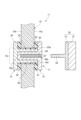
- FIG. 1 is a schematic plan view of a glass diaphragm.
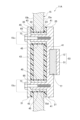
- FIG. 2 is a schematic cross-sectional view of the glass diaphragm shown in FIG. 1 taken along line II-II.
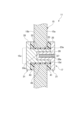
- FIG. 3A is a schematic cross-sectional view of a glass diaphragm including a mount portion according to Modification 1-1.
- FIG. 3B is a schematic cross-sectional view of a glass diaphragm including a mount portion according to Modification 1-2.
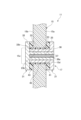
- FIG. 3C is a schematic cross-sectional view of a glass diaphragm including a mount portion according to Modification 1-3.
- FIG. 3D is a schematic cross-sectional view of a glass diaphragm including a mount portion according to Modification 1-4.
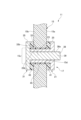
- FIG. 3E is a schematic cross-sectional view of a glass diaphragm including a mount portion according to Modification 1-5.
- FIG. 3F is a schematic cross-sectional view of a glass diaphragm including a mount portion according to Modification 1-6.
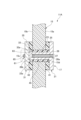
- FIG. 4 is a schematic cross-sectional view of a glass diaphragm according to a second configuration example.
- FIG. 5A is a schematic cross-sectional view of a glass diaphragm including a mount portion according to Modification 2-1.
- FIG. 5B is a schematic cross-sectional view of a glass diaphragm including a mount portion according to Modification 2-2.
- FIG. 5C is a schematic cross-sectional view of a glass diaphragm including a mount portion according to Modification 2-3.
- FIG. 5D is a schematic cross-sectional view of a glass diaphragm including a mount portion according to Modification 2-4.
- FIG. 5E is a schematic cross-sectional view of a glass diaphragm including a mount portion according to Modification 2-4.
- FIG. 5F is a schematic cross-sectional view of a glass diaphragm including a mount portion according to Modification 2-5.
- FIG. 5G is a schematic cross-sectional view of a glass diaphragm including a mount portion according to Modification 2-6.
- FIG. 5H is a schematic cross-sectional view of a glass diaphragm including a mount portion according to Modification 2-7.
- FIG. 5I is a schematic plan view of a mount secured to a glass plate structure by a plurality of screws.
- FIG. 6 is a schematic cross-sectional view of a glass diaphragm according to a third configuration example.
- FIG. 7 is a schematic cross-sectional view of a glass diaphragm including a mount portion according to Modification 3-1.
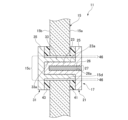
- FIG. 1 is a schematic plan view of the glass diaphragm 11.
- FIG. 2 is a schematic cross-sectional view of the glass diaphragm 11 shown in FIG. 1 taken along line II-II.
- a vibrator 13 that generates vibration can be attached to the glass diaphragm 11.
- the glass diaphragm 11 includes a glass plate structure 15 and a mount part 17 that fixes the vibrator 13 to the glass plate structure 15.
- the mount section 17 has a vibrator mounting section 26 .
- the vibrator mounting portion 26 is constituted by a recess 27 extending from the first main surface 15a side of the glass plate structure 15 to the second main surface 15b side.
- the glass diaphragm 11 is equipped with a vibrator 13 to constitute a glass diaphragm 100 with a vibrator.
- the vibrator 13 includes a connecting portion 51 and constitutes a vibrator portion 53 .
- the vibrator portion 53 may have a structure in which the vibrator 13 and the connecting portion 51 are different members and are firmly fixed, or may be a structure in which they are integrated as the same member.
- the vibrator 13 is fixed to the vibrator attachment part 26 of the mount part 17 as a vibrator part 53.
- the vibrator section 53 is mechanically fixed to the vibrator attachment section 26 of the mount section 17.
- the vibrator 13 is a vibrating device that uses a contacting object as a diaphragm and generates sound from the diaphragm.
- a known actuator such as an exciter can be used.
- the vibrator-equipped glass diaphragm 100 to which the vibrator 13 is mounted vibrates the glass diaphragm 11 by driving the vibrator 13 to generate desired sound.
- the vibrator 13 is placed on the side of the connecting portion 19 with the lifting mechanism (not shown) below the belt line BL.
- the belt line BL is the line at the lower edge of the door opening (window) when a side window that slides up and down is attached to a vehicle door and the side window is in the closed state with the side window moved to the top. This is the part where the attached belt line molding and the side window come into close contact. In the closed state where the side window has moved to the top, the portion of the side window below the belt line BL is hidden by the door panel of the vehicle.
- the glass diaphragm 11 may have its vibrator 13 attached at an opening in the side window above the belt line BL.
- the glass diaphragm 11 can also be applied to fixed windows such as windshields, rear windows, roof glazings, and front quarter windows of vehicles such as automobiles.
- the glass plate structure 15 that constitutes the glass diaphragm 11 has a first main surface 15a and a second main surface 15b, and has a through hole 15c penetrating in the thickness direction.
- the glass plate structure 15 is illustrated as a single glass plate (single glass plate), but other forms may be used, such as laminated glass in which an intermediate layer such as an interlayer film or liquid is sandwiched between a pair of glass plates.
- the thickness of the glass plate structure 15 is preferably 1 [mm] or more, more preferably 2 [mm] or more, and even more preferably 3 [mm] or more. Thereby, the strength of the glass plate structure 15 can be made sufficient.
- the mount portion 17 is provided and fixed in a through hole 15c formed in the glass plate structure 15.
- the vibrator 13 (vibrator part 53) is fixed to this mount part 17, and is attached to the glass plate structure 15 via this mount part 17.
- the mount section 17 includes a first mount section 21 and a second mount section 31.
- the first mount part 21 and the second mount part 31 are made of materials such as metal materials such as aluminum or aluminum alloys, titanium alloys, magnesium alloys, and stainless steel, ceramics, glass, resin materials, carbon fibers, and composite materials made of these materials. It can be formed by Examples of resin materials include acrylic resins such as polymethyl methacrylate resin (PMMA), polycarbonate (PC), polyvinyl chloride (PVC), urethane, polypropylene (PP), ABS resin, polybutylene terephthalate (PBT), and polyethylene terephthalate (PBT).
- PMMA polymethyl methacrylate resin
- PC polycarbonate
- PVC polyvinyl chloride
- PP polypropylene
- ABS resin polybutylene terephthalate
- PBT polyethylene terephthalate
- the mount portion 17 may be made of a single material, or may be made of a composite material such as an aluminum alloy and stainless steel, or a resin material and stainless steel.
- the first mount section 21 and the second mount section 31 preferably have a Young's modulus of 1 ⁇ 10 7 [Pa] or more in order to transmit acoustic vibrations from the vibrator 13 (vibrator portion 53).
- the Young's modulus of the first mount portion 21 and the second mount portion 31 is more preferably 1 ⁇ 10 8 [Pa] or more, further preferably 5 ⁇ 10 8 [Pa] or more, and 10 ⁇ 10 8 [Pa] or more. is particularly preferred.
- the first mount part 21 and the second mount part 31 preferably have a longitudinal sound velocity value of 2 ⁇ 10 3 [m/s] or more, and 5 ⁇ 10 3 [m/s] in order to improve the reproducibility of high-frequency sound ranges. ] or more is more preferable, 10 ⁇ 10 3 [m/s] or more is even more preferable, and there is no upper limit.
- the vibration damping ability of the mount portion 17 is preferably as low as possible, and the damping coefficient is preferably 2.0 ⁇ 10 ⁇ 1 or less. It is more preferably 1.0 ⁇ 10 ⁇ 1 or less, and even more preferably 1.0 ⁇ 10 ⁇ 2 or less.
- the lower limit is preferably 1.0 ⁇ 10 ⁇ 6 or more, more preferably 5.0 ⁇ 10 ⁇ 6 or more, and even more preferably 1.0 ⁇ 10 ⁇ 5 . If the longitudinal sound velocity value and the damping coefficient are set to the above values, it is possible to improve the reproducibility of the high frequency sound range and obtain the mount portion 17 with good vibration transmission properties.
- the first mount portion 21 has a shaft portion 23 passing through the through hole 15c, and a flange portion 25 disposed on the first main surface 15a side of the glass plate structure 15.
- the second mount portion 31 has a shaft portion 33 that passes through the through hole 15c, and a flange portion 35 that is disposed on the second main surface 15b side of the glass plate structure 15.
- the shaft portion 23 of the first mount portion 21 has a smaller diameter than the shaft portion 33 of the second mount portion 31.
- the first mount part 21 is mechanically fixed to the second mount part 31 by a shaft part 23 extending into the through hole 15c. Specifically, the first mount section 21 is fastened and fixed to the second mount section 31 by a screw structure.
- the first mount portion 21 has a male thread 23a formed on the shaft portion 23, and the second mount portion 31 has a female thread 33a formed on the shaft portion 33. Then, by screwing the male thread 23a of the shaft portion 23 of the first mount portion 21 into the female thread 33a of the shaft portion 33 of the second mount portion 31, the first mount portion 21 and the second mount portion 31 are fastened to each other. are integrated.
- the breaking torque value of the screw structure of the first mount part 21 and the second mount part 31 is preferably 1 [Nm] to 50 [Nm]. This can prevent the mount part 17 from falling off the glass plate structure 15 due to the first mount part 21 and the second mount part 31 coming off.
- the lower limit of the breaking torque value of the threaded structure is more preferably 2 [Nm] or more, and even more preferably 3 [Nm] or more.
- the upper limit value of the breaking torque value of the threaded structure is more preferably 30 [Nm] or less, further preferably 20 [Nm] or less, and even more preferably 10 [Nm] or less. If the first mount part 21 and the second mount part 31 can be easily attached and detached, for example, even if at least one of the mount parts is damaged, the glass plate structure 15 can be replaced without being damaged.
- the screw structures of the first mount part 21 and the second mount part 31 be fastened to the uneven surfaces thereof via an adhesive.
- the lengths of the first mount section 21 and the second mount section 31 in the thickness direction are also short.
- the number of pitches in the screw structure cannot be set sufficiently, which may make it difficult to secure a good torque value.
- the above-mentioned breaking torque value can be ensured by applying an adhesive to the uneven surface of the threaded structure and reinforcing it.
- the adhesive to be applied to the uneven surface of the screw structure is preferably a curing type such as an anaerobic curing type, a two-component mixture type, a thermosetting type, or a moisture curing type, such as an epoxy type, a urethane type, an acrylic type, or a silicone type.
- Adhesives such as cyanoacrylate, cyanoacrylate, and phenol are preferred.
- a first resin portion 41 is provided between the flange portion 25 of the first mount portion 21 and the first main surface 15a of the glass plate structure 15. Further, a second resin portion 43 is provided between the flange portion 35 of the second mount portion 31 and the second main surface 15b of the glass plate structure 15. In this way, by providing the first resin part 41 and the second resin part 43, the vibration from the vibrator 13 can be smoothly transmitted to the glass plate structure 15 while protecting the attachment point of the mount part 17 on the glass plate structure 15. can be transmitted to enhance the acoustic effect.
- the first resin part 41 and the second resin part 43 have a thickness of 1 [ ⁇ m] to 3 [mm]. By setting the thickness within this range, vibrations from the vibrator 13 can be smoothly transmitted to the glass plate structure 15 while sufficiently protecting the mounting part 17 on the glass plate structure 15. Strong fixing strength of the mount portion 17 to the structural body 15 can be obtained.
- the first resin part 41 and the second resin part 43 are preferably 10 [ ⁇ m] or more, and more preferably 50 [ ⁇ m] or more. Further, the thickness of the first resin part 41 and the second resin part 43 is preferably 2 [mm] or less, and more preferably 1 [mm] or less, from the viewpoint of vibration transmittance.
- the first resin portion 41 and the second resin portion 43 have a Young's modulus of 1 ⁇ 10 4 [Pa] to 1 ⁇ 10 9 [Pa].
- the Young's modulus of the first resin portion 41 and the second resin portion 43 is preferably 5 ⁇ 10 4 [Pa] or more, more preferably 1 ⁇ 10 5 [Pa] or more.
- the Young's modulus of the first resin portion 41 and the second resin portion 43 is preferably 5 ⁇ 10 9 [Pa] or less, more preferably 1 ⁇ 10 9 [Pa] or less.
- first resin portion 41 and the second resin portion 43 have a linear expansion coefficient of 1 ⁇ 10 ⁇ 3 [1/° C.] or less between ⁇ 40 [° C.] and 90 [° C.]. Thereby, the influence of thermal expansion or thermal contraction of the first resin part 41 and the second resin part 43 can be suppressed.
- the coefficient of linear expansion of the first resin part 41 and the second resin part 43 at -40 [°C] to 90 [°C] is preferably 5 ⁇ 10 ⁇ 4 [1/°C] or less, and 3 ⁇ 10 ⁇ 4 [ 1/°C] or less is more preferable.
- first resin part 41 and the second resin part 43 have a shear peel strength of 0.2 [MPa] or more and a shear storage modulus of 1.0 ⁇ at -40 [°C] to 90 [°C]. It is 10 4 [Pa] or more. Thereby, strong fixing strength between the glass plate structure 15 and the mount portion 17 can be maintained regardless of temperature changes.
- the shear peel strength of the first resin part 41 and the second resin part 43 at ⁇ 40 [° C.] to 90 [° C.] is preferably 0.4 [MPa] or more, and more preferably 1.0 [MPa].
- the shear storage modulus of the first resin part 41 and the second resin part 43 at -40 [°C] to 90 [°C] is preferably 1.0 ⁇ 10 5 [Pa] or more, and 1.0 ⁇ 10 6 [Pa] or more is more preferable.
- the first resin part 41 and the second resin part 43 for example, a rubber material, an adhesive tape, an adhesive, a sheet, a film, etc. can be used. Further, when an adhesive is used, it may be a composite layer with a material having a spacer function to define the thickness of the adhesive. At this time, the spacer can be any material known as a spacer material, such as adhesive tape, spacer particles, rubber, etc.
- butyl rubber, nitrile rubber, chloroprene rubber, silicone rubber, fluororubber, urethane rubber, natural rubber, EPDM rubber, thermoplastic elastomer, or the like is used.
- adhesive tape acrylic, silicone, urethane, epoxy silicone, cyanoacrylate, etc. can be used.
- materials such as acrylic, silicone, urethane, epoxy, cyanoacrylate, and epoxy silicone are preferred.
- adhesives such as thermosetting, moisture curing, two-component curing, ultraviolet curing, visible light curing, and anaerobic curing can be used. Functional disassembly adhesives can also be used.
- thermoplastic materials such as polyvinyl butyral (PVB), polyethylene terephthalate (PET), polyurethane (PU), and ethylene vinyl acetate copolymer (EVA) can be used as the material for the sheet or film.
- the glass diaphragm 11 may have a third resin portion 45 between the end surface 15d of the glass plate structure 15 and the mount portion 17 in the through hole 15c.
- This third resin portion 45 is provided between the outer circumference of the shaft portion 33 of the second mount portion 31 and the inner circumference of the through hole 15c. In this manner, by providing the third resin portion 45 between the end surface 15d of the glass plate structure 15 and the mount portion 17 in the through hole 15c, the occurrence of cracks at the end surface 15d of the glass plate structure 15 can be suppressed. .
- the third resin part 45 is formed in a hollow shape such as a tube, and can be made of a non-adhesive member to the end surface 15d of the glass plate structure 15. Thereby, the third resin part 45 can be easily attached and detached. Moreover, as the third resin part 45, a member having adhesiveness or adhesiveness and sticking to the end surface 15d of the glass plate structure 15 may be used.
- the third resin portion 45 has a thickness of 5 [ ⁇ m] to 5 [mm]. By setting the thickness within this range, the stress caused by the difference in expansion and expansion/contraction between the glass plate structure 15 and the mount portion 17 can be satisfactorily alleviated.
- the thickness of the third resin part 45 is preferably 25 [ ⁇ m] or more, and 50 [ ⁇ m] or more. ⁇ m] or more is more preferable, and 100 [ ⁇ m] or more is even more preferable. Furthermore, if the third resin part 45 is too thick, its vibration absorbing properties will increase, making it difficult for vibrations to propagate smoothly. Therefore, the thickness of the third resin part 45 is preferably 3 [mm] or less, more preferably 2 [mm] or less.
- the third resin portion 45 has a Young's modulus of 1 ⁇ 10 5 [Pa] to 5 ⁇ 10 9 [Pa].
- the Young's modulus of the third resin portion 45 is preferably 1 ⁇ 10 5 [Pa] or more, more preferably 3 ⁇ 10 5 [Pa] or more, and even more preferably 5 ⁇ 10 5 [Pa] or more.
- the Young's modulus of the third resin part 45 is high, it becomes difficult to alleviate the thermal expansion and contraction of the materials of the glass plate structure 15 and the mount part 17, so the Young's modulus of the third resin part 45 is 5 ⁇ 10 9 [Pa] or less is preferable, 3 ⁇ 10 9 [Pa] or less is more preferable, and 1 ⁇ 10 9 [Pa] or less is even more preferable.
- the third resin part 45 for example, a rubber material, an adhesive tape, an adhesive, etc. can be used.
- butyl rubber, nitrile rubber, chloroprene rubber, silicone rubber, fluororubber, urethane rubber, natural rubber, EPDM rubber, thermoplastic elastomer, or the like is used.
- acrylic, silicone, urethane, epoxy silicone, etc. can be used.
- materials such as acrylic, silicone, urethane, epoxy, cyanoacrylate, and epoxy silicone are preferred.
- Adhesives that can be used include thermosetting, moisture curing, two-component curing, ultraviolet curing, visible light curing, and anaerobic curing, as well as adhesives with functions such as electrical peeling and thermal peeling. It is also possible to use a removable adhesive having a
- the third resin part 45 a heat-shrinkable tube can be used as the third resin part 45.
- the third resin part 45 is fitted onto the shaft part 33 of the second mount part 31 and is heat-shrinked. Thereby, the third resin part 45 can be easily attached to the outer periphery of the shaft part 33 of the second mount part 31.
- the third resin part 45 may be provided by applying a primer to the end surface 15d of the glass plate structure 15, which not only improves the adhesive strength with the adhesive but also improves the adhesive strength of the glass plate structure 15.
- the effect of suppressing cracks in the through hole 15c can be obtained.
- the primers include silane coupling agents, inorganic metal particles, ceramics, carbon black, silica particles, glass fibers, carbon fibers, carbon nanotubes, graphene, polyisocyanates, polyols, silanol groups, vinyl groups, epoxy groups, Compounds containing at least one of the above components can be used, such as compounds containing any one of methacrylate groups, ester groups, phenol groups, and thiol groups.
- the third resin portion 45 may be a cellular structure such as a sponge or urethane foam, a gel-like substance, or the like.
- a gap may be provided on the outer circumferential side or the inner circumferential side of the third resin part 45. good.
- the mount section 17 has a vibrator attachment section 26 provided on the first mount section 21 .
- the vibrator mounting portion 26 is constituted by a recess 27 extending from the first main surface 15a side of the glass plate structure 15 to the second main surface 15b side.
- the vibrator mounting portion 26 consisting of the recess 27 has a female thread 26a formed on its side surface.
- the vibrator 13 includes the connecting portion 51 to constitute the vibrator portion 53, and is fixed as the vibrator portion 53 to the vibrator attachment portion 26 of the mount portion 17.
- the vibrator portion 53 is mechanically fixed to the vibrator attachment portion 26 of the mount portion 17 by a screw structure.
- the connecting portion 51 constituting the vibrator portion 53 has a screw shaft portion 55 at its center, and by screwing the screw shaft portion 55 into the vibrator mounting portion 26 of the mount portion 17, the vibrator portion 53 is mounted. It is fastened and fixed to the portion 17.
- the destructive torque value (destructive torque value A) between the first mount part 21 and the second mount part 31 is the same as that of the mount part 17.
- the breaking torque value (breaking torque value B) between the first mount portion 21 and the connecting portion 51 may be 1.2 times or more.
- breaking torque value A/breaking torque value B is preferably 1.5 times or more, more preferably 2.0 times or more, and even more preferably 3.0 times or more.
- the upper limit of "breaking torque value A/breaking torque value B" is preferably 100 times or less, more preferably 50 times or less, and even more preferably 20 times or less, from the viewpoint of removing the mount part 17 itself from the glass plate structure 15. preferable.
- the thread structures of the first mount section 21 and the second mount section 31 and the thread structure of the vibrator mounting section 26 are preferably opposite thread structures. Thereby, the connecting portion 51 screwed into the vibrator mounting portion 26 can be loosened and the vibrator portion 53 can be removed from the mount portion 17 without loosening the connection between the first mount portion 21 and the second mount portion 31.
- the mount portion 17 having the vibrator mounting portion 26 to which the vibrator portion 53 including the vibrator 13 that vibrates the glass plate structure 15 is attached is mechanically It is composed of a first mount part 21 and a second mount part 31 that are fixed to each other, and are fixed through the through hole 15c of the glass plate structure 15.
- a first resin part 41 is provided between the flange 25 of the first mount part 21 and the first main surface 15a, and a first resin part 41 is provided between the flange 35 of the second mount part 31 and the second main surface 15b. 2 resin parts 43.
- the vibrator 13 can be stably attached to the glass plate structure 15, and deterioration in sound quality and falling off of the vibrator 13 due to displacement of the vibrator 13 can be suppressed. Furthermore, the vibration from the vibrator 13 can be smoothly transmitted to the glass plate structure 15 while protecting the attachment point of the mount part 17 on the glass plate structure 15, and the acoustic effect can be enhanced.
- the mounting position may be set, for example, to an opening part of a side window other than the hidden part of the door. Can be placed.
- the glass diaphragm 11 of the first configuration example is applicable not only to side windows of vehicles such as automobiles, but also to fixed windows such as windshields, rear windows, roof glazings, and front quarter windows.
- This enables a three-dimensional sound system that combines the glass diaphragm 11 and existing speakers, a noise canceling system that applies opposite-phase sound waves to noise from outside the vehicle to cancel it out, and a reflection control system that cancels the echoes of music inside the vehicle. It can make a big contribution.
- the present invention can be used not only for building windows, structural members, and decorative panels, but also as a diaphragm member for flat panel speakers.
- the glass plate structure 15 and the mount part 17 can be easily separated by separating the first mount part 21 and the second mount part 31 which are mechanically fixed.
- the mount part 17 may be colored with paint or ink material, or paint with functions such as heat shielding and fluorescence. may be applied.
- mount portion 17 is formed from aluminum or an aluminum alloy, it is preferable to perform an alumite treatment on the mount portion 17. If the mount portion 17 is subjected to alumite treatment, not only the aesthetic appearance can be improved, but also the abrasion resistance, corrosion resistance, thermal conductivity, and insulation properties can be improved.
- the mount portion 17 may be provided with an antenna or radar function that transmits radio waves through the through hole 15c of the glass plate structure 15.
- the mount section 17 may be provided with a temperature sensor, a humidity sensor, an acceleration sensor, a rain sensor, a pressure sensor, etc., and various information may be fed back from the mount section 17 to the automobile.
- the configuration of the mount portion 17 of the glass diaphragm 11 in the first configuration example described above is one example, and can be changed to various configurations.
- a modification of the mount portion 17 of the glass diaphragm 11 of the first configuration example will be described.
- 3A to 3F are schematic cross-sectional views showing modified examples of the mount portion 17, respectively.
- the shaft portion 23 of the first mount portion 21 constituting the mount portion 17 does not penetrate through the through hole 15c of the glass plate structure 15.
- the wall thickness in the axial direction of the end portion of the shaft portion 33 of the second mount portion 31 where the flange portion 35 is formed can be increased, and the strength of the second mount portion 31 can be increased.
- the shaft portion 33 of the second mount portion 31 has a smaller diameter than the shaft portion 23 of the first mount portion 21.
- the outer edge of the second mount part 31 in the through hole 15c is inside the outer edge of the first mount part 21.
- the first mount part 21 has a female thread 23b formed in the shaft part 23, and the second mount part 31 has a male thread 33b formed in the shaft part 33. Then, by screwing the male thread 33b of the shaft portion 33 of the second mount portion 31 into the female thread 23b of the shaft portion 23 of the first mount portion 21, the first mount portion 21 and the second mount portion 31 are fastened to each other. are integrated.
- the mount section 17 has a vibrator mounting section 36 provided on the second mount section 31.
- the vibrator mounting portion 36 is constituted by a recess 37 extending from the first main surface 15a side of the glass plate structure 15 to the second main surface 15b side.
- the vibrator mounting portion 36 consisting of the recess 37 has a female thread 36a formed on its side surface. Then, by screwing the screw shaft portion 55 of the connecting portion 51 of the vibrator portion 53 into the vibrator mounting portion 36, the vibrator portion 53 is fastened and fixed to the mount portion 17.
- the first mount part 21 constituting the mount part 17 has a protrusion on the opposite side to the second main surface 15b with respect to the first main surface 15a of the glass plate structure 15.
- a convex portion 29 is provided, and this convex portion 29 is used as the vibrator mounting portion 28.
- the vibrator mounting portion 28 consisting of the convex portion 29 has a male thread 28a formed on its side surface.
- the connecting portion 51 constituting the vibrator portion 53 has a screw hole portion 57 at its center, and by screwing the vibrator mounting portion 28 of the mount portion 17 into the screw hole portion 57, the vibrator portion 53 is fastened and fixed to the mount portion 17.
- the breaking torque value between the first mount section 21 and the second mount section 31 is 1 of the breaking torque value between the first mount section 21 and the connecting section 51 of the mount section 17. .It is sufficient if it is twice or more. This prevents loosening of the connection between the first mount section 21 and the second mount section 31 when loosening the connection section 51 into which the transducer mounting section 28 is screwed in order to remove the transducer section 53 from the mount section 17. Occurrence can be suppressed.
- the thread structures of the first mount section 21 and the second mount section 31 and the thread structure of the vibrator mounting section 28 are preferably reverse thread structures. Thereby, the connecting portion 51 screwed into the vibrator mounting portion 28 can be loosened and the vibrator portion 53 can be removed from the mount portion 17 without loosening the connection between the first mount portion 21 and the second mount portion 31.
- the shaft portion 33 of the second mount portion 31 has a smaller diameter than the shaft portion 23 of the first mount portion 21, and the glass plate structure 15, the outer edge of the second mount portion 31 in the through hole 15c is inside the outer edge of the first mount portion 21. Then, by screwing the male thread 33b formed on the shaft part 33 of the second mount part 31 into the female thread 23b formed in the shaft part 23 of the first mount part 21, the first mount part 21 and the second mount part 31 are fastened together and integrated.
- the first mount portion 21 constituting the mount portion 17 has a second main surface 15b with respect to the first main surface 15a of the glass plate structure 15. It has a convex portion 29 that protrudes to the opposite side, and this convex portion 29 is used as the vibrator mounting portion 28 . Then, by screwing the vibrator mounting portion 28 of the mount portion 17 into the screw hole portion 57 of the connecting portion 51 of the vibrator portion 53, the vibrator portion 53 is fastened and fixed to the mount portion 17.
- the shaft portion 33 of the second mount portion 31 has a smaller diameter than the shaft portion 23 of the first mount portion 21.
- the outer edge of the second mount part 31 in the through hole 15c is inside the outer edge of the first mount part 21. Then, by screwing the male thread 33b formed on the shaft part 33 of the second mount part 31 into the female thread 23b formed in the shaft part 23 of the first mount part 21, the first mount part 21 and the second mount part 31 are fastened together and integrated.
- the second mount part 31 constituting the mount part 17 has a convex protruding from the first main surface 15a of the glass plate structure 15 to the side opposite to the second main surface 15b.
- This convex portion 39 serves as a vibrator mounting portion 38 .
- the vibrator mounting portion 38 consisting of the convex portion 39 has a male thread 38a formed on its side surface. Then, by screwing the vibrator mounting portion 38 of the mount portion 17 into the screw hole portion 57 of the connection portion 51 of the vibrator portion 53, the vibrator portion 53 is fastened and fixed to the mount portion 17.
- the breaking torque value between the first mount section 21 and the second mount section 31 is 1.2 of the breaking torque value between the second mount section 31 and the connecting section 51 of the mount section 17. It is sufficient if it is twice or more. As a result, when loosening the connecting portion 51 into which the vibrator mounting portion 38 is screwed in order to remove the vibrator portion 53 from the mount portion 17, the connection between the first mount portion 21 and the second mount portion 31 is loosened. Occurrence can be suppressed.
- the thread structures of the first mount section 21 and the second mount section 31 and the thread structure of the vibrator mounting section 38 are preferably opposite thread structures. Thereby, the connecting portion 51 screwed into the vibrator mounting portion 38 can be loosened and the vibrator portion 53 can be removed from the mount portion 17 without loosening the connection between the first mount portion 21 and the second mount portion 31.
- a space 46 is provided between the end surface 15d of the glass plate structure 15 and the shaft portion 33 of the mount portion 17 in the through hole 15c.
- This space portion 46 is provided over the longitudinal direction of the shaft portion 33 of the mount portion 17 .
- This space portion 46 is provided over the circumferential direction in a plan view of the glass plate structure 15, so that the shaft portion 33 of the mount portion 17 is not in contact with the end surface 15d of the glass plate structure 15. It passes through the through hole 15c.
- the glass plate structure 15 made of laminated glass in which an intermediate layer such as a resin is sandwiched between two glass plates, holes that will become through holes 15c are formed in each of the two glass plates, and then heated and bent. and physically strengthen it. Thereafter, the two glass plates are stacked with the intermediate layer interposed therebetween, and a hole is made in the intermediate layer at the hole portion of each glass plate to form a through hole 15c. Thereby, a laminated glass is obtained in which the hole portions of each glass plate that become the through holes 15c are also physically strengthened.
- the glass plate structure 15 is laminated glass, there is a possibility that a slight difference in level may occur between the holes of each glass plate in the through holes 15c.
- each of the through holes 15c Even in laminated glass in which a slight step difference occurs between the holes of the glass plates, contact and interference between the end surface 15d of the through hole 15c of the glass plate structure 15 and the shaft part 33 of the mount part 17 can be suppressed well.
- the radial dimension of the space 46 between the end surface 15d of the glass plate structure 15 and the shaft part 33 of the mount part 17 is preferably 1.0 [mm] or more, and 1.5 [mm]. ] or more is more preferable, and 2.0 [mm] or more is even more preferable.
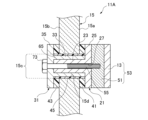
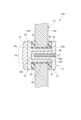
- FIG. 4 is a schematic cross-sectional view of a glass diaphragm 11A according to a second configuration example.
- the shaft portion 23 of the first mount portion 21 has a smaller diameter than the shaft portion 33 of the second mount portion 31.
- the outer edge of the second mount part 31 in the through hole 15c is on the outer side than the outer edge of the first mount part 21.
- the first mount portion 21 has a recess 27 passing through the through hole 15c of the glass plate structure 15. This recess 27 is formed in the shaft portion 23 that passes through the through hole 15c in the first mount portion 21.
- the recessed portion 27 formed in the first mount portion 21 is a vibrator mounting portion 26 having a threaded structure with a female thread 26a formed on its side surface, and the screw shaft of the connecting portion 51 constituting the vibrator portion 53 By screwing 55 into the vibrator attachment part 26, the vibrator part 53 is fastened and fixed to the mount part 17.
- the first mount part 21 is mechanically fixed to the second mount part 31 by a shaft part 23 extending into the through hole 15c. Specifically, the first mount section 21 is fastened and fixed to the second mount section 31 with a rivet 61.
- the rivet 61 has a head 63 and a pin portion 65.
- the head 63 of the rivet 61 is provided on the opposite side of the first main surface 15a of the second mount part 31, and the pin part 65 penetrates the second mount part 31 and the bottom part 26b of the recess 27 of the first mount part 21.
- the first mount section 21 and the second mount section 31 are fastened together.
- the rivet 61 before being driven into the mount portion 17 has an elongated pin portion 65 with a constriction in the middle portion.
- the long pin part 65 of the rivet 61 is inserted from the second main surface 15b side of the glass plate structure 15 at the center of the second mount part 31. Type it in. Thereafter, the tip side of the long pin portion 65 is separated at the constriction portion and removed.
- the second mount part 31 and the bottom part 26b of the recess 27 of the first mount part 21 are fastened by the rivet 61, and the first mount part 21 and the second mount part 31 are mechanically fixed and integrated. Ru.
- the coefficient of linear expansion of the rivet 61 is preferably in the range of 1.0 ⁇ 10 ⁇ 8 [1/°C] to 1.0 ⁇ 10 ⁇ 3 [1/°C], and 1.0 ⁇ 10 ⁇ 7 [1/°C]. °C] to 1.0 ⁇ 10 ⁇ 4 [1/°C] is more preferable.
- the first mount part 21 and the second mount part 31 fixed to each other can be broken. can be separated and removed from the glass plate structure 15. Thereby, the mount portion 17 assembled to the glass plate structure 15 can be easily replaced.
- the vibrator 13 can be stably attached to the glass plate structure 15, similarly to the glass diaphragm 11 of the first configuration example, and the vibrator 13 can be stably attached to the glass plate structure 15. Deterioration in sound quality and falling off of the vibrator 13 due to positional deviation can be suppressed. Furthermore, the vibration from the vibrator 13 can be smoothly transmitted to the glass plate structure 15 while protecting the attachment point of the mount part 17 on the glass plate structure 15, and the acoustic effect can be enhanced.
- the first mount portion 21 and the second mount portion 31 can be fastened together with the rivets 61 and easily fixed to the glass plate structure 15.
- the above-described adhesive may be applied between the side surface of the shaft portion 23 of the first mount portion 21 and the side surface of the shaft portion 33 of the second mount portion 31.
- these may be fastened and fixed by a threaded structure, and an adhesive may be applied to the uneven surface of the threaded structure.
- the configuration of the mount portion 17 of the glass diaphragm 11A in the second configuration example described above is one example, and can be changed to various configurations.
- a modification of the mount portion 17 of the glass diaphragm 11A of the second configuration example will be described.
- 5A to 5I are schematic cross-sectional views showing modified examples of the mount portion 17, respectively.
- the rivet 61 is driven from the recess 27 side of the first mount part 21, and the pin part 65 of the rivet 61 is inserted into the bottom part 26b of the recess 27 of the first mount part 21 and the second mount part. 31 and fastens the first mount part 21 and the second mount part 31.
- the head 63 of the rivet 61 is provided inside the recess 27 of the first mount section 21.
- the rivet 61 when driving the rivet 61, the rivet 61 can be inserted into the recess 27 of the first mount portion 21 and positioned easily, making the driving work easier.
- the second mount portion 31 is formed into a plate shape having a flange portion 35, and is disposed outside the through hole 15c of the glass plate structure 15. Further, in the first mount section 21, a shaft section 23 passing through the through hole 15c of the glass plate structure 15 projects toward the second main surface 15b side and is in contact with the second mount section 31.
- the head 63 of the rivet 61 is provided on the opposite side of the first main surface 15a of the second mount part 31, and the pin part 65 is provided on the second mount part 31 and the bottom part 26b of the recess 27 of the first mount part 21.
- the first mount part 21 and the second mount part 31 are fastened together by penetrating therethrough.
- the shape of the second mount portion 31 can be simplified.
- the second mount portion 31 has a short shaft portion 33 in which a female thread 33a is formed.
- the first mount portion 21 has a shaft portion 23 having a male thread 23a at its tip portion that penetrates the through hole 15c of the glass plate structure 15 and projects toward the second main surface 15b side. It is screwed into the female thread 33a and fastened.
- the rivet 61 is driven from the recess 27 side of the first mount part 21, and the pin part 65 of the rivet 61 is inserted into the bottom of the recess 27 of the first mount part 21. 26b and the second mount part 31, and fastens the first mount part 21 and the second mount part 31.
- the fixing strength between the first mount part 21 and the second mount part 31 is increased by screw fastening and rivet fastening.
- the screw shaft portion 55 of the connecting portion 51 is inserted from the recess 27 side of the first mount portion 21, and the bottom portion 26b of the recess 27 of the first mount portion 21 and the 2 through the mount portion 31.
- a nut 69 is fastened to the tip of the protruding screw shaft portion 55, thereby fastening the first mount portion 21 and the second mount portion 31.
- the connecting portion 51 constituting the vibrator portion 53 has a screw hole portion 71 at its center. Further, similar to Modification 2-4, a recess 27 is formed in the first mount portion 21. Then, by passing a separate screw 73 through the second mount section 31 and the first mount section 21 and screwing it into the screw hole section 71 of the connection section 51, the first mount section 21, the second mount section 31 and the vibration The child part 53 is fastened.
- the connecting portion 51 constituting the vibrator portion 53 includes two screw holes 71. Further, two recesses 27 are formed in the first mount part 21, and two recesses 37 are formed in the second mount part 31. Then, by passing two separate screws 73 through the second mount part 31 and the first mount part 21 and screwing them into the two screw holes 71 of the connecting part 51, the first mount part 21 and the second mount part 21 are screwed. The mount part 31 and the vibrator part 53 are fastened together.
- the first mount portion 21 includes two shaft portions 23 in which thread grooves are formed.
- the first mount part 21 and the second mount part 31 are fastened together by passing two separate screws 73 through the second mount part 31 and screwing them into the first mount part 21, respectively.
- the first mount portion 21 is provided with a screw hole portion 77 at its center that opens on the side opposite to the first main surface 15a of the glass plate structure 15.
- the connecting portion 51 of the vibrator portion 53 has a male thread formed on its outer periphery. By screwing the connecting portion 51 into the screw hole portion 77 of the first mount portion 21, the vibrator portion 53 is fastened and fixed to the mount portion 17.
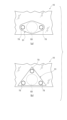
- FIG. 5I is a schematic plan view of the mount portion fixed to the glass plate structure by a plurality of screws.
- (a) shows an example of fixation using two screws 73.
- (b) shows an example in which it is fixed with three screws 73.
- screw holes 71 may be formed in the connecting portion 51, and each screw 73 may be screwed into the screw holes 71.
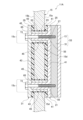
- FIG. 6 is a schematic cross-sectional view of a glass diaphragm 11B according to a third configuration example.
- the second mount portion 31 is opposite to the first main surface 15a side with respect to the second main surface 15b of the glass plate structure 15.
- the side surface 35a has an outwardly protruding protrusion.
- the surface 35a of the second mount portion 31 having a projection shape may be a dome-shaped curved surface or a triangular pyramid shape. As long as the surface 35a has a shape that protrudes on the side opposite to the shaft portion 23 side, it may have a partially planar shape. In this way, in the glass diaphragm 11B, if the surface 35a of the second mount part 31 is shaped to protrude on the side opposite to the shaft part 23 side, when the vibrator part 53 is attached, the second mount part Since the sound waves generated from the surface 35a of 31 are diffused, local sound leakage can be suppressed more easily than in a planar shape.
- the minimum radius of curvature of the surface 35a of the second mount portion 31 may be 3 [mm] or more, and may be 5 [mm] or more, 10 [mm] or more, or 15 [mm] or more. It may be 20 [mm] or more.
- the upper limit of the radius of curvature of the protrusion on the surface 35a of the second mount portion 31 may be 300 [mm] or less, 200 [mm] or less, or 100 [mm] or less.
- FIG. 7 is a schematic cross-sectional view showing a modification of the mount portion 17.
- the second mount portion 31 is divided into a plurality of parts, and in particular, a cap portion 75 is located on the side opposite to the glass plate structure 15 with respect to the flange portion 35. is arranged so that it can be separated from the portion including the shaft portion 23.
- the cap portion 75 has a surface 75a on the side opposite to the shaft portion 23 that protrudes outward.
- the surface 75a of the cap portion 75 having a projection shape may be a dome-shaped curved surface or a triangular pyramid shape.
- the outer edge of the cap portion 75 may be aligned with the outer edge of the flange portion 35 in a plan view of the glass plate structure 15, or may be located outside the outer edge of the flange portion 35, or may be located outside the outer edge of the flange portion 35. It may be located inside the outer edge.
- the cap portion 75 may be attached to the portion including the flange portion 35 and the shaft portion 23 with an adhesive layer, or may be attached with a mechanically fitting structure, and may also be attached with a removable structure. May have.
- the present invention is not limited to the embodiments described above, and those skilled in the art can combine the configurations of the embodiments with each other, modify and apply them based on the description of the specification and well-known techniques. It is also contemplated by the present invention to do so, and is within the scope for which protection is sought.
- the mount part includes a first mount part having a flange on the first main surface side of the glass plate structure, and a second mount part having a flange part on the second main surface side of the glass plate structure.
- the mount section is a glass diaphragm having a vibrator mounting section to which a vibrator section including a vibrator that vibrates the glass plate structure is attached. According to the glass diaphragm having this configuration, the mount portion having the vibrator mounting portion to which the vibrator portion including the vibrator for vibrating the glass plate structure is attached, the first mount portion and the first mount portion mechanically fixed to each other. 2 mount portions, and is fixed through a through hole of the glass plate structure.
- the first resin part is provided between the flange of the first mount part and the first main surface
- the second resin part is provided between the flange of the second mount part and the second main surface.
- the first resin part and the second resin part have a linear expansion coefficient of 1 ⁇ 10 -3 [1/°C] or less at -40 [°C] to 90 [°C].
- the glass diaphragm according to any one of 3). According to the glass diaphragm having this configuration, the influence of thermal expansion or thermal contraction of the first resin part and the second resin part can be suppressed.
- the first resin part and the second resin part have a shear peel strength of 0.2 [MPa] or more and a shear storage modulus of 1.0 at -40 [°C] to 90 [°C].
- the glass diaphragm according to any one of (1) to (4), which is at least ⁇ 10 4 [Pa]. According to the glass diaphragm having this configuration, strong fixing strength between the glass plate structure and the mount portion can be maintained regardless of temperature changes.
- the mount portion is a recess extending from the first main surface side to the second main surface side,
- the mount portion has a convex portion protruding from the first main surface on a side opposite to the second main surface,
- the breaking torque value of the screw structure of the first mount part and the second mount part is 1 [Nm] to 50 [Nm], according to any one of (12) to (18).
- Glass diaphragm According to the glass diaphragm having this configuration, the mount part can be removed from the glass plate structure by releasing the fastening between the first mount part and the second mount part while suppressing the mount part from falling off from the glass plate structure.
- the first mount portion has a recess that penetrates the through hole
- the first mount part and the second mount part are rivets that penetrate through the bottom of the recess of the first mount part and the second mount part to fasten the first mount part and the second mount part.
- the glass diaphragm according to any one of (1) to (11), which is fixed by. According to the glass diaphragm having this configuration, the first mount part and the second mount part can be fastened with rivets and easily fixed to the glass plate structure.
- the second mount portion has a shape in which a surface on a side opposite to the first main surface protrudes outward with respect to the second main surface of the glass plate structure.
- the glass diaphragm according to any one of (26). According to the glass diaphragm with this configuration, when the vibrator section is attached to the mount section, the sound waves generated from the surface of the second mount section are diffused, so local sound leakage is suppressed compared to a planar shape. It becomes easier.
- the vibrator section includes the vibrator and a connection part fixed to the vibrator, A glass diaphragm with a vibrator, wherein the vibrator mounting portion and the connecting portion are mechanically fixed.
- the connection part of the vibrator part is mechanically fixed to the vibrator mounting part of the mount part fixed to the glass plate structure, so that the glass diaphragm can be vibrated. It can be made into a glass diaphragm with a vibrator.
- the first mount part, the second mount part, and the connection part have a screw structure
- the vibrator-equipped glass vibrator according to (29) wherein the breaking torque value between the first mount part and the second mount part is 1.2 times or more the breaking torque value between the mount part and the connecting part. Board.
- the breaking torque value between the first mount part and the second mount part is 1.2 times or more the breaking torque value between the mount part and the connecting part. Board.
Landscapes
- Engineering & Computer Science (AREA)
- Physics & Mathematics (AREA)
- Acoustics & Sound (AREA)
- Signal Processing (AREA)
- Multimedia (AREA)
- Piezo-Electric Or Mechanical Vibrators, Or Delay Or Filter Circuits (AREA)
Priority Applications (1)
| Application Number | Priority Date | Filing Date | Title |
|---|---|---|---|
| JP2024514320A JPWO2023195528A1 (https=) | 2022-04-06 | 2023-04-06 |
Applications Claiming Priority (4)
| Application Number | Priority Date | Filing Date | Title |
|---|---|---|---|
| JP2022-063629 | 2022-04-06 | ||
| JP2022063629 | 2022-04-06 | ||
| JP2022081624 | 2022-05-18 | ||
| JP2022-081624 | 2022-05-18 |
Publications (1)
| Publication Number | Publication Date |
|---|---|
| WO2023195528A1 true WO2023195528A1 (ja) | 2023-10-12 |
Family
ID=88243136
Family Applications (1)
| Application Number | Title | Priority Date | Filing Date |
|---|---|---|---|
| PCT/JP2023/014299 Ceased WO2023195528A1 (ja) | 2022-04-06 | 2023-04-06 | ガラス振動板及び振動子付きガラス振動板 |
Country Status (2)
| Country | Link |
|---|---|
| JP (1) | JPWO2023195528A1 (https=) |
| WO (1) | WO2023195528A1 (https=) |
Citations (5)
| Publication number | Priority date | Publication date | Assignee | Title |
|---|---|---|---|---|
| JP2005311500A (ja) * | 2004-04-19 | 2005-11-04 | Toyota Boshoku Corp | 車両用音響装置 |
| JP2008301038A (ja) * | 2007-05-30 | 2008-12-11 | Panasonic Corp | 音響加振器およびこれを用いた音響再生装置 |
| JP2012023574A (ja) * | 2010-07-14 | 2012-02-02 | Fujitsu Ten Ltd | 車載用スピーカ |
| JP2020096213A (ja) * | 2018-12-10 | 2020-06-18 | アルパイン株式会社 | 音響用の加振装置および前記加振装置を使用した発音装置 |
| CN113939641A (zh) * | 2020-05-13 | 2022-01-14 | 法国圣戈班玻璃厂 | 具有音频激励器的玻璃窗 |
-
2023
- 2023-04-06 JP JP2024514320A patent/JPWO2023195528A1/ja active Pending
- 2023-04-06 WO PCT/JP2023/014299 patent/WO2023195528A1/ja not_active Ceased
Patent Citations (5)
| Publication number | Priority date | Publication date | Assignee | Title |
|---|---|---|---|---|
| JP2005311500A (ja) * | 2004-04-19 | 2005-11-04 | Toyota Boshoku Corp | 車両用音響装置 |
| JP2008301038A (ja) * | 2007-05-30 | 2008-12-11 | Panasonic Corp | 音響加振器およびこれを用いた音響再生装置 |
| JP2012023574A (ja) * | 2010-07-14 | 2012-02-02 | Fujitsu Ten Ltd | 車載用スピーカ |
| JP2020096213A (ja) * | 2018-12-10 | 2020-06-18 | アルパイン株式会社 | 音響用の加振装置および前記加振装置を使用した発音装置 |
| CN113939641A (zh) * | 2020-05-13 | 2022-01-14 | 法国圣戈班玻璃厂 | 具有音频激励器的玻璃窗 |
Also Published As
| Publication number | Publication date |
|---|---|
| JPWO2023195528A1 (https=) | 2023-10-12 |
Similar Documents
| Publication | Publication Date | Title |
|---|---|---|
| JP7314928B2 (ja) | スピーカー装置 | |
| CN107757516B (zh) | 用于制造车辆内饰件的方法和车辆内饰件 | |
| WO2023243643A1 (ja) | ガラス振動板及び振動子付きガラス振動板 | |
| CN113939641B (zh) | 具有音频激励器的玻璃窗 | |
| WO2018123777A1 (ja) | シール部材付きウインドウガラス | |
| US20250074164A1 (en) | Glass-diaphragm-equipped vehicle body structure | |
| US8297403B2 (en) | Panel mounting structure with sound reduction member | |
| WO2023195528A1 (ja) | ガラス振動板及び振動子付きガラス振動板 | |
| US20250115101A1 (en) | Glass diaphragm, exciter-attached glass diaphragm, method for producing glass diaphragm, and method for producing exciter-attached glass diaphragm | |
| EP3480568B1 (en) | Sensor unit and musical instrument | |
| JP2024115393A (ja) | ガラス振動板 | |
| WO2023199889A1 (ja) | ガラス振動板、及び振動子付きガラス振動板 | |
| JP2007530356A (ja) | 破片飛散防止要素を備えた車両の開口を閉鎖する構造体 | |
| DE69303622D1 (de) | Schalldämpfende,mehrschichtige Auskleidung | |
| WO2024070584A1 (ja) | ガラス振動板モジュール | |
| WO2024057893A1 (ja) | ガラス振動板及び振動子付きガラス振動板 | |
| WO2024084866A1 (ja) | ガラス振動板及び振動子付きガラス振動板 | |
| WO2020056363A1 (en) | Dual durometer adhesive damping system and method | |
| WO2023204133A1 (ja) | ガラス振動板及び振動子付きガラス振動板 | |
| US20240171912A1 (en) | Diaphragm, diaphragm with exciter, and vehicular diaphragm | |
| JP2009035045A (ja) | Frp製自動車用部材 | |
| CN113966287A (zh) | 具有音频激励器的车辆的玻璃窗 | |
| WO2023204134A1 (ja) | ガラス振動板及び振動子付きガラス振動板 | |
| JP7845104B2 (ja) | ガラス振動板、振動子付きガラス振動板、ガラス振動板の製造方法及び振動子付きガラス振動板の製造方法 | |
| WO2024004825A1 (ja) | ガラス振動板、ガラス振動板の製造方法及び振動子付きガラス振動板の製造方法 |
Legal Events
| Date | Code | Title | Description |
|---|---|---|---|
| 121 | Ep: the epo has been informed by wipo that ep was designated in this application |
Ref document number: 23784812 Country of ref document: EP Kind code of ref document: A1 |
|
| ENP | Entry into the national phase |
Ref document number: 2024514320 Country of ref document: JP Kind code of ref document: A |
|
| NENP | Non-entry into the national phase |
Ref country code: DE |
|
| 122 | Ep: pct application non-entry in european phase |
Ref document number: 23784812 Country of ref document: EP Kind code of ref document: A1 |