WO2023190334A1 - 半導体装置 - Google Patents
半導体装置 Download PDFInfo
- Publication number
- WO2023190334A1 WO2023190334A1 PCT/JP2023/012188 JP2023012188W WO2023190334A1 WO 2023190334 A1 WO2023190334 A1 WO 2023190334A1 JP 2023012188 W JP2023012188 W JP 2023012188W WO 2023190334 A1 WO2023190334 A1 WO 2023190334A1
- Authority
- WO
- WIPO (PCT)
- Prior art keywords
- semiconductor device
- terminal
- conductive
- thickness
- path
- Prior art date
- Legal status (The legal status is an assumption and is not a legal conclusion. Google has not performed a legal analysis and makes no representation as to the accuracy of the status listed.)
- Ceased
Links
Images














Classifications
-
- H—ELECTRICITY
- H10—SEMICONDUCTOR DEVICES; ELECTRIC SOLID-STATE DEVICES NOT OTHERWISE PROVIDED FOR
- H10W—GENERIC PACKAGES, INTERCONNECTIONS, CONNECTORS OR OTHER CONSTRUCTIONAL DETAILS OF DEVICES COVERED BY CLASS H10
- H10W90/00—Package configurations
- H10W90/811—Multiple chips on leadframes
-
- H—ELECTRICITY
- H10—SEMICONDUCTOR DEVICES; ELECTRIC SOLID-STATE DEVICES NOT OTHERWISE PROVIDED FOR
- H10W—GENERIC PACKAGES, INTERCONNECTIONS, CONNECTORS OR OTHER CONSTRUCTIONAL DETAILS OF DEVICES COVERED BY CLASS H10
- H10W42/00—Arrangements for protection of devices
- H10W42/121—Arrangements for protection of devices protecting against mechanical damage
-
- H—ELECTRICITY
- H10—SEMICONDUCTOR DEVICES; ELECTRIC SOLID-STATE DEVICES NOT OTHERWISE PROVIDED FOR
- H10W—GENERIC PACKAGES, INTERCONNECTIONS, CONNECTORS OR OTHER CONSTRUCTIONAL DETAILS OF DEVICES COVERED BY CLASS H10
- H10W70/00—Package substrates; Interposers; Redistribution layers [RDL]
- H10W70/40—Leadframes
- H10W70/481—Leadframes for devices being provided for in groups H10D8/00 - H10D48/00
-
- H—ELECTRICITY
- H10—SEMICONDUCTOR DEVICES; ELECTRIC SOLID-STATE DEVICES NOT OTHERWISE PROVIDED FOR
- H10W—GENERIC PACKAGES, INTERCONNECTIONS, CONNECTORS OR OTHER CONSTRUCTIONAL DETAILS OF DEVICES COVERED BY CLASS H10
- H10W72/00—Interconnections or connectors in packages
-
- H—ELECTRICITY
- H10—SEMICONDUCTOR DEVICES; ELECTRIC SOLID-STATE DEVICES NOT OTHERWISE PROVIDED FOR
- H10W—GENERIC PACKAGES, INTERCONNECTIONS, CONNECTORS OR OTHER CONSTRUCTIONAL DETAILS OF DEVICES COVERED BY CLASS H10
- H10W72/00—Interconnections or connectors in packages
- H10W72/071—Connecting or disconnecting
-
- H—ELECTRICITY
- H10—SEMICONDUCTOR DEVICES; ELECTRIC SOLID-STATE DEVICES NOT OTHERWISE PROVIDED FOR
- H10W—GENERIC PACKAGES, INTERCONNECTIONS, CONNECTORS OR OTHER CONSTRUCTIONAL DETAILS OF DEVICES COVERED BY CLASS H10
- H10W76/00—Containers; Fillings or auxiliary members therefor; Seals
- H10W76/10—Containers or parts thereof
- H10W76/12—Containers or parts thereof characterised by their shape
- H10W76/13—Containers comprising a conductive base serving as an interconnection
- H10W76/138—Containers comprising a conductive base serving as an interconnection having another interconnection being formed by a cover plate parallel to the conductive base, e.g. sandwich type
-
- H—ELECTRICITY
- H10—SEMICONDUCTOR DEVICES; ELECTRIC SOLID-STATE DEVICES NOT OTHERWISE PROVIDED FOR
- H10W—GENERIC PACKAGES, INTERCONNECTIONS, CONNECTORS OR OTHER CONSTRUCTIONAL DETAILS OF DEVICES COVERED BY CLASS H10
- H10W90/00—Package configurations
-
- H—ELECTRICITY
- H10—SEMICONDUCTOR DEVICES; ELECTRIC SOLID-STATE DEVICES NOT OTHERWISE PROVIDED FOR
- H10W—GENERIC PACKAGES, INTERCONNECTIONS, CONNECTORS OR OTHER CONSTRUCTIONAL DETAILS OF DEVICES COVERED BY CLASS H10
- H10W70/00—Package substrates; Interposers; Redistribution layers [RDL]
- H10W70/40—Leadframes
- H10W70/464—Additional interconnections in combination with leadframes
- H10W70/466—Tape carriers or flat leads
-
- H—ELECTRICITY
- H10—SEMICONDUCTOR DEVICES; ELECTRIC SOLID-STATE DEVICES NOT OTHERWISE PROVIDED FOR
- H10W—GENERIC PACKAGES, INTERCONNECTIONS, CONNECTORS OR OTHER CONSTRUCTIONAL DETAILS OF DEVICES COVERED BY CLASS H10
- H10W72/00—Interconnections or connectors in packages
- H10W72/851—Dispositions of multiple connectors or interconnections
- H10W72/874—On different surfaces
- H10W72/886—Die-attach connectors and strap connectors
-
- H—ELECTRICITY
- H10—SEMICONDUCTOR DEVICES; ELECTRIC SOLID-STATE DEVICES NOT OTHERWISE PROVIDED FOR
- H10W—GENERIC PACKAGES, INTERCONNECTIONS, CONNECTORS OR OTHER CONSTRUCTIONAL DETAILS OF DEVICES COVERED BY CLASS H10
- H10W74/00—Encapsulations, e.g. protective coatings
- H10W74/10—Encapsulations, e.g. protective coatings characterised by their shape or disposition
- H10W74/111—Encapsulations, e.g. protective coatings characterised by their shape or disposition the semiconductor body being completely enclosed
-
- H—ELECTRICITY
- H10—SEMICONDUCTOR DEVICES; ELECTRIC SOLID-STATE DEVICES NOT OTHERWISE PROVIDED FOR
- H10W—GENERIC PACKAGES, INTERCONNECTIONS, CONNECTORS OR OTHER CONSTRUCTIONAL DETAILS OF DEVICES COVERED BY CLASS H10
- H10W90/00—Package configurations
- H10W90/701—Package configurations characterised by the relative positions of pads or connectors relative to package parts
- H10W90/731—Package configurations characterised by the relative positions of pads or connectors relative to package parts of die-attach connectors
- H10W90/736—Package configurations characterised by the relative positions of pads or connectors relative to package parts of die-attach connectors between a chip and a stacked lead frame, conducting package substrate or heat sink
-
- H—ELECTRICITY
- H10—SEMICONDUCTOR DEVICES; ELECTRIC SOLID-STATE DEVICES NOT OTHERWISE PROVIDED FOR
- H10W—GENERIC PACKAGES, INTERCONNECTIONS, CONNECTORS OR OTHER CONSTRUCTIONAL DETAILS OF DEVICES COVERED BY CLASS H10
- H10W90/00—Package configurations
- H10W90/701—Package configurations characterised by the relative positions of pads or connectors relative to package parts
- H10W90/761—Package configurations characterised by the relative positions of pads or connectors relative to package parts of strap connectors
- H10W90/763—Package configurations characterised by the relative positions of pads or connectors relative to package parts of strap connectors between laterally-adjacent chips
-
- H—ELECTRICITY
- H10—SEMICONDUCTOR DEVICES; ELECTRIC SOLID-STATE DEVICES NOT OTHERWISE PROVIDED FOR
- H10W—GENERIC PACKAGES, INTERCONNECTIONS, CONNECTORS OR OTHER CONSTRUCTIONAL DETAILS OF DEVICES COVERED BY CLASS H10
- H10W90/00—Package configurations
- H10W90/701—Package configurations characterised by the relative positions of pads or connectors relative to package parts
- H10W90/761—Package configurations characterised by the relative positions of pads or connectors relative to package parts of strap connectors
- H10W90/766—Package configurations characterised by the relative positions of pads or connectors relative to package parts of strap connectors between a chip and a stacked lead frame, conducting package substrate or heat sink
Definitions
- the present disclosure relates to a semiconductor device.
- Patent Document 1 discloses a conventional semiconductor device (power module).
- the semiconductor device described in Patent Document 1 includes a semiconductor element and a support substrate (ceramic substrate).
- the semiconductor element is, for example, an IGBT made of Si (silicon).
- the support substrate supports the semiconductor element.
- the support substrate includes an insulating base material and conductor layers laminated on both sides of the base material.
- the base material is made of ceramic, for example.
- Each conductor layer is made of, for example, Cu (copper), and a semiconductor element is bonded to one conductor layer.
- the semiconductor element is covered with, for example, a sealing resin.
- the present disclosure was conceived under the above-mentioned circumstances, and an object of the present disclosure is to provide a semiconductor device in which the structure of members constituting conductive paths can be further simplified. Another object of the present disclosure is to provide a semiconductor device capable of suppressing current concentration in a conduction path within a power module. Another object of the present disclosure is to provide a semiconductor device that can suppress shortening of product life even when deformation such as curvature occurs in a component.
- a semiconductor device provided by the present disclosure includes a first conductive portion having a first main surface facing one side in a thickness direction and located on one side in a first direction perpendicular to the thickness direction; a support substrate having a second main surface facing one side in the horizontal direction and a second conductive part located on the other side in the first direction; and a support substrate mounted on the first conductive part and each having a switching function.
- a plurality of first semiconductor elements arranged in a second direction perpendicular to both the thickness direction and the first direction; a plurality of second semiconductor elements arranged in a direction, a first terminal protruding to one side in the first direction with respect to the first conductive part, the plurality of first semiconductor elements and the second conductive part; a first conductive member that conducts electrically between the plurality of second semiconductor elements and the first terminal; a second conductive member that connects the plurality of second semiconductor elements and the first terminal; a conductive member, a sealing resin that covers each of the second conductive member, the supporting substrate and a portion of the first terminal, and the first conductive member individually seals the plurality of first semiconductor elements.
- each of the plurality of first joints has a first tip located on the other side in the thickness direction
- each of the plurality of third joints has a first tip located on the other side in the thickness direction
- At least one of the positions of the third tip portion in the thickness direction is set corresponding to the curvature of the support substrate.
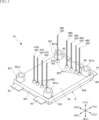
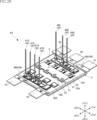
- FIG. 1 is a perspective view showing a semiconductor device according to a first embodiment of the present disclosure.
- FIG. 2 is a partial perspective view showing the semiconductor device according to the first embodiment of the present disclosure.
- FIG. 3 is a partial perspective view showing the semiconductor device according to the first embodiment of the present disclosure.
- FIG. 4 is a plan view showing a semiconductor device according to the first embodiment of the present disclosure.
- FIG. 5 is a partial plan view showing the semiconductor device according to the first embodiment of the present disclosure.
- FIG. 6 is a partial side view showing the semiconductor device according to the first embodiment of the present disclosure.
- FIG. 7 is a partially enlarged plan view showing the semiconductor device according to the first embodiment of the present disclosure.
- FIG. 8 is a partial plan view showing the semiconductor device according to the first embodiment of the present disclosure.
- FIG. 1 is a perspective view showing a semiconductor device according to a first embodiment of the present disclosure.
- FIG. 2 is a partial perspective view showing the semiconductor device according to the first embodiment of the present disclosure.
- FIG. 9 is a partial plan view showing the semiconductor device according to the first embodiment of the present disclosure.
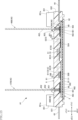
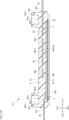
- FIG. 10 is a side view showing the semiconductor device according to the first embodiment of the present disclosure.
- FIG. 11 is a bottom view of the semiconductor device according to the first embodiment of the present disclosure.
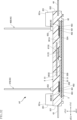
- FIG. 12 is a cross-sectional view taken along line XII-XII in FIG.
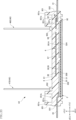
- FIG. 13 is a cross-sectional view taken along line XIII-XIII in FIG.
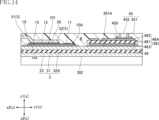
- FIG. 14 is a partially enlarged cross-sectional view showing the semiconductor device according to the first embodiment of the present disclosure.
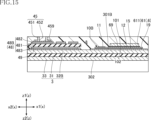
- FIG. 15 is a partially enlarged cross-sectional view showing the semiconductor device according to the first embodiment of the present disclosure.
- FIG. 16 is a cross-sectional view taken along line XVI-XVI in FIG.
- FIG. 17 is a cross-sectional view taken along line XVII-XVII in FIG.
- FIG. 18 is a cross-sectional view taken along line XVIII-XVIII in FIG.
- FIG. 19 is a cross-sectional view taken along line XIX-XIX in FIG.
- FIG. 20 is a sectional view taken along line XX-XX in FIG. 5.
- FIG. 21 is a perspective view showing the second conductive member of the semiconductor device according to the first embodiment of the present disclosure.
- FIG. 22 is a plan view showing the second conductive member of the semiconductor device according to the first embodiment of the present disclosure.
- FIG. 23 is a front view showing the second conductive member of the semiconductor device according to the first embodiment of the present disclosure.
- FIG. 21 is a perspective view showing the second conductive member of the semiconductor device according to the first embodiment of the present disclosure.
- FIG. 22 is a plan view showing the second conductive member of the semiconductor device according to the first embodiment of the present disclosure.
- FIG. 24 is a partially enlarged front view showing the second conductive member of the semiconductor device according to the first embodiment of the present disclosure.
- FIG. 25 is a side view showing the second conductive member of the semiconductor device according to the first embodiment of the present disclosure.
- FIG. 26 is a cross-sectional view showing a first modification of the semiconductor device according to the first embodiment of the present disclosure.
- FIG. 27 is a cross-sectional view showing a first modification of the semiconductor device according to the first embodiment of the present disclosure.
- FIG. 28 is a partial perspective view showing a semiconductor device according to a second embodiment of the present disclosure.
- FIG. 29 is a partial perspective view showing a semiconductor device according to a second embodiment of the present disclosure.
- FIG. 30 is a partial plan view showing a semiconductor device according to a second embodiment of the present disclosure.
- FIG. 31 is a cross-sectional view taken along the XXXI-XXXI line in FIG. 30.
- FIG. 32 is a cross-sectional view taken along line XXXII-XXXII in FIG. 30.
- FIG. 33 is a cross-sectional view taken along the line XXXIII-XXXIII in FIG. 30.
- FIG. 34 is a perspective view showing the second conductive member of the semiconductor device according to the second embodiment of the present disclosure.
- FIG. 35 is a plan view showing the second conductive member of the semiconductor device according to the second embodiment of the present disclosure.
- FIG. 36 is a perspective view showing the second conductive member of the semiconductor device according to the third embodiment of the present disclosure.
- FIG. 37 is a front view showing the second conductive member of the semiconductor device according to the third embodiment of the present disclosure.
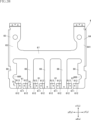
- FIG. 38 is a plan view showing the second conductive member of the semiconductor device according to the fourth embodiment of the present disclosure.
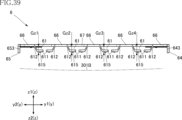
- FIG. 39 is a front view showing the second conductive member of the semiconductor device according to the fourth embodiment of the present disclosure.
- FIG. 40 is a partially enlarged sectional view taken along line XL-XL in FIG. 38.
- FIG. 41 is a plan view showing a first modification of the second conductive member of the semiconductor device according to the fourth embodiment of the present disclosure.
- FIG. 42 is a plan view showing a second modification of the second conductive member of the semiconductor device according to the fourth embodiment of the present disclosure.
- FIG. 43 is a partial front view showing the second conductive member of the semiconductor device according to the fifth embodiment of the present disclosure.
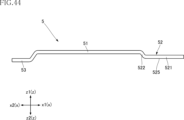
- FIG. 44 is a perspective view showing the first conductive member of the semiconductor device according to the sixth embodiment of the present disclosure.
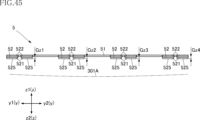
- FIG. 45 is a front view showing the first conductive member of the semiconductor device according to the sixth embodiment of the present disclosure.
- FIG. 46 is a side view showing the first conductive member of the semiconductor device according to the sixth embodiment of the present disclosure.
- FIG. 47 is a partially enlarged cross-sectional view schematically showing the second semiconductor element and the second conductive bonding material of the semiconductor device according to the seventh embodiment of the present disclosure.
- FIG. 48 is a partially enlarged sectional view schematically showing a first semiconductor element and a first conductive bonding material of a semiconductor device according to an eighth embodiment of the present disclosure.
- FIG. 49 is a configuration diagram showing a vehicle equipped with the semiconductor device of the present disclosure.
- a thing A is formed on a thing B and "a thing A is formed on a thing B” mean “a thing A is formed on a thing B” unless otherwise specified.
- "something A is placed on something B” and “something A is placed on something B” mean "something A is placed on something B” unless otherwise specified.
- a certain surface A faces (one side or the other side of) the direction B is not limited to the case where the angle of the surface A with respect to the direction B is 90 degrees; Including cases where it is tilted to the opposite direction.
- the semiconductor device A1 of this embodiment includes a plurality of first semiconductor elements 10A, a plurality of second semiconductor elements 10B, a support substrate 3, a first terminal 41, a second terminal 42, a plurality of third terminals 43, and a fourth terminal 44. , a plurality of control terminals 45 , a control terminal support 48 , a first conduction member 5 , a second conduction member 6 , and a sealing resin 8 .
- FIG. 1 is a perspective view showing a semiconductor device A1.
- 2 and 3 are partial perspective views showing the semiconductor device A1.
- FIG. 4 is a plan view showing the semiconductor device A1.
- FIG. 5 is a partial plan view showing the semiconductor device A1.
- FIG. 6 is a partial side view showing the semiconductor device A1.
- FIG. 7 is a partially enlarged plan view showing the semiconductor device A1.
- 8 and 9 are partial plan views showing the semiconductor device A1.
- FIG. 10 is a side view showing the semiconductor device A1.
- FIG. 11 is a bottom view showing the semiconductor device A1.
- FIG. 12 is a cross-sectional view taken along line XII-XII in FIG.
- FIG. 13 is a cross-sectional view taken along line XIII-XIII in FIG.
- FIG. 14 and 15 are partially enlarged cross-sectional views showing the semiconductor device A1.
- FIG. 16 is a cross-sectional view taken along line XVI-XVI in FIG.
- FIG. 17 is a cross-sectional view taken along line XVII-XVII in FIG.
- FIG. 18 is a cross-sectional view taken along line XVIII-XVIII in FIG.
- FIG. 19 is a cross-sectional view taken along line XIX-XIX in FIG.
- FIG. 20 is a sectional view taken along line XX-XX in FIG. 5.
- FIG. 21 is a perspective view showing the second conductive member 6 of the semiconductor device A1.
- FIG. 22 is a plan view showing the second conductive member 6 of the semiconductor device A1.
- FIG. 23 is a front view showing the second conductive member 6 of the semiconductor device A1.
- FIG. 24 is a partially enlarged front view showing the second conductive member of the semiconductor device A1.
- FIG. 25 is a side view
- the z direction is an example of the thickness direction of the present disclosure
- the x direction is an example of the first direction of the present disclosure
- the y direction is an example of the second direction of the present disclosure.
- one side in the x direction is referred to as the x1 side in the x direction
- the other side in the x direction is referred to as the x2 side in the x direction.
- one side in the y direction is referred to as the y1 side in the y direction
- the other side in the y direction is referred to as the y2 side in the y direction.
- one side in the z direction is referred to as a z1 side in the z direction
- the other side in the z direction is referred to as a z2 side in the z direction.
- the plurality of first semiconductor elements 10A and the plurality of second semiconductor elements 10B are each electronic components that serve as the functional center of the semiconductor device A1.
- the constituent material of each first semiconductor element 10A and each second semiconductor element 10B is, for example, a semiconductor material mainly composed of SiC (silicon carbide). This semiconductor material is not limited to SiC, and may be Si (silicon), GaN (gallium nitride), C (diamond), or the like.
- Each of the first semiconductor elements 10A and each of the second semiconductor elements 10B is a power semiconductor chip having a switching function, such as a MOSFET (Metal Oxide Semiconductor Field Effect Transistor).
- MOSFET Metal Oxide Semiconductor Field Effect Transistor
- first semiconductor element 10A and the second semiconductor element 10B are MOSFETs, but the present invention is not limited to this, and other transistors such as IGBTs (Insulated Gate Bipolar Transistors) can be used. There may be.
- Each first semiconductor element 10A and each second semiconductor element 10B are the same element.
- Each first semiconductor element 10A and each second semiconductor element 10B is, for example, an n-channel MOSFET, but may be a p-channel MOSFET.
- the first semiconductor element 10A and the second semiconductor element 10B each have an element main surface 101 and an element back surface 102, as shown in FIGS. 14 and 15.
- the element main surface 101 and the element back surface 102 are separated in the z direction.
- the element main surface 101 faces the z1 side in the z direction
- the element back surface 102 faces the z2 side in the z direction.
- the semiconductor device A1 includes four first semiconductor elements 10A and four second semiconductor elements 10B, but the number of first semiconductor elements 10A and the number of second semiconductor elements 10B are different from each other. It is not limited to the configuration and may be changed as appropriate depending on the performance required of the semiconductor device A1. In the examples of FIGS. 8 and 9, four first semiconductor elements 10A and four second semiconductor elements 10B are arranged. The number of the first semiconductor elements 10A and the second semiconductor elements 10B may be two or three, or five or more each. The number of first semiconductor elements 10A and the number of second semiconductor elements 10B may be equal or different. The number of first semiconductor elements 10A and second semiconductor elements 10B is determined by the current capacity handled by semiconductor device A1.
- the semiconductor device A1 is configured, for example, as a half-bridge switching circuit.
- the plurality of first semiconductor elements 10A constitute an upper arm circuit of the semiconductor device A1
- the plurality of second semiconductor elements 10B constitute a lower arm circuit.
- the plurality of first semiconductor elements 10A are connected in parallel with each other
- the plurality of second semiconductor elements 10B are connected in parallel with each other.
- Each first semiconductor element 10A and each second semiconductor element 10B are connected in series and constitute a bridge layer.
- the plurality of first semiconductor elements 10A are each mounted on a first conductive portion 32A of the support substrate 3, which will be described later, as shown in FIGS. 8, 9, and 19.
- the plurality of first semiconductor elements 10A are arranged, for example, in the y direction and separated from each other.
- Each first semiconductor element 10A is conductively bonded to the first conductive portion 32A via a conductive bonding material 19.
- the element back surface 102 faces the first conductive part 32A.
- the plurality of first semiconductor elements 10A may be mounted on a metal member different from a part of the DBC substrate or the like. In this case, the metal member corresponds to the first conductive part in the present disclosure. This metal member may be supported by, for example, the first conductive portion 32A.
- the plurality of second semiconductor elements 10B are each mounted on a second conductive portion 32B of the support substrate 3, which will be described later, as shown in FIGS. 8, 9, and 18.
- the plurality of second semiconductor elements 10B are arranged, for example, in the y direction and separated from each other.
- Each second semiconductor element 10B is conductively bonded to the second conductive portion 32B via a conductive bonding material 19.
- the element back surface 102 faces the second conductive part 32B.
- the plurality of first semiconductor elements 10A and the plurality of second semiconductor elements 10B overlap, but they do not need to overlap.
- the plurality of second semiconductor elements 10B may be mounted on a metal member different from a part of the DBC substrate or the like.
- the metal member corresponds to the second conductive part in the present disclosure. This metal member may be supported, for example, by the second conductive portion 32B.
- the plurality of first semiconductor elements 10A and the plurality of second semiconductor elements 10B each have a first main surface electrode 11, a second main surface electrode 12, a third main surface electrode 13, and a back electrode 15.
- the configurations of the first main surface electrode 11, second main surface electrode 12, third main surface electrode 13, and back surface electrode 15 described below are common to each first semiconductor element 10A and each second semiconductor element 10B.
- the first main surface electrode 11, the second main surface electrode 12, and the third main surface electrode 13 are provided on the element main surface 101.
- the first main surface electrode 11, the second main surface electrode 12, and the third main surface electrode 13 are insulated by an insulating film (not shown).
- the back electrode 15 is provided on the back surface 102 of the element.
- the first principal surface electrode 11 is, for example, a gate electrode, and a drive signal (for example, gate voltage) for driving the first semiconductor element 10A (second semiconductor element 10B) is input.
- the second main surface electrode 12 is, for example, a source electrode, through which a source current flows.
- the second main surface electrode 12 of this embodiment has a gate finger 121.
- the gate finger 121 is made of, for example, a linear insulator extending in the x direction, and divides the second main surface electrode 12 into two in the y direction.
- the third main surface electrode 13 is, for example, a source sense electrode, through which a source current flows.
- the back electrode 15 is, for example, a drain electrode, through which a drain current flows.
- the back electrode 15 covers substantially the entire area of the back surface 102 of the element.
- the back electrode 15 is made of, for example, Ag (silver) plating.
- each first semiconductor element 10A (each second semiconductor element 10B) changes between a conductive state and a disconnected state according to this drive signal. The state changes. In a conductive state, a current flows from the back electrode 15 (drain electrode) to the second main surface electrode 12 (source electrode), and in a cutoff state, this current does not flow. That is, each first semiconductor element 10A (each second semiconductor element 10B) performs a switching operation.
- the semiconductor device A1 receives input between one fourth terminal 44 and two first terminals 41 and second terminals 42 due to the switching functions of the plurality of first semiconductor elements 10A and the plurality of second semiconductor elements 10B. For example, the DC voltage is converted into an AC voltage, and the AC voltage is output from the third terminal 43.
- the semiconductor device A1 includes a thermistor 17, as shown in FIGS. 5, 8, 9, etc.
- the thermistor 17 is used as a temperature detection sensor. Note that, in addition to the thermistor 17, the configuration may include, for example, a temperature-sensitive diode, or the configuration may not include the thermistor 17 or the like.
- the support substrate 3 supports the plurality of first semiconductor elements 10A and the plurality of second semiconductor elements 10B.
- the specific structure of the support substrate 3 is not limited at all, and may be formed of, for example, a DBC (Direct Bonded Copper) substrate or an AMB (Active Metal Brazing) substrate.
- Support substrate 3 includes an insulating layer 31, a first metal layer 32, and a back metal layer 33.
- the first metal layer 32 includes a first conductive part 32A and a second conductive part 32B.
- the dimension of the support substrate 3 in the z direction is, for example, 0.4 mm or more and 3.0 mm or less.
- the insulating layer 31 is made of, for example, ceramics with excellent thermal conductivity. Such ceramics include, for example, SiN (silicon nitride).
- the insulating layer 31 is not limited to ceramics, and may be an insulating resin sheet or the like.
- the insulating layer 31 has, for example, a rectangular shape in plan view.
- the dimension of the insulating layer 31 in the z direction is, for example, 0.05 mm or more and 1.0 mm or less.
- the first conductive part 32A supports the plurality of first semiconductor elements 10A
- the second conductive part 32B supports the plurality of second semiconductor elements 10B.
- the first conductive part 32A and the second conductive part 32B are formed on the upper surface of the insulating layer 31 (the surface facing the z1 side in the z direction).
- the constituent material of the first conductive part 32A and the second conductive part 32B includes, for example, Cu (copper).
- the constituent material may include, for example, Al (aluminum) other than Cu (copper).
- the first conductive part 32A and the second conductive part 32B are separated in the x direction.
- the first conductive part 32A is located on the x1 side of the second conductive part 32B in the x direction.
- the first conductive portion 32A and the second conductive portion 32B each have, for example, a rectangular shape in plan view.
- the first conductive part 32A and the second conductive part 32B, together with the first conductive member 5 and the second conductive member 6, are paths for the main circuit current switched by the plurality of first semiconductor elements 10A and the plurality of second semiconductor elements 10B. Configure.
- the first conductive part 32A has a first main surface 301A.
- the first main surface 301A is a plane facing the z1 side in the z direction.
- a plurality of first semiconductor elements 10A are each bonded to the first main surface 301A of the first conductive portion 32A via a conductive bonding material 19.
- the second conductive portion 32B has a second main surface 301B.
- the second main surface 301B is a plane facing the z1 side in the z direction.
- a plurality of second semiconductor elements 10B are bonded to the second main surface 301B of the second conductive portion 32B via a conductive bonding material 19.
- the constituent material of the conductive bonding material 19 is not particularly limited, and may be, for example, solder, metal paste material, or sintered metal.
- the dimensions of the first conductive part 32A and the second conductive part 32B in the z direction are, for example, 0.1 mm or more and 1.5 mm or less.
- the back metal layer 33 is formed on the lower surface of the insulating layer 31 (the surface facing the z2 side in the z direction).
- the constituent material of the back metal layer 33 is the same as that of the first metal layer 32.
- Back metal layer 33 has a back surface 302.
- the back surface 302 is a plane facing the z2 side in the z direction. In the example shown in FIG. 11, the back surface 302 is exposed from the sealing resin 8, for example.
- a heat dissipating member for example, a heat sink, etc. (not shown) can be attached to the back surface 302.
- the back surface 302 may not be exposed from the sealing resin 8 and may be covered with the sealing resin 8.
- the back metal layer 33 overlaps both the first conductive part 32A and the second conductive part 32B in plan view.
- the first terminal 41, the second terminal 42, the plurality of third terminals 43, and the fourth terminal 44 are each made of a plate-shaped metal plate.
- This metal plate includes, for example, Cu (copper) or a Cu (copper) alloy. In the examples shown in FIGS. 1 to 5, FIG. 8, FIG. 9, and FIG. However, the number of each terminal is not limited at all.
- a DC voltage to be subjected to power conversion is input to the first terminal 41, the second terminal 42, and the fourth terminal 44.
- the fourth terminal 44 is a positive electrode (P terminal), and the first terminal 41 and the second terminal 42 are each negative electrodes (N terminal).
- P terminal positive electrode
- N terminal negative electrodes
- the first terminal 41 , the second terminal 42 , the plurality of third terminals 43 , and the fourth terminal 44 each include a portion covered with the sealing resin 8 and a portion exposed from the sealing resin 8 .
- the fourth terminal 44 is electrically connected to the first conductive portion 32A.
- the method of conductive bonding is not limited at all, and methods such as ultrasonic bonding, laser bonding, welding, or methods using solder, metal paste, silver sintered body, etc. are appropriately employed.
- the fourth terminal 44 is located on the x1 side in the x direction with respect to the plurality of first semiconductor elements 10A and the first conductive portion 32A, as shown in FIGS. 8, 9, and the like.
- the fourth terminal 44 is electrically connected to the first conductive portion 32A and, via the first conductive portion 32A, to the back electrode 15 (drain electrode) of each first semiconductor element 10A.
- the first terminal 41 and the second terminal 42 are electrically connected to the second conductive member 6.
- the first terminal 41 and the second conductive member 6 are integrally formed.
- the first terminal 41 and the second conductive member 6 are integrally formed, for example, by cutting and bending a single metal plate material, and are joined together. Refers to a configuration that does not include any bonding materials, etc.
- the second terminal 42 and the second conductive member 6 are integrally formed. Note that the first terminal 41 and the second terminal 42 may have a structure as long as they are electrically connected to the second conductive member 6, and unlike this embodiment, they may have a structure that has a joint portion that joins them to each other.
- the first terminal 41 and the second terminal 42 are respectively located on the x1 side in the x direction with respect to the plurality of first semiconductor elements 10A and the first conductive portion 32A, as shown in FIGS. 5, 8, and the like.
- the first terminal 41 and the second terminal 42 are each electrically connected to the second conductive member 6 and connected to the second main surface electrode 12 (source electrode) of each second semiconductor element 10B via the second conductive member 6. Conduct.
- the first terminal 41, the second terminal 42, and the fourth terminal 44 each protrude from the sealing resin 8 toward the x1 side in the x direction in the semiconductor device A1.
- the first terminal 41, the second terminal 42, and the fourth terminal 44 are spaced apart from each other.
- the first terminal 41 and the second terminal 42 are located on opposite sides of the fourth terminal 44 in the y direction.
- the first terminal 41 is located on the y1 side of the fourth terminal 44 in the y direction
- the second terminal 42 is located on the y2 side of the fourth terminal 44 in the y direction.
- the first terminal 41, the second terminal 42, and the fourth terminal 44 overlap each other when viewed in the y direction.
- the two third terminals 43 are each electrically connected to the second conductive portion 32B.
- the method of conductive bonding is not limited at all, and methods such as ultrasonic bonding, laser bonding, welding, or methods using solder, metal paste, silver sintered body, etc. are appropriately employed.
- the two third terminals 43 are each located on the x2 side in the x direction with respect to the plurality of second semiconductor elements 10B and the second conductive portion 32B.
- Each third terminal 43 is electrically connected to the second conductive portion 32B and, via the second conductive portion 32B, to the back electrode 15 (drain electrode) of each second semiconductor element 10B.
- third terminals 43 is not limited to two, and may be one, for example, or three or more. For example, when there is only one third terminal 43, it is desirable that it is connected to the central portion of the second conductive portion 32B in the y direction.
- Each of the plurality of control terminals 45 is a pin-shaped terminal for controlling each first semiconductor element 10A and each second semiconductor element 10B.
- the plurality of control terminals 45 include a plurality of first control terminals 46A-46E and a plurality of second control terminals 47A-47D.
- the plurality of first control terminals 46A to 46E are used for controlling each first semiconductor element 10A.
- the plurality of second control terminals 47A to 47D are used for controlling each second semiconductor element 10B.
- the plurality of first control terminals 46A to 46E are arranged at intervals in the y direction. As shown in FIGS. 8, 13, and 20, each of the first control terminals 46A to 46E is supported by the first conductive portion 32A via a control terminal support 48 (a first support portion 48A to be described later). Ru. As shown in FIGS. 5 and 8, each of the first control terminals 46A to 46E is connected between the plurality of first semiconductor elements 10A and the first terminal 41, the second terminal 42, and the fourth terminal 44 in the x direction. Located in
- the first control terminal 46A is a terminal (gate terminal) for inputting a drive signal for the plurality of first semiconductor elements 10A.
- a drive signal for driving the plurality of first semiconductor elements 10A is input to the first control terminal 46A (for example, a gate voltage is applied).
- the first control terminal 46B is a source signal detection terminal (source sense terminal) of the plurality of first semiconductor elements 10A.
- the voltage (voltage corresponding to the source current) applied to each second main surface electrode 12 (source electrode) of the plurality of first semiconductor elements 10A is detected from the first control terminal 46B.
- the first control terminal 46C and the first control terminal 46D are terminals that are electrically connected to the thermistor 17.
- the first control terminal 46E is a drain signal detection terminal (drain sense terminal) of the plurality of first semiconductor elements 10A.
- the voltage (voltage corresponding to the drain current) applied to each back electrode 15 (drain electrode) of the plurality of first semiconductor elements 10A is detected from the first control terminal 46E.
- the plurality of second control terminals 47A to 47D are arranged at intervals in the y direction. As shown in FIGS. 8 and 13, each of the second control terminals 47A to 47D is supported by the second conductive portion 32B via a control terminal support 48 (second support portion 48B to be described later). Each of the second control terminals 47A to 47D is located between the plurality of second semiconductor elements 10B and the two third terminals 43 in the x direction, as shown in FIGS. 5 and 8.
- the second control terminal 47A is a terminal (gate terminal) for inputting drive signals for the plurality of second semiconductor elements 10B.
- a drive signal for driving the plurality of second semiconductor elements 10B is input to the second control terminal 47A (for example, a gate voltage is applied).
- the second control terminal 47B is a terminal (source sense terminal) for detecting source signals of the plurality of second semiconductor elements 10B.
- the voltage (voltage corresponding to the source current) applied to each second main surface electrode 12 (source electrode) of the plurality of second semiconductor elements 10B is detected from the second control terminal 47B.
- the second control terminal 47C and the second control terminal 47D are terminals that are electrically connected to the thermistor 17.
- Each of the plurality of control terminals 45 (the plurality of first control terminals 46A to 46E and the plurality of second control terminals 47A to 47D) includes a holder 451 and a metal pin 452.
- the holder 451 is made of a conductive material. As shown in FIGS. 14 and 15, the holder 451 is bonded to the control terminal support 48 (first metal layer 482, which will be described later) via a conductive bonding material 459.
- the holder 451 includes a cylindrical portion, an upper end flange, and a lower end flange. The upper end flange is connected above the cylindrical part, and the lower end flange is connected below the cylindrical part.
- a metal pin 452 is inserted through at least the upper end flange and the cylindrical portion of the holder 451 .
- the holder 451 is covered with a sealing resin 8 (a second protrusion 852 to be described later).
- the metal pin 452 is a rod-shaped member extending in the z direction.
- the metal pin 452 is supported by being press-fitted into the holder 451.
- the metal pin 452 is electrically connected to the control terminal support 48 (first metal layer 482 described below) through at least the holder 451.
- the control terminal support 48 first metal layer 482 described below
- the metal pin 452 is electrically connected to the control terminal support 48 via a conductive bonding material 459.
- the control terminal support 48 supports the plurality of control terminals 45.
- the control terminal support body 48 is interposed between the first main surface 301A and the second main surface 301B and the plurality of control terminals 45 in the z direction.
- the control terminal support 48 includes a first support portion 48A and a second support portion 48B.
- the first support portion 48A is disposed on the first conductive portion 32A and supports a plurality of first control terminals 46A to 46E among the plurality of control terminals 45.
- the first support portion 48A is bonded to the first conductive portion 32A via a bonding material 49, as shown in FIG.
- the bonding material 49 may be conductive or insulating, and for example, solder is used.
- the second support portion 48B is disposed on the second conductive portion 32B and supports a plurality of second control terminals 47A to 47D among the plurality of control terminals 45.
- the second support portion 48B is bonded to the second conductive portion 32B via a bonding material 49, as shown in FIG.
- the control terminal support body 48 (each of the first support part 48A and the second support part 48B) is composed of, for example, a DBC (Direct Bonded Copper) board.
- the control terminal support 48 includes an insulating layer 481, a first metal layer 482, and a second metal layer 483 that are stacked on each other.
- the insulating layer 481 is made of ceramics, for example.
- the insulating layer 481 has, for example, a rectangular shape in plan view.
- the first metal layer 482 is formed on the upper surface of the insulating layer 481, as shown in FIGS. 14, 15, etc. Each control terminal 45 is erected on the first metal layer 482.
- the first metal layer 482 includes, for example, Cu (copper) or a Cu (copper) alloy. As shown in FIG. 8 and the like, the first metal layer 482 includes a first portion 482A, a second portion 482B, a third portion 482C, a fourth portion 482D, a fifth portion 482E, and a sixth portion 482F.
- the first portion 482A, the second portion 482B, the third portion 482C, the fourth portion 482D, the fifth portion 482E, and the sixth portion 482F are spaced apart and insulated from each other.
- the first portion 482A is connected to a plurality of wires 71 and is electrically connected to the first main surface electrode 11 (gate electrode) of each first semiconductor element 10A (each second semiconductor element 10B) via each wire 71.
- a plurality of wires 73 are connected to the first portion 482A and the sixth portion 482F.
- the sixth portion 482F is electrically connected to the first main surface electrode 11 (gate electrode) of each first semiconductor element 10A (each second semiconductor element 10B) via the wire 73 and the wire 71.
- the first control terminal 46A is connected to the sixth portion 482F of the first support portion 48A
- the second control terminal 47A is connected to the sixth portion 482F of the second support portion 48B. It is joined.
- the second portion 482B has a plurality of wires 72 joined and is electrically connected to the third main surface electrode 13 (source sense electrode) of each first semiconductor element 10A (each second semiconductor element 10B) via each wire 72.
- the first control terminal 46B is connected to the second portion 482B of the first support portion 48A
- the second control terminal 47B is connected to the second portion 482B of the second support portion 48B. It is joined.
- the thermistor 17 is joined to the third portion 482C and the fourth portion 482D.
- first control terminals 46C and 46D are connected to the third portion 482C and fourth portion 482D of the first support portion 48A
- the third portion 482C and the fourth portion 482D of the second support portion 48B are Second control terminals 47C and 47D are connected to the fourth portion 482D.
- a wire 74 is joined to the fifth portion 482E of the first support portion 48A, and the fifth portion 482E is electrically connected to the first conductive portion 32A via the wire 74. As shown in FIG. 8, the first control terminal 46E is joined to the fifth portion 482E of the first support portion 48A. The fifth portion 482E of the second support portion 48B is not electrically connected to other components.
- Each of the wires 71 to 74 described above is, for example, a bonding wire.
- the constituent material of each wire 71 to 74 includes, for example, one of Au (gold), Al (aluminum), or Cu (copper).
- the second metal layer 483 is formed on the lower surface of the insulating layer 481, as shown in FIGS. 14, 15, etc.
- the second metal layer 483 of the first support portion 48A is bonded to the first conductive portion 32A via a bonding material 49, as shown in FIG.
- the second metal layer 483 of the second support portion 48B is bonded to the second conductive portion 32B via a bonding material 49, as shown in FIG.
- the first conductive member 5 and the second conductive member 6 are spaced apart from the first main surface 301A and the second main surface 301B toward the z1 side in the z direction, and are separated from the first main surface 301A and the second main surface 301B in a plan view. overlaps with In this embodiment, the first conductive member 5 and the second conductive member 6 are each made of a metal plate.
- the metal includes, for example, Cu (copper) or a Cu (copper) alloy.
- the first conductive member 5 and the second conductive member 6 are appropriately bent metal plates.
- the first conductive member 5 is connected to the second main surface electrode 12 (source electrode) of each first semiconductor element 10A and the second conductive part 32B, and is connected to the second main surface electrode 12 (source electrode) of each first semiconductor element 10A and the second conductive part 32B. 2 conductive portion 32B.
- the first conductive member 5 constitutes a path for main circuit current switched by the plurality of first semiconductor elements 10A.
- the first conductive member 5 includes a main portion 51, a plurality of first joints 52, and a plurality of second joints 53, as shown in FIGS. 7 and 8.
- the main portion 51 is a band-shaped portion that is located between the plurality of first semiconductor elements 10A and the second conductive portion 32B in the x direction and extends in the y direction in a plan view.
- the main portion 51 overlaps both the first conductive portion 32A and the second conductive portion 32B in a plan view, and is spaced from the first main surface 301A and the second main surface 301B in the z direction toward the z1 side in the z direction.
- the main portion 51 is located on the z2 side in the z direction with respect to a third path portion 66 and a fourth path portion 67 of the second conductive member 6, which will be described later, and is located on the z2 side in the z direction. It is located closer to the first main surface 301A and the second main surface 301B than the fourth path portion 67 is.
- the main portion 51 is arranged parallel to the first main surface 301A and the second main surface 301B.
- the main portion 51 extends continuously in the y direction corresponding to the region where the plurality of first semiconductor elements 10A are arranged.
- a plurality of first openings 514 are formed in the main portion 51.
- Each of the plurality of first openings 514 is, for example, a through hole penetrating in the z direction (thickness direction of the main portion 51).
- the plurality of first openings 514 are arranged at intervals in the y direction.
- the plurality of first openings 514 are provided corresponding to each of the plurality of first semiconductor elements 10A.
- the main portion 51 is provided with four first openings 514, and these first openings 514 and the plurality of (four) first semiconductor elements 10A are at the same position in the y direction.
- each first opening 514 overlaps the gap between the first conductive part 32A and the second conductive part 32B in plan view.
- the plurality of first openings 514 are arranged so that the upper side (z1 side in the z direction) and the It is formed to facilitate the flow of the resin material between the lower side (z2 side in the z direction).
- each first joint portion 52 and the plurality of second bonding portions 53 are each connected to the main portion 51 and are arranged corresponding to the plurality of first semiconductor elements 10A.
- each first joint portion 52 is located on the x1 side in the x direction with respect to the main portion 51.
- Each second joint portion 53 is located on the x2 side of the main portion 51 in the x direction.
- each first bonding portion 52 and the corresponding second main surface electrode 12 of one of the first semiconductor elements 10A are bonded via a conductive bonding material 59.
- Each second joint portion 53 and the second conductive portion 32B are joined via a conductive joining material 59.
- the constituent material of the conductive bonding material 59 is not particularly limited, and may be, for example, solder, metal paste material, or sintered metal.
- the first joint portion 52 has two portions spaced apart in the y direction. These two parts are joined to the second main surface electrode 12 on both sides in the y direction, with the gate fingers 121 of the second main surface electrode 12 of the first semiconductor element 10A interposed therebetween.
- the second conductive member 6 connects the second main surface electrode 12 (source electrode) of each second semiconductor element 10B to the first terminal 41 and the second terminal 42.
- the second conductive member 6 is integrally formed with the first terminal 41 and the second terminal 42.
- the second conductive member 6 constitutes a path for main circuit current switched by the plurality of second semiconductor elements 10B. As shown in FIG. 7 and FIG. 21 to FIG. A path section 67 is included. Further, in the illustrated example, the second conductive member 6 includes a first step portion 602 and a second step portion 603.
- the plurality of third bonding parts 61 are parts that are individually bonded to the plurality of second semiconductor elements 10B.
- Each third bonding portion 61 and the second main surface electrode 12 of each second semiconductor element 10B are bonded via a conductive bonding material 69.
- the constituent material of the conductive bonding material 69 is not particularly limited, and may be, for example, solder, metal paste material, or sintered metal.
- the third joint portion 61 has two flat portions 611 and two first inclined portions 612.
- the two flat parts 611 are lined up in the y direction.
- the two flat parts 611 are spaced apart from each other in the y direction.
- the shape of the flat portion 611 is not limited at all, and in the illustrated example, it is rectangular.
- the two flat parts are joined to the second main surface electrode 12 on both sides in the y direction, with the gate finger 121 of the second main surface electrode 12 of the second semiconductor element 10B interposed therebetween.
- the two first inclined parts 612 are connected to the outside of the two flat parts 611 in the y direction. That is, the first inclined portion 612 located on the y1 side in the y direction is connected to the y1 side in the y direction with respect to the flat portion 611 located on the y1 side in the y direction. Further, the first inclined portion 612 located on the y2 side in the y direction is connected to the y2 side in the y direction with respect to the flat portion 611 located on the y2 side in the y direction.
- the first inclined portion 612 is inclined so that the farther it is from the flat portion 611 in the y direction, the closer it is to the z1 side in the z direction.
- the first path portion 64 is interposed between the plurality of third joint portions 61 and the first terminal 41.
- the first path section 64 is connected to the first terminal 41 via the first step section 602.
- the first path portion 64 overlaps the first conductive portion 32A in plan view.
- the first path portion 64 has a shape that extends in the x direction as a whole.
- the first path portion 64 includes a first strip portion 641 and a first extension portion 643.
- the first strip portion 641 is located on the x2 side in the x direction with respect to the first terminal 41, and is substantially parallel to the first main surface 301A.
- the first strip portion 641 has a shape that extends in the x direction as a whole.
- the first strip 641 has a recess 649 .
- the recessed portion 649 is a portion where a portion of the first strip portion 641 is recessed toward the y1 side in the y direction. In FIG. 5, the first metal part 35 is exposed through the recess 649.
- the first extending portion 643 extends from the side end of the first strip portion 641 on the y1 side in the y direction to the z2 side in the z direction.
- the first extending portion 643 is spaced apart from the first conductive portion 32A.
- the first extending portion 643 has a shape along the z direction, and has an elongated rectangular shape whose longitudinal direction is the x direction.
- the first path portion 64 may have a configuration in which the first extending portion 643 is not included.
- the second path portion 65 is interposed between the plurality of third joint portions 61 and the second terminal 42.
- the second path section 65 is connected to the second terminal 42 via the second step section 603.
- the second path portion 65 overlaps the first conductive portion 32A in plan view.
- the second path portion 65 has a shape that extends in the x direction as a whole.
- the second path portion 65 includes a second strip portion 651 and a second extension portion 653.
- the second strip portion 651 is located on the x2 side in the x direction with respect to the second terminal 42, and is substantially parallel to the first main surface 301A.
- the second strip portion 651 has a shape that extends in the x direction as a whole.
- the second strip portion 651 has a recess 659 .
- the recessed portion 659 is a portion of the second strip portion 651 that is recessed toward the y2 side in the y direction. In FIG. 5, the second metal portion 36 is exposed through the recess 659.
- the second extending portion 653 extends from the side end of the second strip portion 651 on the y2 side in the y direction to the z2 side in the z direction.
- the second extending portion 653 is spaced apart from the first conductive portion 32A.
- the second extending portion 653 has a shape along the z direction, and has an elongated rectangular shape whose longitudinal direction is the x direction. Note that the second path portion 65 may be configured without the second extension portion 653.
- the configuration regarding the first path section 64 is, for example, in a line-symmetrical relationship with respect to a center line extending in the x direction,
- the second path section 65 can also be appropriately adopted.
- the plurality of third path portions 66 are individually connected to the plurality of third joint portions 61.
- Each of the third path sections 66 has a shape extending in the x direction, and is arranged to be spaced apart from each other in the y direction.
- the number of the plurality of third path sections 66 is not limited at all, and in the illustrated example, five third path sections 66 are arranged.
- Each third path section 66 is arranged to be located between the plurality of second semiconductor elements 10B in the y direction or to be located outside of the plurality of second semiconductor elements 10B in the y direction. .
- Concave portions 669 are formed in the two third path portions 66 located on both outer sides in the y direction.
- the recess 669 is recessed from the inside to the outside in the y direction.
- one recess 669 is formed in each of the two third path portions 66 .
- the second conductive portion 32B is exposed through these recesses 669.
- one third joint portion 61 is arranged between two third path portions 66 adjacent to each other in the y direction.
- the first inclined part 612 located on the y1 side in the y direction is the third route part located on the y1 side in the y direction among the two third route parts 66 adjacent in the y direction. It is connected to 66.
- the first inclined portion 612 located on the y2 side in the y direction is the third path portion 612 located on the y2 side in the y direction among the two third path portions 66 adjacent in the y direction. It is connected to 66.
- the fourth path portion 67 is connected to the end of the plurality of third path portions 66 on the x1 side in the x direction.
- the fourth path portion 67 has a shape that extends long in the y direction.
- the fourth path portion 67 is connected to the ends of the first band portion 641 of the first path portion 64 and the second band portion 651 of the second path portion 65 on the x2 side in the x direction.
- the first path portion 64 is connected to the end of the fourth path portion 67 on the y1 side in the y direction.
- the second path portion 65 is connected to the end of the fourth path portion 67 on the y2 side in the y direction.
- the third joint portion 61 has a third tip portion 615.
- the third tip portion 615 is a portion of the third joint portion 61 located on the z2 side in the z direction. Which part of the third joint part 61 constitutes the third tip part 615 can be set in various ways depending on the specific shape of the third joint part 61 and the like. In the illustrated example, the surface of the flat portion 611 on the z2 side in the z direction constitutes the third tip portion 615.
- the positions of the third tip portions 615 of the plurality of third bonding portions 61 in the z direction are set in accordance with the curvature of the support substrate 3. More specifically, as shown in FIG. 23, the positions of the plurality of third path sections 66 in the z direction are the same. Further, the positions of the plurality of third path portions 66 and the fourth path portions 67 in the z direction are the same. The distance Gz in the z direction between the third tip portions 615 of the plurality of third joint portions 61 and the fifth joint portion 63 is set in accordance with the curvature of the support substrate 3.
- the distance Gz1, the distance Gz2, the distance Gz3, and the distance Gz4 are set in order from the distance Gz of the third joint 61 located on the y2 side in the y direction.
- the curved imaginary line in the figure shows the curved shape of the curved second main surface 301B of the support substrate 3 in an exaggerated manner for convenience of understanding.
- the second main surface 301B is curved such that the center portion in the y direction is located on the z2 side in the z direction, and both end portions in the y direction are located on the z1 side in the z direction.
- distance Gz1 is smaller than distance Gz2.
- the distance Gz4 is smaller than the distance Gz3.
- the distance Gz1 and the distance Gz4 are, for example, substantially the same, and the distance Gz2 and the distance Gz3 are substantially the same.
- the difference between the distance Gz1 and the distance Gz2 is, for example, about 40 ⁇ m.
- the difference between the distances Gz3 and Gz4 is, for example, about 40 ⁇ m.
- the thickness of the conductive bonding material 69 is, for example, 60 ⁇ m or more and 120 ⁇ m or less. Note that the magnitude relationship between the distances Gz1 to Gz4 is appropriately set depending on the direction and amount of curvature of the support substrate 3 (second main surface 301B).
- the thickness t2 of the first inclined portion 612 is thinner than the thickness t1 of the flat portion 611. Further, the thickness t2 of the first inclined portion 612 is thinner than the thickness t0 of the third path portion 66. Further, the thickness t1 of the flat portion 611 and the thickness t0 of the third path portion 66 are the same.
- an intermediate portion that will become the flat portion 611 and the first inclined portion 612 is formed in a metal plate material by cutting or the like.
- one third joint portion 61 is formed by two intermediate portions.
- a gap 619 is provided between these two intermediate portions.
- the gap 619 is a portion where the gate finger 121 of the second main surface electrode 12 of the second semiconductor element 10B is positioned. Therefore, the size of the gap 619 is set to be approximately the same as or slightly larger than the y-direction dimension of the gate finger 121, for example.
- the portions that will become the two flat portions 611 are sandwiched between, for example, a mold, and moved toward the z2 side in the z direction with respect to the third path portion 66 and the fourth path portion 67.
- a portion of each of the two intermediate portions has an inclined shape, forming two first inclined portions 612.
- the portion that becomes the first inclined portion 612 is subjected to tension processing. Therefore, the thickness t2 is thinner than the thickness t1 and the thickness t0.
- the dimension of the gap 619 in the y direction hardly changes before and after moving the mold toward the z2 side in the z direction.
- the magnitudes of the distances Gz1 to Gz4 described above can be adjusted, for example, by the amount by which the mold is moved.
- the sealing resin 8 includes a plurality of first semiconductor elements 10A, a plurality of second semiconductor elements 10B, a support substrate 3 (excluding the back surface 302), a first terminal 41, a second terminal 42, and a plurality of third terminals. 43, a portion of the fourth terminal 44, a portion of the plurality of control terminals 45, the control terminal support 48, the first conduction member 5, the second conduction member 6, and the plurality of wires 71 to 43.
- the wires 74 and 74 are respectively covered.
- the sealing resin 8 is made of, for example, black epoxy resin.
- the sealing resin 8 is formed by, for example, molding.
- the sealing resin 8 has, for example, a dimension in the x direction of about 35 mm to 60 mm, a dimension in the y direction, for example, about 35 mm to 50 mm, and a dimension in the z direction, for example, about 4 mm to 15 mm. These dimensions are the largest along each direction.
- the sealing resin 8 has a resin main surface 81, a resin back surface 82, and a plurality of resin side surfaces 831 to 834.
- the resin main surface 81 and the resin back surface 82 are separated in the z direction, as shown in FIGS. 10, 12, and 18.
- the main resin surface 81 faces the z1 side in the z direction
- the resin back surface 82 faces the z2 side in the z direction.
- a plurality of control terminals 45 protrude from the main resin surface 81.
- the resin back surface 82 has a frame shape that surrounds the back surface 302 of the support substrate 3 (the lower surface of the back metal layer 33) in plan view.
- the back surface 302 of the support substrate 3 is exposed from the resin back surface 82, and is flush with the resin back surface 82, for example.
- Each of the plurality of resin side surfaces 831 to 834 is connected to both the resin main surface 81 and the resin back surface 82, and is sandwiched between them in the z direction. As shown in FIG. 4 and the like, the resin side surface 831 and the resin side surface 832 are separated from each other in the x direction.
- the resin side surface 831 faces the x2 side in the x direction
- the resin side surface 832 faces the x1 side in the x direction.
- Two third terminals 43 protrude from the resin side surface 831, and a first terminal 41, a second terminal 42, and a fourth terminal 44 protrude from the resin side surface 832.
- the resin side surface 833 and the resin side surface 834 are separated from each other in the y direction.
- the resin side surface 833 faces the y2 side in the y direction
- the resin side surface 834 faces the y1 side in the y direction.
- a plurality of recesses 832a are formed in the resin side surface 832.
- Each recessed portion 832a is a portion depressed in the x direction in plan view.
- the plurality of recesses 832a include those formed between the first terminal 41 and the fourth terminal 44 and those formed between the second terminal 42 and the fourth terminal 44 in plan view.
- the plurality of recesses 832a are provided to increase the creepage distance along the resin side surface 832 between the first terminal 41 and the fourth terminal 44, and the creepage distance along the resin side surface 832 between the second terminal 42 and the fourth terminal 44. It is provided.
- the sealing resin 8 has a plurality of first protrusions 851, a plurality of second protrusions 852, and a resin cavity 86, as shown in FIGS. 12 and 13.
- Each of the plurality of first protrusions 851 protrudes from the main resin surface 81 in the z direction.
- the plurality of first protrusions 851 are arranged near the four corners of the sealing resin 8 in plan view.
- a first protrusion end surface 851a is formed at the tip of each first protrusion 851 (end on the z1 side in the z direction).
- Each first protruding end surface 851a of the plurality of first protrusions 851 is substantially parallel to the main resin surface 81 and on the same plane (xy plane).
- Each first protrusion 851 is, for example, shaped like a hollow truncated cone with a bottom.
- the plurality of first protrusions 851 are used as spacers when the semiconductor device A1 is mounted on a control circuit board or the like of a device that uses a power source generated by the semiconductor device A1.
- Each of the plurality of first protrusions 851 has a recess 851b and an inner wall surface 851c formed in the recess 851b.
- the shape of each first protrusion 851 may be columnar, and is preferably columnar.
- the recess 851b has a cylindrical shape
- the inner wall surface 851c has a single perfect circular shape when viewed from above.
- the semiconductor device A1 may be mechanically fixed to a control circuit board or the like by a method such as screwing.
- a female thread can be formed on the inner wall surface 851c of the recess 851b in the plurality of first protrusions 851.
- Insert nuts may be embedded in the recesses 851b of the plurality of first protrusions 851.
- the plurality of second protrusions 852 protrude from the main resin surface 81 in the z direction, as shown in FIG. 13 and the like.
- the plurality of second protrusions 852 overlap the plurality of control terminals 45 in plan view.
- Each metal pin 452 of the plurality of control terminals 45 protrudes from each second protrusion 852 .
- Each second protrusion 852 has a truncated cone shape.
- the second protrusion 852 covers the holder 451 and a portion of the metal pin 452 at each control terminal 45 .
- the first terminal 41 and the second conductive member 6 are integrally formed. Thereby, compared to a configuration in which the first terminal 41 and the second conductive member 6 are joined, it is possible to reduce the number of joining steps in the manufacturing process of the semiconductor device A1. Moreover, it is possible to avoid cracking, peeling, etc. from occurring at the bonded portion when the semiconductor device A1 is used. Therefore, it is possible to simplify the manufacturing process of the semiconductor device A1 or improve its reliability during use.
- the second terminal 42 and the second conductive member 6 are integrally formed. Thereby, compared to a configuration in which the second terminal 42 and the second conductive member 6 are joined, it is possible to reduce the number of joining steps in the manufacturing process of the semiconductor device A1. Moreover, it is possible to avoid cracking, peeling, etc. from occurring at the bonded portion when the semiconductor device A1 is used. Therefore, it is possible to simplify the manufacturing process of the semiconductor device A1 or improve its reliability during use.
- the second conductive member 6 has a first stepped portion 602 connected to the first terminal 41. Thereby, the rigidity of the connecting portion between the second conductive member 6 and the first terminal 41 can be increased.
- the second conductive member 6 has a second stepped portion 603 connected to the second terminal 42. Thereby, the rigidity of the connecting portion between the second conductive member 6 and the second terminal 42 can be increased.
- the third joint part 61 has two flat parts 611 and two first slope parts 612.
- the two first inclined parts 612 are connected to the outside of the two flat parts 611 in the y direction. Therefore, the current flowing through the second main surface electrode 12 flows from the second main surface electrode 12 to both sides in the y direction via the flat part 611 and the first slope part 612. Thereby, it is possible to suppress the current flowing through the second main surface electrode 12 from concentrating in one place.
- the two flat parts 611 are separated in the y direction. This allows current to flow reliably through both the two flat parts 611 and the two first slope parts 612, which is preferable for suppressing current concentration.
- the gate finger 121 of the second main surface electrode 12 can be placed between them.
- One third joint portion 61 is arranged between two third path portions 66 adjacent in the y direction. Thereby, it is possible to distribute the current flowing through the second main surface electrode 12 of one second semiconductor element 10B to the two third path sections 66.
- the position of the third tip portion 615 of the plurality of third bonding portions 61 in the z direction is set in accordance with the curvature of the support substrate 3 (second main surface 301B). Thereby, it is possible to make the distances in the z direction between the third tip portions 615 of the plurality of third joint portions 61 and the second main surface electrodes 12 of the plurality of second semiconductor elements 10B more uniform. As a result, the thickness of the conductive bonding material 69 that joins the second main surface electrode 12 and the third bonding portion 61 of any of the second semiconductor elements 10B becomes unduly thin, and the conductive bonding material 69 may It is possible to suppress the occurrence of cracks and peeling, and it is possible to suppress shortening of the product life.
- the distance Gz in the z direction between the flat portions 611 of the plurality of third joint portions 61 and the third path portion 66 is set in accordance with the curvature of the support substrate 3 (second main surface 301B). ing.
- the third path portion 66, the fourth path portion 67, etc. are formed into a flat shape, for example, regardless of the curvature of the support substrate 3, and when the plurality of third joint portions 61 are formed, the third path portion 66, the fourth path portion 67, etc. , the curvature of the support substrate 3 may be considered.
- the thickness t2 of the first inclined portion 612 is thinner than the thickness t1 of the flat portion 611.
- Such a configuration can be formed by the above-mentioned tensile processing using a mold. In this case, there is an advantage that the size of the gap 619 can be easily controlled to a desired size.
- 26-48 illustrate variations and other embodiments of the present disclosure.
- the same or similar elements as in the above embodiment are given the same reference numerals as in the above embodiment.
- the configurations of each part in each modification and each embodiment can be combined with each other as appropriate within a range that does not cause technical contradiction.
- 26 and 27 show a first modification of the semiconductor device A1.
- the second conductive member 6 does not have the above-described first step portion 602 and second step portion 603.
- the position of the first terminal 41 in the z-direction is the same as the position of the first strip portion 641 of the first path portion 64 in the z-direction. That is, the first terminal 41 and the first strip portion 641 are connected to form an integral flat plate.
- the position of the second terminal 42 in the z-direction is the same as the position of the second strip portion 651 of the second path portion 65 in the z-direction. That is, the second terminal 42 and the second strip portion 651 are connected to form an integral flat plate.
- the specific shape of the connecting portion between the second conductive member 6, the first terminal 41, and the second terminal 42 is not limited at all.
- the semiconductor device A2 of this embodiment differs from the above-described embodiment mainly in the configuration of the second conductive member 6.
- the dimension in the x direction of the fourth path portion 67 of the second conductive member 6 is the same as that in the x direction of the fourth path portion 67 in the above-described embodiment.
- larger than the dimensions of The fourth path portion 67 has a size that overlaps both the first conductive portion 32A and the second conductive portion 32B when viewed in the z direction.
- the dimension of the third path section 66 in the x direction is significantly smaller than the dimension of the fourth path section 67 in the x direction.
- the gap between the fourth path portion 67 and the third joint portion 61 in the x direction is smaller than the dimension of the third joint portion 61 in the x direction.
- the second conductive member 6, the first terminal 41, and the second terminal 42 are connected to each other via a conductive bonding material 69. It is joined. That is, the second conductive member 6, the first terminal 41, and the second terminal 42 are not integrally formed.
- the conductive bonding material 69 is, for example, solder, metal paste material, or sintered metal.
- the second conductive member 6 has a fourth joint 62 and a fifth joint 63.
- the fourth joint portion 62 is connected to the end of the first path portion 64 on the x1 side in the x direction.
- the fourth joint portion 62 is joined to the first terminal 41 by a conductive joining material 69.
- the fifth joint portion 63 is connected to the end of the second path portion 65 on the x1 side in the x direction.
- the fifth bonding portion 63 is bonded to the second terminal 42 by a conductive bonding material 69.
- the thermistor 17 is not provided in the first support portion 48A. Therefore, the semiconductor device A2 does not include the first control terminal 46C and the first control terminal 46D in the above embodiment.
- the second conductive member 6, the first terminal 41, and the second terminal 42 may not be integrally formed.
- the fourth path portion 67 has a large dimension in the x direction, for example, larger than the dimension in the x direction of the third path portion 66, current concentration in the fourth path portion 67 can be further suppressed.
- the second conductive member 6 of this embodiment has six third joints 61. This corresponds to the fact that the semiconductor device according to this embodiment includes six second semiconductor elements 10B.
- the second conductive member 6 has seven third path portions 66 corresponding to the six third joint portions 61 .
- the distances Gz1 to Gz6 between the third tip portions 615 of the six third joint portions 61 and the third path portions 66 are It is set corresponding to the curvature of the surface 301B).
- the number of third joint portions 61 of the second conductive member 6 may be appropriately set in accordance with the number of the plurality of second semiconductor elements 10B.
- the third joint portion 61 has a convex portion 613.
- the convex portion 613 protrudes further toward the z2 side in the z direction than the flat portion 611.
- the number, size, shape, etc. of the protrusions 613 are not limited at all.
- the convex portion 613 has a circular shape when viewed in the z direction.
- one convex portion 613 protrudes from one flat portion 611 .
- the third tip portion 615 is configured by the tip portion of the convex portion 613 on the z2 side in the z direction.
- the method of forming the convex portion 613 is not limited at all.
- the convex portion 613 can be formed, for example, by embossing a portion of the flat portion 611.
- the third joint portion 61 has a convex portion 613.
- the convex portion 613 protrudes from the flat portion 611. Therefore, even if the third joint portion 61 approaches the second main surface 301B significantly, the convex portion 613 contacts the second main surface 301B. Thereby, a gap is ensured between the insulating layer 311 and the second main surface 301B. Therefore, it is possible to avoid almost no thickness of the conductive bonding material 69.
- FIG. 41 shows a first modification of the second conductive member 6 of the semiconductor device according to the fourth embodiment of the present disclosure.
- two convex portions 613 protrude from one flat portion 611.
- the two protrusions 613 are lined up in the x direction.
- the number of convex portions 613 is not limited at all.
- FIG. 42 shows a second modification of the second conductive member 6 of the semiconductor device according to the fourth embodiment of the present disclosure.
- the convex portion 613 has a shape that extends long in the x direction when viewed in the z direction.
- the convex portion 613 reaches both ends of the flat portion 611 in the x direction.
- the shape of the convex portion 613 is not limited at all.
- FIG. 43 shows the second conductive member 6 of the semiconductor device according to the fifth embodiment of the present disclosure.
- the flat portion 611 is inclined with respect to the y direction.
- the third tip portion 615 is constituted by the tip of the flat portion 611 on the z2 side in the z direction.
- the distance Gz can be set by adjusting the angle of the flat part 611 with respect to the first slope part 612.
- each of the plurality of first joint portions 52 of the first conductive member 5 has a first tip portion 525.
- the positions of the plurality of first tip portions 525 in the z direction are set according to the curvature of the support substrate 3 (first main surface 301A).
- the first joint portion 52 has two flat portions 521 and two sloped portions 522.
- the two flat parts 521 are spaced apart in the y direction.
- the two inclined parts 522 individually connect the main part 51 and the two flat parts 521.
- the inclined portion 522 is inclined such that the farther it is located on the x2 side from the flat portion 521 in the x direction, the closer it is located on the z1 side in the z direction.
- the first tip portion 525 is configured by the surface of the flat portion 521 on the z2 side in the z direction.
- the distances Gz1 to Gz4 in the z direction between the first tip portions 525 of the plurality of first joint portions 52 and the main portion 51 correspond to the curvature of the first main surface 301A. are configured accordingly.
- the configuration that accommodates the curvature of the support substrate 3 may be adopted for either the first conductive member 5 or the second conductive member 6, or may be adopted for both. Good too.
- FIG. 46 shows a first modification of the first conductive member 5 of the semiconductor device according to the sixth embodiment of the present disclosure.
- the first joint portion 52 has a convex portion 523.
- the convex portion 523 protrudes from the flat portion 521 toward the z2 side in the z direction.
- the specific configuration of the convex portion 523 is not limited at all, and may have the same configuration as the above-described convex portion 613, for example.
- the first tip portion 525 is constituted by the tip portion of the convex portion 523 on the z2 side in the z direction.
- This modification also makes it possible to suppress shortening of product life.
- which part of the first joint part 52 constitutes the first tip part 525 is not limited at all, and can be set in various ways.
- FIG. 47 is a partially enlarged sectional view schematically showing the second semiconductor element 10B and the second conductive bonding material 19B of the semiconductor device according to the seventh embodiment of the present disclosure.
- the thickness of the plurality of second conductive bonding materials 19B in the thickness direction z is set in accordance with the curvature of the support substrate 3. More specifically, as shown in FIG. 47, the thickness Tb of the plurality of second conductive bonding materials 19B in the thickness direction z is set corresponding to the curvature of the support substrate 3.
- the thickness Tb of the second conductive bonding material 19B located on the y2 side in the second direction y is sequentially designated as a thickness Tb1, a thickness Tb2, a thickness Tb3, and a thickness Tb4.
- the curved imaginary line in the figure shows the curved shape of the curved second main surface 301B of the support substrate 3 in an exaggerated manner for convenience of understanding. Further, the thicknesses of the second semiconductor element 10B and the second conductive bonding material 19B in the drawings are exaggerated for the sake of understanding.
- the second principal surface 301B has a central portion in the second direction y located on the z2 side in the thickness direction z, and both end portions in the second direction y located on the z1 side in the thickness direction z. It is curved to In this case, the thickness Tb1 is smaller than the thickness Tb2. Further, the thickness Tb4 is smaller than the thickness Tb3.
- the thickness Tb1 and the thickness Tb4 are, for example, substantially the same, and the thickness Tb2 and the thickness Tb3 are substantially the same.
- the difference between the thickness Tb1 and the thickness Tb2 is, for example, about 40 ⁇ m. Further, the difference between the thickness Tb3 and the thickness Tb4 is, for example, about 40 ⁇ m.
- the thickness of the second conductive bonding material 19B is, for example, 70 ⁇ m or more and 130 ⁇ m or less.
- the size relationship between the thicknesses Tb1 to Tb4 is appropriately set depending on the direction and amount of curvature of the support substrate 3 (second main surface 301B).
- a specific method for setting the thicknesses Tb1 to Tb4 in accordance with the curvature of the second main surface 301B includes, for example, when the plurality of second conductive bonding materials 19B are solder, applying a solder paste as the material. A method of adjusting the amount is used.
- the thickness Tb of the plurality of second conductive bonding materials 19B in the thickness direction z is set in accordance with the curvature of the support substrate 3 (second main surface 301B).
- the thickness of the second conductive bonding material 19B that bonds one of the second semiconductor elements 10B and the second main surface 301B becomes unduly thin, resulting in cracks or peeling in the second conductive bonding material 19B. It is possible to suppress the occurrence of Therefore, even if the support substrate 3 is deformed such as curving, shortening of the product life can be suppressed.
- the thickness Tb of the plurality of second conductive bonding materials 19B in the thickness direction z is set corresponding to the curvature of the support substrate 3 (second main surface 301B), any one of the second It is possible to prevent the thickness of the conductive bonding material 19B from becoming excessively thick. If the second conductive bonding material 19B is too thick, there is a concern that heat radiation from the second semiconductor element 10B to the second conductive portion 32B may be insufficient. According to this embodiment, heat radiation from the plurality of second semiconductor elements 10B can be made more uniform.
- FIG. 48 is a partially enlarged sectional view schematically showing a first semiconductor element 10A and a first conductive bonding material 19A of a semiconductor device according to an eighth embodiment of the present disclosure.
- the thickness of the plurality of first conductive bonding materials 19A in the thickness direction z is set in accordance with the curvature of the support substrate 3. More specifically, the thickness Ta of the plurality of first conductive bonding materials 19A in the thickness direction z is set corresponding to the curvature of the support substrate 3.
- the first conductive bonding material 19A located on the y2 side in the second direction y has a thickness Ta1, a thickness Ta2, a thickness Ta3, and a thickness Ta4 in this order.
- the curved imaginary line in the figure shows the curved shape of the curved first main surface 301A of the support substrate 3 in an exaggerated manner for convenience of understanding. Further, the thicknesses of the first semiconductor element 10A and the first conductive bonding material 19A in the figure are exaggerated for the sake of understanding.
- the first main surface 301A has a central portion in the second direction y located on the z2 side in the thickness direction z, and both end portions in the second direction y located on the z1 side in the thickness direction z.
- the thickness Ta1 is smaller than the thickness Ta2.
- the thickness Ta4 is smaller than the thickness Ta3.
- the thickness Ta1 and the thickness Ta4 are, for example, substantially the same, and the thickness Ta2 and the thickness Ta3 are substantially the same.
- the difference between the thickness Ta1 and the thickness Ta2 is, for example, about 40 ⁇ m.
- the difference between the thickness Ta3 and the thickness Ta4 is, for example, about 40 ⁇ m.
- the thickness of the first conductive bonding material 19A is, for example, 70 ⁇ m or more and 130 ⁇ m or less.
- the size relationship between the thicknesses Ta1 to Ta4 is appropriately set depending on the direction and amount of curvature of the support substrate 3 (first main surface 301A).
- a specific method for setting the thicknesses Ta1 to Ta4 in accordance with the curvature of the first main surface 301A includes, for example, when the plurality of first conductive bonding materials 19A are solder, applying a solder paste to be the material. A method of adjusting the amount is used.
- the thicknesses Ta of the plurality of first conductive bonding materials 19A and the plurality of first conductive bonding materials 19A and Either one of the thicknesses Tb of the two conductive bonding materials 19B may be set in accordance with the curvature of the support substrate 3, or both may be set in accordance with the curvature of the support substrate 3.
- Vehicle B is, for example, an electric vehicle (EV).
- EV electric vehicle
- vehicle B includes an on-vehicle charger 91, a storage battery 92, and a drive system 93.
- Electric power is wirelessly supplied to the on-vehicle charger 91 from a power supply facility (not shown) installed outdoors.
- the means for supplying power from the power supply facility to the on-vehicle charger 91 may be wired.
- the on-vehicle charger 91 includes a step-up DC-DC converter.
- the voltage of the power supplied to the on-vehicle charger 91 is boosted by the converter and then supplied to the storage battery 92 .
- the boosted voltage is, for example, 600V.
- the drive system 93 drives the vehicle B.
- Drive system 93 includes an inverter 931 and a drive source 932.
- Semiconductor device A constitutes a part of inverter 931.
- the power stored in the storage battery 92 is supplied to the inverter 931.
- the power supplied from the storage battery 92 to the inverter 931 is DC power.
- a step-up DC-DC converter may be further provided between the storage battery 92 and the inverter 931.
- Inverter 931 converts DC power into AC power.
- the inverter 931 including the semiconductor device A is electrically connected to a drive source 932.
- Drive source 932 includes an AC motor and a transmission.
- the AC motor rotates and the rotation is transmitted to the transmission.
- the transmission rotates the drive shaft of vehicle B after appropriately reducing the number of rotations transmitted from the AC motor.
- vehicle B is driven.
- the semiconductor device A in the inverter 931 is necessary to output AC power whose frequency is appropriately changed in order to correspond to the required rotational speed of the AC motor.
- the semiconductor device according to the present disclosure is not limited to the embodiments described above.
- the specific configuration of each part of the semiconductor device according to the present disclosure can be changed in design in various ways.
- Appendix X1 a first conductive portion having a first main surface facing one side in the thickness direction and located on one side in a first direction perpendicular to the thickness direction; and a second main surface facing one side in the thickness direction.
- a support substrate having a second conductive portion having a surface and located on the other side in the first direction; a plurality of first semiconductor elements mounted on the first conductive part, each having a switching function, and arranged in a second direction perpendicular to both the thickness direction and the first direction; a plurality of second semiconductor elements mounted on the second conductive part, each having a switching function, and arranged in the second direction; a first terminal protruding toward one side in the first direction with respect to the first conductive part; a first conductive member that connects the plurality of first semiconductor elements and the second conductive part; a second conductive member that connects the plurality of second semiconductor elements and the first terminal; a sealing resin that covers each of the plurality of first semiconductor elements, the plurality of second semiconductor elements,
- Appendix X2 The semiconductor device according to appendix X1, wherein a position of the third tip end portion of the plurality of third bonding portions in the thickness direction is set to correspond to curvature of the support substrate. Appendix X3. The semiconductor device according to appendix X2, wherein each of the plurality of third bonding portions has a flat portion bonded to the plurality of first semiconductor elements. Appendix X4.
- the second conductive member includes a first path portion interposed between the plurality of third joint portions and the first terminal, and a second path portion interposed between the plurality of third joint portions and the second terminal.
- a plurality of third path portions each extending in the first direction, one side end of the plurality of third path portions in the first direction, connected to the first path portion and the second path portion; a fourth path portion extending in the second direction;
- the semiconductor device according to appendix X3, wherein the plurality of third joint portions are connected to the plurality of third path portions. Appendix X5.
- the positions of the plurality of third path portions in the thickness direction are the same,
- Appendix X7 The semiconductor device according to appendix X6, wherein the thickness of the first sloped portion is equal to or less than the thickness of the flat portion.
- Appendix X10. The semiconductor device according to any one of appendices X6 to X9, wherein the first terminal and the second conductive member are integrally formed.
- Appendix X11 The semiconductor device according to appendix X10, wherein the second terminal and the second conductive member are integrally formed.
- the third bonding portion includes two flat portions each connected to the second semiconductor element and lined up in the second direction, and two flat portions connected to the outside in the second direction with respect to the two flat portions.
- the semiconductor device according to appendix X12, wherein the first inclined portion extends from the third path portion in the second direction when viewed in the thickness direction.
- Appendix X14 The semiconductor device according to appendix X13, wherein the two flat portions of the third junction are separated from each other in the second direction.
- Appendix X15 Appendix X15.
- each of the plurality of third joint portions has a convex portion that protrudes from the flat portion to the other side in the thickness direction.
- Appendix X16 A driving source, A semiconductor device according to any one of appendices X1 to X15, The vehicle, wherein the semiconductor device is electrically connected to the drive source.
- Appendix Y1 a first conductive portion having a first main surface facing one side in the thickness direction and located on one side in a first direction perpendicular to the thickness direction; and a second main surface facing one side in the thickness direction.
- a support substrate having a second conductive portion having a surface and located on the other side in the first direction;
- a plurality of first conductive parts are mounted on the first conductive part via a first conductive bonding material, each having a switching function, and arranged in a second direction perpendicular to both the thickness direction and the first direction.
- a semiconductor element a plurality of second semiconductor elements mounted on the second conductive part via a second conductive bonding material, each having a switching function, and arranged in the second direction; a first terminal protruding toward one side in the first direction with respect to the first conductive part; a first conductive member that connects the plurality of first semiconductor elements and the second conductive part; a second conductive member that connects the plurality of second semiconductor elements and the first terminal; a sealing resin that covers each of the plurality of first semiconductor elements, the plurality of second semiconductor elements, the first conduction member and the second conduction member, and a portion of the support substrate and the first terminal; Equipped with At least one of the thickness of the plurality of first conductive bonding materials in the thickness direction and the thickness of the plurality of second conductive bonding materials in the thickness direction corresponds to the curvature of the support substrate.
- the first conductive member includes a plurality of first joint parts each having a flat part joined to the plurality of first semiconductor elements, and a second joint part joined to the second conductive part.
- the second conductive member has a plurality of third joint parts each having a flat part joined to the plurality of second semiconductor elements, At least one of the positions of the flat parts of the plurality of first joint parts in the thickness direction and the positions of the flat parts of the plurality of third joint parts in the thickness direction are determined by the curvature of the support substrate.
- the semiconductor device according to appendix Y1 which is set in accordance with. Appendix Y3.
- the semiconductor device wherein positions of the flat portions of the plurality of third bonding portions in the thickness direction are set to correspond to curvature of the support substrate.
- Appendix Y4. further comprising a second terminal protruding to one side in the first direction with respect to the first conductive part and located on the other side in the second direction with respect to the first terminal,
- the second conductive member includes a first path portion interposed between the plurality of third joint portions and the first terminal, and a second path portion interposed between the plurality of third joint portions and the second terminal.
- Appendix Y10. The semiconductor device according to appendix Y6, wherein the first terminal and the second conductive member are integrally formed.
- Appendix Y11 The semiconductor device according to appendix Y10, wherein the second terminal and the second conductive member are integrally formed. Appendix Y12. The semiconductor device according to appendix Y11, wherein the second conductive part has a first stepped part interposed between the first terminal and the first path part. Appendix Y13. The semiconductor device according to appendix Y12, wherein the second conductive portion has a second step portion interposed between the second terminal and the second path portion. Appendix Y14. The semiconductor device according to appendix Y11, wherein the first terminal and the first path portion are at the same position in the thickness direction. Appendix Y15.
- the third bonding portion includes two flat portions each connected to the second semiconductor element and lined up in the second direction, and two flat portions connected to the outside in the second direction with respect to the two flat portions. 16.
- Appendix Y17 The semiconductor device according to appendix Y16, wherein the first inclined portion extends from the third path portion in the second direction when viewed in the thickness direction. Appendix Y18.
Landscapes
- Cooling Or The Like Of Semiconductors Or Solid State Devices (AREA)
Priority Applications (3)
| Application Number | Priority Date | Filing Date | Title |
|---|---|---|---|
| CN202380030237.1A CN118946968A (zh) | 2022-03-30 | 2023-03-27 | 半导体装置 |
| JP2024512456A JPWO2023190334A1 (https=) | 2022-03-30 | 2023-03-27 | |
| US18/825,485 US20240429138A1 (en) | 2022-03-30 | 2024-09-05 | Semiconductor device |
Applications Claiming Priority (4)
| Application Number | Priority Date | Filing Date | Title |
|---|---|---|---|
| JP2022055494 | 2022-03-30 | ||
| JP2022-055494 | 2022-03-30 | ||
| JP2022-077301 | 2022-05-10 | ||
| JP2022077301 | 2022-05-10 |
Related Child Applications (1)
| Application Number | Title | Priority Date | Filing Date |
|---|---|---|---|
| US18/825,485 Continuation US20240429138A1 (en) | 2022-03-30 | 2024-09-05 | Semiconductor device |
Publications (1)
| Publication Number | Publication Date |
|---|---|
| WO2023190334A1 true WO2023190334A1 (ja) | 2023-10-05 |
Family
ID=88201729
Family Applications (1)
| Application Number | Title | Priority Date | Filing Date |
|---|---|---|---|
| PCT/JP2023/012188 Ceased WO2023190334A1 (ja) | 2022-03-30 | 2023-03-27 | 半導体装置 |
Country Status (3)
| Country | Link |
|---|---|
| US (1) | US20240429138A1 (https=) |
| JP (1) | JPWO2023190334A1 (https=) |
| WO (1) | WO2023190334A1 (https=) |
Cited By (2)
| Publication number | Priority date | Publication date | Assignee | Title |
|---|---|---|---|---|
| WO2025169688A1 (ja) * | 2024-02-08 | 2025-08-14 | ローム株式会社 | 半導体装置 |
| WO2025177812A1 (ja) * | 2024-02-20 | 2025-08-28 | ローム株式会社 | 半導体装置 |
Citations (5)
| Publication number | Priority date | Publication date | Assignee | Title |
|---|---|---|---|---|
| US20100193922A1 (en) * | 2007-07-17 | 2010-08-05 | Zetex Semiconductors Plc | Semiconductor chip package |
| JP2015053425A (ja) * | 2013-09-09 | 2015-03-19 | 三菱電機株式会社 | 半導体装置 |
| US20150270207A1 (en) * | 2014-03-18 | 2015-09-24 | Samsung Electro-Mechanics Co., Ltd. | Semiconductor module package and method of manufacturing the same |
| JP2020080348A (ja) * | 2018-11-12 | 2020-05-28 | ローム株式会社 | 半導体装置 |
| WO2022030244A1 (ja) * | 2020-08-05 | 2022-02-10 | ローム株式会社 | 半導体装置 |
-
2023
- 2023-03-27 WO PCT/JP2023/012188 patent/WO2023190334A1/ja not_active Ceased
- 2023-03-27 JP JP2024512456A patent/JPWO2023190334A1/ja active Pending
-
2024
- 2024-09-05 US US18/825,485 patent/US20240429138A1/en active Pending
Patent Citations (5)
| Publication number | Priority date | Publication date | Assignee | Title |
|---|---|---|---|---|
| US20100193922A1 (en) * | 2007-07-17 | 2010-08-05 | Zetex Semiconductors Plc | Semiconductor chip package |
| JP2015053425A (ja) * | 2013-09-09 | 2015-03-19 | 三菱電機株式会社 | 半導体装置 |
| US20150270207A1 (en) * | 2014-03-18 | 2015-09-24 | Samsung Electro-Mechanics Co., Ltd. | Semiconductor module package and method of manufacturing the same |
| JP2020080348A (ja) * | 2018-11-12 | 2020-05-28 | ローム株式会社 | 半導体装置 |
| WO2022030244A1 (ja) * | 2020-08-05 | 2022-02-10 | ローム株式会社 | 半導体装置 |
Cited By (2)
| Publication number | Priority date | Publication date | Assignee | Title |
|---|---|---|---|---|
| WO2025169688A1 (ja) * | 2024-02-08 | 2025-08-14 | ローム株式会社 | 半導体装置 |
| WO2025177812A1 (ja) * | 2024-02-20 | 2025-08-28 | ローム株式会社 | 半導体装置 |
Also Published As
| Publication number | Publication date |
|---|---|
| US20240429138A1 (en) | 2024-12-26 |
| JPWO2023190334A1 (https=) | 2023-10-05 |
Similar Documents
| Publication | Publication Date | Title |
|---|---|---|
| JP7519498B2 (ja) | 半導体装置および車両 | |
| JP7074046B2 (ja) | 半導体装置とその製造方法 | |
| US20240429138A1 (en) | Semiconductor device | |
| CN120751756B (zh) | 半导体装置 | |
| CN103262238A (zh) | 电路装置 | |
| JPWO2020245880A1 (ja) | 半導体モジュールおよび電力変換装置 | |
| WO2022080072A1 (ja) | 半導体モジュール | |
| WO2022080114A1 (ja) | 半導体モジュール | |
| WO2023140050A1 (ja) | 半導体装置 | |
| US20240429139A1 (en) | Semiconductor device | |
| WO2024247629A1 (ja) | 半導体装置および車両 | |
| WO2024116851A1 (ja) | 半導体装置および電力変換ユニット | |
| WO2024024372A1 (ja) | 半導体装置、電力変換ユニットおよび半導体装置の製造方法 | |
| WO2024181147A1 (ja) | 半導体装置および車両 | |
| WO2023189840A1 (ja) | 半導体装置 | |
| WO2024057860A1 (ja) | 半導体装置 | |
| CN118946968A (zh) | 半导体装置 | |
| US20260096491A1 (en) | Semiconductor device and vehicle | |
| WO2025154475A1 (ja) | 半導体装置および半導体装置の製造方法 | |
| WO2025142441A1 (ja) | 半導体装置および半導体装置の製造方法 | |
| WO2025169688A1 (ja) | 半導体装置 | |
| US20260076248A1 (en) | Bonded structure, semiconductor device, and bonding method | |
| WO2025164225A1 (ja) | 半導体装置 | |
| JP2024166747A (ja) | 接合構造、半導体装置、および接合方法 | |
| JP2007288044A (ja) | 半導体装置 |
Legal Events
| Date | Code | Title | Description |
|---|---|---|---|
| 121 | Ep: the epo has been informed by wipo that ep was designated in this application |
Ref document number: 23780344 Country of ref document: EP Kind code of ref document: A1 |
|
| ENP | Entry into the national phase |
Ref document number: 2024512456 Country of ref document: JP Kind code of ref document: A |
|
| WWE | Wipo information: entry into national phase |
Ref document number: 202380030237.1 Country of ref document: CN |
|
| NENP | Non-entry into the national phase |
Ref country code: DE |
|
| 122 | Ep: pct application non-entry in european phase |
Ref document number: 23780344 Country of ref document: EP Kind code of ref document: A1 |