WO2023176511A1 - 円筒形電池 - Google Patents
円筒形電池 Download PDFInfo
- Publication number
- WO2023176511A1 WO2023176511A1 PCT/JP2023/008048 JP2023008048W WO2023176511A1 WO 2023176511 A1 WO2023176511 A1 WO 2023176511A1 JP 2023008048 W JP2023008048 W JP 2023008048W WO 2023176511 A1 WO2023176511 A1 WO 2023176511A1
- Authority
- WO
- WIPO (PCT)
- Prior art keywords
- gasket
- cylindrical battery
- tapered
- axial direction
- negative electrode
- Prior art date
- Legal status (The legal status is an assumption and is not a legal conclusion. Google has not performed a legal analysis and makes no representation as to the accuracy of the status listed.)
- Ceased
Links
Images




Classifications
-
- H—ELECTRICITY
- H01—ELECTRIC ELEMENTS
- H01M—PROCESSES OR MEANS, e.g. BATTERIES, FOR THE DIRECT CONVERSION OF CHEMICAL ENERGY INTO ELECTRICAL ENERGY
- H01M50/00—Constructional details or processes of manufacture of the non-active parts of electrochemical cells other than fuel cells, e.g. hybrid cells
- H01M50/10—Primary casings; Jackets or wrappings
- H01M50/183—Sealing members
- H01M50/184—Sealing members characterised by their shape or structure
-
- H—ELECTRICITY
- H01—ELECTRIC ELEMENTS
- H01M—PROCESSES OR MEANS, e.g. BATTERIES, FOR THE DIRECT CONVERSION OF CHEMICAL ENERGY INTO ELECTRICAL ENERGY
- H01M10/00—Secondary cells; Manufacture thereof
- H01M10/05—Accumulators with non-aqueous electrolyte
- H01M10/058—Construction or manufacture
- H01M10/0587—Construction or manufacture of accumulators having only wound construction elements, i.e. wound positive electrodes, wound negative electrodes and wound separators
-
- H—ELECTRICITY
- H01—ELECTRIC ELEMENTS
- H01M—PROCESSES OR MEANS, e.g. BATTERIES, FOR THE DIRECT CONVERSION OF CHEMICAL ENERGY INTO ELECTRICAL ENERGY
- H01M10/00—Secondary cells; Manufacture thereof
- H01M10/05—Accumulators with non-aqueous electrolyte
- H01M10/052—Li-accumulators
-
- H—ELECTRICITY
- H01—ELECTRIC ELEMENTS
- H01M—PROCESSES OR MEANS, e.g. BATTERIES, FOR THE DIRECT CONVERSION OF CHEMICAL ENERGY INTO ELECTRICAL ENERGY
- H01M50/00—Constructional details or processes of manufacture of the non-active parts of electrochemical cells other than fuel cells, e.g. hybrid cells
- H01M50/10—Primary casings; Jackets or wrappings
- H01M50/102—Primary casings; Jackets or wrappings characterised by their shape or physical structure
- H01M50/107—Primary casings; Jackets or wrappings characterised by their shape or physical structure having curved cross-section, e.g. round or elliptic
-
- H—ELECTRICITY
- H01—ELECTRIC ELEMENTS
- H01M—PROCESSES OR MEANS, e.g. BATTERIES, FOR THE DIRECT CONVERSION OF CHEMICAL ENERGY INTO ELECTRICAL ENERGY
- H01M50/00—Constructional details or processes of manufacture of the non-active parts of electrochemical cells other than fuel cells, e.g. hybrid cells
- H01M50/10—Primary casings; Jackets or wrappings
- H01M50/147—Lids or covers
- H01M50/148—Lids or covers characterised by their shape
- H01M50/152—Lids or covers characterised by their shape for cells having curved cross-section, e.g. round or elliptic
-
- H—ELECTRICITY
- H01—ELECTRIC ELEMENTS
- H01M—PROCESSES OR MEANS, e.g. BATTERIES, FOR THE DIRECT CONVERSION OF CHEMICAL ENERGY INTO ELECTRICAL ENERGY
- H01M50/00—Constructional details or processes of manufacture of the non-active parts of electrochemical cells other than fuel cells, e.g. hybrid cells
- H01M50/10—Primary casings; Jackets or wrappings
- H01M50/147—Lids or covers
- H01M50/166—Lids or covers characterised by the methods of assembling casings with lids
- H01M50/167—Lids or covers characterised by the methods of assembling casings with lids by crimping
-
- H—ELECTRICITY
- H01—ELECTRIC ELEMENTS
- H01M—PROCESSES OR MEANS, e.g. BATTERIES, FOR THE DIRECT CONVERSION OF CHEMICAL ENERGY INTO ELECTRICAL ENERGY
- H01M50/00—Constructional details or processes of manufacture of the non-active parts of electrochemical cells other than fuel cells, e.g. hybrid cells
- H01M50/10—Primary casings; Jackets or wrappings
- H01M50/147—Lids or covers
- H01M50/166—Lids or covers characterised by the methods of assembling casings with lids
- H01M50/171—Lids or covers characterised by the methods of assembling casings with lids using adhesives or sealing agents
-
- H—ELECTRICITY
- H01—ELECTRIC ELEMENTS
- H01M—PROCESSES OR MEANS, e.g. BATTERIES, FOR THE DIRECT CONVERSION OF CHEMICAL ENERGY INTO ELECTRICAL ENERGY
- H01M50/00—Constructional details or processes of manufacture of the non-active parts of electrochemical cells other than fuel cells, e.g. hybrid cells
- H01M50/10—Primary casings; Jackets or wrappings
- H01M50/183—Sealing members
- H01M50/186—Sealing members characterised by the disposition of the sealing members
-
- H—ELECTRICITY
- H01—ELECTRIC ELEMENTS
- H01M—PROCESSES OR MEANS, e.g. BATTERIES, FOR THE DIRECT CONVERSION OF CHEMICAL ENERGY INTO ELECTRICAL ENERGY
- H01M50/00—Constructional details or processes of manufacture of the non-active parts of electrochemical cells other than fuel cells, e.g. hybrid cells
- H01M50/50—Current conducting connections for cells or batteries
- H01M50/543—Terminals
- H01M50/552—Terminals characterised by their shape
- H01M50/559—Terminals adapted for cells having curved cross-section, e.g. round, elliptic or button cells
- H01M50/56—Cup shaped terminals
-
- Y—GENERAL TAGGING OF NEW TECHNOLOGICAL DEVELOPMENTS; GENERAL TAGGING OF CROSS-SECTIONAL TECHNOLOGIES SPANNING OVER SEVERAL SECTIONS OF THE IPC; TECHNICAL SUBJECTS COVERED BY FORMER USPC CROSS-REFERENCE ART COLLECTIONS [XRACs] AND DIGESTS
- Y02—TECHNOLOGIES OR APPLICATIONS FOR MITIGATION OR ADAPTATION AGAINST CLIMATE CHANGE
- Y02E—REDUCTION OF GREENHOUSE GAS [GHG] EMISSIONS, RELATED TO ENERGY GENERATION, TRANSMISSION OR DISTRIBUTION
- Y02E60/00—Enabling technologies; Technologies with a potential or indirect contribution to GHG emissions mitigation
- Y02E60/10—Energy storage using batteries
Definitions
- the present disclosure relates to cylindrical batteries.
- Cylindrical batteries are required to have high reliability, for example, high reliability such as insulation of positive and negative electrodes and leakage prevention performance of electrolyte.
- This cylindrical battery includes an outer can, an electrode body housed in the outer can, and a sealing body that closes an opening of the outer can.
- the sealing body is caulked and fixed to the opening of the outer can via a gasket.
- the outer can has a shoulder, a groove, a cylindrical portion, and a bottom.
- the grooved portion is formed by recessing a part of the side surface of the outer can in an annular shape radially inward.
- the sealing body receives a force on the opening side in the axial direction from the annular protrusion that protrudes radially inward through the gasket due to the formation of the grooved portion.
- the shoulder portion is formed by bending the upper end of the outer can inward toward the peripheral edge of the closure when caulking and fixing the closure to the outer can.
- the cylindrical battery of Patent Document 1 secures sealability by caulking, but when electrolyte accumulates in the caulked part, the electrolyte creeps up between the gasket and the outer can, causing leakage. There is a possibility that Alternatively, the electrolyte may creep up between the sealing body and the gasket, causing leakage. Therefore, an object of the present disclosure is to provide a cylindrical battery that can suppress leakage of electrolyte from a sealing part.
- a cylindrical battery according to the present disclosure includes an electrode body in which a positive electrode and a negative electrode are wound with a separator in between, a bottomed cylindrical outer can housing the electrode body, and an opening of the outer can.
- the outer can and the closure include a sealing body that seals the outer can and an outer edge covering part that axially sandwiches the outer edge of the outer can and covers the outer circumferential surface of the outer edge.
- An insulating gasket is provided, and one or more tapered grooves including a tapered portion that tapers toward the electrode body are provided on the outer surface of the gasket.
- leakage of electrolyte from the sealing part can be suppressed.
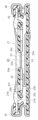
- FIG. 1 is an axial cross-sectional view of a cylindrical battery according to an embodiment of the present disclosure. It is a perspective view of the electrode body of the said cylindrical battery.
- FIG. 3 is an enlarged cross-sectional view of the periphery of the sealing body of the cylindrical battery.
- FIG. 4 is an enlarged cross-sectional view of the vicinity of the shoulder of the outer can in FIG. 3.
- FIG. 3 is a schematic plan view of the annular gasket before deformation, which is incorporated into the cylindrical battery, when viewed from below in the axial direction.
- FIG. 5 is a schematic cross-sectional view when the cross section taken along the dotted line AA in FIG. 4 is opened into a planar shape and expanded into a band shape in the circumferential direction, as viewed from above.
- FIG. 7 is a schematic cross-sectional view corresponding to FIG. 6 of a cylindrical battery of a first modification.
- FIG. 7 is a schematic cross-sectional view corresponding to FIG. 6 of a cylindrical battery of a second modification.
- FIG. 5 is an enlarged sectional view corresponding to FIG. 4 of a cylindrical battery according to a third modification.
- the cylindrical battery of the present disclosure may be a primary battery or a secondary battery.
- a battery using an aqueous electrolyte or a non-aqueous electrolyte may be used.
- a non-aqueous electrolyte secondary battery (lithium ion battery) using a non-aqueous electrolyte will be exemplified as the cylindrical battery 10 that is one embodiment, but the cylindrical battery of the present disclosure is not limited to this.
- FIG. 1 is an axial cross-sectional view of a cylindrical battery 10 according to an embodiment of the present disclosure
- FIG. 2 is a perspective view of an electrode body 14 of the cylindrical battery 10.
- the cylindrical battery 10 includes a wound electrode body 14, a non-aqueous electrolyte (not shown), and a battery case 15 that houses the electrode body 14 and the non-aqueous electrolyte.
- the battery case 15 includes a bottomed cylindrical outer can 16 and a sealing body 17 that closes the opening of the outer can 16.
- the cylindrical battery 10 also includes a resin gasket 28 disposed between the outer can 16 and the sealing body 17.
- the non-aqueous electrolyte includes a non-aqueous solvent and an electrolyte salt dissolved in the non-aqueous solvent.
- the non-aqueous solvent for example, esters, ethers, nitriles, amides, and mixed solvents of two or more of these may be used.
- the non-aqueous solvent may contain a halogen-substituted product in which at least a portion of hydrogen in these solvents is replaced with a halogen atom such as fluorine.
- the non-aqueous electrolyte is not limited to a liquid electrolyte, and may be a solid electrolyte using a gel-like polymer or the like.
- a lithium salt such as LiPF 6 is used as the electrolyte salt.
- the electrode body 14 includes an elongated positive electrode 11, an elongated negative electrode 12, and two elongated separators 13. It has a wound structure in which it is wound through.
- a positive electrode lead 20 is connected to the positive electrode 11 of the electrode body 14, and a negative electrode lead 21 is connected to the negative electrode 12 of the electrode body 14.
- the negative electrode 12 is formed to be one size larger than the positive electrode 11 in order to suppress precipitation of lithium, and is formed longer than the positive electrode 11 in the longitudinal direction and the width direction (short direction).
- the two separators 13 are formed to be at least one size larger than the positive electrode 11, and are arranged to sandwich the positive electrode 11, for example.
- the positive electrode 11 has a positive electrode current collector and positive electrode mixture layers formed on both sides of the current collector.
- a metal foil such as aluminum or an aluminum alloy that is stable in the potential range of the positive electrode 11, a film having the metal disposed on the surface, or the like can be used.
- the positive electrode mixture layer includes a positive electrode active material, a conductive agent, and a binder.
- the positive electrode 11 is made by, for example, applying a positive electrode mixture slurry containing a positive electrode active material, a conductive agent, a binder, etc. onto a positive electrode current collector, drying the coating film, and then compressing it to collect the positive electrode mixture layer. It can be produced by forming on both sides of the electric body.
- the positive electrode active material is composed of a lithium-containing metal composite oxide as a main component.
- Metal elements contained in the lithium-containing metal composite oxide include Ni, Co, Mn, Al, B, Mg, Ti, V, Cr, Fe, Cu, Zn, Ga, Sr, Zr, Nb, In, and Sn. , Ta, W, etc.
- An example of a preferable lithium-containing metal composite oxide is a composite oxide containing at least one of Ni, Co, Mn, and Al.
- Examples of the conductive agent contained in the positive electrode mixture layer include carbon materials such as carbon black, acetylene black, Ketjen black, and graphite.
- Examples of the binder included in the positive electrode mixture layer include fluororesins such as polytetrafluoroethylene (PTFE) and polyvinylidene fluoride (PVdF), polyacrylonitrile (PAN), polyimide, acrylic resin, and polyolefin. These resins may be used in combination with cellulose derivatives such as carboxymethyl cellulose (CMC) or its salts, polyethylene oxide (PEO), and the like.
- the negative electrode 12 includes a negative electrode current collector and negative electrode mixture layers formed on both sides of the current collector.
- a foil made of a metal such as copper or a copper alloy that is stable in the potential range of the negative electrode 12, a film in which the metal is disposed on the surface layer, or the like can be used.
- the negative electrode mixture layer includes a negative electrode active material and a binder.
- the negative electrode 12 can be made by applying a negative electrode mixture slurry containing a negative electrode active material, a binder, etc. onto a negative electrode current collector, drying the coating film, and then compressing the negative electrode mixture layer to form a negative electrode mixture layer on the current collector. It can be produced by forming on both sides.
- a carbon material that reversibly occludes and releases lithium ions is generally used as the negative electrode active material.
- Preferred carbon materials include natural graphite such as flaky graphite, lumpy graphite, and earthy graphite, and graphite such as artificial graphite such as lumpy artificial graphite and graphitized mesophase carbon microbeads.
- the negative electrode mixture layer may contain a Si-containing compound as a negative electrode active material.
- a metal other than Si that is alloyed with lithium, an alloy containing the metal, a compound containing the metal, etc. may be used as the negative electrode active material.
- the binder contained in the negative electrode mixture layer may be a fluororesin, PAN, polyimide resin, acrylic resin, polyolefin resin, etc., but preferably styrene-butadiene rubber (SBR). ) or its modified form.
- the negative electrode mixture layer may contain, for example, in addition to SBR or the like, CMC or a salt thereof, polyacrylic acid (PAA) or a salt thereof, polyvinyl alcohol, or the like.
- a porous sheet having ion permeability and insulation properties is used for the separator 13.
- porous sheets include microporous thin films, woven fabrics, and nonwoven fabrics.
- Preferable materials for the separator 13 include olefin resins such as polyethylene and polypropylene, cellulose, and the like.
- the separator 13 may have either a single layer structure or a laminated structure.
- a heat-resistant layer or the like may be formed on the surface of the separator 13.
- the negative electrode 12 may constitute the winding start end of the electrode body 14, but generally the separator 13 extends beyond the winding start side end of the negative electrode 12, and the winding start side end of the separator 13 forms the winding start end of the electrode body 14. This will be the starting end of No. 14.
- the positive electrode lead 20 is electrically connected to an intermediate portion such as the center in the winding direction of the positive electrode current collector, and the negative electrode lead 21 is electrically connected to an intermediate portion in the winding direction of the negative electrode current collector. electrically connected to the end of the winding.
- the negative electrode lead may be electrically connected to the winding start end of the negative electrode current collector in the winding direction.
- the electrode body has two negative electrode leads, one negative electrode lead is electrically connected to the winding start end in the winding direction of the negative electrode current collector, and the other negative electrode lead is connected to the negative electrode current collector. It may be electrically connected to the end of the winding in the winding direction.
- the negative electrode and the outer can may be electrically connected by bringing the winding end side end of the negative electrode current collector in the winding direction into contact with the inner surface of the outer can.
- the negative electrode lead is electrically connected to the winding start side end of the negative electrode current collector in the winding direction, and the winding end side end of the negative electrode current collector in the winding direction is brought into contact with the inner surface of the outer can. You can.
- the cylindrical battery 10 further includes an upper insulating plate 18 disposed above the electrode body 14 and a lower insulating plate 19 disposed below the electrode body 14.
- the positive electrode lead 20 attached to the positive electrode 11 extends to the sealing body 17 side through the through hole of the upper insulating plate 18, and the negative electrode lead 21 attached to the negative electrode 12 extends outside the lower insulating plate 19. It extends to the bottom plate portion 68 side of the outer can 16 through.
- the positive electrode lead 20 is connected to the lower surface of the terminal plate 23, which is the bottom plate of the sealing body 17, by welding or the like, and the valve body (rupture disk) 27, which is the top plate of the sealing body 17, which is electrically connected to the terminal plate 23, is connected to the positive electrode. It becomes a terminal.
- the negative electrode lead 21 is connected to the inner surface of the bottom plate portion 68 of the outer can 16 by welding or the like, and the outer can 16 serves as a negative electrode terminal.
- the outer can 16 is a metal container having a cylindrical portion with a bottom.
- the space between the outer can 16 and the sealing body 17 is sealed with an annular gasket 28, and the internal space of the battery case 15 is hermetically sealed.
- the gasket 28 includes a clamping portion 32 that is held between the outer can 16 and the sealing body 17, and insulates the sealing body 17 from the outer can 16. That is, the gasket 28 has the role of a sealing material for maintaining airtightness inside the battery, and has the role of preventing electrolyte leakage. Further, the gasket 28 also has the role of an insulating material that prevents a short circuit between the outer can 16 and the sealing body 17.
- the outer can 16 has a protrusion 36 on the inner circumferential side that protrudes inward in the radial direction by providing an annular groove 35 in a part of the cylindrical outer circumferential surface of the outer can 16 in the axial direction.
- the annular groove 35 can be formed, for example, by spinning a part of the outer circumferential surface of the cylinder radially inward and recessing it radially inward.
- the outer can 16 has a bottomed cylindrical portion 30 including a protrusion 36 and an annular shoulder portion 33 .
- the bottomed cylindrical portion 30 accommodates the electrode body 14 and the non-aqueous electrolyte, and the shoulder portion 33 is bent radially inward from the open end of the bottomed cylindrical portion 30 to accommodate the electrode body 14 and the nonaqueous electrolyte. Extends in both directions.
- the shoulder portion 33 is formed when the upper end portion of the outer can 16 is bent inward and caulked onto the peripheral edge portion 31 of the sealing body 17.
- the sealing body 17 is clamped together with the gasket 28 between the shoulder portion 33 and the upper side of the protruding portion 36 by caulking, and is fixed to the exterior can 16.
- FIG. 3 is an enlarged cross-sectional view of the periphery of the sealing body of the cylindrical battery 10.
- the sealing body 17 has a structure in which a terminal plate 23, an annular insulating plate 25, and a valve body 27 are laminated in order from the electrode body 14 side.
- the valve body 27 has a circular shape in plan view.
- the valve body 27 can be manufactured, for example, by pressing a plate material of aluminum or aluminum alloy. Aluminum and aluminum alloys are preferred as materials for the valve body 27 because they have excellent flexibility.
- the valve body 27 has a thin portion 27c formed at an intermediate portion connecting the central portion 27a and the outer peripheral portion 27b.
- the thin wall portion 27c is reversed and ruptured, so that the valve body 27 functions as an explosion-proof valve.
- the insulating plate 25 is formed in an annular shape when viewed from above, and has a through hole 25a in the center.
- the insulating plate 25 is fitted into and fixed to an annular protrusion 27d formed on the outer peripheral portion 27b of the valve body 27 so as to protrude downward.
- the insulating plate 25 is provided to ensure insulation. It is preferable that the insulating plate 25 is made of a material that does not affect battery characteristics. Examples of the material for the insulating plate 25 include polymer resins, such as polypropylene (PP) resin and polybutylene terephthalate (PBT) resin.
- the insulating plate 25 has a ventilation hole 25b on the outer peripheral side that passes through it in the axial direction. Further, the insulating plate 25 has an annular skirt portion 25c extending downward at the outer peripheral edge.
- the terminal plate 23 has a circular outer shape with a diameter smaller than that of the insulating plate 25 in plan view, and a central portion 23a is a thin portion.
- the terminal plate 23 is arranged to face the valve body 27 with the insulating plate 25 interposed therebetween.
- the terminal board 23 is attached to the insulating plate 25 by fitting its outer circumferential surface into the inner circumferential surface of the skirt portion 25c of the insulating plate 25 and fixing it.
- the valve body 27 and the terminal plate 23 are connected at their centers via the through hole 25a of the insulating plate 25.
- the terminal plate 23 is made of aluminum or an aluminum alloy like the valve body 27, and in this case, the central parts of the valve body 27 and the terminal plate 23 can be easily connected to each other.
- connection method it is preferable to use metallurgical joining, and laser welding is exemplified as the metallurgical joining.
- a ventilation hole 23b is formed on the outer peripheral side of the terminal plate 23, passing through the terminal plate 23 in the axial direction. The ventilation hole 23b communicates with the ventilation hole 25b of the insulating plate 25.
- the inner circumferential surface of the skirt portion 25c may have a truncated conical shape with the inner diameter decreasing toward the bottom, and the outer circumferential surface of the terminal plate 23 may have a truncated conical shape corresponding to the inner circumferential surface.
- the terminal plate 23 by press-fitting and fixing the terminal plate 23 to the skirt portion 25c, displacement of the terminal plate 23 relative to the valve body 27 can be reliably prevented.
- one or more tapered grooves including a tapered portion that tapers toward the electrode body are provided on the outer surface of the gasket.
- the gasket has one or more tapered grooves on the outer surface including a tapered portion that tapers toward the electrode body, so that the electrolyte accumulated in the caulked portion is caused by capillarity to form the tapered groove.
- the depth of the tapered groove is preferably 50% or less of the thickness of the gasket before it is incorporated into a cylindrical battery, in order to ensure sufficient strength of the gasket.
- the outer surface of the gasket 28 has a plurality of inner tapered grooves 51 that taper toward the electrode body 14 side of the outer can 16, and a plurality of inner tapered grooves 51 that taper toward the electrode body 14 side of the outer can 16.
- a plurality of external tapered grooves 52 are provided.
- FIG. 4 is an enlarged sectional view of the vicinity of the shoulder portion 38 of the outer can 16 in FIG. 3.
- the inner tapered groove 51 is provided on the lower surface 54 of the gasket 28 on the bottom plate portion 68 side of the outer can 16 in the axial direction, and is a lower tapered portion that tapers toward the inside in the radial direction.
- the internal tapered groove 51 includes only the lower tapered portion 51a.
- the external tapered groove 52 is provided on the upper surface 55 of the gasket 28 axially opposite to the lower surface 59 on the bottom plate portion 68 side of the outer can 16 in the axial direction of the sealing body 17, and as it goes radially inward.
- the external tapered groove 52 includes only the upper tapered portion 52a.
- the depth of the upper tapered portion 52a after the gasket 28 is assembled into the cylindrical battery 10 is the length shown as t in FIG.
- FIG. 5 is a schematic plan view of the annular gasket 28 before being deformed and incorporated into the cylindrical battery 10, when viewed from below in the axial direction.
- a plurality of inner tapered grooves 51 are provided at approximately equal intervals in the circumferential direction.
- the inner tapered groove 51 is a tapered groove whose groove width becomes narrower toward the inside in the radial direction. All of the plurality of internal tapered grooves 51 are substantially the same groove, but the plurality of internal tapered grooves may include two or more tapered grooves that differ in at least one of shape and size.
- the plurality of internal tapered grooves 51 are provided at equal intervals in the circumferential direction, the plurality of internal tapered grooves may be provided at non-equal intervals in the circumferential direction.
- FIG. 6 is a schematic cross-sectional view when the cross section taken along the dotted line AA in FIG. 4 is opened into a planar shape and developed into a band shape in the circumferential direction as viewed from above.
- the plurality of external tapered grooves 52 are provided on the upper surface 55 of the gasket 28 at equal intervals in the circumferential direction.
- the external tapered groove 52 is a tapered groove whose groove width becomes narrower toward the inside in the radial direction. All of the plurality of externally tapered grooves 52 are substantially the same groove, but the plurality of externally tapered grooves may include two or more tapered grooves that differ in at least one of shape and size.
- the plurality of external tapered grooves 52 are provided at equal intervals in the circumferential direction, the plurality of external tapered grooves may be provided at non-equal intervals in the circumferential direction.
- the gasket 28 may have a plurality of internal tapered grooves 51 arranged at intervals of 45° or less over the entire circumferential direction, or at intervals of 30° or less over the entire circumferential direction. It may have a plurality of internal tapered grooves 51 arranged at an interval of 15° or less over the entire circumference in the circumferential direction. Further, the gasket 28 may have a plurality of internal tapered grooves 51 arranged at intervals of 10° or less over the entire circumferential direction, or at intervals of 5° or less over the entire circumferential direction. A plurality of internal tapered grooves 51 may be provided. It is preferable to arrange the plurality of internal tapered grooves 51 over the entire circumference of the gasket 28 because leakage from between the outer can 16 and the gasket 28 can be effectively suppressed.
- the gasket 28 may have a plurality of external tapered grooves 52 arranged at intervals of 45° or less over the entire circumferential direction, and at intervals of 30° over the entire circumferential direction. It may have a plurality of external tapered grooves 52 arranged at the following intervals, or it may have a plurality of external tapered grooves 52 arranged at intervals of 15 degrees or less over the entire circumference in the circumferential direction. good. Further, the gasket 28 may have a plurality of external tapered grooves 52 arranged at intervals of 10 degrees or less over the entire circumferential direction, and at intervals of 5 degrees or less over the entire circumferential direction. A plurality of externally tapered grooves 52 may be provided. It is preferable to arrange the plurality of externally tapered grooves 52 over the entire circumference of the gasket 28 because leakage from between the sealing body 17 and the gasket 28 can be effectively suppressed.
- each of the internal tapered groove 51 and the external tapered groove 52 is a closed groove with a closed tip, but at least one of the internal tapered groove and the external tapered groove has a closed tip. The tip may be open without being closed.
- each of the internal tapered groove 51 and the external tapered groove 52 has an isosceles triangular shape in the schematic cross-sectional view shown in FIG. In the schematic cross-sectional view corresponding to FIG. 6, it is sufficient that the shape is tapered toward the inside in the radial direction. good.
- the circumferential position of the tips of the plurality of internal tapered grooves 51 substantially coincides with the circumferential position of the tips of the plurality of external tapered grooves 52.
- the plurality of internal tapered grooves 151 and the plurality of external tapered grooves 152 are The circumferential position of the tip of the tapered groove 151 and the circumferential position of the tip of the plurality of external tapered grooves 152 may be arranged so as to appear alternately in the circumferential direction. In this way, it is preferable that the tip of the inner tapered groove 151 and the tip of the outer tapered groove 152 do not face each other because it is easy to ensure sufficient strength of the gasket 128.
- the two inner tapered grooves 251 adjacent in the circumferential direction are located on the opposite side from the tapered side.
- the end portion on the widening side may communicate in the circumferential direction, and the plurality of internal tapered grooves 251 may be provided continuously in the circumferential direction over the entire circumferential range.
- the ends of the two external tapered grooves 252 adjacent to each other in the circumferential direction may communicate in the circumferential direction at the end portions on the side that widens toward the end opposite to the tapered side, and the plurality of external tapered grooves 252 may also be connected in the circumferential direction. It may be provided continuously in the circumferential direction over the entire range.
- one of the internal tapered groove and the external tapered groove may not exist, only one or more internal tapered grooves may exist, or one or more internal tapered grooves may exist. Only the external tapered groove may be present. Further, in the cylindrical battery of the present disclosure, at least a portion of the tapered groove may be present on the side of the gasket, as shown in FIG. 9 below.
- FIG. 9 is an enlarged sectional view corresponding to FIG. 4 of a cylindrical battery 310 of a third modification.
- at least one of the one or more inner tapered grooves 351 is provided in an outer circumferential axially extending portion 371 that faces the outer can 16 and extends in the axial direction in the gasket 328. It may also include an outer circumferential tapered portion 381 that tapers toward the bottom plate of the outer can 16 in the axial direction. The end of the outer circumferential tapered portion 381 on the bottom plate portion 68 side in the axial direction may communicate with the radially outer end of the lower tapered portion 51a.
- At least one of the one or more external tapered grooves 352 is provided in the inner circumferential axially extending portion 372 that faces the outer circumferential surface 27e of the sealing body 17 and extends in the axial direction in the gasket 328.
- the outer can 16 may include an inner circumferentially tapered portion 382 that tapers toward the bottom plate portion of the outer can 16 in the axial direction. The end of the inner circumferential tapered portion 382 on the bottom plate portion 68 side in the axial direction may communicate with the outer end in the radial direction of the upper tapered portion 52a.
- the gasket 328 may have a plurality of internal tapered grooves 351 that are arranged at intervals in the circumferential direction over the entire circumference and include an outer circumferential tapered portion 381 and a lower tapered portion 51a. good.
- the gasket 328 may have a plurality of external tapered grooves 352 that are arranged at intervals in the circumferential direction over the entire circumferential direction and include an inner circumferential tapered portion 382 and an upper tapered portion 52a. good.
- Example 1> (Preparation of positive electrode) Li(Ni 0.8 Co 0.15 Al 0.05 )O 2 was used as the positive electrode active material.
- a positive electrode mixture paste was prepared by mixing 100 parts by mass of a positive electrode active material, 2.0 parts by mass of polyvinylidene fluoride as a binder, and 2.0 parts by mass of acetylene black as a conductive agent into a liquid component (NMP).
- the positive electrode mixture paste was applied to both surfaces of a positive electrode current collector made of aluminum foil, except for the connection portion of the positive electrode lead, and dried to form a positive electrode mixture layer.
- the produced positive electrode precursor was compressed to obtain a positive electrode.
- the connection portion of the positive electrode lead was formed at the center of the positive electrode.
- Graphite was used as the negative electrode active material. 100 parts by mass of the negative electrode active material, 1.0 parts by mass of polyvinylidene fluoride as a binder, 1.0 parts by mass of carboxymethylcellulose as a thickener, and an appropriate amount of water were stirred in a double-arm kneader. A negative electrode paste was obtained. The negative electrode mixture paste was applied to both sides of a negative electrode current collector made of copper foil except for the connection portion of the negative electrode lead, and dried to form a negative electrode mixture layer. The produced negative electrode precursor was compressed to obtain a negative electrode. The connection portion of the negative electrode lead was formed at the winding end of the negative electrode.
- LiPF 6 as an electrolyte salt was dissolved at a concentration of 1.0 M (mol/liter) in a non-aqueous solvent that was a mixture of ethylene carbonate and dimethyl carbonate at a volume ratio of 40:60 (1 atm, 25°C).
- a non-aqueous electrolyte was prepared.
- the electrode body was inserted into an exterior can with a height of 74.5 mm and a diameter of 21 mm, and the diameter of the opening was reduced.
- an upper insulating plate made of phenolic resin (GP) mixed with glass fiber and having an outer diameter of 20 mm and a thickness of 0.3 mm was inserted.
- a positive electrode lead is welded to a sealing body incorporating an insulating gasket (PP) into the opening of the outer can, the above-mentioned non-aqueous electrolyte is injected, and a press machine is used to remove the sealing body, gasket, and opening side of the outer can.
- the ends were caulked to produce a cylindrical battery.
- As the gasket a gasket was used in which an externally tapered groove was provided only in the portion from the outer peripheral surface of the valve body (rupture disk) that contacted the lower surface of the valve body.
- the rated capacity of the cylindrical battery was 5.0 Ah.
- Example 2 A cylindrical battery was produced that differed from the cylindrical battery of Example 1 only in that a gasket having an externally tapered groove was used only in the portion contacting the lower surface of the valve body (rupture disk). The rated capacity of the cylindrical battery was 5.0 Ah.
- Example 3 The cylindrical battery of Example 1 has the only difference that a gasket with an internal tapered groove is used only in the range from the outer circumferential surface in contact with the inner circumferential surface of the outer can to the radially inner edge of the lower surface on the electrode body side in the axial direction.
- a different type of cylindrical battery was fabricated.
- the rated capacity of the cylindrical battery was 5.0 Ah.
- Example 4 A cylindrical battery was produced that differed from the cylindrical battery of Example 1 only in that a gasket was used that had an internal tapered groove provided only in the range up to the radial inner edge of the lower surface on the electrode body side in the axial direction.
- the rated capacity of the cylindrical battery was 5.0 Ah.
- Example 5 An external tapered groove is provided only in the part from the outer circumferential surface of the valve body (rupture disk) that contacts the lower surface of the valve body, and the radially inner groove is provided on the lower surface of the electrode body side in the axial direction from the outer circumferential surface that contacts the inner circumferential surface of the outer can.
- a cylindrical battery was produced that differed from the cylindrical battery of Example 1 only in that a gasket having an internal tapered groove only up to the edge was used. The rated capacity of the cylindrical battery was 5.0 Ah.
- Example 6 An external tapered groove is provided only from the outer circumferential surface of the valve body (rupture disk) to the portion that touches the bottom surface of the valve body, and an internal tapered groove is provided only in the range from the radially inner edge of the lower surface of the electrode body side in the axial direction.
- a cylindrical battery was produced that differed from the cylindrical battery of Example 1 only in that the provided gasket was used. The rated capacity of the cylindrical battery was 5.0 Ah.
- Example 7 An external tapered groove is provided only in the part that contacts the lower surface of the valve body (rupture disk), and only in the range from the outer circumferential surface in contact with the inner circumferential surface of the outer can to the radially inner edge of the lower surface on the electrode body side in the axial direction.
- a cylindrical battery was produced that differed from the cylindrical battery of Example 1 only in that a gasket having an internal tapered groove was used. The rated capacity of the cylindrical battery was 5.0 Ah.
- Example 8 A gasket was used in which an external tapered groove was provided only in the part that contacted the lower surface of the valve body (rupture disk), and an internal tapered groove was provided only in the range up to the radial inner edge of the lower surface on the electrode body side in the axial direction.
- a cylindrical battery was produced that differed from the cylindrical battery of Example 1 only in one point. The rated capacity of the cylindrical battery was 5.0 Ah.
- a cylindrical battery was produced that differed from the cylindrical battery of Example 1 only in that a gasket without a tapered groove was used.
- the rated capacity of the cylindrical battery was 5.0 Ah.
- a temperature cycle test was conducted on five samples at a state of charge (SOC) of 30%. Specifically, a cycle of maintaining a temperature of 85 ⁇ 2°C for 6 hours and then maintaining a temperature of -40 ⁇ 2°C for 6 hours was repeated 10 times, and then a temperature of 20°C was maintained for 24 hours. After the test, the presence or absence of leakage at the caulked portion of the cylindrical battery was checked, and the presence or absence of a change in the mass of the cylindrical battery was confirmed.
- SOC state of charge
- the cylindrical battery of the present disclosure it is possible to suppress the electrolytic solution from creeping up at the caulked portion, the airtightness of the gasket can be made good, and leakage from the cylindrical battery 10 can be suppressed.
- the gasket is provided with tapered grooves over a wide range, the strength of the gasket will be reduced. Therefore, if the cylindrical battery of Example 8 in which the internal tapered groove is formed in a narrow range and the external tapered groove is also formed in a narrow range is manufactured, it is possible to prevent liquid leakage from between the valve body and the gasket and prevent the external can from leaking. Not only can liquid leakage from between the gaskets be effectively suppressed, but also the gasket strength can be increased, and gasket breakage can also be effectively suppressed.
- the tapered groove was not provided in the gasket at the portion facing the upper surface of the sealing body, such a tapered groove may be provided.
- the external tapered groove may be provided only in the portion of the gasket that faces the side of the sealing body, or the internal tapered groove may be provided only in the portion of the gasket that faces the inner circumferential surface of the outer can in the radial direction.
- the center portion of the axially upper end surface of the cylindrical battery 10 is recessed axially downward; however, in the cylindrical battery of the present disclosure, the axially upper end surface The center portion may be configured to protrude upward in the axial direction.
- the tapered groove may include a tapered portion that becomes tapered toward the electrode body. The tapered groove may be tapered over the entire length, or may have a portion with the same groove width in some regions in the extending direction.
Landscapes
- Chemical & Material Sciences (AREA)
- Chemical Kinetics & Catalysis (AREA)
- Electrochemistry (AREA)
- General Chemical & Material Sciences (AREA)
- Engineering & Computer Science (AREA)
- Manufacturing & Machinery (AREA)
- Sealing Battery Cases Or Jackets (AREA)
Priority Applications (3)
| Application Number | Priority Date | Filing Date | Title |
|---|---|---|---|
| CN202380026763.0A CN118872129A (zh) | 2022-03-18 | 2023-03-03 | 圆筒形电池 |
| US18/845,336 US20250192294A1 (en) | 2022-03-18 | 2023-03-03 | Cylindrical battery |
| JP2024507741A JPWO2023176511A1 (https=) | 2022-03-18 | 2023-03-03 |
Applications Claiming Priority (2)
| Application Number | Priority Date | Filing Date | Title |
|---|---|---|---|
| JP2022-043370 | 2022-03-18 | ||
| JP2022043370 | 2022-03-18 |
Publications (1)
| Publication Number | Publication Date |
|---|---|
| WO2023176511A1 true WO2023176511A1 (ja) | 2023-09-21 |
Family
ID=88023009
Family Applications (1)
| Application Number | Title | Priority Date | Filing Date |
|---|---|---|---|
| PCT/JP2023/008048 Ceased WO2023176511A1 (ja) | 2022-03-18 | 2023-03-03 | 円筒形電池 |
Country Status (4)
| Country | Link |
|---|---|
| US (1) | US20250192294A1 (https=) |
| JP (1) | JPWO2023176511A1 (https=) |
| CN (1) | CN118872129A (https=) |
| WO (1) | WO2023176511A1 (https=) |
Cited By (1)
| Publication number | Priority date | Publication date | Assignee | Title |
|---|---|---|---|---|
| WO2025182677A1 (ja) * | 2024-02-29 | 2025-09-04 | パナソニックIpマネジメント株式会社 | 密閉型電池 |
Citations (6)
| Publication number | Priority date | Publication date | Assignee | Title |
|---|---|---|---|---|
| JPS53166023U (https=) * | 1977-06-03 | 1978-12-26 | ||
| JPH0231978Y2 (https=) * | 1984-10-15 | 1990-08-29 | ||
| JP2009283209A (ja) * | 2008-05-20 | 2009-12-03 | Fdk Energy Co Ltd | 筒形非水電解液電池 |
| JP2011216855A (ja) * | 2010-03-15 | 2011-10-27 | Seiko Instruments Inc | 電気化学セル用ガスケット及び電気化学セル |
| US20120028090A1 (en) * | 2009-09-14 | 2012-02-02 | Oh Kyung-Su | Secondary battery |
| JP2022513751A (ja) * | 2019-06-18 | 2022-02-09 | エルジー エナジー ソリューション リミテッド | 溝が形成されたガスケットを含む円筒型二次電池 |
-
2023
- 2023-03-03 CN CN202380026763.0A patent/CN118872129A/zh active Pending
- 2023-03-03 US US18/845,336 patent/US20250192294A1/en active Pending
- 2023-03-03 WO PCT/JP2023/008048 patent/WO2023176511A1/ja not_active Ceased
- 2023-03-03 JP JP2024507741A patent/JPWO2023176511A1/ja active Pending
Patent Citations (6)
| Publication number | Priority date | Publication date | Assignee | Title |
|---|---|---|---|---|
| JPS53166023U (https=) * | 1977-06-03 | 1978-12-26 | ||
| JPH0231978Y2 (https=) * | 1984-10-15 | 1990-08-29 | ||
| JP2009283209A (ja) * | 2008-05-20 | 2009-12-03 | Fdk Energy Co Ltd | 筒形非水電解液電池 |
| US20120028090A1 (en) * | 2009-09-14 | 2012-02-02 | Oh Kyung-Su | Secondary battery |
| JP2011216855A (ja) * | 2010-03-15 | 2011-10-27 | Seiko Instruments Inc | 電気化学セル用ガスケット及び電気化学セル |
| JP2022513751A (ja) * | 2019-06-18 | 2022-02-09 | エルジー エナジー ソリューション リミテッド | 溝が形成されたガスケットを含む円筒型二次電池 |
Cited By (1)
| Publication number | Priority date | Publication date | Assignee | Title |
|---|---|---|---|---|
| WO2025182677A1 (ja) * | 2024-02-29 | 2025-09-04 | パナソニックIpマネジメント株式会社 | 密閉型電池 |
Also Published As
| Publication number | Publication date |
|---|---|
| JPWO2023176511A1 (https=) | 2023-09-21 |
| CN118872129A (zh) | 2024-10-29 |
| US20250192294A1 (en) | 2025-06-12 |
Similar Documents
| Publication | Publication Date | Title |
|---|---|---|
| EP4432433A1 (en) | Cylindrical battery | |
| EP3905364B1 (en) | Cylindrical battery | |
| JP7422680B2 (ja) | ガスケット、及び円筒形電池 | |
| US20240304958A1 (en) | Cylindrical battery | |
| EP4411979A1 (en) | Cylindrical battery | |
| WO2023176511A1 (ja) | 円筒形電池 | |
| US20250273834A1 (en) | Cylindrical battery | |
| JP7793532B2 (ja) | 円筒形電池 | |
| US20250210763A1 (en) | Cylindrical battery | |
| EP4270613A1 (en) | Hermetically sealed battery | |
| WO2023176471A1 (ja) | 円筒形電池 | |
| EP4456280A1 (en) | Cylindrical battery | |
| US20250309422A1 (en) | Cylindrical battery | |
| EP4597735A1 (en) | Cylindrical battery | |
| JP7818534B2 (ja) | 円筒形電池 | |
| US20250210765A1 (en) | Cylindrical battery | |
| WO2024048147A1 (ja) | 円筒形電池 | |
| WO2024048145A1 (ja) | 円筒形電池 | |
| WO2026070618A1 (ja) | 円筒形電池 | |
| WO2025182714A1 (ja) | 非水電解質二次電池 | |
| WO2023162710A1 (ja) | 円筒形の非水電解質二次電池 |
Legal Events
| Date | Code | Title | Description |
|---|---|---|---|
| 121 | Ep: the epo has been informed by wipo that ep was designated in this application |
Ref document number: 23770468 Country of ref document: EP Kind code of ref document: A1 |
|
| ENP | Entry into the national phase |
Ref document number: 2024507741 Country of ref document: JP Kind code of ref document: A |
|
| WWE | Wipo information: entry into national phase |
Ref document number: 18845336 Country of ref document: US |
|
| WWE | Wipo information: entry into national phase |
Ref document number: 202380026763.0 Country of ref document: CN |
|
| NENP | Non-entry into the national phase |
Ref country code: DE |
|
| 122 | Ep: pct application non-entry in european phase |
Ref document number: 23770468 Country of ref document: EP Kind code of ref document: A1 |
|
| WWP | Wipo information: published in national office |
Ref document number: 18845336 Country of ref document: US |