WO2023176196A1 - 穂数予測装置 - Google Patents
穂数予測装置 Download PDFInfo
- Publication number
- WO2023176196A1 WO2023176196A1 PCT/JP2023/004008 JP2023004008W WO2023176196A1 WO 2023176196 A1 WO2023176196 A1 WO 2023176196A1 JP 2023004008 W JP2023004008 W JP 2023004008W WO 2023176196 A1 WO2023176196 A1 WO 2023176196A1
- Authority
- WO
- WIPO (PCT)
- Prior art keywords
- wheat
- ears
- grain
- unit
- panicle
- Prior art date
- Legal status (The legal status is an assumption and is not a legal conclusion. Google has not performed a legal analysis and makes no representation as to the accuracy of the status listed.)
- Ceased
Links
Images



Classifications
-
- G—PHYSICS
- G06—COMPUTING OR CALCULATING; COUNTING
- G06T—IMAGE DATA PROCESSING OR GENERATION, IN GENERAL
- G06T7/00—Image analysis
- G06T7/10—Segmentation; Edge detection
- G06T7/11—Region-based segmentation
-
- A—HUMAN NECESSITIES
- A01—AGRICULTURE; FORESTRY; ANIMAL HUSBANDRY; HUNTING; TRAPPING; FISHING
- A01G—HORTICULTURE; CULTIVATION OF VEGETABLES, FLOWERS, RICE, FRUIT, VINES, HOPS OR SEAWEED; FORESTRY; WATERING
- A01G7/00—Botany in general
-
- G—PHYSICS
- G06—COMPUTING OR CALCULATING; COUNTING
- G06M—COUNTING MECHANISMS; COUNTING OF OBJECTS NOT OTHERWISE PROVIDED FOR
- G06M11/00—Counting of objects distributed at random, e.g. on a surface
-
- G—PHYSICS
- G06—COMPUTING OR CALCULATING; COUNTING
- G06Q—INFORMATION AND COMMUNICATION TECHNOLOGY [ICT] SPECIALLY ADAPTED FOR ADMINISTRATIVE, COMMERCIAL, FINANCIAL, MANAGERIAL OR SUPERVISORY PURPOSES; SYSTEMS OR METHODS SPECIALLY ADAPTED FOR ADMINISTRATIVE, COMMERCIAL, FINANCIAL, MANAGERIAL OR SUPERVISORY PURPOSES, NOT OTHERWISE PROVIDED FOR
- G06Q50/00—Information and communication technology [ICT] specially adapted for implementation of business processes of specific business sectors, e.g. utilities or tourism
- G06Q50/02—Agriculture; Fishing; Forestry; Mining
-
- G—PHYSICS
- G06—COMPUTING OR CALCULATING; COUNTING
- G06T—IMAGE DATA PROCESSING OR GENERATION, IN GENERAL
- G06T7/00—Image analysis
- G06T7/60—Analysis of geometric attributes
-
- G—PHYSICS
- G06—COMPUTING OR CALCULATING; COUNTING
- G06T—IMAGE DATA PROCESSING OR GENERATION, IN GENERAL
- G06T2207/00—Indexing scheme for image analysis or image enhancement
- G06T2207/20—Special algorithmic details
- G06T2207/20076—Probabilistic image processing
-
- G—PHYSICS
- G06—COMPUTING OR CALCULATING; COUNTING
- G06T—IMAGE DATA PROCESSING OR GENERATION, IN GENERAL
- G06T2207/00—Indexing scheme for image analysis or image enhancement
- G06T2207/30—Subject of image; Context of image processing
- G06T2207/30181—Earth observation
- G06T2207/30188—Vegetation; Agriculture
-
- G—PHYSICS
- G06—COMPUTING OR CALCULATING; COUNTING
- G06T—IMAGE DATA PROCESSING OR GENERATION, IN GENERAL
- G06T2207/00—Indexing scheme for image analysis or image enhancement
- G06T2207/30—Subject of image; Context of image processing
- G06T2207/30242—Counting objects in image
Definitions
- the present disclosure relates to an ear number prediction device that predicts the number of ears of grain.
- “grain” refers to agricultural crops whose seeds are regularly eaten by humans, and includes, for example, wheat, rice, millet, and millet.
- “Ear of grain” means a group of flowers and fruits clustered at the tip of a grain stalk.When counting the number of ears of grain, a group of flowers and fruits that appear at the tip of a grain stalk is used. Count as one.
- Patent Document 1 describes an example in which the number of small objects (for example, the stems of agricultural crops) is counted by using image recognition technology using artificial intelligence.
- the number of small objects for example, the stems of agricultural crops
- Patent Document 1 does not take such circumstances into consideration, and there is room for improvement in improving prediction accuracy.
- the present disclosure has been made to solve the above problems, and aims to predict the number of panicles with higher accuracy by compensating for information that cannot be read or that is difficult to read from the image in the panicle number prediction process.
- the panicle number prediction device is a panicle number prediction device that predicts the number of grain ears, and calculates the number of ears of grain from image data of the grain reflected in a two-dimensional unit region set in a grain cultivation field.
- An ear number counting unit that counts the number of ears of the grain based on image recognition technology, and an ear number count value obtained by counting by the ear number counting unit, and an ear number count value obtained in advance by statistical processing.
- a correction unit that corrects based on correlation information between and the true value of the number of panicles; a relative size relationship between a predetermined target range in the grain cultivation field and the two-dimensional unit area; An ear number prediction unit that predicts the number of ears of the grain in the target range based on the corrected ear number correction value.
- the panicle number counting unit counts the number of grain panicles in the two-dimensional unit area based on the image data of the grain reflected in the two-dimensional unit area based on image recognition technology
- the correction unit The panicle number count value obtained by counting is corrected based on correlation information between the panicle number count value and the true panicle number value obtained in advance by statistical processing.
- the correction unit may calculate the true value of the number of ears obtained by counting in a grain cultivation field and the detected number (the number of ears count value) obtained by detecting and counting grain ears from image data of the same cultivation field.
- the ear number prediction unit predicts the number of ears of grain in the target range based on the relative size relationship between the target range and the two-dimensional unit area and the corrected ear number correction value.
- grain ears that are hidden behind the leaves, grain ears that are crowded together, etc. cannot be read from the image or cannot be read. By supplementing difficult information, it is possible to predict the number of panicles with higher accuracy.
- FIG. 1 is a functional block configuration diagram of an ear number prediction device and related equipment in an embodiment of the invention. It is a flowchart which shows the process concerning panicle number prediction.
- FIG. 3 is a diagram for explaining processing up to wheat ear detection.
- (a) is a diagram for explaining a case where a rectangular area set in a wheat cultivation field, the direction of each side of which is determined in advance and specified from the coordinates of both ends of the diagonal line is used as a two-dimensional unit area;
- (b) is identified by arranging a plurality of rectangles with known vertical and horizontal lengths along two predetermined axes directions, as a two-dimensional unit area, based on the coordinates of a single point set in the grain cultivation field.
- FIG. 1 is a functional block configuration diagram of an ear number prediction device and related equipment in an embodiment of the invention. It is a flowchart which shows the process concerning panicle number prediction.
- FIG. 3 is a diagram for explaining processing up to wheat ear detection.
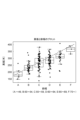
- FIG. 3 is a diagram for explaining an example of generating and applying it to the detection results of artificial intelligence. It is a figure showing the correlation between the true value (real number) of the number of ears of wheat obtained by counting in a wheat cultivation field and the corresponding ridge width of the wheat cultivation field. It is a diagram showing an example of the hardware configuration of a panicle number prediction device.
- the panicle number prediction device 10 according to the embodiment shown in FIG. 20 is acquired, and the number of ears of grain (here, the number of ears of wheat) in the target range (for example, the entire wheat cultivation field 30) is predicted from the image data.
- the number of ears prediction device 10 includes a corner detection section 11, an exclusion section 12, a target object detection section 13, and a prediction section 14 as functional blocks for realizing the functions according to the present disclosure.
- the functions of each part are outlined below.
- the corner detection unit 11 acquires image data of an area image captured by the camera 20 of an area including the rectangular frame F installed in the wheat cultivation field 30, and performs image processing on the acquired image data to determine the area image.
- This is a functional unit that performs grid division and detects the corner of frame F in the obtained first divided image using existing image recognition technology.
- By detecting the corners of the frame F here, position coordinate information of each of the four corners of the frame F in the two-dimensional coordinate system set in the image data of the area image is obtained.
- an example is shown in which an actual rectangular frame F is used instead of a virtual frame as a two-dimensional unit area set in a cultivation field, but for other variations, see FIGS. It will be described later using
- the exclusion unit 12 determines the wheat cultivation field 30 from the position of the corner detected by the corner detection unit 11 (that is, the position coordinates of each of the four corners of the frame F in the two-dimensional coordinate system set in the image data of the area image). This is a functional unit that acquires the position of the frame F in the first divided image and excludes image data in an area outside the frame F from the image data of the first divided image.
- the target object detection unit 13 divides the image based on the image data excluded by the exclusion unit 12 into grids with a division size according to the size of the target object (ears of wheat), and detects the target object from the obtained second divided image.
- This is a functional unit that detects (ears of wheat).
- grid division with a division size that corresponds to the size of the target object (ears of wheat) means to avoid situations where the characteristics of the target object become unclear or disappear, and to divide the pixels occupied by the target object.
- Grid division is performed to obtain a "second divided image" in which the ratio of Alternatively, grid division is performed using a division size according to the size of the target object (grain ear) obtained through experiments or the like.
- the image based on the image data excluded by the exclusion unit 12 becomes the entire image, and this entire image is again divided into grids so that the object can be detected so that the characteristics of the object do not become unclear or disappear.
- a "second divided image” in which the proportion of pixels occupied by the target object is appropriately increased is obtained, and the target object detection unit 13 detects the target object (ears of wheat) from such a second divided image.
- the prediction unit 14 counts the number of ears of the target object (ears of wheat) detected by the target object detection unit 13, and calculates the number of ears of the target object (wheat ears) detected by the target object detection unit 13, and calculates the number of ears in a predetermined target range in the grain cultivation field (here, for example, the entire wheat cultivation field 30).
- This is a functional unit that predicts the number of ears of wheat in the target range from the relative size relationship with the frame F and the count value of the number of ears obtained by counting.
- the prediction unit 14 includes a counting unit 14A, a correction unit 14B, and a panicle number prediction unit 14C.
- the counting unit 14A is a functional unit that counts the number of ears of wheat detected by the target object detection unit 13
- the correction unit 14B is a functional unit that counts the number of ears of wheat detected by the target object detection unit 13.
- This is a functional unit that corrects the panicle number count value obtained by counting using the method described later.
- the panicle number prediction unit 14C determines the number of panicles in the target range based on the relative size relationship between a predetermined target range (for example, the entire wheat cultivation field 30) and the frame F, and the panicle number correction value after correction by the correction unit 14B. This is a functional part that predicts the number of ears of wheat.
- the "ear number counting section" in the claims corresponds to the corner detection section 11, the exclusion section 12, the object detection section 13, and the counting section 14A in FIG.
- this processing includes processing by the panicle number prediction device 10 (steps S3 to S10) and processing by the operator (steps S1 and S2) corresponding to preliminary preparation thereof.
- step S1 the operator installs a frame F in the cultivation field to be counted (step S1), and takes a photograph with the camera 20 so that the entire installed frame is captured (step S2).
- step S2 image data of a region image depicting the region including the frame F, as shown in image example P1 in FIG. 3, is obtained.
- the corner detection unit 11 acquires image data of a region image that captures the region including the above-mentioned frame F (step S3), and as shown in image example P2 in FIG. Then, the area image is divided into, for example, a 3 ⁇ 3 grid, and the corners of the frame F in the obtained first divided image are detected based on existing image recognition technology (step S4).
- the exclusion unit 12 acquires the position of the frame F based on the position of the detected corner (position coordinate data), and based on the acquired position of the frame F, the position of the frame F from the image data of the first divided image. Exclude the outer region (step S5).
- Image example P3 in FIG. 3 shows an example of the image after excluding the outer area, but if the frame F actually appears slightly distorted from its rectangular shape, although it is not possible to completely exclude all of the outer area, The exclusion process in step S5 is performed so that at least the entire area of frame F remains.
- the target object detection unit 13 divides the image based on the image data excluded by the exclusion unit 12 into, for example, a 3 ⁇ 3 grid as shown in image example P4 in FIG.
- a target object is detected from the image based on existing image recognition technology (step S6).
- grid division here, for example, an object (ear of grain) that can be detected empirically or experimentally so that the characteristics of the object do not become unclear or disappear.
- Grid division is performed with a division size corresponding to the size of the image, and a "second divided image" in which the proportion of pixels occupied by the object is appropriately increased is obtained.
- steps S4 and S6 do not need to be a division into a 3 ⁇ 3 grid, but may be a division into an N ⁇ M (both N and M are arbitrary natural numbers) grids. Further, steps S4 and S6 do not need to be divided into the same N ⁇ M (both N and M are arbitrary natural numbers) grids, but may be divided into mutually different grids.
- the counting unit 14A counts the number of ears of wheat detected by the target object detection unit 13 (step S7), and the correction unit 14B calculates the number of ears count value obtained by counting by the counting unit 14A, Correction is performed using the following method (step S8).
- the number of detections + M) is determined in advance by statistical processing, and in step S8, by applying the panicle number count value to the correction formula of the simple regression model determined in advance, the corrected value that is expected to be close to the true value (real number) is calculated. Obtain the panicle number count value.
- the width of the row in which wheat was sown is generally correlated to the density of wheat, so instead of the number of detections (ear count value) mentioned above, it is used as basic information for correction.
- the width of the ridge in which the seeds were sown may be used.
- ridge means each of multiple rows of areas formed by mounding soil in a long and thin linear shape with space between each other in order to grow grain in a cultivation field, and "ridge width” means: It means the width (dimension in the direction perpendicular to the longitudinal direction) of an elongated linear region.
- the true value of the number of ears of wheat (real number) obtained by manual counting in a wheat cultivation field and the ridge width (unit: cm) of the same wheat cultivation field.
- the correction unit 14B uses any method, for example, in advance, so that the count value of the number of panicles obtained by counting by the counting unit 14A approaches the true value obtained by applying the ridge width to the correction formula.
- the panicle number count value may be corrected using a formula (weighting function, etc.) determined empirically or through experiments.
- the panicle number count value may be corrected using any method, for example, using a formula (weighting function, etc.) determined empirically or experimentally in advance so as to approximate the value.
- the correction unit 14B converts the degree of growth of wheat (for example, the average value of the thickness of the stems, the average value of the length of the stems, etc.) recognized from the image data of the wheat cultivation field into further basic information.
- the panicle number count value may be corrected as follows.
- the panicle number prediction unit 14C determines the relative size relationship between a predetermined target range (for example, the entire wheat cultivation field 30) and the frame F, and the panicle number after correction by the correction unit 14B.
- the number of ears of wheat in the target range is predicted based on the correction value (step S9), and the predicted value of the number of ears of wheat in the target range is output (step S10).
- the target range for example, the entire wheat cultivation field 30
- the number of ears of wheat in the target range can be multiplied by N times the corrected ear number correction value.
- output here includes various forms of output, such as display output to a display, print output to a printer, and data transmission to an external device.
- the image after the exclusion is further divided into division sizes according to the size of the target object (ears of wheat). Since the image is divided into grids, it is possible to obtain a "second divided image" in which the proportion of pixels occupied by the object is appropriately increased while avoiding situations where the characteristics of the object become unclear or disappear.
- the target object (ear of wheat) is detected from such a second divided image, and at this time, the detection accuracy of the target object (ear of wheat) in the second divided image can be improved.
- the number of ears of wheat that has been detected with high accuracy is counted, and the number of ears of wheat in the target range is predicted from the relative size relationship between the target range and frame F and the number of ears of wheat.
- the number of ears of wheat in the target range can be predicted with high accuracy.
- the correction unit 14B through the correction process performed by the correction unit 14B, it is possible to compensate for information that cannot be read or that is difficult to read from the image, such as ears of wheat hidden behind leaves or ears of wheat that are crowded together, and predict the number of ears with higher accuracy. can. Furthermore, when the row width is used as the basis for correction, there is an advantage that the ear number count value can be corrected easily and accurately based on the row width information that can be easily obtained without being affected by changes in the color of the wheat. In addition, in an example in which correction is further based on the degree of wheat growth (for example, the average value of stem thickness, average value of stem length, etc.), in particular, image data obtained by photographing a wheat cultivation field from an angle can be used.
- the degree of wheat growth for example, the average value of stem thickness, average value of stem length, etc.
- the direction of each side is determined from the coordinates of both ends of the diagonal line (the coordinates of the two points at the top right and bottom left with stars).
- An example is a pseudo rectangular area (white area) that is specified.
- a pseudo rectangular area specified by arranging ten objects X in each of the vertical and horizontal directions.
- step S6 of FIG. 2 when dividing the image after excluding the external area into grids to obtain a plurality of second divided images, the target object detection unit 13 detects an excessive It is also possible to divide the image into a grid based on a line with a margin added thereto, and obtain a divided image in which the area is expanded outwardly by the margin as each second divided image.
- the above-mentioned surplus is determined according to the size of the object to be detected (an ear of wheat), and an appropriate surplus area that is neither too wide nor too narrow is added.
- the object detection unit 13 detects the object (ear of wheat) in each of the second divided images expanded outward by the surplus amount, and detects the object (ear of wheat) located on the grid dividing line. It is also possible to detect all of the following.
- the prediction unit 14 double-counts the panicle number count value in the adjacent second divided image as follows. Correct to reduce the amount. For example, for the ears of wheat detected and counted in each of the adjacent second divided images, the two-dimensional coordinates of the detected object (ears of wheat) in the two-dimensional coordinate system set for the wheat cultivation field image through image processing are the same. (that is, the same ears of wheat that were counted twice), and then corrected so that the detected number (surplus due to double counting) is subtracted from the ear number count value. As described above, it is possible to detect all objects (ears of wheat) located on the grid division lines while avoiding the disadvantages of double counting, and it is possible to contribute to improving the accuracy of predicting the number of ears.
- each functional block may be realized using one physically or logically coupled device, or may be realized using two or more physically or logically separated devices directly or indirectly (e.g. , wired, wireless, etc.) and may be realized using a plurality of these devices.
- the functional block may be realized by combining software with the one device or the plurality of devices.
- Functions include judgment, decision, judgment, calculation, calculation, processing, derivation, investigation, exploration, confirmation, reception, transmission, output, access, resolution, selection, selection, establishment, comparison, assumption, expectation, consideration, These include, but are not limited to, broadcasting, notifying, communicating, forwarding, configuring, reconfiguring, allocating, mapping, and assigning. I can't do it.
- a functional block (configuration unit) that performs transmission is called a transmitting unit or transmitter. In either case, as described above, the implementation method is not particularly limited.
- the panicle number prediction device in one embodiment of the present disclosure may function as a computer that performs the processing in this embodiment.
- FIG. 7 is a diagram illustrating a hardware configuration example of the panicle number prediction device 10 according to an embodiment of the present disclosure.
- the above-mentioned panicle number prediction device 10 may be physically configured as a computer device including a processor 1001, a memory 1002, a storage 1003, a communication device 1004, an input device 1005, an output device 1006, a bus 1007, and the like.
- the word “apparatus” can be read as a circuit, a device, a unit, etc.
- the hardware configuration of the panicle number prediction device 10 may be configured to include one or more of each device shown in the figure, or may be configured not to include some of the devices.
- Each function in the panicle number prediction device 10 includes loading predetermined software (programs) onto hardware such as the processor 1001 and memory 1002, so that the processor 1001 performs calculations, controls communication by the communication device 1004, This is realized by controlling at least one of reading and writing data in the memory 1002 and storage 1003.
- the processor 1001 for example, operates an operating system to control the entire computer.
- the processor 1001 may be configured by a central processing unit (CPU) including an interface with peripheral devices, a control device, an arithmetic unit, registers, and the like.
- CPU central processing unit
- the processor 1001 reads programs (program codes), software modules, data, etc. from at least one of the storage 1003 and the communication device 1004 to the memory 1002, and executes various processes in accordance with these.
- programs program codes
- software modules software modules
- data etc.
- the program a program that causes a computer to execute at least part of the operations described in the above embodiments is used.
- Processor 1001 may be implemented by one or more chips. Note that the program may be transmitted from a network via a telecommunications line.
- the memory 1002 is a computer-readable recording medium, and includes at least one of ROM (Read Only Memory), EPROM (Erasable Programmable ROM), EEPROM (Electrically Erasable Programmable ROM), RAM (Random Access Memory), etc. may be done.
- Memory 1002 may be called a register, cache, main memory, or the like.
- the memory 1002 can store executable programs (program codes), software modules, and the like to implement a wireless communication method according to an embodiment of the present disclosure.
- the storage 1003 is a computer-readable recording medium, such as an optical disk such as a CD-ROM (Compact Disc ROM), a hard disk drive, a flexible disk, or a magneto-optical disk (for example, a compact disk, a digital versatile disk, or a Blu-ray disk). (registered trademark disk), smart card, flash memory (eg, card, stick, key drive), floppy disk, magnetic strip, etc.
- Storage 1003 may also be called an auxiliary storage device.
- the storage medium mentioned above may be, for example, a database including at least one of memory 1002 and storage 1003, or other suitable medium.
- the communication device 1004 is hardware (transmission/reception device) for communicating between computers via at least one of a wired network and a wireless network, and is also referred to as a network device, network controller, network card, communication module, etc., for example.
- the input device 1005 is an input device (eg, keyboard, mouse, microphone, switch, button, sensor, etc.) that accepts input from the outside.
- the output device 1006 is an output device (for example, a display, a speaker, an LED lamp, etc.) that performs output to the outside.
- the input device 1005 and the output device 1006 may have an integrated configuration (for example, a touch panel).
- each device such as the processor 1001 and the memory 1002 is connected by a bus 1007 for communicating information.
- the bus 1007 may be configured using a single bus, or may be configured using different buses for each device.
- notification of prescribed information is not limited to being done explicitly, but may also be done implicitly (for example, not notifying the prescribed information). Good too.
- the input/output information may be stored in a specific location (for example, memory) or may be managed using a management table. Information etc. to be input/output may be overwritten, updated, or additionally written. The output information etc. may be deleted. The input information etc. may be transmitted to other devices.
- the phrase “based on” does not mean “based solely on” unless explicitly stated otherwise. In other words, the phrase “based on” means both “based only on” and “based at least on.”
- a and B are different may mean “A and B are different from each other.” Note that the term may also mean that "A and B are each different from C”. Terms such as “separate” and “coupled” may also be interpreted similarly to “different.”
Landscapes
- Engineering & Computer Science (AREA)
- Physics & Mathematics (AREA)
- General Physics & Mathematics (AREA)
- Theoretical Computer Science (AREA)
- Computer Vision & Pattern Recognition (AREA)
- Life Sciences & Earth Sciences (AREA)
- Business, Economics & Management (AREA)
- Mining & Mineral Resources (AREA)
- General Health & Medical Sciences (AREA)
- Forests & Forestry (AREA)
- Environmental Sciences (AREA)
- Agronomy & Crop Science (AREA)
- Animal Husbandry (AREA)
- Marine Sciences & Fisheries (AREA)
- Botany (AREA)
- Biodiversity & Conservation Biology (AREA)
- Health & Medical Sciences (AREA)
- Economics (AREA)
- Ecology (AREA)
- Human Resources & Organizations (AREA)
- Marketing (AREA)
- Primary Health Care (AREA)
- Strategic Management (AREA)
- Tourism & Hospitality (AREA)
- General Business, Economics & Management (AREA)
- Geometry (AREA)
- Management, Administration, Business Operations System, And Electronic Commerce (AREA)
- Image Processing (AREA)
Priority Applications (2)
| Application Number | Priority Date | Filing Date | Title |
|---|---|---|---|
| JP2024507566A JPWO2023176196A1 (https=) | 2022-03-15 | 2023-02-07 | |
| US18/845,103 US20250182288A1 (en) | 2022-03-15 | 2023-02-07 | Spike number prediction device |
Applications Claiming Priority (2)
| Application Number | Priority Date | Filing Date | Title |
|---|---|---|---|
| JP2022-039959 | 2022-03-15 | ||
| JP2022039959 | 2022-03-15 |
Publications (1)
| Publication Number | Publication Date |
|---|---|
| WO2023176196A1 true WO2023176196A1 (ja) | 2023-09-21 |
Family
ID=88022760
Family Applications (1)
| Application Number | Title | Priority Date | Filing Date |
|---|---|---|---|
| PCT/JP2023/004008 Ceased WO2023176196A1 (ja) | 2022-03-15 | 2023-02-07 | 穂数予測装置 |
Country Status (3)
| Country | Link |
|---|---|
| US (1) | US20250182288A1 (https=) |
| JP (1) | JPWO2023176196A1 (https=) |
| WO (1) | WO2023176196A1 (https=) |
Citations (4)
| Publication number | Priority date | Publication date | Assignee | Title |
|---|---|---|---|---|
| JP2001299091A (ja) * | 2000-04-21 | 2001-10-30 | Hokuriku Natl Agricultural Experiment Station | 赤外線遮光による茎数計測方法 |
| JP2017104037A (ja) * | 2015-12-08 | 2017-06-15 | ヤンマー株式会社 | 茎数計測システム、及び、それを用いた農作管理システム |
| JP2020024672A (ja) * | 2018-07-27 | 2020-02-13 | キヤノン株式会社 | 情報処理装置、情報処理方法及びプログラム |
| WO2021006029A1 (ja) * | 2019-07-11 | 2021-01-14 | オムロン株式会社 | 情報処理装置及び指標値算出方法 |
-
2023
- 2023-02-07 JP JP2024507566A patent/JPWO2023176196A1/ja active Pending
- 2023-02-07 US US18/845,103 patent/US20250182288A1/en active Pending
- 2023-02-07 WO PCT/JP2023/004008 patent/WO2023176196A1/ja not_active Ceased
Patent Citations (4)
| Publication number | Priority date | Publication date | Assignee | Title |
|---|---|---|---|---|
| JP2001299091A (ja) * | 2000-04-21 | 2001-10-30 | Hokuriku Natl Agricultural Experiment Station | 赤外線遮光による茎数計測方法 |
| JP2017104037A (ja) * | 2015-12-08 | 2017-06-15 | ヤンマー株式会社 | 茎数計測システム、及び、それを用いた農作管理システム |
| JP2020024672A (ja) * | 2018-07-27 | 2020-02-13 | キヤノン株式会社 | 情報処理装置、情報処理方法及びプログラム |
| WO2021006029A1 (ja) * | 2019-07-11 | 2021-01-14 | オムロン株式会社 | 情報処理装置及び指標値算出方法 |
Also Published As
| Publication number | Publication date |
|---|---|
| JPWO2023176196A1 (https=) | 2023-09-21 |
| US20250182288A1 (en) | 2025-06-05 |
Similar Documents
| Publication | Publication Date | Title |
|---|---|---|
| EP3182329B1 (en) | Fingerprint sensor and correction method thereof | |
| US11436855B2 (en) | Method for performing fingerprint sensing, electronic module capable of performing fingerprint sensing, and computing apparatus | |
| EP2908287B1 (en) | Image segmentation device, image segmentation method, and depth map generating method | |
| US20050077452A1 (en) | Camera-based touch system | |
| CN112184688B (zh) | 网络模型的训练方法、目标检测方法及相关装置 | |
| US20180181406A1 (en) | Arithmetic processing device and control method of the arithmetic processing device | |
| CN111028176B (zh) | 指纹图像处理方法、装置、电子设备及计算机可读介质 | |
| US11526900B2 (en) | Aggregation system and control method of the same | |
| WO2019014858A1 (zh) | 触摸检测方法和触摸检测装置 | |
| CN112509003A (zh) | 解决目标跟踪框漂移的方法及系统 | |
| CN115587948B (zh) | 一种图像暗场校正方法及设备 | |
| JP2017194736A (ja) | メモリ制御装置及びメモリ制御方法 | |
| WO2023176196A1 (ja) | 穂数予測装置 | |
| WO2023176201A1 (ja) | 穂数予測装置 | |
| CN111476101A (zh) | 视频镜头切换检测方法及装置、计算机可读存储介质 | |
| KR20130035914A (ko) | 디지털 단색 이미지의 결함 픽셀의 휘도를 정정하는 방법 | |
| CN105574853B (zh) | 一种基于图像识别的麦穗粒数计算的方法及系统 | |
| US11355083B2 (en) | Correction device, display device, method of performing correction for display device, and method of manufacturing display device | |
| JP7297468B2 (ja) | データ処理装置及びその方法 | |
| JP5610825B2 (ja) | 追尾装置 | |
| US8059893B2 (en) | Method for single pass blob image analysis | |
| JP3655496B2 (ja) | 車両検知装置および車両検知方法ならびに車両検知プログラムを記録したコンピュータ読み取り可能な記録媒体 | |
| WO2023176726A1 (ja) | 穂数予測装置 | |
| CN111712833B (zh) | 一种筛选局部特征点的方法及装置 | |
| CN118429273A (zh) | 利用时间触发的智能检测系统 |
Legal Events
| Date | Code | Title | Description |
|---|---|---|---|
| 121 | Ep: the epo has been informed by wipo that ep was designated in this application |
Ref document number: 23770157 Country of ref document: EP Kind code of ref document: A1 |
|
| ENP | Entry into the national phase |
Ref document number: 2024507566 Country of ref document: JP Kind code of ref document: A |
|
| WWE | Wipo information: entry into national phase |
Ref document number: 18845103 Country of ref document: US |
|
| NENP | Non-entry into the national phase |
Ref country code: DE |
|
| 122 | Ep: pct application non-entry in european phase |
Ref document number: 23770157 Country of ref document: EP Kind code of ref document: A1 |
|
| WWP | Wipo information: published in national office |
Ref document number: 18845103 Country of ref document: US |