WO2023153311A1 - 着色感光性樹脂組成物、硬化物、隔壁、有機電界発光素子、カラーフィルタ及び画像表示装置 - Google Patents
着色感光性樹脂組成物、硬化物、隔壁、有機電界発光素子、カラーフィルタ及び画像表示装置 Download PDFInfo
- Publication number
- WO2023153311A1 WO2023153311A1 PCT/JP2023/003417 JP2023003417W WO2023153311A1 WO 2023153311 A1 WO2023153311 A1 WO 2023153311A1 JP 2023003417 W JP2023003417 W JP 2023003417W WO 2023153311 A1 WO2023153311 A1 WO 2023153311A1
- Authority
- WO
- WIPO (PCT)
- Prior art keywords
- group
- less
- mass
- ring
- mol
- Prior art date
- Legal status (The legal status is an assumption and is not a legal conclusion. Google has not performed a legal analysis and makes no representation as to the accuracy of the status listed.)
- Ceased
Links
Images
Classifications
-
- G—PHYSICS
- G03—PHOTOGRAPHY; CINEMATOGRAPHY; ANALOGOUS TECHNIQUES USING WAVES OTHER THAN OPTICAL WAVES; ELECTROGRAPHY; HOLOGRAPHY
- G03F—PHOTOMECHANICAL PRODUCTION OF TEXTURED OR PATTERNED SURFACES, e.g. FOR PRINTING, FOR PROCESSING OF SEMICONDUCTOR DEVICES; MATERIALS THEREFOR; ORIGINALS THEREFOR; APPARATUS SPECIALLY ADAPTED THEREFOR
- G03F7/00—Photomechanical, e.g. photolithographic, production of textured or patterned surfaces, e.g. printing surfaces; Materials therefor, e.g. comprising photoresists; Apparatus specially adapted therefor
- G03F7/004—Photosensitive materials
- G03F7/09—Photosensitive materials characterised by structural details, e.g. supports, auxiliary layers
- G03F7/105—Photosensitive materials characterised by structural details, e.g. supports, auxiliary layers having substances, e.g. indicators, for forming visible images
-
- G—PHYSICS
- G02—OPTICS
- G02B—OPTICAL ELEMENTS, SYSTEMS OR APPARATUS
- G02B5/00—Optical elements other than lenses
- G02B5/20—Filters
-
- G—PHYSICS
- G02—OPTICS
- G02F—OPTICAL DEVICES OR ARRANGEMENTS FOR THE CONTROL OF LIGHT BY MODIFICATION OF THE OPTICAL PROPERTIES OF THE MEDIA OF THE ELEMENTS INVOLVED THEREIN; NON-LINEAR OPTICS; FREQUENCY-CHANGING OF LIGHT; OPTICAL LOGIC ELEMENTS; OPTICAL ANALOGUE/DIGITAL CONVERTERS
- G02F1/00—Devices or arrangements for the control of the intensity, colour, phase, polarisation or direction of light arriving from an independent light source, e.g. switching, gating or modulating; Non-linear optics
- G02F1/01—Devices or arrangements for the control of the intensity, colour, phase, polarisation or direction of light arriving from an independent light source, e.g. switching, gating or modulating; Non-linear optics for the control of the intensity, phase, polarisation or colour
- G02F1/13—Devices or arrangements for the control of the intensity, colour, phase, polarisation or direction of light arriving from an independent light source, e.g. switching, gating or modulating; Non-linear optics for the control of the intensity, phase, polarisation or colour based on liquid crystals, e.g. single liquid crystal display cells
- G02F1/133—Constructional arrangements; Operation of liquid crystal cells; Circuit arrangements
- G02F1/1333—Constructional arrangements; Manufacturing methods
- G02F1/1335—Structural association of cells with optical devices, e.g. polarisers or reflectors
-
- G—PHYSICS
- G03—PHOTOGRAPHY; CINEMATOGRAPHY; ANALOGOUS TECHNIQUES USING WAVES OTHER THAN OPTICAL WAVES; ELECTROGRAPHY; HOLOGRAPHY
- G03F—PHOTOMECHANICAL PRODUCTION OF TEXTURED OR PATTERNED SURFACES, e.g. FOR PRINTING, FOR PROCESSING OF SEMICONDUCTOR DEVICES; MATERIALS THEREFOR; ORIGINALS THEREFOR; APPARATUS SPECIALLY ADAPTED THEREFOR
- G03F7/00—Photomechanical, e.g. photolithographic, production of textured or patterned surfaces, e.g. printing surfaces; Materials therefor, e.g. comprising photoresists; Apparatus specially adapted therefor
- G03F7/004—Photosensitive materials
-
- G—PHYSICS
- G03—PHOTOGRAPHY; CINEMATOGRAPHY; ANALOGOUS TECHNIQUES USING WAVES OTHER THAN OPTICAL WAVES; ELECTROGRAPHY; HOLOGRAPHY
- G03F—PHOTOMECHANICAL PRODUCTION OF TEXTURED OR PATTERNED SURFACES, e.g. FOR PRINTING, FOR PROCESSING OF SEMICONDUCTOR DEVICES; MATERIALS THEREFOR; ORIGINALS THEREFOR; APPARATUS SPECIALLY ADAPTED THEREFOR
- G03F7/00—Photomechanical, e.g. photolithographic, production of textured or patterned surfaces, e.g. printing surfaces; Materials therefor, e.g. comprising photoresists; Apparatus specially adapted therefor
- G03F7/004—Photosensitive materials
- G03F7/0045—Photosensitive materials with organic non-macromolecular light-sensitive compounds not otherwise provided for, e.g. dissolution inhibitors
-
- G—PHYSICS
- G03—PHOTOGRAPHY; CINEMATOGRAPHY; ANALOGOUS TECHNIQUES USING WAVES OTHER THAN OPTICAL WAVES; ELECTROGRAPHY; HOLOGRAPHY
- G03F—PHOTOMECHANICAL PRODUCTION OF TEXTURED OR PATTERNED SURFACES, e.g. FOR PRINTING, FOR PROCESSING OF SEMICONDUCTOR DEVICES; MATERIALS THEREFOR; ORIGINALS THEREFOR; APPARATUS SPECIALLY ADAPTED THEREFOR
- G03F7/00—Photomechanical, e.g. photolithographic, production of textured or patterned surfaces, e.g. printing surfaces; Materials therefor, e.g. comprising photoresists; Apparatus specially adapted therefor
- G03F7/004—Photosensitive materials
- G03F7/027—Non-macromolecular photopolymerisable compounds having carbon-to-carbon double bonds, e.g. ethylenic compounds
-
- G—PHYSICS
- G03—PHOTOGRAPHY; CINEMATOGRAPHY; ANALOGOUS TECHNIQUES USING WAVES OTHER THAN OPTICAL WAVES; ELECTROGRAPHY; HOLOGRAPHY
- G03F—PHOTOMECHANICAL PRODUCTION OF TEXTURED OR PATTERNED SURFACES, e.g. FOR PRINTING, FOR PROCESSING OF SEMICONDUCTOR DEVICES; MATERIALS THEREFOR; ORIGINALS THEREFOR; APPARATUS SPECIALLY ADAPTED THEREFOR
- G03F7/00—Photomechanical, e.g. photolithographic, production of textured or patterned surfaces, e.g. printing surfaces; Materials therefor, e.g. comprising photoresists; Apparatus specially adapted therefor
- G03F7/004—Photosensitive materials
- G03F7/027—Non-macromolecular photopolymerisable compounds having carbon-to-carbon double bonds, e.g. ethylenic compounds
- G03F7/028—Non-macromolecular photopolymerisable compounds having carbon-to-carbon double bonds, e.g. ethylenic compounds with photosensitivity-increasing substances, e.g. photoinitiators
-
- G—PHYSICS
- G03—PHOTOGRAPHY; CINEMATOGRAPHY; ANALOGOUS TECHNIQUES USING WAVES OTHER THAN OPTICAL WAVES; ELECTROGRAPHY; HOLOGRAPHY
- G03F—PHOTOMECHANICAL PRODUCTION OF TEXTURED OR PATTERNED SURFACES, e.g. FOR PRINTING, FOR PROCESSING OF SEMICONDUCTOR DEVICES; MATERIALS THEREFOR; ORIGINALS THEREFOR; APPARATUS SPECIALLY ADAPTED THEREFOR
- G03F7/00—Photomechanical, e.g. photolithographic, production of textured or patterned surfaces, e.g. printing surfaces; Materials therefor, e.g. comprising photoresists; Apparatus specially adapted therefor
- G03F7/004—Photosensitive materials
- G03F7/038—Macromolecular compounds which are rendered insoluble or differentially wettable
-
- H—ELECTRICITY
- H05—ELECTRIC TECHNIQUES NOT OTHERWISE PROVIDED FOR
- H05B—ELECTRIC HEATING; ELECTRIC LIGHT SOURCES NOT OTHERWISE PROVIDED FOR; CIRCUIT ARRANGEMENTS FOR ELECTRIC LIGHT SOURCES, IN GENERAL
- H05B33/00—Electroluminescent light sources
- H05B33/02—Details
-
- H—ELECTRICITY
- H05—ELECTRIC TECHNIQUES NOT OTHERWISE PROVIDED FOR
- H05B—ELECTRIC HEATING; ELECTRIC LIGHT SOURCES NOT OTHERWISE PROVIDED FOR; CIRCUIT ARRANGEMENTS FOR ELECTRIC LIGHT SOURCES, IN GENERAL
- H05B33/00—Electroluminescent light sources
- H05B33/12—Light sources with substantially two-dimensional [2D] radiating surfaces
-
- H—ELECTRICITY
- H10—SEMICONDUCTOR DEVICES; ELECTRIC SOLID-STATE DEVICES NOT OTHERWISE PROVIDED FOR
- H10K—ORGANIC ELECTRIC SOLID-STATE DEVICES
- H10K50/00—Organic light-emitting devices
-
- H—ELECTRICITY
- H10—SEMICONDUCTOR DEVICES; ELECTRIC SOLID-STATE DEVICES NOT OTHERWISE PROVIDED FOR
- H10K—ORGANIC ELECTRIC SOLID-STATE DEVICES
- H10K59/00—Integrated devices, or assemblies of multiple devices, comprising at least one organic light-emitting element covered by group H10K50/00
-
- H—ELECTRICITY
- H10—SEMICONDUCTOR DEVICES; ELECTRIC SOLID-STATE DEVICES NOT OTHERWISE PROVIDED FOR
- H10K—ORGANIC ELECTRIC SOLID-STATE DEVICES
- H10K59/00—Integrated devices, or assemblies of multiple devices, comprising at least one organic light-emitting element covered by group H10K50/00
- H10K59/30—Devices specially adapted for multicolour light emission
- H10K59/38—Devices specially adapted for multicolour light emission comprising colour filters or colour changing media [CCM]
Definitions
- the present invention relates to a colored photosensitive resin composition, a cured product, partition walls, an organic electroluminescence device, a color filter and an image display device.
- pixels and color filters using luminescent nanocrystal particles such as quantum dots have been studied.
- Methods for manufacturing pixels and color filters include a photolithography method and an inkjet method, and the latter method is known to reduce the loss of ink materials (see, for example, Patent Document 1).
- pixels or color filters containing luminescent nanocrystalline particles are manufactured by an inkjet method
- pixels are formed by ejecting ink containing luminescent nanocrystalline particles onto regions (pixel portions) surrounded by prefabricated partition walls.
- Organic electroluminescence devices used in organic field displays are manufactured by forming partitions (banks) on a substrate and laminating various functional layers in regions surrounded by the partitions.
- An inkjet method is known as a method for laminating a functional layer in the partition walls.
- Partition walls for color filters containing luminescent nanocrystalline particles and partition walls for organic electroluminescent elements must prevent mixing of ink between adjacent pixel portions when ink is ejected by inkjet.
- Ink repellency is required.
- Patent Document 2 discloses a colored photosensitive resin composition having high ink repellency and good linearity by using two types of specific alkali-soluble resins together. It is stated that a product is obtained. Further, Patent Documents 3 to 6 describe photosensitive resin compositions containing specific resins.
- partition walls having a light-shielding property using a pigment in order to suppress light leakage to adjacent pixels.
- developability of a composition that has an ethylenically unsaturated group in the side chain and a double bond equivalent of 400 g / mol or less in combination with a coloring agent and the composition when the composition is used as a partition There is no description about the ease with which the ink permeates into the partition walls, and it is unknown.
- Patent Document 6 does not describe a liquid-repellent agent, and the ink repellency when the liquid-repellent agent is used and the ease with which ink permeates into the partition wall when the liquid-repellent agent is used are unknown.
- the present invention exhibits high ink repellency and developability, and is capable of suppressing penetration of ink into partition walls (such characteristics may be hereinafter referred to as "penetration resistance").
- An object of the present invention is to provide a colored photosensitive resin composition that can be formed even under baking temperature conditions. Further, the present invention provides a cured product obtained by curing the colored photosensitive resin composition of the present invention, partition walls composed of the cured product of the present invention, an organic electroluminescence device comprising the partition walls of the present invention, and luminescent nanocrystalline particles.
- An object of the present invention is to provide a color filter and an image display device including
- the present inventors have found that the above problems can be solved by using a specific alkali-soluble resin and a photopolymerizable compound in a colored photosensitive resin composition containing a liquid repellent agent, and have completed the present invention. reached. That is, the gist of the present invention is as follows.
- a colored photosensitive resin composition containing (A) a photopolymerizable compound, (B) a photopolymerization initiator, (C) an alkali-soluble resin, (D) a liquid repellent agent and (E) a colorant,
- the (A) photopolymerizable compound contains a photopolymerizable compound (A1) having a hydroxyl equivalent of 600 g/mol or less
- the (C) alkali-soluble resin contains an acrylic copolymer resin (C1) having a partial structure represented by the following general formula (I) and having a double bond equivalent of 400 g/mol or less
- a colored photosensitive resin composition, wherein the (D) liquid-repellent agent contains a compound (D1) having a cross-linking group and having a fluorine atom and/or a siloxane chain.
- R 1 and R 2 each independently represent a hydrogen atom or a methyl group. * represents a bond.
- a colored photosensitive resin composition that exhibits high ink repellency and developability, and that is capable of forming partition walls capable of suppressing penetration of ink into the partition walls even at a low post-baking temperature.
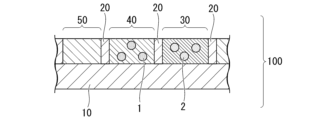
- FIG. 1 is a schematic cross-sectional view of an example of a color filter having partition walls of the present invention.
- total solid content means the total amount of components other than the solvent in the colored photosensitive resin composition. Even if a component other than the solvent is liquid at room temperature, that component is not included in the solvent but is included in the total solid content.
- a numerical range represented using “to” means a range including the numerical values described before and after "to” as lower and upper limits.
- (Co)polymer means including both a single polymer (homopolymer) and a copolymer (copolymer), and "(acid) anhydride", “(anhydride) ... acid” , is meant to include both acids and their anhydrides.
- a partition wall material refers to a bank material, a wall material, and a wall material, and similarly, a partition wall refers to a bank, a wall, and a wall.
- a weight average molecular weight means the weight average molecular weight (Mw) of polystyrene conversion by GPC (gel permeation chromatography).
- the acid value means an acid value in terms of effective solid content unless otherwise specified, and is calculated by neutralization titration.
- partition walls can be used, for example, for partitioning functional layers such as color filters containing quantum dot nanoparticles and light emitting elements.
- ink which is a material for forming a functional layer, is ejected in a partitioned region (pixel region), and dried and cured as necessary to form pixels and the like including the functional layer and partition walls. can be used.
- the colored photosensitive resin composition of the present invention comprises (A) a photopolymerizable compound, (B) a photopolymerization initiator, (C) an alkali-soluble resin, (D) a liquid repellent agent and ( E) Contains a coloring agent.
- the colored photosensitive resin composition of the present invention may further contain other components as necessary, such as (F) a dispersant, a solvent, and a chain transfer agent.
- the colored photosensitive resin composition of the present invention contains (A) a photopolymerizable compound. It is believed that the inclusion of (A) the photopolymerizable compound increases the curability of the coating film and improves the ink repellency.
- the (A) photopolymerizable compound used herein means a compound having one or more ethylenically unsaturated bonds in the molecule. A compound having two or more ethylenically unsaturated bonds in the molecule is preferable in terms of polymerizability, crosslinkability, and the ability to expand the difference in developer solubility between the exposed and unexposed areas. Further, the unsaturated bond is derived from a (meth)acryloyloxy group, that is, the (A) photopolymerizable compound is more preferably a (meth)acrylate compound.
- a polyfunctional ethylenic monomer having two or more ethylenically unsaturated bonds in one molecule as (A) the photopolymerizable compound.
- the number of ethylenically unsaturated groups possessed by the polyfunctional ethylenic monomer is not particularly limited, but is preferably 2 or more, more preferably 3 or more, still more preferably 5 or more, and preferably 15. Below, more preferably 10 or less, still more preferably 8 or less, particularly preferably 7 or less.
- the above upper and lower limits can be combined arbitrarily. For example, 2 to 15 are preferred, 2 to 10 are more preferred, 3 to 8 are even more preferred, and 5 to 7 are particularly preferred.
- the photopolymerizable compound contains a photopolymerizable compound (A1) having a hydroxyl equivalent of 600 g/mol or less. Containing the photopolymerizable compound (A1) is thought to increase the penetration resistance even at a low post-baking temperature.
- the photopolymerizable compound (A1) include esters of aliphatic polyhydroxy compounds and unsaturated carboxylic acids; polyvalent hydroxy compounds such as aliphatic polyhydroxy compounds and aromatic polyhydroxy compounds; an ester obtained by an esterification reaction with a polybasic carboxylic acid;
- Esters of aliphatic polyhydroxy compounds and unsaturated carboxylic acids include, for example, pentaerythritol di(meth)acrylate, pentaerythritol tri(meth)acrylate, dipentaerythritol tetra(meth)acrylate, dipentaerythritol penta(meth) (Meth)acrylic acid esters of aliphatic polyhydroxy compounds such as acrylates and glycerol (meth)acrylates; itaconate esters in which these (meth)acrylates are replaced by itaconates; crotonic acid in which these (meth)acrylates are replaced by cronates esters; maleic acid esters in which these (meth)acrylates are replaced with maleates;
- the ester obtained by the esterification reaction of a polyhydric hydroxy compound such as an aliphatic polyhydroxy compound or an aromatic polyhydroxy compound with an unsaturated carboxylic acid or a polybasic carboxylic acid is not necessarily a single substance, but for example, Condensates of acrylic acid, phthalic acid and ethylene glycol; Condensates of acrylic acid, maleic acid and diethylene glycol; Condensates of methacrylic acid, terephthalic acid and pentaerythritol; Condensates of acrylic acid, adipic acid, butanediol and glycerol. ;
- epoxy acrylates such as an addition reaction product of a polyepoxy compound and hydroxy(meth)acrylate or (meth)acrylic acid are useful. .
- the (A) photopolymerizable compound is preferably an ester of an aliphatic polyhydroxy compound and an unsaturated carboxylic acid, such as pentaerythritol di(meth)acrylate and pentaerythritol tri (Meth)acrylate, dipentaerythritol tetra(meth)acrylate, dipentaerythritol penta(meth)acrylate, dibasic acid anhydride adduct of dipentaerythritol penta(meth)acrylate is more preferred, pentaerythritol di(meth)acrylate , and pentaerythritol tri(meth)acrylate are more preferred. Dipentaerythritol tetra(meth)acrylate and dipentaerythritol hexa(meth)acrylate are preferable from the viewpoint of improving adh.
- an unsaturated carboxylic acid such as pentaerythritol
- the molecular weight of the photopolymerizable compound (A1) is not particularly limited, but is preferably 100 or more, more preferably 150 or more, and still more preferably 150 or more, from the viewpoint of ink repellency and formation of high-definition partition walls with a narrow line width.
- the above upper and lower limits can be combined arbitrarily. For example, it is preferably 100-1000, more preferably 150-1000, still more preferably 200-1000, still more preferably 300-700, even more preferably 400-700, particularly preferably 500-700.
- the number of carbon atoms in the photopolymerizable compound (A) is not particularly limited, but is preferably 7 or more, more preferably 10 or more, still more preferably 15 or more, and still more preferably 20 from the viewpoint of ink repellency and residue suppression. As mentioned above, it is particularly preferably 25 or more, preferably 50 or less, more preferably 40 or less, still more preferably 35 or less, and particularly preferably 30 or less.
- the above upper and lower limits can be combined arbitrarily. For example, it is preferably 7-50, more preferably 10-50, even more preferably 15-40, still more preferably 20-35, and particularly preferably 25-30.
- the hydroxyl equivalent of the photopolymerizable compound (A1) in the invention is 600 g/mol or less.
- 500 g/mol or less is more preferable, 400 g/mol or less is more preferable, 350 g/mol or less is even more preferable, 300 g/mol or less is particularly preferable, and 100 g/mol or more is preferable, and 150 g/mol or more is more preferable; 200 g/mol or more is more preferable, and 250 g/mol or more is particularly preferable.
- the above upper limit and lower limit can be combined arbitrarily.
- the hydroxyl equivalent of the photopolymerizable compound (A1) can be calculated from the following formula.
- the (A) photopolymerizable compound of the present invention contains, as a photopolymerizable compound other than the photopolymerizable compound (A1), a photopolymerizable compound having a hydroxyl equivalent exceeding 600 g/mol or containing no hydroxyl group. good too.
- Specific examples of photopolymerizable compounds other than the photopolymerizable compound (A1) include esters of aliphatic polyhydroxy compounds and unsaturated carboxylic acids; esters of aromatic polyhydroxy compounds and unsaturated carboxylic acids; an ester obtained by an esterification reaction between a polyhydric hydroxy compound such as a group polyhydroxy compound and an aromatic polyhydroxy compound, and an unsaturated carboxylic acid or a polybasic carboxylic acid;
- Esters of aliphatic polyhydroxy compounds and unsaturated carboxylic acids include, for example, ethylene glycol diacrylate, triethylene glycol di(meth)acrylate, trimethylolpropane triacrylate, trimethylolethane triacrylate, pentaerythritol tetraacrylate, di (Meth)acrylic acid esters of aliphatic polyhydroxy compounds such as pentaerythritol hexaacrylate; methacrylic acid esters by replacing these acrylates with methacrylates; itaconate esters by replacing these acrylates with itaconates; crotonic acid esters; and maleic acid esters obtained by replacing these acrylates with maleates.
- Esters of aromatic polyhydroxy compounds and unsaturated carboxylic acids include acrylic acid esters and methacryl esters of aromatic polyhydroxy compounds such as hydroquinone diacrylate, hydroquinone dimethacrylate, resorcin diacrylate, resorcin dimethacrylate, and pyrogallol triacrylate. acid esters.
- the ester obtained by the esterification reaction of a polyhydric hydroxy compound such as an aliphatic polyhydroxy compound or an aromatic polyhydroxy compound with an unsaturated carboxylic acid or a polybasic carboxylic acid is not necessarily a single substance, but for example, Condensates of acrylic acid, phthalic acid and ethylene glycol; Condensates of acrylic acid, maleic acid and diethylene glycol; Condensates of methacrylic acid, terephthalic acid and pentaerythritol; Condensates of acrylic acid, adipic acid, butanediol and glycerol. ;
- polyfunctional ethylenic monomers used in the present invention include a polyisocyanate compound and a hydroxyl group-containing (meth)acrylic acid ester or a polyisocyanate compound, a polyol and a hydroxyl group-containing (meth)acrylic acid ester.
- Urethane (meth)acrylates such as those obtained; acrylamides such as ethylenebisacrylamide; allyl esters such as diallyl phthalate; and vinyl group-containing compounds such as divinyl phthalate are useful.
- Urethane (meth)acrylates include, for example, DPHA-40H, UX-5000, UX-5002D-P20, UX-5003D, UX-5005 (manufactured by Nippon Kayaku Co., Ltd.), U-2PPA, U-6LPA, U- 10PA, U-33H, UA-53H, UA-32P, UA-1100H (manufactured by Shin-Nakamura Chemical Co., Ltd.), UA-306H, UA-510H, UF-8001G (manufactured by Kyoeisha Chemical Co., Ltd.), UV-1700B, UV-7600B, UV-7605B, UV-7630B, UV7640B (manufactured by Nippon Synthetic Chemical Industry Co., Ltd.).
- the hydroxyl group equivalent of the photopolymerizable compound is preferably 1300 g/mol or less, more preferably 1200 g/mol or less, still more preferably 1100 g/mol or less, particularly preferably 1000 g/mol or less, and 100 g/mol or more.
- it is 150 g/mol or more, more preferably 200 g/mol or more, and particularly preferably 250 g/mol or more.
- the above upper limit and lower limit can be combined arbitrarily.
- it is preferably 100 to 1300 g/mol, more preferably 150 to 1300 g/mol, still more preferably 200 to 1200 g/mol, even more preferably 250 to 1100 g/mol, and particularly preferably 250 to 1000 g/mol.
- the hydroxyl equivalent is calculated by dividing the mass of the entire photopolymerizable compound by the number of moles of hydroxyl groups in the entire photopolymerizable compound. be able to.
- the content of (A) the photopolymerizable compound in the colored photosensitive resin composition of the present invention is not particularly limited, but preferably 1% by mass or more in the total solid content of the colored photosensitive resin composition, more preferably 5% by mass or more, more preferably 10% by mass or more, still more preferably 15% by mass or more, particularly preferably 20% by mass or more, preferably 80% by mass or less, more preferably 60% by mass or less, and further It is preferably 40% by mass or less, and more preferably 30% by mass or less.
- the above upper and lower limits can be combined arbitrarily.
- it is preferably 1 to 80% by mass, more preferably 5 to 80% by mass, even more preferably 10 to 60% by mass, even more preferably 15 to 40% by mass, and particularly preferably 20 to 30% by mass.
- the ink repellency tends to be improved, and when it is at most the above upper limit, it tends to be possible to form high-definition partition walls with a narrow line width.
- the content of the photopolymerizable compound (A1) in the colored photosensitive resin composition of the present invention is not particularly limited, but the total solid content of the colored photosensitive resin composition is preferably 5% by mass or more, more preferably 7% by mass or more, more preferably 10% by mass or more, still more preferably 20% by mass or more, particularly preferably 25% by mass or more, preferably 70% by mass or less, more preferably 60% by mass or less, and further It is preferably 50% by mass or less, more preferably 40% by mass or less.
- the above upper and lower limits can be combined arbitrarily.
- it is preferably 5 to 70% by mass, more preferably 7 to 70% by mass, still more preferably 10 to 60% by mass, even more preferably 20 to 50% by mass, and particularly preferably 25 to 40% by mass.
- the content is equal to or higher than the lower limit, the penetration resistance tends to be improved, and when the content is equal to or lower than the upper limit, the ink repellency tends to be improved.
- the content of the photopolymerizable compound (A1) in the photopolymerizable compound is not particularly limited, but is preferably 10% by mass or more, more preferably 20% by mass or more, still more preferably 30% by mass or more, and still more It is preferably 40% by mass or more, particularly preferably 50% by mass or more, and is preferably 100% by mass or less, more preferably 90% by mass or less, still more preferably 80% by mass or less, and particularly preferably 70% by mass or less. be.
- the above upper and lower limits can be combined arbitrarily. For example, it is preferably 10 to 100% by mass, more preferably 20 to 100% by mass, still more preferably 30 to 90% by mass, even more preferably 40 to 80% by mass, and particularly preferably 50 to 70% by mass.
- the content of (A) the photopolymerizable compound relative to 100 parts by mass of the alkali-soluble resin (C) is not particularly limited, but is preferably 1 part by mass or more, more preferably 5 parts by mass or more, and still more preferably 10 parts by mass or more. More preferably 15 parts by mass or more, even more preferably 20 parts by mass or more, even more preferably 25 parts by mass or more, particularly preferably 30 parts by mass or more, and preferably 150 parts by mass or less, more preferably 100 parts by mass. It is not more than 80 parts by mass, more preferably not more than 60 parts by mass, and particularly preferably not more than 50 parts by mass. The above upper and lower limits can be combined arbitrarily.
- the ink repellency tends to be improved, and when it is at most the above upper limit, it tends to be possible to form high-definition partition walls with a narrow line width.
- the content ratio of the photopolymerizable compound (A1) to 100 parts by mass of the alkali-soluble resin is not particularly limited, but is preferably 1 part by mass or more, more preferably 5 parts by mass or more, still more preferably 10 parts by mass or more. More preferably 15 parts by mass or more, even more preferably 20 parts by mass or more, even more preferably 25 parts by mass or more, particularly preferably 30 parts by mass or more, and preferably 150 parts by mass or less, more preferably 100 parts by mass. It is not more than 80 parts by mass, more preferably not more than 60 parts by mass, and particularly preferably not more than 50 parts by mass. The above upper and lower limits can be combined arbitrarily.
- the content is equal to or higher than the lower limit, the penetration resistance tends to be improved, and when the content is equal to or lower than the upper limit, the ink repellency tends to be improved.
- the colored photosensitive resin composition of the present invention contains (B) a photopolymerization initiator.
- the photopolymerization initiator polymerizes the (A) photopolymerizable compound with actinic rays.
- (A) is not particularly limited as long as it is a compound that polymerizes the ethylenically unsaturated bond of the photopolymerizable compound.
- a photopolymerization initiator commonly used in this field can be used as (B) the photopolymerization initiator.
- photopolymerization initiators include metallocene compounds including titanocene compounds described in JP-A-59-152396 and JP-A-61-151197; JP-A-2000-56118. biimidazole derivatives described in JP-A-10-39503; halomethylated oxadiazole derivatives, halomethyl-s-triazine derivatives, and N-aryl- ⁇ -amino acids such as N-phenylglycine described in JP-A-10-39503.
- Radical activators such as N-aryl- ⁇ -amino acid salts and N-aryl- ⁇ -amino acid esters; ⁇ -aminoalkylphenone derivatives; oxime ester compounds described in JP-A-36750;
- metallocene compounds include dicyclopentadienyl titanium dichloride, dicyclopentadienyl titanium bisphenyl, dicyclopentadienyl titanium bis(2,3,4,5,6-pentafluorophenyl), dicyclopenta Dienyl titanium bis(2,3,5,6-tetrafluorophenyl), dicyclopentadienyl titanium bis(2,4,6-trifluorophenyl), dicyclopentadienyl titanium di(2,6-difluoro phenyl), dicyclopentadienyl titanium di(2,4-difluorophenyl), di(methylcyclopentadienyl) titanium bis(2,3,4,5,6-pentafluorophenyl), di(methylcyclopenta dienyl) titanium bis(2,6-difluorophenyl), dicyclopentadienyl titanium [2,6-di-fluoro-3-(pyro-1-yl)-pheny
- Biimidazole derivatives include, for example, 2-(2'-chlorophenyl)-4,5-diphenylimidazole dimer, 2-(2'-chlorophenyl)-4,5-bis(3'-methoxyphenyl)imidazole dimer, 2-(2′-fluorophenyl)-4,5-diphenylimidazole dimer, 2-(2′-methoxyphenyl)-4,5-diphenylimidazole dimer, (4′-methoxyphenyl )-4,5-diphenylimidazole dimer.
- halomethylated oxadiazole derivatives examples include 2-trichloromethyl-5-(2'-benzofuryl)-1,3,4-oxadiazole, 2-trichloromethyl-5-[ ⁇ -(2'- benzofuryl)vinyl]-1,3,4-oxadiazole, 2-trichloromethyl-5-[ ⁇ -(2′-(6′′-benzofuryl)vinyl)]-1,3,4-oxadiazole, 2-trichloromethyl-5-furyl-1,3,4-oxadiazole.
- halomethyl-s-triazine derivatives examples include 2-(4-methoxyphenyl)-4,6-bis(trichloromethyl)-s-triazine, 2-(4-methoxynaphthyl)-4,6-bis( trichloromethyl)-s-triazine, 2-(4-ethoxynaphthyl)-4,6-bis(trichloromethyl)-s-triazine, 2-(4-ethoxycarbonylnaphthyl)-4,6-bis(trichloromethyl) -s-triazines.
- ⁇ -aminoalkylphenone derivatives examples include 2-methyl-1[4-(methylthio)phenyl]-2-morpholinopropan-1-one, 2-benzyl-2-dimethylamino-1-(4- morpholinophenyl)-butanone-1,2-benzyl-2-dimethylamino-1-(4-morpholinophenyl)butan-1-one.
- oxime ester compounds are particularly effective in terms of sensitivity and plate-making properties. Such an oxime ester compound having excellent sensitivity is useful.
- the oxime ester compound has a high quantum yield of photoreaction and high activity of the generated radical, so that it has high sensitivity and is stable against thermal reaction, and a small amount of the colored photosensitive resin composition has high sensitivity. It is possible to get things.
- Oxime ester-based compounds are preferred because they have high sensitivity and improve photocurability, and thus have high penetration resistance.
- oxime ester compounds include compounds represented by the following general formula (IV).
- R 21a represents a hydrogen atom, an optionally substituted alkyl group, or an optionally substituted aromatic ring group.
- R 21b represents any substituent containing an aromatic ring.
- R 22a represents an optionally substituted alkanoyl group or an optionally substituted aroyl group.
- n represents an integer of 0 or 1;
- the alkyl group for R 21a may be linear, branched, or include a cyclic alkyl group.
- the number of carbon atoms in the alkyl group in R 21a is not particularly limited, but from the viewpoint of solubility in a solvent and sensitivity, it is preferably 1 or more, more preferably 2 or more, preferably 20 or less, more preferably 15 or less, and further It is preferably 10 or less.
- the above upper and lower limits can be combined arbitrarily. For example, 1 to 20 are preferred, 1 to 15 are more preferred, and 2 to 10 are even more preferred.
- alkyl groups include methyl, ethyl, propyl, butyl, pentyl, hexyl, cyclopentylmethyl, cyclopentylethyl, cyclohexylmethyl and cyclohexylethyl groups.
- Substituents that the alkyl group may have include, for example, an aromatic ring group, a hydroxyl group, a carboxy group, a halogen atom, an amino group, an amide group, 4-(2-methoxy-1-methyl)ethoxy-2- A methylphenyl group or an N-acetyl-N-acetoxyamino group can be mentioned. From the viewpoint of ease of synthesis, it is preferably unsubstituted.
- the aromatic ring group for R 21a includes aromatic hydrocarbon ring groups and aromatic heterocyclic groups.
- the number of carbon atoms in the aromatic ring group is not particularly limited, it is preferably 5 or more from the viewpoint of solubility in the colored photosensitive resin composition. From the viewpoint of developability, it is preferably 30 or less, more preferably 20 or less, and even more preferably 12 or less. For example, 5-30 is preferred, 5-20 is more preferred, and 5-12 is even more preferred.
- aromatic ring groups include phenyl, naphthyl, pyridyl, and furyl groups. From the viewpoint of developability, a phenyl group and a naphthyl group are preferred, and a phenyl group is more preferred.
- substituents that the aromatic ring group may have include hydroxyl groups, carboxyl groups, halogen atoms, amino groups, amido groups, alkyl groups, alkoxy groups, and groups in which these substituents are linked. From the viewpoint of developability, an alkyl group, an alkoxy group, or a group in which these are linked is preferable, and a linked alkoxy group is more preferable. From the viewpoint of sensitivity, R 21a is preferably an optionally substituted alkyl group or an optionally substituted aromatic ring group.
- R 21b is, for example, an optionally substituted carbazolyl group, an optionally substituted thioxanthonyl group, an optionally substituted diphenyl sulfide group, an optionally substituted fluorenyl group, an optionally substituted indolyl groups.
- An optionally substituted carbazolyl group is preferred from the viewpoint of sensitivity.
- the number of carbon atoms in the alkanoyl group in R 22a is not particularly limited, but from the viewpoint of solubility in solvents and sensitivity, it is preferably 2 or more, more preferably 20 or less, more preferably 15 or less, still more preferably 10 or less, especially It is preferably 5 or less.
- 2 to 20 are preferred, 2 to 15 are more preferred, 2 to 10 are even more preferred, and 2 to 5 are particularly preferred.
- Alkanoyl groups include, for example, an acetyl group, an ethyloyl group, a propanoyl group, and a butanoyl group.
- alkanoyl group may have include an aromatic ring group, a hydroxyl group, a carboxy group, a halogen atom, an amino group, and an amide group. From the viewpoint of ease of synthesis, it is preferably unsubstituted.
- the number of carbon atoms in the aroyl group in R 22a is not particularly limited, it is preferably 7 or more, preferably 20 or less, more preferably 15 or less, and still more preferably 10 or less from the viewpoint of solvent solubility and sensitivity. .
- the aroyl group includes, for example, a benzoyl group and a naphthoyl group.
- substituents that the aroyl group may have include a hydroxyl group, a carboxy group, a halogen atom, an amino group, an amide group, and an alkyl group. From the viewpoint of ease of synthesis, it is preferably unsubstituted.
- R 22a is preferably an optionally substituted alkanoyl group, more preferably an unsubstituted alkanoyl group, and even more preferably an acetyl group.
- a photoinitiator may be used individually by 1 type, or may be used in combination of 2 or more types.
- the photopolymerization initiator can be blended with a sensitizing dye and a polymerization accelerator depending on the wavelength of the image exposure light source, if necessary.
- Sensitizing dyes include, for example, the xanthene dyes described in JP-A-4-221958 and JP-A-4-219756; JP-A-3-239703 and JP-A-5-289335. JP-A-3-239703, 3-ketocoumarin compound described in JP-A-5-289335; JP-A-6-19240.
- amino group-containing sensitizing dyes are preferred, and compounds having an amino group and a phenyl group in the same molecule are more preferred. More preferably, for example, 4,4′-dimethylaminobenzophenone, 4,4′-diethylaminobenzophenone, 2-aminobenzophenone, 4-aminobenzophenone, 4,4′-diaminobenzophenone, 3,3′-diaminobenzophenone, 3 , benzophenone compounds such as 4-diaminobenzophenone; 2-(p-dimethylaminophenyl)benzoxazole, 2-(p-diethylaminophenyl)benzoxazole, 2-(p-dimethylaminophenyl)benzo[4,5]benzo oxazole, 2-(p-dimethylaminophenyl)benzo[6,7]benzoxazole, 2,5-bis(p-diethylaminophen
- polymerization accelerators examples include ethyl 4-dimethylaminobenzoate, 2-dimethylaminoethyl benzoate, 2-ethylhexyl 4-dimethylaminobenzoate, 4-dimethylaminoacetophenone, 4-dimethylaminopropiophenone, and the like. and aliphatic amines such as n-butylamine, N-methyldiethanolamine, and 2-dimethylaminoethyl benzoate; can be used.
- a polymerization accelerator may be used individually by 1 type, or may be used in combination of 2 or more type.
- the content of (B) the photopolymerization initiator in the colored photosensitive resin composition of the present invention is not particularly limited, the total solid content of the colored photosensitive resin composition is preferably 0.01% by mass or more, more preferably is 0.1% by mass or more, more preferably 1% by mass or more, even more preferably 2% by mass or more, particularly preferably 3% by mass or more, and preferably 25% by mass or less, more preferably 20% by mass. Below, more preferably 15% by mass or less, still more preferably 10% by mass or less, even more preferably 7% by mass or less, and particularly preferably 5% by mass or less.
- the above upper and lower limits can be combined arbitrarily. For example, the 7% by weight, particularly preferably 3 to 5% by weight.
- the mixing ratio of (B) photopolymerization initiator to (A) photopolymerizable compound in the colored photosensitive resin composition is preferably 1 part by weight or more with respect to 100 parts by weight of (A) photopolymerizable compound, More preferably 5 parts by mass or more, more preferably 10 parts by mass or more, even more preferably 15 parts by mass or more, preferably 200 parts by mass or less, more preferably 100 parts by mass or less, further preferably 50 parts by mass or less, 30 parts by mass or less is even more preferable, and 20 parts by mass or less is particularly preferable.
- the above upper and lower limits can be combined arbitrarily.
- it is preferably 1 to 200 parts by mass, more preferably 1 to 100 parts by mass, even more preferably 5 to 50 parts by mass, even more preferably 10 to 30 parts by mass, and particularly preferably 15 to 20 parts by mass.
- ink repellency and penetration resistance tend to improve
- developability tends to improve.
- chain transfer agent it is preferable to use a chain transfer agent in combination with the photopolymerization initiator.
- chain transfer agents include mercapto group-containing compounds and carbon tetrachloride. It is more preferable to use a mercapto group-containing compound because it tends to have a high chain transfer effect. This is probably because bond cleavage is likely to occur due to the small SH bond energy, and hydrogen abstraction reaction and chain transfer reaction are likely to occur.
- Use of a chain transfer agent is effective in improving sensitivity, surface curability, and ink repellency.
- Mercapto group-containing compounds include, for example, 2-mercaptobenzothiazole, 2-mercaptobenzimidazole, 2-mercaptobenzoxazole, 3-mercapto-1,2,4-triazole, 2-mercapto-4(3H)-quinazoline, Mercapto group-containing compounds having an aromatic ring such as ⁇ -mercaptonaphthalene and 1,4-dimethylmercaptobenzene; Ethylene glycol bis(3-mercaptopropionate), ethylene glycol bisthioglycolate, trimethylolpropane tris(3-mercaptopropionate), trimethylolpropane tristhioglycolate, trishydroxyethyl tristhiopropionate, penta Erythritol tetrakis (3-mercaptopropionate), pentaerythritol tris (3-mercaptopropionate), butanediol bis (3-mercaptobutyrate), ethylene glycol bis
- 2-mercaptobenzothiazole and 2-mercaptobenzimidazole are preferred.
- aliphatic mercapto group-containing compounds trimethylolpropane tris (3-mercaptopropionate), pentaerythritol tetrakis (3-mercaptopropionate), pentaerythritol tris (3-mercaptopropionate), trimethylolpropane Tris(3-mercaptobutyrate), pentaerythritol tetrakis(3-mercaptobutyrate), pentaerythritol tris(3-mercaptobutyrate), 1,3,5-tris(3-mercaptobutyloxyethyl)-1,3 ,5-triazine-2,4,6(1H,3H,5H)-trione is preferred.
- aliphatic mercapto group-containing compounds are preferred, such as trimethylolpropane tris (3-mercaptopropionate), pentaerythritol tetrakis (3-mercaptopropionate), pentaerythritol tris (3- mercaptopropionate), trimethylolpropane tris (3-mercaptobutyrate), pentaerythritol tetrakis (3-mercaptobutyrate), pentaerythritol tris (3-mercaptobutyrate), 1,3,5-tris (3- mercaptobutyloxyethyl)-1,3,5-triazine-2,4,6(1H,3H,5H)-trione is preferred, pentaerythritol tetrakis (3-mercaptopropionate), pentaerythritol tetrakis (3-mercapto butyrate) is more preferred. These may be used
- 2-mercaptobenzothiazole 2-mercaptobenzimidazole
- 2-mercaptobenzoxazole 2-mercaptobenzoxazole
- 2-mercaptobenzothiazole 2-mercaptobenzimidazole
- 2-mercaptobenzothiazole and 2-mercaptobenzimidazole may be used in combination.
- pentaerythritol tetrakis (3-mercaptopropionate) and pentaerythritol tetrakis (3-mercaptobutyrate).
- one or more selected from the group consisting of 2-mercaptobenzothiazole, 2-mercaptobenzimidazole, and 2-mercaptobenzoxazole, and pentaerythritol tetrakis (3-mercaptopropionate) It is preferable to use one or more selected from the group consisting of pentaerythritol tetrakis(3-mercaptobutyrate) in combination with a photopolymerization initiator.
- the content of the chain transfer agent in the colored photosensitive resin composition of the present invention is not particularly limited, it is preferably 0.01% by mass or more, more preferably 0.1, based on the total solid content of the colored photosensitive resin composition. % by mass or more, more preferably 0.5% by mass or more, still more preferably 0.8% by mass or more, and preferably 5% by mass or less, more preferably 4% by mass or less, and even more preferably 3% by mass. Below, more preferably 2% by mass or less.
- the above upper and lower limits can be combined arbitrarily. For example, it is preferably 0.01 to 5% by mass, more preferably 0.1 to 4% by mass, even more preferably 0.5 to 3% by mass, still more preferably 0.8 to 2% by mass.
- concentration is equal to or higher than the lower limit, the ink repellency tends to be improved, and when the concentration is equal to or lower than the upper limit, it tends to be possible to form high-definition partition walls with a narrow line width.
- the content ratio of the chain transfer agent to the photopolymerization initiator (B) in the colored photosensitive resin composition is preferably 5 parts by mass or more, and 10 parts by mass or more with respect to 100 parts by mass of the photopolymerization initiator (B). is more preferably 15 parts by mass or more, particularly preferably 20 parts by mass or more, preferably 500 parts by mass or less, more preferably 300 parts by mass or less, further preferably 100 parts by mass or less, and 50 parts by mass or less It is particularly preferable, and 30 parts by mass or less is particularly preferable.
- the above upper and lower limits can be combined arbitrarily.
- it is preferably 5 to 500 parts by mass, more preferably 5 to 300 parts by mass, even more preferably 10 to 100 parts by mass, even more preferably 15 to 50 parts by mass, and particularly preferably 20 to 30 parts by mass.
- the ink repellency and penetration resistance tend to improve.
- the colored photosensitive resin composition of the present invention contains (C) an alkali-soluble resin.
- (C) the alkali-soluble resin is not particularly limited as long as it can be developed with an alkali developer.
- the alkali-soluble resin include various resins having a carboxy group or a hydroxyl group, and those having a carboxy group are preferable from the viewpoint of excellent developability.
- the (C) alkali-soluble resin in the colored photosensitive resin composition of the present invention has a partial structure represented by the following general formula (I) and has a double bond equivalent of 400 g/mol or less acrylic copolymer resin (C1 ) (hereinafter sometimes abbreviated as “acrylic copolymer resin (C1)”).
- R 1 and R 2 each independently represent a hydrogen atom or a methyl group. * represents a bond.
- the acrylic copolymer resin (C1) will be described in detail.
- the acrylic copolymer resin (C1) has a partial structure containing a side chain having an ethylenically unsaturated group, as shown by formula (I). It is believed that having an ethylenically unsaturated group causes photocuring by exposure to form a stronger film, makes it difficult for the liquid-repellent agent to flow out during development, and facilitates the expression of ink repellency and permeation resistance. Moreover, by having the partial structure represented by the formula (I), the flexibility of the film is maintained, and radicals tend to diffuse easily.
- partial structures represented by formula (I) partial structures represented by the following general formula (I') are preferable from the viewpoint of sensitivity and alkali developability.
- R 1 and R 2 each independently represent a hydrogen atom or a methyl group.
- R X represents a hydrogen atom or a polybasic acid residue.
- the polybasic acid residue in formula (I′) means a monovalent or divalent group obtained by removing one or two OH groups from a polybasic acid.
- polybasic acids include maleic acid, succinic acid, itaconic acid, phthalic acid, tetrahydrophthalic acid, hexahydrophthalic acid, pyromellitic acid, trimellitic acid, benzophenonetetracarboxylic acid, methylhexahydrophthalic acid, and endomethylene. Tetrahydrophthalic acid, chlorendic acid, methyltetrahydrophthalic acid, biphenyltetracarboxylic acid.
- maleic acid, succinic acid, itaconic acid, phthalic acid, tetrahydrophthalic acid, hexahydrophthalic acid, pyromellitic acid, trimellitic acid, and biphenyltetracarboxylic acid are preferred from the viewpoint of patterning properties, and more preferred. is tetrahydrophthalic acid, biphenyltetracarboxylic acid.
- the content ratio of the partial structure represented by the formula (I) contained in the acrylic copolymer resin (C1) is not particularly limited, but is 10 mol% or more with respect to the total number of moles of the structural units of the acrylic copolymer resin (C1). is preferably 30 mol% or more, more preferably 50 mol% or more, even more preferably 60 mol% or more, even more preferably 70 mol% or more, particularly preferably 80 mol% or more, and 99 mol% The following is preferable, 95 mol% or less is more preferable, and 90 mol% or less is even more preferable. The above upper and lower limits can be combined arbitrarily.
- 10 to 99 mol% preferably 30 to 95 mol%, more preferably 50 to 95 mol%, still more preferably 60 to 95 mol%, even more preferably 70 to 95 mol%, particularly preferably 80 to 90 in mol %.
- ink repellency and penetration resistance tend to improve
- developability tends to improve.
- the content is not particularly limited, but 10 mol% or more is preferable, 30 mol% or more is more preferable, 50 mol% or more is more preferable, 60 mol% or more is even more preferable, 70 mol% or more is particularly preferable, 80 mol% or more is particularly preferable, and 99 mol % or less is preferable, 95 mol % or less is more preferable, and 90 mol % or less is even more preferable.
- the above upper and lower limits can be combined arbitrarily.
- 10 to 99 mol% preferably 30 to 95 mol%, more preferably 50 to 95 mol%, still more preferably 60 to 95 mol%, even more preferably 70 to 95 mol%, particularly preferably 80 to 90 in mol %.
- ink repellency and penetration resistance tend to improve
- developability tends to improve.
- the partial structure possessed by the acrylic copolymer resin (C1) is not particularly limited, but from the viewpoint of development adhesion, the partial structure represented by the following general formula (II) It is preferable to further have
- R3 represents a hydrogen atom or a methyl group
- R4 represents an optionally substituted alkyl group, an optionally substituted aromatic ring group, or a substituent. represents an alkenyl group which may be present.
- R 4 represents an optionally substituted alkyl group, an optionally substituted aromatic ring group, or an optionally substituted alkenyl group.
- Alkyl groups for R 4 include linear, branched and cyclic alkyl groups.
- the number of carbon atoms is preferably 1 or more, more preferably 3 or more, more preferably 5 or more, particularly preferably 8 or more, and preferably 20 or less, more preferably 18 or less, further preferably 16 or less, and 14 or less. Even more preferably, 12 or less is particularly preferable.
- the above upper and lower limits can be combined arbitrarily.
- 1 to 20 are preferred, 1 to 18 are more preferred, 3 to 16 are even more preferred, 5 to 14 are even more preferred, and 8 to 12 are particularly preferred.
- the content is equal to or higher than the above lower limit, the film strength tends to increase and development adhesion tends to be improved.
- alkyl groups include methyl, ethyl, cyclohexyl, dicyclopentanyl, and dodecanyl groups. From the viewpoint of developability, a dicyclopentanyl group and a dodecanyl group are preferred, and a dicyclopentanyl group is more preferred.
- Substituents that the alkyl group may have include, for example, methoxy group, ethoxy group, chloro group, bromo group, fluoro group, hydroxy group, amino group, epoxy group, oligoethylene glycol group, phenyl group and carboxy group. , acryloyl group, and methacryloyl group. A hydroxyl group and an oligoethylene glycol group are preferable from the viewpoint of developability.
- the aromatic ring group for R 4 includes monovalent aromatic hydrocarbon ring groups and monovalent aromatic heterocyclic groups.
- the number of carbon atoms is preferably 6 or more, preferably 24 or less, more preferably 22 or less, still more preferably 20 or less, and particularly preferably 18 or less.
- the aromatic hydrocarbon ring in the aromatic hydrocarbon ring group may be a monocyclic ring or a condensed ring.
- Examples include benzene ring, naphthalene ring, anthracene ring, phenanthrene ring, perylene ring, tetracene ring, pyrene ring, benzpyrene ring, chrysene ring, triphenylene ring, acenaphthene ring, fluoranthene ring, and fluorene ring.
- the aromatic heterocyclic ring in the aromatic heterocyclic group may be a single ring or a condensed ring, such as furan ring, benzofuran ring, thiophene ring, benzothiophene ring, pyrrole ring, pyrazole ring and imidazole ring.
- oxadiazole ring indole ring, carbazole ring, pyrroloimidazole ring, pyrrolopyrazole ring, pyrrolopyrrole ring, thienopyrrole ring, thienothiophene ring, furopyrrole ring, furofuran ring, thienofuran ring, benzoisoxazole ring, benzoisothiazole ring, benzimidazole ring, pyridine ring, pyrazine ring, pyridazine ring, pyrimidine ring, triazine ring, quinoline ring, isoquinoline ring, shinoline ring, quinoxaline ring, phenanthridine ring, perimidine ring, quinazoline ring, quinazolinone ring, azulene ring .
- a benzene ring and a naphthalene ring are preferred, and a benzene ring is more preferred.
- Substituents which the aromatic ring group may have include, for example, methyl group, ethyl group, propyl group, methoxy group, ethoxy group, chloro group, bromo group, fluoro group, hydroxy group, amino group and epoxy group. , an oligoethylene glycol group, a phenyl group, and a carboxy group. A hydroxyl group and an oligoethylene glycol group are preferable from the viewpoint of developability.
- Alkenyl groups for R 4 include linear, branched and cyclic alkenyl groups.
- the number of carbon atoms is 2 or more, preferably 22 or less, more preferably 20 or less, more preferably 18 or less, even more preferably 16 or less, and particularly preferably 14 or less.
- Substituents that the alkenyl group may have include, for example, a methoxy group, an ethoxy group, a chloro group, a bromo group, a fluoro group, a hydroxy group, an amino group, an epoxy group, an oligoethylene glycol group, a phenyl group and a carboxy group. is mentioned.
- a hydroxyl group and an oligoethylene glycol group are preferable from the viewpoint of developability.
- R 4 represents an alkyl group optionally having substituent(s), an aromatic ring group optionally having substituent(s), or an alkenyl group optionally having substituent(s). From a viewpoint, an alkyl group and an alkenyl group are preferable, and an alkyl group is more preferable.
- the content ratio is not particularly limited, but 1 mol with respect to the total number of moles of the structural units of the acrylic copolymer resin (C1) % or more, more preferably 2 mol % or more, preferably 70 mol % or less, more preferably 50 mol % or less, even more preferably 30 mol % or less, and even more preferably 10 mol % or less.
- the above upper and lower limits can be combined arbitrarily. For example, 1 to 70 mol %, preferably 2 to 50 mol %, more preferably 2 to 30 mol %, still more preferably 2 to 10 mol %.
- the partial structure possessed by the acrylic copolymer resin (C1) includes the partial structure represented by the following general formula (III) from the viewpoint of heat resistance and film strength. is preferred.
- R 5 represents a hydrogen atom or a methyl group
- R 6 represents an optionally substituted alkyl group, an optionally substituted alkenyl group, or an optionally substituted represents an optionally substituted alkynyl group, a hydroxy group, a carboxy group, a halogen atom, an optionally substituted alkoxy group, a thiol group, or an optionally substituted alkylsulfide group.
- t represents an integer of 0 to 5; When t represents an integer of 2 or more, a plurality of R 6 may be the same or different.
- R 6 is an optionally substituted alkyl group, an optionally substituted alkenyl group, an optionally substituted alkynyl group, a hydroxy group, a carboxy group, represents a halogen atom, an optionally substituted alkoxy group, a thiol group, or an optionally substituted alkylsulfide group.
- Alkyl groups for R 6 include linear, branched and cyclic alkyl groups. The number of carbon atoms is preferably 1 or more, more preferably 3 or more, further preferably 5 or more, preferably 20 or less, more preferably 18 or less, further preferably 16 or less, even more preferably 14 or less, and 12 or less. is particularly preferred.
- the above upper and lower limits can be combined arbitrarily. For example, 1 to 20, preferably 1 to 18, more preferably 3 to 16, even more preferably 5 to 14.
- the content is equal to or higher than the lower limit, the development adhesion tends to be improved, and when the content is equal to or lower than the upper limit, the residue tends to be reduced.
- alkyl groups include methyl, ethyl, cyclohexyl, dicyclopentanyl, and dodecanyl groups. From the viewpoint of developability and film strength, a dicyclopentanyl group and a dodecanyl group are preferred, and a dicyclopentanyl group is more preferred.
- Substituents that the alkyl group may have include, for example, methoxy group, ethoxy group, chloro group, bromo group, fluoro group, hydroxy group, amino group, epoxy group, oligoethylene glycol group, phenyl group and carboxy group. , acryloyl group, and methacryloyl group. A hydroxyl group and an oligoethylene glycol group are preferable from the viewpoint of developability.
- Alkenyl groups for R 6 include linear, branched and cyclic alkenyl groups.
- the number of carbon atoms is 2 or more, preferably 22 or less, more preferably 20 or less, still more preferably 18 or less, even more preferably 16 or less, and particularly preferably 14 or less.
- Substituents that the alkenyl group may have include, for example, a methoxy group, an ethoxy group, a chloro group, a bromo group, a fluoro group, a hydroxy group, an amino group, an epoxy group, an oligoethylene glycol group, a phenyl group and a carboxy group. is mentioned.
- a hydroxyl group and an oligoethylene glycol group are preferable from the viewpoint of improving developability.
- Alkynyl groups for R 6 include linear, branched and cyclic alkynyl groups.
- the number of carbon atoms is 2 or more, preferably 22 or less, more preferably 20 or less, still more preferably 18 or less, even more preferably 16 or less, and particularly preferably 14 or less.
- Substituents that the alkynyl group may have include, for example, methoxy group, ethoxy group, chloro group, bromo group, fluoro group, hydroxy group, amino group, epoxy group, oligoethylene glycol group, phenyl group and carboxy group. is mentioned. A hydroxyl group and an oligoethylene glycol group are preferable from the viewpoint of improving developability.
- Halogen atoms for R 6 include, for example, fluorine, chlorine, bromine and iodine atoms.
- a fluorine atom is preferable from the viewpoint of ink repellency.
- Alkoxy groups for R 6 include linear, branched and cyclic alkoxy groups.
- the number of carbon atoms is 1 or more, preferably 20 or less, more preferably 18 or less, even more preferably 16 or less, even more preferably 14 or less, and particularly preferably 12 or less.
- Substituents that the alkoxy group may have include, for example, a methoxy group, an ethoxy group, a chloro group, a bromo group, a fluoro group, a hydroxy group, an amino group, an epoxy group, an oligoethylene glycol group, a phenyl group, and a carboxy group. , acryloyl group, and methacryloyl group.
- a hydroxyl group and an oligoethylene glycol group are preferable from the viewpoint of improving developability.
- the alkylsulfide group for R 6 includes linear, branched and cyclic alkylsulfide groups.
- the number of carbon atoms is preferably 1 or more, preferably 20 or less, more preferably 18 or less, still more preferably 16 or less, even more preferably 14 or less, and particularly preferably 12 or less.
- substituents that the alkyl group in the alkylsulfide group may have include methoxy, ethoxy, chloro, bromo, fluoro, hydroxy, amino, epoxy, oligoethylene glycol, phenyl group, carboxy group, acryloyl group, and methacryloyl group.
- a hydroxyl group and an oligoethylene glycol group are preferable from the viewpoint of improving developability.
- R6 is an optionally substituted alkyl group, an optionally substituted alkenyl group, an optionally substituted alkynyl group, a hydroxy group, a carboxy group, a halogen atom, an alkoxy group; , a hydroxyalkyl group, a thiol group, or an optionally substituted alkylsulfide group, preferably a hydroxy group or a carboxy group, more preferably a carboxy group, from the viewpoint of improving developability.
- t represents an integer of 0-5. From the viewpoint of ease of manufacture, t is preferably 0.
- the content ratio is not particularly limited, but it is 0.0 to the total number of moles of the structural units of the acrylic copolymer resin (C1). 5 mol % or more is preferable, 1 mol % or more is more preferable, 2 mol % or more is still more preferable, and 4 mol % or more is particularly preferable. Also, it is preferably 50 mol % or less, more preferably 30 mol % or less, even more preferably 20 mol % or less, even more preferably 10 mol % or less, and particularly preferably 6 mol % or less. The above upper and lower limits can be combined arbitrarily.
- it is 0.5 to 50 mol %, preferably 1 to 30 mol %, more preferably 1 to 20 mol %, even more preferably 2 to 10 mol %, still more preferably 4 to 6 mol %.
- concentration is equal to or higher than the lower limit, the uniformity of the film tends to be improved, and when the concentration is equal to or lower than the upper limit, the developability tends to be improved.
- R7 represents a hydrogen atom or a methyl group.
- the content ratio is not particularly limited, but 5 mol with respect to the total number of moles of the structural units of the acrylic copolymer resin (C1). % or more, more preferably 10 mol % or more, still more preferably 20 mol % or more, preferably 80 mol % or less, more preferably 70 mol % or less, and even more preferably 60 mol % or less.
- the above upper and lower limits can be combined arbitrarily. For example, 5 to 80 mol %, preferably 10 to 70 mol %, more preferably 20 to 60 mol %.
- the double bond equivalent of the acrylic copolymer resin (C1) is 400 g/mol or less, preferably 350 g/mol or less, more preferably 300 g/mol or less, and even more preferably 270 g/mol or less. Also, it is preferably 80 g/mol or more, more preferably 100 g/mol or more, still more preferably 150 g/mol or more, and particularly preferably 200 g/mol or more.
- the above upper and lower limits can be combined arbitrarily. For example, it is 80 to 400 g/mol, preferably 100 to 350 g/mol, more preferably 150 to 300 g/mol, even more preferably 200 to 270 g/mol.
- the upper limit value or less tends to improve the ink repellency, and the lower limit value or more tends to improve the developability.
- the double bond equivalent of the acrylic copolymer resin (C1) can be calculated from the following formula.
- the acid value of the acrylic copolymer resin (C1) is not particularly limited, but is preferably 10 mgKOH/g or more, more preferably 15 mgKOH/g or more, still more preferably 20 mgKOH/g or more, and even more preferably 25 mgKOH/g or more.
- 150 mgKOH/g or less is preferable, 120 mgKOH/g or less is more preferable, 90 mgKOH/g or less is still more preferable, 60 mgKOH/g or less is even more preferable, and 40 mgKOH/g or less is particularly preferable.
- the above upper and lower limits can be combined arbitrarily.
- 10 to 150 mgKOH/g preferably 15 to 120 mgKOH/g, more preferably 20 to 90 mgKOH/g, still more preferably 20 to 60 mgKOH/g, still more preferably 20 to 40 mgKOH/g.
- the developability tends to be improved
- the content is at most the upper limit, the permeation resistance and development adhesion tend to be improved.
- the weight average molecular weight (Mw) of the acrylic copolymer resin (C1) is not particularly limited, but is preferably 1000 or more, more preferably 2000 or more, still more preferably 4000 or more, even more preferably 6000 or more, and even more preferably 7000 or more. Also, it is preferably 30,000 or less, more preferably 20,000 or less, even more preferably 15,000 or less, and even more preferably 10,000 or less.
- the above upper and lower limits can be combined arbitrarily. For example, it is 1,000 to 30,000, preferably 2,000 to 20,000, more preferably 4,000 to 20,000, even more preferably 6,000 to 15,000, still more preferably 7,000 to 15,000, particularly preferably 7,000 to 10,000.
- the content of the acrylic copolymer resin (C1) contained in the alkali-soluble resin is not particularly limited, but is preferably 10% by mass or more, more preferably 20% by mass or more, relative to the total mass of the alkali-soluble resin (C).
- 30% by mass or more is more preferable, 40% by mass or more is more preferable, 50% by mass or more is particularly preferable, and 100% by mass or less is preferable, 95% by mass or less is more preferable, and 90% by mass or less is further preferable.
- Preferably, 85% by mass or less is particularly preferable.
- the above upper and lower limits can be combined arbitrarily.
- it is 10 to 100% by mass, preferably 20 to 95% by mass, more preferably 30 to 90% by mass, still more preferably 40 to 85% by mass, still more preferably 50 to 85% by mass.
- the content is at least the above lower limit, the ink repellency and penetration resistance tend to improve. Tend.
- the alkali-soluble resin contains an epoxy (meth)acrylate resin (C2) and/or an alkali-soluble resin (C3) described later in addition to the acrylic copolymer resin (C1), the acrylic copolymer resin (C1)
- the content of the acrylic copolymer resin (C1), the epoxy (meth)acrylate resin (C2) and the alkali-soluble resin (C3) is preferably 10% by mass or more, and 30% by mass or more. is more preferably 50% by mass or more, more preferably 60% by mass or more, particularly preferably 70% by mass or more, preferably 99% by mass or less, more preferably 95% by mass or less, and 90% by mass or less More preferably, 85% by mass or less is particularly preferable.
- the above upper and lower limits can be combined arbitrarily. For example, 10 to 99% by mass, preferably 30 to 95% by mass, more preferably 50 to 90% by mass, still more preferably 70 to 85% by mass.
- the content is at least the above lower limit, the ink repellency and penetration resistance tend to improve.
- acrylic copolymer resin (C1) for example, resins described in JP-A-8-297366 and JP-A-2001-89533 can be mentioned.
- the alkali-soluble resin (C) may contain an alkali-soluble resin other than the acrylic copolymer resin (C1).
- the alkali-soluble resin other than the acrylic copolymer resin (C1) is not particularly limited, for example, an acrylic copolymer resin having a double bond equivalent exceeding 400 g/mol, an acrylic copolymer resin having no ethylenic double bond side chain , an epoxy (meth)acrylate resin (C2) and an alkali-soluble resin (C3), which will be described later.
- Epoxy (meth)acrylate resin (C2) Epoxy (meth)acrylate resin (C2) is obtained by adding an ethylenically unsaturated monocarboxylic acid or an ester compound to an epoxy resin, optionally reacting an isocyanate group-containing compound, and then reacting a polybasic acid or its anhydride. It is a resin that has been For example, ring-opening addition of a carboxyl group of an unsaturated monocarboxylic acid to an epoxy group of an epoxy resin results in addition of an ethylenically unsaturated bond to the epoxy compound via an ester bond (-COO-), One carboxyl group of the polybasic acid anhydride is added to the hydroxyl group generated at that time.
- epoxy (meth)acrylate resin (C2) those having an aromatic ring in the main chain can be more preferably used from the viewpoint of partition wall linearity.
- the epoxy (meth)acrylate resin (C2) also includes a resin obtained by reacting the carboxy group of the resin obtained by the above reaction with a compound having a reactive functional group.
- the epoxy (meth)acrylate resin has substantially no epoxy group due to its chemical structure, and is not limited to "(meth)acrylate", but an epoxy compound (epoxy resin) is a raw material. and "(meth)acrylate” is a typical example, so it is named in this way according to common practice.
- the epoxy resin includes a raw material compound before forming a resin by thermosetting, and the epoxy resin can be appropriately selected and used from known epoxy resins.
- the epoxy resin a compound obtained by reacting a phenolic compound and epihalohydrin can be used.
- the phenolic compound is preferably a compound having a divalent or more divalent phenolic hydroxyl group, and may be a monomer or a polymer.
- Epoxy resin dihydroxylfluorene-type epoxy resin, dihydroxylalkyleneoxylfluorene-type epoxy resin, 9,9-bis(4′-hydroxyphenyl)diglycidyl ether of fluorene, 1,1-bis(4′-hydroxy Examples include diglycidyl ethers of phenyl)adamantane, and those having an aromatic ring in the main chain can be preferably used.
- bisphenol A epoxy resin bisphenol A epoxy resin
- phenol novolak epoxy resin cresol novolak epoxy resin
- polymerized epoxy resin of phenol and dicyclopentadiene diglycidyl of 9,9-bis(4′-hydroxyphenyl)fluorene.
- Etherates are preferred, and bisphenol A epoxy resins are particularly preferred.
- epoxy resins include bisphenol A type epoxy resins (e.g., "jER (registered trademark, hereinafter the same) 828", “jER1001", “jER1002", “jER1004" manufactured by Mitsubishi Chemical Corporation, manufactured by Nippon Kayaku Co., Ltd.).
- NER-1302 (epoxy equivalent 323, softening point 76 ° C.), etc.), bisphenol F type resin (for example, Mitsubishi Chemical "jER807”, “jER4004P”, “jER4005P”, “jER4007P”, Nippon Kayaku “NER-7406” (epoxy equivalent 350, softening point 66 ° C.), etc.), bisphenol S-type epoxy resin, biphenyl glycidyl ether (e.g., "jERYX-4000” manufactured by Mitsubishi Chemical), phenol novolac type epoxy resin (For example, "EPPN (registered trademark, hereinafter the same) -201" manufactured by Nippon Kayaku, "jER152” and “jER154” manufactured by Mitsubishi Chemical, "DEN-438” manufactured by Dow Chemical), (o , m, p-) cresol novolak-type epoxy resin (for example, Nippon Kayaku Co., Ltd.
- EOCN triglycidyl isocyanate Nurate
- TEPIC trisphenolmethane type epoxy resin
- EPPN-501 e.g., "EPPN-502”, "EPPN-503” manufactured by Nippon Kayaku Co., Ltd.
- alicyclic epoxy resins e.g., "Celoxide (registered trademark) 2021P” and “Celoxide EHPE” manufactured by Daicel Corporation
- epoxy resins obtained by glycidylating phenol resins by reaction of dicyclopentadiene and phenol for example, "EXA-7200” manufactured by DIC Corporation, “NC-7300” manufactured by Nippon Kayaku Co., Ltd.
- epoxy resin represented by the following general formula (i-11) As an epoxy resin represented by the following general formula (i-11), "XD-1000” manufactured by Nippon Kayaku Co., Ltd., and as an epoxy resin represented by the following general formula (i-12), Japan “NC-3000” manufactured by Kayaku Co., Ltd., and "ESF-300” manufactured by Nippon Steel & Sumikin Chemical Co., Ltd. as an epoxy resin represented by the following general formula (i-14).
- n is an average value and represents a number from 0 to 10.
- Each R 111 independently represents a hydrogen atom, a halogen atom, an alkyl group having 1 to 8 carbon atoms, a cycloalkyl group having 3 to 10 carbon atoms, a phenyl group, a naphthyl group or a biphenyl group. Plural R 111 in one molecule may be the same or different.
- n is an average value and represents a number from 0 to 10.
- Each R 121 independently represents a hydrogen atom, a halogen atom, an alkyl group having 1 to 8 carbon atoms, a cycloalkyl group having 3 to 10 carbon atoms, a phenyl group, a naphthyl group or a biphenyl group. Plural R 121 in one molecule may be the same or different.
- X represents a linking group represented by general formula (i-13-1) or (i-13-2) below. However, it contains one or more adamantane structures in its molecular structure.
- c represents 2 or 3;
- R 131 to R 134 and R 135 to R 137 each independently represent an optionally substituted adamantyl group, a hydrogen atom, It represents an optionally substituted alkyl group having 1 to 12 carbon atoms, or an optionally substituted phenyl group. * represents a bond.
- p and q each independently represent an integer of 0 to 4
- R 141 and R 142 each independently represent an alkyl group having 1 to 4 carbon atoms or a halogen atom
- R 143 and R 144 each independently represent an alkylene group having 1 to 4 carbon atoms
- x and y each independently represent an integer of 0 or more.
- epoxy resin it is preferable to use an epoxy resin represented by any one of formulas (i-11) to (i-14).
- Examples of ethylenically unsaturated monocarboxylic acids include (meth)acrylic acid, crotonic acid, maleic acid, fumaric acid, itaconic acid, citraconic acid, and pentaerythritol tri(meth)acrylate succinic anhydride adduct, pentaerythritol Tri(meth)acrylate tetrahydrophthalic anhydride, dipentaerythritol penta(meth)acrylate succinic anhydride adduct, dipentaerythritol penta(meth)acrylate phthalic anhydride adduct, dipentaerythritol penta(meth)acrylate tetrahydroanhydride Examples include phthalic acid adducts and reaction products of (meth)acrylic acid and ⁇ -caprolactone. From the viewpoint of sensitivity, (meth)acrylic acid is preferred.
- polybasic acids examples include succinic acid, maleic acid, itaconic acid, phthalic acid, tetrahydrophthalic acid, 3-methyltetrahydrophthalic acid, 4-methyltetrahydrophthalic acid, 3-ethyltetrahydrophthalic acid, 4 - ethyltetrahydrophthalic acid, hexahydrophthalic acid, 3-methylhexahydrophthalic acid, 4-methylhexahydrophthalic acid, 3-ethylhexahydrophthalic acid, 4-ethylhexahydrophthalic acid, trimellitic acid, pyromellitic acid , benzophenonetetracarboxylic acid, biphenyltetracarboxylic acid, and anhydrides thereof.
- succinic anhydride succinic anhydride, maleic anhydride, tetrahydrophthalic anhydride, and hexahydrophthalic anhydride are preferable, and succinic anhydride and tetrahydrophthalic anhydride are more preferable.
- polyhydric alcohol tends to increase the molecular weight of the epoxy (meth)acrylate resin (C2), introduce branches into the molecule, and balance the molecular weight and viscosity.
- rate of introduction of acid groups into the molecule can be increased, and there is a tendency to balance sensitivity, adhesion, and the like.
- Preferred polyhydric alcohols include, for example, trimethylolpropane, ditrimethylolpropane, pentaerythritol, dipentaerythritol, trimethylolethane, and 1,2,3-propanetriol.
- epoxy (meth)acrylate resin (C2) in addition to those mentioned above, for example, resins described in Korean Patent Publication No. 10-2013-0022955 can be mentioned.
- the acid value of the epoxy (meth)acrylate resin (C2) is not particularly limited, but is preferably 10 mgKOH/g or more, more preferably 30 mgKOH/g or more, still more preferably 50 mgKOH/g or more, and even more preferably 60 mgKOH/g or more. Also, it is preferably 200 mgKOH/g or less, more preferably 150 mgKOH/g or less, still more preferably 100 mgKOH/g or less, even more preferably 80 mgKOH/g or less, and particularly preferably 70 mgKOH/g or less.
- the above upper and lower limits can be combined arbitrarily.
- 10 to 200 mgKOH/g preferably 30 to 150 mgKOH/g, more preferably 50 to 100 mgKOH/g, still more preferably 60 to 80 mgKOH/g, still more preferably 60 to 70 mgKOH/g.
- the lower limit value or more tends to improve the developability, and the upper limit value or less tends to improve the ink repellency and film strength.
- the weight average molecular weight (Mw) of the epoxy (meth)acrylate resin (C2) is not particularly limited, but is preferably 1,000 or more, more preferably 2,000 or more, still more preferably 3,000 or more, even more preferably 4,000 or more, and particularly preferably 5,000. It is preferably 30,000 or less, more preferably 20,000 or less, even more preferably 15,000 or less, even more preferably 10,000 or less, and particularly preferably 8,000 or less.
- the above upper and lower limits can be combined arbitrarily. For example, it is 1,000 to 30,000, preferably 2,000 to 20,000, more preferably 3,000 to 15,000, even more preferably 4,000 to 10,000, particularly preferably 5,000 to 8,000.
- the content is at least the lower limit, the film strength and penetration resistance tend to improve.
- the double bond equivalent of the epoxy (meth)acrylate resin (C2) is not particularly limited, but is preferably 600 g/mol or less, more preferably 500 g/mol or less, still more preferably 450 g/mol or less, and particularly preferably 400 g/mol or less. Also, it is preferably 100 g/mol or more, more preferably 200 g/mol or more, still more preferably 250 g/mol or more, and particularly preferably 300 g/mol or more. The above upper and lower limits can be combined arbitrarily. For example, 100 to 600 g/mol is preferred, 200 to 500 g/mol is more preferred, 250 to 450 g/mol is even more preferred, and 300 to 400 g/mol is particularly preferred.
- the upper limit value or less tends to improve the ink repellency, and the lower limit value or more tends to improve the developability.
- the double bond equivalent of the epoxy (meth)acrylate resin (C2) can be calculated in the same manner as the double bond equivalent of the acrylic copolymer resin (C1).
- the alkali-soluble resin contains an epoxy (meth)acrylate resin (C2)
- the content is not particularly limited, but is preferably 10% by mass or more with respect to the total mass of the (C) alkali-soluble resin, and 20 more preferably 30% by mass or more, even more preferably 35% by mass or more, particularly preferably 40% by mass or more, preferably 90% by mass or less, more preferably 70% by mass or less, % by mass or less is more preferable, and 50% by mass or less is particularly preferable.
- the above upper and lower limits can be combined arbitrarily.
- 10 to 90% by mass preferably 20 to 90% by mass, more preferably 30 to 70% by mass, still more preferably 35 to 70% by mass, even more preferably 40 to 60% by mass, particularly preferably 40 to 50% by mass. % by mass.
- the linearity of the partition tends to be improved, and when it is equal to or lower than the upper limit, it tends to be possible to form high-definition partitions with a narrow line width.
- the epoxy (meth)acrylate resin (C2) can be synthesized by a conventionally known method. Specifically, the epoxy resin is dissolved in an organic solvent, and in the presence of a catalyst and a thermal polymerization inhibitor, the acid or ester compound having the ethylenically unsaturated bond is added for addition reaction, and further polybasic acid or its A method of continuing the reaction by adding an anhydride can be used. For example, the methods described in Japanese Patent No. 3938375 and Japanese Patent No. 5169422 can be mentioned.
- examples of the organic solvent used for the reaction include methyl ethyl ketone, cyclohexanone, diethylene glycol ethyl ether acetate, and propylene glycol monomethyl ether acetate.
- catalysts used in the reaction include tertiary amines such as triethylamine, benzyldimethylamine, and tribenzylamine; tetramethylammonium chloride, methyltriethylammonium chloride, tetraethylammonium chloride, tetrabutylammonium chloride, trimethylbenzylammonium chloride, and the like phosphorus compounds such as triphenylphosphine; stibines such as triphenylstibine; Thermal polymerization inhibitors used in the reaction include, for example, hydroquinone, hydroquinone monomethyl ether, and methylhydroquinone.
- the acid or ester compound having an ethylenically unsaturated bond is preferably 0.7 to 1.3 chemical equivalents, more preferably 0.9 to 1.1 chemical equivalents, relative to 1 chemical equivalent of the epoxy group of the epoxy resin. It can be an amount that becomes
- the temperature during the addition reaction is preferably 60 to 150°C, more preferably 80 to 120°C.
- the amount of polybasic acid (anhydride) to be used is preferably 0.1 to 1.2 chemical equivalents, more preferably 0.2 to 1.1 chemical equivalents, per 1 chemical equivalent of hydroxyl groups generated in the addition reaction. It can be an equivalent amount.
- epoxy (meth)acrylate resins (C2) epoxy (meth)acrylate resins having a partial structure represented by the following general formula (i) and general formula (ii) below from the viewpoint of film strength and partition wall linearity It is preferable that at least one selected from the group consisting of epoxy (meth)acrylate resins having a partial structure represented by is included.
- R a represents a hydrogen atom or a methyl group
- R b represents a divalent hydrocarbon group which may have a substituent.
- the benzene ring in formula (i) may be further substituted with any substituent. * represents a bond.
- each R c independently represents a hydrogen atom or a methyl group.
- R d represents a divalent hydrocarbon group having a cyclic hydrocarbon group as a side chain. * represents a bond.
- epoxy (meth)acrylate resin (C2-1) having a partial structure represented by the following general formula (i) will be described in detail.
- R a represents a hydrogen atom or a methyl group
- R b represents a divalent hydrocarbon group which may have a substituent.
- the benzene ring in formula (i) may be further substituted with any substituent. * represents a bond.
- R b represents a divalent hydrocarbon group which may have a substituent.
- the divalent hydrocarbon group for example, a divalent aliphatic group, a divalent aromatic ring group, and one or more divalent aliphatic groups and one or more divalent aromatic ring groups linked groups.
- the divalent aliphatic group includes linear, branched and cyclic aliphatic groups.
- a linear aliphatic group is preferable from the viewpoint of developing solubility, and a cyclic aliphatic group is preferable from the viewpoint of reducing permeation of the developer into the exposed area.
- the number of carbon atoms in the divalent aliphatic group is preferably 1 or more, more preferably 3 or more, still more preferably 6 or more, particularly preferably 10 or more, preferably 20 or less, and more preferably 15 or less.
- the above upper and lower limits can be combined arbitrarily. For example, it is 1-20, preferably 3-15, more preferably 6-15, still more preferably 10-15.
- divalent linear aliphatic groups examples include methylene group, ethylene group, n-propylene group, n-butylene group, n-hexylene group and n-heptylene group.
- a methylene group is preferable from the viewpoint of ink repellency and manufacturing cost.
- the divalent branched aliphatic group includes, for example, the aforementioned divalent straight-chain aliphatic group, and side chains of methyl, ethyl, n-propyl, isopropyl, n-butyl, and isobutyl. structures having a group, a sec-butyl group, and a tert-butyl group.
- the number of rings possessed by the divalent cyclic aliphatic group is not particularly limited, it is preferably 1 or more, more preferably 2 or more, and preferably 10 or less, more preferably 5 or less.
- the above upper and lower limits can be combined arbitrarily. For example, 1-10, preferably 2-5.
- divalent cyclic aliphatic groups include groups obtained by removing two hydrogen atoms from a cyclohexane ring, cycloheptane ring, cyclodecane ring, cyclododecane ring, norbornane ring, isobornane ring, and adamantane ring. From the viewpoint of film strength and developability, a group obtained by removing two hydrogen atoms from an adamantane ring is preferred.
- substituents that the divalent aliphatic group may have include alkoxy groups having 1 to 5 carbon atoms such as methoxy group and ethoxy group, hydroxyl group, nitro group, cyano group and carboxy group. From the viewpoint of ease of synthesis, it is preferably unsubstituted.
- Divalent aromatic ring groups include divalent aromatic hydrocarbon ring groups and divalent aromatic heterocyclic groups.
- the number of carbon atoms in the divalent aromatic ring group is preferably 4 or more, more preferably 5 or more, still more preferably 6 or more, and preferably 20 or less, more preferably 15 or less, and still more preferably 10 or less.
- the above upper and lower limits can be combined arbitrarily. For example, 4-20, preferably 5-15, more preferably 6-10.
- the aromatic hydrocarbon ring in the divalent aromatic hydrocarbon ring group may be a monocyclic ring or a condensed ring.
- the divalent aromatic hydrocarbon ring group includes, for example, benzene ring, naphthalene ring, anthracene ring, phenanthrene ring, perylene ring, tetracene ring, pyrene ring, benzpyrene ring, chrysene ring, which have two free valences, triphenylene ring, acenaphthene ring, fluoranthene ring, and fluorene ring.
- the aromatic heterocyclic ring in the aromatic heterocyclic group may be a monocyclic ring or a condensed ring.
- divalent aromatic heterocyclic groups include furan ring, benzofuran ring, thiophene ring, benzothiophene ring, pyrrole ring, pyrazole ring, imidazole ring, oxadiazole ring, and indole ring having two free valences.
- substituents that the divalent aromatic ring group may have include a hydroxy group, a methyl group, a methoxy group, an ethyl group, an ethoxy group, a propyl group, and a propoxy group. From the viewpoint of curability, non-substitution is preferred.
- one or more of the above-mentioned divalent aliphatic groups and the above-mentioned divalent aromatic ring groups is linked to one or more.
- the number of divalent aliphatic groups is not particularly limited, it is preferably 1 or more, more preferably 2 or more, and preferably 10 or less, more preferably 5 or less, and even more preferably 3 or less.
- the above upper and lower limits can be combined arbitrarily. For example, 1-10, preferably 1-5, more preferably 2-3.
- the developability tends to be improved, and when the content is equal to or lower than the upper limit, the film strength tends to be improved.
- the number of divalent aromatic ring groups is not particularly limited, it is preferably 1 or more, more preferably 2 or more, and preferably 10 or less, more preferably 5 or less, and even more preferably 3 or less.
- the above upper and lower limits can be combined arbitrarily. For example, 1-10, preferably 1-5, more preferably 2-3.
- Examples of groups in which one or more divalent aliphatic groups and one or more divalent aromatic ring groups are linked include groups represented by the following formulas (iA) to (iF). be done.
- a group represented by the following formula (iA) is preferable from the viewpoint of rigidity of the skeleton and hydrophobicity of the membrane.
- the benzene ring in formula (i) may be further substituted with any substituent.
- Permissible substituents on the benzene ring in formula (i) include, for example, hydroxy, methyl, methoxy, ethyl, ethoxy, propyl and propoxy groups.
- the number of substituents is also not particularly limited, and may be one or two or more. From the viewpoint of curability, it is preferably unsubstituted.
- the partial structure represented by formula (i) is preferably a partial structure represented by formula (i-1) below from the viewpoint of development solubility.
- R a and R b have the same definitions as in formula (i).
- RY represents a hydrogen atom or a polybasic acid residue. * represents a bond.
- the benzene ring in formula (i-1) may be further substituted with any substituent.
- the polybasic acid residue in formula (i-1) means a monovalent or divalent group obtained by removing one or two OH groups from a polybasic acid.
- polybasic acids include maleic acid, succinic acid, itaconic acid, phthalic acid, tetrahydrophthalic acid, hexahydrophthalic acid, pyromellitic acid, trimellitic acid, benzophenonetetracarboxylic acid, methylhexahydrophthalic acid, and endomethylene. Tetrahydrophthalic acid, chlorendic acid, methyltetrahydrophthalic acid, biphenyltetracarboxylic acid.
- maleic acid, succinic acid, itaconic acid, phthalic acid, tetrahydrophthalic acid, hexahydrophthalic acid, pyromellitic acid, trimellitic acid, and biphenyltetracarboxylic acid are preferred, and tetrahydrophthalic acid is more preferred.
- phthalic acid and biphenyltetracarboxylic acid are preferred.
- the number of repeating unit structures represented by formula (i-1) contained in one molecule of the epoxy (meth)acrylate resin (C2-1) may be one or two or more.
- the number of partial structures represented by formula (i) contained in one molecule of the epoxy (meth)acrylate resin (C2-1) is not particularly limited, but is preferably 1 or more, more preferably 2 or more, and 3 or more. More preferably, 10 or less is preferable, and 8 or less is even more preferable.
- the above upper and lower limits can be combined arbitrarily. For example, 1-10, preferably 2-10, more preferably 3-8.
- the number of partial structures represented by the formula (i-1) contained in one molecule of the epoxy (meth)acrylate resin (C2-1) is not particularly limited, but is preferably 1 or more, more preferably 2 or more, 3 Above is more preferable, 10 or less is preferable, and 8 or less is more preferable.
- the above upper and lower limits can be combined arbitrarily. For example, 1-10, preferably 2-10, more preferably 3-8.
- epoxy (meth)acrylate resin (C2-1) Specific examples of the epoxy (meth)acrylate resin (C2-1) are given below.
- epoxy (meth)acrylate resin having a partial structure represented by the following general formula (ii) (hereinafter sometimes referred to as "epoxy (meth)acrylate resin (C2-2)") will be described in detail.
- each R c independently represents a hydrogen atom or a methyl group.
- R d represents a divalent hydrocarbon group having a cyclic hydrocarbon group as a side chain. * represents a bond.
- R d represents a divalent hydrocarbon group having a cyclic hydrocarbon group as a side chain.
- the cyclic hydrocarbon group includes an aliphatic ring group and an aromatic ring group.
- the number of rings possessed by the aliphatic ring group is not particularly limited, it is preferably 1 or more, more preferably 2 or more, and preferably 10 or less, more preferably 5 or less, and still more preferably 3 or less.
- the above upper and lower limits can be combined arbitrarily. For example, 1-10, preferably 1-5, more preferably 2-3.
- the number of carbon atoms in the aliphatic ring group is preferably 4 or more, more preferably 6 or more, still more preferably 8 or more, preferably 40 or less, more preferably 30 or less, still more preferably 20 or less, and particularly preferably 15 or less.
- the above upper and lower limits can be combined arbitrarily. For example, 4-40, preferably 4-30, more preferably 6-20, and even more preferably 8-15.
- Examples of the aliphatic ring in the aliphatic ring group include cyclohexane ring, cycloheptane ring, cyclodecane ring, cyclododecane ring, norbornane ring, isobornane ring, and adamantane ring.
- An adamantane ring is preferred from the viewpoint of film strength and developability.
- the number of rings possessed by the aromatic ring group is not particularly limited, but is preferably 1 or more, more preferably 2 or more, still more preferably 3 or more, preferably 10 or less, more preferably 5 or less, and further preferably 4 or less. .
- the above upper and lower limits can be combined arbitrarily. For example, 1-10, preferably 2-5, more preferably 3-4.
- the aromatic ring group includes an aromatic hydrocarbon ring group and an aromatic heterocyclic group.
- the number of carbon atoms in the aromatic ring group is preferably 4 or more, more preferably 6 or more, still more preferably 8 or more, still more preferably 10 or more, particularly preferably 12 or more, preferably 40 or less, and more preferably 30 or less. , is more preferably 20 or less, and particularly preferably 15 or less.
- the above upper and lower limits can be combined arbitrarily. For example, 4-40, preferably 6-40, more preferably 8-30, even more preferably 10-20, and even more preferably 12-15.
- the aromatic ring in the aromatic ring group includes, for example, benzene ring, naphthalene ring, anthracene ring, phenanthrene ring, perylene ring, tetracene ring, pyrene ring, benzpyrene ring, chrysene ring, triphenylene ring, acenaphthene ring, fluoranthene ring, fluorene ring.
- a fluorene ring is preferable from the viewpoint of patterning properties.
- the divalent hydrocarbon group in the divalent hydrocarbon group having a cyclic hydrocarbon group as a side chain is not particularly limited, and examples thereof include a divalent aliphatic group, a divalent aromatic ring group, one or more Examples thereof include groups in which a valent aliphatic group and one or more divalent aromatic ring groups are linked.
- the divalent aliphatic group includes linear, branched and cyclic aliphatic groups.
- a linear aliphatic group is preferred from the viewpoint of improving developability.
- a cyclic aliphatic group is preferable from the viewpoint of film strength.
- the number of carbon atoms is preferably 1 or more, preferably 3 or more, more preferably 6 or more, and preferably 25 or less, more preferably 20 or less, and even more preferably 15 or less.
- the above upper and lower limits can be combined arbitrarily. For example, 1-25, preferably 3-20, more preferably 6-15.
- divalent linear aliphatic groups examples include methylene group, ethylene group, n-propylene group, n-butylene group, n-hexylene group and n-heptylene group.
- a methylene group is preferable from the viewpoint of ink repellency.
- the divalent branched aliphatic group includes, for example, the aforementioned divalent straight-chain aliphatic group, and side chains of methyl, ethyl, n-propyl, isopropyl, n-butyl, and isobutyl. structures having a group, a sec-butyl group, and a tert-butyl group.
- the number of rings possessed by the divalent cyclic aliphatic group is not particularly limited, it is preferably 1 or more, more preferably 2 or more, and preferably 10 or less, more preferably 5 or less, and even more preferably 3 or less.
- the above upper and lower limits can be combined arbitrarily. For example, 1-10, preferably 1-5, more preferably 2-3.
- divalent cyclic aliphatic groups include groups obtained by removing two hydrogen atoms from a cyclohexane ring, cycloheptane ring, cyclodecane ring, cyclododecane ring, norbornane ring, isobornane ring, and adamantane ring. From the viewpoint of film strength, a group obtained by removing two hydrogen atoms from an adamantane ring is preferable.
- substituents that the divalent aliphatic group may have include alkoxy groups having 1 to 5 carbon atoms such as methoxy group and ethoxy group, hydroxyl group, nitro group, cyano group and carboxy group. From the viewpoint of ease of synthesis, it is preferably unsubstituted.
- Divalent aromatic ring groups include divalent aromatic hydrocarbon ring groups and divalent aromatic heterocyclic groups.
- the number of carbon atoms is preferably 4 or more, more preferably 5 or more, still more preferably 6 or more, preferably 30 or less, more preferably 20 or less, and still more preferably 15 or less.
- the above upper and lower limits can be combined arbitrarily. For example, 4-30, preferably 5-20, more preferably 6-15.
- the aromatic hydrocarbon ring in the divalent aromatic hydrocarbon ring group may be a monocyclic ring or a condensed ring.
- the divalent aromatic hydrocarbon ring group includes, for example, benzene ring, naphthalene ring, anthracene ring, phenanthrene ring, perylene ring, tetracene ring, pyrene ring, benzpyrene ring, chrysene ring, which have two free valences, triphenylene ring, acenaphthene ring, fluoranthene ring, and fluorene ring.
- the aromatic heterocyclic ring in the divalent aromatic heterocyclic group may be a monocyclic ring or a condensed ring.
- divalent aromatic heterocyclic groups include furan ring, benzofuran ring, thiophene ring, benzothiophene ring, pyrrole ring, pyrazole ring, imidazole ring, oxadiazole ring, and indole ring having two free valences.
- substituents that the divalent aromatic ring group may have include a hydroxy group, a methyl group, a methoxy group, an ethyl group, an ethoxy group, a propyl group, and a propoxy group. From the viewpoint of curability, non-substitution is preferred.
- one or more of the above-mentioned divalent aliphatic groups and the above-mentioned divalent aromatic ring groups is linked to one or more.
- the number of divalent aliphatic groups is not particularly limited, it is preferably 1 or more, more preferably 2 or more, and preferably 10 or less, more preferably 5 or less, and even more preferably 3 or less.
- the above upper and lower limits can be combined arbitrarily. For example, 1-10, preferably 1-5, more preferably 2-3.
- the developability tends to be improved, and when the content is equal to or lower than the upper limit, the film strength tends to be improved.
- the number of divalent aromatic ring groups is not particularly limited, it is preferably 1 or more, more preferably 2 or more, and preferably 10 or less, more preferably 5 or less, and even more preferably 3 or less.
- the above upper and lower limits can be combined arbitrarily. For example, 1-10, preferably 1-5, more preferably 2-3.
- groups in which one or more divalent aliphatic groups and one or more divalent aromatic ring groups are linked include, for example, the aforementioned formulas (iA) to (iF) group.
- the group represented by the formula (iC) is preferable from the viewpoint of achieving both film strength and ink repellency.
- the bonding mode of the cyclic hydrocarbon group, which is a side chain, to these divalent hydrocarbon groups is not particularly limited. Examples include a mode in which it is substituted with a hydrocarbon group, and a mode in which a cyclic hydrocarbon group, which is a side chain, is formed by including one of the carbon atoms of the aliphatic group.
- the partial structure represented by formula (ii) is preferably a partial structure represented by formula (ii-1) below.
- R c has the same meaning as in formula (ii).
- R ⁇ represents a monovalent cyclic hydrocarbon group which may have a substituent.
- n is an integer of 1 or more. * represents a bond.
- the benzene ring in formula (ii-1) may be further substituted with any substituent.
- R ⁇ represents a monovalent cyclic hydrocarbon group which may have a substituent.
- the cyclic hydrocarbon group includes an aliphatic ring group and an aromatic ring group.
- the number of rings possessed by the aliphatic ring group is not particularly limited, it is preferably 1 or more, more preferably 2 or more, and preferably 6 or less, more preferably 4 or less, and still more preferably 3 or less.
- the above upper and lower limits can be combined arbitrarily. For example, 1-6, preferably 1-4, more preferably 2-3.
- the number of carbon atoms in the aliphatic ring group is preferably 4 or more, more preferably 6 or more, still more preferably 8 or more, preferably 40 or less, more preferably 30 or less, still more preferably 20 or less, and particularly preferably 15 or less.
- the above upper and lower limits can be combined arbitrarily. For example, 4-40, preferably 4-30, more preferably 6-20, and even more preferably 8-15.
- Examples of the aliphatic ring in the aliphatic ring group include cyclohexane ring, cycloheptane ring, cyclodecane ring, cyclododecane ring, norbornane ring, isobornane ring, and adamantane ring.
- An adamantane ring is preferable from the viewpoint of compatibility between film strength and developability.
- the number of rings possessed by the aromatic ring group is not particularly limited, it is preferably 1 or more, more preferably 2 or more, still more preferably 3 or more, and preferably 10 or less, more preferably 5 or less.
- the above upper and lower limits can be combined arbitrarily. For example, 1-10, preferably 2-10, more preferably 3-5.
- Aromatic ring groups include aromatic hydrocarbon ring groups and aromatic heterocyclic groups.
- the number of carbon atoms in the aromatic ring group is preferably 4 or more, more preferably 5 or more, still more preferably 6 or more, preferably 30 or less, more preferably 20 or less, and still more preferably 15 or less.
- the above upper and lower limits can be combined arbitrarily. For example, 4-30, preferably 5-20, more preferably 6-15.
- aromatic ring in the aromatic ring group examples include benzene ring, naphthalene ring, anthracene ring, phenanthrene ring, and fluorene ring.
- a fluorene ring is preferable from the viewpoint of achieving both film strength and developability.
- Substituents that the cyclic hydrocarbon group may have include, for example, hydroxy group, methyl group, ethyl group, n-propyl group, isopropyl group, n-butyl group, sec-butyl group, tert-butyl group, Alkyl groups having 1 to 5 carbon atoms such as amyl group and isoamyl group; alkoxy groups having 1 to 5 carbon atoms such as methoxy group and ethoxy group; nitro group; cyano group; and carboxy group. Unsubstituted is preferred from the viewpoint of ease of synthesis.
- n represents an integer of 1 or more, preferably 2 or more, and preferably 3 or less. For example, 1-3, preferably 2-3.
- R ⁇ is preferably a monovalent aliphatic cyclic group, more preferably an adamantyl group.
- Examples of acceptable substituents on the benzene ring in formula (ii-1) include a hydroxy group, a methyl group, a methoxy group, an ethyl group, an ethoxy group, a propyl group, and a propoxy group.
- the number of substituents is also not particularly limited, and may be one or two or more. From the viewpoint of curability, it is preferably unsubstituted.
- the partial structure represented by formula (ii) is preferably a partial structure represented by the following general formula (ii-2) from the viewpoint of development adhesion.
- R c has the same definition as in formula (ii) above.
- R ⁇ represents a divalent cyclic hydrocarbon group which may have a substituent. * represents a bond.
- the benzene ring in formula (ii-2) may be further substituted with any substituent.
- R ⁇ represents an optionally substituted divalent cyclic hydrocarbon group.
- the cyclic hydrocarbon group includes an aliphatic ring group or an aromatic ring group.
- the number of rings possessed by the aliphatic ring group is not particularly limited, it is preferably 1 or more, more preferably 2 or more, and preferably 10 or less, more preferably 5 or less.
- the above upper and lower limits can be combined arbitrarily. For example, 1-10, preferably 2-5.
- the number of carbon atoms in the aliphatic ring group is preferably 4 or more, more preferably 6 or more, still more preferably 8 or more, and preferably 40 or less, more preferably 35 or less, and still more preferably 30 or less.
- the above upper and lower limits can be combined arbitrarily.
- the film strength tends to be improved, and when the content is equal to or lower than the upper limit, developability tends to be improved.
- the aliphatic ring in the aliphatic ring group include cyclohexane ring, cycloheptane ring, cyclodecane ring, cyclododecane ring, norbornane ring, isobornane ring and adamantane ring.
- An adamantane ring is preferable from the viewpoint of compatibility between film strength and developability.
- the number of rings possessed by the aromatic ring group is not particularly limited, it is preferably 1 or more, more preferably 2 or more, still more preferably 3 or more, and preferably 10 or less, more preferably 5 or less.
- the above upper and lower limits can be combined arbitrarily. For example, 1-10, preferably 2-10, more preferably 3-5.
- Aromatic ring groups include aromatic hydrocarbon ring groups and aromatic heterocyclic groups.
- the number of carbon atoms in the aromatic ring group is preferably 4 or more, more preferably 6 or more, more preferably 8 or more, particularly preferably 10 or more, preferably 40 or less, more preferably 30 or less, and further preferably 20 or less, 15 or less is particularly preferred.
- the above upper and lower limits can be combined arbitrarily. For example, it is 4-40, preferably 6-30, more preferably 8-20, still more preferably 10-15.
- aromatic ring in the aromatic ring group examples include benzene ring, naphthalene ring, anthracene ring, phenanthrene ring, and fluorene ring.
- a fluorene ring is preferred from the viewpoint of film strength and developability.
- Substituents that the cyclic hydrocarbon group may have include, for example, hydroxy group, methyl group, ethyl group, n-propyl group, isopropyl group, n-butyl group, sec-butyl group, tert-butyl group, Alkyl groups having 1 to 5 carbon atoms such as amyl group and isoamyl group; alkoxy groups having 1 to 5 carbon atoms such as methoxy group and ethoxy group; nitro group; cyano group; and carboxy group. Unsubstituted is preferred from the viewpoint of ease of synthesis.
- R ⁇ is preferably a divalent aliphatic cyclic group, more preferably a divalent adamantane cyclic group.
- R ⁇ is preferably a divalent aromatic ring group, more preferably a divalent fluorene ring group.
- Examples of acceptable substituents for the benzene ring in formula (ii-2) include hydroxy, methyl, methoxy, ethyl, ethoxy, propyl, and propoxy groups.
- the number of substituents is also not particularly limited, and may be one or two or more. From the viewpoint of curability, it is preferably unsubstituted.
- the partial structure represented by formula (ii) is preferably a partial structure represented by general formula (ii-3) below.
- R c and R d are the same as in formula (ii).
- R Z represents a hydrogen atom or a polybasic acid residue.
- the polybasic acid residue in formula (ii-3) means a monovalent or divalent group obtained by removing one or two OH groups from a polybasic acid.
- polybasic acids include maleic acid, succinic acid, itaconic acid, phthalic acid, tetrahydrophthalic acid, hexahydrophthalic acid, pyromellitic acid, trimellitic acid, benzophenonetetracarboxylic acid, methylhexahydrophthalic acid, and endomethylene. Tetrahydrophthalic acid, chlorendic acid, methyltetrahydrophthalic acid, biphenyltetracarboxylic acid.
- maleic acid, succinic acid, itaconic acid, phthalic acid, tetrahydrophthalic acid, hexahydrophthalic acid, pyromellitic acid, trimellitic acid, and biphenyltetracarboxylic acid are preferred, and tetrahydrophthalic acid is more preferred.
- phthalic acid and biphenyltetracarboxylic acid are preferred.
- the partial structure represented by the formula (ii-3) contained in one molecule of the epoxy (meth)acrylate resin (C2-2) may be one type or two or more types.
- the number of partial structures represented by formula (ii) contained in one molecule of the epoxy (meth)acrylate resin (C2-2) is not particularly limited, but is preferably 1 or more, more preferably 3 or more, and 20 The following is preferable, 15 or less is more preferable, and 10 or less is even more preferable.
- the above upper and lower limits can be combined arbitrarily. For example, 1-20, preferably 1-15, more preferably 3-10.
- the lower limit value or more tends to improve the ink repellency, and the upper limit value or less tends to improve the developability.
- the number of partial structures represented by formula (ii-1) contained in one molecule of the epoxy (meth)acrylate resin (C2-2) is not particularly limited, but is preferably 1 or more, more preferably 3 or more, and , is preferably 20 or less, more preferably 15 or less, and even more preferably 10 or less.
- the above upper and lower limits can be combined arbitrarily. For example, 1-20, preferably 1-15, more preferably 3-10.
- the lower limit value or more tends to improve the ink repellency, and the upper limit value or less tends to improve the developability.
- the number of partial structures represented by formula (ii-2) contained in one molecule of the epoxy (meth)acrylate resin (C2-2) is not particularly limited, but is preferably 1 or more, more preferably 3 or more, and , is preferably 20 or less, more preferably 15 or less, and even more preferably 10 or less.
- the above upper and lower limits can be combined arbitrarily. For example, 1-20, preferably 1-15, more preferably 3-10.
- the lower limit value or more tends to improve the ink repellency, and the upper limit value or less tends to improve the developability.
- the number of partial structures represented by formula (ii-3) contained in one molecule of the epoxy (meth)acrylate resin (C2-2) is not particularly limited, but is preferably 1 or more, more preferably 3 or more, and , is preferably 20 or less, more preferably 15 or less, and even more preferably 10 or less.
- the above upper and lower limits can be combined arbitrarily. For example, 1-20, preferably 1-15, more preferably 3-10.
- the lower limit value or more tends to improve the ink repellency, and the upper limit value or less tends to improve the developability.
- the alkali-soluble resin (C3) will be described in detail.
- alkali-soluble resin (C3) is a resin having a repeating unit represented by the following general formula (V) (hereinafter sometimes referred to as "repeating unit (V)").
- R 1 to R 4 each independently represent a hydrogen atom or a hydrocarbon group.
- n represents an integer of 0 to 2; * represents a bond.
- the alkali-soluble resin (C3) has a repeating unit represented by formula (V).
- the repeating unit represented by the formula (V) is not as rigid as aromatic hydrocarbons, it has a sterically bulky structure, and a certain degree of flexibility allows reaction points to approach each other during light and/or heat curing reactions. It is thought that the curing reaction is not excessively inhibited, and the penetration resistance is developed after curing due to its bulky structure.
- R 1 to R 4 are each independently a hydrogen atom or a hydrocarbon group.
- hydrocarbon groups include alkyl groups, alkenyl groups, alkynyl groups, aromatic ring groups, and aralkyl groups.
- the alkyl group may be linear, branched or cyclic.
- the number of carbon atoms in the alkyl group is not particularly limited, it is preferably 1 or more, more preferably 3 or more, still more preferably 6 or more, and preferably 15 or less, and more preferably 8 or less.
- the above upper and lower limits can be combined arbitrarily. For example, 1 to 15 are preferred, 3 to 15 are more preferred, and 6 to 8 are even more preferred.
- alkyl groups include methyl group, ethyl group, n-propyl group, isopropyl group, n-butyl group, isobutyl group, sec-butyl group, tert-butyl group, pentyl group, neopentyl group, hexyl group and heptyl group. , octyl group, nonyl group, decyl group, adamantyl group, cyclopentyl group, cyclohexyl group and cyclooctyl group.
- the number of carbon atoms in the alkenyl group is not particularly limited, it is preferably 2 or more, more preferably 3 or more, and preferably 10 or less, and more preferably 8 or less.
- the above upper and lower limits can be combined arbitrarily. For example, 2 to 10 are preferred, and 3 to 8 are more preferred.
- concentration is equal to or higher than the lower limit, the permeation resistance tends to be improved, and when the concentration is equal to or lower than the upper limit, the developability tends to be improved.
- alkenyl groups include vinyl groups, allyl groups, butenyl groups, and pentenyl groups.
- the number of carbon atoms in the alkynyl group is not particularly limited, it is preferably 2 or more, more preferably 3 or more, and preferably 10 or less, more preferably 8 or less.
- the above upper and lower limits can be combined arbitrarily. For example, 2 to 10 are preferred, and 3 to 8 are more preferred.
- concentration is equal to or higher than the lower limit, the penetration resistance tends to be improved, and when the concentration is equal to or lower than the upper limit, the developability tends to be improved.
- alkynyl groups include ethynyl groups.
- aromatic ring groups include aromatic hydrocarbon ring groups and aromatic heterocyclic groups.
- the number of carbon atoms in the aromatic ring group is not particularly limited, but is preferably 4 or more, more preferably 5 or more, still more preferably 6 or more, preferably 20 or less, more preferably 15 or less, and still more preferably 10 or less.
- the above upper and lower limits can be combined arbitrarily. For example, 4 to 20 are preferred, 5 to 15 are more preferred, and 6 to 10 are even more preferred.
- the concentration is equal to or higher than the lower limit, the penetration resistance tends to be improved, and when the concentration is equal to or lower than the upper limit, the developability tends to be improved.
- aromatic ring groups include phenyl, naphthyl, anthracenyl, tolyl, and xylyl groups.
- the number of carbon atoms in the aralkyl group is not particularly limited, it is preferably 5 or more, more preferably 6 or more, still more preferably 7 or more, and preferably 20 or less, more preferably 15 or less, and still more preferably 10 or less.
- the above upper and lower limits can be combined arbitrarily. For example, 5 to 20 are preferred, 6 to 15 are more preferred, and 7 to 10 are even more preferred.
- the aralkyl group includes, for example, a group in which one hydrogen atom of the alkyl group described above is substituted with the aromatic ring group described above.
- Aralkyl groups include, for example, a benzyl group and a phenethyl group.
- R 1 to R 4 each independently represent a hydrogen atom or a hydrocarbon group, R 1 and R 4 may be linked to form a cyclic structure, R 2 and R 3 are linked to form a cyclic structure may form
- any one of R 1 to R 4 is preferably a hydrogen atom, and more preferably all of R 1 to R 4 are hydrogen atoms.
- n represents an integer of 0 to 2, and n is preferably 0 from the viewpoint of developability.
- Examples of the repeating unit (V) include those represented by the following general formulas (V-1) to (V-3). Among these, a repeating unit represented by the following general formula (V-1) is more preferable from the viewpoint of permeation resistance.
- the alkali-soluble resin (C3) preferably has a repeating unit (VI) having a carboxy group (hereinafter sometimes referred to as "repeating unit (VI)").
- the structure of the repeating unit (VI) having a carboxy group in the alkali-soluble resin (C3) is not particularly limited, but examples thereof include repeating units derived from unsaturated group-containing carboxylic acids and unsaturated group-containing carboxylic acid anhydrides. From the viewpoint of improving developability and penetration resistance, the alkali-soluble resin (C3) is a repeating unit represented by the following general formula (VI-1) (hereinafter referred to as "repeating unit (VI-1)" in some cases. ) is preferred.
- R 5 represents a hydrogen atom or an organic group. * represents a bond.
- Examples of the organic group include an alkyl group that may have a substituent and an aryl group that may have a substituent.
- the number of carbon atoms in the organic group is preferably 1-18.
- R 5 is an alkyl group
- the number of carbon atoms is not particularly limited, but is preferably 1 or more, more preferably 2 or more, still more preferably 4 or more, and preferably 9 or less, and more preferably 7 or less.
- the above upper and lower limits can be combined arbitrarily. For example, 1 to 9 are preferred, 2 to 9 are more preferred, and 4 to 7 are even more preferred.
- alkyl groups include methyl group, ethyl group, n-propyl group, isopropyl group, n-butyl group, isobutyl group, sec-butyl group, tert-butyl group, pentyl group, neopentyl group, hexyl group and heptyl group. , octyl group, nonyl group, decyl group, adamantyl group, cyclopentyl group, cyclohexyl group and cyclooctyl group.
- R 5 is an aryl group
- the number of carbon atoms is not particularly limited, but is preferably 6 or more, preferably 20 or less, more preferably 15 or less, and even more preferably 10 or less.
- 6 to 20 are preferred, 6 to 15 are more preferred, and 6 to 10 are even more preferred.
- Aryl groups include, for example, phenyl, naphthyl, anthracenyl, tolyl, and xylyl groups.
- substituents that the alkyl group and the aryl group may have include a hydroxyl group and a (meth)acryloyl group.
- R 5 is preferably a repeating unit represented by the following general formula (VI-2).
- R 6 represents a hydrogen atom or a methyl group.
- e represents an integer of 1 to 5; * represents a bond.
- e represents an integer of 1 to 5, preferably an integer of 1 to 3, more preferably an integer of 1 to 2, from the viewpoint of permeation resistance.
- any of the repeating units represented by the following general formulas (VI-3) to (VI-6) is more preferable, and the following general formula (VI-3) or formula (VI- A repeating unit represented by 4) is particularly preferred.
- the alkali-soluble resin (C3) may have "other repeating units” other than the repeating unit (V) and the repeating unit (VI).
- Other repeating units are not limited, but for example, repeating units represented by the following general formulas (VII-1) to (VII-5) (hereinafter referred to as "repeating units (VII-1) to ( VII-5)”).
- R 5 has the same definition as in formula (VI-1), and in formulas (VII-1) and (VII-2), each R 7 independently represents a hydrogen atom or a methyl group. represent. * represents a bond.
- R 8 represents an optionally substituted alkyl group. * represents a bond.
- the presence of the repeating unit represented by formula (VII-5) tends to improve the heat resistance of the alkali-soluble resin (C3).
- the optionally substituted alkyl group for R 8 includes, for example, methyl, ethyl, propyl and benzyl.
- the alkali-soluble resin (C3) preferably has a repeating unit (V), a repeating unit (VI-1) and a repeating unit (VII-1) from the viewpoint of surface smoothness and penetration resistance, and the repeating unit (V) , repeating unit (VI-1), repeating unit (VII-1) and repeating unit (VII-4).
- the method for producing the alkali-soluble resin (C3) is not particularly limited, and conventionally known methods can be employed. For example, it can be produced in the following (step i) to (step iii). The following ring-opening precursor polymer obtained in (step ii) can also be used as the alkali-soluble resin (C3).
- Step i A step of preparing a precursor polymer containing a repeating unit represented by formula (V) and a repeating unit represented by formula (VII-4).
- Step ii The precursor polymer obtained in Step i is reacted with alcohol or water to ring-open the acid anhydride skeleton in formula (VII-4) to form a carboxy group or an ester thereof in the precursor polymer. to obtain a ring-opened precursor polymer. From the viewpoint of permeation resistance, it is more preferable to use a compound represented by the following general formula (VI-2-1) as the alcohol.
- Step iii optionally, reacting the ring-opened precursor polymer obtained in step ii with a compound having an epoxy group and an ethylenic double bond.
- a compound having an epoxy group and an ethylenic double bond include, for example, glycidyl methacrylate.
- the alkali-soluble resin (C3) can be produced, for example, by the methods described in International Publication Nos. 2016/194619 and 2017/154439.
- the content of the repeating unit (V) in the alkali-soluble resin (C3) is not particularly limited, but it is preferably 10% by mass or more, more preferably 20% by mass or more, in the alkali-soluble resin (C3).
- the content is preferably 25% by mass or more, preferably 50% by mass or less, more preferably 40% by mass or less, and even more preferably 30% by mass or less.
- the above upper and lower limits can be combined arbitrarily. For example, 10 to 50% by mass is preferable, 20 to 40% by mass is more preferable, and 25 to 30% by mass is even more preferable.
- the content of the repeating unit (V) in the alkali-soluble resin (C3) is not particularly limited, but preferably 20 mol% or more, more preferably 30 mol% or more, and It is preferably 40 mol % or more, preferably 80 mol % or less, more preferably 70 mol % or less, still more preferably 60 mol % or less.
- the above upper and lower limits can be combined arbitrarily. For example, 20 to 80 mol % is preferred, 30 to 70 mol % is more preferred, and 40 to 60 mol % is even more preferred.
- the concentration is equal to or higher than the lower limit, the penetration resistance tends to be improved, and when the concentration is equal to or lower than the upper limit, the developability tends to be improved.
- the content is not particularly limited, but the total repeating units of the alkali-soluble resin (C3) are preferably 5 mol% or more, more preferably It is 10 mol % or more, more preferably 15 mol % or more, and preferably 40 mol % or less, more preferably 30 mol % or less, still more preferably 20 mol % or less.
- the above upper and lower limits can be combined arbitrarily. For example, 5 to 40 mol % is preferred, 10 to 30 mol % is more preferred, and 15 to 20 mol % is even more preferred.
- the concentration is equal to or higher than the lower limit, the developability tends to be improved, and when the concentration is equal to or lower than the upper limit, the penetration resistance tends to be improved.
- the content is not particularly limited, but it is preferably 5 mol% or more in the total repeating units of the alkali-soluble resin (C3), and more It is preferably 10 mol % or more, more preferably 15 mol % or more, and preferably 40 mol % or less, more preferably 30 mol % or less, still more preferably 20 mol % or less.
- the above upper and lower limits can be combined arbitrarily. For example, 5 to 40 mol % is preferred, 10 to 30 mol % is more preferred, and 15 to 20 mol % is even more preferred.
- the concentration is equal to or higher than the lower limit, the penetration resistance tends to be improved, and when the concentration is equal to or lower than the upper limit, the developability tends to be improved.
- the content is not particularly limited, but it is preferably 5 mol% or more in the total repeating units of the alkali-soluble resin (C3), and more It is preferably 10 mol % or more, more preferably 15 mol % or more, and preferably 40 mol % or less, more preferably 30 mol % or less, still more preferably 20 mol % or less.
- the above upper and lower limits can be combined arbitrarily. For example, 5 to 40 mol % is preferred, 10 to 30 mol % is more preferred, and 15 to 20 mol % is even more preferred.
- the content is equal to or higher than the lower limit, synthesis tends to be facilitated, and when the content is equal to or lower than the upper limit, penetration resistance and developability tend to be improved.
- the alkali-soluble resin (C3) has a repeating unit (VI-1), a repeating unit (VII-1) and a repeating unit (VII-4), the repeating unit (VI-1) in the alkali-soluble resin (C3),
- the content of the repeating unit (VI-1) is preferably 10 mol% or more, more preferably 20 mol% or more, relative to the total content of the repeating unit (VII-1) and the repeating unit (VII-4). , more preferably 30 mol % or more, more preferably 90 mol % or less, more preferably 70 mol % or less, still more preferably 50 mol % or less.
- the above upper and lower limits can be combined arbitrarily.
- 10 to 90 mol% is preferred, 20 to 70 mol% is more preferred, and 30 to 50 mol% is even more preferred.
- concentration is equal to or higher than the lower limit, the developability tends to be improved, and when the concentration is equal to or lower than the upper limit, the penetration resistance tends to be improved.
- the acid value of the alkali-soluble resin (C3) is not particularly limited, but is preferably 10 mgKOH/g or more, more preferably 30 mgKOH/g or more, still more preferably 50 mgKOH/g or more, and preferably 200 mgKOH/g or less, and 150 mgKOH/g.
- the following is more preferable, 100 mgKOH/g or less is more preferable, and 80 mgKOH/g or less is particularly preferable.
- the above upper and lower limits can be combined arbitrarily. For example, 10 to 200 mgKOH/g is preferred, 10 to 150 mgKOH/g is more preferred, 30 to 100 mgKOH/g is even more preferred, and 50 to 80 mgKOH/g is particularly preferred.
- the content is equal to or higher than the lower limit, the developability tends to be improved, and when the content is equal to or lower than the upper limit, the development adhesion tends to be improved.
- the weight average molecular weight (Mw) of the alkali-soluble resin (C3) is not particularly limited, but is preferably 2000 or more, more preferably 3000 or more, still more preferably 4000 or more, even more preferably 5000 or more, and particularly preferably 6000 or more. Also, it is preferably 35,000 or less, more preferably 20,000 or less, even more preferably 15,000 or less, and particularly preferably 10,000 or less.
- the above upper and lower limits can be combined arbitrarily. For example, it is preferably 2,000 to 35,000, more preferably 3,000 to 35,000, even more preferably 4,000 to 20,000, even more preferably 5,000 to 15,000, and particularly preferably 6,000 to 10,000.
- the double bond equivalent of the alkali-soluble resin (C3) is not particularly limited, it is preferably 200 g/mol or more, more preferably 300 g/mol or more, still more preferably 400 g/mol or more, still more preferably 500 g/mol or more, especially It is preferably 600 g/mol or more, more preferably 1000 g/mol or less, more preferably 800 g/mol or less, still more preferably 700 g/mol or less.
- the above upper and lower limits can be combined arbitrarily.
- it is preferably 200 to 1000 g/mol, more preferably 300 to 800 g/mol, still more preferably 400 to 700 g/mol, even more preferably 500 to 700 g/mol, particularly preferably 600 to 700 g/mol.
- the double bond equivalent of the alkali-soluble resin (C3) can be calculated in the same manner as the double bond equivalent of the acrylic copolymer resin (C1).
- the (C) alkali-soluble resin in the present invention may contain other alkali-soluble resins in addition to the acrylic copolymer resin (C1), the epoxy (meth)acrylate resin (C2), and the alkaline resin (C3). good.
- the acid value of the alkali-soluble resin is not particularly limited, but is preferably 10 mgKOH/g or more, more preferably 20 mgKOH/g or more, still more preferably 25 mgKOH/g or more, and preferably 200 mgKOH/g or less, and 150 mgKOH/g.
- the following is more preferable, 100 mgKOH/g or less is more preferable, and 80 mgKOH/g or less is particularly preferable.
- the above upper and lower limits can be combined arbitrarily. For example, 10 to 200 mgKOH/g, preferably 20 to 150 mgKOH/g, more preferably 25 to 100 mgKOH/g, particularly preferably 25 to 80 mgKOH/g.
- an acid value means the weighted average value according to the content rate.
- the double bond equivalent of the alkali-soluble resin is not particularly limited, but is preferably 600 g/mol or less, more preferably 500 g/mol or less, still more preferably 450 g/mol or less, even more preferably 400 g/mol or less, and 350 g/mol.
- mol or less is particularly preferable, 100 g/mol or more is preferable, 150 g/mol or more is more preferable, 200 g/mol or more is still more preferable, and 250 g/mol or more is particularly preferable.
- the above upper and lower limits can be combined arbitrarily.
- the double bond equivalent of the alkali-soluble resin can be calculated in the same manner as for the acrylic copolymer resin (C1).
- the double bond equivalent of the resin can be calculated by dividing the weight average molecular weight of the alkali-soluble resin (C) by the average number of ethylenically unsaturated double bonds in the alkali-soluble resin (C).
- the content of (C) the alkali-soluble resin in the colored photosensitive resin composition of the present invention is not particularly limited, it is preferably 5% by mass or more, more preferably 10% by mass, based on the total solid content of the colored photosensitive resin composition. % by mass or more, more preferably 20% by mass or more, still more preferably 30% by mass or more, even more preferably 40% by mass or more, particularly preferably 50% by mass or more, most preferably 60% by mass or more, and also preferably is 90% by mass or less, more preferably 80% by mass or less, and still more preferably 70% by mass or less.
- the above upper and lower limits can be combined arbitrarily.
- 5 to 90% by mass preferably 10 to 90% by mass, more preferably 20 to 90% by mass, still more preferably 30 to 80% by mass, even more preferably 40 to 80% by mass, particularly preferably 50 to 70% by mass. % by weight, most preferably 60-70% by weight.
- the content is equal to or higher than the lower limit, the developability tends to be improved, and when the content is equal to or lower than the upper limit, the ink repellency tends to be improved.
- the sum of the content of (d) the photopolymerizable compound and the content of (C) the alkali-soluble resin with respect to the total solid content of the colored photosensitive resin composition is not particularly limited, but is preferably 10% by mass or more, 30% by mass or more is more preferable, 60% by mass or more is more preferable, 80% by mass or more is particularly preferable, and 98% by mass or less is preferable, 95% by mass or less is more preferable, and 92% by mass or less is even more preferable.
- the above upper and lower limits can be combined arbitrarily. For example, it is 10 to 98% by mass, preferably 30 to 95% by mass, more preferably 60 to 92% by mass, still more preferably 80 to 92% by mass.
- the lower limit value or more tends to improve adhesion to the substrate, and the upper limit value or less tends to improve light-shielding properties and ink repellency.
- composition of the present invention contains (D) a liquid repellent agent, and (D) the liquid repellent agent has a cross-linking group and a fluorine atom and/or contains a compound (D1) having a siloxane chain.
- the compound (D1) By containing the compound (D1), ink repellency can be imparted to the surface of the resulting partition walls, and color mixture can be prevented for each pixel.
- Compound (D1) has a cross-linking group and a fluorine atom and/or a siloxane chain.
- a reactive group capable of forming an intermolecular cross-linking structure by chemical bonding by heat or light can be used. Examples thereof include active groups and ethylenically unsaturated groups that generate radicals. Ethylenically unsaturated groups and active groups that generate radicals upon exposure to actinic rays are preferred from the viewpoints of suppressing the outflow of the liquid-repellent agent to the developing solution and preserving the storage stability of the colored photosensitive resin composition.
- Ethylenically unsaturated groups include, for example, vinyl groups, allyl groups, and (meth)acryloyl groups.
- Active groups that generate radicals upon exposure to actinic rays include benzophenone groups, alkylphenone groups, benzoin groups, benzoin ether groups, ⁇ -hydroxyketone groups (eg, 1-[4-(2-hydroxyethoxy)-phenyl]).
- ⁇ -aminoketone group obtained by removing one hydrogen atom from the "hydroxyl group in 2-hydroxyethoxy" of 2-hydroxy-2-methyl-1-propanone
- ⁇ -aminoketone group ⁇ -diketone group
- ⁇ -diketone dialkyl acetal group examples include ⁇ -diketone dialkyl ketal groups, anthraquinone groups, thioxanthone groups, ketocoumarin groups, alkylphenylglyoxalate groups, phosphine oxide groups, and oxime ester groups.
- a benzophenone group, an alkylphenone group, an ⁇ -hydroxyketone group, an ⁇ -aminoketone group, an ⁇ -diketone group, and an ⁇ -diketone dialkylketal group are preferred in terms of their high radical generation efficiency.
- a ketone group is more preferred, and an ⁇ -hydroxyketone group is particularly preferred.
- the liquid repellent tends to segregate on the surface of the partition wall and the ink repellency tends to be improved.
- compound (D1) When compound (D1) has a fluorine atom, compound (D1) preferably has either or both of a perfluoroalkyl group and a perfluoroalkylene ether chain. Having one or both of a perfluoroalkyl group and a perfluoroalkylene ether chain tends to improve ink repellency.
- perfluoroalkyl groups include perfluorobutyl, perfluorohexyl, and perfluorooctyl groups.
- perfluoroalkylene ether chains include -CF 2 -O-, -(CF 2 ) 2 -O-, -(CF 2 ) 3 -O-, -CF 2 -C(CF 3 )O-, - Examples thereof include C(CF 3 )--CF 2 --O-- and divalent groups having repeating units thereof.
- a perfluoroalkyl group is preferable from the viewpoint of ink repellency and suppression of residue.
- the compound (D1) having a cross-linking group and a fluorine atom includes, for example, an acrylic copolymer resin having an epoxy group and a perfluoroalkyl group, an acrylic copolymer resin having an epoxy group and a perfluoroalkylene ether chain, and an ethylenically unsaturated group.
- an acrylic copolymer resin having a perfluoroalkyl group an acrylic copolymer resin having an ethylenically unsaturated group and a perfluoroalkylene ether chain, an epoxy group and an epoxy (meth) acrylate resin having a perfluoroalkyl group, an epoxy group and a per Epoxy (meth)acrylate resin having fluoroalkylene ether chain, Epoxy (meth)acrylate resin having ethylenically unsaturated group and perfluoroalkyl group, Epoxy (meth)acrylate having ethylenically unsaturated group and perfluoroalkylene ether chain resin.
- an acrylic copolymer resin having an ethylenically unsaturated group and a perfluoroalkyl group, and an acrylic copolymer resin having an ethylenically unsaturated group and a perfluoroalkylene ether chain are preferable.
- Acrylic copolymer resins having perfluoroalkylene ether chains are more preferred.
- acrylic copolymer resin having an ethylenically unsaturated group and a perfluoroalkylene group "Megaface RS-72-K”, “Megaface RS-78”, and “Megaface RS-90" can be preferably used. can.
- the content of fluorine atoms in compound (D1) is not particularly limited, but is preferably 5% by mass or more, more preferably 10% by mass or more, relative to the total mass of compound (D1). Preferably, it is 15% by mass or more, and even more preferably 20% by mass or more. Moreover, 50 mass % or less is preferable and 35 mass % or less is more preferable.
- the above upper and lower limits can be combined arbitrarily. For example, 5 to 50% by mass is preferable, 10 to 50% by mass is more preferable, 15 to 35% by mass is even more preferable, and 20 to 35% by mass is particularly preferable.
- the lower limit value or more there is a tendency that outflow to the adjacent pixel portion can be suppressed.
- the content is equal to or less than the above upper limit, there is a tendency to exhibit a high contact angle.
- the molecular weight of compound (D1) is not particularly limited, and may be a low molecular weight compound or a high molecular weight compound.
- a high-molecular-weight material is preferable because it suppresses fluidity due to post-baking and suppresses outflow from the partition wall.
- the number average molecular weight of the compound (D1) is preferably 100 or more, more preferably 1000 or more, still more preferably 10000 or more, particularly preferably 50000 or more, and 300000 or less. It is preferably 200,000 or less, more preferably 150,000 or less. The above upper and lower limits can be combined arbitrarily.
- the ink repellency tends to be enhanced by making it equal to or higher than the lower limit.
- the content is equal to or less than the above upper limit, there is a tendency that the uniformity of the coating film becomes high.
- the siloxane chain possessed by the compound (D1) is preferably polysiloxane represented by the following structural formula (E).
- R 1 , R 2 , R 3 , R 4 , R 5 , R 6 , R 7 and R 8 each independently represent a monovalent organic group or a hydrogen atom.
- n represents an integer of 0 or more.
- the monovalent organic group is preferably a hydrocarbon group having 1 to 10 carbon atoms, such as an alkyl group such as a methyl group, an ethyl group, a propyl group, a butyl group, a pentyl group, a hexyl group, a heptyl group; and a vinyl group.
- n is an integer of 0 or more, preferably 5 or more, more preferably 10 or more, preferably 2000 or less, more preferably 1500 or less, still more preferably 1000 or less, even more preferably 500 or less, particularly preferably is 300 or less.
- the above upper and lower limits can be combined arbitrarily. For example, it is 0 to 2000, preferably 0 to 1500, more preferably 5 to 1000, even more preferably 5 to 500, particularly preferably 10 to 300.
- the ink repellency tends to be enhanced by making it equal to or higher than the lower limit.
- the content is equal to or less than the above upper limit, the uniformity of the coating film tends to be enhanced.
- Examples of commercially available products of the compound (D1) containing a cross-linking group and a siloxane chain include "BYK-UV3500 series” manufactured by BYK Chemie, "8SS” series manufactured by Taisei Fine Chemicals, and "KP series” manufactured by Shin-Etsu Chemical Co., Ltd. be done.
- the content of (D) the liquid repellent agent in the colored photosensitive resin composition of the present invention is not particularly limited, it is preferably 0.01% by mass or more, more preferably 0, based on the total solid content of the colored photosensitive resin composition. 05% by mass or more, more preferably 0.1% by mass or more, and preferably 5% by mass or less, more preferably 3% by mass or less, and even more preferably 2% by mass or less.
- the above upper and lower limits can be combined arbitrarily. For example, 0.01 to 5% by mass is preferable, 0.05 to 3% by mass is more preferable, and 0.1 to 2% by mass is even more preferable.
- the ink repellency tends to be improved by making it equal to or higher than the lower limit. When the thickness is equal to or less than the above upper limit, there is a tendency that a uniform coating film can be easily obtained when the ink is applied to the pixel portion after the formation of the partition walls.
- the content of compound (D1) in the colored photosensitive resin composition of the present invention is not particularly limited, but is based on the total solid content of the colored photosensitive resin composition. is preferably 0.01% by mass or more, more preferably 0.05% by mass or more, still more preferably 0.1% by mass or more, preferably 5% by mass or less, more preferably 3% by mass or less, and further Preferably, it is 2% by mass or less.
- the above upper and lower limits can be combined arbitrarily. For example, 0.01 to 5% by mass is preferable, 0.05 to 3% by mass is more preferable, and 0.1 to 2% by mass is even more preferable.
- the ink repellency tends to be improved by making it equal to or higher than the lower limit.
- the thickness is equal to or less than the above upper limit, there is a tendency that a uniform coating film can be easily obtained when the ink is applied to the pixel portion after the formation of the partition walls.
- the compound (D1) has a cross-linking group and a siloxane chain
- the content of the compound (D1) in the colored photosensitive resin composition of the present invention is not particularly limited, but is based on the total solid content of the colored photosensitive resin composition.
- the above upper and lower limits can be combined arbitrarily. For example, 0.1 to 5% by mass is preferable, 0.2 to 3% by mass is more preferable, and 0.5 to 2% by mass is even more preferable.
- the ink repellency tends to be improved by making it equal to or higher than the lower limit. When the thickness is equal to or less than the above upper limit, there is a tendency that a uniform coating film can be easily obtained when the ink is applied to the pixel portion after the formation of the partition walls.
- a surfactant may be used together with (D) the liquid-repellent agent.
- Surfactants for example, can be used for the purpose of improving the applicability of the colored photosensitive resin composition as a coating liquid and the developability of the coating film. Fluorine-based surfactants that do not contain In particular, during development, there is an action to remove the residue of the colored photosensitive resin composition from the unexposed area, also, since it has a function to express the wettability, silicone-based surfactant is preferable, polyether-modified silicone system surfactants are more preferred.
- Compounds having a fluoroalkyl or fluoroalkylene group on at least one of the terminal, main chain and side chain are suitable as the fluorosurfactant that does not have a cross-linking group.
- These commercial products include, for example, BM Chemie “BM-1000”, “BM-1100”, DIC “Megafac F142D”, “Megafac F172”, “Megafac F173", “Megafac F183” , “Megafac F470”, “Megafac F475", “Megafac F554", "Megafac F559", “FC430” manufactured by 3M Japan, and “DFX-18” manufactured by Neos.
- silicone surfactants examples include “DC3PA”, “SH7PA”, “DC11PA”, “SH21PA”, “SH28PA”, “SH29PA”, “8032Additive”, and “SH8400” manufactured by Dow Corning Toray Co., Ltd. "BYK (registered trademark, the same shall apply hereinafter) 323" and “BYK330” manufactured by K.K.
- Surfactants may contain surfactants other than fluorosurfactants and silicone surfactants, such as nonionic surfactants, anionic surfactants, cationic surfactants, amphoteric surfactants, active agents.
- Nonionic surfactants include, for example, polyoxyethylene alkyl ethers, polyoxyethylene polyoxypropylene alkyl ethers, polyoxyethylene alkylphenyl ethers, polyoxyethylene alkyl esters, polyoxyethylene fatty acid esters, glycerin Fatty acid esters, polyoxyethylene glycerin fatty acid esters, pentaerythrityl fatty acid esters, polyoxyethylene pentaerythritic fatty acid esters, sorbitan fatty acid esters, polyoxyethylene sorbitan fatty acid esters, sorbit fatty acid esters, polyoxyethylene sorbitol fatty acid esters.
- Examples of commercially available products include polyoxyethylene-based surfactants such as "Emulgen (registered trademark, hereinafter the same) 104P" and "Emulgen A60" manufactured by Kao Corporation.
- anionic surfactants include alkylsulfonates, alkylbenzenesulfonates, alkylnaphthalenesulfonates, polyoxyethylene alkylethersulfonates, alkylsulfates, alkylsulfates, higher alcohol sulfates, Fatty alcohol sulfates, polyoxyethylene alkyl ether sulfates, polyoxyethylene alkylphenyl ether sulfates, alkyl phosphates, polyoxyethylene alkyl ether phosphates, polyoxyethylene alkylphenyl ether phosphates, special polymer Surfactants are included.
- a special polymeric surfactant is preferred, and a special polycarboxylic acid type polymeric surfactant is more preferred.
- Commercially available products include, for example, "Emal (registered trademark, hereinafter the same.) 10" manufactured by Kao Corporation for alkyl sulfate ester salts; and "Perex (registered trademark) NB- L”; examples of special polymeric surfactants include “Homogenol (registered trademark, hereinafter the same) L-18” and “Homogenol L-100” manufactured by Kao Corporation.
- Cationic surfactants include, for example, quaternary ammonium salts, imidazoline derivatives, and alkylamine salts.
- amphoteric surfactants include betaine-type compounds, imidazolium salts, imidazolines, and amino acids. Quaternary ammonium salts are preferred, and stearyltrimethylammonium salts are more preferred.
- Commercially available products include alkylamine salts such as "Acetamine (registered trademark) 24" manufactured by Kao Corporation; quaternary ammonium salts such as "Cortamine (registered trademark) 24P" manufactured by Kao Corporation; "Cortamine 86W”;
- Surfactants may be used singly or in combination of two or more. For example, a combination of a silicone-based surfactant and a fluorine-based surfactant, a combination of a silicone-based surfactant and a special polymer surfactant, and a combination of a fluorine-based surfactant and a special polymer-based surfactant. and a combination of a silicone-based surfactant and a fluorine-based surfactant is preferred.
- a silicone-based surfactant and a fluorine-based surfactant for example, "DFX-18” manufactured by Neos, "BYK-300” or “BYK-330” manufactured by BYK-Chemie and "S-” manufactured by AGC Seimi Chemical Co., Ltd. 393”; Combination of Shin-Etsu Silicone Co., Ltd. “KP340” and DIC “F-554” or “F-559”; Toray Dow Corning Co., Ltd. “SH7PA” and Daikin Co., Ltd. “DS-401” Combination with: A combination of "L-77” manufactured by NUC and "FC4430" manufactured by 3M Japan.
- the colored photosensitive resin composition of the present invention contains (E) a colorant.
- a coloring agent By including (E) a coloring agent, it is possible to obtain moderate light absorption properties, particularly when used for forming light-shielding members such as colored barrier ribs, moderate light-shielding properties.
- the type of (E) colorant used in the present invention is not particularly limited, and a pigment or a dye may be used. Among these, pigments are preferably used from the viewpoint of durability.
- the pigments contained in the (E) colorant may be of one type alone, or may be of two or more types. In particular, from the viewpoint of uniform light blocking in the visible region, two or more types are preferable.
- the type of pigment that can be used as the colorant is not particularly limited, but examples thereof include organic pigments and inorganic pigments. Among these, organic pigments are preferably used from the viewpoint of controlling the transmission wavelength of the colored photosensitive resin composition for efficient curing.
- Organic pigments include organic coloring pigments and organic black pigments.
- the organic coloring pigment means an organic pigment exhibiting a color other than black, and includes red pigment, orange pigment, blue pigment, purple pigment, green pigment, yellow pigment, and the like.
- organic pigments it is preferable to use an organic coloring pigment from the viewpoint of ultraviolet absorption.
- the organic coloring pigments may be used singly or in combination of two or more.
- organic pigments are not particularly limited, but examples include azo-based, phthalocyanine-based, quinacridone-based, benzimidazolone-based, isoindolinone-based, dioxazine-based, indanthrene-based, and perylene-based pigments. Specific examples of pigments that can be used are shown below by pigment numbers. In the following, terms such as "C.I. Pigment Red 2" refer to the Color Index (C.I.).
- C.I. I. Pigment Red 48 1, 122, 149, 168, 177, 179, 194, 202, 206, 207, 209, 224, 242, 254, more preferably C.I. I. Pigment Red 177, 209, 224, 254 may be mentioned.
- C.I. I. Pigment Red 177, 254, and 272 are preferred, and when the colored photosensitive resin composition is cured with UV rays, red pigments with low UV absorbance are preferred. I. Pigment Red 254, 272 are more preferred.
- C.I. I. Pigment Orange 1 2, 5, 13, 16, 17, 19, 20, 21, 22, 23, 24, 34, 36, 38, 39, 43, 46, 48, 49, 61, 62, 64, 65, 67, 68, 69, 70, 71, 72, 73, 74, 75, 77, 78, 79 can be mentioned.
- C.I. I. Pigment Orange 13, 43, 64, and 72 are preferable, and when the colored photosensitive resin composition is cured with ultraviolet rays, an orange pigment having a low ultraviolet absorption rate is preferable.
- I. Pigment Orange 64, 72 are more preferred.
- C.I. I. Pigment Blue 1 1:2, 9, 14, 15, 15:1, 15:2, 15:3, 15:4, 15:6, 16, 17, 19, 25, 27, 28, 29, 33, 35, 36, 56, 56:1, 60, 61, 61:1, 62, 63, 66, 67, 68, 71, 72, 73, 74, 75, 76, 78, 79 can be mentioned.
- C.I. I. Pigment Blue 15, 15:1, 15:2, 15:3, 15:4, 15:6, 60 more preferably C.I. I. Pigment Blue 15:6 may be mentioned.
- C.I. I. Pigment Blue 15:6, 16, 60 is preferable, and when the colored photosensitive resin composition is cured with ultraviolet rays, a blue pigment having a low ultraviolet absorption rate is preferable. I. Pigment Blue 60 is more preferred.
- C.I. I. Pigment Violet 1 1:1, 2, 2:2, 3, 3:1, 3:3, 5, 5:1, 14, 15, 16, 19, 23, 25, 27, 29, 31, 32, 37, 39, 42, 44, 47, 49, 50 can be mentioned.
- C.I. I. Pigment Violet 19 23, more preferably C.I. I. Pigment Violet 23 may be mentioned.
- C.I. I. Pigment Violet 23 and 29 are preferable, and when the colored photosensitive resin composition is cured with ultraviolet rays, a purple pigment having a low ultraviolet absorption rate is preferable. I. Pigment Violet 29 is more preferred.
- organic coloring pigments examples include green pigments and yellow pigments.
- green pigments C.I. I. Pigment Green 1, 2, 4, 7, 8, 10, 13, 14, 15, 17, 18, 19, 26, 36, 45, 48, 50, 51, 54, 55; I. Pigment Green 7, 36 is preferred.
- yellow pigment C.I. I.
- At least one pigment selected from the group consisting of red pigments, orange pigments, blue pigments and violet pigments.
- Red pigment C.I. I. Pigment Red 177, 254, 272
- Orange pigment C.I. I. Pigment Orange 43, 64, 72
- Blue pigment C.I. I. pigment blue 15:6,60 Purple pigment: C.I. I. Pigment Violet 23, 29
- the combination of organic coloring pigments is not particularly limited, but from the viewpoint of light-shielding properties, at least one selected from the group consisting of red pigments and orange pigments, blue pigments and purple It preferably contains at least one selected from the group consisting of pigments.
- the combination of colors is not particularly limited, but from the viewpoint of light blocking properties, for example, a combination of a red pigment and a blue pigment, a combination of a blue pigment and an orange pigment, and a combination of a blue pigment, an orange pigment and a violet pigment can be mentioned.
- an organic black pigment From the viewpoint of light-shielding properties, it is preferable to contain an organic black pigment.
- a compound represented by the following general formula (1) ( Hereinafter, also referred to as “compound (1)"), at least one selected from the group consisting of geometric isomers of compound (1), salts of compound (1), and salts of geometric isomers of compound (1)
- an organic black pigment hereinafter sometimes collectively referred to as "the organic black pigment represented by the general formula (1)”
- R 11 and R 16 each independently represent a hydrogen atom, CH 3 , CF 3 , a fluorine atom or a chlorine atom;
- compound (1) When compound (1) is anionic, its charge can be transferred to any known suitable cation such as metallic, organic, inorganic or metal-organic cations, particularly alkali metals, alkaline earth metals, transition metals, primary ammonium , secondary ammonium, tertiary ammonium such as trialkylammonium, quaternary ammonium such as tetraalkylammonium or a salt compensated by an organometallic complex. Also, when the geometric isomer of compound (1) is anionic, it is preferably a similar salt.
- suitable cation such as metallic, organic, inorganic or metal-organic cations, particularly alkali metals, alkaline earth metals, transition metals, primary ammonium , secondary ammonium, tertiary ammonium such as trialkylammonium, quaternary ammonium such as tetraalkylammonium or a salt compensated by an organometallic complex.
- suitable cation such as metallic
- R 12 , R 14 , R 15 , R 17 , R 19 and R 20 are each independently preferably hydrogen, fluorine or chlorine, more preferably hydrogen.
- R 13 and R 18 are each independently preferably hydrogen atom, NO 2 , OCH 3 , OC 2 H 5 , bromine atom, chlorine atom, CH 3 , C 2 H 5 , N(CH 3 ) 2 , N(CH 3 ) (C 2 H 5 ), N(C 2 H 5 ) 2 , ⁇ -naphthyl, ⁇ -naphthyl, SO 3 H or SO 3 - , more preferably hydrogen atom or SO 3 H, particularly preferably is a hydrogen atom.
- R 11 and R 16 are each independently preferably a hydrogen atom, CH 3 or CF 3 , more preferably a hydrogen atom.
- at least one combination selected from the group consisting of R 11 and R 16 , R 12 and R 17 , R 13 and R 18 , R 14 and R 19 , and R 15 and R 20 is the same, more preferably is the same as R 16 , R 12 is the same as R 17 , R 13 is the same as R 18 , R 14 is the same as R 19 , and R 15 is the same as R 20 are identical.
- Alkyl groups having 1 to 12 carbon atoms are, for example, methyl group, ethyl group, n-propyl group, isopropyl group, n-butyl group, sec-butyl group, isobutyl group, tert-butyl group, 2-methylbutyl group, n -pentyl group, 2-pentyl group, 3-pentyl group, 2,2-dimethylpropyl group, n-hexyl group, n-heptyl group, n-octyl group, 1,1,3,3-tetramethylbutyl group, 2-ethylhexyl group, nonyl group, decyl group, undecyl group and dodecyl group.
- Cycloalkyl groups having 3 to 12 carbon atoms are, for example, cyclopropyl, cyclopropylmethyl, cyclobutyl, cyclopentyl, cyclohexyl, methylcyclohexyl, trimethylcyclohexyl, thuzyl, norbornyl, bornyl and norcalyl groups. , karyl group, menthyl group, norpinyl group, pinyl group, adamantan-1-yl group and adamantan-2-yl group.
- Alkenyl groups having 2 to 12 carbon atoms are, for example, vinyl group, allyl group, 2-propen-2-yl group, 2-buten-1-yl group, 3-buten-1-yl group, 1,3-butadiene -2-yl group, 2-penten-1-yl group, 3-penten-2-yl group, 2-methyl-1-buten-3-yl group, 2-methyl-3-buten-2-yl group, 3-methyl-2-buten-1-yl group, 1,4-pentadien-3-yl group, hexenyl group, octenyl group, nonenyl group, decenyl group and dodecenyl group.
- Cycloalkenyl groups having 3 to 12 carbon atoms are, for example, 2-cyclobuten-1-yl, 2-cyclopenten-1-yl, 2-cyclohexen-1-yl, 3-cyclohexen-1-yl, 2 , 4-cyclohexadien-1-yl group, 1-p-menthen-8-yl group, 4(10)-thugen-10-yl group, 2-norbornen-1-yl group, 2,5-norbornadiene-1 -yl group, 7,7-dimethyl-2,4-norcaladien-3-yl group, and camphenyl group.
- Alkynyl groups having 2 to 12 carbon atoms are, for example, 1-propyn-3-yl, 1-butyn-4-yl, 1-pentyn-5-yl, 2-methyl-3-butyn-2-yl group, 1,4-pentadiyn-3-yl group, 1,3-pentadiyn-5-yl group, 1-hexyn-6-yl group, cis-3-methyl-2-penten-4-yn-1-yl group, trans-3-methyl-2-penten-4-yn-1-yl group, 1,3-hexadiyn-5-yl group, 1-octin-8-yl group, 1-nonin-9-yl group, 1-decyn-10-yl group and 1-dodecyn-12-yl group.
- a halogen atom is, for example, a fluorine atom, a chlorine atom, a bromine atom, or an iodine atom.
- the organic black pigment represented by the general formula (1) is preferably a compound represented by the following general formula (2) (hereinafter also referred to as "compound (2)”), and a geometric isomer of compound (2)
- compound (2) a compound represented by the following general formula (2)
- organic black pigment is Irgaphor (registered trademark) Black S 0100 CF (manufactured by BASF).
- This organic black pigment is preferably used by dispersing it with a dispersant, solvent, and method, which will be described later.
- a sulfonic acid derivative of compound (1), particularly a sulfonic acid derivative of compound (2) is present during dispersion, dispersibility and storage stability may be improved. is preferably included.
- organic black pigments other than the organic black pigment represented by general formula (1) include aniline black and perylene black.
- inorganic pigments include inorganic black pigments such as carbon black, acetylene black, lamp black, bone black, graphite, iron black, cyanine black, and titanium black, and metal oxides.
- Carbon black can be preferably used from the viewpoint of light shielding properties.
- Metal oxides can be preferably used from the viewpoint of increasing the transmittance and scattering properties in the coating film and increasing the luminance of a display device containing an organic electroluminescence element or a display device containing luminescent nanocrystalline particles.
- Examples of carbon black include the following carbon blacks. Mitsubishi Chemical Corporation: MA7, MA8, MA11, MA77, MA100, MA100R, MA100S, MA220, MA230, MA600, MCF88, #5, #10, #20, #25, #30, #32, #33, #40 , #44, #45, #47, #50, #52, #55, #650, #750, #850, #900, #950, #960, #970, #980, #990, #1000, # 2200, #2300, #2350, #2400, #2600, #2650, #3030, #3050, #3150, #3250, #3400, #3600, #3750, #3950, #4000, #4010, OIL7B, OIL9B , OIL11B, OIL30B, OIL31B Degussa: Printex (registered trademark, hereinafter the same) 3, Printex3OP, Printex30, Printex30OP, Printex40, Printex45, Printex55, Printex60, Printex75
- Carbon black that is coated with resin may be used.
- the use of resin-coated carbon black has the effect of improving the adhesion to the glass substrate and the volume resistivity.
- resin-coated carbon black for example, carbon black described in Japanese Patent Application Laid-Open No. 09-71733 can be preferably used.
- Resin-coated carbon black is preferably used in terms of volume resistance and dielectric constant.
- metal oxides include titanium oxide, zirconium oxide, aluminum oxide, hafnium oxide, barium sulfate, magnesium oxide, titanium oxide, and those surface-treated with various silane coupling agents. Titanium oxide and zirconium oxide are preferred from the viewpoint of particle stability, and titanium oxide is more preferred from the viewpoint of increasing reflectance.
- the crystal system of titanium oxide includes, for example, an anatase type and a rutile type, and is not particularly limited, but the rutile type, which has low catalytic activity, is preferable from the viewpoint of stability.
- Organic pigments and inorganic pigments are preferably dispersed and used so that the average particle size is preferably 1 ⁇ m or less, more preferably 0.5 ⁇ m or less, and even more preferably 0.25 ⁇ m or less.
- the standard for the average particle size is the number of pigment particles.
- the average particle size of the pigment is a value determined from the pigment particle size measured by dynamic light scattering (DLS). Particle size measurement is performed using a sufficiently diluted colored photosensitive resin composition (usually diluted to prepare a pigment concentration of about 0.005 to 0.2% by mass. However, if the concentration recommended by the measuring instrument is If so, follow the concentration.) and measure at 25°C.
- Dyes may be used in addition to organic pigments and inorganic pigments.
- Dyes that can be used as colorants include, for example, azo dyes, anthraquinone dyes, phthalocyanine dyes, quinoneimine dyes, quinoline dyes, nitro dyes, carbonyl dyes, and methine dyes.
- azo dyes include C.I. I. Acid Yellow 11, C.I. I. Acid Orange 7, C.I. I. Acid Red 37, C.I. I. Acid Red 180, C.I. I. Acid Blue 29, C.I. I. Direct Red 28, C.I. I. Direct Red 83, C.I. I. Direct Yellow 12, C.I. I. Direct Orange 26, C.I. I. Direct Green 28, C.I.
- anthraquinone dyes examples include C.I. I. bat blue 4, C.I. I. Acid Blue 40, C.I. I. Acid Green 25, C.I. I. Reactive Blue 19, C.I. I. Reactive Blue 49, C.I. I. disperse thread 60, C.I. I. Disperse Blue 56, C.I. I. Disperse Blue 60 may be mentioned.
- phthalocyanine dyes examples include C.I. I. Bat Blue 5 is mentioned.
- quinone imine dyes examples include C.I. I. Basic Blue 3, C.I. I. Basic Blue 9 is mentioned.
- quinoline dyes examples include C.I. I. Solvent Yellow 33, C.I. I. Acid Yellow 3, C.I. I. Disperse Yellow 64 is mentioned.
- nitro-based dyes examples include C.I. I. Acid Yellow 1, C.I. I. Acid Orange 3, C.I. I. Disperse Yellow 42 is mentioned.
- the content of (E) the coloring agent is not particularly limited, but it is preferably 1% by mass or more, and 2% by mass or more in the total solid content of the colored photosensitive resin composition. More preferably 3% by mass or more, particularly preferably 4% by mass or more, preferably 50% by mass or less, more preferably 30% by mass or less, further preferably 20% by mass or less, more preferably 15% by mass or less More preferably, 12% by mass or less is particularly preferable, and 10% by mass or less is particularly preferable.
- the above upper and lower limits can be combined arbitrarily.
- 1 to 50% by mass is preferable, 1 to 30% by mass is more preferable, 2 to 20% by mass is more preferable, 2 to 15% by mass is even more preferable, 3 to 12% by mass is particularly preferable, and 4 to 10% by mass is more preferable. % by weight is particularly preferred.
- the light-shielding property tends to increase
- the amount of the alkali-soluble resin and the photopolymerizable compound can be relatively increased, so the curability and ink repellency of the coating film. tend to improve.
- the colored photosensitive resin composition of the present invention finely disperses (E) the colorant and stabilizes the dispersion state of the (E) colorant, F) preferably contains a dispersant.
- a polymer dispersant having a functional group is preferable, and from the viewpoint of dispersion stability, for example, a carboxy group; A primary amino group; a quaternary ammonium base; pyridine, pyrimidine, a polymer dispersant having a group derived from a nitrogen-containing heterocycle such as pyrazine is more preferable, primary, secondary or tertiary amino group; a quaternary ammonium base; pyridine, A polymer dispersant having a group derived from a nitrogen-containing heterocycle such as pyrimidine or pyrazine is more preferable from the viewpoint that a small amount of the dispersant can disperse the pigment when dispersing the pigment.
- Polymer dispersants include, for example, urethane dispersants, acrylic dispersants, polyethyleneimine dispersants, polyallylamine dispersants, dispersants composed of amino group-containing monomers and macromonomers, and polyoxyethylene alkyl ether dispersants. Dispersants, polyoxyethylene diester dispersants, polyether phosphate dispersants, polyester phosphate dispersants, sorbitan aliphatic ester dispersants, and aliphatic modified polyester dispersants can be mentioned.
- dispersant trade names such as EFKA (registered trademark, manufactured by BASF), DISPERBYK (registered trademark, manufactured by BYK-Chemie), Disparlon (registered trademark, manufactured by Kusumoto Kasei Co., Ltd.), SOLSPERSE (registered trademark, manufactured by Lubrizol) are available. Co., Ltd.), KP (manufactured by Shin-Etsu Chemical Co., Ltd.), Polyflow (manufactured by Kyoeisha Chemical Co., Ltd.), and Ajisper (registered trademark, manufactured by Ajinomoto Co., Inc.). Polymer dispersants may be used alone or in combination of two or more.
- the weight average molecular weight (Mw) of the polymer dispersant is preferably 700 or more, more preferably 1000 or more, and preferably 100,000 or less, more preferably 50,000 or less.
- the above upper and lower limits can be combined arbitrarily.
- the weight average molecular weight (Mw) of the polymeric dispersant is preferably 700-100,000, more preferably 1,000-50,000.
- the dispersant preferably contains either or both of a functional group-containing urethane polymer dispersant and an acrylic polymer dispersant. It is particularly preferred to include From the viewpoint of dispersibility and storage stability, a polymer dispersant having a basic functional group and either one or both of a polyester bond and a polyether bond is preferred.
- Urethane-based and acrylic-based polymer dispersants include, for example, DISPERBYK-160 to 167, 182 series (all urethane-based), DISPERBYK-2000, 2001, BYK-LPN21116 (all acrylic-based) (all manufactured by BYK-Chemie) ).
- urethane-based polymer dispersants include polyisocyanate compounds, compounds having a number average molecular weight of 300 to 10000 having one or two hydroxyl groups in the molecule, and compounds having active hydrogen and a tertiary amino group in the same molecule.
- a dispersing resin having a weight average molecular weight of 1,000 to 200,000 obtained by reacting with is preferred.
- all or part of the tertiary amino groups can be converted to quaternary ammonium bases by treating the dispersing resin with a quaternizing agent such as benzyl chloride.
- Polyisocyanate compounds include aromatic diisocyanates such as paraphenylene diisocyanate, 2,4-tolylene diisocyanate, 2,6-tolylene diisocyanate, 4,4'-diphenylmethane diisocyanate, naphthalene-1,5-diisocyanate, and tolidine diisocyanate; Aliphatic diisocyanates such as hexamethylene diisocyanate, lysine methyl ester diisocyanate, 2,4,4-trimethylhexamethylene diisocyanate, dimer acid diisocyanate, isophorone diisocyanate, 4,4′-methylenebis(cyclohexyl isocyanate), ⁇ , ⁇ ′-diisocyanate dimethyl Alicyclic diisocyanates such as cyclohexane; aliphatic diisocyanates having aromatic rings such as xylylene diisocyanate and ⁇ , ⁇ , ⁇ ', ⁇ '-tetramethyl
- trimers of isocyanates and water adducts thereof and polyol adducts thereof.
- a trimer of organic diisocyanate is preferable, and a trimer of tolylene diisocyanate and a trimer of isophorone diisocyanate are more preferable. These may be used individually by 1 type, and may use 2 or more types together.
- trimerization catalyst such as tertiary amines, phosphines, alkoxides, metal oxides, and carboxylates to partially convert isocyanate groups.
- trimerization is terminated by adding a catalyst poison, unreacted polyisocyanate is removed by solvent extraction and thin film distillation to obtain the desired isocyanurate group-containing polyisocyanate.
- Compounds having a number average molecular weight of 300 to 10000 and having one or two hydroxyl groups in the same molecule include, for example, polyether glycol, polyester glycol, polycarbonate glycol, polyolefin glycol, and one terminal hydroxyl group of these compounds has 1 to 1 carbon atoms. Compounds alkoxylated with 25 alkyl groups are included. These may be used individually by 1 type, and may use 2 or more types together.
- Polyether glycols include, for example, polyether diols and polyether ester diols.
- Polyether diols include those obtained by homopolymerizing or copolymerizing alkylene oxides, such as polyethylene glycol, polypropylene glycol, polyethylene-propylene glycol, polyoxytetramethylene glycol, polyoxyhexamethylene glycol, and polyoxyoctamethylene glycol. mentioned.
- alkylene oxides such as polyethylene glycol, polypropylene glycol, polyethylene-propylene glycol, polyoxytetramethylene glycol, polyoxyhexamethylene glycol, and polyoxyoctamethylene glycol. mentioned.
- polyether glycol polyethylene glycol, polypropylene glycol, polyoxytetramethylene glycol, and compounds in which one terminal hydroxyl group of these compounds is alkoxylated with an alkyl group having 1 to 25 carbon atoms are preferable.
- polyether ester diols compounds obtained by reacting ether group-containing diols or mixtures with other glycols with dicarboxylic acids or their anhydrides, or by reacting polyester glycols with alkylene oxides, such as poly( polyoxytetramethylene)adipate.
- Polyester glycols include dicarboxylic acids (succinic acid, glutaric acid, adipic acid, sebacic acid, fumaric acid, maleic acid, phthalic acid, etc.) or their anhydrides and glycols (ethylene glycol, diethylene glycol, triethylene glycol, propylene glycol, Dipropylene glycol, tripropylene glycol, 1,2-butanediol, 1,3-butanediol, 1,4-butanediol, 2,3-butanediol, 3-methyl-1,5-pentanediol, neopentyl glycol , 2-methyl-1,3-propanediol, 2-methyl-2-propyl-1,3-propanediol, 2-butyl-2-ethyl-1,3-propanediol, 1,5-pentanediol, 1 ,6-hexanediol, 2-methyl-2,4-pentane
- polycarbonate glycols examples include poly(1,6-hexylene) carbonate and poly(3-methyl-1,5-pentylene) carbonate.
- Polyolefin glycols include, for example, polybutadiene glycol, hydrogenated polybutadiene glycol, and hydrogenated polyisoprene glycol. These may be used individually by 1 type, and may use 2 or more types together.
- the compound having one or two hydroxyl groups in the same molecule preferably has a number average molecular weight of 300 to 10,000, more preferably 500 to 6,000, and even more preferably 1,000 to 4,000.
- Active hydrogen that is, a hydrogen atom directly bonded to an oxygen atom, a nitrogen atom or a sulfur atom, includes a hydrogen atom in a functional group such as a hydroxyl group, an amino group, a thiol group, etc.
- a functional group such as a hydroxyl group, an amino group, a thiol group, etc.
- an amino group, especially a primary A hydrogen atom of the amino group of is preferred.
- tertiary amino group is not particularly limited, examples thereof include an amino group having an alkyl group having 1 to 4 carbon atoms, and nitrogen-containing heterocyclic structures such as imidazole ring and triazole ring.
- Compounds having active hydrogen and a tertiary amino group in the same molecule include, for example, N,N-dimethyl-1,3-propanediamine, N,N-diethyl-1,3-propanediamine, N,N-dipropyl -1,3-propanediamine, N,N-dibutyl-1,3-propanediamine, N,N-dimethylethylenediamine, N,N-diethylethylenediamine, N,N-dipropylethylenediamine, N,N-dibutylethylenediamine, N,N-dimethyl-1,4-butanediamine, N,N-diethyl-1,4-butanediamine, N,N-dipropyl-1,4-butanediamine, N,N-dibutyl-1,4-butane diamines.
- Nitrogen-containing heterocyclic structures include, for example, pyrazole ring, imidazole ring, triazole ring, tetrazole ring, indole ring, carbazole ring, indazole ring, benzimidazole ring, benzotriazole ring, benzoxazole ring, benzothiazole ring, and benzothiadiazole ring.
- nitrogen-containing hetero 5-membered rings such as pyridine ring, pyridazine ring, pyrimidine ring, triazine ring, quinoline ring, acridine ring, isoquinoline ring;
- Examples of compounds having an imidazole ring and an amino group include 1-(3-aminopropyl)imidazole, histidine, 2-aminoimidazole and 1-(2-aminoethyl)imidazole.
- Compounds having a triazole ring and an amino group include, for example, 3-amino-1,2,4-triazole, 5-(2-amino-5-chlorophenyl)-3-phenyl-1H-1,2,4-triazole , 4-amino-4H-1,2,4-triazole-3,5-diol, 3-amino-5-phenyl-1H-1,3,4-triazole, 5-amino-1,4-diphenyl-1 , 2,3-triazole, 3-amino-1-benzyl-1H-2,4-triazole, N,N-dimethyl-1,3-propanediamine, N,N-diethyl-1,3-propane Diamine, 1-(3-aminopropyl
- a preferred blending ratio of raw materials for producing a urethane-based polymer dispersant is 10 to 200 parts of a compound having a number average molecular weight of 300 to 10,000 and having one or two hydroxyl groups in the same molecule per 100 parts by mass of a polyisocyanate compound. Parts by mass, preferably 20 to 190 parts by mass, more preferably 30 to 180 parts by mass, 0.2 to 25 parts by mass, preferably 0.3 to 24 parts by mass of a compound having active hydrogen and a tertiary amino group in the same molecule part by mass.
- Urethane-based polymer dispersants are produced according to known methods for producing polyurethane resins.
- Solvents for production include, for example, ketones such as acetone, methyl ethyl ketone, methyl isobutyl ketone, cyclopentanone, cyclohexanone, and isophorone; esters such as ethyl acetate, butyl acetate, and cellosolve acetate; benzene, toluene, xylene, and hexane.
- Some alcohols such as diacetone alcohol, isopropanol, sec-butanol, tert-butanol; chlorides such as methylene chloride and chloroform; ethers such as tetrahydrofuran and diethyl ether; dimethylformamide, N-methyl Aprotic polar solvents such as pyrrolidone, dimethylsulfoxide; are used. These may be used individually by 1 type, and may use 2 or more types together.
- a urethanization reaction catalyst may be used in the production of the urethane polymer dispersant.
- urethanization reaction catalysts include tin-based catalysts such as dibutyltin dilaurate, dioctyltin dilaurate, dibutyltin dioctoate and stannus octoate; iron-based catalysts such as iron acetylacetonate and ferric chloride; triethylamine and triethylenediamine. tertiary amine system; These may be used individually by 1 type, and may be used in combination of 2 or more types.
- the introduction amount of the compound having active hydrogen and a tertiary amino group in the same molecule is preferably controlled so that the amine value after the reaction is 1 to 100 mgKOH/g, preferably 5 to 95 mgKOH/g.
- the amine value is a value expressed in mg of KOH corresponding to the acid value obtained by neutralizing and titrating the basic amino group with an acid.
- the weight average molecular weight (Mw) of the urethane polymer dispersant is preferably 1,000 to 200,000, more preferably 2,000 to 100,000, still more preferably 3,000 to 50,000.
- Mw weight average molecular weight
- an unsaturated group-containing monomer having a functional group (the functional group here is the functional group described above as the functional group contained in the polymer dispersant), It is preferable to use random copolymers, graft copolymers and block copolymers with unsaturated group-containing monomers having no functional groups. These copolymers can be produced by known methods.
- unsaturated group-containing monomers having functional groups examples include (meth) acrylic acid, 2-(meth) acryloyloxyethyl succinic acid, 2-(meth) acryloyloxyethyl phthalate, 2-(meth) ) Unsaturated monomers having a carboxy group such as acryloyloxyethyl hexahydrophthalic acid and acrylic acid dimer; groups, unsaturated monomers with a quaternary ammonium base; These may be used individually by 1 type, and may use 2 or more types together.
- unsaturated group-containing monomers having no functional group examples include methyl (meth) acrylate, ethyl (meth) acrylate, propyl (meth) acrylate, isopropyl (meth) acrylate, n-butyl (meth) acrylate, isobutyl (meth)acrylate, t-butyl (meth)acrylate, benzyl (meth)acrylate, phenyl (meth)acrylate, cyclohexyl (meth)acrylate, phenoxyethyl (meth)acrylate, phenoxymethyl (meth)acrylate, 2-ethylhexyl ( meth)acrylate, isobornyl (meth)acrylate, tricyclodecane (meth)acrylate, tetrahydrofurfuryl (meth)acrylate, N-vinylpyrrolidone, styrene and its derivatives, ⁇ -methylstyrene, N-cycl
- the acrylic polymer dispersant is preferably an AB or BAB block copolymer consisting of an A block having a functional group and a B block having no functional group.
- the A block may contain a partial structure derived from an unsaturated group-containing monomer containing no functional group. It may be contained in the A block in any form of random copolymerization or block copolymerization.
- the content of the partial structure containing no functional group in the A block is preferably 80% by mass or less, more preferably 50% by mass or less, and even more preferably 30% by mass or less.
- the B block consists of a partial structure derived from an unsaturated group-containing monomer containing no functional group, but one B block may contain partial structures derived from two or more monomers. It may be contained in either form of random copolymerization or block copolymerization in the B block.
- the AB or BAB block copolymer is prepared, for example, by the following living polymerization method.
- the living polymerization method includes an anion living polymerization method, a cationic living polymerization method, and a radical living polymerization method.
- the acrylic polymer dispersant that can be used in the present invention may be an AB block copolymer or a BAB block copolymer, and the A block constituting the copolymer
- the /B block ratio is 1/99 to 80/20, preferably 5/95 to 60/40 (mass ratio). Within this range, there is a tendency to ensure a balance between dispersibility and storage stability.
- the amount of the quaternary ammonium base in 1 g of the AB block copolymer or BAB block copolymer that can be used in the present invention is preferably 0.1 to 10 mmol. Within this range, there is a tendency to ensure good dispersibility.
- the block copolymer may contain amino groups generated during the production process, but the amine value thereof is about 1 to 100 mgKOH/g, and from the viewpoint of dispersibility, preferably 10 mgKOH/g or more. More preferably 30 mgKOH/g or more, still more preferably 50 mgKOH/g or more, more preferably 90 mgKOH/g or less, more preferably 80 mgKOH/g or less, still more preferably 75 mgKOH/g or less.
- the above upper and lower limits can be combined arbitrarily. For example, it is preferably 10 to 90 mgKOH/g, more preferably 30 to 80 mgKOH/g, still more preferably 50 to 75 mgKOH/g.
- the amine value of a dispersant such as a block copolymer is expressed by the mass of KOH equivalent to the amount of base per 1 g of solid content excluding the solvent in the dispersant sample, and is measured by the following method. Accurately weigh 0.5 to 1.5 g of a dispersant sample in a 100 mL beaker and dissolve it in 50 mL of acetic acid. Using an automatic titrator equipped with a pH electrode, this solution is neutralized and titrated with a 0.1 mol/L HClO 4 acetic acid solution. The inflection point of the titration pH curve is defined as the end point of the titration, and the amine value is obtained by the following formula.
- Amine value [mgKOH/g] (561 x V)/(W x S) [However, W: Dispersant sample weighed amount [g], V: Titration amount [mL] at the end point of titration, S: Solid content concentration [% by mass] of the dispersant sample. ]
- the acid value of the block copolymer depends on the presence and type of the acidic group that is the source of the acid value, it is generally preferably as low as possible, preferably 10 mgKOH/g or less.
- the weight average molecular weight (Mw) of the block copolymer is preferably in the range of 1,000 to 100,000. Within the above range, there is a tendency to ensure good dispersibility.
- the structure of the polymer dispersant is not particularly limited, but from the viewpoint of dispersibility, a repeating unit represented by the following general formula (Fi) (hereinafter referred to as "repeating (sometimes referred to as unit (Fi)”).
- each of R 31 to R 33 is independently a hydrogen atom, an optionally substituted alkyl group, an optionally substituted aryl group, or a substituted represents an aralkyl group which may be two or more of R 31 to R 33 may be bonded together to form a cyclic structure;
- R 34 is a hydrogen atom or a methyl group;
- X is a divalent linking group;
- Y ⁇ is a counter anion.
- the number of carbon atoms in the optionally substituted alkyl group in R 31 to R 33 of formula (Fi) is not particularly limited, but is preferably 1 or more, preferably 10 or less, and more preferably 6 or less. preferable. For example, 1 to 10 are preferred, and 1 to 6 are more preferred.
- Alkyl groups include methyl, ethyl, propyl, butyl, pentyl, hexyl, heptyl and octyl groups, and methyl, ethyl, propyl, butyl, pentyl and hexyl groups are Preferred are methyl group, ethyl group, propyl group and butyl group.
- Alkyl groups may be linear or branched. Moreover, a cyclic structure such as a cyclohexyl group or a cyclohexylmethyl group may be included.
- the number of carbon atoms in the optionally substituted aryl group in R 31 to R 33 of formula (Fi) is not particularly limited, but is preferably 6 or more, preferably 16 or less, and more preferably 12 or less. preferable. For example, 6-16 is preferred, and 6-12 is more preferred.
- aryl group examples include phenyl group, methylphenyl group, ethylphenyl group, dimethylphenyl group, diethylphenyl group, naphthyl group, anthracenyl group, phenyl group, methylphenyl group, ethylphenyl group, dimethylphenyl group, A diethylphenyl group is preferred, and a phenyl group, a methylphenyl group and an ethylphenyl group are more preferred.
- the number of carbon atoms in the optionally substituted aralkyl group in R 31 to R 33 of formula (Fi) is not particularly limited, but is preferably 7 or more, preferably 16 or less, and more preferably 12 or less. preferable. For example, 7-16 is preferred, and 7-12 is more preferred.
- the aralkyl group includes, for example, a phenylmethyl group (benzyl group), a phenylethyl group (phenethyl group), a phenylpropyl group, a phenylbutyl group, a phenylisopropyl group, a phenylmethyl group, a phenylethyl group, a phenylpropyl group, A phenylbutyl group is preferred, and a phenylmethyl group and a phenylethyl group are more preferred.
- each of R 31 to R 33 is independently an alkyl group or an aralkyl group.
- R 31 and R 33 are each independently a methyl group or an ethyl group, and R 32 is a phenylmethyl group or a phenylethyl group, and R 31 and R 33 are a methyl group. and, more preferably, R 32 is a phenylmethyl group.
- repeating unit (F-ii) (hereinafter referred to as "repeating unit (F-ii)" ) is preferred.
- R 35 and R 36 are each independently a hydrogen atom, an optionally substituted alkyl group, an optionally substituted aryl group, or a substituted an aralkyl group which may be R 35 and R 36 may combine with each other to form a cyclic structure;
- R 37 is a hydrogen atom or a methyl group;
- Z is a divalent linking group.
- the optionally substituted alkyl group for R 35 and R 36 in formula (F-ii) is the same as R 31 to R 33 in formula (F-i).
- the optionally substituted aryl group for R 35 and R 36 in formula (F-ii) is the same as R 31 to R 33 in formula (F-i).
- the optionally substituted aralkyl group for R 35 and R 36 in formula (F-ii) is the same as R 31 to R 33 in formula (Fi).
- R 35 and R 36 are each independently preferably an optionally substituted alkyl group, more preferably a methyl group or an ethyl group.
- Examples of substituents that the alkyl group, aralkyl group and aryl group in R 31 to R 33 of formula (Fi) and R 35 and R 36 of formula (F-ii) may have include a halogen atom , an alkoxy group, a benzoyl group, and a hydroxyl group.
- the divalent linking groups X and Z include, for example, an alkylene group having 1 to 10 carbon atoms, an arylene group having 6 to 12 carbon atoms, and —CONH—R. 43 - group, -COOR 44 - group [provided that R 43 and R 44 are a single bond, an alkylene group having 1 to 10 carbon atoms, or an ether group (alkyloxyalkyl group) having 2 to 10 carbon atoms]. and preferably -COO-R 44 - group.
- examples of the counter anion Y ⁇ include Cl ⁇ , Br ⁇ , I ⁇ , ClO 4 ⁇ , BF 4 ⁇ , CH 3 COO ⁇ and PF 6 ⁇ .
- the content ratio of the repeating unit represented by the formula (Fi) is not particularly limited, but from the viewpoint of dispersibility, the content ratio of the repeating unit represented by the formula (Fi) and the content ratio of the repeating unit represented by the formula (F-ii) It is preferably 60 mol% or less, more preferably 50 mol% or less, still more preferably 40 mol% or less, and particularly preferably 35 mol% or less, relative to the total content of repeating units represented. is preferably 5 mol % or more, more preferably 10 mol % or more, still more preferably 20 mol % or more, and particularly preferably 30 mol % or more.
- the above upper and lower limits can be combined arbitrarily. For example, it is preferably 5 to 60 mol %, more preferably 10 to 50 mol %, even more preferably 20 to 40 mol %, particularly preferably 30 to 35 mol %.
- the content ratio of the repeating unit represented by the formula (Fi) to the total repeating units of the polymer dispersant is not particularly limited, but from the viewpoint of dispersibility, it is preferably 1 mol% or more, and more preferably 5 mol% or more. It is preferably 10 mol % or more, more preferably 50 mol % or less, more preferably 30 mol % or less, even more preferably 20 mol % or less, and particularly preferably 15 mol % or less.
- the above upper and lower limits can be combined arbitrarily. For example, 1 to 50 mol% is preferable, 1 to 30 mol% is more preferable, 5 to 20 mol% is still more preferable, and 10 to 15 mol% is particularly preferable.
- the content ratio of the repeating unit represented by formula (F-ii) in the total repeating units of the polymer dispersant is not particularly limited, but from the viewpoint of dispersibility, it is preferably 5 mol% or more, more preferably 10 mol% or more. 15 mol% or more is more preferable, 20 mol% or more is particularly preferable, 60 mol% or less is preferable, 40 mol% or less is more preferable, 30 mol% or less is more preferable, and 25 mol% or less is particularly preferable. .
- the above upper and lower limits can be combined arbitrarily. For example, 5 to 60 mol% is preferable, 10 to 40 mol% is more preferable, 15 to 30 mol% is still more preferable, and 20 to 25 mol% is particularly preferable.
- the polymer dispersant is a repeating unit represented by formula (F-iii) (hereinafter referred to as "repeating unit (F-iii )”.).
- R 40 is an ethylene group or a propylene group;
- R 41 is an optionally substituted alkyl group;
- R 42 is a hydrogen atom or a methyl group;
- n is an integer from 1 to 20;
- the number of carbon atoms in the optionally substituted alkyl group in R 41 of formula (F-iii) is not particularly limited, but is preferably 1 or more, more preferably 2 or more, and preferably 10 or less. The following are more preferred. The above upper and lower limits can be combined arbitrarily. For example, 1 to 10 are preferred, and 2 to 6 are more preferred.
- alkyl groups include methyl, ethyl, propyl, butyl, pentyl, hexyl, heptyl and octyl groups, and methyl, ethyl, propyl, butyl, pentyl and hexyl groups.
- the alkyl group is preferred, and methyl group, ethyl group, propyl group and butyl group are more preferred.
- the alkyl group may be linear or branched.
- a cyclic structure such as a cyclohexyl group or a cyclohexylmethyl group may be included.
- n in the formula (F-iii) is preferably 1 or more, more preferably 2 or more, preferably 10 or less, and more preferably 5 or less, from the viewpoint of compatibility and dispersibility in a binder component such as a solvent.
- the above upper and lower limits can be combined arbitrarily. For example, 1 to 10 are preferred, and 2 to 5 are more preferred.
- the content of the repeating unit represented by formula (F-iii) in the total repeating units of the polymeric dispersant is not particularly limited, but is preferably 1 mol% or more, more preferably 2 mol% or more, and 4 mol% or more. is more preferably 30 mol % or less, more preferably 20 mol % or less, and even more preferably 10 mol % or less.
- the above upper and lower limits can be combined arbitrarily. For example, 1 to 30 mol % is preferred, 2 to 20 mol % is more preferred, and 4 to 10 mol % is even more preferred. Within the above range, it tends to be possible to achieve both compatibility with a binder component such as a solvent and dispersion stability.
- the polymer dispersant is a repeating unit represented by the formula (F-iv) (hereinafter referred to as "repeating unit (F- iv)”).
- R 38 is an optionally substituted alkyl group, an optionally substituted aryl group, or an optionally substituted aralkyl group;
- R39 is a hydrogen atom or a methyl group.
- the number of carbon atoms in the optionally substituted alkyl group in R 38 of formula (F-iv) is not particularly limited, but is preferably 1 or more, more preferably 2 or more, further preferably 4 or more, and 10 or less is preferable, and 8 or less is more preferable.
- the above upper and lower limits can be combined arbitrarily. For example, 1 to 10 are preferred, 2 to 10 are more preferred, and 4 to 8 are even more preferred.
- alkyl groups include methyl, ethyl, propyl, butyl, pentyl, hexyl, heptyl and octyl groups, and methyl, ethyl, propyl, butyl, pentyl and hexyl groups.
- Alkyl groups may be linear or branched. Moreover, a cyclic structure such as a cyclohexyl group or a cyclohexylmethyl group may be included.
- the number of carbon atoms in the optionally substituted aryl group in R 38 of formula (F-iv) is not particularly limited, but is preferably 6 or more, preferably 16 or less, more preferably 12 or less, and 8 More preferred are: For example, 6 to 16 are preferred, 6 to 12 are more preferred, and 6 to 8 are even more preferred.
- aryl group examples include phenyl group, methylphenyl group, ethylphenyl group, dimethylphenyl group, diethylphenyl group, naphthyl group and anthracenyl group, and phenyl group, methylphenyl group, ethylphenyl group, dimethylphenyl group, A diethylphenyl group is preferred, and a phenyl group, a methylphenyl group and an ethylphenyl group are more preferred.
- the number of carbon atoms in the optionally substituted aralkyl group in R 38 of formula (F-iv) is not particularly limited, but is preferably 7 or more, preferably 16 or less, more preferably 12 or less, and 10. More preferred are: For example, 7 to 16 are preferred, 7 to 12 are more preferred, and 7 to 10 are even more preferred.
- the aralkyl group includes, for example, a phenylmethyl group (benzyl group), a phenylethyl group (phenethyl group), a phenylpropyl group, a phenylbutyl group, a phenylisopropyl group, a phenylmethyl group, a phenylethyl group, a phenylpropyl group, A phenylbutyl group is preferred, and a phenylmethyl group and a phenylethyl group are more preferred.
- R 38 is preferably an alkyl group or an aralkyl group, more preferably a methyl group, an ethyl group or a phenylmethyl group.
- substituents that the alkyl group in R 38 may have include a halogen atom and an alkoxy group.
- substituents that the aryl group and the aralkyl group may have include a chain alkyl group, a halogen atom, an alkoxy group, and the like.
- the chain-like alkyl group represented by R 38 includes both straight-chain and branched-chain alkyl groups.
- the content of the repeating unit represented by formula (F-iv) in the total repeating units of the polymer dispersant is preferably 30 mol% or more, more preferably 40 mol% or more, and 50 mol. % or more, preferably 80 mol % or less, and more preferably 70 mol % or less.
- the above upper and lower preliminary lower limits can be combined arbitrarily. For example, 30 to 80 mol% is preferred, 40 to 80 mol% is more preferred, and 50 to 70 mol% is even more preferred.
- the polymeric dispersant may have repeating units other than the repeating unit (Fi), the repeating unit (F-ii), the repeating unit (F-iii) and the repeating unit (F-iv).
- repeating units include, for example, styrene-based monomers such as styrene and ⁇ -methylstyrene; (meth)acrylate-based monomers such as (meth)acrylic chloride; (meth)acrylamide; vinyl acetate; acrylonitrile; allyl glycidyl ether, glycidyl crotonate; repeating units derived from N-methacryloylmorpholine;
- the polymer dispersant includes an A block having the repeating unit (Fi) and the repeating unit (F-ii), and the repeating unit (i) and the repeating unit (F-ii). It is preferably a block copolymer having a B block that does not have.
- the block copolymer is an AB block copolymer or a BAB block copolymer.
- the B block has repeating units (F-iii), more preferably it has repeating units (F-iv).
- the repeating unit (Fi) and the repeating unit (F-ii) may be contained in either random copolymerization or block copolymerization mode.
- the repeating units (F-i) and the repeating units (F-ii) may contain two or more kinds in one A block, in which case each repeating unit is random copolymerized in the A block. , may be contained in any form of block copolymerization.
- a repeating unit other than the repeating unit (Fi) and the repeating unit (F-ii) may be contained in the A block.
- Examples of such repeating units include the above-mentioned (meth)acrylic A repeating unit derived from an acid ester-based monomer is included.
- the content of repeating units other than the repeating unit (Fi) and the repeating unit (F-ii) in the A block is preferably 0 to 50 mol%, more preferably 0 to 20 mol%. Such repeating units are preferably not contained in the A block.
- Repeating units other than repeating units (F-iii) and (F-iv) may be contained in the B block.
- repeating units include styrene such as styrene and ⁇ -methylstyrene.
- (Meth)acrylic acid salt-based monomers such as (meth)acrylic acid chloride;
- (meth)acrylamide-based monomers such as (meth)acrylamide and N-methylolacrylamide; vinyl acetate; acrylonitrile; allyl glycidyl ether, glycidyl crotonate; repeating units derived from N-methacryloylmorpholine;
- the content of repeating units other than the repeating units (F-iii) and (F-iv) in the B block is preferably 0 to 50 mol%, more preferably 0 to 20 mol%. Such repeating units are preferably not contained in the B block.
- the content is not particularly limited, but is preferably 0.1% by mass or more in the total solid content of the colored photosensitive resin composition. , 0.5% by mass or more is more preferable, 8% by mass or less is preferable, 5% by mass or less is more preferable, 3% by mass or less is more preferable, and 2% by mass or less is particularly preferable.
- the above upper and lower limits can be combined arbitrarily. For example, 0.1 to 8% by mass is preferable, 0.1 to 5% by mass is more preferable, 0.5 to 3% by mass is even more preferable, and 0.5 to 2% by mass is particularly preferable.
- it is at least the above lower limit there is a tendency to suppress the generation of residues due to aggregates, and when it is at most the above upper limit, there is a tendency for ink repellency and developability to be improved.
- the colored photosensitive resin composition of the present invention may contain an ultraviolet absorber.
- the UV absorber is added for the purpose of controlling the photocuring distribution by absorbing a specific wavelength of the light source used for exposure. Addition of an ultraviolet absorber provides effects such as formation of high-definition barrier ribs with a narrow line width and elimination of residues remaining in non-exposed areas after development.
- the ultraviolet absorber from the viewpoint of inhibiting the light absorption of the (B) photopolymerization initiator, for example, a compound having an absorption maximum between wavelengths of 250 nm and 400 nm can be used.
- the UV absorber contains either one or both of a benzotriazole-based compound and a triazine-based compound.
- the benzotriazole-based compound and the triazine-based compound By including one or both of the benzotriazole-based compound and the triazine-based compound, the light absorption rate at the bottom of the film of the initiator is reduced, and the line width at the bottom of the coating film is reduced, resulting in a thin line width and high definition. It is thought that partition walls can be formed.
- benzotriazole compounds include 2-(5methyl-2-hydroxyphenyl)benzotriazole, 2-(2-hydroxy-5-t-butylphenyl)-2H-benzotriazole, 3-[3-tert- Butyl-5-(5-chloro-2H-benzotriazol-2-yl)-4-hydroxyphenyl]octyl propionate, 3-[3-tert-butyl-5-(5-chloro-2H-benzotriazole-2 -yl)-4-hydroxyphenyl]ethylhexyl propionate, 2-[2-hydroxy-3,5-bis( ⁇ , ⁇ -dimethylbenzyl)phenyl]-2H-benzotriazole, 2-(3-tbutyl-5 -methyl-2-hydroxyphenyl)-5-chlorobenzotriazole, 2-(3,5-di-t-amyl-2-hydroxyphenyl)benzotriazole, 2-(2'-hydroxy-5'-t-octyl
- benzotriazole compounds include, for example, Sumisorb (registered trademark, hereinafter the same) 200, Sumisorb 250, Sumisorb 300, Sumisorb 340, Sumisorb 350 (manufactured by Sumitomo Chemical), JF77, JF78, JF79, JF80, and JF83.
- TINUVIN registered trademark, hereinafter the same.
- PS TINUVIN99-2, TINUVIN109, TINUVIN384-2, TINUVIN326, TINUVIN900, TINUVIN928, TINUVIN1130 (manufactured by BASF), EVERSORB70, EVERSORB71, EVERSORB72, EVERSO RB73, EVERSORB74 , EVERSORB75, EVERSORB76, EVERSORB234, EVERSORB77, EVERSORB78, EVERSORB80, EVERSORB81 (manufactured by Taiwan Eikoh Chemical Co., Ltd.), Tomisorb (registered trademark, the same applies hereinafter) 100, Tomisorb 600 (manufactured by API Corporation), SEESORB (registered trademark, the same applies hereinafter.
- SEESORB702 SEESORB703, SEESORB704, SEESORB706, SEESORB707, SEESORB709 (manufactured by Shipro Kasei), and RUVA-93 (Otsuka Chemical Co., Ltd.).
- triazine compounds examples include 2-[4,6-di(2,4-xylyl)-1,3,5-triazin-2-yl]-5-octyloxyphenol, 2-[4,6- Bis(2,4-dimethylphenyl)-1,3,5-triazin-2-yl]-5-[3-(dodecyloxy)-2-hydroxypropoxy]phenol, 2-(2,4-dihydroxyphenyl) -4,6-bis(2,4-dimethylphenyl)-1,3,5-triazine and 2-ethylhexyl glycidyl ether reaction product, 2,4-bis[2-hydroxy-4-butoxyphenyl]-6 -(2,4-dibutoxyphenyl)-1,3-5-triazine.
- a hydroxyphenyltriazine compound is preferred from the viewpoint of ink repellency and formation of fine partition walls with a narrow line width.
- examples of commercially available triazine compounds include TINUVIN400, TINUVIN405, TINUVIN460, TINUVIN477, and TINUVIN479 (manufactured by BASF).
- ultraviolet absorbers include, for example, benzophenone compounds, benzoate compounds, cinnamic acid derivatives, naphthalene derivatives, anthracene and its derivatives, dinaphthalene compounds, phenanthroline compounds, and dyes.
- Sumisorb 130 (manufactured by Sumitomo Chemical Co., Ltd.), EVERSORB10, EVERSORB11, EVERSORB12 (manufactured by Taiwan Eiko Chemical Co., Ltd.), Tomisorb 800 (manufactured by API Corporation), SEESORB100, SEESORB101, SEESORB101S, SEESORB102, SEESORB103, S EESORB105, SEESORB106, SEESORB107 , SEESORB151 (manufactured by Cipro Kasei Co., Ltd.) and other benzophenone compounds; Sumisorb 400 (manufactured by Sumitomo Chemical Co., Ltd.), benzoate compounds such as phenyl salicylate; cinnamic acid derivatives such as isoamyl mic acid; 1,5-dihydroxynaphthalene, 1,6-dihydroxynaphthalene, 1,7-dihydroxynaphthalene, 1,8-dihydroxyna
- naphthalene derivatives anthracene, anthracene such as 9,10-dihydroxyanthracene and derivatives thereof; azo dyes, benzophenone dyes, aminoketone dyes, quinoline dyes, anthraquinone dyes, diphenylcyanoacrylate dyes, triazine dyes, p- dyes such as aminobenzoic acid dyes; From the viewpoint of ink repellency, cinnamic acid derivatives and naphthalene derivatives are preferred, and cinnamic acid derivatives are more preferred. These light absorbing agents can be used alone or in combination of two or more.
- the benzotriazole compound and the hydroxyphenyltriazine compound are preferable, and the benzotriazole compound is particularly preferable.
- ultraviolet absorber one type may be used alone, or two or more types may be used in combination.
- the content is not particularly limited, but in the total solid content of the colored photosensitive resin composition, preferably 0.01% by mass or more, more Preferably 0.05% by mass or more, more preferably 0.1% by mass or more, still more preferably 0.5% by mass or more, particularly preferably 1% by mass or more, and preferably 15% by mass or less, more It is preferably 10% by mass or less, more preferably 5% by mass or less, and even more preferably 3% by mass or less.
- the above upper and lower limits can be combined arbitrarily.
- it is equal to or higher than the lower limit there is a tendency to form partition walls with fine line width and high definition, and when it is equal to or lower than the upper limit, ink repellency tends to be enhanced.
- the blending ratio of (B) the photopolymerization initiator is as follows: preferably 1 part by mass or more, more preferably 10 parts by mass or more, still more preferably 30 parts by mass or more, still more preferably 50 parts by mass or more, particularly preferably 80 parts by mass or more, and preferably 500 parts by mass or less, and more It is preferably 300 parts by mass or less, more preferably 200 parts by mass or less, and even more preferably 100 parts by mass or less.
- the above upper and lower limits can be combined arbitrarily.
- it is preferably 1 to 500 parts by mass, more preferably 10 to 500 parts by mass, still more preferably 30 to 300 parts by mass, even more preferably 50 to 200 parts by mass, and particularly preferably 80 to 100 parts by mass.
- the lower limit there is a tendency to form partition walls with fine line width and high definition, and when it is equal to or lower than the upper limit, ink repellency tends to be enhanced.
- the colored photosensitive resin composition of the present invention preferably contains a polymerization inhibitor. Since the inclusion of a polymerization inhibitor inhibits radical polymerization, there is a tendency that the taper angle of the obtained partition walls can be increased.
- Polymerization inhibitors include, for example, hydroquinone, hydroquinone monomethyl ether, methylhydroquinone, methoxyphenol, and 2,6-di-tert-butyl-4-cresol (BHT). From the viewpoint of the ability to inhibit polymerization, methylhydroquinone, hydroquinone, and methoxyphenol are preferred, and methylhydroquinone is more preferred.
- the polymerization inhibitor preferably contains one or two or more.
- the resin may contain a polymerization inhibitor, which may be used as it is, or in addition to the polymerization inhibitor contained in the resin, the same or different polymerization inhibitor may be added during the production of the colored photosensitive resin composition.
- the content is not particularly limited, but the total solid content of the colored photosensitive resin composition is preferably 0.0005% by mass or more, more preferably 0 0.001% by mass or more, more preferably 0.01% by mass or more, and preferably 0.1% by mass or less, more preferably 0.08% by mass or less, and still more preferably 0.05% by mass or less .
- the above upper and lower limits can be combined arbitrarily. For example, it is preferably 0.0005 to 0.1 mass %, more preferably 0.001 to 0.08 mass %, still more preferably 0.01 to 0.05 mass %. Setting it to the lower limit or more tends to increase the taper angle, and setting it to the upper limit or less tends to increase the ink repellency.
- Thermal polymerization initiator The colored photosensitive resin composition of the invention may contain a thermal polymerization initiator. Inclusion of a thermal polymerization initiator tends to increase the degree of cross-linking of the film.
- Thermal polymerization initiators include, for example, azo compounds, organic peroxides, and hydrogen peroxide. These may be used individually by 1 type, and may use 2 or more types together.
- the total content of these is the photopolymerization initiator in the colored photosensitive resin composition. It is preferable to make the content ratio of When a photopolymerization agent and a thermal polymerization agent are used in combination, from the viewpoint of ink repellency, the ratio of the photopolymerization initiator and the thermal polymerization initiator used in combination is the thermal polymerization initiator per 100 parts by mass of the photopolymerization initiator. is preferably 5 to 300 parts by mass.
- the colored photosensitive resin composition of the present invention may contain an amino compound in order to accelerate thermosetting.
- the content of the amino compound is preferably 40% by mass or less, more preferably 30% by mass, based on the total solid content of the colored photosensitive resin composition. % or less, preferably 0.5 mass % or more, more preferably 1 mass % or more.
- the above upper and lower limits can be combined arbitrarily. For example, it is preferably 0.5 to 40% by mass, more preferably 1 to 30% by mass.
- amino compounds include amino compounds having at least two functional groups, a methylol group and an alkoxymethyl group obtained by modifying a methylol group by condensation with an alcohol having 1 to 8 carbon atoms.
- melamine resin obtained by polycondensation of melamine and formaldehyde
- benzoguanamine resin obtained by polycondensation of benzoguanamine and formaldehyde
- glycoluril resin obtained by polycondensation of glycoluril and formaldehyde
- urea obtained by polycondensation of urea and formaldehyde resins
- modified resins obtained by modifying methylol groups of the above resins by alcohol condensation These may be used individually by 1 type, and may use 2 or more types together.
- modified resins having a modified ratio of methylol groups of 70% or more are more preferred, and modified resins having a modified ratio of methylol groups of 80% or more are even more preferred.
- melamine resins and modified resins thereof examples include Cymel (registered trademark, hereinafter the same) 300, 301, 303, 350, 736, 738, 370, 771, 325, 327, 703, 701, 266, 267, 285, 232, 235, 238, 1141, 272, 254, 202, 1156, 1158, and "Nikalac” (registered trademark, hereinafter the same) manufactured by Sanwa Chemical Co., Ltd. MW-390, MW-100LM , MX-750LM, MW-30M, MX-45, MX-302.
- benzoguanamine resins and modified resins thereof examples include "Cymel" 1123, 1125 and 1128 manufactured by Cytec.
- glycoluril resins and modified resins thereof examples include “Cymel” 1170, 1171, 1174, 1172 manufactured by Cytech and “Nikalac” MX-270 manufactured by Sanwa Chemical.
- Urea resins and modified resins thereof include, for example, “UFR” (registered trademark) 65, 300 manufactured by Cytech and “Nikalac” MX-290 manufactured by Sanwa Chemical Co., Ltd.
- the colored photosensitive resin composition of the present invention may contain a silane coupling agent in order to improve adhesion to a substrate.
- a silane coupling agent for example, various silane coupling agents such as epoxy, methacrylic, amino, and imidazole can be used. is preferred. From the viewpoint of adhesion, the content is preferably 20% by mass or less, more preferably 15% by mass or less in the total solid content of the colored photosensitive resin composition.
- the colored photosensitive resin composition of the present invention may contain a phosphoric acid-based ethylenic monomer in order to impart adhesion to a substrate.
- a phosphoric acid-based ethylenic monomer (meth)acryloyloxy group-containing phosphates are preferable, and those represented by the following general formulas (g1), (g2) and (g3) are preferable.
- R 51 represents a hydrogen atom or a methyl group
- l and l' are integers of 1 to 10
- m is 1, 2 or 3.
- the phosphoric acid-based ethylenic monomers may be used singly or in combination of two or more.
- the content is preferably 0.02% by mass or more, more preferably 0.05% by mass or more, more preferably 0.05% by mass or more, based on the total solid content of the colored photosensitive resin composition.
- 1% by mass or more is more preferable, 0.2% by mass or more is particularly preferable, 10% by mass or less is preferable, 5% by mass or less is more preferable, 3% by mass or less is more preferable, and 1% by mass or less is particularly preferable.
- the above upper and lower limits can be combined arbitrarily.
- 0.02 to 10% by mass is preferable, 0.05 to 5% by mass is more preferable, 0.1 to 3% by mass is even more preferable, and 0.2 to 1% by mass is particularly preferable.
- the effect of improving adhesion to the substrate tends to be sufficient, while when it is at most the above upper limit, deterioration of adhesion to the substrate tends to be easily suppressed.
- the colored photosensitive resin composition of the present invention may contain a solvent, and each component may be dissolved or dispersed in the solvent before use.
- the solvent is not particularly limited, and examples thereof include the following organic solvents.
- Ethylene glycol monomethyl ether ethylene glycol monoethyl ether, ethylene glycol monopropyl ether, ethylene glycol monobutyl ether, propylene glycol monomethyl ether, propylene glycol monoethyl ether, propylene glycol mono-n-butyl ether, propylene glycol-t-butyl ether, diethylene glycol monomethyl ether, diethylene glycol monoethyl ether, diethylene glycol mono-n-butyl ether, dipropylene glycol monoethyl ether, dipropylene glycol monomethyl ether, 3-methyl-3-methoxybutanol, 3-methoxy-1-butanol, triethylene glycol monomethyl ether, Glycol monoalkyl ethers such as triethylene glycol monoethyl ether, tripropylene glycol methyl ether; Glycol dialkyl ethers such as ethylene glycol dimethyl ether, ethylene glycol diethyl ether,
- solvents include, for example, Mineral Spirit, Valsol #2, Apco #18 Solvent, Apco Thinner, Socal Solvent No. 1 and no. 2, Solvesso #150, Shell TS28 solvent, carbitol, ethyl carbitol, butyl carbitol, methyl cellosolve, ethyl cellosolve, ethyl cellosolve acetate, methyl cellosolve acetate, diglyme (all trade names).
- a solvent capable of dissolving or dispersing each component in the colored photosensitive resin composition is selected according to the method of using the colored photosensitive resin composition of the present invention.
- a solvent having a boiling point of 60 to 280° C., preferably 70 to 260° C. under atmospheric pressure is preferred.
- propylene glycol monomethyl ether, 3-methoxy-1-butanol, propylene glycol monomethyl ether acetate and 3-methoxy-1-butyl acetate are preferred.
- the content of the solvent in the total solid content in the colored photosensitive resin composition solution is preferably 10% by mass or more, more preferably 15% by mass or more, still more preferably 20% by mass or more, and even more preferably 25% by mass.
- it is preferably used in an amount of 90% by mass or less, more preferably 50% by mass or less, even more preferably 40% by mass or less, and even more preferably 35% by mass or less.
- the above upper and lower limits can be combined arbitrarily.
- it is preferably 10 to 90% by mass, more preferably 15 to 50% by mass, even more preferably 20 to 40% by mass, still more preferably 25 to 35% by mass.
- the colored photosensitive resin composition of the present invention is prepared by mixing the above components with a stirrer.
- a stirrer for example, when the colorant (E) contains a solvent-insoluble component such as a pigment, it is preferable to previously disperse the colorant using a paint conditioner, sand grinder, ball mill, roll mill, stone mill, jet mill, homogenizer, or the like. Since the (E) colorant is finely divided by the dispersion treatment, the application properties of the colored photosensitive resin composition are improved.
- Dispersion treatment is preferably carried out in a system in which (E) a coloring agent, a solvent, and (F) a dispersant are used in combination, or a system in which they are optionally combined with (C) a part or all of an alkali-soluble resin (
- the mixture subjected to dispersion treatment and the composition obtained by dispersion treatment may be referred to as "ink” or "pigment dispersion”).
- a polymeric dispersant as (F) the dispersant, because the thickening of the obtained ink and colored photosensitive resin composition over time is suppressed, that is, the dispersion stability is excellent.
- the production of the colored photosensitive resin composition preferably includes a step of producing a pigment dispersion containing at least (E) a colorant, a solvent, and (F) a dispersant.
- a colorant e.g., a colorant, organic solvent, and (F) dispersant.
- the content ratio of each colorant in (E) the colorant in the pigment dispersion preferably employed.
- the dispersion treatment temperature is preferably 0°C to 100°C, more preferably room temperature to 80°C.
- the appropriate dispersion treatment time varies depending on the composition of the liquid, the size of the dispersion treatment apparatus, etc., and is therefore adjusted as appropriate.
- the index of dispersion is to control the glossiness of the ink so that the 20 degree specular glossiness (JIS Z8741) of the colored photosensitive resin composition is 50-300.
- the dispersed particle size of the pigment dispersed in the ink is preferably 0.03 to 0.3 ⁇ m.
- the dispersed particle size is measured by a dynamic light scattering method or the like.
- the ink obtained by the dispersion treatment is mixed with other components contained in the colored photosensitive resin composition to form a uniform solution or dispersion.
- fine dust may be mixed in the liquid, it is desirable to filter the obtained colored photosensitive resin composition with a filter or the like.
- the cured product of the present invention is obtained by curing the colored photosensitive resin composition of the present invention.
- the partition wall of the present invention is composed of the cured product of the present invention.
- the colored photosensitive resin composition of the present invention can be used to form partitions, for example, partitions for partitioning the organic layers of organic electroluminescent elements, and pixel portions in color filters containing luminescent nanocrystalline particles. can be preferably used to form a partition for partitioning.
- the method for forming partition walls using the colored photosensitive resin composition of the present invention is not particularly limited, and conventionally known methods can be employed.
- a method for forming the partition walls includes, for example, a coating step of applying a colored photosensitive resin composition onto a substrate to form a colored photosensitive resin composition layer, and an exposure step of exposing the colored photosensitive resin composition layer. , and the like. Methods for forming such banks include, for example, an inkjet method and a photolithographic method.
- a colored photosensitive resin composition whose viscosity has been adjusted by dilution with a solvent or the like is used as ink, and ink droplets are ejected onto a substrate along a predetermined pattern of partition walls by an inkjet method to obtain a colored photosensitive resin.
- the composition is applied onto a substrate to form a pattern of uncured barrier ribs.
- the pattern of uncured barrier ribs is then exposed to form cured barrier ribs on the substrate.
- the exposure of the uncured barrier rib pattern is performed in the same manner as the exposure step in the photolithography method described later, except that no mask is used.
- a colored photosensitive resin composition is applied to the entire area of the substrate where the partition walls are to be formed to form a colored photosensitive resin composition layer. After the formed colored photosensitive resin composition layer is exposed according to a predetermined pattern of barrier ribs, the exposed colored photosensitive resin composition layer is developed to form barrier ribs on the substrate.
- a contact transfer coating device such as a roll coater, a reverse coater, a bar coater, or a spinner (rotating Coating device)
- a curtain flow coater or other non-contact coating device is used to apply the colored photosensitive resin composition, and if necessary, the solvent is removed by drying to form a colored photosensitive resin composition layer.
- a negative mask is used to irradiate the colored photosensitive resin composition with active energy rays such as ultraviolet rays and excimer laser light, and the colored photosensitive resin composition layer is formed according to the bank pattern.
- active energy rays such as ultraviolet rays and excimer laser light
- the colored photosensitive resin composition layer is formed according to the bank pattern.
- Partial exposure a light source that emits ultraviolet rays, such as a high-pressure mercury lamp, an extra-high pressure mercury lamp, a xenon lamp, or a carbon arc lamp, can be used.
- the amount of exposure varies depending on the composition of the colored photosensitive resin composition, it is preferably about 10 to 400 mJ/cm 2 , for example.
- the partition walls are formed by developing the exposed colored photosensitive resin composition layer according to the pattern of the partition walls with a developer.
- the development method is not particularly limited, and an immersion method, a spray method, or the like can be used.
- Specific examples of the developer include organic ones such as dimethylbenzylamine, monoethanolamine, diethanolamine and triethanolamine, sodium hydroxide, potassium hydroxide, sodium carbonate, ammonia, quaternary ammonium salts and the like. Aqueous solutions are mentioned.
- an antifoaming agent or a surfactant can be added to the developer.
- an additional exposure step may be performed, if necessary.
- the barrier ribs are irradiated with an active energy ray such as an ultraviolet ray or an excimer laser beam for exposure.
- an active energy ray such as an ultraviolet ray or an excimer laser beam for exposure.
- partial exposure may be performed using a mask.
- a light source that emits ultraviolet rays such as a high-pressure mercury lamp, an extra-high pressure mercury lamp, a xenon lamp, or a carbon arc lamp, can be used.
- the amount of exposure differs depending on the composition of the photosensitive resin composition, it is preferably about 10 to 10,000 mJ/cm 2 , for example.
- post-baking that is, heat curing treatment is applied to the barrier ribs after development or post-exposure subsequent to development.
- the post-baking temperature is preferably 80° C. or higher, more preferably 90° C. or higher, preferably 250° C. or lower, more preferably 200° C. or lower, further preferably 180° C. or lower, and even more preferably 140° C. or lower. 120° C. or lower is particularly preferable, and 100° C. or lower is particularly preferable.
- the above upper and lower limits can be combined arbitrarily.
- the post-baking time is preferably 5 minutes or longer, more preferably 10 minutes or longer, still more preferably 20 minutes or longer, particularly preferably 30 minutes or longer, and preferably 180 minutes or shorter, more preferably 150 minutes or shorter, and 120 minutes or shorter. More preferably, 100 minutes or less is particularly preferable, and 60 minutes or less is particularly preferable.
- the above upper and lower preliminary lower limits can be combined arbitrarily.
- the substrate used for forming the partition is not particularly limited, and is appropriately selected according to the type of organic electroluminescence device manufactured using the substrate on which the partition is formed.
- Suitable substrate materials include glass and various resin materials.
- resin materials include polyester such as polyethylene terephthalate; polyolefin such as polyethylene and polypropylene; polycarbonate; poly(meth)methacrylic resin; polysulfone; and polyimide. Glass and polyimide are preferable because of their excellent heat resistance.
- a transparent electrode layer such as ITO or ZnO may be provided in advance on the surface of the substrate on which the barrier ribs are formed, depending on the type of organic electroluminescence element to be manufactured.
- the film thickness of the partition wall of the present invention is preferably 0.1 ⁇ m or more, more preferably 1 ⁇ m or more, still more preferably 5 ⁇ m or more, still more preferably 10 ⁇ m or more, more preferably 1 mm or less, more preferably 100 ⁇ m or less, It is more preferably 50 ⁇ m or less, still more preferably 30 ⁇ m or less, and particularly preferably 20 ⁇ m or less.
- the above upper and lower limits can be combined arbitrarily. For example, it is preferably 0.1 ⁇ m to 1 mm, more preferably 0.1 to 100 ⁇ m, still more preferably 1 to 50 ⁇ m, even more preferably 5 to 30 ⁇ m, particularly preferably 10 to 20 ⁇ m.
- the film thickness of the partition wall is measured by a level difference/surface roughness/fine shape measuring device, a scanning white light interference microscope, an ellipsometer, a reflection spectroscopic film thickness meter, and an electron microscope.
- the organic electroluminescent device of the present invention comprises the partition wall of the present invention.
- Various organic electroluminescence devices are manufactured using the substrate provided with the barrier rib pattern manufactured by the method described above.
- the method for forming the organic electroluminescence element is not particularly limited, but preferably, after forming a partition pattern on the substrate by the above method, ink is injected into the region surrounded by the partition on the substrate to form pixels and the like.
- An organic electroluminescence device is manufactured by forming an organic layer. Types of organic electroluminescence devices include bottom emission type and top emission type.
- partition walls are formed on a glass substrate laminated with transparent electrodes, and a hole transport layer, a light emitting layer, an electron transport layer, and a metal electrode layer are laminated in an opening surrounded by the partition walls.
- barrier ribs are formed on a glass substrate laminated with a metal electrode layer, and an electron transport layer, a light emitting layer, a hole transport layer, and a transparent electrode layer are stacked in an opening surrounded by the barrier ribs. made by
- Organic solvent Water, an organic solvent, and a mixed solvent thereof can be used as the solvent used when forming the ink for forming the organic layer.
- the organic solvent is not particularly limited as long as it can be removed from the film formed after injecting the ink.
- Specific examples of organic solvents include toluene, xylene, anisole, mesitylene, tetralin, cyclohexylbenzene, acetone, methyl ethyl ketone, methyl isobutyl ketone, cyclohexanone, methanol, ethanol, isopropyl alcohol, ethyl acetate, butyl acetate, and 3-phenoxytoluene. is mentioned.
- surfactants, antioxidants, viscosity modifiers, ultraviolet absorbers, and the like can be added to the ink.
- an inkjet method is preferable because a small amount of ink can be easily injected into a predetermined location.
- the ink used for forming the organic layer is appropriately selected according to the type of organic electroluminescence element to be manufactured.
- the viscosity of the ink is not particularly limited as long as the ink can be discharged well from the inkjet head, but is preferably 4 to 20 mPa ⁇ s, more preferably 5 to 10 mPa ⁇ s.
- the viscosity of the ink can be adjusted by adjusting the solid content in the ink, changing the solvent, adding a viscosity modifier, and the like.
- examples of the light-emitting layer include organic electroluminescent layers as described in Japanese Patent Application Laid-Open No. 2009-146691 and Japanese Patent No. 5734681. Quantum dots as described in Japanese Patent No. 5653387 and Japanese Patent No. 5653101 may also be used.
- a color filter containing luminescent nanocrystalline particles according to the present invention comprises the partition walls of the present invention.
- Color filters containing luminescent nanocrystalline particles according to the present invention include those in which pixels are formed in regions partitioned by partition walls.
- FIG. 1 is a schematic cross-sectional view of an example of a color filter having partition walls of the present invention.
- the color filter 100 includes a substrate 10 , partition walls 20 provided on the substrate, red pixels 30 , green pixels 40 and blue pixels 50 .
- the red pixels 30, the green pixels 40, and the blue pixels 50 are arranged in a grid so as to repeat in this order.
- a partition wall 20 is provided between these adjacent pixels. In other words, these adjacent pixels are partitioned by the partition walls 20 .
- Red pixels 30 contain red-emitting nanocrystalline particles 2 and green pixels 40 contain green-emitting nanocrystalline particles 1 .
- the blue pixels 50 are pixels that transmit blue light from the light source.
- Luminescent nanocrystalline particles are nano-sized crystals that absorb excitation light and emit fluorescence or phosphorescence.
- the maximum particle diameter measured by a transmission electron microscope or scanning electron microscope is 100 nm or less. It is a crystal.
- Luminescent nanocrystalline particles can emit light (fluorescence or phosphorescence) of a wavelength different from the absorbed wavelength by absorbing light of a predetermined wavelength.
- red-emitting nanocrystalline particles 2 emits light (red light) having an emission peak wavelength in the range of 605 to 665 nm
- green-emitting nanocrystalline particles 1 emit light (green light) having an emission peak wavelength in the range of 500 to 560 nm. ).
- the wavelength (emission color) of the light emitted by the luminescent nanocrystalline particles depends on the size (e.g., particle diameter) of the luminescent nanocrystalline particles. It also depends on the energy gap of the crystal grains. Therefore, the emission color can be selected by changing the constituent material and size of the luminescent nanocrystalline particles used.
- Luminescent nanocrystalline particles include quantum dots and the like.
- a method for producing a color filter containing luminescent nanocrystalline particles is not particularly limited, but a substrate having barrier ribs composed of the cured product of the present invention is prepared, and luminescent nanocrystalline particles are contained in regions partitioned by the barrier ribs.
- a method of forming a layer is included.
- the method for forming a layer containing luminescent nanocrystalline particles is not particularly limited. It can be manufactured by a method of curing an object.
- the image display device of the present invention includes the partition wall of the present invention.
- Examples of the image display device of the present invention include an image display device including the organic electroluminescent device of the present invention.
- the image display device of the present invention is formed by the method described in "Organic EL Display” (Ohmsha, August 20, 2004, Shizuo Tokito, Chihaya Adachi, Hideyuki Murata). can do.
- an image may be displayed by combining an organic electroluminescent element that emits white light and a color filter, or an image may be displayed by combining organic electroluminescent elements emitting different colors such as RGB.
- Examples of the image display device of the present invention include an image display device equipped with a color filter containing the luminescent nanocrystalline particles of the present invention.
- Examples of types of image display devices include liquid crystal display devices and image display devices including organic electroluminescent elements.
- a liquid crystal display device includes a light source having a blue LED and a liquid crystal layer having an electrode for controlling the blue light emitted from the light source for each pixel portion.
- an image display device including an organic electroluminescence element includes an organic electroluminescence element that emits blue light and is arranged at a position corresponding to each pixel portion of the color filter. Specifically, the method described in JP-A-2019-87746 can be mentioned.
- the colored photosensitive resin composition of the present invention will be described with reference to specific examples, but the present invention is not limited to the following examples as long as the gist thereof is not exceeded.
- the constituent components of the colored photosensitive resin composition used in the following examples and comparative examples are as follows.
- a copolymer resin containing dicyclopentanyl methacrylate/styrene/glycidyl methacrylate (molar ratio: 0.02/0.05/0.93) as constituent monomers is subjected to an addition reaction of an equivalent amount of acrylic acid and the glycidyl methacrylate, and An alkali-soluble acrylic copolymer resin to which 0.10 mol of tetrahydrophthalic anhydride is added per 1 mol of the above copolymer resin.
- the polystyrene-equivalent weight average molecular weight (Mw) measured by GPC was 8900, the solid content acid value was 27 mgKOH/g, and the double bond equivalent was 260 g/mol, which corresponds to the acrylic copolymer resin (C1).
- a copolymer resin containing dicyclopentanyl methacrylate/styrene/glycidyl methacrylate (molar ratio: 0.30/0.10/0.60) as constituent monomers is added with acrylic acid in an equivalent amount to the glycidyl methacrylate. and an alkali-soluble acrylic copolymer resin obtained by adding 0.39 mol of tetrahydrophthalic anhydride to 1 mol of the above copolymer resin.
- the polystyrene equivalent weight average molecular weight (Mw) measured by GPC was 9000, the solid content acid value was 80 mgKOH/g, and the double bond equivalent was 470 g/mol.
- An acrylic AB block copolymer comprising an A block having a quaternary ammonium base and a tertiary amino group and a B block having no quaternary ammonium base and a tertiary amino group.
- Amine value is 70 mgKOH/g.
- Acid value is 1 mgKOH/g or less.
- PE-3A pentaerythritol triacrylate manufactured by Kyoeisha Chemical Co., Ltd.; Hydroxyl equivalent 298 g/mol. It corresponds to the photopolymerizable compound (A1).
- Photopolymerizable compound-II> M-933 A mixture of pentaerythritol diacrylate, pentaerythritol triacrylate and pentaerythritol tetraacrylate manufactured by Toagosei Co., Ltd. Hydroxyl equivalent 228 g/mol. It corresponds to the photopolymerizable compound (A1).
- TMP-A trimethylolpropane triacrylate manufactured by Kyoeisha Chemical Co., Ltd.; It has no hydroxyl group. The hydroxyl equivalent is greater than 600 g/mol and does not correspond to the photopolymerizable compound (A1).
- ⁇ Liquid repellent agent -I> An acrylic copolymer resin having a structural unit having a perfluoroalkyl group, a structural unit having an ethylenic double bond side chain, and a structural unit having a carboxy group. Weight average molecular weight Mw 90000, fluorine atom content 20% by mass. It corresponds to the compound (D1).
- ⁇ Pigment Dispersion 1> A pigment, a dispersant, an alkali-soluble resin, and a solvent were mixed so as to have the mass ratio shown in Table 1. This solution was dispersed for 3 hours at a temperature range of 25 to 45° C. using a paint shaker. Zirconia beads with a diameter of 0.5 mm were used as beads, and 2.5 times the mass of the dispersion liquid was added. After completion of dispersion, the beads and the dispersion liquid were separated by a filter to prepare a pigment dispersion liquid 1.
- Examples 1 to 10 and Comparative Examples 1 to 4 Using the above pigment dispersion 1, each component is added so that the solid content ratio of each component in the total solid content is the mixing ratio shown in Table 2, and the content of PGME in the total solvent is 20% by mass. PGMEA was added so that the content ratio of the total solid content was 31% by mass, and the mixture was stirred and dissolved to prepare colored photosensitive resin compositions 1 to 15 (compositions 1 to 15). Using each of the obtained colored photosensitive resin compositions, evaluation was performed by the method described later.
- the colored photosensitive resin composition was applied onto a glass substrate so as to have a thickness of 10 ⁇ m after heat curing.
- the coated substrate was dried in vacuum for 1 minute and further dried by heating on a hot plate at 90° C. for 120 seconds.
- the resulting coated substrate was exposed to light of 80 mJ/cm 2 at a wavelength of 365 nm and an illuminance of 500 mW/cm 2 using an exposure apparatus MPA-600FA (manufactured by Canon).
- this substrate is treated with an aqueous solution in which 0.03% by mass of KOH and 0.05% by mass of Emulgen A-60 (surfactant manufactured by Kao Corporation) are dissolved as a developer, and a spray pressure of 0.05 MPa at 24 ° C. for 70 seconds, and then washed with pure water at a spray pressure of 0.5 MPa for 10 seconds.
- a proxy exposure machine MA-1100 manufactured by Dainippon Kaken Co., Ltd.
- this substrate was post-baked in an oven at 90° C. for 30 minutes to obtain a substrate for contact angle measurement.
- the contact angle of the substrate for contact angle measurement was measured one second after dropping 0.7 ⁇ L of PGMEA under the conditions of 23° C. and 50% RH.
- the ink repellency was evaluated according to the following criteria. A larger contact angle indicates higher ink repellency.
- a substrate for evaluation of aperture width was prepared in the same manner as the substrate for contact angle measurement, except that a photomask having a square covering portion of 50 ⁇ m ⁇ 50 ⁇ m was used in the first exposure.
- the aperture on the aperture width evaluation substrate was observed with an optical microscope, the shortest distance on the diagonal line of the aperture was measured as the aperture width, and the aperture width was evaluated according to the following criteria. A larger opening width indicates higher developability.
- a photomask having a lattice-shaped exposed area having a plurality of covered areas of 100 ⁇ m ⁇ 300 ⁇ m, the covered area has an exposed area with a width of 100 ⁇ m in the long axis direction and an exposed area with a width of 10 ⁇ m in the uniaxial direction.
- a substrate for ink penetration resistance evaluation was produced in the same manner as the substrate for contact angle measurement, except that the substrate was exposed to light using a light beam (which is placed through the middle of the substrate).
- inkjet printer DMP-2831 manufactured by FUJIFILM Corporation
- 48 droplets of ink were applied to the 100 ⁇ m x 300 ⁇ m openings of the substrate for ink penetration resistance evaluation, 1 row x 5 rows (a total of 5 openings). did. 1,6-hexanediol diacrylate was used as the ink.
- a head for 10 pL was used for inkjet coating.
- the penetration of the ink into the partition wall around the opening where the ink was applied was observed with an optical microscope 6 hours after the application.
- an abnormality is observed in the form of discoloration of the partition wall and generation of a spot-like pattern. If no abnormality was found, the evaluation was ⁇ , and if penetration into the partition walls was evaluated as x.
- Having a cross-linking group suppresses the elution of the liquid-repellent agent during development, and by increasing the amount of the liquid-repellent agent remaining in the partition wall, the solubility of the ink in the partition wall is reduced, and the penetration of the ink is suppressed. Conceivable.
Landscapes
- Physics & Mathematics (AREA)
- General Physics & Mathematics (AREA)
- Spectroscopy & Molecular Physics (AREA)
- Optics & Photonics (AREA)
- Nonlinear Science (AREA)
- Engineering & Computer Science (AREA)
- Structural Engineering (AREA)
- Architecture (AREA)
- Mathematical Physics (AREA)
- Chemical & Material Sciences (AREA)
- Crystallography & Structural Chemistry (AREA)
- Materials For Photolithography (AREA)
- Optical Filters (AREA)
- Electroluminescent Light Sources (AREA)
Priority Applications (3)
| Application Number | Priority Date | Filing Date | Title |
|---|---|---|---|
| JP2023580210A JPWO2023153311A1 (https=) | 2022-02-14 | 2023-02-02 | |
| KR1020247026197A KR20240144187A (ko) | 2022-02-14 | 2023-02-02 | 착색 감광성 수지 조성물, 경화물, 격벽, 유기 전계 발광 소자, 컬러 필터 및 화상 표시 장치 |
| CN202380020854.3A CN118661136A (zh) | 2022-02-14 | 2023-02-02 | 着色感光性树脂组合物、固化物、间隔壁、有机场致发光元件、滤色片及图像显示装置 |
Applications Claiming Priority (2)
| Application Number | Priority Date | Filing Date | Title |
|---|---|---|---|
| JP2022020652 | 2022-02-14 | ||
| JP2022-020652 | 2022-02-14 |
Publications (1)
| Publication Number | Publication Date |
|---|---|
| WO2023153311A1 true WO2023153311A1 (ja) | 2023-08-17 |
Family
ID=87564383
Family Applications (1)
| Application Number | Title | Priority Date | Filing Date |
|---|---|---|---|
| PCT/JP2023/003417 Ceased WO2023153311A1 (ja) | 2022-02-14 | 2023-02-02 | 着色感光性樹脂組成物、硬化物、隔壁、有機電界発光素子、カラーフィルタ及び画像表示装置 |
Country Status (5)
| Country | Link |
|---|---|
| JP (1) | JPWO2023153311A1 (https=) |
| KR (1) | KR20240144187A (https=) |
| CN (1) | CN118661136A (https=) |
| TW (1) | TW202342555A (https=) |
| WO (1) | WO2023153311A1 (https=) |
Citations (2)
| Publication number | Priority date | Publication date | Assignee | Title |
|---|---|---|---|---|
| WO2021090836A1 (ja) * | 2019-11-06 | 2021-05-14 | 三菱ケミカル株式会社 | 感光性樹脂組成物、硬化物、隔壁、有機電界発光素子、カラーフィルタ及び画像表示装置 |
| JP2021124704A (ja) * | 2020-02-10 | 2021-08-30 | 三菱ケミカル株式会社 | 感光性着色樹脂組成物、硬化物、隔壁及び画像表示装置 |
Family Cites Families (6)
| Publication number | Priority date | Publication date | Assignee | Title |
|---|---|---|---|---|
| JP5428910B2 (ja) | 2010-02-05 | 2014-02-26 | 三菱化学株式会社 | アクティブ駆動型有機電界発光素子の隔壁用感光性組成物およびアクティブ駆動型有機電界発光表示装置 |
| CN109661855B (zh) | 2016-09-05 | 2022-07-08 | 三菱化学株式会社 | 有机场致发光元件间隔壁形成用感光性树脂组合物、间隔壁、有机场致发光元件、图像显示装置及照明 |
| JP6992424B2 (ja) | 2017-11-10 | 2022-01-13 | Dic株式会社 | インク組成物、光変換層及びカラーフィルタ |
| WO2019146685A1 (ja) | 2018-01-26 | 2019-08-01 | 三菱ケミカル株式会社 | 着色感光性樹脂組成物、隔壁、有機電界発光素子、画像表示装置及び照明 |
| JP7234946B2 (ja) | 2018-01-26 | 2023-03-08 | 三菱ケミカル株式会社 | 感光性樹脂組成物、隔壁、有機電界発光素子、画像表示装置及び照明 |
| CN114787668A (zh) | 2019-12-24 | 2022-07-22 | 住友化学株式会社 | 着色树脂组合物 |
-
2023
- 2023-02-02 JP JP2023580210A patent/JPWO2023153311A1/ja active Pending
- 2023-02-02 CN CN202380020854.3A patent/CN118661136A/zh active Pending
- 2023-02-02 WO PCT/JP2023/003417 patent/WO2023153311A1/ja not_active Ceased
- 2023-02-02 KR KR1020247026197A patent/KR20240144187A/ko active Pending
- 2023-02-10 TW TW112104745A patent/TW202342555A/zh unknown
Patent Citations (2)
| Publication number | Priority date | Publication date | Assignee | Title |
|---|---|---|---|---|
| WO2021090836A1 (ja) * | 2019-11-06 | 2021-05-14 | 三菱ケミカル株式会社 | 感光性樹脂組成物、硬化物、隔壁、有機電界発光素子、カラーフィルタ及び画像表示装置 |
| JP2021124704A (ja) * | 2020-02-10 | 2021-08-30 | 三菱ケミカル株式会社 | 感光性着色樹脂組成物、硬化物、隔壁及び画像表示装置 |
Also Published As
| Publication number | Publication date |
|---|---|
| TW202342555A (zh) | 2023-11-01 |
| KR20240144187A (ko) | 2024-10-02 |
| JPWO2023153311A1 (https=) | 2023-08-17 |
| CN118661136A (zh) | 2024-09-17 |
Similar Documents
| Publication | Publication Date | Title |
|---|---|---|
| JP7294146B2 (ja) | 着色感光性樹脂組成物、隔壁、有機電界発光素子、画像表示装置及び照明 | |
| JP7435445B2 (ja) | 感光性着色樹脂組成物、硬化物、画像表示装置及び照明 | |
| JP7201019B2 (ja) | 感光性着色樹脂組成物、硬化物、隔壁及び画像表示装置 | |
| JP7658276B2 (ja) | 感光性樹脂組成物、硬化物、隔壁、有機電界発光素子、カラーフィルタ及び画像表示装置 | |
| JP7331371B2 (ja) | 感光性着色樹脂組成物、硬化物、及び画像表示装置 | |
| JP2021124704A (ja) | 感光性着色樹脂組成物、硬化物、隔壁及び画像表示装置 | |
| JP7841536B2 (ja) | 感光性樹脂組成物、硬化物、隔壁、有機電界発光素子、カラーフィルター、画像表示装置、及び硬化物の形成方法 | |
| JP7443713B2 (ja) | 感光性樹脂組成物、硬化物、及び画像表示装置 | |
| WO2023153311A1 (ja) | 着色感光性樹脂組成物、硬化物、隔壁、有機電界発光素子、カラーフィルタ及び画像表示装置 | |
| KR20250128958A (ko) | 감광성 수지 조성물, 경화물, 격벽, 유기 전계 발광 소자, 컬러 필터, 화상 표시 장치, 및 경화물의 형성 방법 | |
| WO2023249070A1 (ja) | 感光性樹脂組成物、硬化物及びその形成方法、隔壁並びに画像表示装置 | |
| WO2022230792A1 (ja) | 感光性着色樹脂組成物、硬化物、隔壁及び画像表示装置 | |
| WO2025084352A1 (ja) | 感光性着色組成物、硬化物、隔壁、有機電界発光素子、カラーフィルター、及び画像表示装置 | |
| JP2022114818A (ja) | 感光性着色樹脂組成物、硬化物、隔壁及び画像表示装置 |
Legal Events
| Date | Code | Title | Description |
|---|---|---|---|
| 121 | Ep: the epo has been informed by wipo that ep was designated in this application |
Ref document number: 23752776 Country of ref document: EP Kind code of ref document: A1 |
|
| WWE | Wipo information: entry into national phase |
Ref document number: 202380020854.3 Country of ref document: CN |
|
| ENP | Entry into the national phase |
Ref document number: 2023580210 Country of ref document: JP Kind code of ref document: A |
|
| NENP | Non-entry into the national phase |
Ref country code: DE |
|
| 122 | Ep: pct application non-entry in european phase |
Ref document number: 23752776 Country of ref document: EP Kind code of ref document: A1 |