WO2023149289A1 - カトラリー - Google Patents
カトラリー Download PDFInfo
- Publication number
- WO2023149289A1 WO2023149289A1 PCT/JP2023/002183 JP2023002183W WO2023149289A1 WO 2023149289 A1 WO2023149289 A1 WO 2023149289A1 JP 2023002183 W JP2023002183 W JP 2023002183W WO 2023149289 A1 WO2023149289 A1 WO 2023149289A1
- Authority
- WO
- WIPO (PCT)
- Prior art keywords
- cutlery
- pulp
- paper
- neck portion
- sheet material
- Prior art date
- Legal status (The legal status is an assumption and is not a legal conclusion. Google has not performed a legal analysis and makes no representation as to the accuracy of the status listed.)
- Ceased
Links
Images



Classifications
-
- A—HUMAN NECESSITIES
- A47—FURNITURE; DOMESTIC ARTICLES OR APPLIANCES; COFFEE MILLS; SPICE MILLS; SUCTION CLEANERS IN GENERAL
- A47G—HOUSEHOLD OR TABLE EQUIPMENT
- A47G21/00—Table-ware
- A47G21/02—Forks; Forks with ejectors; Combined forks and spoons; Salad servers
-
- A—HUMAN NECESSITIES
- A47—FURNITURE; DOMESTIC ARTICLES OR APPLIANCES; COFFEE MILLS; SPICE MILLS; SUCTION CLEANERS IN GENERAL
- A47G—HOUSEHOLD OR TABLE EQUIPMENT
- A47G21/00—Table-ware
- A47G21/04—Spoons; Pastry servers
-
- D—TEXTILES; PAPER
- D21—PAPER-MAKING; PRODUCTION OF CELLULOSE
- D21H—PULP COMPOSITIONS; PREPARATION THEREOF NOT COVERED BY SUBCLASSES D21C OR D21D; IMPREGNATING OR COATING OF PAPER; TREATMENT OF FINISHED PAPER NOT COVERED BY CLASS B31 OR SUBCLASS D21G; PAPER NOT OTHERWISE PROVIDED FOR
- D21H27/00—Special paper not otherwise provided for, e.g. made by multi-step processes
-
- D—TEXTILES; PAPER
- D21—PAPER-MAKING; PRODUCTION OF CELLULOSE
- D21J—FIBREBOARD; MANUFACTURE OF ARTICLES FROM CELLULOSIC FIBROUS SUSPENSIONS OR FROM PAPIER-MACHE
- D21J1/00—Fibreboard
Definitions
- the present invention relates to cutlery such as spoons, forks and knives.
- Patent Document 2 Technologies for using natural materials other than plastic for cutlery instead of plastic are disclosed in Patent Document 2, Patent Document 3, and Patent Document 4 below.
- Patent Document 2 forms a container portion for storing food by folding and bonding sheet-shaped materials, so it can be manufactured by procuring and processing sheet-shaped materials in advance.
- it does not have a curved design like molded plastic cutlery, which is not non-disposable metal cutlery, so the feeling of use, such as the feeling when you put it in the oral cavity, is not plastic. It is very different from the cutlery made in Japan.
- Patent Documents 3 and 4 are a technology for directly molding slurry-like wet pulp, so equipment for handling wet pulp is necessary for manufacturing, and patents that can be manufactured from sheet materials The manufacturing process and management are more complicated than the technique of Document 2.
- the pulp molding technology molds wet pulp, it is difficult to increase the density and water resistance of the molded product.
- the main object of the present invention is to achieve the same design and feeling of use as conventional plastic disposable cutlery while using natural materials as the main raw material, and furthermore, it can be manufactured from a sheet material and is easy to manufacture. and to provide a cutlery with sufficient water resistance.
- Disposable cutlery It has a head portion that comes in contact with food, a neck portion that connects to the head portion, and a handle portion that connects to the neck portion for gripping, Formed from a sheet material made from pulp fibers, And part or all of the sheet material is pressed and compression molded, Disposable cutlery characterized by
- the second means is Disposable cutlery according to the first means, containing a siloxane compound.
- a third way is The above-mentioned first or second means, wherein the pulp fiber contains 90 to 100% by mass of softwood kraft pulp and hardwood kraft pulp in total, and the blending ratio of softwood kraft pulp and hardwood kraft pulp is 5:95 to 30:70. It is a disposable cutlery related to
- a fourth means is The disposable cutlery according to the first to third means, wherein the pressed portion has a density of 1.0 g/cm 3 or more.
- a fifth means is It has a head portion that has a dish shape or at least a portion that curves toward the tip side, a neck portion that is connected to the head portion and is narrower than the head portion, and a handle portion that is the same width as the neck portion or wider than the neck portion. , At least the head part and the neck part are formed by press working, The neck portion is shaped to have a curved cross section, and the ratio of the radius of curvature of the cross section to the width is 1:0.4 to 1:0.8. Disposable cutlery according to the first to fourth means.
- a sixth means has a head portion having a blade portion that tapers toward one edge, a neck portion that is connected to the head portion, and a handle portion that is connected to the neck portion,
- the head portion, neck portion and handle portion are formed by laminating a plurality of sheet materials, And at least the blade portion is formed to be tapered toward one edge by forming by press working, Disposable cutlery according to the first to fourth means.
- Another object of the present invention is to provide a cutlery having sufficient water resistance.
- FIG. 1A and 1B are front, side and cross-sectional views of a spoon according to an embodiment; FIG. It is a front view, a side view and a cross-sectional view of a fork according to the present embodiment.
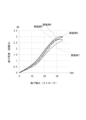
- 1A and 1B are front, side and cross-sectional views of a knife according to an embodiment; It is a figure for demonstrating the locking structure which concerns on this embodiment. It is a figure for demonstrating the measuring method of the bending strength of the cutlery which concerns on this embodiment. It is a figure for demonstrating the result of the bending-strength measurement of the cutlery which concerns on this embodiment. It is a figure for demonstrating the result of another bending-strength measurement of the cutlery which concerns on this embodiment.
- Disposable cutlery 1 is provided in various food and drink places such as food courts in commercial facilities, fast food shops, take-out bento shops, in-flight food and drink service, food delivery and catering events. Therefore, it is expected to be discarded after being used once or several times.
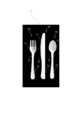
- the disposable cutlery 1 according to this embodiment has a head portion 11 that mainly comes into contact with food, a neck portion 12 that is connected to the head portion 11, and a handle portion 13 that is connected to the neck portion 12 and is mainly used for handling and operation. and includes a spoon 10, a fork 20 and a knife 30, as shown particularly in FIG. Others may include lotuses, muddlers, slotted spoons, and the like.
- the disposable cutlery 1 of this embodiment is characteristically formed of a sheet material made from pulp fibers, and part or all of the sheet material made from pulp fibers is pressed in the thickness direction and molded. ing. That is, the whole is formed of a sheet material made of pulp fibers, and a mold preformed in a partial shape or an entire shape of the cutlery 1 such as the spoon 10, the fork 20, and the knife 30 is molded from the sheet material. Compression molding is performed so that the shape of the mold is transferred to the sheet material by pressing a part or all of the sheet material from the thickness direction. Of course, it may be formed into a desired shape by die-cutting, cutting, or the like as appropriate after press working.
- the whole is press-formed in the thickness direction because it can be formed with a high press pressure.
- the cutlery 1 is a knife 30, it is desirable that at least the edge portion of the head portion 11, which serves as a blade, is formed by pressing. Furthermore, the disposable cutlery 1 of the present embodiment may be formed by pressing a plurality of sheet materials in a laminated state, but since there is no risk of peeling between layers, a single sheet It is preferable to press and mold only the material.
- the conventional pulp molding technology like the casting technology in metal molding, molds a fluid raw material containing pulp fibers and agglutinates it by compression. Densification is difficult, and since the molded product does not have fiber orientation, there is a problem that it is rigid and weak in stiffness, and is likely to break or crack.
- the cutlery of this embodiment is a sheet that is dried once to build hydrogen bonds and has a fixed fiber orientation, like forging technology in metal molding, rather than stamping a fluid raw material such as pulp molding technology. Since the material is further pressed in the thickness direction, it is compacted to a high density, and although it is thin, it has the appropriate plastic-like elasticity and flexibility, and is strong enough for use.
- the thickness can be reduced while the strength can be increased, and the surface can be made smoother than those produced by conventional pulp molding technology. For this reason, it can be formed into a shape similar to that of high-grade metal cutlery formed with smooth curves and curved surfaces, and is excellent in taste when used. Furthermore, there is an advantage that it is easy to manufacture without requiring a fluid pulp slurry at the time of manufacture.
- the cutlery 1 of the present embodiment is formed not of plastic but of a sheet material made from pulp fibers, it is possible to eliminate plastic. From the viewpoint of eliminating plastics, it is desirable that the cutlery 1 according to the present embodiment is not plastic-laminated with a non-biodegradable resin, and it is particularly desirable not to be plastic-laminated. In addition, since the cutlery 1 of the present embodiment is an aggregate of pulp fibers, the cutlery 1 is not crushed in the oral cavity even if chewed with the teeth during use, and safety during use can be ensured.
- the bending strength of the cutlery 1 of the present embodiment is not necessarily limited because the necessary bending strength varies depending on the shape and the use of the cutlery, but it is measured by a composite material testing machine (10 kN) type 5966 type and its equivalent. It is desirable that the strength in the two-point bending load test is 0.5 N or more when the bending deflection is 15 mm.
- the handle portion 13 of the cutlery 1 is fixed to the support base 80A, and the central portion of the head portion 11 of the cutlery 1 is measured as the pushing position. For example, as shown in FIG. 7, if the cutlery 1 is a spoon 10, the position of the bottom of the bowl shape is the pushing position.
- the holding length L20 from the rear end of the cutlery to the end of the support base is not limited by the type or shape of the cutlery 1, but may be 25 to 30% of the total length of the cutlery. However, at least the position where the neck portion 12 has the narrowest width is set ahead of the wire end 80t of the support base 80A. Measurement is performed with a small load of 500N, an indentation speed of 40 mm/min, and an indenter 81 having a semicircular tip. If the measurement sample is the spoon 10 or the fork 20, it is set with the front side facing upward, and if it is the knife 30, it is set with the lateral side facing upward.
- a curry spoon or a table spoon is about 15 to 30 g, and when operating the cutlery 1 such as the spoon 10 and the fork 20, the neck 12 or the vicinity thereof is supported with a finger or the like. . Therefore, if the bending load at bending deflection of 15 mm is 0.5 N or more by this measurement method without supporting the neck portion, the cutlery 1 has a particularly preferable strength sufficient to be used with a general operation method. It can be said. Furthermore, it is desirable that the cutlery of this embodiment has a bending resistance of 2 N or more at a bending deflection of 30 mm. Even if it is shaped like a relatively large table spoon, it has a high degree of flexure, and the risk of breakage or breakage during use is extremely low, resulting in high safety.
- the cutlery 1 of the present embodiment preferably has water resistance of 3 minutes or more, more preferably 5 minutes or more.
- the water resistance means that each layer does not separate even if it is completely immersed in water, and that it does not hydrolyze.
- the strength in the two-point bending load test that is, the bending load at a bending deflection of 15 mm is maintained at 0.5 N or more even after being immersed for 5 minutes.
- the cutlery 1 preferably contains a siloxane compound. It is more desirable that at least the pressed portion contains the siloxane compound, and it is particularly desirable that the entirety contains the siloxane compound.
- the siloxane bond provides high rigidity, strength, water resistance and surface smoothness.
- a range that includes at least the head portion 11, which is likely to come into contact with food and moisture in the oral cavity, and is likely to come into contact with the oral cavity and lips, and the neck portion 12, which is likely to be twisted and force applied during operation. contains a siloxane compound. The effect of improving the rigidity, strength, water resistance, and surface smoothness due to the inclusion of the siloxane compound is likely to be felt.
- the siloxane compound is contained throughout the cutlery.
- the siloxane compound is not necessarily limited as long as it has a siloxane bond, but since the cutlery 1 may come into contact with food or be put in the oral cavity, it should have no or low toxicity to living organisms. is desirable.
- an appropriate alkoxysilane solution or an alkoxysilane solution processed product is applied to the sheet material before molding. After the impregnation, the material may be heated or pressed while being heated. In this way, the siloxane compound is contained in such a manner as to bind to the pulp fibers themselves or coat the pulp fibers.
- the cutlery 1 of the present embodiment is formed by pressing a sheet material, and the pressing pressure and pressing speed can be appropriately changed according to the type and shape of the sheet material and cutlery. possible, but not necessarily limited.
- the press pressure is preferably 60 tons or more, more preferably 80 tons or more, and particularly preferably 100 tons or more. It is preferably formed by compressing the sheet material with pressure.
- the upper limit may be designed within a range in which breakage of the sheet material does not occur, but considering that the sheet material is made from pulp fibers, the upper limit is about 200 tons.
- the cutlery 1 of the present embodiment when such a high pressing pressure is used, it is easier to manufacture by pressing the whole cutlery 1 rather than by partially pressing it. It is desirable in terms of strength. Therefore, the cutlery 1 of the present embodiment is obtained by partially bonding or crimping a sheet material that is not press-processed to integrate a single sheet material that has been press-processed and compression-molded as a whole. may be When performing press working, the sheet material may be heated at the same time as the press working, or may be moistened so as to facilitate deformation of the sheet material. A solution containing the siloxane compound or a solution containing a precursor of the siloxane compound may be used as the wetting agent. Moreover, the heating temperature and the like when heating are not necessarily limited.
- a preferable basis weight of the cutlery 1 of the present embodiment is 700 g/m 2 or more, more preferably 850 g/m 2 or more, and particularly preferably 950 g/m 2 or more.
- the grammage is a value measured according to "Paper and paperboard - Basis weight measurement method" described in JIS P 8124 (2011).
- the cutlery 1 of this embodiment preferably has a density of 0.70 g/cm 3 or more, preferably 0.98 g/cm 3 or more, and particularly preferably 1.1 g/cm 3 .
- the density of the pressed portion is preferably 1.0 g/cm 3 or more, particularly preferably 1.2 g/cm 3 .
- the density is calculated by (basis weight)/(paper thickness).
- the cutlery 1 of this embodiment can be said to have a sufficiently high density if it has this density.
- the thickness is not necessarily limited, but the thickness of the pressed portion is 1.5 mm or less, preferably 1.35 mm or less, and particularly preferably 1.0 mm or less per sheet.
- the paper thickness is a value measured according to “Paper and paperboard—Testing methods for thickness and density” described in JIS-P8118 (2014).
- the pulp fibers that make up the cutlery 1 are not necessarily limited, but preferred constituent pulp fibers are unbleached softwood kraft pulp (NUKP), semi-bleached softwood kraft pulp (NSBKP), and softwood kraft pulp such as bleached softwood kraft pulp (NBKP). and hardwood kraft pulp such as unbleached hardwood kraft pulp (LUKP), semi-bleached hardwood kraft pulp (LSBKP), and bleached hardwood kraft pulp (LBKP).
- NUKP unbleached softwood kraft pulp
- NBRKP softwood kraft pulp
- hardwood kraft pulp such as unbleached hardwood kraft pulp (LUKP), semi-bleached hardwood kraft pulp (LSBKP), and bleached hardwood kraft pulp (LBKP).
- Other pulps include chemical pulps such as waste paper pulp, hardwood sulfite pulp and softwood sulfite pulp, or various known pulps such as pulp chemically or mechanically produced from non-wood fibers such as kena
- the cutlery 1 is used for touching food or being put in the oral cavity, it is preferably made of 100% virgin pulp and does not contain waste paper pulp. In addition, since it is virgin pulp and it is easy to achieve both the appearance and strength of the product after processing, it is desirable that the content of softwood kraft pulp and hardwood kraft pulp is 90 to 100% by mass. In this case, the mixing ratio of softwood kraft pulp and hardwood kraft pulp is preferably 5:95 to 30:70. By increasing the blending ratio of hardwood kraft pulp with short fiber length, it is easy to be compacted by press working, easy to develop strength, and easy to improve the texture of the surface. Furthermore, it is particularly preferable to use bleached softwood kraft pulp and bleached hardwood kraft pulp because the cutlery 1 is made of bleached pulp, has a high degree of whiteness, and has a design with a sense of cleanliness and hardness.
- Sheet materials made from pulp fibers according to the present embodiment include dry paper and wet paper. Paper having a machine direction (MD direction) and a cross direction (CD direction) produced by wet papermaking from a pulp slurry is preferred. Since such paper has fiber orientation, it is easy to increase the strength.
- MD direction machine direction
- CD direction cross direction
- the longitudinal direction from the head portion 11 side to the handle portion 13 side is the longitudinal direction of the paper (MD direction ). By aligning the longitudinal direction (MD direction) of the paper with the longitudinal direction, the cutlery 1 is hard to break and easy to bend when the head part 11 is operated with the handle part 13. - ⁇
- a particularly preferable sheet material according to the present embodiment is the multi-layered paper 50 having three or more paper layers. It is particularly preferable that the cutlery 1 of the present embodiment is made of the multi-layered paper 50 as the sheet material and contains a siloxane compound.
- the multi-layered paper 50 has a plurality of laminated paper layers 51 and 52, so that it is easier to increase the strength when compacted in the thickness direction than the single-layered paper.
- the multi-layered paper 50 can change the characteristics of each layer, and can easily secure elasticity while having a high density, and can be easily imparted with water resistance.
- the sheet material is compression-molded by press working in the thickness direction, that is, the stacking direction of the layers of the multilayered paper 50, so that the characteristics of each layer of the multilayered paper 50 are easily maintained.
- the head portion 11 and the handle portion 13 are connected via a narrow neck portion 12 like a spoon shown in FIG. 3 or a fork shown in FIG. Even with a thin and elongated shape as a whole, it is easy to develop sufficient strength.
- the multi-layered paper 50 can be manufactured by multi-layered paper.
- the multi-layered paper 50 may be commercially available, for example, Ellipra paper manufactured by Dainichi Paper Co., Ltd., and the like.
- the multilayer paper 50 which is a preferred sheet material according to the present embodiment, preferably has tensile strengths of 50 kN/m or more in both the longitudinal direction and the transverse direction measured according to JIS P 8113 (2006). If it has this tensile strength, it is easy to ensure sufficient strength even in the non-pressed portion and after press forming.
- the multilayer paper 50 which is a preferable sheet material according to the present embodiment, has a Taber stiffness of 125 mN ⁇ m or more, preferably 150 mN ⁇ m or more in the longitudinal direction, measured according to JIS P 8125 (2000). , 40 mN ⁇ m or more, preferably 60 mN ⁇ m or more in the transverse direction.
- the multi-layered paper 50 is tested according to JAPAN TAPPI Paper Pulp Test Method No. 18-1:2000, the Z-axis strength is 400 kN/m 2 or more, preferably 450 kN/m 2 or more. It has excellent formability by press working, and is easy to manufacture by punching such as Thomson processing before and after press working, and cutting with a cutting plotter.
- the number of layers of the multilayer paper 50 which is a preferable sheet material according to the present embodiment, is not limited, but it is preferable to set the number of layers to 5 to 9, and the number of layers of the middle layer 52 to be 3 or more, particularly 5.
- the embodiment shown in FIG. 2 has three middle layers 52 . It is said that when the total number of middle layers 52 is three or more, the toughness and durability of the multi-layered paper 50 are likely to be exhibited.
- the upper limit of the total number of intermediate layers 52 is preferably seven layers or less from the viewpoint of maintaining interlayer strength. In addition, three to seven layers are easy to operate while maintaining interlaminar strength in the case of using a cylinder multi-cylinder type combined paper machine.
- the basis weight of the multilayer paper 50 which is a preferable sheet material according to the present embodiment, is preferably 700 g/m 2 or more, more preferably 850 g/m 2 or more, and particularly preferably 950 g/m 2 or more.
- the multi-layered paper 50 having this basis weight, it is easy to obtain sufficient rigidity and strength by compressing it in the thickness direction, and it is easy to make it feel more like a plastic disposable cutlery.
- the upper limit of the basis weight of the multi-layered paper 50 is not limited, there is a risk that creases may easily occur with a calender roll or the like during papermaking. 2 is more preferred.
- the thickness of the multilayer paper is preferably 900 ⁇ m or more and 1,500 ⁇ m or less, more preferably 1000 ⁇ m or more and 1,350 ⁇ m or less.
- the basis weight is a value measured in accordance with "Paper and paperboard - Basis weight measurement method" described in JIS P 8124 (2011), and the paper thickness is a value described in JIS-P8118 (2014) "Paper and paperboard - test methods for thickness and density”.
- the basis weights of the surface layer 51 and the middle layer 52 in the multilayer paper 50 can be adjusted within the range of the basis weight of the entire sheet material, and are not particularly limited, but are preferably
- the basis weight of the surface layer 51 is preferably 60.0 g/m 2 or more and 250.0 g/m 2 or less, particularly 130 to 150 g/m 2 per layer.
- the basis weight of the entire middle layer 52 is preferably 500 g/m 2 or more and 900 g/m 2 or less, particularly 650 g/m 2 or more and 800 g/m 2 or less.
- the multilayer paper 50 preferably has a ratio of the total basis weight of the pair of surface layers 51, 51 to the total basis weight of the multilayer paper 50 of 20.0% or more and 35.0% or less. This is because the pair of surface layers 51 has high rigidity and the middle layer 52 has excellent flexibility. Further, in the multilayer paper 50, when the ratio of the total basis weight of the pair of surface layers 51 is within the above range, the multi-layer paper 50 has a property of being difficult to bend.
- the preferred multi-layered paper 50 has a density of preferably 0.65 to 1.50 g/cm 3 , more preferably 0.73 to 1.00 g/cm 3 , particularly preferably 0.76 before compression molding by pressing. ⁇ 0.96 g/cm 3 . When the density of the multilayered paper 50 is within this range, the multi-layered paper 50 has a high basis weight and excellent rigidity, is less likely to break, and tends to have higher hardness and higher stiffness when formed by press working.
- the preferred pulp fibers constituting each layer of the multilayer paper 50 are the same as the pulp fibers constituting the cutlery 1 described above, and are not necessarily limited, but are preferably soft tree unbleached kraft pulp (NUKP), soft tree semi-bleached kraft pulp.
- Softwood kraft pulp such as pulp (NSBKP), bleached softwood kraft pulp (NBKP), and hardwood kraft pulp such as unbleached hardwood kraft pulp (LUKP), semi-bleached hardwood kraft pulp (LSBKP), and bleached hardwood kraft pulp (LBKP).
- NUKP soft tree unbleached kraft pulp
- NKP soft tree semi-bleached kraft pulp
- Softwood kraft pulp such as pulp (NSBKP), bleached softwood kraft pulp (NBKP), and hardwood kraft pulp such as unbleached hardwood kraft pulp (LUKP), semi-bleached hardwood kraft pulp (LSBKP), and bleached hardwood kraft pulp (LBKP).
- pulps include chemical pulps such as waste paper pulp, hardwood sulfite pulp and softwood sulfite pulp, or various known pulps such as pulp chemically or mechanically produced from non-wood fibers such as kenaf, hemp, and reeds. Any suitable combination of pulps may be used.
- the cutlery since it is used for touching food or being put in the oral cavity, it is preferably made of 100% virgin pulp and does not contain waste paper pulp.
- it is virgin pulp and it is easy to achieve both the appearance and strength of the product after processing it is desirable that the content of softwood kraft pulp and hardwood kraft pulp is 90 to 100% by mass.
- the mixing ratio of softwood kraft pulp and hardwood kraft pulp is preferably 5:95 to 30:70.
- the cutlery 1 is made of bleached pulp, has a high degree of whiteness, and has a design with a sense of cleanliness and hardness.
- the multilayer paper 50 which is a preferable sheet material according to the present embodiment, is preferably paper composed only of fibers derived from natural materials and does not contain synthetic fibers including plastics, from the viewpoint of eliminating plastics.
- the paper is made of pulp fibers only.
- the surface layer 51 preferably has a mass ratio (%) of softwood kraft pulp and hardwood kraft pulp of 0/100 or more and 15/85 or less.
- the cutlery 1 contains a large amount of hardwood kraft pulp, which is rigid and easily densified, and the surface layer has high density and rigid characteristics, resulting in a cutlery 1 having excellent strength.
- the mass ratio (%) of the softwood kraft pulp and the hardwood kraft pulp is preferably 15/85 or more and 35/65 or less.
- the multilayer paper 50 which is a preferred sheet material according to the present embodiment, as a papermaking additive.
- a sizing agent and a paper strength agent is added to the multilayer paper 50, which is a preferred sheet material according to the present embodiment, as a papermaking additive. Easy to adjust to desired intensity.
- the multi-layered paper 50 may contain other various additives as long as they do not impair the intended effects of the present invention. For example, polyvinyl alcohol, wax, or the like can be applied.
- Styrene sizing agents alkyl ketene dimers (AKD), alkenyl succinic anhydrides (ASA), neutral rosin sizing agents, rosin sizing agents, modified rosin emulsion sizing agents, and the like can be used as sizing agents.
- rosin sizing agents and modified rosin emulsion sizing agents are preferred.
- the rosin sizing agent is not particularly limited.
- Rosin-based substances include, for example, rosins such as gum rosin, wood rosin, and tall oil rosin modified with ⁇ , ⁇ -unsaturated carboxylic acids such as fumaric acid, maleic acid, and acrylic acid, or their anhydrides; Rosin esters obtained by reacting polyhydric alcohols such as glycerin, trimethylolethane, trimethylolpropane, pentaerythritol and diglycerin can be mentioned.
- the rosin sizing agent also includes those obtained by emulsifying these alone or a mixture thereof, and those obtained by emulsifying them alone and then mixing them. Furthermore, emulsified products to which various polymers are added in order to further improve size development are also included.
- amphoteric paper strength agents are preferably used.
- amphoteric polyacrylamides include copolymers of acrylamide with anionic monomers and cationic monomers, Mannich-modified copolymers of acrylamide with anionic monomers, Hoffmann decomposition products, and the like.
- amphoteric polyacrylamide since amphoteric polyacrylamide has a self-fixing function, even if it is added to improve inter-paper strength, it does not become excessively cationic. can be established in
- the amount of sizing agent added is preferably 0.5 kg/t or more and 5.0 kg/t or less in solid content.
- the amount of the paper strength agent to be added is preferably 12 kg/t or more and 30 kg/t or less in terms of solid content.
- “kg/t” shows the mass (kg) per 1t of pulp.
- the multilayered paper 50 it is preferable to add at least one of the above-described sizing agent and paper strength agent to each layer of the surface layer 51 and the middle layer 52 as a papermaking additive.
- the amount of the sizing agent added to the surface layer 51 is preferably 0.5 kg/t or more and 5.0 kg/t or less in solid content.
- the amount of the sizing agent added to the middle layer 52 is preferably 2.0 kg/t or more and 5.0 kg/t or less in solid content.
- the amount of the paper strength enhancer added to each layer is preferably 12 kg/t or more and 30 kg/t or less in terms of solid content. Within this range, it is easy to achieve various paper strengths such as interlaminar strength of multi-layered paper suitable for cutlery.
- FIG. 3 shows a table spoon 10, which is a disposable cutlery according to this embodiment.
- (A) is a diagram showing a front view
- (B) is a diagram showing a side view
- (C) is a front side curve at positions (1) to (7) in (A). It is the figure which showed the shape by the cross section view.
- the entire spoon 10 of this embodiment shown in the figure, from the head portion 11 to the handle portion 13, is formed by compression molding by pressing a sheet material.
- the head portion 11 that touches the food is a bowl that opens from the front side like a general metal spoon or a conventional plastic disposable spoon so that various shapes of food such as solid, powder or liquid can be scooped. shape.
- the neck portion 12 connected to the head portion 11 is formed to have a narrow width that smoothly continues in a curved line from the head portion 11 in front view, and the handle portion 13 connected to the neck portion 12 is formed. has the same width as the neck portion 12 or is wider than the neck portion 12 . Furthermore, from the head part 11 to the handle part 13, the edge draws a curve in the front view and the side view, and the front and back are configured with curved surfaces. It has the same shape and is excellent in design. However, the spoon 10 according to this embodiment is not limited to this shape.
- the neck portion 12 connected to the head portion 11 is formed to be narrow and smoothly continuous from the head portion 11 in a curved line when viewed from the front.
- the ratio of the curvature radius R1 of the cross section to the width L1 is 1:0.4 to 1:0.8.
- Particularly preferred is 1:0.4 to 1:0.75.
- the ratio of the radius of curvature of the cross section to the width of the neck portion is 1:0.4 to 1:0.8, the strength can be increased while the neck portion can be removed from the compression mold.
- the ratio of the radius of curvature of the cross section to the width is less than 1:0.5, it will not come out of the mold. and can be less than 1:0.5 for flexing to open curved surfaces.
- the neck portion 12 is formed to have a curved cross section, the bending strength is improved when the head portion 11 is pushed from the front side or the back side, compared with the case where the neck portion 12 is not formed.
- the ratio of the radius of curvature of the cross section to the width is 1:0.4 to 1:0.8, there is a risk that the neck portion may break during use, for example, during the general operation of scooping food with a spoon. lower step by step.
- the specific size of the spoon of this embodiment is not limited, especially in the case of the table spoon 10 shown in FIG. 0 to 60.0 mm, the maximum width L4 of the head portion 11 is 35.0 to 45.0 mm,
- the length L5 of the neck portion 12 can be 40.0-50.0 mm, and the minimum width L6 of the neck portion 12 can be 8.5-22.0 mm. With this shape, it is possible to have a feeling of use similar to that of the disposable tablespoon 10, which is a popular plastic product.
- the table spoon 10 is used as an example to describe the shape and size thereof. It can be of any size, for example, it can have a size and shape suitable for use as a service spoon, dessert spoon, soup spoon, fish spoon, teaspoon, coffee spoon, demitasse spoon, and ice cream spoon. . Moreover, a spoon with a bifurcated and trifurcated tip, which is called a melon spoon, a strawberry spoon, or the like, may be used.
- FIG. 4 shows a table fork 20 which is the disposable cutlery 1 according to this embodiment.
- (A) is a diagram showing a front view
- (B) is a diagram showing a side view
- (C) is a curve of the front side at positions (1) to (7) in (A). It is the figure which showed the shape by the cross section view.
- the fork 20 of this embodiment of the illustrated example is formed by compression-molding the entirety from the head portion 11 to the handle portion 13 by pressing a sheet material.
- the head portion 11 that touches the food has a shallow bowl shape on the front side so that it can scoop up various shapes of food such as solids, powders, liquids, etc. It is formed in a comb shape divided into four.
- the neck portion 12 connected to the head portion 11 is formed to have a narrow width that smoothly continues in a curved line from the head portion 11 in a front view, similarly to the spoon 10 described above.
- the handle portion 13 connected to the neck portion 12 has the same width as the neck portion 12 or is wider than the neck portion 12 .
- the edge is curved in front view and side view, and the surface is configured with a curved surface. It has a shape and is excellent in design.
- the fork 20 according to this embodiment is not limited to this shape.
- the neck portion 12 that is connected to the head portion 11 is formed to have a narrow width that smoothly continues in a curved line from the head portion 11 when viewed from the front.
- the neck portion 12 is formed to have a curved cross section with an open front side, and the ratio of the curvature radius R2 of the cross section to the width L7 is 1:0.4 to 1:0.8. It has become. Particularly preferred is 1:0.4 to 1:0.75.
- the specific size of the fork 20 of this embodiment is not limited, especially in the case of the table fork 20 shown in FIG.
- the maximum width L10 of the head portion 11 is 35.0 to 45.0 mm
- the length L11 of the neck portion is 40.0 to 50.0 mm
- the minimum width L12 of the neck portion is 8.5 to 22 mm. 0 mm. With this shape, it is possible to have the same feeling of use as the disposable table fork 20, which is a popular plastic product.
- the table fork is used as an example to describe the shape and size thereof.
- the size and shape can be suitable for use as service forks, dessert forks, fish forks, salad forks, fruit forks, cake forks, and Hime forks.
- FIG. 5 shows a table knife 30 as the disposable cutlery 1 according to this embodiment.
- (A) is a view showing a rear view
- (B) is a view showing a side view
- (C) is a cross-sectional view at positions (1) to (7) in (A). It is a diagram.
- the knife 30 of this embodiment of the illustrated example has a blade portion 11B in which one edge of the head portion 11 tapers toward the one edge by pressing.
- the knife 30 according to this embodiment is formed in a curved shape in which one edge constituting the blade portion 11B is slightly bulged in a side view, and the neck portion 12 connected thereto has a curved shape in a side view. It is smoothly connected to the handle portion 13, and the edge on the side of the blade portion 11B has a shape similar to that of high-class cutlery such as metal cutlery which is streamlined and not disposable as a whole, and is excellent in design.
- the knife 30 according to this embodiment is not limited to this shape.
- the knife 30 of this embodiment is characterized in that the portion extending to the head portion 11, the neck portion 12 and the handle portion 13 is formed by laminating two sheet materials 30A and 30B.
- the portion other than the pressed one edge portion is not press-processed, and the thickness is increased with respect to the blade portion 11B.
- the thickness of the non-pressed portion is not necessarily limited, but is 1800 ⁇ m or more and 3000 ⁇ m or less.
- the number of sheets to be laminated is not necessarily limited, it is desirable that the number is two to three.
- One edge of the head part 11 is made into a blade part 11B that is tapered toward one edge by press working, and the other part is laminated with a sheet material, so that food can be cut with a knife, for example, when used.
- a knife for example, when used.
- the risk of the knife breaking during normal operation is greatly reduced.
- the edge of the blade portion 11B may be formed in a serrated shape. It becomes easy to cut fibrous substances such as meat.
- the specific size of the knife of this embodiment is not limited, especially in the case of the table knife 30 shown in FIG. 0 to 110.0 mm, the maximum width L15 of the head portion 11 is 12.0 to 20.0 mm, the length L16 of the handle portion is 90.0 to 100.0 mm, and the width L17 of the handle portion is 15.0 to 25.0 mm.
- this shape it is possible to have a feeling of use similar to that of a general disposable table knife made of plastic.
- the shape and size of the table knife have been described as an example.
- the cutlery of the present embodiment is a fork, it is not limited to this and can be used as long as the effects of the present invention are not hindered. It can be of any size, for example, any size and shape suitable for use as a dessert knife, fish knife, fruit knife, or butter knife.
- the cutlery of the present embodiment there may be a portion formed by laminating and integrating portions of sheet materials that are not pressed, such as the knife 30 shown in FIG. Furthermore, there may be a portion where the sheet material is pressed and a portion where the sheet material which is not pressed is laminated and integrated.
- the method of joining the sheet materials is not necessarily limited. As long as the effects of the present invention are not hindered, they can be joined by joining means such as joining by a locking structure, which is also called adhesive, crimping means, crimping means, eyelet means, wedge means, stapling means, coreless staples, and the like. can. Also, as the joining means, a plurality of types of joining means may be used together.
- starch As adhesives for joining, starch, various modified starches, modified cellulose such as carboxymethyl cellulose, water-soluble polymer adhesives such as polyvinyl alcohol, water-based emulsion resins such as acrylic acid esters and vinyl acetate, etc. may be used. good. Those derived from natural materials such as starch and cellulose are desirable from the viewpoint of environmental load. Crimping for joining, rivets constituting eyelets, and staple needles should be made of wood or metal other than plastic, and materials other than plastic should be used.
- this locking structure can be formed at a plurality of appropriate locations to integrate the sheet materials, like the locking portion 40 of the knife 30 shown in FIG. Since the sheet material of the cutlery 1 of the present embodiment is a paper material having stiffness, the layers can be joined to each other even by joining with such a locking structure.
- This locking structure is also desirable in that it does not use any other parts.
- a mechanical locking structure including this locking structure and an adhesive may be used together. Even in this case, there is an advantage that the amount of adhesive used can be reduced.
- spoons (Examples 1 to 7) were produced as cutlery according to the present invention, and their bending strengths were measured. All of Examples 1 to 7 had the shape shown in FIG. In addition, the total length is 190 mm.
- sheet material multi-layered paper (Ellipra paper manufactured by Dainichi Paper Co., Ltd., basis weight: 1000 g/m 2 ) made of 100% pulp fibers was used. Pressing is performed as a whole, Example 1 is processed with a press pressure of 60 tons, Example 2 is processed with a press pressure of 80 tons, and Example 3 is processed with a press pressure of 110 tons. The processing pressure was made different. Examples 4 and 5 are processed at a press pressure of 110 tons and contain a siloxane compound.
- Example 4 the content of the siloxane compound in Example 4 was doubled.
- Examples 6 and 7 are processed at a press pressure of 60 tons and contain a siloxane compound. In Examples 6 and 7, the content of the siloxane compound in Example 6 was doubled.
- the test method is a two-point bending load test using a composite material testing machine (10 kN) type 5966, and as shown in FIG. I fixed it like this.
- the narrowest portion of the neck portion 12 is positioned forward of the tip position 80t.
- the push-in position was set at the bottom position of the bowl shape.
- the measurement was carried out with a small load of 500 N, a pressing speed of 40 mm/min, and a radius R1 of the indenter 81 of 5 mm.
- Figures 8 and 9 show the measurement results of each example. As shown in FIG. 8, in Examples 1 to 3, although the pressing pressure was different, the bending load was 0.5 N or more when the bending deflection was 15 mm, and further, the bending load was 2 N or more when the bending deflection was 30 mm. It has been shown to be strong enough for cutlery. In addition, as shown in FIG. 9, it was confirmed that the inclusion of a siloxane compound further increased the strength.
- a spoon (Example 8) and a fork (Example 9), which are cutlery according to the present invention, and a cutlery-shaped sheet material (Comparative Example 1 and Comparative Example 2) before the press processing were produced, and given to a subject.
- a sensory test was conducted in which actual use was made.
- the spoon according to Example 8 was the same as that of Example 3, and the fork according to Example 9 had the shape shown in FIG. Ellipra paper manufactured by Paper Manufacturing Co., Ltd. (basis weight: 1000 g/m 2 ) was used, and was molded under a press pressure of 110 tons.
- the shape was the same as the shape before pressing in Examples 8 and 9, and the sheet material was multi-layered paper (manufactured by Dainichi Paper Co., Ltd.) in which the fiber raw material was 100% pulp fiber. Ellipra paper with a basis weight of 1000 g/m 2 ) was used.
Landscapes
- Table Equipment (AREA)
- Paper (AREA)
Applications Claiming Priority (2)
| Application Number | Priority Date | Filing Date | Title |
|---|---|---|---|
| JP2022-016572 | 2022-02-04 | ||
| JP2022016572A JP7759816B2 (ja) | 2022-02-04 | 2022-02-04 | カトラリー |
Publications (1)
| Publication Number | Publication Date |
|---|---|
| WO2023149289A1 true WO2023149289A1 (ja) | 2023-08-10 |
Family
ID=87552169
Family Applications (1)
| Application Number | Title | Priority Date | Filing Date |
|---|---|---|---|
| PCT/JP2023/002183 Ceased WO2023149289A1 (ja) | 2022-02-04 | 2023-01-25 | カトラリー |
Country Status (2)
| Country | Link |
|---|---|
| JP (3) | JP7759816B2 (https=) |
| WO (1) | WO2023149289A1 (https=) |
Families Citing this family (11)
| Publication number | Priority date | Publication date | Assignee | Title |
|---|---|---|---|---|
| JP2020103417A (ja) * | 2018-12-26 | 2020-07-09 | 株式会社三洋物産 | 遊技機 |
| JP2020103414A (ja) * | 2018-12-26 | 2020-07-09 | 株式会社三洋物産 | 遊技機 |
| JP2020103418A (ja) * | 2018-12-26 | 2020-07-09 | 株式会社三洋物産 | 遊技機 |
| JP2020146144A (ja) * | 2019-03-12 | 2020-09-17 | 株式会社三洋物産 | 遊技機 |
| JP2021133198A (ja) * | 2020-02-28 | 2021-09-13 | 株式会社三洋物産 | 遊技機 |
| JP2021133200A (ja) * | 2020-02-28 | 2021-09-13 | 株式会社三洋物産 | 遊技機 |
| JP2021133199A (ja) * | 2020-02-28 | 2021-09-13 | 株式会社三洋物産 | 遊技機 |
| JP2021186294A (ja) * | 2020-05-29 | 2021-12-13 | 株式会社三洋物産 | 遊技機 |
| JP2022012089A (ja) * | 2020-06-30 | 2022-01-17 | 株式会社三洋物産 | 遊技機 |
| JP2022012088A (ja) * | 2020-06-30 | 2022-01-17 | 株式会社三洋物産 | 遊技機 |
| JP2022012090A (ja) * | 2020-06-30 | 2022-01-17 | 株式会社三洋物産 | 遊技機 |
Citations (4)
| Publication number | Priority date | Publication date | Assignee | Title |
|---|---|---|---|---|
| JP3051917U (ja) * | 1998-03-02 | 1998-09-11 | 宣男 佐藤 | スプーン |
| JP2006068307A (ja) * | 2004-09-02 | 2006-03-16 | Showa Marutsutsu Co Ltd | 紙軸、紙製マドラー、紙製スプーンおよび紙製ナイフ |
| JP2020090739A (ja) * | 2018-12-05 | 2020-06-11 | 大王製紙株式会社 | 食器用塗工紙 |
| JP2021029926A (ja) * | 2019-08-29 | 2021-03-01 | 王子ホールディングス株式会社 | カトラリー |
Family Cites Families (4)
| Publication number | Priority date | Publication date | Assignee | Title |
|---|---|---|---|---|
| JPS60195585U (ja) * | 1984-06-07 | 1985-12-26 | 陳 朝欽 | スプ−ン |
| WO1991008086A1 (en) | 1989-11-24 | 1991-06-13 | W.A. Sanders Papierfabriek 'coldenhove' B.V. | Disposable cutlery |
| ES1225984Y (es) * | 2019-01-18 | 2019-05-28 | Copy Valls Con Gelats S L | Cubierto de carton |
| JP2021053383A (ja) * | 2019-09-30 | 2021-04-08 | 日本製紙株式会社 | 紙製ストロー |
-
2022
- 2022-02-04 JP JP2022016572A patent/JP7759816B2/ja active Active
-
2023
- 2023-01-25 WO PCT/JP2023/002183 patent/WO2023149289A1/ja not_active Ceased
-
2024
- 2024-04-11 JP JP2024063873A patent/JP7794883B2/ja active Active
- 2024-04-11 JP JP2024063874A patent/JP2024086866A/ja active Pending
Patent Citations (4)
| Publication number | Priority date | Publication date | Assignee | Title |
|---|---|---|---|---|
| JP3051917U (ja) * | 1998-03-02 | 1998-09-11 | 宣男 佐藤 | スプーン |
| JP2006068307A (ja) * | 2004-09-02 | 2006-03-16 | Showa Marutsutsu Co Ltd | 紙軸、紙製マドラー、紙製スプーンおよび紙製ナイフ |
| JP2020090739A (ja) * | 2018-12-05 | 2020-06-11 | 大王製紙株式会社 | 食器用塗工紙 |
| JP2021029926A (ja) * | 2019-08-29 | 2021-03-01 | 王子ホールディングス株式会社 | カトラリー |
Also Published As
| Publication number | Publication date |
|---|---|
| JP2024086866A (ja) | 2024-06-28 |
| JP2023114287A (ja) | 2023-08-17 |
| JP7794883B2 (ja) | 2026-01-06 |
| JP2024096853A (ja) | 2024-07-17 |
| JP7759816B2 (ja) | 2025-10-24 |
Similar Documents
| Publication | Publication Date | Title |
|---|---|---|
| WO2023149289A1 (ja) | カトラリー | |
| JP2023114287A5 (https=) | ||
| JP2024096853A5 (https=) | ||
| US10710784B2 (en) | Foldable spoon and method for making | |
| JP4039006B2 (ja) | 絞り成形加工用原紙及びそれを用いた紙製成形容器 | |
| CN114630938B (zh) | 多层纸及其制造方法 | |
| TW202030401A (zh) | 紙筒及紙筒用原紙 | |
| JP2025509882A (ja) | プレス成形用の多層材料、送達システム、及び結果として生じる繊維製品 | |
| JP7808484B2 (ja) | 剃刀用の柄体及び剃刀 | |
| WO1991008086A1 (en) | Disposable cutlery | |
| CN113195829A (zh) | 餐具用涂布纸 | |
| JP2001098496A (ja) | 嵩高板紙 | |
| CN101148847B (zh) | 液体和食品包装纸及其生产方法 | |
| JP7216849B1 (ja) | 歯ブラシ及び歯ブラシ用の柄体 | |
| JP2025025670A (ja) | カトラリー | |
| CN120759159A (zh) | 旨在形成u形吸管的纸 | |
| WO2023209496A1 (en) | Method for manufacturing a disposable item | |
| JP2024141112A (ja) | 合紙、並びに、該合紙の加工品である紙食器及び衣類掛け用具 | |
| JP2023540438A (ja) | 複合型熱成形食器及びその製造方法 | |
| JP7255723B1 (ja) | 合紙及び該合紙を加工して得られる紙加工品 | |
| US20240392511A1 (en) | Barrier board and a method to produce it | |
| JPH076299U (ja) | 下垂用紙 | |
| JP2023182237A (ja) | 剃刀 | |
| JP2024150172A (ja) | 加湿成形用の紙基材、紙加工品及び紙容器 | |
| JP2024010845A (ja) | 剃刀及び剃刀用の刃固定部材 |
Legal Events
| Date | Code | Title | Description |
|---|---|---|---|
| 121 | Ep: the epo has been informed by wipo that ep was designated in this application |
Ref document number: 23749605 Country of ref document: EP Kind code of ref document: A1 |
|
| NENP | Non-entry into the national phase |
Ref country code: DE |
|
| 122 | Ep: pct application non-entry in european phase |
Ref document number: 23749605 Country of ref document: EP Kind code of ref document: A1 |