WO2023145891A1 - 電解コンデンサおよび電解コンデンサの製造方法 - Google Patents
電解コンデンサおよび電解コンデンサの製造方法 Download PDFInfo
- Publication number
- WO2023145891A1 WO2023145891A1 PCT/JP2023/002689 JP2023002689W WO2023145891A1 WO 2023145891 A1 WO2023145891 A1 WO 2023145891A1 JP 2023002689 W JP2023002689 W JP 2023002689W WO 2023145891 A1 WO2023145891 A1 WO 2023145891A1
- Authority
- WO
- WIPO (PCT)
- Prior art keywords
- conductive polymer
- polymer layer
- electrolytic capacitor
- liquid
- separator
- Prior art date
- Legal status (The legal status is an assumption and is not a legal conclusion. Google has not performed a legal analysis and makes no representation as to the accuracy of the status listed.)
- Ceased
Links
Images

Classifications
-
- H—ELECTRICITY
- H01—ELECTRIC ELEMENTS
- H01G—CAPACITORS; CAPACITORS, RECTIFIERS, DETECTORS, SWITCHING DEVICES, LIGHT-SENSITIVE OR TEMPERATURE-SENSITIVE DEVICES OF THE ELECTROLYTIC TYPE
- H01G9/00—Electrolytic capacitors, rectifiers, detectors, switching devices, light-sensitive or temperature-sensitive devices; Processes of their manufacture
- H01G9/004—Details
- H01G9/022—Electrolytes; Absorbents
- H01G9/035—Liquid electrolytes, e.g. impregnating materials
-
- H—ELECTRICITY
- H01—ELECTRIC ELEMENTS
- H01G—CAPACITORS; CAPACITORS, RECTIFIERS, DETECTORS, SWITCHING DEVICES, LIGHT-SENSITIVE OR TEMPERATURE-SENSITIVE DEVICES OF THE ELECTROLYTIC TYPE
- H01G11/00—Hybrid capacitors, i.e. capacitors having different positive and negative electrodes; Electric double-layer [EDL] capacitors; Processes for the manufacture thereof or of parts thereof
- H01G11/52—Separators
-
- H—ELECTRICITY
- H01—ELECTRIC ELEMENTS
- H01G—CAPACITORS; CAPACITORS, RECTIFIERS, DETECTORS, SWITCHING DEVICES, LIGHT-SENSITIVE OR TEMPERATURE-SENSITIVE DEVICES OF THE ELECTROLYTIC TYPE
- H01G9/00—Electrolytic capacitors, rectifiers, detectors, switching devices, light-sensitive or temperature-sensitive devices; Processes of their manufacture
-
- H—ELECTRICITY
- H01—ELECTRIC ELEMENTS
- H01G—CAPACITORS; CAPACITORS, RECTIFIERS, DETECTORS, SWITCHING DEVICES, LIGHT-SENSITIVE OR TEMPERATURE-SENSITIVE DEVICES OF THE ELECTROLYTIC TYPE
- H01G9/00—Electrolytic capacitors, rectifiers, detectors, switching devices, light-sensitive or temperature-sensitive devices; Processes of their manufacture
- H01G9/0029—Processes of manufacture
-
- H—ELECTRICITY
- H01—ELECTRIC ELEMENTS
- H01G—CAPACITORS; CAPACITORS, RECTIFIERS, DETECTORS, SWITCHING DEVICES, LIGHT-SENSITIVE OR TEMPERATURE-SENSITIVE DEVICES OF THE ELECTROLYTIC TYPE
- H01G9/00—Electrolytic capacitors, rectifiers, detectors, switching devices, light-sensitive or temperature-sensitive devices; Processes of their manufacture
- H01G9/0029—Processes of manufacture
- H01G9/0036—Formation of the solid electrolyte layer
-
- H—ELECTRICITY
- H01—ELECTRIC ELEMENTS
- H01G—CAPACITORS; CAPACITORS, RECTIFIERS, DETECTORS, SWITCHING DEVICES, LIGHT-SENSITIVE OR TEMPERATURE-SENSITIVE DEVICES OF THE ELECTROLYTIC TYPE
- H01G9/00—Electrolytic capacitors, rectifiers, detectors, switching devices, light-sensitive or temperature-sensitive devices; Processes of their manufacture
- H01G9/004—Details
- H01G9/02—Diaphragms; Separators
-
- H—ELECTRICITY
- H01—ELECTRIC ELEMENTS
- H01G—CAPACITORS; CAPACITORS, RECTIFIERS, DETECTORS, SWITCHING DEVICES, LIGHT-SENSITIVE OR TEMPERATURE-SENSITIVE DEVICES OF THE ELECTROLYTIC TYPE
- H01G9/00—Electrolytic capacitors, rectifiers, detectors, switching devices, light-sensitive or temperature-sensitive devices; Processes of their manufacture
- H01G9/004—Details
- H01G9/022—Electrolytes; Absorbents
- H01G9/025—Solid electrolytes
- H01G9/028—Organic semiconducting electrolytes, e.g. TCNQ
-
- H—ELECTRICITY
- H01—ELECTRIC ELEMENTS
- H01G—CAPACITORS; CAPACITORS, RECTIFIERS, DETECTORS, SWITCHING DEVICES, LIGHT-SENSITIVE OR TEMPERATURE-SENSITIVE DEVICES OF THE ELECTROLYTIC TYPE
- H01G9/00—Electrolytic capacitors, rectifiers, detectors, switching devices, light-sensitive or temperature-sensitive devices; Processes of their manufacture
- H01G9/004—Details
- H01G9/04—Electrodes or formation of dielectric layers thereon
- H01G9/048—Electrodes or formation of dielectric layers thereon characterised by their structure
- H01G9/055—Etched foil electrodes
-
- H—ELECTRICITY
- H01—ELECTRIC ELEMENTS
- H01G—CAPACITORS; CAPACITORS, RECTIFIERS, DETECTORS, SWITCHING DEVICES, LIGHT-SENSITIVE OR TEMPERATURE-SENSITIVE DEVICES OF THE ELECTROLYTIC TYPE
- H01G9/00—Electrolytic capacitors, rectifiers, detectors, switching devices, light-sensitive or temperature-sensitive devices; Processes of their manufacture
- H01G9/004—Details
- H01G9/07—Dielectric layers
-
- H—ELECTRICITY
- H01—ELECTRIC ELEMENTS
- H01G—CAPACITORS; CAPACITORS, RECTIFIERS, DETECTORS, SWITCHING DEVICES, LIGHT-SENSITIVE OR TEMPERATURE-SENSITIVE DEVICES OF THE ELECTROLYTIC TYPE
- H01G9/00—Electrolytic capacitors, rectifiers, detectors, switching devices, light-sensitive or temperature-sensitive devices; Processes of their manufacture
- H01G9/145—Liquid electrolytic capacitors
-
- H—ELECTRICITY
- H01—ELECTRIC ELEMENTS
- H01G—CAPACITORS; CAPACITORS, RECTIFIERS, DETECTORS, SWITCHING DEVICES, LIGHT-SENSITIVE OR TEMPERATURE-SENSITIVE DEVICES OF THE ELECTROLYTIC TYPE
- H01G9/00—Electrolytic capacitors, rectifiers, detectors, switching devices, light-sensitive or temperature-sensitive devices; Processes of their manufacture
- H01G9/15—Solid electrolytic capacitors
-
- H—ELECTRICITY
- H01—ELECTRIC ELEMENTS
- H01G—CAPACITORS; CAPACITORS, RECTIFIERS, DETECTORS, SWITCHING DEVICES, LIGHT-SENSITIVE OR TEMPERATURE-SENSITIVE DEVICES OF THE ELECTROLYTIC TYPE
- H01G9/00—Electrolytic capacitors, rectifiers, detectors, switching devices, light-sensitive or temperature-sensitive devices; Processes of their manufacture
- H01G9/15—Solid electrolytic capacitors
- H01G9/151—Solid electrolytic capacitors with wound foil electrodes
Definitions
- the present disclosure relates to electrolytic capacitors and methods of manufacturing electrolytic capacitors.
- an electrolytic capacitor including a wound body of anode foil, separator, and cathode foil is known.
- One example of such an electrolytic capacitor includes conductive polymer layers disposed in a winding.
- the conductive polymer layer is formed, for example, by impregnating the wound body with a dispersion containing conductive polymer particles.
- a dispersion containing conductive polymer particles has a high viscosity because it contains particles. Therefore, even if the wound body is impregnated with the dispersion, a sufficient conductive polymer layer may not be formed inside the wound body. Insufficient formation of the conductive polymer layer can cause a decrease in initial capacity, an increase in equivalent series resistance (ESR), a decrease in reliability, and the like.
- ESR equivalent series resistance
- the dielectric film formed on the surface of the anode foil is covered with dense conductive polymer particles, it becomes difficult for the electrolytic solution to come into contact with the surface of the dielectric layer. As a result, the dielectric layer (oxide film) forming function of the electrolytic solution is not sufficiently exhibited, which may cause an increase in leakage current or a short circuit.
- Patent Literature 1 International Publication No. 2020/158780 describes "a step of preparing an electrode foil, and a step of preparing a first conductive polymer dispersion containing a first conductive polymer component and a first dispersion medium. and after applying the first conductive polymer dispersion to the surface of the electrode foil by a coating method, at least part of the first dispersion medium is removed, and the first conductive polymer component is included.
- a method for manufacturing an electrolytic capacitor comprising the steps of: forming a first conductive polymer layer; and manufacturing a capacitor element using the electrode foil on which the first conductive polymer layer is formed.” disclosed.
- Patent Document 2 International Publication No. 2020/158783 describes "a step of preparing an anode foil, a cathode foil and a fiber structure provided with a dielectric layer, and a conductive polymer containing a conductive polymer component and a dispersion medium.
- preparing a dispersion applying the conductive polymer dispersion to the fibrous structure and then removing at least a portion of the dispersion medium to prepare a separator; and sequentially laminating the cathode foils to produce a capacitor element, wherein the dispersion medium contains water, the fiber structure contains 50% by mass or more of synthetic fiber, and the fiber structure contains A method for manufacturing an electrolytic capacitor, wherein the density is 0.2 g/cm 3 or more and less than 0.45 g/cm 3 .”
- One object of the present disclosure is to provide a method for manufacturing an electrolytic capacitor that includes a conductive polymer layer and has excellent characteristics.
- the manufacturing method is a method for manufacturing an electrolytic capacitor including an anode foil having a dielectric layer formed thereon, a cathode foil, and a separator, wherein the surface of the dielectric layer and the surface of the cathode foil are selected from the surfaces of the dielectric layer and the cathode foil.
- a removing step and an impregnating step of impregnating the layered body that has undergone the removing step with a liquid component are included in this order.
- the electrolytic capacitor includes a laminate including an anode foil having a dielectric layer formed thereon, a cathode foil, and a separator, and a liquid component impregnated in the laminate, wherein the laminate
- the body includes a conductive polymer layer formed on at least one surface selected from the surface of the dielectric layer and the surface of the cathode foil and the separator, wherein the conductive polymer layer includes the at least There is a mixed region in which the first conductive polymer layer formed on one surface and the second conductive polymer layer formed on the separator are mixed, and the mixed region includes , glycols, glycerin, polyglycerin, and sugar alcohols.
- an electrolytic capacitor including a conductive polymer layer and having high characteristics can be obtained.
- FIG. 1 is a side view schematically showing an electrolytic capacitor according to an embodiment of the present disclosure
- FIG. 1 is an exploded perspective view schematically showing a capacitor element according to an embodiment of the present disclosure
- FIG. 1 is an exploded perspective view schematically showing a capacitor element according to an embodiment of the present disclosure
- a manufacturing method is a manufacturing method of an electrolytic capacitor including an anode foil having a dielectric layer formed thereon, a cathode foil, and a separator.
- the manufacturing method may be hereinafter referred to as “manufacturing method (M)”.
- the manufacturing method (M) includes a polymer layer forming step, a laminate forming step, a liquid applying step, a removing step, and an impregnating step in this order. They are described below.
- Polymer layer forming step In the polymer layer forming step, at least one surface selected from the surface of the dielectric layer (the dielectric layer on the surface of the anode foil) and the surface of the cathode foil and the separator are coated with a conductive high polymer component containing a conductive polymer component. This is the process of forming a molecular layer.
- the at least one surface may hereinafter be referred to as "at least one surface (S)" or “surface (S)”.
- the polymer layer forming step may include step (a) and step (b).
- the step (a) is a step of applying a coating liquid containing a conductive polymer component and a liquid medium to the at least one surface (S) and the separator.
- Step (b) is a step of forming a conductive polymer layer on at least one surface (S) and the separator by removing at least part of the liquid medium from the applied coating liquid.
- the liquid medium may contain or be water. Step (a) and step (b) are described below.
- the coating liquid may be applied to the surface of the dielectric layer and the separator, or the coating liquid may be applied to the surface of the cathode foil and the separator. Alternatively, the coating liquid may be applied to the surface of the dielectric layer, the surface of the cathode foil, and the separator. If necessary, a coating liquid is applied onto the dielectric layers formed on both sides of the anode foil, and a coating liquid is coated onto both sides of the cathode foil. A conductive polymer layer is formed at the location where the coating liquid is applied.
- the conductive polymer component may be dispersed in the coating liquid in the form of particles.
- the method of applying the coating liquid is not limited, and it may be applied by a known method.
- a method using a coater may be used, the coating liquid may be sprayed, or the object to be coated may be immersed in the coating liquid.
- methods using a coater include gravure coating and die coating.
- the method of applying the coating liquid to the separator includes a method of impregnating the separator with the coating liquid.
- the coating liquid applied to the separator permeates into the separator, and a conductive polymer layer can be formed over the entire thickness of the separator.
- the method of removing the liquid medium in step (b) is not limited.
- the liquid medium may be removed by heating and/or under reduced pressure, preferably at least by heating.
- the heating temperature may be 100° C. or higher, 120° C. or higher, or 140° C. or higher, and may be 200° C. or lower, or 160° C. or lower.
- the heating temperature may be in the range of 100°C to 200°C.
- the heating time is not particularly limited as long as it can appropriately remove a part of the liquid medium. An example heating time is in the range of 5-60 minutes.
- the conductive polymer layer can be formed for each member. Therefore, the application of the coating liquid to one member (step (a)) may be performed after the drying treatment (step (b)) to another member. For example, after applying the coating liquid (step (a)) and drying treatment (step (b)) to the surface (S), applying the coating liquid to the separator (step (a)) and drying treatment (step (b)) may be performed.
- steps (a) and (b) for forming a conductive polymer layer on the anode foil (on the dielectric layer) and a step for forming a conductive polymer layer on the cathode foil ( A) and step (b), and step (a) and step (b) for forming the conductive polymer layer on the separator can be performed in any order.
- a conductive polymer layer may be formed on the surface of the dielectric layer (the dielectric layer on the anode foil), the surface of the cathode foil, and the separator. According to this configuration, it is possible to form the conductive polymer layer continuously from the dielectric layer to the cathode foil facing the dielectric layer.
- the conductive polymer layer formed on the surface (S) will be referred to as the "first conductive polymer layer”
- the conductive polymer layer formed on the separator will be referred to as the “second conductive polymer layer.” sometimes referred to as a layer.
- the second conductive polymer layer can be formed on the surface of the fibers or the microporous membrane that constitute the separator.
- the first conductive polymer layer and the second conductive polymer layer may be composed of the same conductive polymer component, or may contain different conductive polymer components.
- the first conductive polymer layer formed on the anode foil (on the dielectric layer), the first conductive polymer layer formed on the cathode foil, and the second conductive polymer layer are the same. It may be composed of a conductive polymer component, or may contain different conductive polymer components. In one preferred example, they contain the same conductive polymer component.
- the first conductive polymer layer is formed on 80% or more (for example, 90% or more) of the surface area where the first conductive polymer layer is formed. It is preferable to form one conductive polymer layer.
- the first conductive polymer layer is preferably formed on the entire surface of the electrode foil (anode foil, cathode foil) that contributes to the capacitance of the capacitor element.
- the area where the second conductive polymer layer is formed on the separator is preferably 80% or more (for example, 90% or more) of the area of the separator, and may be formed on the entire separator.
- the area of the surface of the electrode foil is an area not considering surface unevenness, and can be calculated from the outer shape of the electrode foil.
- the area of the surface on which the first conductive polymer is formed is the sum of the areas of both sides.
- the mass of the first conductive polymer layer per unit area may be 0.01 mg/cm 2 or more, or 0.02 mg/cm 2 or more, and 0.5 mg/cm 2 or less, or 0.3 mg. /cm 2 or less. By setting the mass to 0.1 mg/cm 2 or more, the conductive polymer layer can be formed more uniformly.
- the mass per unit area is the mass of the layer formed on one side of the electrode foil.
- the mass of the second conductive polymer layer per unit area may be 0.02 mg/cm 2 or more, or 0.05 mg/cm 2 or more, and 2.0 mg/cm 2 or less, or 1.0 mg. /cm 2 or less. By setting the mass to 0.3 mg/cm 2 or more, the conductive polymer layer can be formed more uniformly.
- the mass of the conductive polymer layer per unit area can be obtained by the following method. First, a member (electrode foil or separator) before forming a conductive polymer layer is cut into five samples with a predetermined area, and the mass of the five samples is measured. In addition, five samples are prepared by cutting the member (electrode foil or separator) having the conductive polymer layer formed thereon into the predetermined area, and the mass of each sample is measured. Using the difference between the total mass of the five samples after the formation of the conductive polymer layer and the total mass of the five samples before the formation of the conductive polymer layer, and the predetermined area, the conductivity per unit area is calculated. The mass of the elastic polymer layer is determined.
- the laminate forming step is a step of forming a laminate including a conductive polymer layer by laminating an anode foil, a cathode foil, and a separator such that the separator is disposed between the anode foil and the cathode foil. is.
- the method of forming the laminate is not limited, and the laminate may be formed by a known method.
- the laminate may be a wound body.
- the wound body may be formed by winding the anode foil, the cathode foil, and the separator so that the separator is arranged between the anode foil and the cathode foil.
- the anode foil, the cathode foil, and the separator are laminated in the radial direction of the wound body.
- the laminate may be formed by unidirectionally laminating a flat anode foil, a flat cathode foil, and a flat separator.
- a laminate may be formed by laminating a plurality of anode foils, a plurality of cathode foils, and a plurality of separators in one direction.
- the anode foils and the cathode foils are arranged alternately, and the separator is arranged between the anode foils and the cathode foils.
- the liquid applying step is a step of impregnating the conductive polymer layer in the laminate with a liquid containing water and an organic compound that does not boil at 100° C. at 1 atmosphere (101325 Pa).
- the organic compound and the liquid are hereinafter sometimes referred to as "organic compound (C)” and “liquid (S)".
- the main component (content: 50% by mass or more) of the liquid (S) may be water.
- the method of impregnating the conductive polymer layer with the liquid (S) is not limited.
- the conductive polymer layer may be impregnated with the liquid (S) by immersing at least part of the laminate in the liquid (S). It is possible to increase the adhesion between the first conductive polymer layer and the second conductive polymer layer by the liquid application step.
- Liquid (S) comprises water and organic compounds (C), as described above.
- the liquid (S) may consist only of water and the organic compound (C), or may contain other components.
- the organic compound (C) may be a compound miscible with water.
- Examples of organic compounds (C) include compounds used as organic solvents.
- Examples of organic compounds (C) include polyhydric alcohols having two or more hydroxyl groups.
- the liquid (S) may or may not contain a conductive polymer. Since the liquid (S) is a liquid that acts on the conductive polymer layer, it is preferable that the liquid (S) does not substantially contain a conductive polymer. For example, the content of the conductive polymer in the liquid (S) may be less than 0.5% by mass or less than 0.1% by mass. When the liquid (S) contains a conductive polymer component, the conductive polymer component contained in the conductive polymer layer and the conductive polymer component contained in the liquid (S) may be the same. , may differ.
- the boiling point means the boiling point at 1 atm unless otherwise specified.
- organic compounds (C) include organic compounds with a boiling point higher than 100°C.
- the boiling point may be 110° C. or higher, 150° C. or higher, or 200° C. or higher; There may be.
- the boiling point may be in the range of 110°C to 400°C (eg, in the range of 150°C to 350°C).
- organic compounds (C) include polyhydric alcohols, sulfolane, ⁇ -butyrolactone, and borate esters.
- the organic compound (C) may contain at least one selected from the group consisting of polyhydric alcohols, sulfolane, ⁇ -butyrolactone, and borate esters, and may be at least one of them.
- the organic compound (C) may contain at least one selected from the group consisting of glycols, glycerins, sugar alcohols, sulfolane, ⁇ -butyrolactone, and borate esters, and may be at least one of the .
- polyhydric alcohols examples include glycols, glycerins, and sugar alcohols.
- glycols include ethylene glycol, diethylene glycol, triethylene glycol, polyalkylene glycol (eg, polyethylene glycol), polyoxyethylene polyoxypropylene glycol (ethylene oxide/propylene oxide copolymer), and the like.
- glycerins include glycerin and polyglycerin.
- sugar alcohols include mannitol, xylitol, sorbitol, erythritol, pentaerythritol, and the like.
- the organic compound (C) may be a protic solvent. Examples of protic solvents are described below.
- glycols such as ethylene glycol
- the water content in the liquid (S) is, for example, 40% by mass or more, and may be 50% by mass or more, 70% by mass or more, 90% by mass or more, or 95% by mass or more.
- the content is preferably 99% by mass or less, or 98% by mass or less, and may be 95% by mass or less, 90% by mass or less, 80% by mass or less, or 50% by mass or less.
- the content may be in the range 40-99% by weight, in the range 50-99% by weight, in the range 70-99% by weight, or in the range 90-99% by weight.
- the upper limit may be replaced by 98 wt%, 95 wt%, 90 wt%, 80 wt%, or 50 wt%, so long as the lower limit is not greater than or equal to the upper limit.
- the content of the organic compound (C) in the liquid (S) may be 1% by mass or more, 2% by mass or more, 3% by mass or more, 5% by mass or more, 10% by mass or more, or 20% by mass or more. .
- the content may be 60% by mass or less, 50% by mass or less, 40% by mass or less, or 30% by mass or less.
- the content may be in the range 1-60% by weight, 2-60% by weight, 3-60% by weight, 5-60% by weight, or 10-60% by weight. . In any of these ranges, the upper limit may be replaced by 50 wt%, 30 wt%, 25 wt%, or 20 wt%.
- the content is preferably in the range of 2-50% by mass, more preferably in the range of 5-50% by mass.
- the removing step is a step of removing part of the liquid (S) impregnated in the conductive polymer layer so that the organic compound (C) remains in the conductive polymer layer.
- the time from performing the liquid applying step to performing the removing step and the removing step may be performed immediately after performing the liquid applying step.
- the removal step may be performed after a period of 1 to 360 minutes (eg, 5 to 180 minutes) has elapsed after the liquid application step.
- the liquid (S) is removed so that the organic compound (C) remains.
- the manufacturing method (M) the liquid (S) is removed so that the organic compound (C) remains.
- the liquid applying step and the removing step are preferably carried out so that the mass of the organic compound (C) in the conductive polymer layer is greater than the mass of water in the conductive polymer layer by the removing step. That is, in the conductive polymer layer after the removal step and before other steps are performed, the mass of the organic compound (C) in the layer is greater than the mass of water in the layer. is preferred. If the amount of water remaining in the conductive polymer layer increases, the characteristics of the electrolytic capacitor deteriorate. Therefore, in the removing step, it is preferable to remove part of the liquid (S) so as to reduce the amount of water remaining in the conductive polymer layer.
- the removal of the liquid (S) may be performed by heating and/or decompression, preferably at least by heating.
- heating it is preferable to remove part of the liquid (S) by heating the laminate at a temperature of 100° C. or higher.
- the heating temperature is preferably a temperature at which the organic compound (C) does not boil or decompose.
- the organic compound (C) is a compound that does not have a definite boiling point, it is preferable to heat at a temperature at which the organic compound (C) evaporates little and the organic compound (C) does not decompose.
- the heating temperature may be 100° C. or higher, 120° C. or higher, or 140° C.
- the heating temperature may be in the range of 100-200° C. (eg, in the range of 100-160° C.).
- the heating time is no particular limitation on the heating time, and it may be any time that allows for the appropriate removal of part of the liquid (S).
- An example heating time is in the range of 5-60 minutes.
- the ratio Wc/Wp of the mass Wc of the organic compound (C) remaining in the conductive polymer layer to the mass Wp of the conductive polymer component in the conductive polymer layer is 1.0 or more and 20 or less.
- a liquid application step and a liquid removal step may be performed.
- the ratio Wc/Wp may be 1.0 or more, 1.2 or more, or 2.0 or more, and may be 20 or less, or 18 or less.
- the ratio Wc/Wp may be 1.0 or more and 20 or less, 1.2 or more and 18 or less, or 2.0 or more and 18 or less.
- the liquid (S) is added so that the ratio of the weight Ww of water in the conductive polymer layer to the weight Wc of the organic compound (C) in the conductive polymer layer, Ww/Wc, is less than 1. part of is removed.
- Ww/Wc may be 0 or more, 0.001 or more, 0.1 or more, or 0.2 or more, 0.9 or less, 0.8 or less, 0.5 or less, 0.2 or less, 0 .1 or less, or 0.005 or less.
- Ww can be measured by Karl Fischer titration.
- a method of increasing the content of the organic compound (C) in the liquid (S), a method of decreasing the content of water in the liquid (S), conditions under which water preferentially evaporates and the like can be used.
- the impregnation step is a step of impregnating the laminate (for example, the conductive polymer layer in the laminate) that has undergone the removal step with a liquid component.
- the liquid component is hereinafter sometimes referred to as "liquid component (L)".
- the laminate may be impregnated with the liquid component (L) by immersing at least part of the laminate in the liquid component (L). Examples of the liquid component (L) will be described later.
- a capacitor element including a conductive polymer layer and a liquid component is formed by the above steps. After that, the capacitor element is enclosed in the outer package as needed. Thus, an electrolytic capacitor is manufactured.
- the manufacturing method (M) may include steps other than the above steps, if necessary.
- the conductive polymer layer may include a first conductive polymer layer formed on the at least one surface (S) and a second conductive polymer layer formed on the separator.
- the conductive polymer layer of the laminate that has undergone the impregnation step may have a mixed region where the first conductive polymer layer and the second conductive polymer layer are mixed. .
- part of the liquid (S) is removed so that the organic compound (C) remains in the conductive polymer layer. Therefore, excessive shrinkage of the conductive polymer component is suppressed, and a mixed region in which the first conductive polymer layer and the second conductive polymer layer are mixed can be formed. . By forming the mixed region, it is possible to reduce the ESR of the capacitor element.
- the coating liquid used in the polymer layer forming step contains a conductive polymer component and a liquid medium. If desired, the coating liquid may contain other components.
- the liquid medium may contain or be water.
- the liquid medium may contain an organic compound (C).
- the coating liquid may be a dispersion liquid in which particles of the conductive polymer component are dispersed.
- the conductive polymer component may contain a conductive polymer or be composed of only a conductive polymer.
- the conductive polymer component may contain a conductive polymer and a dopant.
- Examples of conductive polymers include polypyrrole, polythiophene, polyfuran, polyaniline, polyacetylene, and derivatives thereof. Such derivatives include polymers having polypyrrole, polythiophene, polyfuran, polyaniline, and polyacetylene as basic skeletons.
- derivatives of polythiophene include poly(3,4-ethylenedioxythiophene) and the like. These conductive polymers may be used alone or in combination.
- the conductive polymer may be a copolymer of two or more monomers.
- the weight average molecular weight of the conductive polymer is not particularly limited, and may be in the range of 1,000 to 100,000, for example.
- a preferred example of a conductive polymer is poly(3,4-ethylenedioxythiophene) (PEDOT).
- the conductive polymer may be doped with a dopant.
- a polymer dopant As the dopant.
- polymeric dopants include polyvinylsulfonic acid, polystyrenesulfonic acid, polyallylsulfonic acid, polyacrylsulfonic acid, polymethacrylsulfonic acid, poly(2-acrylamido-2-methylpropanesulfonic acid), polyisoprenesulfonic acid, Polyacrylic acid and the like are included. These may be used alone or in combination of two or more. At least part of these may be added in the form of salts.
- a preferred example of a dopant is polystyrene sulfonic acid (PSS).
- the dopant may be a dopant containing an acidic group or a polymer dopant containing an acidic group.
- acidic groups include sulfonic acid groups, carboxyl groups, and the like.
- a polymeric dopant containing an acidic group is a macromolecule (polymer) in which at least some of the constitutional units contain an acidic group. Examples of such polymeric dopants include the polymeric dopants described above.
- the weight average molecular weight of the dopant is not particularly limited. From the viewpoint of facilitating the formation of a homogeneous conductive polymer layer, the dopant may have a weight average molecular weight in the range of 1,000 to 100,000.
- the dopant may be polystyrene sulfonic acid
- the conductive polymer may be poly(3,4-ethylenedioxythiophene). That is, the conductive polymer component may be poly(3,4-ethylenedioxythiophene) doped with polystyrenesulfonic acid.
- the pH of the coating liquid is preferably less than 7.0, preferably 6.0 or less or 5.0 or less, in order to suppress dedoping of the dopant. good too.
- the pH of the coating liquid may be 1.0 or higher, or 2.0 or higher.
- the conductive polymer component may exist in the coating liquid in the form of particles.
- the mode of particle size may be 10 nm or more, or 20 nm or more, and may be 1000 nm or less, 500 nm or less, 200 nm or less, or 100 nm or less. good.
- the volume-based particle size distribution can be determined using a laser diffraction/scattering particle size distribution analyzer.
- the mode of the particle size of the particles of the conductive polymer component may be in the range of 20 nm to 200 nm (for example, in the range of 20 nm to 100 nm). Further, in the volume-based particle size distribution, the volume-based proportion of particles having a particle diameter in the range of 20 nm to 100 nm may be 90% or more of the whole. These ranges make it easier to form a conductive polymer layer containing a conductive polymer component in the pores of the members (electrode foil and separator).
- the water content in the coating liquid may be 50% by mass or more, 80% by mass or more, 90% by mass or more, 96% by mass or more, or 97% by mass or more.
- the content may be 99.5% by mass or less.
- the content may be in the range of 50-99.5% by weight, 96-99.5% by weight, or 97-99.5% by weight.
- the content of the conductive polymer component in the coating liquid may be 0.5% by mass or more, or 1.0% by mass or more, and may be 4.0% by mass or less, 3.0% by mass or less, or 2. It may be 0% by mass or less.
- the content may be in the range of 0.5 to 4.0% by mass, or in the range of 1.0 to 4.0% by mass. In any of these ranges, the upper limit may be 3.0 wt% or 2.0 wt%.
- the content is preferably in the range of 1.0 to 3.0% because the physical properties of the coating liquid and its stability over time are excellent, and the balance between the ESR and the cost of the electrolytic capacitor is good. preferable.
- the coating liquid contains a dopant
- the mass of the dopant is included in the mass of the conductive polymer component.
- the mass of the dopant contained in the coating liquid is not particularly limited, and may be in the range of 0.1 to 5 times (for example, the range of 0.5 to 3 times) the mass of the conductive polymer contained in the coating liquid. .
- the above water content and conductive polymer component content can be arbitrarily combined as long as there is no contradiction.
- An example of the coating liquid may satisfy one, two, three, or four conditions arbitrarily selected from the following conditions (1) to (4), or may satisfy all conditions. .
- the content of water is in the range of 96 to 99.5% by mass (for example, the range of 97 to 99.5% by mass), and the content of the conductive polymer component is 0.5 to 4.0% by mass. (for example, the range of 1.0 to 3.0% by mass).
- the conductive polymer component contains poly(3,4-ethylenedioxythiophene) and polystyrenesulfonic acid.
- the conductive polymer component may be composed of poly(3,4-ethylenedioxythiophene) and polystyrene sulfonic acid.
- the pH of the coating liquid is in the range of 1.0 to 6.0 (for example, the range of 2.0 to 5.0).
- the conductive polymer component is present in the coating liquid in the form of particles, and in the volume-based particle size distribution of the particles of the conductive polymer component, the mode of the particle size is in the range of 20 nm to 1000 nm (for example, 20 nm to 200 nm or 20 nm to 100 nm).
- the proportion (volume-based) of particles having a particle size in the range of 20 nm to 1000 nm (for example, the range of 20 nm to 200 nm or the range of 20 nm to 100 nm) to the total particles is 90% or more. There may be.
- the coating liquid may satisfy the above conditions (2) and (3). By satisfying the conditions (2) and (3), a conductive polymer layer with high conductivity can be formed.
- liquid component (L) examples of the liquid component (L) used in the impregnation step include non-aqueous solvents and electrolytic solutions.
- An electrolytic solution containing a non-aqueous solvent and a solute dissolved in the non-aqueous solvent can be used as the electrolytic solution.
- the liquid component (L) may be a component that is liquid at room temperature (25° C.) or a component that is liquid at the temperature at which the electrolytic capacitor is used. .
- the non-aqueous solvent used for the liquid component (L) may be an organic solvent, an ionic liquid, or a protic solvent.
- non-aqueous solvents include polyhydric alcohols such as ethylene glycol and propylene glycol, cyclic sulfones such as sulfolane (SL), lactones such as ⁇ -butyrolactone ( ⁇ BL), N-methylacetamide, N,N- Amides such as dimethylformamide and N-methyl-2-pyrrolidone, esters such as methyl acetate, carbonate compounds such as propylene carbonate, ethers such as 1,4-dioxane, ketones such as methyl ethyl ketone, and formaldehyde. .
- a polymer-based solvent may be used as the non-aqueous solvent.
- polymer solvents include polyalkylene glycol, derivatives of polyalkylene glycol, compounds in which at least one hydroxyl group in a polyhydric alcohol is substituted with polyalkylene glycol (including derivatives), and the like.
- polymer solvents examples include polyethylene glycol (PEG), polyethylene glycol glyceryl ether, polyethylene glycol diglyceryl ether, polyethylene glycol sorbitol ether, polypropylene glycol, polypropylene glycol glyceryl ether, polypropylene glycol diglyceryl ether, Polypropylene glycol sorbitol ether, polybutylene glycol and the like are included.
- polymer solvents further include ethylene glycol-propylene glycol copolymers, ethylene glycol-butylene glycol copolymers, propylene glycol-butylene glycol copolymers, and the like.
- the non-aqueous solvents may be used singly or in combination of two or more.
- the liquid component (L) may contain a non-aqueous solvent and a base component (base) dissolved in the non-aqueous solvent.
- the liquid component (L) may also contain a non-aqueous solvent and a base component and/or an acid component (acid) dissolved in the non-aqueous solvent.
- Polycarboxylic acids and monocarboxylic acids can be used as the acid component.
- examples of the above polycarboxylic acids include aliphatic polycarboxylic acids ([saturated polycarboxylic acids such as oxalic acid, malonic acid, succinic acid, glutaric acid, adipic acid, pimelic acid, suberic acid, azelaic acid, sebacic acid, 1 ,6-decanedicarboxylic acid, 5,6-decanedicarboxylic acid]; [unsaturated polycarboxylic acids such as maleic acid, fumaric acid, icotanic acid]), aromatic polycarboxylic acids (e.g.
- phthalic acid isophthalic acid, terephthalic acid , trimellitic acid, pyromellitic acid
- alicyclic polycarboxylic acids eg, cyclohexane-1,2-dicarboxylic acid, cyclohexene-1,2-dicarboxylic acid, etc.
- Examples of the above monocarboxylic acids include aliphatic monocarboxylic acids (having 1 to 30 carbon atoms) ([saturated monocarboxylic acids such as formic acid, acetic acid, propionic acid, butyric acid, isobutyric acid, valeric acid, caproic acid, enanthic acid, caprylic acid, pelargonic acid, lauric acid, myristic acid, stearic acid, behenic acid]; [unsaturated monocarboxylic acids such as acrylic acid, methacrylic acid, oleic acid]), aromatic monocarboxylic acids (e.g. benzoic acid, cinnamic acid, naphthoic acid), oxycarboxylic acids (eg salicylic acid, mandelic acid, resorcinic acid).
- saturated monocarboxylic acids such as formic acid, acetic acid, propionic acid, butyric acid, isobutyric acid, valeric acid, capro
- maleic acid, phthalic acid, benzoic acid, pyromellitic acid, and resorcinic acid are thermally stable and are preferably used.
- An inorganic acid may be used as the acid component.
- representative inorganic acids include phosphoric acid, phosphorous acid, hypophosphorous acid, alkyl phosphates, boric acid, borofluoric acid, tetrafluoroboric acid, hexafluorophosphoric acid, benzenesulfonic acid, and naphthalene sulfone. acids and the like.
- the base component may be a compound having an alkyl-substituted amidine group, such as an imidazole compound, a benzimidazole compound, or an alicyclic amidine compound (pyrimidine compound, imidazoline compound).
- an imidazole compound such as an imidazole compound, a benzimidazole compound, or an alicyclic amidine compound (pyrimidine compound, imidazoline compound).
- 1,8-diazabicyclo[5,4,0]undecene-7, 1,5-diazabicyclo[4,3,0]nonene-5 1,2-dimethylimidazolinium, 1,2, 4-trimethylimidazoline, 1-methyl-2-ethyl-imidazoline, 1,4-dimethyl-2-ethylimidazoline, 1-methyl-2-heptylimidazoline, 1-methyl-2-(3'heptyl)imidazoline, 1- Methyl-2-dodecylimidazoline, 1,2-
- a quaternary salt of a compound having an alkyl-substituted amidine group may be used as the base component.
- Examples of such basic components include imidazole compounds, benzimidazole compounds, and alicyclic amidine compounds (pyrimidine compounds, imidazoline compounds) quaternized with an alkyl group or arylalkyl group having 1 to 11 carbon atoms. be done.
- a tertiary amine may also be used as the base component.
- tertiary amines include trialkylamines (trimethylamine, dimethylethylamine, methyldiethylamine, triethylamine, dimethyl-n-propylamine, dimethylisopropylamine, methylethyln-propylamine, methylethylisopropylamine, diethyl-n- propylamine, diethylisopropylamine, tri-n-propylamine, triisopropylamine, tri-n-butylamine, tri-tert-butylamine, etc.), phenyl group-containing amines (dimethylphenylamine, methylethylphenylamine, diethylphenylamine, etc.
- trialkylamines are preferable in terms of high conductivity, and it is more preferable to include at least one selected from the group consisting of trimethylamine, dimethylethylamine, methyldiethylamine, and triethylamine.
- secondary amines such as dialkylamines, primary amines such as monoalkylamines, and ammonia may be used.
- the liquid component (L) may contain a salt of an acid component and a base component.
- Salts may be inorganic and/or organic salts.
- An organic salt is a salt in which at least one of the anion and cation contains an organic substance. Examples of organic salts include trimethylamine maleate, triethylamine borodisalicylate, ethyldimethylamine phthalate, mono-1,2,3,4-tetramethylimidazolinium phthalate, mono-1,3-dimethyl-2-phthalate, Ethylimidazolinium and the like may also be used.
- the pH of the liquid component (L) may be less than 7.0 or 5.0 or less, or may be 1.0 or more, or 2.0 or more.
- the pH may be 1.0 or more and less than 7.0 (for example, in the range of 2.0 to 5.0).
- the liquid component (L) preferably contains a protic solvent. A high effect is obtained when the liquid component (L) contains a protic solvent.
- the liquid component (L) may contain a solvent other than the protic solvent in addition to the protic solvent.
- the protic solvent may contain at least one selected from the group consisting of glycols, glycerin, polyglycerin, and sugar alcohols, and may be at least one of them.
- the protic solvent may be composed of only one type of compound, or may contain multiple types of compounds.
- the organic compound (C) and the liquid component (L) may contain the same compound.
- they may contain the same protic solvent, they may contain the same polyhydric alcohols, they may contain the same glycols (such as ethylene glycol), they may contain the same sugar alcohols.
- An electrolytic capacitor according to an embodiment of the present disclosure may be hereinafter referred to as an “electrolytic capacitor (E)”.
- the electrolytic capacitor (E) can be manufactured by the manufacturing method (M).
- the electrolytic capacitor (E) may be manufactured by a method other than the manufacturing method (M). Since the matters described for the manufacturing method (M) can also be applied to the electrolytic capacitor (E), redundant description may be omitted. Also, the matters described for the electrolytic capacitor (E) may be applied to the manufacturing method (M).
- the electrolytic capacitor (E) includes a laminate including an anode foil having a dielectric layer formed on its surface, a cathode foil, and a separator, and a liquid component impregnated in the laminate.
- the liquid component is the liquid component (L) described above.
- the laminate includes a conductive polymer layer formed on at least one surface (S) selected from the surface of the dielectric layer and the surface of the cathode foil and the separator. In the conductive polymer layer, a mixed region in which the first conductive polymer layer formed on at least one surface (S) and the second conductive polymer layer formed on the separator are mixed. exists.
- a liquid component (L) exists in the conductive polymer layer (for example, mixed region). At least one selected from the group consisting of glycols, glycerin, polyglycerin, and sugar alcohols is preferably present in the conductive polymer layer (eg, mixed region). According to this configuration, the adhesion between the first conductive polymer layer and the second conductive polymer layer can be enhanced.
- An organic compound (C) that does not boil at 100°C at 1 atm can be present in the conductive polymer layer (for example, the mixed region).
- the mixed region can be formed by manufacturing the electrolytic capacitor (E) with the manufacturing method (M). In that case, the organic compound (C) present in the mixed region is included in the liquid (S) used in the liquid applying step.
- the electrolytic capacitor (E) includes a mixed region, ESR can be reduced. Further, by manufacturing the electrolytic capacitor (E) by the manufacturing method (M), the above effects can be obtained.
- An example of the configuration and components of the electrolytic capacitor (E) manufactured by the manufacturing method (M) is described below.
- An example electrolytic capacitor described below includes a capacitor element, an outer casing, an anode lead terminal, and a cathode lead terminal.
- the configuration and components of the electrolytic capacitor (E) are not limited to the following examples.
- the electrolytic capacitor (E) includes a laminate and a liquid component (L) impregnated in the laminate.
- the laminate includes a conductive polymer layer.
- the laminate functions as a capacitor element.
- the laminate includes an anode foil having a dielectric layer formed thereon, a cathode foil, and a separator.
- the electrolytic capacitor (E) usually includes an outer package in which the laminate is enclosed.
- anode foil examples include metal foils containing at least one of valve action metals such as titanium, tantalum, aluminum and niobium, and may be metal foils of valve action metals (eg, aluminum foil).
- the anode foil may contain the valve metal in the form of an alloy containing the valve metal or a compound containing the valve metal.
- the thickness of the anode foil may be 15 ⁇ m or more and 300 ⁇ m or less.
- the surface of the anode foil may be roughened by etching or the like.
- a dielectric layer is formed on the surface of the anode foil.
- the dielectric layer may be formed by chemically converting the anode foil.
- the dielectric layer may include a valve metal oxide (eg, aluminum oxide). It should be noted that the dielectric layer may be formed of a dielectric other than oxides of valve metals as long as it functions as a dielectric.
- the conductive polymer layer may not be formed on the end face of the anode foil.
- cathode foil The cathode foil is not particularly limited as long as it functions as a cathode.
- cathode foils include metal foils (eg aluminum foils).
- the type of metal is not particularly limited, and may be a valve action metal or an alloy containing a valve action metal.
- the thickness of the cathode foil may be 15 ⁇ m or more and 300 ⁇ m or less.
- the surface of the cathode foil may be roughened or chemically treated as necessary.
- the cathode foil may include a conductive coating layer.
- the coating layer may contain at least one metal having a lower ionization tendency than carbon and the valve action metal. This makes it easier to improve the acid resistance of the metal foil.
- the coating layer may contain at least one selected from the group consisting of carbon, nickel, titanium, tantalum and zirconium. Among other things, the coating layer may comprise nickel and/or titanium due to their low cost and low resistance.
- the thickness of the coating layer may be 5 nm or more, 10 nm or more, or 200 nm or less.
- the coating layer may be formed by vapor-depositing or sputtering the metal on the metal foil. Alternatively, the coating layer may be formed by vapor-depositing a conductive carbon material or applying a carbon paste containing a conductive carbon material to the metal foil. Examples of conductive carbon materials include graphite, hard carbon, soft carbon, carbon black, and the like.
- a porous sheet can be used as the separator.
- porous sheets include wovens, nonwovens, and microporous membranes.
- the thickness of the separator is not particularly limited, and may be in the range of 10-300 ⁇ m.
- separator materials include cellulose, polyethylene terephthalate, polybutylene terephthalate, polyphenylene sulfide, vinylon, nylon, aromatic polyamide, polyimide, polyamideimide, polyetherimide, rayon, glass, and the like.
- the exterior body includes a case and/or sealing resin.
- the sealing resin may contain a thermosetting resin.
- thermosetting resins include epoxy resins, phenolic resins, silicone resins, melamine resins, urea resins, alkyd resins, polyurethanes, polyimides, unsaturated polyesters, and the like.
- the encapsulating resin may contain fillers, curing agents, polymerization initiators, and/or catalysts.
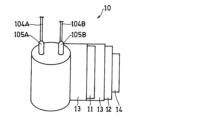
- FIG. 1 is a cross-sectional view schematically showing an example electrolytic capacitor 100 according to this embodiment.
- FIG. 2 is a schematic diagram in which a part of the capacitor element 10 included in the electrolytic capacitor 100 is expanded.
- the electrolytic capacitor 100 includes a capacitor element 10, a bottomed case 101 that accommodates the capacitor element 10, a sealing member 102 that closes an opening of the bottomed case 101, a seat plate 103 that covers the sealing member 102, and a sealing member.
- Lead wires 104A and 104B lead out from 102 and pass through seat plate 103, and lead tabs 105A and 105B connecting the lead wires and electrodes of capacitor element 10 are provided.
- the vicinity of the open end of the bottomed case 101 is drawn inward, and the open end is curled so as to be crimped to the sealing member 102 .
- the capacitor element 10 is, for example, a wound body as shown in FIG.
- the wound body includes anode foil 11 connected to lead tab 105A, cathode foil 12 connected to lead tab 105B, and separator 13 .
- Capacitor element 10 (wound body) includes a conductive polymer layer (not shown).
- the conductive polymer layer contains an organic compound (C).
- the electrolytic capacitor 100 includes a liquid component (L) (for example, electrolyte) impregnated in the capacitor element 10 .
- FIG. 1 shows a partially unfolded state before stopping the outermost circumference of the wound body.
- the electrolytic capacitor should have at least one capacitor element, and may have a plurality of capacitor elements.
- the number of capacitor elements included in the electrolytic capacitor may be determined according to the application.
- Capacitor A1 An electrolytic capacitor (capacitor A1) was produced by the following method.
- (a) Preparation of Components An aluminum foil (thickness: 100 ⁇ m) was subjected to an etching treatment to roughen the surface of the aluminum foil. The surface of the roughened aluminum foil was chemically treated to form a dielectric layer. Thus, an anode foil having dielectric layers formed on both sides was obtained.
- An aluminum foil (thickness: 50 ⁇ m) was etched to roughen the surface of the aluminum foil to obtain a cathode foil.
- a nonwoven fabric (50 ⁇ m thick) was prepared as a separator.
- the nonwoven fabric is composed of 50% by mass of synthetic fibers (25% by mass of polyester fiber, 25% by mass of aramid fiber) and 50% by mass of cellulose, and contains polyacrylamide as a paper strength agent.
- the density of the nonwoven fabric was 0.35 g/cm 3 .
- a conductive polymer layer was formed on both sides of the cathode foil by the same method as that formed on both sides of the anode foil.
- a conductive polymer layer was formed on the separator by applying the coating liquid to the separator and then performing a drying treatment in the same manner as the method for forming on both sides of the anode foil.
- liquid (S) was prepared by mixing water and ethylene glycol (organic compound (C)).
- a capacitor element (laminate) was impregnated with the obtained liquid (S).
- Impregnation of Liquid Component An electrolytic solution (liquid component) was prepared by dissolving o-phthalic acid and triethylamine (base component) in ethylene glycol (solvent) at a total concentration of 25% by mass. The capacitor element was immersed in the electrolytic solution for 5 minutes in a reduced pressure atmosphere (40 kPa). Thus, the capacitor element (laminate) was impregnated with the electrolytic solution.
- Capacitors A2-A24 and C1 Electrolytic capacitors (capacitors A2 to A24) were produced in the same manner as the capacitor A1, except that the type and concentration of the organic compound (C) used in the liquid (S) were changed. The type of organic compound (C) was changed as shown in Table 1. In addition, in the fabrication of the capacitor A4, the heating conditions in the removing step were 135° C. and 30 minutes. The produced capacitors were evaluated by the following methods. Capacitor C1 was fabricated in the same manner as capacitor A1, except that the liquid application and removal steps were not performed.
- the ratio Wc/Wp between the mass Wc of the organic compound (C) remaining in the conductive polymer layer and the mass Wp of the conductive polymer component in the conductive polymer layer is determined. rice field.
- the mass Wp can be calculated from the concentration of the conductive polymer component in the dispersion (coating liquid) containing the conductive polymer component and the mass of the dispersion used to form the conductive polymer layer.
- the mass Wc is calculated according to the following procedure. First, the mass W0 (initial) of the capacitor element is measured after the conductive polymer layer is formed and before the liquid application step is performed. Next, the mass W1 (after treatment) of the capacitor element after the liquid applying process and the removing process are performed is measured. Then, the mass Wc can be calculated from the mass difference (W1-W0) between the post-treatment mass W1 and the initial mass W0. In this example, it is believed that most of the water in the liquid (S) impregnating the capacitor element is removed by the removal step. Therefore, the mass difference (W1-W0) was regarded as the mass Wc. Alternatively, the mass Ww of water remaining in the conductive polymer layer may be determined by Karl Fischer titration, and (W1-W0-Ww) may be Wc.
- Adhesion between anode foil and separator Adhesion between the anode foil and the separator was evaluated using a peel tester.
- ESR Equivalent series resistance
- LC leakage current
- Tables 1 and 2 show the composition of the coating liquid used to manufacture the electrolytic capacitor and the evaluation results.
- "#200”, “#300”, “#400”, and “#2000” in Table 2 indicate that the weight average molecular weights are about 200, about 300, about 400, and about 2000, respectively. .
- Capacitors A1 to A24 are capacitors manufactured by a manufacturing process including a liquid applying process and a liquid removing process, and the organic compound (C) remains in the conductive polymer layer. As shown in Tables 1 and 2, the ESR and leakage current of capacitors A1-A24 were lower than the ESR and leakage current of comparative capacitor C1. In particular, after being left in a high-temperature atmosphere, the ESR and leakage current of capacitors A1 to A24 were significantly lower than those of capacitor C1.
- Capacitor element 11 Anode foil 12: Cathode foil 13: Separator 14: Winding tape 100: Electrolytic capacitor 101: Bottomed case 102: Sealing member 103: Seat plate 104A, 104B: Lead wire 105A, 105B: Lead tab
Landscapes
- Engineering & Computer Science (AREA)
- Power Engineering (AREA)
- Microelectronics & Electronic Packaging (AREA)
- Chemical & Material Sciences (AREA)
- Chemical Kinetics & Catalysis (AREA)
- Electrochemistry (AREA)
- Manufacturing & Machinery (AREA)
- Laminated Bodies (AREA)
- Compositions Of Macromolecular Compounds (AREA)
Priority Applications (3)
| Application Number | Priority Date | Filing Date | Title |
|---|---|---|---|
| JP2023577034A JPWO2023145891A1 (https=) | 2022-01-28 | 2023-01-27 | |
| CN202380018837.6A CN118648076A (zh) | 2022-01-28 | 2023-01-27 | 电解电容器和电解电容器的制造方法 |
| US18/832,334 US20250104926A1 (en) | 2022-01-28 | 2023-01-27 | Electrolytic capacitor and method for producing electrolytic capacitor |
Applications Claiming Priority (2)
| Application Number | Priority Date | Filing Date | Title |
|---|---|---|---|
| JP2022012069 | 2022-01-28 | ||
| JP2022-012069 | 2022-01-28 |
Publications (1)
| Publication Number | Publication Date |
|---|---|
| WO2023145891A1 true WO2023145891A1 (ja) | 2023-08-03 |
Family
ID=87471725
Family Applications (1)
| Application Number | Title | Priority Date | Filing Date |
|---|---|---|---|
| PCT/JP2023/002689 Ceased WO2023145891A1 (ja) | 2022-01-28 | 2023-01-27 | 電解コンデンサおよび電解コンデンサの製造方法 |
Country Status (4)
| Country | Link |
|---|---|
| US (1) | US20250104926A1 (https=) |
| JP (1) | JPWO2023145891A1 (https=) |
| CN (1) | CN118648076A (https=) |
| WO (1) | WO2023145891A1 (https=) |
Cited By (1)
| Publication number | Priority date | Publication date | Assignee | Title |
|---|---|---|---|---|
| JPWO2023145889A1 (https=) * | 2022-01-28 | 2023-08-03 |
Citations (3)
| Publication number | Priority date | Publication date | Assignee | Title |
|---|---|---|---|---|
| WO2016031207A1 (ja) * | 2014-08-26 | 2016-03-03 | パナソニックIpマネジメント株式会社 | 電解コンデンサの製造方法 |
| JP2017216317A (ja) * | 2016-05-31 | 2017-12-07 | 信越ポリマー株式会社 | キャパシタ用導電性高分子分散液、キャパシタ及びその製造方法 |
| JP2019516241A (ja) * | 2016-04-11 | 2019-06-13 | ケメット エレクトロニクス コーポレーション | ハイブリッドコンデンサ及びコンデンサの製造方法 |
Family Cites Families (4)
| Publication number | Priority date | Publication date | Assignee | Title |
|---|---|---|---|---|
| CN112424893B (zh) * | 2018-07-26 | 2022-12-06 | 松下知识产权经营株式会社 | 电解电容器 |
| JP2021163863A (ja) * | 2020-03-31 | 2021-10-11 | 日本ケミコン株式会社 | 固体電解コンデンサ、導電性高分子分散液及び導電性高分子分散液の製造方法 |
| JP7731057B2 (ja) * | 2020-03-31 | 2025-08-29 | パナソニックIpマネジメント株式会社 | 電解コンデンサおよびその製造方法 |
| US20250182976A1 (en) * | 2022-01-28 | 2025-06-05 | Panasonic Intellectual Property Management Co., Ltd. | Electrolytic capacitor and method for producing electrolytic capacitor |
-
2023
- 2023-01-27 US US18/832,334 patent/US20250104926A1/en active Pending
- 2023-01-27 JP JP2023577034A patent/JPWO2023145891A1/ja active Pending
- 2023-01-27 CN CN202380018837.6A patent/CN118648076A/zh active Pending
- 2023-01-27 WO PCT/JP2023/002689 patent/WO2023145891A1/ja not_active Ceased
Patent Citations (3)
| Publication number | Priority date | Publication date | Assignee | Title |
|---|---|---|---|---|
| WO2016031207A1 (ja) * | 2014-08-26 | 2016-03-03 | パナソニックIpマネジメント株式会社 | 電解コンデンサの製造方法 |
| JP2019516241A (ja) * | 2016-04-11 | 2019-06-13 | ケメット エレクトロニクス コーポレーション | ハイブリッドコンデンサ及びコンデンサの製造方法 |
| JP2017216317A (ja) * | 2016-05-31 | 2017-12-07 | 信越ポリマー株式会社 | キャパシタ用導電性高分子分散液、キャパシタ及びその製造方法 |
Cited By (1)
| Publication number | Priority date | Publication date | Assignee | Title |
|---|---|---|---|---|
| JPWO2023145889A1 (https=) * | 2022-01-28 | 2023-08-03 |
Also Published As
| Publication number | Publication date |
|---|---|
| CN118648076A (zh) | 2024-09-13 |
| JPWO2023145891A1 (https=) | 2023-08-03 |
| US20250104926A1 (en) | 2025-03-27 |
Similar Documents
| Publication | Publication Date | Title |
|---|---|---|
| US12073999B2 (en) | Electrolytic capacitor and method for producing same | |
| JP7731057B2 (ja) | 電解コンデンサおよびその製造方法 | |
| US20250054706A1 (en) | Electrolytic capacitor and method for producing same | |
| JP2025163262A (ja) | 電解コンデンサおよびその製造方法 | |
| JP7724421B2 (ja) | 電解コンデンサおよびその製造方法 | |
| WO2023145891A1 (ja) | 電解コンデンサおよび電解コンデンサの製造方法 | |
| WO2023145889A1 (ja) | 電解コンデンサおよび電解コンデンサの製造方法 | |
| WO2024181212A1 (ja) | 電解コンデンサおよび電解コンデンサの製造方法 | |
| WO2025028068A1 (ja) | 電解コンデンサおよび電解コンデンサの製造方法 | |
| WO2025028067A1 (ja) | 電解コンデンサおよび電解コンデンサの製造方法 | |
| JP7796336B2 (ja) | 電解コンデンサおよびその製造方法 | |
| JP7681840B2 (ja) | 電解コンデンサおよびその製造方法 | |
| US20250095923A1 (en) | Electrolytic capacitor and method for manufacturing electrolytic capacitor | |
| WO2025028070A1 (ja) | 電解コンデンサ、電解コンデンサの製造方法、および電解コンデンサ用のシート | |
| WO2024116845A1 (ja) | 電解コンデンサの製造方法、電解コンデンサ、第1処理液、および第2処理液 | |
| WO2025028069A1 (ja) | 電解コンデンサおよび電解コンデンサの製造方法 | |
| WO2025028056A1 (ja) | 電解コンデンサおよび電解コンデンサの製造方法 | |
| WO2025028055A1 (ja) | 電解コンデンサおよび電解コンデンサの製造方法 | |
| WO2025028057A1 (ja) | 電解コンデンサおよび電解コンデンサの製造方法 | |
| WO2024024887A1 (ja) | 電解コンデンサの製造に用いられる分散体、電解コンデンサの製造方法、および電解コンデンサ | |
| WO2024181210A1 (ja) | 電解コンデンサおよびその製造方法 | |
| CN119547168A (zh) | 电解电容器及电解电容器的制造方法 |
Legal Events
| Date | Code | Title | Description |
|---|---|---|---|
| 121 | Ep: the epo has been informed by wipo that ep was designated in this application |
Ref document number: 23747101 Country of ref document: EP Kind code of ref document: A1 |
|
| WWE | Wipo information: entry into national phase |
Ref document number: 18832334 Country of ref document: US |
|
| ENP | Entry into the national phase |
Ref document number: 2023577034 Country of ref document: JP Kind code of ref document: A |
|
| WWE | Wipo information: entry into national phase |
Ref document number: 202380018837.6 Country of ref document: CN |
|
| NENP | Non-entry into the national phase |
Ref country code: DE |
|
| 122 | Ep: pct application non-entry in european phase |
Ref document number: 23747101 Country of ref document: EP Kind code of ref document: A1 |
|
| WWP | Wipo information: published in national office |
Ref document number: 18832334 Country of ref document: US |