WO2023127340A1 - 推定装置、推定方法及びプログラム - Google Patents
推定装置、推定方法及びプログラム Download PDFInfo
- Publication number
- WO2023127340A1 WO2023127340A1 PCT/JP2022/042775 JP2022042775W WO2023127340A1 WO 2023127340 A1 WO2023127340 A1 WO 2023127340A1 JP 2022042775 W JP2022042775 W JP 2022042775W WO 2023127340 A1 WO2023127340 A1 WO 2023127340A1
- Authority
- WO
- WIPO (PCT)
- Prior art keywords
- unit
- living body
- distance
- complex transfer
- transmitting antenna
- Prior art date
- Legal status (The legal status is an assumption and is not a legal conclusion. Google has not performed a legal analysis and makes no representation as to the accuracy of the status listed.)
- Ceased
Links
Images







Classifications
-
- G—PHYSICS
- G01—MEASURING; TESTING
- G01S—RADIO DIRECTION-FINDING; RADIO NAVIGATION; DETERMINING DISTANCE OR VELOCITY BY USE OF RADIO WAVES; LOCATING OR PRESENCE-DETECTING BY USE OF THE REFLECTION OR RERADIATION OF RADIO WAVES; ANALOGOUS ARRANGEMENTS USING OTHER WAVES
- G01S13/00—Systems using the reflection or reradiation of radio waves, e.g. radar systems; Analogous systems using reflection or reradiation of waves whose nature or wavelength is irrelevant or unspecified
- G01S13/02—Systems using reflection of radio waves, e.g. primary radar systems; Analogous systems
- G01S13/06—Systems determining position data of a target
- G01S13/08—Systems for measuring distance only
- G01S13/32—Systems for measuring distance only using transmission of continuous waves, whether amplitude-, frequency-, or phase-modulated, or unmodulated
- G01S13/34—Systems for measuring distance only using transmission of continuous waves, whether amplitude-, frequency-, or phase-modulated, or unmodulated using transmission of continuous, frequency-modulated waves while heterodyning the received signal, or a signal derived therefrom, with a locally-generated signal related to the contemporaneously transmitted signal
-
- G—PHYSICS
- G01—MEASURING; TESTING
- G01S—RADIO DIRECTION-FINDING; RADIO NAVIGATION; DETERMINING DISTANCE OR VELOCITY BY USE OF RADIO WAVES; LOCATING OR PRESENCE-DETECTING BY USE OF THE REFLECTION OR RERADIATION OF RADIO WAVES; ANALOGOUS ARRANGEMENTS USING OTHER WAVES
- G01S13/00—Systems using the reflection or reradiation of radio waves, e.g. radar systems; Analogous systems using reflection or reradiation of waves whose nature or wavelength is irrelevant or unspecified
- G01S13/02—Systems using reflection of radio waves, e.g. primary radar systems; Analogous systems
- G01S13/06—Systems determining position data of a target
- G01S13/08—Systems for measuring distance only
- G01S13/10—Systems for measuring distance only using transmission of interrupted, pulse modulated waves
-
- G—PHYSICS
- G01—MEASURING; TESTING
- G01S—RADIO DIRECTION-FINDING; RADIO NAVIGATION; DETERMINING DISTANCE OR VELOCITY BY USE OF RADIO WAVES; LOCATING OR PRESENCE-DETECTING BY USE OF THE REFLECTION OR RERADIATION OF RADIO WAVES; ANALOGOUS ARRANGEMENTS USING OTHER WAVES
- G01S13/00—Systems using the reflection or reradiation of radio waves, e.g. radar systems; Analogous systems using reflection or reradiation of waves whose nature or wavelength is irrelevant or unspecified
- G01S13/003—Bistatic radar systems; Multistatic radar systems
-
- G—PHYSICS
- G01—MEASURING; TESTING
- G01S—RADIO DIRECTION-FINDING; RADIO NAVIGATION; DETERMINING DISTANCE OR VELOCITY BY USE OF RADIO WAVES; LOCATING OR PRESENCE-DETECTING BY USE OF THE REFLECTION OR RERADIATION OF RADIO WAVES; ANALOGOUS ARRANGEMENTS USING OTHER WAVES
- G01S13/00—Systems using the reflection or reradiation of radio waves, e.g. radar systems; Analogous systems using reflection or reradiation of waves whose nature or wavelength is irrelevant or unspecified
- G01S13/02—Systems using reflection of radio waves, e.g. primary radar systems; Analogous systems
- G01S13/06—Systems determining position data of a target
- G01S13/08—Systems for measuring distance only
- G01S13/32—Systems for measuring distance only using transmission of continuous waves, whether amplitude-, frequency-, or phase-modulated, or unmodulated
- G01S13/34—Systems for measuring distance only using transmission of continuous waves, whether amplitude-, frequency-, or phase-modulated, or unmodulated using transmission of continuous, frequency-modulated waves while heterodyning the received signal, or a signal derived therefrom, with a locally-generated signal related to the contemporaneously transmitted signal
- G01S13/347—Systems for measuring distance only using transmission of continuous waves, whether amplitude-, frequency-, or phase-modulated, or unmodulated using transmission of continuous, frequency-modulated waves while heterodyning the received signal, or a signal derived therefrom, with a locally-generated signal related to the contemporaneously transmitted signal using more than one modulation frequency
-
- G—PHYSICS
- G01—MEASURING; TESTING
- G01S—RADIO DIRECTION-FINDING; RADIO NAVIGATION; DETERMINING DISTANCE OR VELOCITY BY USE OF RADIO WAVES; LOCATING OR PRESENCE-DETECTING BY USE OF THE REFLECTION OR RERADIATION OF RADIO WAVES; ANALOGOUS ARRANGEMENTS USING OTHER WAVES
- G01S7/00—Details of systems according to groups G01S13/00, G01S15/00, G01S17/00
- G01S7/02—Details of systems according to groups G01S13/00, G01S15/00, G01S17/00 of systems according to group G01S13/00
- G01S7/28—Details of pulse systems
- G01S7/285—Receivers
-
- G—PHYSICS
- G01—MEASURING; TESTING
- G01S—RADIO DIRECTION-FINDING; RADIO NAVIGATION; DETERMINING DISTANCE OR VELOCITY BY USE OF RADIO WAVES; LOCATING OR PRESENCE-DETECTING BY USE OF THE REFLECTION OR RERADIATION OF RADIO WAVES; ANALOGOUS ARRANGEMENTS USING OTHER WAVES
- G01S7/00—Details of systems according to groups G01S13/00, G01S15/00, G01S17/00
- G01S7/02—Details of systems according to groups G01S13/00, G01S15/00, G01S17/00 of systems according to group G01S13/00
- G01S7/40—Means for monitoring or calibrating
-
- G—PHYSICS
- G01—MEASURING; TESTING
- G01S—RADIO DIRECTION-FINDING; RADIO NAVIGATION; DETERMINING DISTANCE OR VELOCITY BY USE OF RADIO WAVES; LOCATING OR PRESENCE-DETECTING BY USE OF THE REFLECTION OR RERADIATION OF RADIO WAVES; ANALOGOUS ARRANGEMENTS USING OTHER WAVES
- G01S7/00—Details of systems according to groups G01S13/00, G01S15/00, G01S17/00
- G01S7/02—Details of systems according to groups G01S13/00, G01S15/00, G01S17/00 of systems according to group G01S13/00
- G01S7/40—Means for monitoring or calibrating
- G01S7/4004—Means for monitoring or calibrating of parts of a radar system
- G01S7/4017—Means for monitoring or calibrating of parts of a radar system of HF systems
-
- G—PHYSICS
- G01—MEASURING; TESTING
- G01S—RADIO DIRECTION-FINDING; RADIO NAVIGATION; DETERMINING DISTANCE OR VELOCITY BY USE OF RADIO WAVES; LOCATING OR PRESENCE-DETECTING BY USE OF THE REFLECTION OR RERADIATION OF RADIO WAVES; ANALOGOUS ARRANGEMENTS USING OTHER WAVES
- G01S7/00—Details of systems according to groups G01S13/00, G01S15/00, G01S17/00
- G01S7/02—Details of systems according to groups G01S13/00, G01S15/00, G01S17/00 of systems according to group G01S13/00
- G01S7/41—Details of systems according to groups G01S13/00, G01S15/00, G01S17/00 of systems according to group G01S13/00 using analysis of echo signal for target characterisation; Target signature; Target cross-section
- G01S7/415—Identification of targets based on measurements of movement associated with the target
-
- G—PHYSICS
- G01—MEASURING; TESTING
- G01S—RADIO DIRECTION-FINDING; RADIO NAVIGATION; DETERMINING DISTANCE OR VELOCITY BY USE OF RADIO WAVES; LOCATING OR PRESENCE-DETECTING BY USE OF THE REFLECTION OR RERADIATION OF RADIO WAVES; ANALOGOUS ARRANGEMENTS USING OTHER WAVES
- G01S13/00—Systems using the reflection or reradiation of radio waves, e.g. radar systems; Analogous systems using reflection or reradiation of waves whose nature or wavelength is irrelevant or unspecified
- G01S13/02—Systems using reflection of radio waves, e.g. primary radar systems; Analogous systems
- G01S13/06—Systems determining position data of a target
- G01S13/46—Indirect determination of position data
- G01S2013/466—Indirect determination of position data by Trilateration, i.e. two antennas or two sensors determine separately the distance to a target, whereby with the knowledge of the baseline length, i.e. the distance between the antennas or sensors, the position data of the target is determined
Definitions
- the present disclosure relates to an estimation device, an estimation method, and the like for estimating the distance or position of a living body using radio signals.
- Patent Documents 1 to 4 disclose techniques for estimating the position and state of a person to be detected by analyzing components including Doppler shift using difference calculation.
- Patent documents 4 and 5 disclose Doppler sensors using OFDM (Orthogonal Frequency Division Multiplexing) signals.
- the present disclosure has been made in view of the circumstances described above, and aims to provide an estimating device and the like that can more accurately estimate the distance from the estimating device to the living body.
- an estimating apparatus is an estimating apparatus for estimating a distance to a living body, and is an estimating apparatus that generates a transmission signal that generates a multicarrier signal in which a plurality of subcarrier signals are modulated.
- a transmitting antenna unit having M M (M is a natural number equal to or greater than 1) transmitting antenna elements; and processing the multicarrier signal and outputting the multicarrier signal to the transmitting antenna unit.
- N is a natural number of 1 or more) receiving antenna elements; and a received signal received by each of the N receiving antenna elements, wherein the M a receiving unit for observing received signals including reflected signals of said multicarrier signals transmitted from each of said transmitting antenna elements reflected or scattered by said living body for a first period corresponding to a cycle derived from said living body's activity; and M ⁇ N combinations of each of the M transmitting antenna elements and each of the N receiving antenna elements using the plurality of received signals observed in the first period in the receiving unit for each of the combinations, a complex transfer function representing a propagation characteristic between the transmitting antenna element and the receiving antenna element in the combination, for each of the plurality of subcarriers to which the plurality of subcarrier signals respectively correspond; and a complex transfer function calculating unit that calculates a plurality of complex transfer functions for each of the plurality of subcarriers and for each of the M ⁇ N combinations: (i) a plurality of complex transfer function calculating units calculated by the complex transfer function
- a biocorrelation matrix calculator that calculates a biocorrelation matrix of an M ⁇ N matrix for each of the plurality of subcarriers; and the biocorrelation matrix that is calculated for each of the plurality of subcarriers.
- an estimating unit that estimates a third distance that is the sum of a first distance between the antenna unit and the living body and a second distance between the receiving antenna unit and the living body.
- an estimation method includes a transmitting antenna unit having M (M is a natural number of 1 or more) transmitting antenna elements, and N (N is a natural number of 1 or more) receiving antenna elements. and an estimation method by an estimating apparatus comprising: generating a multicarrier signal in which a plurality of subcarrier signals are modulated, processing the multicarrier signal, and outputting it to the transmitting antenna unit and transmitting the multicarrier signal to the transmitting antenna unit, and the received signal received by each of the N receiving antenna elements, wherein the multicarrier signal is transmitted from each of the M transmitting antenna elements A received signal including a reflected signal reflected or scattered by a living body is observed for a first period corresponding to a cycle derived from the activity of the living body, and a plurality of the received signals observed during the first period are used.
- the combination of the transmitting antenna element and the receiving antenna element in the combination calculating a plurality of complex transfer functions representing propagation characteristics between the plurality of subcarriers for each of the plurality of subcarriers respectively corresponding to the plurality of subcarrier signals, and for each of the plurality of subcarriers and the M ⁇ N For each of the combinations, (i) sequentially recording the plurality of calculated complex transfer functions in a time series in the order in which the plurality of received signals were observed, and (ii) sequentially recording the time series.
- a bio-correlation matrix of M ⁇ N matrix is calculated for each of the plurality of subcarriers, and calculated for each of the plurality of subcarriers.
- a third distance which is the sum of a first distance between the transmitting antenna section and the living body and a second distance between the receiving antenna section and the living body, is estimated using the biological correlation matrix.
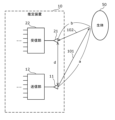
- FIG. 1 is a block diagram showing an example of the configuration of an estimation device according to Embodiment 1.
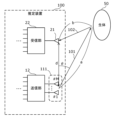
- FIG. 2 is a diagram illustrating an example of a detection target of the estimation device illustrated in FIG. 1.
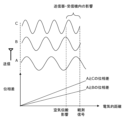
- FIG. 3 is a schematic diagram showing that the phase of the received signal changes with frequency and distance.
- FIG. 4 is a schematic diagram showing the relationship between phase errors and channels according to the first embodiment.
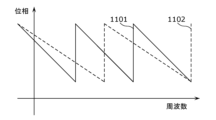
- FIG. 5 is a schematic diagram showing the relationship between the frequency and the slope of the phase difference.
- 6 is a schematic diagram showing phases of a time-domain biological component transfer function matrix according to Embodiment 1.
- FIG. FIG. 7 is a schematic diagram showing the positional relationship between the living body, transmitting antenna elements and receiving antenna elements, and the position of the living body defined by the third distance.
- FIG. 8 is a schematic diagram of estimating the position of a living body by using a plurality of receiving antenna elements.
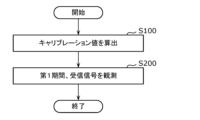
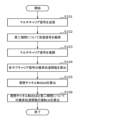
- 9 is a flowchart showing estimation processing of the estimation device according to Embodiment 1.
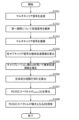
- FIG. 10 is a flowchart showing calibration value calculation processing according to the first embodiment.
- FIG. 11 is a flowchart showing distance measurement processing according to the first embodiment.
- 12 is a block diagram showing an example of the configuration of an estimation device according to Embodiment 2.
- FIG. 13 is a diagram showing an example of a detection target of the estimation device shown in FIG. 12.
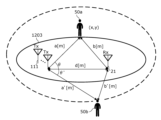
- FIG. 14 is a diagram illustrating an example of a positional relationship of detection targets of the estimation device illustrated in FIG. 12.
- FIG. FIG. 15 is a diagram showing an example of the positional relationship of detection targets of the estimation device shown in FIG. 12 when a plurality of living bodies exist.
- 16 is a flowchart illustrating estimation processing of the estimation device according to Embodiment 2.
- FIG. 2 is a flowchart showing
- Patent Documents 1 and 2 disclose that a radio signal is transmitted to a predetermined area, the radio signal reflected by a detection target is received by a plurality of antennas, and the complex transfer function between the transmitting and receiving antennas is estimated.
- a complex transfer function is a function of complex numbers representing the relationship between input and output, and here represents the propagation characteristics between transmitting and receiving antennas. The number of elements of this complex transfer function is equal to the product of the number of transmit antennas and the number of receive antennas.
- Patent Document 3 discloses, in a configuration similar to that of Patent Document 2, estimating the posture of a living body using RCS (Radar Cross Section) obtained from received power.
- the RCS is an index representing the area of the object that reflected the transmitted wave, and the RCS of the living body varies depending on the posture.
- Patent Document 1 further discloses that the position and state of a person to be detected can be known by analyzing components including Doppler shift using Fourier transform. More specifically, time changes of the elements of the complex transfer function are recorded, and the time waveform is Fourier transformed. A living body such as a person gives a slight Doppler effect to reflected waves due to living body activities such as breathing and heartbeat. Therefore, the component containing the Doppler shift contains the human influence. On the other hand, the component without Doppler shift is not affected by the person, that is, it corresponds to the reflected wave from a fixed object or the direct wave between the transmitting and receiving antennas. That is, it is possible to know the position and state of the person to be detected by using the components included in a predetermined frequency range in the Fourier-transformed waveform.
- Patent Document 2 discloses a method of extracting a component containing a slight Doppler shift that includes the influence of the living body by recording the time change of the elements of the complex transfer function and analyzing the difference information. That is, it is possible to know the position and state of the person to be detected using the difference information.
- Patent Document 3 discloses an OFDM Doppler radar that transmits pulses using OFDM signals and detects the Doppler shift caused by the target moving object. Further, Patent Document 4 discloses a high-speed processing method that does not require Fourier transform for OFDM Doppler radar.
- Patent Documents 6 and 7 disclose techniques for improving the estimation accuracy of the complex transfer function between transmitting and receiving antennas by transmitting OFDM signals.
- Patent Document 5 discloses that the received noise component can be reduced by averaging the complex transfer function for each subcarrier, and Patent Document 7 selects the subcarrier with the maximum received power. ing.
- Patent Documents 4 and 5 also require steep transmission pulses in order to obtain sufficient accuracy, which requires a wide frequency band. Therefore, the hardware cost is higher than that of consumer communication devices.
- Non-Patent Document 1 With the technology of Non-Patent Document 1, it is possible to estimate the distance that can be calculated from the ToF (Time Of Flight) between the transmitting antenna and the receiving antenna and the ToF by transmitting and receiving signals of multiple frequencies using a measuring instrument such as a network analyzer. is. This is similar to a ranging sensor using FMCW (Frequency Modulated Continuous Wave) radar. When two signals with different frequencies are transmitted with the same phase, the phase received by the receiving antenna propagates between the signal frequency difference and the antenna. It utilizes the property that changes depending on the distance. The technique of Non-Patent Document 1 further improves the resolution by performing ToF estimation using the MUSIC (MUltiple Signal Classification) method.
- MUSIC MUltiple Signal Classification
- the transmitting side and the receiving side must operate at the same reference frequency or must be synchronized with high accuracy, and home appliances such as wireless LAN cannot be used.
- home appliances such as wireless LAN cannot be used.
- only the distance between antennas can be estimated, and the distance to a living body that does not have special equipment cannot be estimated.
- the inventors used existing communication devices to estimate the distance, etc. from the estimation device to the living body at low cost and with high accuracy using multi-carrier radio signals represented by OFDM. I came to invent an estimating device etc. that can perform.
- an estimating device that estimates a distance to a living body, and includes a transmission signal generation unit that generates a multicarrier signal in which a plurality of subcarrier signals are modulated; a transmitting antenna unit having (M is a natural number of 1 or more) transmitting antenna elements; A transmitting unit, a receiving antenna unit having N (N is a natural number of 1 or more) receiving antenna elements, and a received signal received by each of the N receiving antenna elements, wherein the M transmitting antennas a receiving unit that observes a received signal including a reflected signal of the multicarrier signal transmitted from each of the elements that is reflected or scattered by a living body for a first period corresponding to a cycle derived from the activity of the living body; Using the plurality of received signals observed in the first period in the part, M ⁇ N combinations that are combinations of each of the M transmitting antenna elements and each of the N receiving antenna elements For each, a plurality of complex transfer functions representing
- a plurality of the complex transfer functions calculated by the complex transfer function calculation unit are sequentially recorded in time series in the order in which the plurality of received signals were observed, and (ii) by extracting biological components from the plurality of complex transfer functions sequentially recorded in the time series, M ⁇ N a biocorrelation matrix calculator for calculating a biocorrelation matrix of a matrix for each of the plurality of subcarriers; and using the biocorrelation matrix calculated for each of the plurality of subcarriers; an estimating unit that estimates a third distance that is the sum of a first distance to the living body and a second distance between the receiving antenna unit and the living body.
- a biometric radar that measures the distance to a living body by using an existing communication device by using a multicarrier signal such as OFDM as a transmission signal.
- a multicarrier signal such as OFDM
- OFDM multi-carrier signal receivers
- biological radars that measure the distance to a living body at a lower cost than when unmodulated signals are used. can be realized.
- An estimating apparatus is the estimating apparatus according to the first aspect, further comprising: subcarrier direction based on the ideal complex transfer function between the transmitting antenna element and the receiving antenna element and a reference complex transfer function matrix containing M ⁇ N complex transfer functions observed in the second period and a calibration unit that calculates a correction value for correcting the phase error of and corrects the complex transfer function for the first period.
- An estimating device is the estimating device according to the first aspect or the second aspect, wherein at least one of the M and the N is 2 or more, and the estimating device comprises: Further, angles of the living body from two or more antenna elements among the M transmitting antenna elements and the N receiving antenna elements using the plurality of complex transfer functions calculated by the complex transfer function calculating unit and a positioning unit that calculates the first distance from the first angle and the third distance and calculates the position of the living body.
- An estimating device is the estimating device according to the first aspect or the second aspect, wherein at least one of M and N is 3 or more, and the estimating unit For each of the M ⁇ N combinations, calculate an ellipse whose focal point is the position of the transmitting antenna element and the receiving antenna element included in the combination and whose major axis length is the third distance. The position of the living body is estimated based on the closest M ⁇ N points of intersection of the M ⁇ N ellipses obtained.
- An estimating device is the estimating device according to any one aspect of the first aspect to the fourth aspect, wherein the biocorrelation matrix calculator includes the plurality of complex transfer functions is inverse Fourier transformed in the subcarrier direction to calculate the biocorrelation matrix.
- An estimating device is the estimating device according to any one aspect of the first to fourth aspects, wherein the estimating unit uses a MUSIC (MUltiple Signal Classification) method to estimate the distance.
- MUSIC MUltiple Signal Classification
- An estimation method includes a transmitting antenna unit having M (M is a natural number of 1 or more) transmitting antenna elements, and N (N is a natural number of 1 or more) receiving antenna elements.
- a reception antenna section wherein a multicarrier signal is generated by modulating a plurality of subcarrier signals, and the multicarrier signal is processed and output to the transmission antenna section, a received signal received by each of the N receiving antenna elements by causing the transmitting antenna unit to transmit the multicarrier signal, wherein the multicarrier signal transmitted from each of the M transmitting antenna elements is Observing a received signal including a reflected signal reflected or scattered by a living body for a first period corresponding to a cycle derived from the activity of the living body, and using a plurality of the received signals observed during the first period, For each of M ⁇ N combinations that are combinations of each of the M transmitting antenna elements and each of the N receiving antenna elements, the distance between the transmitting antenna element and the receiving antenna element in the combination A plurality
- a bio-correlation matrix of M ⁇ N matrix is calculated for each of the plurality of subcarriers, and the bio-organism calculated for each of the plurality of subcarriers
- a correlation matrix is used to estimate a third distance, which is the sum of a first distance between the transmitting antenna section and the living body and a second distance between the receiving antenna section and the living body.
- a biometric radar that measures the distance to a living body by using an existing communication device by using a multicarrier signal such as OFDM as a transmission signal.
- a multicarrier signal such as OFDM
- OFDM multi-carrier signal receivers
- biological radars that measure the distance to a living body at a lower cost than when unmodulated signals are used. can be realized.
- a program according to an eighth aspect of the present disclosure is a program for causing a computer to execute the estimation method according to the seventh aspect.
- these general or specific aspects may be realized by a system, an integrated circuit, a computer program, or a recording medium such as a computer-readable CD-ROM, and an apparatus, system, method, integrated circuit, computer program, etc. and any combination of recording media.
- Embodiment 1 A method for estimating the distance to a living body, which is a detection target, by the estimating apparatus 10 according to Embodiment 1 will be described below with reference to the drawings.
- FIG. 1 is a block diagram showing an example of the configuration of estimation device 10 according to Embodiment 1.
- FIG. 2 is a diagram showing an example of a detection target of the estimation device 10 shown in FIG.
- the estimation device 10 shown in FIG. a biocorrelation matrix calculator 25 , and an estimator 26 .
- the estimating device 10 estimates the distance from the estimating device 10 to the living body 50 using the estimating device 100 as a direction or position reference.
- the transmitting antenna section 11 has M transmitting antenna elements.
- M is a natural number of 1 or more.
- the transmitting antenna section 11 has one transmitting antenna element.
- the transmission antenna elements transmit multicarrier signals (transmission waves) generated by the transmission section 12, which will be described later.
- the transmission signal generator 13 generates a multicarrier signal obtained by modulating a plurality of subcarrier signals. Specifically, the transmission signal generation unit 13 generates a plurality of subcarrier signals corresponding to a plurality of subcarriers in mutually different frequency bands, and multiplexes the generated plurality of subcarrier signals to obtain a multicarrier signal. to generate In the present embodiment, the transmission signal generation unit 13 generates an OFDM signal composed of S subcarriers with high frequency band utilization efficiency as a multicarrier signal. As long as the obtained multicarrier signal is not limited to generating an OFDM signal in which each subcarrier is orthogonal, other multicarrier signals such as a simple FDM (Frequency Division Multiplexing) signal may be generated. .
- FDM Frequency Division Multiplexing
- the signal generated by the transmission signal generator 13 may be shared with the signal used for communication.
- the transmitter 12 applies appropriate processing to the signal generated by the transmission signal generator 13 to generate a transmission wave.
- the processing performed here includes, for example, an up-conversion that converts the signal from the IF (Intermediate Frequency) frequency band to the RF (Radio Frequency) frequency band, an amplifier that amplifies the signal to an appropriate transmission level, and the like.
- the transmission unit 12 outputs the processed multicarrier signal to the transmission antenna unit 11 to cause the transmission antenna unit 11 to transmit the multicarrier signal.
- the multicarrier signal is transmitted from one transmission antenna element included in the transmission antenna section 11 .
- the receiving antenna section 21 has N receiving antenna elements.
- N is a natural number of 1 or more.
- the receiving antenna section 21 has one receiving antenna element. Then, for example, as shown in FIG. 2, one receiving antenna element receives a signal (receiving signal) transmitted from one transmitting antenna element and reflected by the living body 50 .
- the receiving unit 22 receives a received signal received by one receiving antenna element and includes a reflected signal obtained by reflecting or scattering a multicarrier signal transmitted from one transmitting antenna element by the living body 50. , the first period corresponding to the cycle derived from the activity of the living body 50 is observed.
- the cycle derived from the activity of the living body is the cycle derived from the living body (biological fluctuation cycle) that is longer than half of the period of any one of the breathing, heartbeat, and body movement of the living body 50 .
- the receiving unit 22 converts a high-frequency signal received by one receiving antenna element into a low-frequency signal that can be processed. Then, the receiver 22 demodulates one OFDM signal into signals of S subcarriers. Each of the S subcarrier signals is represented by an IQ symbol.
- the receiving unit 22 receives S ⁇ M pairs (in this embodiment, S sets) of subcarrier signals are output to the complex transfer function calculator 23 .
- the receiving unit 22 constantly observes the received signal received by the receiving antenna unit 21, and continuously or periodically transmits S subcarrier signals (IQ symbols) to the complex transfer function calculating unit 23. You can continue.
- the complex transfer function calculator 23 uses a plurality of received signals observed in the first period in the receiver 22 to calculate each of M (one in this embodiment) transmitting antenna elements and N (in this embodiment) For each of the M ⁇ N (one in this embodiment) combinations that are combinations with each of the receiving antenna elements (one in the embodiment), the distance between the transmitting antenna element and the receiving antenna element in the combination A plurality of complex transfer functions representing propagation characteristics are calculated for each of the plurality of subcarriers to which the plurality of subcarrier signals respectively correspond. Note that the M ⁇ N combinations are all combinations that can be obtained when M transmitting antenna elements and N receiving antenna elements are combined in a one-to-one manner.
- the complex transfer function calculator 23 uses the S ⁇ M sets (S sets in the present embodiment) of subcarrier signals transmitted from the receiver 22 to obtain S subcarrier signals.
- a complex transfer function representing the propagation characteristics between each transmitting antenna element and each receiving antenna element is calculated for .
- the calculated complex transfer function matrix includes reflected waves that do not pass through the living body 50, such as direct waves and reflected waves originating from fixed objects.
- a method of calculating a complex transfer function from one subcarrier signal includes a method of dividing a received IQ symbol by a known signal such as a pilot signal or a guard interval signal.
- a known signal such as a pilot signal or a guard interval signal.
- other subcarrier signals are divided by the reference subcarrier signal S0.
- the complex transfer function calculator 23 performs the complex function calculation for each of the S subcarrier signals, and outputs the obtained S complex transfer function matrices to the calibration unit 24 .
- the complex transfer function calculator 23 may continuously or periodically use each of the plurality of subcarrier signals output by the receiver 22 to constantly obtain the complex transfer function matrix.
- the estimating device 10 shares the hardware of the communication device, the estimating device 10 can also use the complex transfer function matrix that is constantly calculated for use in the processing of the communication device.
- the calibration unit 24 acquires the calculated complex transfer function matrix h and calibrates the phase error in the frequency direction. A phase error that requires calibration will be described with reference to FIG. FIG. 3 is a schematic diagram showing that the phase of the received signal changes with frequency and distance.
- the distance between the antennas When signals with different frequencies are propagated through space and received, the amount of phase rotation of the transmitted signal with respect to the received signal depends on the frequency and the distance between the transmitting antenna and the receiving antenna (hereinafter referred to as the distance between the antennas). Varies depending. Therefore, the distance between antennas can be obtained by back calculation by transmitting and receiving signals of a plurality of known frequencies and measuring the phase difference. However, the phase difference that is actually measured is not only affected by spatial propagation between the transmitting and receiving antennas, but also by the internal circuits of the transmitter and receiver and by the phase characteristics of the antenna. error). Therefore, in order to correctly measure the distance between antennas, it is necessary to remove the phase error from the observed signal.
- FIG. 4 is a diagram showing the correspondence between the phase error described above and the channel (complex transfer function).
- the phase error can be obtained by calculating the difference between the channel h meas indicated by the matrix obtained by measurement and the spatial ideal channel hi ideal indicated by the matrix that can be calculated from the distance between the antennas. This applies not only to estimation of the inter-antenna distance, but also to estimation of the distance to the living body 50 .
- the phase error in the frequency direction refers to the difference in phase from the reference subcarrier signal S0 calculated by the complex transfer function calculator 23 that is not due to spatial propagation between antennas.
- the phase error is influenced by the frequency characteristics of the transmitting antenna section 11 and the receiving antenna section 21, the electrical length of the circuit inside the transmitting section 12, the electrical length of the circuit inside the receiving section 22, and the like.
- the phase error includes a phase error ej ⁇ tx due to the transmitting antenna section 11 and the transmitting section 12 and a phase error ej ⁇ rx due to the receiving antenna section 21 and the receiving section 22.
- the calibration unit 24 calibrates the complex transfer function matrix based on the frequency direction calibration values calculated by a predetermined method.
- the calibration unit 24 obtains hide, which is an ideal channel between the antenna elements, based on the inter-antenna distance d between the transmitting antenna element and the receiving antenna element input in advance.
- the input inter-antenna distance d is, for example, a value obtained by actually measuring the distance between the transmitting antenna element and the receiving antenna element by the user.
- h ideal is a vector of complex numbers having elements of S subcarriers, and the i-th element is is calculated by where k i is the wavenumber of the i-th subcarrier.
- h ideal is the ideal complex transfer function between the transmit and receive antenna elements, obtained based on the inter-antenna distance between the transmit and receive antenna elements.
- the calibration unit 24 acquires from the complex transfer function calculation unit 23 a reference complex transfer function matrix including M ⁇ N complex transfer function matrices observed in the second reference period.
- the measurement of the reference complex transfer function matrix is desirably performed in an unattended state where the influence of the living body is small, but the influence of the living body may be included.
- the first complex transfer function matrix obtained from the complex transfer function calculator 23 may be used as the reference complex transfer function matrix.
- the reference complex transfer function matrix when there is no person or when the direct wave component is not large enough, the reference complex transfer function matrix is Fourier-transformed with respect to the observation time (slow time), and only the components that do not fluctuate with time are extracted. may be used.
- the calibration unit 24 calculates a new reference complex transfer function matrix based on the timing data with little fluctuation obtained by simultaneously calculating the time fluctuation of the absolute value of the complex transfer function, and calculates the new reference complex transfer function matrix.
- the reference complex transfer function matrix may be updated with the reference complex transfer function matrix.
- the reference complex transfer function matrix is a vector h meas having S elements.
- the calibration unit 24 calculates a correction value for correcting the phase error in the subcarrier direction based on the ideal channel hideal and the reference complex transfer function (channel hmeas ). Specifically, the calibration unit 24 calculates the difference between the calculated ideal channel h_ideal and the measured channel h_meas , and uses the difference as a correction value (calibration value) h cal . Specifically, h cal is obtained by the following calculation.
- the calibration value h cal is the same as long as the reference complex transfer function matrix does not change, it is desirable to store the calibration value h cal in a memory or the like and use the stored value from the next time onward.
- the calibration unit 24 calibrates (corrects) the complex transfer function matrix h according to the following equation based on the calibration value h cal .
- the calibration unit 24 outputs the calibrated complex transfer function matrix h' thus obtained to the biocorrelation matrix calculation unit 25 in the subsequent stage.
- the bio-correlation matrix calculation unit 25 converts the plurality of calibrated complex transfer function matrices calculated by the calibration unit 24 for each of the plurality of subcarriers and for each of the M ⁇ N combinations into a plurality of Received signals are recorded sequentially in the order in which they were observed. Then, the biometric correlation matrix calculator 25 calculates the calibrated complex transfer observed in the first period sequentially recorded in time series for each of the plurality of subcarriers and each of the M ⁇ N combinations. By extracting bio-related components from the function matrix h′, bio-component transfer function matrices represented by M ⁇ N-dimensional matrices are calculated for each of a plurality of subcarriers.
- the biological component transfer function matrix is obtained by extracting the reflected wave or scattered wave (biological component) that has passed through the living body 50 and is included in the received signal.
- a method of obtaining a biological component from a complex transfer function recorded in time series there is a method using Fourier transform disclosed in Patent Document 1 and a method using differential information disclosed in Patent Document 2.
- the complex transfer function matrix h' is Fourier transformed with respect to the observation time (slow time) and only specific frequency components are extracted.
- a biological component transfer function matrix h'fft can be calculated for each of a plurality of frequency components contained between 1 Hz and 3 Hz.
- FIG. 5 shows the relationship between the frequency (in the column direction of the matrix) and the phase of the biological component transfer function matrix h'fft .
- a solid line 1101 represents how the phase of each component of the biological component transfer function matrix varies depending on the subcarrier frequency when the living body 50 exists at a certain position.
- the phase here is the difference from the phase at the frequency of the subcarrier S0 used as a reference when calculating the complex transfer function.
- the ToF Time Of Flight
- the distance to the living body can be estimated from the slope of this graph.
- this biological component transfer function matrix h'fft is further subjected to inverse Fourier transform in the subcarrier direction to obtain a time-domain biological component transfer function matrix h'ift , after the signal containing the biological component is transmitted from the transmitter, The time until reception by the receiver is obtained.
- FIG. 6 shows the relationship between the time (in the column direction of the matrix) and the phase of the time-domain biological component transfer function matrix h'ifft .
- Phase changes of solid line 1101 and dashed line 1102 in FIG. 5 appear as peaks indicated by solid line 1201 and dashed line 1202, respectively.
- the time resolution ⁇ t obtained here is given by using the subcarrier bandwidth B as For example, when the bandwidth is 20 MHz, the time resolution corresponds to 0.5 ⁇ s, which is about 15 m when converted to distance resolution, which is not practical.
- the MUSIC MULTIPLE SIGNAL CLASSIFICATION
- the biocorrelation matrix calculator 25 calculates the correlation matrix R'f of the biocomponent transfer function matrix h'fft according to the following equation.
- the biological component transfer function matrix h′ fft exists for each frequency that can include the vibration caused by the living body after the Fourier transform of h′, and E[ ⁇ ] in Equation 5 indicates averaging in the frequency direction.
- the estimation unit 26 uses the correlation matrix R'f calculated by the biocorrelation matrix calculation unit 25 to perform distance measurement by the MUSIC method. That is, the estimation unit 26 estimates the distance using the MUSIC method. First, the estimator 26 performs eigenvalue decomposition on the biometric correlation matrix R'f to obtain a vector U S ' corresponding to the signal and an eigenvector U N ' corresponding to the noise.
- the eigenvectors corresponding to the signal are vectors from the first eigenvector up to the number of objects whose distances are to be measured.
- the eigenvectors corresponding to the signal are, for example, k eigenvectors from the first eigenvector to the k-th eigenvector if the target is k persons (k is a natural number of 2 or more). Also, the eigenvector corresponding to noise indicates an eigenvector other than the eigenvector corresponding to the signal.
- the MUSIC spectrum P MUSIC (l) is calculated according to the following equation.
- a(d) represents the steering vector
- the maximum value l of the MUSIC spectrum P MUSIC (l) thus obtained is the distance a+b in FIG. It corresponds to the sum (third distance) of the distance between (second distance). That is, the estimation unit 26 can calculate the third distance by calculating the maximum value l. In this way, the estimating unit 26 uses the biological correlation matrix calculated for each of the plurality of subcarriers to calculate the sum of the first distance and the second distance between the transmitting antenna unit 11 and the living body 50. Estimate the third distance.
- FIG. 7 is a schematic diagram showing the positional relationship of the living body, the transmitting antenna element and the receiving antenna element, and the position of the living body defined by the third distance.
- the position of the living body 50 on the plane is limited to the circumference of an ellipse 1203 with the positions of the transmitting antenna section 11 and the receiving antenna section 21 as focal points. Recognize.
- the position of the living body 50 may be estimated from the intersection of the ellipses by estimating a plurality of third distances using three or more transmitting antennas or receiving antennas as shown in FIG.
- FIG. 8 is a schematic diagram of estimating the position of a living body by using a plurality of receiving antenna elements.
- the reception antenna section 21 of the estimation device 10 in this case includes three reception antenna elements 21a, 21b, and 21c. Note that the receiving antenna section 21 only needs to have three or more receiving antenna elements, and is not limited to having three receiving antenna elements. Also, instead of the receiving antenna section 21 having three or more receiving antenna elements, the transmitting antenna section 11 may have three or more transmitting antenna elements.
- the position of the transmitting antenna element and the receiving antenna element included in the combination is the focus, and the length of the major axis is the third distance, and the ellipse is calculated.
- the position of the living body 50 is estimated based on the three (that is, M ⁇ N) intersection points that are closest to each other among the three (that is, M ⁇ N) intersection points of the ellipses.
- FIG. 9 is a flowchart showing estimation processing of estimation device 10 according to the present embodiment.
- the estimation device 10 first calculates a calibration value (S100). Details of the processing in step S100 will be described with reference to FIG.
- step S200 the estimation device 10 measures the third distance based on the calculated calibration value (S200). Details of the processing in step S200 will be described with reference to FIG.
- FIG. 10 is a flowchart showing detailed processing for calculating the calibration value in step S100.
- the estimation device 10 transmits a multicarrier signal obtained by modulating S subcarrier signals from a transmitting antenna element. (S101).
- the estimating apparatus 10 transmits multicarrier signals from the transmitting antenna elements and observes the received signals with the receiving antenna elements during a second period in which the living body or other moving objects do not exist in the predetermined space that is the estimation target area. (S102).
- the estimation device 10 performs multicarrier demodulation on the received signals observed in the second period to demodulate into S signal sequences (S103).
- the estimating apparatus 10 calculates a complex transfer function representing the propagation characteristics between the transmitting antenna element and the receiving antenna element from the respective received signals of the plurality of subcarriers observed in the second period. Calculate for each (S104). This processing is performed in parallel or serially for each subcarrier. Since the details are as described above, the description here is omitted. The same applies to the following.
- the estimating apparatus 10 calculates an ideal channel hide from the previously given distance between the transmitting antenna element and the receiving antenna element (S105).
- the estimating apparatus 10 calculates the calibration value h cal according to Equation 2 based on the ideal channel hide and the measured channel h meas (S106).
- FIG. 11 is a flowchart showing detailed processing of distance measurement in step S200.
- the estimation device 10 transmits a multicarrier signal obtained by modulating S subcarrier signals from a transmitting antenna element (S201).
- the estimating apparatus 10 uses the received signal received by each of the N receiving antenna elements, which is a multicarrier signal transmitted from each of the M transmitting antenna elements, as reflected or scattered by the living body 50 .
- a received signal including a signal is observed for a first period corresponding to a cycle derived from activity of the living body 50 (S202).
- the estimation device 10 performs multicarrier demodulation on the received signals observed in the first period, and demodulates into S signal sequences (S203).
- the estimating apparatus 10 calculates each of the M transmitting antenna elements and the N receiving antenna elements from the M ⁇ N received signals observed in the first period for each of the plurality of subcarrier signals. For each of the M ⁇ N combinations that are combinations of , the complex transfer function representing the propagation characteristics between the transmitting antenna element and the receiving antenna element in the combination is a plurality of subcarrier signals corresponding to each A plurality of calculations are performed for each subcarrier of (S204).
- the estimation apparatus 10 calculates a calibrated complex transfer function matrix h′ according to Equation 3 using the calibration value h cal (S205).
- the estimating apparatus 10 calculates a biological component transfer function matrix h'fft from the calibrated complex transfer function matrix h', and further performs an inverse Fourier transform on the biological component transfer function matrix h'fft in the subcarrier direction.
- a regional biological component transfer function matrix h'ifft is obtained, and a biological component correlation matrix R'f is calculated according to Equation 5 (S206). That is, for each of the plurality of subcarriers and for each of the M ⁇ N combinations, estimating apparatus 10 (i) calculates the plurality of complex transfer functions in the order in which the plurality of received signals were observed. and (ii) extracting bio-related components from a plurality of complex transfer functions sequentially recorded in the time series, thereby obtaining a bio-correlation matrix of M ⁇ N matrix for each of the plurality of subcarriers Calculated for each
- the estimation device 10 calculates the MUSIC spectrum P MUSIC (l) according to Equation 6 (S207).
- the estimating device 10 searches for l that maximizes the MUSIC spectrum P MUSIC (l), and the search result is the first distance between the transmitting antenna element and the living body 50 and the distance between the living body 50 and the receiving antenna element. is output as a third distance that is the sum of the second distances between (S208).
- the distance between the living body and the antenna can be estimated by using an existing multicarrier transceiver by using a multicarrier signal such as OFDM as a transmission signal. is possible. Also, by using the MUSIC method, distance measurement with fine distance resolution is possible. In the simulation, positioning with a median error of about 1 m was possible using a signal with a bandwidth of 20 MHz.
- Embodiment 2 Estimation apparatus 10 described in Embodiment 1 uses the SISO (Single Input Single Output) scheme in which there is one transmission antenna element and one reception antenna element. It is also applicable to a SIMO (Single Input Multiple Output) or MISO (Multiple Input Single Output) system, which is an antenna of .
- SISO Single Input Single Output
- Embodiment 2 the case of the MISO system with a plurality of transmitting antennas will be described.
- FIG. 12 is a block diagram showing an example of the configuration of estimation apparatus 100 according to Embodiment 2. As shown in FIG. FIG. 13 is a diagram showing an example of a detection target of the estimation device 100 shown in FIG. 12. As shown in FIG.
- the estimation device 10 shown in FIG. a biometric correlation matrix calculator 125 , an estimator 126 , an angle estimator 127 , and a positioning unit 128 .
- the estimating device 10 estimates the position of the living body 50 using the estimating device 100 as a direction or position reference.
- the transmitting antenna section 111 has M (M is 2 or more) transmitting antenna elements. As described above, the transmission antenna elements transmit multicarrier signals (transmission waves) generated by the transmission section 12, which will be described later.
- Transmission signal generation section 13 generates a multicarrier signal obtained by modulating a plurality of subcarrier signals for each transmission antenna element included in transmission antenna section 111 .
- a multicarrier signal obtained by modulating a plurality of subcarrier signals for each transmission antenna element included in transmission antenna section 111 .
- an example of generating an OFDM signal composed of S subcarriers with high frequency band utilization efficiency as in Embodiment 1 will be described. If so, it is possible to generate other multicarrier signals such as a simple FDM (Frequency Division Multiplexing) signal without limiting to generating an OFDM signal in which each subcarrier is orthogonal.
- FDM Frequency Division Multiplexing
- the signal generated by the transmission signal generator 13 may be shared with the signal used for communication.
- the transmitter 12 applies appropriate processing to the signal generated by the transmission signal generator 13 to generate a transmission wave.
- the processing performed here includes, for example, an up-conversion that converts the signal from the IF (Intermediate Frequency) frequency band to the RF (Radio Frequency) frequency band, an amplifier that amplifies the signal to an appropriate transmission level, and the like.
- transmitting section 12 outputs the processed multicarrier signal to transmitting antenna section 111 to cause transmitting antenna section 111 to transmit the multicarrier signal.
- multicarrier signals are transmitted from M (where M is 2 or more) transmitting antenna elements included in transmitting antenna section 111 .
- the receiving antenna section 21 has N receiving antenna elements.
- N is a natural number of 1 or more.
- the receiving antenna section 21 has one receiving antenna element. Then, for example, as shown in FIG. 13, one receiving antenna element receives signals (receiving signals) transmitted from M transmitting antenna elements and reflected by the living body 50 .
- the receiving unit 22 receives a received signal received by one receiving antenna element and includes a reflected signal obtained by reflecting or scattering multicarrier signals transmitted from M transmitting antenna elements by the living body 50. , the first period corresponding to the cycle derived from the activity of the living body 50 is observed.
- the cycle derived from the activity of the living body is the cycle derived from the living body (biological variation cycle) that is longer than half of the period of any one of the breathing, heartbeat, and body movement of the living body 50 .
- the receiving unit 22 converts a high-frequency signal received by one receiving antenna element into a low-frequency signal that can be processed.
- the receiving unit 22 then demodulates the M OFDM signals transmitted by the M transmitting antenna elements into signals of S ⁇ M subcarriers.
- Each of the S ⁇ M subcarrier signals is represented by an IQ symbol.
- the receiving unit 22 receives S ⁇ M subcarrier signals obtained by converting high-frequency signals received by N (one in this embodiment) receiving antenna elements for at least the first period, Output to the complex transfer function calculator 23 .
- the receiving unit 22 constantly observes the received signal received by the receiving antenna unit 21, and continuously or periodically outputs S ⁇ M subcarrier signals (IQ symbols) to the complex transfer function calculating unit 23. may continue to be transmitted.
- Complex transfer function calculator 123 uses a plurality of received signals observed in the first period in receiving section 22 to calculate each of M (one in this embodiment) transmitting antenna elements and N (in this embodiment For each of the M ⁇ N (one in this embodiment) combinations that are combinations with each of the receiving antenna elements (one in the embodiment), the distance between the transmitting antenna element and the receiving antenna element in the combination A plurality of complex transfer functions representing propagation characteristics are calculated for each of the plurality of subcarriers to which the plurality of subcarrier signals respectively correspond. Note that the M ⁇ N combinations are all combinations that can be obtained when M transmitting antenna elements and N receiving antenna elements are combined in a one-to-one manner.
- the complex transfer function calculator 23 uses the S ⁇ M subcarrier signals transmitted from the receiver 22 to calculate each transmission antenna element and each transmission antenna element for each of the S subcarrier signals. A complex transfer function representing the propagation characteristics between the receiving antenna elements is calculated.
- the calculated complex transfer function matrix includes reflected waves that do not pass through the living body 50, such as direct waves and reflected waves derived from fixed objects.
- a method of calculating a complex transfer function from one subcarrier signal includes a method of dividing a received IQ symbol by a known signal such as a pilot signal or guard interval signal.
- a reference element may be determined among the elements of the complex transfer function matrix of M rows and S columns, and the complex transfer function matrix at each time may be normalized (divided) by the reference element. By this operation, it is possible to remove noise caused by the deviation of the operating clocks of the transmitter and the receiver.
- the element of the complex transfer function that serves as a reference may be the average of each element of the complex transfer function, or may be the direct wave component obtained by eigenvalue decomposition of the correlation matrix of the complex transfer function.
- the complex transfer function calculator 123 calculates the complex transfer function for each of the S subcarrier signals, and outputs the obtained S complex transfer function matrices to the calibration unit 124 .
- the complex transfer function calculator 123 may continuously or periodically use each of the plurality of subcarrier signals output by the receiver 22 to always obtain the complex transfer function matrix.
- the estimating apparatus 100 can also use the complex transfer function matrix that is constantly calculated for use in the processing of the communication apparatus.
- the complex transfer function is directly output to the calibration unit 24, but in the present embodiment, the complex transfer function matrix is subjected to singular value decomposition according to the following equation.
- H represents a Hermitian matrix.
- the matrix V obtained in this way is output to the subsequent calibration section 124 . By doing so, the amount of data passed to the subsequent stage can be reduced.
- a complex transfer function may be passed as in the first embodiment, and in that case, similar processing can be performed by replacing V with h.
- the calibration unit 124 acquires the calculated matrix V and calibrates the phase error in the frequency direction.
- the phase error in the frequency direction refers to the difference from the phase of the reference subcarrier signal S0 calculated by the complex transfer function calculation unit 123, which is not due to spatial propagation between antennas.
- the phase error is influenced by the frequency characteristics of the transmitting antenna section 111 and the receiving antenna section 21, the electrical length of the circuit inside the transmitting section 12, the electrical length of the circuit inside the receiving section 22, and the like.
- the phase error includes a phase error ej ⁇ tx due to the transmitting antenna section 111 and the transmitting section 12 and a phase error ej ⁇ rx due to the receiving antenna section 21 and the receiving section 22.
- the V matrix received by the calibration unit 124 is expressed by the following equation.
- the calibration unit 124 calibrates each row of the V matrix, that is, each antenna, based on the frequency direction calibration value calculated by a predetermined method.
- a method of performing correction focusing on the j-th row will be described.
- the calibration unit 124 obtains hide, which is an ideal channel between the antenna elements, based on the distance d j between the j-th transmitting antenna element and the receiving antenna element input in advance.
- h ideal is a vector of complex numbers having elements of S subcarriers, and the i-th element is is calculated by where k i is the wavenumber of the i-th subcarrier.
- h ideal is the ideal complex transfer function between the transmit and receive antenna elements, obtained based on the inter-antenna distance between the transmit and receive antenna elements.
- the calibration unit 124 acquires from the complex transfer function calculation unit 123 a reference complex transfer function matrix including M ⁇ N complex transfer function matrices observed in the second reference period.
- the measurement of the reference complex transfer function matrix is desirably performed in an unattended state where the influence of the living body is small, but the influence of the living body may be included.
- the first complex transfer function matrix obtained from the complex transfer function calculator 123 may be used as the reference complex transfer function matrix.
- the calibration unit 124 calculates a new reference complex transfer function matrix based on the timing data with little fluctuation obtained by simultaneously calculating the time fluctuation of the absolute value of the complex transfer function, and calculates the new reference complex transfer function matrix.
- the reference complex transfer function matrix may be updated with the reference complex transfer function matrix.
- the reference complex transfer function matrix is a matrix h meas having S ⁇ M elements.
- the calibration unit 124 calculates the reference V matrix v meas by singular value decomposition in the same manner as the complex transfer function matrix measured in the first period.
- the calibration unit 24 calculates a correction value for correcting the phase error in the subcarrier direction based on the ideal channel hideal and the reference complex transfer function (channel hmeas ). Specifically, the calibration unit 24 calculates the difference between h_ideal , which is the ideal channel obtained by calculation, and the measured reference V matrix v_meas , and uses the difference as a correction value (calibration value ) v cal . Specifically, v cal is obtained by the following calculation.
- the V matrix and channel h can be read interchangeably, and calibration values can be calculated using hide as in the first embodiment. Since the calibration value v cal is the same as long as the reference complex transfer function matrix does not change, it is desirable that the calibration value v cal is stored in a memory or the like and the stored value is used from the next time onward.
- the calibration unit 124 calibrates (corrects) the V matrix v according to the following equation based on the calibration value v cal .
- the calibration unit 124 performs the same correction on the rows corresponding to other transmitting antennas in the V matrix, and passes the calibrated V matrix V' to the biocorrelation matrix calculation unit 125 and the angle estimation unit 127 in the subsequent stage. Output.
- Bio-correlation matrix calculation section 125 converts a plurality of calibrated V matrices calculated by calibration section 124 to a plurality of received signals for each of a plurality of subcarriers and for each of M ⁇ N combinations. are recorded in the chronological order in which they were observed. Then, the biometric correlation matrix calculation unit 125 calculates the calibrated V matrix observed in the first period sequentially recorded in time series for each of the plurality of subcarriers and each of the M ⁇ N combinations. By extracting bio-related components from V′, bio-component transfer function matrices represented by M ⁇ N-dimensional matrices are calculated for each of a plurality of subcarriers.
- the biological component transfer function matrix is obtained by extracting the reflected wave or scattered wave (biological component) that has passed through the living body 50 and is included in the received signal.
- a method of obtaining a biological component from a complex transfer function recorded in time series there is a method using Fourier transform disclosed in Patent Document 1 and a method using difference information disclosed in Patent Document 2.
- the biological component V matrix V' fft can be calculated by Fourier transforming the V matrix V' with respect to the observation time (slow time) and extracting only specific frequency components.
- the biological component V matrix V′ fft is calculated for each of a plurality of frequency components included in frequencies that may include the effects of biological activity, for example, from 0.1 Hz to 3 Hz.
- the biological component V matrix V'fft is further subjected to inverse Fourier transform in the subcarrier direction to obtain the time-domain biological component V matrix V'ift , whereby the signal containing the biological component is transmitted from the transmitter.
- the time from transmission to reception at the receiver is determined.
- the time resolution ⁇ t obtained here and the subcarrier bandwidth B For example, when the bandwidth is 20 MHz, the time resolution corresponds to 0.5 ⁇ s, which is about 15 m when converted to distance resolution, which is not practical.
- the MUSIC MUltiple SIgnal Classification
- the biometric correlation matrix calculator 125 calculates the correlation matrix R'f of the biocomponent V matrix V'fft according to the following equation.
- E[ ⁇ ] in Equation 14 indicates an averaging operation in the column direction, that is, for each transmitting antenna, in the frequency direction that may include the influence of the living body, and m indicates the index number from 1 to M of the transmitting antenna.
- the estimation unit 126 uses the correlation matrix R'f calculated by the biocorrelation matrix calculation unit 125 to perform distance measurement by the MUSIC method. That is, the estimation unit 26 estimates the distance using the MUSIC method. First, the estimator 126 performs eigenvalue decomposition on the biometric correlation matrix R'f to obtain a vector U S ' corresponding to the signal and an eigenvector U N ' corresponding to the noise.
- the eigenvectors corresponding to the signal are vectors from the first eigenvector up to the number of objects whose distances are to be measured.
- the eigenvectors corresponding to the signal are, for example, k eigenvectors from the first eigenvector to the k-th eigenvector if the target is k persons (k is a natural number of 2 or more). Also, the eigenvector corresponding to noise indicates an eigenvector other than the eigenvector corresponding to the signal.
- the MUSIC spectrum P MUSIC (l) is calculated according to the following equation.
- a(d) represents the steering vector
- the maximum value l of the MUSIC spectrum P MUSIC (l) is the distance a (first distance) between the transmitting antenna element and the living body 50 in FIG. It corresponds to the sum (third distance) of the distance b (second distance). That is, the estimation unit 26 can calculate the third distance by calculating the maximum value l. In this way, the estimating unit 26 uses the biological correlation matrix calculated for each of a plurality of subcarriers to calculate the sum of the first distance and the second distance between the transmitting antenna unit 111 and the living body 50. Estimate the third distance.
- the estimating unit 126 sets the sum of the estimated distance a (first distance) between the transmitting antenna element and the living body 50 and the estimated distance b (second distance) between the receiving antenna element and the living body 50 as the third distance L, and the positioning unit 128.
- the angle estimating unit 127 uses the calibrated V matrix calculated by the calibrating unit 124 to estimate the angle (direction) of the living body 50 as viewed from the transmitting antenna unit 121 (that is, the estimating device 100). .
- the arrival angle estimation using the MUSIC method described in Patent Document 1 can be used for estimation.
- the angle from the transmitting antenna element is estimated in this embodiment, the angle from the receiving antenna element may be estimated using a device having a plurality of receiving antenna elements.
- the angle estimation unit 127 passes the first angle ⁇ , which is the estimated angle at which the living body 50 exists, to the positioning unit 128 .
- the positioning unit 128 calculates coordinates of the living body 50 based on the third distance L estimated by the estimating unit and the first angle ⁇ estimated by the angle estimating unit 127 .
- FIG. 14 shows the relationship among the living body 50, the transmitting antenna section 111, the receiving antenna section 21, the third distance L, and the first angle ⁇ .
- the third distance L which corresponds to the sum of the first distance a and the second distance b in FIG.
- the position of the living body 50 is determined at one point on the circumference of the ellipse 1203 .
- a method of calculating the coordinates of the living body 50 will be described below using mathematical expressions.
- the positioning unit 128 calculates the first distance a from the law of cosines using the third distance L, the first angle ⁇ , and the distance d between the antennas.
- a specific formula is as follows.
- the positioning unit 128 uses the first distance a and the first angle ⁇ to calculate the coordinates (x, y) of the living body 50 using the following equations.
- the number of living organisms present is 1, but even if the number of living organisms is 2 or more, the third distance and the first angle are estimated for each living organism as shown in FIG. , the third distance and the first angle can be estimated from the magnitude relationship of the eigenvalues of the correlation matrix, and the coordinates of each living body can be obtained. Further, by extending the steering vector used in calculating the MUSIC spectrum to two dimensions of distance and angle, it is possible to simultaneously estimate the combination of the third distance and the first angle of a plurality of persons. It is also possible to simultaneously estimate angles, distances, etc. from other transmit or receive antenna elements by further extending the dimension of the steering vector.
- FIG. 16 is a flowchart showing estimation processing of estimation apparatus 100 according to the second embodiment.
- the estimation device 100 first calculates a calibration value (S1000).
- the estimation device 10 measures the third distance L based on the calculated calibration value (S1100). In parallel with or before or after the distance measurement, the estimating apparatus 10 estimates the first angle ⁇ , which is the angle of the living body 50 (S1200).
- the estimation device 100 estimates the position of the living body 50 based on the third distance L and the first angle ⁇ (S1300). The processing of each step is omitted because it has been described above.
- the coordinates of a living body can be estimated even by using an estimating apparatus having a MISO or SIMO configuration.
- an estimating device and an estimating method capable of estimating the distance and position of a living body using radio signals in a short time and with high accuracy.
- Embodiments 1 and 2 distance estimation and position estimation of the living body 50 have been described as examples, but the living body 50 is not limited to this. It can be applied to various moving objects (machines, etc.) that, when irradiated with high-frequency signals, give Doppler effects to reflected waves due to their activity.
- the present disclosure can be implemented not only as a positioning sensor having such characteristic components, but also as an estimation method or the like in which the characteristic components included in the positioning sensor are used as steps. can. It can also be implemented as a computer program that causes a computer to execute each characteristic step included in such a method. It goes without saying that such a computer program can be distributed via a computer-readable non-temporary recording medium such as a CD-ROM or a communication network such as the Internet.
- the present disclosure can be used for a positioning sensor and a distance estimation method that estimate the distance and position of a living body using radio signals. It can be used for a distance measuring sensor and a direction estimation method installed in a home appliance that performs control according to the environment, a monitoring device that detects an intrusion of a living body, and the like.
Landscapes
- Engineering & Computer Science (AREA)
- Radar, Positioning & Navigation (AREA)
- Remote Sensing (AREA)
- Computer Networks & Wireless Communication (AREA)
- Physics & Mathematics (AREA)
- General Physics & Mathematics (AREA)
- Radar Systems Or Details Thereof (AREA)
Priority Applications (4)
| Application Number | Priority Date | Filing Date | Title |
|---|---|---|---|
| EP22915571.8A EP4459322A4 (en) | 2021-12-27 | 2022-11-17 | Estimating device, estimating method, and program |
| JP2023570725A JP7653624B2 (ja) | 2021-12-27 | 2022-11-17 | 推定装置、推定方法及びプログラム |
| CN202280084151.2A CN118414558A (zh) | 2021-12-27 | 2022-11-17 | 估计装置、估计方法以及程序 |
| US18/721,546 US20250060468A1 (en) | 2021-12-27 | 2022-11-17 | Estimating device, estimating method, and recording medium |
Applications Claiming Priority (2)
| Application Number | Priority Date | Filing Date | Title |
|---|---|---|---|
| JP2021212607 | 2021-12-27 | ||
| JP2021-212607 | 2021-12-27 |
Publications (1)
| Publication Number | Publication Date |
|---|---|
| WO2023127340A1 true WO2023127340A1 (ja) | 2023-07-06 |
Family
ID=86998836
Family Applications (1)
| Application Number | Title | Priority Date | Filing Date |
|---|---|---|---|
| PCT/JP2022/042775 Ceased WO2023127340A1 (ja) | 2021-12-27 | 2022-11-17 | 推定装置、推定方法及びプログラム |
Country Status (5)
| Country | Link |
|---|---|
| US (1) | US20250060468A1 (https=) |
| EP (1) | EP4459322A4 (https=) |
| JP (1) | JP7653624B2 (https=) |
| CN (1) | CN118414558A (https=) |
| WO (1) | WO2023127340A1 (https=) |
Cited By (1)
| Publication number | Priority date | Publication date | Assignee | Title |
|---|---|---|---|---|
| WO2026004758A1 (ja) * | 2024-06-26 | 2026-01-02 | パナソニックIpマネジメント株式会社 | 推定装置、推定方法及びプログラム |
Citations (7)
| Publication number | Priority date | Publication date | Assignee | Title |
|---|---|---|---|---|
| JP2012088279A (ja) | 2010-10-22 | 2012-05-10 | Mitsubishi Electric Corp | レーダ装置、およびレーダ装置に適用される移動目標検出方法 |
| JP2012137340A (ja) | 2010-12-24 | 2012-07-19 | Research Organization Of Information & Systems | ドップラーレーダーシステム、ドップラーレーダー送信装置及び送信波最適化方法 |
| JP2015117972A (ja) | 2013-12-17 | 2015-06-25 | 三星電子株式会社Samsung Electronics Co.,Ltd. | 処理装置、および処理方法 |
| JP2017129558A (ja) | 2016-01-15 | 2017-07-27 | パナソニックIpマネジメント株式会社 | 推定装置および推定方法 |
| JP2018008021A (ja) | 2016-07-05 | 2018-01-18 | パナソニックIpマネジメント株式会社 | センサーおよび推定方法 |
| JP2018084432A (ja) * | 2016-11-21 | 2018-05-31 | 株式会社東芝 | レーダシステム及びそのレーダ信号処理方法 |
| JP2020109391A (ja) * | 2018-12-28 | 2020-07-16 | パナソニックIpマネジメント株式会社 | 推定方法、推定装置、及び、プログラム |
Family Cites Families (5)
| Publication number | Priority date | Publication date | Assignee | Title |
|---|---|---|---|---|
| CN101572581A (zh) * | 2008-04-29 | 2009-11-04 | 株式会社Ntt都科摩 | 一种信干噪比确定方法及装置 |
| JP2012004668A (ja) * | 2010-06-14 | 2012-01-05 | Sony Corp | 頭部伝達関数生成装置、頭部伝達関数生成方法及び音声信号処理装置 |
| JP6396073B2 (ja) * | 2014-05-21 | 2018-09-26 | 国立研究開発法人情報通信研究機構 | 信号伝搬特性の測定法 |
| JP6587199B1 (ja) * | 2018-07-03 | 2019-10-09 | パナソニックIpマネジメント株式会社 | 推定装置および推定方法 |
| US11255955B2 (en) * | 2018-12-28 | 2022-02-22 | Panasonic Intellectual Property Management Co., Ltd. | Estimation method, estimation device, and recording medium |
-
2022
- 2022-11-17 US US18/721,546 patent/US20250060468A1/en active Pending
- 2022-11-17 WO PCT/JP2022/042775 patent/WO2023127340A1/ja not_active Ceased
- 2022-11-17 JP JP2023570725A patent/JP7653624B2/ja active Active
- 2022-11-17 EP EP22915571.8A patent/EP4459322A4/en active Pending
- 2022-11-17 CN CN202280084151.2A patent/CN118414558A/zh active Pending
Patent Citations (7)
| Publication number | Priority date | Publication date | Assignee | Title |
|---|---|---|---|---|
| JP2012088279A (ja) | 2010-10-22 | 2012-05-10 | Mitsubishi Electric Corp | レーダ装置、およびレーダ装置に適用される移動目標検出方法 |
| JP2012137340A (ja) | 2010-12-24 | 2012-07-19 | Research Organization Of Information & Systems | ドップラーレーダーシステム、ドップラーレーダー送信装置及び送信波最適化方法 |
| JP2015117972A (ja) | 2013-12-17 | 2015-06-25 | 三星電子株式会社Samsung Electronics Co.,Ltd. | 処理装置、および処理方法 |
| JP2017129558A (ja) | 2016-01-15 | 2017-07-27 | パナソニックIpマネジメント株式会社 | 推定装置および推定方法 |
| JP2018008021A (ja) | 2016-07-05 | 2018-01-18 | パナソニックIpマネジメント株式会社 | センサーおよび推定方法 |
| JP2018084432A (ja) * | 2016-11-21 | 2018-05-31 | 株式会社東芝 | レーダシステム及びそのレーダ信号処理方法 |
| JP2020109391A (ja) * | 2018-12-28 | 2020-07-16 | パナソニックIpマネジメント株式会社 | 推定方法、推定装置、及び、プログラム |
Non-Patent Citations (3)
| Title |
|---|
| ASADA, JUNJI; SASASE, IWAO: "Moving Target Detection with MUSIC for the Bistatic Radar Using Digital Terrestrial Broadcasting Signals", IEICE TRANSACTIONS B, vol. J93-B, no. 8, 1 August 2010 (2010-08-01), pages 1061 - 1074, XP009547445, ISSN: 1344-4697 * |
| H. YAMADAM. OHMIYAY. OGAWAK. ITOH: "Superresolution techniques for time-domain measurements with a network analyzer", IEEE TRANSACTIONS ON ANTENNAS AND PROPAGATION |
| See also references of EP4459322A4 |
Cited By (1)
| Publication number | Priority date | Publication date | Assignee | Title |
|---|---|---|---|---|
| WO2026004758A1 (ja) * | 2024-06-26 | 2026-01-02 | パナソニックIpマネジメント株式会社 | 推定装置、推定方法及びプログラム |
Also Published As
| Publication number | Publication date |
|---|---|
| US20250060468A1 (en) | 2025-02-20 |
| JP7653624B2 (ja) | 2025-03-31 |
| CN118414558A (zh) | 2024-07-30 |
| EP4459322A4 (en) | 2025-04-30 |
| JPWO2023127340A1 (https=) | 2023-07-06 |
| EP4459322A1 (en) | 2024-11-06 |
Similar Documents
| Publication | Publication Date | Title |
|---|---|---|
| Chen et al. | AoA-aware probabilistic indoor location fingerprinting using channel state information | |
| JP6587199B1 (ja) | 推定装置および推定方法 | |
| Hakobyan et al. | A novel intercarrier-interference free signal processing scheme for OFDM radar | |
| Sit et al. | Direction of arrival estimation using the MUSIC algorithm for a MIMO OFDM radar | |
| Zhang et al. | A novel CSI-based fingerprinting for localization with a single AP | |
| JP5250336B2 (ja) | タイミング同期方法およびその装置、並びにプリアンブルおよびその生成方法と装置 | |
| JP5089460B2 (ja) | 伝搬遅延時間測定装置及びレーダ装置 | |
| US20220187438A1 (en) | Radar processor | |
| CN107390198A (zh) | 一种高速运动目标的子带相关配准方法 | |
| Zhang et al. | A novel fingerprinting using channel state information with MIMO–OFDM | |
| CN116418644A (zh) | 基于正交多载波fscm信号的isac方法、设备和网络 | |
| Yazgan et al. | High-accuracy indoor ranging using microwave ofdm signals | |
| JP7653624B2 (ja) | 推定装置、推定方法及びプログラム | |
| Bhogavalli et al. | Waveform design to improve the estimation of target parameters using the fourier transform method in a MIMO OFDM DFRC system | |
| Sanson et al. | High-resolution DOA estimation of closely-spaced and correlated targets for MIMO OFDM radar-communication system | |
| Han et al. | A new high precise indoor localization approach using single access point | |
| CN112904060A (zh) | 信号相位补偿的方法及装置、信号加解扰的方法、传感器 | |
| JP7769942B2 (ja) | 推定装置、推定方法及びプログラム | |
| JP7796342B2 (ja) | 推定装置、推定方法、及び、プログラム | |
| CN116500600A (zh) | 基于角度时延联合估计的雷达通信一体化定位方法及系统 | |
| Valiulahi et al. | Isac super-resolution receivers: The effect of different dictionary matrices | |
| Wang et al. | Radar-Assisted Compressed Sensing for Enhanced Channel Estimation in V2X Communications | |
| JP7801675B2 (ja) | 推定装置、推定方法及びプログラム | |
| JP7843454B2 (ja) | 推定装置、推定方法及びプログラム | |
| US20250004117A1 (en) | Method and system for measuring velocity based on wireless communication, storage medium, and device |
Legal Events
| Date | Code | Title | Description |
|---|---|---|---|
| 121 | Ep: the epo has been informed by wipo that ep was designated in this application |
Ref document number: 22915571 Country of ref document: EP Kind code of ref document: A1 |
|
| WWE | Wipo information: entry into national phase |
Ref document number: 2023570725 Country of ref document: JP |
|
| WWE | Wipo information: entry into national phase |
Ref document number: 18721546 Country of ref document: US |
|
| WWE | Wipo information: entry into national phase |
Ref document number: 202280084151.2 Country of ref document: CN |
|
| NENP | Non-entry into the national phase |
Ref country code: DE |
|
| ENP | Entry into the national phase |
Ref document number: 2022915571 Country of ref document: EP Effective date: 20240729 |