WO2023127267A1 - 農作業支援システム、農業機械、農作業支援装置 - Google Patents
農作業支援システム、農業機械、農作業支援装置 Download PDFInfo
- Publication number
- WO2023127267A1 WO2023127267A1 PCT/JP2022/040137 JP2022040137W WO2023127267A1 WO 2023127267 A1 WO2023127267 A1 WO 2023127267A1 JP 2022040137 W JP2022040137 W JP 2022040137W WO 2023127267 A1 WO2023127267 A1 WO 2023127267A1
- Authority
- WO
- WIPO (PCT)
- Prior art keywords
- turning
- work
- route
- unit
- agricultural machine
- Prior art date
- Legal status (The legal status is an assumption and is not a legal conclusion. Google has not performed a legal analysis and makes no representation as to the accuracy of the status listed.)
- Ceased
Links
Images















Classifications
-
- G—PHYSICS
- G05—CONTROLLING; REGULATING
- G05D—SYSTEMS FOR CONTROLLING OR REGULATING NON-ELECTRIC VARIABLES
- G05D1/00—Control of position, course, altitude or attitude of land, water, air or space vehicles, e.g. using automatic pilots
- G05D1/60—Intended control result
- G05D1/648—Performing a task within a working area or space, e.g. cleaning
- G05D1/6484—Performing a task within a working area or space, e.g. cleaning by taking into account parameters or characteristics of the working area or space, e.g. size or shape
-
- A—HUMAN NECESSITIES
- A01—AGRICULTURE; FORESTRY; ANIMAL HUSBANDRY; HUNTING; TRAPPING; FISHING
- A01B—SOIL WORKING IN AGRICULTURE OR FORESTRY; PARTS, DETAILS, OR ACCESSORIES OF AGRICULTURAL MACHINES OR IMPLEMENTS, IN GENERAL
- A01B69/00—Steering of agricultural machines or implements; Guiding agricultural machines or implements on a desired track
-
- A—HUMAN NECESSITIES
- A01—AGRICULTURE; FORESTRY; ANIMAL HUSBANDRY; HUNTING; TRAPPING; FISHING
- A01B—SOIL WORKING IN AGRICULTURE OR FORESTRY; PARTS, DETAILS, OR ACCESSORIES OF AGRICULTURAL MACHINES OR IMPLEMENTS, IN GENERAL
- A01B69/00—Steering of agricultural machines or implements; Guiding agricultural machines or implements on a desired track
- A01B69/007—Steering or guiding of agricultural vehicles, e.g. steering of the tractor to keep the plough in the furrow
- A01B69/008—Steering or guiding of agricultural vehicles, e.g. steering of the tractor to keep the plough in the furrow automatic
-
- A—HUMAN NECESSITIES
- A01—AGRICULTURE; FORESTRY; ANIMAL HUSBANDRY; HUNTING; TRAPPING; FISHING
- A01B—SOIL WORKING IN AGRICULTURE OR FORESTRY; PARTS, DETAILS, OR ACCESSORIES OF AGRICULTURAL MACHINES OR IMPLEMENTS, IN GENERAL
- A01B79/00—Methods for working soil
- A01B79/005—Precision agriculture
-
- G—PHYSICS
- G05—CONTROLLING; REGULATING
- G05D—SYSTEMS FOR CONTROLLING OR REGULATING NON-ELECTRIC VARIABLES
- G05D1/00—Control of position, course, altitude or attitude of land, water, air or space vehicles, e.g. using automatic pilots
- G05D1/20—Control system inputs
- G05D1/24—Arrangements for determining position or orientation
- G05D1/246—Arrangements for determining position or orientation using environment maps, e.g. simultaneous localisation and mapping [SLAM]
-
- G—PHYSICS
- G05—CONTROLLING; REGULATING
- G05D—SYSTEMS FOR CONTROLLING OR REGULATING NON-ELECTRIC VARIABLES
- G05D1/00—Control of position, course, altitude or attitude of land, water, air or space vehicles, e.g. using automatic pilots
- G05D1/60—Intended control result
- G05D1/646—Following a predefined trajectory, e.g. a line marked on the floor or a flight path
-
- G—PHYSICS
- G05—CONTROLLING; REGULATING
- G05D—SYSTEMS FOR CONTROLLING OR REGULATING NON-ELECTRIC VARIABLES
- G05D2105/00—Specific applications of the controlled vehicles
- G05D2105/15—Specific applications of the controlled vehicles for harvesting, sowing or mowing in agriculture or forestry
-
- G—PHYSICS
- G05—CONTROLLING; REGULATING
- G05D—SYSTEMS FOR CONTROLLING OR REGULATING NON-ELECTRIC VARIABLES
- G05D2107/00—Specific environments of the controlled vehicles
- G05D2107/20—Land use
- G05D2107/21—Farming, e.g. fields, pastures or barns
-
- G—PHYSICS
- G05—CONTROLLING; REGULATING
- G05D—SYSTEMS FOR CONTROLLING OR REGULATING NON-ELECTRIC VARIABLES
- G05D2109/00—Types of controlled vehicles
- G05D2109/10—Land vehicles
Definitions
- the present invention relates to an agricultural work support system, an agricultural work support device, and an agricultural machine that support farm work while running an agricultural machine in a field.
- Patent Literature 1 discloses a technique for assisting farm work with a work device connected to the agricultural machine while automatically driving the agricultural machine in a field.
- a control device provided in an agricultural machine disclosed in Patent Literature 1 sets a bank line, a headland line, and a work start/end line based on outer peripheral position data of a farm field and the lateral width of the agricultural machine. Then, the control device sets a plurality of work travel lines in parallel at predetermined intervals in the center of the field surrounded by the work start/end line and the headland line. Further, the control device sets a turning line from the work end position of one work travel line to the work start position of the adjacent work travel line.
- the agricultural machine automatically travels along the work travel line, performs farm work on the central portion of the field with the work device, and turns based on the turning line. In addition, the agricultural machine performs farm work on the headland surrounding the central portion with the work device while traveling based on the bank line, the work start/end line, and the headland line.
- the technical means of the present invention for solving the above technical problems are characterized by the following points.
- An agricultural work support system includes field information indicating a contour of a field, dimension information of an agricultural machine or a working device connected to the agricultural machine, and the agricultural machine and the working device for the field.
- an input unit for inputting work conditions for performing farm work, and based on the field information, the dimension information, and the work conditions, creating a travel route for the agricultural machine to travel in a map showing the field, and a route generating unit that secures a turning space for turning the agricultural machine; and a turning allowance that indicates the size of the turning space.
- a notification unit for notifying a location where the turning allowance is determined to be insufficient by the turning allowance calculation unit.
- the turning allowance calculation unit invalidates the travel route when the turning allowance is less than the threshold value, and the notification unit distributes the turning allowance determined to be insufficient by the turning allowance calculation unit to a location where the turning allowance is found. It may be notified that the travel route could not be created due to the lack of width.
- the agricultural work support system includes an area setting unit that sets a first area and a second area located inside the first area in the map based on the dimension information and the work conditions, and
- the creation unit creates, as the travel route, a work route in which work is performed by the work device while the agricultural machine travels in at least one of the first area and the second area, and the turning space is created in the first area. is secured and a turning route for turning the agricultural machine is created, and when the turning allowance calculation unit determines that the turning allowance is insufficient, the notification unit determines that the width of the first area is insufficient. You may notify us that you are doing so.
- the agricultural work support system includes a display unit that displays the map and the travel route, and when there is the turning allowance determined to be insufficient by the turning allowance calculation unit, the notification unit displays the On the map displayed by the display unit, without displaying the travel route, the location where the turning allowance determined to be insufficient is displayed, and the turning allowance calculation unit determines that the allowance is insufficient.
- the display unit may display the map and the travel route when there is no turning allowance set.
- the agricultural work support system includes an output unit that outputs the travel route, a position detection unit that detects the position of the agricultural machine, the position of the agricultural machine detected by the position detection unit, and the output from the output unit.
- an automatic control unit that drives the work device while automatically traveling or steering the agricultural machine based on the travel route and performs the agricultural work on the farm field, wherein the output unit comprises: and when the turning allowance determined to be insufficient by the turning allowance calculation unit is not present, the travel route may be output to the automatic control unit.
- the notification unit determines that, among the plurality of turning allowances, there is a turning allowance with the largest difference from the threshold value.
- the location may be displayed on the display unit together with the map, and the largest difference may be displayed on the display unit as the shortage amount.
- the turning allowance calculation unit is configured to turn the agricultural machine from a first route included in the traveling route toward a second route having a direction different from that of the first route.
- the width of the turning space extending to the edge of the map in the direction of travel of the first route, or the width of the turning space extending from the beginning of the second route to the edge of the map opposite to the direction of travel of the second route. The width may be calculated as the turning allowance.
- the turning allowance calculation unit is connected to the agricultural machine and the agricultural machine.
- the threshold value may be calculated as a sum of the total length of the agricultural work unit including the working device and a predetermined safety margin.
- the turning allowance calculation unit is configured to calculate the total length of an agricultural work unit composed of the agricultural machine and the work device connected to the agricultural machine. , the addition value of the detection distance at which an object detection unit provided on the agricultural machine can detect an object in the direction of travel from the front end with respect to the direction of travel of the agricultural work unit, and a predetermined safety allowance, It may be calculated as a threshold value.
- the notification unit may issue a notification prompting a change of the work condition when the turning allowance calculating unit determines that the turning allowance is insufficient.
- An agricultural machine is an agricultural machine that performs agricultural work supported by the agricultural work support system, comprising: a traveling vehicle body; a connection part capable of connecting a working device to the traveling vehicle body; field information indicating the outline of the agricultural machine, dimensional information of the working device connected to the agricultural machine or the traveling vehicle body, and work conditions for running the traveling vehicle body and performing farm work on the farm field by the working device.
- an input unit for creating a travel route for the traveling vehicle body to travel in a map showing the agricultural field based on the agricultural field information, the dimension information, and the working conditions; and a turning space for turning the traveling vehicle body.
- a turning allowance calculator that calculates a turning allowance indicating the size of the turning space and determines that the turning allowance is insufficient when the turning allowance is less than a predetermined threshold. and a notification unit that notifies a location where the turning allowance is determined to be insufficient by the turning allowance calculation unit.
- the agricultural machine automatically controls traveling or steering of the traveling vehicle body based on a position detection unit that detects the position of the traveling vehicle body, and the position of the traveling vehicle body detected by the position detection unit and the traveling route.
- a location having the turning allowance determined to be insufficient by the turning allowance calculation unit may be displayed on the displayed map.
- An agricultural work support device is an agricultural work support device included in the above agricultural work support system, comprising field information indicating the outline of a field, dimension information of an agricultural machine or a working device connected to the agricultural machine, and an input unit for inputting work conditions for performing farm work on the farm field by the agricultural machine and the work device, and a map showing the farm field based on the farm field information, the dimension information, and the work conditions.
- a route creating unit that creates a travel route for the agricultural machine to travel and secures a turning space for turning the agricultural machine;
- a turning allowance calculation unit that determines that the turning allowance is insufficient when the amount is less than a predetermined threshold value, and a notification unit that notifies a location where the turning allowance is determined to be insufficient by the turning allowance calculation unit. And prepare.
- the agricultural work support device includes a display unit that displays the map and the travel route, and an output unit that outputs the travel route to the agricultural machine.
- a location having the turning allowance determined to be insufficient by the turning allowance calculation unit is displayed on the map, and the output unit outputs the turning allowance determined to be insufficient by the turning allowance calculation unit.
- the travel route may be output to the automatic control unit when there is no
- FIG. 1 is a configuration diagram of an agricultural work support system; FIG. It is a perspective view of a lifting device. It is a figure which shows an example of a home screen. It is a figure which shows an example of an agricultural field registration screen. It is a figure for demonstrating the registration method of an agricultural field. It is a figure for demonstrating the registration method of another agricultural field. It is a figure for demonstrating the registration method of another agricultural field. It is a figure which shows an example of a work selection screen. It is a figure which shows an example of a vehicle confirmation screen. It is a figure which shows an example of a device selection screen. It is a figure which shows an example of a device confirmation screen. It is a figure which shows an example of an agricultural field selection screen.
- route preparation 1 screen It is a figure which shows an example of a route preparation 2 screen. It is a figure which shows an example of a route preparation 2 screen. It is a figure which shows an example of a route preparation 2 screen. It is a figure which shows the notification of the route preparation 2 screen. It is a figure which shows the other notification of a route preparation 2 screen. It is a figure for demonstrating the setting method of an area and a driving
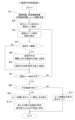
- FIG. 8 is a flowchart of turning allowance determination processing; It is a figure which shows the safe space of a manned agricultural machine. It is a figure which shows the turning space and turning allowance of a manned agricultural machine.
- FIG. 10 is a diagram showing another turning space and turning allowance of the manned agricultural machine;
- FIG. 4 is a diagram showing a safe space for an unmanned agricultural machine;
- FIG. 10 is a diagram showing another turning space and turning allowance of the unmanned agricultural machine;
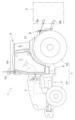
- FIG. 1 is a side view of an agricultural machine
- FIG. 18 is a side view of the agricultural machine 1.
- FIG. Agricultural machine 1 is composed of a tractor.
- the agricultural machine 1 is not limited to a tractor, and may be configured by other agricultural machines such as a rice transplanter or a combine harvester, or a work vehicle other than a tractor for performing farm work.
- the agricultural machine 1 includes a traveling vehicle body 3 , a prime mover 4 , a transmission 5 and a traveling device 7 .
- the travel device 7 has front wheels 7F and rear wheels 7R.
- the front wheel 7F may be of a tire type or a crawler type.
- the rear wheel 7R may be of a tire type or a crawler type.
- the prime mover 4 is composed of a diesel engine, an electric motor, or the like. In this embodiment, the prime mover 4 is composed of a diesel engine.
- the transmission device 5 can switch the driving force of the traveling device 7 by shifting gears, and can switch the traveling device 7 between forward and reverse.
- the driving force of the prime mover 4 is transmitted to the traveling device 7 by the transmission device 5, and the traveling device 7 is driven, so that the traveling vehicle body 3 travels back and forth.
- the left side is the front side of the traveling vehicle body 3 and the right side is the rear side of the traveling vehicle body 3 .
- a cabin 9 is provided in the traveling vehicle body 3 .
- a driver's seat 10 is provided inside the cabin 9 .
- a lifting device 8 composed of a three-point link mechanism or the like is provided at the rear portion of the traveling vehicle body 3 .
- the lifting device 8 is provided with connecting portions 8g and 8h to which the working device 2 for agricultural work can be connected. By connecting the working device 2 to the connecting portions 8g and 8h, the working device 2 and the traveling vehicle body 3 (agricultural machine 1) are connected, and the traveling vehicle body 3 can tow the working device 2.
- the work device 2 performs ground work on the field.
- the work device 2 includes a cultivating device (rotary cultivator) for tilling a field, a rough cultivating device (stubble cultivator) for rough plowing, a puddling device (drive harrow) for puddling, fertilizer or agricultural chemicals.
- FIG. 1 is a configuration diagram of an agricultural work support system 100.
- the agricultural work support system 100 includes an agricultural work support device 50 .
- the farm work support system 100 and the farm work support device 50 support farm work using the work device 2 while the agricultural machine 1 is running in a field.
- the agricultural machine 1 includes a control device 60 , an operating device 62 , a prime mover 4 , a transmission device 5 , a braking device 6 , a steering device 29 , an elevating device 8 , a positioning device 40 , an alarm device 63 and a detection device 64 .
- the agricultural machine 1 is provided with an in-vehicle network N1 such as LAN or CAN.
- the control device 60, the operation device 62, the positioning device 40, the alarm device 63, and the detection device 64 are connected to the in-vehicle network N1. These units provided in the agricultural machine 1 are included in the agricultural work support system 100 .
- the control device 60 is composed of an electric circuit including a CPU (or microcomputer) and memory.
- the memory of controller 60 includes volatile memory and non-volatile memory.
- the control device 60 controls operations of each part of the agricultural machine 1 .
- the control device 60 is provided with an automatic control section 61 that controls travel of the agricultural machine 1 and operation of the work device 2 .
- the operation device 62 includes switches, levers, pedals, and other keys that can be operated by a user such as a driver sitting in the driver's seat 10 or a worker near the agricultural machine 1 .
- the operating device 62 includes a mode switch 65 .
- the mode switch 65 is operated to switch modes of the agricultural machine 1 .
- the prime mover 4 (engine) is driven, stopped, and controlled by the control device 60 in terms of rotation speed.
- the transmission 5 is connected to the control valve 37 .
- the control valve 37 is an electromagnetic valve that operates based on a control signal sent from the control device 60 . Hydraulic oil discharged from the hydraulic pump 33 is supplied to the control valve 37 . Although the control valves 37 are shown as one block in FIG.
- the automatic control unit 61 controls the driving of the transmission 5 by electrically controlling the switching position and opening of the control valve 37 .
- the transmission device 5 transmits the driving force of the prime mover 4 to the traveling device 7, whereby the traveling device 7 is operated to cause the traveling vehicle body 3 to travel forward and backward. Further, for example, when the work device 2 is a ground work device, the transmission 5 transmits the driving force of the prime mover 4 to the work device 2 . As a result, the operating force of the working device 2 is increased.
- the automatic control unit 61 communicates with the work device 2 via the in-vehicle network N1.
- the working device 2 includes a control section 2a and a communication section 2b.
- the automatic control unit 61 transmits a work command to the work device 2 via the in-vehicle network N1.
- the control unit 2a of the work device 2 controls the operation of each part of the work device 2 based on the work command to perform farm work (ground work).
- the control unit 2a transmits information or data indicating a working state or the like to the control device 60 via the in-vehicle network N1 by the communication unit 2b.
- the automatic control unit 61 detects the working state of the work device 2 based on information or data received from the work device 2 via the in-vehicle network N1.
- the braking device 6 is connected to the control valve 38.
- the control valve 38 is an electromagnetic valve that operates based on control signals sent from the control device 60 . Hydraulic oil discharged from the hydraulic pump 33 is supplied to the control valve 38 .
- the automatic control unit 61 electrically controls the switching position and the opening degree of the control valve 38 to operate the braking device 6 to brake the traveling vehicle body 3 .
- the steering device 29 has a steering wheel (steering wheel) 30 , a steering shaft (rotating shaft) 31 and an auxiliary mechanism (power steering mechanism) 32 .
- the handle 30 is provided inside the cabin 9 .
- the steering shaft 31 rotates as the steering wheel 30 rotates.
- the assist mechanism 32 assists steering by the handle 30 .
- the auxiliary mechanism 32 includes a control valve 34 and a steering cylinder 35.
- Control valve 34 is an electromagnetic valve that operates based on a control signal sent from control device 60 .
- the control valve 34 is composed of a three-position switching valve that can be switched by movement of a spool or the like. Hydraulic oil discharged from the hydraulic pump 33 is supplied to the control valve 34 .
- the control device 60 electrically controls the switching position and the opening degree of the control valve 34 to adjust the hydraulic pressure supplied to the steering cylinder 35 to extend and retract the steering cylinder 35 .
- the steering cylinder 35 is connected to a knuckle arm (not shown) that turns the front wheels 7F.
- the control valve 34 can also be switched by steering the steering shaft 31 . Specifically, by operating the steering wheel 30, the steering shaft 31 rotates according to the operating state, and the switching position and the opening degree of the control valve 34 are switched.
- the steering cylinder 35 expands and contracts leftward or rightward of the traveling vehicle body 3 according to the switching position and opening degree of the control valve 34 . This telescopic motion of the steering cylinder 35 changes the steering direction of the front wheels 7F.
- the steering device 29 described above is merely an example, and is not limited to the configuration described above.
- the traveling vehicle body 3 of the agricultural machine 1 can be manually steered by manually operating the steering wheel 30 and automatically steered by the automatic control unit 61 . Further, the traveling vehicle body 3 can travel and stop by driving the transmission device 5 or the braking device 6 according to manual operation of an accelerator member or a brake member (both not shown) provided in the operation device 62 . Furthermore, the traveling vehicle body 3 can automatically travel and stop according to the control of the transmission device 5 and the braking device 6 by the automatic control unit 61 .
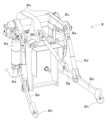
- FIG. 2 is a perspective view of the lifting device 8.
- the lifting device 8 has a lift arm 8a, a lower link 8b, a top link 8c, a lift rod 8d, and a lift cylinder 8e.
- a front end portion of the lift arm 8a is supported by a rear upper portion of a case (transmission case) that houses the transmission 5 so as to be capable of swinging upward or downward.
- the lift arm 8a swings (moves up and down) by being driven by a lift cylinder 8e.
- the lift cylinder 8e is composed of a hydraulic cylinder.
- the lift cylinder 8e is connected with the control valve 36 (Fig. 1).
- the control valve 36 is an electromagnetic valve that operates based on control signals sent from the control device 60 . Hydraulic oil discharged from the hydraulic pump 33 is supplied to the control valve 36 .
- the front end portion of the lower link 8b shown in FIG. 2 is supported by the lower rear portion of the transmission 5 (FIGS. 1 and 18) so as to be able to swing upward or downward.
- a front end portion of the top link 8c is supported by the rear portion of the transmission 5 above the lower link 8b so as to be able to swing upward or downward.
- the lift rod 8d connects the lift arm 8a and the lower link 8b.
- Connecting portions 8g and 8h to which the working device 2 can be connected are provided at rear end portions of the lower link 8b and the top link 8c.
- the automatic control unit 61 shown in FIG. 1 electrically controls the switching position and the opening degree of the control valve 36, thereby adjusting the hydraulic pressure supplied to the lift cylinder 8e shown in FIG. .
- the extension and contraction of the lift cylinder 8e raises and lowers the lift arm 8a and the lower link 8b connected to the lift arm 8a via the lift rod 8d.
- the working device 2 swings upward or downward (elevates) around the front portion of the lower link 8b (the side opposite to the connecting portions 8g and 8h) as a fulcrum.
- the positioning device 40 shown in FIG. 1 has a receiving device 41 and an inertial measurement unit (IMU: Inertial Measurement Unit) 42 .
- the receiving device 41 receives satellite signals (positions of positioning satellites, transmission times, correction information, etc.) transmitted from satellite positioning systems (positioning satellites) such as D-GPS, GPS, GLONASS, Hokuto, Galileo, and Michibiki.
- the positioning device 40 detects the current position (for example, latitude and longitude) based on the satellite signals received by the receiving device 41 . That is, the positioning device 40 is a position detector that detects the position of the traveling vehicle body 3 of the agricultural machine 1 .
- the inertial measurement device 42 has an acceleration sensor, a gyro sensor, and the like.
- the inertial measurement device 42 detects the roll angle, pitch angle, yaw angle, and the like of the traveling vehicle body 3 .
- the alarm device 63 is composed of a buzzer, a speaker, or a warning light provided on the traveling vehicle body 3.
- the alarm device 63 issues an alarm to the surroundings of the traveling vehicle body 3 by sound or light.
- the detection device 64 is composed of a sensor or the like (a camera may be included) installed in each part of the agricultural machine 1 and the working device 2 .
- the detection device 64 detects the operation state (driving state) of each part such as the transmission device 5, the braking device 6, the traveling device 7, the lifting device 8, the steering device 29, and the operating device 62 of the agricultural machine 1 based on output signals from sensors and the like. and stop status, operating position, etc.). Further, the detection device 64 detects the operating state of the work device 2 based on the output signal from a sensor or the like.
- the detection device 64 includes an object detection unit 64a, a laser sensor such as LiDAR, an ultrasonic sensor, and the like.
- a laser sensor, an ultrasonic sensor, and the like are installed at the front portion, the rear portion, and the left and right side portions of the traveling vehicle body 3 .
- the object detection unit 64a detects the presence or absence of an object around the agricultural machine 1 and the distance to the object from the output signal from the laser sensor or the ultrasonic sensor.
- the agricultural work support device 50 is composed of, for example, a portable tablet terminal device.
- the agricultural work support device 50 is mounted, for example, inside the cabin 9 of the agricultural machine 1 and is detachable from the agricultural machine 1 . That is, the agricultural machine 1 is equipped with the agricultural work support device 50 .
- the agricultural work support device 50 includes a control unit 51, a display operation unit 52, a storage unit 53, and a communication unit 54.
- the control unit 51 is composed of a CPU (or microcomputer), a volatile memory, and a nonvolatile memory.
- the controller 51 controls each part of the agricultural work support device 50 .
- the control unit 51 includes an agricultural field registration unit 51a, an area setting unit 51b, a route creation unit 51c, a turning allowance calculation unit 51d, and a notification unit 51g.
- Each of these units is configured by a software program in this example, but may be configured by hardware such as a semiconductor element such as an ASIC or an electric circuit as another example.
- the display operation unit 52 is composed of a touch panel and displays various information on the screen. Further, various inputs can be performed by performing predetermined operations on the display screen of the display operation unit 52 .
- the display operation unit 52 is a display unit and an input unit. Instead of the display/operation unit 52, the agricultural work support device 50 may be provided with an independent display unit and an operation unit (input unit).
- the storage unit 53 is composed of a non-volatile memory or the like.
- the storage unit 53 readable and writable information or data for supporting the running and working of the agricultural machine 1 .
- the communication unit 54 is composed of an interface for connecting to the in-vehicle network N1.
- the control unit 51 communicates with the control device 60, the operation device 62, the positioning device 40, the alarm device 63, the detection device 64, and the work device 2 via the vehicle-mounted network N1 by the communication unit .
- the communication unit 54 is an output unit that outputs information and data to the control device 60 of the agricultural machine 1 .
- the farm field registration unit 51a registers information about fields where farm work is performed by the agricultural machine 1 and the work device 2 .
- the area setting unit 51b sets a predetermined area in the field registered by the field registration unit 51a.
- the route creation unit 51c creates a travel route along which the agricultural machine 1 travels in the field registered by the field registration unit 51a. Further, at this time, the route creating unit 51c secures a turning space for turning the agricultural machine 1 and the working device 2 in the registered farm field.
- the turning allowance calculation unit 51d determines whether or not the turning allowance indicating the size of the turning space secured by the route creating unit 51c is insufficient.
- the notification unit 51g notifies by causing the display/operation unit 52 to display the content of predetermined information and data. Alternatively, the notification unit 51g may notify by outputting a voice indicating the content of the predetermined information and data from the speaker of the alarm device 63.
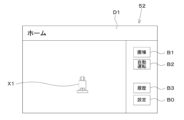
- the control unit 51 causes the display operation unit 52 to display the home screen D1 shown in FIG.
- the data of the home screen D1 and the data of each screen described later are stored in the storage unit 53 .
- the control unit 51 reads data from the storage unit 53 as necessary, and causes the display operation unit 52 to display a screen based on the data.
- the home screen D1 displays an agricultural machine mark X1, a field key B1, an automatic operation key B2a, an autosteer key B2b, a history key B3, and a setting key B0.
- the setting key B0 is a key for making various settings. By selecting (tapping) the setting key B0, it becomes possible to set and register predetermined items.
- the predetermined items include, for example, the agricultural machine 1 on which the agricultural work support device 50 is mounted, the working device 2 connected to the agricultural machine 1, the agricultural work performed by the agricultural machine 1 and the working device 2, the field where the agricultural work is performed, and items related to the display operation unit 52 are included.
- the history key B3 is a key for displaying the work history of the agricultural machine 1.
- the farm field key B1 is a key for registering a farm field on which farm work is to be performed by the agricultural machine 1 .
- the automatic driving key B2a is a key for setting or predicting the automatic driving work mode of the agricultural machine 1 .
- the autosteer key B2b is a key for setting or predicting the automatic steering operation mode of the agricultural machine 1 .
- the automatic traveling work mode is a mode in which agricultural work (ground work) is performed by the working device 2 while the traveling vehicle body 3 of the agricultural machine 1 is automatically driven.
- Automatic operation of the agricultural machine 1 means automatically changing the traveling speed of the traveling vehicle body 3 and automatically steering the traveling vehicle body 3 .
- the automatic steering work mode is a mode in which farm work (ground work) is performed by the work device 2 while the traveling vehicle body 3 is automatically steered.
- the driver of the agricultural machine 1 operates an accelerator member or a brake member included in the operating device 62 (FIG. 1), thereby turning the traveling vehicle body 3 in response to the operation.
- Running speed is changed. That is, in the automatic steering work mode, the running speed of the running vehicle body 3 is changed based on the manual operation.
- the agricultural machine 1 can of course also be manually operated, and can perform ground work with the work device 2 during the travel.
- Manual operation of the agricultural machine 1 means that the driver operates the accelerator member or the brake member of the operation device 62 to change the traveling speed of the traveling vehicle body 3 and operate the steering wheel 30 (FIG. 1). It is to steer the traveling vehicle body 3 .
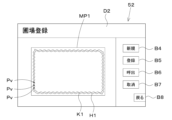
- the control unit 51 causes the display operation unit 52 to display the farm field registration screen D2 shown in FIG.
- the field registration screen D2 displays a map MP1, the position Pv of the traveling vehicle body 3 of the agricultural machine 1, a new key B4, a registration key B5, a call key B6, a cancel key B7, and a return key B8.
- On the map MP1 an image showing a map around the position where the agricultural machine 1 is located is displayed.
- the map data of the surrounding area is obtained by the control unit 51 from the positioning device 40 or stored in the storage unit 53 in advance.
- the map MP1 displays fields in which the agricultural machine 1 performs farm work, and is associated with position information such as latitude and longitude.
- the map displayed on the map MP1 is enlarged or reduced, or the display location of the map is moved.
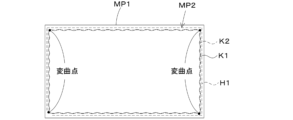
- FIG. 5A is a diagram for explaining a method of registering fields.
- the user selects the new key B4 on the farm field registration screen D2 shown in FIG. 4 to manually rotate the agricultural machine 1 in the farm field.
- the working device 2 may be raised by the lifting device 8 so that the working device 2 does not perform farm work on the field, or the working device 2 may be lowered by the lifting device 8 to work on the field.
- Agricultural work may be performed by the device 2 .
- the control unit 51 of the agricultural work support device 50 (FIG.
- the agricultural field registration unit 51a calculates the traveling locus K1 of the traveling vehicle body 3 based on the plurality of recorded detection positions Pv. Further, the control unit 51 displays the travel locus K1 on the map MP1 as shown in FIG. 5A.
- the running locus of the traveling vehicle body 3 is a line K1 that returns to the first detected position Pv after passing through the plurality of detection positions Pv in the order of detection (acquisition order).
- the detected position Pv is the GPS position of the positioning device 40, and the running trajectory K1 is the trajectory along which the GPS position has moved.
- the farm field registration unit 51a registers the circumference outer end of the working device 2 from the GPS position of the agricultural machine 1 (the left end of the working device 2 in FIG.
- a line H1 is formed between the traveling locus K1 and the outline line of the map MP1 by offsetting the traveling locus K1 outward by a predetermined amount, which is equivalent to the interval in the lateral width direction to (1).
- the GPS position of the positioning device 40 is at the center of the traveling vehicle body 3, and the center of the traveling vehicle body 3 in the lateral width direction coincides with the center of the working device 2 in the lateral width direction. It is set to the same value as half the full width (length in the lateral width direction) of the device 2 or half the working width (length in the lateral width direction) in which the work device 2 can work on the ground.
- the outline line of the travel locus K1 and the map MP1 is set to a value that is a predetermined amount smaller or a predetermined amount greater than the widthwise distance from the GPS position of the agricultural machine 1 to the outer circumference end of the working device 2 as an offset amount.
- a line H1 may be formed between Alternatively, the user may select the setting key B0 on the home screen D1 and perform a predetermined input operation so that an arbitrary offset amount can be input.
- the field registration unit 51a uses the line H1 formed as described above as the contour (outline) of the field, and registers (stores) the field map MP2 (data indicating the contour of the field) represented by the contour H1 in the storage unit 53. do.
- the farm field registration unit 51a registers the farm field name and identification information in the storage unit 53 in association with the farm field map MP2.
- the field identification information may be assigned by the field registration unit 51a, may be input by the user by operating the display operation unit 52, or may be stored in the storage unit 53 in advance. good.
- a plurality of pieces of farm field information such as the farm field map MP2, the name of the farm field, and the identification information of the farm field can be registered in the storage unit 53 .
- the control unit 51 displays the farm field map MP2 (field outline H1) included in the farm field information on the map MP1.
- the agricultural field registration unit 51a calculates an inflection point from the traveling locus K1 of the traveling vehicle body 3 and forms a line K2 passing through the inflection point. Then, the line K2 is offset outward by the above-described offset amount to form a line H1 between the travel locus K1 and the outline line of the map MP1.
- the field map MP2 may be registered in the storage unit 53.
- the user may operate a predetermined switch or the like provided on the operation device 62 to designate the edge of the field as shown in FIG. 5C.
- the farm field registration unit 51a forms a line K3 that passes through each end of the field in the designated order and then returns to the first designated end. Then, the line K3 is offset outward by the above-described offset amount to form a line H1 between the travel locus K1 and the outline line of the map MP1.
- the field map MP2 may be registered in the storage unit 53.
- the field outline H1 and the field map MP2 are data indicated by positions (latitude, longitude), data indicated by a coordinate system (X-axis, Y-axis), or data indicated by other expressions. There may be.
- the control unit 51 reads the data of one of the field maps MP2 registered in the storage unit 53, MP2 is displayed on the field registration screen D2. Further, when the user selects the cancel key B7, the farm field registration unit 51a erases the position Pv of the traveling vehicle 3 and the field map MP2 (field outline H1) displayed on the map MP1 at this time, and deletes these data. is also erased from the storage unit 53. That is, the registration of the field outline H1 and the field map MP2 is cancelled.
- the control unit 51 causes the display operation unit 52 to display the home screen D1 of FIG. That is, the return key B8 is a key for returning the display screen of the display operation unit 52 to the previous screen.
- the control unit 51 causes the display operation unit 52 to display the work selection screen D3 shown in FIG.
- a message indicating the input operation procedure is displayed on the work selection screen D3.
- the work selection screen D3 also displays a plurality of work keys B31 to B35, an up arrow key B41, a down arrow key B42, a next key B9, and a return key B8.
- the work keys B31 to B35 are keys indicating farm work that can be performed by the agricultural machine 1 and the work device 2 connected to the agricultural machine 1.
- FIG. 6 five work keys B31, B32, B33, B34, and B35 are displayed.
- the control unit 51 displays a work key indicating another work on the work selection screen D3.
- the control unit 51 displays the selected work key on the work selection screen D3 in a display form different from that of the other work keys. In the example of FIG. 6, only the selected tillage key B31 is marked with a black circle.
- the control unit 51 causes the vehicle confirmation screen D4a shown in FIG. display. That is, the next key B9 is a key for switching the display screen of the display operation unit 52 to the next screen.
- the control unit 51 causes the display operation unit 52 to display the home screen D1 of FIG. That is, the return key B8 is a key for returning the display screen of the display operation unit 52 to the previous screen.
- the vehicle confirmation screen D4a shown in FIG. 7A includes a message indicating an input operation procedure, a type of farm work, a type of the agricultural machine 1, an unmanned machine setting key B10, a manned machine setting key B11, a next key B9, and a return key B8. is displayed.
- the type of farm work indicates the farm work selected on the work selection screen D3.
- the type of agricultural machine 1 includes a vehicle type and a control type. In FIG. 7A, the type of the agricultural machine 1 registered (set) in advance is displayed on the vehicle confirmation screen D4a.
- the user can input the type of the agricultural machine 1 by selecting the setting key B0 on the home screen D1 (FIG. 3) and performing a predetermined input operation on the display operation unit 52, for example. At that time, the user can also input specifications such as the name and dimensions of the agricultural machine 1 by performing a predetermined input operation. Further, when the user performs a predetermined input operation, the control unit 51 stores the input type and specification of the agricultural machine 1 in a predetermined area of the storage unit 53, thereby registering the type and specification. Information on the agricultural machine 1 and information on the working device 2, which will be described later, can also be input from the home screen D1 in the same procedure and registered (stored) in the storage unit 53. FIG.
- the user can change the type of the agricultural machine 1 by selecting the unmanned machine setting key B10 or the manned machine setting key B11 on the vehicle confirmation screen D4a and performing a predetermined input operation.
- the control unit 51 causes the internal memory to store the setting information (type of agricultural work and type of agricultural machine 1) displayed on the vehicle confirmation screen D4a.
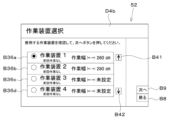
- the device selection screen D4b shown in FIG. 7B is displayed on the display operation unit 52.
- the device selection screen D4b displays a message indicating an input operation procedure, work device keys B36a to B36d, an up arrow key B41, a down arrow key B42, a next key B9, and a return key B8.
- Each of the working device keys B36a to B36d shows representative unique information of the working device 2 registered in advance.
- the typical unique information of the work device 2 includes the name of the work device 2, whether or not the work device 2 has performed the previous work, and the work width.
- the working width is a workable width in a horizontal plane perpendicular to the traveling direction of the working device 2 .
- FIG. 7B four working device keys B36a to B36d are displayed.
- the control unit 51 causes the working device key indicating the other working device 2 to be displayed on the device selection screen D4b.
- the control unit 51 displays the selected working device key on the device selection screen D4b in a display form different from that of the other working device keys.
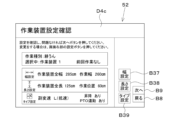
- the control unit 51 causes the display operation unit 52 to display the device confirmation screen D4c shown in FIG. 7C.
- the device confirmation screen D4c displays a message indicating an input operation procedure, unique information of the working device 2 selected on the device selection screen D4b (FIG. 7B), setting keys B37 to B39, next key B9, and return key B8. It is
- the unique information of the work device 2 includes the name of the work device 2 , whether or not the work device 2 was previously used for work, dimension information of the work device 2 , and the type of the work device 2 . That is, detailed specifications of the work device 2 selected on the device selection screen D4b are displayed on the device confirmation screen D4c. In FIGS. 7B and 7C, pre-registered unique information of the work device 2 is displayed on the screens D4b and D4c.
- the dimensional information of the working device 2 includes the overall width, working width, overall length, and working position of the working device 2 .
- the type of the working device 2 includes a speed stage of an auxiliary transmission (not shown) for rotating the working device 2, which is a tilling device, whether or not the working device 2 is raised and lowered by the lifting device 8, and the PTO of the agricultural machine 1. (Power Take-off) is included.
- the setting keys B37 to B39 are keys for setting and changing the dimensional information or type of the work device 2. Specifically, the user can select the width setting key B37 and perform a predetermined input operation to input and change the set values of the overall width and working width of the working device 2 . Also, the user can input and change the set values of the total length and working position of the working device 2 by pressing the length setting key B38 and performing a predetermined input operation.
- the total length of the working device 2 is defined as the distance from the position where the working device 2 is connected to the lower link 8b (FIGS. 1 and 2) of the lifting device 8 to the rear end of the working device 2 (the end opposite to the traveling vehicle body 3 of the agricultural machine 1). ).
- the working position of the working device 2 is the length from the connection position of the working device 2 to the lower link 8b to the front end position where the work on the ground is possible (the end of the workable portion on the traveling vehicle body 3 side).
- the user selects the type setting key B39 and performs a predetermined input operation to select a low speed stage (L (low speed)) or a medium speed stage (M (medium speed)) as the speed stage of the auxiliary transmission. Can be entered and changed.
- L low speed
- M medium speed
- both the interlocking with the PTO of the agricultural machine 1 in the working device 2 and the lifting by the lifting device 8 are fixed to "yes” and cannot be changed.
- either “yes” or “no” may be selectable for each of interlocking with the PTO of the agricultural machine 1 and lifting by the lifting device 8 .
- the control unit 51 When the user selects the next key B9 on the device confirmation screen D4c, the control unit 51 causes the internal memory to store the setting information displayed on the device confirmation screen D4c, and displays the field selection screen D5 shown in FIG. 52 to display.
- the field selection screen D5 displays one or more registered field maps MP2, an up arrow key B41, a down arrow key B42, a next key B9, and a return key B8. In FIG. 8, three field maps MP2 are displayed.
- the control unit 51 displays another farm field map MP2 on the farm field selection screen D5.
- the control unit 51 displays the selected farm field map MP2 in a display form different from the other farm field maps MP2. In FIG. 8, only the selected field map MP2 is surrounded by a thick line frame. Further, the control unit 51 displays the date and time of the last farm work performed on the selected farm field map MP2 and the area of the farm field map MP2 on the farm field selection screen D5. When the user selects the next key B9 while any field map MP2 is selected, the control unit 51 reads the field information including the selected field map MP2 from the storage unit 53 and stores it in the internal memory. to display the route creation 1 screen D6 shown in FIG.
- the field information at the time of this setting includes the identification information, contour, and area of the field map MP2 as the information of the field map MP2, and the identification information, the position, and the contour of the field as information of the field corresponding to the field map MP2. etc. are included.
- the field information includes the date and time of the previous work.
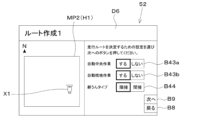
- the route creation 1 screen D6 shown in FIG. 9 includes a selected field map MP2 (outline H1), an agricultural machine mark X1, a message indicating an input operation procedure, work keys B43a, B43b, B44, a next key B9, and a return key.
- Key B8 is displayed.
- the work keys B43a, B43b, and B44 are keys for selecting settings for creating a travel route for the agricultural machine 1, which will be described later.
- the work keys B43a, B43b, and B44 are keys for setting work conditions for performing farm work on fields by the agricultural machine 1 (the traveling vehicle body 3) and the work device 2.
- the automatic central work key B43a is used to determine whether farm work is to be performed by the work device 2 while the traveling vehicle body 3 of the agricultural machine 1 is automatically driven in the central area set in the field map MP2 as will be described later.
- the automatic headland work key B43b is a headland set in the farm field map MP2 as will be described later. is the key for selecting
- the work type key B44 is a key for selecting the work state to be performed by the work device 2.
- the work type key B44 in FIG. It is the key to select whether When another work is selected on the work selection screen D3 of FIG. 6, the work type key B44 of FIG. 9 serves as a key for selecting the state of the other work.
- FIG. 9 shows a state in which the automatic central work key B43a is used to automatically run the agricultural machine 1 in the central area of the field while the work device 2 performs farm work.
- the automatic headland work key B43b shows a state in which the farm work is selected to be performed by the work device 2 while automatically running the agricultural machine 1 on the headland of the field.
- the work type key B44 shows a state in which adjacent work is selected as the type of tillage work.
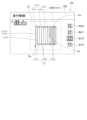
- the route creation 2 screen D7 includes a selected field map MP2, an agricultural machine mark X1, a message indicating an input operation procedure, a plurality of setting items and their numerical input fields, a recommended key B12, a route creation key B13, and a trajectory prediction key. B14, a plus key B45, a minus key B46, a next key B9, and a return key B8 are displayed. While the route creation 2 screen D7 is being displayed, the control unit 51 acquires the actual position of the traveling vehicle body 3 detected by the positioning device 40 by the communication unit 54, and displays the position of the traveling vehicle body 3 on the field map MP2 according to the position of the traveling vehicle body 3. Agricultural machine mark X1 may be displayed at the corresponding portion of .
- a plurality of setting items in the route creation 2 screen D7 are creation conditions for creating a travel route and work conditions for performing farm work on a field by the agricultural machine 1 and the work device 2.
- the setting items include expected work distance, number of headlands, number of headlands for automatic operation, working direction, headland overlap, and center overlap. Among these items, numerical values can be input for items other than the expected working distance.
- the number of headlands is the number of one or more headlands set inside the registered field contour H1 (field map MP2) along the contour H1.
- the number of headlands for automatic operation refers to the number of headlands where agricultural work is performed by the work device 2 while the agricultural machine 1 is automatically driven among the set number of headlands.
- the working direction is the direction in which the working device 2 works while the traveling vehicle body 3 is reciprocated in a straight line in the central part inside the headland of the field.
- a predetermined number for example, "1" to "4"
- each direction of up, down, left, and right of the route creation 2 screen D7 corresponding to the numerical value is set. be done.
- the overlapping margin of the headland is a margin of protrusion of the working width of the working device 2 with respect to the headland.
- the overlapping margin in the central portion is the overlapping margin between working widths when the working device 2 performs the work while reciprocating the traveling vehicle body 3 in a straight line in the central portion of the field.
- the user can select a numerical value input field for each setting item and operate the plus key B45 or minus key B46 to input a numerical value in each numerical value input field. Further, when the user selects the recommendation key B12, the control unit 51 selects each setting item corresponding to the farm work selected on the work selection screen D3 (FIG. 6) among the recommended values stored in the storage unit 53 in advance. , and input (display) the recommended value in the corresponding numerical input field.
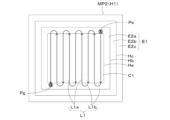
- the control unit 51 stores the numerical value of each setting item in the internal memory. Further, the area setting unit 51b (FIG. 1) sets a central area (second area) C1 and a headland area (first area) E1 in the field map MP2, as shown in FIG. 10B. Furthermore, the route creation unit 51c (FIG. 1) creates a travel route (planned travel route) L1 in the field map MP2.
- Figures 11A to 11D are diagrams for explaining how to set the areas C1 and E1 and the travel route L1.
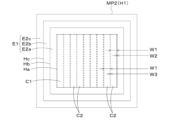
- the area setting unit 51b sets a value based on the field information, the dimension information of the working device 2, the number of headlands input on the route creation 2 screen D7, or the headland overlap margin.
- a central area C1 and a headland area E1 are set.
- the area setting unit 51b sets the width W4 obtained by subtracting the overlap width W2 of the headland from the working width W1 of the working device 2, and repeats the outline H1 of the farm field the same number of times as the number of headlands. Compute the contours Hc, Hb, Ha formed by offsetting inwards.
- the area setting unit 51b sets an area (central portion) surrounded by the innermost contour Ha as the central area C1.
- the area setting unit 51b calculates a contour formed by offsetting the field contour H1 inward the same number of times as the number of headlands within the working width of the working device 2 (or the full width of the working device 2).
- an area (central portion) surrounded by an innermost contour may be set as the central area.
- the area setting unit 51b After setting the central area C1 as described above, the area setting unit 51b sets a frame-shaped area (outer frame) outside the central area C1 and inside the contour H1 of the field as the headland area E1. do. Further, in the headland area E1, the area setting unit 51b selects the areas between the adjacent contours among the outline H1 of the farm field and the outlines Hc, Hb, and Ha obtained by offsetting the outline H1 as the headlands E2c and E2b. , E2c. Then, the area setting unit 51b causes the storage unit 53 to store data such as positions indicating the areas C1 and E1 (including the headlands E2c, E2b, and E2c).
- the route creation unit 51c uses the farm field information, the area C1 and E1, the dimension information of the agricultural machine 1 and the working device 2, the working direction input on the route creation 2 screen D7, the headland overlap, and the center overlap. Based on this, a travel route L1 is created. Specifically, first, as shown in FIG. 11B, the route creation unit 51c starts from one end (the right end in FIG. 11B) of the central area C1 parallel to the working direction (vertical direction in FIG. 11B). A plurality of unit work sections C2 are created in the central area C1 by dividing in order by the work width W1.
- the route creation unit 51c causes the work width W1 to overlap the headland area E1 by the headland overlap width W2 in the unit work section C2 to be created first.
- the route creating section 51c causes the work width W1 to overlap the previously created unit work section C2 by an overlap width W3 at the center.
- the route creation unit 51c creates a straight route L1a along which the traveling vehicle body 3 travels straight for each unit work section C2.
- the route creation unit 51c creates a linear straight route L1a connecting both ends in the longitudinal direction of the unit work section C2 on the center line in the width direction (horizontal direction in FIG. 11C) of the unit work section C2.
- the straight route L1a created in the unit work section C2 is created outside the central area C1. If so, the route creation unit 51c may exclude the straight route L1a from the travel route L1.
- the route creation unit 51c creates a route L1b connecting adjacent straight routes L1a in the headland area E1.
- the route L1b is a turning route in which the agricultural machine 1 (the traveling vehicle body 3) and the working device 2 turn from one of the two adjacent straight routes L1a to the other.
- the route creating unit 51c secures a turning space for turning the agricultural machine 1 and the working device 2 in the headland area E1. The details of the turning space at this time will be described later.
- a simple semicircular turning route L1b is illustrated, but this shape can be easily displayed on the display screen of the display operation unit 52, or the driving route L1 can be easily visually recognized on the display screen. This is because it is convenient to do so.
- the traveling vehicle body 3 of the agricultural machine 1 and the working device 2 actually travel along one of the straight routes L1a, when turning toward the other straight traveling route L1a, the traveling vehicle body 3 and the like move not only forward but also backward.
- the trajectory may be cut back to draw a trajectory with a more complicated shape than a semicircular shape. That is, the turning route L1b is a route for display on the display operation unit 52, and the agricultural machine 1 may not turn based on the turning route L1b.
- the route creating unit 51c may create a turning route L1b having a shape other than a semicircular shape.
- the control device 60 (FIG. 1) of the agricultural machine 1 lowers the working device 2 by the lifting device 8 (FIG. 2) while the traveling vehicle body 3 is traveling on the straight route L1a. Ground work is carried out by Further, when the traveling vehicle body 3 is turned at a location corresponding to the turning route L1b, that is, when the traveling vehicle body 3 is turned from one straight route L1a toward the other straight route L1a, the automatic control unit 61 controls the lifting device 8 raises the working device 2 to stop the work on the ground by the working device 2 .
- the straight route L1a is a work route in which ground work is performed by the work device 2 while the traveling vehicle body 3 of the agricultural machine 1 is automatically driven.
- the central area C1 in which a plurality of straight routes L1a are created is a work area in which the work on the ground is performed by the work device 2 while the traveling vehicle body 3 is reciprocated while traveling straight by automatic operation.
- the work route is not limited to a straight route such as the straight route L1a, and may be a curved route.
- at least one work route out of a linear work route and a curved work route may be created in the work area.
- the automatic central work key B43a selects work in the central area C1
- the automatic headland work key B43b selects not to work in the headlands
- the work type key B44. selects adjacent operations.
- the route creation unit 51c creates a travel route L1 composed of a straight route L1a and a turning route L1b.
- the route creation unit 51c selects one end of the straight route L1a that is not connected to the turning route L1b (the upper end of the straight route L1a on the right end in FIG. 11C) among the ends of the straight route L1a on both sides of the central area C1.
- the route creation unit 51c stores information indicating the areas C1 and E1, the travel route L1, the start position Ps, the goal position Pg, and the turning space in the internal memory as route information.
- the automatic center work key B43a selects work in the central area C1
- the automatic headland work key B43b selects work in the headlands
- the work type key B44. selects adjacent operations.
- the route creating unit 51c creates a circular route L1c that circles the outside of the central area C1 in the headland area E1 as shown in FIG. 11D.
- the route creation unit 51c is set outside the central area C1 by the area setting unit 51b.
- the headland E2a that is closest to the central area C1 is used to create a circuit route L1c.
- the circuit route L1c is a work route in which ground work is performed by the work device 2 while the traveling vehicle body 3 of the agricultural machine 1 is automatically driven.
- the circuit route L1c includes a plurality of straight routes L1s that are substantially straight and turning routes L1r that are curved with a radius of curvature greater than or equal to a predetermined radius.
- a plurality of straight routes L1s are created on the center line in the width direction of the headland E2a so as to correspond to each straight line portion of the outline Ha of the central area C1.
- the turning route L1r is a route in which the agricultural machine 1 (the traveling vehicle body 3) and the working device 2 are turned from one straight route L1s toward the other straight route L1s adjacent to the one straight route L1s in the extending direction. be.
- One straight route L1s and the other straight route L1s extend in different directions, but the end of one straight route L1s and the beginning of the other straight route L1s are connected by a turning route L1r.
- the route creating unit 51c also secures a turning space in the headland area E1 for turning the traveling vehicle body 3 of the agricultural machine 1 and the working device 2 when creating the turning route L1r. The details of the turning space at this time will also be described later.
- a simple arc-shaped turning route L1b is illustrated for convenience.
- the agricultural machine 1 or the like actually turns from one straight route L1s toward the other straight route L1s, it not only moves forward, but also reverses or turns back to follow a more complicated shape than a circular arc.
- the turning route L1r is a route for display on the display operation unit 52, and the agricultural machine 1 may not turn based on the turning route L1r.
- the route creation unit 51c may create a turning route L1r having a shape other than an arc shape.
- a loosely curved portion (curved with less than a predetermined radius of curvature) route (not shown) may be included in the round route L1c.
- the automatic control unit 61 may perform the ground work by the working device 2 while the traveling vehicle body 3 is automatically traveling based on the straight route L1s or the gentle curve portion of the circuit route L1c. That is, the straight route L1s and the gently curved portion are work routes.
- the automatic control unit 61 controls the lifting device 8 raises the working device 2 to stop the work on the ground by the working device 2 .
- the automatic control unit 61 also moves the working device 2 by the lifting device 8 when turning the traveling vehicle body 3 from one straight route L1a in the central area C1 toward one straight route L1s in the headland area E1. Then, the ground work by the work device 2 is stopped.
- the headland E2a for which the circuit route L1c is created as described above is a work area in which the work device 2 performs work on the ground while the traveling vehicle body 3 circles the outside of the central area C1.
- the route creating unit 51c may create a circuit route for other headlands E2b and E2c outside the headland E2a.
- a key for inputting the number of headlands for creating a circuit route may be provided on the route creation 2 screen D7.
- the route creation unit 51c may create a circuit route that makes multiple turns around at least one headland among the plurality of headlands E2a, E2b, and E2c.
- a circular route may be constructed to pass through both headlands. That is, the route creation unit 51c may create a circuit route in the headland area E1 that circles around the central area C1 a number of times equal to or greater than the number of headlands.
- the route creating unit 51c selects one straight route L1a that is not connected to the turning route L1b among both ends of the straight route L1a at both ends (left and right ends in FIG. 11D) of the central area C1. (the upper end of the straight route L1a on the right end in FIG. 11D), and the loop route L1c is set on the other end of the straight route L1a (the lower end of the straight route L1a on the left end in FIG. 11D). Connect. Further, the route creating unit 51c sets the goal position Pg at the end of the circuit route L1c that is not connected to the straight route L1a. Then, the route creation unit 51c stores information indicating the areas C1 and E1, the travel route L1, the start position Ps, the goal position Pg, and the turning space in the internal memory as route information.
- the turning allowance determination process is a process for determining whether or not the turning allowance indicating the size of the turning space is insufficient.
- FIG. 12 is a flow chart showing the procedure of the turning allowance determination process.
- the turning allowance calculation unit 51d acquires (reads) field information, information on the agricultural machine 1, information on the working device 2, and route information from the internal memory of the control unit 51 or the storage unit 53 (S1 ).
- the turning allowance calculation unit 51d traces the traveling route L1 included in the route information from the start position Ps, and extracts turning routes L1b and L1r (S2).
- the turning allowance calculation unit 51d specifies the turning space in which the turning route L1b, L1r is formed, and calculates the turning allowance indicating the size of the specific turning space. (S3).
- the turning allowance calculation unit 51d calculates the turning allowance of the specific turning space based on the dimensional information of the agricultural machine 1 and the working device 2 and the positional information of the specific turning space included in the information acquired in step S1. calculate.
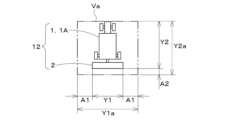
- FIG. 13A is a diagram showing the safety space Va when the agricultural machine 1 is the manned agricultural machine 1A.
- FIG. 13B is a diagram showing a turning space G1 and a turning allowance Z1 for creating a turning route L1b projecting from the central area C1 when the agricultural machine 1 is a manned agricultural machine 1A.
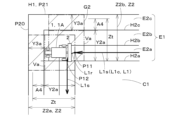
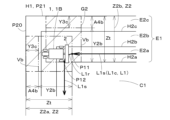
- FIG. 13C is a diagram showing a turning space G2 and a turning allowance Z2 for creating a turning route L1r included in the turning route L1c when the agricultural machine 1 is a manned agricultural machine 1A.
- the route creation unit 51c When the agricultural machine 1 is a manned agricultural machine 1A that can be operated by a driver sitting in the driver's seat 10 (FIG. 18) operating the operation device 62, the route creation unit 51c, for example, as shown in FIG. 13A,
- the agricultural work unit 12 is a unit composed of the agricultural machines 1 and 1A and the work device 2 connected to the agricultural machines 1 and 1A.
- the total length Y2 is the distance from the front end of the traveling vehicle body 3 of the agricultural machine 1 (the end of the traveling vehicle body 3 on the side opposite to the working device 2) to the rear of the traveling vehicle body 3 by the connecting portions 8h and 8g. It is the length to the rear end of the working device 2 (the end of the working device 2 on the side opposite to the traveling vehicle body 3).
- the route creation unit 51c calculates a rectangular safe space Va determined by the virtual width Y1a and the virtual length Y2a.
- the safety space Va is a space that should be secured between the agricultural work unit 12 and surrounding objects for safety reasons (the same applies to the safety space Vb, which will be described later).
- the route creating unit 51c when creating a turning route L1b from one straight route L1a created in the central area C1 toward the other straight route L1a, the route creating unit 51c , the safety space Va is arranged toward the edge P10 of the nearest agricultural field map MP2 in the traveling direction of the straight route L1a.
- the route creation unit 51c arranges the safety space Va from the starting point P2 of the other straight route L1a toward the nearest end P10 of the field map MP2 opposite to the traveling direction of the straight route L1a.
- the route creation unit 51c defines a turning space G1 (indicated by hatching) between a portion reached by at least one of the two arranged safety spaces Va (inside the safety space Va) and a range up to the edge P10 of the field map MP2. shown range).
- a turning space G1 is secured in the headland area E1.
- the route creation unit 51c creates a turning route L1b from one straight route L1a to the other straight route L1a in the turning space G1.
- the turning allowance calculation unit 51d calculates the width Z1a of the turning space G1 that spreads from the terminal end P1 of one straight route L1a toward the traveling direction of the one straight route L1a, or the width Z1a of the turning space G1 that spreads from the starting end P2 of the other straight route L1a to the other straight route L1a.
- a width Z1b of the turning space G1 that widens in the direction opposite to the traveling direction of the straight route L1a is calculated as the turning allowance Z1 of the turning space G1.
- the route creation unit 51c when creating a turning route L1r from one straight route L1s toward the other straight route L1s in the round route L1c created in the headland area E1, the route creation unit 51c A safety space Va is arranged from the terminal end P11 of the route L1s toward the end P20 of the nearest agricultural field map MP2 in the traveling direction of the straight route L1s. In addition, the route creating unit 51c arranges the safety space Va from the starting point P12 of the other straight route L1s toward the nearest end P21 of the field map MP2 opposite to the traveling direction of the straight route L1s.
- the route creation unit 51c creates a turning space G2 (a hatched range), which is a location reached by at least one of the two arranged safety spaces Va, and a range from the location to ends P20 and P21 of the field map MP2. ).
- a turning space G2 is secured in the headland area E1.
- the route creation unit 51c creates a turning route L1r from one straight route L1s to the other straight route L1s in the turning space G2.
- the turning allowance calculation unit 51d calculates the width Z2a of the turning space G2 that spreads from the terminal end P11 of one straight route L1s toward the traveling direction of the one straight route L1a, or The width Z2b of the turning space G2, which widens in the direction opposite to the traveling direction of the straight route L1a, is calculated as the turning allowance Z2 of the turning space G2.
- the turning margin calculator 51d calculates the sum of the virtual length Y2a of the safe space Va and the margin Y3a, which is the distance from the turning space G2 to the ends P20 and P21 of the field map MP2, as the width of the turning space G2.
- FIG. 14A is a diagram showing the safety space Vb when the agricultural machine 1 is the unmanned agricultural machine 1B.
- FIG. 14B is a diagram showing the turning space G1 and the turning allowance Z1 when the agricultural machine 1 is an unmanned agricultural machine 1B.
- FIG. 13C is a diagram showing another turning space G2 and turning allowance Z2 when the agricultural machine 1 is an unmanned agricultural machine 1B.
- the safety allowances A1b and A2b of the unmanned agricultural machine 1 are set larger than the safety allowances A1 and A2 of the manned agricultural machine 1A.
- the object detection unit 64a (FIG. 1) provided in the agricultural machine 1B detects an object in the traveling direction (forward) of the agricultural machine 1B from the front end of the unmanned agricultural machine 1B. Detection distance to possible positions is set.
- the other safety margins A1b and A2b also include a distance from the left and right ends or the rear end of the unmanned agricultural machine 1B to a position where the object detection unit 64a can detect an object on the left, right side or rear of the agricultural machine 1B. A detection distance may be set.
- the route creating unit 51c calculates a rectangular safe space Vb defined by the virtual width Y1b and the virtual length Y2b.
- the route creation unit 51c When creating the turning route L1b as shown in FIG. 14B , the route creation unit 51c creates a safe route from the end P1 of one straight route L1a toward the end P10 of the field map MP2 in the traveling direction of the straight route L1a. Place a space Vb. In addition, the route creating unit 51c arranges the safety space Vb from the starting point P2 of the other straight route L1a toward the end P10 of the field map MP2 opposite to the traveling direction of the straight route L1a. Then, the route creation unit 51c divides the location (inside the safety space Vb) reached by at least one of the two arranged safety spaces Vb and the range up to the edge P10 of the nearest field map MP2 into the turning space G1 ( area indicated by hatching).
- the route creation unit 51c arranges a safe space Vb from the end P11 of one straight route L1s toward the end P20 of the field map MP2. In addition, the route creating unit 51c arranges a safety space Vb from the starting point P12 of the other straight route L1s toward the edge P21 of the agricultural field map MP2. Then, the route creation unit 51c secures a range from a point covered by at least one of the two safety spaces Va to ends P20 and P21 of the field map MP2 as a turning space G2 (a hatched range).
- the turning allowance calculator 51d calculates the width Z2a or the width Z2b of the turning space G2 as the turning allowance Z2.
- the route creation unit 51c creates a route between the ends P1 and P11 of one of the adjacent straight routes L1a and L1s and the ends P10 and P20 of the field map MP2, and the other straight route.
- Safety spaces Va and Vb are virtually arranged both between the starting ends P2 and P12 of the routes L1a and L1s and the end P21 of the field map MP2.
- the route creation unit 51c creates a route between the ends P1 and P11 of one of the straight routes L1a and L1s and the ends P10 and P20 of the field map MP2, and between the starting ends P2 and P12 of the other straight route L1a and L1s and the field.
- the safety spaces Va and Vb may be virtually arranged between either one of the ends P21 of the map MP2.
- the route creation unit 51c may secure a turning space by combining the safety spaces Va and Vb with the spaces from the safety spaces Va and Vb to the ends P10, P20 and P21 of the field map MP2.
- the turning margin calculation unit 51d determines the width of the turning space (that is, either one of the width Z1a and the width Z1b of the turning space for creating the turning route L1b, or the width Z2a of the turning space for creating the turning route L1r). and width Z2b) may be calculated as the turning allowances Z1 and Z2.
- the route creation unit 51c may For example, as shown in FIGS. 15A and 15B, the straight route L1a may be created so as to be inclined at an angle smaller than 90° with respect to one side of the contour H1 of the field map MP2.
- FIG. 15A is a diagram showing a turning space G1 and a turning allowance Z1 in an irregularly shaped farm field map when the agricultural machine 1 is a manned agricultural machine 1A.
- FIG. 15B is a diagram showing a turning space G1 and a turning allowance Z1 in an irregularly shaped farm field map when the agricultural machine 1 is an unmanned agricultural machine 1B.
- the contour H1 of the farm field map MP2 (farm field) shown in FIGS. 15A and 15B has one side inclined at a predetermined angle with respect to the adjacent side. 13A, 13B, 14A, and 14B, according to the manned or unmanned agricultural machine 1, for such an irregular field map MP2 (field).
- a turning space G1 is secured by the creating unit 51c, and a turning allowance Z1 is calculated by the turning allowance calculating unit 51d.
- the turning allowance calculation unit 51d may calculate, for example, the smaller one of the widths Z1a and Z1b of the turning space G1 as the turning allowance Z1.
- the turning allowance calculator 51d calculates the width Z1b as the turning allowance Z1 because the width Z1b is smaller than the width Z1a of the turning space G1.
- the case of securing the turning space G1 and the turning margin Z1 for creating the turning route L1b projecting from the central area C1 of the irregular field map MP2 is shown as an example.
- the turning space G2 and the turning margin Z2 for creating the turning route L1r are secured in the area E1
- the turning space G2 is secured by the route creating unit 51c in the same manner as described with reference to FIGS. 13C and 14C.
- a turning allowance Z2 is calculated by the turning allowance calculation unit 51d (detailed explanation is omitted).
- the turning allowance calculation unit 51d calculates the turning allowances Z1 and Z2 of the specific turning spaces G1 and G2 (S3 in FIG. 12)
- the turning allowances Z1 and Z2 are compared with the predetermined threshold value Zt.
- the threshold value Zt is a value (ideal ) is set in advance based on the results of design, testing, simulation, or the like.
- the fourth safety margins A4 and A4b are values that vary depending on, for example, the overall length of the agricultural machine 1 (running vehicle body 3). In this example, the fourth safety margins A4 and A4b are the same predetermined value (1 m, etc.). As another example, the fourth safety allowance A4 when the agricultural machine 1 is the manned agricultural machine 1A and the fourth safety allowance A4b when the agricultural machine 1 is the unmanned agricultural machine 1B are set to different values. good too.
- the turning allowances Z1 and Z2 are the imaginary lengths Y2a and Y2b and the distances from the safety spaces Va and Vb to the ends P10, P20 and P21 of the field map MP2. This is the sum of the allowances Y3, Y3a, Y3b, and Y3c. Therefore, the comparison between the turning allowances Z1 and Z2 and the threshold value Zt by the turning allowance calculation unit 51d is substantially the comparison between the allowances Y3, Y3a, Y3b and Y3c and the fourth safety allowances A4 and A4b. .
- the turning allowance calculator 51d searches for the next turning routes L1b and L1r included in the traveling route L1. Then, if the turning allowance calculation unit 51d can extract the next turning routes L1b and L1r (S7: NO), the steps from step S3 onward are repeated again.
- the turning allowance calculation unit 51d searches for the next turning routes L1b and L1r included in the travel route L1, and if the next turning routes L1b and L1r can be extracted (S7: NO), the processing from step S3 is repeated. repeat the steps of
- the turning allowance calculation unit 51d finishes determining whether or not all the turning routes L1b and L1r included in the travel route L1 are insufficient and extracts the goal position Pg, it calculates the next turning routes L1b and L1r. It is determined that it cannot be extracted (S7: YES). Then, the turning allowance calculation unit 51d refers to the contents stored in the internal memory of the control unit 51, and determines whether or not there are turning allowances Z1 and Z2 that are determined to be insufficient. record).
- the turning allowance calculator 51d invalidates the route information including the traveling route L1 and prohibits the output of the route information (S9). .
- the turning allowance calculation unit 51d deletes the route information from the internal memory of the control unit 51 and turns on a route output prohibition flag (not shown) provided in a predetermined storage area of the internal memory. Prohibits output of information.
- the turning allowance calculation unit 51d specifies the turning allowances Z1 and Z2 having the maximum difference ⁇ Z ( ⁇ Zmax) from the threshold value Zt among the turning allowances Z1 and Z2 determined to be insufficient, and determines the maximum difference ⁇ Zmax. is determined as the shortage amount, and the locations (positions) where the specific turning allowances Z1 and Z2 are present and the shortage amount ⁇ Zmax are recorded in a predetermined area of the internal memory of the control unit 51 (S10).
- the turning allowance calculator 51d permits the output of route information including the travel route L1 (S11). At this time, for example, the turning allowance calculation unit 51d permits the output of the route information by turning off the above-described route output prohibition flag.
- the notification unit 51g outputs the route information when the route information is invalidated and the output of the route information is prohibited (the route output prohibition flag is ON) (S9 in FIG. 12, When S10 is executed), the positions of the specific turning allowances Z1 and Z2 recorded in the internal memory of the control unit 51 and the shortage amount ⁇ Zmax are read out. Then, as shown in FIG. 10C, the notification unit 51g notifies by displaying a location Q1 (marked with an X in FIG. 10C) having specific turning allowances Z1 and Z2 on the farm field map MP2 of the route creation 2 screen D7. .
- the notification unit 51g sends a message M1 to the effect that the travel route L1 could not be created due to the shortage amount ⁇ Zmax of the specific turning allowances Z1 and Z2 and the shortage of the specific turning allowances Z1 and Z2. Notification is made by displaying on the creation 2 screen D7.
- a message M1 indicating that it was not possible is displayed on the route creation 2 screen D7. At this time, the travel route L1 is not displayed on the route creation 2 screen D7.
- the user sees the notifications Q1 and M1 displayed on the route creation 2 screen D7, and creates a travel route L1 based on the location Q1 where the turning margins Z1 and Z2 are insufficient and the turning margins Z1 and Z2 are insufficient. Figure out what you can't do.
- the user in order to recreate the travel route L1 with the agricultural work support device 50, the user, for example, greatly changes the numerical value entered in the entry field for the number of headlands on the route creation 2 screen D7, and (the interval between the contour Ha of the central area C1 and the contour H1 of the field map MP2).
- the value entered in the entry field for the headland lap cost on the route creation 2 screen D7 may be decreased, or the previous screens D4a (Fig. 7A), D4c ( 7C) and D4e (FIG. 7E).
- the control unit 51 reads out the route information recorded in the internal memory, The areas C1 and E1, the travel route L1, the start position Ps, and the goal position Pg included in the route information are displayed on the route creation 2 screen D7 as shown in FIG. 10B.
- the route creation unit 51c calculates the expected work distance for performing ground work with the work device 2 while the traveling vehicle body 3 is traveling based on all the straight routes L1a and L1s included in the traveling route L1. Then, the control unit 51 displays the expected work distance on the route creation 2 screen D7.
- the control unit 51 calculates the predicted work trajectory of the work device 2, that is, the work portion that is predicted to be worked on the ground by the work device 2 while the traveling vehicle body 3 is automatically driven based on the travel route L1. do. Then, the control unit 51 displays the predicted work locus so as to be superimposed on the travel route L1 of the farm field map MP2 in the route creation 2 screen D7 (not shown).
- the control unit 51 causes the display operation unit 52 to display the travel control screen D8 shown in FIG.
- the control unit 51 also generates automatic traveling data based on the setting information stored in the internal memory, and transmits (outputs) the automatic traveling data to the control device 60 of the agricultural machine 1 through the communication unit 54 .
- the automatic driving data includes route information, the type of work device 2, and automatic driving work information.
- the information on the traveling route L1 included in the route information includes information indicating the positions of straight routes L1a and L1s, which are work routes, and does not include information indicating the positions of turning routes L1b and L1r. good.
- the travel control screen D8 shown in FIG. 16 is a screen that displays the travel state of the agricultural machine 1 and the work state of the work device 2 in the automatic travel work mode.
- the running state and working state of the agricultural machine 1 after a while after the automatic running work mode is started are displayed on the running control screen D8.
- the traveling control screen D8 includes a farm field map MP2, a traveling route L1, a start position Ps, a goal position Pg, an agricultural machine mark X2, a traveling state of the agricultural machine 1, a setting change key B20, a state display key B21, a work trajectory key B15, and a trajectory clear key B16 are displayed.
- the control unit 51 acquires the actual position of the traveling vehicle body 3 detected by the positioning device 40 by the communication unit 54 at a predetermined cycle, and displays the agricultural field map MP2 corresponding to the position of the traveling vehicle body 3 on the corresponding location on the agricultural field map MP2.
- the machine mark X2 is displayed at any time. That is, the agricultural machine mark X2 in the traveling control screen D8 indicates the actual position of the traveling vehicle body 3 of the agricultural machine 1.
- the user manually operates the agricultural machine 1 to the start position Ps, and then performs a predetermined operation for shifting to the automatic travel work mode with the mode switch 65 (Fig. 1).
- the automatic control unit 61 (FIG. 1) shifts to the automatic traveling work mode, and based on the automatic traveling data received from the agricultural work support device 50 and the position of the traveling vehicle body 3 detected by the positioning device 40, The work on the ground is performed by the working device 2 while the traveling vehicle body 3 is automatically driven.
- the automatic control unit 61 first reads the route information included in the automatic travel data, and grasps the travel route L1 (work routes L1a and L1s), the start position Ps, and the goal position Pg. Then, the automatic control unit 61 performs ground work with the work device 2 while automatically running the traveling vehicle body 3 based on the straight route L1a of the traveling route L1 from the start position Ps.
- the traveling vehicle body 3 (agricultural machine 1) reaches the end of one straight route L1a
- the automatic control unit 61 temporarily stops the work on the ground by the work device 2, raises the work device 2, and causes the other adjacent straight route.
- the traveling vehicle body 3 is turned toward the starting end of the route L1a.
- the automatic control unit 61 turns the agricultural machine 1 and the working device 2 at a location corresponding to the turning route L1b. At this time, the automatic control unit 61 controls the position information of the areas C1 and E1, the position information of the straight route L1a, the dimension information of the agricultural machine 1 and the working device 2, the position of the traveling vehicle body 3 detected by the positioning device 40, and the detection The agricultural machine 1 and the working device 2 are turned based on the detection result of the device 64 or the like.
- the automatic control unit 61 lowers the working device 2, and when the traveling vehicle body 3 starts to travel automatically based on the other straight route L1a. , the work on the ground by the work device 2 is resumed. As a result, the traveling vehicle body 3 travels straight back and forth in the central area C1 by automatic operation, and the work device 2 performs ground work in the central area C1.
- the automatic control unit 61 performs the work on the ground with the work device 2 while automatically running the traveling vehicle body 3 based on the circuit route L1c and the position of the traveling vehicle body 3 . At this time, the automatic control unit 61 automatically causes the traveling vehicle body 3 to travel on the straight route L1s while performing the work on the ground using the work device 2. , the work device 2 is lifted to stop the work on the ground by the work device 2 .
- the automatic control unit 61 controls the position information of the areas C1 and E1, the position information of the straight route L1s, the dimension information of the agricultural machine 1 and the working device 2, the position of the traveling vehicle body 3 detected by the positioning device 40, and The agricultural machine 1 and the working device 2 are turned based on the detection result of the detection device 64 and the like.
- the traveling vehicle body 3 automatically circulates outside the central area C1, and the work device 2 performs ground work on the headland E2a (see FIG. 11D, etc.) surrounding the central area C1.
- FIG. 17A to 17D are diagrams for explaining the automatic steering of the agricultural machine 1.
- the automatic control unit 61 automatically runs the traveling vehicle body 3 while calculating the deviation between the position of the traveling vehicle body 3 detected by the positioning device 40 and the traveling route L1 (working routes L1a, L1s). . If the deviation is less than the threshold (for example, FIG. 17A), the automatic control section 61 maintains the rotation angle of the steering shaft 31 (FIG. 1). When the deviation between the position of the traveling vehicle body 3 and the traveling route L1 is greater than or equal to the threshold value and the traveling vehicle body 3 is located on the left side of the traveling route L1 (for example, FIG.
- the automatic control unit 61 The steering shaft 31 is rotated so that the steering direction of the vehicle body 3 is rightward.
- the deviation between the position of the traveling vehicle body 3 and the traveling route L1 is greater than or equal to the threshold value and the traveling vehicle body 3 is located on the right side of the traveling route L1 (for example, FIG. 17C)
- the automatic control unit 61 The steering shaft 31 is rotated so that the steering direction of the vehicle body 3 is leftward.
- the steering angle of the steering device 29 is changed based on the deviation between the position of the traveling vehicle body 3 and the traveling route L1.
- the steering angle of the steering device 29 may be changed based on the angle ⁇ g of the traveling direction F1.
- the automatic control unit 61 calculates the first steering angle based on the deviation between the position of the traveling vehicle body 3 and the traveling route L1, and calculates the first steering angle based on the traveling route L1 and the traveling direction F1 of the traveling vehicle body 3. may be used to calculate the second steering angle. Then, the automatic control section 61 may calculate a third steering angle based on the first steering angle and the second steering angle, and rotate the steering shaft 31 based on the third steering angle.
- the automatic control unit 61 calculates the actual vehicle speed of the traveling vehicle body 3 based on the change in the position of the traveling vehicle body 3 when the traveling vehicle body 3 is automatically traveling based on the traveling route L1. Then, the driving of the transmission 5, the braking device 6, and the prime mover 4 is controlled so that the actual vehicle speed matches the vehicle speed associated with the straight route L1a, the turning route L1b, or the circuit route L1c.
- the automatic control unit 61 automatically changes the traveling speed of the traveling vehicle body 3 (agricultural machine 1) based on the traveling route L1 and the position of the traveling vehicle body 3 (agricultural machine 1). While doing so, the traveling vehicle body 3 is automatically steered. Further, the automatic control unit 61 automatically performs or stops agricultural work (ground work) by the work device 2 .
- the control unit 51 determines the actual ground work performed by the work device 2 based on the position of the traveling vehicle body 3 detected by the positioning device 40 and the work width of the work device 2. Calculate the work trajectory. Then, as shown in FIG. 16, the control unit 51 displays the actual work trajectory (hatched portion) so as to be superimposed on the straight route (work route) L1a of the field map MP2. When the user selects the track clear key B16, the control unit 51 clears the display of the actual work track.
- the automatic control unit 61 of the agricultural machine 1 causes the traveling vehicle body 3 to automatically travel based on the traveling route L1 and the position of the traveling vehicle body 3, and the working device 2 performs ground work while the working device 2 reaches the goal. Arrive at position Pg. At this time, the automatic control unit 61 stops the automatic traveling work mode, and stops the traveling vehicle body 3 and the working device 2 . As a result, the agricultural work based on the travel route L1 in the automatic travel work mode of the agricultural machine 1 and the work device 2 is completed.
- the modes that can be executed by the agricultural machine 1 include the automatic steering operation mode in addition to the automatic traveling operation mode as described above. In the automatic traveling work mode and the automatic steering work mode, the work on the ground by the work device 2 is automatically performed appropriately. Work modes that can be executed by the agricultural machine 1 include a manual operation work mode in addition to an automatic travel work mode and an automatic steering work mode. In the manual operation mode, the user of the agricultural machine 1 operates the accelerator member or the brake member of the operation device 62 to change the traveling speed of the traveling vehicle body 3, and operates the steering wheel 30 to control the traveling vehicle body 3. steer.
- the execution and stop of ground work by the work device 2 may be performed by the user through the operation device 62, or by the automatic control unit 61 depending on the position of the traveling vehicle body 3 and the traveling route L1. may be controlled based on In addition to the above modes, for example, an automatic traveling mode in which the traveling vehicle body 3 travels automatically without automatically performing ground work by the work device 2 or an automatic steering mode in which the traveling vehicle body 3 automatically steers It is executable on machine 1.
- control unit 51 causes the internal memory to store various setting information for executing the automatic steering work mode, as well as various setting information for executing the automatic driving work mode.
- the route creation unit 51 c creates a travel route in the automatic steering operation mode based on various settings stored in the internal memory of the control unit 51 .
- the turning allowance calculation unit 51d calculates the turning space and the turning allowance for the turning route included in the traveling route, determines whether or not the turning allowance is insufficient, and prohibits or disables the output of the traveling route. To give permission.
- the notification unit 51g can create a travel route in the automatic steering work mode based on the position of the insufficient turning allowance, the amount of the shortage of the turning allowance, and the shortage. It is notified by displaying on the display/operation unit 52 that there was not. In this case, the travel route in the automatic steering work mode is neither displayed on the display operation unit 52 nor transmitted to the agricultural machine 1, and the agricultural machine 1 does not execute the automatic steering work mode.
- the control unit 51 causes the display operation unit 52 to display route information including the travel route, generates automatic steering data including the route information, and outputs the automatic steering data. is transmitted (output) to the agricultural machine 1 by the communication unit 54 .
- the automatic steering data is received by the communication unit 54 of the agricultural machine 1
- the automatic control unit 61 of the control device 60 shifts to the automatic steering operation mode, and the traveling route and the position of the traveling vehicle body 3 included in the automatic steering data are displayed. Based on , the work on the ground is performed by the working device 2 while automatically steering the traveling vehicle body 3 .
- the safety spaces Va and Vb around the agricultural machine 1 are changed depending on whether the agricultural machine 1 is the manned agricultural machine 1A or the unmanned agricultural machine 1B.
- the safety space Vb including the third safety margin A3, which is the forward detection distance by the object detection unit 64a may be adopted.
- the safety space may be set by omitting the second safety margins A2 and A2b that extend the total length Y2 of the farm work unit 12 rearward.
- the threshold value Zt when the agricultural machine 1 is the manned agricultural machine 1A, the same value as in the case of the unmanned agricultural machine 1B is adopted, or the second safety margins A2 and A2b are omitted.
- the notification unit 51g notifies the location Q1 of the turning margins Z1 and Z2 where the difference ⁇ Z from the threshold value Zt is the largest on the field map MP2 of the route creation 2 screen D7.
- the notification unit 51g displays all locations with turning allowances Z1 and Z2 that are determined to be insufficient by the turning allowance calculation unit 51d and are less than the threshold value Zt on the field map MP2 of the route creation 2 screen D7. You may notify by displaying.
- the notification unit 51g calculates a location Q1 at which the turning allowances Z1 and Z2 are determined to be insufficient by the turning allowance calculation unit 51d, the shortage amounts of the turning allowances Z1 and Z2, and
- the display operation unit 52 displays a message M2 prompting a change of the work conditions in order to eliminate the shortage of the turning allowances Z1 and Z2. may notify you.
- message M2 recommends an increase in the number of headlands as a change in working conditions.
- the display operation unit 52 may notify a message M2 prompting an increase in the working width of the work device 2 or a decrease in the headland lap allowance.
- the agricultural field registration unit 51a, the area setting unit 51b, the route creation unit 51c, the turning allowance calculation unit 51d, and the notification unit 51g are provided in the control unit 51 of the farm work support device 50 .
- at least one of the units 51a, 51b, 51c, 51d, and 51g may be provided in the control device 60 of the agricultural machine 1, or configured as a separate device from the control device 60.
- the registered information such as the farm field map MP2 (field), the agricultural machine 1, the work device 2, and the work conditions is stored in the server or storage medium, and the registered information is input to the agricultural work support device 50.
- the input unit may be configured by a communication circuit or an input interface for performing the processing.
- the communication circuit, the input interface, the display, the touch pad, the keys, or the output interface mounted on the agricultural machine 1 can also be used as an input unit.
- the display operation unit 52 can be regarded as an output unit because it outputs information such as the travel route L1 so as to be visible to the user.
- the agricultural work support device 50 may be composed of, for example, a smartphone or a terminal device fixed to the agricultural machine 1, other than a portable tablet terminal device. Further, the agricultural work support device may be configured by an electronic device such as a PC that is not mounted on the agricultural machine 1, such as a server provided on the cloud. Further, instead of the agricultural work support device, for example, the agricultural work support system may include an application program that can be acquired from the cloud and installed by an electronic device owned by the user. In this case, the application program configures the agricultural field registration unit 51a, the area setting unit 51b, the route creation unit 51c, the turning allowance calculation unit 51d, and the notification unit 51g, and the display unit provided in the electronic device in which the application program is installed. Notifications from the notification unit may be displayed on a display device connected to the electronic device. Alternatively, the notification from the notification unit may be audible and output from a speaker of the agricultural machine or the electronic device.
- the agricultural work support system 100, the agricultural machine 1, and the agricultural work support device 50 according to the present embodiment described above have the following configurations, and are effective.
- the agricultural work support system 100 of the present embodiment includes field information indicating the contour H1 of the field, dimension information of the agricultural machine 1 or the working device 2 connected to the agricultural machine 1, and An input unit (display operation unit) 52 for inputting work conditions for performing farm work, and a map (field map) MP2 indicating a field based on field information, dimension information of the working device 2, and work conditions.
- a route creation unit 51c that creates a travel route L1 along which the agricultural machine 1 travels, secures turning spaces G1 and G2 for turning the agricultural machine 1, and turning margins Z1 and Z2 that indicate the sizes of the turning spaces G1 and G2.
- the turning allowance calculation unit 51d calculates and determines that the turning allowances Z1 and Z2 are insufficient when the turning allowances Z1 and Z2 are less than a predetermined threshold value Zt, and the turning allowance calculation unit 51d determines that the turning allowances Z1 and Z2 are insufficient. and a notification unit 51g for notifying a location Q1 where the turning allowances Z1 and Z2 are determined to be present.
- the agricultural machine 1 of the present embodiment is an agricultural machine that performs farm work supported by the farm work support system 100, and includes a travelable traveling vehicle body 3 and connecting portions 8g and 8h capable of connecting the working device 2 to the traveling vehicle body 3. , field information indicating the contour H1 of the field, dimension information of the working device 2 connected to the agricultural machine 1 or the traveling vehicle body 3, and farm work on the field by the working device 2 by causing the traveling vehicle body 3 to travel.
- the input unit 52 for inputting the working conditions of the field information, the dimension information, and the working conditions create a traveling route L1 for the traveling vehicle body 3 to travel in the map MP2 indicating the agricultural field, and the traveling vehicle body 3 a route creation unit 51c that secures turning spaces G1 and G2 for turning, the above-described turning margin calculation unit 51d, and a notification unit 51g.
- the agricultural work support device 50 of the present embodiment is an agricultural work support device included in the farm work support system 100, and includes the input unit 52, the route creation unit 51c, the turning allowance calculation unit 51d, and the notification unit 51g. Prepare.
- the turning allowance calculator 51d disables the travel route L1 when the turning allowances Z1 and Z2 are less than the threshold value Zt. It is notified that the traveling route L1 could not be created due to the insufficient width of the portion Q1 where the turning allowances Z1 and Z2 are located. In this way, when the turning allowances Z1 and Z2 are insufficient, the traveling route L1 is invalidated, so that the agricultural machine 1 does not travel based on the traveling route L1, and the insufficient turning allowances Z1 and Z2 are not allowed to travel. It is possible to prevent the agricultural machine 1 from being unable to turn normally at the point Q1 where the allowances Z1 and Z2 are present. In addition, the user can recognize from the notification of the notification unit 51g that the travel route L1 was not created due to the lack of the width of the location Q1 on the map MP2. It is possible to recreate the travel route L1 by taking appropriate measures such as changing the conditions.
- the agricultural work support system 100 is positioned inside the first area (headland area) E1 and the first area E1 in the map MP2 based on the dimensional information and work conditions of the work device 2. and a second area (central area) C1, and the route creating unit 51c causes the agricultural machine 1 to travel in at least one of the first area E1 and the second area C1 as the traveling route L1.
- the notification unit 51g notifies that the width of the first area E1 is insufficient when the turning allowance calculation unit 51d determines that the turning allowances Z1 and Z2 are insufficient.
- the user can take measures such as changing the work conditions so as to widen the width of the first area E1, and cause the route creation unit 51c to recreate the travel route L1.
- the agricultural work support system 100 includes a display unit (display operation unit) 52 that displays the map MP2 and the travel route L1, and the turning allowance determined to be insufficient by the turning allowance calculation unit 51d.
- the notification unit 51g does not display the travel route L1 on the map MP2 displayed by the display unit 52, and there are turning allowances Z1 and Z2 that are determined to be insufficient.
- the display unit 52 displays the map MP2 and the travel route L1 when the point Q1 is displayed and there is no turning allowance Z1 or Z2 determined to be insufficient by the turning allowance calculation unit 51d.
- the user can visually check the location Q1 where the insufficient turning allowances Z1 and Z2 are displayed on the map MP2 for farm work, and take appropriate measures (measures) to eliminate the shortage. can be done. Further, when there is no shortage of turning allowances Z1 and Z2, the travel route L1 is displayed on the map MP2, so the user can visually recognize the travel route L1 and operate the agricultural machine 1.
- the agricultural work support system 100 includes an output unit (communication unit) 54 that outputs the travel route L1, a position detection unit (positioning device) 40 that detects the position of the agricultural machine 1, and a position detection unit 40.
- the working device 2 is driven while automatically traveling or steering the agricultural machine 1, and and an automatic control unit 61 for performing farm work, and the output unit 54 determines the travel route L1 by the automatic control unit 61 when there is no turning allowance Z1 or Z2 determined to be insufficient by the turning allowance calculation unit 51d.
- the automatic control unit 61 automatically travels or steers the agricultural machine 1 based on the traveling route L1 without the insufficient turning allowances Z1 and Z2, and the working device 2 performs normal agricultural work on the field. It can be performed. Further, when there are insufficient turning allowances Z1 and Z2, the automatic control unit 61 does not automatically run or steer the agricultural machine 1 based on the traveling route L1. , Z2 can prevent the agricultural machine 1 from turning normally at the point Q1.
- the notification unit 51g displays the location Q1 with the turning margins Z1 and Z2 having the largest difference ⁇ Z from the threshold value Zt together with the map MP2, and displays the largest difference ⁇ Z as the shortage amount on the display unit 52 .
- the user can visually confirm the point Q1 with the turning allowances Z1 and Z2 with the largest shortage ⁇ Z and the shortage ⁇ Z, and adjust the work conditions and dimensions so that the shortage ⁇ Z at the location Q1 is zero. It is possible to recreate the travel route L1 by the route creating unit 51c by taking measures such as changing the information or field information.
- the turning allowance calculation unit 51d converts first routes (straight routes) L1a and L1s included in the travel route L1 to second routes (straight routes) having different traveling directions from the first routes L1a and L1s.
- Route) Extends from the ends P1, P11 of the first routes L1a, L1s to the ends P10, P20 of the map MP2 in the traveling direction of the first routes L1a, L1s in order to turn the agricultural machine 1 toward L1a, L1s.
- Widths Z1a, Z2a of the turning spaces G1, G2, or turning spaces G1 extending from the starting ends P2, P12 of the second routes L1a, L1s to the ends P10, P21 of the map MP2 opposite to the direction of travel of the second routes L1a, L1s. , and G2 are calculated as turning allowances Z1 and Z2. As a result, it is determined whether or not the turning margins Z1 and Z2 are insufficient. It can be regarded as a judgment result of the suitability of the turning spaces G1 and G2, such as whether or not they are sufficient for turning the working device 2 normally.
- the user takes appropriate measures such as changing the work conditions so as to widen the portion Q1 where the insufficient turning allowances Z1 and Z2 are present, regenerate the travel route L1, and make the turning spaces G1 and G2. can be expanded to the above sufficient size.
- the turning allowance calculation unit 51d Addition of the total length Y2 of the agricultural work unit 12 consisting of the working device 2 connected to the 1 and the predetermined safety allowances A2, A2b, A4, A4b (second safety allowances A2, A2b, fourth safety allowances A4, A4b) value is calculated as the threshold Zt.
- a threshold value Zt which is the sum of A4, A4b, A2, and A2b, can be set, and it can be determined whether or not the turning allowances Z1 and Z2 are insufficient with respect to the threshold value Zt.
- the turning allowance calculation unit 51d calculates a Widths Z1a, Z2a of turning spaces G1, G2 to ends P10, P20 of map MP2 in the traveling direction of one route L1a, L1s, or starting ends P2, P12 of second routes L1a, L1s to the second routes L1a, L1s Widths Z1b and Z2b of the turning spaces G1 and G2 to the ends P10 and P21 of the map MP2 opposite to the direction of travel of the map MP2 are calculated as turning margins Z1 and Z2, and the agricultural machine 1 and the work connected to the agricultural machine 1 and a detection distance ( The sum of the third safety allowance A3 and the predetermined safety allowances A2, A2b, A4 and A4b (the second safety allowances A2 and A2b and the fourth safety allowances A4 and A4b) is calculated as the threshold value Zt.
- the total length Y2 of the agricultural work unit 12, the detection distance A3 of the object detection unit 64a, and the safety margins A4, A4b, A2, and A2b added to the front and rear of the agricultural work unit 12 are A threshold value Zt, which is an added value, can be set, and it can be determined whether or not the turning allowances Z1 and Z2 are insufficient with respect to the threshold value Zt.
- the notification unit 51g issues a notification (message) M2 prompting a change in work conditions when the turning allowance calculation unit 51d determines that the turning allowances Z1 and Z2 are insufficient. Accordingly, the user can change the work conditions according to the contents of the notification M2 and cause the route creation unit 51c to recreate the travel route L1, thereby further improving convenience.
- the agricultural machine 1 has a position detector (positioning device) 40 that detects the position of the traveling vehicle body 3, and the position of the traveling vehicle body 3 detected by the position detector 40 and the travel route L1.
- an automatic control unit 61 that drives the working device 2 while automatically traveling or steering the traveling vehicle body 3 to perform agricultural work on the field;
- a display unit 52 that displays the map MP2 and the traveling route L1;
- the notification unit 51g causes the map MP2 displayed by the display unit 52 to display a location Q1 having the turning allowances Z1 and Z2 determined to be insufficient by the turning allowance calculation unit 51d.
- the user can visually check the location Q1 where the insufficient turning allowances Z1 and Z2 are displayed on the map MP2 for farm work, and can take appropriate measures to eliminate the shortage. Further, when the travel route L1 is displayed on the map MP2, the user can visually recognize the travel route L1 and perform automatic travel, automatic steering, or manual operation of the agricultural machine 1 .
- the agricultural work support device 50 includes a display unit 52 that displays the map MP2 and the travel route L1, and an output unit 54 that outputs the travel route L1 to the agricultural machine 1.
- the notification unit 51g on the map MP2 displayed by the display unit 52, the point Q1 having the turning allowances Z1 and Z2 determined to be insufficient by the turning allowance calculation unit 51d is displayed. If there are no turning allowances Z1 and Z2 determined to be insufficient by the above, the traveling route L1 is output to the automatic control unit 61. - ⁇ As a result, the user can visually check the location Q1 where the insufficient turning allowances Z1 and Z2 are displayed on the map MP2 for farm work, and can take appropriate measures to eliminate the shortage.
- the agricultural machine 1 is automatically traveled or steered by the automatic control unit 61, and the working device 2 performs normal agricultural work on the field. It can be carried out. Further, when there are insufficient turning allowances Z1 and Z2, the automatic control unit 61 does not automatically run or steer the agricultural machine 1 based on the traveling route L1. , Z2 can prevent the agricultural machine 1 from turning normally at the point Q1.
Landscapes
- Engineering & Computer Science (AREA)
- Life Sciences & Earth Sciences (AREA)
- Environmental Sciences (AREA)
- Soil Sciences (AREA)
- Mechanical Engineering (AREA)
- Remote Sensing (AREA)
- Automation & Control Theory (AREA)
- General Physics & Mathematics (AREA)
- Physics & Mathematics (AREA)
- Radar, Positioning & Navigation (AREA)
- Aviation & Aerospace Engineering (AREA)
- Guiding Agricultural Machines (AREA)
- Control Of Position, Course, Altitude, Or Attitude Of Moving Bodies (AREA)
- Management, Administration, Business Operations System, And Electronic Commerce (AREA)
Priority Applications (4)
| Application Number | Priority Date | Filing Date | Title |
|---|---|---|---|
| CN202280073374.9A CN118215392A (zh) | 2021-12-28 | 2022-10-27 | 农业作业辅助系统、农业机械以及农业作业辅助装置 |
| JP2023570681A JP7781915B2 (ja) | 2021-12-28 | 2022-10-27 | 農作業支援システム、農業機械、農作業支援装置 |
| EP22915500.7A EP4458124A4 (en) | 2021-12-28 | 2022-10-27 | AGRICULTURAL WORK ASSISTANCE SYSTEM, AGRICULTURAL MACHINE AND AGRICULTURAL WORK ASSISTANCE DEVICE |
| US18/743,187 US20240324488A1 (en) | 2021-12-28 | 2024-06-14 | Agricultural work assistance system, agricultural machine, and agricultural work assistance device |
Applications Claiming Priority (2)
| Application Number | Priority Date | Filing Date | Title |
|---|---|---|---|
| JP2021214364 | 2021-12-28 | ||
| JP2021-214364 | 2021-12-28 |
Related Child Applications (1)
| Application Number | Title | Priority Date | Filing Date |
|---|---|---|---|
| US18/743,187 Continuation US20240324488A1 (en) | 2021-12-28 | 2024-06-14 | Agricultural work assistance system, agricultural machine, and agricultural work assistance device |
Publications (1)
| Publication Number | Publication Date |
|---|---|
| WO2023127267A1 true WO2023127267A1 (ja) | 2023-07-06 |
Family
ID=86998632
Family Applications (1)
| Application Number | Title | Priority Date | Filing Date |
|---|---|---|---|
| PCT/JP2022/040137 Ceased WO2023127267A1 (ja) | 2021-12-28 | 2022-10-27 | 農作業支援システム、農業機械、農作業支援装置 |
Country Status (5)
| Country | Link |
|---|---|
| US (1) | US20240324488A1 (https=) |
| EP (1) | EP4458124A4 (https=) |
| JP (1) | JP7781915B2 (https=) |
| CN (1) | CN118215392A (https=) |
| WO (1) | WO2023127267A1 (https=) |
Cited By (1)
| Publication number | Priority date | Publication date | Assignee | Title |
|---|---|---|---|---|
| EP4552454A1 (de) * | 2023-11-08 | 2025-05-14 | CLAAS KGaA mbH | Landwirtschaftliche arbeitsmaschine |
Citations (5)
| Publication number | Priority date | Publication date | Assignee | Title |
|---|---|---|---|---|
| WO2015119263A1 (ja) * | 2014-02-06 | 2015-08-13 | ヤンマー株式会社 | 自律走行作業車両の走行経路の設定方法 |
| JP2018000039A (ja) | 2016-06-28 | 2018-01-11 | 株式会社クボタ | 作業車 |
| JP2018116615A (ja) * | 2017-01-20 | 2018-07-26 | 株式会社クボタ | 走行経路生成装置 |
| WO2020039786A1 (ja) * | 2018-08-24 | 2020-02-27 | ヤンマー株式会社 | 自動走行システム |
| WO2022059734A1 (ja) * | 2020-09-17 | 2022-03-24 | 株式会社クボタ | 農業機械の走行ライン作成システム |
Family Cites Families (9)
| Publication number | Priority date | Publication date | Assignee | Title |
|---|---|---|---|---|
| KR101247933B1 (ko) * | 2005-02-18 | 2013-03-26 | 아이로보트 코퍼레이션 | 습식 및 건식 청소를 위한 자동 표면 청소 로봇 |
| US7747370B2 (en) * | 2007-04-03 | 2010-06-29 | Cnh America Llc | Method for creating end of row turns for agricultural vehicles |
| US8145390B2 (en) * | 2007-04-26 | 2012-03-27 | Cnh America Llc | Swath finder feature integrated with multipurpose display |
| WO2015118730A1 (ja) * | 2014-02-06 | 2015-08-13 | ヤンマー株式会社 | 併走作業システムの遠隔操作装置 |
| DE102017212047A1 (de) * | 2017-07-13 | 2019-01-17 | Deere & Company | Anhängevorrichtung |
| JP7091189B2 (ja) * | 2018-08-22 | 2022-06-27 | ヤンマーパワーテクノロジー株式会社 | 作業車両用の自動走行システム |
| US11224154B2 (en) * | 2019-03-19 | 2022-01-18 | Cnh Industrial America Llc | Headland turn planning for a work vehicle |
| US11472395B2 (en) * | 2020-02-28 | 2022-10-18 | Cnh Industrial America Llc | System and method for executing multi-mode turns with a work vehicle |
| DE102020109013A1 (de) * | 2020-04-01 | 2021-10-07 | Horsch Leeb Application Systems Gmbh | Verfahren zur Fahrspurplanung mehrerer landwirtschaftlicher Arbeitsmaschinen |
-
2022
- 2022-10-27 JP JP2023570681A patent/JP7781915B2/ja active Active
- 2022-10-27 EP EP22915500.7A patent/EP4458124A4/en active Pending
- 2022-10-27 CN CN202280073374.9A patent/CN118215392A/zh active Pending
- 2022-10-27 WO PCT/JP2022/040137 patent/WO2023127267A1/ja not_active Ceased
-
2024
- 2024-06-14 US US18/743,187 patent/US20240324488A1/en active Pending
Patent Citations (5)
| Publication number | Priority date | Publication date | Assignee | Title |
|---|---|---|---|---|
| WO2015119263A1 (ja) * | 2014-02-06 | 2015-08-13 | ヤンマー株式会社 | 自律走行作業車両の走行経路の設定方法 |
| JP2018000039A (ja) | 2016-06-28 | 2018-01-11 | 株式会社クボタ | 作業車 |
| JP2018116615A (ja) * | 2017-01-20 | 2018-07-26 | 株式会社クボタ | 走行経路生成装置 |
| WO2020039786A1 (ja) * | 2018-08-24 | 2020-02-27 | ヤンマー株式会社 | 自動走行システム |
| WO2022059734A1 (ja) * | 2020-09-17 | 2022-03-24 | 株式会社クボタ | 農業機械の走行ライン作成システム |
Non-Patent Citations (1)
| Title |
|---|
| See also references of EP4458124A4 |
Cited By (1)
| Publication number | Priority date | Publication date | Assignee | Title |
|---|---|---|---|---|
| EP4552454A1 (de) * | 2023-11-08 | 2025-05-14 | CLAAS KGaA mbH | Landwirtschaftliche arbeitsmaschine |
Also Published As
| Publication number | Publication date |
|---|---|
| EP4458124A4 (en) | 2025-12-17 |
| CN118215392A (zh) | 2024-06-18 |
| US20240324488A1 (en) | 2024-10-03 |
| JPWO2023127267A1 (https=) | 2023-07-06 |
| JP7781915B2 (ja) | 2025-12-08 |
| EP4458124A1 (en) | 2024-11-06 |
Similar Documents
| Publication | Publication Date | Title |
|---|---|---|
| JP7612855B2 (ja) | 農作業支援システム、農作業支援装置、農業機械 | |
| CN108777935A (zh) | 作业车辆以及行驶区域确定装置 | |
| CN115135131A (zh) | 区域登记方法以及区域登记系统 | |
| JP7669467B2 (ja) | 農業機械、農作業支援装置、農作業支援システム | |
| US20240334861A1 (en) | Agricultural work assistance system, agricultural machine, and agricultural work assistance device | |
| EP4205523B1 (en) | Agricultural assistance system | |
| WO2023127267A1 (ja) | 農作業支援システム、農業機械、農作業支援装置 | |
| US20250008858A1 (en) | Agricultural work assistance system, agricultural machine, agricultural work assistance device, method for creating traveling route for agricultural machine | |
| JP7604359B2 (ja) | 農作業支援システム、農業機械、農作業支援装置 | |
| JP7600095B2 (ja) | 農業機械、農作業支援システム | |
| JP7651673B2 (ja) | 農作業支援装置、農作業支援システム、農業機械 | |
| CN117279492B (en) | Agricultural operation auxiliary system, agricultural operation auxiliary device and agricultural machine | |
| CN117279492A (zh) | 农业作业辅助系统、农业作业辅助装置、农业机械 | |
| JP2025173256A (ja) | ルート生成装置、作業支援システム、ルート生成方法 | |
| JP2025173259A (ja) | 作業支援システム |
Legal Events
| Date | Code | Title | Description |
|---|---|---|---|
| 121 | Ep: the epo has been informed by wipo that ep was designated in this application |
Ref document number: 22915500 Country of ref document: EP Kind code of ref document: A1 |
|
| WWE | Wipo information: entry into national phase |
Ref document number: 202280073374.9 Country of ref document: CN |
|
| WWE | Wipo information: entry into national phase |
Ref document number: 2401003823 Country of ref document: TH |
|
| WWE | Wipo information: entry into national phase |
Ref document number: 2023570681 Country of ref document: JP |
|
| NENP | Non-entry into the national phase |
Ref country code: DE |
|
| ENP | Entry into the national phase |
Ref document number: 2022915500 Country of ref document: EP Effective date: 20240729 |