WO2023119731A1 - 情報処理方法、情報処理装置、および情報処理プログラム - Google Patents
情報処理方法、情報処理装置、および情報処理プログラム Download PDFInfo
- Publication number
- WO2023119731A1 WO2023119731A1 PCT/JP2022/032063 JP2022032063W WO2023119731A1 WO 2023119731 A1 WO2023119731 A1 WO 2023119731A1 JP 2022032063 W JP2022032063 W JP 2022032063W WO 2023119731 A1 WO2023119731 A1 WO 2023119731A1
- Authority
- WO
- WIPO (PCT)
- Prior art keywords
- cooking
- information
- user
- target user
- ingredients
- Prior art date
- Legal status (The legal status is an assumption and is not a legal conclusion. Google has not performed a legal analysis and makes no representation as to the accuracy of the status listed.)
- Ceased
Links
Images










Classifications
-
- G—PHYSICS
- G06—COMPUTING OR CALCULATING; COUNTING
- G06F—ELECTRIC DIGITAL DATA PROCESSING
- G06F16/00—Information retrieval; Database structures therefor; File system structures therefor
- G06F16/90—Details of database functions independent of the retrieved data types
- G06F16/907—Retrieval characterised by using metadata, e.g. metadata not derived from the content or metadata generated manually
- G06F16/908—Retrieval characterised by using metadata, e.g. metadata not derived from the content or metadata generated manually using metadata automatically derived from the content
-
- G—PHYSICS
- G06—COMPUTING OR CALCULATING; COUNTING
- G06F—ELECTRIC DIGITAL DATA PROCESSING
- G06F16/00—Information retrieval; Database structures therefor; File system structures therefor
- G06F16/90—Details of database functions independent of the retrieved data types
- G06F16/903—Querying
- G06F16/9035—Filtering based on additional data, e.g. user or group profiles
-
- G—PHYSICS
- G06—COMPUTING OR CALCULATING; COUNTING
- G06Q—INFORMATION AND COMMUNICATION TECHNOLOGY [ICT] SPECIALLY ADAPTED FOR ADMINISTRATIVE, COMMERCIAL, FINANCIAL, MANAGERIAL OR SUPERVISORY PURPOSES; SYSTEMS OR METHODS SPECIALLY ADAPTED FOR ADMINISTRATIVE, COMMERCIAL, FINANCIAL, MANAGERIAL OR SUPERVISORY PURPOSES, NOT OTHERWISE PROVIDED FOR
- G06Q10/00—Administration; Management
-
- G—PHYSICS
- G06—COMPUTING OR CALCULATING; COUNTING
- G06Q—INFORMATION AND COMMUNICATION TECHNOLOGY [ICT] SPECIALLY ADAPTED FOR ADMINISTRATIVE, COMMERCIAL, FINANCIAL, MANAGERIAL OR SUPERVISORY PURPOSES; SYSTEMS OR METHODS SPECIALLY ADAPTED FOR ADMINISTRATIVE, COMMERCIAL, FINANCIAL, MANAGERIAL OR SUPERVISORY PURPOSES, NOT OTHERWISE PROVIDED FOR
- G06Q50/00—Information and communication technology [ICT] specially adapted for implementation of business processes of specific business sectors, e.g. utilities or tourism
- G06Q50/10—Services
Definitions
- This disclosure relates to technology for assisting cooking.
- Patent Literature 1 discloses a technique for accurately estimating the difficulty level of a recipe for each user by suppressing the divergence between the difficulty level considered by the recipe creator and the difficulty level of the recipe for the user. Specifically, in Patent Document 1, by referring to correspondence information that defines attributes including nationality and years of cooking experience and difficulty levels according to cooking genres, the attributes of the user and the cuisine desired by the user are determined. Disclosed is a technique of determining a difficulty level corresponding to a cooking genre and determining the determined difficulty level as the difficulty level of a user's recipe.
- Patent Document 1 does not consider the cooking processes that make up the cooking menu, so further improvements are needed to accurately estimate the difficulty of recipes.
- the present disclosure has been made to solve such problems, and is to provide a technique that can accurately calculate the difficulty level of a cooking menu.
- An information processing method includes a method in which a computer (A) acquires a cooking menu indicating a cooking method of ingredients, and (B) based on the cooking menu, ingredients indicating ingredients used in the cooking menu (C) determining the execution difficulty level of the cooking menu based on the food information and the food cooking information;
- FIG. 1 is a block diagram showing an example of an information processing system according to Embodiment 1 of the present disclosure
- FIG. It is a figure which shows an example of the data structure of a process information table. It is a figure which shows an example of a data structure of a difficulty level table. It is a figure which shows an example of a data structure of a difficulty level table. It is a figure which shows an example of a data structure of a cooking ability table.
- 4 is a flow chart showing an example of processing of the information processing apparatus according to Embodiment 1; It is a figure which shows an example of a display image.
- FIG. 10 is a diagram showing an example of a data configuration of a difficulty level table in Modification (2) of Embodiment 1; FIG.
- 10 is a diagram showing an example of a display image in Modification (4) of Embodiment 1 of the present disclosure; It is a figure which shows an example of a data structure of a user attribute table. It is a figure which shows an example of a data structure of an attribute information table.
- 10 is a flow chart showing an example of processing of an information processing device according to Embodiment 2;
- FIG. 11 is a block diagram showing an example of a configuration of an information processing device according to Embodiment 3 of the present disclosure;
- FIG. 11 is a flow chart showing an example of processing according to Embodiment 3 of the present disclosure;
- FIG. FIG. 12 is a flow chart showing an example of processing of an information processing device in a modification of Embodiment 3;
- FIG. 11 is a diagram showing an example of a display image in modification (2) of the present disclosure;
- An information processing method is such that a computer (A) acquires a cooking menu indicating a cooking method of ingredients, and (B) based on the cooking menu, ingredients used in the cooking menu. (C) determining the execution difficulty level of the cooking menu based on the food information and the food cooking information;
- ingredient information indicating ingredients used in the cooking menu and ingredients cooking information indicating the cooking method of the ingredients are extracted from the cooking menu, and the cooking menu is executed based on the ingredients information and the ingredients cooking information. Since the difficulty level is determined, it is possible to accurately determine the execution difficulty level of the cooking menu.
- the cooking menu may include a plurality of cooking processes, and in (C), the execution difficulty level of each cooking process may be determined.
- appliance information indicating appliances used for cooking the ingredients is extracted from the cooking menu. and estimated information obtained by estimating the cooking method of the food from the appliance information may be acquired as the food cooking information.
- the food cooking information is acquired by estimating the cooking method of the food from the equipment information indicating the equipment used in the cooking menu, so the food cooking information can be specified with high accuracy.
- the step (B) further extracts, from the cooking menu, appliance information indicating the appliance used for cooking the ingredients, and the step (C)
- the execution difficulty level of each cooking process may be determined based on the ingredient information, the ingredient cooking information, and the utensil information.
- each cooking process it is determined whether or not each cooking process can be executed by the target user, so it is possible to provide information for determining which cooking process the target user can help out of the plurality of cooking processes. As a result, the help by the target user can proceed smoothly. Furthermore, since the cooking process that can be executed by the target user is determined based on the cooking ability information of the target user and the execution difficulty level of each cooking process, the target user can decide whether the cooking ability of each target user is taken into consideration. A feasible cooking process can be determined.
- each cooking process it is determined whether or not each cooking process can be executed by the target user, so it is possible to provide information for determining which cooking process the target user can help out of the plurality of cooking processes. As a result, the help by the target user can proceed smoothly. Furthermore, among the execution success rates by attribute determined in advance based on the execution result of each cooking process by unspecified users, the execution success rate corresponding to the attribute of the target user is regarded as the execution success rate of the target user. The execution success rate is compared with the threshold to determine the cooking process that can be executed by the target user. Therefore, it is possible to easily determine the cooking process executable by the target user without managing the individual execution success rate of the target user.
- a display image is generated in which information on possible cooking is superimposed on the display column of the possible cooking process among the display columns of the plurality of cooking processes, and the display image is output, so that the target user can help. It is possible to easily recognize which cooking process is the cooking process.
- the target users include a first target user and a second target user
- the cooking possibility information is a first target user indicating the possible cooking process of the first target user.
- second cooking possibility information indicating the possible cooking processes of the second target user, wherein the display image is selected from the display fields of the plurality of cooking processes and includes the possible cooking processes of the first target user.
- the first cooking possibility information may be superimposed on the display column of the cooking process
- the second cooking possibility information may be superimposed on the display column of the possible cooking process of the second target user.
- the target users include a first target user and a second target user
- the cooking possibility information is a first target user indicating the possible cooking process of the first target user.
- second cooking possibility information indicating the possible cooking processes of the second target user, wherein the display image is the possible cooking of the first target user among the plurality of cooking process display fields. a first display image in which first cooking possibility information is superimposed on a process display column; and a second display image on which is superimposed.
- the first display image displaying the cooking process executable by the first target user and the second display image displaying the cooking process executable by the second target user can be generated separately. Therefore, it is possible to display the first display screen and the second display screen separately, and it is possible to clearly distinguish the cooking steps that can be performed by the first target user and the second target user.
- the cooking ability information of the target user is changed in consideration of the cooking result, so it is possible to improve the accuracy of determining the cooking process executable by the target user.
- the execution success rate stored in the attribute database is changed in consideration of the cooking result, so it is possible to improve the accuracy of determining the cooking process executable by the target user.
- An information processing device includes an acquisition unit that acquires a cooking menu indicating a cooking method of ingredients, and ingredient information indicating ingredients used in the cooking menu based on the cooking menu. and ingredients cooking information indicating the cooking method of the ingredients; and a determination part deciding the execution difficulty level of the cooking menu based on the ingredients information and the ingredients cooking information.
- the cooking menu may include a plurality of cooking processes, and the determination unit may determine the execution difficulty level of each cooking process.
- the determination unit acquires a first numerical value associated with the feature of the food based on the food information, A second numerical value associated with the characteristics of the cooking method of the ingredient may be obtained based on the above, and the execution difficulty level of the cooking menu may be determined by combining the first numerical value and the second numerical value.
- the acquiring unit acquires cooking ability information of the target user, and the determining unit, based on the cooking ability information and the execution difficulty level of each cooking process, It may be determined whether each cooking process is executable by the intended user.
- the cooking apparatus may further include a generation unit that generates a display image in which cooking possibility information is superimposed on the column indicating the possible cooking process, and an output unit that outputs the display image.
- a program (A) acquires a cooking menu indicating a cooking method of ingredients, and (B) based on the cooking menu, ingredients indicating ingredients used in the cooking method. extracting information and ingredients cooking information indicating a method of cooking the ingredients; and (C) determining the execution difficulty level of the cooking menu based on the ingredients information and the ingredients cooking information. .
- an information processing program for executing the information processing method can be provided.
- the present disclosure can also be implemented as an information processing system operated by such an information processing program. It goes without saying that such a computer program can be distributed via a computer-readable non-temporary recording medium such as a CD-ROM or a communication network such as the Internet.
- a computer-readable non-temporary recording medium such as a CD-ROM or a communication network such as the Internet.
- FIG. 1 is a block diagram showing an example of an information processing system 100 according to Embodiment 1 of the present disclosure.
- the information processing system 100 provides, for example, a support service that assists a leader such as a guardian and a user when the user such as a child helps the user with cooking.
- the information processing system 100 includes an information processing device 1, a user terminal 2, and a display terminal 3.
- the information processing device 1, the user terminal 2, and the display terminal 3 are connected to communicate with each other via a network.
- the network is, for example, a wide area network including the Internet.
- the information processing device 1 is, for example, a server device including one or more computers.
- the user terminal 2 is composed of a portable computer such as a smart phone or a tablet computer, and is carried by the user's guardian.
- a user is, for example, a parent's child.
- a user is an example of a target user.
- the user terminal 2 accepts various information input by parents.
- the input information is, for example, recipe information.
- the display terminal 3 is configured by a portable computer such as a smart phone or a tablet, and displays a display screen for displaying recipe information.
- the display terminal 3 may be an electrical device having a display, or may be an integrated display device that is attached to the wall of the house and allows collective operation of the electrical devices in the house. Electric appliances are, for example, microwave ovens, refrigerators, and the like. Note that the user terminal 2 and the display terminal 3 may be the same terminal.
- the information processing device 1 includes a processor 10 , a memory 20 and a communication section 30 .
- Processor 10 is, for example, a CPU.
- the processor 10 includes a recipe information acquisition section 11 , an extraction section 12 , a determination section 13 , a user information acquisition section 14 , a generation section 15 and an output section 16 .
- the recipe information acquisition unit 11 to the output unit 16 may be implemented by the processor 10 executing an information processing program, or may be configured by a dedicated hardware circuit such as ASIC.
- the recipe information acquisition unit 11 acquires recipe information transmitted from the user terminal 2 via the communication unit 30 .
- Recipe information is an example of a cooking menu indicating how to cook ingredients.
- Recipe information is recipe information indicating a cooking method for a certain dish.
- Recipe information includes, for example, information indicating a plurality of cooking processes for cooking a certain dish and information indicating ingredients used in each cooking process.
- the extraction unit 12 extracts ingredients information indicating the ingredients used in the recipe indicated by the recipe information and ingredients cooking information indicating the cooking method of the ingredients.
- the food information includes, for example, food names such as “carrot” and “tomato”.
- Food cooking information includes, for example, information indicating cooking actions such as “cutting”, “chopping”, “baking”, and “mixing”.
- the determination unit 13 determines the execution difficulty level of the recipe indicated by the recipe information based on the ingredients information and the ingredients cooking information extracted by the extraction unit 12 .
- the execution difficulty is a value that indicates how difficult it is to cook the dish indicated by the recipe.
- the determining unit 13 determines the execution difficulty level for each cooking process.
- the determination unit 13 determines a cooking process that can be performed by the user from among the plurality of cooking processes based on the execution difficulty level of each cooking process and the user's cooking ability information.
- the user information acquisition unit 14 acquires user information from the user information storage unit 23.
- User information includes user's cooking ability information.
- the cooking ability information is information indicating the cooking level of the user.
- the generation unit 15 indicates that the possible cooking process is executable among the cooking process display fields included in the recipe information.
- a display image is generated in which the possible cooking information is superimposed on the display field of the possible cooking process.
- the output unit 16 uses the communication unit 30 to transmit the display screen generated by the generation unit 15 to the display terminal 3 . Thereby, the display terminal 3 can display the display screen.
- the memory 20 is a rewritable nonvolatile storage device such as a hard disk drive and solid state drive.
- the memory 20 includes a process information storage section 21 , a difficulty level information storage section 22 and a user information storage section 23 .
- the process information storage unit 21 stores a process information table T11.
- FIG. 2 is a diagram showing an example of the data configuration of the process information table T1.
- the process information table T11 is a table for determining the execution difficulty level of each cooking process, and stores process information that defines the content of the cooking process.
- One record of the process information table T11 corresponds to one process information.
- the process information table T11 includes "cooking process”, “cooking method”, “ingredients”, “cooking utensils”, and “execution difficulty”.
- "Cooking process” is a label that identifies the cooking process.
- the “cooking process” is classified according to the combination of the ingredients to be cooked and the cooking method of the ingredients, such as “cut carrots into bite-sized pieces” and “melt roux”.
- “Cooking method” indicates actions of cooking processes such as “cutting”, “simmering”, “baking”, “stirring”, and “melting”.
- Foodstuffs indicates foodstuffs used in the cooking process, such as “carrots” and “roux”.
- "Cooking utensil” indicates cooking utensils used in the cooking process, such as “kitchen knives", “pots”, and “microwaves”.
- "Execution difficulty” indicates the difficulty of executing the cooking process.
- the "cooking method” is defined only by actions, and is defined by rough granularity, but is defined by finer granularity including information other than actions (eg, condition of ingredients, cooking time, etc.). may be specified.
- “cooking method” may be categorized as “cut into bite-sized pieces” and “finely chopped” instead of just “cut”, or “simmer until X minutes” and “X minutes” instead of just “simmer”. It may be classified as “simmering for Y minutes after simmering for 1 minute”, or simply “mixing”, but may be classified as “stirring the fresh cream until it reaches a state of cream", or simply “washing” instead of "washing”.
- the process information table T11 in which the “cooking method” is classified by fine granularity, has records for each classification of the cooking method, such as “cut into bite-sized pieces” and “finely cut”. Execution difficulty is specified for each cooking method classification.
- the determining unit 13 may switch between the process information table T11 in which the "cooking method” is defined with rough granularity and the process information table T11 in which the "cooking method” is defined with fine granularity. For example, in the case of a pay plan user, the determination unit 13 selects the process information table T11 in which the “cooking method” is specified in fine granularity, and in the case of the free plan user, the determination unit 13 selects the rough granularity. A process information table T11 in which the "cooking method" is defined may be selected.
- the determination unit 13 selects the process information table T11 in which the "cooking method" is specified with rough granularity, and if the user's age is below the reference age, selects the process information table T11 with fine granularity. may select the process information table T11 in which the "cooking method" is defined in .
- the difficulty level information storage unit 22 stores difficulty level tables T21 and T22.
- FIG. 3 is a diagram showing an example of the data structure of the difficulty level table T21.
- the difficulty level table T21 is a table that stores food difficulty levels used when calculating the execution difficulty level of each cooking process.
- the difficulty level table T21 defines food difficulty levels for each of the plurality of food material characteristics for each of the plurality of food materials.
- the food properties are properties related to cooking of the food, such as "hardness”, “size”, “weight”, “brittleness”, “slipperiness”, “easy to peel”, and “shape”. complexity”.
- the food difficulty level indicates the difficulty level of cooking the food material according to the property of the food material.
- the ingredient difficulty level has a value determined in advance according to the characteristics of the ingredient, and the larger the value, the higher the difficulty level. For example, for “tomato”, each of “hardness”, “size”, “weight”, “brittleness”, “slipperiness”, “peelability”, and “complexity of shape”
- the ingredient difficulty levels are “1", “3", “2”, “3", “5", “4" and “1”.
- the food difficulty level is an example of "the first numerical value associated with the characteristics of the food material”. Note that the food properties shown in FIG. 3 are an example, and other food properties may be employed.
- FIG. 4 is a diagram showing an example of the data configuration of the difficulty level table T22.
- the difficulty level table T22 is a table that stores weight values used when calculating the execution difficulty level of each cooking process.
- the degree-of-difficulty table T22 defines weight values for each of a plurality of ingredients characteristics for each of a plurality of cooking methods.
- the "cooking method” is the operation of the cooking process, such as "chopping” and "stirring”.
- the food properties are the same as those in the difficulty level table T21 in FIG. and "complexity of shape”.
- the weight value has a predetermined value according to the characteristics of the ingredients, and the greater the value, the higher the degree of difficulty.
- the weight value is an example of "a second numerical value associated with the characteristics of the cooking method of the ingredients”.
- the process information table T11 is composed of a table in which the "cooking method” is classified with a fine granularity
- the "cooking method” of the difficulty level table T22 is "cut into bite-sized pieces” in order to correspond to this classification. and “finely cut” are classified by fine granularity.
- the user information storage unit 23 stores a cooking ability table T31.
- FIG. 5 is a diagram showing an example of the data configuration of the cooking ability table T31.
- the cooking ability table T31 is a table that defines cooking ability information of each user.
- the cooking ability table T31 includes "user ID” and "cooking ability information”.
- "User ID” is a user identifier such as "daughter” and "son”. Note that the "user ID” may be a symbol string that uniquely identifies each user.
- the cooking ability information indicates the cooking ability of each user. The cooking ability information indicates that the larger the value, the higher the cooking ability.
- the cooking ability table T31 indicates a cooking ability table for one family, but if the information processing apparatus 1 targets a plurality of families, it includes a cooking ability table for each household.
- the user's cooking ability information is specified by the family ID and the user ID.
- the daughter's cooking ability information is 30, so she can perform cooking processes with an execution difficulty level of 30 or less.
- the cooking ability table T31 may store the cooking ability information of each user by "cooking method” such as "30" for “cutting” and "20” for “baking”.
- the cooking ability information may be input using the user terminal 2 by the guardian who has determined the user's cooking ability.
- the cooking ability information may be determined by the guardian answering a questionnaire regarding the user's cooking ability displayed on the user terminal 2 .
- the questionnaire included a number of items such as "I can chop by myself”, “I can handle the stove by myself”, and “I can fry food by myself using oil”. Or enter a numerical value in several steps.
- the information processing device 1 receives the results of the questionnaire from the user terminal 2 and calculates the user's cooking ability information based on the results of the questionnaire.
- the information processing device 1 may determine the cooking ability information from sensor information.
- the sensor information is, for example, video data of the user's cooking scene.
- the information processing device 1 may calculate the user's cooking ability information based on the difference between the user's moving image data and the model moving image data. For example, the information processing apparatus 1 calculates the difference between the user's movement feature amount from the user's moving image data and the reference movement feature amount obtained from the model moving image data.
- the cooking ability information may be calculated so that the value of the cooking ability information becomes small.
- the cooking ability information may be obtained from an external database.
- the external database is, for example, a database managed by a server of a system that provides a service different from this information processing system.
- Another service is, for example, a cooking support service that manages cooking ability information of a user, proposes a recipe suitable for the user based on the cooking ability information, and guides the user to cook according to the suggested recipe.
- FIG. 6 is a flow chart showing an example of processing of the information processing device 1 according to the first embodiment.
- Step S101 The recipe information acquisition unit 11 acquires recipe information transmitted from the user terminal 2 .
- the input pattern of the recipe information to the user terminal 2 is as follows.
- the user terminal 2 may acquire the recipe information entered by the guardian.
- the input recipe information includes at least one of recipe text data, recipe video data, and recipe still image data.
- the recipe text data may be data manually input by the user.
- the video data of the recipe may be video data showing the recipe acquired by the guardian from an external server, or may be video data of the cooking according to the recipe taken by the guardian himself/herself.
- the still image data of the recipe may be still image data showing the recipe acquired by the guardian from an external server, or may be still image data of the cooking according to the recipe photographed by the guardian himself/herself.
- the still image data showing the recipe acquired from the external server may be a screen shot of video data showing how the recipe is cooked. For example, moving image data or still image data of a mother cooking by herself can be applied to a mode in which a father serves as an instructor and helps a user (child) with cooking.
- the user terminal 2 acquires a recipe book photograph taken by a guardian, converts the photograph into text data, acquires recipe information, and transmits the acquired recipe information to the information processing apparatus 1. good.
- step S101 the user ID of the user who helps is acquired together with the recipe information.
- the extraction unit 12 extracts process information from recipe information.
- the process information includes at least food information and food cooking information among food information, food cooking information, and appliance information.
- the extracting unit 12 divides the text data into a plurality of cooking processes, and applies morphological analysis to the text data of each cooking process so that the text data included in the text data of each cooking process Identify verbs, objects, complements and modifiers. Then, the extracting unit 12 extracts the cooking process and the cooking method used in each cooking process as food cooking information, extracts food as food material information, and extracts cooking utensils as appliance information from the identification result.
- the text data ⁇ Cut carrots into bite-sized pieces with a kitchen knife'' is classified into ⁇ kitchen knife'', ⁇ carrot'', ⁇ bite-sized'', and ⁇ cut'' by morphological analysis. is the ingredient, "cut” is extracted as the cooking method, and "cut into bite-sized pieces" is extracted as the cooking process.
- the extracting unit 12 applies skeleton detection processing to the image data to identify the movement of the cook, and extracts the movement included in the recipe information from the identified movement.
- the image data obtained is classified according to a plurality of cooking processes.
- the extraction unit 12 applies object detection processing and skeleton detection processing to the image data classified for each cooking process, thereby extracting the cooking process, cooking method, ingredients, and cooking utensils as process information.
- the extraction unit 12 does not have to extract the cooking utensils when the cooking utensils are not included in the text data or image data of the cooking process.
- Step S103 The determination unit 13 determines whether or not the process information extracted from the recipe information is stored in the memory 20 . If the process information table T11 contains process information that matches each of the “cooking process”, “cooking method”, “ingredients”, and “cooking utensils” included in the extracted process information, the extraction unit 12 It determines that the information is stored in memory 20 . On the other hand, if the process information table T11 does not contain process information that matches each of the “cooking process”, “cooking method”, “ingredients”, and “cooking utensils” included in the extracted process information, the extraction unit 12 It is determined that the process information is not stored in the memory 20 .
- the process information includes "cutting carrots into bite-sized pieces” as a “cooking process”, “cutting” as a “cooking method”, “carrots” as an “ingredient”, and “kitchen knife” as a “cooking utensil”, It is determined that the process information is included in the process information table T11.
- the determining unit 13 determines that if the process information table T11 contains process information that matches the "cooking process", the "cooking method", and the “ingredients", It may be determined that the process information is stored in the memory 20 . Further, the determination unit 13 selects process information that matches at least the "cooking method” and the “ingredients” among the “cooking process”, the “cooking method”, the “ingredients", and the "cooking utensils" included in the extracted process information. is in the process information table T ⁇ b>11 , it may be determined that the process information is stored in the memory 20 .
- step S103 determines whether the determination result in step S103 is YES or not. If the determination result in step S103 is YES, the process proceeds to step S104, and if the determination result in step S103 is NO, the process proceeds to step S109.
- Step S104 The determination unit 13 acquires from the memory 20 the execution difficulty level of the cooking process corresponding to the extracted process information. For example, if the extracted process information includes "cut carrots into bite-sized pieces" as a cooking process, “cut” as a cooking method, “carrot” as an ingredient, and “kitchen knife” as a cooking utensil, then from the process information table T11, " The execution difficulty level "69” of "Cut carrots into bite-sized pieces” is acquired.
- the determining unit 13 calculates the execution difficulty level of the cooking process corresponding to the extracted process information. Specifically, it is as follows. First, the determination unit 13 acquires the food difficulty level of the food material indicated by the food material information included in the extracted process information from the difficulty level table T21. For example, when the ingredient information is "tomato", the ingredient difficulty level of tomato is obtained from the difficulty level table T21.
- the determination unit 13 acquires the weight value corresponding to the cooking method included in the process information from the difficulty level table T22. For example, when the ingredient method is "randomly chopped", the weight value for each ingredient characteristic of "randomly chopped" is acquired from the difficulty level table T22.
- the determining unit 13 calculates the execution difficulty level of the cooking process corresponding to the process information by weighting and adding the ingredient difficulty level acquired from the difficulty level table T21 using the weight value acquired from the difficulty level table T22. do.
- “1.5” of the first item "1" is the item of hardness of the ingredients difficulty level of tomato, and "5" is the weight value of the hardness of chopping.
- "3.4” of the second item "3" is the item of the difficulty level of tomato ingredients, and "4" is the weight value of the size of chopping.
- the execution difficulty is obtained by multiplying the ingredient difficulty obtained from the difficulty level table T21 and the weight value obtained from the difficulty level table T22 for the same ingredient characteristics, and adding the multiplied values. can get.
- the determination unit 13 stores the calculated execution difficulty in the memory 20 .
- the determination unit 13 adds a new record that stores process information for which the execution difficulty is calculated to the process information table T11, and stores the calculated execution difficulty in the "execution difficulty" column of the added record. do.
- Step S105 The user information acquisition unit 14 acquires the cooking ability information of the user corresponding to the user ID obtained in step S101 from the cooking ability table T31. For example, if the user ID is "daughter", "30" is acquired as the cooking ability information. In addition, when there are a plurality of users who help, the cooking ability information of each of the plurality of users is acquired.
- Step S106 The determination unit 13 determines whether or not there is a cooking process for which the user's cooking ability information is equal to or higher than the execution difficulty level among the plurality of cooking processes included in the recipe information. If it is determined that there is a possible cooking process whose cooking ability information is a cooking process with a degree of difficulty of execution or higher (YES in step S106), the process proceeds to step S107, and if it is determined that there is no possible cooking process (step S106 NO), the process ends.
- Step S107 The generation unit 15 generates a display image in which cookable information indicating that the possible cooking process is executable among the display fields of the cooking processes included in the recipe information is superimposed on the display fields of the possible cooking processes.
- FIG. 7 is a diagram showing an example of the display image G1.
- a display image G1 showing a curry and rice recipe is shown.
- the display image G1 includes display fields 701 and 702 .
- a display field 701 is a display field for a plurality of cooking processes included in the curry and rice recipe.
- the display field 701 displays a list of cooking processes such as "Cut onions into wedges" and "Peel potatoes and remove sprouts.”
- a display field 702 is a display field for the user's possible cooking processes.
- cooking possible information 703 is superimposed and displayed in order to distinguish the possible cooking process from other cooking processes.
- Cookable information 703 is, for example, a highlight image. However, this is only an example, and the cooking possible information 703 may be an underline or a rectangle surrounding the possible cooking process. In the example of FIG. 5, the cooking ability information of the user who is the daughter is "30", and the execution difficulty level of the cooking process of "add water” and "melt the roux" is "30" or less.
- Cookable information 703 is superimposed on the display column 702 .
- generating the display image G1 in the generation unit 15 means generating display data for displaying the display image G1 on the display terminal 3 .
- the generation unit 15 may generate the display image G1 on which the cookable information is not superimposed.
- the display terminal 3 may display the display image G1 on which the information on possible cooking is not superimposed.
- Step S108 The output unit 16 outputs display data of the display image G ⁇ b>1 to the display terminal 3 using the communication unit 30 .
- the display terminal 3 displays the display image G1 on the display. Since the display image G1 highlights the possible cooking processes, the guardian can easily grasp the cooking processes that the user can help. In addition, the user can easily grasp the cooking process in which he or she can help. Therefore, the user can proceed with the help smoothly.
- the cooking method may be estimated from the appliance information.
- the extractor 12 may estimate “cut” as the cooking method because "kitchen knife” is used for cutting.
- the extracting unit 12 may extract “cut carrot” as the cooking process from the combination of "cut", "knife” and “carrot”.
- the extracting unit 12 may extract "cut carrots” and the cooking method as food cooking information.
- the extraction unit 12 may estimate the cooking method from the appliance information by referring to the cooking method estimation table stored in the memory 20 .
- the cooking method estimation table associates appliance information with cooking methods, such as ⁇ cut'' for ⁇ knife'', ⁇ simmer'' for ⁇ pot'', and ⁇ bake'' for ⁇ frying pan''.
- FIG. 8 is a diagram showing an example of the data configuration of the difficulty level table T23 in Modification (2) of Embodiment 1.
- the "cooking method” includes not only actions, but also "cut with a kitchen knife”, “peele with a peeler”, “whisk with an electric beater”, and “whisk with a beater”. , defined by the combination of motion and cookware.
- the determination unit 13 acquires the food difficulty level of the food material indicated by the food material information included in the process information from the difficulty level table T21. Next, the determination unit 13 acquires the weight value of the "cooking method", which is the combination of the action extracted as described above and the cooking utensil, from the difficulty level table T23.
- the process information table T11 includes not only actions but also actions and cooking such as “cut with kitchen knife”, “peele with peeler”, “whisk with electric whisk”, and “whisk with whisk”.
- a "cooking method” is defined by the combination with the appliance, and a record is allocated for each "cooking method” defined in this way. Therefore, the execution difficulty level is calculated for each "cooking method” defined by the combination of the action and the cooking utensil.
- step S109 of the modified example (3) the determination unit 13 determines the first execution difficulty calculated from the difficulty table T21 and the difficulty table T22, and the second execution difficulty calculated from the difficulty table T21 and the difficulty table T23.
- the execution difficulty may be calculated by combining with the degree. For example, the average of the first execution difficulty and the second execution difficulty is calculated as the execution difficulty.
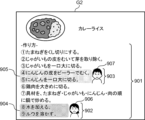
- FIG. 9 is a diagram showing an example of a display image G2 in Modification (4) of Embodiment 1 of the present disclosure.
- the display image G2 includes display columns 901, 902, and 903.
- the display field 901 is the same as the display field 701 .
- a display field 902 is a display field for possible cooking processes of the user who is the daughter (first user).
- a display field 903 is a display field for possible cooking processes of the user who is the son (second user).
- cooking possible information 904 is displayed superimposed in order to distinguish the first user's possible cooking process from other cooking processes.
- cooking possible information 905 is superimposed and displayed to distinguish the second user's possible cooking process from other cooking processes.
- the information 904 that can be cooked is displayed with a red highlight image
- the information 905 that can be cooked is displayed with a blue highlight image, and both are displayed in different colors.
- a first user icon 906 is displayed in the display field 902
- a second user icon 907 is displayed in the display field 903, so that it is possible to easily recognize which user corresponds to which display field. It is configured.
- the second user's cooking ability information is higher than the first user's cooking ability information.
- the second user can also perform the first user's possible cooking processes.
- the display fields 902 of the possible cooking processes for both the first user and the second user are the first user with the low cooking ability information. Only one user's cookable information 904 is superimposed and displayed.
- the determination unit 13 determines whether or not there is a possible cooking process for each user.
- the generation unit 15 compares the cooking ability information of the first user and the cooking ability information of the second user with the execution difficulty level of the cooking process for each of the cooking processes, thereby determining the cooking ability of the first user and the second user. Identify the cooking process. Then, the generation unit 15 superimposes the first user's cooking information 904 on the display field 902 of the cooking steps that can be executed by both the first user and the second user, and displays the cooking steps that can be executed only by the second user. In the display field 903 of the possible cooking process, the cooking possible information 905 of the second user may be superimposed and displayed.
- the generation unit 15 generates a first display image for the first user in which only the cooking possibility information 904 is superimposed on the display field 902 of the first user's possible cooking processes, and a display field of the possible cooking processes of the second user.
- a second display image for the second user in which only the information 905 that can be cooked is superimposed on 903 may be generated.
- the output unit 16 may output the first display image to the display terminal 3 of the first user and output the second display image to the display terminal 3 of the second user. Since the display terminal 3 of the first user displays the first display image, the first user can easily grasp the cooking process in which he or she can help, and the display terminal 3 of the second user displays the second display image. , the second user can easily grasp the cooking process in which he or she can help.
- the output unit 16 may display on the display terminal 3 a display image configured to be switchable between the first display image and the second display image. In this case, the display terminal 3 may switch and display the first display image and the second display image according to an instruction from the first user, the second user, or the guardian.
- Embodiment 2 In the second embodiment, the presence or absence of each possible cooking process is determined using the execution success rate corresponding to the attribute to which the user belongs and the user's execution difficulty level.
- the same reference numerals are given to the same components as in the first embodiment, and the description thereof is omitted.
- the memory 20 stores a user attribute table T4 and an attribute information table T5.
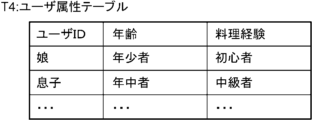
- FIG. 10 is a diagram showing an example of the data configuration of the user attribute table T4.
- the user attribute table T4 is a table that stores attributes for each user.
- the attributes include an "age” attribute and a "cooking experience” attribute.
- the "age” attribute includes, for example, the attributes of senior, middle and young. Elderly people, middle-aged people, and young people correspond to each age group when, for example, 0 to 18 years old are divided into three age groups.
- age groups such as kindergarten, lower grades of elementary school, middle grades of elementary school, upper grades of elementary school, junior high school students, and high school students may be adopted.
- the "cooking experience” attribute is an attribute related to cooking ability, and includes, for example, beginner, intermediate, and advanced attributes. Information input by the guardian using the user terminal 2 is used for the “cooking experience” attribute. Alternatively, the “cooking experience” attribute may be obtained from sensor information or an external database.
- the sensor information is video data that captures the user's cooking scene.
- the information processing device 1 determines whether the user belongs to a beginner, an intermediate, or an advanced user based on the difference between the user's video data and the model video data. It may be stored in the attribute table T4. As the difference, the above-described difference between the feature amount of the user's movement and the feature amount of the model movement can be used.
- the "cooking experience" attribute may be determined from the number of cooking times of the user managed by the information processing device 1. For example, if the number of times the user cooks stored in the memory 20 is less than or equal to the first standard number of times, the information processing apparatus 1 determines that the user is a beginner, if the number of times is greater than the first standard number of times and less than or equal to the second standard number of times, the user is an intermediate level user, and the second standard number of times is less than or equal to the second standard number of times. If it is larger, it should be judged as advanced.
- the "cooking experience" attribute may be obtained from an external database.
- the external database is a database managed by the server of the system that provides the different services mentioned above.
- the external database manages, for example, information indicating that each user is a beginner, an intermediate player, and an advanced player, and this information may be provided to the information processing apparatus 1 .
- the user attribute table T4 indicates a user attribute table for one family. You can In this case, the user's "age” attribute and "cooking experience” attribute are specified by the family ID and the user ID.
- the "cooking experience” attribute is divided into three, but this is just an example, and it may be divided into two or four or more.
- FIG. 11 is a diagram showing an example of the data configuration of the attribute information table T5.
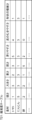
- the attribute information table T5 defines the execution success rate according to the average success rate and the combination of the "age” attribute and the “cooking experience” attribute for each cooking process.
- "Cooking process” is the label of the cooking process, as in FIG.
- Average success rate is the average execution success rate of unspecified users in each cooking process.
- An unspecified user is any user managed by this support system.
- the execution success rate for "young people & beginners” is 50%
- the execution success rate for "young people & intermediate people” is 60%.
- the execution success rate is the average value of the execution success rate of unspecified users corresponding to the combination of the "age” attribute and the "cooking experience” attribute.
- the execution success rate is calculated by aggregating cooking results indicating whether or not an unspecified user succeeded in cooking for each cooking process. For example, if there are 100 unspecified users and 50 successful people in a certain cooking process, the execution success rate is 50%.
- FIG. 12 is a flowchart showing an example of processing of the information processing device 1 according to the second embodiment. Steps S201, S202, S205 and S206 are the same as steps S101, S102, S107 and S108 in FIG. 6, respectively.
- Step S203 The determining unit 13 acquires the “age” attribute and the “cooking experience” attribute of the target user from the user attribute table. For example, in the case of the user with the user ID "daughter”, “younger” is acquired as the “age” attribute, and “beginner” is acquired as the "cooking experience” attribute.
- the determining unit 13 determines whether there is a cooking process whose execution success rate corresponding to the attribute of the user is equal to or higher than a threshold among the cooking processes included in the recipe information. Specifically, the determination unit 13 acquires the execution success rate corresponding to the "age” attribute and the "cooking experience” attribute from the attribute information table T5 for each cooking process included in the recipe information. For example, in the example of the daughter user above, the "age” attribute is “younger” and the "cooking experience” attribute is "beginner.” 52%” is obtained. For example, if the threshold is "50%”, the execution success rate of "getting pumpkin seeds” is "52%” in the above example. be judged.
- step S204 If there is at least one cooking process whose execution success rate is equal to or higher than the threshold (YES in step S204), the process proceeds to step S205, and if there is no cooking process whose execution success rate is equal to or higher than the threshold (NO in step S204), the process finish.
- the threshold may be changed to any numerical value by the guardian or the person who takes the lead in cooking.
- the execution success rate corresponding to the user's attribute is the user's An execution success rate is considered and the execution success rate is compared with a threshold to determine the user's executable cooking steps. Therefore, it is possible to easily determine the cooking process that can be executed by the target user without managing the individual execution success rate of the user.
- Embodiment 3 acquires the cooking result of the user who has finished the cooking work, and changes the cooking ability information based on the cooking result.
- the same reference numerals are given to the same components as in the first embodiment, and the description thereof is omitted.
- FIG. 13 is a block diagram showing an example of the configuration of the information processing device 1A according to Embodiment 3 of the present disclosure.
- Processor 10A further includes a cooking result acquisition unit 17 .
- the cooking result acquisition unit 17 acquires the user's cooking result transmitted from the user terminal 2 using the communication unit 30 .
- the cooking result acquisition unit 17 changes the user's cooking ability information based on the acquired cooking result.
- FIG. 14 is a flowchart showing an example of processing according to Embodiment 3 of the present disclosure. This flowchart is executed, for example, after the user finishes cooking.
- the cooking result acquisition unit 17 acquires the cooking result transmitted from the user terminal 2 .
- the cooking result may be input by operating the user terminal 2 by the guardian.
- the cooking result acquisition unit 17 causes the user terminal 2 to display a cooking result input screen.
- the cooking result input screen includes, for example, a message such as “Did you cook well today?” and fields for inputting cooking results for each cooking process included in the recipe information.
- the parent/guardian can input the cooking result for each cooking process while viewing the input screen, and transmit the input cooking result from the user terminal 2 to the information processing device 1 .
- the cooking result may be sensor information.
- the sensor information is, for example, video data of a user's cooking scene captured by a camera.
- the cooking result acquisition unit 17 analyzes the video data, identifies the user's motion, identifies the cooking process from the motion, and determines whether the user's motion satisfies a predetermined success condition for the cooking process.
- the cooking result is determined to be successful, and if the operation does not satisfy the success conditions, the cooking process is determined to be unsuccessful.
- the success conditions are, for example, that the cooking was completed within a predetermined time, that the user did not give up halfway through the cooking process, that the user was not injured, and that the user was able to complete the cooking process without parental intervention. , etc.
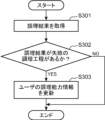
- Step S302 The cooking result acquisition unit 17 determines whether or not there is at least one cooking process with a cooking result of failure among the cooking processes included in the recipe information. If there is at least one cooking process with a cooking result of failure (YES in step S302), the process proceeds to step S303, and if there is no cooking process with a cooking result of failure (NO in step S302), the process ends. .
- Step S303 The cooking result acquisition unit 17 updates the user's cooking ability information. For example, if the cooking ability information of the user is "30" and the execution difficulty of the cooking process that the user has failed is "28", the cooking process will not be determined to be executable by the user from the next time onwards. , the user's cooking ability information should be changed to a value smaller than "28" (for example, 27).
- the cooking result acquisition unit 17 changes the execution difficulty level of the process information table T11 so that this cooking process will not be determined to be executable for this user from the next time onwards. You can change it. For example, if the user's cooking ability information is "30" and the execution difficulty level of the cooking process that the user has failed is "28", the cooking result acquiring unit 17 stores the execution difficulty level of this cooking process in the process information table T11. The degree may be changed to a value greater than "30", such as "31". Alternatively, the cooking result acquisition unit 17 may increase each of the plurality of weight values corresponding to this cooking process in the difficulty level table T22 or the difficulty level table T23 by a predetermined value without changing the user's cooking ability information. .
- the user's cooking ability information is changed in consideration of the cooking result, so that the accuracy of determining the cooking process executable by the user can be improved.
- FIG. 15 is a flowchart showing an example of processing of the information processing device 1A according to the modification of the third embodiment. Steps S401 and S402 are the same as steps S301 and S302.
- the cooking result acquisition unit 17 may reduce the execution success rate of the cooking step in which the user failed, which corresponds to the user's "age” attribute and "cooking experience” attribute, by a predetermined value.
- the threshold used in step S204 is managed for each user, the cooking result acquisition unit 17 increases the threshold of the corresponding user so that the failed cooking process will not be determined to be executable from the next time onwards. Just do it. For example, if the user's threshold is "50%" and the execution success rate of the failed cooking process corresponding to the user's "age” attribute and "cooking experience” attribute is "52%", The cooking result acquisition unit 17 may change the user's threshold to a value greater than 52% (for example, 53%).
- Cookable information may be set so that it is not superimposed on the display field of a specific cooking process based on the input by the guardian. For example, when the generation unit 15 acquires from the user terminal 2 information disallowing a specific cooking process input by the guardian during the input of the recipe information or the display of the display image G1, the generation unit 15 determines that the cooking process is not permitted by the user. Even if it is executable for the cooking process, the cooking possible information is not superimposed on the display column of the cooking process. For example, if the guardian does not have enough supervision over the user due to other errands in today's cooking, the guardian can disallow the cooking process that the user judges to be dangerous. For example, the guardian can set the cooking process using kitchen knives or the cooking process using oil not to be permitted.
- FIG. 16 is a diagram showing an example of a display image G3 in modification (2) of the present disclosure.
- Display image G3 further includes a play button 1501 in addition to display image G1.
- a play button 1501 is a button that is arranged near the display field 702 and plays back a reference video of the cooking process.
- the display image G3 displays a moving image explaining the cooking process in the display column 702 on the display of the display terminal 3 in an easy-to-understand manner. As a result, the parent's burden of explaining the cooking process to the user is reduced.
- the display image G3 may display a still image explaining the cooking process near the display field 702. FIG. For example, if it is determined that the cooking process of “cutting the onion into wedges” is executable, the display image G3 may display a still image of the wedge-cut onion near the display field 702 .
- the generation unit 15 may change the message explaining the possible cooking process to a more detailed explanation than the standard message. For example, if the possible cooking process is "melt the roux", the standard message “melt the roux” may be further changed to "melt the roux until lumps are no longer visible". In this case, the generation unit 15 may change the message by referring to a pre-created table for determining the message to be added to the standard message for each cooking process. This allows the user to more easily grasp the content of the help.
- the generation unit 15 selects recipes related to recipes that can be cooked by the user and are to be cooked.
- a suggested recipe image may be generated. For example, if it is determined that all the cooking steps for curry and rice are not executable, and the user is able to make a boiled egg, the generation unit 15 may say, "I can ask for your help with the process of making a boiled egg. , would you like to top your curry and rice today with a boiled egg?” may be generated, and the output unit 16 may display the generated recipe image on the display terminal 3.
- the generating unit 15 may say, "I can ask for your help in chopping carrots into chunks. Would you like to change the menu from hamburger to another menu that handles carrots?”, and the output unit 16 may cause the display terminal 3 to display the recipe image.
- the memory 20 stores a recipe candidate table that defines candidate cooking processes to be proposed when all cooking processes are determined to be unexecutable for each recipe. Then, if there is a candidate cooking process that can be executed by the user among the candidate cooking processes described in the recipe candidate table, the generation unit 15 may generate a message that proposes the candidate cooking process.
- the recipe information acquisition unit 11 may display cooking steps that can be executed by the user when allowing the parent/guardian to enter the recipe information. For example, if the possible cooking process is chopping carrots into chunks, the recipe information acquisition unit 11 generates a recipe information input screen including a message such as "We can ask for your help in chopping carrots into chunks, so we recommend a menu that uses carrots.” and the input screen may be displayed on the user terminal 2 .
- the present disclosure is useful in the technical field of educating users through cooking because it can assist users in cooking.
Landscapes
- Engineering & Computer Science (AREA)
- Theoretical Computer Science (AREA)
- Databases & Information Systems (AREA)
- Physics & Mathematics (AREA)
- General Physics & Mathematics (AREA)
- Business, Economics & Management (AREA)
- Data Mining & Analysis (AREA)
- General Engineering & Computer Science (AREA)
- Library & Information Science (AREA)
- Tourism & Hospitality (AREA)
- Computational Linguistics (AREA)
- Economics (AREA)
- Human Resources & Organizations (AREA)
- Marketing (AREA)
- Strategic Management (AREA)
- General Business, Economics & Management (AREA)
- Health & Medical Sciences (AREA)
- General Health & Medical Sciences (AREA)
- Primary Health Care (AREA)
- Entrepreneurship & Innovation (AREA)
- Operations Research (AREA)
- Quality & Reliability (AREA)
- Management, Administration, Business Operations System, And Electronic Commerce (AREA)
- Medical Treatment And Welfare Office Work (AREA)
Priority Applications (3)
| Application Number | Priority Date | Filing Date | Title |
|---|---|---|---|
| JP2023569056A JPWO2023119731A1 (https=) | 2021-12-21 | 2022-08-25 | |
| CN202280084371.5A CN118451443A (zh) | 2021-12-21 | 2022-08-25 | 信息处理方法、信息处理装置及信息处理程序 |
| US18/748,735 US20240338412A1 (en) | 2021-12-21 | 2024-06-20 | Information processing method, information processing device, and non-transitory computer readable recording medium |
Applications Claiming Priority (2)
| Application Number | Priority Date | Filing Date | Title |
|---|---|---|---|
| JP2021207343 | 2021-12-21 | ||
| JP2021-207343 | 2021-12-21 |
Related Child Applications (1)
| Application Number | Title | Priority Date | Filing Date |
|---|---|---|---|
| US18/748,735 Continuation US20240338412A1 (en) | 2021-12-21 | 2024-06-20 | Information processing method, information processing device, and non-transitory computer readable recording medium |
Publications (1)
| Publication Number | Publication Date |
|---|---|
| WO2023119731A1 true WO2023119731A1 (ja) | 2023-06-29 |
Family
ID=86901770
Family Applications (1)
| Application Number | Title | Priority Date | Filing Date |
|---|---|---|---|
| PCT/JP2022/032063 Ceased WO2023119731A1 (ja) | 2021-12-21 | 2022-08-25 | 情報処理方法、情報処理装置、および情報処理プログラム |
Country Status (4)
| Country | Link |
|---|---|
| US (1) | US20240338412A1 (https=) |
| JP (1) | JPWO2023119731A1 (https=) |
| CN (1) | CN118451443A (https=) |
| WO (1) | WO2023119731A1 (https=) |
Cited By (1)
| Publication number | Priority date | Publication date | Assignee | Title |
|---|---|---|---|---|
| WO2025084228A1 (ja) * | 2023-10-17 | 2025-04-24 | パナソニックIpマネジメント株式会社 | レシピ表示システム、レシピ表示方法、および、プログラム |
Citations (5)
| Publication number | Priority date | Publication date | Assignee | Title |
|---|---|---|---|---|
| JP2016103042A (ja) * | 2013-06-12 | 2016-06-02 | パナソニック インテレクチュアル プロパティ コーポレーション オブ アメリカPanasonic Intellectual Property Corporation of America | 調理スキル評価方法、調理スキル評価システム及び調理スキル評価システムを制御する制御プログラム |
| WO2020187864A1 (en) * | 2019-03-21 | 2020-09-24 | Koninklijke Philips N.V. | An apparatus and method for determining cooking ability index |
| WO2021014910A1 (ja) * | 2019-07-24 | 2021-01-28 | パナソニックIpマネジメント株式会社 | 調理習得支援システムおよび調理習得支援方法 |
| JP2021056997A (ja) * | 2019-09-30 | 2021-04-08 | クックパッド株式会社 | 情報処理システム、情報処理装置、情報処理方法及びプログラム |
| JP2021183879A (ja) * | 2020-05-21 | 2021-12-02 | パナソニックIpマネジメント株式会社 | 調理習得支援システムおよび調理習得支援方法 |
-
2022
- 2022-08-25 JP JP2023569056A patent/JPWO2023119731A1/ja active Pending
- 2022-08-25 CN CN202280084371.5A patent/CN118451443A/zh active Pending
- 2022-08-25 WO PCT/JP2022/032063 patent/WO2023119731A1/ja not_active Ceased
-
2024
- 2024-06-20 US US18/748,735 patent/US20240338412A1/en active Pending
Patent Citations (5)
| Publication number | Priority date | Publication date | Assignee | Title |
|---|---|---|---|---|
| JP2016103042A (ja) * | 2013-06-12 | 2016-06-02 | パナソニック インテレクチュアル プロパティ コーポレーション オブ アメリカPanasonic Intellectual Property Corporation of America | 調理スキル評価方法、調理スキル評価システム及び調理スキル評価システムを制御する制御プログラム |
| WO2020187864A1 (en) * | 2019-03-21 | 2020-09-24 | Koninklijke Philips N.V. | An apparatus and method for determining cooking ability index |
| WO2021014910A1 (ja) * | 2019-07-24 | 2021-01-28 | パナソニックIpマネジメント株式会社 | 調理習得支援システムおよび調理習得支援方法 |
| JP2021056997A (ja) * | 2019-09-30 | 2021-04-08 | クックパッド株式会社 | 情報処理システム、情報処理装置、情報処理方法及びプログラム |
| JP2021183879A (ja) * | 2020-05-21 | 2021-12-02 | パナソニックIpマネジメント株式会社 | 調理習得支援システムおよび調理習得支援方法 |
Cited By (1)
| Publication number | Priority date | Publication date | Assignee | Title |
|---|---|---|---|---|
| WO2025084228A1 (ja) * | 2023-10-17 | 2025-04-24 | パナソニックIpマネジメント株式会社 | レシピ表示システム、レシピ表示方法、および、プログラム |
Also Published As
| Publication number | Publication date |
|---|---|
| JPWO2023119731A1 (https=) | 2023-06-29 |
| CN118451443A (zh) | 2024-08-06 |
| US20240338412A1 (en) | 2024-10-10 |
Similar Documents
| Publication | Publication Date | Title |
|---|---|---|
| US8323026B2 (en) | Interactive recipe preparation using instructive device with integrated actuators to provide tactile feedback | |
| US20140074830A1 (en) | Device for presenting recipe and method for presenting recipe | |
| JP7565506B2 (ja) | 調理習得支援システムおよび調理習得支援方法 | |
| CN108447543A (zh) | 基于烹饪设备的菜谱推送方法和装置 | |
| CN105635251A (zh) | 食谱的推送方法、系统和云服务器 | |
| JP2016103042A (ja) | 調理スキル評価方法、調理スキル評価システム及び調理スキル評価システムを制御する制御プログラム | |
| CN115587245A (zh) | 菜谱清单的推荐方法、装置、存储介质及电子装置 | |
| CN111603050A (zh) | 一种炒菜机控制方法、装置、存储介质及炒菜机 | |
| WO2023119731A1 (ja) | 情報処理方法、情報処理装置、および情報処理プログラム | |
| WO2021014910A1 (ja) | 調理習得支援システムおよび調理習得支援方法 | |
| CN113597623A (zh) | 确定烹饪能力指数的装置和方法 | |
| WO2014199584A1 (ja) | 調理スキル評価方法、調理スキル評価システム及び調理スキル評価システムを制御する制御プログラム | |
| CN114203280A (zh) | 推荐菜谱的方法及装置、计算机可读存储介质以及处理器 | |
| WO2021162012A1 (ja) | 調理支援方法、調理支援装置、およびプログラム | |
| CN116484083A (zh) | 菜品信息的显示方法和装置、存储介质及电子装置 | |
| CN111090812A (zh) | 菜谱推荐方法、装置、电子设备及存储介质 | |
| US20250181213A1 (en) | Display method, information processing apparatus, program for displaying function/operation of appliance | |
| US20250181831A1 (en) | Information processing method, information processing apparatus, and program that combines multiple cooking steps | |
| JP2019201396A (ja) | 情報処理装置、情報処理方法、情報処理プログラム及びコンテンツ配信システム | |
| JP7230412B2 (ja) | 情報処理装置、情報処理方法およびプログラム | |
| JP2020056879A (ja) | 情報提供システム及び方法 | |
| JP7848901B1 (ja) | 調理補助作業管理システム | |
| JP2024029582A (ja) | 情報処理装置における情報処理方法、情報処理装置、および情報処理プログラム | |
| WO2023079918A1 (ja) | 情報出力方法、情報出力装置、及び情報出力プログラム | |
| CN111178159A (zh) | 一种食谱处理方法、装置、服务器及存储介质 |
Legal Events
| Date | Code | Title | Description |
|---|---|---|---|
| 121 | Ep: the epo has been informed by wipo that ep was designated in this application |
Ref document number: 22910458 Country of ref document: EP Kind code of ref document: A1 |
|
| ENP | Entry into the national phase |
Ref document number: 2023569056 Country of ref document: JP Kind code of ref document: A |
|
| WWE | Wipo information: entry into national phase |
Ref document number: 202280084371.5 Country of ref document: CN |
|
| NENP | Non-entry into the national phase |
Ref country code: DE |
|
| 122 | Ep: pct application non-entry in european phase |
Ref document number: 22910458 Country of ref document: EP Kind code of ref document: A1 |