WO2023112650A1 - レンズを製造する方法 - Google Patents
レンズを製造する方法 Download PDFInfo
- Publication number
- WO2023112650A1 WO2023112650A1 PCT/JP2022/043749 JP2022043749W WO2023112650A1 WO 2023112650 A1 WO2023112650 A1 WO 2023112650A1 JP 2022043749 W JP2022043749 W JP 2022043749W WO 2023112650 A1 WO2023112650 A1 WO 2023112650A1
- Authority
- WO
- WIPO (PCT)
- Prior art keywords
- resin composition
- photocurable resin
- meth
- structural unit
- group
- Prior art date
- Legal status (The legal status is an assumption and is not a legal conclusion. Google has not performed a legal analysis and makes no representation as to the accuracy of the status listed.)
- Ceased
Links
Images


Classifications
-
- G—PHYSICS
- G02—OPTICS
- G02B—OPTICAL ELEMENTS, SYSTEMS OR APPARATUS
- G02B3/00—Simple or compound lenses
- G02B3/0006—Arrays
- G02B3/0012—Arrays characterised by the manufacturing method
- G02B3/0018—Reflow, i.e. characterized by the step of melting microstructures to form curved surfaces, e.g. manufacturing of moulds and surfaces for transfer etching
-
- B—PERFORMING OPERATIONS; TRANSPORTING
- B29—WORKING OF PLASTICS; WORKING OF SUBSTANCES IN A PLASTIC STATE IN GENERAL
- B29C—SHAPING OR JOINING OF PLASTICS; SHAPING OF MATERIAL IN A PLASTIC STATE, NOT OTHERWISE PROVIDED FOR; AFTER-TREATMENT OF THE SHAPED PRODUCTS, e.g. REPAIRING
- B29C39/00—Shaping by casting, i.e. introducing the moulding material into a mould or between confining surfaces without significant moulding pressure; Apparatus therefor
- B29C39/22—Component parts, details or accessories; Auxiliary operations
- B29C39/24—Feeding the material into the mould
-
- G—PHYSICS
- G02—OPTICS
- G02B—OPTICAL ELEMENTS, SYSTEMS OR APPARATUS
- G02B3/00—Simple or compound lenses
-
- G—PHYSICS
- G03—PHOTOGRAPHY; CINEMATOGRAPHY; ANALOGOUS TECHNIQUES USING WAVES OTHER THAN OPTICAL WAVES; ELECTROGRAPHY; HOLOGRAPHY
- G03F—PHOTOMECHANICAL PRODUCTION OF TEXTURED OR PATTERNED SURFACES, e.g. FOR PRINTING, FOR PROCESSING OF SEMICONDUCTOR DEVICES; MATERIALS THEREFOR; ORIGINALS THEREFOR; APPARATUS SPECIALLY ADAPTED THEREFOR
- G03F7/00—Photomechanical, e.g. photolithographic, production of textured or patterned surfaces, e.g. printing surfaces; Materials therefor, e.g. comprising photoresists; Apparatus specially adapted therefor
- G03F7/004—Photosensitive materials
- G03F7/027—Non-macromolecular photopolymerisable compounds having carbon-to-carbon double bonds, e.g. ethylenic compounds
- G03F7/032—Non-macromolecular photopolymerisable compounds having carbon-to-carbon double bonds, e.g. ethylenic compounds with binders
-
- G—PHYSICS
- G03—PHOTOGRAPHY; CINEMATOGRAPHY; ANALOGOUS TECHNIQUES USING WAVES OTHER THAN OPTICAL WAVES; ELECTROGRAPHY; HOLOGRAPHY
- G03F—PHOTOMECHANICAL PRODUCTION OF TEXTURED OR PATTERNED SURFACES, e.g. FOR PRINTING, FOR PROCESSING OF SEMICONDUCTOR DEVICES; MATERIALS THEREFOR; ORIGINALS THEREFOR; APPARATUS SPECIALLY ADAPTED THEREFOR
- G03F7/00—Photomechanical, e.g. photolithographic, production of textured or patterned surfaces, e.g. printing surfaces; Materials therefor, e.g. comprising photoresists; Apparatus specially adapted therefor
- G03F7/20—Exposure; Apparatus therefor
-
- G—PHYSICS
- G03—PHOTOGRAPHY; CINEMATOGRAPHY; ANALOGOUS TECHNIQUES USING WAVES OTHER THAN OPTICAL WAVES; ELECTROGRAPHY; HOLOGRAPHY
- G03F—PHOTOMECHANICAL PRODUCTION OF TEXTURED OR PATTERNED SURFACES, e.g. FOR PRINTING, FOR PROCESSING OF SEMICONDUCTOR DEVICES; MATERIALS THEREFOR; ORIGINALS THEREFOR; APPARATUS SPECIALLY ADAPTED THEREFOR
- G03F7/00—Photomechanical, e.g. photolithographic, production of textured or patterned surfaces, e.g. printing surfaces; Materials therefor, e.g. comprising photoresists; Apparatus specially adapted therefor
- G03F7/26—Processing photosensitive materials; Apparatus therefor
Definitions
- the present invention relates to a method for producing a lens using a photocurable resin composition, and also to a lens produced by such a method and a display device comprising the lens.
- Microlenses are used for the purpose of light control, such as improving the light collection efficiency to each photoelectric conversion element in a solid-state imaging device and improving the light extraction efficiency from each pixel in a display device.
- a method of manufacturing microlenses for example, a method of obtaining a microlens pattern by etching a resin layer is known (Japanese Patent Application Laid-Open No. 2002-217393).
- An object of the present invention is to provide a novel method for manufacturing a lens using a photocurable resin composition.
- the present invention includes the following.
- a method for producing a convex lens made of a cured product of a photocurable resin composition on a substrate comprising: A photocurable resin composition layer forming step of applying the photocurable resin composition onto the substrate to form a photocurable resin composition layer; an exposure step of selectively exposing the photocurable resin composition layer; After the exposure step, a developing step of developing the photocurable resin composition layer; has A method in which, in the exposure step, the photocurable resin composition layer is exposed with an exposure amount that is 2.0 times or more of the saturated exposure amount.
- the lens has a ratio (W2/W1) of a lens width W2 at a height of 90% from the substrate surface to a lens width W1 in contact with the substrate in a cross-sectional view (W2/W1).
- the photocurable resin composition contains a resin, a polymerizable compound, a photopolymerization initiator, and a solvent.
- a display device comprising the lens according to [7].
- a convex lens can be produced by a simple method using a photocurable resin composition.
- FIG. 4A to 4C are partial cross-sectional views showing each manufacturing step of the microlens array in the method of the present embodiment; It is a figure which shows the planar view of the microlens array of this embodiment.
- FIG. 3 is a cross-sectional view of microlenses forming the microlens array of the present embodiment;
- the present invention is a method for producing a convex lens made of a cured product of a photocurable resin composition on a substrate, a resin layer forming step of applying the photocurable resin composition onto the substrate to form a photocurable resin composition layer; an exposure step of selectively exposing the photocurable resin composition layer; After the exposure step, a developing step of developing the photocurable resin composition layer; has In the exposure step, the photocurable resin composition layer is exposed to an exposure amount of 2.0 times or more of the saturated exposure amount.
- a plurality of lenses are formed on the substrate.
- a method of manufacturing a microlens array in which a plurality of lenses are arranged close to each other on a substrate and each lens is a microlens will be specifically described below.
- FIG. 1 is a partial cross-sectional side view showing each manufacturing step of a microlens array in the method of the present embodiment.
- a photocurable resin composition is applied onto a substrate 1 to form a photocurable resin composition layer 2 (photocurable resin composition layer forming step).
- the photocurable resin composition layer 2 is dried if necessary.
- the photocurable resin composition layer 2 is selectively exposed (exposure step).
- a selectively exposed region in the photocurable resin composition layer 2 is shown as a region 21.
- the selective exposure of the photocurable resin composition layer 2 can be carried out by, for example, irradiating light through a photomask 5 or irradiating light in spots.
- the photocurable resin composition layer 2 is exposed with an exposure amount of 2.0 times or more of the saturated exposure amount. After that, the photocurable resin composition layer 2 is developed (development step). A post-baking step may be included after the developing step, and the post-baking step may follow the developing step.
- a microlens array 3 composed of a plurality of microlenses 31 formed on the substrate 1 is obtained as shown in FIG. 1(c).
- the microlens 31 is made of a cured product of a photocurable resin composition.
- the photocurable resin composition is not particularly limited as long as it has the property of being polymerized by irradiation with light in the exposure step and the unexposed portion is eluted by development in the development step. Specific examples of the photocurable resin composition will be described later.
- the substrate 1 examples include resin substrates such as transparent glass plates, silicon wafers, polycarbonate substrates, polyester substrates, aromatic polyamide substrates, polyamideimide substrates, and polyimide substrates.
- resin substrates such as transparent glass plates, silicon wafers, polycarbonate substrates, polyester substrates, aromatic polyamide substrates, polyamideimide substrates, and polyimide substrates.
- a black matrix, a cured film or colored pattern, a transparent pattern for film thickness adjustment, a TFT, and the like may be formed on the substrate 1 .
- Examples of the method of applying the photocurable resin composition include an extrusion coating method, a direct gravure coating method, a reverse gravure coating method, a CAP coating method, and a die coating method. Coating may also be performed using a dip coater, bar coater, spin coater, slit & spin coater, slit coater (also called die coater, curtain flow coater, spinless coater), roller, or the like. Especially, it is preferable to apply using a spin coater.
- Examples of methods for drying the photocurable resin composition layer 2 include natural drying, ventilation drying, and reduced pressure drying.
- a specific heating temperature is about 30 to 120°C, preferably about 60 to 100°C.
- a suitable heating time is about 10 seconds to 60 minutes, preferably about 30 seconds to 30 minutes.
- the reduced pressure drying is exemplified by carrying out under a pressure of about 50 to 150 Pa and a temperature range of about 20 to 25°C.
- the solvent can be removed by the drying described above.
- the thickness of the photocurable resin composition layer 2 is not particularly limited, and can be appropriately adjusted depending on the material used, the application of the microlens array, etc.
- the thickness after drying is about 0.1 to 30 ⁇ m, preferably About 1 to 20 ⁇ m, more preferably about 1 to 12 ⁇ m, more preferably about 1 to 10 ⁇ m is exemplified.
- the selective exposure of the photocurable resin composition layer 2 can be performed by exposing through a photomask 5, for example.
- a photomask 5 a mask having a light-shielding portion corresponding to a portion to be removed according to the intended pattern is used.
- the light source used for exposure is preferably a light source that emits light with a wavelength of 250 to 450 nm. For example, light of less than 350 nm is cut using a filter that cuts this wavelength range, or light near 436 nm, 408 nm, and 365 nm is selectively extracted using a bandpass filter that extracts these wavelength ranges.
- Light sources include mercury lamps, light emitting diodes, metal halide lamps, halogen lamps, and the like.
- An exposure apparatus such as a mask aligner or a stepper can be used because it is possible to uniformly irradiate the entire exposure surface with parallel rays and to perform accurate alignment between the photomask 5 and the photocurable resin composition layer 2. is preferred.
- the photocurable resin composition layer 2 is exposed with an exposure amount of 2.0 times or more of the saturated exposure amount.
- the photocurable resin composition layer 2 has a different remaining film ratio in the developing process depending on the amount of exposure in the exposing process.
- the residual film ratio increases as the exposure dose increases, and after the residual film ratio reaches 100%, the residual film ratio remains at 100% even if the exposure dose is increased. becomes.
- the residual film ratio is calculated by the following formula (1).
- Remaining film ratio (%) (film thickness after development/film thickness before development) x 100 (1)
- the saturated exposure amount of the photocurable resin composition layer 2 is defined as the minimum exposure amount (hereinafter also referred to as “absolute minimum exposure amount”) at which the residual film rate is 95% or more and 100% or less.
- the exposure amount is increased stepwise to measure the minimum exposure amount (hereinafter also referred to as “measurement minimum exposure amount”). Specifically, the exposure amount is increased stepwise, and after exposure with the exposure amount a, when the residual film rate exceeds 95% for the first time when the exposure is performed with the next larger exposure amount b, the residual film rate is 95% or more and 100% or less.
- the requirement of the present invention of being twice or more of x, which is the saturation exposure dose can be satisfied. That is, in the practice of the present invention, it is not always necessary to determine the absolute minimum exposure amount x corresponding to the saturation exposure amount if the measured minimum exposure amount b is obtained.
- the minimum measurable exposure amount b can be measured, for example, by the following method.
- a photocurable resin composition having the same thickness as that of the photocurable resin composition layer 2 is coated on a substrate by the same coating method and dried under the same conditions.
- the layer is exposed using an exposure machine (TME-150RSK; manufactured by Topcon Co., Ltd., light source: ultra-high pressure mercury lamp), in an air atmosphere, with an exposure dose (365 nm standard) in the range of 1 mJ/cm 2 to 500 mJ/cm 2 .
- 11 levels (1, 10, 15, 20, 40, 60, 100, 150, 200, 300, 500) are sequentially increased and light irradiation is performed.
- This light irradiation is carried out by passing radiated light from an ultra-high pressure mercury lamp through an optical filter (UV-31; manufactured by Asahi Techno Glass Co., Ltd.).
- the thickness of the photocurable resin composition layer after light irradiation is measured and taken as the film thickness before development.
- a cured film is obtained by developing with the same developing solution and under the same developing conditions as in the developing step and performing post-baking.
- the thickness of the cured film is measured and taken as the film thickness after development.
- the film thickness before development and the film thickness after development are measured by a contact film thickness measuring device (DEKT AK6M, manufactured by ULVAC, Inc.).
- the residual film in the actual measurement is The minimum measurable exposure amount b at which the film ratio is 95% or more and 100% or less is 100 mJ/cm 2 .
- the photocurable resin composition layer 2 should be exposed in the exposure step with an exposure amount of 200 mJ/cm 2 or more, which is at least twice the minimum measurable exposure amount b. , it can be seen that the requirement of the present invention that exposure is performed with an exposure amount that is at least twice the saturated exposure amount is satisfied.
- the present inventors adjusted the exposure amount of the photocurable resin composition layer 2 in the exposure process in a range exceeding the saturated exposure amount, thereby changing the shape of the surface of each dot in the dot pattern obtained through the development process. After obtaining the knowledge that it is possible to adjust the amount of exposure, and further extensive investigation, it was found that dots having a convex surface that can function as a lens can be obtained when the amount of exposure is 2.0 times or more of the saturation exposure amount. This discovery led to the present invention.
- the exposure amount of the photocurable resin composition layer 2 is not particularly limited as long as the exposure amount is 2.0 times or more of the saturation exposure amount.
- the amount may be 2.2 times or more, or 2.3 times or more, and preferably 3.0 times or less of the saturation exposure amount.
- a development step for developing the photocurable resin composition layer 2 is performed.
- the developer is preferably an aqueous solution of an alkaline compound such as potassium hydroxide, sodium hydrogencarbonate, sodium carbonate, tetramethylammonium hydroxide.
- the concentration of these alkaline compounds in the aqueous solution is preferably 0.01-10 mass %, more preferably 0.03-5 mass %.
- the developer may contain a surfactant.
- the developing method may be any of a puddle method, a dipping method, a spray method, and the like. Further, the substrate 1 may be tilted at any angle during development. It is preferable to wash with water after development.
- the photocurable resin composition layer 2 is washed with water and subjected to a post-baking step.
- the post-baking step is preferably carried out after washing with water after the developing step, in that the time required for manufacturing can be shortened.
- the durability (solvent resistance) of the lens can be improved by performing the post-baking process.
- the post-baking process is a process of heating the photocurable resin composition layer 2 on the substrate. Heating is usually performed using a heating device such as an oven or a hot plate.
- the heating temperature is preferably 60-260°C. When the heating temperature is such a temperature, it is possible to prevent unnecessary solvent from remaining in the film.
- the heating time is preferably 1 to 120 minutes, more preferably 10 to 60 minutes.
- FIG. 1C is composed of a plurality of microlenses 31 .
- FIG. 2 is a plan view of the microlens array 3 of this embodiment.
- the microlenses 31 forming the microlens array 3 are rectangular in plan view.
- the shape of the microlenses 31 in plan view can be adjusted by the shape of the photomask used in the exposure step in the manufacturing method of the microlens array 3.
- the shape may be rectangular such as square or rectangular, circular, or elliptical. good.
- FIG. 3 shows a cross-sectional view of one microlens 31 in the microlens array 3.
- the microlens 31 preferably has a lens width W1 of 200 ⁇ m or less, more preferably 100 ⁇ m or less, and preferably 1 ⁇ m or more, more preferably 2 ⁇ m or more, in any cross-sectional view.
- the lens width W1 does not need to be the same in all cross sections, and when the microlenses 31 are rectangular in plan view, the lens width W1 has different values depending on the cross section. It is preferable that at least one section satisfies the numerical range of the lens width W1 described above, and it is more preferable that any section satisfies the numerical range.
- the ratio (W2/W1) of the lens width W2 at the height H of 90% of the lens height from the substrate surface to the lens width W1 in contact with the substrate 1 is preferably 0.7 or less, It is more preferably 0.6 or less, more preferably 0.4 or more, and more preferably 0.5 or more.
- a microlens array in which the lens width W1 and the ratio (W2/W1) of each microlens are within the above ranges can be obtained by a simple method.
- the microlens array of this embodiment can be used for the same applications as conventional microlens arrays. For example, it can be used by arranging it in a display device or a solid-state imaging device.
- a microlens is arranged so as to correspond to each pixel, and light is emitted from each pixel through the microlens, thereby improving the light extraction efficiency from each pixel.
- the solid-state imaging device has a configuration in which a photoelectric conversion element layer made up of a plurality of photoelectric conversion elements, a color filter, and a microlens array are stacked in order, and further microlenses are arranged so as to correspond to each photoelectric conversion element.
- the efficiency of condensing light to each photoelectric conversion element can be improved.
- the photocurable resin composition used in the method for producing the lens of the present invention has the property of being polymerized by irradiation with light in the exposure step, and the unexposed portion being eluted by development in the development step. It is not limited as long as it is a thing.
- One form of the photocurable resin composition that is preferably used in the present invention will be described below. Compounds exemplified as components can be used alone or in combination unless otherwise specified.
- the photocurable resin composition of the present embodiment includes a resin (hereinafter referred to as resin (A)), a polymerizable compound (hereinafter referred to as polymerizable compound (C)), a photopolymerization initiator (hereinafter referred to as photo polymerization initiator (D)), and a solvent (hereinafter referred to as solvent (E)).
- the resin (A) has a structural unit (Aa) having a cyclic ether structure with 2 to 4 carbon atoms (hereinafter referred to as "structural unit (Aa)") and a carbazole ring which may have a substituent. It is a copolymer containing a structural unit (Ab) (hereinafter referred to as "structural unit (Ab)").
- the photocurable resin composition of the present embodiment includes other components such as a polymerization initiation aid (hereinafter referred to as polymerization initiation aid (H)) and a leveling agent (hereinafter referred to as a leveling agent (B). ), an antioxidant (hereinafter referred to as antioxidant (F)), a curing agent (hereinafter referred to as curing agent (G)), and the like.
- a polymerization initiation aid hereinafter referred to as polymerization initiation aid (H)
- a leveling agent hereinafter referred to as a leveling agent (B).
- antioxidant antioxidant
- curing agent (G) curing agent
- examples of the curing agent (G) include polycarboxylic acids (hereinafter referred to as polycarboxylic acids (G1)), imidazole compounds (hereinafter referred to as imidazole compounds (G2)), and the like.
- Resin (A) is a copolymer containing a structural unit (Aa) and a structural unit (Ab).
- the copolymer is further copolymerizable with the structural units (Aa) or (Ab), and structural units other than the structural units (Aa) and (Ab) (hereinafter referred to as structural units (Ac)).
- structural units (Ac) structural units
- (meth)acrylic acid” represents at least one compound selected from the group consisting of acrylic acid and methacrylic acid. Notations such as "(meth)acryloyl” and “(meth)acrylate” have the same meaning.
- the resin (A) may contain two or more kinds of each of the structural units (Aa) and the structural units (Ab).
- the structural unit (Aa) can be derived from an unsaturated compound having a cyclic ether structure with 2 to 4 carbon atoms (eg, at least one selected from the group consisting of oxirane ring, oxetane ring and tetrahydrofuran ring).
- a structural unit derived from an unsaturated compound having a cyclic ether structure with 2 to 4 carbon atoms can be obtained by producing a copolymer using the unsaturated compound as a monomer. Alternatively, it can be obtained by reacting another structural unit (hereinafter referred to as structural unit (Aa')) with a compound having a cyclic ether structure having 2 to 4 carbon atoms.
- the unsaturated compound having a cyclic ether structure having 2 to 4 carbon atoms leading to the structural unit (Aa) is, for example, a monomer having an oxiranyl group and an ethylenically unsaturated bond (hereinafter, monomer (Aa1) and ), a monomer having an oxetanyl group and an ethylenically unsaturated bond (hereinafter referred to as monomer (Aa2)), a monomer having a tetrahydrofuryl group and an ethylenically unsaturated bond (hereinafter referred to as referred to as a monomer (Aa3)).
- the monomer (Aa1) is, for example, a monomer having a structure in which a linear or branched unsaturated aliphatic hydrocarbon is epoxidized (hereinafter referred to as monomer (Aa1-1). ), and a monomer having a structure in which an unsaturated alicyclic hydrocarbon is epoxidized (hereinafter referred to as monomer (Aa1-2)).
- monomer (Aa1) is preferable in that the heat resistance, chemical resistance, etc. of the obtained film can be further enhanced.
- the monomer (Aa1-2) is more preferable in terms of excellent storage stability of the photocurable resin composition.
- Examples of the monomer (Aa1-1) include glycidyl (meth)acrylate, ⁇ -methylglycidyl (meth)acrylate, ⁇ -ethylglycidyl (meth)acrylate, glycidyl vinyl ether, o-vinylbenzyl glycidyl ether and m-vinylbenzyl glycidyl.
- Examples of the monomer (Aa1-2) include vinylcyclohexene monoxide, 1,2-epoxy-4-vinylcyclohexane (eg, Celoxide 2000; manufactured by Daicel Corporation), and 3,4-epoxycyclohexylmethyl (meth)acrylate.
- vinylcyclohexene monoxide 1,2-epoxy-4-vinylcyclohexane
- Celoxide 2000 manufactured by Daicel Corporation
- 3,4-epoxycyclohexylmethyl (meth)acrylate for example, Cychromer M100; manufactured by Daicel Corporation
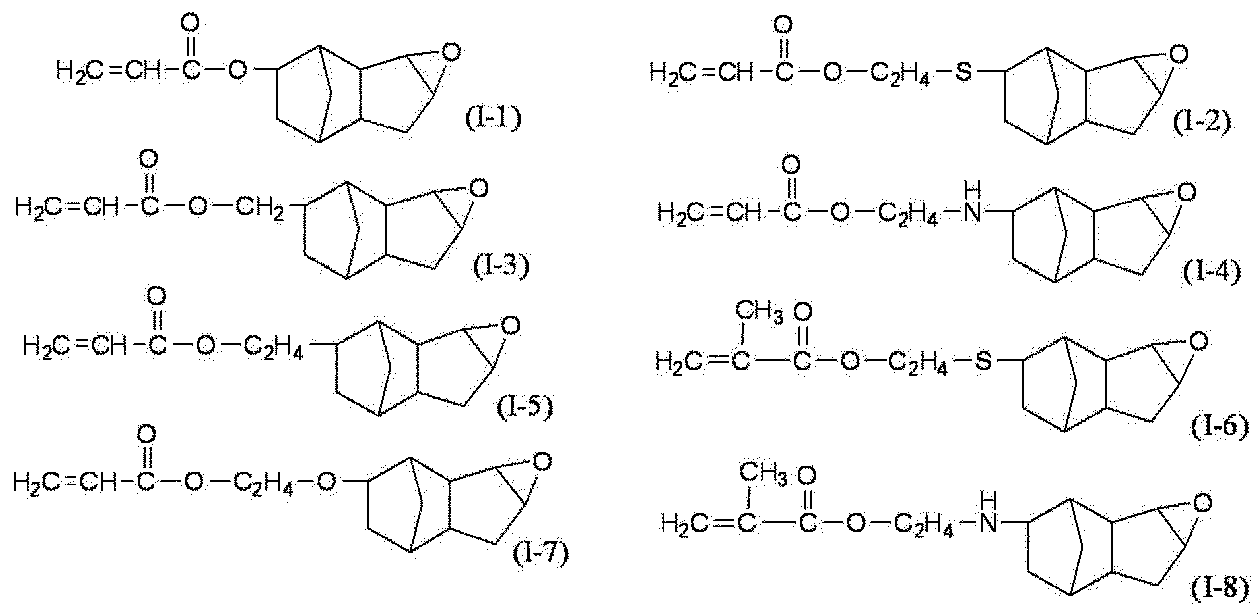
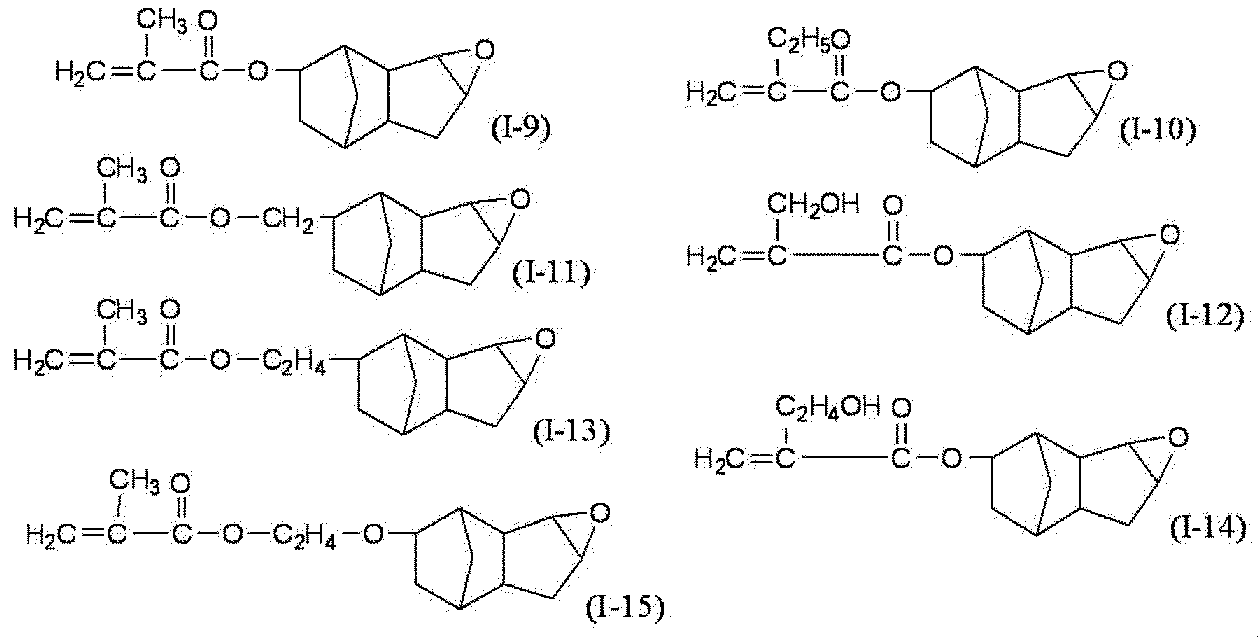
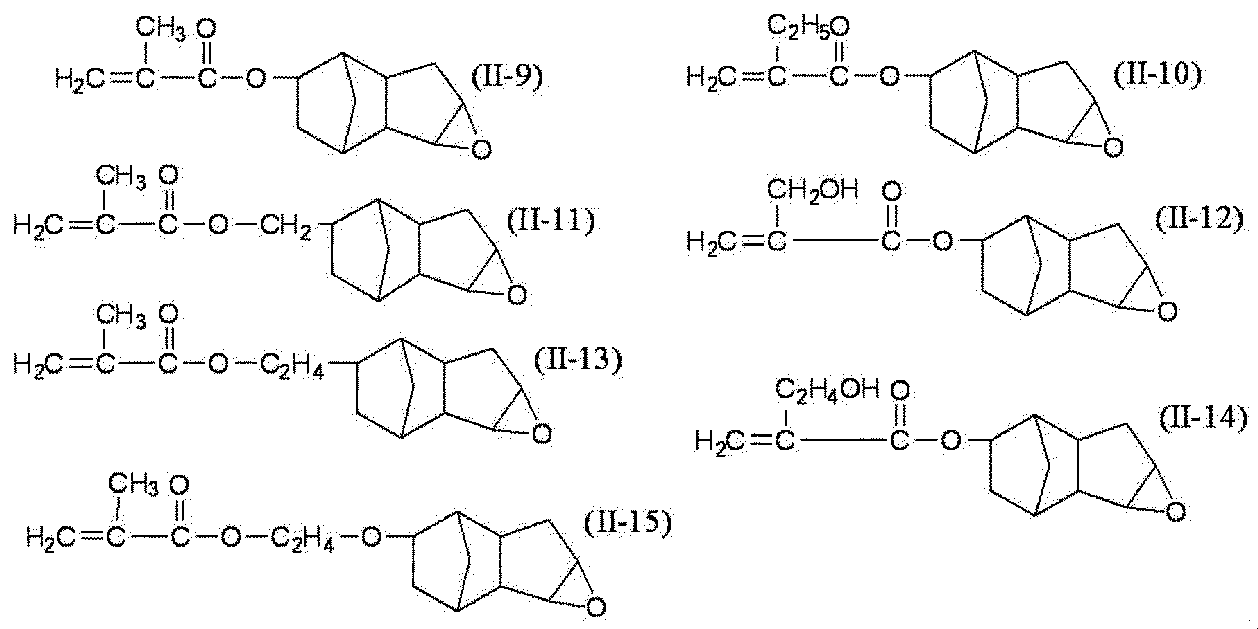
- the compound represented by formula (I) and the formula A compound represented by (II) and the like can be mentioned.
- R b1 and R b2 represent a hydrogen atom or an alkyl group having 1 to 4 carbon atoms, and the hydrogen atom contained in the alkyl group is substituted with a hydroxy group.
- X b1 and X b2 each represent a single bond, *-R b3 -, *-R b3 -O-, *-R b3 -S- or *-R b3 -NH-.
- R b3 represents an alkanediyl group having 1 to 6 carbon atoms. * represents a bond with O.
- alkyl groups having 1 to 4 carbon atoms include methyl group, ethyl group, n-propyl group, isopropyl group, n-butyl group, sec-butyl group and tert-butyl group.
- Alkyl groups in which hydrogen atoms are substituted with hydroxy include hydroxymethyl group, 1-hydroxyethyl group, 2-hydroxyethyl group, 1-hydroxypropyl group, 2-hydroxypropyl group, 3-hydroxypropyl group, 1-hydroxy -1-methylethyl group, 2-hydroxy-1-methylethyl group, 1-hydroxybutyl group, 2-hydroxybutyl group, 3-hydroxybutyl group, 4-hydroxybutyl group and the like.
- R b1 and R b2 preferably include a hydrogen atom, a methyl group, a hydroxymethyl group, a 1-hydroxyethyl group and a 2-hydroxyethyl group, more preferably a hydrogen atom and a methyl group.
- alkanediyl groups include methylene, ethylene, propane-1,2-diyl, propane-1,3-diyl, butane-1,4-diyl, pentane-1,5-diyl, hexane- A 1,6-diyl group and the like can be mentioned.
- X b1 and X b2 are preferably single bond, methylene group, ethylene group, *-CH 2 -O- and *-CH 2 CH 2 -O-, more preferably single bond and *-CH 2 CH 2 —O— is included. * represents a bond with O.
- Examples of the compound represented by formula (I) include compounds represented by any one of formulas (I-1) to (I-15), preferably formula (I-1), formula (I -3), formula (I-5), formula (I-7), formula (I-9) or compounds represented by formulas (I-11) to (I-15), more preferably Examples include compounds represented by formula (I-1), formula (I-7), formula (I-9) or formula (I-15).
- Examples of the compound represented by formula (II) include compounds represented by any one of formulas (II-1) to (II-15), preferably formula (II-1), formula (II -3), formula (II-5), formula (II-7), formula (II-9) or compounds represented by formulas (II-11) to (II-15), more preferably Examples include compounds represented by formula (II-1), formula (II-7), formula (II-9) or formula (II-15).
- the compound represented by formula (I) and the compound represented by formula (II) may be used alone or in combination of two or more. When these are used in combination, the content ratio of these [compound represented by formula (I): compound represented by formula (II)] is on a molar basis, preferably 5:95 to 95:5, more preferably 20 :80 to 80:20.
- a mixture containing a compound represented by formula (I-1) and a compound represented by formula (II-1) at a ratio of 50:50 (commercially available under the trade name “E-DCPA” (manufactured by manufactured by Daicel) can be used.
- a monomer having an oxetanyl group and a (meth)acryloyloxy group is more preferable as the monomer (Aa2).
- Examples of the monomer (Aa2) include 3-methyl-3-methacryloyloxymethyloxetane, 3-methyl-3-acryloyloxymethyloxetane, 3-ethyl-3-methacryloyloxymethyloxetane, 3-ethyl-3-acryloyl Oxymethyloxetane, 3-methyl-3-methacryloyloxyethyloxetane, 3-methyl-3-acryloyloxyethyloxetane, 3-ethyl-3-methacryloyloxyethyloxetane, 3-ethyl-3-acryloyloxyethyloxetane and the like. be done.
- the monomer (Aa3) a monomer having a tetrahydrofuryl group and a (meth)acryloyloxy group is preferable.
- the monomer (Aa3) include tetrahydrofurfuryl acrylate (eg, Viscoat V#150, manufactured by Osaka Organic Chemical Industry Co., Ltd.), tetrahydrofurfuryl methacrylate, and the like.
- the monomer (Aa1- 2) and more preferably a structural unit represented by formula (Aa-1) or formula (Aa-2).
- the structural unit represented by formula (Aa-1) is derived from the compound represented by formula (I)
- the structural unit represented by formula (Aa-2) is derived from the compound represented by formula (II). be killed.
- R b1 and R b2 represent a hydrogen atom or an alkyl group having 1 to 4 carbon atoms, and the hydrogen atom contained in the alkyl group is a hydroxy group. may be substituted.
- X b1 and X b2 each represent a single bond, *-R b3 -, *-R b3 -O-, *-R b3 -S- or *-R b3 -NH-.
- R b3 represents an alkanediyl group having 1 to 6 carbon atoms. * represents a bond with O.
- the structural unit (Ab) can be derived from an unsaturated compound having an optionally substituted carbazole ring.
- a structural unit derived from the unsaturated compound can be obtained by producing a copolymer using the unsaturated compound as a monomer. Alternatively, it can be obtained by reacting another structural unit (Ab') with a compound (Ab'') having a carbazole ring which may have a substituent.
- the refractive index of the obtained film can be improved.
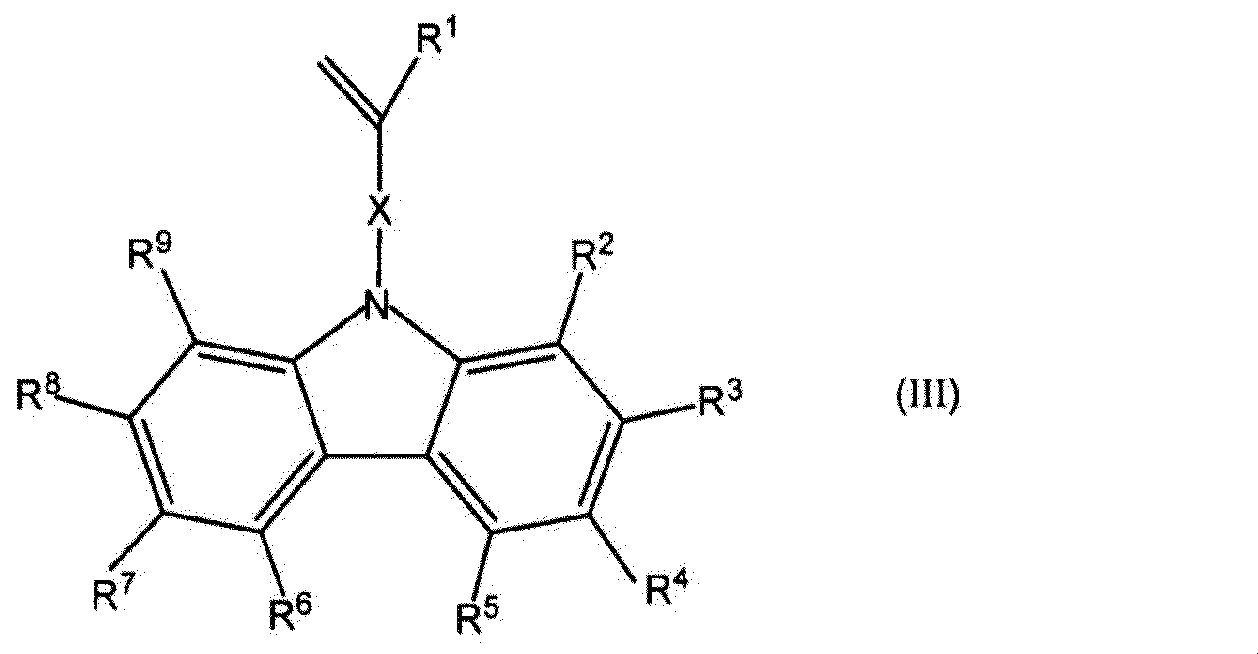
- the unsaturated compound leading to the structural unit (Ab) is preferably a compound represented by formula (III).
- R 1 represents a hydrogen atom, a methyl group, or a hydroxymethyl group.
- R 2 to R 9 each independently represent a hydrogen atom, a halogen atom, a saturated hydrocarbon group having 1 to 20 carbon atoms or an aryl group having 6 to 20 carbon atoms, and the hydrogen atom contained in the saturated hydrocarbon group is , an alkoxy group or an aryl group.
- X represents a single bond, an alkanediyl group having 1 or more carbon atoms, or a linear or branched group represented by the following formula (V).
- Compounds represented by formula (III) include N-vinylcarbazole, N-allylcarbazole, N-(meth)acryloylcarbazole, 2-(9-carbazolyl)ethyl (meth)acrylate, 2-(9-carbazolyl) ethoxyethyl (meth)acrylate, 2-(9-carbazolyl)-2-methylethyl (meth)acrylate, 2-(9-carbazolyl)-1-methylethyl (meth)acrylate and the like.
- N-vinylcarbazole, N-allylcarbazole and 2-(9-carbazolyl)ethyl (meth)acrylate are preferred.
- Structural unit (Ac) examples include a structural unit derived from a compound belonging to the group consisting of unsaturated carboxylic acids and unsaturated carboxylic anhydrides (hereinafter referred to as "structural unit (Ac1)").
- Examples of compounds belonging to the group consisting of unsaturated carboxylic acids and unsaturated carboxylic acid anhydrides include unsaturated monocarboxylic acids such as acrylic acid, methacrylic acid, crotonic acid, o-, m- and p-vinylbenzoic acid; Maleic acid, fumaric acid, citraconic acid, mesaconic acid, itaconic acid, 3-vinyl phthalic acid, 4-vinyl phthalic acid, 3,4,5,6-tetrahydrophthalic acid, 1,2,3,6-tetrahydrophthalic acid, dimethyl Unsaturated dicarboxylic acids such as tetrahydrophthalic acid and 1,4-cyclohexenedicarboxylic acid; methyl-5-norbornene-2,3-dicarboxylic acid, 5-carboxybicyclo[2.2.1]hept-2-ene, 5,6-dicarboxybicyclo[2.2.1]hept-2-ene, 5-carboxy-5-methylbicy
- structural unit (Ac2) examples include the following compounds: methyl (meth) acrylate, sec-butyl (meth) acrylate, tert-butyl (meth) acrylate, 2-ethylhexyl (meth) acrylate, stearyl (meth) acrylate, cyclopentyl (meth) acrylate, cyclohexyl (meth) acrylate, 2- methylcyclohexyl (meth)acrylate, tricyclo[5.2.1.0 2,6 ]decan-8-yl (meth)acrylate (in the technical field, it is commonly called “dicyclopentanyl (meth)acrylate”); Also referred to as “tricyclodecyl (meth)acrylate”), tricyclo[5.2.1.0 2,6 ]decen-8-yl (meth)acrylate (in the technical field, as a
- the resin (A) is the following resin [K1] or [K2].
- Resin [K1] a copolymer composed of a structural unit (Aa) and a structural unit (Ab);
- Resin [K2] A copolymer composed of a structural unit (Aa), a structural unit (Ab) and a structural unit (Ac).
- Resin (A) is preferably resin [K2].
- a structural unit (Ac1) is included as the structural unit (Ac), and a resin composed of the structural unit (Aa), the structural unit (Ab), and the structural unit (Ac1) is preferable.
- the resin (A) contains the structural unit (Ac1), its content is preferably 1 to 50 mol%, more preferably 5 to 40 mol%, based on the total structural units constituting the resin (A).
- the ratio of each structural unit is, with respect to all structural units constituting resin [K1], Structural unit (Aa); 5 to 95 mol%, Structural unit (Ab); preferably 5 to 95 mol%, Structural unit (Aa); 10 to 70 mol%, Structural unit (Ab); more preferably 30 to 90 mol %.
- the ratio of the structural units constituting the resin [K1] is within the above range, the storage stability of the photocurable resin composition and the chemical resistance, heat resistance and mechanical strength of the resulting film can be improved. It is preferable in that it can be done.
- the resin [K1] is, for example, the method described in the document "Experimental Methods for Polymer Synthesis" (written by Takayuki Otsu, published by Kagaku Doujin Co., Ltd., 1st edition, 1st edition, published on March 1, 1972) and the It can be manufactured with reference to the cited document described in the literature. Specifically, predetermined amounts of the structural unit (Aa) and the structural unit (Ab), a photopolymerization initiator, a solvent, and the like are placed in a reaction vessel, and, for example, by replacing oxygen with nitrogen, a deoxygenated atmosphere is created. , a method of heating and keeping warm while stirring.
- the photopolymerization initiator, solvent, and the like are not particularly limited, and those commonly used in the field can be used.
- photopolymerization initiators include azo compounds (2,2′-azobisisobutyronitrile, 2,2′-azobis(2,4-dimethylvaleronitrile), etc.) and organic peroxides (benzoyl peroxide, etc.).
- the solvent may be any solvent as long as it dissolves each monomer, and examples thereof include the below-described solvents used in the photocurable resin composition.
- the resin solution obtained by the reaction may be used as it is, or a concentrated or diluted solution may be used. You may use what was taken out as (powder).
- the solvent included in the photocurable resin composition of the present invention as a polymerization solvent, the solution after the reaction can be used as it is for the production of the photocurable resin composition, so that the photocurable resin The manufacturing process of the composition can be simplified.
- the ratio of each structural unit is the structural unit (Aa); Structural unit (Ab); 5 to 98 mol%, Structural unit (Ac); preferably 1 to 50 mol%, Structural unit (Aa); 3 to 80 mol%, Structural unit (Ab); 17 to 90 mol%, Structural unit (Ac); 3 to 40 mol%, is more preferably Structural unit (Aa); 3 to 80 mol%, Structural unit (Ab); 50 to 90 mol%, Structural unit (Ac); 3 to 40 mol%, is more preferable.
- the resin [K2] contains only the structural unit (Ac1) as the structural unit (Ac), Structural unit (Aa); 1 to 70 mol%, Structural unit (Ab); 5 to 90 mol%, Structural unit (Ac1); preferably 1 to 50 mol%, Structural unit (Aa); 3 to 50 mol%, Structural unit (Ab); 20 to 90 mol%, Structural unit (Ac1); more preferably 5 to 40 mol%, Structural unit (Aa); 3 to 50 mol%, Structural unit (Ab); 50 to 90 mol%, Structural unit (Ac1); more preferably 5 to 40 mol %.
- the resin [K2] contains only the structural unit (Ac2) as the structural unit (Ac), Structural unit (Aa); 1 to 90 mol%, Structural unit (Ab); 5 to 98 mol%, Structural unit (Ac2); preferably 1 to 50 mol%, Structural unit (Aa); 3 to 70 mol%, Structural unit (Ab); 20 to 90 mol%, Structural unit (Ac2); more preferably 3 to 40 mol%, Structural unit (Aa); 3 to 70 mol%, Structural unit (Ab); 50 to 90 mol%, Structural unit (Ac2); more preferably 3 to 40 mol %.
- Resin [K2] can be produced by the same method as resin [K1].
- the polystyrene equivalent weight average molecular weight (Mw) of the resin (A) is preferably 3,000 to 100,000, more preferably 5,000 to 50,000, still more preferably 5,000 to 20,000, and particularly preferably is between 5,000 and 10,000.
- Mw weight-average molecular weight
- the dispersion degree [weight average molecular weight (Mw)/number average molecular weight (Mn)] of the resin (A) is preferably 1.1 to 6.0, more preferably 1.2 to 4.0. When the degree of dispersion is within the above range, the obtained film tends to have excellent chemical resistance.
- the resin (A) contains the structural unit (Ac1)
- its acid value is preferably 30 mg-KOH/g or more and 180 mg-KOH/g or less, more preferably 40 mg-KOH/g or more and 150 mg-KOH/g or less, More preferably, it is 50 mg-KOH/g or more and 135 mg-KOH/g or less.
- the acid value is a value measured as the amount (mg) of potassium hydroxide required to neutralize 1 g of resin, and can be determined by titration with an aqueous potassium hydroxide solution. When the acid value of the resin (A) is within the above range, the obtained film tends to have excellent adhesion to the substrate.
- the content of the resin (A) is relative to the solid content of the photocurable resin composition of the present invention. , preferably 30 to 99% by mass, more preferably 35 to 80% by mass, still more preferably 40 to 70% by mass.
- the content of the resin (A) is within the above range, the resulting film tends to be excellent in heat resistance, adhesion to the substrate, and chemical resistance.
- the solid content of the photocurable resin composition refers to the amount obtained by subtracting the content of the solvent (E) from the total amount of the photocurable resin composition of the present invention.
- the polymerizable compound (C) is a monomer that reacts with heat or the action of the photopolymerization initiator (D).
- the monomer include compounds having an ethylenically unsaturated bond, preferably (meth)acrylic compounds, more preferably compounds having at least one group selected from the group consisting of acryloyl groups and methacryloyl groups.
- the (meth)acrylic compound having one (meth)acryloyl group includes the same compounds as the monomers leading to the structural unit (Aa), the structural unit (Ab) and the structural unit (Ac) of the resin (A). mentioned.
- the (meth)acrylic compounds having two (meth)acryloyl groups include 1,3-butanediol di(meth)acrylate, 1,3-butanediol (meth)acrylate, 1,6-hexanediol di(meth) Acrylates, ethylene glycol di(meth)acrylate, diethylene glycol di(meth)acrylate, neopentyl glycol di(meth)acrylate, triethylene glycol di(meth)acrylate, tetraethylene glycol di(meth)acrylate, polyethylene glycol diacrylate, bisphenol Bis (acryloyloxyethyl) ether of A, ethylene oxide-modified bisphenol A di(meth)acrylate, propylene oxide-modified neopentyl glycol di(meth)acrylate, ethylene oxide-modified neopentyl glycol di(meth)acrylate, 3-methylpentanediol diol (Meth)acrylate and
- Examples of (meth)acrylic compounds having three or more (meth)acryloyl groups include trimethylolpropane tri(meth)acrylate, pentaerythritol tri(meth)acrylate, tris(2-hydroxyethyl)isocyanurate tri(meth)acrylate, Ethylene oxide-modified trimethylolpropane tri(meth)acrylate, propylene oxide-modified trimethylolpropane tri(meth)acrylate, pentaerythritol tetra(meth)acrylate, dipentaerythritol penta(meth)acrylate, dipentaerythritol hexa(meth)acrylate, tri Pentaerythritol tetra(meth)acrylate, tripentaerythritol penta(meth)acrylate, tripentaerythritol hexa(meth)acrylate, tripentaerythritol hept
- the (meth)acrylic compound is preferably a (meth)acrylic compound having three or more (meth)acryloyl groups, more preferably dipentaerythritol hexa(meth)acrylate.
- the photocurable resin composition of the present invention contains a polymerizable compound (C)
- its content is preferably 20 to 200 parts by mass, more preferably 30 to 150 parts by mass, relative to 100 parts by mass of the resin (A). part by mass.
- the content of the polymerizable compound (C) is within the above range, the resulting film can have good chemical resistance and mechanical strength.
- the photopolymerization initiator (D) is not particularly limited as long as it is a compound that generates an active radical, an acid, etc. by the action of light and can initiate the polymerization of the polymerizable compound (C). agent can be used.
- the photopolymerization initiator (D) is preferably a photopolymerization initiator containing at least one selected from the group consisting of O-acyloxime compounds, alkylphenone compounds, triazine compounds, acylphosphine oxide compounds and biimidazole compounds.
- a photoinitiator containing an acyl oxime compound is more preferred.
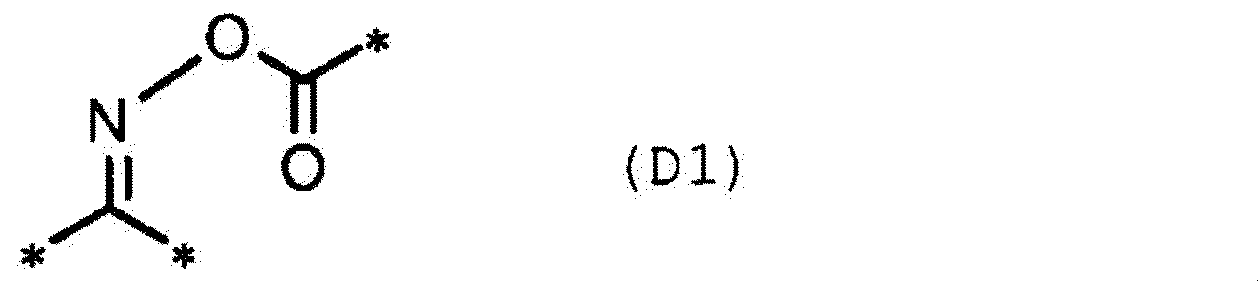
- O-acyloxime compound is a compound having a structure represented by formula (D1). Below, * represents a bond.
- O-acyloxime compounds include N-benzoyloxy-1-(4-phenylsulfanylphenyl)butan-1-one-2-imine, N-benzoyloxy-1-(4-phenylsulfanylphenyl)octane- 1-one-2-imine, N-benzoyloxy-1-(4-phenylsulfanylphenyl)-3-cyclopentylpropan-1-one-2-imine, N-acetoxy-1-[9-ethyl-6-( 2-methylbenzoyl)-9H-carbazol-3-yl]ethan-1-imine, N-acetoxy-1-[9-ethyl-6- ⁇ 2-methyl-4-(3,3-dimethyl-2,4 -dioxacyclopentanylmethyloxy)benzoyl ⁇ -9H-carbazol-3-yl]ethan-1-imine, N-acetoxy-1-[9-ethyl-6-(2-methylbenzoyl)
- An alkylphenone compound is a compound having a structure represented by formula (D2-1) or a structure represented by formula (D2-2). In these structures, the benzene ring may have a substituent.
- Examples of compounds having a structure represented by formula (D2-1) include 2-methyl-2-morpholino-1-(4-methylsulfanylphenyl)propan-1-one, 2-dimethylamino-1-( 4-morpholinophenyl)-2-benzylbutan-1-one, 2-(dimethylamino)-2-[(4-methylphenyl)methyl]-1-[4-(4-morpholinyl)phenyl]butane-1- On is mentioned.
- Commercially available products such as Irgacure (registered trademark) 369, 907 and 379 (manufactured by BASF Corporation) may also be used.
- a photopolymerization initiator having a group capable of causing chain transfer which is described in JP-T-2002-544205, may be used.
- compounds having a structure represented by formula (D2-2) include 2-hydroxy-2-methyl-1-phenylpropan-1-one, 2-hydroxy-2-methyl-1-[4-( 2-hydroxyethoxy)phenyl]propan-1-one, 1-hydroxycyclohexylphenyl ketone, oligomers of 2-hydroxy-2-methyl-1-(4-isopropenylphenyl)propan-1-one, ⁇ , ⁇ -di ethoxyacetophenone, benzyl dimethyl ketal; From the viewpoint of sensitivity, the alkylphenone compound is preferably a compound having a structure represented by formula (D2-1).
- triazine compounds examples include 2,4-bis(trichloromethyl)-6-(4-methoxyphenyl)-1,3,5-triazine, 2,4-bis(trichloromethyl)-6-(4-methoxy naphthyl)-1,3,5-triazine, 2,4-bis(trichloromethyl)-6-piperonyl-1,3,5-triazine, 2,4-bis(trichloromethyl)-6-(4-methoxystyryl )-1,3,5-triazine, 2,4-bis(trichloromethyl)-6-[2-(5-methylfuran-2-yl)ethenyl]-1,3,5-triazine, 2,4- Bis(trichloromethyl)-6-[2-(furan-2-yl)ethenyl]-1,3,5-triazine, 2,4-bis(trichloromethyl)-6-[2-(furan-2-yl)ethenyl]-1,3,5-tri
- Acylphosphine oxide compounds include 2,4,6-trimethylbenzoyldiphenylphosphine oxide and the like. Commercially available products such as Irgacure 819 (manufactured by BASF Japan Ltd.) may also be used.
- Biimidazole compounds include, for example, 2,2′-bis(2-chlorophenyl)-4,4′,5,5′-tetraphenylbiimidazole, 2,2′-bis(2,3-dichlorophenyl)-4 ,4′,5,5′-tetraphenylbiimidazole (see, for example, JP-A-6-75372 and JP-A-6-75373), 2,2′-bis(2-chlorophenyl)-4, 4′,5,5′-tetraphenylbiimidazole, 2,2′-bis(2-chlorophenyl)-4,4′,5,5′-tetra(alkoxyphenyl)biimidazole, 2,2′-bis( 2-chlorophenyl)-4,4',5,5'-tetra(dialkoxyphenyl)biimidazole, 2,2'-bis(2-chlorophenyl)-4,4',5,5'-tetra
- benzoin compounds such as benzoin, benzoin methyl ether, benzoin ethyl ether, benzoin isopropyl ether, benzoin isobutyl ether; benzophenone, o-benzoyl methyl benzoate, 4-phenylbenzophenone, 4-benzoyl -benzophenone compounds such as 4'-methyldiphenyl sulfide, 3,3',4,4'-tetra(tert-butylperoxycarbonyl)benzophenone, 2,4,6-trimethylbenzophenone; 9,10-phenanthrenequinone quinone compounds such as , 2-ethylanthraquinone and camphorquinone; 10-butyl-2-chloroacridone, benzyl, methyl phenylglyoxylate, titanocene compounds and the like.
- H polymerization initiation aid
- An acid generator can also be used as the photopolymerization initiator (D).
- acid generators include 4-hydroxyphenyldimethylsulfonium p-toluenesulfonate, 4-hydroxyphenyldimethylsulfonium hexafluoroantimonate, 4-acetoxyphenyldimethylsulfonium p-toluenesulfonate, 4-acetoxyphenyl-methyl- Onium salts such as benzylsulfonium hexafluoroantimonate, triphenylsulfonium p-toluenesulfonate, triphenylsulfonium hexafluoroantimonate, diphenyliodonium p-toluenesulfonate, diphenyliodonium hexafluoroantimonate, nitrobenzyl tosylate, and benzoin tosylate.
- the content of the photopolymerization initiator (D) is the resin (A) and the polymerizable compound (C ) is preferably 0.1 to 30 parts by mass, more preferably 0.5 to 15 parts by mass, and still more preferably 1 to 8 parts by mass, relative to the total content of 100 parts by mass.
- the content of the photopolymerization initiator (D) is within the above range, the resulting pattern tends to have high visible light transmittance.
- the polymerization initiation aid (H) is a compound used together with the photopolymerization initiator (D) to promote the polymerization of the polymerizable compound (C) whose polymerization is initiated by the photopolymerization initiator (D), or an additive. It is a sensitizer.
- polymerization initiation aids examples include thiazoline compounds, amine compounds, alkoxyanthracene compounds, thioxanthone compounds, and carboxylic acid compounds.
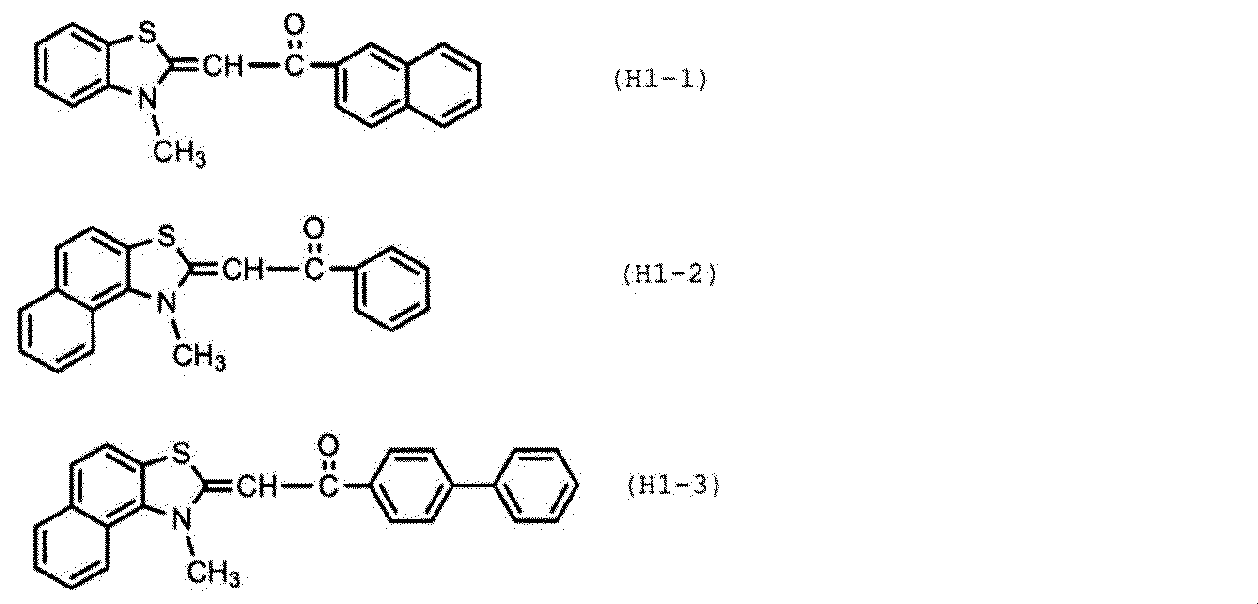
- Examples of thiazoline compounds include compounds represented by formulas (H1-1) to (H1-3), compounds described in JP-A-2008-65319, and the like.
- amine compounds include triethanolamine, methyldiethanolamine, triisopropanolamine, methyl 4-dimethylaminobenzoate, ethyl 4-dimethylaminobenzoate, isoamyl 4-dimethylaminobenzoate, 2-dimethylaminoethyl benzoate, 4- 2-ethylhexyl dimethylaminobenzoate, N,N-dimethyl p-toluidine, 4,4'-bis(dimethylamino)benzophenone (commonly known as Michler's ketone), 4,4'-bis(diethylamino)benzophenone, 4,4'-bis( ethylmethylamino)benzophenone and the like, among which 4,4'-bis(diethylamino)benzophenone is preferred.
- EAB-F manufactured by Hodogaya Chemical Industry Co., Ltd.
- Alkoxyanthracene compounds include 9,10-dimethoxyanthracene, 2-ethyl-9,10-dimethoxyanthracene, 9,10-diethoxyanthracene, 2-ethyl-9,10-diethoxyanthracene, 9,10-dibutoxy anthracene, 2-ethyl-9,10-dibutoxyanthracene and the like.
- Thioxanthone compounds include 2-isopropylthioxanthone, 4-isopropylthioxanthone, 2,4-diethylthioxanthone, 2,4-dichlorothioxanthone, 1-chloro-4-propoxythioxanthone, and the like.
- Carboxylic acid compounds include phenylsulfanylacetic acid, methylphenylsulfanylacetic acid, ethylphenylsulfanylacetic acid, methylethylphenylsulfanylacetic acid, dimethylphenylsulfanylacetic acid, methoxyphenylsulfanylacetic acid, dimethoxyphenylsulfanylacetic acid, chlorophenylsulfanylacetic acid, dichlorophenylsulfanylacetic acid, N -phenylglycine, phenoxyacetic acid, naphthylthioacetic acid, N-naphthylglycine, naphthoxyacetic acid and the like.
- the photocurable resin composition of the present invention contains a polymerizable compound (C), a photopolymerization initiator (D) and a polymerization initiation aid (H), the content of the polymerization initiation aid (H) is the resin ( It is preferably 0.1 to 30 parts by mass, more preferably 0.2 to 10 parts by mass, per 100 parts by mass of the total content of A) and the polymerizable compound (C).
- the amount of the polymerization initiation aid (H) is within the above range, the pattern tends to be formed with higher sensitivity.
- Leveling agent (B) examples include silicone-based surfactants, fluorine-based surfactants, and silicone-based surfactants having fluorine atoms. These may have a polymerizable group in the side chain.
- silicone-based surfactants include surfactants that have siloxane bonds in their molecules.
- Toray Silicone DC3PA, Toray SH7PA, Toray DC11PA, Toray SH21PA, Toray SH28PA, Toray SH29PA, Toray SH30PA, Toray SH8400 (trade name: Dow Corning Toray Co., Ltd.), KP321, KP322, KP323, KP324 , KP326, KP340, KP341 (manufactured by Shin-Etsu Chemical Co., Ltd.), TSF400, TSF401, TSF410, TSF4300, TSF4440, TSF4445, TSF4446, TSF4452 and TSF4460 (manufactured by Momentive Performance Materials Japan LLC), etc. .
- fluorine-based surfactants examples include surfactants having a fluorocarbon chain in the molecule.
- silicone-based surfactants having fluorine atoms include surfactants having siloxane bonds and fluorocarbon chains in the molecule.
- Megafac registered trademark
- Megafac BL20 Megafac F475, F477 and F443 (manufactured by DIC Corporation) and the like can be mentioned.
- the leveling agent (B) When the leveling agent (B) is contained, its content is preferably 0.001% by mass or more and 0.2% by mass or less, more preferably 0.002% by mass, relative to the total amount of the photocurable resin composition. It is 0.1% by mass or more and more preferably 0.005% by mass or more and 0.07% by mass or less.
- Antioxidants (F) include phenol antioxidants, sulfur antioxidants, phosphorus antioxidants, and amine antioxidants. Among them, phenol-based antioxidants are preferable because the resulting film is less colored.
- Phenolic antioxidants include, for example, 2-tert-butyl-6-(3-tert-butyl-2-hydroxy-5-methylbenzyl)-4-methylphenyl acrylate, 2-[1-(2-hydroxy -3,5-di-tert-pentylphenyl)ethyl]-4,6-di-tert-pentylphenyl acrylate, 3,9-bis[2- ⁇ 3-(3-tert-butyl-4-hydroxy-5 -methylphenyl)propionyloxy ⁇ -1,1-dimethylethyl]-2,4,8,10-tetraoxaspiro[5.5]undecane, 2,2′-methylenebis(6-tert-butyl-4-methyl phenol), 4,4′-butylidenebis(6-tert-butyl-3-methylphenol), 4,4′-thiobis(2-tert-butyl-5-methylphenol), 2,2′-thiobis(6- tert-butyl
- sulfur-based antioxidants examples include dilauryl 3,3'-thiodipropionate, dimyristyl 3,3'-thiodipropionate, distearyl 3,3'-thiodipropionate, pentaerythrityl tetrakis (3 - lauryl thiopropionate).
- a commercially available product may be used as the sulfur-based antioxidant.
- Examples of commercially available sulfur-based antioxidants include Sumilizer (registered trademark) TPL-R and TP-D (all manufactured by Sumitomo Chemical Co., Ltd.).
- Phosphorus antioxidants include, for example, trioctyl phosphite, trilauryl phosphite, tridecyl phosphite, tris(nonylphenyl) phosphite, distearylpentaerythritol diphosphite, tetra(tridecyl)-1,1, 3-tris(2-methyl-5-tert-butyl-4-hydroxyphenyl)butane diphosphite.
- a commercially available product may be used as the phosphorus antioxidant.
- phosphorus antioxidants include, for example, Irgafos (registered trademark) 168, 12, 38 (all manufactured by BASF Corporation), ADEKA STAB 329K, and ADEKA STAB PEP36 (all manufactured by ADEKA Corporation). is mentioned.
- Amine antioxidants include, for example, N,N'-di-sec-butyl-p-phenylenediamine, N,N'-di-isopropyl-p-phenylenediamine, N,N'-dicyclohexyl-p-phenylene Diamine, N,N'-diphenyl-p-phenylenediamine, N,N'-bis(2-naphthyl)-p-phenylenediamine.
- Commercially available products may be used as the amine-based antioxidant.
- Commercially available amine-based antioxidants include, for example, Sumilizer (registered trademark) BPA, BPA-M1, and 4ML (all manufactured by Sumitomo Chemical Co., Ltd.).
- the photocurable resin composition of the present invention contains an antioxidant (F)
- its content is preferably 0.1 parts by mass or more and 5 parts by mass or less, more preferably 0.5 parts by mass or more and 3 parts by mass or less.
- the content of the antioxidant (F) is within the above range, the obtained film tends to be excellent in heat resistance and pencil hardness.
- the polycarboxylic acid (G1) is at least one compound selected from the group consisting of polycarboxylic anhydrides and polycarboxylic acids.
- a polyvalent carboxylic acid is a compound having two or more carboxy groups, and a polyvalent carboxylic acid anhydride is an anhydride of a polyvalent carboxylic acid.
- the molecular weight of the polycarboxylic acid (G1) is preferably 3000 or less, more preferably 1000 or less.
- polyvalent carboxylic acid anhydrides examples include maleic anhydride, succinic anhydride, glutaric anhydride, citraconic anhydride, itaconic anhydride, 2-dodecylsuccinic anhydride, 2-(2-octa -3-enyl)succinic anhydride, 2-(2,4,6-trimethylnon-3-enyl)succinic anhydride, tricarballylic anhydride, 1,2,3,4-butanetetracarboxylic acid di Chain polyvalent carboxylic anhydride such as anhydride; 3,4,5,6-tetrahydrophthalic anhydride, 1,2,3,6-tetrahydrophthalic anhydride, dimethyltetrahydrophthalic anhydride, hexahydro Phthalic anhydride, 4-methylhexahydrophthalic anhydride, norbornene dicarboxylic anhydride, methylbicyclo[2.2.1]heptane-2,3-dicarboxylic
- polyvalent carboxylic acid examples include chain polyvalent carboxylic acids such as oxalic acid, malonic acid, adipic acid, sebacic acid, fumaric acid, tartaric acid, citric acid, and polyvalent carboxylic acids leading to chain polyvalent carboxylic acid anhydrides.
- chain carboxylic acid anhydrides and alicyclic polyvalent carboxylic acid anhydrides are preferable, and alicyclic polyvalent Carboxylic anhydrides are more preferred.
- the photocurable resin composition of the present invention contains a polyvalent carboxylic acid (G1)
- its content is preferably with respect to 100 parts by mass of the total content of the resin (A) and the polymerizable compound (C) is 1 to 30 parts by mass, more preferably 2 to 20 parts by mass, and still more preferably 2 to 15 parts by mass.
- the content of the polycarboxylic acid (G1) is within the above range, the heat resistance and adhesion of the obtained film are excellent.
- the imidazole compound (G2) is not particularly limited as long as it is a compound having an imidazole skeleton, and examples thereof include compounds known as epoxy curing agents. Among them, the compound represented by formula (G2-1) is preferable.
- R 31 represents an alkyl group having 1 to 20 carbon atoms, a phenyl group, a benzyl group, or a cyanoalkyl group having 2 to 5 carbon atoms.
- R 32 to R 34 each independently represent a hydrogen atom, a halogen atom, an alkyl group having 1 to 20 carbon atoms, a phenyl group, a nitro group or an acyl group having 1 to 20 carbon atoms, and the alkyl group and the phenyl group; A hydrogen atom contained in may be substituted with a hydroxy group.
- alkyl groups having 1 to 20 carbon atoms include methyl group, ethyl group, propyl group, isobutyl group, butyl group, tert-butyl group, hexyl group, heptyl group, octyl group, nonyl group, decyl group and heptadecyl group. , an undecyl group.
- Examples of the cyanoalkyl group having 2 to 5 carbon atoms include cyanomethyl group, cyanoethyl group, cyanopropyl group, cyanobutyl group and cyanopentyl group.
- Halogen atoms include, for example, fluorine, chlorine and bromine atoms.
- acyl groups having 1 to 20 carbon atoms include formyl, acetyl, propionyl, isobutyryl, valeryl, isovaleryl, pivaloyl, lauroyl, myristoyl and stearoyl groups.
- imidazole compounds (G2) include 1-methylimidazole, 2-methylimidazole, 2-hydroxymethylimidazole, 2-methyl-4-hydroxymethylimidazole, 5-hydroxymethyl-4-methylimidazole, and 2-ethylimidazole.
- the content thereof is preferably 0 with respect to 100 parts by mass of the total content of the resin (A) and the polymerizable compound (C). .1 to 25 parts by mass, more preferably 0.2 to 15 parts by mass, still more preferably 0.5 to 5 parts by mass.
- the content of the imidazole compound (G2) is within the above range, the resulting film tends to have excellent transparency in the visible light region.
- the photocurable resin composition of the present invention contains a solvent (E).
- the solvent (E) is not particularly limited, and solvents commonly used in the field can be mentioned.
- ester solvent solvent (solvent containing -COO- in the molecule but not containing -O-)
- ether solvent solvent containing -O- in the molecule but not containing -COO-
- ether ester solvent solvent containing -COO- in the molecule solvent containing -COO- and -O-
- ketone solvent solvent containing -CO- in the molecule and not containing -COO-
- alcohol solvent containing OH in the molecule, -O-, - solvents containing no CO- and -COO-
- aromatic hydrocarbon solvents amide solvents, dimethyl sulfoxide and the like.
- Ester solvents include methyl lactate, ethyl lactate, butyl lactate, methyl 2-hydroxyisobutanoate, ethyl acetate, n-butyl acetate, isobutyl acetate, pentyl formate, isopentyl acetate, butyl propionate, isopropyl butyrate, ethyl butyrate, butyl butyrate. , methyl pyruvate, ethyl pyruvate, propyl pyruvate, methyl acetoacetate, ethyl acetoacetate, cyclohexanol acetate and ⁇ -butyrolactone.
- Ether solvents include ethylene glycol monomethyl ether, ethylene glycol monoethyl ether, ethylene glycol monopropyl ether, ethylene glycol monobutyl ether, diethylene glycol monomethyl ether, diethylene glycol monoethyl ether, diethylene glycol monobutyl ether, propylene glycol monomethyl ether, and propylene glycol monoethyl ether.
- propylene glycol monopropyl ether propylene glycol monobutyl ether, 3-methoxy-1-butanol, 3-methoxy-3-methylbutanol, tetrahydrofuran, tetrahydropyran, 1,4-dioxane, diethylene glycol dimethyl ether, diethylene glycol diethyl ether, diethylene glycol methyl ethyl Ether, diethylene glycol dipropyl ether, diethylene glycol dibutyl ether, anisole, phenetol and methylanisole and the like.
- Ether ester solvents include methyl methoxyacetate, ethyl methoxyacetate, butyl methoxyacetate, methyl ethoxyacetate, ethyl ethoxyacetate, methyl 3-methoxypropionate, ethyl 3-methoxypropionate, methyl 3-ethoxypropionate, 3-ethoxy ethyl propionate, methyl 2-methoxypropionate, ethyl 2-methoxypropionate, propyl 2-methoxypropionate, methyl 2-ethoxypropionate, ethyl 2-ethoxypropionate, methyl 2-methoxy-2-methylpropionate, Ethyl 2-ethoxy-2-methylpropionate, 3-methoxybutyl acetate, 3-methyl-3-methoxybutyl acetate, propylene glycol monomethyl ether acetate, propylene glycol monoethyl ether acetate, propylene glycol monopropyl ether a
- Ketone solvents include 4-hydroxy-4-methyl-2-pentanone, acetone, 2-butanone, 2-heptanone, 3-heptanone, 4-heptanone, 4-methyl-2-pentanone, cyclopentanone, cyclohexanone and isophorone. etc.
- Alcohol solvents include methanol, ethanol, propanol, butanol, hexanol, cyclohexanol, ethylene glycol, propylene glycol and glycerin.
- Aromatic hydrocarbon solvents include benzene, toluene, xylene and mesitylene.
- Amide solvents include N,N-dimethylformamide, N,N-dimethylacetamide, N-methylpyrrolidone, and the like.
- organic solvents having a boiling point of 100°C or higher and 200°C or lower at 1 atm are preferable from the viewpoint of coating properties and drying properties.
- Preferred solvents are propylene glycol monomethyl ether acetate, propylene glycol monomethyl ether, methyl 3-methoxypropionate, ethyl 3-ethoxypropionate, ethylene glycol ethyl methyl ether, cyclohexanone, methoxybutanol and methoxybutyl acetate, and propylene glycol monomethyl ether. More preferred are acetate, propylene glycol monomethyl ether, ethylene glycol ethyl methyl ether, methoxybutanol and methoxybutyl acetate.
- the content of the solvent (E) in the photocurable resin composition of the present invention is preferably 60-95% by mass, more preferably 70-95% by mass, relative to the total amount of the photocurable resin composition.
- the solid content of the photocurable resin composition of the present invention is preferably 5-40% by mass, more preferably 5-30% by mass.
- the photocurable resin composition of the present invention contains additives known in the art such as fillers, other polymer compounds, ultraviolet absorbers, chain transfer agents, and adhesion promoters. may be
- the photocurable resin composition of the present embodiment includes a resin (A), a polymerizable compound (C), a photopolymerization initiator (D), and a solvent (E), furthermore, a polymerization initiation aid (H) and a leveling agent. (B), antioxidant (F), curing agent (G) and other components can be mixed by a known method. After mixing, it is preferable to filter with a filter having a pore size of about 0.05 to 1.0 ⁇ m.
- Resin (A-1) A 1 L flask equipped with a reflux condenser, a dropping funnel, and a stirrer was filled with nitrogen by flowing an appropriate amount of nitrogen, and 297 parts by mass of propylene glycol monomethyl ether acetate and 9 parts by mass of cyclopentanone were added, and the temperature was raised to 85° C. while stirring. heated. Then, 28.5 parts by mass of a mixture of 3,4-epoxytricyclo[5.2.1.0 2,6 ]decane-8 or/and 9-yl acrylate, 38.5 parts by mass of acrylic acid, 9-vinyl A mixed solution of 233 parts by mass of carbazole and 200 parts by mass of cyclopentanone was added dropwise over 5 hours.
- Resin (A-2) 276.8 parts of propylene glycol monomethyl ether acetate was placed in a flask equipped with a stirring device, a dropping funnel, a condenser, a thermometer and a gas inlet tube, and the mixture was stirred while being replaced with nitrogen and heated to 120°C. Then, to a monomer mixture consisting of 92.4 parts of 2-ethylhexyl acrylate, 184.9 parts of glycidyl methacrylate and 12.3 parts of dicyclopentanyl methacrylate, 35.3 parts of t-butyl peroxy-2-ethylhexanoate. (Polymerization initiator) was added dropwise into the flask from the dropping funnel over 2 hours.
- the mixture was further stirred at 120° C. for 30 minutes to carry out a copolymerization reaction to produce an addition copolymer. Thereafter, the inside of the flask was replaced with air, and 93.7 parts of acrylic acid, 1.5 parts of triphenylphosphine (catalyst) and 0.8 parts of methoquinone (polymerization inhibitor) were introduced into the above addition copolymer solution.
- the reaction was continued at 110° C. for 10 hours to cleave the epoxy group and introduce a polymerizable unsaturated bond into the side chain of the polymer at the same time as the reaction between the epoxy group derived from glycidyl methacrylate and acrylic acid.
- HLC-8120GPC manufactured by Tosoh Corporation
- the ratio (Mw/Mn) of the polystyrene equivalent weight average molecular weight (Mw) to the number average molecular weight (Mn) obtained above was taken as the degree of dispersion.
- Photocurable resin compositions 1 to 3 were prepared by mixing a resin, a polymerizable compound, a photopolymerization initiator, a silane coupling agent, and a leveling agent in the proportions shown in Table 1, and mixed with a solvent.
- Table 1 the number of parts of each component represents parts by mass in terms of solid content.
- Polymerizable compound (C-1) a bifunctional acrylate compound having a fluorene skeleton (OGSOL (registered trademark) EA-0300: manufactured by Osaka Gas Chemicals Co., Ltd.
- 11 levels (1, 10, 15, 20, 40, 60, 100, 150, 200, 300, 500) were sequentially increased in the range of cm 2 and irradiated with light.
- This light irradiation was carried out by passing radiated light from an extra-high pressure mercury lamp through an optical filter (UV-31; manufactured by Asahi Techno Glass Co., Ltd.).
- the photocurable resin composition layer after light irradiation is developed by immersing it in a 2.38% aqueous solution of tetramethylammonium hydroxide at 23°C for 80 seconds, washed with water, and post-baked on a hot plate at 100°C for 30 minutes. A cured film was obtained by performing.
- the film thickness before and after development was measured using a contact film thickness measuring device (DEKTAK6M; manufactured by ULVAC, Inc.), and the residual film rate was calculated by the above formula (1 ).
- the exposure dose in the exposure step is 200 mJ/cm 2 or more, which is 2.0 times the measured minimum exposure dose of 100 mJ/cm 2 , it is 2.0 times or more the saturation exposure dose. is the exposure amount of .
- the exposure dose in the exposure step is 120 mJ/cm 2 or less, which is 2.0 times as much as 60 mJ/cm 2 , the exposure dose must be 2.0 times or more the saturated exposure dose. is clearly not satisfied.
- the measurement minimum exposure amounts of the photocurable resin compositions 2 and 3 were determined. They were 100 mJ/cm 2 and 600 mJ/cm 2 respectively.
- the photocurable resin composition 1 On a 4-inch glass substrate, the photocurable resin composition 1 was applied by a spin coating method so that the film thickness after post-baking was 9 ⁇ m, and then prebaked at 60 ° C. for 1 minute to form a photocurable resin composition. got a layer.
- the distance between the photocurable resin composition layer and the quartz glass photomask was set to 50 ⁇ m, and an exposure machine (TME-150RSK; manufactured by Topcon Corporation, light source; ultra-high pressure mercury lamp) was used in an air atmosphere. was irradiated with light (365 nm standard) shown in FIG.
- This light irradiation was carried out by passing radiated light from an extra-high pressure mercury lamp through an optical filter (UV-31; manufactured by Asahi Techno Glass Co., Ltd.).
- an optical filter UV-31; manufactured by Asahi Techno Glass Co., Ltd.
- a photomask a photomask for forming a rectangular dot pattern of 10 ⁇ m long and 20 ⁇ m wide was used.
- the photocurable resin composition layer after light irradiation is developed by immersing it in a 2.38% aqueous solution of tetramethylammonium hydroxide at 23°C for 80 seconds, washed with water, and post-baked on a hot plate at 100°C for 30 minutes.
- a rectangular dot pattern (cured film) was produced by performing.
- Example 4 uses the photocurable resin composition 2
- Example 5 uses the photocurable resin composition 3 to prepare the dot patterns of Examples 1 to 3 and Comparative Examples 1 to 3 described above.
- a rectangular dot pattern (cured film) was produced at the exposure amount (365 nm standard) shown in Table 3.
- the ratio (W2/ W1 ) in the dots can be adjusted by the exposure dose in the exposure step. It turns out that it is 0.7 or less.
Landscapes
- Physics & Mathematics (AREA)
- General Physics & Mathematics (AREA)
- Engineering & Computer Science (AREA)
- Manufacturing & Machinery (AREA)
- Spectroscopy & Molecular Physics (AREA)
- Optics & Photonics (AREA)
- Chemical & Material Sciences (AREA)
- Crystallography & Structural Chemistry (AREA)
- Addition Polymer Or Copolymer, Post-Treatments, Or Chemical Modifications (AREA)
- Photosensitive Polymer And Photoresist Processing (AREA)
- Materials For Photolithography (AREA)
- Casting Or Compression Moulding Of Plastics Or The Like (AREA)
Abstract
Description
[1] 基板の上に光硬化性樹脂組成物の硬化物からなる凸面形状のレンズを製造する方法であって、
前記光硬化性樹脂組成物を前記基板の上に塗布して光硬化性樹脂組成物層を形成する光硬化性樹脂組成物層形成工程と、
前記光硬化性樹脂組成物層を選択的に露光する露光工程と、
前記露光工程の後に、前記光硬化性樹脂組成物層を現像する現像工程と、
を有し、
前記露光工程において、前記光硬化性樹脂組成物層を飽和露光量の2.0倍量以上の露光量で露光する、方法。
[2] 前記露光工程において、前記光硬化性樹脂組成物層の露光はフォトマスクを介して選択的に行う、[1]に記載の方法。
[3] 前記現像工程の後に、さらにポストベーク工程を有する、[1]または[2]に記載の方法。
[4] 前記レンズは、断面視において、前記基板に接するレンズ幅W1に対する、前記レンズの高さの前記基板面から90%の高さにおけるレンズ幅W2の比率(W2/W1)が0.7以下である、[1]~[3]のいずれか1項に記載の方法。
[5] 前記レンズ幅W1は100μm以下である、[4]に記載の方法。
[6] 前記光硬化性樹脂組成物は、樹脂、重合性化合物、光重合開始剤、及び溶剤を含む、[1]~[5]のいずれか1項に記載の方法。
[7] [1]~[6]のいずれか1項に記載の製造方法により製造されたレンズ。
[8] [7]に記載のレンズを備える表示装置。
本発明は、基板の上に光硬化性樹脂組成物の硬化物からなる凸面形状のレンズを製造する方法であって、
前記光硬化性樹脂組成物を前記基板の上に塗布して光硬化性樹脂組成物層を形成する樹脂層形成工程と、
前記光硬化性樹脂組成物層を選択的に露光する露光工程と、
前記露光工程の後に、前記光硬化性樹脂組成物層を現像する現像工程と、
を有し、
前記露光工程において、前記光硬化性樹脂組成物層を飽和露光量の2.0倍量以上の露光量で露光する、方法である。
光硬化性樹脂組成物としては、露光工程での光の照射により重合し、かつ未露光部分は現像工程での現像により溶出する性質を有するものであれば限定されない。光硬化性樹脂組成物については、後段で具体例を示す。
光硬化性樹脂組成物層2の選択的な露光は、例えば、フォトマスク5を介して露光することにより行うことができる。フォトマスク5として、目的とするパターンに応じて除去したい部分に対応して遮光部が形成されたマスクを用いる。露光に用いられる光源としては、250~450nmの波長の光を発生する光源が好ましい。例えば、350nm未満の光を、この波長域をカットするフィルタを用いてカットしたり、436nm付近、408nm付近、365nm付近の光を、これらの波長域を取り出すバンドパスフィルタを用いて選択的に取り出したりしてもよい。光源としては、水銀灯、発光ダイオード、メタルハライドランプ、ハロゲンランプ等が挙げられる。露光面全体に均一に平行光線を照射することや、フォトマスク5と光硬化性樹脂組成物層2との正確な位置合わせを行うことができるため、マスクアライナ、ステッパ等の露光装置を用いることが好ましい。
残膜率(%)=(現像後の膜厚/現像前の膜厚)×100 (1)
光硬化性樹脂組成物層2と同一の組成の光硬化性樹脂組成物を同一の塗布方法によって基板上に塗布し同一の条件で乾燥して得られた同一の厚みの光硬化性樹脂組成物層に対して、露光機(TME-150RSK;トプコン(株)製、光源;超高圧水銀灯)を用いて、大気雰囲気下、露光量(365nm基準)を1mJ/cm2~500mJ/cm2の範囲で11水準(1,10,15,20,40,60,100,150,200,300,500)で順次増加させてそれぞれ光照射する。なお、この光照射は、超高圧水銀灯からの放射光を、光学フィルタ(UV-31;旭テクノグラス(株)製)を通過させて行う。光照射後の光硬化性樹脂組成物層の厚みを測定して現像前の膜厚とする。現像工程と同じ現像液及び同じ現像条件で現像し、ポストベークを行うことにより硬化膜を得る。かかる硬化膜の厚みを測定して現像後の膜厚とする。現像前の膜厚と現像後の膜厚は、接触式膜厚測定装置(DEKT AK6M、(株)アルバック製)により測定する。
露光工程後、光硬化性樹脂組成物層2を現像する現像工程を行う。露光後の光硬化性樹脂組成物層2を現像液に接触させて現像することにより、光硬化性樹脂組成物層2の未露光部が現像液に溶解して除去されて、基板1上にパターンを有する光硬化性樹脂組成物層2が形成される。現像液としては、水酸化カリウム、炭酸水素ナトリウム、炭酸ナトリウム、水酸化テトラメチルアンモニウム等のアルカリ性化合物の水溶液が好ましい。これらのアルカリ性化合物の水溶液中の濃度は、好ましくは0.01~10質量%、より好ましくは0.03~5質量%である。さらに、現像液は、界面活性剤を含んでいてもよい。現像方法は、パドル法、ディッピング法及びスプレー法等のいずれでもよい。さらに現像時に基板1を任意の角度に傾けてもよい。現像後は、水洗することが好ましい。
現像工程後に、好ましくは、光硬化性樹脂組成物層2を水洗しポストベーク工程を行う。ポストベーク工程は、製造に要する時間を短くできる点で、現像工程後の水洗後に続いて行うことが好ましい。ポストベーク工程を行うことによりレンズの耐久性(耐溶剤性)を向上させることができる。
図1(c)に示すマイクロレンズアレイ3は、複数個のマイクロレンズ31からなる。図2は、本実施形態のマイクロレンズアレイ3の平面視を示す図である。
本発明のレンズを製造する方法において用いられる光硬化性樹脂組成物は、上述の通り、露光工程での光の照射により重合し、かつ未露光部分は現像工程での現像により溶出する性質を有するものであれば限定されない。以下、本発明において好適に用いられる光硬化性樹脂組成物の一形態を説明する。各成分として例示する化合物は、特に断りのない限り、単独で又は複数種を組合せて使用することができる。
樹脂(A)は、構成単位(Aa)と、構成単位(Ab)とを含む共重合体である。該共重合体は、さらに、構成単位(Aa)又は(Ab)と共重合可能であり、かつ、構成単位(Aa)及び(Ab)以外の構成単位(以下、構成単位(Ac)と称する。)をさらに含んでもよい。なお、本明細書において、「(メタ)アクリル酸」とは、アクリル酸及びメタクリル酸よりなる群から選ばれる少なくとも1種の化合物を表す。「(メタ)アクリロイル」及び「(メタ)アクリレート」等の表記も、同様の意味を有する。樹脂(A)は、構成単位(Aa)及び構成単位(Ab)を、それぞれ2種以上含んでいてもよい。
構成単位(Aa)は、炭素数2~4の環状エーテル構造(例えば、オキシラン環、オキセタン環及びテトラヒドロフラン環からなる群から選ばれる少なくとも1種)を有する不飽和化合物から導くことができる。炭素数2~4の環状エーテル構造を有する不飽和化合物から導かれる構成単位とは、該不飽和化合物を単量体として用いて共重合体を製造することによって得ることができる。あるいは、他の構成単位(以下、構成単位(Aa’)と称する。)に、炭素数2~4の環状エーテル構造を有する化合物を反応させることによって得ることもできる。

Xb1及びXb2は、単結合、*-Rb3-、*-Rb3-O-、*-Rb3-S-又は*-Rb3-NH-を表す。
Rb3は、炭素数1~6のアルカンジイル基を表す。
*は、Oとの結合手を表す。]
水素原子がヒドロキシで置換されたアルキル基としては、ヒドロキシメチル基、1-ヒドロキシエチル基、2-ヒドロキシエチル基、1-ヒドロキシプロピル基、2-ヒドロキシプロピル基、3-ヒドロキシプロピル基、1-ヒドロキシ-1-メチルエチル基、2-ヒドロキシ-1-メチルエチル基、1-ヒドロキシブチル基、2-ヒドロキシブチル基、3-ヒドロキシブチル基、4-ヒドロキシブチル基等が挙げられる。


Xb1及びXb2は、単結合、*-Rb3-、*-Rb3-O-、*-Rb3-S-又は*-Rb3-NH-を表す。
Rb3は、炭素数1~6のアルカンジイル基を表す。
*は、Oとの結合手を表す。]
構成単位(Ab)は、置換基を有していてもよいカルバゾール環を有する不飽和化合物から導くことができる。該不飽和化合物から導かれる構成単位は、該不飽和化合物を単量体として用いて共重合体を製造することによって得ることができる。あるいは、他の構成単位(Ab’)に、置換基を有していてもよいカルバゾール環を有する化合物(Ab’’)を反応させることによって得ることもできる。構成単位(Ab)を有することにより、得られる膜の屈折率を向上させることができる。
R2~R9は、互いに独立に、水素原子、ハロゲン原子、炭素数1~20の飽和炭化水素基又は炭素数6~20のアリール基を表し、該飽和炭化水素基に含まれる水素原子は、アルコキシ基又はアリール基で置換されていてもよい。
Xは、単結合、炭素数1以上のアルカンジイル基、もしくは直鎖状又は分枝鎖状の下記の式(V)で表される基を表す。

構成単位(Ac)としては、不飽和カルボン酸及び不飽和カルボン酸無水物からなる群に属する化合物によって導かれる構成単位(以下「構成単位(Ac1)」と称する。)が挙げられる。不飽和カルボン酸及び不飽和カルボン酸無水物からなる群に属する化合物としては、例えば、アクリル酸、メタクリル酸、クロトン酸、o-、m-、p-ビニル安息香酸等の不飽和モノカルボン酸;
マレイン酸、フマル酸、シトラコン酸、メサコン酸、イタコン酸、3-ビニルフタル酸、4-ビニルフタル酸、3,4,5,6-テトラヒドロフタル酸、1,2,3,6-テトラヒドロフタル酸、ジメチルテトラヒドロフタル酸、1,4-シクロヘキセンジカルボン酸等の不飽和ジカルボン酸;
メチル-5-ノルボルネン-2,3-ジカルボン酸、5-カルボキシビシクロ[2.2.1]ヘプト-2-エン、5,6-ジカルボキシビシクロ[2.2.1]ヘプト-2-エン、5-カルボキシ-5-メチルビシクロ[2.2.1]ヘプト-2-エン、5-カルボキシ-5-エチルビシクロ[2.2.1]ヘプト-2-エン、5-カルボキシ-6-メチルビシクロ[2.2.1]ヘプト-2-エン、5-カルボキシ-6-エチルビシクロ[2.2.1]ヘプト-2-エン等のカルボキシ基を含有するビシクロ不飽和化合物;
無水マレイン酸、シトラコン酸無水物、イタコン酸無水物、3-ビニルフタル酸無水物、4-ビニルフタル酸無水物、3,4,5,6-テトラヒドロフタル酸無水物、1,2,3,6-テトラヒドロフタル酸無水物、ジメチルテトラヒドロフタル酸無水物、5,6-ジカルボキシビシクロ[2.2.1]ヘプト-2-エン無水物等の不飽和ジカルボン酸無水物;こはく酸モノ〔2-(メタ)アクリロイルオキシエチル〕、フタル酸モノ〔2-(メタ)アクリロイルオキシエチル〕等の2価以上の多価カルボン酸の不飽和モノ〔(メタ)アクリロイルオキシアルキル〕エステル;
α-(ヒドロキシメチル)アクリル酸などの、同一分子中にヒドロキシ基及びカルボキシ基を含有する不飽和アクリレート等が挙げられる。
メチル(メタ)アクリレート、sec-ブチル(メタ)アクリレート、tert-ブチル(メタ)アクリレート、2-エチルヘキシル(メタ)アクリレート、ステアリル(メタ)アクリレート、シクロペンチル(メタ)アクリレート、シクロヘキシル(メタ)アクリレート、2-メチルシクロヘキシル(メタ)アクリレート、トリシクロ[5.2.1.02,6]デカン-8-イル(メタ)アクリレート(当該技術分野では、慣用名として「ジシクロペンタニル(メタ)アクリレート」といわれている。また、「トリシクロデシル(メタ)アクリレート」と称する。)、トリシクロ[5.2.1.02,6]デセン-8-イル(メタ)アクリレート(当該技術分野では、慣用名として「ジシクロペンテニル(メタ)アクリレート」といわれている。)、ジシクロペンタニルオキシエチル(メタ)アクリレート、イソボルニル(メタ)アクリレート、アダマンチル(メタ)アクリレート、アリル(メタ)アクリレート、プロパルギル(メタ)アクリレート、フェニル(メタ)アクリレート、ナフチル(メタ)アクリレート、ベンジル(メタ)アクリレート等の(メタ)アクリル酸エステル;
2-ヒドロキシエチル(メタ)アクリレート、2-ヒドロキシプロピル(メタ)アクリレート等のヒドロキシ基含有(メタ)アクリル酸エステル;
マレイン酸ジエチル、フマル酸ジエチル、イタコン酸ジエチル等のジカルボン酸ジエステル;
ビシクロ[2.2.1]ヘプト-2-エン、5-メチルビシクロ[2.2.1]ヘプト-2-エン、5-エチルビシクロ[2.2.1]ヘプト-2-エン、5-ヒドロキシビシクロ[2.2.1]ヘプト-2-エン、5-ヒドロキシメチルビシクロ[2.2.1]ヘプト-2-エン、5-(2’-ヒドロキシエチル)ビシクロ[2.2.1]ヘプト-2-エン、5-メトキシビシクロ[2.2.1]ヘプト-2-エン、5-エトキシビシクロ[2.2.1]ヘプト-2-エン、5,6-ジヒドロキシビシクロ[2.2.1]ヘプト-2-エン等のビシクロ不飽和化合物;
N-フェニルマレイミド、N-シクロヘキシルマレイミド、N-ベンジルマレイミド、N-スクシンイミジル-3-マレイミドベンゾエート、N-スクシンイミジル-4-マレイミドブチレート等のジカルボニルイミド誘導体;
スチレン、α-メチルスチレン、o-ビニルトルエン、m-ビニルトルエン、p-ビニルトルエン、p-メトキシスチレン、(メタ)アクリロニトリル、塩化ビニル、塩化ビニリデン、(メタ)アクリルアミド、酢酸ビニル、1,3-ブタジエン、イソプレン及び2,3-ジメチル-1,3-ブタジエン等から導かれる構成単位が挙げられる。 樹脂(A)は、構成単位(Ac1)を有していることが好ましい。
樹脂(A)は、以下の樹脂[K1]または[K2]である。
樹脂[K1]:構成単位(Aa)及び構成単位(Ab)から構成される共重合体;
樹脂[K2]:構成単位(Aa)、構成単位(Ab)及び構成単位(Ac)から構成される共重合体。
樹脂(A)は、樹脂[K2]であることが好ましい。さらに、樹脂[K2]の中でも、構成単位(Ac)として構成単位(Ac1)を含むことが好ましく、構成単位(Aa)と、構成単位(Ab)と、構成単位(Ac1)とからなる樹脂が好ましい。
樹脂(A)が構成単位(Ac1)を含む場合、その含有率は、樹脂(A)を構成する全構成単位に対して、1~50モル%が好ましく、5~40モル%がより好ましい。
構成単位(Aa);5~95モル%、
構成単位(Ab);5~95モル%、であることが好ましく、
構成単位(Aa);10~70モル%、
構成単位(Ab);30~90モル%、であることがより好ましい。
具体的には、構成単位(Aa)及び構成単位(Ab)の所定量、光重合開始剤及び溶剤等を反応容器中に入れて、例えば、窒素により酸素を置換することにより、脱酸素雰囲気にし、攪拌しながら、加熱及び保温する方法が挙げられる。なお、光重合開始剤及び溶剤等は、特に限定されず、当該分野で通常使用されているものを使用することができる。光重合開始剤としては、例えば、アゾ化合物(2,2’-アゾビスイソブチロニトリル、2,2’-アゾビス(2,4-ジメチルバレロニトリル)等)や有機過酸化物(ベンゾイルペルオキシド等)が挙げられ、溶剤としては、各モノマーを溶解するものであればよく、光硬化性樹脂組成物に用いられる後述の溶剤等が挙げられる。
構成単位(Ab);5~98モル%、
構成単位(Ac);1~50モル%であることが好ましく、
構成単位(Aa);3~80モル%、
構成単位(Ab);17~90モル%、
構成単位(Ac);3~40モル%、
であることがより好ましく、
構成単位(Aa);3~80モル%、
構成単位(Ab);50~90モル%、
構成単位(Ac);3~40モル%、
であることがさらに好ましい。
構成単位(Aa);1~70モル%、
構成単位(Ab);5~90モル%、
構成単位(Ac1);1~50モル%であることが好ましく、
構成単位(Aa);3~50モル%、
構成単位(Ab);20~90モル%、
構成単位(Ac1);5~40モル%であることがより好ましく、
構成単位(Aa);3~50モル%、
構成単位(Ab);50~90モル%、
構成単位(Ac1);5~40モル%であることがさらに好ましい。
構成単位(Aa);1~90モル%、
構成単位(Ab);5~98モル%、
構成単位(Ac2);1~50モル%であることが好ましく、
構成単位(Aa);3~70モル%、
構成単位(Ab);20~90モル%、
構成単位(Ac2);3~40モル%であることがより好ましく、
構成単位(Aa);3~70モル%、
構成単位(Ab);50~90モル%、
構成単位(Ac2);3~40モル%であることがさらに好ましい。
構成単位(Aa);1~70モル%、
構成単位(Ab);5~90モル%、
構成単位(Ac1);1~50モル%、
構成単位(Ac2);1~40モル%であることが好ましく、
構成単位(Aa);3~50モル%、
構成単位(Ab);10~90モル%、
構成単位(Ac1);5~35モル%、
構成単位(Ac2);1~30モル%であることがより好ましく、
構成単位(Aa);3~50モル%、
構成単位(Ab);50~90モル%、
構成単位(Ac1);5~35モル%、
構成単位(Ac2);1~30モル%であることがより好ましい。
重合性化合物(C)は、熱又は光重合開始剤(D)の作用により反応するモノマーであり、該モノマーとして、例えば、エチレン性不飽和結合を有する化合物が挙げられ、好ましくは(メタ)アクリル化合物が挙げられ、より好ましくはアクリロイル基及びメタクリロイル基からなる群から選ばれる少なくとも1種の基を有する化合物が挙げられる。
光重合開始剤(D)は、光の作用により活性ラジカル、酸等を発生し、重合性化合物(C)の重合を開始しうる化合物であれば特に限定されることなく、公知の光重合開始剤を用いることができる。光重合開始剤(D)としては、O-アシルオキシム化合物、アルキルフェノン化合物、トリアジン化合物、アシルホスフィンオキサイド化合物及びビイミダゾール化合物からなる群から選ばれる少なくとも1種を含む光重合開始剤が好ましく、O-アシルオキシム化合物を含む光重合開始剤がより好ましい。これらの光重合開始剤であると、高感度であり、かつ可視光領域における透過率が高くなる傾向がある。
以下、*は結合手を表す。

重合開始助剤(H)は、光重合開始剤(D)とともに、光重合開始剤(D)によって重合が開始された重合性化合物(C)の重合を促進するために用いられる化合物、もしくは増感剤である。
レベリング剤(B)としては、シリコーン系界面活性剤、フッ素系界面活性剤及びフッ素原子を有するシリコーン系界面活性剤等が挙げられる。これらは、側鎖に重合性基を有していてもよい。
酸化防止剤(F)としては、フェノール系酸化防止剤、イオウ系酸化防止剤、リン系酸化防止剤、アミン系酸化防止剤が挙げられる。中でも、得られる膜の着色が少ないという点で、フェノール系酸化防止剤が好ましい。
(多価カルボン酸(G1))
多価カルボン酸(G1)は、多価カルボン酸無水物及び多価カルボン酸からなる群から選ばれる少なくとも1種の化合物である。多価カルボン酸とは、2つ以上のカルボキシ基を有する化合物であり、多価カルボン酸無水物とは、多価カルボン酸の無水物である。多価カルボン酸(G1)の分子量は、好ましくは3000以下、より好ましくは1000以下である。
イミダゾール化合物(G2)は、イミダゾール骨格を有する化合物であれば特に限定されず、例えば、エポキシ硬化剤として知られている化合物が挙げられる。中でも、式(G2-1)で表される化合物が好ましい。

R32~R34は、互いに独立に、水素原子、ハロゲン原子、炭素数1~20のアルキル基、フェニル基、ニトロ基又は炭素数1~20のアシル基を表し、該アルキル基及び該フェニル基に含まれる水素原子は、ヒドロキシ基で置換されていてもよい。]
炭素数2~5のシアノアルキル基としては、例えば、シアノメチル基、シアノエチル基、シアノプロピル基、シアノブチル基、シアノペンチル基が挙げられる。
炭素数1~20のアシル基としては、例えば、ホルミル基、アセチル基、プロピオニル基、イソブチリル基、バレリル基、イソバレリル基、ピバロイル基、ラウロイル基、ミリストイル基、ステアロイル基が挙げられる。
本発明の光硬化性樹脂組成物は、溶剤(E)を含有する。溶剤(E)としては、特に限定されず、当該分野で通常使用される溶剤を挙げることができる。例えば、エステル溶剤(分子内に-COO-を含み、-O-を含まない溶剤)、エーテル溶剤(分子内に-O-を含み、-COO-を含まない溶剤)、エーテルエステル溶剤(分子内に-COO-と-O-とを含む溶剤)、ケトン溶剤(分子内に-CO-を含み、-COO-を含まない溶剤)、アルコール溶剤(分子内にOHを含み、-O-、-CO-及び-COO-を含まない溶剤)、芳香族炭化水素溶剤、アミド溶剤、ジメチルスルホキシド等が挙げられる。
本発明の光硬化性樹脂組成物には、必要に応じて、充填剤、その他の高分子化合物、紫外線吸収剤、連鎖移動剤、密着促進剤等、当該技術分野において公知の添加剤を含有していてもよい。
本実施形態の光硬化性樹脂組成物は、樹脂(A)、重合性化合物(C)、光重合開始剤(D)、及び溶剤(E)、さらに、重合開始助剤(H)、レベリング剤(B)、酸化防止剤(F)、硬化剤(G)及びその他の成分を、公知の方法で混合することにより製造することができる。混合後は、孔径0.05~1.0μm程度のフィルタでろ過することが好ましい。
還流冷却器、滴下ロート及び攪拌機を備えた1Lのフラスコ内に窒素を適量流し窒素雰囲気に置換し、プロピレングリコールモノメチルエーテルアセテート297質量部およびシクロペンタノン9質量部を入れ、攪拌しながら85℃まで加熱した。次いで、3,4-エポキシトリシクロ[5.2.1.02,6]デカン-8又は/及び9-イルアクリレートの混合物28.5質量部、アクリル酸38.5質量部、9-ビニルカルバゾール233質量部、シクロペンタノン200質量部の混合溶液を5時間かけて滴下した。一方、2,2-アゾビス(2,4-ジメチルバレロニトリル)4質量部をプロピレングリコールモノメチルエーテルアセテート190質量部に溶解した混合溶液を5時間かけて滴下した。滴下終了後、3時間同温度で保持した後、室温まで冷却して、B型粘度(23℃)100mPas、固形分33.7質量%の共重合体を得た。生成した共重合体の重量平均分子量Mwは15000、分散度2.76であった。

撹拌装置、滴下ロート、コンデンサー、温度計、ガス導入管を備えたフラスコにプロピレングリコールモノメチルエーテルアセテート276.8部を取り、窒素置換しながら撹拌し120℃に昇温した。次いで、2-エチルヘキシルアクリレート92.4部、グリシジルメタクリレート184.9部及びジシクロペンタニルメタクリレート12.3部からなるモノマー混合物に、35.3部のt-ブチルパーオキシ-2-エチルヘキサノエート(重合開始剤)を添加したものを滴下ロートから2時間にわたって前記フラスコ中に滴下した。滴下終了後、120℃でさらに30分間撹拌して共重合反応を行い、付加共重合体を生成させた。その後、フラスコ内を空気に置換し、アクリル酸93.7部、トリフェニルホスフィン(触媒)1.5部およびメトキノン(重合禁止剤)0.8部を上記の付加共重合体溶液中に投入し、110℃で10時間にわたり反応を続け、グリシジルメタクリレート由来のエポキシ基とアクリル酸の反応によりエポキシ基を開裂すると同時にポリマーの側鎖に重合性不飽和結合を導入した。次いで、反応系に無水コハク酸24.2部を加え、110℃で1時間にわたり反応を続け、エポキシ基の開裂により生じたヒドロキシ基と無水コハク酸を反応させて側鎖にカルボキシル基を導入し、ポリマーを得た。最後に反応溶液に、プロピレングリコールモノメチルエーテルアセテート383.3部を加え、ポリマー固形分40%のポリマー(樹脂(A-2))溶液を得た。生成した共重合体(ポリマー;樹脂(A-2))の重量平均分子量Mwは6.3×103、固形分換算の酸価は34mg-KOH/gであった。
得られた樹脂の重量平均分子量(Mw)及び数平均分子量(Mn)の測定は、GPC法を用いて、以下の条件で行った。
装置:HLC-8120GPC(東ソー(株)製)
カラム:TSK-GELG2000HXL
カラム温度:40℃
溶媒:THF(テトラヒドロフラン)
流速:1.0mL/min
被検液固形分濃度:0.001~0.01質量%
注入量:50μL
検出器:RI
較正用標準物質:TSK STANDARD POLYSTYRENE F-40、F-4、F-288、A-2500、A-500(東ソー(株)製)
上記で得られたポリスチレン換算の重量平均分子量(Mw)及び数平均分子量(Mn)の比(Mw/Mn)を分散度とした。
樹脂、重合性化合物、光重合開始剤、シランカップリング剤、及びレベリング剤を表1に示す割合で含み、溶剤を混合して光硬化性樹脂組成物1~3を調製した。表1において、各成分の部数は、固形分換算の質量部を表す。
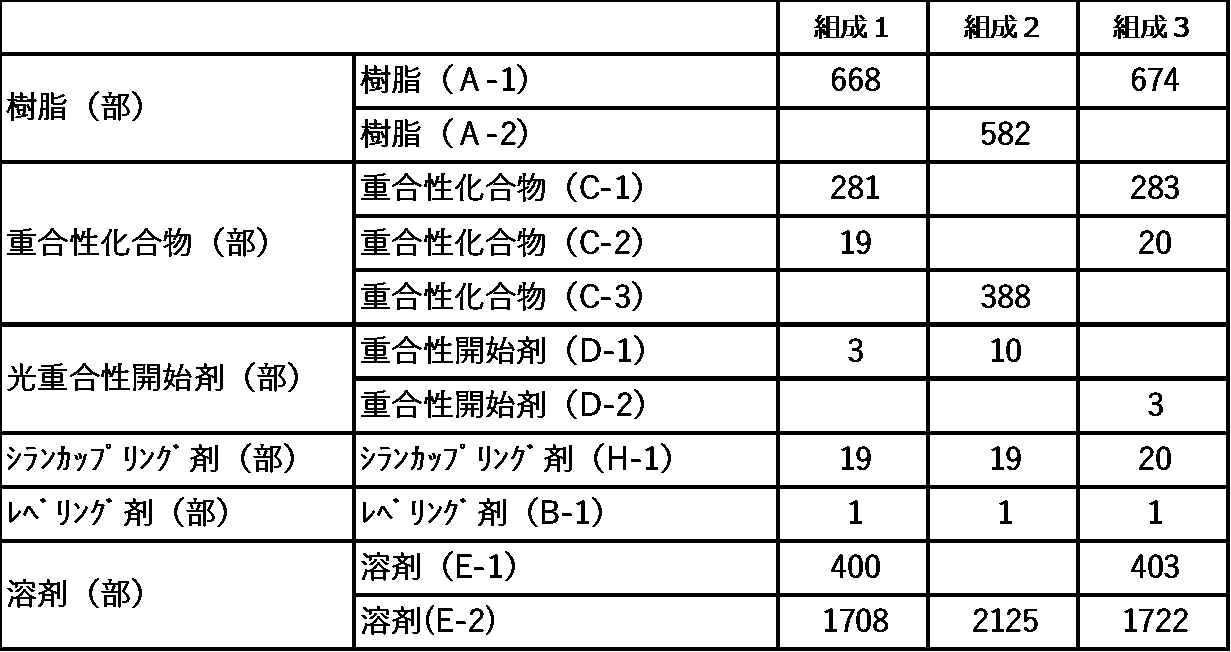
重合性化合物(C-1):フルオレン骨格を有する二官能アクリレート化合物(OGSOL(登録商標)EA-0300:大阪ガスケミカル(株)製
重合性化合物(C-2):A-GLY-3E:新中村化学(株)製(エトキシ化グリセリントリアクリレート)
重合性化合物(C-3):A-DPH-12E:新中村化学(株)製(エトキシ化ジペンタエリスリトールポリアクリレート)
光重合性開始剤(D-1):NCI-930:(株)ADEKA製
光重合性開始剤(D-2):PBG-327:常州強力電子新材料(株)製
シランカップリング剤(H-1):KBM-502:信越化学(株)製
レベリング剤(B-1):ポリエーテル変性シリコーンオイル:商品名トーレシリコーンSH8400:東レダウコーニング(株)製
溶剤(E-1):シクロペンタノン
溶剤(E-2):プロピレングリコールモノメチルエーテルアセテート
<光硬化性樹脂組成物1の測定最小露光量の決定>
(硬化膜の作製)
4インチのガラス基板上に、光硬化性樹脂組成物1をポストベーク後の膜厚が9μmになるようにスピンコート法で塗布した後、60℃で1分間プリベークして光硬化性樹脂組成物層を得た。この光硬化性樹脂組成物層に露光機(TME-150RSK;トプコン(株)製、光源;超高圧水銀灯)を用いて、大気雰囲気下、露光量(365nm基準)を1mJ/cm2~500mJ/cm2の範囲で11水準(1,10,15,20,40,60,100,150,200,300,500)で順次増加させてそれぞれ光照射した。なお、この光照射は、超高圧水銀灯からの放射光を、光学フィルタ(UV-31;旭テクノグラス(株)製)を通過させて行った。光照射後の光硬化性樹脂組成物層を、水酸化テトラメチルアンモニウム2.38%水溶液で、23℃で80秒間浸漬して現像し、水洗後、ホットプレート上、100℃で30分間ポストベークを行うことにより硬化膜を得た。
硬化膜の作製中、現像前後の膜厚(現像後膜厚)を、接触式膜厚測定装置(DEKTAK6M;(株)アルバック製)を用いてそれぞれ測定し、残膜率を、上記式(1)から算出した。露光量が60mJ/cm2では残膜率が95%に達しておらず、露光量が100mJ/cm2で残膜率が初めて95%以上となり、測定最小露光量は100mJ/cm2と測定された。以上に基づいて、露光工程での露光量を、測定最小露光量100mJ/cm2の2.0倍量である200mJ/cm2以上とする場合には、飽和露光量の2.0倍量以上の露光量であることは明らかである。一方で、露光工程での露光量を、60mJ/cm2の2.0倍量である120mJ/cm2以下とする場合には、飽和露光量の2.0倍量以上の露光量との条件を満たさないことは明らかである。
光硬化性樹脂組成物1と同様にして、光硬化性樹脂組成物2,3の測定最小露光量を決定した。それぞれ、100mJ/cm2、600mJ/cm2であった。
4インチのガラス基板上に、光硬化性樹脂組成物1をポストベーク後の膜厚が9μmになるようにスピンコート法で塗布した後、60℃で1分間プリベークして光硬化性樹脂組成物層を得た。この光硬化性樹脂組成物層と石英ガラス製フォトマスクとの間隔を50μmとし、露光機(TME-150RSK;トプコン(株)製、光源;超高圧水銀灯)を用いて、大気雰囲気下、表2に示す露光量(365nm基準)で光照射した。なお、この光照射は、超高圧水銀灯からの放射光を、光学フィルタ(UV-31;旭テクノグラス(株)製)を通過させて行った。また、フォトマスクとしては、縦10μm、横20μmの長方形ドットパターンを形成するためのフォトマスクを用いた。光照射後の光硬化性樹脂組成物層を、水酸化テトラメチルアンモニウム2.38%水溶液で、23℃で80秒間浸漬して現像し、水洗後、ホットプレート上、100℃で30分間ポストベークを行うことにより、長方形ドットパターン(硬化膜)を作製した。
実施例4は光硬化性樹脂組成物2を用いて、実施例5は光硬化性樹脂組成物3を用いて、上記した、実施例1~3および比較例1~3のドットパターンの作製と同様の方法により、表3に示す露光量(365nm基準)で長方形ドットパターン(硬化膜)を作製した。
上記で得られたドットパターンについて、電子顕微鏡(S-4100、日立ハイテク社製)を用いて、任意の長方形ドットの短辺断面を観察した。任意の長方形ドットとガラス基板との界面(ボトム)におけるドット幅W1に対する、ドットの厚み方向の基板面から90%の高さにおけるドット幅W2の比率(W2/W1)で評価を行った。ドットパターンをマイクロレンズアレイとして用いるためには、W2/W1が0.7以下であることが好ましい。
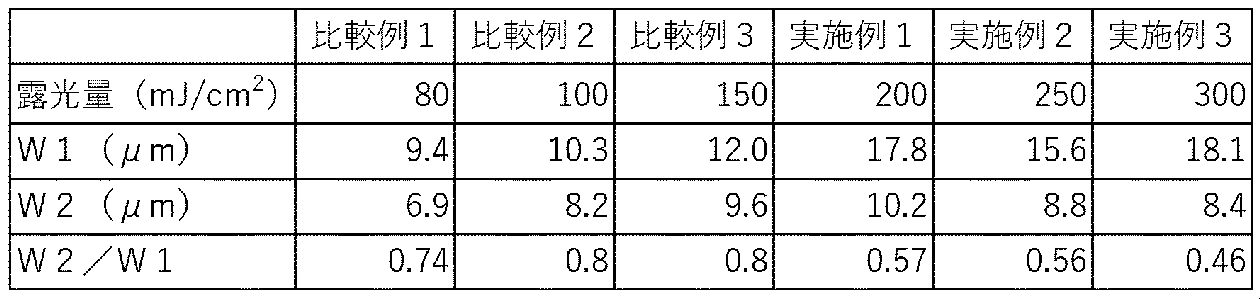
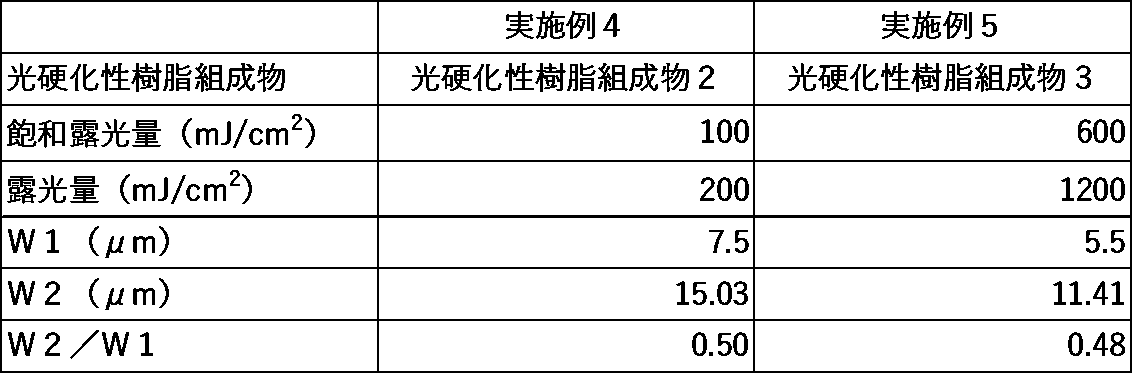
Claims (8)
- 基板の上に光硬化性樹脂組成物の硬化物からなる凸面形状のレンズを製造する方法であって、
前記光硬化性樹脂組成物を前記基板の上に塗布して光硬化性樹脂組成物層を形成する光硬化性樹脂組成物層形成工程と、
前記光硬化性樹脂組成物層を選択的に露光する露光工程と、
前記露光工程の後に、前記光硬化性樹脂組成物層を現像する現像工程と、
を有し、
前記露光工程において、前記光硬化性樹脂組成物層を飽和露光量の2.0倍量以上の露光量で露光する、方法。 - 前記露光工程において、前記光硬化性樹脂組成物層の露光はフォトマスクを介して選択的に行う、請求項1に記載の方法。
- 前記現像工程の後に、さらにポストベーク工程を有する、請求項1または2に記載の方法。
- 前記レンズは、断面視において、前記基板に接するレンズ幅W1に対する、前記レンズの高さの前記基板面から90%の高さにおけるレンズ幅W2の比率(W2/W1)が0.7以下である、請求項1または2に記載の方法。
- 前記レンズ幅W1は100μm以下である、請求項4に記載の方法。
- 前記光硬化性樹脂組成物は、樹脂、重合性化合物、光重合開始剤、及び溶剤を含む、請求項1または2に記載の方法。
- 請求項1または2に記載の製造方法により製造されたレンズ。
- 請求項7に記載のレンズを備える表示装置。
Priority Applications (2)
| Application Number | Priority Date | Filing Date | Title |
|---|---|---|---|
| CN202280081865.8A CN118414561A (zh) | 2021-12-13 | 2022-11-28 | 制造透镜的方法 |
| KR1020247022818A KR20240113969A (ko) | 2021-12-13 | 2022-11-28 | 렌즈를 제조하는 방법 |
Applications Claiming Priority (2)
| Application Number | Priority Date | Filing Date | Title |
|---|---|---|---|
| JP2021201699 | 2021-12-13 | ||
| JP2021-201699 | 2021-12-13 |
Publications (1)
| Publication Number | Publication Date |
|---|---|
| WO2023112650A1 true WO2023112650A1 (ja) | 2023-06-22 |
Family
ID=86774199
Family Applications (1)
| Application Number | Title | Priority Date | Filing Date |
|---|---|---|---|
| PCT/JP2022/043749 Ceased WO2023112650A1 (ja) | 2021-12-13 | 2022-11-28 | レンズを製造する方法 |
Country Status (5)
| Country | Link |
|---|---|
| JP (1) | JP2023087657A (ja) |
| KR (1) | KR20240113969A (ja) |
| CN (1) | CN118414561A (ja) |
| TW (1) | TW202323862A (ja) |
| WO (1) | WO2023112650A1 (ja) |
Families Citing this family (1)
| Publication number | Priority date | Publication date | Assignee | Title |
|---|---|---|---|---|
| WO2026116422A1 (ja) * | 2024-11-28 | 2026-06-04 | 大阪有機化学工業株式会社 | 硬化性樹脂組成物、及び硬化物 |
Citations (5)
| Publication number | Priority date | Publication date | Assignee | Title |
|---|---|---|---|---|
| JPH01263601A (ja) * | 1988-04-15 | 1989-10-20 | Dainippon Printing Co Ltd | マイクロ集光レンズの形成方法 |
| WO2006064670A1 (ja) * | 2004-12-15 | 2006-06-22 | Sharp Kabushiki Kaisha | 表示パネルの製造方法および表示パネルの製造装置 |
| JP2008310044A (ja) * | 2007-06-14 | 2008-12-25 | Jsr Corp | 感放射線性樹脂組成物、層間絶縁膜およびマイクロレンズならびにそれらの形成方法 |
| JP2011170176A (ja) * | 2010-02-19 | 2011-09-01 | Toppan Printing Co Ltd | ウエハレベルレンズモジュールの製造方法 |
| US20120038880A1 (en) * | 2010-08-11 | 2012-02-16 | Bernhard Seiferling | Modulated uv cure |
Family Cites Families (1)
| Publication number | Priority date | Publication date | Assignee | Title |
|---|---|---|---|---|
| JP4977929B2 (ja) | 2001-01-12 | 2012-07-18 | ソニー株式会社 | マイクロレンズの形成方法 |
-
2022
- 2022-11-28 WO PCT/JP2022/043749 patent/WO2023112650A1/ja not_active Ceased
- 2022-11-28 CN CN202280081865.8A patent/CN118414561A/zh active Pending
- 2022-11-28 KR KR1020247022818A patent/KR20240113969A/ko active Pending
- 2022-11-28 JP JP2022189234A patent/JP2023087657A/ja active Pending
- 2022-12-01 TW TW111146199A patent/TW202323862A/zh unknown
Patent Citations (5)
| Publication number | Priority date | Publication date | Assignee | Title |
|---|---|---|---|---|
| JPH01263601A (ja) * | 1988-04-15 | 1989-10-20 | Dainippon Printing Co Ltd | マイクロ集光レンズの形成方法 |
| WO2006064670A1 (ja) * | 2004-12-15 | 2006-06-22 | Sharp Kabushiki Kaisha | 表示パネルの製造方法および表示パネルの製造装置 |
| JP2008310044A (ja) * | 2007-06-14 | 2008-12-25 | Jsr Corp | 感放射線性樹脂組成物、層間絶縁膜およびマイクロレンズならびにそれらの形成方法 |
| JP2011170176A (ja) * | 2010-02-19 | 2011-09-01 | Toppan Printing Co Ltd | ウエハレベルレンズモジュールの製造方法 |
| US20120038880A1 (en) * | 2010-08-11 | 2012-02-16 | Bernhard Seiferling | Modulated uv cure |
Also Published As
| Publication number | Publication date |
|---|---|
| CN118414561A (zh) | 2024-07-30 |
| KR20240113969A (ko) | 2024-07-23 |
| TW202323862A (zh) | 2023-06-16 |
| JP2023087657A (ja) | 2023-06-23 |
Similar Documents
| Publication | Publication Date | Title |
|---|---|---|
| CN103631090B (zh) | 感光性树脂组合物 | |
| CN108459468B (zh) | 树脂组合物及固化膜 | |
| TWI738750B (zh) | 硬化性樹脂組成物及硬化膜 | |
| JP2021073366A (ja) | 樹脂組成物及び硬化膜 | |
| JP7105562B2 (ja) | 液晶表示装置用樹脂組成物、液晶表示装置用膜及び共重合体 | |
| JP7046638B2 (ja) | 樹脂組成物、膜及び共重合体 | |
| CN102967994B (zh) | 固化性树脂组合物 | |
| JP2023103974A (ja) | 樹脂組成物、膜、及び表示装置 | |
| WO2022210268A1 (ja) | 樹脂組成物、膜及び共重合体 | |
| CN103116244B (zh) | 固化性树脂组合物 | |
| JP2023087657A (ja) | レンズを製造する方法 | |
| JP2020164800A (ja) | 硬化性樹脂組成物及び硬化膜 | |
| KR102455993B1 (ko) | 착색 감광성 수지 조성물 |
Legal Events
| Date | Code | Title | Description |
|---|---|---|---|
| 121 | Ep: the epo has been informed by wipo that ep was designated in this application |
Ref document number: 22907180 Country of ref document: EP Kind code of ref document: A1 |
|
| WWE | Wipo information: entry into national phase |
Ref document number: 202280081865.8 Country of ref document: CN |
|
| ENP | Entry into the national phase |
Ref document number: 20247022818 Country of ref document: KR Kind code of ref document: A |
|
| NENP | Non-entry into the national phase |
Ref country code: DE |
|
| 122 | Ep: pct application non-entry in european phase |
Ref document number: 22907180 Country of ref document: EP Kind code of ref document: A1 |