WO2023112121A1 - キャンセル装置、方法及びプログラム - Google Patents
キャンセル装置、方法及びプログラム Download PDFInfo
- Publication number
- WO2023112121A1 WO2023112121A1 PCT/JP2021/045963 JP2021045963W WO2023112121A1 WO 2023112121 A1 WO2023112121 A1 WO 2023112121A1 JP 2021045963 W JP2021045963 W JP 2021045963W WO 2023112121 A1 WO2023112121 A1 WO 2023112121A1
- Authority
- WO
- WIPO (PCT)
- Prior art keywords
- canceling
- sound
- speaker
- directivity
- noise
- Prior art date
- Legal status (The legal status is an assumption and is not a legal conclusion. Google has not performed a legal analysis and makes no representation as to the accuracy of the status listed.)
- Ceased
Links
Images

Classifications
-
- G—PHYSICS
- G10—MUSICAL INSTRUMENTS; ACOUSTICS
- G10K—SOUND-PRODUCING DEVICES; METHODS OR DEVICES FOR PROTECTING AGAINST, OR FOR DAMPING, NOISE OR OTHER ACOUSTIC WAVES IN GENERAL; ACOUSTICS NOT OTHERWISE PROVIDED FOR
- G10K11/00—Methods or devices for transmitting, conducting or directing sound in general; Methods or devices for protecting against, or for damping, noise or other acoustic waves in general
- G10K11/16—Methods or devices for protecting against, or for damping, noise or other acoustic waves in general
- G10K11/175—Methods or devices for protecting against, or for damping, noise or other acoustic waves in general using interference effects; Masking sound
- G10K11/178—Methods or devices for protecting against, or for damping, noise or other acoustic waves in general using interference effects; Masking sound by electro-acoustically regenerating the original acoustic waves in anti-phase
- G10K11/1785—Methods, e.g. algorithms; Devices
- G10K11/17857—Geometric disposition, e.g. placement of microphones
-
- G—PHYSICS
- G10—MUSICAL INSTRUMENTS; ACOUSTICS
- G10K—SOUND-PRODUCING DEVICES; METHODS OR DEVICES FOR PROTECTING AGAINST, OR FOR DAMPING, NOISE OR OTHER ACOUSTIC WAVES IN GENERAL; ACOUSTICS NOT OTHERWISE PROVIDED FOR
- G10K11/00—Methods or devices for transmitting, conducting or directing sound in general; Methods or devices for protecting against, or for damping, noise or other acoustic waves in general
- G10K11/16—Methods or devices for protecting against, or for damping, noise or other acoustic waves in general
- G10K11/175—Methods or devices for protecting against, or for damping, noise or other acoustic waves in general using interference effects; Masking sound
- G10K11/178—Methods or devices for protecting against, or for damping, noise or other acoustic waves in general using interference effects; Masking sound by electro-acoustically regenerating the original acoustic waves in anti-phase
- G10K11/1785—Methods, e.g. algorithms; Devices
- G10K11/17853—Methods, e.g. algorithms; Devices of the filter
- G10K11/17854—Methods, e.g. algorithms; Devices of the filter the filter being an adaptive filter
-
- G—PHYSICS
- G10—MUSICAL INSTRUMENTS; ACOUSTICS
- G10K—SOUND-PRODUCING DEVICES; METHODS OR DEVICES FOR PROTECTING AGAINST, OR FOR DAMPING, NOISE OR OTHER ACOUSTIC WAVES IN GENERAL; ACOUSTICS NOT OTHERWISE PROVIDED FOR
- G10K11/00—Methods or devices for transmitting, conducting or directing sound in general; Methods or devices for protecting against, or for damping, noise or other acoustic waves in general
- G10K11/16—Methods or devices for protecting against, or for damping, noise or other acoustic waves in general
- G10K11/175—Methods or devices for protecting against, or for damping, noise or other acoustic waves in general using interference effects; Masking sound
- G10K11/178—Methods or devices for protecting against, or for damping, noise or other acoustic waves in general using interference effects; Masking sound by electro-acoustically regenerating the original acoustic waves in anti-phase
- G10K11/1787—General system configurations
- G10K11/17879—General system configurations using both a reference signal and an error signal
- G10K11/17881—General system configurations using both a reference signal and an error signal the reference signal being an acoustic signal, e.g. recorded with a microphone
-
- H—ELECTRICITY
- H04—ELECTRIC COMMUNICATION TECHNIQUE
- H04R—LOUDSPEAKERS, MICROPHONES, GRAMOPHONE PICK-UPS OR LIKE ACOUSTIC ELECTROMECHANICAL TRANSDUCERS; ELECTRIC HEARING AIDS; PUBLIC ADDRESS SYSTEMS
- H04R3/00—Circuits for transducers
-
- G—PHYSICS
- G10—MUSICAL INSTRUMENTS; ACOUSTICS
- G10K—SOUND-PRODUCING DEVICES; METHODS OR DEVICES FOR PROTECTING AGAINST, OR FOR DAMPING, NOISE OR OTHER ACOUSTIC WAVES IN GENERAL; ACOUSTICS NOT OTHERWISE PROVIDED FOR
- G10K2210/00—Details of active noise control [ANC] covered by G10K11/178 but not provided for in any of its subgroups
- G10K2210/10—Applications
- G10K2210/111—Directivity control or beam pattern
-
- G—PHYSICS
- G10—MUSICAL INSTRUMENTS; ACOUSTICS
- G10K—SOUND-PRODUCING DEVICES; METHODS OR DEVICES FOR PROTECTING AGAINST, OR FOR DAMPING, NOISE OR OTHER ACOUSTIC WAVES IN GENERAL; ACOUSTICS NOT OTHERWISE PROVIDED FOR
- G10K2210/00—Details of active noise control [ANC] covered by G10K11/178 but not provided for in any of its subgroups
- G10K2210/10—Applications
- G10K2210/128—Vehicles
- G10K2210/1282—Automobiles
Definitions
- the present invention relates to technology for suppressing noise in a predetermined area.
- FIG. 1 A conventional configuration of active noise suppression (feedforward type) using a canceling speaker is shown in FIG. 1
- the conventional configuration consists of a reference microphone P1 that acquires external noise, an ANC processor P2 that estimates how the noise acquired from the reference microphone changes at the position of the error microphone, and a sound that suppresses the noise. It has a canceling speaker P3 and an error microphone P4 that monitors the noise suppression state and feeds it back to the ANC processor P2.
- the error microphone P4 is placed in the area PR where noise should be suppressed.
- An enclosure speaker is used as the canceling speaker P3.
- active noise suppression In passive noise suppression, the effect of broadband noise suppression is low. Therefore, active noise suppression (feedforward type) is effective for wideband noise suppression.
- An object of the present invention is to provide a cancellation device, method, and program with higher noise suppression performance than conventional ones.
- a canceling device includes a sound signal processing unit that generates a canceling signal for suppressing noise acquired by one or more reference microphones for acquiring noise; and one or more canceling speakers that emit noise, wherein the sound signal processing unit generates a canceling signal based on sound signals obtained by one or more error microphones arranged in a region where noise is desired to be suppressed. and one or more reference microphones are directional and placed near the canceling loudspeaker.
- the noise suppression performance can be higher than before while achieving stable operation.
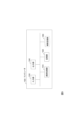
- FIG. 1 is a diagram showing an example of the functional configuration of a canceling device.
- FIG. 2 is a diagram showing an example of the processing procedure of the cancellation method.
- FIG. 3 is a diagram for explaining an enclosureless speaker.
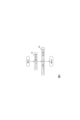
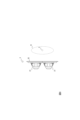
- FIG. 4 is a perspective view of an example enclosureless speaker.
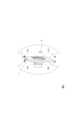
- FIG. 5 is a front view of an example enclosureless speaker.
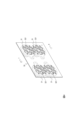
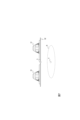
- FIG. 6 is a left side view of an example enclosureless speaker.
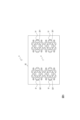
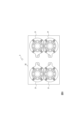
- FIG. 7 is a plan view of an example enclosureless speaker.
- FIG. 8 is a rear view of an example enclosureless speaker.
- FIG. 9 is a diagram illustrating a functional configuration example of a computer.
- FIG. 10 is a diagram for explaining the background art.
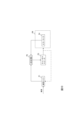
- the canceling device includes a sound signal processor 2 and one or more canceling speakers 3, as shown in FIG.
- the cancellation device may further comprise one or more reference microphones 1 , one or more error microphones 4 and a directivity controller 5 .
- FIG. 1 two or more reference microphones 1, two or more cancellation speakers 3, and two or more error microphones 4 are depicted. However, each of the number of reference microphones 1, the number of cancellation speakers 3, and the number of error microphones 4 may be one.
- the canceling method is realized, for example, by each component of the canceling device performing the processing of steps S1 and S2 shown in FIG. 2, which will be described below.
- a reference microphone 1 is a microphone for acquiring noise.
- a noise signal which is a noise signal acquired by the reference microphone 1 , is output to the sound signal processing unit 2 .
- the reference microphone 1 has directivity and is arranged near the cancellation speaker 3 .
- the directivity of the reference microphone 1 is realized, for example, by the processing of the directivity control unit 5, which will be described later.
- the directivity of the reference microphone 1 may be realized by the function of the reference microphone 1 itself.
- the word "has directivity” includes the case where the microphone as a whole has directivity by applying signal processing to the signal obtained by picking up sound with multiple omnidirectional microphones, and the case where the microphone itself has directivity. It is assumed that two types of characteristics are included, one is the case of using one with directivity as a characteristic of . Note that the directivity type of the reference microphone 1 is not limited to these two types.
- the sound signal processing unit 2 generates a cancellation signal for suppressing noise acquired by one or more reference microphones 1 (step S1).
- the generated cancel signal is output to the cancel speaker 3 .
- the sound signal processing unit 2 corresponds to the ANC processing unit P2 of the background art. That is, it can be said that the sound signal processing unit 2 performs processing for estimating how the noise acquired by the reference microphone 1 changes at the position of the error microphone 4 .
- the sound signal processing unit 2 generates a cancellation signal for suppressing noise based on sound signals obtained by one or more error microphones 4 .
- the cancel speaker 3 emits sound based on the cancel signal (step S2).
- the canceling speaker 3 may be an enclosureless speaker, or may be an enclosure speaker as in the background art. Enclosureless speakers will be described later.
- the error microphone 4 is a microphone placed in a region R where noise suppression is desired. A sound signal obtained by the error microphone is output to the sound signal processing unit 2 .
- the area around the person's head becomes the area R where you want to suppress noise.
- a sound signal which is a sound signal acquired by the reference microphone 1 , is input to the sound signal processing section 2 .
- a noise signal may be included in the sound signal.
- the directivity control unit 5 controls the directivity of the reference microphone 1 based on the sound signal acquired by the reference microphone 1, for example, as described later in [Directivity of the reference microphone 1].
- a control signal for filtering that controls the directivity of the sound signal acquired by each reference microphone 1 is generated and output to the sound signal processing unit 2. do.
- the sound signal processing unit 2 filters the sound signal acquired by each reference microphone 1 based on the control signal.
- the sound signal processing unit 2 performs the above sound signal processing on the filtered signal.
- the directivity of the reference microphones 1 is controlled by the directivity control unit 5 in this way, for example.
- the directivity control unit 5 may be able to control the directivity of the reference microphones 1 by physically changing the direction and position of the reference microphones 1 .
- the directivity control unit 5 may be capable of estimating the direction of arrival of the sound signal.
- the reference microphone 1 When the error microphone 4 and the reference microphone 1 are placed close to each other, the reference microphone 1 is placed near the canceling speaker 3 to give directivity to the reference microphone 1, so that the sound emitted by the canceling speaker 3 is the reference microphone. It becomes difficult to enter 1. For this reason, howling can be suppressed, and noise suppression performance can be improved more than before while realizing stable operation.
- the reference microphone 1 is set to have directivity in the direction in which the sound coming from the canceling speaker 3 is weaker than in the direction in which the sound coming from the canceling speaker is large.
- This directivity setting is realized by control of the directivity control unit 5, for example.
- the intensity of the sound emitted by the canceling speaker 3 captured by the reference microphone 1 when the directivity of the reference microphone 1 is directed in each direction is measured.
- the directivity of the reference microphone 1 is set so that the direction in which the strength of the sound emitted by the canceling speaker 3 captured by the reference microphone 1 is the greatest is null.
- the directivity of the reference microphone 1 may be set so that the entire direction in which the strength of the sound emitted by the canceling speaker 3 captured by the reference microphone 1 is equal to or greater than a predetermined threshold is null.
- a reference microphone 1 is arranged on the plane on which the diaphragm of the enclosureless speaker is arranged, and a reference microphone 1 is arranged in a direction parallel to the plane. It is preferable to set the reference microphone 1 so that it is directional to the outside.
- the number of canceling speakers 3 is two or more, there may be multiple directions in which the sound emitted by the canceling speakers 3 picked up by the reference microphone 1 becomes stronger. In this case, for example, setting the directivity of the reference microphone 1 as described above is highly effective.
- the reference microphone 1 is set to have directivity in the direction from which the noise arrives.
- These directivity settings are realized by control of the directivity control unit 5, for example.
- N be a positive integer of 2 or more
- K be an integer greater than 1 and less than N
- the number of reference microphones 1 is N.
- the part of the reference microphones 1 is the K reference microphones 1 among the N reference microphones 1
- the other part of the reference microphones 1 is the reference microphones 1 among the N reference microphones 1.
- N-K reference microphones 1 that are not part of microphone 1;
- the directivity of all or part of the reference microphone 1 is set so that the direction in which the strength of the sound emitted by the canceling speaker 3 caught by all or part of the reference microphone 1 becomes null. Even if the directivity of all or part of the reference microphone 1 is set so that the entire direction in which the strength of the sound emitted by the canceling speaker 3 captured by all or part of the reference microphone 1 is equal to or greater than a predetermined threshold value is null, good.
- the other part of the reference microphone 1 may be set to have directivity in the direction from which the noise arrives.
- the other part of the reference microphone 1 when the directivity of the other part of the reference microphone 1 is directed in each direction may measure the strength of the noise captured by Then, the directivity of the other part of the reference microphone 1 may be set so as to have directivity in the direction in which the intensity of noise captured by the other part of the reference microphone 1 is the highest, in other words, in the direction in which the noise arrives.
- the following method (1) or (2) can be used.
- the directivity of the reference microphone 1 may be preset before the cancellation device and method are used, or dynamically set when the cancellation device and method are used.
- the directivity control section 5 may dynamically control the directivity of the reference microphone 1 .
- the directivity control unit 5 estimates the direction of arrival of the sound emitted by the canceling speaker 3 in real time, and adjusts all or part of the directivity of the reference microphone 1 so that the estimated direction of arrival is null. Directivity may be set.
- the directivity control unit 5 may estimate the direction of arrival of noise in real time and set the directivity of the other part of the reference microphone 1 so as to have directivity in the estimated direction of arrival.
- An enclosureless speaker is, for example, a speaker in which a null directional characteristic is formed on the same plane as the diaphragm by not including a housing.
- the positive pressure emitted to the front of the enclosureless speaker and the back pressure emitted from the back of the enclosureless speaker cancel each other out at a position on the same plane as the diaphragm of the enclosureless speaker. . Therefore, the sound emitted by the enclosureless speaker is reduced near the position on the same plane as the diaphragm of the enclosureless speaker.
- An example of the vicinity of the canceling speaker where the reference microphone 1 is arranged is a position on the same plane as the diaphragm of the enclosureless speaker or a position near that position.
- This enclosureless speaker comprises a speaker 31 and a fixing plate 32, as shown in FIGS.
- FIG. 4 is a perspective view of an example of an enclosureless speaker.
- FIG. 5 is a front view of an example enclosureless speaker.
- FIG. 6 is a left side view of an example enclosureless speaker.
- FIG. 7 is a plan view of an example enclosureless speaker.
- FIG. 8 is a rear view of an example enclosureless speaker.
- the fixing plate 32 is made of aluminum, for example.
- a sound emitting hole 321 is provided in the fixed plate 32 .
- Four speakers 31 are attached to the position of the sound emission hole 321 of the fixing plate 32 .
- At least two speakers 31 are required.
- a plurality of speakers 31 are installed on the same plane.
- the plurality of speakers 31 are on the same plane and are spread evenly in a grid pattern, honeycomb pattern, or the like.
- each sound emission hole 321 is composed of seven holes.
- the speaker 31 is attached so that the center of the hole in the center of these seven holes and the center of the speaker 31 are aligned.
- the speaker 31 is screwed to the fixing plate 32. As shown in FIG.
- the sound emitting holes 321 By arranging the sound emitting holes 321 in a highly symmetrical arrangement with respect to the center of the speaker 31, the generated sound field becomes more uniform, which is more preferable from the viewpoint of sound quality.
- the arrangement of the holes is not limited to this example.
- the sound emission holes 321 do not have to be arranged in completely symmetrical positions with respect to the center of the speaker 31 .
- the sound emitting holes 321 may be configured by arranging six holes (one in the center and five in the periphery) in a star shape.
- the relationship between the sound emitting hole 321 and the speaker 31 is not particularly limited, but the sound emitting hole 321 is provided at a position close to the speaker 31, for example.
- the number and arrangement of the sound emission holes 321 and the speakers 31 are not limited to those described above.
- the reference microphone 1 is positioned symmetrically with respect to the + and - sound fields generated by the speaker 31 .
- a symmetrical position can be any position as long as it is on the same plane as described above, but it is even better if it is a position where it is possible to record the sound that comes directly from the noise (without colliding with or reflecting from various objects on the way). .
- the reference microphone 1 is arranged above the center of the fixing plate 32 .
- the reference microphone 1 is supported by an extension extending from the fixed plate 32, for example. 4 to 8 do not describe the elongated body.
- the reference microphone 1 is arranged on the same plane as the speaker 31. It can be said that this plane includes the boundary between the sound emitting direction of the speaker 31 and the direction opposite to the sound emitting direction.
- the reference microphone 1 does not have to be placed above the speaker 31 as long as it is placed on the same plane as the speaker 31 .
- the reference microphone 1 may be arranged beside the fixed plate 32 .
- data may be exchanged between the components of the canceling device directly or via a storage unit (not shown).
- a program that describes this process can be recorded on a computer-readable recording medium.
- a computer-readable recording medium is, for example, a non-temporary recording medium, specifically a magnetic recording device, an optical disc, or the like.
- this program will be carried out, for example, by selling, transferring, lending, etc. portable recording media such as DVDs and CD-ROMs on which the program is recorded.
- the program may be distributed by storing the program in the storage device of the server computer and transferring the program from the server computer to other computers via the network.
- a computer that executes such a program for example, first stores a program recorded on a portable recording medium or a program transferred from a server computer once in the auxiliary recording unit 1050, which is its own non-temporary storage device. Store. When executing the process, this computer reads the program stored in the auxiliary recording section 1050, which is its own non-temporary storage device, into the storage section 1020, and executes the process according to the read program. As another execution form of this program, the computer may read the program directly from the portable recording medium into the storage unit 1020 and execute processing according to the program. It is also possible to execute processing in accordance with the received program each time the is transferred.
- ASP Application Service Provider
- the above-mentioned processing is executed by a so-called ASP (Application Service Provider) type service, which does not transfer the program from the server computer to this computer, and realizes the processing function only by its execution instruction and result acquisition.
- ASP Application Service Provider
- the program in this embodiment includes information used for processing by a computer and conforming to the program (data that is not a direct command to the computer but has the property of prescribing the processing of the computer, etc.).
- the device is configured by executing a predetermined program on a computer, but at least part of these processing contents may be implemented by hardware.
Landscapes
- Physics & Mathematics (AREA)
- Engineering & Computer Science (AREA)
- Acoustics & Sound (AREA)
- Multimedia (AREA)
- Signal Processing (AREA)
- Soundproofing, Sound Blocking, And Sound Damping (AREA)
Priority Applications (3)
| Application Number | Priority Date | Filing Date | Title |
|---|---|---|---|
| US18/717,992 US20250046291A1 (en) | 2021-12-14 | 2021-12-14 | Cancellation apparatus, method and program |
| JP2023567311A JPWO2023112121A1 (cg-RX-API-DMAC7.html) | 2021-12-14 | 2021-12-14 | |
| PCT/JP2021/045963 WO2023112121A1 (ja) | 2021-12-14 | 2021-12-14 | キャンセル装置、方法及びプログラム |
Applications Claiming Priority (1)
| Application Number | Priority Date | Filing Date | Title |
|---|---|---|---|
| PCT/JP2021/045963 WO2023112121A1 (ja) | 2021-12-14 | 2021-12-14 | キャンセル装置、方法及びプログラム |
Publications (1)
| Publication Number | Publication Date |
|---|---|
| WO2023112121A1 true WO2023112121A1 (ja) | 2023-06-22 |
Family
ID=86774069
Family Applications (1)
| Application Number | Title | Priority Date | Filing Date |
|---|---|---|---|
| PCT/JP2021/045963 Ceased WO2023112121A1 (ja) | 2021-12-14 | 2021-12-14 | キャンセル装置、方法及びプログラム |
Country Status (3)
| Country | Link |
|---|---|
| US (1) | US20250046291A1 (cg-RX-API-DMAC7.html) |
| JP (1) | JPWO2023112121A1 (cg-RX-API-DMAC7.html) |
| WO (1) | WO2023112121A1 (cg-RX-API-DMAC7.html) |
Citations (4)
| Publication number | Priority date | Publication date | Assignee | Title |
|---|---|---|---|---|
| JPH02224498A (ja) * | 1989-02-25 | 1990-09-06 | Calsonic Corp | アクティブ・ノイズ・キャンセラー |
| JPH1011072A (ja) * | 1996-06-24 | 1998-01-16 | Matsushita Electric Ind Co Ltd | 騒音制御装置 |
| JP2010045574A (ja) * | 2008-08-12 | 2010-02-25 | Sony Corp | ハンズフリー通話装置、ハンズフリー通話機能付き音響再生装置、ハンズフリー通話方法 |
| WO2020162271A1 (ja) * | 2019-02-05 | 2020-08-13 | ソニー株式会社 | スピーカユニットおよび音響システム |
Family Cites Families (4)
| Publication number | Priority date | Publication date | Assignee | Title |
|---|---|---|---|---|
| JP2006097350A (ja) * | 2004-09-29 | 2006-04-13 | Mitsubishi Heavy Ind Ltd | 消音装置、遮音壁及び消音方法 |
| JP4722878B2 (ja) * | 2007-04-19 | 2011-07-13 | ソニー株式会社 | ノイズ低減装置および音響再生装置 |
| JP6579924B2 (ja) * | 2015-11-13 | 2019-09-25 | 三菱日立パワーシステムズ株式会社 | 煙突騒音低減システム及び煙突騒音低減システムの設定方法 |
| WO2017136386A1 (en) * | 2016-02-05 | 2017-08-10 | 3M Innovative Properties Company | Hearing protection device |
-
2021
- 2021-12-14 JP JP2023567311A patent/JPWO2023112121A1/ja active Pending
- 2021-12-14 US US18/717,992 patent/US20250046291A1/en active Pending
- 2021-12-14 WO PCT/JP2021/045963 patent/WO2023112121A1/ja not_active Ceased
Patent Citations (4)
| Publication number | Priority date | Publication date | Assignee | Title |
|---|---|---|---|---|
| JPH02224498A (ja) * | 1989-02-25 | 1990-09-06 | Calsonic Corp | アクティブ・ノイズ・キャンセラー |
| JPH1011072A (ja) * | 1996-06-24 | 1998-01-16 | Matsushita Electric Ind Co Ltd | 騒音制御装置 |
| JP2010045574A (ja) * | 2008-08-12 | 2010-02-25 | Sony Corp | ハンズフリー通話装置、ハンズフリー通話機能付き音響再生装置、ハンズフリー通話方法 |
| WO2020162271A1 (ja) * | 2019-02-05 | 2020-08-13 | ソニー株式会社 | スピーカユニットおよび音響システム |
Also Published As
| Publication number | Publication date |
|---|---|
| JPWO2023112121A1 (cg-RX-API-DMAC7.html) | 2023-06-22 |
| US20250046291A1 (en) | 2025-02-06 |
Similar Documents
| Publication | Publication Date | Title |
|---|---|---|
| US20180190259A1 (en) | Arrangements and methods for active noise cancelling | |
| CN101242677B (zh) | 耳机设备、声音再现系统和声音再现方法 | |
| US12382220B2 (en) | Dynamic control of multiple feedforward microphones in active noise reduction devices | |
| US11062688B2 (en) | Placement of multiple feedforward microphones in an active noise reduction (ANR) system | |
| CN114080638B (zh) | 具有多个前馈麦克风的anr系统中的增益调整 | |
| US11721314B2 (en) | Methods and systems for modifying acoustics of a loudspeaker back enclosure using active noise control | |
| CN115474121A (zh) | 主动降噪方法、装置、芯片、耳机及存储介质 | |
| US10665220B1 (en) | Active noise reduction (ANR) system with multiple feedforward microphones and multiple controllers | |
| US11523215B2 (en) | Method and system for using single adaptive filter for echo and point noise cancellation | |
| JP2016213820A (ja) | ヘッドホンにおける能動ノイズ低減 | |
| JP7675989B2 (ja) | 生成装置、生成方法、およびプログラム | |
| KR101796768B1 (ko) | 능동 소음 제어를 이용한 소음 저감 장치 및 방법 | |
| US11172288B1 (en) | Methods and systems for modifying acoustics of a loudspeaker back enclosure using active noise control | |
| US20250046291A1 (en) | Cancellation apparatus, method and program | |
| JP2025118778A (ja) | アクティブノイズ低減デバイスのための計算アーキテクチャ | |
| KR20220043171A (ko) | 귓속형 마이크로폰 어레이들을 위한 부분적인 hrtf 보상 또는 예측 | |
| KR20230118008A (ko) | 음향 변환 장치 | |
| Fukui et al. | A seat headrest loudspeaker system with personalized sound zone capabilities | |
| JP7709142B2 (ja) | 生成装置、生成方法、およびプログラム | |
| WO2026100519A1 (ja) | 放音装置 | |
| JP2024117875A (ja) | 生成装置、生成方法、およびプログラム | |
| KR20250104447A (ko) | 액티브 노이즈 캔슬링을 수행하기 위한 전자 장치 및 그 제어 방법 | |
| KR20240065424A (ko) | 주변 소리 듣기 기능을 지닌 무선 음향 변환 장치 | |
| CN114257921A (zh) | 拾音方法及装置、计算机可读存储介质及耳机 |
Legal Events
| Date | Code | Title | Description |
|---|---|---|---|
| 121 | Ep: the epo has been informed by wipo that ep was designated in this application |
Ref document number: 21968042 Country of ref document: EP Kind code of ref document: A1 |
|
| ENP | Entry into the national phase |
Ref document number: 2023567311 Country of ref document: JP Kind code of ref document: A |
|
| WWE | Wipo information: entry into national phase |
Ref document number: 18717992 Country of ref document: US |
|
| NENP | Non-entry into the national phase |
Ref country code: DE |
|
| 122 | Ep: pct application non-entry in european phase |
Ref document number: 21968042 Country of ref document: EP Kind code of ref document: A1 |