WO2023100603A1 - チタン材料 - Google Patents
チタン材料 Download PDFInfo
- Publication number
- WO2023100603A1 WO2023100603A1 PCT/JP2022/041563 JP2022041563W WO2023100603A1 WO 2023100603 A1 WO2023100603 A1 WO 2023100603A1 JP 2022041563 W JP2022041563 W JP 2022041563W WO 2023100603 A1 WO2023100603 A1 WO 2023100603A1
- Authority
- WO
- WIPO (PCT)
- Prior art keywords
- titanium
- titanium material
- mass
- less
- content
- Prior art date
- Legal status (The legal status is an assumption and is not a legal conclusion. Google has not performed a legal analysis and makes no representation as to the accuracy of the status listed.)
- Ceased
Links
Images


Classifications
-
- C—CHEMISTRY; METALLURGY
- C22—METALLURGY; FERROUS OR NON-FERROUS ALLOYS; TREATMENT OF ALLOYS OR NON-FERROUS METALS
- C22C—ALLOYS
- C22C14/00—Alloys based on titanium
-
- C—CHEMISTRY; METALLURGY
- C22—METALLURGY; FERROUS OR NON-FERROUS ALLOYS; TREATMENT OF ALLOYS OR NON-FERROUS METALS
- C22F—CHANGING THE PHYSICAL STRUCTURE OF NON-FERROUS METALS AND NON-FERROUS ALLOYS
- C22F1/00—Changing the physical structure of non-ferrous metals or alloys by heat treatment or by hot or cold working
- C22F1/16—Changing the physical structure of non-ferrous metals or alloys by heat treatment or by hot or cold working of other metals or alloys based thereon
- C22F1/18—High-melting or refractory metals or alloys based thereon
- C22F1/183—High-melting or refractory metals or alloys based thereon of titanium or alloys based thereon
-
- C—CHEMISTRY; METALLURGY
- C22—METALLURGY; FERROUS OR NON-FERROUS ALLOYS; TREATMENT OF ALLOYS OR NON-FERROUS METALS
- C22C—ALLOYS
- C22C1/00—Making non-ferrous alloys
- C22C1/04—Making non-ferrous alloys by powder metallurgy
- C22C1/045—Alloys based on refractory metals
- C22C1/0458—Alloys based on titanium, zirconium or hafnium
Definitions
- titanium materials Due to its high specific strength, titanium materials have been used in fields such as the aerospace and automotive industries. In addition, due to its excellent biocompatibility, it is also in increasing demand as a biomedical material for dental implants and the like.
- Patent Document 1 discloses, as a titanium material having high strength, a titanium material in which ⁇ phase and ⁇ phase are mixed at normal temperature and normal pressure.
- the titanium material of the present disclosure is A titanium material containing 91% by mass or more of titanium,
- the tensile strength ⁇ BMPa and the breaking elongation ⁇ % of the titanium material show the relationship of the following formula I, ⁇ B ⁇ 1600 ⁇ 30 ⁇ Formula I A titanium material that satisfies ⁇ B ⁇ 400 and ⁇ 20 in Formula I above.
- FIG. 1 is a coordinate system showing the relationship between strength and ductility of a conventional titanium material and the titanium material of Embodiment 1.
- FIG. FIG. 2 is an example of an optical microscope image of the titanium material of this embodiment.
- FIG. 3 is a temperature-pressure phase diagram of titanium.
- FIG. 4 is an example of an X-ray diffraction pattern obtained by irradiating a titanium material with X-rays.
- FIG. 5 is a coordinate system showing the relationship between the 0.2% proof stress in the tensile test of the conventional titanium material and the titanium material of Embodiment 2 and the content of components other than titanium in the titanium material.
- FIG. 1 is a coordinate system showing the relationship between strength and ductility of a conventional titanium material and the titanium material of Embodiment 1.
- FIG. 2 is an example of an optical microscope image of the titanium material of this embodiment.
- FIG. 3 is a temperature-pressure phase diagram of titanium.
- FIG. 4 is an example of an X-ray diffraction pattern
- FIG. 6 is a coordinate system showing the relationship between the tensile strength of the conventional titanium material and the titanium material of Embodiment 3 and the content of components other than titanium in the titanium material.
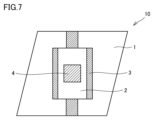
- FIG. 7 is a schematic cross-sectional view of a high-pressure cell of an ultrahigh-pressure and high-temperature generator used for manufacturing the titanium material of the present disclosure.
- An object of the present disclosure is to provide a titanium material having high strength.
- the titanium material of the present disclosure can have high strength.
- the titanium material of the present disclosure is a titanium material containing 91% by mass or more of titanium,
- the tensile strength ⁇ BMPa and the breaking elongation ⁇ % of the titanium material show the relationship of the following formula I, ⁇ B ⁇ 1600 ⁇ 30 ⁇ Formula I A titanium material that satisfies ⁇ B ⁇ 400 and ⁇ 20 in Formula I above.
- the titanium material of the present disclosure can have high strength. Additionally, the titanium material of the present disclosure can have high ductility.
- the titanium material may contain 98.8% by mass or more of titanium. According to this, the biocompatibility of the titanium material can be enhanced.
- the titanium material of the present disclosure is a titanium material containing 91% by mass or more of titanium,
- the 0.2% yield strength ⁇ 0.2 MPa in the tensile test of the titanium material and the content c% by mass of the components other than titanium in the titanium material show the relationship of the following formula II, ⁇ 0.2 >600c+180 Equation II
- c is a titanium material that is 0 or more and 9 or less.
- the titanium material of the present disclosure can have high strength.
- the titanium material may contain 98.8% by mass or more of titanium. According to this, the biocompatibility of the titanium material can be enhanced.
- the titanium material of the present disclosure is a titanium material containing 91% by mass or more of titanium,
- the tensile strength ⁇ BMPa of the titanium material and the content ratio c% by mass of the components other than titanium in the titanium material show the relationship of the following formula III, ⁇ B>600c+280 Equation III In Formula III above, c is 0 or more and 9 or less, and is a titanium material.
- the titanium material of the present disclosure can have high strength.
- the titanium material may contain 98.8% by mass or more of titanium. According to this, the biocompatibility of the titanium material can be enhanced.
- the tensile strength ⁇ BMPa and the elongation at break ⁇ % of the titanium material may have the relationship of Formula I below. ⁇ B ⁇ 1600 ⁇ 30 ⁇ Formula I In Formula I above, ⁇ B ⁇ 400 and ⁇ 20.
- titanium materials can have high strength.
- titanium materials can have high strength.
- the average grain size of the crystal grains constituting the titanium material is 1 ⁇ m or more and 1000 ⁇ m or less
- the titanium material may contain 50% by mass or more of titanium having an omega-phase crystal structure. According to this, the titanium material can have high strength and high ductility.
- the 0.2% proof stress in a compression test of the titanium material may be 570 MPa or more. According to this, the titanium material can have high strength.
- the Vickers hardness of the titanium material may be 200 Hv or more. According to this, the titanium material can have a high hardness.
- the heat resistant temperature of the titanium material may be 100°C or higher. According to this, the titanium material can maintain high strength even at high temperatures of 100° C. or higher.
- the volume of the titanium material may be 0.001 m 3 or more. Since the titanium material has a sufficient size as a biomedical metal material, it can be used for various purposes such as dental implants and artificial joints.
- the titanium material contains 98.8% by mass or more of titanium,
- the titanium material contains at least one impurity element selected from the group consisting of hydrogen, carbon, nitrogen, oxygen and iron,
- a total content of the titanium and the impurity elements in the titanium material may be 99.99% by mass or more.
- titanium materials can have excellent biocompatibility.
- the cumulative 10% particle diameter D10 from the small diameter side is The ratio D90/D10 of the cumulative 90% particle size D90 may be 5 or more and 1000 or less.
- the strength and ductility of the titanium material are homogenized, and the titanium material can have even higher strength and higher ductility.
- stress means including at least one of tensile strength, 0.2% proof stress in a tensile test, and 0.2% proof stress in a compression test.
- Embodiment 1 Titanium material
- Embodiment 1 A titanium material according to an embodiment of the present disclosure (hereinafter also referred to as “Embodiment 1") will be described.
- FIG. 1 is a coordinate system showing the relationship between strength and ductility of a conventional titanium material and the titanium material of Embodiment 1.
- FIG. 1 the X axis indicates tensile strength ⁇ B (MPa) and the Y axis indicates elongation at break ⁇ (%).
- Tensile strength is one index that indicates the strength of a material, and the higher the value, the higher the strength.
- the elongation at break is one of the indicators of the ductility of a material, and the larger the value, the higher the ductility.
- JIS-1 to JIS-4 and ⁇ alloys mean industrial pure titanium described in JIS H 4600:2012 "Titanium and titanium alloys - plates and strips".
- JIS-1 means JIS H 4600 type 1
- JIS-2 means JIS H 4600 type 2
- JIS-3 means JIS H 4600 type 3
- JIS-4 means JIS H 4600 Means 4 species.
- JIS-1 to JIS-4 have a titanium content of about 99% by mass or more and have an alpha phase crystal structure.
- pure titanium having an alpha-phase crystal structure is also referred to as alpha-pure titanium.
- Ti-Fe, Ti-3Al-2.5V and ⁇ alloys mean titanium alloys.
- alpha-pure titanium with a high titanium content has a high elongation at break (hereinafter also referred to as ductility), but has a low tensile strength (also referred to as strength).
- titanium alloys in which other metals are added to titanium have high tensile strength but low elongation at break.
- the titanium material of Embodiment 1 is a titanium material containing 91% by mass or more of titanium,
- the tensile strength ⁇ BMPa and the breaking elongation ⁇ % of the titanium material show the relationship of the following formula I, ⁇ B ⁇ 1600 ⁇ 30 ⁇ Formula I A titanium material that satisfies ⁇ B ⁇ 400 and ⁇ 20 in Formula I above.
- the titanium material showing the relationship of the above formula I will be described with reference to FIG.
- the area showing the relationship of formula I is the shaded area.
- the shaded area has a breaking elongation of 20% or more and high ductility, and a tensile strength of 400 MPa or more and high strength.
- the titanium material of Embodiment 1 has high strength and high ductility because it satisfies the relationship of Formula I above.
- Conventional titanium materials all have strength and ductility in the region of ⁇ B ⁇ 1600-30 ⁇ and do not satisfy the relationship of Equation I above.
- the elongation at break is large when compared with conventional titanium materials having equivalent strength. That is, the titanium material of Embodiment 1 is superior in ductility when compared to conventional titanium materials of comparable strength.
- the tensile strength ⁇ BMPa and the elongation at break ⁇ % of the titanium material preferably show the relationship of the following formula IA. ⁇ B>1875-30 ⁇ Formula IA In the above formula IA, ⁇ B ⁇ 400 and ⁇ 20. Titanium materials that satisfy the relationship of Formula IA above can have higher strength and higher ductility.
- the tensile strength ⁇ BMPa and the elongation at break ⁇ % of the titanium material exhibit the relationship of the following formula IB. ⁇ B>1900-30 ⁇ Formula IB In the above formula IB, ⁇ B ⁇ 400 and ⁇ 20. Titanium materials that satisfy the relationship of Formula IB above can have higher strength and higher ductility.
- the lower limit of the tensile strength ⁇ B of the titanium material of Embodiment 1 is 400 MPa or more. From the viewpoint of ensuring excellent strength, the lower limit of the tensile strength ⁇ B of the titanium material is preferably 500 MPa or more, more preferably 600 MPa or more, and even more preferably 800 MPa or more.
- the upper limit of the tensile strength ⁇ B of the titanium material is not particularly limited, it can be, for example, less than 1550 MPa.
- the tensile strength ⁇ B of the titanium material is preferably 400 MPa or more and less than 1550 MPa, preferably 500 MPa or more and less than 1550 MPa, more preferably 600 MPa or more and less than 1550 MPa, and even more preferably 800 MPa or more and less than 1550 MPa.
- the tensile strength ⁇ B of titanium materials is measured in accordance with JIS Z 2241:2011 "Metal Material Tensile Test Method".
- the test temperature shall be 23°C ⁇ 5°C.
- the breaking elongation ⁇ of the titanium material of Embodiment 1 is 20% or more.
- the lower limit of the breaking elongation ⁇ of the titanium material is preferably 25% or more, more preferably 30% or more, and even more preferably 35% or more, from the viewpoint of ensuring excellent ductility.
- the upper limit of the breaking elongation ⁇ of the titanium material can be, for example, 50% or less, or 45% or less.
- the breaking elongation ⁇ of the titanium material is preferably 20% or more and 50% or less, preferably 25% or more and 50% or less, preferably 30% or more and 50% or less, preferably 35% or more and 50% or less, and 20% or more and 45% or less. is preferred, 25% or more and 45% or less is preferred, and 30% or more and 45% or less is preferred.
- the breaking elongation ⁇ of the titanium material is measured according to JIS Z 2241:2011 "Metal material tensile test method".
- the test temperature shall be 23°C ⁇ 5°C.
- the titanium material of Embodiment 1 contains 91% by mass or more of titanium. From the viewpoint of improving biocompatibility, the lower limit of the titanium content of the titanium material is more preferably 95% by mass or more, preferably 98% by mass or more, still more preferably 98.955% by mass or more, and 99.2% by mass or more. is more preferable, 99.495% by mass or more is more preferable, and 99.999% by mass or more is still more preferable.
- the upper limit of the titanium content of the titanium material is preferably 100% by mass or less. That is, the titanium material can also consist of 100% by mass of titanium.
- the titanium content of the titanium material is preferably 91% by mass or more and 100% by mass or less, preferably 95% by mass or more and 100% by mass or less, preferably 98% by mass or more and 100% by mass or less, and 98.955% by mass or more and 100% by mass.
- the following are preferable, 99.2 mass % or more and 100 mass % or less are preferable, 99.495 mass % or more and 100 mass % or less are preferable, 99.999 mass % or more and 100 mass % or less are preferable.
- the upper limit of the titanium content of the titanium material of Embodiment 1 can be, for example, 99.9999% by mass or less when unavoidable impurities are taken into consideration.
- the titanium content of the titanium material is preferably 91% by mass or more and 99.9999% by mass or less, preferably 95% by mass or more and 99.9999% by mass or less, preferably 98% by mass or more and 99.9999% by mass or less, and 98.955% by mass.
- 99.9999 mass % or less is preferable, 99.2 mass % or more and 99.9999 mass % or less is preferable, 99.495 mass % or more and 99.9999 mass % or less is preferable, 99.9990 mass % or more and 99.9999 mass % or more is preferable. 9999% by mass or less is preferable.
- the titanium material of Embodiment 1 can consist of 100% by mass of titanium.
- the titanium material of Embodiment 1 can contain more than 0% by mass and 9% by mass or less of components other than titanium.
- components other than titanium include general transition metal elements (scandium (Sc), chromium (Cr), manganese (Mn), iron (Fe), cobalt (Co), nickel (Ni), copper (Cu ), yttrium (Y), zirconium (Zr), niobium (Nb), molybdenum (Mo), silver (Ag), hafnium (Hf), tantalum (Ta), tungsten (W), platinum (Pt), gold (Au ), etc.), and hydrogen (H), carbon (C), nitrogen (N), and oxygen (O) as inevitable impurities.
- the upper limit of the content of components other than titanium in the titanium material is 9% by mass or less, including inevitable impurities.
- the content of components other than titanium in the titanium material can be set to a value obtained by subtracting the content of titanium from 100% by mass of the entire titanium material.
- the content of components other than titanium in the titanium material is measured by ICP analysis (high frequency inductively coupled plasma atomic emission spectrometry) when the component is a transition metal element.
- ICP analysis high frequency inductively coupled plasma atomic emission spectrometry
- SIMS analysis secondary ion mass spectrometry
- the method of measuring the titanium content of the titanium material is obtained by measuring the content of components other than titanium by the above method, setting the titanium material to 100% by mass, and subtracting the content of components other than titanium from this.
- the titanium material contains 98.8% by mass or more of titanium, the titanium material contains at least one impurity element selected from the group consisting of hydrogen, carbon, nitrogen, oxygen and iron, and the titanium material
- the total content of titanium and impurity elements in is preferably 99.99% by mass or more. According to this, the titanium material does not contain components harmful to living bodies such as vanadium (V) and aluminum (Al) contained in conventional titanium alloys, or even if it contains a very small amount, It can have excellent biocompatibility.
- the total content of titanium and the impurity elements in the titanium material is preferably 99.99% by mass or more and 100% by mass or less, more preferably 99.999% by mass or more and 100% by mass or less, and most preferably 100% by mass.
- the average grain size of the crystal grains constituting the titanium material of Embodiment 1 (hereinafter also referred to as “the average grain size of the titanium material”) is preferably 1 ⁇ m or more and 1000 ⁇ m or less. According to this, titanium materials can have excellent strength and ductility.
- the lower limit of the average particle size of the titanium material is preferably 1 ⁇ m or more, preferably 3 ⁇ m or more, preferably 5 ⁇ m or more, preferably 10 ⁇ m or more, and preferably 20 ⁇ m or more.
- the upper limit of the average particle size of the titanium material is preferably 1000 ⁇ m or less, preferably 500 ⁇ m or less, preferably 200 ⁇ m or less, preferably 100 ⁇ m or less, and preferably 50 ⁇ m or less.
- the average particle size of the titanium material is preferably 1 ⁇ m to 1000 ⁇ m, preferably 3 ⁇ m to 500 ⁇ m, preferably 5 ⁇ m to 200 ⁇ m, preferably 10 ⁇ m to 100 ⁇ m, preferably 10 ⁇ m to 50 ⁇ m, and preferably 20 ⁇ m to 50 ⁇ m.
- the average grain size of the titanium material is measured by the cutting method.
- a specific measuring method is as follows.
- the polished surface of the titanium material is imaged with an optical microscope at a magnification of 100 to obtain an optical microscope image.
- An example of an optical microscope image of the titanium material of Embodiment 1 is shown in FIG.
- the above measurements are performed at three locations for one measurement sample, and the average value of the average particle diameters at the three locations is defined as the average particle diameter of the titanium material in this specification.
- the grain size of the crystal grains that make up the titanium material have small variations.
- the ratio D90/D10 of the cumulative 90% particle diameter D90 from the small diameter side to the cumulative 10% particle diameter D10 from the small diameter side is preferably 5 or more and 1000 or less. , 10 or more and 1000 or less. The smaller the value of D90/D10, the smaller the grain size variation of crystal grains.
- the grain size of each crystal grain for calculating the D90/D10 is obtained by performing image processing using commercially available image analysis software on an optical microscope image taken under the same conditions as the above cutting method, and obtaining each It is obtained by measuring the circle-equivalent diameter of crystal grains.
- a measurement field of 50 mm ⁇ 50 mm is set in the optical microscope image, and a volume-based cumulative particle size distribution is created based on all crystal grains observed in the measurement field.
- D90/D10 is calculated based on the cumulative particle size distribution.
- the titanium material of Embodiment 1 preferably contains 50% by mass or more of titanium having an omega-phase crystal structure. According to this, titanium materials can have excellent strength and ductility.
- titanium has an alpha titanium phase (indicated as ⁇ in FIG. 3 ).
- alpha titanium is a stable phase at normal temperature and pressure and has a hexagonal close-packed lattice (hcp) crystal structure.
- Beta titanium is a stable phase on the high temperature side and has a body-centered cubic (bcc) crystal structure.
- Omega titanium is a metastable transition phase that occurs when alpha titanium is crystallized from beta titanium, and has a simple hexagonal crystal structure.
- omega-titanium under normal temperature and normal pressure has been confirmed as a small amount of precipitation as nanoparticles in the alpha-titanium phase during the production process of alpha-pure titanium containing about 99% by mass or more of alpha-titanium.
- the omega titanium weakens the alpha pure titanium. Therefore, it was conventionally considered preferable to reduce the content of omega titanium in alpha pure titanium.
- the inventors of the present invention have, as a result of trial and error, developed a titanium material containing 50% by volume or more of omega-titanium under the completely opposite technical idea of reducing the content of omega-titanium in conventional alpha-pure titanium. made.
- the titanium material was confirmed to have excellent strength and ductility.
- the lower limit of the content of titanium having an omega phase crystal structure in titanium materials is preferably 50% by mass or more, and 55% by mass or more. , 60% by mass or more, 65% by mass or more, 70% by mass or more, 75% by mass or more, 80% by mass or more, 85% by mass or more, 90% by mass or more, 95% by mass or more, 98.8% by mass or more, 99% by mass % or more, 99.2 mass % or more, 99.5 mass % or more, or 99.999 mass % or more.
- the upper limit of omega titanium in the titanium material is preferably 100% by mass or less.
- the titanium material can also consist of 100% by weight of omega titanium.
- the omega-titanium content of the titanium material is 50% by mass or more and 100% by mass or less, 55% by mass or more and 100% by mass or less, 60% by mass or more and 100% by mass or less, 65% by mass or more and 100% by mass or less, or 70% by mass or more and 100% by mass.
- % by mass or less 75% by mass or more and 100% by mass or less, 80% by mass or more and 100% by mass or less, 85% by mass or more and 100% by mass or less, 90% by mass or less and 100% by mass or less, 95% by mass or less and 100% by mass or less, 98 8% by mass or more and 100% by mass or less, 99% by mass or more and 100% by mass or less, 99.2% by mass or more and 100% by mass or less, or 99.999% by mass or more and 100% by mass or less.
- the upper limit of the omega-titanium content of the titanium material of Embodiment 1 can be, for example, 99.9999% by mass or less when unavoidable impurities are taken into consideration.
- the omega titanium content of the titanium material is 50% by mass or more and 99.9999% by mass or less, 55% by mass or more and 99.9999% by mass or less, 60% by mass or more and 99.9999% by mass or less, 65% by mass or more and 99.9999% by mass.
- % or less 70% by mass or more and 99.9999% by mass or less, 75% by mass or more and 99.9999% by mass or less, 80% by mass or more and 99.9999% by mass or less, 85% by mass or more and 99.9999% by mass or less, 90% by mass 99.9999 mass% or less, 95 mass% or more and 99.9999 mass% or less, 98.8 mass% or more and 99.9999 mass% or less, 99 mass% or more and 99.9999 mass% or less, 99.2 mass% or more and 99 9999 mass % or less, or 99.9990 mass % or more and 99.9999 mass % or less is preferable.
- the titanium material of Embodiment 1 may contain one or both of alpha titanium and beta titanium, in addition to omega titanium, within the scope of exhibiting the effects of the present disclosure.
- the upper limit of the total content of alpha titanium and beta titanium in the titanium material is 50% by mass or less, 45% by mass or less, 40% by mass or less, 35% by mass or less, 30% by mass or less, 25% by mass or less, and 20% by mass. Below, 15 mass % or less, 10 mass % or less, 5 mass % or less, 1.2 mass % or less, or 1 mass % or less is preferable.
- the lower limit of the total content of alpha-titanium and beta-titanium in the titanium material is not particularly limited, but is preferably 0% by mass or more, but may be 0.01% by mass or more.
- the total content of alpha titanium and beta titanium in the titanium material is 0% by mass to 50% by mass, 0% by mass to 45% by mass, 0% by mass to 40% by mass, and 0% by mass to 35% by mass.
- the content of omega-titanium, alpha-titanium and beta-titanium in the titanium material is calculated from the intensity ratio of the X-ray diffraction peaks specific to omega-titanium, alpha-titanium and beta-titanium.
- the 0.2% proof stress in the compression test of the titanium material of Embodiment 1 is preferably 570 MPa or more. According to this, it can have high strength.
- the lower limit of the 0.2% proof stress in the compression test of the titanium material is preferably 600 MPa or more, more preferably 700 MPa or more, and even more preferably 800 MPa or more.
- the upper limit of the 0.2% yield strength in the compression test of the titanium material is preferably as large as possible, so it is not particularly limited, but can be, for example, 5000 MPa or less.
- the 0.2% proof stress in the compression test of the titanium material is preferably 570 MPa or more and 5000 MPa or less, preferably 600 MPa or more and 5000 MPa or less, more preferably 700 MPa or more and 5000 MPa or less, and even more preferably 800 MPa or more and 5000 MPa or less.
- the 0.2% yield strength in the compression test of titanium materials is measured in accordance with JIS R 1608:2003 "Method for testing compressive strength of fine ceramics".
- the test temperature shall be 23°C ⁇ 5°C.
- the Vickers hardness of the titanium material of Embodiment 1 is preferably 200 Hv or more. According to this, the titanium material can have excellent hardness. The titanium material is less prone to wear.
- the lower limit of the Vickers hardness of the titanium material is preferably 200 Hv or higher, more preferably 220 Hv or higher. Since the upper limit of the Vickers hardness of the titanium material is preferably as high as possible, it is not particularly limited, but can be, for example, 400 Hv or less.
- the Vickers hardness of the titanium material is preferably 200 Hv or more and 400 Hv or less, more preferably 220 Hv or more and 400 Hv or less.
- the Vickers hardness of titanium materials is measured in accordance with JIS Z 2244:2009 "Vickers hardness test - test method”.
- the test temperature shall be 23°C ⁇ 5°C.
- the heat-resistant temperature of the titanium material of Embodiment 1 is preferably 100° C. or higher. According to this, the titanium material can maintain excellent strength even at high temperatures of 100° C. or higher.
- the lower limit of the heat resistance temperature of the titanium material of Embodiment 1 is preferably 100°C or higher, more preferably 120°C or higher, and even more preferably 140°C or higher.
- the upper limit of the heat resistance temperature of the titanium material is not particularly limited because it is preferable that the temperature is as high as possible.
- the heat resistance temperature of the titanium material is preferably 100° C. or higher and 190° C. or lower, more preferably 120° C. or higher and 190° C. or lower, and still more preferably 140° C. or higher and 190° C. or lower.
- the heat resistance temperature of a titanium material is measured by X-ray diffraction analysis by comparing the X-ray diffraction pattern at 25°C with the X-ray diffraction pattern at a given temperature.
- a specific measurement method is as follows.
- a sample for measurement by polishing the surface of the titanium material is prepared.
- a measurement sample is irradiated with X-rays under the following measurement conditions to obtain an X-ray diffraction pattern.
- a plurality of temperatures of 25° C. and above 25° C. are appropriately selected, and an X-ray diffraction pattern is obtained at each temperature.
- the X-ray diffraction pattern at 25°C is compared with the X-ray diffraction pattern at a predetermined temperature above 25°C (hereinafter also referred to as "predetermined temperature"), and the shapes of both X-ray diffraction patterns match.
- predetermined temperature a predetermined temperature above 25°C
- the measurement sample maintains its crystal structure at the predetermined temperature and is judged to have heat resistance.
- the fact that "both X-ray diffraction patterns match" is confirmed by the fact that all the diffraction peak positions match and the orders of the intensities of the diffraction peaks also match.
- the above X-ray diffraction measurement is performed by increasing the temperature conditions until the X-ray diffraction pattern at a predetermined temperature above 25°C has a different shape from the line diffraction pattern at 25°C.
- the X-ray diffraction pattern at the highest temperature that matches the X-ray diffraction pattern at 25°C is identified. The highest temperature is taken as the heat resistance temperature of the measurement sample.
- FIG. 4 An example of an X-ray diffraction pattern obtained by irradiating the titanium material of Embodiment 1 with X-rays is shown in FIG.
- the X-axis indicates 2 ⁇ (deg) and the Y-axis indicates intensity (cps).
- FIG. 4 shows the X-ray diffraction pattern at each temperature obtained by performing X-ray diffraction measurement on the same titanium material under temperature conditions of 25° C. and 10° C. intervals from 40° C. to 210° C. It is shown.
- the heat resistance temperature of the titanium material shown in FIG. 4 is determined to be 180.degree.
- the volume of the titanium material of Embodiment 1 is preferably 0.001 mm 3 or more. Since the titanium material has a sufficient size as a biomedical metal material, it can be used for various purposes such as dental implants and artificial joints.
- the lower limit of the volume of the titanium material is preferably 0.001 mm 3 or more, more preferably 10 mm 3 or more, and even more preferably 100 mm 3 or more. Since the upper limit of the volume of the titanium material is preferably large, it is not particularly limited, but is preferably 100000 mm 3 or less, for example.
- the volume of the titanium material is preferably 0.001 mm 3 or more and 100000 mm 3 or less, more preferably 10 mm 2 or more and 100000 mm 3 or less, and even more preferably 100 mm 3 or more and 100000 mm 3 or less.
- the volume of the titanium material is measured by the Archimedes method.
- Embodiment 2 Titanium material
- Embodiment 2 A titanium material according to another embodiment of the present disclosure (hereinafter also referred to as “Embodiment 2”) will be described.
- FIG. 5 is a coordinate system showing the relationship between the 0.2% proof stress in the tensile test of the conventional titanium material and the titanium material of Embodiment 2 and the content of components other than titanium in the titanium material.
- the X-axis indicates the content rate c (mass %) of components other than titanium in the titanium material
- the Y-axis indicates the 0.2% proof stress ⁇ 0.2 (MPa) in the tensile test.
- the 0.2% proof stress in a tensile test is one of the indicators of the strength of a material, and the higher the number, the higher the strength.
- the conventional titanium material is ASTM Gr. 1 to ASTM Gr. 4, and the upper and lower limits of the 0.2% proof stress in the tensile test are shown for each titanium material.
- ASTM Gr. 1 to ASTM Gr. 4 means pure titanium as described in ASTM. These pure titanium are alpha-pure titanium having a titanium content of about 99% by mass or more and having an alpha-phase crystal structure.
- the conventional titanium material had a higher 0.2% proof stress in a tensile test and a higher strength as the content of components other than titanium increased.
- the titanium material of Embodiment 2 is a titanium material containing 91% by mass or more of titanium,
- the 0.2% proof stress ⁇ 0.2 MPa in the tensile test of the titanium material and the content c% by mass of the components other than titanium in the titanium material show the relationship of the following formula II, ⁇ 0.2 >600c+180 Equation II In formula II above, c is 0 or more and 9 or less. Titanium material.
- a titanium material exhibiting the relationship of formula II will be described with reference to FIG. In FIG. 5, the area showing the relationship of the formula II is the shaded area.
- the region exhibiting the relationship of Equation II above has a higher 0.2% yield strength in tensile testing when compared to conventional titanium materials with equivalent non-titanium content. That is, the titanium material of Embodiment 2, which satisfies the relationship of Formula II above, has a higher strength when compared to a conventional titanium material having an equivalent non-titanium content. All conventional titanium materials have a 0.2% yield strength in a tensile test in the region of ⁇ 0.2 ⁇ 600c+180 and a content of components other than titanium, and do not satisfy the relationship of the above formula II.
- the 0.2% yield strength ⁇ 0.2 MPa in the tensile test of the titanium material and the content c% by mass of the components other than titanium in the titanium material preferably show the relationship of the following formula II-A.
- c is 0 or more and 9 or less, or c is 0 or more and 1.2 or less.
- Titanium materials that satisfy the relationship of Formula II-A above can have higher strength when compared to conventional titanium materials having equivalent non-titanium content.
- the 0.2% proof stress ⁇ 0.2 MPa in the tensile test of the titanium material and the content c% by mass of the components other than titanium in the titanium material preferably show the relationship of the following formula II-B.
- c is 0 or more and 9 or less, or c is 0 or more and 1.2 or less.
- Titanium materials that satisfy the relationship of Formula II-B above can have higher strength when compared to conventional titanium materials having equivalent non-titanium content.
- the 0.2% proof stress ⁇ 0.2 in the tensile test of the titanium material of Embodiment 2 is over 180 MPa.
- the lower limit of the 0.2% yield strength ⁇ 0.2 in the tensile test of the titanium material is preferably 250 MPa or more, more preferably 400 MPa or more, and even more preferably 550 MPa or more, from the viewpoint of ensuring excellent strength.
- the upper limit of the 0.2% proof stress ⁇ 0.2 in the tensile test of the titanium material is preferably as large as possible, and is not particularly limited.
- the 0.2% proof stress in the tensile test of titanium materials is measured in accordance with JIS Z 2241:2011 "Metal material tensile test method".
- the test temperature shall be 23°C ⁇ 5°C.
- the composition of the titanium material, the average grain size of the crystal grains constituting the titanium material, the content of titanium having an omega phase crystal structure in the titanium material, the 0.2% proof stress in the compression test of the titanium material, the titanium The Vickers hardness of the material, the heat resistance temperature of the titanium material, and the volume of the titanium material may be the same as those described in the first embodiment.
- the titanium material may contain 98.8% by mass or more of titanium.
- the titanium material contains 98.8% by mass or more of titanium, the titanium material contains at least one impurity element selected from the group consisting of hydrogen, carbon, nitrogen, oxygen and iron,
- the total content of the titanium and the impurity elements in the titanium material is preferably 99.99% by mass or more. This further improves the strength and ductility of the titanium material.
- the relationship between the tensile strength ⁇ BMPa and the elongation at break ⁇ % of the titanium material can be the same as in the first embodiment. That is, the tensile strength ⁇ BMPa and the elongation at break ⁇ % of the titanium material preferably show the relationships of Formula I, Formula IA, and Formula IB described in the first embodiment. This further improves the strength and ductility of the titanium material.
- Embodiment 3 Titanium material
- Embodiment 3 A titanium material according to another embodiment of the present disclosure (hereinafter also referred to as “Embodiment 3") will be described.
- FIG. 6 is a coordinate system showing the relationship between the tensile strength of the conventional titanium material and the titanium material of Embodiment 3 and the content of components other than titanium in the titanium material.
- the X-axis indicates the content c (mass %) of the titanium material other than titanium
- the Y-axis indicates the tensile strength ⁇ B (MPa) of the titanium material.
- Tensile strength is one index that indicates the strength of a material, and the higher the value, the higher the strength.
- conventional titanium materials had higher tensile strength and higher strength as the content of components other than titanium increased.
- the titanium material of Embodiment 3 is a titanium material containing 91% by mass or more of titanium,
- the tensile strength ⁇ BMPa of the titanium material and the content ratio c% by mass of components other than titanium in the titanium material show the relationship of the following formula III, ⁇ B>600c+280 Equation III
- c is 0 or more and 9 or less, Titanium material.
- a titanium material that exhibits the relationship of formula III above will be described with reference to FIG.
- the region showing the relationship of the formula III is the shaded region.
- the region exhibiting the relationship of Equation III above has increased tensile strength when compared to conventional titanium materials with equivalent non-titanium content. That is, the titanium material of Embodiment 3, which satisfies the relationship of Formula III above, has a higher tensile strength when compared with a conventional titanium material having an equivalent content of components other than titanium. It should be noted that all conventional titanium materials have a tensile strength in the region of ⁇ B ⁇ 600c+280 and a content of components other than titanium, and do not satisfy the relationship of the above formula III.
- the tensile strength ⁇ BMPa of the titanium material and the content c% by mass of the components other than titanium in the titanium material have the relationship of the following formula III-A.
- c is 0 or more and 9 or less, or 0.15 or more and 9 or less.
- Titanium materials that satisfy the relationship of Formula III-A above can have higher strength when compared to conventional titanium materials having equivalent non-titanium content.
- the tensile strength ⁇ BMPa of the titanium material and the content c% by mass of the components other than titanium in the titanium material preferably show the relationship of the following formula III-B. ⁇ B>600c+320 Formula III-B In Formula III-B above, c is 0 or more and 9 or less, or 0.15 or more and 9 or less. Titanium materials that satisfy the relationship of Formula III-B above can have higher strength when compared to conventional titanium materials having equivalent non-titanium content.
- the composition of the titanium material, the average grain size of the crystal grains constituting the titanium material, the content of titanium having an omega phase crystal structure in the titanium material, the 0.2% proof stress in the compression test of the titanium material, the titanium The Vickers hardness of the material, the heat resistance temperature of the titanium material, and the volume of the titanium material can be the same as in the first embodiment.
- the titanium material may contain 98.8% by mass or more of titanium.
- the titanium material contains 98.8% by mass or more of titanium, the titanium material contains at least one impurity element selected from the group consisting of hydrogen, carbon, nitrogen, oxygen and iron,
- the total content of the titanium and the impurity elements in the titanium material is preferably 99.99% by mass or more. This further improves the strength and ductility of the titanium material.
- the relationship between the tensile strength ⁇ BMPa and the elongation at break ⁇ % of the titanium material can be the same as in the first embodiment. That is, the tensile strength ⁇ BMPa and the elongation at break ⁇ % of the titanium material preferably show the relationships of Formula I, Formula IA, and Formula IB described in the first embodiment. This further improves the strength and ductility of the titanium material.
- the relationship between the 0.2% proof stress ⁇ 0.2 MPa in the tensile test of the titanium material and the content c% by mass of the components other than titanium in the titanium material can be the same as in the second embodiment. That is, the 0.2% proof stress ⁇ 0.2 MPa in the tensile test of the titanium material and the content c% by mass of the components other than titanium in the titanium material are the formulas II, II-A, and II -B relationship is preferred. This further improves the strength and ductility of the titanium material.
- Embodiment 4 Method for producing titanium material
- the method for producing a titanium material according to Embodiments 1 to 3 (hereinafter also referred to as "Embodiment 4") will be described below. Note that the titanium material of the present disclosure is not limited to those produced by the following production methods, and includes those produced by other methods.
- Patent Document 1 a titanium material is produced by subjecting pure titanium, an ⁇ -titanium alloy, and an ⁇ + ⁇ -titanium alloy to plastic working under a pressure of 1.5 GPa or more with a working strain of 0.5 or more. Since the grain size of the crystal grains constituting the titanium material of Patent Document 1 is as small as several hundred nanometers, it is presumed that the ductility is low. In addition, since the titanium material is produced while applying working strain to the raw material, there is a strain gradient between the central portion and the end portion of the titanium material, which is heterogeneous and reduces mechanical properties such as tensile strength. Inappropriate as a measurement target.
- FIG. 7 is a schematic cross-sectional view of a high pressure cell of an ultrahigh pressure and high temperature generator used in Embodiment 4.
- the high-pressure cell 10 includes a pressure medium 1 having a regular octahedral shape, a sample container 2 arranged inside the pressure medium 1, and a heating element arranged around the sample container. 3.
- the sample container 2 is made of hexagonal boron nitride.
- the heating element 3 is made of graphite.
- a raw material 4 is sealed inside the sample container 2 .
- the maximum load of the ultrahigh pressure and high temperature generator used in Embodiment 4 is, for example, 2800 tons.
- a conventional titanium alloy containing 98.8% by mass or more of titanium or pure titanium is prepared as a raw material.
- the titanium in the titanium alloy and pure titanium is alpha titanium having an alpha phase crystal structure.
- At least part of the alpha-titanium in the raw material is converted to omega-titanium by the high-pressure and high-temperature treatment under the above conditions.
- the phase transformation from alpha-titanium to omega-titanium involves rearrangement of atoms. Atomic rearrangement requires energy.
- the alpha-titanium to omega-titanium phase transformation begins under pressure and temperature above the dashed line indicated by the ⁇ hysteresis in FIG. 3 due to hysteresis effects.
- Embodiment 4 the high-pressure and high-temperature treatment is performed under pressure and temperature conditions near the dotted line indicated by ⁇ hysteresis in FIG. Under these conditions, the excess pressure is low, and crystal nuclei of omega-titanium are generated only in limited places such as polymerization points of grain boundaries, and excessive generation of crystal nuclei is unlikely to occur. Therefore, it is presumed that the grain size of the crystal grains constituting the obtained titanium material tends to be large and that the obtained titanium material has high ductility.
- Embodiment 4 graphite with high thermal conductivity (thermal conductivity: 2000 W / (m K)) is used as the heating element of the ultrahigh pressure and high temperature device, and hexagonal boron nitride with high thermal conductivity (thermal conductivity: 600 W/(m ⁇ K)) is used. Since these materials have very high thermal conductivity, temperature gradients are less likely to occur around the raw material during high-pressure, high-temperature processing. Furthermore, since graphite and hexagonal boron nitride are soft, the pressure applied to the sample tends to be even. Therefore, it is presumed that the crystal nuclei grow homogeneously, and the obtained titanium material has a uniform grain size of the crystal grains, and has high strength and high ductility.
- the combined pressure is 6 to 11 GPa and the maximum load of the manufacturing apparatus is 2800 tons . It is possible to manufacture.
- the titanium material has a sufficient diameter so that specimens can be made for tensile testing.
- lanthanum chromite oxide LaCr 2 O 3 , thermal conductivity: 5 W/(m ⁇ K) or less
- magnesia MgO: 60 W/ (m ⁇ K)
- these materials have low thermal conductivity, a temperature gradient is likely to occur around the raw material during high-pressure, high-temperature treatment.
- pressure gradients are likely to occur. Therefore, it is presumed that the grain size of the obtained titanium material tends to vary. From the above, it is inferred that the ⁇ -Ti produced in these documents has lower strength and ductility than the titanium material of the present disclosure.
- the titanium material obtained in the above literature is small (cylindrical with a diameter of 4 mm, a height of 3 mm, and a volume of 37.7 mm 3 ), making it difficult to prepare test specimens for measuring mechanical properties such as tensile strength. It was possible. Since the manufacturing conditions of the above document use a pressure of 12 GPa, it was difficult to increase the size of the titanium material.
- Example 1 ⁇ Production of Titanium Material> Alpha pure titanium having the following composition was prepared as a raw material. N: 0.03% by mass, C: 0.08% by mass, H: 0.015% by mass, O: 0.18% by mass, Fe: 0.20% by mass, Ti (having an alpha phase crystal structure) : remainder.
- multi-anvil ultra high pressure and high temperature generator (“mavo press LPR 1000-400/50” manufactured by Voggenreiter, heating element made of graphite, maximum load 2800 tons) was used to pressurize to 8 GPa, then heated to 400° C. and held for 3 hours to obtain a titanium material.
- the obtained titanium material had a cylindrical shape with a diameter of 10 mm, a height of 6 mm and a volume of 471 mm 3 .
- a titanium material was produced by the above-described manufacturing method, and the composition, tensile strength ⁇ B, elongation at break ⁇ %, 0.2% proof stress ⁇ 0.2 in a tensile test, content of omega titanium, content of components other than titanium in the titanium material.
- the ratio c, the average grain size of the crystal grains constituting the titanium material, the 0.2% proof stress in the compression test, the Vickers hardness, and the heat resistance temperature were measured.
- the measurement method for each measurement item is as described in Embodiments 1 and 2, and therefore description thereof will not be repeated. The results are as follows.
- N 0.03% by mass
- C 0.08% by mass
- H 0.015% by mass
- O 0.18% by mass
- Fe 0.20% by mass
- Ti balance (99.495% by mass %)
- Tensile strength ⁇ B 833 MPa Breaking elongation ⁇ %: 34% 0.2% proof stress ⁇ 0.2 in tensile test: 634 MPa
- Omega titanium content 99% by mass Content of components other than titanium in titanium material c: 0.505% by mass
- Average grain size of crystal grains constituting titanium material 20 ⁇ m 0.2% proof stress in compression test: 900 MPa Vickers hardness: 230Hv Heat resistant temperature: 180°C
- the titanium material of Example 1 contains 91% by mass or more of titanium, satisfies the relationships of the above formulas I, II, and III, and exhibits high strength and high ductility, as shown in FIGS. confirmed to have
- Example 2 ⁇ Production of Titanium Materials> Alpha pure titanium having the following composition was prepared as a raw material. N: 0.05% by mass, C: 0.08% by mass, H: 0.015% by mass, O: 0.40% by mass, Fe: 0.50% by mass, Ti (having an alpha phase crystal structure) : remainder.
- multi-anvil ultra high pressure and high temperature generator (“mavo press LPR 1000-400/50” manufactured by Voggenreiter, heating element made of graphite, maximum load 2800 tons) was used to pressurize to 8 GPa, then heated to 400° C. and held for 3 hours to obtain a titanium material.
- the obtained titanium material had a cylindrical shape with a diameter of 10 mm, a height of 6 mm and a volume of 471 mm 3 .
- a titanium material was produced by the above-described manufacturing method, and the composition, tensile strength ⁇ B, elongation at break ⁇ %, 0.2% proof stress ⁇ 0.2 in a tensile test, content of omega titanium, content of components other than titanium in the titanium material.
- the ratio c, the average grain size of the crystal grains constituting the titanium material, the 0.2% proof stress in the compression test, the Vickers hardness, and the heat resistance temperature were measured.
- the measurement method for each measurement item is as described in Embodiments 1 and 2, and therefore description thereof will not be repeated. The results are as follows.
- N 0.05% by mass
- C 0.08% by mass
- H 0.015% by mass
- O 0.40% by mass
- Fe 0.50% by mass
- Ti balance (98.955% by mass %)
- Tensile strength ⁇ B 1090 MPa Breaking elongation ⁇ %: 30% 0.2% proof stress ⁇ 0.2 in tensile test: 985 MPa
- Omega titanium content 99% by mass Content of components other than titanium in titanium material
- c 1.045% by mass
- Average grain size of crystal grains constituting titanium material 10 ⁇ m 0.2% proof stress in compression test: 1180 MPa Vickers hardness: 300Hv Heat resistant temperature: 180°C
- the titanium material of Example 2 contains 91% by mass or more of titanium, satisfies the relationships of formulas I, II, and III above, and exhibits high strength and high ductility, as shown in FIGS. confirmed to have
- Example 3 ⁇ Production of Titanium Materials> ⁇ Production of Titanium Material> Alpha pure titanium having the following composition was prepared as a raw material. Total of Fe and O: 0.001% by mass, Ti (having an alpha phase crystal structure): balance.
- multi-anvil ultra high pressure and high temperature generator (“mavo press LPR 1000-400/50” manufactured by Voggenreiter, heating element made of graphite, maximum load 2800 tons) was used to pressurize to 8 GPa, then heated to 400° C. and held for 3 hours to obtain a titanium material.
- the obtained titanium material had a cylindrical shape with a diameter of 10 mm, a height of 6 mm and a volume of 471 mm 3 .
- a titanium material was produced by the above-described manufacturing method, and the composition, tensile strength ⁇ B, elongation at break ⁇ %, 0.2% proof stress ⁇ 0.2 in a tensile test, content of omega titanium, content of components other than titanium in the titanium material.
- the ratio c, the average grain size of the crystal grains constituting the titanium material, the 0.2% proof stress in the compression test, the Vickers hardness, and the heat resistance temperature were measured.
- the measurement method for each measurement item is as described in Embodiments 1 and 2, and therefore description thereof will not be repeated. The results are as follows.
- Composition total of Fe and O: 0.001% by mass, Ti: remainder (99.999% by mass)
- the titanium material of Example 3 contains 91% by mass or more of titanium, satisfies the relationships of the above formulas I, II, and III, and exhibits high strength and high ductility, as shown in FIGS. confirmed to have
Landscapes
- Chemical & Material Sciences (AREA)
- Engineering & Computer Science (AREA)
- Materials Engineering (AREA)
- Mechanical Engineering (AREA)
- Metallurgy (AREA)
- Organic Chemistry (AREA)
- Physics & Mathematics (AREA)
- Thermal Sciences (AREA)
- Crystallography & Structural Chemistry (AREA)
- Materials For Medical Uses (AREA)
Priority Applications (5)
| Application Number | Priority Date | Filing Date | Title |
|---|---|---|---|
| US18/714,196 US20250027185A1 (en) | 2021-11-30 | 2022-11-08 | Titanium material |
| EP22901036.8A EP4442847A4 (en) | 2021-11-30 | 2022-11-08 | TITANIUM-BASED MATERIAL |
| CN202280077110.0A CN118284711A (zh) | 2021-11-30 | 2022-11-08 | 钛材料 |
| JP2023564836A JP7582513B2 (ja) | 2021-11-30 | 2022-11-08 | チタン材料 |
| KR1020247017395A KR20240090958A (ko) | 2021-11-30 | 2022-11-08 | 티탄 재료 |
Applications Claiming Priority (2)
| Application Number | Priority Date | Filing Date | Title |
|---|---|---|---|
| JP2021-194773 | 2021-11-30 | ||
| JP2021194773 | 2021-11-30 |
Publications (1)
| Publication Number | Publication Date |
|---|---|
| WO2023100603A1 true WO2023100603A1 (ja) | 2023-06-08 |
Family
ID=86612000
Family Applications (1)
| Application Number | Title | Priority Date | Filing Date |
|---|---|---|---|
| PCT/JP2022/041563 Ceased WO2023100603A1 (ja) | 2021-11-30 | 2022-11-08 | チタン材料 |
Country Status (6)
| Country | Link |
|---|---|
| US (1) | US20250027185A1 (https=) |
| EP (1) | EP4442847A4 (https=) |
| JP (1) | JP7582513B2 (https=) |
| KR (1) | KR20240090958A (https=) |
| CN (1) | CN118284711A (https=) |
| WO (1) | WO2023100603A1 (https=) |
Cited By (4)
| Publication number | Priority date | Publication date | Assignee | Title |
|---|---|---|---|---|
| WO2024236783A1 (ja) * | 2023-05-17 | 2024-11-21 | 住友電気工業株式会社 | チタン材料、医療用部材、歯科インプラント構成部材およびダイヤセンサー収納用カプセル |
| WO2024236784A1 (ja) * | 2023-05-17 | 2024-11-21 | 住友電気工業株式会社 | チタン材料、医療用部材、歯科インプラント構成部材およびダイヤセンサー収納用カプセル |
| WO2024236782A1 (ja) * | 2023-05-17 | 2024-11-21 | 住友電気工業株式会社 | チタン材料、医療用部材、歯科インプラント構成部材およびダイヤセンサー収納用カプセル |
| WO2025120700A1 (en) * | 2023-12-04 | 2025-06-12 | Sumitomo Electric Industries, Ltd. | Metal member, implant member, and biocompatible metal member |
Citations (9)
| Publication number | Priority date | Publication date | Assignee | Title |
|---|---|---|---|---|
| JPH0474855A (ja) * | 1990-07-13 | 1992-03-10 | Sumitomo Metal Ind Ltd | 耐食性チタン合金溶接管の製造方法 |
| JP2008208413A (ja) * | 2007-02-26 | 2008-09-11 | Nippon Steel Corp | 高強度チタン合金製冷間鍛造用素材 |
| JP2009228053A (ja) | 2008-03-21 | 2009-10-08 | Daido Steel Co Ltd | チタン材料およびその製造方法 |
| WO2012115187A1 (ja) * | 2011-02-23 | 2012-08-30 | 独立行政法人物質・材料研究機構 | Ti-Mo合金とその製造方法 |
| JP2012214861A (ja) * | 2011-04-01 | 2012-11-08 | Kobe Steel Ltd | プレス成形性に優れたチタン板 |
| JP2016059951A (ja) * | 2014-09-19 | 2016-04-25 | 国立大学法人 東京医科歯科大学 | 生体用チタン合金加工品の製造方法、及び生体用チタン合金加工品 |
| JP2019214749A (ja) * | 2018-06-12 | 2019-12-19 | 勝義 近藤 | Ti−Fe系焼結合金素材およびその製造方法 |
| JP2020063509A (ja) * | 2018-10-16 | 2020-04-23 | 武生特殊鋼材株式会社 | チタン焼結素材の製造方法 |
| JP2021194773A (ja) | 2020-06-09 | 2021-12-27 | セイコーエプソン株式会社 | 印刷装置 |
-
2022
- 2022-11-08 EP EP22901036.8A patent/EP4442847A4/en active Pending
- 2022-11-08 CN CN202280077110.0A patent/CN118284711A/zh active Pending
- 2022-11-08 JP JP2023564836A patent/JP7582513B2/ja active Active
- 2022-11-08 WO PCT/JP2022/041563 patent/WO2023100603A1/ja not_active Ceased
- 2022-11-08 US US18/714,196 patent/US20250027185A1/en active Pending
- 2022-11-08 KR KR1020247017395A patent/KR20240090958A/ko active Pending
Patent Citations (9)
| Publication number | Priority date | Publication date | Assignee | Title |
|---|---|---|---|---|
| JPH0474855A (ja) * | 1990-07-13 | 1992-03-10 | Sumitomo Metal Ind Ltd | 耐食性チタン合金溶接管の製造方法 |
| JP2008208413A (ja) * | 2007-02-26 | 2008-09-11 | Nippon Steel Corp | 高強度チタン合金製冷間鍛造用素材 |
| JP2009228053A (ja) | 2008-03-21 | 2009-10-08 | Daido Steel Co Ltd | チタン材料およびその製造方法 |
| WO2012115187A1 (ja) * | 2011-02-23 | 2012-08-30 | 独立行政法人物質・材料研究機構 | Ti-Mo合金とその製造方法 |
| JP2012214861A (ja) * | 2011-04-01 | 2012-11-08 | Kobe Steel Ltd | プレス成形性に優れたチタン板 |
| JP2016059951A (ja) * | 2014-09-19 | 2016-04-25 | 国立大学法人 東京医科歯科大学 | 生体用チタン合金加工品の製造方法、及び生体用チタン合金加工品 |
| JP2019214749A (ja) * | 2018-06-12 | 2019-12-19 | 勝義 近藤 | Ti−Fe系焼結合金素材およびその製造方法 |
| JP2020063509A (ja) * | 2018-10-16 | 2020-04-23 | 武生特殊鋼材株式会社 | チタン焼結素材の製造方法 |
| JP2021194773A (ja) | 2020-06-09 | 2021-12-27 | セイコーエプソン株式会社 | 印刷装置 |
Non-Patent Citations (4)
| Title |
|---|
| HIDEKI FUJIITAKASHI MAEDA: "Shinnittetsu Sumikin giho", 2013, article "Titanium Alloys Developed by Nippon Steel & Sumitomo Metal Corporation", pages: 16 - 22 |
| SAWAHATA ET AL.: "Synthesis and Bending Characteristic Evaluation of Polycrystalline Single-Phase - Ti under High Pressure", HIGH PRESSURE SCIENCE & TECHNOLOGY, 2019, pages 29 |
| See also references of EP4442847A4 |
| THENSAWAHATA ET AL.: "Synthesis and Mechanical Characteristic Evaluation of Polycrystalline Single-Phase - Ti and -Zr under High Pressure", HIGH PRESSURE SCIENCE & TECHNOLOGY, 2018, pages 28 |
Cited By (5)
| Publication number | Priority date | Publication date | Assignee | Title |
|---|---|---|---|---|
| WO2024236783A1 (ja) * | 2023-05-17 | 2024-11-21 | 住友電気工業株式会社 | チタン材料、医療用部材、歯科インプラント構成部材およびダイヤセンサー収納用カプセル |
| WO2024236784A1 (ja) * | 2023-05-17 | 2024-11-21 | 住友電気工業株式会社 | チタン材料、医療用部材、歯科インプラント構成部材およびダイヤセンサー収納用カプセル |
| WO2024236782A1 (ja) * | 2023-05-17 | 2024-11-21 | 住友電気工業株式会社 | チタン材料、医療用部材、歯科インプラント構成部材およびダイヤセンサー収納用カプセル |
| WO2025120700A1 (en) * | 2023-12-04 | 2025-06-12 | Sumitomo Electric Industries, Ltd. | Metal member, implant member, and biocompatible metal member |
| JP2026502756A (ja) * | 2023-12-04 | 2026-01-27 | 住友電気工業株式会社 | 金属部材、インプラント部材および生体用金属部材 |
Also Published As
| Publication number | Publication date |
|---|---|
| US20250027185A1 (en) | 2025-01-23 |
| CN118284711A (zh) | 2024-07-02 |
| EP4442847A4 (en) | 2025-04-09 |
| KR20240090958A (ko) | 2024-06-21 |
| EP4442847A1 (en) | 2024-10-09 |
| JP7582513B2 (ja) | 2024-11-13 |
| JPWO2023100603A1 (https=) | 2023-06-08 |
Similar Documents
| Publication | Publication Date | Title |
|---|---|---|
| JP7582513B2 (ja) | チタン材料 | |
| JP6849128B2 (ja) | 金属積層造形用混合粉末 | |
| CN115449689B (zh) | 合金粉末 | |
| Gelchinski et al. | High-entropy alloys: properties and prospects of application as protective coatings | |
| Wang et al. | Martensitic microstructures and mechanical properties of as-quenched metastable β-type Ti–Mo alloys | |
| EP2737966A1 (en) | Method for manufacturing alloy containing transition metal carbide, tungsten alloy containing transition metal carbide, and alloy manufactured by said method | |
| JP7152722B2 (ja) | Ti-Ni系合金、これを用いた線材、通電アクチュエータ及び温度センサ並びにTi-Ni系合金材の製造方法 | |
| Cvijović-Alagić et al. | Microstructural study of Ti45Nb alloy before and after HPT processing using experimental and ab initio data mining approach | |
| CN109153079A (zh) | 复合部件的制造方法和复合部件 | |
| Awad et al. | Physical, mechanical, and corrosion properties of Ti–12Mo and Ti–15Mo alloys fabricated by elemental blend and mechanical alloying techniques | |
| Liu et al. | Microstructure and mechanical properties of laser additive manufactured novel titanium alloy after heat treatment | |
| Mehmood et al. | Development and characterization of boride-reinforced CoCrFeNi composites | |
| Karunanithi et al. | Synthesis, characterization, and mechanical behavior of ultra-fine-grained Ti-6Al-5V alloy prepared by mechanical alloying and spark plasma sintering | |
| Zhu et al. | Enhancing the strength and plasticity of Kovar alloy without sacrificing thermal expansion properties | |
| WO2024236783A1 (ja) | チタン材料、医療用部材、歯科インプラント構成部材およびダイヤセンサー収納用カプセル | |
| JP2004142993A (ja) | 六方晶複合炭化物およびその製造方法 | |
| WO2024236784A1 (ja) | チタン材料、医療用部材、歯科インプラント構成部材およびダイヤセンサー収納用カプセル | |
| WO2024236782A1 (ja) | チタン材料、医療用部材、歯科インプラント構成部材およびダイヤセンサー収納用カプセル | |
| Chu et al. | Enhanced strength of a novel La-TZM alloy via multicomponent second phase strengthening mechanism | |
| CN116445788A (zh) | 一种难熔多组元合金及其制备方法 | |
| Yalcın et al. | Investigation on Microstructural and Mechanical Properties of FeNiMnCrCoTi0. 1 High Entropy Alloy with B Addition | |
| JP7180052B1 (ja) | 複合多結晶体、及び複合多結晶体を備える工具 | |
| JP7180054B1 (ja) | ダイヤモンド多結晶体、及びダイヤモンド多結晶体を備える工具 | |
| Guo et al. | Effects of cold deformation on microstructure and mechanical properties of Ti–35Nb–2Zr–0.3 O alloy for biomedical applications | |
| Harashima et al. | Compositional mappings of room-temperature phases and mechanical properties of β-phase Au–Cu–Al shape memory alloys |
Legal Events
| Date | Code | Title | Description |
|---|---|---|---|
| 121 | Ep: the epo has been informed by wipo that ep was designated in this application |
Ref document number: 22901036 Country of ref document: EP Kind code of ref document: A1 |
|
| WWE | Wipo information: entry into national phase |
Ref document number: 2023564836 Country of ref document: JP |
|
| WWE | Wipo information: entry into national phase |
Ref document number: 202280077110.0 Country of ref document: CN |
|
| ENP | Entry into the national phase |
Ref document number: 20247017395 Country of ref document: KR Kind code of ref document: A |
|
| WWE | Wipo information: entry into national phase |
Ref document number: 18714196 Country of ref document: US |
|
| NENP | Non-entry into the national phase |
Ref country code: DE |
|
| ENP | Entry into the national phase |
Ref document number: 2022901036 Country of ref document: EP Effective date: 20240701 |