WO2023085229A1 - 脱硫剤 - Google Patents
脱硫剤 Download PDFInfo
- Publication number
- WO2023085229A1 WO2023085229A1 PCT/JP2022/041354 JP2022041354W WO2023085229A1 WO 2023085229 A1 WO2023085229 A1 WO 2023085229A1 JP 2022041354 W JP2022041354 W JP 2022041354W WO 2023085229 A1 WO2023085229 A1 WO 2023085229A1
- Authority
- WO
- WIPO (PCT)
- Prior art keywords
- btc
- desulfurizing agent
- agent
- benzene
- desulfurization
- Prior art date
- Legal status (The legal status is an assumption and is not a legal conclusion. Google has not performed a legal analysis and makes no representation as to the accuracy of the status listed.)
- Ceased
Links
Images



Classifications
-
- B—PERFORMING OPERATIONS; TRANSPORTING
- B01—PHYSICAL OR CHEMICAL PROCESSES OR APPARATUS IN GENERAL
- B01J—CHEMICAL OR PHYSICAL PROCESSES, e.g. CATALYSIS OR COLLOID CHEMISTRY; THEIR RELEVANT APPARATUS
- B01J20/00—Solid sorbent compositions or filter aid compositions; Sorbents for chromatography; Processes for preparing, regenerating or reactivating thereof
- B01J20/22—Solid sorbent compositions or filter aid compositions; Sorbents for chromatography; Processes for preparing, regenerating or reactivating thereof comprising organic material
- B01J20/223—Solid sorbent compositions or filter aid compositions; Sorbents for chromatography; Processes for preparing, regenerating or reactivating thereof comprising organic material containing metals, e.g. organo-metallic compounds, coordination complexes
- B01J20/226—Coordination polymers, e.g. metal-organic frameworks [MOF], zeolitic imidazolate frameworks [ZIF]
-
- B—PERFORMING OPERATIONS; TRANSPORTING
- B01—PHYSICAL OR CHEMICAL PROCESSES OR APPARATUS IN GENERAL
- B01D—SEPARATION
- B01D53/00—Separation of gases or vapours; Recovering vapours of volatile solvents from gases; Chemical or biological purification of waste gases, e.g. engine exhaust gases, smoke, fumes, flue gases, aerosols
- B01D53/34—Chemical or biological purification of waste gases
- B01D53/46—Removing components of defined structure
- B01D53/48—Sulfur compounds
-
- B—PERFORMING OPERATIONS; TRANSPORTING
- B01—PHYSICAL OR CHEMICAL PROCESSES OR APPARATUS IN GENERAL
- B01D—SEPARATION
- B01D53/00—Separation of gases or vapours; Recovering vapours of volatile solvents from gases; Chemical or biological purification of waste gases, e.g. engine exhaust gases, smoke, fumes, flue gases, aerosols
- B01D53/34—Chemical or biological purification of waste gases
- B01D53/74—General processes for purification of waste gases; Apparatus or devices specially adapted therefor
- B01D53/81—Solid phase processes
-
- B—PERFORMING OPERATIONS; TRANSPORTING
- B01—PHYSICAL OR CHEMICAL PROCESSES OR APPARATUS IN GENERAL
- B01J—CHEMICAL OR PHYSICAL PROCESSES, e.g. CATALYSIS OR COLLOID CHEMISTRY; THEIR RELEVANT APPARATUS
- B01J20/00—Solid sorbent compositions or filter aid compositions; Sorbents for chromatography; Processes for preparing, regenerating or reactivating thereof
- B01J20/02—Solid sorbent compositions or filter aid compositions; Sorbents for chromatography; Processes for preparing, regenerating or reactivating thereof comprising inorganic material
- B01J20/04—Solid sorbent compositions or filter aid compositions; Sorbents for chromatography; Processes for preparing, regenerating or reactivating thereof comprising inorganic material comprising compounds of alkali metals, alkaline earth metals or magnesium
- B01J20/041—Oxides or hydroxides
-
- B—PERFORMING OPERATIONS; TRANSPORTING
- B01—PHYSICAL OR CHEMICAL PROCESSES OR APPARATUS IN GENERAL
- B01J—CHEMICAL OR PHYSICAL PROCESSES, e.g. CATALYSIS OR COLLOID CHEMISTRY; THEIR RELEVANT APPARATUS
- B01J20/00—Solid sorbent compositions or filter aid compositions; Sorbents for chromatography; Processes for preparing, regenerating or reactivating thereof
- B01J20/02—Solid sorbent compositions or filter aid compositions; Sorbents for chromatography; Processes for preparing, regenerating or reactivating thereof comprising inorganic material
- B01J20/04—Solid sorbent compositions or filter aid compositions; Sorbents for chromatography; Processes for preparing, regenerating or reactivating thereof comprising inorganic material comprising compounds of alkali metals, alkaline earth metals or magnesium
- B01J20/046—Solid sorbent compositions or filter aid compositions; Sorbents for chromatography; Processes for preparing, regenerating or reactivating thereof comprising inorganic material comprising compounds of alkali metals, alkaline earth metals or magnesium containing halogens, e.g. halides
-
- B—PERFORMING OPERATIONS; TRANSPORTING
- B01—PHYSICAL OR CHEMICAL PROCESSES OR APPARATUS IN GENERAL
- B01J—CHEMICAL OR PHYSICAL PROCESSES, e.g. CATALYSIS OR COLLOID CHEMISTRY; THEIR RELEVANT APPARATUS
- B01J20/00—Solid sorbent compositions or filter aid compositions; Sorbents for chromatography; Processes for preparing, regenerating or reactivating thereof
- B01J20/28—Solid sorbent compositions or filter aid compositions; Sorbents for chromatography; Processes for preparing, regenerating or reactivating thereof characterised by their form or physical properties
- B01J20/28054—Solid sorbent compositions or filter aid compositions; Sorbents for chromatography; Processes for preparing, regenerating or reactivating thereof characterised by their form or physical properties characterised by their surface properties or porosity
- B01J20/28069—Pore volume, e.g. total pore volume, mesopore volume, micropore volume
-
- B—PERFORMING OPERATIONS; TRANSPORTING
- B01—PHYSICAL OR CHEMICAL PROCESSES OR APPARATUS IN GENERAL
- B01J—CHEMICAL OR PHYSICAL PROCESSES, e.g. CATALYSIS OR COLLOID CHEMISTRY; THEIR RELEVANT APPARATUS
- B01J20/00—Solid sorbent compositions or filter aid compositions; Sorbents for chromatography; Processes for preparing, regenerating or reactivating thereof
- B01J20/28—Solid sorbent compositions or filter aid compositions; Sorbents for chromatography; Processes for preparing, regenerating or reactivating thereof characterised by their form or physical properties
- B01J20/28054—Solid sorbent compositions or filter aid compositions; Sorbents for chromatography; Processes for preparing, regenerating or reactivating thereof characterised by their form or physical properties characterised by their surface properties or porosity
- B01J20/28088—Pore-size distribution
- B01J20/28092—Bimodal, polymodal, different types of pores or different pore size distributions in different parts of the sorbent
-
- B—PERFORMING OPERATIONS; TRANSPORTING
- B01—PHYSICAL OR CHEMICAL PROCESSES OR APPARATUS IN GENERAL
- B01J—CHEMICAL OR PHYSICAL PROCESSES, e.g. CATALYSIS OR COLLOID CHEMISTRY; THEIR RELEVANT APPARATUS
- B01J20/00—Solid sorbent compositions or filter aid compositions; Sorbents for chromatography; Processes for preparing, regenerating or reactivating thereof
- B01J20/30—Processes for preparing, regenerating, or reactivating
-
- B—PERFORMING OPERATIONS; TRANSPORTING
- B01—PHYSICAL OR CHEMICAL PROCESSES OR APPARATUS IN GENERAL
- B01J—CHEMICAL OR PHYSICAL PROCESSES, e.g. CATALYSIS OR COLLOID CHEMISTRY; THEIR RELEVANT APPARATUS
- B01J20/00—Solid sorbent compositions or filter aid compositions; Sorbents for chromatography; Processes for preparing, regenerating or reactivating thereof
- B01J20/30—Processes for preparing, regenerating, or reactivating
- B01J20/3085—Chemical treatments not covered by groups B01J20/3007 - B01J20/3078
-
- C—CHEMISTRY; METALLURGY
- C10—PETROLEUM, GAS OR COKE INDUSTRIES; TECHNICAL GASES CONTAINING CARBON MONOXIDE; FUELS; LUBRICANTS; PEAT
- C10G—CRACKING HYDROCARBON OILS; PRODUCTION OF LIQUID HYDROCARBON MIXTURES, e.g. BY DESTRUCTIVE HYDROGENATION, OLIGOMERISATION, POLYMERISATION; RECOVERY OF HYDROCARBON OILS FROM OIL-SHALE, OIL-SAND, OR GASES; REFINING MIXTURES MAINLY CONSISTING OF HYDROCARBONS; REFORMING OF NAPHTHA; MINERAL WAXES
- C10G25/00—Refining of hydrocarbon oils in the absence of hydrogen, with solid sorbents
- C10G25/003—Specific sorbent material, not covered by C10G25/02 or C10G25/03
-
- B—PERFORMING OPERATIONS; TRANSPORTING
- B01—PHYSICAL OR CHEMICAL PROCESSES OR APPARATUS IN GENERAL
- B01D—SEPARATION
- B01D2253/00—Adsorbents used in seperation treatment of gases and vapours
- B01D2253/20—Organic adsorbents
- B01D2253/204—Metal organic frameworks (MOF's)
-
- B—PERFORMING OPERATIONS; TRANSPORTING
- B01—PHYSICAL OR CHEMICAL PROCESSES OR APPARATUS IN GENERAL
- B01D—SEPARATION
- B01D2256/00—Main component in the product gas stream after treatment
- B01D2256/24—Hydrocarbons
-
- B—PERFORMING OPERATIONS; TRANSPORTING
- B01—PHYSICAL OR CHEMICAL PROCESSES OR APPARATUS IN GENERAL
- B01D—SEPARATION
- B01D2257/00—Components to be removed
- B01D2257/30—Sulfur compounds
- B01D2257/306—Organic sulfur compounds, e.g. mercaptans
-
- C—CHEMISTRY; METALLURGY
- C10—PETROLEUM, GAS OR COKE INDUSTRIES; TECHNICAL GASES CONTAINING CARBON MONOXIDE; FUELS; LUBRICANTS; PEAT
- C10G—CRACKING HYDROCARBON OILS; PRODUCTION OF LIQUID HYDROCARBON MIXTURES, e.g. BY DESTRUCTIVE HYDROGENATION, OLIGOMERISATION, POLYMERISATION; RECOVERY OF HYDROCARBON OILS FROM OIL-SHALE, OIL-SAND, OR GASES; REFINING MIXTURES MAINLY CONSISTING OF HYDROCARBONS; REFORMING OF NAPHTHA; MINERAL WAXES
- C10G2300/00—Aspects relating to hydrocarbon processing covered by groups C10G1/00 - C10G99/00
- C10G2300/10—Feedstock materials
- C10G2300/1025—Natural gas
-
- Y—GENERAL TAGGING OF NEW TECHNOLOGICAL DEVELOPMENTS; GENERAL TAGGING OF CROSS-SECTIONAL TECHNOLOGIES SPANNING OVER SEVERAL SECTIONS OF THE IPC; TECHNICAL SUBJECTS COVERED BY FORMER USPC CROSS-REFERENCE ART COLLECTIONS [XRACs] AND DIGESTS
- Y02—TECHNOLOGIES OR APPLICATIONS FOR MITIGATION OR ADAPTATION AGAINST CLIMATE CHANGE
- Y02E—REDUCTION OF GREENHOUSE GAS [GHG] EMISSIONS, RELATED TO ENERGY GENERATION, TRANSMISSION OR DISTRIBUTION
- Y02E60/00—Enabling technologies; Technologies with a potential or indirect contribution to GHG emissions mitigation
- Y02E60/30—Hydrogen technology
- Y02E60/50—Fuel cells
Definitions
- the present disclosure relates to desulfurization agents.
- Patent Document 1 a metal organic structure having copper ions and an organic ligand (benzene-1,3,5-tricarboxylic acid) is contacted with a fluid containing dimethylsulfide to remove dimethylsulfide from the fluid. discloses a method.
- the present disclosure provides a desulfurizing agent capable of reducing the volume of the desulfurizing agent used in the desulfurizer and miniaturizing the desulfurizer.
- the desulfurizing agent in the present disclosure contains copper ions and benzene-1,3,5 tricarboxylic acid, and removes sulfur compounds from fluids containing sulfur compounds.
- the integrated value of the pore volume having a pore diameter of greater than 0.75 nm and 2.00 nm or less is at least twice the integrated value of the pore volume having a pore diameter of 0.75 nm or less.
- the desulfurizing agent in the present disclosure has a pore volume larger than 0.75 nm and an integrated pore volume of 2.00 nm or less that is twice or more the integrated pore volume having a pore diameter of 0.75 nm or less. Diffusion of sulfur compounds within the pores of the agent is enhanced, increasing the number of adsorption sites accessible to sulfur compounds.
- the adsorption amount of sulfur compounds per weight can be increased.
- FIG. 1 is a schematic diagram showing the configuration of a desulfurizer according to Embodiment 1.
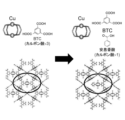
- FIG. 2 is a schematic diagram schematically showing an increase in the pore diameter of Cu-BTC in Embodiment 1.
- FIG. 3 is a characteristic diagram showing the powder X-ray diffraction pattern of the sample in Embodiment 1.
- FIG. 4 is a characteristic diagram showing the nitrogen adsorption isotherm of the sample in Embodiment 1.
- FIG. FIG. 5 is a characteristic diagram showing the result of pore structure analysis of the sample in Embodiment 1.
- FIG. FIG. 6 is a characteristic diagram showing the powder X-ray diffraction pattern of the sample in Embodiment 2.
- FIG. 7 is a characteristic diagram showing the nitrogen adsorption isotherm of the sample in Embodiment 2.
- FIG. 8 is a characteristic diagram showing the result of pore structure analysis of the sample in Embodiment 2.
- Ag zeolite in which Ag was introduced into ion exchange sites of zeolite, was available as a desulfurizing agent for removing sulfur compounds from a fluid containing sulfur compounds.
- this material has a high content of copper ions in its structure and a high specific surface area, even sulfur compounds that are difficult to adsorb can be effectively removed, and the cost is lower than that of Ag zeolite. Met.
- the inventors used a metal-organic framework with a large pore diameter to promote the diffusion of sulfur compounds in the pores and increase the number of adsorption sites accessible to sulfur compounds. I got the idea that a high adsorption amount can be obtained.
- the inventors have found that in order to miniaturize the desulfurizer, a metal organic structure having copper ions with a large copper ion content in the structure and benzene-1,3,5 tricarboxylic acid
- the present inventors have found the problem that it is necessary to increase the pore size while maintaining the three-dimensional structure of , and have come to constitute the subject of the present disclosure to solve the problem.
- the present disclosure provides a desulfurizing agent capable of reducing the volume of the desulfurizing agent used in the desulfurizer and miniaturizing the desulfurizer.
- Embodiment 1 Embodiment 1 will be described below with reference to FIGS. 1 to 5 and Tables 1 to 3.
- FIG. 1 is a diagrammatic representation of Embodiment 1
- FIG. 1 is a schematic diagram showing the configuration of a desulfurizer according to Embodiment 1.
- FIG. 1 is a schematic diagram showing the configuration of a desulfurizer according to Embodiment 1.
- the desulfurizer 10 has a container 1 with an inlet 3 and an outlet 4 .
- a container 1 contains a desulfurizing agent 2 .
- the desulfurization agent 2 contains copper ions and benzene-1,3,5 tricarboxylic acid (BTC), and removes sulfur compounds from fluids containing sulfur compounds.
- BTC benzene-1,3,5 tricarboxylic acid
- the integrated value of the pore volume having a pore diameter of greater than 0.75 nm and 2.00 nm or less is at least twice the integrated value of the pore volume having a pore diameter of 0.75 nm or less.
- the desulfurizing agent 2 is a metal organic structure containing BTC and isophthalic acid or benzoic acid.
- the metal organic structure contained in the desulfurizing agent 2 part of BTC contained in Cu-BTC is replaced with isophthalic acid or benzoic acid.
- the desulfurization agent 2 containing copper ions and BTC the desulfurization agent 2 in which a part of BTC is not substituted with isophthalic acid, benzoic acid, or the like is called Cu-BTC.
- the desulfurizing agent 2 may be powdery.
- the powder preferably has a BET specific surface area of, for example, 500 m 2 /g or more.
- the average particle size of the primary particles of the desulfurizing agent 2 is not particularly limited, but is, for example, 1 ⁇ m or more and 30 ⁇ m or less.
- a metal organic framework has a uniform skeleton structure in which the molecules that make up its three-dimensional skeleton are arranged regularly, so it has a high specific surface area.
- Metal-organic frameworks can precisely set physical or chemical properties such as pore size, pore structure, and surface functionality through appropriate selection and combination of organic ligands and metal ions. Therefore, metal-organic frameworks have a very high degree of design freedom compared to conventional desulfurization agents such as zeolites.
- BTC which has three carboxylic acids coordinated to the benzene ring
- BTC has one carboxylic acid coordinated to the benzene ring.
- FIG. 2 is a schematic diagram schematically showing the increase in the pore diameter of Cu-BTC in Embodiment 1.
- FIG. 2 shows a schematic diagram of increasing the pore diameter of Cu—BTC by substituting a portion of BTC with benzoic acid.
- the present inventors replaced part of the BTC contained in Cu-BTC with benzoic acid, which has a smaller number of carboxylic acids than BTC, to Cu-BTC-BA, and by replacing it with isophthalic acid, Cu-BTC- ISO was obtained.
- the molar ratio of benzoic acid contained in Cu-BTC-BA and the molar ratio of isophthalic acid contained in Cu-BTC-ISO are preferably 10% or more and 50% or less with respect to BTC.
- Cu-BTC usually has a large number of micropores, but when the molar ratio exceeds 50%, it is thought that the number of mesopores increases due to two or more adjacent benzoic acids or isophthalic acids.
- An increase in mesopores means a collapse of the three-dimensional structure of the metal-organic framework, which leads to a decrease in the specific surface area and is not suitable for use as a desulfurizing agent.
- metal organic structures can be synthesized by a known solvothermal method (that is, hydrothermal synthesis method).
- a copper ion source and an organic ligand are added to a solvent such as ethylene glycol to prepare a starting material solution.
- the starting material solution is then heated to grow crystals of the metal-organic framework.
- a copper ion source is copper sulfate hydrate.
- a product having a synthesized metal-organic structure is washed with a washing liquid to remove residual raw materials from the product.
- the washing liquid is, for example, methanol, which has a low viscosity and a low boiling point. After washing, a powdery metal organic structure is obtained through solid-liquid separation and drying.
- a precipitate was obtained from the obtained product by suction filtration.
- the resulting precipitate was put into a methanol solution, washed with stirring for 24 hours, and suction filtered again to obtain a precipitate.
- Cu-BTC-BA Cu-BTC-BA01 (Example 3) was changed to 1.6 mmol of BTC by the same synthesis method, with the amount of benzoic acid being 0.2 mmol.
- Cu-BTC08-BA024 (Example 4) was obtained by adjusting the amount of benzoic acid to 0.48 mmol.
- CTAB hexadecyltrimethylammonium bromide
- Cu-BTC-ISO Cu-BTC-HISO (Example 6) was obtained by the same synthesis method, with the amount of 5-hydroxyisophthalic acid (HISO) being 0.4 mmol. Further, as a sample for comparison, Cu-BTC (Comparative Example 1) was synthesized by the same procedure without introducing benzoic acid or isophthalic acid.
- Cu-BTC-BA03 of Example 1 and Cu-BTC-ISO of Example 2 were subjected to powder X-ray interpretation analysis. .
- FIG. 3 is a characteristic diagram showing the powder X-ray diffraction pattern of the sample in Embodiment 1.
- FIG. 3 the vertical axis indicates the diffraction intensity, and the horizontal axis indicates the diffraction angle 2 ⁇ .
- Powder X-ray diffraction analysis pattern simulation of Cu-BTC is based on Cambridge Crystal Structure Database, Accession No. 112954.
- FIG. 4 is a characteristic diagram showing the nitrogen adsorption isotherm of the sample in Embodiment 1.
- FIG. 4 the vertical axis indicates the nitrogen adsorption amount, and the horizontal axis indicates the adsorption equilibrium pressure.
- Table 1 shows the BET specific surface area calculated using the BET formula from the adsorption isotherm in FIG.
- FIG. 5 is a characteristic diagram showing the result of pore structure analysis of the sample in Embodiment 1.
- FIG. FIG. 5 shows the pore volume at a certain pore diameter.
- the vertical axis indicates pore volume (cm 3 /g) and the horizontal axis indicates pore diameter (mm).
- This characteristic diagram was calculated from the adsorption isotherm in FIG. 4 by simulation using the non-localized density half function (NLDFT) method. Since the result of the nitrogen adsorption isotherm is used, the analysis range is pores of 0.39 nm or more, which are larger than nitrogen molecules.
- NLDFT non-localized density half function
- Cu-BTC-BA03 of Example 1 and Cu-BTC-ISO of Example 2 into which benzoic acid and isophthalic acid were introduced were finer than Cu-BTC of Comparative Example 1.
- the pore volume around 0.4 to 0.5 nm in pore size decreased, and the pore volume around 0.9 to 1.0 nm increased.
- Table 2 shows Cu-BTC of Comparative Example 1, Cu-BTC-BA03 of Example 1, Cu-BTC-ISO of Example 2, Cu-BTC-BA01 of Example 3, Cu-BTC08 of Example 4- The results of accumulating the pore volume in each of the pore diameter regions of 0.39 to 0.75 nm and 0.76 to 2.00 nm of BA024 are shown.
- a desulfurizing agent 2 containing Cu-BTC-BA, Cu-BTC-ISO, etc. is accommodated inside the accommodating container 1 of the desulfurizer 10 . Then, a sulfur-containing gas is supplied to the inlet portion 3 from a sulfur-containing gas supply source (not shown).
- the supplied sulfur component-containing gas passes through the container 1 while being in contact with the desulfurizing agent 2 inside the container 1 .
- the sulfur component-containing gas from which sulfur components have been removed is discharged from the outlet portion 4 .
- sulfur-containing gases examples include city gas, natural gas, or hydrocarbon fuels such as LPG. Sulfur compounds are added to the hydrocarbon fuel for safety purposes so that leaks can be detected quickly.
- An example of the sulfur compound contained in the sulfur-containing gas is tetrahydrothiophene (THT) with a molecular diameter of 0.59 nm.
- Table 3 shows the THT adsorption capacity at 15 ppm for each sample.
- the THT adsorption capacity was determined by introducing a sample and THT gas into a sealed bag, leaving the bag for 24 hours, and then analyzing the THT concentration in the bag to measure the THT adsorption capacity for multiple equilibrium concentrations. Then, assuming that the adsorbate molecules adsorb to a monomolecular layer, the adsorption isotherm was calculated using Langmuir's equation, and the adsorption capacity at 15 ppm was calculated for evaluation.
- Cu-BTC-BA03 of Example 1 into which benzoic acid and isophthalic acid were introduced Cu-BTC-ISO of Example 2, Cu-BTC-BA01 of Example 3, and Cu-BTC08-BA024 of Example 4 exhibited higher THT adsorption capacities than Cu-BTC of Comparative Example 1, respectively.
- Cu-BTC-CTAB of Example 5 in which CTAB was introduced and Cu-BTC-HISO of Example 6 in which HISO was introduced also showed higher THT adsorption capacities than Cu-BTC of Comparative Example 1.
- the desulfurizer 10 has the container 1 having the inlet section 3 and the outlet section 4 .
- a container 1 contains a desulfurizing agent 2 .
- the desulfurizing agent 2 contains copper ions and benzene-1,3,5 tricarboxylic acid, and removes sulfur compounds from the fluid containing sulfur compounds.
- the integrated value of the pore volume having a pore diameter of greater than 0.75 nm and 2.00 nm or less is at least twice the integrated value of the pore volume having a pore diameter of 0.75 nm or less.
- the desulfurizing agent 2 may be one in which defects are generated in the structure of the desulfurizing agent containing copper ions and BTC by benzoic acid or isophthalic acid.
- the adsorption amount of sulfur compounds per mass can be increased. Therefore, it is possible to further reduce the volume of the desulfurizing agent 2 used in the desulfurizer 10 and provide the desulfurizing agent 2 capable of reducing the size of the desulfurizer 10 .
- THT adsorption capacity at 15 ppm of Cu-BTC-BA03 of Example 1 actually shown in the present embodiment is 1.59 times that of Cu-BTC of Comparative Example 1, the storage volume of desulfurizing agent 2 is reduced to 1/1. A 1.59-fold reduction in size is expected.
- the desulfurizing agent 2 may be one in which defects are generated in the structure of the desulfurizing agent containing copper ions and BTC by hexadecyltrimethylammonium bromide.
- the generation of defects changes the electronic state of the adsorption site, so the adsorption amount of sulfur compounds per mass can be increased. Therefore, it is possible to further reduce the volume of the desulfurizing agent 2 used in the desulfurizer 10 and provide the desulfurizing agent 2 capable of reducing the size of the desulfurizer 10 .
- the sulfur compound may be a sulfur compound or THT having a molecular diameter of less than 0.75 nm.
- the sulfur compound in the supplied sulfur-containing gas is smaller than the pore diameter of the main pores, so that the diffusion of the sulfur compound inside the pores of the desulfurization agent 2 is further promoted, so that the sulfur compound is accessible.
- the possible adsorption sites of the desulfurizing agent 2 are increased, and the adsorption amount of sulfur compounds per mass can be further increased. Therefore, it is possible to further reduce the volume of the desulfurizing agent 2 used in the desulfurizer 10 and provide the desulfurizing agent 2 capable of reducing the size of the desulfurizer 10 .
- Embodiment 2 Embodiment 2 will be described below using FIGS. 1, 6 to 8, and Tables 4 to 6.
- FIG. 1 is a diagrammatic representation of Embodiment 2
- the desulfurizer 10 has a containment vessel 1 with an inlet section 3 and an outlet section 4 .
- a container 1 contains a desulfurizing agent 2 .
- the desulfurizing agent 2 contains copper ions and BTC, and the integrated value of the pore volume having a pore diameter of 0.75 nm or less is greater than 0.75 nm and 2.00 nm or less. is more than twice the integrated value of
- Cu-BTC has three types of pores of 0.5 nm, 1.1 nm, and 1.3 nm. Focusing attention, the inventors thought that it would be possible to control the orientation of crystal growth by adding additives, and to synthesize Cu-BTC having more large pores.
- the present inventors have found Cu-BTC-LDH in which crystal growth orientation is controlled by adding a layered double hydroxide (LDH) containing magnesium (Mg) and aluminum (Al) during the synthesis of Cu-BTC. got
- LDH containing Mg and Al is an example of an additive added during the synthesis of Cu-BTC, and is not limited to this.
- the additive added during the synthesis of Cu-BTC may be, for example, an additive containing Al, or an additive containing sodium (Na) or potassium (K).
- sodium nitrate (NaNO 3 ) or sodium chloride (NaCl) or sodium bromide (NaBr) or potassium nitrate (KNO 3 ) or potassium chloride (KCl) or potassium bromide (KBr) was used as an additive during the synthesis of Cu-BTC. may be added.
- the molar ratio of LDH introduced during Cu-BTC-LDH synthesis is preferably 5% or more and 20% or less with respect to BTC. LDH changes not only the crystal growth orientation but also the crystal growth rate. Therefore, it is conceivable that excessive addition of Cu--BTC would promote crystal growth and conversely collapse the structure of Cu--BTC.
- Cu-BTC-LDH was subjected to powder X-ray interpretation analysis and compared with the powder X-ray diffraction analysis pattern simulation of Cu-BTC. rice field.
- FIG. 6 is a characteristic diagram showing the powder X-ray diffraction pattern of the sample in Embodiment 2.
- FIG. 6 the vertical axis indicates the diffraction intensity, and the horizontal axis indicates the diffraction accuracy 2 ⁇ .
- Cu-BTC-LDH has a three-dimensional crystal structure similar to that of Cu-BTC and does not contain other impurity crystals.
- FIG. 7 is a characteristic diagram showing the nitrogen adsorption isotherm of the sample in Embodiment 2.
- FIG. 7 the vertical axis indicates the nitrogen adsorption amount, and the horizontal axis indicates the adsorption equilibrium pressure.
- the present inventors confirmed that the isotherm of any sample as shown in FIG. 7 is an IUPACI-type isotherm due to the presence of micropores.
- Table 4 shows the BET specific surface area calculated using the BET formula from the adsorption isotherm in FIG.
- the specific surface area of Cu-BTC-LDH of Example 5 is almost close to the specific surface area of Cu-BTC of Comparative Example 1 in which LDH containing Mg and Al is not introduced. rice field. From this, it is considered that the excessive injection of LDH containing Mg and Al hardly causes the three-dimensional structure of the metal-organic framework to collapse.
- FIG. 8 is a characteristic diagram showing the result of pore structure analysis of the sample in Embodiment 2.
- FIG. FIG. 8 shows the pore volume at a certain pore diameter.
- the vertical axis indicates pore volume (cm 3 /g) and the horizontal axis indicates pore diameter (mm).
- This characteristic diagram was calculated from the adsorption isotherm shown in FIG. 7 by simulation using the non-localized density half function (NLDFT) method.
- NLDFT non-localized density half function
- the Cu-BTC-LDH of Example 7 in which LDH containing Mg and Al is introduced, has pores with a pore diameter of about 0.4 to 0.5 nm compared to Cu-BTC.
- the volume decreased and the pore volume around 0.9 to 1.0 nm increased.
- Table 5 shows the result of integrating the pore volume in the pore diameter 0.39 to 0.75 nm and 0.76 to 2.00 nm regions of Cu-BTC of Comparative Example 1 and Cu-BTC-LDH of Example 7. show.
- the integrated value of the pore volume having a pore diameter of 0.75 nm or less and 2.00 nm or less is the integrated pore volume having a pore diameter of 0.75 nm or less. 1.1 times the value.
- Cu-BTC-LDH was 23.0 times. From this, it was clarified that the introduction of LDH containing Mg and Al changed the orientation of crystal growth and increased the ratio of large pores in micropores.
- a desulfurizing agent 2 containing Cu-BTC-LDH is accommodated inside the accommodating container 1 of the desulfurizer 10 . Then, a sulfur-containing gas is supplied to the inlet portion 3 from a sulfur-containing gas supply source (not shown).
- the supplied sulfur component-containing gas passes through the container 1 while being in contact with the desulfurizing agent 2 inside the container 1 .
- the sulfur component-containing gas from which sulfur components have been removed is discharged from the outlet portion 4 .
- An example of the sulfur compound contained in the sulfur-containing gas is THT with a molecular diameter of 0.59 nm.
- the number of pores with a pore diameter larger than the molecular diameter of THT is greater than in Cu-BTC. Therefore, it can be considered that the diffusion of THT in the pores is promoted, the number of adsorption sites accessible to THT increases, and the adsorption capacity of THT increases.
- Table 6 shows the THT adsorption capacity of each sample at 15 ppm.
- the desulfurizer 10 has the container 1 having the inlet section 3 and the outlet section 4 .
- a container 1 contains a desulfurizing agent 2 .
- the crystal growth of the desulfurizing agent 2 containing copper ions and benzene-1,3,5-tricarboxylic acid may be controlled by LDH containing Mg and Al.
- the diffusion of sulfur compounds inside the pores of the desulfurizing agent 2 is promoted, so that the adsorption sites of the desulfurizing agent 2 accessible to sulfur compounds increase, and the amount of sulfur compounds adsorbed per mass is increased. can be done. Furthermore, since the electronic state of the adsorption site is changed by the addition of the metal species, the adsorption amount of the sulfur compound per mass can be further increased.
- THT adsorption capacity at 15 ppm of Cu-BTC-LDH of Example 7 actually shown in the present embodiment is 1.32 times that of Cu-BTC of Comparative Example 1, the storage volume of desulfurizing agent 2 is reduced to 1/1. It is expected that the size will be reduced by 1.32 times.
- the desulfurization agent 2 may have its crystal growth controlled by an additive containing Al.
- the desulfurizing agent 2 may have its crystal growth controlled by an additive containing Na or K.
- the diffusion of sulfur compounds inside the pores of the desulfurizing agent 2 is promoted, so that the adsorption sites of the desulfurizing agent 2 accessible to sulfur compounds increase, and the amount of sulfur compounds adsorbed per mass is increased. can be done. Furthermore, since the electronic state of the adsorption site is changed by the addition of the metal species, the adsorption amount of the sulfur compound per mass can be further increased.
- the desulfurizing agent 2 may have crystal growth controlled by NaNO 3 or NaCl or NaBr or KNO 3 or KCl or Kbr.
- the diffusion of sulfur compounds inside the pores of the desulfurizing agent 2 is promoted, so that the adsorption sites of the desulfurizing agent 2 accessible to sulfur compounds increase, and the amount of sulfur compounds adsorbed per mass is increased. can be done. Furthermore, since the electronic state of the adsorption site is changed by the addition of the metal species, the adsorption amount of the sulfur compound per mass can be further increased.
- Embodiments 1 and 2 have been described as examples of the technology disclosed in the present application. However, the technology in the present disclosure is not limited to this, and can also be applied to embodiments with modifications, replacements, additions, omissions, and the like. Also, it is possible to combine the constituent elements described in the first and second embodiments to form a new embodiment.
- benzoic acid and isophthalic acid were described as examples of materials with a small number of carboxylic acids.
- Desulfurizing agent 2 may be desulfurized as long as the number of carboxylic acids coordinated to the benzene ring is 2 or less. Therefore, it is not limited to benzoic acid or isophthalic acid.
- LDH was described as an example of a material that changes the orientation of crystal growth. Any substance may be added to the desulfurizing agent 2 as long as it changes the orientation of crystal growth. Therefore, it is not limited to LDH. However, if lauric acid is used as a material to be added when synthesizing the desulfurizing agent 2, a high THT adsorption capacity can be obtained.
- the present disclosure is applicable to desulfurization agents that remove sulfur compounds from fuel gas containing sulfur compounds. Specifically, the present disclosure is applicable to a fuel cell capable of converting city gas into hydrogen and generating power.
Landscapes
- Chemical & Material Sciences (AREA)
- Chemical Kinetics & Catalysis (AREA)
- Analytical Chemistry (AREA)
- Organic Chemistry (AREA)
- Engineering & Computer Science (AREA)
- Oil, Petroleum & Natural Gas (AREA)
- Inorganic Chemistry (AREA)
- Environmental & Geological Engineering (AREA)
- General Chemical & Material Sciences (AREA)
- Health & Medical Sciences (AREA)
- Biomedical Technology (AREA)
- Solid-Sorbent Or Filter-Aiding Compositions (AREA)
Priority Applications (2)
| Application Number | Priority Date | Filing Date | Title |
|---|---|---|---|
| JP2023559615A JPWO2023085229A1 (https=) | 2021-11-15 | 2022-11-07 | |
| EP22892728.1A EP4434617A4 (en) | 2021-11-15 | 2022-11-07 | DESULPHURIZING AGENT |
Applications Claiming Priority (2)
| Application Number | Priority Date | Filing Date | Title |
|---|---|---|---|
| JP2021-185372 | 2021-11-15 | ||
| JP2021185372 | 2021-11-15 |
Publications (1)
| Publication Number | Publication Date |
|---|---|
| WO2023085229A1 true WO2023085229A1 (ja) | 2023-05-19 |
Family
ID=86336079
Family Applications (1)
| Application Number | Title | Priority Date | Filing Date |
|---|---|---|---|
| PCT/JP2022/041354 Ceased WO2023085229A1 (ja) | 2021-11-15 | 2022-11-07 | 脱硫剤 |
Country Status (3)
| Country | Link |
|---|---|
| EP (1) | EP4434617A4 (https=) |
| JP (1) | JPWO2023085229A1 (https=) |
| WO (1) | WO2023085229A1 (https=) |
Families Citing this family (1)
| Publication number | Priority date | Publication date | Assignee | Title |
|---|---|---|---|---|
| EP4574809A4 (en) * | 2022-08-16 | 2026-01-21 | Panasonic Ip Man Co Ltd | DESULFURRATION AGENT |
Citations (4)
| Publication number | Priority date | Publication date | Assignee | Title |
|---|---|---|---|---|
| JP6238150B1 (ja) | 2016-03-01 | 2017-11-29 | パナソニック株式会社 | 流体からの硫黄化合物の除去 |
| KR101876318B1 (ko) * | 2017-02-27 | 2018-07-10 | 이화여자대학교 산학협력단 | 혼성화 나노복합체, 이의 제조 방법, 및 이를 포함하는 수분 흡착제 |
| WO2019167441A1 (ja) * | 2018-03-01 | 2019-09-06 | 株式会社クレハ | 毒素分離器具 |
| JP2019181452A (ja) * | 2018-03-30 | 2019-10-24 | パナソニックIpマネジメント株式会社 | 脱硫器、水素生成装置、および燃料電池システム |
Family Cites Families (1)
| Publication number | Priority date | Publication date | Assignee | Title |
|---|---|---|---|---|
| US11478774B2 (en) * | 2016-08-29 | 2022-10-25 | Cornell University | Metal organic frameworks and methods of making and using same |
-
2022
- 2022-11-07 EP EP22892728.1A patent/EP4434617A4/en active Pending
- 2022-11-07 JP JP2023559615A patent/JPWO2023085229A1/ja active Pending
- 2022-11-07 WO PCT/JP2022/041354 patent/WO2023085229A1/ja not_active Ceased
Patent Citations (4)
| Publication number | Priority date | Publication date | Assignee | Title |
|---|---|---|---|---|
| JP6238150B1 (ja) | 2016-03-01 | 2017-11-29 | パナソニック株式会社 | 流体からの硫黄化合物の除去 |
| KR101876318B1 (ko) * | 2017-02-27 | 2018-07-10 | 이화여자대학교 산학협력단 | 혼성화 나노복합체, 이의 제조 방법, 및 이를 포함하는 수분 흡착제 |
| WO2019167441A1 (ja) * | 2018-03-01 | 2019-09-06 | 株式会社クレハ | 毒素分離器具 |
| JP2019181452A (ja) * | 2018-03-30 | 2019-10-24 | パナソニックIpマネジメント株式会社 | 脱硫器、水素生成装置、および燃料電池システム |
Non-Patent Citations (1)
| Title |
|---|
| See also references of EP4434617A4 |
Also Published As
| Publication number | Publication date |
|---|---|
| EP4434617A1 (en) | 2024-09-25 |
| EP4434617A4 (en) | 2025-05-07 |
| JPWO2023085229A1 (https=) | 2023-05-19 |
Similar Documents
| Publication | Publication Date | Title |
|---|---|---|
| Li et al. | Seignette salt induced defects in Zr-MOFs for boosted Pb (Ⅱ) adsorption: universal strategy and mechanism insight | |
| Amooghin et al. | Fluorinated metal–organic frameworks for gas separation | |
| Shang et al. | Facile synthesis of CuBTC and its graphene oxide composites as efficient adsorbents for CO2 capture | |
| Zeeshan et al. | Enhancing CO2/CH4 and CO2/N2 separation performances of ZIF-8 by post-synthesis modification with [BMIM][SCN] | |
| Yu et al. | Hydrogen adsorption and kinetics in MIL-101 (Cr) and hybrid activated carbon-MIL-101 (Cr) materials | |
| Lucero et al. | Tunability of ammonia adsorption over NaP zeolite | |
| Jiang et al. | Constructing C2H2 anchoring traps within MOF interpenetration nets as C2H2/CO2 and C2H2/C2H4 bifunctional separator | |
| Abid et al. | Effects of ammonium hydroxide on the structure and gas adsorption of nanosized Zr-MOFs (UiO-66) | |
| Missaoui et al. | PEG-templated synthesis of ultramicroporous n-ZIF-67 nanoparticles with high selectivity for the adsorption and uptake of CO2 over CH4 and N2 | |
| Gao et al. | Mechanochemical synthesis of three-component metal-organic frameworks for large scale production | |
| Yuan et al. | Understanding the characteristics of water adsorption in zeolitic imidazolate framework-derived porous carbon materials | |
| Duan et al. | A novel metal-organic framework for high storage and separation of acetylene at room temperature | |
| Dathe et al. | Metal organic frameworks based on Cu2+ and benzene-1, 3, 5-tricarboxylate as host for SO2 trapping agents | |
| Zhang et al. | A stable microporous framework with multiple accessible adsorption sites for high capacity adsorption and efficient separation of light hydrocarbons | |
| KR20140041445A (ko) | 금속-카테콜레이트 골격체의 제조 | |
| CN108473325A (zh) | 沸石咪唑酯框架 | |
| Jolodar et al. | Enhancing carbon dioxide separation from natural gas in dynamic adsorption by a new type of bimetallic MOF; MIL-101 (Cr-Al) | |
| He et al. | Direct Functionalization of the Open Metal Sites in Rare Earth-Based Metal–Organic Frameworks Used for the Efficient Separation of Ethylene | |
| JP7775436B2 (ja) | コンデンセート中の重金属吸着剤として使用するためのジルコニウム系金属有機構造体及びその調製方法 | |
| Liu et al. | Boosting Xe/Kr separation by a Mixed-linker strategy in Radiation-Resistant Aluminum-Based Metal− Organic frameworks | |
| WO2023153070A1 (ja) | 脱硫剤 | |
| WO2023085229A1 (ja) | 脱硫剤 | |
| Mansour et al. | The Co‐UMO‐1 Metal Organic Framework: Solvothermal Synthesis of [Co3 {μ3‐O} 2 (C14H8O6S) 2 (H2O) 3 (C2H5OH)]⋅ 2H2O, Characterizations, and Application in Methylene Blue Removal | |
| Baghelani et al. | Effect of K/Na ratio on adsorption of sweetened gas in dehydration packed bed adsorber: A Monte Carlo simulation study of single and multicomponent gas mixture | |
| Morita et al. | Direct observation of dimethyl sulfide trapped by MOF proving efficient removal of sulfur impurities |
Legal Events
| Date | Code | Title | Description |
|---|---|---|---|
| 121 | Ep: the epo has been informed by wipo that ep was designated in this application |
Ref document number: 22892728 Country of ref document: EP Kind code of ref document: A1 |
|
| ENP | Entry into the national phase |
Ref document number: 2023559615 Country of ref document: JP Kind code of ref document: A |
|
| WWE | Wipo information: entry into national phase |
Ref document number: 2022892728 Country of ref document: EP |
|
| ENP | Entry into the national phase |
Ref document number: 2022892728 Country of ref document: EP Effective date: 20240617 |