WO2023079977A1 - 日焼け止め化粧料 - Google Patents
日焼け止め化粧料 Download PDFInfo
- Publication number
- WO2023079977A1 WO2023079977A1 PCT/JP2022/039213 JP2022039213W WO2023079977A1 WO 2023079977 A1 WO2023079977 A1 WO 2023079977A1 JP 2022039213 W JP2022039213 W JP 2022039213W WO 2023079977 A1 WO2023079977 A1 WO 2023079977A1
- Authority
- WO
- WIPO (PCT)
- Prior art keywords
- mass
- ultraviolet absorber
- sunscreen
- cosmetic
- less
- Prior art date
- Legal status (The legal status is an assumption and is not a legal conclusion. Google has not performed a legal analysis and makes no representation as to the accuracy of the status listed.)
- Ceased
Links
Images
Classifications
-
- A—HUMAN NECESSITIES
- A61—MEDICAL OR VETERINARY SCIENCE; HYGIENE
- A61K—PREPARATIONS FOR MEDICAL, DENTAL OR TOILETRY PURPOSES
- A61K8/00—Cosmetics or similar toiletry preparations
- A61K8/18—Cosmetics or similar toiletry preparations characterised by the composition
- A61K8/30—Cosmetics or similar toiletry preparations characterised by the composition containing organic compounds
- A61K8/31—Hydrocarbons
-
- A—HUMAN NECESSITIES
- A61—MEDICAL OR VETERINARY SCIENCE; HYGIENE
- A61K—PREPARATIONS FOR MEDICAL, DENTAL OR TOILETRY PURPOSES
- A61K8/00—Cosmetics or similar toiletry preparations
- A61K8/18—Cosmetics or similar toiletry preparations characterised by the composition
- A61K8/30—Cosmetics or similar toiletry preparations characterised by the composition containing organic compounds
- A61K8/33—Cosmetics or similar toiletry preparations characterised by the composition containing organic compounds containing oxygen
- A61K8/34—Alcohols
-
- A—HUMAN NECESSITIES
- A61—MEDICAL OR VETERINARY SCIENCE; HYGIENE
- A61K—PREPARATIONS FOR MEDICAL, DENTAL OR TOILETRY PURPOSES
- A61K8/00—Cosmetics or similar toiletry preparations
- A61K8/18—Cosmetics or similar toiletry preparations characterised by the composition
- A61K8/30—Cosmetics or similar toiletry preparations characterised by the composition containing organic compounds
- A61K8/33—Cosmetics or similar toiletry preparations characterised by the composition containing organic compounds containing oxygen
- A61K8/35—Ketones, e.g. benzophenone
-
- A—HUMAN NECESSITIES
- A61—MEDICAL OR VETERINARY SCIENCE; HYGIENE
- A61K—PREPARATIONS FOR MEDICAL, DENTAL OR TOILETRY PURPOSES
- A61K8/00—Cosmetics or similar toiletry preparations
- A61K8/18—Cosmetics or similar toiletry preparations characterised by the composition
- A61K8/30—Cosmetics or similar toiletry preparations characterised by the composition containing organic compounds
- A61K8/33—Cosmetics or similar toiletry preparations characterised by the composition containing organic compounds containing oxygen
- A61K8/37—Esters of carboxylic acids
-
- A—HUMAN NECESSITIES
- A61—MEDICAL OR VETERINARY SCIENCE; HYGIENE
- A61K—PREPARATIONS FOR MEDICAL, DENTAL OR TOILETRY PURPOSES
- A61K8/00—Cosmetics or similar toiletry preparations
- A61K8/18—Cosmetics or similar toiletry preparations characterised by the composition
- A61K8/30—Cosmetics or similar toiletry preparations characterised by the composition containing organic compounds
- A61K8/40—Cosmetics or similar toiletry preparations characterised by the composition containing organic compounds containing nitrogen
- A61K8/41—Amines
-
- A—HUMAN NECESSITIES
- A61—MEDICAL OR VETERINARY SCIENCE; HYGIENE
- A61K—PREPARATIONS FOR MEDICAL, DENTAL OR TOILETRY PURPOSES
- A61K8/00—Cosmetics or similar toiletry preparations
- A61K8/18—Cosmetics or similar toiletry preparations characterised by the composition
- A61K8/30—Cosmetics or similar toiletry preparations characterised by the composition containing organic compounds
- A61K8/49—Cosmetics or similar toiletry preparations characterised by the composition containing organic compounds containing heterocyclic compounds
-
- A—HUMAN NECESSITIES
- A61—MEDICAL OR VETERINARY SCIENCE; HYGIENE
- A61Q—SPECIFIC USE OF COSMETICS OR SIMILAR TOILETRY PREPARATIONS
- A61Q17/00—Barrier preparations; Preparations brought into direct contact with the skin for affording protection against external influences, e.g. sunlight, X-rays or other harmful rays, corrosive materials, bacteria or insect stings
- A61Q17/04—Topical preparations for affording protection against sunlight or other radiation; Topical sun tanning preparations
Definitions
- This disclosure relates to sunscreen cosmetics.
- compositions exhibiting sunscreen properties and cosmetics using such compositions have been developed.
- Patent Document 1 0.5 to 30% by weight of a perfume component, 0.1 to 20% by weight of an emulsifier, 50 to 99% by weight of water, 0.001 to 10% by weight of a water-soluble polymer, and ultraviolet absorption
- a liquid or gel perfume composition which contains a soluble agent and is substantially free of alcohol.
- Patent Document 2 discloses a single organic filter filtering UV A , a single organic filter different from the first filter filtering UV B , and 1-50% by weight of a solvent for said filter.
- An anti-UV additive comprising at least 95% by weight of a mixture consisting of at least one non-volatile oil, wherein the organic filter for filtering UV A is selected from dibenzoylmethane derivatives and comprises from 5 to 5 by weight of the additive.
- the UV B filtering organic filter is selected from cinnamate derivatives and 20-90% by weight of the additive weight, the non-volatile oil isononyl isononanoate, dicaprylic acid/ selected from butylene glycol dicaprate, phenyltrimethicone, and diisostearyl malate, and representing 5 to 30% by weight of the weight of the additive, for a composition, wherein said composition comprises a perfume and a colorant; Disclosed is a cosmetic composition or flavored solution containing an anti-UV additive.
- Patent Document 3 discloses a water-in-oil sunscreen containing (A) a cinnamic acid-based ultraviolet absorber, (B) porous silica, (C) oil, (D) a surfactant, and (E) water.
- A a cinnamic acid-based ultraviolet absorber
- B porous silica
- C oil
- D a surfactant
- E water
- JP-A-08-225431 Japanese Patent No. 6551701 JP 2009-067683 A
- sunscreen cosmetics have had a problem with the odor peculiar to the ultraviolet absorber blended in the cosmetics.
- sunscreen cosmetics that combine a salicylic acid derivative ultraviolet absorber and a solid ultraviolet absorber at room temperature have excellent sunscreen performance, but exhibit a unique sunscreen odor. was desired.
- the subject of the present disclosure is to provide a sunscreen cosmetic that improves the unique sunscreen odor that occurs when a salicylic acid derivative ultraviolet absorber and a solid ultraviolet absorber at room temperature are used in combination.
- ⁇ Aspect 1> Contains a salicylic acid derivative ultraviolet absorber, a solid ultraviolet absorber at room temperature, and a fragrance,
- the perfume is limonene, 2,6-dimethyl-7-octen-2-ol, n-octanal, cis-3-hexen-1-yl salicylate, 4-methyl-3-decen-5-ol, hexyl acetate, 2-phenylethyl alcohol, linalool, citronellyl acetate, citronellol, ⁇ -ionone, benzyl acetate, ⁇ -hexylcinnamaldehyde, methyl dihydrojasmonate, geraniol, cis-jasmone, jasmine lactone, 1-(2-butenoyl)-2, 6,6-trimethyl-1,3-cyclohexadiene, methylionone, isobutylmethyltetrahydropyranol, vanillin, 2-
- the fragrance is limonene, cis-3-hexen-1-yl salicylate, hexyl acetate, 2-phenylethyl alcohol, linalool, citronellol, ⁇ -ionone, benzyl acetate, methyl dihydrojasmonate, geraniol, 1-(2-butenoyl )-2,6,6-trimethyl-1,3-cyclohexadiene, methylionone, and isobutylmethyltetrahydropyranol.
- ⁇ Aspect 7> The cosmetic according to any one of aspects 1 to 6, further comprising a thickening agent.
- a sunscreen cosmetic that improves the peculiar sunscreen odor that occurs when a salicylic acid derivative ultraviolet absorber and a solid ultraviolet absorber at room temperature are used in combination.
- FIG. 1 is a graph of masking and harmonizing effects when using various fragrances.
- the sunscreen cosmetic of the present disclosure (hereinafter sometimes simply referred to as “cosmetics”) contains a salicylic acid derivative UV absorber, an UV absorber that is solid at room temperature, and the specific fragrance described above.
- the sunscreen cosmetic of the present disclosure has a unique sunscreen odor (hereinafter simply “sunburn It is thought that the principle of action that can improve the "stop odor”) is as follows.
- sunscreen odor hereinafter simply “sunburn It is thought that the principle of action that can improve the "stop odor" is as follows.
- more specific odors can be expressed, but not limited to the following, for example, a salicylic acid-based odor, a bitter odor, and a combination of these odors. mentioned.
- Sunscreen cosmetics generally generate a unique odor associated with the base used.
- Various components are contained in the base, but the present inventor analyzed the odor of each part (for example, the ultraviolet absorber part, the ultraviolet scattering agent part) used when preparing the cosmetic.
- a combination of a salicylic acid derivative ultraviolet absorber and an ultraviolet absorber that is solid at room temperature, and the odor generated when these are heated in the preparation of a cosmetic is found to be the source of an unpleasant odor, and the odor is eliminated. By doing so, it was found that the unpleasant odor of the cosmetic as a whole can be eliminated.
- Such odor is typically generated when the salicylic acid derivative ultraviolet absorber and the ultraviolet absorber solid at room temperature are heated, but such odor remains in the cosmetic even after it is slowly cooled to room temperature. .
- the present inventors selected a specific perfume from a myriad of perfumes. To improve the odor of sunscreen in a more comfortable direction, and furthermore, to improve the odor of sunscreen as a whole cosmetic containing a salicylic acid derivative ultraviolet absorber and an ultraviolet absorber solid at room temperature in a more comfortable direction. I found
- the "harmonage effect” means an effect in which an unpleasant odor component and a perfume component are incorporated to shift the quality of the unpleasant odor from unpleasant to pleasant.
- masking effect means the effect of eliminating or masking unpleasant odors.
- the sunscreen cosmetic of the present disclosure contains a salicylic acid derivative ultraviolet absorber.
- a salicylic acid derivative ultraviolet absorber Commercially available products, for example, can be appropriately used as such materials.
- the salicylic acid derivative UV absorber can also suitably dissolve UV absorbers that are solid at room temperature, which will be described later.
- the amount of the salicylic acid derivative ultraviolet absorber to be blended is not particularly limited, and can be appropriately blended so as to achieve the desired sunscreen performance.
- a blending amount is, for example, 1.0% by mass or more, 5.0% by mass or more, 10% by mass or more, 15% by mass or more, 20% by mass or more, or 30% by mass or more, relative to the total amount of the cosmetic.
- the salicylic acid derivative UV absorber is not particularly limited as long as it has a salicylic acid skeleton, and examples include homosalate (homothyl salicylate), ethylhexyl salicylate (octyl salicylate), and triethanolamine salicylate.
- Salicylic acid derivative ultraviolet absorbers can be used alone or in combination of two or more.
- the present inventor found that when the UV absorber solid at room temperature and the salicylic acid derivative UV absorber are heated to mix them, the odor associated with the salicylic acid derivative UV absorber is enhanced. Among them, homosalate and ethylhexyl salicylate have a large effect of enhancing the odor caused by heating. Even if there is, the sunscreen odor can be suitably improved.
- the sunscreen cosmetic of the present disclosure contains an ultraviolet absorber that is solid at room temperature.
- the amount of the UV absorber that is solid at room temperature can be appropriately added so as to achieve the desired sunscreen performance.
- the blending amount can be, for example, 0.1% by mass or more, 0.5% by mass or more, or 1.0% by mass or more with respect to the total amount of the cosmetic, and 20% by mass. % or less, 15 mass % or less, 10 mass % or less, 7.0 mass % or less, or 5.0 mass % or less.
- the sunscreen cosmetic of the present disclosure typically heats and mixes an ultraviolet absorber that is solid at room temperature and a salicylic acid derivative ultraviolet absorber. Therefore, there is no particular limitation on the ultraviolet absorber that is solid at room temperature as long as it can be dissolved by heating.
- examples of such ultraviolet absorbers include bisethylhexyloxyphenolmethoxyphenyltriazine, ethylhexyltriazone, diethylaminohydroxybenzoylhexylbenzoate, and oxybenzone-3.
- a solid ultraviolet absorber can be used individually or in combination of 2 or more types at normal temperature.
- bisethylhexyloxyphenol methoxyphenyltriazine and diethylaminohydroxybenzoyl hexyl benzoate when combined with a heated salicylic acid derivative ultraviolet absorber, enhance the sunscreen odor, but the cosmetics of the present disclosure contain a specific fragrance. Since it contains, the sunscreen odor can be suitably improved even for such an ultraviolet absorber.
- the sunscreen cosmetic of the present disclosure contains the following specific fragrances (hereinafter sometimes referred to as "specific fragrances").
- specific fragrances By blending such a fragrance in cosmetics, a salicylic acid derivative ultraviolet absorber and an ultraviolet absorber solid at room temperature are used in combination, and a unique sunscreen produced when these are heated in the preparation of cosmetics. Odor can be improved.
- fragrances include limonene, 2,6-dimethyl-7-octen-2-ol, n-octanal, cis-3-hexen-1-yl salicylate, 4-methyl-3-decen-5-ol, hexyl acetate , 2-phenylethyl alcohol, linalool, citronellyl acetate, citronellol, ⁇ -ionone, benzyl acetate, ⁇ -hexylcinnamaldehyde, methyl dihydrojasmonate, geraniol, cis-jasmone, jasmine lactone, 1-(2-butenoyl)-2 ,6,6-trimethyl-1,3-cyclohexadiene, methylionone, isobutylmethyltetrahydropyranol, vanillin, 2-acetyl-2,3,8,8-tetramethyl-1,2,3,4,5,6 , 7,8-octahydronaphthal
- perfumes are able to achieve scores greater than 0 in the Harmonage Test described below.
- limonene cis-3-hexen-1-yl salicylate, hexyl acetate, 2-phenylethyl alcohol, linalool, citronellol, ⁇ -ionone, benzyl acetate, methyl dihydrojasmonate, geraniol, 1-(2-butenoyl)
- At least one selected from the group consisting of -2,6,6-trimethyl-1,3-cyclohexadiene, methylionone, and isobutylmethyltetrahydropyranol is preferred.
- Such a perfume can further improve the sunscreen odor when the score exceeds 0.3 in the Harmonage Test described later, and can further improve the sunscreen odor when the score exceeds 0.6.
- the amount of the specific fragrance compounded can be appropriately adjusted according to, for example, the required degree of improvement in sunscreen odor and the required degree of fragrance.
- the blending amount is 1.0 ⁇ 10 ⁇ 6 mass % or more, 5.0 ⁇ 10 ⁇ 6 mass % or more, 1.0 ⁇ 10 ⁇ 5 mass % or more, 5.0 ⁇ 10 ⁇ 6 mass % or more, based on the total amount of the cosmetic. 0 ⁇ 10 ⁇ 5 % by mass or more, 1.0 ⁇ 10 ⁇ 4 % by mass or more, 5.0 ⁇ 10 ⁇ 4 % by mass or more, or 1.0 ⁇ 10 ⁇ 3 % by mass or more, and It can be 0.1% by mass or less, 0.05% by mass or less, or 0.03% by mass or less.
- the amount of the specific fragrance is 1.0 ⁇ 10 -6 parts by weight or more, 5.0 ⁇ 10 -6 parts by weight or more, 1.0 ⁇ 10 -5 parts by weight or more, 5.0 ⁇ 10 -5 per 100 parts by weight of the total amount of absorbent Parts by mass or more, 1.0 ⁇ 10 ⁇ 4 parts by mass or more, 5.0 ⁇ 10 ⁇ 4 parts by mass or more, 1.0 ⁇ 10 ⁇ 3 parts by mass or more, or 5.0 ⁇ 10 ⁇ 3 parts by mass or more It can also be 1.0 parts by mass or less, 0.50 parts by mass or less, 0.10 parts by mass or less, or 0.05 parts by mass or less.
- the sunscreen cosmetic of the present disclosure may contain fragrances other than the above-mentioned specific fragrances, as long as the effects of the present disclosure are not adversely affected.
- fragrances there are fragrances that have no effect on the sunscreen odor in the present disclosure, or that conversely produce unpleasant odors (hereinafter sometimes referred to as "incompatible fragrances"). .
- the amount of such incompatible perfumes is 1.0 ⁇ 10 ⁇ 3 % by mass or less, 5.0 ⁇ 10 ⁇ 4% by mass or less, 1.0 ⁇ 10 ⁇ 4 % by mass or less, relative to the total amount of the cosmetic, It is preferably 5.0 ⁇ 10 ⁇ 5 mass % or less, 1.0 ⁇ 10 ⁇ 5 mass % or less, or 5.0 ⁇ 10 ⁇ 6 mass % or less, and more preferably does not contain incompatible perfumes.
- Such incompatible perfumes can include, for example, cis-3-hexenyl acetate and dimethyl-3-cyclohexene-1-carbaldehyde.
- whether or not perfumes other than the above specific perfumes correspond to incompatible perfumes can be evaluated by the harmonage test described later. Specifically, if the harmonizing effect score is 0 or less, the perfume can be considered an incompatible perfume when used alone.
- the sunscreen cosmetic of the present disclosure can appropriately contain various components within a range that does not adversely affect the effects of the present disclosure.
- various components include additive components that can be usually blended in sunscreen cosmetics, such as anionic surfactants, cationic surfactants, amphoteric surfactants, nonionic surfactants, thickeners, and moisturizing agents.
- UV absorbers other than the above UV absorbers, pH adjusters, skin nutrients, vitamins, pharmaceuticals, quasi-drugs, cosmetics, etc.
- Water-soluble agents, buffering agents, preservatives, propellants, organic powders, inorganic powders, ultraviolet scattering agents, pigments, dyes, pigments, water, oils and the like can be mentioned.
- Such optional components can be used alone or in combination of two or more.
- the sunscreen cosmetic of the present disclosure contains a thickening agent.
- a thickener an aqueous phase thickener, an oil phase thickener, or the like can be appropriately selected according to the form of the cosmetic (for example, oil-in-water cosmetic, water-in-oil cosmetic, oily cosmetic).
- a thickener can be used individually or in combination of 2 or more types.
- the sunscreen cosmetic of the present disclosure contains the specific fragrance described above, even if the thickener exhibits an odor, the sunscreen odor of the cosmetic as a whole can be suitably improved.
- Aqueous phase thickener Aqueous-phase thickeners that are usually blended in cosmetics can be used in order to increase the viscosity of the aqueous phase. Specific examples include various hydrophilic thickeners such as natural water-soluble polymers, semi-synthetic water-soluble polymers, synthetic water-soluble polymers, and inorganic thickeners. Aqueous phase thickeners can be used alone or in combination of two or more.
- natural water-soluble polymers include plant-based polymers such as gum arabic, tragacanth gum, galactan, guar gum, carrageenan, pectin, quince seed (quince) extract, agar, and brown algae powder; microbial macromolecules such as synoglycan; and animal macromolecules such as collagen, casein, albumin and gelatin.
- semi-synthetic water-soluble polymers include starch-based polymers such as carboxymethyl starch and methylhydroxy starch; methylcellulose, nitrocellulose, ethylcellulose, methylhydroxypropylcellulose, hydroxyethylcellulose, stearoxyhydroxypropylmethylcellulose, cellulose sulfates; , hydroxypropyl cellulose, carboxymethyl cellulose, and crystalline cellulose; and alginic acid polymers such as sodium alginate and propylene glycol alginate.
- starch-based polymers such as carboxymethyl starch and methylhydroxy starch
- alginic acid polymers such as sodium alginate and propylene glycol alginate.
- Examples of synthetic water-soluble polymers include polyvinyl alcohol, polyvinyl acetate, polyvinyl methyl ether, polyvinylpyrrolidone, copolymers of vinylpyrrolidone and vinyl acetate, vinyl polymers such as carboxyvinyl polymer; sodium polyacrylate, polyethyl acrylates, polyacrylamides, alkyl acrylate/methacrylate copolymers (e.g., (acrylates/alkyl acrylate (C10-30)) crosspolymers), alkanolamine polyacrylates, copolymers of alkyl methacrylates and dimethylaminoethyl methacrylates, Acrylic polymers such as poly 2-acrylamido-2-methylpropanesulfonic acid, polymethacryloyloxytrimethylammonium, (acryloyldimethyltaurate ammonium/VP) copolymer, and (dimethylacrylamide/acryloyldimethyltaurate Na) copolymer.
- inorganic thickeners examples include bentonite, laponite, hectorite, magnesium aluminum silicate, and anhydrous silicic acid.
- the amount of the water-phase thickener to be blended can be, for example, 0.1% by mass or more, 0.3% by mass or more, or 0.5% by mass or more relative to the total amount of the cosmetic. 0% by mass or less, 4.0% by mass or less, 3.0% by mass or less, or 2.0% by mass or less.
- Oil phase thickener As the oil phase thickener, those commonly blended in cosmetics can be used in order to increase the viscosity of the oil phase. Specific examples include dextrin fatty acid esters, sucrose fatty acid esters, and fatty acids or salts thereof. Oil phase thickeners can be used alone or in combination of two or more.
- Dextrin fatty acid ester is an ester of dextrin or reduced dextrin and higher fatty acid, and can be used without particular limitation as long as it is commonly used in cosmetics. It is preferable to use dextrin or reduced dextrin having an average degree of sugar polymerization of 3-100.
- a saturated fatty acid having 8 to 22 carbon atoms is preferably used as a constituent fatty acid of the dextrin fatty acid ester. Specific examples include dextrin palmitate, dextrin oleate, dextrin stearate, dextrin myristate, and (palmitate/2-ethylhexanoate) dextrin.
- sucrose fatty acid ester a linear or branched, saturated or unsaturated fatty acid having 12 to 22 carbon atoms can be preferably used.
- sucrose caprylate, sucrose caprate, sucrose laurate, sucrose myristate, sucrose palmitate, sucrose stearate, sucrose oleate, sucrose Sugar erucate may be mentioned.
- Fatty acids that are solid at room temperature can be used, such as myristic acid, palmitic acid, stearic acid, and behenic acid.
- Salts of fatty acids include calcium salts, magnesium salts and aluminum salts thereof.
- the blending amount of the oil phase thickener can be, for example, 0.1% by mass or more, 0.3% by mass or more, or 0.5% by mass or more with respect to the total amount of the cosmetic, or 15% by mass. % or less, 13 mass % or less, 10 mass % or less, 9.0 mass % or less, 8.0 mass % or less, 7.0 mass % or less, 6.0 mass % or less, 5.0 mass % or less, 4. It can be 0% by mass or less, 3.0% by mass or less, or 2.0% by mass or less.
- the sunscreen cosmetic of the present disclosure contains oil.
- oils are not particularly limited, and examples thereof include polar oils, hydrocarbon oils, and silicone oils.
- An oil component can be used individually or in combination of 2 or more types.
- oil-in-water cosmetic e.g., water-in-oil cosmetic, oily cosmetic.
- oily cosmetic e.g., oil-in-water cosmetic, water-in-oil cosmetic, oily cosmetic.
- the blending amount of the oil is, for example, 0.5% by mass or more, 1.0% by mass or more, 3.0% by mass or more, 5 0% by mass or more, 7.0% by mass or more, 10% by mass or more, 13% by mass or more, or 15% by mass or more, and 50% by mass or less, 40% by mass or less, and 30% by mass or less , 25% by mass or less, or 20% by mass or less.
- the oil content may be, for example, 20% by mass or more, 25% by mass or more, or 30% by mass or more with respect to the total amount of the cosmetic. Moreover, it can be 70% by mass or less, 65% by mass or less, or 60% by mass or less.
- the polar oil is not particularly limited, and for example, a polar oil having an IOB of 0.10 or more can be used. Also, an organic UV absorber with an IOB of 0.10 or more can be regarded as a polar oil.
- the polar oil is preferably liquid at room temperature. In the present disclosure, “normal temperature” can mean a range of 20° C. ⁇ 15° C., for example.
- the IOB value of the polar oil and the organic UV absorber that can be regarded as the polar oil can be, for example, 0.10 or more, 0.11 or more, 0.12 or more, or 0.13 or more, and 0.60 0.55 or less, 0.50 or less, 0.45 or less, or 0.40 or less.
- the IOB value is an abbreviation for Inorganic/Organic Balance (inorganic/organic ratio), which is a value representing the ratio of the inorganic value to the organic value, and is an index indicating the degree of polarity of an organic compound. It becomes.
- Organic UV Absorber with IOB of 0.10 or More examples include octocrylene, octylmethoxycinnamate (ethylhexyl methoxycinnamate), and polysilicone-15.
- Such ultraviolet absorbers can be used alone or in combination of two or more.
- octocrylene and octylmethoxycinnamate are preferable from the viewpoint of the solubility of the UV absorber which is solid at room temperature and the transparency of the cosmetic.
- the organic UV absorbers with an IOB of 0.10 or more there are UV absorbers that exhibit odor. Therefore, when using such an organic UV absorber, from the viewpoint of suppressing the sunscreen odor, the Hereinafter, it is preferable to blend in the cosmetic at a ratio of 1.0% by mass or less, or 0.5% by mass or less, or it is more preferable not to blend such an organic UV absorber in the cosmetic. .
- Hydrocarbon oils include, for example, petrolatum, liquid paraffin, tetraisobutane, hydrogenated polydecene, microcrystalline wax, olefin oligomers, isododecane, isohexadecane, squalane, polybutene, hydrogenated polybutene, polyisobutene, and hydrogenated polyisobutene.
- silicone oils examples include linear silicone oils, branched silicone oils, and cyclic silicone oils.
- linear silicone oils examples include dimethylpolysiloxane with a viscosity of 0.65 cs (sometimes referred to as “dimethicone”), dimethylpolysiloxane with a viscosity of 1 cs, dimethylpolysiloxane with a viscosity of 1.5 cs, and dimethyl with a viscosity of 2 cs.
- dimethylpolysiloxane with a viscosity of 0.65 cs (sometimes referred to as "dimethicone")
- dimethylpolysiloxane with a viscosity of 1 cs dimethylpolysiloxane with a viscosity of 1.5 cs
- dimethyl with a viscosity of 2 cs examples of linear silicone oils.
- branched silicone oils examples include methyltrimethicone, tris(trimethylsilyl)methylsilane, and tetrakis(trimethylsilyl)silane.
- Cyclic silicone oils include, for example, octamethylcyclotetrasiloxane, decamethylcyclopentasiloxane, and dodecamethylcyclohexasiloxane.
- the sunscreen cosmetic of the present disclosure may contain an ultraviolet scattering agent.
- ultraviolet scattering agent intends an agent capable of physically blocking ultraviolet rays by reflection or scattering. UV scattering agents can be used alone or in combination of two or more, and for example, commercially available products can be used as appropriate.
- the blending amount of the ultraviolet scattering agent may be, for example, 1.0% by mass or more, 3.0% by mass or more, or 5.0% by mass or more, or 40% by mass, based on the total amount of the cosmetic. 35% by mass or less, 30% by mass or less, 25% by mass or less, 20% by mass or less, 15% by mass or less, or 10% by mass or less.
- the ultraviolet scattering agent is not particularly limited, and examples thereof include metal oxide particles such as zinc oxide, titanium oxide, silicon oxide (silica), iron oxide, aluminum oxide, cerium oxide, chromium oxide, and tungsten oxide. can.
- metal oxide particles such as zinc oxide, titanium oxide, silicon oxide (silica), iron oxide, aluminum oxide, cerium oxide, chromium oxide, and tungsten oxide.
- Other examples include particles of barium sulfate, talc, mica, salicite, kaolin, titanium mica, Prussian blue, and chromium hydroxide.
- zinc oxide particles and titanium oxide particles are preferable from the viewpoint of sunscreen performance and the like.
- the size of the UV scattering agent is not particularly limited, and can be appropriately set so as to achieve the desired sunscreen performance.
- the average primary particle size of the ultraviolet scattering agent can be 10 nm or more, 20 nm or more, or 30 nm or more, and can be 100 nm or less, 70 nm or less, or 50 nm or less.
- the “average primary particle size” means the size of the primary particles of the powder measured by a commonly used method, specifically, observed with a transmission electron microscope. It is a value obtained as an arithmetic mean of the length of the major axis and the length of the minor axis of 10 or more particles.
- the shape of the ultraviolet scattering agent is not particularly limited, and examples include spherical, elliptical, flaky, and crushed shapes.
- the UV scattering agent may be surface-treated.
- Surface treatment can be implemented by a well-known method.
- a surface-treated commercially available UV scattering agent may be used.
- hydrophobization treatment is preferable as the surface treatment.
- hydrophobizing agents used for hydrophobizing treatment include various compounds that can be used for hydrophobizing surface treatment of UV scattering agents blended in cosmetics, such as fatty acids, silicone compounds, fluorine compounds, and silane cups. ring agents and quaternary ammonium salt compounds. Hydrophobizing agents can be used alone or in combination of two or more.
- fatty acids examples include palmitic acid, isostearic acid, stearic acid, lauric acid, myristic acid, behenic acid, oleic acid, rosin acid, and 12-hydroxystearic acid.
- silicone compounds include methylhydrogenpolysiloxane, dimethylpolysiloxane (dimethicone), and methylphenylpolysiloxane.
- fluorine compounds include perfluoroalkyl group-containing esters, perfluoropolyethers, and polymers having perfluoroalkyl groups.
- silane coupling agents include fluoroalkylsilane compounds such as perfluoroalkylsilane, trifluoromethylethyltrimethoxysilane, heptadecafluorodecyltrimethoxysilane; methyltriethoxysilane, ethyltriethoxysilane, hexyltriethoxysilane; , octyltriethoxysilane, and triethoxycaprylylsilane.
- fluoroalkylsilane compounds such as perfluoroalkylsilane, trifluoromethylethyltrimethoxysilane, heptadecafluorodecyltrimethoxysilane; methyltriethoxysilane, ethyltriethoxysilane, hexyltriethoxysilane; , octyltriethoxysilane, and triethoxycapry
- quaternary ammonium salt compounds include stearyltrimethylammonium chloride, behenyltrimethylammonium chloride, cetyltrimethylammonium chloride, distearyldimethylammonium chloride, dibehenyldimethylammonium chloride, dicetyldimethylammonium chloride, stearyldimethylbenzylammonium chloride, and dilauryldimethylammonium chloride.
- the cosmetic composition of the present disclosure uses an ultraviolet absorber that is solid at room temperature in addition to the salicylic acid derivative ultraviolet absorber, so it can exhibit excellent ultraviolet protection performance.
- the cosmetic of the present disclosure can reduce the amount of the UV scattering agent that has conventionally been blended in the sunscreen cosmetic in order to enhance the UV protection performance. While the UV scattering agent can enhance the UV protection performance, it causes the whiteness of the sunscreen cosmetic. Since the cosmetic of the present disclosure can exhibit excellent UV protection performance even when the amount of the UV scattering agent is small, it is possible to provide a sunscreen cosmetic with excellent transparency.
- the amount of the UV scattering agent is 1.0% by mass or less, 0.5% by mass or less, or 0.1% by mass or less with respect to the total amount of the cosmetic. It is preferable that there is a UV scattering agent, and it is more preferable that the UV scattering agent is not blended in the cosmetic.
- the sunscreen cosmetic of the present disclosure can be provided in the form of, for example, an oily cosmetic, a water-in-oil emulsified cosmetic, or an oil-in-water emulsified cosmetic.
- Such cosmetics can be prepared, for example, by known methods such as a dispersion method and an aggregation method.
- a heating step is typically provided in order to mix the salicylic acid derivative ultraviolet absorber and the ultraviolet absorber that is solid at room temperature.
- Cosmetics containing these ultraviolet absorbers when subjected to a heating step, exhibit a peculiar sunscreen odor that accompanies heating of these ultraviolet absorbers. Therefore, even if the heating step is performed, the odor of the sunscreen can be preferably improved.
- the temperature conditions for the heating step are not particularly limited, and can be, for example, 70° C. or higher, 75° C. or higher, or 80° C. or higher, and 100° C. or lower, 95° C. or lower, 90° C. or lower, or 85° C. or lower. can be
- the production of the cosmetic of the present disclosure may include any steps other than the heating step, such as a slow cooling step.
- the dispersion method is a method of refining the aggregates of the dispersed phase by mechanical force. Specifically, it is a method of emulsifying using the crushing force of an emulsifier, and examples of such a method include a high-pressure emulsification method in which a high-pressure homogenizer is used to apply a high shearing force.
- the coagulation method is a colloidal preparation method that utilizes surface chemical properties, and is a method in which a uniformly dissolved state is brought into a supersaturated state by some means to emerge as a dispersed phase.
- the HLB temperature emulsification method, the phase inversion emulsification method, the non-aqueous emulsification method, the D phase emulsification method, the liquid crystal emulsification method, and the like are known.
- the dosage form of the sunscreen cosmetic for example, emulsion-like, cream-like, and liquid-like dosage forms can be adopted.
- the stopping odor is more preferably improved.
- the unscented control sample was sniffed before sniffing the next test sample.
- a break of about 10 minutes or more was given every about 30 minutes.
- Test Example 1 Confirmation of improvement effect of sunscreen odor due to difference in fragrance>>
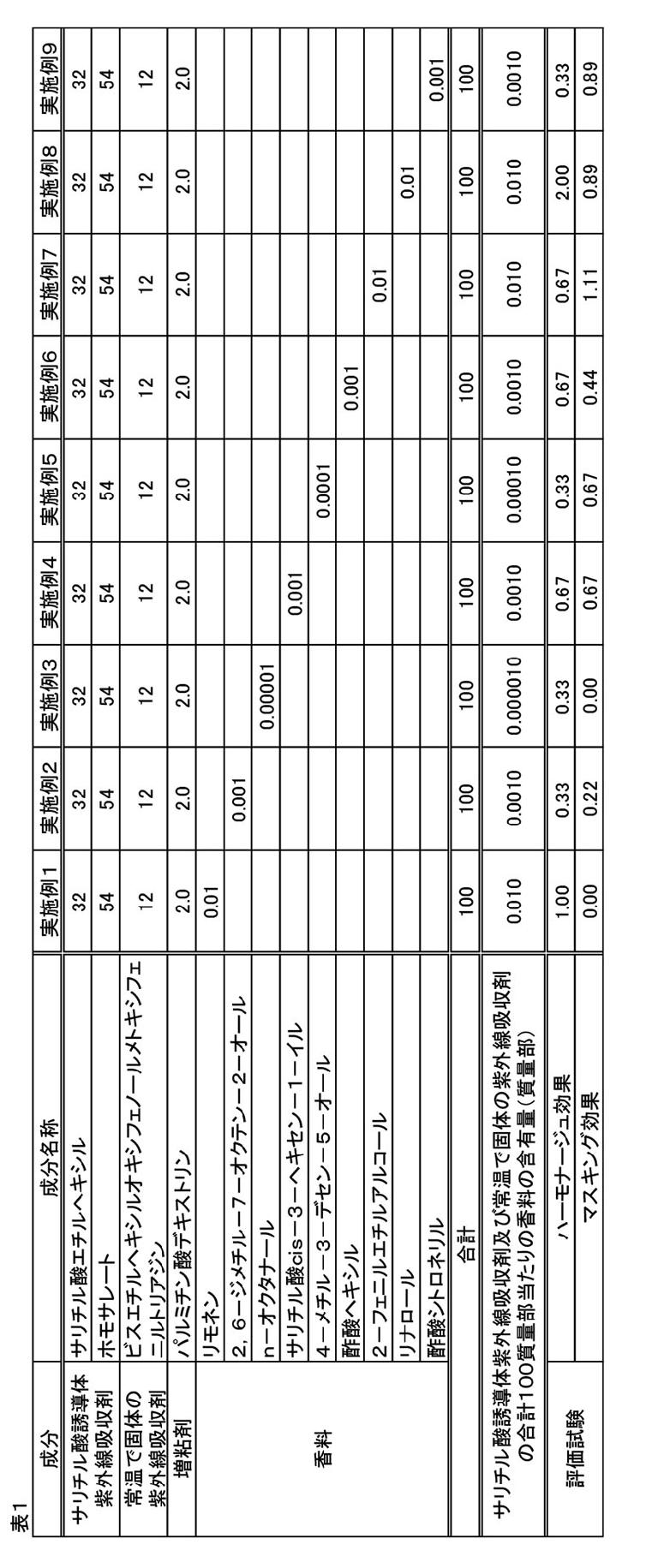
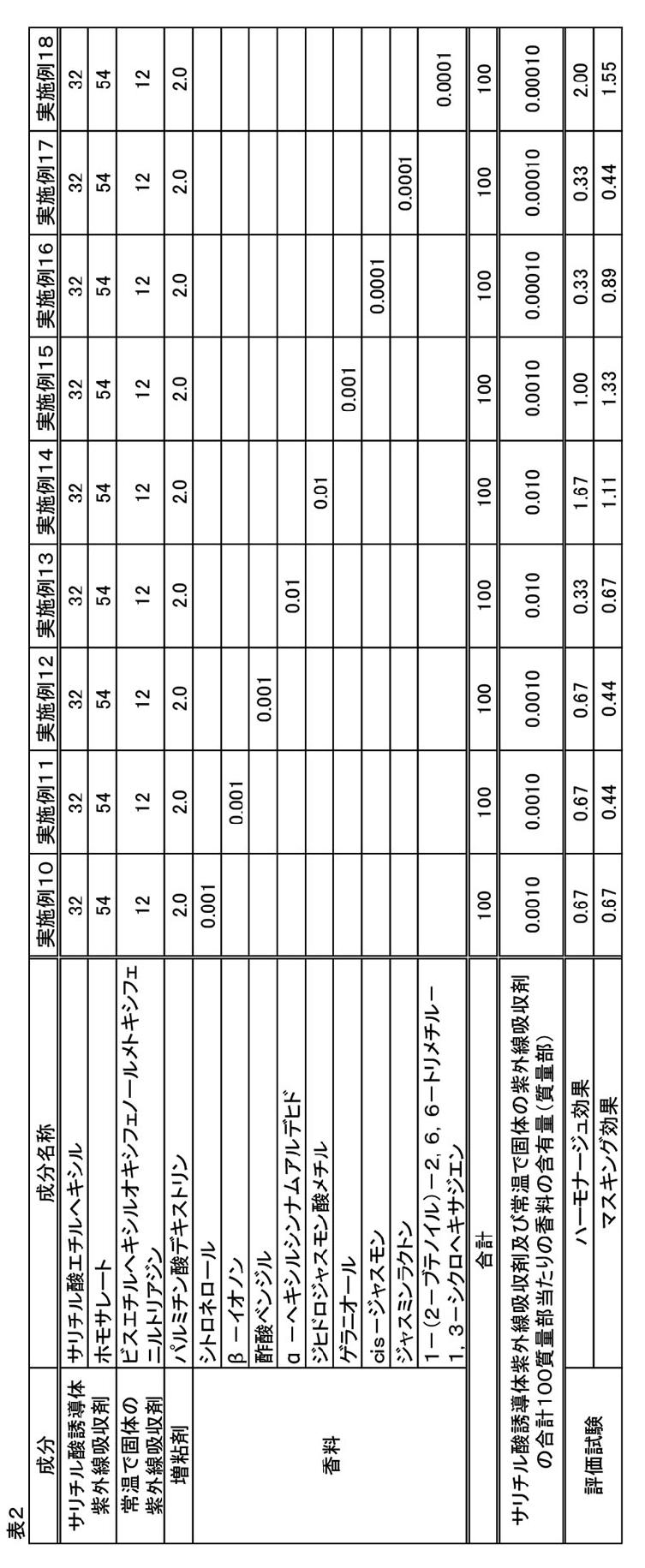
- Test Example 1 the effect of improving the sunscreen odor due to the difference in the blended perfume was examined. The results are shown in Tables 1-3.
- Example 1 Using the formulations shown in Table 1, oily cosmetics were produced by the following method.
- Salicylic acid derivative UV absorbers ethylhexyl salicylate and homosalate, UV absorber bisethylhexyloxyphenol methoxyphenyltriazine that is solid at room temperature, and thickener dextrin palmitate are mixed while heated to 80° C., followed by UV irradiation. Absorbent parts were prepared.
- Examples 2-24 and Comparative Examples 1-2 Oil-based cosmetics of Examples 2 to 24 and Comparative Examples 1 and 2 were obtained in the same manner as in Example 1, except that the type and blending amount of the perfume was changed to those shown in Tables 1 to 3.
- the cosmetic containing the specific fragrance of the present disclosure uses both a salicylic acid derivative ultraviolet absorber and a solid ultraviolet absorber at room temperature, and these are used in the preparation of the cosmetic. It was confirmed that the peculiar sunscreen smell generated when the was heated could be suitably improved.
- Test Example 2 Confirmation of the effect of improving sunscreen odor due to the difference in ultraviolet absorbers that are solid at room temperature>>
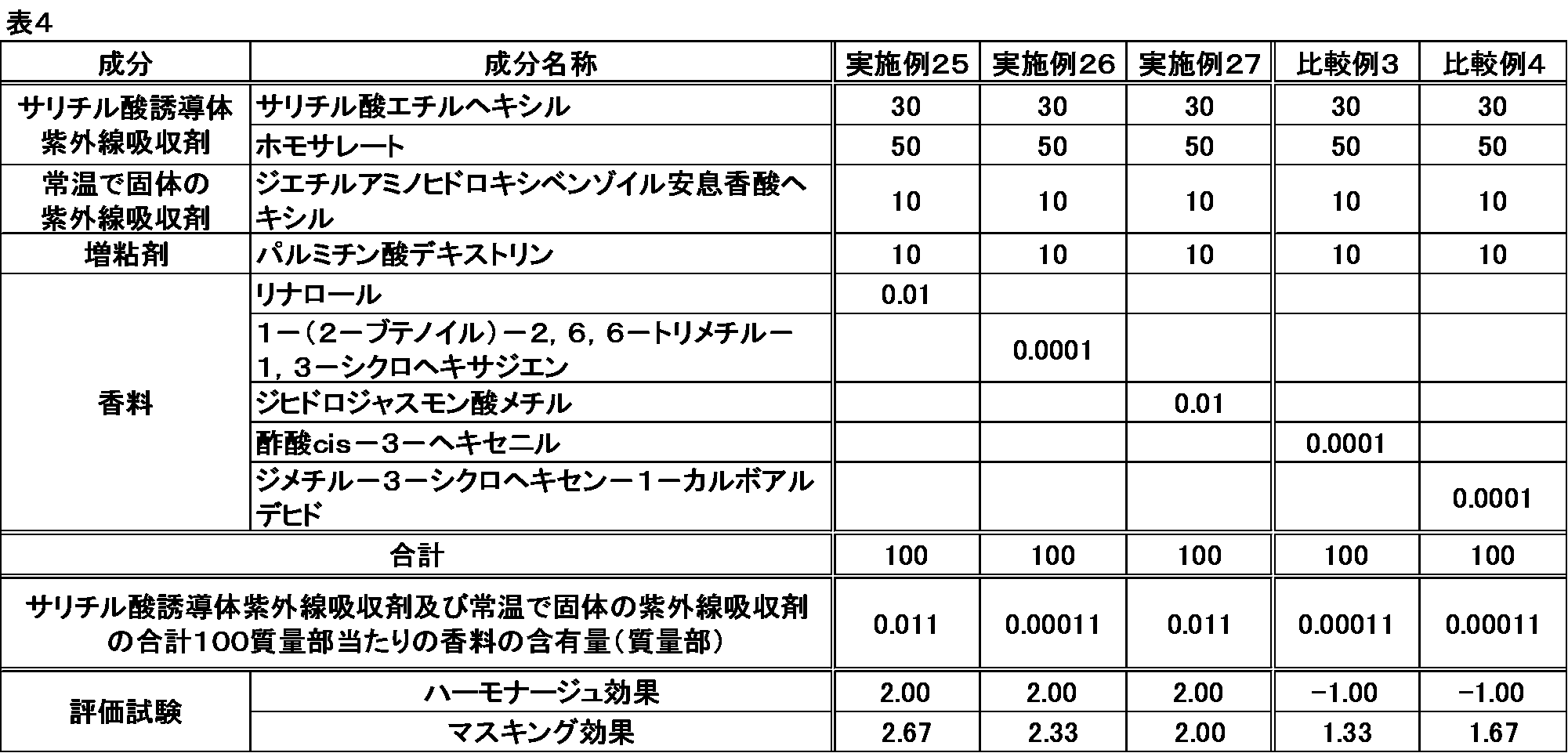
- Test Example 2 the effect of improving the sunscreen odor was examined when diethylaminohydroxybenzoyl hexyl benzoate was used as an ultraviolet absorber that is solid at room temperature. Table 4 shows the results.
- Examples 25-27 and Comparative Examples 3-4 Oil-based cosmetics of Examples 25-27 and Comparative Examples 3-4 were obtained in the same manner as in Example 1, except that the formulations were changed to those shown in Table 4.
- the cosmetic containing the specific fragrance of the present disclosure uses both a salicylic acid derivative UV absorber and a solid UV absorber at room temperature, regardless of the type of UV absorber that is solid at room temperature. In addition, it was confirmed that the peculiar sunscreen odor that occurs when these are heated in the preparation of cosmetics can be suitably improved.
Landscapes
- Health & Medical Sciences (AREA)
- Life Sciences & Earth Sciences (AREA)
- Animal Behavior & Ethology (AREA)
- General Health & Medical Sciences (AREA)
- Public Health (AREA)
- Veterinary Medicine (AREA)
- Birds (AREA)
- Epidemiology (AREA)
- Emergency Medicine (AREA)
- Dermatology (AREA)
- Cosmetics (AREA)
Abstract
サリチル酸誘導体紫外線吸収剤と常温で固体の紫外線吸収剤とを併用したときに発生する特有の日焼け止め臭を改善した日焼け止め化粧料を提供する。 本開示の日焼け止め化粧料は、サリチル酸誘導体紫外線吸収剤及び常温で固体の紫外線吸収剤に加え、特定の香料を含む。
Description
本開示は、日焼け止め化粧料に関する。
化粧品の分野では、日焼け止め性能を呈する種々の組成物及び該組成物を用いた化粧料が開発されている。
特許文献1には、香料成分0.5~30重量%と、乳化剤0.1~20重量%と、水50~99重量%と、水溶性高分子0.001~10重量%と、紫外線吸収剤とを含有し、かつ、アルコールを実質的に含有しない、液状又はジェル状の香料組成物が開示されている。
特許文献2には、UVAをフィルタリングする単一の有機フィルター、UVBをフィルタリングする、第1のフィルターとは異なる単一の有機フィルター、及び前記フィルター用の溶媒である1~50重量%の少なくとも1種の不揮発性油からなる混合物を少なくとも95重量%含む抗紫外線添加剤であって、UVAをフィルタリングする有機フィルターが、ジベンゾイルメタン誘導体から選択され、かつ、添加剤の重量の5~75重量%に相当し、UVBをフィルタリングする有機フィルターが、シンナメート誘導体から選択され、かつ、添加剤の重量の20~90重量%に相当し、不揮発性油が、イソノナン酸イソノニル、ジカプリル酸/ジカプリン酸ブチレングリコール、フェニルトリメチコン、及びリンゴ酸ジイソステアリルから選択され、かつ、添加剤の重量の5~30重量%に相当し、組成物用であり、前記組成物が香料と色素とを含有する、抗紫外線添加剤を含む、化粧用組成物又は着香溶液が開示されている。
特許文献3には、(A)桂皮酸系紫外線吸収剤、(B)多孔質シリカ、(C)油分、(D)界面活性剤、及び(E)水を含有する、日焼け止め油中水型乳化化粧料が開示されている。
例えば、特許文献3の背景技術にも記載されるように、日焼け止め化粧料は、化粧料中に配合される紫外線吸収剤特有の臭いが問題になっていた。
また、近年、日焼け止め化粧料において、紫外線吸収剤が複数併用される結果、臭いがさらに複雑化するようになってきた。なかでも、サリチル酸誘導体紫外線吸収剤と常温で固体の紫外線吸収剤とを併用した日焼け止め化粧料は、日焼け止め性能には優れるものの、独特の日焼け止め臭を呈するため、かかる日焼け止め臭の改善が望まれていた。
したがって、本開示の主題は、サリチル酸誘導体紫外線吸収剤と常温で固体の紫外線吸収剤とを併用したときに発生する特有の日焼け止め臭を改善した日焼け止め化粧料を提供することである。
〈態様1〉
サリチル酸誘導体紫外線吸収剤、常温で固体の紫外線吸収剤、及び香料を含み、
前記香料が、リモネン、2,6-ジメチル-7-オクテン-2-オール、n-オクタナール、サリチル酸cis-3-ヘキセン-1-イル、4-メチル-3-デセン-5-オール、酢酸ヘキシル、2-フェニルエチルアルコール、リナロール、酢酸シトロネリル、シトロネロール、β-イオノン、酢酸ベンジル、α-ヘキシルシンナムアルデヒド、ジヒドロジャスモン酸メチル、ゲラニオール、cis-ジャスモン、ジャスミンラクトン、1-(2-ブテノイル)-2,6,6-トリメチル-1,3-シクロヘキサジエン、メチルイオノン、イソブチルメチルテトラヒドロピラノール、バニリン、2-アセチル-2,3,8,8-テトラメチル-1,2,3,4,5,6,7,8-オクタヒドロナフタレン、2-エチル-4-(2,2,3-トリメチル-3-シクロペンテニル)-2-ブテン-1-オール、及び1,3,4,6,7,8ヘキサヒドロ4,6,6,7,8,8ヘキサメチルシクロペンタγ2ベンゾピランからなる群から選択される少なくとも一種である、
日焼け止め化粧料。
〈態様2〉
前記サリチル酸誘導体紫外線吸収剤が、サリチル酸エチルヘキシル及びホモサレートからなる群から選択される少なくとも一種である、態様1に記載の化粧料。
〈態様3〉
前記常温で固体の紫外線吸収剤が、ビスエチルヘキシルオキシフェノールメトキシフェニルトリアジン及びジエチルアミノヒドロキシベンゾイル安息香酸ヘキシルからなる群から選択される少なくとも一種である、態様1又は2に記載の化粧料。
〈態様4〉
IOBが0.10以上の紫外線吸収剤をさらに含む、態様1~3のいずれかに記載の化粧料。
〈態様5〉
前記IOBが0.10以上の紫外線吸収剤が、オクトクリレン及びオクチルメトキシシンナメートからなる群から選択される少なくとも一種である、態様4に記載の化粧料。
〈態様6〉
前記香料が、リモネン、サリチル酸cis-3-ヘキセン-1-イル、酢酸ヘキシル、2-フェニルエチルアルコール、リナロール、シトロネロール、β-イオノン、酢酸ベンジル、ジヒドロジャスモン酸メチル、ゲラニオール、1-(2-ブテノイル)-2,6,6-トリメチル-1,3-シクロヘキサジエン、メチルイオノン、及びイソブチルメチルテトラヒドロピラノールからなる群から選択される少なくとも一種である、態様1~5のいずれかに記載の化粧料。
〈態様7〉
増粘剤をさらに含む、態様1~6のいずれかに記載の化粧料。
〈態様8〉
前記香料の含有量が、サリチル酸誘導体紫外線吸収剤及び常温で固体の紫外線吸収剤の合計量100質量部当たり、1.0×10⁻⁶質量部以上である、態様1~7のいずれかに記載の化粧料。
〈態様9〉
紫外線散乱剤の含有量が、1.0質量%以下である、態様1~8のいずれかに記載の化粧料。
本開示によれば、サリチル酸誘導体紫外線吸収剤と常温で固体の紫外線吸収剤とを併用したときに発生する特有の日焼け止め臭を改善した日焼け止め化粧料を提供することができる。
以下、本開示の実施の形態について詳述する。本開示は、以下の実施の形態に限定されるものではなく、発明の本旨の範囲内で種々変形して実施できる。
本開示の日焼け止め化粧料(以下単に「化粧料」と称する場合がある。)は、サリチル酸誘導体紫外線吸収剤、及び常温で固体の紫外線吸収剤に加え、上記特定の香料を含んでいる。
原理によって限定されるものではないが、本開示の日焼け止め化粧料が、サリチル酸誘導体紫外線吸収剤と常温で固体の紫外線吸収剤とを併用したときに発生する特有の日焼け止め臭(以下単に「日焼け止め臭」と称する場合がある。)を改善し得る作用原理は以下のとおりであると考える。ここで、かかる日焼け止め臭をイメージしやすくするために、より具体的な臭いで表現すると、次に限定されないが、例えば、サリチル酸系の臭い、苦みのあるような臭い、及びこれらの複合臭が挙げられる。
日焼け止め化粧料は、一般的に、使用する基剤に伴う独特な臭いを発生する。基剤には、種々の成分が含まれているが、本発明者は、化粧料を調製するときに使用する各パーツ(例えば紫外線吸収剤パーツ、紫外線散乱剤パーツ)毎に臭いを分析した結果、サリチル酸誘導体紫外線吸収剤と常温で固体の紫外線吸収剤とを併用し、かつ、化粧料の調製においてこれらを加熱したときに生じる臭いが不快な臭いの根源であることを突き止め、かかる臭いを解消することで、化粧料全体としての不快な臭いを解消し得ることを見出した。なお、かかる臭いは、典型的には、サリチル酸誘導体紫外線吸収剤と常温で固体の紫外線吸収剤が加熱されたときに発生するが、室温まで徐冷した後においてもかかる臭いは化粧料に残存する。
臭いが気になる場合、特許文献1に記載されているように、香料を配合することが一般的である。しかし、本発明者は、サリチル酸誘導体紫外線吸収剤と常温で固体の紫外線吸収剤とを併用し、かつ、化粧料の調製においてこれらを加熱したときに生じる特有の日焼け止め臭に関しては、香料ならばいかなるものも有効に作用するわけではなく、香料の中には逆に、不快な臭いを増長させてしまうような香料も存在することを発見した。
そして、本発明者は、マスキング効果とハーモナージュ効果との観点に基づいて、かかる日焼け止め臭と香料との関係を分析した結果、無数に存在する香料の中から、ある特定の香料を選択すると、かかる日焼け止め臭を快適な方向に改善し得ること、ひいては、サリチル酸誘導体紫外線吸収剤と常温で固体の紫外線吸収剤とを含む化粧料全体としての日焼け止め臭を快適な方向に改善し得ることを見出した。
本開示における用語の定義は以下のとおりである。
本開示において「ハーモナージュ効果」とは、不快な臭い成分と香料成分とが取り込まれて、嫌な臭いの質を不快なものから快適なものにシフトさせる効果を意味する。
本開示において「マスキング効果」とは、不快な臭いを消したり又は覆い隠したりする効果を意味する。
《日焼け止め化粧料》
〈サリチル酸誘導体紫外線吸収剤〉
本開示の日焼け止め化粧料は、サリチル酸誘導体紫外線吸収剤を含む。かかる材料は、例えば市販品を適宜使用することができる。サリチル酸誘導体紫外線吸収剤は後述する常温で固体の紫外線吸収剤を好適に溶解させることもできる。
〈サリチル酸誘導体紫外線吸収剤〉
本開示の日焼け止め化粧料は、サリチル酸誘導体紫外線吸収剤を含む。かかる材料は、例えば市販品を適宜使用することができる。サリチル酸誘導体紫外線吸収剤は後述する常温で固体の紫外線吸収剤を好適に溶解させることもできる。
サリチル酸誘導体紫外線吸収剤の配合量としては特に制限はなく、所望の日焼け止め性能を奏するように適宜配合することができる。具体的には、かかる配合量として、例えば、化粧料の全量に対し、1.0質量%以上、5.0質量%以上、10質量%以上、15質量%以上、20質量%以上、又は30質量%以上とすることができ、また、90質量%以下、85質量%以下、80質量%以下、75質量%以下、70質量%以下、65質量%以下、60質量%以下、55質量%以下、50質量%以下、45質量%以下、40質量%以下、又は35質量%以下とすることができる。
サリチル酸誘導体紫外線吸収剤としては、サリチル酸骨格を有する紫外線吸収剤であれば特に制限はなく、例えば、ホモサレート(サリチル酸ホモメンチル)、サリチル酸エチルヘキシル(サリチル酸オクチル)、サリチル酸トリエタノールアミンを挙げることができる。サリチル酸誘導体紫外線吸収剤は、単独で又は二種以上組み合わせて使用することができる。
本発明者は、常温で固体の紫外線吸収剤とサリチル酸誘導体紫外線吸収剤を混合するためにこれらを加熱すると、サリチル酸誘導体紫外線吸収剤に伴う臭いが増長されることを見出した。なかでも、ホモサレート及びサリチル酸エチルヘキシルは加熱に伴う臭いの増長作用が大きいが、本開示の化粧料は特定の香料を含むため、このようなホモサレート及びサリチル酸エチルヘキシルを配合し、かつ加熱工程を経た場合であっても日焼け止め臭を好適に改善することができる。
〈常温で固体の紫外線吸収剤〉
本開示の日焼け止め化粧料は、常温で固体の紫外線吸収剤を含む。
本開示の日焼け止め化粧料は、常温で固体の紫外線吸収剤を含む。
常温で固体の紫外線吸収剤の配合量としては特に制限はなく、所望の日焼け止め性能を奏するように適宜配合することができる。具体的には、かかる配合量として、例えば、化粧料の全量に対し、0.1質量%以上、0.5質量%以上、又は1.0質量%以上とすることができ、また、20質量%以下、15質量%以下、10質量%以下、7.0質量%以下、又は5.0質量%以下とすることができる。
本開示の日焼け止め化粧料は、常温で固体の紫外線吸収剤とサリチル酸誘導体紫外線吸収剤を、典型的には、加熱して混合している。したがって、常温で固体の紫外線吸収剤は、加熱して溶解し得るものであれば特に制限はない。このような紫外線吸収剤としては、例えば、ビスエチルヘキシルオキシフェノールメトキシフェニルトリアジン、エチルヘキシルトリアゾン、ジエチルアミノヒドロキシベンゾイル安息香酸ヘキシル、オキシベンゾン-3を挙げることができる。常温で固体の紫外線吸収剤は、単独で又は二種以上組み合わせて使用することができる。なかでも、ビスエチルヘキシルオキシフェノールメトキシフェニルトリアジン及びジエチルアミノヒドロキシベンゾイル安息香酸ヘキシルは、加熱されたサリチル酸誘導体紫外線吸収剤と組み合わさると、日焼け止め臭が増長されるが、本開示の化粧料は特定の香料を含むため、このような紫外線吸収剤に対しても日焼け止め臭を好適に改善することができる。
〈香料〉
本開示の日焼け止め化粧料は、以下に示す特定の香料(以下「特定香料」と称する場合がある。)を含む。このような香料を化粧料中に配合することによって、サリチル酸誘導体紫外線吸収剤と常温で固体の紫外線吸収剤とを併用し、かつ、化粧料の調製においてこれらを加熱したときに生じる特有の日焼け止め臭を改善することができる。
本開示の日焼け止め化粧料は、以下に示す特定の香料(以下「特定香料」と称する場合がある。)を含む。このような香料を化粧料中に配合することによって、サリチル酸誘導体紫外線吸収剤と常温で固体の紫外線吸収剤とを併用し、かつ、化粧料の調製においてこれらを加熱したときに生じる特有の日焼け止め臭を改善することができる。
特定香料としては、リモネン、2,6-ジメチル-7-オクテン-2-オール、n-オクタナール、サリチル酸cis-3-ヘキセン-1-イル、4-メチル-3-デセン-5-オール、酢酸ヘキシル、2-フェニルエチルアルコール、リナロール、酢酸シトロネリル、シトロネロール、β-イオノン、酢酸ベンジル、α-ヘキシルシンナムアルデヒド、ジヒドロジャスモン酸メチル、ゲラニオール、cis-ジャスモン、ジャスミンラクトン、1-(2-ブテノイル)-2,6,6-トリメチル-1,3-シクロヘキサジエン、メチルイオノン、イソブチルメチルテトラヒドロピラノール、バニリン、2-アセチル-2,3,8,8-テトラメチル-1,2,3,4,5,6,7,8-オクタヒドロナフタレン、2-エチル-4-(2,2,3-トリメチル-3-シクロペンテニル)-2-ブテン-1-オール、及び1,3,4,6,7,8ヘキサヒドロ4,6,6,7,8,8ヘキサメチルシクロペンタγ2ベンゾピランからなる群から選択される少なくとも一種が挙げられる。これらの香料は後述するハーモナージュ試験において0を超えるスコアを達成することができる。なかでも、リモネン、サリチル酸cis-3-ヘキセン-1-イル、酢酸ヘキシル、2-フェニルエチルアルコール、リナロール、シトロネロール、β-イオノン、酢酸ベンジル、ジヒドロジャスモン酸メチル、ゲラニオール、1-(2-ブテノイル)-2,6,6-トリメチル-1,3-シクロヘキサジエン、メチルイオノン、及びイソブチルメチルテトラヒドロピラノールからなる群から選択される少なくとも一種が好ましい。かかる香料は後述するハーモナージュ試験において0.3を超えるスコアの場合には日焼け止め臭をより改善でき、0.6を超えるスコアの場合には日焼け止め臭をさらに改善することができる。
特定香料の配合量は、例えば、要する日焼け止め臭の改善の程度、要する香りの程度に応じて適宜調整することができる。例えば、かかる配合量としては、化粧料の全量に対し、1.0×10⁻⁶質量%以上、5.0×10⁻⁶質量%以上、1.0×10⁻⁵質量%以上、5.0×10⁻⁵質量%以上、1.0×10⁻⁴質量%以上、5.0×10⁻⁴質量%以上、又は1.0×10⁻³質量%以上とすることができ、また、0.1質量%以下、0.05質量%以下、又は0.03質量%以下とすることができる。
また、特定香料は、サリチル酸誘導体紫外線吸収剤及び常温で固体の紫外線吸収剤によって生じる特有の日焼け止め臭を改善することから、特定香料の配合量は、サリチル酸誘導体紫外線吸収剤及び常温で固体の紫外線吸収剤の合計量100質量部当たり、1.0×10⁻⁶質量部以上、5.0×10⁻⁶質量部以上、1.0×10⁻⁵質量部以上、5.0×10⁻⁵質量部以上、1.0×10⁻⁴質量部以上、5.0×10⁻⁴質量部以上、1.0×10⁻³質量部以上、又は5.0×10⁻³質量部以上とすることもでき、また、1.0質量部以下、0.50質量部以下、0.10質量部以下、又は0.05質量部以下とすることもできる。
いくつかの実施態様では、本開示の日焼け止め化粧料は、本開示の効果に悪影響を及ぼさない範囲で、上記特定香料以外の香料を含んでもよい。しかし、香料の中には、本開示における日焼け止め臭に対して効果がなかったり、或いは逆に不快な臭いを生じさせたりする香料(以下「不適合香料」と称する場合がある。)が存在する。このような不適合香料の配合量は、化粧料の全量に対し、1.0×10⁻³質量%以下、5.0×10⁻⁴質量%以下、1.0×10⁻⁴質量%以下、5.0×10⁻⁵質量%以下、1.0×10⁻⁵質量%以下、又は5.0×10⁻⁶質量%以下とすることが好ましく、不適合香料は配合しないことがより好ましい。このような不適合香料としては、例えば、酢酸cis-3-ヘキセニル、及びジメチル-3-シクロヘキセン-1-カルボアルデヒドを挙げることができる。ここで、上記特定香料以外の香料が不適合香料に該当するか否かについては、後述するハーモナージュ試験で評価することができる。具体的には、ハーモナージュ効果のスコアが0以下であれば、その香料は単独使用する場合は不適合香料とみなすことができる。
〈任意成分〉
本開示の日焼け止め化粧料は、本開示の効果に悪影響を及ぼさない範囲で、各種成分を適宜配合することができる。各種成分としては、日焼け止め化粧料に通常配合し得るような添加成分、例えば、アニオン性界面活性剤、カチオン性界面活性剤、両性界面活性剤、非イオン性界面活性剤、増粘剤、保湿剤、分散剤、水溶性高分子、油溶性高分子、シリコーン化多糖類等の皮膜形成剤、金属イオン封鎖剤、エタノール等の低級アルコール、エチレングリコール等の多価アルコール、高級アルコール、各種抽出液、糖、アミノ酸、有機アミン、高分子エマルジョン、キレート剤、上記紫外線吸収剤以外の他の紫外線吸収剤、pH調整剤、皮膚栄養剤、ビタミン、医薬品、医薬部外品、化粧品等に適用可能な水溶性薬剤、緩衝剤、防腐剤、噴射剤、有機系粉末、無機系粉末、紫外線散乱剤、顔料、染料、色素、水、油分等を挙げることができる。このような任意の成分は、単独で又は二種以上組み合わせて使用することができる。
本開示の日焼け止め化粧料は、本開示の効果に悪影響を及ぼさない範囲で、各種成分を適宜配合することができる。各種成分としては、日焼け止め化粧料に通常配合し得るような添加成分、例えば、アニオン性界面活性剤、カチオン性界面活性剤、両性界面活性剤、非イオン性界面活性剤、増粘剤、保湿剤、分散剤、水溶性高分子、油溶性高分子、シリコーン化多糖類等の皮膜形成剤、金属イオン封鎖剤、エタノール等の低級アルコール、エチレングリコール等の多価アルコール、高級アルコール、各種抽出液、糖、アミノ酸、有機アミン、高分子エマルジョン、キレート剤、上記紫外線吸収剤以外の他の紫外線吸収剤、pH調整剤、皮膚栄養剤、ビタミン、医薬品、医薬部外品、化粧品等に適用可能な水溶性薬剤、緩衝剤、防腐剤、噴射剤、有機系粉末、無機系粉末、紫外線散乱剤、顔料、染料、色素、水、油分等を挙げることができる。このような任意の成分は、単独で又は二種以上組み合わせて使用することができる。
いくつかの実施態様では、本開示の日焼け止め化粧料は増粘剤を含む。増粘剤は、化粧料の形態(例えば水中油型化粧料、油中水型化粧料、油性化粧料)に応じ、水相増粘剤及び油相増粘剤などを適宜選定することができる。増粘剤は単独で又は二種以上組み合わせて使用することができる。なお、本開示の日焼け止め化粧料は、上述した特定の香料を含んでいるため、増粘剤が臭いを呈したとしても、化粧料全体としての日焼け止め臭を好適に改善することができる。
(水相増粘剤)
水相増粘剤は、水相の増粘性を高めるために、化粧料に通常配合されるものを使用することができる。具体的には、例えば、天然の水溶性高分子、半合成の水溶性高分子、合成の水溶性高分子、無機系増粘剤等といった各種の親水性増粘剤が挙げられる。水相増粘剤は、単独で又は二種以上組み合わせて使用することができる。
水相増粘剤は、水相の増粘性を高めるために、化粧料に通常配合されるものを使用することができる。具体的には、例えば、天然の水溶性高分子、半合成の水溶性高分子、合成の水溶性高分子、無機系増粘剤等といった各種の親水性増粘剤が挙げられる。水相増粘剤は、単独で又は二種以上組み合わせて使用することができる。
天然の水溶性高分子としては、例えば、アラビアガム、トラガカントガム、ガラクタン、グアガム、カラギーナン、ペクチン、クインスシード(マルメロ)抽出物、寒天、褐藻粉末等の植物系高分子;キサンタンガム、デキストラン、プルラン、サクシノグリカン等の微生物系高分子;コラーゲン、カゼイン、アルブミン、ゼラチン等の動物系高分子が挙げられる。
半合成の水溶性高分子としては、例えば、カルボキシメチルデンプン、メチルヒドロキシデンプン等のデンプン系高分子;メチルセルロース、ニトロセルロース、エチルセルロース、メチルヒドロキシプロピルセルロース、ヒドロキシエチルセルロース、ステアロキシヒドロキシプロピルメチルセルロース、セルロース硫酸塩、ヒドロキシプロピルセルロース、カルボキシメチルセルロース、結晶セルロース等のセルロース系高分子;アルギン酸ナトリウム、アルギン酸プロピレングリコールエステル等のアルギン酸系高分子が挙げられる。
合成の水溶性高分子としては、例えば、ポリビニルアルコール、ポリビニルアセテート、ポリビニルメチルエーテル、ポリビニルピロリドン、ビニルピロリドンとビニルアセテート共重合物、カルボキシビニルポリマー等のビニル系高分子;ポリアクリル酸ナトリウム、ポリエチルアクリレート、ポリアクリルアミド、アクリル酸・メタクリル酸アルキル共重合体(例えば、(アクリレーツ/アクリル酸アルキル(C10-30))クロスポリマー)、ポリアクリル酸アルカノールアミン、アルキルメタクリレートとジメチルアミノエチルメタクリレート共重合物、ポリ2-アクリルアミド-2-メチルプロパンスルホン酸、ポリメタクリロイルオキシトリメチルアンモニウム、(アクリロイルジメチルタウリンアンモニウム/VP)コポリマー、(ジメチルアクリルアミド/アクリロイルジメチルタウリンNa)コポリマー等のアクリル系高分子が挙げられる。
無機系増粘剤としては、例えば、ベントナイト、ラポナイト、ヘクトライト、ケイ酸アルミニウムマグネシウム、無水ケイ酸が挙げられる。
水相増粘剤の配合量としては、例えば、化粧料全量に対して、0.1質量%以上、0.3質量%以上、又は0.5質量%以上とすることができ、また、5.0質量%以下、4.0質量%以下、3.0質量%以下、又は2.0質量%以下とすることができる。
(油相増粘剤)
油相増粘剤は、油相の増粘性を高めるために、化粧料に通常配合されるものを使用することができる。具体的には、例えば、デキストリン脂肪酸エステル、ショ糖脂肪酸エステル、及び脂肪酸若しくはその塩が挙げられる。油相増粘剤は、単独で又は二種以上組み合わせて使用することができる。
油相増粘剤は、油相の増粘性を高めるために、化粧料に通常配合されるものを使用することができる。具体的には、例えば、デキストリン脂肪酸エステル、ショ糖脂肪酸エステル、及び脂肪酸若しくはその塩が挙げられる。油相増粘剤は、単独で又は二種以上組み合わせて使用することができる。
デキストリン脂肪酸エステルは、デキストリン又は還元デキストリンと高級脂肪酸とのエステルであり、化粧料に一般的に使用されているものであれば特に制限されず使用することができる。デキストリン又は還元デキストリンは平均糖重合度が3~100のものを用いるのが好ましい。デキストリン脂肪酸エステルの構成脂肪酸としては、炭素原子数が8~22の飽和脂肪酸を用いるのが好ましい。具体的には、例えば、パルミチン酸デキストリン、オレイン酸デキストリン、ステアリン酸デキストリン、ミリスチン酸デキストリン、(パルミチン酸/2-エチルヘキサン酸)デキストリンを挙げることができる。
ショ糖脂肪酸エステルは、その脂肪酸が直鎖状又は分岐鎖状であり、飽和又は不飽和である、炭素原子数が12~22のものを好ましく用いることができる。具体的には、例えば、ショ糖カプリル酸エステル、ショ糖カプリン酸エステル、ショ糖ラウリン酸エステル、ショ糖ミリスチン酸エステル、ショ糖パルミチン酸エステル、ショ糖ステアリン酸エステル、ショ糖オレイン酸エステル、ショ糖エルカ酸エステルを挙げることができる。
脂肪酸は、常温で固形のものを使用することができ、例えば、ミリスチン酸、パルミチン酸、ステアリン酸、ベヘニン酸を挙げることができる。脂肪酸の塩としては、これらのカルシウム塩、マグネシウム塩、アルミニウム塩等を挙げることができる。
油相増粘剤の配合量は、例えば、化粧料全量に対して、0.1質量%以上、0.3質量%以上、又は0.5質量%以上とすることができ、また、15質量%以下、13質量%以下、10質量%以下、9.0質量%以下、8.0質量%以下、7.0質量%以下、6.0質量%以下、5.0質量%以下、4.0質量%以下、3.0質量%以下、又は2.0質量%以下とすることができる。
いくつかの実施態様では、本開示の日焼け止め化粧料は油分を含む。かかる油分としては特に制限はなく、例えば、極性油、炭化水素油、シリコーン油を挙げることができる。油分は単独で又は二種以上組み合わせて使用することができる。
油分の配合量としては特に制限はなく、例えば、化粧料の全量に対し、0.5質量%以上、1.0質量%以上、又は3.0質量%以上、80質量%以下、75質量%以下、70質量%以下、65質量%以下、又は60質量%以下の範囲で、化粧料の形態(例えば、水中油型化粧料、油中水型化粧料、油性化粧料)に応じて適宜配合することができる。
化粧料が水中油型の化粧料の場合における油分の配合量としては、例えば、化粧料の全量に対し、0.5質量%以上、1.0質量%以上、3.0質量%以上、5.0質量%以上、7.0質量%以上、10質量%以上、13質量%以上、又は15質量%以上とすることができ、また、50質量%以下、40質量%以下、30質量%以下、25質量%以下、又は20質量%以下とすることができる。
化粧料が油中水型の化粧料の場合における油分の配合量としては、例えば、化粧料の全量に対し、20質量%以上、25質量%以上、又は30質量%以上とすることができ、また、70質量%以下、65質量%以下、又は60質量%以下とすることができる。
(極性油)
極性油としては特に制限はなく、例えば、IOBが0.10以上の極性油を使用することができる。また、IOBが0.10以上の有機系紫外線吸収剤は、極性油とみなすことができる。ここで、極性油は、常温で液状であることが好ましい。本開示において「常温」とは、例えば、20℃±15℃の範囲を意図することができる。
極性油としては特に制限はなく、例えば、IOBが0.10以上の極性油を使用することができる。また、IOBが0.10以上の有機系紫外線吸収剤は、極性油とみなすことができる。ここで、極性油は、常温で液状であることが好ましい。本開示において「常温」とは、例えば、20℃±15℃の範囲を意図することができる。
極性油及び極性油とみなし得る有機系紫外線吸収剤のIOB値は、例えば、0.10以上、0.11以上、0.12以上、又は0.13以上とすることでき、また、0.60以下、0.55以下、0.50以下、0.45以下、又は0.40以下とすることができる。ここで、IOB値とは、Inorganic/Organic Balance(無機性/有機性比)の略であって、無機性値の有機性値に対する比率を表す値であり、有機化合物の極性の度合いを示す指標となるものである。IOB値は、具体的には、IOB値=無機性値/有機性値として表される。「無機性値」、「有機性値」のそれぞれについては、例えば、分子中の炭素原子1個について「有機性値」が20、水酸基1個について「無機性値」が100といったように、各種原子又は官能基に応じた「無機性値」、「有機性値」が設定されており、有機化合物中の全ての原子及び官能基の「無機性値」、「有機性値」を積算することによって、当該有機化合物のIOB値を算出することができる(例えば、甲田善生著、「有機概念図-基礎と応用-」、p.11~17、三共出版、1984年発行参照)。
a.IOBが0.10以上の極性油
このような条件を満たす極性油の例としては、ミリスチン酸イソプロピル(IOB値=0.18)、パルミチン酸オクチル(IOB値=0.13)、パルミチン酸イソプロピル(IOB値=0.16)、ステアリン酸ブチル(IOB値=0.14)、ラウリン酸ヘキシル(IOB値=0.17)、ミリスチン酸ミリスチル(IOB値=0.11)、オレイン酸デシル(IOB値=0.11)、イソノナン酸イソノニル(IOB値=0.20)、イソノナン酸イソトリデシル(IOB値=0.15)、エチルヘキサン酸セチル(IOB値=0.13)、テトラエチルヘキサン酸ペンタエリスリチル(IOB値=0.35)、コハク酸ジエチルヘキシル(IOB値=0.32)、コハク酸ジオクチル(IOB値=0.36)、ジステアリン酸グリコール(IOB値=0.16)、ジイソステアリン酸グリセリル(IOB値=0.29)、ジカプリン酸ネオペンチルグリコール(IOB値=0.25)、リンゴ酸ジイソステアリル(IOB値=0.28)、トリイソステアリン酸トリメチロールプロパン(IOB値=0.16)、トリ2-エチルヘキサン酸グリセリル(トリエチルヘキサノイン)(IOB値=0.35)、トリオクタン酸トリメチロールプロパン(IOB値=0.33)、トリイソステアリン酸トリメチロールプロパン(IOB値=0.16)、アジピン酸ジイソブチル(IOB値=0.46)、N-ラウロイル-L-グルタミン酸-2-オクチルドデシルエステル(IOB値=0.29)、アジピン酸2-ヘキシルデシル(IOB値=0.16)、セバシン酸ジイソプロピル(IOB値=0.40)、パルミチン酸2-エチルヘキシル(IOB値=0.13)、エチルヘキサン酸2-エチルヘキシル(IOB値=0.20)、トリイソステアリン(IOB値=0.16)、ジピバリン酸PPG-3(IOB値=0.52)、トリ(カプリル酸/カプリン酸)グリセリル(IOB値=0.33)、ジピバリン酸PPG-3(IOB値=0.52)、安息香酸アルキル(例えば、炭素原子数が12~15の安息香酸アルキル)(IOB値=0.18)等が挙げられる。これらは単独で又は二種以上組み合わせて使用することができる。
このような条件を満たす極性油の例としては、ミリスチン酸イソプロピル(IOB値=0.18)、パルミチン酸オクチル(IOB値=0.13)、パルミチン酸イソプロピル(IOB値=0.16)、ステアリン酸ブチル(IOB値=0.14)、ラウリン酸ヘキシル(IOB値=0.17)、ミリスチン酸ミリスチル(IOB値=0.11)、オレイン酸デシル(IOB値=0.11)、イソノナン酸イソノニル(IOB値=0.20)、イソノナン酸イソトリデシル(IOB値=0.15)、エチルヘキサン酸セチル(IOB値=0.13)、テトラエチルヘキサン酸ペンタエリスリチル(IOB値=0.35)、コハク酸ジエチルヘキシル(IOB値=0.32)、コハク酸ジオクチル(IOB値=0.36)、ジステアリン酸グリコール(IOB値=0.16)、ジイソステアリン酸グリセリル(IOB値=0.29)、ジカプリン酸ネオペンチルグリコール(IOB値=0.25)、リンゴ酸ジイソステアリル(IOB値=0.28)、トリイソステアリン酸トリメチロールプロパン(IOB値=0.16)、トリ2-エチルヘキサン酸グリセリル(トリエチルヘキサノイン)(IOB値=0.35)、トリオクタン酸トリメチロールプロパン(IOB値=0.33)、トリイソステアリン酸トリメチロールプロパン(IOB値=0.16)、アジピン酸ジイソブチル(IOB値=0.46)、N-ラウロイル-L-グルタミン酸-2-オクチルドデシルエステル(IOB値=0.29)、アジピン酸2-ヘキシルデシル(IOB値=0.16)、セバシン酸ジイソプロピル(IOB値=0.40)、パルミチン酸2-エチルヘキシル(IOB値=0.13)、エチルヘキサン酸2-エチルヘキシル(IOB値=0.20)、トリイソステアリン(IOB値=0.16)、ジピバリン酸PPG-3(IOB値=0.52)、トリ(カプリル酸/カプリン酸)グリセリル(IOB値=0.33)、ジピバリン酸PPG-3(IOB値=0.52)、安息香酸アルキル(例えば、炭素原子数が12~15の安息香酸アルキル)(IOB値=0.18)等が挙げられる。これらは単独で又は二種以上組み合わせて使用することができる。
b.IOBが0.10以上の有機系紫外線吸収剤
このような条件を満たす有機系紫外線吸収剤の例としては、オクトクリレン、オクチルメトキシシンナメート(メトキシケイヒ酸エチルヘキシル)、ポリシリコーン-15等が挙げられる。かかる紫外線吸収剤は、単独で又は二種以上を組み合わせて使用することができる。なかでも、上述した常温で固体の紫外線吸収剤の溶解性、化粧料の透明性等の観点から、オクトクリレン、オクチルメトキシシンナメートが好ましい。
このような条件を満たす有機系紫外線吸収剤の例としては、オクトクリレン、オクチルメトキシシンナメート(メトキシケイヒ酸エチルヘキシル)、ポリシリコーン-15等が挙げられる。かかる紫外線吸収剤は、単独で又は二種以上を組み合わせて使用することができる。なかでも、上述した常温で固体の紫外線吸収剤の溶解性、化粧料の透明性等の観点から、オクトクリレン、オクチルメトキシシンナメートが好ましい。
IOBが0.10以上の有機系紫外線吸収剤の中には臭いを呈する紫外線吸収剤も存在する。したがって、このような有機系紫外線吸収剤を使用する場合には、日焼け止め臭を抑制する観点から、10質量%以下、7.0質量%以下、5.0質量%以下、3.0質量%以下、1.0質量%以下、又は0.5質量%以下の割合で化粧料中に配合することが好ましく、或いは、このような有機系紫外線吸収剤は化粧料中に配合しないことがより好ましい。
(炭化水素油)
炭化水素油としては、例えば、ワセリン、流動パラフィン、テトライソブタン、水添ポリデセン、マイクロクリスタリンワックス、オレフィンオリゴマー、イソドデカン、イソヘキサデカン、スクワラン、ポリブテン、水添ポリブテン、ポリイソブテン、及び水添ポリイソブテンが挙げられる。
炭化水素油としては、例えば、ワセリン、流動パラフィン、テトライソブタン、水添ポリデセン、マイクロクリスタリンワックス、オレフィンオリゴマー、イソドデカン、イソヘキサデカン、スクワラン、ポリブテン、水添ポリブテン、ポリイソブテン、及び水添ポリイソブテンが挙げられる。
(シリコーン油)
シリコーン油としては、例えば、直鎖状シリコーン油、分岐状シリコーン油、環状シリコーン油を挙げることができる。
シリコーン油としては、例えば、直鎖状シリコーン油、分岐状シリコーン油、環状シリコーン油を挙げることができる。
直鎖状シリコーン油としては、例えば、粘度0.65csのジメチルポリシロキサン(「ジメチコン」と称する場合がある。)、粘度1csのジメチルポリシロキサン、粘度1.5csのジメチルポリシロキサン、粘度2csのジメチルポリシロキサンが挙げられる。ここで、これらの粘度は、25℃雰囲気下における動粘度を意図する。
分岐状シリコーン油としては、例えば、メチルトリメチコン、トリス(トリメチルシリル)メチルシラン、テトラキス(トリメチルシリル)シランが挙げられる。
環状シリコーン油としては、例えば、オクタメチルシクロテトラシロキサン、デカメチルシクロペンタシロキサン、及びドデカメチルシクロヘキサシロキサンが挙げられる。
(紫外線散乱剤)
本開示の日焼け止め化粧料は、紫外線散乱剤を含んでもよい。本開示において「紫外線散乱剤」とは、反射又は散乱により紫外線を物理的に遮断し得る剤を意図する。紫外線散乱剤は、単独で又は二種以上組み合わせて使用することができ、また、例えば市販品を適宜使用することができる。
本開示の日焼け止め化粧料は、紫外線散乱剤を含んでもよい。本開示において「紫外線散乱剤」とは、反射又は散乱により紫外線を物理的に遮断し得る剤を意図する。紫外線散乱剤は、単独で又は二種以上組み合わせて使用することができ、また、例えば市販品を適宜使用することができる。
紫外線散乱剤の配合量としては、例えば、化粧料の全量に対し、1.0質量%以上、3.0質量%以上、又は5.0質量%以上とすることができ、また、40質量%以下、35質量%以下、30質量%以下、25質量%以下、20質量%以下、15質量%以下、又は10質量%以下とすることができる。
紫外線散乱剤としては特に制限はなく、例えば、酸化亜鉛、酸化チタン、酸化ケイ素(シリカ)、酸化鉄、酸化アルミニウム、酸化セリウム、酸化クロム、酸化タングステンのような金属酸化物の粒子を挙げることができる。この他、例えば、硫酸バリウム、タルク、マイカ、サリサイト、カオリン、雲母チタン、紺青、水酸化クロムなどの粒子も挙げられる。なかでも、日焼け止め性能等の観点から、酸化亜鉛粒子、及び酸化チタン粒子が好ましい。
紫外線散乱剤の大きさとしては特に制限はなく、所望の日焼け止め性能を奏するように適宜設定することができる。例えば、紫外線散乱剤の平均一次粒子径としては、10nm以上、20nm以上、又は30nm以上とすることができ、また、100nm以下、70nm以下、又は50nm以下とすることができる。ここで、本開示において「平均一次粒子径」とは、一般的に用いられる方法で測定される粉体の一次粒子の径を意味するものであり、具体的には、透過電子顕微鏡で観察した10個以上の粒子の長軸の長さと短軸の長さとの相加平均として求められる値である。
紫外線散乱剤の形状として特に制限はなく、例えば、球状、楕円形状、薄片状、破砕状等の形状を挙げることができる。
紫外線散乱剤は、表面処理が施されていてもよい。表面処理は公知の方法で実施することができる。あるいは、表面処理された市販の紫外線散乱剤を使用してもよい。
化粧料中での分散性等の観点から、表面処理としては、疎水化処理が好ましい。疎水化処理に使用する疎水化処理剤としては、例えば、化粧料等に配合される紫外線散乱剤の疎水化表面処理に使用可能な種々の化合物、例えば、脂肪酸、シリコーン化合物、フッ素化合物、シランカップリング剤、第4級アンモニウム塩化合物が挙げられる。疎水化処理剤は単独で又は二種以上組み合わせて使用することができる。
脂肪酸としては、例えば、パルミチン酸、イソステアリン酸、ステアリン酸、ラウリン酸、ミリスチン酸、ベヘニン酸、オレイン酸、ロジン酸、及び12-ヒドロキシステアリン酸を挙げることができる。
シリコーン化合物としては、例えば、メチルハイドロゲンポリシロキサン、ジメチルポリシロキサン(ジメチコン)、及びメチルフェニルポリシロキサンを挙げることができる。
フッ素化合物としては、例えば、パーフルオロアルキル基含有エステル、パーフルオロポリエーテル、パーフルオロアルキル基を有する重合体を挙げることができる。
シランカップリング剤としては、例えば、パーフルオロアルキルシラン、トリフルオロメチルエチルトリメトキシシラン、ヘプタデカフルオロデシルトリメトキシシラン等のフルオロアルキルシラン化合物;メチルトリエトキシシラン、エチルトリエトキシシラン、ヘキシルトリエトキシシラン、オクチルトリエトキシシラン、トリエトキシカプリリルシラン等のアルキルシラン化合物を挙げることができる。
第4級アンモニウム塩化合物としては、例えば、塩化ステアリルトリメチルアンモニウム、塩化ベヘニルトリメチルアンモニウム、塩化セチルトリメチルアンモニウム、塩化ジステアリルジメチルアンモニウム、塩化ジベヘニルジメチルアンモニウム、塩化ジセチルジメチルアンモニウム、塩化ステアリルジメチルベンジルアンモニウム、及び塩化ジラウリルジメチルアンモニウムを挙げることができる。
本開示の化粧料は、サリチル酸誘導体紫外線吸収剤に加えて常温で固体の紫外線吸収剤を併用しているため、優れた紫外線防御性能を呈することができる。その結果、本開示の化粧料は、従来より紫外線防御性能を高めるために日焼け止め化粧料中に配合していた紫外線散乱剤の配合量を少なくすることができる。紫外線散乱剤は、紫外線防御性能を高めることができる一方で、日焼け止め化粧料の白さの原因となっていた。本開示の化粧料は、紫外線散乱剤の配合量を少なくしても優れた紫外線防御性能を呈することができるため、透明性に優れる日焼け止め化粧料を提供することができる。
透明性に優れる日焼け止め化粧料を得る観点から、紫外線散乱剤の配合量は、化粧料の全量に対し、1.0質量%以下、0.5質量%以下、又は0.1質量%以下であることが好ましく、紫外線散乱剤は化粧料中に配合しないことがより好ましい。
〈化粧料の形態及び剤型〉
本開示の日焼け止め化粧料は、例えば、油性化粧料、油中水型乳化化粧料、水中油型乳化化粧料の形態で提供することができる。このような化粧料は、例えば、分散法、凝集法といった公知の方法により調製することができる。
本開示の日焼け止め化粧料は、例えば、油性化粧料、油中水型乳化化粧料、水中油型乳化化粧料の形態で提供することができる。このような化粧料は、例えば、分散法、凝集法といった公知の方法により調製することができる。
本開示の化粧料の製造においては、サリチル酸誘導体紫外線吸収剤と常温で固体の紫外線吸収剤とを混合するために、典型的には、加熱工程が備わっている。これらの紫外線吸収剤を含む化粧料は、加熱工程を経るとこれらの紫外線吸収剤の加熱に伴って生じる特有の日焼け止め臭を呈するが、本開示の化粧料は、上述した特定の香料が含まれているため、加熱工程が実施されたとしても日焼け止め臭を好適に改善することができる。加熱工程の温度条件としては特に制限はなく、例えば、70℃以上、75℃以上、又は80℃以上とすることができ、また、100℃以下、95℃以下、90℃以下、又は85℃以下とすることができる。また本開示の化粧料の製造では、加熱工程以外の任意の工程、例えば、徐冷工程などが備わっていてもよい。
分散法とは、分散相の塊を機械的な力により微細化する方法である。具体的には、乳化機の破砕力を利用して乳化する方法であり、このような方法として、例えば、高圧ホモジナイザーを用いて高剪断力を付加する高圧乳化法を挙げることができる。
凝集法とは、界面化学的特性を利用したコロイド調製法であり、一様に溶け合った状態から何らかの手段で過飽和状態にし、分散相となるものを出現させる方法である。具体的な手法として、HLB温度乳化法、転相乳化法、非水乳化法、D相乳化法、液晶乳化法等が知られている。
日焼け止め化粧料の剤型としては、例えば、乳液状、クリーム状、液状といった剤型を採用することができる。
以下に実施例を挙げて、本開示についてさらに詳しく説明を行うが、本開示はこれらに限定されるものではない。なお、以下、特に断りのない限り、配合量は質量%で示す。
下記の製造方法により得た各試験サンプルを用いて以下に示す試験を実施し、その結果を、表1~4及び図1にまとめる。
《評価方法》
〈ハーモナージュ試験及びマスキング試験〉
作製した化粧料をそれぞれ5gずつ、容量20mLのスクリュー瓶に充填し、付属のキャップでスクリュー瓶を密封した。室温にて、密封から1時間以上静置した後にキャップを外し、エバリュエーターからなる3名の専門パネルが、1.5cm径の瓶口から臭いを嗅いで、各香料による日焼け止め臭に対するハーモナージュ効果及びマスキング効果を以下の基準で官能評価した。3名の専門パネルの評価スコアの平均値を各表に示す。ここで、少なくともハーモナージュ効果のスコアが0を超えていれば、日焼け止め臭が好適に改善されているといえ、ハーモナージュ効果及びマスキング効果のスコアが、いずれも0を超えていれば、日焼け止め臭がより好適に改善されているといえる。なお、試験サンプルを変更する場合には、次の試験サンプルの臭いをかぐ前に、コントロールとなる無賦香のサンプルを嗅いだ。また、嗅覚の疲労を防ぐために、評価に長時間(例えば2時間以上)要する場合は、約30分おきに約10分以上の休憩を入れた。
ハーモナージュ効果の官能スコア
+2点:日焼け止め臭と調和して良い香りを呈した。
+1点:日焼け止め臭と調和して不快感は消失した。
0点:日焼け止め臭の不快感に変化はなかった。
-1点:日焼け止め臭よりも不快感が強くなった。
-2点:日焼け止め臭よりも悪臭を呈した。
+2点:日焼け止め臭と調和して良い香りを呈した。
+1点:日焼け止め臭と調和して不快感は消失した。
0点:日焼け止め臭の不快感に変化はなかった。
-1点:日焼け止め臭よりも不快感が強くなった。
-2点:日焼け止め臭よりも悪臭を呈した。
マスキング効果の官能スコア
4点:日焼け止め臭を感じなかった。
3点:日焼け止め臭を少し感じた。
2点:日焼け止め臭をやや強く感じた。
1点:日焼け止め臭を強く感じた。
0点:日焼け止め臭がほとんど消えていなかった。
4点:日焼け止め臭を感じなかった。
3点:日焼け止め臭を少し感じた。
2点:日焼け止め臭をやや強く感じた。
1点:日焼け止め臭を強く感じた。
0点:日焼け止め臭がほとんど消えていなかった。
《試験例1:香料の相違による日焼け止め臭の改善効果の確認》
試験例1では、配合する香料の相違による日焼け止め臭の改善効果について検討した。その結果を表1~3に示す。
試験例1では、配合する香料の相違による日焼け止め臭の改善効果について検討した。その結果を表1~3に示す。
〈化粧料の製造方法〉
(実施例1)
表1に示す処方を用い、以下の方法によって油性化粧料を製造した。
(実施例1)
表1に示す処方を用い、以下の方法によって油性化粧料を製造した。
サリチル酸誘導体紫外線吸収剤のサリチル酸エチルヘキシル及びホモサレートと、常温で固体の紫外線吸収剤であるビスエチルヘキシルオキシフェノールメトキシフェニルトリアジンと、増粘剤のパルミチン酸デキストリンとを80℃に加熱しながら混合して、紫外線吸収剤パーツを調製した。
紫外線吸収剤パーツを室温まで徐冷した後、香料のリモネンを添加して均一に混合して油性化粧料を得た。
(実施例2~24及び比較例1~2)
香料の種類及び配合量を、表1~3に示すものに変更したこと以外は、実施例1と同様にして、実施例2~24及び比較例1~2の油性化粧料を得た。
香料の種類及び配合量を、表1~3に示すものに変更したこと以外は、実施例1と同様にして、実施例2~24及び比較例1~2の油性化粧料を得た。

〈結果〉
表1~3及び図1から明らかなように、本開示の特定香料を含む化粧料は、サリチル酸誘導体紫外線吸収剤と常温で固体の紫外線吸収剤とを併用し、かつ、化粧料の調製においてこれらを加熱したときに生じる特有の日焼け止め臭を好適に改善し得ることが確認できた。
表1~3及び図1から明らかなように、本開示の特定香料を含む化粧料は、サリチル酸誘導体紫外線吸収剤と常温で固体の紫外線吸収剤とを併用し、かつ、化粧料の調製においてこれらを加熱したときに生じる特有の日焼け止め臭を好適に改善し得ることが確認できた。
その一方で、比較例1~2の結果から、香料の中には、この特有の日焼け止め臭に対して効果を発揮しない香料が存在することも分かった。
《試験例2:常温で固体の紫外線吸収剤の相違による日焼け止め臭の改善効果の確認》
試験例2では、常温で固体の紫外線吸収剤として、ジエチルアミノヒドロキシベンゾイル安息香酸ヘキシルを使用した場合における日焼け止め臭の改善効果について検討した。その結果を表4に示す。
試験例2では、常温で固体の紫外線吸収剤として、ジエチルアミノヒドロキシベンゾイル安息香酸ヘキシルを使用した場合における日焼け止め臭の改善効果について検討した。その結果を表4に示す。
〈化粧料の製造方法〉
(実施例25~27及び比較例3~4)
表4に示す処方に変更したこと以外は、実施例1と同様にして、実施例25~27及び比較例3~4の油性化粧料を得た。
(実施例25~27及び比較例3~4)
表4に示す処方に変更したこと以外は、実施例1と同様にして、実施例25~27及び比較例3~4の油性化粧料を得た。
〈結果〉
表4から明らかなように、本開示の特定香料を含む化粧料は、常温で固体の紫外線吸収剤の種類にかかわらず、サリチル酸誘導体紫外線吸収剤と常温で固体の紫外線吸収剤とを併用し、かつ、化粧料の調製においてこれらを加熱したときに生じる特有の日焼け止め臭を好適に改善し得ることが確認できた。
表4から明らかなように、本開示の特定香料を含む化粧料は、常温で固体の紫外線吸収剤の種類にかかわらず、サリチル酸誘導体紫外線吸収剤と常温で固体の紫外線吸収剤とを併用し、かつ、化粧料の調製においてこれらを加熱したときに生じる特有の日焼け止め臭を好適に改善し得ることが確認できた。
その一方で、比較例3~4の結果から、香料の中には、この特有の日焼け止め臭に対して効果を発揮しないばかりか、逆により不快にさせてしまう香料が存在することも分かった。
《日焼け止め化粧料の処方例》
以下に、本開示の日焼け止め化粧料の処方例を挙げるが、この例示に限定されるものではない。また、以下に示す処方の化粧料のうち、処方例1及び2の化粧料は油中水型の乳化化粧料であり、処方例3及び4の化粧料は水中油型の乳化化粧料であり、これらは常法により各々調製した。なお、以下の処方例に記載した各化粧料も、本開示の特定香料を含んでいるため、上記特有の日焼け止め臭は好適に改善されていた。
《日焼け止め化粧料の処方例》
以下に、本開示の日焼け止め化粧料の処方例を挙げるが、この例示に限定されるものではない。また、以下に示す処方の化粧料のうち、処方例1及び2の化粧料は油中水型の乳化化粧料であり、処方例3及び4の化粧料は水中油型の乳化化粧料であり、これらは常法により各々調製した。なお、以下の処方例に記載した各化粧料も、本開示の特定香料を含んでいるため、上記特有の日焼け止め臭は好適に改善されていた。
〈処方例1〉
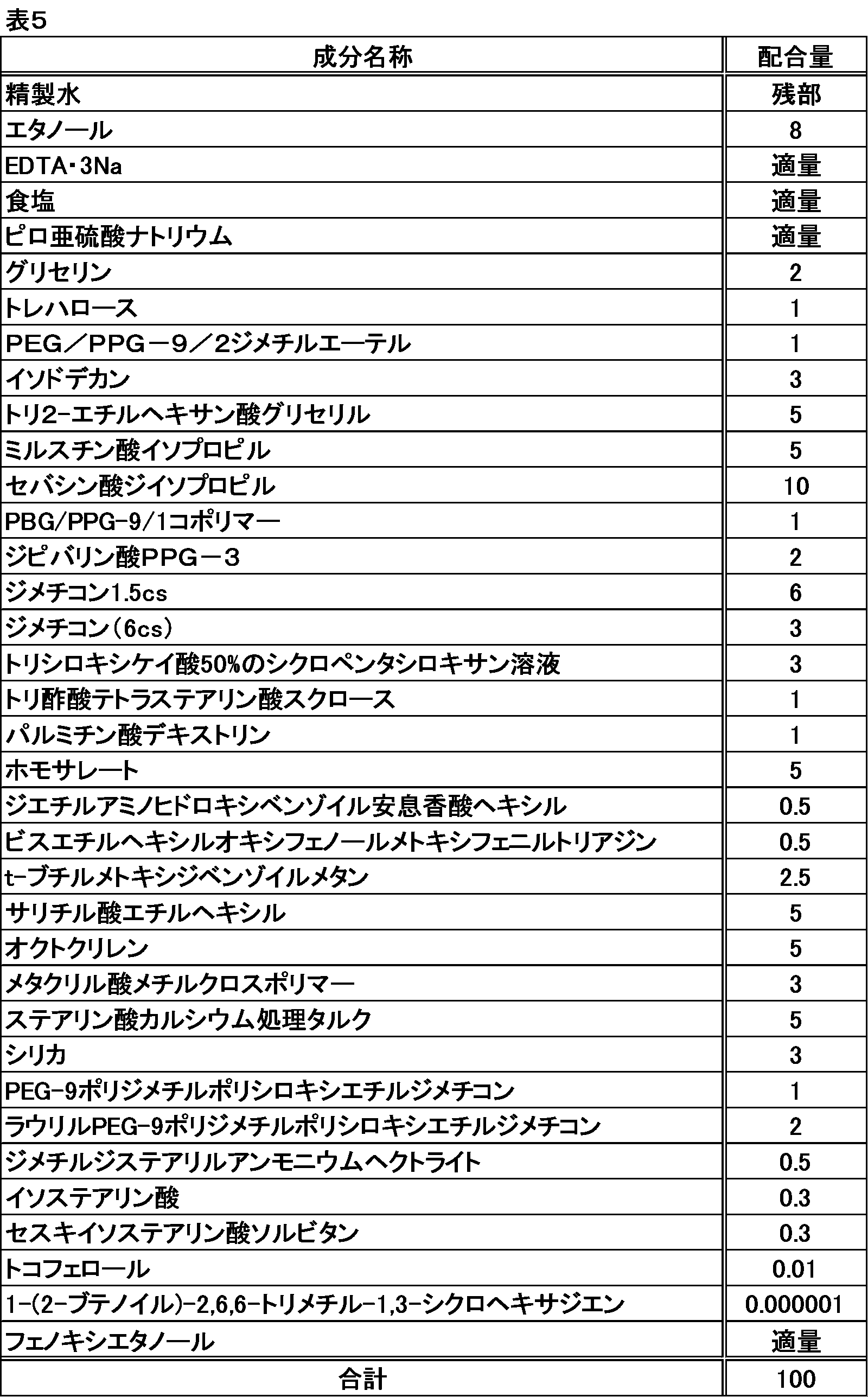
〈処方例2〉

〈処方例3〉

〈処方例4〉
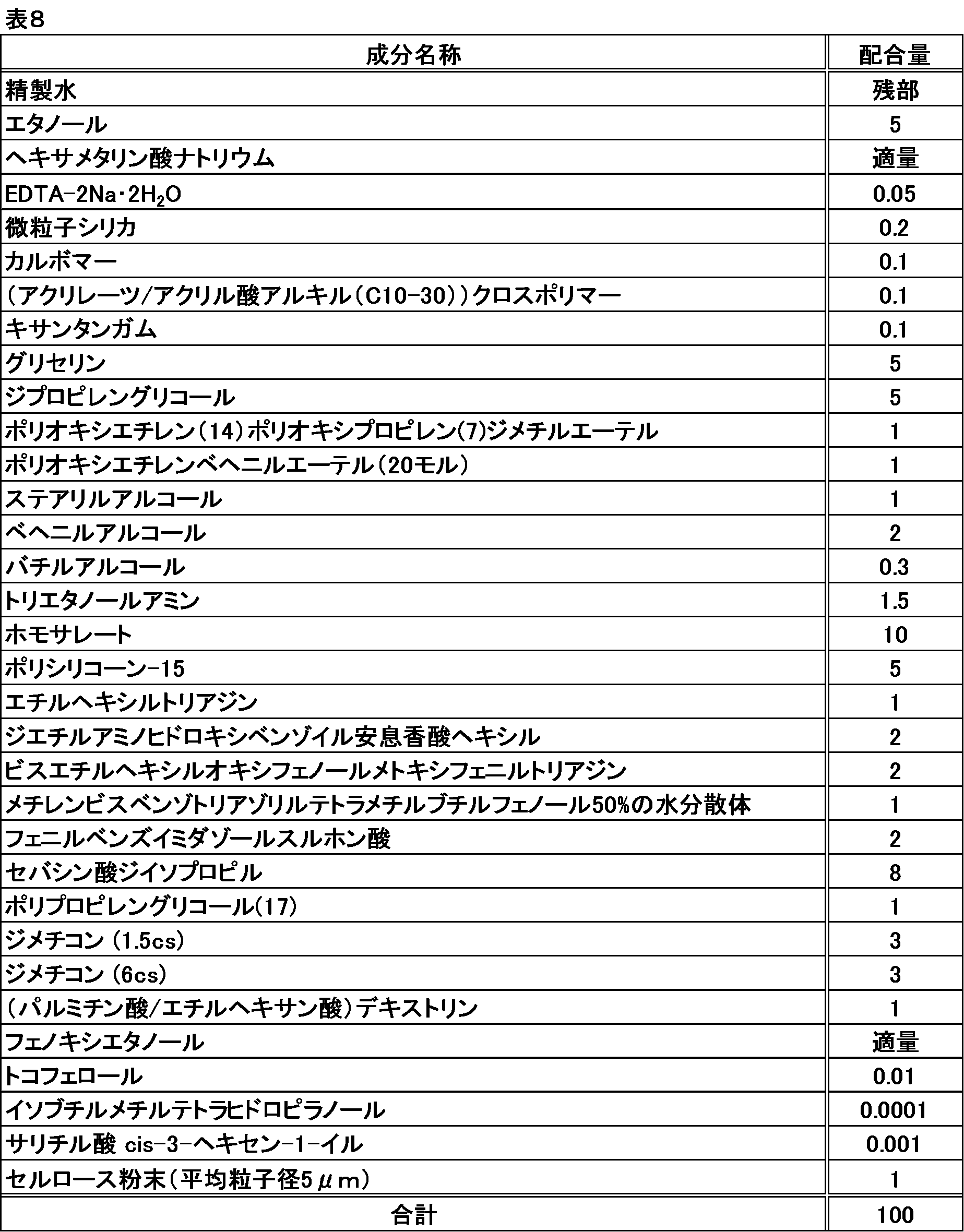
Claims (9)
- サリチル酸誘導体紫外線吸収剤、常温で固体の紫外線吸収剤、及び香料を含み、
前記香料が、リモネン、2,6-ジメチル-7-オクテン-2-オール、n-オクタナール、サリチル酸cis-3-ヘキセン-1-イル、4-メチル-3-デセン-5-オール、酢酸ヘキシル、2-フェニルエチルアルコール、リナロール、酢酸シトロネリル、シトロネロール、β-イオノン、酢酸ベンジル、α-ヘキシルシンナムアルデヒド、ジヒドロジャスモン酸メチル、ゲラニオール、cis-ジャスモン、ジャスミンラクトン、1-(2-ブテノイル)-2,6,6-トリメチル-1,3-シクロヘキサジエン、メチルイオノン、イソブチルメチルテトラヒドロピラノール、バニリン、2-アセチル-2,3,8,8-テトラメチル-1,2,3,4,5,6,7,8-オクタヒドロナフタレン、2-エチル-4-(2,2,3-トリメチル-3-シクロペンテニル)-2-ブテン-1-オール、及び1,3,4,6,7,8ヘキサヒドロ4,6,6,7,8,8ヘキサメチルシクロペンタγ2ベンゾピランからなる群から選択される少なくとも一種である、
日焼け止め化粧料。 - 前記サリチル酸誘導体紫外線吸収剤が、サリチル酸エチルヘキシル及びホモサレートからなる群から選択される少なくとも一種である、請求項1に記載の化粧料。
- 前記常温で固体の紫外線吸収剤が、ビスエチルヘキシルオキシフェノールメトキシフェニルトリアジン及びジエチルアミノヒドロキシベンゾイル安息香酸ヘキシルからなる群から選択される少なくとも一種である、請求項1又は2に記載の化粧料。
- IOBが0.10以上の紫外線吸収剤をさらに含む、請求項1~3のいずれか一項に記載の化粧料。
- 前記IOBが0.10以上の紫外線吸収剤が、オクトクリレン及びオクチルメトキシシンナメートからなる群から選択される少なくとも一種である、請求項4に記載の化粧料。
- 前記香料が、リモネン、サリチル酸cis-3-ヘキセン-1-イル、酢酸ヘキシル、2-フェニルエチルアルコール、リナロール、シトロネロール、β-イオノン、酢酸ベンジル、ジヒドロジャスモン酸メチル、ゲラニオール、1-(2-ブテノイル)-2,6,6-トリメチル-1,3-シクロヘキサジエン、メチルイオノン、及びイソブチルメチルテトラヒドロピラノールからなる群から選択される少なくとも一種である、請求項1~5のいずれか一項に記載の化粧料。
- 増粘剤をさらに含む、請求項1~6のいずれか一項に記載の化粧料。
- 前記香料の含有量が、サリチル酸誘導体紫外線吸収剤及び常温で固体の紫外線吸収剤の合計量100質量部当たり、1.0×10⁻⁶質量部以上である、請求項1~7のいずれか一項に記載の化粧料。
- 紫外線散乱剤の含有量が、1.0質量%以下である、請求項1~8のいずれか一項に記載の化粧料。
Priority Applications (1)
| Application Number | Priority Date | Filing Date | Title |
|---|---|---|---|
| JP2023557945A JPWO2023079977A1 (ja) | 2021-11-05 | 2022-10-21 |
Applications Claiming Priority (2)
| Application Number | Priority Date | Filing Date | Title |
|---|---|---|---|
| JP2021-181225 | 2021-11-05 | ||
| JP2021181225 | 2021-11-05 |
Publications (1)
| Publication Number | Publication Date |
|---|---|
| WO2023079977A1 true WO2023079977A1 (ja) | 2023-05-11 |
Family
ID=86241001
Family Applications (1)
| Application Number | Title | Priority Date | Filing Date |
|---|---|---|---|
| PCT/JP2022/039213 Ceased WO2023079977A1 (ja) | 2021-11-05 | 2022-10-21 | 日焼け止め化粧料 |
Country Status (2)
| Country | Link |
|---|---|
| JP (1) | JPWO2023079977A1 (ja) |
| WO (1) | WO2023079977A1 (ja) |
Cited By (1)
| Publication number | Priority date | Publication date | Assignee | Title |
|---|---|---|---|---|
| WO2025223885A1 (de) * | 2024-04-23 | 2025-10-30 | Beiersdorf Ag | Neue kosmetische zubereitung mit vanillin und ethylhexyloxyphenol methoxyphenyl triazine |
Citations (2)
| Publication number | Priority date | Publication date | Assignee | Title |
|---|---|---|---|---|
| US20150265510A1 (en) * | 2014-03-18 | 2015-09-24 | Symrise Ag | Coated titanium dioxide to reduce the whitening effect on skin |
| JP2020121929A (ja) * | 2019-01-29 | 2020-08-13 | 株式会社 資生堂 | 皮膚外用剤および紫外線防御効果の向上方法 |
-
2022
- 2022-10-21 JP JP2023557945A patent/JPWO2023079977A1/ja active Pending
- 2022-10-21 WO PCT/JP2022/039213 patent/WO2023079977A1/ja not_active Ceased
Patent Citations (2)
| Publication number | Priority date | Publication date | Assignee | Title |
|---|---|---|---|---|
| US20150265510A1 (en) * | 2014-03-18 | 2015-09-24 | Symrise Ag | Coated titanium dioxide to reduce the whitening effect on skin |
| JP2020121929A (ja) * | 2019-01-29 | 2020-08-13 | 株式会社 資生堂 | 皮膚外用剤および紫外線防御効果の向上方法 |
Non-Patent Citations (5)
| Title |
|---|
| DATABASE GNPD MINTEL; August 2014 (2014-08-01), TESCO: "Sun Lotion SPF 50+", XP093063963, Database accession no. 2347466 * |
| DATABASE GNPD MINTEL; December 2015 (2015-12-01), BEIERSDORF: "Invisible Protection Transparent Spray SPF 30 PA++", XP093063965, Database accession no. 3620407 * |
| DATABASE GNPD MINTEL; December 2019 (2019-12-01), JOHNSON & JOHNSON: "Shine Control Sunscreen SPF 60", XP093063966, Database accession no. 7125365 * |
| DATABASE GNPD MINTEL; May 2017 (2017-05-01), ORION PHARMA: "Sunscreen Cream SPF 50+ for Children", XP093063967, Database accession no. 4789247 * |
| DATABASE GNPD MINTEL; May 2021 (2021-05-01), SHISEIDO: "Clear Suncare Stick SPF 50+", XP093063962, Database accession no. 8706841 * |
Cited By (1)
| Publication number | Priority date | Publication date | Assignee | Title |
|---|---|---|---|---|
| WO2025223885A1 (de) * | 2024-04-23 | 2025-10-30 | Beiersdorf Ag | Neue kosmetische zubereitung mit vanillin und ethylhexyloxyphenol methoxyphenyl triazine |
Also Published As
| Publication number | Publication date |
|---|---|
| JPWO2023079977A1 (ja) | 2023-05-11 |
Similar Documents
| Publication | Publication Date | Title |
|---|---|---|
| JP7512056B2 (ja) | 水中油型エマルジョン、紫外線遮蔽用組成物、及び化粧料 | |
| JP2023089269A (ja) | 油中水型乳化化粧料 | |
| JP6328908B2 (ja) | 水中油型乳化組成物 | |
| CN110022841B (zh) | 水包油型紫外线防御化妆品 | |
| JP2017122075A (ja) | 水中油型皮膚化粧料 | |
| JPWO2016002751A1 (ja) | 水中油型乳化組成物 | |
| JP7017971B2 (ja) | 水中油型乳化化粧料 | |
| JP2024083481A (ja) | アクリル系ポリマー含有ピッカリングエマルション | |
| JP5913411B2 (ja) | 水中油型乳化化粧料 | |
| WO2021193854A1 (ja) | 水中油型乳化化粧料 | |
| JP6110634B2 (ja) | 水中油型乳化化粧料 | |
| JP7347993B2 (ja) | 日焼け止め用組成物 | |
| JP6831737B2 (ja) | 水中油型化粧料 | |
| WO2021221149A1 (ja) | 水中油型乳化組成物 | |
| WO2023079979A1 (ja) | 日焼け止め化粧料 | |
| WO2023079982A1 (ja) | 日焼け止め化粧料 | |
| JP7726452B2 (ja) | 油中水型組成物 | |
| JP7604221B2 (ja) | 水中油型乳化化粧料 | |
| JP2021107372A (ja) | 油性組成物 | |
| WO2022224672A1 (ja) | 水中油型乳化化粧料 | |
| JP7356240B2 (ja) | 水中油型乳化組成物 | |
| JP7348767B2 (ja) | 水中油型乳化化粧料及びその製造方法 | |
| WO2024177088A1 (ja) | 水中油型乳化化粧料 | |
| WO2024024545A1 (ja) | 組成物 | |
| JP6918543B2 (ja) | 皮膚外用剤または化粧料用組成物 |
Legal Events
| Date | Code | Title | Description |
|---|---|---|---|
| 121 | Ep: the epo has been informed by wipo that ep was designated in this application |
Ref document number: 22889797 Country of ref document: EP Kind code of ref document: A1 |
|
| ENP | Entry into the national phase |
Ref document number: 2023557945 Country of ref document: JP Kind code of ref document: A |
|
| NENP | Non-entry into the national phase |
Ref country code: DE |
|
| 122 | Ep: pct application non-entry in european phase |
Ref document number: 22889797 Country of ref document: EP Kind code of ref document: A1 |