WO2023067711A1 - バッテリ着脱構造 - Google Patents
バッテリ着脱構造 Download PDFInfo
- Publication number
- WO2023067711A1 WO2023067711A1 PCT/JP2021/038672 JP2021038672W WO2023067711A1 WO 2023067711 A1 WO2023067711 A1 WO 2023067711A1 JP 2021038672 W JP2021038672 W JP 2021038672W WO 2023067711 A1 WO2023067711 A1 WO 2023067711A1
- Authority
- WO
- WIPO (PCT)
- Prior art keywords
- battery
- swing shaft
- plug holder
- case
- side terminal
- Prior art date
- Legal status (The legal status is an assumption and is not a legal conclusion. Google has not performed a legal analysis and makes no representation as to the accuracy of the status listed.)
- Ceased
Links
Images










Classifications
-
- B—PERFORMING OPERATIONS; TRANSPORTING
- B60—VEHICLES IN GENERAL
- B60K—ARRANGEMENT OR MOUNTING OF PROPULSION UNITS OR OF TRANSMISSIONS IN VEHICLES; ARRANGEMENT OR MOUNTING OF PLURAL DIVERSE PRIME-MOVERS IN VEHICLES; AUXILIARY DRIVES FOR VEHICLES; INSTRUMENTATION OR DASHBOARDS FOR VEHICLES; ARRANGEMENTS IN CONNECTION WITH COOLING, AIR INTAKE, GAS EXHAUST OR FUEL SUPPLY OF PROPULSION UNITS IN VEHICLES
- B60K1/00—Arrangement or mounting of electrical propulsion units
- B60K1/04—Arrangement or mounting of electrical propulsion units of the electric storage means for propulsion
-
- B—PERFORMING OPERATIONS; TRANSPORTING
- B62—LAND VEHICLES FOR TRAVELLING OTHERWISE THAN ON RAILS
- B62J—CYCLE SADDLES OR SEATS; AUXILIARY DEVICES OR ACCESSORIES SPECIALLY ADAPTED TO CYCLES AND NOT OTHERWISE PROVIDED FOR, e.g. ARTICLE CARRIERS OR CYCLE PROTECTORS
- B62J43/00—Arrangements of batteries
- B62J43/10—Arrangements of batteries for propulsion
- B62J43/16—Arrangements of batteries for propulsion on motorcycles or the like
-
- B—PERFORMING OPERATIONS; TRANSPORTING
- B62—LAND VEHICLES FOR TRAVELLING OTHERWISE THAN ON RAILS
- B62J—CYCLE SADDLES OR SEATS; AUXILIARY DEVICES OR ACCESSORIES SPECIALLY ADAPTED TO CYCLES AND NOT OTHERWISE PROVIDED FOR, e.g. ARTICLE CARRIERS OR CYCLE PROTECTORS
- B62J43/00—Arrangements of batteries
- B62J43/20—Arrangements of batteries characterised by the mounting
-
- Y—GENERAL TAGGING OF NEW TECHNOLOGICAL DEVELOPMENTS; GENERAL TAGGING OF CROSS-SECTIONAL TECHNOLOGIES SPANNING OVER SEVERAL SECTIONS OF THE IPC; TECHNICAL SUBJECTS COVERED BY FORMER USPC CROSS-REFERENCE ART COLLECTIONS [XRACs] AND DIGESTS
- Y02—TECHNOLOGIES OR APPLICATIONS FOR MITIGATION OR ADAPTATION AGAINST CLIMATE CHANGE
- Y02E—REDUCTION OF GREENHOUSE GAS [GHG] EMISSIONS, RELATED TO ENERGY GENERATION, TRANSMISSION OR DISTRIBUTION
- Y02E60/00—Enabling technologies; Technologies with a potential or indirect contribution to GHG emissions mitigation
- Y02E60/10—Energy storage using batteries
Definitions
- the present invention relates to a battery attachment/detachment structure, and more particularly to a battery attachment/detachment structure for allowing a portable battery to be attached/detached to/from a storage case provided in a vehicle or the like.
- Patent Document 1 in a battery attachment/detachment structure applied to an electric motorcycle, a link mechanism is provided in front and rear of a storage case, and a battery-side terminal and a case-side terminal are connected by pushing down an operation lever connected to the link mechanism.
- a configuration is disclosed in which the connection between the battery-side terminal and the case-side terminal is released by pulling up the operation lever.
- An object of the present invention is to solve the above-mentioned problems of the prior art, and to provide a battery attachment/detachment structure capable of maintaining good movement of the link mechanism and facilitating attachment/detachment of the battery.
- the present invention provides a battery (B), a battery case (33) in which the battery (B) is housed, and a battery side terminal (49) provided on the bottom surface of the battery (B). and a case-side terminal (55) connected to the battery-side terminal (49), in which the battery (B) is housed in the battery case (33),
- the link mechanism (L) includes a link arm (72) swingably supported by a second swing shaft (73) functioning as a fulcrum of the lever;
- the lower end of (36) is pivotally supported by a first swing shaft (36g) that functions as a leverage point on one end side of the link arm (72), and the plug holder (70) is attached to the link arm (72).
- the other end of (72) is supported by a third swing shaft (71) functioning as a point of leverage, and a hole through which the third swing shaft (71) is inserted into the plug holder (70).
- a portion (100) is formed, and the plug holder (70) moves the third swing shaft (71) along the inner circumference of the hole (100) as the link arm (72) swings.
- the hole portion (100) is configured to move in the pressing direction by pressing the surface, and the plug holder (70) moves up and down even when the third swing shaft (71) moves.
- the first feature is that it constitutes an idle running section that does not move and has a first shape portion (101) shaped along the arc locus (R) of the third swing shaft (71).
- the third swing shaft (71) moves between an upper end position (102) and a lower end position (103) along the arc locus (R), and the hole (100) moves along the arc locus (R). an intermediate contact portion (105) against which the third swing shaft (71) abuts while the swing shaft (71) moves from the upper end position (102) to the lower end position (103);
- the second feature is that the plug holder (70) moves in the pressing direction when the swing shaft (71) presses the intermediate contact portion (105) in the pressing direction.
- the intermediate contact portion (105) is positioned above the second swing shaft (73) when the third swing shaft (71) is positioned at the upper end position (102).
- the intermediate contact portion (105) is positioned above the second swing shaft (73) when the third swing shaft (71) is positioned at the upper end position (102).
- a fourth characteristic is that the second shape portion (104) is provided so that the angle ( ⁇ ) formed becomes smaller toward the upper end position (102).
- a fifth feature is that the first shape portion (101) has a curved shape along the arc locus (R).
- a sixth feature is that a preload is applied to the plug holder (70) until it reaches the upper end position (102).
- a seventh feature is that a plurality of the batteries (B) are provided.
- An eighth characteristic is that the battery attachment/detachment structure is applied to a vehicle.
- a ninth feature is that the battery attachment/detachment structure is applied to an electric vehicle.
- a battery (B) a battery case (33) in which the battery (B) is housed, a battery side terminal (49) provided on the lower surface of the battery (B), and the battery
- a battery attachment/detachment structure including a case-side terminal (55) connected to a side terminal (49)
- the battery (B) is installed in the battery case (33) while the battery (B) is stored in the battery case (33).
- the link mechanism (L) includes a link arm (72) swingably supported by a second swing shaft (73) functioning as a fulcrum of the lever, and the operating lever (36)
- the lower end portion is pivotally supported by a first swing shaft (36g) that functions as a leverage point on one end side of the link arm (72), and the plug holder (70) is attached to the link arm (72).
- the hole (100) is an idling section where the plug holder (70) does not move up and down even when the third swing shaft (71) moves. and includes the first shape portion (101) having a shape along the arc locus (R) of the third swing shaft (71), so that the sliding motion around the third swing shaft becomes smooth.
- the configuration of the present application can efficiently convert circular motion (link portion) into linear motion (plug holder), so that the load on the case-side terminal and the battery-side terminal and the operation load of the operation lever can be reduced. .
- said third swing axis (71) moves between an upper end position (102) and a lower end position (103) along said arc locus (R), and moves said hole (100).
- ) is an intermediate contact portion (105) with which the third swing shaft (71) abuts while the third swing shaft (71) moves from the upper end position (102) to the lower end position (103).
- the plug holder (70) moves in the pressing direction. Abutting the driving shaft on the intermediate abutting portion enables efficient transmission of the downward load to the plug holder. As a result, the plug holder can be smoothly pushed down to disconnect the case-side contacts and the battery-side contacts.
- the intermediate contact portion (105) is more inclined than the second swing shaft (73) when the third swing shaft (71) is positioned at the upper end position (102). Since it is positioned upward, the plug holder can be appropriately pushed down by providing the intermediate contact portion at a position where the downward load component can be used more effectively.
- the hole (100) is connected to the intermediate contact part (105), and the tangential line (S) of the hole (100) and the moving direction of the plug holder (70) are aligned. Since the angle ( ⁇ ) formed with the axis (O) is provided with the second shape portion (104) that decreases toward the upper end position (102), the provision of the second shape portion having a curved shape allows the plug holder to It is possible to efficiently transmit the load when pushing up. Also, the upward load component can be effectively used to smoothly push up the plug holder to the highest position.
- the first shape portion (101) has a curved shape along the arc locus (R), so that the third swing shaft can smoothly slide upward. becomes possible.
- the third swing shaft (71) moves upward, the third swing shaft (71) is rotated after the connection between the battery side terminal (49) and the case side terminal (55) is completed. Since the preload is applied to the plug holder (70) until the rocking shaft (71) reaches the upper end position (102), the preload is applied to the plug holder so that the large step can be overcome. Even if the battery moves upward in the vehicle body, the case-side terminals can follow the movement of the battery to maintain electrical connection. Also, by setting the preload to be applied at a point where a large upward load can be applied, it is possible to apply the preload appropriately.
- the seventh feature since a plurality of batteries (B) are provided, it is possible to attach and detach a plurality of batteries at the same time.
- the battery attachment/detachment structure is applied to a vehicle, so it is possible to smoothly attach and detach the battery applied to the vehicle.
- the battery attachment/detachment structure is applied to an electric vehicle, so it is possible to smoothly attach and detach a large battery that is applied to an electric vehicle.
- FIG. 1 is a left side view of an electric motorcycle according to an embodiment of the present invention
- FIG. It is a perspective view of the electric two-wheeled vehicle as seen from the right rear.
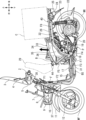
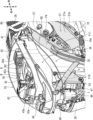
- Fig. 2 is a left side view of the electric motorcycle with main exterior parts removed; 4 is an enlarged perspective view showing a peripheral structure of the battery case;
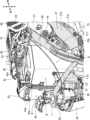
- FIG. FIG. 5 is a structural explanatory view in which the battery case is removed from the state of FIG. 4;
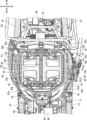
- Fig. 2 is a partially enlarged plan view of the electric two-wheeled vehicle with exterior components removed;
- FIG. 3 is a perspective view of the battery case with the battery removed; It is a perspective view of an operating lever.
- FIG. 1 is a left side view of an electric motorcycle according to an embodiment of the present invention
- FIG. It is a perspective view of the electric two-wheeled vehicle as seen from the right rear.
- Fig. 2 is a left side view of the electric motorcycle with main exterior parts removed
- 4 is an enlarged perspective view showing
- FIG. 4 is a cross-sectional perspective view showing a state in which the battery case is cut in the front-rear direction; It is a perspective view which shows the structure of a link mechanism.
- FIG. 4 is a perspective view of a battery case to which a link mechanism is attached;
- FIG. 4 is a front view showing the structure of the link mechanism (with the operating lever pulled up);
- FIG. 4 is a front view showing the structure of the link mechanism (with the operating lever pushed down to the lowest position);
- It is a perspective view of a case-side terminal.
- FIG. 4 is a structural explanatory diagram of the preload mechanism (state in which the operating lever is pushed down to some extent);
- FIG. 4 is a structural explanatory diagram of the preload mechanism (state in which the operating lever is pushed down to the lowest position);
- FIG. 11 is an explanatory diagram showing actions of a link arm and a plug holder when pushing down an operation lever;
- FIG. 10 is an explanatory diagram showing actions of the link arm and the plug holder when pulling up the operating lever;
- FIG. 10 is an explanatory diagram when the operating lever is at the highest position; It is explanatory drawing at the time of switching from a link idling section to a terminal connection section.
- FIG. 5 is an explanatory diagram when switching from a terminal connection section to a preload addition section;
- FIG. 11 is an explanatory diagram when a preload addition section ends;
- FIG. 10 is an explanatory diagram when the operating lever is at the lowest position;
- FIG. 10 is an explanatory diagram when switching from a preload release section to a terminal connection release section;
- FIG. 10 is an explanatory diagram when switching from a terminal disconnection section to a plug self-weight drop section;
- FIG. 10 is an explanatory diagram when a plug self-weight drop section ends;
- FIG. 1 is a left side view of an electric motorcycle 1 according to one embodiment of the present invention.
- FIG. 2 is a perspective view of the electric motorcycle 1 as seen from the rear right.
- the electric two-wheeled vehicle 1 is a so-called scooter-type straddle-type electric vehicle in which a low floor 17 is provided between the steering handle 2 and the seat 29 for the rider to put his/her feet on.
- a pair of left and right front forks 12 that rotatably support the front wheels WF can be swung by a steering handle 2 extending in the vehicle width direction.
- a steering wheel cover 5 covering the front and rear of the steering wheel 2 has a meter device 39 embedded therein, and also has a windbreak screen 3 and a pair of left and right rearview mirrors 4 attached thereto.
- Below the handle cover 5, a front cover 6 on the front side of the vehicle body and a floor panel 13 on the rear side of the front cover 6 facing the legs of the occupant are arranged.
- a front carrier 7 is supported in front of the front cover 6, and a headlight 9 supported by a light stay 8 and a pair of left and right front flasher lamps 10 are arranged below the front carrier 7.
- a front fender 11 that covers the top of the front wheel WF is supported by left and right front forks 12 .
- a brake pedal 15 that activates the brake device for the rear wheels WR and a footrest 16 that enhances the operability of the brake pedal 15 are arranged.
- a pair of left and right undercovers 14 that cover the low floor 17 from below are connected to the left and right ends of the low floor 17 .
- an under-seat cover 30 having a convex curved shape toward the front side of the vehicle body is provided.
- An upper floor cover 28 that continues to the upper portion of the low floor 17 is connected to the lower portion of the under-seat cover 30 .
- a side stand 19 is arranged behind the undercover 14 on the left side in the vehicle width direction.
- a pair of left and right rear covers 27 are provided behind the upper floor cover 28 , and a rear carrier 40 surrounded by a grip pipe 26 is provided above the rear covers 27 .
- a tail light device 25 and a pair of left and right rear flasher lamps 24 are arranged behind the rear cover 27 .
- a swing unit type power unit P that rotatably supports the rear wheel WR is arranged behind the undercover 14 .
- a power unit P containing a motor for driving the rear wheel WR is attached via a link lever 18 to the vehicle body frame so as to be able to swing.
- a rear cushion 23 suspends the rear portion of the power unit P from the vehicle body frame.
- a rear fender 22 is attached to the upper portion of the power unit P to cover the upper rear portion of the rear wheel WR, and a center stand 20 is attached to the lower portion of the power unit P.
- a cover member 21 is arranged between the seat under cover 30 and the rear fender 22 to receive the running wind introduced from the slit 30a of the floor upper cover 28 and the running wind flowing inside the undercover 14.
- FIG. 3 is a left side view of the electric motorcycle 1 with main exterior parts removed.
- a vehicle body frame F (hatched portion in the drawing) of the electric motorcycle 1 includes a main frame F2 extending downward from a head pipe F1 at the center in the vehicle width direction, and a pair of left and right frames connected to the lower ends of the main frames F2 and curved rearward.
- a cross pipe F5 that connects the left and right rising frames F4 to each other is connected to the front portion of the rising frame F4.
- a steering stem 38 is rotatably supported on the head pipe F1.
- the steering handlebar 2 is fixed to the upper end of the steering stem 38, and the bottom bridge 37 that supports the upper end of the front fork 12 is fixed to one lower end.
- a battery case 33 is arranged to house two portable batteries B for supplying electric power to the motor, arranged side by side in the vehicle width direction.
- the battery case 33 is composed of a vertically long lower case 35 that matches the shape of the battery B, and an upper case 34 that is joined to the upper part of the lower case 35 and forms an opening that matches the shape of the bottom of the seat 29 .
- the seat 29 is rotatably supported by a hinge 44 positioned at the upper front end of the battery case 33 and functions as an opening/closing lid for the battery case 33 .
- the seat 29 in the open state is indicated by a chain double-dashed line.
- the battery case 33 is housed behind the cross pipe F5 between a pair of left and right rising frames F4.
- the underseat cover 30 (see FIGS. 1 and 2) extends from the front of the cross pipe F5 to the sides of the left and right rising frames F4 so as to cover the front and sides of the battery case 33 .
- a storage case 31 is provided below the low floor 17, for storing electrical components such as a low-voltage sub-battery BS for supplying power to auxiliary devices such as the headlight 9 and fuses.
- a connection pipe F7 is provided under the underframe F3 to connect the left and right underframes F3 to increase rigidity and protect the storage case 31 .
- a cover member 21 (see FIGS. 1 and 2) that receives the running wind from the front of the vehicle body in front of the rear fender 22 is arranged on the rear surface side of the battery case 33, and is located near the upper rear surface side of the battery case 33.
- a PCU (power control unit) 32 for controlling power supply to the motor is arranged at a position covered by the member 21 .
- the battery B is a substantially rectangular parallelepiped that is elongated in the vertical direction, and is housed in the battery case 33 in a state of being slightly slanted backwards with respect to the vertical direction. This reduces the height of the battery case 33 and lowers the center of gravity, thereby facilitating the attachment and detachment of the battery B. As shown in FIG. In addition, since the battery B is tilted, the extraction direction (the arrow in the figure) when removing the battery B from the battery case 33 is also tilted slightly rearward. The range is such that the battery B does not interfere with the load C even in this state.
- FIG. 4 is an enlarged perspective view showing the peripheral structure of the battery case 33.
- FIG. FIG. 4 shows a state in which the seat 29 and the under-seat cover 30 are removed, and the left half of the upper floor cover 28 is removed.
- FIG. 5 is a structural explanatory diagram in which the battery case 33 is removed from the state shown in FIG.
- an operation lever 36 is provided that is manually held by the operator and moved up and down.
- the operation lever 36 is pushed downward to connect the battery-side terminal and the case-side terminal, the pressing holder 42 pivotally supported by the swing shaft 42a is oscillated with an urging force. It abuts on the upper surface, thereby suppressing the vertical movement of the battery B even when the battery B runs over a large step while driving.
- a locking member 43 is arranged in front of the operating lever 36 to hold the operating lever 36 in a state of being pushed downward.
- the lock member 43 is rotatably supported by the upper case 34 by a swing shaft 43a, and is switched to the unlocked state by tilting forward from the illustrated upright state.
- the upright wall portion 34a forming the upper edge of the battery case 33 is formed so as to descend forward along the shape of the bottom surface of the seat 29. As shown in FIG. As a result, when the seat 29 is opened, access to the lock member 43 and the operation lever 36 located near the front is facilitated, and the operation of extracting and inserting the battery B is also facilitated.
- the battery case 33 is supported so as to be sandwiched between the left and right rising frames F4.
- the rising frame F4 is provided with a pair of left and right tandem step holders F11, and at the lower front position thereof, there is a cross pipe that curves upward into a substantially U shape and connects the left and right rising frames F4.
- F5 is provided.
- a pair of front and rear link mechanisms L for converting the vertical movement of the operating lever 36 into the vertical movement of the case-side terminal are disposed in front and rear of the lower case 35 of the battery case 33.
- a key cylinder 45 for operating a seat catch mechanism 48 provided at the upper rear end of the battery case 33 is provided below the hinge 44 and covered by the underseat cover 30 .
- the upper side of the seat catch mechanism 48 is covered with the rear cover 41 , and a cable 60 extending from the key cylinder 45 is connected to the left side of the seat catch mechanism 48 in the vehicle width direction.
- a contactor 46 for turning on/off power supply to electrical components is arranged below the key cylinder 45.
- a pair of left and right plate-like support stays F10 that support the front side of the battery case 33 below the link mechanism L are provided on the lower surface of the cross pipe F5 made of a steel pipe. The lateral sides of the electrical components located below and behind the cross pipe F5 are protected by the support stays F10.
- a front end portion of the cover member 21 is arranged behind the tandem step holder F11.
- the cover member 21 is provided with a wide portion 21a that covers from the side of the battery case 33 to the rear of the PCU 32, and a narrow portion 21b that is connected to the lower portion of the wide portion 21a and formed narrower than the wide portion 21a. be done.
- FIG. 6 is a partially enlarged plan view of the electric motorcycle 1 with exterior parts removed.
- the two batteries B are arranged side by side on the left and right, and an operation lever 36 having a grip portion extending in the front-rear direction is arranged at the center position between the left and right batteries B in the vehicle width direction.
- a pair of pressure holders 42 for pressing the upper surface of the battery B are provided on the front and rear sides of one battery B.
- the pressing holder 42 has a metal main body portion 42b that is pivotally supported by the swing shaft 42a, and a rubber portion 42c that covers the tip side of the main body portion 42b. Due to the elastic force of the rubber portion 42c, it is possible to stably maintain the stored state of the battery B. As shown in FIG.
- a biasing force on one side is applied to the pressing holder 42 pivotally supported by the swing shaft 42a by a biasing member.
- the pressing holder 42 is configured to press the upper surface of the battery B with an urging force when the operating lever 36 is pushed down, and to stand vertically by being pushed up by the operating lever 36 when the operating lever 36 is raised.
- the battery-side terminal 49 provided on the bottom of the battery B is arranged on the outer side of the battery B in the vehicle width direction.
- the operation lever 36 for vertically moving the case-side terminal 55 positioned below the battery-side terminal 49 can be similarly operated from either the left or right side of the vehicle body, and the battery B replacement work is facilitated.
- the operation lever 36 and the case-side terminal 55 are arranged apart from each other, it is possible to secure a space for providing the link mechanism L that interlocks the operation lever 36 and the case-side terminal 55 .
- the rising frame F4 connected to the underframe F3 that supports the low floor 17 from below has a shape that widens the left-right interval in accordance with the shape of the battery case 33 at the rising portion from the underframe F3.
- the pivot 19b of the side stand 19 supported by the left rising frame F4 in the vehicle width direction is provided at a portion where the rising frame F4 bulges outward in the vehicle width direction.
- a pair of return springs 19 a are provided outside and inside the side stand 19 to bias the side stand 19 to the deployed state and the retracted state.
- FIG. 7 is a perspective view of the battery case 33 with the battery B removed.
- the battery case 33 which is a combination of the upper case 34 and the lower case 35, is formed with a storage portion 50 into which two batteries B arranged close to each other in the vehicle width direction are inserted.
- the battery case 33 has a bottomed box shape with an open upper side to increase rigidity.
- a partition part 54 is provided at the bottom of the storage part 50 to prevent the left and right batteries B from coming into contact with each other.
- the partition portion 54 extends upward along the front and rear inner walls of the storage portion 50 to about half the height of the lower case 35 . According to this partition portion 54, it is possible to stably hold the two batteries B housed in the battery case 33 by preventing the two batteries B from coming into contact with each other on the bottom side.
- a pedestal 44a to which a hinge 44 is attached is provided at the front end of the upper case 34. Between the pedestal 44a and the lock member 43, a deep groove portion 51 is provided in which documents and the like can be stored.
- the deep groove portion 51 is provided by utilizing a space created by tilting the battery B rearward with respect to the vertical direction.
- an operation lever 36 that is manually gripped by an operator and moved up and down is arranged.
- the operation lever 36 is pulled upward, the battery B can be removed from the battery case 33.
- the operation lever 36 is pushed down, the battery side terminal 49 and the case side terminal 55 are electrically connected and the battery B is held in place.
- a pair of front and rear pressing holders 42 for pressing the upper surface of the battery B are provided for each of the left and right storage portions 50 .
- the battery B has a substantially rectangular parallelepiped shape elongated in the vertical direction of the vehicle body. Of the six surfaces that constitute the battery B, the surface directed outward in the vehicle width direction has a curved shape convex outward in the vehicle width direction when viewed from the top of the vehicle body. is making
- FIG. 8 is a perspective view of the operating lever 36.
- the operation lever 36 made of synthetic resin or the like has a symmetrical shape in the front and rear and in the left and right.
- a gripping portion 36a for vertically moving the operating lever 36 and a connecting rod 36e extending downward for operating the link mechanism L are connected by a connecting block 36b having a hollow structure.
- the lock member 43 restricts the upward movement of the operating lever 36 by engaging with the upper surface of the front connecting block 36b.
- a rectangular engagement plate 36d is provided at substantially the center of the connecting rod 36e in the vertical direction for contacting the lower surface of the pressing holder 42 and erecting it in the vertical direction when the operating lever 36 is pulled up.
- a metal stay 36f that supports a pin (first swing shaft) 36g connected to the link mechanism L is fixed to the lower end of the connecting rod 36e by insert molding.
- a pair of front and rear separator portions 36c that are inserted between the left and right batteries B when the operation lever 36 is pushed down are provided inside the connecting block 36b.
- the operation lever 36 to also function as a partition plate that stably holds the two batteries B in a predetermined position while preventing contact between the two batteries B that are arranged close to each other.
- FIG. 9 is a cross-sectional perspective view showing a state in which the battery case 33 is cut in the front-rear direction.
- 10 is a perspective view showing the configuration of the link mechanism L.
- a connecting rod 36e of the operating lever 36 is guided to the outside of the lower case 35 through an opening provided in the lower case 35, and is connected to a pair of front and rear link mechanisms L disposed on the front and rear sides of the lower case 35, respectively.
- a partition portion 54 continuous from the bottom portion of the storage portion 50 extends to the lower portion of the engaging plate 36d when the operating lever 36 is pushed down to a predetermined position.
- a left terminal cover 52 and a right terminal cover 53 are attached to the lower part of the lower case 35 to accommodate the case-side terminals 55 that move up and down with the operation of the link mechanism L.
- a pair of left and right support pipes 56 that support the battery case 33 from below are disposed between the left terminal cover 52 and the right terminal cover 53 at the lower portion of the lower case 35 .
- the left and right case-side terminals 55 are arranged in alignment with the positions of the battery-side terminals 49 arranged on the outer side in the vehicle width direction. , and is connected to the battery-side terminal 49 .
- the left terminal cover 52 and the right terminal cover 53 forming storage spaces 52a and 53a for the case-side terminals 55 are spaced apart from each other in the vehicle width direction.
- the battery-side terminal 49 and the case-side terminal are arranged apart from each other, and the operation lever 36 is arranged in the center in the vehicle width direction so that it can be similarly operated from either the left or right side of the vehicle body. 36 and the case-side terminal 55 can be secured.
- the space secured between the left terminal cover 52 and the right terminal cover 53 is used to dispose the down regulator 57 .
- the down regulator 57 is arranged below the lower case 35 and between the left and right case-side terminals 55 .
- the layout efficiency can be improved, and the harness connected to the down regulator 57 can be shortened.
- the link mechanisms L are arranged in front and rear pairs on the front and rear surfaces of the battery case 33 . This makes it possible to stably move the case-side terminal 55 up and down.
- the link mechanism L since the link mechanism L is arranged in front of and behind the battery case 33, the dimension in the vehicle width direction around the battery case 33 is reduced, and the link mechanism L is protected even when an external force is applied from the side of the vehicle body. be able to.
- the link mechanism L has a bilaterally symmetrical structure centering on the center in the vehicle width direction. is possible.
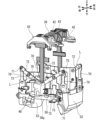
- the link mechanism L is configured to vertically move the plug holder 70 that supports the case-side terminal 55 by means of a link arm 72 that is connected to the lower end of the operating lever 36 .
- the link arm 72 is pivotally supported on the base plate 75 by a second swing shaft 73 functioning as a fulcrum.
- the end portion of the link arm 72 on the inner side in the vehicle width direction is pivotally supported by the operation lever 36 by a first swing shaft 36g that functions as a power point.
- the outer end of the link arm 72 in the vehicle width direction is supported by the plug holder 70 by the third swing shaft 71 functioning as a point of action.
- a support pipe 58 is provided in front of the left terminal cover 52 and the right terminal cover 53 and fixed to a support stay F10 provided on the lower surface of the cross pipe F5.
- FIG. 11 is a perspective view of the battery case 33 to which the link mechanism L is attached.
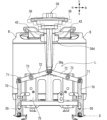
- 12 and 13 are front views showing the structure of the link mechanism L.
- FIG. 12 shows a state in which the operating lever 36 is pulled up
- FIG. 13 shows a state in which the operating lever 36 is pushed down to the lowest position.
- a pair of left and right link arms 72 are swingably supported by a second swing shaft 73 on the upper end of a base plate 75 that supports the link mechanism L.
- a stay 36f at the lower end of the operating lever 36 is pivotally supported by a first swing shaft 36g on one end side of the link arm 72 located on the inner side in the vehicle width direction.
- a plug holder 70 that supports the case-side terminals 55 is supported on the other end of the link arm 72 located on the outer side in the vehicle width direction.
- the plug holder 70 is formed in a substantially U shape so as to surround the side surfaces of the battery B in the longitudinal direction of the vehicle body.
- the link mechanism L that includes the "lever" configuration of the fulcrum, the force point, and the point of action. Specifically, when the operation lever 36 is pushed down with the second swing shaft 73 as a fulcrum, the first swing shaft 36g as a force point, and the third swing shaft 71 as a point of action, the plug holder 70 rises and the operation lever 36 is pushed downward. It is possible to obtain the link mechanism L in which the plug holder 70 descends when pulled up. Further, by connecting the two plug holders 70 to the link mechanism L, it is possible to obtain a structure in which the two plug holders 70 are vertically moved by the single operation lever 36 . Furthermore, using the principle of leverage, the plug holder 70 can be moved up and down with a small force.
- the link arm 72 and the base plate 75 can be made of sheet metal or the like.
- a pressing holder 42 pivotally supported on the battery case 33 is biased in a direction of pressing the upper surface of the battery B by an elastic member.
- the operating lever 36 is pulled upward, the upper end surface of the engaging plate 36d contacts the lower surface of the pressing holder 42, and the operating lever 36 is pulled upward against the urging force of the elastic member, whereby the pressing holder 42 is swung upward to be in a standing state.
- the plug holder 70 connected to the link mechanism L is lowered to the retracted position D, and the case-side terminal 55 is separated from the battery B.
- the operation lever 36 is configured to be swingable about the first swing shaft 36g in a state in which the operation lever 36 is pulled upward to move the plug holder 70 to the retracted position D. As a result, even when the operation lever 36 is arranged between two batteries B arranged close to each other, the operation lever 36 can be swung to prevent interference with the battery B when the battery B is pulled out upward. .
- FIG. 14 is a structural explanatory diagram of the battery-side terminal 49.
- FIG. 15 is a perspective view of the case-side terminal 55.
- the battery-side terminal 49 is embedded in the lower surface 107 of the battery B at a position closer to the outside in the vehicle width direction. Slits 76 into which the seven terminal plates 94 of the case-side terminals 55 are inserted, and positioning pins 93 supported by the support portions 93a outside the terminal plates 94 of the case-side terminals 55 are inserted into the battery-side terminals 49. and an engaging hole 77 are formed.
- a support shaft (see FIGS. 16 and 17 ) that allows the case-side terminal 55 to slide with respect to the plug holder 70 passes through the base plate 91 that supports the terminal plate 94 and the positioning pin 93 .
- a hole 92 is formed.
- a protection plate 94a for protecting the terminal plate 94 is erected on the side of the terminal plate 94, and a harness holder 95 for supporting a harness for supplying electric power is provided on the lower surface of the base plate 91.
- FIG. 16 and 17 are structural explanatory diagrams of a preload mechanism that presses the case-side terminal 55 against the battery-side terminal 49.
- FIG. 16 shows a state in which the operating lever 36 is pushed down to the position where the case-side terminal 55 engages the battery-side terminal 49
- FIG. 17 shows a state in which the operating lever 36 is further pushed down to the lowest position and preloaded.
- the case-side terminal 55 is vertically slidably supported on the plug holder 70 by a cylindrical support shaft 98 passing through a through hole 70 a formed in the plug holder 70 .
- a coil spring 97 wound around the outer peripheral surface of the support shaft 98 is configured to generate elastic force in the direction of separating the plug holder 70 and the case-side terminal 55 .
- the longest distance between the plug holder 70 and the case-side terminals 55 is regulated by a snap ring 98a, while the shortest distance between the plug holder 70 and the case-side terminals 55 is determined by a coil spring 97 disposed on the lower surface of the base plate 91. is regulated by a cup member 96 covering the
- the operation lever 36 when the battery B is accommodated in the battery case 33 and the operation lever 36 is pushed down, the electrical connection between the case-side terminal 55 and the battery-side terminal 49 is established before the operation lever 36 reaches the lowest position.
- the coil spring 97 When it is completed and further pushed down to the lowest position, the coil spring 97 is contracted and a preload is generated.
- the gap T between the cup member 96 and the plug holder 70 is configured to be secured even in a state where preload occurs.
- the case-side terminal 55 is moved to the connection position by disposing the spring 97 that biases the case-side terminal 55 between the case-side terminal 55 and the plug holder 70 . In this state, it is possible to generate a pressing force that presses the case-side terminal 55 against the battery-side terminal 49 . As a result, even when the battery B moves upward in the vehicle body such as when a large step is overcome, the case-side terminal 55 can follow the movement of the battery B to maintain electrical connection.
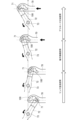
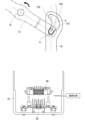
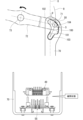
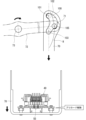
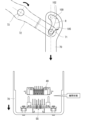
- FIG. 18 is an explanatory diagram showing the actions of the link arm 72 and the plug holder 70 when the operating lever 36 is pushed down.
- the upper end of the plug holder 70 is formed with a curved hole 100 convex in a direction away from the second swing shaft 73, and the third swing shaft 71 inserted through the hole 100 is connected to the link. It is fixed to the other end side of the arm 72 .
- one location on the front side and left side in the vehicle width direction of the battery case 33 will be referred to, but the structure and operation are common to the four locations.
- the link arm 72 starts swinging counterclockwise, but the plug holder 70 does not move from the lowest position during the link free running section.
- the terminal connecting section is entered, and the plug holder 70 moves upward as the link arm 72 swings.
- the battery side terminal 49 and the case side terminal 55 are connected.
- the preload addition section is entered. In the preload application section, the preload is applied until the plug holder 70 moves further upward and reaches the uppermost position.
- the link idle running section is provided when the operation lever 36 is pushed down from the uppermost position, so that the sliding movement around the third swing shaft 71 becomes smooth.
- the link shape can be optimized. Therefore, the configuration of the present application can efficiently convert the circular motion (link portion) into linear motion (plug holder), thereby reducing the load on the case-side terminal 55 and the battery-side terminal 49 and the operation load of the operation lever 36. be able to.
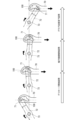
- 19A and 19B are explanatory diagrams showing actions of the link arm 72 and the plug holder 70 when the operating lever 36 is pulled up.
- the link arm 72 starts swinging clockwise.
- the plug holder 70 moves downward by the amount that the preload is released.
- the terminal disconnection section is entered.
- the third swing shaft 71 presses the stepped portion of the hole 100 downward to move the plug holder 70 downward, thereby disconnecting the battery-side terminal 49 and the case-side terminal 55 . be done.
- the link arm 72 further swings clockwise, and the plug holder 70 moves to the lowest position by its own weight in the plug self-weight dropping section.
- the third swing shaft 71 when the operation lever 36 is pulled up from the lowest position, the third swing shaft 71 is provided with a portion where it contacts the inner peripheral surface of the hole portion 100 downward. It becomes possible to efficiently transmit the load to the plug holder 72 . This makes it possible to smoothly push down the plug holder 72 and disconnect the case-side contact 55 and the battery-side contact 49 .
- FIG. 20 is an explanatory diagram when the operating lever 36 is at the highest position.
- 21 is an explanatory diagram when the link free running section is switched to the terminal connection section
- FIG. 22 is an explanatory diagram when the terminal connection section is switched to the preload addition section
- FIG. 23 is the end of the preload addition section. It is an explanatory diagram of the case.
- the third swing shaft 71 fixed to the link arm 72 moves along the arc locus R between the uppermost position 102 and the lowermost position 103 as the link arm 72 swings.
- the hole portion 100 constitutes an idling section in which the plug holder 70 does not move up and down even when the third swing shaft 71 moves, and the first shape portion has a shape along the arc locus R of the third swing shaft 71. 101.
- the first shape portion 101 has a curved shape along the arc trajectory R. As shown in FIG. As a result, the sliding motion around the third swing shaft 71 becomes smooth, and it becomes possible to secure an appropriate stroke amount and optimize the link shape. In addition, smooth sliding motion is possible when the third swing shaft 71 moves upward.
- the second shape portion 104 is curved toward the uppermost position 102, and the tangent line S contacting the hole portion 100 at the point of contact SO and the moving direction of the plug holder 70 are aligned. Since the angle ⁇ formed with the axis O decreases toward the upper end position 102, the upward load component can be effectively used to smoothly push up the plug holder 70 to the uppermost position.
- the plug is pulled from the completion of the connection between the battery-side terminal 49 and the case-side terminal 55 until the third swing shaft 71 reaches the upper end position 102 . Since the preload is applied to the holder 70, it is possible to appropriately apply the preload by setting the preload to be applied at a position where a large upward load can be applied.
- FIG. 24 is an explanatory diagram when the operating lever 36 is at the lowest position.
- 25 is an explanatory diagram when switching from the preload release section to the terminal disconnection section
- FIG. 26 is an explanatory diagram when switching from the terminal disconnection section to the plug gravity drop section
- FIG. 27 is an explanatory diagram when the plug gravity drop section is switched. is an explanatory diagram when is completed.
- the operation lever 36 when the operation lever 36 is started to be pulled up from the lowest position, the preload applied to the plug holder 70 is first released, and then the third swing shaft 71 is moved to the intermediate contact portion at the position shown in FIG. 105.
- the provision of the substantially horizontal intermediate contact portion 105 that forms the stepped shape makes it possible to efficiently transmit the downward load to the plug holder 70 .
- the plug holder 70 can be smoothly pushed down to disconnect the case-side contact 55 and the battery-side contact 49 .
- the upper portion of the hole 100 is provided with an idle running section in which the plug holder 70 does not move up and down even when the third swing shaft 71 moves.
- An upper first shape portion 101 having a shape along the arc locus R of 71 is provided.
- the sliding motion around the third swing shaft 71 becomes smooth, and an appropriate stroke amount can be secured and tilting of the plug holder 70 can be suppressed, thereby improving the link shape. Optimization is possible.
- the intermediate contact portion 105 is positioned above the second swing shaft 73 when the third swing shaft 71 is positioned at the upper end position 102 (see FIG. 24). As a result, the plug holder 70 can be appropriately pushed down by providing the intermediate contact portion at a position where the downward load component can be used more effectively.
- the form of the electric motorcycle, the shape and structure of the battery case, the shape and structure of the link mechanism, the shape and number of the batteries, the arrangement of the batteries, etc. are not limited to the above embodiment, and various modifications are possible.
- the battery attachment/detachment structure according to the present invention can be applied to vehicles such as electric motorcycles, three-wheeled vehicles, and four-wheeled vehicles, as well as various electric products such as snowmobiles, boats, drones, and battery stations in which a portable battery can be attached and detached. It is possible.
Landscapes
- Engineering & Computer Science (AREA)
- Mechanical Engineering (AREA)
- Chemical & Material Sciences (AREA)
- Combustion & Propulsion (AREA)
- Transportation (AREA)
- Battery Mounting, Suspending (AREA)
Priority Applications (3)
| Application Number | Priority Date | Filing Date | Title |
|---|---|---|---|
| JP2023554140A JP7690047B2 (ja) | 2021-10-19 | 2021-10-19 | バッテリ着脱構造 |
| CN202180103084.XA CN118103287A (zh) | 2021-10-19 | 2021-10-19 | 蓄电池装卸结构 |
| PCT/JP2021/038672 WO2023067711A1 (ja) | 2021-10-19 | 2021-10-19 | バッテリ着脱構造 |
Applications Claiming Priority (1)
| Application Number | Priority Date | Filing Date | Title |
|---|---|---|---|
| PCT/JP2021/038672 WO2023067711A1 (ja) | 2021-10-19 | 2021-10-19 | バッテリ着脱構造 |
Publications (1)
| Publication Number | Publication Date |
|---|---|
| WO2023067711A1 true WO2023067711A1 (ja) | 2023-04-27 |
Family
ID=86057976
Family Applications (1)
| Application Number | Title | Priority Date | Filing Date |
|---|---|---|---|
| PCT/JP2021/038672 Ceased WO2023067711A1 (ja) | 2021-10-19 | 2021-10-19 | バッテリ着脱構造 |
Country Status (3)
| Country | Link |
|---|---|
| JP (1) | JP7690047B2 (https=) |
| CN (1) | CN118103287A (https=) |
| WO (1) | WO2023067711A1 (https=) |
Cited By (1)
| Publication number | Priority date | Publication date | Assignee | Title |
|---|---|---|---|---|
| CN116374063A (zh) * | 2023-05-10 | 2023-07-04 | 品上佳自行车(深圳)有限公司 | 电动自行车车架结构 |
Citations (3)
| Publication number | Priority date | Publication date | Assignee | Title |
|---|---|---|---|---|
| JP2005288150A (ja) * | 2004-03-12 | 2005-10-20 | Aisin Kiko Co Ltd | 手術用ステープラー及びその操作ユニット |
| WO2019064605A1 (ja) * | 2017-09-29 | 2019-04-04 | 本田技研工業株式会社 | 車両のバッテリ収納装置 |
| JP6825169B1 (ja) * | 2019-07-10 | 2021-02-03 | 本田技研工業株式会社 | 鞍乗型電動車両 |
-
2021
- 2021-10-19 JP JP2023554140A patent/JP7690047B2/ja active Active
- 2021-10-19 CN CN202180103084.XA patent/CN118103287A/zh active Pending
- 2021-10-19 WO PCT/JP2021/038672 patent/WO2023067711A1/ja not_active Ceased
Patent Citations (3)
| Publication number | Priority date | Publication date | Assignee | Title |
|---|---|---|---|---|
| JP2005288150A (ja) * | 2004-03-12 | 2005-10-20 | Aisin Kiko Co Ltd | 手術用ステープラー及びその操作ユニット |
| WO2019064605A1 (ja) * | 2017-09-29 | 2019-04-04 | 本田技研工業株式会社 | 車両のバッテリ収納装置 |
| JP6825169B1 (ja) * | 2019-07-10 | 2021-02-03 | 本田技研工業株式会社 | 鞍乗型電動車両 |
Cited By (2)
| Publication number | Priority date | Publication date | Assignee | Title |
|---|---|---|---|---|
| CN116374063A (zh) * | 2023-05-10 | 2023-07-04 | 品上佳自行车(深圳)有限公司 | 电动自行车车架结构 |
| CN116374063B (zh) * | 2023-05-10 | 2023-10-13 | 品上佳自行车(深圳)有限公司 | 电动自行车车架结构 |
Also Published As
| Publication number | Publication date |
|---|---|
| JPWO2023067711A1 (https=) | 2023-04-27 |
| CN118103287A (zh) | 2024-05-28 |
| JP7690047B2 (ja) | 2025-06-09 |
Similar Documents
| Publication | Publication Date | Title |
|---|---|---|
| JP6830567B1 (ja) | 鞍乗型電動車両のバッテリ着脱構造 | |
| JP6864162B1 (ja) | 鞍乗型電動車両 | |
| CN112770963B (zh) | 骑乘型车辆的电池装卸构造 | |
| JP6825169B1 (ja) | 鞍乗型電動車両 | |
| CN112752708B (zh) | 骑乘型车辆的电池装卸构造 | |
| CN112752707B (zh) | 骑乘型车辆的电池装卸构造 | |
| WO2023067711A1 (ja) | バッテリ着脱構造 | |
| JP7198357B2 (ja) | 鞍乗型電動車両 |
Legal Events
| Date | Code | Title | Description |
|---|---|---|---|
| 121 | Ep: the epo has been informed by wipo that ep was designated in this application |
Ref document number: 21961364 Country of ref document: EP Kind code of ref document: A1 |
|
| WWE | Wipo information: entry into national phase |
Ref document number: 202180103084.X Country of ref document: CN |
|
| ENP | Entry into the national phase |
Ref document number: 2023554140 Country of ref document: JP Kind code of ref document: A |
|
| WWE | Wipo information: entry into national phase |
Ref document number: 202417032455 Country of ref document: IN |
|
| NENP | Non-entry into the national phase |
Ref country code: DE |
|
| 122 | Ep: pct application non-entry in european phase |
Ref document number: 21961364 Country of ref document: EP Kind code of ref document: A1 |